Article

Zircon Trace Element Constraints on the Evolution of the Continental Crust in the Western Domain of the Congo Craton

by
Ngong Divine Njinchuki
1,
Evine Laure Njiosseu Tanko
2,*,
Philomène Nga Essomba Tsoungui
1,
Brice Woguia Kamguia
1,
Marvine Nzepang Tankwa
3,
Landry Soh Tamehe
1,
Donald Hermann Fossi
3,4,* and
Jean Paul Nzenti
1
1
Department of Earth Sciences, University of Yaounde I, Yaounde P.O. Box 0812, Cameroon
2
Department of Earth Sciences, University of Dschang, Yaounde P.O. Box 0067, Cameroon
3
Institute of Geological and Mining Research, Yaounde P.O. Box 4110, Cameroon
4
Department of Geology, Lakehead University, Thunder Bay, ON P7B 5E1, Canada
*
Authors to whom correspondence should be addressed.
Minerals 2026, 16(4), 414; https://doi.org/10.3390/min16040414
Submission received: 12 January 2026 / Revised: 27 March 2026 / Accepted: 11 April 2026 / Published: 16 April 2026

Abstract

This study integrates LA-ICP-MS zircon U–Pb ages and the first zircon trace element data from metasedimentary and metaigneous rocks of the Nyong Complex (NyC) in the NW Congo Craton, southern Cameroon, to constrain its petrogenesis, tectonic setting, and crustal evolution. Chondrite-normalized REE patterns show strong HREE enrichment, depleted LREE–MREE, and pronounced positive Ce and negative Eu anomalies, indicating a magmatic origin for the zircons. Trace element signatures suggest that the zircons derived from continental crustal magmas generated under variable oxidation conditions in a long-lived arc-related tectonic environment. Detrital zircon ages range from Archean to Paleoproterozoic, with five major age peaks at 2885 ± 8 Ma, 2775 ± 6 Ma, 2654 ± 7 Ma, 2469 ± 11 Ma, and 2316 ± 11 Ma. These ages correspond to major magmatic and metamorphic events recognized in both the Congo and São Francisco cratons. The preservation of felsic continental crust between 2.9 and 2.2 Ga in the NyC and the Borborema Province (NE Brazil) likely records a critical transition in Earth’s geodynamic regime, marked by enhanced consumption and recycling of mafic crust during Proterozoic accretion compared to the late Archean. This transition reflects the onset of modern-style plate tectonics, enabling craton stabilization and contributing to the assembly of the Nuna/Columbia supercontinent. The NyC is thus interpreted as part of the Trans-Amazonian belt, analogous to that in NE Brazil, and formed during the collision between the Congo and São Francisco cratons.

1. Introduction

Owing to its exceptional physical and chemical resilience, zircon is a key mineral tool that serves as a reliable archive of the elemental and isotopic characteristics of the host magma; therefore, it has been widely used to study the long-term evolution of the Earth’s continental crust [1,2]. Recent investigations [3,4,5,6] have examined global-scale patterns in zircon evolution, highlighting the importance of zircon data for understanding geodynamic and tectonothermal processes. A major advantage of zircon is its suitability for U-Pb geochronology, owing to its high closure temperature for the U-Pb isotope system and its typically low levels of common Pb contamination. Detrital zircon ages span the Archean to Cenozoic eras, with distinct age clusters correlating with various orogenic cycles and supercontinent formation events [7]. Another reason for its significance lies in zircon’s ability to incorporate numerous geochemically important trace elements, thereby preserving a rich and diverse record of geological processes. For example, zircon trace-element compositions provide insights into changes in regional crustal development, suggesting that 60%–70% of Earth’s crust formed prior to 2500 Ma [8]. Recent studies used zircon geochemistry to constrain episodes of crustal thickening and thinning associated with orogenic events [9]. In addition,. Burnham and Berry [10] demonstrated that I- and S-type granites from the Lachlan Fold Belt in eastern Australia differed in both their zircon P2O5 and REE + Y contents. Several studies have revealed that the distribution of zircons from S-type granites is heterogeneous and appears to correlate with supercontinent cycles, as evidenced by classification diagrams plotting P versus REE + Y for detrital zircon datasets [2,9,11,12]. The Ti concentration in zircon, particularly in equilibrium with rutile (TiO2), has been employed to estimate crystallization temperatures spanning approximately 600–1450 °C [13,14]. Ti-in-zircon thermometry has become a widely used tool for determining zircon crystallization temperatures, partly because of reports of extremely sluggish Ti diffusion perpendicular to the crystallographic c-axis of zircon [14,15,16]. Apart from Ti, zircon trace element ratios (e.g., U/Yb, Nb/Yb, Nb/Hf, Th/U, Hf/Th, and Th/Nb) have been successfully used to investigate the tectonic setting of the host magma [17,18,19]. Despite zircon’s durability, recent studies have shown that its rims can be thinned by up to 50% through mechanical abrasion and chemical weathering during orogenic and sedimentary cycles, potentially erasing critical geochemical information and compromising tectonic reconstructions [20]. Note that zircon trace-element compositions can be influenced by factors such as ferric iron content and the absence of residual garnet in the source [21]. Moreover, exotic zircons in igneous or metaigneous rocks could have formed via fluid-assisted solid-phase transfer within the subduction channel [22]. Thus, using zircon trace-element composition to track long-term changes in Earth’s tectonic processes should be done with caution.
Archean cratons were constructed by episodic juvenile accretion, the recycling of pre-existing crustal materials, and assembly of micro-blocks through multiple collisions [23,24,25]. The Congo Craton (CC) provides a unique geological window into these processes, as it preserves a nearly continuous record from 3600 to 2000 Ma, offering an exceptional opportunity for investigating the co-evolution of the continental crust and underlying mantle [26,27,28,29,30,31,32,33,34,35,36]. Within the CC, the evolution of the continental crust exhibits considerable variability owing to differences in tectonic environments, magmatic activity, and metamorphic histories. The CC in southern Cameroon comprises the Nyong and Ntem Complexes [37,38] with the Nyong Complex (NyC) being the focus of the present study. Previous studies focused on whole-rock major- and trace-element geochemistry, Sm-Nd isotope analysis, and zircon U-Pb-Lu-Hf isotopes to investigate basement rocks in the NyC region during Archean to Paleoproterozoic times [28,29,34,35,36,39,40]. Although zircon trace-element compositions and REE patterns provide powerful tools for investigating Precambrian geodynamic processes, they have not yet been systematically applied to basement rocks of the northwestern CC. Therefore, an integrated U-Pb zircon geochronological and trace element study is essential to constrain the petrogenetic and geodynamic processes governing continental crustal evolution at the western edge of the CC.
In this study, we present the trace-element geochemistry and Ti-in-zircon thermometry of zircons from basement rocks of the NyC in northwestern CC to provide insights into crustal evolution and tectonic setting. These zircons were previously investigated for U-Pb geochronology [34,41,42,43]. Our findings, based on the first zircon trace element dataset from the NyC, demonstrate that distinct zircon age groups are temporally correlated with well-documented regional geological events. The geochemical signatures of these zircons are consistent with formation in a compressional magmatic arc (orogenic) setting. Furthermore, we established that most Neoarchean to Paleoproterozoic rocks within the NyC originated from the recycling of Paleoarchean crust, with limited input from juvenile magmatic sources.

2. Geological Background

2.1. Regional Geology

The CC crops out in southern Cameroon and extends from Central Africa (Central African Republic, Equatorial Guinea, Gabon, and Congo) to eastern Brazil, forming the Congo/São Francisco craton (Figure 1a). Previous studies [36,44] have discussed the geology of the northwestern CC in detail; therefore, only a summary is presented here.
In Gabon, the CC comprises the West and East Gabonian blocks, separated by the Ogooué Complex. The East Gabonian Block comprises the North Gabonian Massif to the North and the Chaillu Massif to the South. It consists of Mesoarchean (3185–2805 Ma) and Neoarchean (2802–2500 Ma) granitoids and gneisses, while the West Gabonian Block includes Neoarchean to early Paleoproterozoic (ca. 2515–2435 Ma) metamorphic terranes. The Ogooué Complex comprises ca. 2200–2120 Ma gneisses and migmatites [30]. The Mesoarchean rocks consist of high-K, calc-alkaline granitoids, and tonalite–trondhjemite–granodiorite (TTG) associated with ca. 2820 Ma charnockites and ca. 2920–2750 Ma greenstone belts characterized by volcanic rocks, banded iron formations (BIFs), conglomerates, and mica schists [30]. These Archean to early Paleoproterozoic metamorphic terranes are unconformably overlain by the middle Paleoproterozoic Francevillian Group and the late Neoproterozoic West Congolian Group [45,46].
In the northwestern Republic of Congo, the Congo Craton is made up of the Ivindo Complex, bounded by the North Gabonian Massif in Gabon and the Ntem Complex in Cameroon [36]. The Ivindo Complex consists of metavolcanosedimentary successions of greenstone belts containing schists, amphibolites, BIFs, and mafic to ultramafic rocks, including gabbros, basalts, amphibolites, diabase/dolerite dykes, peridotites, pyroxenites, komatiites, and chromite-bearing ultramafics [47]. The TTG suite in the northeastern Ivindo Complex was emplaced at 2895 ± 9.4 and 2889 ± 9.2 Ma (LA-ICP-MS U-Pb zircon dates; [33]).
In southwestern Cameroon, the CC consists of the Ntem and Nyong complexes (Figure 1b). The Ntem complex (NtC) is composed of Mesoarchaean greenstone formation associated with charnockites in the central domain, granulitic gneisses to the south, and TTG suite to the north [48,49]. These lithological units are crosscut by potassic granites and doleritic dykes [27,50,51]. The greenstone formation contains mafic to ultramafic metavolcanic rocks, consisting of gneisses and amphibolites, interbedded with BIFs [27,31,52]. Granitoids and charnockites record deformation and granulite facies metamorphism at ~2.9 Ga [27,53,54,55], while granitic injections occurred between 2.7 and 2.9 Ga [50]. LA-ICP-MS U-Pb zircon dating constrained charnockites and TTGs emplacement at ca. 3155–2850 Ma and gabbro intrusions at ca. 2866 ± 6 Ma [31].

2.2. Brief Geological Review of the Nyong Complex

The NyC region of northwestern CC (Figure 1b) is generally interpreted as a reworked Archean segment of the northwestern CC during the Paleoproterozoic orogeny [28,56] or as a Paleoproterozoic suture domain between the CC and the São Francisco Craton [29,40,41]. It is predominantly composed of Archean to Paleoproterozoic basement and supracrustal rocks, including metasedimentary and metaigneous rocks and TTG suites [28,37,57,58,59,60].
Metaigneous suite of the NyC includes lithologies of felsic (granitic gneisses, metaryhyodacites), mafic (epidosites, amphibolites, mafic granulites, eclogites), and ultramafic (serpentinites) compositions [29,34,41,42,43,59,61]. The rocks are occasionally intruded by syenites and dolerites [52,57,59,62]. Eclogites and serpentinites are locally developed [29,40,41]. Mafic rocks, including amphibolites and metarhyodacites, were emplaced at ca. 2850 Ma and 2671 Ma, respectively [59,60], while the crystallization age of the high-grade granitic gneiss protolith from the Mewongo area was constrained at ca. 2837 Ma [34]. Both rocks underwent high-grade regional metamorphism at ca. 2065 Ma during the Eburnean/Trans-Amazonian orogeny [60]. High-grade metamorphism within the NyC occurred at ca. 2.09–2.05 Ga (U/Pb zircon dates; [29,42,60]), coeval with the emplacement of plutonic rocks [28,54]. Paleoproterozoic (ca. 2066 Ma) granodiorites and Neoproterozoic (ca. 590 Ma) alkaline syenites intruded the NyC to the west.
The metasedimentary suite of the NyC consists of metasiliciclastic rocks (schists, garnet mica schists, garnet gneisses, quartzite) and banded iron formations (BIFs). Detrital zircons from metasiliciclastic rocks bracketed the deposition of the NyC between ca. 2.4 and 2.2 Ga [59]. Meanwhile, detrital zircons from the BIFs constrain the maximum depositional age of the NyC to ca. 2466–2422 Ma [28,43,63]. More recently, the deposition of the BIF sequence was further constrained to ca. 2.1–2.0 Ga by SIMS and LA-ICP-MS U-Pb zircon dating [35,36].

2.2.1. Whole-Rock Geochemistry

The provenance, geochemical affinity, and tectonic setting of the metasedimentary and metaigneous rocks from the NyC have been constrained in previous studies using whole-rock geochemistry [35,36,60]. Data for mafic metaigneous (mafic granulite and amphibolite), intermediate to felsic metaigneous (gneiss), metasiliciclastic (gneiss, schist) rocks and BIFs were compiled from the recent available literature on the NyC (Supplementary Table S1; [35,36,39,41,42,43,60,61,63,64]). The compiled data indicate compositions of basalt (mafic granulite and amphibolite) and andesite–rhyodacite (gneiss) for the metaigneous rocks [39,60,65] and shale, arkose and greywacke for the metasiliciclastic precursors [35,36,42]. A detailed description of the current study felsic metaigneous rocks (garnet pyroxene gneiss, granitic gneiss) and metasedimentary rocks (mica schist and BIFs) from the NyC is also presented below.
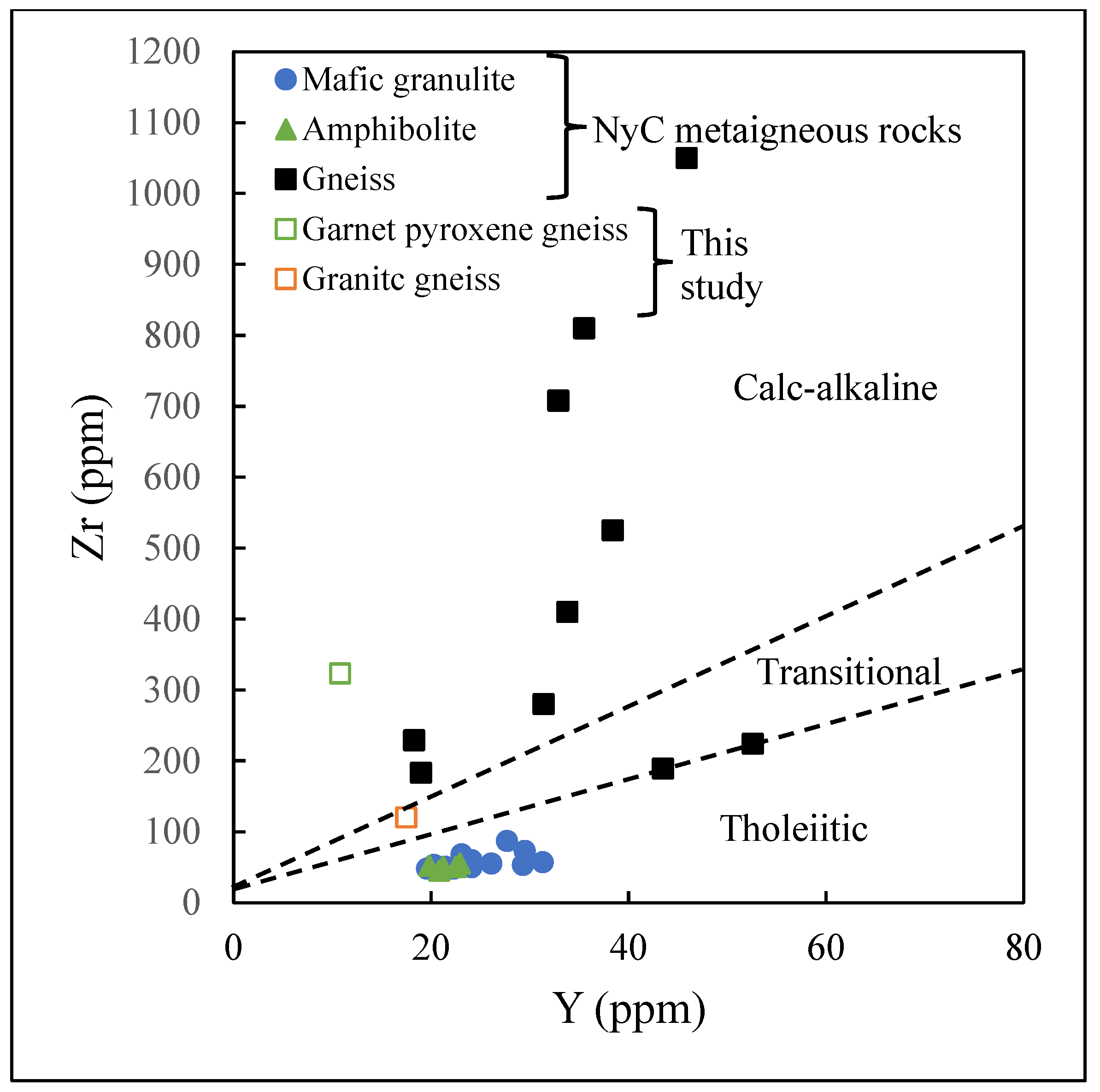
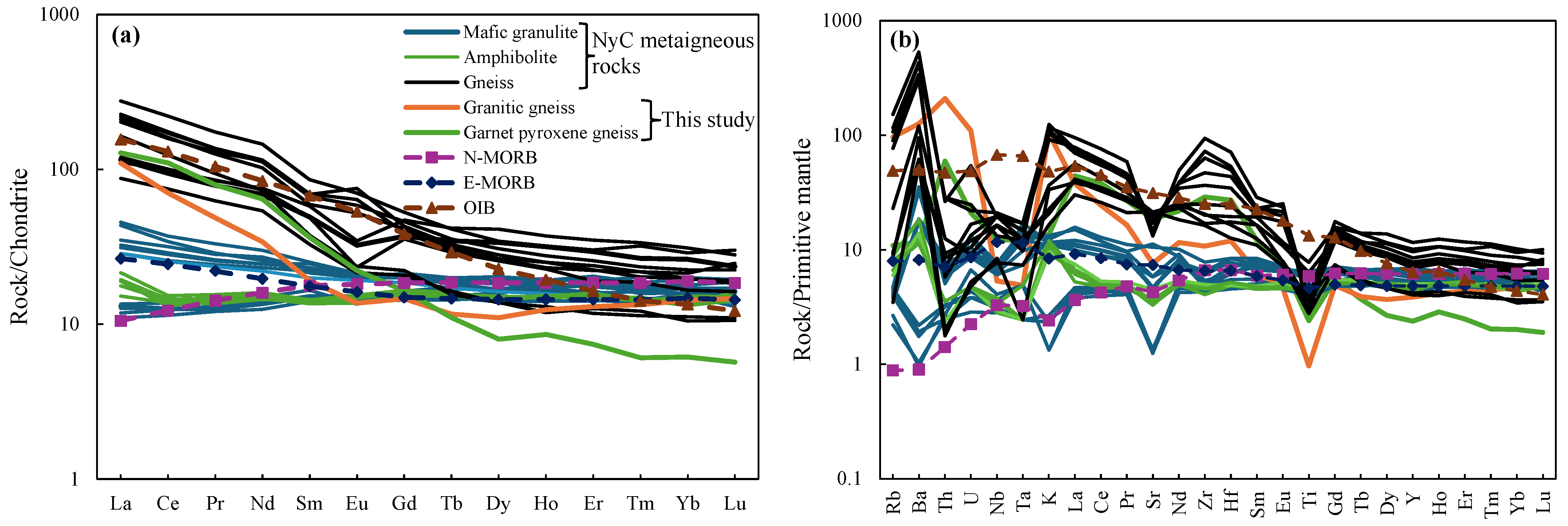
The studied felsic metaigneous rocks show both transitional (granitic gneiss) and calc-alkaline (garnet pyroxene gneiss) affinities on the Zr-Y diagram (Figure 2), as well as most of the NyC intermediate to felsic metaigneous gneiss. In contrast, the NyC mafic metaigneous rocks have a tholeiitic signature. The studied granitic gneiss and garnet pyroxene gneiss exhibit fractionated chondrite-normalized REE patterns with moderate and high (La/Yb)CN ratios of 7.65 and 20.79, respectively, and LREE enrichment relative to HREE (Figure 3a). The slightly negative Eu anomalies ((Eu/Eu*)CN = 0.82 and 0.91, respectively) suggest minor plagioclase fractionation. The lack of Ce anomalies (Ce/Ce*)CN = 0.96 and 1.09, respectively) supports limited alteration influence and reliability for petrogenetic considerations. On the primitive mantle-normalized multi-element diagrams (Figure 3b), granitic gneiss shows enrichment in HREE, Th, U, K, and Rb, and depletion in Nb, Ta, Sr, and Ti, indicating a protolith derived from the partial melting of crustal or subduction-related sources. The low MgO (0.57 wt%), Mg# (31.37), and Ni (57 ppm) values indicate a crustally derived magma source. In contrast, garnet–pyroxene gneiss lacks similar features in the primitive mantle-normalized diagram, except for Th, Nb, Sr, and Ti, indicating a different source.
The NyC mafic metaigneous rocks (Figure 3a) exhibit slightly fractionated to flat chondrite-normalized REE patterns ((La/Yb)CN = 0.64–2.87) comparable to tholeiitic compositions. The degree of fractionation is different for LREE ((La/Sm)CN = 0.78–2.03) but generally similar for HREE ((Gd/Yb)CN = 0.89–1.35), the latter indicating garnet-free source for their protolith. They commonly lack Eu (average (Eu/Eu*)CN = 0.94) and Ce (average (Ce/Ce*)CN = 0.95) anomalies, indicating the minor influence of fractional crystallization in their genesis and the lack of post-emplacement modification to their compositions. They show MORB-like signatures similar to magma generated from partial melting of a depleted mantle source. On the primitive mantle-normalized multi-element diagram (Figure 3b), the NyC mafic metaigneous rocks show variable distribution patterns of LILE and LREE, with the Kribi mafic granulite [60] and Mewengo amphibolite [39] systematically enriched in these elements. The rocks show peaks in Ba, K, and Sr, interpreted as mantle-source metasomatism. In contrast, all samples show similar, relatively flat HFSE and HREE patterns, with mild troughs in Ti interpreted as insignificant fractionation of Ti-bearing accessory phases.
Figure 2. Geochemical affinity plot of Zr versus Y after [66] for rocks from the study area. The Nyong Complex data include mafic and intermediate to felsic metaigneous rocks metaigneous rocks [39,41,60].
Minerals 16 00414 g002
Figure 3. Geochemical diagrams for the Nyong Complex Metaigneous rocks. (a) Chondrite-normalized [67] REE diagram and (b) Primitive Mantle (PM)-normalized [68] spider diagrams. The Nyong Complex data include metaigneous rocks from [39,41,60].
Minerals 16 00414 g003
Chondrite-normalized REE patterns of the NyC intermediate to felsic metaigneous rocks are fractionated, show negative to slight positive Eu anomalies ((Eu/Eu*)CN = 0.56–1.39) and lack Ce anomalies (0.97–1.01). They were interpreted as differentiated members derived from the fractional crystallization of the Kribi mafic granulite [60]. In the primitive mantle-normalized multi-element diagram (Figure 3b), the intermediate to felsic metaigneous rocks show enrichment in LILE and LREE but depletion in HFSE and HREE similar to arc-like trace-elements distribution patterns.
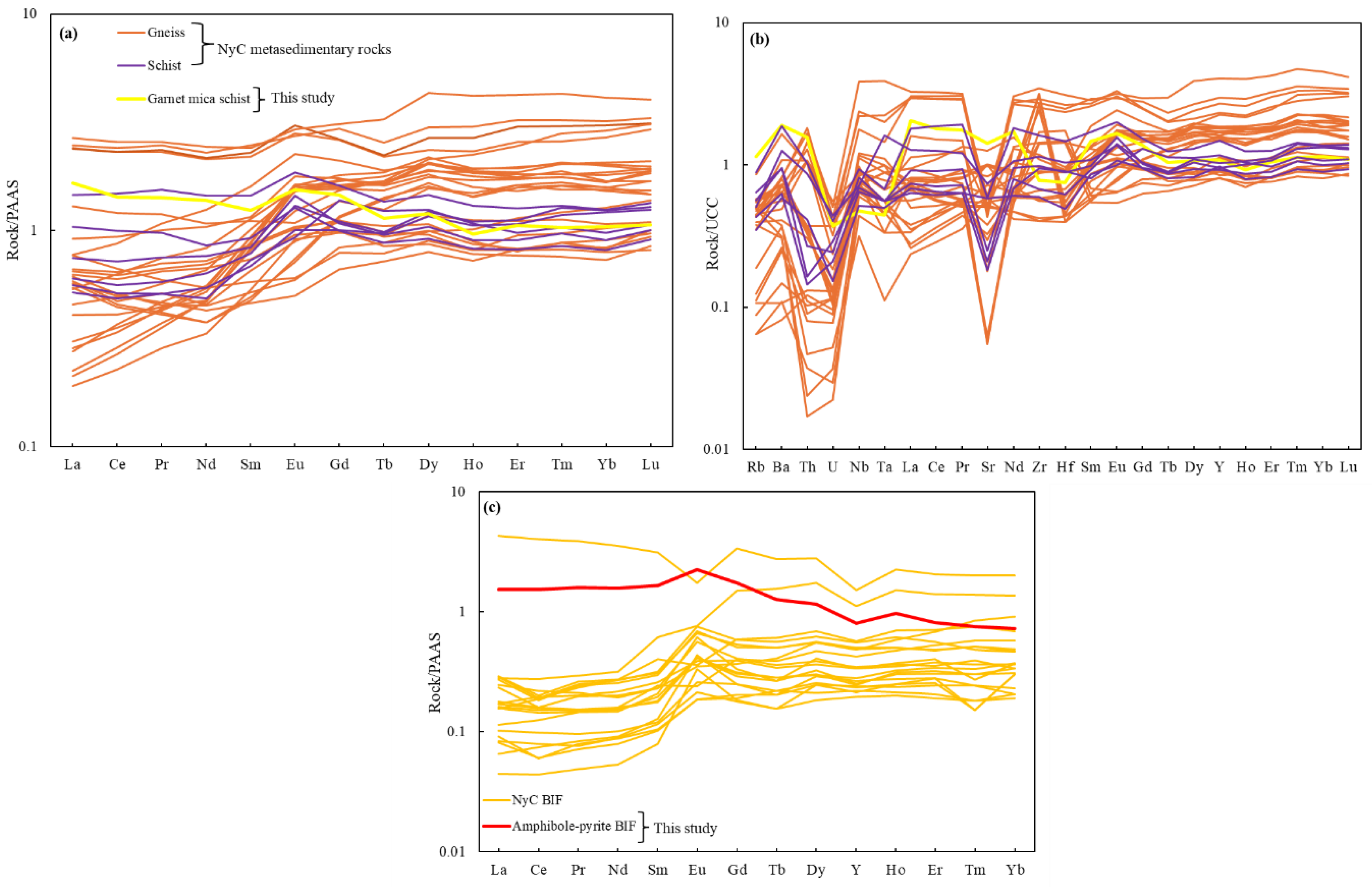
The PAAS-normalized REE diagram (Figure 4a) of metasiliciclastic rocks mainly shows HREE enrichment over LREE and rare relatively flat patterns, whereas the garnet micaschist studied; likewise, few of the NyC samples show contrasting patterns exhibiting LREE enrichment over HREE. The samples mainly lack Ce anomalies (average (Ce/Ce*)SN = 0.99) and display slight negative to slight positive Eu anomalies (average (Eu/Eu*)SN = 0.88–1.52). The NyC complex metasiliciclastic rocks are interpreted as chiefly originated from intermediate to mafic and felsic to intermediate igneous sources, with a mild contribution of depleted mantle-derived material [35,36,42].
The UCC-normalized multi-element diagram of the metasiliclastic rocks (Figure 4b) displays pronounced troughs in Th, U, Sr, and Hf, along with relatively flat HREE patterns. These geochemical features are comparable to those observed in the studied garnet–mica schists, indicating similar source characteristics and metamorphic evolution. The PAAS-normalized REE-Y patterns (Figure 4c) of the NyC BIFs are generally similar to most Archean to Paleoproterozoic BIFs in the literature [31,69,70], characterized by depleted LREE relative to HREE, positive La, Y, and Gd anomalies, and super-chondritic Y/Ho ratio. In contrast, the studied BIF and few NyC samples show unusual patterns and a chondritic Y/Ho ratio interpreted as the post-deposition resetting of HREE content through the interaction with hydrothermal fluids [43]. The geochemical signatures of the NyC BIFs suggest that they were formed from a mixture of seawater and hydrothermal fluids under oxic to anoxic conditions [35,43,61,63,64].
Figure 4. Geochemical diagrams for the Nyong Complex metasedimentary rocks and BIFs. (a,c) PAAS-normalized [71] REE and REE-Y diagrams for the metasiliciclastic rocks and BIFs, respectively. (b) Upper Continental Crust (UCC)-normalized [72] spider diagram for the metasiliclastic rocks. The Nyong Complex data include metasedimentary rocks and BIFs from [35,36,42,61,63,64].
Minerals 16 00414 g004
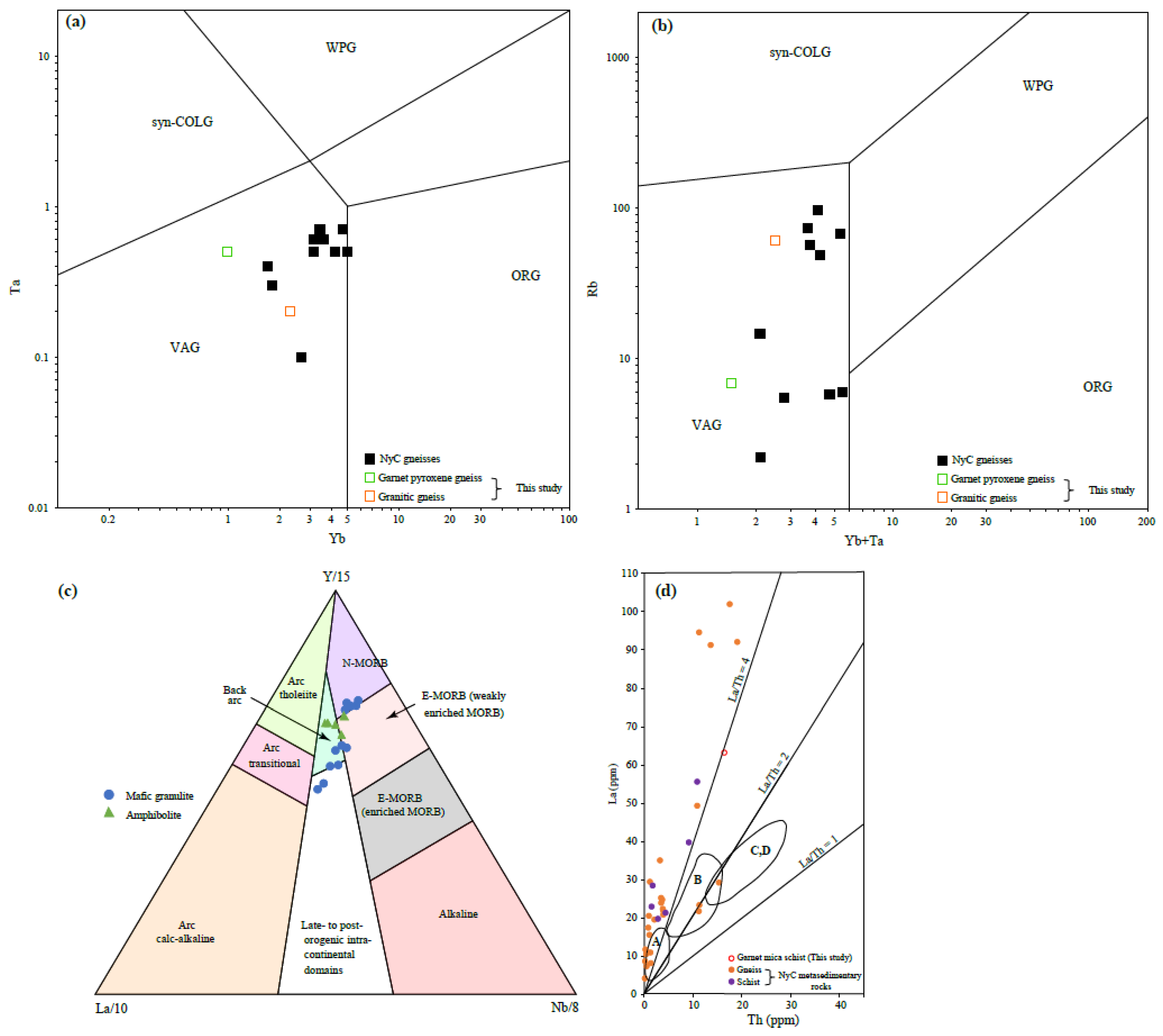
In the Rb vs. Ta + Yb and Ta vs. Yb binary plots (Figure 5a,b), the NyC intermediate to felsic rocks are presented, as well as the studied garnet pyroxene gneiss and granitic gneiss samples plot in the volcanic arc granite (VAG) field. In the La/10-Y/15-Nb/8 geochemical ternary diagram (Figure 5c), the NyC mafic metaigneous rocks show emplacement within a back-arc environment and MORB signature. The La vs. Th tectonic discrimination diagram (Figure 5d) shows that the studied metasiliciclastic rocks (garnet mica schist) plot along La/Th ≈ 4, suggesting an affinity with an oceanic island arc setting [73]. Conversely, the NyC metasiliciclastic rocks display La/Th ratios ranging between 1.9 and 47.7, overlapping the oceanic island arc, continental island arc, and active continental margin/passive margin fields. They are primarily derived from the upper continental crust and were deposited in either active or passive continental-margin settings [42,61].
BIFs of the NyC are commonly interstratified with volcanic rocks of mafic to intermediate compositions, highlighting in most cases, a direct genetic relationship between volcanic activity and BIFs deposition ([69] and references therein). BIFs are also reported spatially associated with clastic sediments, deposited distal to volcanic activities, on submerged platforms or on continental shelves ([69] and references therein). Given this genetic relationship, and the spatial associations between the NyC BIFs, mafic metaigneous rocks, and metasiliciclastic rocks [35,36,39,43,57,61,62,63,64], submarine volcanic arc, back-arc settings, and deep submarine environments along continental margins are generally suggested for the NyC BIFs deposition.

2.2.2. Hf and Nd Isotopic Data

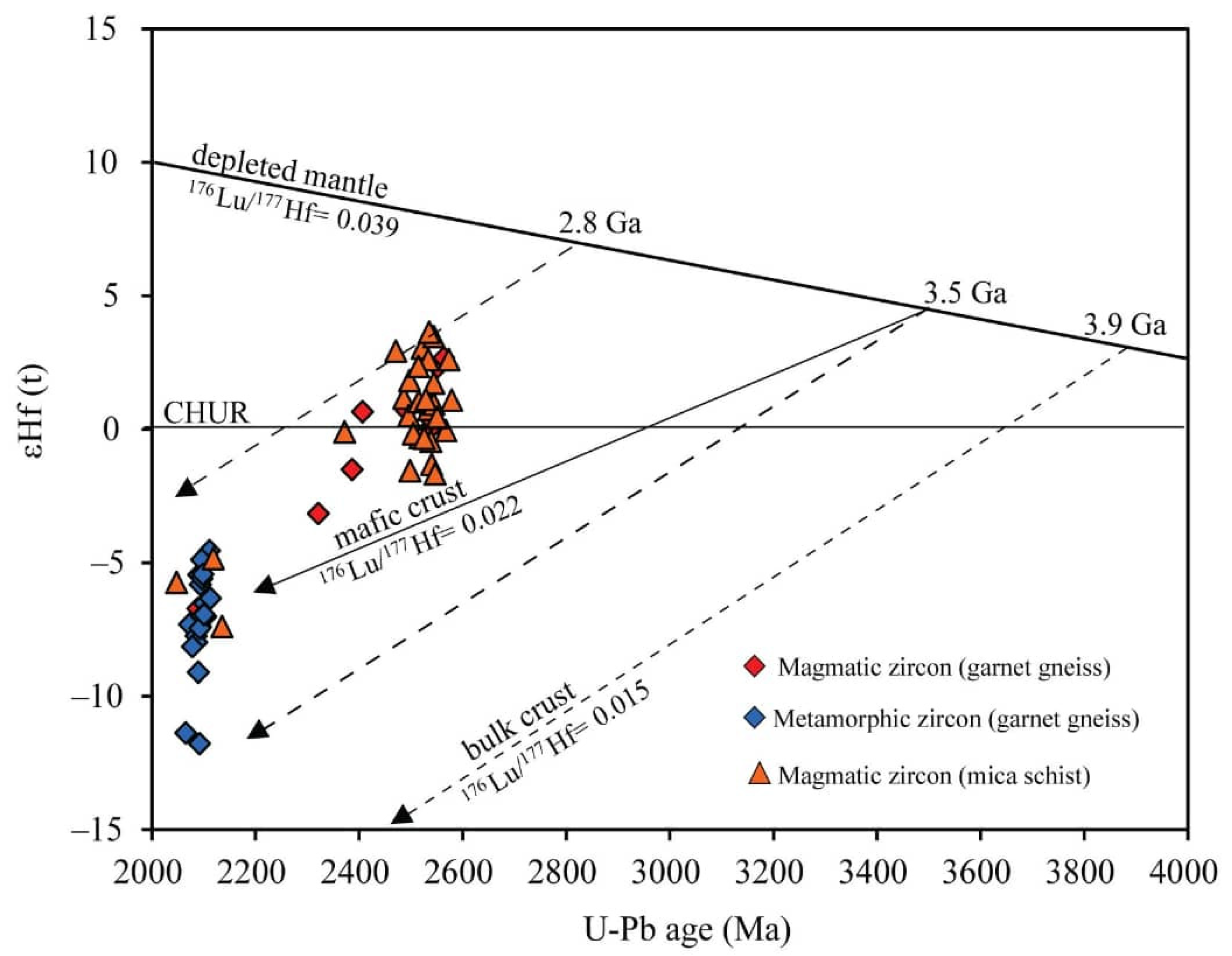
Zircon Lu-Hf and whole-rock Sm-Nd isotope data for the NyC metaigneous and metasedimentary rocks were reported in previous studies (Supplementary Tables S2 and S3) [35,36] and are summarized here. The detrital zircon εHf(t) values of NyC metasedimentary rocks range from −6.73 to +2.67 (garnet gneiss) and −7.40 to +3.62 (mica schist). These values correspond to Hf model ages of 3098–2880 Ma (garnet gneiss) and 3285–2804 Ma (mica schist). In contrast, the NyC metavolcanic rocks (amphibolite) yield positive εHf(t) values (+2.01 to +10.24), with younger Hf model ages of 2670–2176 Ma, indicating juvenile mantle wedge sources above a subduction zone, consistent with arc magmatism rather than plume-derived rift magmas [35]. On εHf(t) vs. U–Pb age plot (Figure 6), most garnet mica schist samples display positive εHf(t) values above the CHUR (Chondritic Uniform Reservoir) line, indicating new crustal growth from mantle-derived magmas. However, the majority of NyC metasedimentary rocks show negative εHf(t) values with Paleoarchean Hf model ages (3641–3098 Ma). This suggests derivation from the recycling of Paleoarchean crustal rocks, consistent with processes of continental collision and crustal reworking. Similarly, whole-rock εNd(t) values of the NyC metasedimentary rocks range from −9.81 to −5.22 for BIFs, with Nd TDM model ages between 3634 Ma and 2822 Ma. Metasedimentary rocks interlayered with BIFs show εNd(t) values from −12.20 to +0.46, with Nd TDM model ages spanning from 3803 Ma to 2772 Ma [36].
Zircon Hf model ages, in conjunction with whole-rock Nd isotope data, indicate significant recycling of ancient continental crust, with only minor episodes of new crustal growth in the NyC during the early Paleoproterozoic. These findings are consistent with previous Nd–Hf studies of intrusive and basement rocks from the Nyong, Ntem, and Ivindo complexes, as well as the East Gabonian Block [26,27].

3. Sampling and Methodology

Four samples belonging to two main rock types were selected: (i) two metasedimentary samples (BIF, GB10 and garnet mica schist, OB39) to investigate the detrital zircon populations and sedimentary provenance; (ii) two metaigneous rocks (garnet pyroxene gneiss, GN7 and granitic gneiss, KA17) to determine the magmatic events and zircon crystallization ages. This selection enabled a comprehensive comparative study of magmatic and metamorphic processes using zircon chemistry and U-Pb dating. Fieldwork prioritized well-preserved outcrops to ensure reliable zircon extraction.
Zircon grains were extracted using conventional gravimetric and magnetic separation techniques at Langfang Rock Detection Technology Services, Ltd. (Langfang, China). The zircon trace element and U-Th-Pb isotope analyses were performed using LA-ICP-MS, incorporating a ThermoFisher Elemental Scientific Instruments New Wave Research 193 nm laser ablation system coupled with an Analytic Jena PQMS Elite ICP-MS (Beijing Kehui Testing International Co., Ltd., Beijing, China), following the analytical procedure outlined by [43]. Zircon grains were meticulously handpicked under a binocular microscope, embedded in epoxy mounts, and polished until their inner sections were fully exposed for analysis. They were documented using transmitted- and reflected-light microscopy, while cathodoluminescence (CL) imaging was performed on a JSM 6510 scanning electron microscope equipped with a Gatan CL detector, operated at 10 kV at Langfang Rock Detection Technology Services, Ltd. (Langfang, China). All zircon analyses were performed with a 30 µm beam diameter, a pulse repetition rate of 10 Hz, and an energy of 4 J/cm2. The reference standards included Zircon 91500 [76], GJ-1 [77], Plesovice [78], Qinhu, and NIST610 glass, with calibrations performed every 5–10 analyses. Concordia diagrams and probability density plots were processed using Isoplot/Ex v. 3.0. Lastly, the Ti-in-zircon thermometer was applied to estimate the crystallization temperatures using the empirical formulations proposed by [13,14]. These temperature calculations offer deeper insights into the thermal conditions that influenced the magmatic and metamorphic evolution of the NyC.

4. Results

4.1. Zircon Morphology and Internal Structure

4.1.1. Metasedimentary Rocks

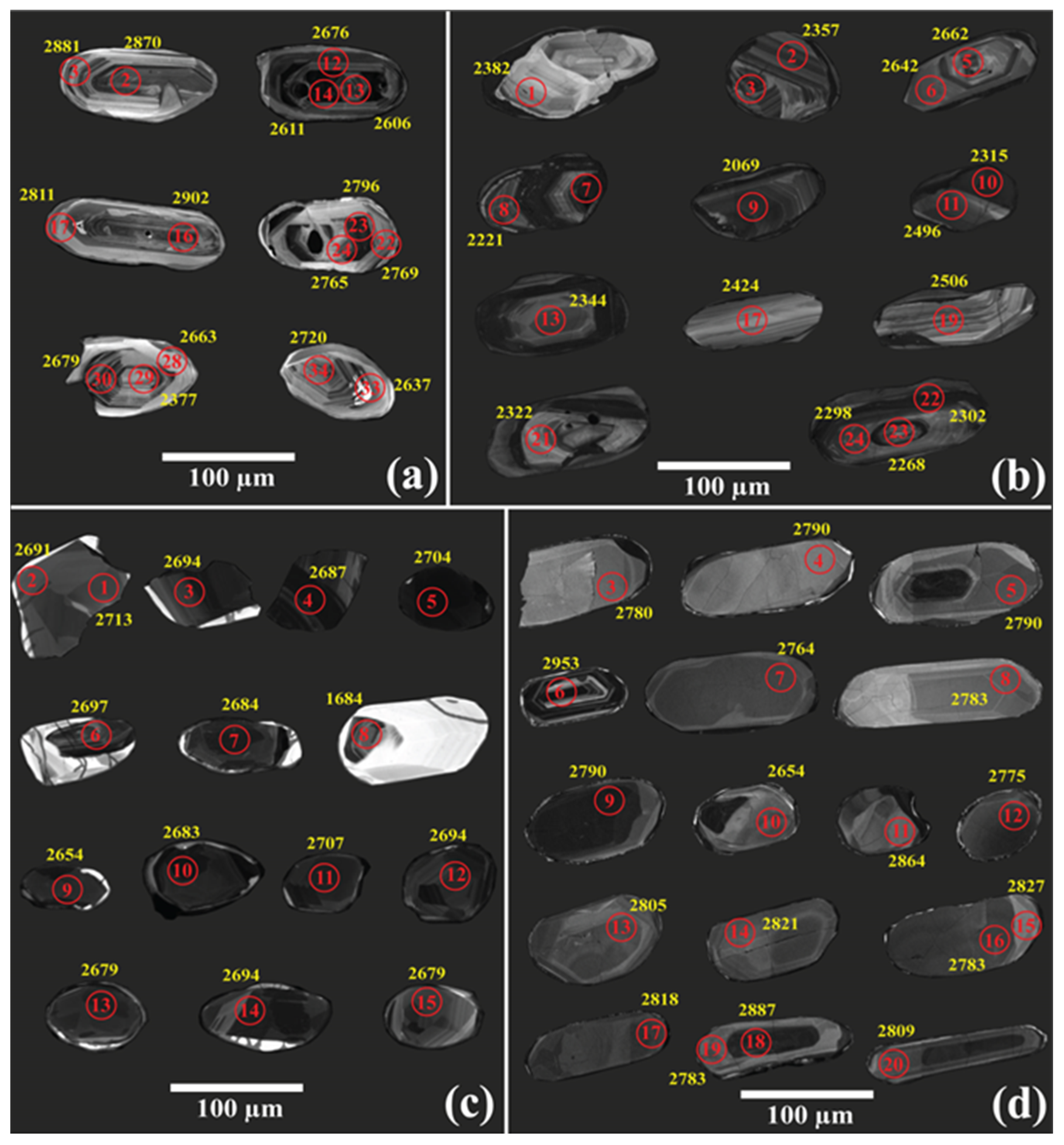
Most detrital zircon grains are short to long prismatic crystals, ranging in length from 65 to 300 µm, with subhedral to euhedral shapes and rounded termination rims. Under cathodoluminescence (CL), these crystals show pronounced oscillatory zoning, indicating crystallization from magma (Figure 7a,b; Supplementary Table S4). Some grains exhibit less pronounced zoning with metamictized cores and contain inclusions. They are fractured and truncated, with U-enriched bright zones indicative of homogenization (Figure 5a,b).

4.1.2. Metaigneous Rocks

Most zircon grains are short prismatic to slightly rounded, with lengths ranging from 100 to 250 µm and rounded nebulized rims, indicating metamorphic effects (Figure 5c,d). Some grains are multifaceted and fractured at the edges (Figure 7c,d, Supplementary Table S4). Other zircons are euhedral long prismatic crystals (Figure 7d), measuring 150–200 µm in length, while others have rounded shapes measuring approximately 60 µm in diameter. Most zircon grains are partially homogeneous, with a few displaying well-preserved regular magmatic zoning and prismatic cores, which are characteristic of magmatic zircons [79].

4.2. Zircon Geochemistry

4.2.1. Trace Element Concentrations

A total of 62 trace-element analyses were conducted on 29 zircons from metasedimentary rocks and 33 zircons from metaigneous rocks. The trace elements, including the REE contents, were measured in situ for each zircon grain, and the complete dataset is presented in Supplementary Tables S5 and S6.
The results revealed notable variations in trace element content among individual grains within the same rock sample. Zr concentrations range from 44.43 wt% to 50.38 wt% in metasedimentary rocks and from 47.54 wt% to 50.52 wt% in metaigneous rocks. Despite these variations, the average Zr content is relatively consistent across all the studied rock types, ranging from 44.43 wt% to 50.52 wt%. High-field strength elements (HFSE), such as Nb, Ta, and Ti, can substitute for Zr in zircon [80] and exhibit significant and variable concentrations. Ti shows the highest average content, notably in metasedimentary rocks, with an average of 14.53 ppm, consistent with typical Ti abundances in unaltered igneous zircons [81]. Zircons from metasedimentary rocks display the highest average concentrations of Nb and Ta (2.45 ppm and 1.11 ppm, respectively), compared to zircons from metaigneous rocks (1.15 ppm and 0.55 ppm, respectively). This indicates higher HFSE enrichment in metasedimentary zircons relative to those from metaigneous rocks, which may be linked to the uptake of Nb and Ta during zircon crystallization from highly fractionated granitic melts [80]. Such enrichment is often associated with elevated volatile elements, particularly fluorine, which enhances Nb-Ta incorporation [82]. Furthermore, the high Nb content (>4 ppm) observed in these zircons supports the hypothesis that subducted mélange recycling is a key source of HFSE, rather than metasomatism by arc-related melts or fluids [20].

4.2.2. Rare Earth Element Concentrations

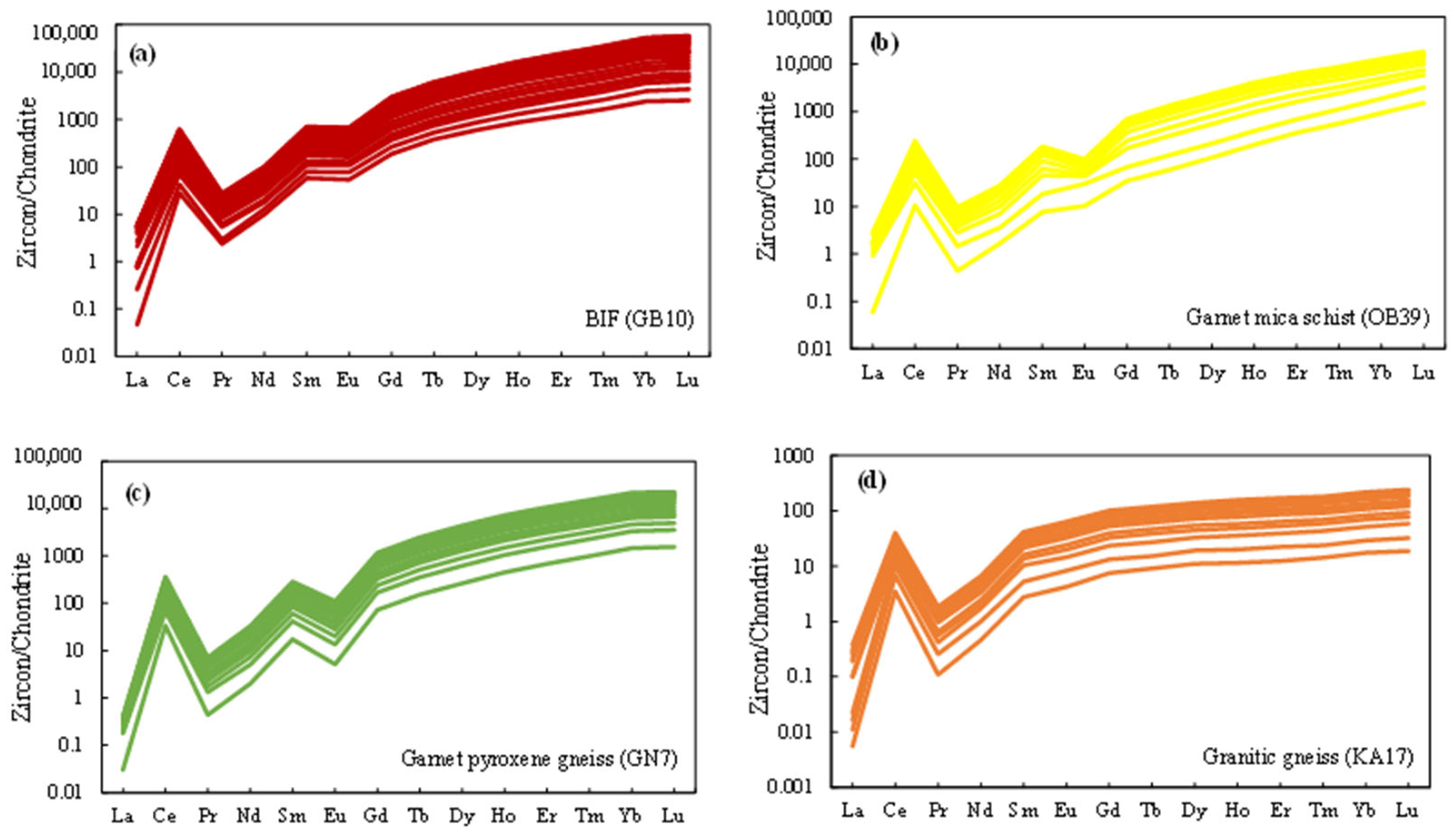
The chondrite-normalized REE patterns [67] of the studied zircons are generally characterized by steeply rising slope patterns due to the enrichment of HREE relative to LREE and MREE, with pronounced positive and negative Ce and Eu anomalies, respectively (Figure 8). These features are typical of unaltered igneous zircons [81,83]. Zircons from metaigneous and metasedimentary rocks display positive Ce anomalies, with mean Ce/Ce* values of 125 and 62, respectively. Pronounced negative Eu anomalies are recorded in zircons from metasedimentary and metaigneous rocks, with average Eu/Eu* of 0.43 and 0.61, respectively. The separate HREE spectra of zircons from each rock sample are almost parallel, with limited ranges of (Yb/Gd)N ratios (6.47–29.37 for metasedimentary rocks; 1.86–32.29 for metaigneous rocks), while the LREE and MREE spectra display somewhat dissimilar patterns, as indicated by the wide variation in their (Sm/La)N ratios (0.00–1356 and 0.00–5461 for zircons from metasedimentary and metaigneous rocks, respectively).
  • Zr/Hf ratio
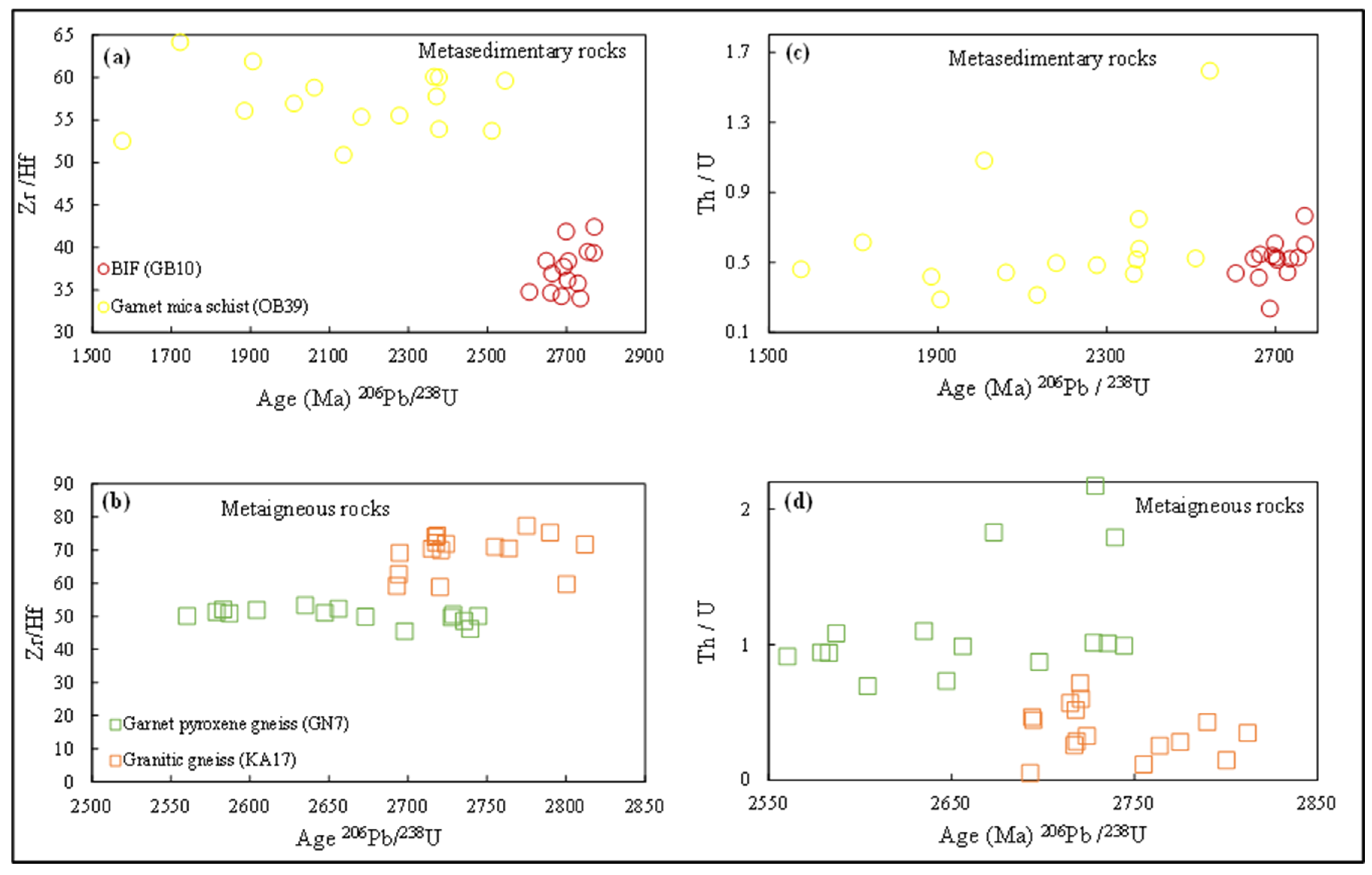
The Zr/Hf ratios of the zircons are listed in Supplementary Tables S5 and S6. The average zircon Hf content is 10,205 ppm for the metasedimentary rocks, and their Zr/Hf ratios range from 34 to 64. The average zircon Hf content is 8318 ppm for the metaigneous rocks, and their Zr/Hf ratios range from 45 to 77. For the metasedimentary rocks, fourteen analytical spots display Zr/Hf ratios lower than 42, with a corresponding 207Pb/206Pb age range of ca. 2929–2619 Ma (Figure 9a). Fifteen analytical spots had Zr/Hf ratios higher than 50, ranging from 51 to 64, with 207Pb/206Pb ages of ca. 2662–2220 Ma. For the metaigneous samples, 15 zircon analytical spots show Zr/Hf ratios ranging from 46 to 52 and 207Pb/206Pb ages of approximately 2713–2654 Ma, while 18 zircon analytical spots yield Zr/Hf ratios higher than 52, ranging from 59 to 74, with ages between ca. 2953 and 2720 Ma (Figure 9b). Indeed, the detrital zircon εHf(t) data of the NyC metasedimentary rocks range from −13.08 to +3.62, indicating the involvement of both crust and mantle in their genesis. In contrast, the NyC metavolcanic rocks yield consistently positive εHf(t) values (+2.01 to +10.24), reflecting a mantle-derived magma source [35]. Overall, a low Zr/Hf ratio serves as a distinctive fingerprint of effective magmatic fractionation within the crust [84].
  • Th/U ratios
The zircon Th and U contents and Th/U ratios are listed in Supplementary Tables S5 and S6. The average zircon Th and U contents of the metasedimentary rocks are 204 ppm and 367 ppm, respectively, with Th/U ratios ranging from 0.24 to 1.60. The Th/U ratios of zircons are commonly used to distinguish between igneous and metamorphic origins. Zircons of igneous origin typically have Th/U ratios greater than 0.2, while those of metamorphic origin generally have ratios less than 0.1 [85]. The Th/U ratios of all metasedimentary zircons are >0.2 (Supplementary Tables S5), suggesting magmatic origin. There is a weak positive correlation between Th/U ratios and their corresponding ages (Figure 9c). For the metaigneous rocks, the zircon analyses yield average Th and U concentrations of 77.28 ppm and 102 ppm, respectively, with Th/U ratios ranging from 0.05 to 2.17, suggesting both metamorphic and magmatic origin.

4.3. Ti-in-Zircon Thermometry

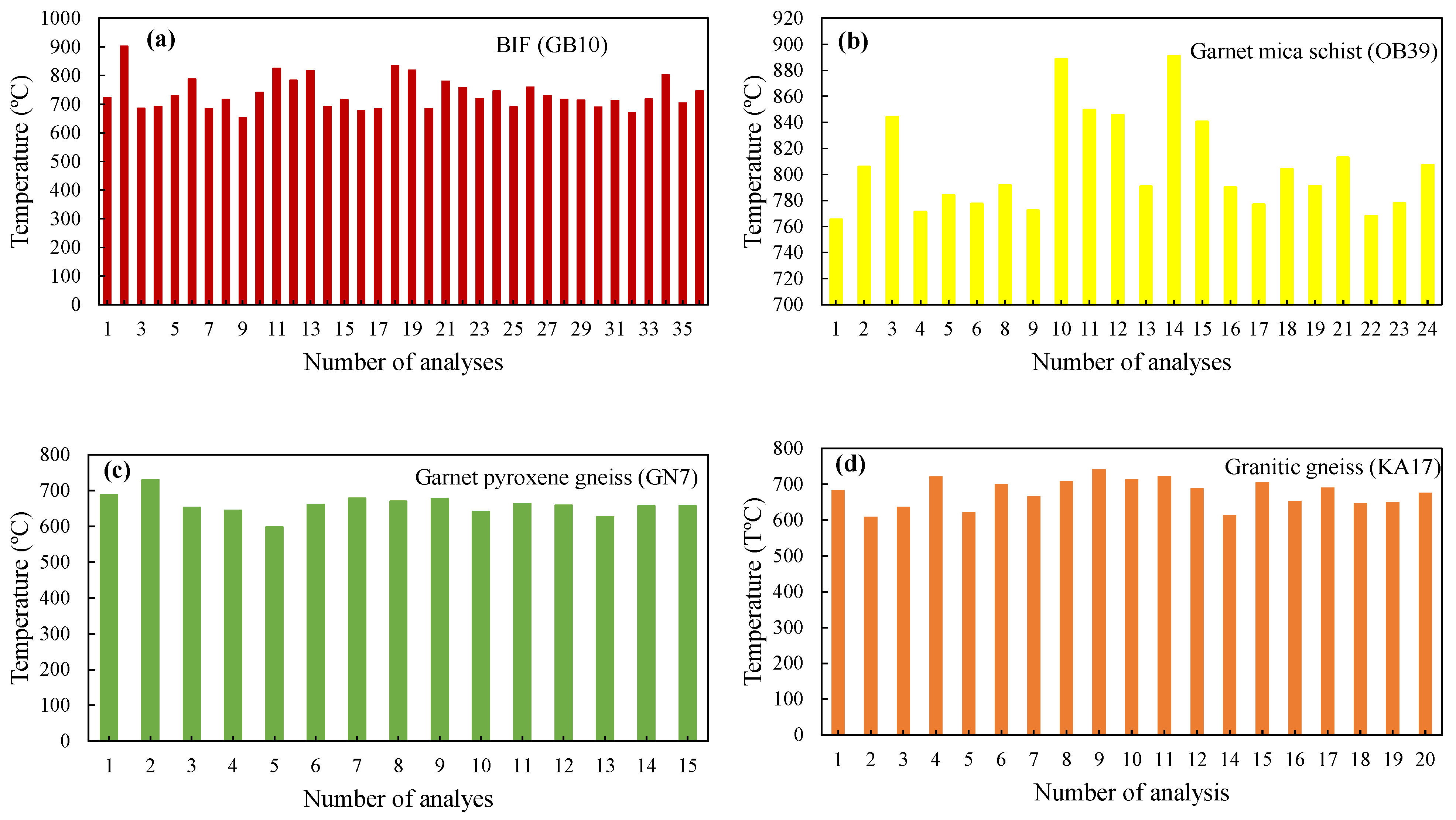
The application of Ti-in-zircon is a powerful geochemical proxy for constraining zircon crystallization temperatures [13]. Additionally, the temperature-dependent substitution of Ti4+ in the zircon structure, when in equilibrium with quartz (SiO2) and rutile (TiO2), allows zircon to serve as a robust thermometer under varied geological conditions [14,86]. Furthermore, Ferry and Watson [14] and Ferriss et al. [87] suggest that the Ti-in-zircon thermometer exhibits moderate pressure dependence. Recently, Ti-in-zircon thermometry has been widely applied to an increasing number of natural zircons [15,88,89,90,91,92]. Although the calculation of exceedingly precise magmatic zircon crystallization temperatures requires knowledge of the activities of TiO2 (aTiO2) and SiO2 (aSiO2) [14], our estimation is based on the assumption that aSiO2 = 1 and aTiO2 = 0.7 as suggested by [93]. A total of 62 samples were analysed, recording variations in the Ti-in-zircon temperatures. The analyzed samples consist of 29 metasedimentary zircons and 33 metaigneous zircons.
The Ti values are listed in Supplementary Tables S5 and S6, while the calculated temperatures are listed in Supplementary Table S7 and shown in Figure 10.
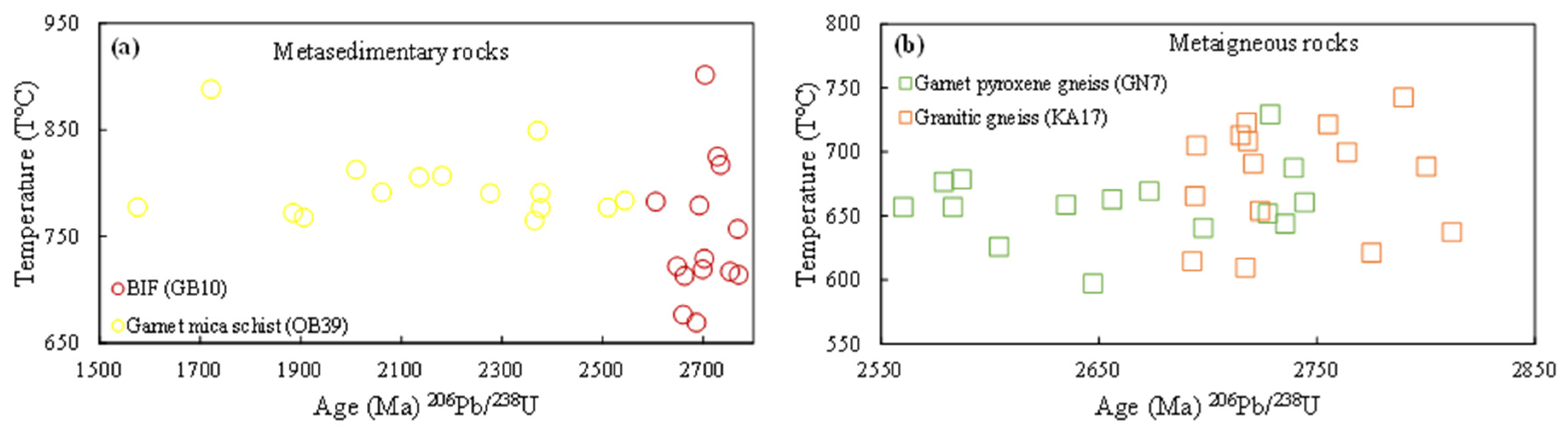
The Ti content in the analyzed zircons is less than 20 ppm. The temperature ranges of zircons are 653–902 °C and 597–743 °C for metasedimentary and metaigneous rocks, respectively. There is no correlation between Ti-in-zircon temperatures and the analytical ages of metaigneous rocks (Figure 11b). Zircons from metasedimentary rocks exhibit relatively higher Ti-in-zircon temperatures. The higher temperature range observed in zircons from metasedimentary rocks can be attributed to the lithological diversity of their provenance. Zircons with high crystallization temperatures (>850 °C) are likely derived from TTG rocks, whereas those with temperatures between 650 and 800 °C are associated with high-K granites, pegmatites, and syenites. These rock types are well documented in the adjacent Ntem Complex [32,36,37]. In contrast, the relatively low crystallization temperatures of zircons from metaigneous rocks are consistent with the crystallization conditions of their intermediate to felsic protoliths (trachyte and rhyolite). Additionally, zircons with low Zr/Hf ratios (Zr/Hf < 56) generally have higher temperatures than those with high Zr/Hf ratios (Zr/Hf > 56). There is no correlation between the zircon-estimated temperatures and the analytical ages of metasedimentary rocks (Figure 11a).

4.4. Zircon LA-ICP-MS U-Pb Dating

4.4.1. Metasedimentary Rocks

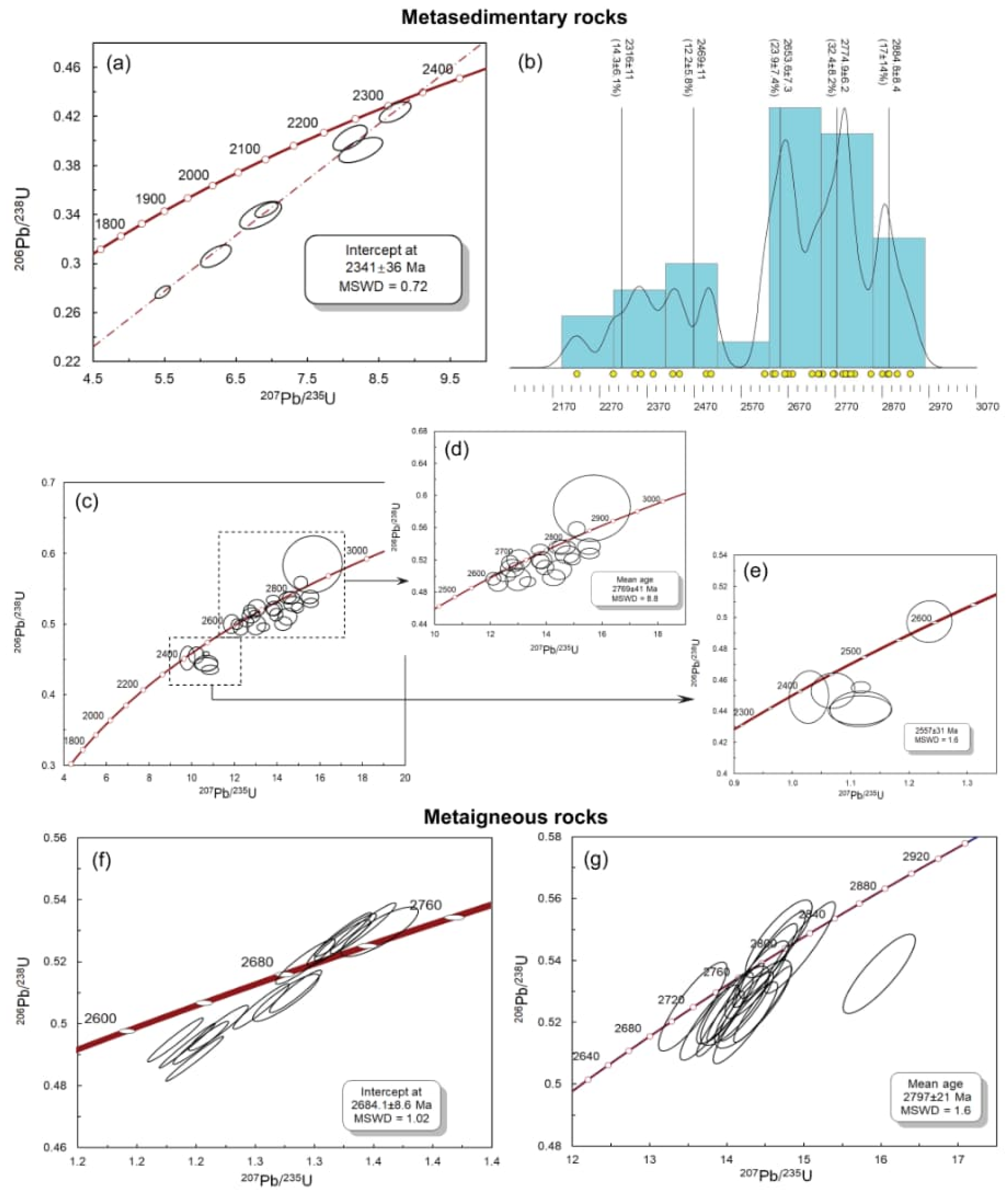
Geochronological analyses were performed on zircon from metasedimentary rocks, specifically a BIF sample (23) and a mica schist sample (11). All analysed zircons with high concordance (>90%) were used for age calculations (Supplementary Table S8). The detrital zircon population yields concordant 207Pb/206Pb ages between ca. 2929 and 2220 Ma, with five prominent age peaks at ca. 2885 ± 8, 2775 ± 6, 2654 ± 7, 2469 ± 11, and 2316 ± 11 Ma (Figure 12b). These peaks broadly overlap major magmatic events recorded in the Congo–São Francisco craton. The youngest concordant single zircon age of ca. 2220 Ma provides a maximum depositional age for these units, but given the possibility of Pb-loss and metamorphic modification during the ca. 2.09–2.05 Ga high-grade event in the NyC [28,29,54], it cannot be taken alone as a precise depositional age. Instead, we consider the youngest coherent detrital zircon age peak at ca. 2.3 Ga, together with published U–Pb ages of closely associated metavolcanic protoliths at ca. 2.16 Ga [35] to indicate that NyC sedimentation most likely occurred within a broad interval between ca. 2.4 and 2.1 Ga. This range is consistent with previous estimates based on detrital zircon ages from BIFs and metasiliciclastic rocks [36,43,59,63] but emphasizes that depositional constraints should be expressed as probability distributions rather than single-grain ages.

4.4.2. Metaigneous Rocks

The geochronological analysis of metaigneous rocks involved 30 zircon spots, all of which exhibited good concordance (>90%) and were used for age calculations (Supplementary Table S9). Concordia diagrams (Figure 12f,g) indicate Archean ages of 2684 ± 8.6 Ma (MSWD = 1.02) for the Eseka garnet pyroxene gneiss and 2797 ± 21 Ma (MSWD = 1.6) for the Mewengo granitic gneiss. The results align with the Mesoarchean–Neoarchean ages (2954–2695 Ma) reported by Kouankap Nono et al. [34] for similar metaigneous rocks. The analyzed zircon grains exhibit distinct magmatic features, suggesting that the ages obtained represent the crystallization ages of the protolith.

5. Discussion

5.1. Magmatic and Metamorphic Events

The morphology of zircons, including their shapes and internal structures, reflects the crystallization environment and magmatic history [94]. Although zircons are physically and chemically resistant to geological processes, they are not immune to mechanical abrasion and chemical alteration. Recent studies have shown that the zircon rim thickness decreases by approximately 50%, suggesting that information in the rim would be erased during grain reworking during orogenic and associated sedimentary cycles [20]. A global detrital zircon core and rim age dataset was utilized to investigate the core–rim thickness of detrital zircons during different tectonic regimes. The results indicate that crustal information recorded in zircons can be lost not only during surface sediment transport but also through deep-crustal recycling processes such as lithospheric delamination, subduction erosion, and sediment subduction.
The detrital zircon ages reflect the worldwide episodic nature of igneous activity, recognized since the first compilation of U-Pb zircon ages at a global scale, with the most recent compilation showing peaks at ca. 2.7 and 1.9 Ga [84]. The limited number of analyses in the 2.5–2.0 Ga age range in this compilation has prompted suggestions of a widespread slowdown in planetary magmatism during this period [95].
Most of the analyzed zircon grains from the NyC metasedimentary rocks display round-shaped cores, indicating inherited zircons derived from older crustal rocks or crystallized from early magma, which may represent part of the magma source material [94]. These zircons yielded Archean and Paleoproterozoic ages (2929 to 2220 Ma) with five prominent age peaks at 2885 ± 8 Ma, 2775 ± 6 Ma, 2654 ± 7 Ma, 2469 ± 11 Ma and 2316 ± 11 Ma (Figure 12b). In addition, the crystallization ages of the garnet–pyroxene gneiss (ca. 2684 Ma) and granitic gneiss (ca. 2797 Ma) indicate early to late Neoarchean magmatism within the Nyong Complex. These results provide clear evidence of early to late Neoarchean magmatic activity, particularly granitic plutonism along the western margin of the Congo Craton. Such magmatism reflects episodes of crustal growth and reworking during craton stabilization, with granitic intrusions representing a key stage in the continental assembly of the region. The age peaks of ca. 2.89 Ga and 2.65 Ga overlap within error with that (2797 ± 21 Ma and 2684 ± 8.6 Ma; Figure 12f,g) of the studied metaigneous rocks and the well-known magmatic events dated at ca. 2850 Ma ca. and 2600 Ma within the CC [33,51]. Moreover, the age peak of ca. 2.47 Ga is consistent with the syenite emplacement at ca. 2400 Ma in the adjacent Ntem Complex [96,97]. The 207Pb/206Pb ages ranging from ca. 2.50 to 2.37 Ga for the studied zircons from metasedimentary rocks is consistent with the view of a prominent magmatic event at ca. 2.50–2.45 Ga in the NyC region [36]. This finding aligns with the evidence for widespread emplacement of igneous rocks between ca. 2.5 and 2.3 Ga across crustal provinces that were later incorporated into West Gondwana [98,99]. This result indicates a dynamic geological evolution characterized by episodic crustal recycling and magmatic differentiation from Mesoarchean to Paleoproterozoic in the NyC.
Overall, the zircon morphology and geochronological data from this study suggest a complex magmatic history in which both inherited and newly crystallized zircon populations record distinct magmatic events followed by metamorphic overprinting during Eburnean orogeny at ca. 2.1–2.0 Ga [35,36]. This interpretation is consistent with the features of some zircon grains displaying sub-rounded to rounded shapes, rounded termination rims, and multifaceted shapes with thin to broad nebulized rims, typical of zircons of metamorphic origin [100].

5.2. Oxidation States in the Zircon Crystallizing Environments

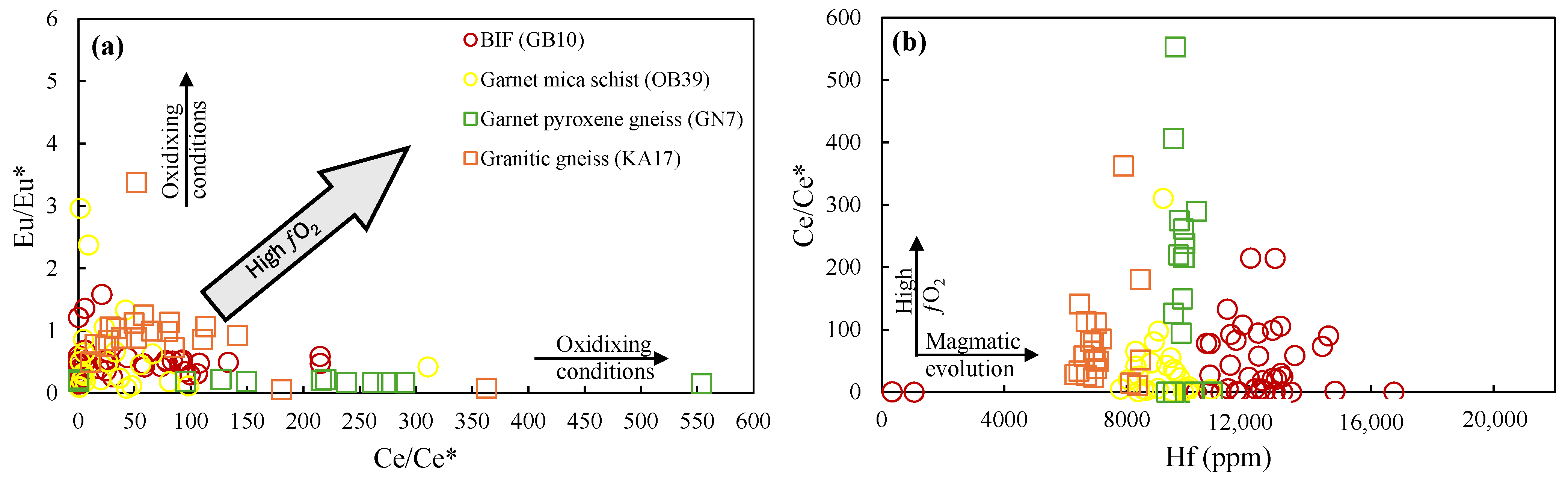
Trace-element concentrations in zircons provide a means of inferring the physical and chemical conditions under which they crystallized [101]. Ce and Eu concentrations in zircons have recently been used in oxybarometry, because they are sensitive to the degree of magmatic oxidation, owing to their multiple ionic [101]. The Ce/Ce* vs. Eu/Eu* plot provides an effective means of evaluating the oxidation state during magma crystallization. In Figure 13a, the studied NyC zircons show a broad anti-correlation trend along the two axes representing oxidizing conditions between Eu/Eu* and Ce/Ce*. This alignment along the two axes may suggest that all the zircons crystallized under variable oxidation conditions, spanning a range from low to high oxygen fugacity. Previous studies [90,101] have demonstrated that during zircon crystallization, the control of Ce and Eu anomalies by oxidation conditions can produce a positive linear or curvilinear correlation between the Eu and Ce anomalies. Thus, the observed anti-linear correlation between the Eu and Ce anomalies (Figure 13a) may indicate that the Eu and Ce oxidation states in the studied NyC rocks were not solely controlled by the oxygen fugacity.
Furthermore, the Hf vs. Ce/Ce* plot can be used to monitor changes in the oxidation state accompanying magma differentiation. The Hf and Ce/Ce* values in this study exhibit a wide range (Figure 13b), which may indicate magma crystallization under variable ƒO2 conditions over a prolonged period. This observation implies that oxygen fugacity was not the sole controlling factor; instead, variations in melt composition and temperature likely played essential roles in shaping the geochemical signatures. This aligns with the interpretation that Eu anomalies in metabasites are controlled by the proportion of ferric iron in the source, particularly in the absence of residual garnet [21]. The zircon characteristics outlined above are also evident in the Ekoumedion, Linté, and Ngazi–Tina granitoids of the adjacent Neoproterozoic North Equatorial Fold Belt in central Cameroon along the northern margin of the CC, where magma crystallization occurred under varying oxidation conditions [15,92,102]. Likewise, zircon trace-element geochemistry from Paleoproterozoic granitoids of the Lawra Belt in Ghana, within the West African craton, reveals comparable oxidation states during magma crystallization [103].

5.3. Zircon Sources

5.3.1. Trace and REE Constraints

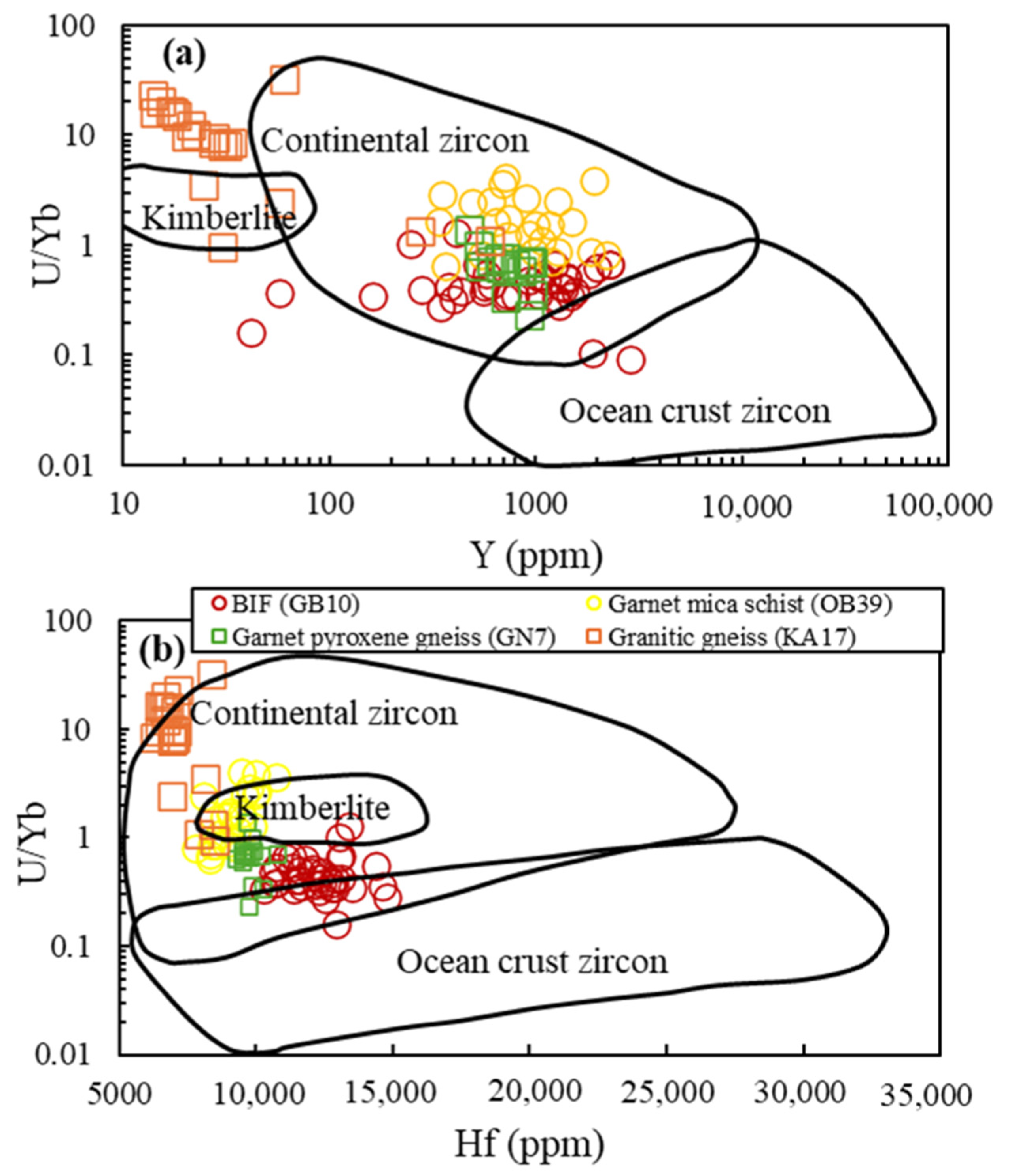
The U/Yb ratios of zircons are valuable for distinguishing their origins [104,105]. As reported by Grimes et al. [106], U/Yb ratios in zircons vary distinctly across rock types, ranging from 0.18 in oceanic gabbros to 1.07 in continental granitoids and up to 2.1 in kimberlites. In this study, the analyzed zircons exhibit U/Yb ratios between 0.23 and 32.33, reflecting mixed sources that include continental, oceanic, and kimberlitic contributions. Specifically, the studied BIFs record signatures of both oceanic and continental sources (U/Yb = 0.35–0.67), whereas the mica schist and granitic gneiss display continental and kimberlitic affinities (U/Yb = 0.80–2.55 and 0.94–32.33, respectively). The garnet–pyroxene gneiss, by contrast, shows signatures predominantly consistent with continental sources (0.23–0.98). This interpretation is consistent with the discrimination diagrams of U/Yb versus Y and Hf (Figure 14a,b) proposed by Cui et al. [107] and Grimes et al. [105]. Furthermore, these findings align with earlier whole-rock geochemical results (Figure 5d), suggesting that the protoliths of the NyC metasedimentary rocks were deposited in a transitional setting between an oceanic volcanic center and a continental margin (see Section 2.2.1; [43]). The studied zircons exhibit average (Sm/La)N ratios of 182 and 683 for the metasedimentary and metaigneous rocks, respectively, which are consistent with the range reported for igneous zircons ((Sm/La)N = 57–547; [81]). However, some zircons from metaigneous rocks display exceptionally high (Sm/La)N values (up to 5461), which may be attributed to an underestimation of La abundance [81].
Similarly, the average  Lu / Gd ) N  ratios of the zircons are 22.85 and 12.96 for the metasedimentary and metaigneous rocks, respectively, aligning with continental crustal values of (Lu/Gd)N = 16–74 [80]. The crust-derived zircons in this study are consistent with an upper continental crust provenance for the NyC metasedimentary rocks, as previously demonstrated by their whole-rock geochemical data [42]. Indeed, the whole-rock chondrite-normalized REE values from the NyC metasiliciclastic rocks exhibit moderate to strong fractionation, with (La/Yb)N ratios ranging from 0.61 to 0.96. These rocks are characterized by enrichment in light rare earth elements (LREEs; (Ce/Sm)N = 0.99–1.15) and depletion in heavy rare earth elements (HREEs; (Gd/Yb)N = 0.68–0.8), with a slight negative Eu anomaly (Eu/Eu* = 0.99–1.01). The observed LREE enrichment and negative Eu anomalies are consistent with derivation from an ancient upper continental crust dominated by felsic components. In addition, typical trace element ratios, such as La/Th (3.82–5.79), Sc/Th (~1), and Hf content (4.00–4.70 ppm), fall within the range of upper continental crust values [108], further confirming that the NyC metasiliciclastic rocks were derived from the upper continental crust and felsic arc source [42]. The primary crust-derived source of the studied zircons correlates well with the Linté and Ngazi–Tina granitoids of the Neoproterozoic North Equatorial Fold Belt in Cameroon [15,92]. Continental-crust-derived zircons were reported in volcanic and granitoid rocks of the Arabian–Nubian Shield in southeastern Sinai, Egypt [101]. Within the West African craton in Ghana, Paleoproterozoic granitoids of the Lawra belt also contain crust-derived zircons, as well as monzogranites in the Northeast Xing’an Block, northeastern China, and the sedimentary rocks of the Zhiluo Formation in southern China [18,19,103]. The integration of zircon trace element data from the present study with previously published whole-rock geochemical dataset indicates that Archean to Paleoproterozoic rocks of the western Gondwana were predominantly derived from continental crustal sources.

5.3.2. Zr/Hf Ratio Constraints

The studied zircons exhibit REE patterns characteristic of magmatic zircons, and their Zr/Hf ratios display a trend of crystallization differentiation, indicating that these zircons are products of crystallization from a magma chamber. Therefore, their corresponding U-Pb ages represent the emplacement age of the magmatic intrusion. During crystallization, the Hf content of zircon is primarily determined by the Hf concentration in the melt [109]. The early crystallization of zircon leads to relatively high Hf concentrations in the residual magma, resulting in a higher Hf content in zircons that crystallize later. Within a single magma chamber, the Zr/Hf ratios of zircons that crystallize later decrease continuously, as crystallization differentiation progresses [110]. Consequently, the Zr/Hf ratios of zircons produced from a single magma source are positively correlated with their ages. The high Zr and Hf concentrations, coupled with the elevated Zr/Hf ratios observed in the studied rocks, suggest a low degree of differentiation and a low evolutionary state, consistent with subduction-related magmatism [111]. Whole-rock geochemical evidence supports a transition from subduction-driven to post-collisional magmatism in this region [111]. Mature continental arcs produce magmas compositionally similar to the continental crust [71,72], reinforcing their role in crustal growth. The Zr-Hf systematic confirms an evolved arc signature, suggesting that this magmatism played a crucial role in regional tectonic evolution and continental formation. This result is consistent with the arc-related setting observed in the central domain of the Pan-African fold belt in Cameroon [15]. These observations are further consistent with the zircon geochemical results from monzogranites in northeastern China and from the Zhiluo Formation sedimentary rocks in southern China [18,19].

5.4. Tectonic Setting

The contrasting geochemical characteristics of Hf, Th, and Nb in zircon provide a useful tool for determining the tectonic setting of the host magma (e.g., [15,18]). Mantle plume-related zircons are typically characterized by high Hf contents, elevated Th/U ratios (>0.3), high Ti-in-zircon crystallization temperatures (>900 °C), and low U/Yb ratios relative to arc-related zircons [106]. These zircons commonly record relatively higher oxidizing magmatic conditions, as indicated by positive Ce anomalies, consistent with derivation from hot mantle-dominated magmas with limited crustal interaction (e.g., [17,81,112]). In comparison, back-arc zircons generally display moderate to high trace element concentrations but lower Ti-in-zircon temperatures than those from mid-ocean ridge or plume settings. They commonly exhibit HFSE depletion and relatively low U/Yb ratios, reflecting a mixed mantle source modified by subduction-related fluids or melts and variable degrees of slab influence [106,113]. By contrast, continental arc zircons typically crystallize from silica-rich magmas that have undergone significant crustal assimilation and differentiation. These zircons are distinguished by high U contents (>200 ppm), elevated Th/U ratios (>0.3), enrichment in LREEs, and pronounced negative Eu anomalies, reflecting plagioclase fractionation and crustal involvement. They also show elevated Hf, Sc, and Y concentrations, together with moderate Ti contents corresponding to high crystallization temperatures of approximately 700–900 °C [10,114,115].
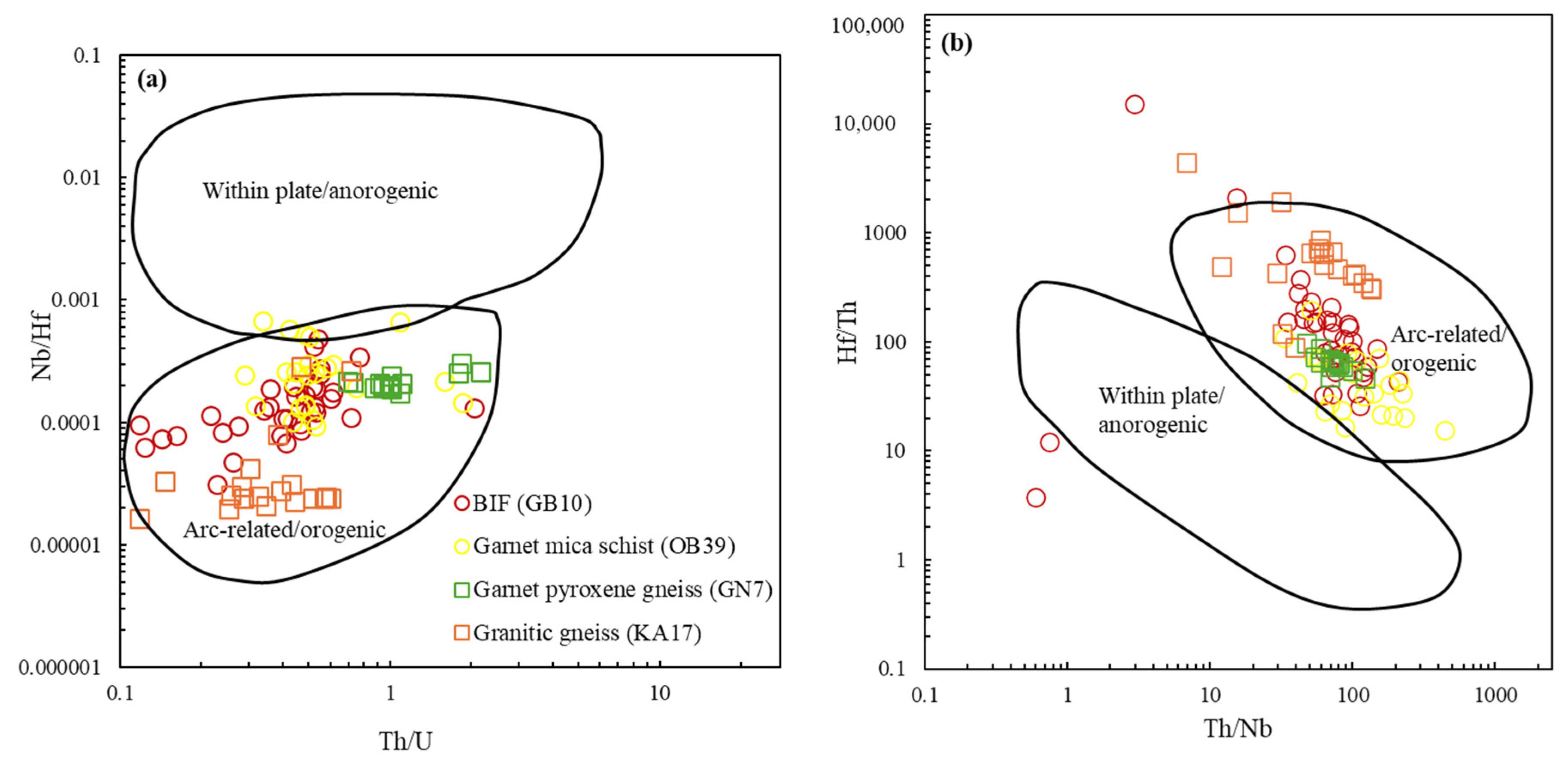
The studied zircons from metasedimentary rocks exhibit high U (average: 209–339 ppm), Th/U ratios (average: 0.52–0.60), Hf (average: 8730–11,982 ppm), Y (average: 949–1338 ppm), and Ti-in-zircon temperatures of 736–807 °C. These zircons display very low Nb/Hf ratios (<0.1) but elevated Th/Nb (71.48–125.88) and Hf/Th (45–554) ratios. The zircons from metaigneous rocks display relatively low U (61.51–147 ppm) but high Th/U ratios (0.36–1.14), Hf (7249–9829 ppm) and Ti-in-zircon temperatures of 660–675 °C. These chemical features indicate arc-related zircons [17]. This interpretation is supported by the Th/U vs. Nb/Hf and Th/Nb vs. Hf/Th tectonic diagrams (Figure 15a,b) in which the studied zircons plot within the arc-related orogenic field, indicating a predominantly compressive magmatic arc or orogenic setting [116,117]. The magmatic arc or orogenic setting exhibited by the studied zircons is comparable to the emplacement environment reported from whole-rock geochemistry for granitoid rocks of similar age from the adjacent Ntem Complex [50,118,119] and Ivindo Basement Complex [33] of the NW Congo Craton. Our interpretations are further consistent with the active orogenic setting previously demonstrated in Bidou I [42] and with the continental crust–arc setting in the Mewengo area of the NyC [34], as revealed by whole-rock geochemistry (Figure 5).
Zircon geochemistry, particularly trace element discrimination, clearly situates the studied rocks within an orogenic compressional magmatic arc environment, consistent with regional tectonic reconstruction [29]. Magmatic arc formation is likely the most important mechanism for maintaining the continental crust reservoir [116]. The preservation of felsic continental crust, combined with the observed geochemical signatures, suggests active-margin processes and supports the hypothesis of Proterozoic crustal growth through accretion and tectonic reworking [120]. Consequently, the Proterozoic period may marks the onset of horizontal tectonics, including arc accretion, terrane collision, and subduction [29].

5.5. Crustal Evolution

As previously discussed in Section 5.1, the zircon age groups reported in this study closely correspond to the timing of recognized geological events in the CC. Indeed, the detrital zircon age spectrum ranges from Mesoarchean to Paleoproterozoic. Given that Mesoarchean to Neoarchean charnockites and TTG granitoids are widespread in the adjacent Ntem Complex and East Gabonian Block, these rocks likely represent the primary source of zircon grains for the metasedimentary rocks in the NyC. The published Hf isotopic data [35,36] for detrital zircons from these rocks, together with the trace-element geochemistry of this study, allow us to constrain the crustal evolution of the NyC. Their negative εHf(t) values, ranging from −8.54 to −1.68, and Hf model ages of 3641–3465 Ma and 3098–2804 Ma for detrital zircons indicate the recycling of Paleoarchean and Mesoarchean continental crust, respectively. In contrast, positive εHf(t) values from +2.01 to +10.24 and Hf model ages of 2670 to 2176 Ma for the magmatic zircons constrain the timing of mantle extraction for the juvenile crust, which was subsequently reworked during the emplacement of the mafic protolith derived from the upper mantle. This indicates the presence of ancient crust within the CC. The Neoarchean zircon population corresponds to a known high-K magmatic event within the CC [33,51]. The presence of both recycled crustal material and mantle-derived magmatism supports a model in which older basement rocks were repeatedly reworked, contributing to the formation and transformation of the NyC over geological time.
Although the relative positions of the São Francisco and Congo cratons before their amalgamation at approximately ca. 2.1–2.0 Ga remain debated (e.g., [121]), some authors (e.g., [122,123]) have suggested that both cratons may have been part of a Supercraton that existed between 3.1 and 2.8 Ga. Indeed, the Serrinha Block of the NE São Francisco Craton and the West CC exhibit common geological and geochronological characteristics. For instance, both blocks consist of TTG grey gneisses of similar ages (ca. 3.2–2.9 Ga; [124,125]). The metamorphic rocks are intruded by mafic to ultramafic igneous complexes such as the ca. 2.72 Ga norite and ca. 2.62 Ga tholeiitic dykes of the Serrinha Block [126] and the ca. 2.77 Ga mafic-ultramafic layered PGE-rich intrusion of the Monts de Cristal Complex from the NW Gabon of CC [127]. The age of the high-pressure metamorphism on the Serrinha Block is similar to that of the oldest high-degree metamorphic event on the West Congo Craton at ca. 2.82 Ga (cf. [128]). The ca. 2.8–2.5 Ga granitoids and metamorphic rocks of the East Gabonian Block are comparable in age to the ca. 2.81–2.69 Ga granitoids of the Jequié Block and the ca. 2.69–2.57 Ga TTG and charnockite suites of the Itabuna-Salvador-Curaçá belt (e.g., [30]). The presence of felsic continental crust between 2.9 and 2.2 Ga in the NyC as shown by the detrital zircon age spectrum aligns with that of the Borborema Province in NE São Francisco Craton [128,129]. We suggest that the transition of initiation of plate tectonics involve a higher consumption of mafic crust during Proterozoic accretion mechanisms than during late Archean processes. This transition enabled the stabilization of the continental lithosphere, the growth of cratons, and the assembly of supercontinents, including the core of the Nuna/Columbia supercontinent [120,130]. This finding aligns with the model suggesting that the São Francisco and Congo cratons were amalgamated to form the core of the Paleoproterozoic Columbia/Nuna supercontinent during the ca. 2.1–2.0 Ga Rhyacian-Orosirian orogeny ([128]; Figure 1a). Therefore, the NyC represents a segment of the Trans-Amazonian belt, which formed during the collision of the São Francisco and Congo cratons at ca. 2.1–2.0 Ga [36,38].

6. Conclusions

An integrated study of geochronology and zircon trace element geochemistry in the NyC metasedimentary and metaigneous rocks provides critical insights into the crustal evolution of this segment of the CC.
  • Most of the analyzed zircons exhibit Th/U ratio > 0.4, which is typical of igneous zircons. Hf content shows wide variation (7796–13,101 ppm for metasedimentary rocks, and 5558–10,572 ppm for metaigneous rocks). The wide range of Hf suggests that the zircon crystallized from a melt with variable composition that underwent significant magmatic differentiation.
  • The chondrite-normalized REE diagrams of the zircon grains of both samples show very similar patterns, characterized by a steeply rising slope due to HREE enrichment relative to LREE with distinctive positive Ce and negative Eu anomalies, suggesting variable oxidation conditions, spanning a range from low to high oxygen fugacity.
  • The application of Ti-in-zircon thermometry reveals temperature ranges of 653–902 °C for metasedimentary zircons, and 597–778 °C for metaigneous rocks.
  • Detrital zircons yielded Archean to Paleoproterozoic ages, with five distinct peaks (2885 ± 8 Ma, 2775 ± 6 Ma, 2654 ± 7 Ma, 2469 ± 11 Ma, and 2316 ± 11 Ma) that align with well-documented magmatic events in the Congo and São Francisco cratons. The studied rocks underwent high-grade metamorphism during the Eburnean orogeny at ca. 2.1–2.0 Ga.
  • The integration of the zircon trace element data of the present study with geochemical, isotope, and geochronological data of previous studies suggests mainly continental-derived crustal magmas in an arc setting for the Archean to Paleoproterozoic rocks of western Gondwana.
  • The formation of the NyC rocks involves both the crustal recycling of the older Archean continental crust and the addition of juvenile crust during the late Paleoproterozoic, when the Congo and São Francisco cratons assembled to form the core of the Nuna–Columbia supercontinent.

Supplementary Materials

The following supporting information can be downloaded at https://www.mdpi.com/article/10.3390/min16040414/s1, Table S1a: Major (wt%) and trace element (ppm) composition of the metaigneous rocks; Table S1b: Major (wt%) and trace element (ppm) composition of the metasedimentary rocks; Table S2: Zircon Lu-Hf isotope data for the Gouap metasiliciclastic rocks; Table S3: Zircon Lu-Hf isotope data for the Mewongo rocks; Table S4: List of zircon morphological properties vs. different rock groups; Table S5: LA-ICP-MS zircon trace element composition (ppm) for the metasedimentary rocks from the study area; Table S6: LA-ICP-MS zircon trace element composition (ppm) for the metaigneous rocks from the study area; Table S7: Calculated temperatures (°C) using Ti-in-zircon geothermometer; Table S8: U-Pb analytical results from zircons of metasedimentary rocks; Table S9. U-Pb analytical results from zircons of metaigneous rocks.

Author Contributions

Conceptualization, N.D.N. and J.P.N.; methodology, N.D.N.; software, N.D.N.; validation, N.D.N., E.L.N.T. and J.P.N.; formal analysis, N.D.N.; investigation, N.D.N., P.N.E.T., B.W.K., M.N.T., L.S.T. and D.H.F.; resources, J.P.N.; data curation, N.D.N. and J.P.N.; writing—original draft preparation, N.D.N.; writing—review and editing, E.L.N.T., J.P.N., P.N.E.T., B.W.K., M.N.T., L.S.T. and D.H.F.; visualization, N.D.N.; supervision, E.L.N.T. and J.P.N.; project administration, J.P.N.; funding acquisition, N.D.N. All authors have read and agreed to the published version of the manuscript.

Funding

This research did not receive any specific grant from funding agencies in the public, commercial, or not-for-profit sectors.

Data Availability Statement

The data are provided in the article.

Acknowledgments

This paper represents part of the first author’s Ph.D. thesis at the Department of Earth Sciences of the University of Yaoundé I. We acknowledge the comments of four anonymous reviewers which substantially improved the quality of this work.

Conflicts of Interest

The authors declare no conflicts of interest.

References

  1. Drabon, N.; Byerly, B.L.; Byerly, G.R.; Wooden, J.L.; Keller, C.B.; Lowe, D.R. Heterogeneous Hadean Crust with Ambient Mantle Affinity Recorded in Detrital Zircons of the Green Sandstone Bed, South Africa. Proc. Natl. Acad. Sci. USA 2021, 118, e2004370118. [Google Scholar] [CrossRef]
  2. Brudner, A.; Jiang, H.; Chu, X.; Tang, M. Crustal Thickness of the Grenville Orogen: A Mesoproterozoic Tibet? Geology 2022, 50, 402–406. [Google Scholar] [CrossRef]
  3. Liu, Y.; Zhang, L.; Santosh, M.; Dong, G.; Zhou, H.; Que, C.; Yang, C.-X. Multi-Stage Metallogeny in the Southwestern Part of South China, and Paleotectonic and Climatic Implications: A High Precision Geochronologic Study. Geosci. Front. 2023, 14, 101536. [Google Scholar] [CrossRef]
  4. Xiong, L.; Song, S.; Su, L.; Zhang, G.; Allen, M.B.; Feng, D.; Yang, S. Detrital Zircons from High-Pressure Trench Sediments (Qilian Orogen): Constraints on Continental-Arc Accretion, Subduction Initiation and Polarity of the Proto-Tethys Ocean. Gondwana Res. 2023, 113, 194–209. [Google Scholar] [CrossRef]
  5. Sundell, K.E.; Gehrels, G.E.; Blum, M.D.; Saylor, J.E.; Pecha, M.E.; Hundley, B.P. An Exploratory Study of “Large-n” Detrital Zircon Geochronology of the Book Cliffs, UT via Rapid (3 s/Analysis) U–Pb Dating. Basin Res. 2024, 36, e12840. [Google Scholar] [CrossRef]
  6. Cheng, C.; Li, S.; Xie, X.; Xie, W.; Yang, D.; Chai, G.; Lu, Y.; Wei, X.; Li, M.; Hu, B. Crustal Thickness Variation of the Dabie Orogenic Belt: Insights from Detrital Zircon Evidence and Geological Significance. Gondwana Res. 2024, 129, 355–366. [Google Scholar] [CrossRef]
  7. Castillo, P.; Bahlburg, H.; Fernandez, R.; Fanning, C.M.; Berndt, J. The European Continental Crust through Detrital Zircons from Modern Rivers: Testing Representativity of Detrital Zircon U-Pb Geochronology. Earth-Sci. Rev. 2022, 232, 104145. [Google Scholar] [CrossRef]
  8. Dhuime, B.; Hawkesworth, C.J.; Delavault, H.; Cawood, P.A. Rates of Generation and Destruction of the Continental Crust: Implications for Continental Growth. Philos. Trans. R. Soc. A Math. Phys. Eng. Sci. 2018, 376, 20170403. [Google Scholar] [CrossRef] [PubMed]
  9. Tang, M.; Ji, W.-Q.; Chu, X.; Wu, A.; Chen, C. Reconstructing Crustal Thickness Evolution from Europium Anomalies in Detrital Zircons. Geology 2021, 49, 76–80. [Google Scholar] [CrossRef]
  10. Burnham, A.D.; Berry, A.J. Formation of Hadean Granites by Melting of Igneous Crust. Nat. Geosci. 2017, 10, 457–461. [Google Scholar] [CrossRef]
  11. Liu, H.; McKenzie, N.R.; Colleps, C.L.; Chen, W.; Ying, Y.; Stockli, L.; Sardsud, A.; Stockli, D.F. Zircon Isotope–Trace Element Compositions Track Paleozoic–Mesozoic Slab Dynamics and Terrane Accretion in Southeast Asia. Earth Planet. Sci. Lett. 2022, 578, 117298. [Google Scholar] [CrossRef]
  12. Liu, Z.; Zhang, G.; Xiong, L.; Chang, F.; Liu, S. Evolution of the Continental Crust in the Northern Tibetan Plateau: Constraints From Geochronology and Hf Isotopes of Detrital Zircons. Front. Earth Sci. 2022, 10, 866375. [Google Scholar] [CrossRef]
  13. Watson, E.B.; Wark, D.A.; Thomas, J.B. Crystallization Thermometers for Zircon and Rutile. Contrib. Miner. Pet. 2006, 151, 413. [Google Scholar] [CrossRef]
  14. Ferry, J.M.; Watson, E.B. New Thermodynamic Models and Revised Calibrations for the Ti-in-Zircon and Zr-in-Rutile Thermometers. Contrib. Miner. Pet. 2007, 154, 429–437. [Google Scholar] [CrossRef]
  15. Ayonta Kenne, P.; Tanko Njiosseu, E.L.; Ganno, S.; Ngnotue, T.; Fossi, D.H.; Hamdja Ngoniri, A.; Nga Essomba, P.; Nzenti, J.P. Zircon Trace Element Geochemistry and Ti-in-Zircon Thermometry of the Linté Pan-African Granitoids, Central Cameroon: Constraints on the Genesis of Host Magma and Tectonic Implications. Geol. J. 2021, 56, 4830–4848. [Google Scholar] [CrossRef]
  16. Bloch, E.M.; Jollands, M.C.; Tollan, P.; Plane, F.; Bouvier, A.-S.; Hervig, R.; Berry, A.J.; Zaubitzer, C.; Escrig, S.; Müntener, O. Diffusion Anisotropy of Ti in Zircon and Implications for Ti-in-Zircon Thermometry. Earth Planet. Sci. Lett. 2022, 578, 117317. [Google Scholar] [CrossRef]
  17. Grimes, C.B.; Wooden, J.L.; Cheadle, M.J.; John, B.E. “Fingerprinting” Tectono-Magmatic Provenance Using Trace Elements in Igneous Zircon. Contrib. Miner. Pet. 2015, 170, 46. [Google Scholar] [CrossRef]
  18. Deng, C.; Sun, G.; Sun, D.; Han, J.; Yang, D.; Tang, Z. Morphology, Trace Elements, and Geochronology of Zircons from Monzogranite in the Northeast Xing’an Block, Northeastern China: Constraints on the Genesis of the Host Magma. Miner. Pet. 2019, 113, 651–666. [Google Scholar] [CrossRef]
  19. Cui, X.; Ren, G.; Pang, W.; Chen, F.; Sun, Z.; Ren, F.; Ning, K.; Deng, Q. Detrital Zircon Provenance of Metasedimentary Rocks in the Proterozoic Caiziyuan-Tongan Accretionary Complex: Constraints on Crustal and Tectonic Evolution of the Yangtze Block, South China. Geol. J. 2022, 57, 2094–2109. [Google Scholar] [CrossRef]
  20. Liu, X.-M.; Liu, L.; Zhu, D.-C.; Cawood, P.A.; Blum, M.D.; Zhang, L.-L.; Wang, Y.; Lu, Y.; Wang, Q.; Chang, Y.-X. Erasure of Zircon Rims by Sediment Transport after Two Orogenic Cycles. Geology 2025, 53, 988–992. [Google Scholar] [CrossRef]
  21. Yakymchuk, C.; Kirkland, C.L. Interpreting Europium Anomalies in Zircon: The Importance of Source Redox. Geochem. Geophys. Geosyst. 2025, 26, e2025GC012505. [Google Scholar] [CrossRef]
  22. Ji, C.; Zhang, K.-J.; Yan, L.-L. Hydrothermal Metasomatism and Solid-Phase Transfer in Petrogenesis of Listvenite: The Meso-Tethyan Ophiolite, Central Tibet, China. Contrib. Miner. Pet. 2023, 178, 4. [Google Scholar] [CrossRef]
  23. Manikyamba, C.; Ganguly, S.; Santosh, M.; Subramanyam, K.S.V. Volcano-Sedimentary and Metallogenic Records of the Dharwar Greenstone Terranes, India: Window to Archean Plate Tectonics, Continent Growth, and Mineral Endowment. Gondwana Res. 2017, 50, 38–66. [Google Scholar] [CrossRef]
  24. Roberts, N.M.W.; Santosh, M. Capturing the Mesoarchean Emergence of Continental Crust in the Coorg Block, Southern India. Geophys. Res. Lett. 2018, 45, 7444–7453. [Google Scholar] [CrossRef]
  25. Jayananda, M.; Santosh, M.; Aadhiseshan, K.R. Formation of Archean (3600–2500 Ma) Continental Crust in the Dharwar Craton, Southern India. Earth-Sci. Rev. 2018, 181, 12–42. [Google Scholar]
  26. Li, X.-H.; Chen, Y.; Li, J.; Yang, C.; Ling, X.-X.; Tchouankoue, J.P. New Isotopic Constraints on Age and Origin of Mesoarchean Charnockite, Trondhjemite and Amphibolite in the Ntem Complex of NW Congo Craton, Southern Cameroon. Precambrian Res. 2016, 276, 14–23. [Google Scholar] [CrossRef]
  27. Shang, C.K.; Liégeois, J.P.; Satir, M.; Frisch, W.; Nsifa, E.N. Late Archaean High-K Granite Geochronology of the Northern Metacratonic Margin of the Archaean Congo Craton, Southern Cameroon: Evidence for Pb-Loss Due to Non-Metamorphic Causes. Gondwana Res. 2010, 18, 337–355. [Google Scholar] [CrossRef]
  28. Lerouge, C.; Cocherie, A.; Toteu, S.F.; Penaye, J.; Milési, J.-P.; Tchameni, R.; Nsifa, E.N.; Mark Fanning, C.; Deloule, E. Shrimp U–Pb Zircon Age Evidence for Paleoproterozoic Sedimentation and 2.05Ga Syntectonic Plutonism in the Nyong Group, South-Western Cameroon: Consequences for the Eburnean–Transamazonian Belt of NE Brazil and Central Africa. J. Afr. Earth Sci. 2006, 44, 413–427. [Google Scholar] [CrossRef]
  29. Loose, D.; Schenk, V. 2.09 Ga Old Eclogites in the Eburnian-Transamazonian Orogen of Southern Cameroon: Significance for Palaeoproterozoic Plate Tectonics. Precambrian Res. 2018, 304, 1–11. [Google Scholar] [CrossRef]
  30. Thiéblemont, P.; Castaing, C.; Billa, M.; Bouton, P.; Préat, A. Notice Explicative de La Carte Géologique et Des Ressources Minérales de La République Gabonaise à 1/1000 000: Libreville, Gabon; Editions DGMG: Libreville, Gabon, 2009; 384p. [Google Scholar]
  31. Ndime, E.N.; Ganno, S.; Nzenti, J.P. Geochemistry and Pb–Pb Geochronology of the Neoarchean Nkout West Metamorphosed Banded Iron Formation, Southern Cameroon. Int. J. Earth Sci. 2019, 108, 1551–1570. [Google Scholar] [CrossRef]
  32. Takam, T.; Arima, M.; Kokonyangi, J.; Dunkley, D.J.; Nsifa, E.N. Pale-oarchaean Charnockite in the Ntem Complex, Congo Craton, Cameroon: Insights from SHRIMP Zircon U–Pb Ages. J. Mineral. Petrol. Sci. 2009, 104, 1–11. [Google Scholar] [CrossRef]
  33. Gatsé Ebotehouna, C.; Xie, Y.; Adomako-Ansah, K.; Gourcerol, B.; Qu, Y. Depositional Environment and Genesis of the Nabeba Banded Iron Formation (BIF) in the Ivindo Basement Complex, Republic of the Congo: Perspective from Whole-Rock and Magnetite Geochemistry. Minerals 2021, 11, 579. [Google Scholar] [CrossRef]
  34. Kouankap Nono, G.D.; Minyem, D.; Nga Essomba Tsoungui, E.P.; Kwamou Wanang, M.M.; Ayonta Kenne, P.; Kamguia Woguia, B.; Nkouathio, D.G. Geochemistry and U–Pb Zircon Geochronology of Granitic Gneisses in the Mewengo Iron Deposits: Evidence of Archean Fingerprints within the Paleoproterozoic Nyong Group, Cameroon. Arab. J. Geosci. 2022, 15, 1498. [Google Scholar] [CrossRef]
  35. Deassou Sezine, E.; Soh Tamehe, L.; Ganno, S.; Nzepang Tankwa, M.; Brice Lemdjou, Y.; Dadjo Djomo, H.; Alberto Rosière, C.; Paul Nzenti, J.; Bekker, A. Geochronological and Geochemical Constraints for the Metavolcanosedimentary Succession of the Nyong Complex, Northwestern Margin of the Congo Craton: Implications for Depositional Age and Tectonic Setting of Associated Banded Iron Formations. Precambrian Res. 2022, 383, 106910. [Google Scholar] [CrossRef]
  36. Soh Tamehe, L.; Wei, C.; Ganno, S.; Rosière, C.A.; Li, H.; Soares, M.B.; Nzenti, J.P.; Santos, J.O.S.; Bekker, A. Provenance of Metasiliciclastic Rocks at the Northwestern Margin of the East Gabonian Block: Implications for Deposition of BIFs and Crustal Evolution in Southwestern Cameroon. Precambrian Res. 2022, 376, 106677. [Google Scholar] [CrossRef]
  37. Maurizot, P.; Abessolo, A.; Feybesse, J.L.; Lecomte, P.J. Etude de Prospection Minière du Sud-Ouest Cameroun: Synthèse des Travaux de 1978 à 1985. Rapp. BRGM. 85, CMR 066; Bureau de Recherches Géologiques et Minières: Orléans, France, 1986.
  38. Owona, S.; Ratschbacher, L.; Ngapna, M.N.; Gulzar, A.M.; Ondoa, J.M.; Ekodeck, G.E. How Diverse Is the Source? Age, Provenance, Reworking, and Overprint of Precambrian Meta-Sedimentary Rocks of West Gondwana, Cameroon, from Zircon U-Pb Geochronology. Precambrian Res. 2021, 359, 106220. [Google Scholar] [CrossRef]
  39. Kwamou Wanang, M.M.; Kouankap Nono, G.D.; Nkouathio, D.G.; Ayonta Kenne, P. Petrogenesis and U–Pb Zircon Dating of Amphibolite in the Mewengo Iron Deposit, Nyong Series, Cameroon: Fingerprints of Iron Depositional Geotectonic Setting. Arab. J. Geosci. 2021, 14, 872. [Google Scholar] [CrossRef]
  40. Bouyo, M.H.; Penaye, J.; Mouri, H.; Toteu, S.F. Eclogite Facies Metabasites from the Paleoproterozoic Nyong Group, SW Cameroon: Mineralogical Evidence and Implications for a High-Pressure Metamorphism Related to a Subduction Zone at the NW Margin of the Archean Congo Craton. J. Afr. Earth Sci. 2019, 149, 215–234. [Google Scholar] [CrossRef]
  41. Nga Essomba Tsoungui, P.; Ganno, S.; Tanko Njiosseu, E.L.; Ndema Mbongue, J.L.; Kamguia Woguia, B.; Soh Tamehe, L.; Takodjou Wambo, J.D.; Nzenti, J.P. Geochemical Constraints on the Origin and Tectonic Setting of the Serpentinized Peridotites from the Paleoproterozoic Nyong Series, Eseka Area, SW Cameroon. Acta Geochim. 2020, 39, 404–422. [Google Scholar] [CrossRef]
  42. Kamguia Woguia, B.; Kouankap Nono, G.D.; Nga Essomba Tsoungui, P.E.; Njiosseu Tanko, E.L.; Ayonta Kenne, P.; Nzenti, J.P. Geochemistry and U–Pb Zircon Age of the Paleoproterozoic Metasedimentary Rocks from the Bidou I, Nyong Series, Cameroon: Implications for Provenance and Tectonic Setting. Arab. J. Geosci. 2022, 15, 154. [Google Scholar] [CrossRef]
  43. Soh Tamehe, L.; Wei, C.; Ganno, S.; Rosière, C.A.; Nzenti, J.P.; Gatse Ebotehouna, C.; Lu, G. Depositional Age and Tectonic Environment of the Gouap Banded Iron Formations from the Nyong Group, SW Cameroon: Insights from Isotopic, Geochemical and Geochronological Studies of Drillcore Samples. Geosci. Front. 2021, 12, 549–572. [Google Scholar] [CrossRef]
  44. Teixeira, W.; Oliveira, E.P.; Peng, P.; Dantas, E.L.; Hollanda, M.H.B.M. U-Pb Geochronology of the 2.0Ga Itapecerica Graphite-Rich Supracrustal Succession in the São Francisco Craton: Tectonic Matches with the North China Craton and Paleogeographic Inferences. Precambrian Res. 2017, 293, 91–111. [Google Scholar] [CrossRef]
  45. Bankole, O.M.; El Albani, A.; Meunier, A.; Poujol, M.; Bekker, A. Elemental Geochemistry and Nd Isotope Constraints on the Provenance of the Basal Siliciclastic Succession of the Middle Paleoproterozoic Francevillian Group, Gabon. Precambrian Res. 2020, 348, 105874. [Google Scholar] [CrossRef]
  46. Ossa, F.O.; Hofmann, A.; Ballouard, C.; Vorster, C.; Schoenberg, R.; Fiedrich, A.; Mayaga-Mikolo, F.; Bekker, A. Constraining Provenance for the Uraniferous Paleoproterozoic Francevillian Group Sediments (Gabon) with Detrital Zircon Geochronology and Geochemistry. Precambrian Res. 2020, 343, 105724. [Google Scholar] [CrossRef]
  47. Meloux, J.; Bigot, M.; Viland, J.C. Plan Minéral de La République Populaire Du Congo. Éditions BRGM 1983, 1, 725. [Google Scholar]
  48. Shang, C.K.; Satir, M.; Siebel, W.; Nsifa, E.N.; Taubald, H.; Liégeois, J.-P.; Tchoua, F.M. TTG Magmatism in the Congo Craton; a View from Major and Trace Element Geochemistry, Rb–Sr and Sm–Nd Systematics: Case of the Sangmelima Region, Ntem Complex, Southern Cameroon. J. Afr. Earth Sci. 2004, 40, 61–79. [Google Scholar] [CrossRef]
  49. Shang, C.K.; Satir, M.; Nsifa, E.N.; Liégeois, J.-P.; Siebel, W.; Taubald, H. Archaean High-K Granitoids Produced by Remelting of Earlier Tonalite–Trondhjemite–Granodiorite (TTG) in the Sangmelima Region of the Ntem Complex of the Congo Craton, Southern Cameroon. Int. J. Earth Sci. 2007, 96, 817–841. [Google Scholar] [CrossRef]
  50. Tchameni, R.; Mezger, K.; Nsifa, N.E.; Pouclet, A. Crustal Origin of Early Proterozoic Syenites in the Congo Craton (Ntem Complex), South Cameroon. Lithos 2001, 57, 23–42. [Google Scholar] [CrossRef]
  51. Akame, J.M.; Owona, S.; Hublet, G.; Debaille, V. Archean Tectonics in the Sangmelima Granite-Greenstone Terrains, Ntem Complex (NW Congo Craton), Southern Cameroon. J. Afr. Earth Sci. 2020, 168, 103872. [Google Scholar] [CrossRef]
  52. Soh Tamehe, L.; Chongtao, W.; Ganno, S.; Simon, S.J.; Kouankap Nono, G.D.; Nzenti, J.P.; Lemdjou, Y.B.; Lin, N.H. Geology of the Gouap Iron Deposit, Congo Craton, Southern Cameroon: Implications for Iron Ore Exploration. Ore Geol. Rev. 2019, 107, 1097–1128. [Google Scholar] [CrossRef]
  53. Toteu, S.F.; Van Schmus, W.R.; Penaye, J.; Michard, A. New U/Pb and Sm/Nd Data from North-Central Cameroon and Its Bearing on the Pre-Pan African History of Central Africa. Precambrian Res. 2001, 108, 45–73. [Google Scholar] [CrossRef]
  54. Toteu, S.F.; Van Schmus, W.R.; Penaye, J.; Nyobe, J.B. U-Pb and Sm-N Edvidence for Eburnian and Pan-African High-Grade Metamorphism in Cratonic Rocks of Southern Cameroon. Precambrian Res. 1994, 67, 321–347. [Google Scholar] [CrossRef]
  55. Akame, J.M.; Oliveira, E.P.; Poujol, M.; Hublet, G.; Debaille, V. LA–ICP–MS Zircon UPb Dating, LuHf, SmNd Geochronology and Tectonic Setting of the Mesoarchean Mafic and Felsic Magmatic Rocks in the Sangmelima Granite-Greenstone Terrane, Ntem Complex (South Cameroon). Lithos 2020, 372–373, 105702. [Google Scholar] [CrossRef]
  56. Penaye, J.; Toteu, S.F.; Tchameni, R.; Van Schmus, W.R.; Tchakounté, J.; Ganwa, A.; Minyem, D.; Nsifa, E.N. The 2.1Ga West Central African Belt in Cameroon: Extension and Evolution. J. Afr. Earth Sci. 2004, 39, 159–164. [Google Scholar] [CrossRef]
  57. Ganno, S.; Njiosseu Tanko, E.L.; Kouankap Nono, G.D.; Djoukouo Soh, A.; Moudioh, C.; Ngnotué, T.; Nzenti, J.P. A Mixed Seawater and Hydrothermal Origin of Superior-Type Banded Iron Formation (BIF)-Hosted Kouambo Iron Deposit, Palaeoproterozoic Nyong Series, Southwestern Cameroon: Constraints from Petrography and Geochemistry. Ore Geol. Rev. 2017, 80, 860–875. [Google Scholar] [CrossRef]
  58. Chombong, N.N.; Suh, C.E.; Lehmann, B.; Vishiti, A.; Ilouga, D.C.; Shemang, E.M.; Tantoh, B.S.; Kedia, A.C. Host Rock Geochemistry, Texture and Chemical Composition of Magnetite in Iron Ore in the Neoarchaean Nyong Unit in Southern Cameroon. Appl. Earth Sci. 2017, 126, 129–145. [Google Scholar] [CrossRef]
  59. Owona, S.; Ratschbacher, L.; Afzal, M.G.; Nsangou Ngapna, M.; Mvondo Ondoa, J.; Ekodeck, G.E. New U–Pb Zircon Ages of Nyong Complex Meta-Plutonites: Implications for the Eburnean/Trans-Amazonian Orogeny in Southwestern Cameroon (Central Africa). Geol. J. 2021, 56, 1741–1755. [Google Scholar] [CrossRef]
  60. Mvodo, H.; Ganno, S.; Kouankap Nono, G.D.; Fossi, D.H.; Nga Essomba, P.E.; Nzepang Tankwa, M.; Nzenti, J.P. Petrogenesis, LA-ICP-MS Zircon U-Pb Geochronology and Geodynamic Implications of the Kribi Metavolcanic Rocks, Nyong Group, Congo Craton. Acta Geochim. 2022, 41, 470–495. [Google Scholar] [CrossRef]
  61. Nzepang Tankwa, M.N.; Ganno, S.; Okunlola, O.A.; Njiosseu, E.L.T.; Tamehe, L.S.; Woguia, B.K.; Mbita, A.S.M.; Nzenti, J.P. Petrogenesis and Tectonic Setting of the Paleoproterozoic Kelle Bidjoka Iron Formations, Nyong Group Greenstone Belts, Southwestern Cameroon. Constraints from Petrology, Geochemistry, and LA-ICP-MS Zircon U-Pb Geochronology. Int. Geol. Rev. 2020, 63, 1737–1757. [Google Scholar] [CrossRef]
  62. Moudioh, C.; Tamehe, L.S.; Ganno, S.; Nzepang Tankwa, M.; Brando Soares, M.; Ghosh, R.; Kankeu, B.; Nzenti, J.P. Tectonic Setting of the Bipindi Greenstone Belt, Northwest Congo Craton, Cameroon: Implications on BIF Deposition. J. Afr. Earth Sci. 2020, 171, 103971. [Google Scholar] [CrossRef]
  63. Djoukouo Soh, A.P.; Ganno, S.; Zhang, L.; Soh Tamehe, L.; Wang, C.; Peng, Z.; Tong, X.; Nzenti, J.P. Origin, Tectonic Environment and Age of the Bibole Banded Iron Formations, Northwestern Congo Craton, Cameroon: Geochemical and Geochronological Constraints. Geol. Mag. 2021, 158, 2245–2263. [Google Scholar] [CrossRef]
  64. Swiffa Fajong, I.; Nzepang Tankwa, M.; Fossi, D.H.; Ganno, S.; Moudioh, C.; Soh Tamehe, L.; Suh, C.E.; Nzenti, J.P. Lithostratigraphy, Origin, and Geodynamic Setting of Iron Formations and Host Rocks of the Anyouzok Region, Congo Craton, Southwestern Cameroon. Minerals 2022, 12, 1198. [Google Scholar] [CrossRef]
  65. Nga Essomba, P.E. Evolution Tectono-Métamorphique des Formations Précambriennes de Minlongo-Lolodorf (Région du Sud-Cameroun). Ph.D. Thesis, Université de Yaoundé I, Yaoundé, Cameroon, 2020. [Google Scholar]
  66. Ross, P.-S.; Bédard, J.H. Magmatic Affinity of Modern and Ancient Subalkaline Volcanic Rocks Determined from Trace-Element Discriminant Diagrams. Can. J. Earth Sci. 2009, 46, 823–839. [Google Scholar] [CrossRef]
  67. McDonough, W.F.; Sun, S.-S. The Composition of the Earth. Chem. Geol. 1995, 120, 223–253. [Google Scholar] [CrossRef]
  68. Sun, S.-S.; McDonough, W.F. Chemical and Isotopic Systematics of Oceanic Basalts: Implications for Mantle Composition and Processes. Geol. Soc. Lond. Spec. Publ. 1989, 42, 313–345. [Google Scholar] [CrossRef]
  69. Bekker, A.; Planavsky, N.; Rasmussen, B.; Krapez, B.; Hofmann, A.; Slack, J.; Rouxel, O.; Konhauser, K. Iron Formations: Their Origins and Implications for Ancient Seawater Chemistry. In Treatise on Geochemistry; Elsevier: Amsterdam, The Netherlands, 2014; Volume 12, pp. 561–628. [Google Scholar]
  70. Gourcerol, B.; Blein, O.; Chevillard, M.; Callec, Y.; Boudzoumou, F.; Djama, L.-M.J. Depositional Setting of Archean BIFs from Congo: New Insight into Under-Investigated Occurrences. Minerals 2022, 12, 114. [Google Scholar] [CrossRef]
  71. Taylor, S.R.; McLennan, S.M. The Continental Crust: Its Composition and Evolution; Blackwell Scientific Publications: Oxford, UK, 1985. [Google Scholar]
  72. Rudnick, R.; Gao, S. The Role of Lower Crustal Recycling in Continent Formation. Geochim. Cosmochim. Acta Suppl. 2003, 67, 403. [Google Scholar]
  73. Bhatia, M.R.; Crook, K.A. Trace Element Characteristics of Graywackes and Tectonic Setting Discrimination of Sedimentary Basins. Contrib. Miner. Pet. 1986, 92, 181–193. [Google Scholar] [CrossRef]
  74. Pearce, J.A.; Harris, N.B.W.; Tindle, A.G. Trace Element Discrimination Diagrams for the Tectonic Interpretation of Granitic Rocks. J. Pet. 1984, 25, 956–983. [Google Scholar] [CrossRef]
  75. Cabanis, B.; Lecolle, M. Le Diagramme La/10-Y/15-Nb/8: Un Outil Pour La Discrimination Des Séries Volcaniques et La Mise En Évidence Des Processus de Mélange et/Ou de Contamination Crustale. Comptes Rendus Acad. Sci. Ser. 2 1989, 309, 2023–2029. [Google Scholar]
  76. Wiedenbeck, M.; Allé, P.; Corfu, F.; Griffin, W.L.; Meier, M.; Oberli, F.; Quadt, A.V.; Roddick, J.C.; Spiegel, W. Three Natural Zircon Standards for U-Th-Pb, Lu-Hf, Trace Element and Ree Analyses. Geostand. Newsl. 1995, 19, 1–23. [Google Scholar] [CrossRef]
  77. Jackson, S.E.; Pearson, N.J.; Griffin, W.L.; Belousova, E.A. The Application of Laser Ablation-Inductively Coupled Plasma-Mass Spectrometry to in Situ U–Pb Zircon Geochronology. Chem. Geol. 2004, 211, 47–69. [Google Scholar] [CrossRef]
  78. Sláma, J.; Košler, J.; Condon, D.J.; Crowley, J.L.; Gerdes, A.; Hanchar, J.M.; Horstwood, M.S.; Morris, G.A.; Nasdala, L.; Norberg, N. Plešovice Zircon—A New Natural Reference Material for U–Pb and Hf Isotopic Microanalysis. Chem. Geol. 2008, 249, 1–35. [Google Scholar] [CrossRef]
  79. Pidgeon, R.T. Recrystallisation of Oscillatory Zoned Zircon: Some Geochronological and Petrological Implications. Contrib. Miner. Pet. 1992, 110, 463–472. [Google Scholar] [CrossRef]
  80. Van Lichtervelde, M.; Holtz, F.; Dziony, W.; Ludwig, T.; Meyer, H.-P. Incorporation Mechanisms of Ta and Nb in Zircon and Implications for Pegmatitic Systems. Am. Miner. 2011, 96, 1079–1089. [Google Scholar] [CrossRef]
  81. Hoskin, P.W.O.; Schaltegger, U. The Composition of Zircon and Igneous and Metamorphic Petrogenesis. Rev. Miner. Geochem. 2003, 53, 27–62. [Google Scholar] [CrossRef]
  82. Wang, L.; Zhang, C.; Geng, R.; Li, Y.; Song, J.; Wang, B.; Cui, F. The Discrimination of Tectonic Settings Using Trace Elements in Magmatic Zircons: A Machine Learning Approach. Earth Sci. Inform. 2023, 16, 4097–4112. [Google Scholar] [CrossRef]
  83. Hoskin, P.W. Trace-Element Composition of Hydrothermal Zircon and the Alteration of Hadean Zircon from the Jack Hills, Australia. Geochim. Cosmochim. Acta 2005, 69, 637–648. [Google Scholar] [CrossRef]
  84. Condie, K.C.; Aster, R.C. Episodic Zircon Age Spectra of Orogenic Granitoids: The Supercontinent Connection and Continental Growth. Precambrian Res. 2010, 180, 227–236. [Google Scholar] [CrossRef]
  85. Rubatto, D.; Gebauer, D. Use of Cathodoluminescence for U-Pb Zircon Dating by Ion Microprobe: Some Examples from the Western Alps. In Cathodoluminescence in Geosciences; Pagel, M., Barbin, V., Blanc, P., Ohnenstetter, D., Eds.; Springer: Berlin/Heidelberg, Germany, 2000; pp. 373–400. ISBN 978-3-642-08526-0. [Google Scholar]
  86. Watson, E.B.; Harrison, T.M. Zircon Thermometer Reveals Minimum Melting Conditions on Earliest Earth. Science 2005, 308, 841–844. [Google Scholar] [CrossRef]
  87. Ferriss, E.D.; Essene, E.J.; Becker, U. Computational Study of the Effect of Pressure on the Ti-in-Zircon Geothermometer. Eur. J. Miner. 2008, 20, 745–755. [Google Scholar] [CrossRef]
  88. Barth, A.P.; Wooden, J.L. Coupled Elemental and Isotopic Analyses of Polygenetic Zircons from Granitic Rocks by Ion Microprobe, with Implications for Melt Evolution and the Sources of Granitic Magmas. Chem. Geol. 2010, 277, 149–159. [Google Scholar] [CrossRef]
  89. Ickert, R.B.; Williams, I.S.; Wyborn, D. Ti in Zircon from the Boggy Plain Zoned Pluton: Implications for Zircon Petrology and Hadean Tectonics. Contrib. Miner. Pet. 2011, 162, 447–461. [Google Scholar] [CrossRef]
  90. Orejana, D.; Villaseca, C.; Armstrong, R.A.; Jeffries, T.E. Geochronology and Trace Element Chemistry of Zircon and Garnet from Granulite Xenoliths: Constraints on the Tectonothermal Evolution of the Lower Crust under Central Spain. Lithos 2011, 124, 103–116. [Google Scholar] [CrossRef]
  91. Wielicki, M.M.; Harrison, T.M.; Schmitt, A.K. Geochemical Signatures and Magmatic Stability of Terrestrial Impact Produced Zircon. Earth Planet. Sci. Lett. 2012, 321, 20–31. [Google Scholar] [CrossRef]
  92. Hamdja Ngoniri, A.; Soh Tamehe, L.; Ganno, S.; Ngnotue, T.; Chen, Z.; Li, H.; Ayonta Kenne, P.; Nzenti, J.P. Geochronology and Petrogenesis of the Pan-African Granitoids from Mbondo-Ngazi Tina in the Adamawa-Yadé Domain, Central Cameroon. Int. J. Earth Sci. 2021, 110, 2221–2245. [Google Scholar] [CrossRef]
  93. Claiborne, L.L.; Miller, C.F.; Flanagan, D.M.; Clynne, M.A.; Wooden, J.L. Zircon Reveals Protracted Magma Storage and Recycling beneath Mount St. Helens. Geology 2010, 38, 1011–1014. [Google Scholar] [CrossRef]
  94. Belousova, E.A.; Griffin, W.L.; O’Reilly, S.Y. Zircon Crystal Morphology, Trace Element Signatures and Hf Isotope Composition as a Tool for Petrogenetic Modelling: Examples from Eastern Australian Granitoids. J. Pet. 2006, 47, 329–353. [Google Scholar] [CrossRef]
  95. Eriksson, P.G.; Condie, K.C. Cratonic Sedimentation Regimes in the ca. 2450–2000 Ma Period: Relationship to a Possible Widespread Magmatic Slowdown on Earth? Gondwana Res. 2014, 25, 30–47. [Google Scholar] [CrossRef]
  96. Tchameni, R. Monozircon and Sm-Nd Whole Rock Ages from the Ebolowa Greenstone Belts: Evidence for the Terranes Older than 2.9 Ga in the Ntem Complex (Congo Craton, South Cameroon). J. Cameroon Acad. Sci. 2004, 4, 213–224. [Google Scholar]
  97. Kouayep Tchoundi, L.C.; Ganno, S.; Soh Tamehe, L.; Djoukouo Soh, A.P.; Fossi, D.H.; Nzenti, J.P. Geochemistry and U-Pb Zircon Geochronology of the Nkout Banded Iron Formations and Associated Metasiliciclastic Rocks, NW Congo Craton, Southern Cameroon. Int. Geol. Rev. 2024, 66, 3327–3352. [Google Scholar] [CrossRef]
  98. Macambira, M.J.B.; Vasquez, M.L.; da Silva, D.C.C.; Galarza, M.A.; de Mesquita Barros, C.E.; de Freitas Camelo, J. Crustal Growth of the Central-Eastern Paleoproterozoic Domain, SW Amazonian Craton: Juvenile Accretion vs. Reworking. J. S. Am. Earth Sci. 2009, 27, 235–246. [Google Scholar] [CrossRef]
  99. Álvaro, J.J.; Pouclet, A.; Ezzouhairi, H.; Soulaimani, A.; Bouougri, E.H.; Imaz, A.G.; Fekkak, A. Early Neoproterozoic Rift-Related Magmatism in the Anti-Atlas Margin of the West African Craton, Morocco. Precambrian Res. 2014, 255, 433–442. [Google Scholar] [CrossRef]
  100. Corfu, F.; Hanchar, J.M.; Hoskin, P.W.O.; Kinny, P. Atlas of Zircon Textures. Rev. Miner. Geochem. 2003, 53, 469–500. [Google Scholar] [CrossRef]
  101. El-Bialy, M.Z.; Ali, K.A. Zircon Trace Element Geochemical Constraints on the Evolution of the Ediacaran (600–614 Ma) Post-Collisional Dokhan Volcanics and Younger Granites of SE Sinai, NE Arabian–Nubian Shield. Chem. Geol. 2013, 360, 54–73. [Google Scholar] [CrossRef]
  102. Embui, V.F.; Suh, C.E.; Cottle, J.M.; Etame, J.; Mendes, J.; Agyingi, C.M.; Vishiti, A.; Shemang, E.M.; Lehmann, B. Zircon Chemistry and New Laser Ablation U–Pb Ages for Uraniferous Granitoids in SW Cameroon. Acta Geochim. 2020, 39, 43–66. [Google Scholar] [CrossRef]
  103. Sakyi, P.A.; Su, B.; Kwayisi, D.; Chen, C.; Bai, Y.; Alemayehu, M. Zircon Trace Element Constraints on the Evolution of the Paleoproterozoic Birimian Granitoids of the West African Craton (Ghana). J. Earth Sci. 2018, 29, 43–56. [Google Scholar] [CrossRef]
  104. Kelemen, P.B.; Hanghøj, K.; Greene, A.R. One View of the Geochemistry of Subduction-Related Magmatic Arcs, with an Emphasis on Primitive Andesite and Lower Crust. Treatise Geochem. 2003, 3, 659. [Google Scholar]
  105. Grimes, C.B.; John, B.E.; Cheadle, M.J.; Mazdab, F.K.; Wooden, J.L.; Swapp, S.; Schwartz, J.J. On the Occurrence, Trace Element Geochemistry, and Crystallization History of Zircon from in Situ Ocean Lithosphere. Contrib. Miner. Pet. 2009, 158, 757–783. [Google Scholar] [CrossRef]
  106. Grimes, C.B.; John, B.E.; Kelemen, P.B.; Mazdab, F.K.; Wooden, J.L.; Cheadle, M.J.; Hanghøj, K.; Schwartz, J.J. Trace Element Chemistry of Zircons from Oceanic Crust: A Method for Distinguishing Detrital Zircon Provenance. Geology 2007, 35, 643–646. [Google Scholar] [CrossRef]
  107. Cui, L.; Peng, N.; Liu, Y.; Qiao, D.; Liu, Y. Detrital Zircon Geochronology and Tectonic Evolution Implication of the Middle Jurassic Zhiluo Formation, Southern Ordos Basin, China. Minerals 2022, 13, 45. [Google Scholar] [CrossRef]
  108. Taylor, S.R.; McLennan, S.M. The Significance of the Rare Earths in Geochemistry and Cosmochemistry. Handb. Phys. Chem. Rare Earths 1988, 11, 485–578. [Google Scholar]
  109. Wang, Q.; Zhu, D.-C.; Zhao, Z.-D.; Guan, Q.; Zhang, X.-Q.; Sui, Q.-L.; Hu, Z.-C.; Mo, X.-X. Magmatic Zircons from I-, S-and A-Type Granitoids in Tibet: Trace Element Characteristics and Their Application to Detrital Zircon Provenance Study. J. Asian Earth Sci. 2012, 53, 59–66. [Google Scholar] [CrossRef]
  110. Schneider, P.; Gallhofer, D.; Skrzypek, E.; Hauzenberger, C.A.; Balen, D. Age and Origin of a Brief Late Cretaceous Magmatic Pulse Based on Geochemical Data from Accessory Zircon: A Case Study from Mt. Papuk, Croatia. Geol. Carpathica 2025, 76, 277–299. [Google Scholar] [CrossRef]
  111. Jamali, H. The Behavior of Rare-Earth Elements, Zirconium and Hafnium during Magma Evolution and Their Application in Determining Mineralized Magmatic Suites in Subduction Zones: Constraints from the Cenozoic Belts of Iran. Ore Geol. Rev. 2017, 81, 270–279. [Google Scholar] [CrossRef]
  112. Trail, D.; Tailby, N.D.; Sochko, M.; Ackerson, M.R. Possible Biosphere-Lithosphere Interactions Preserved in Igneous Zircon and Implications for Hadean Earth. Astrobiology 2015, 15, 575–586. [Google Scholar] [CrossRef]
  113. Barth, A.P.; Wooden, J.L.; Jacobson, C.E.; Economos, R.C. Detrital Zircon as a Proxy for Tracking the Magmatic Arc System: The California Arc Example. Geology 2013, 41, 223–226. [Google Scholar] [CrossRef]
  114. Hoskin, P.W.O.; Ireland, T.R. Rare Earth Element Chemistry of Zircon and Its Use as a Provenance Indicator. Geology 2000, 28, 627–630. [Google Scholar] [CrossRef]
  115. Loucks, R.R.; Fiorentini, M.L.; Henríquez, G.J. New Magmatic Oxybarometer Using Trace Elements in Zircon. J. Pet. 2020, 61, egaa034. [Google Scholar] [CrossRef]
  116. Hawkesworth, C.J.; Kemp, A.I.S. Using Hafnium and Oxygen Isotopes in Zircons to Unravel the Record of Crustal Evolution. Chem. Geol. 2006, 226, 144–162. [Google Scholar] [CrossRef]
  117. Yang, J.; Cawood, P.A.; Du, Y.; Huang, H.; Huang, H.; Tao, P. Large Igneous Province and Magmatic Arc Sourced Permian–Triassic Volcanogenic Sediments in China. Sediment. Geol. 2012, 261, 120–131. [Google Scholar] [CrossRef]
  118. Pouclet, A.; Tchameni, R.; Mezger, K.; Vidal, M.; Nsifa, E.; Shang, C.; Penaye, J. Archaean Crustal Accretion at the Northern Border of the Congo Craton (South Cameroon). The Charnockite-TTG Link. Bull. Soc. Geol. Fr. 2007, 178, 331–342. [Google Scholar] [CrossRef]
  119. Akame, J.M.; Oliveira, E.P.; Debaille, V.; Poujol, M.; Schulz, B.; Bisso, D.; Humbert, F.; Lebogo, S.P.K.N.; Zame, P.Z. Mesoarchean Synchronous Emplacement of TTG Gneisses and Potassic Granitoids in the Nyabessane Granite-Greenstone Terranes, NW Congo Craton (Southern Cameroon): Zircon UPb Geochronology, Petrogenesis and Tectonic Implications. Lithos 2024, 464, 107429. [Google Scholar] [CrossRef]
  120. Chowdhury, P.; Gerya, T.; Chakraborty, S. Emergence of Silicic Continents as the Lower Crust Peels off on a Hot Plate-Tectonic Earth. Nat. Geosci. 2017, 10, 698–703. [Google Scholar] [CrossRef]
  121. D’Agrella-Filho, M.S.; Cordani, U.G. The Paleomagnetic Record of the São Francisco-Congo Craton. In São Francisco Craton, Eastern Brazil; Heilbron, M., Cordani, U.G., Alkmim, F.F., Eds.; Regional Geology Reviews; Springer International Publishing: Cham, Switzerland, 2017; pp. 305–320. ISBN 978-3-319-01714-3. [Google Scholar]
  122. Eriksson, K.A.; Campbell, I.H.; Palin, J.M.; Allen, C.M.; Bock, B. Evidence for Multiple Recycling in Neoproterozoic through Pennsylvanian Sedimentary Rocks of the Central Appalachian Basin. J. Geol. 2004, 112, 261–276. [Google Scholar] [CrossRef]
  123. Eriksson, P.G.; Banerjee, S.; Nelson, D.R.; Rigby, M.J.; Catuneanu, O.; Sarkar, S.; Roberts, R.J.; Ruban, D.; Mtimkulu, M.N.; Raju, P.S. A Kaapvaal Craton Debate: Nucleus of an Early Small Supercontinent or Affected by an Enhanced Accretion Event? Gondwana Res. 2009, 15, 354–372. [Google Scholar] [CrossRef]
  124. De Wit, M.J.; Linol, B. Precambrian Basement of the Congo Basin and Its Flanking Terrains. In Geology and Resource Potential of the Congo Basin; De Wit, M.J., Guillocheau, F., De Wit, M.C.J., Eds.; Springer: Berlin/Heidelberg, Germany, 2015; pp. 19–37. ISBN 978-3-642-29481-5. [Google Scholar]
  125. Thiéblemont, D.; Callec, Y.; Fernandez-Alonso, M.; Chène, F. A Geological and Isotopic Framework of Precambrian Terrains in Western Central Africa: An Introduction. In Geology of Southwest Gondwana; Siegesmund, S., Basei, M.A.S., Oyhantçabal, P., Oriolo, S., Eds.; Regional Geology Reviews; Springer International Publishing: Cham, Switzerland, 2018; pp. 107–132. ISBN 978-3-319-68919-7. [Google Scholar]
  126. Oliveira, E.P.; Silveira, E.M.; Söderlund, U.; Ernst, R.E. U–Pb Ages and Geochemistry of Mafic Dyke Swarms from the Uauá Block, São Francisco Craton, Brazil: LIPs Remnants Relevant for Late Archaean Break-up of a Supercraton. Lithos 2013, 174, 308–322. [Google Scholar] [CrossRef]
  127. Maier, W.D.; Prevec, S.A.; Scoates, J.S.; Wall, C.J.; Barnes, S.-J.; Gomwe, T. The Uitkomst Intrusion and Nkomati Ni-Cu-Cr-PGE Deposit, South Africa: Trace Element Geochemistry, Nd Isotopes and High-Precision Geochronology. Miner. Depos. 2018, 53, 67–88. [Google Scholar] [CrossRef]
  128. Baldim, M.R.; Oliveira, E.P. Northeast São Francisco Craton and West-Congo Craton Linked before the Rhyacian (2.10–2.04 Ga) Orogeny: Evidences from Provenance and U-Pb Ages of Supracrustal Rocks from the Rio Capim Greenstone Belt, Serrinha Block. Precambrian Res. 2021, 352, 105985. [Google Scholar] [CrossRef]
  129. Zincone, S.A.; Barbuena, D.; Oliveira, E.P.; Baldim, M.R. Detrital Zircon U-Pb Ages as Evidence for Deposition of the Saúde Complex in a Paleoproterozoic Foreland Basin, Northern São Francisco Craton, Brazil. J. S. Am. Earth Sci. 2017, 79, 537–548. [Google Scholar] [CrossRef]
  130. Ferreira, A.C.; Dantas, E.L.; Fuck, R.A.; Nedel, I.M. Arc Accretion and Crustal Reworking from Late Archean to Neoproterozoic in Northeast Brazil. Sci. Rep. 2020, 10, 7855. [Google Scholar] [CrossRef] [PubMed]
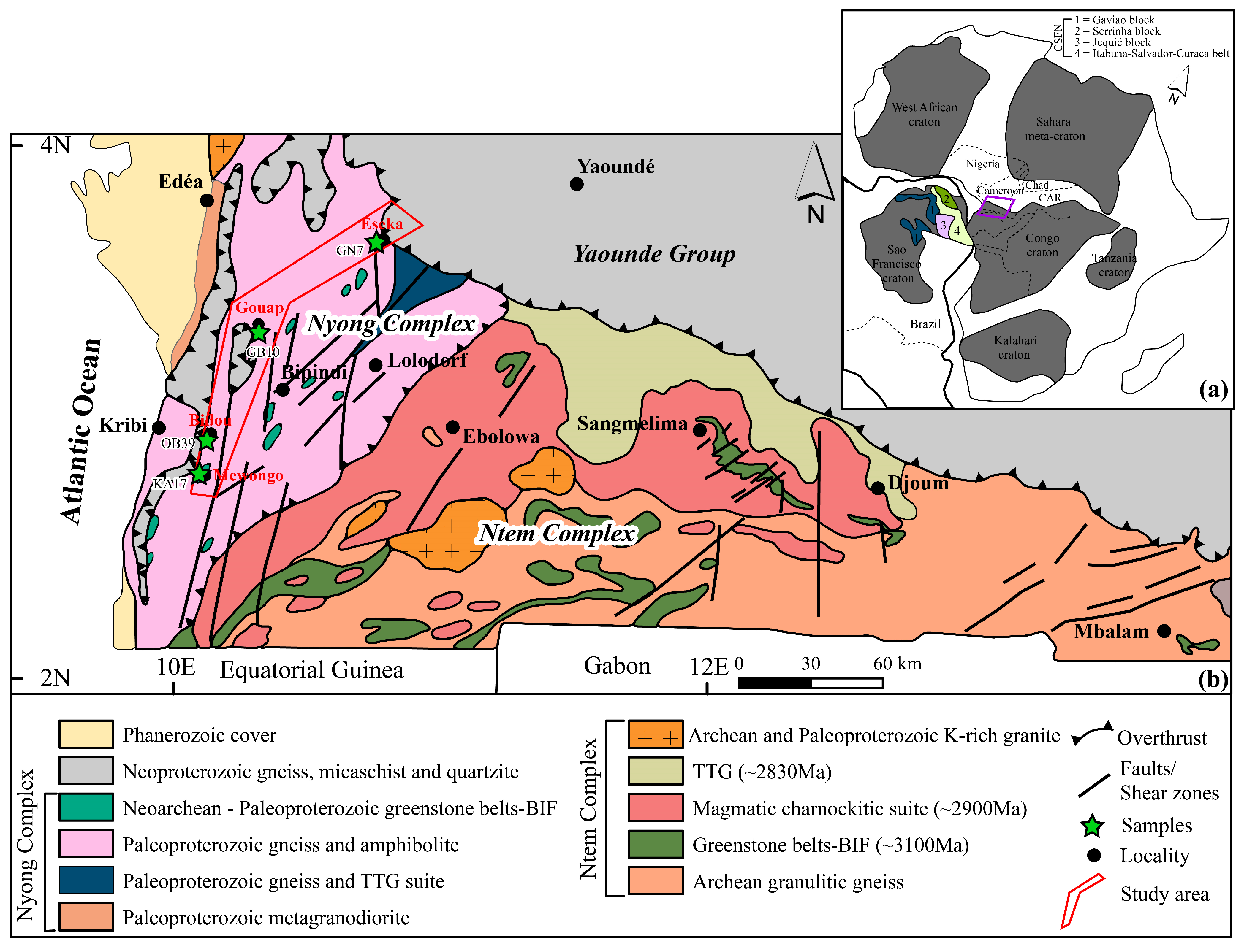
Figure 1. (a) Schematic paleogeographic reconstruction of the Congo–São Francisco proto-cratons for the late Rhyacian, showing the location of the Nyong Complex (irregular violet shape); NW Congo Craton) (modified from [44]). (b) Geological map of the Nyong and Ntem complexes showing the location of the studied area (red irregular shape) in the Nyong complex (adapted after [35,37,43].
Minerals 16 00414 g001
Figure 5. Tectonic discrimination diagrams of the Nyong Complex metaigneous and metasedimentary rocks. (a,b). Rb vs. Ta + Yb and Ta vs. Yb binary plots [74]; (c). La/10-Nb/8-Y/15 ternary plot [75]; (d). plot of La vs. Th modified after [73]. Abbreviations: N-MORB: Normal Mid-Ocean Ridge Basalts, E-MORB: Enriched Mid-Ocean Ridge Basalts. A: Oceanic Island Arc, B: Continental Island Arc. C: Active Continental Margins, D: Passive margins. The Nyong Complex data include metaigneous rocks [39,41,60] and metasedimentary rocks [35,36,42].
Minerals 16 00414 g005
Figure 6. Plot of εHf(t) values vs. U-Pb ages for the detrital zircons from the Nyong Complex metasedimentary rocks [36].
Minerals 16 00414 g006
Figure 7. Cathodoluminescence (CL) images of zircon crystals from the metasedimentary rocks: (a) BIF and (b) garnet mica schist and metaigneous rocks: (c) garnet pyroxene gneiss and (d) granitic gneiss, with the location of U-Pb analytical spots (spot number in red) and U–Pb age (Ma) in yellow.
Minerals 16 00414 g007
Figure 8. Chondrite-normalized REE patterns of zircon from metasedimentary (a) BIF and (b) garnet mica schist and metaigneous (c) garnet pyroxene gneiss and (d) granitic gneiss rocks.
Minerals 16 00414 g008
Figure 9. Correlation diagrams of zircons Zr/Hf vs. age in (a) metasedimentary rocks and (b) metaigneous rocks and Th/U vs. age in (c) metasedimentary rocks and (d) metaigneous rocks, for the studied samples.
Minerals 16 00414 g009
Figure 10. Histograms of temperatures obtained from Ti-in-zircon thermometry for metasedimentary (a,b), and metaigneous (c,d) rocks.
Minerals 16 00414 g010
Figure 11. Plots of estimated Ti-in-zircon temperatures vs. analytical 206Pb/238U ages for the zircons from (a) metasedimentary rocks and (b) metaigneous rocks of the studied samples.
Minerals 16 00414 g011
Figure 12. LA-ICP-MS of zircon U–Pb ages from metasedimentary (ae) and metaigneous (f,g) rocks.
Minerals 16 00414 g012
Figure 13. (a) Eu/Eu* vs. Ce/Ce* and (b) Ce/Ce* vs. Hf diagrams illustrating the oxidation state of the magma from which the studied zircons crystallized.
Minerals 16 00414 g013
Figure 14. Discrimination diagrams for continental crust, oceanic crust and kimberlite zircons (after [19,105]). (a) U/Yb vs. Y, (b) U/Yb vs. Hf.
Minerals 16 00414 g014
Figure 15. Tectonic discrimination diagrams depicting the magmatic-arc setting of the studied rocks. (a) Th/U vs. Nb/Hf [116] and (b) Th/Nb vs. Hf/Th [117].
Minerals 16 00414 g015
Disclaimer/Publisher’s Note: The statements, opinions and data contained in all publications are solely those of the individual author(s) and contributor(s) and not of MDPI and/or the editor(s). MDPI and/or the editor(s) disclaim responsibility for any injury to people or property resulting from any ideas, methods, instructions or products referred to in the content.