Article

Mantle Heterogeneity at the Arc–Back-Arc Transition: Insights from Peridotites of the Southern Mariana Trench

by
Kana Miyata
1,*,
Katsuyoshi Michibayashi
1,2,*,
Shigeki Uehara
3 and
Yasuhiko Ohara
1,2,4
1
Department of Earth and Planetary Sciences, Graduate School of Environmental Studies, Nagoya University, Nagoya 464-8601, Japan
2
Volcanoes and Earth’s Interior Research Center, Research Institute for Marine Geodynamics, Japan Agency for Marine-Earth Science and Technology, Yokosuka 237-0061, Japan
3
Institute of Geosciences, Shizuoka University, Shizuoka 422-8529, Japan
4
Hydrographic and Oceanographic Department of Japan, Tokyo 100-8932, Japan
*
Authors to whom correspondence should be addressed.
Minerals 2026, 16(3), 274; https://doi.org/10.3390/min16030274
Submission received: 4 February 2026 / Revised: 26 February 2026 / Accepted: 27 February 2026 / Published: 3 March 2026

Abstract

Peridotites exposed in the southern Mariana Trench provide a rare opportunity to investigate mantle processes operating at the interface between arc and back-arc tectonic domains. This study presents petrographic observations and major element mineral chemistry of 41 depleted mantle harzburgites collected from three sites (Sites A–C) in the southern Mariana Trench. Site A is located on the east-facing slope of the West Santa Rosa Bank Fault, whereas Sites B and C are situated on the southern slope of the South Mariana Forearc Ridge along the eastern side of the Challenger Deep. The harzburgites exhibit variable microstructures ranging from coarse-grained (>1 mm) to medium-grained (<1 mm) to small-grained (>0.1 mm) textures, with or without porphyroclasts, and commonly contain amphibole associated with orthopyroxene and spinel. Olivine Mg# (Mg/[Mg + Fe]) (0.902–0.925) and spinel Cr# (Cr/[Cr + Al]) (0.304–0.720) indicate a wide range of mantle depletion across the three sites. Based on the integrated chemical characteristics of olivine, spinel, and amphibole, the harzburgites are classified into three distinct compositional trends (Trends 1–3). Trend 1 is characterized by high olivine Mg# (~0.925), high spinel Cr# (>0.6), low TiO2 contents (<0.1 wt%), and K2O-enriched but TiO2-poor amphibole (TiO2/K2O < ~0.5), consistent with strongly depleted forearc mantle modified by slab-derived hydrous melts or fluids. In contrast, Trend 2 is defined by relatively high olivine Mg# (>~0.91), lower spinel Cr# (<0.6), slightly higher TiO2 contents (up to ~0.2 wt%), and amphibole moderately enriched in both K2O and TiO2 (TiO2/K2O = 1–4), recording an intermediate geochemical signature that cannot be uniquely attributed to a purely forearc origin. Trend 3 is characterized by lower olivine Mg# (~0.90), lower spinel Cr# (<0.6), distinctly higher TiO2 contents (up to ~0.8 wt%), and TiO2-rich but K2O-poor amphibole (TiO2/K2O > 4), indicating a back-arc mantle origin related to decompression melting. Trends 1 and 2 occur in harzburgites from Sites B and C of the South Mariana Forearc Ridge, whereas Trend 3 is exclusively identified in harzburgites from Site A of the West Santa Rosa Bank Fault, highlighting the juxtaposition of forearc-type, transitional, and back-arc-type mantle domains within a single forearc region.

1. Introduction

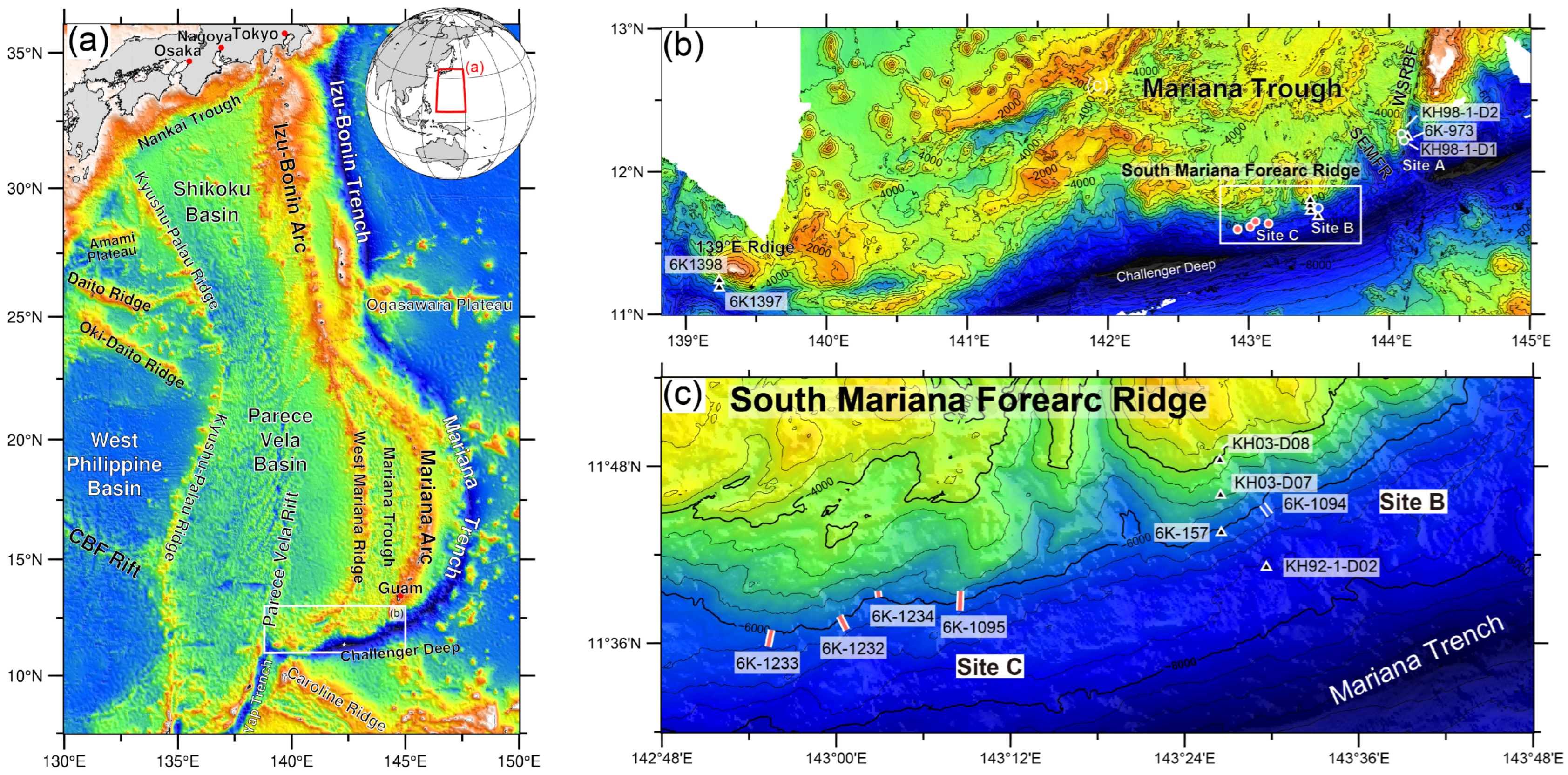
The Mariana Trench is a classic example of an ocean–ocean subduction zone, where the Pacific Plate subducts beneath the Philippine Sea Plate (Figure 1) [1]. Within this system, the Challenger Deep represents the deepest point on Earth (Figure 1a,b), reaching depths greater than 10,000 m [2,3,4,5]. The collision of the Caroline Ridge with the southern Mariana Trench caused a significant reorientation of the trench axis from N–S to E–W, producing a distinctive geomorphological setting in which the trench axis intersects both the Mariana island arc and the back-arc basin [6,7,8]. As a result, this region represents a key locality for investigating interactions between arc and back-arc tectonic processes. Previous studies have extensively examined the tectonics, magmatism, and crustal and upper-mantle structure of the region using geophysical and geochemical approaches [2,3,4,9,10,11,12,13,14,15,16,17,18].
In the southern Mariana Trench, peridotites are directly exposed along the landward slope, providing a rare opportunity to investigate mantle processes at an active convergent margin [20]. From a geochemical perspective, peridotites near Challenger Deep show forearc characteristics based on major element compositions, indicating mantle material influenced by subduction-related processes typical of the forearc mantle wedge [20]. In contrast, peridotites from the 139°E Ridge and the West Santa Rosa Bank Fault (Figure 1b) display geochemical traits aligned with back-arc basin mantle sources, such as those from the Parece Vela Basin and Mariana Trough, suggesting mantle domains affected by back-arc spreading and magmatism [21,22,23]. The coexistence of these distinct mantle signatures in a relatively confined area points to a complex mantle structure.
The exposure of these peridotites within the subduction zone likely results from dynamic processes such as mantle wedge flow, faulting (e.g., along the West Santa Rosa Bank Fault), and localized mantle exhumation that bring both forearc and back-arc mantle rocks to the seafloor. The spatial distribution and detailed mechanisms driving the formation and exposure of these contrasting mantle domains remain insufficiently resolved, indicating a need for integrated geophysical, petrological, and geochemical studies to map mantle heterogeneity and understand the interplay of subduction and back-arc processes.
This study presents petrographic observations and major element mineral chemistry of 41 harzburgites from the southern Mariana Trench to better understand the origin and tectono–magmatic evolution of mantle peridotites. Combining olivine, spinel, and amphibole data with previous studies allows a comprehensive evaluation of mantle depletion, metasomatism, and melt–rock interactions at the arc–back-arc transition.

2. Geological Setting

2.1. The Southern Mariana Trench

The southern Mariana Trench exhibits a distinctive morphology shaped by the collision with the Caroline Ridge, resulting in a unique geological setting where the trench axis intersects both the Mariana island arc and the adjacent back-arc basin (Figure 1a) [6,7,8]. This configuration is further interpreted to reflect diffuse volcano–tectonic extension of the southern Mariana margin, as documented by Martinez et al. [24], who showed that deformation and magmatism are distributed over a broad region rather than localized along a single spreading axis. This region is part of the larger Izu–Bonin–Mariana (IBM) arc–trench system, which comprises a complex assemblage of arc, back-arc, and oceanic terranes characterized by diverse tectonic and magmatic processes [25,26,27,28,29,30,31,32,33,34,35,36,37,38,39].
Subduction of the Pacific Plate beneath the proto-IBM arc initiated approximately 52 million years ago (Ma), marking the onset of the modern convergent margin and associated magmatic activity [33]. Following this initial subduction phase, significant tectonic reconfigurations occurred in the region. Between 52 and 30 Ma, the West Philippine Basin underwent seafloor rifting, a process that contributed to the fragmentation and reorganization of the oceanic lithosphere in the western Pacific [34,40]. Subsequently, at around 25 Ma, the Kyushu–Palau Ridge experienced rifting events that facilitated the development of the Parece Vela and Shikoku Basins, further modifying the regional back-arc basin architecture [34]. These tectonic episodes reflect the dynamic evolution of the IBM system, characterized by episodic extension and basin formation behind the active volcanic arc.
More recently, back-arc spreading commenced in the Mariana Trough around 6 Ma and continues to be tectonically active, driving seafloor spreading and mantle upwelling processes typical of back-arc basins [8,13,24,41]. This ongoing activity is closely linked to the subduction dynamics and magmatic processes of the Mariana Arc, which remains volcanically and tectonically vigorous. The interplay between the arc and back-arc components creates a highly complex and evolving geological framework that influences mantle composition, crustal formation, and seismicity in the region [8,13,24].
Overall, the southern Mariana Trench and the broader IBM system represent a key natural laboratory for studying convergent margin processes, including subduction initiation, back-arc basin development, and mantle dynamics. The intricate tectono–magmatic history recorded in this region underscores the importance of integrated geological, geochemical, and geophysical investigations to unravel the mechanisms governing arc–back-arc evolution.

2.2. Sample Locations of the Southern Mariana Trench

The study area is located on the east-facing slope of the West Santa Rosa Bank Fault (Site A in Figure 1b) and the southern slope of the South Mariana Forearc Ridge within the Challenger Deep Forearc Segment [4] at water depths between 4586 and 6405 m (Sites B, C in Figure 1b,c). We studied 41 harzburgites obtained from Sites A–C: 11 harzburgites from dredge sites (KH98-1-D1 and D2) and 30 harzburgites from dive sites (6K-1094 and 1095 in YK08-08, 6K-1232, 1233, and 1234 in YK10-12) (Figure 1b,c).

3. Methods

3.1. Microstructural Observation

Thin sections were prepared primarily in planes perpendicular to foliation and parallel to lineation (i.e., XZ plane). Foliations and lineations were defined based on the preferred alignment and elongation of spinel and/or orthopyroxene grains. In samples where foliation and lineation were difficult to identify due to extensive serpentinization, thin sections were not prepared in the XZ plane. All thin sections were polished using a 1 μm diamond paste, followed by final polishing with colloidal silica. In total, 41 thin sections of harzburgite were examined under a polarized light microscope to describe mineral size, shape, and modal abundance.

3.2. Major Element Compositions of Minerals

Major element compositions of olivine, spinel, and amphibole were determined using a JEOL electron microprobe (JXA-733, Akishima, Japan) at Shizuoka University, Japan. Analytical conditions included an accelerating voltage of 15 kV, a beam current of 12 nA, and a beam diameter of 20 µm. Counting times were 20 s on peak positions and 10 s on background for each element. Natural and synthetic JEOL mineral standards were used for data calibration. The conventional ZAF matrix correction was used. The Fe3+ content of spinel was calculated based on stoichiometric constraints.

4. Results

4.1. Texture and Mineralogical Characteristics

4.1.1. Site A

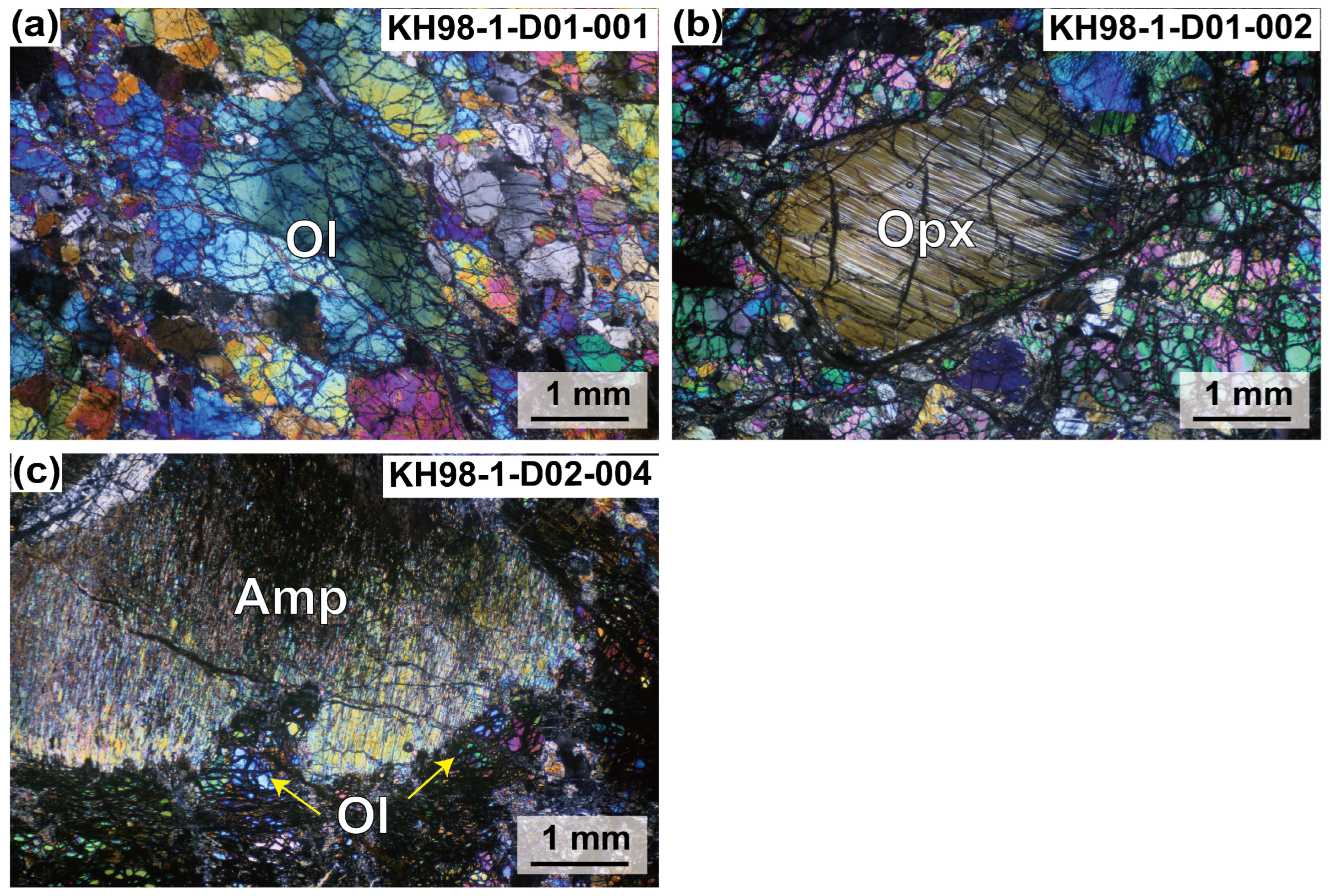
At Site A, the harzburgites consist of olivine, orthopyroxene, clinopyroxene, plagioclase, spinel, serpentine, and minor amphibole (Table 1). The samples are characterized by relatively coarse grain sizes, locally reaching several millimeters, although they are partly recrystallized to medium grain sizes (<1 mm). Olivine grains are locally elongated and commonly display undulose extinction (Figure 2a). Orthopyroxene grains frequently exhibit clinopyroxene exsolution lamellae (Figure 2b). Minor amphibole occurs sporadically, with some grains reaching coarse-sized (>1 mm) (Figure 2c).

4.1.2. Site B

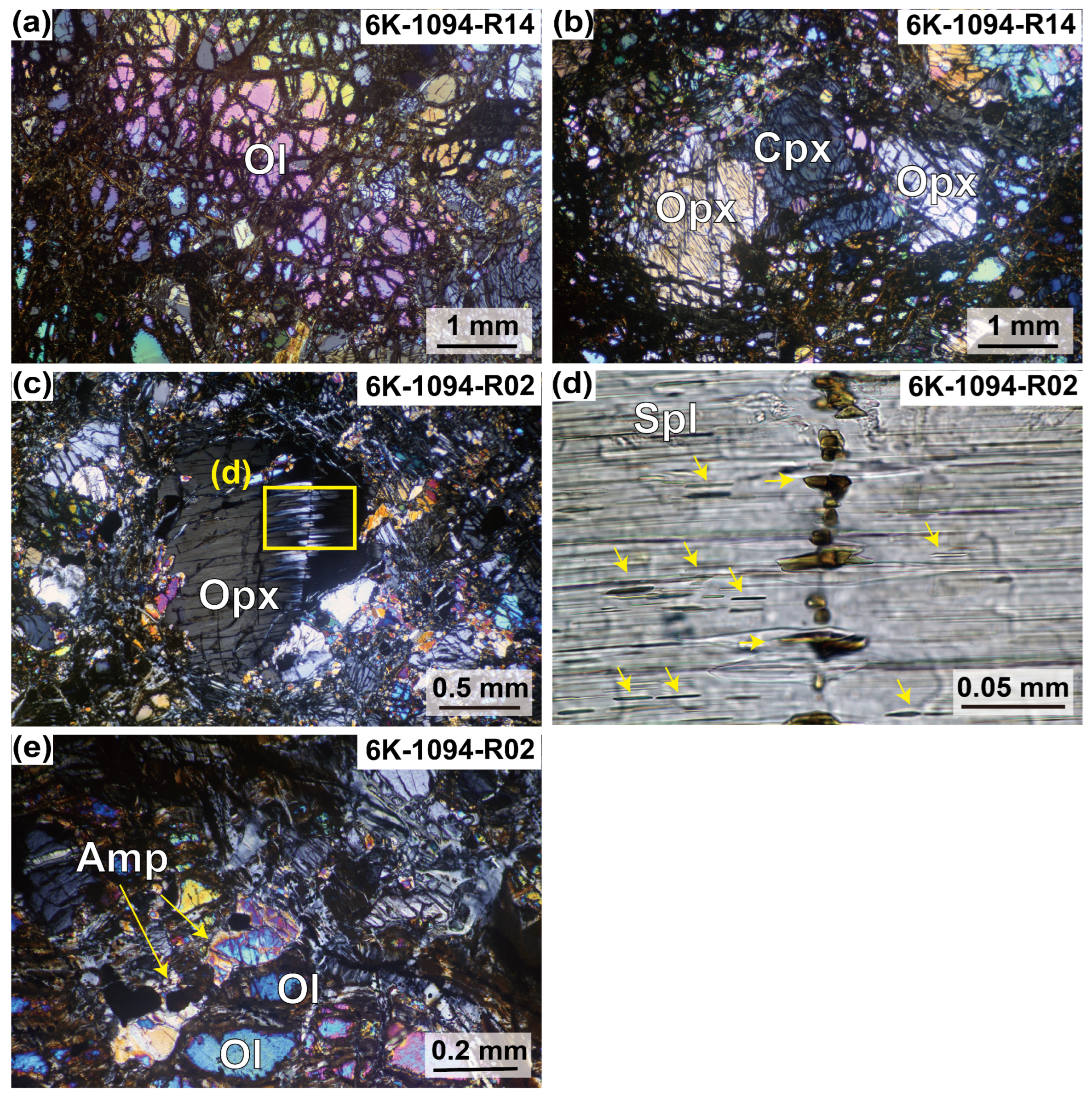
Peridotites recovered from Site B are predominantly dunite, with only two harzburgite samples obtained during dive 6K-1094 (Table 2). The harzburgites consist mainly of olivine, orthopyroxene, clinopyroxene, spinel, serpentine, and minor amphibole (Table 2). These samples are characterized by relatively coarse grain sizes, locally reaching several millimeters. Olivine grains are commonly elongated and exhibit undulose extinction, and partial dynamic recrystallization has produced medium grain sizes (<1 mm) (Figure 3a). Orthopyroxene locally occurs as aggregates, some of which contain minor clinopyroxene grains (Figure 3b). Planar and needle-like spinel inclusions are observed within orthopyroxene porphyroclasts and along internal cracks, extending parallel to cleavage planes (Figure 3c,d). Minor amphibole occurs along olivine grain boundaries (Figure 3e) and in association with orthopyroxene porphyroclasts.

4.1.3. Site C

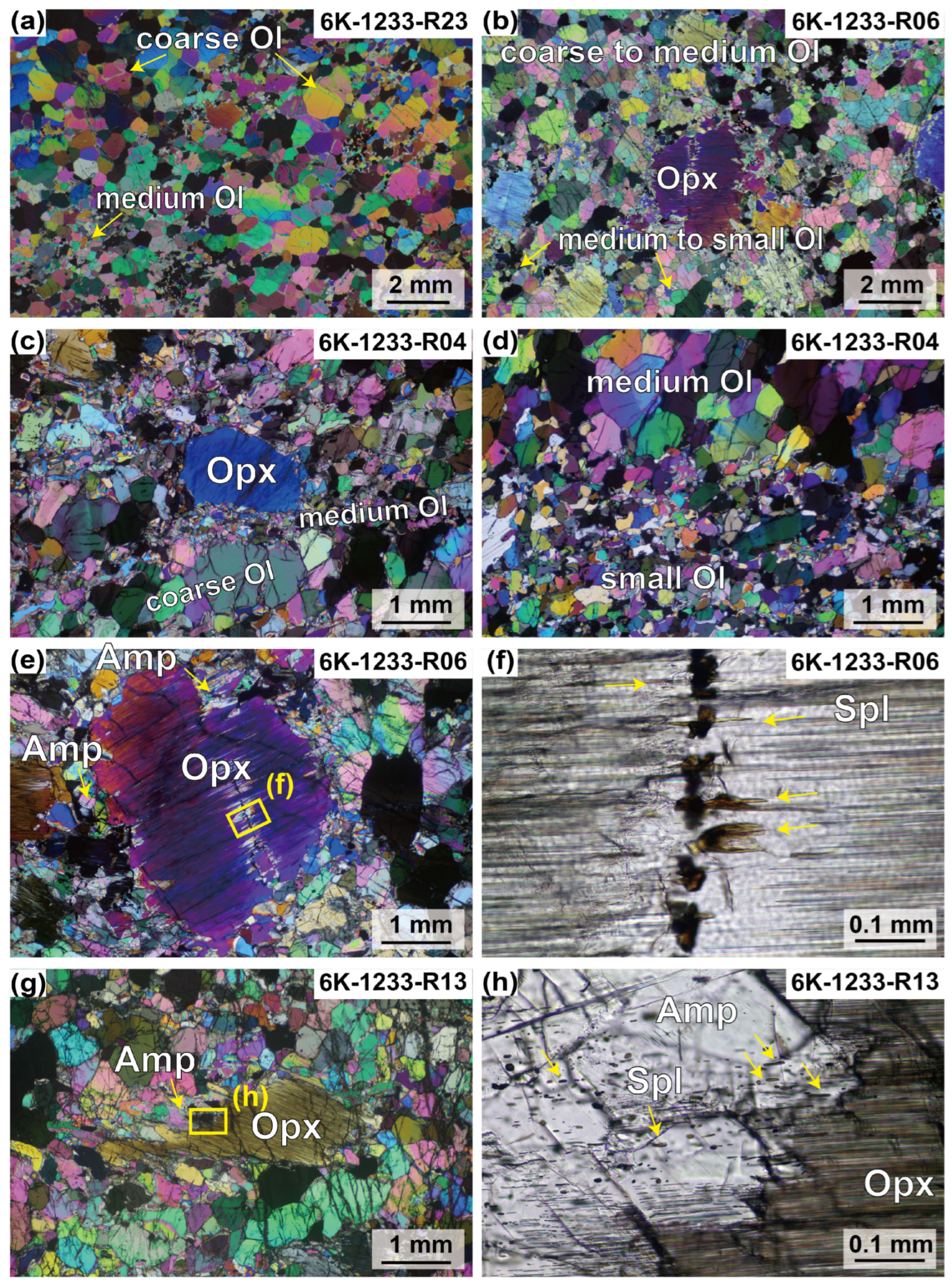
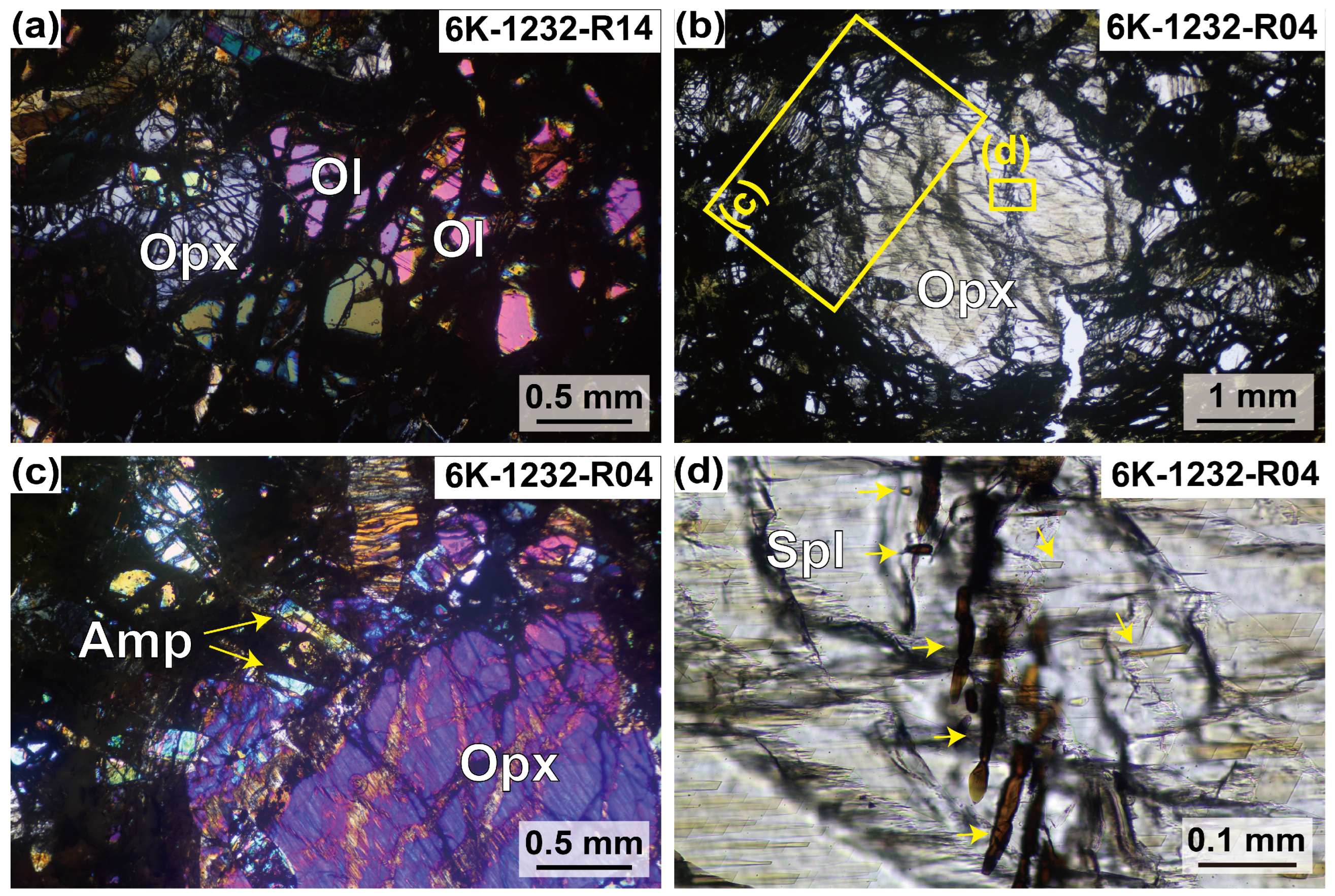
In Site C, dive 6K-1095 recovered predominantly dunite samples, whereas dives 6K-1232, 6K-1233, and 6K-1234 are dominated by harzburgite. The harzburgite samples consist of olivine, orthopyroxene, clinopyroxene, spinel, and serpentine, with minor amphibole, talc and plagioclase (Table 3). Although most samples are variably serpentinized, several harzburgite samples from dive 6K-1233 remain remarkably fresh (Figure 4).
Harzburgites from Site C display a wide variety of textures, with olivine grain sizes ranging from coarse (>1 mm) through medium (<1 mm) to small (>0.1 mm) (Figure 4 and Figure 5). Some samples contain coarse orthopyroxene porphyroclasts (~2 mm to 2 cm in diameter) surrounded by recrystallized medium–small-grained olivine and amphibole (Figure 4b,c). In domains lacking orthopyroxene porphyroclasts, olivine grains tend to be coarser and exhibit polygonal, equigranular textures (Figure 4a–d).
Orthopyroxene grains vary from rounded to slightly distorted in shape. Across all textural types, amphibole is frequently associated with orthopyroxene (Figure 4e,g and Figure 5c). Planar and needle-like spinel inclusions are locally observed in orthopyroxene porphyroclasts, which are aligned parallel to the orthopyroxene cleavage and locally along internal cracks (Figure 4f,h and Figure 5d).

4.2. Major Element Compositions of Minerals

4.2.1. Olivine and Spinel

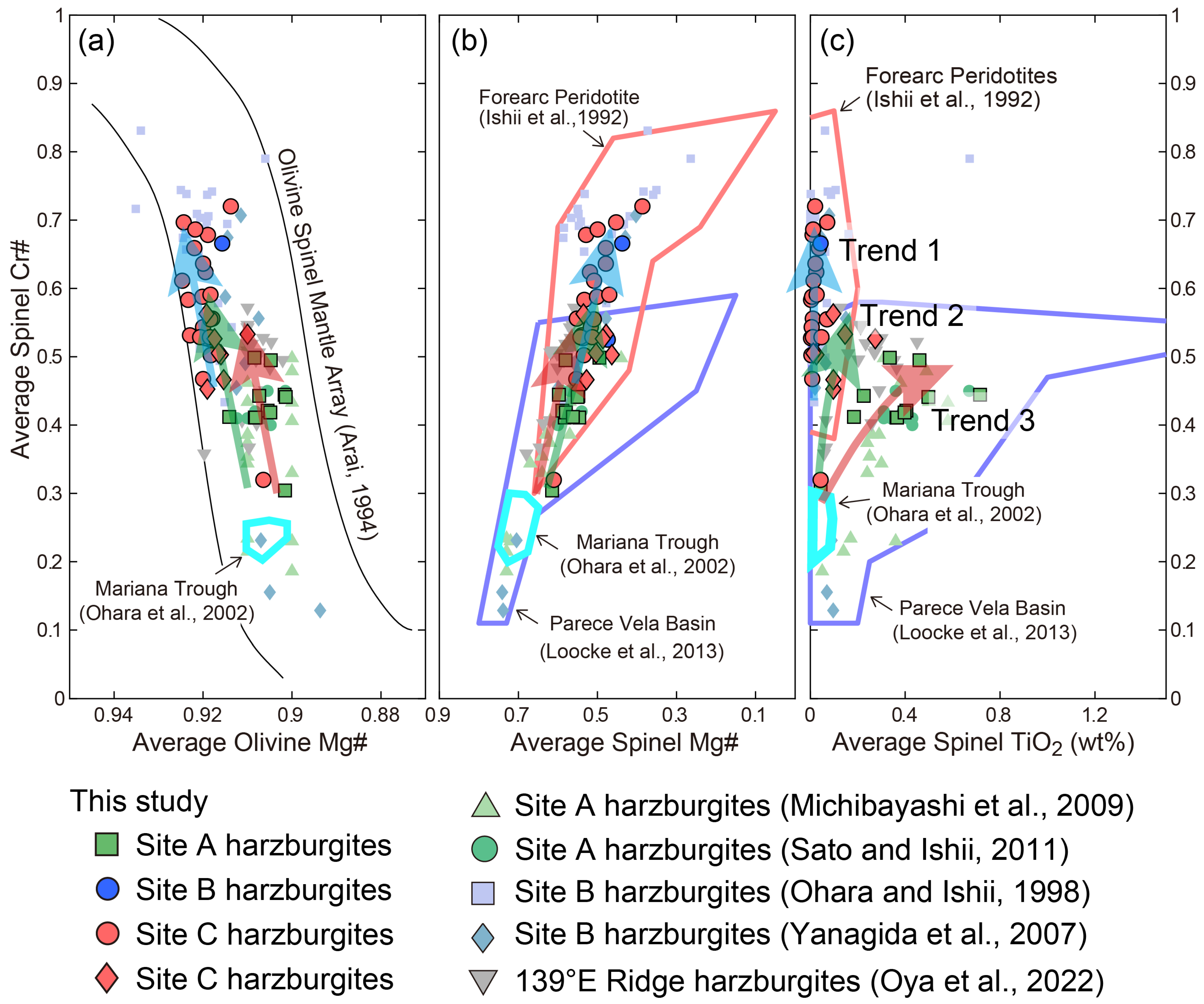
The average major element compositions of olivine are listed in Table S1. Olivine Mg# (Mg/[Mg + Fe]) ranged from 0.902 to 0.925. The average major element compositions of spinel are provided in Table S2. Spinel Cr# (Cr/[Cr + Al]) ranged from 0.304 to 0.720, Mg# from 0.386 to 0.615, and TiO2 contents from 0.003 to 0.716 wt%. Spinel Cr# values are plotted on the vertical axis against olivine Mg# (Figure 6a), spinel Mg# (Figure 6b), and spinel TiO2 contents (Figure 6c). For comparison, previously published data (compiled in Tables S1–S3) from harzburgites recovered by dive 6K-973 [21], dives 6K-1397 and 6K-1398 [23], dredges KH92-1-D02 [20], dredges KH98-1-D1 and D2 [22], and dredges KH03-D07 and D08 [42] are plotted on the same diagrams (see locations in Figure 1).

4.2.2. Amphibole

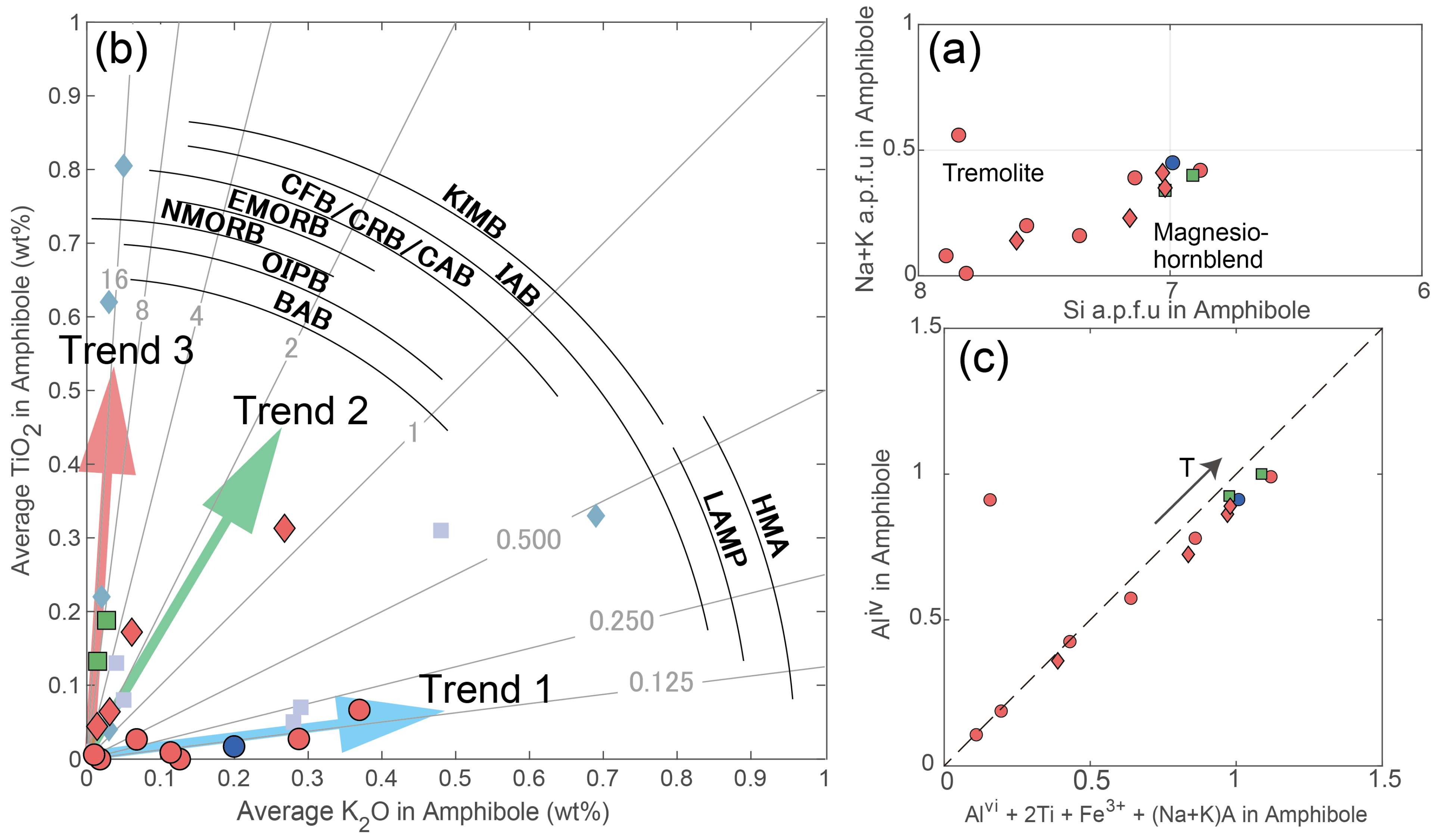
The representative average major element compositions of amphibole are listed in Table S3. According to the classification by Leake et al. [46] and Hawthorne et al. [47], these amphiboles are categorized as calcic amphiboles, specifically magnesio-hornblende and tremolite (Figure 7a). Figure 7b illustrates the relationship between K2O and TiO2 contents in amphiboles, in which three compositional trends of amphiboles are recognized: (1) a K2O-enriched but TiO2-poor trend (TiO2/K2O < ~0.5; Trend 1), (2) a trend moderately enriched in both K2O and TiO2 (TiO2/K2O = 1–4; Trend 2), and (3) a TiO2-enriched but K2O-poor trend (TiO2/K2O > 4; Trend 3) (Figure 7b).
Figure 7. Major element compositions of amphibole in harzburgites from the southern Mariana Trench. (a) Si (a.p.f.u.) versus Na + K (a.p.f.u.) for amphiboles in the harzburgites. (b) TiO2 versus K2O of amphiboles plotted following the discrimination diagram of Ozawa [48]. Fields are shown for back-arc basin basalt (BAB), N-type and E-type mid-ocean ridge basalt (NMORB and EMORB), oceanic intraplate basalt and other continental alkali basalt (OIPB), island arc basalt (IAB), high-magnesian andesite (HMA), kimberlite (KIMB), lamproite (LAMP), continental flood basalt (CFB), continental rift basalt (CRB), and other continental alkali basalt (CAB). Three colored arrows indicate the three compositional trends (Trends 1–3). (c) Al(IV) versus [Al(VI) + 2Ti + Fe3+ + (Na + K)] for amphiboles. Increasing values along the dashed line indicate increasing temperature. Symbols are the same as those in Figure 6.
Minerals 16 00274 g007
Figure 7c plots Al(IV) on the vertical axis against Al(VI) + 2Ti + Fe3+ + (Na + K) in the A site on the horizontal axis. Along the dashed line, increasing values correspond to higher equilibrium temperatures. Amphiboles from Sites A and B plot in the higher-temperature field, whereas those from Site C are distributed along the dashed line, indicating a wider range of equilibrium temperatures (Figure 7c). These trends are consistent with the amphibole chemical compositions shown in Figure 7a.

5. Discussion

5.1. Coexistence of Forearc and Back-Arc Peridotites in the Southern Mariana Trench

Several studies have investigated peridotites exposed in the southern Mariana Trench, providing detailed petrographic and geochemical characterizations of mantle rocks recovered from trench slopes. In a pioneering study near the Challenger Deep, Ohara and Ishii [20] reported spinel Cr# values of 0.43–0.83 (Figure 6; Table S3) for peridotites recovered by dredge KH92-1-D2 and dive 6K-157 (Site B; Figure 1b,c), which are significantly higher than those typically observed in abyssal peridotites [49]. Based on their mineralogical and chemical characteristics, Ohara and Ishii [20] classified the peridotites into anhydrous, intermediate, and hydrous types and proposed that they were modified by slab-derived fluids, indicating a forearc origin.
Yanagida et al. [42] documented peridotites recovered by dredges KH03-3-D07 and D08 (Site B; Figure 1b,c) that contain metamorphic minerals such as talc and cummingtonite (see also [17]). They identified two compositional groups: aluminum-rich spinel (AS-type) peridotites with low spinel Cr# values (0.13–0.23) and chromium-rich spinel (CS-type) peridotites with higher Cr# values (0.46–0.81; Figure 6; Table S3). The AS-type peridotites were interpreted as mantle residues formed by extremely low degrees of partial melting during amagmatic extension, analogous to processes in the Shikoku Basin [50], whereas the CS-type peridotites were considered residual mantle rocks depleted by island arc magmatism.
Michibayashi et al. [21] analyzed peridotites recovered by dive 6K-973 from the West Santa Rosa Bank Fault (Site A; Figure 1b) and reported moderately low spinel Cr# values (0.19–0.50) together with elevated TiO2 contents (0.05–0.58 wt%; Figure 6; Table S3). Although these samples were collected near the trench axis, their major element compositions closely resemble those of peridotites from the Mariana Trough [28] and the Parece Vela Basin [29,44]. The enrichment in TiO2, an incompatible element, was interpreted to reflect significant melt–rock interaction processes.
More recently, Oya et al. [23] reported peridotites recovered by dives 6K-1397 and 6K-1398 on the southern slope of the 139°E Ridge in the westernmost Mariana Trench (Figure 1b). These peridotites exhibit spinel Cr# values of 0.36–0.57 and TiO2 contents of 0.06–0.45 wt% (Figure 6; Table S3), and their major- and trace-element compositions closely resemble those of peridotites from the Parece Vela Basin [44], suggesting a back-arc origin.
These observations demonstrate that peridotites recovered from trench slopes include both highly depleted harzburgites characterized by high spinel Cr# values (0.6–0.8) and low TiO2 contents, and more fertile harzburgites containing spinel with lower Cr# values (0.1–0.6) and higher TiO2 contents (Figure 6; Table S3). These compositional diversities indicate the coexistence of mantle materials derived from distinct tectono–magmatic environments within the southern Mariana Trench [20,21,22,23,42].

5.2. Three Chemical Composition Trends Within Harzburgites in the Southern Mariana Trench

Peridotites from the southern Mariana Trench are characterized by the occurrence of amphibole (Table 1, Table 2 and Table 3, Figure 2, Figure 3, Figure 4 and Figure 5). Ozawa [48] proposed that magmas in equilibrium with mantle materials can serve as proxies for the chemical characteristics of their source peridotites (Figure 7b). Primitive island arc basalts (IAB) are generally enriched in K compared to primitive mid-ocean ridge basalts (MORB) and depleted in Ti compared to primitive oceanic intraplate basalts (OIPB) [51]. Consequently, the TiO2/K2O ratios of IAB are typically lower than those of MORB or OIPB. Among IAB, high-magnesian andesites (HMA) and lamproites (LAMP) are particularly enriched in K and depleted in Ti (Figure 7b). Building on this framework, we classify the peridotites analyzed in this study into three compositional trends, as described below.
According to the classification scheme of Ozawa [48], TiO2-rich amphibole most likely formed in back-arc basin settings [52,53]. In contrast, K2O-enriched amphibole is characteristics of forearc environments. This geochemical signature is commonly attributed to the addition of melts or fluids with low TiO2/K2O ratios into the mantle wedge [54,55]. Such melts or aqueous fluids are widely interpreted to derive from dehydration and partial melting of the subducting slab [56,57,58,59,60]. Based on these amphibole compositional characteristics (Figure 7b), the associated olivine and spinel compositions in the analyzed harzburgites can likewise be grouped into three distinct chemical trends (Trends 1–3) (Figure 6).
Harzburgites corresponding to Trend 1 are characterized by high spinel Cr# values (>0.6) and negligible TiO2 contents, overlapping closely with the compositional field of peridotites from the northern Mariana Trench [45] (Figure 6). Because spinel Cr# is a robust indicator of the degree of partial melting in the upper mantle [49], the elevated Cr# values observed in Trend 1 reflect strongly depleted mantle residues. Cr# values exceeding ~0.6 are commonly interpreted to result from enhanced degrees of melting facilitated by the addition of slab-derived water to the mantle wedge [20,37,38,39,45].
In Trend 1 peridotites, amphibole commonly occurs together with spinel inclusions associated with orthopyroxene porphyroclasts (Figure 3 and Figure 4). Notably, needle-like spinel inclusions are aligned parallel to orthopyroxene cleavage (Figure 3d and Figure 4f,h). Similar needle-shaped spinel inclusions were documented by Harano and Michibayashi [61], who suggested that such textures form through reactions between peridotite and hydrous melts or fluids.
In contrast, harzburgites corresponding to Trend 3 (Figure 2) exhibit lower spinel Cr# values (<0.6) than typical forearc peridotites and relatively higher TiO2 contents (Figure 6). This compositional range broadly overlaps with that of peridotites from the 139° E Ridge in the westernmost Mariana Trench (Figure 6c) [23]. In addition, samples showing the lowest Cr# values (<0.3), combined with low TiO2 contents, are comparable to peridotites recovered by dive 6K-359 from the Mariana Trough [28] (Figure 6c). Nevertheless, because Ti is an incompatible element, the relatively elevated TiO2 contents observed in Trend 3 harzburgites (Figure 6c) are most plausibly attributed to melt addition derived from deeper mantle sources, possibly related to flux melting processes [29,49].
Between these two end-member trends, we identify Trend 2 harzburgites (Figure 5), representing an intermediate composition trend between Trends 1 and 3 (Figure 6 and Figure 7b). Although the olivine and spinel compositions of Trend 2 differ only slightly from those of Trend 1 (Figure 6), their amphibole compositions exhibit systematically higher TiO2/K2O ratios (1–4) than those of Trend 1 (<~0.5) (Figure 7b). This feature indicates a contribution from melts or aqueous fluids with higher TiO2/K2O ratios, likely reflecting variable slab-derived inputs or evolving melt compositions within the forearc mantle. These TiO2/K2O ratios are relatively comparable to those reported for Group 3 peridotites (TiO2/K2O = 2–8) of Harano and Michibayashi [61], suggesting that similar melt or fluid characteristics influenced the chemical signatures of Trend 2 harzburgites. In addition, Trend 2 harzburgites locally contain spinel inclusions aligned parallel to orthopyroxene cleavage (Figure 5d), similar to those observed in Trend 1 peridotites (Figure 4f,h), suggesting that Trend 2 peridotites also experienced interaction with hydrous slab-derived melts.
Consequently, peridotites in the southern Mariana Trench can be classified into three chemical trends: forearc-related peridotites (Trend 1), compositionally transitional peridotites (Trend 2), and back-arc-related peridotites (Trend 3) (Figure 6 and Figure 7b). Interestingly, both Trends 1 and 2 occur in harzburgites from Sites B and C of the South Mariana Forearc Ridge (Table 2 and Table 3), whereas Trend 3 is exclusively identified in harzburgites from Site A of the West Santa Rosa Bank Fault (Table 1; Figure 1).

5.3. Petrogeneses of Peridotites in the Southern Mariana Trench

5.3.1. Site A Peridotites on the East-Facing Slope of the West Santa Rosa Bank Fault

The Site A harzburgites examined in this study are largely comparable to those reported previously [21,22] (Figure 6), as both datasets were collected from the east-facing slope of the West Santa Rosa Bank Fault (Figure 1b). However, the Site A harzburgites analyzed here contain slightly more depleted spinel compositions, as reflected by marginally higher spinel Cr# values than those reported in previous studies [21,22] (Figure 6). Michibayashi et al. [21] documented the coexistence of high-Cr# (0.34–0.50) and low-Cr# (0.19–0.23) spinels within individual samples and interpreted this heterogeneity as the result of melt impregnation. In their model, the low-Cr# spinels represent the original composition of mantle residues produced by low degrees of partial melting of a depleted MORB-type mantle beneath the Mariana Trough, whereas the high-Cr# spinels reflect subsequent modification by melt–rock interaction (see also [22]).
In this context, the Site A peridotites investigated in the present study are unlikely to represent fragments of forearc mantle, despite their proximity to the Mariana Trench. Instead, their mineral chemical characteristics indicate formation in a tectonic environment more closely resembling a back-arc basin rather than a forearc setting. Consistent with previous interpretations [21,22], we propose that the Site A peridotites originated from mantle associated with the development of the Mariana Trough back-arc basin at <~7 Ma (e.g., [8]) and were subsequently exhumed and exposed along the West Santa Rosa Bank Fault.

5.3.2. Sites B and C Peridotites on the Southern Slope of the South Mariana Forearc Ridge

Peridotites recovered from Sites B and C on the southern slope of the South Mariana Forearc Ridge (SMFR; Figure 1b,c) are characterized by the occurrence of two distinct compositional trends, Trends 1 and 2, which reflect different degrees and styles of mantle depletion and metasomatic modification. Although both trends occur within the forearc region, their mineral chemical characteristics suggest contrasting mantle processes and tectono–magmatic affinities.
Trend 1: Forearc-Type Harzburgites Modified by Slab-Derived Fluids
Harzburgites corresponding to Trend 1 are characterized by high spinel Cr# values (>0.6), very low TiO2 contents (Figure 6), and the presence of K2O-enriched but TiO2-poor amphibole (Figure 7b). The high spinel Cr# values in Trend 1 harzburgites are consistent with high degrees of partial melting facilitated by the addition of slab-derived water to the mantle wedge [20,45]. Furthermore, the low TiO2/K2O ratios (<~0.5) of amphibole (Figure 7b) suggest metasomatism by hydrous melts or aqueous fluids with a strong slab signature, likely released during dehydration reactions within the subducting Pacific Plate. These characteristics collectively indicate that Trend 1 harzburgites represent typical forearc mantle that has been both strongly depleted and subsequently modified by slab-derived fluids.
Trend 2: Transitional Harzburgites with Ambiguous Forearc–Back-Arc Affinity
Harzburgites corresponding to Trend 2 exhibit mineral chemical characteristics that cannot be uniquely attributed to a purely forearc origin. Although their olivine Mg# and spinel Cr# values indicate relatively depleted mantle residues comparable to those of Trend 1 (Figure 6), their amphibole compositions are systematically characterized by higher TiO2/K2O ratios (1–4) (Figure 7b). This feature implies metasomatism by melts or fluids that are relatively enriched in Ti compared to typical slab-derived components, suggesting contributions from mantle-derived melts in addition to aqueous fluids released from the subducting slab.
Notably, the amphibole TiO2/K2O ratios (1–4) of Trend 2 harzburgites partially overlap with those reported for Group 3 peridotites (TiO2/K2O = 2–8) of Harano and Michibayashi [61]. Group 3 was interpreted to record interaction with melts or fluids characterized by relatively high TiO2/K2O signatures, reflecting contributions from slab-derived fluids rather than solely mantle-derived melts [61]. The similarity in amphibole geochemistry suggests that Trend 2 harzburgites experienced comparable metasomatic processes, supporting an interpretation involving mixed fluid–melt inputs.
Such geochemical characteristics are consistent with models of forearc mantle modification involving transient or localized melt infiltration associated with arc rifting processes. This interpretation is supported by the occurrence of young basaltic lavas within the South Mariana Forearc Ridge, which have been linked to extensional tectonics and mantle upwelling beneath the forearc [14]. Moreover, Reagan et al. [36] demonstrated that magmatism in the southern Mariana forearc is not limited to simple slab-fluid fluxing but also includes contributions from decompression-related melting associated with tectonic reorganization and forearc rifting.
In this context, Trend 2 harzburgites may record interaction between originally forearc mantle residues and melts generated during incipient rifting beneath the southern Mariana forearc. This interpretation is consistent with the intermediate position of Trend 2 between Trends 1 and 3 in compositional space (Figure 6 and Figure 7b), suggesting that Trend 2 records a transitional mantle domain rather than a purely forearc or back-arc end member.
Importantly, the occurrence of Trend 2 harzburgites within the South Mariana Forearc Ridge indicates that the forearc mantle beneath the southern Mariana Trench is compositionally heterogeneous. Instead of representing a single, uniform forearc mantle reservoir, it preserves evidence for spatially and/or temporally variable metasomatic processes, potentially linked to heterogeneous slab-derived fluid flux, localized melt infiltration, and early-stage arc rifting. Therefore, although Trend 2 harzburgites are presently exposed within a forearc setting, their mineral chemical characteristics indicate that they cannot be regarded as unequivocally forearc-derived.

5.4. Regional Synthesis: Juxtaposition of Forearc and Back-Arc Mantle Domains in the Southern Mariana Trench

The petrological and geochemical characteristics of peridotites recovered from the southern Mariana Trench are consistent with recent seismic imaging across the southernmost Mariana Trench. Wan et al. [13] presented a wide-angle seismic velocity model along a trench-perpendicular profile crossing the Challenger Deep, revealing pronounced lateral heterogeneity in the upper mantle beneath the forearc region. Their model identifies a low-velocity mantle domain beneath the Southwest Mariana Rift, interpreted as incipient arc rifting associated with hydration and/or melt infiltration, juxtaposed against relatively higher-velocity forearc mantle closer to the trench.
Integration of our petrological results with these geophysical observations indicates that the southern Mariana Trench represents a tectonically dynamic transition zone where forearc and back-arc mantle domains are structurally juxtaposed. Fault-controlled exhumation along major structures such as the West Santa Rosa Bank Fault likely facilitated the exposure of mantle materials formed in distinct geodynamic environments. This combined petrological–geophysical framework underscores the role of arc rifting and slab-derived fluid flux in generating compositional and structural complexity within the forearc mantle wedge.
Moreover, Martinez et al. [24] demonstrated that the southern Mariana margin is undergoing diffuse volcano–tectonic extension over a ~150–200 km wide zone between the trench and the organized back-arc spreading system. Such trench-parallel extension has been attributed to progressive weakening of the overriding plate lithosphere through sustained hydration by slab-derived fluids, inhibiting rigid plate boundary formation and enabling distributed deformation of the forearc mantle. Building on this framework, Sleeper et al. [8] proposed that the southern Mariana Trough and adjacent forearc rift system form a continuum between focused back-arc spreading and diffuse forearc extension. Their results suggest that magmatism and extension migrate trenchward within a mechanically weak, hydrous mantle wedge, producing spatial overlap between back-arc-like and forearc-like tectono–magmatic processes. Such a dynamic configuration naturally promotes the lateral juxtaposition of mantle domains with contrasting thermal and compositional histories.
Accordingly, the coexistence of Trends 1–3 peridotites is best interpreted as evidence for lateral heterogeneity generated during diffuse extension of the southern Mariana margin, rather than simple vertical stratification of mantle domains. Trend 3 peridotites at Site A likely represent melt-rich back-arc mantle associated with diffuse spreading and rifting, whereas Trends 1 and 2 at Sites B and C record variably modified forearc mantle that experienced differing degrees of melt–rock interaction and fluid infiltration. The southern Mariana Trench thus provides a rare natural example in which petrological evidence of melt–rock interaction can be directly linked to large-scale tectonic processes driven by slab hydration, diffuse extension, and arc–back-arc transition dynamics.

6. Conclusions

This study presents petrographic observations and major element mineral chemistry of 41 depleted mantle harzburgites recovered from three sites in the southern Mariana Trench and leads to the following conclusions:
  • Three distinct chemical trends (Trends 1–3) are identified in the harzburgites based on the integrated compositions of olivine, spinel, and amphibole. These trends reflect systematic variations in mantle depletion, melt–rock interaction, and metasomatism related to contrasting tectonic environments.
  • Trend 1 harzburgites are characterized by high spinel Cr# values (>0.6), very low TiO2 contents, and K2O-enriched but TiO2-poor (TiO2/K2O < ~0.5) amphibole, indicating strongly depleted mantle residues modified by slab-derived fluids or hydrous melts. These characteristics are consistent with a forearc mantle origin.
  • Trend 2 harzburgites exhibit mineral compositions intermediate between forearc and back-arc signatures, with slightly lower spinel Cr# values and amphibole showing moderately higher TiO2/K2O ratios (1–4) than Trend 1. This trend records heterogeneous metasomatism within the forearc mantle, reflecting variable contributions of slab-derived fluids and melts and possibly transient interaction with back-arc-related magmatic components.
  • Trend 3 harzburgites, identified exclusively at Site A on the West Santa Rosa Bank Fault, are characterized by lower spinel Cr# values (<0.6), elevated TiO2 contents, and TiO2-rich but K2O-poor (TiO2/K2O > 4) amphibole. These features indicate a back-arc mantle affinity, likely related to decompression melting and melt–rock interaction during the development of the Mariana Trough.
  • The spatial distribution of the three trends demonstrates that forearc- and back-arc-derived mantle domains are juxtaposed within the southern Mariana Trench. This juxtaposition is interpreted to result from fault-controlled exhumation and tectonic reorganization associated with subduction dynamics, diffuse extension, and back-arc basin evolution.
  • When combined with regional tectonic models invoking diffuse extension and trenchward migration of magmatism, the coexistence of chemically distinct mantle components within a single forearc region highlights the complex and dynamic nature of mantle wedge processes at arc–back-arc transitions.

Supplementary Materials

The following supporting information can be downloaded at: https://www.mdpi.com/article/10.3390/min16030274/s1, Table S1: Olivine chemical compositions; Table S2: Spinel chemical compositions; Table S3: Amphibole chemical compositions.

Author Contributions

Conceptualization, K.M. (Katsuyoshi Michibayashi) and Y.O.; methodology, K.M. (Katsuyoshi Michibayashi) and K.M. (Kana Miyata); software, K.M. (Katsuyoshi Michibayashi) and K.M. (Kana Miyata); validation, K.M. (Katsuyoshi Michibayashi), K.M. (Kana Miyata) and Y.O.; formal analysis, S.U.; investigation, K.M. (Katsuyoshi Michibayashi), K.M. (Kana Miyata) and S.U.; resources, K.M. (Katsuyoshi Michibayashi) and Y.O.; data curation, K.M. (Kana Miyata), K.M. (Katsuyoshi Michibayashi) and Y.O.; writing—original draft preparation, K.M. (Katsuyoshi Michibayashi), S.U. and K.M. (Kana Miyata); writing—review and editing, K.M. (Katsuyoshi Michibayashi) and Y.O.; visualization, K.M. (Katsuyoshi Michibayashi) and K.M. (Kana Miyata); supervision, K.M. (Katsuyoshi Michibayashi); project administration, Y.O.; funding acquisition, K.M. (Katsuyoshi Michibayashi). All authors have read and agreed to the published version of the manuscript.

Funding

This research was funded by the Japan Society for the Promotion of Science (19340148, 22244062, 20H02005, 23H0172) to KM.

Data Availability Statement

The datasets presented in this article are available in the Supplementary Materials.

Acknowledgments

We thank the captain, crew, and scientific parties of R/V Yokosuka cruises YK08-08 and YK10-12, as well as the Shinkai6500 operation team, for their outstanding efforts and professional support. We are also grateful to JAMSTEC and Atmosphere and Ocean Research Institute, University of Tokyo for logical and technical assistance. We sincerely appreciate the constructive comments provided by three anonymous reviewers, which significantly improved this manuscript. In addition, we thank the members of the Rock and Mineral Laboratory (Ganko) at Nagoya University for their continuous support and assistance.

Conflicts of Interest

The authors declare no conflicts of interest.

References

  1. Bird, P. An updated digital model of plate boundaries. Geochem. Geophys. Geosyst. 2003, 4, 1027. [Google Scholar] [CrossRef]
  2. Fujioka, K.; Okino, K.; Kanamatsu, T.; Ohara, Y. Morphology and origin of the Challenger Deep in the Southern Mariana Trench. Geophys. Res. Lett. 2002, 29, 1372. [Google Scholar] [CrossRef]
  3. Fryer, P.; Becker, N.; Appelgate, B.; Martinez, F.; Edwards, M.; Fryer, G. Why is the Challenger Deep so deep? Earth Planet. Sci. Lett. 2003, 211, 259–269. [Google Scholar]
  4. Stern, R.J.; Ohara, Y.; Ren, M.; Leybourne, M.; Bowers, B. Glimpses of oceanic lithosphere of the Challenger Deep forearc segment in the southernmost Marianas: The 143° E transect, 5800–4200 m. Isl. Arc 2020, 29, e12345. [Google Scholar] [CrossRef]
  5. Greenaway, S.F.; Sullivan, K.D.; Umfress, S.H.; Beittel, A.B.; Wagner, K.D. Revised depth of the Challenger Deep from submersible transects; including a general method for precise, pressure-derived depths in the ocean. Deep-Sea Res. Part I 2021, 178, 103644. [Google Scholar] [CrossRef]
  6. McCabe, R.; Uyeda, S. Hypothetical model for the bending of the Mariana arc. In The Tectonic and Geologic Evolution of Southeast Asian Seas and Islands, Part 2; Hayes, D.E., Ed.; AGU: Washington, DC, USA, 1983; Volume 27, pp. 281–293. [Google Scholar]
  7. Miller, M.S.; Kennett, B.L.N.; Toy, V.G. Spatial and temporal evolution of the subducting Pacific plate structure along the western Pacific margin. J. Geophys. Res. Solid Earth 2006, 111, B02401. [Google Scholar] [CrossRef]
  8. Sleeper, J.D.; Martinez, F.; Fryer, P.; Stern, R.J.; Kelley, K.A.; Ohara, Y. Diffuse spreading, a newly recognized mode of crustal accretion in the southern Mariana Trough backarc basin. Geosphere 2021, 17, 1382–1404. [Google Scholar] [CrossRef]
  9. Gvirtzman, Z.; Stern, R.J. Bathymetry of Mariana Trench–arc system and formation of the Challenger Deep as a consequence of weak plate coupling. Tectonics 2004, 23, TC2011. [Google Scholar] [CrossRef]
  10. Michibayashi, K.; Tasaka, M.; Ohara, Y.; Ishii, T.; Okamoto, A.; Fryer, P. Variable microstructure of peridotite samples from the southern Mariana Trench: Evidence of a complex tectonic evolution. Tectonophysics 2007, 444, 111–118. [Google Scholar] [CrossRef]
  11. Lallemand, S. Philippine Sea Plate inception, evolution, and consumption with special emphasis on the early stages of Izu–Bonin–Mariana subduction. Prog. Earth Planet. Sci. 2016, 3, 15. [Google Scholar] [CrossRef]
  12. Reagan, M.; Heaton, D.E.; Schmitz, M.D.; Pearce, J.A.; Shervais, J.W.; Koppers, A.A.P. Forearc ages reveal extensive short-lived and rapid seafloor spreading following subduction initiation. Earth Planet. Sci. Lett. 2019, 506, 520–529. [Google Scholar] [CrossRef]
  13. Wan, K.; Jin, J.; Xia, S.; Sun, J.; Xu, M.; Yang, H.; Zhou, Z.; Zeng, X.; Cao, J.; Xu, H. Deep Seismic structure across the southernmost Mariana Trench: Implications for Arc Rifting and Plate Hydration. J. Geophys. Res. Solid Earth 2019, 124, 4710–4727. [Google Scholar] [CrossRef]
  14. Stern, R.J.; Ren, M.; Kelley, K.A.; Ohara, Y.; Martinez, F.; Bloomer, S.H. Basaltic volcaniclastics from the Challenger Deep forearc segment, Mariana convergent margin: Implications for tectonics and magmatism of the southernmost Izu-Bonin-Mariana arc. Isl. Arc 2014, 23, 368–382. [Google Scholar] [CrossRef]
  15. Ito, T.; Katayama, I.; Akamatsu, Y.; Matsuyama, K.; Fujii, M.; Harigane, Y.; Ohara, Y. Onboard measurements of the seismic velocity and electrical resistivity of dredged samples from the Southern Mariana region collected during cruise KH-23-9. J. Mineral. Petrol. Sci. 2025, 120, 241230. [Google Scholar] [CrossRef]
  16. Xu, W.; Peng, X.; Stern, R.J.; Xu, X.; Xu, H. Challenger Deep basalts reveal Indian-type Early Cretaceous oceanic crust subducting in the southernmost Mariana Trench. Geology 2023, 51, 865–869. [Google Scholar] [CrossRef]
  17. Li, J.; Jin, Z. The Microdeformation Fabric of Amphibole-Rich Peridotite in the Southern Mariana Trench and Its Influence on Seismic Anisotropy. Minerals 2024, 14, 577. [Google Scholar] [CrossRef]
  18. Hong, Y.; Wu, T.; Edmonds, M.; Tian, L.; Lu, J.; Zhu, H.; Song, T. Magmatic evolution of the southernmost Mariana Trench revealed by igneous rocks sampled at > 9.5 km depth. Lithos 2025, 518–519, 108327. [Google Scholar] [CrossRef]
  19. Ribeiro, J.M.; Stern, R.J.; Kelley, K.A.; Martinez, F.; Ishizuka, O.; Manton, W.I.; Ohara, Y. Nature and distribution of slab-derived fluids and mantle sources beneath the southeast Mariana forearc rift. Geochem. Geophys. Geosyst. 2013, 14, 4585–4607. [Google Scholar] [CrossRef]
  20. Ohara, Y.; Ishii, T. Peridotites from the southern Mariana forearc: Heterogeneous fluid supply in mantle wedge. Isl. Arc 1998, 7, 541–558. [Google Scholar] [CrossRef]
  21. Michibayashi, K.; Ohara, Y.; Stern, R.J.; Fryer, P.; Kimura, J.I.; Tasaka, M.; Harigane, Y.; Ishii, T. Peridotites from a ductile shear zone within back-arc lithospheric mantle, southern Mariana Trench: Results of a Shinkai 6500 dive. Geochem. Geophys. Geosyst. 2009, 10, Q05002. [Google Scholar] [CrossRef]
  22. Sato, H.; Ishii, T. Petrology and Mineralogy of Mantle Peridotites from the Southern Marianas. In Accretionary Prisms and Convergent Margin Tectonics in the Northwest Pacific Basin; Ogawa, Y., Anma, R., Dilek, Y., Eds.; Modern Approaches in Solid Earth Sciences 8; Springer Science+Business Media B.V.: Dordrecht, The Netherlands, 2011; pp. 129–147. [Google Scholar] [CrossRef]
  23. Oya, S.; Michibayashi, K.; Ohara, Y.; Martinez, F.; Kourim, F.; Lee, H.Y.; Nimura, K. Peridotites with back-arc basin affinity exposed at the southwestern tip of the Mariana forearc. Prog. Earth Planet. Sci. 2022, 9, 32. [Google Scholar] [CrossRef]
  24. Martinez, F.; Stern, R.J.; Kelley, K.A.; Ohara, Y.; Sleeper, J.D.; Ribeiro, J.M.; Brounce, M. Diffuse extension of the southern Mariana margin. J. Geophys. Res. Solid Earth 2018, 123, 892–916. [Google Scholar] [CrossRef]
  25. Okino, K.; Kasuga, S.; Ohara, Y. A new scenario of the Parece Vela Basin genesis. Mar. Geophys. Res. 1998, 20, 21–40. [Google Scholar] [CrossRef]
  26. Okino, K.; Ohara, Y.; Kasuga, S.; Kato, Y. The Philippine Sea: New survey results reveal the structure and the history of the marginal basin. Geophys. Res. Lett. 1999, 26, 2287–2290. [Google Scholar] [CrossRef]
  27. Ohara, Y.; Fujioka, K.; Ishizuka, O.; Ishii, T. Peridotites and volcanics from the Yap arc system: Implications for tectonics of the southern Philippine Sea Plate. Chem. Geol. 2002, 189, 35–53. [Google Scholar] [CrossRef]
  28. Ohara, Y.; Stern, R.J.; Ishii, T.; Yurimoto, H.; Yamazaki, T. Peridotites from the Mariana Trough: First look at the mantle beneath an active back-arc basin. Contrib. Mineral. Petrol. 2002, 143, 1–18. [Google Scholar] [CrossRef]
  29. Ohara, Y.; Fujioka, K.; Ishii, T.; Yurimoto, H. Peridotites and gabbros from the Parece Vela backarc basin: Unique tectonic window in an extinct backarc spreading ridge. Geochem. Geophys. Geosyst. 2003, 4, 8611. [Google Scholar] [CrossRef]
  30. Tani, K.; Dunkley, D.J.; Ohara, Y. Termination of backarc spreading: Zircon dating of a giant oceanic core complex. Geology 2011, 39, 47–50. [Google Scholar] [CrossRef]
  31. Ishizuka, O.; Tani, K.; Reagan, M.K.; Kanayama, K.; Umino, S.; Harigane, Y.; Sakamoto, I.; Miyajima, Y.; Yuasa, M.; Dunkley, D.J. The timescales of subduction initiation and subsequent evolution of an oceanic island arc. Earth Planet. Sci. Lett. 2011, 306, 229–240. [Google Scholar] [CrossRef]
  32. Ishizuka, O.; Tani, K.; Reagan, M.K. Izu–Bonin–Mariana forearc crust as a modern ophiolite analogue. Elements 2014, 10, 115–120. [Google Scholar] [CrossRef]
  33. Ishizuka, O.; Hickey-Vargas, R.; Arculus, R.J.; Yogodzinski, G.M.; Savov, I.P.; Kusano, Y.; McCarthy, A.; Brandl, P.A.; Sudo, M. Age of Izu–Bonin–Mariana arc basement. Earth Planet. Sci. Lett. 2018, 481, 80–90. [Google Scholar] [CrossRef]
  34. Ishizuka, O.; Tani, K.; Taylor, R.N.; Umino, S.; Sakamoto, I.; Yokoyama, Y.; Ogitsu, I.; Shimoda, G.; Harigane, Y.; Sato, T.; et al. Origin of Philippine Sea Basins During Subduction Initiation in the Western Pacific. Geochem. Geophys. Geosyst. 2024, 25, e2023GC011291. [Google Scholar] [CrossRef]
  35. Reagan, M.K.; Ishizuka, O.; Stern, R.J.; Kelley, K.A.; Ohara, Y.; Blichert-Toft, J.; Bloomer, S.H.; Cash, J.; Fryer, P.; Hanan, B.B.; et al. Fore-arc basalts and subduction initiation in the Izu–Bonin–Mariana system. Geochem. Geophys. Geosyst. 2010, 11, Q03X12. [Google Scholar] [CrossRef]
  36. Reagan, M.K.; Heywood, L.; Goff, K.; Michibayashi, K.; Foster, C.T.; Jicha, B.; Lapen, T.; McClelland, W.C.; Ohara, Y.; Righter, M.; et al. Geodynamic implications of crustal lithologies from the southeast Mariana forearc. Geosphere 2019, 14, 1–22. [Google Scholar] [CrossRef]
  37. Morishita, T.; Tani, K.; Shukuno, H.; Harigane, Y.; Tamura, A.; Kumagai, H.; Hellebrand, E. Diversity of melt conduits in the Izu–Bonin–Mariana forearc mantle: Implications for the earliest stage of arc magmatism. Geology 2011, 39, 411–414. [Google Scholar] [CrossRef]
  38. Harigane, Y.; Michibayashi, K.; Morishita, T.; Tani, K.; Dick, H.J.B.; Ishizuka, O. The earliest mantle fabrics formed during subduction zone infancy. Earth Planet. Sci. Lett. 2013, 377–378, 106–113. [Google Scholar] [CrossRef]
  39. Loocke, M.P.; Snow, J.E.; Ohara, Y. Arc foundations and subduction initiation: Insights into the magmatic evolution of the Izu–Bonin forearc. J. Petrol. 2024, 65, egae017. [Google Scholar] [CrossRef]
  40. Deschamps, A.; Lallemand, S. The West Philippine Basin: An Eocene to early Oligocene back arc basin opened between two opposed subduction zones. J. Geophys. Res. 2002, 107, 2322. [Google Scholar] [CrossRef]
  41. Fryer, P. Geology of the Mariana Trough. In Backarc Basins; Taylor, B., Ed.; Springer: New York, NY, USA, 1995; pp. 237–279. [Google Scholar]
  42. Yanagida, Y.; Ishiwatari, A.; Ishii, T. Forearc–backarc mantle exposed on the landward slope of the southern Mariana Trench. Chikyu Mon. 2007, 29, 615–627. (In Japanese) [Google Scholar]
  43. Arai, S. Characterization of spinel peridotites by olivine–spinel compositional relationships: Review and interpretation. Chem. Geol. 1994, 113, 191–204. [Google Scholar] [CrossRef]
  44. Loocke, M.P.; Snow, J.E.; Ohara, Y. Melt stagnation in peridotites from the Godzilla Megamullion oceanic core complex, Parece Vela Basin, Philippine Sea. Lithos 2013, 182–183, 1–10. [Google Scholar] [CrossRef]
  45. Ishii, T.; Robinson, P.T.; Maekawa, H.; Fiske, R. Petrological studies of peridotites from diapiric serpentinite seamounts in the Izu–Ogasawara–Mariana forearc. Proc. Ocean Drill. Program Sci. Results 1992, 125, 593–614. [Google Scholar]
  46. Leake, B.E.; Woolley, A.R.; Arps, C.E.S.; Birch, W.D.; Gilbert, M.C.; Grice, J.D.; Hawthorne, F.C.; Kato, A.; Kisch, H.J.; Krivovichev, V.G.; et al. Nomenclature of amphiboles Report of the Subcommittee on Amphiboles of the International Mineralogical Association Commission on New Minerals and Mineral Names. Eur. J. Mineral. 1997, 9, 623–651. [Google Scholar] [CrossRef]
  47. Hawthorne, C.F.; Oberti, R.; Harlow, E.G.; Maresh, V.M.; Martin, F.R.; Schumacher, C.J.; Welch, D.M. IMA report Nomenclature of the amphibole supergroup. Am. Mineral. 2012, 97, 2031–2048. [Google Scholar] [CrossRef]
  48. Ozawa, K. Ultramafic tectonite of the Miyamori ophiolitic complex in the Kitakami Mountains, northeast Japan: Hydrous upper mantle in an island arc. Contrib. Mineral. Petrol. 1988, 99, 159–175. [Google Scholar] [CrossRef]
  49. Dick, H.J.B.; Bullen, T. Chromian spinel as a petrogenetic indicator in abyssal and alpine-type peridotites and spatially associated lavas. Contrib. Mineral. Petrol. 1984, 86, 54–76. [Google Scholar] [CrossRef]
  50. Michibayashi, K.; Inoue, S.; Basch, V.; Cuffaro, M.; Harigane, Y.; Katagiri, S.; Moriguchi, T.; Natsume, I.; Nimura, K.; Okino, K.; et al. Amagmatic mylonitic deformation of mantle peridotites from the Tosa Megamullion in the Shikoku Basin, Philippine Sea. Minerals 2026, 16, 154. [Google Scholar] [CrossRef]
  51. Perfit, M.R.; Gust, D.A.; Bence, A.E.; Arculus, R.J.; Taylor, S.R. Chemical characteristics of island-arc basalts: Implications for mantle sources. Chem. Geol. 1980, 30, 227–256. [Google Scholar] [CrossRef]
  52. Delaney, J.R.; Muenow, D.W.; Graham, D.G. Abundance and distribution of water, carbon and sulfur in the glassy rims of submarine pillow basalts. Geochim. Cosmochim. Acta 1978, 42, 581–594. [Google Scholar] [CrossRef]
  53. Muenow, D.W.; Liu, N.W.K.; Garcia, M.O.; Saunders, A.D. Volatiles in submarine volcanic rocks from the spreading axis of the East Scotia Sea back-arc basin. Earth Planet. Sci. Lett. 1980, 47, 345–355. [Google Scholar] [CrossRef]
  54. Frey, F.A.; Green, D.H. The mineralogy, geochemistry and origin of lherzolite inclusions in Victorian basanites. Geochim. Cosmochim. Acta 1974, 38, 1023–1059. [Google Scholar] [CrossRef]
  55. Dick, H.J.B.; Fisher, R.L.; Bryan, W.B. Mineralogic variability of the uppermost mantle along mid-ocean ridges. Earth Planet. Sci. Lett. 1984, 69, 88–106. [Google Scholar] [CrossRef]
  56. Ringwood, A.E. The petrological evolution of island arc systems. J. Geol. Soc. 1974, 130, 183–204. [Google Scholar] [CrossRef]
  57. Best, M.G. Migration of hydrous fluids in the upper mantle and potassium variation in calc-alkalic rocks. Geology 1975, 3, 429–432. [Google Scholar] [CrossRef]
  58. Hawkesworth, C.J.; Norry, M.J.; Roddick, J.C.; Baker, P.E. Nd–Sr isotopic variations and incompatible element variations in calc-alkaline andesites and plateau lavas from South America. Earth Planet. Sci. Lett. 1979, 42, 45–57. [Google Scholar] [CrossRef]
  59. Hickey, R.L.; Frey, F.A. Geochemical characteristics of boninite series volcanics: Implications for their source. Geochim. Cosmochim. Acta 1982, 46, 2099–2115. [Google Scholar] [CrossRef]
  60. Tatsumi, Y.; Ishizaka, K. Origin of high-magnesian andesites in the Setouchi volcanic belt, southwest Japan: I. Petrographical and chemical characteristics. Earth Planet. Sci. Lett. 1982, 60, 293–304. [Google Scholar] [CrossRef]
  61. Harano, A.; Michibayashi, K. Textural and chemical variations in peridotite induced by hydrous melt migration in mantle under the back-arc spreading. Lithos 2024, 488–489, 107699. [Google Scholar] [CrossRef]
Figure 1. (a) Bathymetric map of the Izu–Bonin–Mariana (IBM) arc–trench system. The white rectangle indicates the location of the study area shown in (b). (b) Regional bathymetric map of the southern Mariana Trench. Site A (KH98-1-D1, D2, and 6K-973) is located to the West Santa Rosa Bank Fault (WSRBF). Sites B (KH92-1-D02, KH03-3-D07, D08, and 6K-157) and C (6K-1095, 6K-1232, 6K-1233, and 6K-1234) are situated on the southern slope of the South Mariana Forearc Ridge along the eastern side of the Challenger Deep. Symbols indicate dredge sites and Shinkai6500 dive locations at the three study sites: circles colored green (Site A), blue (Site B), and red (Site C) represent data obtained in this study, whereas black triangles represent previously published data. The white rectangle marks the area enlarged in (c). SEMFR: Southeast Mariana Forearc Rift [19]. (c) Detailed bathymetric map of Sites B and C showing dredge locations and Shinkai6500 dive tracks.
Minerals 16 00274 g001
Figure 2. Photomicrographs of representative harzburgites from Site A under crossed polarized light. All samples from Site A belong to Trend 3. (a) Coarse-grained olivine showing elongation and undulose extinction. (b) Orthopyroxene porphyroclast containing clinopyroxene exsolution lamellae. (c) Coarse-grained amphibole associated with olivine. Ol: olivine, Opx: orthopyroxene, Amp: amphibole.
Minerals 16 00274 g002
Figure 3. Photomicrographs of representative harzburgites from Site B. All samples from Site B belong to Trend 1. Crossed polarized light (ac,e); Plane-polarized light (d). (a) Coarse-grained olivine showing partial dynamic recrystallization. (b) Aggregate of orthopyroxene and clinopyroxene. (c) Orthopyroxene porphyroclast with clinopyroxene lamellae along an internal crack; yellow rectangle indicates the area enlarged in (d). (d) Trail of planar and needle-like spinel inclusions (yellow arrows) within the orthopyroxene porphyroclast, elongated parallel to the orthopyroxene cleavage. (e) Minor amphibole occurring along olivine grain boundaries. Ol: olivine, Opx: orthopyroxene, Cpx: clinopyroxene, Amp: amphibole.
Minerals 16 00274 g003
Figure 4. Photomicrographs of representative Trend 1 harzburgites from Site C. Crossed polarized light (ae,g); Plane-polarized light (f,h). (a) Coarse-grained polygonal olivine domains coexisting with medium-grained domains. (b) Orthopyroxene porphyroclast occurring within coarse- to medium-grained domains. (c) Smaller orthopyroxene porphyroclasts enclosed within recrystallized medium–small-grained domains. (d) Close-up view of the boundary between coarse-grained and medium–small-grained domains. (e) Orthopyroxene porphyroclast associated with amphibole within a medium-grained matrix; the yellow rectangle indicates the area enlarged in (f). (f) Trails of planar and needle-like spinel inclusions along a crack within the orthopyroxene porphyroclast, elongated parallel to orthopyroxene cleavage. (g) Elongated orthopyroxene porphyroclast associated with amphibole within a medium-grained olivine matrix; the yellow rectangle indicates the area enlarged in (h). (h) Needle-like spinel inclusions within amphibole, aligned parallel to orthopyroxene cleavage. Ol, olivine; Opx, orthopyroxene; Spl, spinel; Amp, amphibole.
Minerals 16 00274 g004
Figure 5. Photomicrographs of representative Trend 2 harzburgites from Site C. Crossed polarized light (a,c); Plane-polarized light (b,d). (a) Orthopyroxene grains occurring within coarse- to medium-grained olivine. (b) Orthopyroxene porphyroclast showing cleavages and cracks; the yellow rectangles indicate the areas enlarged in (c,d). (c) Minor amphibole occurring in association with orthopyroxene porphyroclasts. (d) Trails of needle-like spinel inclusions along cracks within the orthopyroxene porphyroclast and parallel to the orthopyroxene cleavages. Ol, olivine; Opx, orthopyroxene; Spl, spinel; Amp, amphibole.
Minerals 16 00274 g005
Figure 6. Major element compositions of olivine and spinel in harzburgites from the southern Mariana Trench. (a) Average olivine Mg# versus spinel Cr# for the studied harzburgites. The area between the two solid lines represents the olivine–spinel mantle array (OSMA), which defines the compositional range of mantle-derived spinel peridotites [43]. (b) Average olivine Mg# versus spinel Cr#. (c) Average spinel TiO2 content versus spinel Cr#. The compositional fields of back-arc peridotites are outlined in light blue [28] and dark blue [44], whereas those of forearc peridotites are outlined in red [45]. Three colored arrows indicate the three compositional trends (Trends 1–3) defined in this study, corresponding to the classification presented in Figure 7 [20,21,22,23,42].
Minerals 16 00274 g006
Table 1. Mineral assemblages of harzburgites from Site A. All samples belong to Trend 3.
SampleOlOpxCpxSplPlAmpTalcSerpXZ-PlaneTrend
KH98-1-D1-001--3
KH98-1-D1-002--3
KH98-1-D1-003--3
KH98-1-D1-007--3
KH98-1-D1-008--3
KH98-1-D1-009-3
KH98-1-D2-001---3
KH98-1-D2-002--3
KH98-1-D2-003--3
KH98-1-D2-004--3
KH98-1-D2-007--3
Ol: olivine, Opx: orthopyroxene, Cpx: clinopyroxene, Spl: spinel, Pl: plagioclase, Amp: amphibole, Serp: serpentine, ⭘: Common, △: Minor, -: None.
Table 2. Mineral assemblages of harzburgites from Site B. Both samples belong to Trend 1.
SampleOlOpxCpxSplPlAmpTalcSerpXZ-PlaneTrend
6K-1094-R02--1
6K-1094-R14---1
Ol: olivine, Opx: orthopyroxene, Cpx: clinopyroxene, Spl: spinel, Pl: plagioclase, Amp: amphibole, Serp: serpentine, ⭘: Common, △: Minor, -: None.
Table 3. Mineral assemblages of harzburgites from Site C. Samples belong to either Trend 1 or Trend 2.
SampleOlOpxCpxSplPlAmpTalcSerpXZ-PlaneTrend
6K-1095-R2--2
6K-1095-R6---2
6K-1095-R8--2
6K-1095-R11--1
6K-1095-R21---2
6K-1232-R2----1
6K-1232-R4----2
6K-1232-R5---1
6K-1232-R12----1
6K-1232-R14-2
6K-1232-R15---2
6K-1232-R17----1
6K-1232-R19----1
6K-1232-R22----1
6K-1233-R3----1
6K-1233-R4----1
6K-1233-R5-----1
6K-1233-R6----1
6K-1233-R7-----1
6K-1233-R8-----1
6K-1233-R12---1
6K-1233-R13--1
6K-1233-R20---1
6K-1233-R21---1
6K-1233-R22--1
6K-1233-R23-----1
6K-1234-R4----1
6K-1234-R8----1
Ol: olivine, Opx: orthopyroxene, Cpx: clinopyroxene, Spl: spinel, Pl: plagioclase, Amp: amphibole, Serp: serpentine, ◎: Abundant, ⭘: Common, △: Minor, -: None.
Disclaimer/Publisher’s Note: The statements, opinions and data contained in all publications are solely those of the individual author(s) and contributor(s) and not of MDPI and/or the editor(s). MDPI and/or the editor(s) disclaim responsibility for any injury to people or property resulting from any ideas, methods, instructions or products referred to in the content.