Article

Approximate Analysis of a Viscoelastic Plate Floating on a Fluid of Finite Depth
1
School of Control Engineering, Northeastern University at Qinhuangdao, Taishan Road, Qinhuangdao 066004, China
2
School of Mathematics and Physics, Qingdao University of Science and Technology, Songling Road, Qingdao 266061, China
*
Author to whom correspondence should be addressed.
Symmetry 2026, 18(5), 864; https://doi.org/10.3390/sym18050864 (registering DOI)
Submission received: 22 February 2026 / Revised: 14 April 2026 / Accepted: 25 April 2026 / Published: 20 May 2026

Abstract

The responses of a very large floating structure (VLFS), which is modeled as a thin viscoelastic plate floating on a fluid of finite depth, are analytically studied within the framework of the nonlinear potential flow theory. We use the Laplace equation with the dynamical boundary condition to express a balance among the hydrodynamic, inertial, and viscoelastic forces. For the case of steady-state incident waves, we obtain convergent series solutions for plate deflection and velocity potential by choosing the optimal convergence-control parameter C 0 and proper auxiliary linear operators in the homotopy analysis method (HAM). The strain relaxation time for the viscoelastic plate is studied, and the result shows that the plate deflection decreases when the retardation time increases. The influences of other physical parameters on the viscoelastic plate are also discussed. The nonlinearity of dispersion relation and the retardation time of the plate have important and non-negligible effects on the responses of the VLFS. The results obtained here may be helpful in understanding the different physical parameters to model hydroelastic responses of a VLFS in the real ocean.

1. Introduction

A very large floating structure (VLFS), which often can be used as a marine airport, a storage facility, a wind turbine power plant or a thin sea-ice floe in the polar region [1], has attracted wide attention under the rapidly growing demand for exploiting ocean resources and developing marine space. The VLFS is usually modeled as a thin elastic plate or beam [2] because of its large horizontal scale and small bending rigidity.
Most theoretical works on the elastic response of the VLFS are in the scope of linear theory [3] with the assumption of small-amplitude wave motion and small plate deflection. Lu and Dai [4] used the Laplace–Fourier transform to investigate flexural– and capillary–gravity waves in an inviscid, incompressible, homogenous fluid. The results indicate that the generated waves consist of three wave systems. The VLFS over a viscoelastic bed was investigated by Das and Sahoo [5]. It was found that the viscoelastic layers have a relaxation effect on the plate deflection. Hegarty and Squire [6] researched the reciprocity between an elastic plate and the large-amplitude wave to obtain a second-order theory. Two kinds of major sea-ice models were studied by Squire [7], who presented the synergy between a very large ice sheet and the ocean water.
Linear water wave theories have been studied well in recent decades. However, these linear models are not suitable to describe large-amplitude plate deflections [8]. Bonnefoy et al. [9] compared nonlinear and linear responses of an infinite ice sheet to a moving load. It was found that the nonlinear effects provide a correction to the linear solution. Plotnikov and Toland [10] investigated the interaction between an elastic ice cover and an infinite fluid by constructing a special traveling wave equation. Nonlinear water wave equations under an ice sheet were researched by Părău and Vanden–Broeck [11] using the boundary integral equation method. It was shown that the forms of solutions depend on the relative relationship between the velocity of a moving load and the minimum phase velocity.
There are many analytic methods for nonlinear water wave models, but most of them depend on small physical parameters and are invalid for highly nonlinear problems [12]. Liao [13] developed the homotopy analysis method (HAM), which is independent of any small or large physical parameters and is applied to solve strong nonlinear problems. More importantly, different from previous analytic methods, the HAM can assure the convergence of these series solutions by choosing the optimal convergence-control parameter in the minimum total residual square error. The method has been systematically described by Liao [12,14].
The nonlinear hydroelastic responses of an elastic plate were studied by Wang and Lu [15] with the aid of the HAM. It was found that several physical parameters have important influences on the plate deflections. Wang and Cheng [16] considered the nonlinear hydroelastic waves beneath an ice sheet floating on a fluid of finite depth and analyzed the responses of the ice sheet deflection with different water depths, Young’s moduli and the thicknesses of the ice sheet. Further, Wang and Lu [17] presented the effects of the density ratio and the depth ratio of the fluid layers on the hydroelastic progressive waves in a two-layer fluid. Ji and Zhang [18] analyzed a (2+1)-dimensional Navier–Stokes equation and derived a third-order approximate solution by the HAM. The nonlinear and steady hydroelastic waves generated by a moving load in a uniform current were investigated analytically by Wang et al. [19]. It was found that the steady wave system depends on the relationship between the relative current speed and the minimal phase speed.
These aforementioned works used the assumption that the VLFS is an elastic plate [20]. Considering that viscoelastic plates are significantly superior to elastic plates in terms of vibration reduction, energy absorption, and impact resistance, Li and Lu [21] analytically studied the linear flexural–gravity wave under a viscoelastic plate with the Fourier transform method to describe the actual responses of the VLFS.
It was found that there is a velocity threshold for the uniform straight motion, while the wave resistance is zero for the subcritical speed. Pogorelova [22] studied a viscoelastic plate problem with several shock pulses, in which the effects of a series of parameters on height of wave were discussed. More recently, Xue et al. [23] utilized the boundary integral method to investigate the hydroelastic responds of a viscoelastic ice sheet and discussed the influences of the ice thickness, lead width, and load properties on the load speed.
In the present paper, our objective is to analytically investigate the nonlinear responses of a viscoelastic plate floating on a fluid of finite depth. Detailed research is organized as follows. The mathematical model is formulated in Section 2. In the frame of the HAM, deformation equations and an iteration of the approximated solutions are introduced in Section 3. In Section 4, variations of the nonlinear hydroelastic response of a viscoelastic plate with the increased nonlinearity of the dispersion relation and important physical parameters are discussed. Concluding remarks follow in Section 5.

2. Mathematical Formulation

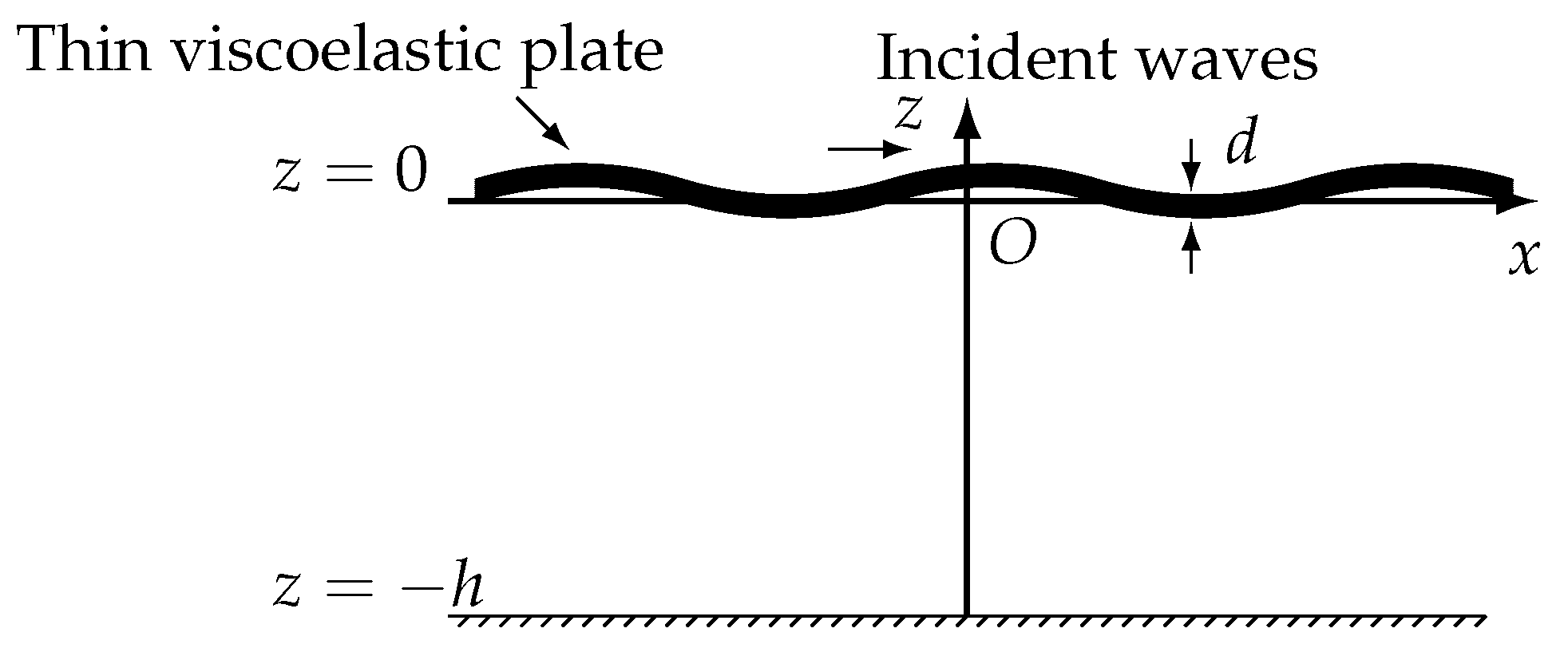
The nonlinear hydroelastic response of a thin viscoelastic plate floating on a fluid of finite depth is considered for the two-dimensioned case. It is assumed that the fluid is incompressible, homogeneous, and inviscid, and the flow is irrotational. As shown in Figure 1, Cartesian coordinates o x z are chosen such that the x-axis represents the undisturbed fluid surface and points horizontally rightward, while the z-axis points vertically upwards.
The velocity potential ϕ ( x , z , t ) satisfies the Laplace equation
2 ϕ = 0 , ( z ζ ( x , t ) ) ,
where ζ ( x , t ) is the vertical deflection of the floating plate.
The bottom boundary condition on the flat rigid bottom reads
ϕ z = 0 , ( z = h ) ,
and the kinematic and dynamic boundary conditions are, respectively, defined by
ζ t + ϕ x ζ x ϕ z = 0 , ( z = ζ ( x , t ) ) ,
ϕ t + 1 2 | ϕ | 2 + P e ρ + g ζ = 0 , ( z = ζ ( x , t ) ) ,
where P e is the pressure on the plate–water interface, g is the gravitational acceleration, and ρ is the uniform density of the fluid. Following Li and Lu [21], we describe the pressure as
P e = D 1 + τ φ t 4 ζ + M 2 ζ t 2 ,
where D = E d 3 / [ 12 ( 1 ν 2 ) ] is the flexural rigidity of the plate in which E is Young’s modulus, ν is Poisson’s ratio, and d is the thickness of the plate; ρ is the density of the fluid, τ φ = ζ / E is the retardation time, and M = ρ e d is the mass per unit area of the plate in which ρ e is the uniform density of the plate [22,24].
Substituting Equation (5) into Equation (4) yields the ultimate dynamic boundary condition
ϕ t + g ζ + 1 2 | ϕ | 2 + D ρ 1 + τ φ t 4 ζ + M ρ 2 ζ t 2 = 0 .
Based on the traveling wave method, an independent variable transformation is introduced:
X = k x ω t ,
where k and ω are the wave numbers and the angular frequency, respectively.
Selecting k, ρ , g as fundamental quantities, we obtain the following dimensionless quantities:
x = k x , z = k z , t = t ( g k ) 1 / 2 , d = k d , ϕ = k 2 ϕ ( g k ) 1 / 2 , ζ = k ζ , ω = ω ( g k ) 1 / 2 , D = k 4 D ρ g , E = k E ρ g , ρ e = ρ e / ρ , M = k M ρ , τ φ = τ φ ( k g ) 1 / 2 , h = k h ,
in the subsequent formulae, the asterisks denoting dimensionless quantities will be omitted.
Applying the transformation (7) and these dimensionless quantities in (8) in Equations (3) and (6), we can express ϕ ( x , z , t ) = ϕ ( X , z ) and ζ ( x , t ) = ζ ( X ) . Then the dimensionless Laplace equation are given by
2 ϕ X 2 + 2 ϕ z 2 = 0 , ( z ζ ( X , t ) ) ,
with the dimensionless kinematic and dynamic boundary conditions on the plate–water interface ( z = ζ ( X , t ) ) , respectively, changed to
ω d ζ d X + ϕ X d ζ d X ϕ z = 0 ,
D d 4 ζ d X 4 τ φ ω d 5 ζ d X 5 + M ω 2 d 2 ζ d X 2 + f ω ϕ X + ζ = 0 .
where f = 1 2 ϕ X 2 + ϕ z 2 . And the bottom condition is
ϕ z = 0 , ( z = h ) .

3. Approximate Analytical Solution Approach

3.1. Deformation Equations

In the HAM, we construct two homotopies Φ ( X , z ; q ) and η ( X ; q ) , which correspond to the unknown variables ϕ ( X , z ) and ζ ( X ) , respectively, which are governed by a new family of nonlinear partial differential equations as
2 Φ = 0 , ( z η ) ,
Φ z = 0 , ( z = h ) ,
( 1 q ) L 1 [ Φ ϕ 0 ] = C 0 q N 1 [ Φ , η ] , ( z = η ) ,
( 1 q ) L 2 [ η ζ 0 ] = C 0 q N 2 [ Φ , η ] , ( z = η ) ,
where ϕ 0 ( X , z ) and ζ 0 ( X ) are the initial guesses of the velocity potential ϕ ( X , z ) and the hydroelastic wave deflection ζ ( X ) , respectively. C 0 is a nonzero convergence-control parameter and q [ 0 , 1 ] an embedding parameter. As the parameter q increases from 0 to 1, the homotopy Φ ( X , z ; q ) deforms continuously from its initial estimation ϕ 0 ( X , z ) to the exact solution ϕ ( X , z ) , and the homotopy η ( X ; q ) varies continuously from ζ 0 ( X ) to ζ ( X ) . Equations (15) and (16) are called the zero-order deformation equations in the HAM. Based on the dimensionless kinematical condition (10) and dynamical boundary condition (11), the nonlinear differential operators N 1 [ Φ , η ] and N 2 [ Φ , η ] can be described by
N 1 [ Φ , η ] = ω η X + Φ X d η d X Φ z ,
N 2 [ Φ , η ] = D d 4 η d X 4 τ φ ω d 5 η d X 5 + M ω 2 d 2 η d X 2 + F ω Φ X + η ,
where F = 1 2 Φ X 2 + Φ z 2 .
In the frame of the HAM, we have extremely large freedom to choose the initial approximations and the auxiliary linear operator. In order to simplify the process of solving nonlinear problems, we choose the auxiliary linear operator
L 1 [ Φ ( X , z ; q ) ] = Φ + Φ z ,
and another linear operator is
L 2 [ η ( X ; q ) ] = η + d 2 η d X 2 + D d 4 η d X 4 D τ φ d 5 η d X 5 ,
where L n [ 0 ] = 0 , ( n = 1 , 2 ) . Note that we usually choose the linear terms in the nonlinear differential operators as the according auxiliary linear operators. However, in the subsequent solution procedure, we cannot obtain the convergent series solutions if L 1 [ Φ ( X , z ; q ) ] has only one term Φ z . So we built the operator L 1 [ Φ ( X , z ; q ) ] by adding the item Φ in Equation (19).
Following Liao [14], we expand the two unknown variables Φ ( X , z ; q ) and η ( X ; q ) into the Maclaurin series with respect to q. Then the unknown ϕ m ( X , z ) and ζ m ( X ) are governed by the following high-order deformation equations
L 1 ϕ m | z = 0 = C 0 Δ m 1 ϕ , ζ S ¯ m + χ m S m 1 ,
L 2 ζ m = C 0 Δ ˜ m 1 ζ , ϕ + χ m ζ m 1 + d 2 ζ m 1 d X 2 + D d 4 ζ m 1 d X 4 D τ φ d 5 ζ m 1 d X 5 ,
where
χ m = 0 , m 1 , 1 , m 2 ,
More detailed expressions for Equations (21) and (22) are provided in Appendix A.

3.2. Solution Expressions and Initial Guesses

The linear dispersion relation is derived from the linearized approximation by Li and Lu [21]
ω 2 = D + 1 M + coth h
Due to the nonlinearity on the hydroelastic waves and the fact that the dispersion relation (24) is only valid for small-amplitude waves, the actual angular frequency is slightly different from the angular frequency ω of the linear hydroelastic waves. Following Liu [25,26] and Wang [27], we introduce
Ω / ω = ε ,
where Ω is the actual wave frequency of the nonlinear hydroelastic waves. The dimensionless parameter ε should be a constant larger than 1. The nonlinearity of the dispersion relation strengthens as ε increases. Substituting the relation (25) into (24), we obtain an approximate nonlinear dispersion relation rather than a fully derived nonlinear solution as follows:
Ω = ε D + 1 M + coth h .
We construct the solution expressions of every order of hydroelastic wave elevation and every order of velocity potential as the superposition of linear corresponding solutions
ζ m ( X ) = n = 0 + β m , n cos ( n X ) + γ m , n sin ( n X ) ,
ϕ m ( X , z ) = n = 0 + α m , n cosh [ n ( z + h ) ] cosh ( n h ) sin ( n X ) + ε m , n cosh [ n ( z + h ) ] cosh ( n h ) cos ( n X ) ,
where α m , n , β m , n , γ m , n and ε m , n are coefficients to be determined. It should be emphasized that the solution expression (28) automatically satisfies the governing Equation (9) and the bottom boundary condition (12).
According to the solution expressions and to simplify the subsequent solution procedure, we construct the initial approximations for the unknown variables as
ϕ 0 ( X , z ) = α 0 , 0 cosh ( z + h ) cosh h sin X ,
ζ 0 ( X ) = 0 .
In order to make our model closed, a relation equation is constructed by
ζ 1 ( m π ) ζ 1 ( n π ) = H ,
where m is an even number, n is an odd number, and H is the amplitude of the first-order incident wave.
The accuracy of our HAM-based series solutions is validated by the total squared residual
ε m T = 1 1 + M i = 0 M N 1 [ Φ , η ] | X = i Δ X , z = η 2 + N 2 [ Φ , η ] | X = i Δ X , z = η 2 ,
where M is an integer and Δ X = π / M . We choose M = 10 hereinafter. The optimal convergence-control parameter C 0 can be obtained by the minimal ε m T . First-order and second-order solutions are given in Appendix B.

4. Results and Analysis

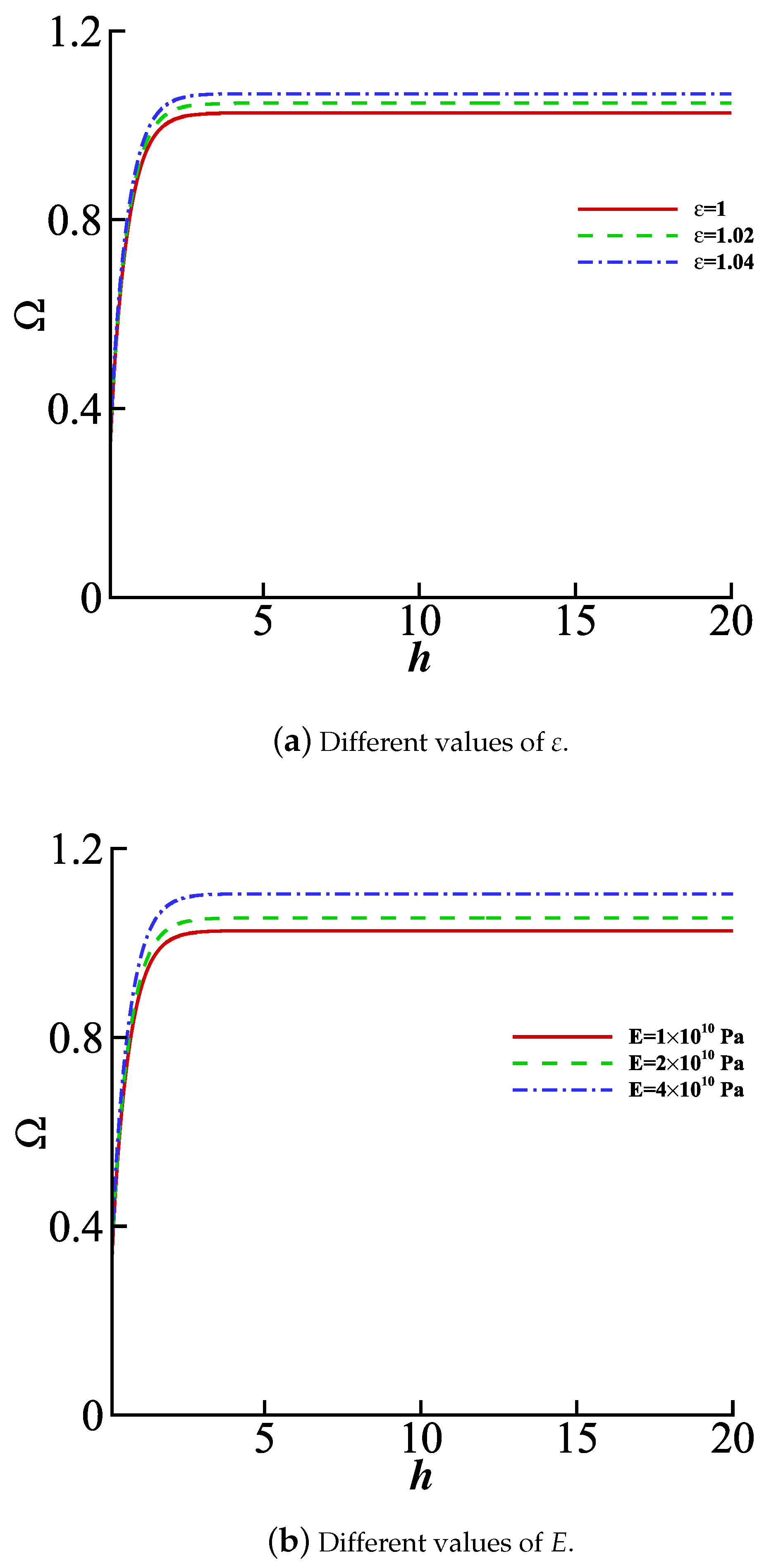
We adopt dimensional physical parameters given by Li and Lu [21]: d = 0.1 m , H = 0.1 m , ρ = 1024 kg / m 3 , ρ e = 917 kg / m 3 , ν = 0.3 , E = 1 × 10 10 Pa , h = 500 m , ε = 1.0002 , τ φ = 1 s , k = π / 20 m 1 , and we take these data hereinafter unless otherwise stated. Figure 2 illustrates angular frequency Ω versus water depth h. It is found that Ω initially increases and then remains constant when h increases. Further, in Figure 2a, the angular frequency Ω increases as the dimensionless parameter ε slightly increases. It is shown that the nonlinear angular frequency would be underestimated if the linear dispersion relation  ( ε = 1 ) were used. Figure 2b shows that Young’s modulus E has a positive correlation with Ω in the approximate nonlinear dispersion relation.
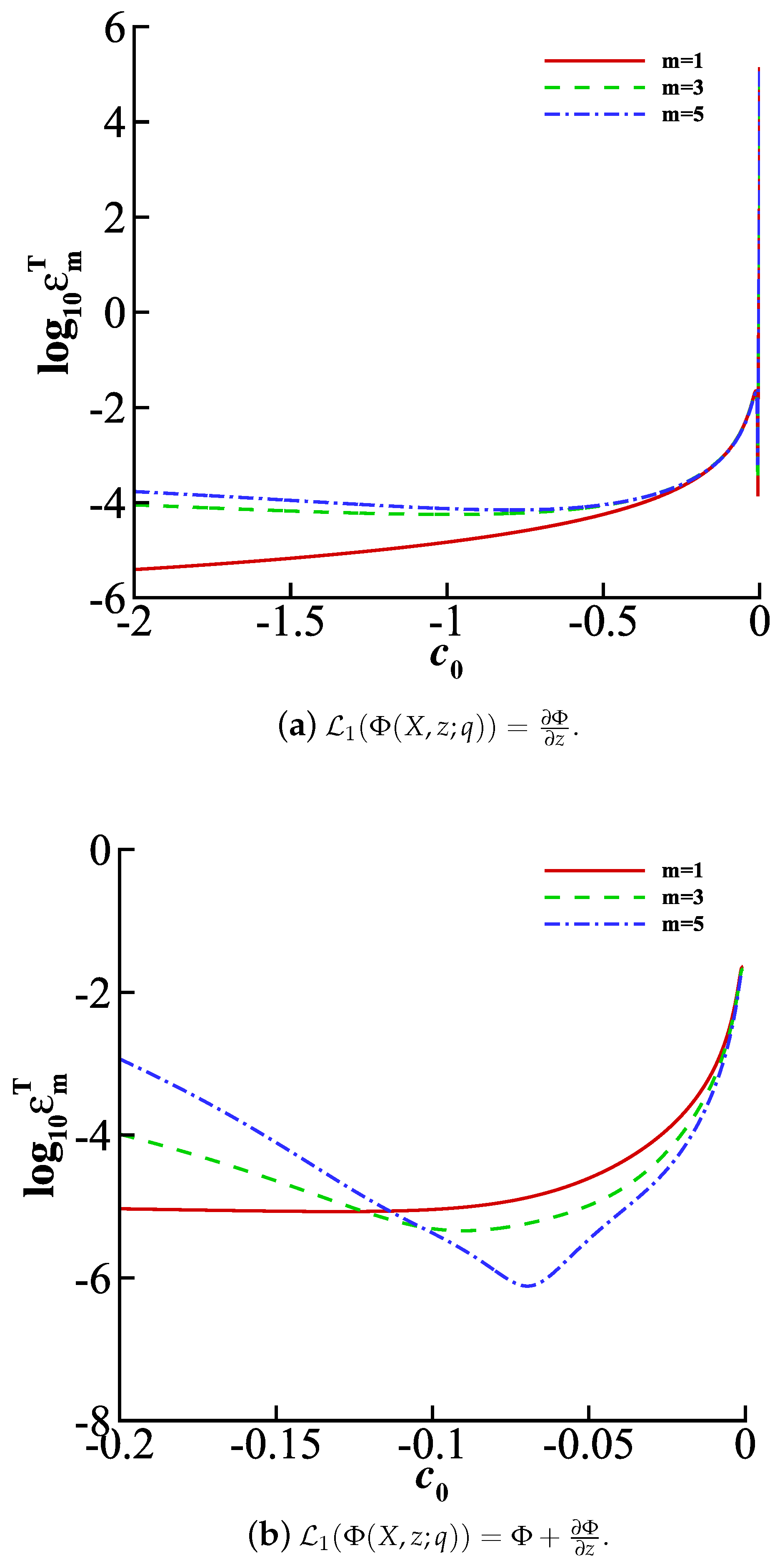
To show the validity and accuracy of our HAM-based analytic solutions, we illustrate the total squared residual ε m T of our solutions at several different orders versus the nonzero convergence-control parameter C 0 . As the auxiliary linear operator L 1 ( Φ ( X , z ; q ) ) = Φ z , Figure 3a shows that the total squared residual ε m T does not decrease when m increases in the subsequent solution procedure. Thus, we improved the operator L 1 [ Φ ( X , z ; q ) ] by adding the item Φ into L 1 ( Φ ( X , z ; q ) ) . As shown in Figure 3b, we find that for several order HAM-based solutions, log 10 ε m T can reduce to a minimum in the interval 0.2 < C 0 < 0 and then the optimal C 0 is about 0.07 . The corresponding log residual error squares decrease when m increases, and they arrive at 6.115 when m = 5 , as shown in Table 1. These solutions illustrate that our HAM-based series solutions are accurate and convergent for the nonlinear responses of the viscoelastic plate.
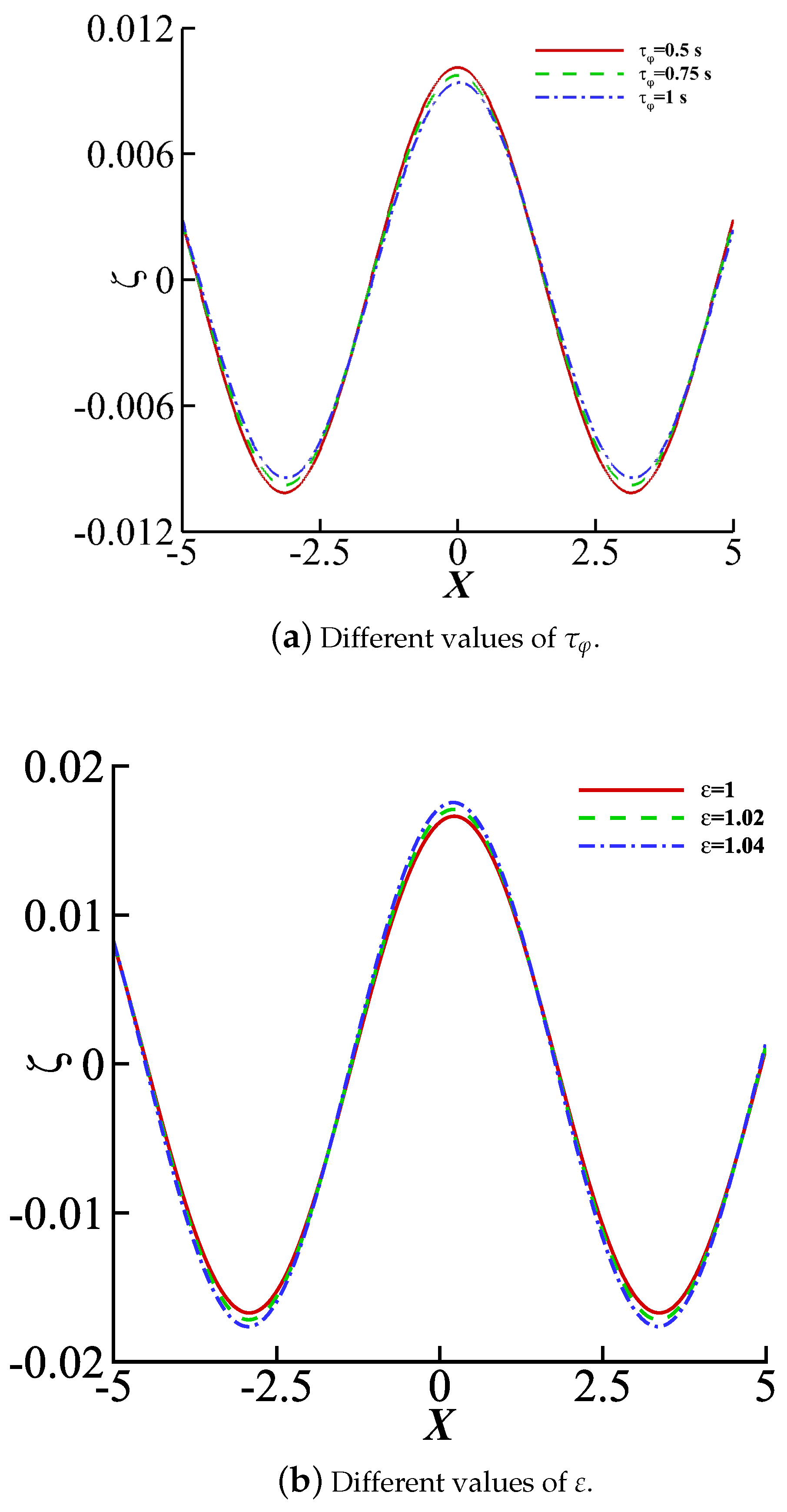
We consider the influence of the retardation time τ φ on the plate deflection ζ ( X ) by increasing it from 0.5 s to 1 s . Figure 4a shows that ζ ( X ) becomes flatter at the crest and steeper at the trough when the retardation time τ φ increases. The result indicates that ignoring plate viscosity results in an underestimation of the actual nonlinear response of the structure. Further, as shown in Figure 4b, we find that ζ ( X ) increases as the dimensionless parameter ε increases. Figure 4a,b show that the nonlinear response of viscoelastic thin plates would be underestimated if the viscosity of the plate were ignored or the linear dispersion relation used.
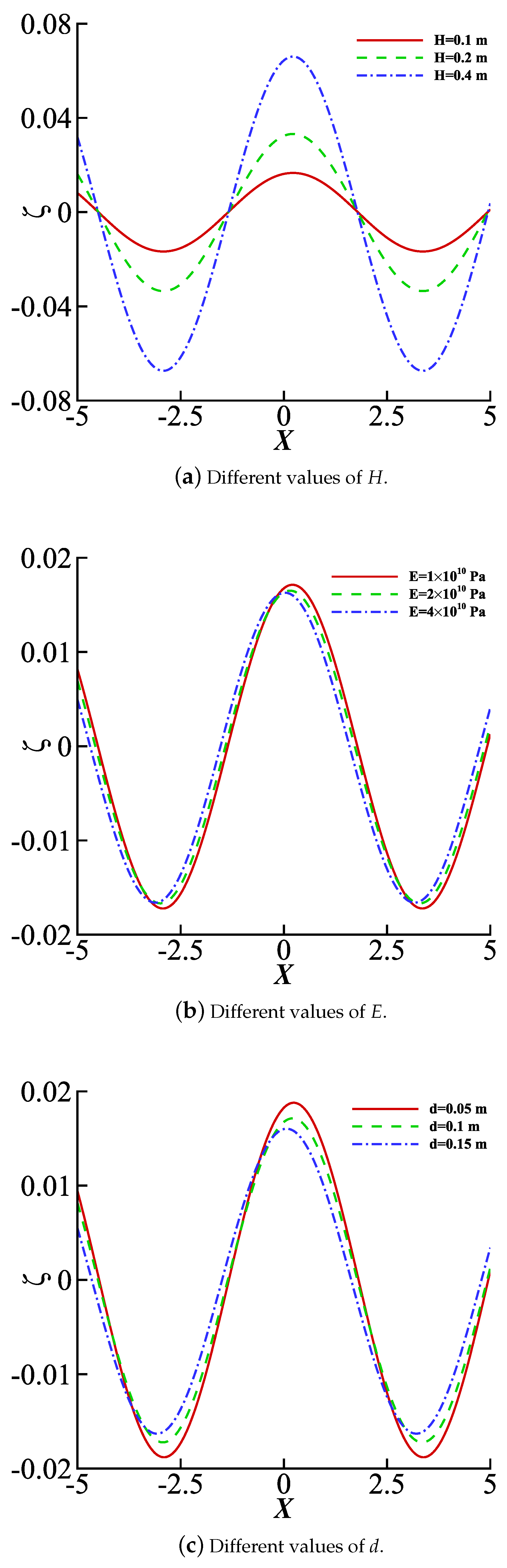
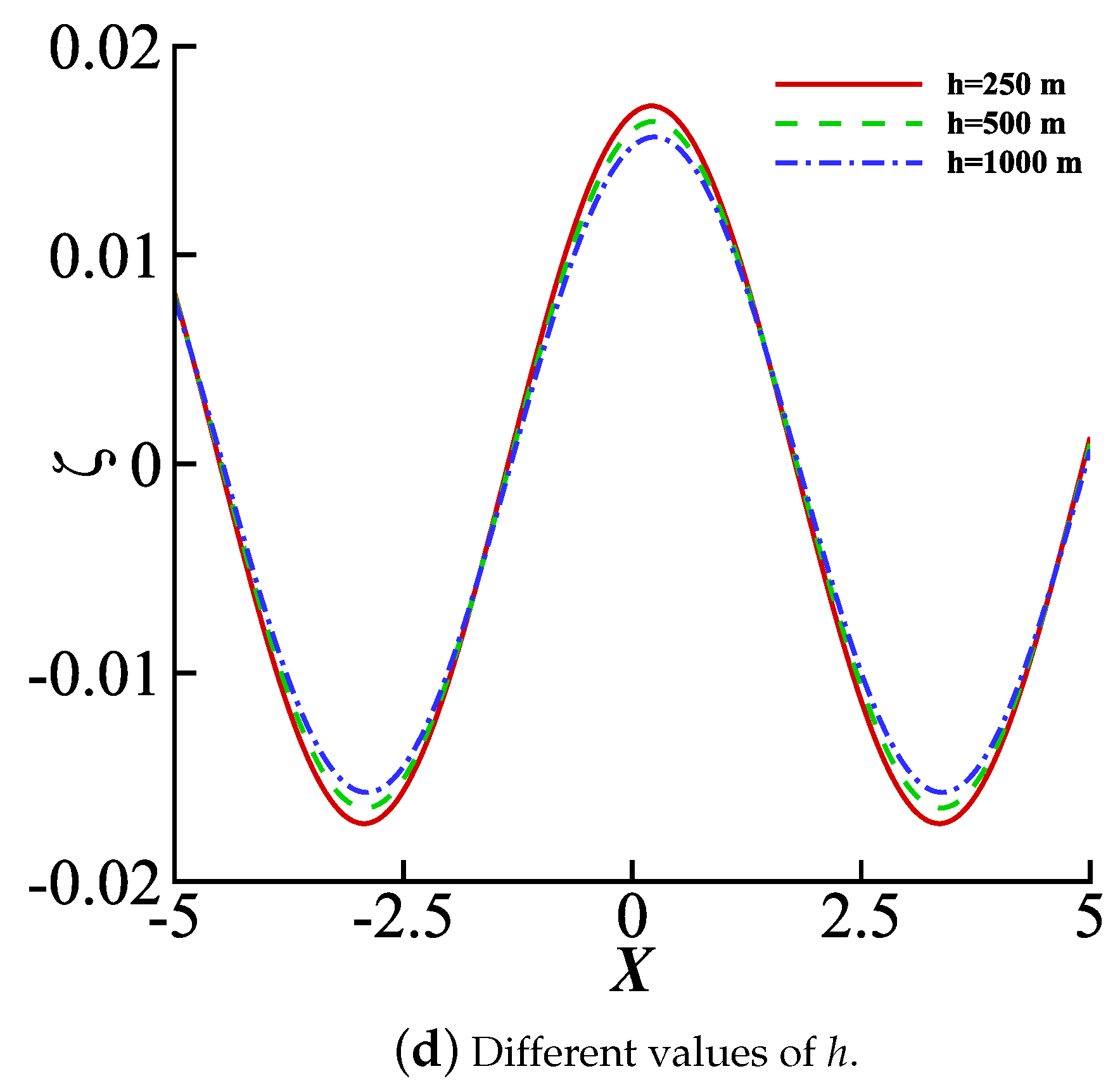
The effects of several other physical parameters on the viscoelastic plate are considered in Figure 5a–d. In Figure 5a, the plate deflection ζ ( X ) increases obviously as the wave amplitude H increases. However, Figure 5b shows that the differences in the plate deflection for Young’s modulus E = 10 10 Pa , E = 2 × 10 10 Pa and E = 4 × 10 10 Pa . We find that the plate deflection ζ ( X ) decreases slightly with a large value of Young’s modulus E. The plate deflection ζ ( X ) decreases as the thickness d of the plate increases in Figure 5c. Figure 5d shows the variation in the plate deflection ζ ( X ) in the cases of h = 250 m , h = 500 m and h = 1000 m . It is found that ζ ( X ) decreases when water depth h increases.

5. Conclusions

The response of a VLFS is analytically studied within the framework of the nonlinear water wave theory. The VLFS is modeled as a thin viscoelastic plate, and the respond problem is transformed into a steady-state wave problem by means of the traveling-wave method. By choosing proper auxiliary linear operators and the solution expressions, we construct the zero-order and high-order deformation equations in the HAM to accurately analyze the plate responses in a fluid of finite depth. Our main innovative work includes accurate and convergent series solutions that are obtained by using the HAM, and an approximate nonlinear dispersion relation and a thin viscoelastic model are introduced to evaluate more exactly the dynamic characteristics of the VLFS.
Graphical comparisons are presented to show that an increasing retardation time, the thickness and flexural rigidity of the plate, and the water depth all decrease deflections, while an increasing wave amplitude of the incident waves increases the plate deflection. These analyses can help us further understand the hydroelastic interaction between a VLFS and water waves.
However, the limitations of the present study are that the incident waves must be progressive waves and the wave systems must be steady because of incomplete analytical calculation methods. The infinite-plate assumption eliminates edge diffraction and radiation damping (wave-making damping) effects, which are typically non-negligible [28,29], particularly near resonance frequencies. Our future work will strive to analyze deeply radiation damping and added mass effects arising from the acceleration of the surrounding fluid and the finite-plate or semifinite-plate with numerical methods.

Author Contributions

Conceptualization, Y.Q. and P.W.; methodology, P.W.; software, Y.Q.; validation, Y.Q. and P.W.; formal analysis, P.W.; investigation, P.W.; resources, P.W.; data curation, P.W.; writing—original draft preparation, Y.Q.; writing—review and editing, P.W.; visualization, Y.Q.; supervision, P.W.; project administration, P.W.; funding acquisition, P.W.. All authors have read and agreed to the published version of the manuscript.

Funding

This research received no external funding.

Data Availability Statement

The original contributions presented in this study are included in the article. Further inquiries can be directed to the corresponding author.

Conflicts of Interest

The authors declare no conflicts of interest.

Appendix A. Detailed Derivations for the High-Order Deformations (21) and (22)

According to the solution expression of every order velocity potential ϕ m ( X , z ) (28), we find that the independent variables X and z in every term of ϕ m ( X , z ) are separable. So, for the unknown boundary z = η ( X ; q ) , the function ϕ m ( X , z ) can be expanded into the following Maclaurin series:
ϕ m ( X , z ) = ϕ 1 , m ( X ) ϕ 2 , m ( z ) = ϕ 1 , m ( X ) k = 0 + 1 k ! d k ϕ 2 , m d z k | z = 0 z k = ϕ 1 , m ( X ) k = 0 + 1 k ! d k ϕ 2 , m d z k | z = 0 i = k + μ k , i q i = i = 0 + ψ m , i q i ,
where
η k = i = 1 + ζ i q i k = i = k + μ k , i q i , ψ m , i = ϕ 1 , m ( X ) k = 0 i 1 k ! d k ϕ 2 , m d z k | z = 0 μ k , i .
Thus, we have on z = η ( X ; q ) ,
Φ ( X , η ; q ) = m = 0 + ϕ m ( X , η ) q m = m = 0 + i = 0 + ψ m , i q i q m = m = 0 + φ m q m ,
where
φ m = i = 0 m ψ m i , i .
Substituting the two series (27) and (A3) into the zeroth-order deformation Equations (14) and (15), and then equating the like-power of the embedding parameter q, we can obtain the high-order deformation Equations (21) and (22) in the HAM. The explicit expressions for Δ m 1 ϕ , ζ , Δ ˜ m 1 ζ , ϕ , Δ 0 ϕ , ζ , Δ ˜ 0 ζ , ϕ , S m 1 , and S ¯ m in these equations are given by
Δ m 1 ϕ , ζ = ω d ζ m 1 d X + k = 0 m 1 d φ k d X d ζ m 1 k d X φ ¯ m 1 , ( m 2 ) ,
Δ ˜ m 1 ζ , ϕ = D d 4 ζ m 1 d X 4 τ φ ω d 5 ζ m 1 d X 5 + M ω 2 d 2 ζ m 1 d X 2 + F ω d φ m 1 d X + ζ m 1 , ( m 2 ) ,
Δ 0 ϕ , ζ = φ ¯ 0 , Δ ˜ 0 ζ , ϕ = 1 2 d φ 0 d X 2 + φ ¯ 0 2 ω d φ 0 d X ,
S m 1 = i = 0 m 2 ψ m 1 i , i + γ m 1 i , i ,
S ¯ m = i = 1 m 1 ψ m 1 i , i + γ m 1 i , i ,
where
φ ¯ m 1 = i = 0 m 1 γ m 1 i , i ,
γ m i , i = k = 0 i 1 k ! k + 1 ϕ m i z k + 1 | z = 0 μ k , i .

Appendix B. First-Order and Second-Order Solutions

According to the aforementioned mth-order deformation Equations (21) and (22), we can get the coefficients of the solution expressions, and first-order and second-order solutions are shown as follows
ϕ 1 ( X , z ) = D H 1 + τ φ 2 4 Ω cosh ( z + h ) cosh h sin X ,
ζ 1 ( X ) = H 2 cos X H τ φ 2 sin X + D 2 H 2 1 + τ φ 2 2 8 Ω 2 c 0 , ϕ 2 ( X , z ) = T 1 cosh ( z + h ) cosh h sin X + T 2 cosh 2 ( z + h ) cosh 2 h sin 2 X
+ T 3 cosh ( z + h ) cosh h cos X + T 4 cosh 2 ( z + h ) cosh 2 h cos 2 X + T 5
ζ 2 ( X ) = Q 1 cos X + Q 2 sin X + Q 3 .
where
T 1 = H 2 D + D c 0 2 Ω c 0 2 D τ φ 2 + D c 0 τ φ 2 8 Ω ,
T 2 = D H 2 1 + τ φ 2 24 Ω ,
T 3 = Ω c 0 τ φ H 4 ,
T 4 = D H 2 τ φ 1 + τ φ 2 24 Ω ,
T 5 = D H 2 τ φ 1 + τ φ 2 8 Ω ,
Q 1 = τ φ H 2 D 1 + τ φ 2 + c 0 4 + 3 D 2 D Ω 4 Ω 2 m e + D 1 + 2 Ω τ φ 2 4 Ω D 1 + τ φ 2 ,
Q 2 = H 2 D 1 + τ φ 2 + c 0 2 + D + 2 3 D + 4 D Ω τ φ 2 + 2 Ω 2 m e 1 + τ φ 2 4 Ω D 1 + τ φ 2 ,
Q 3 = D 2 H 2 1 + τ φ 2 2 8 Ω 2 c 0 .

References

  1. Wang, C.M.; Tay, Z.Y. Very large floating structures: Applications, research and development. Procedia Eng. 2011, 14, 62–72. [Google Scholar] [CrossRef]
  2. Hosking, R.; Sneyd, A.D.; Waugh, D. Viscoelastic response of a floating ice plate to a steadily moving load. J. Fluid Mech. 1988, 196, 409–430. [Google Scholar] [CrossRef]
  3. Craik, A.D. The origins of water wave theory. Annu. Rev. Fluid Mech. 2004, 36, 1–28. [Google Scholar] [CrossRef]
  4. Lu, D.Q.; Dai, S.Q. Flexural- and capillary-gravity waves due to fundamental singularities in an inviscid fluid of finite depth. Int. J. Eng. Sci. 2008, 46, 1183–1193. [Google Scholar] [CrossRef]
  5. Das, S.; Sahoo, T. Hydroelastic analysis of very large floating structure over viscoelastic bed. Meccanica 2016, 52, 1871–1887. [Google Scholar] [CrossRef]
  6. Hegarty, G.M.; Squire, V.A. A boundary-integral method for the interaction of large-amplitude ocean waves with a compliant floating raft such as a sea-ice floe. J. Eng. Math. 2008, 62, 355–372. [Google Scholar] [CrossRef]
  7. Squire, V.A. Of ocean waves and sea-ice revisited. Cold Reg. Sci. Technol. 2007, 49, 110–133. [Google Scholar] [CrossRef]
  8. Lake, B.M.; Yuen, H.C. A note on some nonlinear water-wave experiments and the comparison of data with theory. J. Fluid Mech. 1977, 83, 75–81. [Google Scholar] [CrossRef]
  9. Bonnefoy, F.; Meylan, M.H.; Ferrant, P. Nonlinear higher order spectral solution for a two-dimensional moving load on ice. J. Fluid Mech. 2009, 621, 215–242. [Google Scholar] [CrossRef]
  10. Plotnikov, P.I.; Toland, J.F. Modelling nonlinear hydroelastic waves. Philos. Trans. R. Soc. A Math. Phys. Eng. Sci. 2011, 369, 2942–2956. [Google Scholar] [CrossRef]
  11. Părău, E.I.; Vanden Broeck, J.M. Three-dimensional waves beneath an ice sheet due to a steadily moving pressure. Philos. Trans. R. Soc. A Math. Phys. Eng. Sci. 2011, 369, 2973–2988. [Google Scholar] [CrossRef] [PubMed]
  12. Liao, S.J. Beyond Perturbation: Introduction to the Homotopy Analysis Method; CRC Press: Boca Raton, FL, USA, 2003. [Google Scholar]
  13. Liao, S.J. Notes on the homotopy analysis method: Some definitions and theorems. Commun. Nonlinear Sci. 2009, 14, 983–997. [Google Scholar] [CrossRef]
  14. Liao, S.J. Homotopy Analysis Method in Nonlinear Differential Equations; Higher Education Press: Beijing, China, 2012. [Google Scholar]
  15. Wang, P.; Lu, D.Q. Analytic approximation to nonlinear hydroelastic waves traveling in a thin elastic plate floating on a fluid. Sci. China Phys. Mech. 2013, 56, 2170–2177. [Google Scholar] [CrossRef]
  16. Wang, P.; Cheng, Z.S. Nonlinear hydroelastic waves beneath a floating ice sheet in a fluid of finite depth. Abstr. Appl. Anal. 2013, 2013, 108026. [Google Scholar] [CrossRef]
  17. Wang, P.; Lu, D.Q. Nonlinear hydroelastic waves traveling in a thin elastic plate floating on a two-layer fluid. Appl. Math. Comput. 2016, 274, 700–710. [Google Scholar] [CrossRef]
  18. Ji, J.J.; Zhang, L.F. Homotopy analysis method for solving (2+1)-dimensional navier-stokes equations with perturbation terms. Commun. Math. Res. 2018, 34, 1–14. [Google Scholar]
  19. Wang, P.; Lu, D.Q.; Fu, L.D. Steady-state hydroelastic waves generated by a moving load in a uniform current. Wave Motion 2023, 122, 103190. [Google Scholar] [CrossRef]
  20. Squire, V.; Hosking, R.J.; Kerr, A.D.; Langhorne, P. Moving Loads on Ice Plates; Springer Science & Business Media: Dordrecht, The Netherlands, 1996. [Google Scholar]
  21. Li, J.S.; Lu, D.Q. Flexural-gravity wave resistances due to a moving point source on 2-d infinite floating beam. J. Hydrodyn. 2017, 29, 1000–1009. [Google Scholar] [CrossRef]
  22. Pogorelova, A. Plane problem of the impact of several shock pulses on a viscoelastic plate floating on a fluid surface. J. Appl. Mech. Tech. Phys. 2010, 51, 155–163. [Google Scholar] [CrossRef]
  23. Xue, Y.; Zeng, L.; Ni, B.; Korobkin, A.; Khabakhpasheva, T. Hydroelastic response of an ice sheet with a lead to a moving load. Phys. Fluids 2021, 33, 037109. [Google Scholar] [CrossRef]
  24. Kozin, V.; Pogorelova, A. Wave resistance of amphibian aircushion vehicles during motion on ice fields. J. Appl. Mech. Tech. Phys. 2003, 44, 193–197. [Google Scholar] [CrossRef]
  25. Liu, Z.; Liao, S.J. Steady-state resonance of multiple wave interactions in deep water. J. Fluid Mech. 2014, 742, 664–700. [Google Scholar] [CrossRef]
  26. Liu, Z.; Xie, D. Finite-amplitude steady-state wave groups with multiple near-resonances in finite water depth. J. Fluid Mech. 2019, 867, 348–373. [Google Scholar] [CrossRef]
  27. Wang, P.; Lu, D.Q. Nonlinear hydroelastic waves traveling in a plate in terms of plotnikov–toland’s model. Adv. Appl. Math. Mech. 2021, 13, 724–734. [Google Scholar] [CrossRef]
  28. Chen, G.B.; Chen, W.L.; Min, X.W.; Gao, D.L. A coupled model for vortex induced vibration of a circular cylinder with and without passive-jet flow control. J. Fluids Struct. 2022, 110, 103541. [Google Scholar] [CrossRef]
  29. Chen, G.B.; Chen, W.L.; Chen, C.L.; Gao, D.; Meng, H.; Kim, K.C. Experimental and coupled model investigation of an active jet for suppressing vortex-induced vibration of a box girder. J. Fluids Struct. 2024, 127, 104119. [Google Scholar] [CrossRef]
Figure 1. Coordinates.
Symmetry 18 00864 g001
Figure 2. Variation in angular frequency Ω versus water depth h for different ε and E, respectively.
Symmetry 18 00864 g002
Figure 3. Log squared residual log 10 ε m T of the m-th order homotopy approximation versus C 0 .
Symmetry 18 00864 g003
Figure 4. Variation in plate vertical displacement ζ ( X ) versus X for different τ φ and ε , respectively.
Symmetry 18 00864 g004
Figure 5. Variation in plate vertical displacement ζ ( X ) versus X for different parameter values.
Symmetry 18 00864 g005aSymmetry 18 00864 g005b
Table 1. The total log residual squares in the cases of m = 1 , 3 , 5 as C 0 = 0.07 .
m log 10 ε m T
1 4.879
3 5.242
5 6.115
Disclaimer/Publisher’s Note: The statements, opinions and data contained in all publications are solely those of the individual author(s) and contributor(s) and not of MDPI and/or the editor(s). MDPI and/or the editor(s) disclaim responsibility for any injury to people or property resulting from any ideas, methods, instructions or products referred to in the content.