1. Introduction
Portfolio models are often evaluated by return and risk, but practical rebalancing adds another layer of difficulty. In bond ETF allocation, a portfolio must also respect credit exposure, transaction costs, and limits on how much the holdings can change at each rebalance. A strategy that improves an in-sample objective may therefore be unattractive in practice if it produces large and unstable trading adjustments.
Turnover is one of the most direct indicators of this gap between optimization and implementation. Large portfolio updates increase trading costs and may also create unstable exposure shifts, especially when credit-sensitive bond ETFs are involved. Once turnover limits are imposed together with return, tail-risk, and diversification objectives, the allocation problem becomes a constrained multi-objective problem that is not always convenient for standard exact solvers.
Multi-objective particle swarm optimization provides a flexible way to search such constrained spaces. It can maintain a set of non-dominated candidate portfolios and does not require the objective landscape to be smooth or convex. However, the behavior of a swarm is not determined only by the objective functions. It also depends on how particles communicate, how leaders are selected, and how infeasible updates are handled. These internal design choices matter when the target is not simply an attractive frontier, but a portfolio that can actually be rebalanced.
This paper focuses on the communication structure inside the swarm. We view particles as nodes in a graph, with edges defining which particles can exchange information. Under this interpretation, topology affects the speed and pattern of information diffusion. A fully connected graph may encourage fast convergence, while a more local structure such as a ring may preserve search diversity for longer. In a turnover-constrained portfolio problem, this distinction is important because premature convergence can lead the search toward narrow or unstable regions of the feasible set.
We therefore propose a topology-aware multi-objective PSO framework for bond ETF allocation under credit-risk-related constraints. The framework optimizes annualized return, CVaR, and diversification while enforcing a hard maximum-step turnover rule. After each particle update, candidates that violate the turnover budget are repaired toward the feasible region before evaluation. In this way, turnover control enters the search process directly rather than being treated only as a soft penalty or an ex post adjustment.
Empirically, we evaluate the framework using a walk-forward out-of-sample backtest from 2008 to 2024. The experiment is designed not to show that the proposed method dominates all alternatives in every metric, but to study whether a topology-aware swarm design can produce a more stable and implementable return–risk–turnover profile. For this purpose, we compare the proposed method with stronger classical and evolutionary baselines, test multiple communication topologies, examine hard-versus-soft turnover control, evaluate stress-period behavior, and report a solver-level scalability proxy.
The main contributions of this paper are as follows.
First, we formulate bond ETF rebalancing as a constrained multi-objective problem that jointly considers annualized return, downside tail risk, diversification, and trading feasibility. The formulation includes long-only, exposure, and hard maximum-step turnover constraints.
Second, we introduce a graph-based view of swarm search. Particles are treated as nodes in a communication topology, so alternative graph structures can be tested as model-design choices rather than incidental algorithm settings.
Third, we develop a turnover-aware MOPSO framework that combines Pareto archive search, topology-sensitive leader guidance, and feasibility-preserving repair. Candidate updates that violate the turnover budget are moved back toward the admissible region before evaluation.
Fourth, we evaluate the method against stronger classical and evolutionary baselines, communication-topology variants, hard-versus-soft turnover controls, stress windows, transaction-cost levels, and a runtime scalability proxy. The results show that the ring topology gives the most stable overall behavior in our setting, especially when tail turnover is treated as part of the optimization problem.
2. Related Work
The paper is related to three areas of prior work: downside-risk portfolio optimization, swarm-based multi-objective search, and graph-based views of information flow in optimization. The first area explains why CVaR and trading frictions matter in fixed-income allocation. The second provides algorithmic tools for constrained, non-convex portfolio problems. The third motivates treating the communication pattern of a swarm as a design choice rather than a background implementation detail.
2.1. Tail-Risk Modeling and Real-World Frictions
The integration of credit risk into portfolio optimization necessitates risk measures capable of capturing heavy-tailed and asymmetric return distributions. Since its introduction, CVaR has been widely used to measure downside tail risk in portfolio optimization [
1,
2,
3]. While theoretical risk models are well-established, the persistent degradation of out-of-sample performance in live markets is predominantly driven by unconstrained turnover and execution costs [
4]. Early efforts to rectify this involved integrating linear and fixed transaction costs into the objective function, yielding complex formulations [
5,
6].
Recent work has therefore shifted attention from idealized portfolio frontiers to strategies that remain stable after trading constraints are imposed. Constraints on cardinality, sparsity, and rebalancing can reduce execution drag and make allocations less sensitive to small estimation errors [
7,
8,
9]. Related CVaR-based models have also been combined with machine learning forecasts to improve downside-risk management [
10,
11]. These studies motivate the use of explicit implementation constraints, but most do not study how swarm communication topology interacts with hard turnover feasibility.
2.2. Swarm Intelligence and Multi-Objective Heuristics
Solving non-convex portfolio problems with multiple competing objectives requires sophisticated multi-objective evolutionary algorithms [
12,
13,
14]. Since the seminal work of Kennedy and Eberhart [
15], Particle Swarm Optimization (PSO) and its multi-objective derivations (MOPSO) have gained significant traction due to their computational efficiency in continuous and constrained spaces [
16,
17]. As documented in a recent fifty-year retrospective of portfolio optimization [
18], metaheuristics have become essential for handling practical market constraints that exact solvers cannot process.
For portfolio applications, the performance of MOPSO depends strongly on constraint handling and leader selection [
19,
20]. Recent variants introduce richer exemplars, local-awareness mechanisms, or hybrid learning components to improve diversification and constraint satisfaction [
21,
22,
23]. Evolutionary methods have also been widely used for cardinality-constrained portfolios [
24,
25]. Less attention has been paid to fixed-income portfolios where turnover is enforced as a hard rebalancing-step constraint and where the communication topology itself is treated as an empirical design variable.
The above literature points to a common difficulty: in constrained portfolio search, performance depends not only on the objective formulation itself, but also on how information is propagated among candidate solutions during optimization. This observation motivates a structural perspective. If swarm-based portfolio optimization is viewed as a network of interacting search agents rather than as an unstructured population, then communication topology becomes a meaningful design choice rather than a purely descriptive one. This is the connection that motivates the graph-based viewpoint adopted next.
2.3. Graph Structure, Topology, and Structural Perspectives in Optimization
Recent research increasingly emphasizes structural representations in optimization and financial modeling, especially when interactions among variables, agents, or temporal dependencies can be expressed through graphs or network topologies. In financial learning, graph-based formulations have been used to represent cross-asset dependencies and non-stationary market structure, as illustrated by graph attention models for financial systems [
26]. More broadly, graph-theoretic studies on connectivity, diagnosability, and ordered traversal properties highlight how structural organization influences information transmission, robustness, and reachable states in networked systems [
27,
28,
29].
Although these studies do not directly address turnover-constrained portfolio rebalancing by swarm intelligence, they motivate a structural interpretation in which the behavior of distributed optimization agents depends on the topology through which information propagates. From this perspective, communication patterns in PSO can be viewed as graph-constrained interactions over a population of agents, and the resulting topology may affect convergence behavior, diversity preservation, and feasible exploration. This paper adopts this viewpoint to reinterpret turnover-aware MOPSO as a graph-structured optimization framework with application to constrained portfolio management.
3. Problem Formulation
3.1. Assets, Returns, and Portfolio Weights
We consider a universe of
d tradable assets (bond ETFs in our experiments). Let
denote the portfolio weights held during rebalancing period
t. We focus on long-only fully-invested allocations:
Let
be the vector of single-period (daily) arithmetic returns at day
, computed from adjusted close prices. The portfolio return on day
given weights
is
In a walk-forward setting, at each rebalance date t we estimate objectives using a rolling training window of daily returns. Denote the sample size and the realized portfolio returns on the training window by (indexing the days within ).
3.2. Objectives: Return, CVaR, Diversification
3.2.1. Expected Return (Annualized)
We use the sample mean of daily portfolio returns on
,
and report annualized expected return as
where
A is the annualization factor (e.g.,
for daily data). Since our algorithm is multi-objective, we treat return as a maximization objective.
3.2.2. Tail Risk via CVaR of Losses
Let the one-day portfolio loss be
. For a confidence level
(e.g.,
), the Conditional Value-at-Risk (CVaR) is the expected loss in the
-tail:
In practice, we compute the empirical CVaR on the training window
by sorting losses
in ascending order and averaging the worst
fraction:
where
denotes the
j-th order statistic of losses. CVaR is minimized (lower tail loss is better).
3.2.3. Diversification via Concentration (HHI)
To discourage concentrated portfolios, we use the Herfindahl–Hirschman Index (HHI):
Under the simplex constraint (
1),
, where smaller values indicate more diversified allocations. We minimize HHI.
3.2.4. Multi-Objective Vector
At each rebalance date
t, we therefore optimize the following objective vector:
where return is negated to convert to a minimization form, consistent with Pareto dominance.
3.3. Constraints and Practical Trading Limits
3.3.1. Position Bounds and Credit-Risk Exposure Control
Beyond long-only and full investment (
1), we impose implementable position constraints. Let
and
be lower and upper bounds for asset
k:
Such bounds encode practical exposure limits (e.g., caps on high-yield or emerging-market credit proxies and floors on investment-grade exposure). We may also enforce a maximum single-name concentration:
3.3.2. Turnover and Rebalancing Step Constraint
Let
denote the holdings before rebalancing at time
t. We quantify one-way turnover using the standard
distance on weights:
This equals the total traded notional fraction under self-financing rebalancing. To prevent extreme trades and improve deployability, we impose a hard step constraint:
where
is a user-defined rebalancing limit (e.g.,
–
per rebalance).
3.3.3. Transaction Costs (Used in Evaluation)
While our optimizer primarily targets the return–risk–diversification trade-off under explicit feasibility constraints, we evaluate out-of-sample implementability under proportional transaction costs. We separate turnover feasibility from transaction-cost accounting for two reasons. First, the hard turnover bound already limits excessive trading directly during optimization. Second, keeping transaction costs in evaluation allows the effect of the proposed turnover-aware design to be assessed more transparently, without conflating feasibility control with a particular soft-penalty specification.
Given per-unit cost rate
c (e.g., in basis points), the net portfolio return on day
in a rebalance period that begins at
t is approximated by
where the cost is charged once at the rebalance time and amortized for performance accounting. This design does not imply that transaction costs are unimportant for optimization. Rather, it reflects a modeling choice: in this paper, trading implementability is enforced through hard turnover feasibility, while proportional cost sensitivity is studied separately in the out-of-sample evaluation.
3.3.4. Final Optimization Problem
Collecting the constraints, define the feasible set at time
t:
At each rebalance date
t, our goal is to approximate the Pareto-efficient set:
We then select a deployable compromise solution (e.g., knee point) for trading and walk-forward testing, as detailed in the next section.
4. Graph-Theoretic Interpretation of Swarm Dynamics
To make the role of communication explicit, we interpret the swarm at rebalance date
t as a graph
where each node
represents particle
i, and each edge
indicates that particle
i is allowed to receive search information from particle
j under the chosen communication topology.
Let
denote the adjacency matrix of
, where
if particle
j belongs to the communication neighborhood of particle
i, and
otherwise. The neighborhood of particle
i is
This graph representation links the communication structure to the actual search process. Topology determines which particles can influence one another, which archive candidates are visible as leaders, and how quickly feasible regions are propagated through the population. This matters in the portfolio setting because the swarm is not moving through an unconstrained space: each candidate allocation must satisfy long-only, exposure, and turnover requirements.
Different topologies therefore imply different search behavior. A fully connected graph promotes rapid information diffusion and stronger exploitation. A ring topology restricts communication to local neighborhoods and can preserve diversity for longer. Sparse or random graphs sit between these two cases. In a turnover-constrained portfolio problem, these differences may affect not only convergence, but also the stability of the selected rebalancing decisions.
Under this view, turnover-aware MOPSO becomes a graph-structured search process over a constrained portfolio domain. The bond ETF application provides a concrete setting in which the role of communication topology can be tested empirically.
5. Turnover-Aware Multi-Objective PSO
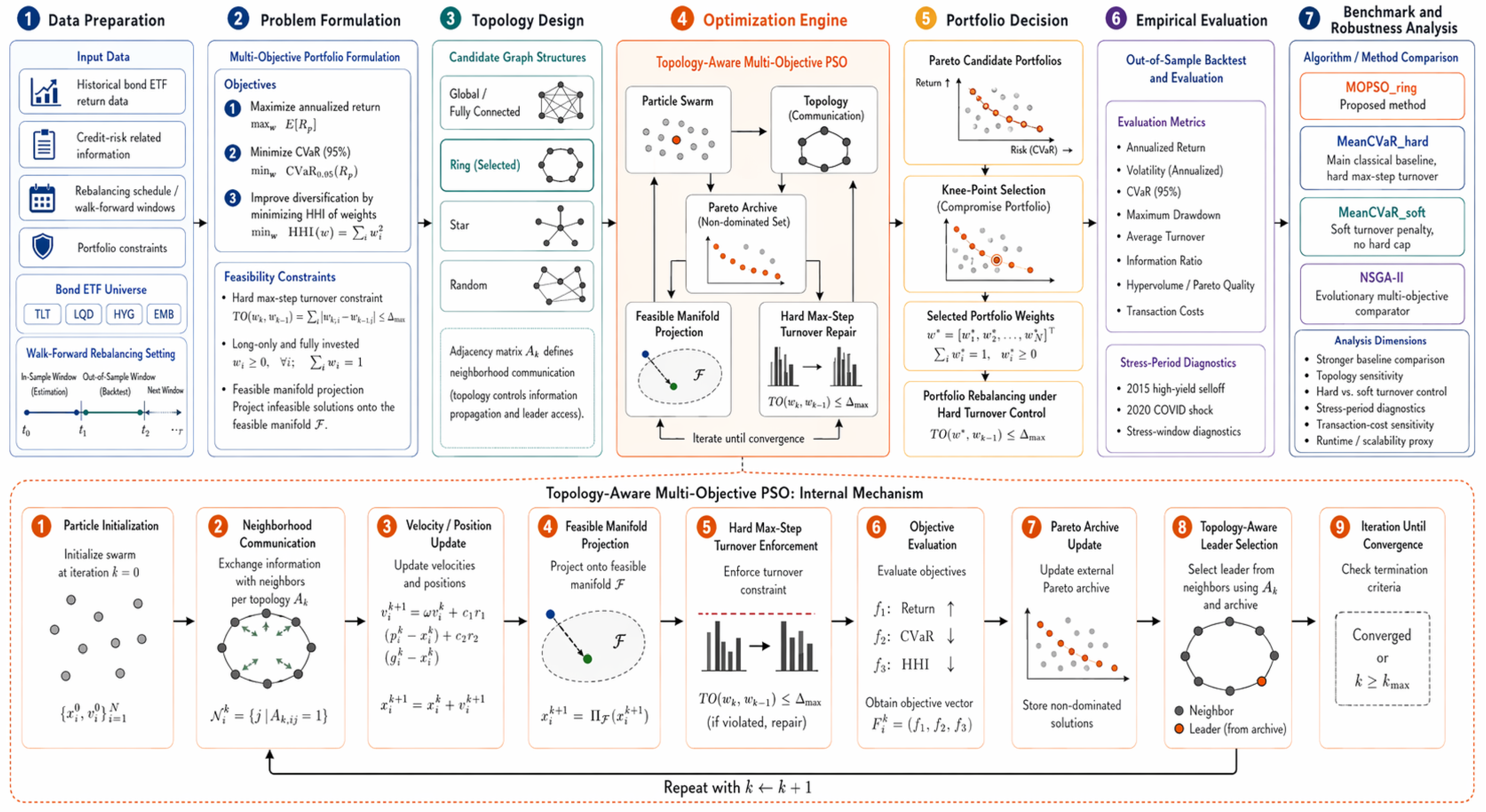
The proposed method combines a portfolio-level workflow with a swarm-level search mechanism. At the portfolio level, historical ETF returns are converted into a constrained multi-objective allocation problem and evaluated through walk-forward testing. At the swarm level, particles communicate through a graph topology, update candidate portfolios, repair infeasible turnover steps, and maintain a Pareto archive.
Figure 1 summarizes this workflow.
5.1. MOPSO Framework
We adopt a multi-objective particle swarm optimization (MOPSO) framework to approximate the Pareto-efficient set of the tri-objective problem in (
15). At each rebalance date
t, each particle represents a candidate portfolio weight vector
. Let
and
denote the position (weights) and velocity of particle
i at iteration
k. Given the objective vector
in (
8), MOPSO maintains (i) a set of particle personal bests
(non-dominated memory per particle) and (ii) an external archive
storing globally non-dominated solutions.
5.1.1. Dominance and Archive Maintenance
For two feasible solutions and , we say Pareto-dominates if it is no worse in all objectives and strictly better in at least one. Infeasible solutions are handled by a feasibility-first rule: any feasible solution dominates any infeasible one; among infeasible solutions, we rank by total constraint violation. After each iteration, newly evaluated candidates are merged into , dominated solutions are removed, and if exceeds a preset capacity, we apply a diversity control (e.g., crowding-distance pruning) to keep a well-spread approximation of the frontier.
5.1.2. Particle Update
Given a leader
selected from the archive and the particle’s personal best
, we update
where
is an inertia weight,
are acceleration coefficients,
are i.i.d. random vectors, and ⊙ denotes element-wise multiplication. A polynomial mutation or Gaussian perturbation can be optionally applied to
with small probability to enhance exploration.
5.2. Turnover-Aware Selection and Rebalancing Step Constraint
Standard MOPSO leader selection typically favors diversity along the Pareto front (e.g., selecting leaders from less crowded regions), which can inadvertently produce non-deployable solutions that require excessive rebalancing. To address this, we integrate two complementary mechanisms: a turnover-aware selection score (soft preference) and a hard rebalancing step constraint (feasibility enforcement).
5.2.1. Turnover-Aware Leader Selection
Let
denote the portfolio weights held before rebalancing at date
t, and define turnover
as in (
11). For each archive candidate
, we compute a normalized turnover score
where
is a small constant. We then select leaders by minimizing a composite preference score
where
is a normalized crowding penalty (smaller means less crowded/better diversity), and
controls the preference toward low-turnover candidates. Intuitively, (
19) preserves the exploration advantage of MOPSO while systematically biasing the swarm toward implementable regions of the frontier.
5.2.2. Hard Max-Step Constraint and Feasibility-Preserving Projection
In addition to preference scoring, we enforce the rebalancing step constraint
(equivalently
). After each position update (
17), we apply a feasibility-preserving projection step to satisfy the hard maximum-step turnover constraint:
If an updated candidate violates this bound, we perform a convex-combination transformation
with
chosen so that the transformed candidate satisfies the turnover limit. This is followed by a final projection onto the feasible box-simplex to ensure (
9) and (
1).
From a structural perspective, this step can be interpreted as a projection-type operator onto the feasible portfolio manifold:
where
denotes the admissible domain induced by long-only, simplex, exposure, and turnover constraints. Given an infeasible candidate
, the mapped point
preserves implementability while minimally altering the search direction. Hence, the update process alternates between topology-driven information propagation and feasibility-preserving projection over the constrained domain.
5.3. Knee-Point Selection
MOPSO returns an archive
of non-dominated portfolios. For deployment, we select a single implementable portfolio using a knee-point criterion, which identifies a solution where further improvement in one objective would incur disproportionately large deterioration in others. Let
be the set of feasible archive solutions. We first normalize objectives across
to mitigate scale differences:
We then choose the archive point that minimizes the Euclidean distance to the ideal point
in normalized space:
This criterion is simple, deterministic, and yields a robust compromise portfolio for walk-forward evaluation. Alternative choices (e.g., curvature-based knees or preference-weighted utilities) are possible; we adopt (
22) for its stability and transparency. Algorithm 1 summarizes the deployment version of the proposed turnover-aware MOPSO at a given rebalance date.
| Algorithm 1 Turnover-Aware MOPSO (Deployment Version at Rebalance Date t) |
- Require:
Training window with returns ; previous weights . - Require:
Swarm size N, iterations T, archive capacity M, PSO parameters . - Require:
Turnover preference , max-step . - Ensure:
Deployable portfolio . - 1:
Initialize particles and velocities - 2:
Set personal bests for all i; set archive - 3:
for to do - 4:
for to N do - 5:
Evaluate objectives and constraint violations - 6:
end for - 7:
Update archive with feasible non-dominated solutions; prune by diversity if - 8:
for to N do - 9:
Select leader using score in ( 19) - 10:
Update velocity and position via ( 16) and ( 17) - 11:
Project to box-simplex constraints ( 1) and ( 9) (and ( 10) if used) - 12:
if then - 13:
Apply the feasibility-preserving projection in ( 20); then re-project onto the box-simplex - 14:
end if - 15:
Update personal best by feasibility-first Pareto dominance - 16:
end for - 17:
end for - 18:
Let be feasible solutions in ; choose knee solution via ( 22) - 19:
return
|
6. Experimental Setup
6.1. Dataset and Preprocessing
We use daily data for four liquid U.S. bond ETFs that cover different duration and credit exposures. The investment universe consists of the following iShares portfolios:
iShares 20+ Year Treasury Bond ETF (TLT): Seeks to track the investment results of an index composed of U.S. Treasury bonds with remaining maturities greater than twenty years, serving as our risk-free duration proxy.
iShares iBoxx $ Investment Grade Corporate Bond ETF (LQD): Tracks an index composed of U.S. dollar-denominated, investment-grade corporate bonds, capturing premium corporate credit.
iShares iBoxx $ High Yield Corporate Bond ETF (HYG): Tracks an index composed of U.S. dollar-denominated, high-yield corporate bonds, introducing significant credit risk and tail-loss potential.
iShares J.P. Morgan USD Emerging Markets Bond ETF (EMB): Corresponds to the price and yield of the JP Morgan Emerging Markets Bond Index, providing exposure to sovereign and corporate emerging market debt.
Daily adjusted closing prices are obtained from standard public financial databases such as Yahoo Finance, covering January 2008 to August 2024.
6.1.1. Data Cleaning and Alignment
To construct a consistent multi-asset panel, we align the trading dates across all selected ETFs, carefully handling non-trading days and market holidays. The intersection of these timelines yields a robust, continuous sample spanning from 1 January 2008 to 19 August 2024, containing daily observations with no missing prices.
6.1.2. Returns Construction
Let
be the adjusted close price of ETF
k on day
. We compute daily arithmetic returns
and stack them into
with
. All objectives in
Section 5 are estimated from the training-window return panel. For reporting, we annualize mean return and volatility using a factor of
trading days per year.
6.2. Walk-Forward Protocol
To evaluate deployability, we perform a walk-forward (rolling-origin) backtest that mimics periodic re-optimization and rebalancing. At each rebalance date
t, the optimizer observes a trailing training window
consisting of the most recent
n daily returns, estimates objectives on
, and outputs a deployable portfolio
subject to the constraints in (
14). The portfolio is then held until the next rebalance date, producing out-of-sample (OOS) returns.
6.2.1. Rebalance Schedule and Holding Period
We use a rolling walk-forward design with a three-year training window, semiannual rebalancing, and a 126-trading-day out-of-sample holding period after each rebalance. This produces
rebalancing decisions over the evaluation sample. At each rebalance date
t, the optimizer observes the trailing training window, estimates the three objectives, and outputs a deployable portfolio
subject to the feasibility constraints in (
14). The selected portfolio is then held fixed over the subsequent 126-trading-day test window.
6.2.2. Transaction Costs
We incorporate proportional transaction costs to reflect realistic implementation frictions. At each rebalance, a cost proportional to turnover is charged:
where
is defined in (
11) and
c corresponds to
tc_bps in basis points. OOS performance is reported under a default cost level (5 bps) and we further conduct transaction-cost sensitivity tests (0–20 bps).
6.3. Baselines, Ablations, and Robustness Diagnostics
The empirical comparison is organized around three questions. First, how does the proposed topology-aware MOPSO compare with stronger classical and evolutionary alternatives? Second, how much does the communication topology matter once the same turnover constraint is imposed? Third, is a soft turnover penalty enough, or is a hard feasibility repair needed to control large rebalancing events?
6.3.1. Main Comparison Methods
The main comparison includes four methods:
MOPSO_ring: the proposed method, using the ring communication topology together with topology-aware leader selection and hard max-step turnover repair.
MeanCVaR_hard: a classical mean–CVaR baseline solved under long-only, exposure, and hard maximum-step turnover constraints. It is the main classical benchmark.
MeanCVaR_soft: a mean–CVaR baseline with a soft turnover penalty but without hard max-step repair. It is used to show what happens when turnover is discouraged but not strictly capped.
NSGA-II: a non-swarm evolutionary multi-objective comparator evaluated under the same walk-forward protocol.
6.3.2. Topology Sensitivity
We compare global, ring, star, and random communication structures under the same optimization and evaluation protocol. This experiment tests whether topology changes the return–risk–turnover profile, rather than merely changing an implementation detail of the swarm.
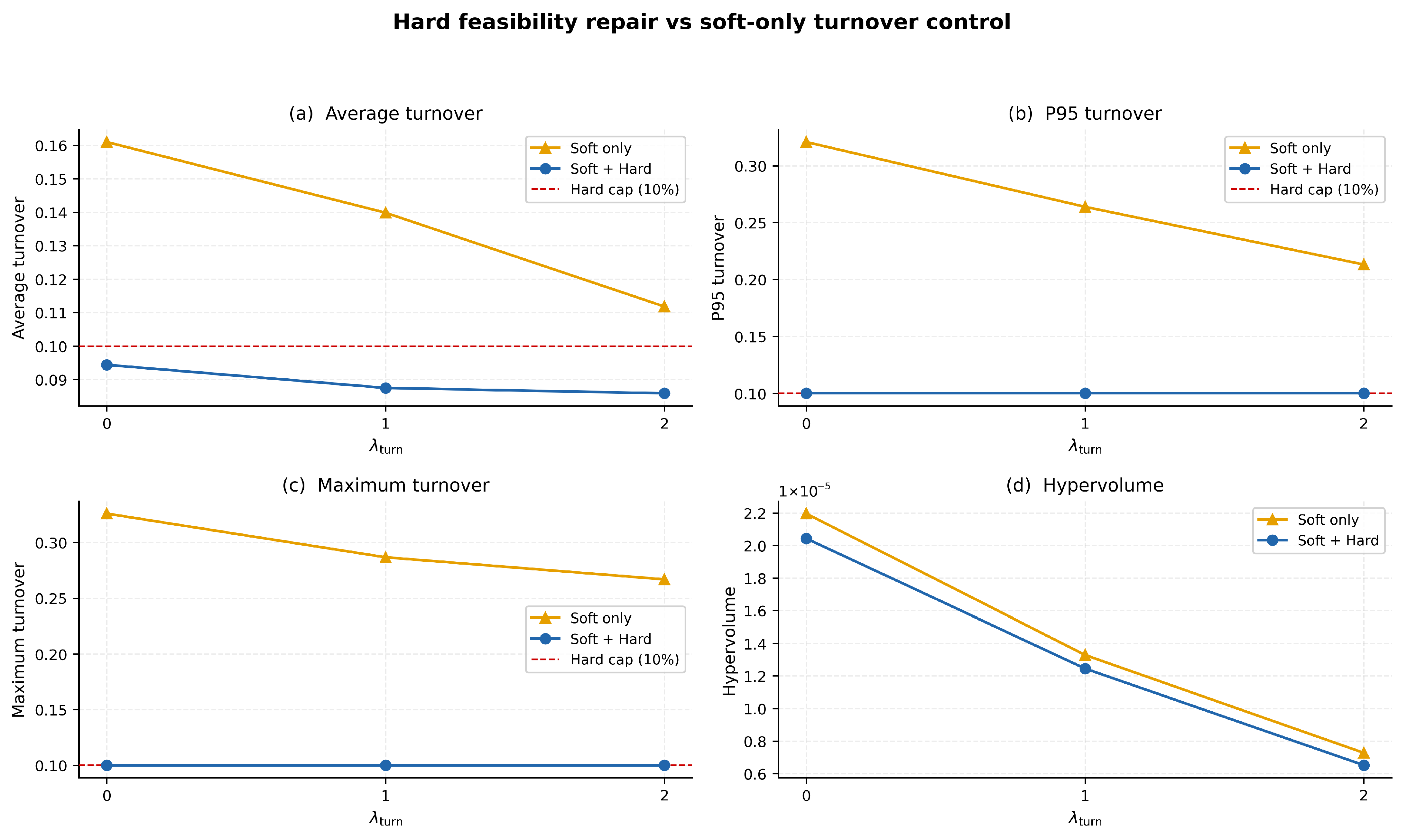
6.3.3. Design of Hard-Versus-Soft Turnover Control
We compare soft-only turnover control with soft-plus-hard turnover control under the ring topology. The purpose is to separate average turnover reduction from tail-turnover control.
6.3.4. Design of Stress-Period Diagnostics
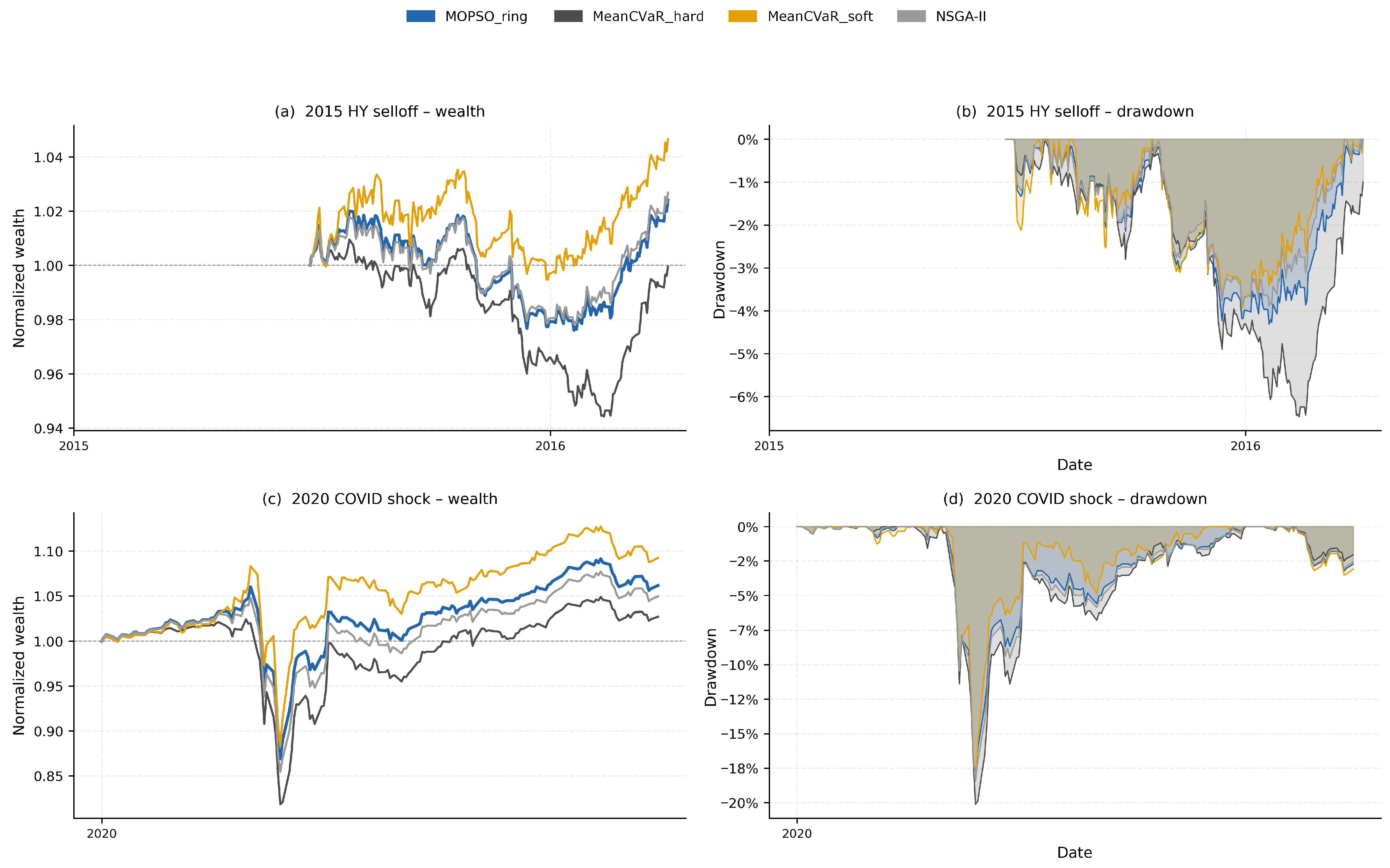
We examine stress windows around the 2015 high-yield selloff and the 2020 COVID shock. These periods are useful because credit-sensitive bond ETFs can experience abrupt drawdowns and liquidity pressure during spread-widening episodes.
6.3.5. Design of Runtime Scalability Proxy
We also report a solver-level scalability proxy in which the return panel is expanded from 4 to 500 synthetic assets derived from the base ETF series. This experiment does not claim full economic validation in a 500-asset universe; it only checks whether the core solver remains computationally manageable as the problem dimension increases.
6.4. Evaluation Metrics
We report both risk–return performance and implementability diagnostics.
6.4.1. Risk–Return Metrics
From the OOS daily portfolio returns , we compute the following:
Annualized mean return: , where is the sample mean of OOS daily returns;
Annualized volatility: ;
Tail loss (CVaR95): empirical of daily losses over the OOS period;
Maximum drawdown (MDD): this is computed from the cumulative net-value curve.
6.4.2. Trading Metrics
We measure implementability via the following:
Average turnover ;
Turnover distribution diagnostics, including median, upper quantiles, and maximum turnover per rebalance, to detect occasional extreme trading events.
6.4.3. Constraint-Activation Diagnostics
To understand whether the hard maximum-step turnover bound is merely precautionary or frequently binding, we additionally report the cap-hit frequency, i.e., the fraction of rebalancing dates for which realized turnover reaches the imposed ceiling. This diagnostic helps explain whether similarities in upper-tail turnover across topologies reflect genuinely similar behavior or simply the common action of the hard constraint.
6.4.4. Search-Quality and Computational Diagnostics
For topology comparisons and runtime experiments, we also report archive-based search diagnostics such as hypervolume and archive size, together with wall-clock runtime. These quantities are used to assess whether changes in communication structure or problem dimension affect not only portfolio metrics, but also the computational behavior of the underlying multi-objective solver.
6.4.5. Statistical Uncertainty via Block Bootstrap
Because daily returns exhibit temporal dependence, we assess uncertainty using a moving-block bootstrap. We resample the OOS return series with block length trading days and perform bootstrap replications. For each replication, we recompute key metrics and report 95% confidence intervals for pairwise differences between methods (e.g., , , and ). This procedure preserves short-range autocorrelation while enabling robust uncertainty quantification.
7. Results
7.1. Pareto Archive and Deployment-Oriented Selection
At each rebalance date, the optimizer first produces a feasible archive of non-dominated portfolios. These candidates represent different compromises among return, CVaR, diversification, and turnover feasibility. We then apply the normalized knee-point rule in
Section 5.3 to choose a single portfolio for the next out-of-sample holding period.
This design gives the Pareto archive a practical role. It is not only a visualization of the efficient frontier; it is the intermediate decision set from which the deployed portfolio is selected. Extreme archive points are avoided because a small gain in one objective may require a much larger sacrifice in tail risk, concentration, or turnover stability.
7.2. Out-of-Sample Walk-Forward Performance
We first compare the four main methods in the full walk-forward test with tc = 5 bps.
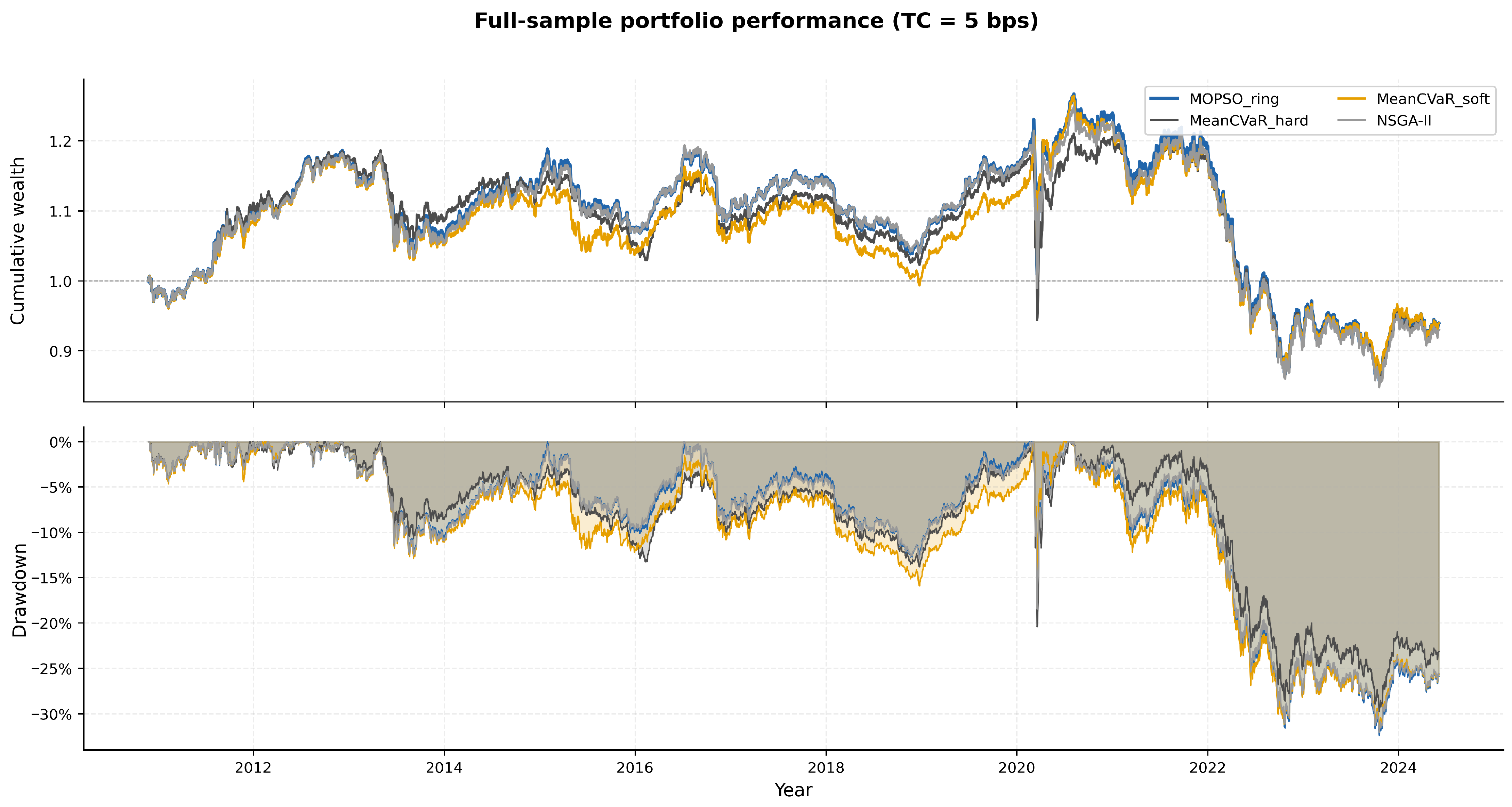
Figure 2 reports cumulative wealth and drawdown, and
Table 1 gives the corresponding summary statistics.
The sample includes several difficult fixed-income regimes, and all methods experience a sizable drawdown late in the backtest. The comparison is therefore more informative as a return–risk–turnover trade-off than as a simple ranking by return.
MeanCVaR_hard is the strongest classical benchmark. It delivers the lowest CVaR95 loss and the shallowest maximum drawdown among the main methods. MOPSO_ring is close to this benchmark in return and risk, while keeping p95 and maximum turnover at the hard cap. NSGA-II has the lowest average turnover, whereas MeanCVaR_soft obtains the highest raw return but requires much larger trades.
7.3. Risk–Return–Turnover Tradeoff
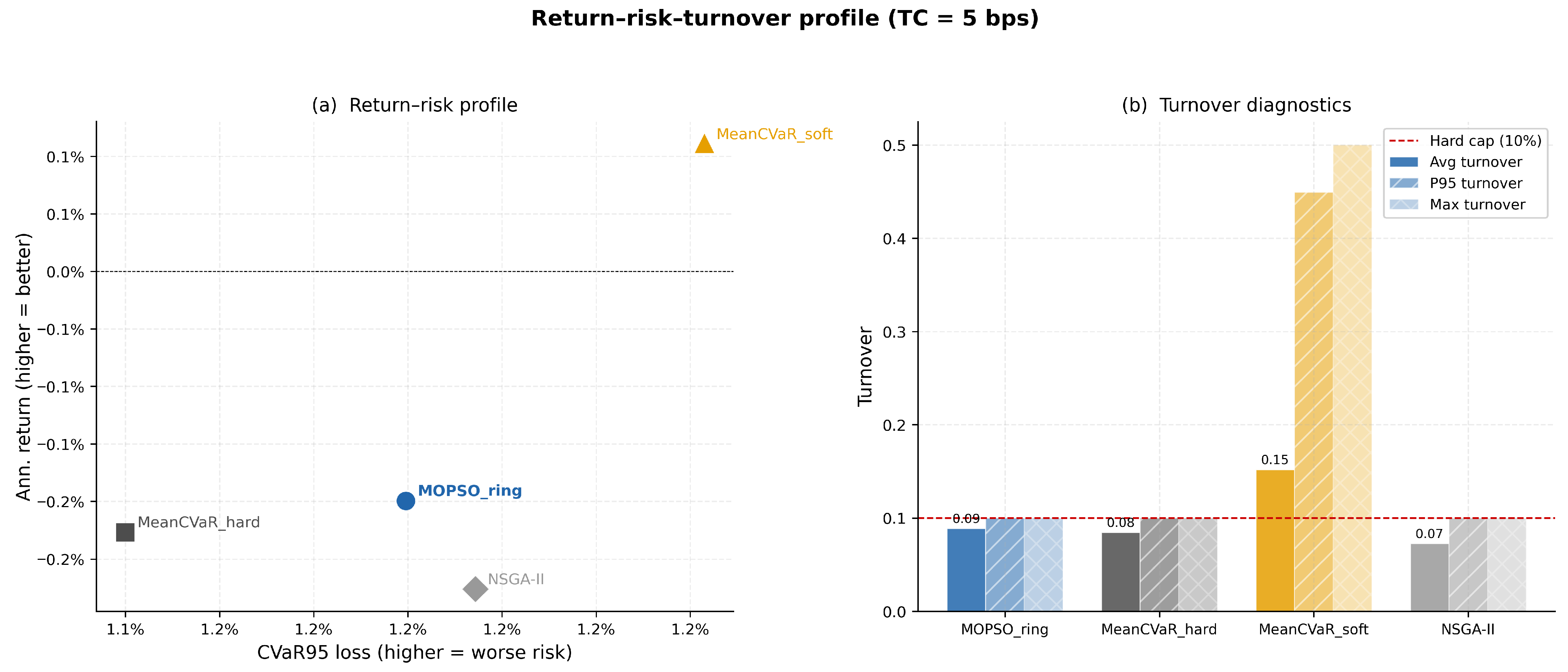
Figure 3 provides a compact view of the main trade-off.
Figure 3a places the methods in the return–CVaR plane, while
Figure 3b reports turnover-tail behavior.
MeanCVaR_hard is the most conservative method in this comparison, with the lowest CVaR95 loss and a relatively shallow drawdown. MOPSO_ring stays close to this point in the return–risk plane and keeps the upper turnover tail at the hard cap. MeanCVaR_soft moves in a different direction: it improves raw return in this sample, but with a much larger p95 and maximum turnover. NSGA-II gives the lowest average turnover, although its return is weaker. These results place MOPSO_ring between the more conservative hard-constrained baseline and the more aggressive soft-penalty baseline.
7.4. Topology Sensitivity and Communication Structure
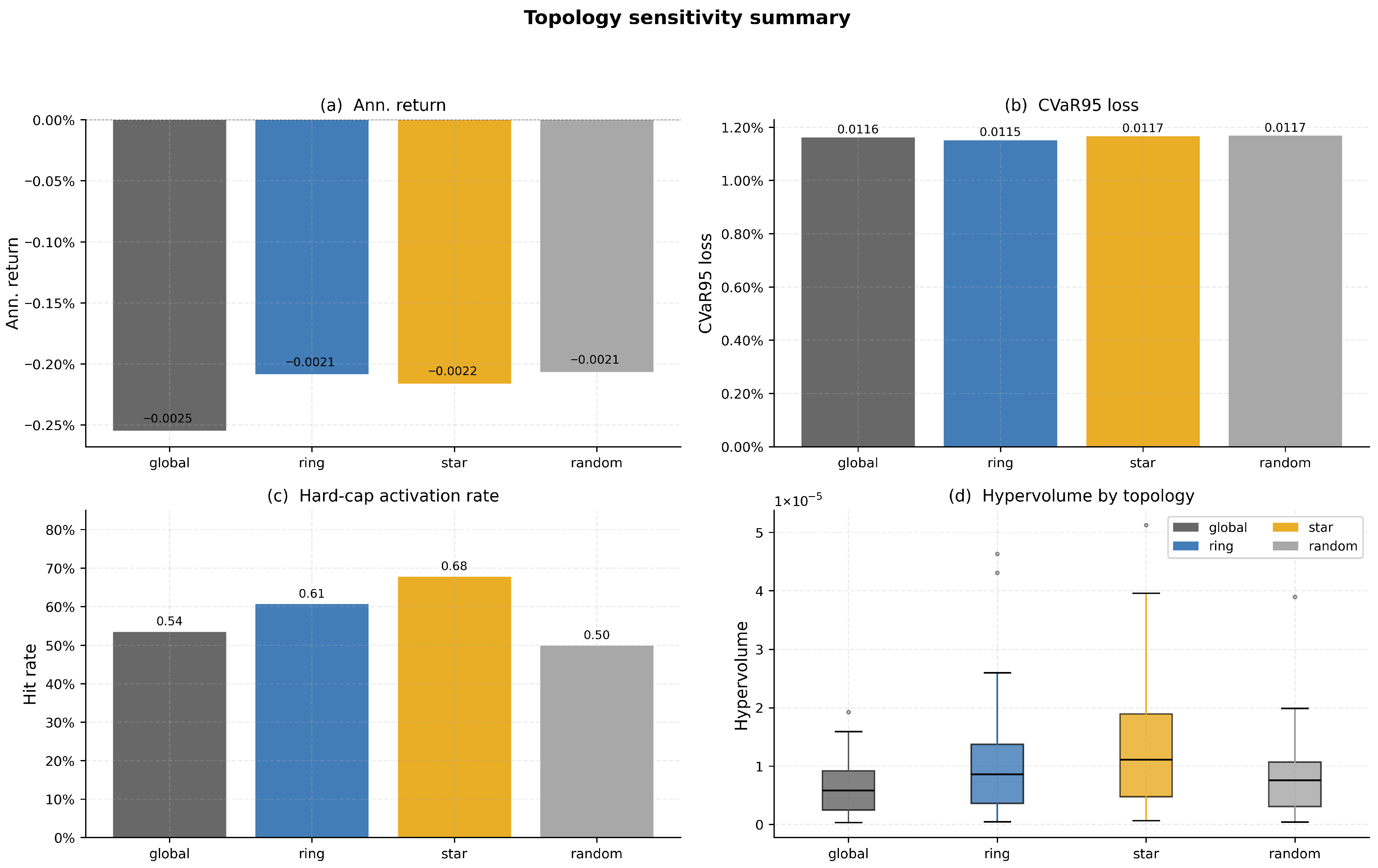
Figure 4 compares the four communication structures used in the topology experiment. The fully connected topology spreads information fastest, but it does not give a clear advantage in the final portfolio metrics. The star topology is more aggressive and reaches the turnover cap more often. The random topology lowers some turnover measures, but its risk–return profile is less consistent.
The ring topology offers the most usable compromise in this setting. It is not best on every individual axis, but it avoids the more aggressive behavior of the star topology while retaining a competitive risk profile. For this reason, the ring topology is used as the default communication structure in the main MOPSO specification.
7.5. Hard-Versus-Soft Turnover Control
Figure 5 separates two forms of turnover control. A soft penalty changes the search preference, whereas the hard repair changes the admissible update itself.
The difference is most visible in the upper tail. Increasing reduces average turnover under the soft-only setting, but large rebalancing steps can still occur. With the hard repair activated, p95 and maximum turnover are forced to the 10% ceiling. This is why the hard repair is kept in the main specification: it controls rare but operationally important trading bursts that may survive a soft penalty.
7.6. Stress-Period Diagnostics
Figure 6 shows normalized wealth and drawdown during the 2015 high-yield selloff and the 2020 COVID-19 shock. Wealth is reset to one at the start of each stress window, so the panels focus on within-period behavior.
MeanCVaR_hard remains a strong risk-control benchmark in these windows. MeanCVaR_soft can produce attractive wealth paths, but the interpretation should be read together with its heavier turnover. MOPSO_ring stays close to the stronger trajectories while preserving the hard turnover cap. The stress test therefore confirms that the main comparison is not driven only by calm-market periods.
7.7. Transaction Cost Sensitivity
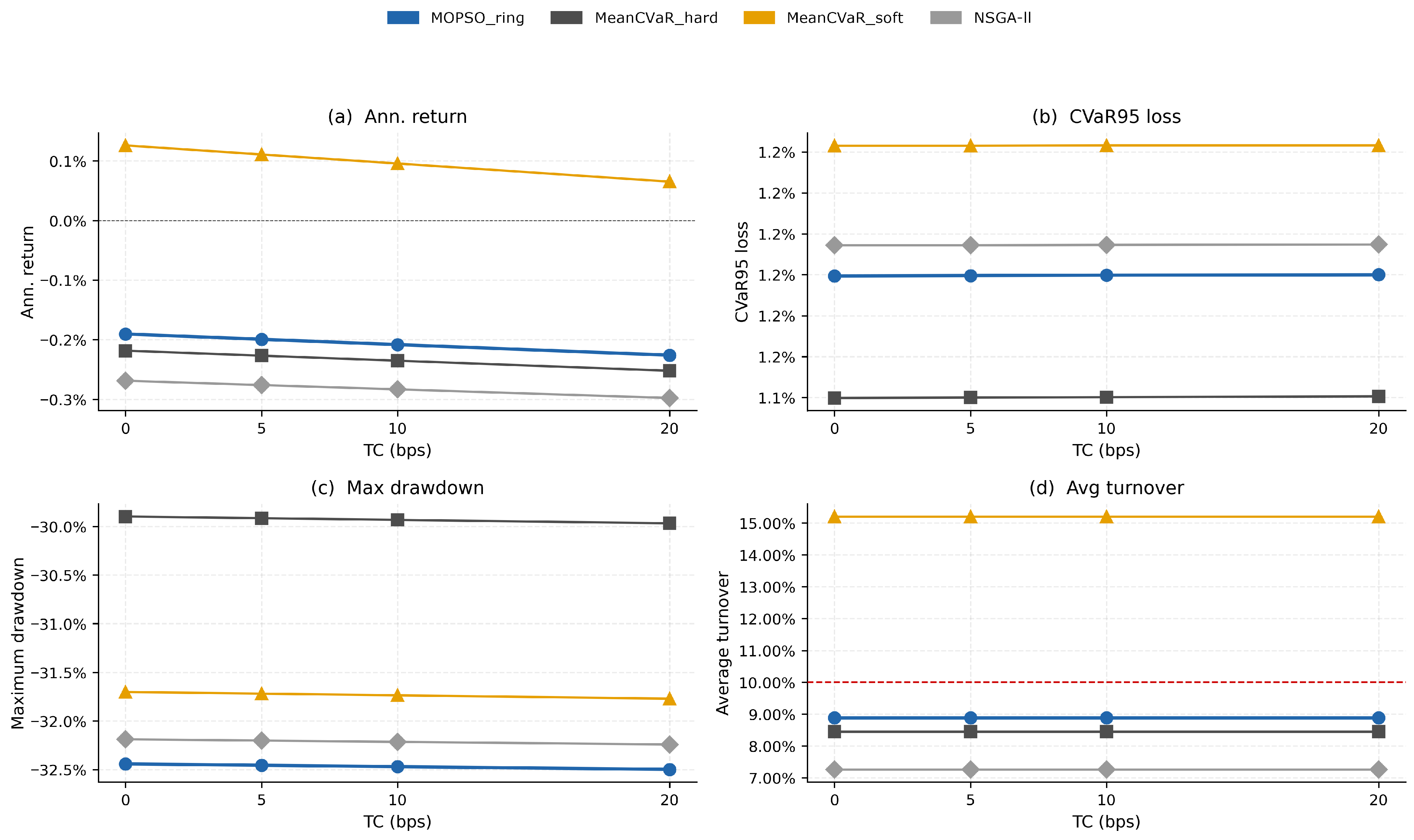
We next vary transaction costs from 0 to 20 bps while keeping each method’s out-of-sample weight path fixed. This isolates the accounting effect of trading costs from the optimizer’s search path.
Figure 7 and
Table 2 show that the low-turnover methods change only mildly as costs rise. MOPSO_ring and MeanCVaR_hard are therefore relatively insensitive to this sweep. MeanCVaR_soft retains the highest return, but its higher turnover makes the result more dependent on trading-cost assumptions. NSGA-II has low turnover but weaker return.
7.8. Runtime Scalability Proxy
Table 3 reports a solver-level scalability check using synthetic asset expansions from 4 to 500 dimensions. The test asks whether the optimizer becomes computationally impractical as dimension increases under a fixed search budget. It is not a substitute for an economic backtest in a larger bond universe.
Average runtime remains below one second across all tested dimensions, and the archive size does not grow with dimension. This suggests that the core routine is not computationally tied to the four-ETF setting, although a larger real-universe test remains necessary.
8. Discussion
The experiments point to two practical lessons. First, turnover control should be part of the optimization mechanism, not only a reporting statistic. Second, the communication topology of the swarm changes how feasible portfolios are discovered. The following discussion focuses on these two points and on the limits of the current evidence.
8.1. Hard Turnover Control as a Deployability Requirement
The hard turnover repair is useful because it acts on the portfolio update itself. A soft penalty can make high-turnover candidates less attractive, but it does not rule them out. This distinction matters in rebalancing problems, where occasional large trades may be more disruptive than a moderate increase in average turnover.
The comparison between MeanCVaR_hard and MeanCVaR_soft illustrates the same point outside the PSO family. The soft version can look better in raw return, but it allows much larger turnover tails. The hard-constrained version is less aggressive but more stable. This is why the proposed method combines a turnover-aware search preference with a hard repair step.
8.2. Communication Topology as an Empirical Design Choice
The topology experiment shows that graph structure changes the behavior of the swarm even when the objective functions and constraints are held fixed. A fully connected graph promotes fast information sharing, but faster diffusion is not automatically better in a constrained portfolio problem. The star topology is more centralized and tends to activate the hard cap more often. The ring topology is slower and more local, but in this setting it provides a steadier compromise.
This result does not mean that the ring topology will always be best. It means that topology should be tested rather than assumed. For turnover-constrained allocation, the internal communication pattern of the optimizer can affect both search diversity and the stability of the resulting rebalancing decisions.
8.3. Interpreting the Stronger Baselines
The stronger baselines make the empirical conclusion more modest but more credible. MeanCVaR_hard is difficult to beat on downside-risk metrics, and the proposed method does not dominate it on every axis. NSGA-II also provides a useful check that the result is not only a comparison within the PSO family.
The value of MOPSO_ring is therefore best described as a balanced profile. It is close to the hard-constrained classical benchmark in risk and return, improves on the soft-only comparator in turnover control, and offers a graph-structured search interpretation that the convex baseline does not provide.
8.4. Stress-Period Behavior
The stress windows are useful because they separate normal backtest behavior from periods of abrupt credit-market pressure. The proposed method remains competitive in both the 2015 and 2020 windows, but the more important point is that it does not rely on unusually large reallocations to do so.
This is consistent with the paper’s main argument. In credit-sensitive ETF allocation, stress-period performance should be read together with turnover. A wealth path that looks attractive but requires large trades may be less useful in practice than a slightly less aggressive path with tighter rebalancing control.
8.5. Runtime Scalability Evidence
The scalability proxy addresses a narrow computational question. With a fixed optimization budget, the solver does not show an immediate runtime breakdown as the synthetic dimension increases to 500 assets. This is encouraging, but it should not be confused with a full large-universe investment test.
A broader validation would require real fixed-income securities, richer liquidity constraints, and more detailed execution assumptions. The current result only shows that the algorithmic core is not obviously limited to four ETFs from a computational perspective.
8.6. Statistical Uncertainty and Interpretation
The block-bootstrap intervals remind us that financial backtests are noisy. Some pairwise differences may overlap zero, especially with a limited number of rebalance dates. This does not invalidate the mechanism evidence, but it limits how strongly one should interpret small differences in average return.
For this reason, the paper emphasizes turnover-tail control, topology effects, stress-window behavior, and cost sensitivity rather than claiming statistically decisive return outperformance.
8.7. Limitations and Future Extensions
Several limitations remain. The ETF universe is small and liquid, which helps isolate the mechanism but limits external generalization. Transaction costs are modeled proportionally, without nonlinear market impact, liquidity shocks, or execution delays. The scalability experiment is synthetic and computational, not a full economic study of a large fixed-income universe. Finally, only a small set of canonical communication topologies is tested.
Future work can extend the framework to broader bond universes, introduce liquidity- and impact-aware trading constraints, and study adaptive topologies that change with market conditions or swarm diversity. A larger empirical design could also compare alternative rules for selecting a deployed portfolio from the Pareto archive.
9. Conclusions
This paper studies bond ETF allocation as a constrained multi-objective rebalancing problem. The proposed topology-aware MOPSO framework combines graph-structured communication, Pareto archive search, topology-sensitive leader selection, and hard turnover repair. The aim is to connect portfolio quality with rebalancing feasibility.
The results support three conclusions. First, hard turnover repair controls the upper tail of rebalancing more directly than soft penalties. Second, communication topology affects swarm behavior, with the ring topology giving the most stable compromise in this application. Third, MOPSO_ring remains competitive against stronger baselines, including MeanCVaR_hard and NSGA-II, while offering a structural interpretation that conventional baselines do not provide.
The evidence also shows the limits of the method. MeanCVaR_hard remains a strong risk-control benchmark, and MeanCVaR_soft achieves higher raw return in this sample at the cost of heavier turnover. The main contribution is therefore a feasible search design that links multi-objective optimization, communication topology, and hard trading constraints in one framework.




 ,
,