1. Introduction
Permanent magnet synchronous motors (PMSMs) offer advantages such as high-power density, superior efficiency, low cost, and fast dynamic response, making them essential components in modern industrial applications, including electric vehicles, robotics, and renewable energy systems [
1,
2,
3]. However, inaccuracies in motor parameters can lead to performance degradation in PMSM control systems, particularly under external disturbances [
4]. Traditional control strategies, such as field-oriented control (FOC) and direct torque control (DTC), are widely used for PMSM drives. Specifically, FOC employs a multi-loop structure with PI controllers for current and speed tracking but struggles to maintain optimal performance under parameter variations and load disturbances [
5]. DTC relies on hysteresis controllers and lookup tables (LUTs) to track torque and flux; however, the load angle between rotor and stator flux cannot be consistently maintained during rotation, leading to torque ripples [
6].
In recent years, model predictive control (MPC) has emerged as a research hotspot due to its intuitive design, simple structure, and superior dynamic performance [
7]. It has been successfully applied to speed control in permanent magnet synchronous motor (PMSM) and induction motor drive systems [
8]. Numerous improved MPC approaches have been proposed: Errouissi et al. [
9] combined Taylor series-based continuous-time model predictive control (CTMPC) with a nonlinear disturbance observer to achieve load disturbance decoupling in PMSM drive systems; Das et al. [
10] developed a numerical algorithm that directly solves the CTMPC problem through finite parameterization of the admissible control trajectory space; Abdissa [
11] applied Laguerre functions to propose a discrete model predictive speed control strategy for surface-mounted PMSMs, achieving fast dynamic response alongside excellent steady-state performance; Kuo et al. [
12] utilized Laguerre functions to approximate control signals and presented a tracking control scheme for constrained nonlinear systems. Eunji Lee et al. proposed a model predictive control based on feedback linearization, state feedback, and advanced adaptive control of an acceleration permanent magnet synchronous motor model, which enables the proposed method to effectively resist external disturbances and parameter uncertainties [
13]. Mohammad Bagher Sepahkar proposed a model-free predictive current and speed control (MFPCSC) scheme that achieves both current and speed control by optimizing the cost function, without the need for any PI speed controller or PI current controller [
14]. Tarek Yahia et al. proposed an enhanced model predictive direct speed control (MPDSC) framework for permanent magnet synchronous motor drives, which integrates duty cycle optimization and load torque disturbance compensation, thereby significantly improving transient and steady-state performance [
15]. Dejun Liu et al. proposed a fuzzy adaptive fractional-order control strategy based on torque observation compensation [
16].
Although previous studies have explored Laguerre-based MPC and CTMPC for PMSM drives, many approaches rely on discrete-time implementations (introducing discretization errors) or lack unified integration of continuous-time prediction with adaptive smoothing, soft constraints, and nonlinear disturbance observation. This paper proposes a unified CTMPC framework that combines continuous-time prediction, Laguerre function parameterization, adaptive smoothing, soft tanh-based constraints, and a nonlinear disturbance observer. By exploiting the orthogonal symmetry of Laguerre functions and the structural invariance of continuous-time PMSM dynamics, the proposed method achieves a compact and balanced control trajectory with improved computational efficiency and robustness. Quantitative comparisons with PI control and conventional MPC demonstrate clear performance improvements in transient response and disturbance rejection.
2. Mathematical Model of the PMSM
In the d-q axis coordinate system, the voltage equations for a surface-mounted PMSM (SPMSM) are expressed as
Note that Equation (2) assumes equal d-q axis inductances (), which holds specifically for surface-mounted PMSMs (SPMSMs).
Where and are the d-q axis stator voltages, and are the d-q axis stator currents, is the stator resistance, is the d-q axis inductance, is the electrical angular velocity (, with the pole pairs and the mechanical speed), and is the permanent magnet flux linkage.
The electromagnetic torque of an SPMSM is given by
where the torque constant is denoted as
.
Mechanical dynamics follow Newton’s second law:
Substituting the torque equation yields
Defining the state variable
, input
, disturbance
, and system parameters
,
, the speed dynamics become
In discrete time, using forward Euler approximation:
3. Laguerre-Based Controller Design
This work employs Laguerre functions in CTMPC to parameterize the control increment in finite dimensions, transforming the infinite-dimensional continuous-time optimization into a finite-parameter problem, thereby reducing computational complexity.
3.1. Principle of CTMPC
CTMPC optimizes a cost function based on a continuous-time model to predict future system behavior and compute optimal control inputs for high-performance objectives. It directly optimizes the derivative of the control signal to ensure smoothness and stability.
Compared to discrete-time MPC, CTMPC avoids discretization errors, providing more accurate state evolution for fast-dynamic systems like PMSMs.
Assuming the disturbance remains constant over the prediction horizon ( for ), it is estimated via NDO.
As the predicted output trajectory of CTMPC depends solely on the system model and the control input, the disturbance
—estimated via the NDO—influences only the initial condition and does not directly enter the prediction dynamics. Consequently, the disturbance
is pre-compensated into the initial rotor speed using the NDO estimate, yielding:
The state dynamics over the prediction horizon are
where
,
is the rotational speed at the current time, and
is the control input in the prediction time domain.
The primary goal of the CTMPC is to achieve accurate tracking of the reference speed
by the rotor speed
, while simultaneously minimizing the control effort. Accordingly, the cost function is formulated as
where
Q is the state weight, reflecting the penalty for speed error,
R is the control weight, reflecting the penalty for changes in control input,
is the reference speed,
is the q-axis current at the current moment, and u(t) is the overall predicted input.
The control input is expressed in incremental form:
, where
is the control increment. The cost function is rewritten as
However, directly optimizing would require numerical integration over the entire prediction horizon, resulting in high computational complexity. To address this, Laguerre functions are employed to parameterize , which simplifies the optimization problem.
3.2. Laguerre Functions
Laguerre functions possess orthogonality and exponential decay characteristics, making them particularly suitable for modeling smooth control signals. They exhibit fast convergence and compact representation, which render them well-suited for real-time implementation in continuous-time predictive control problems. According to function approximation theory, Laguerre functions can approximate any smooth control signal to arbitrary accuracy within a finite order. Moreover, their orthogonality simplifies the computation of correlation matrices in the optimization problem, thereby improving solving efficiency and numerical stability.
For PMSM systems, incorporating Laguerre functions as basic functions in the speed controller—by expressing the control increment as a finite-order linear combination of Laguerre functions—enhances the system’s robustness against model uncertainties and load disturbances. A set of Laguerre functions is defined as
This definition is the standard form for orthogonal Laguerre functions in control applications. The parameter is the time-scaling factor, which physically represents the rate at which the functions decay exponentially, allowing adjustment to match the system’s time constants for better approximation efficiency.
The Laplace transform is:
They satisfy orthogonality:
where
is the Kronecker delta is.
The control increment is expressed as a linear combination:
Define the Laguerre function vector and the coefficient vector . Then, the control increment .
Substituting
into the predictive model yields the state
as follows:
Combined with Equation (15), it can be further expressed as:
The cost function is minimized over
:
Define the integral terms as
Then, the state can be expressed as
Substituting Equation (20) into the cost function (18) yields
Since is a quadratic function in , the optimal coefficient vector can be obtained analytically by taking the partial derivative with respect to and setting it to zero, thereby yielding the optimal control input.
The above approach utilizes Laguerre function parameterization to reduce the optimization variables from the entire continuous prediction horizon (discretized into M points) to a finite set of coefficients (of dimension N << M), significantly lowering the computational complexity.
In conventional CTMPC, the QP problem involves an M-dimensional Hessian matrix, with solving complexity typically O(M3) for matrix inversion in unconstrained cases. With Laguerre parameterization, the problem reduces to N dimensions, yielding O(N3) complexity—a substantial reduction given N << M. The orthogonality of Laguerre functions further ensures well-conditioned matrices, enhancing numerical efficiency without approximations that could degrade performance.
From a symmetry perspective, the orthogonality of Laguerre basis functions and the structural invariance of the continuous-time PMSM dynamics contribute to numerical stability by yielding well-conditioned optimization matrices, thereby reducing solver sensitivity to numerical errors. This symmetry enables effective decoupling of basis contributions, minimizes cross-coupling in prediction, and enhances robustness against model uncertainties and load variations. As a result, balanced control is achieved through compact and energy-efficient approximations without excessive actuator effort.
3.3. Adaptive Smoothing Factor
A fixed smoothing factor can cause input fluctuations during speed changes or disturbances. An adaptive smoothing factor is proposed based on prediction error:
where ε represents the prediction error. The smoothed control input is:
, where
is the control input at the previous time step.
is dynamically adjusted according to the error: when the error is large,
approaches 0.1 to enhance the smoothing effect; when the error is small,
approaches 1 to speed up the response.
3.4. Soft Constraints
In model predictive control, input constraints represent a common requirement in engineering practice. Ignoring these constraints may lead the controller to generate control commands exceeding the actuator capabilities, potentially destabilizing the system. Traditional hard constraints are implemented by incorporating inequality restrictions into the optimization problem. However, hard constraints can cause discontinuous “boundary hitting” behavior in the control input, making it difficult for the solver to converge.
To address this, a soft constraint mechanism is introduced into the CTMPC framework in this study. This is achieved by designing a continuously differentiable saturation function to smoothly limit the control input. Compared with hard constraints, the proposed approach ensures constraint satisfaction while avoiding abrupt changes at the boundaries, thereby improving dynamic performance. Additionally, the continuous nature of the soft constraint helps mitigate numerical oscillations to a certain extent, enhancing the feasibility of the controller in real-time applications. The specific form of the constraint function is presented as follows:
The hyperbolic tangent (tanh) function is chosen for this soft constraint because it provides a smooth, continuously differentiable approximation to hard saturation limits (e.g., , corresponding to typical inverter current bounds in PMSM drives). Unlike hard clipping, which introduces discontinuities and may cause numerical instability or solver chattering in the CTMPC optimization, tanh ensures gradient preservation and better convergence. Practically, it mimics the natural smooth roll-off behavior of real actuators under saturation, improving system smoothness, robustness, and feasibility in high-dynamic applications without aggressive high-frequency components.
4. Nonlinear Disturbance Observer Design
In PMSM control, the primary external disturbance affecting system performance is the load torque. Sudden changes in load torque can cause significant fluctuations in motor speed. If only the CTMPC controller is employed, prediction trajectory offsets are prone to occur when facing unmeasurable disturbances or system uncertainties.
The nonlinear disturbance observer (NDO) enables fast and accurate estimation of external disturbances in the PMSM system. The estimated disturbance is then fed back into the CTMPC model to achieve feedforward disturbance compensation. Therefore, the NDO is introduced as an observer in the speed control loop. By dynamically correcting the initial conditions of the model prediction, it enhances the robustness of the control system, thereby improving overall control performance and response accuracy.
4.1. Principle of the NDO
Based on Equation (4), the speed dynamics of the PMSM are given by
Define the nonlinear function
Then
where
represents the lumped disturbance.
The objective of the NDO is to estimate the disturbance , from which the estimated load torque is obtained.
The core idea of the NDO is to construct a disturbance estimator by introducing an auxiliary variable
and a nonlinear gain function. It is assumed that the disturbance
varies slowly over short time intervals (
). The auxiliary variable
is defined to satisfy
where
is the disturbance estimate and
is the nonlinear gain function that depends on the rotor speed
. Differentiating
yields
Given
and assuming rapid convergence of the estimate (
), along with
Substituting into Equation (26) gives
Since
, Equation (30) leads to
In discrete time, the forward Euler approximation is applied:
The disturbance estimate is
The estimated load torque is
The design of the nonlinear gain function and its derivative directly influences the estimation accuracy and convergence rate of the NDO.
The gain
is designed as a quadratic function:
where
controls the baseline gain level and
governs the sensitivity to speed variations. This structure improves the observer’s response to high-speed disturbances or strong excitations, preventing estimation saturation or overshoot. The derivative is
The parameters are chosen as and to ensure the gain remains positive and varies moderately over the operating speed range.
4.2. Estimation Constraints
In practical motor control, load disturbances are bound by physical limits. Therefore, incorporating prior knowledge to clamp the estimate enhances credibility and maintains system robustness.
To prevent sudden jumps in the estimated value under severe external disturbances or model mismatches—which could destabilize the controller—an amplitude constraint is imposed on the estimated load torque:
This constraint effectively limits the NDO output range, preventing unreasonable disturbance feedback from entering the CTMPC controller and thereby improving overall system stability and safety.
5. System Simulation Experiment Analysis
To validate the feasibility of the proposed control scheme, a simulation platform was constructed using MATLAB/Simulink (R2024b). The integrated simulation system parameters and PMSM parameters are listed in
Table 1 and
Table 2, respectively.
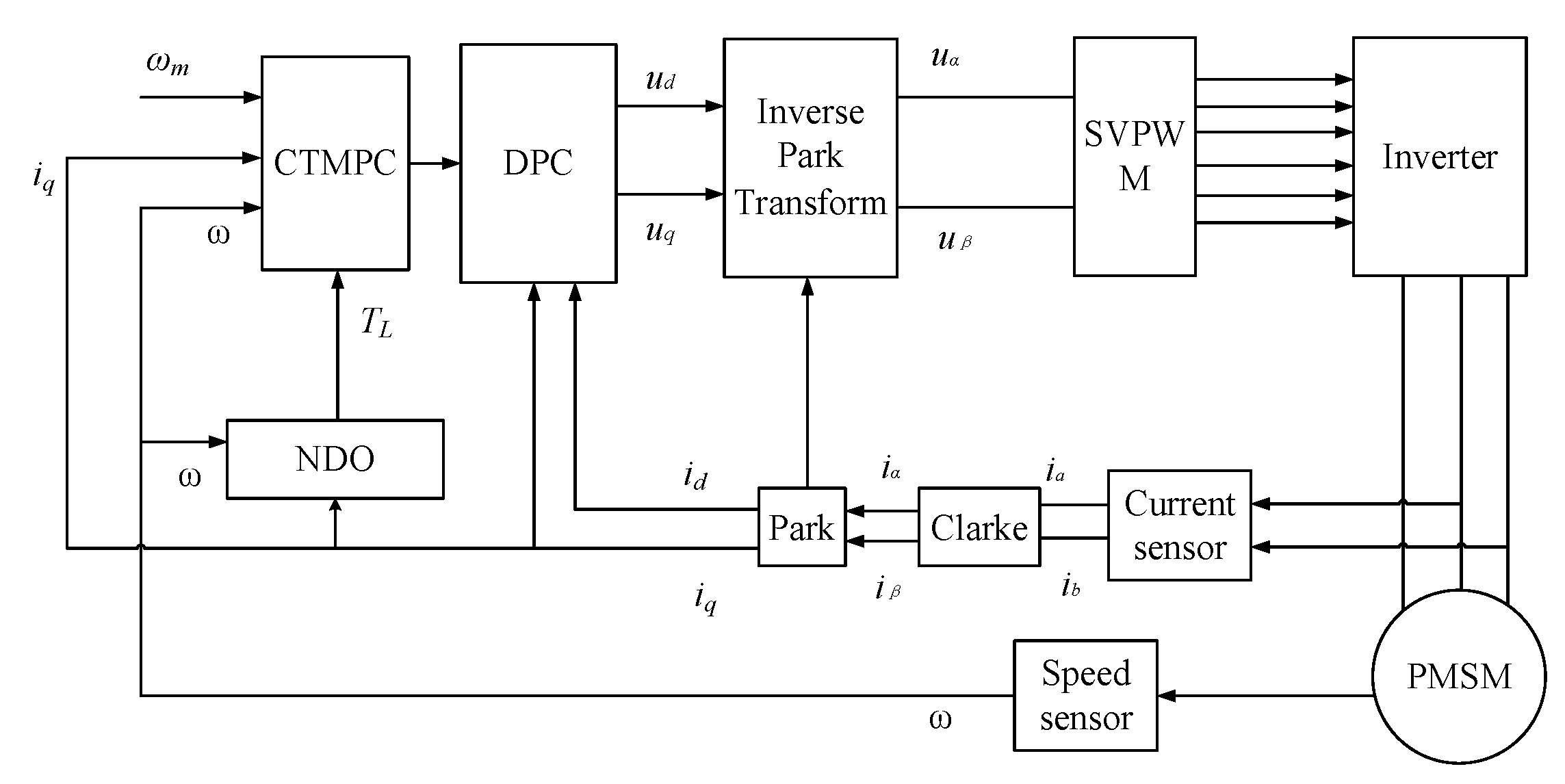
The overall simulation structure of the system is shown in
Figure 1. The control system adopts a dual closed-loop configuration consisting of an inner current loop and an outer speed loop. The outer speed loop employs the proposed continuous-time model predictive control combined with a nonlinear disturbance observer for disturbance estimation, while the inner current loop utilizes deadbeat predictive current control.
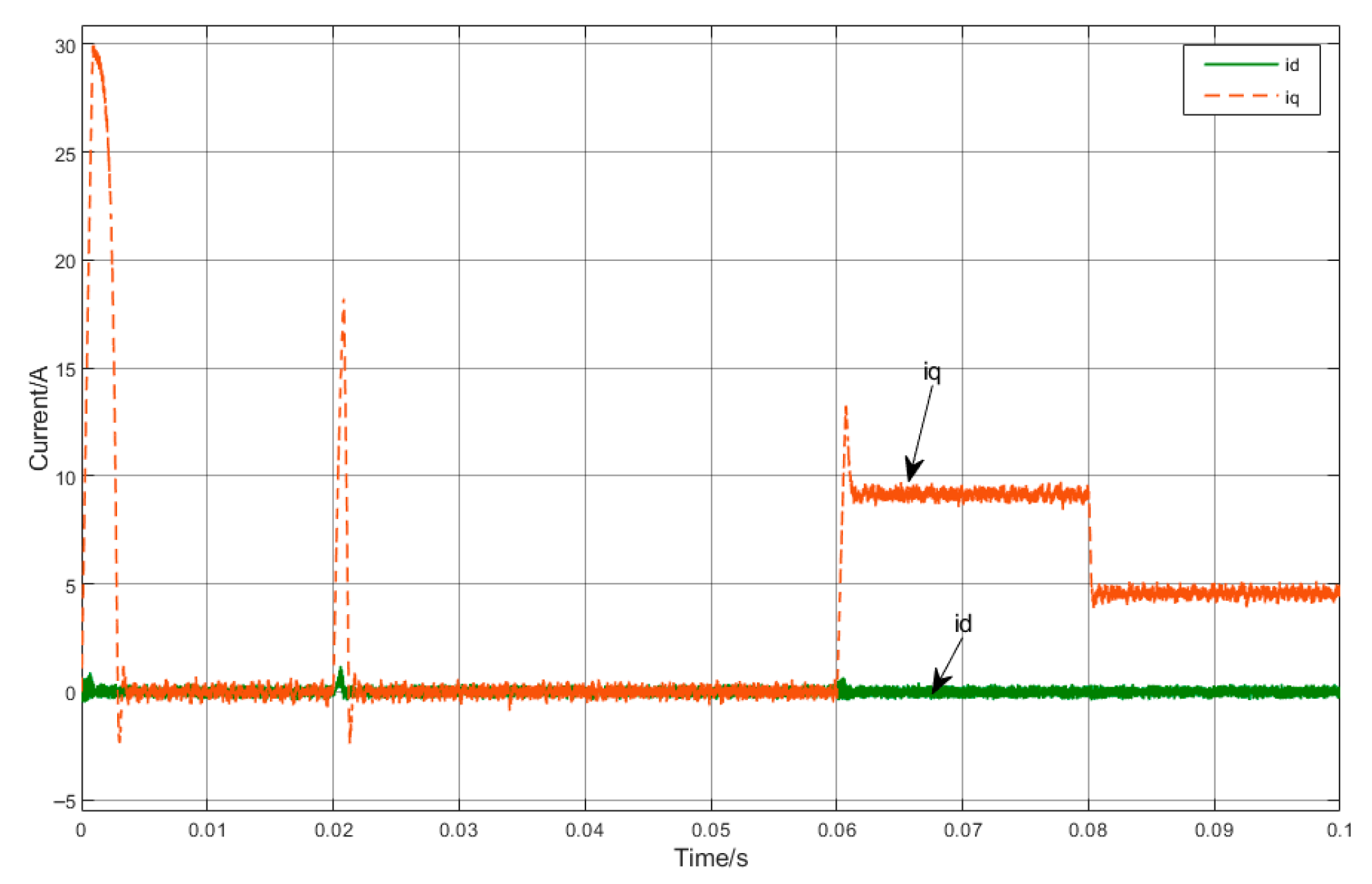
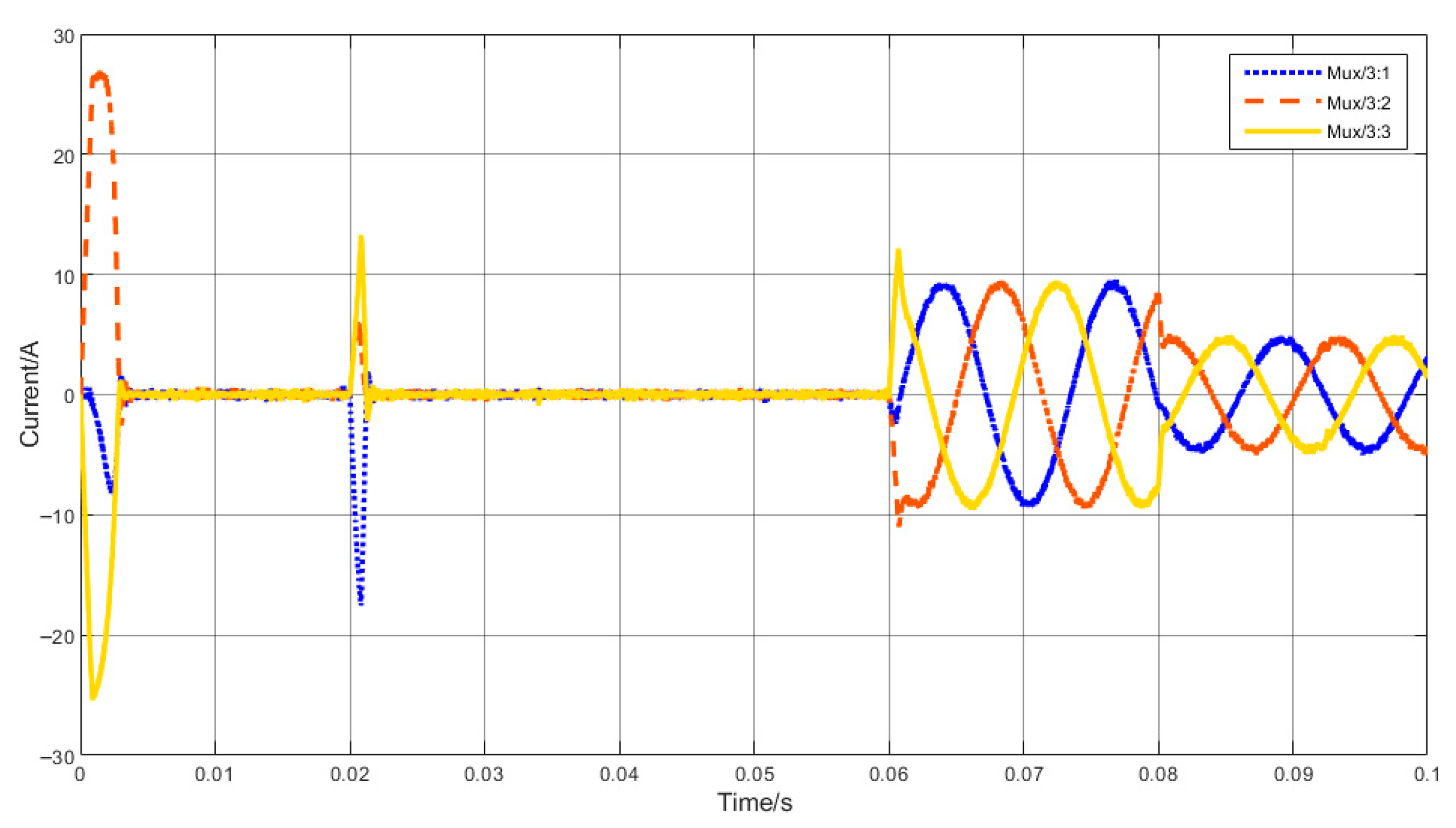
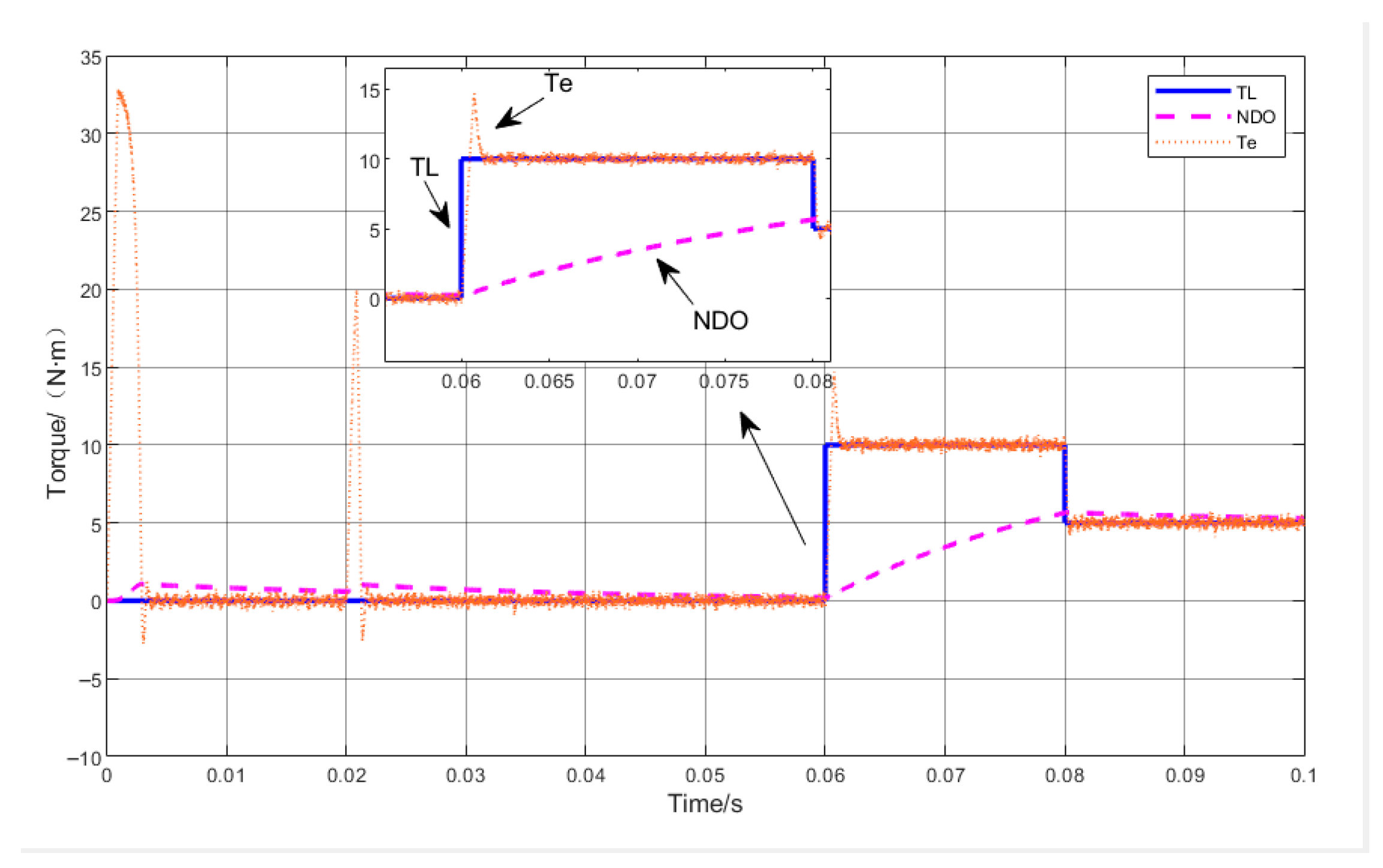
Under the aforementioned simulation conditions, the PMSM is supplied with a voltage of 380 V, and the speed reference is set as a varying profile: 1000 r/min from 0 s to 0.02 s, 1200 r/min from 0.02 s to 0.04 s, and 1000 r/min from 0.04 s to 0.1 s. Additionally, a load disturbance of 10 N·m is applied at 0.06 s, which is then reduced to 5 N·m at 0.08 s and maintained until 0.1 s.
Figure 2 shows the time evolution of the d- and q-axis currents. From 0 s to 0.06 s, the q-axis current
rapidly adjusts in response to the speed step changes, reaching a peak of approximately 30 A, which demonstrates the fast response of the CTMPC to speed variations. At 0.06 s, when the 10 N·m load is suddenly applied,
rises to about 13 A and quickly stabilizes. At 0.08 s, as the load decreases to 5 N·m,
reduces to approximately 5 A. These results indicate that the CTMPC effectively regulates the torque to counteract load disturbances.
Figure 3 illustrates the time variation in the three-phase stator currents. From 0 s to 0.06 s, the three-phase currents rapidly adjust in response to the speed step changes, with peak values reaching approximately 25 A and −25 A, reflecting the torque demand induced by speed variations. At 0.06 s, when the 10 N·m load is applied, the current amplitude increases to about 10 A. Subsequently, at 0.08 s, as the load is reduced to 5 N·m, the amplitude decreases to approximately 5 A to −5 A. These results demonstrate the system’s ability to effectively respond to load changes.
Figure 4 depicts the time responses of the electromagnetic torque Te, the actual torque load TL, and the estimated load torque from the NDO. From 0 s to 0.06 s, Te rapidly adjusts in response to the speed step changes, reaching a peak of approximately 30 N·m, which reflects the torque demand caused by speed variations. At 0.06 s, when the 10 N·m load is applied, Te quickly rises to about 10 N·m. At 0.08 s, as the load decreases to 5 N·m, Te reduces to approximately 5 N·m. These results demonstrate that the CTMPC effectively regulates torture to counteract load disturbances. The NDO estimate rapidly tracks the actual TL at both 0.06 s and 0.08 s, confirming the NDO’s ability to accurately estimate disturbances.
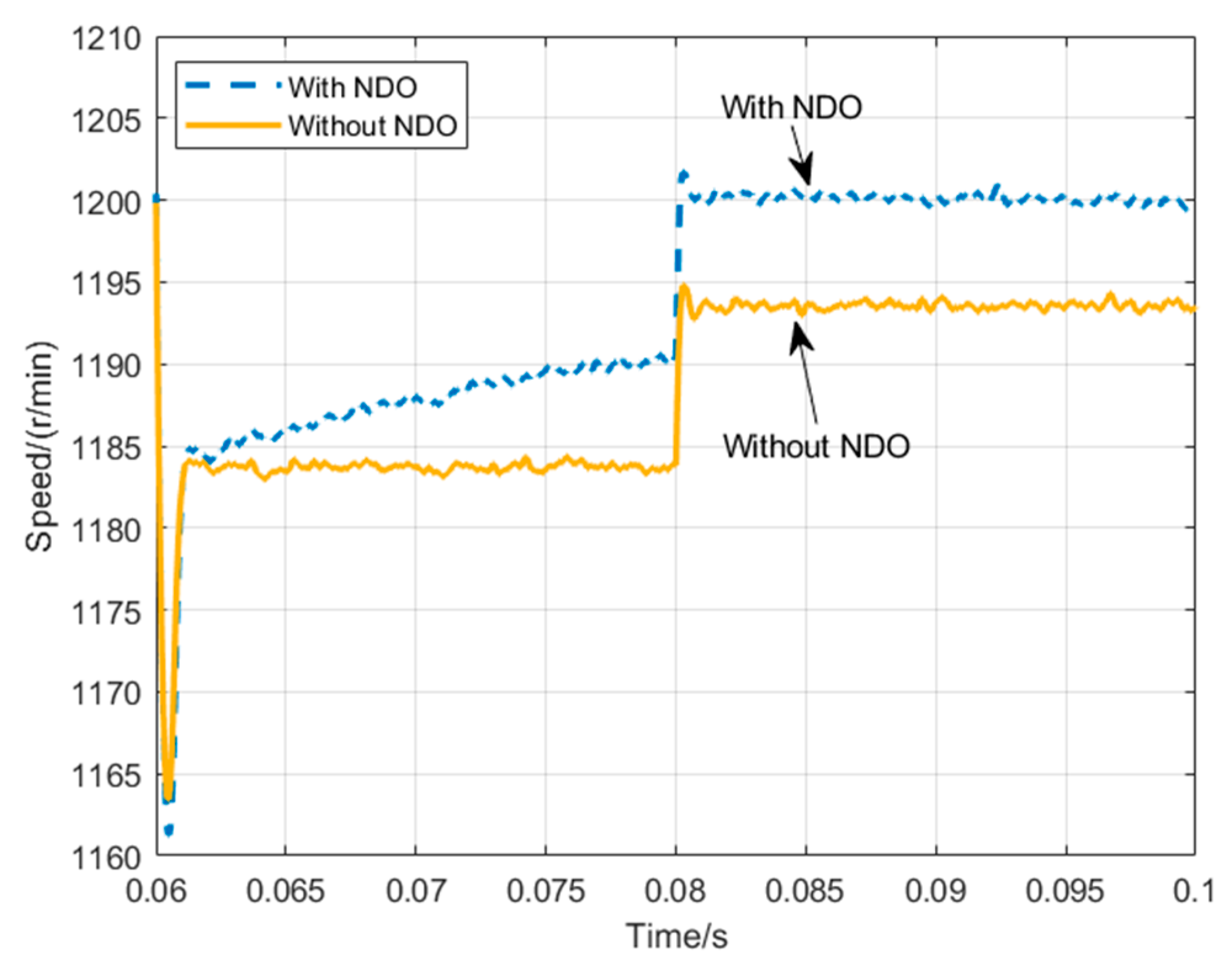
To further validate the enhancement in disturbance rejection performance provided by the nonlinear disturbance observer, a comparative simulation was conducted between cases with and without the NDO under the same CTMPC framework. The resulting speed responses are shown in
Figure 5.
As observed from
Figure 5, when the load disturbance is applied, the actual speed with the NDO rapidly converges to the reference value and stabilizes at 1200 r/min. In contrast, without the NDO, the steady-state speed only reaches approximately 1193 r/min, exhibiting a noticeable steady-state error. These results demonstrate that the incorporation of the NDO significantly improves the system’s disturbance rejection capability.
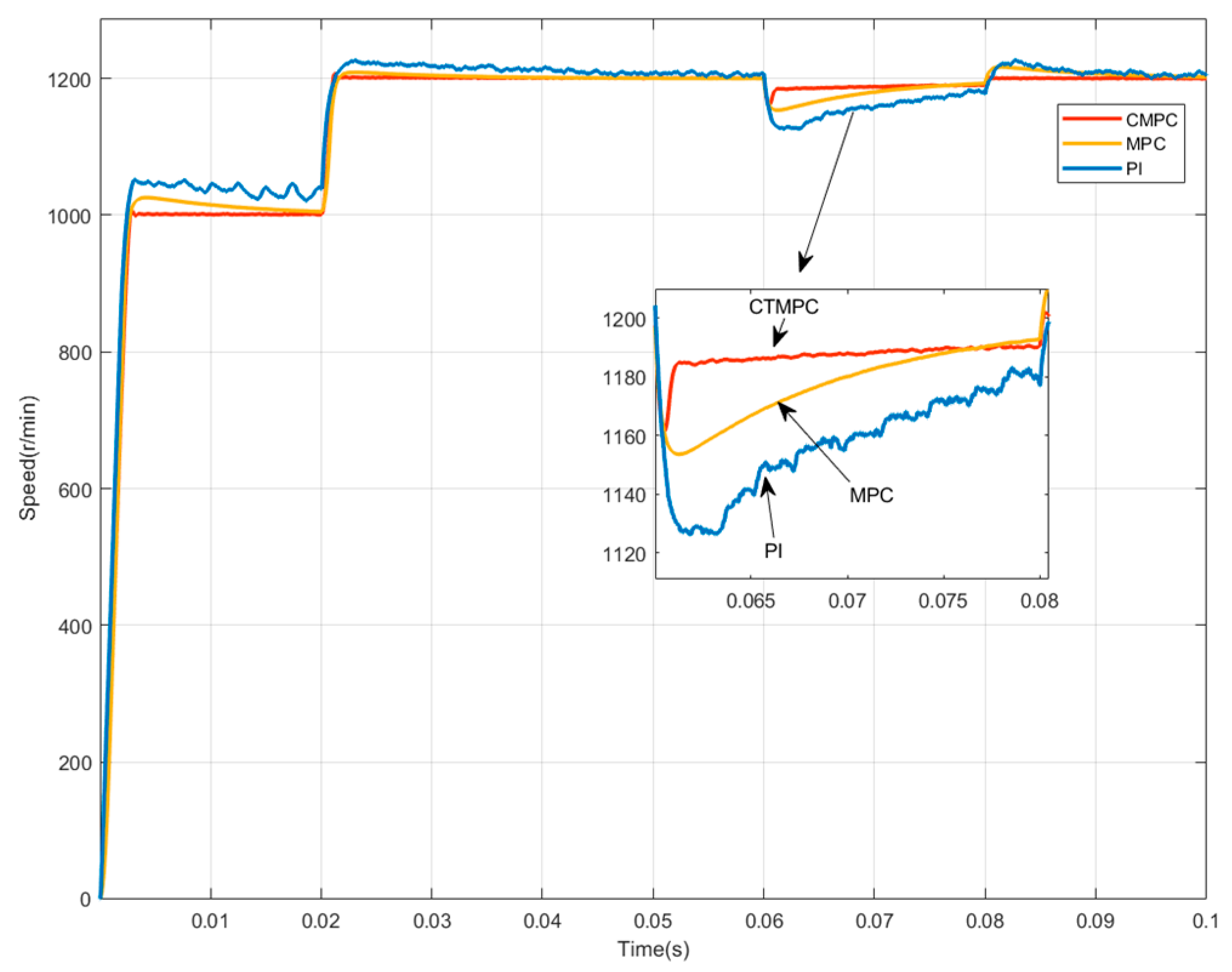
To further benchmark the proposed CTMPC against conventional methods, a comparative simulation was conducted under the same conditions with discrete-time MPC (denoted as MPC) and classical PI control (with well-tuned parameters). The resulting speed responses are shown in
Figure 6, where the red line represents CTMPC, the orange line MPC, and the blue line PI. From 0 s to 0.02 s (initial speed ramp to 1000 r/min), all controllers achieve fast rise times (~0.003–0.004 s), but PI exhibits noticeable oscillations during settling, while CTMPC and MPC show smoother transients with minimal ripple. At 0.02 s (speed step to 1200 r/min), CTMPC achieves the shortest rise time (~0.001 s) with virtually no overshoot (≈8 r/min max deviation); MPC shows a slight overshoot (~15–20 r/min) and longer settling; PI displays the largest overshoot (~30–40 r/min) and prolonged oscillations. The critical advantage emerges during load disturbances. At 0.06 s (sudden 10 N·m load application), CTMPC experiences the smallest speed dip (≈32 r/min) and recovers in ~0.007 s with minimal fluctuation. MPC dips to ≈35 r/min with ~0.014 s recovery. In contrast, PI suffers a severe drop (≈80 r/min, down to ~1120 r/min in the zoomed view) and takes significantly longer (~0.02–0.03 s) to recover, highlighting its poor disturbance rejection. At 0.08 s (load reduction to 5 N·m), CTMPC shows the smallest overshoot (≈2 r/min) and fastest stabilization; MPC has moderate overshoot (~15 r/min); PI exhibits pronounced overshoot and slow return to steady state.
Performance comparison of the proposed CTMPC with conventional MPC and PI control in terms of rising time, overshoot, speed dip under load disturbance, recovery time, and steady-state error (
Table 3).
These results indicate that, under identical operating conditions, the proposed CTMPC outperforms the conventional MPC and PI in terms of speed tracking accuracy, overshoot suppression, and disturbance rejection.
6. Discussion
Simulation results show that the proposed CTMPC with Laguerre parameterization and NDO outperforms conventional discrete-time MPC in dynamic response (25% shorter rise time, 69% reduced overshoot) and disturbance rejection (50% faster recovery and zero steady-state error). Compared to classical PI control—which shows larger overshoot, more significant speed dips, and slower recovery under load disturbances—the proposed method reduces rise time by 25–30%, overshoot by up to 70%, and recovery time by 50–70%, while achieving near-zero steady-state error (see
Table 3 and
Figure 6).
The use of Laguerre functions effectively reduces computational complexity while maintaining the accuracy of continuous-time modeling. The NDO provides accurate load torque estimation and feedforward compensation, significantly enhancing robustness.
The adaptive smoothing factor and soft constraints improve practical feasibility by balancing responsiveness and smoothness without introducing numerical instability. Overall, these enhancements make the controller particularly suitable for high-dynamic applications such as electric vehicles and robotics, where rapid speed tracking and strong disturbance rejection are critical.
Future work will focus on hardware implementation and real-time experimental validation. Potential extensions include parameter-adaptive Laguerre scaling and integration with efficiency-oriented cost functions.
In summary, the proposed scheme offers a computationally efficient, robust, and practical solution for advanced PMSM speed regulation.
7. Conclusions
This paper proposed a continuous-time model predictive control (CTMPC) framework for PMSM speed regulation by combining Laguerre function parameterization with a nonlinear disturbance observer. The use of orthogonal Laguerre basis functions enables a finite-dimensional representation of the control increment, which improves computational efficiency while preserving the advantages of continuous-time prediction.
It should be explicitly noted that the validation presented in this work is limited to numerical simulations conducted in the MATLAB/Simulink environment. Although the simulation results are comprehensive and demonstrate clear performance advantages over PI control and conventional MPC, experimental validation or hardware-in-the-loop testing has not yet been carried out, which constitutes a limitation of the present study.
Future work will, therefore, focus on the implementation of the proposed controller on a real PMSM drive platform. Planned efforts include real-time execution on a digital control system, experimental evaluation under varying load and speed conditions, and further investigation of adaptive Laguerre parameter tuning to enhance robustness and practical applicability.
Author Contributions
Conceptualization, K.S.; methodology, K.S. and L.M.; software, L.M.; validation, L.M.; formal analysis, K.S. and L.M.; investigation, L.M.; resources, K.S.; data curation, L.M.; writing—original draft preparation, L.M.; writing—review and editing, K.S. and L.M.; visualization, L.M.; supervision, K.S.; project administration, K.S.; funding acquisition, K.S. All authors have read and agreed to the published version of the manuscript.
Funding
This research received no external funding.
Data Availability Statement
The results presented in this study are based entirely on numerical simulations conducted using MATLAB/Simulink software. No new experimental data was generated or analyzed. The simulation models, parameter files, and datasets supporting the reported results are not publicly archived but are available from the corresponding author upon reasonable request.
Acknowledgments
The authors sincerely thank Shao Keyong for his guidance and support in this work.
Conflicts of Interest
The authors declare no conflicts of interest.
Abbreviations
The following abbreviations are used in this manuscript:
| PMSM | Permanent magnet synchronous motors |
| CTMPC | Continuous-time model predictive control |
| NDO | Nonlinear disturbance observer |
References
- Zhang, Z.; Sun, Q.; Zhang, Q. A Computationally Efficient Model Predictive Control Method for Dual Three-Phase PMSM of Electric Vehicle With Fixed Switching Frequency. IEEE Trans. Ind. Appl. 2023, 60, 1105–1116. [Google Scholar] [CrossRef]
- Pang, S.; Zhang, Y.; Huangfu, Y.; Li, X.; Tan, B.; Li, P.; Tian, C.; Quan, S. A Virtual MPC-Based Artificial Neural Network Controller for PMSM Drives in Aircraft Electric Propulsion System. IEEE Trans. Ind. Appl. 2024, 60, 3603–3612. [Google Scholar] [CrossRef]
- Guo, K.; Guo, Y.; Fang, S.; Li, C.; Xue, W. Design and Analysis of a Permanent Magnet Frameless Motor. IEEE J. Emerg. Sel. Top. Power Electron. 2024, 12, 3124–3134. [Google Scholar] [CrossRef]
- Zhang, X.; Fang, S.; Zhang, H. Predictive Current Error Compensation Based Strong Robust Model Predictive Control for PMSM Drive Systems. IEEE Trans. Ind. Electron. 2024, 71, 15280–15289. [Google Scholar] [CrossRef]
- Aboelhassan, A.; Wang, S.; Buticchi, G.; Varvolik, V.; Galea, M.; Bozhko, S. Modulated Model Predictive Speed Controller for PMSM Drives Employing Voltage-Based Cost Function. IEEE Open J. Ind. Electron. Soc. 2024, 5, 122–131. [Google Scholar] [CrossRef]
- Son, D.-I.; Han, J.-S.; Park, J.-S.; Lim, H.-S.; Lee, G.-H. Performance Improvement of DTC-SVM of PMSM with Compensation for the Dead Time Effect and Power Switch Loss Based on Extended Kalman Filter. Electronics 2023, 12, 966. [Google Scholar] [CrossRef]
- Elmorshedy, M.F.; Xu, W.; El-Sousy, F.F.; Islam, M.R.; Ahmed, A.A. Recent Achievements in Model Predictive Control Techniques for Industrial Motor: A Comprehensive State-of-the-Art. IEEE Access 2021, 9, 58170–58191. [Google Scholar] [CrossRef]
- Liu, M.; Hu, J.; Chan, K.W.; Or, S.W.; Ho, S.L.; Xu, W.; Zhang, X. Dual Cost Function Model Predictive Direct Speed Control With Duty Ratio Optimization for PMSM Drives. IEEE Access 2020, 8, 126637–126647. [Google Scholar] [CrossRef]
- Errouissi, R.; Al-Durra, A.; Muyeen, S.; Leng, S. Continuous-time model predictive control of a permanent magnet synchronous motor drive with disturbance decoupling. IET Electr. Power Appl. 2017, 11, 697–706. [Google Scholar] [CrossRef]
- Das, S.; Ganguly, S.; Anjali, M.; Chatterjee, D. Towards Continuous-Time MPC: A Novel Trajectory Optimization Algorithm. In Proceedings of the 2023 62nd IEEE Conference on Decision and Control (CDC), Marina Bay Sands, Singapore, 13–15 December 2023; IEEE: Piscataway, NJ, USA, 2023; pp. 3276–3281. [Google Scholar]
- Abdissa, C.M. Improved Model Predictive Speed Control of a PMSM via Laguerre Functions. Math. Probl. Eng. 2024, 2024, 5562771. [Google Scholar] [CrossRef]
- Kuo, Y.-L.; Pongpanyaporn, P. Continuous-Time Nonlinear Model Predictive Tracking Control with Input Constraints Using Feedback Linearization. Appl. Sci. 2022, 12, 5016. [Google Scholar] [CrossRef]
- Lee, E.; Gui, Y.; You, S.; Moon, J.; Kim, W. Extended State Observer-Based Robust Model Predictive Velocity Control for Permanent Magnet Synchronous Motor. IEEE Access 2025, 13, 60602–60612. [Google Scholar] [CrossRef]
- Sepahkar, M.B.; Niasar, A.H. Robust Model-Free Predictive Current and Speed Control of PMSM Drive Based on Nonlinear Disturbance Observer. IET Power Electron. 2025, 18, e70041. [Google Scholar] [CrossRef]
- Yahia, T.; Ahmed, A.A.; Ahmed, M.M.; El Zawawi, A.; Elbarbary, Z.M.S.; Arafath, M.S.; Ali, M.M. Enhanced Model Predictive Speed Control of PMSMs Based on Duty Ratio Optimization with Integrated Load Torque Disturbance Compensation. Machines 2025, 13, 891. [Google Scholar] [CrossRef]
- Liu, D.; Han, J.; Chen, G.; Cheng, Y.; Liang, X.; Song, C. Fuzzy self-tuning fractional order PD permanent magnet synchronous motor speed control based on torque compensation. Sci. Rep. 2025, 15, 2141. [Google Scholar] [CrossRef] [PubMed]
| Disclaimer/Publisher’s Note: The statements, opinions and data contained in all publications are solely those of the individual author(s) and contributor(s) and not of MDPI and/or the editor(s). MDPI and/or the editor(s) disclaim responsibility for any injury to people or property resulting from any ideas, methods, instructions or products referred to in the content. |