1. Introduction
Hemispheric specialization is a widespread feature of vertebrate nervous systems, with left–right differences observed across perceptual, motor, emotional, and cognitive domains. A well-studied example is global–local visual processing, in which global form and local detail are differentially processed [
1,
2]. Behavioral, neuropsychological, and neuroimaging studies have linked this distinction to hemispheric differences, often associating the right hemisphere with broader integration and the left hemisphere with more local analysis, although this pattern depends on stimulus properties, spatial frequency, task demands, and experimental design [
3,
4,
5,
6,
7,
8,
9].
Hemispheric asymmetry is not limited to global–local processing. Broader accounts describe lateralization as a general organizational feature of nervous systems [
10,
11,
12,
13]. Comparative and evolutionary studies further suggest that lateralization can reduce redundant bilateral processing, support parallel operations, and enable complementary specialization within bilaterally organized systems [
14,
15,
16,
17]. The key question is therefore not only whether left–right differences exist, but how initially equivalent bilateral systems come to occupy differentiated processing roles.
Here, we distinguish three related but separable problems: differentiation, polarity, and persistence. Differentiation refers to whether two initially equivalent sides acquire different functional roles. Polarity refers to which side adopts which role. Persistence refers to whether an already differentiated state remains after the biasing condition that helped select it is removed. These properties are often discussed together, but they need not share a single origin. A system may differentiate under symmetric conditions, while weak developmental asymmetries bias only the probability of selecting one polarity over the other.
This distinction is relevant because biological asymmetry is expressed across multiple levels. Small early asymmetries may be amplified into stable anatomical or behavioral differences [
18]. Embryological left–right patterning involves symmetry-breaking mechanisms such as nodal flow and asymmetric signaling cascades [
19,
20,
21]. Neural asymmetries have also been reported in gene expression, cortical maturation, and functional dominance during development [
22,
23,
24,
25]. These findings show that biological asymmetry can arise early and be stabilized, but they do not specify the minimal computational conditions under which functional left–right differentiation becomes advantageous.
Developmental and genetic accounts also suggest that polarity is unlikely to be fixed by a single deterministic mechanism. Classical theories proposed that weak developmental biases can influence laterality without fully specifying the mature phenotype [
26,
27], and more recent modeling has framed cerebral lateralization as a probabilistic architecture of partially dissociable modules [
28]. A related minimal dynamical model suggested that weak early left–right asymmetry can be amplified and stabilized into persistent hemispheric differentiation without requiring a fully specified hemispheric program [
29]. This motivates the present question: does functional differentiation itself require an initial left–right bias, or can symmetric bilateral systems already contain asymmetric high-fitness solutions whose polarity is subsequently biased?
Global–local processing provides a minimal domain for this question because it involves a tension between broad spatial integration and sensitivity to local irregularity. A bilateral system with two initially equivalent channels may benefit from allowing one channel to adopt a broader integration scale and the other a narrower one. Such differentiation can be studied as a division of labor between complementary spatial filters, not as a direct anatomical model of real cerebral hemispheres.
The present study examines this possibility using a deliberately minimal evolutionary model. Two initially equivalent processing channels received the same spatial input and evolved their spatial integration widths. The model was left–right exchange symmetric under equal developmental gains, and differentiation was quantified by the signed order parameter Δa = a_R − a_L. The task was formulated as a spatial mismatch-separation problem: each channel computed mismatch between the input and its filtered representation, and fitness rewarded the magnitude of the resulting bilateral decision signal. This objective does not directly measure anomaly localization accuracy; rather, it tests whether differentiated integration widths can arise as high-fitness solutions when the system is rewarded for producing strong contrast between complementary mismatch responses.
This framework addressed four questions: whether bilateral differentiation arises under exact developmental symmetry, whether weak developmental gain asymmetry biases polarity without determining it completely, whether differentiated solutions outperform forced-symmetry, shared-parameter, and single-channel controls, and whether already polarized solutions are retained after developmental symmetry is restored. By separating differentiation, polarity bias, and persistence, the study clarifies how asymmetric functional organization can arise in a minimal left–right symmetric model class without assuming a preassigned hemispheric template.
2. Methods
2.1. Study Overview
The purpose of this study was to examine how asymmetric functional differentiation can arise in a minimal bilateral system, how weak developmental gain asymmetry biases the polarity of that differentiation, and how already polarized solutions behave after developmental symmetry is restored. The model consisted of two processing channels, denoted left and right. Both channels received the same spatial input and evolved their spatial integration widths through a genetic algorithm.
The task was formulated as a spatial mismatch-separation problem. Each channel transformed the same spatial input using a Gaussian spatial integration filter. The system then generated a scalar decision signal from the difference between the two channel-specific mismatch responses. The evolutionary objective rewarded the magnitude of this internal decision signal. It did not directly reward anomaly localization accuracy.
The model was intentionally minimal. Each channel was represented by one evolvable parameter, the spatial integration width. The model was therefore used to isolate a computational principle of bilateral differentiation, not to reproduce the anatomical, temporal, or network-level complexity of real cerebral hemispheres.
2.2. Bilateral Model and Left–Right Symmetry
Each agent consisted of two processing channels with spatial integration-width parameters a_L and a_R. Both parameters were constrained to be greater than or equal to 0.1 throughout all simulations.
Left–right exchange was defined by the transformation
P:
Here, m_L and m_R denote the developmental gain factors of the left and right channels, respectively. Under exact developmental symmetry, m_L = m_R = 1.0. Under this condition, the expected fitness of the model is invariant under left–right exchange, such that E[F(a_L, a_R)] = E[F(a_R, a_L)].
The signed order parameter for left–right differentiation was defined as
The unsigned magnitude of differentiation was defined as |Δa|. Positive values of Δa indicate right-wider solutions. Negative values of Δa indicate left-wider solutions. Δa = 0 indicates a symmetric integration-width solution.
A lineage was classified as clearly divergent when |Δa| > 0.25. This threshold was used only for descriptive classification and polarity-reversal analysis. It was not included in the fitness function.
2.3. Spatial Input Generation
Each trial used a 20 × 20 spatial grid. The raw grid X_raw was generated by sampling each element independently from a standard normal distribution.
Two background conditions were used: structured background and unstructured background. In the structured-background condition, X_raw was smoothed using a Gaussian filter with standard deviation σ_bg = 1.0. The Gaussian filter used reflective boundary conditions and truncation at 3.0 standard deviations. In the unstructured-background condition, the raw grid was not spatially smoothed.
After background generation, the grid was standardized to zero mean and unit standard deviation when its standard deviation was greater than zero. If the standard deviation was zero, the grid was mean-centered without division by the standard deviation.
For anomaly-present trials, one grid coordinate was selected uniformly at random. A positive offset was added to a 3 × 3 patch centered on that coordinate. The anomaly amplitude A was sampled from Uniform (1.5, 2.0). For boundary locations, the patch was clipped to the valid grid range.
The same anomaly-generation procedure was used in both structured-background and unstructured-background conditions. Therefore, the primary environmental comparison differed in background spatial organization while preserving anomaly presence, anomaly size, anomaly amplitude range, grid size, and input scaling.
Anomaly-absent trials were generated using the same background-generation procedures but without patch insertion.
2.4. Channel Processing
Each channel processed the same input grid X using Gaussian spatial integration. For a channel with integration width a, the filtered representation was defined as
Here, G_a denotes Gaussian filtering with effective standard deviation max (a, 0.1). Reflective boundary conditions and truncation at 3.0 standard deviations were used for all channel-level filters.
For each channel, mismatch was defined as the sum of absolute deviations between the input grid and the filtered representation:
Smaller values of a preserve finer local variation. Larger values of a emphasize broader spatial structure. Therefore, differentiation between a_L and a_R corresponds to differentiation between narrower and broader spatial integration.
2.5. Developmental Gain Asymmetry and Decision Variable
Developmental gain asymmetry was parameterized by
δ. Channel-specific gains were defined as
Thus, δ = 0 corresponds to exact developmental symmetry. Positive δ increases the gain of the right channel and decreases the gain of the left channel by the same amount. Negative δ produces the opposite pattern. For example, δ = 0.02 gives m_L = 0.99 and m_R = 1.01.
The weighted mismatch signals were defined as
S_L =
m_L M(
a_L) and
S_R =
m_R M(
a_R). The scalar decision variable was defined as
The decision magnitude was |D|. No explicit term involving Δa or |Δa| was included in the fitness function. Differentiation was selected only insofar as it increased the decision magnitude generated by the two channel responses.
2.6. Fitness Function
The reaction-time proxy for trial k was defined as
The constant ε was fixed at 1.0 × 10⁻⁶, and RT_max was fixed at 1.0 × 10⁵. This cap prevented rare near-zero decision magnitudes from dominating the fitness distribution.
Fitness was defined as the negative mean reaction-time proxy across N evaluation trials:
Higher fitness therefore corresponds to lower mean RT and larger decision magnitude. The fitness function rewards internal decisiveness of the bilateral mismatch contrast. It does not directly reward anomaly localization accuracy or the magnitude of Δa.
2.7. Genetic Algorithm
Each lineage was evolved independently using a genetic algorithm. Unless otherwise specified, the default evolutionary parameters were as follows.
Population size: 20.
Number of generations: 50.
Parent fraction: 0.5.
Number of parents selected per generation: 10.
Elitism: not used.
Trials per agent per generation: 32.
Final held-out evaluation trials: 256.
Mutation standard deviation: σ_mut = 0.05.
Mutation decay: none.
Minimum integration width: 0.1.
All individuals in the initial population were initialized with a_L = 1.0 and a_R = 1.0.
At each generation, one shared evaluation set was generated for the lineage. All agents within the same generation were evaluated on the same set of task environments. This design ensured that competing agents were compared against identical task instances within each generation.
After fitness evaluation, the top 50 percent of agents were selected as parents. Offspring were generated by arithmetic recombination between two randomly selected parents. For each offspring, the pre-mutation value of each parameter was the arithmetic mean of the corresponding parental values.
Independent Gaussian mutation was then applied to
a_L and
a_R:
After mutation, both a_L and a_R were clipped to remain greater than or equal to 0.1. No upper bound was imposed on a_L or a_R.
At the end of each lineage, the best individual from the final generation was re-evaluated on 256 independently generated held-out trials. Final reported values were computed from this held-out evaluation.
2.8. Algorithmic Procedure
The evolutionary procedure for one lineage was as follows (Algorithm 1).
| Algorithm 1. Evolution of one lineage |
Initialize 20 agents with a_L = 1.0 and a_R = 1.0. For each generation from 1 to 50: 2.1. Generate one shared set of 32 task environments. 2.2. Evaluate every agent on the same 32 task environments. 2.3. For each agent and each trial, compute M(a_L), M(a_R), S_L, S_R, D, RT, and fitness. 2.4. Rank agents by fitness. 2.5. Select the top 10 agents as parents. 2.6. Generate 20 offspring by arithmetic recombination of randomly selected parent pairs. 2.7. Apply independent Gaussian mutation to a_L and a_R. 2.8. Clip a_L and a_R to remain greater than or equal to 0.1. 2.9. Replace the full population with the offspring population. Select the best individual from the final generation. Re-evaluate this individual on 256 held-out task environments. Store a_L, a_R, Δa, |Δa|, mean RT, sd RT, fitness, and polarity.
|
2.9. Symmetric-Development Analysis
The symmetric-development analysis tested whether asymmetric integration widths arise under exact developmental symmetry. In this condition, δ = 0, m_L = 1.0, and m_R = 1.0.
Forty independent lineages were evolved for 50 generations in the structured-background condition with anomaly insertion. The primary outcomes were Δa, |Δa|, polarity, mean RT, sd RT, and fitness after held-out evaluation.
Polarity was defined by the sign of Δa. A lineage with Δa > 0 was classified as right-wider. A lineage with Δa < 0 was classified as left-wider. A lineage with Δa = 0 was classified as symmetric.
Directional skew was assessed by comparing the number of right-wider and left-wider lineages against a chance-level probability of 0.5 using an exact binomial test. Because finite stochastic search can yield unequal basin occupancy even under a symmetric model class, polarity imbalance was analyzed separately from the magnitude of differentiation.
2.10. Developmental-Bias Analyses
Developmental-bias analyses tested whether weak gain asymmetry biases the polarity of differentiation.
In the positive-bias condition, δ = 0.02, m_L = 0.99, and m_R = 1.01. In the negative-bias condition, δ = −0.02, m_L = 1.01, and m_R = 0.99.
Forty independent lineages were evolved in each condition. All other evolutionary settings were identical to the symmetric-development analysis.
A bias-sweep analysis was performed using the following values of δ:
−0.05, −0.03, −0.02, −0.01, −0.005, 0, 0.005, 0.01, 0.02, 0.03, and 0.05.
For each value of δ, 40 independent lineages were evolved for 50 generations under the structured-background condition with anomaly insertion. The primary outcome was the proportion of right-wider solutions. Exact binomial confidence intervals were computed for each polarity proportion.
2.11. Persistence After Restoration of Developmental Symmetry
Persistence analyses tested whether already polarized solutions remain differentiated after developmental gains are returned to symmetry.
For each lineage from the positive-bias condition, the best final individual was used as a template to initialize a new population. The reseeded population contained one exact copy of the template and 19 mutated variants. The mutated variants were generated using the same mutation rule as in the main genetic algorithm, with σ_mut = 0.05.
Developmental gains were then restored to symmetry, with m_L = 1.0 and m_R = 1.0. Each reseeded lineage was evolved for 100 generations in the structured-background condition with anomaly insertion.
The same procedure was applied to the best final individuals from the negative-bias condition. Thus, persistence was tested separately for solutions initially selected under positive and negative developmental bias.
Matched fresh-start symmetry controls were also run. These control lineages were initialized with a_L = 1.0 and a_R = 1.0 and evolved under m_L = 1.0 and m_R = 1.0 for 100 generations. The same number of lineages, population size, mutation scale, trial count, and environmental condition were used for reseeded and fresh-start controls.
Persistence was quantified by final |
Δa|, polarity-retention rate, mean RT, and fitness. Polarity reversal was defined as a change in the sign of
Δa after a lineage had first exceeded the divergence threshold specified in
Section 2.2.
2.12. Forced-Symmetry and Shared-Parameter Controls
Forced-symmetry controls were used to test the behavior of the model when differentiation between the two channels was not permitted. In this condition, the two integration widths were tied throughout evolution, such that a_L = a_R = a_S. Only the shared parameter a_S was allowed to mutate and recombine.
Under exact developmental symmetry, this condition produces identical channel processing and therefore removes the possibility of left–right differentiation.
A shared-parameter two-channel control was also implemented. In this control, the two channels were evaluated separately but inherited the same integration-width parameter at every generation. Thus, the two-channel architecture was preserved, while the possibility of evolving different a_L and a_R values was removed.
These controls were used to determine whether high-fitness solutions depended on the availability of differentiated integration widths.
2.13. Single-Channel Baseline
A single-channel baseline was used to evaluate performance when bilateral contrast was absent. The single-channel agent had one evolvable integration width a. For paired anomaly-sensitivity evaluation, each background was used to generate both an anomaly-present and anomaly-absent version.
Single-channel anomaly sensitivity was defined as the difference between the mismatch value for the anomaly-present grid and the mismatch value for the anomaly-absent grid:
The single-channel reaction-time proxy was computed using the same inverse-magnitude form as the bilateral model, with the same ε and RT cap.
The single-channel baseline was used to evaluate whether a non-bilateral processor could exploit the local perturbation structure without evolving complementary integration widths.
2.14. Environmental-Structure Analysis
The environmental-structure analysis tested whether background spatial organization strengthens differentiation when anomaly insertion is held constant. The primary comparison used two conditions: structured background with anomaly insertion, and unstructured background with anomaly insertion.
The same anomaly amplitude range, patch size, grid size, input standardization procedure, population size, generation count, mutation scale, and trial count were used in both conditions.
Thirty paired lineage seeds were used. For each seed, one lineage was evolved in the structured-background condition and one lineage was evolved in the unstructured-background condition. The primary outcomes were final |Δa|, mean RT, and fitness.
Secondary environmental controls examined structured and unstructured backgrounds without anomaly insertion. These conditions were used to determine whether differentiation depended on background structure alone, anomaly insertion alone, or their combination.
2.15. Symmetry-Control Analyses
Two symmetry-control analyses were performed.
First, final agents from the symmetric-development condition were evaluated after left–right label exchange. This operation transformed (a_L, a_R) into (a_R, a_L). Under a symmetric implementation, label exchange should reverse the sign of Δa while preserving |Δa| and expected fitness.
Second, the task environment was horizontally mirrored before channel processing. Mirrored evaluation tested whether the spatial implementation of the task introduced a hidden left–right bias. Each final agent was evaluated on 256 mirrored and 256 non-mirrored held-out trials generated from matched random seeds.
The primary outcomes were changes in Δa, |Δa|, mean RT, and fitness under label exchange and environmental mirroring.
2.16. Decision-Validity Analysis
Decision-validity analyses tested whether the decision magnitude |D| was related to anomaly presence. For each final agent, paired anomaly-present and anomaly-absent environments were generated from the same background.
Anomaly sensitivity of the bilateral decision signal was defined as
Positive Q indicates that the bilateral decision signal was larger when a local anomaly was present.
For each final agent, Q was computed across 256 paired held-out environments. In addition, anomaly-present and anomaly-absent trials were classified using |D| as a scalar score. Receiver-operating characteristic analysis was used to compute the area under the curve. This analysis evaluated the relationship between decision magnitude and anomaly presence. It was not part of the evolutionary fitness function.
2.17. Fitness-Landscape Analysis
Fitness-landscape analyses were used to examine how polarized solutions were arranged in parameter space.
For representative right-wider and left-wider endpoint solutions, linear interpolation paths were constructed between polarity-opposed parameter sets. Let the two endpoint solutions be
θ_A and
θ_B. Interpolated parameters were defined as
For each interpolation path, 101 equally spaced values of t were evaluated. Each interpolated agent was evaluated under symmetric developmental gains on 256 held-out structured-background trials with anomaly insertion.
To determine whether the interpolation path was representative of the local landscape, a two-dimensional parameter grid was also evaluated. The grid sampled a_L and a_R values across the range spanning both polarized endpoints and the near-symmetric region. Each grid point was evaluated under symmetric developmental gains on 256 held-out trials. Fitness, mean RT, Δa, and |Δa| were stored for each grid point.
2.18. Robustness Analyses
Robustness analyses tested whether the main pattern depended on a narrow evolutionary setting. Four parameter variations were examined relative to the default configuration:
Population size = 40.
Trials per agent per generation = 64.
Mutation standard deviation σ_mut = 0.03.
Mutation standard deviation σ_mut = 0.07.
For each variation, 20 independent lineages were evolved under symmetric developmental gains in the structured-background condition with anomaly insertion. All other settings were held constant unless explicitly varied. The primary outcomes were final |Δa|, polarity distribution, mean RT, and fitness.
2.19. Statistical Analysis
The primary unit of analysis was the lineage-best individual after held-out re-evaluation. For each condition, Δa, |Δa|, mean RT, sd RT, and fitness were summarized using the median, interquartile range, mean, standard deviation, and 95% confidence intervals.
Confidence intervals for medians and paired differences were estimated using non-parametric bootstrap resampling with 10,000 bootstrap samples. Polarity proportions were summarized using exact binomial confidence intervals.
Directional skew in polarity distributions was tested using two-sided exact binomial tests against a chance-level probability of 0.5.
Paired comparisons were analyzed using two-sided Wilcoxon signed-rank tests. These included structured-background versus unstructured-background comparisons and reseeded versus matched fresh-start comparisons. Effect sizes for paired non-parametric comparisons were reported as rank-biserial correlations.
Independent-condition comparisons were analyzed using Mann–Whitney U tests when pairing was not present. Effect sizes for independent non-parametric comparisons were reported as Cliff’s delta.
For the bias-sweep analysis, the relationship between δ and the probability of right-wider polarity was summarized using logistic regression with δ as the predictor. The slope estimate, 95% confidence interval, and predicted probability curve were reported.
All statistical tests were two-sided. Statistical significance was defined as p < 0.05. When multiple related comparisons were performed within the same analysis family, Holm correction was applied.
No physical laboratory equipment, commercial instruments, or formal technical. standards were used in this simulation study. All simulations, statistical analyses, and figure generation were performed using custom Python scripts in Python 3.13.0 (Python Software Foundation, Wilmington, DE, USA;
https://www.python.org/, accessed on 2 May 2026).
3. Results
3.1. Symmetric Developmental Conditions Produced Robust Bilateral Differentiation Without Directional Fixation
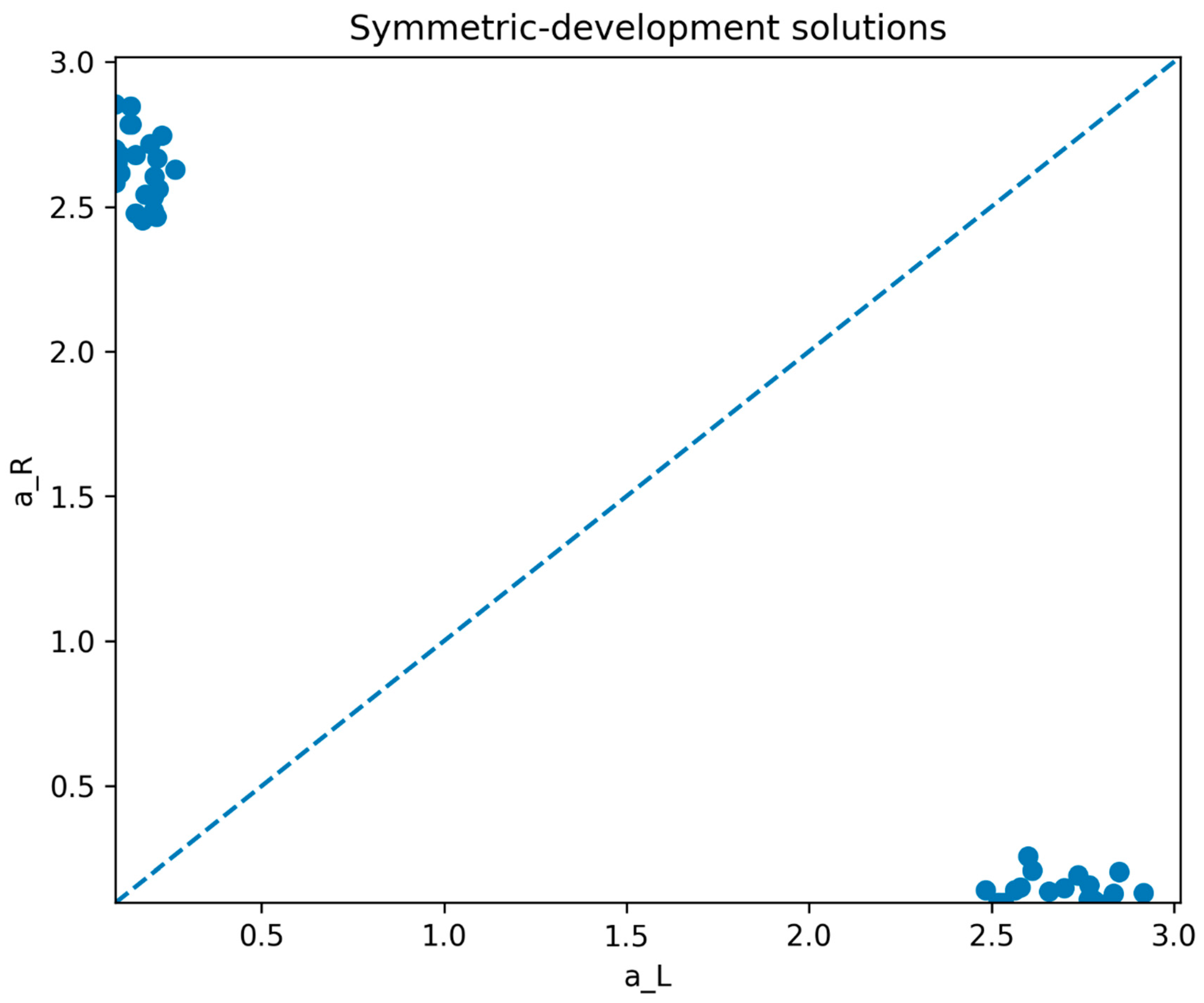
Under exact developmental symmetry, all lineages were initialized with identical left and right integration widths and evolved under identical developmental gains. Despite this symmetry, the final lineage-best solutions showed robust bilateral differentiation in the
a_L-a_R parameter plane (
Figure 1). Across 40 independent lineages, the median specialization magnitude was |
Δa| = 2.511 (IQR = 2.390–2.615). The mean reaction-time proxy was 0.004 (SD = 6.623 × 10
−5), and the median fitness was −0.004.
Polarity was not significantly biased under symmetric developmental gains. Among the 40 lineages, 22 converged to right-wider solutions and 18 converged to left-wider solutions, with no symmetric final solutions. The proportion of right-wider outcomes was 0.550, which did not differ significantly from chance level (exact binomial test, p = 0.636). Thus, the symmetric condition produced reliable differentiation in integration width, but did not impose a fixed direction of polarity.
The symmetry-control analyses showed no evidence that this pattern was caused by a trivial implementation asymmetry. Left–right label exchange preserved fitness and reversed the sign of the order parameter as expected, with a median swap fitness difference of 0.000. Horizontal mirroring of the input environment also produced negligible effects, with a median mirror fitness difference of 0.000 and a maximum absolute difference of 4.337 × 10⁻¹⁹. These controls support the interpretation that the observed differentiation reflected the bilateral model dynamics rather than an overt coding or spatial-orientation artifact.
3.2. Developmental Gain Asymmetry Biased Polarity Selection in a Graded Manner
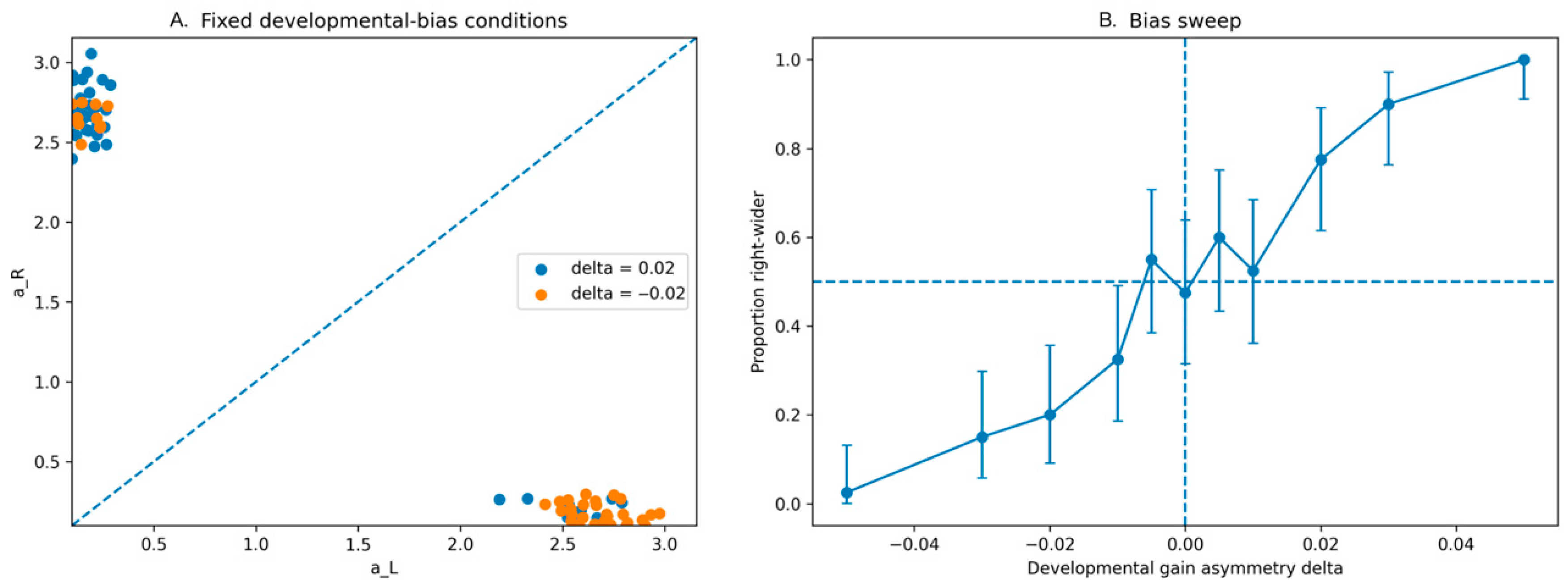
Weak developmental gain asymmetry shifted the probability of polarity selection without eliminating the alternative polarity class (
Figure 2A). Under positive developmental bias, 30 of 40 lineages converged to right-wider solutions and 10 converged to left-wider solutions. The proportion of right-wider outcomes was 0.750, which differed significantly from chance level (exact binomial test,
p = 0.002). The median specialization magnitude remained large, with |
Δa| = 2.481 (IQR = 2.390–2.572), and the mean reaction-time proxy was 0.004 (SD = 1.112 × 10
−4).
Reversing the sign of the developmental bias produced the corresponding shift in the opposite direction. Under negative developmental bias, 11 of 40 lineages converged to right-wider solutions and 29 converged to left-wider solutions. The proportion of right-wider outcomes was 0.275, again differing significantly from chance level (exact binomial test, p = 0.006). The median specialization magnitude was similar to the positive-bias condition, with |Δa| = 2.482 (IQR = 2.372–2.581), and the mean reaction-time proxy was 0.004 (SD = 7.478 × 10⁻⁵).
The bias-sweep analysis confirmed that polarity selection depended systematically on the developmental gain asymmetry parameter (
Figure 2B). As
δ varied from −0.05 to 0.05, the proportion of right-wider solutions increased from 0.025 to 1.000. The relationship was strongly positive overall, although not perfectly monotonic at the smallest bias values. The Spearman correlation between
δ and the proportion of right-wider outcomes was rho = 0.955 (
p = 4.99 × 10
−6). Logistic regression likewise showed a positive slope for
δ predicting right-wider polarity (slope = 66.486, 95% CI = 53.241–79.731). These results indicate that developmental gain asymmetry acted as a graded probabilistic bias on polarity selection rather than as an all-or-none determinant.
3.3. Differentiated Bilateral Solutions Outperformed Forced-Symmetry and Shared-Parameter Controls
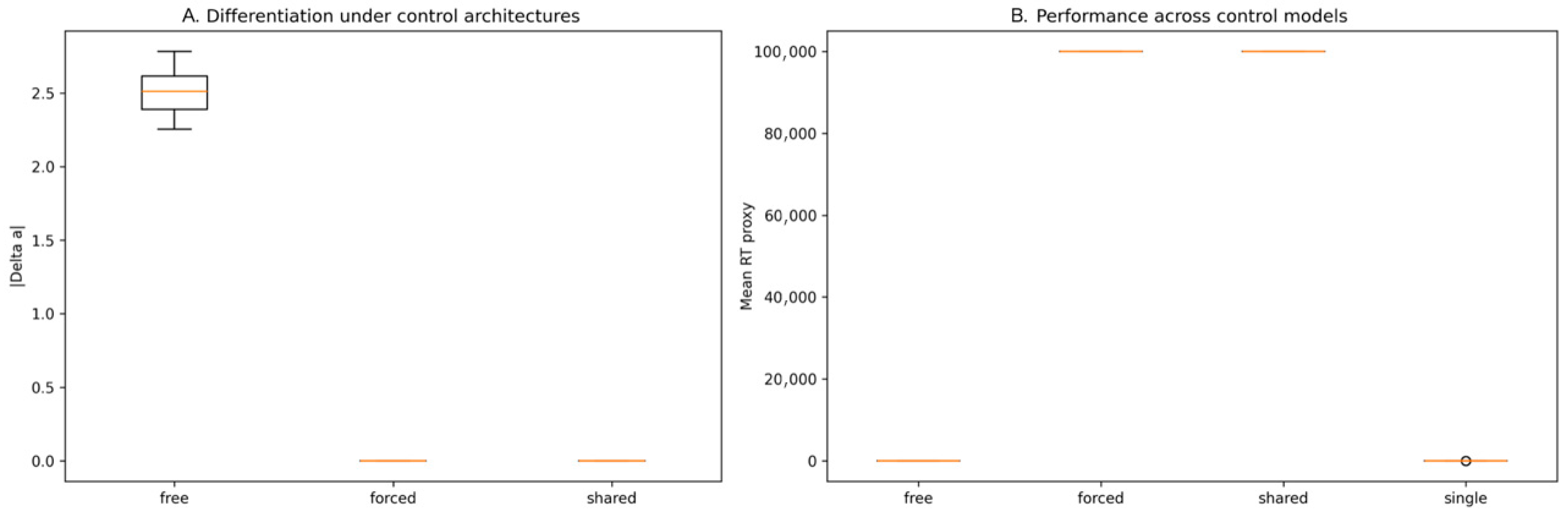
The forced-symmetry and shared-parameter controls tested whether high-fitness outcomes could be obtained when left–right differentiation was not permitted (
Figure 3). In the free bilateral model under symmetric developmental conditions, the median |
Δa| was 2.511. In contrast, both constrained controls had median |
Δa| = 0.000.
Performance also differed sharply between the free model and constrained controls. In the forced-symmetry control, the median reaction-time proxy reached the imposed cap of 1.000 × 10⁵, whereas the free model had a median reaction-time proxy of 0.004. The difference was significant for both |Δa| and mean RT (Mann–Whitney U tests, both p = 1.97 × 10⁻¹⁶; Cliff’s delta = 1.000 for |Δa| and −1.000 for mean RT). The shared-parameter control produced the same pattern: median |Δa| = 0.000 and median reaction-time proxy = 1.000 × 10⁵, again differing from the free model for both differentiation magnitude and performance (both p = 1.97 × 10⁻¹⁶).
The single-channel baseline also performed worse than the free bilateral model. The free model had a median reaction-time proxy of 0.004, whereas the single-channel baseline had a median reaction-time proxy of 0.400 (p = 1.44 × 10⁻¹⁴; Cliff’s delta = −1.000). These results show that the task objective could not be satisfied by a strictly tied two-channel solution and was substantially less efficient in the absence of bilateral contrast.
3.4. Decision Magnitude Was Reliably but Modestly Associated with Anomaly Presence
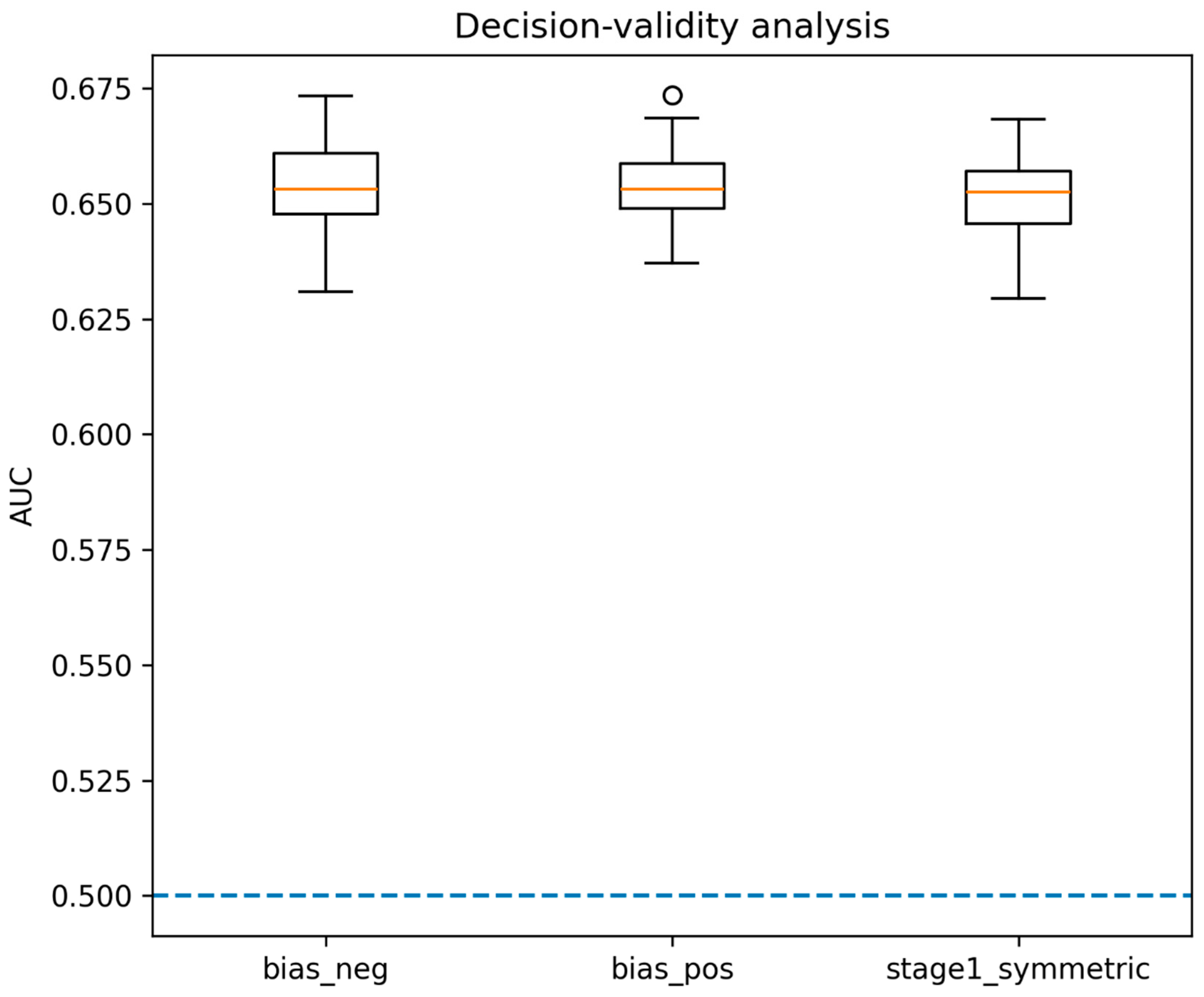
Because the evolutionary objective rewarded decision magnitude rather than explicit anomaly-localization accuracy, an additional decision-validity analysis was performed. This analysis tested whether the decision magnitude |D| was larger for anomaly-present inputs than for matched anomaly-absent inputs (
Figure 4).
In the symmetric-development condition, the median mean Q was 7.590 (95% CI = 7.484–7.652, p = 1.82 × 10⁻¹²), where Q denotes the difference between |D| for anomaly-present and anomaly-absent inputs. The median proportion of trials with Q > 0 was 0.896, indicating that decision magnitude was usually larger when an anomaly was present. The median AUC for classifying anomaly-present versus anomaly-absent inputs using |D| was 0.653 (95% CI = 0.650–0.655, p = 1.82 × 10⁻¹²).
The same qualitative result was observed in both biased conditions. Under positive developmental bias, the median mean Q was 7.719, the median proportion Q > 0 was 0.906, and the median AUC was 0.653. Under negative developmental bias, the median mean Q was 7.760, the median proportion Q > 0 was 0.902, and the median AUC was again 0.653.
These results indicate that the evolved decision magnitude was reliably associated with anomaly presence. However, the AUC values were modest rather than high. Therefore, the model should be interpreted as optimizing a bilateral mismatch-separation signal that is related to anomaly presence, not as a direct model of accurate anomaly localization.
3.5. Polarized States Showed History-Dependent Retention and Amplification After Restoration of Symmetry
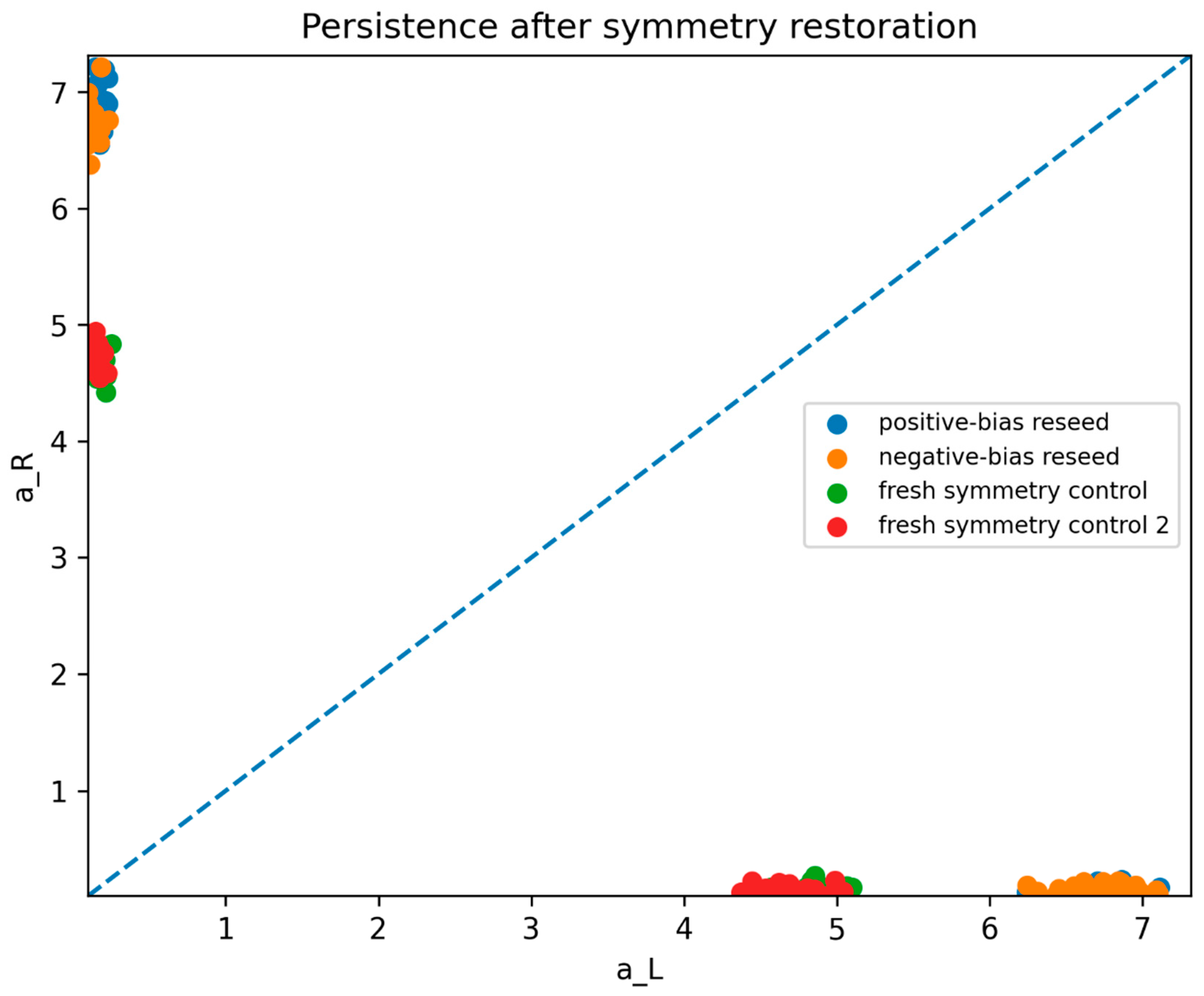
Persistence analyses tested whether polarized solutions remained differentiated after developmental gains were returned to symmetry (
Figure 5). When lineages selected under positive developmental bias were reseeded and evolved under restored symmetric gains, specialization increased rather than decayed. The median |
Δa| increased from 2.481 in the positive-bias parent condition to 6.661 after reseeded symmetric evolution. This change was significant (median paired difference = −4.191 for parent minus reseeded persistence, 95% CI = −4.227 to −4.098,
p = 1.82 × 10
−12, rank-biserial = −1.000). Mean RT decreased from 0.004 to 0.003, indicating improved performance after reseeded evolution (median paired difference = 5.713 × 10
−4 for parent minus reseeded persistence, 95% CI = 5.322 × 10
−4 to 6.062 × 10
−4,
p = 1.82 × 10
−12).
The same pattern was obtained for lineages selected under negative developmental bias. Median |Δa| increased from 2.482 in the negative-bias parent condition to 6.619 after reseeded symmetric evolution (median paired difference = −4.172, 95% CI = −4.194 to −4.036, p = 1.82 × 10⁻¹²). Mean RT again decreased from 0.004 to 0.003 (median paired difference = 5.796 × 10⁻⁴, 95% CI = 5.467 × 10⁻⁴ to 6.026 × 10⁻⁴, p = 1.82 × 10⁻¹²).
Fresh-start symmetry controls also evolved differentiated solutions under the same restored-symmetry setting, indicating that differentiation remained accessible under symmetric gains. However, reseeded lineages were more strongly differentiated than matched fresh-start controls. Positive-bias reseeded lineages had median |Δa| = 6.661, compared with 4.596 in matched fresh-start symmetry controls (median difference = 2.064, 95% CI = 1.935–2.215, p = 1.82 × 10⁻¹²). Negative-bias reseeded lineages had median |Δa| = 6.619, compared with 4.548 in matched fresh-start controls (median difference = 2.039, 95% CI = 1.912–2.267, p = 1.82 × 10⁻¹²). These results support history-dependent retention and amplification of polarized states after restoration of symmetry.
3.6. Structured Backgrounds Increased Differentiation Magnitude but Did Not Improve Decision-Time Performance
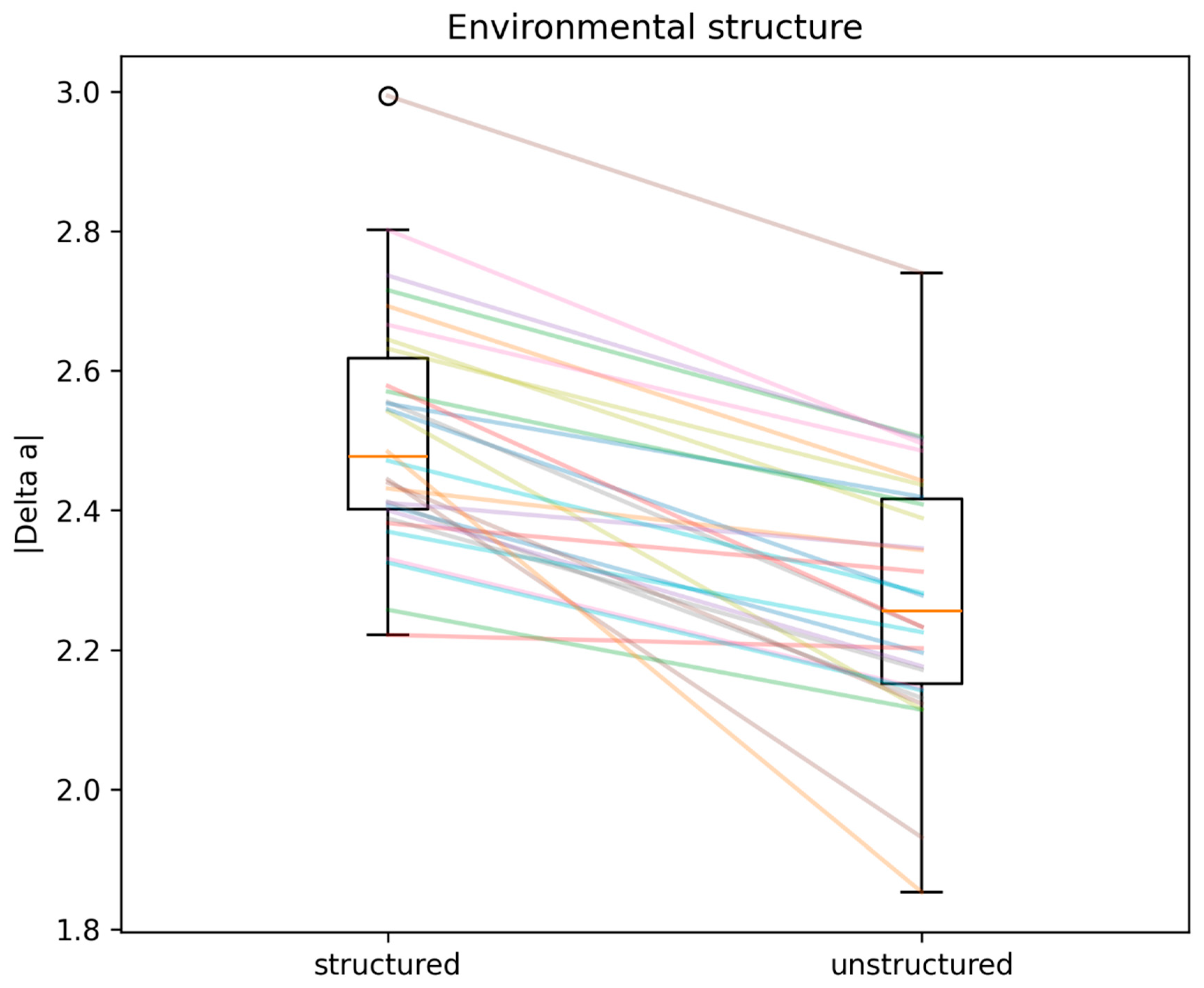
The environmental-structure analysis compared structured and unstructured backgrounds while holding anomaly insertion constant (
Figure 6). Structured backgrounds produced larger differentiation magnitudes than unstructured backgrounds. Median |
Δa| was 2.477 in the structured-background condition and 2.256 in the unstructured-background condition. The paired median difference was 0.214 (95% CI = 0.185–0.255), and this difference was significant (Wilcoxon signed-rank test,
p = 1.86 × 10
−9, rank-biserial = 1.000).
However, structured backgrounds did not improve performance as measured by the reaction-time proxy. The median mean RT was 0.004 in the structured-background condition and 0.003 in the unstructured-background condition. The paired difference was 6.373 × 10⁻⁴ (95% CI = 5.966 × 10⁻⁴ to 6.563 × 10⁻⁴, p = 1.86 × 10⁻⁹), indicating that structured backgrounds produced slower decision-time values. Fitness was correspondingly lower in the structured-background condition, with a median fitness of −0.004 compared with −0.003 in the unstructured-background condition (median difference = −6.373 × 10⁻⁴, 95% CI = −6.563 × 10⁻⁴ to −5.966 × 10⁻⁴, p = 1.86 × 10⁻⁹).
Thus, spatial background structure strengthened bilateral differentiation, but it also made the mismatch-separation problem more demanding. The correct interpretation is therefore not that structured environments improved performance, but that they increased the degree of left–right differentiation while imposing a higher decision-time cost.
3.7. Fitness-Landscape Analyses Showed a Low-Fitness Near-Symmetric Region
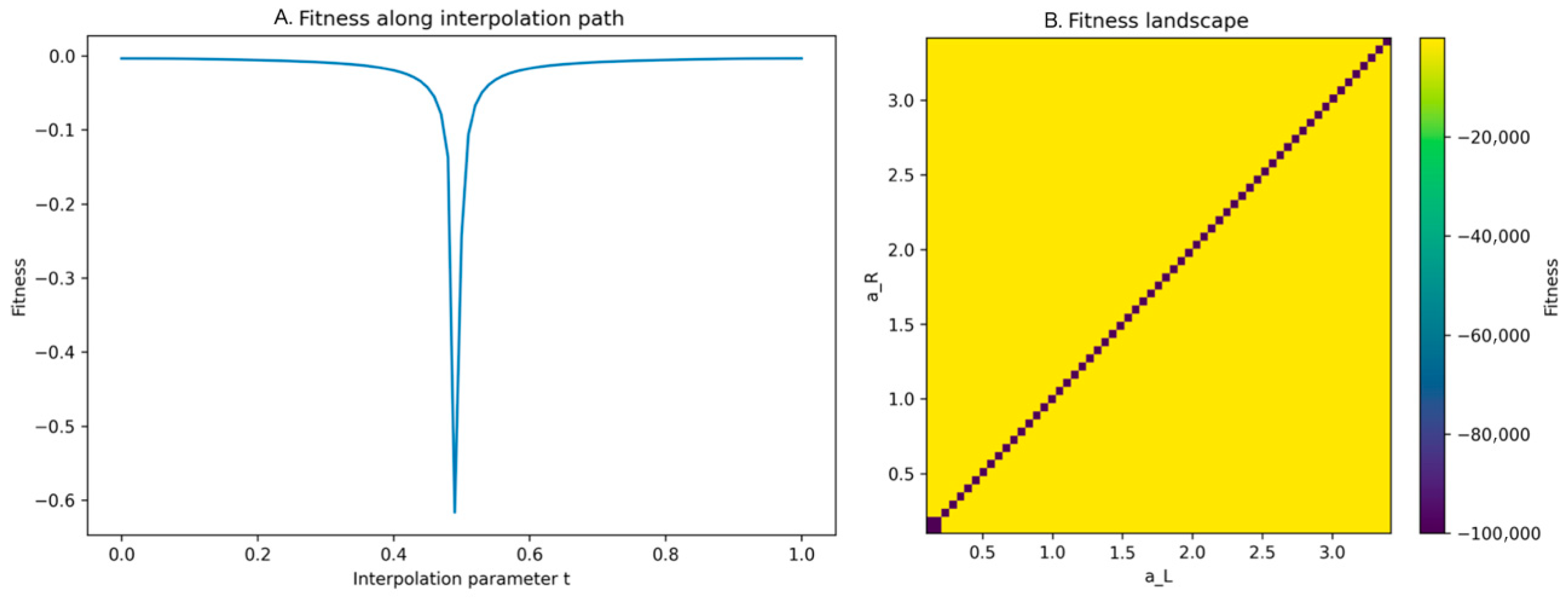
Fitness-landscape analyses examined how polarized and near-symmetric solutions were arranged in parameter space (
Figure 7). Along the interpolation path connecting polarity-opposed endpoint solutions, fitness was high near both endpoints and substantially lower near the midpoint. Endpoint fitness values were both approximately −0.004, whereas the midpoint fitness near t = 0.5 was −0.243. The resulting fitness drop from the endpoint mean to the midpoint was 0.239. Mean RT showed the corresponding increase, rising from an endpoint mean of 0.004 to 0.243 at the midpoint.
The worst point along the interpolation path occurred near t = 0.49, with fitness = −0.616. The two-dimensional grid analysis further supported the existence of a low-fitness near-symmetric region. Grid points close to the diagonal, defined by |Δa| ≤ 0.05, had a median fitness of −1.000 × 10⁵, corresponding to the imposed reaction-time cap. The best sampled grid point had fitness = −0.004 at a_L = 0.1 and a_R = 3.417, whereas the worst sampled grid point had fitness = −1.000 × 10⁵ at a_L = 0.1 and a_R = 0.1.
These analyses do not prove the full global structure of the fitness landscape. They do, however, show that the sampled near-symmetric region was strongly disfavored relative to polarized endpoint solutions, providing a mechanistic explanation for the persistence and amplification of differentiated states.
3.8. Robustness Across Evolutionary Settings
Robustness analyses showed that bilateral differentiation was preserved across changes in population size, trial count, and mutation strength. Increasing the population size to 40 produced a median |Δa| of 2.555 (IQR = 2.491–2.636), with 12 right-wider and eight left-wider outcomes. Increasing the number of trials per agent to 64 produced a median |Δa| of 2.483 (IQR = 2.428–2.575), with 10 right-wider and 10 left-wider outcomes.
Changing mutation strength altered the magnitude of differentiation quantitatively. With σ_mut = 0.03, the median |Δa| was 1.603 (IQR = 1.577–1.686), with seven right-wider and 13 left-wider outcomes. With σ_mut = 0.07, the median |Δa| increased to 3.230 (IQR = 3.081–3.343), with 15 right-wider and five left-wider outcomes. Thus, mutation scale affected the degree of differentiation, but the qualitative emergence of bilateral differentiation remained robust across the tested evolutionary settings.
3.9. Summary of Results
Across the analyses, the model showed a consistent pattern. First, symmetric developmental gains produced robust differentiation in the bilateral integration-width parameters without significant directional fixation. Second, weak developmental gain asymmetry biased the probability of selecting one polarity over the other in a graded manner. Third, constrained controls showed that high-fitness performance depended on allowing the two channels to differentiate. Fourth, decision magnitude was reliably associated with anomaly presence, although only modestly, indicating that the model optimized mismatch separation rather than explicit anomaly localization. Fifth, already polarized solutions were retained and amplified after symmetry was restored. Finally, structured backgrounds increased differentiation magnitude but did not improve decision-time performance. Together, these results support the conclusion that asymmetric bilateral processing can arise as a high-fitness solution in a left–right symmetric model class, while developmental bias modulates polarity selection and prior polarization promotes subsequent retention.
4. Discussion
4.1. Principal Findings
The present study examined how asymmetric functional differentiation can arise in a minimal bilateral system, how weak developmental gain asymmetry biases polarity, and how already polarized solutions behave after developmental symmetry is restored. The main finding was that two initially equivalent channels evolved different spatial integration widths under exact developmental symmetry. This differentiation occurred in a left–right exchange-symmetric model class and was quantified by the signed order parameter Δa. Importantly, the symmetric-development condition produced robust differentiation without significant directional fixation: right-wider and left-wider outcomes both occurred, and their distribution did not differ significantly from chance.
A second finding was that developmental gain asymmetry biased polarity selection in a graded manner. Positive gain asymmetry increased the probability of right-wider outcomes, whereas negative gain asymmetry shifted the distribution in the opposite direction. Across the bias sweep, the probability of right-wider polarity changed systematically with δ. Thus, developmental asymmetry did not simply create differentiation de novo; rather, it biased which of the available asymmetric solutions was more likely to be selected.
A third finding was that differentiation was functionally relevant within the present objective landscape. Forced-symmetry and shared-parameter controls failed to produce differentiated solutions and performed poorly because the bilateral decision signal collapsed when the two channels were constrained to remain identical. The single-channel baseline also performed worse than the free bilateral model. These controls indicate that high-fitness performance in this task depended on the availability of differentiated bilateral processing.
A fourth finding was that polarized solutions showed history-dependent retention and amplification after restoration of symmetry. When populations were reseeded from already polarized solutions and evolved under symmetric gains, differentiation did not decay toward the diagonal. Instead, |Δa| increased further. Fresh-start symmetry controls also evolved differentiated solutions, but reseeded lineages became more strongly differentiated than fresh-start lineages. This indicates that prior polarization altered subsequent evolutionary trajectories under restored symmetry.
Finally, environmental structure had a specific effect on differentiation. Structured backgrounds increased the magnitude of bilateral differentiation compared with unstructured backgrounds when anomaly insertion was held constant. However, structured backgrounds did not improve decision-time performance; they produced slower reaction-time proxy values and lower fitness. Therefore, the appropriate conclusion is that spatial structure strengthened differentiation while making the mismatch-separation problem more demanding.
4.2. Differentiation, Polarity, and Persistence Are Separable
A central implication of the present study is that differentiation, polarity, and persistence should be treated as distinct explanatory problems. Differentiation concerns whether the two sides of a bilateral system adopt different functional roles. Polarity concerns which side adopts which role. Persistence concerns whether an already differentiated state remains stable after the conditions that biased its selection are removed.
The present results show that these properties can dissociate. Differentiation occurred under symmetric developmental gains, indicating that an explicitly preassigned left–right template was not necessary within this model. However, polarity was not fixed under the same condition. Weak gain asymmetry biased the probability of selecting one polarity over the other, but even biased conditions did not eliminate the alternative class. Persistence was stronger than initial polarity bias: once a polarized solution had formed, subsequent evolution under restored symmetry retained and amplified the differentiated state.
This separation is useful for interpreting biological laterality. Empirical lateralization is often discussed as though the presence of asymmetry, the direction of asymmetry, and the stability of asymmetry must share a single origin. The present model suggests a more decomposed view. A task structure may make differentiated solutions advantageous; weak developmental asymmetries may bias which polarity is selected; and the resulting fitness landscape may make reversal unlikely once a solution has been established. This interpretation is consistent with probabilistic accounts of laterality, in which developmental factors influence the likelihood of lateralized outcomes without fully determining them in every case [
26,
27,
28,
29].
4.3. Relationship to Previous Minimal Modeling
The present study is directly related to previous minimal modeling of early asymmetry and hemispheric lateralization. Prior work proposed that weak early left–right asymmetry can be amplified and stabilized into persistent hemispheric differentiation without requiring a fully specified hemispheric program from the outset [
29]. That earlier model addressed how a small initial bias could be transformed into stable lateralized differentiation.
The present study asks a complementary question. It examines whether differentiated bilateral states can arise even when developmental gains are exactly symmetric, and whether weak asymmetry then acts primarily on polarity selection rather than on the existence of differentiation itself. The results support this distinction. Under δ = 0, the system evolved differentiated integration widths without significant directional fixation. When δ was varied, the probability of right-wider or left-wider polarity changed systematically. After polarized states were established, they were retained and amplified under restored symmetry.
Thus, the present model extends prior minimal modeling by separating three components that were not fully isolated in the earlier framework: the availability of differentiated bilateral solutions under exact symmetry, the probabilistic biasing of polarity by weak developmental asymmetry, and the history-dependent retention of already polarized states [
29]. This does not imply that either model directly reproduces biological hemispheric development. Rather, the two studies together support a minimal computational view in which weak asymmetries bias and stabilize lateralized outcomes, while task structure can make asymmetric solutions available in the first place.
4.4. Relationship to Global–Local Processing and Division of Labor
The model was motivated by the computational tension between broad spatial integration and local sensitivity. In global–local processing, one recurring theme is that broad or coarse integration and fine-grained local analysis are not identical operations. Empirical studies have associated these processing modes with hemispheric differences, although the specific direction and strength of lateralization depend on stimulus properties, spatial frequency, task demands, and methodology [
3,
4,
5,
6,
7,
8,
9,
30,
31].
The present model does not reproduce the neural mechanisms underlying global–local processing. It contains no cortical networks, no temporal dynamics, no interhemispheric communication, and no explicit attentional process. Its relevance is narrower. It shows that when two initially equivalent channels are rewarded for producing a strong contrast between mismatch responses, differentiated spatial integration widths can become high-fitness solutions. In this sense, the model provides a minimal computational analogy for division of labor between broader and narrower spatial integration strategies.
The forced-symmetry and shared-parameter controls are important for this interpretation. If differentiation were merely a descriptive by-product of stochastic drift, constrained controls should still have achieved comparable performance. Instead, constraining the two channels to remain identical collapsed the bilateral decision signal and produced very poor performance. This indicates that differentiation was not simply incidental within the present objective. It was required for the bilateral contrast mechanism to function. The present objective should therefore be interpreted with an important qualification. In this formulation, exactly symmetric solutions are not expected to be optimal under exact developmental symmetry. When a_L = a_R and m_L = m_R, the two channels produce identical mismatch responses, the bilateral decision variable collapses to D = 0, and the reaction-time proxy becomes poor. Thus, the task is not neutral with respect to differentiation: it is a contrastive bilateral objective that structurally favors unequal integration widths. The main result is therefore not that asymmetry emerged in a task for which symmetric and asymmetric solutions were equally favored. Rather, the result is that a left–right exchange-symmetric model class contains two polarity-opposed high-fitness differentiated solutions, while the objective itself favors functional differentiation. In this sense, differentiation is favored by the task structure, whereas directional polarity is not explicitly built into the model.
4.5. Developmental Asymmetry as a Probabilistic Bias on Polarity
The developmental gain parameter δ had a graded effect on polarity selection. The bias sweep showed that increasing δ shifted the probability of right-wider outcomes from near zero to complete or near-complete dominance across the tested range. However, weak bias values did not act as deterministic switches. Around small positive and negative values, both polarity classes remained possible. Conceptually, this effect can be understood as a consequence of how δ changes the relative weighting of the two mismatch responses before they are compared. Because the decision variable is defined as D = m_R M(a_R) − m_L M(a_L), a positive δ slightly amplifies the contribution of the right channel, whereas a negative δ slightly amplifies the contribution of the left channel. When high-fitness solutions require one broader and one narrower integration width, this gain imbalance can make one polarity marginally more favorable than its mirror counterpart. Across repeated stochastic evolutionary searches, this small asymmetry can bias the probability of occupying one asymmetric basin rather than the other.
This result supports a probabilistic rather than deterministic interpretation of developmental asymmetry. In the model, gain asymmetry did not create the possibility of differentiation, because differentiation was already observed under
δ = 0. Instead, gain asymmetry changed the relative probability of occupying one asymmetric basin rather than the other. The present study does not provide an analytical derivation of this
δ–polarity relationship; it should therefore be interpreted as an empirical regularity within the sampled model and fitness landscape rather than as a general theoretical law. This is conceptually consistent with biological accounts in which early left–right differences influence the probability of laterality outcomes without encoding the entire mature pattern in advance [
27,
28,
29].
This interpretation also clarifies the role of symmetry breaking in the present model. The key result is not that the model produced a perfectly unbiased textbook symmetry-breaking process. Rather, the result is that a left–right symmetric model class produced robust order-parameter divergence, while polarity remained probabilistic and bias-sensitive. This is a more precise statement than claiming that hemispheric specialization simply emerged spontaneously.
4.6. Persistence as History-Dependent Retention Rather than Proof of a Biological Attractor
The persistence analyses showed that already polarized solutions remained differentiated after developmental gains were restored to symmetry. Moreover, reseeded lineages became more strongly differentiated than matched fresh-start controls. These findings support history-dependent retention and amplification of polarized states.
The fitness-landscape analyses help explain this behavior. Along interpolation paths between opposite-polarity endpoints, fitness was high near the polarized endpoints and low near the near-symmetric midpoint. The two-dimensional grid analysis likewise showed that near-diagonal solutions were strongly disfavored in the sampled region. Thus, once a lineage had moved into a polarized high-fitness region, reversal toward the opposite polarity would require passage through a low-fitness intermediate region.
This result should not be overstated. The present analysis does not prove the existence of an attractor in the strict dynamical-system sense. The model is an evolutionary optimization process, not a continuous developmental dynamical system. The safer interpretation is that, within the sampled evolutionary fitness landscape, polarized solutions occupied high-fitness regions separated by a low-fitness near-symmetric region. This landscape structure provides a plausible mechanism for persistence in the model, but it should not be read as a direct proof of biological attractor dynamics in neural development.
4.7. Environmental Structure Increased Differentiation but Not Performance
The environmental comparison refined the interpretation of the task. When anomaly insertion was held constant, structured backgrounds produced greater differentiation than unstructured backgrounds. This supports the view that spatial organization can strengthen the pressure toward complementary integration widths. However, structured backgrounds also produced slower reaction-time proxy values and lower fitness than unstructured backgrounds.
This pattern indicates that structured environments made the task more demanding. They increased the degree of bilateral differentiation but did not improve performance under the current fitness definition. Therefore, the present results do not support the claim that a multiscale environmental structure automatically improves task performance. A more precise conclusion is that structured spatial backgrounds increased the magnitude of differentiation while imposing a greater decision-time cost.
This distinction matters for the biological interpretation. Environmental structure may promote differentiation because different integration scales become more distinctively useful when inputs contain spatial organization. However, stronger differentiation is not equivalent to better performance across all metrics. In the present model, differentiation magnitude and reaction-time proxy could move in different directions. This reinforces the need to distinguish between the emergence of division of labor and the absolute efficiency of the resulting solution.
4.8. Relationship to Biological Asymmetry
The present findings are compatible with, but do not directly explain, biological asymmetry. Real hemispheric specialization arises in nervous systems with complex developmental programs, recurrent circuits, interhemispheric pathways, sensorimotor constraints, and experience-dependent plasticity. The present model abstracts away from all of these features. It should therefore not be interpreted as a literal model of cortical lateralization.
Its biological relevance is more limited and more specific. The model illustrates how a bilateral system can develop functional differentiation without imposing a complete left–right template at the outset. It also shows how a weak bias can influence polarity selection and how a selected polarity can become difficult to reverse once it occupies a high-fitness region. These principles are broadly compatible with accounts of lateralization as a multi-level phenomenon involving early asymmetries, probabilistic biasing, and later stabilization [
14,
15,
16,
17,
18,
29,
32].
The connection to embryological asymmetry should also be interpreted cautiously. Developmental left–right patterning mechanisms such as nodal flow and asymmetric signaling cascades provide biological examples of symmetry breaking and stabilization [
19,
20,
21]. However, the present model does not simulate these processes. Rather, it provides a minimal computational analogy: weak asymmetry can bias the selection of one among multiple available asymmetric states, while the selected state may persist because intermediate symmetric states are disfavored. In this respect, the present study and prior minimal modeling should be read as complementary computational models rather than as direct developmental accounts [
29].
4.9. Limitations
Several limitations should be emphasized. First, the model reduces each side of the bilateral system to a single spatial integration-width parameter. Real hemispheric specialization involves distributed networks, multiple representational dimensions, temporal dynamics, and interhemispheric communication. The model therefore cannot address how neural circuits implement lateralized processing.
Second, the fitness function rewards decision magnitude rather than explicit task accuracy. The decision-validity analysis showed that |D| was reliably associated with anomaly presence, but the AUC values were modest. Therefore, the model should not be described as optimizing accurate anomaly localization. It optimizes a bilateral mismatch-separation signal that is related to anomaly presence. Relatedly, the fitness function may bias the model toward asymmetric solutions because performance is defined by the magnitude of a bilateral contrast signal. Under exact channel equality, this signal necessarily collapses. Therefore, the present study should not be interpreted as showing that symmetric solutions are never optimal in bilateral systems in general. Symmetric solutions may be optimal under objectives that reward redundancy, averaging, noise reduction, or coordinated bilateral processing. The conclusion is limited to the present mismatch-separation objective, in which differentiated integration widths are advantageous because they generate a stronger bilateral contrast.
Third, the polarity distribution under symmetric conditions was not interpreted as evidence of perfectly unbiased symmetry breaking. Although the symmetric condition did not show significant directional bias, finite sampling, stochastic search, and details of the objective landscape may still influence basin occupancy. The appropriate conclusion is robust differentiation under symmetric developmental gains, not exact equiprobability of opposite polarities.
Fourth, persistence was tested through reseeding from previously selected polarized solutions. This design directly addresses history-dependent retention, but it does not prove that all possible polarized solutions are globally stable or that reversal is impossible under broader exploration. The interpolation and grid analyses support a low-fitness near-symmetric region in the sampled landscape, but they do not exhaustively characterize the full parameter space.
Fifth, developmental asymmetry was modeled as a scalar gain difference. Biological developmental asymmetry is likely to be temporally structured, spatially heterogeneous, and embedded within genetic, cellular, and anatomical constraints. The gain parameter should therefore be understood as a minimal biasing term rather than a mechanistic representation of any specific developmental pathway.
4.10. Conclusions
The present study shows that asymmetric bilateral processing can arise as a high-fitness solution in a minimal left–right exchange-symmetric model class. Under exact developmental symmetry, two initially equivalent channels evolved distinct spatial integration widths without significant directional fixation. Weak developmental gain asymmetry biased the probability of selecting one polarity over the other, but did not act as an absolute determinant. Constrained controls showed that differentiated integration widths were necessary for high performance under the bilateral mismatch-separation objective. Once polarized solutions had formed, they were retained and amplified after developmental symmetry was restored, consistent with history-dependent persistence within the sampled fitness landscape.
Together with previous minimal modeling of early asymmetry and hemispheric lateralization, these findings support a cautious computational interpretation of hemispheric specialization as a separable combination of differentiation, polarity bias, and persistence [
29]. The model does not explain real cerebral lateralization in full biological detail. It does, however, demonstrate a minimal route by which asymmetric functional organization can become advantageous in a bilateral system without assuming a preassigned hemispheric template.