Article

Generalized h(x)-Fibonacci–Lucas–Polylogarithm and Legendre–Polylogarithm Polynomials Associated with Generalized Hyperharmonic Numbers


1
Department of Electrical Engineering, Prince Mohammad Bin Fahd University, P.O. Box 1664, Al Khobar 31952, Saudi Arabia
2
Department of Mathematics, Kırıkkale University, 71450 Kırıkkale, Türkiye
3
Department of Mathematics, College of Science, Qassim University, Buraydah 51452, Saudi Arabia
*
Author to whom correspondence should be addressed.
Symmetry 2026, 18(5), 748; https://doi.org/10.3390/sym18050748
Submission received: 11 March 2026 / Revised: 12 April 2026 / Accepted: 24 April 2026 / Published: 27 April 2026
(This article belongs to the Special Issue Symmetries in Differential Equations and Application—3rd Edition)

Abstract

Polylogarithm-weighted sequences and h ( x ) -Fibonacci/Lucas polynomials have each been studied extensively, but a common formulation that incorporates generalized hyperharmonic weights into both these kernels and related Legendre-type kernels has not been formulated in a unified way. In this paper, the classical generating functions are deformed by the factor Li p ( t ) / ( 1 t ) q , and the resulting coefficients are derived by Cauchy product arguments. This construction yields the h ( x ) -Fibonacci–polylogarithm and h ( x ) -Lucas–polylogarithm polynomials, explicit coefficient formulas, convolution identities, recurrence relations, and parity properties, together with a unified two-parameter family of generalized h ( x ) -Fibonacci–Lucas–polylogarithm polynomials P h , n a , b , p , q ( x ) . The same deformation principle also gives rise to Legendre–polylogarithm polynomials and to a ( q , λ ) -extension obtained from a weighted Legendre generating kernel. These families provide a natural generating-function setting for models in which cumulative harmonic or hyperharmonic effects are intrinsic, while also making explicit the main analytic restrictions of the deformation, including convergence constraints and the loss of classical orthogonality in the Legendre setting.

1. Introduction

The classical polylogarithm function Li p ( t ) is defined, for | t | < 1 , by
Li p ( t ) = n = 1 t n n p ,
and it occupies a central place in the theory of special functions; see Erdélyi et al. [1]. A particularly important combinatorial incarnation of Li p ( t ) is through the generating functions of poly-Bernoulli numbers and polynomials: Kaneko [2] introduced the poly-Bernoulli numbers and related zeta-type functions, and subsequent work developed their polynomial and combinatorial aspects (e.g., Bayad and Hamahata [3], Bényi and Matsusaka [4], and Kaneko’s seminar note on multiple zeta values [5]). Closely related objects include the Arakawa–Kaneko zeta function [6] and symmetry/convolution phenomena for Bernoulli and poly-Bernoulli families studied by Young [7,8].
A second theme concerns harmonic and hyperharmonic-type sequences and their polylogarithmic deformations. Dil [9] introduced a hyperharmonic function viewpoint and, together with collaborators, analyzed a variety of Euler sums and zeta value evaluations involving harmonic numbers (see Dil and Boyadzhiev [10], Dil, Mező and Cenkci [11], and Dil, Boyadzhiev and Aliev [12]). Polylogarithms also enter Euler sum computations via integral representations and polylogarithmic kernels; see, for example, Xu, Yan, and Shi [13] and Coppo and Candelpergher [14]. In those works, Euler sums are rewritten in terms of integrals involving kernels such as Li p ( t ) / ( 1 t ) and Li p ( t ) / ( 1 + t ) , so the polylogarithm is not merely a formal factor but an analytic device that encodes harmonic-weighted summation. In the hyperharmonic direction, Kargın and Can [15] derived identities for hyperharmonic numbers using polynomial methods, while Kargın et al. [16] related generalized harmonic numbers to poly-Bernoulli polynomials and introduced the following generating function definition of generalized hyperharmonic numbers:
Li p ( t ) ( 1 t ) q = n = 0 H n ( p , q ) t n .
For p = 1 , this reduces to the classical hyperharmonic numbers h n ( q ) (see [9,15]); in particular,
ln ( 1 t ) ( 1 t ) q = n = 0 h n ( q ) t n , h n ( q ) = n + q 1 q 1 H n + q 1 H q 1 ,
where H n = k = 1 n 1 k with H 0 = 0 ; see [17]. See, for example, Dil and Boyadzhiev [10] for this classical closed form and related identities.
Generalizations and structural properties of hyperharmonic numbers continue to attract attention, including Euler sums of generalized harmonic numbers and extensions [18], Riordan array approaches to identities for generalized harmonic/hyperharmonic and special numbers [19], generalized hyperharmonic numbers of order r [20], multi-generalized q-hyperharmonic numbers [21], Euler transform constructions of generalized hyperharmonic sums [22], geometric/analytic studies of hyperharmonic differences [23], and integrality phenomena [24].
On a different axis, Fibonacci–Lucas type polynomial families provide a flexible language for encoding identities and for producing systematic generalizations. Classical background on Fibonacci/Lucas sequences can be found in standard references such as Conway and Guy [25]. A standard generating-function setting for polynomial generalizations of Fibonacci–Lucas sequences is obtained by fixing a polynomial h ( x ) and defining the h ( x ) -Fibonacci and h ( x ) -Lucas polynomials via
t 1 h ( x ) t t 2 = n = 0 F h , n ( x ) t n , 2 h ( x ) t 1 h ( x ) t t 2 = n = 0 L h , n ( x ) t n ,
as studied systematically by Nalli and Haukkanen [26]. Recent variations include h ( x ) -Lucas p-polynomials [27], hyper-Fibonacci and hyper-Lucas polynomials [28], ( p , q ) -Fibonacci and ( p , q ) -Lucas polynomials associated with Changhee numbers [29], hybrid Fibonacci–Lucas constructions [30], and mixed polynomial families combining Fibonacci and Lucas components [31].
However, the existing literature does not incorporate the generalized hyperharmonic weight Li p ( t ) / ( 1 t ) q directly into the generating kernels of the h ( x ) -Fibonacci, h ( x ) -Lucas, and Legendre families. To the best of our knowledge, a unified polylogarithm-weighted treatment of these kernels, together with explicit weighted coefficient formulas, has not previously been developed. The central idea of the present paper is therefore to deform the classical generating functions by the factor in (1). Once this factor is inserted into a rational Fibonacci–Lucas or Legendre kernel, the coefficients become weighted convolutions of the underlying classical polynomial family with the generalized hyperharmonic numbers H n ( p , q ) . This observation leads naturally to new generating families whose algebraic structure follows from transparent coefficient extractions.
In the Fibonacci–Lucas setting, we introduce the h ( x ) -Fibonacci–polylogarithm and h ( x ) -Lucas–polylogarithm polynomials and then place them in the broader family of generalized h ( x ) -Fibonacci–Lucas–polylogarithm polynomials P h , n a , b , p , q ( x ) , which provides a convenient common setting for specialization and comparison. In parallel, we define Legendre–polylogarithm polynomials by applying the same deformation principle to the classical Legendre generating kernel and then extend this construction to a ( q , λ ) -family. The resulting theory yields explicit expansions, convolution identities, recurrence relations, and structural properties that clarify how generalized hyperharmonic weights interact with the underlying classical kernels.
The usefulness of these families is most evident in problems where harmonic, hyperharmonic, or polylogarithmic weights are part of the model itself. In such situations, one repeatedly encounters weighted convolutions of the form
m = 0 n H m ( p , q ) F h , n m ( x ) or m = 0 n H m ( p , q ) P n m ( x ) ,
where the classical unweighted polynomial families do not encode the weights intrinsically. By incorporating H m ( p , q ) into the generating kernel, the present construction converts such weighted coefficient extractions into ordinary generating-function calculations. At the same time, the deformed families remain subject to the natural limitations of the generating-kernel approach: the relevant series are local in the disk | t | < 1 , additional singularities are inherited from the rational kernels, and the Legendre deformation does not preserve the classical orthogonality structure in general. The parity statements obtained in Section 2 likewise depend on symmetry assumptions on h ( x ) .
The remainder of the paper is organized as follows. Section 2 develops the analytical setting and introduces the basic h ( x ) -Fibonacci/ h ( x ) -Lucas polylogarithm constructions. Section 3 presents the main results concerning the generalized h ( x ) -Fibonacci–Lucas–polylogarithm family, together with the associated weighted recurrence perspective, as well as the Legendre–polylogarithm construction and its related extensions. Section 4 provides representative applications, comparisons, and numerical examples. Finally, Section 5 summarizes the principal conclusions and outlines several directions for future research.

2. Materials and Methods

This paper is theoretical in scope and relies on generating-function methods, Cauchy-product coefficient extraction, recurrence analysis, and standard identities for special polynomial families. No experimental datasets, laboratory materials, or human or animal subjects are involved.

h ( x ) -Fibonacci–Lucas–Polylogarithm Setting

This subsection records the analytical ingredients used in the development of the weighted Fibonacci–Lucas constructions. The classical inputs are the generating kernels (2) and (3) and the characteristic-root representation (10), which belong to the established h ( x ) -Fibonacci/ h ( x ) -Lucas literature; see Nalli and Haukkanen [26]. By contrast, the weighted definitions (4) and (5) and the identities (6)–(18) arise here from the generalized hyperharmonic factor (1). This separation clarifies which elements are classical and which are consequences of the deformation introduced in the present work.
Following Nalli and Haukkanen [26], we recall the standard generating-function definitions of the h ( x ) -Fibonacci polynomials F h , n ( x ) and the h ( x ) -Lucas polynomials L h , n ( x ) .
t 1 h ( x ) t t 2 = n = 0 F h , n ( x ) t n
and
2 h ( x ) t 1 h ( x ) t t 2 = n = 0 L h , n ( x ) t n .
The corresponding polylogarithm-weighted families are introduced next.
Definition 1.
The h ( x ) -Fibonacci–polylogarithm polynomials.
For integers p and q, define the h ( x ) -Fibonacci–polylogarithm polynomials F h , n ( p , q ) ( x ) by the generating function
Li p ( t ) ( 1 t ) q t 1 h ( x ) t t 2 = n = 0 F h , n ( p , q ) ( x ) t n .
If h ( x ) = 1 , then F n ( p , q ) ( 1 ) = F n ( p , q ) are the Fibonacci–polylogarithm numbers.
Definition 2.
The h ( x ) -Lucas–polylogarithm polynomials.
For integers p and q, define the h ( x ) -Lucas–polylogarithm polynomials L h , n ( p , q ) ( x ) by the generating function
Li p ( t ) ( 1 t ) q 2 h ( x ) t 1 h ( x ) t t 2 = n = 0 L h , n ( p , q ) ( x ) t n .
If h ( x ) = 1 , then L n ( p , q ) ( 1 ) = L n ( p , q ) are the Lucas–polylogarithm numbers.
Theorem 1.
For n 0 , we have
F h , n ( p , q ) ( x ) = m = 0 n F h , n m ( x ) H m ( p , q ) .
Proof. 
From (4), we have
n = 0 F h , n ( p , q ) ( x ) t n = Li p ( t ) ( 1 t ) q t 1 h ( x ) t t 2
= n = 0 F h , n ( x ) t n m = 0 H m ( p , q ) t m
= n = 0 m = 0 n F h , n m ( x ) H m ( p , q ) t n .
Comparing coefficients of t n gives (6). □
Theorem 2.
For n 1 , we have
H n ( p , q ) = F h , n + 1 ( p , q ) ( x ) h ( x ) F h , n ( p , q ) ( x ) F h , n 1 ( p , q ) ( x ) .
Proof. 
Writing (4) in the form
Li p ( t ) ( 1 t ) q = ( 1 h ( x ) t t 2 ) n = 0 F h , n ( p , q ) ( x ) t n 1
n = 0 H n ( p , q ) t n = ( 1 h ( x ) t t 2 ) n = 0 F h , n ( p , q ) ( x ) t n 1 .
Comparing coefficients of t n gives (8). □
Theorem 3.
Suppose that h ( x ) is an odd polynomial (that is, h ( x ) = h ( x ) ). Then for n 0 we have
F h , n ( p , q ) ( x ) + ( 1 ) n + 1 F h , n ( p , q ) ( x ) = 2 m = 0 n 2 F h , n 2 m ( x ) H 2 m ( p , q ) , F h , n ( p , q ) ( x ) ( 1 ) n + 1 F h , n ( p , q ) ( x ) = 2 m = 0 n 1 2 F h , n 2 m 1 ( x ) H 2 m + 1 ( p , q ) .
Proof. 
Since h ( x ) = h ( x ) , the h ( x ) -Fibonacci polynomials satisfy F h , k ( x ) = ( 1 ) k + 1 F h , k ( x ) for all k 0 (this follows immediately from the recurrence F h , k ( x ) = h ( x ) F h , k 1 ( x ) + F h , k 2 ( x ) with F h , 0 ( x ) = 0 , F h , 1 ( x ) = 1 ). Using the convolution Formula (6), we obtain
F h , n ( p , q ) ( x ) = m = 0 n F h , n m ( x ) H m ( p , q ) = ( 1 ) n + 1 m = 0 n ( 1 ) m F h , n m ( x ) H m ( p , q ) .
Multiplying the last identity by ( 1 ) n + 1 and adding/subtracting from (6) isolates the even and odd values of m, which yields (9). □
Let α ( x ) and β ( x ) denote the roots of the characteristic equation [26]:
λ 2 h ( x ) λ 1 = 0 .
Then
α ( x ) = h ( x ) + h 2 ( x ) + 4 2 , β ( x ) = h ( x ) h 2 ( x ) + 4 2 .
Note that α ( x ) + β ( x ) = h ( x ) , α ( x ) β ( x ) = 1 and α ( x ) β ( x ) = h 2 ( x ) + 4 .
Theorem 4.
For n 1 , we have
F h , n ( p , q ) ( x ) = m = 0 n 2 1 n + m i = 0 [ n m 1 2 ] n m 2 i + 1 H m ( p , q ) h n m 2 i 1 ( x ) ( h 2 ( x ) + 4 ) i .
Proof. 
For k 1 , the Binet form [26] F h , k ( x ) = α k ( x ) β k ( x ) α ( x ) β ( x ) with (10) gives
F h , k ( x ) = 1 2 k 1 i = 0 [ k 1 2 ] k 2 i + 1 h k 2 i 1 ( x ) ( h 2 ( x ) + 4 ) i ,
since only odd binomial terms survive in ( h ± h 2 + 4 ) k , and ( α β ) = h 2 + 4 cancels. Substituting this expansion into the convolution identity (6) with k = n m , yields (11). □
Theorem 5.
For n 0 , we have
L h , n ( p , q ) ( x ) = m = 0 n L h , m ( x ) H n m ( p , q ) .
Proof. 
We may now rewrite (5) as
n = 0 L h , n ( p , q ) ( x ) t n = m = 0 L h , m ( x ) t m n = 0 H n ( p , q ) t n .
Replacing n by n m in the right-hand side and comparing the coefficients of t n , we obtain (12). □
Theorem 6.
For n 1 , we have the following representation for h ( x ) -Lucas-polylogarithm polynomials:
L h , n ( p , q ) ( x ) = 2 H n ( p , q ) + m = 0 n 1 i = 0 [ n m 2 ] n m i i H m ( p , q ) n m n m i h n m 2 i ( x ) .
Proof. 
From (12), we obtain
L h , n ( p , q ) ( x ) = m = 0 n L h , n m ( x ) H m ( p , q ) .
The term m = n , contributes L h , 0 ( x ) H n ( p , q ) = 2 H n ( p , q ) . For k 1 , one has the binomial expansion
L h , k ( x ) = i = 0 [ k 2 ] k k i k i i h k 2 i ( x ) ,
which follows, for example, by expanding ( 2 h ( x ) t ) / ( 1 h ( x ) t t 2 ) as a power series; see also [26]. Substituting k = n m and splitting off the case m = n gives (13). □
Theorem 7.
For n 1 , we have
L h , n ( p , q ) ( x ) = m = 0 n 1 2 n m 1 i = 0 [ n m 2 ] n m 2 i H m ( p , q ) h n m 2 i ( x ) ( h 2 ( x ) + 4 ) i .
Proof. 
Using α ( x ) , β ( x ) from (10), we have for k 0 (see also [26])
L h , k ( x ) = α k ( x ) + β k ( x ) = 1 2 k 1 i = 0 [ k 2 ] k 2 i h k 2 i ( x ) ( h 2 ( x ) + 4 ) i ,
since the odd powers cancel in ( h ± h 2 + 4 ) k and h 2 + 4 2 i = ( h 2 + 4 ) i . Substituting this expansion into the convolution identity (12) with k = n m yields (14). □
Theorem 8.
Suppose that h ( x ) is an odd polynomial (that is, h ( x ) = h ( x ) ). Then for n 0 , we have
L h , n ( p , q ) ( x ) + ( 1 ) n L h , n ( p , q ) ( x ) = 2 m = 0 n 2 L h , n 2 m ( x ) H 2 m ( p , q ) , L h , n ( p , q ) ( x ) ( 1 ) n L h , n ( p , q ) ( x ) = 2 m = 0 n 1 2 L h , n 2 m 1 ( x ) H 2 m + 1 ( p , q ) .
Proof. 
When h is odd, the h ( x ) -Lucas polynomials satisfy L h , k ( x ) = ( 1 ) k L h , k ( x ) for all k 0 (by the recurrence L h , k ( x ) = h ( x ) L h , k 1 ( x ) + L h , k 2 ( x ) with L h , 0 ( x ) = 2 , L h , 1 ( x ) = h ( x ) ). Using (12), we obtain
L h , n ( p , q ) ( x ) = m = 0 n L h , n m ( x ) H m ( p , q ) = ( 1 ) n m = 0 n ( 1 ) m L h , n m ( x ) H m ( p , q ) .
Multiplying by ( 1 ) n and adding/subtracting from (12) isolates even and odd m, which yields (15). □
Theorem 9.
For n 1 , we have
F h , n ( p , q ) ( x ) = m = 0 n 1 i n m 1 U n m 1 h ( x ) 2 i H m ( p , q ) ,
where i 2 = 1 and U n denotes the Chebyshev polynomial of the second kind, which admits the explicit form
U n ( t ) = j = 0 [ n 2 ] ( 1 ) j n j j ( 2 t ) n 2 j .
Proof. 
It is known (see, e.g., [32] Equation (18.12.10)) that
n = 0 U n ( t ) z n = 1 1 2 t z + z 2 .
Setting z = i y and t = h ( x ) 2 i gives
n = 0 i n U n h ( x ) 2 i y n + 1 = y 1 h ( x ) y y 2 .
Multiplying (17) by Li p ( y ) ( 1 y ) q = m = 0 H m ( p , q ) y m and using (4) yields
n = 0 F h , n ( p , q ) ( x ) y n = r = 0 i r U r h ( x ) 2 i y r + 1 m = 0 H m ( p , q ) y m .
Comparing coefficients of y n gives (16). □
Theorem 10.
For n 0 , we have
L h , n ( p , q ) ( x ) = m = 0 n 2 i n m T n m h ( x ) 2 i H m ( p , q ) ,
where i 2 = 1 and T n denotes the Chebyshev polynomial of the first kind. For n 1 , one may write
T n ( t ) = n 2 j = 0 [ n 2 ] ( 1 ) j n j n j j ( 2 t ) n 2 j .
Proof. 
It is known (see [32] Equation (18.12.8)) that
n = 0 T n ( t ) z n = 1 t z 1 2 t z + z 2 , hence n = 0 2 T n ( t ) z n = 2 2 t z 1 2 t z + z 2 .
Setting z = i y and t = h ( x ) 2 i yields
n = 0 2 i n T n h ( x ) 2 i y n = 2 h ( x ) y 1 h ( x ) y y 2 .
Multiplying (19) by Li p ( y ) ( 1 y ) q = m = 0 H m ( p , q ) y m and using (5) (with t = y ) gives
n = 0 L h , n ( p , q ) ( x ) y n = r = 0 2 i r T r h ( x ) 2 i y r m = 0 H m ( p , q ) y m ,
and comparing coefficients of y n yields (18). □

3. Results

3.1. The Generalized h ( x ) -Fibonacci–Lucas–Polylogarithm Polynomials

This section introduces a unified family of h ( x ) -Fibonacci–Lucas–polylogarithm polynomials. It contains the families from Section 2 as special cases and leads to additional identities. In particular, the generating function (20) is new and is proposed here as a single construction that simultaneously interpolates between the Fibonacci- and Lucas-type weighted constructions; Formulas (21)–(25) are corresponding new specializations and decompositions of this family.
Definition 3.
Let h ( x ) be a real-coefficient polynomial with h ( 0 ) = 0 . For parameters a , b and integers p , q , define the generalized h ( x ) -Fibonacci–Lucas–polylogarithm polynomials P h , n a , b , p , q ( x ) by the generating function
n = 0 P h , n a , b , p , q ( x ) t n = a t + b ( 2 h ( x ) t ) ( 1 h ( x ) t t 2 ) Li p ( t ) ( 1 t ) q .
Equivalently,
n = 0 P h , n a , b , p , q ( x ) t n = n = 0 a F h , n ( p , q ) ( x ) + b L h , n ( p , q ) ( x ) t n .
Setting h ( x ) = 1 gives
n = 0 P n a , b , p , q t n = a t + b ( 2 t ) ( 1 t t 2 ) Li p ( t ) ( 1 t ) q
and, equivalently,
n = 0 P n a , b , p , q t n = n = 0 a F n ( p , q ) + b L n ( p , q ) t n .
Some specializations of (20) are worth recording.
Let h ( x ) = x , and replace a with s. Subtracting b x t 1 x t t 2 Li p ( t ) ( 1 t ) q from both sides of (20) gives
n = 0 b n ( p , q ) ( x ) t n = 2 b ( 1 x t ) + s t 1 x t t 2 Li p ( t ) ( 1 t ) q = n = 0 P h , n s , b , p , q ( x ) b x F h , n ( p , q ) ( x ) t n .
This identity defines a derived generalized Fibonacci–Lucas–polylogarithm family b n ( p , q ) ( x ) .
Likewise, if in (20) we replace a with a + b , replace b with 2 b , and set h ( x ) = x , then
n = 0 P h , n a + b , 2 b , p , q ( x ) t n = n = 0 W n ( p , q ) ( x ) t n + 2 b 1 x t t 2 Li p ( t ) ( 1 t ) q ,
hence,
n = 0 P h , n a + b , 2 b , p , q ( x ) t n = n = 0 W n ( p , q ) ( x ) + 2 b U n ( p , q ) ( x ) t n ,
where W n ( p , q ) ( x ) denotes a generalized Fibonacci–polylogarithm family and U n ( p , q ) ( x ) is the Chebyshev–polylogarithm polynomial of the second kind, defined by
n = 0 U n ( p , q ) ( x ) t n = 1 1 x t t 2 Li p ( t ) ( 1 t ) q .
From the perspective of weighted recurrence modeling, (20) serves as a compact kernel for a broad class of second-order nonhomogeneous relations. Indeed, if a discrete response y n ( x ) satisfies
y n + 2 ( x ) h ( x ) y n + 1 ( x ) y n ( x ) = H n ( p , q ) g ( x ) , y 0 ( x ) = y 1 ( x ) = 0 ,
then its generating function is given by
n = 0 y n ( x ) t n = t g ( x ) n = 0 F h , n ( p , q ) ( x ) t n ,
so, up to the natural index shift, the solution coefficients are generated by the weighted Fibonacci family itself. In this way, the constructions of Section 2 and Section 3 may be read not only as formal identities but also as closed generating kernels for forced difference equations with cumulative harmonic or hyperharmonic memory.

3.2. Legendre–Polylogarithm Polynomials

We now apply the same deformation principle to the Legendre setting. The classical inputs are the standard Legendre generating formula and the associated kernel identities cited below from [1,32], whereas the weighted families (26) and (33), together with the Expansions (28)–(38), are derived here from the insertion of the generalized hyperharmonic factor into the classical kernel. We begin with the standard generating function of the Legendre polynomials (see, for example, [32] Equation (18.12.11)):
( 1 2 x t + t 2 ) 1 2 = n = 0 P n ( x ) t n .
We then define the polylogarithm-weighted deformation.
Definition 4.
The Legendre–polylogarithm polynomials.
For integers p and q, define the Legendre–polylogarithm polynomials P n ( p , q ) ( x ) by the generating function
( 1 + t ) ( 1 t ) q + 1 Li p ( t ) ( 1 2 x t + t 2 ) 3 2 = n = 0 P n ( p , q ) ( x ) t n .
For x = 0 , (26) reduces to
( 1 + t ) ( 1 t ) q + 1 Li p ( t ) ( 1 + t 2 ) 3 2 = n = 0 P n ( p , q ) ( 0 ) t n = n = 0 P n ( p , q ) t n ,
where P n ( p , q ) are the Legendre–polylogarithm numbers.
Theorem 11.
The Legendre–polylogarithm polynomials are represented by the series
P n ( p , q ) ( x ) = m = 0 n ( 2 n 2 m + 1 ) H m ( p , q ) P n m ( x )
and
P n ( p , q ) ( x ) = m = 0 n k = 1 m ( 2 n 2 m + 1 ) H k ( p , q 1 ) P n m ( x ) .
Moreover,
P n ( 1 , q ) ( x ) = m = 0 n ( 2 n 2 m + 1 ) h m ( q ) P n m ( x )
and
P n ( p , 0 ) ( x ) = m = 1 n 2 n 2 m + 1 m p P n m ( x ) .
Proof. 
Starting from the known result [1] (p. 246, Equation (6))
( 1 t 2 ) ( 1 2 x t + t 2 ) 3 2 = n = 0 ( 2 n + 1 ) P n ( x ) t n ,
we observe that
n = 0 P n ( p , q ) ( x ) t n = ( 1 + t ) ( 1 t ) q + 1 Li p ( t ) ( 1 2 x t + t 2 ) 3 2 = n = 0 ( 2 n + 1 ) P n ( x ) t n m = 0 H m ( p , q ) t m .
Comparing coefficients of t n gives (28).
Using H m ( 1 , q ) = h m ( q ) , H m ( p , 0 ) = 1 m p , H m ( p , q ) = k = 1 m H k ( p , q 1 ) , Li 0 ( t ) = t 1 t and Li 1 ( t ) = ln ( 1 t ) in (28), we obtain (29)–(31). □
We also use the identity [1] (p. 246, Equation (8))
( 1 t ) λ ( 1 + t ) ( 1 2 x t + t 2 ) 3 2 = n = 0 G n λ ( x ) t n
where (see [1] (p. 246))
G n λ ( x ) = k = 0 n ( λ + 1 ) n k ( n k ) ! ( 2 k + 1 ) P k ( x ) .
Here, ( a ) n denotes the Pochhammer symbol [32] (Equation (5.2.4)).
This motivates the following generalized Legendre–polylogarithm family.
Definition 5.
The generalized Legendre–polylogarithm polynomials.
For integers p and q and a parameter λ, define the generalized Legendre–polylogarithm polynomials G n ( p , q , λ ) ( x ) by the generating function
( 1 t ) λ q ( 1 + t ) Li p ( t ) ( 1 2 x t + t 2 ) 3 2 = n = 0 G n ( p , q , λ ) ( x ) t n .
Remark 1.
Setting λ = 0 in (33) and using G n ( p , q , 0 ) ( x ) = P n ( p , q ) ( x ) recovers (26).
Theorem 12.
The generalized Legendre-polylogarithm polynomials are represented by the series
G n ( p , q , λ ) ( x ) = m = 0 n ( 2 n 2 m + 1 ) H m ( p , q ) G n m λ ( x )
and
G n ( p , q , λ ) ( x ) = m = 0 n k = 1 m ( 2 n 2 m + 1 ) H k ( p , q 1 ) G n m λ ( x ) .
Moreover,
G n ( 1 , q , λ ) ( x ) = m = 0 n ( 2 n 2 m + 1 ) h m ( q ) G n m λ ( x )
and
G n ( p , 0 , λ ) ( x ) = m = 1 n 2 n 2 m + 1 m p G n m λ ( x ) .
Proof. 
Multiplying both sides of (32) by Li p ( t ) ( 1 t ) q = m = 0 H m ( p , q ) t m gives the generating function (33) on the left-hand side and
n = 0 G n λ ( x ) t n m = 0 H m ( p , q ) t m
on the right-hand side. Collecting coefficients of t n yields (34). The identities (35)–(37) follow from the relations between H m ( p , q ) and H m ( p , q 1 ) , together with the specializations H m ( 1 , q ) = h m ( q ) and H m ( p , 0 ) = m p for m 1 (with H 0 ( p , 0 ) = 0 ). □
Theorem 13.
For n 0 , we have
( 1 ) n P n ( p , q ) ( x ) + P n ( p , q ) ( x ) = 2 m = 0 [ n 2 ] ( 2 n 4 m + 1 ) H 2 m ( p , q ) P n 2 m ( x ) .
Proof. 
Setting x for x and t for t in (26) gives
( 1 t ) ( 1 + t ) q + 1 Li p ( t ) ( 1 2 x t + t 2 ) 3 2 = n = 0 ( 1 ) n P n ( p , q ) ( x ) t n .
Adding (26) and (39), we obtain
( 1 t 2 ) ( 1 2 x t + t 2 ) 3 2 Li p ( t ) ( 1 t ) q + Li p ( t ) ( 1 + t ) q = n = 0 ( 1 ) n P n ( p , q ) ( x ) + P n ( p , q ) ( x ) t n .
By (1), we have
Li p ( t ) ( 1 t ) q + Li p ( t ) ( 1 + t ) q = n = 0 H n ( p , q ) t n + n = 0 H n ( p , q ) ( t ) n = 2 m = 0 H 2 m ( p , q ) t 2 m .
Using the classical expansion ( 1 t 2 ) ( 1 2 x t + t 2 ) 3 2 = n = 0 ( 2 n + 1 ) P n ( x ) t n and comparing coefficients of t n yields (38). □

4. Discussion

4.1. Applications, Comparison, and Numerical Examples

This section has four purposes. First, it explains why the polylogarithm-weighted families are useful in comparison with the corresponding classical unweighted families. Second, it gives a simple illustrative example from mathematical physics. Third, it provides additional visual comparisons, numerical plots, and zero distributions that make the effect of the deformation easier to interpret. Fourth, it briefly examines the orthogonality question suggested by the Legendre-type construction.

4.2. Why the Weighted Families Are Useful

When a model contains cumulative coefficients such as H m ( p , q ) , the classical generating kernels
t 1 h ( x ) t t 2 and 1 t 2 ( 1 2 x t + t 2 ) 3 / 2
do not keep track of these weights intrinsically. In applications where weighted memory terms are intrinsic, one is naturally led to repeated convolutions of the form
F h , n ( p , q ) ( x ) = m = 0 n F h , n m ( x ) H m ( p , q ) , P n ( p , q ) ( x ) = m = 0 n ( 2 n 2 m + 1 ) H m ( p , q ) P n m ( x ) .
Theorems 1 and 11 show that these weighted convolutions are not auxiliary constructions but the coefficient arrays of the new polynomial families themselves. The deformed kernels are therefore most effective precisely when harmonic or hyperharmonic memory forms part of the model. In the absence of such weighting, the classical families remain simpler and retain additional structures, including the standard orthogonality theory in the Legendre case.

4.3. An Illustrative Model from Mathematical Physics

Legendre generating kernels arise naturally in axisymmetric potential theory and in multipole expansions; see, for example, [1,32]. To illustrate the role of the weighted deformation, consider the exterior expansion
Φ p , q ( r , x ) = n = 0 P n ( p , q ) ( x ) r n + 1 , r > 1 , x = cos θ .
Substituting t = r 1 into (26) gives the closed form
Φ p , q ( r , x ) = 1 r ( 1 + r 1 ) ( 1 r 1 ) q + 1 Li p ( r 1 ) ( 1 2 x r 1 + r 2 ) 3 / 2 .
The polylogarithmic factor therefore acts as an order-dependent modulation of the classical Legendre multipoles. The angular structure remains unchanged, whereas the amplitudes are reweighted by the generalized hyperharmonic deformation. For the representative choice ( p , q ) = ( 1 , 1 ) , r = 2 , and x = 0.3 , (41) yields
Φ 1 , 1 ( 2 , 0.3 ) 0.561437 ,
while the partial sums of (40) with n 5 and n 8 are approximately 0.542542 and 0.565078 , respectively. This agreement illustrates that the weighted generating kernel can be used directly for numerical evaluation.

4.4. Prototype Weighted-Recurrence Templates in Engineering and Mathematical Biology

The following examples are not presented as empirical case studies; rather, they indicate how the new kernels enter naturally once cumulative weighted memory is built into the governing recurrence.
In engineering, a hereditary discrete filter may be written as
y n + 2 ( x ) h ( x ) y n + 1 ( x ) y n ( x ) = H n ( p , q ) u ( x ) ,
where u ( x ) denotes an input amplitude. As noted after (25), the corresponding transfer kernel is generated by the weighted Fibonacci family, so F h , n ( p , q ) ( x ) quantifies the propagation of an input whose effect accumulates according to generalized hyperharmonic weights.
In mathematical biology, one may likewise consider the toy recursion
N n + 2 ( x ) h ( x ) N n + 1 ( x ) N n ( x ) = H n ( p , q ) b ( x ) ,
where b ( x ) represents a baseline recruitment term and the weighting reflects cumulative age- or exposure-dependent effects. In this setting, the new polynomial families again provide the relevant generating kernels for the response coefficients. The significance of these examples lies not in the exhaustive validation of a specific applied model, but in showing that the deformation yields closed solution kernels as soon as weighted memory is embedded in the recurrence itself.

4.5. Numerical Values for h ( x ) -Fibonacci–Polylogarithm Polynomials

For illustration, fix ( p , q ) = ( 1 , 2 ) so that H n ( 1 , 2 ) = h n ( 2 ) are the classical hyperharmonic numbers of order 2, and take the odd polynomial h ( x ) = x . By Theorem 3,
F h , n ( 1 , 2 ) ( x ) = m = 0 n F h , n m ( x ) H m ( 1 , 2 ) ,
so for each fixed x, the sequence { F h , n ( 1 , 2 ) ( x ) } n 0 is obtained by a finite convolution of the h ( x ) -Fibonacci polynomials with the corresponding generalized hyperharmonic numbers. Table 1 records representative numerical values.
The inversion formula of Theorem 2 also provides a direct recovery mechanism for the coefficients H n ( 1 , 2 ) from consecutive values of F h , n ( 1 , 2 ) ( x ) . For example, at x = 1 , one obtains
H 4 ( 1 , 2 ) = F h , 5 ( 1 , 2 ) ( 1 ) h ( 1 ) F h , 4 ( 1 , 2 ) ( 1 ) F h , 3 ( 1 , 2 ) ( 1 ) = 18.750000 8.833333 3.500000 = 6.416667 ,
which agrees with the coefficient of t 4 in ln ( 1 t ) / ( 1 t ) 2 .
When h ( x ) = x is odd, Theorem 3 further shows that the symmetric and antisymmetric combinations F h , n ( 1 , 2 ) ( x ) ± F h , n ( 1 , 2 ) ( x ) separate the even- and odd-index hyperharmonic contributions. Accordingly, strict even or odd parity occurs only in special cases. For n = 5 , for instance,
F h , 5 ( 1 , 2 ) ( x ) + F h , 5 ( 1 , 2 ) ( x ) = 5 x 2 + 107 6 , F h , 5 ( 1 , 2 ) ( x ) F h , 5 ( 1 , 2 ) ( x ) = 2 x 3 + 38 3 x .

4.6. Visualizing the Deformation Against the Classical Families

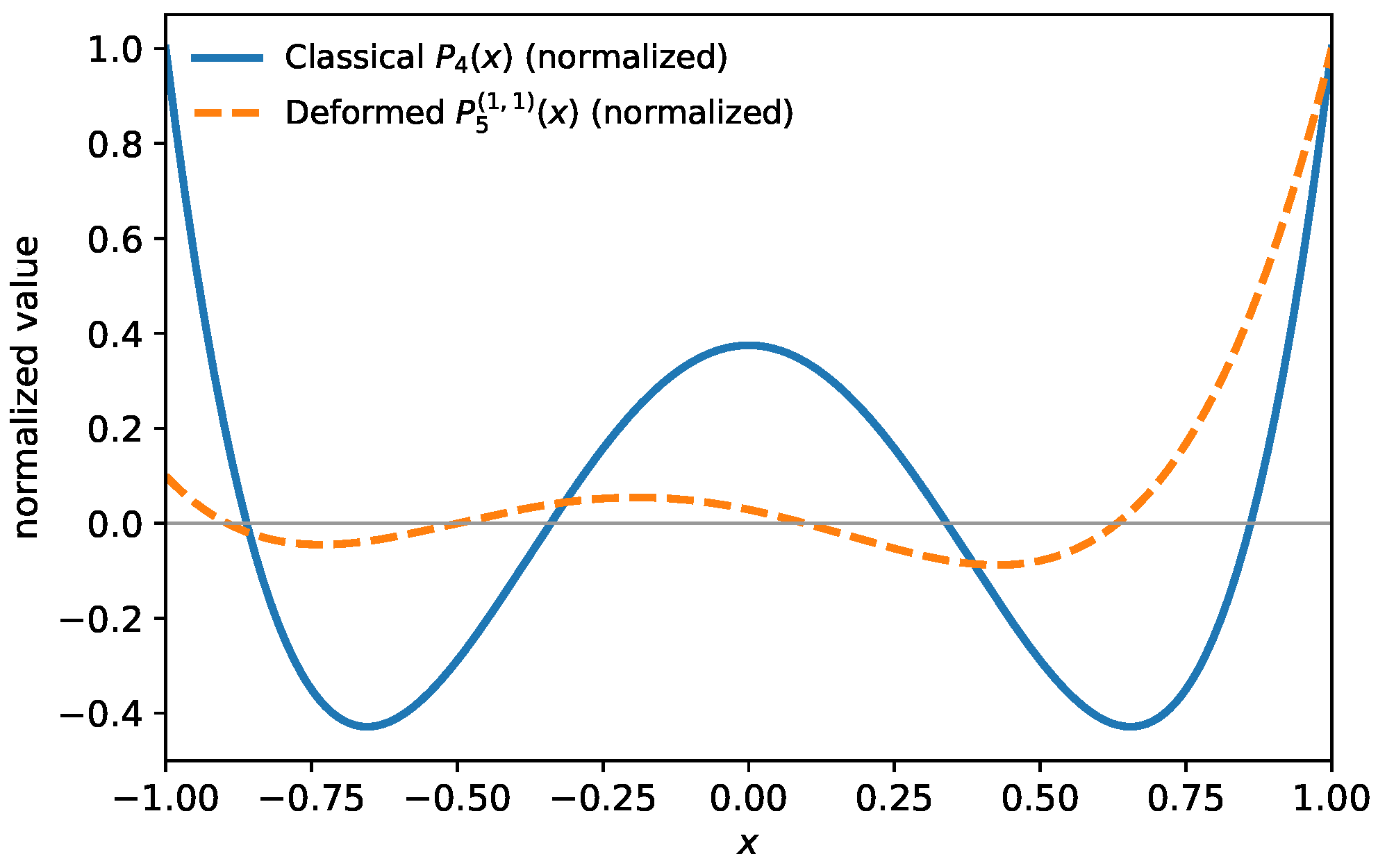
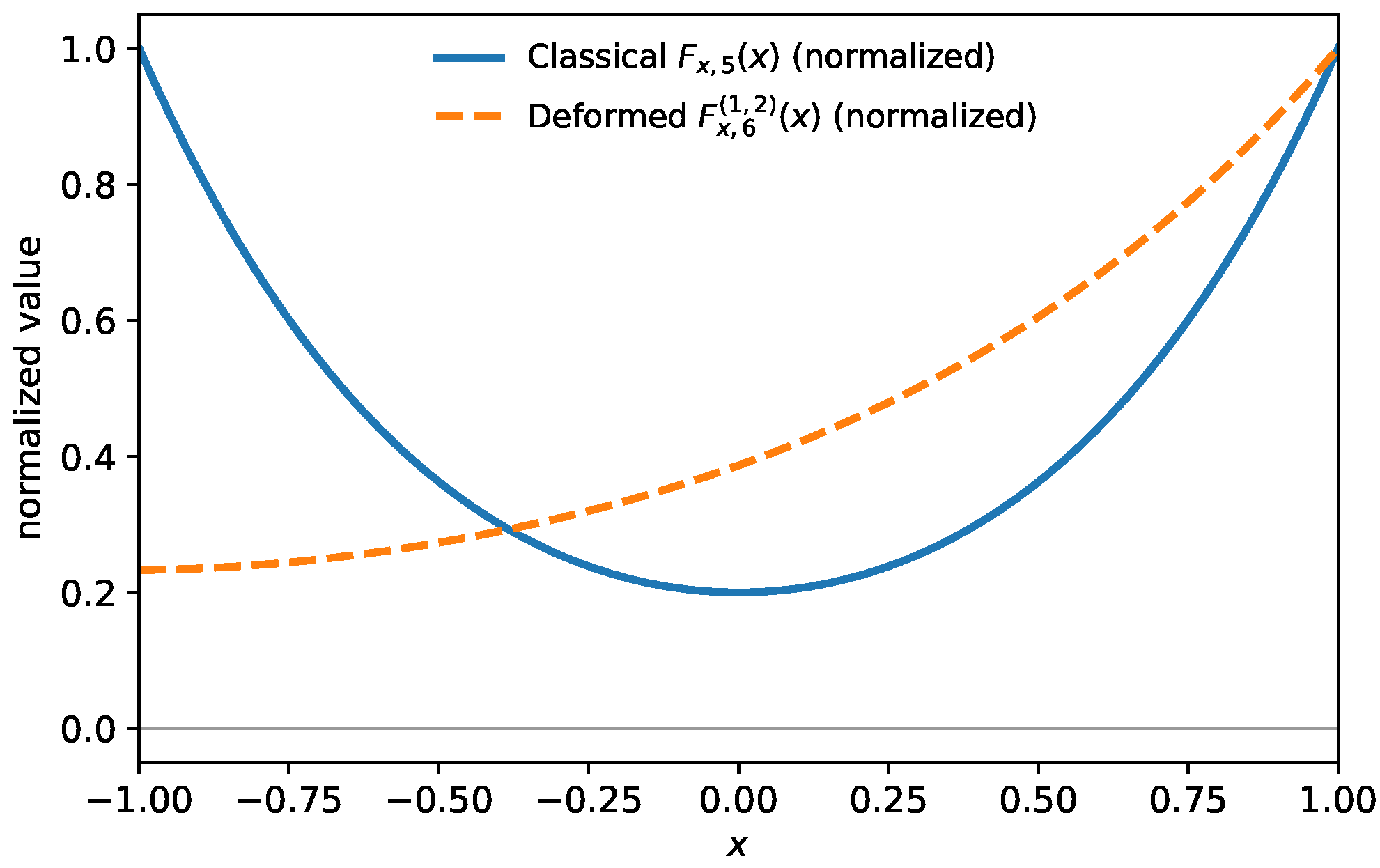
Because the polylogarithm factor Li p ( t ) has no constant term, the deformed coefficients begin one index later than the corresponding undeformed kernels. For visual comparison, it is therefore natural to compare a deformed polynomial with the classical polynomial of the same degree. Figure 1 and Figure 2 follow this convention by comparing P 5 ( 1 , 1 ) ( x ) with P 4 ( x ) and F x , 6 ( 1 , 2 ) ( x ) with F x , 5 ( x ) .
The normalized Legendre comparison in Figure 1 shows that the deformation does more than rescale the amplitude: it also redistributes the oscillation profile, flattening the interior portion of the curve and shifting the dominant growth toward the endpoint x = 1 . Figure 2 shows a complementary effect for the h ( x ) -Fibonacci family with h ( x ) = x : the deformation introduces substantial lower-degree contributions, breaks the even symmetry present in F x , 5 ( x ) , and produces a visibly right-leaning profile. These two plots give a concrete picture of how the polylogarithmic factor alters the classical coefficient arrays.

4.7. Legendre Profiles and Zero Distributions

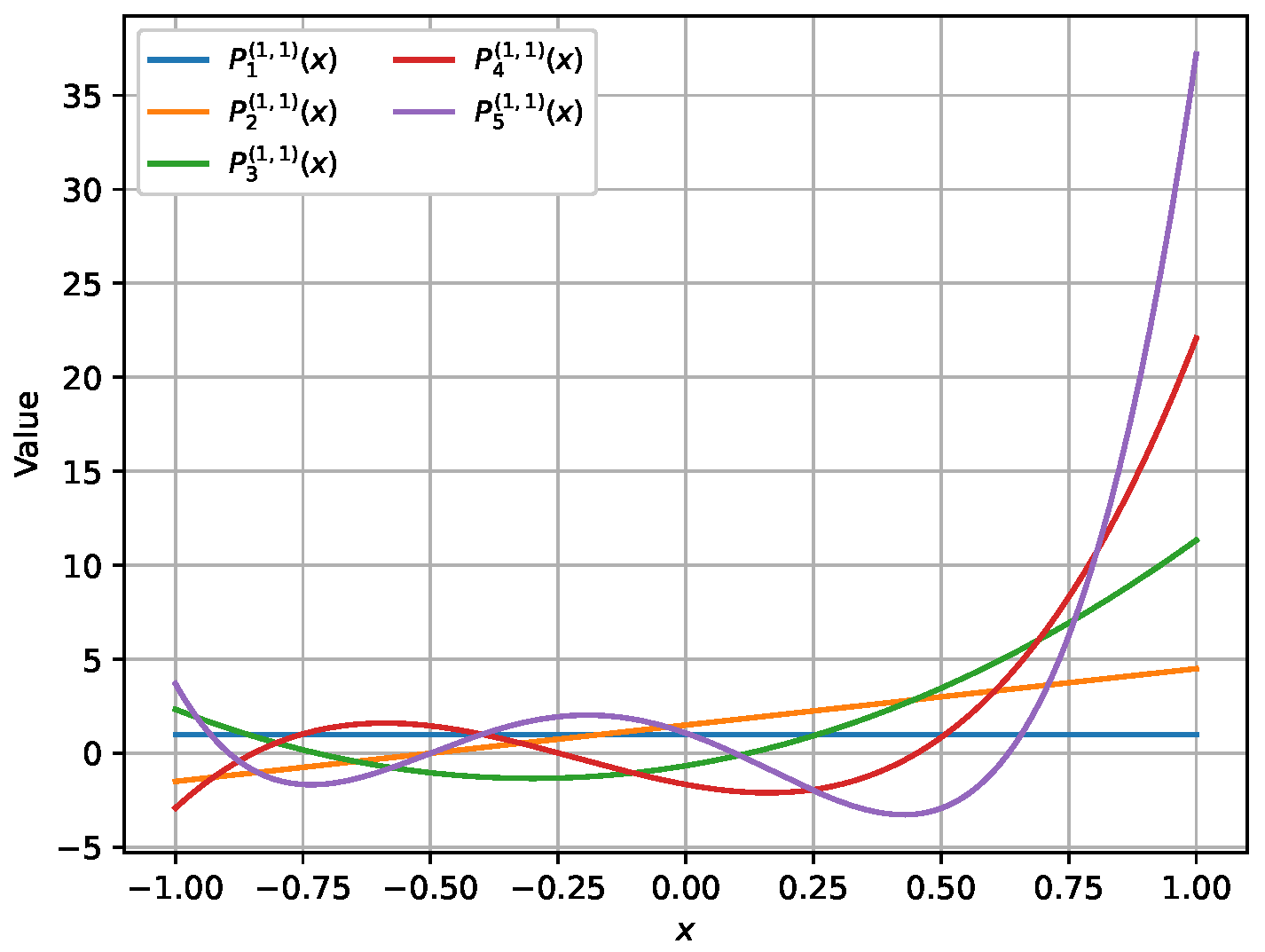
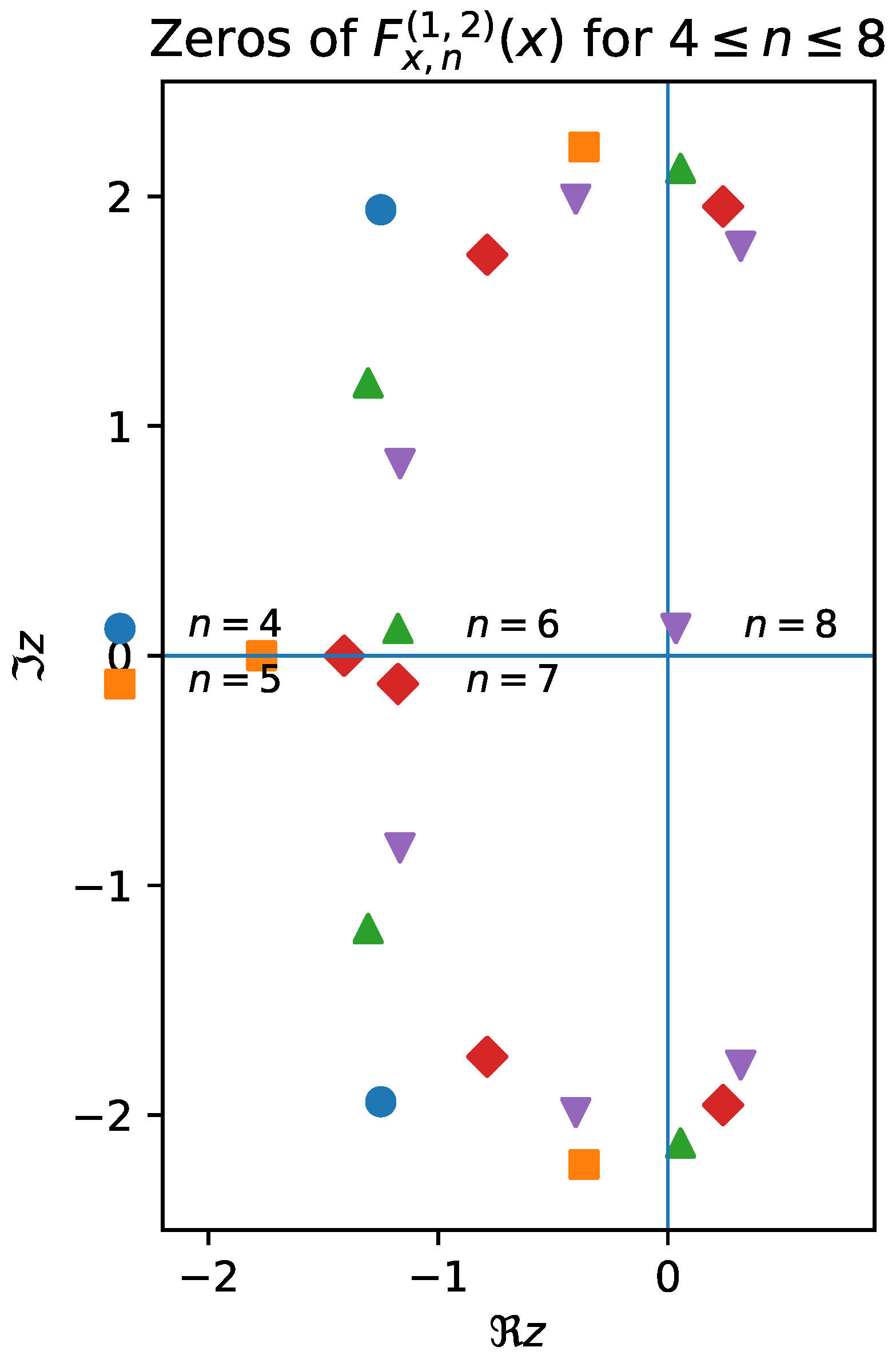
Figure 1 and Figure 2 already show the qualitative effect of the deformation relative to degree-matched classical families. Figure 3 now complements those comparisons by displaying the unnormalized profiles of the Legendre–polylogarithm polynomials P n ( 1 , 1 ) ( x ) for 1 n 5 on [ 1 , 1 ] . To complement these profile plots, Figure 4 presents the zeros of the polynomials F x , n ( 1 , 2 ) ( x ) for 4 n 8 in the complex plane. Since the coefficients are real, the zeros occur in conjugate pairs, and the resulting pattern makes the geometric effect of the polylogarithmic deformation visible. Relative to the classical h ( x ) -Fibonacci polynomials with h ( x ) = x , the weighted family exhibits a more intricate zero geometry, with part of the spectrum leaving the real axis.
The numerical illustrations also clarify the practical range of the constructions. The weighted families are particularly effective when generalized hyperharmonic coefficients are intrinsic to the model, whereas they are less advantageous when one requires the full classical orthogonality theory or works outside the natural region of convergence of the generating functions.

4.8. Orthogonality and Deformation of the Weight

A natural question is whether a shifted Legendre–polylogarithm family can again form an orthogonal system on [ 1 , 1 ] under a suitably deformed weight. Since P n ( p , q ) ( x ) has degree n 1 , it is convenient to set
P ˜ n ( p , q ) ( x ) : = P n + 1 ( p , q ) ( x ) , n 0 .
From (28) and the fact that H 1 ( p , q ) = 1 , the first two members are
P ˜ 0 ( p , q ) ( x ) = 1 , P ˜ 1 ( p , q ) ( x ) = 3 x + H 2 ( p , q ) = 3 x + q + 2 p .
Consequently, the classical Legendre weight is not preserved. For the representative choice ( p , q ) = ( 1 , 1 ) ,
1 1 P ˜ 0 ( 1 , 1 ) ( x ) P ˜ 1 ( 1 , 1 ) ( x ) d x = 1 1 3 x + 3 2 d x = 3 0 ,
so the deformed family is certainly not orthogonal with respect to the undeformed weight w ( x ) = 1 .
More generally, if one seeks a weight w p , q ( x ) for which { P ˜ n ( p , q ) } n 0 is orthogonal, then its moments
μ j ( p , q ) : = 1 1 x j w p , q ( x ) d x
must satisfy the first nontrivial constraint
3 μ 1 ( p , q ) + H 2 ( p , q ) μ 0 ( p , q ) = 0 , that is , μ 1 ( p , q ) = H 2 ( p , q ) 3 μ 0 ( p , q ) .
Thus, if such a weight exists, then it must already deform at the level of its first moment and can no longer retain the classical symmetry μ 1 = 0 . Higher-order orthogonality conditions would impose additional moment constraints involving the full sequence H m ( p , q ) . We therefore regard the determination of an explicit orthogonality measure, both for the present Legendre deformation and for possible future Chebyshev-type deformations, as a natural open problem.

5. Conclusions

We have introduced several polylogarithm-weighted polynomial families generated by the factor Li p ( t ) / ( 1 t ) q , whose coefficients are governed by the generalized hyperharmonic numbers H n ( p , q ) . In the Fibonacci–Lucas setting, this yields the h ( x ) -Fibonacci–polylogarithm and h ( x ) -Lucas–polylogarithm polynomials, together with the unified family P h , n a , b , p , q ( x ) . In the Legendre setting, the same deformation principle leads to Legendre–polylogarithm polynomials and to a related ( q , λ ) -extension. Across these constructions, we derived explicit coefficient expansions, convolution identities, and recurrence relations, and we identified structural features such as parity behavior under symmetry assumptions on h ( x ) .
The examples included in the manuscript show that the deformation is not merely formal. When weighted harmonic or hyperharmonic effects are intrinsic to the problem, the new generating kernels absorb these cumulative weights at the outset and therefore provide a more natural representation than the corresponding unweighted classical families. At the same time, the analysis makes clear that this gain comes with restrictions: the generating functions remain local objects, the kernels inherit their own singular structures, and the Legendre deformation does not preserve classical orthogonality in general.
Several directions remain open. These include related polylogarithm-weighted constructions for other orthogonal or recurrence-based polynomial systems, especially Chebyshev-type analogues; refined analyses of zeros and asymptotic behavior; the orthogonality problem for the shifted Legendre–polylogarithm family under a genuinely deformed weight; and further study of parameter-dependent regimes associated with ( p , q ) and the choice of h ( x ) .
A more speculative direction concerns cryptography. In classical cryptography, recurrence-based pseudorandom sequence families and their complexity profiles are central in the study of stream ciphers [33]. On the quantum side, continuous-variable quantum key distribution relies on continuous-variable models whose security and implementation are strongly shaped by modulation, noise, and parameter-estimation issues [34]. These observations suggest that polylogarithm-weighted recurrences may be worth investigating as analytic testbeds for memory-dependent sequence generation, approximation, or estimation problems in classical and quantum secure-communication settings. At present, however, we regard this as a prospective direction rather than an established application of the present theory.
In this sense, the present work should be viewed as a structured generating-function approach for weighted polynomial deformations rather than as a terminal form of the theory.

Author Contributions

Conceptualization, W.A.K., O.Y. and K.S.M.; methodology, W.A.K., O.Y., K.S.M., A.A. and N.M.; formal analysis, W.A.K., O.Y., K.S.M., A.A. and N.M.; investigation, W.A.K., O.Y., K.S.M., A.A. and N.M.; writing—original draft preparation, W.A.K., O.Y. and K.S.M.; writing—review and editing, W.A.K., O.Y., K.S.M., A.A. and N.M.; supervision, K.S.M. All authors have read and agreed to the published version of the manuscript.

Funding

The researchers would like to thank the Deanship of Graduate Studies and Scientific Research at Qassim University for financial support (QU-APC-2026).

Data Availability Statement

The original contributions presented in this study are included in the article. Further inquiries can be directed to the corresponding author.

Acknowledgments

The authors thank the reviewers and the academic editor for their careful reading and valuable suggestions.

Conflicts of Interest

The authors declare no conflicts of interest.

References

  1. Bateman, H. Higher Transcendental Functions; Erdélyi, A., Ed.; McGraw–Hill: New York, NY, USA, 1955; Volume 3. [Google Scholar]
  2. Kaneko, M. Poly-Bernoulli numbers. J. Théor. Nr. Bordx. 1997, 9, 221–228. [Google Scholar] [CrossRef]
  3. Bayad, A.; Hamahata, Y. Polylogarithms and poly-Bernoulli polynomials. Kyushu J. Math. 2011, 65, 15–24. [Google Scholar] [CrossRef]
  4. Bényi, B.; Matsusaka, T. Combinatorial aspects of poly-Bernoulli polynomials and poly-Euler numbers. J. Théor. Nr. Bordx. 2022, 34, 917–939. [Google Scholar] [CrossRef]
  5. Kaneko, M. Multiple Zeta Values and Poly-Bernoulli Numbers; Tokyo Metropolitan University Seminar Report; 1997. [Google Scholar]
  6. Coppo, M.-A.; Candelpergher, B. The Arakawa–Kaneko zeta function. Ramanujan J. 2010, 22, 153–162. [Google Scholar] [CrossRef]
  7. Young, P.T. Symmetries of Bernoulli polynomial series and Arakawa–Kaneko zeta functions. J. Number Theory 2014, 143, 142–161. [Google Scholar] [CrossRef]
  8. Young, P.T. Bernoulli and poly-Bernoulli polynomial convolutions and identities of p-adic Arakawa–Kaneko zeta functions. Int. J. Number Theory 2016, 12, 1295–1309. [Google Scholar] [CrossRef]
  9. Dil, A. On the hyperharmonic function. Süleyman Demirel Univ. J. Nat. Appl. Sci. 2019, 23, 187–193. [Google Scholar] [CrossRef]
  10. Dil, A.; Boyadzhiev, K.N. Euler sums of hyperharmonic numbers. J. Number Theory 2015, 147, 490–498. [Google Scholar] [CrossRef]
  11. Dil, A.; Mező, I.; Cenkci, M. Evaluation of Euler-like sums via Hurwitz zeta values. Turk. J. Math. 2017, 41, 1640–1655. [Google Scholar] [CrossRef]
  12. Dil, A.; Boyadzhiev, K.N.; Aliev, I.A. On values of the Riemann zeta function at positive integers. Lith. Math. J. 2020, 60, 9–24. [Google Scholar] [CrossRef]
  13. Xu, C.; Yan, Y.; Shi, Z. Euler sums and integrals of polylogarithm functions. J. Number Theory 2016, 165, 84–108. [Google Scholar] [CrossRef]
  14. Coppo, M.-A.; Candelpergher, B. On some formulae related to Euler sums. Lith. Math. J. 2023, 63, 31–43. [Google Scholar] [CrossRef]
  15. Kargın, L.; Can, M. Harmonic number identities via polynomials with r-Lah coefficients. Comptes Rendus. Math. 2020, 358, 535–550. [Google Scholar] [CrossRef]
  16. Kargın, L.; Cenkci, M.; Dil, A.; Can, M. Generalized harmonic numbers via poly-Bernoulli polynomials. arXiv 2021, arXiv:2008.00284v2. [Google Scholar] [CrossRef]
  17. Graham, R.L.; Knuth, D.E.; Patashnik, O. Concrete Mathematics: A Foundation for Computer Science, 2nd ed.; Addison–Wesley: Reading, MA, USA, 1994. [Google Scholar]
  18. Can, M.; Kargın, L.; Dil, A.; Soylu, G. Euler sums of generalized harmonic numbers and connected extensions. Appl. Anal. Discret. Math. 2023, 17, 401–417. [Google Scholar] [CrossRef]
  19. Koparal, S.; Ömür, N.; Duran, Ö. On identities involving generalized harmonic, hyperharmonic and special numbers with Riordan arrays. Spec. Matrices 2021, 9, 22–30. [Google Scholar] [CrossRef]
  20. Koparal, S.; Ömür, N.; Elkhiri, L. On generalized hyperharmonic numbers of order r, H n , m r (σ). Notes Number Theory Discret. Math. 2023, 29, 804–812. [Google Scholar] [CrossRef]
  21. Chen, Z.; Ömür, N.; Koparal, S.; Khan, W.A. Some identities with multi-generalized q-hyperharmonic numbers of order r. Symmetry 2023, 15, 917. [Google Scholar] [CrossRef]
  22. Manulat, K.V.M.; Corcino, R.B. Generalized hyperharmonic sum via Euler’s transform. Eur. J. Pure Appl. Math. 2025, 18, 6191. [Google Scholar] [CrossRef]
  23. Altuntaş, Ç.; Göral, H.; Sertbaş, D.C. The difference of hyperharmonic numbers via geometric and analytic methods. J. Korean Math. Soc. 2022, 59, 1103–1137. [Google Scholar] [CrossRef]
  24. Sertbaş, D.C. Hyperharmonic integers exist. Comptes Rendus. Math. 2020, 358, 1179–1185. [Google Scholar] [CrossRef]
  25. Conway, J.H.; Guy, R.K. The Book of Numbers; Springer: New York, NY, USA, 1996. [Google Scholar] [CrossRef]
  26. Nalli, A.; Haukkanen, P. On generalized Fibonacci and Lucas polynomials. Chaos Solitons Fractals 2009, 42, 3179–3186. [Google Scholar] [CrossRef]
  27. Prasad, B. On h(x) Lucas p-polynomials. Appl. Math. E-Notes 2024, 24, 477–485. Available online: https://www.math.nthu.edu.tw/~amen/2024/AMEN-A231029.pdf (accessed on 10 January 2026).
  28. Mersin, E.Ö. Hyper-Fibonacci and hyper-Lucas polynomials. Turk. J. Math. Comput. Sci. 2023, 15, 63–70. [Google Scholar] [CrossRef]
  29. Zhang, C.; Khan, W.A.; Kızılateş, C. On (p, q)-Fibonacci and (p, q)-Lucas polynomials associated with Changhee numbers and their properties. Symmetry 2023, 15, 851. [Google Scholar] [CrossRef]
  30. Ait-Amrane, N.R.; Belbachir, H.; Tan, E. On generalized Fibonacci and Lucas hybrid polynomials. Turk. J. Math. 2022, 46, 2069–2077. [Google Scholar] [CrossRef]
  31. Abd-Elhameed, W.M.; Alqubori, O.M. New expressions for certain polynomials combining Fibonacci and Lucas polynomials. AIMS Math. 2025, 10, 2930–2957. [Google Scholar] [CrossRef]
  32. Olver, F.W.J.; Daalhuis, A.B.O.; Lozier, D.W.; Schneider, B.I.; Boisvert, R.F.; Clark, C.W.; Miller, B.R.; Saunders, B.V.; Cohl, H.S.; McClain, M.A. (Eds.) NIST Digital Library of Mathematical Functions. Release 1.2.5 of 2025-12-15. Available online: https://data.nist.gov/od/id/FDB59097469F5200E043065706813E54167 (accessed on 10 January 2026).
  33. Li, C. A survey on complexity measures for pseudo-random sequences. Cryptography 2024, 8, 25. [Google Scholar] [CrossRef]
  34. Zhang, Y.; Bian, Y.; Li, Z.; Yu, S.; Guo, H. Continuous-variable quantum key distribution system: Past, present, and future. Appl. Phys. Rev. 2024, 11, 011318. [Google Scholar] [CrossRef]
Figure 1. Degree-matched comparison between the normalized classical Legendre polynomial P 4 ( x ) and the normalized Legendre–polylogarithm polynomial P 5 ( 1 , 1 ) ( x ) on [ 1 , 1 ] . The polylogarithmic deformation preserves the relation deg P n + 1 ( p , q ) = deg P n while altering the oscillation profile and endpoint behavior.
Symmetry 18 00748 g001
Figure 2. Degree-matched comparison between the normalized classical h ( x ) -Fibonacci polynomial F x , 5 ( x ) and the normalized h ( x ) -Fibonacci–polylogarithm polynomial F x , 6 ( 1 , 2 ) ( x ) on [ 1 , 1 ] for h ( x ) = x . The generalized hyperharmonic convolution introduces lower-degree contributions and produces an asymmetric, right-leaning profile.
Symmetry 18 00748 g002
Figure 3. Profiles of the Legendre–polylogarithm polynomials P n ( 1 , 1 ) ( x ) for 1 n 5 on [ 1 , 1 ] . The family illustrates the progressive change in shape and amplitude induced by the polylogarithmic deformation.
Symmetry 18 00748 g003
Figure 4. Zeros F x , n ( 1 , 2 ) ( x ) for 4 n 8 in the complex plane, with h ( x ) = x . The markers indicate the polynomial order: circles for n = 4 , squares for n = 5 , upward triangles for n = 6 , diamonds for n = 7 , and downward triangles for n = 8 . The roots occur in complex-conjugate pairs, and part of the spectrum departs from the real axis under the polylogarithmic deformation.
Symmetry 18 00748 g004
Table 1. Numerical values of F h , n ( 1 , 2 ) ( x ) for h ( x ) = x at selected x.
n x = 0 x = 0.5 x = 1 x = 1.5 x = 2
2 1.000000 1.000000 1.000000 1.000000 1.000000
3 2.500000 3.000000 3.500000 4.000000 4.500000
4 5.333333 6.833333 8.833333 11.333333 14.333333
5 8.916667 12.833333 18.750000 27.416667 39.583333
6 14.033333 21.950000 36.283333 61.158333 102.200000
Disclaimer/Publisher’s Note: The statements, opinions and data contained in all publications are solely those of the individual author(s) and contributor(s) and not of MDPI and/or the editor(s). MDPI and/or the editor(s) disclaim responsibility for any injury to people or property resulting from any ideas, methods, instructions or products referred to in the content.