Article

Investigation of Self-Disproportionation of Enantiomers via Column Chromatography (SDEvCC) Using 3-(ortho-Substituted-phenyl)quinazolin-4-one Derivatives


1
Chemistry and Materials Program, College of Engineering, Shibaura Institute of Technology, 3-7-5 Toyosu, Kohto-ku, Tokyo 135-8548, Japan
2
Institute of Chemistry, Jan Kochanowski University in Kielce, Uniwersytecka 7, 25-406 Kielce, Poland
3
Department of Organic Chemistry I, Faculty of Chemistry, University of the Basque Country UPV/EHU, Paseo Manuel Lardizábal 3, 20018 San Sebastián, Spain
4
IKERBASQUE, Basque Foundation for Science, Maria Diaz de Haro 3, 48013 Bilbao, Spain
*
Author to whom correspondence should be addressed.
Symmetry 2026, 18(4), 699; https://doi.org/10.3390/sym18040699
Submission received: 18 March 2026 / Revised: 15 April 2026 / Accepted: 16 April 2026 / Published: 21 April 2026
(This article belongs to the Section Chemistry: Symmetry/Asymmetry)

Abstract

In this study, the applicability of achiral column chromatography—including both medium-pressure liquid chromatography (MPLC) and classical gravity-driven techniques—was evaluated as a laboratory method for enantiomeric enrichment of scalemic (non-racemic) samples of axially chiral compounds. As model substrates, 3-(ortho-substituted-phenyl)quinazolin-4-one derivatives were employed. The results confirmed that self-disproportionation of enantiomers (SDE), occurring during column chromatography (SDEvCC), enabled the efficient isolation of enantiomerically pure fractions, with MPLC demonstrating particularly high effectiveness. Additionally, the parameters governing gravity-driven column chromatography were systematically optimized, with particular attention to variables such as eluent type and concentration, stationary phase composition, sample preparation protocol, and solvent purity. Furthermore, leveraging known crystallographic data and quantum chemical calculations based on Density Functional Theory (DFT), a molecular association mechanism was proposed to elucidate the physicochemical basis of the SDE phenomenon.

1. Introduction

The synthesis of enantiomerically pure compounds remains a fundamental challenge in contemporary organic chemistry [1,2,3,4,5,6,7,8,9,10]. The optical purity of chiral compounds holds particular significance in pharmacology, as individual enantiomers may exhibit markedly different pharmacological activities [11]. The thalidomide tragedy remains the most striking example underscoring the critical importance of optical purity in bioactive substances [12]. This concept is equally applicable to axially chiral compounds (atropisomers) [13,14]. Despite significant advances in asymmetric synthesis and the development of efficient methods for racemate resolution, the need persists for practical strategies to enrich enantiomeric excess in scalemic (non-racemic) mixtures [15,16,17,18,19,20,21].
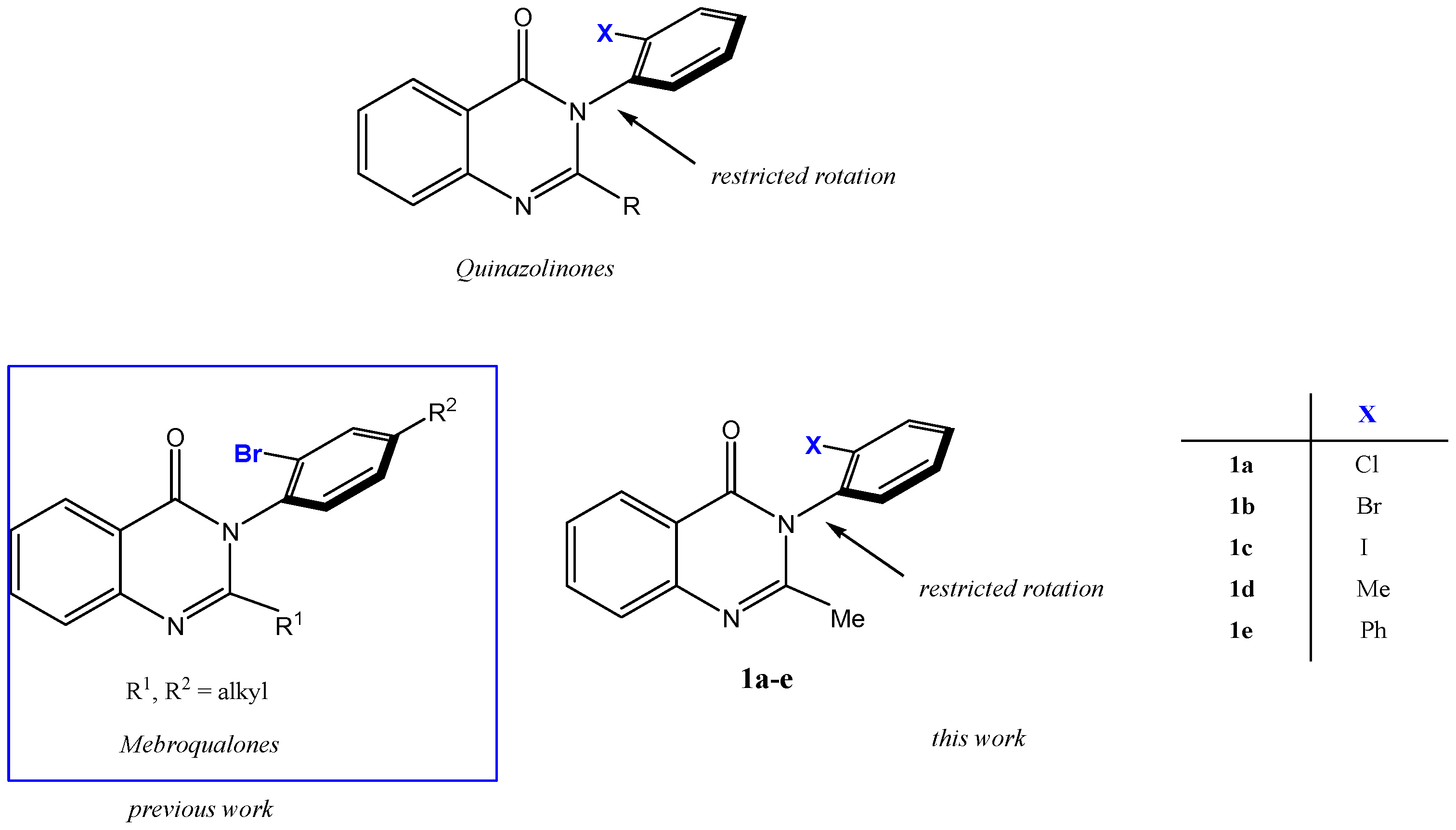
A representative example involves the asymmetric synthesis of 3-(ortho-substituted-phenyl)quinazolin-4-one derivatives [22,23]. These compounds are axially chiral due to restricted rotation around the nitrogen–carbon bond (C–N atropoisomers), and their synthesis is particularly attractive owing to their pharmacological potential [13,24,25,26]. Many members of this class exhibit hypnotic, sedative, and ataractic (tranquilizing) effects, primarily through activity as GABA receptor agonists [13]. Two C–N atropisomers may also differ in their biological activity. For example, the (P)-atropisomer of 3-(2-hydroxyphenyl)quinazolin-4-one exhibits stronger anti-MRSA activity than its (M)-atropisomer [13,27].
The asymmetric synthesis of 3-(ortho-substituted-phenyl)quinazolin-4-one derivatives rarely affords enantiomerically pure products; typical enantiomeric excess values range from 30% to 99%, depending on the nature of the substituents [23].
As demonstrated in previous studies, an effective approach for enantiomeric enrichment involves medium-pressure liquid chromatography (MPLC) under achiral conditions, facilitated by the phenomenon of self-disproportionation of enantiomers (SDE) [23,28].
Self-disproportionation of enantiomers (SDE) refers to the partitioning of a scalemic mixture of a chiral compound into fractions with differing enantiomeric composition, occurring in the absence of any external chiral influence [29]. This phenomenon has been observed during column chromatography [30,31,32,33] as well as in various physicochemical processes [34,35,36,37]. In the present study, we demonstrate that conventional achiral column chromatography can be effectively employed for the enantiomeric enrichment of chiral compounds present in scalemic form.

2. Results and Discussion

SDE of Quinazolinone Derivatives 1a-e via Column Chromatography

The first systematic studies on the self-disproportionation of enantiomers (SDE) for this class of chiral compounds were carried out on a series of mebroqualone derivatives bearing a bromine atom in the ortho position of the phenyl ring (Figure 1) [28].
As a continuation of our investigation into the SDE behavior of axially chiral quinazolinone derivatives, we now report the results of SDE studies on analogs featuring halogen substituents—specifically, chloro 1a and iodo 1c groups—in the ortho position of the phenyl ring, along with structurally related analogs bearing methyl 1d and phenyl 1e substituents (Figure 1). This set of compounds was selected to directly assess how substituent size and electronic character influence the magnitude and detectability of SDE effects. For comparison, Table 1 includes mebroqualone 1b, enabling a controlled evaluation of substituent-dependent trends [28].
Quinazolinone derivatives 1ae exhibit high configurational stability. The calculated rotational barrier for mebroqualone 1b, bearing an ortho-bromine atom, is approximately 35 kcal/mol. Quinazolines bearing sterically less demanding ortho-substituents, such as mecloqualone 1a and methaqualone 1d, which contain an ortho-chlorine atom and an ortho-methyl group, respectively, also exhibit substantial rotational stability (barrier ≈ 31.5 kcal/mol; racemization half-life at 298 K on the order of several decades). The other quinazolinones, 1c, and 1e, which contain bulkier ortho-substituents than 1a and 1d, are expected to exhibit even higher rotational barriers [38]. Therefore, N–Ar bond rotation in quinazolinones 1ae is not expected to occur under the SDE conditions.
In the initial phase of our study, column chromatography under MPLC conditions was carried out using derivatives 1ae. For each run, the polarity of the eluent was adjusted to yield a comparable retention time of approximately one hour. As summarized in Table 1, all compounds 1ae demonstrated a pronounced self-disproportionation of enantiomers (SDE) effect. In each case, a distinct boundary was observed on the chromatograms. Subsequent analysis of the collected fractions using a chiral column revealed that the first-eluted (less polar) fraction was enriched in the enantiopure form of the respective compound, while the later-eluted (more polar) fraction exhibited a more racemic composition.
As previously emphasized in our earlier studies [28] MPLC chromatography proves to be a practical and effective method for enantiomeric enrichment of this class of compounds. Notably, the lowest yields of the enantiomerically enriched fractions were observed for derivatives bearing the smallest ortho substituents on the phenyl ring—namely, methyl 1d and chloro 1a groups. In contrast, derivatives featuring bulkier substituents such as iodo 1c or phenyl 1e exhibited the highest SDE yields.
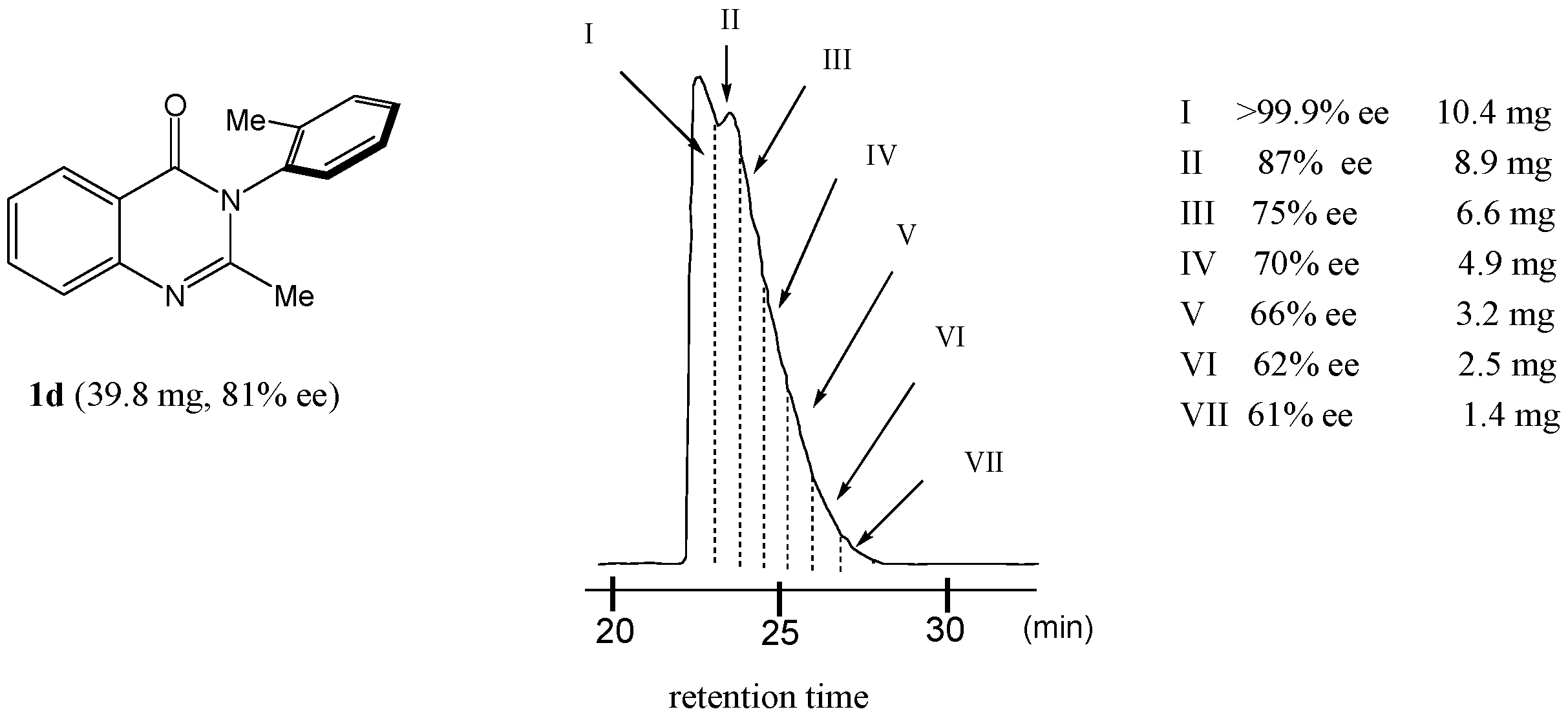
In a subsequent MPLC experiment involving methaqualone 1d (81% ee), a detailed analysis was conducted on the composition of the enantiomerically depleted peak. As illustrated in Figure 2, the distribution of enantiomers varied across the collected fractions throughout the elution. The enantiomeric excess gradually declined during the process, reaching a minimum of 61% ee.
In the next phase of this study, the SDE behavior of compounds bearing both a methyl and a phenyl group in the ortho position—specifically, compounds 1d and 1e—was examined via gravity-driven column chromatography. Building on our previous investigations involving compound 1b, which contains an ortho-bromophenyl substituent, and its structural analogs, we explored the influence of several parameters on the elution profile and, consequently, on the course of the SDE process. The factors evaluated included the type of eluent, the compound concentration (defined as 1 mmol per gram of stationary phase), and the nature of the stationary phase [39,40,41,42,43,44,45,46,47].
The initial chromatographic conditions for runs with derivative 1d employed a compound concentration of 1 mmol per 30 g of silica gel as the stationary phase. The sample was introduced into the chromatography column as a solution in dichloromethane. For consistency, all runs utilized samples of compound 1d with identical enantiomeric excess (ee) values. The polarity of the eluents was adjusted to maintain a uniform retention factor (Rf) of approximately 0.2 on TLC, and the volume of collected fractions was standardized across all runs.
According to the data in Table 2 (runs 1–5), compound 1d exhibited a pronounced self-disproportionation of enantiomers (SDE) under gravity-driven column chromatography. As observed under MPLC conditions, the enantiomerically enriched fraction was less polar and eluted first, suggesting that the mode of molecular association remained consistent across all solvent systems tested. Eluents containing tert-butyl methyl ether (runs 3 and 4) yielded the highest enantiomeric excess in the first-eluted fraction, exceeding 99% ee. A similarly effective eluent was the CH2Cl2–EtOAc mixture (100:1) used in run 5, which produced the largest Δee value of 47%.
The influence of compound concentration on the SDE process was investigated by increasing the silica gel loading from 30 g to 40 g per 1 mmol of compound. The two eluents that previously demonstrated the most pronounced SDE effects—CH2Cl2–EtOAc (100:1) and c-hexane–MTBE (2:1)—were selected for this study. Consistent with our earlier findings on related compounds, a higher amount of stationary phase enhanced the manifestation of the SDE effect. However, this adjustment also led to longer experimental durations and increased solvent consumption (runs 6 and 7). Nevertheless, the implementation of automation and solvent recycling strategies could help capitalize on the exceptional efficiency of this enantiomer purification protocol. Such measures would mitigate the increased resource demands associated with larger-scale SDE processes, making the approach more sustainable and amenable to routine application.
In run 9, the effect of the stationary phase on the SDE process was examined by substituting silica gel with aluminum oxide (Neutral, grade I) while maintaining all other parameters identical to those in run 7—specifically, the eluent CH2Cl2–EtOAc (100:1) and a compound concentration of 1 mmol per 40 g of stationary phase. This modification led to a reduction in the efficiency of the SDE process. Nevertheless, the retention of the same elution order suggests that the underlying mode of molecular association remained unchanged. In run 10, decreasing the compound concentration and doubling the amount of aluminum oxide—analogous to the approach used with silica gel—resulted in a marked enhancement of the SDE effect.
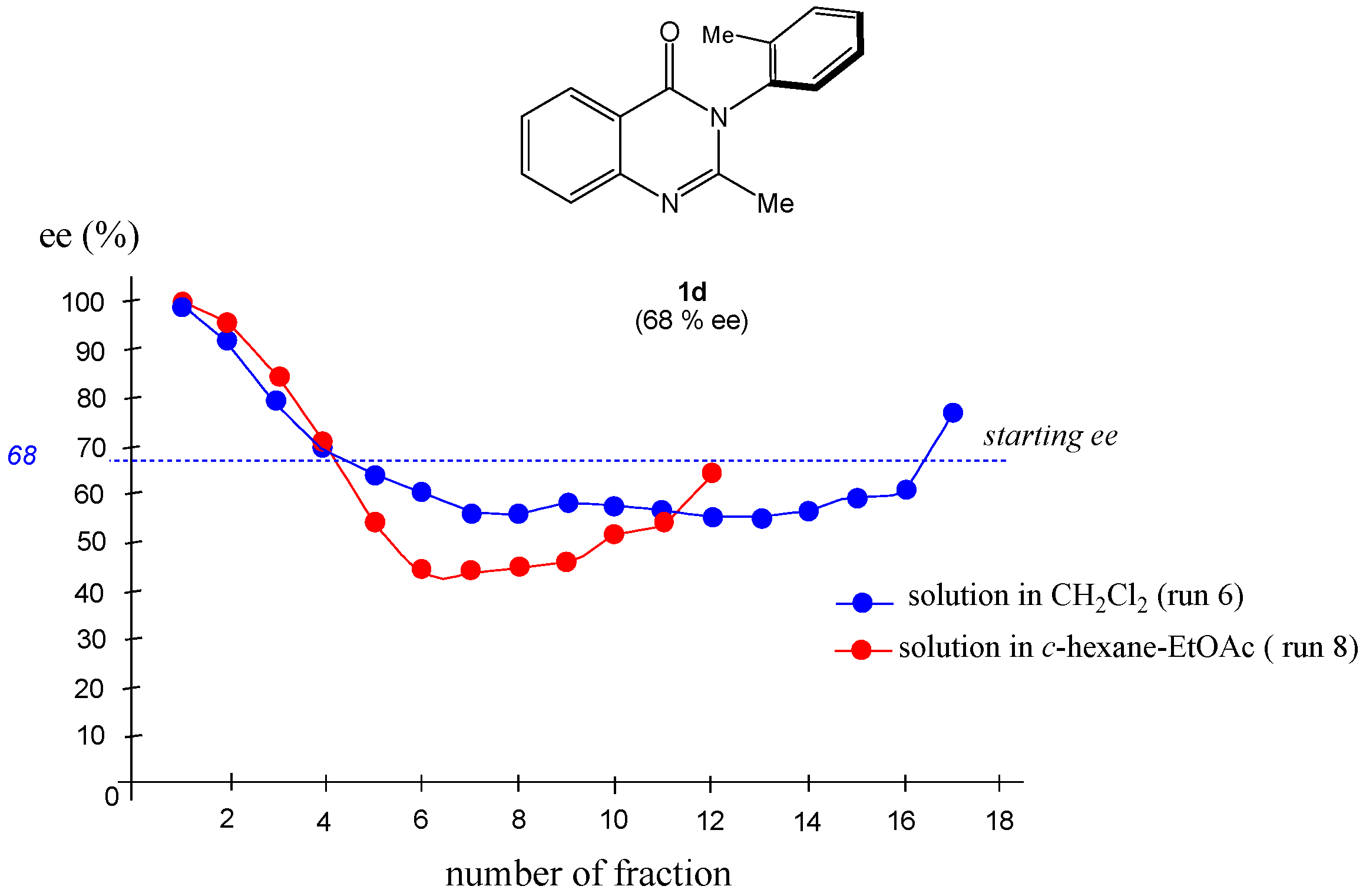
In the next phase of this study, the impact of sample preparation method on column loading, elution behavior, and SDE efficiency was evaluated. In previous runs, the sample was consistently introduced into the column as a solution in CH2Cl2, using a fixed volume, followed by rinsing the flask with an equal volume of eluent to ensure reproducibility across runs. The use of CH2Cl2 helped circumvent solubility issues commonly encountered with the compounds. To assess the effect of modifying this protocol, a chromatographic run was conducted under the same conditions as run 6, with one key change: the solution of compound 1d—identical in mass and enantiomeric excess—was prepared using an equal volume of eluent instead of CH2Cl2 (run 8). A comparative analysis of the elution profiles from both runs is presented in Figure 3.
As demonstrated, both the sample preparation method and the choice of solvent exert a significant influence on the self-disproportionation of enantiomers (SDE) process. When the compound is loaded as a solution in CH2Cl2, elution takes longer and the total volume of collected fractions increases by approximately 40%. However, this does not necessarily correlate with greater SDE efficiency. In fact, the Δee value—an indicator of SDE effectiveness—is higher when the compound is introduced as a solution in the eluent itself. Furthermore, this alternative approach offers practical advantages, yielding a more time-efficient and solvent-conserving purification protocol.
A pronounced SDE effect under gravity-driven column chromatography was also observed for the ortho-phenyl analogue, compound 1e (Table 3).
In the investigation of compound 1e, the chromatographic conditions previously identified as optimal for promoting SDE in compound 1d were applied. Specifically, a concentration of 1 mmol per 40 g of silica gel was used as the stationary phase, with c-hexane–MTBE (2:1) and CH2Cl2 serving as eluents. Under these conditions, compound 1e exhibited a pronounced SDE effect. As with compound 1d, the elution order remained unchanged, suggesting that the molecular association mode of 1e was analogous to that of its para-substituted counterpart.
To assess the reproducibility of results, an additional run was conducted to examine the influence of solvent purity on the elution behavior of compound 1e using CH2Cl2 of two different grades: pure (run 13) and analytical grade (run 14). As shown in Table 3, TLC analysis revealed a lower retention factor for the analytical-grade solvent. Under these conditions, the elution process was markedly prolonged, yet it yielded a significantly larger amount of the enantiomerically pure fraction (>99% ee)—specifically, 11.5 mg (9.47% by mass), corresponding to an SDE yield of 14.8%. In contrast, the use of pure-grade CH2Cl2 resulted in a shorter elution time but a substantially lower yield of the enantiopure fraction, amounting to only 1.28% by mass. Notably, the Δee value was also higher in run 14, indicating that the analytical-grade solvent more effectively promoted the SDE process. These findings carry both practical significance and a cautionary message. It is entirely plausible that polar impurities present in solvents can disrupt the delicate intermolecular interactions responsible for the SDE process. This underscores the importance for all practitioners investigating SDE phenomena to ensure the use of solvents with rigorously controlled purity. In light of these observations, it may be justified to propose a dedicated solvent classification—such as “SDE-grade purity”—to standardize and safeguard the reproducibility of enantiomer separation protocols.
A comparative analysis of the SDE behavior of compounds 1d and 1e—bearing a methyl and a bulky phenyl group, respectively, in the ortho position of the phenyl substituent—reveals that the presence of a larger substituent enhances the SDE effect and improves the efficiency of enantiomeric enrichment. While MPLC offers superior performance in terms of resolution and throughput, gravity-driven column chromatography remains a viable and effective alternative for isolating enantiomerically pure fractions in small quantities. Importantly, this method is broadly accessible, requiring no specialized instrumentation, and thus suitable for routine use in standard laboratory settings.

3. Physicochemical Basis of Self-Disproportionation of Enantiomers (SDE) in Axially Chiral Quinazolinone Derivatives

The self-disproportionation of enantiomers (SDE) observed in solutions of chiral, scalemic compounds under chromatographic conditions is driven by the formation of homo- and heterochiral supramolecular assemblies. These assemblies arise from intermolecular interactions that differ in stability and chromatographic behavior depending on their chiral composition. Molecular modeling and crystallographic analysis—applied to both racemic and enantiopure crystals—serve as powerful tools for elucidating the nature of these interactions, revealing the types of non-covalent forces involved and their preferential association, whether homochiral or heterochiral.
Structural analysis of 3-(ortho-halo-phenyl)quinazolin-4-one derivatives 1ac suggests that these compounds can engage in halogen bonding, specifically between the carbonyl oxygen atom of one molecule and the halogen atom of another. Additionally, quinazolinone derivatives may be viewed as a distinct class of amides, with the potential to participate in strong dipolar interactions via the amide bond, further contributing to supramolecular association.
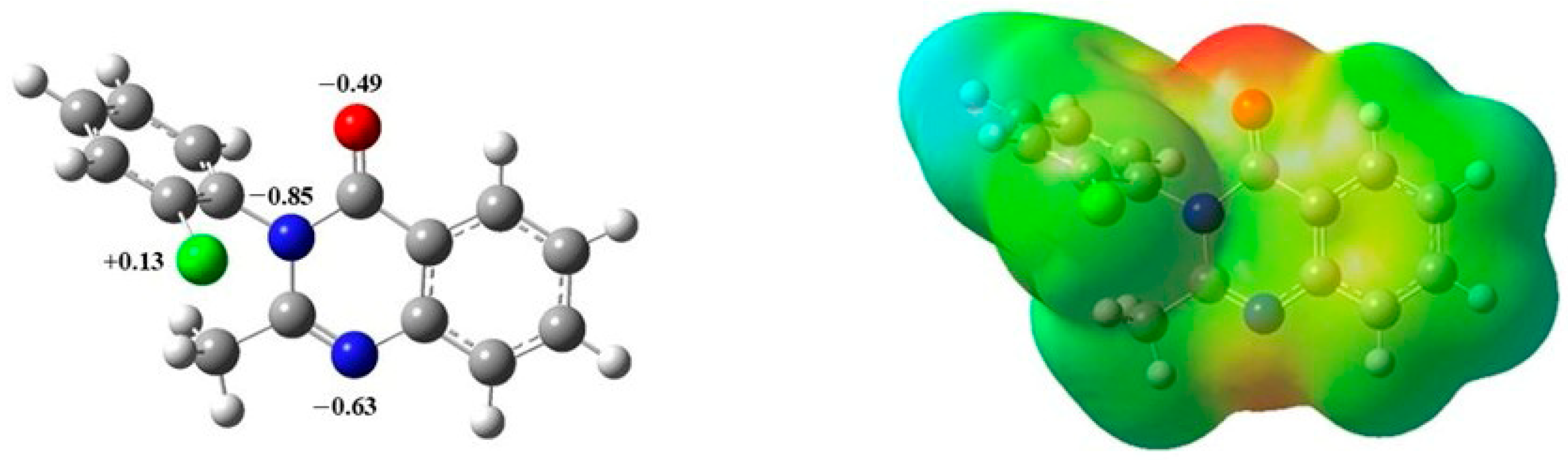
Quantum mechanical calculations using the DFT method [48] for monomer 1a support the predominance of halogen bonding. The results indicate a significant excess negative charge (−0.49 e) localized on the carbonyl oxygen atom and a partial positive charge (+0.13 e) on the chlorine atom, while both nitrogen atoms also carry negative charges. These charge distributions are consistent with the formation of directional halogen bonds, as illustrated in Figure 4.
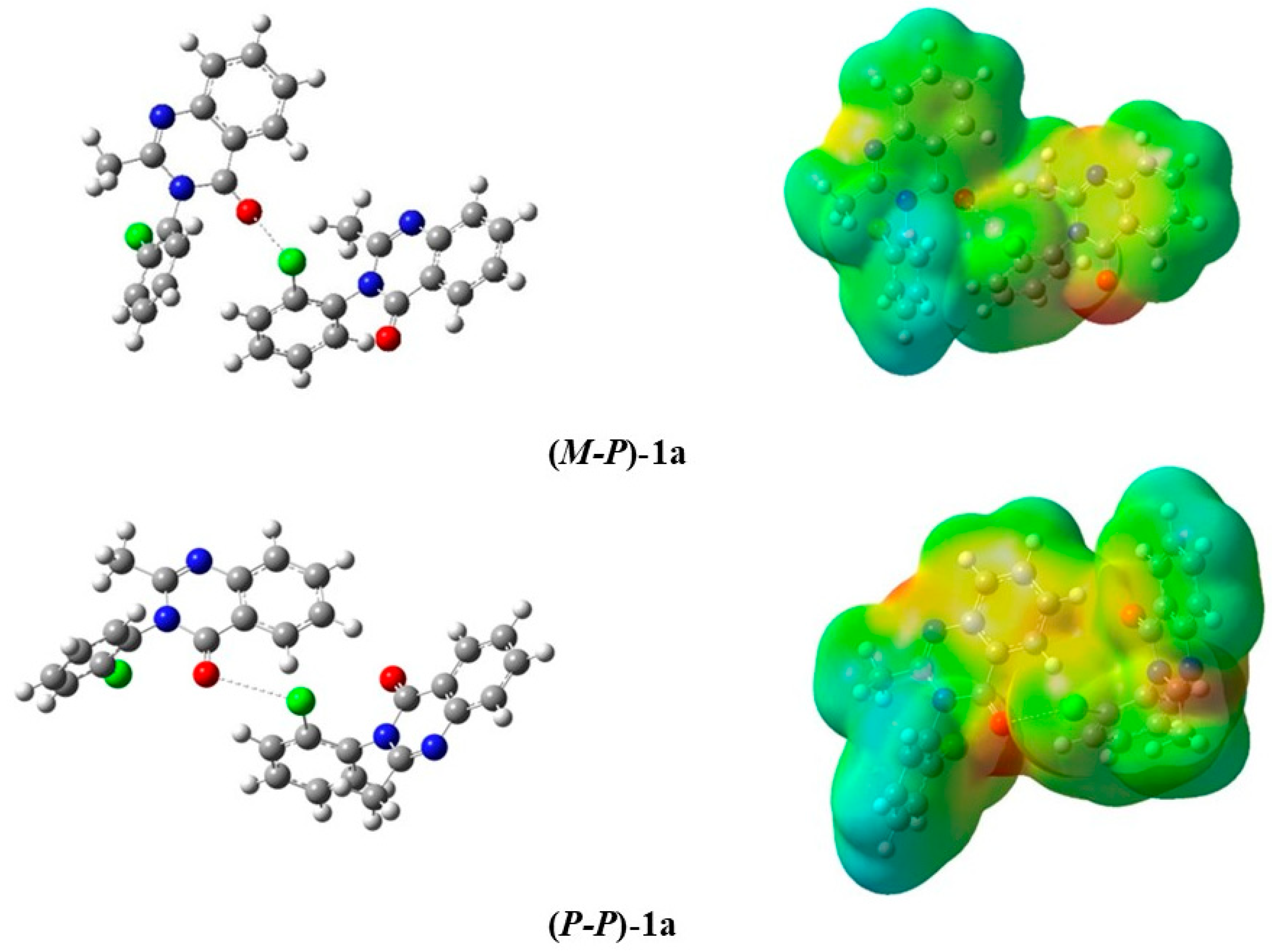
Molecular modeling of dimers composed of heterochiral (MP) and homochiral (PP) molecules revealed distinct differences in halogen bond lengths (Figure 5). In the heterochiral dimer, the O–Cl halogen bond measures 3.251 Å, which is notably shorter than the corresponding bond in the homochiral dimer (3.756 Å). Interestingly, despite the shorter bond length, the energy of the heterochiral dimer is higher by +4.61 kcal/mol relative to the homochiral counterpart. These findings suggest that the halogen bond in the heterochiral assembly is more energetically demanding, potentially reflecting a less favorable overall stabilization. Nonetheless, quantum chemical calculations using the DFT method support the feasibility of forming both heterochiral and homochiral dimers in 3-(ortho-halo-phenyl)quinazolin-4-one derivatives 1ac.
Further quantum chemical calculations, including Natural Bond Orbital (NBO) analysis performed with Gaussian 09, demonstrated that the association process involves not only halogen bonding but also additional intermolecular interactions. The NBO second-order perturbation analysis indicates that the dimers are stabilized predominantly by halogen bonding involving σ(C–Cl) acceptor orbitals, strong π π interactions, and donor–acceptor charge transfer from nitrogen lone pairs into the antibonding π* orbitals of the adjacent monomer. Additional stabilization arises from CH···π contacts.
Theoretical calculations using the DFT method align well with crystallographic data obtained from both racemic and enantiomerically pure crystals of compounds 1ac [28,49]. For compound 1a, halogen bonding is observed in the racemic crystal, where it connects heterochiral molecules to form an infinite heterochiral chain of the type (–PMPM–)ₙ. The bond length measured in the crystal structure is 3.208 Å, closely matching the value predicted for the heterochiral dimer by DFT calculations (3.251 Å). In contrast, halogen bonding is absent in the enantiomerically pure crystal of compound 1a. A similar supramolecular arrangement involving halogen bonds was also identified in the racemic crystal of derivative 1b [28].
To elucidate the nature of the intermolecular contacts within the crystal lattice, a Hirshfeld surface analysis was performed for both the racemic and the enantiomerically pure crystals 1a (Table 4) [50]. Regions of negative d norm values (visualized as red areas) correspond to contacts shorter than the sum of the van der Waals radii, indicating the most significant intermolecular interactions stabilizing the lattice. Both molecules exhibit such features; however, only in the racemic crystal is a distinct region of markedly negative d norm observed at the chlorine atom, confirming the presence of a pronounced Cl···O interaction with a neighboring molecule, characteristic of halogen bonding.
Additionally, the interaction energies between the individual monomers in the corresponding hetero- and homodimers were calculated. Despite the smaller contribution of halogen bonding in the homochiral dimer, the overall interaction energy between the monomers in this dimer is higher (Table 5). The interaction energy in the homochiral dimer is −17.9 kJ mol−1 (−4.28 kcal mol−1), whereas in the heterochiral dimer it amounts to −16.1 kJ mol−1 (−3.85 kcal mol−1). All contacts between the monomers in both dimers within a distance of 3.5 Å are highlighted in Table 4.
For the 3-(ortho-iodo-phenyl)quinazolin-4-one derivative 1c, crystallographic analysis of both racemic and enantiomerically pure forms revealed a preference for homochiral interactions. In the racemic crystal, two distinct homochiral chains—(–PPPP–)n and (–MMMM–)n—are formed through O–I contacts. However, the nature of these interactions differs from classical halogen bonding. In the enantiomerically pure crystal of (P)-1c, both O–I and N–I interactions are observed, suggesting a more complex supramolecular architecture [49].
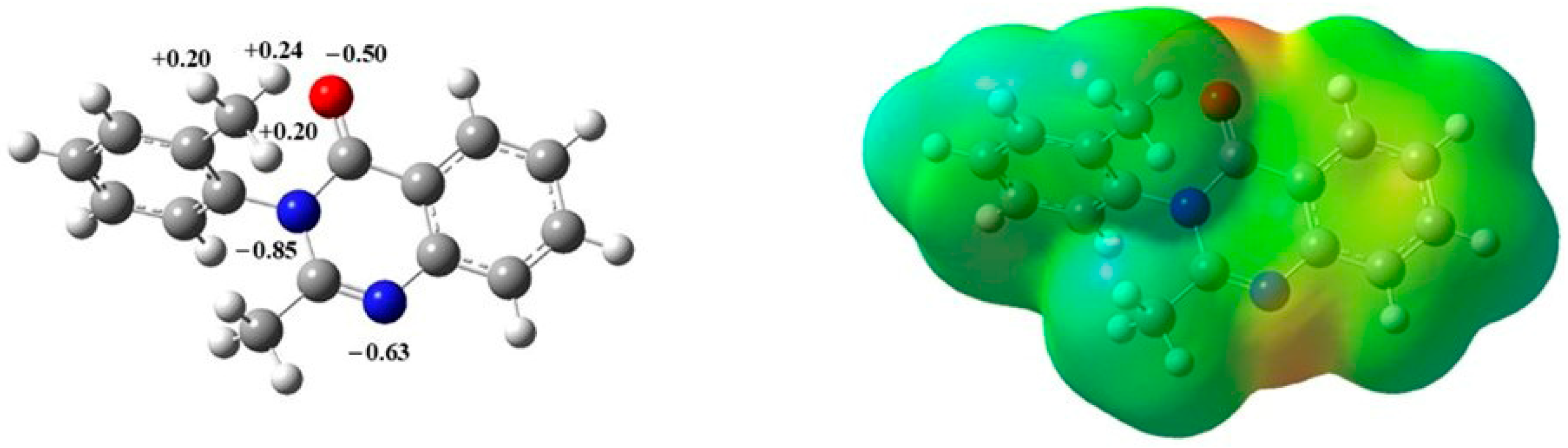
The ortho-methyl and ortho-phenyl derivatives 1d and 1e also demonstrated pronounced self-disproportionation of enantiomers (SDE) under column chromatography conditions. Quantum chemical calculations performed for the (P)-1d monomer, along with analysis of electron density distributions on individual atoms (Figure 6), suggest the involvement of two distinct types of hydrogen bonding: (1) between the hydrogen atom of the methyl group and the carbonyl oxygen atom (C–H···O=C), and (2) between the hydrogen atom of the methyl group and the nitrogen atom (C–H···N). These interactions likely contribute to the supramolecular association behavior that underlies the observed SDE effect.
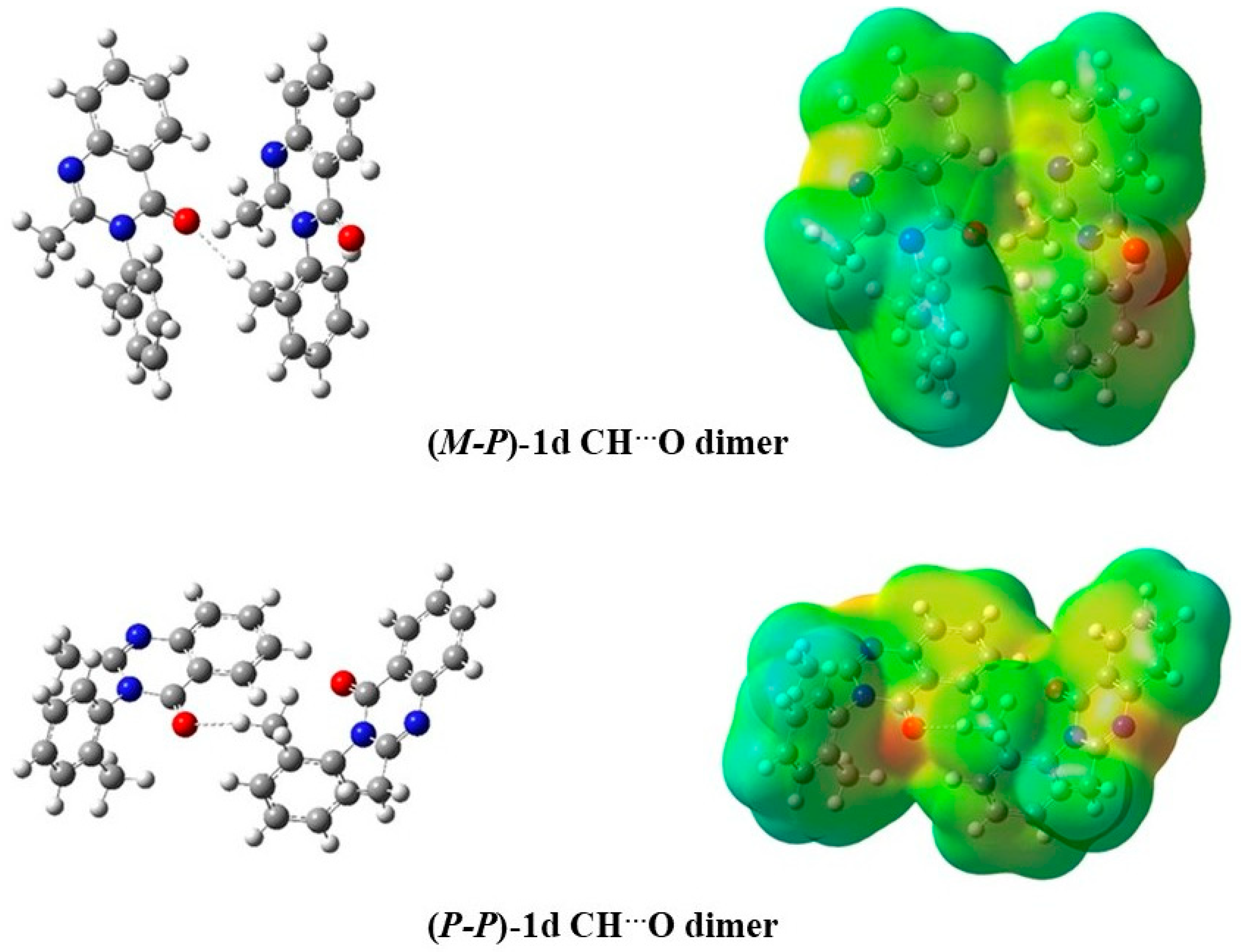
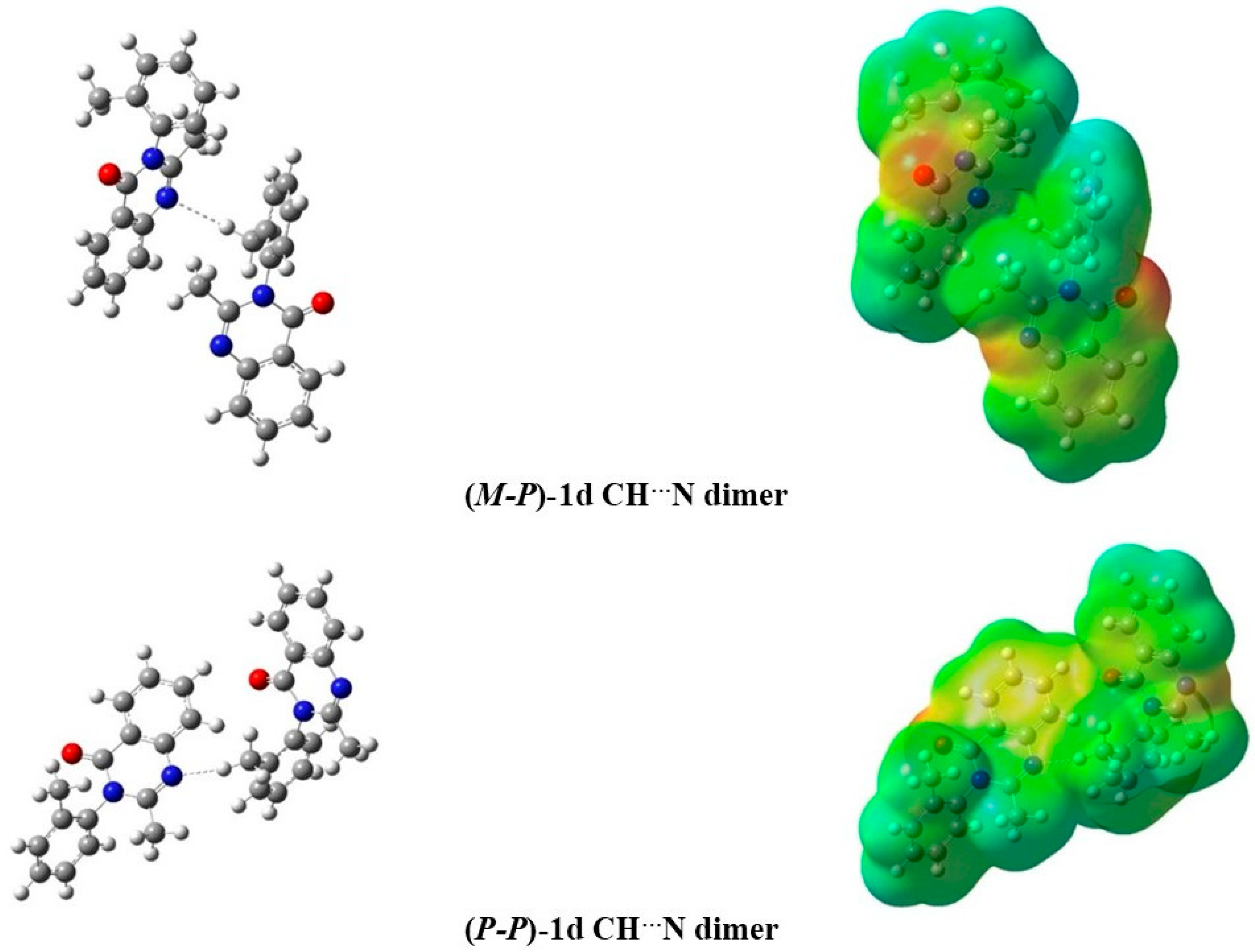
DFT calculations revealed that dimers stabilized by hydrogen bonding involving the carbonyl oxygen atom (C=O···H–C) (Figure 7) are energetically more favorable than those formed via hydrogen bonds of the C–H···N type (Figure 8). Key structural parameters of the modeled dimers are summarized in Table 6.
DFT calculations for both heterochiral and homochiral dimers—formed via hydrogen bonding involving the carbonyl oxygen atom—indicate a preference for heterochiral association. The hydrogen bond in the heterochiral dimer measures 2.235 Å, which is shorter than the corresponding bond in the homochiral dimer (2.306 Å). This structural difference is accompanied by a slight energetic advantage: the heterochiral dimer is more stable, with the homochiral dimer exhibiting a higher interaction energy by +0.36 kcal/mol. These findings support the notion that subtle variations in non-covalent geometry can influence the thermodynamic favorability of supramolecular assemblies.
While crystal structures and DFT calculations offer valuable insights into the preferred modes of molecular interaction in solution, it is important to recognize that chromatographic systems are inherently more complex. They involve additional components such as the solvent and the stationary phase, each contributing to the overall behavior of the system. These factors collectively establish a dynamic equilibrium in solutions of scalemic chiral compounds, encompassing a distribution of monomers, dimers, and higher-order oligomers—both homochiral and heterochiral in nature.

4. Conclusions

This study confirms that chromatographic methods conducted under achiral conditions—without the need for advanced or costly instrumentation—can serve as effective tools for the enantiomeric enrichment of structurally diverse chiral compounds, including 3-(ortho-substituted-phenyl)quinazolin-4-one derivatives. Among the techniques evaluated, medium-pressure liquid chromatography (MPLC) demonstrated superior efficiency; however, gravity-driven column chromatography, when properly optimized, also yielded enantiomerically pure samples, making it a practical and accessible alternative for routine laboratory use.
Key factors influencing the self-disproportionation of enantiomers (SDE) were identified, including the nature of the stationary phase, the compound-to-phase concentration ratio, and the choice of eluent. Additionally, solvent purity and sample preparation methods were shown to significantly impact the outcome of the SDE process.
At the molecular level, structural features—particularly the presence of atoms or functional groups capable of engaging in non-covalent interactions—play a critical role in the formation of homo- and heterochiral aggregates of varying order and chromatographic behavior. Crystallographic analysis and quantum chemical calculations revealed that 3-(ortho-halogen-phenyl)quinazolin-4-one derivatives (1ac) associate predominantly through halogen bonding, while the ortho-methyl derivative 1d forms supramolecular assemblies stabilized by C–H···O hydrogen bonds. These findings underscore the interplay between molecular architecture and chromatographic dynamics in driving the SDE phenomenon.
In future studies, we will focus on deepening the mechanistic understanding of the SDE phenomenon. To achieve this, we plan to employ more advanced quantum chemical calculations, including the evaluation of higher-order aggregates and alternative computational approaches, to better characterize the non-covalent interactions governing SDE. These efforts may ultimately contribute to the development of practical, low-cost strategies for routine enantiomeric enrichment in synthetic and analytical laboratories.

5. Experimental Setup

5.1. General

Melting point was recorded on a melting point apparatus and is uncorrected. 1H and 13C NMR spectra were recorded on a 400 MHz and 101 MHz spectrometer. Chemical shifts δ were given in ppm and coupling constants J in Hz. 1H and 13C NMR chemical shifts were determined using residual signals of the deuterated solvents: CDCl3 (1H:δ = 7.26 ppm, 13C: δ = 77.01 ppm). HRMS was recorded on a double focusing magnetic sector mass spectrometer using ESI-TOF (JOEL, Tokyo, Japan). Optical rotations were measured in CHCl3 on JASCO P-1020 Polarimeter (Tokyo, Japan) at λ = 589 nm. Column chromatography was performed on silica gel (75–150 μm). Medium-pressure liquid chromatography (MPLC) was performed on a 25 × 4 cm i.d. prepacked column (silica gel, 10 mm) with a UV detector.
Medium-pressure liquid chromatography (MPLC) was performed on a 25 × 4 cm i.d. prepacked column (silica gel, 10 μm) with a UV detector using a mixture of n-hexane/ethyl acetate with different proportions as an eluent. The polarity of the eluent for each compound was selected in order to achieve similar retention time (about 1 h).
Gravity-driven column chromatography was performed using a column of diameter 10 mm and height 450 mm. The samples of quinazolinones 1d,e enriched in the P enantiomer of various enantiomeric excess were loaded onto the column as a solution in CH2Cl2 or eluent as indicated in the Supplementary Materials.
Solvents for SDE studies via gravity-driven column chromatography were purchased from Chempur (Piekary Slaskie, Poland) (CH2Cl2, c-hexane, ethyl acetate, diethyl ether), VWR Chemicals (VWR Int. Gdansk, Poland) (n-hexane 95%, CH2Cl2 for analysis), POCh (Gliwice, Poland) (t-butyl methyl ether—MTBE) and were used without further purification. Solvents for HPLC analysis, n-hexane and 2-propanol, were purchased from VWR Chemicals. Silica gel for column chromatography 230–400 mesh and aluminum oxide 90 active neutral (activity stage I) 70–230 mesh ASTM were purchased from Merck.
Thin-layer chromatography (TLC) was performed on precoated aluminum sheets (TLC silica gel 60 F254). The solvent polarity for column chromatography for each compound was selected based on TLC.
HPLC chromatographic analysis was performed on a Varian ProStar (Palo Alto, CA, USA) instrument with UV-VIS detector (λ = 254 nm) using a CHIRALPAK AS-H column (25 cm x 0.46 cm) (Daicel Chemical Industries, Osaka, Japan) with n-hexane/2-propanol as a mobile phase, ratio 90:10, flow rate 1.0 mL/min for 1d and 0.8 mL/min for 1e.
DFT calculations were performed using Gaussian 09, Revision A.02 with the B3LYP functional and the 6-31G\* basis set [48]. All geometries were optimized in the gas phase using default convergence criteria. No dispersion correction or solvent model was applied.

5.2. Quinazolinone Derivatives 1ae

Enantioenriched quinazolinones 1ad were prepared in accordance with the procedure which was previously reported by us [23,49]. Quinazolinone (P)-1b (68% ee) was obtained through chiral-Pd catalyzed reductive asymmetric desymmetrization with 3-(2,6-dibromophenyl)-2-methylquinazolin-4-one substrate [23]. Enantioenriched quinazolinone (P)-1d was prepared through Suzuki–Miyaura coupling of (P)-1b with methyl boronic acid [23]. Enantioenriched quinazolinones 1a,d were obtained through MPLC separation of racemate 1a,d using a semipreparative chiral AY-H column followed by mixing the enantiomers in an appropriate ratio [49]. Quinazolinone 1e, which is a new compound, was prepared in accordance with the following procedure.

5.3. (P)-2-Methyl-3-(2-phenyphenyl)quinazolin-4-one (P)-1e

Under N2 atmosphere, the suspension of Pd(OAc)2 (3.4 mg, 0.015 mmol), bis-diphenylphosphinopropane (DPPP, 12.4 mg, 0.030 mmol) and K3PO4 (159 mg, 0.75 mmol) in 1,4-dioxne (1.5 mL) was stirred for 10 min at room temperature. Methyl boronic acid (45 mg, 0.75 mmol) and 1b (47.3 mg, 0.15 mmol, 99% ee) were added to the mixture. After being stirred for 5 h at 45 °C, the mixture was poured into water and extracted with EtOAc. The EtOAc extracts were washed with brine, dried over MgSO4 and evaporated to dryness. Purification of the residue by column chromatography (n-hexane/EtOAc = 2) and subsequent medium-pressure liquid chromatography (MPLC, eluent: hexane/EtOAc = 2) gave (P)-1e (40 mg, 85%, 96% ee). The ee of 1e (96% ee) was determined by HPLC analysis using a CHIRALPAK AS-H column [25 cm × 0.46 cm i.d.; 15% i-PrOH in n-hexane; flow rate, 0.8 mL/min; (P)-1e (major); tR = 8.1 min, (M)-1e (minor); tR = 9.9 min]. (P)-1e: white solid; mp 48–49 °C; [α]D = +401.2 (c = 0.42, CHCl3); IR (neat) 1670 cm−1; 1H NMR (CDCl3) δ: 8.30 (1H, dd, J = 1.2, 8.0 Hz), 7.71 (1H, ddd, J = 1.2, 6.8, 8.0 Hz), 7.51–7.58 (4H, m), 7.45 (1H, m), 7.28–7.31 (3H, m), 7.21–7.24 (3H, m), 2.05 (3H, s); 13C NMR (CDCl3) δ: 163.0, 154.0, 147.4, 140.3, 137.8, 135.3, 134.5, 131.6, 129.8, 129.0, 128.9, 128.5, 128.1, 127.9, 127.1, 126.7, 126.5, 120.4, 24.0; MS (m/z) 335 (MNa+); HRMS. Calcd for C21H16N2NaO (MNa+) 335.1160. Found: 335.1179.

Supplementary Materials

The following supporting information can be downloaded at https://www.mdpi.com/article/10.3390/sym18040699/s1, File S1. Spectral data (1H and 13C NMR) and chromatogram traces from chiral HPLC for new compound 1e and graphical representations and tabulations of chromatographic runs 1–14.

Author Contributions

Conceptualization, O.K., A.W., M.K. and V.A.S.; methodology, T.I., S.T., O.K., A.W., M.K. and V.A.S.; formal analysis, T.I., S.T., O.K., A.W., M.K. and V.A.S.; investigation, T.I., S.T., O.K., A.W., M.K. and V.A.S.; resources, O.K., A.W. and M.K., data curation, T.I., S.T., O.K., A.W., M.K. and V.A.S.; writing—original draft preparation, O.K., A.W., M.K. and V.A.S.; writing—review and editing, O.K., A.W., M.K. and V.A.S.; supervision, O.K., A.W., M.K. and V.A.S.; project administration, O.K., A.W., M.K. and V.A.S. All authors have read and agreed to the published version of the manuscript.

Funding

The authors gratefully acknowledge financial support from the Ministry of Science and Higher Education, Poland (grant no. SUPB.RN.25.216, A.W. and M.K.).

Data Availability Statement

The original contributions presented in this study are included in the article or Supplementary Materials. Further inquiries can be directed to the corresponding author.

Conflicts of Interest

The authors declare no conflicts of interest.

References

  1. Senkuttuvan, N.; Komarasamy, B.; Krishnamoorthy, R.; Sarkar, S.; Dhanasekarand, S.; Anaikutti, P. The Significance of Chirality in Contemporary Drug Discovery—A mini review. RSC Adv. 2024, 14, 33429–33448. [Google Scholar] [CrossRef]
  2. Proietti Silvestri, I.; Colbon, P.J.J. The Growing Importance of Chirality in 3D Chemical Space Exploration and Modern Drug Discovery Approaches for Hit-ID. ACS Med. Chem. Lett. 2021, 12, 1220−1229. [Google Scholar] [CrossRef] [PubMed]
  3. Peng, S.; Zhu, Y.; Luo, C.; Zhang, P.; Wang, F.; Li, R.; Lin, G.; Zhang, J. Chiral drugs: Sources, absolute configuration identification, pharmacological applications, and future research trends. LabMed Discov. 2024, 1, 100008. [Google Scholar] [CrossRef]
  4. Niu, X.; Zhao, R.; Yan, S.; Pang, Z.; Li, H.; Yang, X.; Wang, K. Chiral materials: Progress, applications, and prospects. Small 2023, 19, e2303059. [Google Scholar] [CrossRef]
  5. Jeschke, P. The continuing significance of chiral agrochemicals. Pest Manag. Sci. 2025, 81, 1697–1716. [Google Scholar] [CrossRef]
  6. Engel, K.-H. Chirality: An Important Phenomenon Regarding Biosynthesis, Perception, and Authenticity of Flavor Compounds. J. Agric. Food Chem. 2020, 68, 10265–10274. [Google Scholar] [CrossRef]
  7. Garg, A.; Rendina, D.; Bendale, H.; Akiyama, T.; Ojima, I. Recent advances in catalytic asymmetric synthesis. Front. Chem. 2024, 12, 1398397. [Google Scholar] [CrossRef]
  8. Wang, Y.; Song, X.; Wang, J.; Moriwaki, H.; Soloshonok, V.A.; Liu, H. Recent approaches for asymmetric synthesis of α-amino acids via homologation of Ni(II) complexes. Amino Acids 2017, 49, 1487–1520. [Google Scholar] [CrossRef]
  9. Mei, H.; Xie, C.; Han, J.; Soloshonok, V.A. N-tert-Butanesulfinyl-(3,3,3)-trifluoroacetaldimine: Versatile Reagent for Asymmetric Synthesis of Trifluoromethyl-Containing Amines and Amino Acids of Pharmaceutical Importance. Eur. J. Org. Chem. 2016, 2016, 5917–5932. [Google Scholar] [CrossRef]
  10. Mei, H.; Liu, J.; Fustero, S.; Román, R.; Ruzziconi, R.; Soloshonok, V.A.; Han, J. Chemistry of detrifluoroacetylatively in situ generated fluoro-enolates. Org. Biomol. Chem. 2019, 17, 762–775. [Google Scholar] [CrossRef] [PubMed]
  11. Santos, R.; Pontes, K.V.; Nogueira, I.B.R. Enantiomers and Their Resolution. Encyclopedia 2022, 2, 151–188. [Google Scholar] [CrossRef]
  12. Tokunaga, E.; Yamamoto, T.; Ito, E.; Shibata, N. Understanding the Thalidomide Chirality in Biological Processes by the Self-disproportionation of Enantiomers. Sci. Rep. 2018, 8, 17131. [Google Scholar] [CrossRef]
  13. Wang, Y.; Kitagawa, O. Bioactive C─N Atropisomers. Chem. Rec. 2026, early view. [Google Scholar] [CrossRef]
  14. Welch, W.; Ewing, F.E.; Huang, J.; Menniti, F.S.; Pagnozzi, M.J.; Kelly, K.; Seymour, P.A.; Guanowsky, V.; Guhan, S.; Guinn, M.R.; et al. Atropisomeric Quinazolin-4-One Derivatives Are Potent Noncompetitive α-Amino-3-Hydroxy-5-Methyl-4-Isoxazolepropionic Acid (AMPA). Bioorg. Med. Chem. Lett. 2001, 11, 177–181. [Google Scholar] [CrossRef]
  15. Sui, J.; Wang, N.; Wang, J.; Huang, X.; Wang, T.; Zhou, L.; Hao, H. Strategies for Chiral Separation: From Racemate to Enantiomer. Chem. Sci. 2023, 14, 11955–12003. [Google Scholar] [CrossRef] [PubMed]
  16. Milo, A.; Ooi, T.; Bach, T. Modern Enantioselective Catalysis in Organic Chemistry. J. Org. Chem. 2023, 88, 7615–7618. [Google Scholar] [CrossRef]
  17. Gaucherand, A.; Yen-Pon, E.; Domain, A.; Bourhis, A.; Rodriguez, J.; Bonne, D. Enantioselective synthesis of molecules with multiple stereogenic elements. Chem. Soc. Rev. 2024, 53, 11165–11206. [Google Scholar] [CrossRef]
  18. Elijošius, R.; King-Smith, E.; Faber, F.A.; Bernier, L.; Berritt, S.; Farrell, W.P.; Hou, X.; Klug-McLeod, J.L.; Mustakis, J.; Sach, N.W.; et al. Predictive design of crystallographic chiral separation. Nat. Commun. 2025, 16, 7977. [Google Scholar] [CrossRef] [PubMed]
  19. Wzorek, A.; Klika, K.D.; Han, J.; Sorochinsky, A.E.; Ono, T.; Soloshonok, V.A. Enantiomer Purification Through Achiral Chromatography: Integrating Simulated Moving Bed and Self-Disproportionation of Enantiomers. Ukr. Chem. J. 2025, 91, 34–48. [Google Scholar] [CrossRef]
  20. Marek, W.K.; Lee, J.W.; Seidel-Morgenstern, A.; Antos, D. Separation of nonracemic mixtures of enantiomers by achiral simulated moving bed chromatography. Sep. Purif. Technol. 2025, 361, 131497. [Google Scholar] [CrossRef]
  21. Mruc, P.; Olbrycht, M.; Korbetskyy, M.; Antos, D. Altering the mobile phase composition to enhance self-disproportionation of enantiomers in achiral chromatography. J. Chromatogr. A 2024, 1715, 464603. [Google Scholar] [CrossRef]
  22. Kitagawa, O. Chiral Pd-Catalyzed Enantioselective Synthesis of Various N–C Axially Chiral Compounds and Their Applications. Acc. Chem. Res. 2021, 54, 719–730. [Google Scholar] [CrossRef]
  23. Hirai, M.; Terada, S.; Yoshida, H.; Ebine, K.; Hirata, T.; Kitagawa, O. Catalytic Enantioselective Synthesis of N–C Axially Chiral Mebroqualone and Its Derivatives through Reductive Asymmetric Desymmetrization. Org. Lett. 2016, 18, 5700–5703. [Google Scholar] [CrossRef] [PubMed]
  24. Xin, M.; Hei, Y.-Y.; Zhang, H.; Shen, Y.; Zhang, S.-Q. Design and synthesis of novel 6-aryl substituted 4-anilinequinazoline derivatives as potential PI3Kδ inhibitors. Bioorg. Med. Chem. Lett. 2017, 27, 1972–1977. [Google Scholar] [CrossRef] [PubMed]
  25. Lodola, A.; Bertolini, S.; Biagetti, M.; Capacchiu, S.; Facchinetti, F.; Gall, P.M.; Pappani, A.; Mor, M.; Pala, D.; Rivara, S.; et al. Atropisomerism and Conformational Equilibria: Impact on PI3Kδ Inhibition of 2-((6-Amino-9H-purin-9-yl)methyl)-5-methyl-3-(o-tolyl)quinazolin-4(3H)-one (IC87114) and Its Conformationally Restricted Analogs. J. Med. Chem. 2017, 60, 4304–4315. [Google Scholar] [CrossRef] [PubMed]
  26. Ameriks, M.K.; Venable, J.D. Small Molecule Inhibitors of Phosphoinositide 3-Kinase (PI3K) δ and γ. Curr. Top. Med. Chem. 2009, 9, 738–753. [Google Scholar] [CrossRef]
  27. Wang, Y.; Kaneko, H.; Yang, Y.; Komamatsu, S.; Nakamura, K.; Sato, A.; Yanai, H.; Nakaminami, H.; Kitagawa, O. C−N Atropisomerism and Anti-MRSA Activity in 3-(2-Hydroxyphenyl)quinazolin-4-one Derivatives. J. Org. Chem. 2025, 90, 7930−7937. [Google Scholar] [CrossRef]
  28. Terada, S.; Hirai, M.; Honzawa, A.; Kitagawa, O.; Kamizela, A.; Wzorek, A.; Soloshonok, V.A. Possible case of halogen bond-driven self-disproportionation of enantiomers (SDE) via achiral chromatography. Chem. Eur. J. 2017, 23, 14631–14638. [Google Scholar] [CrossRef]
  29. Soloshonok, V.A.; Klika, K.D. Terminology Related to the Phenomenon ‘Self-Disproportionation of Enantiomers’ (SDE). Helv. Chem. Acta 2014, 97, 1583–1589. [Google Scholar] [CrossRef]
  30. Sorochinsky, A.E.; Katagiri, T.; Ono, T.; Wzorek, A.; Aceña, J.L.; Soloshonok, V.A. Optical Purifications via Self-Disproportionation of Enantiomers by Achiral Chromatography: Case Study of a Series of α–CF3-containing Secondary Alcohols. Chirality 2013, 25, 365–368. [Google Scholar] [CrossRef]
  31. Nakamura, T.; Tateishi, K.; Tsukagoshi, S.; Hashimoto, S.; Watanabe, S.; Soloshonok, V.A.; Aceña, J.L.; Kitagawa, O. Self-disproportionation of enantiomers of non-racemic chiral amine derivatives through achiral chromatography. Tetrahedron 2012, 68, 4013–4017. [Google Scholar] [CrossRef]
  32. Wzorek, A.; Sato, A.; Drabowicz, J.; Soloshonok, V.A. Self-disproportionation of enantiomers (SDE) of chiral non-racemic amides via achiral chromatography. Isr. J. Chem. 2016, 56, 977–989. [Google Scholar] [CrossRef]
  33. Han, J.; Wzorek, A.; Soloshonok, V.A.; Klika, K.D. The self-disproportionation of enantiomers (SDE): The effect of scaling down, potential problems versus prospective applications, possible new occurrences, and unrealized opportunities? Electrophoresis 2019, 40, 1869–1880. [Google Scholar] [CrossRef]
  34. Mastai, Y.; Völkel, A.; Cölfen, H. Separation of racemate from excess enantiomer of chiral nonracemic compounds via density gradient ultracentrifugation. J. Am. Chem. Soc. 2008, 130, 2426–2427. [Google Scholar] [CrossRef]
  35. Kozma, D.; Kassai, C.; Fogassy, E. Enantiomeric enrichment by the use of density differences between racemic compounds and optically active enantiomers. Tetrahedron Lett. 1995, 36, 3245–3246. [Google Scholar] [CrossRef]
  36. Yasumoto, M.; Ueki, H.; Ono, T.; Katagiri, T.; Soloshonok, V.A. Self-disproportionation of enantiomers of isopropyl 3,3,3-(trifluoro)lactate via sublimation: Sublimation rates vs. enantiomeric composition. J. Fluor. Chem. 2010, 131, 535–539. [Google Scholar] [CrossRef]
  37. Wzorek, A.; Soloshonok, V.A.; Klika, K.D. The Self-Disproportionation of Enantiomers (SDE) of α-Pinene via Evaporation off Silica Gel and Foam Fractionation—Validation of the Plausibility of SDE via Gas Chromatography (GC) for α-Pinene. Separations 2023, 10, 382. [Google Scholar] [CrossRef]
  38. Alkorta, I.; Elguero, J.; Roussel, C.; Vanthuyne, N.; Piras, P. Atropisomerism and Axial Chirality in Heteroaromatic Compounds. Adv. Heterocycl. Chem. 2012, 105, 1–18. [Google Scholar] [CrossRef]
  39. Suzuki, Y.; Han, J.; Kitagawa, O.; Aceña, J.L.; Klika, K.D.; Soloshonok, V.A. A comprehensive examination of the self-disproportionation of enantiomers (SDE) of chiral amides via achiral, laboratory-routine, gravity-driven column chromatography. RSC Adv. 2015, 5, 2988–2993. [Google Scholar] [CrossRef]
  40. Wzorek, A.; Sato, A.; Drabowicz, J.; Soloshonok, V.A. Self-Disproportionation of Enantiomers via achiral gravity-driven column chromatography: A case study of N-Acyl-α-Phenylethylamines. J. Chromatogr. A 2016, 1467, 270–278. [Google Scholar] [CrossRef]
  41. Han, J.; Wzorek, A.; Kwiatkowska, M.; Soloshonok, V.A.; Klika, K.D. The self-disproportionation of enantiomers (SDE) of amino acids and their derivatives. Amino Acids 2019, 51, 865–889. [Google Scholar] [CrossRef]
  42. Wzorek, A.; Kamizela, A.; Sato, A.; Soloshonok, V.A. Self-Disproportionation of Enantiomers (SDE) via achiral gravity-driven column chromatography of N-fluoroacyl-1-phenylethylamines. J. Fluor. Chem. 2017, 196, 37–43. [Google Scholar] [CrossRef]
  43. Hosaka, T.; Imai, T.; Wzorek, A.; Marcinkowska, M.; Kolbus, A.; Kitagawa, O.; Soloshonok, V.A.; Klika, K.D. The self-disproportionation of enantiomers (SDE) of α-amino acid derivatives; facets of steric and electronic properties. Amino Acids 2019, 51, 283–294. [Google Scholar] [CrossRef]
  44. Kwiatkowska, M.; Marcinkowska, M.; Wzorek, A.; Pajkert, R.; Han, J.; Klika, K.D.; Soloshonok, V.A.; Röschenthaler, G.V. The self-disproportionation of enantiomers (SDE) via column chromatography of β-amino-α,α-difluorophosphonic acid derivatives. Amino Acids 2019, 51, 1377–1385. [Google Scholar] [CrossRef]
  45. Wzorek, A.; Sato, A.; Drabowicz, J.; Soloshonok, V.A.; Klika, K.D. Remarkable magnitude of the self-disproportionation of enantiomers (SDE) via achiral chromatography; application to the practical-scale enantiopurification of β-amino acid esters. Amino Acids 2016, 48, 605–613. [Google Scholar] [CrossRef]
  46. Abás, S.; Arróniz, C.; Molins, E.; Escolano, C. Access to the enantiopure pyrrolobenzodiazepine (PBD) dilactam nucleus via self-disproportionation of enantiomers. Tetrahedron 2018, 74, 867–871. [Google Scholar] [CrossRef]
  47. Wzorek, A.; Sato, A.; Drabowicz, J.; Soloshonok, V.A.; Klika, K.D. Enantiomeric enrichments via the self-disproportionation of enantiomers (SDE) by achiral, gravity-driven column chromatography: A case study using N-acetyl-1-(phenyl)ethylamine for optimizing the enantiopure yield and magnitude of the SDE. Helv. Chem. Acta 2015, 98, 1147–1159. [Google Scholar] [CrossRef]
  48. Frisch, M.J.; Trucks, G.W.; Schlegel, H.B.; Scuseria, G.E.; Robb, M.A.; Cheeseman, J.R.; Scalmani, G.; Barone, V.; Petersson, G.A.; Nakatsuji, H.; et al. Gaussian 09, Revision A02; Gaussian, Inc.: Wallingford, CT, USA, 2009. [Google Scholar]
  49. Imai, T.; Niijima, E.; Terada, S.; Wzorek, A.; Soloshonok, V.A.; Hori, A.; Kitagawa, O. Chirality-dependent halogen bonds in axially chiral quinazolin-4-one derivatives bearing ortho-halophenyl groups. CrystEngComm 2019, 21, 3385–3389. [Google Scholar] [CrossRef]
  50. Spackman, M.A.; Jayatilaka, D. Hirshfeld surface analysis. CrystEngComm 2009, 11, 19–32. [Google Scholar] [CrossRef]
Figure 1. Chemical structure of quinazolinone derivatives 1ae.
Symmetry 18 00699 g001
Figure 2. MPLC experiment performed at room temperature with methaqualone 1d of 81% ee studying more detailed composition of the enantiomerically depleted peak.
Symmetry 18 00699 g002
Figure 3. Elution profiles for runs involving compound 1d using various loading solutions.
Symmetry 18 00699 g003
Figure 4. Physical representations of the geometry-optimized monomer (P)-1a and its electrostatic potential calculated by DFT (Gaussian 09, with the B3LYP hybrid functional and the 6-31G* basis set) [48]. Red surfaces indicate negative potentials while blue surfaces indicate positive potentials.
Symmetry 18 00699 g004
Figure 5. Physical representations of the geometry-optimized heterochiral (M-P)-1a and homochiral (P-P)-1a dimers and their electrostatic potential calculated by DFT (Gaussian 09 with the B3LYP hybrid functional and the 6-31G* basis set) [48]. Red surfaces indicate negative potentials while blue surfaces indicate positive potentials.
Symmetry 18 00699 g005
Figure 6. Physical representations of the geometry-optimized monomer (P)-1d and its electrostatic potential calculated by DFT (Gaussian 09 with the B3LYP hybrid functional and the 6-31G* basis set) [48]. Red surfaces indicate negative potentials while blue surfaces indicate positive potentials.
Symmetry 18 00699 g006
Figure 7. Physical representations of the geometry-optimized heterochiral (M-P)-1d and homochiral (P-P)-1d dimers with hydrogen bond type C–H···O=C and their electrostatic potential calculated by DFT (Gaussian 09 with the B3LYP hybrid functional and the 6-31G* basis set) [48]. Red surfaces indicate negative potentials while blue surfaces indicate positive potentials.
Symmetry 18 00699 g007
Figure 8. Physical representations of the geometry-optimized heterochiral (M-P)-1d and homochiral (P-P)-1d dimers with hydrogen bond type C–H···N and their electrostatic potential calculated by DFT (Gaussian 09 with the B3LYP hybrid functional and the 6-31G* basis set) [48]. Red surfaces indicate negative potentials while blue surfaces indicate positive potentials.
Symmetry 18 00699 g008
Table 1. SDE of quinazolinones 1 under MPLC chromatography with n-hexane/EtOAc as an eluent.
RunCompound 1Eluent
Ratio
More Polar FractionLess Polar
Fraction
Yield SDE [%]
Xmg a, % eemg a, % ee bmg a, % ee
11aCl51.2, 67327.5, 4016.7, >9948.7
21bBr50.1, 68324.6, 3821.6, >9963.4
31cI49.7, 68319.4, 2626.7, >9979.3
41dMe49.7, 68434.5, 5812.0, >9935.5
51ePh50.2, 67423.1, 3521.6, >9964.4
a Recovery mass, b Determined on HPLC using CHIRALPAK AS chiral column.
Table 2. SDE of methaqualone 1d of 68% ee via gravity-driven column chromatography a.
RunEluent (Ratio)Concentration
(1 mmol 1 d/g of
Stationary Phase)
% eeSDE
mag.
ee)
First FractionLast Fraction
1n-hexane–EtOAc (2:1)3092.857.635.2
2c-hexane–EtOAc (2:1)3088.453.634.8
3n-hexane–MTBE (1.3:1)3099.253.845.4
4c-hexane–MTBE (2:1)3099.855.044.8
5CH2Cl2–EtOAc (100:1)3098.651.647.0
6c-hexane–MTBE (2:1)4098.453.045.4
7CH2Cl2–EtOAc (100:1)4099.846.653.2
8c-hexane–MTBE (2:1)40 b99.843.856.0
9CH2Cl2–EtOAc (100:1)40 c81.457.823.6
10CH2Cl2–EtOAc (100:1)80 c89.232.057.2
The ee of the first/last fraction or of the fraction with the highest/lowest ee. a Silica gel (230–400 mesh), Rf ≈ 0.2; the sample was loaded as a solution in CH2Cl2. b The sample was loaded as a solution in eluent. c Aluminum oxide (Neutral, grade I) was used as stationary phase.
Table 3. SDE of quinazolinone 1e of 64% ee via gravity-driven column chromatography a.
RunEluent (Ratio)Rf% eeSDE
mag.
ee)
First
Fraction
Last
Fraction
11c-hexane–MTBE (2:1)0.2295.236.458.8
12c-hexane–MTBE (2:1) b0.2296.242.653.6
13CH2Cl20.2599.837.862.0
14CH2Cl2 c0.1499.827.872.0
The ee of the first/last fraction or of the fraction with the highest/lowest ee. a Silica gel (230–400 mesh), concentration 1 mmol of 1e/40 g of silica gel; the sample was loaded as a solution in c-hexane–CH2Cl2 (1:1). b The sample was loaded as a solution in eluent. c Analytical-grade CH2Cl2 was used.
Table 4. Overview of structural parameters in the racemic and enantiopure crystals 1a.
Racemic Crystal 1aEnantiopure Crystal 1a
Cl-O distance [Ǻ]3.223.42
Hirshfeld Surface (dnorm)Symmetry 18 00699 i001Symmetry 18 00699 i002
DimerSymmetry 18 00699 i003Symmetry 18 00699 i004
Contacts
(d = 3.5 Ǻ)
Symmetry 18 00699 i005Symmetry 18 00699 i006
Energy interaction between monomers [kJ/mol]*E tot = −16.1E tot = −17.9
Table 5. Interaction energy between the monomers in homo- and heterochiral dimers in crystals 1a *.
E (kJ/mol)E eleE polE disE repE tot
Heterochiral dimer 1a−5.6−2.0−20.214.3−16.1
Homochiral dimer 1a−4.4−1.8−25.016.0−17.9
* Crystal Explorer 21.5; method 2B3LYp/G-31G(d,p).
Table 6. Calculated parameters for the homo- and heterochiral dimeric associates for ortho-methyl derivative 1d made using DFT (Gaussian 09 with the B3LYP hybrid functional and the 6-31G* basis set) [48].
DimerEnergy,
ΔE (kcal/mol)
Hydrogen Bond Length [Ǻ]Isotropic
Polarizability,
α3)
(M-P)-1d CHO 0.002.23549.76
(P-P)-1d CHO+0.362.30651.08
(M-P)-1d CHN+8.252.47049.60
(P-P)-1d CHN+2.652.46651.36
Disclaimer/Publisher’s Note: The statements, opinions and data contained in all publications are solely those of the individual author(s) and contributor(s) and not of MDPI and/or the editor(s). MDPI and/or the editor(s) disclaim responsibility for any injury to people or property resulting from any ideas, methods, instructions or products referred to in the content.