Article

Oscillatory Behaviors of Two-Component Genetic Networks

School of Science, Jiangsu University of Science and Technology, Zhenjiang 212100, China
*
Author to whom correspondence should be addressed.
These authors contributed equally to this work.
Symmetry 2026, 18(4), 697; https://doi.org/10.3390/sym18040697
Submission received: 21 March 2026 / Revised: 9 April 2026 / Accepted: 17 April 2026 / Published: 21 April 2026
(This article belongs to the Section Computer)

Abstract

Transcriptional and translational inhibition are fundamental regulatory mechanisms in gene networks, governing diverse processes from viral replication to neuroplasticity. Two-component genetic oscillators based on the “activator–repressor” motif serve as ideal models for studying biological rhythms due to their simplicity and rich dynamics. However, systematic theoretical comparisons of distinct inhibitory mechanisms—particularly using inhibition strength as a control variable—remain lacking. Addressing this gap, we present a comprehensive bifurcation analysis of the post-translational repression model, proving the existence and uniqueness of its positive equilibrium, deriving Hopf bifurcation conditions, and identifying critical parameter ranges for sustained oscillations. Using inhibition strength as a key comparator, we systematically contrast transcriptional and post-translational repression, elucidating how different inhibitory mechanisms modulate oscillation initiation and amplitude. We further reveal distinct symmetry–asymmetry patterns in their bifurcation dynamics: transcriptional repression exhibits asymmetric bistable regimes, while post-translational repression manifests narrow, nearly symmetric oscillatory intervals. This unified analytical framework not only advances the theoretical understanding of two-component genetic oscillators but also provides a generalizable paradigm for dissecting complex gene regulatory dynamics.

1. Introduction

Gene regulatory networks (GRNs) are complex systems composed of molecular regulators, such as DNA, RNA, proteins, and related molecules, and their interactions. They function to regulate gene expression levels within cells, encompassing the key processes of transcription and translation [1]. GRNs are not only highly dynamic and diverse but also regarded as a core framework for understanding the origin of biological morphogenesis and evolution [2]. In recent years, with advances in evolutionary developmental biology, in-depth study of GRNs has become an important approach to revealing the intrinsic mechanisms of biodiversity, attracting widespread attention in the scientific community.
GRNs determine cell fate by coordinating gene expression, and their oscillatory dynamics, particularly periodic oscillations, play a crucial role in key life activities such as cell division, migration, and differentiation [3,4]. Oscillatory behavior is a common dynamic characteristic in cellular responses and plays a crucial role in enhancing cellular function and decision-making. For instance, in the p53-Mdm2 network, a critical system implicated in cancer progression, oscillations are a hallmark of the cellular response to DNA damage. A recently developed data-driven ordinary differential equation model has been developed to accurately quantify different stable periodic solutions of p53-Mdm2 dynamics, revealing two distinct oscillatory regimes, which are of great significance for uncovering the role of p53-Mdm2 in cancer progression and therapeutic targeting [5]. In addition, oscillatory behavior enhances both the sensitivity and flexibility of cellular responses. Single-cell studies have demonstrated that oscillations allow cells to repeatedly sample signal persistence, integrate information over multiple cycles, and make more accurate cell fate decisions, thereby reducing the risk of premature commitment [6]. This “indecisive” yet adaptive strategy helps filter out transient fluctuations and improves the accuracy of fate determination—highlighting a key functional advantage of oscillatory dynamics in cellular regulation. Despite its importance, modeling, analyzing, and predicting oscillatory behavior in living systems remain major challenges from both theoretical and experimental perspectives.
Feedback loops serve as the basic structural units that generate oscillations in gene regulatory networks [4,7]. In one well-studied case, the p53-Mdm2 network contains multiple positive and negative feedback loops [8,9]. Its oscillatory response to DNA damage, mediated by these coupled feedbacks, has been widely investigated through experiments and models, with the goal of informing cellular control strategies and potential cancer therapies targeting the p53 pathway [10,11,12,13,14]. Another classic example is the circadian clock, which relies on a negative-feedback loop to produce oscillations with a period of about 24 h [15,16]. Given the complexity and multifactorial nature of oscillatory mechanisms, mathematical modeling and numerical simulation have become indispensable tools for dissecting the molecular basis and functional roles of biological rhythms. Our previous work [17,18] explored the oscillatory dynamics of the p53 regulatory network in response to DNA damage, identifying parameter regimes that support sustained oscillations and clarifying the underlying molecular mechanisms.
In gene regulatory networks, both transcriptional and translational inhibition serve as fundamental regulatory mechanisms across diverse biological processes, a fact extensively validated by experimental and theoretical studies. Targeted blockade of viral protein translation, for instance, represents a promising strategy for anti-SARS-CoV-2 drug development, given that protein translation is essential for viral replication—producing early non-structural proteins for RNA synthesis and late structural proteins for virion assembly [19]. In bacterial cells, sublethal antibiotic concentrations inhibit ribosomal activity (translation inhibition), reducing growth rates and depleting the RNA polymerase pool available for transcription of non-ribosomal genes, thereby indirectly influencing transcription efficiency [20]. Moreover, studies on recombinant protein production have shown that transcription itself, even without protein translation, imposes a metabolic burden on host cells, while translation of transcripts into properly folded proteins may not affect cell growth under optimal conditions, indicating that both transcription and translation inhibition are closely related to cellular physiological regulation [21]. Additionally, toxin-induced transcription or translation inhibition following fluoroquinolone treatment can increase bacterial persistence, further underscoring the functional importance of these two modes in bacterial stress responses [22]. In neurobiology, inhibition of transcription and translation in the dorsal hippocampus and striatum can affect memory consolidation and reconsolidation under specific training conditions, reflecting the regulatory role of these two processes in neural function [23]. Furthermore, microRNAs can exert dual inhibitory effects on target genes at both levels; for example, miR-552 suppresses both the transcription and translation of cytochrome P450 2E1, enabling effective gene expression regulation [24]. For obligate intracellular pathogens such as Chlamydia, small RNAs inhibit the translation of key developmental cycle proteins to regulate pathogen differentiation, highlighting the indispensable role of translation inhibition in microbial developmental processes [25]. Furthermore, microRNAs can also exert dual inhibitory effects on target genes at both transcriptional and translational levels, such as miR-552, which suppresses both transcription and translation of cytochrome P450 2E1, achieving effective gene expression regulation [24]. For obligate intracellular pathogens such as Chlamydia, small RNAs can inhibit the translation of key developmental cycle proteins to regulate pathogen differentiation, highlighting the indispensable role of translation inhibition in microbial developmental processes [25].
To investigate such oscillatory dynamics, deterministic ordinary differential equation (ODE) models combined with bifurcation analysis have been widely employed. This approach effectively reveals the critical conditions under which a system transitions from a steady state to an oscillatory state. However, a systematic analytical bifurcation analysis of two-component genetic oscillators incorporating distinct inhibitory mechanisms remains incomplete. In particular, targeted investigations into how inhibition strength—one of the most biologically relevant parameters—modulates oscillatory initiation and amplitude are still lacking. While previous comparative studies have often focused on degradation rate ratios, the dynamical consequences of different inhibitory implementations have yet to be fully elucidated.
Among various biological oscillator models, the two-component oscillator comprising an activator and a repressor has become an ideal model system for exploring the principles of biological rhythm generation, owing to its simple architecture and its ability to reproduce rich dynamical behaviors. For instance, Guantes and Poyatos [26] constructed two minimal oscillatory modules based on the ’activator–repressor’ scheme—namely transcriptional-level repression (Design I) and posttranslational level repression (Design II), and found significant differences in their oscillatory properties, noise resistance, and signal-encoding strategies. This reveals that genetic oscillators can exhibit markedly distinct dynamical behaviors and functional characteristics depending on their specific molecular implementation. Despite this pioneering work, their study only conducted a preliminary dynamical comparison and lacked in-depth analytical bifurcation analysis of the two models, failing to derive the sufficient conditions for Hopf bifurcation and the critical parameter ranges for sustained oscillations. Subsequently, Zhu et al. [27] performed a detailed bifurcation analysis of Design I and demonstrated that parameter variations can induce diverse dynamical regimes. However, they did not carry out an equally systematic theoretical analysis for Design II. This gap leaves the bifurcation characteristics, oscillatory regulatory mechanisms, and functional differences between the two inhibitor designs largely unexplored in a comparative manner. Moreover, no existing study has taken inhibition strength as the core control variable to compare the two oscillator designs, limiting our understanding of how the molecular implementation of inhibition shapes the efficiency and sensitivity of biological oscillations. To address these gaps, we have conducted the following studies: Firstly, we present the first comprehensive analytical and numerical bifurcation analysis of the post-translational repression model (Design II), including a rigorous proof of the existence and uniqueness of its positive equilibrium, the derivation of Hopf bifurcation conditions, and the identification of critical parameter ranges for oscillatory behavior—thus filling the theoretical gap for Design II. Secondly, we employ inhibition strength as the key comparative control variable to systematically compare the two oscillator designs, elucidating how different inhibitory mechanisms modulate the oscillation initiation and amplitude. Finally, by constructing an analytical framework, we complete a comparative bifurcation analysis of two classic designs, advancing the theoretical research on two-component genetic oscillators. Additionally, we provide a generalizable and reproducible method for studying the oscillatory dynamics of more complex gene regulatory networks. Ultimately, this work aims to clarify the intrinsic dynamical principles by which distinct molecular implementation mechanisms shape oscillatory behavior and to reveal the functional advantages of different inhibitory strategies in biological rhythm regulation.
The remainder of this paper is organized as follows. In Section 2, we introduce the model, and in Section 3, we establish its theoretical foundation by analyzing the existence, uniqueness, and stability of its positive equilibrium, followed by an investigation into Hopf bifurcations. In Section 4, we undertake a numerical bifurcation analysis. Through this analysis, we generate a series of bifurcation diagrams that map the steady-state and oscillatory regions within the parameter space. By integrating time-series simulations with phase portraits, we visually track the dynamic transitions induced by parameter variation, thereby constructing a comprehensive picture of the oscillator’s behavior. Using inhibition strength as a comparative control variable, we apply this framework to contrast the functional performance of two distinct oscillator designs originally proposed by Guantes and Poyatos. In Section 5, we discuss the biological significance of these findings. Finally, we summarize the principal conclusions and insights derived from this study.

2. Mathematical Model

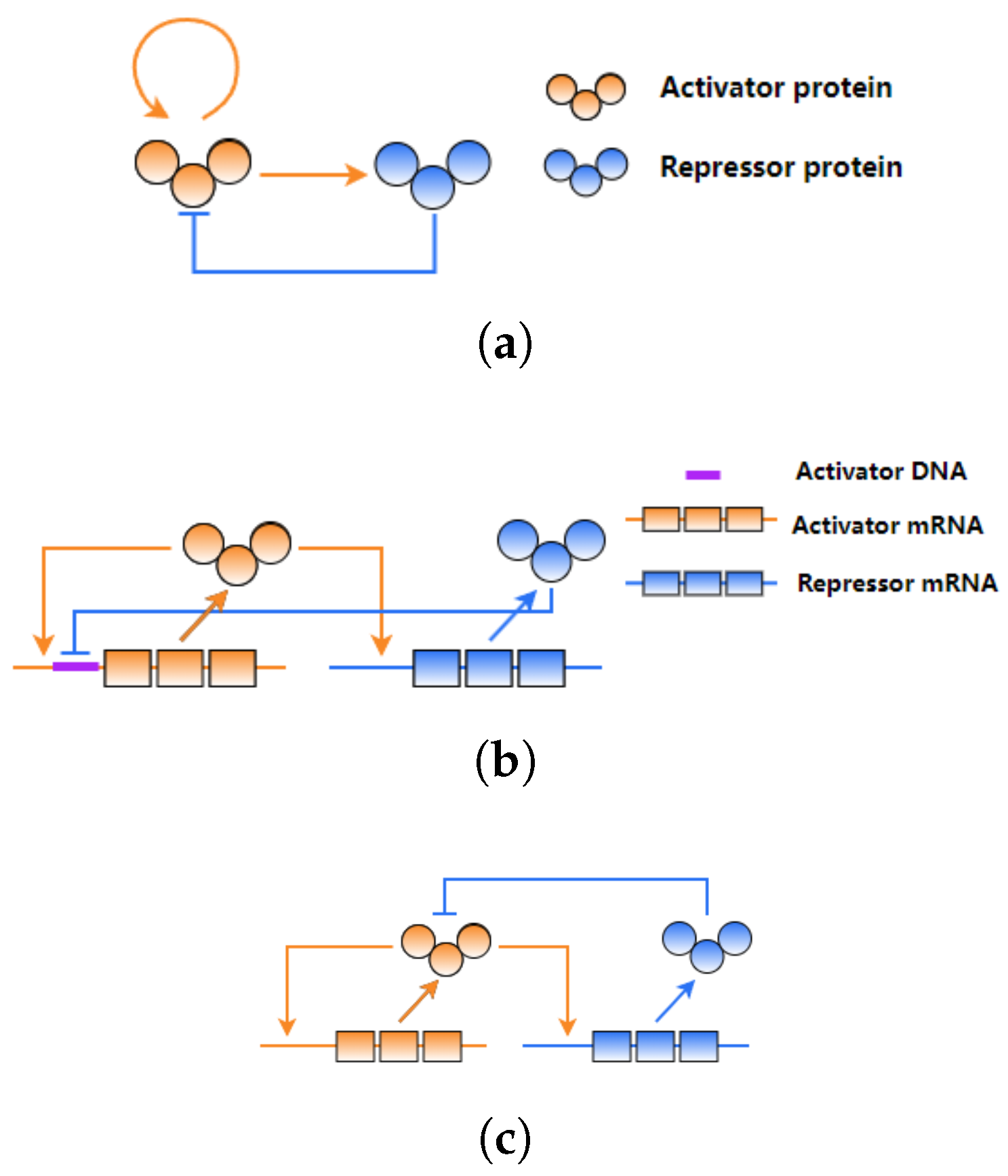
Based on the foundational work of Guantes and Poyatos [26], their proposed minimal oscillatory network architecture provides a critical framework for analyzing biological rhythms. As illustrated in Figure 1a, the core circuit consists of an activator (orange) and a repressor (blue). The activator promotes its own expression through auto-activation while also inducing the synthesis of the repressor, which in turn closes the essential negative feedback loop by inhibiting the activator, thereby establishing the basic topology required for sustained oscillations. From this core architecture, Guantes and Poyatos derived two distinct two-component oscillator variants based on different inhibitory mechanisms. The first variant employs transcriptional repression (Figure 1b), wherein the repressor indirectly inhibits the activator by binding to its promoter region and suppressing mRNA synthesis-a common biological strategy recently utilized to construct synthetic genetic clocks. The second variant relies on post-translational inhibition (Figure 1c), in which the repressor directly binds to and inactivates the synthesized activator protein, enabling rapid feedback regulation on the existing protein pool; this mechanism is considered a core feature of circadian clock function. Next, we present the ordinary differential equation (ODE) models corresponding to each variant.

2.1. Model 1: Transcriptional-Level Repression

The model shown in Figure 1b is derived from the simplified model proposed by Guantes and Poyatos [26], as shown below:
d x d τ = γ x β x α x P x T 1 + ρ K 1 K y y m 1 1 + K 1 K y y m 1 δ x x , d y d τ = γ y β y α y P y T 1 + ρ K 3 K x x n 1 1 + K 2 K x x n 1 + K 3 K y y m 1 δ y y ,
where: K 1 , K 2 , K 3 are the association constants for DNA binding, K x , K y are the association constants for multimerization, P x T , P y T denote the constant total promoter number (total number of promoters for gene x and y, respectively), ρ represents the fold change in promoter activity, n 1 , m 1 are the Hill coefficients (representing the order of multimerization), β x , β y are the mRNA transcription rates (for gene x and y, respectively), α x , α y are the mRNA degradation rates (for mRNA transcribed from gene x and y, respectively), δ x , δ y are the protein degradation rates (for protein x and y, respectively), γ x , γ y are the mRNA translation rate constants (for protein x and y, respectively), τ is the original time variable, and x , y are the concentrations of protein x and protein y (typically representing repressor and activator proteins, respectively). In assigning specific values to the model parameters, we referred to the typical orders of magnitude reported by Guantes and Poyatos [26].
Then, we introduce dimensionless time and concentrations as follows:
t = τ δ x , x 1 = ( K 1 K ) 1 m 1 y , x 2 = ( K 1 K ) 1 n 1 x .
Following the assumptions of Guantes and Poyatos [26], we set the Hill coefficients to n 1 = m 1 = 2 , and assume K 1 = K 3 and K K y = K x . Time is then rescaled to units of the repressor degradation rate, and protein concentrations are normalized by their corresponding promoter binding and multimerization constants. Under these simplifications, the original two-dimensional model reduces to:
d x 1 d t = a m 1 + k x 1 2 1 + x 1 2 + r x 2 2 x 1 , d x 1 d t = a f m 1 + k x 1 2 1 + x 1 2 x 2 ,
with the definitions
m = γ y β y δ y α y P y T K 1 K , a = δ y δ x , f = γ x γ y , r = K 2 K 1 ,
and P y T = P x T , β y = β x , α y = α x , n 1 = m 1 = 2 .

2.2. Model 2: Post-Translational-Level Repression

The model shown in Figure 1c is derived from the simplified model proposed by Guantes and Poyatos [26], as shown below:
d x d τ = γ x β x α x P x T 1 + ρ K 1 K y y m 1 1 + K 1 K y y m 1 δ x x , d y d τ = γ y β y α y P y T 1 + ρ K 3 K x x m 1 1 + K 3 K y y m 1 δ y y δ x y x y .
Following the same scaling procedure used for Model (1) and adopting the dimensionless definitions introduced therein, the system for Model (5) reduces to:
d x 1 d t = a m 1 + k x 1 2 1 + x 1 2 x 1 r x 1 x 2 , d x 2 d t = a f m 1 + k x 1 2 1 + x 1 2 x 2 ,
with
r = δ x y δ y K 1 K .
To ensure that the average numbers of inhibitory factors and mRNA molecules in both models are approximately equal, Guantes and Poyatos [26] set the coupling strengths to r = r . In our study, this assumption remains valid; accordingly, Model (6) simplifies to the following form:
d x 1 d t = a m 1 + k x 1 2 1 + x 1 2 x 1 r x 1 x 2 , d x 2 d t = a f m 1 + k x 1 2 1 + x 1 2 x 2 ,

2.3. Dynamical and Biological Differences

Although both oscillator variants originate from the same activator–repressor topology and depend on time scale separation to sustain oscillations, they embody fundamentally distinct regulatory logics. In transcriptional repression (Model (3)), the inhibitor acts indirectly: it must accumulate to a threshold concentration before binding the activator’s promoter, a process captured by nonlinear (sigmoidal) kinetics ( r x 2 2 ) that introduces a built in delay. By contrast, post-translational repression (Model (8)) achieves inhibition through direct, linear coupling ( r x 1 x 2 )—for example via proteolytic degradation or sequestration-which operates without transcriptional lag and enables immediate feedback. This mechanistic distinction propagates into their dynamical and functional traits. Model (8) generates oscillations with smaller activator amplitudes and lower period variability, and its linear coupling makes the oscillatory frequency more sensitive to the strength of repression; it also requires substantially fewer activator molecules, reducing the metabolic burden on the cell. Model (3), on the other hand, produces large, tunable amplitudes and tolerates broader parameter ranges, favoring robustness over precision. Biologically, these two models correspond to complementary cellular strategies. Post-translational repression supports rapid, energy-efficient oscillations—ideal for processes such as NF- κ B-mediated immune responses or somite segmentation that demand fast synchronization. Transcriptional repression, with its inherent delay and amplificatory nature, is better suited to sustained rhythms like circadian clocks or stress response pathways where signal amplification is advantageous. Together, these two motifs illustrate how cells can fulfill diverse oscillatory demands using a common core circuit, and they offer a design blueprint for synthetic biologists seeking to tune oscillation speed, precision, and metabolic cost in engineered gene networks.

3. Bifurcation Analysis

For Model (3), Zhu et al. [27] investigated the global dynamics of a two-component genetic oscillator using bifurcation analysis and probabilistic energy landscapes. Their results demonstrated that parameter variations can induce multiple dynamical regimes, including monostable, oscillatory, and bistable states. In this study, we employ a combination of theoretical analysis and numerical simulation to conduct a detailed investigation of Model (8), aiming to further elucidate the dynamical mechanisms underlying general gene expression patterns.

3.1. Positivity of Solutions

Since Model (8) is relevant to practical problems, the following result shows that the model is well-posed.
Theorem 1. 
Under initial conditions x 1 ( 0 ) > 0 and x 2 ( 0 ) > 0 , all solutions of system (8) are positive on [ 0 , + ) .
Proof. 
Assume there exists a minimal time t 0 > 0 such that either x 1 ( t 0 ) 0 or x 2 ( t 0 ) 0 (the minimal t 0 ensures x 1 ( t ) > 0 and x 2 ( t ) > 0 for all 0 t < t 0 , consistent with the positive initial conditions). We analyze the two cases separately:
  • Case 1:  x 1 ( t 0 ) 0
Since t 0 is minimal, x 1 ( t ) > 0 for t < t 0 , so x 1 ( t 0 ) = 0 (the only possible boundary for a continuous function transitioning from positive to non-positive). Substitute x 1 ( t 0 ) = 0 into the derivative of x 1 ( t ) :
d x 1 d t | t = t 0 = a · m · 1 + 0 1 + 0 = a m > 0 .
This implies x 1 ( t ) is strictly increasing at t 0 . Thus, for sufficiently small ε > 0 , x 1 ( t 0 ε ) < x 1 ( t 0 ) = 0 , which contradicts the minimality of t 0 (we assumed x 1 ( t ) > 0 for t < t 0 ). Therefore, x 1 ( t ) > 0 for all t 0 (no non-positive value can be reached).
  • Case 2:  x 2 ( t 0 ) 0
By the same minimality argument, x 2 ( t ) > 0 for t < t 0 , so x 2 ( t 0 ) = 0 (the only continuous transition from positive to non-positive). Substitute x 2 ( t 0 ) = 0 and x 1 ( t 0 ) > 0 (proven in Case 1) into the derivative of x 2 ( t ) :
d x 2 d t | t = t 0 = a f m 1 + k x 1 2 ( t 0 ) 1 + x 1 2 ( t 0 ) > 0 .
This implies x 2 ( t ) is strictly increasing at t 0 , so x 2 ( t 0 ε ) < x 2 ( t 0 ) = 0 for small ε > 0 , contradicting the minimality of t 0 . Therefore, x 2 ( t ) > 0 for all t 0 .
In conclusion, all solutions of Model (8) are strictly positive for all t 0 with positive initial conditions. This guarantees the biological validity of the model, as protein concentrations can never be negative or zero. This completes the proof of Theorem 1. □

3.2. The Existence and Uniqueness of the Positive Equilibrium Point

Let X * = ( x 1 * , x 2 * ) be an equilibrium point of Model (8). Then it satisfies:
a m 1 + k x 1 2 1 + x 1 2 x 1 r x 1 x 2 = 0 , a f m 1 + k x 1 2 1 + x 1 2 x 2 = 0 .
Let
H ( x 1 ) = m x 1 1 + x 1 2 1 + k x 1 2 a r f m x 1 ,
then H ( 0 ) = m > 0 and lim x 1 + H ( x 1 ) = .
In addition,
H ( x 1 ) = 3 k 2 x 1 6 + k 2 x 1 4 + 4 k x 1 4 + 3 x 1 2 ( 1 + k x 1 2 ) 2 a r f m < 0 .
Therefore, there exists a positive root such that H ( x 1 ) = 0 , i.e., x 1 * > 0 . From the second equation of Equation (9), we obtain x 2 * = a f m 1 + k x 1 * 2 1 + x 1 * 2 . The parameters a , f , m , k are all positive parameters with biological significance, representing the degradation rate ratio, synthesis rate ratio, basal synthesis rate, and activator-promoter interaction coefficient, respectively. Thus, we can directly conclude that x 2 * > 0 . In summary, the system has a unique positive equilibrium point X * = ( x 1 * , x 2 * ) .

3.3. Stability Analysis of Equilibrium Point

After proving the existence and uniqueness of the system’s positive equilibrium point X * = ( x 1 * , x 2 * ) , we further analyze the stability of this equilibrium point. The stability of the equilibrium point is determined by the eigenvalues of the Jacobian matrix linearized from the system at X * . Let x ( t ) = x 1 ( t ) x 1 * , y ( t ) = x 2 ( t ) x 2 * , then linearizing the system at the equilibrium point ( x 1 * , x 2 * ) , we obtain:
d x 1 d t = m 11 x 1 + m 12 x 2 = f ( x 1 , x 2 ) , d x 2 d t = m 21 x 1 + m 22 x 2 = g ( x 1 , x 2 ) ,
where
m 11 = a ( 2 m k x 1 * 1 + ( x 1 * ) 2 2 m x 1 * ( 1 + k ( x 1 * ) 2 ) ( 1 + ( x 1 * ) 2 ) 2 1 r x 2 * ) , m 12 = a r x 1 * , m 21 = 2 m a f k x 1 * 1 + ( x 1 * ) 2 2 a m f x 1 * ( 1 + k ( x 1 * ) 2 ) ( 1 + ( x 1 * ) 2 ) 2 , m 22 = 1 .
The form of Jacobian matrix J is as follows:
J = m 11 m 12 m 21 m 22 .
Then, the characteristic equation of system (10) is obtained as follows:
det ( λ I J ) = 0 λ 2 P λ + Q = 0 ,
where P = m 11 + m 22 , Q = m 11 m 22 m 12 m 21 .
Based on the characteristic equation, construct the following equation:
Δ = P 0 1 Q ,
thereby obtaining the primary and secondary equations of each order: Δ 1 = P , Δ 2 = P Q . According to the Routh–Hurwitz criterion, the equilibrium point is asymptotically stable if and only if Δ i > 0 , i = 1 , 2 , i.e., P < 0 and Q > 0 . On the contrary, if P > 0 or Q < 0 , the equilibrium point is unstable.

3.4. Hopf Bifurcation Analysis

On the basis of stability analysis, we further investigate the Hopf bifurcation phenomenon that occurs in the system during parameter changes. Hopf bifurcation is an important turning point for a system to transition from a stable state to an oscillatory state. It is noted that Hopf bifurcation occurs when a two-dimensional system satisfies the following conditions:
P = m 11 + m 22 = 0 , Q = m 11 m 22 m 12 m 21 > 0 , δ = P ( a ) a | a = a 0 0 .
When bifurcation parameter a = a 0 , system (8) has equilibrium points ( x 1 * , x 2 * ) .
In other words, when the roots of the characteristic equation are purely imaginary roots, Hopf bifurcation occurs. Let’s set the eigenvalues as λ = ± i ω . By substituting the characteristic equation, we can obtain λ = ± i Q = ± i ω , i.e., ω = Q , where Q is an expression about a, thus obtaining the relationship between ω and a. According to the formula in the article [28], the first Lyapunov coefficient a 0 has the following form
a 0 = 1 16 ( f x x x + f x y y + g x x x + g y y y + 1 16 ω ( f x y ( f x x + f y y ) g x y ( g x x + g y y ) f x x g x x + f y y g y y ) ) ,
where a 0 determines the type of Hopf bifurcation. If a 0 < 0 , it indicates that a supercritical Hopf bifurcation has occurred, resulting in a stable limit cycle; If a 0 > 0 , it indicates that a subcritical Hopf bifurcation has occurred, resulting in an unstable limit cycle.

4. Results

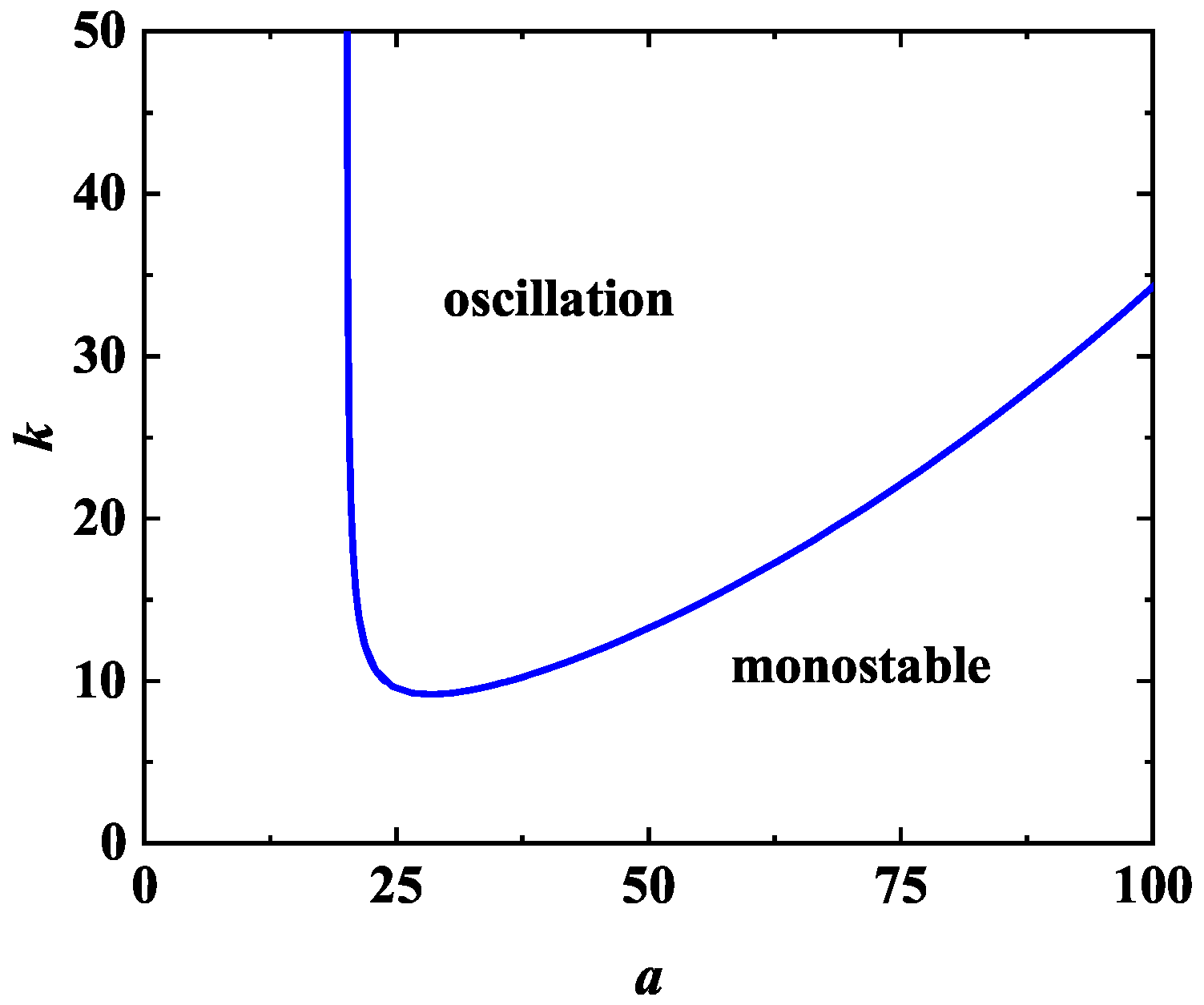
To illustrate the analytical results, we consider a specific parameter set: a = 10 , m = 1 , k = 10 , f = 0.05 , r = 1 . These values were chosen within the ranges reported in references [3,27]. To examine how parameters influence the oscillators dynamics, we carried out bifurcation analysis using XPPAUT, supported by numerical simulations to visualize the system’s behavior more intuitively, as in Figure 2, Figure 3, Figure 4, Figure 5, Figure 6, Figure 7, Figure 8, Figure 9 and Figure 10. In the bifurcation diagrams, red solid lines denote stable equilibrium points (SEP), black dashed lines denote unstable equilibrium points (UEP), green dots represent stable periodic orbits (SPO), and blue circles represent unstable periodic orbits (UPO). Hopf bifurcations are labeled as HB, and limit points of cycles are labeled as LPC. In two-parameter bifurcation diagrams, the blue solid line represents the locus of Hopf bifurcation (HB) points, which divides the plane into two regions: the monostable region (below the line, no oscillation) and the oscillatory region (above the line, sustained limit cycle oscillations).

4.1. Dependence of Dynamics on Model Parameters

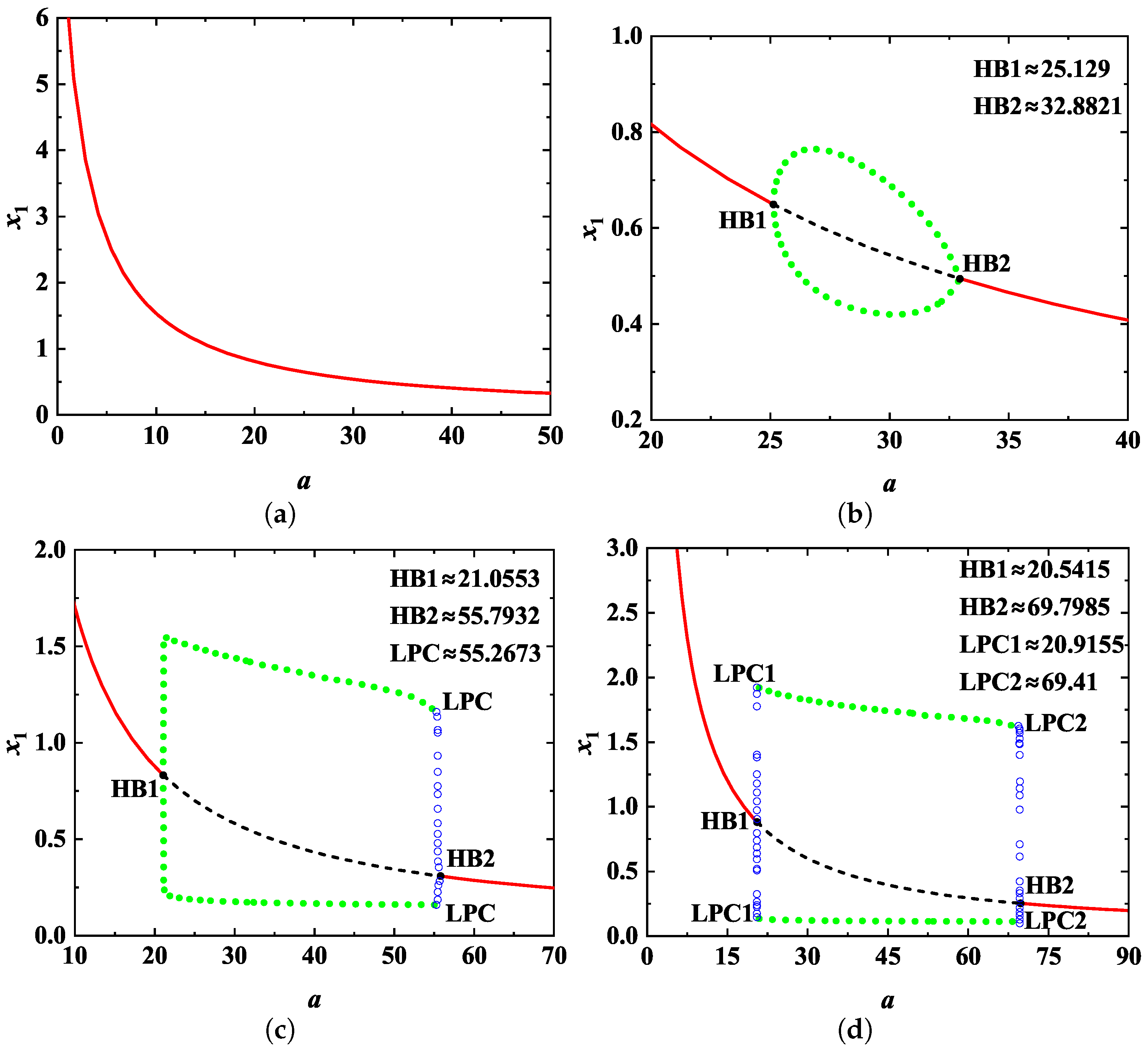
Figure 2 presents the bifurcation diagrams of a as a bifurcation parameter under different values of parameter k. The corresponding codimension-one bifurcation diagrams are shown below.
As shown in Figure 2a, at k = 9 , the system lies within the monostable region and remains in a stable steady state. The concentration of the activator increases monotonically as the bifurcation parameter a rises. For k = 9.5 (Figure 2b), the system enters the oscillatory regime. Two Hopf bifurcation points appear, HB1 at a 25.129 and HB2 at a 32.882 , dividing the steady-state curve into three segments: a branch of stable equilibria with high activator concentration, a region of unstable equilibria surrounded by stable limit cycles, and a branch of stable equilibria with low activator concentration. When k increases to 15 (Figure 2c), a Hopf point HB1 ( a 21.055 ), a limit point of cycles LPC ( a 55.267 ), and a second Hopf point HB2 ( a 55.793 ) emerge. As a grows, stable limit cycles born at HB1 lose stability at the LPC and finally disappear at HB2. At a large value k = 20 (Figure 2d), two Hopf points (HB1 at a 20.542 , HB2 at a 69.799 ) and two limit points of cycles (LPC1 at a 20.916 , LPC2 at a 69.41 ) are observed. The unstable limit cycle emanating from HB1 gains stability at LPC1, loses it again at LPC2, and vanishes before reaching HB2. This sequence indicates the onset of bistability, where a stable equilibrium coexists with a stable limit cycle over a certain interval of a.
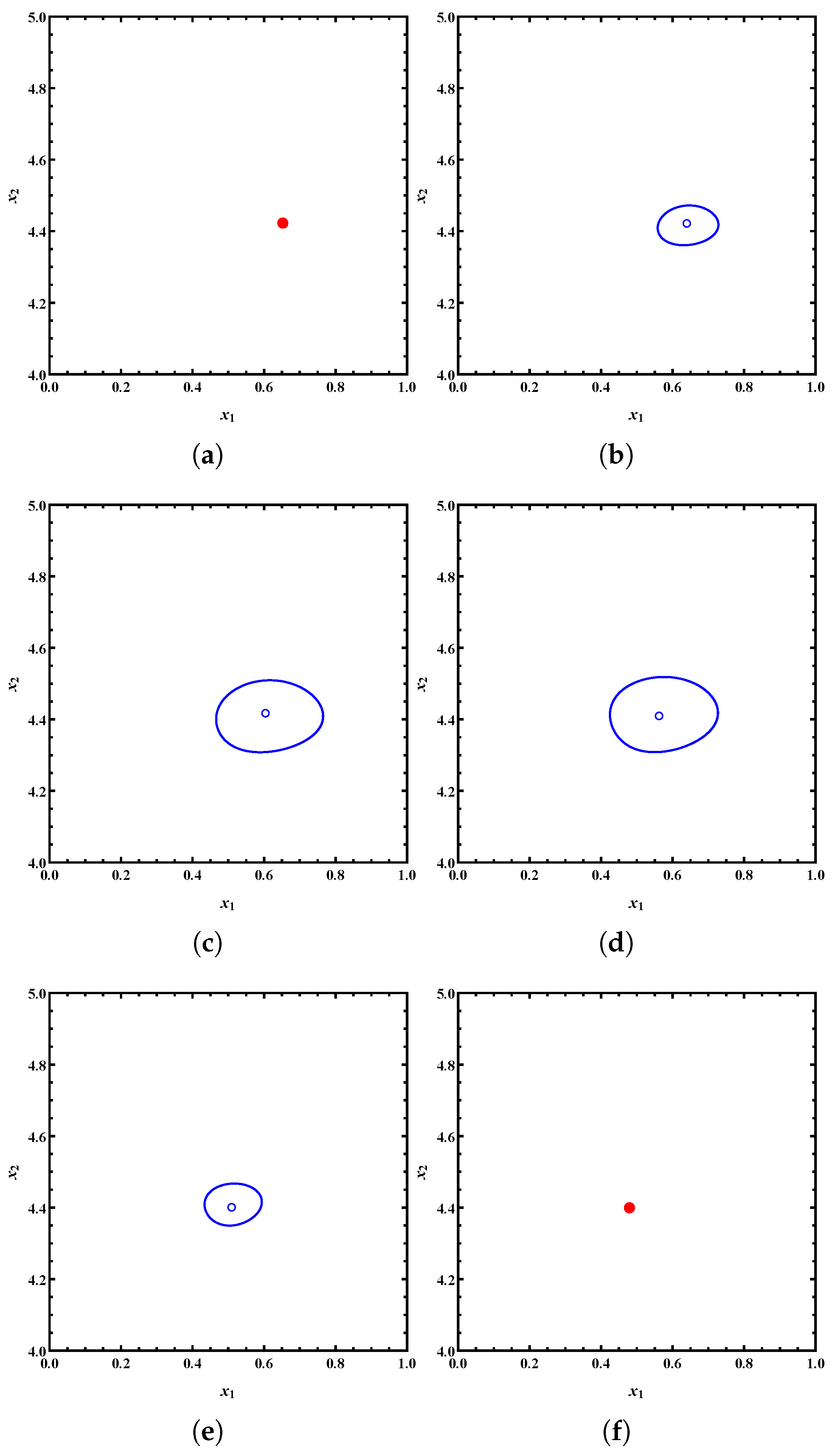
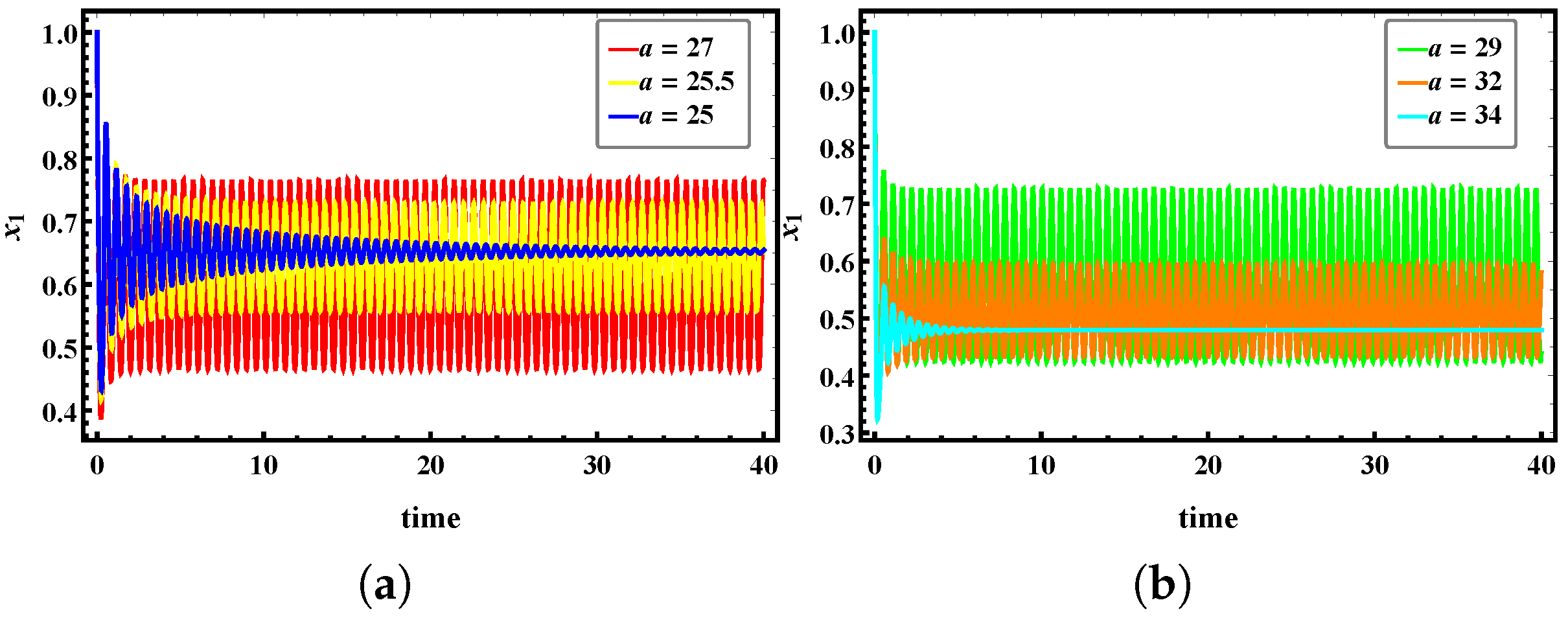
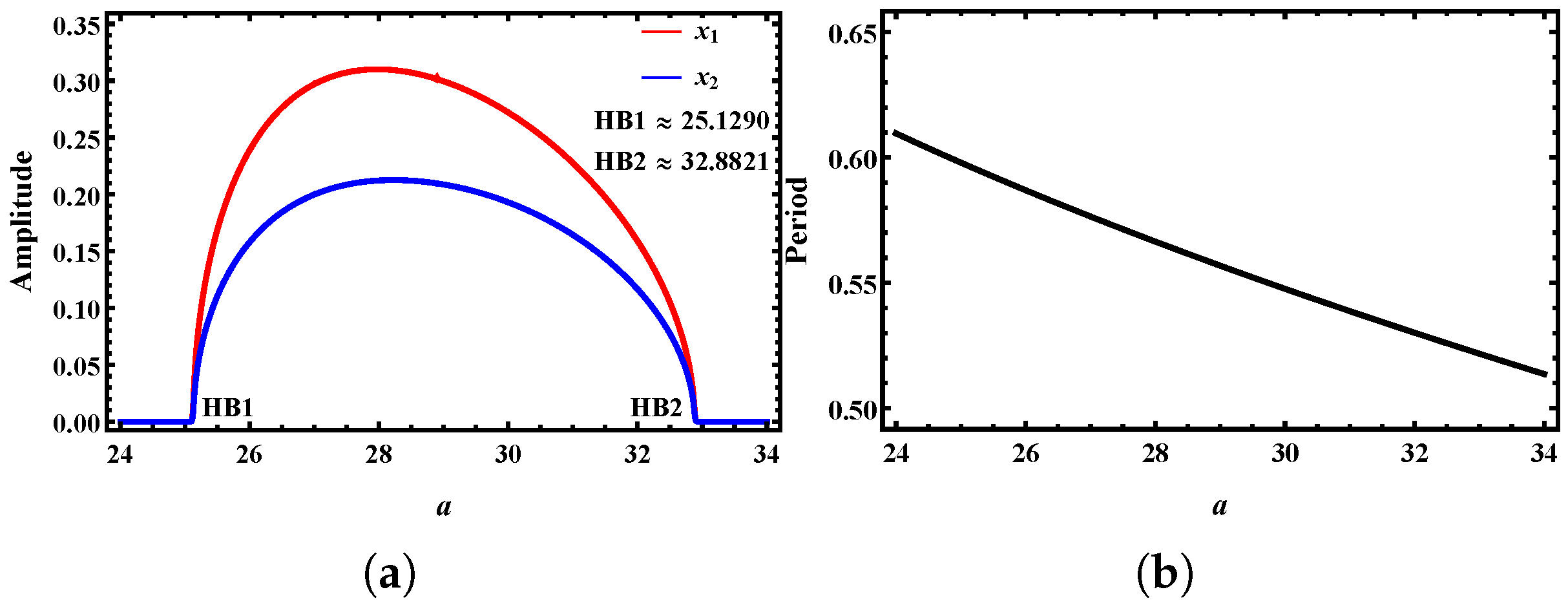
With the Hopf bifurcation conditions satisfied and a first Lyapunov coefficient of a 0 1.191835 < 0 calculated from Equation (12), the Hopf bifurcation theorem confirms the occurrence of a supercritical Hopf bifurcation at a 25.129 . Furthermore, phase-portrait analysis (Figure 3) indicates that as parameter a increases, the system undergoes a Hopf bifurcation from equilibrium to a limit cycle, followed by a reverse bifurcation back to equilibrium, consistent with the behavior shown in Figure 2b. The limit cycle first expands and then contracts, reflecting a corresponding increase and subsequent decrease in oscillation amplitude. To illustrate these amplitude changes explicitly, we plot the time histories for different values of a (Figure 4). The results reveal two distinct regimes: in one range the oscillation amplitude decreases with increasing a, while in another it increases. In addition, the above observations are further confirmed by plotting amplitude and period versus a. As shown in Figure 5, the amplitude curve exhibits a non-monotonic response (increase followed by decrease), while the period decreases monotonically, thereby affirming the critical regulatory function of parameter a in system oscillations.
Additionally, to further explore how the interaction between parameters a and k shapes the bifurcation behavior, we constructed a two-parameter bifurcation diagram (Figure 6). In this diagram, a blue line marks the locus of Hopf bifurcation points, which partitions the ( a , k ) plane into two distinct regimes: a monostable region and an oscillatory region. System oscillations emerge only when both a and k are maintained within an appropriate range bounded by this Hopf curve.
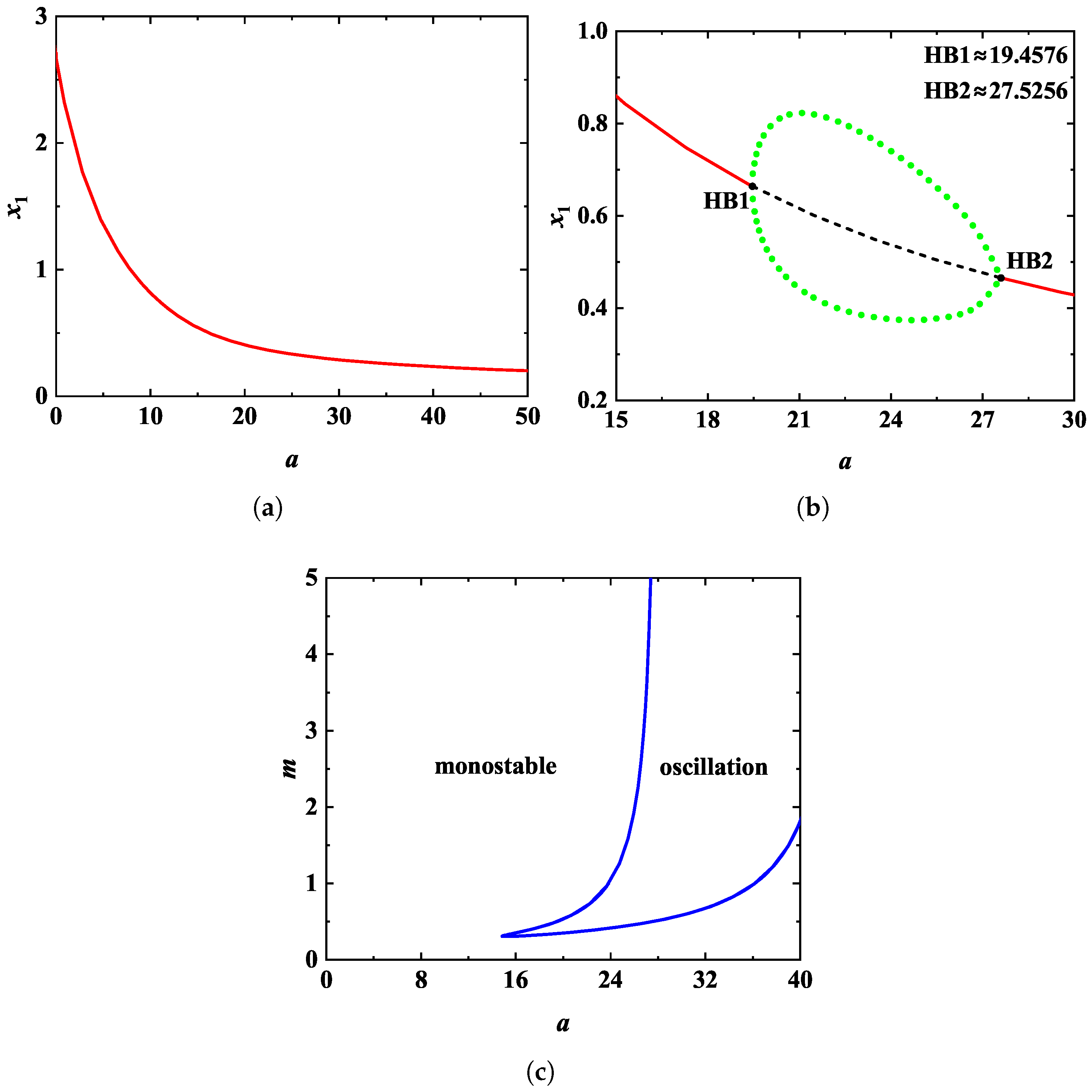
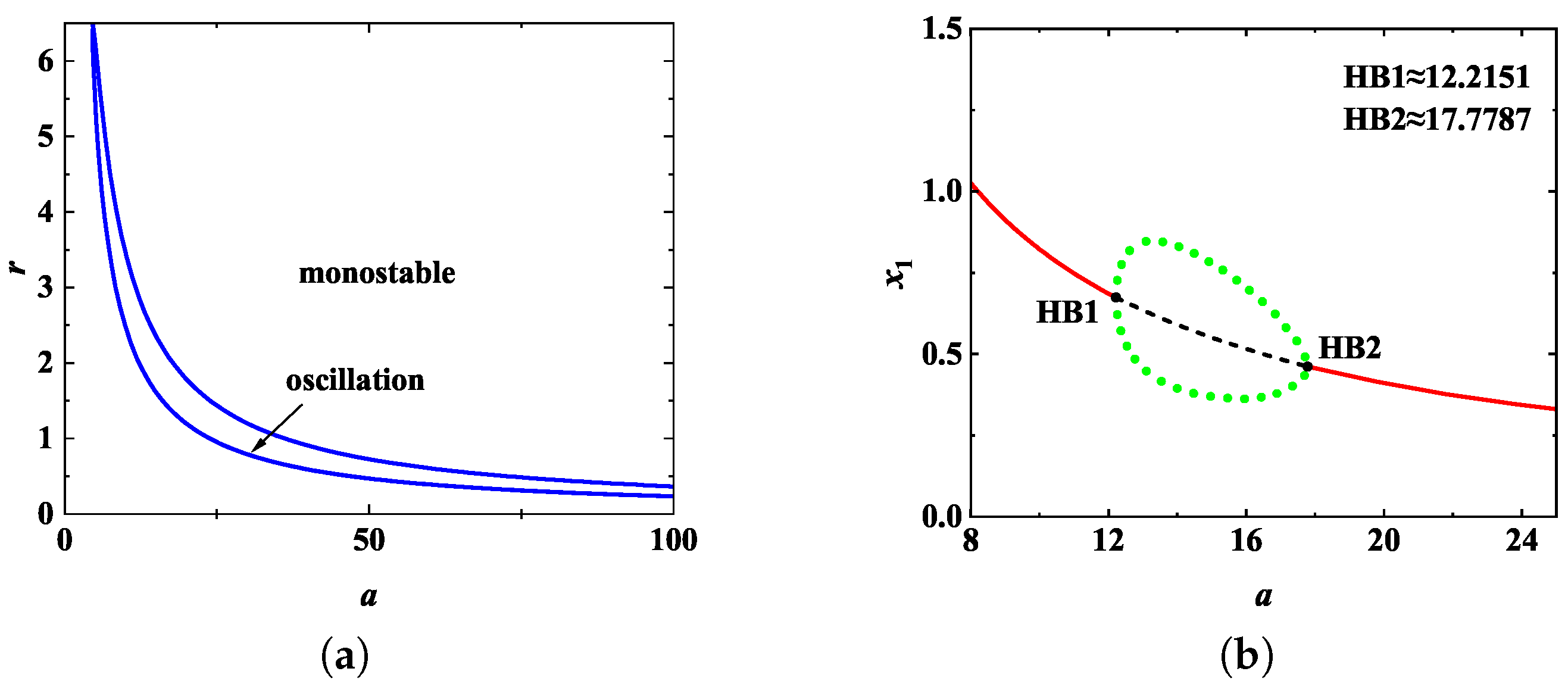
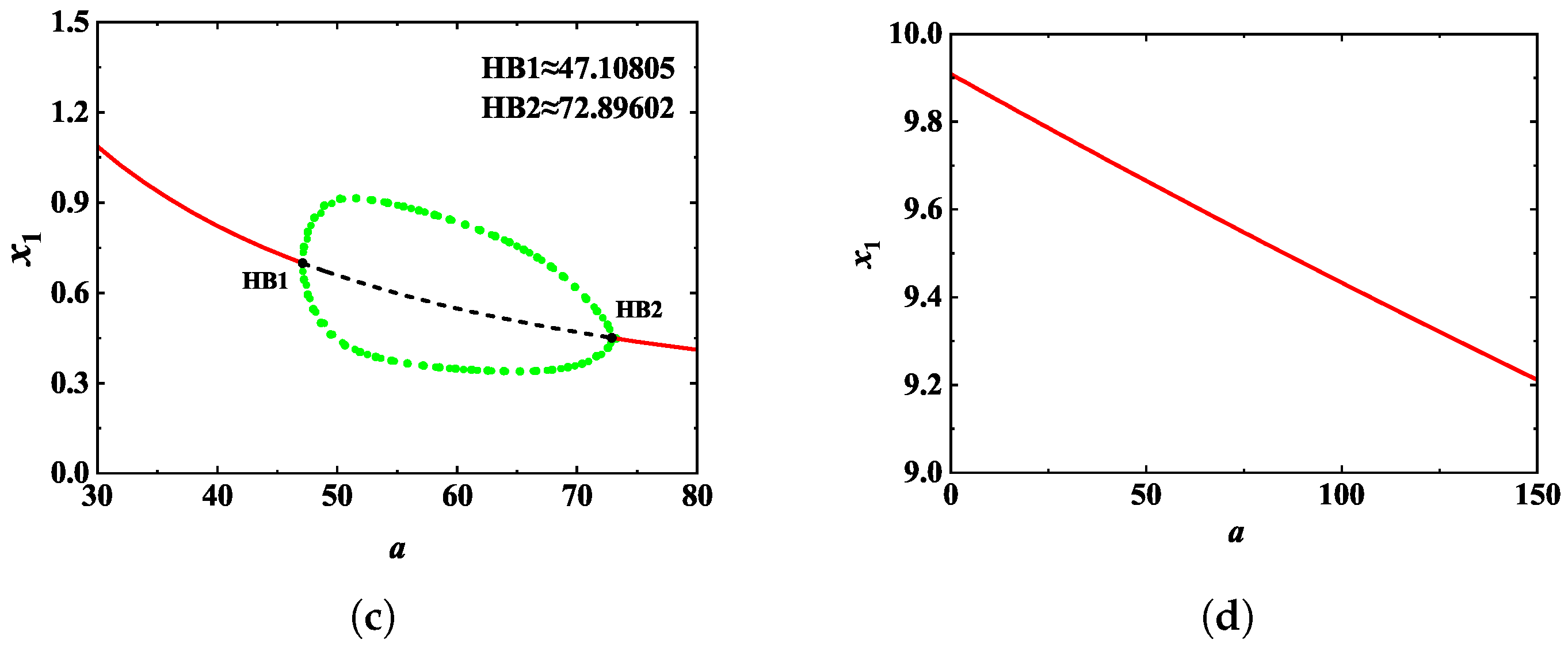
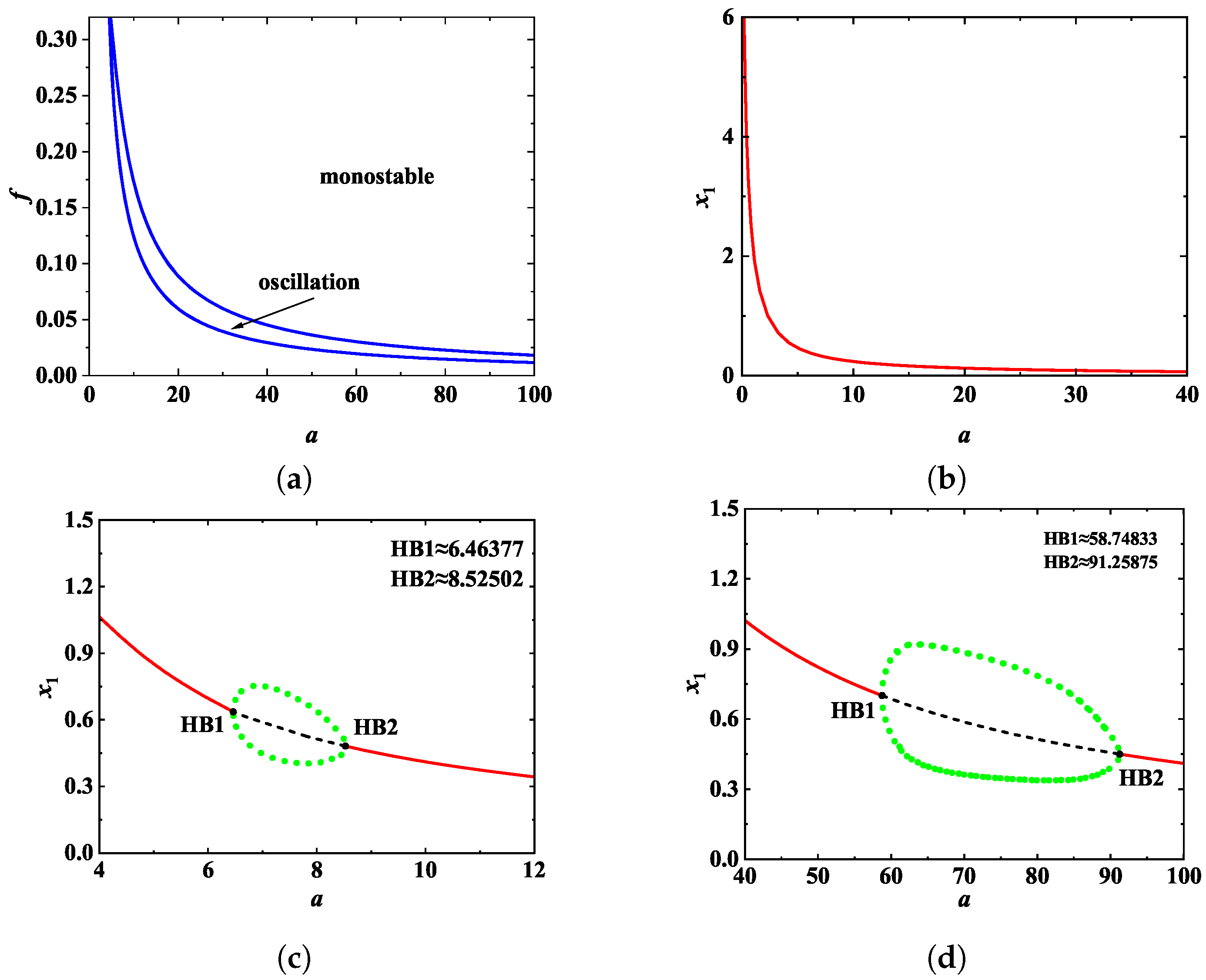
By constructing bifurcation diagrams of system (8) with respect to the control parameter a while varying the parameters m, r, and f, we find that the resulting bifurcation diagrams are qualitatively similar to those generated by varying parameter k. Typical bifurcation diagrams for three parameter sets are presented in Appendix A (Figure A1, Figure A2 and Figure A3). Together, they confirm that as the control parameter increases, the transition of the system’s dynamical behavior follows the same pattern observed when varying k. In the interest of brevity, detailed descriptions of these qualitatively identical diagrams are omitted here and provided in Appendix A. Overall, our results demonstrate that parameter variations play a decisive role in driving transitions between distinct dynamical regimes, such as monostable and oscillatory states.

4.2. Comparative Analysis: Transcriptional vs. Post-Translational Repression

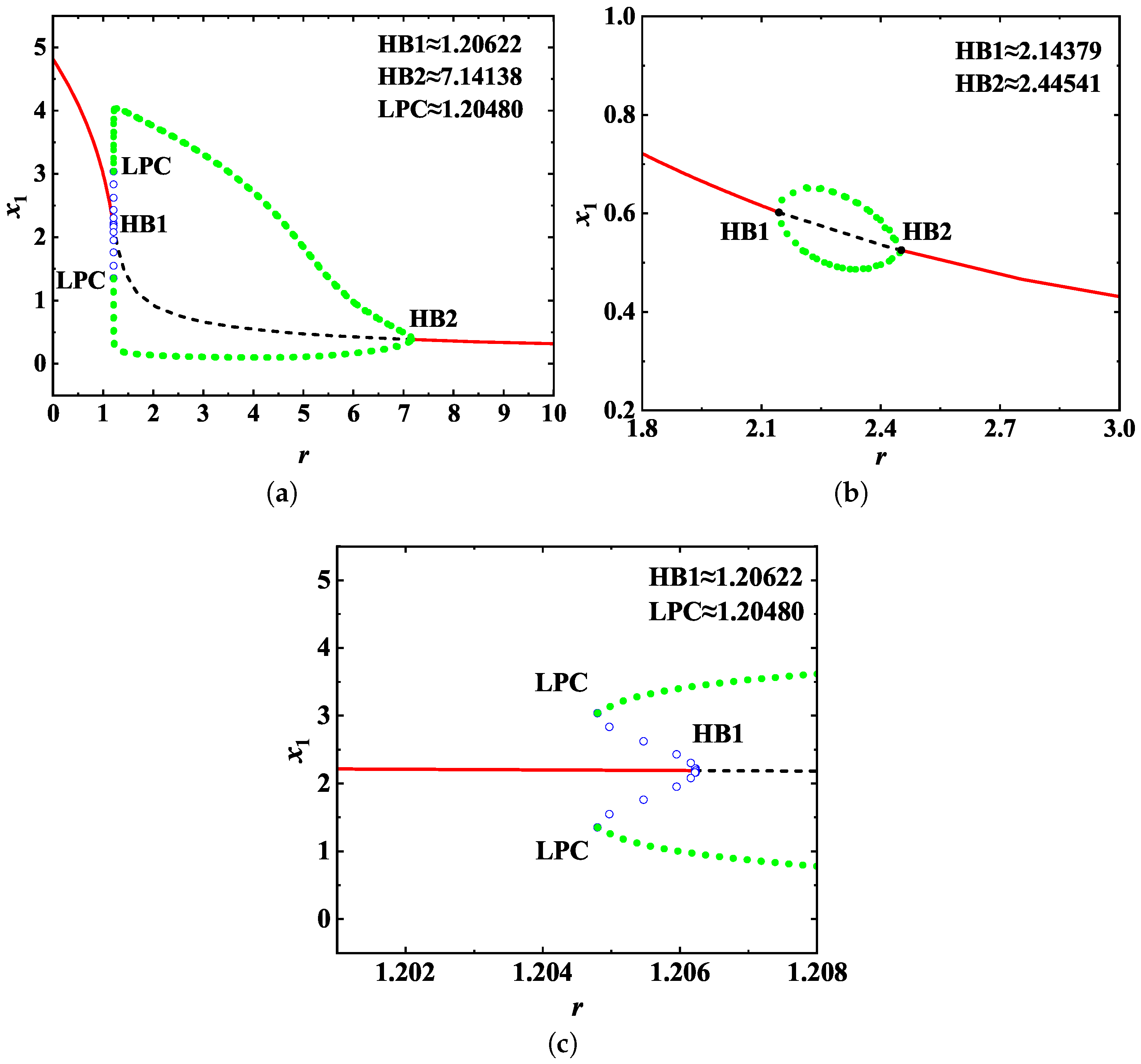
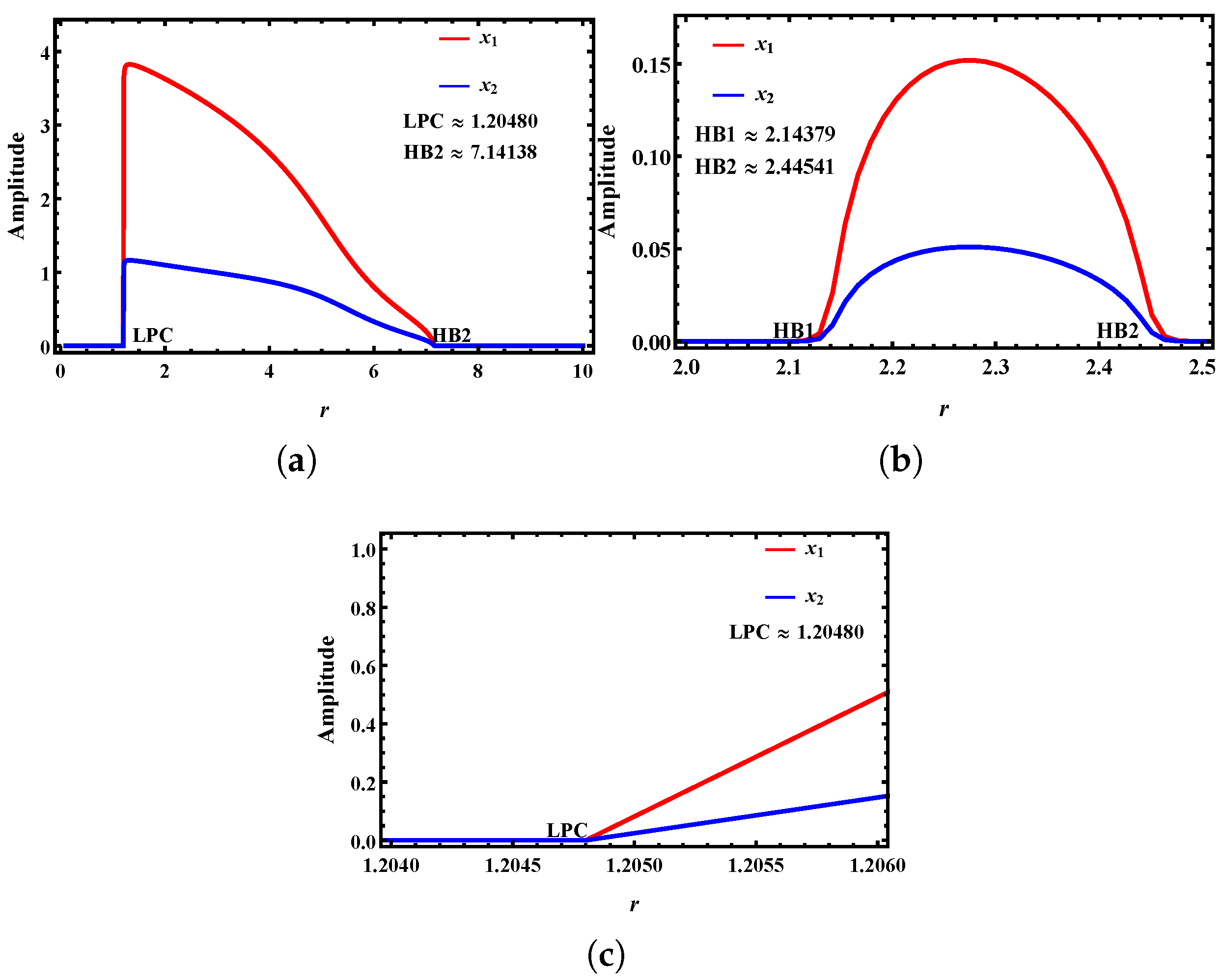
To highlight the distinctive dynamic features of the two genetic models, Guantes and Poyatos [26] used identical biochemical parameters a such as transcription, translation, and binding rates, along with a comparable inhibition intensity r in both implementations, and differentiated their oscillatory periods and amplitudes by describing the waveforms as functions of the degradation rate ratio (parameter a). In contrast, the present work fixes all other parameters and varies only the inhibition intensity r to compare the amplitude behaviors of the two models. Because Model (3) inhibits indirectly at the transcriptional level while Model (8) inhibits directly at the translational level, we specifically investigate how the strength of inhibition influences both the emergence and the amplitude of oscillations. As shown in Figure 7, with the parameters set to a = 10 , k = 10 , m = 0.5 ,   f = 0.05 , we plotted the bifurcation diagrams of Model (3) and Model (8) with the inhibition intensity r as the bifurcation parameter. In Figure 7a, as r rises, the system first undergoes a subcritical Hopf bifurcation at r 1.20622 (labeled HB1), producing an unstable limit cycle. A fold bifurcation of cycles (LPC) occurs at r 1.2048 . Above LPC, the system undergoes bistability, the coexistence of stable equilibria and limit cycle, until the subcritical Hopf bifurcation point occurs. Within this regime, the cycle amplitude increases with r until it peaks. Below the critical value LPC, the activator protein level reaches a high stable steady state, while beyond which protein level undergoes periodical oscillations. When r further increases to second Hopf bifurcation (HB2) at r 7.1438 , sustained oscillations disappear and the activator protein level again evolves toward a low stable steady state. As expected, these results indicate that the signal strength can lead to two Hopf bifurcation and only the signal strength in an appropriate range can drive the protein oscillations, which is consistent with the result that a threshold signal can act as a switch to induce sustained oscillations. In Figure 7b, it exhibits limit-cycle oscillations in response to increasing parameter values. Moreover, there exist two Hopf bifurcation points labeled as HB1 and HB2, respectively. As r increases gradually, the activator protein level goes from high stable state to limit-cycle periodic oscillation and then to low steady state. Moreover, oscillations arise through Hopf bifurcation labeled as HB1 at r 2.14379 , and then disappear at a second Hopf bifurcation labeled as HB2 at r 2.44541 .
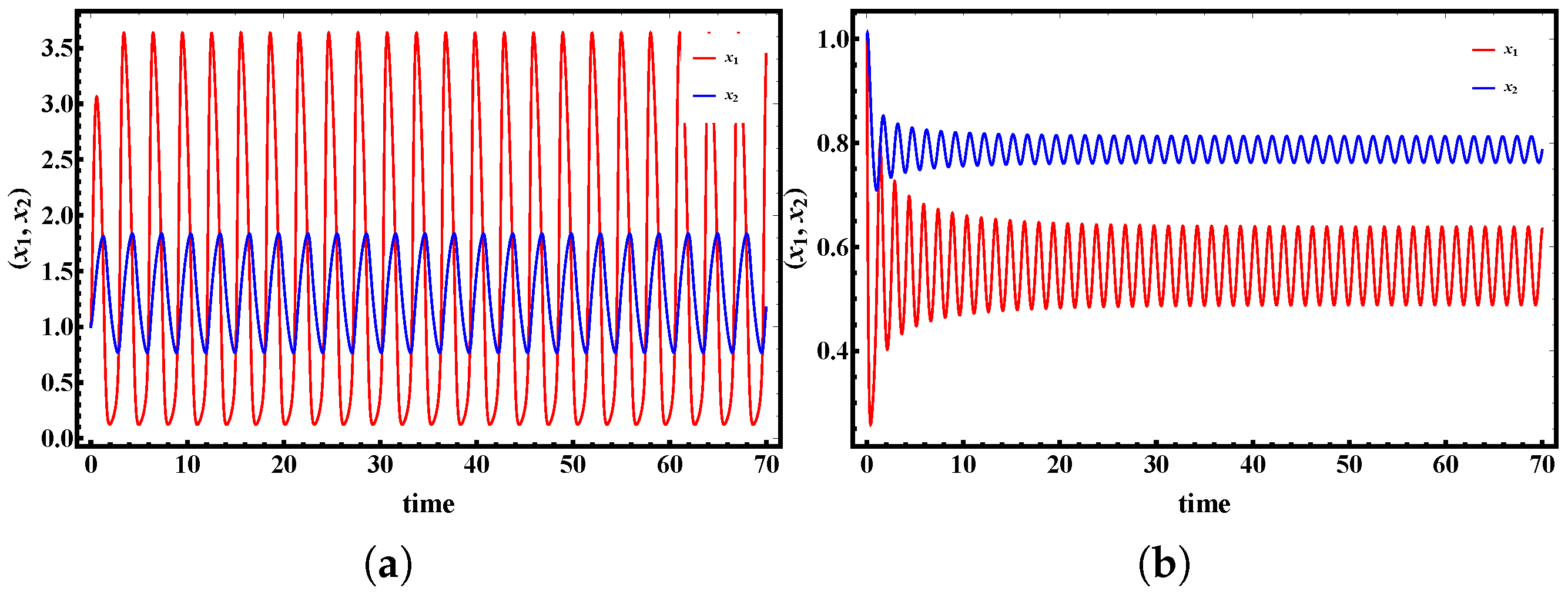
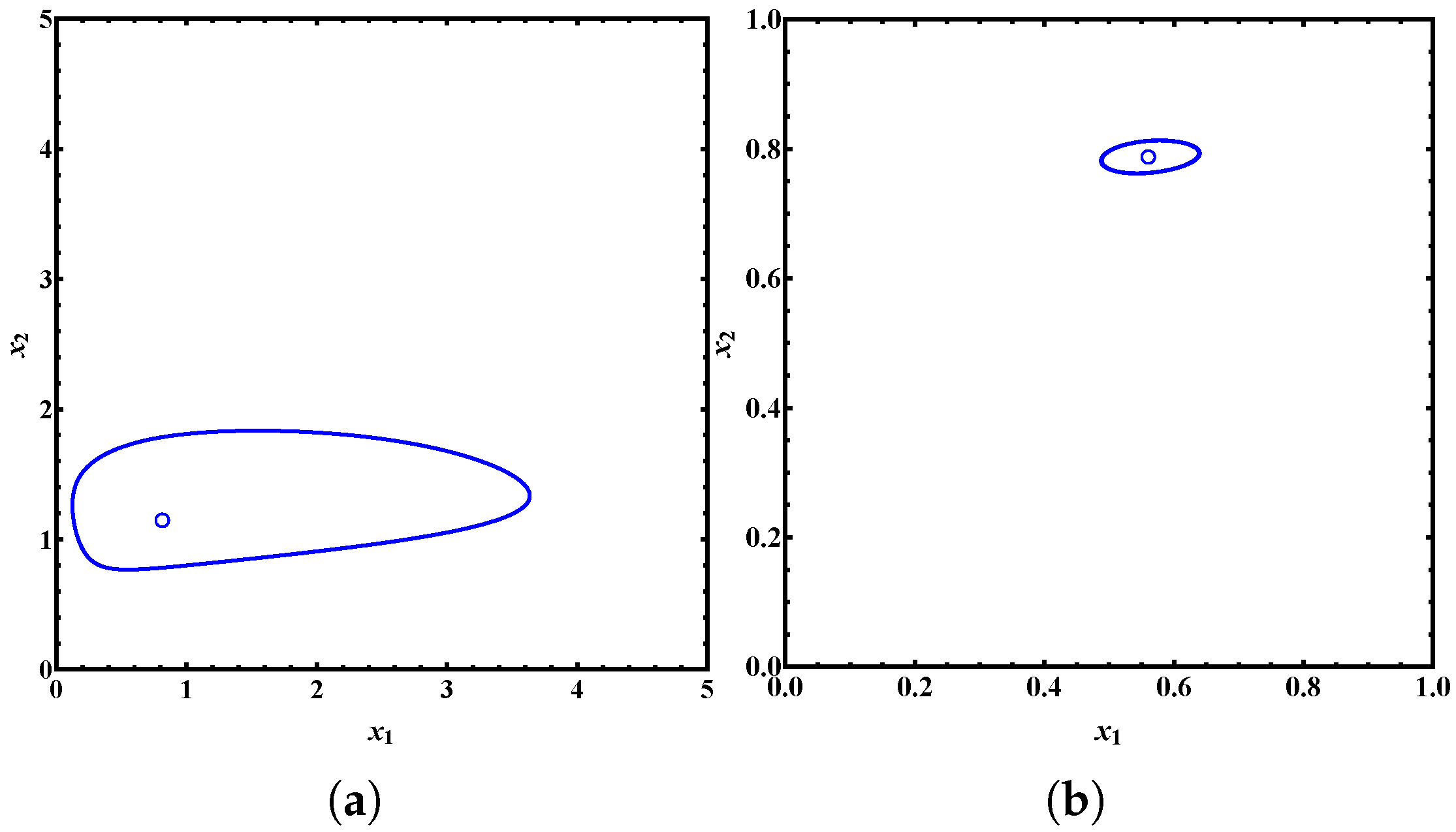
To further compare the dynamic differences between the two models, we select a representative parameter set between HB1 and HB2, i.e, r = 2.3 , a = 10 , k = 10 , m = 0.5 , f = 0.05 . The corresponding phase portraits and time-history curves are shown in Figure 8 and Figure 9. Under these identical conditions, Model (3) exhibits a larger oscillation amplitude than Model (8). Moreover, by characterizing the amplitude as a function of the inhibition intensity r for both models (Figure 10), we observe distinct patterns. Although Model (3) oscillates over a relatively wide range of r, its amplitude rises sharply to a peak and then declines. In contrast, Model (8) oscillates only within a narrow interval ( r 2.14379–2.44541), and its amplitude varies gradually, increasing and then decreasing slowly as r changes. These results indicate that Model (8) is more sensitive to changes in inhibition strength, suggesting that post-translational repression is more direct and effective than transcriptional repression. This difference is closely related to the core requirement of gene-regulatory networks for responding to cellular stress, such as DNA damage.

4.3. Symmetry and Asymmetry in Bifurcation Dynamics

The bifurcation diagrams presented in this work (Figure 2, Figure 6, Figure 7, Figure A1, Figure A2 and Figure A3) reveal distinct patterns of symmetry and asymmetry in the oscillatory dynamics of the two genetic oscillator models, which are closely tied to their underlying regulatory mechanisms and parameter interactions.

4.3.1. Asymmetry in Bifurcation Dynamics

Notably, all bifurcation diagrams exhibit pronounced asymmetry in both parameter dependence and dynamical outcomes. In all two-parameter bifurcation diagrams, the Hopf bifurcation locus forms a monotonic curve—decreasing in the a k , a r , and a f planes, yet increasing in the a m plane—without any reflectional or rotational symmetry with respect to the axes or any central point. This monotonic trend indicates that the threshold for oscillatory behavior responds asymmetrically to changes in the degradation rate ratio a relative to other control parameters. Specifically, as a increases, the critical values of k, r and f required to sustain oscillations decrease monotonically, whereas the critical value of m increases monotonically, with no symmetric reversal of these trends. Such asymmetry reflects the inherent directionality of time-scale separation ( a 1 ) and the unidirectional coupling between activator and repressor dynamics, which inherently breaks mathematical symmetry.
This asymmetry extends to the one-parameter bifurcation diagrams in two key forms. First, the oscillatory intervals bounded by two Hopf bifurcation points (HB1 and HB2) are never symmetrically distributed around any central parameter value. For instance, in Figure 2b, the oscillatory window a [ 25.129 , 32.882 ] is not centered, and the oscillation amplitude peaks closer to HB1 rather than the interval midpoint—a pattern consistently observed across all one-parameter oscillatory regimes (e.g., Figure A1, Figure A2 and Figure A3). Second, the bifurcation types and state distributions are structurally asymmetric. In Figure 2c, HB1 is supercritical while HB2 is subcritical, yielding unstable periodic orbits only on the right side of HB2. Moreover, in Figure 7a, bistability (coexistence of stable equilibria and stable limit cycles) is confined to a narrow interval r [ LPC 1.20480 , HB 1 1.20622 ] , with no symmetric counterpart elsewhere, further underscoring the globally asymmetric nature of the system’s dynamics.

4.3.2. Symmetry in Bifurcation Dynamics

Local reflectional symmetry emerges in the stable periodic orbits of certain one-parameter diagrams. For instance, in Figure 7c, the upper and lower branches of stable periodic orbits are mirror images of each other across the stable equilibrium point (red solid line at x 1 2 ), while in Figure 2d, the stable periodic orbits exhibit vertical reflectional symmetry around the central stable equilibrium branch, with symmetric upper and lower amplitudes. Moreover, symmetric patterns in state distribution are evident in diagrams with paired Hopf bifurcations. In cases with two supercritical Hopf bifurcations (e.g., Figure 2b, Figure A1b, Figure A2b,c and Figure A3b,d), the state distribution follows a balanced “stable–unstable–stable” structure: stable equilibria occupy both sides of the oscillatory interval, while unstable equilibria lie between HB1 and HB2. In contrast, for the subcritical Hopf pair in Figure 2d, symmetry is also maintained: both sides feature stable equilibria and unstable periodic orbits, while the central region hosts symmetric upper and lower branches of stable periodic orbits. Collectively, these observations reveal that despite global asymmetries in parameter dependence, the system can exhibit localized symmetric structures in both orbit geometry and state organization.

5. Biological Interpretation

In this section, we provide biological interpretations of the bifurcation diagrams and numerical simulations presented above, under the assumption that the initial conditions are biologically meaningful. We focus on regimes where trajectories are stable for initial conditions chosen outside the stable/unstable manifolds of the equilibrium and not on the limit cycle; in such cases, the final dynamical regime remains robust to small perturbations in initial conditions. For Model (8), we identify three distinct dynamical regimes with biological relevance:
(i) The monostable regime (MR): In this regime, both activator and repressor concentrations converge to a stable equilibrium with specific expression levels. This corresponds to the monostable region in the bifurcation diagrams, i.e., the parameter range outside the Hopf bifurcation curve. Biologically, MR represents the cell’s basal homeostatic state, where the two-component regulatory network remains at rest in the absence of stress. A prototypical example is the p53-Mdm2 oscillator exhibiting low-level balanced expression without DNA damage.
(ii) The bistable regime (RB): Within a specific parameter range bounded by key bifurcation points, the system exhibits two switchable stable states: a survival state with high activator expression and an apoptotic state with low activator expression. This bistable behavior functions as an all-or-none molecular switch for cell fate determination, a core role of two-component oscillators in stress response. For instance, in the DNA damage response, the p53-Mdm2 oscillator’s bistable switch dictates whether the cell undergoes repair or apoptosis.
(iii) The regime of sustained oscillation (RSO): Here, the activator and repressor concentrations converge to a stable limit cycle, corresponding to the parameter region between the two Hopf bifurcation points. Biologically, this oscillatory behavior is the hallmark function of two-component oscillators, underpinning essential processes such as cell cycle progression, circadian rhythms, and the pulsatile activation of p53-Mdm2 during DNA damage repair. In the latter, rhythmic pulses encode stress intensity to guide stepwise repair.
Based on the bifurcation analyses presented above, we draw the following core conclusions for the two-component gene oscillator (Model (8)). Parameter a, the activator-to-repressor degradation rate ratio, is the core control parameter for time-scale separation [3,27]; parameter k is the core positive feedback strength indicator that directly determines the system’s oscillation competence [27]. As shown in Figure 2, k = 9 maintains the system in monostability, corresponding to cellular basal homeostasis. For example, low-level balanced p53-Mdm2 expression without DNA damage [11]; k = 9.5 drives the system into the oscillatory regime with two Hopf bifurcation points, corresponding to stress response activation, where periodic oscillations encode stress intensity to initiate damage repair [14,29]; k = 15 generates two HB points and one limit point of cycles (LPC), reflecting expanded cellular adaptive response range for graded stimulus coding under moderate positive feedback; k = 20 yields two HB points, two LPCs and a bistable region, endowing cells with dual functions of all-or-none cell fate decision and time-coded signal processing, the core dynamic basis of two-component networks in stress response. The a k two-parameter bifurcation analysis reveals the synergistic biological rule of positive feedback and protein degradation dynamics: it clarifies the non-negotiable threshold effect of activator auto-activation for oscillation initiation. When k is low, positive feedback is too weak to break steady-state balance, and no oscillation can be initiated regardless of a adjustment, which explains why reduced activator-promoter binding affinity completely abolishes the pulsatile stress response in cells [27]. Excessively high k leads to over-strong positive feedback, requiring a larger a to maintain oscillation stability, which provides a quantitative basis for optimizing positive feedback modules in synthetic biological oscillatory circuits [30].
Additionally, parameters m, r and f exhibit consistent dynamical regulatory characteristics, as all can drive the system to switch between monostable and sustained oscillatory regimes by tuning network feedback strength and basal expression levels. As shown in Figure 6, f represents the repressor-to-activator basal synthesis rate ratio, which determines the system’s basal inhibition level [27]: when f = 0.355, the system is monostable, corresponding to excessive basal inhibition that impairs stress response, that consistent with damped p53-Mdm2 oscillation caused by abnormally high Mdm2 basal expression [11,26]; f = 0.2, the system enters the oscillatory regime, corresponding to restored stress response capacity via downregulated basal inhibition. The a f two-parameter bifurcation analysis elucidates how basal inhibition level modulates cellular oscillatory robustness: f and a synergistically determine the oscillation initiation threshold and dynamic stability. When f is low, low basal repressor expression gives the system the widest oscillatory interval and strongest anti-interference ability, which corresponds to the robust circadian oscillation maintained by low basal expression of core repressor proteins in mammalian cells [16,27]. When f is high, excessive basal inhibition significantly narrows the oscillatory interval and predisposes the system to bistability, which explains the loss of p53 pulsatile response in cancer cells with abnormally high basal Mdm2 expression [11].
Furthermore, taking repressor inhibition strength r as the core control variable to systematically compare the two models under consistent biochemical parameters, the results show that the transcriptional repression Model (3) has a wider oscillatory interval of r with sharp amplitude changes, while the post-translational repression Model (8) has an extremely narrow oscillatory window and higher sensitivity to r variation [26]. This difference has profound physiological implications: for the p53-Mdm2 network, Model (3) wide oscillatory range requires long-term fluctuations in inhibition strength for cells to transition from stress state to homeostasis, prolonging genome damage risk; while Model (8) narrow window enables rapid initiation and termination of oscillatory regulation with minimal r modulation, allowing faster stress exit and reduced genomic damage risk [29]. This advantage explains why time-critical processes (circadian rhythms, DNA damage response) rely on post-translational repression, which bypasses time-consuming transcription and translation steps to shorten regulatory delay [8,16], and also provides clear guidance for synthetic gene circuit model: Model (3) suits long-period, large-amplitude oscillatory circuits, while Model (8) is more applicable to rapid-response, high-precision stress response circuits [30].
In addition, the observed patterns of symmetry and asymmetry are not mathematical artifacts but carry functional significance for biological oscillators. To begin with, the monotonic asymmetry in two-parameter thresholds ensures that cells can robustly tune oscillations by adjusting a single parameter (e.g., a) without triggering symmetric, counterproductive responses in other parameters, enabling reliable adaptation to environmental changes. Next, asymmetric oscillatory intervals and amplitude peaks allow cells to prioritize specific parameter ranges for optimal oscillatory performance—for example, larger amplitudes near HB1 in Model (3) facilitate robust signal amplification for stress responses. Moreover, local reflectional symmetry in SPOs ensures balanced oscillatory amplitudes around the stable steady state, which is critical for maintaining precise, rhythmic protein concentrations without extreme deviations. Then, symmetric state distributions in Hopf bifurcation pairs provide a stable, predictable transition between steady and oscillatory states, reducing the risk of erratic dynamical behavior and ensuring reliable biological rhythm generation. Finally, the coexistence of global asymmetry and local symmetry highlights that cells evolve hierarchical dynamical patterns: global asymmetry enables flexible tuning of oscillations, while local symmetry ensures precision and stability within functional oscillatory regimes.

6. Conclusions and Discussion

In this study, we employed a minimal two-component gene regulatory network to analyze oscillatory dynamics. The model is analyzed through a combination of analytical and numerical approaches, with the parameter a serving as the primary control variable to systematically examine how oscillation patterns evolve with parameter variation. By applying Hopf bifurcation theory, we derived sufficient conditions for the emergence of sustained oscillations. These theoretical and computational results not only deepen the understanding of regulatory mechanisms in synthetic gene circuits but also provide a framework for analyzing oscillatory dynamics in more complex genetic networks.
In previous studies on genetic oscillator models, researchers have mainly focused on the impact of regulatory steps in transcription and translation on system dynamics to understand the mechanisms of gene expression [7,31]. Because the time required for mRNA translation into protein is generally shorter than that for transcription, many studies tend to omit the translation step or treat the two steps as a single combined process [17,31]. Consequently, few studies have compared the effects of different inhibition sites. In our model, we compared two oscillator models proposed by Guantes and Poyatos using inhibition intensity as the control variable. The comparison results show that post-translational inhibition (Model 8) is more effective and direct than transcriptional inhibition (Model 3). This difference carries important physiological implications. For instance, when cells face crises such as DNA damage or oxidative stress—as observed in systems exemplified by the p53-mediated repair pathway—rapid and precise regulation is essential to prevent damage escalation and ensure cell survival. However, it should be noted that the present abstract modelling framework is not specifically tailored to the p53-Mdm2 system; rather, it captures general architectural features shared by multiple genetic oscillators. Post-translational inhibition acts directly on already synthesized activator proteins, bypassing time-consuming steps like transcriptional initiation, mRNA synthesis, and processing. This enables faster initiation of oscillatory programs and shortens the cycle of ”stress response–damage repair–homeostasis restoration”. In contrast, transcriptional inhibition acts upstream in gene expression, introducing longer regulatory delays that may prolong the cellular stress state and increase the risk of genomic instability or even carcinogenesis. This mechanistic advantage also explains why physiological processes requiring precise temporal control, such as circadian rhythms, rely predominantly on post-translational repression—a strategy that ensures both rhythmic stability and timely adaptation to environmental changes. Additionally, our analysis of symmetry and asymmetry in bifurcation dynamics reveals that these structural dynamical patterns are intrinsic to the regulatory logic of each oscillator design, further distinguishing the functional trade-offs between transcriptional and post-translational repression. Specifically, local symmetry in oscillatory amplitudes ensures rhythmic precision, while global asymmetry enables robust parameter tuning—two complementary traits shaped by distinct inhibitory mechanisms. It is important to note that the current model was deliberately simplified to highlight core dynamical principles. Several limitations should be acknowledged. First, the analysis relies on deterministic ordinary differential equations, which neglect stochastic effects and cell-to-cell variability. Second, the specific functional forms employed (such as Hill-type regulation functions) represent idealized approximations, and quantitative predictions may depend on these choices. Third, the conclusions about oscillatory regimes are contingent upon the specific parameter ranges examined. Fourth, the two-component architecture omits additional regulatory layers, time delays, and spatial heterogeneity present in endogenous genetic networks. As a natural extension, future work will incorporate more realistic biological factors—such as time delays, spatial heterogeneity, or additional regulatory layers—to explore how these features modulate the oscillatory repertoire and functional robustness of genetic oscillators.


Author Contributions

Conceptualization, Y.W. and R.L.; methodology, C.G.; software, Y.W. and R.L.; validation, C.G., Y.W. and R.L.; formal analysis, R.L. and Y.W.; investigation, C.G., Y.W. and R.L.; resources, C.G.; data curation, Y.W.; writing—original draft preparation, C.G.; writing—review and editing, Y.W. and R.L.; visualization, C.G. and Y.W.; project administration, C.G.; funding acquisition, C.G. All authors have read and agreed to the published version of the manuscript.

Funding

This research was supported by the Scientific Research Funding of Jiangsu University of Science and Technology, No. 1052932305 (C. Gao) and the National Natural Science Foundation of China, No. 12502009 (C. Gao).

Data Availability Statement

The original contributions presented in this study are included in the article. Further inquiries can be directed to the corresponding author.

Conflicts of Interest

The authors declare no conflicts of interest.

Appendix A. Bifurcation Diagrams of A as a Bifurcation Parameter Under Different Values of Parameter M, R and F

Figure A1. Bifurcation diagrams of model (8) with a as the variable parameter under different effective basic synthesis rates of activators (parameter m). (ac) One-parameter bifurcation diagrams in the a x 1 plane for (a) m = 0.3 and (b) m = 0.5 . (c) Two-parameter bifurcation diagram in the a m plane, delineating the oscillatory region. Red solid and black dashed lines denote stable/unstable equilibrium points; green dots denote stable periodic orbits; the blue solid line is the Hopf bifurcation points.
Symmetry 18 00697 g0a1
Figure A2. Bifurcation diagrams of model (8) with a as the variable parameter under different inhibition strength (parameter r). (a) Two-parameter bifurcation diagram of Model (8) in the a r plane. (bd) One-parameter bifurcation diagrams of Model (8) in the a x 1 plane for fixed values of r: (b) r = 2 , (c) r = 0.5 , (d) r = 0.001 . Red solid and black dashed lines denote stable/unstable equilibrium points; green dots denote stable periodic orbits; the blue solid line is the Hopf bifurcation points.
Symmetry 18 00697 g0a2aSymmetry 18 00697 g0a2b
Figure A3. Bifurcation diagrams of model (8) with a as the variable parameter under different synthesis rate ratio (parameter f). (a) Two-parameter bifurcation diagram of Model (8) in the a f plane. (bd) One-parameter bifurcation diagrams of Model (8) in the a x 1 plane for fixed values of f: (b) f = 0.355 , (c) f = 0.2 , (d) f = 0.02 . Red solid and black dashed lines denote stable/unstable equilibrium points; green dots denote stable periodic orbits; the blue solid line is the Hopf bifurcation points.
Symmetry 18 00697 g0a3

References

  1. Lai, Q.; Zhao, X.W.; Huang, J.N.; Pham, V.T.; Rajagopal, K. Monostability, bistability, periodicity and chaos in gene regulatory network. Eur. Phys. J. Spec. Top. 2018, 227, 719–730. [Google Scholar] [CrossRef]
  2. Stuart, J.M.; Segal, E.; Koller, D.; Kim, S.K. A Gene-Coexpression Network for Global Discovery of Conserved Genetic Modules. Science 2003, 302, 249–255. [Google Scholar] [CrossRef] [PubMed]
  3. Goldbeter, A. Computational approaches to cellular rhythms. Nature 2002, 420, 238–245. [Google Scholar] [CrossRef] [PubMed]
  4. Novák, B.; Tyson, J.J. Design principles of biochemical oscillators. Nat. Rev. Mol. Cell Biol. 2009, 9, 981–991. [Google Scholar] [CrossRef]
  5. Menta, K.K.; Bani-Yaghoub, M.; Youan, B.B.C. Uncovering dual oscillatory regimes in p53-mdm2 dynamics: A data-driven modeling approach with implications for cancer progression. BioSystems 2025, 255, 105540. [Google Scholar] [CrossRef]
  6. Lahav, G. The Strength of Indecisiveness: Oscillatory Behavior for Better Cell Fate Determination. Sci. STKE 2004, 2004, pe55. [Google Scholar] [CrossRef]
  7. Monk, N.A.M. Oscillatory expression of Hes1, p53, and NF-kappaB driven by transcriptional time delays. Curr. Biol. 2003, 13, 1409–1413. [Google Scholar] [CrossRef]
  8. Lahav, G. Oscillations by the p53-Mdm2 feedback loop. Adv. Exp. Med. Biol. 2008, 641, 28–38. [Google Scholar]
  9. Wu, X.; Bayle, J.H.; Olson, D.; Levine, A.J. The p53-mdm2 autoregulatory feedback loop. Genes Dev. 1993, 7, 1126–1132. [Google Scholar] [CrossRef]
  10. Batchelor, E.; Loewer, A.; Lahav, G. The ups and downs of p53: Understanding protein dynamics in single cells. Nat. Rev. Cancer 2009, 9, 371–377. [Google Scholar] [CrossRef]
  11. Lahav, G.; Rosenfeld, N.; Sigal, A.; Geva-Zatorsky, N.; Levine, A.J.; Elowitz, M.B.; Alon, U. Dynamics of the p53-Mdm2 feedback loop in individual cells. Nat. Genet. 2004, 36, 147–150. [Google Scholar] [CrossRef]
  12. Moore, R.; Ooi, H.K.; Kang, T.; Bleris, L.; Ma, L. MiR-192-Mediated Positive Feedback Loop Controls the Robustness of Stress-Induced p53 Oscillations in Breast Cancer Cells. PLoS Comput. Biol. 2015, 11, e1004653. [Google Scholar] [CrossRef] [PubMed]
  13. Wagner, J.; Ma, L.; Rice, J.J.; Hu, W.; Levine, A.J.; Stolovitzky, G.A. p53-Mdm2 loop controlled by a balance of its feedback strength and effective dampening using ATM and delayed feedback. IEE Proc.-Syst. Biol. 2005, 2, 109–118. [Google Scholar] [CrossRef] [PubMed]
  14. Zhang, X.P.; Liu, F.; Cheng, Z.; Wang, W. Cell fate decision mediated by p53 pulses. Proc. Natl. Acad. Sci. USA 2009, 106, 12245–12250. [Google Scholar] [CrossRef]
  15. Barkai, N.; Leibler, S. Biological rhythms: Circadian clocks limited by noise. Nature 2000, 403, 267–268. [Google Scholar] [CrossRef]
  16. Yao, X.; Heidebrecht, B.L.; Chen, J.; Tyson, J.J. Mathematical analysis of robustness of oscillations in models of the mammalian circadian clock. PLoS Comput. Biol. 2022, 18, e1008340. [Google Scholar] [CrossRef]
  17. Gao, C.; Chen, F. Dynamics of p53 regulatory network in DNA damage response. Appl. Math. Model. 2020, 88, 701–704. [Google Scholar] [CrossRef]
  18. Gao, C.; Chen, F. Oscillatory Behaviors of Delayed p53 Regulatory Network with microRNA 192 in DNA Damage Response. Int. J. Bifurc. Chaos 2021, 31, 2150020. [Google Scholar] [CrossRef]
  19. Wu, S.N.; Xiao, T.; Chen, H.; Li, X.H. Decoding the genome of SARS-CoV-2: A pathway to drug development through translation inhibition. RNA Biol. 2024, 21, 1290–1307. [Google Scholar] [CrossRef]
  20. Zhang, Q.; Brambilla, E.; Li, R.; Shi, H.; Lagomarsino, M.C.; Sclavi, B. A Decrease in Transcription Capacity Limits Growth Rate upon Translation Inhibition. mSystems 2020, 5, e00575–20. [Google Scholar] [CrossRef]
  21. Li, Z.; Rinas, U. Recombinant protein production associated growth inhibition results mainly from transcription and not from translation. Microb. Cell Factories 2020, 19, 83. [Google Scholar] [CrossRef]
  22. Lemma, A.S.; Brynildsen, M.P. Toxin Induction or Inhibition of Transcription or Translation Posttreatment Increases Persistence to Fluoroquinolones. mBio 2021, 12, e0198321. [Google Scholar] [CrossRef]
  23. Medina, A.C.; Torres-García, M.E.; Rodríguez-Serrano, L.M.; Bello-Medina, P.C.; Quirarte, G.L.; McGaugh, J.L.; Prado-Alcalá, R.A. Inhibition of transcription and translation in dorsal hippocampus does not interfere with consolidation of memory of intense training. Neurobiol. Learn. Mem. 2019, 166, 107092. [Google Scholar] [CrossRef]
  24. Miao, L.; Yao, H.; Li, C.; Pu, M.; Yao, X.; Yang, H.; Qi, X.; Ren, J.; Wang, Y. A dual inhibition: MicroRNA-552 suppresses both transcription and translation of cytochrome P450 2E1. BBA-Gene Regul. Mech. 2016, 1859, 650–662. [Google Scholar] [CrossRef]
  25. Tattersall, J.; Rao, G.V.; Runac, J.; Hackstadt, T.; Grieshaber, S.S.; Grieshaber, N.A. Translation inhibition of the developmental cycle protein HctA by the small RNA IhtA is conserved across Chlamydia. PLoS ONE 2012, 7, e47439. [Google Scholar]
  26. Guantes, R.; Poyatos, J.F. Dynamical Principles of Two-Component Genetic Oscillators. PLoS Comput. Biol. 2006, 2, e30. [Google Scholar] [CrossRef]
  27. Zhu, Q.; Shen, J.; Han, F.; Lu, W. Bifurcation Analysis and Probabilistic Energy Landscapes of Two-Component Genetic Network. IEEE Access 2020, 8, 150696–150708. [Google Scholar] [CrossRef]
  28. Das, D.; Banerjee, D.; Bhattacharjee, J.K. Super-Critical and Sub-Critical Hopf bifurcations in two and three dimensions. Nonlinear Dyn. 2014, 77, 169–184. [Google Scholar] [CrossRef]
  29. Vousden, K.H.; Lu, X. Live or let die: The cell’s response to p53. Nat. Rev. Cancer 2002, 2, 594–604. [Google Scholar] [CrossRef] [PubMed]
  30. Atkinson, M.; Savageau, M.; Myers, J.; Ninfa, A. Development of genetic circuitry exhibiting toggle switch or oscillatory behavior in Escherichia coli. Cell 2003, 113, 597–607. [Google Scholar] [CrossRef]
  31. Gao, C.; Chen, F. Stability and bifurcation analysis of a delayed genetic oscillator model. Nonlinear Dyn. 2021, 106, 3565–3582. [Google Scholar] [CrossRef]
Figure 1. Minimal oscillatory network design and its genetic implementation for two-component activator–repressor circuits. (a) Schematic of the core circuit with auto-activation of activator and induction of repressor synthesis; (b) Transcriptional-level repression (Model (3)), where repressor inhibits activator by suppressing its promoter region at the mRNA synthesis level; (c) Post-translational-level repression (Model (8)), where repressor directly binds to and inactivates the synthesized activator protein (the core mechanism of circadian clock).
Symmetry 18 00697 g001
Figure 2. One-parameter bifurcation diagrams of Model (8). The bifurcation diagrams are shown in the a x 1 (the degradation rate ratio-activator protein concentration) plane. Calculations were performed with fixed parameters m = 1 , f = 0.05 , r = 1 , while varying k across subplots: (a) k = 9 , (b) k = 9.5 , (c) k = 15 , (d) k = 20 . Red solid and black dashed lines denote stable/unstable equilibrium points; green dots and blue circles denote stable/unstable periodic orbits.
Symmetry 18 00697 g002
Figure 3. Phase portraits of Model (8) in the x 1 - x 2 (activator–repressor concentration) plane. Fixed parameters: m = 1 , k = 9.5 , f = 0.05 , r = 1 . Each subplot corresponds to a different value of the bifurcation parameter a: (a) a = 25 , (b) a = 25.5 , (c) a = 27 , (d) a = 29 , (e) a = 32 , (f) a = 34 . Red solid circles denote stable equilibrium points (SEP), open blue circles denote unstable equilibrium points (UEP), and solid blue lines denote stable limit cycles (SLCs).
Symmetry 18 00697 g003
Figure 4. Time history curves of activator protein concentration ( x 1 ) in Model (8) for different values of the bifurcation parameter a. Fixed parameters: m = 1 , k = 9.5 , f = 0.05 , r = 1 . The values of a are chosen as (a,b) a = 25 , 25.5 , 27 , 29 , 32 , 34 , spanning the oscillatory region between the two Hopf bifurcation points (HB1 at a 25.129 and HB2 at a 32.882 ). The curves illustrate the transition from steady state to sustained oscillations and back to steady state as a increases.
Symmetry 18 00697 g004
Figure 5. Oscillation amplitude (a) and period (b) of Model (8) as functions of the bifurcation parameter a. Fixed parameters: m = 1 , k = 9.5 , f = 0.05 , r = 1 . The Hopf bifurcation points HB1 ( a 25.129 ) and HB2 ( a 32.882 ) delimit the oscillatory region, where sustained limit cycles exist.
Symmetry 18 00697 g005
Figure 6. Two-parameter bifurcation diagram of Model (8) in the a k plane, where the x-axis is the protein accumulation coefficient k (activator-promoter interaction) and the y-axis is the degradation rate ratio a (activator/repressor).
Symmetry 18 00697 g006
Figure 7. (a,b) are one-parameter bifurcation diagrams for Model (3) and Model (8), respectively, with the suppression intensity r as the bifurcation parameter. (c) Partially enlarge the HB1-LPC region in (a) to clearly observe the subcritical Hopf bifurcation. Red solid and black dashed lines denote stable/unstable equilibrium points; green dots and blue circles denote stable/unstable periodic orbits.
Symmetry 18 00697 g007
Figure 8. Phase portrait comparison of Model (3) (transcriptional repression, (a) and Model (8) (post-translational repression, (b) in the x 1 x 2 plane, where x 1 (x-axis) is the activator concentration and x 2 (y-axis) is the repressor concentration. Calculation parameters (between HB1 and HB2 for both models): a = 10 , k = 10 , m = 0.5 , f = 0.05 , r = 2.3 . Solid blue lines represent stable limit cycles (SLC), reflecting the oscillatory characteristics of the two models under the same inhibitory strength. Numerical simulations are based on ODE numerical solution method.
Symmetry 18 00697 g008
Figure 9. Time history curve comparison of activator protein concentration ( x 1 ) for Model (3) (transcriptional repression, (a)) and Model (8) (post-translational repression, (b)), where the x-axis is dimensionless time and the y-axis is the relative concentration of activator protein x 1 . Calculation parameters: a = 10 , k = 10 , m = 0.5 , f = 0.05 , r = 2.3 . The curves show the difference in oscillation amplitude and frequency between the two models under the same inhibitory strength.
Symmetry 18 00697 g009
Figure 10. Dependence of oscillation amplitude on inhibitory strength r (x-axis) for Model (3) (transcriptional repression, (a)) and Model (8) (post-translational repression, (b)), with the y-axis representing dimensionless oscillation amplitude of activator protein x 1 ; (c) Partial enlargement of the LPC-HB1 region in (a). Fixed calculation parameters for both models: a = 10 , k = 10 , m = 0.5 , f = 0.05 . HB1/HB2 = Hopf bifurcation points, LPC = limit point of cycles, reflecting the different sensitivity of the two models to the change of inhibitory strength.
Symmetry 18 00697 g010
Disclaimer/Publisher’s Note: The statements, opinions and data contained in all publications are solely those of the individual author(s) and contributor(s) and not of MDPI and/or the editor(s). MDPI and/or the editor(s) disclaim responsibility for any injury to people or property resulting from any ideas, methods, instructions or products referred to in the content.