1. Introduction
A Norwegian mathematician, Marius Sophus Lie (1842–1899) is responsible for the discovery of the transformations of variables and its properties. He began by investigating the continuous groups of transformations that would leave the differential equations invariant and his work created what is now known as symmetry analysis of differential equations. Lie’s original aim was to set a general theory for the integration of ordinary differential equations which was similar to the work that was done by Galois Abel [
1] on algebraic equations in 1888. During the nineteenth century, Lie developed and applied the symmetry analysis of differential equations [
2]. The theory that he developed enabled one to derive the solutions of differential equations in an algorithmic way that did not require any special guesses. There has been a lot of interest in the way Lie approached differential equations and notable mentions include the work done by Sedov Leonid Ivanovich [
3] and Garrett Birkhoff [
4] on the dimensional analysis. Their individual work proved to be important in the understanding of Lie’s approach to differential equations because they showed that Lie’s theory gave pertinent results in applied problems. Before this, there was a German mathematician Hermann Weyl (1885–1955) who in 1928 took interest in the abstract theory of Lie groups, and the term Lie group was coined by him in the same year. There has been a restoration of interest in Lie’s theory in recent decades and during these decades there has been a lot of crucial progress that was made from an applied point of view or a theoretical one. Lie’s theory involves a lot of tedious and cumbersome calculations. Lie group analysis has been and is still an essential tool in various fields like physics, number theory, differential equations, differential geometry, analysis and more.
Many researchers have investigated the application of Lie symmetry analysis to difference equations. Systematic algorithms and methods dealing with the derivation of symmetries for difference equations are now recorded and well documented. Some of the first works can be traced back to Maeeda [
5,
6] who developed an algorithm for obtaining continuous point symmetries of ordinary difference equations. Levi and Winternitz [
7], Hydon [
8], Quispel and Sahadeva [
9], among others, have greatly contributed to the use of the Lie’s theory to difference equations.
Just like differential equations, difference equations have applications in real life (simple and compound interests, loan repayments, biological population dynamics, etc.). In general, difference equations are the perfect tools for describing phenomena that happen in discrete time steps. For example, in biological populations without overlapping generations, the growth of population takes place in discrete time steps and is modeled by difference equations (see [
10]). An example of a typical model is that of semelparous populations which are insect populations with a single reproductive period before death. If we denote by
the number of adults in the
nth breeding time and
the average number of eggs laid by an adult, the model turns out to be
for some constant
t. See [
10] for more details. Let
denote the carrying capacity of the environment. Then,
, and the model is known as the Beverton–Holt model [
10]. Note that (
1) implies that
where
and
.
In [
11], the authors solved and dealt with the recursive equations:
where the real numbers
and
are the initial conditions.
In [
12], the author determined and formulated the analytical solutions of the rational recursive equations:
where
and
are the initial conditions, which are arbitrary non-zero real numbers.
Note that appropriate change of variables transform equations in (
3) and (
4) into equations similar to (
2).
The aim of this study is to generalize the results in [
11,
12] by studying the system of ordinary difference equations
where
,
,
and
are real sequences, using a symmetry method. Note that
,
,
,
are the initial conditions. For a similar work, see [
13].
Understanding Lie groups and being able to use them is important because there is a lot that can be done with Lie groups, for example, we can get the Lie algebra action for a linear object by getting the derivative of the Lie group action. This is useful because when it comes to linear objects, it is much simpler to work with a Lie algebra than directly working with a Lie group. This is just one example of the many useful ways Lie groups can be used.
2. Preliminaries
In this section, we introduce some basic definitions and theorems needed in the work. Most of our definitions can be found in [
8,
14].
Definition 1. A forward OΔ
E has the form The domain D of the forward OE is said to be a regular domain if , . Here, the notation stands for .
Definition 2. A parametrized set of point transformations,where is a one-parameter local Lie group if the following conditions are satisfied: - (1)
is the identity map, so thatwhen
- (2)
for every sufficiently close to zero.
- (3)
Each can be represented as Taylor series in ε (in a neighborhood of that is determined by ), and therefore
Definition 3. Consider with expand in Taylor series,up to first order, we have Definition 4. A symmetry generator of (
6)
is denoted by U and is given bywhere Q is the characteristic of the group of transformations. In the above definition, . The operator S is known as the shift operator.
Consider the system of ordinary difference equations of the form
where the independent variable is
n and the dependent variables are
,
and their shifts.
Consider the group of transformations
In (
13), the characteristic of the group of transformations is
. The infinitesimal generator corresponds to
where
. In this work, we will need the
kth extension
of (
14).
For the set of solutions of (
12) to be mapped to itself, the following linearized symmetry conditions
whenever (
12) is true, must be satisfied. If the conditions given in (
16), that is,
are satisfied, then the group of transformations (
13) is a symmetry group.
3. Symmetries and Solutions of the System of Difference Equations
Equivalently, Equation (
5) can be written as
where
,
,
and
are real sequences. Applying (
16) to (
17) yields
After a set of long calculations, we get a system of determining equations for the characteristics
and
. Solving this system, we get
provided that
The characteristic equation corresponding to (
22) is giving by
Basically,
r are the
-th roots of 1, which are obtained as follows:
that is,
for any
successive values of
, say
. This is the same as saying that
It follows that the solutions
of (
22) are given by
Therefore (thanks to (
14), (
20), (
27) and (
28)), the system (
17) has the following
symmetry generators:
where
. Thanks to (
20), the canonical coordinates [
15] are given by
Motivated by (
21), we let
and
. For a better understanding, we use
. We then get the invariants
Here, (
31) is invariant under the group transformations of (
20). In other words, the action of the symmetry generators, given in (
29), on (
31) gives zero. It is worthwhile mentioning that the symmetries together with the constraints on
and
have helped us to come up with the appropriate change of variables that will lead to the reduced system of equations. This is just one of the many roles of symmetries.
Using (
31), (
5) is reduced to a second-order difference equations:
The closed form solutions of (
32) are, respectively, as follows:
for
Performing iterations on (
35), respectively, leads to the following:
where
The subscript of
in (
33) and (
34) is
where
but the ones of
in (
36) are
where
. Therefore, we want to write
in the form similar to
We know that any positive integer
r can be written as
,
, where
denotes the remainder when
r is divided by
k. Hence,
and
Now, (
37) and (
38) are of the form similar to
will either be 0 or 1. Substituting (
37) and (
38) into (
36) leads to the following:
and
Using (
33), (
34) (
39) and (
40), we get the following:
that is,
and, similarly,
Back-shifting the equations above by
k yields
and
for
, 1,
⋯,
. Equations (
43) and (
44) are the solutions of (
5).
3.1. The Case When , , and Are Constant Sequences
Letting
for all
n simplifies (
43) and (
44) as follows:
and
where
3.2. A Detailed Study of the Case
One of the aims of this section is to verify the results in [
11,
12]. To achieve this, we substitute
into (
45) and (
46). It yields the following:
and
where
For the sake of clarity, we can rewrite (
47) and (
48) in expanded forms as follows:
Theorem 1. The following system of equationshas a 2-periodic solution if , and , . Proof. Let
and
in the exact Equation (
49). Then,
Following the same procedure as above on Equations ()–() gives and □
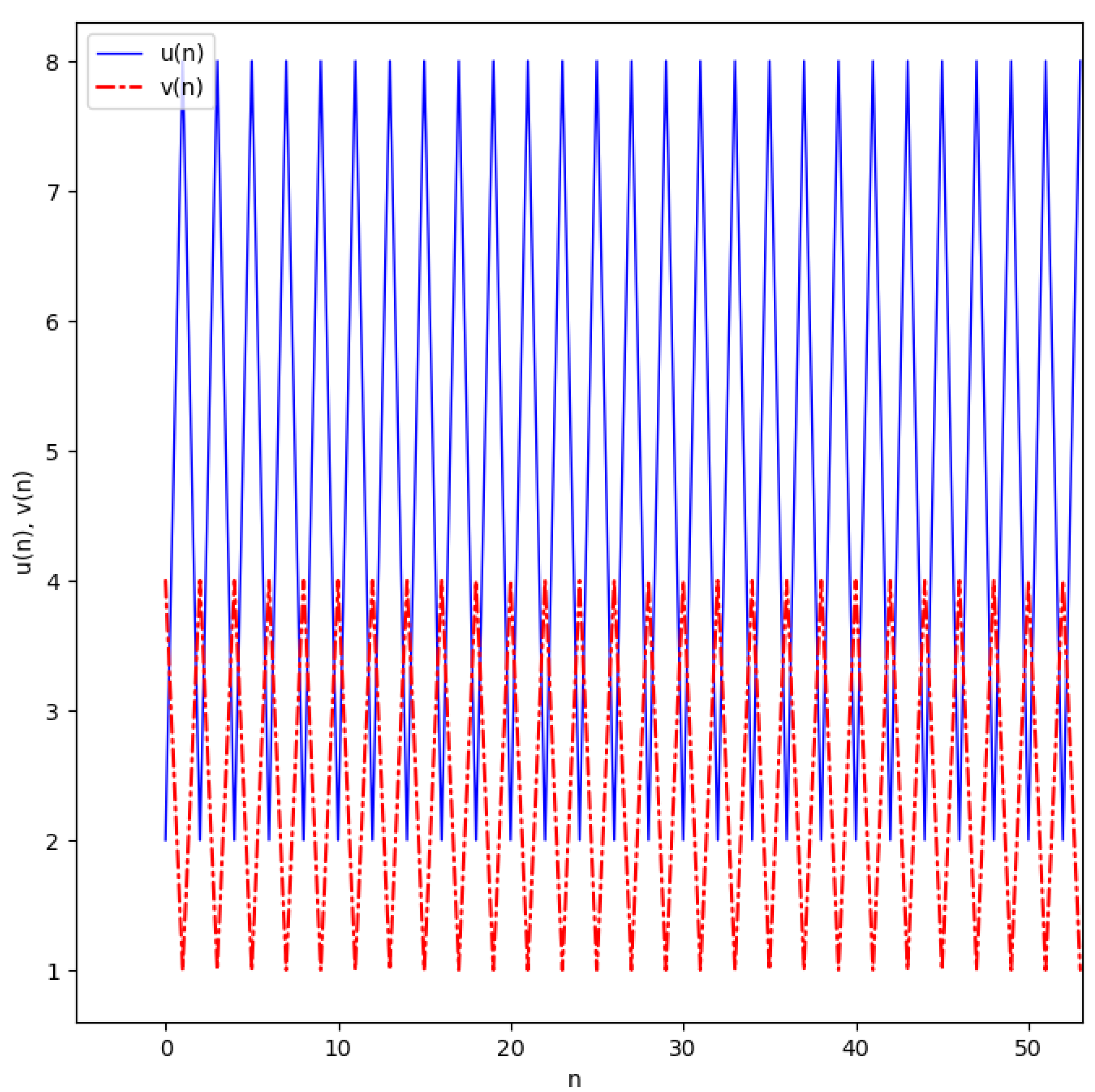
Below is a graph that illustrates the theorem above.
Figure 1 is when we let
and
into the system of Equation (
57).
If we let
and
, then Equations (
49)–() reduce to Theorem 4 in [
11] as shown below:
Just as above, we similarly obtain the following:
Similarly, if we let
then Equations (
49)–() reduce to Theorem 1 in [
11], as shown below:
In the above equation, we performed index shifting. Now,
Following the same procedure as above, Equations ()–(), respectively, result in the following equations:
When
in (
5), the resulting
OEs are
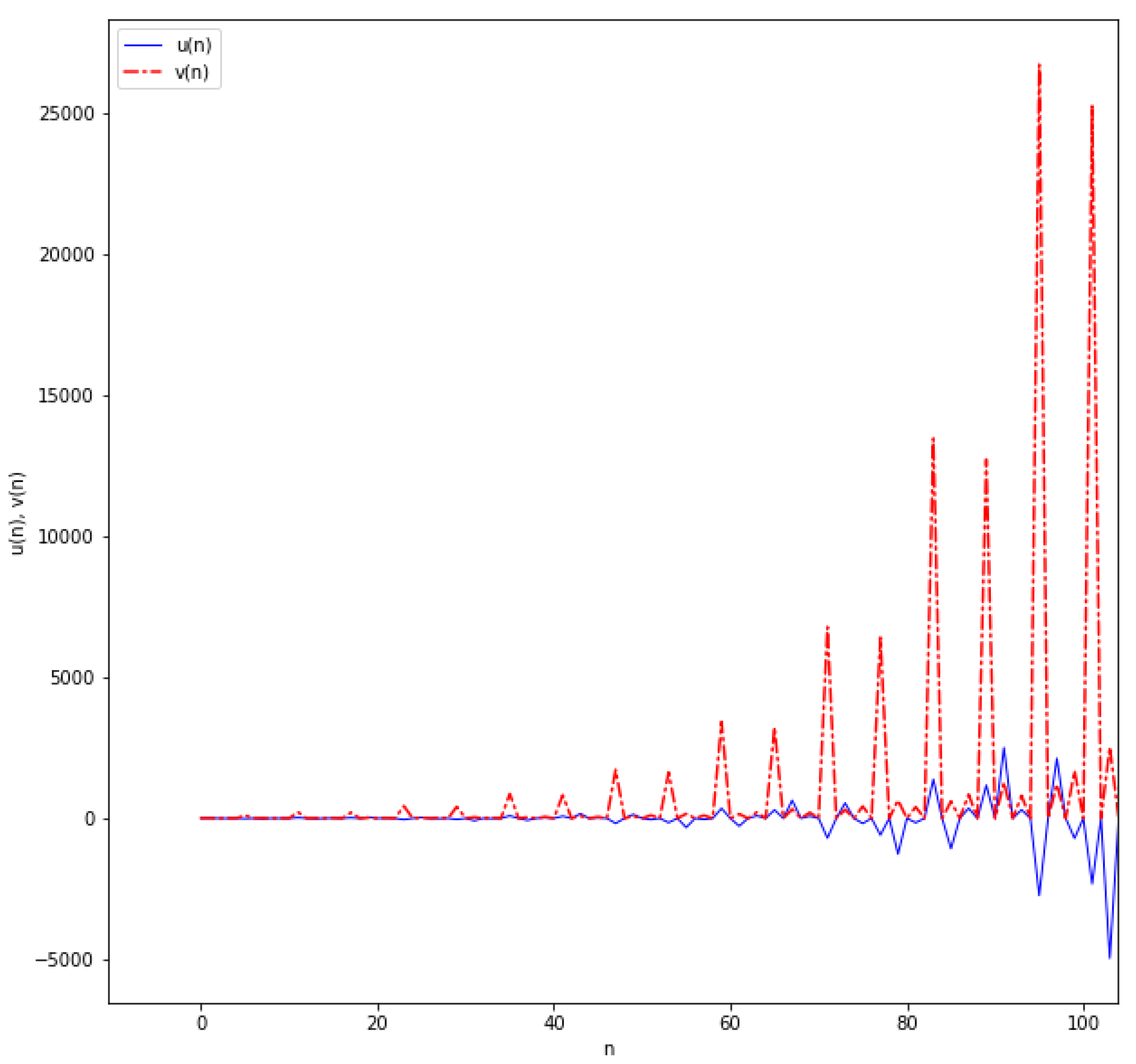
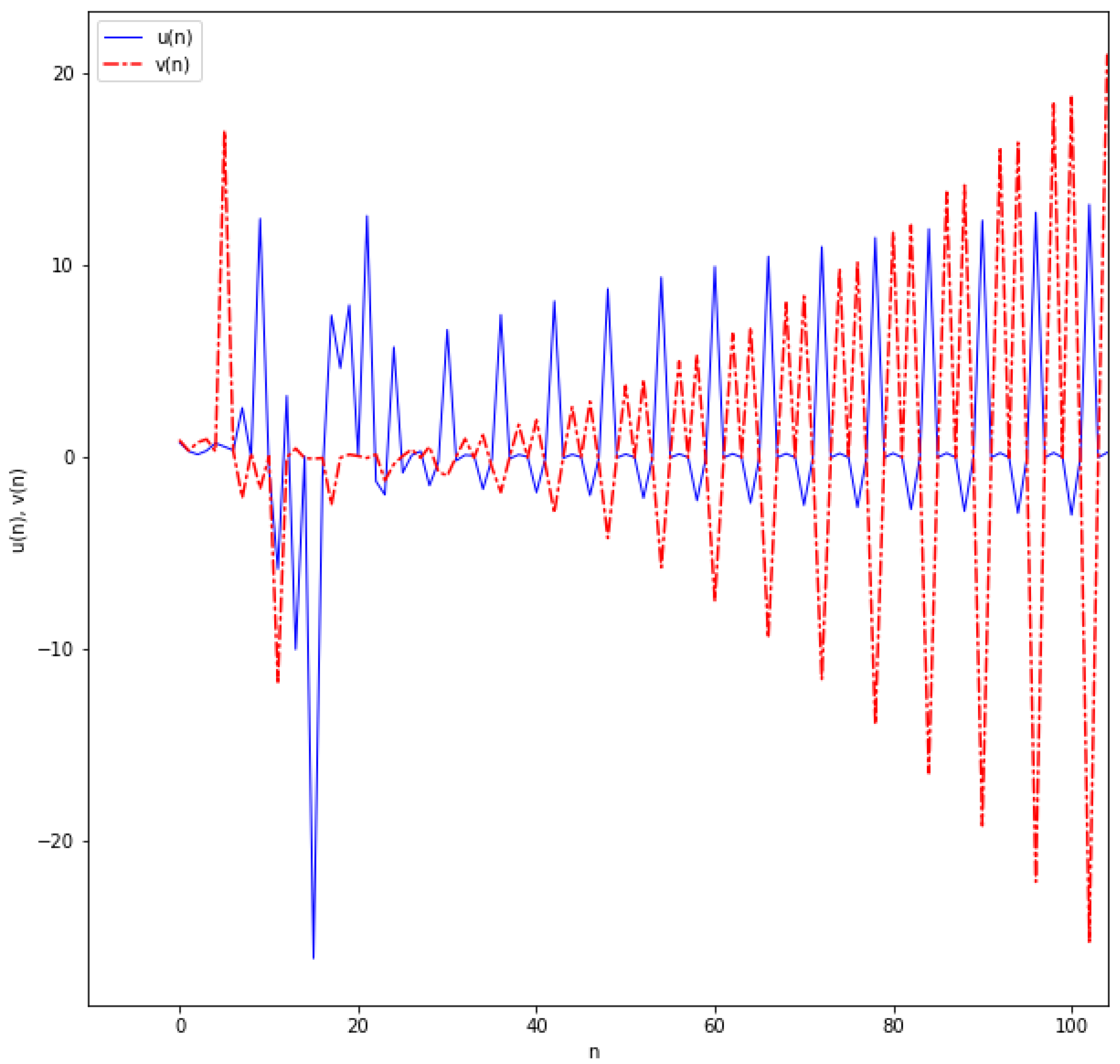
Example 1. We get the illustration below (see Figure 2) when we let , , in (76). Example 2. Letting in (76) yields Figure 3. 4. Conclusions
In this study, we looked at a system of
th order ordinary difference equations. We investigated these equations by finding the symmetry generators (
29). We then used the canonical coordinates to find the invariants in (
31) of which led us to get the closed form solutions (
33) and (
34). Performing iterations resulted in (
36), where we used the floor function definition and back-shifted the resulting equations to obtain the solutions (
43) and (
44) of (
5). We performed a detailed study of the case where
. The reason for studying this case is that we wanted to show that the work done in the articles [
11,
12] are special cases of our results. In fact, for different combinations of values of
and
D, which we get from the articles [
11,
12], we obtain the following important results:
Equations (
49)–(
56) are reduced to equations in Theorem 2 in [
11] when we set
Equations (
49)–(
56) are reduced to equations in Theorem 3 in [
11] when we set
Equations (
49)–(
56) are reduced to equations in Theorem 4 in [
11] when we set
Equations (
49)–(
56) are reduced to equations in Theorem 1 in [
12] when we set
Equations (
49)–(
56) are reduced to equations in Theorem 2 in [
12] when we set
Equations (
49)–(
56) are reduced to equations in Theorem 3 in [
12] when we set
Equations (
49)–(
56) are reduced to Theorem 4 in [
12] when we set
and
We also stated and provided the proof for the existence of 2-periodic solutions.