Article

Impact of Land Use Change on Carbon Storage and Habitat Quality: A Comparison of the Guangdong–Hong Kong–Macao Greater Bay Area and the Yangtze River Delta


1
School of Surveying and Geo-Informatics, Shandong Jianzhu University, Jinan 250101, China
2
School of Remote Sensing Science and Technology, Aerospace Information Technology University, Jinan 250200, China
*
Authors to whom correspondence should be addressed.
Land 2026, 15(5), 871; https://doi.org/10.3390/land15050871 (registering DOI)
Submission received: 20 April 2026 / Revised: 11 May 2026 / Accepted: 14 May 2026 / Published: 19 May 2026

Abstract

The Guangdong–Hong Kong–Macao Greater Bay Area (GBA) and the Yangtze River Delta (YRD) are key economic growth poles in China, playing a critical role in driving national economic development and facilitating international exchanges in commerce, culture, and ecology. However, rapid urbanization and industrialization have exerted considerable pressure on regional environments. In this study, we first assessed the dynamics of carbon storage (CS) and habitat quality (HQ) in the GBA and the YRD from 2000 to 2020 using the InVEST model and ArcGIS software, systematically analyzing their spatiotemporal changes and underlying driving mechanisms. Subsequently, we employed the PLUS model to predict land use changes by 2030 and evaluate their potential impacts on CS and HQ. The results indicate that: (1) Both regions have experienced increases in construction land and declines in cropland. (2) Between 2000 and 2020, CS in the GBA decreased by 33.65 × 10⁶ t and HQ declined by 0.0833, whereas in the YRD, CS decreased by 15.35 × 10⁶ t and HQ dropped by 0.0504. (3) By 2030, CS in the GBA is projected to decline further by 4.08%, with HQ decreasing to 0.4777, while in the YRD, CS is expected to fall by 2.71% and HQ decrease to 0.4115. (4) The spatial differentiation of CS and HQ in the GBA is primarily driven by anthropogenic processes, whereas in the YRD it is mainly constrained by natural factors such as topography. This study highlights the importance of understanding the spatiotemporal dynamics of CS and HQ, which can help enhance ecosystem service functions, mitigate the impacts of climate change, and provide a scientific basis for regional sustainable development.

1. Introduction

Biodiversity conservation has become a central pillar in global ecological governance. Driven by persistent population increase and continued economic growth, the critical role of biodiversity in supporting human well-being is now well-documented. Nevertheless, accelerating biodiversity loss persists as a major global sustainability challenge [1,2,3]. Carbon storage (CS) capacity and habitat quality (HQ) serve as fundamental metrics for ecosystem service evaluation, providing essential scientific support for sustainable development [4,5,6]. Terrestrial ecosystems, as one of the three primary carbon sinks, serve as a critical component of the carbon cycle by modulating regional climates through the absorption and release of greenhouse gases such as carbon dioxide. This function is crucial to the overall carbon cycle and to the mitigation of climate change [7,8]. Alterations in land use compromise the integrity and functioning of ecosystems [9], while also representing a major conduit for influencing CS dynamics at both regional and global scales [10,11,12]. HQ is an index of the suitability of ecosystems for the habitation and reproduction of organisms, reflecting the integrity and diversity of ecosystem functions. It is a fundamental metric for biodiversity assessment [13,14]. Urban growth at an unprecedented rate has driven notable changes in land use dynamics, leading to both the degradation of HQ and a decline in biodiversity [15,16]. Consequently, unraveling the spatiotemporal dynamics of CS and HQ, as well as their underlying drivers, is of paramount importance for safeguarding regional biodiversity and enhancing the functionality of ecological services.
Since the 21st century, study on CS and HQ has been on the rise, with numerous scholars examining these aspects of ecosystems from diverse angles. The InVEST (Integrated Valuation of Ecosystem Services and Tradeoffs) model, which utilizes land use data, stands out for its precision, cost-effectiveness, and visualization capabilities, making it well-suited for assessing ecosystem service functions under various scenarios and objectives [17]. This model encompasses several modules, including Seasonal Water Yield, Coastal Blue Carbon, Carbon Storage and Sequestration, and Habitat Quality. The Carbon module of the InVEST model is specifically designed to evaluate the impact of forest and land use changes on CS. In regional CS service estimation, two primary methods are commonly employed: one involves quantitative analysis through biogeochemical process models such as CASA and Biome-BGC [18,19], and the other relies on empirical assessment via the InVEST model’s Carbon module [20]. Studies have shown that biogeochemical models face some limitations in predicting CS, including a high dependence on input data and parameters, simplified handling of climate change responses, a failure to account for spatial heterogeneity and temporal scale limitations, and challenges in validation and calibration [21,22]. In contrast, the InVEST model combines the strengths of different methodologies, excelling in carbon storage estimation [23]. For instance, Li et al. analyzed the linkage between land use changes and CS in Yunnan Province (China) using the InVEST and CA-Markov models [24]; Babbar et al. utilized the InVEST model to study CS in the Sariska Tiger Reserve in India [25]. Nelson et al. assessed global CS changes from 2000 to 2010 using the InVEST model and projected global trends for the period from 2010 to 2015 [26]. Wang et al. applied the InVEST model’s Carbon module to assess carbon density across diverse land use categories in the Bortala region (China) and explored the relationship between land use changes and CS under diverse climatic conditions [27]. The HQ module of the InVEST model links land use types with surrounding environmental threats to assess HQ and degradation across different land use types. Evaluation methods for HQ can be divided into two categories: indicator-based and ecological model-based methods [28,29]. Compared with the former, the ecological model evaluation method offers more advantages in terms of application scope, data acquisition, and operability. As a result, an increasing number of researchers have started focusing on its application in HQ assessment [16,30]. Liu et al. studied CS over the past two decades in the Loess Plateau (China) by coupling the InVEST model with the PLUS model, projecting future land use and CS scenarios for 2035 [31]. Liu et al. conducted a spatiotemporal dynamic analysis of HQ responses in the periods preceding and succeeding implementing soil and water conservation measures in the PU River basin of Shenyang (China) based on the InVEST model [32]. Wang et al. examined the impact of landscape pattern changes in the karst mountainous city of Guizhou (China) on the spatiotemporal changes of HQ, finding significant spatial heterogeneity and clustering effects in HQ distribution [33]. The PLUS model ranks among the most extensively applied models for land use prediction in current research, integrating the land expansion strategy analysis module with the multi-class random patch seed-based cellular automaton model. This model preserves the strengths of adaptive inertia competition and roulette wheel selection mechanisms commonly employed in existing future land use simulation frameworks [27,34], while also using random forest algorithms to assess the prospective development value of each land type [35]. It demonstrates significant advantages in large-scale and multi-land-type comprehensive simulations. Existing research suggests that Li et al. believe the coupling degree between the PLUS model and the InVEST model is high, making it an effective means for land use prediction and assessment [36].
The 2022 National (China) ‘Two Sessions’ Government Work Report pointed out that it is necessary to enhance the balance and coordination of regional development, thoroughly carry out key regional initiatives and promote coordinated regional development strategies, and emphasize the promotion of the construction of the Guangdong–Hong Kong–Macao Greater Bay Area (GBA) and the integrated development of the Yangtze River Delta (YRD). Characterized by high levels of openness and economic vitality, the GBA is among China’s most prominent regional economic hubs, and its development is intended to foster complementary strengths, promote coordinated growth, and realize mutual benefit and shared prosperity. The YRD is one of China’s most economically dynamic, open, and innovation-driven regions. It holds a pivotal strategic position in the broader context of national modernization and comprehensive opening-up, serving as a key driver in advancing the formation of a new development paradigm. However, both urban agglomerations face significant pressure on natural resources and ecosystems due to rapid land use changes and intense human activities. In the process of fast-paced economic and urban development, preserving biodiversity and ecosystem service functions in the GBA and the YRD is essential for the sustainable development of these urban clusters [37,38]. Therefore, monitoring and analyzing land use changes and the impacts of human activities on CS and HQ is crucial for achieving a balance between regional environmental improvement and rapid economic development.
This study explores the spatiotemporal dynamics of CS and HQ evolution driven by land use changes within the GBA and the YRD, predicts land use distribution in 2030, and analyzes changes in CS and HQ from 2020 to 2030. Leveraging multi-temporal GlobeLand30 (30 m resolution) datasets (2000–2020), we utilized the InVEST model to assess CS and HQ and applied standard deviation ellipse, center of gravity migration, and spatial autocorrelation methods for analysis. By investigating the impact of land use change on the temporal and spatial evolution of CS and HQ, this study aims to offer a scientific foundation for environmental protection and sustainable regional development in both the GBA and the YRD.

2. Materials and Methods

2.1. Study Area

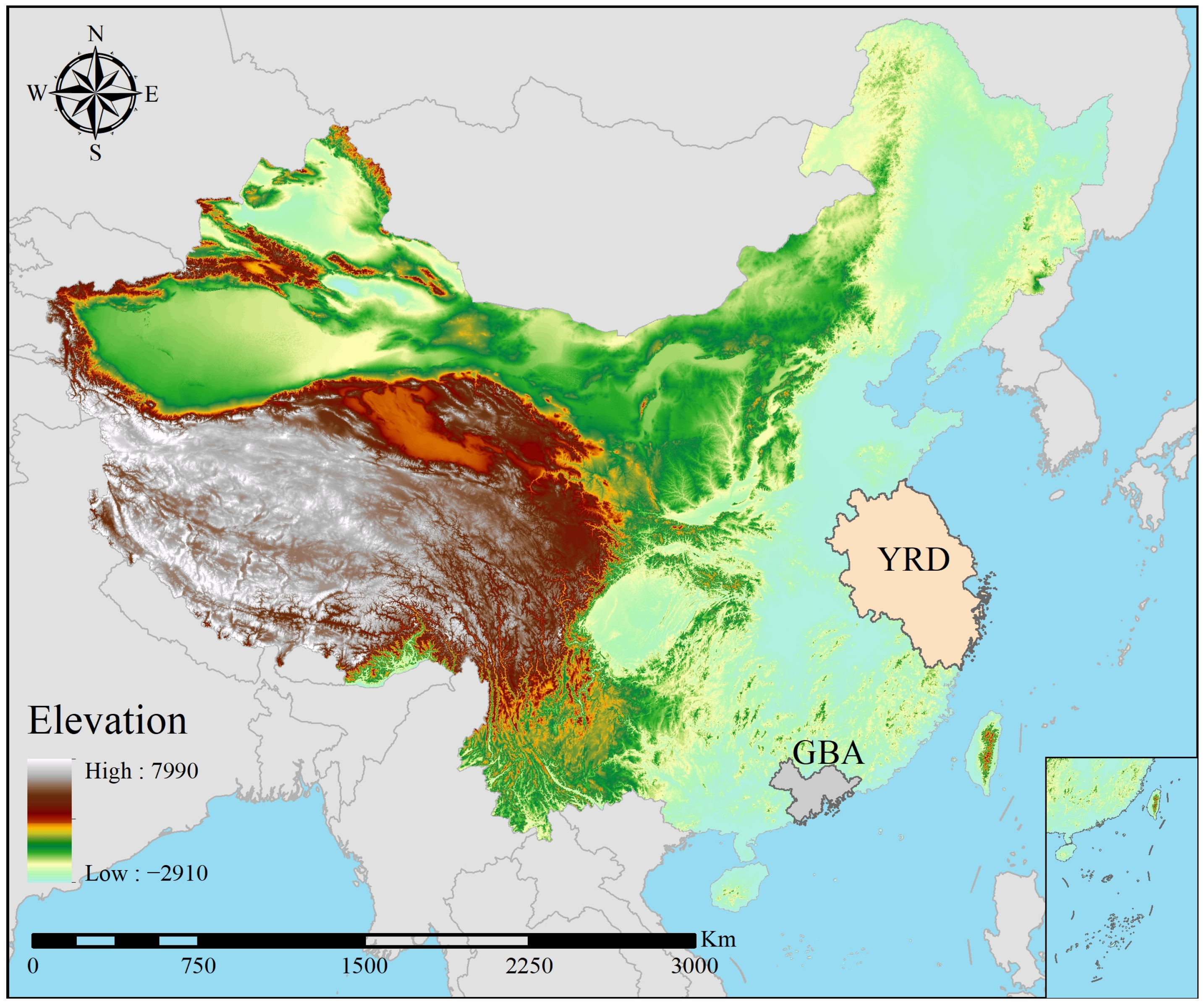
The Guangdong–Hong Kong–Macao Greater Bay Area (GBA), located in southern China (Figure 1), represents one of the most market-oriented regions in China. The GBA has a subtropical monsoon climate, with mean annual temperatures ranging from 22 to 24 °C, monthly averages of 10–17 °C in January and 27–29 °C in July, and annual precipitation of 1500–2000 mm, mostly occurring from May to September [39,40]. Rapid urbanization and climate change have intensified heatwaves and extreme rainfall events. According to the WRB (2022) [41], the region’s soils are diverse, including Anthrosols, Fluvisols, Gleysols, Cambisols, Acrisols, Ferralsols, Technosols, and localized Leptosols, Regosols, and saline soils. Spanning approximately 5.6 × 10⁴ km2, the GBA accounts for roughly 30% of Guangdong Province’s total area. By 2022, the population had reached 86 million, and its GDP (Gross Domestic Product) had surged past 13 trillion yuan, solidifying its status as a region with one of the highest per capita GDPs and the most robust economic power in China [42].
In contrast, the Yangtze River Delta (YRD) is located along the eastern coast of China (Figure 1) and lies at the crossroads of the “Belt and Road Initiative” and the “Yangtze River Economic Belt.” The YRD has a humid subtropical monsoon climate, with mean annual temperatures of 15–18 °C, January averages of 3–6 °C, July averages of 27–29 °C, and annual precipitation of 1000–1600 mm, mainly during the plum rain (May–June) and typhoon seasons (July–September). Rapid urbanization and climate change have intensified heatwaves and extreme rainfall in recent decades [43]. According to the WRB (2022) [41], the region’s soils are diverse, including Anthrosols (agricultural), Fluvisols and Gleysols (deltaic and alluvial lowlands), Acrisols and Cambisols (uplands), Technosols (urban and reclaimed land), and localized saline soils, Regosols, and Leptosols. Despite covering just 4% (3.58 × 10⁵ km2) of the national territory, this region accommodates 17% of China’s population and contributes nearly a quarter of the national economic output [44]. As one of the regions exhibiting the highest levels of economic vitality, open, and innovative regions, the YRD had a population of 227 million by the end of 2019. In 2023, its GDP reached 30.5 trillion yuan.
The rapid urbanization process in the GBA and the YRD has driven the expansion of urban land, exacerbating ecological issues such as biodiversity loss and environmental pollution. Such challenges emphasize the critical importance of achieving a balance between environmental protection and economic growth.

2.2. Data

The data employed in this study encompass both natural and socio-economic factors (Table 1). Natural factor data comprise land use, digital elevation model (DEM), annual average precipitation, annual average temperature, soil type, and administrative divisions. Social factor data include gross domestic product (GDP), population, distance to railways, distance to highways, distance to provincial roads, and distance to national roads. Details of the data sources and time periods are provided in the table. To ensure spatial accuracy, all data were converted to a uniform grid format of 30 m × 30 m, and the coordinate system was standardized to Krasovsky_1940_Albers. Given the extensive size of the study area, some challenges arose when using the PLUS model to forecast land use distribution for 2030. As a solution, we standardized the raster data to a uniform resolution of 300 m × 300 m for processing.

2.3. InVEST Model

The InVEST model (Version 3.13.0) is designed to evaluate the relationship between land use and ecosystem service provision [45], aiding decision-makers in understanding ecosystem values and integrating them into planning and policy-making. The model is widely applied in watershed ecosystem assessments [46,47], addressing areas such as land use management, CS estimation, and HQ evaluation [48,49,50]. By quantifying ecosystem service values, the model helps decision-makers make more informed trade-offs between economic progress and the safeguarding of natural ecosystems. This enables policymakers and researchers to gain a comprehensive understanding of ecosystem services and develop more science-based and sustainable management policies.

2.3.1. Carbon Storage Module

Carbon storage (CS) in terrestrial ecosystems is composed of four key components: aboveground biomass CS, belowground biomass CS, soil CS, and dead organic matter CS. The carbon module of the InVEST model (Carbon Storage and Sequestration) utilizes land use and carbon density data to simulate CS under current or future scenarios. The principle involves using the raster area of land use data as the measurement unit, statistically analyzing the carbon density data, and then multiplying it by their respective areas to calculate CS. Further processing in the model generates the spatial arrangement of CS and the CS value contained in each raster. The formula is as follows [51,52,53]:
C _ t o t a l = C _ a b o v e + C _ b e l o w + C _ s o i l + C _ d e a d
where C _ t o t a l is the total CS, C _ a b o v e is the aboveground biomass CS, C _ b e l o w is the belowground biomass CS, C _ s o i l is the soil CS, and C _ d e a d is the dead organic matter CS. The carbon density values for the GBA (Table 2) [54,55,56] and YRD (Table 3) [57,58,59,60] are summarized from numerous sources in the literature. They were not further differentiated within more refined land use classification levels, and standardized carbon density parameters were uniformly applied in the calculations. This approach helps ensure consistency in regional-scale analyses and meets the requirements for examining the overall spatiotemporal patterns of CS.

2.3.2. Habitat Quality Module

The assessment of habitat quality (HQ) relies on land use data to determine potential threat factors, sensitivity, and the magnitude of external threats affecting HQ. The HQ module within the InVEST model is employed to compute raster-based HQ indices. These values range from 0 to 1, with values approaching 1 signifying superior habitat quality and greater biodiversity. Conversely, lower values suggest poorer HQ, which is detrimental to biodiversity maintenance. The specific calculation formula are as follows [1,61]:
D x j = r = 1 R y = 1 Y r ω r r = 1 R ω r r y i r x y β x K j r
Q x j = H j 1 D x j 2 D x j 2 + k 2
In the formula, D x j denotes the level of habitat degradation for raster x in habitat type j ; r is the quantity of threat factors; Y r is a set of threat rasters in threat raster r ; ω r is the weight of threat factor, ranging from 0 to 1; r y is the stress value for raster y ; i r x y is the threat level of stress raster y to raster x ; β x is the accessibility level of raster x , ranging from 0 to 1; K j r is the sensitivity of land use type j to threat factor r , ranging from 0 to 1; Q x j is the HQ of raster x when land use type is j ; H j is the habitat suitability of land use type j ; and k is the half-saturation constant, typically set as half of the maximum habitat degradation degree, set at 0.5. Relevant literature was consulted to select cropland, construction land, and unused land as threat factors, along with obtaining the corresponding parameters (Table 4 and Table 5) [28,62,63].

2.4. PLUS Model

The parallel technology of the PLUS software (Version 1.4) originates from the High-Performance Spatial Computing and Intelligent Laboratory at China University of Geosciences (Wuhan). It is utilized for generating patches in land use change simulation and forecasting models [31]. The software combines a new Land Expansion Analysis Strategy (LEAS) with a CA model based on Multiple Types of Random Patch Seeds (CARS) to simulate fine-scale land use change through Markov chain or linear regression methods [34,64].
The LEAS module extracts land use expansion data using a random forest algorithm, calculating the development probability of various land uses and analyzing the contribution rates of the driving factors behind land use expansion. The detailed formulation of the random forest algorithm is presented as follows:
p i , k d x = n = 1 M I h n x = d M
In the formula, x represents the vector of driving factors, p i , k d x is the probability of the expansion of the k -type land use type in patch i when d = 0 or d = 1, where 1 indicates a transition from other land types to type k and 0 indicates no conversion to type k . M denotes the number of decision trees, and I indicates the decision tree indicator function, h n x representing the land use types obtained when the decision tree is n .
The CARS module generates land use patches based on multi-class random seeds and a threshold decrement mechanism, under the constraints of development probabilities for various land uses.
O P i , k d = 1 , t = P i , k d × Ω i , k t × D k t
In the formula, O P i , k d = 1 , t is the comprehensive probability that the i -th patch turns into the k -land type at time t , P i , k d is the suitability probability that the i -th patch turns into the k -land type, Ω i , k t is the coverage ratio of the k -land type in the next neighborhood, and D k t is the influence of future demand on the k -land type.
Drawing on land use data from 2000 and 2010 for the GBA and the YRD, ten influencing factors were selected, such as DEM, GDP and road networks. The PLUS model was employed to forecast the land use scenario for the year 2020, and a comparative analysis was conducted between the predicted results and the actual land use data. The calculated Kappa coefficient was 0.74 for GBA and 0.78 for YRD, with an overall accuracy of 0.83 for GBA and 0.86 for YRD, indicating that the simulation results are acceptable in terms of precision (Supplementary Materials Figures S1 and S2). Consequently, this model can be utilized to simulate the land use scenarios of the urban agglomerations in the GBA and the YRD for the year 2030.

2.5. Spatial Autocorrelation Analysis

Spatial autocorrelation is a statistical method used to measure the distribution characteristics of spatial data and the relationships among them. Its fundamental premise is that attribute values at neighboring or nearby locations tend to exhibit a certain degree of dependence or similarity, and this correlation generally decreases or even disappears as spatial distance increases. Depending on the research scale and analytical purpose, spatial autocorrelation can be classified into global and local types: the former is used to characterize the overall spatial distribution pattern of the study area, while the latter reveals local spatial heterogeneity as well as clustering or dispersion characteristics.
In this study, GeoDA software (Version 1.22.0.21) was employed to analyze the global spatial autocorrelation of habitat quality (HQ) among grid cells in the study area, in order to identify the overall spatial correlation pattern. On this basis, local spatial autocorrelation analysis was further conducted to examine the spatial clustering characteristics of HQ, thereby identifying the spatial distribution of high quality and low quality habitats [65]. The specific calculation formulas are as follows:
I = n i = 1 n j = 1 n w i j x i x ¯ x j x ¯ i = 1 n x i x ¯ 2 i = 1 n j = 1 n w i j
I i = ( x i x ¯ ) j = 1 n w i j x j x ¯ i = 1 n x i x 2
In the formula, n is the number of features; x i and x j are the attribute values of features i and j , respectively; x ¯ is the mean of the attribute values; and w i j is the spatial weight between features i and j . The value of Moran’s I index is generally [−1, 1], less than 0 means negative correlation in space, greater than 0 means positive correlation in space, and equal to 0 means uncorrelated, random distribution.
This study first constructed a 2000 m × 2000 m grid in ArcGIS (Version 10.2.0.3348) and integrated the HQ data with the grid. The choice of this grid size was based on a comprehensive consideration of spatial analysis accuracy, computational efficiency and ecological relevance. Smaller grids could provide higher spatial resolution but would substantially increase computational demand, while larger grids might smooth out spatial heterogeneity and obscure regional-scale patterns. The 2000 m grid balances these factors, effectively capturing regional spatial structures, reducing computational burden, producing more robust Moran’s I and clustering results, and simultaneously reflecting habitat heterogeneity and landscape patterns. Subsequently, global spatial autocorrelation analysis was performed using GeoDA software, and Moran’s I index was calculated to assess overall spatial autocorrelation. This was followed by local spatial autocorrelation analysis to identify spatial clustering patterns of habitat quality.

2.6. Geographical Detector

The Geographical Detector (Version 2018) was proposed by the research team led by Wang Jinfeng at the Institute of Geographic Sciences and Natural Resources Research. It is designed to identify spatial differentiation characteristics and reveal their driving mechanisms. The core idea is that if an independent variable has a significant impact on a dependent variable, their spatial distributions should exhibit a high degree of consistency.
The Geographical Detector consists of four components: factor detector, interaction detector, risk detector, and ecological detector. Among them, the factor detector is mainly used to identify the dominant driving factors and to quantify the explanatory power of each factor on the dependent variable [66]. The formula is as follows:
q = 1 h = 1 L N h σ h 2 N σ 2
In the formula, h = 1 ,…, L , where L represents the stratification of variable Y or factor X. N h and N denote the number of units in stratum h and in the entire study area, respectively. σ h 2 and σ 2 represent the variance of Y within stratum h and across the whole region, respectively. The q value indicates the explanatory power of the factor, ranging from 0 to 1; a larger value suggests a more pronounced spatial differentiation of Y.
In this study, the 2020 data were used as an example to analyze the driving factors. Each factor was discretized using the Natural Breaks method and ultimately classified into five categories following multiple trials and comparisons. This classification effectively captures the spatial heterogeneity of the driving factors and enhances the rigor and reliability of the analysis.

3. Results

3.1. Result of Land Use

3.1.1. Temporal Dynamics of Land Use and Land Use Transfer Matrix

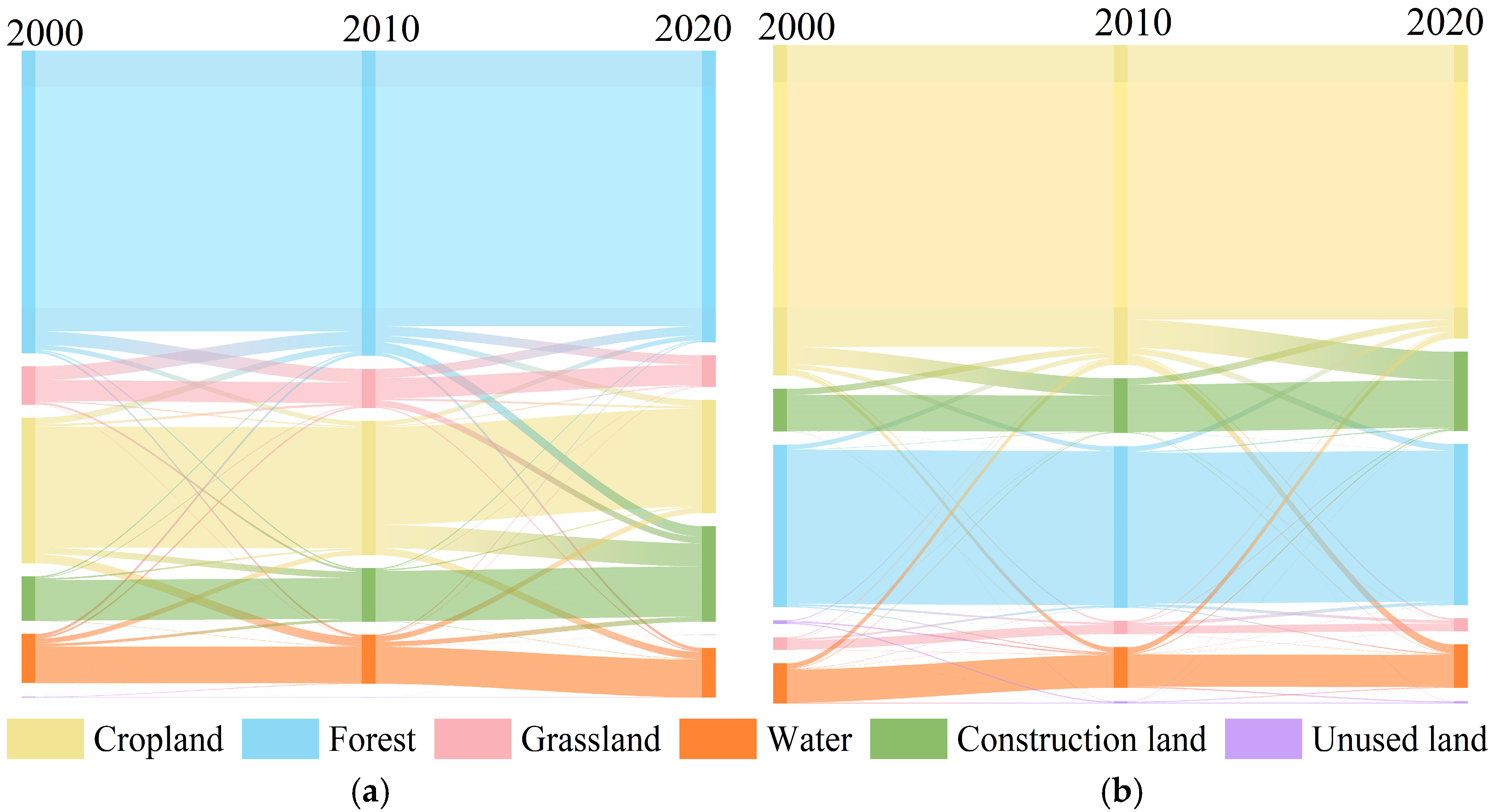
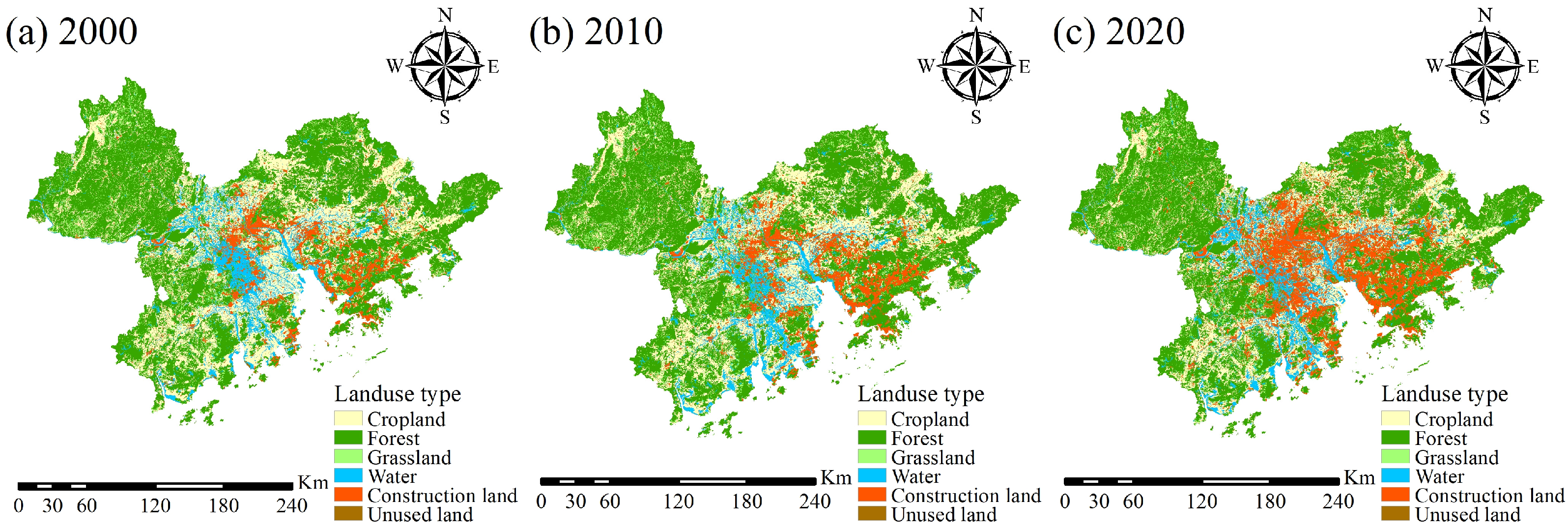
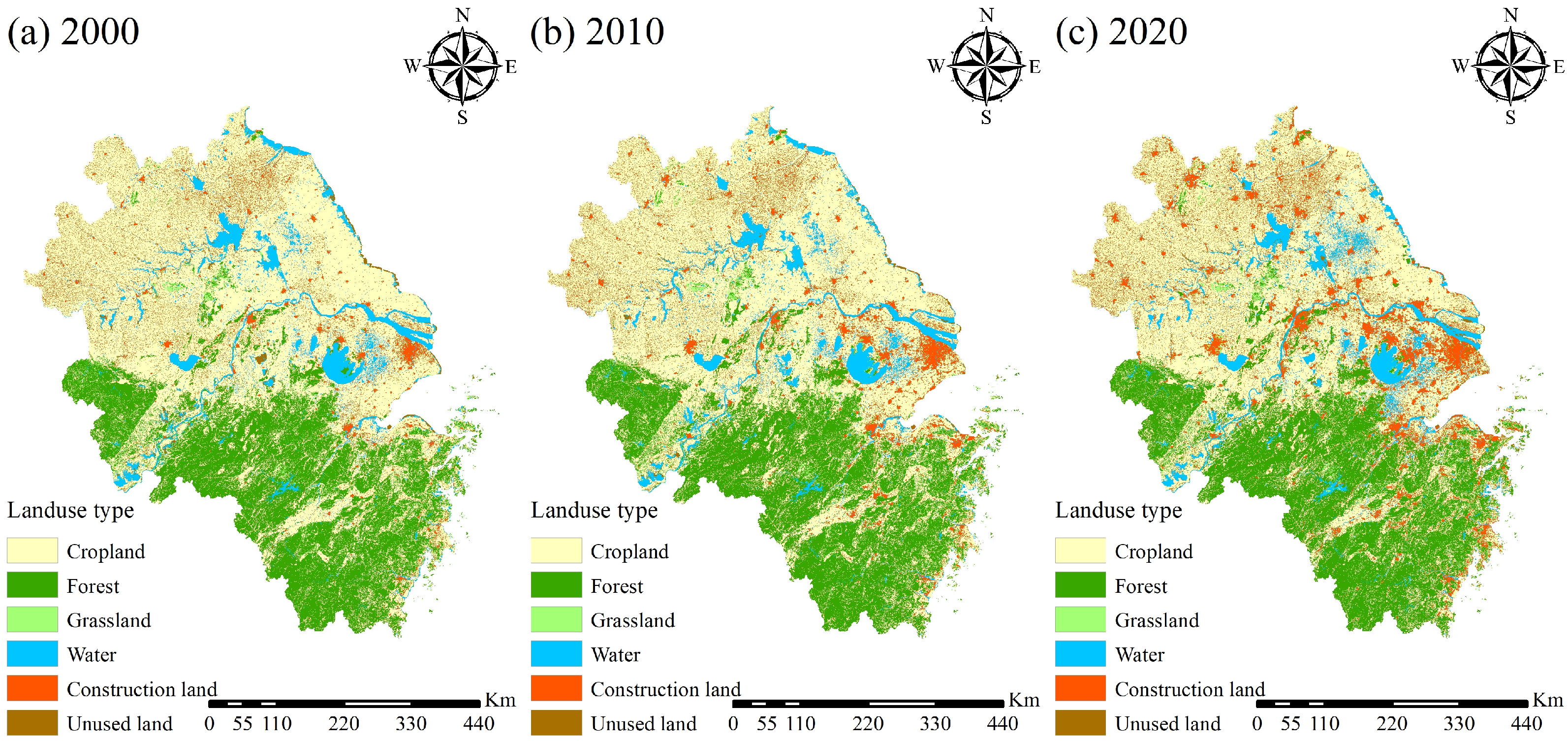
As shown in Table 6 and Table 7, from 2000 to 2020, land use in the GBA and the YRD was dominated by forest and cropland, accounting for approximately 52% and 56% of the total area in each region, respectively, while unused land consistently remained the smallest land use category. Regarding land use transitions, both the GBA and the YRD exhibited significant conversions between cropland and construction land; however, the two regions differed markedly in the scale and pathways of these transitions (Figure 2).
In the GBA, cropland decreased by approximately 3100 km2 over the study period. Between 2000 and 2010, cropland was mainly converted into water, construction land, and forest, whereas from 2010 to 2020 it declined by about 1995 km2, with nearly all losses being transformed into construction land. In contrast, cropland loss in the YRD was substantially greater, reaching 22,071 km2. During 2000–2010, cropland was primarily converted into construction land, forest, and grassland, while from 2010 to 2020 it further decreased by approximately 15,715 km2, mainly due to conversion into construction land. These results indicate that cropland loss in the YRD was far greater than in the GBA, with construction land expansion serving as the dominant driver of cropland reduction in both areas.
Regarding forest, in the GBA it exhibited a pattern of initial increase followed by decrease, resulting in a net loss of 1045 km2 over 20 years. In the early period, forest mainly received transfers from grassland, whereas in the later period it was primarily converted into construction land. In the YRD, forest change was relatively stable, with a total decrease of 760 km2, indicating higher stability than in the GBA, and it was mainly replenished by cropland conversion.
Construction land expansion represents the most prominent common feature in both areas. In the GBA, construction land increased from 4253 km2 to 9096 km2, an expansion of approximately 4843 km2, with particularly rapid growth during 2010–2020, primarily at the expense of cropland. In the YRD, construction land expanded from 25,533 km2 to 47,218 km2, an increase of about 21,685 km2, significantly higher than in the GBA. In addition to cropland, water and forest also contributed to construction land expansion in the YRD.
Grassland exhibited contrasting trends between the two areas. In the GBA, grassland decreased by 628 km2, mainly converting into forest, whereas in the YRD, grassland increased slightly by 32 km2. Although grassland was still primarily converted into forest, the reverse transfers from forest and cropland led to a slight increase in grassland area in the region. Water decreased slightly in the GBA but increased by approximately 1893 km2 in the YRD, indicating divergent trends, while the conversion of cropland to water played an important role in both areas. Unused land declined in both areas and was mainly converted into water or other ecological land types.
In the GBA, land use change was characterized by cropland to construction land conversion and a slight decline in forest, whereas in the YRD, cropland loss was greater in absolute terms, construction land expansion was more extensive, and the proportion of cropland converted to water was higher. Consequently, the overall intensity and scale of land use change in the YRD are significantly higher than in the GBA.

3.1.2. Spatial Patterns of Land Use

The spatial patterns of land use in the GBA and the YRD exhibit notable differences (Figure 3 and Figure 4). In the GBA, forest and cropland are widely distributed, effectively covering most of the region, whereas in the YRD, forest are primarily concentrated in the southwestern areas and cropland in the northeastern areas, indicating more pronounced spatial heterogeneity. Grassland in both areas generally surrounds forest, with a distribution similar to that of forest. Construction land in both regions is mainly distributed in low-lying and flat areas, showing a clear inverse relationship with forest, which are typically located in mountainous areas with higher elevation and limited development potential. Specifically, in the GBA, construction land is concentrated in the central and southern parts of the Pearl River Delta, characterized by dense ports and active economic activities, whereas in the YRD, construction land is predominantly distributed along the eastern coastal areas, where trade activities are intensive. Regarding water, the GBA exhibits highly concentrated water distribution, mainly in the central area, while the YRD has a greater total water area with a relatively wider spatial extent, primarily in the eastern and northern parts. Unused land occupies a minimal proportion in both regions, with no prominent spatial pattern.

3.2. Result of CS

3.2.1. Spatiotemporal Patterns of CS

From the temporal perspective of CS, both the GBA and the YRD exhibit a declining trend, but the magnitude and rate of decrease differ significantly (Table 8). In the GBA, CS decreased from 724.61 × 10⁶ t in 2000 to 690.96 × 10⁶ t in 2020, representing a cumulative loss of approximately 33.65 × 10⁶ t. During 2000 to 2010, the decline was relatively modest, about 2.6 × 10⁶ t, whereas from 2010 to 2020, the reduction accelerated sharply to approximately 30.05 × 10⁶ t. This indicates that CS in the GBA remained relatively stable during the first decade but experienced a pronounced loss in the second decade. In contrast, CS in the YRD is larger in absolute terms but shows a slower declining trend. CS decreased from 2536.12 × 106 t in 2000 to 2520.77 × 106 t in 2020, with a cumulative reduction of approximately 15.35 × 10⁶ t, exhibiting relatively stable changes throughout the period. Notably, from 2010 to 2020, the decline was only about 8.97 × 10⁶ t. Although the absolute expansion of construction land in the YRD far exceeds that in the GBA, the relative proportion of CS loss is smaller, likely due to the more stable distribution of forest and water and the presence of larger ecological spaces.
Overall, while the total CS in the GBA is smaller than YRD, its rate of decline is faster, particularly in the most recent decade. In contrast, the YRD maintains a larger CS and exhibits more gradual changes. The decrease in CS in the GBA is primarily driven by the expansion of construction land and the reduction in cropland, whereas in the YRD, under the context of large-scale urbanization, forest and water provide a certain buffering effect, resulting in a relatively controlled loss of CS.
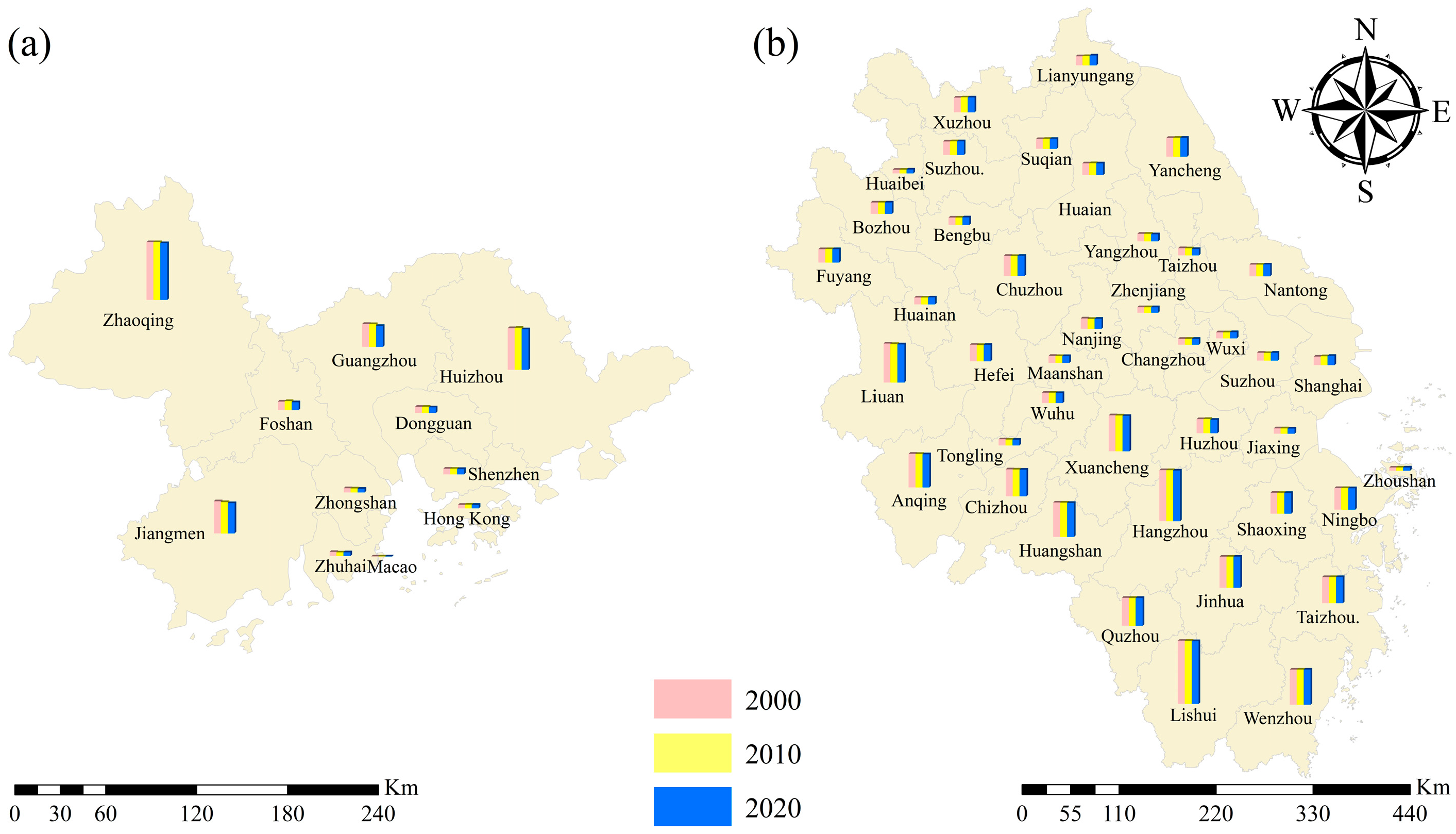
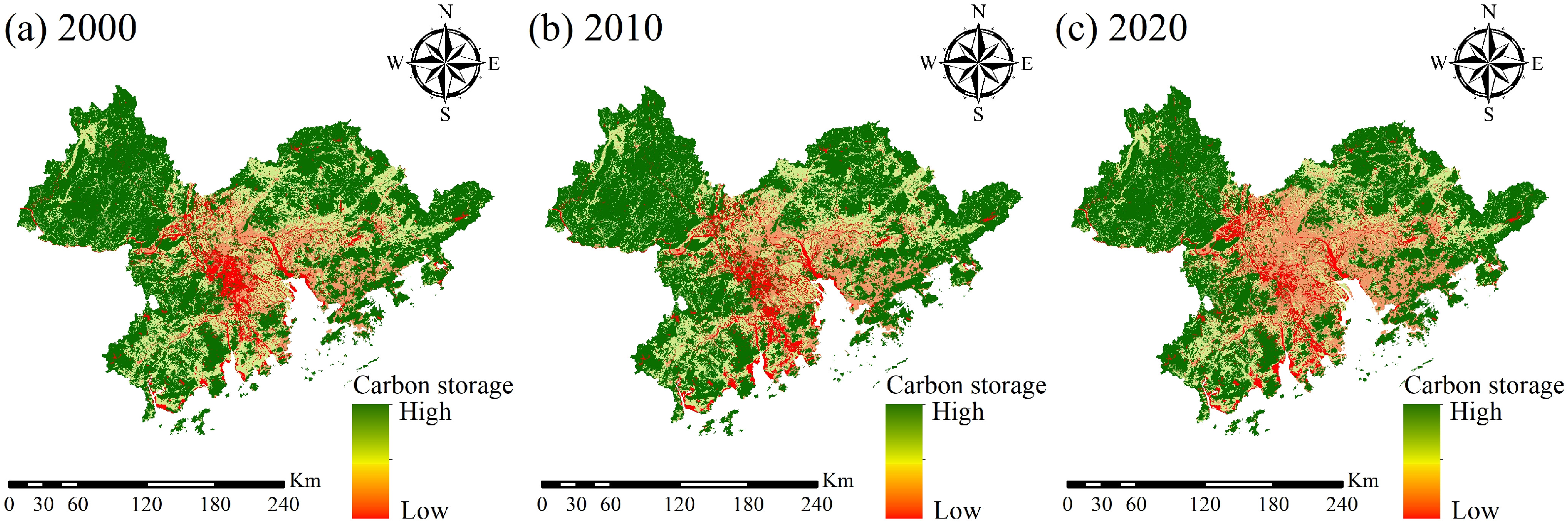
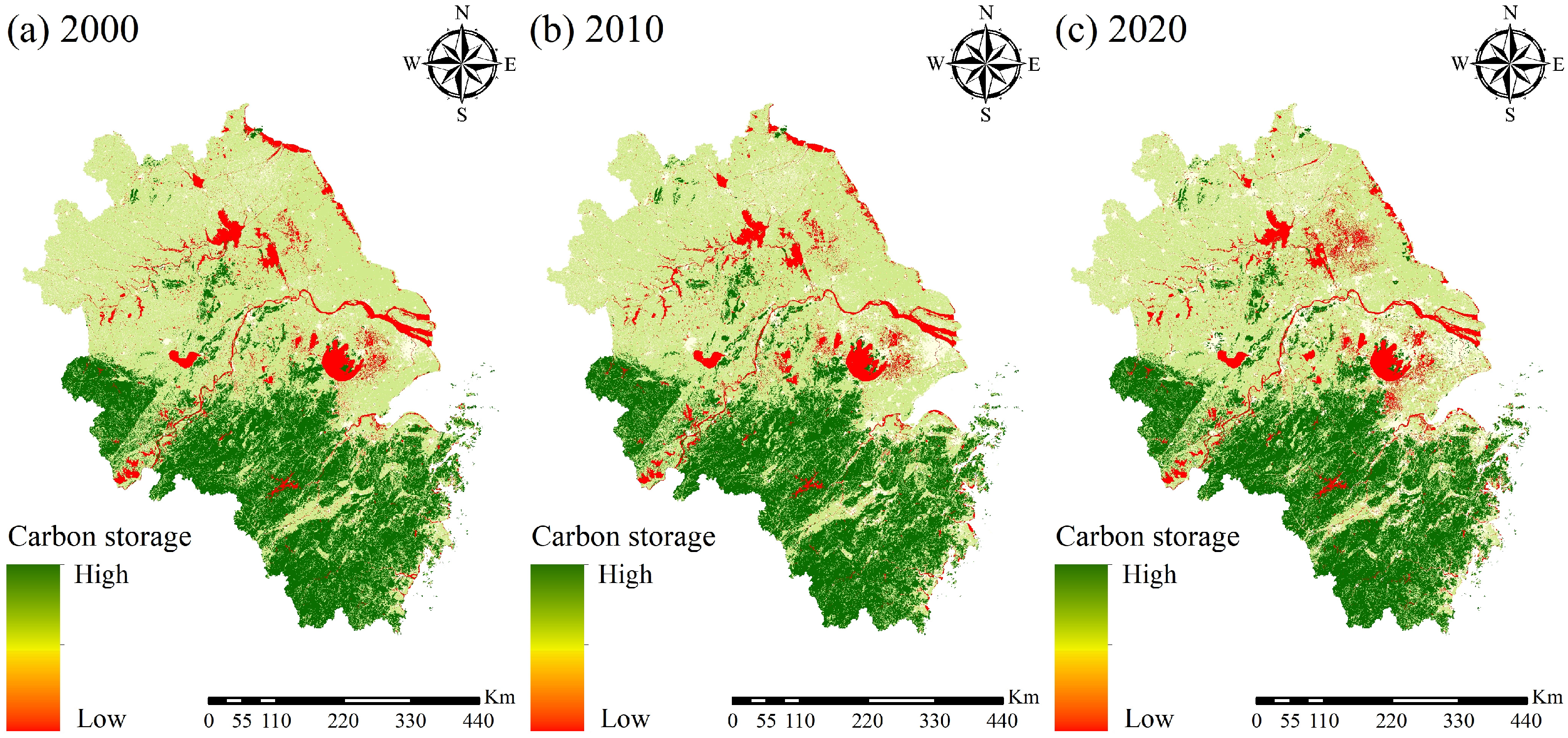
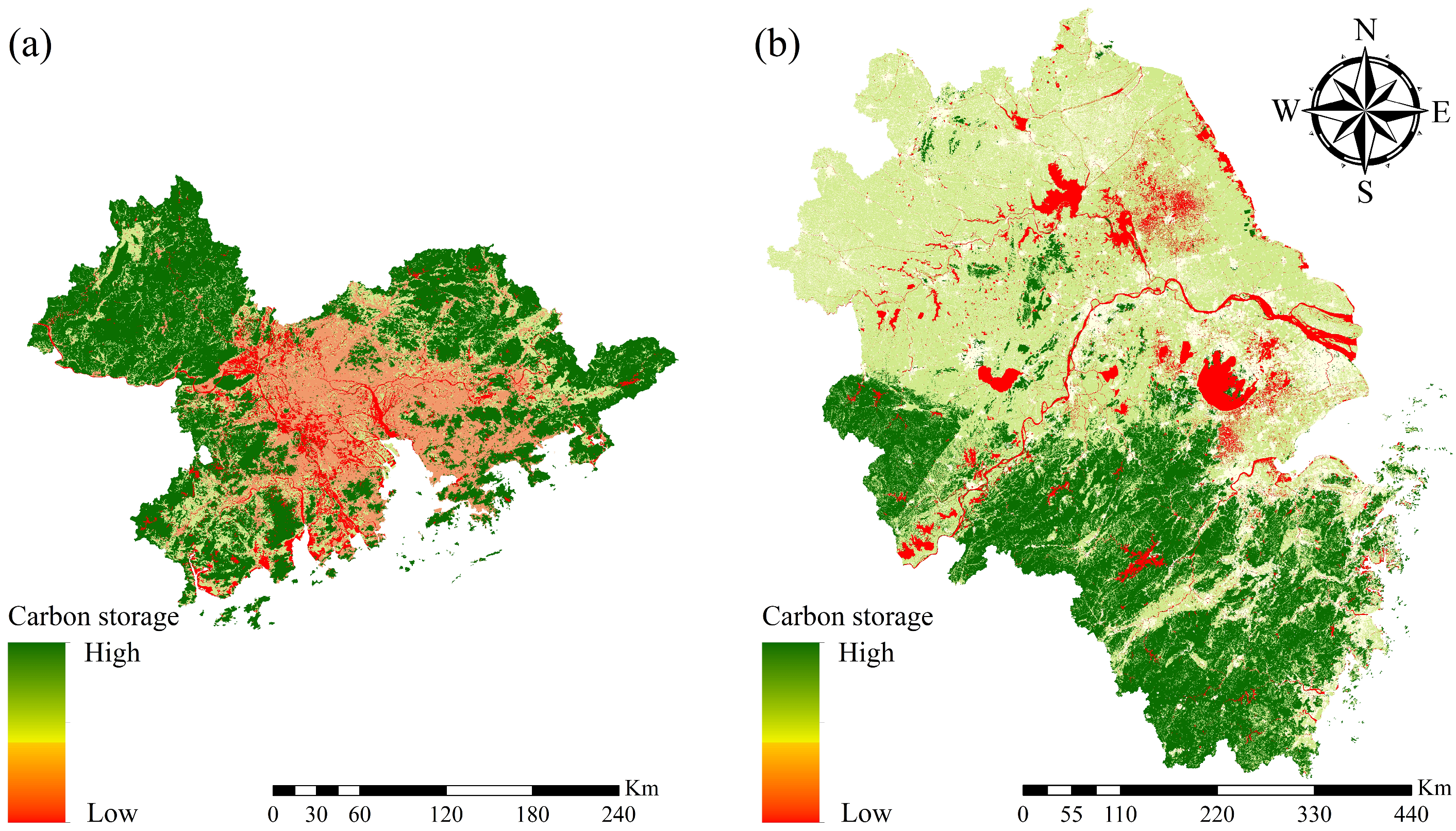
From the perspective of the spatial distribution of CS, both the GBA and the YRD exhibit pronounced spatial heterogeneity (Figure 5). In the GBA, CS shows an increasing trend from the central areas toward the periphery, with high values primarily concentrated in the northwest, northeast, and southwest (Figure 6). Among these, the northwest exhibits the highest CS, encompassing cities such as Zhaoqing, Huizhou, and Jiangmen. These areas are characterized by complex terrain, relatively high elevation, and high forest and grassland coverage. In contrast, central cities such as Foshan and Guangzhou, as well as the southern coastal regions, have relatively lower CS, which is largely attributable to intensive economic activities, high population density, active trade and rapid urbanization. In the YRD, CS displays a “high in the southwest, low in the northeast” spatial pattern (Figure 7). The southwestern areas, with higher terrain and dense forest, such as Lishui, Hangzhou, Wenzhou, Xuancheng and Liuan, exhibit higher CS, whereas the northeastern regions along rivers and flat terrains, including Shanghai, Suzhou, Nantong, Yangzhou and Lianyungang, show a stepwise decline in CS. The above research results are relatively consistent with the study by Wen et al. [67] and Gao et al. [68].
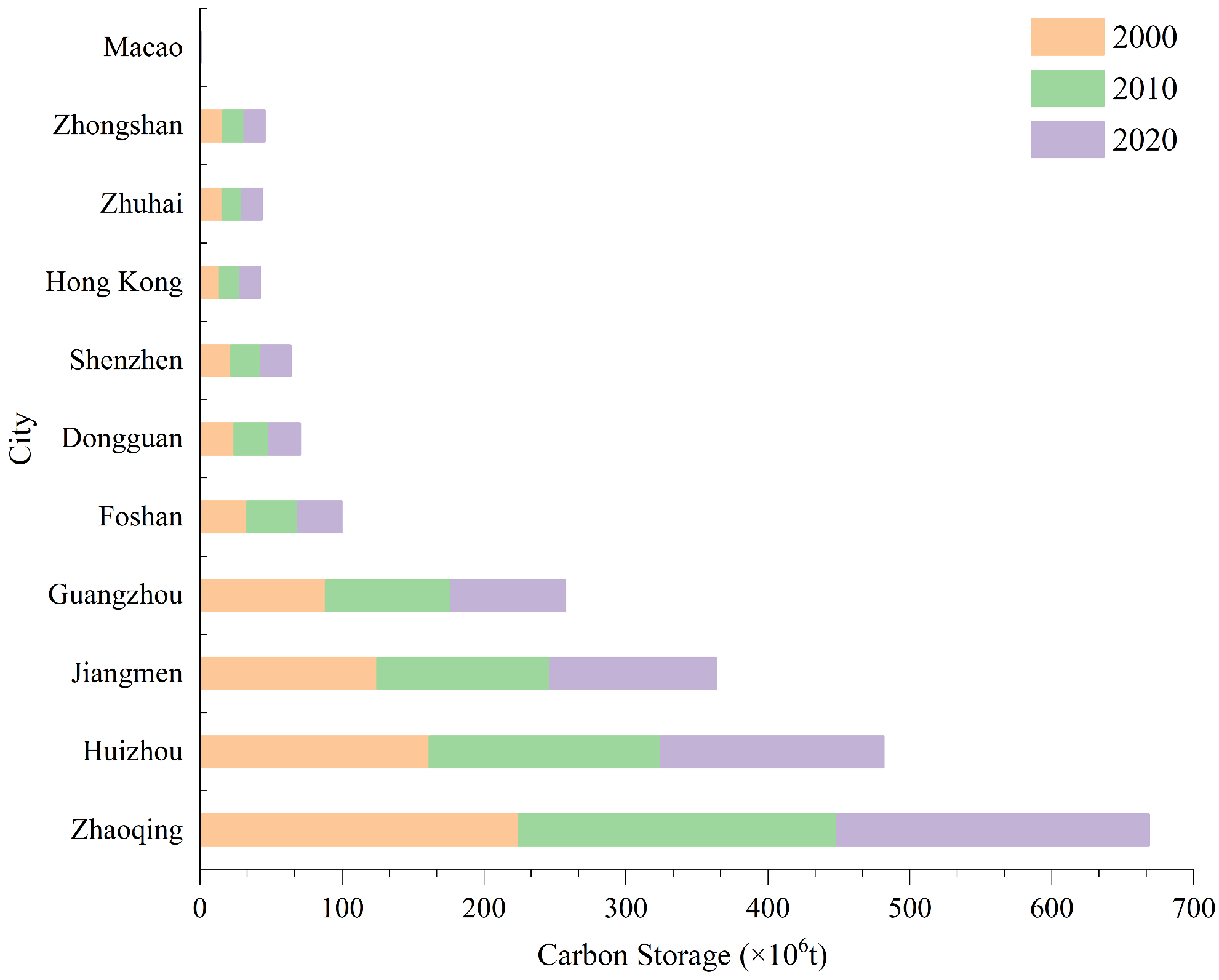
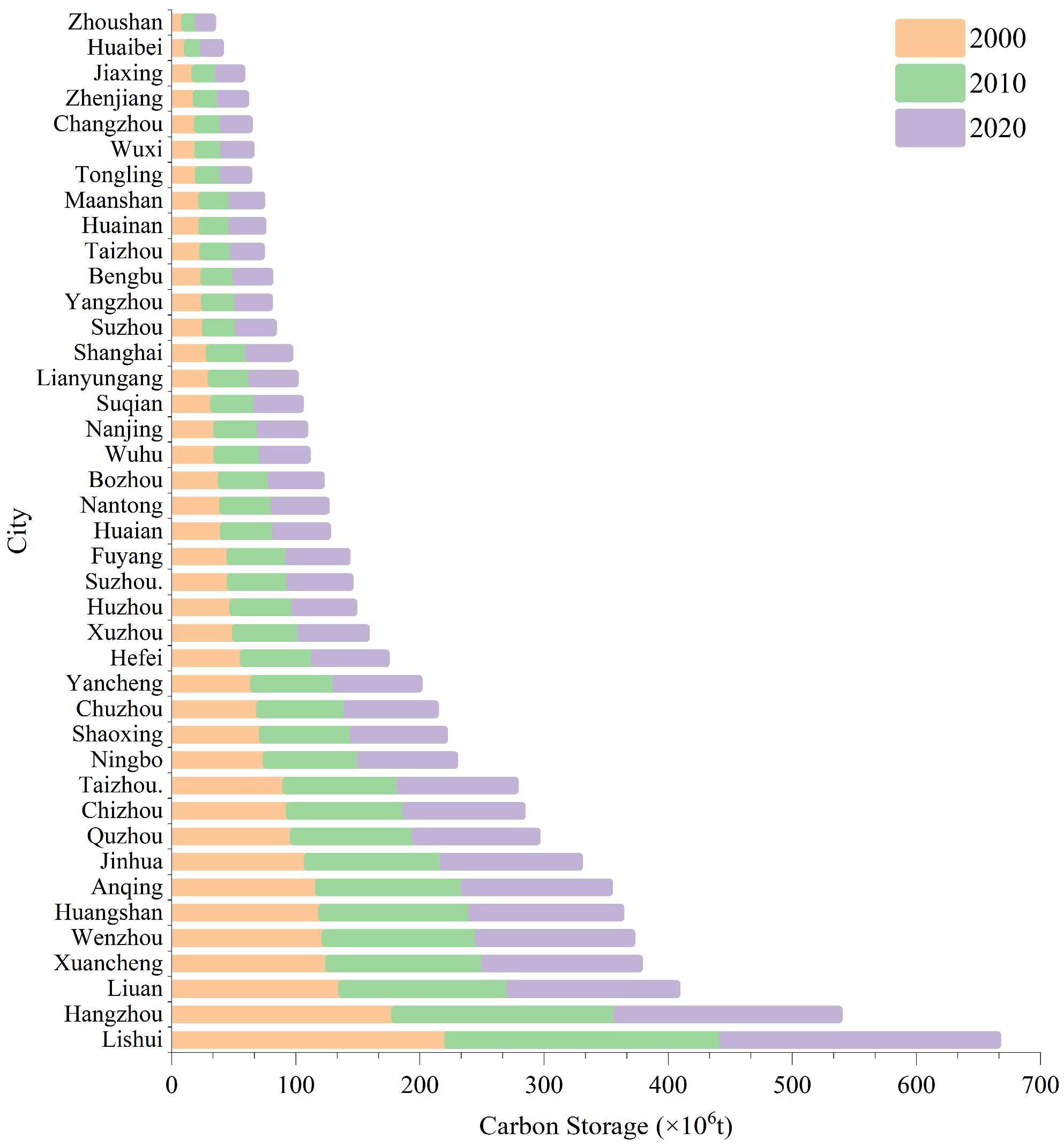
From the city scale perspective, CS in the GBA is highly concentrated in a few cities with strong ecological endowments, whereas in the YRD it exhibits a more balanced gradient distribution (Figure 8 and Figure 9). Zhaoqing and Huizhou in the GBA consistently maintain the highest values, significantly exceeding other cities and functioning as the primary regional carbon sink cores. Guangzhou, Foshan and Jiangmen are at intermediate levels, while the remaining cities exhibit persistently low CS, reflecting the relatively weak carbon sequestration capacity in highly urbanized areas. In contrast, the highest CS values in the YRD are concentrated in Lishui, Hangzhou and Liuan. Although the peak values are comparable to those in the GBA, the YRD contains more high CS cities with a more dispersed spatial distribution.
In terms of variation magnitude, CS decline in the GBA is more concentrated and exhibits greater fluctuations. Guangzhou shows the largest decrease, while Jiangmen and Foshan also display notable downward trends. Meanwhile, cities such as Shenzhen and Zhuhai continue to decline, suggesting that CS in core urban areas is more sensitive to land development. By comparison, changes in the YRD are relatively moderate, with most cities, such as Hangzhou, Huangshan, Jinhua and Ningbo, showing only slight decreases or remaining largely stable. High CS cities such as Lishui and Hangzhou exhibit minimal variation, while cities such as Shanghai and Lianyungang show limited increases, indicating relatively low overall system variability.
In terms of stability, the YRD demonstrates a clear advantage over the GBA. Cities such as Jinhua, Quzhou and Taizhou in the YRD remain nearly stable, with very small fluctuations. In contrast, except for Zhaoqing and Huizhou, most cities in the GBA experience varying degrees of decline, with weaker stability overall, particularly in Guangzhou, Jiangmen and Foshan, where fluctuations are more pronounced.
In general, the GBA is characterized by high value concentration with strong variability, indicating that CS is more sensitive to urban development disturbances, whereas the YRD exhibits a pattern of dispersed high values with overall stability, reflecting a more balanced structure and smaller inter-city differences.

3.2.2. Spatial Variation of CS

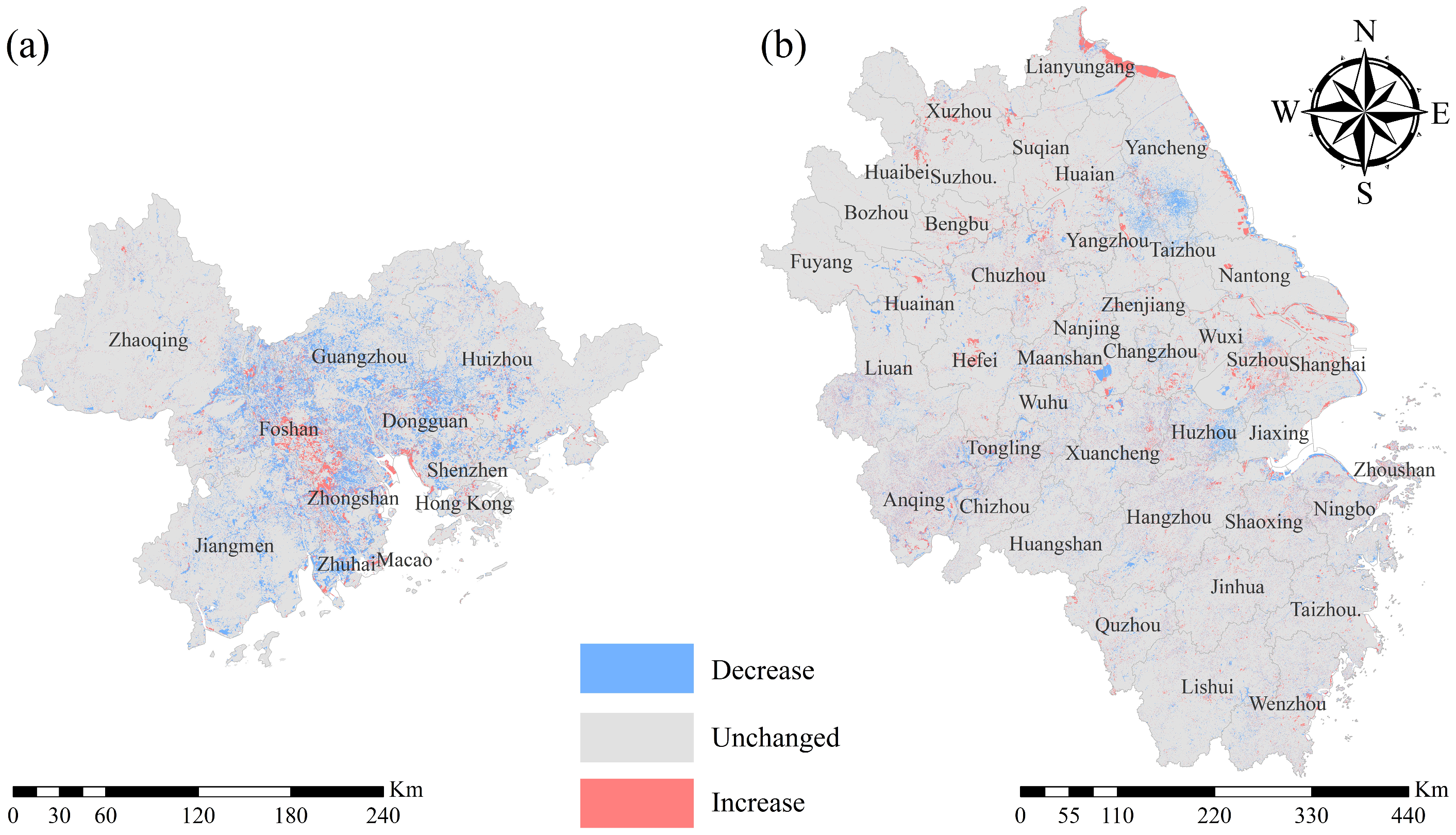
To more clearly capture the changes in CS between the initial and final years, raster-based differencing was conducted in ArcGIS. The results reveal distinct spatial patterns of CS change between 2000 and 2020 in the GBA and the YRD (Figure 10). In the GBA, CS changes exhibit a pronounced spatial clustering pattern. Areas of CS increase are mainly concentrated in Foshan and Zhongshan, with additional localized patches in southwestern Dongguan and Shenzhen. In contrast, areas of CS decrease are primarily clustered in the central part of the study area, while marginal zones show comparatively minor changes, indicating a clear core-area aggregation pattern. By comparison, the spatial variation of CS in the YRD is more dispersed, characterized by “localized clustering with overall dispersion.” Areas of CS increase are mainly concentrated in the northeastern part, forming relatively large contiguous patches in northeastern Lianyungang, with scattered increases also observed around Shanghai, Suzhou and Wuxi. Areas of CS decrease are primarily distributed around Yancheng, Yangzhou and Huzhou, exhibit a multi-core, scattered pattern overall.
On the whole, CS changes in the GBA are characterized by a more spatially concentrated pattern, whereas the YRD displays a more dispersed and heterogeneous spatial configuration.

3.2.3. Standard Deviation Ellipse and Center of Gravity Shift of CS

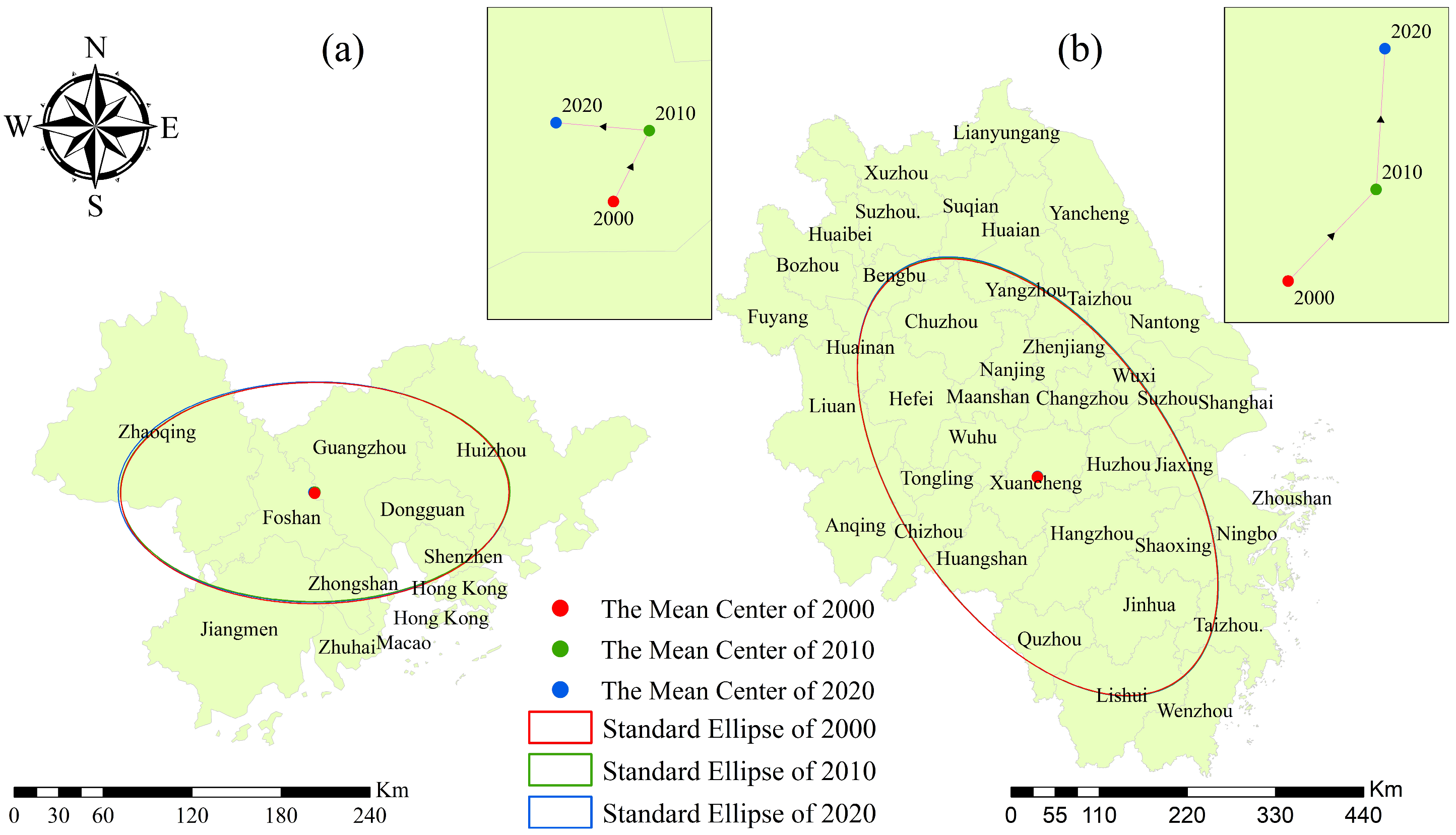
To more clearly reveal the spatial evolution differences of CS between the GBA and the YRD, this study employed ArcGIS to depict the spatial distribution of CS using standard deviation ellipses and to track the migration of CS centers. The results (Table 9 and Figure 11) show that the CS center in the GBA is primarily located in Foshan (113.20° E, 23.10° N), whereas in the YRD it is mainly in Xuancheng (118.87° E, 30.73° N). The migration amplitudes of both centers over time are relatively small, indicating that the high CS areas are concentrated and relatively stable. In terms of migration trajectories, both regions initially shifted northeast, after which the GBA CS center moved toward the northwest, while the YRD center continued shifting northeast. The areas of the standard deviation ellipses slightly increased, suggesting a modest expansion in the spatial extent of high CS regions, with the YRD exhibiting noticeably higher spatial dispersion than the GBA. Regarding ellipse orientation, the GBA shows an angle of approximately 89°, extending primarily in the east–west direction, whereas the YRD has an angle of about 146°, oriented northwest-southeast, highlighting significant differences in the spatial configuration of high CS areas between the two regions.

3.2.4. CS of Various Land Use Types

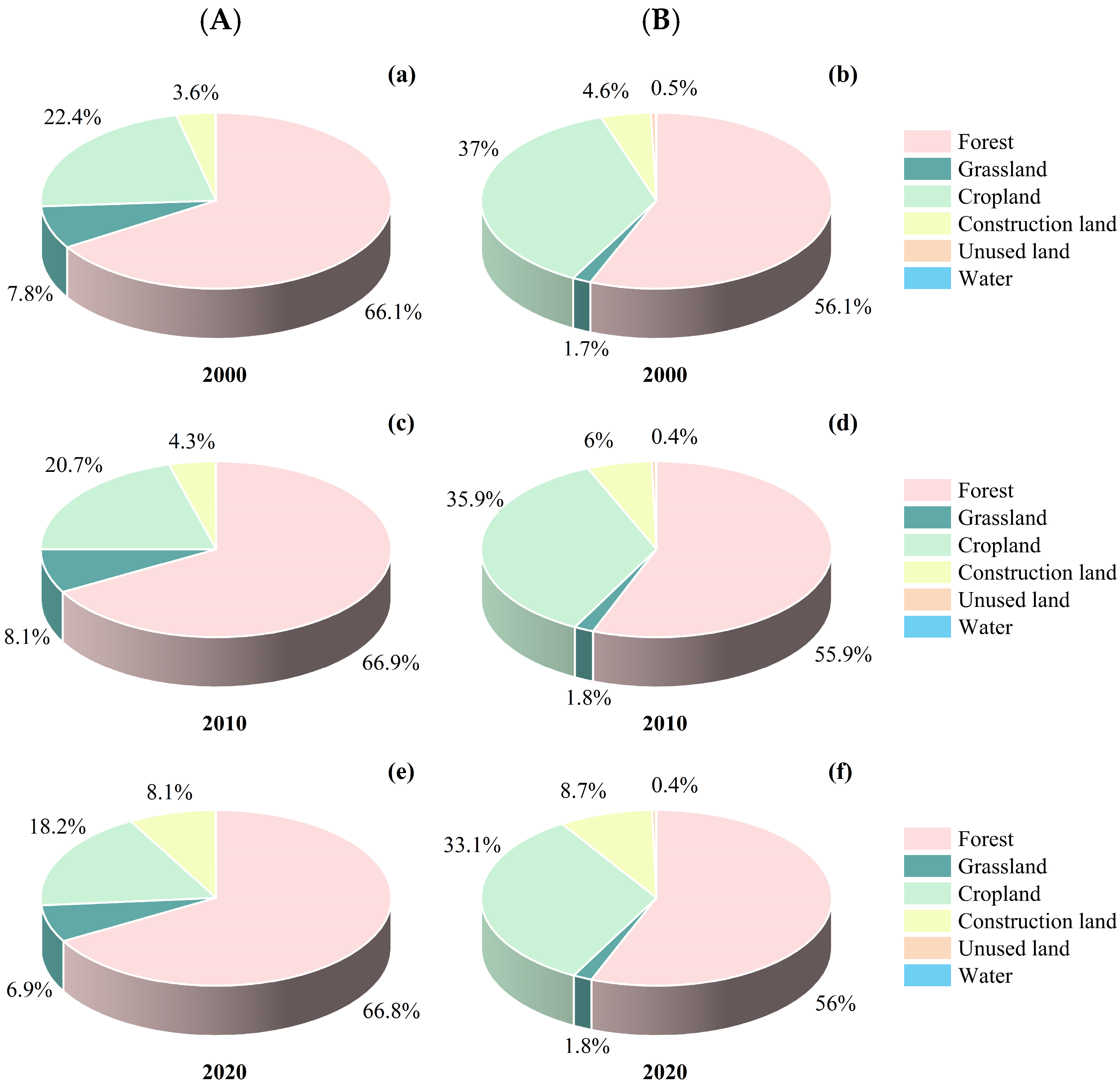
Different land use types exert distinct influences on carbon sink capacity. Generally, forest and grassland have the highest carbon sink potential. In this study, the InVEST model was employed to estimate CS in the GBA and the YRD. The results indicate that the carbon sequestration capacity of different land use types in the study area ranks from strongest to weakest as follows: forest, grassland, cropland, unused land, construction land and water. The proportion of CS by land use types in the GBA and the YRD is shown in Figure 12.
From 2000 to 2020, the composition of CS across different land use types in the GBA and the YRD exhibited a generally similar overall structure, while differences were observed in the proportions of dominant types and their relative contributions, as shown in Figure 12. In both regions, forest CS constituted the primary contributor. However, its dominance was more pronounced in the GBA, where forest CS accounted for 66.1% in 2000 and slightly increased to 66.8% in 2020, significantly higher than in the YRD, where it remained stable at around 56.0%, indicating a stronger reliance on forest CS in the GBA. Cropland CS ranked second in the YRD, declining from 37.0% in 2000 to 33.1% in 2020, and remained substantially higher than in the GBA, where it decreased from 22.4% to 18.2%, highlighting the greater importance of cropland in the CS structure of the YRD. Construction land CS increased rapidly in both regions, rising from 3.6% in 2000 to 8.1% in 2020 in the GBA and from 4.6% to 8.7% in the YRD, gradually becoming the third major component of CS, reflecting the continuous influence of urbanization on CS structure. In contrast, grassland CS remained relatively low in both regions but was generally higher in the GBA than in the YRD, with only limited variation over time. CS contributions from unused land and water were consistently negligible in both regions and remained largely stable over the two decades, exerting minimal influence on the overall CS structure.

3.3. Result of HQ

3.3.1. Spatiotemporal Variation Characteristics of HQ

In this study, we employed the HQ module of the InVEST model to evaluate HQ in the GBA and the YRD for the years 2000, 2010, and 2020. The HQ values range from 0 to 1, with higher values representing better HQ. To provide a clearer and more intuitive depiction of spatial distribution, HQ was categorized into five levels using the equal interval classification method: low (0–0.2), relatively low (0.2–0.4), general (0.4–0.6), relatively high (0.6–0.8), and high (0.8–1.0). Additionally, we also calculated the proportion of HQ within each level (Table 10 and Table 11).
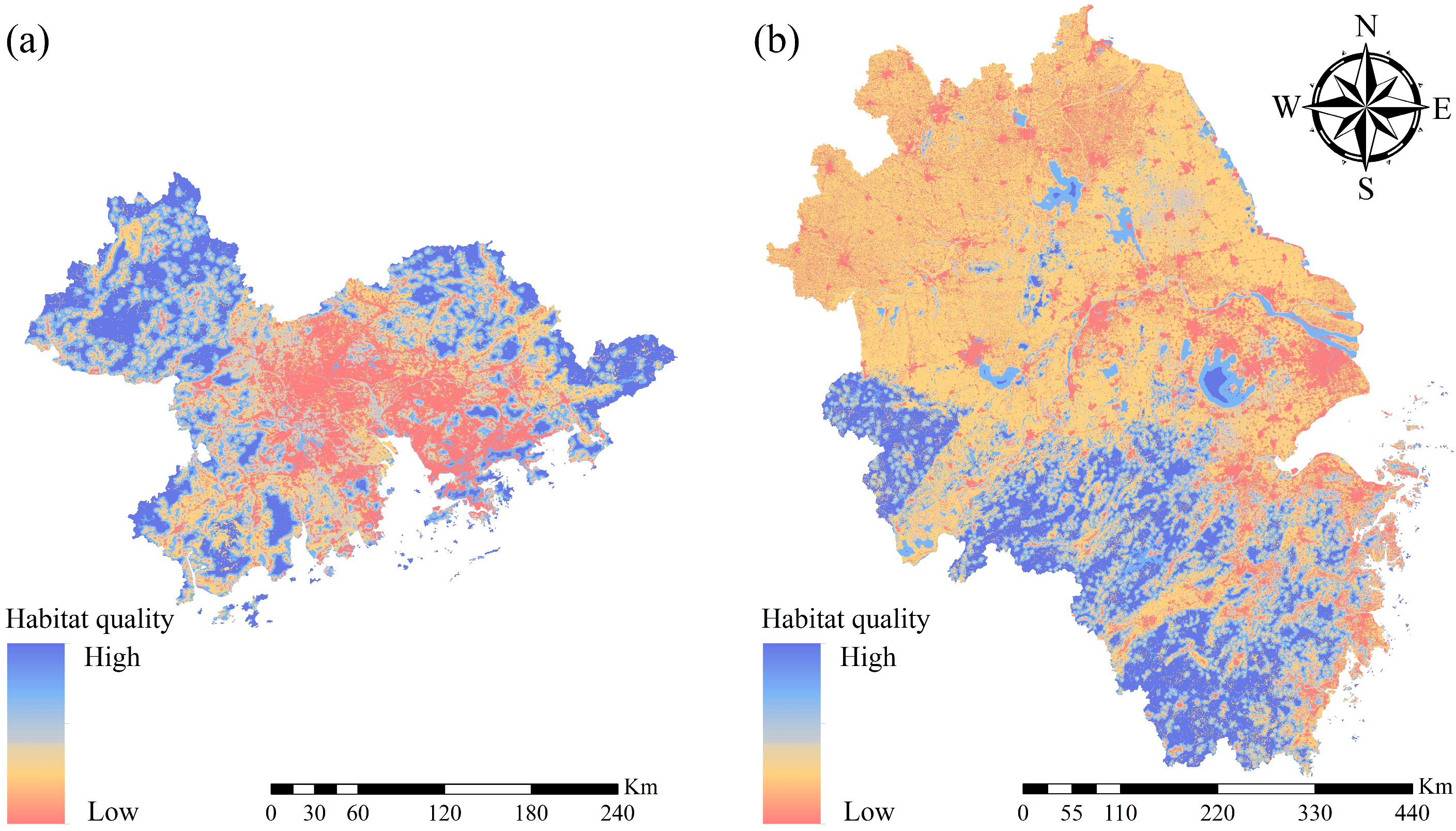
From 2000 to 2020, HQ in both the GBA and the YRD remained at a moderate level but exhibited a declining trend. The average HQ in the GBA decreased from 0.5746 to 0.4913, with a more pronounced decline, particularly accelerating during 2010 to 2020, whereas in the YRD it declined from 0.4733 to 0.4229, showing a more gradual and stable decrease. As shown in Table 10 and Table 11, High HQ areas in both regions decreased significantly, with a reduction of approximately 10% in the GBA and 7.4% in the YRD, mainly occurring in the later period, indicating that core high quality ecological areas were increasingly affected by urbanization and land use change. In contrast, Low HQ areas expanded in both regions, increasing by 8.8% in the GBA and 6.1% in the YRD, suggesting a clear expansion of low HQ, with a more pronounced increase in the GBA. In the GBA, General HQ areas continuously expanded and became the dominant type by 2020, whereas in the YRD, although General HQ areas increased, their overall proportion remained relatively low. Instead, the YRD was consistently dominated by Relatively low HQ areas, which accounted for more than 50% throughout the study period despite a gradual decline. Meanwhile, relatively high HQ areas showed no significant growth in either region, with slight fluctuations in the GBA and only marginal increases in the YRD.
Overall, the HQ evolution in the GBA is characterized by a clear shift from High HQ to General HQ and Low HQ, with General HQ becoming dominant and Low HQ expanding rapidly, indicating a downward transition in HQ. In contrast, the YRD has long been dominated by Relatively low HQ, with High HQ gradually shrinking and Low HQ steadily increasing, resulting in a more moderate and stable structural adjustment.
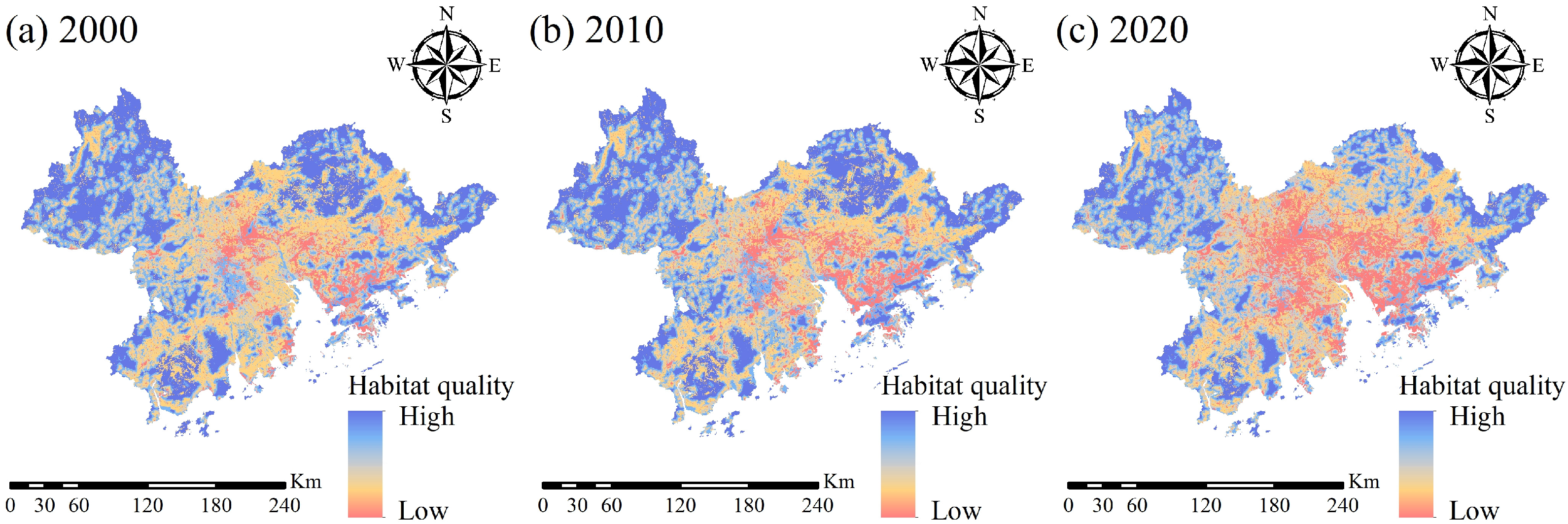
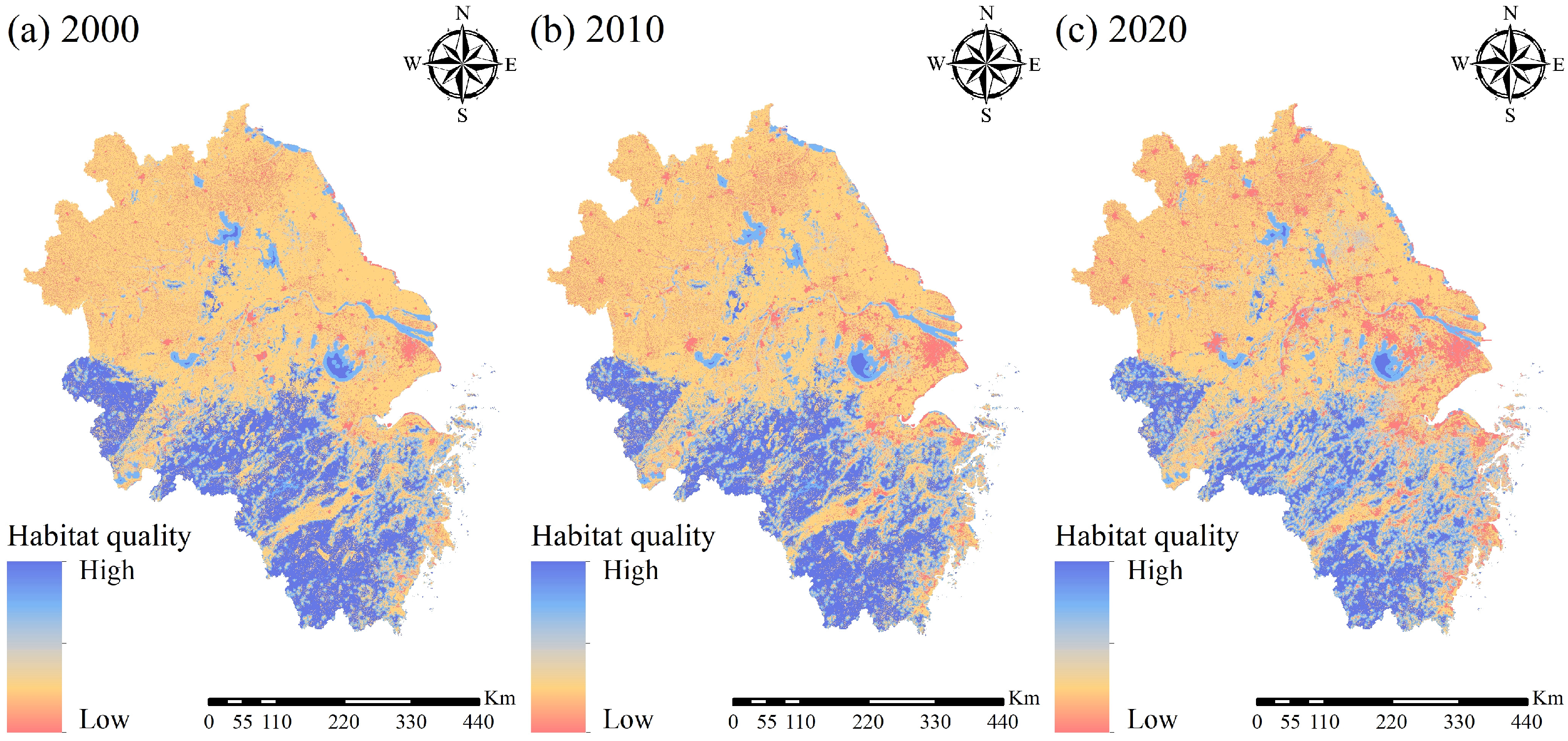
From 2000 to 2020, both the GBA and the YRD exhibited pronounced spatial heterogeneity in HQ distribution. In the GBA, HQ displayed a pattern of lower values in the central areas and higher values toward the periphery. Low HQ was significantly concentrated in core urban areas such as Foshan, Dongguan, Shenzhen and Macao, whereas High HQ was mainly distributed in peripheral cities such as Zhaoqing, Jiangmen and Huizhou, indicating a general pattern of central degradation and relatively stable peripheral conditions (Figure 13). In contrast, the YRD showed a spatial pattern of High HQ and Relatively high HQ concentrated in the southwestern ecological zones, while Low HQ dominated the northeastern and central northern riverine and coastal areas (Figure 14). In the GBA, High HQ remained primarily in the periphery, but Low HQ expanded rapidly in central areas, leading to increasing landscape fragmentation and a weakening of the Relatively high HQ transition belt. In comparison, in the YRD, High HQ was spatially scattered but relatively stable, and the dominance of Low and Relatively low HQ persisted over time. Although Relatively low HQ showed a slight contraction, the overall spatial pattern evolved more gradually and remained relatively stable. The above research results are relatively consistent with the study by Ayinuer et al. [69] and Chen et al. [28].

3.3.2. Spatial Autocorrelation Analysis of HQ

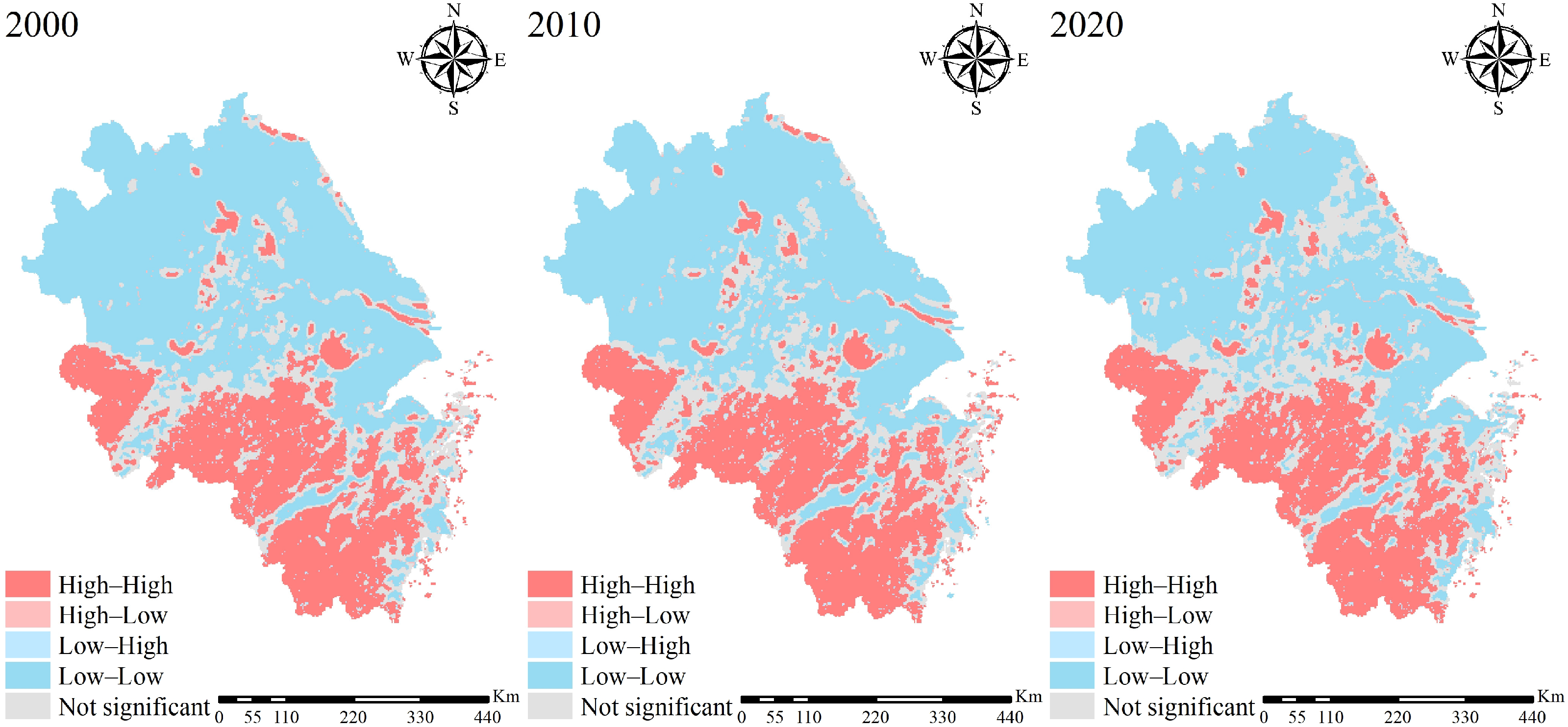
From 2000 to 2020, the Moran’s I values of HQ in both the GBA and the YRD were consistently greater than 0, indicating significant positive spatial correlation and clustering characteristics in both regions. Compared with the GBA, where Moran’s I values remained relatively stable at approximately 0.84 throughout the study period, the Moran’s I values in the YRD decreased from 0.851 to 0.809, suggesting a slight weakening of spatial aggregation, whereas the spatial clustering intensity in the GBA remained generally stable (Table 12).
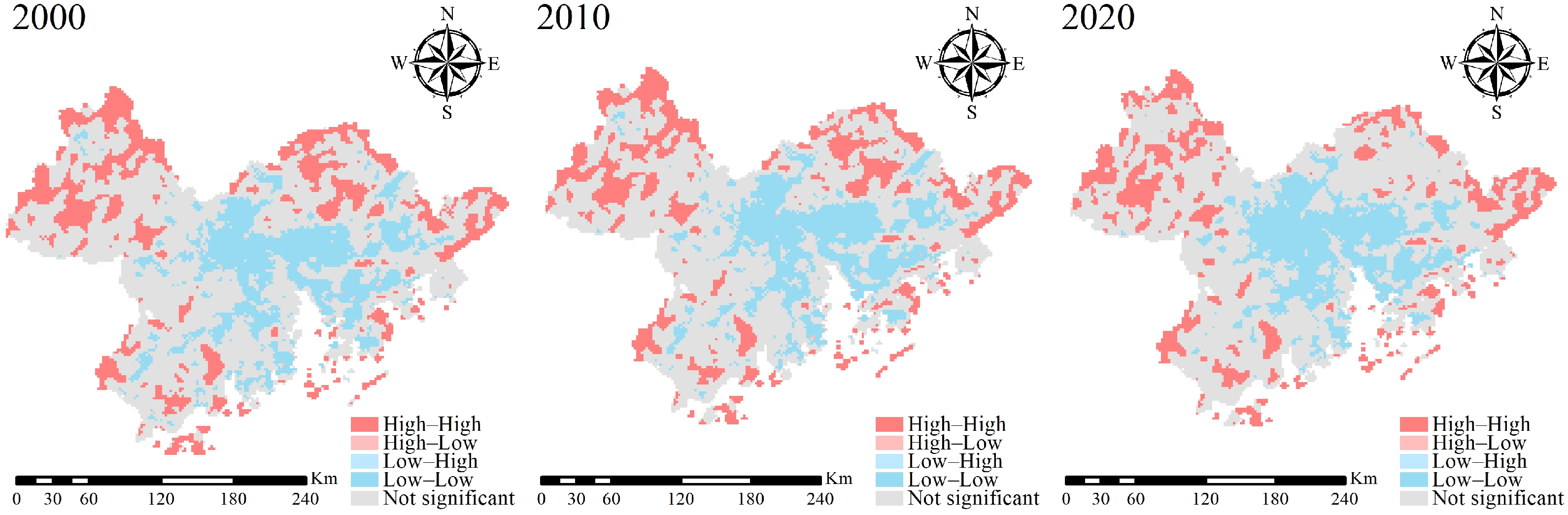
In terms of spatial distribution, the High–High clusters in the GBA were mainly distributed in peripheral areas, while core cities such as Foshan, Dongguan, southern Guangzhou, Shenzhen and Zhongshan formed concentrated and contiguous Low–Low clusters, exhibiting a spatial pattern in which High–High clusters surrounded central Low–Low clusters. Over time, the Low–Low clusters in the central GBA expanded significantly, whereas some High–High clusters in Guangzhou and Huizhou decreased (Figure 15). In contrast, the High–High clusters in the YRD were primarily concentrated in ecologically favorable southwestern areas, including southern Liuan, northern Anqing, as well as Chizhou, Huangshan, Hangzhou, Lishui and Wenzhou. Meanwhile, the central northern cities were persistently dominated by Low–Low clusters, forming an overall spatial pattern characterized by high in the southwest and low in the northeast. Unlike the rapid expansion of central Low–Low clusters in the GBA, the spatial aggregation pattern in the YRD remained relatively stable from 2000 to 2020, with both High–High and Low–Low clusters showing comparatively limited changes (Figure 16).

3.4. Spatial Divergence and Driving Mechanisms of CS and HQ in the GBA and the YRD

The comparative analysis of CS and HQ between the GBA and the YRD reveals distinct spatial differentiation patterns and underlying driving mechanisms. Although both ecological indicators exhibit significant spatial heterogeneity, their dominant controlling factors differ substantially between the two regions.
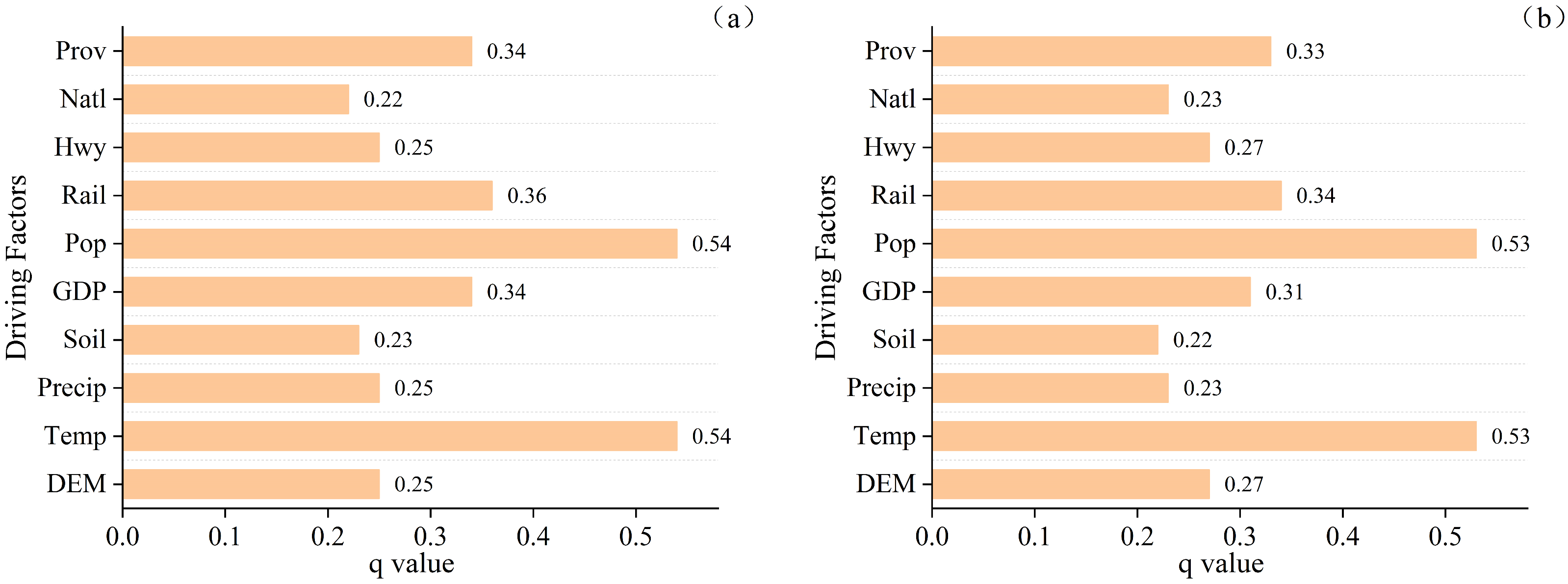
As shown in Figure 17, in the GBA, both CS and HQ are primarily influenced by anthropogenic and climatic factors. Population and temperature consistently show high explanatory power for both CS (q = 0.54 for both) and HQ (q = 0.53 for both), indicating that urbanization intensity and urban heat effects play a central role in shaping ecological patterns. In addition, GDP and transportation accessibility also contribute to spatial variation, further highlighting the strong imprint of human activities on ecological conditions in this region. These combined effects result in a typical “core–periphery” spatial structure, characterized by lower ecological values in densely urbanized centers and higher values in surrounding areas.
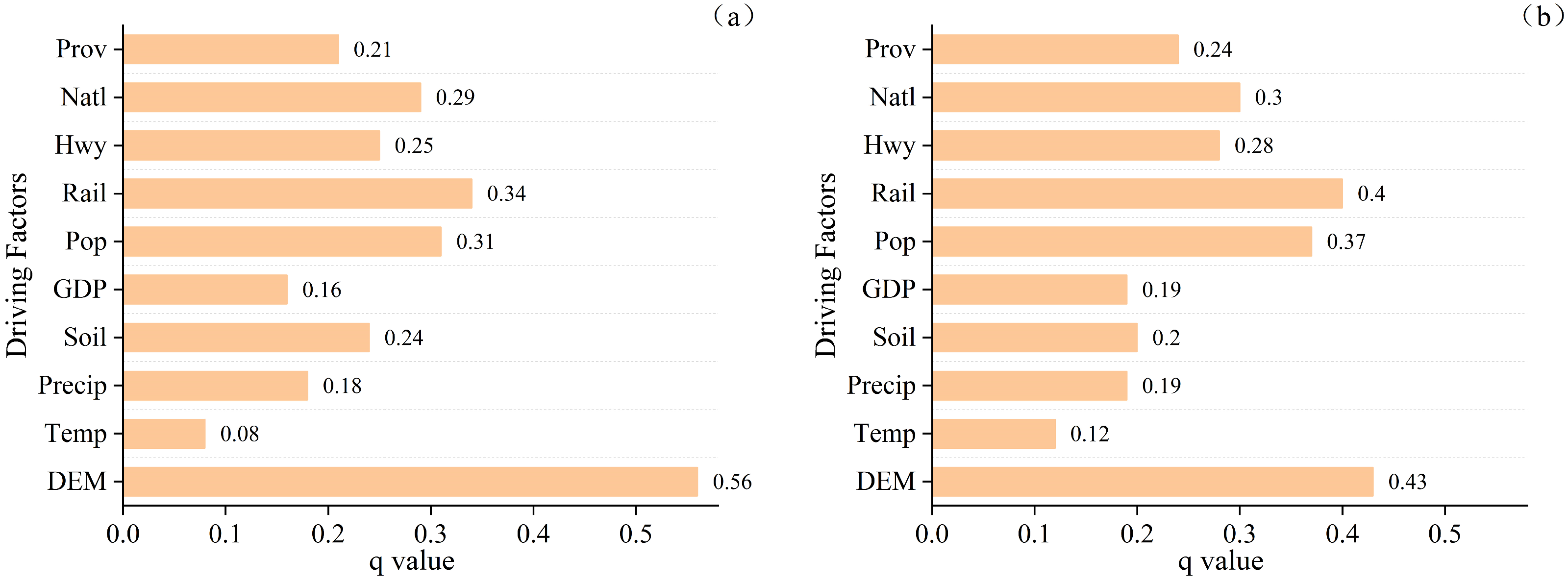
As shown in Figure 18, in contrast, the YRD exhibits a more complex interaction between natural constraints and human activities. DEM emerges as the most influential factor for both CS (q = 0.56) and HQ (q = 0.43), indicating that topographic conditions strongly regulate ecological spatial distribution. Meanwhile, transportation infrastructure and population also play important roles, particularly in HQ, where distance to railway (q = 0.40) and population (q = 0.37) show strong explanatory power. Compared with the GBA, the YRD shows a relatively stronger influence of natural geographic conditions, resulting in a spatial pattern characterized by directional gradients rather than a simple “urban–rural core–periphery” structure.
The divergence in spatial patterns between the two regions can therefore be attributed to differences in dominant driving mechanisms. In the GBA, ecological patterns are primarily shaped by intensive human activities and climatic conditions, whereas in the YRD, they are jointly constrained by topographic conditions and infrastructure development corridors. This leads to the formation of a “core–periphery” structure in the GBA and a more directional “southwest–northeast” gradient pattern in the YRD. Overall, the results demonstrate that CS and HQ respond consistently to environmental and socioeconomic drivers, but the relative dominance of natural versus anthropogenic factors varies significantly across regions. This variation ultimately determines the observed differences in spatial ecological patterns.

3.5. Future Predictions

3.5.1. Predicted Results of CS

By employing the PLUS model and historical land use data from 2000, 2010, and 2020, we will forecast land use patterns in the GBA and the YRD for the year 2030. By integrating these projections with the InVEST model, we will analyze the spatiotemporal evolution of CS and HQ in both regions. The findings of this study provide important references for informing future land use planning and ecological conservation strategies.
By 2030, CS in both the GBA and the YRD is projected to continue declining. CS in the GBA is expected to decrease to 662.79 × 10⁶ t, representing a reduction of 28.17 × 10⁶ t compared with 2020, whereas the YRD is projected to experience a larger total loss of 68.25 × 10⁶ t. In both regions, the decline in CS is mainly driven by reductions in forest and cropland. In the GBA, forest and cropland CS are projected to decrease by 23.02 × 10⁶ t and 16.76 × 10⁶ t, respectively, while the corresponding reductions in the YRD are expected to reach 80.21 × 10⁶ t and 34.14 × 10⁶ t, indicating a stronger dependence of the YRD on high carbon density ecological land and a more pronounced degradation of these land types. Meanwhile, the continuous expansion of construction land further weakens the carbon sequestration capacity in both regions and promotes the expansion of low carbon density land.
From a spatial perspective, both regions exhibit an expansion of low CS areas, although their spatial evolution patterns differ significantly. In the GBA (Figure 19a), low CS areas are mainly concentrated in central core cities, including Foshan, Zhongshan, Dongguan, Shenzhen and southwestern Guangzhou, and continue expanding toward highly urbanized regions such as Hong Kong and Macao, forming a pronounced central agglomeration pattern. Among these cities, Guangzhou is projected to experience the largest CS decline, with a reduction of 6.63 × 10⁶ t, reflecting the persistent pressure of intensive urban development on ecological space. In contrast, the expansion of low CS areas in the YRD is more prominent in coastal and riverside cities, such as Lianyungang, Shanghai, Ningbo, Suzhou and Nanjing, where the conversion of high carbon density land into low carbon density land becomes increasingly widespread, resulting in stronger spatial fragmentation. Meanwhile, some high altitude areas in the southwestern YRD, such as Jinhua and Hangzhou, are also projected to exhibit localized degradation trends (Figure 19b).
Despite the overall decline in CS, high CS core areas in both regions remain relatively stable. In the GBA, high CS areas continue to be concentrated in Zhaoqing, Huizhou and Jiangmen, contributing 33%, 23% and 17% of the regional CS, respectively, indicating that peripheral mountainous forest ecosystems remain the primary regional carbon sink. By comparison, high CS contributions in the YRD are more spatially dispersed, mainly concentrated in Lishui, Hangzhou and Liuan, with contribution rates of 8.9%, 7.03% and 5.45%, respectively.
In summary, CS in both the GBA and the YRD is projected to decline by 2030, primarily due to losses in forest and cropland CS. Social development inevitably impacts ecosystems, as economic activities drive diverse land use demands. Land use changes have a major impact on CS variations, alongside the increase in construction land and the reduction in ecological land emerging as key trends in urbanization. Striking a balance between development and ecological preservation is crucial for ensuring sustainable regional growth.

3.5.2. Predicted Results of HQ

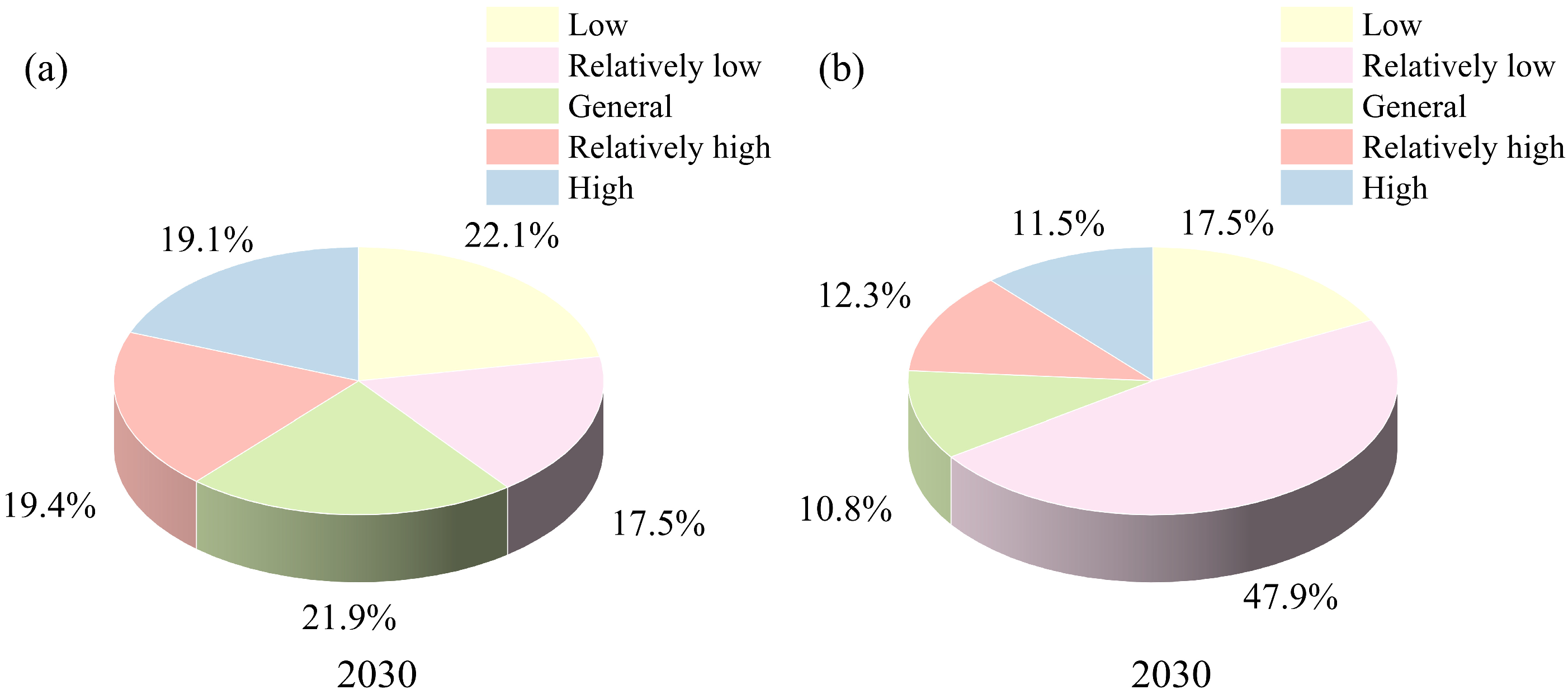
By 2030, HQ in both the GBA and the YRD is projected to decline. The average HQ in the GBA is expected to decrease to 0.4777 by 2030, while the average HQ in the YRD will further decline to 0.4115, with an overall decrease of 2.7%, indicating that the overall HQ level in the YRD remains lower than that in the GBA and exhibits a more persistent ecological degradation trend. In terms of HQ grade structure (Figure 20), both regions show an expansion of Low HQ areas, although the dominant grades differ significantly. In the GBA, Low HQ and General HQ areas are projected to become the dominant types by 2030, accounting for 22.1% and 21.9% of the total area, respectively, indicating that medium–low HQ areas are gradually becoming the main structural component. Meanwhile, High HQ areas are still expected to increase slightly, with a growth rate of 2.3%, suggesting that ecologically favorable peripheral areas maintain a certain degree of stability. In contrast, relatively low HQ areas will remain dominant in the YRD, accounting for 47.9% of the study area. In addition, the growth rate of Low HQ areas in the YRD is projected to be 3.6%, lower than the 5.5% observed in the GBA, while High HQ areas will increase by only 1%, indicating a relatively limited capacity for the recovery of high quality ecological spaces.
Spatially, as shown in Figure 21, high HQ cities in the GBA are mainly concentrated in peripheral mountainous ecological areas. Zhaoqing and Huizhou are expected to remain the top two cities, with the HQ of Zhaoqing increasing from 0.6300 to 0.6421, further strengthening its ecological advantages. Jiangmen is projected to surpass Hong Kong and rank third, indicating that peripheral ecological cities will continue to serve as the core support areas for HQ in the GBA. By comparison, high HQ cities in the YRD are more concentrated in the southwestern mountainous and hilly regions, including Lishui, Huangshan, Chizhou, Quzhou and Hangzhou. Among them, Lishui will consistently maintain the highest HQ value of 0.7335, while Huangshan and Chizhou are expected to show certain recovery trends, reflecting the relatively strong stability of the southwestern ecological barrier areas. Meanwhile, Low HQ areas in both regions are projected to continue expanding, although in different ways. In the GBA, Low HQ areas are mainly concentrated in highly urbanized core cities. Dongguan is projected to experience a decline of 0.0550 over the decade and become the city with the lowest HQ by 2030, whereas Macao, despite maintaining a relatively low HQ level, will exhibit minimal change, with a decrease of only 0.0002, indicating relatively high stability. In contrast, Low HQ areas in the YRD are more concentrated in coastal and riverside cities. Shanghai and Fuyang are expected to remain the cities with the lowest HQ levels, with Shanghai maintaining the lowest value at 0.2357. Ningbo, Zhoushan and Nanjing are projected to experience the most significant HQ declines and substantial ranking decreases, indicating that ecological pressure within coastal economic growth corridors will continue to intensify.

4. Discussion

4.1. General Analysis

This study employed the InVEST and PLUS models to comprehensively assess CS and HQ in the GBA and the YRD regions. By integrating these two models (Section 2.3 and Section 2.4), this study provides a more comprehensive understanding of the impacts of land use change on ecosystem service functions, thereby offering scientific evidence and data support for regional sustainable development and ecological conservation policies.
In the comparative analysis of the spatial patterns of CS and HQ between the GBA and the YRD, the two regions exhibited significant spatial differences. The GBA demonstrated a typical “core–periphery” gradient pattern (Figure 6 and Figure 13), which was jointly driven by the highly concentrated urban agglomeration (Guangzhou–Shenzhen–Hong Kong) and extensive coastal port development and land reclamation activities (Figure 3), compressing CS and HQ toward the urban periphery. As a result, CS and HQ values in the urban core decreased significantly, whereas peripheral areas maintained relatively high levels due to lower development intensity and the implementation of ecological protection policies, thereby forming a clear radial decreasing gradient. In contrast, the YRD exhibited a “southwest–northeast” axial pattern (Figure 7 and Figure 14), which was primarily influenced by topographic conditions (with more forest preserved in the southwestern hilly regions) as well as the distribution of river networks and watersheds (Figure 4). Meanwhile, transportation and industrial corridors distributed along this axis intensified land use conversion, resulting in a belt-like spatial distribution of HQ and CS.
To further explore the underlying driving mechanisms, the Geodetector results further verified the above findings (Section 3.4). In the GBA, population density and temperature were the dominant driving factors of CS and HQ, reflecting the significant influence of urbanization intensity and urban heat effects (Figure 17). GDP and transportation accessibility further emphasized the effects of economic development and land use intensity. In contrast, DEM was the most important controlling factor in the YRD, followed by transportation infrastructure and population density, indicating that natural geographical conditions imposed stronger constraints on spatial differentiation (Figure 18). These results consistently indicate that the GBA is primarily driven by anthropogenic processes, whereas the YRD is shaped by natural constraints and socioeconomic development.
Previous studies have similarly demonstrated that the spatial heterogeneity of CS and HQ is mainly driven by the interaction between natural factors and socioeconomic development [55,63,69,70], while regional differences in topography, climate and ecological conditions determine their fundamental spatial patterns [29]. Rapid urbanization, economic growth and population agglomeration promote urban expansion into flat, easily developed yet ecologically fragile areas, thereby increasing land use intensity and diversity and exacerbating the spatial imbalances of CS and HQ [71,72,73]. In addition, significant differences exist among land use types in terms of carbon sequestration capacity and ecological functions [74,75]: forest and grassland possess relatively high carbon storage capacity, whereas construction land and industrial land exhibit relatively low capacity, and although well-managed cropland can sequester carbon, its capacity remains lower than that of natural ecosystems. Urbanization and industrialization processes are often accompanied by deforestation, wetland reclamation and the expansion of impervious surfaces, thereby weakening soil carbon sequestration capacity and degrading ecosystem integrity. HQ is also significantly affected by land use change [76]: urban expansion and agricultural development intensify landscape fragmentation and degradation, reducing biodiversity [77], ecological connectivity and core ecological functions. Notably, the decline in HQ further exacerbates CS loss, forming a negative feedback mechanism. In rapidly developing coastal regions, frequent land use changes intensify these effects [78,79], while increasing urbanization and land use intensity contribute to regional carbon loss and habitat degradation.

4.2. Management Recommendations

To address the decline in CS and HQ in the GBA and the YRD, this study proposes differentiated ecological management strategies tailored to the characteristics of different areas, based on the spatial distribution of CS and the clustering patterns of HQ.
Overall, priority should be given to protecting areas characterized by “High CS–HQ High–High clusters,” as these areas generally exhibit high ecosystem quality and stable carbon sequestration functions and represent the core of the regional ecological security pattern. They should be strictly regulated under ecological conservation redline policies. For “High CS–HQ Low–Low clusters,” attention should be paid to ecological degradation risks, and habitat restoration and ecological connectivity enhancement should be implemented to improve habitat conditions and ecological network structure. For “Low CS–HQ High–High clusters,” the focus should be on maintaining HQ while enhancing CS capacity through vegetation restoration and land use optimization. For “Low CS–HQ Low–Low clusters,” limited and controlled green development may be permitted under strict ecological constraints, accompanied by ecological restoration and land use restructuring to gradually improve ecological and carbon sequestration functions.
In the GBA, due to high urbanization intensity and fragmented ecological space, priority should be given to strengthening the protection of coastal wetlands and urban fringe ecological areas. Strict protection should be applied to “High CS–HQ High–High cluster” areas to prevent further ecological fragmentation. Meanwhile, for “Low CS–HQ Low–Low cluster” urban built-up areas, ecological functions should be enhanced through urban renewal, green infrastructure optimization, and low-carbon infrastructure development. In the YRD, although the ecosystem has relatively good overall connectivity, it is strongly affected by river–lake networks and agricultural activities. Therefore, priority should be given to strengthening ecological restoration in river–lake wetlands and agricultural mosaic areas, with enhanced protection and hydrological connectivity maintenance in “High CS–HQ High–High cluster” areas. For “Low CS–HQ Low–Low cluster” areas, ecological quality and carbon sequestration potential should be improved through degraded wetland restoration, ecological agriculture optimization and land consolidation.

4.3. Limitations and Future Research Direction

Although this study offers a rigorous scientific assessment approach for regional CS and HQ, it also has certain limitations. While the InVEST model is widely used globally, its parameter settings depend on previous study and experience, introducing a degree of subjectivity [80]. Additionally, the model’s input data primarily reflects existing land use and climate conditions, without fully accounting for unpredictable future climate changes and human activities, which limits its ability to assess dynamic ecosystem changes [81]. Future research could enhance the model’s accuracy by incorporating more remote sensing and high-resolution ground survey data. Moreover, future studies should expand to include other ecosystem service functions, such as water resource regulation and biodiversity conservation, to provide more comprehensive ecological management recommendations. By integrating multiple ecosystem services, researchers can develop a multidimensional guidance framework for policymakers, supporting sustainable ecosystem development and promoting a balanced coexistence between economic growth and environmental protection.

5. Conclusions

CS and HQ serve as a key factor in mitigating and adapting to climate change, as well as in promoting ecosystem conservation and sustainable development. These factors provide a solid foundation for supporting effective decision-making and striking a balance between economic development and environmental conservation. This study assesses CS and HQ in the GBA and the YRD from 2000 to 2030 using the InVEST and PLUS models, and conducted an integrated analysis incorporating spatiotemporal evolution and driving factor identification. The main conclusions are as follows:
1. From 2000 to 2030, land use changes in the GBA and the YRD are primarily characterized by the continuous expansion of construction land and a persistent decrease in cropland, with land conversion mainly involving the transfer of cropland and forest to construction land. The significant reduction in cropland is the main source of increased construction land, reflecting the acceleration of urbanization. Concurrently, the conflict between social development and ecosystem health has become more pronounced.
2. CS and HQ in both the GBA and the YRD are decreasing year by year. Spatially, the GBA exhibits a circular distribution with low values in the center and higher values around it, while the YRD shows a pattern of higher values in the southwest and lower values in the northeast.
3. The 2030 projections indicate that both CS and HQ in the GBA and the YRD will continue to decline, with overall ecosystem service functions remaining in a degraded state. This highlights the need to further prioritize the protection and enhancement of ecosystem functions in order to promote regional ecological security and sustainable development.
4. The spatial differentiation of CS and HQ is jointly driven by both natural factors and human activities, but there are significant regional differences in their dominant mechanisms. The GBA is primarily dominated by anthropogenic processes such as population density, urbanization, and economic development, whereas the YRD is mainly constrained by natural factors such as topography, with secondary influences from socioeconomic factors.
This study offers a scientific foundation for the GBA and the YRD region, helps to balance the contradiction between urbanization and ecological protection, optimizes regional ecosystem services, and provides a reference for land use policy formulation. In the future, land use control should be strengthened, green urbanization and sustainable development should be promoted, ecological restoration efforts should be enhanced, and a long-term ecological monitoring mechanism should be established to realize a mutually beneficial balance between economic development and ecological conservation.

Supplementary Materials

The following supporting information can be downloaded at: https://www.mdpi.com/article/10.3390/land15050871/s1, Figure S1: Comparison of Actual and Predicted Land Use in the GBA in 2020; Figure S2: Comparison of Actual and Predicted Land Use in the YRD in 2020.

Author Contributions

Writing—review and editing, G.Z., B.W., Y.L., Z.G. and X.C.; Writing—original draft, G.Z., B.W. and Y.L.; Validation, G.Z., B.W., Y.L., Z.G. and X.C.; Formal analysis, G.Z., B.W. and Y.L.; Supervision, G.Z. and Y.L.; Data curation, G.Z., B.W., Y.L., Z.G. and X.C.; Methodology, B.W., Z.G. and X.C.; Investigation, B.W., Z.G. and X.C.; Funding acquisition, Y.L.; Conceptualization, Z.G. and X.C. All authors have read and agreed to the published version of the manuscript.

Funding

This research was funded by the Youth Innovation Team Project of Higher School in Shandong Province, China, grant number 2024KJH087.

Data Availability Statement

The data used in this study are derived from publicly available sources, and the processed data supporting the findings of this study are available from the corresponding author upon reasonable request.

Conflicts of Interest

The authors declare no conflicts of interest.

References

  1. Cao, Y.; Wang, C.; Su, Y.; Duan, H.; Wu, X.; Lu, R.; Su, Q.; Wu, Y.; Chu, Z. Study on Spatiotemporal Evolution and Driving Forces of Habitat Quality in the Basin along the Yangtze River in Anhui Province Based on InVEST Model. Land 2023, 12, 1092. [Google Scholar] [CrossRef]
  2. Mao, L.; Swenson, N.G.; Sui, X.; Zhang, J.; Chen, S.; Li, J.; Peng, P.; Zhou, G.; Zhang, X. The geographic and climatic distribution of plant height diversity for 19,000 angiosperms in China. Biodivers. Conserv. 2020, 29, 487–502. [Google Scholar] [CrossRef]
  3. Perino, A.; Pereira, H.M.; Felipe-Lucia, M.; Kim, H.; Kühl, H.S.; Marselle, M.R.; Meya, J.N.; Meyer, C.; Navarro, L.M.; van Klink, R. Biodiversity post-2020: Closing the gap between global targets and national-level implementation. Conserv. Lett. 2022, 15, e12848. [Google Scholar] [CrossRef]
  4. Ren, D.-F.; Cao, A.-H.; Wang, F.-y. Response and multi-scenario prediction of carbon storage and habitat quality to land use in liaoning Province, China. Sustainability 2023, 15, 4500. [Google Scholar] [CrossRef]
  5. Wang, C.; Li, T.; Guo, X.; Xia, L.; Lu, C.; Wang, C. Plus-InVEST Study of the Chengdu-Chongqing urban agglomeration’s land-use change and carbon storage. Land 2022, 11, 1617. [Google Scholar] [CrossRef]
  6. Yang, Y. Evolution of habitat quality and association with land-use changes in mountainous areas: A case study of the Taihang Mountains in Hebei Province, China. Ecol. Indic. 2021, 129, 107967. [Google Scholar] [CrossRef]
  7. Costanza, R.; De Groot, R.; Sutton, P.; Van der Ploeg, S.; Anderson, S.J.; Kubiszewski, I.; Farber, S.; Turner, R.K. Changes in the global value of ecosystem services. Glob. Environ. Change 2014, 26, 152–158. [Google Scholar] [CrossRef]
  8. Houghton, R.A. Revised estimates of the annual net flux of carbon to the atmosphere from changes in land use and land management 1850–2000. Tellus B Chem. Phys. Meteorol. 2003, 55, 378–390. [Google Scholar] [CrossRef]
  9. Rao, Y.; Zhou, M.; Ou, G.; Dai, D.; Zhang, L.; Zhang, Z.; Nie, X.; Yang, C. Integrating ecosystem services value for sustainable land-use management in semi-arid region. J. Clean. Prod. 2018, 186, 662–672. [Google Scholar] [CrossRef]
  10. Zaehle, S.; Bondeau, A.; Carter, T.R.; Cramer, W.; Erhard, M.; Prentice, I.C.; Reginster, I.; Rounsevell, M.D.; Sitch, S.; Smith, B. Projected changes in terrestrial carbon storage in Europe under climate and land-use change, 1990–2100. Ecosystems 2007, 10, 380–401. [Google Scholar] [CrossRef]
  11. Ma, X.; Wang, Z. Progress in the study on the impact of land-use change on regional carbon sources and sinks. Acta Ecol. Sin. 2015, 35, 5898–5907. [Google Scholar] [CrossRef]
  12. Houghton, R.A.; House, J.I.; Pongratz, J.; Van Der Werf, G.R.; Defries, R.S.; Hansen, M.C.; Le Quéré, C.; Ramankutty, N. Carbon emissions from land use and land-cover change. Biogeosciences 2012, 9, 5125–5142. [Google Scholar] [CrossRef]
  13. Nelson, E.; Mendoza, G.; Regetz, J.; Polasky, S.; Tallis, H.; Cameron, D.; Chan, K.M.; Daily, G.C.; Goldstein, J.; Kareiva, P.M. Modeling multiple ecosystem services, biodiversity conservation, commodity production, and tradeoffs at landscape scales. Front. Ecol. Environ. 2009, 7, 4–11. [Google Scholar] [CrossRef]
  14. Goldstein, J.H.; Caldarone, G.; Duarte, T.K.; Ennaanay, D.; Hannahs, N.; Mendoza, G.; Polasky, S.; Wolny, S.; Daily, G.C. Integrating ecosystem-service tradeoffs into land-use decisions. Proc. Natl. Acad. Sci. USA 2012, 109, 7565–7570. [Google Scholar] [CrossRef]
  15. Butchart, S.H.; Walpole, M.; Collen, B.; Van Strien, A.; Scharlemann, J.P.; Almond, R.E.; Baillie, J.E.; Bomhard, B.; Brown, C.; Bruno, J. Global biodiversity: Indicators of recent declines. Science 2010, 328, 1164–1168. [Google Scholar] [CrossRef]
  16. Terrado, M.; Sabater, S.; Chaplin-Kramer, B.; Mandle, L.; Ziv, G.; Acuña, V. Model development for the assessment of terrestrial and aquatic habitat quality in conservation planning. Sci. Total Environ. 2016, 540, 63–70. [Google Scholar] [CrossRef]
  17. Li, X.; Liu, Z.; Li, S.; Li, Y. Multi-Scenario Simulation Analysis of Land Use Impacts on Habitat Quality in Tianjin Based on the PLUS Model Coupled with the InVEST Model. Sustainability 2022, 14, 6923. [Google Scholar] [CrossRef]
  18. Li, G.; Wu, Z.; He, Y.; Chen, C.; Long, Y. The promotion of sustainable land use planning for the enhancement of ecosystem service capacity: Based on the FLUS-INVEST-RUSLE-CASA model. PLoS ONE 2024, 19, e0305400. [Google Scholar] [CrossRef]
  19. Chen, Y.; Xiao, W. Estimation of forest NPP and carbon sequestration in the Three Gorges Reservoir Area, using the biome-BGC model. Forests 2019, 10, 149. [Google Scholar] [CrossRef]
  20. Chuai, X.; Huang, X.; Lai, L.; Wang, W.; Peng, J.; Zhao, R. Land use structure optimization based on carbon storage in several regional terrestrial ecosystems across China. Environ. Sci. Policy 2013, 25, 50–61. [Google Scholar] [CrossRef]
  21. Fatichi, S.; Leuzinger, S.; Körner, C. Moving beyond photosynthesis: From carbon source to sink-driven vegetation modeling. New Phytol. 2014, 201, 1086–1095. [Google Scholar] [CrossRef]
  22. Posner, S.; Verutes, G.; Koh, I.; Denu, D.; Ricketts, T. Global use of ecosystem service models. Ecosyst. Serv. 2016, 17, 131–141. [Google Scholar] [CrossRef]
  23. Liang, Y.; Hashimoto, S.; Liu, L. Integrated assessment of land-use/land-cover dynamics on carbon storage services in the Loess Plateau of China from 1995 to 2050. Ecol. Indic. 2021, 120, 106939. [Google Scholar] [CrossRef]
  24. Li, L.; Fu, W.; Luo, M. Spatial and temporal variation and prediction of ecosystem carbon stocks in yunnan province based on land use change. Int. J. Environ. Res. Public Health 2022, 19, 16059. [Google Scholar] [CrossRef]
  25. Babbar, D.; Areendran, G.; Sahana, M.; Sarma, K.; Raj, K.; Sivadas, A. Assessment and prediction of carbon sequestration using Markov chain and InVEST model in Sariska Tiger Reserve, India. J. Clean. Prod. 2021, 278, 123333. [Google Scholar] [CrossRef]
  26. Nelson, E.; Sander, H.; Hawthorne, P.; Conte, M.; Ennaanay, D.; Wolny, S.; Manson, S.; Polasky, S. Projecting global land-use change and its effect on ecosystem service provision and biodiversity with simple models. PLoS ONE 2010, 5, e14327. [Google Scholar] [CrossRef]
  27. Wang, Z.; Li, X.; Mao, Y.; Li, L.; Wang, X.; Lin, Q. Dynamic simulation of land use change and assessment of carbon storage based on climate change scenarios at the city level: A case study of Bortala, China. Ecol. Indic. 2022, 134, 108499. [Google Scholar] [CrossRef]
  28. Chen, S.; Liu, X. Spatio-temporal variations of habitat quality and its driving factors in the Yangtze River Delta region of China. Glob. Ecol. Conserv. 2024, 52, e02978. [Google Scholar] [CrossRef]
  29. Zhang, H.; Wang, F.; Zhao, H.; Kang, P.; Tang, L. Evolution of habitat quality and analysis of influencing factors in the Yellow River Delta Wetland from 1986 to 2020. Front. Ecol. Evol. 2022, 10, 1075914. [Google Scholar] [CrossRef]
  30. Lei, J.; Chen, Y.; Li, L.; Chen, Z.; Chen, X.; Wu, T.; Li, Y. Spatiotemporal change of habitat quality in Hainan Island of China based on changes in land use. Ecol. Indic. 2022, 145, 109707. [Google Scholar] [CrossRef]
  31. Liu, K.; Zhang, C.; Zhang, H.; Xu, H.; Xia, W. Spatiotemporal Variation and Dynamic Simulation of Ecosystem Carbon Storage in the Loess Plateau Based on PLUS and InVEST Models. Land 2023, 12, 1065. [Google Scholar] [CrossRef]
  32. Liu, J.; Xu, D.; Xu, J. Analysis of Landscape Patterns and Spatio-temporal Evolution of Habitat Quality in the PU River Basin Based on the InVEST Model. J. Soil Water Conserv. 2024, 38, 258–267. [Google Scholar] [CrossRef]
  33. Wang, Z.; Liu, S.; Su, Y. Spatiotemporal evolution of habitat quality and its response to landscape patterns in karst mountainous cities: A case study of Guiyang City in China. Environ. Sci. Pollut. Res. 2023, 30, 114391–114405. [Google Scholar] [CrossRef]
  34. Liang, X.; Guan, Q.; Clarke, K.C.; Liu, S.; Wang, B.; Yao, Y. Understanding the drivers of sustainable land expansion using a patch-generating land use simulation (PLUS) model: A case study in Wuhan, China. Comput. Environ. Urban Syst. 2021, 85, 101569. [Google Scholar] [CrossRef]
  35. Zhai, H.; Lv, C.; Liu, W.; Yang, C.; Fan, D.; Wang, Z.; Guan, Q. Understanding spatio-temporal patterns of land use/land cover change under urbanization in Wuhan, China, 2000–2019. Remote Sens. 2021, 13, 3331. [Google Scholar] [CrossRef]
  36. Li, Y.; Yao, S.; Jiang, H.; Wang, H.; Ran, Q.; Gao, X.; Ding, X.; Ge, D. Spatial-temporal evolution and prediction of carbon storage: An integrated framework based on the MOP–PLUS–InVEST model and an applied case study in Hangzhou, East China. Land 2022, 11, 2213. [Google Scholar] [CrossRef]
  37. Zhang, Y.; Fox, A.D.; Cao, L.; Jia, Q.; Lu, C.; Prins, H.H.; de Boer, W.F. Effects of ecological and anthropogenic factors on waterbird abundance at a Ramsar Site in the Yangtze River Floodplain. Ambio 2019, 48, 293–303. [Google Scholar] [CrossRef]
  38. Zhou, B.; Cao, J.; Zhu, C.; Jin, B. Valuation of wetland ecosystem services along the Yangtze River in Anqing, Anhui Province. Geogr. Res. 2011, 30, 2296–2304. [Google Scholar]
  39. Tan, X.; Liu, S.; Tian, Y.; Zhou, Z.; Wang, Y.; Jiang, J.; Shi, H. Impacts of Climate Change and Land Use/Cover Change on Regional Hydrological Processes: Case of the Guangdong-Hong Kong-Macao Greater Bay Area. Front. Environ. Sci. 2022, 9-2021, 783324. [Google Scholar] [CrossRef]
  40. Huang, Q.; Wang, L.; Jia, B.; Lai, X.; Peng, Q. Impact of Climate Change on the Spatio-Temporal Variation in Groundwater Storage in the Guangdong–Hong Kong–Macao Greater Bay Area. Sustainability 2023, 15, 10776. [Google Scholar] [CrossRef]
  41. IUSS Working Group WRB. World Reference Base for Soil Resources: International Soil Classification System for Naming Soils and Creating Legends for Soil Maps; International Union of Soil Sciences (IUSS): Vienna, Austria, 2022. [Google Scholar]
  42. Wen, D.; Wang, X.; Liu, J.; Xu, N.; Zhou, W.; Hong, M. Maintaining key ecosystem services under multiple development scenarios: A case study in Guangdong–Hong Kong–Macao greater bay Area, China. Ecol. Indic. 2023, 154, 110691. [Google Scholar] [CrossRef]
  43. Wang, Q.; Cai, X.; Tang, J.; Yang, L.; Wang, J.; Xu, Y. Climate feedbacks associated with land-use and land-cover change on hydrological extremes over the Yangtze River Delta Region, China. J. Hydrol. 2023, 623, 129855. [Google Scholar] [CrossRef]
  44. Zhu, Y.; Yang, S.; Lin, J.; Cai, A. Pattern and effect of economic agglomeration in the Yangtze River Delta region based on population-land allometric growth. Front. Earth Sci. 2023, 11, 1112423. [Google Scholar] [CrossRef]
  45. Hu, W.; Li, G.; Gao, Z.; Jia, G.; Wang, Z.; Li, Y. Assessment of the impact of the Poplar Ecological Retreat Project on water conservation in the Dongting Lake wetland region using the InVEST model. Sci. Total Environ. 2020, 733, 139423. [Google Scholar] [CrossRef]
  46. Dong, J.; Zhang, Z.; Liu, B.; Zhang, X.; Zhang, W.; Chen, L. Spatiotemporal variations and driving factors of habitat quality in the loess hilly area of the Yellow River Basin: A case study of Lanzhou City, China. J. Arid Land 2022, 14, 637–652. [Google Scholar] [CrossRef]
  47. Wang, Y.; Lan, A.; Fan, Z.; Liu, S.; Zhu, N. Spatial-temporal differentiation and driving factors of habitat quality in the Chishui River Basin based on InVEST Model. China Rural Water Hydropower 2023, 17–23. [Google Scholar] [CrossRef]
  48. Liu, X.; Wang, S.; Wu, P.; Feng, K.; Hubacek, K.; Li, X.; Sun, L. Impacts of urban expansion on terrestrial carbon storage in China. Environ. Sci. Technol. 2019, 53, 6834–6844. [Google Scholar] [CrossRef]
  49. Zhao, M.; He, Z.; Du, J.; Chen, L.; Lin, P.; Fang, S. Assessing the effects of ecological engineering on carbon storage by linking the CA-Markov and InVEST models. Ecol. Indic. 2019, 98, 29–38. [Google Scholar] [CrossRef]
  50. Liu, Y.; Wang, Y.; Lin, Y.; Ma, X.; Guo, S.; Ouyang, Q.; Sun, C. Habitat Quality Assessment and Driving Factors Analysis of Guangdong Province, China. Sustainability 2023, 15, 11615. [Google Scholar] [CrossRef]
  51. Li, P.; Chen, J.; Li, Y.; Wu, W. Using the InVEST-PLUS model to predict and analyze the pattern of ecosystem carbon storage in Liaoning Province, China. Remote Sens. 2023, 15, 4050. [Google Scholar] [CrossRef]
  52. Wu, X.; Guo, F. Analysis and prediction of carbon storage changes in Jiangsu Province based on the Invest model and Flus model. Chin. J. Eco-Agric. 2024, 32, 230–239. [Google Scholar]
  53. Huang, G.; Wang, R.-Y. Impact of Land Use/Cover Change (LUCC) on Carbon Storage in Zhaoqing by using the InVEST Model. Int. J. Rural. Dev. Environ. Health Res. 2023, 7, 20–37. [Google Scholar] [CrossRef]
  54. Zhu, L.; Song, R.; Sun, S.; Li, Y.; Hu, K. Land use/land cover change and its impact on ecosystem carbon storage in coastal areas of China from 1980 to 2050. Ecol. Indic. 2022, 142, 109178. [Google Scholar] [CrossRef]
  55. Wang, R.Y.; Cai, H.; Chen, L.; Li, T. Spatiotemporal evolution and multi-scenario prediction of carbon storage in the GBA based on PLUS–InVEST models. Sustainability 2023, 15, 8421. [Google Scholar] [CrossRef]
  56. Wang, C.; Li, M.; Wang, X.; Deng, M.; Wu, Y.; Hong, W. Spatio-temporal dynamics of carbon storage in rapidly urbanizing Shenzhen, China: Insights and predictions. Land 2024, 13, 1566. [Google Scholar] [CrossRef]
  57. Zhu, C.; Fan, W.; Wu, X.; Zhang, Z.; Chen, Y. Spatial mismatch and the attribution analysis of carbon storage demand and supply in the Yangtze River Economic Belt, China. J. Clean. Prod. 2024, 434, 140036. [Google Scholar] [CrossRef]
  58. Cai, W.; Peng, W. Exploring spatiotemporal variation of carbon storage driven by land use policy in the Yangtze River Delta Region. Land 2021, 10, 1120. [Google Scholar] [CrossRef]
  59. Yang, Y.; Li, J.; Wang, L.; Wang, Z.; Ling, Y.; Xu, J.; Yao, C.; Sun, Y.; Wang, Y.; Zhao, L. The impact of urbanization on the relationship between carbon storage supply and demand in mega-urban agglomerations and response measures: A case of Yangtze River Delta Region, China. Int. J. Environ. Res. Public Health 2022, 19, 13768. [Google Scholar] [CrossRef]
  60. Qiao, W.; Guan, W.; Huang, X. Assessing the potential impact of land use on carbon storage driven by economic growth: A case study in Yangtze River Delta urban agglomeration. Int. J. Environ. Res. Public Health 2021, 18, 11924. [Google Scholar] [CrossRef]
  61. Wu, J.; Li, X.; Luo, Y.; Zhang, D. Spatiotemporal effects of urban sprawl on habitat quality in the Pearl River Delta from 1990 to 2018. Sci. Rep. 2021, 11, 13981. [Google Scholar] [CrossRef] [PubMed]
  62. Zhang, X.; Zhou, J.; Li, G.; Chen, C.; Li, M.; Luo, J. Spatial pattern reconstruction of regional habitat quality based on the simulation of land use changes from 1975 to 2010. J. Geogr. Sci. 2020, 30, 601–620. [Google Scholar] [CrossRef]
  63. Sun, H.; Gong, Q.; Liu, Q.; Sun, P. Spatio-temporal evolution of habitat quality based on the land-use changes in Shandong Province. Chin. J. Soil Sci. 2022, 12, 15422. [Google Scholar] [CrossRef]
  64. Luo, S.; Hu, X.; Sun, Y.; Yan, C.; Zhang, X. Multi-scenario land use change and its impact on carbon storage based on coupled Plus-Invest model. Chin. J. Eco-Agric. 2023, 31, 300–314. [Google Scholar] [CrossRef]
  65. Bao, P.; Wang, Y.; Chen, Y.; Liu, J. Synergistic Changes in Wetland Carbon Storage and Habitat Quality in the Western Part of Jilin Province and Their Response to Landscape Patterns. Land 2026, 15, 736. [Google Scholar] [CrossRef]
  66. Zhang, L.; Guan, Q.; Li, H.; Chen, J.; Meng, T.; Zhou, X. Assessment of Coastal Carbon Storage and Analysis of Its Driving Factors: A Case Study of Jiaozhou Bay, China. Land 2024, 13, 1208. [Google Scholar] [CrossRef]
  67. Wen, D.; Li, X.; Wang, X.; Hong, M.; Zhou, W.; Xu, N. Evaluating the impact of multi scenario land use change simulation on carbon storage at different scales: A case study of Pearl River Delta Urban Agglomeration. Front. Ecol. Evol. 2023, 11, 1259369. [Google Scholar] [CrossRef]
  68. Gao, J.; Wang, L. Embedding spatiotemporal changes in carbon storage into urban agglomeration ecosystem management—A case study of the Yangtze River Delta, China. J. Clean. Prod. 2019, 237, 117764. [Google Scholar] [CrossRef]
  69. Yushanjiang, A.; Zhou, W.; Wang, J.; Wang, J. Impact of urbanization on regional ecosystem services—A case study in Guangdong-Hong Kong-Macao Greater Bay Area. Ecol. Indic. 2024, 159, 111633. [Google Scholar] [CrossRef]
  70. Li, H.; Hu, Y.; Li, H.; Ren, J.; Shao, R.; Liu, Z. Assessing the Impact of Spatiotemporal Evolution of Urbanization on Carbon Storage in the Mega-Urban Agglomeration Area: Case Study of Yangtze River Delta Urban Agglomeration, China. Sustainability 2023, 15, 14548. [Google Scholar] [CrossRef]
  71. Mitchell, M.G.; Johansen, K.; Maron, M.; McAlpine, C.A.; Wu, D.; Rhodes, J.R. Identification of fine scale and landscape scale drivers of urban aboveground carbon stocks using high-resolution modeling and mapping. Sci. Total Environ. 2018, 622, 57–70. [Google Scholar] [CrossRef] [PubMed]
  72. He, C.; Liu, Z.; Xu, M.; Ma, Q.; Dou, Y. Urban expansion brought stress to food security in China: Evidence from decreased cropland net primary productivity. Sci. Total Environ. 2017, 576, 660–670. [Google Scholar] [CrossRef]
  73. Liu, S.; Liao, Q.; Xiao, M.; Zhao, D.; Huang, C. Spatial and temporal variations of habitat quality and its response of landscape dynamic in the three gorges reservoir area, China. Int. J. Environ. Res. Public Health 2022, 19, 3594. [Google Scholar] [CrossRef]
  74. Canadell, J.G.; Raupach, M.R. Managing forests for climate change mitigation. Science 2008, 320, 1456–1457. [Google Scholar] [CrossRef] [PubMed]
  75. Liu, W.; Fritz, C.; van Belle, J.; Nonhebel, S. Production in peatlands: Comparing ecosystem services of different land use options following conventional farming. Sci. Total Environ. 2023, 875, 162534. [Google Scholar] [CrossRef]
  76. Li, Z.; Ma, Z.; Zhou, G. Impact of land use change on habitat quality and regional biodiversity capacity: Temporal and spatial evolution and prediction analysis. Front. Environ. Sci. 2022, 10, 1041573. [Google Scholar] [CrossRef]
  77. Zheng, H.; Li, H. Spatial–temporal evolution characteristics of land use and habitat quality in Shandong Province, China. Sci. Rep. 2022, 12, 15422. [Google Scholar] [CrossRef]
  78. Yao, H. Characterizing landuse changes in 1990–2010 in the coastal zone of Nantong, Jiangsu province, China. Ocean Coast. Manag. 2013, 71, 108–115. [Google Scholar] [CrossRef]
  79. Ellis, J.T.; Spruce, J.P.; Swann, R.A.; Smoot, J.C.; Hilbert, K.W. An assessment of coastal land-use and land-cover change from 1974–2008 in the vicinity of Mobile Bay, Alabama. J. Coast. Conserv. 2011, 15, 139–149. [Google Scholar] [CrossRef]
  80. Natural Capital Alliance. InVEST 3.19.0. 2026. Stanford University, University of Minnesota, Chinese Academy of Sciences, The Nature Conservancy, World Wildlife Fund, Stockholm Resilience Centre, and the Royal Swedish Academy of Sciences. Available online: https://natcap.github.io/invest.release-metadata/3.19.0.html (accessed on 11 May 2026).
  81. Jiang, W.; Deng, Y.; Tang, Z.; Lei, X.; Chen, Z. Modelling the potential impacts of urban ecosystem changes on carbon storage under different scenarios by linking the CLUE-S and the InVEST models. Ecol. Model. 2017, 345, 30–40. [Google Scholar] [CrossRef]
Figure 1. The locations of the GBA (grey color) and YRD (yellow color).
Land 15 00871 g001
Figure 2. Land use type transition in the GBA (a) and YRD (b) from 2000 to 2020.
Land 15 00871 g002
Figure 3. Land use type distribution in the GBA from 2000 to 2020.
Land 15 00871 g003
Figure 4. Land use type distribution in the YRD from 2000 to 2020.
Land 15 00871 g004
Figure 5. Spatial distribution of CS in the (a) GBA and the (b) YRD.
Land 15 00871 g005
Figure 6. CS distribution in the GBA from 2000 to 2020.
Land 15 00871 g006
Figure 7. CS distribution in the YRD from 2000 to 2020.
Land 15 00871 g007
Figure 8. CS in different cities in the GBA.
Land 15 00871 g008
Figure 9. CS in different cities in the YRD.
Land 15 00871 g009
Figure 10. Spatial variation of CS in the (a) GBA and the (b) YRD.
Land 15 00871 g010
Figure 11. Standard Deviation Ellipse and Center of Gravity Shift of CS in the (a) GBA and the (b) YRD. The arrows indicate the direction of CS center of gravity migration.
Land 15 00871 g011
Figure 12. Proportions of CS by Different Land Use Types in the GBA and the YRD from 2000 to 2020. Notes: Column (A) represents the proportion of CS for different land use types in the GBA in 2000 (a), 2010 (c), and 2020 (e), while Column (B) represents the corresponding proportions in the YRD in 2000 (b), 2010 (d), and 2020 (f). Since the proportions of CS in unused land and water are relatively small, they are not shown in the figure; only the other four land use types are presented.
Land 15 00871 g012
Figure 13. HQ distribution in the GBA from 2000 to 2020.
Land 15 00871 g013
Figure 14. HQ distribution in the YRD from 2000 to 2020.
Land 15 00871 g014
Figure 15. Local spatial autocorrelation clustering distribution in the GBA from 2000 to 2020.
Land 15 00871 g015
Figure 16. Local spatial autocorrelation clustering distribution in the YRD from 2000 to 2020.
Land 15 00871 g016
Figure 17. Spatial driving factors of CS (a) and HQ (b) in the GBA. Notes: From bottom to top: DEM, temperature, precipitation, soil, GDP, population, distance to railway, distance to highway, distance to national road, distance to provincial road.
Land 15 00871 g017
Figure 18. Spatial driving factors of CS (a) and HQ (b) in the YRD. Notes: From bottom to top: DEM, temperature, precipitation, soil, GDP, population, distance to railway, distance to highway, distance to national road, distance to provincial road.
Land 15 00871 g018
Figure 19. CS distribution in the (a) GBA and the (b) YRD in 2030.
Land 15 00871 g019
Figure 20. Proportion of HQ at different levels in the (a) GBA and (b) YRD in 2030.
Land 15 00871 g020
Figure 21. HQ distribution in the (a) GBA and the (b) YRD in 2030.
Land 15 00871 g021
Table 1. Data source and description.
Data TypeData NameData SourceYear
Natural factorsLand use dataNational Catalogue Service For Geographic Information (https://www.webmap.cn, accessed on 14 September 2025)2000,
2010,
2020
Digital elevation modelGeospatial Data Cloud
(https://www.gscloud.cn, accessed on 14 September 2025)
2023
Annual average precipitationResource and Environmental Science Data Platform (https://www.resdc.cn, accessed on 14 September 2025)2020
Annual average temperature
Soil data
Administrative divisionNational Geomatics Center of China (https://www.ngcc.cn, accessed on 14 September 2025)2024
Social factorsGross Domestic ProductResource and Environmental Science Data Platform (https://www.resdc.cn, accessed on 14 September 2025)2020
Population
Distance to railwayOpenStreetMap
(https://www.openstreetmap.org, accessed on 14 September 2025)
2020
Distance to highway
Distance to provincial road
Distance to national road
Table 2. Carbon density of various land use types in the GBA (unit: Mg/hm2).
Land Use Type C _ a b o v e C _ b e l o w C _ s o i l C _ d e a d
Cropland153.1598.51
Forest43.5810.53106.756.5
Grassland6.0526.41121.91.9
Water0.21000
Construction land1.150.9359.130
Unused land2.1060.170
Table 3. Carbon density of various land use types in the YRD (unit: Mg/hm2).
Land Use Type C _ a b o v e C _ b e l o w C _ s o i l C _ d e a d
Cropland2.660.439.495
Forest32.211.1686.1517.6
Grassland1.47.2448.911
Water0.48000
Construction land1.21.5243.20
Unused land2.08053.80
Table 4. Threats and their maximum influence distances and weights.
Threat FactorMaximum Influence Distance (km)Relative WeightTypes of Spatial Decline
Cropland40.6linear
Construction land71exponential
Unused land50.5linear
Table 5. Habitat suitability and sensitivity of each land use type.
Land Use TypeHabitat SuitabilityThreat Factor
CroplandConstruction LandUnused Land
Cropland0.40.250.40.4
Forest10.70.80.2
Grassland10.70.750.3
Water0.80.650.70.3
Construction land0000
Unused land0.20.20.20.2
Table 6. Area of Different Land Use Types in the GBA from 2000 to 2020 (Unit: km2).
Land Use TypeYear
200020102020
Cropland13,873.7712,768.7710,773.01
Forest28,788.4729,030.8927,742.67
Grassland3655.83740.753027.41
Water4554.964556.884540.91
Construction land4253.375090.519095.79
Unused land79.1817.7525.76
Table 7. Area of Different Land Use Types in the YRD from 2000 to 2020 (Unit: km2).
Land Use TypeYear
200020102020
Cropland197,667.99191,311.65175,596.57
Forest97,136.1996,468.7596,375.87
Grassland7654.417900.567686.99
Water23,950.7124,144.9325,844.13
Construction land25,532.9132,890.6847,218.05
Unused land2203.471429.111424.07
Table 8. CS in the GBA and the YRD from 2000 to 2020 (Unit: ×106 t).
AreaTime
200020102020
GBA724.61722.01690.96
YRD2536.122529.742520.77
Table 9. Standard Deviation Ellipse and Centroid Migration of CS in the GBA and the YRD.
RegionYearCenterX (°)CenterY (°)XStdDist (km)YStdDist (km)Area (km2)Rotation (°)
GBA2000113.2023.0974.30131.0130,578.1089.71
2010113.2023.1073.59131.4230,382.0689.82
2020113.1923.1074.07132.1830,755.7190.06
YRD2000118.8630.73307.34172.61166,644.58145.45
2010118.8730.73307.94172.77167,131.29145.58
2020118.8730.74308.76172.97167,766.41145.66
Table 10. Proportion of HQ in different years in the GBA (Unit: %).
LevelScore200020102020
Low0–0.27.99.316.6
Relatively low0.2–0.425.823.520.6
General0.4–0.618.218.325.5
Relatively high0.6–0.821.422.120.5
High0.8–126.826.916.8
Table 11. Proportion of HQ in different years in the YRD (Unit: %).
LevelScore200020102020
Low0–0.27.89.813.9
Relatively low0.2–0.456.454.450.1
General0.4–0.67.17.812.1
Relatively high0.6–0.810.811.413.4
High0.8–117.916.710.5
Table 12. Moran’s I Values in the GBA and the YRD from 2000 to 2020.
RegionYear
200020102020
GBA0.8420.8400.854
YRD0.8510.8460.809
Disclaimer/Publisher’s Note: The statements, opinions and data contained in all publications are solely those of the individual author(s) and contributor(s) and not of MDPI and/or the editor(s). MDPI and/or the editor(s) disclaim responsibility for any injury to people or property resulting from any ideas, methods, instructions or products referred to in the content.