Article

Evaluating Sustainable Development and Coupling Coordination in Western China Under the SDG Framework


1
School of Public Administration, Public Issues Institute, Sichuan University, Chengdu 610065, China
2
Business School, Sichuan University, Chengdu 610065, China
*
Author to whom correspondence should be addressed.
Land 2026, 15(5), 820; https://doi.org/10.3390/land15050820 (registering DOI)
Submission received: 16 April 2026 / Revised: 8 May 2026 / Accepted: 11 May 2026 / Published: 12 May 2026

Abstract

Achieving the Sustainable Development Goals (SDGs) requires not only aggregate progress but also more balanced coordination across social, economic, and ecological systems. This issue is especially salient in western China, where development catch-up, ecological fragility, and pronounced intraregional heterogeneity coexist. This study constructs a localized SDG evaluation framework for 12 provincial units of western China from 2000 to 2018, reorganizing the 17 SDGs into social, economic, and ecological subsystems with 106 indicators. The analysis combines entropy-weighted TOPSIS, coupling coordination analysis, regional disparity analysis, spatial autocorrelation analysis, and integrated forecasting. Results show that the composite sustainable development index increased from 0.225 to 0.430, yet subsystem progress was uneven: social sustainability improved fastest, economic sustainability also increased substantially, while ecological sustainability lagged significantly. SDG5, SDG6, SDG10, SDG12, SDG13, and SDG15 emerged as the principal lagging goals. Coupling coordination among the three subsystems improved from near disorder to primary coordination, but economic–ecological and social–ecological links stayed weaker than the social–economic relationship. Provincial disparities were moderate overall but ecological sustainability exhibited greater interprovincial divergence. Spatially, the three subsystems followed distinct trajectories: ecological sustainability shifted from early clustering to a low-level dispersed state, economic sustainability developed an entrenched club-convergence pattern, and social sustainability remained spatially random. Forecasts to 2030 indicate continued social and economic gains alongside persistent ecological lag and subsystem imbalance. These findings indicate that the main sustainability challenge in western China has shifted from general development insufficiency to structural imbalance across goals, subsystems, and provinces, and that regional SDG assessments must move beyond aggregate metrics to identify subsystem coordination, territorial heterogeneity, and spatially differentiated governance pathways.

1. Introduction

Since the adoption of the 2030 Agenda for Sustainable Development in 2015, a central question in sustainability research has shifted from whether progress can be measured to how progress should be interpreted across scales, sectors, and places. The Sustainable Development Goals (SDGs) are no longer understood as a simple checklist of 17 parallel ambitions. Instead, they are increasingly treated as an interconnected policy architecture in which synergies, trade-offs, and feedbacks shape development trajectories [1,2,3,4]. These interactions are particularly consequential for land systems, where competing demands for production, living, and ecological space make the coordination of environmental, economic, and social objectives a central challenge for sustainable land and natural resource management [5]. Identifying and optimizing the trade-offs among these subsystems has thus become a core research task for sustainable land resource governance in ecologically fragile and development-stressed regions. This shift has important methodological implications: regional sustainability assessment cannot be reduced to economic growth indicators or to a loose aggregation of social and environmental variables; it must also address overall performance, the balance across goals, and the degree of coordination among subsystems.
Recent scholarship has therefore moved in two related directions, SDG interaction analysis and subnational assessment [3,6,7]. The first is toward integrated thinking about SDG interactions, emphasizing that progress in one domain may reinforce or constrain progress in others [2,3]. The second is toward subnational assessment, because national averages often conceal territorially differentiated development pathways [7,8]. In this literature, two points are especially relevant. First, implementation gaps often stem from weak attention to interlinkages, trade-offs, and systems thinking in real-world policy design [9]. Second, aggregate progress alone is an incomplete metric of sustainability, because uneven progress across goals may mask structurally fragile development trajectories [6,7]. A region may therefore improve its aggregate score while still reproducing deep internal imbalances.
These issues are especially salient in China. China’s National Plan on Implementation of the 2030 Agenda for Sustainable Development explicitly embedded the SDGs into the country’s broader development strategy, linking implementation to innovation, coordination, green development, openness, and sharing [10]. At the same time, the 2020 Guiding Opinions on Promoting the Development of the Western Region in the New Era framed western China as a strategic space where ecological improvement, infrastructure connectivity, innovation capacity, public services, and high-quality development must be pursued simultaneously [11]. This policy context makes western China more than a geographically large or relatively lagging region; it is a territorially complex space in which ecological protection, development catch-up, social inclusion, and regional coordination are tightly intertwined.
This territorial complexity makes western China analytically important for SDG research. Compared with eastern and central China, the western region faces a sharper coexistence of development pressure and ecological constraint. Recognized as a national ecological security barrier and a key arena for narrowing regional disparities and improving connectivity, the region has been assigned a dual mission: underpinning high-quality development with high-level environmental protection while accelerating economic catch-up and social inclusion [12]. At the same time, subnational SDG evidence for China consistently suggests spatially uneven progress across goals and provinces: eastern China outperformed western China in the 2000s [7,8], and more recent assessments confirm that an east-to-west gradient remains visible across many indicators [13,14]. From a land-systems perspective, western China is therefore not simply a policy target; it is a revealing empirical setting in which the structural tension between development expansion and ecological limits can be observed more clearly than in more balanced regions. This makes the region a critical case for examining how environmental, economic, and social impacts can be better aligned through evidence-based natural resource management.
Despite a growing body of work on SDGs, sustainable development, ecological civilization, and regional coordination in China, three limitations remain. First, much of the literature emphasizes aggregate performance or progress toward single goals, while giving less attention to whether social, economic, and ecological subsystems are improving in a coordinated manner. Second, many studies focus on one theme, one basin, one policy domain, or one stage of development, rather than offering a long-term, region-wide, cross-system assessment of western China as an integrated territorial unit. Third, future-oriented analysis remains relatively limited: many studies document historical progress, but fewer ask which goals, subsystem relations, and regional disparities are most likely to constrain progress toward 2030. These limitations are particularly evident in land-system research on western China, where the structural trade-offs between ecological conservation and development expansion remain empirically underexplored from a coupling coordination perspective [6,15]. To address this gap, the present study introduces a diagnostic framework that integrates sustainability measurement, coupling coordination analysis, and trend forecasting to systematically identify coordination deficits and place-specific bottlenecks in sustainability. Drawing on the classification–coordination–collaboration (3C) approach [15], the framework moves beyond aggregate progress metrics to reveal structural imbalances across subsystems and provinces, thereby providing a theoretical lens for optimizing environmental, economic and social trade-offs in natural resource management.
Accordingly, this study treats sustainable development in western China as a structural land-systems challenge rather than an average-progress problem. On the one hand, the region has recorded substantial advances in poverty reduction, infrastructure provision, and public service expansion [16,17]. On the other hand, resource-dependent growth, ecological fragility, water constraints, carbon pressures, and intraregional inequality remain deeply consequential [18,19]. The analytical issue, therefore, is not to show once again that western China has improved, but to determine whether that improvement has translated into coordinated gains across social, economic, and ecological systems, a question that lies at the core of integrated land and natural resource management [20]. If not, the next question becomes more specific: which goals, which subsystem relationships, and which provincial disparities now constitute the main bottlenecks to higher-quality sustainable land and resource use?
Against this background, the article addresses three interrelated questions. First, how did the overall level of sustainable development in western China, and its social, economic, and ecological dimensions, evolve between 2000 and 2018? Second, have the social, economic, and ecological systems become more coordinated over time, and if coordination remains incomplete, which subsystem relationships lag behind? Third, looking toward 2030, which goals and which territorial constraints are most likely to require priority attention, and how might a place-based pathway of classification, coordination, and collaboration be constructed for the region? These questions are designed to move the analysis beyond static measurement toward structural diagnosis and pathway construction.
To address these questions, this study develops a localized SDG-based evaluation framework for the 12 provincial-level units of western China by reorganizing the 17 goals into social, economic, and ecological subsystems in a way that is more compatible with China’s statistical system and the territorial realities of the region. It combines entropy-weighted TOPSIS measurement, coupling coordination analysis, regional disparity identification, trend forecasting, and a 3C framework to examine sustainable development in an integrated and forward-looking manner.
The study contributes to the literature in three respects. Empirically, the study provides a systematic provincial-level assessment of western China, a region of particular importance for subnational SDG research and for land-related sustainability studies, and moves beyond aggregate evaluation by examining both subsystem trajectories and goal-specific bottlenecks. Analytically, it shifts the focus from overall performance to subsystem coordination, territorial heterogeneity, and the structural constraints that shape uneven sustainability outcomes, while also extending the analysis through forecasting of sustainability indices and coupling coordination dynamics toward 2030. Conceptually, it links localized SDG measurement with land-systems-oriented subsystem perspective and pathway design by constructing an integrated “SDG–land subsystem coupling” framework that operationalizes the 3C approach for regional sustainability diagnosis. It thereby provides a structured basis for identifying coordination deficits and place-specific bottlenecks in regional sustainability transitions.

2. Literature Review

2.1. From the Normative Idea of Sustainable Development to the SDG Interaction Perspective

The contemporary discussion of sustainable development is rooted in a longer conceptual tradition that links development to resource use, intergenerational equity, and the balancing of multiple social systems. Later scholarship further clarified that sustainability should not be reduced to economic expansion alone, but should instead be understood as a multidimensional condition involving ecological integrity, social well-being, and distributive justice [21,22]. These debates remain relevant because they established a basic insight that also underpins the SDGs: development is not sustainable if it advances one dimension while systematically eroding others.
This insight became more explicit after the adoption of the 2030 Agenda. A major shift in the literature has been the move from treating the 17 SDGs as parallel policy domains to understanding them as an interconnected system. Early work demonstrated that the goals form a network of targets with dense cross-linkages rather than a set of discrete policy silos [1]. It was subsequently argued that implementation should explicitly map interactions among goals because progress in one domain may reinforce, constrain, or reshape outcomes in another [2]. Using global indicator data, scholars further confirmed that synergies and trade-offs are widespread rather than exceptional [3]. In this line of work, the key analytical question is no longer simply whether a region has improved, but whether such improvement is occurring through mutually reinforcing or structurally conflicting subsystem relations.
This perspective is especially relevant for regional sustainability assessment. If sustainable development is produced through interactions among goals rather than through independent improvements, then a region’s development trajectory cannot be adequately captured by GDP growth, a small set of welfare indicators, or even an aggregate SDG score alone. A region may improve on average while still reproducing severe internal imbalances across goals and subsystems. This is precisely why the literature has increasingly called for assessments that consider not only overall performance but also coordination, balance, and interaction across social, economic, and ecological dimensions [1,6].

2.2. Localization, Data Constraints, and the Rise of Subnational SDG Assessment

A second important strand of the literature concerns the localization of the SDGs and the methodological challenges of applying the framework at subnational scales. Although the SDGs offer a globally standardized normative architecture, they are not directly transferable to every national or regional context. Indicator definitions, statistical availability, governance structures, and territorial conditions vary significantly across countries and regions. Research on early SDG implementation across countries found that it was often hindered by weak systems thinking, limited integration across sectors, and insufficient operationalization at lower administrative levels [9]. This suggests that regional assessment is not merely a technical extension of the global framework; it requires substantive adaptation to local institutional and statistical realities.
These difficulties are especially evident in China, where SDG implementation has proceeded through a combination of national planning and local experimentation. China’s national implementation plan embedded the SDGs into a broader development strategy structured around innovation, coordination, green development, openness, and sharing. At the same time, local monitoring initiatives have shown that SDG measurement in China requires context-specific indicator systems and cross-sector data integration rather than direct replication of global metrics. The Deqing pilot, for example, demonstrated both the operational potential and the substantial data and coordination demands of localized SDG monitoring at the county scale [23].
Recent empirical studies reinforce this point. China’s SDG progress at both national and provincial levels has been shown to be characterized by pronounced spatiotemporal heterogeneity [7]. It has further been argued that aggregate progress is incomplete as an evaluation criterion because evenness across goals matters for identifying whether development is genuinely balanced [6]. Together, these studies imply that subnational assessment should do more than calculate a single composite score: it should identify where progress is uneven, which dimensions lag behind, and whether development occurs through more coordinated or more fragmented subsystem relations.
Chinese scholarship has also made important contributions to SDG localization. Existing studies have examined the design of China-specific SDG indicator systems, the availability and comparability of relevant data, and the measurement of selected goals or selected territorial units. Earlier work explored a China-oriented SDG evaluation indicator framework [24], while subsequent research proposed a sustainable development evaluation system adapted to China’s statistical context [25]. At a more specific territorial level, assessments of land and water resource conditions in western China have also been conducted from an SDG perspective [26]. These studies are valuable because they directly address precisely the fact that global SDG indicators cannot simply be transplanted to regional Chinese contexts. At the same time, they also illustrate a broader pattern in the literature: many studies either focus on indicator design or examine one issue, one goal, or one region at a time, while fewer provide a long-term, cross-system assessment of western China as an integrated sustainability space.

2.3. Chinese Regional Sustainability Studies and the Case of Western China

Within the broader Chinese literature, sustainable development has often been discussed through adjacent themes such as ecological civilization [27], high-quality development [28], coordinated regional development [29], land-use efficiency [30], and ecosystem services [31]. This body of work has generated important insights into the territorial foundations of sustainability, but it is often organized around specific issue domains rather than a comprehensive SDG-based structure. Studies have measured sustainable land use across Chinese provinces using multi-dimensional indicator systems aligned with the SDGs [20] and have examined high-quality regional development through SDG-related lenses in western and southwestern China [13]. These studies confirm that sustainable development in China is spatially differentiated and strongly conditioned by land, resources, and ecological constraints.
Western China is especially important in this regard. It is not simply a large and relatively less developed region; it is a territorially complex space that combines ecological fragility, resource dependence, development catch-up, and substantial internal heterogeneity. National policy documents frame the western region simultaneously as an ecological security barrier, a key arena of regional coordination, and an important space for improving infrastructure, innovation capacity, and public service provision. This positioning makes western China analytically distinctive: the region is likely to reveal sustainability tensions more sharply than more balanced regions because economic expansion, social inclusion, and ecological protection are all under active pressure at the same time.
Yet this is also where the literature remains relatively underdeveloped. Existing studies have examined specific resource issues, selected development dimensions, or particular territories such as river basins and pilot areas, but comprehensive assessments of western China since the implementation of the Western Development Strategy remain limited. Some work has focused on western land and water resource conditions from an SDG perspective [26]. However, a region-wide, long-term evaluation that simultaneously considers overall sustainability, subsystem coordination, provincial disparity, and future trajectories remains uncommon. For a region such as western China, this is not a minor omission. It means that the literature still struggles to answer whether observed progress has been structurally balanced, which goals now function as bottlenecks, and whether future trajectories are likely to reduce or deepen existing imbalances.

2.4. Research Gap and Analytical Orientation

The literature reviewed above provides an important foundation for this study, but it also points to three unresolved issues. First, existing studies still pay insufficient attention to the internal relations among SDG-related subsystems. Much of the literature assesses overall levels or individual goals, yet pays less attention to whether social, economic, and ecological systems evolve in a coordinated way. The interaction literature clearly shows that sustainable development is relational rather than additive, but this insight has not been fully operationalized in regional studies of western China.
Second, although quantitative assessment has expanded, indicator systems often remain either too narrow or too fragmented. Data limitations, statistical inconsistency, and the sheer breadth of the SDG framework make it difficult to construct evaluation systems that are simultaneously comprehensive, operational, and regionally comparable. Chinese studies have made progress in localizing SDG indicators, but a system-wide framework that is both empirically manageable and conceptually coherent remains difficult to achieve, especially at the provincial scale and over long time spans.
Third, western China remains underexamined as a strategic SDG region. Although the region is central to China’s long-term sustainability agenda, research has only rarely combined long-run assessment, subsystem coordination, regional differentiation, and future-oriented analysis in one framework. This matters because the core issue in western China is unlikely to be average progress alone. It is more plausibly a structural issue: whether social, economic, and ecological gains have occurred in a balanced manner, and if not, which goals, subsystem relations, and provincial disparities now constrain higher-quality development.
Against this backdrop, the present study develops a localized SDG evaluation framework for the 12 provincial-level units of western China, groups the goals into social, economic, and ecological subsystems, measures both overall and subsystem-specific progress, examines coupling and coordination across systems, and extends the analysis through forecasting and a 3C pathway perspective. Conceptually, the study proceeds from a simple proposition: sustainable development in western China is best interpreted not only as a matter of aggregate improvement, but as a question of whether improvement is coordinated across subsystems under persistent territorial constraints.

3. Sustainability Evaluation System and Methods

3.1. Study Area, Indicator Selection, and Data Sources

This study examines the 12 provincial-level units covered by China’s Western Development Strategy during 2000–2018: Chongqing, Sichuan, Guizhou, Yunnan, Xizang, Shaanxi, Gansu, Qinghai, Ningxia, Xinjiang, Inner Mongolia, and Guangxi. The spatial distribution and geographical location of these study units are illustrated in Figure 1. Western China is an analytically distinctive region because it combines development catch-up, ecological fragility, uneven resource endowments, and substantial intraregional heterogeneity. In the context of the 2030 Agenda, it is therefore better understood not as a uniformly lagging region, but as a territorially complex space in which economic expansion, social inclusion, and ecological protection are simultaneously under pressure. The study period ends in 2018 because constructing a consistent, complete, and quality-controlled long-term panel for 12 provinces and 106 indicators presents considerable practical difficulties. Several core ecological and resource-efficiency indicators are subject to belated release, discontinuous reporting, or changes in statistical definitions after 2018, which would introduce structural breaks and undermine the reliability of composite indices and forecasting analysis. A further advantage of this temporal boundary is that it excludes the COVID-19 pandemic period, thereby avoiding the conflation of long-term structural dynamics with short-term pandemic-induced anomalies.
The indicator system is constructed under the SDG framework but localized to the institutional, statistical, and territorial realities of western China. It serves two complementary purposes. First, it provides the empirical basis for measuring the overall sustainability level of western China and the trajectories of its social, economic, and ecological subsystems. Second, it creates the analytical conditions for coupling coordination analysis, which would be difficult to implement if the 17 SDGs were treated as a flat set of loosely connected categories rather than as interacting components of higher-order systems. Rather than mechanically transferring the global SDG indicators, the study follows three principles: availability, comparability, and reliability. Availability is necessary because the analysis covers a long period and multiple provinces; comparability is required for both temporal and cross-provincial evaluation; and reliability requires that the indicators be grounded as much as possible in official statistical sources and stable reporting practices. In designing the indicator system, this study follows the foundational approach of assembling the most comprehensive indicator set feasible to track SDG progress across space and time [7]. This approach helps reduce index uncertainty and capture the multidimensional nature of sustainable development across western China’s diverse territorial units. The entropy-weighting method further alleviates concerns about redundancy and multi-collinearity by allowing the data structure itself, rather than subjective judgment, to determine each indicator’s relative importance. The 17 goals are reorganized into three subsystems, namely social, economic, and ecological, so that the framework remains both conceptually coherent and empirically operational at the provincial scale.
This restructuring is not merely classificatory but analytically essential. It reflects the premise that sustainable development in western China is produced through the interaction of three higher-order systems rather than through isolated target-by-target improvements. It also enables target-level analysis to be nested within subsystem-level diagnosis: the 17 SDGs remain analytically visible, but each lagging goal can be interpreted not as an isolated empirical anomaly, but in relation to the subsystem to which it belongs and the cross-system tensions with which it is associated. This nested structure is central to identifying structural bottlenecks that aggregate indices alone would obscure.
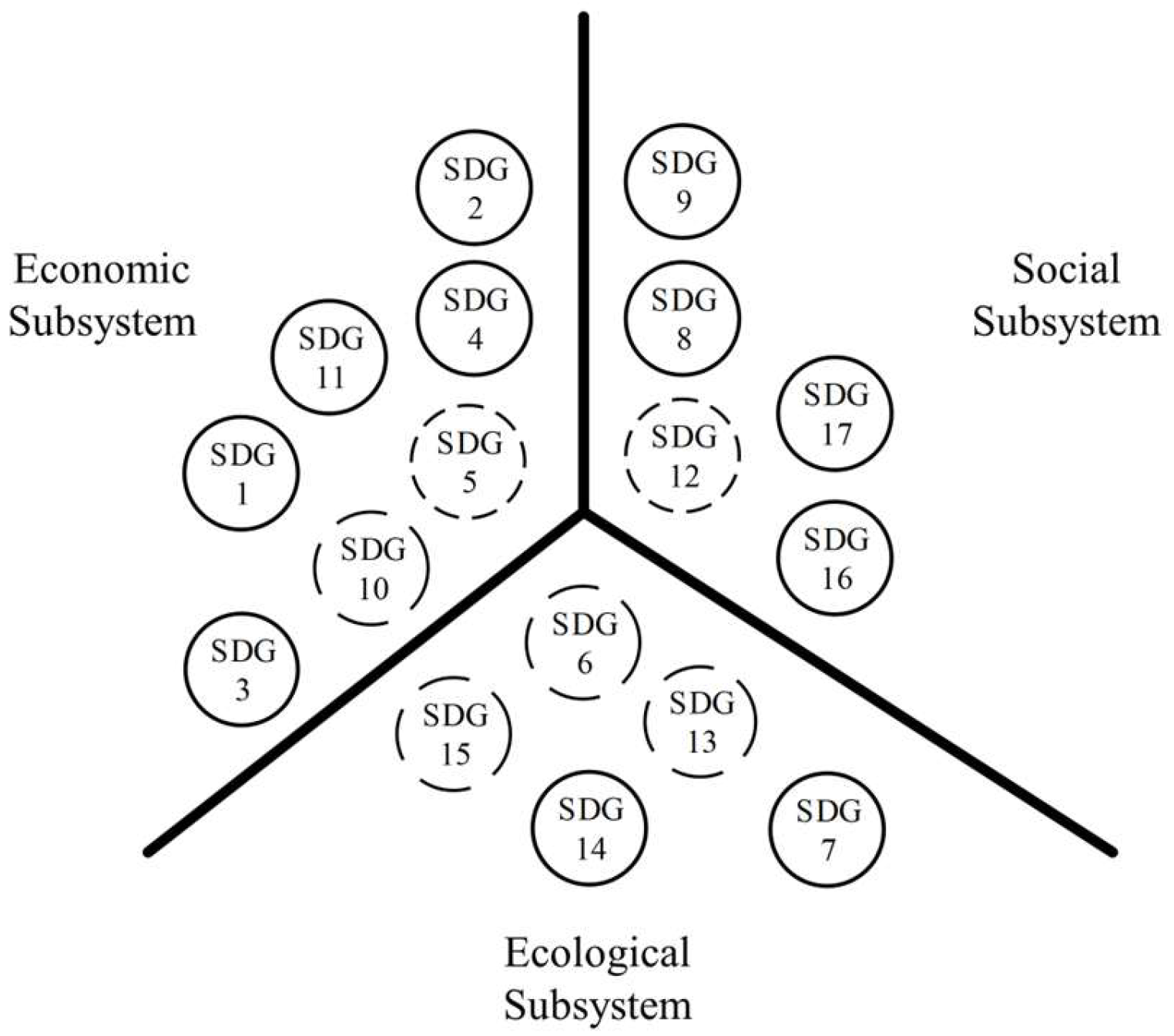
The social subsystem includes SDG1-SDG5, SDG10, SDG11, SDG16, and SDG17; the economic subsystem includes SDG8, SDG9, and SDG12; and the ecological subsystem includes SDG6, SDG7, and SDG13-SDG15. The purpose of this restructuring is not merely classificatory. It reflects the analytical premise that sustainable development in western China is produced through the interaction of three higher-order systems rather than through isolated target-by-target improvements. Social indicators capture livelihoods, health, education, inclusion, and institutional support. Economic indicators capture growth quality, industrial structure, innovation, and resource-use efficiency. Ecological indicators capture water security, energy structure, climate pressure, and ecosystem condition. Table 1 reports the complete indicator system encompassing a total of 106 specific indicators.
The dataset is compiled mainly from successive editions of the China Statistical Yearbook, China Population and Employment Statistical Yearbook, and China Health Statistics Yearbook, supplemented by derived indicators constructed from underlying statistical series. Because a small number of indicators contain missing observations in some years or provinces, linear interpolation is applied to maintain temporal continuity and inter-provincial comparability. Missing values occur only sporadically and are confined to isolated intermediate years within the 2000–2018 observation window. Where a value is missing for a given province-year, it is estimated as the arithmetic mean of the immediately adjacent observed values from the preceding and succeeding years. No extrapolation is performed beyond the observed range. This treatment affects less than 2% of the total data points, and does not alter the overall temporal pattern or the distributional properties of the dataset. Linear interpolation is a standard imputation technique in subnational SDG assessment and panel-data research [13,33], and is widely regarded as appropriate when the proportion of missing observations is low and the temporal intervals are regular.

3.2. Entropy-Weighted TOPSIS Measurement

To evaluate sustainable development levels across provinces and over time, this study employs an entropy-weighted TOPSIS approach. TOPSIS was developed as a multiple-attribute decision-making method that ranks alternatives by their relative proximity to an ideal solution and their distance from an anti-ideal solution. Its advantage lies in preserving the geometric logic of multi-criteria evaluation while remaining suitable for large indicator systems. The entropy-weighting procedure complements TOPSIS by deriving indicator weights from the information contained in the data rather than from subjective assignment. Taken together, entropy-weighted TOPSIS is well suited to the present study because it can accommodate a large, multidimensional indicator set while reducing the arbitrariness of ex ante weighting. The direction and entropy weight of each indicator are reported in Appendix A (Table A1).
The specific process is as follows:
First, calculate the standardized matrix: x i j is the original data; m a x j x i j and m i n j x i j are the maximum and minimum values of the j indicator in the original data; h i j is the standardized matrix; i = 1,2 , , m ; j = 1,2 , , n .
For positive indicators x i j :
h i j = x i j m i n j x i j m a x j x i j m i n j x i j
For negative indicators x i j :
h i j = m a x j x i j x i j m a x j x i j m i n j x i j
Second, calculate the entropy value: e j is the entropy value of the j indicator; i = 1,2 , , m ; j = 1,2 , , n .
e j = 1 l n m i = 1 m h i j ln h i j
Third, calculate the weights: b j is the difference coefficient of the j indicator; w j is the weight of the j indicator obtained by the entropy method; j = 1,2 , , n .
b j = 1 e j
w j = b j j = 1 n b j
Furthermore, after obtaining the weights, the Technique for Order Preference by Similarity to an Ideal Solution (TOPSIS) is used to calculate the sustainable development level of each province in western China. The advantages of this method include obvious geometric significance, flexible calculation, and small information distortion. The detailed calculation process is as follows:
First, calculate the weighted standardized matrix: u i j is the weighted standardized matrix; i = 1,2 , , m ; j = 1,2 , , n .
u i j = h i j × w j
Second, calculate the positive and negative ideal solutions: U + and U are the positive and negative ideal solutions; for positive indicators u i j , u j + = max u i j , i = 1,2 , , m , u j = min u i j , i = 1,2 , , m ; for negative indicators u i j , u j + = min u i j , i = 1,2 , , m , u j = max u i j , i = 1,2 , , m .
U + = u 1 + , u 2 + , , u j +
U = u 1 , u 2 , , u j
Third, calculate the distances from each scheme to the positive and negative ideal solutions: d i + and d i are the distances from the i -th sample to the positive and negative ideal solutions.
d i + = j = 1 n u i j u j + 2 , i = 1,2 , , m
d i = j = 1 n u i j u j 2 ,   i = 1,2 , , m
Fourth, calculate the relative closeness: the larger p i indicates higher sustainable development level in that region.
p i = d i d i + d i + , i = 1,2 , , m
Using this procedure, the study derives the overall sustainability index for western China as well as separate indices for the social, economic, and ecological subsystems. Higher values of the composite index and all sub-indices indicate better sustainability performance.

3.3. Coupling and Coordination Analysis

Composite scores alone do not reveal whether the three subsystems evolve in a mutually supportive way. A region may improve on average while still exhibiting strong internal asymmetry, for example, rapid economic and social gains accompanied by relatively slow ecological improvement. To capture this relational dimension, the study introduces coupling and coupling coordination analysis [5].
The coupling degree is used to measure the intensity of interdependence among the social, economic, and ecological subsystems. The coupling degree is calculated as:
C = f A x f B x f C x f A x + f B x + f C x 3 3 3
where C is the coupling degree, f A ( x ) , f B ( x ) , f C ( x ) denote the sustainability levels of the social, economic, and ecological subsystems, respectively.
This measure captures the extent to which the three subsystems are linked, but a high coupling value does not necessarily imply high-quality coordination. Systems can be tightly coupled while remaining jointly low-level or structurally unbalanced. For this reason, the analysis further introduces a composite development term and a coupling coordination coefficient.
The composite index is defined as
T = θ f A ( x ) + μ f B ( x ) + φ f C ( x )
Coupling coordination degree, which further reflects the degree of coordination and consistency among the three systems, is expressed as:
D = T × C
where T is the comprehensive value of the social, economic, and ecological systems, and θ , μ and φ are parameters to be determined. Referring to relevant research, the parameters are set as θ = μ = φ = 0.33 . D is the coupling coordination degree. It captures not only the intensity of interdependence but also whether that interdependence is supported by sufficiently high subsystem development levels. The coupling degree and coupling coordination degree are divided into different grades, shown in Table 2.

3.4. Regional Disparity and Spatial Autocorrelation Analysis

Because western China is characterized by substantial intraregional heterogeneity, the analysis also considers regional disparity explicitly. Beyond comparing provincial mean values, the study adopts a sigma-convergence approach based on the coefficient of variation to examine whether dispersion in sustainability levels narrows or widens over time. Sigma-convergence is expressed as
σ = i N M i M ¯ i N M ¯ i
where M i denotes the sustainability index of province i , M ¯ i is the mean sustainability level, and N is the number of provinces. A declining σ suggests convergence, while an increasing value suggests divergence. In the present context, this procedure is especially useful because it distinguishes improvements in average performance from changes in provincial dispersion. A region may improve overall while still becoming more internally unequal across provinces or subsystems.
Spatial autocorrelation analysis is employed to examine whether the spatial distribution of sustainability indices across the 12 western provinces exhibits systematic geographical patterns. The Global Moran’s I statistic measures overall spatial clustering and is defined as [34]:
M o r a n s   I = n i = 1 n j = 1 n W i j × i = 1 n j = 1 n W i j ( Y i Y ¯ ) ( Y j Y ¯ ) i = 1 n ( Y i Y ¯ ) 2
where n is the number of provinces; Y i and Y j are the sustainability index values of provinces i and j; Y ¯ is the mean; and W i j is the element of the row-standardized spatial weights matrix. A first-order queen contiguity matrix is adopted, with W i j = 1 if provinces share a boundary and W i j = 0 otherwise. The Global Moran’s I ranges from −1 to +1: positive values indicate spatial clustering of similar values, negative values indicate spatial dispersion of dissimilar values, and values near zero suggest randomness.
To identify specific locations of spatial clusters and outliers that the global statistic may obscure, Local Indicators of Spatial Association proposed by Anselin are employed [35]. The local Moran’s I for province i is:
I i = ( Y i Y ¯ ) m 0 j = 1 n W i j ( Y j Y ¯ ) ,   w h e r e   m 0 = i = 1 n ( Y i Y ¯ ) 2 n
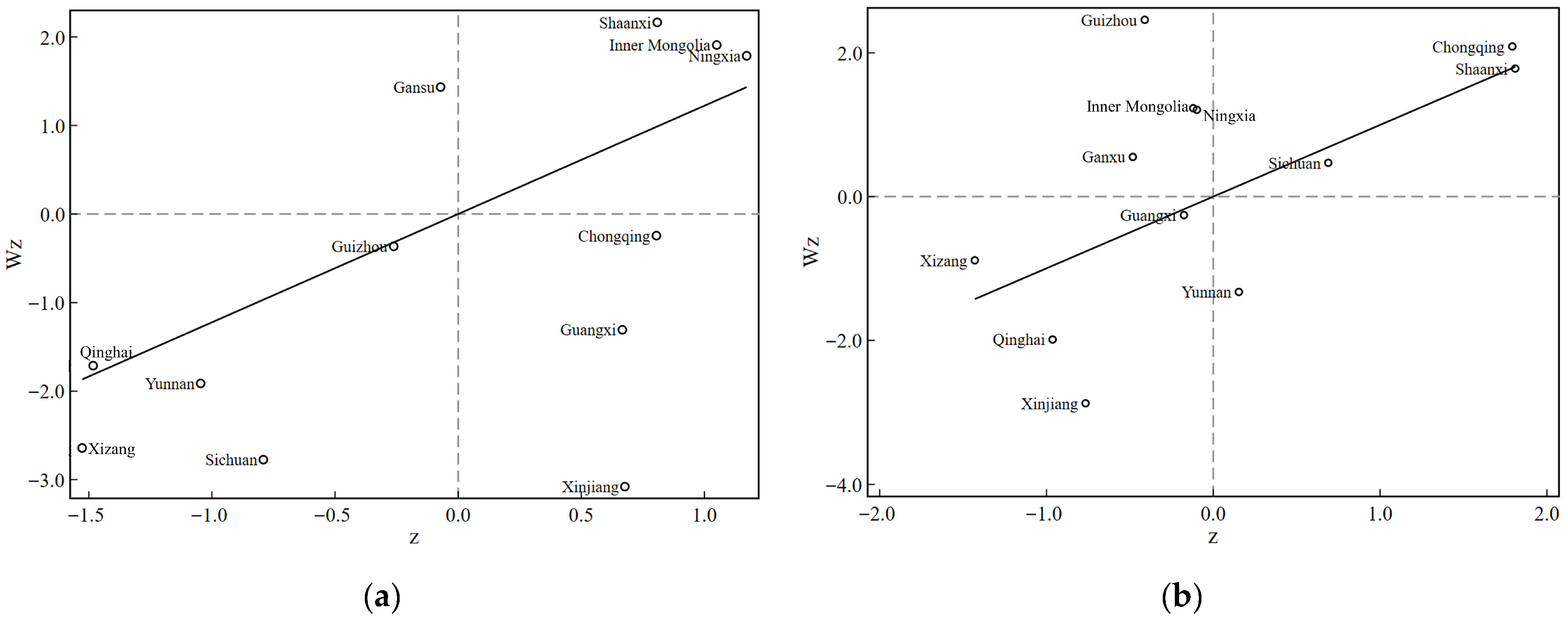
A positive and significant I i identifies a spatial cluster (High–High or Low–Low); a negative and significant I i identifies a spatial outlier (High–Low or Low–High). Results are visualized using Moran scatter plots, where the horizontal axis represents the standardized value of each province, the vertical axis its spatial lag, and the slope of the fitted line corresponds to the Global Moran’s I. The four quadrants of the scatter plot map directly onto the four types of local spatial association.

3.5. Forecasting Methods

To assess likely trajectories beyond the observation period, the study further combines several forecasting approaches. First, grey forecasting is included because it is well suited to systems with limited information and relatively short samples; grey system theory was originally introduced by Deng in 1982 and has been widely used in settings characterized by incomplete information [36]. In this study, the standard GM(1,1) model is applied, which generates predictions from a first-order differential equation fitted to the accumulated generating series. Second, exponential smoothing is used because it updates forecasts through recursively weighted historical information and is particularly useful when recent observations should carry more influence than distant ones [37]. Given the non-seasonal nature of the annual sustainability indices, the Holt linear trend model, which captures both level and trend components, is adopted, with smoothing parameters optimized by minimizing the sum of squared one-step-ahead prediction errors. Third, ARIMA is included because the Box–Jenkins framework remains one of the standard approaches for modeling temporal dependence in non-stationary time series [38]. Model identification follows an automated search procedure over a grid of p, d, q values (0–2 for each parameter), guided by the corrected Akaike Information Criterion (AICc) to balance goodness-of-fit with parsimony. Stationarity is checked using the Augmented Dickey–Fuller test, and differencing order d is selected accordingly. These methods represent different forecasting logics rather than interchangeable tools, which is precisely why combining them can improve robustness.
To evaluate model performance and quantify uncertainty, a rolling-origin validation strategy is employed. For each sustainability index, the observation period is split into a training window (2000–2014) and a test window (2015–2018). Each individual model is fitted on the training data, and the root mean square error (RMSE) over the test window is calculated. Prediction intervals at the 90% and 95% confidence levels are constructed for each model using their respective analytical formulas. For the integrated forecast, the final prediction interval is obtained through a weighted combination of individual model intervals, using the same inverse-RMSE weights applied to the point forecasts. This procedure ensures that the uncertainty bands reflect the ensemble structure rather than relying on a single model’s error distribution.
To reduce dependence on any one single model, the study adopts an integrated forecasting strategy. The linear ensemble is expressed as
Y ^ = i = 1 n θ i y ^ i
where Y ^ is the final integrated prediction, θ i is the weight assigned to model i , and y ^ i is the corresponding model-specific forecast. The weights are assigned according to the inverse of the root mean square error (RMSE):
θ i = 1 / R M S E i i = 1 n 1 / R M S E i
This procedure gives greater weight to models with smaller in-sample prediction error and therefore produces an integrated forecast that is more stable than any single-model projection. The weights are computed separately for each sustainability index (social, economic, and ecological), reflecting the fact that different models may perform differently across target variables [39]. In this study, the integrated forecasts are used not only to project the future values of the social, economic, and ecological sustainability indices for 2019–2030, but also to derive projected coupling coordination scores for the major subsystem relationships.
The methodological design adopted here therefore does more than produce a composite sustainability score. It enables the study to evaluate how western China has developed, whether that development has been internally coordinated, how regional disparities have evolved, and whether current structural imbalances are likely to persist toward 2030. This logic provides the empirical basis for the next chapter, which examines the temporal evolution, coordination dynamics, regional differentiation, and projected trajectories of sustainable development in western China.

4. Evaluation and Forecasting of Sustainable Development in Western China

4.1. Dynamic Evolution of Sustainable Development

4.1.1. Overall SDG Performance

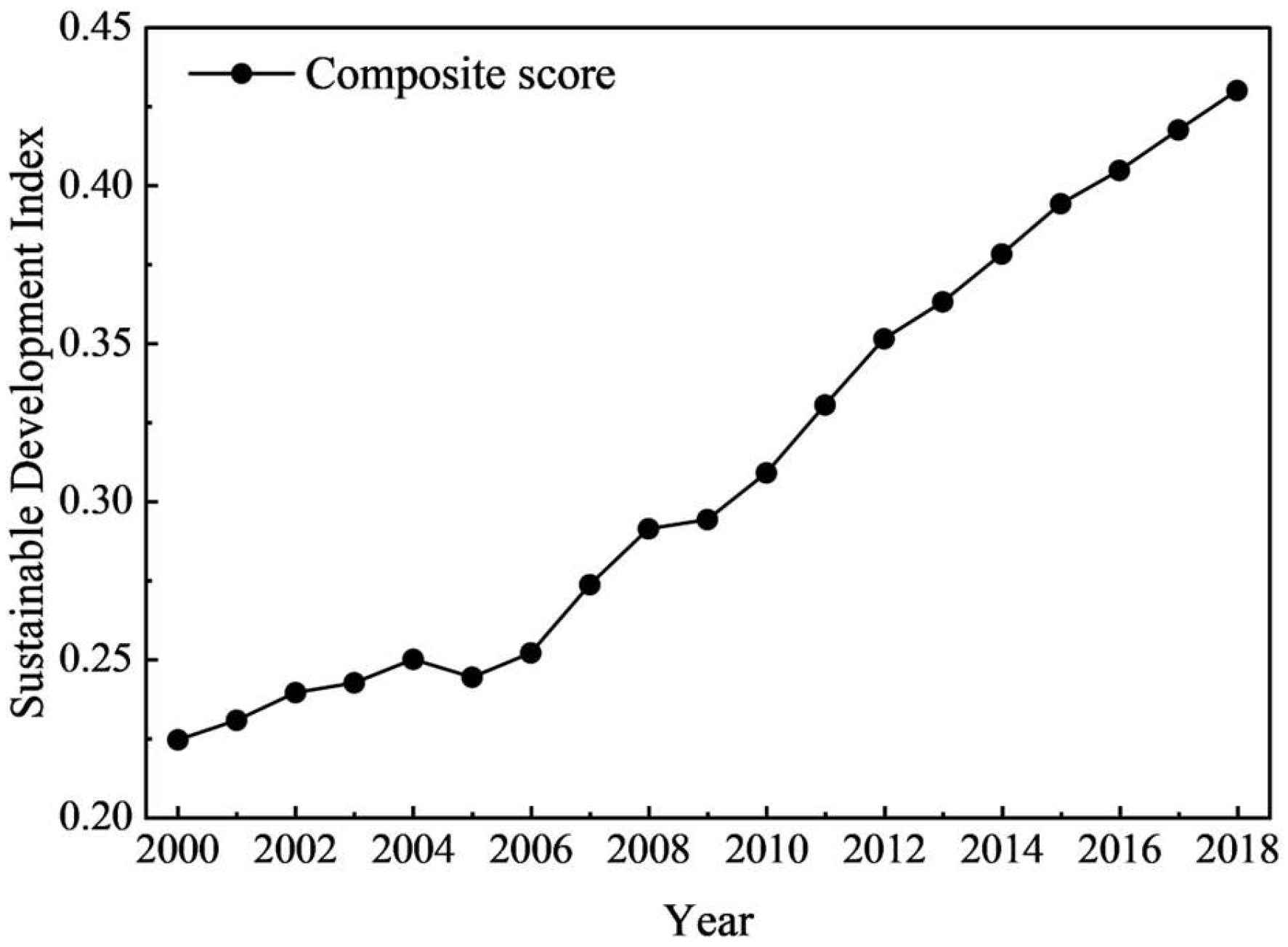
Based on the evaluation system established above, the entropy-weighted TOPSIS model is used to calculate the composite sustainable development index for western China. As shown in Figure 2, the overall index increased from 0.225 in 2000 to 0.430 in 2018, representing a growth rate of 91.556%. This indicates that sustainable development in western China improved substantially during the study period. More importantly, the rise in the aggregate index suggests that western China’s development trajectory cannot be described solely in terms of economic expansion; rather, it reflects a broader improvement in the region’s composite development condition.
The temporal pattern, however, was not linear. Between 2000 and 2005, the composite index increased by only 8.823%, indicating relatively limited improvement in the early stage of the Western Development Strategy. By contrast, the index rose by 70.639% during 2006–2018, suggesting a marked acceleration after the mid-2000s. This stage difference implies that sustainable development in western China followed a cumulative rather than instantaneous process. In the earlier phase, development efforts were more likely absorbed by basic capacity building, including infrastructure provision, institutional adjustment, and the gradual expansion of development opportunities. The later phase appears to reflect the release of these accumulated conditions into broader regional improvements in livelihoods, economic organization, and ecological governance.
This pattern is analytically important because it indicates that western China’s sustainability transition did not emerge from a single policy shock or from one subsystem alone. Instead, it developed through a staged reconfiguration of regional conditions. At the same time, an improving composite score does not necessarily imply that progress was internally balanced. Aggregate improvement may coexist with widening differences among subsystems or persistent structural bottlenecks. For that reason, the overall result needs to be decomposed into the social, economic, and ecological dimensions.

4.1.2. Evolution of the Three Subsystems

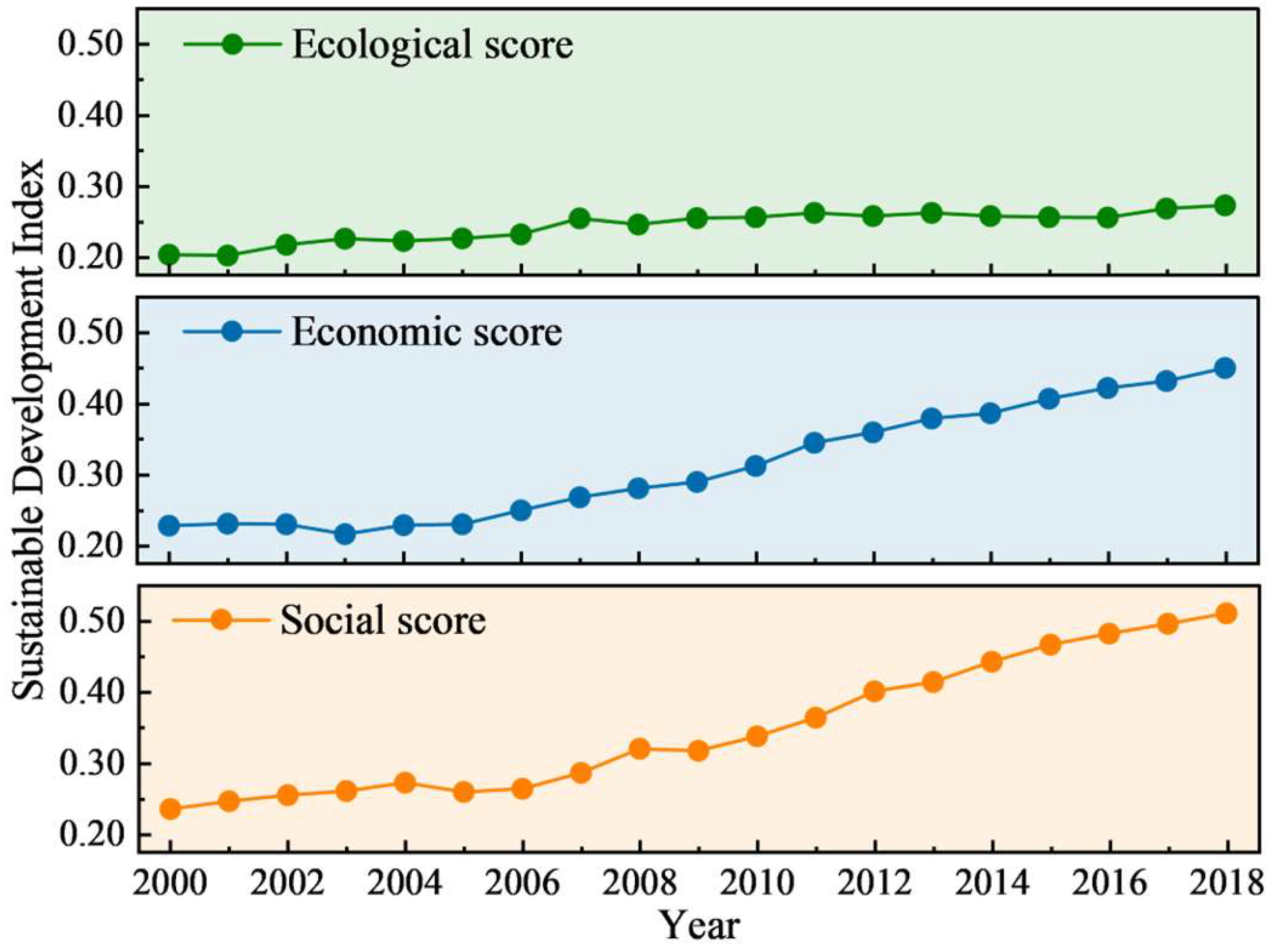
Figure 3 reports the trajectories of the three subsystem indices. All three improved between 2000 and 2018, but the magnitude of improvement differed markedly across subsystems.
The social sustainability index rose from 0.235 in 2000 to 0.511 in 2018, an increase of 117.461%, making it the fastest-improving dimension of the three. This result suggests that the strongest contribution to the overall sustainability improvement in western China came from the social subsystem. A plausible interpretation is that the Western Development Strategy produced not only physical investment effects but also cumulative gains in public services, poverty reduction, social protection, and social stability. In other words, western China’s sustainability gains were driven to a large extent by the strengthening of the social foundations of development rather than by narrowly defined output growth alone.
The economic sustainability index increased from 0.228 to 0.450 over the same period, with a growth rate of 97.275%. This indicates substantial improvement in economic sustainability as well, although less pronounced than in the social dimension. The result suggests that western China’s economy became more supportive of long-term development over time, likely through improvements in infrastructure connectivity, industrial support, and development capacity. At the same time, the slower increase relative to the social dimension implies that economic gains, while significant, did not dominate the sustainability transition to the extent often assumed in conventional regional development narratives.
By contrast, the ecological sustainability index rose only from 0.204 to 0.274, an increase of 34.057%. Although the ecological subsystem improved in absolute terms, its pace of change lagged far behind that of the social and economic subsystems. This result indicates that ecological improvement in western China has been much more constrained and much less synchronized with broader development gains. This lag should not be interpreted simply as a lack of ecological policy effort. Rather, it is more plausibly associated with the structural pressures western China faces: ecological fragility, water stress, resource dependence, and the persistence of energy-intensive development patterns in some areas. In this sense, the ecological subsystem emerges not merely as a weaker dimension, but as the principal structural bottleneck limiting the transition from aggregate improvement to more balanced sustainability.
Taken together, the three subsystem trajectories reveal a clear hierarchy of change: social sustainability improved the most, economic sustainability improved substantially but less sharply, and ecological sustainability improved only modestly. This means that the aggregate sustainability gain observed in western China was largely driven by the social and economic subsystems, while ecological change remained comparatively slow. The central issue is therefore not whether western China improved, but whether its improvement was structurally balanced. The subsystem evidence suggests that it was not.

4.1.3. Goal-Specific Performance and Emerging Bottlenecks

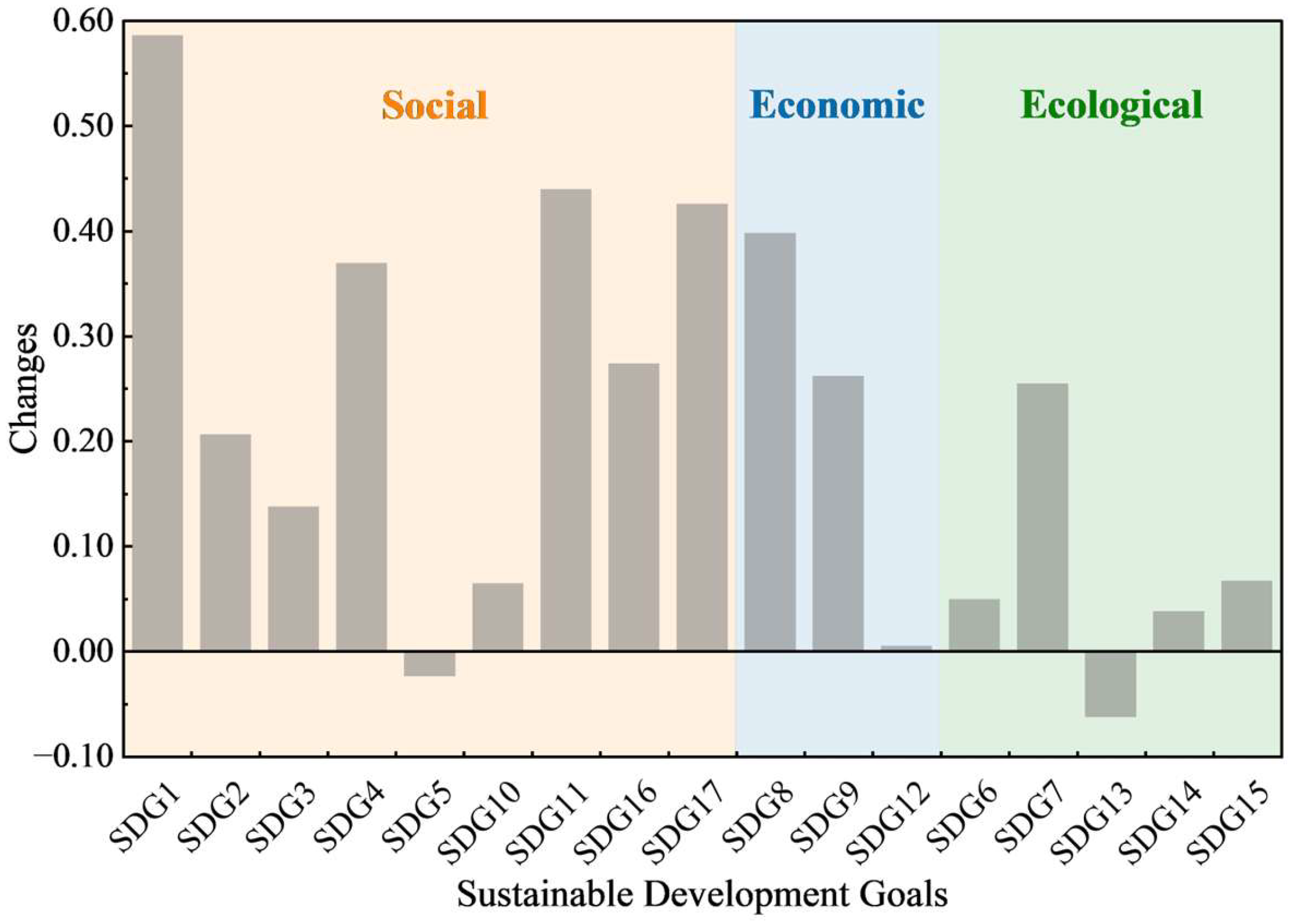
To identify which SDGs now constitute the main constraints on future progress, the study further examines changes in the 17 individual goals over the sample period, as illustrated in Figure 4. The results show that progress across goals was highly uneven.
Within the social subsystem, most goals improved substantially, especially SDG1 (No Poverty), SDG11 (Sustainable Cities and Communities), and SDG17 (Partnerships for the Goals). This pattern indicates that western China made relatively strong progress in poverty reduction, infrastructure-related social improvement, and broader forms of connectivity and institutional support. At the same time, SDG10 (Reduced Inequalities) improved only modestly, while SDG5 (Gender Equality) even experienced a decline. This decline may reflect the widening gender disparities in employment and income that have accompanied China’s transition from a planned to a market-oriented economy, a pattern that is particularly pronounced in less economically diversified regions such as western China. This suggests that social sustainability in western China, although substantially strengthened in aggregate terms, still contains persistent internal imbalances related to distribution, inclusion, and gendered access to development opportunities.
Within the economic subsystem, SDG12 (Responsible Consumption and Production) showed limited progress. This finding implies that western China’s economic gains were not accompanied by equally strong progress in transforming production and consumption patterns toward greener and less resource-intensive forms. Put differently, the economic subsystem improved, but not all dimensions of economic sustainability improved at the same rate. Growth-supporting structures strengthened more quickly than low-carbon and resource-efficient development patterns.
Within the ecological subsystem, SDG6 (Clean Water and Sanitation) and SDG15 (Life on Land) recorded only weak improvement, while SDG13 (Climate Action) declined. These outcomes point directly to the ecological constraints embedded in western China’s development trajectory. Water-related stress, land and ecosystem vulnerability, and climate-related pressures remain central challenges, and they are not easily offset by broader social and economic gains. The fact that SDG13 declined is particularly important because it suggests that climate-related pressure remains substantial even in a context where aggregate sustainability scores are rising.
Overall, the goal-level analysis indicates that western China’s future sustainability constraints are concentrated in SDG5, SDG6, SDG10, SDG12, SDG13, and SDG15. These goals should not be interpreted as isolated weak points. Rather, they represent structurally important bottlenecks located at the intersection of equity, resource use, ecological pressure, and system imbalance. Their relative lag explains why aggregate improvement has not translated into more even and fully coordinated sustainability progress.

4.2. Coupling and Coordination of Sustainable Development

4.2.1. Coupling Analysis

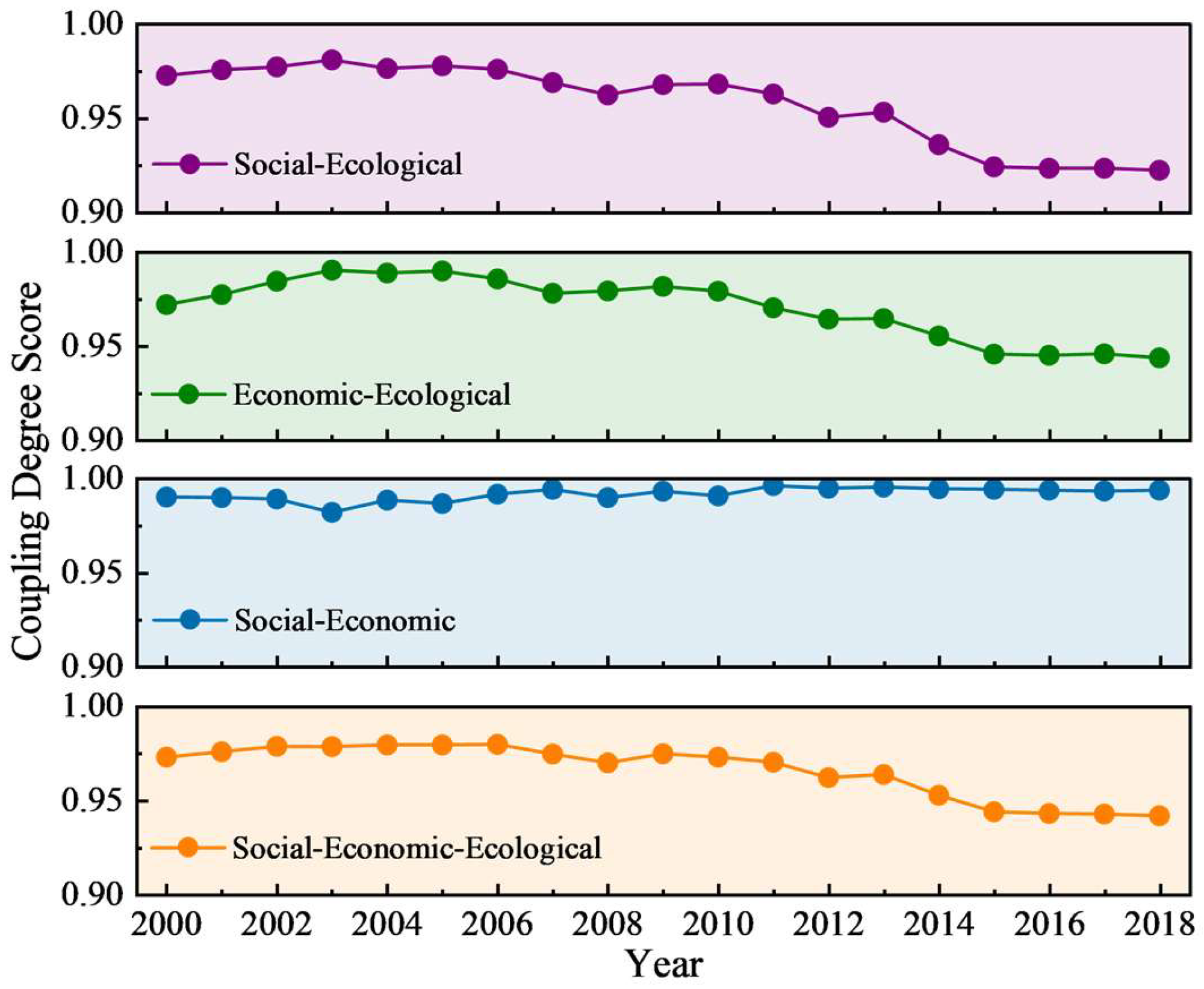
To move beyond subsystem scores and examine whether social, economic, and ecological changes evolved in a mutually reinforcing way, the study calculates the coupling degree and coupling coordination degree among the three subsystems. As shown in Figure 5, the coupling degree remained at a relatively high level throughout 2000–2018. This indicates that the three subsystems were strongly interdependent rather than operating independently. In particular, the coupling degree between the social and economic subsystems remained above 0.980 during the entire period, suggesting a high degree of co-movement between these two dimensions.
However, a high coupling degree should not be confused with high-quality coordination. In recent years, the coupling degree of the social–economic–ecological system and of the economic–ecological and social–ecological subsystem pairs showed a fluctuating downward tendency. This pattern indicates that the strength of interdependence remained high, but the relative balance among the subsystems weakened. The most plausible explanation lies in the unequal rates of subsystem improvement documented above: all three subsystems improved, but ecological sustainability improved much more slowly than social and economic sustainability. As a result, the system became more interconnected in aggregate while also becoming more structurally uneven.
This distinction implies that sustainable development in western China cannot be adequately described through subsystem scores alone, nor can it be inferred from coupling intensity alone. A system may remain tightly linked while the relative positions of its components drift further apart. The ecological subsystem appears to be the key source of this drift.

4.2.2. Coupling Coordination Analysis

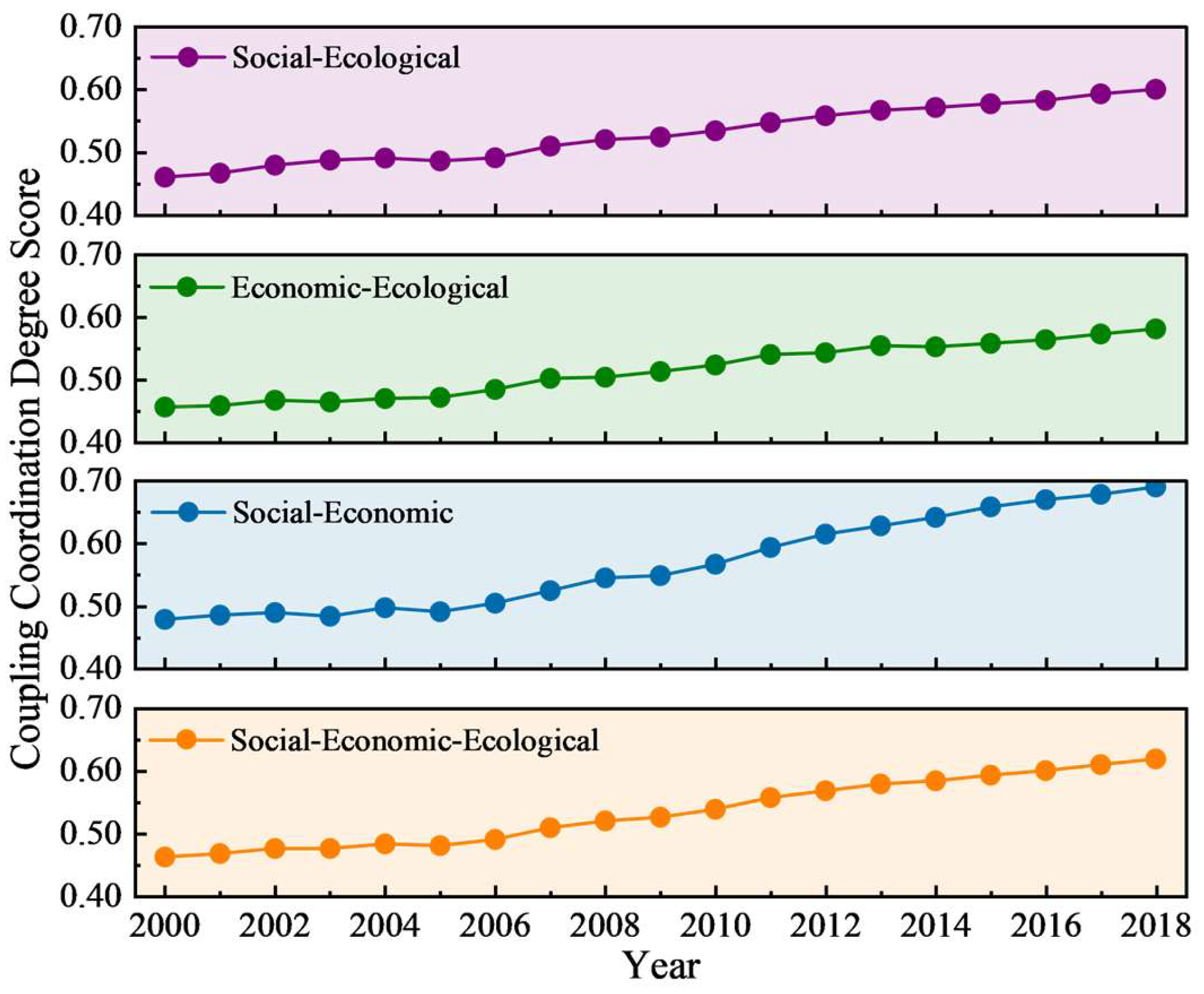
Figure 6 shows that the coupling coordination degree of the major subsystem relationships increased steadily over the study period, with a more visible rise after 2005. According to the classification standards established earlier, western China as a whole moved through a sequence from “near disorder” to “barely coordinated” and then to “primary coordination.” Among the subsystem pairs, the social–economic relationship performed best and approached the stage of “intermediate coordination.”
This pattern suggests that western China did not merely improve in aggregate terms; the coordination among its main subsystems also became stronger over time. Yet the substantive meaning of this finding requires careful interpretation. The transition from near disorder to primary coordination does not imply that the system has become highly balanced. Rather, it indicates that the region moved away from a strongly fragmented state, while still remaining short of advanced coordination. In that sense, the system improved, but did not converge toward a fully synchronized development structure.
An especially revealing result is that while the coupling degree of the economic–ecological and social–ecological relationships declined, their coupling coordination degree continued to rise. This combination suggests that western China’s subsystems were all improving, but not at the same speed. The ecological subsystem remained increasingly outpaced by the social and economic subsystems, even though all three were moving upward in absolute terms. This is why coordination can improve and yet still remain structurally insufficient. The pattern is consistent with the broader argument of this paper: the main challenge in western China is no longer whether progress occurs, but whether progress occurs in a sufficiently balanced and ecologically compatible way.
The lag of the economic–ecological and social–ecological relationships is particularly significant. It suggests that the ecological subsystem has not yet been fully internalized into the broader development logic of the region. Economic growth and social improvement have continued, but ecological carrying capacity, environmental pressure, and resource-use constraints have limited the degree to which these gains could be translated into high-level coordination. This is why ecology emerges not simply as one subsystem among others, but as the central limiting factor in the quality of western China’s overall sustainability transition.

4.2.3. Provincial Variation in Coupling Coordination

Because the economic–ecological and social–ecological relationships are the most lagging, the study further examines provincial change in these two dimensions (Table 3). Overall, both indicators increased across provinces during the study period, which means that all provinces made some progress in linking development with ecological conditions. However, improvement was clearly uneven.
The range of the economic–ecological coupling coordination degree widened from 0.155 in 2000 to 0.230 in 2018, while the range of the social–ecological coupling coordination degree increased from 0.133 to 0.227. This means that coordination gains did not occur uniformly across western China. Some provinces improved much more rapidly than others. Guangxi, for instance, achieved relatively strong progress, whereas Xizang and Yunnan remained comparatively weak. In 2018, Xizang and Yunnan were still in the “near disorder” stage for the economic–ecological relationship, while Qinghai, Gansu, Sichuan, Guizhou, and Xinjiang remained in “barely coordinated” status. For the social–ecological relationship, Yunnan remained in “near disorder,” and Xizang, Qinghai, Sichuan, Gansu, and Guizhou remained in the “barely coordinated” category.
These results indicate that subsystem coordination in western China is not only a general structural issue but also a territorially differentiated one. Provincial disparities in coordination are widening even as average coordination improves. This reinforces the argument that sustainable development in western China must be interpreted through regional heterogeneity rather than through a single regional average.

4.3. Regional Disparities in Sustainable Development

4.3.1. Provincial Disparities

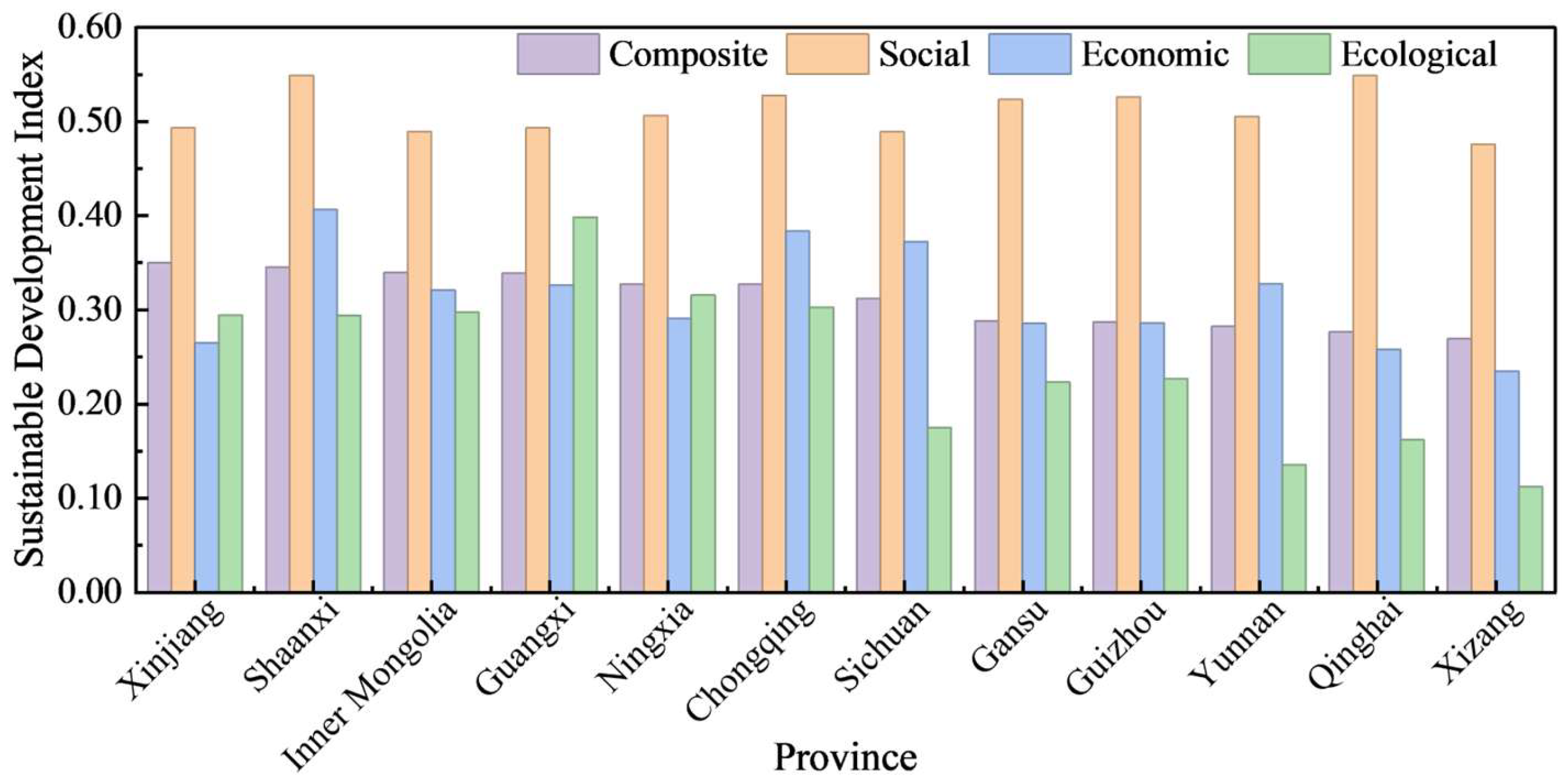
Figure 7 reports the mean sustainability indices of the 12 provinces. At the level of the composite index, provincial values cluster around 0.300, suggesting that overall regional disparity in western China is not extreme. However, the aggregate picture conceals notable variation across subsystems.
The social sustainability index is relatively concentrated across provinces, with mean values generally falling between 0.450 and 0.550. This is consistent with the earlier result that the social subsystem improved most strongly and also did so in a comparatively broad-based manner. The relative concentration of the social index suggests that gains in poverty reduction, public service provision, and social development were more spatially widespread than gains in other dimensions.
The economic sustainability index shows clearer stratification. Shaanxi, Chongqing, and Sichuan occupy the relatively high end, whereas Xizang, Qinghai, and Xinjiang remain at the lower end. This pattern likely reflects differences in development base, infrastructure connectivity, industrial structure, and openness. It suggests that western China’s economic sustainability has become more hierarchical, with certain provinces acting as stronger growth and innovation poles than others.
The ecological sustainability index exhibits the strongest disparity. Its interprovincial range reaches 0.287, much larger than for the social or economic dimensions. This confirms that ecology is not only the weakest subsystem overall but also the most spatially uneven. Provincial differences in ecological sustainability likely reflect differences in environmental carrying capacity, resource dependence, water conditions, land fragility, and ecological governance capability. Thus, the central spatial divide in western China is not one of general development level alone; it is more specifically a divide in ecological conditions and ecological governance capacity.

4.3.2. Sigma-Convergence Analysis

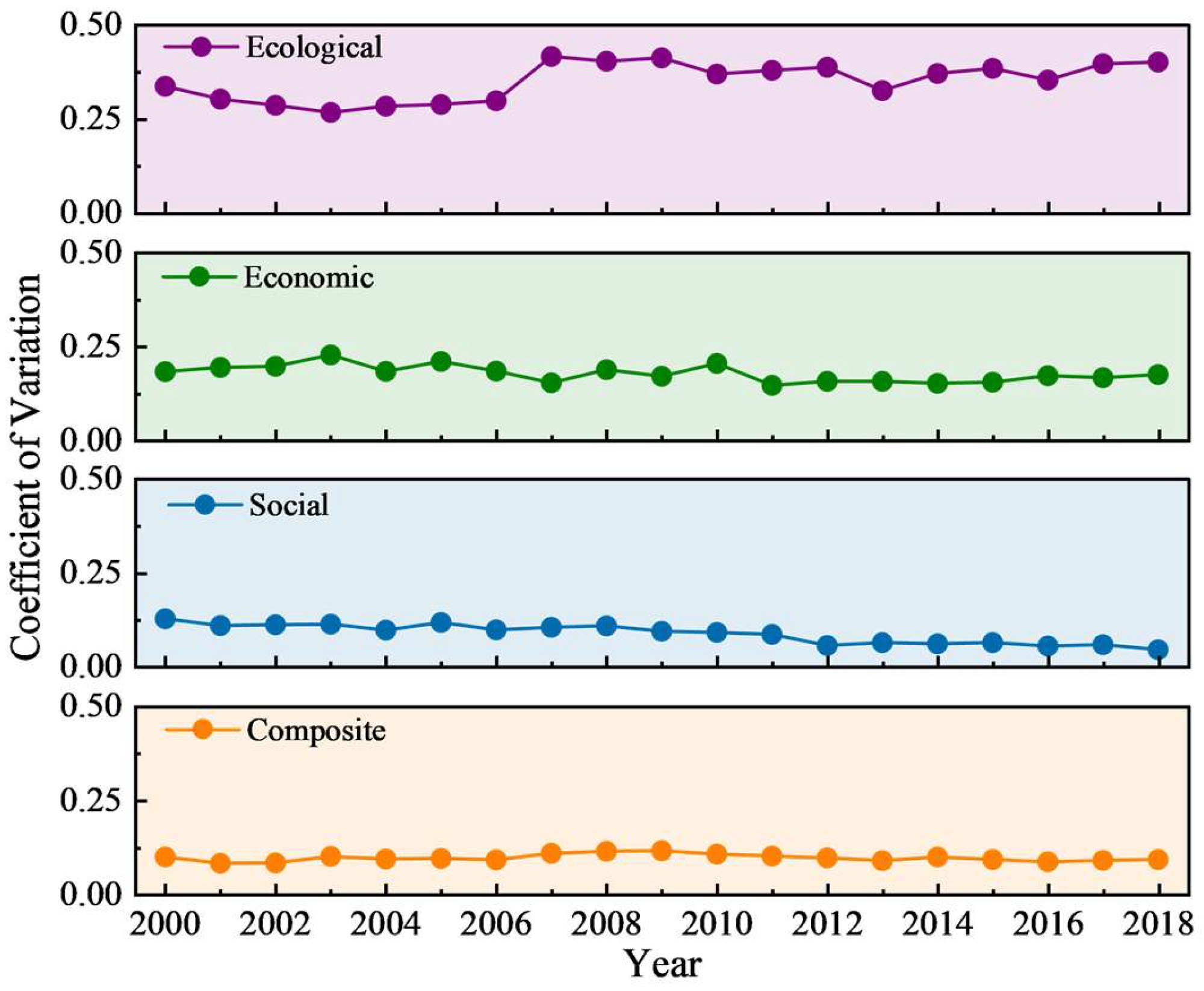
To assess whether provincial disparities narrowed or widened over time, the study applies a sigma-convergence test using the coefficient of variation. Figure 8 shows that the coefficients for the composite, social, and economic sustainability indices display no clear long-run trend toward either convergence or divergence. This suggests that disparities in these dimensions remained relatively stable over time.
The ecological dimension, however, exhibits a much more stage-specific pattern. During 2000–2006, the ecological coefficient of variation remained broadly stable, suggesting that provinces faced relatively similar ecological pressures at this stage. After 2007, interprovincial ecological disparity became more pronounced, likely because some provinces made faster progress in ecological protection and environmental governance than others. Thereafter, the ecological gap remained relatively persistent rather than naturally narrowing.
This result is theoretically and practically important. It indicates that ecological disparity is not likely to shrink automatically as overall development improves. Instead, ecological divergence may persist, or even become more entrenched, when provinces differ in ecological vulnerability, development pressure, and governance capacity. In western China, therefore, the major regional sustainability challenge is not merely uneven development in general, but the persistence of ecologically grounded inequality across provinces.

4.3.3. Spatial Autocorrelation Analysis

To examine whether the spatial distribution of sustainable development across provinces follows systematic geographical patterns, this study employs the Global Moran’s I and local Moran scatter plots for spatial autocorrelation analysis. The spatial weight matrix adopts the first-order queen contiguity criterion, which defines spatial adjacency based on whether two provinces share a common boundary. The choice is justified because western China covers a vast territory with substantial variation in interprovincial geographical distances and economic linkages. Ecological spillovers, such as those operating through shared watersheds, dust storm transmission, and grassland degradation, are most pronounced between directly neighboring provinces. The contiguity matrix captures such localized ecological interdependencies more precisely while avoiding the dilution effect introduced by assigning weights to distant provinces. The analysis is performed separately for the ecological, economic, and social sustainability sub-indices over the period 2000–2018.
Complete results of the global spatial autocorrelation analysis are reported in Appendix A (Table A2). First, the Global Moran’s I of the ecological sustainability index remained significantly positive throughout 2000–2006, indicating that ecologically fragile areas were spatially concentrated during the early stage of the Western Development Strategy, with neighboring provinces facing similar pressures from soil erosion, desertification, and grassland degradation. After 2007, the Moran’s I values dropped sharply to near zero and became statistically insignificant. This transition from significant clustering toward spatial randomness suggests that the earlier contiguous pattern of ecological vulnerability was partially disrupted by subsequent differentiated governance measures. Major ecological programs, including the Grain for Green Program, the fourth phase of the Three-North Shelterbelt Forest Program, and the comprehensive rocky desertification control initiative, were implemented with varying intensity across provinces, such that ecological quality is no longer predominantly structured by geographical proximity.
Second, the Global Moran’s I of the economic sustainability index exhibited significant positive spatial autocorrelation in the majority of years from 2005 onward, persisting through the end of the observation period. This indicates the emergence and consolidation of a spatial club convergence effect in economic sustainability: the growth spillovers of the Chengdu–Chongqing economic circle, the radiating influence of the Guanzhong Plain urban agglomeration, and industrial synergies along energy corridors have together produced a spatial pattern in which provinces with similar economic performance become increasingly contiguous. The coexistence of High–High and Low–Low clusters further confirms that regional differentiation in the economic dimension possesses a certain geographical stickiness.
Third, the Global Moran’s I of the social sustainability index remained insignificant in nearly all years examined. The spatial distribution of poverty reduction progress, public service provision, and social security levels across provinces thus approximates a random pattern rather than one systematically driven by geographical proximity. This finding carries an important policy implication: the spatial distribution of social welfare is not subject to pronounced geographical lock-in effects. The improvement of social outcomes depends more on province-specific factors, including the scale of fiscal transfers, investment in public services, and local governance capacity, than on spatial spillovers from neighboring provinces.
Taken together, the global autocorrelation results reveal three distinct spatial trajectories: the early clustering of the ecological subsystem has dissolved, yet its current low-level dispersed state implies that ecological pressures have not been eliminated but rather redistributed, with each province now bearing its own burden; the economic subsystem exhibits spatial clustering, which may exacerbate regional polarization; and the spatial randomization of the social subsystem suggests, to some extent, the absence of effective interregional policy diffusion mechanisms for coordinated social development in western China.
To further identify localized spatial clustering patterns, the study employs Moran scatter plots. Guided by the global autocorrelation findings, the scatter plots are presented for the ecological index in 2000 and the economic index in 2018, the former corresponding to the year when ecological spatial clustering was most pronounced, and the latter representing the current mature stage of economic club formation. Since the Global Moran’s I of the social index was non-significant in virtually all years, the social scatter plot exhibits no meaningful clustering pattern and is therefore omitted from presentation.
Specifically, Figure 9a displays the Moran scatter plot for the ecological sustainability index in 2000. The plot exhibits a clear positive slope, consistent with the significantly positive Global Moran’s I for that year (I = 0.271, p < 0.05). The majority of provinces fall into the first quadrant (High–High clusters) and the third quadrant (Low–Low clusters), confirming that ecologically fragile areas were distinctly contiguous during the early stage of the Western Development Strategy. Shaanxi, Inner Mongolia, and Ningxia are located in the first quadrant, indicating that their relative ecological advantages were shared by neighboring provinces with similar environmental endowments. Conversely, Xizang, Sichuan, Qinghai, Yunnan, and Guizhou are concentrated in the third quadrant, reflecting the common challenge of weak ecological foundations and the high spatial concentration of such vulnerability across these provinces.
Figure 9b presents the Moran scatter plot for the economic sustainability index in 2018. The plot displays a significant positive slope, highly consistent with the Global Moran’s I for that year (I = 0.278, p < 0.05). After nearly two decades of development, the spatial configuration of the economic dimension has evolved into a firmly established spatial club pattern. Chongqing, Shaanxi, and Sichuan are clustered in the first quadrant (High–High), forming an economic highland centered on the Chengdu–Chongqing and Guanzhong Plain regions, whose growth momentum has effectively spilled over into neighboring provinces. In contrast, Xinjiang, Qinghai, Guangxi, and Xizang are concentrated in the third quadrant (Low–Low), indicating that peripheral western provinces have remained persistently disadvantaged in terms of economic sustainability, and that this disadvantage has been reinforced by the similarly weak performance of surrounding provinces. Provinces such as Guizhou fall into the second quadrant: although surrounded by neighbors with relatively better economic performance, their own economic sustainability remains low, rendering them spatial “depressions” within the broader club-convergence landscape.
Synthesizing the local spatial autocorrelation results, the early-stage spatial clustering of the ecological dimension and the current clustering of the economic dimension are both clearly reflected in the Moran scatter plots, whereas the spatial randomization of the social dimension yields no meaningful clustering features. This contrast further corroborates the core argument of this study: the three subsystems of sustainable development in western China exhibit sharply divergent spatial trajectories, and the structural imbalance is manifested not only in developmental gaps across subsystems but is also deeply embedded in their respective spatial organizing logics.

4.4. Forecasting Sustainable Development

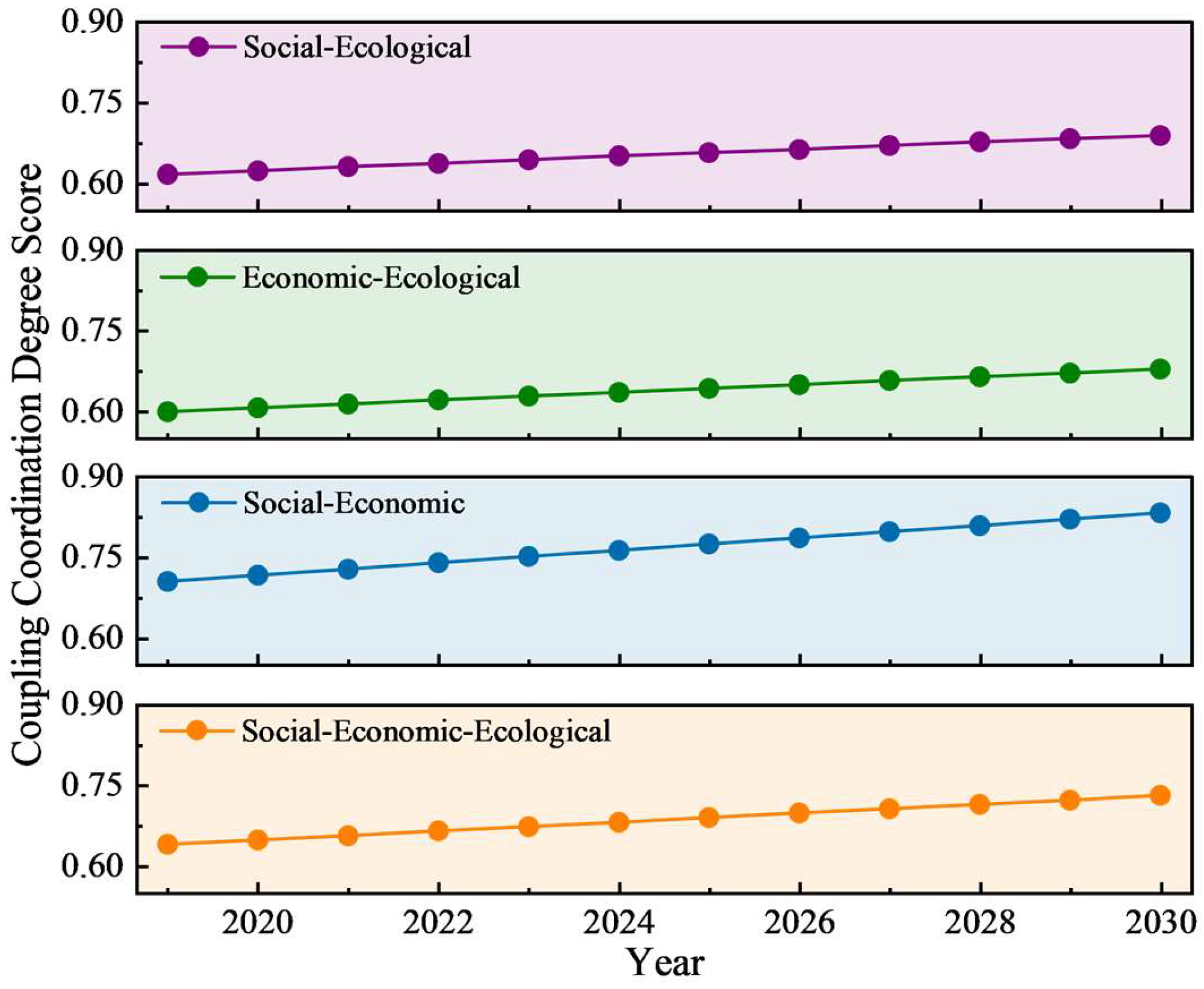
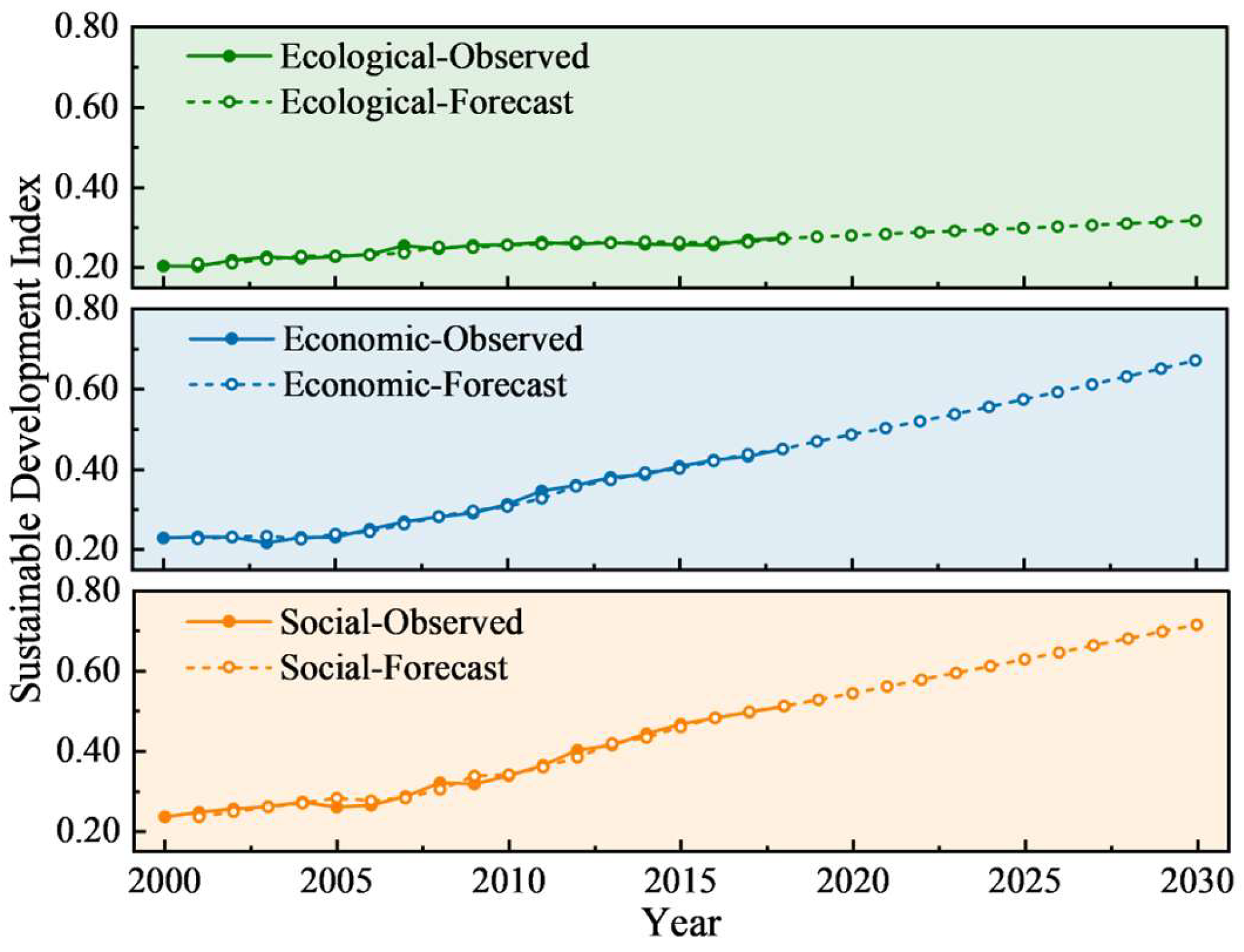
To explore the future trajectory of sustainable development in western China, the study applies grey forecasting, exponential smoothing, ARIMA, and an integrated forecasting approach to project the social, economic, and ecological sustainability indices for 2019–2030. The integrated approach performs best in terms of RMSE over the 2015–2018 test window (validation details are reported in Section 3.5) and is therefore taken as the main basis for interpretation. The composition of the integrated forecast varies across the three subsystems, reflecting the fact that different models perform differently depending on the target series. For the social sustainability index, the inverse-RMSE procedure assigns weights of 0.256 (grey forecasting), 0.360 (exponential smoothing), and 0.384 (ARIMA). For the economic sustainability index, the corresponding weights are 0.288, 0.380, and 0.332. For the ecological sustainability index, the weights are 0.313, 0.332, and 0.355. Across all three subsystems, no single model dominates the ensemble, and ARIMA and exponential smoothing consistently receive higher weights than grey forecasting, suggesting that methods which explicitly model temporal dependence or trend dynamics are better suited to capturing the historical patterns of these sustainability indices. Moreover, the integrated forecasts achieved RMSE values of 0.010 (social), 0.007 (economic), and 0.006 (ecological) over the validation period, all of which are lower than those of any individual model, confirming that the ensemble substantially improves predictive accuracy. Figure 10 shows predicted results of the sustainable development index, while Figure 11 shows coupling coordination analysis of the sustainable development index forecast results.
The forecasting results indicate that after 2018, the social and economic sustainability indices continue the upward trend observed in the later years of the sample period. The social index remains above the economic index, and the two trajectories gradually become more synchronized. This suggests that western China is likely to maintain momentum in public welfare improvement, social development, and economic upgrading under the continuation of its existing development trajectory.
The ecological sustainability index also continues to increase, but only weakly. Its absolute level remains substantially below those of the social and economic subsystems, and the gap between ecology and the other two dimensions tends to widen rather than narrow. This is a crucial result because it implies that the central structural imbalance identified in the historical analysis is likely to persist into the future if the overall development trajectory remains unchanged. In other words, western China’s most likely future problem is not stagnation in aggregate sustainability, but the continued lag of ecological sustainability relative to social and economic gains.
Using the forecasted subsystem values, the study also projects future coupling coordination degrees for the main subsystem relationships. The results show that the coordination scores of all major relationships continue to rise steadily through 2030. The social–economic relationship remains the strongest and is projected to reach “good coordination” before 2030. However, the relationships involving the ecological subsystem continue to lag behind. This indicates that subsystem coordination is likely to improve further, but without a fundamental rebalancing of the development structure. Thus, the forecasting exercise reinforces the central conclusion of this chapter: future progress in western China is likely to remain real but uneven, with ecology continuing to function as the key limiting subsystem.

5. Sustainable Development Pathways Based on the 3C Framework

The empirical results indicate that sustainable development in western China has moved beyond a low-level development problem and into a structurally differentiated phase. Aggregate progress is evident, but the central constraint is no longer whether improvement occurs. It is whether improvement is sufficiently balanced across goals, provinces, and subsystems. In particular, the historical results and forecasts show a common pattern: social and economic sustainability continue to improve more rapidly than ecological sustainability, while ecology-related coupling relationships remain the weakest part of the regional system. Under these conditions, a generic call for “comprehensive progress” is analytically inadequate. What is required instead is a governance logic that can prioritize structural bottlenecks, coordinate subsystem relations, and mobilize differentiated capacities across places and actors. This is why the 3C framework is useful here. Fu et al. proposed 3C as a systems approach for advancing the SDGs under conditions where goals cannot all be advanced at the same speed or with the same instruments [15]. In the present study, the framework is used not as a normative slogan but as an analytical way of translating the observed patterns of uneven progress into differentiated development pathways.

5.1. Classification: Identifying Priority Goals and Differentiated Regional Types

The first implication of the empirical results is that western China should not be treated as a homogeneous sustainability space. Classification is therefore not a formal sorting exercise; it is a way of reducing analytical complexity by distinguishing among goals, subsystems, and provinces according to their relative constraint strength. The preceding chapter already showed that the 17 SDGs do not advance uniformly. The main bottlenecks are concentrated in SDG5, SDG6, SDG10, SDG12, SDG13, and SDG15, that is, gender equality, clean water and sanitation, reduced inequalities, responsible consumption and production, climate action, and life on land. These are not marginal goals. They sit precisely at the intersection of distributional inequality, land and water constraints, ecological vulnerability, and low-carbon transition. Their lag is therefore structurally important rather than statistically incidental.
A first classification step is thus goal-based. Rather than allocating policy attention evenly across all 17 goals, western China needs a priority structure that distinguishes between goals that have already recorded relatively strong progress and goals that now act as binding constraints on broader sustainability improvement. The findings of this study imply that the main short-term gains in aggregate sustainability are unlikely to come from simply extending already faster-moving domains. Instead, the more consequential gains are likely to come from reducing the asymmetry between the faster-moving social and economic subsystems and the slower-moving ecological subsystem. This suggests that future sustainability strategies should treat ecology-related and inequality-related goals as leverage points rather than as residual domains.
A second classification step is subsystem-based. The reorganization of the 17 SDGs into social, economic, and ecological subsystems was originally adopted for measurement, but it also has direct policy relevance. Figure 12 is a schematic diagram of the structure of the Sustainable Development Goals. Social goals in western China are not merely welfare outcomes; they are associated with poverty reduction, service provision, and inclusion. Economic goals capture growth quality, industrial structure, and innovation capacity. Ecological goals reflect both environmental conditions and the boundary conditions of long-term development. Because the results show that these three subsystems do not move synchronously, policy intervention should also avoid a flat structure. Western China’s sustainability problem is not that all three systems are equally weak. Rather, it is that ecology remains relatively lagging while social and economic gains continue to accumulate. A subsystem perspective therefore helps distinguish where the central tension lies.
A third classification step is territorial. The provincial results show that western China contains multiple sustainability types rather than a single regional pattern. Based on the 2018 composite sustainability index, the provinces can be grouped into relatively high-, medium-, and low-sustainability categories: Guangxi, Shaanxi, Chongqing, and Inner Mongolia as higher-sustainability provinces; Ningxia, Xinjiang, Sichuan, and Gansu as intermediate cases; and Guizhou, Qinghai, Yunnan, and Xizang as lower-sustainability cases. The meaning of this classification is not to rank provinces normatively, but to indicate that the sources of sustainability constraint are unlikely to be identical across the region. In some provinces, ecological carrying pressure is the main limitation; in others, weaker economic support structures or lower coordination capacity may be more important. This classification is therefore necessary if the region is to move beyond average-based governance.
More broadly, the case for classification is consistent with the systems approach proposed by Fu et al., who argue that SDG progress requires identifying which goals and which territorial units should be prioritized at different stages rather than assuming simultaneous convergence across all goals [15]. Related work also suggests that in periods of global uncertainty and delayed SDG implementation, targeted sequencing becomes increasingly important because not all constraints can be addressed at once and not all goals yield equivalent system-wide effects [40]. For western China, the empirical evidence in this paper strongly supports such a differentiated reading of the sustainability problem.

5.2. Coordination: Correcting Subsystem Imbalance and Aligning Temporal Horizons

If classification identifies where the main bottlenecks lie, coordination addresses how they should be governed as interdependent rather than isolated problems. The results of this study show that the central sustainability challenge in western China is not an absence of progress, but an imbalance in the pace and structure of progress. Social and economic sustainability improved much more rapidly than ecological sustainability, and ecology-related coupling coordination relations remained weaker than the social–economic relationship. This means that the quality of future development will depend less on whether aggregate scores continue to rise and more on whether the region can reduce the mismatch between subsystems.
A first coordination task is therefore subsystem coordination. In practical terms, this means that ecological governance should not be treated as an independent environmental domain added to an otherwise growth-led development model. The empirical findings suggest that ecology lags because development gains continue to rely, at least in part, on resource-intensive and land-constrained trajectories. Under those conditions, ecology-related goals cannot improve sufficiently if they are governed only through downstream pollution control or isolated conservation measures. What is required is a stronger integration of ecological constraints into the economic and social policy architecture itself. In other words, the relevant coordination problem is not only how to improve ecological indicators, but how to alter the relationship between ecological pressure and the mechanisms of growth, welfare expansion, and regional integration.
A second coordination task concerns interprovincial relations. The provincial analysis demonstrated that improvement in ecology-related coordination has not occurred uniformly; in fact, provincial disparities in the economic–ecological and social–ecological coordination indicators widened over time. This suggests that the region’s sustainability deficit is partly a coordination deficit across provinces. Higher-performing provinces do not simply differ in final scores; they differ in their capacity to align subsystem change. That means regional policy should not rely on uniform implementation intensity. Instead, interprovincial coordination should be used to reduce differences in coordination capability itself. In this respect, the task is not just to narrow gaps in development outcomes, but to reduce gaps in the institutional and developmental ability to convert growth and welfare gains into ecologically compatible trajectories.
A third coordination task is temporal. The empirical analysis and the forecasts together suggest that short-term and long-term sustainability objectives may diverge if not explicitly aligned. In the short run, some provinces face urgent challenges in poverty reduction, water access, ecological remediation, or basic public service provision. In the longer run, however, sustained improvement depends on bigger changes in innovation capacity, infrastructure quality, energy structure, and land-resource efficiency. If short-term interventions merely stabilize current trajectories without changing their structural basis, then the forecasted ecological lag is likely to persist. Conversely, if long-term goals are formulated without regard to immediate livelihood and service constraints, implementation may remain weak. The main implication is that coordination must work across temporal horizons as well as across sectors and provinces.

5.3. Collaboration: Extending Coordination Through Regional and Multi-Actor Arrangements

Collaboration is the third element of the 3C framework, and in the present context, it should be understood as the institutional extension of coordination. If western China’s core sustainability challenge lies in subsystem imbalance and territorial heterogeneity, then these problems cannot be addressed by isolated provincial action alone. Collaboration is necessary because the relevant capacities, namely technical, fiscal, institutional, and informational, are unevenly distributed across provinces and across actors.
The first collaborative dimension is interregional. The preceding analysis showed that provinces differ not only in sustainability levels but also in the structure of their bottlenecks. Some provinces are relatively stronger in economic support and innovation; others perform better in ecological protection or in coupling ecological improvement with broader development. This means that collaboration across provinces should not be interpreted merely as resource redistribution. More importantly, it can function as a mechanism for transferring coordination capacity. Higher-performing provinces can generate spillovers not only through industrial linkages or investment flows, but also through institutional learning, policy demonstration, and problem-specific governance experience. In this sense, interprovincial collaboration is relevant because it can narrow disparities in the ability to manage subsystem relationships, not just disparities in current outcomes.
The second collaborative dimension is multi-actor. The bottlenecks identified in this study, such as responsible production and consumption, climate action, and ecosystem protection, cannot be addressed through public administration alone. Firms influence production structure, resource intensity, and technological upgrading. Social organizations and local communities are often critical to implementation, monitoring, and adaptation, especially in ecologically fragile and socially diverse areas. Subsystem imbalance is partly reproduced through fragmented governance. Collaboration can reduce this fragmentation by linking ecological governance to industrial actors, social inclusion to local institutional capacity, and longer-term transition goals to the organizations that shape land, resource, and infrastructure decisions on the ground.
The third collaborative dimension is external openness. For western China, openness matters not only because it can increase market access, but because it can broaden access to green technology, environmental management experience, and cleaner production pathways. This is especially relevant for a region where the forecasts indicate continued ecological lag under the baseline trajectory. Collaboration beyond the region can therefore be analytically justified not as a generic development principle but as a way to alter the structural conditions that sustain subsystem imbalance. In that sense, collaboration becomes part of the region’s adaptive capacity: it enlarges the set of available institutional and technological options for reconciling development and ecological constraint.
Previous studies explicitly argue that classification and coordination are unlikely to succeed without collaboration, because the SDGs are too interdependent and too territorially uneven to be advanced through isolated policy action [15]. The evidence from western China in this study supports that claim. A region characterized by ecology-related lag, widening provincial differences in coordination, and uneven subsystem progress requires collaborative arrangements not because they are normatively desirable, but because they are functionally necessary for shifting the development trajectory away from persistent structural imbalance.

6. Discussion

This study reframes the sustainability challenge of Western China from a problem of aggregate development insufficiency to one of structural imbalance across subsystems, spatial units, and future trajectories. While prior SDG research has emphasized the importance of moving beyond composite indices and attending to interlinkages, trade-offs, and territorial heterogeneity [1,2,3,4], the case of western China extends this literature by demonstrating empirically that its social, economic, and ecological subsystems operate through different logics of accumulation, coordination, and spatial organization. The integrated analytical framework developed here, combining entropy-weighted TOPSIS, coupling coordination analysis, regional disparity testing, spatial autocorrelation analysis, and integrated forecasting, provides a replicable diagnostic tool for structurally complex, ecologically fragile regions, directly addressing the practical question of how environmental, economic, and social impacts can be evaluated and better aligned in natural resource management.

6.1. Uneven Subsystem Progress and Its Drivers

The finding that social and economic sustainability improved substantially between 2000 and 2018 while ecological sustainability lagged behind is not merely descriptive; it reflects the region’s deeper development logic. The acceleration of aggregate sustainability after the mid-2000s coincides with the intensification of China’s Western Development Strategy, particularly through large-scale infrastructure investment, intergovernmental fiscal transfers, and targeted poverty alleviation programs [16,19]. These policy instruments generated stronger gains in social sustainability, through expanded access to education, healthcare, and social insurance, and in economic outcomes, through industrial relocation, transport connectivity, and energy corridor development, than in ecological sustainability, where improvements required longer time horizons and faced structural resistance from resource-dependent growth patterns. This interpretation is consistent with broader evidence showing that the degradation of ecosystem services, compounded by urbanization pressures and management gaps, continues to undermine environmental objectives in development-focused regions [41,42].
At the goal level, the concentration of bottlenecks in SDG5 (Gender Equality), SDG13 (Climate Action), and SDG15 (Life on Land) reinforces this interpretation. The observed decline in SDG5 is particularly noteworthy. The transition from a planned economy to a market-oriented system in China has been associated with widening gender disparities in employment, income, and political representation, a pattern documented across multiple provinces and particularly pronounced in less economically diversified regions [43,44,45]. In western China, where industrial structures remain dominated by resource extraction and heavy manufacturing, employment opportunities for women are more constrained than in the service-oriented economies of eastern provinces, plausibly contributing to the lagging and in some cases declining gender equality performance observed here.

6.2. Subsystem Coordination and the Ecology Development Trade-Off

The coupling coordination analysis shows that the economic–ecological and social–ecological relationships remained persistently weaker than the social–economic relationship, and that the gap did not narrow meaningfully over time. This finding aligns with the broader sustainability transitions literature, which has documented that synergies between development and environment are difficult to achieve in practice, particularly in regions where short-term economic and social imperatives dominate policy agendas [2,3]. The weakening of ecology-related coordination observed in the later years of the sample period may reflect an intensifying structural trade-off: as economic expansion accelerates and social expectations rise, the pressure on land, water, and ecosystem services increases faster than the capacity of governance systems to internalize ecological costs. This interpretation is consistent with recent work on land-system sustainability in China, which shows that the competition among production, living, and ecological spaces tends to intensify with development rather than resolve spontaneously [5].
The persistence of weak ecology-related coupling also carries methodological implications. Although the traditional coupling coordination model used here is adequate for identifying broad relational patterns, it may underrepresent certain nonlinear feedbacks and spatial tele coupling effects that newer models, such as near-long-range and dynamic near-long-range coupling coordination frameworks, are better equipped to capture. Future applications of the diagnostic framework developed here would therefore benefit from incorporating these methodological refinements.

6.3. Spatial Divergence and Territorial Heterogeneity

The spatial autocorrelation analysis yields a novel and instructive finding: the three subsystems follow sharply divergent spatial trajectories. Ecological sustainability shifted from significant positive spatial clustering in the early 2000s to a low-level dispersed state after 2007, whereas economic sustainability developed an entrenched spatial club convergence pattern from 2005 onward, and social sustainability remained spatially random throughout the observation period. To our knowledge, these contrasting trajectories have not been clearly documented in prior SDG research on western China and represent one of the study’s key empirical contributions.
The disappearance of ecological clustering deserves particular attention. The early clustering pattern likely reflected contiguous ecological vulnerability, with neighboring provinces sharing similar exposure to desertification, soil erosion, and grassland degradation across the northwestern arid zone and the Tibetan Plateau [12]. The subsequent shift toward spatial randomness suggests that differential provincial responses to national ecological programs, including variation in the pace and intensity of Grain for Green implementation, desertification control investments, and protected area expansion, broke the earlier spatial lock-in. While this can be interpreted positively as evidence that place-based interventions can alter spatial ecological dynamics, the current low-level dispersed state also implies that ecological pressures have not been resolved but rather redistributed across provinces, with each now bearing its own burden in relative isolation.
The economic club convergence pattern, by contrast, indicates a self-reinforcing spatial dynamic. The concentration of High–High clusters in the Chengdu–Chongqing and Guanzhong Plain regions and Low–Low clusters in peripheral provinces such as Xinjiang, Qinghai, and Xizang is consistent with the predictions of new economic geography: agglomeration economies, infrastructure connectivity, and human capital concentration tend to widen rather than narrow spatial economic disparities in the absence of strong redistribution mechanisms [46]. The fact that this spatial polarization has persisted and even intensified through 2018 suggests that, despite significant achievements in poverty reduction and infrastructure provision, the Western Development Strategy has not fundamentally altered the centripetal forces drawing economic activity toward a limited number of growth poles.
The spatial randomness of social sustainability is equally important. It indicates that improvements in health, education, social security, and poverty reduction are not systematically structured by geographical proximity, but rather by province-specific policy implementation and fiscal capacity. This pattern is consistent with China’s social policy architecture, in which national strategies and targeted fiscal transfers, rather than interprovincial spatial spillovers, have been the primary drivers of social welfare improvements. The Western Development Strategy substantially increased the share of central fiscal transfers allocated to western China, from 29% in 1999 to 39.4% in 2010, directly fuelling the expansion of social services such as education and healthcare across the region [7].
Taken together, these spatial findings suggest that the governance of sustainable development in western China must be spatially differentiated rather than uniform. Ecological governance requires cross-provincial coordination at the scale of contiguous ecological units; economic governance must address the structural drivers of spatial polarization; and social governance should strengthen mechanisms for interprovincial policy learning and diffusion.

6.4. Forecasting and the Persistence of Structural Imbalance

In the context of Western China, this implies that the ecological bottleneck is unlikely to show incremental improvement alone, and that targeted interventions, especially those, will be necessary to alter the projected trajectory.
The forecasts to 2030 should be interpreted not as deterministic predictions, but as structural extrapolations of existing subsystem relationships and spatial configurations. They project what is likely to happen if the historical relationships among subsystems and the spatial configurations documented in the analysis persist. The results indicate continued social and economic improvement alongside persistent ecological lag and subsystem imbalance. This finding echoes scenario-based sustainability research showing that business-as-usual trajectories tend to reproduce existing structural imbalances rather than correct them [47,48]. In the western China context, this implies that the ecological bottleneck is unlikely to disappear through incremental improvement alone, and that targeted policy interventions, particularly those aimed at decoupling economic growth from resource consumption and ecological degradation, will be necessary to alter the projected trajectory.

6.5. Implications for Land and Natural Resource Governance

The findings carry direct implications for the optimisation of environmental, economic, and social impacts in natural resource management. Western China’s structural imbalance can be understood as a spatial manifestation of the tension between production, living, and ecological functions of land, a tension that integrated land-use planning and natural resource governance must explicitly manage [5]. The spatial and subsystem-specific bottlenecks identified here, lagging ecological sustainability, weak ecology-related coupling, economic spatial polarization, and spatially fragmented ecological governance, provide a concrete diagnostic basis for prioritizing interventions. The 3C framework translates these diagnostic findings into actionable governance principles: classify provinces and goals by their bottleneck structures, coordinate across subsystems and administrative boundaries, and collaborate through multi-level governance mechanisms that bridge spatial scales.

7. Conclusions and Implications

7.1. Conclusions

This study constructed a localized SDG-based evaluation framework for the 12 provincial-level units of western China and reorganized the 17 goals into social, economic, and ecological subsystems to examine sustainable development from the perspectives of overall performance, subsystem coordination, regional disparity, spatial pattern, and future trajectory. By combining entropy-weighted TOPSIS, coupling coordination analysis, disparity analysis, spatial autocorrelation analysis, and integrated forecasting, the study moves beyond a static assessment of whether western China has improved and instead evaluates the form and quality of that improvement. Several conclusions are drawn.
First, sustainable development in western China improved substantially during 2000–2018, but the improvement was uneven across subsystems. The composite index rose from 0.225 to 0.430, driven primarily by social and economic gains, while ecological sustainability improved only modestly and remained the main structural bottleneck. At the goal level, the most important bottlenecks are concentrated in SDG5, SDG6, SDG10, SDG12, SDG13, and SDG15, namely goals related to gender equality, water and sanitation, inequality reduction, sustainable production and consumption, climate action, and terrestrial ecosystem protection.
Second, subsystem coordination improved over time but remained incomplete. The coupling coordination degree evolved from near disorder to primary coordination, yet the economic–ecological and social–ecological relationships remained significantly weaker than the social–economic relationship. This indicates that the ecological subsystem is not only slower to improve in absolute terms but also less fully embedded in the broader regional development structure.
Third, interprovincial disparities were relatively stable in the composite, social, and economic dimensions, whereas ecological sustainability exhibited stronger non-equilibrium characteristics and clearer stage-specific divergence. This confirms that the sustainability challenge in western China is territorially differentiated, with provinces facing different combinations of ecological constraint, development base, and coordination capacity.
Fourth, the three subsystems exhibit sharply divergent spatial patterns. Ecological sustainability shifted from significant spatial clustering in the early 2000s to a low-level dispersed state after 2007, whereas economic sustainability developed an entrenched spatial club convergence pattern from 2005 onward, and social sustainability remained spatially random throughout. These contrasting spatial trajectories indicate that the structural imbalance among subsystems is not merely a matter of developmental gaps but is also rooted in their distinct spatial organizing logics, with ecological constraints operating at local adjacency scales while economic dynamics generate broader regional polarization.
Fifth, the forecasts to 2030 suggest continuity rather than automatic correction. Social and economic sustainability are likely to continue improving, and their coordination is expected to strengthen further. Ecological sustainability is also projected to rise, but at a slower pace, implying that the structural lag of ecology may persist. If current trajectories remain largely unchanged, western China is more likely to experience continued aggregate improvement alongside persistent subsystem imbalance than a spontaneous transition toward high-level coordinated sustainability.
Overall, the evidence indicates that the core sustainability challenge in western China has shifted from general development insufficiency to structural imbalance across goals, subsystems, and provinces. The ecological subsystem, lagging in absolute level, weakly coupled with other subsystems, and spatially fragmented after an early phase of clustering, constitutes the most critical bottleneck. Future progress will therefore depend less on whether development continues and more on whether it becomes more coordinated under persistent ecological constraints and territorially differentiated development conditions.

7.2. Theoretical Implications

The results have several implications for current debates on regional sustainability and SDG localization. First, they reinforce the argument that regional sustainability analysis should move beyond aggregate scores toward the examination of subsystem relations and their spatial foundations in land and resource systems. The SDGs form an interconnected network rather than a set of independent policy domains [1,2,3]. The case of western China demonstrates that a region may achieve substantial composite gains while remaining weakly integrated in ecological terms, a disconnect that is fundamentally mediated by land-use patterns and resource dependence. This suggests that the analytical focus of regional SDG studies should shift from asking how much progress has occurred to asking how that progress is internally organized across subsystems and across the territorial space that sustains them.
Second, the structural bottlenecks identified, concentrated in climate, land-based ecosystems, and resource-related goals such as SDG 13 and SDG 15, confirm that sustainability constraints are not uniformly distributed but are anchored in specific land and resource pressures. Extending recent work emphasizing evenness across goals [6], this study shows that a limited set of ecological and resource-related goals exerts disproportionate influence over the quality of regional sustainability. Theoretical frameworks of sustainable development therefore need to assign greater weight to the role of land-use structure, ecological carrying capacity, and resource-use transitions as binding constraints on aggregate progress.
Third, the study shows that regional heterogeneity is better understood not merely as variance in development levels, but as distinct configurations of land, resource, and ecological pressures that produce divergent spatial trajectories. The contrasting spatial organization of the three subsystems, ecological fragmentation, economic club convergence, and social randomness, indicates that territorial structure is not a contextual backdrop, but a generative force in shaping sustainability outcomes. Regional sustainability research should accordingly treat spatial and resource heterogeneity as analytically constitutive, rather than as background variation.
Fourth, regarding SDG localization, this study goes beyond indicator substitution to demonstrate that localization requires organizing assessment around region-specific land-resource tensions. The three-subsystem framework, when embedded in a territorial logic and evaluated through coupling coordination and spatial analysis, reveals the substantive meaning of sustainability for a given place. This approach contributes to land system science and integrated natural resource management by linking subsystem coordination to territorial structure and resource constraints.

7.3. Practical Implications

The study carries several practical implications for regional governance. First, governance priorities in western China should shift from aggregate improvement to the rebalancing of subsystem relations. Because the ecological lag is structurally linked to resource-dependent growth and competing land-use demands, extending existing development momentum without addressing land-resource pressures is unlikely to resolve the region’s central constraint.
Second, ecological governance should be treated as a structural development issue rather than a narrow environmental policy domain. The weak integration of ecological considerations into land-use planning and resource management decisions perpetuates the disconnect between development gains and ecological costs.
Third, the divergent spatial patterns exhibited by the three subsystems call for territorially differentiated governance. The spatially fragmented state of ecological sustainability, the entrenched club convergence of economic sustainability, and the spatially random distribution of social sustainability each require distinct intervention logics, cross-provincial ecological coordination at the scale of contiguous ecological units, measures addressing the structural drivers of economic polarization, and stronger mechanisms for interprovincial social policy diffusion.
Fourth, evaluation frameworks for western China should increasingly assess progress by whether ecology-related and land-related goals remain persistently lagging, whether subsystem gaps narrow or widen, and whether provincial disparities become more entrenched. The standard for judging sustainable development should accordingly shift from “whether improvement exists” to “whether improvement is sufficiently coordinated across subsystems and across territorial space to be sustained.”

7.4. Limitations and Future Research

This study has several limitations that should be acknowledged. First, the analysis is conducted at the provincial scale and constrained by statistical data availability. While the provincial scale is appropriate for identifying broad regional patterns, it cannot capture finer intra-provincial spatial differences. In addition, some indicators must be constructed from underlying series, limited interpolation is required for local data gaps, and the study period ends in 2018 owing to the lack of consistent post-2018 data for several core indicators. Future research could extend the framework to finer scales by integrating multi-source data, including remotely sensed products and emerging statistical series, to enable more recent and spatially refined assessments.
Second, the coupling coordination analysis employs the traditional coupling coordination degree model. Although this model has been widely applied in sustainability assessment, the literature has increasingly moved from traditional to modified coupling coordination models, and to near-long-range and dynamic near-long-range coupling coordination frameworks that are better able to capture complex spatial and temporal interdependencies among systems. The use of the traditional model in this study may therefore underrepresent certain dynamic feedbacks and cross-system spatial linkages, which should be taken into account when interpreting the coordination findings. Future research could incorporate these methodological advances to deepen the analysis of synergistic development among subsystems.
Third, coupling coordination analysis identifies structural relations but does not establish causal mechanisms. The finding that ecology-related relations remain the main bottleneck is robust at the descriptive level, but future work should examine more directly why some provinces improve coordination more rapidly than others and how institutional, industrial, and territorial factors drive such differences.
Fourth, the forecasting exercise is based on historically observed trajectories. While integrated forecasting improves robustness over single-model predictions, it cannot fully account for major policy shifts or external shocks. Scenario-based analysis would therefore be a useful next step for evaluating alternative pathways under different conditions.
Overall, the evidence suggests that the sustainable development challenge of western China has shifted from general development insufficiency to structural imbalance across goals, subsystems, and provinces. Future progress depends less on whether development continues and more on whether it becomes more coordinated under persistent ecological constraints.

Author Contributions

Conceptualization, M.W. and Q.C.; methodology, Q.C., Z.H.; software, Q.C.; validation, Z.H. and H.W.; writing—original draft preparation, Q.C., Z.H., M.W.; writing—review and editing, H.W., Z.H.; supervision, M.W.; funding acquisition, M.W., H.W. All authors have read and agreed to the published version of the manuscript.

Funding

This research was funded by 2025 Key Project of the System Science and Enterprise Development Research Center of the Key Research Base of Philosophy and Social Sciences in Sichuan Province (No. Xq25B07), 2025 Sichuan Province Graduate High-Quality Education and Teaching Re-source Construction Project (No. YXGXM25-C020), and 2025 Sichuan Provincial Social Science Fund Entrusted Project (No. SCJJ25RKX112).

Data Availability Statement

The raw data supporting the conclusions of this article will be made available by the authors on request.

Conflicts of Interest

The authors declare no conflicts of interest.

Appendix A

Table A1 shows the direction of each indicator and the corresponding weights calculated using the entropy method.
Table A1. Direction and entropy weight for each indicator.
IndicatorDirectionEntropy WeightIndicatorDirectionEntropy WeightIndicatorDirectionEntropy Weight
X1,1+0.356X10,1+0.487X9,7+0.055
X1,2+0.151X10,2→10.365X9,8+0.111
X1,30.161X10,3→10.147X9,9+0.207
X1,40.134X11,1+0.161X9,10+0.251
X1,50.199X11,20.019X12,10.110
X2,10.024X11,3+0.029X12,20.112
X2,2+0.217X11,40.006X12,3+0.281
X2,3+0.208X11,5+0.151X12,40.091
X2,4+0.014X11,60.014X12,50.117
X2,5+0.115X11,7+0.038X12,60.073
X2,6+0.323X11,8+0.045X12,7+0.215
X2,70.038X11,9+0.043X6,1+0.030
X2,8+0.060X11,10+0.124X6,20.005
X3,10.015X11,11+0.175X6,3+0.011
X3,2+0.051X11,12+0.131X6,4+0.329
X3,3+0.060X11,13+0.063X6,5+0.625
X3,40.046X16,1+0.512X7,10.354
X3,50.035X16,2+0.488X7,20.032
X3,60.075X17,1+0.055X7,3+0.614
X3,7+0.074X17,2+0.103X13,10.130
X3,8+0.160X17,3+0.188X13,20.061
X3,9+0.034X17,4+0.281X13,30.033
X3,10+0.040X17,5+0.069X13,40.049
X3,11+0.232X17,6+0.303X13,50.727
X3,12+0.177X8,1+0.239X14,1+0.523
X4,10.034X8,20.019X14,20.001
X4,2+0.015X8,3+0.278X14,3+0.476
X4,3+0.227X8,4+0.228X15,1+0.110
X4,4+0.147X8,5+0.237X15,2+0.149
X4,5+0.256X9,1+0.129X15,30.061
X4,6+0.131X9,2+0.035X15,4+0.064
X4,7+0.190X9,3+0.044X15,5+0.098
X5,1→10.187X9,4+0.023X15,6+0.022
X5,2→10.277X9,5+0.070X15,7+0.035
X5,3→10.213X9,6+0.075X15,8+0.460
X5,4→10.323
Notes: + denotes a positive indicator; − denotes a negative indicator; →1 denotes that the indicator value should be as close to 1 as possible.
Table A2 reports the results of the global spatial autocorrelation analysis for the ecological, economic, and social sustainability indices based on the contiguity matrix. To assess the robustness of these findings, Table A3 presents the Global Moran’s I results derived from two alternative spatial weight matrices: a geographical distance matrix (with weights defined as the inverse of the interprovincial geographical distance computed from longitude and latitude) and an economic-geographic nested matrix (with weights integrating the inverse of the absolute difference in average per capita GDP over the sample period and the inverse of geographical distance). As shown in Table A3, the qualitative conclusions regarding the spatial patterns of the three dimensions remain robust under both alternative matrices. The ecological sustainability index does not attain statistical significance under either the geographical distance matrix or the economic-geographic nested matrix. This is consistent with the main-text finding that ecological clustering disappeared after 2007 under the contiguity matrix, and further indicates that spatial interdependencies in ecological conditions operate predominantly at the scale of immediate adjacency, with ecological spillover effects across long distances or economic linkages being negligible. For the economic sustainability index, significant positive spatial autocorrelation appears intermittently throughout the sample period under the geographical distance matrix and persists continuously from 2011 to 2017 under the nested matrix, lending partial support to the conclusion that the economic club convergence effect does not depend on a particular spatial weight specification. For the social sustainability index, only sporadic years reach statistical significance under either matrix, while the majority of the observations remain spatially random, consistent with the findings reported in the main text. In sum, the contiguity matrix adopted for the primary analysis possesses clear theoretical justification in terms of ecological scale, and the corresponding conclusions withstand robustness checks across different spatial weight matrices.
Table A2. Global Moran’s I results (based on the contiguity matrix).
YearEcologicalEconomicSocial
20000.271 **−0.0980.080
20010.230 **0.0500.009
20020.291 **0.141 *0.160 *
20030.260 **0.1070.015
20040.264 **0.106−0.002
20050.224 **0.224 **0.055
20060.222 **0.205 **0.125 *
20070.0040.133 *0.116
2008−0.0110.1140.152 *
2009−0.0080.1230.072
2010−0.0240.227 **0.047
2011−0.0390.301 **−0.071
2012−0.0680.273 **−0.038
20130.0070.290 **0.002
2014−0.0040.305 ***−0.103
20150.0240.268 **0.009
20160.0990.276 **−0.063
2017−0.0480.277 **0.097
2018−0.0300.278 **−0.107
Notes: *, **, and *** denote significance at the 10%, 5%, and 1% levels, respectively.
Table A3. Global Moran’s I results (based on the geographical distance matrix and the economic-geographic nested matrix).
YearEcologicalEconomicSocial
GDMEGNMGDMEGNMGDMEGNM
2000−0.061−0.022−0.065−0.102−0.0130.021 *
2001−0.071−0.045−0.004 *−0.084−0.031−0.005
2002−0.059−0.0190.045 **−0.057−0.006 *−0.004
2003−0.056−0.0110.006 *−0.064−0.008 *−0.046
2004−0.063−0.046−0.015−0.064−0.041−0.052
2005−0.073−0.0400.041 **−0.025−0.051−0.023
2006−0.071−0.0420.043 **−0.041−0.019−0.009
2007−0.085−0.0870.005 *−0.050−0.007 *0.002 *
2008−0.092−0.0850.021 **−0.0180.035 **0.054 **
2009−0.080−0.082−0.019−0.038−0.006 *−0.006 *
2010−0.089−0.0820.005 *−0.021−0.015−0.022
2011−0.095−0.0850.038 **0.026 *−0.055−0.068
2012−0.098−0.0850.022 **0.027 *−0.005 *0.012 *
2013−0.093−0.0630.020 **0.026 *−0.028−0.002 *
2014−0.091−0.0580.002 *0.026 **−0.052−0.038
2015−0.089−0.055−0.005 *0.015 *−0.036−0.071
2016−0.076−0.034−0.0130.005 *−0.061−0.094
2017−0.100−0.080−0.010 *0.003 *−0.009 *−0.009
2018−0.098−0.0780.005 *−0.007−0.054−0.026
Notes: * and ** denote significance at the 10% and 5% levels, respectively. GDM = geographical distance matrix; EGNM = economic-geographic nested matrix.

References

  1. Le Blanc, D. Towards Integration at Last? The Sustainable Development Goals as a Network of Targets. Sustain. Dev. 2015, 23, 176–187. [Google Scholar] [CrossRef]
  2. Nilsson, M.; Griggs, D.; Visbeck, M. Map the interactions between Sustainable Development Goals. Nature 2016, 534, 320–322. [Google Scholar] [CrossRef] [PubMed]
  3. Pradhan, P.; Costa, L.; Rybski, D.; Lucht, W.; Kropp, J.P. A Systematic Study of Sustainable Development Goal (SDG) Interactions. Earths Future 2017, 5, 1169–1179. [Google Scholar] [CrossRef]
  4. Sachs, J.D.; Schmidt-Traub, G.; Mazzucato, M.; Messner, D.; Nakicenovic, N.; Rockström, J. Six Transformations to achieve the Sustainable Development Goals. Nat. Sustain. 2019, 2, 805–814. [Google Scholar] [CrossRef]
  5. Fu, J.Y.; Bu, Z.Q.; Jiang, D.; Lin, G.; Li, X. Sustainable land use diagnosis based on the perspective of production-living-ecological spaces in China. Land Use Policy 2022, 122, 106386. [Google Scholar] [CrossRef]
  6. Liu, Y.L.; Du, J.Q.; Wang, Y.F.; Cui, X.Y.; Dong, J.C.; Hao, Y.B.; Xue, K.; Duan, H.B.; Xia, A.Q.; Hu, Y.; et al. Evenness is important in assessing progress towards sustainable development goals. Natl. Sci. Rev. 2021, 8, nwaa238. [Google Scholar] [CrossRef]
  7. Xu, Z.C.; Chau, S.N.; Chen, X.Z.; Zhang, J.; Li, Y.J.; Dietz, T.; Wang, J.Y.; Winkler, J.A.; Fan, F.; Huang, B.R.; et al. Assessing progress towards sustainable development over space and time. Nature 2020, 577, 74–78. [Google Scholar] [CrossRef]
  8. Wang, H.S.; Yang, Y.H. Measuring and Monitoring Provincial Sustainable Development Goals in China. Soc. Indic. Res. 2025, 176, 415–472. [Google Scholar] [CrossRef]
  9. Allen, C.; Metternicht, G.; Wiedmann, T. Initial progress in implementing the Sustainable Development Goals (SDGs): A review of evidence from countries. Sustain. Sci. 2018, 13, 1453–1467. [Google Scholar] [CrossRef]
  10. China, The State Council Information Office of the People’s Republic of China. China’s National Plan on Implementation of the 2030 Agenda for Sustainable Development. Available online: https://www.mfa.gov.cn/eng/zy/jj/2030kcxfzyc/202406/P020240606605119362879.pdf (accessed on 3 May 2026).
  11. China, State Council of the People’s Republic of China. Guiding Opinions on Promoting the Development of the Western Region in the New Era. Available online: https://www.gov.cn/zhengce/2020-05/17/content_5512456.htm (accessed on 3 May 2026).
  12. Feng, Q.; Bai, G.; Li, Z.; Wang, B.; Chen, L.; Wang, P.; Yu, T.; Meng, H.; Liu, W.; Lu, Z.; et al. Accelerate Construction of New Pattern of Ecological Protection in Northwest China. Bull. Chin. Acad. Sci. 2022, 37, 1457–1470. (In Chinese) [Google Scholar] [CrossRef]
  13. Zhang, Z.Y.; Hu, Z.N.; Zhong, F.L.; Cheng, Q.P.; Wu, M.Z. Spatio-Temporal Evolution and Influencing Factors of High Quality Development in the Yunnan-Guizhou, Region Based on the Perspective of a Beautiful China and SDGs. Land 2022, 11, 821. [Google Scholar] [CrossRef]
  14. Xing, Q.; Wu, C.Y.; Chen, F.; Liu, J.G.; Pradhan, P.; Bryan, B.A.; Schaubroeck, T.; Carrasco, L.R.; Gonsamo, A.; Li, Y.K.; et al. Intranational synergies and trade-offs reveal common and differentiated priorities of sustainable development goals in China. Nat. Commun. 2024, 15, 2251. [Google Scholar] [CrossRef]
  15. Fu, B.J.; Zhang, J.Z.; Wang, S.; Zhao, W.W. Classification-coordination-collaboration: A systems approach for advancing Sustainable Development Goals. Natl. Sci. Rev. 2020, 7, 838–840. [Google Scholar] [CrossRef]
  16. Tian, Z.H.; Hu, A.; Yang, Z.; Lin, Y.R. Highway networks and regional poverty: Evidence from Chinese counties. Struct. Change Econ. Dyn. 2024, 69, 224–231. [Google Scholar] [CrossRef]
  17. Ning, X.; Ye, X.B.; Pan, Y.M.; Li, Y.T.; Sun, H.Y. Towards urban-rural development and equity in Western China: Insights gained from residential buildings’ carbon emissions and per capita income. Energy Sustain. Dev. 2025, 85, 101633. [Google Scholar] [CrossRef]
  18. Cheng, Z.; He, J.L.; Xu, S.; Yang, X. Coupling assessment for the water-economy-ecology nexus in Western China. Ecol. Indic. 2023, 154, 110648. [Google Scholar] [CrossRef]
  19. Zhu, P.Y.; Wang, Y.L.; Lin, Y.T. Unravelling regional inequality: The heterogeneous impact of China’s Great Western Development Program. Reg. Stud. 2025, 59, 2438319. [Google Scholar] [CrossRef]
  20. Lu, X.H.; Zhang, Y.W.; Lin, C.R.; Wu, F. Analysis and comprehensive evaluation of sustainable land use in China: Based on sustainable development goals framework. J. Clean. Prod. 2021, 310, 127205. [Google Scholar] [CrossRef]
  21. Marshall, J.D.; Toffel, M.W. Framing the elusive concept of sustainability: A sustainability hierarchy. Environ. Sci. Technol. 2005, 39, 673–682. [Google Scholar] [CrossRef]
  22. Holden, E.; Linnerud, K.; Banister, D. Sustainable development: Our Common Future revisited. Glob. Environ. Change 2014, 26, 130–139. [Google Scholar] [CrossRef]
  23. Chen, J.; Peng, S.; Zhao, X.-S.; Ge, Y.-J.; Li, Z.-L. Measuring regional progress towards SDGs by combining geospatial and statistical information. Acta Geod. Cartogr. Sin. 2019, 48, 473–479. (In Chinese) [Google Scholar] [CrossRef]
  24. Zhu, J.; Sun, X.Z.; He, Z. Research on China’s sustainable development evaluation indicators in the framework of SDGs. China Popul. Resour. Environ. 2018, 28, 9–18. (In Chinese) [Google Scholar]
  25. Shao, C.; Chen, S.; Gao, J.; He, Y.; Zhou, H. Design of China’s Sustainable Development Evaluation Index System Based on the SDGs. China Popul. Resour. Environ. 2021, 31, 1–12. (In Chinese) [Google Scholar]
  26. Zhou, W.; Shen, L.; Zhong, S. Assessment of Land and Water Resources in Western China for the Sustainable Development Goals. Geogr. Res. 2022, 41, 917–930. (In Chinese) [Google Scholar]
  27. Xue, B.; Han, B.; Li, H.Q.; Gou, X.H.; Yang, H.; Thomas, H.; Stückrad, S. Understanding ecological civilization in China: From political context to science. Ambio 2023, 52, 1895–1909. [Google Scholar] [CrossRef]
  28. Ren, Y.F.; He, X.N.; Jiang, Q.N.; Zhang, F.; Zhang, B.T. Advancing high-quality development in China: Unraveling the dynamics, disparities, and determinants of inclusive green growth at the prefecture level. Ecol. Indic. 2024, 169, 112898. [Google Scholar] [CrossRef]
  29. Hong, W.Y.; Li, Y.L.; Guo, R.Z.; Chen, B.; Zhang, W.J.; Li, F.X.; Yang, S.W.; Liu, Y.K.; Zhao, Y.M.; Li, Y.R.; et al. Empowering China’s sustainable development through social-ecological networks. npj Urban Sustain. 2025, 5, 45. [Google Scholar] [CrossRef]
  30. Song, W.; Cao, S.S.; Du, M.Y.; Lu, L.L. Distinctive roles of land-use efficiency in sustainable development goals: An investigation of trade-offs and synergies in China. J. Clean. Prod. 2023, 382, 134889. [Google Scholar] [CrossRef]
  31. Zhang, J.W.; Wang, M.; Liu, K.; Chen, S.D.; Zhao, Z.A. Social-ecological system sustainability in China from the perspective of supply-demand balance for ecosystem services. J. Clean. Prod. 2025, 497, 145039. [Google Scholar] [CrossRef]
  32. GS(2023)2767; China Map (1:7,400,000). Ministry of Natural Resources of the People’s Republic of China: Beijing, China, 2023.
  33. Schafer, J.L.; Graham, J.W. Missing data: Our view of the state of the art. Psychol. Methods 2002, 7, 147–177. [Google Scholar] [CrossRef]
  34. Moran, P.A.P. The Interpretation of Statistical Maps. J. R. Stat. Soc. B 1948, 10, 243–251. [Google Scholar] [CrossRef]
  35. Anselin, L. Local Indicators of Spatial Association—Lisa. Geogr. Anal. 1995, 27, 93–115. [Google Scholar] [CrossRef]
  36. Lin, Y.; Liu, S.F. A historical introduction to grey systems theory. In Proceedings of the IEEE International Conference on Systems, Man and Cybernetics, The Hague, The Netherlands, 10–13 October 2004; pp. 2403–2408. [Google Scholar]
  37. Hyndman, R.J.; Athanasopoulos, G. Forecasting: Principles and Practice, 3rd ed.; OTexts: Melbourne, Australia, 2014. [Google Scholar]
  38. Box, G.E.P.; Jenkins, G.M.; Reinsel, G.C.; Ljung, G.M. Time Series Analysis: Forecasting and Control, 5th ed.; Wiley: Hoboken, NJ, USA, 2015; Volume 27, pp. 88–105. [Google Scholar]
  39. Stock, J.H.; Watson, M.W. Combination forecasts of output growth in a seven-country data set. J. Forecast. 2004, 23, 405–430. [Google Scholar] [CrossRef]
  40. Zhao, W.W.; Yin, C.C.; Hua, T.; Meadows, M.E.; Li, Y.; Liu, Y.X.; Cherubini, F.; Pereira, P.; Fu, B.J. Achieving the Sustainable Development Goals in the post-pandemic era. Hum. Soc. Sci. Commun. 2022, 9, 258. [Google Scholar] [CrossRef]
  41. Nardella, L.; Sebastiani, A.; Stafoggia, M.; Buonocore, E.; Franzese, P.P.; Manes, F. Modeling regulating ecosystem services along the urban-rural gradient: A comprehensive analysis in seven Italian coastal cities. Ecol. Indic. 2024, 165, 112161. [Google Scholar] [CrossRef]
  42. Li, H.R.; Ma, S.; Zhang, M.; Yin, Y.K.; Wang, L.J.; Jiang, J. Determinants of ecological functional zones in the Qinghai-Tibet Plateau ecological shelter at different scales in 2000 and 2015: From the perspective of ecosystem service bundles. Ecol. Indic. 2023, 154, 110743. [Google Scholar] [CrossRef]
  43. Jayachandran, S. The Roots of Gender Inequality in Developing Countries. Annu. Rev. Econ. 2015, 7, 63–88. [Google Scholar] [CrossRef]
  44. Liu, B.-H.; Li, L.; Yang, C.-Y. Gender (In)Equality and China’s Economic Transition. In Revisiting Gender Inequality: Perspectives from the People’s Republic of China; Wang, Q., Dongchao, M., Sørensen, B.A., Eds.; Palgrave Macmillan US: New York, NY, USA, 2016; pp. 21–57. [Google Scholar]
  45. Liu, B.; Li, L.; Yang, C. A research on gender equality in the economic transition in China. J. Shandong Women’s Univ. 2015, 2, 20–36. (In Chinese) [Google Scholar]
  46. Bank, W. World Development Report 2009: Reshaping Economic Geography. Available online: https://openknowledge.worldbank.org/entities/publication/58557d74-baf0-5f97-a255-00482909810a (accessed on 3 May 2026).
  47. Bryan, B.A.; Gao, L.; Ye, Y.Q.; Sun, X.F.; Connor, J.D.; Crossman, N.D.; Stafford-Smith, M.; Wu, J.G.; He, C.Y.; Yu, D.Y.; et al. China’s response to a national land-system sustainability emergency. Nature 2018, 559, 193–204. [Google Scholar] [CrossRef]
  48. Gao, L.; Bryan, B.A. Finding pathways to national-scale land-sector sustainability. Nature 2017, 544, 217–222. [Google Scholar] [CrossRef]
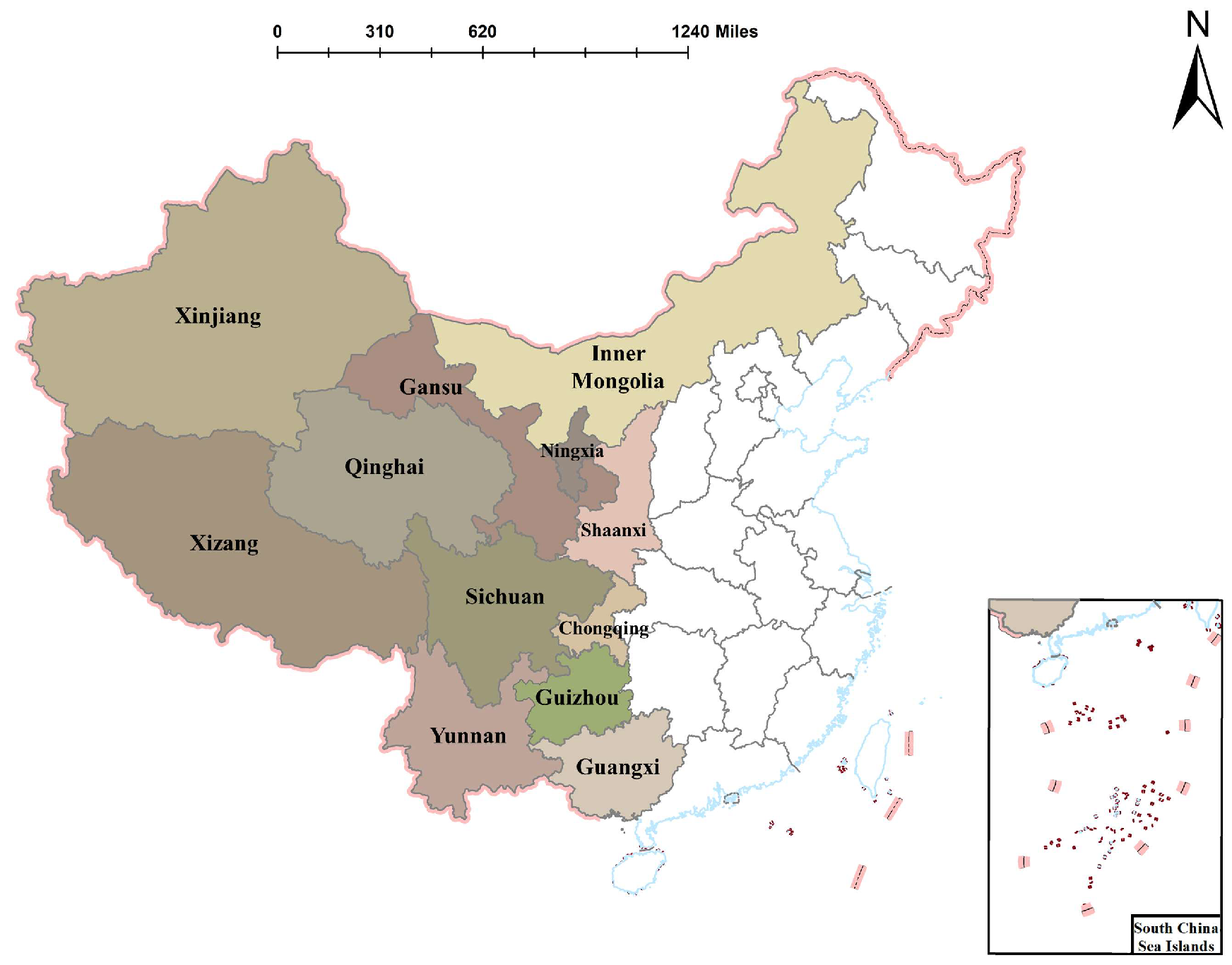
Figure 1. Location of the 12 western provincial-level study units in China. Note: This map is based on the standard map with approval number GS(2023)2767 from the Standard Map Service website of the Ministry of Natural Resources of the People’s Republic of China [32]. The base map boundaries have not been modified.
Land 15 00820 g001
Figure 2. Sustainable development index in the western region.
Land 15 00820 g002
Figure 3. Social, economic, and ecological sustainability development index.
Land 15 00820 g003
Figure 4. Changes in the 17 Sustainable Development Goals during the sample period.
Land 15 00820 g004
Figure 5. Sustainable development coupling degree score.
Land 15 00820 g005
Figure 6. Sustainable development coupling coordination degree score.
Land 15 00820 g006
Figure 7. Average annual sustainable development index of western provinces.
Land 15 00820 g007
Figure 8. Variation in the coefficient of variation in various sustainable development indices during the sample period.
Land 15 00820 g008
Figure 9. Moran scatter plot. (a) Moran scatter plot for the ecological sustainability index in 2000; (b) Moran scatter plot for the economic sustainability index in 2018.
Land 15 00820 g009
Figure 10. Predicted results of the sustainable development index.
Land 15 00820 g010
Figure 11. Coupling coordination analysis of sustainable development index forecast results.
Land 15 00820 g011
Figure 12. Schematic diagram of the structure of Sustainable Development Goals.
Land 15 00820 g012
Table 1. Sustainable development assessment system.
SystemDevelopment GoalEvaluation Indicators
SocialNo Poverty X1
(SDG1)
Per capita disposable income X1,1
Basic education coverage population ratio X1,2
Missing persons and disaster-affected population ratio per 100,000 people X1,3
Direct economic losses in disasters as proportion of GDP X1,4
Unemployed population ratio X1,5
Zero Hunger X2
(SDG2)
Undernourishment rate for children under 5 X2,1
Rural per capita income X2,2
Grain output X2,3
Grain output growth rate X2,4
Ratio of agricultural extension workers per 1000 farmers X2,5
Crop water productivity X2,6
Low birth weight infant ratio X2,7
Agricultural land ratio X2,8
Good Health and Well-being X3
(SDG3)
Maternal mortality ratio X3,1
Births attended by skilled health personnel X3,2
Health management rate for children under 7 X3,3
Perinatal mortality rate X3,4
Incidence of tuberculosis, malaria, and hepatitis B per 100,000 people X3,5
Traffic accident mortality rate X3,6
Health care expenditure as proportion of total household income X3,7
Health human resource density X3,8
Antenatal care coverage X3,9
Postnatal care coverage X3,10
Percentage of medical institutions meeting service standards X3,11
Medical research and medical assistance expenditure as proportion of fiscal expenditure X3,12
Quality Education X4
(SDG4)
Illiterate population ratio among people aged 15+ X4,1
Net enrollment rate of school-age children X4,2
Ratio of primary and secondary school teachers with bachelor’s degrees or above X4,3
Ratio of university teachers with master’s degrees or above X4,4
Population with higher education ratio X4,5
Senior high school teacher-student ratio X4,6
Government education expenditure as proportion of GDP X4,7
Gender Equality X5
(SDG5)
Ratio of male to female sterilization rates X5,1
Ratio of male to female illiteracy X5,2
Ratio of male to female education X5,3
Ratio of male to female employment X5,4
Reduced Inequalities X10
(SDG10)
Wages as proportion of GDP X10,1
Ratio of male to female illiteracy X10,2
Urban-rural income ratio X10,3
Sustainable Cities and Communities X11
(SDG11)
Passenger traffic volume X11,1
Missing persons and disaster-affected population ratio per 100,000 people X11,2
Ratio of tertiary industry legal entities X11,3
Industrial solid waste discharge X11,4
Basic old-age insurance participation ratio for urban and rural residents X11,5
Traffic deaths per million people X11,6
Per capita public green space area X11,7
Doctors per 10,000 people X11,8
Per capita urban road area X11,9
Urban residents’ disposable income X11,10
Per capita education expenditure X11,11
Per capita GDP X11,12
Hospital beds per million people X11,13
Peace, Justice and Strong Institutions X16
(SDG16)
Local government expenditure as proportion of originally approved budget X16,1
Women’s proportion in public institutions X16,2
Partnerships for the Goals X17
(SDG17)
Total government revenue as proportion of GDP X17,1
Total import and export volume as proportion of GDP X17,2
Proportion of individuals using the Internet X17,3
Government health and education expenditure X17,4
Taxes as proportion of GDP X17,5
Social security and employment expenditure X17,6
EconomicDecent Work and Economic Growth X8
(SDG8)
Per capita GDP X8,1
Energy consumption per unit of GDP X8,2
International tourism income per 10,000 yuan GDP X8,3
Per capita disposable income X8,4
Average wage of employed workers X8,5
Industry, Innovation and Infrastructure X9
(SDG9)
Passenger traffic volume X9,1
Industrial added value as proportion of GDP X9,2
Manufacturing employment as proportion of total employment X9,3
Proportion of small-scale industries in total industrial added value X9,4
R&D expenditure as proportion of GDP X9,5
Researchers as proportion of total population X9,6
Enterprise R&D expenditure as proportion of GDP X9,7
Proportion of population using the Internet X9,8
Patents per million people X9,9
Scientific papers per million people X9,10
Responsible Consumption and Production X12
(SDG12)
Water consumption per unit of GDP X12,1
Per capita industrial solid waste discharge X12,2
Percentage of industrial wastewater receiving treatment X12,3
Per capita wastewater production X12,4
Energy consumption per unit of GDP X12,5
Solid waste discharge X12,6
Green R&D technology investment proportion X12,7
EcologicalClean Water and Sanitation X6
(SDG6)
Rural sanitary toilet coverage rate X6,1
Water consumption per unit of GDP X6,2
Freshwater withdrawal as proportion of available freshwater X6,3
Per capita water use X6,4
Marine protected areas proportion X6,5
Affordable and Clean Energy X7
(SDG7)
Thermal power generation proportion X7,1
GDP energy intensity X7,2
Population with access to gas X7,3
Climate Action X13
(SDG13)
CO2 emissions per unit of GDP X13,1
Per capita CO2 emissions X13,2
Greenhouse gas emission intensity in forest areas X13,3
Deaths and missing persons per million people in climate disasters X13,4
Thermal power generation proportion X13,5
Life Below Water X14
(SDG14)
Marine protected areas proportion X14,1
Wastewater discharge proportion into belonging sea areas X14,2
Proportion of marine researchers X14,3
Life on Land X15
(SDG15)
Forest area as proportion of total land area X15,1
Wetland area as proportion of total land area X15,2
Degraded land as proportion of total land area X15,3
Expenditure for biodiversity protection as proportion of GDP X15,4
Afforestation area as proportion of forest area X15,5
Available water resources as proportion of total water resources X15,6
Government environmental pollution control expenditure as proportion of GDP X15,7
Motorized fishing boats year-end ownership X15,8
Table 2. Classification standards for coupling degree and coupling coordination degree.
Coupling Degree or Coordination Degree ScoreCoupling TypeCoupling Coordination GradeCoupling Coordination Type
(0, 0.10]Low-level couplingExtreme disorderDisorder type
(0.10, 0.20]Severe disorder
(0.20, 0.30]Moderate disorder
(0.30, 0.40]Antagonism stageMild disorderTransition type
(0.40, 0.50]Near disorder
(0.50, 0.60]Barely coordinated
(0.60, 0.70]Running-in stagePrimary coordinationCoordinated development type
(0.70, 0.80]Intermediate coordination
(0.80, 0.90]High-level couplingGood coordination
(0.90, 1.00]Quality coordination
Table 3. Changes in economic–ecological and social–ecological coupling coordination degrees in western provinces during the sample period.
ProvinceEconomic–EcologicalSocial–Ecological
Year 2000Year 2018 Year 2000Year 2018
Inner Mongolia0.4860.6190.5140.647
Gansu0.4560.5500.4520.575
Guangxi0.5120.6840.4610.705
Guizhou0.4400.5610.4490.580
Ningxia0.4510.6340.5220.656
Qinghai0.3810.5140.3910.553
Shaanxi0.5360.6690.4920.647
Sichuan0.4390.5560.4340.567
Xizang0.3850.4550.3950.511
Xinjiang0.4710.5930.5240.648
Yunnan0.4150.4670.4190.478
Chongqing0.5110.6780.4790.646
Disclaimer/Publisher’s Note: The statements, opinions and data contained in all publications are solely those of the individual author(s) and contributor(s) and not of MDPI and/or the editor(s). MDPI and/or the editor(s) disclaim responsibility for any injury to people or property resulting from any ideas, methods, instructions or products referred to in the content.