Article

From Bloomery Iron to Cast Iron: Spatial Distribution Patterns and Influencing Factors of Ancient Iron Smelting Technology in Southeastern Guangxi, China


1
Southern China and Southeast Asia Research Center for Archaeometry and Cultural Heritage Conservation, Guangxi Minzu University, Nanning 530006, China
2
College of Ethnolog and Sociology, Guangxi Minzu University, Nanning 530006, China
3
Institute for History and Culture of Science and Technology, Guangxi Minzu University, Nanning 530006, China
*
Authors to whom correspondence should be addressed.
These authors contributed equally to this work.
Land 2026, 15(5), 816; https://doi.org/10.3390/land15050816 (registering DOI)
Submission received: 29 March 2026 / Revised: 7 May 2026 / Accepted: 8 May 2026 / Published: 11 May 2026
(This article belongs to the Section Landscape Archaeology)

Abstract

Existing research on iron smelting sites from the Han to Song Dynasties in southeastern Guangxi has focused on metallurgical technology analysis, but geographic information system-based analysis remains limited. To address this gap, this study examines spatial distribution, clustering patterns, and natural controls of iron smelting sites and clarifies the coupling relationship between spatial patterns and the evolution of bloomery iron smelting and cast iron smelting technology. This study examines 38 iron smelting sites using a geographic database that integrates kernel density estimation, Thiessen polygons, and geographic detectors to reveal spatial patterns and driving factors. Results show that: (1) two smelting technologies existed in the region (bloomery iron and cast iron); (2) sites exhibit a three-centre cluster, with the highest density in Pingnan County; (3) lithology was the primary controlling factor, followed by contour density, relief, elevation, and soil properties; (4) shaft furnaces existed in favourable geotechnical conditions and transport access; small-scale furnaces are controlled by ore availability, with additional cultural and safety influences. This study reveals the spatial heterogeneity and key factors of iron smelting sites in southeastern Guangxi, providing quantitative support for Lingnan metallurgical archaeology, human–environment relations, and dissemination of Maritime Silk Road technology.

1. Introduction

As a critical geographical corridor linking the Central Plains and Southeast Asia, Guangxi is adjacent to the Beibu Gulf and serves as an important point of departure for China’s ancient “Maritime Silk Road”. The iron smelting industry, as a core component of ancient metallurgical production systems, played a pivotal role in facilitating regional economic development and cross-cultural exchanges. During the period from the Han to the Song dynasties, Guangxi’s iron smelting industry evolved from its initial emergence to a stage of sustained prosperity, thereby leaving behind numerous well-preserved iron smelting sites. These sites provide material evidence for the technological development of ancient iron smelting in Guangxi and constitute a valuable dataset for in-depth investigations of regional economic systems, cultural interactions, and socioeconomic transformations between China and Southeast Asia. In previous studies on iron smelting sites, research has focused on slag geochemical analyses [1], metallographic microstructure characterisation [2], and technological attributes [3], with relatively few studies addressing the spatial distribution patterns and their underlying controlling mechanisms.
In recent years, with advancements in technologies such as remote sensing, geographic information systems (GIS), and unmanned aerial vehicle-based aerial imaging, archaeological site research has transcended traditional disciplinary boundaries and has increasingly integrated with fields such as geography, geology, and environmental science. Spatial analysis methods are widely applied in archaeological research, thereby providing robust and quantitative tools for site detection, identification, and spatial characterisation. Li et al. [4] used Dazhuangke iron smelting sites group in Yanqing District, Beijing, as a case study to analyse its spatial structure and its relationships with environmental and resource variables, establishing quantitative relationships between site distributions and factors significantly associated with smelting activities, and further simulating site predictions within a localised spatial scale. Subsequent studies have applied spatial analysis methods to settlement sites, salt-production sites, and broader archaeological contexts, thereby elucidating site layout strategies, human–land interactions, and relationships between spatial distribution and environmental conditions [5,6,7]. Researchers have examined cultural relic protection units in Shanxi, scenic and historical sites in Hunan, and cultural heritage sites in western Hunan as case studies, analysing their spatiotemporal distribution characteristics, identifying key influencing factors, and constructing spatial protection networks [8,9,10].
Existing research has focused mainly on field investigations and technical analyses, with limited integrated interpretation of spatial patterns and technological evolution. Most GIS applications in archaeology mainly target general settlements or officially protected heritage sites, whereas specialised quantitative research on metallurgical sites, especially resource-dependent and technologically specific iron smelting sites, remains limited. In addition, research on iron smelting sites in Guangxi has failed to effectively link spatial distribution with the transformation of iron smelting technology, leaving the site selection logic for ancient iron smelting production in the region insufficiently understood. Based on this context, this study focuses on iron smelting sites in Guangxi, analysing the controlling mechanisms of site distribution patterns using spatial analysis supported by natural geographical variables. This study provides a new framework for comparative analysis of archaeological site clusters and offers a novel perspective on the processes governing ancient iron smelting site selection and technological evolution. Based on this context, this study focuses on iron smelting sites in Guangxi, analysing the controlling mechanisms of site distribution patterns using spatial analysis supported by natural geographical variables. This study provides a new quantitative framework for analysing archaeological site groups and supplements the empirical basis for research on the relationship between the Lingnan region and the Maritime Silk Road, as well as the dissemination of metallurgical technology.

2. Materials and Methods

2.1. Overview of the Study Area

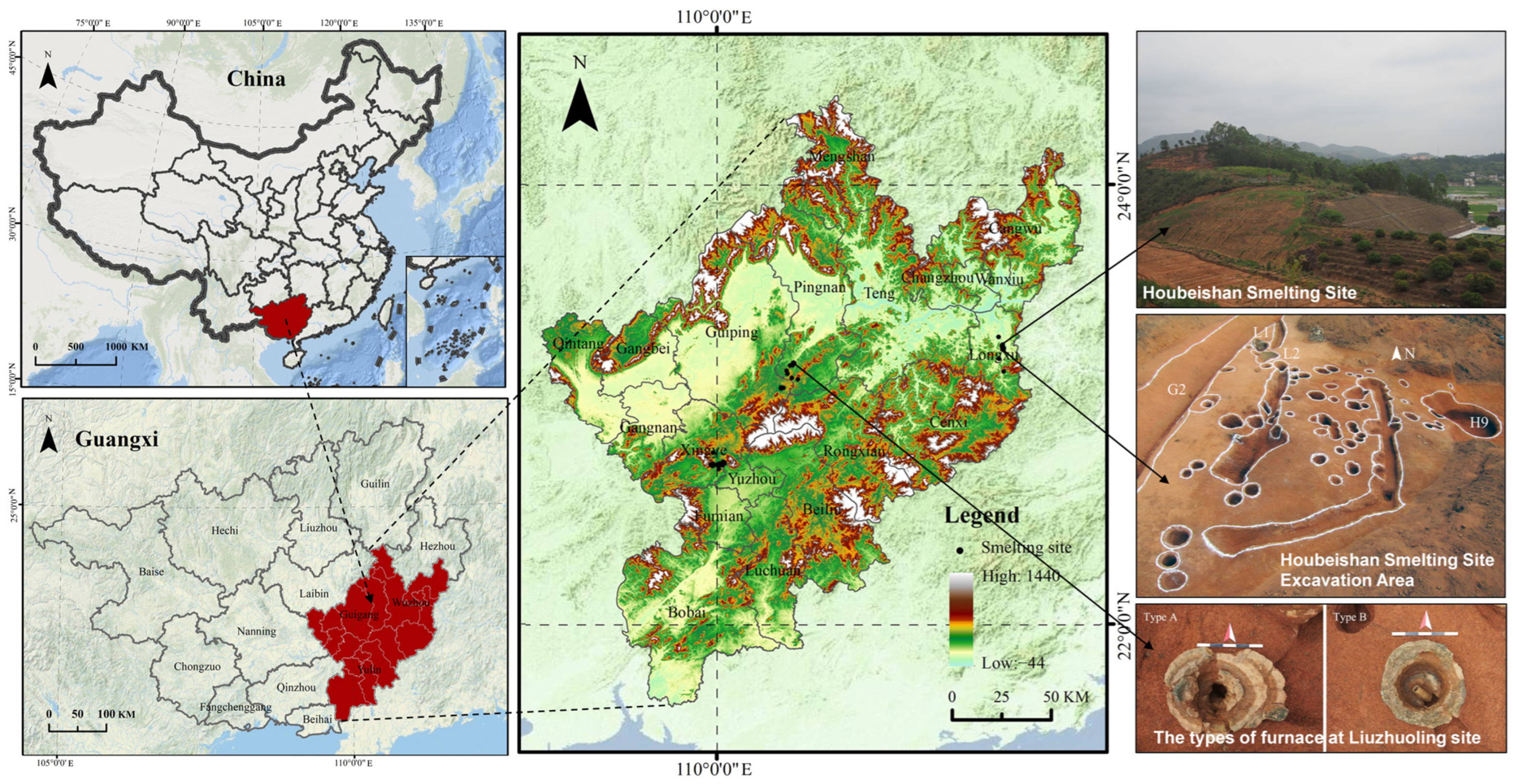
The Guangxi Zhuang Autonomous Region is located in southern China. It provides the most accessible maritime gateway for southwestern China and functions as a strategic transitional zone between the resource-based economy of western China and the export-oriented economy of southeastern China, thereby occupying a crucial position in economic exchanges between China and Southeast Asia (Figure 1). Guigang is situated on the Xunyu Plain in southeastern Guangxi, within the middle reaches of the Xijiang River basin. It shares administrative boundaries with Wuzhou to the east and Yulin to the south. As the eastern gateway of Guangxi, Wuzhou City is bordered by Guangdong Province to the east, Rong County (Yulin) to the south, and Pingnan County (Guigang) to the west; it is strategically situated at the fluvial confluence of the Xunjiang River, Guijiang River, and Xijiang River. Yulin City is situated in southeastern Guangxi and is bounded by Guangdong Province to the east, Guigang to the north, and Wuzhou to the northeast, reflecting its position within a regionally interconnected administrative and geographical framework. The region is characterised by relatively flat topography and is located in proximity to the Beibu Gulf.
Studies have demonstrated that iron artefacts were used in ancient Guangxi at least as early as the late Warring States Period [11]. Based on recent discoveries and studies, the iron smelting site groups of Guigang, Wuzhou, and Yulin represent the three principal clusters of concentrated iron smelting activity in Guangxi. The Guigang and Wuzhou clusters exhibit similar development trajectories and jointly constitute the core region for early bloomery iron smelting in southeastern Guangxi. Huang [12] investigated sites in Guigang and confirmed that they were bloomery iron smelting sites dating from the Han to the Tang dynasties (202 BC–AD 907). Meng and Zou conducted a systematic survey of the Houbeishan Site in Wuzhou and identified it as a bloomery iron smelting site [13]. Huang [14] and Yu [15] investigated the Yulin site group and determined that it comprises cast iron smelting sites dating from the Tang to the Song dynasties. Other scholars have further investigated these sites and have supplemented the existing archaeological record [16,17].
These studies provide critical evidence for elucidating the development and the spatial dissemination of iron smelting technology across Guangxi, the Central Plains, and Southeast Asia. However, existing research on iron smelting sites in this region has primarily focused on site surveys, metallurgical analyses, and chronological dating. This study focuses on iron smelting site groups in southeastern Guangxi, analyses their spatial distribution patterns at a regional scale, constructs a geospatial database using a GIS, identifies key physical geographic variables influencing site distribution, and explores the interactions among these factors to infer the decision-making processes underlying ancient site selection.

2.2. Research Methods

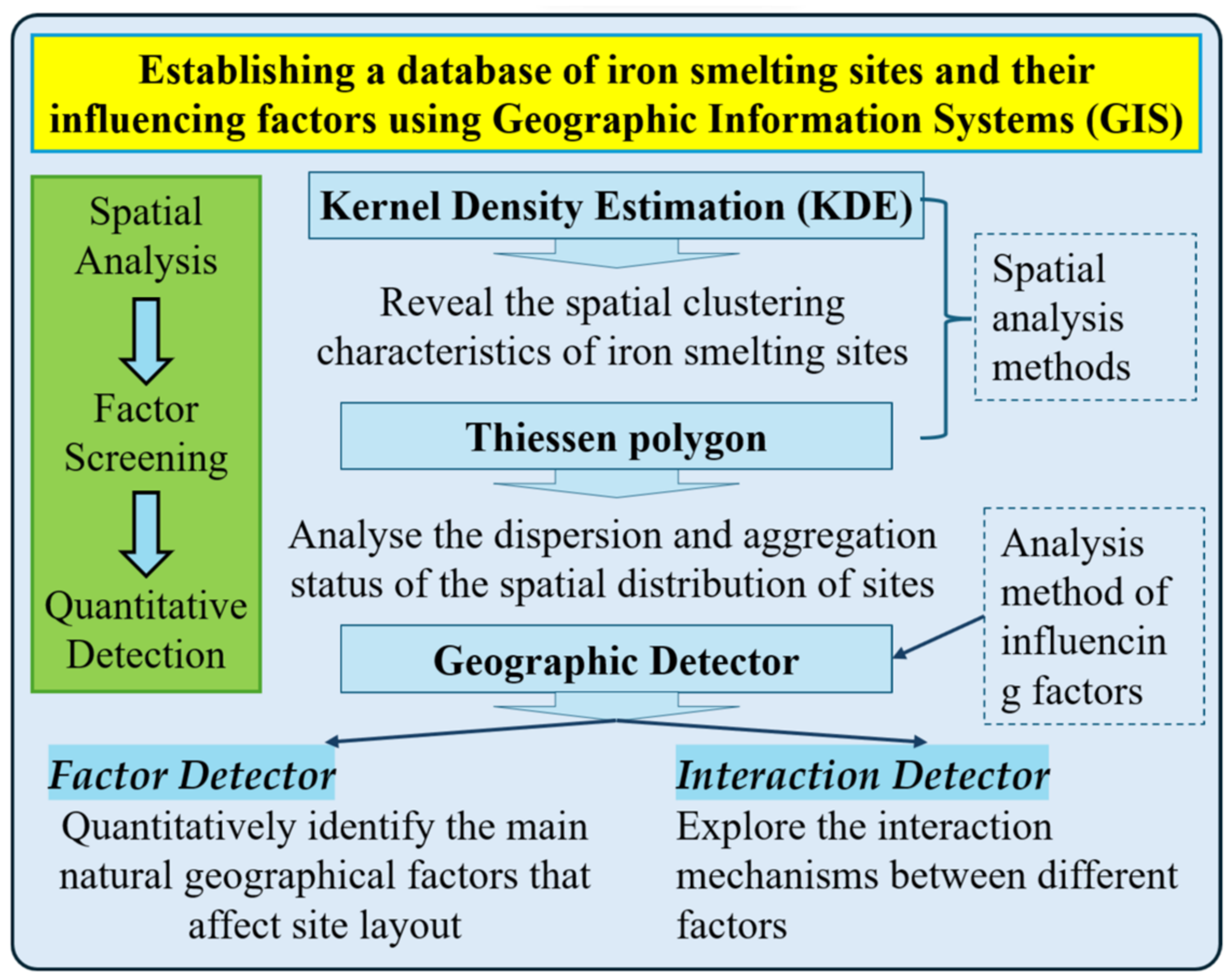
This study follows the research framework of “spatial analysis–factor screening–quantitative detection” (Figure 2). First, the Kernel Density Estimation (KDE) method is used to reveal the spatial clustering characteristics of iron smelting sites; second, the Thiessen polygon method is used to analyse the dispersion and aggregation status of the spatial distribution of sites; finally, a geographic detector model is used to quantitatively identify the dominant natural geographic factors that affect site layout and to explore the interaction mechanisms between different factors, thereby forming a complete spatial pattern and analysis system for influencing factors. This design has a unique role in metallurgical archaeological research. First, a standardised quantitative workflow suitable for spatial pattern analysis of metallurgical iron sites has been established, which can be applied to other metallurgical heritage groups; second, conventional spatial analysis is coupled with technological types to construct a spatial distribution and technological evolution correlation framework, which has been less applied in previous GIS archaeological research; finally, quantitative attribution research was conducted to enhance the reliability of quantitative detection of regional iron smelting sites. Based on 38 typical iron smelting sites covering the Han to Song dynasties, this method system achieves quantitative identification of spatial distribution patterns and dominant controlling factors, thereby providing a replicable quantitative path for the study of metallurgical archaeological sites.

2.2.1. Kernel Density Estimation

Kernel density analysis is used to calculate the unit density of measured values of point and line features within a specified neighbourhood, which can intuitively reflect the distribution of discrete measured values in a continuous area [18].
f s = i = 1 n k π r 2 x x i r , x R
The calculation equation is as follows: in Equation (1), f(s) denotes the kernel density estimation value at point x; n represents the number of sites, and r is the search radius. The kernel density analysis method can accurately characterise the spatial agglomeration characteristics of site groups.

2.2.2. Thiessen Polygon

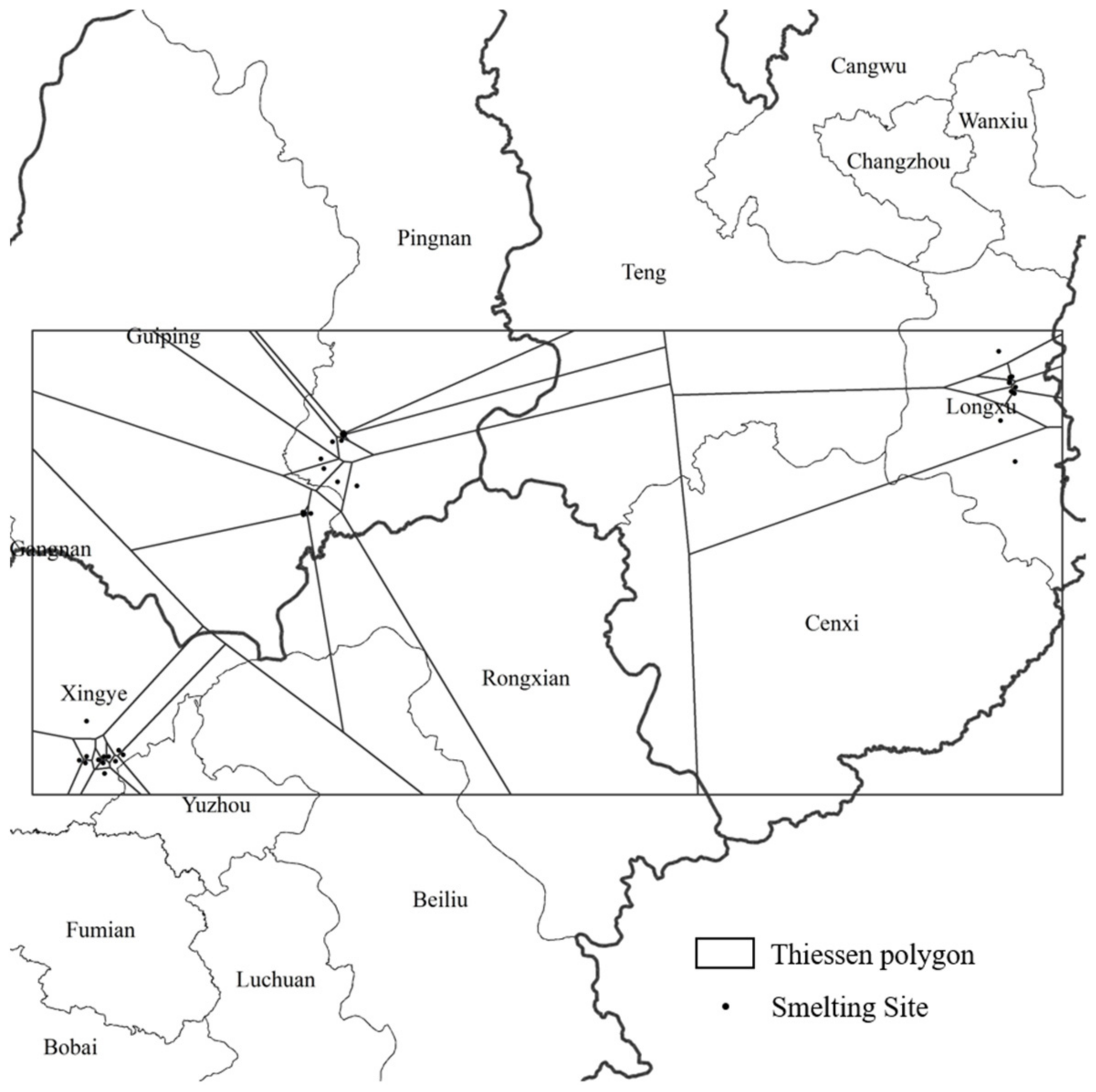
Thiessen polygons are a special spatial segmentation form used to represent the proximity relationship between points in space. In settlement archaeology, site catchment areas and Thiessen polygons are usually used to describe the spatial relationships between sites [19]. Under the premise of a fixed study area boundary, the denser the site points are, the more Thiessen polygons will be generated, and the smaller the average area of a single polygon will be. In this study, the Coefficient of Variation (CV) of Thiessen polygon areas is used to detect the distribution pattern of spatial point sets, where a smaller CV indicates a more uniform spatial distribution, while a larger CV indicates a more clustered distribution [20]. On the basis of kernel density analysis, Thiessen polygons are further employed to analyse the spatial agglomeration of sites in this study.

2.2.3. Geographical Detector

The Geographical Detector is a statistical method for detecting spatial stratified heterogeneity (SSH) and revealing its underlying influencing factors [21]. It divides the study area into several subregions, compares regional variances, and analyses the differences and correlations between regions. The q-value is a metric for measuring the explanatory power of independent variables, and the equation is as follows [22]:
q = 1 h = 1 L N h σ h 2 N σ 2
In Equation (2), L is the stratum of the dependent or independent variable; N h and σ h 2 denote the number of units and the variance of stratum h, respectively; N and σ2 represent the total number of units and the overall variance of the study area, respectively. Before analysis, all continuous variables were discretised using the natural breaks (Jenks) method. This method minimises within-group variance and maximises between-group variance, making it suitable for the classification of geospatial data. According to the sample size of 38 iron smelting sites and the requirements of the geographic detector model, all continuous variables were uniformly divided into five strata to ensure the stability and reliability of the q-statistic calculation.

2.2.4. Factor Detector

The factor detector is used to identify the spatial stratified heterogeneity of Y, and quantify the degree to which a factor X explains the spatial stratified heterogeneity of attribute Y, which is measured by the q-value [23]. The expressions are as follows:
q = 1 h = 1 L N h σ h 2 N σ 2 = 1 S S W S S T
S S W = h = 1 L N h σ h 2 , S S T = N σ 2 q = 1 h = 1 L N h σ h 2 N σ 2
In Equations (3) and (4), the stratum of variable Y or factor X is represented by h = 1, …, L (i.e., classification or zoning). N h and N denote the number of units in stratum h and the whole study area, respectively; σ h 2 and σ h 2 represent the variance of Y values in stratum h and the whole study area, respectively [24]. SSW is the within sum of squares, and SST is the total sum of squares of the study area. The q-value ranges from 0 to 1; a larger q-value indicates more significant spatial stratified heterogeneity of Y. If the stratum is generated based on the independent variable X, a larger q-value denotes stronger explanatory power of X for attribute Y, and vice versa [25].

2.2.5. Interaction Detector

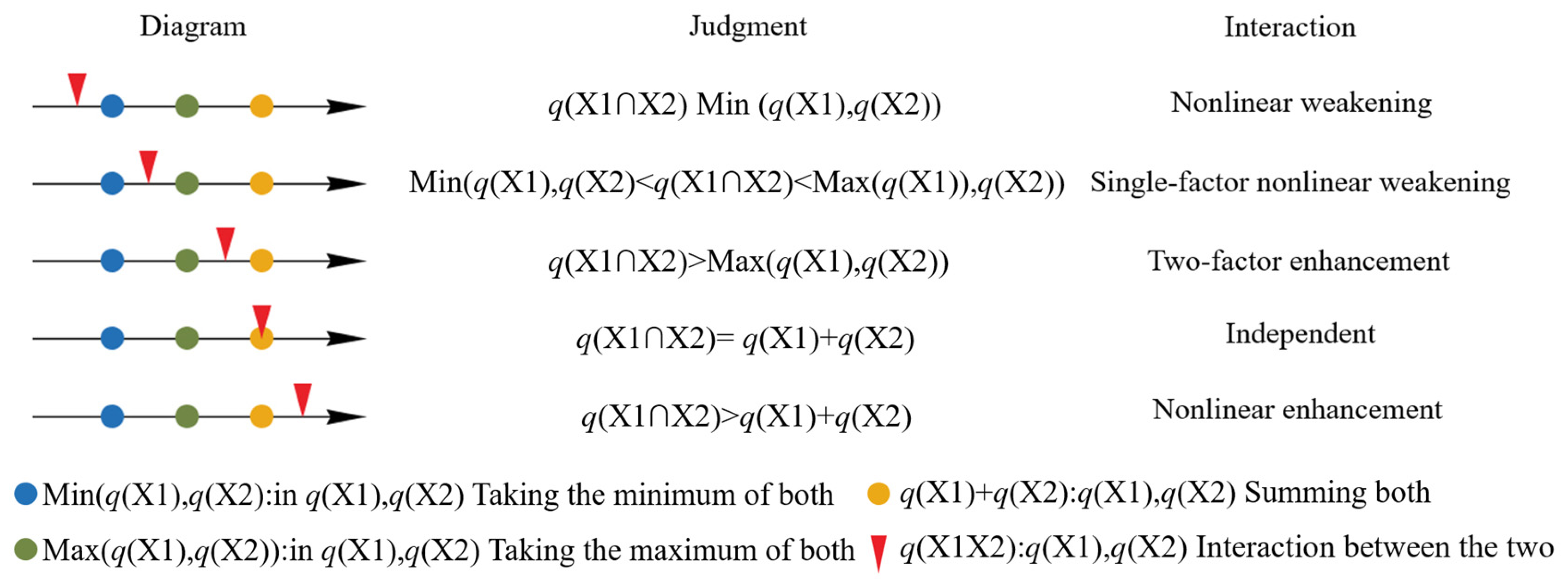
This method is used to identify the interaction between different factors X s , and to evaluate the explanatory power of the combined effect of factors X1 and X2 on the dependent variable Y [26]. As shown in Figure 3, the interaction between two factors can be classified into the following categories.
In this study, the factor detector module of the Geographical Detector was used to analyse the spatial stratified heterogeneity of iron smelting sites in Guangxi from the Han to the Song Dynasties. The interaction detector module was then applied to identify the explanatory power of influencing factors and their interactions, clarifying pairwise relationships and their combined explanatory power on the dependent variable under different interaction types.

3. Results

3.1. Spatial Layout of Iron Smelting Sites

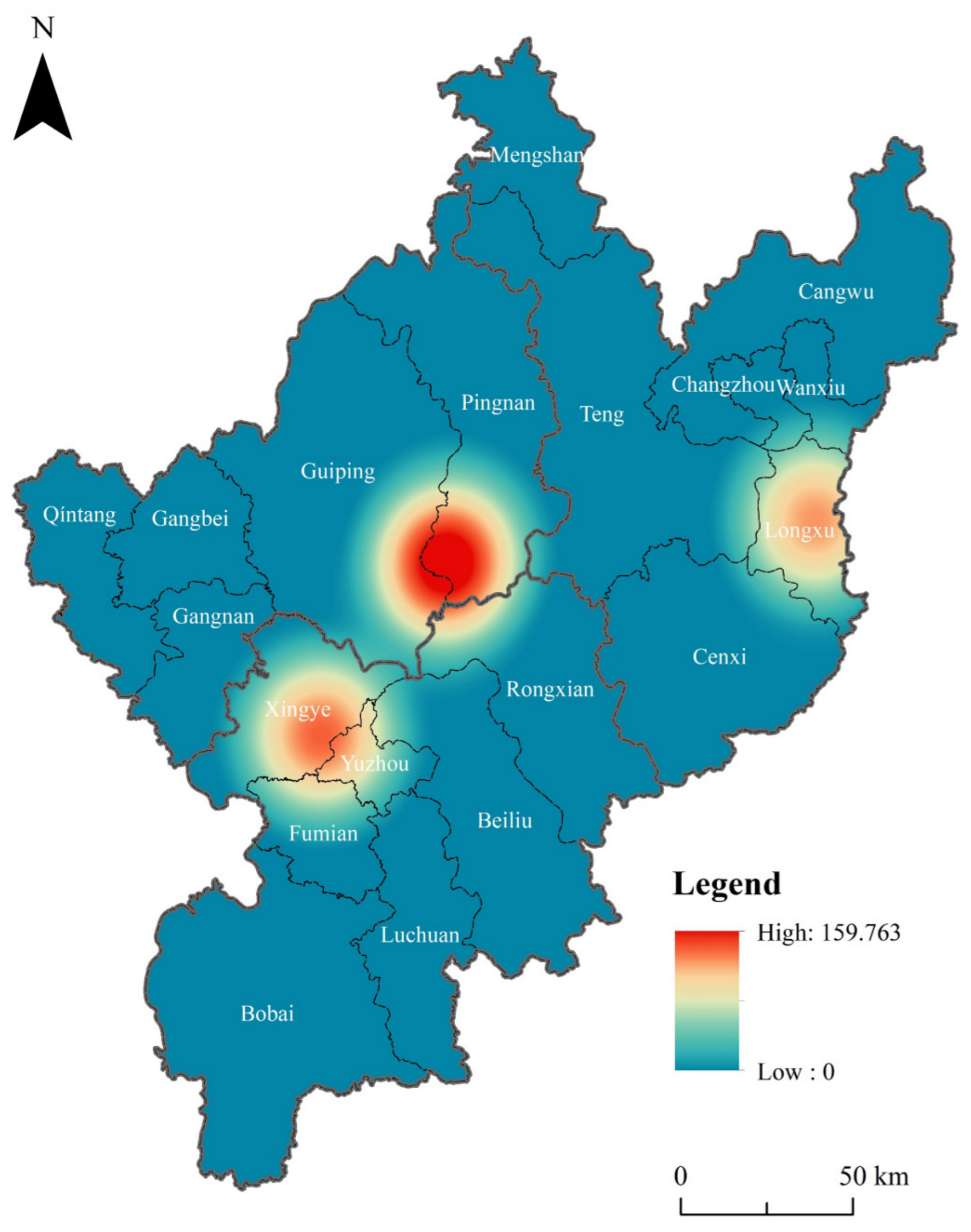
KDE and Thiessen polygon methods were employed to analyse the overall spatial distribution patterns of iron smelting sites in Guangxi from the Han to the Song dynasties, integrating both regional-scale (macro) and local-scale (micro) analytical perspectives. In this study, the kernel density bandwidth (search radius r) was set to 2000 m based on the study area and site-distribution density. As shown in Figure 4, the iron smelting site group in Guigang exhibits a three-centre clustered distribution, mainly concentrated in southwestern Guiping City, southern Pingnan County (both under Guigang), and Longxu District of Wuzhou. The highest site density appears in southern Pingnan, extending southeastward to Guiping. In contrast, the Tang–Song iron smelting site group in Yulin is mostly distributed in southwestern Xingye County. The Yulin site group displays a single, highly concentrated core with a radial spatial pattern, and its clustering intensity is significantly stronger than that of the Guigang site group. Analysis based on Thiessen polygons (Figure 5) indicates that the overall coefficient of variation (CV) is 2.005, reflecting a high degree of spatial dispersion among sites, with substantial inter-site distance variability and pronounced clustering effects. The Guigang site group exhibits a widely dispersed spatial configuration (accounting for 50.51% of the total Thiessen polygon area, CV = 1.333), whereas the Wuzhou site group demonstrates moderate spatial dispersion (accounting for 36.43% of the total polygon area, CV = 1.43). The relatively low spatial differentiation indices of the two clusters indicate a production model characterised by small-scale, spatially distributed smelting, consistent with the defining features of the “small furnace cluster” production system. The Yulin site group exhibits a pronounced clustering trend (accounting for 13.06% of the total polygon area, CV = 1.93), consistent with the interpretation that a larger CV represents stronger clustering. Iron smelting nodes in this region are spatially sparse. However, the scale of individual sites varies considerably, and the observed spatial heterogeneity reflects a technological trajectory towards intensive shaft furnace-based smelting systems.

3.2. Analysis of Influencing Factors on Site Distribution

3.2.1. Selection of Influencing Factors

In previous studies, influencing factors such as altitude, aspect, slope, and distance to rivers have been widely used [27,28,29,30,31]; however, the selection criteria and underlying rationale have rarely been explicitly articulated. Accordingly, this study constructs an evaluation index system based on factors potentially controlling ancient smelting-site selection, while considering regional characteristics, data accessibility, and indicator representativeness.
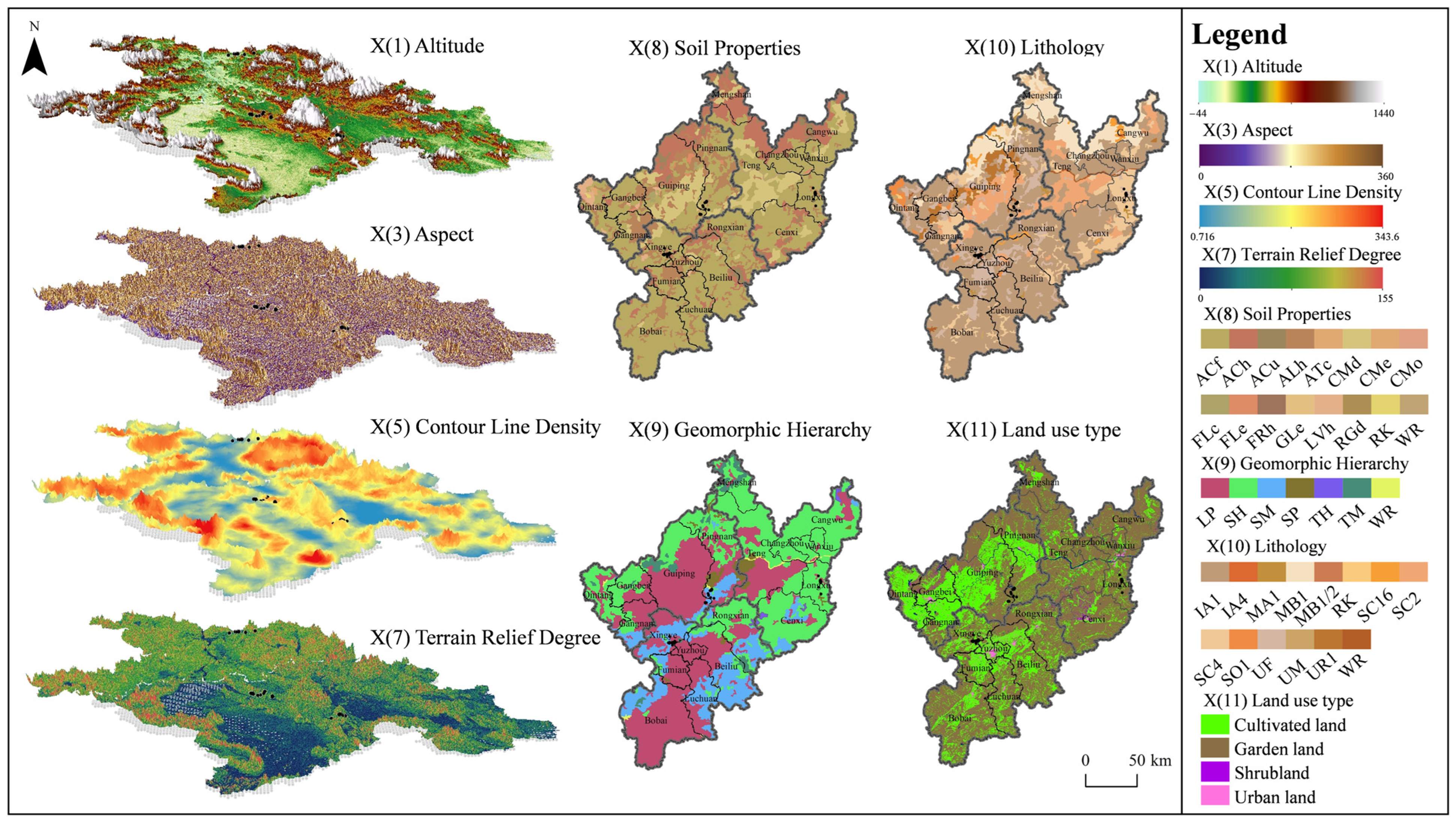
Given that anthropogenic factors are highly susceptible to temporal variability and may introduce significant biases that compromise the objectivity and robustness of the results, this study selects natural geographic variables characterised by low temporal variability. The selected variables are defined as follows: (1) altitude primarily influences resource accessibility, transportation conditions, production environments, and human adaptability; (2) gentle slopes facilitate ore extraction and transportation, whereas steep slopes increase operational risks and instability during production; (3) aspect influences solar radiation exposure, temperature regimes, prevailing wind direction, and ventilation conditions at smelting sites; (4) ancient iron smelting required substantial water resources for cooling, washing, and domestic use, making proximity to rivers a critical constraint for site selection; (5) contour density serves as a proxy for terrain steepness; (6) areas with high vegetation coverage indicate the availability of biomass fuel resources; (7) relief amplitude controls transportation difficulty and associated costs, thereby influencing the efficiency of material transport (ore, fuel, and products); (8) soil properties determine the geotechnical bearing capacity of smelting infrastructure foundations; (9) different geomorphological types correspond to varying levels of natural hazard susceptibility; (10) lithology is closely associated with iron ore occurrence and availability, which constitute the primary raw material for smelting; (11) ancient smelting sites were typically located away from farmland or settlements, making land-use type an important reference variable.
Accordingly, 11 influencing variables were selected as independent predictors: altitude, slope, aspect, distance to river systems, contour density, vegetation coverage, relief amplitude, soil properties, geomorphological classification, lithology, and land-use type (Table 1).

3.2.2. Collinearity Analysis of Influencing Factors

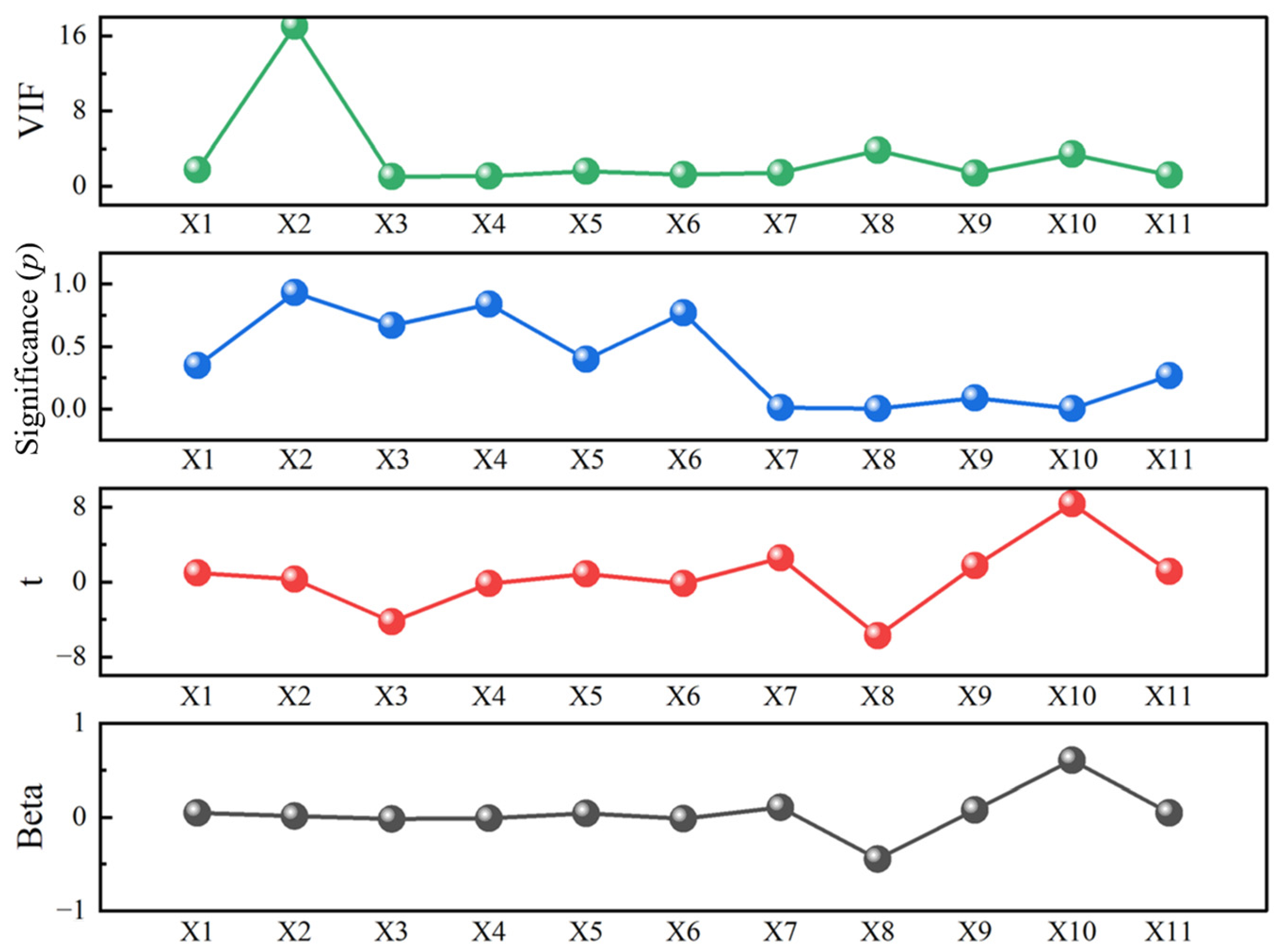
Collinearity diagnostics for the 11 selected influencing variables were performed using a regression model implemented in SPSS 26.0, to remove variables exhibiting strong multicollinearity as a data preprocessing step prior to Geographical Detector analysis. The diagnostics were primarily based on the variance inflation factor (VIF), with standardised regression coefficients, significance levels (p-values), and tolerance values used as auxiliary criteria for variable elimination.
As shown in Table 2, the coefficient of determination (R2) of the linear regression model is 0.648, and the adjusted R2 is 0.630 (slightly lower than the unadjusted value), indicating that the independent variables explain 63.0% of the variance in the spatial distribution of iron smelting sites, which represents a statistically acceptable model fit. The significance level of the F-change is 0.001, which is below the threshold of 0.05, thereby confirming the statistical significance of the regression model.
According to standard regression diagnostics (Figure 6), multicollinearity is indicated when VIF > 5 and becomes severe when VIF > 10 [32]. First, the slope variable exhibits a VIF value of 17.007 (exceeding 5), indicating severe multicollinearity, and fails the 95% significance test; its inclusion would substantially reduce the robustness of the Geographical Detector results; therefore, the slope variable was excluded. Second, vegetation coverage exhibits the lowest absolute t-statistic, indicating minimal statistical significance of its regression coefficient (B value), and fails the 95% significance threshold; therefore, it was excluded. Finally, the standardised beta coefficient for distance to rivers is −0.009, indicating a negligible negative effect on the spatial distribution of iron smelting sites and limited explanatory power; therefore, this variable was also excluded.
As shown in Figure 7, eight noncollinear variables were retained—altitude, aspect, contour density, relief amplitude, soil properties, geomorphological classification, lithology, and land-use type—which were subsequently included in the Geographical Detector for influencing factor analysis.

3.2.3. Factor Detection of Influencing Factors

As shown in Table 3, five of the eight independent variables—lithology, contour density, relief amplitude, altitude, and soil properties—passed the 99.99% significance threshold, indicating that these variables exert significant control over the spatial distribution of iron smelting sites in Guangxi. Analysis of the q value indicates that lithology exhibits the highest explanatory power, thereby acting as the dominant controlling factor, followed sequentially by contour density, relief amplitude, altitude, and soil properties. The remaining three independent variables (aspect, geomorphological classification, and land-use type) did not pass the significance test, with q values below 0.1, indicating negligible influence and limited explanatory power for the spatial distribution of iron smelting sites in Guangxi. These five independent variables are discussed below.
  • Lithology
Lithology refers to the intrinsic properties of rocks, including colour, mineral composition, texture, and structure, which are primarily controlled by mineral assemblages within surface and near-surface geological layers. Most ancient iron smelting sites are located near ore deposits or mining areas, as iron ore constitutes the primary raw material for smelting. Such proximity facilitated local extraction, reduced transportation costs, and ensured a stable raw-material supply. Therefore, ancient iron smelting site selection was closely associated with lithological conditions. The q value of lithology is 0.714, ranking highest among all significant factors and confirming lithology as the dominant controlling variable governing the spatial distribution of iron smelting sites in Guangxi. Further analysis indicates that the dominant lithological compositions at the iron smelting sites in Guangxi comprise three principal rock types: granite (IA1), clastic rock (UF), and argillaceous rock (including shale (SC4) and slate/phyllite (MB1)). Granite (IA1) and UF are the most widely distributed lithologies, accounting for 85.7% of the total. Granite typically has relatively low iron content (usually 0.5–5%) and is unlikely to undergo enrichment sufficient to form economically viable iron ore deposits. However, its high refractoriness and thermal stability make it suitable for constructing iron smelting furnace walls. UF, dominated by sandstone and siltstone with minor claystone content, is often used as an admixture [33]; these constitute key components of refractory materials that enhance furnace heat resistance and improve overall refractoriness. Based on the proportional distribution of lithological types, it can be inferred that lithology primarily influences iron smelting sites in Guangxi by supporting furnace construction rather than directly supplying iron ore resources.
For the Guigang iron smelting site group, 11 sites are located in granite-dominated areas (IA1), concentrated in southwestern Pingnan County; four sites occur in clastic rock-dominated areas (UF), concentrated in southeastern Guiping; and one site is located in a shale-dominated area (SC4). The primary components of SC4 are iron-bearing oxide minerals, with magnetite comprising more than 80% of the total. By integrating lithological types and their proportions, it can be inferred that this site group adopted localised resource utilisation for both iron ore and furnace construction materials: granite was used for furnace walls, and clastic rock was incorporated as an admixture to enhance furnace structural stability. For the Yulin iron smelting site group, five sites are located in IA1, concentrated in the western sector; four sites occur in UF, concentrated in the eastern sector, together with three sites in argillaceous rock-dominated areas (MB1). This spatial lithological configuration is similar to that observed in Wuzhou, where sites are predominantly distributed in UF- and SC4-dominated areas. Compared with the Guigang site group, the proportion of sites located in IA1 decreases markedly in Yulin, and no sites are identified in SC4. Notably, MB1 is present in the Yulin site group; as an admixture, it provides greater structural stability for furnace wall materials compared with UF. In summary, lithological distribution suggests that the Yulin iron smelting site group may have adopted a fully localised sourcing strategy for furnace construction materials, which is interpreted as reflecting relatively advanced iron smelting technology, temperature control systems, and furnace material proportioning practices consistent with the observed data.
2.
Contour Density
Contour line density is directly correlated with terrain slope; higher contour density indicates steeper gradients, whereas lower contour density corresponds to gentler slopes. The q value for contour density is 0.428, ranking second among all significant factors and indicating that it is the second most influential variable controlling the spatial distribution of iron smelting sites in Guangxi. Detailed analysis indicates that the contour density values for iron smelting sites in Guangxi ranged from 35.1 to 61.1, with a mean value of 45.0. Based on the corresponding conversion formula, site slopes range from 0° to 28.4°, with a mean value of 12.4°; 82.1% of the sites exhibit slopes of less than 20°. Areas with excessively steep slopes are more susceptible to geomorphological hazards, such as landslides and debris flows, and exhibit poor accessibility, which is unfavourable for transporting raw materials and finished iron products. Conversely, sites located on very gentle slopes or low-lying terrain may be more vulnerable to hydrological hazards, such as flooding. Therefore, iron smelting sites in Guangxi are preferentially distributed in areas characterised by moderate slope gradients. The slope of the iron smelting site group in Guigang ranged from 3.2° to 28.4°, with a mean of 13.6°; in Wuzhou, it ranged from 3.7° to 24.6°, with a mean of 14.2°; and in Yulin, it ranged from 0° to 27.7°, with a mean of 10.8°. Slopes of 0–3° are generally classified as flat, 3–7° as gentle, 7–15° as moderate, 15–25° as steep, and slopes above 25° as very steep; slopes exceeding 25° would have been unsuitable for iron smelting activities under the technological and socioeconomic conditions of the time. Comparative analysis indicates that although the mean slopes of all three site groups fall within the moderate range, the Yulin site group exhibits relatively gentler gradients than the Guigang and Wuzhou groups, suggesting that topographic slope was a key factor in site selection during the Tang–Song period, with a preference for the gentler end of moderate slopes.
3.
Relief Amplitude
Relief amplitude refers to the difference between the maximum and minimum elevation values within a specified spatial unit and serves as a quantitative measure of local topographic variability. The q value for relief amplitude is 0.423, ranking third among all significant influencing factors. Excessively high relief amplitude increases susceptibility to geomorphological hazards, such as landslides and slope failures. Lower relief amplitude reduces production and daily activity costs and enhances the feasibility of infrastructure development. The relief amplitude of iron smelting sites in Guangxi ranges from 1 m to 8 m, with a mean value of 3.8 m. Although the overall relief amplitudes in Guigang and Yulin are relatively high, the iron smelting sites in both regions are located in comparatively flat local settings. The mean relief amplitude of the Guigang iron smelting site group is 4.1 m, within predominantly hilly terrain; only five sites exceed this mean value, and relief amplitudes in Luoxiu are consistently lower than those in Pingnan County. The relief amplitude of iron smelting sites in Wuzhou is comparable to that in Guigang, with a mean of 4.2 m and limited variation among individual sites. The mean relief amplitude of the Yulin iron smelting site group is 3.25 m, reflecting relatively low topographic variability and encompassing three principal geomorphological units: basins, mountains, and hills. Four sites, including Shandiling and Shengguo Temple, are situated on flat terrain characterised by a relief amplitude of 0 m, indicating minimal microtopographic variation. In comparison, the Yulin iron smelting site group is situated in areas with relatively flatter terrain and closer proximity to river systems; notably, the Lüya River, a tributary of the Nanliu River, flows through the vicinity of the sites. From these locations, personnel and products could be transported southwards along the Nanliu River via Panbu to the Beibu Gulf, reaching Hepu Port, eastern Guangdong, and Hainan Province; alternatively, to the northeast, goods could be transported via a short overland route through Guimenguan Pass, followed by riverine transport along the Beiliu and Xijiang rivers to Guangdong. Such topographic conditions provide a favourable environment for iron smelting activities by ensuring accessibility, operational efficiency, and site stability and safety.
4.
Elevation
Variations in elevation influence multiple environmental factors, including topographic characteristics, climatic conditions, and hydrological availability. Excessively high elevations increase the difficulty and costs of ore extraction and are associated with harsh climatic conditions that are unfavourable for production and habitation; conversely, excessively low elevations may reduce resilience to natural hazards. Therefore, under conditions of limited technological productivity, elevation constitutes a key factor influencing the selection of iron smelting sites. The q value for elevation is 0.421, ranking fourth among the significant influencing factors. Detailed analysis indicates that the elevation of iron smelting sites from the Han to the Song dynasties in Guangxi ranged from 80 m to 202 m, with a mean value of 128.14 m. The Han Dynasty iron smelting site group in Guigang is distributed across elevations ranging from 80 to 189 m, with a mean elevation of 127.62 m, and is predominantly situated within the hilly geomorphological setting of the Baisha River basin in the upper reaches of the Pearl River, representing relatively low-elevation terrain conditions. The Wuzhou iron smelting site group is distributed across elevations ranging from 76 to 192 m, with a mean elevation of 123.25 m, and is predominantly situated within a transitional geomorphological zone characterised by ridge-like low hills. The Tang–Song iron smelting site group in Yulin is distributed across elevations ranging from 88 to 202 m, with a mean elevation of 128.83 m, and is primarily situated in Long’an Town and its surrounding areas, which are characterised by a hilly–plain transitional geomorphological setting at relatively low elevations. In summary, the elevation distribution of iron smelting sites in Guangxi is relatively consistent, with “low elevation within hilly terrain” serving as a general criterion for site selection. Lower elevations are generally associated with flatter terrain and fewer geomorphological barriers, providing favourable conditions for iron smelting and reflecting possible transportation constraints during that period.
5.
Soil Properties
Soil properties encompass soil texture, structure, and pH characteristics. Variations in soil trace element composition influence the sustainability of iron smelting activities by affecting furnace construction materials, geotechnical bearing capacity, and acid–alkaline conditions. Soil moisture also regulates the furnace cooling rate and influences slag fluidity during smelting processes. The q value for soil properties is 0.211, ranking fifth among all significant influencing factors and indicating that soil properties account for 21.1% of the explanatory power in the spatial distribution of iron smelting sites. Further analysis indicates that the soil types associated with iron smelting sites in Guangxi fall into three main categories: Ferric Acrisol (ACf, 56.1%), Haplic Acrisol (ACh, 9.7%), and Anthropogenic Cumulative Soil (Atc, 35.0%). Ferric Acrisol has relatively high iron content; however, its low chemical activity and strong acidity render it unsuitable for furnace foundation construction, although it may serve as a potential raw material source for iron smelting. Anthropogenic Cumulic Soil reflects prolonged human habitation and activity in the region, including potential on-site soil extraction, mixing, and iron smelting processes.
In comparison, 11 sites in the Guigang area are distributed on Ferric Acrisol (ACf), predominantly concentrated within the site cluster in southwestern Pingnan County, whereas five sites occur on Anthropogenic Cumulic Soil (Atc) within the iron smelting site group in southeastern Guiping. Ferric Acrisol is a highly weathered soil type, the formation of which is associated with the enrichment of metallic elements such as iron and aluminium and is commonly linked to iron ore resources [34]. The spatial distribution of soil properties suggests that iron ores used at smelting sites in Pingnan County (Guigang) may have been locally sourced, whereas sites in Guiping may represent long-term smelting operations supplied with raw materials from Pingnan County. The Wuzhou iron smelting site group comprises four sites in Haplic Alisol (ALh) and five sites in ACf, with most sites located along the boundary between these two soil types, indicating strong similarities to the Guigang sites. The Yulin iron smelting site group comprises five sites on ACf and four sites on Atc. Notably, three sites (accounting for 25% of the cluster) are distributed on Haplic Acrisol (ACh), which is characterised by a stable soil structure and limited reactivity to metal elements under smelting conditions. When used in furnace construction, Haplic Acrisol helps maintain the structural stability of smelting furnaces during operation. Based on the above analysis, the Yulin iron smelting site group appears to have made more extensive use of locally sourced raw materials for furnace construction, with improved material formulations exhibiting greater structural stability and integrity. This pattern is interpreted as indicating more advanced furnace construction techniques, higher achievable smelting temperatures, and more developed iron smelting technologies consistent with the soil and lithological data.

3.2.4. Interactive Effects of Influencing Factors

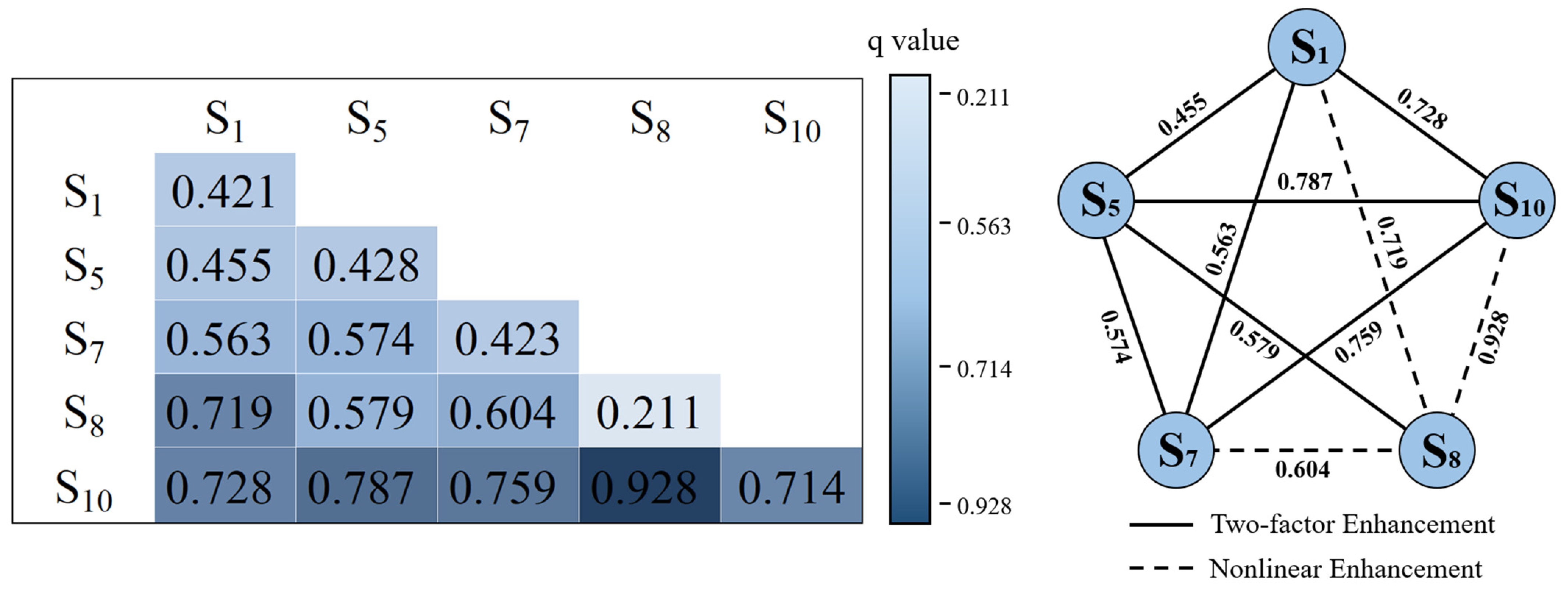
Given that the effects of different variables on the dependent variable are typically not independent, interaction detection analysis was conducted on the five independent variables that passed the significance test [35]. Altitude, contour density, relief amplitude, soil properties, and lithology are denoted as S1, S5, S7, S8, and S10, respectively. The results indicate that the effects of independent variables are not mutually independent but exhibit strong interaction effects. When the combined explanatory power of two variables exceeds that of either variable acting independently, the interaction is defined as a two-factor enhancement effect. When the combined explanatory power of two variables exceeds the sum of their individual explanatory powers, the interaction is classified as a nonlinear enhancement effect.
As shown in Table 4 and Figure 8, the interactions between lithology and altitude, relief amplitude, and soil properties exhibit nonlinear enhancement effects, whereas the remaining seven interaction groups display two-factor enhancement effects.
In terms of post-interaction explanatory power, the interaction groups can be classified into three hierarchical tiers. The first tier comprises interactions between lithology and other influencing variables, with explanatory power ranging from 71.9% to 92.8% and exhibiting the highest statistical significance among all groups, indicating that lithology-driven interactions provide the strongest explanation for the spatial distribution of iron smelting sites in Guangxi. Among these, the interaction between lithology and soil properties exhibits explanatory power of 92.8%, indicating that site distribution is most strongly controlled by the combined effects of these two variables. The second tier includes interaction groups between soil properties and contour density, as well as relief amplitude, with explanatory power ranging from 60.4% to 71.9%, indicating that the combined effects of these variables represent key drivers of iron smelting site selection. The third tier comprises pairwise interactions between contour density, relief amplitude, and altitude, with explanatory power ranging from 45.5% to 57.4%, reflecting the comparatively weaker influence of these interactions on site distribution.
In terms of post-interaction effect intensity, interaction effects can be systematically classified into two categories: two-factor enhancement and nonlinear enhancement. Interactions between lithology and soil properties, contour density, and altitude exhibit nonlinear enhancement effects, indicating that the influence of these factor variable pairs on site distribution exceeds that of the corresponding individual variables and surpasses the additive effects expected under superposition. This nonlinear synergy is consistent with the quantitative pattern observed in recent metallurgical site studies, confirming that ancient iron production was a multifactor decision rather than a response to single environmental conditions [36]. The remaining seven interaction groups exhibit two-factor enhancement effects, indicating that the combined explanatory power of pairwise interactions among soil properties, contour density, relief amplitude, and altitude exceeds that of each variable; that is, the influence of interacting variables on the dependent variable is stronger than that of any single variable.
Across all interaction types, the explanatory power of variable interactions exceeds that of any corresponding single variable acting alone, confirming that the spatial distribution of iron smelting sites in Guangxi is governed by strong synergistic effects arising from the interaction of multiple factors rather than by individual independent variables.

4. Discussion

4.1. Development and Differentiation of Iron Smelting Technologies

The technological systems associated with iron smelting sites in Guangxi exhibit distinct temporal and regional characteristics and can be classified into two principal categories: bloomery iron smelting and cast-iron smelting. During the Han and Tang dynasties, iron smelting technology occupied a central position, as represented by Liuchen (Pingnan–Luoxiu) within the Guiping iron smelting site group in Guigang City and the Houbeishan Site in Wuzhou City. This technique employs a low-temperature solid-state reduction process at 800–1000 °C, producing porous bloomery iron with a carbon content of less than 0.02%. Although this product has a relatively loose microstructure, impurities can be removed, and the material can be hardened through repeated forging and carburisation, resulting in carburised bloomery steel [37]. During the Tang–Song dynasties, cast iron smelting technology was widely adopted, with the Lüya iron smelting site group in Xingye County serving as a representative example. This technique employs a high-temperature liquid-state reduction process at temperatures exceeding 1200 °C, producing cast iron characterised by a hypoeutectic white cast iron microstructure. This process incorporates manganese ore as a flux, utilising Guangxi’s abundant manganese resources to lower the slag melting point and enhance its fluidity. Meanwhile, Mn facilitates desulfurisation and deoxidation of the melt, thereby optimising the hardness and strength of the final product (with optimal modification occurring at Mn contents of 1.0–3.0%). This process was relatively rare in ancient global iron smelting practices, representing an important technological innovation in Guangxi’s historical metallurgical development [38]. In recent years, archaeological and technological research has focused more on Eurasian bloomery ironmaking technology. This study further clarifies the spatial technological transformation from bloomery ironmaking to cast iron in Lingnan, providing new comparative data for the evolution of China’s iron smelting technology [39].
In terms of fuel, charcoal served as the primary fuel and reducing agent in both technological systems, as evidenced by the widespread presence of charcoal fragments and residual wood textures in slag recovered from these sites. The design of blast systems and furnaces also exhibits cross-system uniformity; all tuyères are cylindrical and composed of clay tempered with sand. For bloomery iron production, smelting furnaces are classified into two types: the “bowl-shaped” furnace (a semi-subterranean structure, wider at the top and narrower at the base with a round bottom) and the “shaft” furnace (a small, regular-shaped vertical shaft furnace). These two furnace types are functionally complementary and are suitable for small-scale smelting operations. At cast iron smelting sites represented by Chongtangling, large shaft furnaces predominate, with a residual height of up to 2 m and furnace diameters of approximately 1.1 m, meeting the thermal requirements of high-temperature smelting; such production processes typically require coordinated labour among multiple workers.

4.2. Influencing Factors on Site Selection

4.2.1. Iron Smelting Site Selection and Scientific and Technological Development

The Han Dynasty represents a major period of political unification in Chinese history following the Qin Dynasty. Over its more than forty years of governance, iron smelting technology achieved significant advances, including major developments in both smelting equipment and smelting–casting processes [40]. Specifically, three core technological breakthroughs can be identified: (1) improvement of iron smelting blast furnaces, which increased furnace volume and elevated operating temperatures; (2) optimisation of annealing furnaces, enabling more precise control of heat-treatment processes; (3) the initial development of puddling technology, which reduced the carbon content of iron products. Archaeological remains, including tuyères (blast pipes) and smelting slag, were unearthed at a Han Dynasty iron smelting site in Guigang. Smelting technology is reflected in the design and structural configuration of semi-subterranean furnaces. The spatial pattern of these small-scale smelting workshops aligns with the previously documented small-scale, decentralised smelting and mini-furnace cluster production system. These smelting furnaces typically exhibit circular or oval planar geometries, with the furnace walls and bases constructed from clay–sand mixtures. The furnace opening and slag discharge channel were strategically positioned on the downslope side, with the “bowl-shaped” furnace representing a typical configuration [41]. During the smelting process, iron ore is first crushed and then subjected to high-temperature reduction, producing slags with distinct physical properties, including dense, fluid slag and porous, nonflow slag. These characteristics indicate that bloomery iron smelting technology had been effectively mastered and applied in the region during this period. Iron smelting site selection is primarily reflected in the practice of locating smelting workshops close to ore resources, with small-scale facilities situated in remote mountainous areas rich in iron deposits and generally distant from major water sources. This siting strategy stemmed from two key factors. First, small-scale production required relatively little water, which could be satisfied by manual transport. Second, underdeveloped mining techniques forced production to rely heavily on the spatial distribution of iron ore. This siting strategy reflects the practical difficulties of ore extraction and the ancient producers’ dependence on locally available natural resources for smelting activities. Similar to recent research on iron smelting sites in North China [42], the scattered pattern of small furnaces in southeastern Guangxi also exhibits strong near-ore dependence characteristics, consistent with the distribution of mineral resources and transportation capacity from the Han to Tang dynasties.
The Yulin iron smelting site group dates to the Tang–Song dynasties. Iron production flourished during the Tang Dynasty, with iron mines established across the region and metallurgical processes, including smelting and forging, being widely implemented. During the early Yuanhe era of Emperor Xianzong of the Tang Dynasty (806–820 CE), the annual iron output exceeded 10 million jin (a traditional Chinese unit of mass, approximately 0.5 kg per jin). Blacksmiths during the Tang Dynasty adopted high-temperature smelting processes to improve iron purity, thereby significantly enhancing the quality of iron products. During the Northern Song Dynasty, coal was extensively utilised as a primary fuel for iron smelting in the Central Plains region [43], significantly enhancing smelting efficiency and advancing iron smelting technology. Although charcoal remained the primary fuel for iron smelting in the Lingnan region, furnace design and smelting processes were significantly optimised under the influence of Central Plains technological systems, leading to improved thermal efficiency and process control. The Yulin iron smelting site group is large in scale and rich in archaeological remains, including shaft furnaces, tuyères (blast pipes), and substantial quantities of slag. The smelting products from this site group have been identified as cast iron [44]. This finding is consistent with the pronounced spatial clustering characteristics of the Yulin site group identified in previous factor detection analyses, which represent an agglomerated distribution directly reflecting the development of intensive blast furnace smelting technology. The areas surrounding the site group are characterised by rocks with thick, deep-red weathering crusts and iron-rich soil, and the site group is located adjacent to iron ore-producing areas, ensuring a reliable supply of raw materials. In addition, abundant charcoal resources and nearby water sources meet the substantial fuel demands for iron smelting and facilitate the transport and trade of iron products.

4.2.2. Iron Smelting Site Selection and Natural Environment

Guigang and Wuzhou are located within a subtropical monsoon climate zone characterised by four distinct seasons and synchronised rainfall and temperature patterns. As recorded in the Geography Treatise of the Book of Tang, “The Huaze Commandery of Guizhou presented gold, silver, and lead artifacts as tributes to the imperial court,” indicating that the region (ancient Guizhou Huaize Commandery) was endowed with abundant mineral resources and was capable of sustaining metallurgical production for imperial tribute. Iron smelting site groups in these two regions are concentrated within the hilly terrain of the Baisha River Basin in the upper reaches of the Pearl River, at elevations of 80–189 m, which are favourable for ore extraction, smelting, and transport. Iron ore deposits are mainly distributed in Guiping City, Cenxi City, Teng County, and surrounding regions and are characterised by relatively high sulfur (S) and aluminium (Al) contents. Sulfur reacts with Fe to form FeS compounds, which can alter slag chemistry and reduce desulfurisation efficiency [45]. This indicates that the spatial distribution of iron ore deposits was considered during site selection in these regions, as further evidenced by the elevated sulfur and aluminium contents detected in excavated slag [46]. In addition, the local geological framework is dominated by lithological units such as Mesozoic (Triassic) medium-grained porphyritic cordierite–biotite monzogranite and Palaeozoic (Permian) medium- to coarse-grained allanite–hornblende syenogranite, which are geochemically enriched in elements such as silicon, iron, and manganese and may contribute to enhanced smelting efficiency and thermal stability. The local soils are dominated by red and latosolic red soils, which are favourable for ore extraction, construction of smelting facilities, and agricultural activities supporting the subsistence needs of iron smelting workers.
The Tang–Song iron smelting site group in Yulin is primarily distributed in Long’an Town, Xingye County, and surrounding areas within Yulin City. Compared with Guigang, Yulin possesses more abundant ferromanganese ore resources, which are distributed across surrounding mountainous and fluvial zones, including Shachan Ridge and Shizi Ridge [47]. Iron ores in these areas are characterised by high grade, favourable exploitability, and large reserve capacity, thereby providing sufficient raw materials for iron smelting activities. Lithology is the dominant factor controlling the spatial distribution of iron smelting sites in Guangxi (q = 0.714), and the abundant ferromanganese ore resources in Yulin represent a key manifestation of lithology-controlled site selection. Archaeological surveys indicate that Mn ores occur in areas such as Chencun, Xinzhuang, and Chenghuang (Xingye County) in Yulin, with high-grade enriched Mn ores primarily concentrated in Chencun and Xinzhuang [48]. As an alloying element in Fe, Mn enhances the strength and hardness of the resulting iron products [49]. The site group is located within hilly terrain at elevations ranging from 88 to 202 m. Compared with Guigang, Yulin receives more abundant and more evenly distributed annual precipitation, providing stable climatic conditions for iron smelting activities. The Nanliu River and its tributaries traverse Yulin, providing substantial water discharge and favourable navigation conditions that facilitate the transport of smelted iron products and the supply of raw materials. In addition, soils in Yulin exhibit relatively high iron–aluminium (Fe–Al) content; the yellowish-blue clay in Shachan Ridge [50] serves as a high-quality raw material for iron smelting, and the region also contains abundant haematite resources. A comprehensive comparison indicates that Yulin possessed comparative advantages in precipitation, hydrological systems, soil properties, and mineral resources, collectively providing a favourable environmental basis for the development of the local iron smelting industry during this period. This result diverges from most prior GIS-based archaeological studies, which typically prioritise single topographic or hydrological variables [42]. It demonstrates that metallurgical sites are more sensitive to coupled lithological–soil conditions, as these directly constrain furnace construction and raw material procurement.

4.2.3. Site Selection of Iron Smelting and the Human–Environment Relationship

After the First Emperor of Qin unified the Lingnan region, he implemented the policy of Heji Baiyue (harmonising and pacifying the Baiyue groups) and established three commanderies in Lingnan, with the administrative centre of Guilin Commandery located in Bushan (covering most of present-day Guangxi and parts of Guangdong). The development of infrastructure, including the Lingqu Canal, facilitated economic and cultural exchange between Lingnan and the Central Plains, thereby establishing a robust socio-economic foundation for the expansion of iron smelting activities in Guigang during the Han Dynasty. The Han Dynasty inherited and further consolidated the centralised administrative system established during the Qin Dynasty, thereby enforcing more stringent governance over local administrative regions. As recorded in the Discourses on Salt and Iron (“Criticism of Shang Yang”), “Under Emperor Wen’s reign, the people thrived even without state monopolies over salt and iron production”, indicating that the free trade system for iron in the early Han Dynasty promoted the rapid development of these industries and facilitated the dissemination of iron smelting technology in the Lingnan region. Meanwhile, as documented in Volume 24 of the Book of Han, “The primary state policy was to encourage the populace to engage in agricultural production”. To this end, the rulers implemented a series of practical, agriculture-oriented policies aimed at encouraging a return to farming, stabilising the agricultural population, and promoting agricultural development. These pro-agricultural policies created favourable socio-economic conditions for the widespread adoption and use of iron tools in the Lingnan region. Cultural exchanges between the Central Plains and Guangxi also contributed to the advancement of iron smelting technology. As recorded in the Records of the Grand Historian (“Annals of Qin Shi Huang”), “In the 33rd year of his reign, Qin Shi Huang sent exiles, matrilocal husbands, and merchants to conquer the Luliang area”. Notably, iron smelting sites in Guigang exhibit distinct structural and technological similarities with those in South and Southeast Asia, and GIS-based spatial analysis further confirms that these correspondences are not coincidental but reflect underlying patterns of technological diffusion. Guangxi is situated in the southwestern coastal region of China, bordering the Beibu Gulf to the south and Vietnam to the southwest, thereby occupying a strategic geographical position for regional connectivity and cross-border exchange. As a key transitional zone between the Central Plains and Southeast Asia, its geographical position provides favourable conditions for the cross-regional diffusion of iron smelting technologies. As a strategic hub facilitating interactions between Lingnan and the Central Plains, Guigang became a core node for the diffusion of iron smelting technologies. Specifically, tuyères (blast pipes) unearthed from iron smelting sites, including Ban Di Lung in Thailand [51], Naikund in India [52], and Alakolavava and Samanalavava in Sri Lanka [53], exhibit comparable structural morphologies to those excavated in Guangxi, indicating shared technological design principles. This indicates that, under the influence of Central Plains culture, Guigang absorbed advanced iron smelting technologies and functioned as an important node for their dissemination to surrounding regions, including South and Southeast Asia. In addition, the Liuchen Han Dynasty iron smelting site group in Pingnan County, Guigang—the earliest iron smelting site identified in Guangxi and the broader Lingnan region—exhibits technical features that both reflect Central Plains metallurgical traditions [17] and show affinities with iron smelting sites in South and Southeast Asia, thereby providing critical evidence for reconstructing the transmission pathways of Central Plains iron smelting technologies to Southeast Asia via northern Vietnam.
During the early Tang Dynasty, most areas of present-day Guangxi were under the jurisdiction of the three administrative prefectures of Gui, Rong, and Yong within the Lingnan Circuit. In the third year of the Xiantong era (862 CE), the Lingnan Circuit was divided into the East and West Lingnan Circuits, and the Jinglüe Commissioner (military and civil administrator) of Yongguan was concurrently appointed as the Jiedushi (military governor) of the West Lingnan Circuit, a measure that further strengthened centralised governance. Long’an Town was historically known as “Lüxia”, which later evolved into “Lüya” through phonetic transformation. Lüya became a key town in Lingnan during the Northern Song Dynasty and developed into one of the major iron smelting centres in China during the Southern Song dynasty, commonly referred to as the Lüya Smelting Site. After the Northern Song Dynasty, adjustments in production relations and the rise of privately operated iron smelting industries [54] further promoted the development of iron smelting in Yulin. Yulin is located within the Nanliu River Basin. The Nanliu River and its tributaries, including the Sanshan and Lüya Rivers, provide efficient water transport routes for distributing iron smelting products to various regions, thereby promoting commercial activity and economic development. According to the Yulin City Annals, iron produced at the Lüya Site satisfied local market demand and was also distributed to external regions, including the Censhui iron smelting site in Shaozhou, indicating the existence of an organised regional trade network. Furthermore, as documented in A Topographical Account of the Imperial Realm (Yudi Jisheng), “The Lüya Site, located in Nanliu County, produced 64,700 jin of iron annually, which was transported to the warehouse of the Censhui Site in Shaozhou for handover”, indicating that the Lüya Site functioned as a major iron smelting centre during the Southern Song Dynasty, with substantial output distributed to distant regions through established trade networks.

5. Conclusions

At present, research on iron smelting sites in southeastern Guangxi mainly focuses on archaeological investigations and technical analyses of metallurgical remains, with an emphasis on studying ancient smelting processes and reconstructing smelting processes through slag analysis. Quantitative spatial research based on GIS remains relatively limited. This study focuses on 38 iron smelting sites from the Han Dynasty to the Song Dynasty, systematically revealing the spatial clustering pattern, dominant controlling factors, and interactive mechanisms of ancient iron smelting sites. The results indicate that the iron smelting sites in the study area are clustered in three centres, with the highest density in Pingnan County; lithology is the primary controlling factor (q = 0.714), followed by contour density, terrain undulation, elevation, and soil properties, all of which exhibit significant synergistic enhancement effects. The study distinguishes two typical technological systems, namely bloomery ironmaking and cast iron, whose site-selection logic is closely coupled with technological evolution and production scales.
This study quantitatively reveals the spatial heterogeneity and multifactorial driving mechanisms of iron smelting sites in southeastern Guangxi, establishes a framework linking spatial distribution with the evolution of iron smelting technology, and elucidates the relationship between site-layout patterns and the transformation from bloomery iron smelting to cast-iron technology. The study provides a replicable quantitative analysis framework for spatial patterns of metallurgical archaeological sites, which can be extended to other metallurgical heritage groups. The research enriches the theoretical framework of archaeological geography and metallurgical archaeology, deepens the understanding of the human–environment relationship in ancient metallurgical production, and provides a new quantitative paradigm for studying technological diffusion along the Maritime Silk Road. In addition, the identified key controlling factors and suitable areas can provide a scientific basis for archaeological investigation, site protection, heritage management, and regional cultural relic planning in southeastern Guangxi.
This study also has certain limitations. For example, the analysis did not include variables related to human factors, and some sites were not accurately distinguished in terms of time series. Future research could expand the sample size and incorporate human-related indicators to refine the influencing-factor system and further explore the coupling relationship between ironmaking technology and site spatial distribution. On this basis, future research will delve into the development logic of the ancient ironmaking industry in southern China. Reconstructing the ancient iron smelting technology system and trade network in Lingnan provides important empirical support for studying cultural exchanges between China and Southeast Asia in the context of the Maritime Silk Road.

Author Contributions

Conceptualization, G.Z. and R.L.; methodology, R.L.; formal analysis, G.Z.; investigation, Q.H. and J.B.; resources, Y.Z.; writing—original draft preparation, G.Z. and R.L.; writing—review and editing, R.L.; visualisation, R.L.; supervision, G.Z. and Q.H.; project administration, G.Z.; funding acquisition, G.Z. and J.B. All authors have read and agreed to the published version of the manuscript.

Funding

This research was funded by the Research Fund by Science and Technology Plan Project of Guangxi, China (No. Guike AD23026242), the Research Fund by Innovation Project of Guangxi Graduate Education (YCSW2025333), the Major Project of Key Research Bases for Humanities and Social Sciences in Guangxi Universities in 2025 (No. 2025JDZD004), the Innovation Project of Guangxi University for Nationalities Graduate Education (gxmzu-chxs2025151).

Data Availability Statement

The data is available on request from the corresponding author. The data is not publicly available.

Acknowledgments

We are grateful to anonymous reviewers for their comments and suggestions.

Conflicts of Interest

The authors declare no conflicts of interest.

Abbreviations

GISGeographic Information Systems
UAVUnmanned Aerial Vehicle
GZARThe Guangxi Zhuang Autonomous Region
KDEKernel Density Estimation
SSHSpatial Stratified Heterogeneity
ACfFerric Acrisols
AChHaplic Acrisols
ACuHumic Acrisols
ALhHaplic Alisols
ATcCumulic Anthrosols
CMdDystric Cambisols
CMeEutric Cambisols
CMoFerralic Cambisols
FLcCalcaric Fluvisols
FLeEutric Fluvisols
FRhHaplic Ferralsols
GLeEutric Gleysols
LVhHaplic Luvisols
RGdDystric Regosols
RKRock outcrops
WRWater bodies
LPPlain
SHMedium-gradient hill
SMMedium-gradient mountain
SPDissected plain
THhigh-gradient hill
TMhigh-gradient mountain
IA1Granite
IA4Rhyolite
MA1Quartzite
MB1Slate, phyllite (pelticrocks)
MB1/2Quartzite/Slate
RKRock outcrop
SC16Sandstone
SC2greywacke, arkose
SC4Shale
SO1Limestone, othercarbonate rocks
UFFluvial
UMMarine
UR1Clastic rock

References

  1. Zou, G.; Meng, C.; Li, Y.; Huang, Q. Preliminary Study on Smelting Technology at Houbeishan Site in Wuzhou, Guangxi. Nonferrous Met. Smelt. 2022, 8, 141–146. (In Chinese) [Google Scholar]
  2. Burja, J.; Šetina Batič, B.; Pavlovič, D. Characterization of Bloom Iron Smelting Site Remains in Pržanj, Slovenia. Heritage 2024, 7, 3919–3931. [Google Scholar] [CrossRef]
  3. Zhang, Z.; Zou, Y.; Sun, K.; Xu, H.; Hu, Y.; Qian, W.; Chen, J. Study on Technical Characteristics of Iron Smelting Site Group in Lushan, Henan. Huaxia Archaeol. 2022, 2, 82–96. (In Chinese) [Google Scholar]
  4. Li, P.; Liu, H.; Qian, W.; Li, Y.; Chen, J. Preliminary Application of GIS in Landscape Archaeology Research of Liao Dynasty Iron Smelting Sites in Yanqing, Beijing. Sci. Conserv. Archaeol. 2016, 28, 86–92. (In Chinese) [Google Scholar]
  5. Zhao, J.; Feng, J.; Wang, Y. Research on Cultural Center Migration and Environmental Archaeology of Neolithic Settlement Sites in Xi’an. J. Arid Land Resour. Environ. 2021, 35, 87–93. (In Chinese) [Google Scholar]
  6. Zhang, S.; Wei, Q.; Zhao, Y. Analysis of Salt Production and Related Issues in Northern Shandong during the Eastern Zhou Period. South. Cult. Relics 2023, 3, 216–222. (In Chinese) [Google Scholar]
  7. Xu, L. Research on Human-Environment Relationship of Goguryeo-Bohai in Northeast China Supported by GIS. Master’s Thesis, Changchun Normal University, Changchun, China, 2024. (In Chinese) [Google Scholar]
  8. Duan, Y.; Zhang, Y. Study on Spatiotemporal Evolution Characteristics and Influencing Factors of Cultural Heritage in Shanxi Province: A Case Study of Cultural Relics Protection Units. Resour. Dev. Mark. 2024, 40, 1094–1102. (In Chinese) [Google Scholar]
  9. Zhang, J. Spatiotemporal Distribution Characteristics and Influencing Factors Analysis of Cultural Landscape of Scenic Spot Toponyms in Hunan Province. Master’s Thesis, Central South University of Forestry and Technology, Changsha, China, 2024. (In Chinese) [Google Scholar]
  10. Hu, H. Spatiotemporal Distribution Characteristics of Cultural Heritage in Xiangxi Prefecture and Construction of Spatial Protection Network System. Master’s Thesis, Central South University of Forestry and Technology, Changsha, China, 2023. (In Chinese) [Google Scholar]
  11. Huang, Q.; Li, Y.; Zheng, C.; Chen, J.; Feng, G.; Zhu, L. Scientific Research on Iron Artifacts Excavated from Warring States to Han Dynasty Tombs in Guangxi. South. Cult. Relics 2016, 1, 109–114. (In Chinese) [Google Scholar]
  12. Huang, Q. Investigation and Research on Ancient Iron Smelting Sites in Guigang Area, Guangxi; Lijiang Publishing House: Guilin, China, 2013. (In Chinese) [Google Scholar]
  13. Meng, Z. Archaeological Discovery and Research of Early Iron Smelting Sites in Guangxi. Guangxi Cult. Mus. 2017, 93–107. (In Chinese) [Google Scholar]
  14. Huang, Q.; Li, Y.; Wan, F. Preliminary Investigation of Ancient Lüya Smelting Site in Xingye, Guangxi. J. Guangxi Univ. Natl. (Nat. Sci. Ed.) 2007, 2, 23–27. (In Chinese) [Google Scholar]
  15. Yu, Y. Preliminary Investigation and Research on Five Locations of Ancient Lüya Iron Smelting Site Group in Xingye, Guangxi. Master’s Thesis, University of Science and Technology Beijing, Beijing, China, 2010. (In Chinese) [Google Scholar]
  16. Liang, C. Preliminary Study on Iron Smelting Site at Liuxi Village in Xingye, Guangxi. Identif. Apprec. Cult. Relics 2020, 7, 157–158. (In Chinese) [Google Scholar]
  17. Li, Y. Guangxi Pingnan “Bowl-Type” Smelting Furnace and the Origin of “Bowl-Type” Furnaces in China. Archaeology 2014, 6, 64–79. (In Chinese) [Google Scholar]
  18. Zhang, J.; Zhang, H.; Li, J.; Wang, H.; Zhang, C.; Dong, J.; Lin, C.; Zhang, C.; Zhang, J.; Li, X.; et al. Spatiotemporal evolution characteristics and influencing factors of traditional villages: The Yellow River Basin in Henan Province, China. Herit. Sci. 2023, 11, 97. [Google Scholar] [CrossRef]
  19. Wang, Y.; Qin, Z.; Hou, W.; Storozum, M. Water Conservancy System and Urban Layout of Yinxu, the Capital City of Shang: A GIS Approach. Land 2022, 11, 986. [Google Scholar] [CrossRef]
  20. Duyckaerts, C.; Godefroy, G. Voronoi Tessellation to Study the Numerical Density and the Spatial Distribution of Neurones. J. Chem. Neuroanat. 2000, 20, 83–92. [Google Scholar] [CrossRef] [PubMed]
  21. Li, K.; Huang, Z.; Pang, Y.; Chen, S.; Fan, Y.; Yin, M.; Shi, C. Cultural heritage of the Qin-Shu Ancient Road in Shaanxi: Spatial distribution characteristics and influencing factors. PLoS ONE 2025, 20, e0331676. [Google Scholar] [CrossRef] [PubMed]
  22. Jin, T.; Yu, F. Spatial distribution characteristics and influencing factors of Suzhou traditional villages from the perspective of “Millennium Village”. npj Herit. Sci. 2026, 14, 172. [Google Scholar] [CrossRef]
  23. Xiao, W.; Huang, E.; Li, C.; Li, H. Investigating the spatial distribution and influencing factors of traditional villages in Qiandongnan based on ArcGIS and geodetector. Sci. Rep. 2025, 15, 5786. [Google Scholar] [CrossRef]
  24. Guo, Y.; He, P.; Huang, J. Exploring the spatial and temporal distribution mechanism and multidimensional influencing factors of traditional villages in the Huaihe River Basin of China based on geographic grids. Humanit. Soc. Sci. Commun. 2025, 12, 1393. [Google Scholar] [CrossRef]
  25. Wang, J.; Zhang, T.; Fu, B. A Measure of Spatial Stratified Heterogeneity. Ecol. Indic. 2016, 67, 250–256. [Google Scholar] [CrossRef]
  26. Qiu, J.; Jin, J.; Ren, Y.; Zuo, X.; Li, Z. Distribution characteristics and environmental background of Neolithic-Bronze Age settlement sites in the Tingjiang River Basin, Fujian. J. Mt. Sci. 2021, 39, 791–805. (In Chinese) [Google Scholar]
  27. Jia, X.; Li, F.; Cui, M.; Cheng, G.; Zhao, Y.; Ding, H.; Yu, B.; Lu, H. Geographical environmental characteristics and differences in production modes among Tibetan and other major ethnic groups in the Hehuang Valley. Sci. China Earth Sci. 2019, 49, 706–716. (In Chinese) [Google Scholar]
  28. Li, J.; Li, F. Spatial distribution and influencing factors of Han Dynasty village sites along the Silk Road in Gansu Province. J. Earth Environ. 2023, 14, 444–457. (In Chinese) [Google Scholar]
  29. Du, X.; Hu, X.; Jin, X.; Gong, W.; Cao, S. Spatiotemporal differentiation characteristics and influencing factors of mid-late Neolithic settlements in the Dongting Lake Basin. J. Hum. Settl. West China 2022, 37, 135–143. (In Chinese) [Google Scholar]
  30. Li, J.; Liu, W. Spatial distribution and influencing factors of Han Dynasty village sites along the Silk Road in Ningxia. Arid Land Geogr. 2022, 45, 1291–1301. (In Chinese) [Google Scholar]
  31. Du, X.; Hu, X.; Jin, X.; Cao, S.; Luo, Z.; Wei, B. Human settlement suitability evaluation of Neolithic settlement sites in Hunan based on geographical detectors. J. Earth Environ. 2021, 12, 269–278. (In Chinese) [Google Scholar]
  32. Liu, F.; Dong, F. Diagnosis and treatment methods of multicollinearity in econometrics. J. Zhongyuan Univ. Technol. 2020, 31, 44–48, 55. (In Chinese) [Google Scholar]
  33. Liu, H. Preliminary Study on Materials of Ancient Chinese Iron Smelting Furnace Walls. Ph.D. Dissertation, University of Science and Technology Beijing, Beijing, China, 2015. (In Chinese) [Google Scholar]
  34. Yu, X.; Zhang, W.; Wang, H.; Ye, X.; Lin, Z. Transformation of iron-bearing minerals and iron resource cycling. Resour. Conserv. Recycl. 2025, 220, 108353. [Google Scholar] [CrossRef]
  35. Sun, L.; Hou, X.; Yang, L. Study on the Dynamic Evolution and Driving Forces of High-Quality Development of Coal Cities in China. Sustainability 2025, 17, 1707. [Google Scholar] [CrossRef]
  36. Kupczak, K.; Warchulski, R.; Gawęda, A.; Janiec, J. Bloomery iron production in the Holy Cross Mountains (Poland) area during the Roman period: Conditions during the metallurgical process and their uniformity between locations. Herit. Sci. 2024, 12, 147. [Google Scholar] [CrossRef]
  37. Meng, C.; Zou, G. Preliminary study on the Six Dynasties iron smelting site in Wuzhou, Guangxi. Met. World 2017, 4, 11–17. (In Chinese) [Google Scholar]
  38. Liu, Y.; Tian, Y.; Chen, K. Archaeometric study of the iron objects from the Xuechi sacrificial site and its implication for bloomery iron smelting during early Western Han period in China. Archaeometry 2024, 66, 1050–1062. [Google Scholar] [CrossRef]
  39. Wood, J.R.; Liu, Y. Trajectories of adoption for silver and bloomery iron in China from the Spring and Autumn period (c. 770–476 BC). Archaeometry 2025, 67, 1267–1282. [Google Scholar] [CrossRef]
  40. Zhang, H. Brief discussion on the development of iron smelting technology in the Han Dynasty. Identif. Apprec. Cult. Relics 2022, 22, 166–169. (In Chinese) [Google Scholar]
  41. Zou, G.; Meng, Z.; Li, Y.; Huang, Q.; Cui, C. From bowl furnaces to small shaft furnaces: New evidence from ancient bloomery iron smelting site at Liuzhuoling in Guangxi, Southern China, ca. 400 to 700 AD. Archaeol. Anthropol. Sci. 2022, 14, 54–65. [Google Scholar] [CrossRef]
  42. Lam, W.; Chen, J.; Chong, J.; Lei, X.; Tam, W.L. An iron production and exchange system at the center of the Western Han Empire: Scientific study of iron products and manufacturing remains from the Taicheng site complex. J. Archaeol. Sci. 2018, 100, 88–101. [Google Scholar] [CrossRef]
  43. Chai, G. New developments in coal utilization in the Central Plains during the Han Dynasty. J. Nanyang Inst. Technol. 2015, 7, 70–73. (In Chinese) [Google Scholar]
  44. Huang, Q.; Liang, C.; Li, Y.; Chen, J.; Li, J.; Qin, F. Ancient high-manganese slag from pig iron in Guangxi and the diversified development of Chinese iron smelting technology. South. Cult. Relics 2018, 3, 212–218. (In Chinese) [Google Scholar]
  45. Yang, Q.; Yang, Z.; Ji, J.; Liu, X.; Ji, W.; Wang, J.; Wu, T.; Wang, L. Mineralogical and heavy metal geochemical characteristics of soils rich in Fe-Mn nodules in karst geological high-background areas of Guigang, Guangxi. Mod. Geol. 2021, 35, 1450–1458. (In Chinese) [Google Scholar]
  46. Huang, Q.; Li, Y.; Chen, J.; Gong, H. Preliminary study on the Han Dynasty iron smelting site at Liuxueling in Guigang, Guangxi. South. Ethnol. Archaeol. 2014, 231–238. (In Chinese) [Google Scholar]
  47. Huang, Q.; Liang, C.; Huang, Q.; Zou, G. Preliminary investigation of the ancient casting site at Longqiding in Xingye, Guangxi. Nonferrous Met. (Extr. Metall.) 2021, 11, 128–136. (In Chinese) [Google Scholar]
  48. Bao, G. Spatiotemporal distribution patterns and prospecting directions of manganese deposits in the Yulin-Qinzhou manganese belt. China Met. Bull. 2020, 8, 47–48. (In Chinese) [Google Scholar]
  49. Zhang, Y.; Zhu, P.; Su, S.; Sun, W.; Ding, S. Experimental study on lead ion adsorption from simulated wastewater using manganese metallurgical iron-aluminum slag. Hydrometall. China 2021, 40, 46–51. (In Chinese) [Google Scholar]
  50. Huang, Y.; Lin, S.; Yang, X.; Chen, G.; Liu, B. Soil-forming conditions and characteristics of pedogenesis in ferralitic soils in Guangxi. Southwest China J. Agric. Sci. 2008, 21, 1622–1625. (In Chinese) [Google Scholar]
  51. Suchitta, P. History and Development of Iron Smelting Technology in Thailand. Ph.D. Dissertation, Brown University, Providence, RI, USA, 1983. [Google Scholar]
  52. Prakash, B. Methods of iron-making in early India. In Archaeometallurgy of Iron: Results Achieved 1967–1987; Pleiner, R., Ed.; Academia: Prague, Czech Republic, 1989; pp. 307–332. [Google Scholar]
  53. Juleff, G. An ancient wind-powered iron smelting technology in Sri Lanka. Nature 1996, 379, 60–63. [Google Scholar] [CrossRef]
  54. Liu, C. Review on geographical research of mining and metallurgy industry in the Song Dynasty. Hist. Res. China 2013, 2, 30–37. (In Chinese) [Google Scholar]
Figure 1. Location information of ancient iron smelting sites in Guangxi.
Land 15 00816 g001
Figure 2. Methodological Framework.
Land 15 00816 g002
Figure 3. Types of interaction effects between two independent variables on the dependent variable.
Land 15 00816 g003
Figure 4. Kernel density analysis of iron smelting sites.
Land 15 00816 g004
Figure 5. Thiessen polygons of iron smelting sites.
Land 15 00816 g005
Figure 6. Relationship between the regression outputs and the dependent variable.
Land 15 00816 g006
Figure 7. Influencing factors included in the Geographical Detector analysis.
Land 15 00816 g007
Figure 8. Quantitative representation of the effects of influencing variables based on Geographical Detector analysis.
Land 15 00816 g008
Table 1. Description of variables and indicators influencing the layout of iron smelting sites in the study area.
Influencing FactorData SourceCalculation Method
Altitude X1National Catalogue Service for Geographic Information ResourcesExtraction and analysis via ArcGIS 10.8
Slope X2Geospatial Data CloudExtraction and analysis via ArcGIS 10.8
Aspect X3Geospatial Data CloudExtraction and analysis via ArcGIS 10.8
Distance to rivers X4Resources and Environmental Science and Data Centre, Chinese Academy of SciencesNeighbourhood analysis via ArcGIS 10.8
Contour density X5Resources and Environmental Science and Data Centre, Chinese Academy of SciencesDensity analysis via ArcGIS 10.8
Vegetation coverage X6National Earth System Science Data CentreExtraction and analysis via ArcGIS 10.8
Relief amplitude X7National Catalogue Service for Geographic Information ResourcesExtraction and analysis via ArcGIS 10.8
Soil property X8Resources and Environmental Science and Data Centre, Chinese Academy of SciencesSpatial join via ArcGIS 10.8
Geomorphological hierarchical type X9National Earth System Science Data CentreSpatial join via ArcGIS 10.8
Lithology X10Geological Cloud of China Geological SurveySpatial join via ArcGIS 10.8
Land use type X11Resources and Environmental Science and Data Centre, Chinese Academy of SciencesSpatial join via ArcGIS 10.8
Table 2. Results of the linear regression analysis.
Variable NameBetatSignificance (p)Variance Inflation Factor
Altitude X10.0480.9370.3491.742
Slope X20.0140.2870.93017.007
Aspect X3−0.017−4.270.6701.014
Distance to river X4−0.009−0.2060.8371.108
Contour density X50.0430.8450.3981.619
Vegetation coverage X6−0.013−0.1950.7681.215
Relief amplitude X70.1082.5800.0101.431
Soil properties X8−0.444−5.7520.0013.829
Geomorphic hierarchy X90.0791.7040.0891.388
Lithology X100.6048.3110.0013.389
Land use type X110.0481.1120.2671.199
Table 3. Factor detection results for influencing variables using the Geographical Detector.
Name of Independent Variablep-Valueq StatisticExplanatory Power Ranking
Altitude X1<0.0010.4214
Aspect X30.1230.013
Contour density X5<0.0010.4282
Relief amplitude X7<0.0010.4233
Soil properties X8<0.0010.2115
Geomorphic hierarchy X90.2720.023
Lithology X10<0.0010.7141
Land use type X110.4370.015
Table 4. Results of interaction detection analysis among influencing variables using the Geographical Detector.
Q = A∩BA + BComparison ResultInteraction TypeRank of Post-Interaction Explanatory Power
S1∩S5 = 0.455S1(0.421) + S5(0.428) = 0.849A + B > q > A,BTwo-factor enhancement10
S1∩S7 = 0.563S1(0.421) + S7(0.423) = 0.844A + B > q > A,BTwo-factor enhancement9
S1∩S8 = 0.719S1(0.421) + S8(0.211) = 0.632q > A + BNonlinear enhancement5
S1∩S10 = 0.728S1(0.421) + S10(0.714) = 1.135A + B > q > A,BTwo-factor enhancement4
S5∩S7 = 0.574S5(0.428) + S7(0.423) = 0.851A + B > q > A,BTwo-factor enhancement8
S5∩S8 = 0.579S5(0.428) + S8(0.211) = 0.639A + B > q > A,BTwo-factor enhancement7
S5∩S10 = 0.787S5(0.428) + S10(0.714) = 1.142A + B > q > A,BTwo-factor enhancement2
S7∩S8 = 0.604S7(0.423) + S8(0.211) = 0.634q > A + BNonlinear enhancement6
S7∩S10 = 0.759S7(0.423) + S10(0.714) = 1.137A + B > q > A,BTwo-factor enhancement3
S8∩S10 = 0.928S8(0.211) + S10(0.714) = 0.925q > A + BNonlinear enhancement1
Disclaimer/Publisher’s Note: The statements, opinions and data contained in all publications are solely those of the individual author(s) and contributor(s) and not of MDPI and/or the editor(s). MDPI and/or the editor(s) disclaim responsibility for any injury to people or property resulting from any ideas, methods, instructions or products referred to in the content.