Article

Synergistic Changes in Wetland Carbon Storage and Habitat Quality in the Western Part of Jilin Province and Their Response to Landscape Patterns

School of Geographic Science and Tourism, Jilin Normal University, Siping 136000, China
*
Author to whom correspondence should be addressed.
Land 2026, 15(5), 736; https://doi.org/10.3390/land15050736
Submission received: 21 March 2026 / Revised: 19 April 2026 / Accepted: 23 April 2026 / Published: 26 April 2026
(This article belongs to the Special Issue Carbon Cycling and Carbon Sequestration in Wetlands)

Abstract

As a key component of ecosystems, the synergistic relationship between wetland carbon storage and habitat quality is vital for maintaining ecological functions, and its evolution is profoundly influence by changes in wetlands. This study focuses on wetlands in western Jilin Province. Based on four sets of land use data from 2010 to 2023 and utilizing the InVEST model, combined with methods such as spatial autocorrelation, the Coupled Coordination Degree Model, and the GeoDetector, the study analyzed the co-variation of carbon storage and habitat quality, as well as their response to landscape patterns. The study found that between 2010 and 2023, the wetland area increased by a net 858.13 km2, and landscape fragmentation was generally alleviated, although local connectivity continued to degrade. Regional carbon storage increased by 68.1%, totaling 7.43 × 10⁶ Mg, while the habitat quality index exhibited high spatiotemporal stability, fluctuating marginally between 0.609 and 0.621. Spatially, high-value areas remained primarily concentrated within nature reserves. Results of bivariate spatial autocorrelation analysis revealed a strengthening of spatial positive autocorrelation between carbon storage and habitat quality, with Moran’s I increasing from 0.410 to 0.501. The coupled coordination degree model further confirmed that the level of synergy between the two services exhibited a pattern of higher values in the north and lower values in the south, and that areas of high coordination expanded significantly outward following restoration projects. GeoDetector analysis indicates that the largest patch index is the core factor driving the synergistic development of ecosystem services. The results also suggest that the integrity of core wetland patches and a heterogeneous landscape pattern can promote the synergistic improvement of carbon storage and habitat quality through boundary effects and habitat complementarity.

1. Introduction

As the most effective terrestrial carbon sinks and biological reservoirs, wetlands provide an irreplaceable nexus for regulating the global carbon cycle and sustaining multi-trophic biodiversity [1]. Carbon storage acts as a metric for climate mitigation potential [2]. Habitat quality serves as a proxy for ecosystem health and evolutionary viability [3]. These two ecosystem services are not independent. Instead, they are functionally coupled through nutrient cycling and energy flux [4]. The degree of spatiotemporal synergy between carbon sequestration and habitat maintenance is a definitive hallmark of ecosystem integrity [5]. This synergy is also a prerequisite for the success of systemic ecological restoration.
Landscape patterns serve as the physical template upon which these biogeochemical processes unfold. The spatial configuration of patches governs the movement of water and the transport of nutrients [6]. High levels of connectivity can catalyze synergistic gains by facilitating efficient material exchange [7]. Conversely, anthropogenic fragmentation induces edge effects that alter microclimates and soil stoichiometry [8]. These effects often trigger a trade-off where carbon pools are depleted and habitat specialists are marginalized. Despite the importance of this landscape-function-service cascade, the mechanistic thresholds where landscape evolution drives a shift from service trade-offs to synergies remain poorly understood.
The western Jilin wetlands provide a critical natural laboratory to investigate these dynamics. This region is located in the semi-arid transition zone of the Songnen Plain and exhibits extreme ecological fragility [9]. Over the past four decades, the region has undergone a profound regime shift [10]. Intensive agricultural reclamation and fluctuating hydro-climatic conditions have transformed contiguous marshlands into fragmented patches [11]. Recent interventions, such as the “River–Lake Connectivity Project,” have initiated a phase of ecological recovery. However, unique water-salt coupling effects complicate the resulting landscape evolution. Existing scholarship has focused predominantly on static land-use changes or isolated service evaluations [12]. There remains a lack of quantitative evidence regarding how long-term landscape restructuring dictates the co-evolutionary trajectory of carbon and habitat services [13]. This gap is particularly evident during the transition from degradation to restoration.
This study integrates GIS-based spatial analysis with the InVEST model to address these gaps. We evaluate wetland dynamics in western Jilin from 2010 to 2023. We propose a new framework to identify turning points where landscape indices signal a shift in ecosystem service relationships. This framework provides a more dynamic view than traditional static evaluations. Specifically, we aim to resolve three fundamental questions: (1) What are the structural hallmarks and turning points of landscape evolution in western Jilin as it transitions from exploitation to restoration? (2) How has the spatiotemporal synergy between carbon storage and habitat quality shifted during this landscape evolution? (3) Which landscape factors exhibit the highest statistical contribution to these synergistic changes, and how do their interactions influence the explanatory power of the model?

2. Materials and Methods

2.1. Study Area

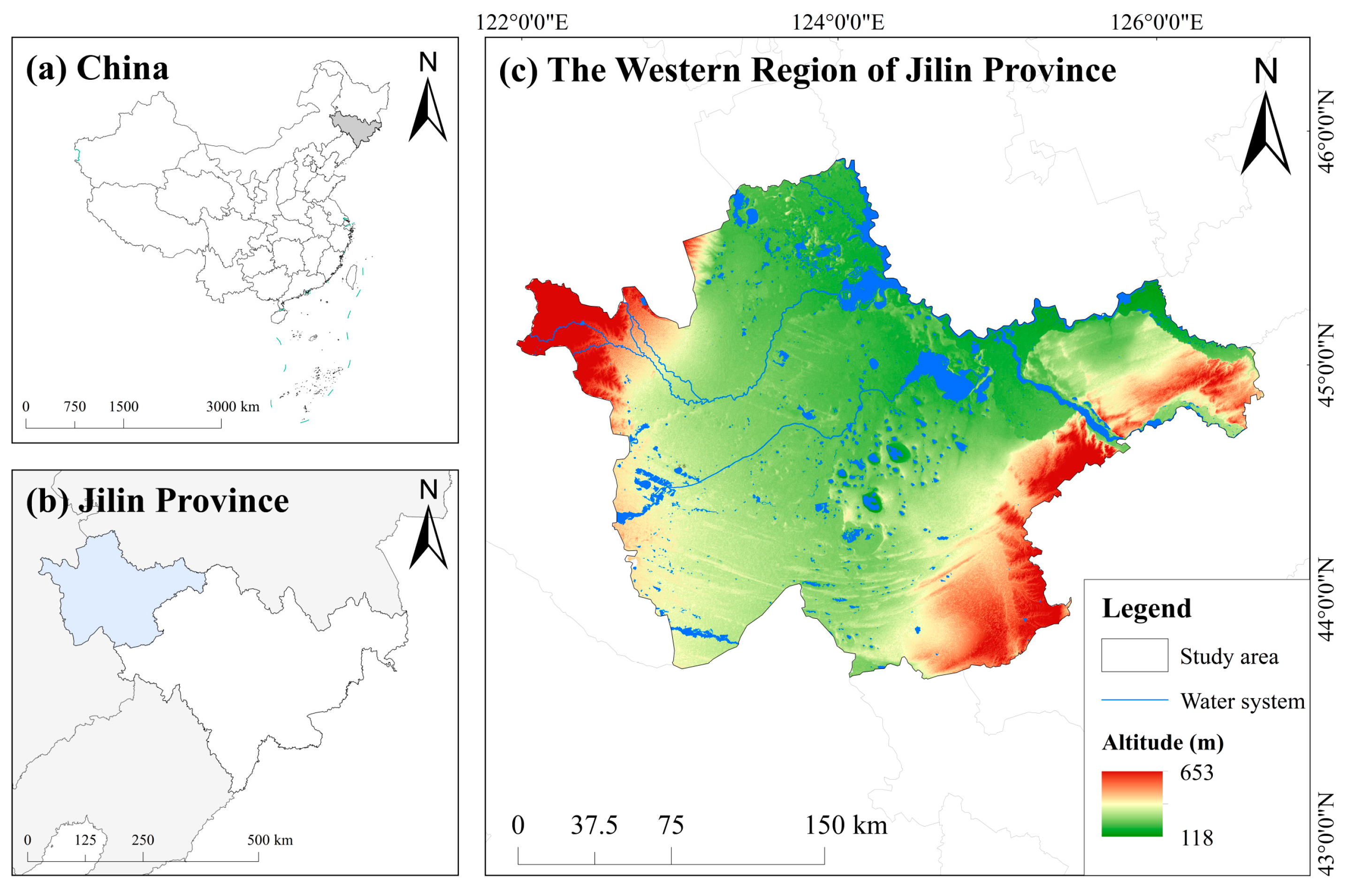
The western region of Jilin Province is located in the southwestern part of the Songnen Plain and constitutes the core area of the ecologically fragile zone in northern China (Figure 1). It lies between 43°59′29″ N and 46°18′22″ N, and 121°38′18″ E and 126°11′19″ E, and includes Baicheng City, Zhenlai County, Da’an City, Taonan City, Tongyu County, Fuyu City, Qianguoerlos Mongol Autonomous County, Qian’an County, Changling County, and Songyuan City-a total of 10 cities and counties. As of the end of 2023, the total permanent resident population of the study area was 3.5932 million, and the regional gross domestic product (GDP) was 237.12 billion yuan; compared with 2010 (when the total permanent resident population was 4.9269 million and GDP was 273.27 billion yuan), both figures showed a downward trend. The western region of Jilin Province is situated in the transitional zone between semi-arid and semi-humid areas, characterized by a continental monsoon climate. The long-term average temperature is approximately 3–6 °C, the long-term average precipitation is approximately 400–600 mm, and the long-term average evaporation is approximately 1500–1900 mm [14]. The region slopes from southeast to northwest, with a landscape dominated by plains, including land-use types such as grasslands, lakes, wetlands, and sandy areas. Rivers flowing through the study area include the Nenjiang, Songhua, and Tao’er Rivers, and the region contains numerous large wetlands such as Xianghai, Momoge, Yueliangpao, and Chagan Lake [15]. In recent years, Jilin Province has implemented a series of ecological restoration projects in degraded wetlands in its western region. These projects primarily include waterway connectivity, vegetation restoration, and habitat creation. Concurrently, the region has advanced land reclamation measures, such as converting farmland back to wetlands and converting aquaculture areas back to tidal flats. Through these efforts, the ecosystem structure of degraded wetlands in western Jilin Province has been effectively restored. Taking the Xianghai, Momoge, and Niuxintaobao wetlands as examples, the introduction of flowing water through projects such as “river-lake connectivity” has expanded water areas, alleviated water shortages and drought conditions in the wetlands, and facilitated progress in vegetation restoration, with improved growth of wetland plants such as reeds.

2.2. Research Framework

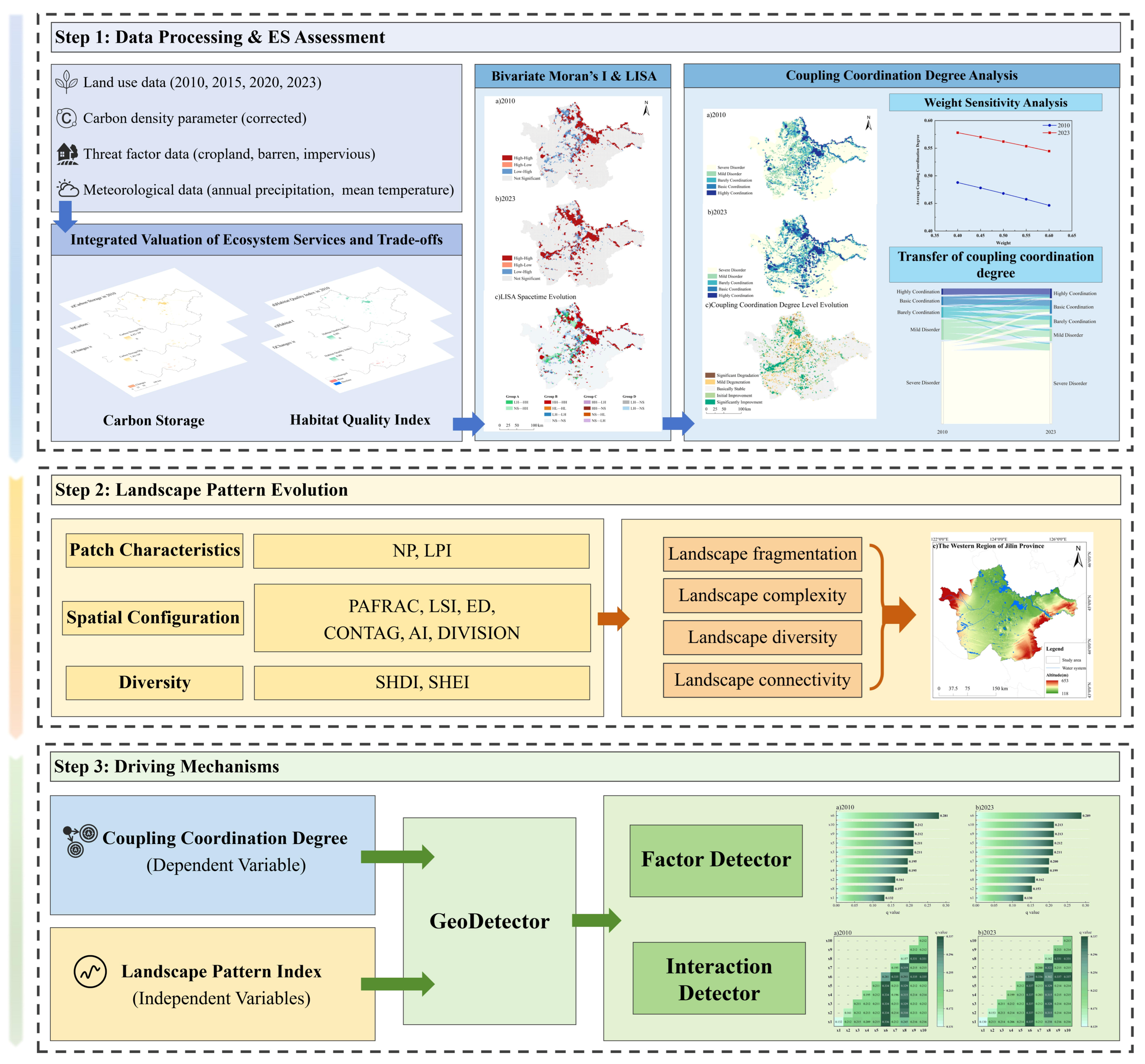
To clarify the complex coupling between wetland ecosystem services and landscape evolution, this study established a systematic research framework consisting of three interconnected stages (Figure 2).

2.3. Data Sources and Processing

Land use data for 2010, 2015, 2020, and 2023 were obtained from the Zenodo research data repository (https://zenodo.org/records/12779975, accessed on 20 January 2025). We utilized the annual national land cover data released by the team of Yang Jie and Huang Xin at Wuhan University [16], with a resolution of 30 m. To meet the study’s requirements, the raw data underwent cropping, extraction, and reclassification. The original nine land use categories were reclassified by merging water bodies and wetlands into a unified “wetlands” top-level category; the remaining seven land types were grouped into the “other (non-wetlands)” category, ultimately forming a two-level classification system comprising “wetlands” and “other (non-wetlands).”
Meteorological data, including annual precipitation and average annual temperature from 2010 to 2023, are sourced from the Jilin Provincial Statistical Yearbook (http://tjj.jl.gov.cn/tjsj/tjnj/) and the annual climate bulletins published by the China Meteorological Administration (https://www.cma.gov.cn/).
The carbon density data required for this study were derived from relevant research on carbon storage conducted by scholars in the field. The original carbon density data were sourced from studies on carbon storage in Jilin Province by Wu, H et al. [17], estimates of terrestrial vegetation carbon sinks in China by Fang, J et al. [18], investigations into vegetation and soil carbon storage in China by Li, K et al. [19], and the 2010s Chinese terrestrial ecosystem carbon density dataset [20]. After comparison and analysis, above-ground and below-ground carbon densities were derived. Due to regional differences, national-scale carbon density averages often fail to capture the specific hydrothermal characteristics of semi-arid regions. Therefore, rather than directly adopting values from the literature, we refined the original carbon density data through local climatic calibration. Specifically, the relationship between annual precipitation and biomass and soil carbon density was modeled using the equations from Alam’s study (Equations (1) and (2)) [21]; the relationship between annual average temperature and biomass carbon density was modeled using the formula from the studies by Giardina [22] and Chen, G et al. [23] (Equation (3)). These equations allowed us to adjust the baseline parameters specifically for the unique climatic gradient of western Jilin, ensuring that the final carbon density estimates (Equations (1)–(3)) reflect the local biomass and soil organic matter accumulation rates more accurately than unadjusted reference values.
C S P = 3.3968 × M A P + 3996.1
C B P = 6.789 × e 0.0054 × M A P
C B T = 28 × M A T + 398
where CSP represents soil carbon density calculated based on annual precipitation data, in units of kg/m2; CBP and CBT represent biomass carbon density derived from annual precipitation and annual mean temperature data, respectively, in units of kg/m2; MAP represents average annual precipitation, in units of mm; MAT represents annual mean temperature, in units of ℃.
Given the significant spatial heterogeneity of carbon density, using national-scale averages directly would make it difficult to accurately reflect the influence of Jilin Province’s unique climatic, soil, and vegetation conditions on carbon storage characteristics. To enhance the reliability of carbon storage estimates in this study, we selected meteorological observation data from Jilin Province and the national level for the period 2010–2023 to calculate the mean values of annual average temperature and annual precipitation, respectively. We then substituted these climate data into the corresponding Equations (1)–(3). By comparing the carbon density ratios derived from differences in regional and national climate conditions, we adjusted the carbon density parameters for different wetland components. This adjustment was intended to make the carbon density estimates better align with the actual conditions in Jilin Province.
K S = C S P A C S P B
K B P = C B P A C B P B
K B T = C B T A C B T B
K B = K B P × K B T
where KS represents the soil carbon density correction factor; KBP and KBT represent the biomass carbon density correction factors based on precipitation and temperature data, respectively; KB represents the biomass carbon density correction factor; CSPA and CSPB represent the soil carbon densities for Jilin Province and the national average, respectively, based on precipitation; CBPA and CBPB represent the biomass carbon densities for Jilin Province and the national average, respectively, based on precipitation; CBTA and CBTB represent the biomass carbon densities for Jilin Province and the national average, respectively, based on temperature.
Carbon in wetland sediments is a key component of the carbon pool in wetland ecosystems and plays a vital role in maintaining the system’s carbon sink function (Table 1). However, due to the difficulty of directly measuring carbon density in wetland sediments and the limited availability of empirical data, this study determined the carbon density parameters for wetland sediments by cross-referencing multiple field-based datasets from the Songnen Plain [24]. To ensure the representativeness of these values, we performed a weighted average of reported ranges specifically for reed marshes and saline-alkali wetlands, which are dominant in our study area, rather than adopting a generic national or area average.

2.4. Methods

2.4.1. Selection and Calculation of Landscape Indices

Landscape indices are a method for quantifying landscape patterns, characterized by their intuitiveness and simplicity. Typically, landscape indices are categorized into three scales: patch, type, and landscape. By calculating landscape indices, one can obtain most of the landscape pattern information within a region. Changes in these indices allow for the analysis of landscape pattern evolution in the region [25], thereby clearly expressing the types and spatial arrangements of landscape units within the area and reflecting landscape spatial heterogeneity. Referring to relevant literature [26] and in accordance with the requirements of this study, 10 landscape indices at the type and landscape levels were selected (Table 2).

2.4.2. Methods for Estimating Carbon Storage

As a comprehensive ecosystem services assessment tool, the InVEST model can simulate carbon storage dynamics under land-use change scenarios. The Carbon Storage module within the InVEST model is used to calculate carbon storage in regional wetlands. This module calculates regional carbon storage based on four components—above-ground mortality carbon density, below-ground biomass carbon density, soil carbon density, and sediment carbon density—to determine the total carbon storage of the wetland.
C i = C i a b o v e + C i b e l o w + C i s o i l + C i d e a d
C t o t a l = i 1 n C i × S i
where Ci represents the carbon density of land use type i, in kg/m2; Ci_above, Ci_below, Ci_soil and Ci_dead represent the carbon densities of aboveground biomass, belowground biomass, soil, and sediment, respectively, in kg/m2; Ctotal represents total carbon storage, in kg; and Si represents the area of the land use type, in m2.

2.4.3. Habitat Quality Assessment Method

The Habitat Quality module in the InVEST model is used to calculate the habitat quality index for regional wetlands and assess habitat quality. This module performs a comprehensive calculation based on land use patterns, combined with landscape type sensitivity and the intensity of external threats, to derive habitat quality information. The calculation formula is as follows:
D x j = r = 1 R y = 1 Y r w r r = 1 R w r r y i r x y β x S j r
where Dxj represents the habitat degradation index of grid x in habitat type j; R represents the number of threat sources; Wr represents the weight of threat source r; Yr represents the number of grids affected by threat source r; ry represents the stress value of grid y; βx represents the accessibility of threat source r to grid x; Sjr represents the sensitivity of habitat type j to threat source r; irxy represents the stress level of stress value ry in grid y on grid x, which can be classified into two types: linear decay and exponential decay:
l i n e a r   d e c a y : i r x y = 1 d x y d r m a x
e x p o n e n t i a l   d e c a y : i r x y = e x p 2.99 d x y d r m a x
where dxy represents the straight-line distance between grid points x and y; drmax represents the maximum threat distance of threat source r.
The weighting of each threat factor is primarily based on its relative impact intensity in the process of regional ecosystem degradation. While the initial values for threat weights and land-use sensitivities (Table 3 and Table 4) were derived from standard InVEST-based studies [27], they were further calibrated based on the specific ecological vulnerability of western Jilin. For instance, the threat weight of cropland was increased to reflect the region’s history of intensive agricultural reclamation, and the sensitivity of water bodies was adjusted to account for their high susceptibility to eutrophication under semi-arid conditions. This calibration process ensures that the model parameters are tailored to the local environmental stressors.
The formula for calculating habitat quality is:
Q x j = H j 1 D x j z D x j z + k z
where Qxj represents the habitat quality index of grid x in habitat type j; Hj represents the habitat suitability of habitat type j; k represents the semi-saturation constant, typically set to 0.5; z represents the normalization constant, typically set to 2.5.
In this section, due to the significant difference in habitat quality between aquatic and wetland habitats, the habitats are reclassified when calculating sensitivity.

2.4.4. Spatial Autocorrelation Analysis

This study employs spatial autocorrelation analysis to investigate the spatial distribution patterns of carbon storage and habitat quality. Spatial autocorrelation analysis includes global spatial autocorrelation and local spatial autocorrelation, which are used to assess whether the spatial distribution of variables exhibits clustering. To overcome the instability and errors associated with single variables while revealing the spatial correlations among multiple variables, the bivariate spatial autocorrelation model (Bivariate LISA) proposed by Anselin [28] was adopted. GeoDa was used to calculate the global Moran’s I, which comprehensively measures the spatial dependence and clustering of the two ecosystem services. The calculation formula is:
I = i = 1 n j = 1 n w i j x i x ¯ x j x ¯ S 2 i j w i j
S 2 = 1 n i = 1 n x i x ¯
Subsequently, significance maps and clustering diagrams were generated using bivariate local spatial autocorrelation, with Moran’s I employed as a metric to identify patterns of synergy (High-High, Low-Low) and trade-offs (High-Low, Low-High) between carbon storage and habitat quality at the local spatial scale. This method provides a scientific reflection of the spatial feedback relationships among ecosystem services. The calculation formula is as follows:
I i = x i x ¯ j = 1 n w i j x i x ¯ S 2
where n represents the number of spatial units (pixels); xi and xj denote the observed values of pixel i and pixel j, respectively; (xi  x ¯ ) is the deviation of the observed value at pixel i from the mean; wij is the distance weight constructed using the distance band method; and S2 is the variance.

2.4.5. Coupling Coordination Degree Model

To quantitatively evaluate the interactions and the level of synergistic development between the carbon storage system and the habitat quality system, this study employs the Coupling Coordination Degree (CCD) model to thoroughly characterize the spatiotemporal evolution of these two ecosystem services from a state of imbalance to one of coordination, and to classify the coupling coordination degree and its evolutionary stages (Table 5). The calculation formula is as follows:
C = U 1 × U 2 / U 1 + U 2 2 2
T = α U 1 + β U 2
D = C × T
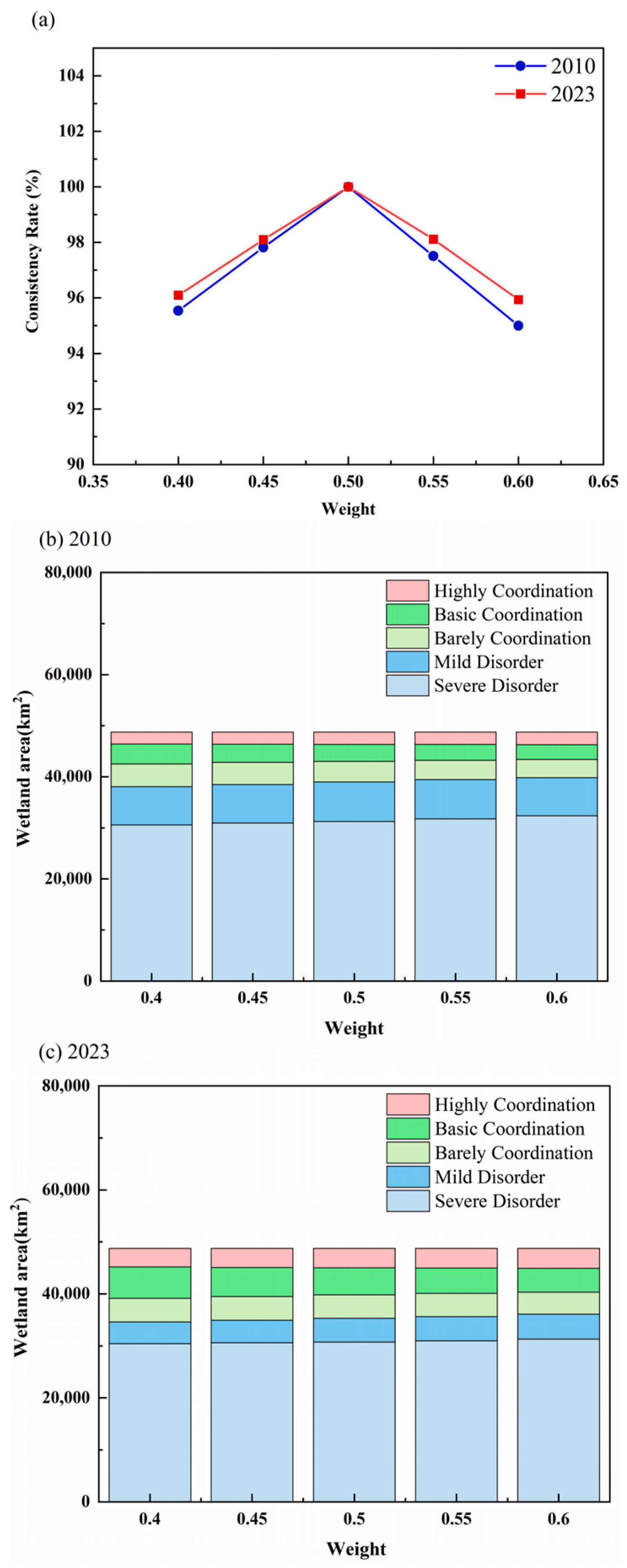
where C represents the coupling degree (0 < C < 1), prior to calculation, the carbon storage and habitat quality index were normalized using the min-max normalization method to ensure data comparability; U1 and U2 represent the normalized carbon storage and habitat quality index, respectively; T represents the comprehensive coordination index; α and β are the weighting coefficients for carbon storage and habitat quality index, respectively. While α and β were initially set to 0.5 based on the balanced ecological significance of both services, a weight perturbation experiment was conducted to test the robustness of this assumption. The value of α was varied from 0.4 to 0.6 (with an interval of 0.05) to observe the stability of the CCD grades and their spatial consistency; and D represents the coupling coordination degree, based on the evaluation criteria, the synergistic state is categorized into two main stages: the “Disorder” stage (Grades I–II), representing a state of systemic imbalance, and the “Coordination” stage (Grades III–V), indicating varying levels of alignment between carbon storage and habitat quality. These stages are used consistently throughout the text to interpret the spatiotemporal transitions of the ecosystem.
This approach overcomes the limitations of using a single evaluation metric and effectively reveals the extent of positive interactions between carbon storage and habitat quality within wetland ecosystems [29].

2.4.6. GeoDetector Model

The GeoDetector model can detect correlations among spatial variables and offers unique advantages in handling spatial hierarchical heterogeneity and revealing the roles of influencing factors. This study employs this model to investigate the spatial heterogeneity of coupling coordination and identify the core landscape drivers underlying it. By using the Factor Detector to calculate the explanatory power index q of each landscape pattern indicator for coupling coordination, we measure the relative contribution of different landscape factors to the level of synergy. We then employ the Interaction Detector to analyze whether there is interactive effects, either enhancing or weakening, on coupling coordination when different landscape indicators are combined in pairs. Compared to traditional statistical methods, this model can effectively parse the nonlinear driving mechanisms among complex spatial variables.
The GeoDetector model was employed to quantify the explanatory power of landscape factors on the spatial heterogeneity of the CCD. Unlike global regression models, GeoDetector excels in capturing the spatial consistency between independent and dependent variables by measuring the explanatory power index (q) [30]. It effectively identifies the contribution of dominant factors to the synergistic development of ecosystem services without requiring linear assumptions. Additionally, the Interaction Detector was used to evaluate whether the combined effect of landscape indicators enhances or weakens the explanatory power, thereby revealing the complex mechanisms underlying spatial variations [31].

3. Results

3.1. Changes in Wetland Landscape Pattern, Carbon Storage, and Habitat Quality

3.1.1. Changes in Wetland Landscape Pattern from 2010 to 2023

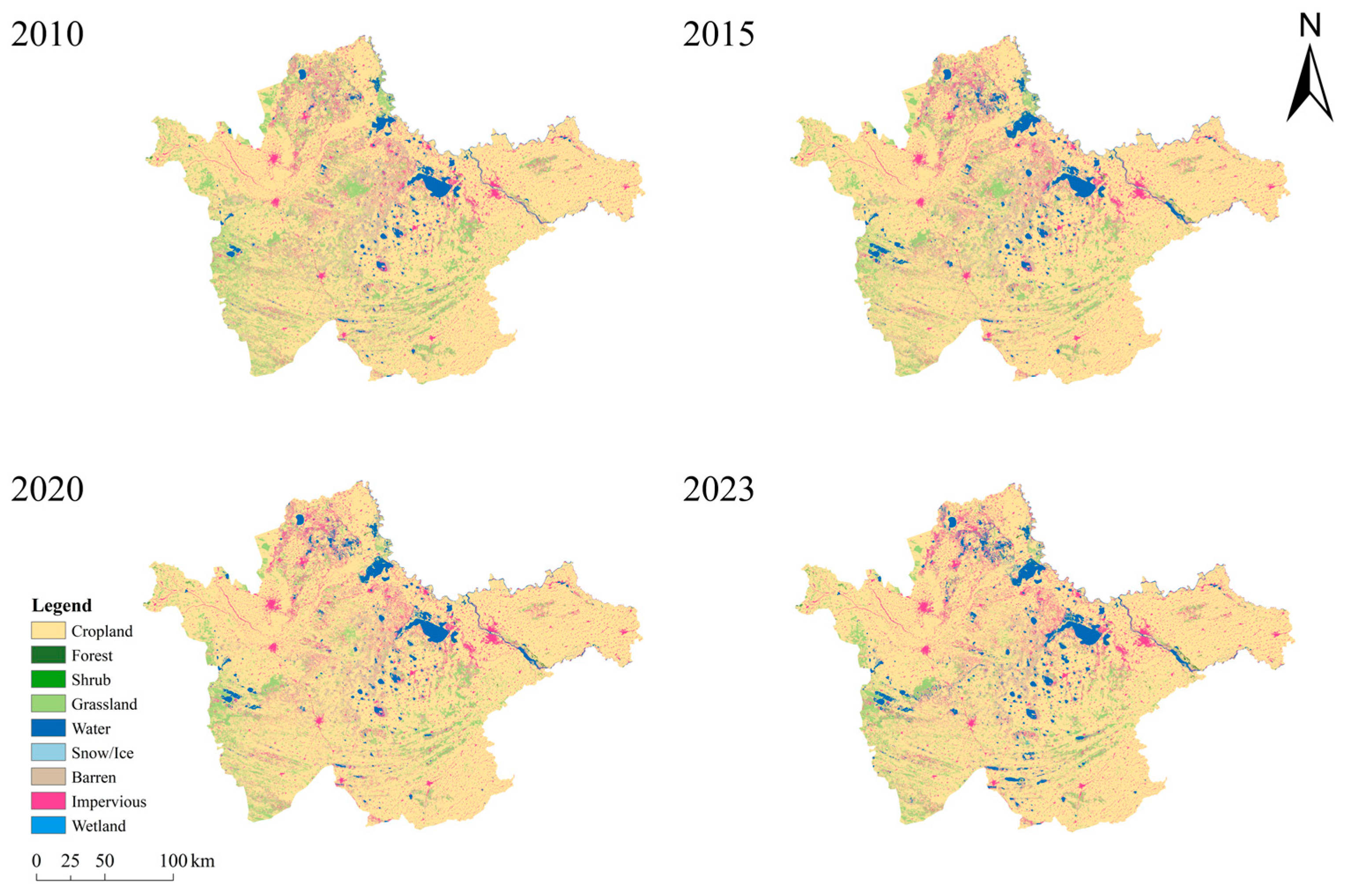
The dynamics and changes in the spatial distribution of wetlands from 2010 to 2023 are shown in Figure 3 and Table 6. The wetland areas for the four periods were 1261.56 km2, 1646.36 km2, 1583.49 km2, and 2119.69 km2. Between 2010 and 2023, the total wetland area in the study area increased by 858.13 km2. This expansion was primarily driven by land-use conversions, including 441.87 km2 converted from cropland, 1.52 km2 from forest, 134.07 km2 from grassland, 0.01 km2 from snow and ice, 227.25 km2 from barren, and 189.08 km2 from impervious, with a total conversion of 993.8 km2. Additionally, the main outflows were to cropland (78.4 km2) and impervious (36.3 km2), with a total outflow of 135.7 km2.
According to the wetland landscape index table (Table 7), an analysis of wetland patch characteristics reveals that the number of patches (NP) decreased from 37,423 to 24,140, indicating that the overall fragmentation of the wetland landscape has been alleviated. At the landscape scale, the largest patch index (LPI) decreased from 97.10 to 95.17, suggesting that although the area of core wetland patches has slightly decreased, their dominant position remains stable. At the typological scale, the largest patch index (LPI) increased from 0.64 to 0.69, reflecting an increase in the proportion of area occupied by dominant patches within the wetlands and a corresponding strengthening of their dominance.
In terms of morphological evolution, the perimeter-area fractal dimension (PAFARC) decreased from 1.40 to 1.33, indicating that under the combined influence of natural evolution and human intervention, the boundaries of some patches have become more regular. At the landscape scale, the landscape shape index (LSI) increased from 22.17 to 28.90, while the corresponding index at the type scale rose from 123.43 to 126.53, and edge density (ED) increased from 3.65 to 4.89. Collectively, these changes indicate that wetland patches are becoming more complex in shape, with increased boundary lengths leading to enhanced edge effects. Furthermore, the landscape division index (DIVISION) rose from 0.06 to 0.09, peaking at 0.27 in 2020. This reflects significant fluctuations in wetland landscape connectivity, with “localized degradation” primarily identified in the southern and western peripheral zones of the study area. Specifically, high fragmentation was observed in the scattered wetland patches of Tongyu and Changling Counties, as well as the marginal buffer zones of the Xianghai and Momoge Nature Reserves. In these areas, the encroachment of small-scale agricultural land and the expansion of salt-alkali patches led to the physical isolation of previously continuous wetland corridors. The temporary spike in the DIVISION index in 2020 reflects a period where localized agricultural expansion at the wetland-cropland interface briefly outpaced the cohesive benefits of early-stage restoration projects, particularly in the lower reaches of the Tao’er River basin.
In terms of diversity, the Shannon diversity index (SHDI) increased from 0.12 to 0.18, and the evenness index (SHEI) rose from 0.18 to 0.27, indicating that the landscape composition has become more diverse and its distribution more even. Meanwhile, in terms of spatial configuration, the contagion index (CONTAG) decreased from 89.05 to 84.03, and the aggregation index (AI) decreased slightly from 99.43 to 99.25. Combined with the increase in diversity, this forms a configuration characterized by high aggregation and weak connectivity, indicating that the intermingling of wetlands with surrounding land types may have intensified, and landscape fragmentation has progressed to some extent. Based on the analysis of changes in various landscape indices in this study, it can be concluded that while the implementation of relevant policies and wetland management and restoration has effectively mitigated fragmentation [32], coordinated boundary management and connectivity restoration—such as through the reconstruction of ecological corridors—still need to be implemented.

3.1.2. Changes in Carbon Storage and Habitat Quality

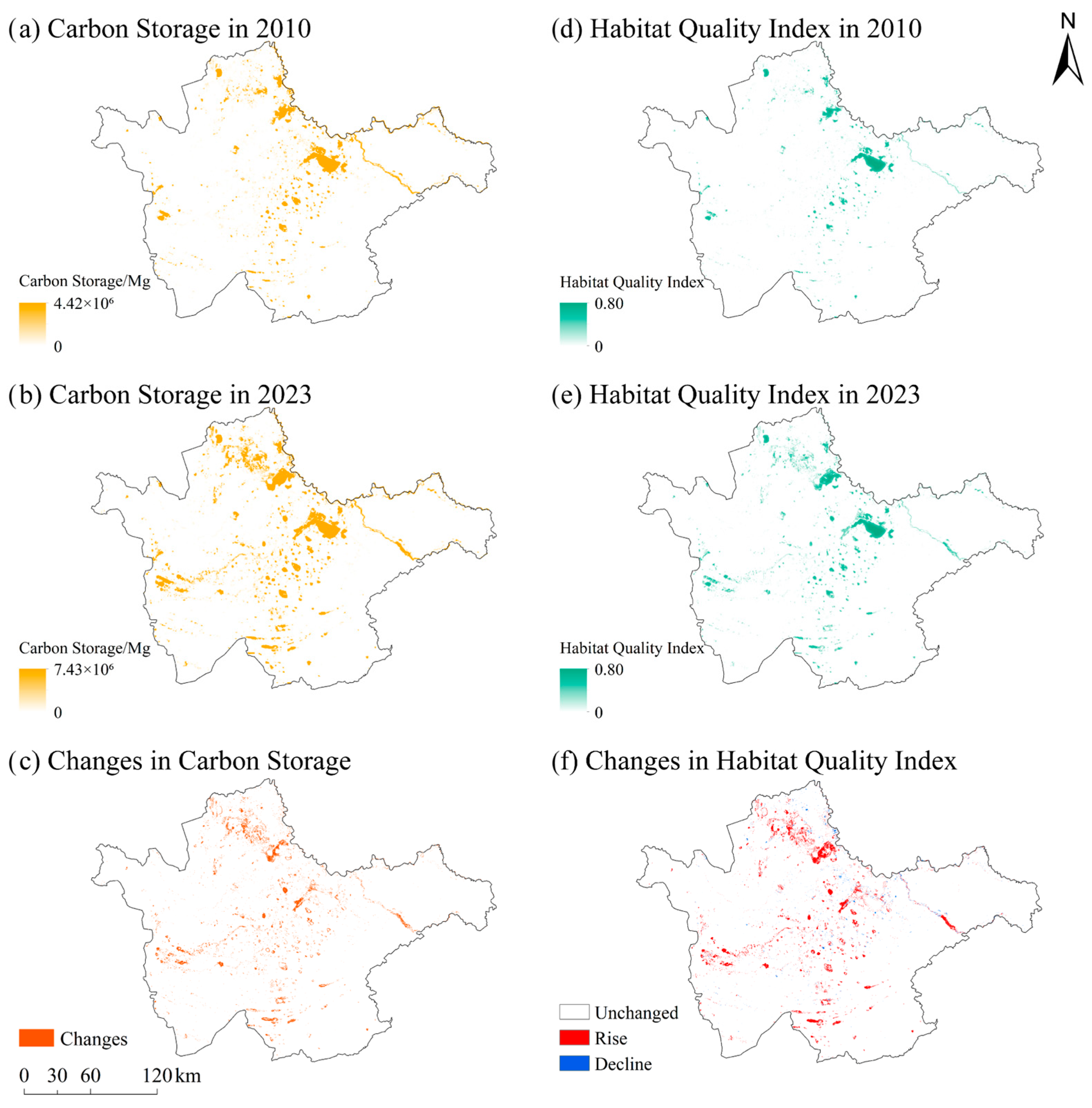
Estimates from the InVEST model show that carbon storage increased overall across the four time periods, reaching 4.42 × 10⁶ Mg, 5.77 × 10⁶ Mg, 5.55 × 10⁶ Mg, and 7.43 × 10⁶ Mg, respectively, with a 68.1% increase from 2010 to 2023. Analysis of Figure 4 reveals that areas with high carbon storage within the study region are primarily concentrated in nature reserves such as Chagan Lake, Momoge, and Xianghai, as well as along the Second Songhua River basin. Spatially, these areas exhibit a distinct radial distribution pattern characterized by “core-to-periphery distribution pattern.” Between 2010 and 2023, the areas of carbon storage change generally expanded outward from existing wetlands in a divergent pattern. The changes were particularly significant in the Momoge Nature Reserve, the Chagan Lake Nature Reserve, and their associated watersheds, indicating that ecological restoration measures implemented in recent years for national-level nature reserves have achieved preliminary success in enhancing carbon storage capacity. Furthermore, a trend of fragmented increases in carbon storage was observed in other regions. This reflects that improved hydrological connectivity has effectively reduced the fragmentation of small, medium, and micro-wetlands, as well as isolated wetlands in western Jilin Province. By mitigating the physical isolation of these micro-habitats, the restoration of connectivity has optimized regional carbon storage capacity, enabling previously disconnected patches to contribute more robustly to the overall carbon sequestration process through the expansion of vegetation cover and the stabilization of soil organic matter. This change may be closely related to the integrated environmental protection policies implemented locally [33]. Against the backdrop of an overall increase in carbon storage, the carbon storage of existing major wetlands has remained relatively stable. This indicates that local governments, while strictly adhering to ecological protection red lines, have further enhanced the stability and carbon storage capacity of wetland ecosystems through orderly adjustments and the implementation of environmental protection policies.
At the same time, according to the average habitat quality indices (0.621, 0.620, 0.621, and 0.609 for 2010, 2015, 2020, and 2023, respectively), the study area exhibited high ecological resilience with only marginal interannual fluctuations. While the regional average index remained relatively high (above 0.60), the spatial distribution of habitat quality categories showed nuanced shifts. Areas with higher habitat quality are primarily distributed in nature reserves such as Chagan Lake, Momoge, and Xianghai, as well as in the Second Songhua River basin. From a landscape pattern perspective, changes in habitat fragmentation in the central part of the study area are generally consistent with the overall trend. Due to the habitat quality index derived from the InVEST model remaining relatively stable during the study period, with the regional average index ranging from 0.609 to 0.621. Specifically, the index remained nearly constant at 0.621 in 2010 and 2020, but experienced a marginal decrease to 0.609 by 2023. This interannual stability suggests that the ecological benefits from restoration projects, such as the river-lake connectivity project, have effectively counterbalanced the negative impacts of localized agricultural expansion and landscape fragmentation. However, the slight decline in 2023 indicates that although the overall ecological health of the western Jilin wetlands is maintained, certain areas still face subtle habitat degradation pressures that warrant continuous monitoring.
Based on the exponential changes, it can be concluded that habitat quality showed an overall slow upward trend during the study period. Areas with more pronounced improvements were concentrated in the Momoge and Chagan Lake Nature Reserves, as well as in parts of the Second Songhua River basin. This trend is likely closely related to the ongoing implementation of local ecological conservation policies and the introduction and enforcement of relevant nature reserve management regulations. However, there are still areas within the study region where habitat quality has declined locally. These areas are scattered among the various nature reserves, with the decline being particularly evident in the northeastern part of the Momoge Nature Reserve, certain sections of the Second Songhua River, and the central part of the study area. These changes may be influenced by human disturbances such as urban expansion and agricultural development.

3.2. Synergistic Changes in Wetland Carbon Storage and Habitat Quality

3.2.1. Spatial Association Patterns Based on Bivariate Local Autocorrelation

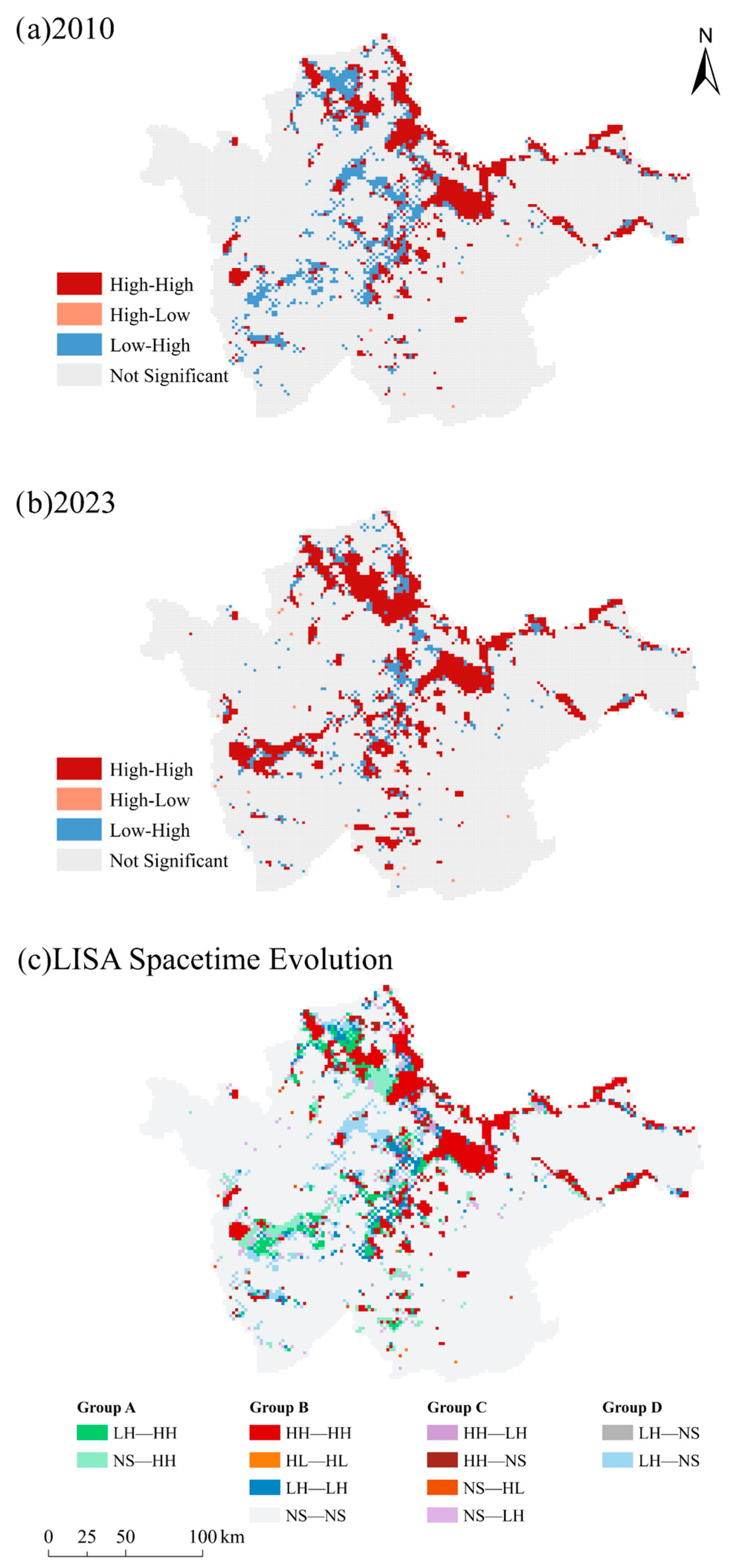
This study utilized a bivariate local spatial autocorrelation model to analyze the spatial evolution characteristics of wetlands in western Jilin Province (Figure 5).
The results indicate that Moran’s I increased from 0.410 to 0.501 between 2010 and 2023, suggesting a significant strengthening of spatial positive autocorrelation between carbon storage and habitat quality. According to the clustering map, the High-High (HH) synergy zones represent the core high-value areas for ecosystem services in the study region. These zones are primarily distributed in the northern Momoge Nature Reserve and the central river-lake connectivity core area. From 2010 to 2023, the patches within the HH zones exhibited a clear trend toward consolidation and outward expansion. This change indicates that wetland conservation and restoration projects have effectively enhanced the overall functionality of the ecosystem. Meanwhile, Low-High (LH) zones are primarily distributed at the periphery of HH clusters, reflecting transition areas where carbon storage gains marginally lag behind habitat improvements. Of particular ecological significance are the High-Low (HL) zones, which represent potential trade-offs between carbon sequestration and biodiversity maintenance. Although these zones remain relatively rare in western Jilin, their occurrence—often observed near reclaimed agricultural land—serves as an early warning of single-service optimization where carbon storage increases at the expense of habitat quality. Recognizing these HL patches is critical for management, as they pinpoint areas where restoration strategies must transition from carbon-centric approaches to more balanced, multi-objective ecological governance to prevent further habitat degradation.
Figure 5c and the transition statistics table provide further analysis and explanation of the synergistic dynamic evolution between carbon storage and habitat quality. The data in the statistical Table 8 indicate that the synergistic optimization group dominated the non-stationary transitions. Specifically, a total of 1536 km2 transitioned from a non-significant state to a high-high aggregation state, while another 1044 km2 transitioned from a low-high deviation state to a high-high aggregation state. This transition from low-level functional zones to high-level synergistic zones confirms the driving role of landscape structure optimization in ecosystem services. Meanwhile, there were 3856 km2 across 11 types that consistently maintained a “high-high aggregation” state. Serving as stable ecological cores, these areas demonstrate the robustness of the wetland’s fundamental functions. The synergy disappearance type within the degradation risk group encompassed 756 km2; these areas are predominantly distributed along the periphery of the wetland, necessitating attention to the breakdown of synergistic relationships caused by local landscape fragmentation.
Overall, the wetland system in western Jilin Province underwent an optimization process from spatial dispersion to spatial aggregation during the study period. Enhanced landscape connectivity and increased patch cohesion have facilitated the formation of a tighter ecological network among forest, grassland, and wetland resources within the region. This spatiotemporal evolution pattern confirms that wetland restoration can significantly improve the level of synergy between carbon pools and habitats, and lays a data foundation for subsequent studies using geodetic detectors to reveal the underlying driving mechanisms.

3.2.2. Spatiotemporal Dynamics and Synergy Levels of Coupling Coordination

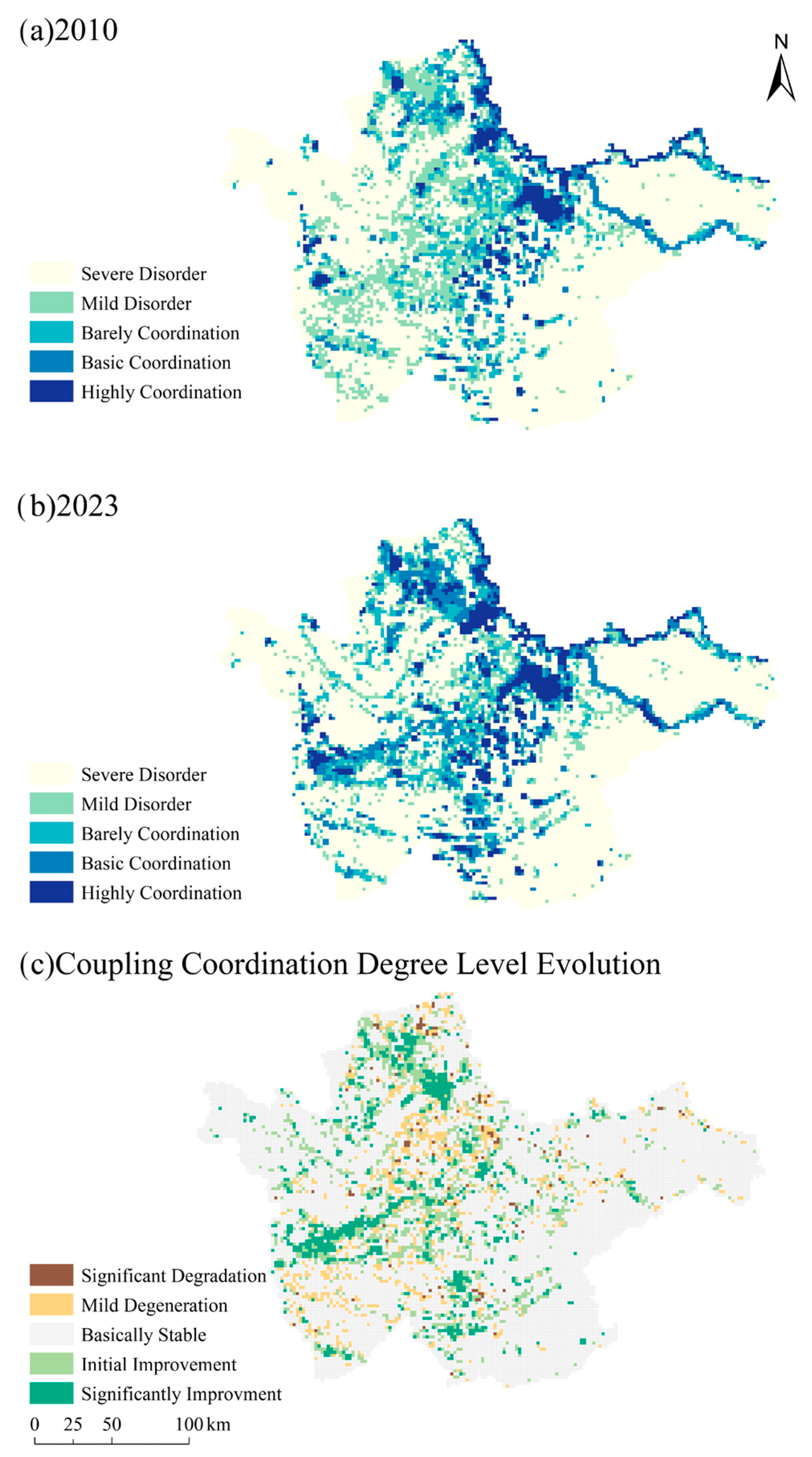
We utilized a coupled coordination degree model to further analyze the level of alignment between carbon storage and habitat quality in the wetlands of western Jilin Province. In terms of spatial distribution, the study area exhibits a distinct “higher in the north, lower in the south” pattern. The classification maps for 2010 and 2023 (Figure 6) show that areas of high coordination are primarily distributed along the Nenjiang River in the north and within the core marsh clusters in the central region.
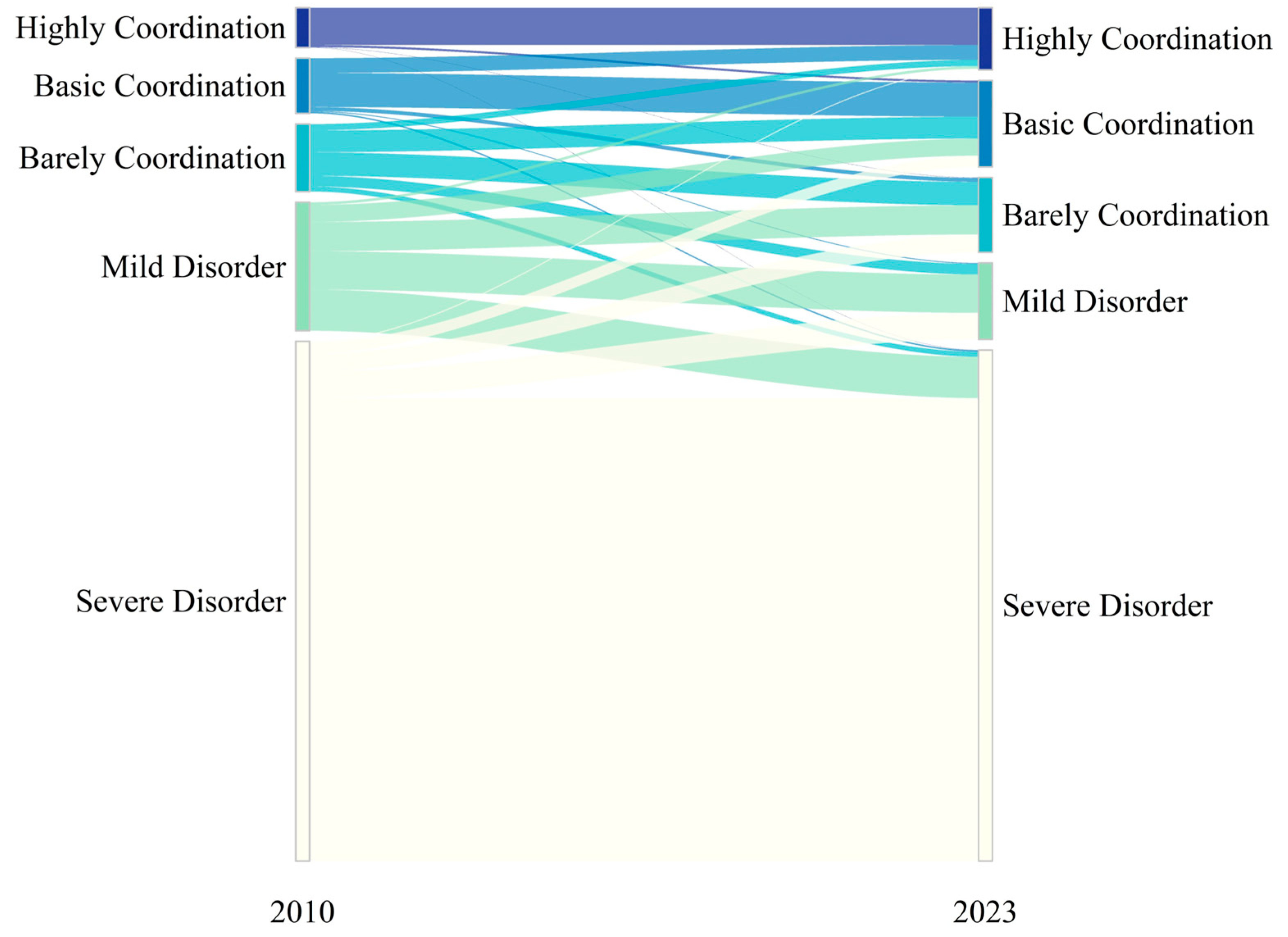
As wetland conservation projects progressed, high-coherence zones in these areas exhibited a significant outward expansion trend. Statistical data further revealed the structural evolution patterns of coherence levels. Among all transition pathways, the largest number of areas—totaling 27,836 km2—remained in a state of Severe Disorder. This is because the landscape background in the study area was assigned a value of 0, except for wetlands after reclassification. Excluding this background, the restoration progress was evidenced by significant shifts within the coordination levels. Approximately 1600 km2 transitioned from Severe Disorder to Mild Disorder during the study period. More importantly, areas exhibiting Coordination (Grades III–V) expanded significantly, reflecting the direct ecological gains from wetland restoration projects.
Meanwhile, areas with significant improvements spanning two or more levels are widely distributed across the map, collectively covering over 2800 km2. These areas are primarily located in the central wetland corridor, where ecological restoration has progressed rapidly. The grade evolution map (c) delineates the spatial distribution of functional improvements; the green areas representing initial and significant improvements form a distinct contiguous belt in the northern region. This change indicates that carbon cycling processes and biodiversity maintenance functions are becoming increasingly synchronized. Based on the aforementioned coupling coordination shift data, ArcGIS 10.8 and Origin 2024 were used to generate the coupling coordination shift trends from 2010 to 2023 (Figure 7).
Although the overall trend across the region is one of stability and improvement, some local areas still face a risk of degradation. The orange and brown areas in the figure, representing degraded regions, are primarily distributed along the outer edges of the wetlands. Among these, the Mild Disorder category comprises 3488 km2—reflecting a slight functional imbalance in some patches due to human intervention. However, the transfer matrix in Figure 7 reveals a robust transition trajectory toward higher coordination. A significant portion of Barely Coordination areas successfully crossed the threshold into Basic Coordination and Highly Coordination levels. These upward transitions between coordination grades serve as the core indicator of restoration success, confirming that the synergistic functional integrity of wetlands in western Jilin has been substantially optimized over the past decade.

3.3. Correlation Analysis of Wetland Landscape Patterns with Carbon Storage and Habitat Quality

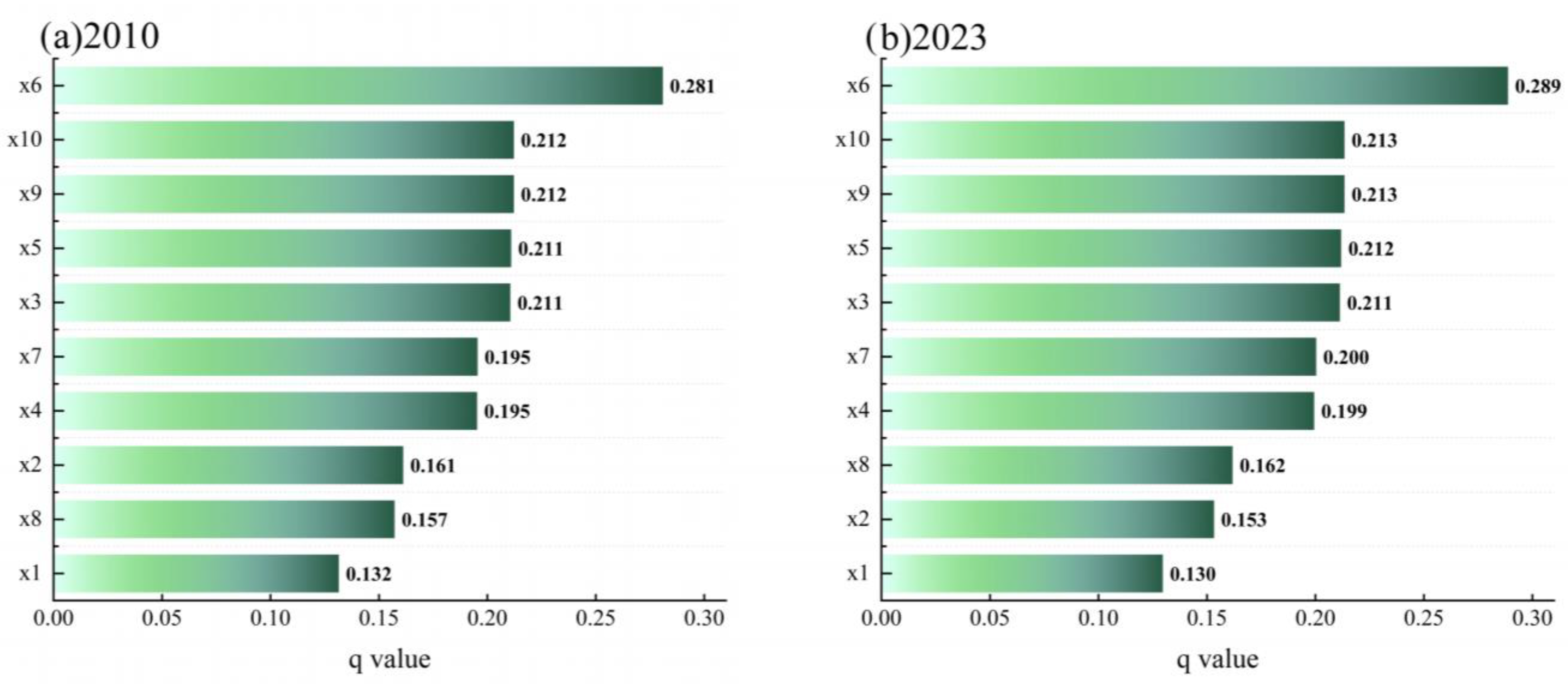
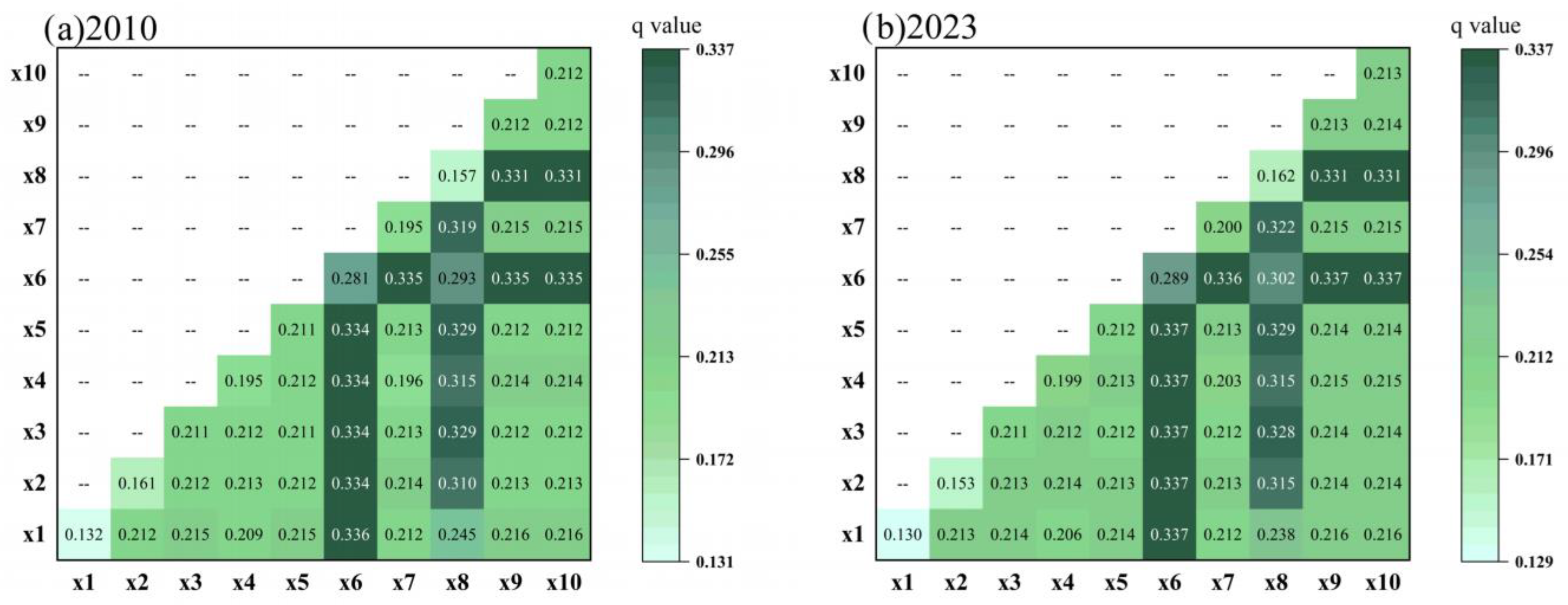
To further elucidate the underlying mechanisms of the synergistic development between landscape patterns and ecosystem services, the Geographic Detector was employed to quantitatively analyze the contribution rates of various landscape indicators, where x1 through x10 represent AI, CONTAG, DIVISION, ED, Landscape-scale LPI, Type-scale LPI, Landscape-scale LSI, Type-scale LSI, SHDI, and SHEI. In the driver factor detection process, considering the model’s requirement for discrete input variables, this study excluded the NP and PAFRAC indicators. This is because these two indicators produced anomalous classification results under the natural breakpoint method and could not provide sufficient statistical information to explain the spatial variations in carbon storage and habitat quality; excluding such indicators helps improve the overall fitting accuracy and explanatory power of the model.
Based on the results of the factor detector (Figure 8), there are significant variations in the explanatory power (q-values) of different landscape indicators regarding the spatial heterogeneity of the CCD. Among all indicators, the largest patch index at the typological level (x6) performed most notably, with q-values of 0.281 and 0.289 in 2010 and 2023, respectively, consistently ranking first. This high degree of spatial consistency indicates that the integrity and scale of core wetland patches are the core factors shaping the spatial stratification of synergistic development. In addition, diversity indicators (x9, x10) and landscape fragmentation (x3) also exhibited relatively strong explanatory power. In contrast, indicators such as landscape aggregation (x1) and landscape shape indices (x2, x8) demonstrated weaker independent explanatory power, with q-values ranging between 0.13 and 0.16, generally at a lower level.
Furthermore, the interaction detector revealed that the interaction between any two landscape factors resulted in a higher explanatory power than that of a single factor alone, predominantly exhibiting “bi-factor enhancement.” This indicates that the synergistic relationship between carbon storage and habitat quality is a complex system influenced by multiple landscape dimensions. Specifically, the coupling of landscape fragmentation and patch morphology collectively reshapes the regional ecological service gradient, reflecting a strong spatial association between landscape configuration and ecosystem service synergy.
The results of the interaction detector (Figure 9) further reveal synergistic enhancement effects among various landscape factors. The data indicate that the explanatory power (q-values) obtained from the interaction of any two landscape indicators is consistently higher than that of either factor alone, predominantly exhibiting “bi-factor enhancement.” This phenomenon reflects the complex and comprehensive nature of landscape configuration in shaping the spatial heterogeneity of coupling coordination. Among these, the largest patch index (x6) exhibited the strongest interactions with other indicators; when combined with other factors, the q-values for this index generally rose to above 0.33, forming the optimal spatial association for the synergistic improvement of ecosystem services. Meanwhile, the landscape shape index (x8) also showed significant interactive enhancement with other factors. This suggests that the complexity of patch morphology and the coupling of landscape fragmentation collectively reshape the regional ecological service gradient when acting in concert, further confirming that the synergistic relationship between carbon storage and habitat quality is a multi-dimensional system deeply influenced by landscape patterns.
Our results indicate that changes in landscape patterns in the western wetlands of Jilin Province have profoundly driven the evolution of the “carbon storage–habitat” coupling relationship. Enhanced landscape connectivity and the expansion of core patch sizes have effectively facilitated the transition of wetland ecosystems from low-level carbon sequestration to high-level synergistic services.

4. Discussion

4.1. Spatiotemporal Coupling and Synergistic Characteristics of Carbon and Habitat

The results of the bivariate Moran’s I analysis in this study indicate a strengthening of spatial positive autocorrelation between carbon storage and habitat quality. Moran’s I value increased from 0.410 to 0.501 signifies that the spatial feedback between these services has become more concentrated and mutually reinforcing. This strengthening clustering implies that ecological restoration in western Jilin is effectively creating synergy hotspots, although the identification of scattered HL and LH zones suggests that localized biophysical lags and service trade-offs still persist, requiring a more nuanced landscape-level intervention, suggesting that the synergistic relationship between the two is continuously strengthening. However, the “Low-High (LH)” regions in the LISA clustering map are predominantly distributed along the edges of the core protected area. This reflects that while vegetation restoration has increased carbon sequestration in these peripheral zones, improvements in habitat quality have lagged due to landscape fragmentation and insufficient connectivity [34], and an efficient synergistic restoration effect has not yet been established.
The selection of equal weights (α = β = 0.5) for the CCD model was further justified by our sensitivity analysis. To address the potential uncertainty of equal weighting, a sensitivity analysis was performed by adjusting the weight coefficient α. As shown in Figure 10, the average CCD values for both 2010 and 2023 exhibited a slight and stable linear response to weight variations, with the overall synergistic trend remaining highly consistent. Specifically, the spatial consistency check revealed that when α fluctuated within the range of 0.4 to 0.6 (±0.1 from the baseline), 90.54% of the areas in 2010 and 92.04% in 2023 maintained their original coordination grades. This high level of stability indicates that the spatial patterns of synergy and the resulting conclusions are not sensitive to minor adjustments in the weighting scheme, thereby validating the robustness of the CCD model used in this study. The minimal shift in coordination levels across different weight scenarios suggests that the internal synergy between wetland carbon sequestration and habitat quality is driven more by their spatial biophysical coupling than by the specific mathematical weighting assigned to each service.
The evolution of habitat quality in western Jilin (averaging 0.618) reflects a state of dynamic ecological equilibrium. Unlike carbon storage, which showed a massive 68.1% leap, habitat quality exhibited high spatiotemporal stability (0.609–0.621). This stability suggests a compensatory mechanism where the systematic restoration of core wetlands (e.g., the river-lake connectivity project) has effectively buffered the negative impacts of localized landscape fragmentation. The marginal decline in 2023 (0.609) serves as a critical indicator that while the overall ecological foundation remains resilient, the boundary effects at the wetland-cropland interface are becoming a primary stressor. This finding transitions the focus from simple area expansion to the necessity of enhancing the internal functional connectivity of existing patches to maintain this high-level equilibrium.

4.2. Driving Forces of Landscape Evolution: Policy Interventions and Patch Dynamics

The spatial analysis of landscape evolution indicates that the expansion of wetland area is fundamentally consistent with the growth of carbon storage and habitat quality. This reflects the positive outcomes of major ecological projects implemented in Jilin Province in recent years, such as the ecological connectivity of forests, grasslands, and wetlands, and comprehensive ecological management in the western region. These conservation and restoration measures are key anthropogenic factors driving the expansion of wetland areas and the optimization of landscape patterns [35], a finding further corroborated by the results of the coupling coordination model. From 2010 to 2023, the coordination level in the study area exhibited a positive shift from Barely Coordination toward Basic and Highly Coordination stages. This progression from Grade III to Grades IV and V represents a critical transition from simple structural recovery to the restoration of complex ecosystem functions. The expansion of these high-coordination zones indicates that carbon sequestration and habitat quality are no longer just co-existing but are actively reinforcing each other. This high-level coordination is most prominent in core marsh clusters where connectivity is highest, validating that successful restoration is not merely about increasing wetland area, but about achieving a functional leap toward systemic synergy.
GeoDetector results indicate that the largest patch index (x6) at the typological scale possesses the strongest explanatory power for the synergistic development of both carbon storage and habitat quality, i.e., it serves as the core driving factor for their synergy. This suggests that the integrity and scale of core wetland patches play a decisive role in the stability of ecosystem functions [36]. On the other hand, the perimeter-area fractal dimension, as well as the contagion and aggregation indices, were negatively correlated with carbon storage and habitat quality. This phenomenon reveals that landscape fragmentation is another key characteristic of the current evolution of wetland patterns [37]. Such fragmentation may stem from activities such as urban and rural construction and agricultural development within the region, leading to the segmentation of wetland patches, increased morphological complexity, and reduced internal connectivity [38].
The spatial patterns of carbon storage and habitat quality derived from InVEST simulations showed high spatial consistency with the explanatory factors identified by GeoDetector. While GeoDetector effectively identifies co-occurrence patterns and quantifies the strength of spatial associations through q-values, it is important to note that these results reflect the intensity of spatial explanatory power rather than causal direction or mutual interdependencies. The high explanatory power of the largest patch index and aggregation index indicates that these factors are the core drivers shaping the spatial heterogeneity of synergy. These findings suggest that the integrity of core wetland structures provides a stable spatial vehicle for the simultaneous improvement of multiple ecosystem services.

4.3. Interaction Mechanisms and Ecological Plausibility of Landscape Indices

The strong spatial consistency between landscape shape index, edge density, and synergy levels suggests a boundary exchange mechanism. Mechanistically, sinuous wetland boundaries (higher shape complexity) facilitate the exchange of matter and energy between core patches and surrounding terrestrial matrices, creating diverse micro-habitats that support higher biodiversity. Furthermore, the positive explanatory power of diversity indices (SHDI and SHEI) reflects the ecological insurance hypothesis at a landscape scale. By maintaining a heterogeneous landscape configuration, the ecosystem ensures that even if localized fragmentation occurs, the overall synergistic stability is maintained through functional redundancy. This provides a biophysical explanation for why the habitat quality in western Jilin remained resilient (averaging 0.612) despite the pressures of agricultural expansion observed in the peripheral counties. This indicates that, under the combined influence of human intervention and natural recovery, wetland landscapes are evolving toward extended boundaries, complex shapes, and diverse types [39]. The implementation of regional ecological policies, land-use changes, and the ecosystem’s own succession processes collectively shape the current landscape patterns of wetlands.
The spatial patterns of carbon storage and habitat quality derived from InVEST model simulations showed significant correlations with the aforementioned landscape indices, which to some extent validates the ecological plausibility of the spatial distributions identified in this study. The results of the interaction analysis using the Geographic Explorer tool also indicated that the interaction between the largest patch index and other factors generally enhanced the explanatory power for coherence [40], suggesting that the combined effects of patch size and shape complexity significantly influence the spatial balance of ecosystem services [41]. An increase in wetland area typically corresponds directly to growth in vegetation biomass and soil carbon storage, and provides more complete habitats [42], which is consistent with the findings of this study. GeoDetector results reveal that while indices reflecting landscape macrostructure, such as the largest patch index, exhibit high spatial explanatory power (q-values), they primarily identify spatial co-occurrence patterns. This suggests that these dominant patches provide a critical spatial foundation for the synergistic improvement of services, although the underlying biophysical interdependencies require further investigation across different scales.
At the same time, based on the interaction detector and the division index results, we identify priority areas for ecological corridor construction. The lower reaches of the Tao’er River and the southern peripheral zones of Tongyu County exhibit high landscape division but possess significant potential for synergistic recovery. These areas should be designated as “Priority Restoration Corridors.” By strategically connecting scattered micro-wetlands to core patches via hydrological restoration, we can trigger a bi-factor enhancement effect, where the optimized landscape configuration facilitates carbon sequestration stability. This targeted approach transforms the current co-occurrence patterns into a resilient, interconnected ecological network.

4.4. Ecosystem-Specific Responses: Re-Evaluating Landscape Aggregation

This study identified a negative spatial association between the aggregation index and the synergistic development of carbon storage and habitat quality. This finding stands in contrast to the conclusions reached by Du et al. [43] in agricultural ecosystems, where high aggregation is typically linked to enhanced ecological stability. This discrepancy underscores the profound ecosystem-specificity of landscape-service relationships. In the semi-arid and semi-humid transition zone of western Jilin, the maintenance of wetland functions is fundamentally dependent on appropriate hydrological connectivity and natural flooding processes. Excessive aggregation, while stabilizing core patches, may inadvertently trigger habitat homogenization, which can restrict critical hydro-ecological dispersal pathways and suppress the development of transitional ecotones [44].
These ecotones are essential for localized carbon sequestration and biodiversity carrying capacity; their suppression through excessive clustering explains why regional habitat quality has maintained a state of high-level dynamic equilibrium (averaging 0.612) rather than exhibiting the same rapid growth trajectory as carbon storage. Consequently, these results caution against a “one-size-fits-all” approach to wetland restoration. Instead, they highlight the necessity of maintaining a balanced mosaic that integrates large core habitats with interconnected micro-wetlands to sustain systemic resilience and ensure the long-term stability of ecosystem service synergy.

4.5. Mechanistic Links Between Landscape Structure and Functional Synergy

Landscape patterns primarily influence key ecological processes through their structural characteristics, thereby affecting carbon storage and habitat quality. In this study, landscape fragmentation—as reflected by the perimeter-area fractal dimension, the contagion, and the aggregation index—often leads to habitat loss, reduced connectivity, and enhanced edge effects. This process not only hinders species dispersal and population exchange and impairs habitat quality, but may also disrupt continuous carbon storage and transport pathways, increasing the risk of carbon loss [45]. In contrast, the boundary complexity and high edge effects characterized by landscape shape indices and edge density play a positive role by creating rich ecological transition zones; that is, sinuous wetland boundaries can promote the exchange of matter and energy with the surrounding environment, facilitating the growth of edge vegetation and carbon sequestration [46]; the diverse niches created by high edge effects also enhance biodiversity and strengthen the system’s buffering capacity against external disturbances, thereby synergistically improving carbon storage and habitat functions [47].
Furthermore, the high landscape heterogeneity indicated by the high Shannon diversity index and evenness index obtained in this study suggests a trend toward greater diversity in resources and habitat types. Higher landscape heterogeneity can enhance the overall stability and productivity of ecosystems through mechanisms such as species complementarity and functional redundancy, thereby promoting long-term carbon sequestration and the maintenance of biodiversity, and creating a positive feedback loop between diversity and function [48]. This understanding is supported by meta-analyses of global ecosystems confirming that landscape heterogeneity is a primary driver of ecosystem multifunctionality, including carbon storage [49]. It also helps explain the discrepancy with conclusions drawn from studies focusing on highly managed urban green spaces, where intense anthropogenic regulation can disrupt the natural correlation between habitat heterogeneity and ecosystem functions [50]. The fundamental reason lies in the essential differences in the structural and functional relationships between natural wetlands and urban artificial green spaces.

4.6. Limitations and Future Perspectives

Despite the comprehensive insights provided by this study, several limitations warrant acknowledgment. While the GeoDetector model effectively quantifies the spatial explanatory power of landscape factors, it is primarily a tool for identifying spatial associations and co-occurrence patterns. The inherent interdependence among landscape metrics—such as the correlation between patch density and fragmentation—suggests that the synergistic mechanisms between carbon storage and habitat quality may involve more complex, non-linear causal pathways than those captured through spatial consistency alone. Future studies may further integrate sociodemographic factors for comprehensive analysis to better elucidate the interdependencies among these variables.
The generalizability of the findings is constrained by the specific bio-geographical characteristics of western Jilin Province. As a typical semi-arid and semi-humid transition zone with unique water-salt coupling effects, the landscape-service responses observed here may differ significantly from those in coastal wetlands or tropical peatlands. Furthermore, the carbon density parameters used in the InVEST model were primarily derived from regional field data and literature specific to Northeast China. Therefore, caution should be exercised when extrapolating these specific quantitative thresholds to other geographical contexts. Expanding the analysis to diverse wetland types across broader climatic gradients would be essential to validate the area applicability of the landscape-synergy frameworks developed in this research.

5. Conclusions

Wetland landscape patterns have a significant impact on regional carbon storage and habitat quality. This study employed a combined approach of landscape index analysis and the InVEST model, incorporating bivariate autocorrelation, the Coupled Coordination Degree Model, and the GeoDetector, to systematically analyze the landscape pattern evolution and ecological effects of wetlands in western Jilin Province from 2010 to 2023.
The study found that during this period, the wetland area within the study area increased by a net total of 858.13 km2, while the number of wetland patches decreased significantly, indicating an overall reduction in landscape fragmentation. At the same time, under the combined influence of natural recovery and human intervention, the shapes of wetland patches became more complex, and boundary effects were significantly enhanced. In terms of ecological effects, wetland carbon storage reached 7.43 × 10⁶ Mg, representing a 68.1% increase, while the average habitat quality index maintained a highly stable level, fluctuating marginally within the range of 0.609 to 0.621. Furthermore, the two ecosystem services exhibited a strong positive spatial correlation, with Moran’s I rising from 0.410 to 0.501. Results from the coupled coordination degree model further confirmed that the level of synergy in the study area exhibited a “higher in the north, lower in the south” pattern, with highly coordinated zones continuously expanding outward as wetland conservation projects progressed. The driving factor detection confirms that the integrity of core wetland patches (LPI) is the primary driver of synergistic development, while the optimization of landscape diversity further enhances the explanatory power of ecosystem service improvements. From a policy perspective, this provides a quantitative basis for the optimization of “Ecological Red Lines” (ERL). Rather than just protecting total area, ERL strategies in western Jilin should prioritize the preservation of the LPI of core marshes in the Momoge and Xianghai regions. Protecting these landscape anchors is more cost-effective for maintaining synergistic gains than restoring numerous small, isolated patches that are prone to boundary degradation.
Overall, this study confirms that wetland restoration in western Jilin has transcended simple area growth to achieve a robust functional synergy between carbon sequestration and habitat quality, maintaining a high-level ecological equilibrium (averaging 0.618). These findings provide a scientific basis for the precision optimization of regional Ecological Red Lines, suggesting that management should prioritize the structural integrity of core patches (LPI) over fragmented restoration efforts to ensure long-term service stability. Furthermore, the identification of localized connectivity gaps offers a strategic roadmap for establishing priority ecological corridors, particularly in the Tao’er River basin, to bridge biophysical lags and enhance systemic resilience. While this integrated framework offers a reliable tool for semi-arid wetland assessment, its quantitative thresholds remain deeply shaped by the specific water-salt and hydrothermal constraints of the Songnen Plain; thus, the findings must be interpreted with caution when applied to different biomes. Future research should prioritize cross-regional validation to refine these synergistic frameworks for broader global wetland conservation strategies.

Author Contributions

Conceptualization, P.B. and Y.C.; methodology, P.B. and Y.C.; software, P.B.; validation, P.B., Y.W. and Y.C.; formal analysis, P.B. and Y.W.; investigation, P.B. and Y.W.; resources, Y.C. and J.L.; data curation, P.B.; writing—original draft preparation, P.B.; writing—review and editing, P.B., Y.W., Y.C. and J.L.; visualization, P.B.; supervision, Y.C. and J.L.; project administration, Y.C.; funding acquisition, Y.C. All authors have read and agreed to the published version of the manuscript.

Funding

This research was funded by the Project of Jilin Provincial Science and Technology Department, grant number YDZJ202401520ZYTS.

Data Availability Statement

The data presented in this study are openly available in Zenodo research data repository at https://doi.org/10.5281/zenodo.12779975.

Conflicts of Interest

The authors declare no conflicts of interest.

References

  1. Mitsch, W.J.; Bernal, B.; Nahlik, A.M.; Mander, Ü.; Zhang, L.; Anderson, C.J.; Jørgensen, S.E.; Brix, H. Wetlands, carbon, and climate change. Landsc. Ecol. 2013, 28, 583–597. [Google Scholar] [CrossRef]
  2. Carnell, P.E.; Windecker, S.M.; Brenker, M.; Baldock, J.; Masque, P.; Brunt, K.; Macreadie, P.I. Carbon stocks, sequestration, and emissions of wetlands in south eastern Australia. Glob. Change Biol. 2018, 24, 4173–4184. [Google Scholar] [CrossRef]
  3. Mengist, W.; Soromessa, T.; Feyisa, G.L. Landscape change effects on habitat quality in a forest biosphere reserve: Implications for the conservation of native habitats. J. Clean Prod. 2021, 329, 12. [Google Scholar] [CrossRef]
  4. Fernández-Martínez, M.; Peñuelas, J.; Chevallier, F.; Ciais, P.; Obersteiner, M.; Rödenbeck, C.; Sardans, J.; Vicca, S.; Yang, H.; Sitch, S.; et al. Diagnosing destabilization risk in global land carbon sinks. Nature 2023, 615, 848–853. [Google Scholar] [CrossRef] [PubMed]
  5. Yue, A.; Guo, X.E.; Gong, H.Y.; Ji, X.H.; Zhang, Y.T.; Wang, W.F. Spatiotemporal evolution and trade-offs among ecosystem services in Tianjin Wetland nature reserves based on the InVEST model. Front. Environ. Sci. 2025, 13, 14. [Google Scholar] [CrossRef]
  6. Rieb, J.T.; Bennett, E.M. Landscape structure as a mediator of ecosystem service interactions. Landsc. Ecol. 2020, 35, 2863–2880. [Google Scholar] [CrossRef]
  7. Han, L.; Wang, Z.; Wei, M.M.; Wang, M.Y.; Shi, H.; Ruckstuhl, K.; Yang, W.K.; Alves, J. Small patches play a critical role in the connectivity of the Western Tianshan landscape, Xinjiang, China. Ecol. Indic. 2022, 144, 9. [Google Scholar] [CrossRef]
  8. Su, Y.; Zhang, C.; Cescatti, A.; Yu, K.; Ciais, P.; Smith, T.; Shang, J.; Carnicer, J.; Liu, J.; Chen, J.M.; et al. Pervasive but biome-dependent relationship between fragmentation and resilience in forests. Nat. Ecol. Evol. 2025, 9, 1670–1684. [Google Scholar] [CrossRef]
  9. Yang, G.Y.; Crowther, T.W.; Lauber, T.; Zohner, C.M.; Smith, G.R. A globally consistent negative effect of edge on aboveground forest biomass. Nat. Ecol. Evol. 2025, 9, 24. [Google Scholar] [CrossRef]
  10. Rina, S.; Bole, Y.; Tong, Z.J.; Zhi, F.; Xu, J.R.; Ma, B.; Liu, X.P.; Zhang, J.Q. Ecological Zoning Study on the Coupling of Land Use Intensity and Landscape Ecological Risk in Western Jilin: A Production-Living-Ecological Space Perspective. Sustainability 2024, 16, 10992. [Google Scholar] [CrossRef]
  11. Tang, J.; Li, Y.; Fu, B.L.; Jin, X.M.; Yang, G.; Zhang, X. Spatial-temporal changes in the degradation of marshes over the past 67 years. Sci. Rep. 2022, 12, 13. [Google Scholar] [CrossRef] [PubMed]
  12. Jiang, P.H.; Cheng, L.; Li, M.C.; Zhao, R.F.; Huang, Q.H. Analysis of landscape fragmentation processes and driving forces in wetlands in arid areas: A case study of the middle reaches of the Heihe River, China. Ecol. Indic. 2014, 46, 240–252. [Google Scholar] [CrossRef]
  13. Li, J.W.; Dong, S.C.; Li, Y.; Wang, Y.S.; Li, Z.H.; Li, F.J. Effects of land use change on ecosystem services in the China-Mongolia-Russia economic corridor. J. Clean Prod. 2022, 360, 14. [Google Scholar] [CrossRef]
  14. Ren, D.F.; Cao, A.H.; Wang, F.Y. Response and Multi-Scenario Prediction of Carbon Storage and Habitat Quality to Land Use in Liaoning Province, China. Sustainability 2023, 15, 4500. [Google Scholar] [CrossRef]
  15. Bai, X.Y.; Fan, Z.M.; Yue, T.X. Dynamic pattern-effect relationships between precipitation and vegetation in the semi-arid and semi-humid area of China. Catena 2023, 232, 10. [Google Scholar] [CrossRef]
  16. Yang, J.; Huang, X. The 30 m annual land cover dataset and its dynamics in China from 1990 to 2019. Earth Syst. Sci. Data 2021, 13, 3907–3925. [Google Scholar] [CrossRef]
  17. Wu, H.; Liu, Z. Influencing factors of ecosystem carbon storage in Jilin Province. China Environ. Sci. 2024, 44, 1706–1717. (In Chinese) [Google Scholar]
  18. Fang, J.; Guo, Z.; Piao, S.; Chen, A. Terrestrial vegetation carbon sinks in China, 1981–2000. Sci. China Ser. D Earth Sci. 2007, 50, 1341–1350. [Google Scholar] [CrossRef]
  19. Li, K.; Wang, S.; Cao, M. Vegetation and soil carbon storage in China. Sci. China Ser. D Earth Sci. 2004, 47, 49–57. [Google Scholar] [CrossRef]
  20. Xiao, Y.; Shang, L.N.; Huang, Z.G.; Zhang, W.G.; Xue, Z.S.; Zhang, Z.S.; Lu, X.G. Ecological Stoichiometry Characteristics of Soil Carbon, Nitrogen and Phosphorus in Mountain Swamps of Eastern Jilin Province. Geogr. Sci. 2014, 34, 994–1001. [Google Scholar]
  21. Alam, S.A.; Starr, M.; Clark, B.J.F. Tree biomass and soil organic carbon densities across the Sudanese woodland savannah: A regional carbon sequestration study. J. Arid Environ. 2013, 89, 67–76. [Google Scholar] [CrossRef]
  22. Giardina, C.P.; Ryan, M.G. Evidence that decomposition rates of organic carbon in mineral soil do not vary with temperature. Nature 2000, 404, 858–861. [Google Scholar] [CrossRef] [PubMed]
  23. Chen, G.; Yang, Y.; Liu, L.; Li, X.; Zhao, Y.; Yuan, Y. Research review on total belowground carbon allocation in forest ecosystems. J. Subtrop. Resour. Environ. 2007, 2, 34–42. [Google Scholar] [CrossRef]
  24. Chen, Y.; Zhang, S.; Zhang, C. Estimation of organic carbon density and carbon storage of salt marsh wetland in Yueqing bay. Mar. Environ. Sci. 2023, 42, 38–45. (In Chinese) [Google Scholar] [CrossRef]
  25. Yao, Y.; Cheng, T.; Sun, Z.H.; Li, L.L.; Chen, D.S.; Chen, Z.H.; Wei, J.L.; Guan, Q.F. VecLI: A framework for calculating vector landscape indices considering landscape fragmentation. Environ. Model. Softw. 2022, 149, 8. [Google Scholar] [CrossRef]
  26. Guo, Z.; Wang, J.; Zhang, Z.W. Construction of 3D landscape indexes based on oblique photogrammetry and its application for islands. Ecol. Inform. 2023, 75, 11. [Google Scholar] [CrossRef]
  27. Zhao, B.; Li, S.; Ma, J.; Gao, Z.; Zhang, J.; Cao, X. Evaluation of habitat quality in Jilin Province based on InVEST model. Northeast Norm. Univ. (Nat. Sci. Ed.) 2022, 54, 132–141. (In Chinese) [Google Scholar] [CrossRef]
  28. Anselin, L. Local Indicators of Spatial Association—LISA. Geogr. Anal. 1995, 27, 93–115. [Google Scholar] [CrossRef]
  29. Pal, S.; Debanshi, S. Exploring the connection of physical habitat health of the wetland with its gas regulating services. Ecol. Inform. 2022, 69, 12. [Google Scholar] [CrossRef]
  30. Wu, J.; Luo, J.; Zhang, H.; Yu, M. Driving forces behind the spatiotemporal heterogeneity of land-use and land-cover change: A case study of the Weihe River Basin, China. J. Arid Land 2023, 15, 253–273. [Google Scholar] [CrossRef]
  31. Wang, J.F.; Li, X.H.; Christakos, G.; Liao, Y.L.; Zhang, T.; Gu, X.; Zheng, X.Y. Geographical Detectors-Based Health Risk Assessment and its Application in the Neural Tube Defects Study of the Heshun Region, China. Int. J. Geogr. Inf. Sci. 2010, 24, 107–127. [Google Scholar] [CrossRef]
  32. Li, X.Z.; Ji, B.C.; Li, N.; Chen, Q.Y.; Anderson, C.J.; Wang, Y.X. Assessing the Effectiveness of Large-Scale Ecological Restoration Measures in the Liaohe Estuary Using a Landscape Pattern Perspective. Sustainability 2024, 16, 7151. [Google Scholar] [CrossRef]
  33. Bryan, B.A.; Gao, L.; Ye, Y.; Sun, X.; Connor, J.D.; Crossman, N.D.; Stafford-Smith, M.; Wu, J.; He, C.; Yu, D.; et al. China’s response to a national land-system sustainability emergency. Nature 2018, 559, 193–204. [Google Scholar] [CrossRef] [PubMed]
  34. Yang, Y.; Dou, Y.X.; Cheng, H.; An, S.S. Plant functional diversity drives carbon storage following vegetation restoration in Loess Plateau, China. J. Environ. Manag. 2019, 246, 668–678. [Google Scholar] [CrossRef]
  35. Dong, Y.L.; Ren, Z.B.; Fu, Y.; Yang, R.; Sun, H.C.; He, X.Y. Land Use/Cover Change and Its Policy Implications in Typical Agriculture-forest Ecotone of Central Jilin Province, China. Chin. Geogr. Sci. 2021, 31, 261–275. [Google Scholar] [CrossRef]
  36. Li, J.; Liu, G.; Su, X.; Zhao, J.; Zuo, L.; Zheng, S.; Luo, K. Effects of pattern dynamics on carbon storage capacity in the Qinghai-Tibetan Plateau from 1980 to 2020. Sci. Rep. 2025, 15, 23265. [Google Scholar] [CrossRef]
  37. Yadav, P.K.; Jha, P.; Joy, M.S.; Bansal, T. Ecosystem health assessment of East Kolkata Wetlands, India: Implications for environmental sustainability. J. Environ. Manag. 2024, 366, 19. [Google Scholar] [CrossRef]
  38. Li, C.; Guan, C.; Zhang, B.; Ma, R.; Chen, X. Unpacking the law of spatial directionality on urban expansion morphology and carbon emissions. Sustain. Cities Soc. 2025, 134, 106935. [Google Scholar] [CrossRef]
  39. Ren, Y.; Wei, X.H.; Wang, D.R.; Luo, Y.J.; Song, X.D.; Wang, Y.J.; Yang, Y.S.; Hua, L.Z. Linking landscape patterns with ecological functions: A case study examining the interaction between landscape heterogeneity and carbon stock of urban forests in Xiamen, China. For. Ecol. Manag. 2013, 293, 122–131. [Google Scholar] [CrossRef]
  40. Grafius, D.R.; Corstanje, R.; Harris, J.A. Linking ecosystem services, urban form and green space configuration using multivariate landscape metric analysis. Landsc. Ecol. 2018, 33, 557–573. [Google Scholar] [CrossRef]
  41. Wu, H.B.; Zheng, B.H. Wetland area identification and waterbird protection management in consideration of lake topography and water level change. Glob. Ecol. Conserv. 2020, 23, 12. [Google Scholar] [CrossRef]
  42. Covino, T. Hydrologic connectivity as a framework for understanding biogeochemical flux through watersheds and along fluvial networks. Geomorphology 2017, 277, 133–144. [Google Scholar] [CrossRef]
  43. Du, X.; Jian, J.; Du, C.; Stewart, R.D. Conservation management decreases surface runoff and soil erosion. Int. Soil Water Conserv. Res. 2022, 10, 188–196. [Google Scholar] [CrossRef]
  44. Smart, S.M.; Thompson, K.; Marrs, R.H.; Le Duc, M.G.; Maskell, L.C.; Firbank, L.G. Biotic homogenization and changes in species diversity across human-modified ecosystems. Proc. R. Soc. B Biol. Sci. 2006, 273, 2659–2665. [Google Scholar] [CrossRef]
  45. Le Gouar, P.; Vallet, D.; Ernoult, A.; Petit, E.J.; Rantier, Y.; Dréano, S.; Qarro, M.; Ménard, N. A multiscale analysis of landscape resistance reveals genetic isolates in an endangered forest-specialist species the Barbary macaque (Macaca sylvanus). Biol. Conserv. 2021, 263, 8. [Google Scholar] [CrossRef]
  46. Cohen, M.J.; Creed, I.F.; Alexander, L.; Basu, N.B.; Calhoun, A.J.K.; Craft, C.; D’Amico, E.; DeKeyser, E.; Fowler, L.; Golden, H.E.; et al. Do geographically isolated wetlands influence landscape functions? Proc. Natl. Acad. Sci. USA 2016, 113, 1978–1986. [Google Scholar] [CrossRef]
  47. Dong, Y.; Yu, Z.; Pugh, T.; Agathokleous, E.; Zhang, F.; Sitch, S.; You, W.; Han, W.; Olin, S.; Liu, S.; et al. Enhancing carbon sinks in China using a spatially-optimized forestation strategy. Nat. Commun. 2026, 17, 1576. [Google Scholar] [CrossRef]
  48. Li, Z.; Ma, T.; Cai, Y.; Fei, T.; Zhai, C.; Qi, W.; Dong, S.; Gao, J.; Wang, X.; Wang, S. Stable or unstable? Landscape diversity and ecosystem stability across scales in the forest–grassland ecotone in northern China. Landsc. Ecol. 2023, 38, 3889–3902. [Google Scholar] [CrossRef]
  49. Müller, J.; Mitesser, O.; Cadotte, M.W.; van der Plas, F.; Mori, A.S.; Ammer, C.; Chao, A.; Scherer-Lorenzen, M.; Baldrian, P.; Bässler, C.; et al. Enhancing the structural diversity between forest patches-A concept and real-world experiment to study biodiversity, multifunctionality and forest resilience across spatial scales. Glob. Change Biol. 2023, 29, 1437–1450. [Google Scholar] [CrossRef]
  50. Chang, B.L.; Miao, C.P.; Xu, S.; Guo, Y.J.; Yu, S.; Wang, Y.L.; Yu, J.H.; Wang, L.; He, X.Y. Assessing seasonal variations in the impact of urban forests and built-up areas on air pollution. Sustain. Cities Soc. 2025, 135, 13. [Google Scholar] [CrossRef]
Figure 1. The location of the western region of Jilin Province.
Land 15 00736 g001
Figure 2. Methodological framework.
Land 15 00736 g002
Figure 3. Distribution of land use types in western Jilin Province from 2010~2023.
Land 15 00736 g003
Figure 4. Spatial Distribution and Change Trends of Carbon Storage and Habitat Quality in the Study Area from 2010 to 2023.
Land 15 00736 g004
Figure 5. Local Spatial Autocorrelation Analysis of Carbon Storage and Habitat Quality in the Study Area: Bivariate LISA plots for (a) 2010 and (b) 2023; (c) LISA spacetime evolution plots from 2010 to 2023.
Land 15 00736 g005
Figure 6. Coupling Coordination Degree Analysis of Carbon Storage and Habitat Quality in the Study Area: Spatial distribution of CCD levels for (a) 2010 and (b) 2023; (c) Coupling coordination degree level evolution from 2010 to 2023.
Land 15 00736 g006
Figure 7. Transfer of coupling coordination degree from 2010 to 2023.
Land 15 00736 g007
Figure 8. Single-factor contribution rate results of the GeoDetector.
Land 15 00736 g008
Figure 9. Heat map of geographic detector factor interactions.
Land 15 00736 g009
Figure 10. Sensitivity and robustness analysis of the Coupled Coordination Degree (CCD) results. (a) consistency rate across five weighting scenarios (α ranging from 0.4 to 0.6) for 2010 and 2023; (b) and (c) demonstrate the structural stability of the absolute wetland area (km2) occupied by each coordination grade across varying weights in 2010 and 2023, respectively.
Land 15 00736 g010
Table 1. Carbon density of wetlands in western Jilin Province (kg C/m2).
Land Use TypeAbove-Ground Carbon DensityBelow-Ground Carbon DensitySoil Carbon DensitySediment Carbon Density
Wetlands0.902.6022.469.10
Table 2. Landscape pattern index.
CategoryScaleNameUnitFormulaDescription
Patch CharacteristicsclassNPn N P = n n denotes the total number of patches in the landscape
class/landscapeLPI% P D = N A 10000 100 max(aij) denotes the area of the largest patch of a given patch type in the landscape, and A denotes the total area of the landscape
Spatial ConfigurationlandscapePAFRAC- P A F R A C = 2 N i = 1 m j = 1 n ( ln p i j × ln a i j ) i = 1 m j = 1 n ln p i j i = 1 m j = 1 n ln a i j N i = 1 m j = 1 n ln p i j 2 i = 1 m j = 1 n ln p i j 2 aij denotes the area of patch ij in square meters, pij denotes the perimeter of patch ij in meters, and N denotes the total number of patches in the landscape
class/landscapeLSI- L S I = 25 E * A E* represents the total perimeter of all patch types within the landscape, and A represents the total area of the landscape.
landscapeEDm/ha E D = E A 10000 E represents the total perimeter of all patch boundaries within the landscape, and A represents the total area of the landscape.
landscapeCONTAG% C O N T A G = 1 + i = 1 m k = 1 m p i g i k k = 1 m g i k ln ( p i ) g i k k = 1 m g i k 2 ln m 100 pi denotes the percentage of the area occupied by patch i; gik denotes the number of adjacent patches of types i and k; m denotes the total number of patches
landscapeAI% A I = g i j m a x g i j 100 gij denotes the number of similar adjacent patches to patch i based on the single-counting method; maxgij denotes the maximum number of similar adjacent patches to patch i based on the single-counting method
landscapeDIVISION- D I V I S I O N = 1 i = 1 m j = 1 n a i j A 2 aij denotes the area of patch ij, and A denotes the total area of the landscape
DiversitylandscapeSHDI- S H D I = i = 1 m p i × ln p i pi denotes the proportion of the total landscape area occupied by patches of type i
landscapeSHEI- S H E I = i = 1 m p i × ln p i ln m pi denotes the proportion of the total landscape area occupied by patches of type i, and m denotes the number of patches in the landscape
Table 3. Parameters related to threat sources.
Threat SourceMaximum Impact DistanceWeightAttenuation Type
Cropland3.50.6Linear
Urban Land80.9Exponential
Barren2.50.3Exponential
Table 4. Sensitivity of land types to threat sources.
Land Use TypeHabitat SuitabilitySensitivity
CroplandUrban LandBarren
Other0000
Water bodies0.80.30.50.15
Wetlands10.70.80.3
Table 5. Evaluation Criteria and Evolution Determination Criteria for Coupling Coordination.
Classification DimensionIndicatorCriteriaType
Static ClassificationD[0, 0.2)I Severe Disorder
[0.2, 0.4)II Mild Disorder
[0.4, 0.6)III Barely Coordination
[0.6, 0.8)IV Basic Coordination
[0.8, 1.0]V Highly Coordination
Dynamic Evolution Assessment∆L = L23L10∆L ≤ −2Significant Degradation
∆L = −1Mild Degeneration
∆L = 0Basically Stable
∆L = 1Initial Improvement
∆L ≥ 2Significantly Improvement
Note: L10 and L23 represent the coupling coordination levels for 2010 and 2023, respectively (I–V).
Table 6. Land transfer matrix from 2010 to 2023 (km2).
Land Use Types2023Total
2010CroplandForestShrubGrasslandWaterSnow/IceBarrenImperviousWetland
Cropland30,576.7862.100.481203.92436.17-39.28415.555.7032,739.98
Forest16.9536.970.040.401.52--0.30-56.18
Grassland3678.7510.370.022567.52123.14-165.40209.6010.936765.73
Water75.483.080.064.361122.20-12.4636.240.141254.02
Sonw/Ice----0.01----0.01
Barren803.150.40-249.46226.450.031029.02190.750.802500.06
Impervious12.440.710.030.55189.06-1.673213.220.023417.70
Wetland2.91--0.880.40-0.140.093.137.55
Total35,166.46113.630.634027.092098.950.031247.974065.7520.7246,741.23
Table 7. Wetland landscape index table.
CategoryScaleName2010201520202023
Patch CharacteristicsclassNP37,42327,97224,38024,140
classLPI0.640.640.640.69
landscapeLPI97.1096.2784.7095.17
Spatial ConfigurationlandscapePAFRAC1.401.371.381.33
classLSI123.43117.11114.30126.53
landscapeLSI22.1723.9022.9728.90
landscapeED3.653.973.794.89
landscapeCONTAG89.0586.8187.2284.03
landscapeAI99.4399.3999.4199.25
landscapeDIVISION0.060.070.270.09
DiversitylandscapeSHDI0.120.150.150.18
landscapeSHEI0.180.220.210.27
Table 8. Bivariate LISA Clusters and Their Spatial Patterns.
Cluster GroupDescription (Key Pattern)Example Spatial PatternsSymbol Combinations (Var2010—Var2023)
Group ASynergy OptimizationSignificant OptimizationLH—HH
New SynergyNS—HH
Group BStable MaintenanceSustained SynergyHH—HH
Sustained ConflictHL—HL
Sustained DeviationLH—LH
Sustained Non-SignificantNS—NS
Group CDegradation RiskSynergy DegradationHH—LH
Synergy DisappearanceHH—NS
New ConflictNS—HL
New DeviationNS—LH
Group DWeakeningConflict WeakeningLH—NS
Deviation WeakeningLH—NS
Disclaimer/Publisher’s Note: The statements, opinions and data contained in all publications are solely those of the individual author(s) and contributor(s) and not of MDPI and/or the editor(s). MDPI and/or the editor(s) disclaim responsibility for any injury to people or property resulting from any ideas, methods, instructions or products referred to in the content.