“Urban Sprawl” or “Urban Compactness”? Differentiated Impacts of Urban Growth Patterns on the Coupling Coordination Between Pollution and Carbon Emissions


Abstract
1. Introduction
2. Theoretical Analysis
3. Materials and Methods
3.1. Study Area
3.2. Methods
3.2.1. Coupling Coordination Degree Model
3.2.2. Urban Expansion Intensity
3.2.3. Urban Sprawl Index
3.2.4. Urban Compactness
3.2.5. Geographically and Temporally Weighted Regression
3.2.6. XGBoost-SHAP Analysis
3.2.7. Classification of Urban Growth Patterns Using K-Means
3.3. Data Sources and Processing
4. Results
4.1. Identification of Urban Growth Patterns
4.2. Spatiotemporal Evolution
4.2.1. Spatiotemporal Evolution of UC, USI, and UEI
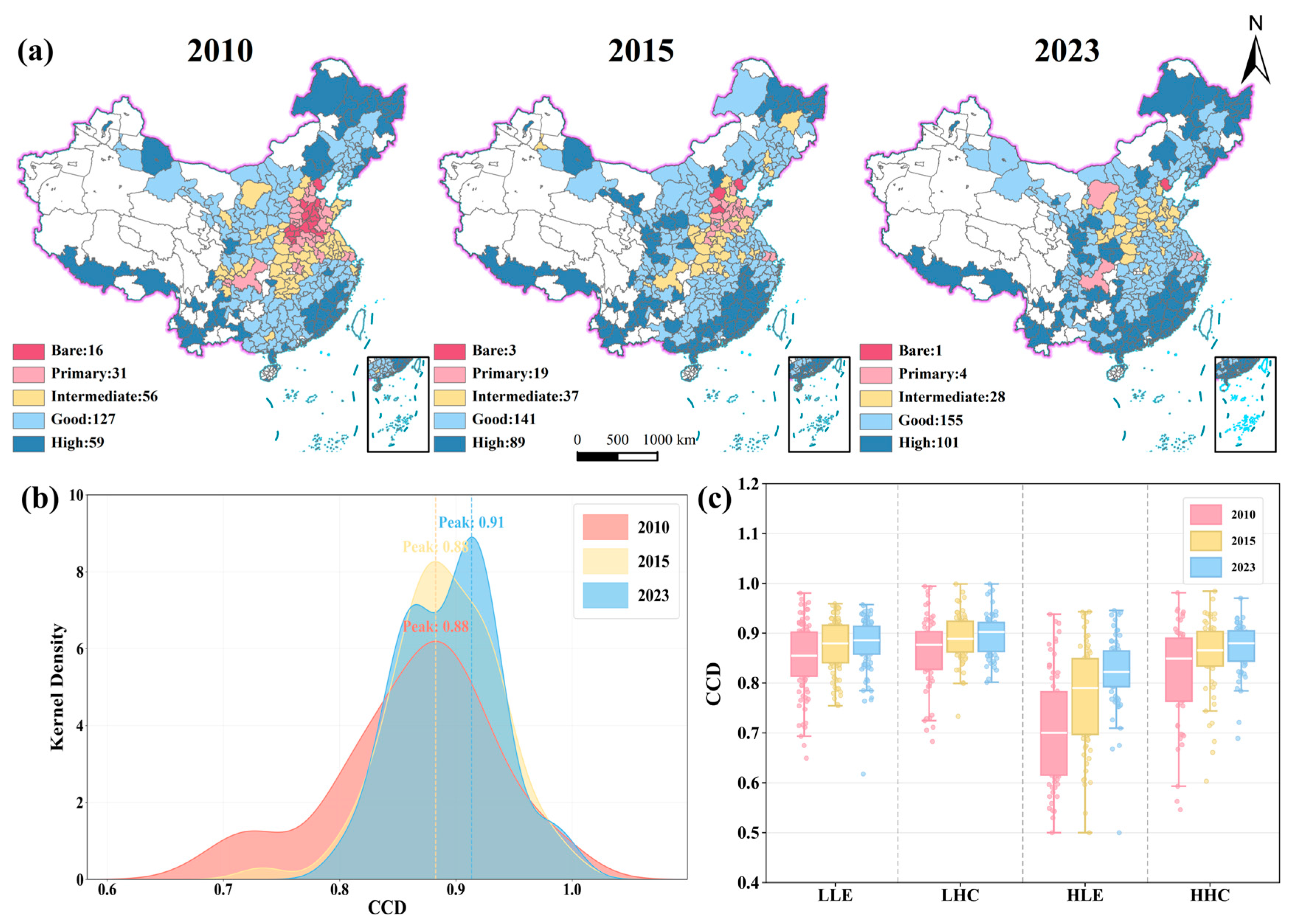
4.2.2. Spatiotemporal Evolution of CCD
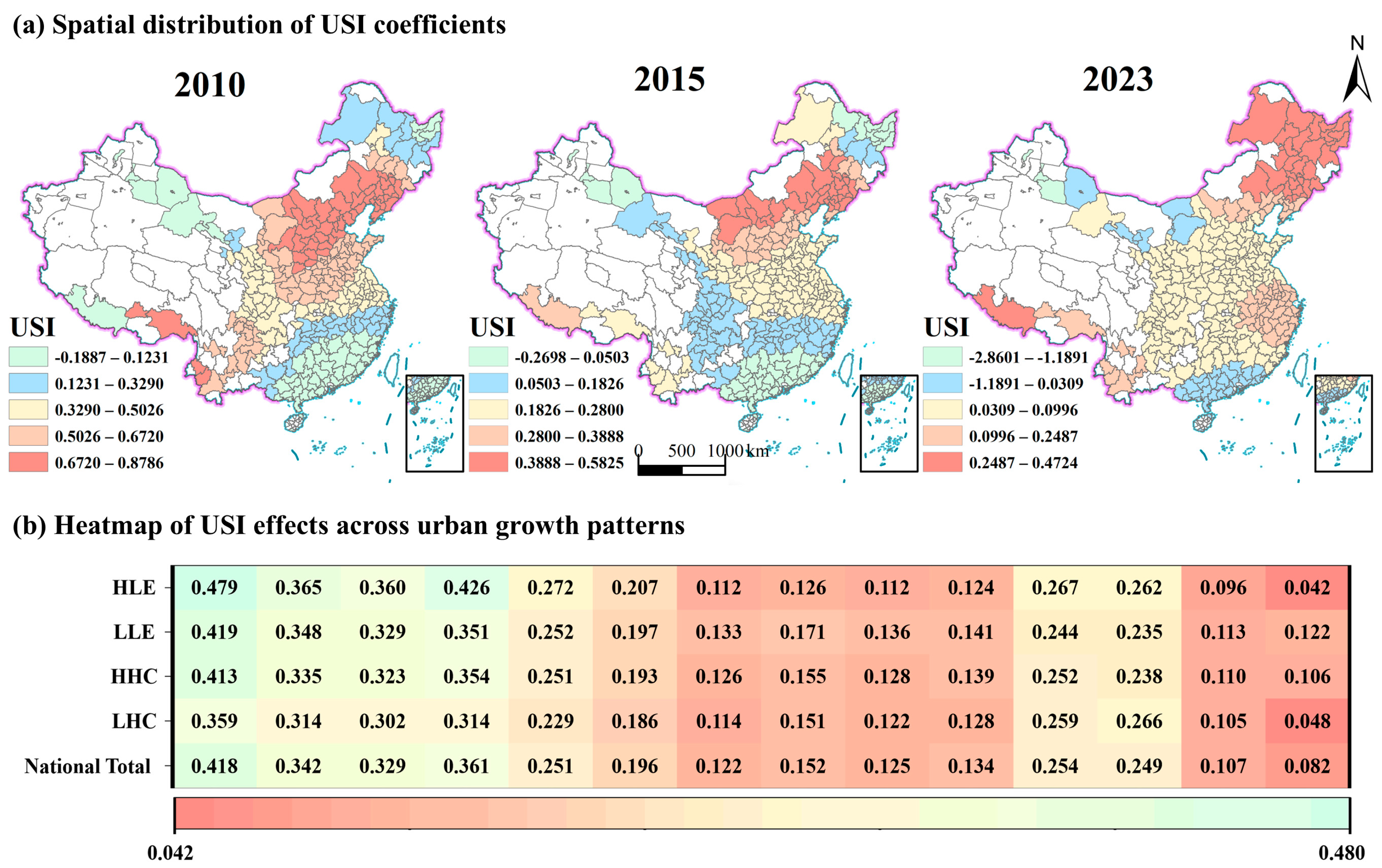
4.3. GTWR Results
4.4. Nonlinear Relationship Analysis Based on an Interpretable XGBoost-SHAP Model
4.4.1. Model Performance and Factor Contributions
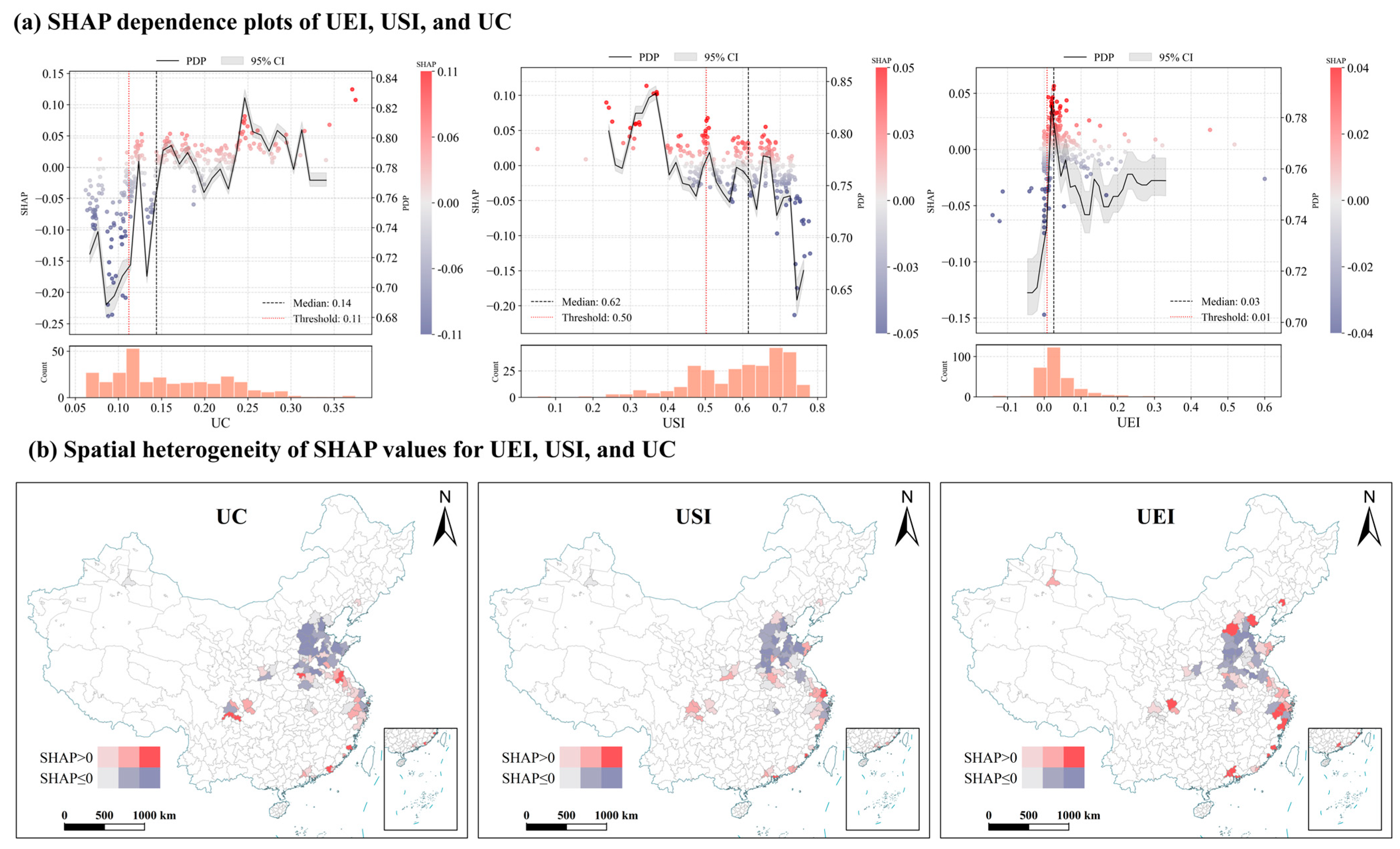
4.4.2. Nonlinear Relationships
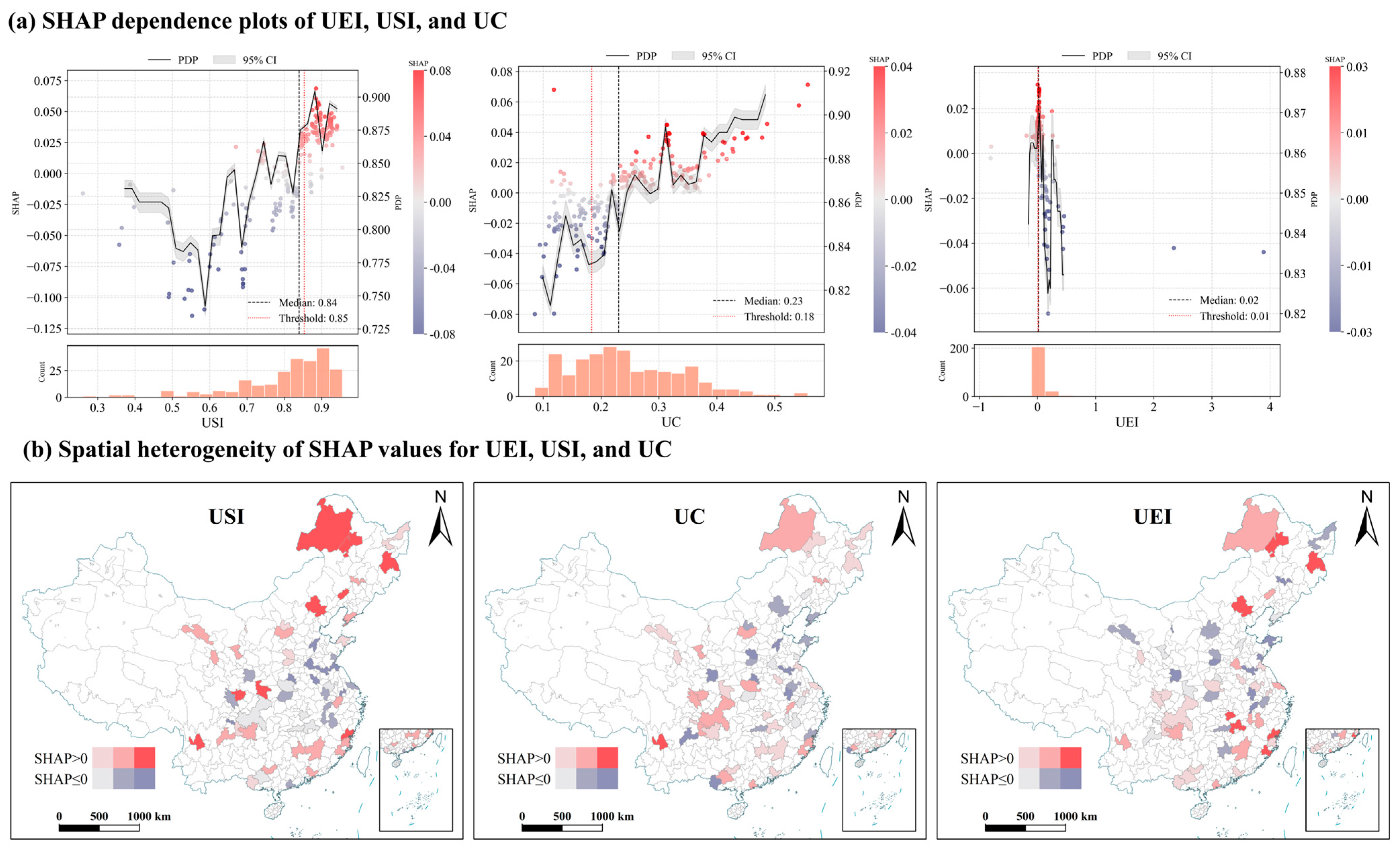
4.4.3. Heterogeneity of Nonlinear Effects Across Urban Growth Patterns
5. Discussion
5.1. Nonlinear Relationships Between Urban Expansion and CCD
5.2. Differential Effects Across Urban Growth Patterns
5.3. Policy Implications
5.4. Limitations and Future Research Directions
6. Conclusions
- (1)
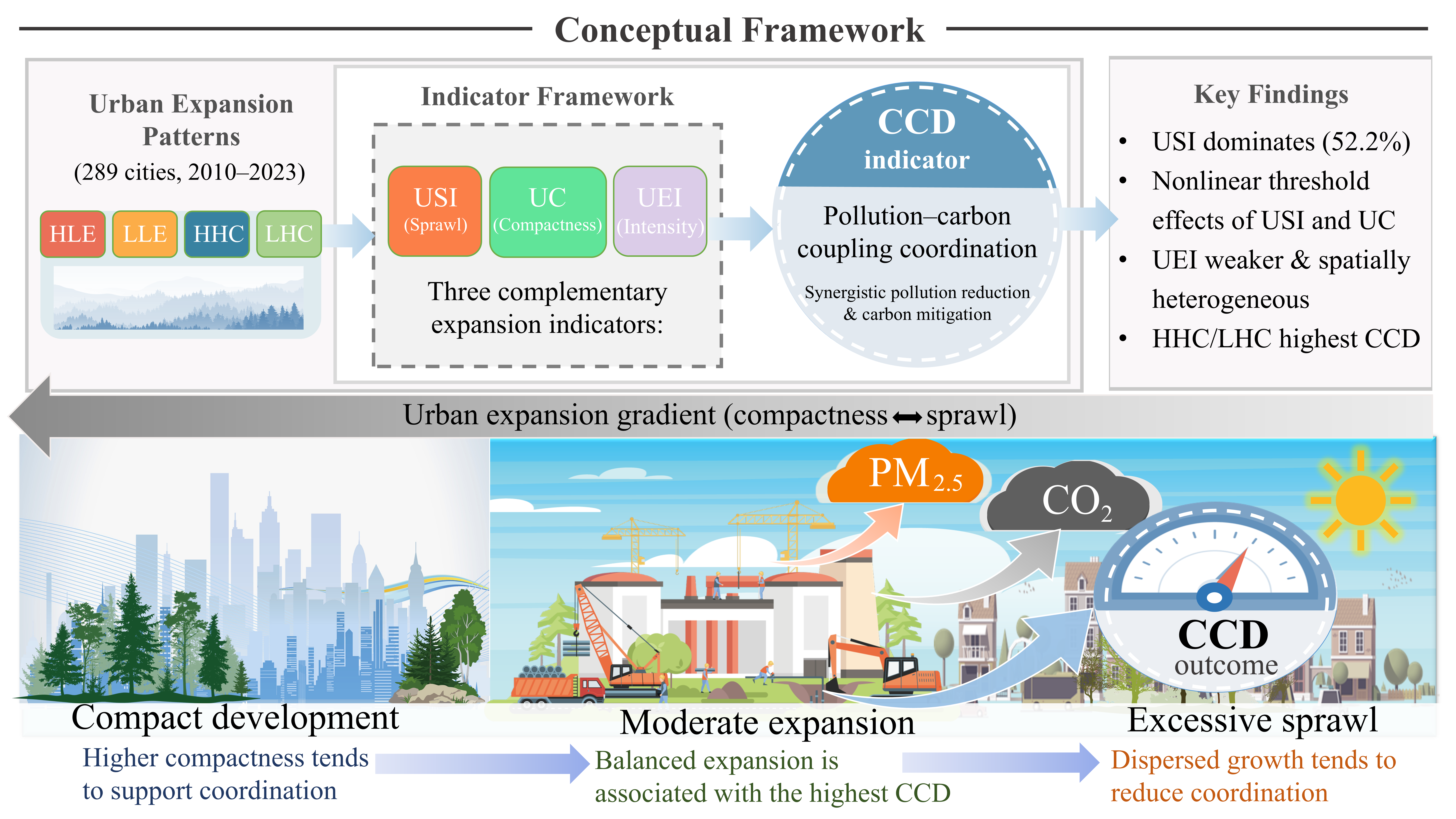
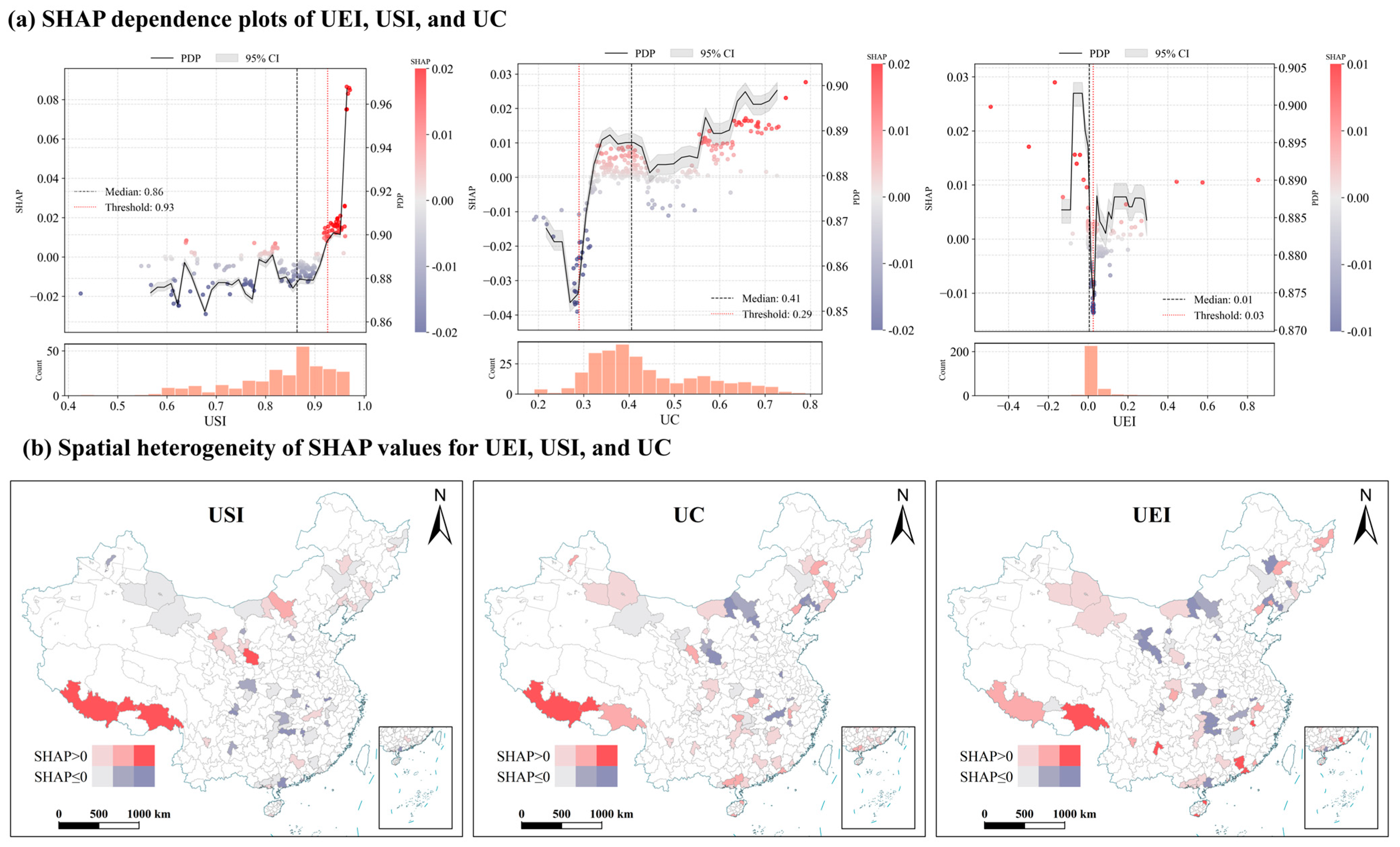
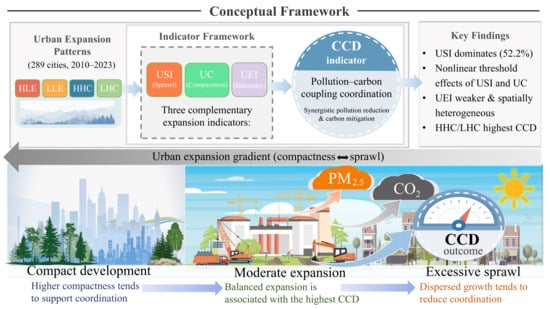
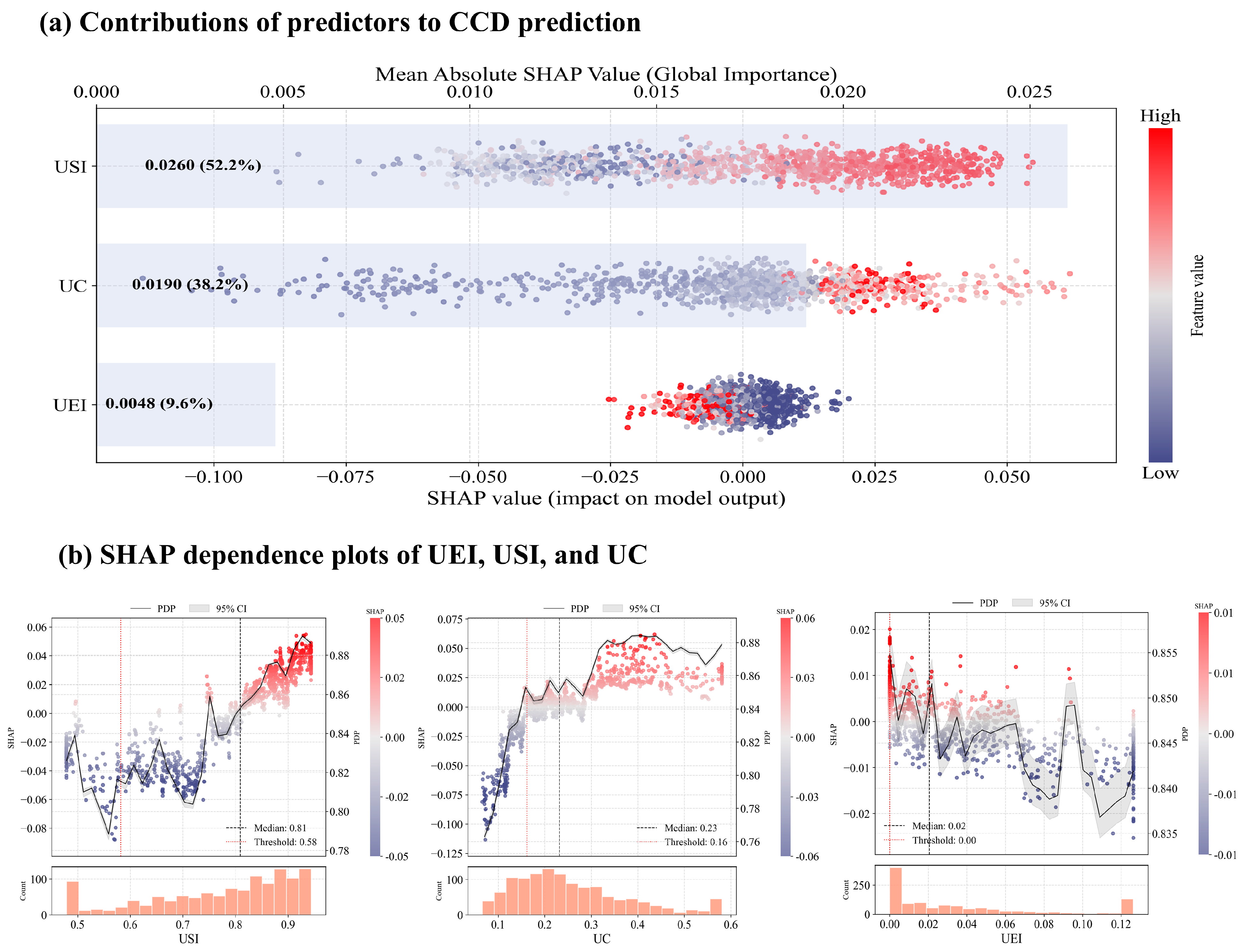
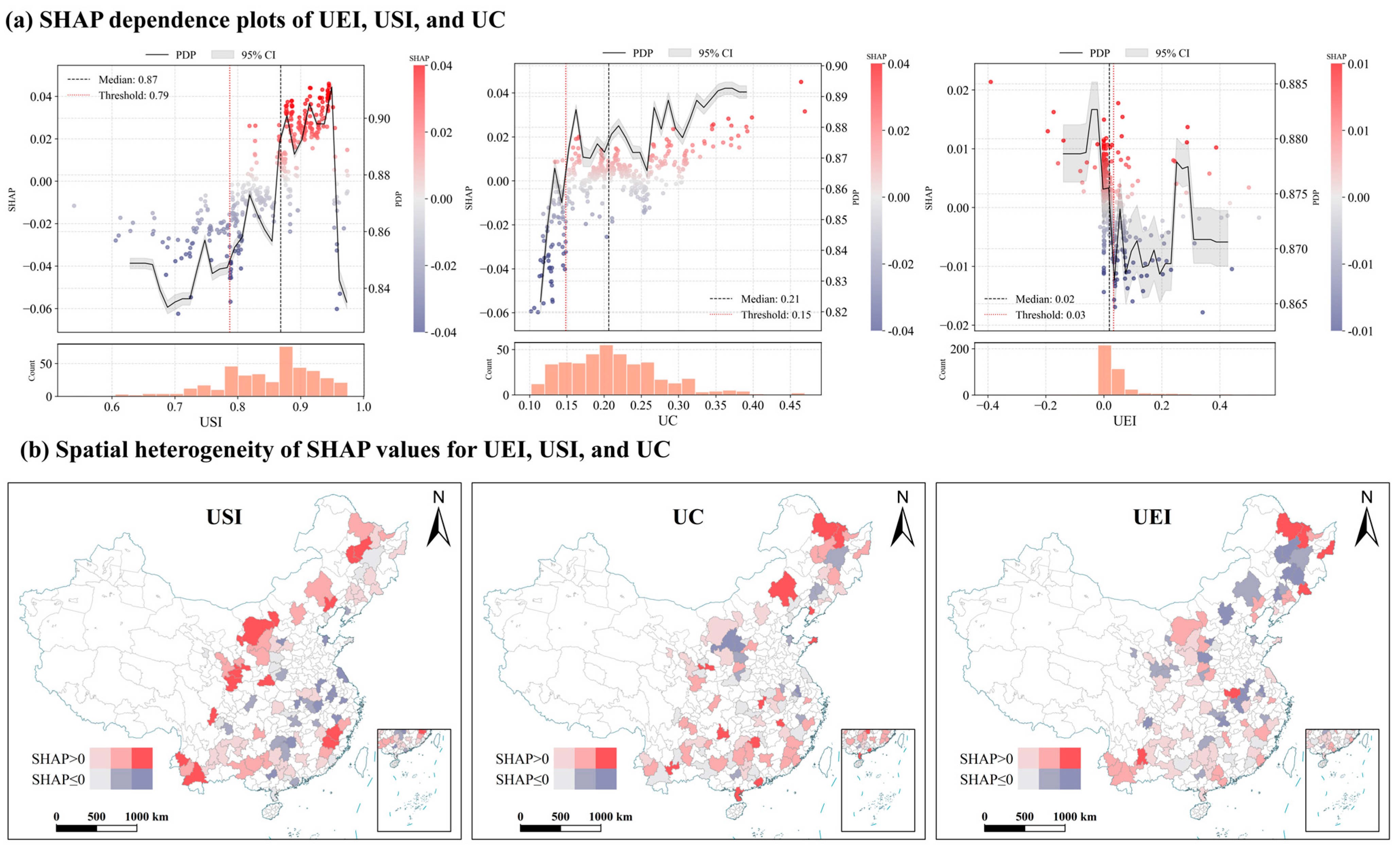
- USI and UC exhibit significant nonlinear threshold effects on CCD. Moderate spatial expansion and an appropriate level of compactness are associated with higher CCD, whereas excessive dispersion or excessive compactness tends to suppress pollution–carbon synergy.
- (2)
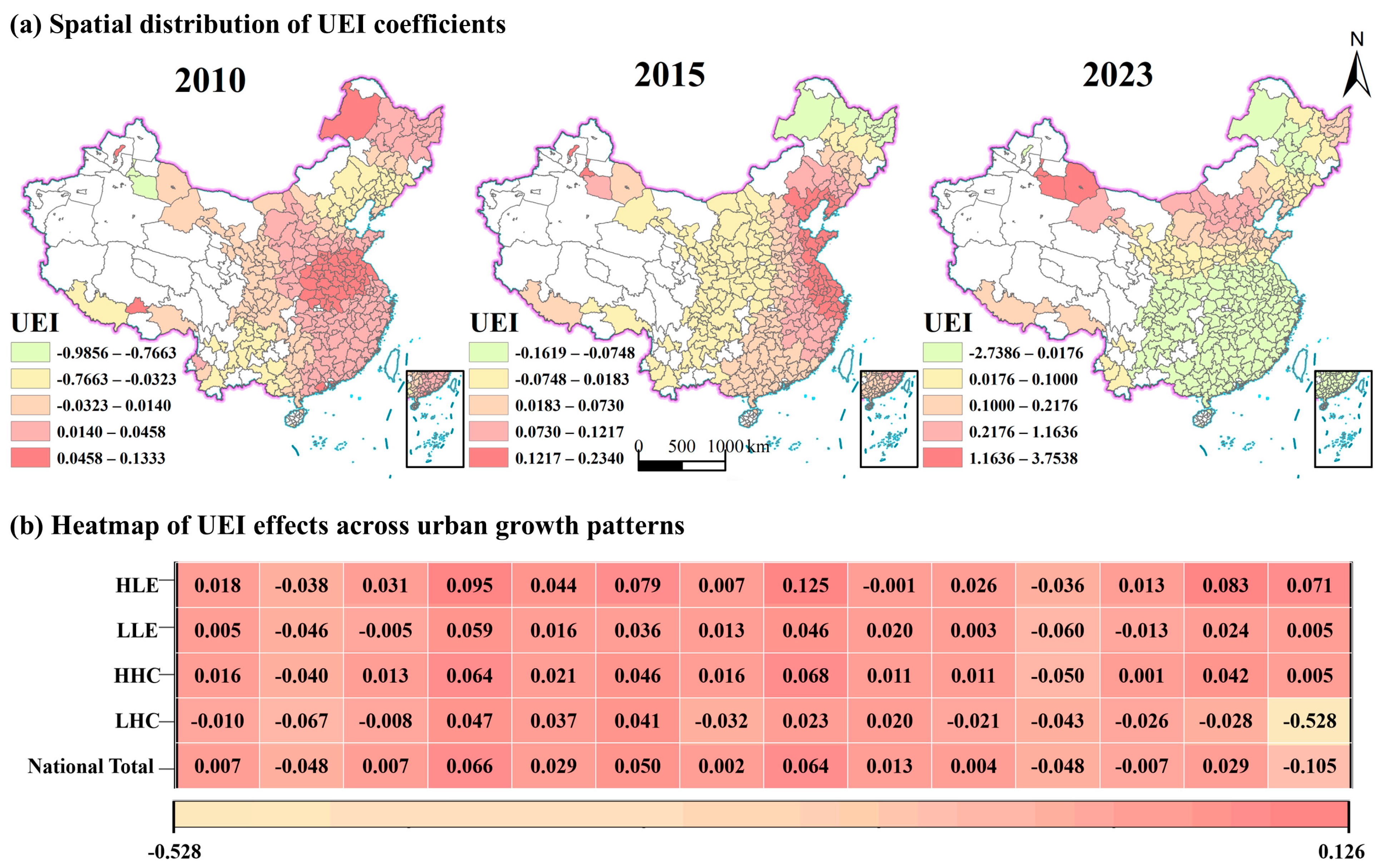
- The effects of USI and UC are substantially stronger than those of UEI. Their stronger associations with CCD may be related to differences in land-use efficiency, commuting distance, and infrastructure configuration.
- (3)
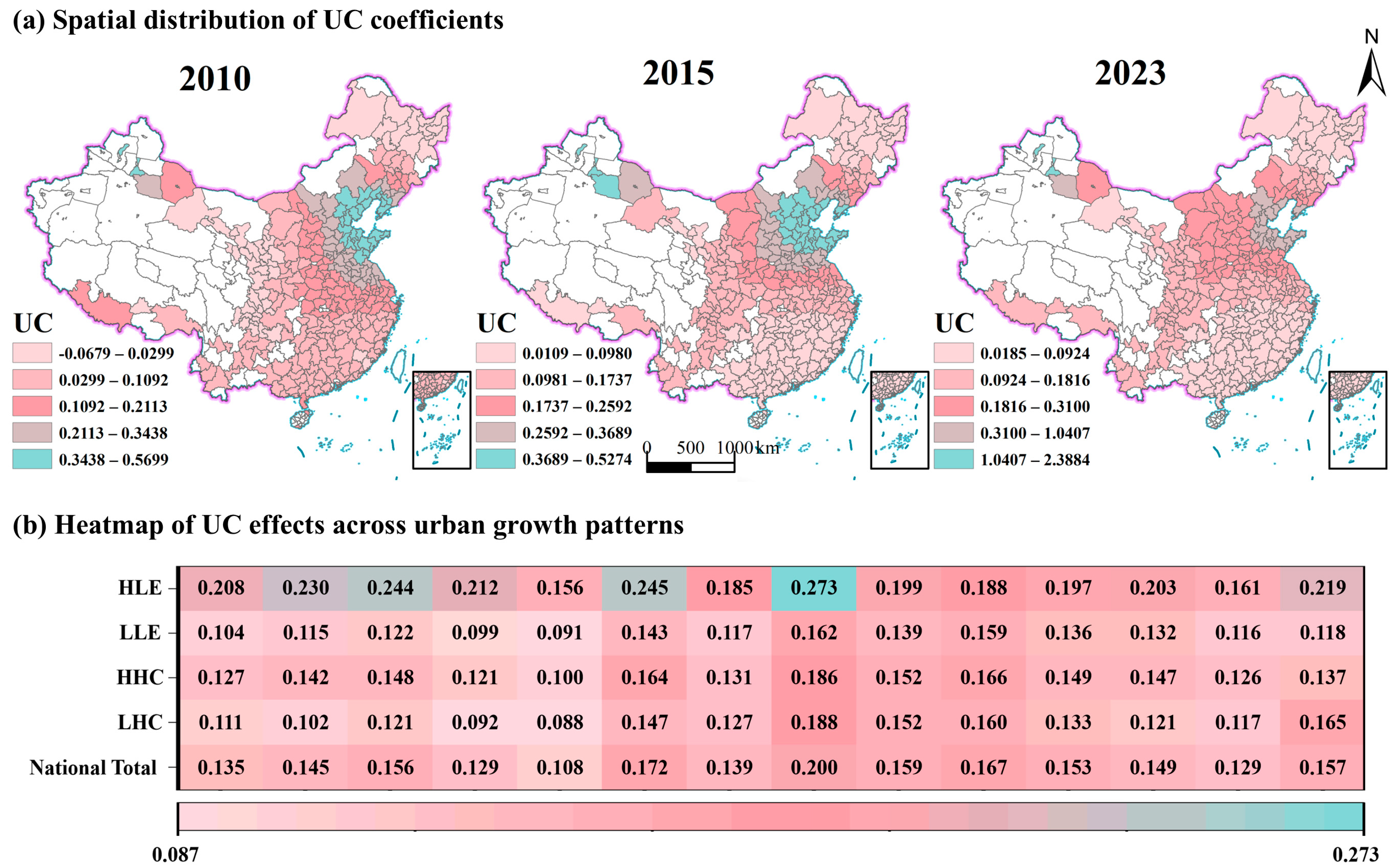
- Significant spatial heterogeneity exists across urban growth patterns. HHC cities show the highest CCD levels, whereas LLE and HLE cities are more often associated with structural inefficiency and lower expansion quality, which correspond to comparatively less favorable pollution–carbon coordination outcomes.
- (4)
- Results from GTWR and XGBoost-SHAP suggest that more organized forms of spatial expansion are more often associated with favorable pollution–carbon coordination outcomes, whereas expansion intensity alone appears to be less informative in distinguishing CCD differences.
Supplementary Materials
Author Contributions
Funding
Data Availability Statement
Conflicts of Interest
References
- Bao, C.; He, D. The Causal Relationship between Urbanization, Economic Growth and Water Use Change in Provincial China. Sustainability 2015, 7, 16076–16085. [Google Scholar] [CrossRef]
- Ning, Y.; Liu, S.; Zhao, S.; Liu, M.; Gao, H.; Gong, P. Urban growth rates, trajectories, and multi-dimensional disparities in China. Cities 2022, 126, 103717. [Google Scholar] [CrossRef]
- Liu, Y.; Yang, M.; Cui, J. Urbanization, economic agglomeration and economic growth. Heliyon 2024, 10, e23772. [Google Scholar] [CrossRef]
- Hong, T.; Yu, N.; Mao, Z.; Zhang, S. Government-driven urbanisation and its impact on regional economic growth in China. Cities 2021, 117, 103299. [Google Scholar] [CrossRef]
- Cao, Y.; Zhang, R.; Zhang, D.; Zhou, C. Urban Agglomerations in China: Characteristics and Influencing Factors of Population Agglomeration. Chin. Geogr. Sci. 2023, 33, 719–735. [Google Scholar] [CrossRef]
- Whiting, S.H. Land Rights, Industrialization, and Urbanization: China in Comparative Context. J. Chin. Political Sci. 2022, 27, 399–414. [Google Scholar] [CrossRef]
- Yang, J.; Zheng, J.; Lu, B.; Han, C.; Li, C.; Wu, J.; Han, L.; Harris, P. How to quantify the impact of urban expansion on ecological security in Northwest China. J. Clean. Prod. 2025, 526, 146622. [Google Scholar] [CrossRef]
- Basu, T.; Das, A. Urbanization induced changes in land use dynamics and its nexus to ecosystem service values: A spatiotemporal investigation to promote sustainable urban growth. Land Use Policy 2024, 144, 107239. [Google Scholar] [CrossRef]
- Shi, F.; Liao, X.; Shen, L.; Meng, C.; Lai, Y. Exploring the spatiotemporal impacts of urban form on CO2 emissions: Evidence and implications from 256 Chinese cities. Environ. Impact Assess. Rev. 2022, 96, 106850. [Google Scholar] [CrossRef]
- Wang, J.; Shao, Z.; Fu, P.; Zhuang, Q.; Chang, J.; Jing, P.; Zhao, Z.; Xu, Z.; Wang, S.; Yang, F. Unraveling the impact of urban expansion on vegetation carbon sequestration capacity: A case study of the Yangtze River Economic Belt. Sustain. Cities Soc. 2025, 120, 106157. [Google Scholar] [CrossRef]
- Chen, Y.-X.; Xiao, Y.; Huang, H.; Xiang, X.; Li, Z. Exploring the spatial heterogeneity impact of urban expansion on pollution and carbon emissions in China. Sustain. Cities Soc. 2025, 132, 106827. [Google Scholar] [CrossRef]
- Yang, X.; Ran, G. Factors influencing the coupled and coordinated development of cities in the Yangtze River Economic Belt: A focus on carbon reduction, pollution control, greening, and growth. J. Environ. Manag. 2024, 370, 122499. [Google Scholar] [CrossRef] [PubMed]
- Liu, J.; Jiao, L.; Zhang, B.; Xu, G.; Yang, L.; Dong, T.; Xu, Z.; Zhong, J.; Zhou, Z. New indices to capture the evolution characteristics of urban expansion structure and form. Ecol. Indic. 2021, 122, 107302. [Google Scholar] [CrossRef]
- Wei, G.; He, B.-J.; Sun, P.; Liu, Y.; Li, R.; Ouyang, X.; Luo, K.; Li, S. Evolutionary trends of urban expansion and its sustainable development: Evidence from 80 representative cities in the belt and road initiative region. Cities 2023, 138, 104353. [Google Scholar] [CrossRef]
- He, X.; Zhou, Y. Urban spatial growth and driving mechanisms under different urban morphologies: An empirical analysis of 287 Chinese cities. Landsc. Urban Plan. 2024, 248, 105096. [Google Scholar] [CrossRef]
- Patil, G.R.; Bhatia, S.Y.; Yadav, M.; Buddhiraju, K.M.; Venugopala Rao, K. Spatiotemporal urban growth dynamics and its interactions with transportation networks in an unplanned urban conglomeration using satellite imagery: A case study of Mumbai Metropolitan Region, India. Land Use Policy 2025, 157, 107617. [Google Scholar] [CrossRef]
- Xue, S.; Fang, Z.; van Riper, C.; Bai, Y.; He, W.; Wang, T.; Zhou, Q.; Cheng, C.; Huang, Z. Tracing spatial variations in ecological and economic benefits to support basic dimensions of wellbeing during urban expansion. Sustain. Cities Soc. 2025, 133, 106846. [Google Scholar] [CrossRef]
- Tan, G.; Zhang, X.; Xiong, S.; Sun, Z.; Lei, Y.; Wang, H.; Du, S. Assessing the impacts of urban functional form on anthropogenic carbon emissions: A case study of 31 major cities in China. Ecol. Indic. 2024, 167, 112700. [Google Scholar] [CrossRef]
- Liu, S.; Xie, Y.; Lu, Y.; Liu, Y.; Tong, Z.; Liu, Y. Impact of urban expansion on the temporal adaptation and spatial connectivity of ecological security patterns: Insights from a rapidly urbanizing metropolitan area. Ecol. Process. 2025, 14, 84. [Google Scholar] [CrossRef]
- Zeng, X.; Fan, D.; Zheng, Y.; Li, S. Exploring the Differentiated Impact of Urban Spatial Form on Carbon Emissions: Evidence from Chinese Cities. Land 2024, 13, 874. [Google Scholar] [CrossRef]
- Ren, Q.; He, C.; Huang, Q.; Shi, P.; Zhang, D.; Güneralp, B. Impacts of urban expansion on natural habitats in global drylands. Nat. Sustain. 2022, 5, 869–878. [Google Scholar] [CrossRef]
- Yushanjiang, A.; Zhou, W.; Wang, J.; Wang, J. Impact of urbanization on regional ecosystem services--- a case study in Guangdong-Hong Kong-Macao Greater Bay Area. Ecol. Indic. 2024, 159, 111633. [Google Scholar] [CrossRef]
- Fu, X.; Liu, J.; Ban-Weiss, G.A.; Zhang, J.; Huang, X.; Ouyang, B.; Popoola, O.; Tao, S. Effects of canyon geometry on the distribution of traffic-related air pollution in a large urban area: Implications of a multi-canyon air pollution dispersion model. Atmos. Environ. 2017, 165, 111–121. [Google Scholar] [CrossRef]
- Li, Z.; Wu, H.; Wu, F. Impacts of urban forms and socioeconomic factors on CO2 emissions: A spatial econometric analysis. J. Clean. Prod. 2022, 372, 133722. [Google Scholar] [CrossRef]
- McCarty, J.; Kaza, N. Urban form and air quality in the United States. Landsc. Urban Plan. 2015, 139, 168–179. [Google Scholar] [CrossRef]
- Hong, S.; Hui, E.C.-m.; Lin, Y. Relationship between urban spatial structure and carbon emissions: A literature review. Ecol. Indic. 2022, 144, 109456. [Google Scholar] [CrossRef]
- Shu, T.; Yu, T.; Liao, X.; Yang, S. Unearthing the impact of urban sprawl on transport carbon dioxide emissions: Fresh evidence from 274 Chinese cities. J. Geogr. Sci. 2024, 34, 1953–1976. [Google Scholar] [CrossRef]
- Wen, H.; Yu, H.; Nghiem, X.-H. Impact of urban sprawl on carbon emission efficiency: Evidence from China. Urban Clim. 2024, 55, 101986. [Google Scholar] [CrossRef]
- Ding, G.; Guo, J.; Pueppke, S.G.; Yi, J.; Ou, M.; Ou, W.; Tao, Y. The influence of urban form compactness on CO2 emissions and its threshold effect: Evidence from cities in China. J. Environ. Manag. 2022, 322, 116032. [Google Scholar] [CrossRef]
- Yin, K.; Yao, X. The impact of urban compactness on urban carbon emissions: A study of 281 Chinese cities. Urban Clim. 2024, 56, 102052. [Google Scholar] [CrossRef]
- Zhou, Y.; Lan, F.; Zhou, T. An experience-based mining approach to supporting urban renewal mode decisions under a multi-stakeholder environment in China. Land Use Policy 2021, 106, 105428. [Google Scholar] [CrossRef]
- Han, B.; Jin, X.; Wang, J.; Yin, Y.; Liu, C.; Sun, R.; Zhou, Y. Identifying inefficient urban land redevelopment potential for evidence-based decision making in China. Habitat Int. 2022, 128, 102661. [Google Scholar] [CrossRef]
- Deng, H. Inventory land era and transformation of China’s urban regeneration: An empirical study of Chengdu Hi-Tech West District, China. Habitat Int. 2024, 150, 103133. [Google Scholar] [CrossRef]
- Chen, S.; Tan, Z.; Mu, S.; Wang, J.; Chen, Y.; He, X. Synergy level of pollution and carbon reduction in the Yangtze River Economic Belt: Spatial-temporal evolution characteristics and driving factors. Sustain. Cities Soc. 2023, 98, 104859. [Google Scholar] [CrossRef]
- Han, S.; Wang, B.; Ao, Y.; Bahmani, H.; Chai, B. The coupling and coordination degree of urban resilience system: A case study of the Chengdu–Chongqing urban agglomeration. Environ. Impact Assess. Rev. 2023, 101, 107145. [Google Scholar] [CrossRef]
- Nie, C.; Lee, C.-C. Synergy of pollution control and carbon reduction in China: Spatial–temporal characteristics, regional differences, and convergence. Environ. Impact Assess. Rev. 2023, 101, 107110. [Google Scholar] [CrossRef]
- Zhang, Q.; Yin, Z.; Lu, X.; Gong, J.; Lei, Y.; Cai, B.; Cai, C.; Chai, Q.; Chen, H.; Dai, H.; et al. Synergetic roadmap of carbon neutrality and clean air for China. Environ. Sci. Ecotechnol. 2023, 16, 100280. [Google Scholar] [CrossRef]
- Feng, X.; Li, Y.; Yu, E.; Yang, J.; Lei, K. Coupling Relationship Between Urban Land Development and Carbon Emission Performance in Jiangsu Province. Econ. Geogr. 2024, 44, 161–171. (In Chinese) [Google Scholar] [CrossRef]
- Liang, S.; Zhang, J.; Cai, B.; Wang, K.; Zhang, S.; Li, Y. How to perceive and map the synergy between CO2 and air pollutants: Observation, measurement, and validation from a case study of China. J. Environ. Manag. 2024, 351, 119825. [Google Scholar] [CrossRef]
- Xiao, Y.-X.; Wang, H.; Liu, L.-J.; Purohit, P.; Jiang, H.-D.; Zhu, L.-L.; Zheng, H.-L.; Zhang, K. Integrated pollution and carbon mitigation delivers major health and economic co-benefits in China. npj Clean Air 2026, 2, 22. [Google Scholar] [CrossRef]
- Shi, Q.; Zheng, B.; Zheng, Y.; Tong, D.; Liu, Y.; Ma, H.; Hong, C.; Geng, G.; Guan, D.; He, K.; et al. Co-benefits of CO2 emission reduction from China’s clean air actions between 2013-2020. Nat. Commun. 2022, 13, 5061. [Google Scholar] [CrossRef]
- Guo, K.; Cao, Y.; Wang, Z.; Li, Z. Urban and industrial environmental pollution control in China: An analysis of capital input, efficiency and influencing factors. J. Environ. Manag. 2022, 316, 115198. [Google Scholar] [CrossRef]
- Zhou, G.; Singh, J.; Wu, J.; Sinha, R.; Laurenti, R.; Frostell, B. Evaluating low-carbon city initiatives from the DPSIR framework perspective. Habitat Int. 2015, 50, 289–299. [Google Scholar] [CrossRef]
- Yang, C.; Zeng, W.; Yang, X. Coupling coordination evaluation and sustainable development pattern of geo-ecological environment and urbanization in Chongqing municipality, China. Sustain. Cities Soc. 2020, 61, 102271. [Google Scholar] [CrossRef]
- Chakraborty, S.; Dadashpoor, H.; Novotný, J.; Maity, I.; Follmann, A.; Patel, P.P.; Roy, U.; Pramanik, S. In pursuit of sustainability—Spatio-temporal pathways of urban growth patterns in the world’s largest megacities. Cities 2022, 131, 103919. [Google Scholar] [CrossRef]
- He, Q.; Zeng, C.; Xie, P.; Tan, S.; Wu, J. Comparison of urban growth patterns and changes between three urban agglomerations in China and three metropolises in the USA from 1995 to 2015. Sustain. Cities Soc. 2019, 50, 101649. [Google Scholar] [CrossRef]
- Lv, T.; Hu, H.; Han, H.; Zhang, X.; Fan, H.; Yan, K. Towards sustainability: The spatiotemporal patterns and influence mechanism of urban sprawl intensity in the Yangtze River Delta urban agglomeration. Habitat Int. 2024, 148, 103089. [Google Scholar] [CrossRef]
- Koroso, N.H.; Zevenbergen, J.A. Urban land management under rapid urbanization: Exploring the link between urban land policies and urban land use efficiency in Ethiopia. Cities 2024, 153, 105269. [Google Scholar] [CrossRef]
- Tian, L.; Li, Y.; Yan, Y.; Wang, B. Measuring urban sprawl and exploring the role planning plays: A shanghai case study. Land Use Policy 2017, 67, 426–435. [Google Scholar] [CrossRef]
- Shi, Y.; Zhou, L.; Guo, X.; Li, J. The Multidimensional Measurement Method of Urban Sprawl and Its Empirical Analysis in Shanghai Metropolitan Area. Sustainability 2023, 15, 1020. [Google Scholar] [CrossRef]
- Feng, X.; Wang, S.; Li, Y.; Yang, J.; Lei, K.; Yuan, W. Spatial heterogeneity and driving mechanisms of carbon emissions in urban expansion areas: A research framework coupled with patterns and functions. Land Use Policy 2024, 143, 107209. [Google Scholar] [CrossRef]
- Han, J. Can urban sprawl be the cause of environmental deterioration? Based on the provincial panel data in China. Environ. Res. 2020, 189, 109954. [Google Scholar] [CrossRef] [PubMed]
- Liu, X.; Xu, H.; Zhang, M. The effects of urban expansion on carbon emissions: Based on the spatial interaction and transmission mechanism. J. Clean. Prod. 2024, 434, 140019. [Google Scholar] [CrossRef]
- Liu, J.; Wen, C.; Liu, Z.; Yu, Y. From isolation to linkage: Holistic insights into ecological risk induced by land use change. Land Use Policy 2024, 140, 107116. [Google Scholar] [CrossRef]
- Lu, J.; Liu, X.; Zhu, D.; Zhang, S. Unveiling multiscale and nonlinear effects of land use change drivers through interpretable machine learning model: Insights from “Ecological-cost and Economic-benefit” trade-off perspective. Environ. Impact Assess. Rev. 2026, 118, 108254. [Google Scholar] [CrossRef]
- Burton, E. The Compact City: Just or Just Compact? A Preliminary Analysis. Urban Stud. 2000, 37, 1969–2006. [Google Scholar] [CrossRef]
- Ewing, R.; Hamidi, S. Compactness versus Sprawl: A Review of Recent Evidence from the United States. J. Plan. Lit. 2015, 30, 413–432. [Google Scholar] [CrossRef]
- Searchinger, T.D.; Beringer, T.; Strong, A. Does the world have low-carbon bioenergy potential from the dedicated use of land? Energy Policy 2017, 110, 434–446. [Google Scholar] [CrossRef]
- Yan, D.; Huang, S.; Chen, G.; Tong, H.; Qin, P. Heterogeneous influences of urban compactness on air pollution: Evidence from 285 prefecture-level cities in China. Humanit. Soc. Sci. Commun. 2025, 12, 77. [Google Scholar] [CrossRef]
- Li, S.; Zhou, C.; Wang, S.; Gao, S.; Liu, Z. Spatial Heterogeneity in the Determinants of Urban Form: An Analysis of Chinese Cities with a GWR Approach. Sustainability 2019, 11, 479. [Google Scholar] [CrossRef]
- Fei, C.; Ziqun, C.; Shujian, W.; Yonghe, L.I. Study on Effects of Compact Urban Spatial Development on Carbon Performance: A Case Study of 41 Cities in the Yangtze River Delta. Areal Res. Dev. 2024, 43, 139–145. [Google Scholar] [CrossRef]
- Han, Y.; Jiang, Z.; Zhao, M.; Li, J. Analysis of coupling coordination development and obstacle factors in the water-energy-carbon-ecological environment nexus across China’s Yellow River basin. Sci. Rep. 2025, 15, 24106. [Google Scholar] [CrossRef]
- Wu, H.; Fang, S.; Zhang, C.; Hu, S.; Nan, D.; Yang, Y. Exploring the impact of urban form on urban land use efficiency under low-carbon emission constraints: A case study in China’s Yellow River Basin. J. Environ. Manag. 2022, 311, 114866. [Google Scholar] [CrossRef] [PubMed]
- Zhang, L.; Zhang, J.; Li, X.; Zhou, K.; Ye, J. The Impact of Urban Sprawl on Carbon Emissions from the Perspective of Nighttime Light Remote Sensing: A Case Study in Eastern China. Sustainability 2023, 15, 11940. [Google Scholar] [CrossRef]
- Jiuwen, S.; Xiaoxu, X.; Qiangmin, X.; Weihao, S. Impact of urban form on housing affordability stress in Chinese cities: Does public service efficiency matter? Cities 2024, 145, 104682. [Google Scholar] [CrossRef]
- Xiao, Y.; Yang, H.; Kong, Q. Poison or antidote? Exploring the effect of polycentric urban spatial structure on ecological resilience. Cities 2025, 165, 106163. [Google Scholar] [CrossRef]
- Mellander, C.; Lobo, J.; Stolarick, K.; Matheson, Z. Night-Time Light Data: A Good Proxy Measure for Economic Activity? PLoS ONE 2015, 10, e0139779. [Google Scholar] [CrossRef]
- Lan, F.; Da, H.; Wen, H.; Wang, Y. Spatial Structure Evolution of Urban Agglomerations and Its Driving Factors in Mainland China: From the Monocentric to the Polycentric Dimension. Sustainability 2019, 11, 610. [Google Scholar] [CrossRef]
- Wang, H.; Liu, Z.; Zhou, Y. Assessing urban resilience in China from the perspective of socioeconomic and ecological sustainability. Environ. Impact Assess. Rev. 2023, 102, 107163. [Google Scholar] [CrossRef]
- Wang, M.; Li, Y.; Yuan, H.; Zhou, S.; Wang, Y.; Adnan Ikram, R.M.; Li, J. An XGBoost-SHAP approach to quantifying morphological impact on urban flooding susceptibility. Ecol. Indic. 2023, 156, 111137. [Google Scholar] [CrossRef]
- Chen, Y.; Yang, J.; Yu, W.; Ren, J.; Xiao, X.; Xia, J.C. Relationship between urban spatial form and seasonal land surface temperature under different grid scales. Sustain. Cities Soc. 2023, 89, 104374. [Google Scholar] [CrossRef]
- Dong, J.-q.; Hu, D.-m.; Yan, Y.-l.; Peng, L.; Zhang, P.-h.; Niu, Y.-y.; Duan, X.-l. Revealing Driving Factors of Urban O3 Based on Explainable Machine Learning. Environ. Sci. 2023, 44, 3660–3668. (In Chinese) [Google Scholar] [CrossRef]
- Hartigan, J.A.; Wong, M.A. A K-Means Clustering Algorithm. J. R. Stat. Soc. Ser. C Appl. Stat. 2018, 28, 100–108. [Google Scholar] [CrossRef]
- Rousseeuw, P.J. Silhouettes: A graphical aid to the interpretation and validation of cluster analysis. J. Comput. Appl. Math. 1987, 20, 53–65. [Google Scholar] [CrossRef]
- Wang, M.; Cai, B. A two-level comparison of CO2 emission data in China: Evidence from three gridded data sources. J. Clean. Prod. 2017, 148, 194–201. [Google Scholar] [CrossRef]
- Zheng, L.; Li, S.; Hu, X.; Zheng, F.; Cai, K.; Li, N.; Chen, Y. Spatiotemporal comparative analysis of three carbon emission inventories in mainland China. Atmos. Pollut. Res. 2025, 16, 102417. [Google Scholar] [CrossRef]
- Gao, M.; Ma, K.; Yu, J. The characteristics and drivers of China’s city-level urban-rural activity sectors’ carbon intensity gap during urban land expansion. Energy Policy 2023, 181, 113725. [Google Scholar] [CrossRef]
- Zhang, X.; Lu, L.; Ren, Y.; Xu, Y.; Zhang, H. Spatiotemporal Evolution Pattern of Urban Sprawl in China and Its Influencing Factors. Econ. Geogr. 2021, 41, 77–85. (In Chinese) [Google Scholar] [CrossRef]
- Nieuwenhuijsen, M.J. Urban and transport planning pathways to carbon neutral, liveable and healthy cities; A review of the current evidence. Environ. Int. 2020, 140, 105661. [Google Scholar] [CrossRef]
- Monkkonen, P.; Guerra, E.; Montejano Escamilla, J.; Caudillo Cos, C.; Tapia-McClung, R. A global analysis of land use regulation, urban form, and greenhouse gas emissions. Cities 2024, 147, 104801. [Google Scholar] [CrossRef]
- Jin, Y.; Xu, Y. Carbon reduction of urban form strategies: Regional heterogeneity in Yangtze River Delta, China. Land Use Policy 2024, 141, 107154. [Google Scholar] [CrossRef]
- Li, M.; Zuo, M.; Chen, S.; Tang, S.; Chen, T.; Liu, J. Impact of Urban Spatial Compactness on Carbon Emissions: Heterogeneity at the County Level in the Beijing–Tianjin–Hebei Area, China. Land 2024, 13, 2104. [Google Scholar] [CrossRef]
- Xing, X.; Xi, Q.; Shi, W. Impact of urban compactness on carbon emission in Chinese cities: From moderating effects of industrial diversity and job-housing imbalances. Land Use Policy 2024, 143, 107213. [Google Scholar] [CrossRef]
- Sun, C.; Zhang, Y.; Ma, W.; Wu, R.; Wang, S. The Impacts of Urban Form on Carbon Emissions: A Comprehensive Review. Land 2022, 11, 1430. [Google Scholar] [CrossRef]
- Van der Borght, R.; Pallares Barbera, M. How urban spatial expansion influences CO2 emissions in Latin American countries. Cities 2023, 139, 104389. [Google Scholar] [CrossRef]








| D Value | Category | D Value | Category |
|---|---|---|---|
| [0, 0.1) | Extreme imbalance | [0.5, 0.6) | Bare coordination |
| [0.1, 0.2) | Severe imbalance | [0.6, 0.7) | Primary coordination |
| [0.2, 0.3) | Moderate imbalance | [0.7, 0.8) | Intermediate coordination |
| [0.3, 0.4) | Mild imbalance | [0.8, 0.9) | Good coordination |
| [0.4, 0.5) | Near imbalance | [0.9, 1.0) | High-quality coordination |
| Urban Growth Patterns | Number of Cities | Share (%) | Mean (SD) | Characteristics | ||
|---|---|---|---|---|---|---|
| UEI | USI | UC | ||||
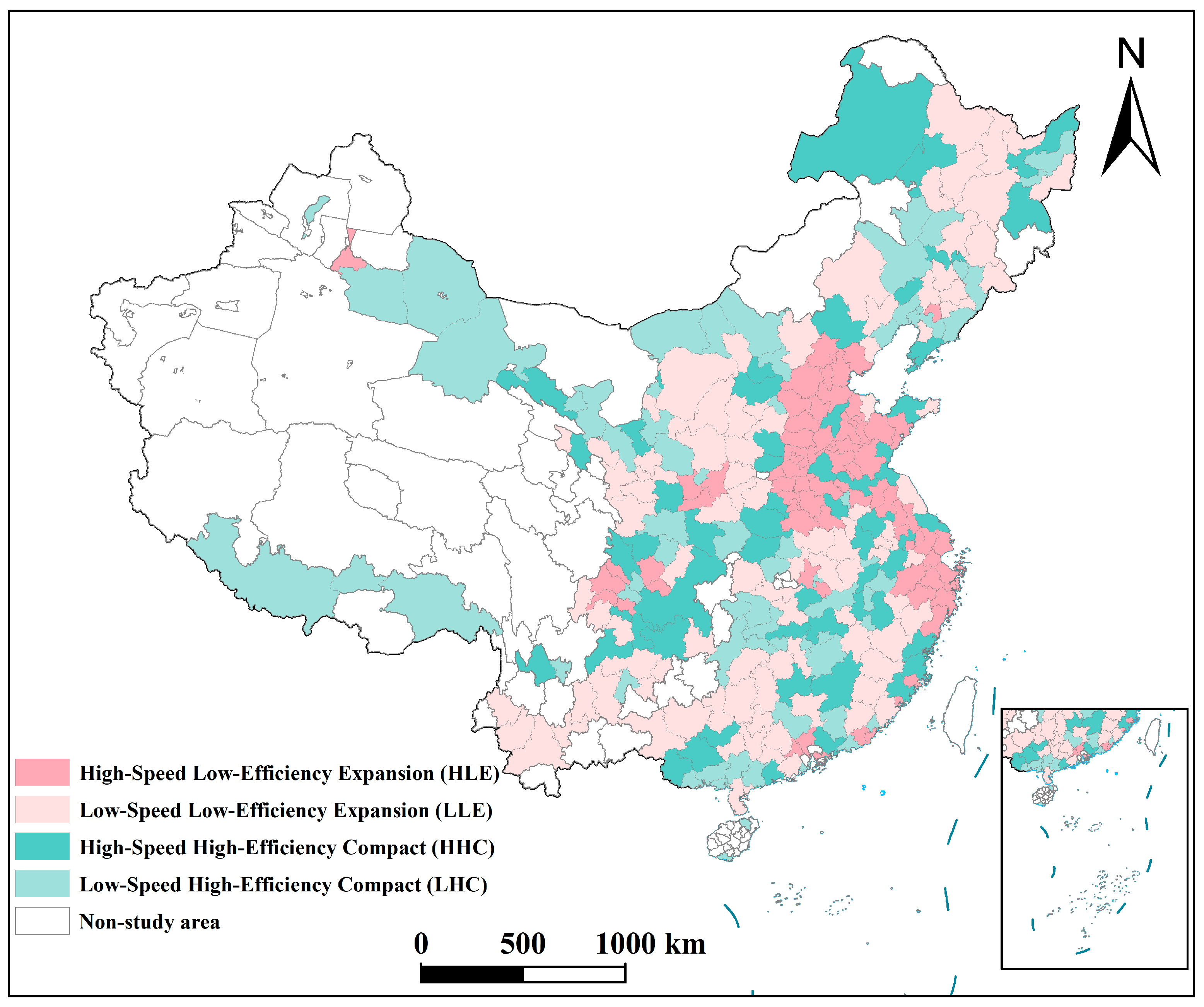
| High-Speed Low-Efficiency Expansion (HLE) | 70 | 24.22 | 0.0468 (0.0426) | 0.6782 (0.0791) | 0.1721 (0.0662) | Rapid growth, high sprawl, low compactness, and low land-use efficiency |
| Low-Speed Low-Efficiency Expansion (LLE) | 95 | 32.87 | 0.0299 (0.0346) | 0.8718 (0.0523) | 0.2098 (0.0563) | Slow growth, high sprawl, low compactness, and low land-use efficiency |
| High-Speed High-Efficiency Compact (HHC) | 56 | 19.38 | 0.1765 (0.0375) | 0.8397 (0.0833) | 0.2382 (0.0842) | Rapid growth, low sprawl, high compactness, and high land-use efficiency |
| Low-Speed High-Efficiency Compact (LHC) | 68 | 23.53 | 0.0285 (0.0366) | 0.8612 (0.0778) | 0.4234 (0.0821) | Slow growth, low sprawl, high compactness, and high land-use efficiency |
| Model | R2 | Adjusted R2 | AICc |
|---|---|---|---|
| OLS | 0.598 | 0.597 | −924.173 |
| GWR | 0.612 | 0.612 | −1300.421 |
| GTWR | 0.717 | 0.714 | −734.768 |
Disclaimer/Publisher’s Note: The statements, opinions and data contained in all publications are solely those of the individual author(s) and contributor(s) and not of MDPI and/or the editor(s). MDPI and/or the editor(s) disclaim responsibility for any injury to people or property resulting from any ideas, methods, instructions or products referred to in the content. |
© 2026 by the authors. Licensee MDPI, Basel, Switzerland. This article is an open access article distributed under the terms and conditions of the Creative Commons Attribution (CC BY) license.
Share and Cite
Zhou, J.; Xu, J.; Zhao, Y. “Urban Sprawl” or “Urban Compactness”? Differentiated Impacts of Urban Growth Patterns on the Coupling Coordination Between Pollution and Carbon Emissions. Land 2026, 15, 701. https://doi.org/10.3390/land15050701
Zhou J, Xu J, Zhao Y. “Urban Sprawl” or “Urban Compactness”? Differentiated Impacts of Urban Growth Patterns on the Coupling Coordination Between Pollution and Carbon Emissions. Land. 2026; 15(5):701. https://doi.org/10.3390/land15050701
Chicago/Turabian StyleZhou, Jiuyan, Jianbin Xu, and Yuyi Zhao. 2026. "“Urban Sprawl” or “Urban Compactness”? Differentiated Impacts of Urban Growth Patterns on the Coupling Coordination Between Pollution and Carbon Emissions" Land 15, no. 5: 701. https://doi.org/10.3390/land15050701
APA StyleZhou, J., Xu, J., & Zhao, Y. (2026). “Urban Sprawl” or “Urban Compactness”? Differentiated Impacts of Urban Growth Patterns on the Coupling Coordination Between Pollution and Carbon Emissions. Land, 15(5), 701. https://doi.org/10.3390/land15050701