Article

Impact Assessment of Coastal Defense Strategies on Critical Infrastructures and Beaches: Application of Coastal Degradation Calculator (CoDeC) to San Lucido, Italy


1
Italian National Agency for New Technologies Energy and Sustainable Development (ENEA), Via Anguillarese 301, 00123 Rome, Italy
2
Institute for Environmental Protection and Research (ISPRA), Via Vitaliano Brancati 48, 00144 Rome, Italy
3
Institute of Polar Sciences, National Research Council of Italy (ISP CNR), Via Salaria km 29,300, 00015 Rome, Italy
*
Author to whom correspondence should be addressed.
Land 2026, 15(5), 696; https://doi.org/10.3390/land15050696
Submission received: 1 March 2026 / Revised: 11 April 2026 / Accepted: 14 April 2026 / Published: 22 April 2026

Abstract

Coastal erosion poses a growing threat to natural systems and critical infrastructures, particularly in touristic coastal areas where beaches represent both ecological assets and economic resources. Beyond shoreline retreat, erosion processes progressively reduce emerged beach surfaces and increase the exposure and vulnerability of coastal roads, railways, and urban settlements, with cascading socio-economic consequences. This study presents an integrated geomorphological and economic assessment of coastal erosion impacts. The Coastal Degradation Calculator (CoDeC) is applied along the Tyrrhenian coast of southern Italy, focusing on the municipality of San Lucido. Shoreline variations are quantified to reconstruct long-term changes in the Surface of the Emerged Beach (SEB) before and after major coastal defense interventions using multi-temporal remote sensing data (1954–2018). Simple, science-based box models are implemented to estimate sediment deficits, restoration needs, and associated economic damages, expressed in both €/m2 and €/year. Results highlight a reduction in SEB area exceeding 60%, significant downdrift erosion linked to hard defenses and additional losses caused by coastal urbanization. The methodology proved effective in supporting damage quantification and informed the resolution of a long-standing legal dispute between public authorities. Owing to its transparency and reproducibility, the proposed framework offers a transferable tool for coastal risk assessment and management under increasing climate-driven pressures.

1. Introduction

Environmental and socio-economic impacts are inherently complex to quantify and there is often a lack of standardized methodologies [1,2]. In particular, landscape aesthetic value represents a fundamental dimension of territorial identity. Where anthropogenic interventions significantly alter the original physiographic and visual characteristics of the environment [3,4], tools to estimate the associated economic impacts are often lacking.
Nicholas Stern, former Chief Economist of the World Bank, estimated that in the absence of adequate mitigation strategies, the global economy could incur losses ranging from approximately 5% to 20% of global Gross Domestic Product (GDP). It should be noted, however, that these projections refer to aggregate global impacts and encompass a broad spectrum of climate-related damages, including but not limited to the effect of sea level rise and coastal erosion processes as described by Davidson-Arnott and Komar [5,6].
Beaches are dynamic coastal sedimentary deposits, geologically formed by grains derived from rock degradation and morphologically influenced by marine, terrestrial and atmospheric forces [7,8,9]. From a sedimentological perspective, sandy beaches are coastal bodies consisting of loose material (sand and/or gravel), transported from inland by rivers and distributed along the coastline by incident waves [10].
Traditional hard engineering measures, including seawalls, groins, and revetments, have constituted the backbone of coastal protection strategies [11,12]. However, their effectiveness is strongly conditioned by periodic maintenance with sand nourishment, introducing scientific debate in relation to their long-term sustainability for storm protection [13]. The structural integrity of defense works can degrade over time due to mechanical stress, hydrodynamic forcing, and material fatigue; without timely interventions, their protective capacity diminishes, increasing the likelihood of cascading failures [11]. Therefore, preventive maintenance is not only a technical necessity but also a cost-effective strategy compared to post-event reconstruction [14,15].
Beyond hard defenses, beach nourishment has gained prominence as a “soft” engineering approach that aligns more closely with landscape aesthetic value and natural coastal processes [11]. This technique involves the periodic deposition of sand volumes onto eroding beaches, using sediments that are morphologically and mineralogically compatible with the native material [16,17,18]. By restoring beach profiles, nourishment projects act as sacrificial buffers that dissipate wave energy and reduce erosive pressure on inland assets, while simultaneously sustaining the recreational and ecological value of beaches [11].
Coastal erosion is a global process that is expected to affect an increasing number of countries and populations in the near future, as it is exacerbated by reduced sediment supply [19,20] and Relative Sea Level Rise (RSLR), which accounts for both global sea level rise and local land movements such as subsidence [21,22,23].
The vulnerability of these systems is particularly pronounced in regions where economic activity and civil protection rely heavily on coastal accessibility, rendering erosion not only an environmental issue but a threat to economic security and societal resilience [24].
In the Mediterranean Sea, this intensification has been documented by [25], highlighting how RSLR increases coastal vulnerability and the erosion risk. SLR is the consequence of several natural as well as anthropogenic drivers that contribute to shoreline retreat and the general reduction in emerged beach surface through time within the sand sharing systems [26,27,28], better known as physiographic units [29]. Over the past 50 years, reforestation, river damming and riverbed quarrying have significantly reduced sediment input from rivers [30,31,32]. Beach erosion typically begins at the river mouths [19] before propagating along adjacent coastal zones [33,34]. In addition, many coastal dunes have been exploited for the extraction of construction material, while harbors and coastal infrastructures have exacerbated erosion because hard structures, mainly seawalls, detached breakwaters, and groins, alter longshore sediment transport, causing erosion downdrift, shifting the process of shoreline retreat rather than mitigating the impact [10,18,35,36,37]. Many studies use historical analysis of shoreline variation to predict exploratory projections [21,38]. Accelerated sea-level rise and the increased frequency of extreme meteorological events exacerbate the natural dynamism of coasts, leading to significant geomorphological alterations [22,39]. The degradation of natural protective beach dune systems or the overtopping of seawalls may expose transport infrastructures to recurrent flooding, compromising the continuity of mobility and logistics networks [40,41].
The economic impacts of coastal erosion is a challenging topic, though specific estimates in €/m2 are absent, and quite often data are expressed in annual losses or total GDP impacts. Ref. [42] estimated that coastal ecosystem services in Europe generate 494 bm€ annually, with future sea-level rise potentially causing 4.2–5.1% decline by 2100. Ref. [43] quantified tourism-related losses for Catalonia at approximately 2200 m€ and 1820 m€ for Costa Brava and Costa Daurada respectively under RCP8.5 scenarios. These processes pose severe risks not only to natural ecosystems but also to anthropogenic assets located in coastal zones [24,25]. The increasing frequency and intensity of natural hazards, driven by climate change, underscores the critical need for systematic monitoring and protection of critical infrastructure [44]. Resilience in coastal human-environment systems requires balancing environmental and social economic components [45,46]. For instance, along the coast of the Gulf of Mexico, 27% of major roads in the region, 9% of rail lines, and 72% of ports are currently at risk [47]. A study by [48] found that around 65% of major coastal roads in Norfolk and Virginia Beach, Virginia (USA), will be more subject to flood and storm surge in the future.
Transport corridors, including coastal highways, railways, ports and energy facilities, are frequently located in low-lying and inherently unstable coastal zones [15,24]. Ref. [49] noted that projections of shoreline retreat and coastal land loss due to sea level rise involve uncertainty in relation to the climate change scenario and the SLR projections at the European scale [30]. Shoreline retreat can progressively undermine infrastructure stability, leading to localized damage, increased maintenance costs, or even total functional disruption [50,51,52,53]. Ref. [54] explicitly frames the problem of infrastructure systems in coastal areas exposed to episodic flooding exacerbated by sea-level rise stressors, while Ref. [55] notes that SLR coupled with storm surge will increase the vulnerability of coastal transportation infrastructure.
The European Union recommends integrating financial, environmental, and ecosystem service values over a sediment cell scale in order to adopt the most sustainable solution for coastal protection. Recent policy developments, particularly Directive (EU) 2022/2557 [56] on the resilience of critical entities, reflect a shift from traditional asset protection toward a comprehensive resilience-based framework requiring risk assessment and adaptive strategies across multiple sectors [57]. This legislative framework amplifies the relevance of interdisciplinary studies capable of quantifying exposure, vulnerability, and the economic implications of infrastructure degradation and failure, thereby supporting climate adaptation and evidence-based decision-making across scales.
In Italy, as a consequence of coastal erosion, about 40 million m2 of emerged beaches have been lost in the last 50 years, affecting about 40% of the sandy coasts [37,58,59,60]. This represents the main limitation to the carrying capacity of beaches and tourism development. Considering the average economic value of Italian beaches, such losses have a direct impact on tourism, which contributes approximately 5% of national GDP [18,61]. Non-market economic valuations highlight the importance of Italian beach landscapes, showing that users are on average willing to pay about €16 per season for their preservation. Willingness to pay is higher for more natural and less urbanized beaches, indicating substantial recreational and aesthetic value beyond direct tourism revenues [62,63]. Ref. [64] revealed that beach nourishment generates net local benefits but also induces free-riding and environmental externalities, suggesting the need for alternative economic instruments such as user fees, insurance schemes, or payments for ecosystem services.
With the growth of tourism and travel industries, beach tourism is becoming increasingly relevant for the economy of many countries [65,66,67]. Consequently, the economic value of beaches is rising due to increasing tourism demand, while their spatial extent is decreasing over time due to coastal erosion [56,68,69,70]. These dynamics can trigger cascading effects that compromise infrastructure functionality and safety, ultimately affecting ecosystem services and socio-economic stability.
This study applies a simplified box model called the Coastal Degradation Calculator (CoDeC) to estimate the economic impacts of coastal erosion, using shoreline variation as an integrated indicator of long-term geomorphological change driven by both natural processes (e.g., SLR) and human pressures (e.g., land use and reduced sediment supply). The proposed framework provides a standardized approach to quantify economic losses associated with sediment deficits induced by inadequate coastal defense systems and insufficient post operam maintenance. Unlike traditional studies, which primarily focus on modeling erosion and accretion processes in sandy beach systems, this approach integrates coastal management with key issues related to impacts on coastal geomorphology and the resulting socio-economic consequence.
The methodology was tested on the sandy coast of San Lucido (southern Italy) over the period 1954–2018, with a focus on erosion-induced impacts on critical infrastructure, particularly the coastal railways and roads, and their cascading effects on local communities. This focus is especially timely, as recent Mediterranean storm events, such as the January 2026 cyclone, have highlighted the acute vulnerability of coastal transport systems, causing widespread damage to roads and railways, service disruptions, and economic losses exceeding hundreds of millions of euros [71,72].

2. Study Area

The Italian coastline extends for approximately 7500 km and is characterized by strong geomorphological variability resulting from the interaction between complex tectonic settings, heterogeneous lithologies, and diverse hydrodynamic regimes [69,70,73]. Sandy beaches, gravelly shores, rocky cliffs, coastal plains, and pocket beaches coexist along the national shoreline [56,70], making Italy particularly exposed to coastal erosion processes, especially in low-lying and sediment-starved sectors [57,74,75,76].
The coast of the Calabria region is distinguished by its elongated and narrow morphology, bounded by the Tyrrhenian Sea to the west and the Ionian Sea to the east [74]. The region is largely mountainous, with short and steep river basins that deliver limited and highly variable sediment inputs to the coast [77,78,79,80]. As a result, many Calabrian shorelines exhibit a marked sensitivity to wave action, extreme storm events, and human-induced alterations of sediment budgets [70,78,81,82,83,84,85].
The study area is located along the Tyrrhenian sector of northern Calabria and comprises the coastal stretch between the municipalities of Paola and San Lucido [81]. This microtidal littoral system is characterized by mixed sandy–gravelly beaches (D50 = 5 mm on the emerged beach, transitioning to fine sand at approximately 10 m depth), alternating with rocky headlands and locally backed by urban settlements and transportation infrastructures [78,86].
The coastal dynamics of this sector are strongly influenced by exposure to northwestern and western wave climates, which play a key role in controlling sediment transport pathways and shoreline evolution [73,87]. Extreme offshore wave conditions can reach significant wave heights of approximately Hs ≈ 7.5 m with peak periods of Tp ≈ 12.6 s [72].
The investigated sector extends approximately between 39.36° N, 16.04° E (Paola) and 39.31° N, 16.06° E (San Lucido), representing a morphodynamically active coastal system where erosion processes pose significant risks to both natural and anthropogenic assets [88].
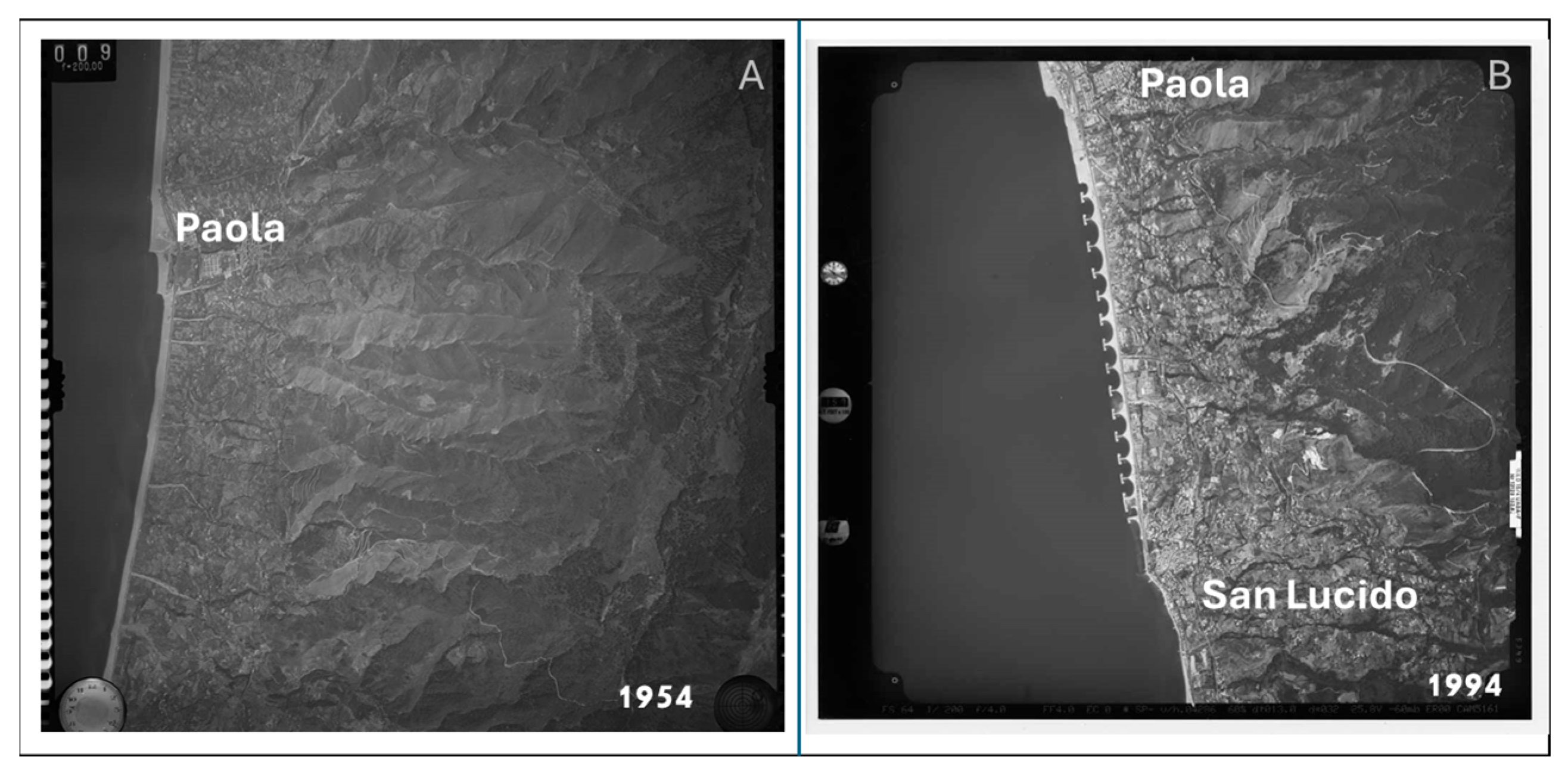
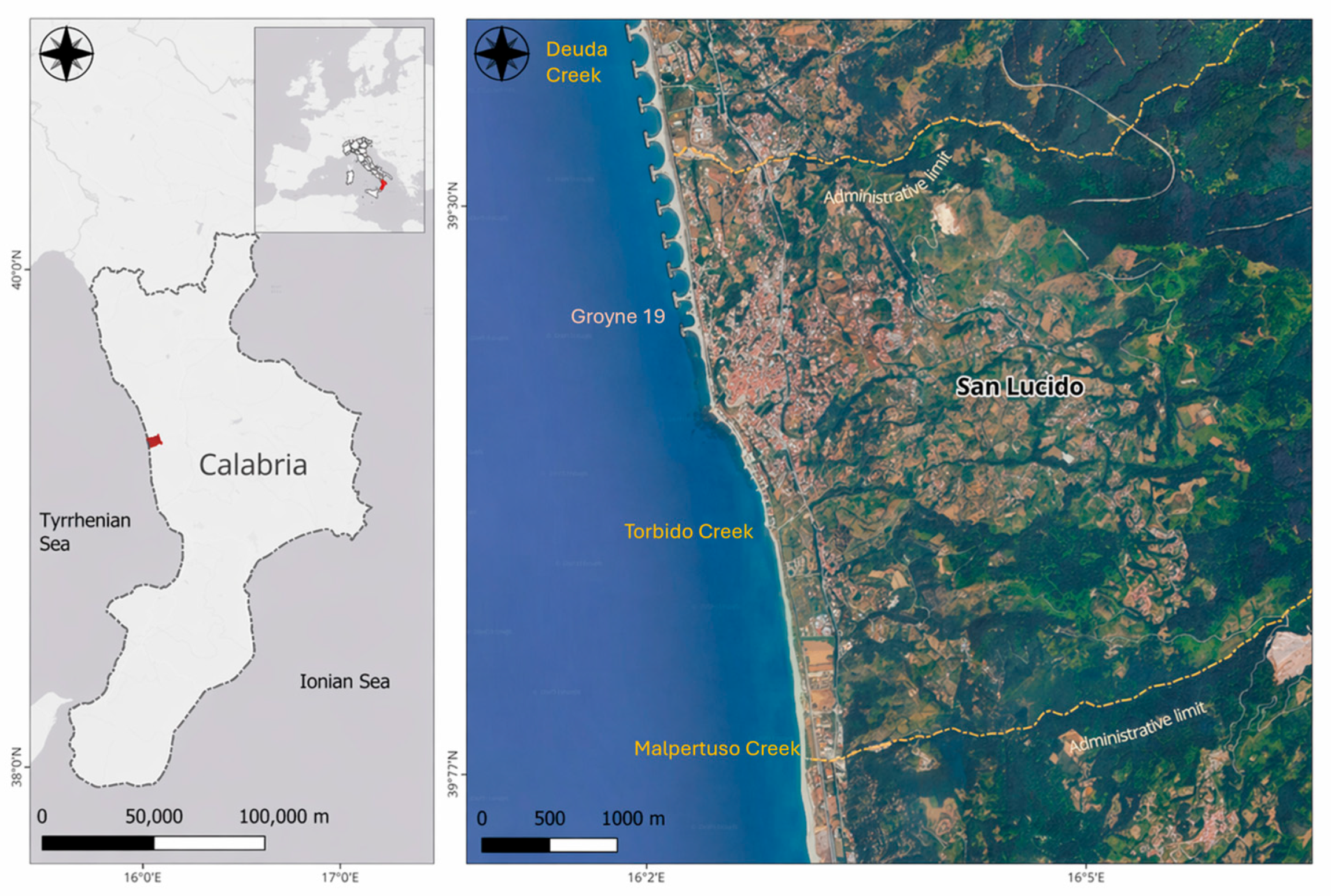
From a historical perspective, the study area (Figure 1) has experienced erosional processes, with documented shoreline retreat during the late nineteenth century, coinciding with the construction of the coastal railway line [73]. Built in the second half of the 1800s, this railway represents a strategic national transport corridor, realized along narrow coastal terraces and, in several sections, directly at the base of steep cliffs [78]. This infrastructural layout has resulted in high exposure of both the railway and the parallel coastal roads to the direct action of waves and to slope instability [73]. Accordingly, San Lucido provides a representative case study of the interaction between long-term erosion processes, infrastructure vulnerability and damage assessment (Figure 1).
San Lucido is located along the Tyrrhenian coast and its seafront is about 3 km long. The municipal territory extends from sea level to 1200 m. a.s.l. [89]. The town occupies a panoramic position, perched above the locality known as “Lo Scoglio”, overlooking a sector of coastline that has repeatedly been affected by landslides [88], an evolutionary process still under investigation by Di Martire et al. (in prep).
San Lucido, located in the province of Cosenza (~38 km north), has a stable population of approximately 6000 inhabitants over an area of 27 km2 (217 inhabitants/km2). The municipality comprises 2053 households with an average size of 2.88 persons. Employment involves 1146 individuals (19.4% of the population), distributed across industry (16.8%), services (17.2%), private enterprises (27.8%), and public administration (38.2%).
From a geological perspective, the Calabrian coast is dominated by steep morphologies and coarse-grained sediment deposits, which produce beaches with high slopes [85]. Such characteristics ensure that the shoreline position is well-defined and easily identifiable in historical charts and aerial photographs, with limited short-term variability [11]. Maximum tidal oscillations are on the order of 0.3 m, confirming that wave action and wave-induced currents represent the primary hydrodynamic forcing mechanisms in the area. Along the Calabrian coasts, twenty-six physiographic units have been identified [29]. For each unit, the closure depth, representing the seaward limit of the sand-sharing system in coastal engineering terms [11], has been calculated using Hallermeier’s empirical formulation [87], as applied by [15]. The northern Tyrrhenian coast is characterized by relatively high wave energy, with mean closure depth (DoC) values ranging from 6.1 to 11.8 m, compared to the southern Tyrrhenian coast, where DoC values range between 4.4 and 7.1 m. Within the San Lucido sector, annual DoC values are estimated between 7 and 8 m [29], consistent with an energetic wave climate [84]. Although the area is partially sheltered by the Aeolian Islands, which reduce effective fetch from the west, exposure to high-energy events remains significant. Net longshore sediment transport is predominantly directed southward, with an average estimated rate of about 25,000 m3/year [73,84].

2.1. Anthropogenic Impacts and Protection of Coastal Critical Infrastructures

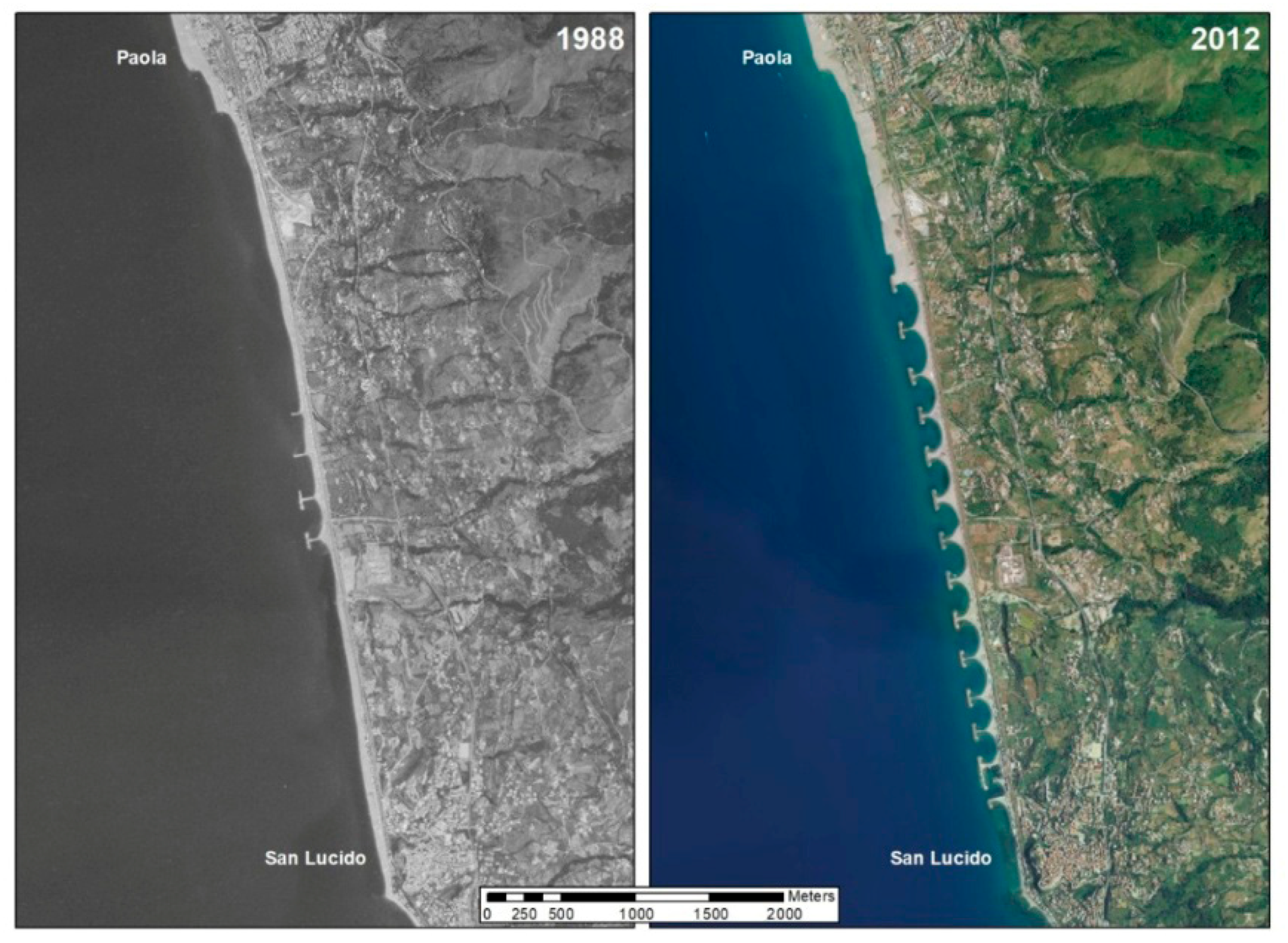
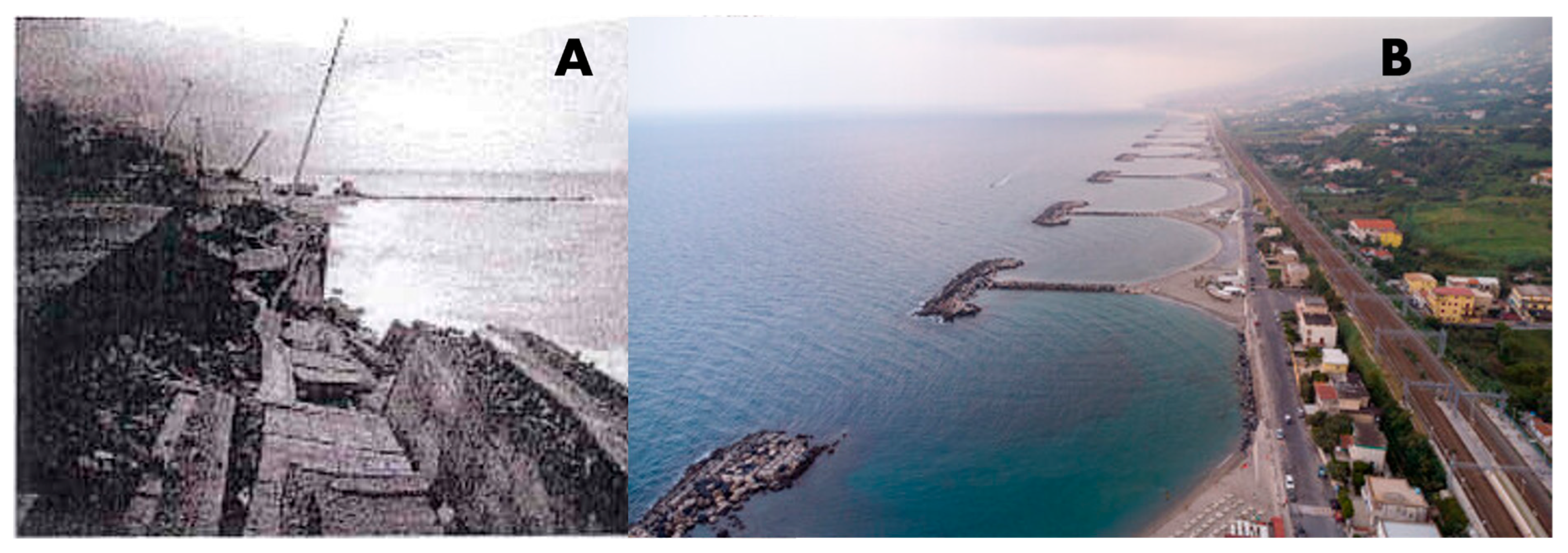
The coastal stretch of San Lucido and Longobardi in the south appeared relatively stable between 1954 and 1981, with only modest positive or negative oscillations of the shoreline recorded during this interval [86]. However, from the 1980s onward, severe storms increasingly exposed the railway line and coastal roads to direct wave action, culminating in the 1985 disruption of infrastructures and significant socio-economic impacts on local communities [84]. To address these critical issues, Rete Ferroviaria Italiana (RFI) commissioned a series of physical and numerical investigations to identify effective protection measures of the railway. Based on these studies, a master plan was launched between 1985 and 1986, targeting the safeguarding of national transport infrastructure. As a result, approximately 74 km of railway lines of Calabria Region, distributed across six coastal stretches, were reinforced through major engineering interventions consisting of hard defenses such as breakwaters, seawalls and groins. Between Paola and San Lucido, a series of emerged T-shaped groins was implemented (Figure 2).
Given the strategic role of the railway as a critical national lifeline, ensuring continuity of service was a primary design constraint, necessitating robust coastal defense solutions. However, these interventions inevitably altered the natural coastal dynamics, producing measurable impacts on shoreline configuration and sediment transport processes. In particular, the interruption of the longshore sediment flux induced a progressive reduction in the emerged beach width in the downdrift sectors, leading to localized shoreline retreat and a consequent decrease in beach width south of the engineered structures.

2.2. Governance Conflict and Downdrift Impacts of Coastal Defense Interventions

The study area was selected due to the lack of agreement among local authorities regarding the construction of a large coastal defense system, despite awareness of the potential downdrift erosion impacts.
Construction of the breakwater started with an anomalous sequence from the northern municipality of Paola, causing significant reduction in emerged beach surface in adjacent sectors. As anticipated by the Superior Council of Public Works (SPWC) (Resolution No. 451, 29 September 1982 [80]), the T-shaped breakwaters do not ensure the continuity of longshore sediment transport [90,91].
Downdrift erosion was explicitly foreseen, and the competent authorities prescribed shoreline and bathymetric monitoring, as well as additional mitigation measures in case of downdrift erosion [80]. However, these requirements were not adequately implemented. Following the construction of groins in the northern sector of Paola, the beach of San Lucido underwent rapid erosion, confirming the predicted impacts caused by drastic reduction in long-shore sediment transport [78]. It is a very common and documented process [15] because the perpendicular groins, when implemented without progressive adaptation and sediment management, can induce sediment imbalance. T-shaped structures further exacerbate this effect in the absence of systematic nourishment and maintenance, making natural wave and current-driven sediment transport insufficient to sustain the coastal system [18,51,52]. Consequently, sediment redistribution now relies only on anthropogenic interventions (Figure 3).
This progressive loss of sediment continuity has exposed the southern sector to increasing risk, with critical waterfront infrastructures, including the coastal road and residential areas, becoming vulnerable.

3. Data, Materials and Methodology

Data spanning the period 1950–2018 were collected to examine the impact of human activity on coastal processes. An overview of data sources used for the implementation of our model is reported in Table 1. In addition, other information and data were obtained via technical services of RFI and local authorities (Calabrian Region and Municipality of San Lucido).
The first step of the methodological approach is the geomorphological analysis and detection of spatial and temporal variation in the Surface of the Emerged Beach (SEB). So, in the present study, shoreline changes are used to determine the temporal evolution of surface polygons obtained by joining them with the backshore and the administrative sectors of the coastline within the Municipality of San Lucido boundaries, determining natural and anthropogenic impact to coastal erosion. The data used for our investigation were acquired between May and July, and only the images showing calm sea conditions were used to improve the accuracy of shoreline positioning. The following assumptions have been made in the present study:
  • The study areas were divided into three sectors: North (between the northern administrative boundary and the “T” of groin 19), Center (between groin 19 and the mouth of the Torbido stream) and South (between the Torbido creek and the southern administrative boundary of SL municipality);
  • Time intervals 1954–1987 (ante operam) and 1994–2006 (post operam) were defined for comparative analysis;
  • Ground motion from ground instabilities (landslides or subsidence) are negligible (according to Fortunato 2001 [88]);
  • Variations in wave climate, mean sea level, and natural littoral drift were not considered (due to the coarse grain size and high slope of the beach profile in the region, their contribution is not negligible but limited);
  • Annual Depth of Closure (DoC) is calculated via Hallermeier’s (1981) formula [87] and it is equal to 7.5 m (according to [17,25,76]); this value must be considered as the minimum active depth of the submerged beach within the study area and it is the most conservative value to determine the volume of sediment needed for nourishment intervention.

3.1. Image Pre-Processing and Shoreline Acquisition

Orthophotos from 1994 to 2012 provided via the OGC-WMS service by the Italian National Geoportal [91] are georeferenced in WGS 84 Datum with UTM 33 projection and were used as reference for all the other datasets. All the unreferenced aerial photography frames were geo-referenced and orthorectified using the 2006 orthophotos provided by the GN as a reference. For the georeferencing process, at least 12 GCPs (Ground Control Points) were selected for each image frame. GCPs were carefully selected within the administrative boundaries of the Municipality of San Lucido from Malpertuso Stream in the north to Deuda Creek in the south. Buildings and fixed points close to the coastline or at similar elevations were selected to minimize distortions caused by the lack of a high-resolution DTM to improve the accuracy of orthorectification. Digitization was carried out at a scale of 1:1000 to ensure data consistency. All datasets were processed at the same scale (1:1000), resulting in a common spatial resolution and estimated positioning error of ±0.20 m.
The limits of the backshore were digitized in a GIS as geodatabase feature. Where available, digital cartography (in CAD format) provided by the Municipality of San Lucido was also used as additional control data to ensure the correct positioning of the frames and to minimize errors derived from optical deformations near the camera frame edges.
Shorelines, administrative boundaries of the Municipality of San Lucido, backshore limits, and beach features were digitized in GIS format and stored as geodatabase features with the highest possible accuracy, carefully distinguishing between land and water, to assess beach surface changes over time.

3.2. Geomorphological Analysis

The geomorphological analysis conducted in the present study is strictly functional for determining and quantifying variations in the Surface of the Emerged Beach (SEB) along the coastline of a single municipal administration. The methodological approach used is therefore to highlight the trend in beach erosion before and after the construction of coastal defense works.
With this methodological approach, it is possible to obtain the area of the emerged beach, using administrative boundaries, the backshore and the shoreline (that is, the geomorphological element subject to variation through time). Before the defense works (ante-operam), the trend of reduction in surface area can be considered to be linked to natural factors (relative variation in sea level) or reduction in coastal solid transport. After the construction of the defense works (post-operam analysis), the area of the emerged beach varies over time depending on the impact of the works themselves and the lack of periodic beach nourishment maintenance (possibly indicated and prescribed in the project). Quantitatively, this contribution can be calculated with the following approach:
ΔSEB = SEB post operam − SEB ante operam
where SEB ante operam is the average beach surface occupied by the road until 1987 and SEB post operam is the average beach surface occupied by the road after 1994.
Although the manuscript does not aim to design mitigation strategies, the study area has been explicitly subdivided into three sectors to account for their different morphodynamic behaviors and levels of present anthropogenic alteration:
  • Northern sector: characterized by rigid coastal defenses (T-shaped breakwaters and groins), which significantly interrupt longshore sediment transport and induce sediment accumulation locally.
  • Central sector: influenced by a submerged barrier system, associated with periodic nourishment requirements using compatible sediments and a modification of shoreline orientation.
  • Southern sector: unprotected and subject to pronounced erosion, with the presence of natural coastal features such as dune systems.

3.3. Implementation of the Coastal Degradation Calculator (CoDeC)

To assess the vulnerability of the San Lucido beach, a Coastal Degradation Calculator (CoDeC) box model was developed to estimate the ecological and socio-economic damage resulting from anthropogenic impacts along the coast. Vulnerability is defined as the combination of an area’s susceptibility to damage and the value of the exposed elements.
The CoDeC considers variations in beach surface within the administrative limits, with the shoreline variation serving as the primary driver for all calculations. The surface occupied by coastal infrastructure over time is also considered. By comparing the emerged beach surface before (ante operam; 1954–1987) and after (post operam; 1994–2018) coastal protection interventions, it is possible to assess beach vulnerability and identify sectors requiring urgent nourishment. This step is fundamental for determining the volume of sediment to be used for beach nourishment. For this reason, sediment volume and the distance from available natural sediment deposits are used to estimate the cost.
The cost of hard defenses, like groins and breakwaters, can also be included in the box model. The costs, including design, safety, and monitoring, are estimated in relation to the size, distance, depth, width and type of material. Periodic sand nourishment may be necessary to maintain sediment continuity downstream of coastal defenses. Frequency and amount of sediment required for maintenance depends on longshore transport rates, while maintenance costs are influenced by extraction techniques and sediment transport to the site.
The model inputs include beach surface variations, coastal infrastructure locations, and sediment transport rates. Meanwhile, the main output of the model provides estimates of
  • Volume of sediment required for beach nourishment;
  • Costs of sediment extraction, transport, and placement;
  • Costs of hard coastal defenses (groins, breakwaters);
  • Maintenance costs.
Volume of sediment needed is calculated as follows:
V (m3) = ∆SEB (m2) × DoC (m)
where ∆SEB (1) is the surface of the beach to be nourished (length × width), and DoC is the Closure of Depth calculated by using Hallermeier’s formula (1981) [29,87].
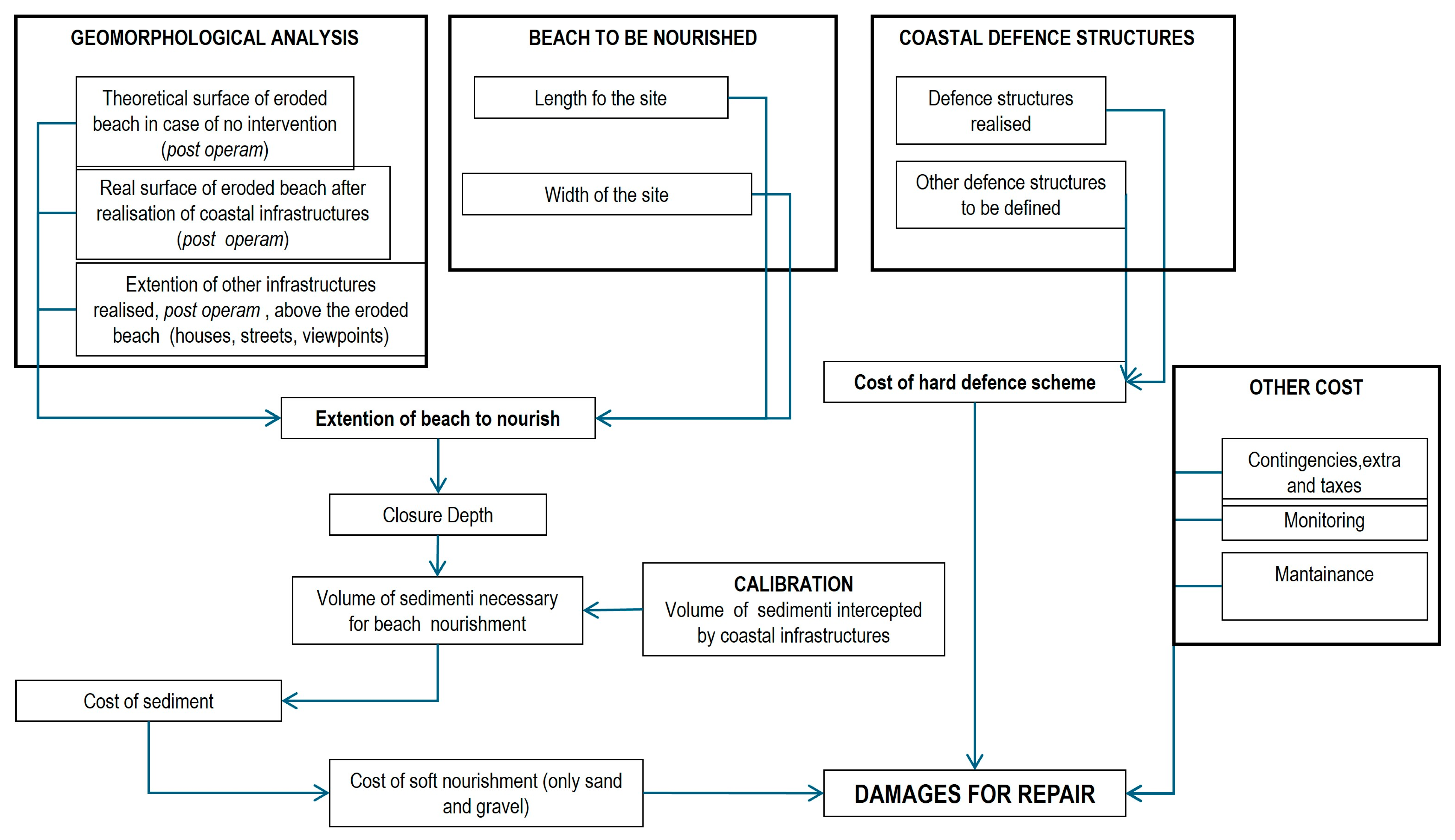
The overall model workflow is summarized in Figure 4.
The computational framework depicted in Figure 4 is structured as a sequential and modular procedure aimed at quantifying erosion-induced damage through physically consistent and economically interpretable steps. The first stage consists of a geomorphological analysis of shoreline evolution. This phase evaluates temporal variations in the coastline position, with particular emphasis on changes in the emerged beach area before and after the implementation of coastal defense interventions. This comparison enables the identification and quantification of surface losses attributable to erosion processes and modification of the waterfront.
The second stage involves the estimation of the beach area to be restored. Specifically, the model quantifies the extent of emerged beach surface that has been lost and determines the corresponding sediment volume required for reconstruction. This is computed as a function of the length and width of the beach to be reconstructed, ensuring consistency with the pre-erosion extension. The third stage focuses on the economic assessment of the necessary interventions.
The required sediment volume is derived from incorporating the annual Depth of Closure, which represents the active profile thickness and is typically defined within the design specifications of coastal defense projects. In addition, longshore sediment transport rate, also provided in the project documentation, is explicitly considered to estimate the sediment demand needed to maintain the restored beach in dynamic equilibrium under the prevailing wave climate conditions of the study areas. Based on these simple parameters, the CoDeC model computes the costs associated with both nourishment and the structural measures required to protect the replenished beach. The logical structure of the framework, as illustrated in the flow diagram of Figure 4, reflects a unidirectional progression of information with embedded feedback mechanisms, allowing for the refinement of input parameters and ensuring internal consistency between geomorphological, hydraulic, and economic components. Overall, the CoDeC provides a concise and physically grounded methodology for estimating erosion-related damages, linking shoreline dynamics to sediment requirements and, ultimately, to the economic costs of coastal protection and beach restoration.

4. Results

Shoreline variations over time caused significant loss of emerged beach surface across the northern, central, and southern sectors. The defense works aimed at protecting critical coastal infrastructures (e.g., railways, road) caused a reduction in the longshore sediment transport and the subsequent downdrift erosion. Here, we quantitatively assess this erosion process through the shoreline displacements and the emerged beach surface variation. Results are presented showing the most relevant outcomes of the geomorphological analysis, which documents the spatial and temporal evolution of the emerged beach (Section 5.1), and the damage assessment model, which quantifies the associated ecological and socio-economic impacts (Section 5.2).

4.1. Geomorphological Assessment

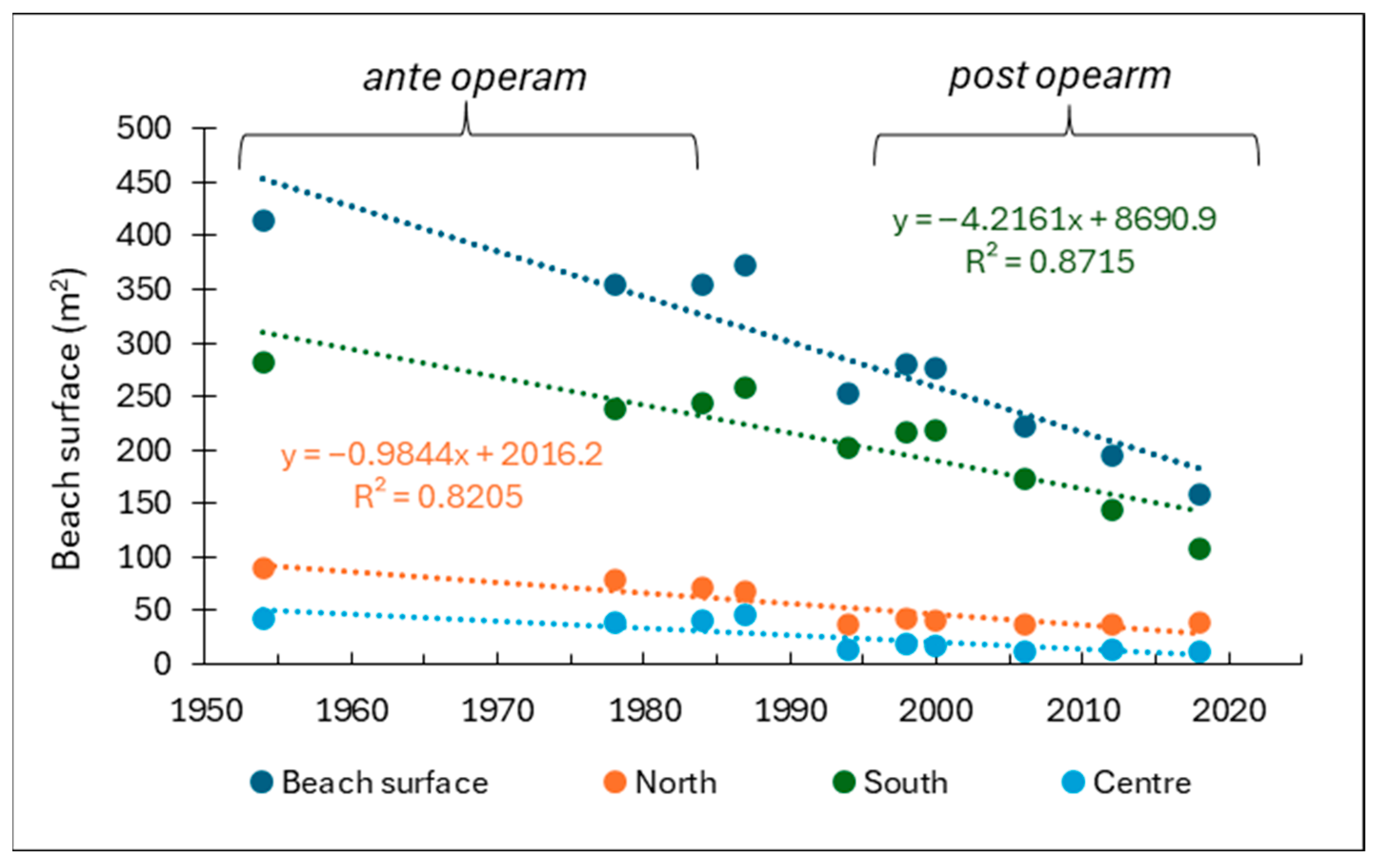
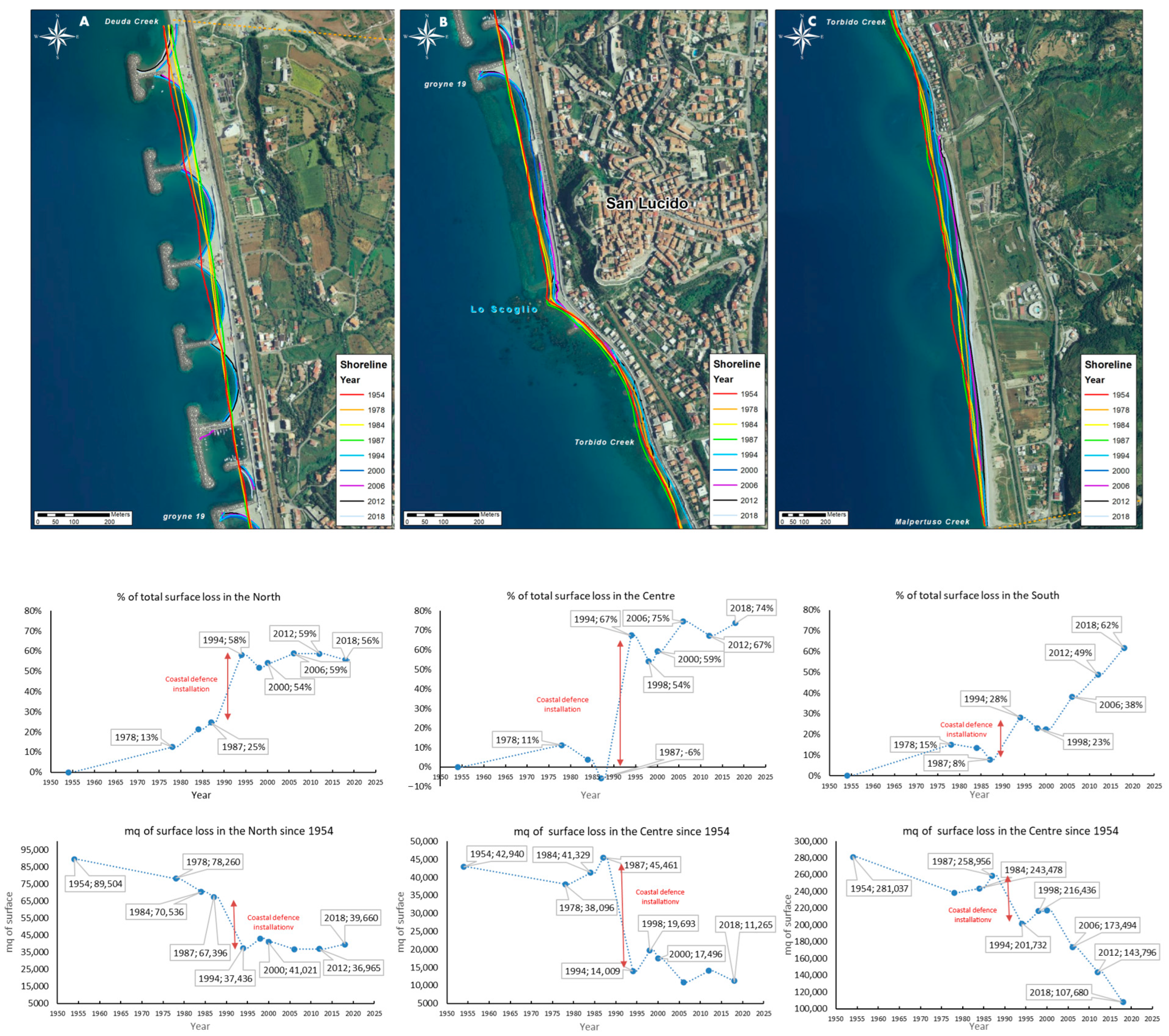
Beach surface values reported in Table 2 and Figure 5 clearly show the morphological evolution of the emerged beaches between 1954 and 2018. Geomorphological analysis allowed for the determination of the reduction in the emerged beach between 1987 and 1994, which corresponds to the time interval during which the T-shape breakwaters were introduced.
In 1987, the total surface of the sandy beach within the Municipality of San Lucido was about 372,000 m2. After 1994, following the installation of the coastal defense works, the average emerged beach surface decreased to about ~253,000 m2 (±32%). Therefore, about 119,000 m2 of beach surface was lost in the time interval 1987–1994.
The adopted methodology demonstrates how the construction of coastal defenses significantly reduced the area of the emerged beach in just a few years. The trend of beach area reduction during the period 1954–1987 may have been influenced by reduced sediment transport, seasonal variability of wave climate, and sea-level rise. However, this trend was less pronounced compared to the period following the construction of the coastal defenses, supporting that the applicability replicability of our model lies precisely in the elimination of factors that do not depend on the choice of adopted coastal defense strategy.

4.1.1. Period 1954–1987 (Ante Operam)

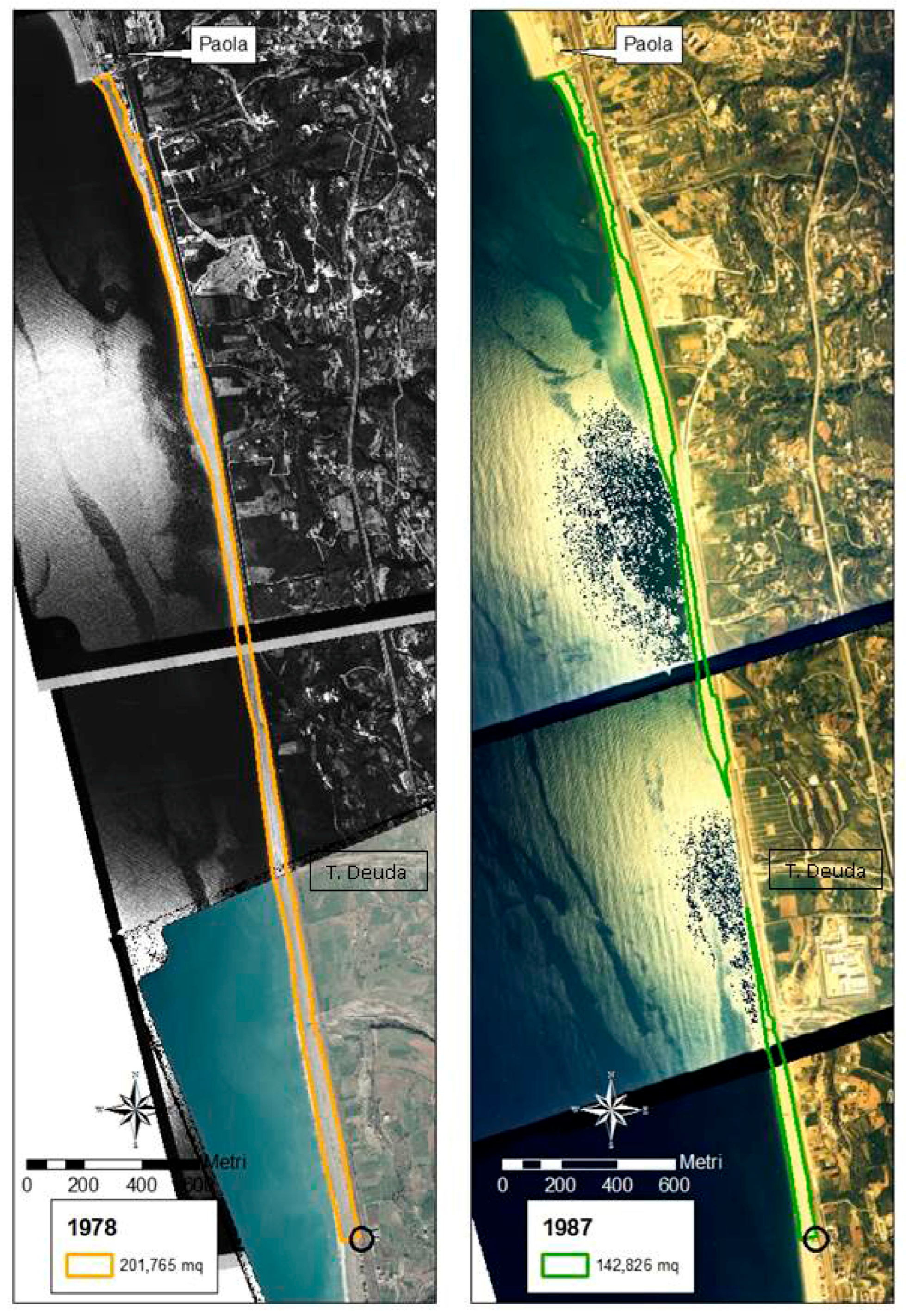
The northern sector, closest to Paola Municipality, was affected by severe erosion before 1987 (Figure 6). No significant erosive events were observed along the San Lucido coast between 1954 and 1987. The maximum shoreline retreat was about 40–60 m, while some adjacent coastal areas experienced a slight advancement of the shoreline. The central and southern sectors exhibited relatively stable conditions during the same period, with only minor oscillations in the emerged beach surface.

4.1.2. Period 1987–1994 (Coastal Protection Master Plan)

Railway reconstruction (1978–1979)
After the collapse of the railway in 1978, a barrier parallel to the shoreline near the Deuda Creek was realized. The emerged beach started to reduce its surface due to the reflective action of the waves at the foot of the embankment (Figure 5). Sediments washed away from the intervention area and were transported southward, nourishing the central sector. Therefore, before 1987, the central sector was showing an evolutionary trend exactly opposite to that of the northern sector (Table 2, Figure 3).
T-shape groins and submerged breakwater (1987–1994)
After the reinforcement of the railway line, a more comprehensive design of coastal defense works was implemented. The entire stretch of coast between Paola and San Lucido was included in the Master Plan of the national railway company. A complex design, supported by numerical models, surveys and laboratory experiments, led to the construction of T-shaped breakwaters. These very expensive hard defense works (more than 55 million of € in the 80s), however, have the side effect of interrupting the long shore sediment transport.
The works were prescribed with strict prescriptions by the Higher Council of Italian Public Works, which required that the downdrift erosive effects that could occur should be taken into account. These prescriptions were largely underestimated. It is also to be noted that the works were not executed sequentially from south to north, but they started in the beach area of Paola (Figure 7) because the municipality of San Lucido formally opposed the works.

4.1.3. Period 1994–2018 (Post Operam)

Seafront enlargement
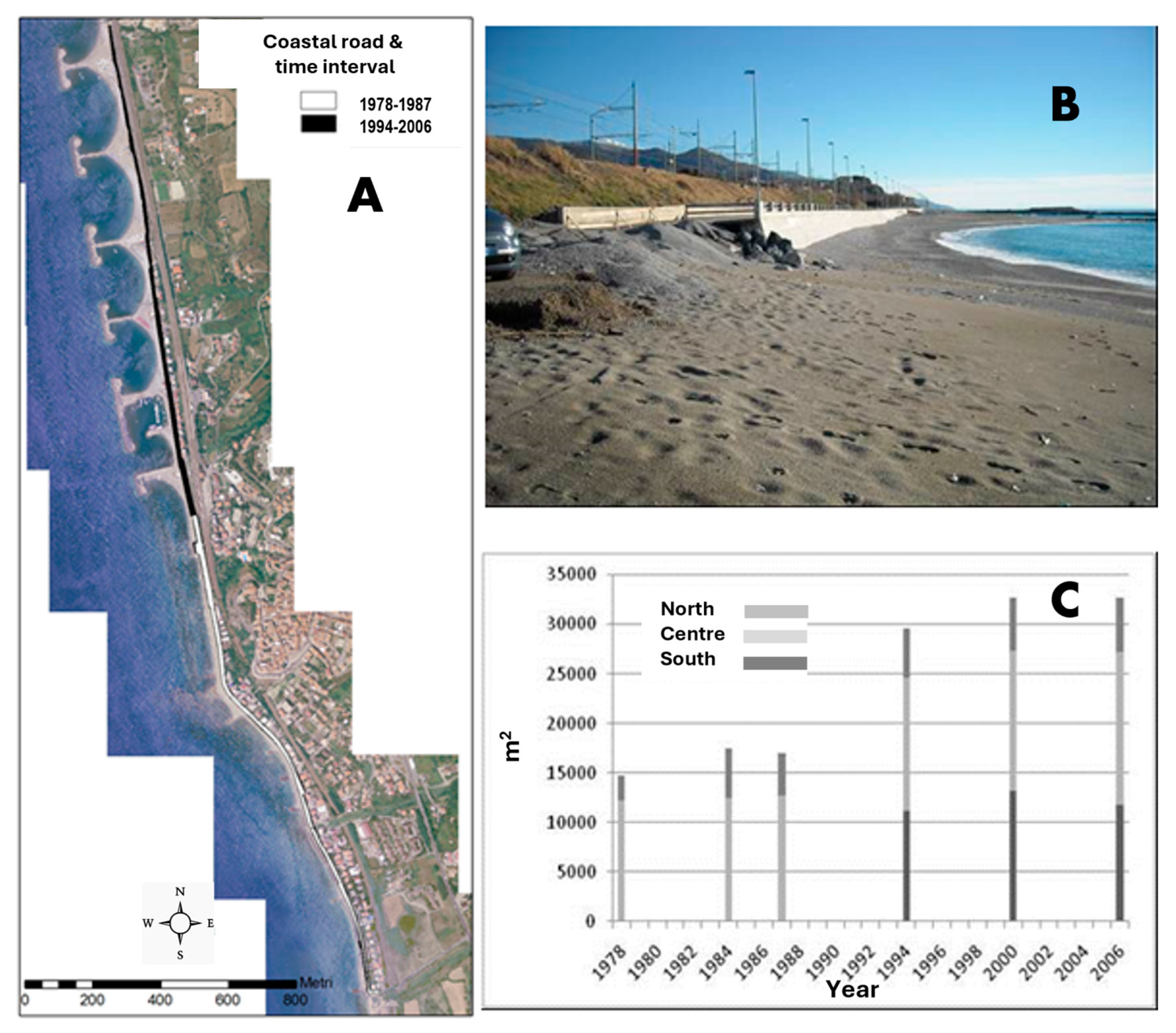
After the construction of the T-shaped breakwater (1994–2000), a portion of the emerged beach was occupied, with the municipality to extend the seafront roads over an area of ~15,000 m2 (±5.9%). The work had begun prior to 1978, when the beach was wide enough to avoid damages from storm events. From the mid-80s onward, the seafront was progressively paved and/or widened, reaching a maximum linear extension of about 32,657 m in 2006. The data in Table 3 and the bar chart shown in Figure 8 point out that the waterfront road was built before the national railway company carried out the coastal defense works (T-shaped breakwaters), but it was subsequently widened and lengthened after 1994. The waterfront was equal to 16,990 m2 ante operam (1987) and was equal to 32,650 m2 post operam (1994). Therefore, 15,650 m2 of beach surface was lost.
With simple surface calculations, our analysis highlights how the sequence of realization of T-shaped breakwaters, combined with construction delays, led to a series of consequences. The most remarkable of these was the downdrift coastal erosion and the extreme slow filling of the sedimentary cells between the T-shaped breakwaters (Figure 9A). Thus, civil and criminal procedures started, followed by the claim for damages. Submerged erosion was perhaps the most evident issue, prompting the national railway company and the Municipality of San Lucido to modify the work in the final section. The last cell was replaced and adapted to function as a small harbor, while a submerged breakwater was built in the last section in 1994 (Figure 9B). To protect the waterfront road and nourish the downdrift beach, about 85,000 m3 of sand (~10% by weight) and gravel (~90% by weight) were discharged in 1994 (15,000 m3 more than initially planned).
Lack of maintenance, downdrift erosion, and protection by groins
After 1994, significant erosion was observed downdrift of the coastal breakwaters because beach nourishment and maintenance were not carried out by either the competent authority or the national railway company. In the downdrift area, near Lo Scoglio in the central sector, the orientation of the shoreline varies, and the longshore transport rate is higher (Figure 9B,C). No maintenance was implemented, leading to the partial disappearance of the beach due to severe erosion.

4.2. Damage Assessment

The application of the proposed risk-based methodology enables a quantitative assessment of the economic damage associated with coastal erosion, explicitly accounting for both the loss of emerged beach area and the failure of coastal road infrastructure. The calculation of the CoDeC follows the logical sequence illustrated in Figure 4, where physical processes are translated into exposure, damage, and the final economic loss.

4.2.1. Loss of Emerged Beach Area

The results indicate a substantial long-term reduction in emerged beach surface, which represents one of the primary direct impacts of coastal erosion (Figure 5 and Figure 9). Comparison between pre-intervention conditions and the most recent geomorphological configuration highlights a net loss of beach area of about 119,000 m2, only partially compensated by beach nourishment (Figure 9B) and partially reduced by post-operam widening measures (15,000 m2; Figure 8).
Based on the restoration geometry adopted in this analysis (about 1800 m of sandy beach under erosion), the beach nourishment strategy, including an enlargement of 40 m and an annual closure depth of 7.5 m, requires a total sediment volume of approximately 540,000 m3. This volume is consistent with the sediment deficit accumulated over more than two decades of reduced natural sediment supply (Calibration of Figure 3) and is obtained considering the project shoreline (+40 m, the length of shoreline restoration, which is about 1.8 km, and the annual DoC, equal to 7.5 m).
Using a unit sediment placement cost of approximately 10 €/m3, the direct cost associated with sediment alone exceeds 9 million € (by using annual DoC). When ancillary works necessary for beach reconstruction are included, the total capital cost of the restoration intervention rises to approximately 12.5 million €. In addition to initial restoration, the results highlight the importance of long-term maintenance. Annual nourishment volumes of approximately 20,000 m3 are required to counteract ongoing erosion, corresponding to yearly maintenance costs on the order of 0.3 million €. At the end of the legal dispute, concluded in 2016, a reference period of 15 years was considered sufficient to compensate for the lack of downdrift nourishment, and the cumulative monitoring and maintenance costs reached about 10 million €, bringing the total economic burden associated with beach loss and restoration to over 22 million €.
These results confirm that the reduction in emerged beach area constitutes a major economic damage, reflecting not only episodic storm events but also persistent, system-scale sediment imbalance that threatens critical infrastructures and local economy. The quantified economic losses associated with variations in the surface of the emerged beach are estimated at approximately 1300 €/m2 [60] and about 0.5 million €/y, when restoration and coastal defense works (about 22 million €) are amortized over a period of approximately 40 years.

4.2.2. Damage to Coastal Road Infrastructure

The erosion-driven retreat of the shoreline has also led to the structural failure of a coastal road, representing a second major component of economic damage. As illustrated in the methodological flow diagram (Figure 3), the loss of beach width directly increases infrastructure exposure and vulnerability, ultimately resulting in physical damage and service disruption. The estimated damage per the CoDeC includes
  • Direct reconstruction costs, associated with pavement, foundation, and ancillary structures.
  • Indirect functional losses, related to traffic interruption and emergency management.
The collapse of the road segment represents a high-impact event, as it involves not only repair or reconstruction costs, but also significant socio-economic consequences due to reduced accessibility along the coastal corridor.
Although the physical extent of the damaged infrastructure is relatively limited, its economic significance is of the same order of magnitude as that associated with large-scale beach restoration interventions. This highlights the strong functional interdependence between natural coastal buffers and adjacent built assets, where the loss of protective beach width can rapidly translate into infrastructure vulnerability. However, it should be noted that infrastructure-related costs are not quantified within the scope of this study. The expansion of the coastal road was a planning decision undertaken by the local administration, resulting in the permanent occupation of an area that previously functioned as emerged beach.

5. Discussion

5.1. Interpretation of Results

The combined pressures of natural coastal dynamics, geomorphological instability, and anthropogenic exposure make the San Lucido coastal area a paradigmatic case study for integrating coastal engineering, geomorphology, and socio-economic risk assessment. The temporal evolution of the emerged beach surface, reconstructed from 1954 to 2018 (Figure 5; Table 2), shows a pronounced long-term erosional trend, punctuated by brief phases of partial recovery. Overall, the results document a progressive and non-linear reduction in beach area, indicative of a system affected by chronic sediment deficit and increasing coastal instability.
In 1954, the emerged beach surface reached approximately 414,000 m2, representing the maximum extent observed in the analyzed period. From this initial condition, the beach gradually decreased until the late 1970s, reaching values around 355,000 m2 in 1978–1984. In the central and southern sectors, the positive effect of beach nourishment carried out between 1994 and 1996 is evident, using approximately 85,000 m3 of sediment (10% sand and 90% gravel by weight). The beach surface observed in 2000 is higher than in 1994, reflecting the morphological evidence of nourishment intervention.
A temporary recovery is also evident in 1987, when the beach surface increased to about 372,000 m2. However, this recovery proved to be short-lived. From the early 1990s, the system entered a phase of accelerated erosion, with a sharp decrease to 253,000 m2 in 1994, corresponding to a loss of nearly 120,000 m2 compared to the 1954 reference state. Despite minor fluctuations in the late 1990s and around 2000, the overall trend remained strongly negative. By 2018, the emerged beach surface had declined to approximately 159,000 m2, representing a total reduction of about 62% relative to 1954.
Beyond the temporal evolution, the spatial variability of coastal erosion is also evident. The subdivision of the beach into northern, central, and southern sectors highlights marked spatial differences in erosion intensity. The southern sector consistently represents the largest share of the total beach area but also exhibits the most severe absolute losses, decreasing from approximately 281,000 m2 in 1954 to 108,000 m2 in 2018. The central sector shows the highest relative vulnerability, with values decreasing from about 43,000 m2 in 1954 to nearly 11,000 m2 in 2018. The northern sector displays comparatively smaller variations and more stable behavior over time, maintaining a surface close to 40,000 m2 in recent decades.
The construction of the seafront road further reduced the available emerged beach, with a net loss of about 15,650 m2 between the ante-operam phase (1987) and post-operam (2006). The expansion of the road coincided with the phase of accelerated erosion downstream of the T-shaped breakwaters, amplifying the overall beach loss.

5.2. Uncertainties

The results of this study are subject to uncertainties mainly related to data quality. The historical datasets used for shoreline reconstruction exhibit variability in spatial resolution and temporal coverage, while the absence of local high-resolution DTMs (e.g., LiDAR derived) may introduce local distortions during the orthorectification process. A residual positional error of ±0.20 m is estimated in the georeferencing process. However, considering the magnitude of the observed changes (e.g., a net loss of approximately 119,000 m2 of emerged beach), this uncertainty is not expected to significantly influence the overall quantification of large-scale surface variations.
Additional sources of uncertainty arise from the assumptions adopted in the economic assessment. As anticipated in the introduction, the authors provide substantial evidence of coastal erosion’s economic impacts, although specific estimates in €/m2 are largely absent in the current literature. Thus, the study should be considered a pioneer exercise supporting environmental damage estimation and natural capital recovery quantifications.
While these factors may affect the absolute values of the estimated economic losses, they do not alter the overall interpretation of the results, particularly the identification of the main controlling processes, such as the interruption of longshore sediment transport and the lack of maintenance of coastal defense structures.
Overall, the consistency between geomorphological evidence, temporal evolution, and process-based interpretation supports the robustness of the proposed model.

5.3. Impact of Coastal Management on Beach Morphology

Many interpretations arise from the results of this study in terms of coastal processes and risk. From a risk perspective, the results indicate that the seafront road acted as a secondary driver of vulnerability, transforming a geomorphological problem into an infrastructural one [92,93,94,95]. By replacing a flexible, dissipative beach surface with rigid, impermeable structures, the system became more sensitive to extreme events, ultimately leading to structural damage and failure of the road itself [96]. Overall, these findings demonstrate that the reduction in emerged beach area cannot be attributed solely to natural processes. This underscores the importance of integrating land-use planning decisions into coastal management strategies, particularly in environments already affected by chronic erosion [97]. In addition to natural and hydrodynamic drivers [98], coastal urbanization has played a significant role in reducing the emerged beach surface, thereby increasing exposure to erosion and storm-related hazards [99].
A growing number of research papers address rising tensions related to sand exploitation, while also emphasizing the increasing importance and societal value of beach nourishment and nature-based solutions as essential approaches for sustainable sediment management in various parts of the world. Coastal erosion is very common, particularly on river deltas, where a strong correlation has been found between variation in land area and sediment load [20,93]. Adaptation strategies and risk assessment have been documented worldwide [100], including the USA [101], China [13], Greece [102], Belgium [103], Portugal [104,105], and developing countries, including those in Africa [106,107,108] and South America [109].
This manuscript helps address a significant gap at the international level by proposing a method to quantify the damage associated with beach protection interventions when they substantially alter the extensions of the emerged beaches within a specific territorial context/administration.

5.4. Legal Dispute and Damage Compensation

From an institutional perspective, it is important to note that the related legal dispute concluded with a shared liability between the involved administrations, and the damage to be compensated was much lower than what would have been necessary to rebuild the emerged beach surface eroded by the defense measures, according to Rangel-Buitrago [110]. Our interpretation, from the scientific and technical point of view, is that responsibility was attributed both to the national railway authority (RFI) for failing to implement adequate coastal defense works and downdrift nourishment measures capable of maintaining a beach surface compatible with ante-operam erosive processes (1954–1978) and to the Municipality of San Lucido for constructing a seafront road that permanently occupied a portion of the emerged beach.
The resulting economic damage associated with beach surface loss highlights a frontier issue in coastal risk research, namely the quantification of the economic value of beaches beyond traditional infrastructure damage [111,112] and the volume of sediment required for restoration and maintenance [15]. Infrastructure failure represents a critical threshold effect, where the progressive reduction in beach width ultimately triggers abrupt and costly damage. At the end of January 2026, the Cyclone Harry hit southern Italy, leaving widespread disruptions across Sicily, Sardinia, and Calabria, causing 2 billion € of damages [71,72]. The integrated approach adopted in the present paper provides a transparent and reproducible basis for quantifying economic impact of catastrophic events, supporting cost–benefit analyses of coastal management strategies and highlighting the importance of preventive measures aimed at preserving beach width as a first line of defense.
We can provide a tool for stakeholders and competent authorities to assess environmental sustainability of intervention on the basis of a scientific methodology.

5.5. Economic Sustainability of Adaptation Strategies

From a scientific standpoint, integrating hard and soft defense strategies represents the most robust approach for coastal risk reduction [37,113,114]. Hard structures provide immediate, localized protection, while nourishment and ecosystem-based measures enhance resilience and adaptability at larger spatial and temporal scales [37,111]. Periodic maintenance of coastal defense works, combined with systematic beach replenishment, is essential for protecting critical assets and ensuring functional continuity of coastal systems [53,115,116,117,118,119,120,121].
Recent international studies increasingly consider the economic value of beaches, including recreational, protective, and replacement aspects [122]. This study contributes by proposing an integrated methodological framework linking geomorphological change, land-use decisions, and economic damage, offering a reproducible approach for assessing costs associated with emerged beach loss in vulnerable coastal systems [123,124].
Within the framework of Integrated Coastal Zone Management (ICZM), EU Recommendation 413/2002 highlights the importance of preserving ecosystem integrity, coastal landscapes, and geomorphological features, thereby strengthening the link with sustainable development objectives. In this context, the proposed approach supports more informed and operational decision-making by enabling both the ex-ante assessment of the expected impacts of coastal defense interventions and the ex-post estimation of damages affecting critical coastal infrastructures, tourism systems, landscape values, and habitats. Furthermore, the methodology provides a quantitative basis for assessing changes in shoreline conditions, including reduction in emerged beach areas, thus offering practical support to competent authorities and the scientific community in the development of site-specific coastal management strategies. Within the policy landscape shaped by Directive (EU) 2022/2557 [56], such methodologies contribute directly to resilience-building objectives by enabling evidence-based identification of risk, assessment of potential impacts on critical entities, and estimation of economic damages, core elements in contemporary risk governance frameworks.
Overall, the study demonstrates that beach erosion has reached a scale that cannot be considered marginal or reversible through isolated interventions [21]. The marked decline in emerged beach surface, especially in the central and southern sectors, highlights the need for integrated long-term mitigation strategies combining
-
Risk-based planning;
-
Comparative analysis of coastal defenses infrastructure adaptation (including modification of the present layout of emerged T-shaped breakwaters and groins);
-
Sediment management (including periodic nourishment of the beach protected by the submerged barrier in the central sector, in order to feed the downdrift coastal areas);
-
Restoration of the southern sector, where natural habitats and the beach-dune system should be promoted, recognized for their ecosystem services, and included in a detailed economic assessment).
Quantitative reconstruction of beach surface evolution provides a robust basis for linking geomorphological change to economic damage assessment and for supporting cost–benefit analyses of future coastal adaptation measures.

5.6. Future Work

The simplified modeling approach does not explicitly account for hydrodynamic forcing (e.g., wave climate and wave power), which represents a limitation of the study and one of the directions for future research. Future developments of the proposed analytical workflow will aim at aligning with the Directive’s emphasis on structured risk assessment and on strengthening the capacity of critical entities to anticipate, absorb, adapt, and recover from disruptive events.
Technological enhancements would significantly extend the applicability of the framework beyond site-specific case studies, making it a robust tool for operational risk assessment, resilience planning, and evaluation of adaptation strategies under uncertainty. Future research should also explore automated pipelines for integrating real-time monitoring data, machine learning-driven pattern detection in shoreline dynamics, and interface design for real-time resilience dashboards supporting policy and emergency response. The adoption of advanced computational environments, including large-scale facilities such as the dedicated Centers for HPC, Big Data and Quantum Computing (ICSC, https://www.supercomputing-icsc.it/ (accessed on 27 February 2026)), offers a decisive opportunity to scale up the implemented methodologies across the national territory. High-performance computing enables the automation of data mining, territorial and remote-sensing analyses, vulnerability and risk assessment of critical infrastructures, and the evaluation of human-induced impacts under multiple climate change scenarios. Moreover, the ICSC Center can enable the monitoring of coastal erosion by analyzing satellite imagery at varying levels of detail. For instance, low-resolution automatic monitoring applications can be developed using open data sources such as Copernicus and Sentinel satellite imagery (10 m spatial resolution). High-level resolution monitoring applications can be developed using sub-meter-resolution commercial satellite imagery. The Italian PNRR MER project is nearing completion of the acquisition of very high-resolution LiDAR and bathymetric data for the entire Italian coastline. In this context, ICSC will support these applications through technologies and resources for managing large volumes of data. Integrating scientifically sound methodologies with high computational capacity represents a key step toward evidence-based coastal planning and more effective adaptation strategies in increasingly dynamic and hazard-prone coastal environments.

6. Conclusions

This study demonstrates that coastal erosion impacts emerge from the cumulative interaction between long-term geomorphological change driven by natural forces, anthropogenic land-use decisions and infrastructure exposure. The resulting consequences are fully appreciable only when physical and economic dimensions are analyzed jointly.
A simplified model is proposed to estimate coastal damage associated with beach surface reduction and the related restoration requirements. The method combines a geomorphological component based on the quantification of beach area loss and the sediment volume required to restore morphological equilibrium with an economic component including nourishment costs, ancillary works, maintenance, monitoring, and technical expenses. The results highlight how robust, transparent, and reproducible analytical frameworks, such as the one presented here, are essential for quantifying losses. In this case study, we estimated 22 million € (about 0.5 million €/year) in total damages.
The integration of geomorphological observation with economic assessment can effectively support the risk-based management of coastal infrastructure exposed to erosive dynamics and catastrophic events. Systematic monitoring of shoreline change enables the quantification of emerging risk profiles and cascading effects impacting both natural and built environments, a prerequisite for enhancing resilience in the face of climatic pressures. The CoDeC model can be applied both ante operam to compare the impacts of different mitigation strategies and post operam to support the attribution of responsibilities.

Supplementary Materials

The following supporting information can be downloaded at https://www.mdpi.com/article/10.3390/land15050696/s1, instruction and excel: Coastal Degradation Calculator (CoDeC) Demo.

Author Contributions

Conceptualization, S.C., L.R. and M.P.; methodology, S.C., L.R. and E.V.; software, L.R. and A.T.; validation, S.C., M.P., L.R., A.T. and E.V.; formal analysis, S.C. and L.R.; investigation, S.C., L.R. and E.V.; resources, M.P. and A.T.; data curation, S.C. and L.R.; writing original draft preparation, S.C.; writing—review and editing, S.C., M.P., L.R., A.T. and E.V.; visualization, L.R., S.C. and E.V.; supervision, S.C.; project administration, A.T.; funding acquisition, A.T. and M.P. All authors have read and agreed to the published version of the manuscript.

Funding

Sergio Cappucci, Maurizio Pollino and Alberto Tofani were supported by the ICSC Project (National Center For HPC, Big Data and Quantum Computing—CN00000013), Spoke 5—Environment & Natural Disasters funded under Next Generation EU Recovery Plan.

Data Availability Statement

The original contributions presented in this study are included in the article/Supplementary Materials. Further inquiries can be directed to the corresponding author. Restrictions can be applied to the availability of these data in case they were obtained from other national and local authorities and are not available from their web pages without permission.

Acknowledgments

The authors have reviewed and edited the output and take full responsibility for the content of this publication. Special thanks are addressed to Enzo Pranzini for his interest and support.

Conflicts of Interest

The authors declare no conflicts of interest. The funders had no role in the design of the study; in the collection, analyses, or interpretation of data; in the writing of the manuscript; or in the decision to publish the results.

References

  1. Martínez, M.L.; Intralawan, A.; Vazquez, G.; Pérez-Maqueo, O.; Sutton, P.; Landgrave, R. The Coasts of Our World: Ecological, Economic and Social Importance. Ecol. Econ. 2007, 63, 254–272. [Google Scholar] [CrossRef]
  2. Bird, E.C.F. Coastal Geomorphology: An Introduction; Wiley-Blackwell: Hoboken, NJ, USA, 2008. [Google Scholar]
  3. Dronkers, J. Dynamics of Coastal Systems; World Scientific Publishing Co.: Utrecht, The Netherlands; Rikswaterstaat: Utrecht, The Netherlands, 2016.
  4. Masselink, G.; Gehrels, R. Introduction to Coastal Environments and Global Change. In Coastal Environments and Global Change; Wiley: Plymouth, UK, 2015; pp. 1–27. [Google Scholar]
  5. Davidson-Arnott, R.G.D. Conceptual Model of the Effects of Sea Level Rise on Sandy Coasts. J. Coast. Res. 2005, 26, 1166–1172. [Google Scholar] [CrossRef]
  6. Komar, P.D. Beach Processes and Sedimentation; Prentice-Hall: Englewood Cliff, NJ, USA, 1998. [Google Scholar]
  7. Short, A.D. Handbook of Beach and Shoreface Morphodynamics; Wiley: West Sussex, UK, 1999. [Google Scholar]
  8. Van Rijn, L.C. Principles of Coastal Morphology; Aqua Publications: Blokzijl, The Netherlands, 1998. [Google Scholar]
  9. Armaroli, C.; Grottoli, E.; Harley, M.D.; Ciavola, P. Beach Morphodynamics and Types of Foredune Erosion Generated by Storms along the Emilia-Romagna Coastline, Italy. Geomorphology 2013, 199, 22–35. [Google Scholar] [CrossRef]
  10. Stive, M.J.; Aarninkhof, S.G.; Hamm, L.; Hanson, H.; Larson, M.; Wijnberg, K.M.; Nicholls, R.J.; Capobianco, M. Variability of Shore and Shoreline Evolution. Coast. Eng. 2002, 47, 211–235. [Google Scholar] [CrossRef]
  11. Dean, R.G.; Dalrymple, R.A. Coastal Processes with Engineering Applications; Cambridge University Press: Cambridge, UK, 2001. [Google Scholar]
  12. Williams, A.T.; Rangel-Buitrago, N.; Pranzini, E.; Anfuso, G. The Management of Coastal Erosion. Ocean Coast. Manag. 2018, 156, 4–20. [Google Scholar] [CrossRef]
  13. Liu, X.; Wang, Y.; Costanza, R.; Kubiszewski, I.; Xu, N.; Gao, Z.; Liu, M.; Geng, R.; Yuan, M. Is China’s Coastal Engineered Defences Valuable for Storm Protection? Sci. Total Environ. 2019, 657, 103–107. [Google Scholar] [CrossRef] [PubMed]
  14. Pollino, M.; Cappucci, S.; Giordano, L.; Iantosca, D.; De Cecco, L.; Bersan, D.; Rosato, V. Assessing Earthquake-Induced Urban Rubble by Means of Multiplatform Remotely Sensed Data. Int. J. Geo-Inf. 2020, 9, 262. [Google Scholar] [CrossRef]
  15. Acciarri, A.; Bisci, C.; Cantalamessa, G.; Cappucci, S.; Conti, M.; Di Pancrazio, G.; Spagnoli, F.; Valentini, E. Metrics for Short-Term Coastal Characterization, Protection and Planning Decisions of Sentina Natural Reserve, Italy. Ocean Coast. Manag. 2021, 201, 105472. [Google Scholar] [CrossRef]
  16. Salman, A.; Lombardo, S.; Doody, P. Iving with Coastal Erosion in Europe: Sediment and Space for Sustainability; Eurosion Project Reports; European Commission: Brussels, Belgium, 2004. [Google Scholar]
  17. Deng, J.; Harff, J.; Zhang, W.; Schneider, R.; Dudzińska-Nowak, J.; Giza, A.; Terefenko, P.; Furmańczyk, K. The Dynamic Equilibrium Shore Model for the Reconstruction and Future Projection of Coastal Morphodynamics. In Coastline Changes of the Baltic Sea from South to East; Springer: Berlin/Heidelberg, Germany, 2017; pp. 87–106. [Google Scholar]
  18. Cappucci, S.; Bertoni, D.; Cipriani, L.E.; Boninsegni, G.; Sarti, G. Assessment of the Anthropogenic Sediment Budget of a Littoral Cell System (Northern Tuscany, Italy). Water 2020, 12, 3240. [Google Scholar] [CrossRef]
  19. Wang, J.; Dai, Z.; Mei, X.; Duan, H.; Cheng, J.; Nienhuis, J.H.; Liang, X.; Luo, J.; Fagherazzi, S. Coastal Engineering Structures Bifurcate Intertidal Eco-morphodynamic Trajectories in a Sediment-starved Delta. Sedimentology 2026, 73, 560–587. [Google Scholar] [CrossRef]
  20. Wang, J.; Dai, Z.; Mei, X.; Duan, H.-F.; Nienhuis, J.H. Response Time of Global Deltas to Changes in Fluvial Sediment Supply. Nat. Commun. 2025, 16, 5573. [Google Scholar] [CrossRef] [PubMed]
  21. Luijendijk, A.; Hagenaars, G.; Ranasinghe, R.; Baart, F.; Donchyts, G.; Aarninkhof, S. The State of the World’s Beaches. Sci. Rep. 2018, 8, 6641. [Google Scholar] [CrossRef] [PubMed]
  22. IPCC. Climate Change 2023: Synthesis Report; Core Writing Team, Lee, H., Romero, J., Eds.; IPCC: Geneva, Switzerland, 2023. [Google Scholar]
  23. Antonioli, F.; De Falco, G.; Lo Presti, V.; Moretti, L.; Scardino, G.; Anzidei, M.; Bonaldo, D.; Carniel, S.; Leoni, G.; Furlani, S.; et al. Relative Sea-Level Rise and Potential Submersion Risk for 2100 on 16 Coastal Plains of the Mediterranean Sea. Water 2020, 12, 2173. [Google Scholar] [CrossRef]
  24. Syvitski, J.P.; Kettner, A. Sediment Flux and the Anthropocene. Philos. Trans. R. Soc. A 2011, 369, 957–975. [Google Scholar] [CrossRef]
  25. Cappucci, S.; Carillo, A.; Iacono, R.; Moretti, L.; Palma, M.; Rignini, G.; Antonioli, F.; Sannino, G. Evolution of Coastal Environments under Inundation Scenarios Using Oceanographic Model and Remote Sensing Data. Remote Sens. 2024, 16, 2599. [Google Scholar] [CrossRef]
  26. Small, C.; Nicholls, R.J. A Global Analysis of Human Settlement in Coastal Zones. J. Coast. Res. 2003, 19, 584–599. [Google Scholar]
  27. Neumann, B.; Vafeidis, A.T.; Zimmermann, J.; Nicholls, R.J. Future Coastal Population Growth and Exposure to Sea-Level Rise and Coastal Flooding—A Global Assessment. PLoS ONE 2015, 10, e0118571. [Google Scholar] [CrossRef]
  28. Li, H. Management of Coastal Mega-Cities—A New Challenge in the 21st Century. Mar. Policy 2003, 27, 333–337. [Google Scholar] [CrossRef]
  29. Lisi, I.; Bruschi, A.; Del Gizzo, M. Physiographic Units and Depths of Closure for the Italian Coast. L’Acqua 2010, 2, 35. [Google Scholar]
  30. Lippmann, T.C.; Holman, R.A. The Spatial and Temporal Variability of Sand Bar Morphology. J. Geophys. Res. 1990, 95, 1575–1590. [Google Scholar] [CrossRef]
  31. da Fontoura Klein, A.H.; de Menezes, J.T. Beach Morphodynamics and Profile Sequence for Headland Bay Coast. J. Coast. Res. 2001, 17, 812–835. [Google Scholar]
  32. Dethier, E.N.; Renshaw, C.E.; Magilligan, F.J. Rapid Changes to Global River Suspended Sediment Flux by Humans. Science 2022, 376, 1447–1452. [Google Scholar] [CrossRef] [PubMed]
  33. Benedet, L.; Finkl, C.W.; Campbell, T.; Kleing, A. Predicting the Effect of Beach Nourishment and Cross-Shore Sediment Variation on Beach Morphodynamic Assessment. Coast. Eng. 2004, 51, 839–861. [Google Scholar] [CrossRef]
  34. Coelho, C.; Conceição, T.; Ribeiro, B. Coastal Erosion Due to Anthropogenic Impacts on Sediment Transport in Douro River-Portugal. In Proceedings of Coastal Dynamics 2009: Impacts of Human Activities on Dynamic Coastal Processes (With CD-ROM); World Scientific: Singapore, 2009; pp. 1–15. [Google Scholar]
  35. Mason, J.A.; Muller, P.O.; De Blij, H.J. Physical Geography: The Global Environment, 5th ed.; Oxford University Press: New York, NY, USA, 2016. [Google Scholar]
  36. Kraus, N.C. Evaluation of Beach Erosion and Accretion Predictors. In Coastal Sediments ′91; ASCE: Reston, VA, USA, 1991; pp. 572–587. [Google Scholar]
  37. Pranzini, E.; Anfuso, G.; Cinelli, I.; Piccardi, M.; Vitale, G. Shore Protection Structures Increase and Evolution on the Northern Tuscany Coast (Italy): Influence of Tourism Industry. Water 2018, 10, 1647. [Google Scholar] [CrossRef]
  38. Williams, T.K.; Belrhaba, T.; Aangri, A.; Fannassi, Y.; Ennouali, Z.; Mayson, J.C.L.; Fahnbulleh, G.K.; Benmohammadi, A.; Masria, A. Assessing Historical Shoreline Change and Forecasting Future Trends Along Monrovia’s Coastline, Liberia. Geomatics 2026, 6, 6. [Google Scholar] [CrossRef]
  39. Cappucci, S.; Pollino, M.; Farrace, M.G.; Della Morte, L.; Baiocchi, V. Infrastructure Impact Assessment through Multi-Hazard Analysis at Different Scales: The 26 November 2022 Flood Event on the Island of Ischia and Debris Management. Land 2024, 13, 500. [Google Scholar] [CrossRef]
  40. Vousdoukas, M.I.; Mentaschi, L.; Voukouvalas, E.; Verlaan, M.; Jevrejeva, S.; Jackson, L.P.; Feyen, L. Global Probabilistic Projections of Extreme Sea Levels Show Intensification of Coastal Flood Hazard. Nat. Commun. 2018, 9, 2360. [Google Scholar] [CrossRef]
  41. Andreucci, S.; Santonastaso, A.; De Luca, M.; Cappucci, S.; Cucco, A.; Quattrocchi, G.; Pascucci, V. A Shallow-Water Dunefield of a Microtidal, Wind-Dominated Strait (Stintino, NW Sardinia, Italy). Geol. Soc. Lond. Spec. Publ. 2023, 523, 173–194. [Google Scholar] [CrossRef]
  42. Paprotny, D.; Kreibich, H.; Morales-Nápoles, O.; Terefenko, P.; Schröter, K. Estimating Exposure of Residential Assets to Natural Hazards in Europe Using Open Data. Nat. Hazards Earth Syst. Sci. 2020, 20, 323–343. [Google Scholar] [CrossRef]
  43. Garola, A.; López-Dóriga, U.; Jiménez, J.A. The economic impact of sea level rise-induced decrease in the carrying capacity of Catalan beaches (NW Mediterranean, Spain). Ocean. Coast. Manag. 2022, 218, 106034. [Google Scholar] [CrossRef]
  44. Pollino, M.; Cappucci, S.; Pesaresi, C.; Della Morte, L.; Vegliante, G. Multi-Hazard Analysis and Mapping of Infrastructure Systems at National Level Using GIS Techniques: Preliminary Results. In Computational Science and Its Applications—ICCSA 2022 Workshops; Lecture Notes in Computer Science; Springer International Publishing: Cham, Switzerland, 2022; Volume 13377, pp. 153–168. [Google Scholar] [CrossRef]
  45. Sheaves, M.; Brookes, J.; Coles, R.; Freckelton, M.; Groves, P.; Johnston, R.; Winberg, P. Repair and Revitalisation of Australia׳s Tropical Estuaries and Coastal Wetlands: Opportunities and Constraints for the Reinstatement of Lost Function and Productivity. Mar. Policy 2014, 47, 23–38. [Google Scholar] [CrossRef]
  46. Shrestha, A.; Howland, G.J.; Chini, C.M. A Review of Climate Change-Induced Flood Impacts and Adaptation of Coastal Infrastructure Systems in the United States. Environ. Res. Infrastruct. Sustain. 2023, 3, 042001. [Google Scholar] [CrossRef]
  47. Chinowsky, P.S.; Price, J.C.; Neumann, J.E. Assessment of Climate Change Adaptation Costs for the U.S. Road Network. Glob. Environ. Change 2013, 23, 764–773. [Google Scholar] [CrossRef]
  48. Sadler, J.M.; Haselden, N.; Mellon, K.; Hackel, A.; Son, V.; Mayfield, J.; Blase, A.; Goodall, J.L. Impact of Sea-Level Rise on Roadway Flooding in the Hampton Roads Region, Virginia. J. Infrastruct. Syst. 2017, 23, 05017006. [Google Scholar] [CrossRef]
  49. Athanasiou, P.; van Dongeren, A.; Giardino, A.; Vousdoukas, M.I.; Ranasinghe, R.; Kwadijk, J. Uncertainties in Projections of Sandy Beach Erosion Due to Sea Level Rise: An Analysis at the European Scale. Sci. Rep. 2020, 10, 11895. [Google Scholar] [CrossRef]
  50. Maiti, S.; Bhattacharya, A.K. Shoreline Change Analysis and Its Application to Prediction: A Remote Sensing and Statistics Based Approach. Mar. Geol. 2009, 257, 11–23. [Google Scholar] [CrossRef]
  51. Liu, H.; Wang, L.; Sherman, D.; Gao, Y.; Wu, Q. An Object-Based Conceptual Framework and Computational Method for Representing and Analyzing Coastal Morphological Changes. Int. J. Geogr. Inf. Sci. 2010, 24, 1015–1041. [Google Scholar] [CrossRef]
  52. Mentaschi, L.; Vousdoukas, M.I.; Pekel, J.F.; Voukouvalas, E.; Feyen, L. Global Long-Term Observations of Coastal Erosion and Accretion. Sci. Rep. 2018, 8, 12876. [Google Scholar] [CrossRef]
  53. Wright, L.D.; Nichols, C.R. Tomorrow’s Coasts: Complex and Impermanent; Springer: Cham, Switzerland, 2019. [Google Scholar]
  54. Batouli, M.; Mostafavi, A. Multiagent Simulation for Complex Adaptive Modeling of Road Infrastructure Resilience to Sea-Level Rise. Comput.-Aided Civ. Infrastruct. Eng. 2018, 33, 393–410. [Google Scholar] [CrossRef]
  55. Martinez, E.; Hernandez, J.; Rodriguez-Nikl, T.; Mazari, M. Resilience of Underground Transportation Infrastructure in Coastal Regions: A Case Study. In Proceedings of the International Conference on Transportation and Development 2018; American Society of Civil Engineers: Reston, VA, USA, 2018; pp. 223–230. [Google Scholar]
  56. Directive (EU) 2022/2557 of the European Parliament and of the Council on the Resilience of Critical Entities. Off. J. Eur. Union Eur. Union 2022, L 333, 164–198.
  57. Wahler, H.; Fanini, L.; Riechers, M. Valuing Beaches for Beauty and Recreation Only? Uncovering Perception Bias through a Hashtag Analysis. Mar. Policy 2023, 155, 105707. [Google Scholar] [CrossRef]
  58. Tavolo Nazionale sull’Erosione Costiera MATTM-Regioni—ISPRA. Linee Guida per la Difesa Della Costa Dai Fenomeni di Erosione e Dagli Effetti Dei Cambiamenti Climatici; ISPRA: Roma, Italy, 2018.
  59. Angnuureng, D.B.; Charuka, B.; Almar, R.; Dada, O.A.; Asumadu, R.; Agboli, N.A.; Ofosu, G.T. Challenges and Lessons Learned from Global Coastal Erosion Protection Strategies. iScience 2025, 28, 112055. [Google Scholar] [CrossRef]
  60. NOMISMA. La Valutazione Economica Delle Località Balneari; NOMISMA: Serravalle, San Marino, 2003. [Google Scholar]
  61. Rodella, I.; Madau, F.; Mazzanti, M.; Corbau, C.; Carboni, D.; Simeoni, U.; Parente, L. Carrying Capacity as Tool for Beach Economic Value Assessment (Case Studies of Italian Beaches). Ocean Coast. Manag. 2020, 189, 105130. [Google Scholar] [CrossRef]
  62. Rodella, I.; Madau, F.A.; Carboni, D. The Willingness to Pay for Beach Scenery and Its Preservation in Italy. Sustainability 2020, 12, 1604. [Google Scholar] [CrossRef]
  63. Liu, J.-Q.; Jeon, C.-Y.; Yang, H.-W. Estimating Marine Tourism Environment Value Using Choice Experiment. J. Destin. Mark. Manag. 2026, 40, 101071. [Google Scholar] [CrossRef]
  64. Martino, S.; Amos, C.L. Valuation of the Ecosystem Services of Beach Nourishment in Decision-Making: The Case Study of Tarquinia Lido, Italy. Ocean Coast. Manag. 2015, 111, 82–91. [Google Scholar] [CrossRef]
  65. Jianhua, W.E.I. Value and Heterogeneity: Using a Choice Experiment to Evaluate the Coastal Recreational Environment. J. Resour. Ecol. 2021, 12, 80–90. [Google Scholar] [CrossRef]
  66. Olmsted, P.; Honey-Rosés, J.; Satterfield, T.; Chan, K.M. Leveraging Support for Conservation from Ecotourists: Can Relational Values Play a Role? J. Sustain. Tour. 2020, 28, 497–514. [Google Scholar] [CrossRef]
  67. Joint Research Centre EU Blue Economy Observatory. Coastal Tourism. Available online: https://blue-economy-observatory.ec.europa.eu/eu-blue-economy-sectors/coastal-tourism_en (accessed on 27 March 2026).
  68. Boyd, R.; Dalrymple, R.W.; Zaitlin, B.A. Classification of Clastic Coastal Depositional Environments. Sediment. Geol. 1992, 80, 139–150. [Google Scholar] [CrossRef]
  69. Shepard, F.P. Coastal Classification and Changing Coastlines. Geosci. Man 1976, 14, 53–64. [Google Scholar]
  70. Gerald, M. Friedman Distinction Between Dune, Beach, and River Sands from Their Textural Characteristics. SEPM J. Sediment. Res. 1961, 31, 514–529. [Google Scholar] [CrossRef]
  71. Wikipedia. Cyclone Harry. Available online: https://en.wikipedia.org/wiki/storm_harry (accessed on 20 December 2025).
  72. Il Sole24ore. Available online: https://en.ilsole24ore.com/art/cyclone-harry-over-2-billion-damage-and-risk-of-gdp-decline-sicily-calabria-and-sardinia-AIDBohDB (accessed on 4 February 2026).
  73. Guiducci, F.; Paolella, G.; Ricca, G. Prerogative e Limiti Delle Opere Realizzate e o in Corso Di Esecuzione Sulle Coste Tirreniche Calabresi (Paola—San Lucido—Amantea). In Proceedings of the Giornate Italiane di Ingegneria Costiera, Reggio Calabria, Italy, 11–13 October 2000; Volume 2000, pp. 31–42. [Google Scholar]
  74. Alberico, I.; Casalbore, D.; Pelosi, N.; Tonielli, R.; Calidonna, C.; Dominici, R.; De Rosa, R. Remote Sensing and Field Survey Data Integration to Investigate on the Evolution of the Coastal Area: The Case Study of Bagnara Calabra (Southern Italy). Remote Sens. 2022, 14, 2459. [Google Scholar] [CrossRef]
  75. Bellotti, P.; Caputo, C.; Davoli, L.; Evangelista, S.; Pugliese, F. Coastal Protections in Tyrrhenian Calabria (Italy): Morphological and Sedimentological Feedback on the Vulnerable Area of Belvedere Marittimo. Geogr. Fis. Din. Quat. 2009, 32, 3–14. [Google Scholar]
  76. Taramelli, A.; Valentini, E.; Piedelobo, L.; Righini, M.; Cappucci, S. Assessment of State Transition Dynamics of Coastal Wetlands in Northern Venice Lagoon, Italy. Sustainability 2021, 13, 4102. [Google Scholar] [CrossRef]
  77. Ghisetti, F. Evoluzione Neotettonica Dei Principali Sistemi Di Faglie Della Calabria Centrale. Ital. J. Geosci. logoSearch Dropdown Menu 1979, 98, 387–430. [Google Scholar]
  78. Foti, G.; Barbaro, G.; Barillà, G.C.; Mancuso, P.; Puntorieri, P. Shoreline Evolutionary Trends Along Calabrian Coasts: Causes and Classification. Front. Mar. Sci. 2022, 9, 846914. [Google Scholar] [CrossRef]
  79. Alberico, I.; Casalbore, D.; Dominici, R.; Valensise, F. Urban Growth and Diachronic Analysis of Shoreline Change—Bagnara Calabra and Favazzina Case Study (Southern Italy). Anthr. Coasts 2026, 9, 4. [Google Scholar] [CrossRef]
  80. Superior Council of Public Works. Ministry of Infrastructure and Transport, Vote 451; Superior Council of Public Works: Roma, Italy, 1982. [Google Scholar]
  81. Barbaro, G. Master Plan of Solutions to Mitigate the Risk of Coastal Erosion in Calabria (Italy), a Case Study. Ocean Coast. Manag. 2016, 132, 24–35. [Google Scholar] [CrossRef]
  82. Cantasano, N.; Caloiero, T.; Pellicone, G.; Aristodemo, F.; De Marco, A.; Tagarelli, G. Can ICZM Contribute to the Mitigation of Erosion and of Human Activities Threatening the Natural and Cultural Heritage of the Coastal Landscape of Calabria? Sustainability 2021, 13, 1122. [Google Scholar] [CrossRef]
  83. Abbruzzese, L.; Amatucci, F.; Piro, G.A. A Railway Protection—Coastal Structures on Tyrrhenian Calabrian Coastline. In Proceedings of the Fifth Symposium on Coastal and Ocean Management, Coastal Zone ’87, Seattle, WA, USA, 26–29 May 1987; Volume 4, pp. 4090–4110. [Google Scholar]
  84. Foti, G.; Barbaro, G.; Besio, G.; Barillà, G.C.; Mancuso, P.; Puntorieri, P. Wave Climate along Calabrian Coasts. Climate 2022, 10, 80. [Google Scholar] [CrossRef]
  85. Iannelli, M.T.; Lena, G. Modificazioni Dell’antica Linea Di Costa Tirrenica in Territorio Di Briatico (Catanzaro): La Villa Marittima Di S. Irene. In Actes du Colloques Internationaux: Deplacements des Lignes de Rivage en Méditerranée d’Aprés le Données de l’Archeologie (Aix en Provence, 5–7 semptembre 1985); CNRS: Paris, France, 1987; pp. 125–133. [Google Scholar]
  86. D’Alessandro, F.; Tomasicchio, G.R.; Frega, F.; Carbone, M. Design and Management Aspects of a Coastal Protection System. A Case History in the South of Italy. J. Coast. Res. 2011, 2011, 492–495. [Google Scholar]
  87. Hallermeier, R.J. A Profile Zonation for Seasonal Sand Beaches from Wave Climate. Coast. Eng. 1981, 4, 253–277. [Google Scholar] [CrossRef]
  88. Fortunato, G.; Guerricchio, A.; Zimmaro, S. Monitoraggio Satellitare GPS Di Elevata Precisione Applicato Alle Deformazioni Gravitative Profonde Di Versante: Il Caso Di S. Lucido (CS). Period. SIGEA 2001, 4, 23–28. [Google Scholar]
  89. Calabria.indettaglio.it. Available online: http://calabria.indettaglio.it/eng/comuni/cs/cosenza (accessed on 20 January 2026).
  90. ISPRA (ex. APAT). Manual on Coastal Protection Structures; ISPRA: Rome, Italy, 2014.
  91. Ministry of Environment and Energy Security. Available online: https://gn.mase.gov.it/portale/en/network-services-ocg (accessed on 20 January 2020).
  92. ENEA and INGV. Available online: https://www.eisac.it/cipcast.php (accessed on 13 April 2026).
  93. Wang, J.; He, Z.; Weng, W. A Review of the Research into the Relations between Hazards in Multi-Hazard Risk Analysis. Nat. Hazards 2020, 104, 2003–2026. [Google Scholar] [CrossRef]
  94. Buffarini, G.; Clemente, P.; Giovinazzi, S.; Ormando, C.; Pollino, M.; Rosato, V. Preventing and Managing Risks Induced by Natural Hazards to Critical Infrastructures. Infrastructures 2022, 7, 76. [Google Scholar] [CrossRef]
  95. Di Pietro, A.; Lavalle, L.; La Porta, L.; Pollino, M.; Tofani, A.; Rosato, V. Design of DSS for Supporting Preparedness to and Management of Anomalous Situations in Complex Scenarios. In Managing the Complexity of Critical Infrastructures; Springer International Publishing: Cham, Switzerland, 2016; pp. 195–232. [Google Scholar]
  96. Aswani, S.; Basurto, X.; Ferse, S.; Glaser, M.; Campbell, L.; Cinner, J.E.; Dalton, T.; Jenkins, L.D.; Miller, M.L.; Pollnac, R.; et al. Marine Resource Management and Conservation in the Anthropocene. Environ. Conserv. 2018, 45, 192–202. [Google Scholar] [CrossRef]
  97. Donchyts, G.; Baart, F.; Winsemius, H.; Gorelick, N.; Kwadijk, J.; van de Giesen, N. Earth’s Surface Water Change over the Past 30 Years. Nat. Clim. Change 2016, 6, 810–813. [Google Scholar] [CrossRef]
  98. Mansour, N.; Sarhan, T.; Nassar, K.; El-Gamal, M. Examining Hydro-Morphological Modulations in Proximity to a Drain’s Estuarine Outlet, Case Study: Kitchener Drain, Northern Coast of Egypt. Reg. Stud. Mar. Sci. 2024, 77, 103732. [Google Scholar] [CrossRef]
  99. Court of Appeal of Catanzaro, Second Civil Section. Judgment No. 47/2016; Court of Appeal of Catanzaro: Catanzaro, Italy, 2016; pp. 1–60. [Google Scholar]
  100. Cabana, D.; Rölfer, L.; Evadzi, P.; Celliers, L. Enabling Climate Change Adaptation in Coastal Systems: A Systematic Literature Review. Earth’s Future 2023, 11, e2023EF003713. [Google Scholar] [CrossRef]
  101. Thornton, E.B. Temporal and Spatial Variations in Sand Budgets with Application to Southern Monterey Bay, California. Mar. Geol. 2016, 382, 56–67. [Google Scholar] [CrossRef]
  102. Chalazas, T.; Chatzistratis, D.; Stamatiadou, V.; Monioudi, I.N.; Katsanevakis, S.; Velegrakis, A.F. Integrated Coastal Zone Management in the Face of Climate Change: A Geospatial Framework for Erosion and Flood Risk Assessment. Water 2026, 18, 284. [Google Scholar] [CrossRef]
  103. Dan, S.; Vandebroek, E. A Sediment Budget for a Highly Developed Coast–Belgian Case. In Proceedings of the Coastal Dynamics 2017, Helsingør (Elsinore), Denmark, 12–16 June 2017; pp. 1376–1385. [Google Scholar]
  104. Pinto, C.A.; Silveira, T.M.; Teixeira, S.B. Beach Nourishment Practice in Mainland Portugal (1950–2017): Overview and Retrospective. Ocean Coast. Manag. 2020, 192, 105211. [Google Scholar] [CrossRef]
  105. Maia, A.; Bernardes, C.; Alves, M. Cost-Benefit Analysis of Coastal Defenses on the Vagueira and Labrego Beaches in North West Portugal. Rev. Gestão Costeira Integr. 2015, 15, 81–90. [Google Scholar] [CrossRef]
  106. El-Asmar, H.M.; Felfla, M.S. Comparative Assessment of AI-Based and Classical DSAS Approaches in Multi-Temporal Shoreline Prediction: A Case Study of Ras El-Bar Coast, Egypt. ISPRS J. Photogramm. Remote Sens. 2026, 233, 407–422. [Google Scholar] [CrossRef]
  107. El-Asmar, H.M.; Felfla, M.S.; Mokhtar, A.A. Spatio-Temporal Shoreline Changes and AI-Based Predictions for Sustainable Management of the Damietta–Port Said Coast, Nile Delta, Egypt. Sustainability 2026, 18, 1557. [Google Scholar] [CrossRef]
  108. Frihy, O.E.; Debes, E.A.; El Sayed, W.R. Processes Reshaping the Nile Delta Promontories of Egypt: Pre- and Post-Protection. Geomorphology 2003, 53, 263–279. [Google Scholar] [CrossRef]
  109. Fernández-Hernández, M.; Iglesias, L.; Escobar, J.; Ortega, J.J.; Pérez-Montiel, J.I.; Paredes, C.; Castedo, R. The Influence of Hard Protection Structures on Shoreline Evolution in Riohacha, Colombia. Appl. Sci. 2025, 15, 8119. [Google Scholar] [CrossRef]
  110. Rangel-Buitrago, N.; Ben-Haddad, M.; Galgani, F.; Neal, W.J. Beach Evaluations for Management, Not for Rankings. Ocean Coast. Manag. 2025, 269, 107852. [Google Scholar] [CrossRef]
  111. Stronkhorst, J.; Huisman, B.; Giardino, A.; Santinelli, G.; Santos, F.D. Sand Nourishment Strategies to Mitigate Coastal Erosion and Sea Level Rise at the Coasts of Holland (The Netherlands) and Aveiro (Portugal) in the 21st Century. Ocean Coast. Manag. 2018, 156, 266–276. [Google Scholar] [CrossRef]
  112. Johnston, K.K.; Dugan, J.E.; Hubbard, D.M.; Emery, K.A.; Grubbs, M.W. Using Dune Restoration on an Urban Beach as a Coastal Resilience Approach. Front. Mar. Sci. 2023, 10, 1187488. [Google Scholar] [CrossRef]
  113. Kozik, R.; Choraś, M.; Flizikowski, A.; Theocharidou, M.; Rosato, V.; Rome, E. Advanced Services for Critical Infrastructures Protection. J. Ambient. Intell. Humaniz. Comput. 2015, 6, 783–795. [Google Scholar] [CrossRef]
  114. Wijerathne, D.; Samarasekara, R.S.M.; Satanarachchi, N.; Vithanage, M.; Lakmal, H.M.A. Evaluating the Environmental Impacts of Hard Coastal Engineering Structures on Groundwater Salinity and Salinity Intrusion: Insights from the Marawila Coastal Zone, Sri Lanka. Environ. Chall. 2025, 19, 101145. [Google Scholar] [CrossRef]
  115. Oh, W.; Cho, C.; Lee, M. Life Cycle Cost Method for Safe and Effective Infrastructure Asset Management. Buildings 2023, 13, 1983. [Google Scholar] [CrossRef]
  116. Clarke, J.; Obrien, E. A Multi-Hazard Risk Assessment Methodology, Stress Test Framework and Decision Support Tool for Transport Infrastructure Networks. Transp. Res. Procedia 2016, 14, 1355–1363. [Google Scholar] [CrossRef]
  117. Bloomfield, R.E.; Popov, P.; Salako, K.; Stankovic, V.; Wright, D. Preliminary Interdependency Analysis: An Approach to Support Critical-Infrastructure Risk-Assessment. Reliab. Eng. Syst. Saf. 2017, 167, 198–217. [Google Scholar] [CrossRef]
  118. Argyroudis, S.A.; Mitoulis, S.A.; Hofer, L.; Zanini, M.A.; Tubaldi, E.; Frangopol, D.M. Resilience Assessment Framework for Critical Infrastructure in a Multi-Hazard Environment: Case Study on Transport Assets. Sci. Total Environ. 2020, 714, 136854. [Google Scholar] [CrossRef] [PubMed]
  119. Šarūnienė, I.; Martišauskas, L.; Krikštolaitis, R.; Augutis, J.; Setola, R. Risk Assessment of Critical Infrastructures: A Methodology Based on Criticality of Infrastructure Elements. Reliab. Eng. Syst. Saf. 2024, 243, 109797. [Google Scholar] [CrossRef]
  120. Esteves, L.S.; Finkl, C.W. The Problem of Critically Eroded Areas (CEA): An Evaluation of Florida Beaches. J. Coast. Res. 1998, 26, 11–18. [Google Scholar]
  121. McNamara, D.E.; Smith, M.D.; Williams, Z.; Gopalakrishnan, S.; Landry, C.E. Policy and Market Forces Delay Real Estate Price Declines on the US Coast. Nat. Commun. 2024, 15, 2209. [Google Scholar] [CrossRef]
  122. Plantinga, A.J. Integrating Economic Land-Use and Biophysical Models. Ann. Rev. Resour. Econ. 2015, 7, 233–249. [Google Scholar] [CrossRef][Green Version]
  123. Levin, S.; Xepapadeas, T.; Crépin, A.-S.; Norberg, J.; de Zeeuw, A.; Folke, C.; Hughes, T.; Arrow, K.; Barrett, S.; Daily, G.; et al. Social-Ecological Systems as Complex Adaptive Systems: Modeling and Policy Implications. Environ. Dev. Econ. 2013, 18, 111–132. [Google Scholar] [CrossRef]
  124. McNamara, D.E.; Gopalakrishnan, S.; Smith, M.D.; Murray, A.B. Climate Adaptation and Policy-Induced Inflation of Coastal Property Value. PLoS ONE 2015, 10, e0121278. [Google Scholar] [CrossRef] [PubMed]
Figure 1. Study area along the Tyrrhenian coast of Calabria (southern Italy), focusing on the coastal sector of San Lucido. The left panel shows a view of the coastline, highlighting the narrow sandy beach system, adjacent urban settlement, and surrounding hilly hinterland. Key geomorphological and hydrological features are indicated, including Deuda Creek to the north, Torbido Creek in the central sector, and Malpertuso Creek to the south. The presence of coastal protection structures (groins, e.g., groin 19) is also reported along the shoreline. The administrative boundary of the study area is marked with a dashed line. The right panel provides the regional context within Calabria (southern Italy).
Land 15 00696 g001
Figure 2. (A) Natural beach conditions between Paola and San Lucido in 1954. (B) Protected coastline in 1994 following the construction of coastal defense structures. Note the accumulation of sediment in front of Paola, associated with the development and partial infilling of the T-shaped groins.
Land 15 00696 g002
Figure 3. Collapse of railway after the storm of November 1978 (A). Panoramic view of coastal intervention (B).
Land 15 00696 g003
Figure 4. Flow diagram of the CoDeC (Coastal Degradation Calculator) box model implemented to estimate ecological and socio-economic damages caused by coastal defense works and sediment deficit resulting from lack of maintenance.
Land 15 00696 g004
Figure 5. Time series of SEB of the Municipality of San Lucido ante operam (1954, 1978), during the coastal protection installation (1984, 1987, 1994) and post operam (2000, 2006, 2012, 2018). Post operam surface area includes the contribution of the municipality that expanded the waterfront road after 1994 (see Section 4.1.3). Beach surface includes the contribution of the northern, central and southern sectors.
Land 15 00696 g005
Figure 6. The coast between Paola and San Lucido in 1978 and 1987.
Land 15 00696 g006
Figure 7. The study area in 1988 at the very beginning of T-shape groins near Deuda Creek within Paola territory. Note the disappearance of the emerged beach close to Deuda Creek, where a grazing cliff was placed to protect the railway immediately after its collapse in 1978.
Land 15 00696 g007
Figure 8. Satellite image from 2006 of the town of San Lucido, left, with the waterfront road visible in the orthophotos from the 1978–1987 interval (white) and the stretch visible in the orthophotos and satellite images from 1994 to 2006 (black; A). The picture shows the seafront road (B). The bar chart indicates the surface of the beach occupied over time by the road protected by a sea wall or any other observable infrastructure during sea storms (C), with construction phases relative to the southern (gray), central (light gray), and northern (dark gray) sectors.
Land 15 00696 g008
Figure 9. Satellite image from 2006 of the study area and diachronic analysis of the shoreline evolution (Top). The plots indicate the emerged beach surface values loss through time (1954–2018), in % (Center) and in m2 (Bottom). Breakdown analysis was carried out separately for the northern (A), central (B) and southern sectors (C). Note T-shape groins in the north, submerged breakwater in the center and natural habitat of coastal dune in the south. The significant reduction in SEB occurred between 1987 and 1994 as a consequence of the coastal defense adopted within the study area.
Land 15 00696 g009
Table 1. Sources of the data used in the study area with year, scale and type.
Data SourceYearScaleData
Region19541:10,000.Shp file of shoreline
BLOOM1978 Aerial photography
BLOOM1984 Aerial photography
BLOOM1987 Aerial photography
MATTM19941:10,000Orthophotography
MATTM20001:10,000Orthophotography
MATTM20061:10,000Orthophotography
Municipality of SL20101:5000CAD planimetry
MATTM20121:10,000Orthophotography
ESRI2018 Orthophotography
Project1982N. A.various
Table 2. Beach surface within the San Lucido Municipality (1954–2018).
YearBeach Surface (m2)%North (m2)Center (m2)South (m2)
1954413,48110089,50442,940281,037
1978354,86885.878,26038,096238,513
1984355,34385.970,53641,329243,478
1987371,81289.967,39645,461258,956
1994253,17661.237,43614,009201,732
1998279,22667.543,09719,693216,436
2000276,16266.841,02117,496217,645
2006221,26453.536,85810,912173,494
2012194,82747.136,96514,066143,796
2018158,60738.439,66011,265107,680
Table 3. Beach surface sealed by enlargement of seafront roads.
YearNorthCenterSouthTotal
(m2)(m2)(m2)(m2)
1978-12,217246314,680
1984-12,476495817,434
1987-12,689430116,990
199411,15513,403506329,621
200013,14614,145536832,660
200611,74815,499541132,657
Disclaimer/Publisher’s Note: The statements, opinions and data contained in all publications are solely those of the individual author(s) and contributor(s) and not of MDPI and/or the editor(s). MDPI and/or the editor(s) disclaim responsibility for any injury to people or property resulting from any ideas, methods, instructions or products referred to in the content.