Local Drivers of Municipal Consolidation: County-to-District Conversion in China
Abstract
1. Introduction
2. Local Governments and Their Consolidation in China
2.1. County, District, and Prefecture-Level City
“The city takes the main responsibility of managing urban planning, economic integration, infrastructure construction, and environmental protection. Districts mainly deliver education, science, culture, health, and social services. Urban construction and other affairs shall be subject to unified leadership and hierarchical management. The county (and county-level city) government is relatively independent, with the authority to manage affairs when it can.”
2.2. County-to-District Conversion
3. The Case of Sichuan Province and Deyang City
4. Hypotheses
5. Materials and Methods
6. Results
6.1. City-Level Analysis
6.2. County-Level Analysis
7. Discussion
8. Conclusions
Author Contributions
Funding
Data Availability Statement
Conflicts of Interest
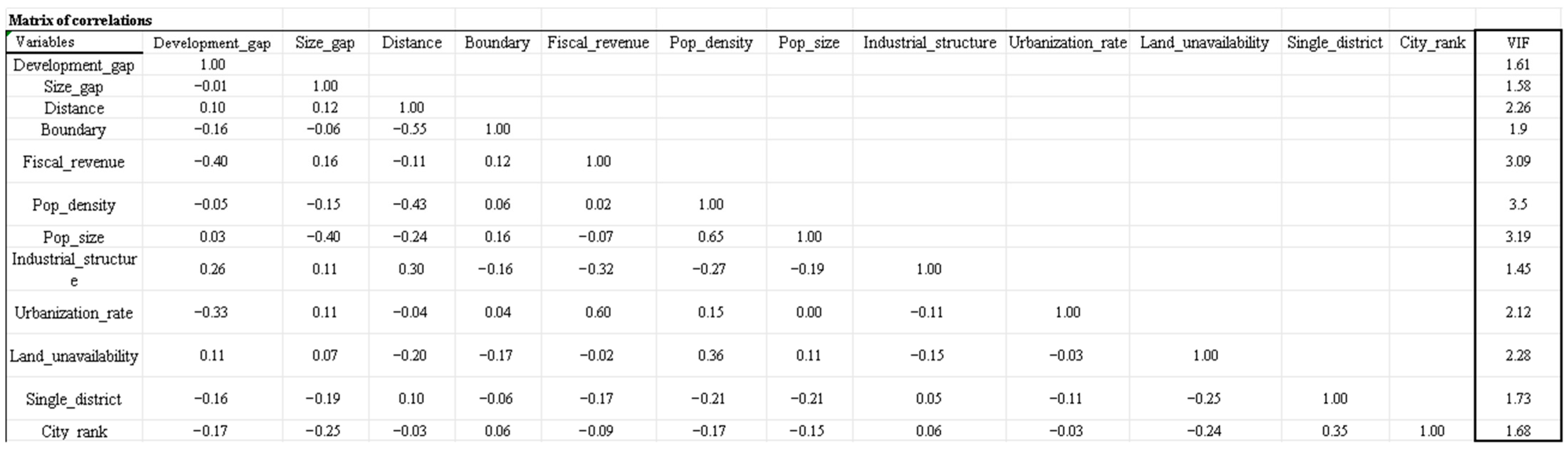
Appendix A. Correlation Matrix and VIF for Regression
| 1 | Potential reasons for the lack of transparency in the decision process of CTD include first, there is no clear guideline from higher level governments, and second, city governments may treat CTD proposals as confidential to prevent possible public unrest (Zhao and Zhang, 2024 [16]). |
| 2 | For example, in 2013, Nanjing merged two counties simultaneously: Lishui, which was adjacent to the urban districts, and Gaochun, which lies next to Lishui but lacks a direct boundary with the original urban area. In 2014, Nanping City, constrained by limited land in its fringe urban district due to natural geography, transformed the non-adjacent county of Jianyang into a district and relocated its city government there. |
References
- Galizzi, G.; Rota, S.; Sicilia, M.F. Local Government Amalgamations: State of the Art and New Ways Forward. Public Manag. Rev. 2023, 25, 2428–2450. [Google Scholar] [CrossRef]
- Gendźwiłł, A.; Kurniewicz, A.; Swianiewicz, P. The Impact of Municipal Territorial Reforms on the Economic Performance of Local Governments. A Systematic Review of Quasi-Experimental Studies. Space Polity 2021, 25, 37–56. [Google Scholar] [CrossRef]
- Strebel, M.A. The political economy of territorial integration referendums. Territ. Politics Gov. 2025, 13, 344–364. [Google Scholar] [CrossRef]
- Steiner, R.; Kaiser, C.; Eythórsson, G.T. A Comparative Analysis of Amalgamation Reforms in Selected European Countries. In Local Public Sector Reforms in Times of Crisis; Palgrave Macmillan: London, UK, 2016; pp. 23–42. [Google Scholar]
- Swianiewicz, P.; Gendźwiłł, A.; Zardi, A. Territorial Reforms in Europe: Does Size Matter? Territorial Amalgamation Toolkit; Council of Europe: Strasbourg, France, 2017. [Google Scholar]
- Askim, J.; Klausen, J.E.; Vabo, S.I.; Bjurstrøm, K. Territorial Upscaling of Local Governments: A Variable-Oriented Approach to Explaining Variance among Western European Countries. Local Gov. Stud. 2017, 43, 555–576. [Google Scholar] [CrossRef]
- Askim, J.; Gendźwiłł, A.; Klausen, J.E. Problem Indicators and Territorial Restructuring: Do Institutional Decision Rules Matter? J. Public Policy 2025, 45, 45–67. [Google Scholar] [CrossRef]
- Hanes, N.; Wikström, M.; Wångmar, E. Municipal Preferences for State-Imposed Amalgamations: An Empirical Study Based on the Swedish Municipal Reform of 1952. Urban Stud. 2012, 49, 2733–2750. [Google Scholar] [CrossRef]
- Bhatti, Y.; Hansen, K.M. Who ‘Marries’ Whom? The Influence of Societal Connectedness, Economic and Political Homogeneity, and Population Size on Jurisdictional Consolidations. Eur. J. Political Res. 2011, 50, 212–238. [Google Scholar] [CrossRef]
- Fitjar, R.D. Unrequited metropolitan mergers: Suburban rejection of cities in the Norwegian municipal reform. Territ. Politics Gov. 2021, 9, 17–36. [Google Scholar] [CrossRef]
- Austin, D.A. Politics vs Economics: Evidence from Municipal Annexation. J. Urban Econ. 1999, 45, 501–532. [Google Scholar] [CrossRef]
- Kuang, Z.; Wang, Y. Local Development, National Strategies, and Territorial Restructuring in China: An Empirical Study Based on the EHA Logistic Method. Eurasian Geogr. Econ. 2022, 65, 203–232. [Google Scholar] [CrossRef]
- He, J.; Jaros, K. The Multilevel Politics of County-to-District Mergers in China. J. Contemp. China 2023, 32, 932–950. [Google Scholar] [CrossRef]
- Market Inspection Bureau of Chongqing. Subordinate Units and Responsibilities of the Chongqing Municipal Administration for Market Regulation. 2023. Available online: https://www.sohu.com/a/753656531_121123744 (accessed on 10 April 2025).
- Hangzhou Government. Implementation Opinions on Institutional Reform of Hangzhou City Districts and Counties (Cities). 2001. Available online: https://www.hangzhou.gov.cn/art/2019/7/12/art_1663774_5304.html (accessed on 10 April 2025).
- Zhao, J.; Zhang, S. Intergovernmental Game of City-County Merger under the Perspective of Whole-Process: Longitudinal Tracking Based on the Administrative Division Adjustment in S District of Z City for 30 Years. J. Shanghai Adm. Inst. 2024, 25, 4–18. [Google Scholar] [CrossRef]
- Guanghan Government. Why Did Guanghan Initiate the Process of Abolishing the City and Establishing a District? 2018. Available online: https://www.163.com/dy/article/DR8G0A9J0514R9P4.html (accessed on 10 April 2025).
- Gao, X. A Study on Government Functional Relationships in the Process of Abolishing Counties (or County-Level Cities) and Establishing Districts — A Case Study of Zhejiang Province. J. Guangdong Inst. Public Adm. 2015, 27, 23–30. [Google Scholar] [CrossRef]
- Han, L.; Kung, J.K.-S. Fiscal Incentives and Policy Choices of Local Governments: Evidence from China. J. Dev. Econ. 2015, 116, 89–104. [Google Scholar] [CrossRef]
- Li, L.; Pang, B.; Wu, Y. Isolated counties, administrative monitoring, and the misuse of public funds in China. Governance 2019, 32, 779–797. [Google Scholar] [CrossRef]
- Wang, S.; Yang, D. Policy Experimentation in China: The Political Economy of Policy Learning; NBER Working Paper 29402; National Bureau of Economic Research: Cambridge, MA, USA, 2021. [Google Scholar] [CrossRef]
- Chen, J.; Luo, D.; She, G.; Ying, Q. Incentive or Selection? A New Investigation of Local Leaders’ Political Turnover in China. Soc. Sci. Q. 2017, 98, 341–359. [Google Scholar] [CrossRef]
- Zhang, T.; Sun, B.; Cai, Y.; Wang, R. Government Fragmentation and Economic Growth in China’s Cities. Urban Stud. 2019, 56, 1850–1864. [Google Scholar] [CrossRef]
- Strebel, M.A. Incented Voluntary Municipal Mergers as a Two-Stage Process: Evidence from the Swiss Canton of Fribourg. Urban Aff. Rev. 2018, 54, 267–301. [Google Scholar] [CrossRef]


| Province Level | Prefecture Level | County Level |
|---|---|---|
| Province-level city | District | |
| County and county-level city | ||
| Province | Prefecture-level city | District |
| County and county-level city |
| Time Period | 2000–2009 | 2010–2020 | ||
|---|---|---|---|---|
| Region | Coastal | Inland | Coastal | Inland |
| Number | 36 | 12 | 65 | 53 |
| Province | Five provinces | 22 others | Five provinces | 22 others |
| Number | 32 | 16 | 42 | 76 |
| Time Period | 2000–2009 | 2010–2020 | ||
|---|---|---|---|---|
| City rank | Capital or sub-provincial | Other prefecture-level | Capital or sub-provincial | Other prefecture-level |
| Number | 17 | 31 | 30 | 88 |
| City | Single District | GDP (Ten Thousand Yuan) | CTD During 2010–2020 |
|---|---|---|---|
| Chengdu | No | 55,513,336 | Yes |
| Mianyang | No | 9,602,153 | Yes |
| Deyang | Yes | 9,212,679 | Yes |
| Yibin | Yes | 8,708,472 | Yes |
| Nanchong | No | 8,278,238 | No |
| Dazhou | Yes | 8,192,030 | Yes |
| Leshan | No | 7,439,150 | No |
| Luzhou | No | 7,148,088 | No |
| Neijiang | No | 6,902,791 | No |
| Ziyang | Yes | 6,579,017 | No |
| Zigong | No | 6,477,251 | No |
| Meishan | Yes | 5,522,508 | Yes |
| Guangan | Yes | 5,372,243 | No |
| Panzhihua | No | 5,239,883 | No |
| Suining | No | 4,952,288 | No |
| Guangyuan | No | 3,218,678 | No |
| Yaan | Yes | 2,865,379 | Yes |
| Bazhong | Yes | 2,809,074 | No |
| County | Distance from Deyang (km) | GDP (Ten Thousand Yuan) | Population | GDP per Capita (Yuan) |
|---|---|---|---|---|
| Zhongjiang | 28.7 | 1,619,090 | 1,186,762 | 13,643 |
| Guanghan | 19.9 | 1,800,244 | 591,115 | 30,455 |
| Shifang | 22.1 | 1,357,819 | 412,758 | 32,896 |
| Mianzhu | 28.9 | 1,181,015 | 477,868 | 24,714 |
| Luojiang | 23.6 | 482,813 | 212,185 | 22,754 |
| Variable | Definition |
|---|---|
| CTD | Dummy indicating if CTD occurred in a city or county during 2010–2020 |
| Land_unavailability | Share of constructed land in the city proper |
| Single_district | Dummy indicating if a city has a single district |
| City_rank | The quintile of a prefecture-level city’s GDP ranking within the province |
| Development_gap | The ratio of GDP per capita between the city proper and the county |
| Size_gap | The ratio of the total population between the city proper and the county |
| Distance | Physical distance between county and city governments in kilometers |
| Boundary | Dummy indicating if a county borders an urban district |
| Fiscal_revenue | Ln (fiscal revenue per capita in yuan) |
| Pop_density | Ln (population density per square kilometer) |
| Pop_size | Ln (total population) |
| Industrial_structure | The GDP ratio between the tertiary and secondary sectors |
| Urbanization_rate | The ratio between the urban and the total population |
| City-Level Variables | Obs | Mean | Std. Dev. | Min | Max |
| CTD | 241 | 0.361 | 0.481 | 0 | 1 |
| Land_unavailability | 241 | 0.096 | 0.115 | 0.001 | 0.953 |
| Single_district | 241 | 0.311 | 0.464 | 0 | 1 |
| City_rank | 241 | 2.867 | 1.411 | 1 | 5 |
| County-Level Variables | Obs | Mean | Std. Dev. | Min | Max |
| CTD | 1260 | 0.093 | 0.29 | 0 | 1 |
| Development_gap | 1260 | 1.967 | 1.118 | 0.184 | 10.633 |
| Size_gap | 1260 | 3.451 | 4.65 | 0.332 | 88.369 |
| Distance | 1260 | 56.946 | 33.437 | 2.536 | 241.7 |
| Boundary | 1260 | 0.533 | 0.499 | 0 | 1 |
| Fiscal_revenue | 1260 | 6.716 | 0.831 | 4.648 | 9.432 |
| Pop_density | 1260 | 5.56 | 0.847 | 1.766 | 8.289 |
| Pop_size | 1260 | 12.96 | 0.644 | 10.311 | 14.536 |
| Industrial_structure | 1260 | 0.798 | 0.57 | 0.103 | 7.023 |
| Urbanization_rate | 1260 | 0.356 | 0.111 | 0.027 | 0.943 |
| (1) | (2) | (3) | (4) | |
|---|---|---|---|---|
| Land_unavailability | 11.729 *** | 10.743 *** | ||
| (2.703) | (3.158) | |||
| Single_district | 0.748 ** | 1.887 *** | ||
| (0.344) | (0.47) | |||
| City_rank | −0.507 *** | −0.546 *** | ||
| (0.116) | (0.148) | |||
| Province FE | Y | Y | Y | Y |
| _cons | −0.772 | −1.175 | 0.817 | −0.948 |
| (0.679) | (0.868) | (0.701) | (0.859) | |
| Observations | 241 | 241 | 241 | 241 |
| Pseudo R2 | 0.218 | 0.136 | 0.188 | 0.3 |
| (1) | (2) | (3) | (4) | |
|---|---|---|---|---|
| Development_gap | 0.375 ** | 0.4 ** | 0.36 ** | 0.406 ** |
| (0.147) | (0.163) | (0.183) | (0.164) | |
| Size_gap | 0.074 *** | 0.079 *** | 0.024 | 0.129 *** |
| (0.025) | (0.027) | (0.036) | (0.043) | |
| Distance | −0.071 *** | −0.076 *** | −0.096 *** | −0.072 *** |
| (0.01) | (0.011) | (0.013) | (0.011) | |
| Boundary | 2.058 *** | 2.182 *** | 1.879 *** | |
| (0.478) | (0.513) | (0.571) | ||
| Fiscal_revenue | 1.244 *** | 1.326 *** | 1.002 *** | 1.27 *** |
| (0.276) | (0.308) | (0.324) | (0.312) | |
| Pop_density | 0.15 | 0.187 | 0.064 | 0.118 |
| (0.258) | (0.281) | (0.287) | (0.287) | |
| Pop_size | 0.204 | 0.191 | −0.291 | 0.335 |
| (0.346) | (0.368) | (0.387) | (0.39) | |
| Industrial_structure | 0.442 | 0.47 | 0.585 | 0.252 |
| (0.376) | (0.401) | (0.425) | (0.484) | |
| Urbanization_rate | −1.304 | −1.266 | −0.904 | −1.183 |
| (1.48) | (1.565) | (1.667) | (1.591) | |
| Land_unavailability | 0.828 | 1.078 | 0.848 | 2.214 |
| (1.024) | (1.244) | (1.141) | (1.565) | |
| Single_district | 1.712 *** | 1.908 *** | 1.671 *** | 2.007 *** |
| (0.371) | (0.452) | (0.429) | (0.409) | |
| City_rank | −0.441 *** | −0.485 *** | −0.362 *** | −0.426 *** |
| (0.127) | (0.147) | (0.138) | (0.139) | |
| Random part | ||||
| City-level variance | 0.408 | 0.015 | 0 | |
| (0.429) | (0.326) | (0) | ||
| Provinces FE | Y | Y | Y | Y |
| _cons | −14.606 *** | −15.516 *** | −5.203 | −14.814 ** |
| (5.099) | (5.544) | (6.078) | (5.806) | |
| Observations | 1260 | 1260 | 1134 | 672 |
| Pseudo R2 | 0.398 |
Disclaimer/Publisher’s Note: The statements, opinions and data contained in all publications are solely those of the individual author(s) and contributor(s) and not of MDPI and/or the editor(s). MDPI and/or the editor(s) disclaim responsibility for any injury to people or property resulting from any ideas, methods, instructions or products referred to in the content. |
© 2026 by the authors. Licensee MDPI, Basel, Switzerland. This article is an open access article distributed under the terms and conditions of the Creative Commons Attribution (CC BY) license.
Share and Cite
Tan, P.; Wang, R. Local Drivers of Municipal Consolidation: County-to-District Conversion in China. Land 2026, 15, 672. https://doi.org/10.3390/land15040672
Tan P, Wang R. Local Drivers of Municipal Consolidation: County-to-District Conversion in China. Land. 2026; 15(4):672. https://doi.org/10.3390/land15040672
Chicago/Turabian StyleTan, Peiao, and Rui Wang. 2026. "Local Drivers of Municipal Consolidation: County-to-District Conversion in China" Land 15, no. 4: 672. https://doi.org/10.3390/land15040672
APA StyleTan, P., & Wang, R. (2026). Local Drivers of Municipal Consolidation: County-to-District Conversion in China. Land, 15(4), 672. https://doi.org/10.3390/land15040672