Evaluation of Cultivated Land Fragmentation and Analysis of Driving Factors in the Major Grain-Producing Areas of the Middle and Lower Yangtze River Basin

Abstract
1. Introduction
2. Materials and Methods
2.1. Study Area and Data Sources and Preprocessing
2.1.1. Study Area
2.1.2. Data Sources and Processing
2.2. Methods
2.2.1. Evaluation Method for Habitat Fragmentation Degree
- Selection of Spatial Scale for Cultivated Land Fragmentation
- 2.
- Calculation of Cultivated Land Fragmentation Index
- 3.
- Fragmentation Difference Analysis
2.2.2. Analysis Method of Fragmentation Influencing Factors
3. Results
3.1. Evaluation of the Degree of Cultivated Land Fragmentation
3.2. Regional Differences in Cultivated Land Fragmentation Characteristics
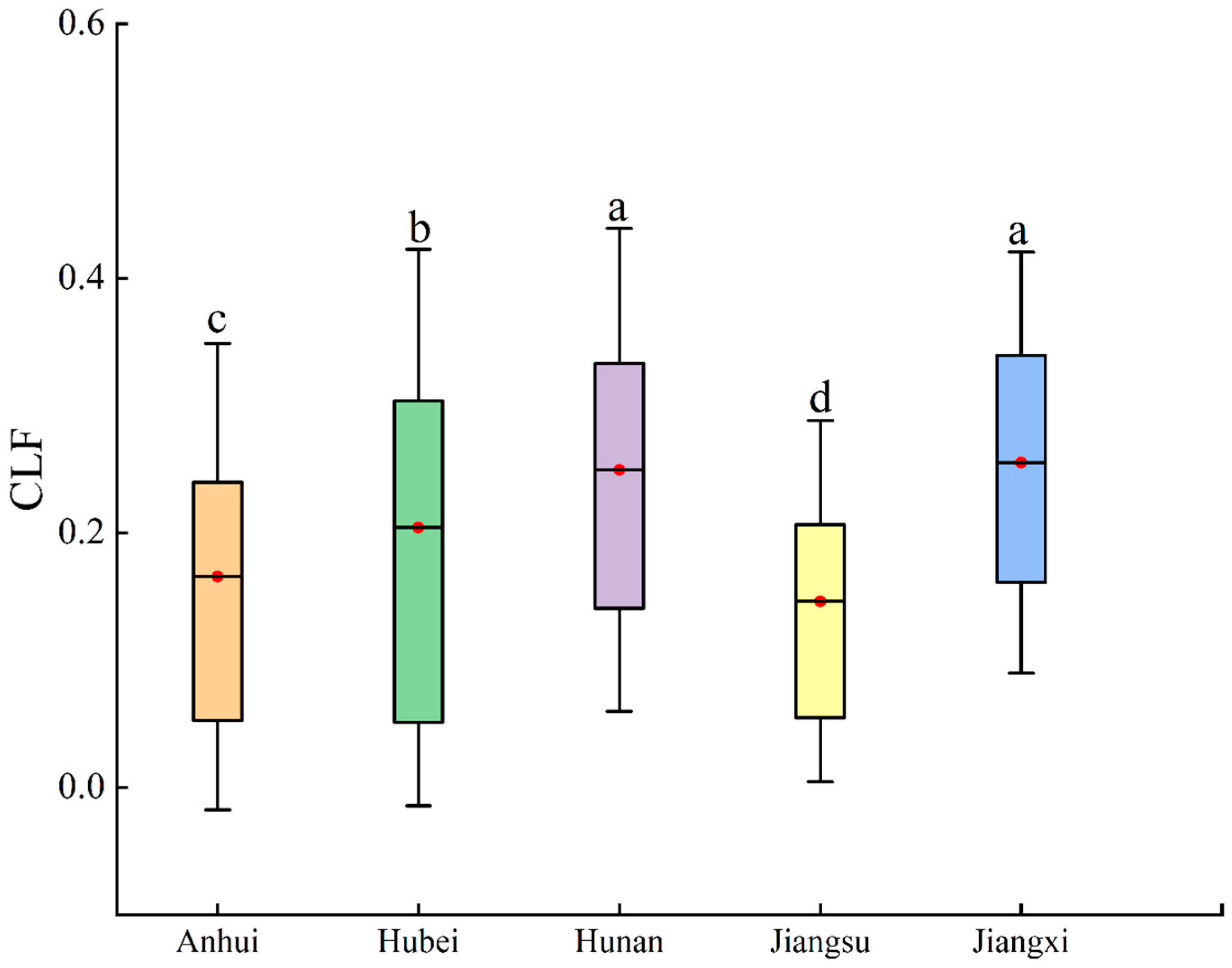
3.2.1. Provincial Differences in Cultivated Land Fragmentation
3.2.2. Differences in Cultivated Land Fragmentation Across Different Topographic Regions
3.3. Analysis of Influencing Factors on Cultivated Land Fragmentation
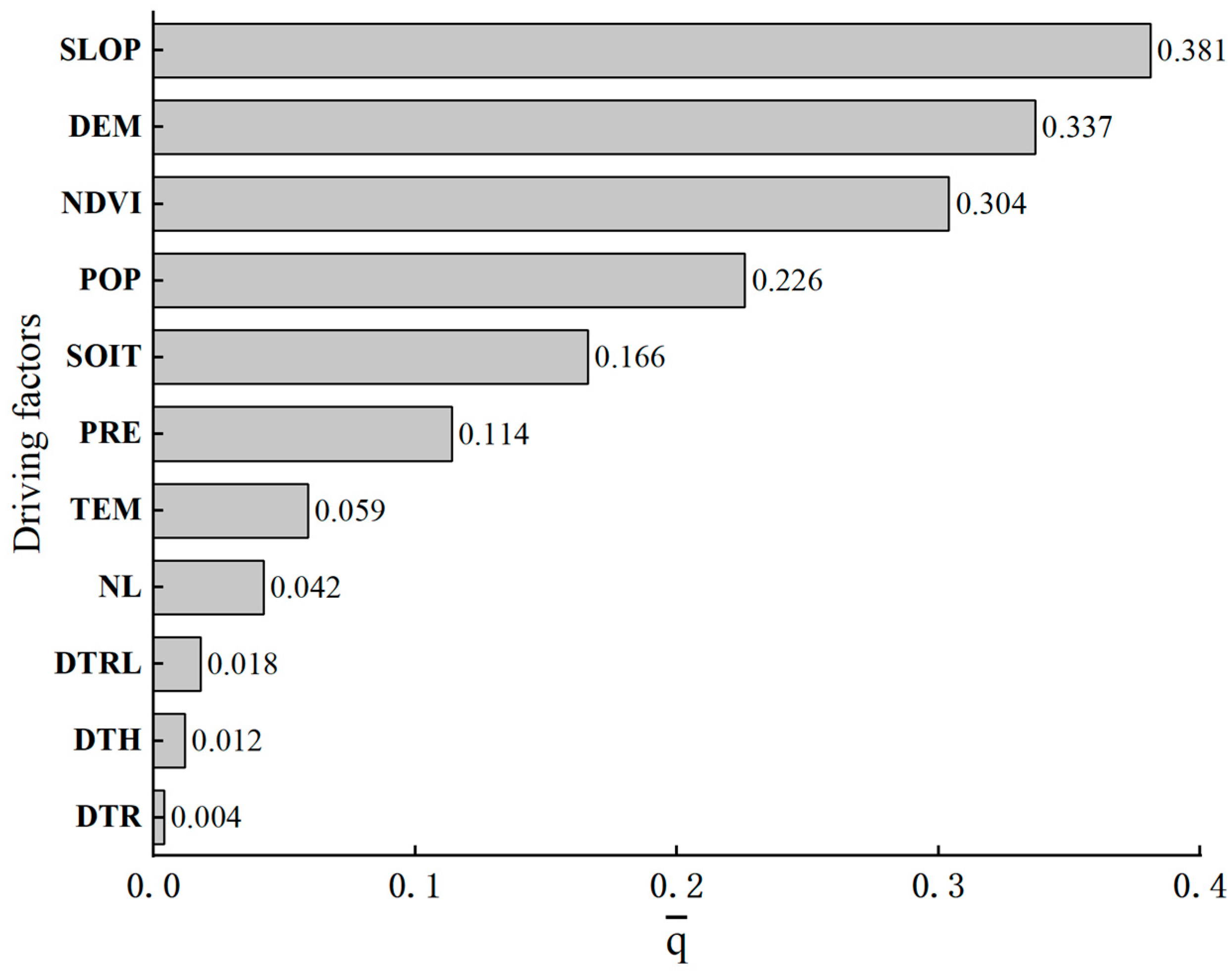
3.3.1. Factors Influencing Cultivated Land Fragmentation in the Study Area
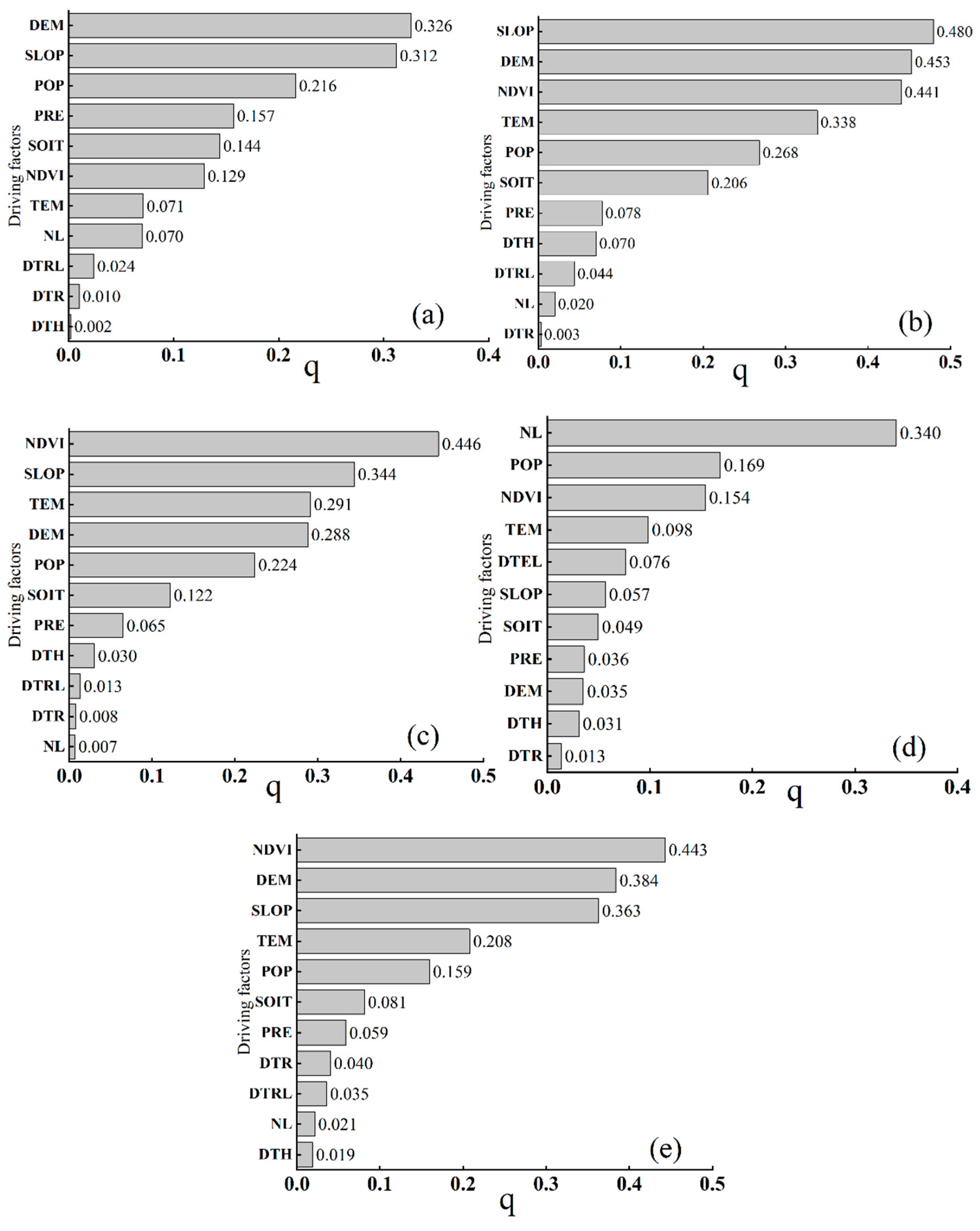
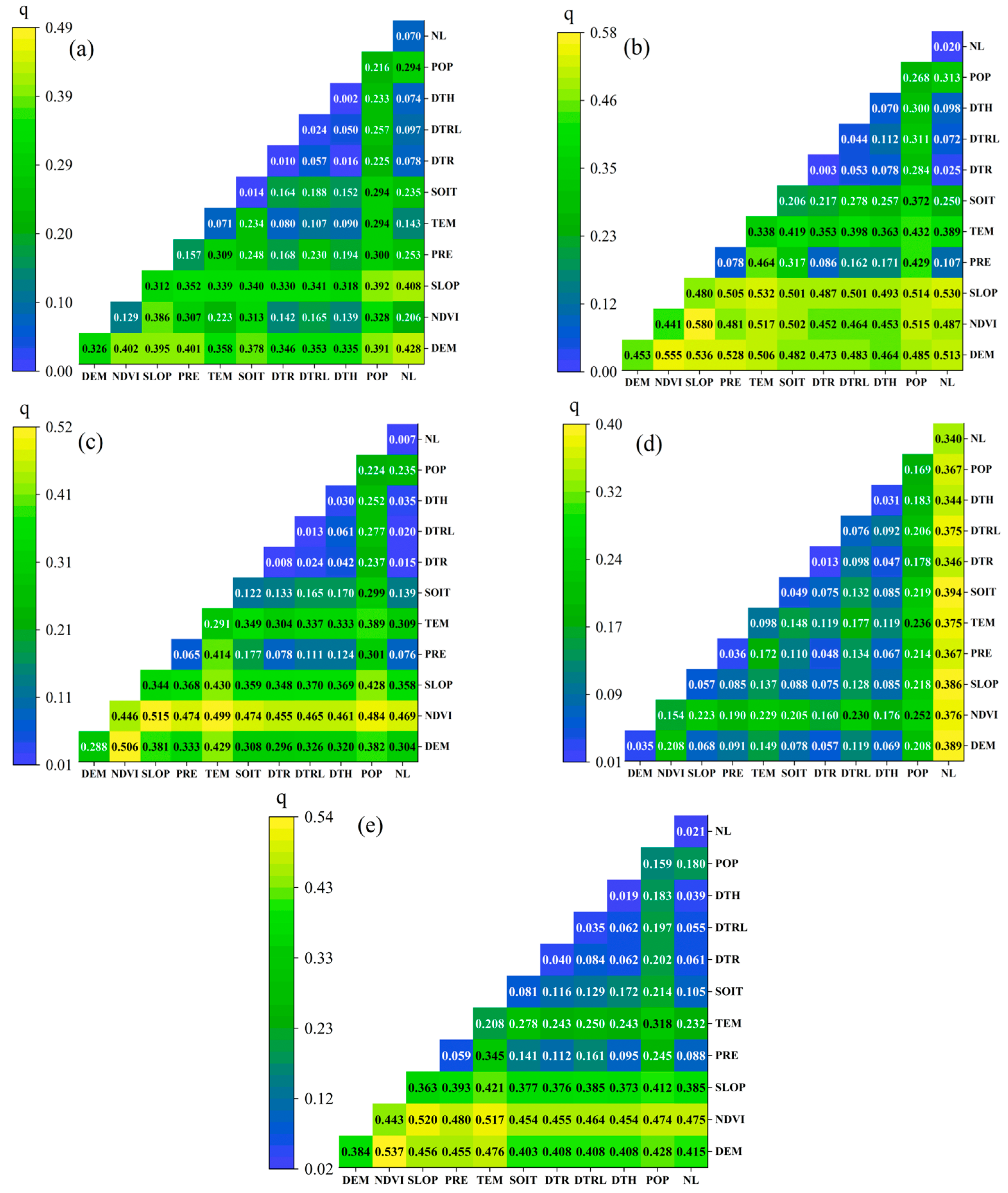
3.3.2. Factors Influencing Cultivated Land Fragmentation in Different Provinces
4. Discussion
5. Conclusions and Policy Recommendations
5.1. Conclusions
5.2. Policy Recommendations
5.3. Limitations and Future Directions
Author Contributions
Funding
Institutional Review Board Statement
Data Availability Statement
Acknowledgments
Conflicts of Interest
Appendix A

References
- Hu, Y.M.; Yang, H.; Zou, R.Y.; Shi, Z.; Wu, W.B.; Wu, L.; Wang, L.; Ren, X.N.; Xie, Y.K.; Ren, S.B.; et al. Evolution and Prospects of Cognitive Framework on Cultivated Land Resource Systems. J. Agric. Resour. Environ. 2021, 38, 937–945+932. (In Chinese) [Google Scholar] [CrossRef]
- Li, W.H.; Shen, J. Study on the Spatiotemporal Changes of Cropland Fragmentation in Water Network Plain Areas. J. Zhejiang Agric. For. Univ. 2021, 38, 723–729. (In Chinese) [Google Scholar] [CrossRef]
- Xu, W.; Jin, X.; Liu, J.; Zhou, Y.K. Analysis of influencing factors of cultivated land fragmentation based on hierarchical linear model: A case study of Jiangsu Province, China. Land Use Policy 2021, 101, 105119. [Google Scholar] [CrossRef]
- Wu, H.Y.; Hao, H.T.; Shi, H.T.; Ge, Y. The Impact of Agricultural Mechanization on Wheat Total Factor Productivity and Its Spatial Spillover Effects. Agric. Technol. Econ. 2022, 8, 50–68. (In Chinese) [Google Scholar] [CrossRef]
- Ren, H.Y.; Zhao, Y.L.; Li, X.B.; Ge, Y.J. Evaluation of Cultivated Land Fragmentation in Mountainous Areas Based on Images of Different Spatial Resolutions and Its Scale Effects. Geogr. Res. 2020, 39, 1283–1294. (In Chinese) [Google Scholar] [CrossRef]
- Liu, L.W.; Duan, Y.H.; Xu, L.S.; Yuan, X.M. Study on the Characteristics and Influencing Factors of Cultivated Land Fragmentation in the Loess Hilly Region: A Case Study of Heshun County, Shanxi Province. Chin. Agric. Sci. Bull. 2021, 37, 90–96. (In Chinese) [Google Scholar] [CrossRef]
- Zeng, J.W.; Liu, H. Analysis of Cultivated Land Fragmentation and Its Influencing Factors in Locally Urbanized Areas: A Case Study of Jinjiang City, Fujian Province. J. Hainan Univ. (Nat. Sci. Ed.) 2020, 38, 397–408. (In Chinese) [Google Scholar] [CrossRef]
- Zhang, X.Y.; Cai, Z.L.; Li, G.E.; Sun, J.Y.; Li, G.; Chen, Z.C. Analysis of Causes and Impact on Rural Income of Farmland Landscape Fragmentation. J. Geomat. 2020, 45, 134–141. (In Chinese) [Google Scholar] [CrossRef]
- Zhou, D.; Qi, J.L.; Yuan, C. Research Progress and Prospects of Farmland Fragmentation in China over the Past 40 Years. China Land Sci. 2021, 35, 107–116. (In Chinese) [Google Scholar] [CrossRef]
- Du, G.M.; Gai, Z.X.; Wang, H.Y. Theoretical Analysis and Research Framework of Cropland Fragmentation in China. J. Earth Sci. Environ. 2021, 43, 997–1008. (In Chinese) [Google Scholar] [CrossRef]
- Zheng, L.Y.; Chen, Z.W. The Impact of Farmland Fragmentation on Agricultural Land Abandonment by Households and Its Governance Optimization. Geogr. Res. 2024, 43, 200–213. (In Chinese) [Google Scholar] [CrossRef]
- Wei, P.; Yu, D.; Hu, Y.Z.; Hu, H.Y.; Sun, C.K. Evaluation of Cropland Fragmentation and Zoning for Consolidation Under Planning and Management Constraints. Trans. Chin. Soc. Agric. Eng. 2024, 40, 283–293. (In Chinese) [Google Scholar] [CrossRef]
- Deng, C.X.; Liu, R.N.; Nie, X.D.; Li, Z.W. Spatiotemporal Evolution of Landscape Patterns in Xiangxi Tujia and Miao Autonomous Prefecture Under the Influence of Land Use Change. J. Sichuan Norm. Univ. (Nat. Sci. Ed.) 2020, 43, 383–392. (In Chinese) [Google Scholar] [CrossRef]
- Wang, X.; Xu, X.F. Spatiotemporal Variation Characteristics of Cultivated Land Landscape Fragmentation in China and Its Influencing Factors. Trans. Chin. Soc. Agric. Eng. 2022, 38, 11–20. (In Chinese) [Google Scholar] [CrossRef]
- Ye, S.J.; Ren, S.Y.; Song, C.Q.; Cheng, C.X.; Shen, S.; Yang, J.Y.; Zhu, D.H. Spatial patterns of county-level arable land productive-capacity and its coordination with land-use intensity in mainland China. Agric. Ecosyst. Environ. 2022, 326, 107757. [Google Scholar] [CrossRef]
- Ao, Y.; Zhang, Y.H.; Wang, X.F.; Wu, J.S. Spatiotemporal Changes and Driving Factors of Cultivated Land Fragmentation in the Guanzhong Region Based on Landscape Indices. Res. Soil Water Conserv. 2024, 31, 401–411. (In Chinese) [Google Scholar] [CrossRef]
- Baker, W.L.; Cai, Y.M. The r. le programs for multiscale Analysis of landscape structure using the GRASS geographical information system. Landsc. Ecol. 1992, 7, 291–302. [Google Scholar] [CrossRef]
- Zhang, P.; Zhang, C.; Li, C.Z.; Li, S.E.; Kong, X.B.; Yun, W.J. Design and Application of a Terrain-Based Cultivated Land Fragmentation Index. J. China Agric. Univ. 2022, 27, 226–236. (In Chinese) [Google Scholar] [CrossRef]
- Li, X.M.; Huang, Q.H.; Lv, J.C.; Li, M.C.; Chen, Z.J.; Li, F.X. Evaluation and Consolidation of Cropland Fragmentation Based on Functional Zoning and Integration of Multi-clustering Algorithms. Trans. Chin. Soc. Agric. Eng. 2022, 38, 274–282. (In Chinese) [Google Scholar] [CrossRef]
- Zhang, G.; Ma, J.; Xu, S. Evaluation and Prediction of Cultivated Land Fragmentation in Jizhou District, Tianjin City Based on Landscape Pattern Index. Soil Water Conserv. Bull. 2022, 42, 112–119+156. (In Chinese) [Google Scholar] [CrossRef]
- Tian, Y.N.; Gao, R.Z.; Liu, T.X.; Fan, L.P. Study on the grain size effect of county-level landscape patterns in the forest-grassland ecotone. J. Beijing Norm. Univ. (Nat. Sci.) 2020, 56, 675–682. (In Chinese) [Google Scholar] [CrossRef]
- Hu, Y.H.; Yu, Q.; Yue, D.P.; Wang, P.C.; Pei, Y.R.; Niu, T. Landscape Pattern Optimization Based on Optimal Granularity in Ongniud Banner. J. Agric. Mech. 2020, 51, 217–225. (In Chinese) [Google Scholar] [CrossRef]
- Luo, Y.; Lv, Y.; Liu, L.; Liang, H.B.; Li, T.; Ren, Y.J. Spatiotemporal scale and integrative methods matter for quantifying the driving forces of land cover change. Sci. Total Environ. 2020, 739, 139622. [Google Scholar] [CrossRef]
- Chen, J.J.; Yang, Y.P.; Feng, Z.H.; Huang, R.J.; Zhou, G.Q.; You, H.T.; Han, X.W. Ecological risk assessment and prediction based on scale optimization—A case study of Nanning, a landscape garden city in China. Remote Sens. 2023, 15, 1304. [Google Scholar] [CrossRef]
- Zhou, D.M.; Chen, C.Y.; Wang, M.J.; Luo, Z.; Kang, L.; Wu, S. Gradient and Directional Differentiation in Landscape Pattern Characteristics of Urban Ecological Space Based on Optimal Spatial Scale: A Case Study in Changsha City. J. Ecol. Rural Environ. 2020, 38, 566–577. [Google Scholar] [CrossRef]
- Wang, B.; Shu, X.B.; Liao, F.Q.; Li, Y.; Wan, Z.W. Spatiotemporal Evolution and Multi-Scenario Simulation of Land Use Conflicts in Poyang Lake Area Based on Optimal Landscape Scale. Res. Soil Water Conserv. 2024, 31, 336–347. (In Chinese) [Google Scholar] [CrossRef]
- Zhao, Y.; Feng, Q. Identifying spatial and temporal dynamics and driving factors of cultivated land fragmentation in Shaanxi province. Agric. Syst. 2024, 217, 103948. [Google Scholar] [CrossRef]
- Yaermaimaiti, A.; Li, X.G.; Ge, X.Y.; Liu, C.J. Analysis of landscape pattern and ecological risk change characteristics in Bosten Lake basin based on optimal scale. Ecol. Indic. 2024, 163, 112120. [Google Scholar] [CrossRef]
- Li, Q.W.; Jin, T.T.; Peng, Q.D.; Lin, J.Q.; Zhang, D.; Huang, J.T.; Liu, B.Y. Identifying the extent of the spatial expression of landscape fragmentation based on scale effect analysis in Southwest China. Ecol. Indic. 2022, 141, 109120. [Google Scholar] [CrossRef]
- Wang, P.K.; Liu, X.L.; Gao, M.; Yu, W.T.; Zhang, X.Y.; Sun, J. The Grain Size Effect of Land Use Landscape Pattern Indices in Lanzhou City. J. Gansu Agric. Univ. 2024, 59, 253–262. (In Chinese) [Google Scholar] [CrossRef]
- Li, H.Y.; Li, W.; He, J.M. Optimal grain size analysis of land use landscape patterns in the Northeast Black Soil Region. Anhui Agric. Sci. 2025, 53, 63–65+73. (In Chinese) [Google Scholar] [CrossRef]
- Wang, H.C.; Wang, L.; Liu, X.; Wei, B.L. Analysis of landscape pattern vulnerability in Dasi River basin at the optimal scale. Sci. Rep. 2024, 14, 10727. [Google Scholar] [CrossRef]
- Kong, X.L.; Kong, F.B.; Li, Y.L.; Sun, J.X.; Zhu, W.J.; Han, M. Assessment of coastal landscape fragmentation and its driving factors based on optimal scale: A case study of the Yellow River Delta, China. Ecol. Indic. 2024, 166, 112537. [Google Scholar] [CrossRef]
- Ai, J.W.; Yu, K.Y.; Zeng, Z.; Yang, L.Q.; Liu, Y.F.; Liu, J. Assessing the dynamic landscape ecological risk and its driving forces in an island city based on optimal spatial scales: Haitan Island, China. Ecol. Indic. 2022, 137, 108771. [Google Scholar] [CrossRef]
- Yang, N.J.; Zhang, T.; Li, J.Z.; Feng, P.; Yang, N.N. Landscape ecological risk assessment and driving factors Analysis based on optimal spatial scales in Luan River Basin, China. Ecol. Indic. 2024, 169, 112821. [Google Scholar] [CrossRef]
- Zhou, W.J.; Wang, W.L.; Luo, W.L.; Lin, Z. Study on the Evolution of Landscape Ecological Risk in Fujian Province Based on LUCC. J. Qinghai Norm. Univ. (Nat. Sci. Ed.) 2023, 39, 13–23. (In Chinese) [Google Scholar] [CrossRef]
- Yu, R.; Wei, J.Y.; Chu, Z.J. Landscape Ecological Security Pattern and Its Influencing Factors in the Xinanjiang River Basin at Optimal Scale. J. Anhui Agric. Univ. (Soc. Sci. Ed.) 2024, 33, 112–123. (In Chinese) [Google Scholar] [CrossRef]
- Wu, Z.J.; Li, Z.J.; Zeng, H. Gradient analysis of spatial differentiation characteristics of landscape pattern in Huizhou City. Chin. J. Ecol. 2021, 40, 490–500. (In Chinese) [Google Scholar] [CrossRef]
- Zuo, Q.; Zhou, Y.; Li, Q.; Wang, L.; Liu, J.Y.; He, N. Spatiotemporal Characteristics of Landscape Ecological Risk Based on Optimal Scale in the Mountainous Areas of Southwestern Hubei Province. Chin. J. Ecol. 2023, 42, 1186–1196. (In Chinese) [Google Scholar] [CrossRef]
- Yang, K.; Xin, G.X.; Jiang, H.Y.; Yang, C.X. Study on the Spatiotemporal Changes of Landscape Ecological Risk Based on Optimal Scale: A Case Study of Jiangjin District in Chongqing Municipality. J. Ecol. Rural Environ. 2021, 37, 576–586. (In Chinese) [Google Scholar] [CrossRef]
- Chen, W.Y.; Li, T.; Sun, J.Y.; Huang, J.Y.; Xian, Z.T.; Li, Z.W. Spatiotemporal Variation Characteristics and Driving Mechanisms of Cultivated Landscape Fragmentation in Guangdong Province from 1990 to 2020. J. Eco-Agric. 2025, 33, 1480–1491. (In Chinese) [Google Scholar] [CrossRef]
- Zhang, R.S.; Ye, S.J.; Ren, S.Y. Analysis of Spatial Patterns and Driving Factors of Cropland Fragmentation in Jiangsu Province Based on the MGWR Model. Transactions of the Chin. Soc. Agric. Eng. 2024, 40, 229–239. (In Chinese) [Google Scholar] [CrossRef]
- Fan, Z.G.; Deng, C.; Fan, Y.Q.; Liu, M.B.; Lu, H.; Zhang, P.W. Measurement of Ecological Efficiency in Arable Land Use and Its Spatiotemporal Characteristics from the Perspective of Carbon Peaking and Carbon Neutrality Goals: A Case Study of Major Grain-Producing Areas in the Middle and Lower Reaches of the Yangtze River. Ecol. Econ. 2023, 39, 119–127. (In Chinese) [Google Scholar]
- Liu, Y.J.; Zhang, A.L.; Liu, M.B. Spatiotemporal Pattern Analysis of Coupling and Coordination Degree Between Urbanization and Ecological Efficiency of Cropland Use in the Major Grain-Producing Areas of the Middle and Lower Reaches of the Yangtze River. J. Agric. Resour. Reg. Plan. 2022, 43, 106–118. Available online: https://d.wanfangdata.com.cn/periodical/zgnyzyyqh202208015 (accessed on 16 April 2026). (In Chinese)
- Liu, M.B.; Zhang, A.L.; Wen, G.H. Spatiotemporal Patterns and Evolutionary Trends of Eco-Efficiency in Cultivated Land Use in the Major Grain-Producing Areas of the Middle and Lower Reaches of the Yangtze River. China Land Sci. 2021, 35, 50–60. (In Chinese) [Google Scholar] [CrossRef]
- Yang, J.; Huang, X. The 30 m annual land cover datasets and its dynamics in China from 1985 to 2023. Earth Syst. Sci. Data 2024, 13, 3907–3925. [Google Scholar] [CrossRef]
- Chen, Z.Q.; Yu, B.L.; Yang, C.S.; Zhou, Y.Y.; Yao, S.J.; Qian, X.J.; Wang, C.X.; Wu, B.; Wu, J.P. An extended time series (2000–2018) of global NPP-VIIRS-like nighttime light data from a cross-sensor calibration. Earth Syst. Sci. Data 2021, 13, 889–906. [Google Scholar] [CrossRef]
- Li, Y.L.; Cui, W.G.; Lu, Q.P.; Liu, S.H.; Wu, X.P. Spatiotemporal Evolution Analysis of Cultivated Land Fragmentation in Mountainous Areas: A Case Study of Guizhou Province. Res. Soil Water Conserv. 2022, 29, 301–309. (In Chinese) [Google Scholar] [CrossRef]
- Liang, J.L.; Pan, S.P.; Chen, W.X.; Li, J.F.; Zhou, T. Cultivated Land Fragmentation and Its Influencing Factors Detection: A Case Study in Huaihe River Basin, China. Int. J. Environ. Res. Public Health 2021, 19, 138. [Google Scholar] [CrossRef] [PubMed]
- Liu, M.Q.; Wu, F.Q.; Mo, C.J.; Xiao, R.J.; Yu, H.L.; Wang, M.M. Heterogeneous Changes and Evolutionary Characteristics of Cultivated Land Fragmentation in Mountainous Counties and Townships in Southwest China: A Case Study of Beichuan Qiang Autonomous County. Land 2025, 14, 1395. [Google Scholar] [CrossRef]
- Chen, W.X.; Duan, B.Q.; Zeng, J. Analysis of Spatial Heterogeneity and Influencing Factors of Cultivated Land Landscape Fragmentation in China from 1980 to 2020. Trans. Chin. Soc. Agric. Eng. 2024, 40, 221–231. (In Chinese) [Google Scholar] [CrossRef]
- Chen, Y.R.; Xiao, W.F.; Teng, M.J.; Feng, Y. Granularity effect of landscape pattern and its response to land use change processes in the Three Gorges Reservoir Area. J. Nat. Resour. 2018, 33, 588–599. (In Chinese) [Google Scholar] [CrossRef]
- Zhang, L.P.; Qu, J.G. Scale effect of landscape pattern in the Songhua River Basin (Harbin Section). J. Surv. Mapp. Eng. 2021, 30, 51–59. (In Chinese) [Google Scholar] [CrossRef]
- Zhang, L.L.; Zhao, Y.H.; Yin, S.; Fang, S.; Liu, X.J.; Pu, M.M. Gradient Analysis of Landscape Pattern in the Dry Valley of Minjiang River Based on the Moving Window Method. Acta Ecol. Sin. 2014, 34, 3276–3284. (In Chinese) [Google Scholar] [CrossRef]
- Pan, Y.C.; Wu, Y.X.; Meng, D.H.; Li, T.T. Impact of Ecological Land Pattern Characteristics on Carbon Sink in Heilongjiang Province. J. Urban For. China 2025, 23, 100–107+116. (In Chinese) [Google Scholar] [CrossRef]
- Wang, J.F.; Xu, C.D. Geodetector: Principles and Prospects. Acta Geogr. Sin. 2017, 72, 116–134. (In Chinese) [Google Scholar] [CrossRef]
- Song, Y.Z.; Wang, J.F.; Ge, Y.; Xu, C.D. An optimal parameters-based geographical detector model enhances geographic characteristics of explanatory variables for spatial heterogeneity analysis: Cases with different types of spatial data. GIScience Remote Sens. 2020, 57, 593–610. [Google Scholar] [CrossRef]





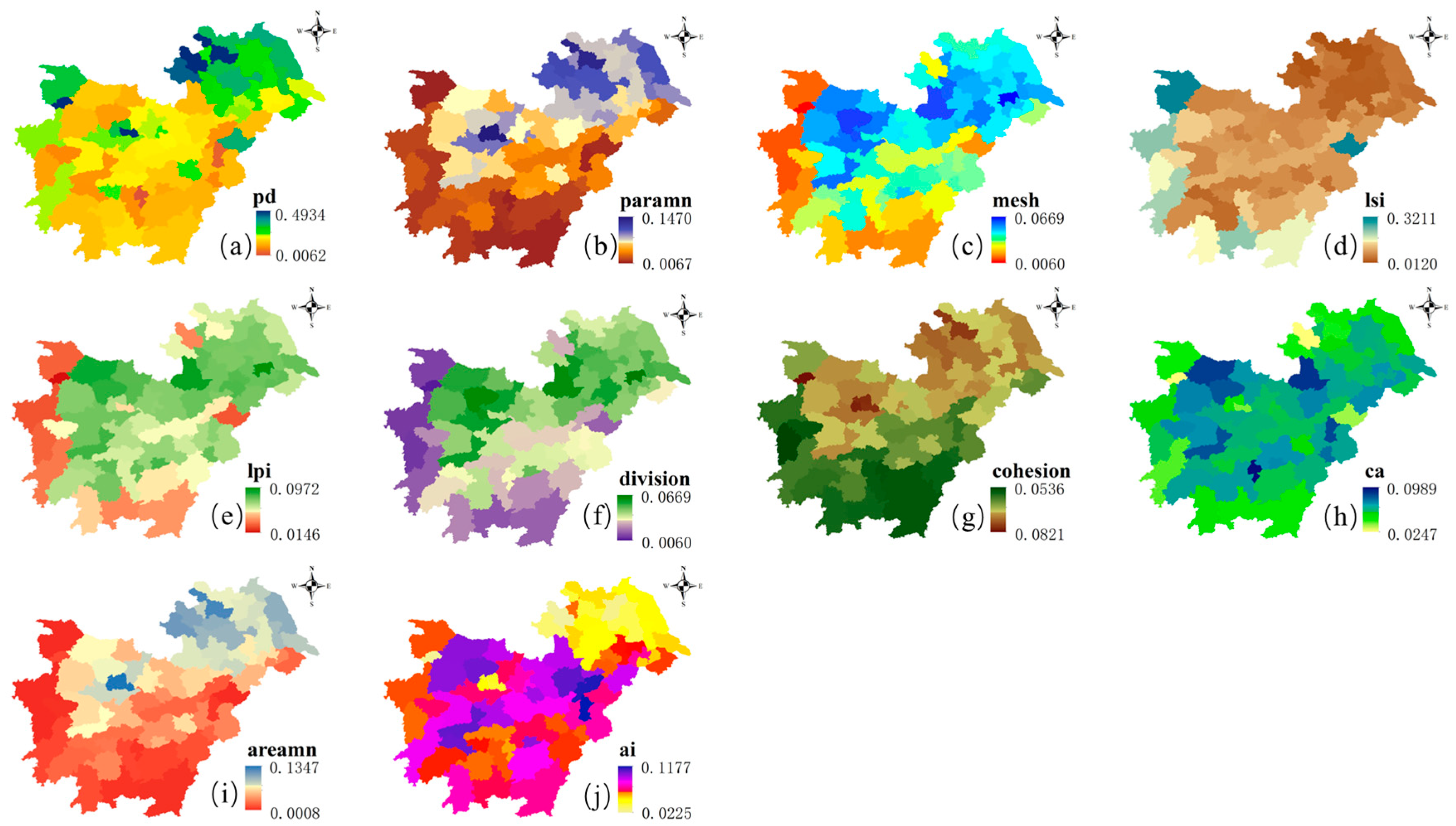
| Landscape Index | Description of Indicators | Index Direction |
|---|---|---|
| Class area (CA) | The measurement of cultivated land area size indicates that larger values correspond to lower degrees of cultivated land fragmentation. | - |
| Mean perimeter–area ratio (PARA_MN) | Characterize the distribution patterns of patch shapes to reveal the impacts of human activities on landscape patterns. The weaker the patch aggregation, the more complex the shape tends to be, and the higher the fragmentation level. | + |
| Patch density (PD) | Characterizes the number of cultivated land patches within a certain range; higher values indicate greater fragmentation of cultivated land. | + |
| Landscape division index (DIVISION) | The degree of separation between cultivated land patches indicates that higher values correspond to greater fragmentation of cultivated land. | + |
| Patch cohesion index (COHESION) | Represents the degree of physical connectivity between cultivated land patches; higher values indicate better connectivity of cultivated land. | - |
| Aggregation index (AI) | The description of cultivated land landscape aggregation degree indicates that higher values represent greater aggregation. | - |
| Mean patch Area (AREA_MN) | The arithmetic mean of cultivated land patch areas, where smaller values indicate higher fragmentation levels. | - |
| Effective mesh size (MESH) | The ratio of the sum of squared patch areas to the total landscape area indicates that a higher value corresponds to a lower degree of cultivated land fragmentation. | - |
| Largest patch index (LPI) | This indicator represents the proportion of landscape area occupied by the largest cultivated land patch; a higher value indicates lower fragmentation of cultivated land. | - |
| Landscape shape index (LSI) | This indicator describes the complexity of cultivated land patch shapes. Higher values indicate more irregular shapes and greater fragmentation of cultivated land patches. | + |
| Coefficient of variation | <0.01 | 0.01–0.1 | 0.1–0.5 | 0.5–1 |
| Sensitivity | Insensitive | Low sensitivity | Moderately sensitive | Highly sensitive |
| Influencing Factor Category | Impact Factor | Abbreviations |
|---|---|---|
| Elevation | DEM | |
| Vegetation cover | NDVI | |
| Slope | SLOP | |
| Natural factors | Precipitation | PRE |
| Temperature | TEM | |
| Soil type | SOIT | |
| Distance from the river | DTR | |
| Socioeconomic factors | Distance from the railway | DTRL |
| Distance from the highway | DTH | |
| Population density | POP | |
| Night lights | NL |
| Type | Description |
|---|---|
| Nonlinear weaken | |
| Uni-weaken | |
| Bi-enhance | |
| Independent | |
| Nonlinear enhance |
| Landscape Index | Coefficient of Variation |
|---|---|
| Class area (CA) | 0.001 |
| Mean perimeter–area ratio (PARA_MN) | 1.223 |
| Patch density (PD) | 1.700 |
| Landscape division index (DIVISION) | 0.035 |
| Patch cohesion index (COHESION) | 0.001 |
| Aggregation index (AI) | 0.063 |
| Mean patch area (AREA_MN) | 0.788 |
| Effective mesh size (MESH) | 0.426 |
| Largest patch index (LPI) | 0.248 |
| Landscape shape index (LSI) | 0.687 |
Disclaimer/Publisher’s Note: The statements, opinions and data contained in all publications are solely those of the individual author(s) and contributor(s) and not of MDPI and/or the editor(s). MDPI and/or the editor(s) disclaim responsibility for any injury to people or property resulting from any ideas, methods, instructions or products referred to in the content. |
© 2026 by the authors. Licensee MDPI, Basel, Switzerland. This article is an open access article distributed under the terms and conditions of the Creative Commons Attribution (CC BY) license.
Share and Cite
Gou, J.; Jiao, C. Evaluation of Cultivated Land Fragmentation and Analysis of Driving Factors in the Major Grain-Producing Areas of the Middle and Lower Yangtze River Basin. Land 2026, 15, 671. https://doi.org/10.3390/land15040671
Gou J, Jiao C. Evaluation of Cultivated Land Fragmentation and Analysis of Driving Factors in the Major Grain-Producing Areas of the Middle and Lower Yangtze River Basin. Land. 2026; 15(4):671. https://doi.org/10.3390/land15040671
Chicago/Turabian StyleGou, Jiangtao, and Cuicui Jiao. 2026. "Evaluation of Cultivated Land Fragmentation and Analysis of Driving Factors in the Major Grain-Producing Areas of the Middle and Lower Yangtze River Basin" Land 15, no. 4: 671. https://doi.org/10.3390/land15040671
APA StyleGou, J., & Jiao, C. (2026). Evaluation of Cultivated Land Fragmentation and Analysis of Driving Factors in the Major Grain-Producing Areas of the Middle and Lower Yangtze River Basin. Land, 15(4), 671. https://doi.org/10.3390/land15040671