Systematic Review

A Systematic Review of Cultural Ecosystem Services and Blue Space

1
School of Design and Arts, Beijing Institute of Technology, Beijing 102400, China
2
Beiijng Institute of Technology-University of Edinburgh the Joint Laboratory of Healthy Space, Beijing 102400, China
3
China Geo-Engineering Corporation, Beijing 100093, China
4
OPENspace Research Centre, Edinburgh College of Art, University of Edinburgh, Edinburgh EH3 9DF, UK
5
Chair of Landscape Architecture, Estonian University of Life Sciences, 51006 Tartu, Estonia
*
Authors to whom correspondence should be addressed.
Land 2026, 15(4), 666; https://doi.org/10.3390/land15040666
Submission received: 13 March 2026 / Revised: 5 April 2026 / Accepted: 13 April 2026 / Published: 17 April 2026

Abstract

Blue space, as an important natural and social composite feature system in cities, not only provides supporting, regulating, and provisioning services, but also plays a key role in human well-being, recreational experience, and urban sustainable development. The blue space cultural ecosystem service (CES) has gradually attracted the attention of academia in recent years, but there is a lack of systematic integration research in related fields. Therefore, it is necessary to conduct a comprehensive analysis of current studies to clarify how, and to what extent, blue spaces influence CESs. This study adopts a PRISMA-based systematic search combined with qualitative synthesis, aiming to review the research status of CES and its developmental trajectory within blue space studies, and to identify future research trends and critical gaps. A total of 52 studies meeting the inclusion criteria were finally selected through database screening. The research innovatively divides the evolution of blue space CES into three stages (2012–2017/2018–2022/2023–2025), revealing a shift in research focus from single value identification to complex policy support. Secondly, through the mapping of six typical blue space types (such as rivers and wetlands) and 10 CES indicators, combined with a Pearson correlation heatmap, it provides quantitative insights into the coupling mechanisms between indicators, such as the significant synergy between spiritual and educational values. Methodologically, it systematically discriminates between the application boundaries of monetary valuation based on the contingent valuation method and non-monetary valuation represented by social media big data and PPGIS, pointing out that technological progress is driving the evaluation toward high dynamics and refinement. Finally, the study points out current bottlenecks such as uneven geographical distribution and insufficient planning transformation, emphasizing that future research should use artificial intelligence to improve data processing accuracy and transform blue space CESs from “invisible welfare” into “explicit policy assets” to guide sustainable urban renewal and healthy space design.

1. Introduction

Proximity to water and access to water resources have long been a cornerstone of human culture, bringing with them numerous social benefits [1]. The positive effects of natural landscapes associated with water on human health and well-being are widely acknowledged in the academic community [2]. In research and practice concerning natural areas, the term “green space” has long been widely used as a general concept, commonly referring to natural spaces characterized primarily by vegetation. However, a more refined classification and identification of the attributes of “green space” reveal that many areas included in green space statistics or research frameworks do not have vegetation as their core surface feature, but instead display distinct “blue” attributes (i.e., water-related areas) [3].
This phenomenon reflects the long-standing insufficient research attention given to water as a key component of landscape systems, despite its importance. Within this context of critique, Lianyong et al. [4] further focused on “waterscapes” as specific carriers, pointing out the systematic neglect of waterscapes in academic research. In response to these research limitations, Bell et al. [5] investigated whether blue spaces can promote health and well-being, exploring whether blue space design can encourage the public to more actively preserve and protect these environments. They also developed the BlueHealth project in Europe [1] and provided evidence-based information for policymakers to maximize the health benefits of aquatic environments and their associated interventions. The term “blue space” was proposed and gradually disseminated. The definition of blue space initially focused on the physical domain of natural water bodies. White et al. [6] refined this definition, indicating that blue space includes not only water bodies themselves (e.g., rivers, lakes) but also “landscape areas surrounding water bodies and associated with human activities” (such as riverbank green areas and coastal promenades), incorporating “human–water interaction” into the definitional scope for the first time.
Blue spaces also provide a wide range of ecosystem services that benefit humans [7,8] and are important providers of cultural ecosystem services. The “products” and “services” provided by ecosystems represent ecological values that humans can obtain directly or indirectly [9]. Ecosystem services of blue spaces include provisioning services, such as supplying freshwater and food [10]; regulating services, such as flood control and water purification [11]; and supporting services, such as water and nutrient cycling. In addition, a fourth category of ecosystem services is referred to as “cultural ecosystem services”. Compared with provisioning, regulating, and supporting services, CESs have received relatively less attention from researchers and decision-makers [12].
Therefore, stronger evidence is needed to improve understanding of the CES provided by blue spaces to truly understand how blue spaces benefit people and promote human health and well-being. A lack of understanding of CESs may also trigger or exacerbate conflicts among people [13]. Accelerating research on blue space CESs can help address inequalities in the distribution and quality of basic urban services [14]. At the same time, blue spaces play a crucial role in strengthening connections between people and the natural environment, and interactions with blue spaces can generate positive feedback that enhances human well-being [15]. Even though the mechanisms of such positive feedback may vary across regions and cities [16], the beneficial health effects of blue spaces appear robust across diverse contexts. Blue spaces provide opportunities for direct contact with nature, guiding human–environment coupling at different scales and supporting decisions related to intra-generational and inter-generational equity and other social issues to achieve sustainable development [17]. Moreover, improving understanding of CESs helps attract public participation and contributes to the protection of blue spaces [18].
Although the cultural services provided by blue spaces present non-material attributes, their value can nonetheless manifest as significant long-term economic benefits. The improvements in physical and mental health, stress reduction, and enhanced social cohesion resulting from interactions with blue spaces [19] are often difficult to quantify as direct economic output in the short term. However, such cultural services can substantially improve overall public health over time [20], thereby reducing governmental expenditure on public health and medical systems. For example, improvements in psychological well-being, increased physical activity, and strengthened social connections are closely associated with reduced risks of chronic diseases, leading to lower healthcare costs and higher labor productivity.
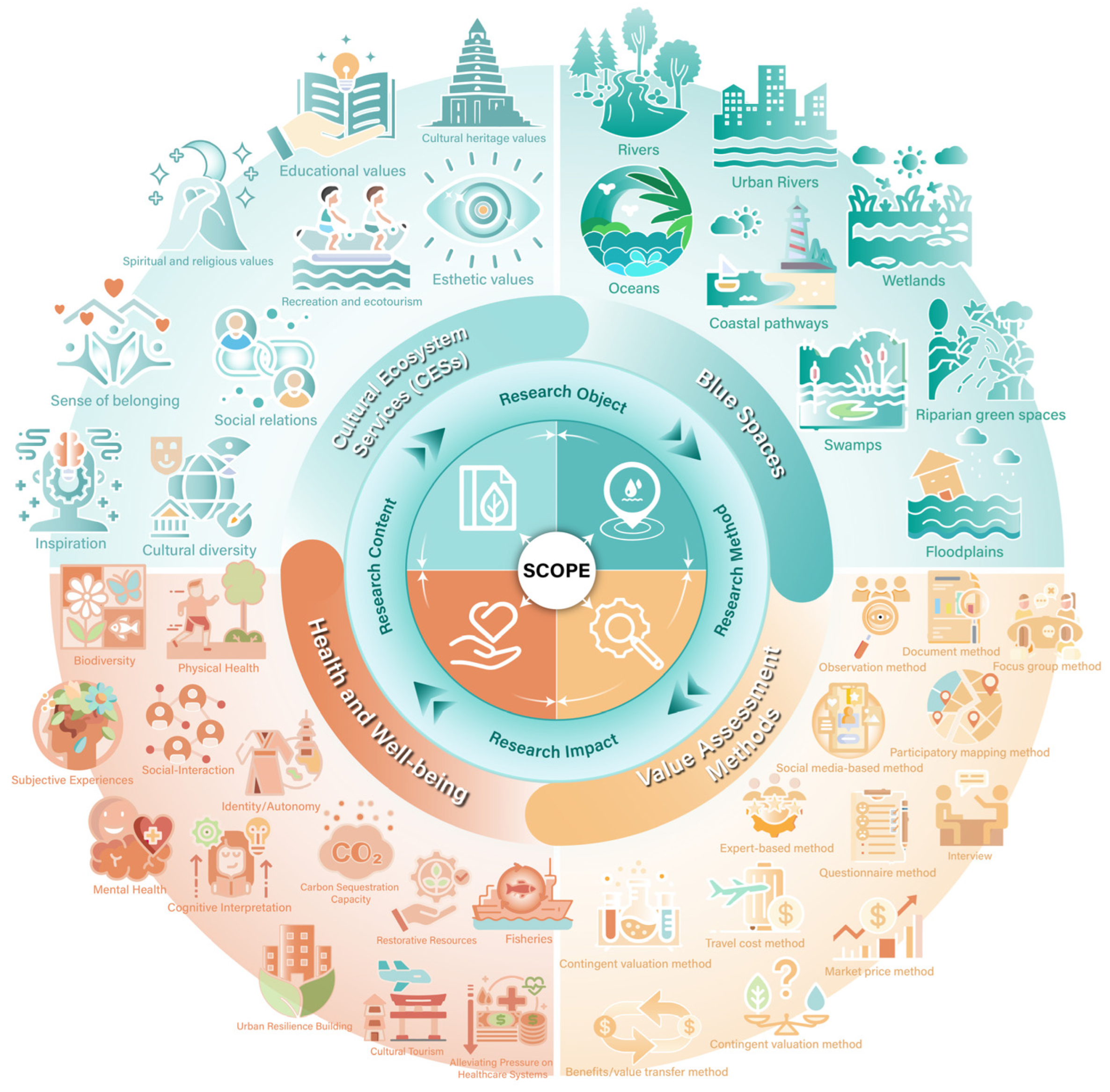
To provide a holistic understanding of this field, this study develops a comprehensive framework encompassing the physical attributes of blue spaces, methodological approaches for CES assessment, and their multifaceted impacts on human well-being (Figure 1).
In summary, this review makes three specific contributions:
(i)
It identifies the critical disconnect between theoretical identification and practical design transformation, highlighting the urgent need for application-oriented frameworks to translate “invisible welfare” into explicit policy assets for healthy space design and strategic urban regeneration.
(ii)
It reveals a significant research gap in the lack of standardized indicator systems tailored to blue spaces, as current CES assessments often rely on generalized green space frameworks. The review further emphasizes the uneven geographical and typological distribution of studies, calling for robust, evidence-based metrics to guide decision-making and ensure social equity.
(iii)
It argues that as dynamic entities, blue spaces require a temporal dimension in CES assessment. Future research must integrate artificial intelligence and machine learning to decode multi-source heterogeneous data, transitioning from static status assessments to precise, AI-enabled supply–demand prediction and adaptive management of complex urban water landscapes.
In addition, this review differs from existing CES reviews in three respects: a three-stage dynamic evolution of blue space CES research (2012–2017/2018–2022/2023–2025); revealing implicit coupling patterns between CES indicators and blue space types through a Pearson correlation heatmap; and systematically distinguishing the application boundaries of monetary vs. non-monetary valuation methods and identifying technology-driven methodological shifts.

2. Materials and Methods

2.1. Review Protocols

This literature review adopts a mixed approach combining systematic retrieval and qualitative synthesis to ensure both the objectivity of literature selection and the analytical depth of the review. The systematic search and screening of quantitative studies follow the PRISMA guidelines and established protocols for conducting systematic reviews [21]. In parallel, qualitative literature analysis is employed to examine the theoretical frameworks, research perspectives, and logical structures of key publications, with the two approaches complementing each other to produce a comprehensive review outcome [22].
The systematic retrieval was conducted using the Web of Science (WOS) Core Collection and Scopus databases, covering the period from their inception to 10 September 2025, with no restriction on the publication date. Given that the concept of blue spaces does not refer to a single type of physical environment, a multidimensional keyword search strategy was developed based on the definitional scope and research domains of blue spaces to ensure both the comprehensiveness and rigor of the retrieval process.
The first part of the search string is locked onto “cultural ecosystem services”, requiring all included studies to be discussed within the scientific context of ecosystem services. The second part of the search string connects a series of terms representing blue spaces using the Boolean operator “OR”, including conceptual terms such as “blue space”, “blue-green space”, and “waterfront spaces”, as well as specific water body types: “rivers”, “lakes”, “wetlands”, “canals”, and “reservoirs”, by performing an “AND” intersection operation between the CES and blue space clusters. The Topic (TS) field is used in Web of Science, while the corresponding TITLE-ABS-KEY field is used in Scopus to achieve standardized retrieval across databases.

2.2. Literature Screening Protocol

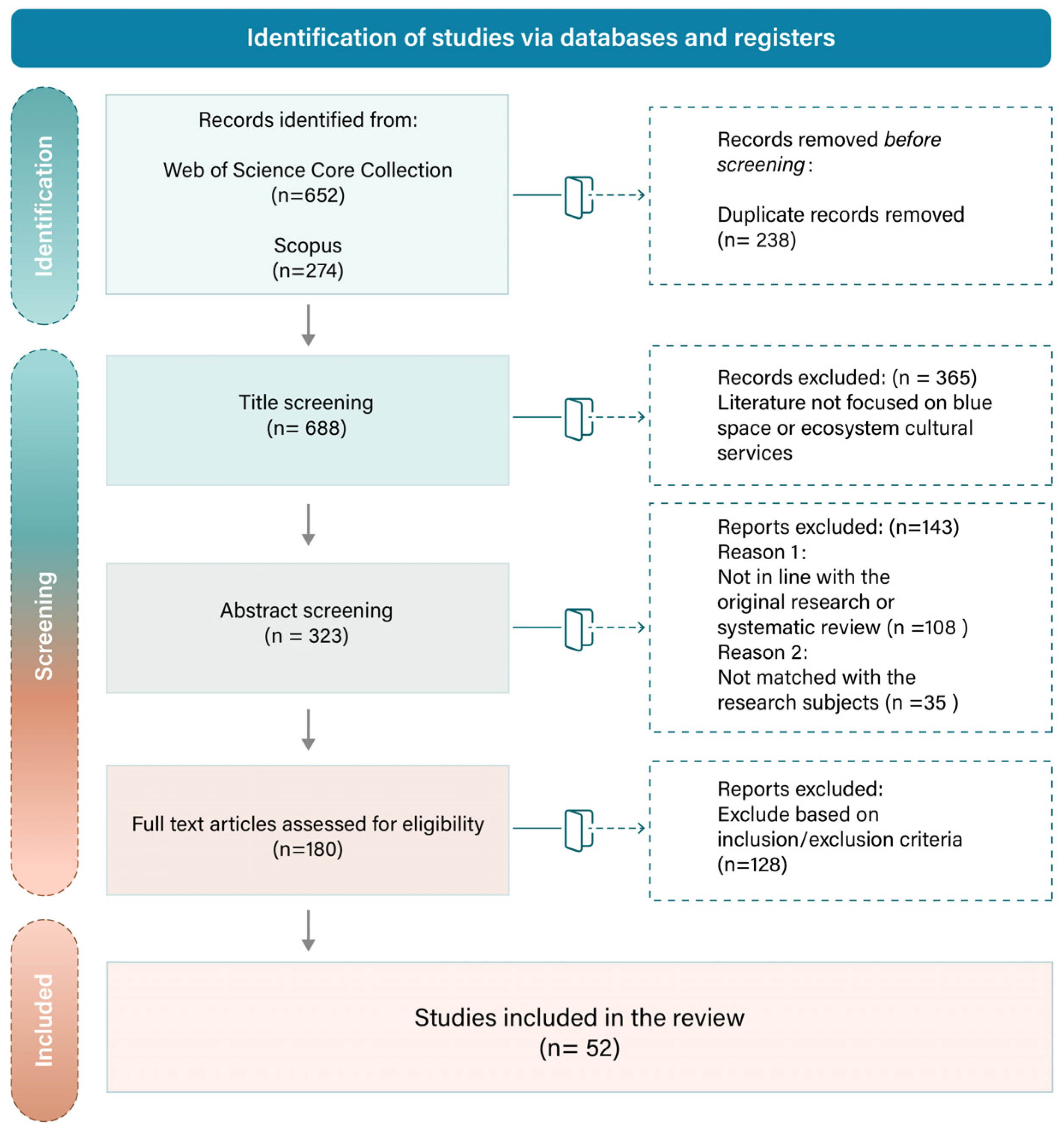
Before screening the retrieval results, the inclusion and exclusion criteria were formulated (Table 1). To ensure the rigor of the review, this study established explicit boundaries for “blue space” based on the conceptualization by White et al. [6], defining it as both physical water bodies and the surrounding landscapes associated with human activities. In the screening of the 52 included papers, we explicitly included natural and semi-natural systems such as rivers, wetlands, lakes, and oceans, as well as engineered infrastructures like artificial canals, reservoirs, and floodplains. The scope also encompassed “blue green” hybrids, such as riparian green areas and coastal promenades, provided the water feature remained the primary focus of the CES assessment. Conversely, small-scale decorative features with limited social-ecological coupling, such as urban fountains or purely decorative garden ponds, were excluded unless they were substantively evaluated through a recognized CES framework, and studies focusing solely on terrestrial green spaces without water attributes were removed to maintain thematic specificity. We then proceeded according to the following steps. First, the literature that did not meet the inclusion criteria was excluded. Review articles, encyclopedia entries, conference papers, and book reviews were not included in this review. A total of 926 articles were retrieved. After removing duplicates (n = 238), the title, abstract, and full text of 688 articles were relevance-based and screened for inclusion.
During the screening stage, the first three authors used Rayyan (https://www.rayyan.ai/) to evaluate the relevance of titles and abstracts, which facilitated data storage, retrieval, and tracking of inclusion or exclusion decisions for the systematic review. Full-text screening was conducted independently by two authors, with an initial inter-rater agreement of 92%. Any disagreements were resolved by consulting a third author until a 100% consensus was reached. Finally, the reference lists of all included studies were manually screened according to the inclusion criteria, and no additional relevant studies were identified. The PRISMA flowchart is shown in Figure 2.
A total of 52 articles were included for data extraction after the full-text screening. The inclusion criteria required that studies explicitly focus on cultural ecosystem services in relation to blue spaces. The included literature was transformed into a series of categories and key elements for systematic review (Table 2). After data extraction, all information was compiled and entered into a Microsoft Excel spreadsheet in a synthesized format.

3. CES Theoretical Foundations

3.1. Evolution of CESs

Cultural ecosystem services (CESs) refer to the “non-material” benefits that people obtain from ecosystems. Distinct from material functions such as providing food or climate regulation, CESs focus on the positive impacts of the natural environment on human spiritual, psychological, and sensory well-being. CESs can be divided into three progressive stages, each characterized by distinct emphases, levels of understanding, and value orientations.

3.1.1. Preliminary Exploration Stage (1997–2005): Theoretical Foundations and Recognition of Economic Benefits

Research on CESs during this stage enabled scholars to recognize the intangible value inherent in cultural services. In 1997, environmental scientist Daily [23] conducted research on ecosystem services, and the “information services” she proposed were regarded as an early form of CESs. In the same year, ecological economist Costanza [24] completed a systematic global assessment of the economic value of ecosystem services, and his quantitative analysis revealed that the total economic value of ecosystem services far exceeded the global GDP at that time. This groundbreaking conclusion filled a long-standing gap in the accounting of the non-market value of natural capital and significantly increased scholarly and policy attention to the asset value embedded in ecosystems, with research during this period oriented toward maximizing the economic benefits of natural capital [24]. In 2002, ecologist De Groot [25] classified ecosystem functions into four categories: regulation, habitat, production, and information functions. Among these, information functions mainly describe the ecosystem’s role in contributing to human health by providing opportunities for reflection, spiritual enrichment, cognitive development, recreation, and esthetic experiences. Due to the intangible nature of CESs, only a portion of cultural services were expressed in monetary terms during this stage [25]. In 2005, the Millennium Ecosystem Assessment (MA) [26] defined cultural ecosystem services as the non-material benefits humans obtain from ecosystems through spiritual fulfillment, cognitive development, reflection, recreation, and esthetic experiences. The MA framework remains one of the most globally recognized assessment systems to date.

3.1.2. Systematic and Diversified Stage (2005–2012): Multidisciplinary Integration and Shifts in Societal Demand

In this stage, research began to focus on the non-material benefits of CESs as well as the needs of different population groups. This phase can be further divided into two sub-periods: the valuation period and the value-tradeoff period [17]. During the valuation period, decision-makers placed greater emphasis on the conversion of ecosystem values, with strong efforts to maximize the economic benefits generated by natural capital [24]. The integration of ecology and economics played a crucial role in advancing research on ecosystem services. Such integration promoted the quantification of ecosystem service values; however, these methods remained inadequate for capturing the full spectrum of value dimensions. As a result, many important considerations remained marginalized in ecosystem service research and practice [17]. Meanwhile, the emphasis on economic benefits at that time caused ecosystem service research to overlook the mutually beneficial and co-evolving relationships between humans and the environment.
In 2007, economists such as James Boyd criticized the existing classifications of ecosystem services, arguing that most categories emphasized processes within service production functions rather than outcomes. They proposed that one reason ecology had struggled to produce accounting units was its excessive focus on analyzing these underlying processes. Boyd and colleagues suggested that although the MA framework linked cultural services to human well-being, it did not clearly differentiate the specific types of services or the values accessible to various stakeholders. The increased attention to cultural services within the ecosystem services literature also led to a widening gap between decision-makers, the public, and different academic disciplines, which to some extent hindered the sustainable development of cultural services.
During the value-tradeoff period, researchers sought to integrate societal perceptions into ecosystem management, tending to rely on public preferences for the environment to identify balances among different ecosystem services. In 2011, humanities and environmental scholar Church, in the UK National Ecosystem Assessment report, emphasized that the materials and benefits produced by CESs within ecosystems are the result of interactions between humans and nature [27]. In 2012, ecologist Chan classified ecosystem service values into eight dimensions to illustrate the interconnections between benefits, human well-being, markets, and other factors, as well as the prevalence of intangible values [28].

3.1.3. Integrated Application Stage (2012–2025): Supply–Demand Matching and Dynamic Management Practices

This stage can be understood as a process in which CES undergoes a dynamic transition between material and non-material values [29]. In 2012, the Intergovernmental Science-Policy Platform on Biodiversity and Ecosystem Services (IPBES) emphasized in its assessment that, in addition to considering the service values that people obtain from nature to enhance their quality of life, it is also necessary to examine the relational conditions through which values are created within and through nature [30]. The spatial supply–demand patterns and mismatches of CESs can provide critical decision-making references for sustainable development.
Daniel, an environmental scholar, pointed out in 2012 that for culture to be regarded as an ecosystem service, there needs to be “a significant relationship between the ecosystem structures and functions defined in the biophysical domain and the fulfillment of human needs and desires defined in the medical, social, or psychological domains” [31]. From the perspective of supply–demand flows, CES research explores how ecosystems and human systems are coupled across scales. In 2017, Martínez-Harms, an expert in ecology, examined the quantification and mapping of ecosystem service provision under scenarios of land-use and climate-change projections, confirming that appropriate land-use planning can effectively enhance the supply capacity of CESs [32]. In 2023, Zhuang et al. [33] identified a supply–demand mismatch in small urban park green spaces in the Guangdong–Hong Kong–Macao Greater Bay Area. They argued that zoning management of natural ecosystems could promote sustainable development and improve human well-being.

3.2. Evolution of CES Guidelines

Classification and description of ecosystem services (ESs) constitute the foundation for measuring, mapping, and valuing them [34]. At present, multiple ES typologies and classification systems exist (Table 3). The Millennium Ecosystem Assessment (MA, 2005) [26], as one of the earliest systematic frameworks in the ES field, covers diverse dimensions of cultural services, classifying them based on cultural diversity, spiritual and religious values, knowledge systems, education, and esthetic appreciation, thereby laying the groundwork for a global and systematic understanding of ESs.
The U.S. National Research Council (2005) [35], focusing on aquatic and associated terrestrial ecosystems, emphasizes “information functions”, integrating cultural services with informational benefits such as esthetics and scientific education to meet the assessment needs of specific ecosystems. The UK National Ecosystem Assessment (2010) [36], developed for national ecosystem management, places greater emphasis on the influence of cultural services on public spiritual experiences, reflecting the attention in developed countries to the “spiritual values” of ecosystems. The Economics of Ecosystems and Biodiversity (TEEB, 2012) [37], designed to incorporate ESs into economic decision-making, prioritizes types more easily aligned with economic valuation (e.g., recreation and tourism, cultural and design inspiration), facilitating valuation and cost–benefit analyses.
The Common International Classification for Ecosystem Services (CICES, 2013) [38], seeking universality and operational applicability, classifies cultural services based on “forms of interaction” (physical experience, intellectual representation) and “modes of access” (extraction, in situ), providing tools adaptable to assessments across different countries and ecosystems.
The National Ecosystem Services Classification System (NESCS, 2015) [39] places greater emphasis on the “use contexts” of services and human activities, distinguishing between “extractive” and “in situ” cultural and spiritual activities, thereby enhancing the precision of local ecosystem management and policy applications.
The Intergovernmental Science-Policy Platform on Biodiversity and Ecosystem Services (IPBES, 2019) framework [40] focuses on core, policy-relevant categories (e.g., spiritual values, recreation and tourism), aiming to deliver essential information to policymakers and advance the development of global biodiversity conservation policies.

4. Research on the Relationships Between Blue Spaces and CESs

4.1. Temporal and Spatial Distribution Characteristics

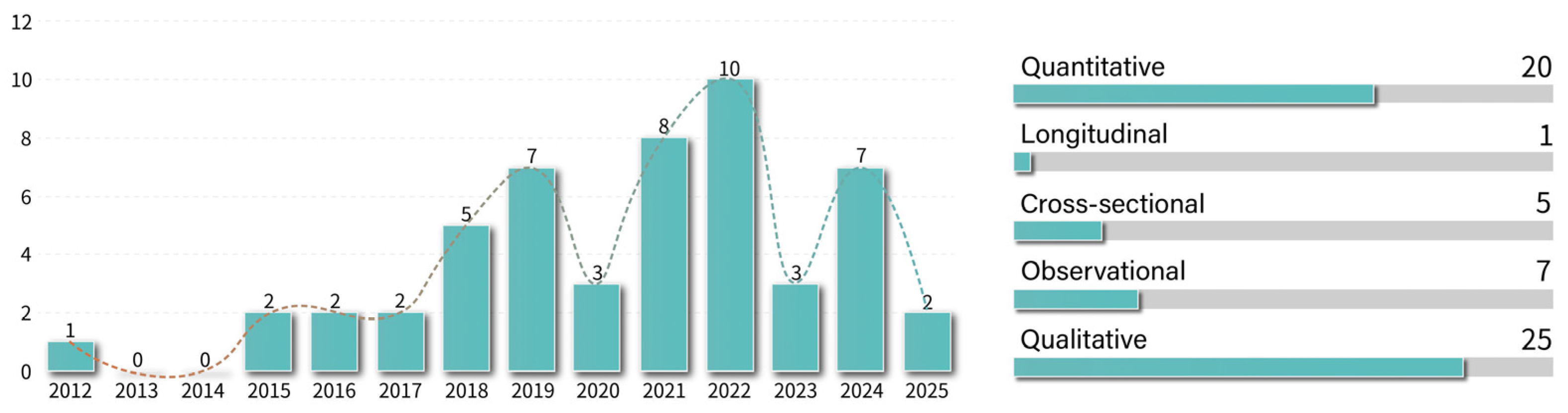
The publication years of the studies included in the systematic review are primarily concentrated within the past decade (Figure 3). As shown in Figure 3, the studies were categorized according to their research design: 43% employed qualitative approaches, 34% used quantitative methods, seven were observational studies (12%), and five were cross-sectional studies (8%). Parts of publications adopted mixed method designs combining both qualitative and quantitative approaches.
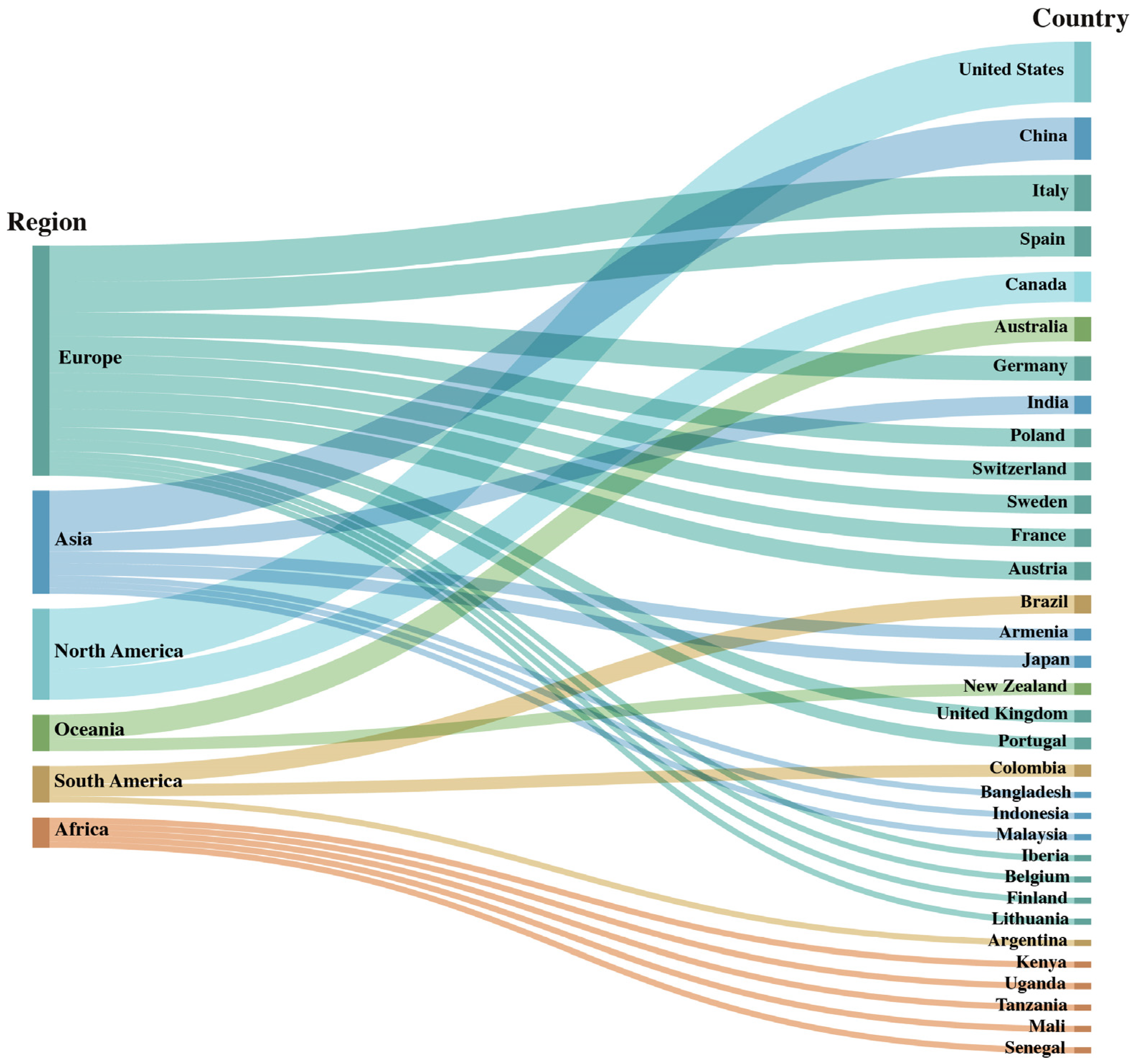
The Figure 4 Sankey diagram highlights the geographical distribution of existing studies on blue spaces and CESs. Existing literature shows a clear lack of studies focusing on tropical regions and low- and middle-income countries. On the continental scale, Europe accounts for approximately 44% of all studies (n = 38), while Asia and North America account for around 20% (n = 17) and 17% (n = 15), respectively. The cumulative number of these instances exceeds the 52 included papers because multi-country studies were recorded as separate geographical occurrences to accurately reflect regional research intensity. Within Asia, China leads with seven studies, followed by India with three. In Europe, Italy and Spain are the most prominent contributors, with six and five studies respectively, whereas other European countries show a more balanced distribution: Poland, Switzerland, Sweden, France, and Austria each contribute three studies; the United Kingdom and Portugal each contribute two; and the remaining countries contribute one study each. In North America, the United States plays a central role, accounting for approximately 12% (n = 10) of the literature. The least amount of research has been conducted by African countries (Figure 4).
This uneven distribution may reflect regional differences in research attention, scientific resource allocation, and foundational research capacity. It underscores the necessity of enhancing the global distribution of research efforts, especially by increasing attention to under-represented regions. Expanding research coverage will enable the production of more comprehensive and diverse knowledge, thereby promoting a more balanced development of this field worldwide.
Based on the temporal distribution, the development of blue space CES research can be broadly divided into three phases.
From 2012 to 2017, research mainly addressed the basic question of how to evaluate cultural values. Research output was limited, showing a low-frequency and steady initial stage. Studies during this period focused on specific river and wetland management and restoration decisions [41], and began to explore functional relationships between the biophysical conditions of ecosystems (such as ecological and chemical conditions of surface water) [42] and the economic value of cultural services (such as willingness to pay) [43], aiming to demonstrate that ecological improvement can lead to measurable increases in cultural benefits.
At the spatial-analysis level, studies started to use multi-source data, including citizen science and social media, to quantify and map CES elements, revealing spatial synergies among different services [43]. They also observed that areas with high levels of recreational cultural services were often subject to significant environmental pressure, suggesting that ecosystem conditions—or people’s enjoyment of recreational services—may retain some resilience even under considerable stress [41]. In addition, the concept of “river culture” was introduced for the first time [44], advocating an eco-social approach that emphasizes watershed-based management units [43] and adjusting management strategies according to hydrological dynamics to promote human well-being and harmonious coexistence between people and river landscapes.
From 2018 to 2022, research focused on the question of how to evaluate CESs dynamically, accurately, and comprehensively. The number of studies increased rapidly, peaking in 2022 with ten included publications. The geographical distribution became noticeably global, reflected in broader research coverage and greater heterogeneity. Study regions were no longer limited to Europe and North America but expanded to Africa [45] (e.g., Kenya’s Yala wetlands), Oceania [46] (e.g., floodplain management in Australia), and the Pacific Islands [47] (e.g., Hawaiian coastlines).
Methodologically, emphasis shifted toward multi-source data integration [48] to achieve more precise and dynamic evaluations of CESs, with social media and geotagged data becoming mainstream tools [49]. In terms of research perspectives, growing attention was given to social equity and cultural values in blue space management [47]. At the same time, studies incorporated lived experiences, place-based knowledge, and experiential learning into the social-ecological systems (SES) framework [50]. Because regulating and cultural services (e.g., esthetic appreciation, Indigenous and community values) were ranked significantly higher than provisioning services, a cost–benefit assessment was argued to require considerations of fairness, accountability, and transparency in public policy [46].
From 2023 to 2025, the focus shifted from traditional value identification to precision-oriented management and policy support. Methodological maturity became evident through the deep integration of multi-source heterogeneous data and advanced models—for example, incorporating social media data into the SolVES model [51] to accurately capture temporal dynamics and spatial distribution patterns of CESs in urban wetlands [52]. Studies also developed frameworks for evaluating CES potential in mountain ecosystems and, combined with PPGIS surveys and regression models, provided detailed analyses of how visitor attributes and spatio-temporal preferences shape the recreational benefits and well-being contributions of urban river landscapes [53].
In practical applications, research expanded to complex and threatened blue space environments [54], further suggesting the broad synergies between non-material values and material contributions of nature [55], offering robust evidence for project valuation and policy promotion.
In the social dimension, research continued to emphasize group differences and equity [53]. For example, using structural equation modeling (SEM) to reveal significant differences between tourists and residents in their perceptions of lake CESs, and applying the IPA model to guide refined landscape management [53]. In regions with historical conflict, studies indicate that nature-based tourism serves as an economic pillar supporting peacebuilding and sustainable development [56]. In watershed management, research emphasized the need to identify negative drivers of ecosystem service supply and proposed that local communities should be involved in decision-making through integrated management approaches [52] to ensure the sustainable use of cultural services and human well-being.

4.2. Types of Blue Spaces

The 52 included studies were preliminarily classified into six major categories (Table 4), each corresponding to different types of blue spaces (e.g., rivers, lakes), which vary widely and encompass both natural and artificial forms. Most studies focused on rivers (n = 20), wetlands (n = 14), and lakes (n = 12) in relation to CESs, while some studies involving multiple types of blue spaces, with no distinction of water area space (n = 3), typically did not focus their analysis on a specific blue space type, but rather studied a broad range of water areas. Studies on other types (n = 4) include non-standardized water bodies or water features that are not explicitly covered by traditional classifications, such as artificial riverbanks, marshes [57], and floodplains [44].
Rivers are not only critical carriers of water resources but also support cultural and economic activities such as navigation and fisheries [44]. A small number of river-related studies considered temporal dynamics; for example, temporary rivers—characterized by seasonal fluctuations—serve as markers of time and seasonality [58], carrying rich cultural meanings. Although dry riverbeds no longer convey flowing water, they record past hydrological variations and provide important clues for reconstructing ecological history [54]. Wetlands provide unique habitats for numerous species. Studies on wetlands include various types such as mangrove wetlands (n = 2) [59,60], constructed wetlands (n = 2) [49,52], coastal wetlands (n = 1) [61], plateau wetlands (n = 1) [62], and freshwater wetlands (n = 1) [42]. In addition, lake-related research includes two studies focusing on alpine lakes [15,63]. Natural alpine lakes are typical freshwater ecosystems in mountainous regions and are highly sensitive to human activities and global environmental change, making such studies particularly significant.

4.3. Types of CESs

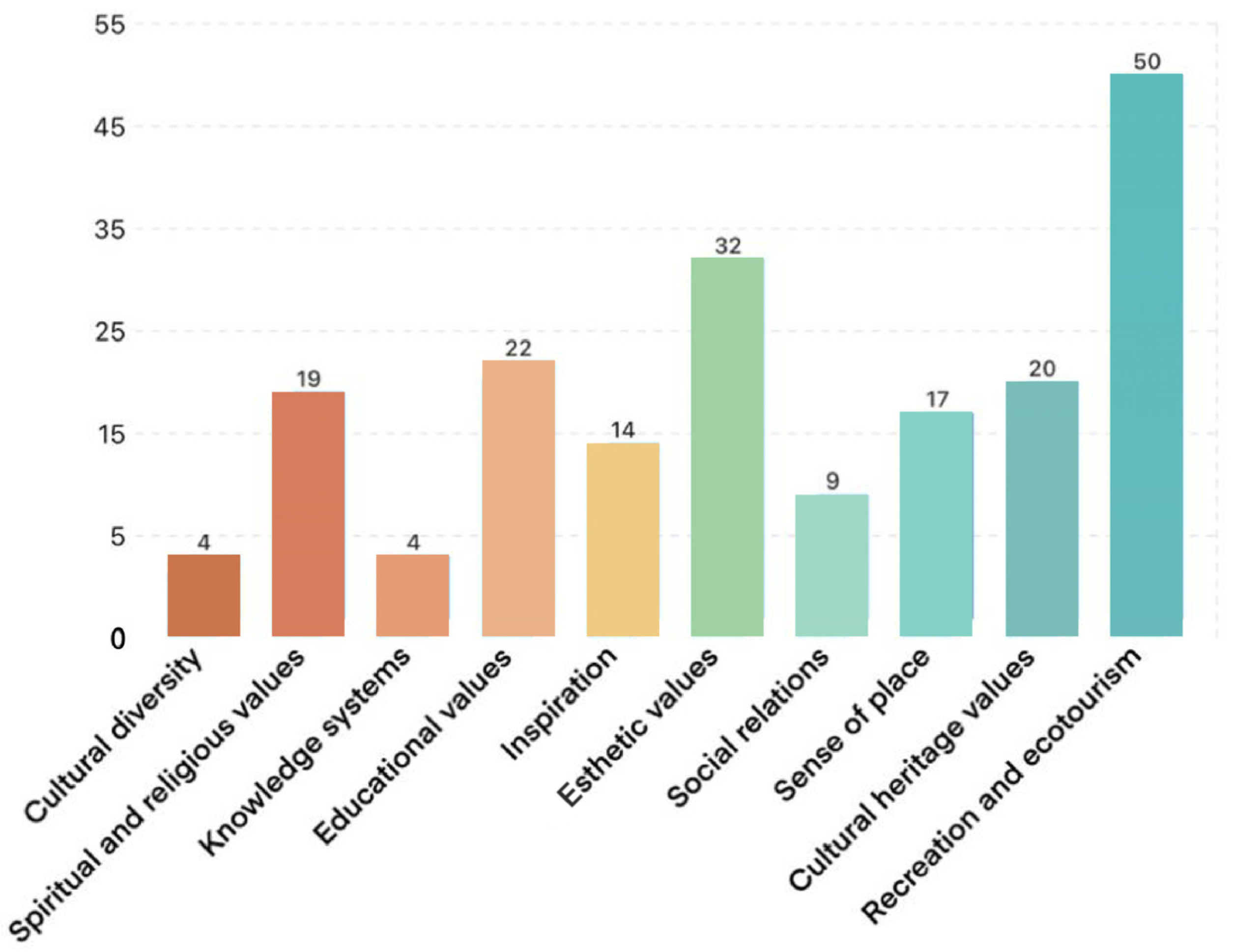
According to the Millennium Ecosystem Assessment classification [26], this study categorizes the CES types mentioned in the collected literature into ten groups (Figure 5). Only categories that were substantively examined are included, while those merely mentioned were excluded due to their limited research value. Because different authors use varying terminology, the categories were reorganized to align with the MA classification system [26]. For example, “esthetic” and “landscape esthetics” are grouped under “esthetic values”, whereas “learning” and “education and research” fall under “educational values”.
The evaluation of CES categories is highly uneven. Most studies assessed recreation and ecotourism, followed by esthetic value, educational value, and cultural heritage value. Cultural diversity, knowledge systems, and social relations received the least attention. Among the 52 studies, six evaluated only a single cultural service, all of which focused on recreation and ecotourism. The remaining studies assessed multiple services, with the most common combination being recreation and ecotourism together with esthetic value. Of the 52 studies, 27 evaluated at least five cultural service categories simultaneously.

4.4. Correlation Analysis of Blue Spaces and CESs

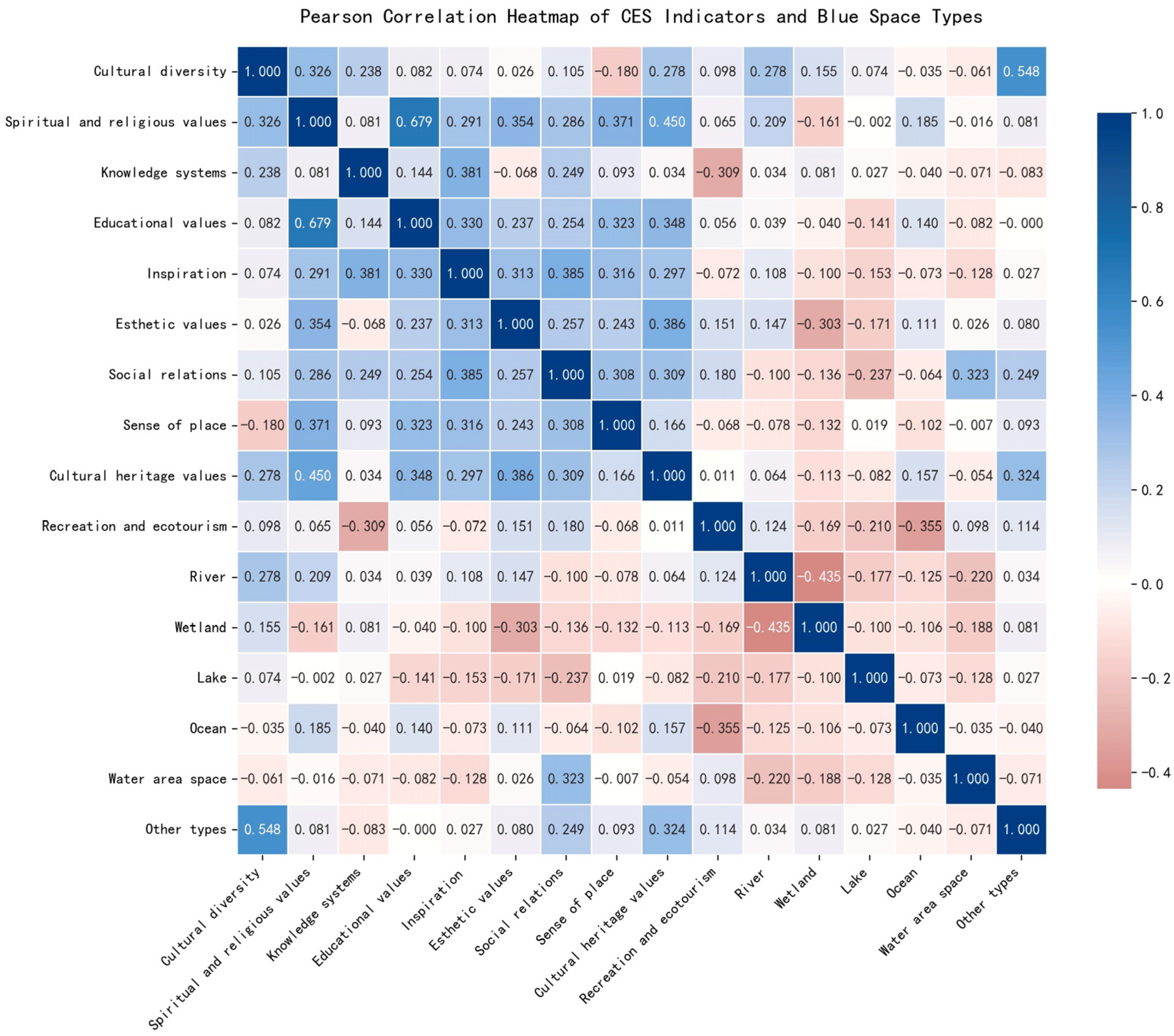
To explore the inherent association patterns between indicator selection and site types in current research, a Pearson correlation analysis was conducted (Figure 6). The data matrix was constructed using binary coding (1 for presence, 0 for absence) to record the co-occurrence of 10 standardized CES indicators and six types of blue spaces across the 52 included papers. Pearson correlation was selected to quantify the linear relationship and clustering tendencies in researcher choices, where a higher coefficient indicates that specific indicators and site types are frequently evaluated together within the same study. It should be noted that these correlations reflect paper-level co-occurrence and research trends rather than real-world causal relationships. Despite the sample size of 52, this analysis assists in visualizing established paradigms and identifies potential gaps in the current academic attention directed toward blue space CESs.
Within CES indicators, the heatmap shows generally strong positive correlations, suggesting that researchers often consider conceptually related services together. Spiritual and religious values and Educational values (R = 0.679) may be due to blue spaces with spiritual or religious significance often simultaneously supporting cultural transmission, environmental education, and experiential learning [64]; thus, individuals may enhance their understanding of nature, history, and culture while obtaining spiritual experiences [47]. For example, in the Meghna River Basin, Sultana et al. [55] documented how local communities engage in both spiritual practices and traditional ecological knowledge transmission along the river. Similarly, Wantzen et al. [44] highlighted that “river culture” encompasses both sacred values and educational dimensions, where rivers serve as living classrooms for intergenerational learning. Such spaces typically exhibit prominent cultural symbolism and authenticity, serving both as sites for religious rituals and cultural expression, and as important resources for educational activities [55].
Cultural heritage values and Spiritual and religious values (R = 0.450) indicate that blue spaces with cultural heritage significance, such as traditional water culture landscapes and rivers/lakes associated with religious ceremonies, often simultaneously provide spiritual and religious experiences. These spaces usually possess profound historical narratives, cultural symbolism, and traditional practices, serving both as carriers of cultural memory and as sites of religious belief and spiritual support. Cultural heritage values and Esthetic values (R = 0.386) may be due to historical water conservancy projects, traditional waterfront settlements, or rivers/lakes with cultural symbolism [65] whose unique structures, landscapes, and cultural narratives can enhance visual appeal and thereby esthetic experiences [66]. Meanwhile, areas with high landscape quality are also more likely to carry cultural memory, historical scenes, or traditional practices [64], further highlighting their cultural heritage significance.
In the analysis of CES and blue space correlations, other types and Cultural diversity (R = 0.548) show the highest positive correlation among all associations. This suggests that researchers evaluating cultural diversity strongly tend to select “other types” [57] of blue spaces that do not belong to conventional categories such as rivers or lakes; for example, concrete embankments, quasi-natural riverbanks, and natural river valley landscapes on the outskirts of cities [67]. These spaces may include complex or uniquely culturally meaningful non-standardized water bodies [67], whose heterogeneous spatial structures allow researchers to identify and quantify diverse cultural elements, resulting in more pronounced cultural diversity indicators. In addition, these water bodies are often located in semi-natural environments, combining natural and human features, and serve as venues for interactions among different cultural groups and for the integration of traditional and modern elements, and thus are highly considered in cultural diversity assessments.
The connection between Social relations and Water area space (R = 0.323) indicates that studies focusing on the social connections and community cohesion provided by water spaces are more likely to use general terms such as “blue space” [56,68,69] rather than specific types of rivers or lakes, emphasizing social attributes rather than ecological attributes. The counterintuitive result between Recreation and ecotourism and Ocean (R = −0.355) may be due to the high difficulty of data acquisition, high activity thresholds [57], and management restrictions for marine ecotourism studies, as well as the academic focus being more on inland waters, making oceans relatively less selected as assessment sites.
The above correlation results should be interpreted with caution. The analysis is based on paper-level co-occurrence rather than real-world causal relationships, and the sample size (n = 52) is modest; thus, findings are exploratory. Potential confounding factors may exist; for example, the high number of river studies could artificially inflate correlations between rivers and recreation. Regarding strong vs. weak correlations, a high positive correlation may reflect that researchers tend to study these services together in certain cultural contexts, not necessarily a universal causal link. The negative correlation between Recreation and Ocean (R = −0.355) should also be interpreted cautiously; possible explanations include data accessibility challenges or management restrictions.

4.5. CES Valuation Methods

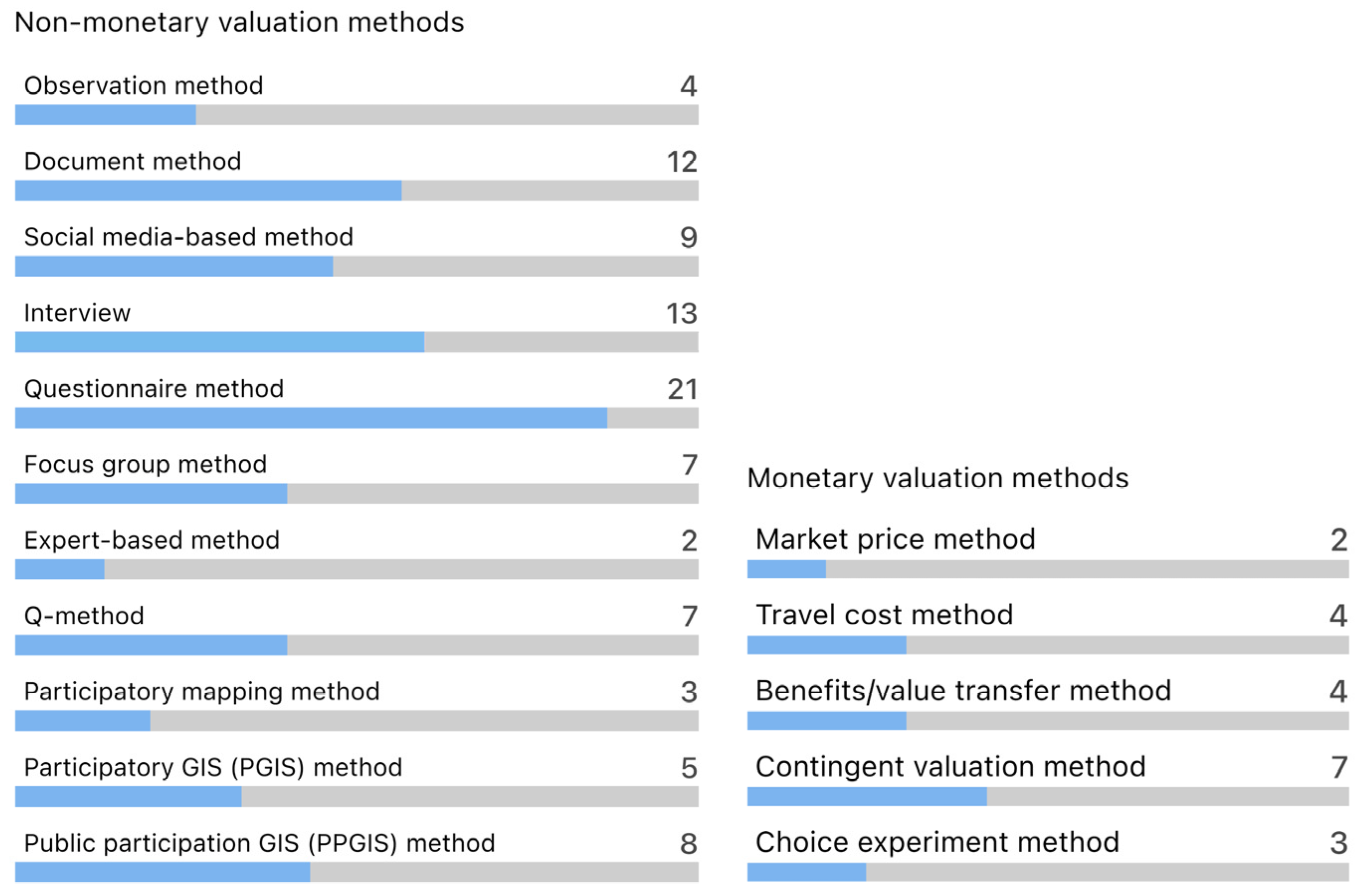
The valuation of cultural ecosystem services evolves alongside research needs and technological development. Because different assessment procedures, theoretical foundations, and technical approaches lead to different valuation methods [70], CES research methods are generally divided into monetary and non-monetary approaches [12,70,71]. In this study, the valuation methods identified in the selected literature were classified into these two categories (Figure 7), showing the number of studies using each method. Some studies employed multiple approaches, which we counted multiple times. Across all studies, five monetary valuation methods and eleven non-monetary valuation methods were identified, with non-monetary methods used considerably more frequently than monetary ones.
Economists consider monetary valuation to be persuasive. Monetary valuation methods primarily include “revealed preference” [72] and “stated preference” [71] methods. Among these, the most frequently used monetary valuation method is the contingent valuation method (n = 7), which belongs to the stated preference category and evaluates individuals’ willingness to pay for CESs; for example, by asking respondents about their willingness to pay for specific services [73]. Gandarillas et al. [74], for instance, interviewed local residents in Bolivia to determine their willingness to contribute labor time toward the protection of cultural ecosystem services in high-Andean wetlands. Rayanov et al. [75] examined public preferences for river-related CESs and found that the highest total willingness to pay was associated with improvements in “naturalness”.
The remaining monetary valuation methods fall under revealed preference, which infer value from cost data incurred in individuals’ actual use of resources based on economic principles. For example, Wang et al. [76] estimated the value of ecosystem services in the Nansi Lake Wetland of China and found that the value of recreational functions consistently exceeded that of cultural and educational functions. Pueyo-Ros et al. [77] revealed that combining travel cost data with conditional behavior data can effectively assess the recreational value of wetlands.
Due to the difficulty of monetary valuation [78] and the intangible and non-material nature of CESs, where values such as cultural diversity, inspiration, and sense of place are often difficult to quantify [26], non-monetary approaches have attracted increasing attention [71]. The questionnaire method (n = 21) and interviews (n = 13) are the most used non-monetary valuation approaches in this study. For example, Julian, Jason P et al. [50] used questionnaires to collect 2580 participants’ assessments of blue space use, perceived value, and cognition. Du Bray [79] conducted interviews with residents living near rivers, documenting and evaluating the ecosystem services they experienced from their local river environments.
At the same time, technological development has influenced CES assessment by making evaluation processes more convenient, expanding data coverage, and improving result accuracy. The Public Participation GIS (PPGIS) method (n = 8) can gather geographic coordinates indicating the locations of various CESs together with corresponding public opinions [80], thereby enhancing the ability of marginalized groups to participate in local planning and decision-making. Grzyb used PPGIS to study residents near the Vistula River in Warsaw and found that visitor characteristics, spatiotemporal visitation preferences, and preferred activities made positive contributions to recreational benefits [16]. Social media–based methods (n = 9) provide new opportunities for assessing CESs at regional scales. Richards et al. [81] analyzed social media photographs to rapidly obtain information on CES supply in Singapore’s mangroves and to support management. Schirpke used geotagged public photographs to evaluate CESs associated with natural and artificial lakes in the Alps, and found that combining qualitative and quantitative analyses of social media data enables deeper insights into individual CESs and their spatial characteristics [82].

5. Discussion

5.1. Biodiversity Support

While biodiversity is theoretically the foundation of ecosystem services [83], it remains a relatively “hidden” or under-researched dimension in the specific context of blue space CESs within the 52 selected publications. Maintaining ecosystem services has become a global priority in landscape management and environmental policy [26], with biodiversity emphasized as a key underpinning of their non-material values, such as spiritual experience and traditional culture [84]. Our results indicate a significant focus on the “products” of ecosystems, such as recreation (n = 50), rather than the underlying biotic processes.
Although explicit measurements of biodiversity were scarce in the 52 studies included in this review, evidence from broader landscape research suggests that biological complexity may function as a potential driver behind the high-frequency recreational and esthetic values identified in our results. This absence of direct biodiversity measurement in the reviewed literature reflects a broader gap in the field, where cultural ecosystem service assessments often overlook the biotic underpinnings that sustain non-material benefits. For instance, while the 52 publications highlight the esthetic appeal of river ecosystems, evidence from the broader literature by Dudgeon [85] clarify that this appeal is sustained by freshwater biodiversity, which shapes unique aquatic landscapes and supports traditional cultures [86]. Similarly, the provision of marine cultural services, such as the diving tourism mentioned in some of the studies, is fundamentally underpinned by coral reef biodiversity [87]; its decline could potentially directly threaten the continuity of these cultural experiences.
In the context of wetlands, which was a significant blue space category in this review (n = 14), Almeida-Gomes et al. [88] highlighted the importance of wetland biodiversity for various consumptive cultural services, such as tourism and recreation, which simultaneously contribute to biodiversity conservation and sustainable development. Biodiversity is not only the fundamental support for cultural service provision but is also widely regarded as playing a key regulatory role in ecosystem productivity [89]. However, our systematic synthesis reveals a methodological disconnect; while biodiversity plays a key regulatory role in ecosystem productivity, the 52 reviewed articles rarely quantify the specific biotic components that translate into non-material benefits. This gap suggests that future blue space CES research should move beyond treating nature as a passive backdrop and begin integrating biological indicators to provide a scientific ecological foundation for urban regeneration.

5.2. Impact on Health and Well-Being

Across the 52 included studies, health and well-being outcomes were most frequently linked to Recreation and ecotourism (n = 50) and Esthetic values (n = 32). This suggests that in blue spaces, the promotion of mental and physical health is not a standalone service but is primarily realized through active engagement (e.g., water sports, walking) and passive appreciation (e.g., viewing water landscapes). However, most existing studies rely on self-reported psychological measures rather than objective physiological or longitudinal health data, which limits causal inference between blue space exposure and well-being outcomes. Based on the 52 articles synthesized for this review, these health outcomes were predominantly measured using subjective assessment methods, such as questionnaires (n = 21) and interviews (n = 13).
Although the MA defines CESs as “non-material benefits obtained through spiritual fulfillment, esthetic enjoyment, and other experiences” [26], it does not further address how humans perceive these benefits or transform them into well-being. Compared with purely biophysical assessments, research on perceptions, values, attitudes, and beliefs may offer more meaningful insights into how ecosystem services contribute to human well-being, as suggested in full text articles assessed for eligibility [90]. Early studies focused on validating the basic relationship between urban ecology and well-being, aiming to clarify the fundamental role of urban ecosystems in human well-being. Bolund et al. [91], through case analysis, revealed that recreational and esthetic CESs provided by urban water bodies can enhance residents’ psychological and social well-being. Russell et al. [92] synthesized evidence on cultural connections and ecosystem benefits and noted that, in addition to physical and mental health, “sense of place,” “identity/autonomy” and “connectedness/belonging” are also influenced. This social aspect is supported by the positive correlation between Social relations and Recreation (R = 0.180) in our heatmap (Figure 6), which suggests that in the reviewed research, the recreational use of blue spaces is frequently identified as the primary catalyst for social interaction and community cohesion. Although these studies mentioned links to well-being, they did not distinguish perceptual differences among different groups. In essence, they remained macro-level analyses centered on “ecological supply” in which the subjective agency of perception was underemphasized.
Plieninger et al. [93] conducted mapping exercises and structured interviews with 93 respondents to examine the relationships between public perceptions and different types of cultural ecosystem services. Riechers et al. [94], based on 558 face-to-face questionnaires with visitors to blue-green spaces in Berlin, found that older adults living in suburban areas were more likely to perceive the well-being benefits of nature experience CESs, whereas younger residents in the city center placed greater emphasis on the well-being value of social interaction CESs. This divergence in perception was associated with differences in life satisfaction among population groups. Juilan et al. [50] investigated the socio-cultural needs of university students when using blue spaces and found that individual differences shaped their distinct social demands for ecosystem services. Research has increasingly begun to examine the mechanisms of well-being perception across specific groups and to focus on the differentiated experiences of various populations regarding urban CESs.
Wu et al. [95] reported through an interdisciplinary model that the sensory stimuli of natural landscapes must pass through both cognitive interpretation and emotional response as mediating processes before being transformed into psychological well-being, thereby challenging the assumption that “perception directly equates to well-being”. Clarke et al. [96] examined cultural values associated with human–environment interactions in coastal wetlands of South Australia and found interconnections among visitors’ environmental awareness and appreciation, the formation of place attachment, and the attainment of positive experiences. Their landscape-based assessment approach provides methodological support for subsequent policy-making and ecological restoration. Xia et al. [97] combined PPGIS and questionnaire analysis in Shanghai’s peri-urban areas and found that residents reported significantly higher subjective well-being when the supply of CESs (e.g., cultural heritage) matched perceived demands (e.g., recreation). Based on these findings, they proposed a “demand-oriented spatial optimization” strategy, which translates perception data into practical measures for enhancing well-being.
Blue spaces exert significant yet often implicit influences on health and well-being, which are typically difficult to monetize in the short term. However, their long-term benefits may substantially shape public health expenditure and broader socioeconomic development [19]. By improving mental health, reducing stress, promoting physical activity, and strengthening social connectedness, blue spaces can gradually reduce the incidence of chronic diseases and mental health disorders [98], thereby alleviating pressure on healthcare systems [50]. Although most studies to date have focused on non-monetary assessments of subjective well-being, from the perspective of national governance and public policy, health improvements can be converted into economic value and influence fiscal priorities.
As 2022 corresponded to the later stages of the COVID-19 pandemic, the pandemic heightened public and policy attention to health, psychological restoration, and outdoor nature contact [99], resulting in a peak in research on blue spaces and CESs (according to Figure 3). The research included in this period report that during the pandemic, residents relied more heavily on natural and blue spaces, treating them as critical “restorative resources” [100], which further propelled scholarly interest and research expansion in blue-health topics. Therefore, the health benefits of blue space CESs represent not only an important source of human well-being, but also a critical component of public health investment, urban resilience building, and long-term societal benefits. Future research should strengthen the quantitative linkage between health impacts and economic returns, enabling the shift from treating blue spaces as “invisible welfare” to recognizing them as “explicit policy assets”.

5.3. Explicit Economic Value of CESs

While blue spaces provide substantial economic benefits through tourism and fisheries, our synthesis of 52 studies highlights a significant “valuation gap”. Although recreation and ecotourism were the most frequently addressed category (n = 50) (Figure 5), only a small fraction of these papers translated these benefits into explicit monetary terms. As shown in the distribution of assessment methods (Figure 7), the contingent valuation method (CVM) was employed in only seven studies, followed by the travel cost method (n = 4). This scarcity of monetary valuation indicates that while the “existence value” of blue space CESs is widely recognized, its “market value” remains under-quantified in current academic paradigms.
Within the research framework of blue spaces and CESs, cultural tourism, fisheries, and carbon sequestration constitute the most visible, quantifiable, and convertible dimensions of explicit value. These values not only manifest as economic benefits but are also deeply embedded in cultural experience, social relations, and place identity [86], reflecting the complex interactions between natural processes and human activities. First, blue spaces, owing to their distinctive landscape features, cultural symbolism, and historical narratives, serve as core carriers of cultural tourism development [56,77], enabling the direct conversion of cultural experience into economic gains [76], while providing essential support for place branding and the shaping of urban identity.
As a representative industry interwoven with both natural and cultural attributes, fisheries not only provide supporting services and generate economic benefits but also embody rich cultural traditions [46], including fishing villages, folk rituals, local beliefs, and water-related techniques [101]. These cultural characteristics are often closely linked to the ecological structure and hydrological conditions of blue space ecosystems [44], allowing fisheries to play a key role in cultural inheritance, community cohesion, and the formation of place identity [55]. Meanwhile, the rise and decline of coastal and inland fisheries reflect changes in the ecological quality of blue spaces, demonstrating a high degree of coupling between cultural services and provisioning services [102].
Blue carbon ecosystems (BCEs) such as mangroves [62,77] and seagrass beds [103] have become one of the most important ecological and economic resources within blue spaces due to their carbon sequestration capacity [46]. Their ecological symbolism has also been incorporated into education, public display, and policy discourse, reinforcing the cultural significance of blue spaces in climate governance, environmental ethics, and public awareness [104]. Consequently, a reinforcing cycle emerges among ecological value, cultural value, and economic value.
In summary, the 52 reviewed articles reveal that the lack of monetary evaluation (n = 20) limits the ability of blue space CESs to influence high-level policy and urban planning decisions, where economic trade-offs are often primary considerations.

5.4. The Application Value and Decision-Making Gap

Although existing research has clearly revealed the value of blue space CESs in esthetic experiences, recreation, and well-being [69], most studies remain at the stage of value identification, with few generating planning or design guidelines that can be directly adopted by decision-makers. As a result, despite evidence confirming that blue spaces are “valuable” [19,20], they are seldom integrated into early project planning, spatial design, or management frameworks, limiting their effectiveness in practice and creating a significant disconnect between the knowledge system of cultural services and urban planning practices. Furthermore, the “decision-making gap” is exacerbated by the low visibility of certain indicators; while recreation is well-documented (n = 50), categories crucial for social equity, such as social relations (n = 9), remain under-represented (Figure 5). The Pearson correlation analysis (Figure 6) further highlights that management strategies often prioritize high-coupling services like recreation and esthetics, potentially overlooking spiritual dimensions that show weaker correlations. Finally, the reliance on traditional questionnaires (n = 21) (Figure 7) indicates a lack of dynamic data to support agile management, identifying a clear bottleneck in translating 52 study syntheses into active policy tools.
It is important to note that while most studies emphasize individual-level benefits (e.g., personal mental health, physical activity), CESs also encompass collective and intangible dimensions, such as social cohesion and cultural identity. However, indicators like social relations (n = 9) and cultural diversity (n = 4) remain significantly under-represented in the literature. This imbalance suggests that current research may be underestimating the broader societal contributions of blue spaces.
Many important cultural functions of blue spaces, such as child-friendliness, age-friendliness, community cohesion, and social interaction, are not yet operationalized within planning systems, and there is a lack of quantifiable indicators. Moreover, tools such as CES-based scenario simulations, project evaluations, and decision-support frameworks remain underdeveloped. For instance, there is currently no clear methodology for mapping CES needs into waterfront planning, aligning CES preferences across different demographic groups, or translating cultural values and spatial functions into design standards.
This gap indicates that research on blue space CESs may urgently need to move beyond value demonstration toward design and planning support, providing a more robust evidence base that can guide spatial practice and ultimately enable blue spaces to function as key infrastructures for promoting well-being and equity.
To address this decision-transformation gap, we propose three actionable policy recommendations: (1) integrate key CES indicators into statutory planning frameworks such as waterfront design guidelines and environmental impact assessments; (2) establish cross-sectoral co-design mechanisms involving planners, health officials, and local communities to align CES outcomes with policy goals; and (3) develop dynamic, AI-enabled CES monitoring tools to support real-time adaptive management of blue spaces.

5.5. Technical Bottlenecks in Research Methods

The supply and use of CESs in blue spaces constitutes a complex multidimensional, multi-actor, and cross-spatiotemporal system. However, current methodologies rely heavily on questionnaires, interviews, PPGIS, and social media data [70,105]. A comprehensive analysis of assessment methods (Figure 7) shows that traditional research paradigms still dominate, with questionnaires (n = 21) and interviews (n = 13) as the primary tools for data collection, accounting for a significant portion of the methodological landscape. While these approaches can capture subjective experiences, they remain limited in data depth, temporal sensitivity, and spatial precision, limiting the field’s ability to capture dynamic processes.
Although some recent studies have begun to introduce large-scale datasets, the rapid growth of mobility data, geospatial big data, multimedia records, and environmental monitoring information suggests that blue space CES research already possesses the necessary conditions to conduct higher-resolution, more dynamic, and more mechanism-oriented analyses. For instance, social media-based methods (n = 9) and PPGIS (n = 8) have gradually become mainstream assessment frameworks, yet applications of artificial intelligence, machine learning, and multi-source heterogeneous data integration remain rare in this field.
In the 52 studies included in this review, no application of deep learning methods was identified. Beyond this scope, a few studies have begun exploring such techniques; for example, convolutional neural networks (CNNs) to classify geotagged photographs [106] and large language models (LLMs) to extract CES perceptions from social media text [107]. However, existing deep learning methods in CES applications remain largely generic. They focus on static classification rather than spatiotemporal dynamics. These dynamics include hydrological rhythms, seasonal fluctuations, and human–water interactions. Such complexities demand the development of dedicated AI frameworks.
Given the highly subjective and context-dependent nature of cultural services, rigorous CES assessment requires the integration of diverse information sources, such as perception data, landscape attributes, behavioral trajectories, and biophysical indicators. Existing studies, however, often stay at the level of surface correlations and lack systematic models capable of revealing supply–demand mechanisms, behavioral drivers, and dynamic evolutionary processes. As a result, current evidence is insufficient to support the enhancement of CES benefits, the matching of supply and demand, or the adaptive management of blue spaces.
Future research should strengthen AI-enabled perception analysis, deepen semantic extraction through advanced machine learning, and promote interdisciplinary methodological integration. These efforts will be essential for advancing CES research toward finer-scale, mechanism-based, and predictive analytical frameworks: for instance, the application of computer vision (CV) algorithms on geotagged images can automate the identification of landscape features driving esthetic appreciation, while natural language processing (NLP) can be applied to social media text to decode complex emotions like “sense of place” or cultural heritage values. Furthermore, by integrating geospatial data with physiological and psychological perception metrics, future research could utilize machine learning algorithms to identify the specificity of human responses across diverse spatial environments. This approach would facilitate a transition in blue space CES research from static status assessment to dynamic supply–demand prediction.

5.6. Limitations and Future Research

This study has several limitations. First, the literature search relied on English language databases, which may have led to the exclusion of studies published in other languages that hold important regional relevance, particularly empirical cases from the Global South and lower-income countries. Meanwhile, the geographical distribution of included studies is heavily concentrated in Europe (44%, Figure 4), which limits the generalizability of our findings to other cultural and geographical contexts. The Pearson correlation analysis is exploratory and based on binary co-occurrence; causal inference is not intended, and the results should be interpreted with caution. Second, the heterogeneity of data types and research methods in existing studies poses challenges for cross-study comparison. Third, this review is primarily based on published literature and may therefore be affected by publication bias, with potentially important evidence from unpublished or gray literature not being captured.
Future research should further expand multilingual and multi-regional literature integration, with particular emphasis on strengthening empirical investigations of blue space CESs in understudied regions such as Africa. In addition, it is necessary to advance the integration of artificial intelligence, big data, and multi-source heterogeneous information to develop cultural ecosystem service models with greater explanatory and predictive capacity. Further interdisciplinary collaboration can enhance research on CES supply, demand mechanisms, health benefits, and pathways for planning and policy translation. Such efforts will support the application of blue space CESs in policymaking and spatial practice and provide a stronger evidence base for achieving equitable and sustainable urban development.

6. Conclusions

The systematic review indicates that current research on blue space CESs are primarily built upon the evidence of recreation and esthetic values, which serve as the dominant pathways for service realization. These findings are largely derived from subjective assessment tools such as questionnaires and interviews, with a heavy geographical and typological concentration in European river and wetland ecosystems. Distinct from prior CES reviews, this study introduces a three-stage evolutionary framework, reveals indicator-type coupling patterns via correlation analysis, and systematically compares monetary and non-monetary valuation methods with attention to emerging AI-driven approaches. However, several issues persist across current research: most studies remain at the stage of value identification and assessment and have not yet been effectively translated into practice-oriented guidance for planning and decision-making. In terms of methodology, existing approaches are relatively fragmented and lack deep integration of multi-source data, which limits a more comprehensive understanding of supply–demand relationships and dynamic mechanisms. Furthermore, social indicators crucial for equity, such as social relations and knowledge systems, remain under-represented compared to individualistic benefits. A key challenge moving forward is not merely recognizing the value of blue spaces but translating that value into concrete planning and policy decisions. To bridge these gaps, it is recommended that future research establishes an application-oriented theoretical framework to achieve a transition from value identification to design, promoting multi-source data integration and AI-enabled mechanism analysis, and strengthens the translation of cultural ecosystem services into economic value to enable blue spaces to become explicit policy assets. Overall, CES research in blue spaces is shifting toward practice-oriented development and is expected to serve as a critical foundation for enhancing urban well-being, equity, and resilient sustainability.

Author Contributions

Conceptualization, C.L., M.H., S.B. and Z.W.; methodology, C.L. and Z.W.; software, C.L., Z.W. and X.L.; validation, C.L. and M.H.; formal analysis, C.L. and Z.W.; investigation, C.L. and X.L.; resources, M.H. and S.B.; data curation, C.L., Z.W. and X.L.; writing—original draft preparation, C.L. and Z.W.; writing—review and editing, M.H., S.B. and C.L.; visualization, C.L. and Z.W.; supervision, M.H. and S.B.; project administration, M.H. and S.B.; funding acquisition, M.H. All authors have read and agreed to the published version of the manuscript.

Funding

This research was funded by the Ministry of Education of China funded research project on Research on Value Implementation Mechanism of Cultural Ecosystem Service in Blue Space of Yongding River (Beijing section) based on multimodal monitoring and machine learning: 2025070987993; China Geological Group Corporation funded research project on Evaluation model of Healthy Villages based on Qinling Ecological Restoration: CGC-GT-JF-2025-1104; Shaanxi Qianyelian Culture Communication Co., Ltd. funded research project on Programming and Post Occupancy Evaluation of urban commercial public space: 202322541003A.

Data Availability Statement

The raw data supporting the conclusions of this article will be made available by the authors on request.

Conflicts of Interest

Author Xiaoping Li was employed by the company China Geo-Engineering Corporation. The remaining authors declare that the research was conducted in the absence of any commercial or financial relationships that could be construed as a potential conflict of interest. The authors declare that this study received funding from China Geological Group Corporation and Shaanxi Qianyelian Culture Communication Co., Ltd. The funder was not involved in the study design, collection, analysis, interpretation of data, the writing of this article or the decision to submit it for publication.

Abbreviations

The following abbreviations are used in this manuscript:
CESsCultural Ecosystem Services
ESs Ecosystem Services
WoS Web of Science
PPGIS Public Participation Geographic Information System
MA Millennium Ecosystem Assessment
TEEBThe Economics of Ecosystems and Biodiversity
CICESCommon International Classification for Ecosystem Services
NESCSNational Ecosystem Services Classification System
IPBESIntergovernmental Science-Policy Platform on Biodiversity and Ecosystem Services
SEMStructural Equation Modeling
CVComputer Vision
NLPNatural Language Processing

References

  1. Grellier, J.; White, M.P.; Albin, M.; Bell, S.; Elliott, L.R.; Gascón, M.; Gualdi, S.; Mancini, L.; Nieuwenhuijsen, M.J.; Sarigiannis, D.A.; et al. BlueHealth: A Study Programme Protocol for Mapping and Quantifying the Potential Benefits to Public Health and Well-Being from Europe’s Blue Spaces. BMJ Open 2017, 7, e016188. [Google Scholar] [CrossRef] [PubMed]
  2. Abraham, A.; Sommerhalder, K.; Abel, T. Landscape and Well-Being: A Scoping Study on the Health-Promoting Impact of Outdoor Environments. Int. J. Public. Health 2010, 55, 59–69. [Google Scholar] [CrossRef]
  3. Gledhill, D.G.; James, P. Rethinking Urban Blue Spaces from a Landscape Perspective: Species, Scale and the Human Element. Salzburger Geogr. Arb. 2008, 42, 151–164. [Google Scholar]
  4. Wang, L.; Eagles, P.F. Some Theoretical Considerations: From Landscape Ecology to Waterscape Ecology. Acta Ecol. Sin. 2009, 29, 176–181. [Google Scholar]
  5. Bell, S.; Fleming, L.E.; Grellier, J.; Kuhlmann, F.; Nieuwenhuijsen, M.J.; White, M.P. Urban Blue Spaces: Planning and Design for Water, Health and Well-Being; Routledge: Oxford, UK, 2021. [Google Scholar]
  6. White, M.; Smith, A.; Humphryes, K.; Pahl, S.; Snelling, D.; Depledge, M. Blue Space: The Importance of Water for Preference, Affect, and Restorativeness Ratings of Natural and Built Scenes. J. Environ. Psychol. 2010, 30, 482–493. [Google Scholar] [CrossRef]
  7. Brander, L.; De Groot, R.; Schägner, J.; Guisado-Goñi, V.; Van’t Hoff, V.; Solomonides, S.; McVittie, A.; Eppink, F.; Sposato, M.; Do, L.; et al. Economic Values for Ecosystem Services: A Global Synthesis and Way Forward. Ecosyst. Serv. 2024, 66, 101606. [Google Scholar] [CrossRef]
  8. Maltby, E.; Acreman, M.C. Ecosystem Services of Wetlands: Pathfinder for a New Paradigm. Hydrol. Sci. J. 2011, 56, 1341–1359. [Google Scholar] [CrossRef]
  9. Reid, W.V.; Mooney, H.A.; Cropper, A.; Capistrano, D.; Carpenter, S.R.; Chopra, K.; Dasgupta, P.; Dietz, T.; Duraiappah, A.K.; Hassan, R.; et al. Ecosystems and Human Well-Being-Synthesis: A Report of the Millennium Ecosystem Assessment; Island Press: Washington, DC, USA, 2005. [Google Scholar]
  10. Ayeni, A.; Ogunsesan, A.; Adekola, O. Provisioning Ecosystem Services Provided by the Hadejia Nguru Wetlands, Nigeria–Current Status and Future Priorities. Sci. Afr. 2019, 5, e00124. [Google Scholar] [CrossRef]
  11. Pattison-Williams, J.K.; Pomeroy, J.W.; Badiou, P.; Gabor, S. Wetlands, Flood Control and Ecosystem Services in the Smith Creek Drainage Basin: A Case Study in Saskatchewan, Canada. Ecol. Econ. 2018, 147, 36–47. [Google Scholar] [CrossRef]
  12. Hirons, M.; Comberti, C.; Dunford, R. Valuing Cultural Ecosystem Services. Annu. Rev. Environ. Resour. 2016, 41, 545–574. [Google Scholar] [CrossRef]
  13. Redpath, S.M.; Gutiérrez, R.J.; Wood, K.A.; Young, J.C. Conflicts in Conservation: Navigating towards Solutions; Cambridge University Press: Cambridge, UK, 2015. [Google Scholar]
  14. Hunter, R.F.; Nieuwenhuijsen, M.; Fabian, C.; Murphy, N.; O’Hara, K.; Rappe, E.; Sallis, J.F.; Lambert, E.V.; Duenas, O.L.S.; Sugiyama, T.; et al. Advancing Urban Green and Blue Space Contributions to Public Health. Lancet Public Health 2023, 8, e735–e742. [Google Scholar] [CrossRef] [PubMed]
  15. Fish, R.; Church, A.; Winter, M. Conceptualising Cultural Ecosystem Services: A Novel Framework for Research and Critical Engagement. Ecosyst. Serv. 2016, 21, 208–217. [Google Scholar] [CrossRef]
  16. Grzyb, T. Mapping Cultural Ecosystem Services of the Urban Riverscapes: The Case of the Vistula River in Warsaw, Poland. Ecosyst. Serv. 2024, 65, 101584. [Google Scholar] [CrossRef]
  17. Zhong, J.; Gao, M.; Han, Z.; Zhou, C.; Yan, X. Spatial Reconstruction of Human–Land Relationships Based on Ecosystem Cultural Services. Acta Geogr. Sin. 2024, 79, 1682–1699. [Google Scholar]
  18. Chan, K.M.; Balvanera, P.; Benessaiah, K.; Chapman, M.; Díaz, S.; Gómez-Baggethun, E.; Gould, R.; Hannahs, N.; Jax, K.; Klain, S.; et al. Why Protect Nature? Rethinking Values and the Environment. Proc. Natl. Acad. Sci. USA 2016, 113, 1462–1465. [Google Scholar] [CrossRef]
  19. Georgiou, M.; Morison, G.; Smith, N.; Tieges, Z.; Chastin, S. Mechanisms of Impact of Blue Spaces on Human Health: A Systematic Literature Review and Meta-Analysis. IJERPH 2021, 18, 2486. [Google Scholar] [CrossRef]
  20. Garrett, J.K.; White, M.P.; Elliott, L.R.; Grellier, J.; Bell, S.; Bratman, G.N.; Economou, T.; Gascon, M.; Lõhmus, M.; Nieuwenhuijsen, M.; et al. Applying an Ecosystem Services Framework on Nature and Mental Health to Recreational Blue Space Visits across 18 Countries. Sci. Rep. 2023, 13, 2209. [Google Scholar] [CrossRef]
  21. Liberati, A.; Altman, D.G.; Tetzlaff, J.; Mulrow, C.; Gøtzsche, P.C.; Ioannidis, J.P.; Clarke, M.; Devereaux, P.J.; Kleijnen, J.; Moher, D. The PRISMA Statement for Reporting Systematic Reviews and Meta-Analyses of Studies That Evaluate Health Care Interventions: Explanation and Elaboration. J. Clin. Epidemiol. 2009, 62, e1-34. [Google Scholar] [CrossRef] [PubMed]
  22. Zupic, I.; Čater, T. Bibliometric Methods in Management and Organization. Organ. Res. Methods 2015, 18, 429–472. [Google Scholar] [CrossRef]
  23. Daily, G.C. Introduction: What Are Ecosystem Services. In Nature’s Services: Societal Dependence on Natural Ecosystems; Island Press: Washington, DC, USA, 1997; Volume 1. [Google Scholar]
  24. Costanza, R.; Folke, C. Valuing Ecosystem Services with Efficiency, Fairness and Sustainability as Goals. In Nature’s Services: Societal Dependence on Natural Ecosystems; Island Press: Washington, DC, USA, 1997; pp. 49–70. [Google Scholar]
  25. De Groot, R.S.; Wilson, M.A.; Boumans, R.M.J. A Typology for the Classification, Description and Valuation of Ecosystem Functions, Goods and Services. Ecol. Econ. 2002, 41, 393–408. [Google Scholar] [CrossRef]
  26. Assessment, M.E. Millennium Ecosystem Assessment. In Ecosystems and Human Well-Being: Synthesis; World Resources Institute: Washington, DC, USA, 2005. [Google Scholar]
  27. Church, A.; Fish, R.; Haines-Young, R.; Mourato, S.; Tratalos, J.; Stapleton, L.; Willis, C.; Coates, P.; Gibbons, S.; Leyshon, C.; et al. UK National Ecosystem Assessment Follow-On: Work Package Report 5: Cultural Ecosystem Services and Indicators; UNEP-WCMC, LWEC: Cambridge, UK, 2014. [Google Scholar]
  28. Chan, K.M.A.; Satterfield, T.; Goldstein, J. Rethinking Ecosystem Services to Better Address and Navigate Cultural Values. Ecol. Econ. 2012, 74, 8–18. [Google Scholar] [CrossRef]
  29. Chen, D.; Zhong, L.; Du, A.; Ouyang, Z. Research Progress on the Valuation of Ecosystem Cultural Services in National Parks. Acta Ecol. Sin. 2025, 45, 3021–3031. [Google Scholar] [CrossRef]
  30. Díaz, S.; Demissew, S.; Carabias, J.; Joly, C.; Lonsdale, M.; Ash, N.; Larigauderie, A.; Adhikari, J.R.; Arico, S.; Báldi, A.; et al. The IPBES Conceptual Framework—Connecting Nature and People. Curr. Opin. Environ. Sustain. 2015, 14, 1–16. [Google Scholar] [CrossRef]
  31. Daniel, T.C.; Muhar, A.; Arnberger, A.; Aznar, O.; Boyd, J.W.; Chan, K.M.; Costanza, R.; Elmqvist, T.; Flint, C.G.; Gobster, P.H.; et al. Contributions of Cultural Services to the Ecosystem Services Agenda. Proc. Natl. Acad. Sci. USA 2012, 109, 8812–8819. [Google Scholar] [CrossRef] [PubMed]
  32. Martinez-Harms, M.J.; Bryan, B.A.; Figueroa, E.; Pliscoff, P.; Runting, R.K.; Wilson, K.A. Scenarios for Land Use and Ecosystem Services under Global Change. Ecosyst. Serv. 2017, 25, 56–68. [Google Scholar] [CrossRef]
  33. Zhuang, S.; Gong, J.; Chen, K.; Li, J. Supply–Demand Matching Characteristics of Cultural Ecosystem Services in Small Urban Parks in the Guangdong–Hong Kong–Macao Greater Bay Area. Acta Ecol. Sin. 2023, 43, 5714–5725. [Google Scholar]
  34. Czúcz, B.; Arany, I.; Potschin-Young, M.; Bereczki, K.; Kertész, M.; Kiss, M.; Aszalós, R.; Haines-Young, R. Where Concepts Meet the Real World: A Systematic Review of Ecosystem Service Indicators and Their Classification Using CICES. Ecosyst. Serv. 2018, 29, 145–157. [Google Scholar] [CrossRef]
  35. National Research Council; Division on Earth, Life Studies, Water Science, Technology Board, Committee on Assessing, Valuing the Services of Aquatic and Related Terrestrial Ecosystems. Valuing Ecosystem Services: Toward Better Environmental Decision-Making; National Academies Press: Washington, DC, USA, 2005. [Google Scholar]
  36. Watson, R.; Albon, S.; Aspinall, R.; Austen, M.; Bardgett, B.; Bateman, I.; Berry, P.; Bird, W.; Bradbury, R.; Brown, C. UK National Ecosystem Assessment; Technical Report; Information Press: Oxford, UK, 2011. [Google Scholar]
  37. Kumar, P. The Economics of Ecosystems and Biodiversity: Ecological and Economic Foundations; Routledge: Oxford, UK, 2012. [Google Scholar]
  38. Balzan, M.V.; Potschin-Young, M.; Haines-Young, R. Island Ecosystem Services: Insights from a Literature Review on Case-Study Island Ecosystem Services and Future Prospects. Int. J. Biodivers. Sci. Ecosyst. Serv. Manag. 2018, 14, 71–90. [Google Scholar] [CrossRef]
  39. Landers, D. National Ecosystem Services Classification System (NESCS): Framework Design and Policy Application; US Environmental Protection Agency: Washington, DC, USA, 2015. [Google Scholar]
  40. IPBES Secretariat, Intergovernmental Science-Policy Platform on Biodiversity and Ecosystem Services. Summary for Policy Makers of the Global Assessment Report on Biodiversity and Ecosystem Services of the Intergovernmental Science-Policy Platform on Biodiversity and Ecosystem Services; IPBES Secretariat: Bonn, Germany, 2019. [Google Scholar]
  41. Allan, J.D.; Smith, S.D.; McIntyre, P.B.; Joseph, C.A.; Dickinson, C.E.; Marino, A.L.; Biel, R.G.; Olson, J.C.; Doran, P.J.; Rutherford, E.S.; et al. Using Cultural Ecosystem Services to Inform Restoration Priorities in the Laurentian Great Lakes. Front. Ecol. Environ. 2015, 13, 418–424. [Google Scholar] [CrossRef]
  42. Roebeling, P.; Abrantes, N.; Ribeiro, S.; Almeida, P. Estimating Cultural Benefits from Surface Water Status Improvements in Freshwater Wetland Ecosystems. Sci. Total Environ. 2016, 545, 219–226. [Google Scholar] [CrossRef]
  43. Vollmer, D.; Prescott, M.F.; Padawangi, R.; Girot, C.; Grêt-Regamey, A. Understanding the Value of Urban Riparian Corridors: Considerations in Planning for Cultural Services along an Indonesian River. Landsc. Urban Plan. 2015, 138, 144–154. [Google Scholar] [CrossRef]
  44. Wantzen, K.M.; Ballouche, A.; Longuet, I.; Bao, I.; Bocoum, H.; Cissé, L.; Chauhan, M.; Girard, P.; Gopal, B.; Kane, A.; et al. River Culture: An Eco-Social Approach to Mitigate the Biological and Cultural Diversity Crisis in Riverscapes. Ecohydrol. Hydrobiol. 2016, 16, 7–18. [Google Scholar] [CrossRef]
  45. Githiora-Murimi, Y.W.; Owuor, M.A.; Abila, R.; Olago, D.; Oriaso, S. Integrating Stakeholder Preferences into Ecosystem Services Mapping in Yala Wetland, Kenya. Ecosyst. People 2022, 18, 146–163. [Google Scholar] [CrossRef]
  46. Kahan, G.; Colloff, M.; Pittock, J. Using an Ecosystem Services Approach to Re-Frame the Management of Flow Constraints in a Major Regulated River Basin. Australas. J. Water Resour. 2021, 25, 222–233. [Google Scholar] [CrossRef]
  47. Gould, R.K.; Morse, C.E.; Brooks, J.; Adams, A. “So Much for Access”: Difference, Benefits, And Barriers At Hawaii’s Shorelines. Geogr. Rev. 2022, 112, 532–549. [Google Scholar] [CrossRef]
  48. Scaini, A.; Stritih, A.; Brouillet, C.; Scaini, C. What Locals Want: Citizen Preferences and Priorities for the Tagliamento River. Environ. Res. Lett. 2022, 17, 025008. [Google Scholar] [CrossRef]
  49. Ghermandi, A. Integrating Social Media Analysis and Revealed Preference Methods to Value the Recreation Services of Ecologically Engineered Wetlands. Ecosyst. Serv. 2018, 31, 351–357. [Google Scholar] [CrossRef]
  50. Julian, J.P.; Daly, G.S.; Weaver, R.C. University Students’ Social Demand of a Blue Space and the Influence of Life Experiences. Sustainability 2018, 10, 3178. [Google Scholar] [CrossRef]
  51. Huang, S.; Tian, T.; Zhai, L.; Deng, L.; Che, Y. Understanding the Dynamic Changes in Wetland Cultural Ecosystem Services: Integrating Annual Social Media Data into the SolVES. Appl. Geogr. 2023, 156, 102992. [Google Scholar] [CrossRef]
  52. Agaton, C.B.; Guila, P.M.C. Ecosystem Services Valuation of Constructed Wetland as a Nature-Based Solution to Wastewater Treatment. Earth 2023, 4, 78–92. [Google Scholar] [CrossRef]
  53. Wang, J.; Wang, K.; Li, S.; Song, H.; Ma, S.; Han, W.; Pang, D. Exploring the Relationship between Cultural Ecosystem Services and Human Well-Being of Qiandao Lake in China: Insights from Tourists and Residents. Environ. Res. Commun. 2025, 7, 015030. [Google Scholar] [CrossRef]
  54. Nicolás-Ruiz, N.; Quintas-Soriano, C.; Suárez, M.L.; Rosario Vidal-Abarca, M. Co-Production of Nature’s Contributions to People in Dry Rivers: A Case Study in Murcia, Spain. Ecosyst. People 2023, 19, 2288953. [Google Scholar] [CrossRef]
  55. Sultana, M.A.; Sunny, A.R.; Hussain, M.A.; Islam, M.R.; Raposo, A.; Al Shiam, S.A.; Foysal, A.M.; Nahiduzzaman, M.; Kunda, M.; Ashrafuzzaman, M.; et al. Beyond Economics: The Multitude of Benefits from Ecosystem Services in the Meghna River Basin. Reg. Stud. Mar. Sci. 2025, 81, 103985. [Google Scholar] [CrossRef]
  56. Delgado Gómez, W.N.; Guzmán Alvis, Á.I.; Torres Prieto, E.A. Landscape and Nature Tourism Activities Evaluation Through Social Networks. In Proceedings of the International Conference on Tourism, Technology and Systems; Springer: Berlin/Heidelberg, Germany, 2023; pp. 305–319. [Google Scholar]
  57. Chen, Y.; Caesemaecker, C.; Rahman, H.T.; Sherren, K. Comparing Cultural Ecosystem Service Delivery in Dykelands and Marshes Using Instagram: A Case of the Cornwallis (Jijuktu’kwejk) River, Nova Scotia, Canada. Ocean Coast. Manag. 2020, 193, 105254. [Google Scholar] [CrossRef]
  58. Jorda-Capdevila, D.; Iniesta-Arandia, I.; Quintas-Soriano, C.; Basdeki, A.; Calleja, E.J.; DeGirolamo, A.M.; Gilvear, D.; Ilhéu, M.; Kriaučiūniene, J.; Logar, I.; et al. Disentangling the Complexity of Socio-Cultural Values of Temporary Rivers. Ecosyst. People 2021, 17, 235–247. [Google Scholar] [CrossRef]
  59. Owuor, M.; Santos, T.M.; Otieno, P.; Mazzuco, A.C.A.; Iheaturu, C.; Bernardino, A.F. Flow of Mangrove Ecosystem Services to Coastal Communities in the Brazilian Amazon. Front. Environ. Sci. 2024, 12, 1329006. [Google Scholar] [CrossRef]
  60. Dou, Y.; Liu, M.; Bakker, M.; Yu, X.; Carsjens, G.J.; De Groot, R.; Liu, J. Influence of Human Interventions on Local Perceptions of Cultural Ecosystem Services Provided by Coastal Landscapes: Case Study of the Huiwen Wetland, Southern China. Ecosyst. Serv. 2021, 50, 101311. [Google Scholar] [CrossRef]
  61. Pueyo-Ros, J.; Ribas, A.; Fraguell, R.M. Uses and Preferences of Visitors to Coastal Wetlands in Tourism Destinations (Costa Brava, Spain). Wetlands 2018, 38, 1183–1197. [Google Scholar] [CrossRef]
  62. González-Molina, H.Z.; Trilleras, J.M.; Pyszczek, O.L.; Romero-Duque, L.P. Participatory Ecological Restoration and Cultural Ecosystem Services: A Necessary Relationship. Acta Botánica Mex. 2022, 129, e1929. [Google Scholar] [CrossRef]
  63. Ebner, M.; Fontana, V.; Schirpke, U.; Tappeiner, U. Stakeholder Perspectives on Ecosystem Services of Mountain Lakes in the European Alps. Ecosyst. Serv. 2022, 53, 101386. [Google Scholar] [CrossRef]
  64. Asatryan, V.; Keryan, T.; Radinger-Peer, V.; Dallakyan, M. Assessment of Cultural Ecosystem Services Potential in River Catchments in the Caucasus: Evidence From Dilijan National Park, Armenia. Mt. Res. Dev. 2024, 44, R1–R13. [Google Scholar] [CrossRef]
  65. Hale, R.L.; Cook, E.M.; Beltrán, B.J. Cultural Ecosystem Services Provided by Rivers across Diverse Social-Ecological Landscapes: A Social Media Analysis. Ecol. Indic. 2019, 107, 105580. [Google Scholar] [CrossRef]
  66. Flausino, F.R.; Gallardo, A.L.C.F. Adding Cultural Ecosystem Services by Urban River Depollution Program in São Paulo City. urbe. Rev. Bras. Gestão Urbana 2021, 13, e20200155. [Google Scholar] [CrossRef]
  67. Grzyb, T. Recreational Use of the Urban Riverscape: What Brings People to the River? Morav. Geogr. Rep. 2024, 32, 14–25. [Google Scholar] [CrossRef]
  68. Let, M.; Pal, S.; Let, M.; Ghosh, R.; Debanshi, S. Anthropogenic Impact on Ecosystem Service Value of Urban Blue Space in Old Malda Municipality of Eastern India. Environ. Monit. Assess. 2024, 196, 976. [Google Scholar] [CrossRef] [PubMed]
  69. Jo, T.; Sato, M.; Minamoto, T.; Ushimaru, A. Valuing the Cultural Services from Urban Blue-space Ecosystems in Japanese Megacities during the COVID-19 Pandemic. People Nat. 2022, 4, 1176–1189. [Google Scholar] [CrossRef]
  70. Cheng, X.; Van Damme, S.; Li, L.; Uyttenhove, P. Evaluation of Cultural Ecosystem Services: A Review of Methods. Ecosyst. Serv. 2019, 37, 100925. [Google Scholar] [CrossRef]
  71. Christie, M.; Fazey, I.; Cooper, R.; Hyde, T.; Kenter, J.O. An Evaluation of Monetary and Non-Monetary Techniques for Assessing the Importance of Biodiversity and Ecosystem Services to People in Countries with Developing Economies. Ecol. Econ. 2012, 83, 67–78. [Google Scholar] [CrossRef]
  72. Hanley, N.; Wright, R.E.; Koop, G. Modelling Recreation Demand Using Choice Experiments: Climbing in Scotland. Environ. Resour. Econ. 2002, 22, 449–466. [Google Scholar] [CrossRef]
  73. Ginsburgh, V. Contingent Valuation, Willingness to Pay, and Willingness to Accept. In Economic Ideas You Should Forget; Springer: Berlin/Heidelberg, Germany, 2017; pp. 65–66. [Google Scholar]
  74. Gandarillas, R.V.; Jiang, Y.; Irvine, K. Assessing the Services of High Mountain Wetlands in Tropical Andes: A Case Study of Caripe Wetlands at Bolivian Altiplano. Ecosyst. Serv. 2016, 19, 51–64. [Google Scholar] [CrossRef]
  75. Rayanov, M.; Dehnhardt, A.; Glockmann, M.; Hartje, V.; Hirschfeld, J.; Lindow, M.; Sagebiel, J.; Thiele, J.; Welling, M. The Economic Value of River Landscapes for Recreational Use-A Willingness-to-Pay Study in Four Regions in Germany. Hydrol. Und Wasserbewirtsch. 2018, 62, 410–422. [Google Scholar]
  76. Wang, F.; Zhang, S.; Hou, H.; Yang, Y.; Gong, Y. Assessing the Changes of Ecosystem Services in the Nansi Lake Wetland, China. Water 2019, 11, 788. [Google Scholar] [CrossRef]
  77. Pueyo-Ros, J.; Garcia, X.; Ribas, A.; Fraguell, R.M. Ecological Restoration of a Coastal Wetland at a Mass Tourism Destination. Will the Recreational Value Increase or Decrease? Ecol. Econ. 2018, 148, 1–14. [Google Scholar] [CrossRef]
  78. Christie, M.; Gibbons, J. The Effect of Individual ‘Ability to Choose’(Scale Heterogeneity) on the Valuation of Environmental Goods. Ecol. Econ. 2011, 70, 2250–2257. [Google Scholar] [CrossRef]
  79. Du Bray, M.V.; Stotts, R.; Beresford, M.; Wutich, A.; Brewis, A. Does Ecosystem Services Valuation Reflect Local Cultural Valuations? Comparative Analysis of Resident Perspectives in Four Major Urban River Ecosystems. Econ. Anthropol. 2019, 6, 21–33. [Google Scholar] [CrossRef]
  80. Brown, G.; Fagerholm, N. Empirical PPGIS/PGIS Mapping of Ecosystem Services: A Review and Evaluation. Ecosyst. Serv. 2015, 13, 119–133. [Google Scholar] [CrossRef]
  81. Richards, D.R.; Friess, D.A. A Rapid Indicator of Cultural Ecosystem Service Usage at a Fine Spatial Scale: Content Analysis of Social Media Photographs. Ecol. Indic. 2015, 53, 187–195. [Google Scholar] [CrossRef]
  82. Schirpke, U.; Tasser, E.; Ebner, M.; Tappeiner, U. What Can Geotagged Photographs Tell Us about Cultural Ecosystem Services of Lakes? Ecosyst. Serv. 2021, 51, 101354. [Google Scholar] [CrossRef]
  83. Veerkamp, C.J.; Schipper, A.M.; Hedlund, K.; Lazarova, T.; Nordin, A.; Hanson, H.I. A Review of Studies Assessing Ecosystem Services Provided by Urban Green and Blue Infrastructure. Ecosyst. Serv. 2021, 52, 101367. [Google Scholar] [CrossRef]
  84. Shedayi, A.A.; Xu, M.; Gonalez-Redin, J.; Ali, A.; Shahzad, L.; Rahim, S. Spatiotemporal Valuation of Cultural and Natural Landscapes Contributing to Pakistan’s Cultural Ecosystem Services. Environ. Sci. Pollut. Res. 2022, 29, 41834–41848. [Google Scholar] [CrossRef]
  85. Dudgeon, D.; Arthington, A.H.; Gessner, M.O.; Kawabata, Z.-I.; Knowler, D.J.; Lévêque, C.; Naiman, R.J.; Prieur-Richard, A.-H.; Soto, D.; Stiassny, M.L.; et al. Freshwater Biodiversity: Importance, Threats, Status and Conservation Challenges. Biol. Rev. 2006, 81, 163–182. [Google Scholar] [CrossRef] [PubMed]
  86. Lu, C.; Xie, G.; Cheng, S. Recreational Function and Value Assessment of River Ecosystems. Resour. Sci. 2001, 77–81. [Google Scholar]
  87. Moberg, F.; Folke, C. Ecological Goods and Services of Coral Reef Ecosystems. Ecol. Econ. 1999, 29, 215–233. [Google Scholar] [CrossRef]
  88. Almeida-Gomes, M.; de Oliveira Roque, F.; Garcia, L.C.; Ganci, C.C.; Pacheco, E.O.; Sano, N.Y.; De Almeida, A.C.; Bolzan, F.; Schirpke, U. Local Biodiversity Supports Cultural Ecosystem Services in the Pantanal. Wetlands 2022, 42, 69. [Google Scholar] [CrossRef]
  89. Chacón-Labella, J.; García Palacios, P.; Matesanz, S.; Schöb, C.; Milla, R. Plant Domestication Disrupts Biodiversity Effects across Major Crop Types. Ecol. Lett. 2019, 22, 1472–1482. [Google Scholar] [CrossRef]
  90. Martín-López, B.; Iniesta-Arandia, I.; García-Llorente, M.; Palomo, I.; Casado-Arzuaga, I.; Amo, D.G.D.; Gómez-Baggethun, E.; Oteros-Rozas, E.; Palacios-Agundez, I.; Willaarts, B.; et al. Uncovering Ecosystem Service Bundles through Social Preferences. PLoS ONE 2012, 7, e38970. [Google Scholar] [CrossRef] [PubMed]
  91. Bolund, P.; Hunhammar, S. Ecosystem Services in Urban Areas. Ecol. Econ. 1999, 29, 293–301. [Google Scholar] [CrossRef]
  92. Russell, R.; Guerry, A.D.; Balvanera, P.; Gould, R.K.; Basurto, X.; Chan, K.M.A.; Klain, S.; Levine, J.; Tam, J. Humans and Nature: How Knowing and Experiencing Nature Affect Well-Being. Annu. Rev. Environ. Resour. 2013, 38, 473–502. [Google Scholar] [CrossRef]
  93. Plieninger, T.; Dijks, S.; Oteros-Rozas, E.; Bieling, C. Assessing, Mapping, and Quantifying Cultural Ecosystem Services at Community Level. Land Use Policy 2013, 33, 118–129. [Google Scholar] [CrossRef]
  94. Riechers, M.; Barkmann, J.; Tscharntke, T. Diverging Perceptions by Social Groups on Cultural Ecosystem Services Provided by Urban Green. Landsc. Urban Plan. 2018, 175, 161–168. [Google Scholar] [CrossRef]
  95. Wu, Y.; Tang, L.; Huang, C.-B.; Shao, G.; Hou, J.; Sabel, C.E. Enhancing Human Well-Being through Cognitive and Affective Pathways Linking Landscape Sensation to Cultural Ecosystem Services. Landsc. Ecol. 2024, 39, 175. [Google Scholar] [CrossRef]
  96. Clarke, B.; Thet, A.K.; Sandhu, H.; Dittmann, S. Integrating Cultural Ecosystem Services Valuation into Coastal Wetlands Restoration: A Case Study from South Australia. Environ. Sci. Policy 2021, 116, 220–229. [Google Scholar] [CrossRef]
  97. Xia, Z.; Wang, Y.; Lu, Q.; Shen, Z.; Liu, K.; Wei, X.; Yuan, C.; Gao, Y.; Liu, L. Understanding Residents’ Perspectives on Cultural Ecosystem Service Supply, Demand and Subjective Well-Being in Rapidly Urbanizing Landscapes: A Case Study of Peri-Urban Shanghai. Landsc. Ecol. 2024, 39, 22. [Google Scholar] [CrossRef]
  98. Britton, E.; Kindermann, G.; Domegan, C.; Carlin, C. Blue Care: A Systematic Review of Blue Space Interventions for Health and Wellbeing. Health Promot. Int. 2020, 35, 50–69. [Google Scholar] [CrossRef] [PubMed]
  99. Li, A.; Mansour, A.; Bentley, R. Green and Blue Spaces, COVID-19 Lockdowns, and Mental Health: An Australian Population-Based Longitudinal Analysis. Health Place 2023, 83, 103103. [Google Scholar] [CrossRef]
  100. Grace, M.J.; Dickie, J.; Bartie, P.J.; Oliver, D.M. Health and Wellbeing (Dis)Benefits of Accessing Inland Blue Spaces over the Course of the COVID-19 Pandemic. Landsc. Urban Plan. 2024, 252, 105178. [Google Scholar] [CrossRef]
  101. López De La Lama, R.; De La Puente, S.; Sueiro, J.C.; Chan, K.M.A. Reconnecting with the Past and Anticipating the Future: A Review of Fisheries-derived Cultural Ecosystem Services in pre-Hispanic Peru. People Nat. 2021, 3, 129–147. [Google Scholar] [CrossRef]
  102. Urquhart, J.; Acott, T. A Sense of Place in Cultural Ecosystem Services: The Case of Cornish Fishing Communities. Soc. Nat. Resour. 2014, 27, 3–19. [Google Scholar] [CrossRef]
  103. Krause-Jensen, D.; Serrano, O.; Apostolaki, E.T.; Gregory, D.J.; Duarte, C.M. Seagrass Sedimentary Deposits as Security Vaults and Time Capsules of the Human Past. Ambio 2019, 48, 325–335. [Google Scholar] [CrossRef] [PubMed]
  104. Quevedo, J.M.D.; Kohsaka, R. A Systematic Review of Cultural Ecosystem Services of Blue Carbon Ecosystems: Trends, Gaps, and Challenges in Asia and Beyond. Mar. Policy 2024, 159, 105898. [Google Scholar] [CrossRef]
  105. Englund, O.; Berndes, G.; Cederberg, C. How to Analyse Ecosystem Services in Landscapes—A Systematic Review. Ecol. Indic. 2017, 73, 492–504. [Google Scholar] [CrossRef]
  106. Comalada, F.; Acuña, V.; Garcia, X. Modelling Cultural Ecosystem Services of River Landscapes in the Iberian Peninsula with Deep Learning and Social Media Images. J. Environ. Manag. 2025, 394, 127667. [Google Scholar] [CrossRef] [PubMed]
  107. Luo, H.; Zhang, Z.; Zhu, Q.; Houda Ben Ameur, N.E.; Liu, X.; Ding, F.; Cai, Y. Using Large Language Models to Investigate Cultural Ecosystem Services Perceptions: A Few-Shot and Prompt Method. Landsc. Urban Plan. 2025, 258, 105323. [Google Scholar] [CrossRef]
Figure 1. Conceptual mapping of CESs in blue spaces.
Land 15 00666 g001
Figure 2. PRISMA diagram for rapid review/study selection flowchart.
Land 15 00666 g002
Figure 3. Time distribution of included studies.
Land 15 00666 g003
Figure 4. Geographical distribution presented by Sankey diagram.
Land 15 00666 g004
Figure 5. Number of papers researching different categories of cultural ecosystem services.
Land 15 00666 g005
Figure 6. Pearson correlation heatmap of CES indicators and blue space types.
Land 15 00666 g006
Figure 7. Number of papers using different methods to assess cultural ecosystem services.
Land 15 00666 g007
Table 1. Inclusion and exclusion criteria.
CategoryInclusion CriteriaExclusion Criteria
SubjectStudies explicitly focusing on blue spaces (e.g., rivers, lakes, wetlands, oceans, coastal areas, etc.) Studies focusing solely on terrestrial green spaces (without water features)
ScopeIncludes CES value identification and evaluation methods (monetary or non-monetary, etc.)Pure hydrology research, water quality engineering, etc.
CESSpecifically addresses one or more of the CES categoriesFocuses solely on provisioning (food/water), regulating (flood control), or supporting services
Table 2. Data extraction categories.
CategoryElement
MetadataYear (S)
Author (M)
Method/locationLocation of study (M)
Region and country category (M)
Blue space type (M)
Types of data (qualitative, quantitative, spatial data, mixed methods) (M)
Cultural ecosystem services Types of cultural ecosystem services (M)
Types of people/communities affected (M)
Assessment methods: monetary assessment/non-monetary assessment (M)
(S) = Single value; (M) = multiple values possible
Table 3. Evolution of Ecosystem Cultural Service Research Guidelines.
Classification SourceTimeCES Category NameClassification of CES
Millennium Ecosystem Assessment [26], MA2005Cultural ServicesCultural diversity, spiritual and religious values, knowledge systems (traditional and formal), educational values, inspiration, esthetic values, social relations, sense of place, cultural heritage values, recreation and ecotourism
National Research Council (U.S.) Committee assessing and valuing the services of aquatic and related terrestrial ecosystems [35]2005Information functionEsthetics, entertainment, culture and art, spiritual history, science and education
UK National Ecosystem Assessment [36]2010Cultural ServicesInspirational/esthetic experiences, religious and spiritual sensibilities, a sense of history and freedom
The Economics of Ecosystems and Biodiversity [37], TEEB2012Cultural ServicesOpportunities for recreation and tourism, inspiration for culture, art and design, spiritual experience, information for cognitive development
Common International Classification for Ecosystem Services [38], CICES2013Cultural ServicesPhysical and experiential interactions, intellectual and representational interactions
National Ecosystem Services Classification System [39], NESCS2015Cultural/spiritual activitiesExtracted or harvested as part of a non-recreational cultural or spiritual activity, used in situ as part of a non-recreational cultural or spiritual activity
Intergovernmental Science-Policy Platform on Biodiversity and Ecosystem Services [40], IPBES2019Cultural ServicesSpiritual values, recreation, tourism
Table 4. Types of blue spaces included in the research.
Types of Blue Space Research FocusResearch Number
River20
Wetland14
Lake12
Ocean3
No distinction of water area space3
Other types (swamps, floodplains, etc.)4
Disclaimer/Publisher’s Note: The statements, opinions and data contained in all publications are solely those of the individual author(s) and contributor(s) and not of MDPI and/or the editor(s). MDPI and/or the editor(s) disclaim responsibility for any injury to people or property resulting from any ideas, methods, instructions or products referred to in the content.