1. Introduction
The world has experienced sustained urban growth since the start of the 20th century. Over recent decades, global urbanized areas have expanded at a rapid rate alongside growing populations [
1,
2,
3]. High-intensity development has become a dominant mode for many megacities. It is believed that compact urban development can alleviate housing pressure, enable the intensive use of limited land resources, and support urban economic circulation [
4,
5,
6].
UGS forms an ecological network that supports the balance between natural and artificial environments in megacities [
7,
8,
9,
10]. In the process of master planning and regulatory zoning, parks, gardens, and waterfront green belts integrate with land use to form ecological areas [
11]. While the general ecological and psychological benefits of UGS are well-documented [
12,
13,
14,
15,
16], realizing these benefits depends fundamentally on residents’ actual access to these spaces in their daily routines. In megacities, the relationship between urban usage intensity and UGS accessibility becomes particularly critical. High-intensity development concentrates massive populations within limited areas, generating an enormous daily demand for outdoor recreational spaces. Convenient access to UGS is not merely an esthetic amenity but a fundamental necessity for relieving psychological stress and facilitating social interaction. But the very nature of high building intensity restricts the physical space available for UGS, creating a profound spatial tension. Therefore, clarifying the relationship between building intensity and the UGS daily accessibility provides critical evidence for balancing high-density development with effective public service provision.
1.1. Contradictions Between Intensive Development and UGS Provision
Large cities, especially central urban areas, have dense populations living on extremely limited land resources. UGS provides multiple ecological and social benefits; however, the construction of commercial housing, office buildings and public facilities to provide residential and employment spaces seems more effective in addressing short-term tangible needs. This dynamic has led to a vicious cycle. Residents in megacities with a compact form are more prone to anxiety than those in small-scale cities, and reduced UGS further exacerbates this psychological distress [
17].
Some scholars identified a squeeze effect of compact development. Excessive building intensity fragments green space networks and even degrades ecological functions [
18,
19]. Other studies noted a potential agglomeration effect. High-intensity urban areas may have more comprehensive public service systems and stricter UGS planning standards. They improve the spatial matching between green space and the dense population [
20]. While multiple studies have independently examined urban usage intensity and its relationship to the spatial quality of the built environment [
21,
22], and others have extensively measured UGS accessibility [
23], these two domains have rarely been correlated. There is a critical lack of prior evidence that simultaneously analyzes how building intensity specifically affects the daily accessibility of green spaces. Does a higher total area quantity mean that residents can better utilize UGS? The answer remains inconclusive.
Therefore, correlating building intensity with the UGS daily accessibility represents a new theoretical issue: it shifts the research paradigm from a traditional supply-oriented quantitative assessment to a function-oriented spatial relationship analysis. Determining whether there is a strong or weak relationship between them helps decode an as-yet-unstudied phenomenon in compact megacities. Furthermore, understanding this correlation serves as a vital, evidence-based tool for decision-making regarding sustainable UGS planning and resource allocation in highly dense cities.
Accessibility is widely recognized as a critical metric in UGS evaluation. Previous studies on UGS accessibility tend to rely on static indicators such as green space ratio or per capita green area. These indicators reflect the stock of green space rather than residents’ actual usage [
24]. In addition, distance is also a key influencing factor. The frequency of UGS use consistently declines as travel distance increases [
25,
26]. Some scholars developed measurement models to assess residents’ access to green space by quantifying travel distance or time, using tools such as buffer analysis and the two-step floating catchment area (2SFCA) methods [
27,
28,
29]. Improved 2SFCA models such as Gaussian-type work to measure UGS accessibility, but these models mainly focus on the matching of supply and demand. Less attention is paid to the choice flexibility of residents’ daily use and the superimposed service effect of multiple green spaces. Daily accessibility encompasses more than just physical arrival at a location. It requires urban planners and designers to improve the convenience of choosing and accessing UGS. The study of UGS daily accessibility is quite necessary towards a humanistic built environment with diverse building intensity characteristics.
1.2. Concept Definition
To establish a clear research framework, the key concepts of building intensity and daily accessibility are defined and operationalized as follows.
1.2.1. Building Intensity
In the context of megacities, building intensity refers to the comprehensive development degree of urban plots. Drawing upon established urban morphology literature and statutory planning practices [
30,
31], this study conceptualizes building intensity through a multidimensional framework comprising three core indicators: Building Density (BD), Floor Area Ratio (FAR), and Population Density (PD). This composite approach aligns with established urban morphology frameworks, providing a recognized method in compact city research to evaluate the built environment [
32]. Specifically:
BD represents the two-dimensional ground coverage of building footprints. High BD directly indicates a highly compact physical environment where the available land surface for UGS is severely restricted.
FAR reflects the three-dimensional volumetric development of a plot. It indicates the total built space and the potential capacity for accommodating mixed urban functions.
PD captures the demographic load, representing the actual intensity of human activity and the corresponding demand for public services, including UGS.
By integrating these three indicators, building intensity comprehensively captures both the physical constraints of the built environment and the demographic pressure on urban spaces. It is important to note in the literature that no unified and mature standard exists so far for building intensity threshold intervals in megacities globally [
33]. This absence is primarily due to demographic, morphological, and developmental differences across countries and regions. Therefore, establishing thresholds for this independent variable requires a context-specific approach. In this study, the classification thresholds for high or low intensity are theoretically grounded in the United Nations World Urbanization Prospects, the National Standard for Urban Residential Area Planning and Design of China (GB50180-2018), and the empirical development status of Beijing. Based on the combined performance of these indicators, urban areas are classified into high, medium, and low building intensity zones to facilitate the subsequent correlation analysis. Specifically, to capture the dominant morphological trait, each grid cell is assigned to the intensity tier that satisfies at least two out of the three indicator thresholds.
1.2.2. Daily Accessibility and the DAI
The European Commission Joint Research Centre describes accessibility as the share of UGS reachable within a specified travel time from a given location [
29]. Accordingly, this study defines daily accessibility as residents’ ability to conveniently access and choose among multiple UGS options within their daily routines, rather than just meeting nominal per capita green area targets.
Traditional accessibility measurements tend to emphasize static spatial coverage or minimum distance [
34]. However, megacities possess complex spatial structures. Even when UGS in a given area meets statutory planning requirements statistically, it may still be difficult for residents to access due to dense road networks or physical barriers. Consequently, many UGS sites function as isolated decorations rather than functional public resources.
This research proposes the Daily Accessibility Index (DAI). While similar cumulative opportunity indices exist in transportation geography to measure the sheer number of reachable destinations [
35], a specific index tailored to evaluate the weighted overlap frequency of hierarchical UGS service buffers does not currently exist with the same level of application in urban planning. Existing UGS accessibility indices mainly focus on binary coverage or distance metrics.
In contrast, the proposed DAI is operationalized as the weighted overlap frequency of 15 min walking service buffers from multiple UGS sites of varying service levels. Unlike traditional metrics, DAI explicitly measures the potential frequency-of-use attribute and choice flexibility. It acts as a proxy for opportunity-based accessibility rather than spatial coverage. A higher DAI indicates that a resident has more alternative UGS options available within a short walk, aligning with the actual ease and convenience of UGS use. This index reflects a human-centered UGS planning logic that prioritizes residents’ real behavioral needs over mere compliance with nominal spatial standards.
1.3. Sites, Hypothesis and Goals
Beijing, the capital of China, serves as the study case.
China’s Vision 2035 outlines the high-quality development of megacities to foster stronger regional trade and investment partnerships [
36]. Beijing plays an essential role in facilitating high-quality growth in consumption and building capacity for high value-added manufacturing. Due to the large amount of job opportunities and strong talent attractiveness, this megacity’s population reached 21.83 million in 2025 according to the Beijing Municipal Bureau of Statistics [
37]. Approximately 50.2% of the population is concentrated in the six central districts, a higher share than the 49.8% residing in the remaining ten suburban districts. Within the central districts, Dongcheng and Xicheng Districts account for just 0.57% of Beijing’s total land area but support 8.3% of its total population. This study focuses on the central districts of Beijing. They cover the full gradient of building intensity from the urban core zones to the periphery. The spatial and demographic complexity makes it a suitable case for assessing UGS daily accessibility. In the current statutory Beijing Master Plan (2016–2035), UGS has been regulated at macro level across the municipal region [
38]. At the medium-micro level, there remains insufficient consideration of the differences across areas.
This study attempts to provide further consideration for the potential correlation between building intensity and UGS daily accessibility. As a former study indicates, areas with high building intensity are mostly located in the urban core zone with mixed land-use and relatively well-developed public service facilities [
18]. Stricter UGS allocation standards are usually mandated at the statutory planning level. Specifically, national regulations such as the Urban Residential Area Planning and Design Standard (GB 50180-2018) and local statutory documents like the Beijing Master Plan (2016–2035) explicitly enforce these requirements. These statutory guidelines mandate that high-density developments must strictly guarantee the spatial layout and service radius coverage of community green spaces to compensate for the concentrated population density. Studies on urban spatial equity and green infrastructure have observed a paradoxical phenomenon in megacities [
25]. In high-intensity urban cores, although the area of a single UGS site may be limited due to land constraints, the dense street networks and mixed land uses often facilitate a higher overlap of service areas from multiple small-scale UGS sites [
36]. Conversely, empirical evidence suggests that low-intensity suburban areas often possess a larger total UGS area, but their distribution frequently suffers from a spatial mismatch that is poorly connected to residential areas and pedestrian networks [
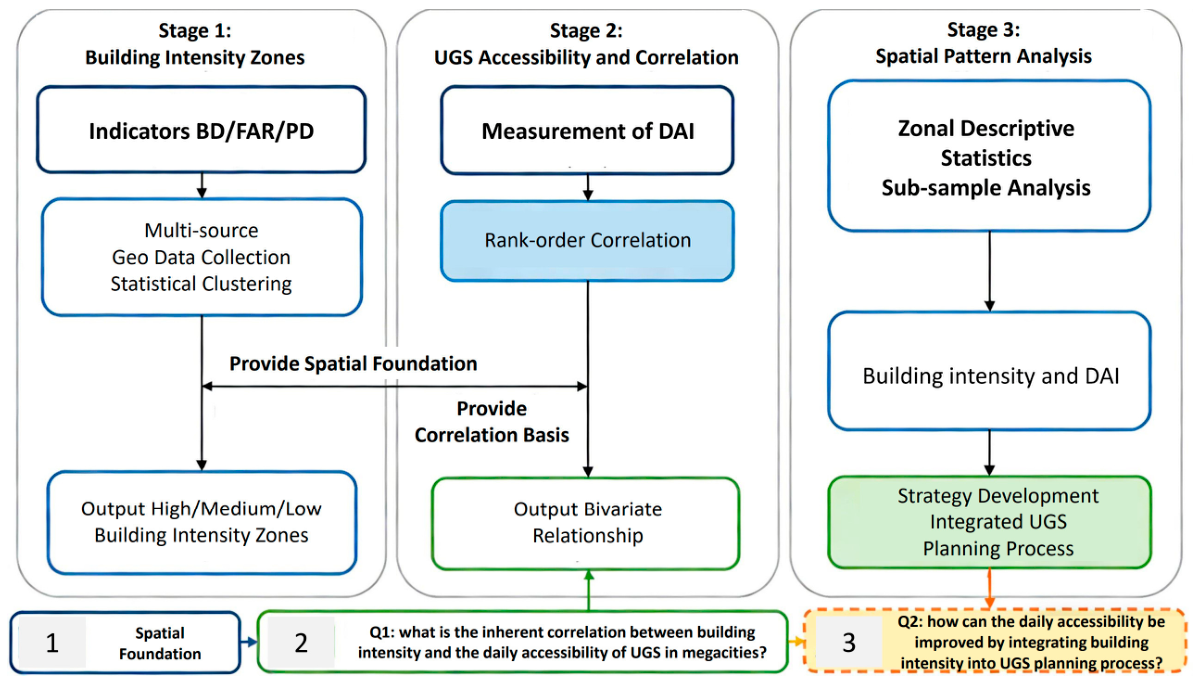
37]. Thus, this study hypothesizes that building intensity alters the functional accessibility of UGS, aiming to quantitatively demonstrate this relationship using the DAI. Against this thinking, this study proposes the following research questions: what is the inherent correlation between building intensity and the daily accessibility of UGS in megacities? And, if such a correlation exists, how can the daily accessibility be improved by integrating building intensity into the UGS planning process? To address these questions, this study sets two goals. The first is to examine the spatial association between building intensity and UGS daily accessibility. The second is to propose evidence-based strategies to improve UGS daily accessibility for megacities with different building intensities.
3. Results
3.1. Recognition of Building Intensity Zones
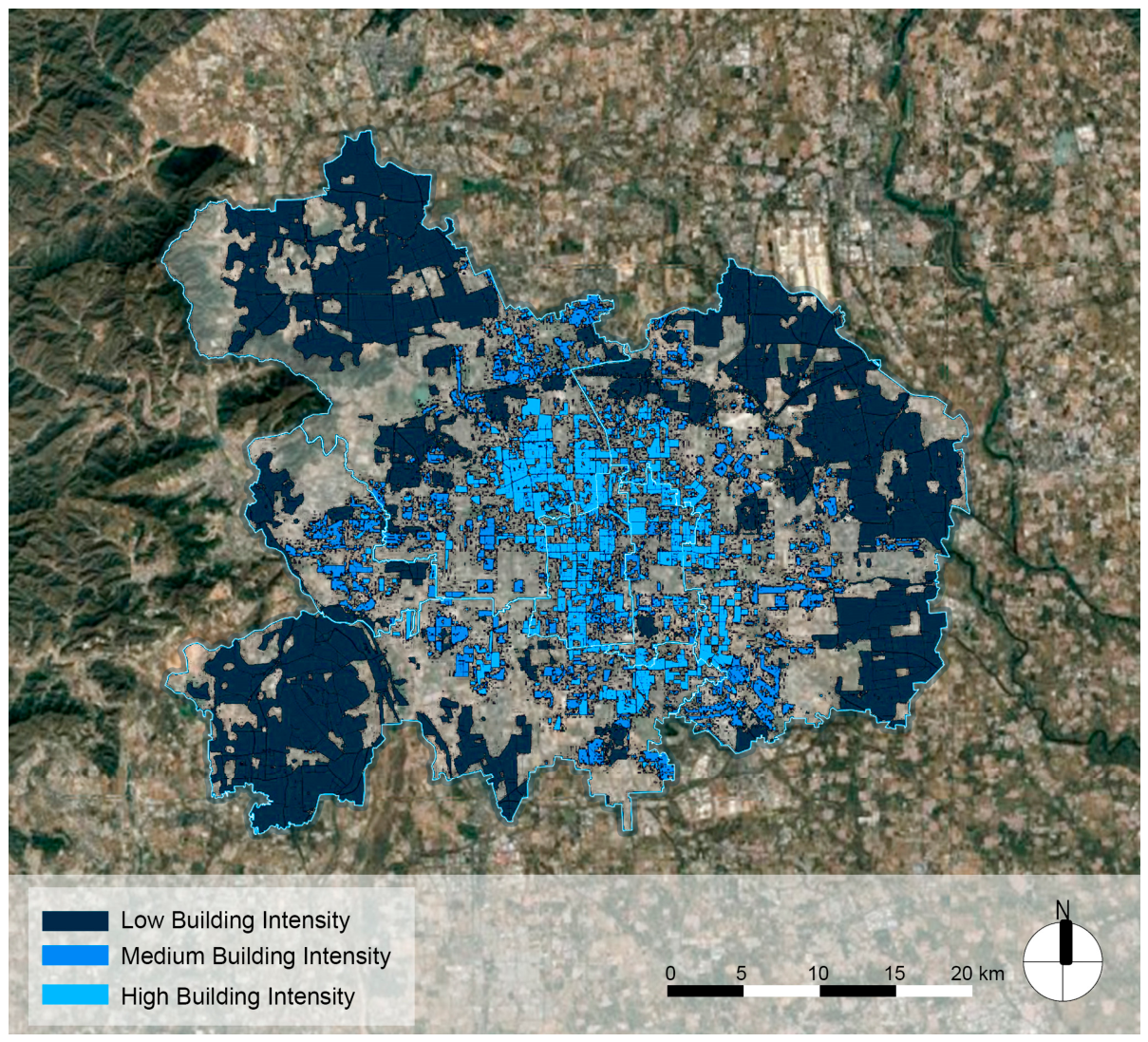
Before delving into the correlation analysis, it is crucial to address the distributional characteristics of the primary variables. Given the spatial heterogeneity and monocentric polarization of Beijing’s urban morphology, global descriptive statistics can be ecologically fallacious. Instead of clustering around a uniform global mean, these variables demonstrate extensive value ranges and stark spatial heterogeneity. They exhibit a core-periphery gradient across the urban space, which provides the spatial variance required for the subsequent geographically weighted analyses. A distinct core-to-periphery distribution is observed across Beijing’s built-up areas (
Figure 3). High building intensity zones are concentrated in Dongcheng and Xicheng Districts. These districts form the historic urban center of Beijing. They have served as clusters of high-density residential neighborhoods for centuries. The urban spatial fabric is preserved under current old town conservation policies and high-density spatial structure remains intact today. High building intensity zones feature highly fragmented UGS. Dense urban development has left limited contiguous land available for UGS. Nevertheless, strict UGS planning schemes are implemented in these areas. Pocket parks appear wherever possible in back streets and alleys through urban micro-renewal. Medium building intensity zones are distributed across areas including the Yongding River waterfront residential belt, the periphery of the Old Summer Palace, Wukesong and Wangjing. These zones are mainly transitional areas shaped by urban renewal, old community regeneration and industrial heritage repurposing. Their urban fabric alternates between sparse and dense blocks. Medium building intensity zones feature moderately scattered green space. These spaces are mostly generated through industrial land redevelopment and community renewal projects. Low building intensity zones are located at the periphery such as the northern foothills of the Xishan Mountains and the vicinity of the Capital Airport. These areas are strictly constrained by ecological protection policies and transportation infrastructure controls. Low building intensity zones feature extensive, low-intervention green spaces. These spaces are mainly large ecological patches protected under municipal ecological control policies. This variegated distribution reflects the urban spatial logic of Beijing. It embodies an evolutionary process that negotiates a dynamic equilibrium between population growth, land resource allocation and green space provision.
3.2. Spatial Pattern of UGS Daily Accessibility
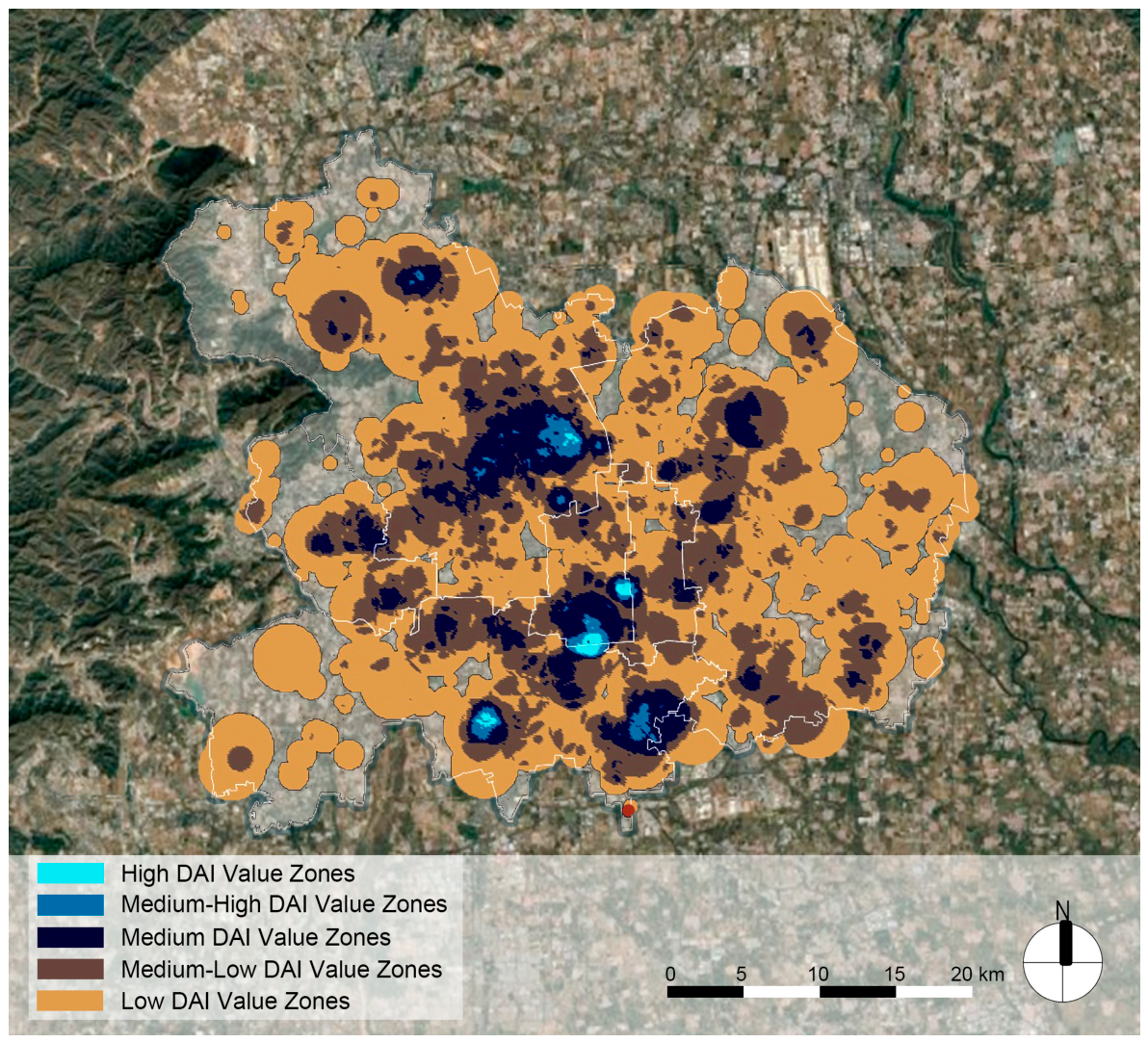
Daily accessibility serves as an indicator for assessing the spatial equity of urban public services. This study operationalizes UGS daily accessibility through DAI. High-value DAI areas, characterized by high coverage overlap frequency, are concentrated primarily in urban core zones such as southern Xicheng and northern Fengtai Districts (
Figure 4). These zones form compact clusters constituting an easily reachable network. Medium–high value DAI areas typically encircle high-quality zones, exhibiting continuous distributions exemplified by the Zizhuyuan–Beixiaguan Science–Education–Government corridor. This forms a secondary service ring. Medium value DAI areas display a concentric distribution extending from Shougang Park (west) to Liulitun Street (east), Nanyuan (south), and Zhongguancun Software Park (north), transitioning from contiguous to fragmented patches. Medium–low value DAI areas emerge between the 4th–5th Ring Roads, appearing as scattered pockets in emerging nodes like western Fengtai Science Park. Low value areas primarily occur along the 5th Ring Road and interzonal connectors, e.g., Chaoyang’s Jinzhan Village. While peripheral green space area increases, daily accessibility decreases radially from the core to the edge.
Figure 4 displays the spatial distribution of DAI value zones overlaid on the satellite image of Beijing’s central areas. The different shades of blue and brown indicate varying levels of DAI. Light blue zones indicate the highest values of DAI. They appear as relatively small, concentrated pockets within the denser urban areas. Darker blue zones surround the high DAI value zones. These areas represent the next highest range of DAI values. The darkest blue zones are broader areas with medium DAI values and still clustered around the urban core. Dark brown zones show a further decrease in DAI values, extending outwards from the central areas. Light brown zones show the most widespread category, covering the largest area and representing the lowest DAI values. They form the outer boundary of the research site, suggesting DAI values generally decrease further from the urban center. This figure uses a graduated color scheme to illustrate how the DAI metric changes across the depicted landscape with higher values concentrated in the central areas and gradually decreasing towards the periphery. The underlying satellite imagery provides geographical context for these DAI value zones.
To systematically illustrate the spatial differences across the megacity, a comparative analysis between the three building intensity zones reveals distinct UGS accessibility patterns. Firstly, in the high-intensity zones, the spatial structure is characterized by a highly permeable street network and a dense distribution of pocket parks. Here, despite limited total green area, the overlapping 15 min walking buffers create a highly resilient and accessible UGS network, yielding the highest DAI. Secondly, transitioning to the medium-intensity zones, the spatial fabric shifts to larger urban blocks and gated communities. In these zones, while individual parks may be larger, the enclosed road networks significantly reduce pedestrian permeability, leading to a more fragmented and uneven DAI distribution. Thirdly, the low-intensity zones exhibit a severe spatial mismatch. Although these areas contain massive ecological green belts and forest parks, the extremely sparse pedestrian infrastructure and isolated residential clusters mean these vast green spaces remain inaccessible for daily use, resulting in the lowest DAI. This systematic comparison highlights how the micro-level street network mediates the relationship between building intensity and UGS accessibility across different urban transects.
The spatial pattern of DAI aligns closely with the spatial structures of Beijing. The central area has a dense and interconnected pedestrian network. This network supports high walking accessibility and frequent buffer overlap. Large ring expressways in the periphery act as barriers. They fragment pedestrian connectivity and reduce UGS service continuity. The multi-centers have concentrated and varied UGS clusters. Population activity hotspots lead to high DAI values. The two ecological belts in western and northern suburbs have extensive green space. These large patches are far from concentrated residential areas and have relatively weak connections to pedestrian networks. This phenomenon leads to a statistical and practical paradox. While UGS exhibits adequate total acreage and high spatial coverage, its realized daily accessibility is lower than expected. Total UGS area increases from the urban core to the periphery, and daily accessibility decreases radially at the same time.
Although the macro-scale maps present the overall urban trend, examining specific local contexts reveals the nuanced micro-scale relationship between building intensity and DAI. A prominent case is Beijing’s historical core, including Dongcheng and Xicheng districts. Characterized by traditional hutongs and courtyard houses, the historical structure of these areas exhibits extremely high BD, yet it is constrained by strict heritage conservation policies that prohibit large-scale demolition for expansive new parks. Consequently, the total UGS area is severely constrained. The DAI in these historical areas remains high. This is because recent urban micro-renewal initiatives have inserted pocket parks into the dense, highly permeable traditional pedestrian network. Thus, the historical structure demonstrates a unique correlation. While it limits UGS quantity, its dense spatial fabric maximizes the overlap frequency of 15 min walking buffers. Conversely, in peripheral low-intensity zones, such as Jinzhan Village, despite the presence of massive ecological green belts, the sparse road networks and isolated residential clusters result in a severe spatial mismatch, leading to a weaker DAI.
3.3. Correlation Between Building Intensity and DAI
Spearman’s rank-order correlation analysis is used to examine the relationship between building intensity and the UGS daily accessibility. All correlation results are statistically significant at the 1% level (two-sided). As
Table 3 indicates, a value of 1 indicates a perfect positive correlation and −1 would indicate a strong negative linear relationship. There is a very strong positive correlation (0.938 ***) between building density and FAR. This is expected as higher building density often implies a greater total floor area relative to the plot size. A strong positive correlation (0.618 ***) between FAR and population density suggests that areas with higher FARs tend to have higher population densities. Similarly, higher building density is strongly associated with higher population density (0.576 ***). DAI shows moderate positive correlations with population density (0.431 ***), building density (0.354 ***), and FAR (0.402 ***). This indicates that while these factors contribute to DAI, their relationship is not as strong as the interrelationships among building density, FAR, and population density.
While the bivariate correlation indicates a general positive association, zonal statistics further reveal distinct UGS accessibility performance across high, medium, and low building intensity zones, as indicated in
Table 4. It should be noted that
Table 4 serves as a descriptive spatial summary to illustrate real-world spatial mismatches, rather than a formal statistical proof of causal mechanisms.
Zonal statistics results reveal distinct UGS accessibility performance across high, medium, and low building intensity zones, as indicated in
Table 4. High building intensity zones have the highest DAI values among the three zones with significantly higher buffer overlap frequency than medium and low intensity zones. Medium building intensity zones have the highest UGS coverage ratio, but low overlap frequency leads to lower DAI than high intensity zones. Low building intensity zones have the lowest DAI values, despite extensive total UGS area, reflecting a severe mismatch between green space supply and residents’ daily use demand.
It is acknowledged that coding building intensity into ordinal categories inherently assumes a linear step effect in the statistical analysis. This ordinal classification was deliberately chosen to strictly align with China’s statutory standards such as GB 50180-2018, which regulate land use and UGS allocation based on discrete density tiers rather than continuous gradients. The ordinal categorization is retained to maximize policy interpretability and practical relevance for urban planners. To address the methodological concern regarding the implied linear assumption of ordinal coding, a robustness check was additionally conducted by replacing the ordinal variable with categorical dummy variables, such as setting ‘High’ and ‘Medium’ intensity as dummies, with ‘Low’ intensity as the reference group. The alternative specification yielded consistent positive and statistically significant results for the high-intensity dummy. This confirms that the observed spatial association is robust and not merely a mathematical artifact of the linear step assumption.
While the spatial correlation models confirm a general positive correlation across the megacity, examining specific local cases reveals where this correlation is particularly strong or weak. The correlation is particularly strong in Beijing’s historical core and central business districts. In these areas, high building density is coupled with a highly permeable, fine-grained street network. This spatial structure maximizes the overlap of 15 min walking buffers, allowing high building intensity to translate efficiently into high DAI via numerous pocket parks. The correlation becomes weak in certain peripheral mega-block developments. In these specific cases, despite having a high FAR, the sparse, enclosed road networks and physical barriers restrict pedestrian movement. These local variations demonstrate that while building intensity is generally positively associated with UGS accessibility, the strength of this correlation is mediated by the micro-level permeability of the urban street network.
4. Discussion
4.1. Dialog with Existing Research
The major finding of this study is that building intensity has a positive correlation with the UGS daily accessibility measured by DAI in Beijing. This result provides new quantitative evidence to address the long-standing academic dispute over the relationship between compact development and UGS provision [
47,
48]. A large body of existing research argues that high-intensity compact development has a squeeze effect on urban green space. These studies conclude that excessive building intensity encroaches on UGS land, fragments green space networks, degrades ecological functions, and ultimately reduces the level of green space services in megacities [
49]. This view has formed a dominant understanding that high-density development is inherently incompatible with high-quality green space services.
The difference between this study’s findings and existing research lies in the evaluation dimension. Most existing studies rely on static scale indicators such as UGS area, per capita green space, and green space coverage ratio, focusing on the quantity of green space supply. This study focuses on the functional effectiveness of green space from the perspective of people’s daily use, using DAI to measure the convenience and choice flexibility of UGS access in their routines. This study does not deny the squeeze effect of high-density development on the total scale of UGS. It is consistent with the finding that high-intensity zones have fragmented green space and lower coverage ratio ranking. However, this study further verifies the agglomeration effect of high-density development. Compact development in the urban core areas brings more mixed land use and denser pedestrian networks, which improve the spatial matching between UGS and daily activities, thus ultimately enhancing the daily accessibility of green space.
This finding bridges the gap between scale-oriented and function-oriented research in this field. It clarifies that the academic dispute over the relationship between density and green space services mainly stems from the difference in evaluation dimensions. The two goals of high-intensity development and high-quality green space are not mutually exclusive, but can achieve synergy through human-centered spatial planning.
This finding challenges the traditional assumption that high-density development degrades green space provision. While the macro-scale analysis reveals a general positive correlation, this overarching generalization does not uniformly apply to all urban contexts. The macro-level trend can be mediated or even disrupted by specific urban morphologies and functions at the micro-scale. As demonstrated by the local case analyses, areas with identical building intensities can exhibit different DAIs depending on their spatial fabric. For instance, the fine-grained, highly permeable street networks of historical cores and traditional commercial districts facilitate a positive correlation, translating high density into high accessibility. In contrast, the enclosed morphology of modern mega-blocks or gated residential communities disrupts this relationship, leading to spatial mismatches where high intensity fails to deliver high accessibility. Urban planners should look beyond macro-scale intensity metrics and prioritize micro-morphological design to ensure equitable UGS provision.
4.2. Theoretical Contributions
This study makes three key theoretical contributions to the existing research on compact city development and UGS planning.
First, this study reveals the dual effect of high-density development on the UGS daily accessibility in megacities, and corrects the one-sided perception that high density will inevitably reduce green space. Existing research has long focused on the negative squeeze effect of compact development, while ignoring its positive agglomeration effect on green space service efficiency. This study empirically verifies the coexistence of the two effects, clarifies the nonlinear relationship between building intensity and green space, and improves the theoretical connotation of the synergy between compact development and ecological services in the compact city.
Second, this study constructs the DAI indicator focusing on residents’ daily use of UGS, and expands the evaluation dimension of green space accessibility. Existing accessibility evaluation systems mostly rely on static scale indicators in total or threshold-based accessibility measurement, which cannot fully capture the actual use experience of residents. The DAI indicator quantifies the richness of UGS options and the convenience of daily use through the overlap frequency of service buffers, enriches the evaluation system of green space accessibility, and provides a new quantitative tool for UGS research.
Third, this study clarifies the differentiated logic of UGS accessibility improvement in different building intensity zones, and enriches the system of high-density green space planning in megacities. Existing research mostly proposes universal planning strategies for green space improvement, ignoring the heterogeneous contradictions in zones with different development intensities. This study identifies the specific issues of UGS usage in high, medium, and low intensity zones respectively to support targeted theoretical guidance for green space planning in different development contexts of megacities.
4.3. Policy and Practical Implications
The findings of this study provide a reference for megacities facing the contradiction between high-density development and green space service supply.
For high building intensity zones, confronting the dual challenges of a high coverage ratio with lagging DAI growth and severely restricted UGS expansion, a multi-faceted strategy is imperative. This encompasses the strategic utilization of existing stock, such as repurposing idle residual plots, street corners, and demolition-vacated land for pocket parks and community gardens. Three-dimensional penetration through promoting vertical greening solutions like rooftop gardens, vertical facades, and green walls expands green space supply in the vertical dimension. Finally, network integration is achieved by weaving micro-green spaces with high-frequency daily travel nodes, including community service centers, transit hubs, and commercial facilities, to establish a two-tiered micro-green space network covering 15 min walking catchments. In medium building intensity zones, addressing the issue of sufficient coverage ratio but low DAI and a spatial mismatch between UGS layout and resident activity hotspots necessitates a strategy of layout optimization, functional integration, and node activation. This involves realigning UGS distribution based on activity heatmaps to mitigate 15 min walking service gaps. Furthermore, integrating UGS construction with urban renewal and older community revitalization initiatives allows for the implantation of composite functions to augment usage frequency. The construction of a community greenway network, connecting disparate UGS patches, is crucial for improving pedestrian connectivity between green spaces, thereby amplifying service overlay effects and DAI levels. Conversely, in low building intensity zones, where a large total UGS area coexists with a low DAI and a scattered layout, a strategy of agglomeration, corridor linkage, and service decentralization is essential. This includes establishing compact UGS nodes to serve surrounding concentrated residential areas, thereby addressing daily service deficits. Connecting large, dispersed ecological green spaces with activity areas via ecological greenways and pedestrian corridors enhances the daily accessibility of these extensive ecological patches. Fostering community-level gardens and pocket parks within concentrated residential areas decentralizes daily UGS services, effectively mitigating the challenge of abundant green space with difficult access.
The DAI indicator serves as a tool for statutory planning and 15 min living circle construction. It could be incorporated into the control indicators of regulatory detailed planning, as a mandatory threshold for land transfer and planning approval, to supplement the green space ratio indicator. Planners, urban designers or developers can use DAI to diagnose UGS service blind spots, identify key areas for planning optimization, and monitor the effectiveness of green space construction over time. This promotes the transformation of urban green space planning from total quantity control to service efficiency control, and ensures that planning decisions are grounded in residents’ actual daily use experience.
The analytical framework, evaluation indicator system, and differentiated planning strategies proposed in this study have universal reference value for global megacities, especially dense urban areas in East Asia that face similar contradictions between population agglomeration and limited land resources. This study provides an evidence-based path to balance compact development and human-centered green space services, helping megacities achieve synergistic development of urban intensification and livability improvement.
4.4. Limitations and Future Research
While this study provides novel insights into the correlation between building intensity and the UGS daily accessibility, several limitations should be noted. Methodologically, although the 100 m × 100 m grid was theoretically justified to standardize the analysis, this study did not conduct a full spatial sensitivity analysis across multiple grid sizes. Future research should incorporate sensitivity tests to evaluate how varying spatial resolutions might affect the observed correlation strength. While the DAI measures potential accessibility, it does not capture actual UGS visitation rates or individual behavioral preferences. Future research must incorporate external usage proxies, such as mobile phone signaling data, POI visitations, or social media check-ins, to thoroughly validate how morphological accessibility translates into actual UGS utilization to bridge the gap between spatial opportunity and actual utilization.
Secondly, regarding the DAI calculation, this study focused exclusively on the statutory 15 min walking radius to evaluate current policy implementation rather than conducting temporal sensitivity tests across varying accessibility thresholds. Because residents’ walking tolerance can vary based on age, weather, and UGS attractiveness, future studies should incorporate temporal sensitivity analyses to explore how different walking time thresholds might alter the spatial correlation between building intensity and UGS accessibility.
Thirdly, a critical consideration is the extent to which these findings can be generalized to other megacities. Beijing represents a typical monocentric megacity with a ring-radial road network and a unique historical core. This study provides empirical evidence for the compact city model by identifying a key mechanism: high building intensity, when coupled with a highly permeable pedestrian network, enhances UGS accessibility through overlapping service areas. This mechanism is likely generalizable to other high-density, rapidly urbanizing Asian megacities that share similar morphological trajectories. However, the specific spatial manifestations of this correlation may vary in cities with different urban morphologies. For instance, in highly polycentric, car-dependent cities or cities characterized by organic historical growth and strict greenbelt containment, the spatial mismatch between building intensity and UGS provision might exhibit different patterns. Therefore, future comparative studies across megacities with diverse morphological typologies are necessary to validate the universality of these findings and to tailor UGS planning strategies to specific local contexts.
Finally, a methodological limitation of this study is the reliance on bivariate correlation and descriptive zonal statistics. Because we did not employ a multivariate spatial regression model (such as a Spatial Lag Model), this study cannot statistically control for confounding third variables like urban centrality, road network density, or land-use mix. Therefore, the observed positive relationship should be interpreted as a spatial association rather than a strict independent or causal effect. Future research must incorporate formal spatial regression frameworks to isolate the net effect of building intensity on UGS accessibility.
5. Conclusions
This study developed a DAI based on the 15 min pedestrian network to evaluate the spatial relationship between building intensity and UGS provision in Beijing. Moving beyond traditional area-based metrics, this analysis yielded several key findings. First, it identified a spatial mismatch across the megacity. While peripheral low-intensity zones possess massive ecological green belts, their sparse pedestrian infrastructure results in the lowest daily accessibility. Second, spatial correlation models revealed a positive correlation between building intensity and the DAI. High-intensity zones, particularly those supported by highly permeable street networks, effectively translate dense urban fabric into high UGS accessibility through the frequent overlap of pocket park service buffers. Conversely, impermeable mega-blocks disrupt this correlation. These findings provide evidence that high-density development does not inevitably degrade green space provision. To achieve an objective enhancement of urban space quality, urban planners must look beyond macro-scale intensity metrics. Future planning strategies should prioritize micro-morphological design, specifically enhancing street network permeability and integrating decentralized pocket parks, to foster equitable and resilient 15 min community life circles. While this study provides morphological insights, future research should integrate visitation data and quantitatively compare the DAI with capacity-based models across diverse urban contexts to further validate these findings.
Residents’ daily use of UGS both shapes and is shaped by the spatial layout of green space and the intensity of urban development. In a particularly highly constructed urban core zone, the daily accessibility of UGS is strongly impacted by the compactness of the built environment and the density of the pedestrian network. This paper uses quantitative spatial analysis tools to visualize the spatial pattern of UGS daily accessibility and its correlation with building intensity. Clarifying this correlation is significant for the decision-making of UGS planning and sustainable urban environment study in megacities.
The research results answer the research questions. Building intensity has a statistically positive correlation with the UGS daily accessibility in Beijing, but the mere expansion of total UGS area does not necessarily promote improved daily accessibility for residents. Quantitative spatial analysis tools offer an evaluation of UGS during the planning process. They help urban planners and designers to identify service blind spots quickly through spatial overlay analysis and indicator calculation. The indicator system and evaluation model, however, become too complicated to regulate the UGS layout when broadening the planning scope to include social, cultural, and policy factors. The complex database instead makes the planning process inefficient. In addition, the DAI indicator can help to analyze the potential use frequency of UGS as buffer overlap frequency on a spatial analysis platform. The indicator can partly reflect behavioral trends and urban space usage, but it does lack accuracy. Residents’ perception and use of urban green space are ever-changing and encompass complex social conditions and urban development situations.
Quantitative evaluation of UGS daily accessibility is a small part of computational techniques applied in the urban planning industry. Although there are some attempts in Beijing, Shanghai, Shenzhen, and other Chinese megacities, UGS planning based on daily accessibility evaluation has no mature, widely applied planning system until now. This paper proposed that computational spatial analysis platforms could provide an efficient evaluation process for UGS planning. It did not mean that quantitative evaluation could bring better planning outcomes in real practice. A comprehensive UGS planning system should include more aspects, such as residents’ subjective perception, social equity, cultural heritage protection, and subsequent implementation and management. Changing the context to less dense suburban conditions makes daily accessibility-oriented UGS planning face different problems such as land sprawl, scattered population distribution, and insufficient public service facilities. The application of quantitative evaluation technology in urban green space planning has the potential to be much more deeply explored.