Beyond Homogenization: Spatio-Temporal Dynamics of Urban Vitality and the Nonlinear Role of Built Environment in Shenyang’s Historic Urban Area

Abstract
1. Introduction
2. Literature Review
2.1. Theory and Measurement of Urban Vitality
2.2. Environmental Correlates of Vitality
2.3. Asymmetric Relationships Between Vitality and Built Environment
2.4. Literature Synthesis and Research Focus
3. Method
3.1. Study Area
3.2. Data Sources

| Data Name | Information Included | Data Source |
|---|---|---|
| Population thermal data | Population distribution locations, times | Baidu Maps Open Platform [64] (https://lbsyun.baidu.com/, accessed on 15 April 2025) |
| Road traffic | Road classification, road length, rail transit stations, public transport stops | OpenStreetMap [65] (https://www.openstreetmap.org, accessed on 15 April 2025) |
| Plots | Plot area, perimeter, land use type, building density, entrance/exit locations | Generated by the authors |
| Buildings | Building footprint area, building height | China Multi-Attribute Building Dataset (CMAB) on Figshare [66] (https://figshare.com, accessed on 20 April 2025) |
| Natural environment | Large parks, water bodies, vegetation coverage | OpenStreetMap, Science Data Bank [67] (https://www.scidb.cn/en, accessed on 23 April 2025) |
| Historical features | Cultural heritage sites, historic buildings | Official websites of the State Council, provincial, and municipal governments [62,68,69] |
| POI | Functional types, locations | Amap Open Platform [70] (https://lbs.amap.com/, accessed on 15 April 2025) |
| Population | Total street population, elderly population | National Bureau of Statistics [61] (https://www.stats.gov.cn/, accessed on 20 February 2026) |
3.3. Variables
3.4. Analysis Methods
3.4.1. XGBoost
3.4.2. SHAP
4. Results
4.1. Spatio-Temporal Characteristics of Vitality in Shenyang’s Historic Urban Area
4.2. Temporal Variations in Built Environment Impacts on Vitality
4.3. Nonlinear and Threshold Effects of Built Environment on Vitality
5. Discussion
5.1. Spatial Distribution of Vitality in Shenyang’s Historic Urban Area
5.2. Nonlinear Impact of Built Environment on Urban Vitality
5.3. Renewal Strategies for Shenyang’s Historic Urban Area
6. Conclusions
Author Contributions
Funding
Data Availability Statement
Conflicts of Interest
References
- Zhou, T.; Zhou, Y.; Liu, G. Comparison of Critical Success Paths for Historic District Renovation and Redevelopment Projects in China. Habitat Int. 2017, 67, 54–68. [Google Scholar] [CrossRef]
- Shin, H.B. Urban Conservation and Revalorisation of Dilapidated Historic Quarters: The Case of Nanluoguxiang in Beijing. Cities 2010, 27, S43–S54. [Google Scholar] [CrossRef]
- Zhang, H.; Cong, C.; Chakraborty, A. Exploring the Institutional Dilemma and Governance Transformation in China’s Urban Regeneration: Based on the Case of Shanghai Old Town. Cities 2022, 131, 103915. [Google Scholar] [CrossRef]
- Zhu, Y.; González Martínez, P. Heritage, Values and Gentrification: The Redevelopment of Historic Areas in China. Int. J. Herit. Stud. 2022, 28, 476–494. [Google Scholar] [CrossRef]
- Boussaa, D. The Past as a Catalyst for Cultural Sustainability in Historic Cities; the Case of Doha, Qatar. Int. J. Herit. Stud. 2021, 27, 470–486. [Google Scholar] [CrossRef]
- Hwang, K.H. Finding Urban Identity through Culture-Led Urban Regeneration. J. Urban Manag. 2014, 3, 67–85. [Google Scholar] [CrossRef]
- Wang, F.; Liu, Z.; Shang, S.; Qin, Y.; Wu, B. Vitality Continuation or Over-Commercialization? Spatial Structure Characteristics of Commercial Services and Population Agglomeration in Historic and Cultural Areas. Tour. Econ. 2019, 25, 1302–1326. [Google Scholar] [CrossRef]
- Han, C.; Zhang, Z. Nonlinear Effects of Built Environment Perception and Objective Features on Street Vitality in Historic Districts. Front. Archit. Res. 2025; in press. [Google Scholar] [CrossRef]
- Wang, F.; Mao, W.; Dong, Y.; Zhu, X. Implications for Cultural Landscape in a Chinese Context: Geo-Analysis of Spatial Distribution of Historic Sites. Chin. Geogr. Sci. 2018, 28, 167–182. [Google Scholar] [CrossRef]
- Bo, W.; Yaqin, L.; Chenggang, W.; Lei, W. The Spatio-Temporal Impacts of the Built Environment on Urban Vitality: A Study Based on Big Data. Geogr. Sci. 2022, 42, 274–283. [Google Scholar] [CrossRef]
- Chen, Z.; Huang, B. Achieving Urban Vibrancy through Effective City Planning: A Spatial and Temporal Perspective. Cities 2024, 152, 105230. [Google Scholar] [CrossRef]
- Ewing, R.; Cervero, R. Travel and the Built Environment. J. Am. Plann. Assoc. 2010, 76, 265–294. [Google Scholar] [CrossRef]
- Li, X.; Li, Y.; Jia, T.; Zhou, L.; Hijazi, I.H. The Six Dimensions of Built Environment on Urban Vitality: Fusion Evidence from non-linear Data. Cities 2022, 121, 103482. [Google Scholar] [CrossRef]
- Liu, D.; Shi, Y. The Influence Mechanism of Urban Spatial Structure on Urban Vitality Based on Geographic Big Data: A Case Study in Downtown Shanghai. Buildings 2022, 12, 569. [Google Scholar] [CrossRef]
- Fan, L.; Zhang, D. Research on the Influence Mechanism and Spatial Heterogeneity Characteristics of Block Vitality in Beijing: Based on Multi-Scale Geographically Weighted Regression. City Plan. Rev. 2022, 46, 27–37. [Google Scholar]
- Han, Y.; Qin, C.; Xiao, L.; Ye, Y. The Nonlinear Relationships between Built Environment Features and Urban Street Vitality: A Data-Driven Exploration. Environ. Plan. B Urban Anal. City Sci. 2024, 51, 195–215. [Google Scholar] [CrossRef]
- Ling, Z.; Zheng, X.; Chen, Y.; Qian, Q.; Zheng, Z.; Meng, X.; Kuang, J.; Chen, J.; Yang, N.; Shi, X. The Nonlinear Relationship and Synergistic Effects between Built Environment and Urban Vitality at the Neighborhood Scale: A Case Study of Guangzhou’s Central Urban Area. Remote Sens. 2024, 16, 2826. [Google Scholar] [CrossRef]
- Li, J.; Lin, S. Nonlinear and Synergistic Effects of Built Environment Indicators on Street Vitality: A Case Study of Humid and Hot Urban Cities. Sustainability 2024, 16, 1731. [Google Scholar] [CrossRef]
- Xiao, L.; Lo, S.; Liu, J.; Zhou, J.; Li, Q. Nonlinear and Synergistic Effects of TOD on Urban Vibrancy: Applying Local Explanations for Gradient Boosting Decision Tree. Sustain. Cities Soc. 2021, 72, 103063. [Google Scholar] [CrossRef]
- Jacobs, J. The Death and Life of Great American Cities; Knopf Doubleday Publishing Group: New York, NY, USA, 1992. [Google Scholar]
- Lynch, K. Good City Form; MIT Press: Cambridge, MA, USA, 1984. [Google Scholar]
- Whyte, W.H. The Social Life of Small Urban Spaces; Project for Public Spaces, Inc.: New York, NY, USA, 2001. [Google Scholar]
- Sung, H.-G.; Go, D.-H.; Choi, C.G. Evidence of Jacobs’s Street Life in the Great Seoul City: Identifying the Association of Physical Environment with Walking Activity on Streets. Cities 2013, 35, 164–173. [Google Scholar] [CrossRef]
- Zarin, S.Z.; Niroomand, M.; Heidari, A.A. Physical and Social Aspects of Vitality Case Study: Traditional Street and Modern Street in Tehran. Procedia Soc. Behav. Sci. 2015, 170, 659–668. [Google Scholar] [CrossRef]
- Yue, H.; Zhu, X. Exploring the Relationship between Urban Vitality and Street Centrality Based on Social Network Review Data in Wuhan, China. Sustainability 2019, 11, 4356. [Google Scholar] [CrossRef]
- Kim, Y.-L. Seoul’s Wi-Fi Hotspots: Wi-Fi Access Points as an Indicator of Urban Vitality. Comput. Environ. Urban Syst. 2018, 72, 13–24. [Google Scholar] [CrossRef]
- Guo, X.; Chen, H.; Yang, X. An Evaluation of Street Dynamic Vitality and Its Influential Factors Based on Multi-Source Big Data. Int. J. Geo-Inf. 2021, 10, 143. [Google Scholar] [CrossRef]
- Liu, M.; Jiang, Y.; He, J. Quantitative Evaluation on Street Vitality: A Case Study of Zhoujiadu Community in Shanghai. Sustainability 2021, 13, 3027. [Google Scholar] [CrossRef]
- Tu, W.; Zhu, T.; Xia, J.; Zhou, Y.; Lai, Y.; Jiang, J.; Li, Q. Portraying the Spatial Dynamics of Urban Vibrancy Using Multisource Urban Big Data. Comput. Environ. Urban Syst. 2020, 80, 101428. [Google Scholar] [CrossRef]
- Ratti, C.; Frenchman, D.; Pulselli, R.M.; Williams, S. Mobile Landscapes: Using Location Data from Cell Phones for Urban Analysis. Environ. Plan. B Plan. Des. 2006, 33, 727–748. [Google Scholar] [CrossRef]
- Hasan, S.; Ukkusuri, S.V. Urban Activity Pattern Classification Using Topic Models from Online Geo-Location Data. Transp. Res. Part C Emerg. Technol. 2014, 44, 363–381. [Google Scholar] [CrossRef]
- Xia, C.; Yeh, A.G.-O.; Zhang, A. Analyzing Spatial Relationships between Urban Land Use Intensity and Urban Vitality at Street Block Level: A Case Study of Five Chinese Megacities. Landsc. Urban Plan. 2020, 193, 103669. [Google Scholar] [CrossRef]
- Mehta, V. Evaluating Public Space. J. Urban Des. 2014, 19, 53–88. [Google Scholar] [CrossRef]
- Ye, Y.; van Nes, A. Quantitative Tools in Urban Morphology: Combining Space Syntax, Spacematrix and Mixed-Use Index in a GIS Framework. Urban Morphol. 2014, 18, 97–118. [Google Scholar] [CrossRef]
- Hu, S.; Yang, S.; Li, W.; Zhang, C.; Xu, F. Spatially Non-Stationary Relationships between Urban Residential Land Price and Impact Factors in Wuhan City, China. Appl. Geogr. 2016, 68, 48–56. [Google Scholar] [CrossRef]
- Wu, J.; Ta, N.; Song, Y.; Lin, J.; Chai, Y. Urban Form Breeds Neighborhood Vibrancy: A Case Study Using a GPS-Based Activity Survey in Suburban Beijing. Cities 2017, 74, 100–108. [Google Scholar] [CrossRef]
- Yue, Y.; Zhuang, Y.; Yeh, A.G.O.; Xie, J.-Y.; Ma, C.-L.; Li, Q.-Q. Measurements of POI-Based Mixed Use and Their Relationships with Neighbourhood Vibrancy. Int. J. Geogr. Inf. Sci. 2017, 31, 658–675. [Google Scholar] [CrossRef]
- De Nadai, M.; Staiano, J.; Larcher, R.; Sebe, N.; Quercia, D.; Lepri, B. The Death and Life of Great Italian Cities: A Mobile Phone Data Perspective. In Proceedings of the 25th International Conference on World Wide Web; International World Wide Web Conferences Steering Committee: Montréal, QC, Canada, 2016; pp. 413–423. [Google Scholar]
- Delclòs-Alió, X.; Miralles-Guasch, C. Looking at Barcelona through Jane Jacobs’s Eyes: Mapping the Basic Conditions for Urban Vitality in a Mediterranean Conurbation. Land Use Policy 2018, 75, 505–517. [Google Scholar] [CrossRef]
- Lee, S.; Cho, N. Nonlinear and Interaction Effects of Multi-Dimensional Street-Level Built Environment Features on Urban Vitality in Seoul. Cities 2025, 165, 106145. [Google Scholar] [CrossRef]
- Gómez-Varo, I.; Delclòs-Alió, X.; Miralles-Guasch, C. Jane Jacobs Reloaded: A Contemporary Operationalization of Urban Vitality in a District in Barcelona. Cities 2022, 123, 103565. [Google Scholar] [CrossRef]
- He, S.; Zhang, Z.; Yu, S.; Xia, C.; Tung, C.-L. Investigating the Effects of Urban Morphology on Vitality of Community Life Circles Using Machine Learning and Geospatial Approaches. Appl. Geogr. 2024, 167, 103287. [Google Scholar] [CrossRef]
- Shao, J.; Long, Y.; Liu, X.; Zheng, Y.; Song, Y.; Wang, J.; Liu, B.; Yang, J.; Chen, Y.; Zhang, F. Machine Learning-Based Study on Factors Influencing Street Vitality in Urban Fringe Commercial Districts: A Case of Wuhan. Front. Archit. Res. 2025; in press. [Google Scholar] [CrossRef]
- Jin, A.; Ge, Y.; Zhang, S. Spatial Characteristics of Multidimensional Urban Vitality and Its Impact Mechanisms by the Built Environment. Land 2024, 13, 991. [Google Scholar] [CrossRef]
- Long, Y.; Jiao, S.; Yu, Y.; Xiao, K. An Analysis of Spatial Vitality Distribution and Formation Mechanisms in Historical Urban Areas Based on Multi-Source Big Data: A Case Study of Changsha. Front. Archit. Res. 2025, 14, 1727–1749. [Google Scholar] [CrossRef]
- Zhang, Y.; Yang, C.; Qi, L. Study on the Assessment of Street Vitality and Influencing Factors in the Historic District—A Case Study of Shichahai Historic District. Chin. Landsc. Archit. 2019, 35, 106–111. [Google Scholar] [CrossRef]
- Doan, Q.C.; Ma, J.; Chen, S.; Zhang, X. Nonlinear and Threshold Effects of the Built Environment, Road Vehicles and Air Pollution on Urban Vitality. Landsc. Urban Plan. 2025, 253, 105204. [Google Scholar] [CrossRef]
- Liu, J.; Li, Y.; Xu, Y.; Zhuang, C.C.; Hu, Y.; Yu, Y. Impacts of Built Environment on Urban Vitality in Cultural Districts: A Case Study of Haikou and Suzhou. Land 2024, 13, 840. [Google Scholar] [CrossRef]
- Kano, N.; Seraku, N.; Takahashi, F.; Tsuji, S. Attractive Quality and Must-Be Quality. J. Jpn. Soc. Qual. Control 1984, 14, 147–156. [Google Scholar] [CrossRef]
- Matzler, K.; Bailom, F.; Hinterhuber, H.H.; Renzl, B.; Pichler, J. The Asymmetric Relationship between Attribute-Level Performance and Overall Customer Satisfaction: A Reconsideration of the Importance–Performance Analysis. Ind. Mark. Manag. 2004, 33, 271–277. [Google Scholar] [CrossRef]
- Matzler, K.; Sauerwein, E. The Factor Structure of Customer Satisfaction: An Empirical Test of the Importance Grid and the Penalty-Reward-Contrast Analysis. Int. J. Serv. Ind. Manag. 2002, 13, 314–332. [Google Scholar] [CrossRef]
- Albayrak, T.; Caber, M.; Bideci, M. Identification of Hotel Attributes for Senior Tourists by Using Vavra’s Importance Grid. J. Hosp. Tour. Manag. 2016, 29, 17–23. [Google Scholar] [CrossRef]
- Wu, X.; Cao, J.; Huting, J. Using Three-Factor Theory to Identify Improvement Priorities for Express and Local Bus Services: An Application of Regression with Dummy Variables in the Twin Cities. Transp. Res. Part Policy Pract. 2018, 113, 184–196. [Google Scholar] [CrossRef]
- Martilla, J.A.; James, J.C. Importance-Performance Analysis. J. Mark. 1977, 41, 77–79. [Google Scholar] [CrossRef]
- Vavra, T.G. Improving Your Measurement of Customer Satisfaction: A Guide to Creating, Conducting, Analyzing, and Reporting Customer Satisfaction Measurement Programs. J. Consum. Mark. 1997, 16, 1–4. [Google Scholar] [CrossRef]
- Cao, J.; Hao, Z.; Yang, J.; Yin, J.; Huang, X. Prioritizing Neighborhood Attributes to Enhance Neighborhood Satisfaction: An Impact Asymmetry Analysis. Cities 2020, 105, 102854. [Google Scholar] [CrossRef]
- Matzler, K.; Sauerwein, E.; Heischmidt, K. Importance-Performance Analysis Revisited: The Role of the Factor Structure of Customer Satisfaction. Serv. Ind. J. 2003, 23, 112–129. [Google Scholar] [CrossRef]
- Tang, Q.; Cao, J.; Yin, C.; Cheng, J. Examining the Nonlinear Relationships between Park Attributes and Satisfaction with Pocket Parks in Chengdu. Urban For. Urban Green. 2024, 101, 128548. [Google Scholar] [CrossRef]
- The Second Batch of National Historical and Cultural Cities. Available online: http://www.gbwhyc.cn/a/dierpi/167.html (accessed on 15 March 2025).
- Announcement on Publicly Soliciting Opinions on the Draft of “Shenyang Historical and Cultural City Protection Plan (2021–2035)”. Available online: https://zrzyj.shenyang.gov.cn/ztgz/lswhmcbh/202311/t20231129_4563954.html (accessed on 24 February 2025).
- Liaoning Provincial Bureau of Statistics. Available online: https://tjj.ln.gov.cn/tjj/tjsj/index.shtml (accessed on 20 February 2026).
- National Cultural Heritage Administration. Available online: http://www.ncha.gov.cn/ (accessed on 15 April 2025).
- Liang, S.; Leng, H. Residents’ Seasonal Behavior Patterns and Spatial Preferences in Public Open Spaces of Severely Cold Regions: Evidence from Harbin, China. Habitat Int. 2025, 156, 103279. [Google Scholar] [CrossRef]
- Baidu Maps Open Platform. Available online: https://lbsyun.baidu.com/ (accessed on 15 April 2025).
- OpenStreetMap. Available online: https://www.openstreetmap.org/ (accessed on 15 April 2025).
- Zhang, Y.; Zhao, H.; Long, Y. CMAB: A Multi-Attribute Building Dataset of China. Sci. Data 2025, 12, 430. [Google Scholar] [CrossRef] [PubMed]
- Shi, Q.; Liu, M.; Marinoni, A.; Liu, X. UGS-1m: Fine-Grained Urban Green Space Mapping of 31 Major Cities in China Based on the Deep Learning Framework. Earth Syst. Sci. Data 2023, 15, 555–577. [Google Scholar] [CrossRef]
- People’s Government of Liaoning Province. Available online: https://www.ln.gov.cn/zwgkx/zfwj/szfwj/ (accessed on 15 April 2025).
- People’s Government of Shenyang Municipality. Available online: https://www.shenyang.gov.cn/ (accessed on 15 April 2025).
- Amap Open Platform. Available online: https://lbs.amap.com/ (accessed on 15 April 2025).
- Sevtsuk, A.; Mekonnen, M. Urban Network Analysis. A New Toolbox for ArcGIS. Rev. Int. Géomat. 2012, 22, 287–305. [Google Scholar] [CrossRef]
- Sung, H.; Lee, S. Residential Built Environment and Walking Activity: Empirical Evidence of Jane Jacobs’ Urban Vitality. Transp. Res. Part Transp. Environ. 2015, 41, 318–329. [Google Scholar] [CrossRef]
- Chen, T.; Guestrin, C. XGBoost: A Scalable Tree Boosting System. In Proceedings of the 22nd ACM SIGKDD International Conference on Knowledge Discovery and Data Mining; Association for Computing Machinery: New York, NY, USA, 2016; pp. 785–794. [Google Scholar]
- Yang, J.; Su, P.; Cao, J. On the Importance of Shenzhen Metro Transit to Land Development and Threshold Effect. Transp. Policy 2020, 99, 1–11. [Google Scholar] [CrossRef]
- Pande, C.B.; Egbueri, J.C.; Costache, R.; Sidek, L.M.; Wang, Q.; Alshehri, F.; Din, N.M.; Gautam, V.K.; Chandra Pal, S. Predictive Modeling of Land Surface Temperature (LST) Based on Landsat-8 Satellite Data and Machine Learning Models for Sustainable Development. J. Clean. Prod. 2024, 444, 141035. [Google Scholar] [CrossRef]
- Duan, G.; Liu, W.; Xing, H. Nonlinear Relationship between Multidimensional Street Vitality and Built Environment Based on Multi-Source Geographic Data: A Case Study of Futian District, Shenzhen City. Geogr. Sci. 2025, 45, 975–987. [Google Scholar] [CrossRef]
- Yang, J.; Cao, J.; Zhou, Y. Elaborating Non-Linear Associations and Synergies of Subway Access and Land Uses with Urban Vitality in Shenzhen. Transp. Res. Part Policy Pract. 2021, 144, 74–88. [Google Scholar] [CrossRef]
- Wu, J.; Lu, Y.; Gao, H.; Wang, M. Cultivating Historical Heritage Area Vitality Using Urban Morphology Approach Based on Big Data and Machine Learning. Comput. Environ. Urban Syst. 2022, 91, 101716. [Google Scholar] [CrossRef]
- Gao, S.; Ge, X.; Li, H.; Zhou, H. Analysis of Urban Vitality and Its Driving Factors in Zhengzhou’s Main Urban Area Based on Multi-Source Data and XGBoost. Ecol. Indic. 2025, 179, 114187. [Google Scholar] [CrossRef]
- Yin, S.; Shi, R.; Wu, N.; Yang, J. Measuring the Impact of Technological Innovation on Urban Resilience through Explainable Machine Learning: A Case Study of the Yangtze River Delta Region, China. Sustain. Cities Soc. 2025, 127, 106457. [Google Scholar] [CrossRef]
- Kim, Y.; Kim, Y. Explainable Heat-Related Mortality with Random Forest and SHapley Additive exPlanations (SHAP) Models. Sustain. Cities Soc. 2022, 79, 103677. [Google Scholar] [CrossRef]
- Li, Z. Extracting Spatial Effects from Machine Learning Model Using Local Interpretation Method: An Example of SHAP and XGBoost. Comput. Environ. Urban Syst. 2022, 96, 101845. [Google Scholar] [CrossRef]
- Zhang, Z.; Liu, J.; Wang, C.; Zhao, Y.; Zhao, X.; Li, P.; Sha, D. A Spatial Projection Pursuit Model for Identifying Comprehensive Urban Vitality on Blocks Using Multisource Geospatial Data. Sustain. Cities Soc. 2024, 100, 104998. [Google Scholar] [CrossRef]



| Dimension | Indicator | Sources |
|---|---|---|
| Socioeconomics | Population density | Delclòs-Alió et al. [39], Lee et al. [40] |
| Block house prices | Lee et al. [40], Fan et al. [15], Gómez-Varo et al. [41] | |
| Location and transportation | Betweenness | Gómez-Varo et al. [41], He et al. [42] |
| Distance to public transport | Shao et al. [43], Lee et al. [40] | |
| Distance to border vacuums | Delclòs-Alió et al. [39], Gómez-Varo et al. [41] | |
| Road network density | Jin et al. [44], Fan et al. [15], Long et al. [45], Shao et al. [40], He et al. [42] | |
| Intersection density | Shao et al. [43], He et al. [42] | |
| Spatial form | Block size | Delclòs-Alió et al. [39], Lee et al. [40] |
| Form compactness | Fan et al. [15] | |
| Fragmentation degree | Fan et al. [15], Lee et al. [40], He et al. [42] | |
| Functional character | Functional density | Jin et al. [44], Fan et al. [15], Zhang et al. [46], Long et al. [45], Shao et al. [40], Doan et al. [47] |
| Functional diversity | Jin et al. [44], Liu et al. [48], Fan et al. [15], Long et al. [45], Shao et al. [43] | |
| Residential and non-residential mix | Delclòs-Alió et al. [39], Gómez-Varo et al. [41] | |
| Mixture of commercial and public facilities | Gómez-Varo et al. [41] | |
| Basic and non-basic commercial balance | Gómez-Varo et al. [41] | |
| Building scale | Building density | Delclòs-Alió et al. [39], Jin et al. [44], Fan et al. [15], Shao et al. [43], Lee et al. [40], He et al. [42] |
| Floor area ratio | Jin et al. [44], Fan et al. [15], Doan et al. [47], He et al. [42] | |
| Average years of construction of buildings | Delclòs-Alió et al. [39], Gómez-Varo et al. [41] | |
| Build Year diversity | Delclòs-Alió et al. [39], Gómez-Varo et al. [41] | |
| Ecological environment | Green space ratio | Jin et al. [44], Fan L et al. [15], Lee et al. [40] |
| Distance to parks | Gómez-Varo et al. [41], Liu et al. [48], Shao et al. [43], He et al. [42] | |
| Proximity to water bodies | Fan et al. [15] | |
| Historic attractiveness | Historical feature concentration | Long et al. [45] |
| Grade of cultural heritage site | Zhang et al. [46] |
| Variable | Dimension | Indicator | Description |
|---|---|---|---|
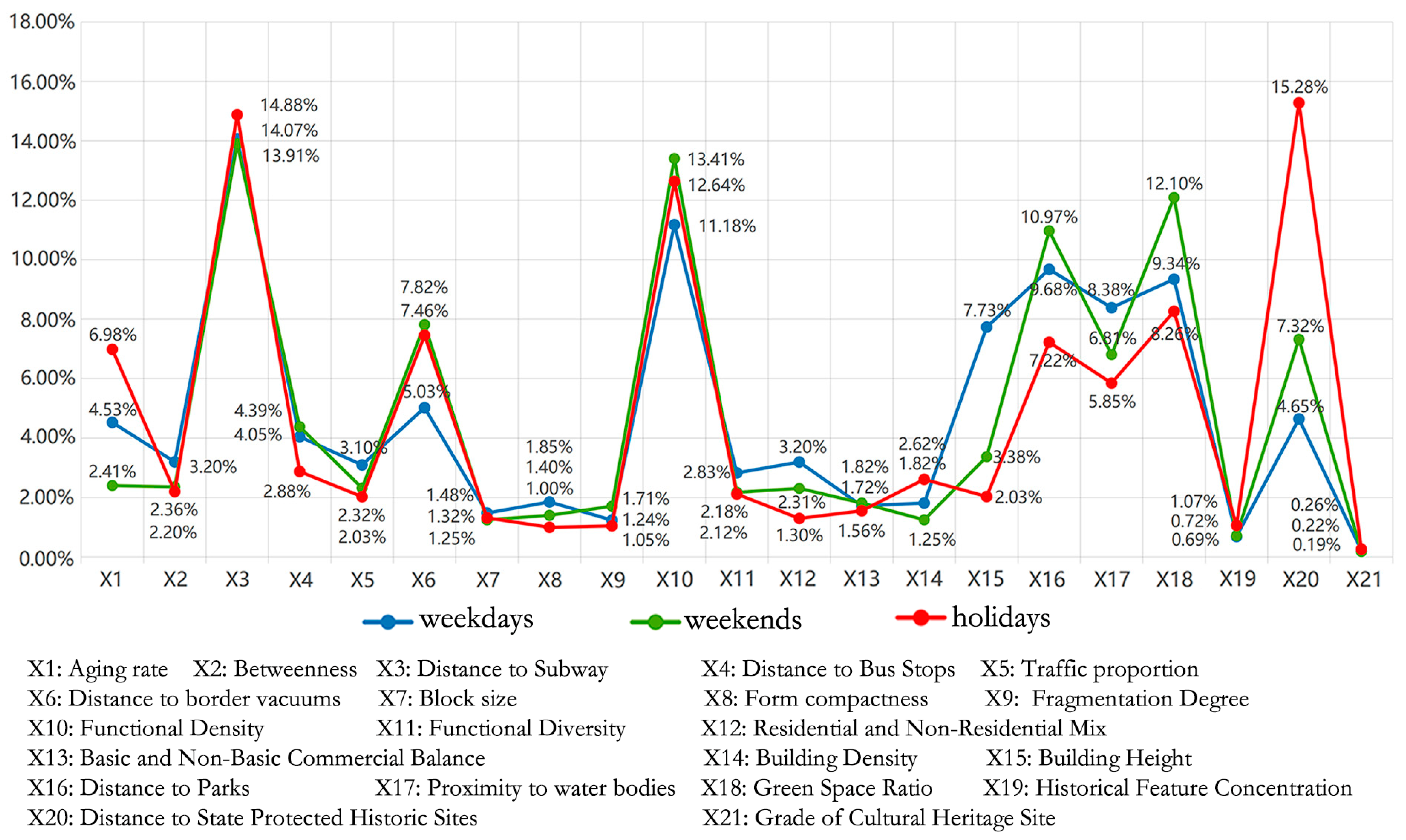
| Dependent variable | Block vitality | Average aggregated heat value within each block over the studied time period | |
| Independent variables | Socioeconomics | Aging rate | Percentage of residents aged 65 and over relative to the total subdistrict population |
| Location and transportation | Betweenness | Frequency with which a node appears on the shortest path between other nodes | |
| Distance to subway | Euclidean distance from the block centroid to the nearest subway station | ||
| Distance to bus stops | Euclidean distance from the block centroid to the nearest bus stop | ||
| Traffic proportion | Combined advantages of driving, public transit, and walking accessibility | ||
| Distance to border vacuums | Euclidean distance to large-scale single-use barriers detrimental to urban vitality | ||
| Spatial form | Block size | Block unit area | |
| Form compactness | Measurement of spatial planar shape compactness | ||
| Fragmentation degree | The extent of land subdivision within the block | ||
| Functional character | Functional density | Density of POI | |
| Functional diversity | Diversity ratio of different POI functional types | ||
| Residential and non-residential mix | Residential and Non-Residential Use Balance | ||
| Basic and non-basic commercial balance | Balance between essential and non-essential commercial facilities | ||
| Building scale | Building density | Ratio of building footprint area to the site area | |
| Building height | Mean height of buildings | ||
| Ecological environment | Distance to parks | Euclidean distance from the block centroid to the nearest park | |
| Proximity to water bodies | Euclidean distance from the block centroid to the nearest water body | ||
| Green space ratio | Ratio of vegetation coverage area to total area | ||
| Historic attractiveness | Historical feature concentration | Ratio of historic building POIs | |
| Distance to state protected historic sites | Euclidean distance from the block centroid to the nearest state protected historic sites | ||
| Grade of Cultural Heritage Site | Weighted score based on the protection level of cultural heritage sites and historic buildings | ||
Disclaimer/Publisher’s Note: The statements, opinions and data contained in all publications are solely those of the individual author(s) and contributor(s) and not of MDPI and/or the editor(s). MDPI and/or the editor(s) disclaim responsibility for any injury to people or property resulting from any ideas, methods, instructions or products referred to in the content. |
© 2026 by the authors. Licensee MDPI, Basel, Switzerland. This article is an open access article distributed under the terms and conditions of the Creative Commons Attribution (CC BY) license.
Share and Cite
Wang, Z.; Gao, Y.; Wei, X.; Lyu, C.; Li, L. Beyond Homogenization: Spatio-Temporal Dynamics of Urban Vitality and the Nonlinear Role of Built Environment in Shenyang’s Historic Urban Area. Land 2026, 15, 431. https://doi.org/10.3390/land15030431
Wang Z, Gao Y, Wei X, Lyu C, Li L. Beyond Homogenization: Spatio-Temporal Dynamics of Urban Vitality and the Nonlinear Role of Built Environment in Shenyang’s Historic Urban Area. Land. 2026; 15(3):431. https://doi.org/10.3390/land15030431
Chicago/Turabian StyleWang, Zijing, Yanpeng Gao, Xinrui Wei, Chang Lyu, and Li Li. 2026. "Beyond Homogenization: Spatio-Temporal Dynamics of Urban Vitality and the Nonlinear Role of Built Environment in Shenyang’s Historic Urban Area" Land 15, no. 3: 431. https://doi.org/10.3390/land15030431
APA StyleWang, Z., Gao, Y., Wei, X., Lyu, C., & Li, L. (2026). Beyond Homogenization: Spatio-Temporal Dynamics of Urban Vitality and the Nonlinear Role of Built Environment in Shenyang’s Historic Urban Area. Land, 15(3), 431. https://doi.org/10.3390/land15030431