Regulatory-Aligned Energy Assessment for Wastewater Collection Networks Under the Scope of the UWWTD 2024/3019




Abstract
1. Introduction
2. Methodology and Data
2.1. Conceptual Framework Basis
2.2. ERSAR Dataset
2.2.1. Available Portuguese Data from the National Water Regulator
- Total energy use (dAR071);
- Energy use for elevation and treatment, when reported separately (dAR072 and dAR073);
- Number of pumping stations and treatment plants (dAR038 and dAR039);
- Reported floods and discharge occurrences, with heterogeneous monitoring coverage (dAR045 to dAR050);
- Self-energy production (dAR070);
- Population equivalent served by WWTPs (dAR046);
- Total collected or treated wastewater volumes (dAR056 and dAR060/61);
- Wastewater volumes in the three months with the highest and lowest volumes (dAR067 and dAR068).
- Specific energy intensity (kWh/m3): can be calculated;
- Pumping stations energy efficiency (kWh/(m3.100 m) (AR16): included;
- Self-energy production (%) (AR19): included;
- Functional energy allocation, e.g., pumping versus treatment share: can be calculated;
- Energy use associated with wastewater treated (kWh/m3) (PAR06): included;
- Energy use for WWTPs per population equivalent (kWh/e.p.): can be calculated;
- Preliminary estimates of indirect GHG emissions, using national emission factors (kg CO2e/m3) (PAR04): included;
- Undue inflows seasonality (-) (PAR03): included;
- Floods occurrence (n.º/100 km sewer.year) (AR04): included;
- Control of emergency and storm overflow discharges (%) (AR20): included.
2.2.2. Structural Limitations of the Current Regulatory Dataset
- Aggregation bias—energy and volume data are typically reported annually at utility scale, masking intra-annual variability and hydraulic seasonality;
- Limited subsystem disaggregation—energy use is rarely reported at the individual pumping station level or network segments, preventing functional disaggregation comparable to WWTP energy audits;
- Absence of hydraulic normalisation variables—reporting does not systematically include volumes generated within the served area, pumped volumes by elevation range, or dynamic head conditions;
- Insufficient quantification of undue inflows—although floods and overflows are reported, volumetric measurements are inconsistent or unavailable;
- Measurement heterogeneity—monitoring practices vary significantly across utilities, affecting data consistency;
- Limited emissions granularity—GHG emissions are not directly measured and must be estimated from energy use.
2.2.3. Analytical Implications for UWWTD Alignment
- Link energy use to hydraulic drivers (e.g., rainfall-derived inflows);
- Assess seasonal and event-based variability;
- Evaluate exceedance volumes and their energy implications;
- Quantify system-level GHG impacts;
- Ensure traceable and auditable energy allocation across system components.
2.3. Regulatory Alignment Procedure
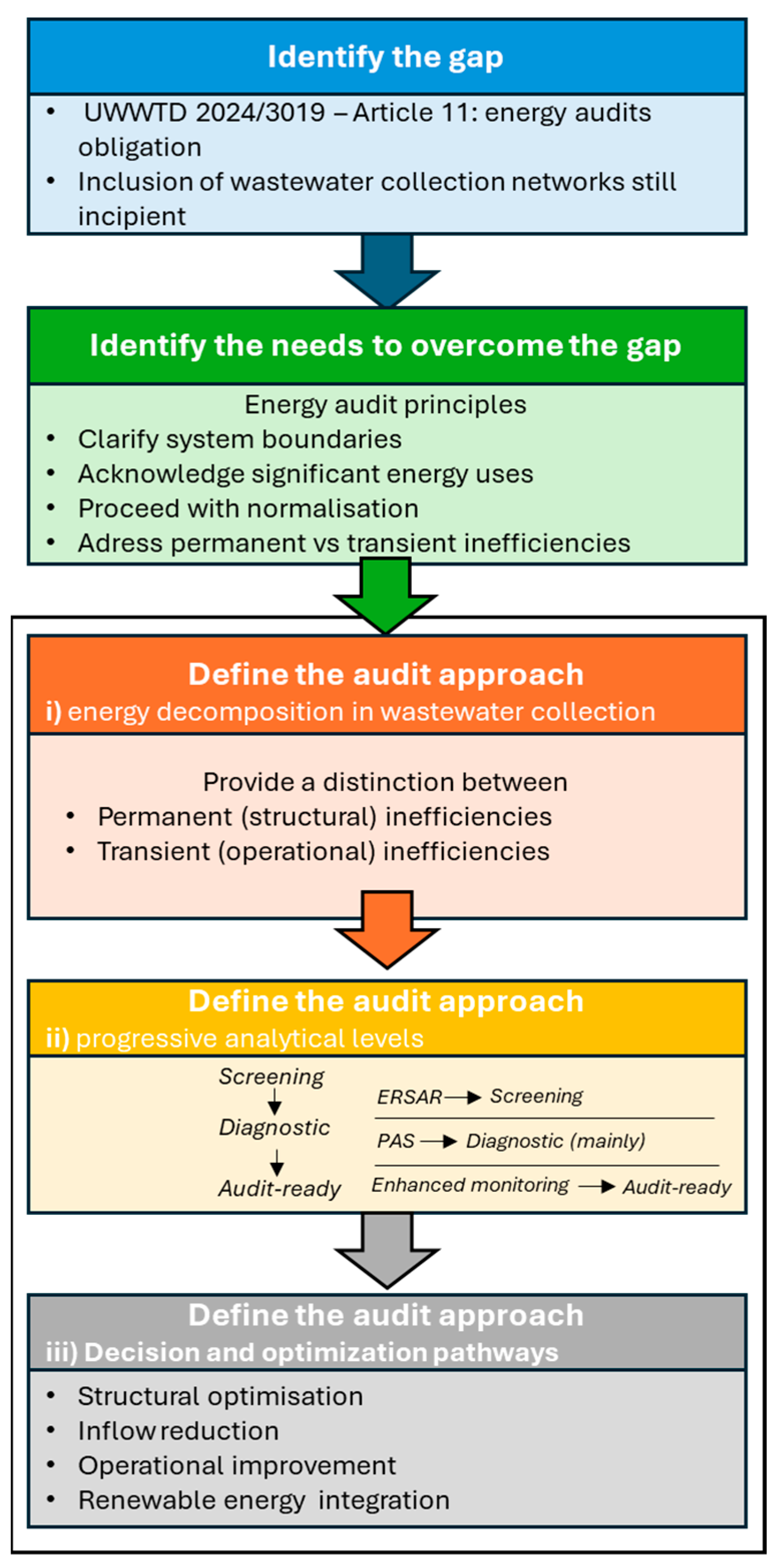
- System-level energy accountability—the Directive requires wastewater collection networks to be explicitly included in energy audits. Because energy neutrality targets apply at the system level, assessments can no longer focus solely on WWTPs. Instead, the entire system (including collection, transport, and treatment) must be addressed through consistent boundaries and functional energy use disaggregation (e.g., elevation, treatment, auxiliary services).
- Hydraulic–energy integration—by formally incorporating combined sewer systems, stormwater discharges, and overflow management, the Directive establishes hydraulic behaviour as a determinant of energy performance. Energy consumption must, therefore, be evaluated in relation to flow variability, rainfall influence, and exceedance events. This requires hydraulic normalisation and seasonality-based metrics capable of capturing undue inflows and rainfall-driven variability.
- Emissions transparency—to support climate objectives, energy use must be systematically translated into GHG emissions. This implies consistent linkage between electricity use and emission factors and, where applicable, differentiation between direct and indirect emissions. Emissions intensity metrics must, therefore, complement traditional energy intensity metrics.
- Comparability and scalability across Member States imply that regulatory instruments must be replicable and compatible with aggregated national datasets while allowing progressive refinement where more detailed measurements are available. This ensures both harmonisation and adaptability.
- Prioritises energy intensity and functional allocation metrics;
- Incorporates undue inflows and rainfall-driven variability as structural drivers of energy performance;
- Ensures explicit linkage between energy use and GHG emissions;
- Maintains compatibility with existing regulatory reporting datasets and structure (e.g., ERSAR);
- Enables progressive enhancement through additional measurements at the utility or subsystem level.
- Structural energy demand—driven by topography, network configuration, and required elevations;
- Excess-driven energy—associated with undue inflows and rainfall events;
- Operational variability—linked to pump efficiency, control strategies, and operational practices;
- Renewable-related components of energy use.
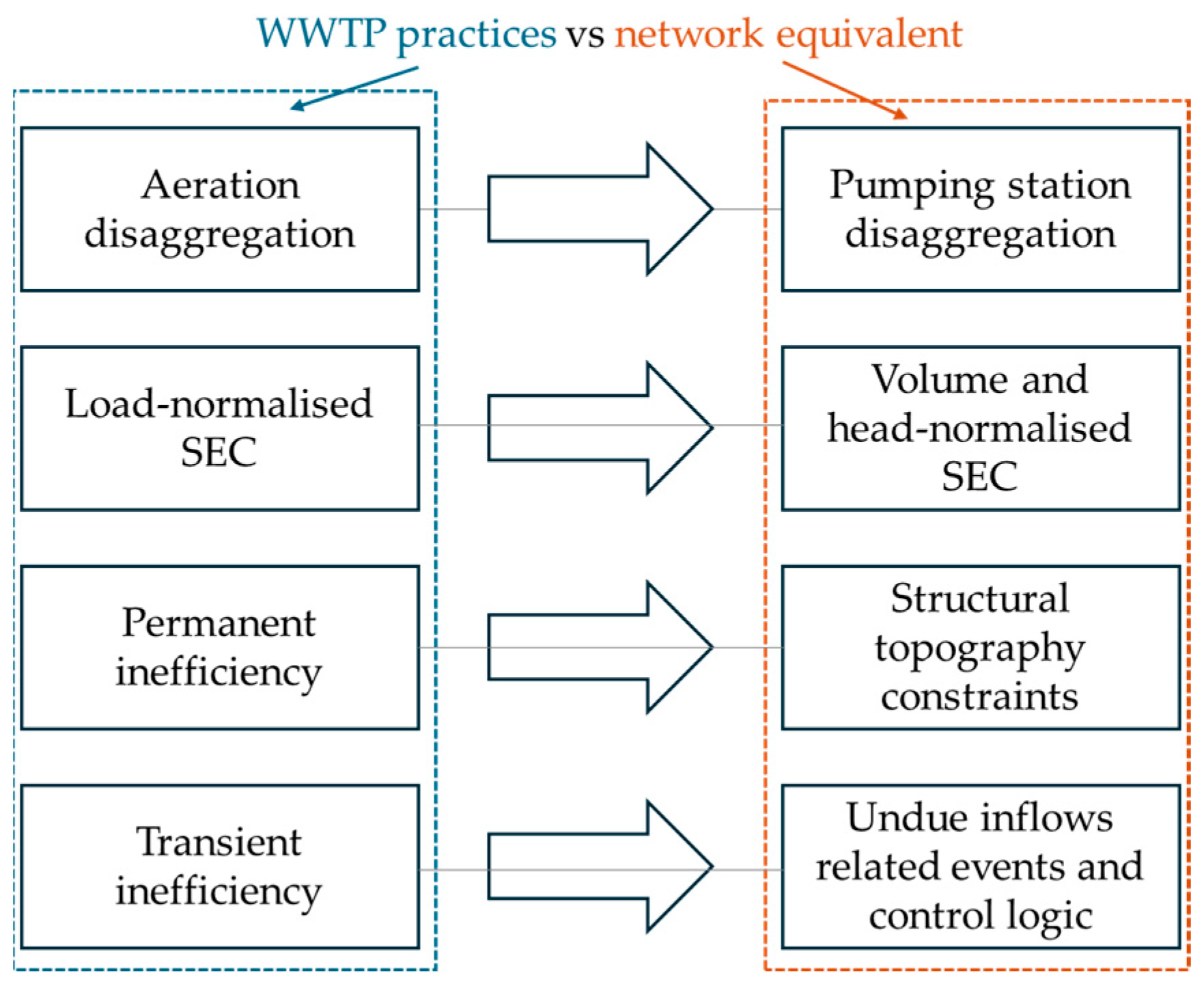
2.4. Energy Audit Principles and Their Translation to Wastewater Collection Networks
- Clear definition of system boundaries;
- Identification of significant energy uses;
- Subsystem-level disaggregation where measurement capabilities allow;
- Normalisation against relevant hydraulic or pollutant loads;
- Distinction between permanent (structural) and transient (operational) inefficiencies;
- Structured audit cycles, including identification and verification of improvement measures.
3. Results
3.1. National Baseline: Energy Performance Assessment from Regulator Data
3.2. Regulatory-Aligned Audit Framework for Wastewater Collection Networks
3.2.1. Decomposition of Network Energy Demand
- represents structurally required energy associated with topography, elevation, and network configuration;
- corresponds to energy induced by undue inflows, rainfall-driven variability, and excess conveyed volumes;
- reflects deviations linked to pump efficiency, control logic, and operational practices.
3.2.2. Progressive Metrics Structure and Alignment
- Screening level—aggregated metrics enabling benchmarking;
- Diagnostic level—partial functional disaggregation allowing preliminary identification of dominant drivers;
- Audit-ready level—subsystem-based metrics permitting defensible attribution of structural versus avoidable energy components.
3.3. From Assessment to Energy-Oriented Decision Pathways
4. Discussion
5. Conclusions
Author Contributions
Funding
Data Availability Statement
Conflicts of Interest
Abbreviations
| ERSAR | Portuguese water and waste service’s national regulator (acronym in Portuguese) |
| EU | European Union |
| GHG | Greenhouse gas |
| O&M | Operation and Maintenance |
| PAS | Performance Assessment System |
| SCADA | Supervisory Control and Data Acquisition |
| SEC | Specific Energy Consumption |
| tep | Tonne of oil equivalent |
| UWWTD | EU Urban Wastewater Treatment Directive |
| W-E-G | Water–Energy–Greenhouse gas emissions |
| WW | Wastewater |
| WWTP | Wastewater treatment plant |
References
- IEA. Electricity Consumption in the Water Sector by Process, 2014–2040; IEA: Paris, France, 2020; Available online: https://www.iea.org/data-and-statistics/charts/electricity-consumption-in-the-water-sector-by-process-2014-2040 (accessed on 25 January 2026).
- Hamawand, I. Energy Consumption in Water/Wastewater Treatment Industry—Optimisation Potentials. Energies 2023, 16, 2433. [Google Scholar] [CrossRef]
- Olsson, G. Water and Energy: Threats and Opportunities; IWA Publishing: London, UK, 2012. [Google Scholar]
- Gude, V.G. Energy and water autarky of wastewater treatment and power generation systems. Renew. Sustain. Energy Rev. 2015, 45, 52–68. [Google Scholar] [CrossRef]
- Reifsnyder, S.; Cecconi, F.; Rosso, D. Dynamic load shifting for the abatement of GHG emissions, power demand, energy use, and costs in metropolitan hybrid wastewater treatment systems. Water Res. 2021, 200, 117224. [Google Scholar] [CrossRef]
- Zhang, D.; Dong, X.; Zeng, S.; Wang, X.; Gong, D.; Mo, L. Wastewater reuse and energy saving require a more decentralized urban wastewater system? Evidence from multi-objective optimal design at the city scale. Water Res. 2023, 235, 119923. [Google Scholar] [CrossRef]
- Longo, S.; d’Antoni, B.M.; Bongards, M.; Chaparro, A.; Cronrath, A.; Fatone, F.; Lema, J.M.; Mauricio-Iglesias, M.; Soares, A.; Hospido, A. Monitoring and diagnosis of energy consumption in wastewater treatment plants. A state of the art and proposals for improvement. Appl. Energy 2016, 179, 1251–1268. [Google Scholar] [CrossRef]
- Panepinto, D.; Fiore, S.; Zappone, M.; Genon, G.; Meucci, L. Evaluation of the energy efficiency of a large wastewater treatment plant in Italy. Appl. Energy 2016, 161, 404–411. [Google Scholar] [CrossRef]
- Capodaglio, A.G. Energy Audits and Energy Efficiency of Urban Wastewater Systems, Following UWWTP Directive 2024/3019. Water 2025, 17, 2049. [Google Scholar] [CrossRef]
- Silva, C.; Rosa, M.J. Energy performance indicators of wastewater treatment: A field study with 17 Portuguese plants. Water Sci. Technol. 2015, 72, 510–519. [Google Scholar] [CrossRef]
- Gu, Y.; Li, Y.; Li, X.; Luo, P.; Wang, H.; Wang, X.; Wu, J.; Li, F. Energy self-sufficient wastewater treatment plants: Feasibility and challenges. Renew. Sustain. Energy Rev. 2017, 75, 1175–1188. [Google Scholar] [CrossRef]
- Hao, X.; Wang, X.; Liu, R.; Li, S.; van Loosdrecht, M.C.; Jiang, H. Environmental impacts of resource recovery from wastewater treatment plants. Water Res. 2019, 160, 268–277. [Google Scholar] [CrossRef]
- Corominas, L.; Byrne, D.M.; Guest, J.S.; Hospido, A.; Roux, P.; Shaw, A.; Short, M.D. The application of life cycle assessment (LCA) to wastewater treatment: A best practice guide and critical review. Water Res. 2020, 184, 116058. [Google Scholar] [CrossRef]
- Cardoso, B.J.; Rodrigues, E.; Gaspar, A.R.; Gomes, A. Energy performance factors in wastewater treatment plants: A review. J. Clean. Prod. 2021, 322, 129107. [Google Scholar] [CrossRef]
- EU. Directive (EU) 2024/3019 of the European Parliament and of the Council of 27 November 2024, Concerning Urban Wastewater Treatment; Official Journal of the European Union; EU: Brussels, Belgium, 2024. [Google Scholar]
- Flores-Alsina, X.; Corominas, L.; Snip, L.; Vanrolleghem, P.A. Including greenhouse gas emissions during benchmarking of wastewater treatment plant control strategies. Water Res. 2011, 45, 4700–4710. [Google Scholar] [CrossRef] [PubMed]
- Hernández-Sancho, F.; Molinos-Senante, M.; Sala-Garrido, R. Energy efficiency in Spanish wastewater treatment plants: A non-radial DEA approach. Sci. Total Environ. 2011, 409, 2693–2699. [Google Scholar] [CrossRef]
- Torregrossa, D.; Schutz, G.; Cornelissen, A.; Hernández-Sancho, F.; Hansen, J. Energy saving in WWTP: Daily benchmarking under uncertainty and data availability limitations. Environ. Res. 2016, 148, 330–337. [Google Scholar] [CrossRef]
- Jorge, C.; Almeida, M.C.; Covas, D. Performance assessment system for energy efficiency in wastewater systems. Water 2021, 13, 1807. [Google Scholar] [CrossRef]
- Jorge, C.; Almeida, M.C.; Brito, R.S.; Covas, D. Water, energy, and emissions nexus: Effect of inflows in urban drainage systems. Water 2022, 14, 868. [Google Scholar] [CrossRef]
- Jorge, C.; Almeida, M.C.; Covas, D. A novel energy balance tailored for wastewater systems. Urban Water J. 2022, 19, 441–452. [Google Scholar] [CrossRef]
- Cabrera, E.; Pardo, M.A.; Cobacho, R.; Cabrera, E., Jr. Energy audit of water networks. J. Resour. Plan. Manag. 2010, 136, 669–677. [Google Scholar] [CrossRef]
- Organisation for Economic Co-operation and Development (OECD). Water Governance in OECD Countries: A Multi-Level Approach; OECD Publishing: Paris, France, 2011. [Google Scholar] [CrossRef]
- Amaral, A.L.; Martins, R.; Dias, L.C. Efficiency benchmarking of wastewater service providers: An analysis based on the Portuguese case. J. Environ. Manag. 2022, 321, 115914. [Google Scholar] [CrossRef]
- Greenberg, E. Energy Audits for Water and Wastewater Treatment Plants and Pump Stations; Continuing Education and Development, Inc.: Stony Point, NY, USA, 2013. [Google Scholar]
- Kroll, S.; Fenu, A.; Wambecq, T.; Weemaes, M.; Van Impe, J.; Willems, P. Energy optimization of the urban drainage system by integrated real-time control during wet and dry weather conditions. Urban Water J. 2018, 15, 362–370. [Google Scholar] [CrossRef]
- Ahmed, W.; Angel, N.; Edson, J.; Bibby, K.; Bivins, A.; O’Brien, J.W.; Choi, P.M.; Kitajima, M.; Simpson, S.L.; Li, J.; et al. First confirmed detection of SARS-CoV-2 in untreated wastewater in Australia: A proof of concept for the wastewater surveillance of COVID-19 in the community. Sci. Total Environ. 2020, 728, 138764. [Google Scholar] [CrossRef]
- Ramos, H.M.; Carravetta, A.; Mc Nabola, A. New Challenges in Water Systems. Water 2020, 12, 2340. [Google Scholar] [CrossRef]
- ERSAR. Annual Report on Water and Waste Services in Portugal (RASARP) 2018; Entidade Reguladora dos Serviços de Águas e Resíduos: Lisbon, Portugal, 2018; Volume 1. Available online: http://www.ersar.pt/pt/publicacoes/relatorio-anual-do-setor (accessed on 15 January 2021). (In Portuguese)
- ERSAR; ADENE. Efficient Energy Uses in Water Services. Technical Guide 24; The Water and Waste Services Regulation Authority (ERSAR) and Agency for Energy (ADENE): Lisbon, Portugal, 2018; ISBN 978-972-98996-5-2. Available online: http://www.ersar.pt/pt/publicacoes/publicacoes-tecnicas/guias (accessed on 15 January 2021). (In Portuguese)
- Cardoso, M.A.; Rosa, M.J.; Brito, R.S.; Silva, C.; Beceiro, P.; Jorge, C.; Alegre, H.; Martinho, G.; Pina, J.; Silveira, A.; et al. Guia de Avaliação da Qualidade dos Serviços de Águas e Resíduos Prestados aos Utilizadores. 4ª Geração do Sistema de Avaliação; ERSAR: Lisboa, Portugal; LNEC: Lisboa, Portugal; NOVA: Lisboa, Portugal, 2022; ISBN 978-989-8360-42-7. (In Portuguese) [Google Scholar]
- Matos, R.; Cardoso, A.; Duarte, P.; Molinari, A.; Shulz, A. Performance Indicators for Wastewater Services; IWA Publishing: London, UK, 2003; ISBN 9781900222907. [Google Scholar]
- Almeida, M.C.; Brito, R.S.; Jorge, C.; Cardoso, M.A. Performance assessment system to wastewater utilities strategic planning. Water 2021, 13, 2489. [Google Scholar] [CrossRef]
- ERSAR. Annual Report on Water and Waste Services in Portugal (RASARP); ERSAR: Lisbon, Portugal, 2024. Available online: http://www.ersar.pt/pt/publicacoes/relatorio-anual-do-setor (accessed on 25 January 2026). (In Portuguese)
- ISO 50002:2014; Energy Audits—Requirements with Guidance for Use. ISO: Geneva, Switzerland, 2014.
- EU. Directive (EU) 2023/1791 of the European Parliament and of the Council of 13 September 2023 on Energy Efficiency and Amending Regulation (EU) 2023/955 (Recast); Official Journal of the European Union; EU: Brussels, Belgium, 2023. [Google Scholar]
- ERSAR. Annual Report on Water and Waste Services in Portugal (RASARP); ERSAR: Lisbon, Portugal, 2023. Available online: http://www.ersar.pt/pt/publicacoes/relatorio-anual-do-setor (accessed on 25 January 2026). (In Portuguese)
- Decree-law 71/2008—Decree-Law n.º 71/2008, de 15 de Abril. Diário da República n.º 74/2008, Série I de 2008-04-15. 2008, pp. 2222–2226. Available online: https://dre.pt/dre/detalhe/decreto-lei/71-2008-249821 (accessed on 30 December 2021). (In Portuguese)
- Jorge, C.; Almeida, M.C.; Covas, D. From assessment to a decision: A global framework for the management of energy use in wastewater systems. Int. J. Environ. Sci. Technol. 2023, 21, 1729–1744. [Google Scholar] [CrossRef]


| Metric * | Reference Values ** |
|---|---|
| Objective 1 | Energy consumption efficiency | |
| Criterion 1.1: Energy efficiency of wastewater systems | |
| M1.1.1: Specific energy per total WW volume (kWh/m3)—metric from [30] | A: [0, 0.5]; ]0.5, 0.6]; ]0.6, +∞[ B: [0, 0.2]; ]0.2, 0.3]; ]0.3, +∞[ |
| M1.1.2: Specific energy per total pumped volume (kWh/m3) | A: [0, 0.5]; ]0.5, 1.7]; ]1.7, +∞[ B: [0, 0.09]; ]0.09, 0.12]; ]0.12, +∞[ |
| M1.1.3: Pumping stations energy efficiency [kWh (m3.100 m)]—metric from [29] | [0.27, 0.45]; ]0.45,0.68]; ]0.68,5[ |
| P1 and M1.1.4: Percentage of total energy use for elevation (%) | A: [0, 15]; ]15, 30[; [30, 100] B: [0, 5]; ]5, 40[; [40, 100] |
| P2 and M1.1.5: Percentage of total energy use for WW treatment (%) | A: [0, 5]; ]5, 50[; [50, 100] B: [0, 5]; ]5, 30[; [30, 100] |
| M1.1.6: Energy consumption for WWTP per population equivalent (kWh/e.p.)—metric adapted from [32] | [0, 20]; ]20, 50[; [50, +∞[ |
| M1.1.7: Percentage of pumps with acceptable efficiency (%) | - |
| Criterion 1.2: Practices of operation, cleaning, and maintenance | |
| M1.2.1: Energy consumption for sewer network cleaning [tep/(100 km.year)] | - |
| M1.2.2: Energy consumption for septic tanks cleaning [tep/(km of travel.year)] | - |
| M1.2.3: Operation practices improvement to lower elevation height (−) | - |
| Criterion 1.3: Control of undue inflows | |
| M1.3.1: Quarter energy peak factor (−) | [1.0, 1.25[; [1.25, 1.75[; [1.75, +∞[ |
| P6 and M1.3.2: Energy consumption seasonality (−) | [1.0, 1.75[; [1.75, 2.5[; [2.5, +∞[ |
| M1.3.3: Percentage of energy equivalent to the volume generated in the served area used for elevation (%) | [95, 100]; [80, 95[; [0, 80[ |
| P3 and M1.3.4: Percentage of energy equivalent to the volume generated in the served area used for WW treatment (%) | [95, 100]; [80, 95[; [0, 80[ |
| M1.3.5: Effect of excessive inflows on energy use (%) | [0, 2.0[; [2.0, 5.0[; [5.0, 100] |
| P4. Inflows seasonality (−)—metric from [33] | [1, 1.25[; [1.25, 2.0[; [2.0, +∞[ |
| P5. Inflows in periods with precipitation (−)—metric from [33] | [1, 1.25[; [1.25, 2.0[; [2.0, +∞[ |
| P7. Energy consumption in periods with precipitation (−) | [1.0, 1.75[; [1.75, 2.5[; [2.5, +∞[ |
| P8. Effect of undue inflows in energy (−) | [0, 2.0[; [2.0, 5.0[; [5.0, +∞[ |
| P9. Effect of infiltration on energy (−) | [0, 2.0[; [2.0, 5.0[; [5.0, +∞[ |
| P10. Effect of rain-derived inflows on energy (−) | [0, 2.0[; [2.0, 5.0[; [5.0, +∞[ |
| Objective 2 | Carbon neutrality | |
| Criterion 2.1: GHG emissions in equipment, processes, and transport | |
| P11 and M2.1.1: Specific GHG emissions associated with total WW volume (kg CO2 eq/m3) | [0, 0.3]; ]0.3, 0.5]; ]0.5, +∞[ |
| P12 and M2.1.2: Specific GHG emissions associated with pumped volume (kg CO2 eq/m3) | [0, 0.4]; ]0.4, 0.5]; ]0.5, +∞[ |
| P13 and M2.1.3: Specific GHG emissions associated with WW-treated volume (kg CO2 eq/m3) | [0, 0.2]; ]0.2, 0.4]; ]0.4, +∞[ |
| P14 and M2.1.4: Specific GHG emissions associated with the volume generated in the served area (kg CO2 eq/m3) | - |
| M2.1.5: Specific GHG emissions associated with O&M (kg CO2 eq/m3) | [0, 1 × 10⁻⁴]; ]1 × 10⁻⁴, 2 × 10⁻⁴]; ]2 × 10⁻⁴, +∞[ |
| Criterion 2.2: Use of clean energy | |
| M2.2.1: Percentage of total energy use from clean energy sources (%) | - |
| Objective 3 | Energy production and recovery | |
| Criterion 3.1: Self-energy production | |
| M3.1.1: Energy self-production (%)—metric from [30] | [20, 100]; [10, 20[; [0, 10[ |
| Criterion 3.2: Energy recovery | |
| M3.2.1: Recovered energy (%) | - |
| Criterion 3.3: Use of purely gravity systems | |
| M3.3.1: Percentage of sewer network not associated with pumping stations (%) | - |
| Objective 4 | Economic and financial sustainability | |
| Criterion 4.1: Wastewater system associated costs (except maintenance) | |
| M4.1.1: Percentage of the cost of total energy equivalent to the volume generated in the served area used for elevation (%) | - |
| M4.1.2: Percentage of the cost of total energy equivalent to the volume generated in the served area used for WW treatment (%) | - |
| M4.1.3: Percentage of the cost of total energy use for elevation (%) | - |
| M4.1.4: Percentage of the cost of total energy use for WW treatment (%) | - |
| M4.1.5: Cost associated with the quarter energy peak factor (−) | [1, 1.5]; [1.5, 2.5[; [2.5, +∞[ |
| M4.1.6: Cost associated with energy use seasonality (−) | [1, 2]; [2, 3[; [3, +∞[ |
| M4.1.7: Percentage of the cost associated with energy self-production (%) | - |
| M4.1.8: O&M costs of energy use reduction by control of undue inflows (%) | - |
| Criterion 4.2: Maintenance costs | |
| M4.2.1: Repair or replacement costs of pumping equipment [€/(equipment.year)] | - |
| M4.2.2: Cleaning operations costs of energy [€/(100 km.year)] | - |
| M4.2.3: Solids removal operations costs of energy [€/(kg.year)] | - |
| Metric | Units | Formulation | Reference Values |
|---|---|---|---|
| AR16: Pumping stations’ energy efficiency (1) | kWh/(m3.100 m) | Energy consumption for elevation/standardisation factor Note—Standardisation factor: m3/(year.100 m) | [0.27; 0.54];]0.54;0.90]; ]0.90; 5.00[ |
| AR19: Self-energy production | % | Energy consumption from self-production/total energy use × 100 | A: [0, 5]; ]5, 50[; [50, 100] B: [0, 5]; ]5, 30[; [30, 100] |
| PAR06: Energy consumption for treated wastewater | kWh/m3 | Energy consumption for treatment/total wastewater treated volume | - |
| PAR04: Specific GHG emissions (2) | kg CO2eq/m3 | Total energy use × IF (3)/total volume of wastewater collected or treated × 1000 | [0, 0.2]; ]0.2, 0.34]; ]0.34, +∞[ (4) |
| PAR03: Undue inflows seasonality | - | Wastewater volumes in the three months with the highest volumes/wastewater volumes in the three months with the lowest volumes | - |
| AR04: Flood occurrence | n.º/100 km sewer.year (type A) or n.º/1000 connections.year (type B) | Number of flooding occurrences in public areas and/or properties originating from the public wastewater sewer network/100 km of sewer (type A) or/1000 connections (type B) | A: [0.0; 0.5];]0.5;2.0]; ]2.0; +∞[ B: [0.0; 0.25];]0.25;1.0]; ]1.0; +∞[ |
| AR20: Control of emergency and storm overflow discharges | % | Emergency and storm overflow structures with direct discharge to the receiving environment that are monitored and operating satisfactorily/total number of these structures | [90, 100]; [80, 90[; [0, 80[ |
| Metric | n | Min | P25 | Average | Median | P75 | Max | Boxplot (1) |
|---|---|---|---|---|---|---|---|---|
| AR16: Pumping stations’ energy efficiency [kWh/(m3.100 m)] | 160 | 0.38 | 0.66 | 1.02 | 0.90 | 1.19 | 3.51 |  |
| AR19: Self-energy production (%) | 314 | 0.00 | 0.00 | 1.37 | 0.00 | 0.00 | 54.00 |  |
| PAR06: Energy consumption associated with wastewater treated (kWh/m3) | 223 | 0.00 | 0.32 | 0.97 | 0.58 | 1.08 | 6.85 |  |
| PAR04: Specific GHG emissions (kg CO2eq/m3) | 300 | 0.00 | 0.00 | 0.05 | 0.02 | 0.07 | 0.54 |  |
| PAR03: Undue inflows seasonality (−) | 142 | 1.00 | 2.00 | 148.65 | 118.00 | 201.75 | 2680.00 |  |
| AR04: Flood occurrence (n.º/1000 drains.year) | 361 | 0.00 | 0.00 | 3.90 | 0.75 | 3.93 | 52.19 |  |
| AR20: Control of emergency and storm overflow discharges (%) | 247 | 0.00 | 0.00 | 27.29 | 0.00 | 54.00 | 100.00 |  |
| Metric | n | Min | P25 | Average | Median | P75 | Max | Boxplot (1) |
|---|---|---|---|---|---|---|---|---|
| AR16: Pumping stations’ energy efficiency [kWh/(m3.100 m)] | 24 | 0.3 | 0.50 | 0.59 | 0.58 | 0.63 | 0.92 |  |
| AR19: Self-energy production (%) | 24 | 0.00 | 0.00 | 6.38 | 2.00 | 9.25 | 25 |  |
| PAR06: Energy consumption associated with wastewater treated (kWh/m3) | 24 | 0.15 | 0.33 | 0.41 | 0.43 | 0.54 | 0.61 |  |
| PAR04: Specific GHG emissions (kg CO2eq/m3) | 24 | 0.03 | 0.08 | 0.091 | 0.09 | 0.11 | 0.15 |  |
| PAR03: Undue inflows seasonality (−) | 24 | 1.00 | 2.00 | 79.29 | 57.50 | 151.75 | 201.00 |  |
| AR04: Flood occurrence (n.º/100 km sewer.year) | 24 | 0.00 | 0.30 | 50.33 | 3.55 | 10.13 | 610.70 |  |
| AR20: Control of emergency and storm overflow discharges (%) | 24 | 0.00 | 0.75 | 20.75 | 11.50 | 37.00 | 62.00 |  |
| Assessment Dimension | Metric | Formulation | Primary Data Source | Analytical Level | Additional Data Required |
|---|---|---|---|---|---|
| Structural energy demand | Specific Energy consumption (SEC) (kWh/m3) (1) | Total annual electricity consumption/total collected wastewater volume | ERSAR (dAR071/dAR056) and PAS (M1.1.1) data | Screening | No additional data required for the annual total energy and collected volume |
| Energy per population equivalent (kWh/e.p.·year) | Total annual electricity consumption/population equivalent served | ERSAR (dAR071/dAR046) and PAS (M1.1.6) data | Screening | Consistent and validated reporting at the utility level | |
| Energy per static head (kWh/m3·m) | Electricity consumption normalised by conveyed volume and static elevation head | PAS adaptation for audit (utility data) (2) | Audit-ready | Measurement of static or total dynamic head at pumping stations | |
| Excess-driven energy | Excess volume ratio (–) | Difference between collected and billed wastewater volumes/by collected volume | New. ERSAR (dAR056–dAR062)/dAR56 data | Screening | Reliable billing data and validation of the collected volume measurement |
| Seasonality proxy (–) | Ratio between the maximum and minimum quarterly collected volumes within the same year | ERSAR (PAR03) | Screening | Quarterly or monthly disaggregation of collected volume | |
| Rainfall-adjusted SEC (kWh/m3) | Difference between specific energy use under wet-weather and dry-weather conditions | New (utility+rainfall data) | Diagnostic | Energy data for wet and dry weather periods based on rainfall or flow data | |
| Wet-weather energy factor (–) | Ratio between electricity consumption during wet-weather and dry-weather periods | New (utility data) | Audit-ready | Temporal energy use data and hydraulic classification of wet-weather events | |
| Operational variability | Pumping energy share (–) | Electricity consumption associated with pumping/total electricity consumption | ERSAR (dAR072/dAR071) and PAS (M1.1.4, P1) data | Screening | Functional allocation of energy between pumping and other uses |
| Specific pumping energy (kWh/m3) | Electricity consumption associated with pumping/total pumped wastewater volume | PAS (M1.1.2) | Diagnostic | Pumping-station-level energy metering and pumped volume measurement | |
| Pump efficiency deviation index (–) | Deviation between actual pumping performance and theoretical pump curve efficiency | New (utility data) | Audit-ready | Pump-level flow, total dynamic head, and power data compared to operating points with manufacturer pump curves | |
| Renewable-related component | Self-production ratio (–) | Electricity generated internally from renewable sources divided by total electricity consumption | ERSAR (AR19) and PAS (M3.1.1) | Screening | Separate accounting of internally generated renewable energy |
| Net energy balance (kWh/year) | Difference between total electricity consumption and renewable electricity produced | New. ERSAR (dAR071–dAR070) data | Screening | Annual accounting of total consumption and renewable self-production |
| Assessment Dimension | Objective | Typical Measures | Decision Horizon | Audit Relevance |
|---|---|---|---|---|
| Structural energy demand | Reduce intrinsically required elevation needs and hydraulic constraints | Increased gravitational transport through network reconfiguration Reduction in unnecessary elevation needs Decentralised/modular treatment integration Infrastructure retrofitting to reduce pumping dependence | Medium to long term | Addresses permanent inefficiencies |
| Excess-driven energy | Reduce avoidable energy associated with undue inflows and rainfall variability | Rehabilitation of sewers Stormwater separation Inflow detection and targeted repair Wet-weather monitoring and flow classification | Medium term | Targets transient, hydraulically driven inefficiencies |
| Operational variability | Improve pumping performance and control efficiency | Pump resizing and efficiency optimisation Pump speed control (e.g., variable frequency drives) and optimisation of pumping operation (e.g., start/stop levels and control logic) Predictive SCADA-based operation | Short to medium term | Addresses operational inefficiencies identified in audits |
| Renewable-related component | Offset residual energy demand after demand-side optimisation | Distributed renewable generation (e.g., photovoltaic systems at pumping stations) Utility-level renewable energy supply (e.g., green electricity or centralised photovoltaic systems) | Medium term | Complements efficiency but does not replace demand reduction |
Disclaimer/Publisher’s Note: The statements, opinions and data contained in all publications are solely those of the individual author(s) and contributor(s) and not of MDPI and/or the editor(s). MDPI and/or the editor(s) disclaim responsibility for any injury to people or property resulting from any ideas, methods, instructions or products referred to in the content. |
© 2026 by the authors. Licensee MDPI, Basel, Switzerland. This article is an open access article distributed under the terms and conditions of the Creative Commons Attribution (CC BY) license.
Share and Cite
Jorge, C.; Brito, R.S.; Almeida, M.d.C. Regulatory-Aligned Energy Assessment for Wastewater Collection Networks Under the Scope of the UWWTD 2024/3019. Water 2026, 18, 1109. https://doi.org/10.3390/w18091109
Jorge C, Brito RS, Almeida MdC. Regulatory-Aligned Energy Assessment for Wastewater Collection Networks Under the Scope of the UWWTD 2024/3019. Water. 2026; 18(9):1109. https://doi.org/10.3390/w18091109
Chicago/Turabian StyleJorge, Catarina, Rita Salgado Brito, and Maria do Céu Almeida. 2026. "Regulatory-Aligned Energy Assessment for Wastewater Collection Networks Under the Scope of the UWWTD 2024/3019" Water 18, no. 9: 1109. https://doi.org/10.3390/w18091109
APA StyleJorge, C., Brito, R. S., & Almeida, M. d. C. (2026). Regulatory-Aligned Energy Assessment for Wastewater Collection Networks Under the Scope of the UWWTD 2024/3019. Water, 18(9), 1109. https://doi.org/10.3390/w18091109