Article

Accelerated Settlement Expansion in High-Hazard Areas of the Ganges–Brahmaputra–Meghna Delta

1
Key Laboratory of Water Cycle and Related Land Surface Processes, Institute of Geographic Sciences and Natural Resources Research, Chinese Academy of Sciences, Beijing 100101, China
2
University of Chinese Academy of Sciences, Beijing 100049, China
*
Author to whom correspondence should be addressed.
Water 2026, 18(9), 1029; https://doi.org/10.3390/w18091029
Submission received: 19 January 2026 / Revised: 12 April 2026 / Accepted: 17 April 2026 / Published: 26 April 2026
(This article belongs to the Section Hydrology)

Abstract

The Ganges–Brahmaputra–Meghna (GBM) delta is one of the most densely populated and flood-prone regions in the world. Identifying the exposure patterns of settlement expansion under different flood hazard levels in the GBM delta is of significant importance for enhancing the delta’s regional resilience. This research regionally screens settlement flood exposure by overlaying the Global Urban Expansion Simulation Dataset and the Aqueduct Floods Hazard Map at a 1 km spatial resolution. To account for inter-model variability, this study utilized the ensemble mean of five global climate models for future projections in 2030 and 2050 under SSP2-4.5 and SSP5-8.5 scenarios. Flood hazards were categorized into four specific levels based on inundation depth, namely low-hazard (0–0.15 m), medium-hazard (0.15–0.5 m), high-hazard (0.5–1.5 m), and highest-hazard (≥1.5 m). The study employed spatial overlay analysis and excluded missing pixels to avoid statistical bias from incomplete data. The findings indicate that under historical and future socioeconomic scenarios, both high- and highest-hazard zones exhibit significant settlement expansion, and the expansion rate within highest-hazard zones (270.9–357.1%) is expected to increase substantially compared to the historical baseline, reaching 1.57–1.85 times the expansion rate of flood-safe zones. Within the high- and highest-hazard categories, the contribution rate of fluvial and coastal flood coincidence zones reaches 21% to 22%. Furthermore, approximately 87% of the settlements within these fluvial–coastal coincidence zones are exposed to high-hazard levels or above. This study characterizes the variation characteristics of settlement exposure within fluvial–coastal flood coincidence zones under future socioeconomic scenarios. These results provide a first-order regional screening and macro-scale support for identifying broad exposure trends and establishing a baseline for future high-resolution assessments in the GBM delta.

1. Introduction

Deltas are one of the most critical human–natural systems globally, providing diverse ecosystem services including fertile soils and vast aquaculture potential, and also functioning as international trade and transportation hubs [1,2]. Due to superior natural conditions and abundant resources, deltas have undergone rapid economic development and significant population growth over the past century. Consequently, these regions have become focal points for urbanization, fostering mega-cities such as the Yangtze, Pearl River, Mississippi, and Ganges–Brahmaputra–Meghna (GBM) delta [3,4,5]. As deltas are situated at the boundaries between rivers and oceans, multiple types of flood risks (such as fluvial and coastal flooding) severely threaten deltaic inhabitants and social development, and their increasing flood risk is recognized as the greatest threat to delta survival [6]. Given the immense contributions of deltaic systems to population, agriculture, and fisheries [1,7,8], deltaic flood exposure assessment has become a research hotspot.
The IPCC defines flood exposure as “the presence of people; livelihoods; species or ecosystems; environmental functions, services and resources; infrastructure; or economic, social or cultural assets in places and settings that could be adversely affected” [9]. On a global scale, scholars have explored the variation trends and distribution disparities of flood exposure [10,11,12,13]; it is noteworthy that across various studies employing multiple methods, there is a consensus that flood exposure in Southeast Asia is relatively higher than in other regions [10,11,14]. Specifically, under a 100-year flood event, approximately 1.24 billion people in South and East Asia are directly exposed to a threat of inundation exceeding 0.15 m [15].
Located in South Asia, the GBM delta, including Bangladesh and West Bengal in India, is the largest deltaic system on Earth, where three major rivers (Ganges, Brahmaputra, and Meghna) gather 75% of the runoff from the Himalayan range [16]. Approximately 80% of the annual precipitation in this region occurs during the monsoon season from June to September [17,18,19]. During this period, these three main rivers receive a volume of water equivalent to 90% of the concurrent total rainfall [20,21]. Meanwhile, the delta is situated in a focal region for global cyclonic activity, where storm surge heights can reach 1.5–10 m [12]. Furthermore, human disturbances such as urban expansion and hydropower station construction will lead to land subsidence and sediment starvation in the delta [4,7,22,23], which will further exacerbate flood exposure. All these factors influence the flood exposure and their variations in the GBM delta [12,22,24,25,26]. While much of this research focuses on exposure variations influenced by changes in inundation extent [24,26,27], analyses that consider the difference in exposure under varying inundation depths remain inadequate. A quantitative description of the exposure patterns of settlement exposure in the GBM delta under different flood hazard levels is still vague.
In this research, we map the flood exposure of settlement areas across varying hazard levels in the GBM delta across historical (1992–2020) and future periods (2030 and 2050 under SSP2-4.5 and SSP5-8.5 scenarios). We integrate the Global Urban Expansion Simulation Dataset (GUESD) with the Aqueduct Floods Hazard Map (AFHM). It should be noted that the indirect influence on settlement exposure is not considered herein. For example, exposure affected by subsidence or dynamical interaction between fluvial floods and coastal floods is not considered. Thus, this study focuses only on the first-order exposure assessment of delta flood exposure resulting from urban expansion, without considering the additional impacts of urban expansion or the dynamic interactions between different flood types. The findings may serve as a macro-level data reference for regional-scale flood risk screening and broad strategic planning in the GBM delta within the context of socioeconomic change.

2. Area, Data, and Method

2.1. Area

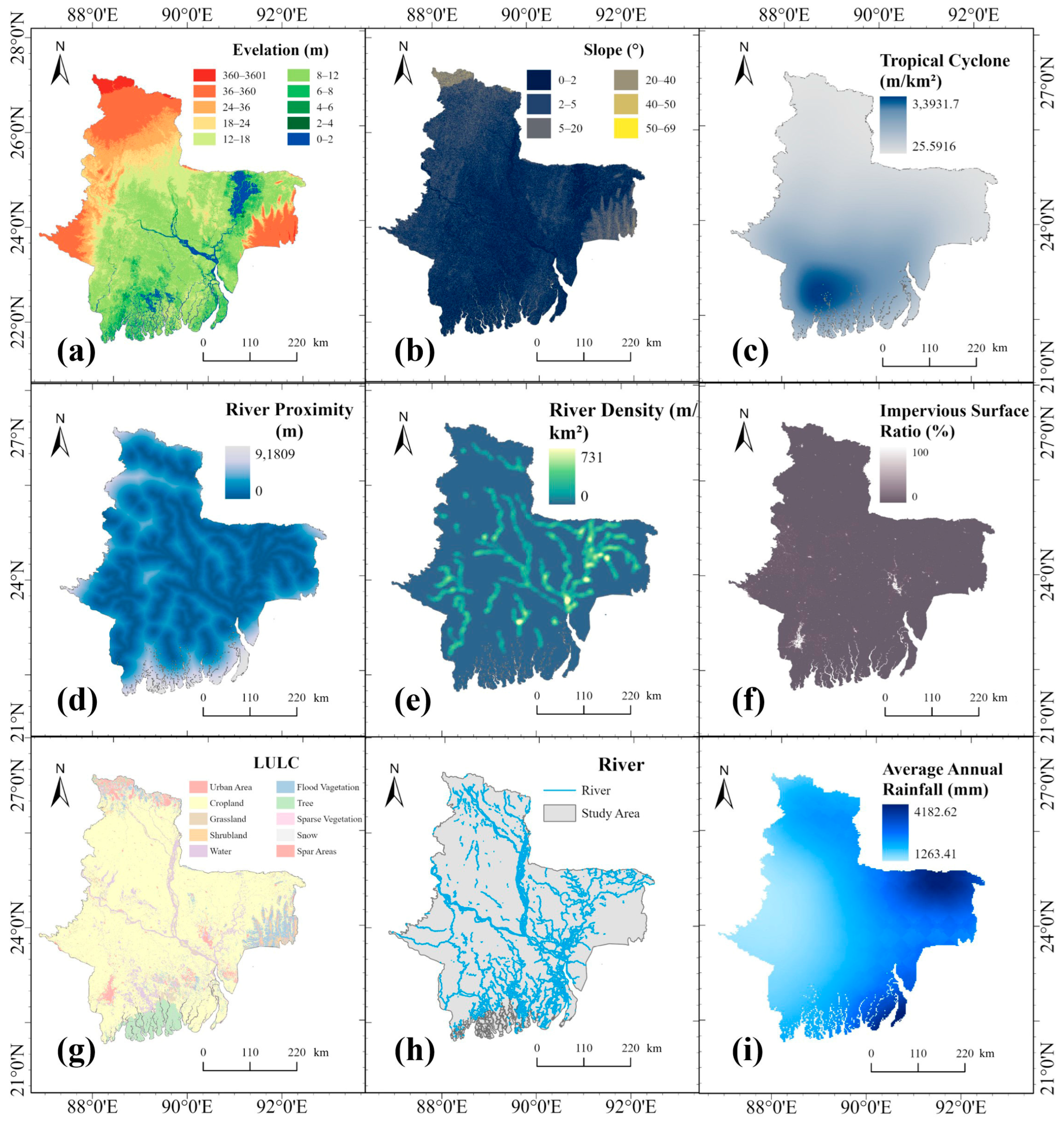
Located at the northern edge of the Bay of Bengal [22], the GBM delta is a low-lying region with a dense network of rivers (Figure 1). Its severe exposure to flooding is exacerbated by both climate change (such as altered precipitation and intensified tropical cyclones) and human activities (such as urban expansion and hydropower station construction). The average elevation of its low-lying areas is only 1 to 2 m, leading to most of these regions being exposed to natural inundation [22]. The delta is highly prone to flood disasters, primarily fluvial and coastal flooding [4,26], and, being periodically exposed to intense tropical cyclones, two-fifths of the global impact area of storm surges (triggered by tropical cyclones) occurs here [28].The majority of the population lives near the coasts and rivers, where the population density reaches a maximum of 4194 people per km2 [29].

2.2. Data

In this research, we perform a spatial overlay analysis to regionally screen settlement flood exposure. Urban expansion data are provided by the GUESD, while the flood hazard data are sourced from the AFHM. The applicability of the AFHM dataset is further discussed in the Discussion Section.
The AFHM [30] is a global risk dataset developed by the WRI alongside Deltares, VU Amsterdam, and Utrecht University. It integrates various high-precision data sources, utilizing the Global Tide and Surge Model (GTSM) to simulate coastal inundation, while the PCRaster Global Water Balance (PCR-GLOBWB) and CaMa-Flood models are employed to simulate global runoff, river routing, and overtopping processes. With a spatial resolution of 1 km, the dataset covers a historical baseline (simulated based on 1960–1999 historical data) and future projections for 2030, 2050, and 2080 under the RCP4.5 and RCP8.5 climate scenarios. While AFHM provides multiple return periods (2, 5, 10, 25, 50, 100, 250, 500, and 1000 years), this research focuses solely on settlement exposure under a 1-in-100-year flood event. This study utilizes sea-level rise projections under the 95th percentile scenario (with the 5th and 50th percentiles as the other two available scenarios). Although land subsidence is also recognized as an important factor influencing flood risk in the GBM delta, multiple studies show that land subsidence is a complex process influenced by human activities such as urban expansion [31], hydropower station construction [32], and groundwater extraction [33], together with factors of climate change such as sea-level rise [7] and rainfall [34]. In this study, we exclude the impact of land subsidence, as this allows for a clearer quantitative analysis of how settlement expansion independently leads to increased flood exposure. The AFHM dataset has been widely applied to analyze flood hazards in both historical and future contexts [14,35,36,37,38,39].
The GUESD [40] was jointly developed by teams from Sun Yat-sen University, Peking University, and other institutions. Based on historical land-use data (such as MODIS and GAIA) and SRTM DEM, GUESD utilizes the Future Land Use Simulation (FLUS) model to generate urban expansion processes under five shared socioeconomic pathways (SSP1, SSP2, SSP3, SSP4, and SSP5). The dataset features a spatial resolution of 1 km and provides temporal coverage for the periods 1992–2020, 2030, and 2050. The accuracy of GUESD has been rigorously validated by comparing simulated 2020 urban extents with observed data. Globally, the dataset achieves a Kappa coefficient of 0.88 and a Figure of Merit (FoM) of 0.23. Specifically, for the GBM delta region, the Kappa coefficients for India and Bangladesh are 0.82 and 0.78, respectively, while the FoM values are 0.22 and 0.28. While acknowledging the inherent uncertainties in land-use projections, these metrics demonstrate the high reliability of GUESD in capturing the spatial distribution of urban expansion within the study area, thereby establishing a robust foundation for subsequent flood exposure assessment.
The importance of fluvial–coastal flood coincidence zones is further identified by the Global Flood Database (GFD). The GFD is an independent, remote sensing-based flood inventory. Developed by Cloud to Street (currently Floodbase) in collaboration with the University of Arizona, the Dartmouth Flood Observatory (DFO), and Google, the GFD provides a high-resolution global atlas of flood inundation [14]. Powered by the Google Earth Engine (GEE) platform, this dataset was generated through the automated classification of tens of thousands of multi-temporal MODIS satellite images with minimal cloud cover. With a spatial resolution of 250 m, the database records the actual inundation extents, durations, and population impacts of 913 major flood events globally from 2000 to 2018. For the purposes of this study, we extracted the cumulative flood inundation extents and inundation frequency data for all recorded events spanning the period from 2000 to 2015.

2.3. Method

The flood exposure of settlement areas across varying hazard levels in the GBM delta was conducted by overlaying urban expansion data and flood hazard data. In this spatial overlay analysis, the urban expansion grids are obtained from the GUESD, and the flood hazard layers are provided by the AFHM. Firstly, the multisource spatial data were preprocessed using Python 3.9 to create a unified analysis dataset with a 1 km spatial resolution. Then, to maintain spatial domain consistency across the comparative analysis, pixels identified as ‘no-data’ in either the GUESD or AFHM datasets were excluded, ensuring that the results are based on a unified geographical coverage. Thirdly, to ensure scenario consistency between the socioeconomic and climate layers, we adopted the standard Scenario Matrix Architecture established for CMIP6 [41]. Specifically, we paired the SSP2 and SSP5 socioeconomic pathways from the GUESD with the RCP4.5 and RCP8.5 climate forcing from the AFHM dataset, respectively. This spatial pairing explicitly aligns with the marker scenarios of CMIP6 (i.e., SSP2-4.5 and SSP5-8.5). Under this framework, the AFHM provides the physical climate hazards by specific radiative forcing levels (RCPs), while the GUESD provides the corresponding settlement exposure footprints by compatible socioeconomic narratives (SSPs). By employing this scenario harmonization approach, we ensured underlying logical consistency between the climate/physical hazards and the socioeconomic trajectories of urban expansion.
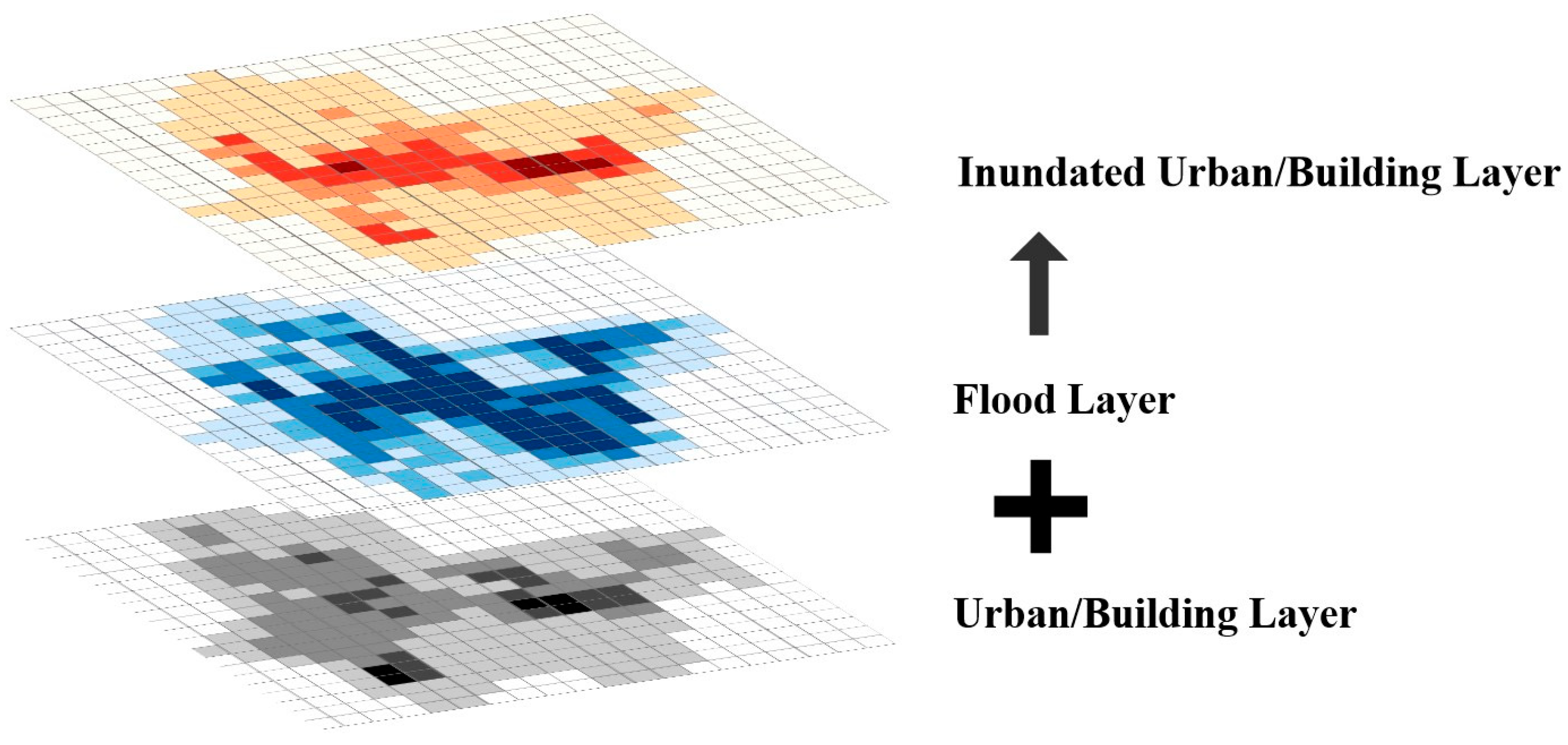
Through the spatial overlay of AFHM and GUESD (Figure 2), flood hazards were categorized into four specific levels based on the maximum inundation depth following the classification criteria established by Rentschler et al. [15,42]. These levels are defined as low- (0–0.15 m), medium- (0.15–0.5 m), high- (0.5–1.5 m), and highest-hazard (≥1.5 m) [41]. These thresholds demonstrate that inundation depths exceeding 0.15 m begin to pose significant risks to human safety and mobility [42]; meanwhile, Rentschler et al. [42] identified depths above 0.5 m as high-impact flooding capable of causing severe structural damage and threatening human lives. We characterized the spatial distribution characteristics of settlement exposure for the historical baseline (1992–2020) and future socioeconomic scenarios (the SSP2-4.5 and SSP5-8.5 scenarios for 2030 and 2050). For future projections, the ensemble mean of five independent global climate models (NorESM1-M, GFDL-ESM2M, HadGEM2-ES, IPSL-CM5A-LR, and MIROC-ESM-CHEM) was utilized to reduce single-model bias, and the standard deviation (SD) was calculated and explicitly visualized in our results. For future socioeconomic scenarios, the study further characterized settlement exposure within fluvial–coastal flood coincidence zones for 2030 and 2050, as well as the distribution patterns of flood hazard levels within these spatial overlap areas.
This 1 km resolution is only suitable for first-order regional screening, and the analysis herein is inherently too coarse to capture complex local morphological features, such as embankments and polders. Consequently, our methodology is designed to map the spatial distribution of flood exposure at a macro scale. The uncertainties from the urban expansion model and flood hazard dataset, and limitations from hazard thresholds and exclusion of subsidence are discussed in the Discussion Section.

3. Results

3.1. Expansion of Exposed Settlement Area

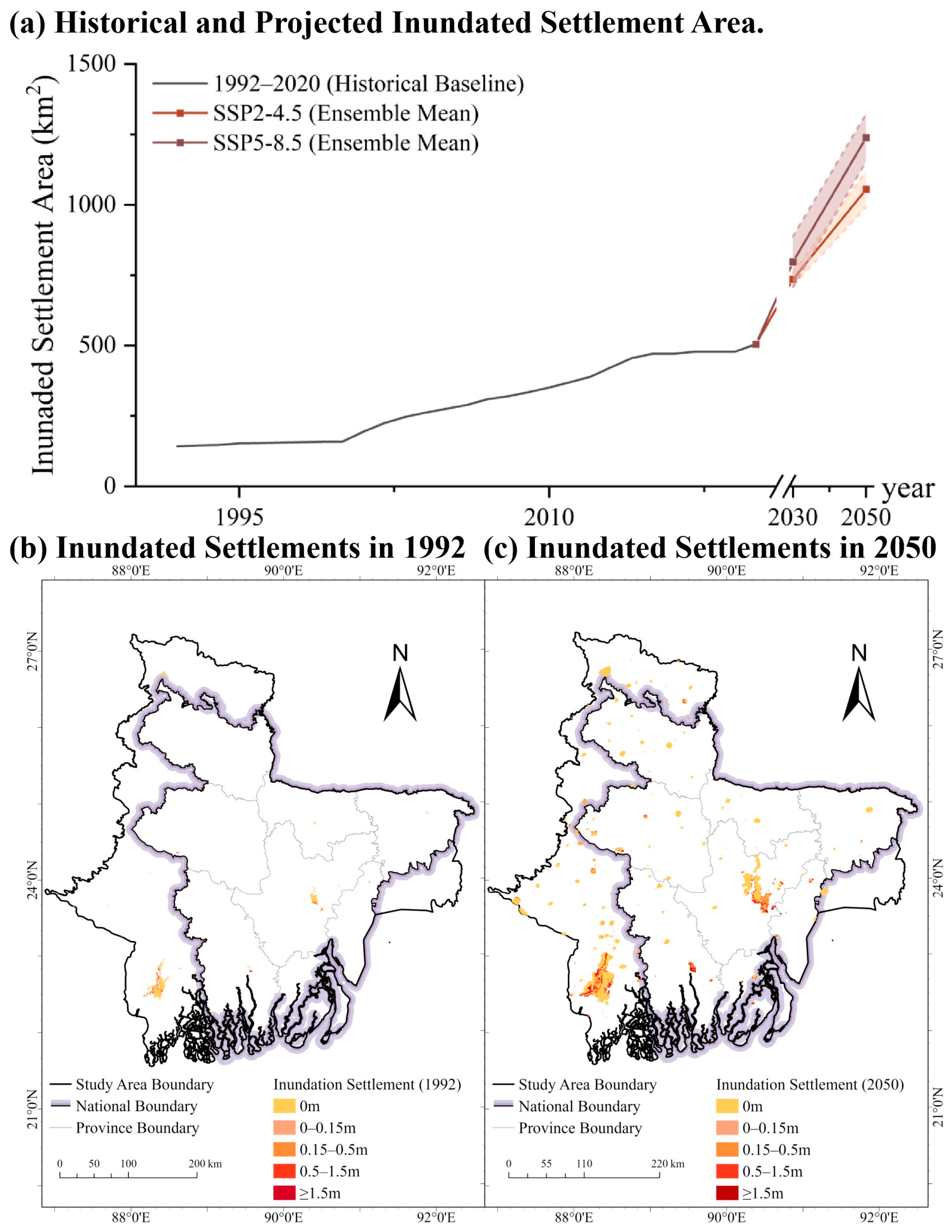
Under future socioeconomic scenarios (the SSP2-4.5 and SSP5-8.5 scenarios for 2030 and 2050), the inundated settlement area showed a significant increase compared to the historical period (1992–2020) (Figure 3a; Table 1). In 2030, the inundated settlement area increased by 45.7% (SSP2-4.5 scenario) and 57.9% (SSP5-8.5 scenario) relative to 2020, and by 2050, these growth rates reached 109.0% (SSP2-4.5 scenario) and 145.3% (SSP5-8.5 scenario). This expansion of settlements potentially affected by flooding occurred across all regions of the delta, particularly in the central and southwestern regions (Figure 3b,c).

3.2. Expansion in High-Hazard Level

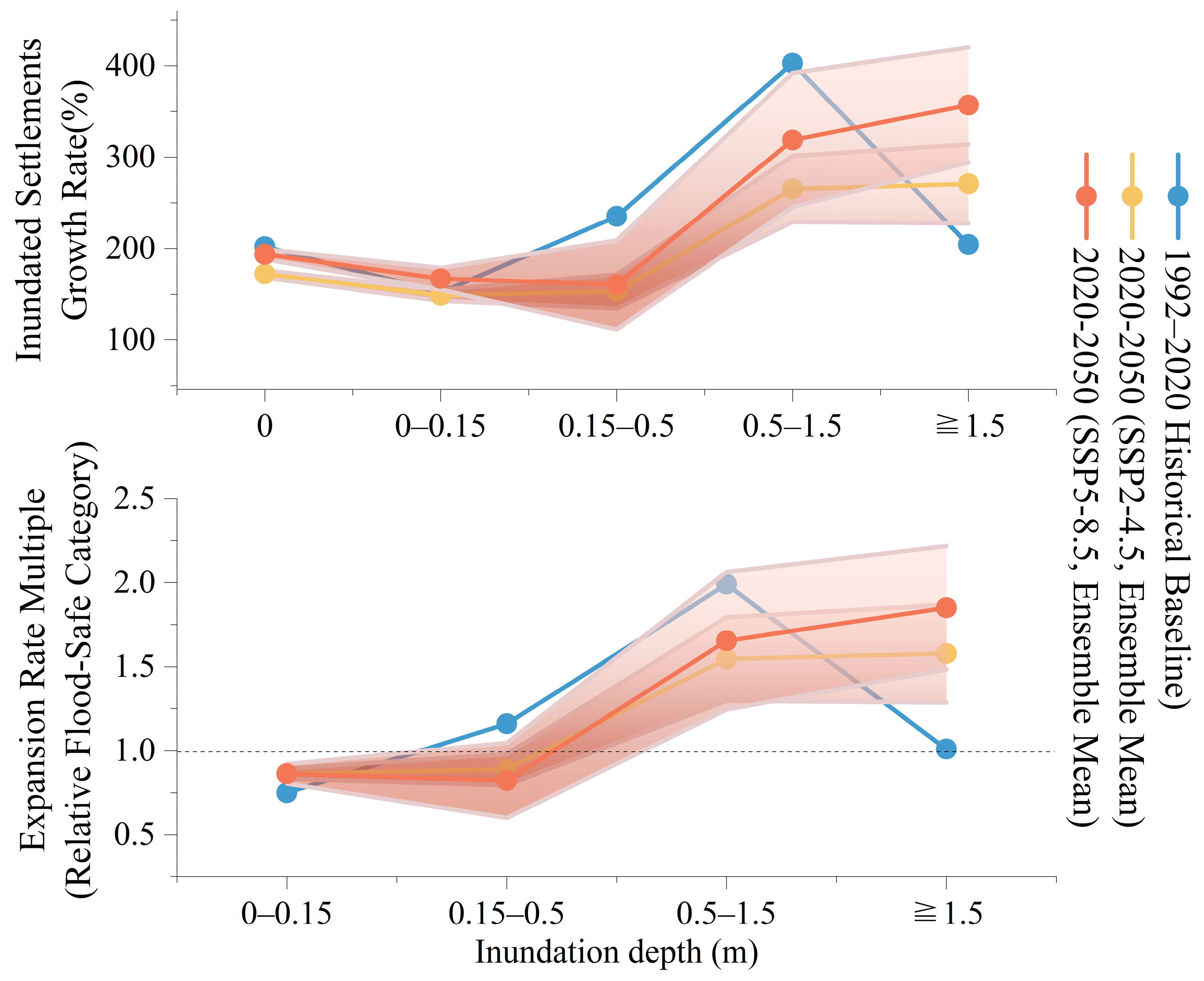
Under historical and future socioeconomic scenarios, both high- (inundation depth 0.5–1.5 m) and highest-hazard (inundation depth ≥ 1.5 m) zones exhibit significant settlement expansion. Specifically, during the historical period (1992–2020), distinct expansion rates were observed across different hazard levels. For instance, the settlement expansion rate in high-hazard zones reached 402.8%, approximately 1.99 times the rate of flood-safe zones (202.1%), while the growth rate in highest-hazard zones (204.3%) was comparable to that of safe zones (1.01 times). Under future socioeconomic scenarios (2020–2050), although the expansion rate in high-hazard zones is projected to moderate (265.3–318.8%) (under SSP2-4.5 and SSP5-8.5 scenarios, respectively), it remains 1.54–1.65 times the rate of flood-safe areas (172.2–193.8%). Meanwhile, the expansion rate within highest-hazard zones (270.9–357.1%) is expected to increase substantially compared to the historical baseline, reaching 1.57–1.85 times the expansion rate of flood-safe zones (Figure 4).

3.3. Expansion in Fluvial–Coastal Flood Coincidence

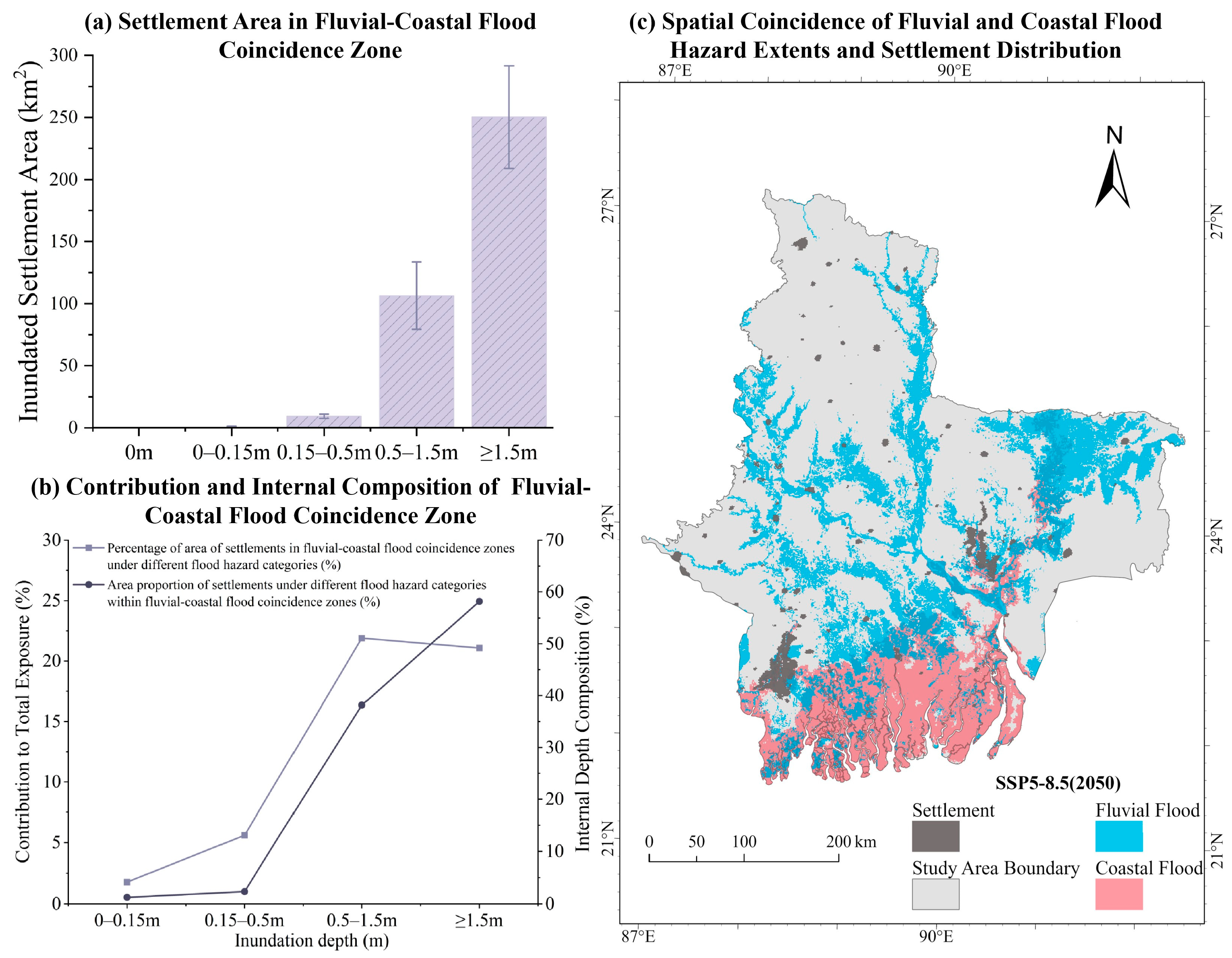
In total, 27–33% of the deltaic area consists of fluvial–coastal flood coincidence zones (Figure 5a). As for the inundation extent under different flood hazards, 21–22% of high- and highest-hazard deltaic settlements are in the coincident areas (Figure 5b), and the proportion for medium- (inundation depth 0.15–0.5 m) and low-hazard (inundation depth 0–0.15 m) is 2–6%.
Furthermore, within these fluvial–coastal flood coincidence zones, settlements exhibit pronounced characteristics of the high- and highest-hazard categories (Figure 5a,b). Specifically, areas classified as high-hazard account for the largest share (approximately 58%), followed by highest-hazard zones (approximately 38%), while low- and medium-hazard zones together comprise less than 4% of the total.

4. Discussion

4.1. Uncertainties of Different Models

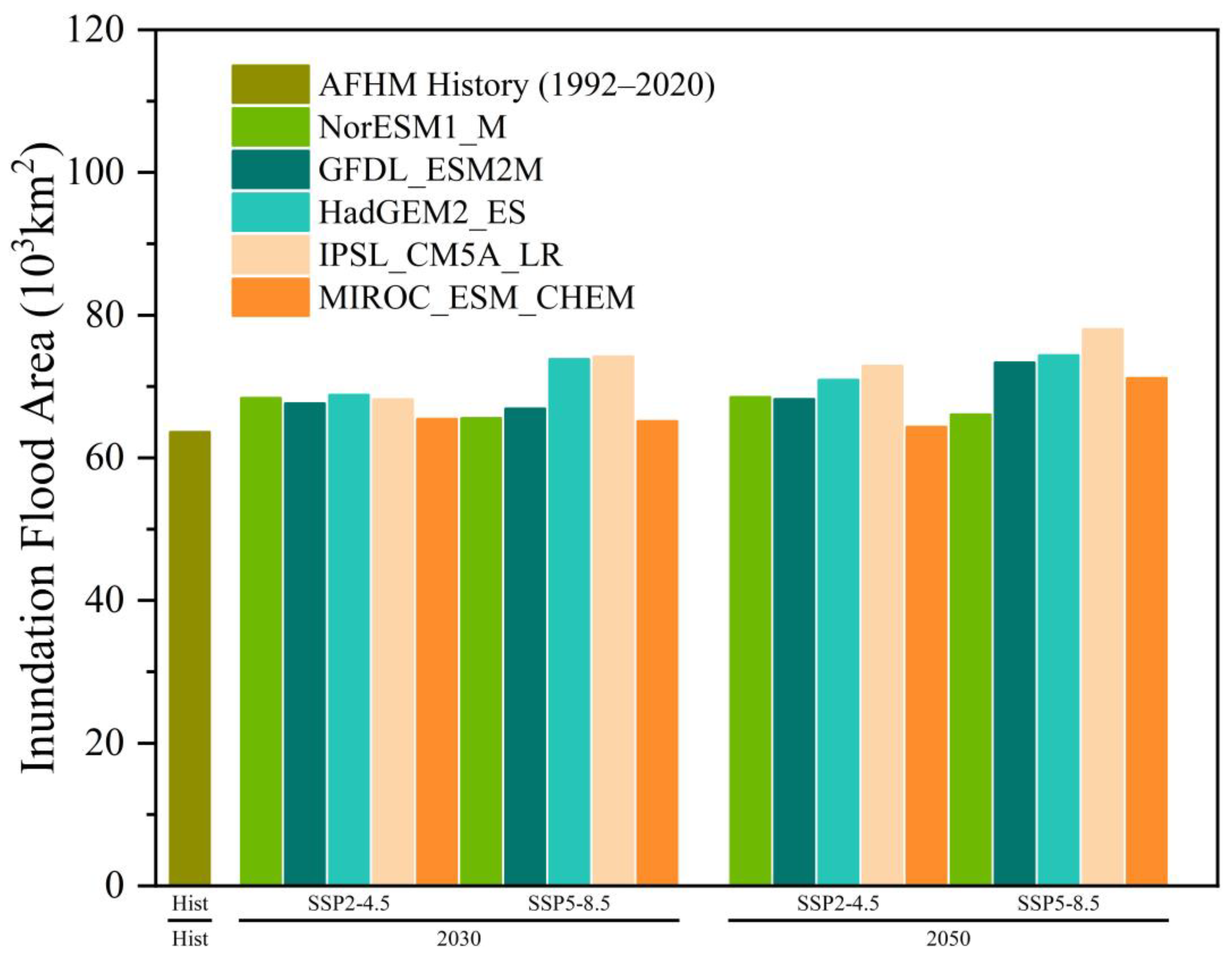
Due to the inherent uncertainties in model predictions, we utilized the simulation results from five global climate models (NorESM1-M, GFDL-ESM2M, HadGEM2-ES, IPSL-CM5A-LR, and MIROC-ESM-CHEM). Under both socioeconomic scenarios (SSP2-4.5 and SSP5-8.5), all five models projected that future inundation areas would be significantly higher than the AFHM historical baseline (Figure 6; Table 2). The inter-model consistency indicates that the trend of intensifying flood hazards is a shared projection across different models, rather than an incidental outcome from a specific model. While this study relies on the global AFHM dataset, previous studies have demonstrated its reliability in capturing large-scale inundation patterns in major deltas [35,36,37,38,39,40]. Nevertheless, we acknowledge the inherent scale limitations; incorporating diversified flood inundation datasets from various modeling frameworks [43,44,45] in future work will be essential for further refining localized flood predictions.

4.2. Uncertainties of Other Factors

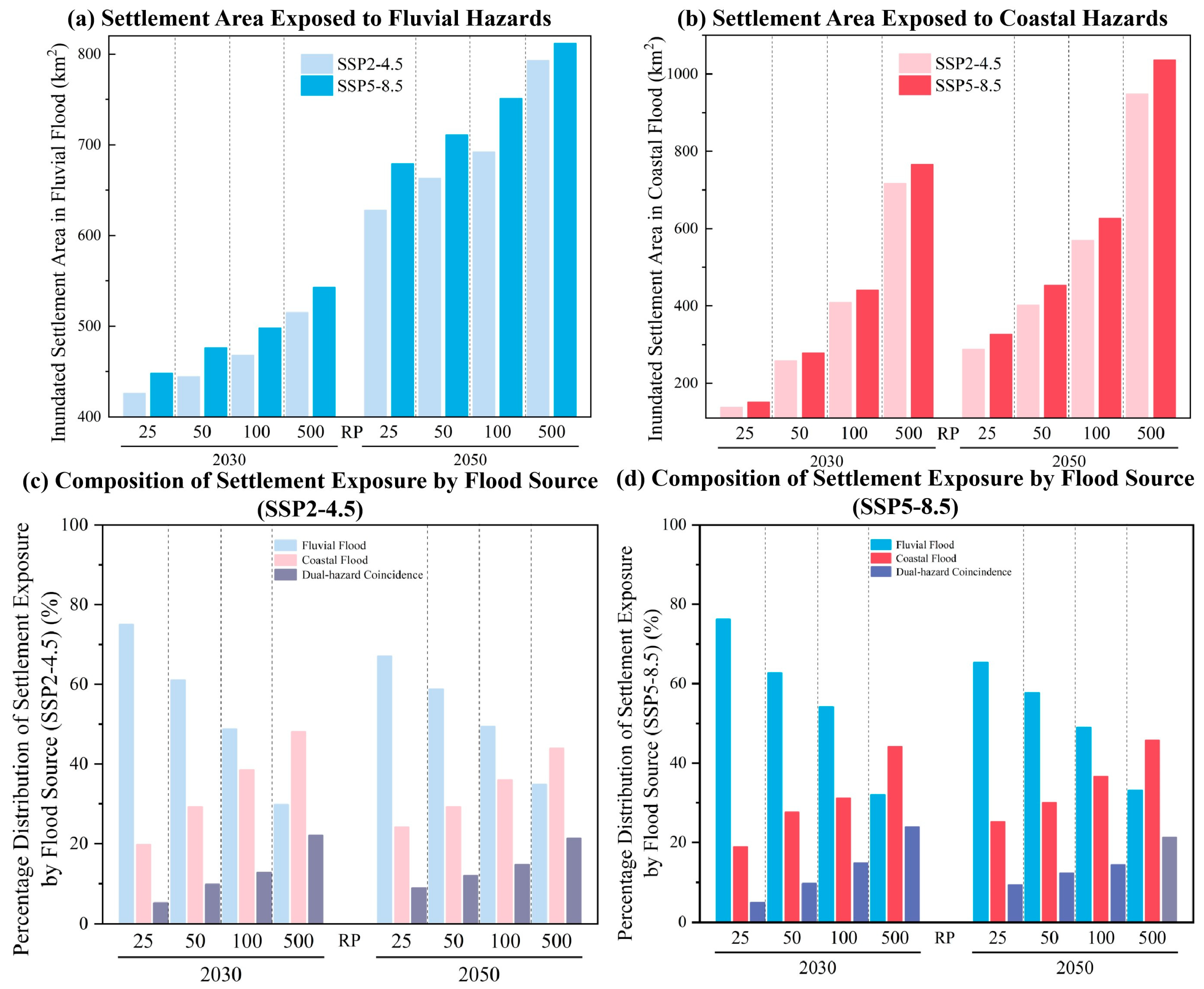
The preceding analysis is based on the 100-year flood event; however, the exposure of settlements to the risk of inundation and the respective impacts of fluvial and coastal flooding differ depending on socioeconomic scenarios and the return periods. Under the SSP2-4.5 scenario, the growth of the inundated settlement area (47.4–54.0%) exceeded the total settlement growth rate (37.4%), while in the SSP5-8.5 scenario, the growth rates of the inundated settlement area (41.4–51.6%) and total settlement area (45.1%) were almost level, depending on the flood return period (Figure 7a,b). The growth rates in both scenarios are significantly higher than the global average growth rate projection (5% between 2020 and 2050) [26].
In addition, under extreme flood scenarios, coastal flooding has a greater impact on settlements. For example, in flood events with a scale less than or equal to a 1-in-100-year event, the proportion of settlements inundated by fluvial flooding (48.9–76.2%) is consistently larger than that of coastal flooding (18.9–36.6%) (Figure 7c), whereas in extreme flood scenarios (1-in-500-year), the proportion of settlements affected by coastal flooding (43.9–48.1%) is greater than the impact caused by fluvial flooding (29.8–34.8%) (Figure 7d).

4.3. Limitations

The first-order regional screening of settlement exposure in the GBM delta identifies the distribution of settlements across different flood hazard levels under both historical and future socioeconomic scenarios. In addition to the aforementioned uncertainties caused by the adopted data, there are other influencing factors that lead to limitations in our findings. First, because the 1 km resolution global dataset used cannot capture micro-scale features such as embankments, polders, and local drainage systems, this study is unable to precisely identify local variations in flood exposure. Second, due to the simplifications of the methodological approach, our analysis did not account for the effects of land subsidence, nor the complex interactions between fluvial and coastal flood processes. Moreover, the selection of hazard level thresholds also affects the quantification of settlement flood exposure. If these effects were taken into account, the actual exposure extents would likely exceed our current understanding.
The observed spatial co-location between settlement expansion and highest-hazard zones is consistent with documented socioeconomic pressures in the GBM delta. Given that the GBM delta is predominantly low-lying and densely populated [16,22], flood-safe land has become an extremely scarce resource. The existing literature indicates that persistent economic agglomeration has attracted substantial inward migration, and an additional 1.5 million people have become concentrated in river-adjacent areas exposed to high flood hazards [46]. For example, within the Dhaka Metropolitan Area, 75% of the annual population growth is absorbed by intra-urban informal settlements [47], among which 63.06% of households exhibit high vulnerability to flood exposure [48].
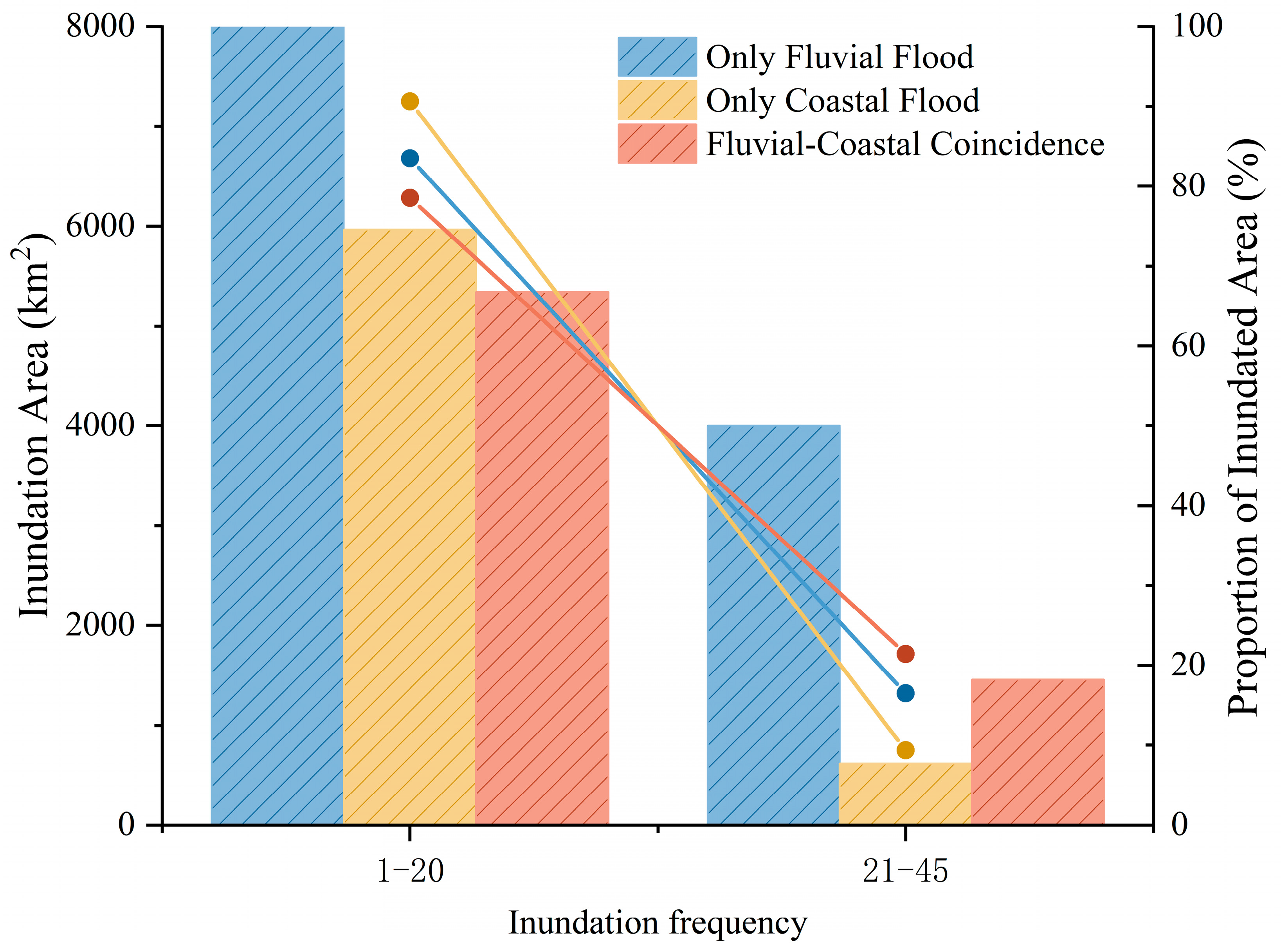
The high-risk exposure characteristics within fluvial–coastal flood coincidence zones could be partially certified by analyses based on observed inundation records. We compared the simulated historical flood areas with historical observational records from the GFD (2000–2015) (Figure 8). By calculating the actual inundation frequencies, we found that the proportion of area experiencing high-frequency inundation (21–45 times) within the flood coincidence zones reached 21.4%, which is significantly higher than that in areas affected solely by fluvial (16.5%) or solely by coastal (9.4%) flooding. This comparison indicates that these identified zones have historically endured more frequent inundation, and also highlights the necessity of improved inundation data analysis, which may take the complex interactions between fluvial and coastal flood processes into consideration.
The first-order identification of exposure within fluvial–coastal flood coincidence zones presented in this study provides a baseline for future regional risk assessment, helping to delineate broad areas that require more detailed, site-specific study.

5. Conclusions

This study characterizes the spatial patterns of settlement exposure in the GBM delta across historical (1992–2020) and future periods (2030 and 2050, under SSP2-4.5 and SSP5-8.5 scenarios). Specifically, the settlement area within high- and highest-hazard zones exhibits significant expansion across both historical and future scenarios. Under future projections, the expansion rate within the highest-hazard category is expected to substantially exceed that of flood-safe areas. As a first-order regional screening, the quantitative analysis of settlement exposure within fluvial and coastal flood coincidence zones emphasized its importance. These coincidence zones account for over one-fifth of the inundated settlements categorized at the high-hazard level or above. Notably, approximately 87% of the settlements located within these areas of spatial overlap are exposed to high- or highest-hazard levels. This study indicates a significant increase in settlement exposure within these overlapping zones. The findings provide data support for the future development of fluvial–coastal flood coincidence zones, and integrating these overlapping areas into the broader framework of the GBM delta’s overall development strategy helps alleviate these intensifying risks.

Author Contributions

Data curation, Y.Y.; writing—original draft preparation, Y.Y.; writing—review and editing, L.H.; project administration, L.H.; funding acquisition, L.H. All authors have read and agreed to the published version of the manuscript.

Funding

This research was funded by the National Natural Science Foundation of China (Grant No. U2243226, 51979264).

Data Availability Statement

All data used in this study are publicly available. The Global Urban Expansion Simulation Dataset is available at https://geodoi.ac.cn/WebEn/geodoi.aspx?Id=3600 (accessed on 26 September 2025). The Aqueduct Floods Hazard Map is available at https://wri-projects.s3.amazonaws.com/AqueductFloodTool/download/v2/index.html (accessed on 28 September 2025).

Conflicts of Interest

The authors declare no conflicts of interest.

References

  1. Bianchi, T.S. Deltas and Humans: A Long Relationship Now Threatened by Global Change; Oxford University Press: Oxford, UK, 2016; pp. 1–200. [Google Scholar]
  2. Syvitski, J.; Ángel, J.R.; Saito, Y. Earth’s sediment cycle during the Anthropocene. Nat. Rev. Earth Environ. 2022, 3, 179–196. [Google Scholar] [CrossRef]
  3. Mei, C.; Liu, J.; Wang, H. Flood risk related to changing rainfall regimes in arterial traffic systems of the Yangtze River Delta. Anthropocene 2021, 35, 100306. [Google Scholar] [CrossRef]
  4. Nicholls, R.J. Delta Challenges and Trade–Offs from the Holocene to the Anthropocene. In Deltas in the Anthropocene; Nicholls, R.J., Adger, W.N., Eds.; Palgrave Macmillan: Cham, Switzerland, 2020; pp. 1–25. [Google Scholar]
  5. Ghosh, S.; Roy, S.; Islam, A. Floods of Ganga–Brahmaputra–Meghna delta in context. In Floods in the Ganga–Brahmaputra–Meghna Delta; Springer Nature: Cham, Switzerland, 2023; pp. 1–17. [Google Scholar]
  6. Iqbal, M.K.; Kutubuddin, W.H. Bangladesh Delta Plan 2100: Charting a course for sustainable ocean governance and maritime development. Bangladesh Marit. J. 2021, 59–76. [Google Scholar]
  7. Nicholls, R.J.; Hutton, C.W.; Lázár, A.N. Integrated assessment of social and environmental sustainability dynamics in the Ganges–Brahmaputra–Meghna delta, Bangladesh. Estuar. Coast. Shelf Sci. 2016, 183, 370–381. [Google Scholar] [CrossRef]
  8. Loucks, D.P. Developed river deltas: Are they sustainable? Environ. Res. Lett. 2019, 14, 113004. [Google Scholar] [CrossRef]
  9. Intergovernmental Panel on Climate Change—IPCC. Annex II: Glossary. In Climate Change 2022: Impacts, Adaptation and Vulnerability; Pörtner, H.-O., Roberts, D.C., Eds.; Cambridge University Press: Cambridge, UK, 2022; pp. 2897–2930. [Google Scholar]
  10. Bernhofen, M.V.; Trigg, M.A.; Sleigh, P.A. Global flood exposure from different sized rivers. Nat. Hazards Earth Syst. Sci. 2021, 21, 2829–2847. [Google Scholar] [CrossRef]
  11. Güneralp, B.; Güneralp, İ.; Liu, Y. Changing global patterns of urban exposure to flood and drought hazards. Glob. Environ. Change 2015, 31, 217–225. [Google Scholar] [CrossRef]
  12. Chen, X.; Liang, B.; Li, J. Comprehensive Assessment of Large-Scale Regional Fluvial Flood Exposure Using Public Datasets: A Case Study from China. ISPRS Int. J. Geo-Inf. 2024, 13, 357. [Google Scholar] [CrossRef]
  13. Qiang, Y. Flood exposure of critical infrastructures in the United States. Int. J. Disaster Risk Reduct. 2019, 39, 101240. [Google Scholar] [CrossRef]
  14. Tellman, B.; Sullivan, J.A.; Kuhn, C.; Kettner, A.J.; Doyle, C.S.; Brakenridge, G.R.; Erickson, T.A.; Slayback, D.A. Satellite imaging reveals increased proportion of population exposed to floods. Nature 2021, 596, 80–86. [Google Scholar] [CrossRef]
  15. Rentschler, J.; Avner, P.; Marconcini, M.; Su, R.; Strano, E.; Vousdoukas, M.; Hallegatte, S. Global evidence of rapid urban growth in flood zones since 1985. Nature 2023, 622, 87–92. [Google Scholar] [CrossRef] [PubMed]
  16. Paszkowski, A.; Goodbred, S., Jr.; Borgomeo, E. Geomorphic change in the Ganges-Brahmaputra-Meghna delta. Nat. Rev. Earth Environ. 2021, 2, 763–780. [Google Scholar]
  17. Dewan, C.; Mukherji, A.; Buisson, M.C. Evolution of water management in coastal Bangladesh: From temporary earthen embankments to depoliticized community-managed polders. Water Int. 2015, 40, 401–416. [Google Scholar] [CrossRef]
  18. Uhe, P.F.; Mitchell, D.M.; Bates, P.D. Enhanced flood risk with 1.5 C global warming in the Ganges-Brahmaputra-Meghna basin. Environ. Res. Lett. 2019, 14, 074031. [Google Scholar]
  19. Islam, A.S.; Haque, A.; Bala, S.K. Hydrologic characteristics of floods in Ganges–Brahmaputra–Meghna (GBM) delta. Nat. Hazards 2010, 54, 797–811. [Google Scholar]
  20. Goodbred, S.L., Jr.; Kuehl, S.A. Enormous Ganges-Brahmaputra sediment discharge during strengthened early Holocene monsoon. Geology 2000, 28, 1083–1086. [Google Scholar] [CrossRef]
  21. Goodbred, S.L., Jr. Response of the Ganges dispersal system to climate change: A source–to–sink view since the last interstade. Sediment. Geol. 2003, 162, 83–104. [Google Scholar]
  22. Rahman, M.M.; Haque, A.; Nicholls, R.J. Sustainability of the coastal zone of the Ganges–Brahmaputra–Meghna delta under climatic and anthropogenic stresses. Sci. Total Environ. 2022, 829, 154547. [Google Scholar]
  23. Anthony, E.J.; Almar, R.; Aagaard, T. Recent shoreline changes in the Volta River delta, West Africa: The roles of natural processes and human impacts. Afr. J. Aquat. Sci. 2016, 41, 81–87. [Google Scholar] [CrossRef]
  24. Ikeuchi, H.; Hirabayashi, Y.; Yamazaki, D. Modeling complex flow dynamics of fluvial floods exacerbated by sea level rise in the Ganges–Brahmaputra–Meghna Delta. Environ. Res. Lett. 2015, 10, 124011. [Google Scholar]
  25. Rahman, S.; Islam, A.K.M.S.; Saha, P.; Tazkia, A.R.; Krien, Y.; Durand, F.; Testut, L.; Islam, G.M.T.; Bala, S.K. Projected changes of inundation of cyclonic storms in the Ganges–Brahmaputra–Meghna delta of Bangladesh due to SLR by 2100. J. Earth Syst. Sci. 2019, 128, 145. [Google Scholar] [CrossRef]
  26. Wu, S.; Zhou, X.; Reyns, J. Climate change and urban sprawl: Unveiling the escalating flood risks in river deltas with a deep dive into the GBM river delta. Sci. Total Environ. 2024, 947, 174703. [Google Scholar] [CrossRef]
  27. Darnkachatarn, S.; Kajitani, Y. Flood damage assessment model of industrial sectors in a Megacity: Derivation from business survey data in the Bangkok Metropolitan Region. Int. J. Disaster Risk Reduct. 2025, 118, 105221. [Google Scholar] [CrossRef]
  28. Wang, X.H.; Elahi, M.W.E. Influence of Wave-Current interaction on a Cyclone-Induced Storm–Surge event in the Ganges–Brahmaputra–Meghna delta: Part 2–Effects on wave. J. Mar. Sci. Eng. 2023, 11, 298. [Google Scholar] [CrossRef]
  29. Jiang, S.; Hossain, M.J.; Uddin, S.A.; Ye, Q.; Wu, Y.; Jin, J.; Su, H.; Liu, Z.B.; He, L.; Zhang, J. Nitrogen accumulation and attenuation in the Ganges–Brahmaputra–Meghna river system: An evaluation with multiple stable isotopes and microbiota. Mar. Pollut. Bull. 2023, 193, 115204. [Google Scholar] [CrossRef]
  30. World Resources Institute. Aqueduct Global Flood Risk Maps. Available online: https://www.wri.org/data/aqueduct-global-flood-risk-maps (accessed on 12 January 2025).
  31. Shirzaei, M.; Bürgmann, R. Global climate change and local land subsidence exacerbate inundation risk to the San Francisco Bay Area. Sci. Adv. 2018, 4, eaap9234. [Google Scholar] [CrossRef]
  32. Tangdamrongsub, N.; Han, S.C.; Jasinski, M.F.; Šprlák, M. Quantifying water storage change and land subsidence induced by reservoir impoundment using GRACE, Landsat, and GPS data. Remote Sens. Environ. 2019, 233, 111385. [Google Scholar] [CrossRef]
  33. Holzer, T.L.; Galloway, D.L. Impacts of land subsidence caused by withdrawal of underground fluids in the United States. In Humans as Geologic Agents; Geological Society of America: Boulder, CO, USA, 2005. [Google Scholar]
  34. Mirus, B.B.; Jones, E.S.; Baum, R.L.; Godt, J.W.; Slaughter, S.; Crawford, M.M.; Lancaster, J.; Stanley, T.; Kirschbaum, D.B.; Burns, W.J.; et al. Landslides across the USA: Occurrence, susceptibility, and data limitations. Landslides 2020, 17, 2271–2285. [Google Scholar] [CrossRef]
  35. Mondal, I.; Naskar, P.K.; Alsulamy, S.; Jose, F.; Hossain, S.A.; Mohammad, L.; De, T.K.; Khedher, K.M.; Salem, M.A.; Benzougagh, B.; et al. Habitat quality and degradation change analysis for the Sundarbans mangrove forest using invest habitat quality model and machine learning. Environ. Dev. Sustain. 2024, 28, 6757–6782. [Google Scholar] [CrossRef]
  36. Nobile, E.G.L.; Figueiredo, R.; Arrighi, C.; Romão, X.; Martina, M.L. Flood risk assessment of cultural heritage across countries and spatial scales. Int. J. Disaster Risk Reduct. 2025, 118, 105236. [Google Scholar] [CrossRef]
  37. Mirza, M.M.Q. Three recent extreme floods in Bangladesh: A hydro-meteorological analysis. Nat. Hazards 2003, 28, 35–64. [Google Scholar] [CrossRef]
  38. Wang, Y.H.; Deng, A.J.; Feng, H.C. Tide-modulated river discharge division in the Ganges–Brahmaputra–Meghna delta channel network, Bangladesh. J. Hydrol. Reg. Stud. 2023, 49, 101493. [Google Scholar]
  39. Zhang, Y.; Wei, Y.; Yao, R.; Sun, P.; Zhen, N.; Xia, X. Data Uncertainty of Flood Susceptibility Using Non–Flood Samples. Remote Sens. 2025, 17, 375. [Google Scholar] [CrossRef]
  40. Liu, Z.; Ying, J.; He, C. Global Urban Expansion Simulation Dataset (1992–2050, V1.0). Available online: https://geodoi.ac.cn/WebEn/geodoi.aspx?Id=3600 (accessed on 12 January 2025).
  41. Tebaldi, C.; Debeire, K.; Eyring, V.; Fischer, E.; Fyfe, J.; Friedlingstein, P.; Knutti, R.; Lowe, J.; O’NEill, B.; Sanderson, B.; et al. Climate model projections from the scenario model intercomparison project (ScenarioMIP) of CMIP6. Earth Syst. Dyn. 2021, 12, 253–293. [Google Scholar] [CrossRef]
  42. Rentschler, J.; de Vries Robbé, S.; Braese, J.; Nguyen, D.H.; van Ledden, M.; Mayo, B.P. Resilient Shores: Vietnam’s Coastal Development Between Opportunity and Disaster Risk; The World Bank Group: Washington, DC, USA, 2020. [Google Scholar]
  43. Guerriero, L.; Ruzza, G.; Guadagno, F.M.; Revellino, P. Flood hazard mapping incorporating multiple probability models. J. Hydrol. 2020, 587, 125020. [Google Scholar] [CrossRef]
  44. Sampson, C.C.; Smith, A.M.; Bates, P.D.; Neal, J.C.; Alfieri, L.; Freer, J.E. A high-resolution global flood hazard model. Water Resour. Res. 2015, 51, 7358–7381. [Google Scholar] [CrossRef]
  45. Muis, S.; Güneralp, B.; Jongman, B.; Aerts, J.C.; Ward, P.J. Flood risk and adaptation strategies under climate change and urban expansion: A probabilistic analysis using global data. Sci. Total Environ. 2015, 538, 445–457. [Google Scholar] [PubMed]
  46. Masrur, A.; Dewan, A.; Botje, D.; Kiselev, G.; Murshed, M. Dynamics of human presence and flood-exposure risk in close proximity to Bangladesh’s river network: An evaluation with multitemporal satellite imagery. Geocarto Int. 2022, 37, 14946–14962. [Google Scholar] [CrossRef]
  47. Streatfield, P.K.; Karar, Z.A. Population challenges for Bangladesh in the coming decades. J. Health Popul. Nutr. 2008, 26, 261. [Google Scholar]
  48. Huq, M.E.; Cheng, Q.; Altan, O.; Shoeb, A.Z.M.; Hossain, M.A.; Sarker, M.N.I.; Saleem, N.; Javed, A.; Longg, X.; Dughairi, A.A.A.; et al. Assessing vulnerability for inhabitants of Dhaka City considering flood-hazard exposure. Geofizika 2020, 37, 97–130. [Google Scholar] [CrossRef]
Figure 1. Studied area of the GBM delta. (a) Elevation. (b) Slope. (c) Tropical cyclone track density. (d) River proximity. (e) River density. (f) Impervious surface ratio. (g) LULC. (h) River. (i) Average annual rainfall.
Water 18 01029 g001
Figure 2. Overlay analysis based on geographic information layers and flood information layers.
Water 18 01029 g002
Figure 3. Temporal variation and spatial distribution of flood-exposed settlements in the GBM delta (1992–2050). (a) Historical (1992–2020) and projected (2030, 2050) distribution of total inundated settlement area under SSP2-4.5 and SSP5-8.5 scenarios. (b) Spatial distribution of inundated settlements in 1992. (c) Spatial distribution of inundated settlements in 2050 (SSP5-8.5 scenario).
Water 18 01029 g003
Figure 4. Growth rates of inundated settlement area by flood hazard category and their multiples relative to the growth rate in the flood-safe category under historical and future scenarios (SSP2-4.5 and SSP5-8.5).
Water 18 01029 g004
Figure 5. Characteristics and spatial distribution of settlement exposure within fluvial–coastal flood coincidence zones. (a) Total inundated settlement area within hazard coincidence zones (defined as the spatial overlap of fluvial and coastal floods) across four hazard levels. (b) Contribution and internal composition of fluvial–coastal flood coincidence zones (mean values under different future scenarios). (c) Spatial coincidence of fluvial and coastal flood hazard extents and settlement distribution in 2050 (SSP5-8.5 scenario).
Water 18 01029 g005
Figure 6. Comparison of inundation flood area between the historical baseline and five global climate models across historical and future scenarios (SSP2-4.5 and SSP5-8.5) for 2030 and 2050.
Water 18 01029 g006
Figure 7. Future settlement exposure to fluvial and coastal flood hazards across different return periods and socioeconomic scenarios. (a) Total settlement area (km2) exposed to coastal and fluvial floods in 2030 under various return periods (RPs). (b) Total settlement area (km2) exposed to coastal and fluvial floods in 2050 under various return periods (RPs). (c) Percentage composition of settlement exposure by flood source under SSP2-4.5, categorized into fluvial hazards, coastal hazards, and fluvial–coastal flood coincidence zones. (d) Percentage composition of settlement exposure by flood source under SSP5-8.5, categorized into fluvial hazards, coastal hazards, and fluvial–coastal flood coincidence zones.
Water 18 01029 g007
Figure 8. Comparison of historical inundation area and frequency across different flood zones based on the GFD (2000–2015).
Water 18 01029 g008
Table 1. Historical (1992, 2020) and projected (2030, 2050) inundated settlement areas categorized by inundation depth under SSP2-4.5 and SSP5-8.5 scenarios (km2).
Inundation Depth (m)History ScenarioSSP2-4.5 ScenarioSSP5-8.5 Scenario
199220202030205020302050
0–0.15297374 ± 589 ± 10109 ± 4122 ± 10
0.15–0.554181194 ± 36197 ± 37227 ± 34290 ± 37
0.5–1.536181349 ± 45364 ± 71480 ± 65577 ± 71
≥1.52370118 ± 11147 ± 41190 ± 30250 ± 41
Table 2. Historical baseline and projected 1-in-100-year flood-inundated area under SSP2-4.5 and SSP5-8.5 scenarios (103 km2).
YearSSP2-4.5 ScenarioSSP5-8.5 Scenario
Historical baseline63.6463.64
203067.71 ± 1.3269.13 ± 4.5
205068.98 ± 3.2272.61 ± 4.41
Disclaimer/Publisher’s Note: The statements, opinions and data contained in all publications are solely those of the individual author(s) and contributor(s) and not of MDPI and/or the editor(s). MDPI and/or the editor(s) disclaim responsibility for any injury to people or property resulting from any ideas, methods, instructions or products referred to in the content.