Review

Artificial Sweeteners as Emerging Environmental Pollutants: Global Research Trends, Environmental Behavior, and Future Perspectives

by
Setyo Budi Kurniawan
1,
Nor Sakinah Mohd Said
2,
Faiza Salsabilla
3,
Bieby Voijant Tangahu
3 and
Muhammad Fauzul Imron
4,5,6,*
1
Research Center for Environment and Clean Technologies, National Research and Innovation Agency (BRIN), Jakarta Pusat 10340, Indonesia
2
Department of Chemical and Process Engineering, Faculty of Engineering and Built Environment, Universiti Kebangsaan Malaysia, Bangi 43600, Selangor, Malaysia
3
Department of Environmental Engineering, Faculty of Civil, Planning and Geo Engineering, Institut Teknologi Sepuluh Nopember, Surabaya 60111, Indonesia
4
Study Program of Environmental Engineering, Department of Biology, Faculty of Science and Technology, Universitas Airlangga, Kampus C UNAIR, Jalan Mulyorejo, Surabaya 60115, Indonesia
5
Research Group of Sustainable Environmental Systems and Infrastructure (SUSTAIN), Faculty of Science and Technology, Universitas Airlangga, Kampus C UNAIR, Jalan Mulyorejo, Surabaya 60115, Indonesia
6
Department of Water Management, Faculty of Civil Engineering and Geosciences, Delft University of Technology, Stevinweg 1, 2628 CN Delft, The Netherlands
*
Author to whom correspondence should be addressed.
Water 2026, 18(8), 961; https://doi.org/10.3390/w18080961
Submission received: 13 March 2026 / Revised: 6 April 2026 / Accepted: 17 April 2026 / Published: 18 April 2026

Abstract

Artificial sweeteners have emerged as contaminants of increasing concern due to their widespread consumption, environmental persistence, and resistance to conventional wastewater treatment. This review provides an integrated assessment of global research trends and the environmental behavior of major artificial sweeteners, including sucralose, acesulfame potassium, saccharin, and aspartame. Bibliometric analysis of SCOPUS-indexed publications reveals rapid growth in research since 2010, with key themes focusing on environmental occurrence, treatment technologies, and ecotoxicological effects. These compounds are frequently detected in wastewater effluents, surface waters, groundwater, and even drinking water systems, driven by their high solubility and limited biodegradability. Their persistence raises concerns regarding ecological impacts, including potential alterations to microbial communities and aquatic organisms. In addition, emerging evidence suggests potential human health implications, including gut microbiota disruption, metabolic effects, and risks associated with chronic low-dose exposure, although these remain poorly understood. The performance of existing treatment technologies, including biological processes, adsorption, advanced oxidation, and membrane filtration, is critically evaluated, highlighting limitations in complete removal and in the formation of transformation products. Future research should prioritize sustainable treatment strategies, comprehensive risk assessment, and improved monitoring frameworks to better address both environmental and human health risks associated with artificial sweeteners.

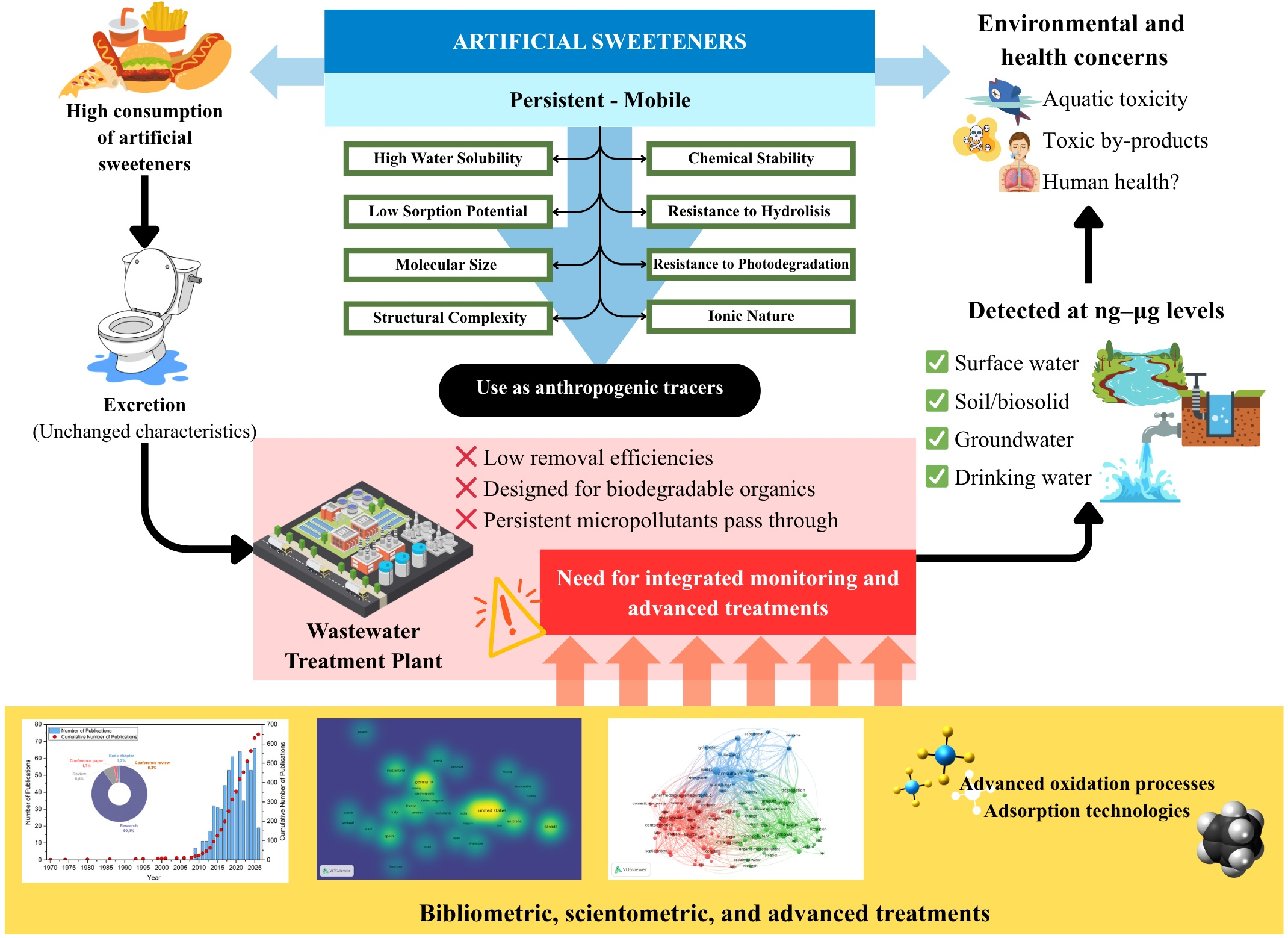
Graphical Abstract

1. Introduction

Over the past few decades, the global food industry has experienced a significant shift toward the development and consumption of low-calorie and sugar-reduced products [1]. This trend has largely been driven by increasing public health concerns related to excessive sugar intake and the rising prevalence of metabolic disorders such as obesity, diabetes, and cardiovascular diseases [2]. As a result, artificial sweeteners, also referred to as non-nutritive or high-intensity sweeteners, have been widely adopted as sugar substitutes in a variety of food products, beverages, pharmaceuticals, and personal care formulations [3]. These compounds provide intense sweetness with minimal or zero caloric contribution, allowing manufacturers to maintain desirable taste profiles while reducing sugar content.
Several artificial sweeteners are currently approved for commercial use worldwide, including sucralose, saccharin, acesulfame potassium, aspartame, cyclamate, neotame, advantame, and alitame [4]. These compounds exhibit diverse chemical structures and sweetness intensities ranging from approximately 30 to more than 37,000 times that of sucrose [4]. Their extensive use in processed foods, diet beverages, and medical formulations has contributed to a continuous increase in global production and consumption. Consequently, the widespread use of artificial sweeteners has also raised concerns about their environmental release and long-term ecological implications [5].
Artificial sweeteners are increasingly recognized as contaminants of emerging concern in environmental systems [6]. After consumption, most artificial sweeteners are poorly metabolized by the human body and are largely excreted unchanged through urine and feces [7]. These compounds subsequently enter municipal wastewater streams and are transported to wastewater treatment plants [8]. However, conventional wastewater treatment processes are often not specifically designed to remove highly stable and hydrophilic organic micropollutants such as artificial sweeteners [9]. As a result, artificial sweeteners pass through treatment systems and are discharged into receiving water bodies. Numerous monitoring studies have reported their presence in wastewater effluents [10], surface waters [11], groundwater [12], and even drinking water supplies [13]. Among them, compounds such as sucralose and acesulfame potassium are frequently detected due to their high stability and resistance to biodegradation [10].
Furthermore, the ecological impacts of artificial sweeteners are not yet fully understood. Although these compounds are generally considered safe for human consumption at regulated levels [14], growing evidence suggests potential adverse effects of artificial sweeteners and their by-products on aquatic organisms, including oxidative stress [15], behavioral changes [5], and alterations in microbial community structure [16]. Chronic low-dose exposure, which is more representative of environmental conditions, remains particularly underexplored. In addition, the combined effects of artificial sweeteners with other micropollutants in aquatic systems may lead to synergistic or cumulative toxicity [17], further complicating risk assessment.

2. Rationale of This Study

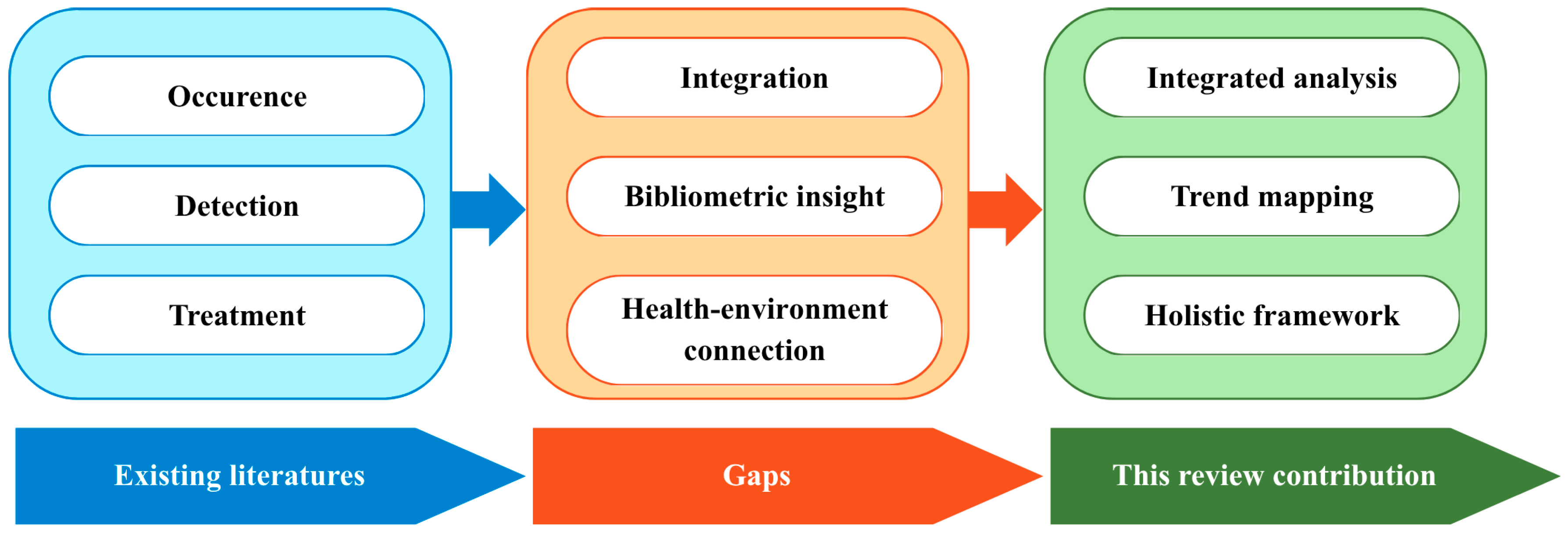
Despite growing scientific interest in artificial sweeteners as environmental pollutants, existing review studies have primarily focused on specific aspects of the topic. Many reviews emphasize the occurrence of artificial sweeteners in wastewater and surface waters [17,18], while others concentrate on analytical detection methods [19,20] or the performance of specific removal technologies [21,22]. Although these studies provide valuable insights, they often lack a comprehensive synthesis that integrates research trends, environmental occurrence, transformation processes, and technological mitigation strategies. Furthermore, relatively few studies have examined the development of scientific research on artificial sweeteners from a bibliometric or scientometric perspective. Understanding how research activities, collaborations, and thematic priorities have evolved is essential for identifying knowledge gaps and guiding future investigations. The absence of such integrated analyses limits the ability to obtain a holistic understanding of the research landscape surrounding artificial sweeteners as environmental contaminants.
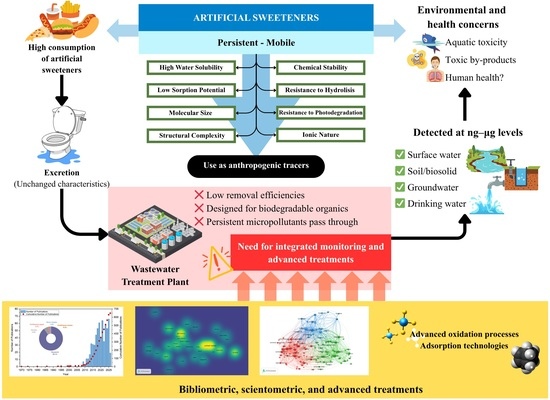
Bibliometric and scientometric approaches provide powerful tools for analyzing the evolution of scientific research fields by examining publication outputs, citation networks, collaborative relationships, and emerging thematic trends. Integrating bibliometric analysis with environmental assessment offers a more comprehensive perspective on artificial sweeteners as environmental contaminants. While bibliometric tools can reveal global research patterns, influential publications, and thematic clusters, environmental synthesis provides detailed insights into sources, environmental behavior, ecological risks, and treatment strategies. The combination of these approaches allows for a more robust understanding of both the scientific progression and the environmental significance of artificial sweeteners (Figure 1).
This review addresses these limitations by integrating bibliometric and scientometric analyses with a detailed environmental synthesis. Specifically, this study aims to: (i) analyze the global evolution of research on artificial sweeteners using bibliometric analysis; (ii) identify key research hotspots, collaboration networks, and thematic trends within the field; (iii) synthesize current knowledge regarding the sources, environmental occurrence, and transformation processes of artificial sweeteners; and (iv) evaluate their ecological implications and existing treatment technologies for their removal from water systems. By integrating research mapping with environmental synthesis, this review seeks to highlight current knowledge gaps and propose future research directions to support improved monitoring, risk assessment, and sustainable management strategies for artificial sweeteners in the environment.
This study has several limitations that should be considered when interpreting the results. First, the bibliometric dataset was derived exclusively from the SCOPUS database, which may result in incomplete coverage of relevant literature indexed in other databases. Second, the restriction to English-language publications and the selected time frame may introduce selection bias. Third, although a systematic screening approach was applied, the inclusion and exclusion criteria may still influence the representation of research themes. In addition, this review is based on qualitative synthesis with a limited quantitative meta-analysis, which limits the ability to directly compare removal efficiencies, environmental concentrations, or toxicity thresholds across studies. Finally, variability in experimental conditions among the reviewed studies may affect the generalizability of the conclusions.

3. Types and Chemical Properties of Artificial Sweeteners

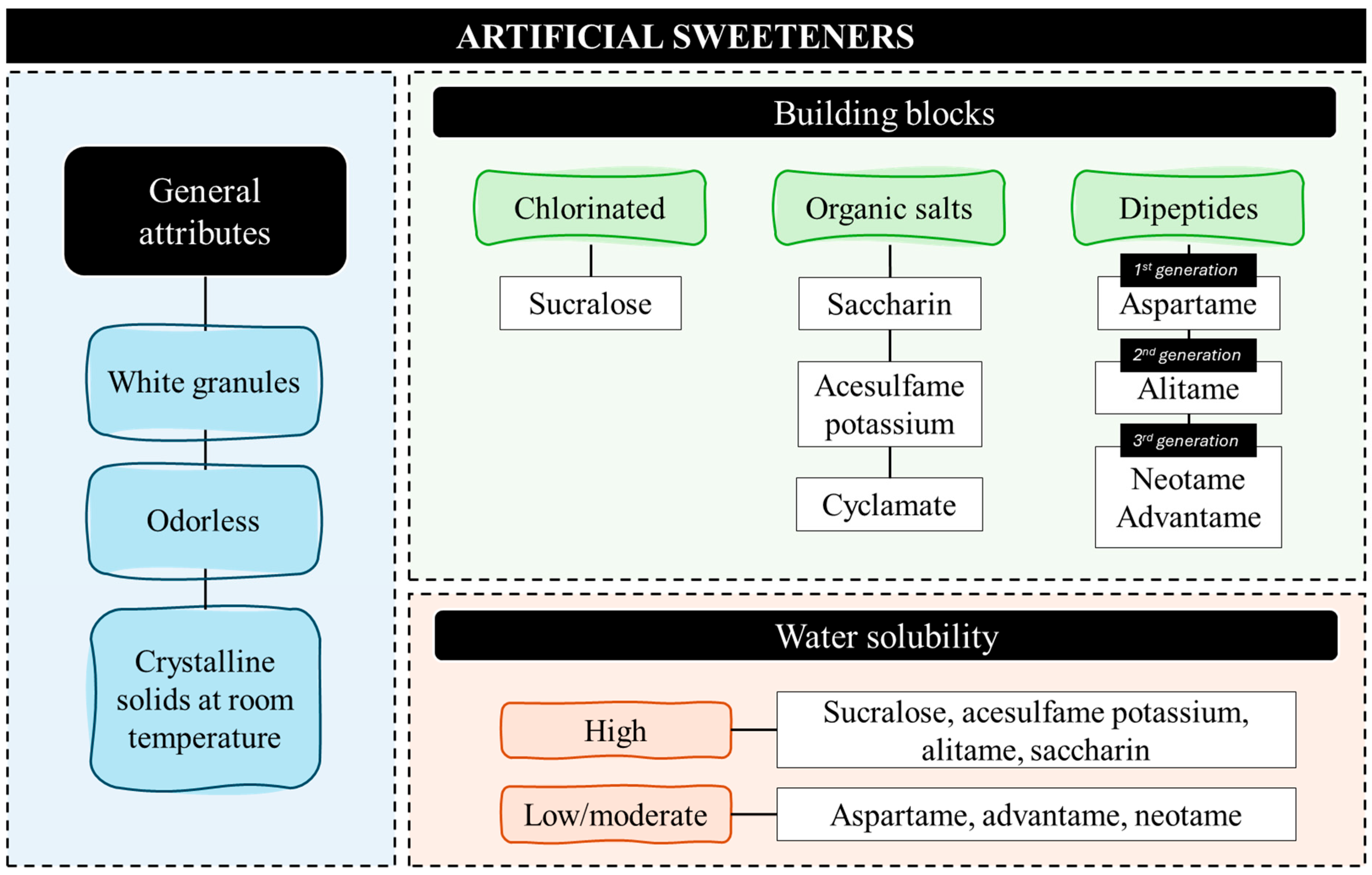
The trend of artificial sweeteners replacing conventional sugar has emerged as a preventive measure against the global rise in diabetes prevalence. Different types of synthesized sweeteners present unique characteristics, varying in intensity and stability. Figure 2 and Table 1 summarize the discussion of artificial sweeteners available in the market. It can be divided into three groups based on different building blocks: chlorinated, organic salts, and dipeptide-based sweeteners.

3.1. Sucralose

Sucralose (C12H19Cl3O8) is a chlorinated derivative of sucrose that serves as a zero-calorie artificial sweetener. Characterized by a sweetness intensity about 600 times greater than that of normal sugar, its structure consists of a disaccharide derivative where chlorine atoms replace hydroxyl groups. It has a molecular weight of 397.63 g/mol and is formed by the selective chlorination of 1,6-dichloro-1,6-dideoxyfructose and 4-chloro-4-deoxygalactose units [23]. It is an odorless, white crystalline powder with a melting point of 115–118 °C and a density of 1.375 g/cm3. It exhibits high water solubility, with a pH of 6–8 in solution forms. Due to its intramolecular hydrogen bonds, it shows excellent stability in acidic and aqueous solutions, resists hydrolysis, and maintains sweetness across pH ranges, with no degradation after years of storage. Sucralose stands out for its heat tolerance in cooking compared to others.
The compound’s notable persistence in water, though seemingly an advantage, results in significant drawbacks. Specifically, its high persistence and low biodegradability allow it to accumulate in the water system even after undergoing wastewater treatment. Available evidence raises concerns about the effects of chronic low-dose exposure on microbial communities and ecosystems, including potential shifts in the microbiota. Chlorinated structures resist natural degradation, including microbial degradation, hydrolysis, chlorination, and UV radiation, similar to persistent organic pollutants [24,25]. The chlorine atom creates chlorohydrin, which is resistant to microbial degradation [26]. Sucralose can’t be broken down, and a lot of microorganisms can’t either, since it can’t degrade easily. Increasing concentration due to rising consumption and the risk of byproduct degradation have also been highlighted in ongoing research. Another concern is oxidative stress induced by sucralose in organisms, the generation of toxic byproducts (dioxin and tetrachlorodibenzofurans). The heating of sucralose in the presence of protein has been shown to release 3-chlorotyrosine, suggesting that this compound can induce the chlorination of other biomolecules [15].
The presence of sucralose in breast milk may induce dysbiosis in the developing gut microbiota of both fetuses and infants throughout the gestational and lactational periods [24]. A study by Zhai et al. [27] highlighted the toxicological effects of sucralose exposure on hundreds of genes. Exposure to high concentrations leads to DNA damage and alters gene expression, with even short-term exposure causing irreversible damage. Disinfection of sucralose using ultraviolet light (via the advanced oxidation process in water treatment) also enhanced its toxicity due to the photolysis of chlorine, which forms hydroxyl radicals (OH) and reactive chlorine species (RCS) [28].

3.2. Saccharin

The hydrophilic saccharin (C7H5NO3S) was the first artificial sweetener, produced in 1879, with about 300 times the sweetness of sugar [24,29]. It is also a heat-stable, nonreactive compound that persists in treated wastewater due to limited adsorption and degradation under anaerobic conditions. It has a molecular weight of 183.18 g/mol [30] and is synthesized from o-toluenesulfonamide (a toluene derivative) through a multistep process of sulfonation, amidation, oxidation, and cyclization [31].
Upon its moderate persistence in the aquatic environment, its chemical stability originates from the sulfonamide moiety [29]. Unlike sucralose, which lacks halogens, this substance is readily biodegradable, with efficiency contingent on dissolved oxygen concentrations and the nature of co-pollutant interactions [32]. But the toxicity of its degradation intermediates, being exposed to solar radiation, which is more ecotoxic than the parent compound, has raised a concern [29]. Issues with its carcinogenic effects, as well as inflammatory bowel disease due to gut bacterial disturbance, have also been in question.

3.3. Acesulfame Potassium

Acesulfame potassium (Ace-K), with the chemical formula C4H4KNO4S, is a white, odorless crystalline powder approximately 200 times sweeter than sugar, but it does not stay. It is derived from sulfamic acid and comprises methyl, carbonyl, and sulfoxide groups [33]. Owing to the variety of functional groups it possesses, it may serve as a ligand to coordinate with various metal ions. It has a molecular weight of 201.25 g/mol, a density of 1.81 g/cm, and a decomposition point of 225 °C [34]. It has high chemical stability, pH-dependent water solubility, and broad thermal resistance. Its chemical structure consists of a potassium salt and an oxathiazin ring, specifically 6-methyl-1,2,3-oxathiazin-4(3H)-one-2,2-dioxide. It can withstand both acidic and basic conditions, and it is useful in beverages and processed foods [33].
It is considered beneficial for health because it is not metabolized and is excreted directly by the body, making it an ideal sweetener for diabetics [33]. But that also means persistence in the aquatic system, as it accumulates in wastewater, resisting biodegradation, and thus cannot be completely removed by wastewater treatment [35]. Exposure to UV radiation can also produce more toxic byproducts and elevate oxidative stress in aquatic organisms [6]. Some studies mentioned the disadvantages of this substance, which are genotoxic potential, cancer risk, cardiovascular disease, causing obesity, and also disruptions of gut microbiota [35,36].

3.4. Aspartame

Manufactured first in 1965, aspartame (C14H18N2O5) is a dipeptide methyl ester composed of aspartic acid and phenylalanine, serving as a zero-calorie artificial sweetener approximately 200 times sweeter than sucrose. Its structure features an L-aspartyl-L-phenylalanine methyl ester linkage, formed by enzymatic coupling of aspartic acid and phenylmethylalanine. It has a molecular weight of 294.30 g/mol and is only slightly soluble in water, with solubility depending on temperature and pH [37]. It is composed of 57% carbon, 6% hydrogen, 10% nitrogen, and 27% oxygen with a density of 1.3 g/cm3. While it exhibits partial aqueous solubility, it is significantly less soluble in lipid-based solvents [30].
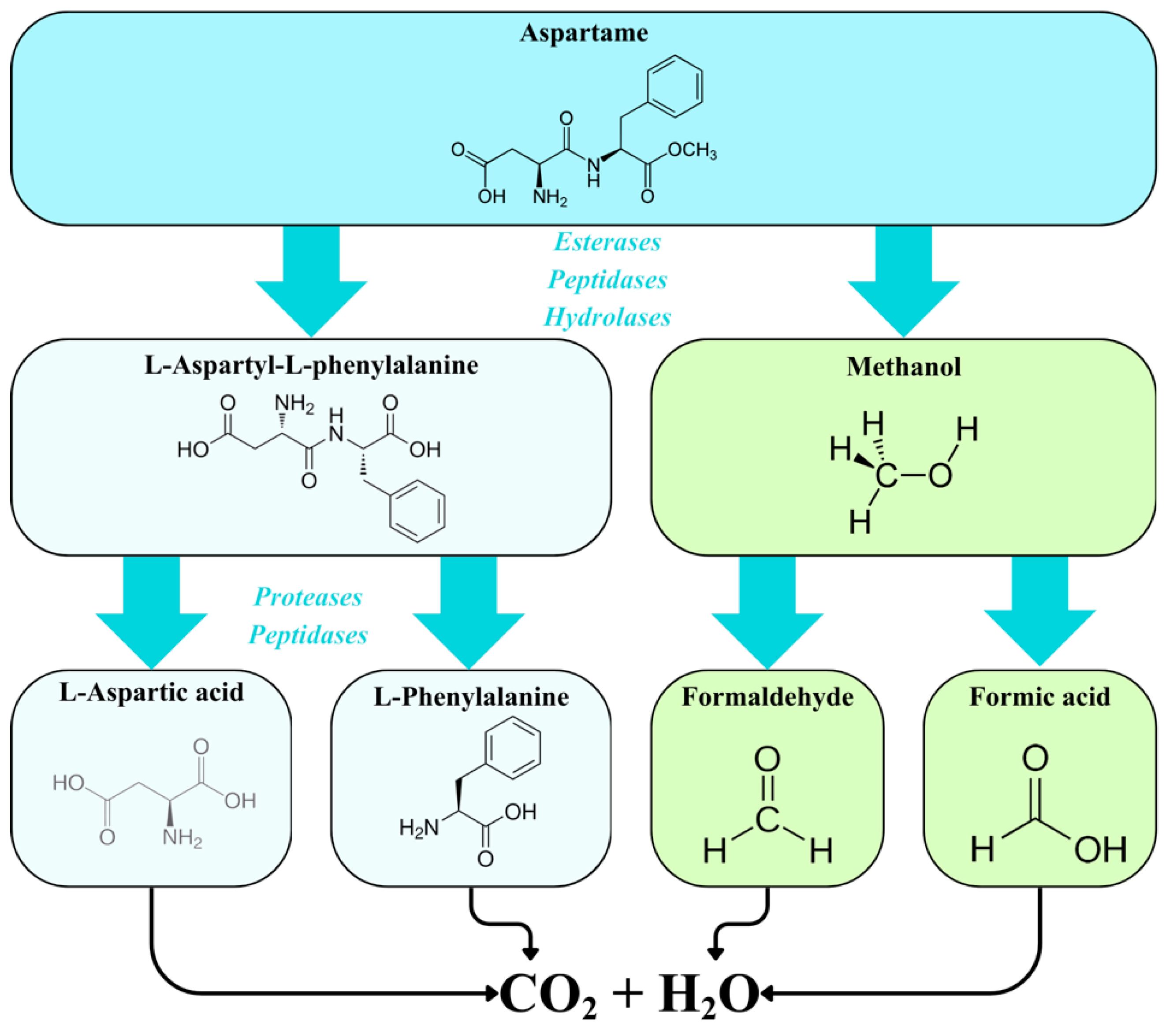
Due to its peptide structure, aspartame poses a lower environmental pollution threat than more persistent sweeteners like acesulfame potassium or sucralose, as it degrades rapidly via hydrolysis into aspartic acid, phenylalanine, and methanol, which are naturally occurring and biodegradable compounds. It exhibits negligible toxicity to aquatic organisms, as it is well below the toxic threshold [6,38]. Upon digestion, it will be metabolized by esterase and peptidase enzymes into three metabolites: phenylalanine, aspartic acid, and methanol [37]. But some concerns had been raised related to neuropsychiatric effects, neurotoxicity, and carcinogenic risk [39].

3.5. Cyclamate

Cyclamates have a sweetness intensity 30 to 50 times that of sucrose and are often blended with saccharin to mask their bitter aftertaste. It existed as three different compounds: C6H13NO3S for the acid form, C6H12NNaO3S for sodium cyclamate, and C12H24CaN2O6S2 for calcium cyclamate. Sodium and calcium salts in solid form were commonly used [30]. In its acidic form, it is a strong acid with high water solubility. Its structure features cyclohexylsulfamic acid, with the salt [40]. Cyclamate is formed by reacting cyclohexylamine with sulfamic acid or sulfonating agents such as chlorosulfonic acid, followed by neutralization with sodium or calcium hydroxide. This process yields the stable sodium salt via synthesis, distillation, and crystallization steps [41]. It resists hydrolysis, is stable across a wide pH range, has good heat tolerance, and has a long shelf life in dry form [42].
The compound is considered to have low toxicity in its native form, but biotransformation by intestinal bacteria yields cyclohexylamine, which exhibits enhanced toxicity [41]. Studies also highlighted the need for limitations in use, leading to the adoption of a safety limit of 50 mg/kg by the World Health Organization in 1967, which was later revised to 11mg/kg as the daily limit [14].

3.6. Alitame

Alitame is a second-generation dipeptide family, with a molecular formula of C14H25N3O4S, synthesized from L-aspartic acid and D-alanine, with a terminal tetramethylthietanylamine group. Different from the first generation of dipeptide sweeteners that contain methyl ester, alitame utilizes an amide linkage [43]. It is approximately 2000 times sweeter than sucrose and about 10 times sweeter than aspartame [7,44]. One of the distinctive features is resilience: while aspartame degrades under high heat, it remains relatively stable across a wide range of temperatures and pH levels, making it suitable for baked goods and acidic beverages [30,43]. Characterized as an odorless crystalline solid, this compound exhibits solubility in aqueous media but not in nonpolar organic solvents. Although this amino acid derivative is susceptible to acid-catalyzed hydrolysis, it exhibits greater stability than aspartame under certain conditions [30].
Alitame sits in the middle ground in terms of environmental persistence. With its amide linkage, it is more stable than aspartame but still more susceptible to microbial degradation in wastewater treatment plants than chlorinated sweeteners, with its primary metabolites, such as alanine amide and the thietanyl moiety, more likely to be found in surface waters than the parent compound itself [43,45]. Regarding microbiota disruption, alitame has been shown to alter the composition and pathogenicity of intestinal bacteria, thereby interfering with the normal environment of the gut mucosa in both humans and animals [7].

3.7. Neotame

Neotame (C20H30N2O5) has a sweet taste but a hint of a licorice aftertaste. As a derivative and more stable version of aspartame with the addition of the 3,3-dimethylbutyl group, it is reported to be approximately 7000 to 13,000 times sweeter than sucrose [46]. Structurally characterized as an N-alkylated derivative of aspartame, neotame features a 3,3-dimethylbutyl (neohexyl) substituent on the amine nitrogen. Its molecular weight is 378.46 g/mol, corresponding to the formula C20H30N2O5 [30]. Unlike aspartame, which loses sweetness at high temperatures, neotame is remarkably stable under pasteurization and baking conditions [43]. This odorless white-gray powder is slightly soluble in water but highly soluble in alcohol [41].
Recent studies have shown that neotame may cause dysbiosis, an imbalance in gut bacteria. Specifically, it can reduce gut microbiome diversity and potentially damage the intestinal epithelial lining [7,47]. Studied in aquatic models, it has also been reported to be linked to minor alterations in cardiovascular performance and heart rate [45].

3.8. Advantame

Advantame, a recent addition to the class of non-nutritive high-intensity sweeteners, is an N-substituted derivative of aspartame (specifically at the aspartic acid moiety) and is structurally analogous to neotame. It is synthesized through reductive N-alkylation of aspartame with vanillin, and possesses a molecular weight of 476.52 g/mol. The addition of the vanillyl (phenylpropyl) group introduces substantial steric hindrance around the peptide bond, protecting it from facile cleavage by heat or enzymes, which is a major flaw in the original aspartame [30]. It has approximately 20,000 times the sweetness intensity of sucrose and about 100–120 times that of aspartame [46]. This sugar-like taste compound has a slightly lower sensory profile but a longer-lasting sweetness than sucrose, which is an effective flavor enhancer [30]. It is slightly soluble in water, but its potency means that only tiny amounts are needed to achieve desired sweetness levels [45]. This third-generation sweetener and its acid metabolite possess strong persistence in the environment, which, upon chronic exposure, leads to cardiovascular alterations in aquatic organisms [43,45]. As with neotame, recent research suggests that unabsorbed advantame reaching the colon may influence gut microbiota diversity, though its impact is considered lower than that of sucralose or saccharin [7].

4. Methodology

4.1. Literature Search Strategy

A systematic literature search was conducted to identify scientific publications on artificial sweeteners as environmental contaminants, following previous publications [48,49]. The search was conducted using major academic databases to ensure comprehensive coverage of peer-reviewed literature in environmental science, environmental chemistry, and wastewater treatment. In this study, publications were retrieved from the SCOPUS database, which is widely recognized for its extensive indexing of high-quality scientific journals.
The search query was constructed using three thematic groups combined with Boolean operators. The first theme captured artificial sweetener terminology and specific compounds, including “artificial sweetener*,” “non-nutritive sweetener*,” “high-intensity sweetener*,” “synthetic sweetener*,” “sugar substitute*,” and individual sweeteners such as “sucralose,” “saccharin,” “acesulfame,” “acesulfame potassium,” “Ace-K,” “aspartame,” “cyclamate,” “neotame,” “advantame,” and “alitame.” The second theme represented the environmental context and included terms such as “environment*,” “aquatic environment,” “water pollution,” “environmental contamination,” “emerging contaminant*,” “micropollutant*,” and “trace organic contaminant*.” The third theme captured contamination pathways and water matrices using keywords such as “wastewater,” “wastewater treatment,” “wastewater treatment plant*,” “WWTP,” “surface water,” “groundwater,” “drinking water,” and “aquatic system*.” These three thematic groups were combined using Boolean operators to retrieve relevant publications. To capture the evolution of research in this field, the literature search covered publications from 1970 to 2026.
Complete search query performed on Sunday, 8 March 2026 with the detail of: TITLE-ABS-KEY ((“artificial sweetener*” OR “non-nutritive sweetener*” OR “high-intensity sweetener*” OR “synthetic sweetener*” OR “sugar substitute*” OR sucralose OR saccharin OR acesulfame OR “acesulfame potassium” OR “Ace-K” OR aspartame OR cyclamate OR neotame OR advantame OR alitame) AND (environment* OR “aquatic environment” OR “water pollution” OR “environmental contamination” OR “emerging contaminant*” OR micropollutant* OR “trace organic contaminant*”) AND (wastewater OR “wastewater treatment” OR “wastewater treatment plant*” OR WWTP OR “surface water” OR groundwater OR “drinking water” OR “aquatic system*”)).

4.2. Screening and Selection of Literature

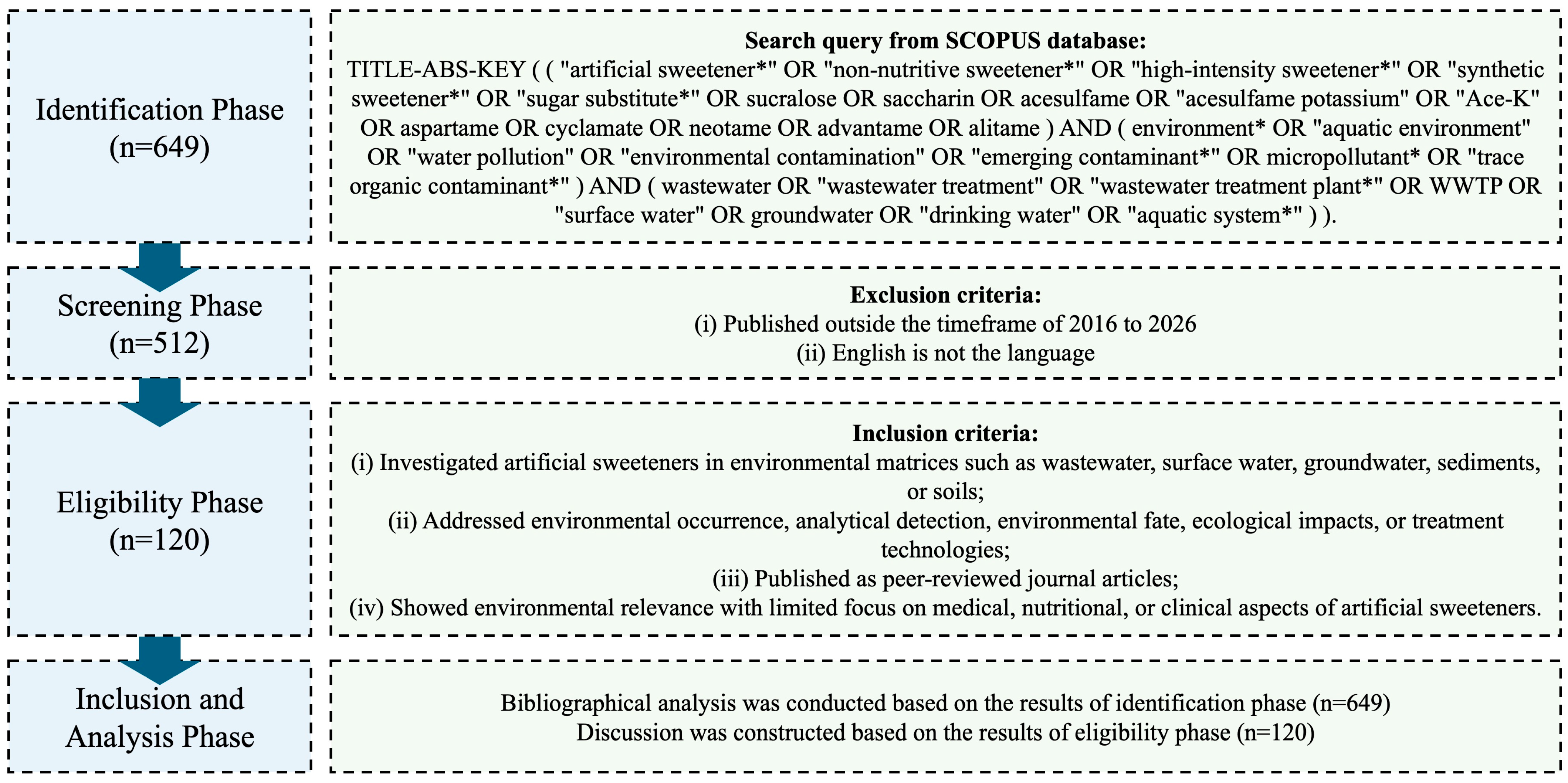
The retrieved publications underwent a systematic screening and selection process to ensure relevance to the scope of this review. Initially, all records obtained from the database search were exported and compiled for further analysis. Duplicate records were identified and removed before the screening process. The exclusion criteria applied during the screening phase were as follows:
(i)
Published outside the timeframe of 2016 to 2026;
(ii)
English is not the language.
Further selection was thoroughly conducted in the eligibility phase, with inclusion criteria as follows:
(i)
Investigated artificial sweeteners in environmental matrices such as wastewater, surface water, groundwater, sediments, or soils;
(ii)
Addressed environmental occurrence, analytical detection, environmental fate, ecological impacts, or treatment technologies;
(iii)
Published as peer-reviewed journal articles;
(iv)
Showed environmental relevance with a limited focus on medical, nutritional, or clinical aspects of artificial sweeteners.
The screening procedure followed the Preferred Reporting Items for Systematic Reviews and Meta-Analyses (PRISMA) framework as summarized in Figure 3. The initial search yielded 649 records (used for bibliographical analysis). After the publication period and abstract screening, 512 studies remained for further selection. By applying four inclusion criteria, 392 titles were deselected. Finally, 120 publications were included for deeper discussion.

4.3. Bibliometric and Scientometric Analysis

Bibliometric and scientometric analyses were performed to examine the evolution of research on artificial sweeteners as environmental contaminants [48,49]. The bibliographic dataset obtained from the selected database was exported in CSV and RIS formats and processed for further analysis. Network visualization and mapping of research trends were conducted using VOSviewer version 1.6.20. This software was used to construct visualization networks of keyword co-occurrence and co-authorship collaborations. The co-occurrence analysis of author keywords was performed with a minimum threshold of 20, thereby identifying major research clusters and thematic hotspots [50].

4.4. Thematic Literature Synthesis

Beyond the bibliometric analysis, a thematic synthesis of the selected literature was conducted to provide a comprehensive qualitative understanding of artificial sweeteners as environmental contaminants [51]. The selected studies were systematically analyzed and categorized based on key research themes, including contamination sources, environmental occurrence, transformation processes, ecological impacts, analytical detection methods, and treatment technologies. The thematic analysis was conducted through manual grouping, thereby organizing relevant studies into coherent research categories. Particular attention was given to studies addressing environmental distribution across different matrices, the physicochemical factors influencing persistence, and the effectiveness of various treatment technologies for the removal of artificial sweeteners.
During the preparation of this manuscript/study, the authors used Grammarly and ChatGPT for the purposes of language refinement. The authors have reviewed and edited the output and take full responsibility for the content of this publication.

5. Evolution of Research on Artificial Sweeteners in the Environment

5.1. Growth of Publications over Time

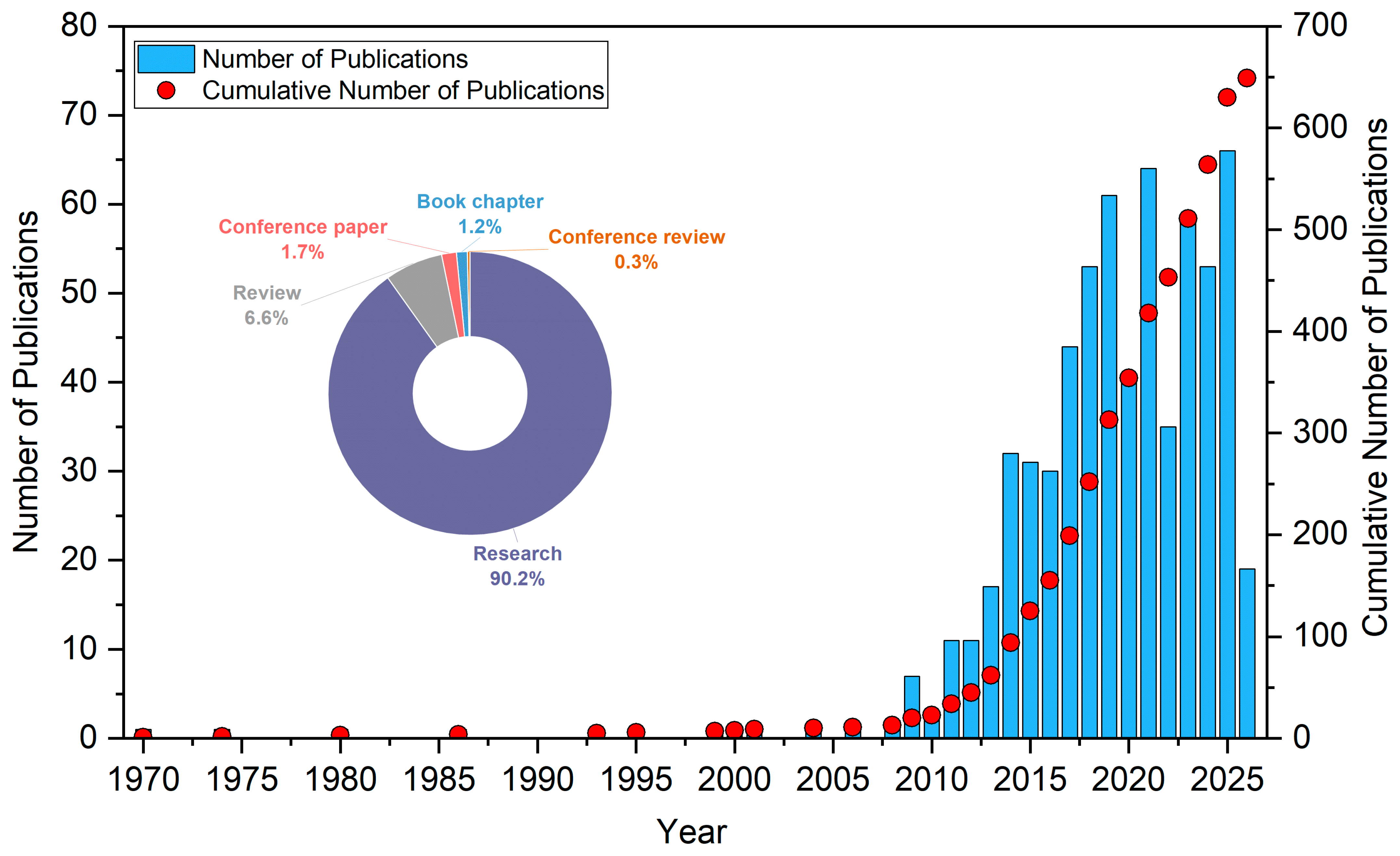
The temporal distribution of publications provides important insights into the development and maturation of research on artificial sweeteners as environmental contaminants. As illustrated in Figure 4, the cumulative number of publications reached 649, reflecting a steady expansion of scientific interest in this research field over the past several decades.
During the early stage of research, spanning from approximately 1970 to the early 2000s, publication activity remained relatively limited. Only a small number of studies were published during this period (an average of 1 article per year), primarily focusing on the chemical properties, safety evaluation, and initial applications of artificial sweeteners in food products. Environmental investigations were still scarce, as the presence of these compounds in environmental systems had not yet been widely recognized. A noticeable increase in publication output began around 2009, marking the emergence of artificial sweeteners as contaminants of emerging concern in environmental research. This shift coincided with improvements in analytical techniques such as liquid chromatography coupled with mass spectrometry, which enabled the detection of artificial sweeteners at trace levels in environmental matrices, including wastewater, surface waters, and groundwater. As a result, researchers began to investigate their environmental occurrence, persistence, and potential ecological impacts. The most rapid growth in publications occurred between 2014 and 2025, during which annual publication counts increased significantly. This period reflects a substantial expansion of research topics, including environmental monitoring, wastewater treatment technologies, ecological risk assessment, and the use of artificial sweeteners as tracers of wastewater contamination. The increasing availability of advanced analytical methods and the growing recognition of artificial sweeteners as persistent micropollutants contributed to the accelerated growth of research activity.
The cumulative publication curve shown in Figure 4 exhibits exponential growth, indicating that research on artificial sweeteners in environmental systems remains an active and expanding field. The continued increase in publication output suggests sustained scientific interest in understanding the environmental behavior, ecological implications, and mitigation strategies associated with these compounds.
In terms of document types, the majority of publications were research articles, accounting for approximately 90.1% of the total dataset, followed by review articles (6.6%). In contrast, other document types, such as conference papers and book chapters, accounted for only a small fraction of total publications. This distribution indicates that the field is largely driven by experimental and analytical studies aimed at investigating the environmental occurrence, fate, and treatment of artificial sweeteners.
While the increasing number of publications reflects growing scientific interest, it does not necessarily indicate a proportional advancement in understanding environmental risks. Much of the early research focused on detection and occurrence, whereas studies addressing long-term ecological impacts and toxicity thresholds remain comparatively limited. This suggests that research development has been driven more by analytical advancements than by comprehensive risk assessment (discussed further in Section 7).

5.2. Distribution of Research Fields

The distribution of research fields provides insight into the interdisciplinary nature of studies related to artificial sweeteners as environmental contaminants [52]. Based on the classification of publications within the SCOPUS database, research on artificial sweeteners spans a wide range of scientific disciplines, reflecting the complex environmental, chemical, and biological dimensions associated with these compounds (Table 2).
As shown in Table 2, Environmental Science represents the dominant research field, accounting for the largest number of publications with 528 documents. This strong representation highlights the research community’s primary focus on the environmental occurrence, fate, and ecological implications of artificial sweeteners in aquatic systems. Many studies within this field investigate the detection of artificial sweeteners in wastewater treatment plants, surface waters, groundwater, and drinking water systems, as well as their persistence and environmental transport pathways. The second-largest contribution comes from Chemistry, with 148 publications, followed by Engineering with 124. The significant presence of chemistry-related research reflects the importance of analytical techniques and chemical characterization in detecting artificial sweeteners at trace concentrations in environmental matrices. Meanwhile, engineering studies primarily focus on wastewater treatment technologies, removal mechanisms, and the development of advanced treatment processes such as adsorption and advanced oxidation processes for the degradation of artificial sweeteners. Several other disciplines also contribute to the research landscape, including Medicine (67 publications) and Biochemistry, Genetics, and Molecular Biology (61 publications). These fields address the potential health implications and biochemical interactions of artificial sweeteners, particularly regarding metabolism and biological exposure pathways. Similarly, Pharmacology, Toxicology, and Pharmaceutics (48 publications) contribute to understanding toxicological effects and to environmental risk assessment.
Additional contributions arise from Agricultural and Biological Sciences (45 publications), which examine the interactions between artificial sweeteners and biological systems, including microbial communities and ecosystem processes. Other disciplines, such as Energy, Earth and Planetary Sciences, and Social Sciences, also contribute fewer publications, highlighting the growing interdisciplinary interest in artificial sweeteners as part of broader environmental and sustainability challenges.
Overall, the distribution of research fields demonstrates that studies on artificial sweeteners extend beyond environmental monitoring and encompass multiple scientific domains, including chemistry, engineering, toxicology, and biological sciences. This interdisciplinary research landscape reflects the multifaceted nature of artificial sweeteners as emerging environmental contaminants. It emphasizes the need for integrated approaches to address their environmental behavior, ecological impacts, and treatment strategies.

5.3. Key Journals

The analysis of publication sources provides valuable insights into the primary journals that disseminate research on artificial sweeteners as environmental contaminants [53]. The distribution of publications across journals (Table 3) also reflects the field’s disciplinary focus and highlights the platforms where the most influential research is typically published.
As shown in Table 3, Science of the Total Environment is the leading journal in this research domain, with 97 publications, representing the largest share of articles in the dataset. This dominance reflects the journal’s broad scope in environmental science and its focus on emerging environmental contaminants, environmental monitoring, and pollution control. Many studies published in this journal investigate the occurrence, distribution, and environmental implications of artificial sweeteners in aquatic environments. The second most prominent journal is Water Research, with 81 publications. This journal is widely recognized as one of the most influential journals in water science and engineering. The high number of publications in Water Research indicates the strong relevance of artificial sweeteners to wastewater treatment research, particularly regarding micropollutant removal, environmental fate, and advanced treatment technologies.
Other highly represented journals include Environmental Science and Technology (41 publications), Chemosphere (30 publications), and Environmental Pollution (23 publications). These journals are well-known for publishing research on environmental chemistry, contaminant transport, and ecological impacts. Their strong representation in the dataset reflects the interdisciplinary nature of artificial sweetener research, which encompasses environmental chemistry, pollution monitoring, and environmental risk assessment. In addition, several journals focusing on hazardous contaminants and treatment technologies contribute significantly to the field, including Journal of Hazardous Materials (20 publications) and Journal of Chromatography A (14 publications). These journals emphasize analytical methodologies and contaminant removal strategies, highlighting the importance of advanced analytical techniques for detecting artificial sweeteners and evaluating treatment performance.
Other journals such as Environmental Monitoring and Assessment, Environmental Science and Pollution Research, and Environmental Science: Processes and Impacts also contribute a notable number of publications, indicating continued research interest in environmental monitoring and contaminant assessment. Furthermore, journals specializing in ecotoxicology, water management, and environmental engineering, such as Environmental Toxicology and Chemistry, Marine Pollution Bulletin, and Journal of Environmental Management, demonstrate the broad interdisciplinary engagement in this research field. In addition, the presence of a large number of journals with fewer than three publications (146 journals) further illustrates the expanding interest in artificial sweeteners across diverse scientific disciplines. This wide distribution suggests that artificial sweeteners are increasingly being studied within the broader framework of emerging contaminants and micropollutants.

6. Global Research Landscape and Collaboration Networks

6.1. Leading Countries

The geographic distribution of publications (Table 4) provides valuable insights into the global research landscape of artificial sweeteners as environmental contaminants. Analysis of the dataset reveals that research activity is concentrated in several key countries, reflecting differences in research capacity, environmental priorities, and technological development.
As shown in Table 4, the United States emerges as the most productive country in this research field, contributing 152 publications. The strong representation of the United States reflects its well-established research infrastructure and extensive investment in environmental science and water quality research. Many studies conducted in the United States focus on the environmental occurrence of artificial sweeteners, wastewater treatment processes, and the use of these compounds as tracers for anthropogenic pollution.
China ranks as the second-most productive country, with 125 publications, followed by Germany with 108. The rapid growth of research output from China reflects the country’s increasing investment in scientific research in environmental monitoring and pollution control, particularly in response to growing concerns about water quality and emerging contaminants. The dissemination of scientific information through open access by research scientists is taking place in developed countries. The most mentioned research fund also originated from China (National Natural Science Foundation of China), with a total of 57 mentions. Similarly, Germany has been actively involved in studying the environmental fate of artificial sweeteners, particularly in wastewater treatment systems and surface water monitoring programs.
Other countries contributing significant research outputs include Canada (64 publications), Australia (45 publications), Spain (41 publications), and Switzerland (40 publications). These countries have strong research programs in environmental chemistry and water resource management, which have advanced knowledge of the occurrence, persistence, and removal of artificial sweeteners in aquatic environments. European countries collectively demonstrate substantial research activity in this field. Countries such as Italy (28 publications), France (27 publications), the United Kingdom (26 publications), and Sweden (23 publications) contribute notable numbers of publications. This strong European presence reflects collaborative research networks and long-standing environmental monitoring programs addressing emerging contaminants in water systems.
Several Asian countries also contribute significantly to the research landscape, including India (22 publications), Singapore (17 publications), Japan (14 publications), and South Korea (12 publications). These countries have increasingly focused on studying artificial sweeteners as part of broader investigations into micropollutants and wastewater-derived contaminants. The concentration of research output in developed countries indicates that current knowledge may be geographically biased toward regions with advanced analytical capabilities. As a result, the global distribution of artificial sweetener contamination may be underestimated, particularly in rapidly urbanizing regions where monitoring efforts remain limited.

6.2. International Collaboration Patterns

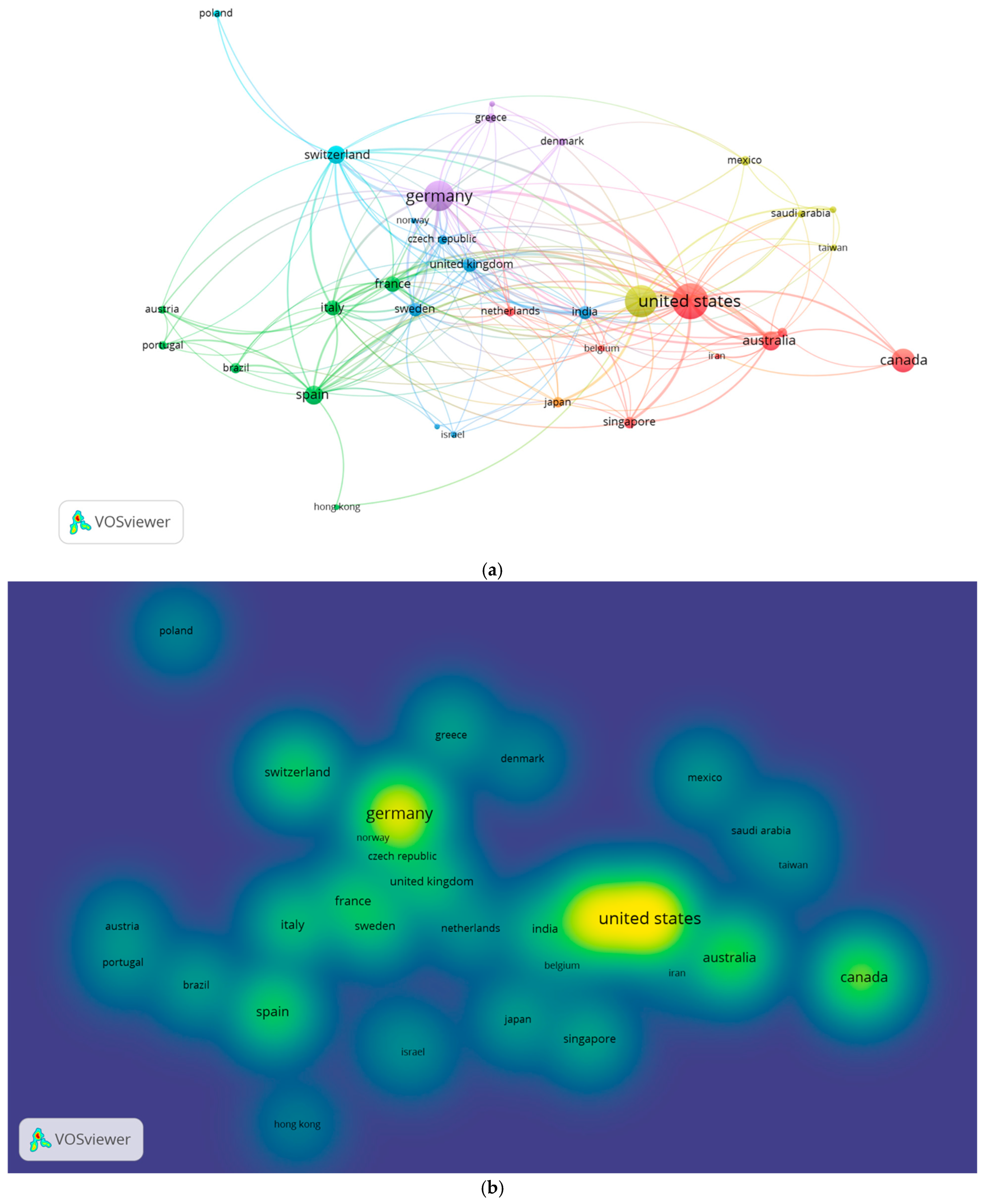
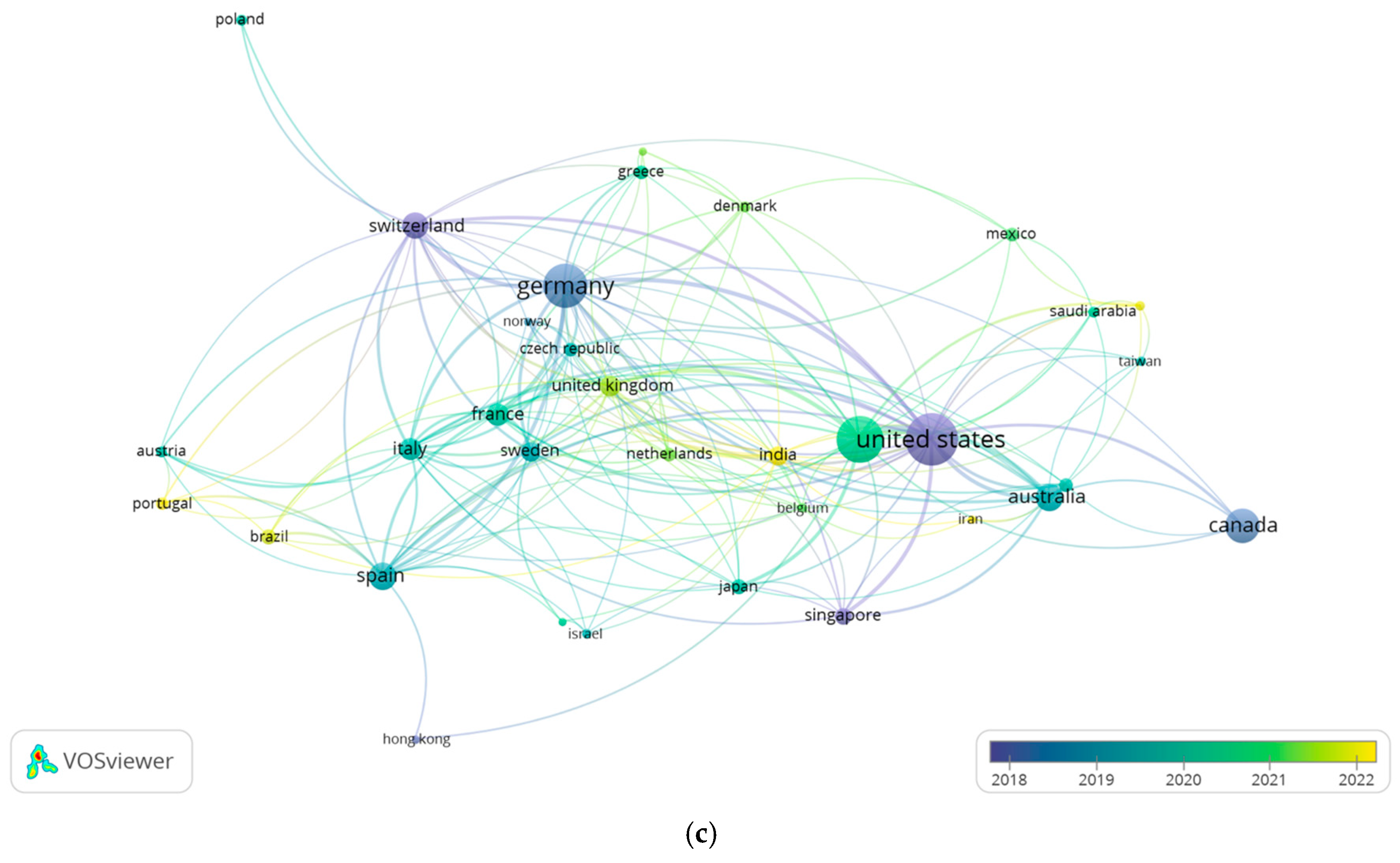
International collaboration plays a critical role in advancing research on artificial sweeteners as environmental contaminants. The country co-authorship network illustrates the global collaboration structure among countries contributing to this research field, as seen in the network visualization (Figure 5a). Complementary insights are provided by the density visualization (Figure 5b), which highlights regions with higher concentrations of collaborative research activity, and the overlay visualization (Figure 5c), which illustrates the temporal development of international collaborations.
As illustrated in the collaboration network (Figure 5a), the United States functions as the central hub of international cooperation within the research landscape. The United States maintains extensive research partnerships with numerous countries, including Canada, Australia, India, Japan, the Netherlands, Belgium, and Singapore. Strong collaborative links among these countries indicate the United States’ prominent role in facilitating global research efforts in environmental monitoring, wastewater treatment technologies, and the assessment of emerging contaminants.
The density visualization (Figure 5b) further confirms this pattern, with the United States appearing as the most prominent collaboration hotspot within the global research network. Germany represents another major center of international collaboration, particularly within the European research community. Germany maintains strong research connections with several European countries, including Switzerland, France, the United Kingdom, Sweden, the Czech Republic, and Denmark. The density visualization highlights Germany as a significant collaboration hub within Europe, reflecting the country’s active participation in joint research initiatives focused on water quality monitoring, environmental chemistry, and micropollutant studies. A strong regional collaboration cluster is also observed among southern and western European countries, particularly Spain, Italy, France, and Portugal. These countries form a closely interconnected research network that frequently collaborates on studies addressing the environmental occurrence of artificial sweeteners, analytical detection methods, and the environmental fate of micropollutants in aquatic systems. Switzerland also serves as an important bridging country within this European network, linking research groups across multiple regions.
The collaboration network further demonstrates the increasing participation of Asia-Pacific countries, including India, Japan, Singapore, Taiwan, and Iran, which maintain active research partnerships with both European and North American institutions. Similarly, Australia and Canada act as important connecting nodes that facilitate cross-continental collaboration. The density map highlights Canada and Australia as emerging centers of collaboration, contributing significantly to international research activities.
The overlay visualization (Figure 5c) provides additional insight into the temporal evolution of international collaborations. Earlier collaborative relationships are primarily associated with European countries such as Germany, Switzerland, and the United Kingdom, indicating that early research on artificial sweeteners was largely concentrated in Europe. In contrast, more recent collaborations, represented by warmer colors in the overlay map, show increasing participation from countries such as India, Saudi Arabia, Taiwan, Mexico, and Brazil, reflecting the expanding global interest in artificial sweeteners as emerging environmental contaminants.

6.3. Influential Papers

Among the most influential publications (Table 5), the review by Tran et al. [54], published in Water Research, stands out as the most-cited article, with 1472 citations. This study provides a comprehensive overview of the occurrence and fate of emerging contaminants in municipal wastewater treatment plants across different geographical regions. The review has played an important role in synthesizing knowledge on the behavior of various micropollutants, including artificial sweeteners, and has served as a key reference for subsequent research on wastewater treatment and contaminant removal.
Another highly influential study is the large-scale monitoring survey conducted by Loos et al. [55], also published in Water Research, which has accumulated 1036 citations. This work presents an EU-wide monitoring program examining emerging polar organic contaminants in wastewater treatment plant effluents. The study provided valuable baseline data on the occurrence of multiple contaminants across European wastewater systems and significantly advanced understanding of the environmental distribution of emerging pollutants.
Several influential review papers have also shaped the field. The review by Rizzo et al. [56] in Science of the Total Environment, with 699 citations, examines advanced treatment technologies for removing contaminants of emerging concern from urban wastewater. This paper has been widely cited due to its comprehensive evaluation of both conventional and advanced treatment approaches, including advanced oxidation processes and hybrid treatment systems.
In addition to methodological and treatment-focused studies, several influential papers have contributed to understanding the environmental occurrence of artificial sweeteners. For example, the study by Buerge et al. [59], published in Environmental Science and Technology, demonstrated the ubiquitous occurrence of acesulfame in aquatic environments and highlighted its potential as a tracer for domestic wastewater contamination in groundwater systems. With 469 citations, this work is considered a landmark study that established artificial sweeteners as indicators of anthropogenic pollution.
Analytical method development has also played a significant role in advancing research in this field. The study by Schymanski et al. [61] introduced strategies for characterizing polar organic contaminants in wastewater using high-resolution mass spectrometry. With 368 citations, this research contributed to improving analytical capabilities for detecting trace organic pollutants, including artificial sweeteners, in environmental samples.
Another important contribution is the study by Scheurer et al. [62], which investigated the occurrence of artificial sweeteners in wastewater, surface waters, and soil aquifer treatment systems. This work provided early evidence of the environmental persistence of artificial sweeteners and has been widely cited in subsequent environmental monitoring studies. Finally, the review by Lange et al. [63] played an important role in formally recognizing artificial sweeteners as a new class of emerging environmental contaminants. This publication helped establish the conceptual framework for studying artificial sweeteners as a subset of micropollutants in aquatic environments.

7. Research Hotspots and Emerging Themes

7.1. Keyword Co-Occurrence Analysis

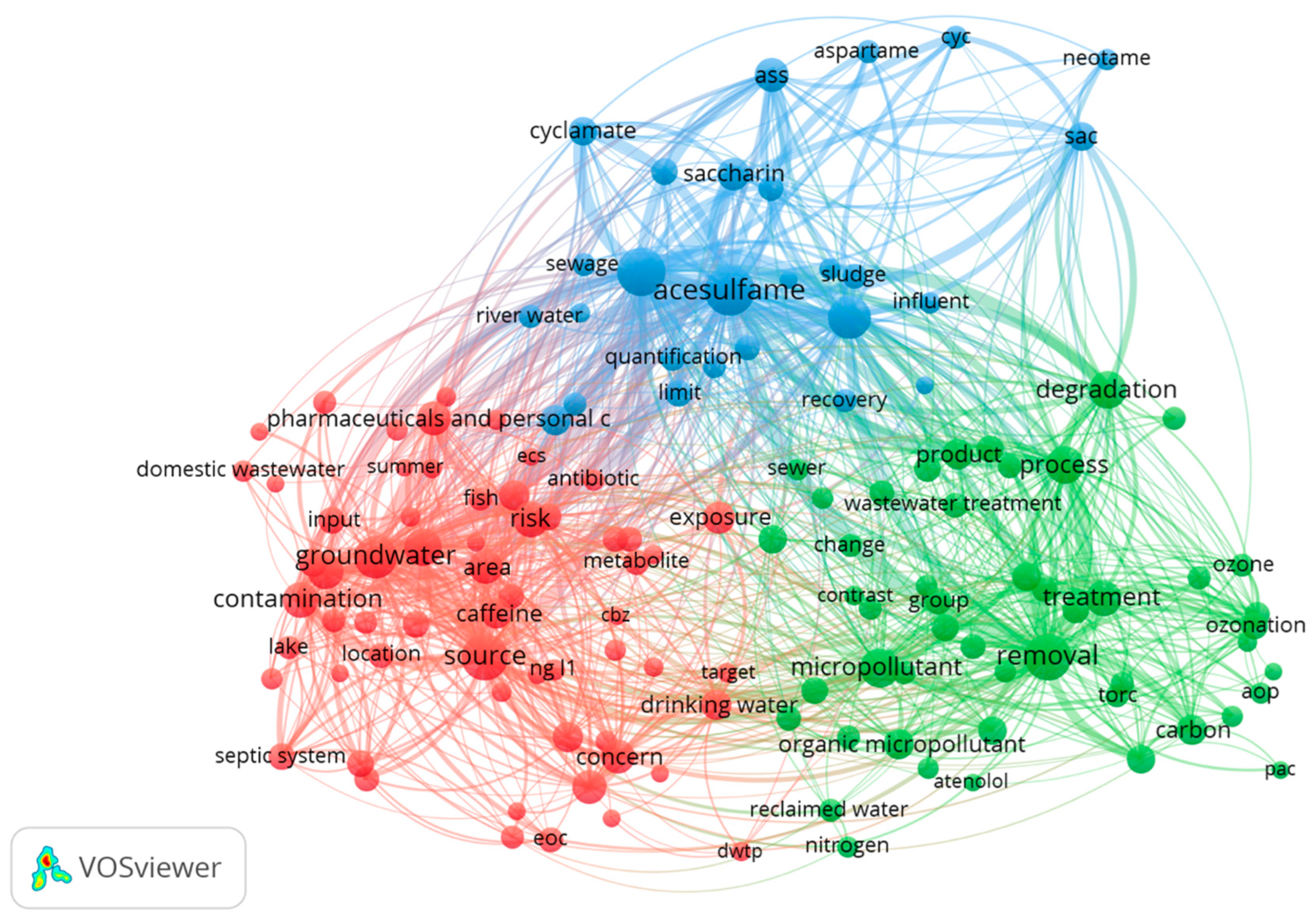
The keyword network (Figure 6) highlights the interdisciplinary nature of artificial sweetener research, spanning environmental monitoring, contamination pathways, and wastewater treatment technologies. Three primary thematic clusters were identified from the analysis, reflecting the main scientific focus areas within the literature.
The first cluster primarily represents research on specific artificial sweetener compounds and their occurrence in environmental matrices. Keywords such as acesulfame, saccharin, aspartame, cyclamate, and neotame appear prominently within this cluster, indicating that many studies focus on the detection and environmental behavior of individual sweetener compounds. The presence of terms such as influent, sludge, and wastewater suggests that these compounds are frequently investigated within wastewater treatment systems and urban water cycles. This cluster reflects a strong emphasis on compound-specific monitoring and on identifying artificial sweeteners as emerging environmental contaminants.
The second cluster highlights research related to environmental occurrence and contamination pathways. Frequently occurring terms in this cluster include groundwater, contamination, source, domestic wastewater, septic system, and drinking water. The clustering of these terms indicates that a substantial portion of the literature focuses on tracing the transport of artificial sweeteners across environmental compartments, particularly from wastewater into surface water and groundwater. The presence of terms such as exposure and source tracking also suggests growing interest in using artificial sweeteners as indicators of anthropogenic pollution and wastewater intrusion.
The third cluster represents research on treatment technologies and removal processes. This cluster contains keywords such as removal, degradation, treatment, ozonation, advanced oxidation processes, and adsorption. These terms indicate that significant research efforts have been devoted to developing strategies for removing artificial sweeteners from wastewater and drinking water systems. The strong connectivity between these keywords reflects the increasing importance of advanced treatment technologies in addressing the persistence of artificial sweeteners in aquatic environments. The prominence of keywords related to occurrence and treatment highlights a strong focus on detection and removal technologies. In contrast, comparatively few studies address toxicity, transformation products, and long-term ecological effects. This imbalance indicates that risk-oriented research remains underdeveloped.

7.2. Cluster Identification of Research Themes

The first cluster focuses on the occurrence and monitoring of artificial sweeteners in environmental systems. This cluster includes keywords associated with contamination pathways and environmental compartments, including groundwater, drinking water, septic systems, domestic wastewater, and environmental monitoring. The presence of these terms indicates that a large portion of the literature focuses on investigating the environmental distribution of artificial sweeteners and identifying sources of contamination. Many studies in this cluster examine the occurrence of these compounds in surface waters, groundwater, and wastewater treatment plant effluents, highlighting their widespread presence in aquatic environments. The frequent association of artificial sweeteners with groundwater and septic systems also suggests that these compounds are increasingly used as tracers for detecting wastewater intrusion and anthropogenic pollution in hydrological studies.
The second cluster represents research centered on specific artificial sweetener compounds and their environmental behavior. Prominent keywords in this cluster include acesulfame, saccharin, aspartame, cyclamate, and neotame. These compounds are among the most widely studied artificial sweeteners due to their extensive consumption and persistence in environmental matrices. Studies within this cluster primarily focus on the detection, quantification, and environmental occurrence of these compounds in wastewater treatment systems and natural waters. The association of keywords such as influent and sludge within the same cluster further highlights the importance of wastewater treatment plants as key entry points for artificial sweeteners into aquatic environments.
The third cluster is associated with treatment technologies and removal processes aimed at mitigating contamination by artificial sweeteners. This cluster contains keywords such as removal, degradation, ozonation, adsorption, advanced oxidation processes, and wastewater treatment. These terms indicate that considerable research attention has been directed toward developing effective strategies for removing artificial sweeteners from water and wastewater systems. The clustering of these keywords reflects growing interest in advanced treatment technologies capable of degrading persistent organic contaminants that conventional wastewater treatment processes do not efficiently remove. Together, these clusters demonstrate that research on artificial sweeteners as environmental contaminants is primarily structured around three interconnected themes: environmental occurrence and contamination pathways, compound-specific monitoring studies, and treatment technologies for contaminant removal.

7.3. Keyword Density Visualization

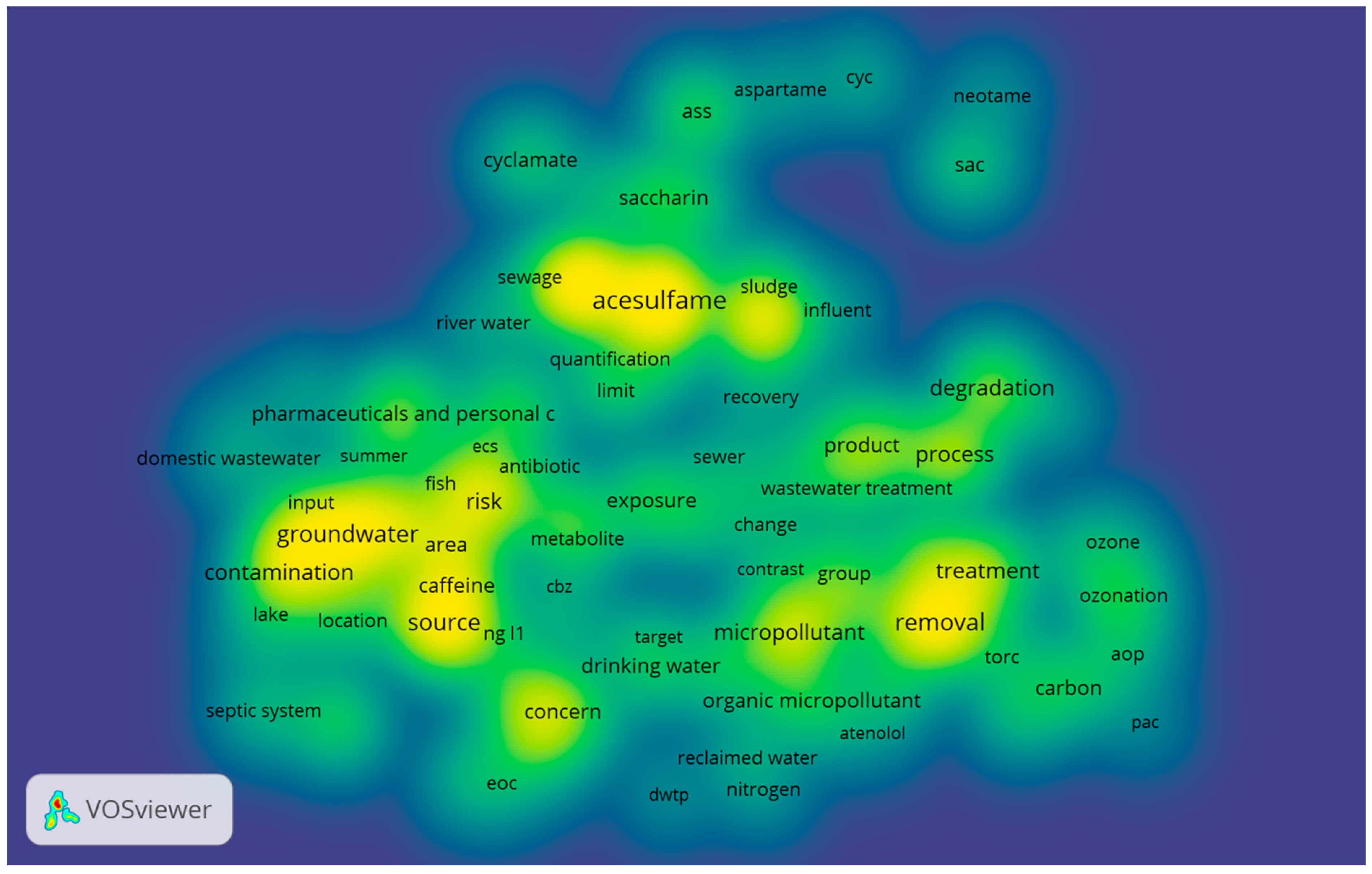
The keyword density visualization (Figure 7) provides an overview of the most frequently studied topics within the field of artificial sweeteners as environmental contaminants.
As shown in Figure 7, several high-density regions are evident, highlighting the primary scientific themes that shape research in this area. One of the most prominent hotspots centers around acesulfame, which appears as a highly concentrated keyword within the network. The prominence of acesulfame is evident in its widespread detection in wastewater and environmental waters, as well as its high persistence during wastewater treatment processes. Closely associated keywords such as influent, sludge, and sewage indicate that many studies focus on monitoring this compound within wastewater treatment systems and urban water cycles.
Another major hotspot is associated with groundwater contamination and pollution sources, where keywords such as contamination and source appear with high density. This cluster highlights the increasing use of artificial sweeteners as indicators of wastewater intrusion into groundwater systems. Their persistence and resistance to degradation make them useful tracers for identifying anthropogenic contamination pathways.
A third hotspot can be observed around removal, with keywords including treatment, degradation, ozonation, and advanced oxidation processes. The concentration of these terms reflects the growing research interest in developing effective strategies to remove artificial sweeteners and other micropollutants from wastewater and drinking water systems.
Additionally, the presence of keywords such as micropollutant, organic micropollutant, and pharmaceuticals and personal care products indicates that artificial sweeteners are increasingly investigated within the broader context of emerging contaminants in aquatic environments. This trend suggests a shift toward integrated studies that examine multiple classes of micropollutants simultaneously.

7.4. Temporal Evolution of Keywords

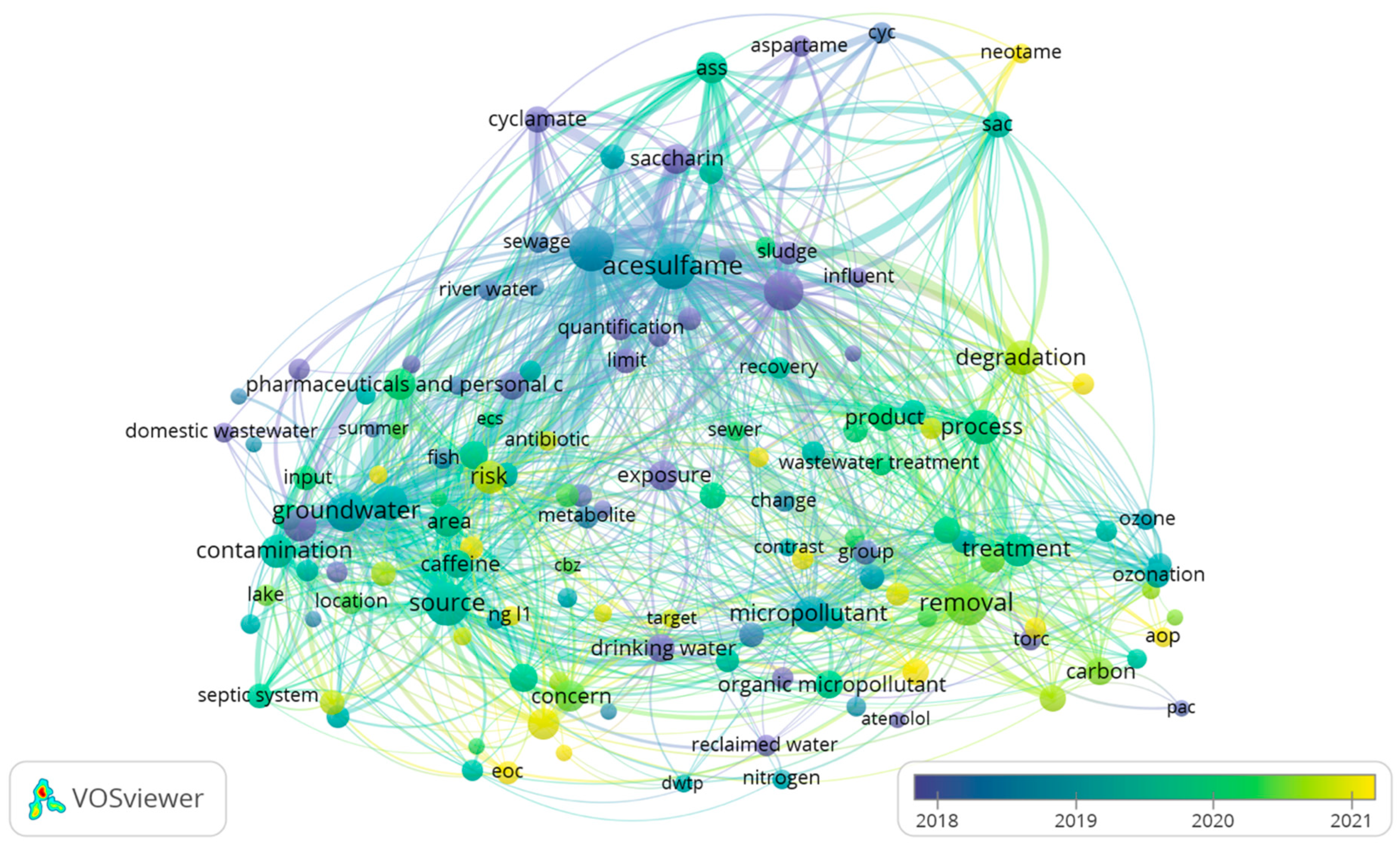
The overlay visualization of keyword co-occurrence provides insights into the temporal development of research themes in artificial sweetener studies (Figure 8).
As shown in Figure 8, earlier research topics primarily focus on the detection and environmental monitoring of artificial sweeteners. Keywords such as acesulfame, saccharin, cyclamate, and aspartame appear in darker blue shades, indicating that these compounds have been the focus of environmental studies for longer. These early investigations were largely concerned with identifying the occurrence of artificial sweeteners in wastewater effluents and aquatic environments, particularly within wastewater treatment systems. Intermediate research themes, represented by green-colored keywords, reflect an expansion of studies into environmental contamination pathways and micropollutant monitoring. Keywords such as groundwater, contamination, micropollutants, and drinking water illustrate the growing interest in understanding the distribution of artificial sweeteners across different environmental compartments and their role as indicators of anthropogenic pollution.
More recent research topics are highlighted in yellow, including degradation, removal, advanced oxidation processes, and carbon-based treatment. These keywords indicate a shift toward developing advanced treatment technologies to mitigate artificial sweetener contamination in wastewater and drinking water systems. The increasing prominence of these topics reflects the growing recognition that conventional wastewater treatment processes are often insufficient for removing persistent artificial sweeteners.
Additionally, the emergence of newer keywords related to organic micropollutants, environmental concerns, and treatment processes suggests a broader integration of artificial sweetener research into the field of emerging contaminants. This shift indicates that artificial sweeteners are increasingly studied alongside pharmaceuticals and other trace organic pollutants as part of a complex mixture of contaminants in aquatic environments.

7.5. Emerging Research Frontiers

The keyword co-occurrence network reveals several emerging research frontiers that reflect the evolving focus of artificial sweetener research in environmental systems. These frontiers arise from the interaction between three dominant thematic clusters: compound occurrence and monitoring, environmental contamination pathways, and treatment technologies for micropollutant removal. Five emerging research trends are elaborated below:
(i)
Artificial sweeteners as tracers of wastewater contamination
One notable emerging research direction involves using artificial sweeteners as anthropogenic tracers for wastewater intrusion and environmental contamination. Keywords such as groundwater, septic system, source, contamination, and domestic wastewater cluster together, indicating that these compounds are increasingly used to track wastewater-derived pollutants in hydrological systems. Compounds such as acesulfame and sucralose, which are highly persistent and poorly removed during wastewater treatment, have been widely applied as indicators of sewage contamination in groundwater and surface waters. This application has expanded the role of artificial sweeteners beyond environmental contaminants to tools for hydrological tracing and pollution source identification.
(ii)
Advanced treatment technologies for micropollutant removal
Another major frontier concerns the development of advanced wastewater treatment technologies to remove persistent artificial sweeteners. The green cluster in the network highlights keywords such as removal, degradation, treatment, ozonation, advanced oxidation processes (AOPs), adsorption, and carbon-based treatment. These technologies are being explored to address the limited removal efficiency of conventional wastewater treatment systems. Increasing attention is being given to hybrid treatment approaches that combine biological treatment with advanced oxidation processes or adsorption materials to improve the degradation of stable compounds such as acesulfame and saccharin.
(iii)
Transformation processes and environmental fate of artificial sweeteners
A third emerging frontier focuses on the environmental fate and transformation pathways of artificial sweeteners. Keywords such as degradation, process, product, and wastewater treatment indicate growing interest in understanding how these compounds transform during treatment or after release into aquatic environments. Research in this area examines biodegradation, photochemical reactions, and advanced oxidation mechanisms that may lead to the formation of transformation products. Understanding these processes is essential for evaluating the persistence and long-term environmental behavior of artificial sweeteners.
(iv)
Ecotoxicological impacts and exposure pathways
The network also highlights increasing research on ecological and human exposure risks associated with artificial sweeteners. Keywords such as risk, exposure, metabolite, and fish suggest that researchers are investigating the potential biological effects of these compounds in aquatic ecosystems. Although artificial sweeteners are generally considered safe for human consumption, concerns remain about their long-term ecological impacts, particularly on microbial communities and aquatic organisms exposed to chronic low concentrations.
(v)
Artificial sweeteners within the broader micropollutant framework
Another emerging direction is the integration of artificial sweeteners into broader studies of micropollutants and emerging contaminants. The presence of terms such as micropollutant, organic micropollutant, and pharmaceuticals and personal care products indicates that artificial sweeteners are increasingly studied alongside pharmaceuticals and other trace organic contaminants. This integrated approach reflects a growing recognition that artificial sweeteners form part of a complex mixture of contaminants in wastewater and aquatic environments.

7.6. Thematic Evolution of Research Domains

Based on the keyword co-occurrence, density, and overlay visualization analyses, the research field has progressed through several stages, reflecting the gradual expansion from compound detection to environmental management and treatment strategies. The earliest stage of research primarily focused on identifying and quantifying artificial sweeteners in environmental systems. Early studies were largely devoted to detecting commonly used compounds such as acesulfame, saccharin, aspartame, and cyclamate in wastewater effluents and surface waters. Improvements in analytical methods, particularly liquid chromatography coupled with mass spectrometry techniques, enabled researchers to quantify artificial sweeteners at trace concentrations in complex environmental matrices. During this phase, the main objective was to establish the environmental presence of artificial sweeteners and to recognize them as potential emerging contaminants associated with anthropogenic activities.
As research progressed, scientific attention shifted toward understanding the environmental distribution and transport pathways of artificial sweeteners. Keywords such as groundwater, contamination, source, drinking water, and septic system became increasingly prominent in the bibliometric network. These studies investigated the migration of artificial sweeteners from municipal wastewater and domestic discharges into natural water bodies, including surface waters and groundwater. The persistence and high water solubility of certain compounds, particularly acesulfame, facilitated their use as indicators of wastewater contamination and anthropogenic pollution in hydrological studies.
The research domain later expanded to include investigations of the environmental fate and transformation processes of artificial sweeteners. Studies began to explore degradation mechanisms, transformation products, and the roles of microbial and physicochemical processes in determining the environmental persistence of these compounds. Keywords related to degradation, metabolite formation, and environmental exposure reflect the growing interest in understanding how artificial sweeteners behave in wastewater treatment systems and natural aquatic environments.
More recently, research has focused on treatment technologies and mitigation strategies to reduce the environmental release of artificial sweeteners. The emergence of keywords such as removal, treatment, ozonation, advanced oxidation processes, and carbon-based adsorption indicates a strong shift toward developing effective technologies to remove persistent micropollutants from wastewater and drinking water systems. These research efforts are driven by the recognition that conventional wastewater treatment plants often exhibit limited efficiency in removing highly stable artificial sweeteners.
In addition to treatment-oriented research, increasing attention has been directed toward ecological risk assessment and the broader context of micropollutant contamination. Artificial sweeteners are now frequently studied alongside pharmaceuticals and personal care products within the broader framework of emerging contaminants. This integrative approach reflects the growing awareness that artificial sweeteners contribute to the complex mixture of trace organic pollutants present in aquatic environments. This progression highlights the maturation of research on artificial sweeteners as environmental contaminants and underscores the increasing emphasis on developing sustainable strategies to manage their environmental impacts. Specifically, clusters related to environmental occurrence, persistence, tracers, treatment technologies, and knowledge gaps correspond directly to Section 8, Section 9, Section 10, Section 11 and Section 12, which examine these topics in detail. These bibliometric findings serve as a framework for synthesizing current knowledge on artificial sweeteners in environmental systems.

8. Sources and Environmental Pathways of Artificial Sweeteners

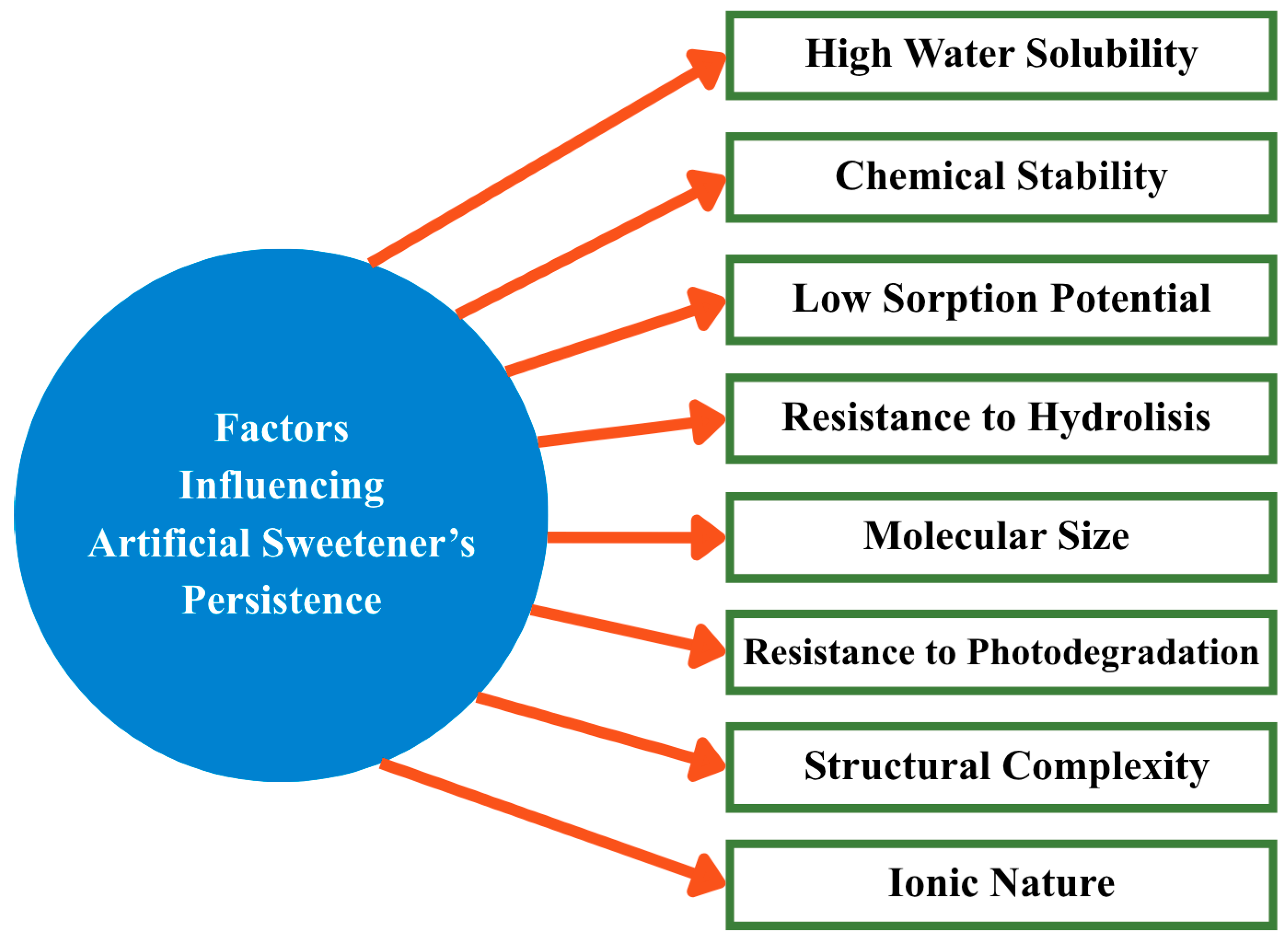
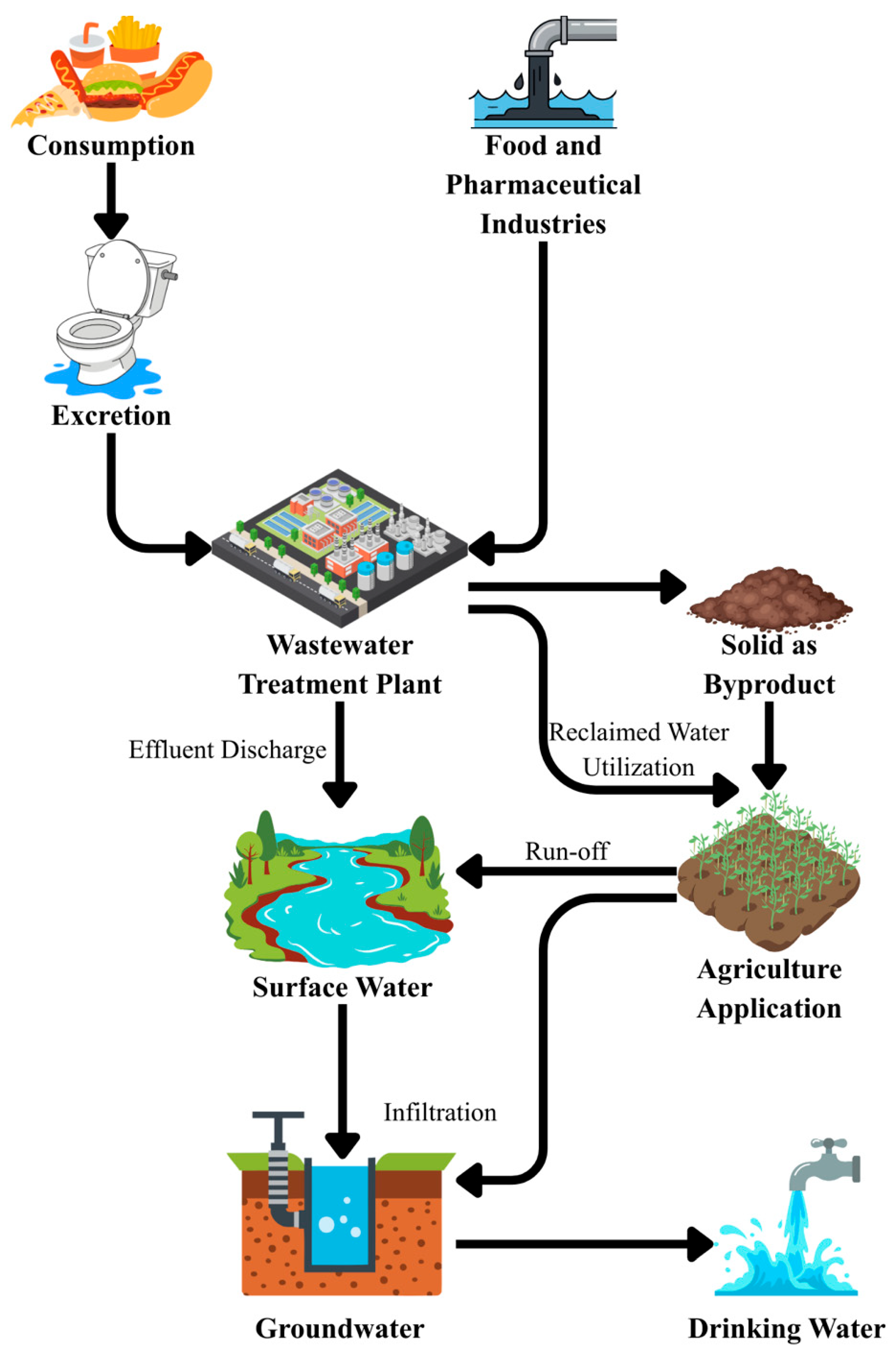
The increasing occurrence of artificial sweeteners in environmental matrices is primarily driven by their extensive use in food products [5], pharmaceuticals [64], and consumer goods [65]. Due to their high chemical stability, water solubility, and resistance to metabolic transformation, many artificial sweeteners are excreted from the human body largely unchanged [66]. Consequently, they enter wastewater streams and can be transported through various environmental pathways. The continuous discharge of these compounds from anthropogenic activities has led to their widespread detection in aquatic environments [17], sediments [67], and even drinking water systems [68]. Building on the bibliometric insights presented in Section 5, Section 6 and Section 7, this section synthesizes current knowledge on the sources and environmental pathways of artificial sweeteners as summarized in Figure 9 and discussed further in the following subsections.

8.1. Municipal Wastewater and Domestic Discharge

Municipal wastewater systems represent the primary pathway through which artificial sweeteners enter the environment [10]. After consumption, most artificial sweeteners are poorly metabolized and excreted in urine and feces, eventually reaching sewage systems [3]. Household wastewater generated from food preparation, beverage consumption, and disposal of sweetener-containing products further contributes to their presence in municipal wastewater streams [8]. Wastewater treatment plants receive these influents and serve as the main interface between human activities and natural water bodies. However, conventional wastewater treatment processes are often not specifically designed to remove highly stable and hydrophilic organic micropollutants such as artificial sweeteners [9]. As a result, compounds such as sucralose and acesulfame potassium frequently pass through treatment systems and are discharged in treated effluents. This continuous release from wastewater treatment effluents makes municipal wastewater a dominant contributor to artificial sweetener contamination in rivers, lakes, and coastal waters [69].

8.2. Industrial Sources and Pharmaceutical Production

In addition to domestic consumption, industrial activities may also contribute to the environmental release of artificial sweeteners. Food and beverage manufacturing facilities that produce diet beverages, sugar-free products, and processed foods often use high-intensity sweeteners in their production processes [17]. Waste streams generated during manufacturing, equipment cleaning, and product formulation can introduce artificial sweeteners into industrial effluents.
The pharmaceutical and formulation industries may also serve as secondary sources of artificial sweeteners [20]. Some artificial sweeteners are used as excipients in medicinal syrups, chewable tablets, and other pharmaceutical preparations to improve palatability [70]. Improper disposal of industrial waste streams or insufficient treatment of industrial effluents may therefore result in the release of these compounds into municipal sewer systems or nearby water bodies. Although industrial contributions may be smaller compared to domestic wastewater inputs, localized contamination near manufacturing facilities can occur. These sources may lead to elevated concentrations in certain regions, particularly in areas with intensive food processing or pharmaceutical production activities [20].

8.3. Agricultural Inputs and Biosolid Application

Agricultural practices represent another indirect pathway through which artificial sweeteners may enter the environment. Wastewater treatment plants often produce biosolids as a by-product of sludge treatment processes. These biosolids are commonly applied to agricultural land as soil amendments due to their nutrient content [71]. However, residual organic contaminants present in wastewater sludge, including artificial sweeteners, may be introduced into soils through this practice [5]. Once applied to agricultural land, these compounds can potentially migrate through soil systems via leaching or surface runoff during rainfall events. In addition, the use of reclaimed wastewater for irrigation in water-scarce regions may also introduce artificial sweeteners into agricultural soils and surrounding environments [72].

8.4. Transport Across Environmental Media

After their release into wastewater and surface waters, artificial sweeteners can undergo various transport processes that enable them to move among multiple environmental compartments. Their high water solubility and low sorption potential enable them to remain primarily in the dissolved phase, facilitating their transport through rivers, lakes, and groundwater systems [5]. Hydrological processes such as river flow, infiltration, and groundwater recharge can further distribute these compounds across different environmental matrices [6]. In some cases, artificial sweeteners may also accumulate in sediments or wastewater sludge [10], depending on their chemical properties and environmental conditions. Their persistence and mobility, therefore, enable them to move between aquatic and terrestrial systems, contributing to their widespread environmental presence.

9. Environmental Occurrence and Global Distribution

Artificial sweeteners have been increasingly detected in a wide range of environmental matrices due to their extensive consumption, chemical stability, and incomplete removal during wastewater treatment processes [67]. Their high water solubility and resistance to biodegradation allow them to persist and spread across aquatic systems, making them useful indicators of anthropogenic contamination [10]. Numerous monitoring studies have reported the occurrence of artificial sweeteners in wastewater effluents [73], surface waters [67], groundwater [35], and even drinking water systems [74]. In addition to aqueous environments, these compounds may also be detected in sludge [75] and sediments [67] due to environmental transport and accumulation processes. Several recent reports regarding the occurrence of artificial sweeteners in various environmental matrices are tabulated in Table 6.

9.1. Analytical Methods

Accurate detection and quantification of artificial sweeteners in environmental samples require highly sensitive analytical techniques due to their typically low environmental concentrations, often occurring at trace levels ranging from nanograms per liter (ng/L) to micrograms per liter (µg/L). As summarized in Table 6, most studies employ targeted analyses using chromatographic techniques coupled with mass spectrometry, particularly liquid chromatography–tandem mass spectrometry (LC–MS/MS), which has become the dominant analytical approach for determining artificial sweeteners in environmental matrices [74,75,76].
Sample preparation methods frequently involve solid-phase extraction (SPE) [73], which is widely used to concentrate analytes from complex matrices such as wastewater, surface water, and groundwater. SPE coupled with LC–tandem quadrupole mass spectrometry (SPE–LC-tQ-MS) has been widely used to detect compounds such as acesulfame-K, cyclamate, saccharin, and sucralose in surface water and sediment samples, achieving detection limits at the ng/L level [67]. Similarly, SPE followed by gas chromatography (SPE–GC) has been used to analyze sucralose in wastewater and drinking water systems, demonstrating its suitability for highly stable compounds [73].
High-performance chromatographic techniques such as ultra-high-performance liquid chromatography (UHPLC) combined with tandem mass spectrometry (UHPLC–MS/MS) [69] or quadrupole time-of-flight mass spectrometry (UPLC–QTOF-MS) [77] provide enhanced sensitivity and selectivity, allowing simultaneous detection of multiple known artificial sweeteners in complex environmental samples. These advanced analytical platforms are particularly useful for monitoring wastewater treatment plants, where concentrations can vary widely depending on influent composition and treatment processes. The application of LC–MS/MS-based techniques also enables the identification of artificial sweeteners in solid environmental matrices such as sediments and biosolids [67,75], where concentrations are typically reported in micrograms per kilogram (µg/kg) or nanograms per gram (ng/g). Additionally, non-targeted analysis using high-resolution mass spectrometry methods, such as QTOF-MS, is increasingly employed [77]. This approach is particularly valuable for identifying transformation products formed during environmental processes and water treatment, as well as detecting previously unreported contaminants. Despite its advantages, non-targeted analysis presents challenges related to data complexity, compound identification, and the need for advanced data processing and spectral libraries [77].

9.2. Wastewater Treatment Plants

Wastewater treatment plants are among the primary hotspots for the occurrence and release of artificial sweeteners into aquatic environments [69]. Due to their widespread consumption in food products, beverages, pharmaceuticals, and personal care products, artificial sweeteners are largely excreted unmetabolized by the human body and subsequently enter municipal wastewater systems. As a result, wastewater treatment plant influents typically contain measurable concentrations of various artificial sweeteners, including acesulfame-K, sucralose, saccharin, cyclamate, and aspartame.
Data summarized in Table 6 demonstrate that several artificial sweeteners are frequently detected in wastewater treatment plant influent and effluent streams across different geographical regions. For example, acesulfame-K concentrations of approximately 0.5–5.1 μg/L have been reported in wastewater treatment facilities in China [69], while sucralose concentrations in wastewater treatment plant influent and effluent have been reported in the range of 1033.4–2626.3 ng/L and 917.6–2031.2 ng/L, respectively [73]. Similarly, cyclamate and saccharin have been detected in wastewater treatment plant effluents at concentrations ranging from 0.04–2.6 μg/L and 0.01–8.6 μg/L [69]. These findings highlight the continuous discharge of artificial sweeteners into receiving water bodies due to their incomplete removal during conventional wastewater treatment processes.
The persistence of certain artificial sweeteners further contributes to their accumulation within wastewater treatment systems. Compounds such as acesulfame-K and sucralose exhibit high chemical stability and resistance to microbial degradation, allowing them to pass through biological treatment processes with limited removal [10]. Consequently, these compounds are frequently detected in treated effluents and are subsequently transported into surface waters, groundwater systems, and downstream drinking water sources. In addition to liquid effluents, artificial sweeteners may also accumulate in solid residues generated during wastewater treatment. Studies have reported the presence of compounds such as cyclamate and sucralose in biosolids and sediments at concentrations up to 0.18 ng/g and 220 ng/g, respectively [75]. The application of biosolids in agricultural land, therefore, represents another potential pathway for environmental dissemination of these compounds.

9.3. Surface Water and Groundwater Contamination

Artificial sweeteners have been increasingly detected in surface water and groundwater systems worldwide, reflecting their persistence in wastewater effluents and their ability to migrate through aquatic environments. As summarized in Table 6, compounds such as acesulfame-K, sucralose, saccharin, and cyclamate have been frequently identified in rivers, lakes, and groundwater at concentrations typically ranging from nanograms per liter to several micrograms per liter.
Surface waters are among the primary environmental compartments that receive artificial sweeteners through the direct discharge of treated wastewater effluents from WWTPs. For example, acesulfame-K concentrations of 74.8–206.9 ng/L have been reported in surface waters in China, while cyclamate has been detected at approximately 373.8 ± 23.9 ng/L in similar aquatic environments [67]. Saccharin has also been widely reported in surface waters, with concentrations ranging from 105.4 to 195.5 ng/L [67]. In certain cases, significantly higher concentrations have been observed in rivers located downstream of wastewater discharge points. For instance, maximum concentrations of acesulfame-K and sucralose, reaching 557 µg/L and 222 µg/L, respectively [76], have been reported in Algerian river systems, highlighting the influence of local wastewater inputs and insufficient treatment capacity.
Beyond surface waters, artificial sweeteners can also infiltrate groundwater systems through processes such as riverbank filtration [35], infiltration of contaminated surface water [6], and leakage from septic systems [8]. Their relatively high water solubility and chemical stability facilitate their transport through soil and aquifer systems. Evidence of this phenomenon is demonstrated by the detection of acesulfame-K in groundwater in the Czech Republic at concentrations ranging from 72.0 to 591.0 ng/L [35], and as saccharin in groundwater samples in Algeria at concentrations up to 674 ng/L [76]. These findings suggest that artificial sweeteners can persist long enough in aquatic systems to migrate into subsurface environments. The presence of artificial sweeteners in groundwater is of particular concern because it is an important source of drinking water in many regions. Their detection in both surface and groundwater systems indicates that artificial sweeteners can function as effective tracers of wastewater contamination and anthropogenic activity in aquatic environments [17]. Moreover, their persistence and mobility raise concerns regarding their long-term accumulation in freshwater resources and the potential exposure of aquatic organisms and human populations.

9.4. Presence in Drinking Water Systems

The presence of artificial sweeteners in drinking water systems has attracted growing scientific attention due to their persistence in aquatic environments and resistance to conventional water treatment processes. As shown in Table 6, several artificial sweeteners have been detected in finished drinking water and tap water, indicating that these compounds can persist through multiple environmental compartments and treatment barriers before reaching potable water supplies. Among the artificial sweeteners reported, saccharin and sucralose have been frequently detected in drinking water sources. For example, saccharin has been identified in drinking water samples in Poland at concentrations ranging from 50 to 100 ng/L [74]. Similarly, sucralose has been detected in tap water in China at concentrations ranging from 177.7 to 409.7 ng/L [73]. These concentrations are generally lower than those observed in wastewater and surface water, reflecting partial removal during drinking water treatment processes. However, their consistent detection indicates that conventional treatment methods such as coagulation, filtration, and disinfection may not eliminate these highly stable compounds.
The presence of artificial sweeteners in drinking water is closely linked to upstream contamination of surface water and groundwater sources [17]. As previously discussed, wastewater treatment plants are major emission points for these compounds, and treated effluents discharged into rivers and lakes may serve as sources of downstream drinking water abstraction. Furthermore, the infiltration of contaminated surface water into groundwater systems can introduce artificial sweeteners into aquifers that supply municipal drinking water facilities. The persistence of compounds such as sucralose and acesulfame-K is largely attributed to their high chemical stability, resistance to biodegradation, and strong polarity, which reduces their removal efficiency during conventional water treatment processes [5]. Although the concentrations reported in drinking water are typically in the ng/L range and generally considered to pose low immediate health risks, their continuous presence raises concerns about long-term exposure and the potential cumulative effects of emerging contaminants [64]. Continued monitoring of artificial sweeteners in drinking water systems is therefore necessary to better understand their environmental pathways, evaluate treatment efficiency, and ensure the protection of public health and water quality.

9.5. Occurrence in Sediments, Sludge, and Soils

In addition to their presence in aquatic environments, artificial sweeteners have also been detected in solid environmental matrices such as sediments, wastewater sludge, and biosolids. These matrices can act as secondary reservoirs for contaminants, allowing artificial sweeteners to persist in the environment and potentially re-enter aquatic systems through resuspension, leaching, or land application of sludge. As summarized in Table 6, several studies have reported measurable concentrations of artificial sweeteners in sediments and biosolids, indicating their capacity to partition into particulate phases despite their generally high water solubility. Sediment samples collected from surface water bodies have detected compounds such as acesulfame-K, cyclamate, saccharin, and sucralose. For example, concentrations of acesulfame-K and saccharin in sediments have been reported at approximately 2.88 ± 0.48 μg/kg. In comparison, cyclamate and sucralose have been detected at concentrations of 1.09 ± 0.25 μg/kg and 0.75 ± 0.19 μg/kg, respectively, in sediment samples from China [67]. Although these concentrations are relatively low compared to those observed in aqueous environments, their detection confirms that artificial sweeteners can associate with suspended particles and accumulate in benthic sediments over time.
Wastewater treatment processes also generate solid residues, including sludge and biosolids, which may contain adsorbed artificial sweeteners. For instance, cyclamate has been detected in biosolids at approximately 0.18 ng/g in Australia, while sucralose has been detected at around 220 ng/g in similar matrices [75]. The accumulation of artificial sweeteners in biosolids is of particular interest because treated sludge is commonly applied to agricultural land as a soil amendment. This practice may therefore represent an additional pathway through which artificial sweeteners are introduced into terrestrial ecosystems.

9.6. Regional Trends and Environmental Hotspots

Recent studies from the past five years (Table 6) reveal clear regional trends in the occurrence of artificial sweeteners in environmental systems. A significant proportion of recent monitoring studies have been conducted in East Asia, particularly in China, where artificial sweeteners have been widely detected across multiple environmental compartments, including wastewater, surface water, sediments, and drinking water systems. The frequent detection of compounds such as acesulfame-K, cyclamate, saccharin, and sucralose in Chinese environmental matrices reflects both increasing consumption of sugar substitutes and the expansion of monitoring programs targeting emerging contaminants in rapidly urbanizing regions.
In these regions, wastewater treatment plants act as major emission points, releasing artificial sweeteners into nearby rivers and surface waters [69]. Subsequent environmental transport leads to their detection in sediments and groundwater, demonstrating the interconnectedness of aquatic compartments. In addition to East Asia, studies from North Africa and Europe also highlight regional hotspots of artificial sweetener contamination. For example, river systems in Algeria have been reported to have relatively high concentrations of acesulfame-K and sucralose compared with many other regions, suggesting strong local inputs from untreated or insufficiently treated wastewater [76]. Groundwater contamination has also been documented in parts of Europe, such as the Czech Republic, where artificial sweeteners have been detected at measurable concentrations in aquifer systems influenced by wastewater infiltration [35]. Another notable regional pattern involves the presence of artificial sweeteners in biosolids and sludge in Australia, demonstrating that wastewater treatment by-products can serve as secondary reservoirs of these compounds [75].
Globally, recent research indicates that the highest concentrations of artificial sweeteners are typically found in wastewater systems, followed by surface waters and groundwater environments. This pattern reflects municipal wastewater as the primary source of artificial sweeteners entering natural aquatic systems. As monitoring efforts continue to expand geographically, emerging hotspots are likely to be identified in regions experiencing rapid population growth, urbanization, and increased consumption of sugar substitutes.

10. Environmental Fate and Transformation Processes

The transformation process and environmental fate are two emerging frontiers in artificial sweetener research. The environmental fate of artificial sweeteners is largely governed by their physicochemical properties, environmental conditions, and interactions with biological and abiotic processes [5]. Once released into environmental systems via wastewater discharge or other anthropogenic pathways, these compounds may undergo a variety of transformations, including biodegradation, photodegradation, and other abiotic reactions. However, the extent of these processes varies significantly depending on the chemical structure of individual sweeteners. Some compounds exhibit high environmental persistence due to their resistance to microbial metabolism and chemical degradation, while others are more readily transformed into intermediate products [66].

10.1. Physicochemical Properties Influencing Persistence

The environmental persistence of artificial sweeteners is strongly influenced by their physicochemical properties, including molecular structure, polarity, solubility, stability, and resistance to biological or chemical degradation (Figure 10). These characteristics determine how artificial sweeteners behave in environmental systems, particularly in aquatic environments where they are frequently detected [66].
One of the most important properties influencing persistence is high water solubility. Most artificial sweeteners are highly polar compounds that readily dissolve in water, allowing them to remain predominantly in the aqueous phase rather than partitioning into sediments or organic matter [68]. For example, compounds such as acesulfame-K and sucralose exhibit very high solubility, which facilitates their transport through wastewater systems and natural aquatic environments [17,73]. This high solubility also enhances their mobility in groundwater systems, enabling them to migrate through soils and aquifers without significant sorption to solid particles.
Another critical factor contributing to the persistence of artificial sweeteners is their chemical stability and resistance to biodegradation [66]. Many artificial sweeteners have molecular structures specifically designed to resist metabolic breakdown within the human body, and these same structural features often make them resistant to microbial degradation in environmental systems [5]. For instance, sucralose contains multiple chlorine substitutions that strengthen its chemical stability and reduce susceptibility to microbial attack [3]. Similarly, acesulfame-K contains a stable oxathiazinone dioxide ring structure that is not readily degraded by common environmental microorganisms [80]. As a result, these compounds can persist through conventional biological wastewater treatment processes with minimal degradation.
The low sorption potential of artificial sweeteners also contributes to their environmental persistence [17]. Many artificial sweeteners have relatively low octanol–water partition coefficients (log Kow), indicating a strong preference for remaining dissolved in water rather than binding to organic matter in soils or sediments [10]. This property reduces the likelihood of removal through adsorption processes during wastewater treatment and allows these compounds to remain mobile in aquatic systems. Consequently, artificial sweeteners are often detected in treated wastewater effluents and downstream water bodies [73].
In addition to chemical stability and low sorption potential, resistance to hydrolysis and photodegradation can further enhance the persistence of certain artificial sweeteners [5]. For example, sucralose is known to resist hydrolytic breakdown across a wide pH range [81], while several artificial sweeteners exhibit relatively slow photolytic degradation under natural sunlight conditions [5]. These characteristics allow the compounds to remain stable in both surface water and groundwater environments for extended periods.
The molecular size and structural complexity of artificial sweeteners can also influence their environmental fate. Compounds with complex ring structures or halogenated functional groups often exhibit enhanced resistance to chemical transformation processes. For example, the chlorinated structure of sucralose significantly reduces its susceptibility to enzymatic cleavage [3], while the sulfonamide group present in saccharin contributes to its stability in aquatic environments [5]. Furthermore, artificial sweeteners typically exist as ionized species at environmental pH, thereby increasing their solubility and reducing their interactions with hydrophobic environmental matrices [82]. The ionic nature of compounds such as acesulfame-K further enhances their transport in aquatic systems and contributes to their widespread detection in surface waters and groundwater [66].

10.2. Biodegradation and Microbial Transformation

Biodegradation represents one of the primary mechanisms by which organic contaminants are removed from environmental systems. However, the biodegradability of artificial sweeteners varies considerably depending on their chemical composition and environmental conditions. Compounds such as sucralose and acesulfame potassium have been reported to exhibit limited biodegradability, allowing them to persist in wastewater effluents and natural water bodies [19]. Their resistance to microbial metabolism is largely attributed to structural modifications that reduce enzymatic recognition and degradation. In contrast, sweeteners containing peptide linkages, such as aspartame, are more susceptible to enzymatic hydrolysis, leading to the formation of smaller metabolites that can be further degraded by microbial communities [39], as reported in previous research [83]. Biodegradation pathways typically involve processes such as hydrolysis, oxidation, and microbial enzymatic transformation (illustrated in Figure 11).
Microbial adaptation and the presence of specialized microorganisms may also influence degradation rates, particularly in wastewater treatment systems where microbial populations are exposed to continuous contaminant inputs. Conversely, many artificial sweeteners resist hydrolysis and microbial degradation [19], often passing through wastewater treatment systems largely unchanged. Partial transformation may occur under advanced treatment conditions, but complete mineralization is rarely achieved [83]. Highly persistent compounds tend to remain dissolved in water and can be transported over long distances, facilitating their widespread detection in surface water and groundwater [66]. This persistence–mobility trade-off implies that compounds with low biodegradability are more likely to exhibit high environmental mobility [84], increasing their potential for continuous exposure to aquatic organisms and eventual entry into drinking water sources [64].

10.3. Photodegradation and Abiotic Processes

In addition to microbial transformation, artificial sweeteners can undergo abiotic degradation processes in aquatic environments, particularly through photodegradation and other physicochemical reactions. These processes play an important role in determining the environmental persistence and transformation of artificial sweeteners in sunlight-exposed surface waters. Photodegradation occurs when chemical compounds absorb solar radiation, leading to molecular excitation and subsequent bond cleavage or structural transformation [85]. This process is especially relevant in surface waters such as rivers, lakes, and reservoirs, where artificial sweeteners may be exposed to ultraviolet (UV) radiation.
Several artificial sweeteners exhibit varying degrees of susceptibility to photolytic degradation depending on their molecular structure and environmental conditions. Compounds such as acesulfame-K may undergo partial photodegradation under UV irradiation, resulting in intermediate degradation products [19]. Laboratory studies have shown that UV-based treatment systems, including UV/H2O2 and UV/persulfate processes, can effectively degrade these compounds by generating highly reactive radicals, such as hydroxyl radicals (•OH) and sulfate radicals (SO4•−) [21]. These reactive species can attack aromatic rings, sulfonamide groups, or other functional groups within artificial sweetener molecules, leading to fragmentation and the formation of smaller, more unstable compounds.
Photodegradation can occur through two primary mechanisms: direct photolysis and indirect photolysis. In direct photolysis, artificial sweeteners absorb photons, triggering molecular excitation and bond breakage. However, many artificial sweeteners have limited absorption in the natural sunlight spectrum, making direct photolysis relatively slow under environmental conditions. Indirect photolysis, on the other hand, involves the interaction of artificial sweeteners with reactive species generated by sunlight-driven processes in water, such as hydroxyl radicals, singlet oxygen, and excited dissolved organic matter. These reactive intermediates can significantly enhance degradation rates compared to direct photolysis alone.
Abiotic transformation can also occur through hydrolysis, oxidation, and chemical reactions with environmental oxidants. For example, oxidative reactions may occur in the presence of oxidizing agents such as ozone, chlorine, or naturally occurring reactive oxygen species in aquatic systems [86]. In engineered water treatment processes, advanced oxidation processes (AOPs) such as ozonation, UV/H2O2, and photocatalysis are commonly applied to accelerate these reactions and enhance the degradation of persistent artificial sweeteners [87].

10.4. Formation and Toxicity of Transformation Products

During environmental degradation, artificial sweeteners may undergo chemical and biological transformations that produce intermediate compounds known as transformation products. These products can be generated through various pathways, including microbial biodegradation, photodegradation, hydrolysis, and advanced oxidation reactions occurring in natural waters or during water treatment processes. Although the parent compounds of artificial sweeteners are generally designed to be chemically stable and resistant to metabolic breakdown, environmental conditions can induce structural changes that produce a variety of transformation intermediates with different physicochemical and toxicological characteristics [5].
Several studies have demonstrated that artificial sweeteners such as acesulfame-K, sucralose, saccharin, and cyclamate may form transformation products during wastewater treatment and environmental degradation [6,10,88]. For instance, oxidative processes such as ozonation and UV-based advanced oxidation can degrade these compounds via reactions with hydroxyl radicals (•OH) or other reactive oxygen species [86]. These reactions may lead to the cleavage of functional groups, ring opening, or substitution, producing smaller organic molecules. As previously mentioned in Section 10.2, aspartame is readily converted through hydrolysis and metabolic processes into compounds such as aspartic acid, phenylalanine, and methanol, as well as oxidation products including formaldehyde and formic acid [83]. In the case of sucralose, photochemical degradation may generate chlorinated intermediates due to the presence of multiple chlorine atoms within its molecular structure. These chlorinated by-products may potentially exhibit greater persistence or toxicity than the original compound [73]. Under specific conditions, sucralose can form more polar metabolites such as glucuronide conjugates. Similarly, acesulfame-K can undergo oxidative degradation during ozonation or UV irradiation, producing various intermediate products via opening of the oxathiazinone ring (such as iso-acesulfame) and smaller inorganic products, including sulfate and amidosulfonic acid. Some of these transformation products have been reported to exhibit increased reactivity or altered toxicity profiles compared with the parent compound [19]. Additionally, saccharin and cyclamate may generate aromatic or sulfonamide-derived intermediates during degradation processes (including cyclohexylamine and related derivatives) [41], which can persist in the aquatic environment depending on environmental conditions [66].
The formation of transformation products is particularly relevant during advanced water treatment processes, where strong oxidizing agents are intentionally applied to degrade persistent contaminants [21,86]. Although these treatment technologies can effectively reduce the concentration of parent artificial sweeteners, incomplete mineralization may result in the accumulation of intermediate compounds. In some cases, these intermediates may exhibit distinct biological activity, raising concerns about their potential ecological impacts [6,17]. For instance, previous studies have indicated that transformation products formed during photolysis or advanced oxidation processes may exhibit higher toxicity than their parent compounds [6,15,29]. Certain metabolites of artificial sweeteners, such as formaldehyde and formic acid derived from aspartame degradation, are known to be toxicologically relevant, particularly under conditions of accumulation [6,38]. Cyclamate’s transformation into cyclohexylamine is another concern, as this metabolite has been associated with toxic effects and variable metabolic conversion among individuals [41]. Beyond direct toxicity, emerging evidence suggests that artificial sweeteners and their transformation products may influence microbial processes. For example, exposure to artificial sweeteners has been shown to enhance horizontal gene transfer of antibiotic resistance genes by increasing cell membrane permeability and promoting transformation mechanisms in bacteria [89].
Toxicological studies evaluating the environmental effects of artificial sweetener transformation products remain relatively limited. Toxicity endpoints such as median lethal concentration (LC50) or median effective concentration (EC50) are typically observed at relatively high concentrations, often in the mg/L range. In contrast, environmental concentrations are generally detected at ng/L to low µg/L levels. This discrepancy suggests that the risk of acute toxicity is likely low under typical environmental conditions. A study on four artificial sweeteners (sucralose, acesulfame, saccharin, and cyclamate) exceeded the 100 mg/L LC50 limit set by the OECD guidelines, with Danio rerio showing sensitivity to sucralose in the μg/L range. At the same time, Oncorhynchus mykiss were unaffected by concentrations up to 100 mg/L [66]. Environmental risk assessment (ERA) frameworks emphasize comparing predicted environmental concentrations (PECs) with predicted no-effect concentrations (PNECs), derived from chronic toxicity endpoints such as NOEC, and suggest PEC/PNEC ratios below 1 indicate low apparent risk. This conclusion is constrained by the lack of chronic toxicity data and environmentally relevant dose–response studies [66]. Similarly, risk quotient (RQ) analysis indicated that artificial sweeteners pose negligible acute ecological risk, with values consistently below 0.1 for algae, Daphnia, and fish [90]. This suggests that, based on conventional acute toxicity thresholds, current environmental concentrations are unlikely to cause immediate harmful effects on aquatic organisms. Cumulative risk assessment using mixture risk quotients (MRQs) was also conducted to evaluate potential mixture effects in complex aquatic systems, yielding values well below 0.1, reinforcing the conclusion of low acute risk [90]. Nevertheless, this apparent safety should be interpreted with caution, as it does not account for chronic exposure or sublethal effects and only addresses mixture interactions.
Experimental evidence from bioluminescent bacterial assays further supports the dose-dependent toxicity of artificial sweeteners and highlights their potential biological effects at the microbial level. Using genetically modified Escherichia coli strains sensitive to cytotoxicity, genotoxicity, and membrane damage, distinct toxicity response patterns exhibited consistent inhibitory effects by sucralose, with minimum luminescent inhibition concentrations (MLIC) ranging from 1 to 100 mg/L, indicating a strong cytotoxic response [91]. In contrast, saccharin and aspartame primarily induced luminescent signals, particularly in genotoxicity-sensitive strains, suggesting potential DNA damage or stress response activation at concentrations of approximately 4–10 mg/L [91]. Importantly, results also demonstrate that artificial sweeteners can trigger measurable biological responses even at sub-inhibitory concentrations, reflecting changes in gene expression rather than outright cell mortality [91].
While several studies have suggested potential adverse health effects of artificial sweeteners, including carcinogenicity and DNA damage, these claims remain inconclusive and require careful interpretation. These findings were often obtained under high-dose conditions that exceed typical environmental or dietary exposure levels. Subsequent regulatory evaluations and epidemiological studies have generally not confirmed a consistent association between artificial sweetener consumption and cancer risk in humans. Similarly, evidence of DNA damage or genotoxic responses, such as those observed in microbial or in vitro systems, should be interpreted with caution, as these models may not fully represent the complex biological processes in higher organisms. While acute toxicity and carcinogenic risks may be limited, findings suggest that there is still uncertainty regarding long-term and indirect health impacts. Therefore, a more critical and evidence-weighted approach is necessary, distinguishing between high-dose experimental outcomes and environmentally relevant exposure scenarios.

10.5. Bioaccumulation and Trophic Transfer Potential

The potential for bioaccumulation and trophic transfer is an important consideration when evaluating the environmental risks associated with artificial sweeteners. Bioaccumulation refers to the ability of a chemical compound to accumulate within the tissues of living organisms over time, while trophic transfer describes the movement of contaminants through food webs from lower to higher trophic levels. In general, the bioaccumulation potential of artificial sweeteners is considered relatively low compared with many hydrophobic organic pollutants [6,64]. This characteristic is largely attributed to their physicochemical properties, including high water solubility, low octanol–water partition coefficients (log Kow), and limited affinity for lipid-rich biological tissues [10].
Most artificial sweeteners, such as acesulfame-K, saccharin, cyclamate, and sucralose, are highly polar and remain predominantly in the aqueous phase [35] rather than partitioning into biological membranes or fatty tissues. As a result, their tendency to accumulate in aquatic organisms is generally limited. Despite the generally low bioaccumulation potential, several studies have reported detectable concentrations of artificial sweeteners in aquatic organisms, suggesting that exposure can occur in contaminated environments [45,92].

10.6. Environmental Half-Life and Persistence vs. Mobility Trade-Off

In the context of artificial sweeteners, environmental half-life provides valuable insight into their long-term behavior in aquatic environments and their potential to accumulate in environmental compartments [17,64]. Artificial sweeteners exhibit varying environmental half-lives depending on their chemical structures and environmental conditions. Compounds such as sucralose and acesulfame-K are known to exhibit relatively long environmental half-lives due to their high chemical stability and resistance to microbial degradation [19,24]. The chlorinated structure of sucralose significantly limits enzymatic cleavage and microbial metabolism, allowing the compound to persist in natural waters for extended periods. Similarly, the oxathiazinone dioxide ring present in acesulfame-K provides structural stability, reducing susceptibility to biodegradation and chemical transformation. In contrast, other artificial sweeteners such as aspartame and cyclamate generally exhibit shorter environmental half-lives due to their greater susceptibility to hydrolysis and microbial degradation [4,93]. Aspartame, for instance, can rapidly degrade through ester hydrolysis and peptide bond cleavage, producing naturally occurring amino acids and methanol that can be readily metabolized by microorganisms [83].
Environmental persistence is often evaluated using several indicators in addition to half-life, including removal efficiency in wastewater treatment plants, frequency of environmental detection, and mobility in aquatic systems [84]. Artificial sweeteners that exhibit low removal efficiencies during wastewater treatment and high detection frequencies in surface water and groundwater are generally considered more persistent. Another useful persistence indicator is the pseudo-persistence concept, which refers to the continuous presence of a compound in the environment due to constant input rather than extremely long intrinsic half-lives [94]. Artificial sweeteners often fall into this category because their widespread consumption and continuous release through municipal wastewater create a constant environmental supply. Even if individual compounds degrade over time, their steady input maintains detectable concentrations in aquatic systems.
Importantly, persistence is closely linked to mobility, forming a persistence–mobility trade-off that governs the environmental behavior of artificial sweeteners [6]. Compounds with high water solubility and low sorption potential, such as sucralose and acesulfame potassium, tend to remain in the dissolved phase, enabling rapid transport through aquatic systems and even into groundwater [35]. This high mobility, combined with resistance to biodegradation, enhances their spatial distribution and prolongs environmental exposure. Based on previous discussions, a qualitative comparison of artificial sweeteners highlights distinct differences in their environmental behavior. In terms of persistence, the general trend follows sucralose > acesulfame-K > saccharin > cyclamate > aspartame, whereas mobility is highest for acesulfame-K and sucralose due to their high polarity and low sorption potential [13,35]. Although acute toxicity remains low across all compounds, sublethal and mechanistic effects appear more pronounced for saccharin and aspartame than for sucralose [91]. In contrast, treatability shows the opposite trend: aspartame is readily removed during biological treatment [83], whereas sucralose and acesulfame-K exhibit high resistance. These contrasting patterns demonstrate a persistence–toxicity–treatability trade-off, where compounds with low toxicity may still pose environmental concerns due to long-term exposure and continuous input.

11. Artificial Sweeteners as Anthropogenic Tracers

Artificial sweeteners have increasingly attracted attention not only as environmental contaminants but also as useful tracers of anthropogenic pollution [95], as indicated by the bibliometric findings. Due to their widespread consumption, high chemical stability, and limited natural sources, these compounds provide valuable indicators of human-derived wastewater contamination in environmental systems. Many artificial sweeteners are excreted largely unchanged after consumption and are resistant to degradation during wastewater treatment processes [10]. As a result, they can persist in treated effluents and subsequently enter receiving water bodies. These characteristics make artificial sweeteners particularly suitable for tracking wastewater inputs, identifying contamination pathways, and assessing the impact of urban activities on aquatic environments [12].

11.1. Indicators of Wastewater Contamination

Among the various artificial sweeteners, acesulfame-K and sucralose have been widely reported as reliable indicators of domestic wastewater contamination [96,97]. These compounds are frequently detected in wastewater influent and effluent at relatively high concentrations and exhibit strong persistence during conventional wastewater treatment processes. Their resistance to microbial degradation and chemical transformation allows them to remain detectable in downstream aquatic environments, including rivers, lakes, and groundwater systems influenced by wastewater discharge. As a result, the presence of these compounds in natural waters often indicates the influence of treated or untreated wastewater inputs.
One of the key advantages of using artificial sweeteners as wastewater tracers is their specific association with human consumption and domestic activities [12]. Unlike many pharmaceuticals or industrial chemicals, artificial sweeteners are primarily derived from food and beverage products, meaning their presence in environmental waters strongly reflects anthropogenic wastewater sources. This specificity reduces the likelihood of alternative environmental sources and enhances their reliability as markers of domestic sewage contamination [97]. Furthermore, artificial sweeteners are often detected alongside other emerging contaminants, such as pharmaceuticals and personal care products [6]. Because of their relatively conservative behavior in aquatic environments, artificial sweeteners can serve as reference compounds for evaluating the transport and dilution of wastewater-derived contaminants. Their detection alongside other pollutants can therefore help researchers better understand contaminant sources, environmental pathways, and the effectiveness of wastewater treatment processes.

11.2. Groundwater and Hydrological Tracing

Artificial sweeteners also exhibit high environmental mobility, which allows them to travel through aquatic systems without significant sorption to sediments or degradation [35]. Their persistence and mobility enable them to be detected at considerable distances from their points of discharge. This characteristic is particularly valuable in studies investigating the transport of wastewater-derived contaminants through river systems or groundwater aquifers [8]. In groundwater systems, artificial sweeteners can indicate infiltration of wastewater from sources such as leaking sewer infrastructure [12], septic system discharge [8], or riverbank filtration [35]. In hydrological studies, artificial sweeteners can be used to track water movement and assess the connectivity between surface water and groundwater systems.

12. Treatment Technologies for Artificial Sweetener Removal

12.1. Limitations of Conventional Wastewater Treatment

Conventional wastewater treatment plants typically rely on primary and secondary treatment processes such as sedimentation, activated sludge systems, and biological degradation to remove organic pollutants from wastewater [9]. While these processes are effective at removing biodegradable organic matter and nutrients, they are often less effective in eliminating highly stable organic micropollutants, such as artificial sweeteners. Artificial sweeteners are designed to resist metabolic breakdown in the human body, which also contributes to their resistance to microbial degradation during biological wastewater treatment [39]. This intrinsic resistance reflects a fundamental mismatch between the design of biological treatment systems and the physicochemical properties of artificial sweeteners, which are often highly polar, chemically stable, and recalcitrant to enzymatic attack. As a result, compounds such as sucralose and acesulfame potassium frequently persist throughout treatment processes and are subsequently discharged in treated effluents [10]. In addition, the hydrophilic nature of artificial sweeteners reduces their tendency to adsorb onto sludge particles, limiting their removal during sedimentation or sludge treatment processes [5]. Consequently, conventional treatment processes primarily act as transfer pathways rather than removal mechanisms, allowing artificial sweeteners to pass through WWTPs and enter receiving environments with minimal transformation. These limitations have prompted growing interest in advanced treatment technologies to improve the removal efficiency of artificial sweeteners from wastewater streams. Several treatment technologies for artificial sweeteners are listed in Table 7 and discussed further in the following subsections.
As shown in Table 7, conventional biological treatment processes often exhibit limited effectiveness in removing artificial sweeteners, primarily due to the chemical stability and recalcitrance of these compounds [108]. Several studies have reported low removal efficiencies for artificial sweeteners in municipal WWTPs. For instance, sucralose removal efficiencies ranged from 0–10% in activated sludge systems and even showed negative values (−10.78 ± 11.07%) in sequencing batch reactors [10,22,73]. Such negative removal efficiencies are particularly important, as they indicate that wastewater treatment processes may not only fail to remove artificial sweeteners but can also lead to apparent concentration increases due to deconjugation, transformation of precursor compounds, or release from sludge matrices. Similarly, acesulfame-K demonstrates inconsistent removal efficiencies in biological treatment systems, ranging from approximately 15.6% to 70.1% depending on the treatment configuration and operational conditions [10,22]. This variability highlights the strong dependence of removal performance on operational parameters such as sludge retention time, microbial community composition, and reactor configuration, indicating that removal is not only compound-specific but also system-dependent. Although some partial removal has been observed, these values indicate that a substantial fraction of the compound persists through treatment processes and is subsequently discharged into receiving waters. In contrast, certain artificial sweeteners, such as aspartame and neotame, exhibit relatively higher removal efficiencies during biological treatment, with reported values of 61.7% and 49.8%, respectively [69]. This contrast underscores the importance of molecular structure in determining biodegradability: peptide-like or hydrolyzable functional groups enhance microbial degradation, whereas halogenated or structurally rigid compounds (such as sucralose) resist breakdown.

12.2. Advanced Oxidation Processes

Advanced oxidation processes have emerged as promising techniques for the removal of persistent organic contaminants, including artificial sweeteners [86]. These processes rely on the generation of highly reactive oxidizing species, particularly hydroxyl radicals, which can rapidly degrade organic compounds into smaller molecules or mineralize them into carbon dioxide and water. Common advanced oxidation process technologies include ultraviolet (UV) irradiation [109], ozonation [5], photocatalysis [102], and combinations of oxidants such as hydrogen peroxide and ozone. Unlike biological processes, advanced oxidation processes target chemical structure rather than biodegradability, making them particularly effective for recalcitrant compounds such as sucralose and acesulfame-K. Despite their effectiveness, advanced oxidation processes may also produce intermediate transformation products during partial degradation, as previously discussed in Section 10.4. Importantly, incomplete oxidation can lead to the formation of more reactive or toxic intermediates, highlighting a trade-off between removal efficiency and by-product safety.
As summarized in Table 7, several advanced oxidation processes have been investigated for the degradation of artificial sweeteners, including electrocatalytic oxidation, Fenton-like processes, ozonation, persulfate-based oxidation, and photocatalytic oxidation. These technologies generally achieve significantly higher removal efficiencies than conventional biological treatment methods. However, it is important to note that high removal efficiency does not necessarily equate to complete mineralization, and many studies report transformation rather than full degradation. Among advanced oxidation processes, electrocatalytic systems (such as boron-doped diamond (BDD) electrodes) tend to achieve higher mineralization efficiency due to their strong oxidation potential. In contrast, processes such as UV/H2O2 or photocatalysis may result in partial degradation depending on operational conditions. Laboratory-scale studies using advanced electrode materials such as BDD and Ti3+ self-doped TiO2 electrodes have achieved removal efficiencies of up to 97.98% for aspartame and 94.2% for acesulfame-K [100,101]. These systems operate by generating reactive oxidants directly at the electrode surface, enabling rapid degradation of organic contaminants. The high oxidation potential of BDD electrodes, in particular, has been shown to enhance the mineralization of persistent micropollutants. Fenton-like oxidation processes also demonstrate considerable effectiveness. Systems combining hydrogen peroxide with UV irradiation or iron catalysts can generate hydroxyl radicals capable of degrading artificial sweeteners. For example, UV/H2O2 treatment achieved approximately 86.7% removal of acesulfame-K [102], while photo-Fenton systems reported removal efficiencies around 80% [103]. However, some compounds, such as saccharin, may exhibit lower degradation efficiencies under certain conditions, with removal rates reported at approximately 33.6% in UV/H2O2 systems [21].
The wide variability in ozonation efficiency (52–100%) further indicates that process optimization is critical and that treatment performance cannot be generalized across systems. Ozone (O3) acts as a powerful oxidant that can react directly with organic compounds or generate secondary hydroxyl radicals in aqueous environments. Studies have reported ozonation removal efficiencies for acesulfame-K ranging from 52% to complete degradation (100%), depending on operational conditions such as ozone dosage, contact time, and the presence of catalysts [13,106]. Similarly, ozonation systems combined with catalytic materials (e.g., O3/TCP) have achieved removal efficiencies exceeding 82% for aspartame [104]. Persulfate-based oxidation technologies have also gained attention for their ability to generate sulfate radicals with high oxidation potentials. Laboratory-scale studies utilizing peroxymonosulfate (PMS) activated by metal–organic framework (MOF) catalysts achieved complete degradation of neotame (100%) [11] and high removal rates of saccharin (81–100%) [11].
Photocatalytic oxidation processes using semiconductor catalysts such as TiO2 and ZnO have also been explored for the degradation of artificial sweeteners. Under UV irradiation, these catalysts generate electron–hole pairs, leading to the formation of hydroxyl radicals that oxidize organic contaminants. Reported removal efficiencies include 97% for saccharin using UV/ANA systems [107], 90.4% for acesulfame-K using UV/TiO2 [102], and 62.7% for acesulfame-K using UV/ZnO [102]. Photocatalytic performance can vary depending on catalyst properties, light intensity, and reaction conditions. Despite their effectiveness, the large-scale implementation of AOPs may be limited by factors such as operational costs, energy requirements, and the potential formation of transformation by-products. Therefore, further research is needed to optimize these technologies and evaluate their environmental sustainability for full-scale wastewater treatment applications.
Despite their high efficiency, the large-scale application of AOPs remains constrained by several factors, including high energy consumption, operational costs, and the need for chemical inputs [13,106]. In addition, the formation of transformation products and the lack of comprehensive toxicity evaluation of these by-products pose significant challenges for environmental safety [6,15,29]. Therefore, while AOPs offer substantial improvements in removal efficiency, their practical implementation requires careful optimization and integration with downstream treatment or monitoring strategies.

12.3. Adsorption Technologies

As indicated in Table 7, GAC adsorption systems have demonstrated moderate removal efficiencies for artificial sweeteners, with sucralose showing approximately 20–48% removal [98]. While this performance represents an improvement over some conventional biological processes, it remains relatively limited compared to advanced oxidation technologies. This limited performance reflects the inherent mismatch between the hydrophilic nature of artificial sweeteners and the typically hydrophobic surface properties of activated carbon materials. The moderate removal efficiency can be attributed to the physicochemical characteristics of artificial sweeteners, particularly their high polarity and strong water solubility, which reduce their affinity for adsorption onto hydrophobic carbon surfaces, a process strongly influenced by molecular structure and hydrophobicity. As a result, adsorption processes are more suitable for polishing or supplementary treatment steps than as standalone solutions for artificial sweetener removal.

13. Knowledge Gaps Identified from Research Mapping

The scientometric mapping of artificial sweetener research provides a comprehensive overview of the dominant research themes and emerging trends within the field. Despite the growing number of publications and increasing scientific interest, several critical knowledge gaps remain. These gaps highlight areas where further research is required to improve the understanding of artificial sweeteners as environmental contaminants and to support more effective environmental management strategies.

13.1. Limited Studies on Transformation Products

Although numerous studies have investigated the occurrence and persistence of artificial sweeteners in environmental systems, relatively limited attention has been given to the formation and behavior of transformation products [21,93,109]. Artificial sweeteners can undergo chemical and biological transformations during wastewater treatment processes or after release into natural aquatic environments. Processes such as photodegradation, biodegradation, and advanced oxidation may generate intermediate compounds that differ significantly from the parent molecules in terms of chemical properties and toxicity. However, the identification and characterization of these transformation products remain insufficiently explored. Moreover, the environmental stability, mobility, and potential ecological impacts of these degradation byproducts are still poorly understood. Future studies should therefore focus on elucidating transformation pathways and assessing the environmental risks associated with both parent compounds and their degradation products.

13.2. Geographic Imbalance in Research

The bibliometric analysis conducted in this study reveals a significant geographic imbalance in the global research landscape of artificial sweeteners as environmental contaminants. As shown in the country productivity and collaboration analyses, the majority of publications originate from developed regions, particularly North America, Europe, and parts of East Asia. Countries such as the United States, China, Germany, Canada, Australia, and Spain dominate scientific output in this field, reflecting their strong research infrastructure, advanced analytical capabilities, and well-established environmental monitoring programs [67,74,75,77,78,79]. The concentration of research activity in these regions is largely attributable to several factors. First, developed countries typically possess more advanced wastewater treatment systems and environmental monitoring networks, which facilitate the detection and study of emerging contaminants such as artificial sweeteners [17]. Second, access to high-resolution analytical instrumentation, including LC–MS/MS and high-resolution mass spectrometry, enables researchers in these regions to conduct detailed environmental investigations [78]. Third, regulatory interest in emerging contaminants has been more prominent in Europe and North America [64], further stimulating scientific research in this area.
In contrast, developing regions such as Africa, South America, and parts of Southeast Asia remain significantly underrepresented in the current literature. Although some studies have been reported in countries such as Brazil, Mexico, India, and Thailand, the overall number of publications from these regions remains relatively low compared with those from Europe and North America. This disparity limits the ability to develop a truly global understanding of patterns of artificial sweetener contamination.
Another consequence of this geographic imbalance is the limited availability of environmental data for tropical and subtropical ecosystems, which may exhibit distinct environmental dynamics compared to those in temperate regions [110]. Factors such as higher temperatures, intense solar radiation, seasonal rainfall patterns, and varying wastewater management practices can influence the environmental fate, transport, and degradation of artificial sweeteners. Without adequate data from these regions, global assessments of artificial sweetener persistence and ecological impacts remain incomplete. Furthermore, the bibliometric collaboration network indicates that international research collaborations are often centered around major research hubs in Europe and North America, with limited participation from institutions in developing countries. Strengthening collaborative research programs and expanding environmental monitoring initiatives in underrepresented regions will therefore be essential for addressing this imbalance.

13.3. Lack of Long-Term Monitoring Studies

Another significant research gap relates to the limited availability of long-term monitoring data [111]. Most existing studies focus on short-term sampling campaigns or site-specific investigations, which provide only a snapshot of artificial sweetener concentrations in environmental systems. Long-term monitoring is necessary to evaluate temporal trends, seasonal variations, and the potential accumulation of artificial sweeteners in aquatic environments. Continuous monitoring programs would also enable researchers to assess the effectiveness of wastewater treatment technologies and environmental management strategies over extended periods. Establishing long-term datasets is therefore crucial for improving the understanding of the environmental dynamics of artificial sweeteners.

13.4. Limited Ecotoxicological Understanding

While artificial sweeteners are widely considered safe for human consumption within regulated limits, their ecological impacts remain insufficiently studied. Existing research has primarily focused on environmental occurrence and treatment technologies, whereas studies addressing ecotoxicological effects are comparatively scarce [64]. Preliminary investigations have suggested that artificial sweeteners may influence microbial community composition, metabolic processes, and oxidative stress responses in aquatic organisms [7,16,112]. However, comprehensive assessments of chronic toxicity, bioaccumulation potential, and trophic transfer remain limited. Additionally, the combined effects of artificial sweeteners with other micropollutants present in aquatic environments are not yet well understood.

14. Future Research Directions

14.1. Integrated Monitoring Frameworks

Comprehensive monitoring systems are essential for accurately assessing the environmental distribution and long-term trends of artificial sweeteners in aquatic and terrestrial environments. Current monitoring efforts are often fragmented and limited to specific regions or environmental matrices [35,93,95], which may hinder the ability to obtain a global understanding of contamination patterns. Future research should aim to establish integrated monitoring frameworks that combine chemical analysis, environmental modeling, and large-scale data sharing. The monitoring systems should incorporate multiple environmental compartments, including wastewater, surface water, groundwater, sediments, and soils, to capture the full environmental cycle of artificial sweeteners. The integration of advanced analytical techniques with environmental monitoring programs may also improve detection sensitivity and allow for the identification of transformation products. Furthermore, the development of standardized monitoring protocols would facilitate comparison across different regions and contribute to more reliable global assessments of artificial sweetener contamination.

14.2. Multi-Contaminant Interactions in Aquatic Systems

In natural environments, artificial sweeteners rarely occur in isolation and are often detected alongside other emerging contaminants such as pharmaceuticals, personal care products, and industrial chemicals. These compounds may interact within aquatic systems and potentially influence each other’s environmental behavior, toxicity, or degradation pathways [17]. However, current research has largely focused on the effects of individual contaminants rather than their combined interactions. Future studies should investigate potential synergistic or antagonistic effects arising from mixtures of artificial sweeteners and other organic micropollutants. Such interactions may influence microbial communities, aquatic organisms, and ecosystem processes in ways that are not fully captured by single-compound studies.

14.3. Nature-Based and Hybrid Treatment Systems

Advancing sustainable and cost-effective treatment technologies represents another important research priority for addressing artificial sweetener contamination. While conventional wastewater treatment processes have limited effectiveness in removing certain artificial sweeteners, emerging treatment approaches have demonstrated promising results. Among these approaches, nature-based treatment systems, such as constructed wetlands and other ecological treatment technologies, have gained increasing attention for their environmental sustainability and lower operational costs [113,114,115]. Hybrid treatment systems that integrate multiple treatment mechanisms may also enhance removal efficiency [116,117,118]. Continued research into optimizing these hybrid systems may contribute to more efficient and sustainable wastewater treatment strategies that address artificial sweeteners and other emerging contaminants.

14.4. Policy Implications and Regulatory Needs

The growing environmental presence of artificial sweeteners highlights the need for stronger policy frameworks and regulatory considerations. Currently, most regulatory guidelines focus primarily on the safety of artificial sweeteners for human consumption, while their environmental impacts remain less thoroughly addressed [119]. As monitoring studies continue to reveal their widespread occurrence in aquatic systems, policymakers may need to consider incorporating artificial sweeteners into environmental monitoring programs and water quality management strategies. Developing appropriate regulatory guidelines requires an improved understanding of environmental exposure levels, transformation products, and ecological risks. Collaboration between scientists, regulatory agencies, and industry stakeholders will therefore be essential to establish effective policies that balance technological innovation with environmental protection. Strengthening environmental regulations and monitoring frameworks may ultimately support more sustainable management of artificial sweeteners and other emerging contaminants.
Future efforts should also focus on promoting natural and biodegradable sweetener alternatives (for example, stevia [4] or fruit extract such as thaumatin [120]), implementing regulatory and reformulation strategies to reduce reliance on persistent synthetic compounds, and enhancing public awareness through coordinated educational and policy-driven initiatives to mitigate both health and environmental risks associated with artificial sweeteners.

15. Conclusions

The rapid global adoption of artificial sweeteners as sugar substitutes has resulted in their increasing release into the environment, where they are now recognized as a class of emerging contaminants. This review integrates bibliometric analysis with environmental assessment to provide a comprehensive overview of the occurrence, environmental fate, ecological implications, and treatment of artificial sweeteners in aquatic systems. Bibliometric results reveal a substantial growth in research output over the past decade, reflecting rising scientific and regulatory interest in the environmental implications of these compounds. The research landscape is dominated by contributions from North America, Europe, and East Asia, with strong interdisciplinary involvement from environmental science, chemistry, engineering, and toxicology. Keyword co-occurrence and thematic mapping indicate that current research is primarily centered on environmental monitoring, wastewater treatment, transformation processes, and ecotoxicological evaluation.
Evidence from environmental monitoring studies confirms the widespread occurrence of artificial sweeteners in wastewater influent and effluent, surface waters, groundwater, and even drinking water sources. Compounds such as acesulfame-K and sucralose are particularly persistent due to their high chemical stability and resistance to biodegradation, making them reliable tracers of domestic wastewater contamination. Their persistence allows them to pass through conventional wastewater treatment processes, resulting in continuous environmental discharge and long-range environmental transport.
Transformation processes, including biodegradation, photodegradation, and advanced oxidation, play important roles in altering the environmental behavior of these compounds. However, transformation products generated during these processes may exhibit different toxicity profiles and environmental persistence, which remain insufficiently characterized. Treatment technologies such as ozonation, advanced oxidation processes, activated carbon adsorption, and membrane filtration have shown promising removal efficiencies. However, operational costs and the formation of transformation products remain important challenges.
Despite the growing body of literature, several critical knowledge gaps remain. Current research is geographically concentrated in developed regions, while many developing countries with rapidly increasing consumption of artificial sweeteners remain underrepresented. Long-term environmental monitoring data are limited, and the ecological impacts of chronic low-level exposure are still poorly understood. In addition, the formation, environmental behavior, and toxicity of transformation products require further investigation.
Future research should therefore focus on integrated monitoring strategies, improved analytical techniques for identifying transformation products, and the development of cost-effective treatment technologies to address these highly persistent compounds. Greater international collaboration and standardized monitoring frameworks will also be essential for improving global understanding of artificial sweetener pollution. Overall, addressing these challenges will be critical to improving the management of emerging contaminants and protecting aquatic ecosystems and public health amid increasing global consumption of artificial sweeteners.


Author Contributions

S.B.K.: Conceptualization, data curation, methodology, validation, visualization, writing—original draft, writing—review & editing; N.S.M.S.: writing—original draft; F.S.: writing—original draft; B.V.T.: writing—original draft; M.F.I.: funding acquisition, resources, writing—original draft. All authors have read and agreed to the published version of the manuscript.

Funding

This research received no external funding. The APC was funded by TU Delft.

Data Availability Statement

The original contributions presented in this study are included in the article. Further inquiries can be directed to the corresponding author.

Acknowledgments

During the preparation of this manuscript/study, the authors used Grammarly 1.156.1.0 and ChatGPT 5.3 for the purposes of language refinement. The authors have reviewed and edited the output and take full responsibility for the content of this publication.

Conflicts of Interest

The authors declare no conflicts of interest.

References

  1. Chen, L.; Wu, W.; Zhang, N.; Bak, K.H.; Zhang, Y.; Fu, Y. Sugar Reduction in Beverages: Current Trends and New Perspectives from Sensory and Health Viewpoints. Food Res. Int. 2022, 162, 112076. [Google Scholar] [CrossRef]
  2. Shi, Z.; Zhu, W.; Lei, Z.; Yan, X.; Zhang, X.; Wei, S.; Wang, Q. Intake of Added Sugar from Different Sources and Risk of All-Cause Mortality and Cardiovascular Diseases: The Role of Body Mass Index. J. Nutr. 2024, 154, 3457–3464. [Google Scholar] [CrossRef]
  3. Hong, Q.Y.; Huang, Y.; Yang, J.; Su, L.T.; Dai, Z.R.; Zhao, C.F. Food Sweeteners: Angels or Clowns for Human Health? Curr. Res. Food Sci. 2025, 10, 101032. [Google Scholar] [CrossRef] [PubMed]
  4. Dragomir, N.; Grigore, D.M.; Pogurschi, E.N. Beyond Sugar: A Holistic Review of Sweeteners and Their Role in Modern Nutrition. Foods 2025, 14, 3182. [Google Scholar] [CrossRef]
  5. Sawma, M.J.; Zayyat, R.M.; Ayoub, G.M.; Mahmassani, N. Environmental and Health Impacts of Selected Artificial Sweeteners: Effectiveness of Treatment Methods and Innovative Approaches for Mitigation. Results Chem. 2025, 16, 102356. [Google Scholar] [CrossRef]
  6. Naik, A.Q.Q.; Zafar, T.; Shrivastava, V.K.K. Environmental Impact of the Presence, Distribution, and Use of Artificial Sweeteners as Emerging Sources of Pollution. J. Environ. Public Health 2021, 2021, 6624569. [Google Scholar] [CrossRef]
  7. Lee, C.-Y.; So, Y.-S.; Yoo, S.-H.; Lee, B.-H.; Seo, D.-H. Impact of Artificial Sweeteners and Rare Sugars on the Gut Microbiome. Food Sci. Biotechnol. 2024, 33, 2047–2064. [Google Scholar] [CrossRef]
  8. Spoelstra, J.; Schiff, S.L.; Brown, S.J. Septic Systems Contribute Artificial Sweeteners to Streams through Groundwater. J. Hydrol. X 2020, 7, 100050. [Google Scholar] [CrossRef]
  9. Matesun, J.; Petrik, L.; Musvoto, E.; Ayinde, W.; Ikumi, D. Limitations of Wastewater Treatment Plants in Removing Trace Anthropogenic Biomarkers and Future Directions: A Review. Ecotoxicol. Environ. Saf. 2024, 281, 116610. [Google Scholar] [CrossRef] [PubMed]
  10. Li, J.; Li, X.; Li, Y.; Liu, H.; Wang, Q. Artificial Sweeteners in Wastewater Treatment Plants: A Systematic Review of Global Occurrence, Distribution, Removal, and Degradation Pathways. J. Hazard. Mater. 2025, 494, 138644. [Google Scholar] [CrossRef]
  11. Ma, X.; Liu, Z.; Yang, Y.; Zhu, L.; Deng, J.; Lu, S.; Li, X.; Dietrich, A.M. Aqueous Degradation of Artificial Sweeteners Saccharin and Neotame by Metal Organic Framework Material. Sci. Total Environ. 2021, 761, 143181. [Google Scholar] [CrossRef]
  12. Ramos, E.; Padilla-Reyes, D.; Mora, A.; Barrios-Piña, H.; Kant, S.; Mahlknecht, J. Assessment of Artificial Sweeteners as Wastewater Co-Tracers in an Urban Groundwater System of Mexico (Monterrey Metropolitan Area). Water 2022, 14, 3210. [Google Scholar] [CrossRef]
  13. Shao, Y.; Pang, Z.; Wang, L.; Liu, X. Efficient Degradation of Acesulfame by Ozone/Peroxymonosulfate Advanced Oxidation Process. Molecules 2019, 24, 2874. [Google Scholar] [CrossRef] [PubMed]
  14. Aronson, J.K. (Ed.) Artificial Sweeteners. In Meyler’s Side Effects of Drugs; Elsevier: Amsterdam, The Netherlands, 2016; pp. 713–716. [Google Scholar]
  15. Hellwig, M. Formation of Chlorinated Carbohydrate Degradation Products and Amino Acids during Heating of Sucralose in Model Systems and Food. J. Agric. Food Chem. 2024, 72, 26441–26450. [Google Scholar] [CrossRef]
  16. Xue, H.; Kang, X.; Hong, K.; Gao, Y.; Tang, Y.; Lin, Y.; Liu, X.; Huang, W.; Zhan, J.; You, Y. Effects of Artificial and Natural Sweeteners on Host Metabolic Health: A Double-Edged Sword. Food Res. Int. 2025, 220, 117158. [Google Scholar] [CrossRef]
  17. Fernandez, R.; Ojito, S.; Pájaro, V.; Gutiérrez, C.; Bolívar-Anillo, H.J.; Hampel, M.; Anfuso, G. Artificial Sweeteners in Aquatic Ecosystems: Occurrence, Sources and Effects. Sustainability 2025, 17, 9946. [Google Scholar] [CrossRef]
  18. Li, Z.; Yu, X.; Yu, F.; Huang, X. Occurrence, Sources and Fate of Pharmaceuticals and Personal Care Products and Artificial Sweeteners in Groundwater. Environ. Sci. Pollut. Res. 2021, 28, 20903–20920. [Google Scholar] [CrossRef]
  19. Belton, K.; Schaefer, E.; Guiney, P.D. A Review of the Environmental Fate and Effects of Acesulfame-Potassium. Integr. Environ. Assess. Manag. 2020, 16, 421–437. [Google Scholar] [CrossRef] [PubMed]
  20. Arvaniti, O.; Gkotsis, G.; Nika, M.-C.; Gyparakis, S.; Manios, T.; Thomaidis, N.; Fountoulakis, M.; Stasinakis, A. Study on the Occurrence of Artificial Sweeteners, Parabens, and Other Emerging Contaminants in Hospital Wastewater Using LC-QToF-MS Target Screening Approach. Water 2023, 15, 936. [Google Scholar] [CrossRef]
  21. Ye, C.; Ma, X.; Deng, J.; Li, X.; Li, Q.; Dietrich, A.M. Degradation of Saccharin by UV/H2O2 and UV/PS Processes: A Comparative Study. Chemosphere 2022, 288, 132337. [Google Scholar] [CrossRef]
  22. Li, S.; Geng, J.; Wu, G.; Gao, X.; Fu, Y.; Ren, H. Removal of Artificial Sweeteners and Their Effects on Microbial Communities in Sequencing Batch Reactors. Sci. Rep. 2018, 8, 3399. [Google Scholar] [CrossRef]
  23. Chemical Book. Sucralose; Chemical Book: Albany, NY, USA, 2024. [Google Scholar]
  24. Tkach, V.V.; Morozova, T.V.; Gaivão, I.O.d.M.; Miranda, N.G.d.; Ivanushko, Y.G.; Martins, J.I.F.d.P.; Barros, A.N. Sucralose: A Review of Environmental, Oxidative and Genomic Stress. Nutrients 2025, 17, 2199. [Google Scholar] [CrossRef]
  25. Soh, L.; Connors, K.A.; Brooks, B.W.; Zimmerman, J. Fate of Sucralose through Environmental and Water Treatment Processes and Impact on Plant Indicator Species. Environ. Sci. Technol. 2011, 45, 1363–1369. [Google Scholar] [CrossRef]
  26. Huang, Y.; Law, J.C.-F.; Wang, Y.; Deng, Y.; Liu, L.; Zhang, Y.; Ding, J.; Yang, Y.; Leung, K.S.-Y.; Zhang, T. Sucralose Biodegradation and Enriched Degrading Consortia Revealed by Combining Illumina and Nanopore Sequencing. Chem. Eng. J. 2023, 461, 141766. [Google Scholar] [CrossRef]
  27. Zhai, Y.; Bai, D.; Yang, H.; Li, X.; Zhu, D.; Cao, X.; Ma, H.; Li, X.; Zheng, X. Hazardous Effects of Sucralose and Its Disinfection Byproducts Identified from an E. Coli Whole-Cell Array Analysis. Front. Environ. Sci. 2021, 9, 724685. [Google Scholar] [CrossRef]
  28. Wang, C.; Moore, N.; Bircher, K.; Andrews, S.; Hofmann, R. Full-Scale Comparison of UV/H2O2 and UV/Cl2 Advanced Oxidation: The Degradation of Micropollutant Surrogates and the Formation of Disinfection Byproducts. Water Res. 2019, 161, 448–458. [Google Scholar] [CrossRef] [PubMed]
  29. Pang, L.; Borthwick, A.G.L.; Chatzisymeon, E. Determination, Occurrence, and Treatment of Saccharin in Water: A Review. J. Clean. Prod. 2020, 270, 122337. [Google Scholar] [CrossRef]
  30. Kapadiya, B.D.; Aparnathi, K.D. Chemistry and Use of Artificial Intense Sweeteners. Int. J. Curr. Microbiol. Appl. Sci. 2017, 6, 1283–1296. [Google Scholar] [CrossRef]
  31. Rankin, G.M.; Poulsen, S.-A. Synthesis of Novel Saccharin Derivatives. Molecules 2017, 22, 516. [Google Scholar] [CrossRef]
  32. Lai, W.W.-P.; Chang, C.-M. Efficacy and Mechanism of the Artificial Sweetener Saccharin Degradation by Thermally Activated Persulfate in Aquatic Environments. Environ. Sci. Water Res. Technol. 2024, 10, 2130–2141. [Google Scholar] [CrossRef]
  33. Yildirim, T.; Köse, D. Investigation of the Importance of Acesulfamate as a Ligand in Coordination Chemistry. J. Mol. Struct. 2025, 1336, 142020. [Google Scholar] [CrossRef]
  34. Irwin, R.; Malarkey, D.; Bristol, D.; Bucher, J.R.; French, J.E.; Hailey, J.R.; Haseman, J.K.; Herbert, R.A.; Maronpot, R.R.; Peckham, J.C.; et al. Genetically Modified Model Report on the Toxicity Studies of Acesulfame Potassium (CASRN 55589-62-3) in FVB/N-TgN(v-Ha-Ras)Led (Tg.AC) Hemizygous Mice and Carcinogenicity Studies of Acesulfame Potassium in B6.129-Trp53tm1Brd (N5) Haploinsufficient Mice (Feed Studies); National Toxicology Program: Durham, NC, USA, 2005. [Google Scholar]
  35. Mursaikova, M.; Kuráž, M.; Grasserová, A.; Cajthaml, T.; Hrkal, Z.; Boukalová, Z. Degradation Behaviour of the Artificial Sweetener Acesulfame-K within a Riverbank Filtration System. J. Water Process Eng. 2024, 63, 105453. [Google Scholar] [CrossRef]
  36. Brusick, D.J. A Critical Review of the Genetic Toxicity of Steviol and Steviol Glycosides. Food Chem. Toxicol. 2008, 46, S83–S91. [Google Scholar] [CrossRef] [PubMed]
  37. Chemical Book. Aspartame: Chemical Structure, Digestion and Metabolism; Chemical Book: Albany, NY, USA, 2024. [Google Scholar]
  38. Lewis, K.; Tzilivakis, J. Review and Synthesis of Data on the Potential Environmental Impact of Artificial Sweeteners. EFSA Support. Publ. 2021, 18, 6918E. [Google Scholar] [CrossRef]
  39. Shaher, S.A.A.A.A.; Mihailescu, D.F.F.; Amuzescu, B. Aspartame Safety as a Food Sweetener and Related Health Hazards. Nutrients 2023, 15, 3627. [Google Scholar] [CrossRef] [PubMed]
  40. Das, A.; Chakraborty, R. Sweeteners: Classification, Sensory and Health Effects. In Encyclopedia of Food and Health; Elsevier: Amsterdam, The Netherlands, 2016; pp. 234–240. [Google Scholar]
  41. Goraya, R.K.; Bajwa, U. The Sweetness Technology of Sugar Substituted Low-Calorie Beverages. Food Nutr. J. 2016, 1, 115. [Google Scholar] [CrossRef]
  42. Mu, L.; Liu, Y.; Luo, H.; Liu, Q.; Zhang, L.; Xu, Y.; Li, G.; Tong, Q. Determination of the Stability of Sodium Cyclamate during Deep-Frying Using HPLC. PLoS ONE 2024, 19, e0308220. [Google Scholar] [CrossRef]
  43. Yu, J.; Hu, W.; Wu, D.; Ding, Y.; Wang, X.; Liu, P. Determination of Aspartame and Alitame in Liquid Dairy Products and Milk-Containing Beverages in the Chinese Market. Ital. J. Food Sci. 2022, 34, 91–98. [Google Scholar] [CrossRef]
  44. Wang, C.; Liu, Y.; Zhao, X.; Liu, B. Current Advances and Future Aspects of Sweetener Synergy: Properties, Evaluation Methods and Molecular Mechanisms. Appl. Sci. 2022, 12, 5096. [Google Scholar] [CrossRef]
  45. Saputra, F.; Lai, Y.-H.; Fernandez, R.A.T.; Macabeo, A.P.G.; Lai, H.-T.; Huang, J.-C.; Hsiao, C.-D. Der Acute and Sub-Chronic Exposure to Artificial Sweeteners at the Highest Environmentally Relevant Concentration Induce Less Cardiovascular Physiology Alterations in Zebrafish Larvae. Biology 2021, 10, 548. [Google Scholar] [CrossRef]
  46. Szyca, M.; Wawrzeńczyk, M.; Jędrzejewska, B.; Przeradzki, J.; Kotulska, M.; Borycka, A.; Lichman, M. Artificial Sweeteners and Their Impact on Human Health. Med. Ogólna i Nauk. o Zdrowiu 2023, 29, 271–276. [Google Scholar] [CrossRef]
  47. Shil, A.; Ladeira Faria, L.M.; Walker, C.A.; Chichger, H. The Artificial Sweetener Neotame Negatively Regulates the Intestinal Epithelium Directly through T1R3-Signaling and Indirectly through Pathogenic Changes to Model Gut Bacteria. Front. Nutr. 2024, 11, 1366409. [Google Scholar] [CrossRef]
  48. Ramadan, B.S.; Rachman, I.; Ikhlas, N.; Kurniawan, S.B.; Miftahadi, M.F.; Matsumoto, T. A Comprehensive Review of Domestic-Open Waste Burning: Recent Trends, Methodology Comparison, and Factors Assessment. J. Mater. Cycles Waste Manag. 2022, 24, 1633–1647. [Google Scholar] [CrossRef]
  49. Jusoh, H.H.W.; Juahir, H.; Hanapi, N.H.M.; Afandi, N.Z.M.; Nasir, N.M.; Kurniawan, S.B.; Zakaria, N.; Nor, S.M.M. Harvesting Solutions: Discover the Evolution of Agriculture Wastewater Treatment through Comprehensive Bibliometric Analysis Using Scopus Database 1971–2023. Desalin. Water Treat. 2024, 317, 100291. [Google Scholar] [CrossRef]
  50. Lin, X.; Ribeiro-Navarrete, S.; Chen, X.; Xu, B. Advances in the Innovation of Management: A Bibliometric Review. Rev. Manag. Sci. 2024, 18, 1557–1595. [Google Scholar] [CrossRef]
  51. Ahmed, S.K.; Mohammed, R.A.; Nashwan, A.J.; Ibrahim, R.H.; Abdalla, A.Q.; Ameen, B.M.M.; Khdhir, R.M. Using Thematic Analysis in Qualitative Research. J. Med. Surg. Public Health 2025, 6, 100198. [Google Scholar] [CrossRef]
  52. Kim, K.; Kogler, D.F.; Maliphol, S. Identifying Interdisciplinary Emergence in the Science of Science: Combination of Network Analysis and BERTopic. Humanit. Soc. Sci. Commun. 2024, 11, 603. [Google Scholar] [CrossRef]
  53. Kankam, P.K.; Acheampong, L.D.; Dei, D.J. Dissemination of Scientific Information through Open Access by Research Scientists in a Developing Country. Heliyon 2024, 10, e28605. [Google Scholar] [CrossRef]
  54. Tran, N.H.; Reinhard, M.; Gin, K.Y.-H. Occurrence and Fate of Emerging Contaminants in Municipal Wastewater Treatment Plants from Different Geographical Regions-a Review. Water Res. 2018, 133, 182–207. [Google Scholar] [CrossRef]
  55. Loos, R.; Carvalho, R.; António, D.C.; Comero, S.; Locoro, G.; Tavazzi, S.; Paracchini, B.; Ghiani, M.; Lettieri, T.; Blaha, L.; et al. EU-Wide Monitoring Survey on Emerging Polar Organic Contaminants in Wastewater Treatment Plant Effluents. Water Res. 2013, 47, 6475–6487. [Google Scholar] [CrossRef]
  56. Rizzo, L.; Malato, S.; Antakyali, D.; Beretsou, V.G.; Đolić, M.B.; Gernjak, W.; Heath, E.; Ivancev-Tumbas, I.; Karaolia, P.; Lado Ribeiro, A.R.; et al. Consolidated vs. New Advanced Treatment Methods for the Removal of Contaminants of Emerging Concern from Urban Wastewater. Sci. Total Environ. 2019, 655, 986–1008. [Google Scholar] [CrossRef]
  57. Sharma, B.M.; Bečanová, J.; Scheringer, M.; Sharma, A.; Bharat, G.K.; Whitehead, P.G.; Klánová, J.; Nizzetto, L. Health and Ecological Risk Assessment of Emerging Contaminants (Pharmaceuticals, Personal Care Products, and Artificial Sweeteners) in Surface and Groundwater (Drinking Water) in the Ganges River Basin, India. Sci. Total Environ. 2019, 646, 1459–1467. [Google Scholar] [CrossRef]
  58. Bourgin, M.; Beck, B.; Boehler, M.; Borowska, E.; Fleiner, J.; Salhi, E.; Teichler, R.; von Gunten, U.; Siegrist, H.; McArdell, C.S. Evaluation of a Full-Scale Wastewater Treatment Plant Upgraded with Ozonation and Biological Post-Treatments: Abatement of Micropollutants, Formation of Transformation Products and Oxidation by-Products. Water Res. 2018, 129, 486–498. [Google Scholar] [CrossRef]
  59. Buerge, I.J.; Buser, H.-R.; Kahle, M.; Müller, M.D.; Poiger, T. Ubiquitous Occurrence of the Artificial Sweetener Acesulfame in the Aquatic Environment: An Ideal Chemical Marker of Domestic Wastewater in Groundwater. Environ. Sci. Technol. 2009, 43, 4381–4385. [Google Scholar] [CrossRef]
  60. Richardson, S.D.; Ternes, T.A. Water Analysis: Emerging Contaminants and Current Issues. Anal. Chem. 2018, 90, 398–428. [Google Scholar] [CrossRef] [PubMed]
  61. Schymanski, E.L.; Singer, H.P.; Longrée, P.; Loos, M.; Ruff, M.; Stravs, M.A.; Ripollés Vidal, C.; Hollender, J. Strategies to Characterize Polar Organic Contamination in Wastewater: Exploring the Capability of High Resolution Mass Spectrometry. Environ. Sci. Technol. 2014, 48, 1811–1818. [Google Scholar] [CrossRef]
  62. Scheurer, M.; Brauch, H.-J.; Lange, F.T. Analysis and Occurrence of Seven Artificial Sweeteners in German Waste Water and Surface Water and in Soil Aquifer Treatment (SAT). Anal. Bioanal. Chem. 2009, 394, 1585–1594. [Google Scholar] [CrossRef]
  63. Lange, F.T.; Scheurer, M.; Brauch, H.-J. Artificial Sweeteners—A Recently Recognized Class of Emerging Environmental Contaminants: A Review. Anal. Bioanal. Chem. 2012, 403, 2503–2518. [Google Scholar] [CrossRef] [PubMed]
  64. Goveas, L.C. Artificial Sweeteners and the One Health Crisis: Toxicity Effects and Ecological Consequences. Discov. Appl. Sci. 2025, 7, 535. [Google Scholar] [CrossRef]
  65. Lin, X.L.; Guo, F.; Rillig, M.C.; Chen, C.; Duan, G.L.; Zhu, Y.G. Effects of Common Artificial Sweeteners at Environmentally Relevant Concentrations on Soil Springtails and Their Gut Microbiota. Environ. Int. 2024, 185, 108496. [Google Scholar] [CrossRef] [PubMed]
  66. Loll, A.; Eilebrecht, E.; Schäfers, C.; Hollert, H.; Eilebrecht, S. Bitter Truth about Artificial Sweeteners: A Critical Review on the Ecotoxicity of Sucralose, Acesulfame, Saccharin and Cyclamate. Environ. Pollut. 2026, 390, 127493. [Google Scholar] [CrossRef] [PubMed]
  67. Yue, J.; Wang, A.; Guo, W.; Du, L.; Li, D.; Zhu, Y.; Zhang, B.; Li, J.; Zhao, X.; Gao, Y. Distribution, Degradation and Microbial Response of Artificial Sweeteners in Sediments of the Lake Riparian Zone at Different Water Depths. J. Hazard. Mater. 2025, 498, 139804. [Google Scholar] [CrossRef]
  68. Dietrich, A.M.; Pang, Z.; Zheng, H.; Ma, X. Mini Review: Will Artificial Sweeteners Discharged to the Aqueous Environment Unintentionally “Sweeten” the Taste of Tap Water? Chem. Eng. J. Adv. 2021, 6, 100100. [Google Scholar] [CrossRef]
  69. Guo, W.; Li, J.; Liu, Q.; Shi, J.; Gao, Y. Tracking the Fate of Artificial Sweeteners within the Coastal Waters of Shenzhen City, China: From Wastewater Treatment Plants to Sea. J. Hazard. Mater. 2021, 414, 125498. [Google Scholar] [CrossRef]
  70. Basson, A.R.; Rodriguez-Palacios, A.; Cominelli, F. Artificial Sweeteners: History and New Concepts on Inflammation. Front. Nutr. 2021, 8, 746247. [Google Scholar] [CrossRef]
  71. Abou Jaoude, L.; Mohtar, R.H.; Kamaleddine, F.; Dbaibo, R.; Bou Said, R.; Keniar, I.; Yanni, S.F. Impact of Treated Wastewater Sludge on Soil and Wheat Growth Characteristics in a Semi-Arid Climate. Sci. Total Environ. 2025, 974, 179166. [Google Scholar] [CrossRef]
  72. Sunyer-Caldú, A.; Sepúlveda-Ruiz, P.; Salgot, M.; Folch-Sánchez, M.; Barcelo, D.; Diaz-Cruz, M.S. Reclaimed Water in Agriculture: A Plot-Scale Study Assessing Crop Uptake of Emerging Contaminants and Pathogens. J. Environ. Chem. Eng. 2022, 10, 108831. [Google Scholar] [CrossRef]
  73. Yang, Y.; Liu, Z.; Zheng, H.; Zhu, S.; Zhang, K.; Li, X.; Ma, X.; Dietrich, A.M. Sucralose, a Persistent Artificial Sweetener in the Urban Water Cycle: Insights into Occurrence, Chlorinated Byproducts Formation, and Human Exposure. J. Environ. Chem. Eng. 2021, 9, 105293. [Google Scholar] [CrossRef]
  74. Ślósarczyk, K.; Wolny, F.; Witkowski, A.J. Monitoring Pharmaceuticals and Personal Care Products to Assess Water Quality Changes and Pollution Sources in a Drinking Water Reservoir Catchment. Water Resour. Ind. 2025, 33, 100283. [Google Scholar] [CrossRef]
  75. Li, D.; O’Brien, J.W.; Tscharke, B.J.; Okoffo, E.D.; Mueller, J.F.; Sun, H.; Thomas, K.V. Artificial Sweeteners in End-Use Biosolids in Australia. Water Res. 2021, 200, 117237. [Google Scholar] [CrossRef] [PubMed]
  76. Hayouni, W.; Pistre, S.; Chkir, N.; Zouari, K. Contaminants of Emerging Concern (CECs) as Indicators of Pollution and Hydrological Processes in an Anthropized Mediterranean Water Basin: Case of the Kasserine Basin (Central Tunisia). Sci. Total Environ. 2025, 984, 179744. [Google Scholar] [CrossRef]
  77. Lu, W.; Sun, S.; Wang, Q.; Wang, Z.; Lu, Y.-Z.; Guo, J.; Zhao, H.-P.; Lai, C.-Y. Acesulfame Degradation within a Methane-Fed Biofilm: A Novel and Efficient Biodegradation Route. J. Hazard. Mater. 2025, 499, 140152. [Google Scholar] [CrossRef]
  78. Crayol, E.; Huneau, F.; Garel, E.; Zuffianò, L.E.; Limoni, P.P.; Romanazzi, A.; Mattei, A.; Re, V.; Knoeller, K.; Polemio, M. Investigating Pollution Input to Coastal Groundwater-Dependent Ecosystems in Dry Mediterranean Agricultural Regions. Sci. Total Environ. 2024, 954, 176015. [Google Scholar] [CrossRef] [PubMed]
  79. Chen, C.; Bu, C.; Wang, Q.; Zhang, Y.; Xu, S.; Hua, Y.; Jia, R.; Lin, H.; Wang, X.; Gan, Z.; et al. Occurrence and Ecological Risks of Pharmaceuticals along the Yangtze River Basin of China: Insights from Target Analysis and Suspect Screening Strategy. J. Hazard. Mater. 2025, 495, 138935. [Google Scholar] [CrossRef] [PubMed]
  80. Castle, L.; Andreassen, M.; Aquilina, G.; Bastos, M.L.; Boon, P.; Fallico, B.; FitzGerald, R.; Frutos Fernandez, M.J.; Grasl-Kraupp, B.; Gundert-Remy, U.; et al. Re-Evaluation of Acesulfame K (E 950) as Food Additive. EFSA J. 2025, 23, e9317. [Google Scholar] [CrossRef]
  81. Castle, L.; Andreassen, M.; Aquilina, G.; Bastos, M.L.; Boon, P.; Fallico, B.; FitzGerald, R.; Fernandez, M.J.F.; Grasl-Kraupp, B.; Gundert-Remy, U.; et al. Re-Evaluation of Sucralose (E 955) as a Food Additive and Evaluation of a New Application on Extension of Use of Sucralose (E 955) in Fine Bakery Wares. EFSA J. 2026, 24, e9854. [Google Scholar] [CrossRef] [PubMed]
  82. Gvozdić, E.; Matić Bujagić, I.; Đurkić, T.; Grujić, S. Trace Analysis of Artificial Sweeteners in Environmental Waters, Wastewater and River Sediments by Liquid Chromatography–Tandem Mass Spectrometry. Microchem. J. 2020, 157, 105071. [Google Scholar] [CrossRef]
  83. Ke, Z.; Song, J.; Ma, J.; Wang, M.; Mao, H.; Xia, C.; Qi, L.; Zhou, Y.; Wang, J. Isolation and Characterization of the Aspartame-Degrading Strain Pseudarthrobacter sp. AS-1. Environ. Pollut. 2024, 340, 122883. [Google Scholar] [CrossRef]
  84. Kleinsteuber, S.; Rohwerder, T.; Lohse, U.; Seiwert, B.; Reemtsma, T. Sated by a Zero-Calorie Sweetener: Wastewater Bacteria Can Feed on Acesulfame. Front. Microbiol. 2019, 10, 2606. [Google Scholar] [CrossRef]
  85. Olatunde, O.C.; Kuvarega, A.T.; Onwudiwe, D.C. Photo Enhanced Degradation of Contaminants of Emerging Concern in Waste Water. Emerg. Contam. 2020, 6, 283–302. [Google Scholar] [CrossRef]
  86. Liu, J.; Jiang, Q.; Chen, S.; Yang, R.; Fang, M.; Xu, Z. Advanced Oxidation Processes for the Removal of Artificial Sweeteners from Aqueous Environments: A Comprehensive Review. Process Saf. Environ. Prot. 2025, 197, 107049. [Google Scholar] [CrossRef]
  87. Paiu, M.; Lutic, D.; Favier, L.; Gavrilescu, M. Heterogeneous Photocatalysis for Advanced Water Treatment: Materials, Mechanisms, Reactor Configurations, and Emerging Applications. Appl. Sci. 2025, 15, 5681. [Google Scholar] [CrossRef]
  88. Huang, Y.; Deng, Y.; Law, J.C.F.; Yang, Y.; Ding, J.; Leung, K.S.Y.; Zhang, T. Acesulfame Aerobic Biodegradation by Enriched Consortia and Chelatococcus spp.: Kinetics, Transformation Products, and Genomic Characterization. Water Res. 2021, 202, 117454. [Google Scholar] [CrossRef] [PubMed]
  89. Yu, Z.; Wang, Y.; Henderson, I.R.; Guo, J. Artificial Sweeteners Stimulate Horizontal Transfer of Extracellular Antibiotic Resistance Genes through Natural Transformation. ISME J. 2022, 16, 543–554. [Google Scholar] [CrossRef]
  90. Yu, X.; Yu, F.; Li, Z.; Shi, T.; Xia, Z.; Li, G. Occurrence, Distribution, and Ecological Risk Assessment of Artificial Sweeteners in Surface and Ground Waters of the Middle and Lower Reaches of the Yellow River (Henan Section, China). Environ. Sci. Pollut. Res. 2023, 30, 52609–52623. [Google Scholar] [CrossRef]
  91. Harpaz, D.; Yeo, L.P.; Cecchini, F.; Koon, T.H.P.; Kushmaro, A.; Tok, A.I.Y.; Marks, R.S.; Eltzov, E. Measuring Artificial Sweeteners Toxicity Using a Bioluminescent Bacterial Panel. Molecules 2018, 23, 2454. [Google Scholar] [CrossRef]
  92. Saucedo-Vence, K.; Dublán-García, O.; Morachis-Valdez, A.G.; Díaz-Bandera, D.; López-Medina, F.A.; López-García, G.; Guadarrama-Lezama, A.Y.; Heredia-García, G.; Santillán-Álvarez, A.; Gómez-Oliván, L.M.; et al. Effect of Emerging Contaminants (Sucralose) at Relevant Concentrations on Functional Properties in Fish Muscle of Common Carp (Cyprinus carpio). Foods 2025, 14, 3387. [Google Scholar] [CrossRef] [PubMed]
  93. Gatidou, G.; Vazaiou, N.; Thomaidis, N.S.; Stasinakis, A.S. Biodegradability Assessment of Food Additives Using OECD 301F Respirometric Test. Chemosphere 2020, 241, 125071. [Google Scholar] [CrossRef] [PubMed]
  94. Petit, S.; Lucotte, M.; Tremblay, G. Multi-Year Pseudo-Persistence, Mobility, and Degradation of Glyphosate and Its Degradation Product (AMPA) in a Gleysol in Quebec (Canada). Agriculture 2025, 15, 110. [Google Scholar] [CrossRef]
  95. Chen, Z.W.; Shen, Z.W.; Hua, Z.L.; Li, X.Q. Global Development and Future Trends of Artificial Sweetener Research Based on Bibliometrics. Ecotoxicol. Environ. Saf. 2023, 263, 115221. [Google Scholar] [CrossRef]
  96. Fu, K.; Wang, L.; Wei, C.; Li, J.; Zhang, J.; Zhou, Z.; Liang, Y. Sucralose and Acesulfame as an Indicator of Domestic Wastewater Contamination in Wuhan Surface Water. Ecotoxicol. Environ. Saf. 2020, 189, 109980. [Google Scholar] [CrossRef]
  97. Jmaiff Blackstock, L.K.; Wawryk, N.J.P.; Jiang, P.; Hrudey, S.E.; Li, X.F. Recent Applications and Critical Evaluation of Using Artificial Sweeteners to Assess Wastewater Impact. Curr. Opin. Environ. Sci. Health 2019, 7, 26–33. [Google Scholar] [CrossRef]
  98. Ivanov, V.; Stabnikov, V.; Tay, J.H. Removal of the Recalcitrant Artificial Sweetener Sucralose and Its By-Products from Industrial Wastewater Using Microbial Reduction/Oxidation of Iron. ChemEngineering 2018, 2, 37. [Google Scholar] [CrossRef]
  99. Yu, C.; Zhang, F.; Wang, K.; Luo, T.; Zhou, C. High-Efficiency Electrochemical Decomposition of Artificial Sweetener Aspartame Using a Ti3+ Self-Doped TiO2 Nanotube Arrays Anode. J. Environ. Chem. Eng. 2022, 10, 106950. [Google Scholar] [CrossRef]
  100. Lin, H.; Oturan, N.; Wu, J.; Sharma, V.K.; Zhang, H.; Oturan, M.A. Removal of Artificial Sweetener Aspartame from Aqueous Media by Electrochemical Advanced Oxidation Processes. Chemosphere 2017, 167, 220–227. [Google Scholar] [CrossRef]
  101. Punturat, V.; Huang, K.L. Degradation Pathways and Organic Matter Transformation of Acesulfame Potassium Electro-Oxidation in Real Water Matrices. J. Taiwan Inst. Chem. Eng. 2017, 80, 222–230. [Google Scholar] [CrossRef]
  102. Wang, Z.; Thuy, G.N.S.T.; Srivastava, V.; Ambat, I.; Sillanpää, M. Photocatalytic Degradation of an Artificial Sweetener (Acesulfame-K) from Synthetic Wastewater under UV-LED Controlled Illumination. Process Saf. Environ. Prot. 2019, 123, 206–214. [Google Scholar] [CrossRef]
  103. Law, J.C.F.; Leung, K.S.Y. Redox Mediators and Irradiation Improve Fenton Degradation of Acesulfame. Chemosphere 2019, 217, 374–382. [Google Scholar] [CrossRef]
  104. Alver, A.; Basturk, E. Removal of Aspartame by Catalytic Ozonation with Nano-TiO2 Coated Pumice. Desalin. Water Treat. 2019, 152, 268–275. [Google Scholar] [CrossRef]
  105. Zhou, R.; Lu, S.; Song, Y.; Ma, X.; Li, X.; Jia, J.; Deng, Y. Occurrence of Emerging Contaminant Acesulfame in Water Treatment System and Its Degradation during Ozone Oxidation. Ozone Sci. Eng. 2021, 43, 185–194. [Google Scholar] [CrossRef]
  106. Chow, C.H.; Leung, K.S.Y. Removing Acesulfame with the Peroxone Process: Transformation Products, Pathways and Toxicity. Chemosphere 2019, 221, 647–655. [Google Scholar] [CrossRef]
  107. Davididou, K.; Hale, E.; Lane, N.; Chatzisymeon, E.; Pichavant, A.; Hochepied, J.F. Photocatalytic Treatment of Saccharin and Bisphenol-A in the Presence of TiO2 Nanocomposites Tuned by Sn(IV). Catal. Today 2017, 287, 3–9. [Google Scholar] [CrossRef]
  108. Ali, H.; Masar, M.; Yasir, M.; Machovsky, M.; Monteiro, O.C.; Kuritka, I. Current Trends in Environmental and Energy Photocatalysis and ISO Standardization. J. Environ. Chem. Eng. 2023, 11, 111541. [Google Scholar] [CrossRef]
  109. Yue, J.; Guo, W.; Liang, S.; Tillotson, M.R.; Zhu, Y.; Li, D.; Du, L.; Li, J.; Zhao, X. Kinetics, Contributions, and Pathways of the Degradation of Artificial Sweeteners by Primary and Secondary Radicals during UV/Persulfate. Sep. Purif. Technol. 2025, 362, 131683. [Google Scholar] [CrossRef]
  110. Metcalfe, D.B.; Anders, E.; Axén, H.; Petter Axelsson, E.; Bermudez, A.E.; Bartholomew, D.C.; Butt, N.; Cadillo-Quiroz, H.; Chaudhary, N.; Callebaut, T.; et al. Gaps in Tropical Science from Unrepresentative Distribution of Sampling and Citation across Natural Terrestrial Environments. Nat. Commun. 2025, 16, 11378. [Google Scholar] [CrossRef]
  111. Haalck, I.; Székely, A.; Ramne, S.; Sonestedt, E.; von Brömssen, C.; Eriksson, E.; Lai, F.Y. Are We Using More Sugar Substitutes? Wastewater Analysis Reveals Differences and Rising Trends in Artificial Sweetener Usage in Swedish Urban Catchments. Environ. Int. 2024, 190, 108814. [Google Scholar] [CrossRef]
  112. M, M.; Vellapandian, C. Exploring the Long-Term Effect of Artificial Sweeteners on Metabolic Health. Cureus 2024, 16, e70043. [Google Scholar] [CrossRef]
  113. Yen, L.Y.; Abdullah, S.R.S.; Imron, M.F.; Kurniawan, S.B. Natural-Based Solution for Sewage Using Hydroponic Systems with Water Hyacinth. Water 2025, 17, 2122. [Google Scholar] [CrossRef]
  114. Imron, M.F.; Firdaus, A.A.F.; Flowerainsyah, Z.O.; Rosyidah, D.; Fitriani, N.; Kurniawan, S.B.; Abdullah, S.R.S.; Hasan, H.A.; Wibowo, Y.G. Phytotechnology for Domestic Wastewater Treatment: Performance of Pistia Stratiotes in Eradicating Pollutants and Future Prospects. J. Water Process Eng. 2023, 51, 103429. [Google Scholar] [CrossRef]
  115. Imron, M.F.; Ananta, A.R.; Ramadhani, I.S.; Kurniawan, S.B.; Abdullah, S.R.S. Potential of Lemna Minor for Removal of Methylene Blue in Aqueous Solution: Kinetics, Adsorption Mechanism, and Degradation Pathway. Environ. Technol. Innov. 2021, 24, 101921. [Google Scholar] [CrossRef]
  116. Buhari, J.; Hasan, H.A.; Kurniawan, S.B.; Abdullah, S.R.S.; Othman, A.R. Future and Challenges of Co-Biofilm Treatment on Ammonia and Bisphenol A Removal from Wastewater. J. Water Process Eng. 2023, 54, 103969. [Google Scholar] [CrossRef]
  117. Muhamad, M.H.; Abdullah, S.R.S.; Hasan, H.A.; Bakar, S.N.H.A.; Kurniawan, S.B.; Ismail, N.I. A Hybrid Treatment System for Water Contaminated with Pentachlorophenol: Removal Performance and Bacterial Community Composition. J. Water Process Eng. 2021, 43, 102243. [Google Scholar] [CrossRef]
  118. Abu Hasan, H.; Muhamad, M.H.; Budi Kurniawan, S.; Buhari, J.; Husain Abuzeyad, O. Managing Bisphenol A Contamination: Advances in Removal Technologies and Future Prospects. Water 2023, 15, 3573. [Google Scholar] [CrossRef]
  119. García-Almeida, J.M.; Cornejo-Pareja, I.M.; Muñoz-Garach, A.; Gómez-Pérez, A.; García-Alemán, J. Sweeteners: Regulatory Aspects; Springer: Cham, Switzerland, 2016; pp. 1–30. [Google Scholar] [CrossRef]
  120. Paulino, B.N.; Araújo, F.F.; Mano, M.C.R.; Pastore, G.M.; Bicas, J.L. Green Approaches to Extraction of Natural Sweeteners: Recent Trends and Applications. In Sustainable Food Science—A Comprehensive Approach; Elsevier: Amsterdam, The Netherlands, 2023; Volume 1–4, pp. 464–479. [Google Scholar] [CrossRef]
Figure 1. Schematic illustration of existing research focus areas and the knowledge gaps addressed by this review.
Water 18 00961 g001
Figure 2. Classification and physicochemical characteristics of artificial sweeteners relevant to their environmental behavior.
Water 18 00961 g002
Figure 3. Systematic literature selection framework and integration approach (PRISMA flow diagram).
Water 18 00961 g003
Figure 4. Annual publication trend of studies on artificial sweeteners as environmental contaminants from 1970 to 2026.
Water 18 00961 g004
Figure 5. International collaboration network among countries studying artificial sweeteners as environmental contaminants: (a) co-authorship network visualization, (b) density visualization, and (c) overlay visualization based on average publication year.
Water 18 00961 g005aWater 18 00961 g005b
Figure 6. Keyword co-occurrence network illustrating major research themes in artificial sweeteners as environmental contaminants.
Water 18 00961 g006
Figure 7. Density visualization of research on artificial sweeteners as environmental contaminants. Areas with warmer colors (yellow) represent keywords with higher frequency and stronger co-occurrence relationships.
Water 18 00961 g007
Figure 8. Overlay visualization of research on artificial sweeteners as environmental contaminants based on average publication year. Darker blue tones represent earlier research topics, and yellow tones indicate more recent research interests.
Water 18 00961 g008
Figure 9. Pathway of artificial sweeteners from human consumption to environmental distribution through wastewater systems.
Water 18 00961 g009
Figure 10. Key physicochemical factors governing the environmental persistence of artificial sweeteners.
Water 18 00961 g010
Figure 11. Proposed microbial degradation pathway of aspartame, highlighting degradation mechanisms and its intermediates.
Water 18 00961 g011
Table 1. Physicochemical properties and environmental characteristics of major artificial sweeteners.
SweetenerMolecular FormulaMolecular Weight (g/mol)Sweetness Intensity (vs. Sucrose)Water SolubilityEnvironmental PersistenceMain Environmental Concern
SucraloseC12H19Cl3O8397.63About 600×Highly soluble (About 280 g/L at 20 °C)Very highHighly persistent in aquatic systems; resistant to biodegradation and conventional wastewater treatment; potential formation of chlorinated by-products
SaccharinC7H5NO3S183.18About 300×Highly soluble (About 1 g/mL in water)ModerateFormation of transformation products with higher ecotoxicity; persistence in wastewater effluents
Acesulfame-KC4H4KNO4S201.25About 200×Highly soluble (About 270 g/L at 20 °C)HighPoor removal during wastewater treatment; frequently detected in surface and groundwater
AspartameC14H18N2O5294.3About 200×Slightly soluble (About 10 g/L depending on pH)LowRapid hydrolysis into metabolites (aspartic acid, phenylalanine, methanol); relatively low environmental persistence
CyclamateC6H13NO3S (acid form)179.22About 30–50×Highly solubleModerateBiotransformation to cyclohexylamine, which exhibits higher toxicity
NeotameC20H30N2O5378.46About 7000–13,000×Slightly solubleModeratePotential effects on microbial communities and aquatic organisms
AdvantameC24H30N2O7476.52About 20,000×Slightly solubleModerate to highPossible persistence and ecological effects due to high potency and structural stability
AlitameC14H25N3O4S331.43About 2000×Moderately solubleModeratePotential alteration of microbial communities and transformation into intermediate metabolites
Table 2. Distribution of research fields related to artificial sweeteners as environmental contaminants based on SCOPUS subject classifications.
Research AreaNumber of Publications
Environmental Science528
Chemistry148
Engineering124
Medicine67
Biochemistry, Genetics and Molecular Biology61
Chemical Engineering54
Pharmacology, Toxicology and Pharmaceutics48
Agricultural and Biological Sciences45
Energy18
Earth and Planetary Sciences17
Social Sciences17
Immunology and Microbiology11
Materials Science11
Multidisciplinary8
Neuroscience4
Computer Science3
Business, Management and Accounting2
Decision Sciences2
Physics and Astronomy2
Veterinary2
Health Professions1
Nursing1
Psychology1
Table 3. Key journals publishing research on artificial sweeteners as environmental contaminants.
Journal NameNumber of Publications
Science of the Total Environment97
Water Research81
Environmental Science and Technology41
Chemosphere30
Environmental Pollution23
Journal of Hazardous Materials20
Journal of Chromatography A14
Environmental Monitoring and Assessment14
Environmental Science and Pollution Research11
Environmental Science Processes and Impacts11
Journal of Environmental Management10
Water Switzerland9
Environmental Toxicology and Chemistry8
Analytical and Bioanalytical Chemistry8
Marine Pollution Bulletin7
Water Science and Technology6
Environmental Science Water Research and Technology5
Environment International5
Ecotoxicology and Environmental Safety5
Bioresource Technology5
ACS Es and T Water5
Water Environment Research4
Journal of Hydrology4
Journal of Environmental Chemical Engineering4
Journal of Contaminant Hydrology4
Chemical Engineering Journal4
Water Research X3
Water Air and Soil Pollution3
Plos One3
Molecules3
Journal of Water Process Engineering3
Integrated Environmental Assessment and Management3
Huanjing Kexue Environmental Science3
Catalysts3
Bulletin of Environmental Contamination and Toxicology3
Analytical Methods3
Analytical Chemistry3
Other Journal (with Number of Publications < 3)146
Table 4. Leading countries contributing to research on artificial sweeteners as environmental contaminants.
CountryNumber of PublicationsCountryNumber of PublicationsCountryNumber of PublicationsCountryNumber of Publications
United States152Portugal9Croatia3El Salvador1
China125Austria8Egypt3Malaysia1
Germany108Denmark7Puerto Rico3Moldova1
Canada64Poland7South Africa3Myanmar1
Australia45Saudi Arabia7Thailand3Panama1
Spain41Belgium6Viet Nam3Peru1
Switzerland40Israel6Barbados2Philippines1
Italy28Pakistan6Cameroon2Romania1
France27Taiwan6Estonia2Saint Lucia1
United Kingdom26Finland5Ireland2Uganda1
Sweden23Hong Kong5Kenya2
India22Iran5Lebanon2
Singapore17Nigeria5Slovakia2
Brazil14Norway5Slovenia2
Japan14Argentina4Turkey2
Czech Republic12Colombia4Bangladesh1
Mexico12New Zealand4Chile1
South Korea12Serbia4Cyprus1
Greece11Tunisia4Democratic Republic Congo1
Netherlands11Ukraine4Ecuador1
Table 5. Most influential publications in the field of artificial sweeteners as environmental contaminants based on citation counts.
TypeDocument TitleAuthorsJournal YearCitations
Review Occurrence and fate of emerging contaminants in municipal wastewater treatment plants from different geographical regions-a review [54]Tran, N.H., Reinhard, M., Gin, K.Y.-H. Water Research20181472
Research EU-wide monitoring survey on emerging polar organic contaminants in wastewater treatment plant effluents [55]Loos, R., Carvalho, R., António, D.C., … Schwesig, D., Gawlik, B.M. Water Research20131036
Review (Open access) Consolidated vs. new advanced treatment methods for the removal of contaminants of emerging concern from urban wastewater [56]Rizzo, L., Malato, S., Antakyali, D., … Silva, A.M.T., Fatta-Kassinos, D. Science of the Total Environment2019699
Research (Open access) Health and ecological risk assessment of emerging contaminants (pharmaceuticals, personal care products, and artificial sweeteners) in surface and groundwater (drinking water) in the Ganges River Basin, India [57]Sharma, B.M., Bečanová, J., Scheringer, M., … Klánová, J., Nizzetto, L. Science of the Total Environment2019473
Research (Open access) Evaluation of a full-scale wastewater treatment plant upgraded with ozonation and biological post-treatments: Abatement of micropollutants, formation of transformation products and oxidation by-products [58]Bourgin, M., Beck, B., Boehler, M., … Siegrist, H., McArdell, C.S. Water Research2018473
Research Ubiquitous occurrence of the artificial sweetener acesulfame in the aquatic environment: An ideal chemical marker of domestic wastewater in groundwater [59]Buerge, I.J., Buser, H.-R., Kahle, M., Müller, M.D., Poiger, T. Environmental Science and Technology2009469
Review Water analysis: Emerging contaminants and current issues [60]Richardson, S.D. Analytical Chemistry2009438
Research Strategies to characterize polar organic contamination in wastewater: Exploring the capability of high resolution mass spectrometry [61]Schymanski, E.L., Singer, H.P., Longrée, P., … Ripollés Vidal, C., Hollender, J. Environmental Science and Technology2014368
Research Analysis and occurrence of seven artificial sweeteners in German waste water and surface water and in soil aquifer treatment (SAT) [62]Scheurer, M., Brauch, H.-J., Lange, F.T. Analytical and Bioanalytical Chemistry2009354
Review Artificial sweeteners-A recently recognized class of emerging environmental contaminants: A review [63]Lange, F.T., Scheurer, M., Brauch, H.-J. Analytical and Bioanalytical Chemistry2012313
Table 6. Reported concentration ranges of artificial sweeteners detected in various environmental matrices across different regions.
SweetenerMatrix *Analytical MethodConcentration RangeCountryReference
Acesulfame-KSurface waterSPE-LC-tQ-MS74.8–206.9 ng/LChina[67]
Acesulfame-KRiverLC-MS/MSMax 557 µg/LAlgeria[76]
Acesulfame-KGroundwaterLC/TQ72.0 to 591.0 ng/LCzech Republic[35]
Acesulfame-KWWTPUPLC-QTOF-MS500 µg/LChina[77]
Acesulfame-KSedimentSPE-LC-tQ-MS2.88 ± 0.48 μg/kgChina[67]
Acesulfame-KWWTPUHPLC-MS/MS0.5–5.1 μg/LChina[69]
AspartameWWTPUHPLC-MS/MS0.2–0.7 µg/LChina[69]
CyclamateSurface waterSPE-LC-tQ-MS373.8 ± 23.9 ng/LChina[67]
CyclamateBiosolidLC-MS/MS0.18 ng/gAustralia[75]
CyclamateWWTPUHPLC-MS/MS0.04–2.6 μg/LChina[69]
CyclamateSedimentSPE-LC-tQ-MS1.09 ± 0.25 μg/kgChina[67]
CyclamateLagoonLC–MS/MS33.5 ng/LItaly[78]
SaccharinSurface waterSPE-LC-tQ-MS105.4–195.5 ng/LChina[67]
SaccharinWWTPUHPLC-MS/MS0.01–8.6 μg/LChina[69]
SaccharinGroundwaterLC-MS/MS674 ng/LAlgeria[76]
SaccharinDrinking waterLC-MS/MS50–100 ng/LPoland[74]
SaccharinSedimentSPE-LC-tQ-MS2.88 ± 0.48 μg/kgChina[67]
SucraloseWWTP influentSPE-GC1033.4–2626.3 ng/LChina[73]
SucraloseWWTP effluentSPE-GC917.6–2031.2 ng/LChina[73]
SucraloseTap waterSPE-GC177.7–409.7 ng/LChina[73]
SucraloseRiverLC-MS/MSMax 222 µg/LAlgeria[76]
SucraloseRiverLC-MS/MS27.00 ± 17.14 ng/LChina[79]
SucraloseSedimentSPE-LC-tQ-MS0.75 ± 0.19 μg/kgChina[67]
SucraloseSurface waterSPE-LC-tQ-MS283.2–368.6 ng/LChina[67]
SucraloseBiosolidLC-MS/MS220 ng/gAustralia[75]
SucraloseWWTPUHPLC-MS/MS0.1–22.2 μg/LChina[69]
NeotameWWTPUHPLC-MS/MS0.03–0.04 µg/LChina[69]
Note(s): * WWTP: wastewater treatment plant.
Table 7. Removal efficiencies of artificial sweeteners using different water and wastewater treatment technologies.
TechnologyTarget SweetenerRemoval Efficiency (%)TechnologyReference
Conventional biological treatmentSucralose15.83Municipal WWTP activated sludge system[73]
Conventional biological treatmentAspartame61.7Municipal WWTP activated sludge system[69]
Conventional biological treatmentNeotame49.8Municipal WWTP activated sludge system[69]
Conventional biological treatmentAcesulfame-K25–70.1Municipal WWTP activated sludge system[10]
Conventional biological treatmentSucralose0–10Municipal WWTP activated sludge system[10]
Conventional biological treatmentAcesulfame-K15.60 ± 6.15Full-scale WWTP sequencing batch reactor[22]
Conventional biological treatmentSucralose−10.78 ± 11.07Full-scale WWTP sequencing batch reactor[22]
Activated carbon adsorptionSucralose20–48Lab-scale granulated activated carbon adsorption[98]
Electrocatalytic oxidationAspartame89.9Lab-scale Ti3+ self-doped TiO2/stainless steel battery system[99]
Electrocatalytic oxidationAspartame97.98Lab-scale BDD/Carbon battery system[100]
Electrocatalytic oxidationAcesulfame-K94.2Lab-scale BDD/stainless steel battery system[101]
Fenton-like oxidationSaccharin33.58UV-H2O2[21]
Fenton-like oxidationAcesulfame-K86.7UV-H2O2[102]
Fenton-like oxidationAcesulfame-K80Photo-Fenton[103]
OzonationAspartame82.06O3/TCP[104]
OzonationAcesulfame-K85O3[105]
OzonationAcesulfame-K52O3[13]
OzonationAcesulfame-K100O3[106]
Persulfate-catalyzed oxidationNeotame100Lab-scale PMS+MOF system[11]
Persulfate-catalyzed oxidationSaccharin81Lab-scale PMS+MOF system[11]
Persulfate-catalyzed oxidationSaccharin100Lab-scale UV-PDS system[11]
Photocatalytic oxidationSaccharin97Lab-scale UV/ANA system[107]
Photocatalytic oxidationAcesulfame-K62.7Lab-scale UV/ZnO system[102]
Photocatalytic oxidationAcesulfame-K90.4Lab-scale UV/TiO2 system[102]
Photocatalytic oxidationAcesulfame-K42Lab-scale UV system[102]
Disclaimer/Publisher’s Note: The statements, opinions and data contained in all publications are solely those of the individual author(s) and contributor(s) and not of MDPI and/or the editor(s). MDPI and/or the editor(s) disclaim responsibility for any injury to people or property resulting from any ideas, methods, instructions or products referred to in the content.