


Abstract
This study investigated a phototrophic approach to close nutrient loops by using landfill leachate as a culture medium to produce biomass and polyhydroxybutyrate (PHB) from a thermotolerant strain of Potamosiphon sp. A multi-cycle reuse scheme in which post-culture leachate was partially replenished with fresh leachate and reused in successive cultivation rounds to increase the biomass concentration (g/L) and the intracellular PHB content (% w/w) was tested. Three operational variables were optimized (leachate replenishment percentage, number of reuse cycles, and sanitation method (autoclaving, UV irradiation, or no treatment)) via the Box–Behnken response surface method. Both response variables were modeled with high predictive accuracy (R2 = 0.98 for biomass and R2 = 1.00 for PHB content). According to the experimental data, leachate replenishment emerged as the key factor influencing nutrient availability—particularly nitrogen and phosphorus—and thus PHB accumulation. The optimized conditions (2.17% v/v fresh leachate, three reuse cycles, and UV sanitation) yielded predicted values of 0.29 g/L biomass and 3.48% w/w PHB. These results demonstrate the feasibility of a controlled multicycle reuse process that integrates effluent treatment and biopolymer synthesis, offering a low-input, circular biotechnological approach for sustainable leachate valorization.
1. Introduction
Landfill leachate is among the most complex and problematic effluents in solid waste management because of its high organic load, elevated ionic strength, presence of heavy metals and recalcitrant organic compounds, and highly variable composition that depends on landfill age, waste typology, and local climatic conditions [1]. Recent data show that, globally, young leachates can exhibit biochemical oxygen demand (BOD) concentrations between 750 and 25,000 mg/L and chemical oxygen demand (COD) concentrations between 2000 and 62,000 mg/L. In contrast, ammoniacal nitrogen typically ranges from 100 to 3100 mg/L, with particularly high values reported for landfills in tropical climates [2]. This combination of biodegradable organic matter, recalcitrant fractions, inorganic nutrients, and xenobiotics makes leachate a significant risk for surface and groundwater bodies, aquatic ecosystems, and human health if it is not adequately treated [1,2].
To address this challenge, treatment trains have been implemented that integrate physicochemical processes (coagulation–flocculation, chemical oxidation, ion exchange), biological processes (sequencing batch reactors, SBRs; membrane bioreactors, MBRs), and membrane technologies (nanofiltration, NF; reverse osmosis, RO), which are frequently coupled with advanced oxidation processes (UV/H2O2, ozone, Fenton) to target the recalcitrant fraction [1,3,4]. Although these schemes can achieve organic matter and nitrogen removal efficiencies above 90% when NF/RO systems are used, their performance is constrained by membrane fouling, the generation of concentrated streams that are difficult to manage, and high energy requirements [5]. Technoeconomic assessment studies indicate that the specific treatment costs of membrane processes typically range between 0.1 and 3.3 USD m3 in operating terms alone and may exceed 8–11 USD m3 when capital expenditure (CAPEX), operating expenditure (OPEX), and long-term operation are considered. This exerts substantial financial pressure on final disposal systems, especially in middle-income countries [6,7].
Nevertheless, the same compositional profile that makes leachate a problematic effluent also positions it as a potentially valuable matrix for biotechnological production, provided that its toxicity and variability can be adequately modulated [8]. In recent years, the literature has shown that leachates and other concentrated effluents can function as alternative culture media for microalgae and cyanobacteria, enabling the simultaneous removal of nutrients (N, P) and organic matter while generating biomass with high added value [9,10]. Within this framework, “wastewater refinery” and circular economy approaches propose shifting from a linear treatment logic toward biorefinery schemes, in which effluent purification is coupled to the production of bioproducts such as lipids, pigments, biofertilizers, or biopolymers [10,11]. This purification–bioproduction integration is desirable for matrices with high nutrient loads, such as landfill leachates.
Microalgal and cyanobacterial phototrophy offers advantages for this type of effluent: inorganic carbon can be supplied as CO2 (e.g., from flue gases), whereas the nitrogen and phosphorus in the leachate are directly reused as nutrients, reducing the demand for synthetic salts [10]. Several recent studies have demonstrated that microalgae and cyanobacteria adapted to saline, ammonium-rich conditions can be cultivated in leachates without dilution or with minimal pretreatment, achieving nitrogen and phosphorus removals of 80–90% and biomass productivities competitive with those obtained in synthetic media [9,12]. To date, most of these applications have focused on biomass production for use as a biofertilizer, feed ingredient, or lipid source, leaving the valorization of leachate as a substrate for microbial bioplastics comparatively less explored [10,13,14].
Polyhydroxyalkanoates (PHAs) are a family of intracellular polyesters accumulated by bacteria, microalgae, and cyanobacteria as carbon and energy reserves. Within this family, polyhydroxybutyrate (PHB) is the most extensively studied homopolymer and the reference platform for the development of fully biodegradable bioplastics [15,16]. Unlike conventional petrochemical-based plastics, PHA, particularly PHB, undergoes complete biodegradation to CO2, water, and biomass in soils, marine environments, and composting conditions, without generating persistent microplastic accumulation. This makes them highly suitable for single-use applications and systems where environmental dispersion is difficult to control [15,17]. In addition, PHB exhibits mechanical properties comparable to those of polypropylene, but with a reduced carbon footprint when produced from residual feedstocks, reinforcing its role as a strategic biopolymer in the transition toward sustainable materials [18].
In the field of PHA/PHB production from waste streams, most developments have been based on heterotrophic processes that use industrial wastewaters or fermentable organic byproducts and operate under nutrient-limiting and carbon-excess conditions to induce polymer accumulation [19,20]. However, recent studies have shown that some cyanobacterial strains, including Synechocystis sp., Nostoc sp., and Zobellella denitrificans, can achieve PHB contents of 40–60% of dry biomass in phototrophic systems, exploiting CO2 fixation when cultivation is steered toward storage metabolism through well-defined nutrient-stress regimes, most commonly nitrogen and/or phosphorus limitation, which redirects photosynthetically fixed carbon from growth to polymer accumulation [21]. Accordingly, PHB yields in wastewater-based phototrophic systems are strongly contingent on the operational strategy (e.g., single-stage operation versus growth–stress staging) and on whether the process objective prioritizes polymer maximization or instead balances biomass production, culture stability, and nutrient recovery under real-matrix constraints [22]. In these species, PHB accumulation is typically triggered under nutritional stress conditions, particularly nitrogen and phosphorus limitations combined with an adequate supply of assimilable carbon, making them attractive models for bioremediation strategies involving the coproduction of bioplastics [19].
In parallel, the cost of culture media and water has been identified as a significant bottleneck for large-scale phototrophic bioproduction. Consequently, numerous studies have focused on the recycling and recirculation of culture media in both microalgae and cyanobacteria to reduce nutrient and freshwater consumption [23]. Medium-recycling studies in cultures of Chlorella, Arthrospira sp., and other microalgae have shown that partial or total reuse of the supernatant, supplemented with key nutrients, can maintain biomass productivity, provided that the accumulation of inhibitory metabolites, biological fouling, and the proliferation of opportunistic bacteria are controlled [12]. In parallel, strategies for effluent and medium recirculation have been reported in aquaculture systems and microalgal biorefineries, supporting the feasibility of closed schemes that integrate effluent treatment and biomass production [24,25].
In the specific case of landfill leachate, some studies have documented the ability of adapted microalgae and cyanobacteria to grow in concentrated leachate, achieving significant removal of COD, nitrogen, and phosphorus, and generating biomass for energy or agronomic uses. However, the effects of the explicit integration of controlled medium recirculation, fractional leachate replenishment, and the evaluation of different sanitation strategies (for example, autoclaving vs. UV irradiation vs. nonsterile operation) on microbiological stability and PHB accumulation remain poorly explored [9,26,27]. This gap is particularly critical for designing low-input systems capable of operating with highly variable matrices without resorting to intensive sanitation or significant additions of commercial nutrients.
In this context, the present study investigated a phototrophic cultivation strategy that integrates landfill leachate nutrient recovery with controlled medium recirculation across successive cycles for the cyanobacterium Potamosiphon sp. Using a Box–Behnken response surface design, three operational variables were systematically analyzed—the percentage of fresh leachate replenishment after each harvest, the number of medium reuse cycles, and the sanitation strategy applied to the recycled medium—with respect to biomass concentration and intracellular PHB content. The aim was to define a low-input operating window that sustains process stability and reproducible performance during repeated reuse, enables the systematic valorization of leachate-derived nutrients through multi-cycle cultivation, and provides clear scale-up potential.
2. Materials and Methods
2.1. Strain
Potamosiphon sp. UFPS008 was previously isolated from a thermal spring (Cúcuta, Colombia). The strain was maintained on agar slants of BG-11 medium [28] at the INValgae collection (UFPS, Cúcuta, Colombia). The strain was initially grown in 0.2 L of liquid BG-11 culture media in a 0.5 L GL45 glass flask. The media was mixed by injecting filtered air enriched with 1% (v/v) CO2 at a flow rate of 0.12 L/min. The culture was subjected to cool-white LED lamps at 100 µmol m−2 s−1, a 12:12 h photoperiod, and a temperature of 27 ± 1 °C for 15 days.
2.2. Physicochemical Characterization of Landfill Leachate
Landfill leachate was collected from the leachate storage ponds at the study site. For each sampling event, a single composite sample was prepared by combining aliquots collected from three representative points of the pond to account for spatial heterogeneity. The composite sample was then analyzed following standardized procedures (Standard Methods for the Examination of Water and Wastewater). The set of parameters and analytical methods is summarized in Table 1.
Table 1.
Analytical methods for raw leachate characterization.
2.3. Experimental Design
To determine the effects of additional leachate concentration and post-cultivation medium treatment, a Box–Behnken experimental design was developed with three continuous numerical factors, 1 block, and 17 experiments using Design-Expert software Version 22.0.2 (Stat-Ease Inc, Minneapolis, USA). Since landfill leachate was incorporated only as a low volumetric fraction within the tested range (0–3% v/v), the matrix-associated constraints were primarily managed through dilution and the operational variables embedded in the experimental design; therefore, dedicated physicochemical pretreatment steps were not required at this stage. The experimental design is presented in Table 2. The fully resolved design is presented in Table A1.
Table 2.
Factors and levels used in the Box–Behnken experimental design.
For factor C, autoclaving corresponds to sterilizing the spent medium before reuse, whereas UV corresponds to a sanitation/disinfection step (reducing microbiological load rather than strict sterilization). The “without sterilization” level represents the direct reuse of the clarified spent medium without any microbiological control.
In addition, the operating configuration identified by the RSM optimization criterion was subsequently monitored in the liquid phase to quantify nutrient and organic-matter attenuation during medium reuse. For this follow-up evaluation, samples were collected at the beginning of each reuse cycle (after make-up with fresh leachate, as per the reuse scheme) and at the end of cultivation, after biomass harvesting/clarification. Orthophosphate (as PO4-P), nitrate (as NO3-N), and chemical oxygen demand (COD) were quantified according to the Standard Methods listed in Table 1. Removal efficiencies were calculated according to Equation (1):
where and are the initial and final concentrations of each parameter for a given cycle.
2.4. Biomass Production and PHB Quantification
The strain was cultured in triplicate (original plus two replicates) for each experiment in 0.5 L GL45 glass flasks, with a working volume of 0.2 L BG-11 media. Each flask was connected to a compressed air line containing 1% CO2 (w/w) at 0.12 L/min, with a 12:12 h photoperiod at 100 µmol m−2 s−1 and 27 ± 1 °C for 20 days.
After biomass production, each flask was separated from the air line and allowed to settle for about twenty minutes. The precipitated biomass was recovered by centrifugation (4500 rpm, 10 °C, 20 min) and dehydrated (40 °C, 12 h) using a food-grade dehydrator [29]. The dried biomass was weighed (g/L) and used to quantify PHB.
10 mg of dehydrated biomass was treated with 10 mL of sodium hypochlorite and incubated (30 °C, 2 h) in a dry bath. The mixture was then centrifuged (4500 rpm, 20 °C, 20 min), and the supernatant was discarded. The pellet was subjected to three sequential washes with distilled water, acetone, and methanol (10 mL each wash). Each time, the solvent was removed by centrifugation (4500 rpm, 20 °C, 20 min) to reduce residual non-polymeric material before spectrophotometric quantification. Finally, the clean pellet was suspended in 5 mL of chloroform.
The concentration of PHB was measured according to Getachew & Woldesenbet [30]. A total of 2 mL of chloroform was transferred to a quartz cuvette. The absorbance was measured at 240 nm using a UV-Vis spectrophotometer. The PHB concentration (mg/mL) was calculated using Equation (2).
3. Results
3.1. Raw Leachate Physicochemical Characterization
The raw landfill leachate exhibited a high oxygen demand, with a BOD5/COD ratio indicating a substantial biodegradable fraction. Nitrogen was quantified as multiple inorganic species, with nitrate and ammoniacal nitrogen as the dominant forms, while nitrite was detected at a trace level. Phosphorus was quantified as phosphate, and the matrix exhibited an alkaline pH together with high electrical conductivity, consistent with elevated ionic strength. Complementary descriptors of the leachate included color, turbidity, sulfate, and dissolved iron; the analytical methods and values are summarized in Table 3.
Table 3.
Physicochemical profile of raw landfill leachate.
3.2. ANOVA and Goodness-of-Fit Parameters of the Biomass and PHB RSM Models
The biomass response was described by a quadratic response surface model that was highly significant (F = 34.82; p < 0.0001), explaining most of the experimental variability (0.0901 out of 0.0922 total sum-of-squares units), as summarized in Table 4. Factor A (fresh leachate) was the dominant main effect (F = 96.82; p < 0.0001), followed by factor C (sterilization), which was also significant (F = 6.26; p = 0.0409), whereas factor B (reuse) did not have a statistically relevant effect (p = 0.2113). The AB, AC, and BC interaction terms were not considered influential (p > 0.16), in contrast to the quadratic terms A2 and C2, which presented high F values (100.61 and 91.13; p < 0.0001), indicating a curved response with respect to the percentage of fresh leachate and the sterilization level; B2 was not significant.
Table 4.
ANOVA for the quadratic model for biomass, and for the quadratic model for PHB.
Regarding goodness of fit, the biomass model yielded R2 = 0.9782, adjusted R2 = 0.9501, and predicted R2 = 0.8912, as well as an Adeq Precision of 17.1291, indicating a signal-to-noise ratio far above the experimental noise. The coefficient of variation was 7.98%, and the standard deviation was 0.0170. The lack-of-fit term was not significant (F = 0.41; p = 0.7530), indicating that the model error does not differ from the pure error and that the fit can be considered adequate to describe and predict biomass production within the evaluated operating range.
For the polyhydroxybutyrate (PHB) content, after applying the inverse square-root transformation, the quadratic model was also highly significant (F = 281.09; p < 0.0001), explaining 0.4182 out of 0.4193 total sum-of-squares units, with a very low residual (0.0012), as shown in Table 4. Factor A (fresh leachate) was again the primary determinant of the response (F = 1168.06; p < 0.0001), whereas B (reuse) and C (sterilization) also exhibited significant effects (F = 39.16; p = 0.0004 and F = 8.34; p = 0.0234, respectively). Unlike what was observed for biomass, all first-order interaction terms (AB, AC, and BC) were significant (F between 7.71 and 59.71; p < 0.05), as were the quadratic terms A2, B2, and C2 (F = 1052.36, 61.76, and 21.03; p ≤ 0.0025), revealing a strongly nonlinear PHB response that is highly sensitive to the combined effects of the three factors.
The fit of the PHB model was outstanding, with R2 = 0.9972, adjusted R2 = 0.9937, and predicted R2 = 0.9789. The precision reached 44.1699, indicating a very favorable signal-to-noise ratio; the coefficient of variation was 1.71%, and the standard deviation was 0.0129, with a mean of 0.7509 (transformed data). The lack-of-fit term was not significant (F = 0.98; p = 0.4872), indicating that the model adequately reproduces the experimental variability and can be considered reliable for describing and optimizing PHB production under the evaluated conditions.
3.3. Optimization of Operating Conditions for Biomass and PHB Production
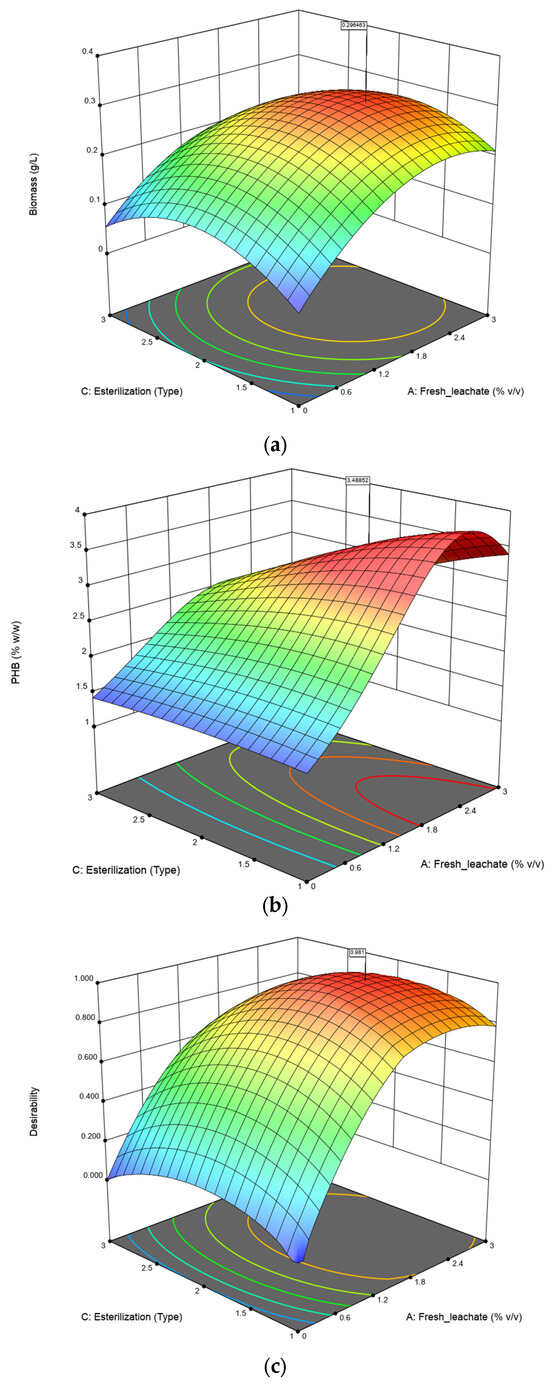
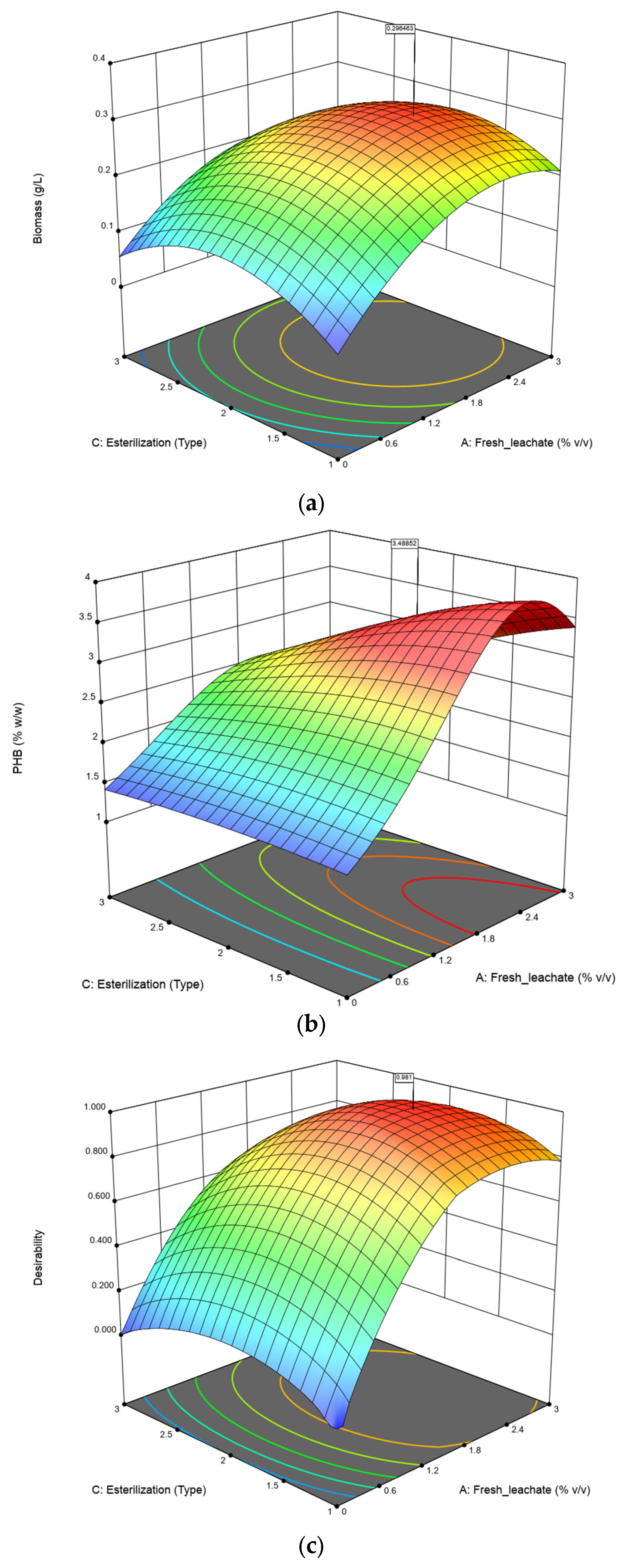
The response surfaces obtained from the quadratic models allow a more precise delimitation of the operating region of the system in the plane defined by the percentage of fresh leachate (A, 0–3% v/v) and the type of sterilization (C, coded levels 1–3), while keeping the number of medium reuses at its central value (B = 2.87). In Figure 1a, the biomass describes a parabolic surface, with minimum values at the corners of the experimental domain—i.e., in combinations of very low leachate (close to 0% v/v) and extreme sterilization levels (C = 1 or C = 3)—where the biomass concentration remains below ~0.10 g/L. From these regions, the surface shows a clear upward gradient both as the percentage of leachate increases within the studied range and as the conditions shift from extreme sterilization levels toward an intermediate level. The local maximum biomass is in an internal region of the design, approximately between 2.0 and 2.3% v/v fresh leachate, and an intermediate value of C, where concentrations near 0.30–0.32 g/L are reached. The isolines projected onto the A–C plane form concentric ellipses around this maximum, confirming the existence of a true optimum within the domain rather than at the boundaries of the experimental space.
Figure 1.
Response surfaces for the optimization of biomass (a), PHB production (b), and model desirability (c).
The PHB response shown in Figure 1b exhibits a different yet statistically coherent behavior relative to the model. In this case, the surface is markedly inclined along the A axis over the entire 0–3% v/v interval: the minimum PHB values occur in the region with the lowest percentage of fresh leachate, where the polymer content is barely above ~1.5% w/w, regardless of the sterilization level. As A increases toward the upper end of the range, the surface increases almost monotonically, reaching a maximum in a slightly shifted interval, approximately between 2.0 and 2.5% v/v, where the predicted values are close to 3.5–3.6% w/w PHB. Above this optimal interval, within the same experimental range, the surface begins to curve. It tends to flatten or decrease slightly, indicating that further increases in leachate do not translate into proportional increases in polymer content. Along the C direction (1–3), a smoother variation is observed: minimum PHB values are concentrated at the highest sterilization levels, whereas maximum values are located at low to intermediate levels. This effect is reflected in the projected contours, where the isolines corresponding to higher PHB cluster in the central band of C and in the upper third of A.
Figure 1c integrates the behavior of both responses into an overall desirability index, calculated over the same factor domain (A: 0–3% v/v; C: 1–3). The resulting surface retains a dome-like shape, but the maximum is not a sharp point; instead, it forms a high-desirability plateau. The lowest index values (<0.2) occur in combinations of low leachate and extreme sterilization, which coincides with regions where biomass and PHB are simultaneously low. As the leachate percentage increases from its lower limit to moderate values within the range, desirability increases steadily and reaches an internal maximum at approximately A = 2.17% v/v and an intermediate sterilization level (C = 2), with B = 3, where the index reaches 0.981. The projected isolines delineate a relatively broad zone of high desirability (>0.8) surrounding this point, indicating that the system offers a robust operating window within the studied ranges, in which biomass concentrations on the order of 0.29 g/L and PHB contents close to 3.5% w/w can be simultaneously maintained.
On these surfaces, the desirability algorithm implemented in Design-Expert® was used to identify the combination of factors that simultaneously maximized biomass and PHB. The optimal solution was a fresh leachate percentage of 2.17% v/v (A), three media reuses (B), and sanitation by UV radiation (C = 2), with an overall desirability of 0.981. Under these conditions, the model predicted a biomass concentration of 0.29 g/L and an intracellular PHB content of 3.48% w/w, values that represent the best convergence between both responses within the evaluated experimental space. The parameters of these optimal conditions are summarized in Table 5.
Table 5.
Optimized conditions for the maximization of biomass and PHB production.
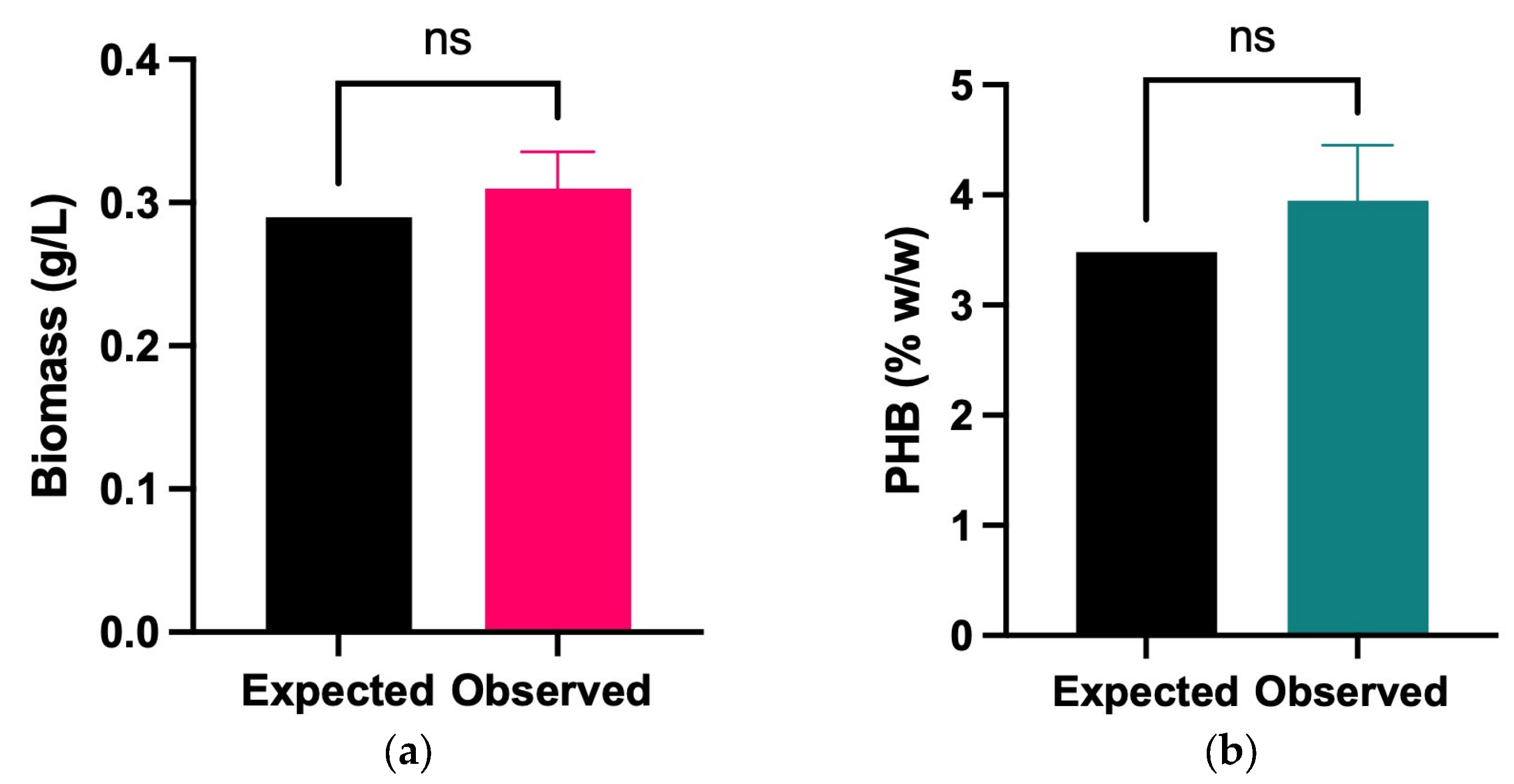
Once optimal conditions were established, a validation test was conducted to assess the model’s stability. To this end, six independent experiments (one original run and five replicates) were performed using the optimal conditions defined in Table 4. The average of the experimental values of biomass concentration and PHB content (observed value) was compared to those predicted by the model (Table 4) using a one-sample t-test using GraphPad Prism version 10.6.1 (GraphPad Software, San Diego, CA, USA, www.graphpad.com).
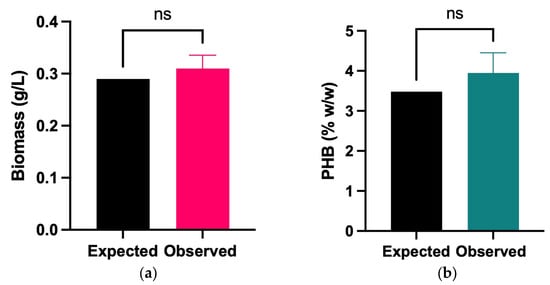
The experimental validation (Figure 2) confirmed its statistical robustness and predictive power, with no significant differences from the model-predicted value.
Figure 2.
t-test analysis of Expected vs. observed data for (a) biomass concentration (g/L) and (b) PHB content (% w/w). ns equals non-significant difference between samples.
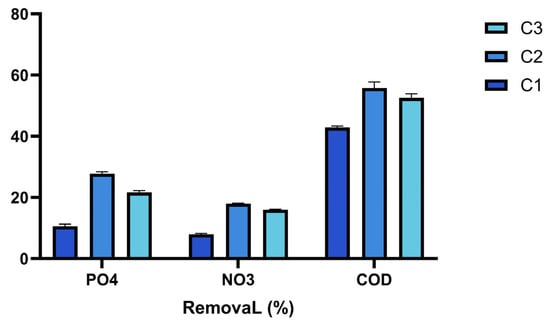
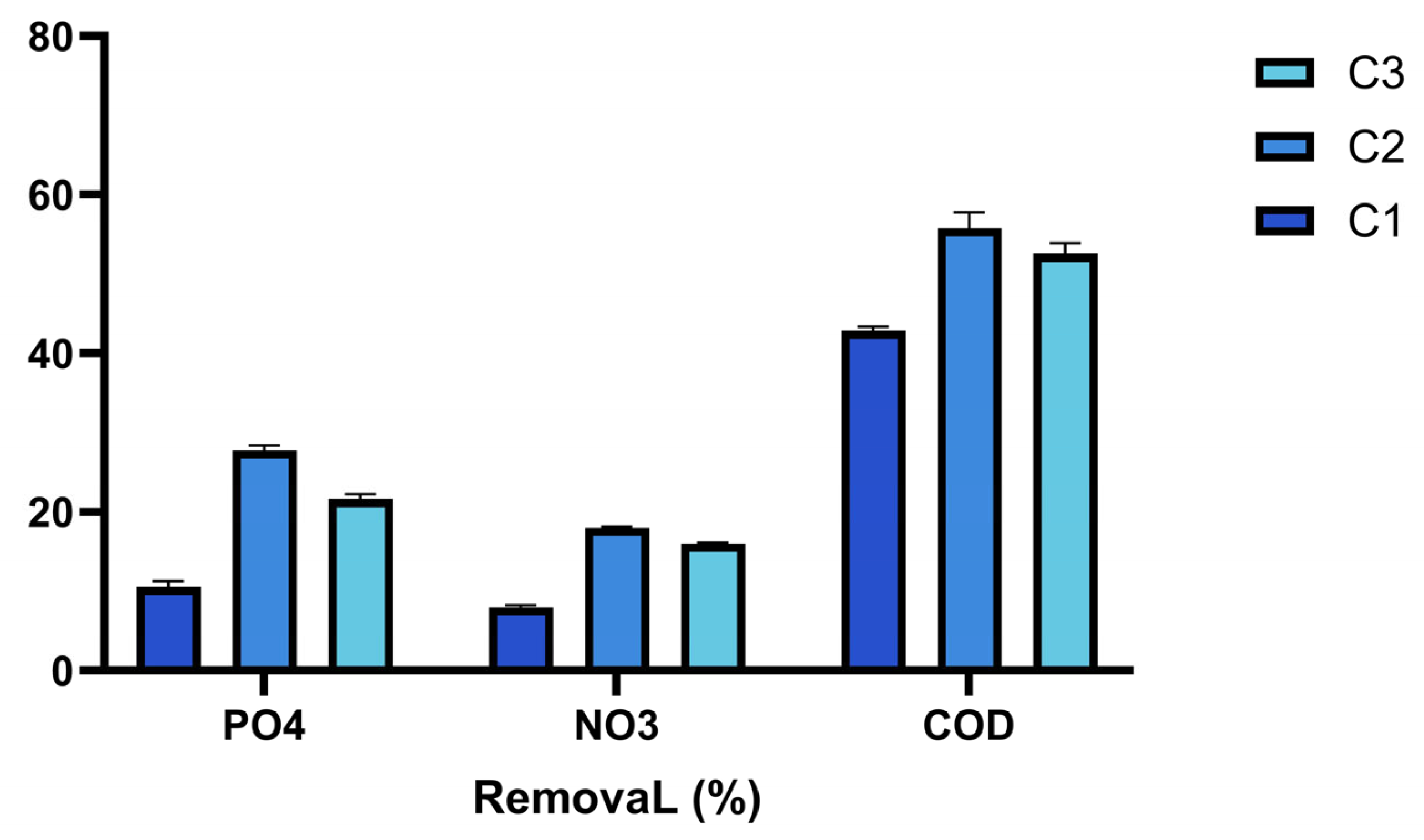
Removal efficiencies showed a consistent cycle-dependent transition across the three consecutive cycles (Figure 3), with replicate values displaying low dispersion within each cycle. For PO4-P, removals in C1 ranged from 10.02 to 11.31%, increased markedly in C2 to 27.10–28.30%, and then decreased in C3 to 21.20–22.32%. For NO3-N, removals in C1 were 7.66–8.20%, increased in C2 to 17.86–18.20%, and remained slightly lower in C3 at 15.92–16.09%. For COD, removals were higher across all cycles, increasing from 42.30 to 43.20% (C1) to 54.20–58.00% (C2), followed by 51.30–54.00% (C3). Overall, the most pronounced shift occurred from C1 to C2 across all analytes, whereas changes from C2 to C3 were minor and variable, depending on the parameter.
Figure 3.
Cycle-dependent PO4–P, NO3–N, and COD removal efficiencies under optimized leachate make-up and medium-reuse operation.
4. Discussion
The measured COD (7040 mg O2/L) is consistent with central values reported for tropical-climate landfill leachates in recent synthesis work, where mean COD values on the order of 7.3 g/L have been compiled across multiple sites, alongside BOD values typically in the g/L range [31]. In that same context, the BOD5/COD ratio is widely used as an operational descriptor of the relative biodegradable fraction; the ratio observed here (0.65) is higher than many aggregated averages reported for tropical leachates (commonly below ~0.5 in compiled datasets), underscoring that leachate “age” and composition can vary substantially across facilities and sampling conditions [31].
When benchmarked against broad classification ranges, the COD magnitude is below the typical upper band reported for “young” leachates yet remains far above stabilized-leachate COD ranges; this positioning aligns with the concept that landfill leachate chemistry may occupy an intermediate regime depending on landfill operation and local conditions [32]. Beyond COD/BOD, the combination of high conductivity and high color observed in Table 3 is coherent with the well-established description of landfill leachate as a matrix with elevated ionic strength and strong chromophoric dissolved organic matter, both of which are operationally relevant for phototrophic systems because they can impose osmotic/ionic stress and reduce light transmission [33]. From the nutrient-recovery perspective, the quantified nitrogen and phosphate levels confirm that the leachate contains substantial nutrient pools that can, in principle, be redirected into biomass synthesis under controlled dilution and operational management. At the same time, landfill leachate is repeatedly documented as a chemically complex matrix that may include inhibitory constituents (including metals and recalcitrant organics), which rationalizes the need for controlled leachate fractions and sanitation/management strategies when coupling treatment with phototrophic cultivation [31,32].
Taken together, the response-surface models indicate that system performance is dominated by a nutrient–stress tradeoff characteristic of diluted landfill-leachate matrices. Fresh leachate serves as both the primary source of nutrients/organic carbon and the main driver of matrix constraints (ionic strength, chromophoric dissolved organic matter, and potentially inhibitory constituents). This dual role provides a mechanistic basis for the internal operating window reflected by the model structure (Table 4) and the joint optimization landscape (Figure 1), where intermediate make-up supports growth and polymer storage without pushing the culture into inhibition-dominated regimes.
A key process-level outcome is that biomass and PHB exhibit different operational sensitivities across the evaluated factor space. Biomass behaves as a comparatively buffered response variable. In contrast, PHB accumulation is more restrictive, consistent with storage-polymer physiology, in which PHB synthesis is favored only within narrower metabolic windows that require carbon availability under controlled nutrient imbalance and stress [22]. This differential sensitivity is evident in the multi-objective optimum reported in Table 5 and the high-desirability region in Figure 1c, supporting the interpretation that biomass is a broad operability indicator. At the same time, PHB defines the tightest feasible window for multi-objective operation in leachate-derived media [22].
Medium reuse adds a second layer that is not captured by single-cycle wastewater cultivation: it introduces a history effect through carryover of dissolved pools (residual nutrients, salts, soluble microbial products, and algogenic dissolved organic matter) and through progressive shifts in the culture’s micro-ecology. Under a controlled make-up fraction, reuse can sustain biomass while modulating nutrient availability and stress cues that condition storage responses, an effect consistent with the literature on medium recycling, where productivity is retained when inhibitory build-up is managed. Critical nutrients are replenished [33,34]. In that sense, reuse in this study is best framed as a deliberate operational strategy coupling partial renewal with cumulative medium conditioning, rather than as a set of independent identical batches [34,35].
The post-cultivation treatment factor should likewise be interpreted mechanistically. Autoclaving and no treatment represent the extremes of microbial control. In contrast, UV sanitation primarily serves as a conditioning step that limits microbial competition while partially transforming dissolved inhibitory constituents, without necessarily depleting the substrate base needed for phototrophic metabolism. This role is consistent with studies that discuss UV-based conditioning as a practical tool to reduce biological contamination pressure and mitigate inhibitory build-up in reuse or recycling modes [36,37,38]. Accordingly, the operating window summarized in Figure 1 and Table 5 can be interpreted as a balance among nutrient restoration by makeup, reuse-driven carryover, and medium aging, and sanitation intensity that stabilizes the reuse sequence while preserving the biochemical context required for both biomass and PHB formation [39,40].
From a process-control perspective, these interactions imply a hierarchical logic in which fresh leachate make-up primarily sets the nutrient/inhibition balance, reuse governs the medium-history trajectory, and sanitation stabilizes the microbial/chemical context in which both responses are expressed (Table 4; Figure 1). This framing is aligned with the way RSM is most useful in wastewater phototrophic systems: as an operational map to define robust windows under variable matrix quality, rather than as a purely statistical descriptor [31,38].
Interpreted mechanistically, the response surfaces (Figure 1a,b) delineate an operating window in which the leachate make-up fraction simultaneously acts as the principal nutrient/carbon input and the primary vector for salinity, chromophoric dissolved organic matter, and recalcitrant constituents that can impose ionic/osmotic and light-transfer constraints. This dual role rationalizes why intermediate leachate fractions are typically associated with improved phototrophic performance in landfill-leachate matrices. In contrast, higher effective loads can shift the balance toward inhibition, a trend consistently reported across microalgal/cyanobacterial systems cultivated in diluted leachates [29,32,39,40,41,42]. Within the present domain, the optimized region therefore should be viewed less as a “numerical optimum” and more as an operable zone where resource availability and leachate-borne stressors are jointly constrained to remain compatible with stable, multi-cycle operation (Figure 1c; Table 5).
The PHB surface (Figure 1b) further supports a storage-metabolism interpretation that is stricter than growth: PHB accumulation requires not only carbon availability but also a specific balance between carbon supply and relative N/P limitation (and/or environmental pressure) that redirects intracellular allocation toward storage rather than division. This is consistent with phototrophic PHB literature showing that polymer accumulation typically peaks within narrower “metabolic windows” than those sustaining biomass formation, and that modest shifts in the carbon load or nutrient balance can reduce PHB even when growth remains comparatively resilient [22,43]. In that sense, the partial offset between the regions that favor biomass (Figure 1a) and PHB (Figure 1b) is coherent with a two-constraint regime: biomass tracks overall nutrient sufficiency and tolerable stress, whereas PHB tracks the onset of storage-favorable imbalance without crossing the threshold where leachate stress suppresses biosynthetic capacity [44,45].
Importantly, the operational variables embedded in the optimized solution (Table 5) have different functional roles in a reuse sequence. Medium reuse establishes a cycle-history boundary condition (carryover of dissolved pools and potential inhibitors), which can preserve resource efficiency while progressively reshaping the chemical and biological milieu experienced by the culture. UV sanitation, in turn, should be interpreted as a conditioning step rather than a strict sterilization endpoint: it mitigates competitive microbiota. It can partially attenuate inhibitory fractions without fully mineralizing the organic pool that supports phototrophic growth and intracellular storage. Similar reuse-oriented studies emphasize that moderate recirculation, combined with photochemical conditioning, can improve multi-cycle feasibility by limiting cumulative inhibition while sustaining an assimilable carbon/nutrient reservoir [45,46]. Consequently, the optimum in Table 5 represents a practical convergence point where make-up intensity, reuse history, and UV sanitation jointly stabilize cultivation performance, rather than a configuration aimed at maximizing single-pass productivity or “polishing” strength typical of treatment-optimized regimes [47].
From a process-intensification standpoint, the optimized results obtained in this study (0.29 g/L of biomass and 3.48% w/w PHB) are modest compared with the phototrophic PHB production reported for cyanobacteria cultivated in municipal and secondary wastewater, where Synechocystis MT_a24-based systems have achieved higher biomass and double-digit PHB fractions (23.7 ± 2.2% PHB) under polymer-oriented operation [21]. Such performance is commonly achieved through cultivation strategies explicitly designed to promote storage metabolism, including stepwise growth-to-stress operation and substantial N/P limitation, which redirect fixed carbon toward intracellular PHB [22,47]. Here, the process was configured for the reuse of leachate over multiple cycles: landfill leachate, an inhibitory high-ionic-strength matrix, was incorporated only as a low-proportion fraction (0–3% v/v) and was recirculated under controlled sanitation. Under these conditions, the main engineering challenge is to maintain repeatable operation throughout the reuse cycles while simultaneously limiting cumulative inhibitory effects that impair light transfer and phototrophic performance. Therefore, the operating window identified promotes leachate valorization within a circular cultivation scheme and provides a basis for subsequent PHB-focused intensification without compromising multi-cycle operability [22,47].
PHB in this study was estimated from the UV absorbance of chloroform extracts, a rapid approach suitable for comparative screening but inherently less selective than chromatographic quantification, particularly when working with complex biomasses and waste-derived matrices, where co-extracted UV-absorbing constituents may be present. To reduce potential interferences, the workflow incorporated oxidative digestion with sodium hypochlorite to remove a substantial fraction of non-polymeric cellular material, followed by sequential washing (water/acetone/methanol) before chloroform dissolution, a strategy commonly used to enrich PHA relative to residual cell components before analysis [48]. In addition, UV–Vis measurements were referenced against appropriate blanks/baseline correction, consistent with standard practice in spectrophotometric PHB determinations [49]. For absolute compositional specificity, PHA studies frequently rely on derivatization/alcoholysis followed by GC (typically with an internal standard and FID detection), which provides compound-specific quantification and serves as a valuable reference framework for future cross-validation of spectrophotometric PHB estimates when required [48].
The cycle-resolved removals observed under the optimized reuse operation (Figure 3) frame the process not only as a cultivation scheme but also as a controlled nutrient/organic-load management mode. COD removal remained comparatively high across cycles (42–58%), consistent with the expectation that landfill-leachate organic matter contains a substantial fraction of slowly biodegradable and recalcitrant constituents that constrain phototrophic removal in short-residence-time operations. Recent phototrophic leachate-cultivation studies reporting COD abatements in the same order of magnitude (50% under optimized operating conditions) were obtained under treatment-oriented configurations and distinct inoculum/matrix histories, highlighting that COD performance is strongly scenario-dependent (influent strength, dilution, and reactor ecology) [50].
In contrast, PO4-P removals were moderate (10–28%) and displayed a marked increase from C1 to C2 followed by a decrease in C3 (Figure 3). Reports of near-complete phosphate removal in landfill-leachate phototrophic systems are typically associated with cultivation/treatment regimes that differ substantially from a low make-up fraction coupled to multi-cycle reuse (e.g., higher adequate nutrient availability for uptake, different replacement strategies, and/or different physiological optima of the phototroph). For example, Galdieria-based leachate treatment has achieved phosphate removal close to 99% under alternative operating regimes, underscoring that the apparent phosphate removal ceiling is highly sensitive to operational mode and organism–matrix compatibility rather than an intrinsic limitation of phototrophic metabolism per se [51].
For nitrogen, direct benchmarking across studies requires explicit attention to speciation. Landfill-leachate literature frequently emphasizes ammonium-dominated nitrogen and reports high NH4+ removal under phototrophic cultivation; however, the nitrogen tracked here was NO3−-N, for which the observed drawdown (≈8–18%) reflects nitrate assimilation under the combined constraints of a low leachate make-up fraction and cycle-to-cycle carryover intrinsic to reuse operation. Recent leachate work with site-adapted microalgal communities likewise shows that nitrogen form dynamics (NO3− vs. NH4+) and cultivation history can dominate the apparent “removal” outcome, even under broadly comparable leachate conditions [9]. In this reuse-mode boundary condition, the C2 peak followed by a modest C3 decline is more coherently attributed to cycle-resolved mass-balance effects (carryover plus make-up) than to a single-pass polishing trajectory.
Finally, the desirability surface (Figure 1c) shows a plateau of high values (>0.8) surrounding the optimum point rather than a sharp maximum. This feature is particularly relevant for operation with leachates, whose composition varies with landfill age, precipitation, and seasonality. In multiobjective optimization with microalgae, the existence of a broad high-desirability region allows deviations in operating variables and effluent quality to be absorbed without abrupt losses in productivity or product quality [52]. In this case, the overlap between that plateau and a moderate number of recirculations supports the central hypothesis of the study: controlled recirculation of a leachate-based medium, combined with appropriately tuned UV sanitation, can repeatedly sustain cyanobacterial biomass formation and PHB synthesis within an operating range broad enough to cope with the intrinsic variability of the liquid waste.
5. Conclusions
This study demonstrates that landfill leachate can be effectively integrated as a phototrophic culture matrix for the thermotolerant cyanobacterium Potamosiphon sp. through a controlled multi-cycle reuse strategy. By coupling fractional leachate replenishment with directed medium recirculation and sanitation, the proposed approach departs from conventional single-pass nutrient use. It enables repeated valorization of residual nitrogen and phosphorus within a circular cultivation framework.
Response surface optimization identified the fresh-leachate replenishment fraction as the dominant control variable, governing the balance between nutrient supply and leachate-associated inhibitory effects. Medium reuse and sanitation history further modulated microbiological stability and the allocation between biomass formation and PHB storage, with UV-based sanitation providing a practical conditioning step that limited microbial interference while preserving assimilable resources.
Under the optimized configuration (2.17% v/v fresh leachate, three reuse cycles, UV sanitation), the system achieved reproducible biomass and PHB levels of 0.29 g L−1 and 3.48% w/w, respectively, and exhibited a broad high-desirability operating region. This tolerance to variable operating conditions is particularly relevant for real landfill leachates, which exhibit temporal and compositional variability. Overall, the results support the feasibility of a low-input, scalable phototrophic process that couples leachate conditioning with biopolymer-oriented biomass production, thereby improving nutrient efficiency and reducing freshwater demand in waste-derived bioprocesses.
Author Contributions
Conceptualization, A.Z., A.F.B.-S. and M.D.O.-A.; methodology, A.Z., J.B.G.-M. and M.D.O.-A.; software, R.L., A.Z. and J.X.P.-S.; validation, A.Z. and A.F.B.-S.; formal analysis, A.Z. and J.X.P.-S.; investigation, J.B.G.-M. and J.X.P.-S.; resources, A.Z. and A.F.B.-S.; data curation, A.Z. and R.L.; writing—original draft preparation, A.Z. and J.X.P.-S.; writing—review and editing, J.B.G.-M. and A.F.B.-S.; visualization, A.F.B.-S., A.Z. and J.X.P.-S.; supervision, A.Z. and M.D.O.-A.; project administration, R.L. and A.F.B.-S.; funding acquisition, A.Z. and A.F.B.-S. All authors have read and agreed to the published version of the manuscript.
Funding
This study received financial support from Sapienza University through the Academic Mid Projects 2021 (Grant No. RM12117A8B58023A). Also, funding was received by the NeWater project through WATER4ALL Partnership. Additionally, funding was provided by Universidad Francisco de Paula Santander (Colombia) (FINU 001-2025), the Ministry of Science and Technology of Colombia, and the Colombian Institute of Educational Credit and Technical Studies Abroad (MINCIENCIAS-ICETEX) under the project titled “FOTOLIX” with the ID 2023-0686.
Data Availability Statement
The original contributions presented in this study are included in the article. Further inquiries can be directed to the corresponding authors.
Acknowledgments
We would like to express our sincere gratitude to Sapienza University of Rome and Universidad Francisco de Paula Santander (Colombia) for providing the equipment for this research. We also thank the Colombian Ministry of Science, Technology, and Innovation, MINCIENCIAS for supporting national Ph.D. Doctorates through the Francisco José de Caldas scholarship program.
Conflicts of Interest
The authors declare no conflicts of interest.
Appendix A
Table A1.
Resolved design with each independent experiment.
References
- Anjum, M.; Anees, M.; Qadeer, S.; Khalid, A.; Kumar, R.; Barakat, M.A. A Recent Progress in the Leachate Pretreatment Methods Coupled with Anaerobic Digestion for Enhanced Biogas Production: Feasibility, Trends, and Techno-Economic Evaluation. Int. J. Mol. Sci. 2023, 24, 763. [Google Scholar] [CrossRef] [Scilit] [PubMed]
- Wang, J.; Qiao, Z. A Comprehensive Review of Landfill Leachate Treatment Technologies. Front. Environ. Sci. 2024, 12, 1439128. [Google Scholar] [CrossRef] [Scilit]
- Becerra-Moreno, D.; Zuorro, A.; Machuca-Martínez, F.; Ramírez-Rios, L.F.; García-Martínez, J.B.; Barajas-Solano, A.F. Coupling Advanced Oxidation and Anaerobic Treatment for Landfill Leachate: Magnetite-Catalyzed Ozone and USAB Reactor Efficiency. Inorganics 2025, 13, 218. [Google Scholar] [CrossRef] [Scilit]
- Becerra-Moreno, D.; Machuca-Martínez, F.; Ramírez-Rios, L.F.; García-Martínez, J.B.; Barajas-Solano, A.F. Synergistic Degradation of Organic Contaminants in Landfill Leachates Using Catalytic Ozonation with Magnetite. Sci 2025, 7, 31. [Google Scholar] [CrossRef] [Scilit]
- Xiang, R.; Wei, W.; Mei, T.; Wei, Z.; Yang, X.; Liang, J.; Zhu, J. A Review on Landfill Leachate Treatment Technologies: Comparative Analysis of Methods and Process Innovation. Appl. Sci. 2025, 15, 3878. [Google Scholar] [CrossRef] [Scilit]
- de Almeida, R.; Campos, J.; Oroski, F.d.A. Techno-economic evaluation of landfill leachate treatment by hybrid lime application and nanofiltration process. Detritus 2020, 10, 170–181. [Google Scholar] [CrossRef] [Scilit]
- de Almeida, R.; Bila, D.M.; Quintaes, B.R.; Campos, J.C. Cost Estimation of Landfill Leachate Treatment by Reverse Osmosis in a Brazilian Landfill. Waste Manag. Res. J. Sustain. Circ. Econ. 2020, 38, 1087–1092. [Google Scholar] [CrossRef] [Scilit]
- Lucero-Sobarzo, D.; Beltrán-Villavicencio, M.; González-Aragón, A.; Vázquez-Morillas, A. Recycling of Nutrients from Landfill Leachate: A Case Study. Heliyon 2022, 8, e09540. [Google Scholar] [CrossRef] [Scilit]
- Kuß, A.; Beszteri, B.; Beese-Vasbender, P.; Rehorek, A.; Sartor, M. Growth and Nutrient Uptake of Site-Adapted Microalgae in Undiluted, High-Strength Landfill Leachates. J. Appl. Phycol. 2025, 37, 4091–4108. [Google Scholar] [CrossRef] [Scilit]
- Dias, R.R.; Deprá, M.C.; de Menezes, C.R.; Zepka, L.Q.; Jacob-Lopes, E. Microalgae Cultivation in Wastewater: How Realistic Is This Approach for Value-Added Product Production? Processes 2025, 13, 2052. [Google Scholar] [CrossRef] [Scilit]
- Calijuri, M.L.; Do Couto, E.d.A.; Assemany, P.P.; Ribeiro, V.J.; Lorentz, J.F.; Castro, J.d.S.; Assis, L.R.d.; Oliveira, A.P.d.S.; Pereira, A.S.A.d.P.; Marangon, B.B.; et al. Microalgae-Based Wastewater Treatment and Biomass Valorization: Insights, Challenges, and Opportunities from 15 Years of Research. ACS Omega 2025, 10, 49273–49299. [Google Scholar] [CrossRef] [Scilit]
- Wang, X.; Lin, L.; Lu, H.; Liu, Z.; Duan, N.; Dong, T.; Xiao, H.; Li, B.; Xu, P. Microalgae Cultivation and Culture Medium Recycling by a Two-Stage Cultivation System. Front. Environ. Sci. Eng. 2018, 12, 14. [Google Scholar] [CrossRef] [Scilit]
- Gupta, R.; Mishra, N.; Singh, G.; Mishra, S.; Lodhiyal, N. Microalgae Cultivation and Value-Based Products from Wastewater: Insights and Applications. Blue Biotechnol. 2024, 1, 20. [Google Scholar] [CrossRef] [Scilit]
- Castellanos-Estupiñan, M.; Carrillo-Botello, A.; Rozo-Granados, L.; Becerra-Moreno, D.; García-Martínez, J.; Urbina-Suarez, N.; López-Barrera, G.; Barajas-Solano, A.; Bryan, S.; Zuorro, A. Removal of Nutrients and Pesticides from Agricultural Runoff Using Microalgae and Cyanobacteria. Water 2022, 14, 558. [Google Scholar] [CrossRef] [Scilit]
- Getino, L.; Martín, J.L.; Chamizo-Ampudia, A. A Review of Polyhydroxyalkanoates: Characterization, Production, and Application from Waste. Microorganisms 2024, 12, 2028. [Google Scholar] [CrossRef] [Scilit] [PubMed]
- Kim, J.; Gupta, N.S.; Bezek, L.B.; Linn, J.; Bejagam, K.K.; Banerjee, S.; Dumont, J.H.; Nam, S.Y.; Kang, H.W.; Park, C.H.; et al. Biodegradation Studies of Polyhydroxybutyrate and Polyhydroxybutyrate-Co-Polyhydroxyvalerate Films in Soil. Int. J. Mol. Sci. 2023, 24, 7638. [Google Scholar] [CrossRef] [Scilit]
- Meereboer, K.W.; Misra, M.; Mohanty, A.K. Review of Recent Advances in the Biodegradability of Polyhydroxyalkanoate (PHA) Bioplastics and Their Composites. Green Chem. 2020, 22, 5519–5558. [Google Scholar] [CrossRef] [Scilit]
- Huang, S.; Dong, Q.; Che, S.; Li, R.; Tang, K.H.D. Bioplastics and Biodegradable Plastics: A Review of Recent Advances, Feasibility and Cleaner Production. Sci. Total Environ. 2025, 969, 178911. [Google Scholar] [CrossRef] [Scilit]
- Fu, X.; Xu, H.; Zhang, Q.; Xi, J.; Zhang, H.; Zheng, M.; Xi, B.; Hou, L. A Review on Polyhydroxyalkanoates Production from Various Organic Waste Streams: Feedstocks, Strains, and Production Strategy. Resour. Conserv. Recycl. 2023, 198, 107166. [Google Scholar] [CrossRef] [Scilit]
- Prudnikova, S.V.; Kiselev, E.G.; Demidenko, A.V.; Nemtsev, I.V.; Shishatskaya, E.I.; Thomas, S.; Volova, T.G. Biodegradation of Microbial Plastic Poly(3-Hydroxybutyrate) in Soil Ecosystems at Different Latitudes. Giant 2024, 18, 100288. [Google Scholar] [CrossRef] [Scilit]
- Grivalský, T.; Lakatos, G.E.; Štěrbová, K.; Manoel, J.A.C.; Beloša, R.; Divoká, P.; Kopp, J.; Kriechbaum, R.; Spadiut, O.; Zwirzitz, A.; et al. Poly-β-Hydroxybutyrate Production by Synechocystis MT_a24 in a Raceway Pond Using Urban Wastewater. Appl. Microbiol. Biotechnol. 2024, 108, 44. [Google Scholar] [CrossRef] [Scilit] [PubMed]
- Rueda, E.; Gonzalez-Flo, E.; Mondal, S.; Forchhammer, K.; Arias, D.M.; Ludwig, K.; Drosg, B.; Fritz, I.; Gonzalez-Esquer, C.R.; Pacheco, S.; et al. Challenges, Progress, and Future Perspectives for Cyanobacterial Polyhydroxyalkanoate Production. Rev. Environ. Sci. Biotechnol. 2024, 23, 321–350. [Google Scholar] [CrossRef] [Scilit]
- Paquette, A.J.; Vadlamani, A.; Demirkaya, C.; Strous, M.; De la Hoz Siegler, H. Nutrient Management and Medium Reuse for Cultivation of a Cyanobacterial Consortium at High PH and Alkalinity. Front. Bioeng. Biotechnol. 2022, 10, 942771. [Google Scholar] [CrossRef] [Scilit] [PubMed]
- Bustamante, B.; Alemán, M.; Reis, D.B.; Pérez, J.A.; Venuleo, M.; Gómez-Pinchetti, J.L.; Portillo, E.; Guidi, F. Revalorization of Microalgae Cultivation Effluent: A Circular Strategy for Long-Term Sustainable Production of Tetraselmis striata. Aquaculture 2026, 613, 743297. [Google Scholar] [CrossRef] [Scilit]
- Böpple, H.; Kymmell, N.L.E.; Slegers, P.M.; Breuhaus, P.; Kleinegris, D.M.M. Water Treatment of Recirculating Aquaculture System (RAS) Effluent Water through Microalgal Biofilms. Algal Res. 2024, 84, 103798. [Google Scholar] [CrossRef] [Scilit]
- Barajas-Solano, A.F. Integrating C-Phycocyanin, and Polyhydroxybutyrate Recovery Using a Triphasic System: Experimental Design and Optimization in Thermotolerant Potamosiphon Sp. Phycology 2026, 6, 21. [Google Scholar] [CrossRef] [Scilit]
- Arora, N.; Lo, E.; Legall, N.; Philippidis, G.P. A Critical Review of Growth Media Recycling to Enhance the Economics and Sustainability of Algae Cultivation. Energies 2023, 16, 5378. [Google Scholar] [CrossRef] [Scilit]
- Andersen, R.; Berges, J.; Harrison, P.; Watanabe, M. Recipes for Freshwater and Seawater Media. In Algal Culture Techniques; Elsevier Academic Press: London, UK, 2005. [Google Scholar]
- Vergel-Suarez, A.H.; García-Martínez, J.B.; López-Barrera, G.L.; Barajas-Solano, A.F.; Zuorro, A. Impact of Biomass Drying Process on the Extraction Efficiency of C-Phycoerythrin. BioTech 2023, 12, 30. [Google Scholar] [CrossRef] [Scilit]
- Getachew, A.; Woldesenbet, F. Production of Biodegradable Plastic by Polyhydroxybutyrate (PHB) Accumulating Bacteria Using Low Cost Agricultural Waste Material. BMC Res. Notes 2016, 9, 509. [Google Scholar] [CrossRef] [Scilit]
- Lindamulla, L.; Nanayakkara, N.; Othman, M.; Jinadasa, S.; Herath, G.; Jegatheesan, V. Municipal Solid Waste Landfill Leachate Characteristics and Their Treatment Options in Tropical Countries. Curr. Pollut. Rep. 2022, 8, 273–287. [Google Scholar] [CrossRef] [Scilit]
- Nawaz, T.; Rahman, A.; Pan, S.; Dixon, K.; Petri, B.; Selvaratnam, T. A Review of Landfill Leachate Treatment by Microalgae: Current Status and Future Directions. Processes 2020, 8, 384. [Google Scholar] [CrossRef] [Scilit]
- Koutsou, O.P.; Mandylas, C.; Fountoulakis, M.S.; Stasinakis, A.S. Leachate Management in Medium- and Small-Sized Sanitary Landfills: A Greek Case Study. Environ. Sci. Pollut. Res. 2023, 30, 120994–121006. [Google Scholar] [CrossRef] [Scilit] [PubMed]
- Lage, A.; Berrendero Gómez, E.; García, L.; Martínez, C.; Garcia, J.; Gonzalez-Flo, E. Assessment of Polyhydroxybutyrate Production by Cyanobacteria Strains Isolated from Environmental Water Sources Using a Secondary Effluent. ACS EST Water 2025, 5, 7267–7278. [Google Scholar] [CrossRef] [Scilit] [PubMed]
- Dzuman, M.J.; Severo, I.A.; Moreira, M.A.C.; de Lima Luz Junior, L.F.; Mitchell, D.A.; Vargas, J.V.C.; Mariano, A.B. Microalgae Culture Medium Recycling: Improved Production of Biomass and Lipids, Biodiesel Properties and Cost Reduction. BioEnergy Res. 2022, 15, 2076–2089. [Google Scholar] [CrossRef] [Scilit]
- Santos, B.; Freitas, F.; Sobral, A.J.F.N.; Encarnação, T. Microalgae and Circular Economy: Unlocking Waste to Resource Pathways for Sustainable Development. Int. J. Sustain. Eng. 2025, 18, 2501488. [Google Scholar] [CrossRef] [Scilit]
- Cáceres-Ferroni, F.; Salinas-García, M.; Villaró-Cos, S.; Rivera-Sánchez, E.; Lafarga, T. Effect of Culture Medium Composition and Reuse on the Growth of Porphyridium cruentum. New Biotechnol. 2025, 90, 65–76. [Google Scholar] [CrossRef] [Scilit]
- Altamira-Algarra, B.; Lage, A.; García, J.; Gonzalez-Flo, E. Photosynthetic Species Composition Determines Bioplastics Production in Microbiomes: Strategy to Enrich Cyanobacteria PHB-Producers. Algal Res. 2024, 79, 103469. [Google Scholar] [CrossRef] [Scilit]
- Mohd Apandi, N.; Muhamad, M.S.; Radin Mohamed, R.M.S.; Mohamed Sunar, N.; Al-Gheethi, A.; Gani, P.; Rahman, F.A. Optimizing of Microalgae Scenedesmus sp. Biomass Production in Wet Market Wastewater Using Response Surface Methodology. Sustainability 2021, 13, 2216. [Google Scholar] [CrossRef] [Scilit]
- Das, A.; Kundu, P.; Adhikari, S. Application of Response Surface Methodology in Optimization of Process Parameters for Combined Biological Treatment of Dairy Wastewater Using Consortium of Bacteria and Microalgae. Environ. Qual. Manag. 2024, 33, 73–90. [Google Scholar] [CrossRef] [Scilit]
- El Ouaer, M.; Turki, N.; Kallel, A.; Halaoui, M.; Trabelsi, I.; Hassen, A. Recovery of Landfill Leachate as Culture Medium for Two Microalgae: Chlorella sp. and Scenedesmus sp. Environ. Dev. Sustain. 2020, 22, 2651–2671. [Google Scholar] [CrossRef] [Scilit]
- Mojiri, A.; Zhou, J.L.; Ratnaweera, H.; Ohashi, A.; Ozaki, N.; Kindaichi, T.; Asakura, H. Treatment of Landfill Leachate with Different Techniques: An Overview. J. Water Reuse Desalin. 2021, 11, 66–96. [Google Scholar] [CrossRef] [Scilit]
- Mourão, M.M.; Gradíssimo, D.G.; Santos, A.V.; Schneider, M.P.C.; Faustino, S.M.M.; Vasconcelos, V.; Xavier, L.P. Optimization of Polyhydroxybutyrate Production by Amazonian Microalga Stigeoclonium sp. B23. Biomolecules 2020, 10, 1628. [Google Scholar] [CrossRef] [Scilit] [PubMed]
- Pattaro, L.; Colta, A.R.; Saccardo, A.; Borella, L.; Barbera, E.; Sforza, E. Effect of Medium Recycle Ratio on Spirulina Cultivation: Experiments and Modelling. J. Environ. Chem. Eng. 2025, 13, 117264. [Google Scholar] [CrossRef] [Scilit]
- Mourão, M.M.; Xavier, L.P.; Urbatzka, R.; Figueiroa, L.B.; da Costa, C.E.F.; Dias, C.G.B.T.; Schneider, M.P.C.; Vasconcelos, V.; Santos, A.V. Characterization and Biotechnological Potential of Intracellular Polyhydroxybutyrate by Stigeoclonium sp. B23 Using Cassava Peel as Carbon Source. Polymers 2021, 13, 687. [Google Scholar] [CrossRef] [Scilit] [PubMed]
- Ribeiro dos Santos, W.; Pereira, P.; Fábio dos Santos, L.; Tagliaferro, G.V.; Guimarães, D.H.P. Effects of Leachate Concentration, Carbon Dioxide and Aeration Flow Rate on Chlorophyll and Carotenoid Productivity and Bioremediation Potential of the Microalga Chlorella minutissima. Water SA 2023, 49, 387–395. [Google Scholar] [CrossRef] [Scilit]
- Romero-Frasca, E.; Buitrón, G. Assessment of Polyhydroxyalkanoates and Polysaccharides Production in Native Phototrophic Consortia under Nitrogen and Phosphorous-Starved Conditions. Int. J. Environ. Sci. Technol. 2024, 21, 4997–5006. [Google Scholar] [CrossRef] [Scilit]
- Montiel-Jarillo, G.; Morales-Urrea, D.A.; Contreras, E.M.; López-Córdoba, A.; Gómez-Pachón, E.Y.; Carrera, J.; Suárez-Ojeda, M.E. Improvement of the Polyhydroxyalkanoates Recovery from Mixed Microbial Cultures Using Sodium Hypochlorite Pre-Treatment Coupled with Solvent Extraction. Polymers 2022, 14, 3938. [Google Scholar] [CrossRef] [Scilit]
- Abdo, S.M.; Ali, G.H. Analysis of Polyhydroxybutrate and Bioplastic Production from Microalgae. Bull. Natl. Res. Cent. 2019, 43, 97. [Google Scholar] [CrossRef] [Scilit]
- González-López, F.; Rendón-Castrillón, L.; Ramírez-Carmona, M.; Ocampo-López, C. Evaluation of a Landfill Leachate Bioremediation System Using Spirulina sp. Sustainability 2025, 17, 2385. [Google Scholar] [CrossRef] [Scilit]
- Selvaratnam, T.; Pan, S.; Rahman, A.; Tan, M.; Kharel, H.L.; Agrawal, S.; Nawaz, T. Bioremediation of Raw Landfill Leachate Using Galdieria sulphuraria: An Algal-Based System for Landfill Leachate Treatment. Water 2022, 14, 2389. [Google Scholar] [CrossRef] [Scilit]
- Yashavanth, P.R.; Maiti, S.K. A Multi-Objective Optimization Approach for the Production of Polyhydroxybutyrate via Chlorogloea fritschii under Diurnal Light with Single-Stage Cultivation. Int. J. Biol. Macromol. 2024, 255, 128067. [Google Scholar] [CrossRef] [Scilit]

Disclaimer/Publisher’s Note: The statements, opinions and data contained in all publications are solely those of the individual author(s) and contributor(s) and not of MDPI and/or the editor(s). MDPI and/or the editor(s) disclaim responsibility for any injury to people or property resulting from any ideas, methods, instructions or products referred to in the content. |
© 2026 by the authors. Licensee MDPI, Basel, Switzerland. This article is an open access article distributed under the terms and conditions of the Creative Commons Attribution (CC BY) license.