Article

Regional-Scale Snow Depth Estimation in the Moroccan Atlas Mountains Using MODIS Remote Sensing Data and Empirical Modeling


by
Haytam Elyoussfi
1,*,
Abdelghani Boudhar
2,3,
Salwa Belaqziz
1,4,
Mostafa Bousbaa
1,
Mohamed Elgarnaoui
5,
Fatima Benzhair
4,
Rahma Azamz
4,
Marouane Insaf
6 and
Abdelghani Chehbouni
1
1
Center for Remote Sensing Applications (CRSA), Mohammed VI Polytechnic University (UM6P), Benguerir 43150, Morocco
2
L3G Laboratory, Faculty of Sciences and Techniques, Cadi Ayyad University, Marrakech 40000, Morocco
3
International Water Research Institute (IWRI), Mohammed VI Polytechnic University (UM6P), Benguerir 43150, Morocco
4
Laboratory of Computer Systems and Vision (LabSIV), Department of Computer Science, Faculty of Science, Ibn Zohr University, Agadir 80000, Morocco
5
Centre Urban Systems (CUS), Mohammed VI Polytechnic University (UM6P), Benguerir 43150, Morocco
6
LMCSA Laboratory, Department of Mathematics, Faculty of Sciences and Technics of Mohammedia, Hassan II University, Mohammedia 28810, Morocco
*
Author to whom correspondence should be addressed.
Water 2026, 18(10), 1244; https://doi.org/10.3390/w18101244
Submission received: 31 January 2026 / Revised: 21 March 2026 / Accepted: 23 March 2026 / Published: 21 May 2026
(This article belongs to the Special Issue Application of Remote Sensing and GIS in Water Resources)

Abstract

In Morocco, snow constitutes a crucial freshwater resource, particularly in the Atlas Mountains, where seasonal snowpack significantly contributes to surface water availability, groundwater recharge, and down-stream water supply. However, snow monitoring in these regions remains challenging due to the scarcity and uneven distribution of ground-based snow depth measurements, especially at high altitudes. This lack of observations limits the accurate assessment of snowpack dynamics and hampers hydrological modeling and water resource management. In this study, we assessed the performance of an empirical approach to estimate snow depth from satellite-derived fractional snow cover (FSC) obtained from MODIS observations. Five empirical FSC snow depth models, including linear and nonlinear exponential formulations, are developed and applied across multiple regions of the Moroccan Atlas Mountains. Model coefficients are calibrated independently for each region using three complementary optimization techniques, nonlinear least squares regression, genetic algorithms, and simulated annealing. Model skill was evaluated during calibration and validation using the Kling–Gupta Efficiency (KGE), Pearson correlation coefficient (R), and absolute error metrics (RMSE and MAE). Results show substantial performance differences across formulations and regions. The most flexible exponential model achieved highest efficiency (KGE up to 0.87; R > 0.85) and 0.26 cm (MAE) under moderate snow conditions. Linear formulations exhibited limited robustness, whereas exponential models better captured snow depth dynamics, particularly in high-altitude areas with deep and persistent snowpacks. These results highlight the potential of FSC-based empirical modeling as a practical and operational solution for snow depth estimation in data-scarce mountainous regions of Morocco.

1. Introduction

Mountain snowpacks play a crucial role in the global hydrological cycle by acting as natural reservoirs that store fresh water during cold seasons and gradually release it through snowmelt processes [1,2]. In semi-arid regions subjected to severe water stress, snowmelt represents a vital freshwater resource, supporting agricultural activities, drinking water supply, ecosystem functioning, and groundwater recharge [3,4]. In North Africa, and particularly in Morocco, seasonal snow accumulation in the Atlas Mountains constitutes a key component of regional water resources, supplying major river basins such as the Draa, Tensift, and Oum Er Rbia [5,6,7,8]. Accurate information on snow extent, Snow Depth (SD), and Snow Water Equivalent (SWE) is essential for hydrological modeling, water resource management, and the assessment of climate change impacts [9,10]. However, in the mountainous regions of Morocco, snow observation networks remain very limited, spatially fragmented, and largely restricted to a few high-elevation sites [11,12]. This scarcity of in situ measurements severely constrains the direct regional-scale extrapolation of snow depth and represents a major challenge for the spatial quantification of snow resources, particularly in ungauged and hard-to-access areas.
In a context characterized by a severe lack of ground-based observations, satellite remote sensing provides an indispensable solution for achieving spatially continuous monitoring of the snowpack. Optical satellite sensors, and in particular the Moderate-Resolution Imaging Spectroradiometer (MODIS), are widely used for snow mapping at both regional and global scales [13,14]. One of the key advantages of MODIS lies in its daily acquisition frequency, made possible by the combined Terra and Aqua platforms, which enables continuous day-to-day tracking of snow accumulation and melt processes. This high temporal resolution is especially critical in Mediterranean and semi-arid regions, where snowfall events are often short-lived, intermittent, and highly sensitive to synoptic-scale atmospheric variability [15].
MODIS snow products are based on the Normalized Difference Snow Index (NDSI), which allows for effective discrimination between snow and other land surface types. Fractional Snow Cover (FSC), derived from subpixel information, provides a more realistic representation of the spatial distribution of snow than binary snow maps, particularly in mountainous terrain where mixed pixels are common [16]. Numerous studies have shown that MODIS-derived FSC is strongly correlated with the state and evolution of the snowpack, especially during snow accumulation and melt periods [17,18]. Despite their widespread use, optical satellite products present several major limitations for the direct estimation of snow depth. First, there is no direct or universal physical relationship between surface reflectance and snowpack thickness, making any direct retrieval inherently uncertain. In addition, optical observations are strongly affected by cloud cover, topographic shading, variations in snow albedo associated with aging, moisture content, and impurities, as well as by the complex geometry of mountainous terrain. These factors can introduce significant biases in snow cover products, particularly in areas characterized by steep slopes and highly variable aspects.
Alternative approaches based on microwave sensors and reanalysis products have been proposed to estimate snow depth at large spatial scales [19,20], but these methods face persistent technological and physical bottlenecks. Microwave sensors, despite their ability to operate regardless of cloud cover, exhibit a complex sensitivity to the internal structure of the snowpack. Their reliability decreases drastically in conditions of deep snow, where the signal tends to saturate, or wet snow, as liquid water absorbs radiation and masks the physical properties of the snow [21]. Simultaneously, reanalysis products, which integrate disparate observations into land surface models, remain highly dependent on the quality of atmospheric forcing data [21,22]. In mountainous terrain, these models often struggle to accurately represent complex processes such as orographic effects or snow metamorphism [23]. Furthermore, the spatial resolution of these products is typically too coarse to capture the pronounced spatial heterogeneity of the snowpack imposed by complex topography [24]. This inability to resolve fine scale variability limits their application for precise water resource management in high-altitude regions.
To overcome these limitations, numerous empirical and statistical approaches have been developed to exploit the observed relationship between fractional snow cover and in situ snow depth measurements [25,26,27]. While these methods provide an operational and computationally efficient alternative, they remain strongly dependent on the availability and representativeness of the ground-based data used for calibration. Their performance can vary substantially with climatic conditions, snow regimes, elevation, and interannual variability, raising important questions regarding their spatial and temporal transferability. In regions where snow observation stations are sparse, a commonly adopted strategy is to use the available in situ data to calibrate empirical models and then apply the calibrated relationships to ungauged areas, assuming a regional consistency of snow regimes [28,29]. Although this assumption involves inherent uncertainties, it currently represents one of the most pragmatic approaches for generating large-scale snow depth maps in data-scarce regions, provided that the models are rigorously evaluated and their limitations are clearly acknowledged.
In the Moroccan Atlas Mountains, although significant progress has been made in mapping snow cover using MODIS and Sentinel-2 data [30,31,32], regional-scale estimation of snow depth remains largely unexplored. To date, no operational snow depth product with high spatial and temporal resolution is available for this region. Yet the strong dependence of Morocco’s water resources on snowmelt highlights the urgent need to develop robust, transferable methods that are specifically adapted to local climatic and topographic conditions.
Accordingly, this study pursues two complementary objectives. First, it aims to characterize the spatiotemporal variability of in situ snow depth across the Moroccan Atlas Mountains in order to better understand regional snow dynamics, spatial heterogeneity, and topographic controls. Second, the main objective is to develop and evaluate empirical statistical models for estimating daily snow depth from MODIS-derived fractional snow cover across the Moroccan Atlas Mountains. This approach fully exploits the daily temporal coverage of MODIS while compensating for the scarcity of ground-based observations, thereby providing an operational framework for regional snowpack monitoring and snow water equivalent estimation.

2. Materials and Methods

2.1. Study Area & Data

2.1.1. Study Area

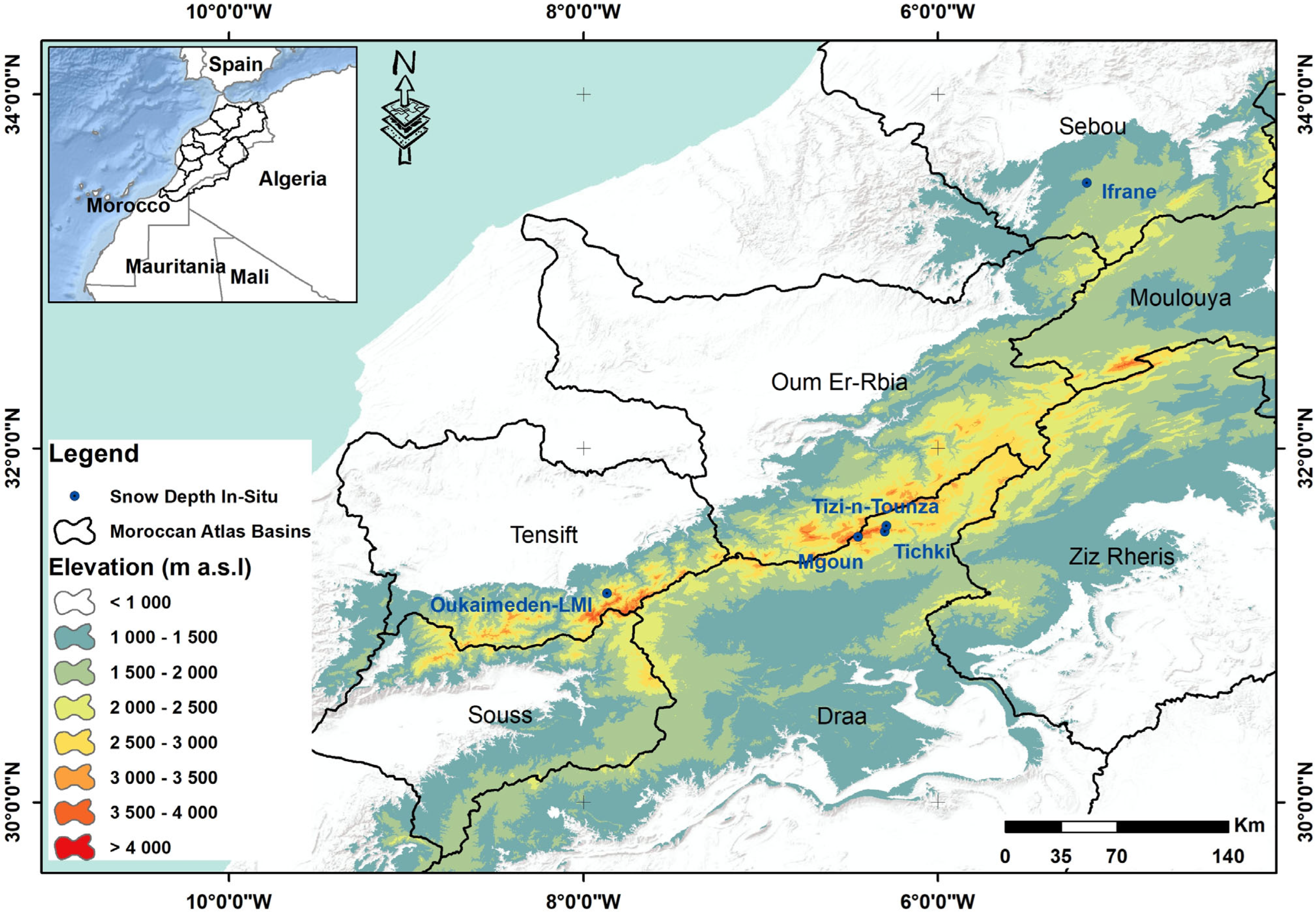
The study area encompasses several mountainous regions of Morocco where in situ snow-depth measurement stations are installed, distributed across the High Atlas, the Middle Atlas, and the country’s major hydrological basins (Figure 1 and Figure 2). The geographical characteristics of these stations, including their location, altitude, and associated river basins, are presented in Table 1. Located in the northwest of Africa, Morocco is influenced by both Atlantic and Mediterranean climate systems, while the Atlas Mountains form the highest topographic barrier in North Africa, creating strong climatic and altitudinal gradients [5,33]. The High Atlas, where the Mgoun (3850 m), Tichki (3250 m), Tizi-n-Tounza (2960 m), and Oukaimeden (3239 m) stations are located, is characterized by rugged terrain, elevations frequently exceeding 3000 m, and persistent winter snow cover driven by cold temperatures and recurring Atlantic frontal systems [12]. In contrast, the Middle Atlas hosts the Ifrane station (1663 m), situated on elevated plateaus between 1600 and 2000 m, where winter snowfall is common but less persistent due to milder conditions and forested landscapes.
Annual precipitation amount ranges from approximately 400 to 1000 mm, with a significant proportion falling as snow at mid and high elevations between November and March [12,34]. Hydrologically, the study sites belong to three major basins: the Draa Basin (Mgoun, Tichki, Tizi-n-Tounza), where snowmelt represents a vital water source sustaining downstream oases in a semi-arid environment; the Tensift Basin (Oukaimeden), which contributes significantly to the water resources of the Marrakech region; and the Oum er Rbia Basin (Ifrane), where snowmelt feeds perennial springs and river systems [35,36]. The strong variability in topography, climate, and snow persistence across these stations provides an ideal natural framework for evaluating snow remote sensing methods and developing regionally adapted snow depth estimation models [30].

2.1.2. Ground-Based Snow Depth Measurements

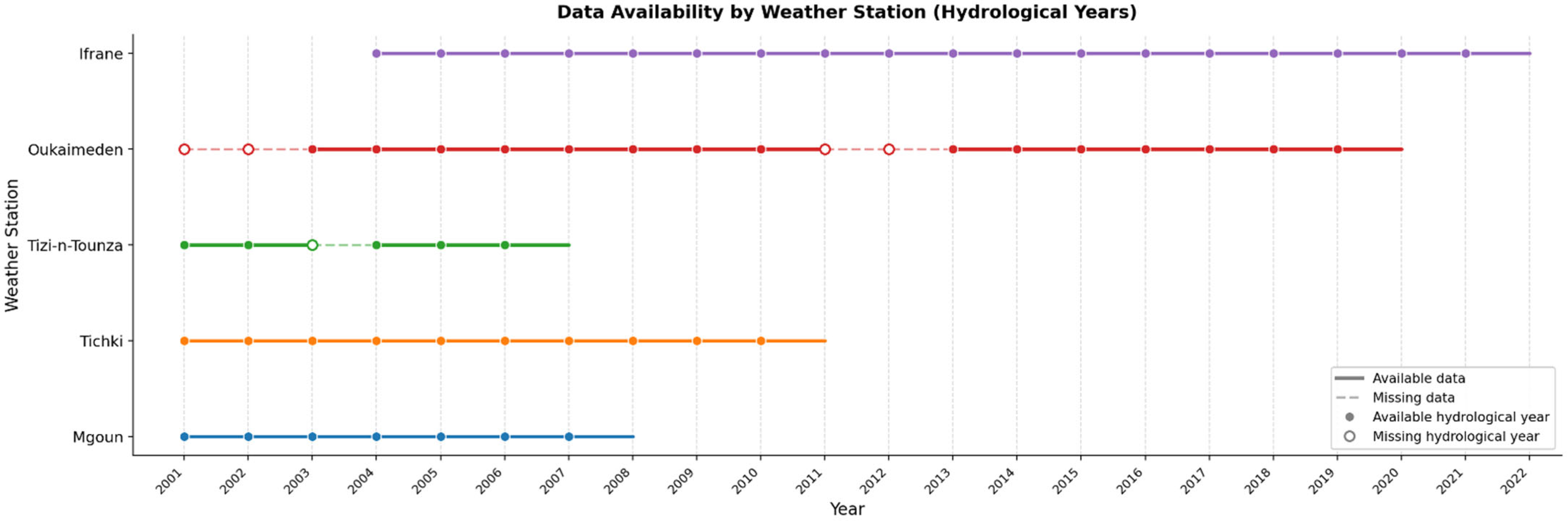
The in situ snow depth data used in this study originate from five meteorological stations representative of Morocco’s main mountain regions, Mgoun, Tichki, Tizi-n-Tounza, Oukaimeden, and Ifrane, whose main statistical characteristics are summarized in Table 2. The maximum recorded snow depths exhibit strong spatial contrasts primarily driven by elevation and local snow regimes, reaching up to 182 cm at Mgoun, 156 cm at Oukaimeden, 103 cm at Tizi-n-Tounza, 81 cm at Tichki, and 72 cm at Ifrane. The mean snow depth averaged over all available day’s ranges from 1.3 cm at Ifrane, 4.1 cm at Tichki, 4.8 cm at Tizi-n-Tounza, 25.8 cm at Oukaimeden, and 25.9 cm at Mgoun. The cold season mean (November–March) further highlights these contrasts, with values of 3.0 cm at Ifrane, 9.7 cm at Tichki, 8.8 cm at Tizi-n-Tounza, 40.2 cm at Oukaimeden, and 44.4 cm at Mgoun, reflecting the strong altitudinal and climatic gradients across the study regions. These observations span periods ranging from 2001 to 2021 and constitute an essential baseline for analysing snowpack variability in Morocco. The temporal availability and continuity of snow depth observations for each station over the study period are illustrated in Figure 3.
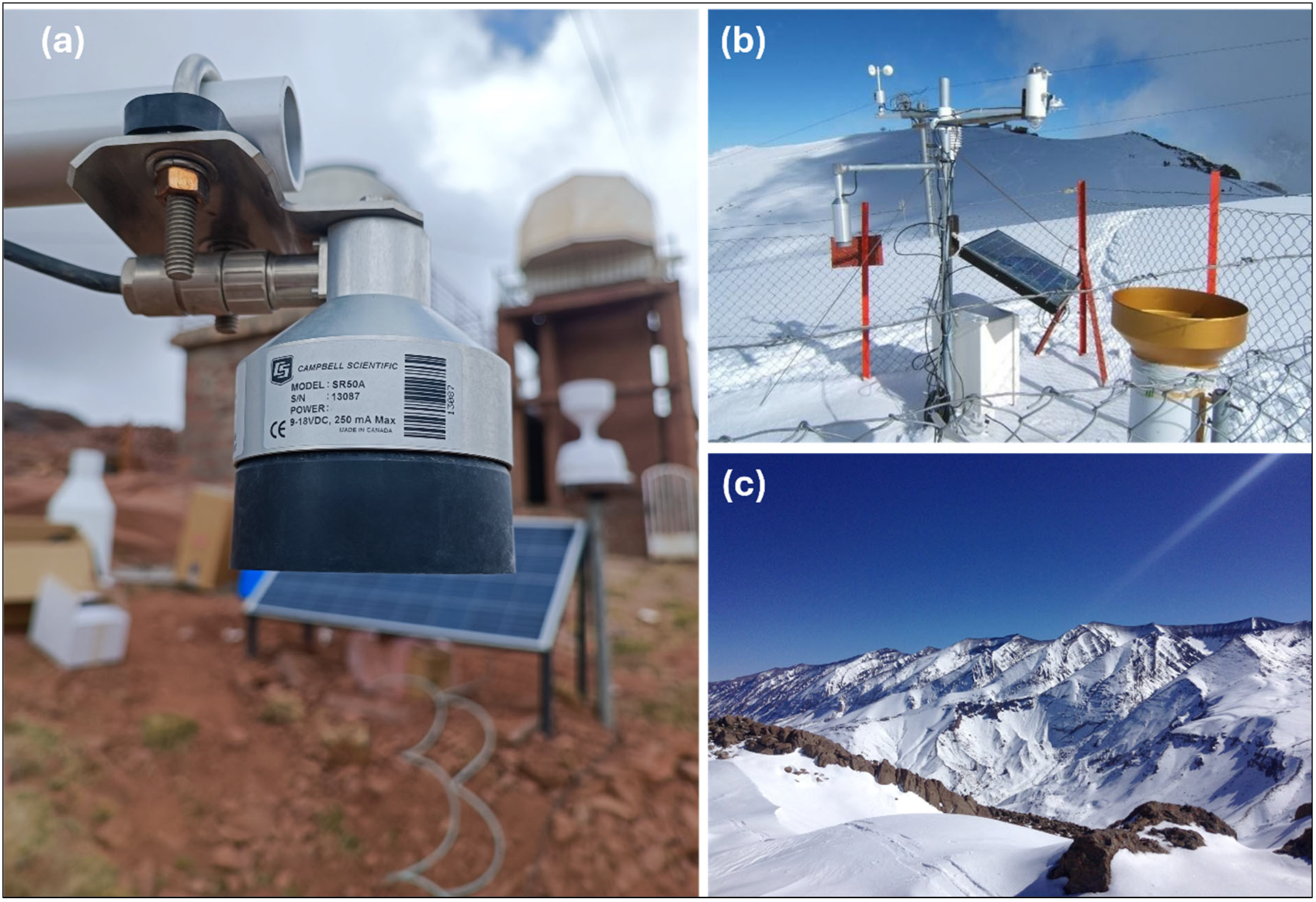
In accordance with the methodological protocol described by, a rigorous preprocessing workflow was applied to the raw snow depth datasets to ensure consistency and accuracy. This process included corrections for ultrasonic SR50 sensor biases, detection and treatment of outliers, removal of non-physical negative snow depth values, and temporal resampling to homogenize the time series. These preprocessing steps ensure the reliability of the snow depth data used for modelling snow dynamics and for training machine learning algorithms.

2.1.3. Remote Sensing Data: Daily Fractional Snow Cover

The fractional snow cover (FSC) used in this study is derived from the daily Terra (MOD10A1) and Aqua (MYD10A1) MODIS products, Collection 6 (V6), at 500 m spatial resolution. The two daily acquisitions are merged to maximize spatial coverage and reduce cloud contamination, enabling the generation of near-complete daily snow fraction maps across the study area. This enhanced product has been specifically optimized for the Moroccan Atlas Mountains. This product relies on the Normalized Difference Snow Index (NDSI), whose global threshold of 0.4 has proven inadequate for the southern Mediterranean context. Using combined MODIS–Sentinel-2 observations, [31] identified locally optimal thresholds and developed region-specific NDSI–FSC relationships, enabling the generation of daily snow-fraction maps at 500 m resolution. After cloud filtering and Terra/Aqua merging, these FSC maps were validated against high-resolution Sentinel-2 data, showing high accuracy (R = 0.96, MAE = 0.22%, bias = −0.17%). FSC is strongly correlated with the state and evolution of the snowpack, particularly during accumulation and melt periods. This physical and spatial relationship makes FSC a relevant satellite-derived predictor for snow-depth estimation, especially in mountainous regions where in situ measurements are sparse or discontinuous. In this study, the FSC is integrated into empirical statistical models to estimate snow depth. The approach focuses on establishing robust functional relationships between satellite-derived FSC and in situ snow depth observations. Consequently, the optimized daily FSC product provides a solid basis for deriving accurate and regionally adapted snow depth maps across the Atlas Mountains.

2.2. Research Method

2.2.1. Overall Workflow

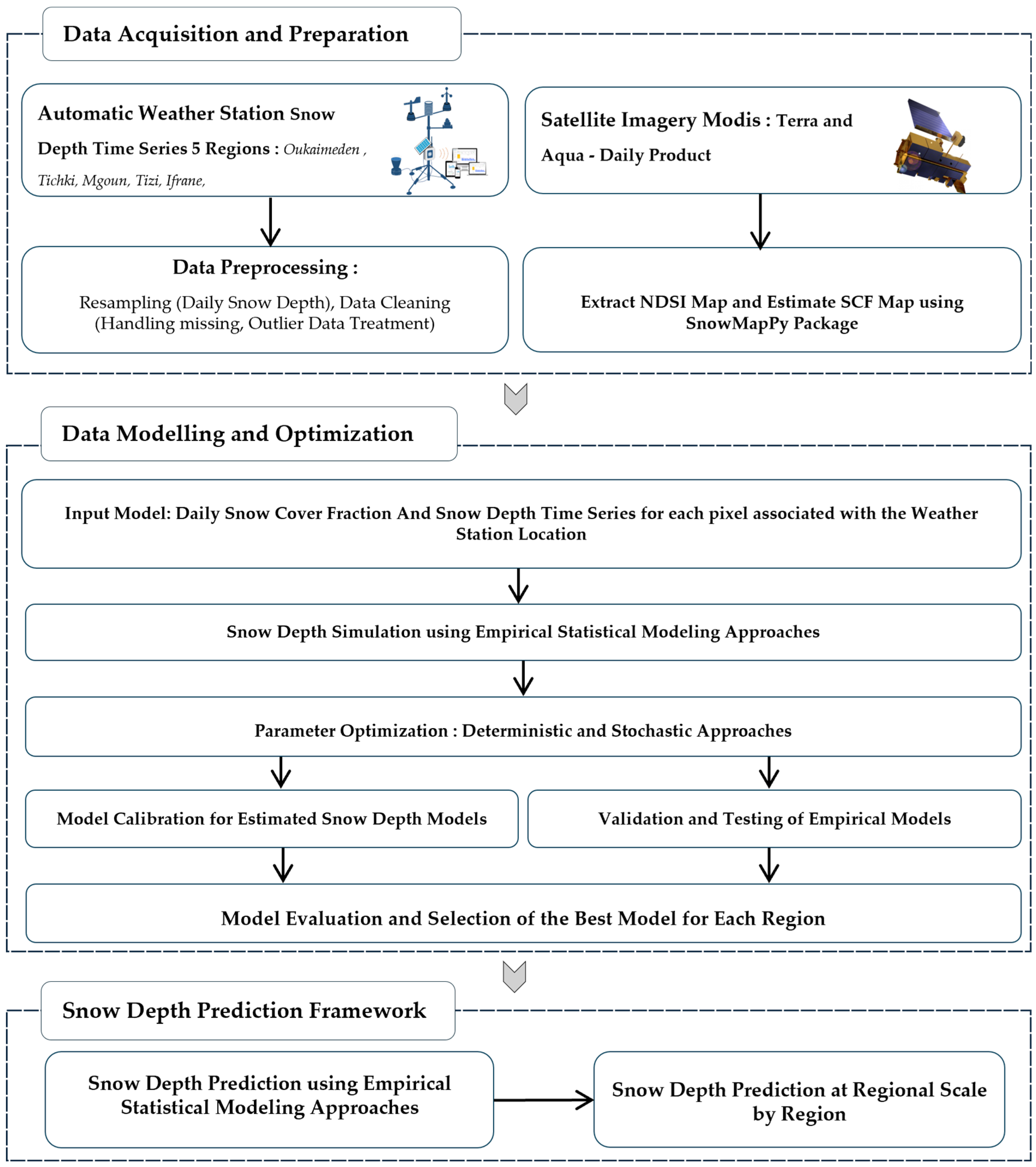
Figure 4 illustrates the overall workflow developed in this study, which combines multi-source geospatial datasets including satellite remote sensing data and in situ observations to estimate SD over mountainous regions of Morocco. The methodology is designed to progressively move from point-scale observations to spatially continuous estimates, while ensuring robustness through calibration, validation, and regional adaptation. It is structured into two main steps, as described below:
The first step focuses on data acquisition and preprocessing. Daily MODIS Terra and Aqua imagery is processed to derive the NDSI and FSC following the methodology described in [31], and implemented using the SnowMapPy package (available at https://github.com/haytamelyo/SnowMapPy) (accessed on 13 August 2025), providing consistent and spatially explicit information on snow dynamics. In parallel, snow depth measurements from five automatic weather stations, Oukaïmeden, Tichki, Mgoun, Tizi, and Ifrane, are collected and carefully preprocessed, including temporal resampling, treatment of missing values, and outlier filtering. All datasets are then harmonized at the pixel station scale to form a consistent input structure for model development. The resulting input dataset consists of daily values of Fractional Snow Cover (FSC) derived from MODIS at 500 m spatial resolution, paired with daily in situ Snow Depth (SD) measurements from the five automatic weather stations.
The second step is dedicated to empirical statistical modeling and calibration. Several linear and nonlinear empirical formulations are used to relate daily FSC to observed SD. Model calibration aims to identify the optimal coefficients governing these relationships and is carried out using three complementary optimization techniques: Nonlinear Least Squares (NLS) regression, Genetic Algorithms (GA), and Simulated Annealing (SA). The NLS approach provides an efficient deterministic solution, while GA and SA are employed to explore the parameter space more extensively and reduce the risk of convergence toward local minima. These methods allow for a robust search for optimal model coefficients under varying snow and climatic conditions. To evaluate model robustness and transferability, the available data are divided into calibration and validation sets based on hydrological years. Models are calibrated using a subset of years and subsequently tested on independent hydrological years not used during calibration, as presented in Table A1. Model performance is assessed using standard statistical metrics, including the correlation coefficient (R), root mean square error (RMSE), mean absolute error (MAE), and Kling–Gupta efficiency (KGE). Based on these evaluation results, the best-performing empirical model is selected for each study region, reflecting regional differences in climate, elevation, and snow persistence.

2.2.2. Empirical Statistical Models

The relationship between SD and FSC can be represented using empirical statistical models, which describe how variations in snow cover extent influence snow accumulation without explicitly simulating physical processes. Such data-driven formulations have been widely used in snow hydrology to estimate snow depth from remotely sensed or in situ snow cover data [17,25,26,27,37]. In this study, five empirical statistical equations were tested and calibrated to identify the formulation that best represents the snowpack behavior in the study area. These equations, combining linear and exponential relationships, establish a functional link between FSC and SD as follows:
S D   =   e ( a .   S C F )     1
S D = e ( a .   S C F b )   1
S D = a     S C F + b
S D = a     e ( b . S C F )
S D = a     e b . S C F + c
Equations (1) and (2) are exponential formulations often used to represent the rapid increase in snow depth as the snow cover becomes continuous. Equation (3) represents a simple linear model frequently used as a baseline for empirical evaluations. Equations (4) and (5) are nonlinear extensions with multiple exponential terms, designed to better capture snowpack variability, particularly during the transition from partial to complete cover.
All five empirical statistical models were calibrated using observed SD data and FSC data and subsequently optimized to identify the formulation that best characterizes snowpack dynamics in the studied regions.

2.2.3. Optimization of Model Coefficients

The optimization of coefficients represents a crucial step in calibrating empirical models that relate the FSC to the SD. It aims to determine the set of parameters θ = ( a , b , c ) that minimizes the difference between simulated and observed values, thereby providing the most accurate representation of snowpack behavior in the study area. The general principle of optimization is to find the combination of coefficients that minimizes an objective function quantifying the modeling error. In this study, the chosen objective function is the RMSE, defined as:
Min   RMSE   ( θ )   =   1   n   i = 1 n ( S D o b s , i S D s i m , i ( θ ) ) 2
where S D o b s , i and S D s i m , i ( θ ) denote the observed and simulated snow depths, respectively, derived from the fractional snow cover F S C i . To ensure robust coefficient estimation and reduce the risk of convergence toward local minima, particularly for nonlinear multi-parameter equations, three complementary optimization approaches were applied: Nonlinear Least Squares (NLS) regression, Genetic Algorithm (GA), and Simulated Annealing (SA). Although these methods rely on different search mechanisms, they share the same objective of minimizing RMSE, and the most effective configuration was automatically retained as the one yielding the lowest RMSE value for empirical model and each study region. A detailed mathematical description of each optimization method is provided in Appendix A.1.

2.2.4. Performance Evaluation

The performance of the empirical snow depth models was evaluated using a set of widely adopted statistical metrics, including the R, RMSE, MAE, and the KGE. These metrics provide complementary information on model accuracy, bias, variability, and overall agreement between simulated and observed values.
The correlation coefficient assesses the strength of the linear relationship between observed and simulated snow depth, while RMSE and MAE quantify the magnitude of prediction errors, with RMSE giving greater weight to large errors and MAE providing a more robust measure of average error. The KGE combines correlation, bias, and variability components into a single metric, allowing a comprehensive evaluation of model performance.
The statistical metrics are defined as follows:
R = i = 1 n S D o b s , i S D o b s ¯ ) ( S D s i m , i S D s i m ¯ i = 1 n ( S D o b s , i S D o b s ¯ ) 2 i = 1 n ( S D s i m , i S D s i m ¯ ) 2
M A E = 1 n i = 1 n S D o b s , i S D s i m , i
K G E = 1 ( R 1 ) 2 + ( β 1 ) 2 + ( γ 1 ) 2
where S D o b s , i and S D s i m , i represent the observed and simulated snow depth values, respectively; S D o b s and S D s i m ¯ denote their mean values; n   is the number of observations; β is the bias ratio; and γ is the variability ratio.
Model calibration and validation were conducted by selecting the model configuration that achieved the highest KGE value as the primary accuracy criterion, with RMSE and MAE used as complementary metrics to confirm the consistency of model ranking across all study regions. In practice, the model configuration achieving the highest KGE systematically also yielded the lowest RMSE and MAE values, ensuring full consistency between the three evaluation metrics. All statistical analyses were performed using Python-based workflows.

3. Results

3.1. Spatiotemporal Variability of Snow Depth in the Moroccan Atlas

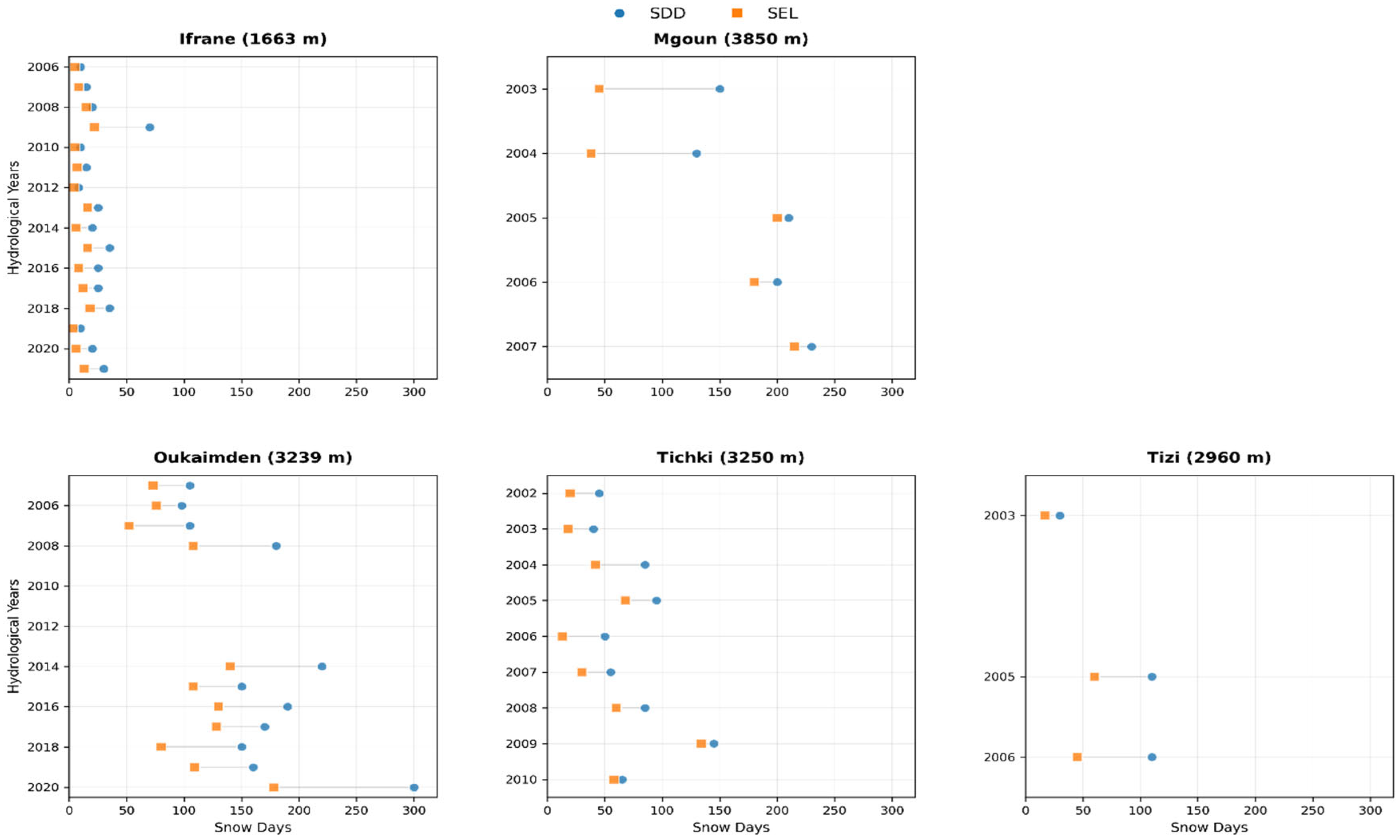
The spatiotemporal variability of the snowpack across the Moroccan Atlas Mountains is analyzed using two complementary indicators derived from in situ snow depth observations: Snow Event Length (SEL), defined the duration of the longest continuous snow covered period within a hydrological year, and Snow Day Duration (SDD), representing the cumulative number of days with measurable snow depth during each hydrological year. To ensure the robustness of the SEL metric, only hydrological years with complete and continuous snow depth records were considered in the analysis. Figure 5 summarizes the interannual variability of SEL and SDD for the five stations distributed across the High Atlas and Middle Atlas regions. Across all stations, snowpack evolution follows a clear seasonal cycle characterized by accumulation during late autumn and winter, a peak phase typically occurring between January and February, and a progressive melt during spring. However, the duration and persistence of snow cover, as reflected by SEL and SDD, vary substantially between regions and from year to year. High-altitude regions located in the High Atlas Mountains exhibit systematically longer snow seasons and higher snow persistence than the Middle Atlas station, highlighting the dominant control of elevation and climatic setting on snowpack dynamics.
Strong spatial contrasts are observed between the High Atlas and Middle Atlas regions. The Mgoun, situated at 3850 m a.s.l., consistently displays the longest SEL values, with several hydrological years exceeding 200 snow days, accompanied by high SDD. This reflects sustained snow accumulation and delayed melting under cold high-elevation conditions. Oukaimeden, located at 3239 m a.s.l. in the Tensift Basin, also shows extended snow seasons, though with greater interannual variability in both SEL and SDD. In contrast, Ifrane, located in the Middle Atlas at 1663 m a.s.l., exhibits markedly shorter snow seasons, with SEL rarely exceeding 70 days and lower SDD values, indicating more transient snow cover conditions. Interannual variability is pronounced at all stations, even among sites with similar elevations. For example, Oukaimeden shows differences of more than 150 days in SEL between individual hydrological years, while Tichki and Tizi-n-Tounza display alternating years of persistent snow cover and seasons characterized by intermittent snowfall and early melt. These fluctuations underline the strong sensitivity of snowpack persistence to year-to-year variations in winter temperature and precipitation regimes.
Elevation emerges as the primary factor controlling both SEL and SDD, with higher stations consistently exhibiting longer snow seasons and greater daily snow persistence. Basin characteristics further modulate these patterns. Stations within the Draa Basin (Mgoun, Tichki, and Tizi-n-Tounza) generally experience longer SEL and higher SDD than the Middle Atlas station, reflecting colder continental conditions and the importance of snowmelt as a delayed water source in this semi-arid basin. Oukaimeden, although located at high elevation, shows intermediate behavior due to its greater exposure to Atlantic moisture and higher variability in winter snowfall. The observed differences in SEL and SDD are consistent with the role of elevation gradients and orographic effects in shaping snow accumulation and persistence in the Atlas Mountains. Higher elevations favor lower air temperatures and enhance snowfall through orographic uplift of Atlantic air masses, resulting in longer lasting snowpacks. These mechanisms have been widely documented in previous studies using MODIS snow products and reanalysis datasets over the Atlas range and North Africa [12,31], which similarly report strong spatial contrasts and high interannual variability in snow cover persistence controlled by topography and regional climate forcing.
Regional climate regimes further explain the observed contrasts between the High Atlas and Middle Atlas. The High Atlas spans semi-arid to arid climatic zones, where snow accumulation is often episodic but can persist for long periods at high elevations due to sustained cold conditions. Conversely, the Middle Atlas is influenced by a more temperate and humid climate, where snowfall is frequent but less persistent, leading to shorter SEL and lower SDD as a result of faster melting rates. The consistency between the present in situ observations and previously reported satellite and reanalysis-based assessments confirms the robustness of the observed snowpack patterns. Overall, the combined analysis of Snow Event Length and Snow Day Duration reveals a highly heterogeneous snow regime across the Moroccan Atlas Mountains, governed by elevation, basin context, and regional climate variability. This pronounced spatial and temporal variability provides a solid foundation for evaluating remote-sensing-based snow monitoring approaches and highlights the necessity of regionally adapted snow depth estimation models in complex mountain environments.

3.2. Relationship Between FSC and SD

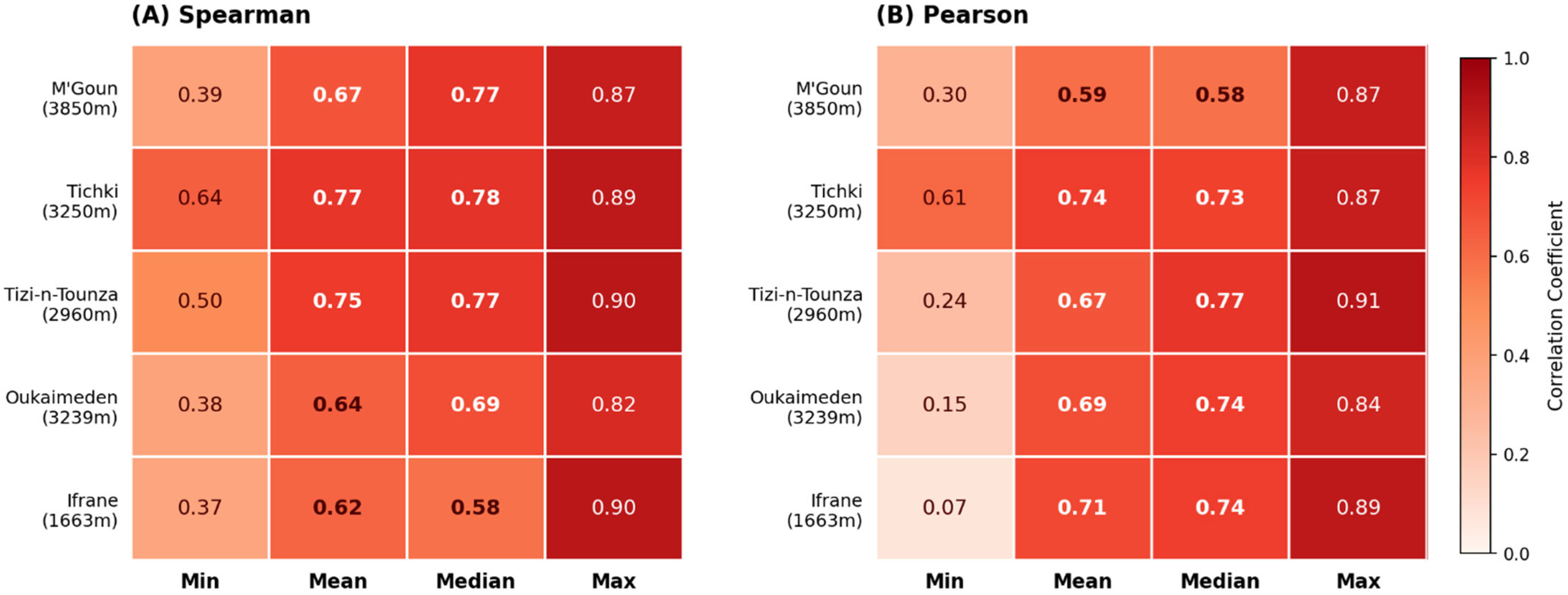
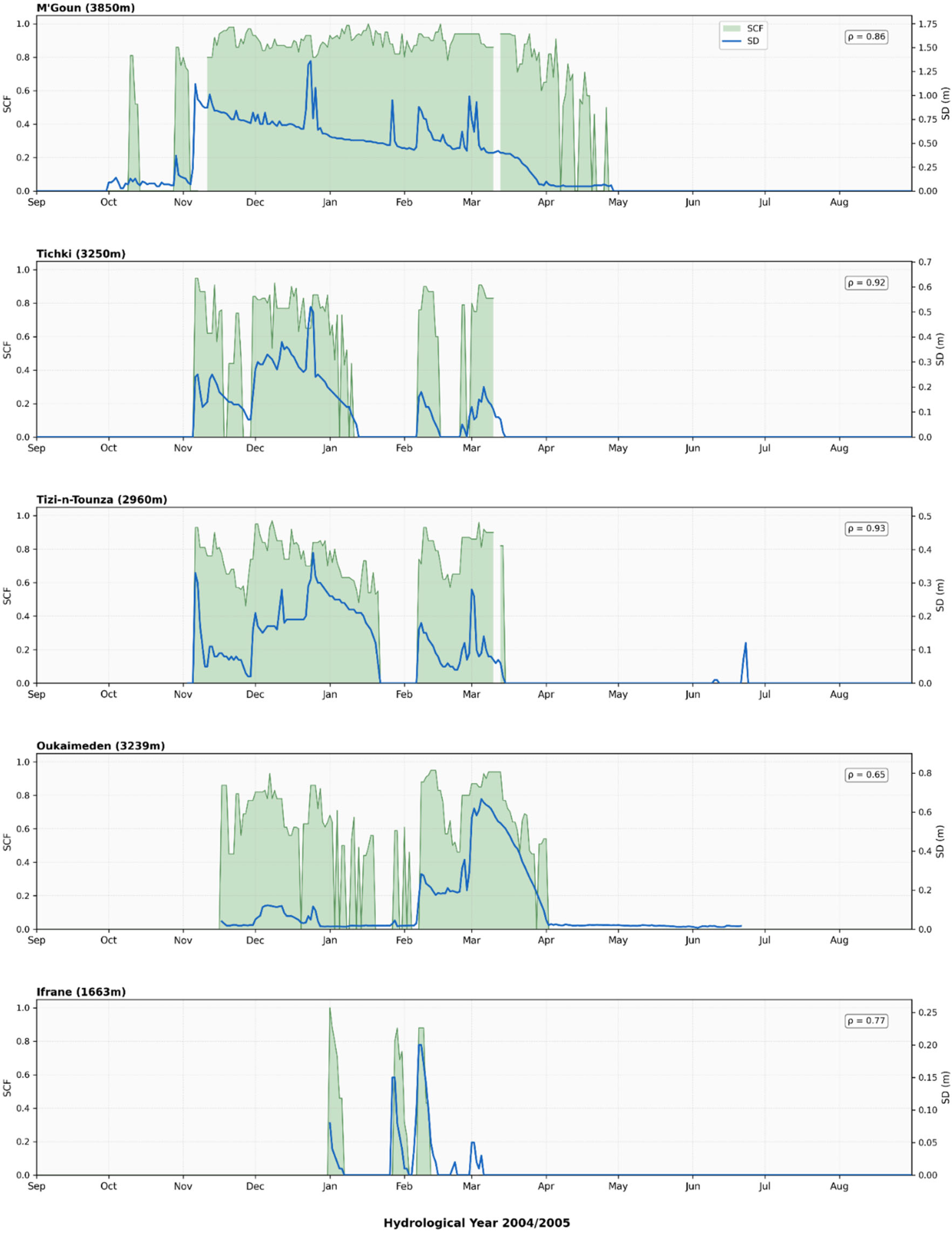
The relationship between satellite-derived FSC and in situ SD was examined across the main mountainous regions of the Moroccan Atlas at annual, seasonal, and daily scales. Correlation analyses (Figure 6) and the comparison of seasonal time series (Figure 7) jointly provide insight into the robustness, stability, and physical consistency of this relationship under contrasting topographic and climatic conditions. At the annual scale, FSC and SD generally exhibit strong correlations across most regions, with Pearson and Spearman coefficients frequently exceeding 0.6 and reaching values close to 0.9 in certain years. The agreement between linear (Pearson) and non-parametric (Spearman) correlations indicates that FSC captures not only linear variations in snow depth but also reliably represents monotonic changes in snowpack evolution. However, the magnitude and temporal stability of these correlations vary substantially among regions, depending on elevation, snow persistence, and climatic variability.
In the High Atlas, particularly in the Mgoun, Tichki, and Tizi-n-Tounza regions, the FSC–SD relationship is generally strong and stable. These regions are characterized by high elevations, low winter temperatures, and persistent snow cover, which promote continuous snow accumulation and gradual melt processes. Under such conditions, increases in FSC closely correspond to increases in SD, while decreases in FSC during spring accurately reflect snowpack ablation. The seasonal evolution observed during the 2004–2005 hydrological year (Figure 7) clearly illustrates this synchronicity, with FSC and SD following very similar temporal trajectories. This behavior demonstrates that, in high-elevation environments with persistent snow cover, FSC constitutes a physically meaningful and reliable proxy for snow depth.
At Oukaimeden, despite its high elevation, the FSC–SD relationship appears more variable at both interannual and seasonal scales. This region is characterized by frequent accumulation–melt cycles, wind-driven snow redistribution, and strong spatial heterogeneity of the snowpack. Consequently, FSC may indicate a large snow-covered area while snow depth remains shallow or highly heterogeneous. Conversely, localized accumulations may increase SD without inducing a significant change in FSC at the pixel scale. These processes contribute to weakening the statistical relationship between FSC and SD and highlight the sensitivity of FSC-based approaches to sub-pixel variability and snow redistribution processes.
The Ifrane, located in the Middle Atlas, exhibits the weakest and most unstable FSC–SD relationship. Snowfall events are relatively frequent but generally short-lived, followed by rapid melting due to higher temperatures. As a result, snow cover is often discontinuous, and snow depth remains low. In this context, FSC responds rapidly to surface snow presence, while SD varies within a narrow range, leading to a partial decoupling between the two variables. This behavior illustrates the limitations of using FSC as a standalone predictor of snow depth in mid-elevation regions characterized by low snow persistence and high climatic variability.
The comparison among regions clearly demonstrates that elevation and snowpack persistence are the dominant factors controlling the strength of the FSC–SD relationship. Regions with long snow seasons and continuous snow cover exhibit strong and stable correlations, whereas regions subject to transient snow conditions show weaker and more variable relationships. This gradient highlights the necessity of accounting for regional snow regimes when developing FSC-based snow depth estimation models.
From a scientific perspective, these results confirm the physical basis of FSC as an indicator of snowpack state, particularly when snow evolution is primarily governed by accumulation and melt processes rather than by rapid phase transitions. From an operational perspective, the findings underscore the strong potential of FSC for snow depth estimation in data-scarce mountainous regions. FSC products derived from MODIS and similar sensors provide near-daily observations at relatively fine spatial resolution, enabling continuous monitoring over large and often inaccessible areas. Collectively, the detailed regional analysis demonstrates that estimating snow depth from fractional snow cover is scientifically sound and operationally relevant, particularly in high-mountain environments characterized by persistent snow cover. When properly calibrated and adapted to regional snow regimes, FSC-based methods constitute a powerful tool for improving snow monitoring and supporting hydrological applications in complex mountainous terrain.

3.3. Performance Assessment of Empirical Snow Depth

3.3.1. Performance Based on R and KGE

The performance of the five empirical models relating FSC to SD was evaluated using the KGE as the primary performance metric, complemented by the Pearson correlation coefficient (R), during both calibration and validation phases across five mountainous regions of Morocco characterized by contrasting climatic and topographic conditions.
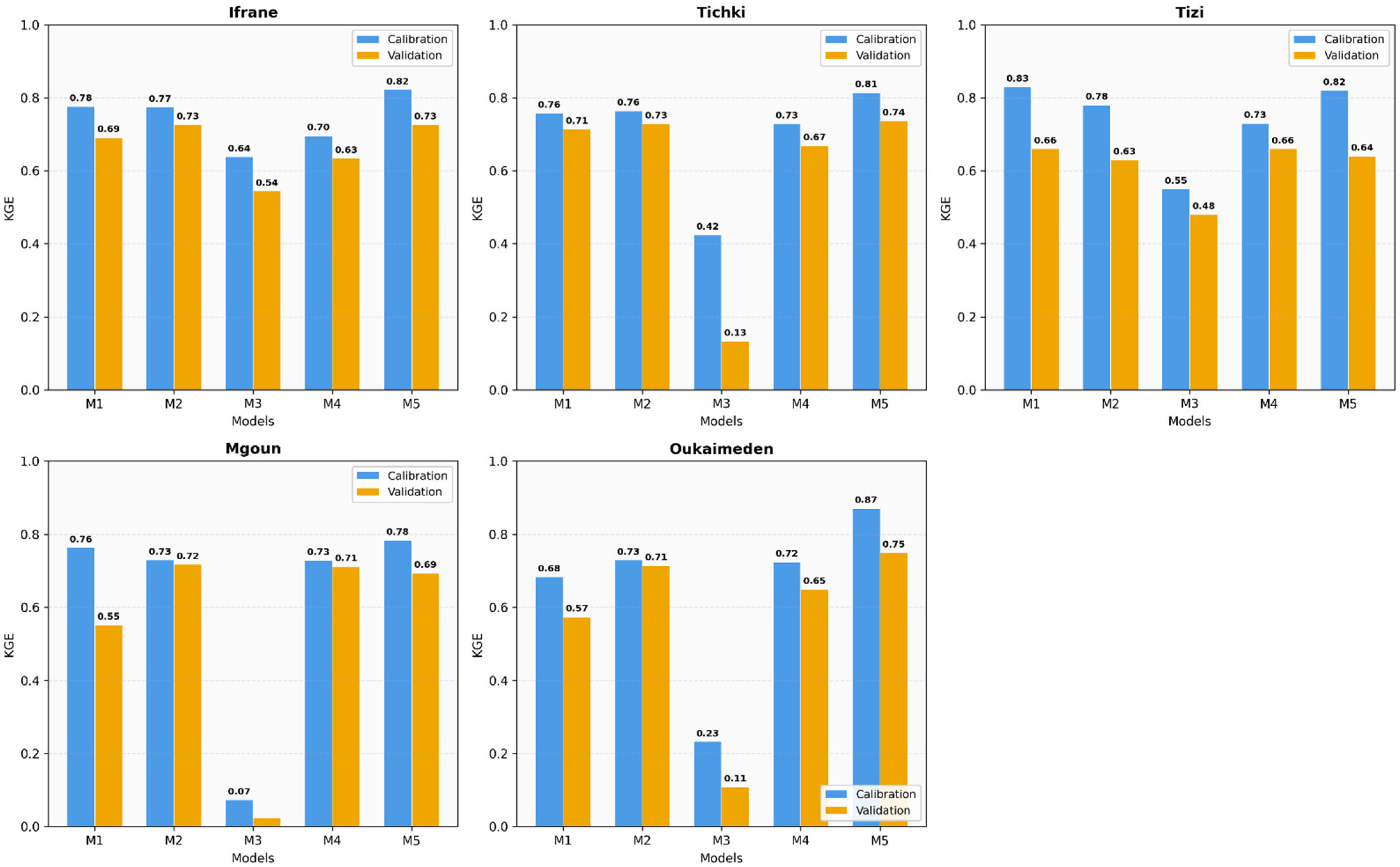
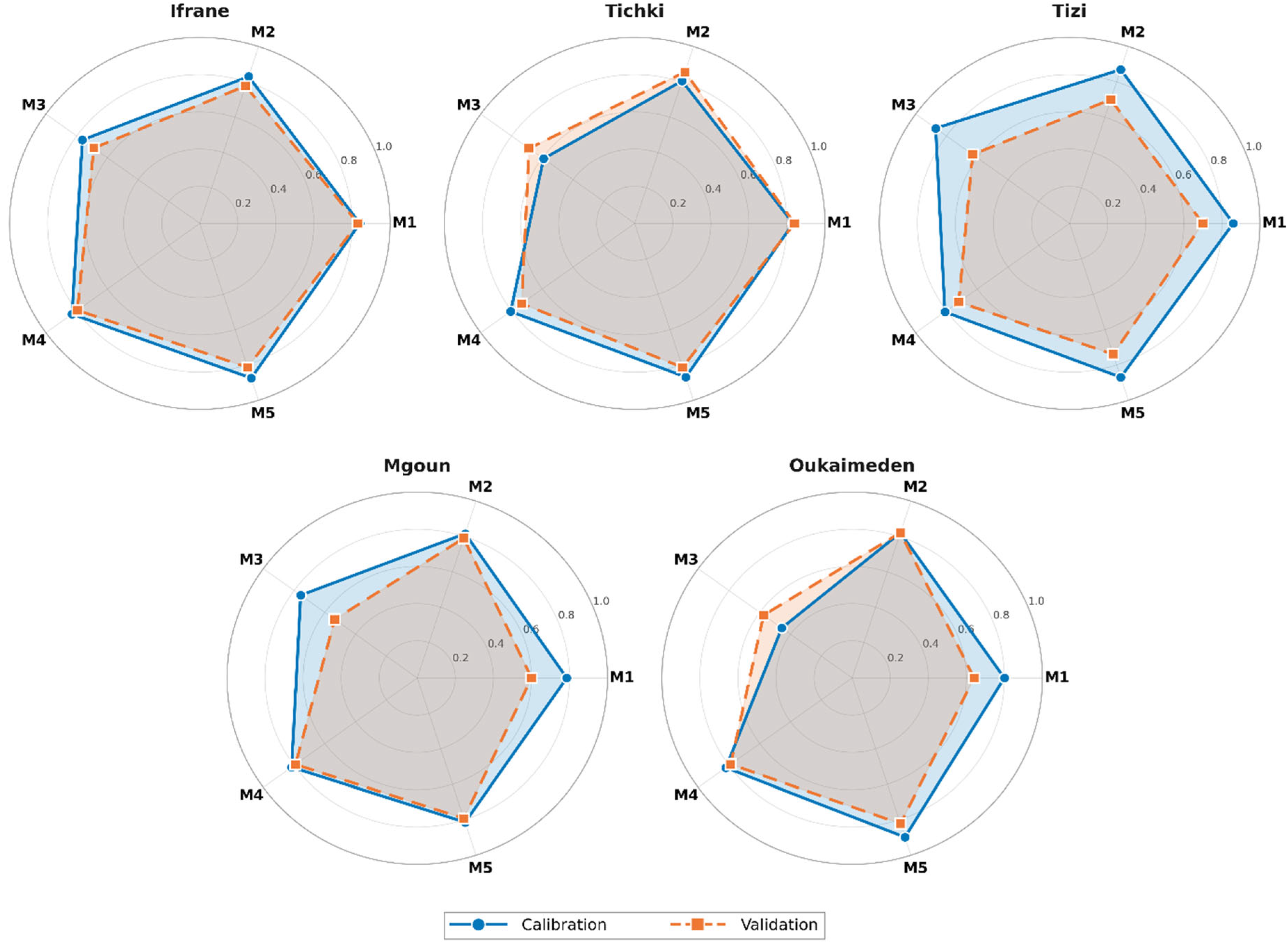
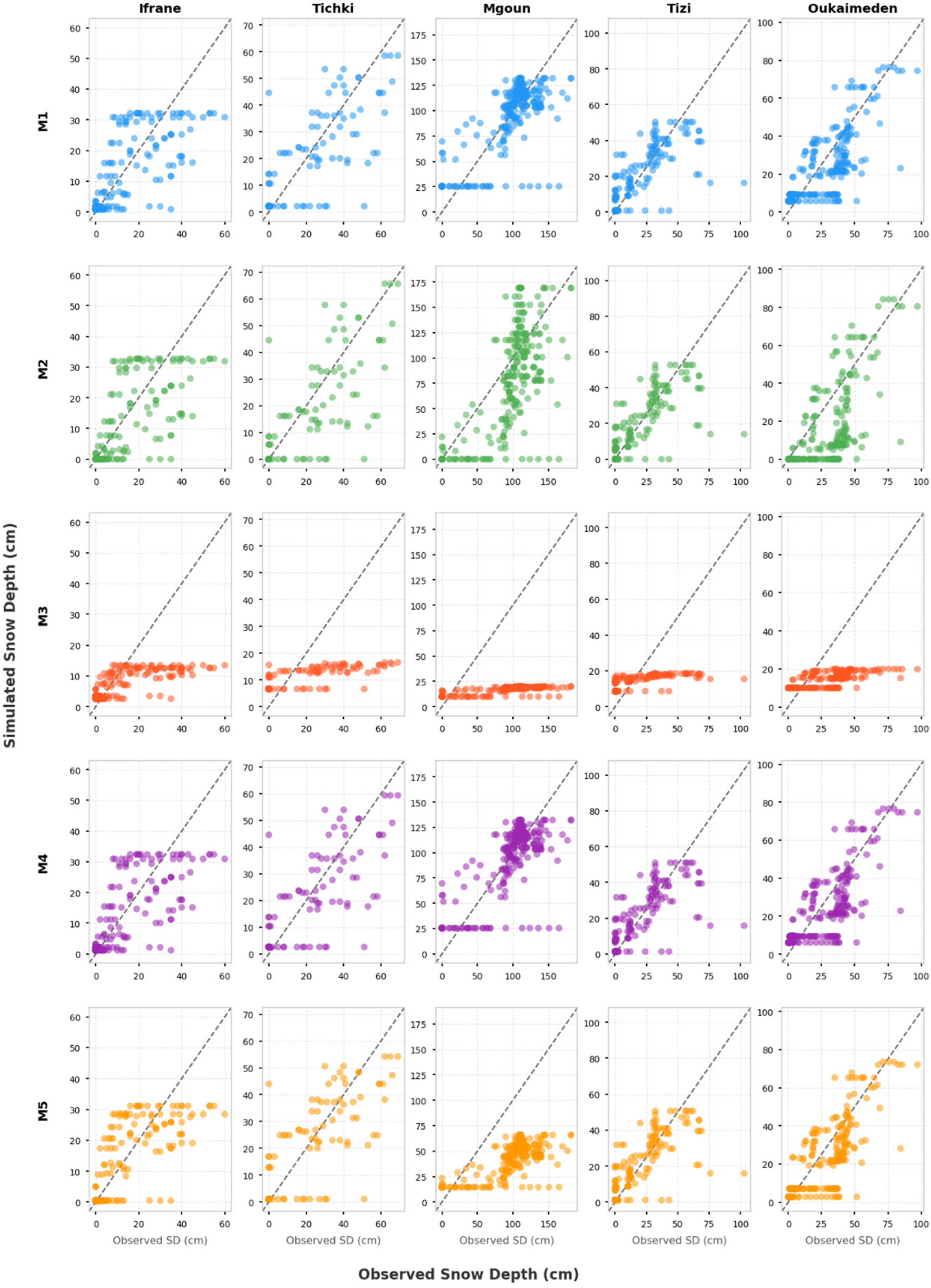
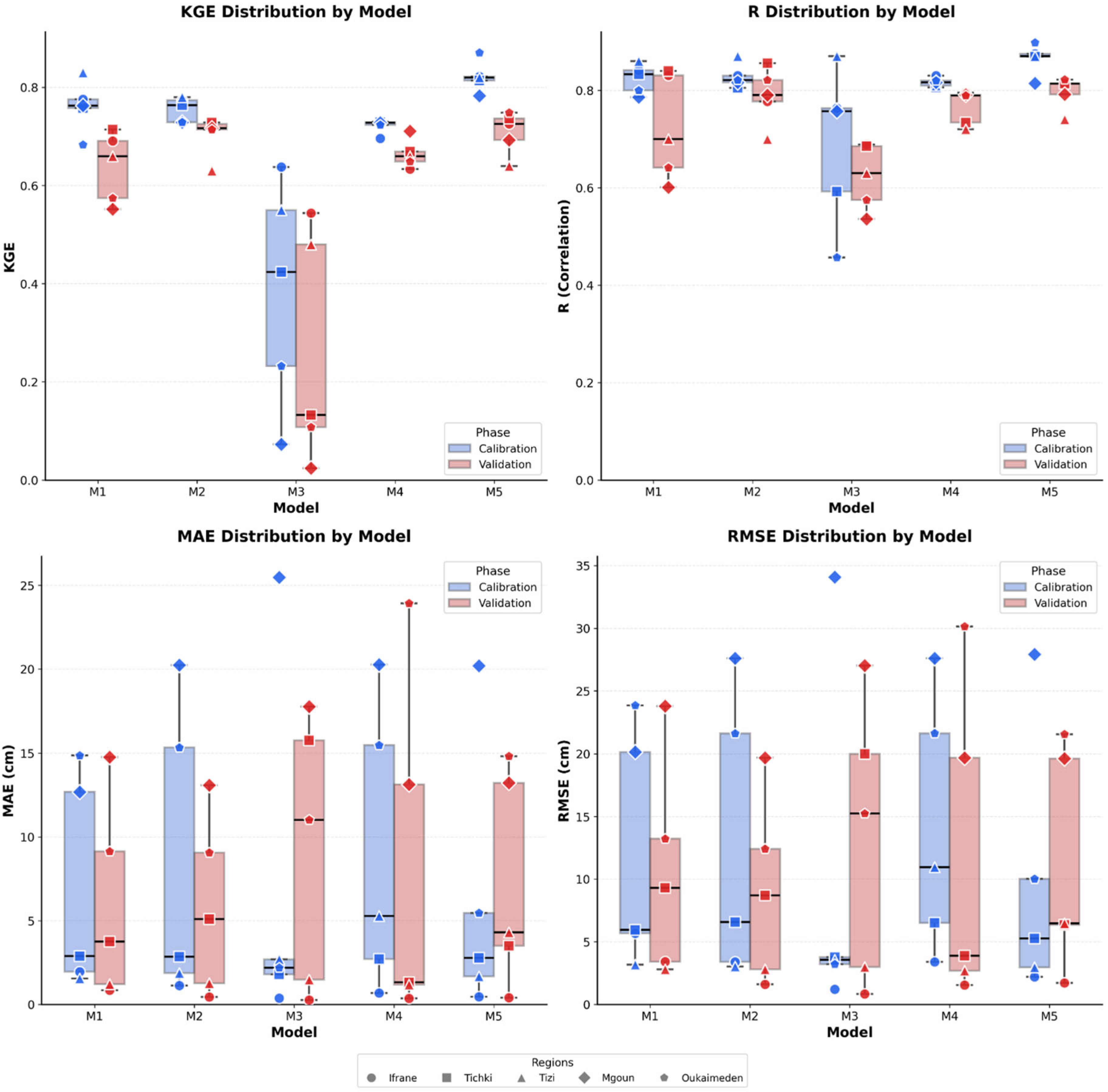
Figure 8 and Figure 9 provide a graphical comparison of model performance, whereas Table A2 and Table A3 report the corresponding quantitative metrics. While KGE provides an integrated assessment of correlation, variability, and bias, the analysis of R allows a more specific evaluation of the models’ ability to reproduce the temporal dynamics of snow depth. Figure 10 further illustrates the agreement between observed and simulated snow depth values during validation period for all five models (1)–(5) across the five study stations, highlighting the spread and systematic deviations of each model relative to the 1:1 line.
The results reveal substantial variability in model performance depending on both the mathematical formulation and the study region. During calibration, KGE values range from 0.07 to 0.87, while during validation they vary between 0.02 and 0.75, reflecting differences in both goodness of fit and robustness when applied to independent data. Correlation coefficients R typically exceed 0.75 for the best-performing models, indicating that most formulations are able to capture the temporal evolution of snow depth, even when overall performance is reduced by biases or variance mismatches. Despite this dispersion, the systematic comparison between calibration and validation highlights a stable ranking of the models, suggesting that the observed differences are primarily related to model structure rather than overfitting effects.
The linear model (3) consistently exhibits the weakest performance across all regions during both calibration and validation. In the calibration phase, KGE values remain below 0.55 and reach particularly low levels in the Mgoun (KGE = 0.07) and Oukaimeden (KGE = 0.23) regions. Although moderate to relatively high correlation coefficients are occasionally observed (e.g., R > 0.75 in Mgoun during calibration), these performances deteriorate markedly during validation, with KGE values decreasing to 0.02 and 0.11, respectively. This contrast between acceptable correlation and very low KGE values indicates that (3) is able to reproduce part of the temporal variability but systematically underestimates peak snow depth values, resulting in a significant positive bias that is reflected in the very low KGE scores. These results highlight the limitations of relying solely on correlation-based metrics and confirm the necessity of integrated performance indicators such as KGE.
The exponential models (1) and (2) show a clear and consistent improvement in performance compared to the linear models (3) across all regions and during both calibration and validation phases. During calibration, model (1) achieves KGE values ranging from 0.68 to 0.83, while model (2) exhibits a narrower and more homogeneous range between 0.72 and 0.78. Corresponding correlation coefficients are generally high (R ≈ 0.80–0.87), indicating a strong ability to capture snow depth dynamics. During validation, both models maintain relatively high KGE values (0.55–0.71 for model (1) and 0.63–0.73 for model (2)), with R values remaining stable or even slightly increasing in some regions. The consistency between calibration and validation for both KGE and R reflects good generalization capability and stable parameter estimation.
The more flexible exponential models (4) and (5), achieve the highest overall performance across the study regions. Model (4) shows robust and relatively uniform performance, with KGE values ranging from 0.69 to 0.73 during calibration and from 0.63 to 0.71 during validation, accompanied by consistently high correlation coefficients (R ≈ 0.80). Model (5) systematically outperforms all other formulations, reaching KGE values of up to 0.87 during calibration and maintaining values above 0.69 during validation. The associated correlation coefficients frequently exceed 0.80–0.85, indicating excellent agreement between simulated and observed snow depth in terms of temporal variability. The limited decrease in both KGE and R between calibration and validation suggests that the increased flexibility of model (5) enhances its adaptability to regional FSC–SD variability without inducing significant overfitting.
Regional differences in model performance are evident and reflect the influence of local climatic, topographic, and snow conditions. The Ifrane and Tizi regions generally display higher KGE and R values for exponential models, suggesting a relatively stable FSC–SD relationship. In contrast, the Mgoun and Oukaimeden regions exhibit stronger sensitivity to model structure, particularly for the linear formulation, where high R values are not accompanied by acceptable KGE scores. Nevertheless, despite these regional contrasts, the relative ranking of the models remains remarkably consistent, with model (5) systematically achieving the best performance, followed by model (4) and model (2), and model (3) consistently ranking last across all regions.
The comparison between calibration and validation confirms that the best-performing models, especially model (5), retain high performance levels for both KGE and R, supporting their robustness and generalization capability. Conversely, the persistently low KGE values of model model (3), despite moderate correlations in some cases, confirm that its limitations are primarily structural rather than related to calibration.
These results demonstrate that flexible exponential formulations provide the most reliable estimates of snow depth from snow cover fraction in Moroccan mountain regions. Among the evaluated models, model (5) offers the best compromise between accuracy, stability between calibration and validation, and regional consistency, making it particularly suitable for large-scale and operational hydrological and snow-related applications.

3.3.2. Error-Based Performance Metrics: RMSE and MAE

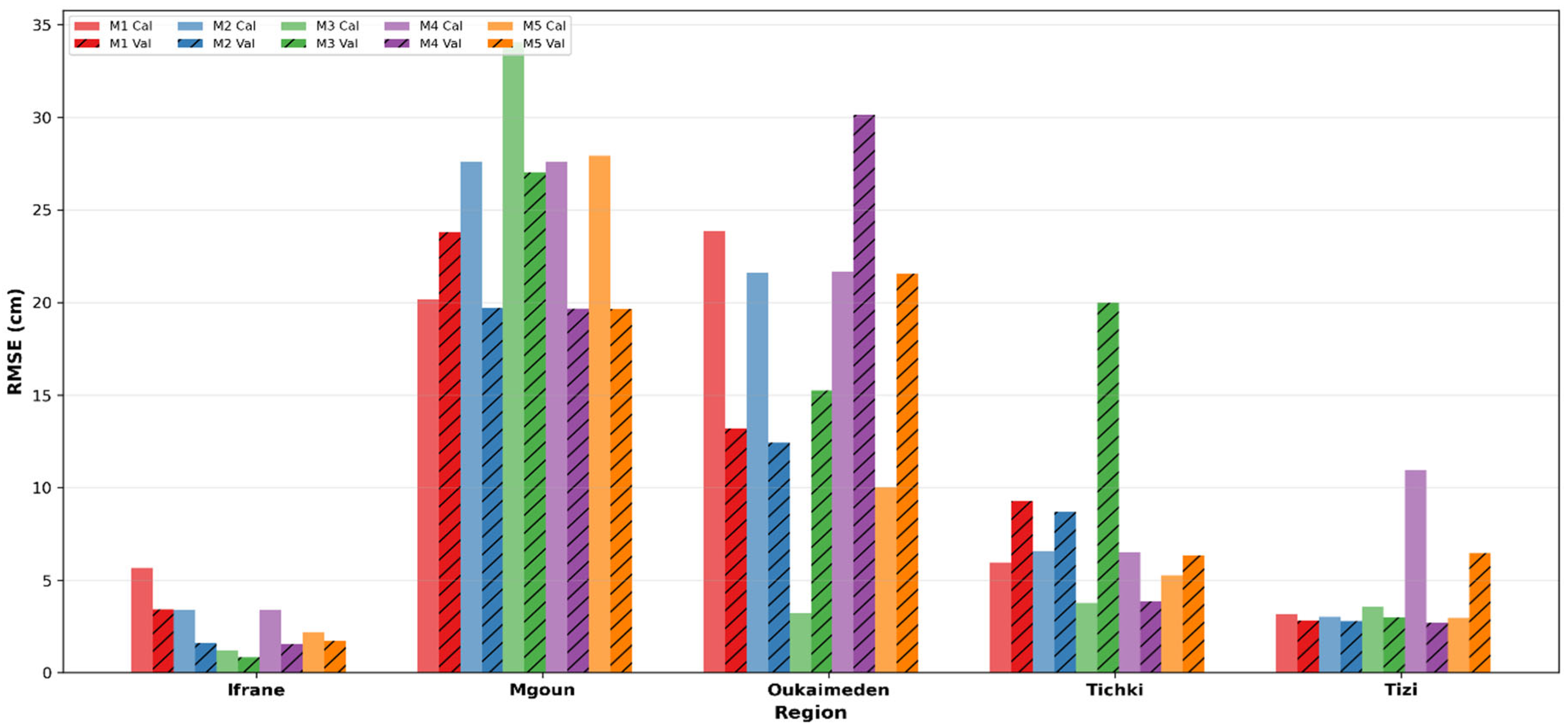
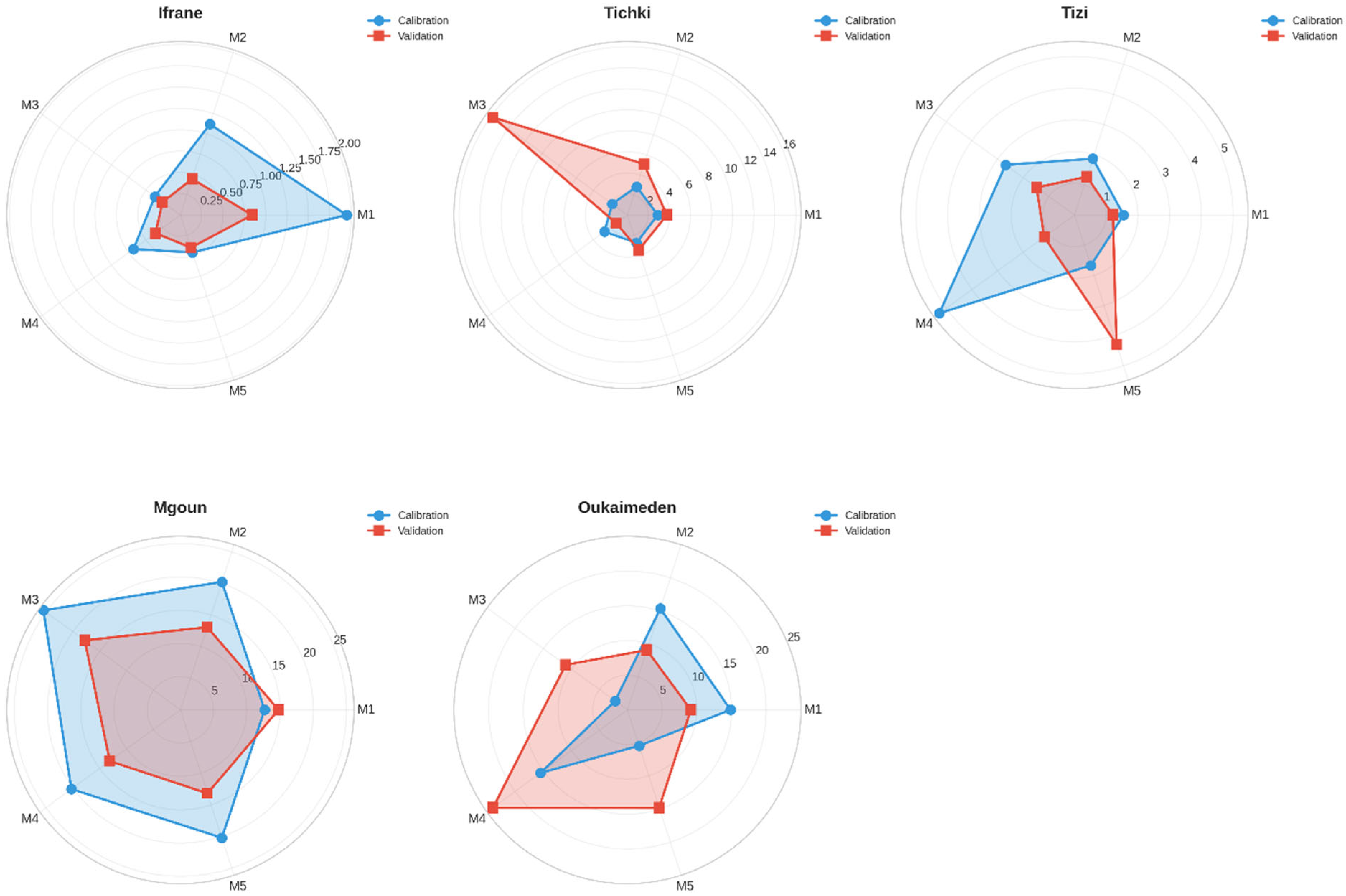
The spatial and inter-model variability observed in RMSE and MAE values reflects the combined influence of snow regime characteristics, topographic complexity, and the structural assumptions underlying each empirical formulation. As illustrated by the regional heatmaps and comparative plots (Figure 11), RMSE values across all regions and models range from 0.82 to 30.15 cm, while MAE values vary between 0.26 and 23.93 cm (Figure 12), highlighting the strong contrasts between the snow environments considered in this study.
A clear distinction emerges between the calibration and validation phases, providing critical information on model robustness and generalization capacity. At Tichki, for instance, model (3) exhibits relatively moderate errors during calibration (RMSE = 3.76 cm; MAE = 1.80 cm), but experiences a dramatic degradation during validation, with RMSE reaching 19.99 cm and MAE reaching 15.77 cm, as clearly shown in Figure 10 and Figure 11. This sharp increase highlights a lack of robustness and an inability to reproduce intense accumulation events outside the calibration period. In contrast, model (4) maintains more stable error levels between calibration (RMSE = 6.52 cm; MAE = 2.70 cm) and validation (RMSE = 3.87 cm; MAE = 1.32 cm), indicating greater consistency and improved generalization of the empirical relationship.
The influence of the snow regime becomes particularly evident in regions characterized by moderate snow conditions. In Ifrane, RMSE and MAE values during validation remain low for all models, with RMSE values below 3.5 cm (Figure 10) and MAE values below 1.0 cm (Figure 11). Model (3) exhibits the lowest errors (RMSE = 0.82 cm; MAE = 0.26 cm), followed by model (4) (RMSE = 1.54 cm; MAE = 0.36 cm) and model (2) (RMSE = 1.59 cm; MAE = 0.45 cm). However, these very low errors must be interpreted alongside the low KGE and correlation values previously identified for model (3), indicating that the reduction in absolute errors is partly achieved through systematic underestimation of snow depth amplitude. This clearly demonstrates that low RMSE and MAE values do not necessarily imply a realistic representation of snowpack dynamics.
In Tizi, absolute errors during validation are relatively homogeneous across most models, with RMSE values ranging between 2.69 cm and 2.98 cm and MAE values between 1.18 cm and 1.48 cm for models (1)–(4). This limited dispersion reflects a simpler snow regime characterized by moderate snow depths and reduced temporal variability. Model (5), however, shows markedly higher errors during validation (RMSE = 6.48 cm; MAE = 4.29 cm), suggesting that increased model flexibility may lead to episodic overestimation when snow depth variability remains moderate.
Regions with deep and persistent snowpacks exhibit the largest absolute errors. At Mgoun, all formulations show validation RMSE values exceeding 19 cm and MAE values above 13 cm, with errors reaching 27.02 cm and 17.79 cm for model (3), and approximately 19.6–19.7 cm and 13.1–13.2 cm for models (2), (4), and (5). This convergence of error magnitudes across multiple models suggests that, under high-altitude conditions, the reduction in absolute errors is constrained by dominant environmental factors such as wind-driven redistribution, strong elevation gradients, and highly heterogeneous snow accumulation. In this context, elevated errors can be explained by two complementary factors. First, when snow depth is large, SCF typically approaches saturation (SCF = 1), making it an increasingly insensitive predictor of further changes in snow depth. Therefore, small SCF errors translate into large SD estimation errors under such conditions. Second, additional environmental factors such as wind-driven snow redistribution, strong elevation gradients, and highly heterogeneous snow accumulation further contribute to observed error magnitudes, independently of individual model formulations.
At Oukaimeden, contrasts among models are particularly pronounced. During validation, model (2) achieves the lowest errors (RMSE = 12.42 cm; MAE = 9.06 cm), followed by model (1) (RMSE = 13.21 cm; MAE = 9.13 cm), indicating a better ability to limit absolute deviations. In contrast, model (5) exhibits higher errors (RMSE = 21.57 cm; MAE = 14.82 cm), while model (4) reaches very large values (RMSE = 30.15 cm; MAE = 23.93 cm), reflecting strong sensitivity to intense accumulation events and extreme spatial heterogeneity at this site. These results demonstrate that models minimizing absolute errors are not necessarily those that best reproduce temporal variability, as confirmed by the higher KGE values obtained by model (5) in this region.
Topography plays a central role in structuring error behavior. Steep slopes, aspect variability, and topographic shading influence both actual snow distribution and the reliability of satellite-derived snow cover observations. In high-mountain environments, these factors, combined with wind-driven redistribution, generate strong intra-pixel variability, making point observations poorly representative of spatial averages and mechanically amplifying RMSE and MAE values. Consequently, the systematic increase in errors from Ifrane and Tizi toward Mgoun and Oukaimeden (Figure 11) highlights a direct link between absolute errors, snow regime intensity, and topographic complexity.
The detailed analysis of RMSE and MAE confirms that absolute errors are jointly controlled by the structure of the empirical models, the intensity of the snow regime, and topographic characteristics. These results emphasize the need to interpret error-based metrics in conjunction with efficiency-based indicators in order to distinguish models that optimize absolute accuracy from those that more faithfully reproduce snowpack temporal dynamics. This distinction is essential for selecting the most appropriate model according to spatial scale and operational objectives.

4. Discussion

4.1. Physical and Statistical Controls on the Performance of Snow Depth Estimation Models

Beyond the purely numerical differences reported in Table A2 and Table A3 for calibration and validation, the results highlight several fundamental aspects related to the physical representation of the snowpack, the intrinsic limitations of satellite-derived snow cover observations, and the complexity of mountain environments [13,38,39]. Model performance therefore cannot be interpreted solely through the absolute values of KGE, R, RMSE, or MAE, but must be analyzed in light of the dominant snowpack processes and the mathematical assumptions underlying each model formulation.
A key factor explaining the contrasted model performances lies in the behavior of snow cover when the snowpack becomes spatially continuous. Once the ground surface is fully covered, snow cover rapidly approaches saturation defined here as the state where the Fractional Snow Cover (FSC) reaches its maximum value of 1.0, meaning that the entire MODIS pixel is completely snow-covered and FSC can no longer increase further, whereas snow depth may continue to increase substantially due to additional snowfall and wind driven redistribution despite gravitational compaction processes that progressively reduce snowpack thickness over time [10]. This physical decoupling between snow cover saturation and the vertical growth of the snowpack represents a major limitation for models assuming a linear relationship between snow cover and snow depth. In particular, the linear model (3) fails to capture this nonlinearity, resulting in a systematic underestimation of snow depth variability and very low KGE values, especially in regions characterized by persistent snow cover such as Mgoun and Oukaimeden. In contrast, exponential-type models introduce a nonlinear increase in snow depth as snow cover approaches saturation, allowing a more realistic representation of rapid snowpack thickening during advanced accumulation phases. This behavior is consistent with previous studies emphasizing the need for nonlinear parameterizations when relating snow cover to snow depth or snow mass [10,40] and explains the higher KGE values obtained by models (1), (2), (4), and particularly model (5).
The results further emphasize the importance of a joint interpretation of performance metrics. In several regions, particularly Ifrane and Tizi, some models exhibit relatively low RMSE and MAE values while showing only moderate KGE scores, as illustrated in Figure 13. This combination indicates that although mean snow depth magnitudes are reasonably reproduced, these models struggle to accurately represent temporal variability, seasonal dynamics, or systematic biases. Such limitations of error-based metrics when used in isolation have been widely reported in hydrological and cryosphere model evaluation studies [41,42]. Conversely, models such as model (5) occasionally display higher absolute errors while achieving superior KGE values, reflecting a better overall agreement between observed and simulated time series. This behavior is particularly evident at Oukaimeden, where a high KGE associated with larger RMSE values suggests that the model successfully captures the general temporal structure and seasonal evolution of the snowpack, while remaining sensitive to extreme accumulation events.
Regional contrasts in model performance metrics directly reflect the influence of topographic and climatic conditions on the relationship between snow cover and snow depth. High-elevation regions with complex terrain, such as Mgoun and Oukaimeden, systematically exhibit higher RMSE and MAE values regardless of model formulation. This behavior can be attributed to two complementary factors: (1) at high elevations, SCF frequently approaches saturation (FSC = 1), rendering it an increasingly insensitive predictor of further increases in snow depth, under such conditions, even small FSC uncertainties translate into large absolute SD estimation errors; and (2) wind-driven snow redistribution, topographic shading, strong elevation gradients, and pronounced sub-pixel heterogeneity in snow accumulation amplify absolute errors independently of model formulation [12,43]. It should also be noted that absolute errors normalized by mean SD could still be reasonably small. In contrast, regions characterized by more moderate snow regimes and less complex topography, such as Ifrane and Tizi, show smaller inter-model differences and more homogeneous performance levels, suggesting a more stable relationship between snow cover and snow depth under these conditions.
The comparison between calibration and validation phases highlights the robustness of the best-performing models, particularly model (5), which maintains high KGE values while limiting the degradation of error-based metrics. This stability indicates a strong capacity for generalization and suggests that the improved performance is not merely the result of overfitting during calibration, but rather reflects a mathematical formulation better suited to representing dominant snowpack processes. In contrast, the persistently poor performance of model (3) across all regions and metrics confirms that its limitations are structural in nature, indicating that improved calibration cannot compensate for an inadequate model formulation when representing snowpack dynamics.
From an operational perspective, these results demonstrate that model selection should be closely aligned with the intended application. Models minimizing absolute errors may be preferable for local-scale applications requiring accurate estimates of mean snow depth. In contrast, models maximizing KGE, such as model (5), are better suited for regional-scale and hydrological applications, where faithful reproduction of temporal variability, seasonal trends, and overall snowpack dynamics is critical, particularly for snow storage assessment and snow water equivalent estimation [1,10].

4.2. Spatial Variability of Optimized FSC–Snow Depth Coefficients

The empirical FSC–SD models were calibrated independently for each study region using three complementary optimization techniques: Nonlinear Least Squares (NLS), Genetic Algorithm (GA), and Simulated Annealing (SA). These methods were applied to both linear and nonlinear formulations in order to robustly explore the parameter space and reduce the risk of convergence toward local minimum, particularly for models exhibiting exponential behavior. For each model and region, the optimal set of coefficients was automatically selected as the configuration yielding the lowest RMSE value, ensuring the most accurate coefficient estimation across all optimization methods (NLS, GA, SA). This dual criterion ensures that the selected parameter sets not only minimize absolute errors but also preserve the temporal consistency and hydrological realism of snow depth simulations.
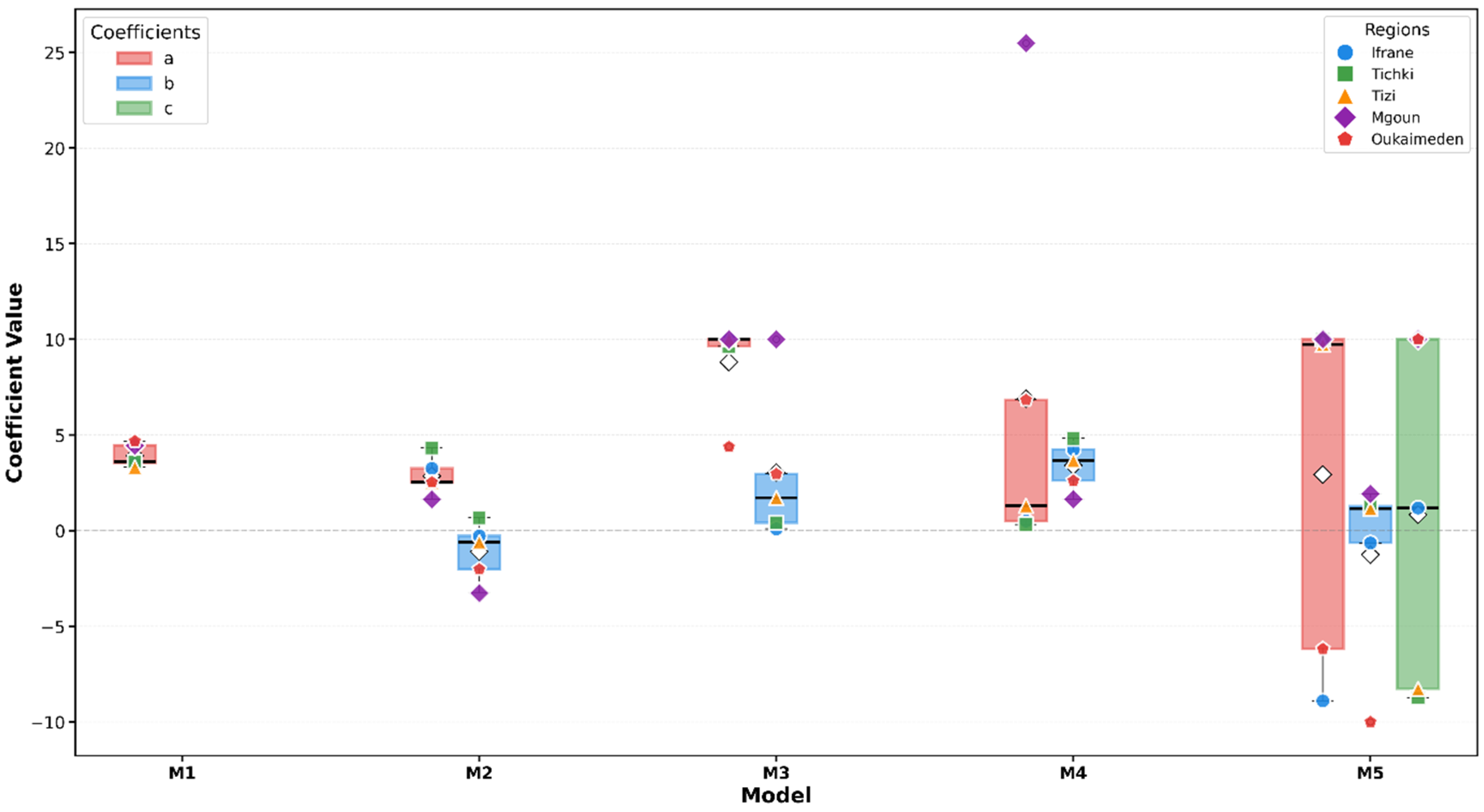
Figure 14 illustrates the spatial variability of the optimized coefficients a, b and c across the five empirical models ((1)–(5)) and the five study regions. A clear distinction emerges between the linear model (3) and the nonlinear exponential formulations (models (1), (2), (4), and (5)). For the linear model (3), the optimized coefficients exhibit limited flexibility and, in several regions, reach the bounds imposed during optimization. This behavior reflects the structural limitation of linear formulations in representing the decoupling between fractional snow cover saturation and continued snow depth accumulation. In contrast, nonlinear models show a much wider range of coefficient values, highlighting their ability to adapt to diverse snow regimes.
The variability of the optimized coefficients is particularly pronounced for models (4) and (5), which include scaling and offset terms. The coefficient “a” controlling the overall magnitude of snow depth shows strong regional contrasts, with higher values generally observed in high-altitude regions such as Mgoun and Oukaimeden. This indicates a greater sensitivity of snow depth to changes in FSC in areas characterized by deep and persistent snowpacks. The parameter “b”, governing the exponential growth rate, also varies substantially among regions, reflecting differences in accumulation dynamics, snow compaction, and the timing of snow cover saturation. For model (5), the offset parameter “c” exhibits large variability and occasionally reaches extreme values, emphasizing its role in decoupling FSC saturation from further increases in snow depth.
These pronounced regional differences in optimized coefficients can be directly linked to variations in altitude, topographic complexity, and snow regime characteristics. High-elevation regions with complex terrain and strong wind-driven redistribution require more flexible parameterizations to represent heterogeneous accumulation and deep snowpack conditions. Conversely, regions with lower elevation and more moderate snow regimes, such as Ifrane and Tizi, exhibit more stable and moderate coefficient values, indicating a more consistent and less nonlinear relationship between FSC and snow depth.
The observed variability of the optimized coefficients confirms that the FSC–SD relationship is highly region-dependent and cannot be described by a single universal parameter set. The results demonstrate that nonlinear empirical models, particularly those with additional degrees of freedom such as model (5), are better suited to accommodate the combined effects of altitude, topography, and snow regime variability. This finding further supports the use of region-specific calibration and multi-method optimization strategies for empirical snow depth estimation in mountainous environments.

4.3. Sources of Uncertainty and Study Limitations

The interpretation of the results is embedded within a methodological framework specifically designed to provide a robust estimation of snow depth using empirical models derived from satellite-based snow cover information. Empirical approaches are particularly well suited to data-sparse mountain regions, where physically based snow models are often limited by the availability of high-resolution meteorological forcing and detailed surface parameterization. By relying on observational relationships calibrated against in situ snow depth measurements, the proposed methodology offers a pragmatic and operationally relevant solution for regional-scale snow monitoring. The inherent limitations of fractional snow cover products, especially those related to spatial resolution, topographic effects, and sub-pixel heterogeneity, are well documented [38,43]. Additionally, the NDSI–FSC conversion itself introduces an inherent source of uncertainty that propagates into the FSC–SD relationships, arising from residual calibration errors, the sensitivity of NDSI to snow aging and surface impurities, and remaining cloud contamination after Terra/Aqua merging. Despite these limitations, the high validation accuracy of the optimized FSC product (R = 0.96) suggests that this uncertainty remains limited and does not substantially affect the reliability of the calibrated FSC–SD relationships. Furthermore, it should be acknowledged that point-scale in situ SD measurements may not be fully representative of the spatial average snow depth over the corresponding 500 × 500 MODIS pixel, particularly in high altitude regions characterized by complex topography and strong intra-pixel variability, which represents an inherent limitation of the calibration procedure. These limitations are explicitly addressed through a comparative multi-model framework that allows the relative strengths of different empirical formulations to be systematically evaluated.
A key physical characteristic of satellite snow cover observations is the saturation of snow cover under continuous snowpack conditions. Rather than representing a limitation of the approach, this behavior is explicitly incorporated into the methodology through the joint analysis of linear and nonlinear empirical models. This strategy enables the identification of formulations that are better suited to capturing snowpack evolution during advanced accumulation phases, when snow depth continues to increase despite limited changes in snow cover fraction [28,40]. The use of extended calibration periods combined with independent validation ensures that the empirical relationships are not site-specific artefacts but instead reflect stable and transferable patterns within each regional snow regime, thereby strengthening the reliability of the estimated snow depth.
Furthermore, the regional, site-specific calibration strategy adopted in this study allows the empirical models to implicitly integrate the combined effects of local climatic conditions, elevation gradients, and topographic complexity, including in high-altitude mountain environments. The simultaneous use of complementary performance metrics (KGE, R, RMSE, MAE) ensures a balanced assessment of model behavior, capturing not only absolute errors but also temporal consistency and variability. Within this framework, the proposed empirical methodology constitutes a coherent, reproducible, and well-adapted approach for snow depth estimation in mountainous regions with limited observations. While the explicit transferability of the models to other climatic contexts has not been tested here, the methodological structure is readily applicable to other regions, provided that appropriate regional calibration and validation are performed.
From an operational perspective, the altitude-based calibration strategy adopted in this study where the five stations span a representative elevation gradient from ~1650 m (Ifrane) to over 3000 m (Oukaimeden, Mgoun)—provides a practical framework for regional-scale snow depth estimation. Each calibrated station effectively serves as a reference node for its corresponding altitudinal zone, and the optimal coefficients extracted at each site can be applied to ungauged areas sharing similar elevation and snow regime characteristics. The results consistently show that the nonlinear models M4 and M5 outperform the other formulations across all stations, establishing these as the recommended model structures for regional applications. For model selection at a given location, KGE is used as the primary criterion; when two models yield comparable KGE values, RMSE serves as a secondary discriminating metric. This hierarchical selection procedure, combined with the station-specific lookup table of optimized coefficients, offers a reproducible and operationally relevant pathway for extending snow depth estimation to the broader Atlas region.

5. Conclusions

This study provides a comprehensive assessment of empirical snow depth estimation models derived from satellite-based snow cover information across mountain regions with contrasting climatic and topographic conditions. The results demonstrate that model performance cannot be evaluated solely on the basis of numerical statistical metrics but must be interpreted in the context of snowpack physical processes and the inherent limitations of snow cover observations. In particular, snow cover saturation plays a key role in controlling model behavior, as linear formulations fail to capture the decoupling between saturated snow cover and continued vertical snowpack accumulation, leading to systematic underestimation of variability in regions with persistent snow cover. In contrast, nonlinear and exponential formulations offer a more realistic representation of snowpack evolution during advanced accumulation phases, resulting in higher Kling–Gupta efficiency values and improved temporal dynamics.
Among the tested models, M5 emerges as the most robust formulation, maintaining consistently high performance across regions and between calibration and validation phases, thereby demonstrating strong generalization capability. The observed regional contrasts further highlight the dominant influence of topography and snow regime on the relationship between snow cover and snow depth, with complex high-altitude environments remaining particularly challenging due to unresolved physical processes and pronounced spatial heterogeneity. From an operational perspective, these findings underscore that model selection should be closely aligned with the intended application: models minimizing absolute errors are more suitable for local-scale snow depth estimation, whereas models maximizing KGE are better adapted to regional and hydrological applications, where accurate representation of temporal variability, seasonal trends, and overall snowpack dynamics is essential.

Author Contributions

Conception, H.E., A.B. and S.B.; Methodology, H.E.; Software, H.E., M.I., F.B., R.A., M.E. and M.B.; Validation, H.E., A.B., A.C. and S.B.; Formal Analysis, H.E.; Investigation, H.E.; Resources and Data Curation, H.E. and M.B.; Writing—Original Draft preparation, H.E.; Writing—Review and Editing, H.E., M.I., F.B., R.A., A.B., S.B., M.B., M.E. and A.C.; Visualization, H.E. and M.B.; Supervision, A.B., S.B. and A.C.; Project Administration, A.C., A.B. and S.B.; Funding Acquisition, A.C. All authors have read and agreed to the published version of the manuscript.

Funding

The project was conducted at Center for Remote Sensing Applications (CRSA), Mohammed VI Polytechnic University (UM6P), Morocco. This work was financially supported by the “Office Chérifien des Phosphates (OCP S.A.)” in Morocco through the funded research project under the specific agreement OCP/UM6P #ASN°39. This study was further supported by the “ResHydro” project No. 360661, funded by CNRST-FRQ Research Collaboration Program (Morocco–Quebec).

Data Availability Statement

Data will be made available on request. Python workflow for downloading and preprocessing snow cover fraction data (available on GitHub: https://github.com/haytamelyo/SnowMapPy accessed on 13 August 2025).

Acknowledgments

The authors extend their gratitude to the Joint International Laboratory TRE-MA for providing snow and meteorological data.

Conflicts of Interest

The authors declare no conflicts of interest.

Abbreviations

The following abbreviations are used in this manuscript:
FSCFractional Snow Cover
SDSnow Depth
SWESnow Water Equivalent
NLSNonlinear Least Squares
GAGenetic Algorithm
SASimulated Annealing

Appendix A

Appendix A.1

To ensure robust parameter estimation and reduce convergence toward local minimum, three complementary optimization methods were implemented:
(1)
Nonlinear Least Squares (NLS) Regression
The NLS method adjusts the model parameters by minimizing the sum of squared differences between observed and simulated snow depths:
S   ( θ )   =   i   = 1 n ( S D o b s , i   f ( F S C ; θ ) ) 2
where f ( F S C ; θ ) represents the empirical equation linking FSC and SD. In this study, the method estimates the coefficients that provide the best fit between the measured FSC and the observed SD. This approach is deterministic and computationally efficient, and it performs well for nearly linear relationships such as S D = a F S C + b . However, it may become trapped in a local minimum when the FSC–SD relationship is highly nonlinear, which can prevent convergence toward the global optimum.
(2)
Genetic Algorithm (GA)
GA is a stochastic and global optimization method inspired by the process of natural selection. In this study, everyone in the population represents a potential combination of coefficients ( a , b , c ) of the FSC–SD equations. The performance of each individual is evaluated using a fitness function, defined as the negative of the RMSE:
F i t n e s s   ( θ )   =     R M S E   ( θ )
The evolutionary process follows three main steps:
  I.
Selection of the best-performing combinations of coefficients, i.e., those producing the lowest discrepancies between observed and simulated snow depth.
 II.
Crossover, which combines parameters from selected solutions to generate new and potentially improved coefficient sets.
III.
Mutation, which randomly modifies certain coefficients to maintain diversity and avoid premature convergence toward a minimum locality.
Applied to the FSC–SD relationship, the GA allows for a global exploration of the parameter space, making it particularly effective for nonlinear or multi-parameter Equations (4) and (5). Although it is more computationally demanding than the NLS method, it provides a better guarantee of finding the global minimum of the error function.
(3)
Simulated Annealing (SA)
The SA method is a probabilistic optimization technique designed to escape local minimum and search for the global minimum of the RMSE. In this study, it is used to iteratively adjust the coefficients of the FSC–SD model to minimize the difference between simulated and observed snow depths.
At each iteration, a new set of coefficients θ is generated from the current solution θ and accepted according to the following probability:
P ( θ θ ) = 1 , if   R M S E ( θ ) < R M S E ( θ ) e x p [ R M S E ( θ ) R M S E ( θ ) λ ] , otherwise .
Here λ is a control parameter that governs the likelihood of temporarily accepting a less optimal solution. This flexibility enables the model to explore a broader solution space and escape from local minimum. Within the FSC–SD framework, the SA method facilitates the search for truly optimal coefficients, particularly when the empirical equations exhibit complex exponential behavior.
Although all three approaches aim to minimize the RMSE between observed and simulated snow depths, they rely on different search mechanisms, allowing for a comparative evaluation of their performance and robustness. The most effective method was then selected based on the combined criteria of RMSE and KGE, ensuring both the highest statistical accuracy and the greatest hydrological consistency in snowpack simulation.

Appendix A.2

Table A1. Calibration and validation periods for each study region.
RegionCalibrationValidation
MgounOctober 2001 to August 2006September 2006 to March 2008
TichkiApril 2001 to August 2009September 2009 To January 2010
Tizi-n-TounzaOctober 2001 to August 2005September 2005 to May 2007
Oukaimeden-LMIApril 2004 to August 2018September 2018 to October 2020
IfraneJanuary 2005 to August 2019September 2019 to December 2021
Table A2. Calibration performance metrics and optimal coefficients of empirical snow depth models across the Moroccan Atlas Regions.
RegionModelsKGERRMSE
(cm)
MAE
(cm)
Optimal Coefficients (a, b, c)
abc
Ifrane(1)0.7760.8415.6611.9503.52
(2)0.7740.8303.4011.1203.25−0.28
(3)0.6380.7631.2010.37010.000.09
(4)0.6960.8303.4050.6800.504.24
(5)0.8220.8752.1950.460−8.90−0.651.18
Tichki(1)0.7580.8335.9552.8803.59
(2)0.7640.8056.5632.8404.320.67
(3)0.4240.5923.7621.8009.640.40
(4)0.7290.8066.5172.7000.314.82
(5)0.8140.8695.2572.78010.001.28−8.75
Tizi(1)0.8300.8603.1701.5503.30
(2)0.7800.8703.0201.8702.52−0.61
(3)0.5500.8703.5502.69010.001.71
(4)0.7300.81010.9505.2701.303.66
(5)0.8200.8702.9601.6709.731.14−8.28
Mgoun(1)0.7630.78620.14612.6804.45
(2)0.7290.81627.60120.2401.62−3.27
(3)0.0730.75734.09025.48010.0010.00
(4)0.7280.81627.61220.27025.491.64
(5)0.7830.81427.92520.20010.001.9210.00
Oukaimeden(1)0.6830.80023.85914.8604.69
(2)0.7290.82121.61915.3402.53−2.02
(3)0.2320.4573.2022.1904.382.96
(4)0.7240.82021.64215.4706.842.61
(5)0.8710.89810.0245.450−6.18−10.0010.00
Table A3. Validation performance metrics of empirical snow depth models across the Moroccan Atlas Regions.
RegionModelsKGERRMSE
(cm)
MAE
(cm)
Ifrane(1)0.6910.8313.4170.843
(2)0.7260.7771.5890.445
(3)0.5440.6890.8220.257
(4)0.6340.7951.5380.362
(5)0.7260.8141.7180.402
Tichki(1)0.7140.8409.2893.748
(2)0.7290.8568.6975.094
(3)0.1330.68619.99815.772
(4)0.6690.7343.8691.320
(5)0.7370.8146.3413.495
Tizi(1)0.6600.7002.8001.210
(2)0.6300.7002.7901.270
(3)0.4800.6302.9801.480
(4)0.6600.7202.6901.180
(5)0.6400.7406.4804.290
Mgoun(1)0.5520.60123.81514.769
(2)0.7170.79019.69113.084
(3)0.0240.53627.01917.786
(4)0.7110.79119.67913.126
(5)0.6930.79219.63613.221
Oukaimeden(1)0.5740.64113.2159.131
(2)0.7140.82112.4199.060
(3)0.1080.57515.24011.015
(4)0.6490.78930.15023.927
(5)0.7490.82221.56514.822

References

  1. Barnett, T.P.; Adam, J.C.; Lettenmaier, D.P. Potential impacts of a warming climate on water availability in snow-dominated regions. Nature 2005, 438, 303–309. [Google Scholar] [CrossRef]
  2. Viviroli, D.; Dürr, H.H.; Messerli, B.; Meybeck, M.; Weingartner, R. Mountains of the world, water towers for humanity: Typology, mapping, and global significance. Water Resour. Res. 2007, 43, 2006WR005653. [Google Scholar] [CrossRef]
  3. Beniston, M.; Farinotti, D.; Stoffel, M.; Andreassen, L.M.; Coppola, E.; Eckert, N.; Fantini, A.; Giacona, F.; Hauck, C.; Huss, M.; et al. The European mountain cryosphere: A review of its current state, trends, and future challenges. Cryosphere 2018, 12, 759–794. [Google Scholar] [CrossRef]
  4. Bousbaa, M.; Boudhar, A.; Hssaisoune, M.; Elyoussfi, H.; Karaoui, I.; Bargam, B.; Nifa, K.; Hadri, A.; Acharki, S.; Vivone, G.; et al. Assessing Groundwater Storage Response to Snow Cover Dynamics in Large Moroccan River Basins Over the Last Decades Using Remote Sensing Data. Groundw. Sustain. Dev. 2025, 32, 101574. [Google Scholar] [CrossRef]
  5. Marchane, A.; Boudhar, A.; Baba, M.W.; Hanich, L.; Chehbouni, A. Snow Lapse Rate Changes in the Atlas Mountain in Morocco Based on MODIS Time Series during the Period 2000–2016. Remote Sens. 2021, 13, 3370. [Google Scholar] [CrossRef]
  6. Nifa, K.; Boudhar, A.; Ouatiki, H.; Elyoussfi, H.; Bargam, B.; Chehbouni, A. Deep Learning Approach with LSTM for Daily Streamflow Prediction in a Semi-Arid Area: A Case Study of Oum Er-Rbia River Basin, Morocco. Water 2023, 15, 262. [Google Scholar] [CrossRef]
  7. Nifa, K.; Boudhar, A.; Elyoussfi, H.; Eljabiri, Y.; Bousbaa, M.; Bargam, B.; Chehbouni, A. Exploring Neural Network Performance in Hydrological Modeling in a Mountainous Region of Morocco: A Case Study on LSTM and GRU Architectures for Runoff Prediction. Available online: https://meetingorganizer.copernicus.org/EGU24/EGU24-11621.html (accessed on 26 April 2024).
  8. Elyoussfi, H.; Boudhar, A.; Belaqziz, S.; Bousbaa, M.; Nifa, K.; Bargam, B.; Karaoui, I.; Bouihrouchane, A.; Benmira, T.; Chehbouni, A. MorSnowAI v1.0: An Open-Source Python Package for Empowering Artificial Intelligence in Snow Hydrology—A Comprehensive Toolbox. Available online: https://meetingorganizer.copernicus.org/EGU24/EGU24-13159.html (accessed on 9 April 2024).
  9. Hall, N.D.; Stuntz, B.B.; Abrams, R.H. Climate Change and Freshwater Resources. Nat. Resour. Environ. 2008, 22, 30–35. [Google Scholar]
  10. Sturm, M.; Taras, B.; Liston, G.E.; Derksen, C.; Jonas, T.; Lea, J. Estimating Snow Water Equivalent Using Snow Depth Data and Climate Classes. J. Hydrometeorol. 2010, 11, 1380–1394. [Google Scholar] [CrossRef]
  11. Boudhar, A.; Baba, W.M.; Marchane, A.; Ouatiki, H.; Bouamri, H.; Hanich, L.; Chehbouni, A. Water Resources Monitoring Over the Atlas Mountains in Morocco Using Satellite Observations and Reanalysis Data. In Remote Sensing of African Mountains: Geospatial Tools Toward Sustainability; Adelabu, S., Ramoelo, A., Olusola, A., Adagbasa, E., Eds.; Springer International Publishing: Cham, Switzerland, 2022; pp. 157–170. [Google Scholar] [CrossRef]
  12. Hanich, L.; Chehbouni, A.; Gascoin, S.; Boudhar, A.; Jarlan, L.; Tramblay, Y.; Boulet, G.; Marchane, A.; Baba, M.W.; Kinnard, C.; et al. Snow hydrology in the Moroccan Atlas Mountains. J. Hydrol. Reg. Stud. 2022, 42, 101101. [Google Scholar] [CrossRef]
  13. Hall, D.K.; Riggs, G.A.; Salomonson, V.V.; DiGirolamo, N.E.; Bayr, K.J. MODIS snow-cover products. Remote Sens. Environ. 2002, 83, 181–194. [Google Scholar] [CrossRef]
  14. Riggs, G.A.; Hall, D.K.; Román, M.O. Overview of NASA’s MODIS and Visible Infrared Imaging Radiometer Suite (VIIRS) snow-cover Earth System Data Records. Earth Syst. Sci. Data 2017, 9, 765–777. [Google Scholar] [CrossRef]
  15. Dietz, S.; Gollier, C.; Kessler, L. The climate beta. J. Environ. Econ. Manag. 2018, 87, 258–274. [Google Scholar] [CrossRef]
  16. Painter, T.H.; Rittger, K.; McKenzie, C.; Slaughter, P.; Davis, R.E.; Dozier, J. Retrieval of subpixel snow covered area, grain size, and albedo from MODIS. Remote Sens. Environ. 2009, 113, 868–879. [Google Scholar] [CrossRef]
  17. Romanov, P.; Tarpley, D. Enhanced algorithm for estimating snow depth from geostationary satellites. Remote Sens. Environ. 2007, 108, 97–110. [Google Scholar] [CrossRef]
  18. Gascoin, S.; Barrou Dumont, Z.; Deschamps-Berger, C.; Marti, F.; Salgues, G.; López-Moreno, J.I.; Revuelto, J.; Michon, T.; Schattan, P.; Hagolle, O. Estimating Fractional Snow Cover in Open Terrain from Sentinel-2 Using the Normalized Difference Snow Index. Remote Sens. 2020, 12, 2904. [Google Scholar] [CrossRef]
  19. Zhu, L.; Zhang, Y.; Wang, J.; Tian, W.; Liu, Q.; Ma, G.; Kan, X.; Chu, Y. Downscaling Snow Depth Mapping by Fusion of Microwave and Optical Remote-Sensing Data Based on Deep Learning. Remote Sens. 2021, 13, 584. [Google Scholar] [CrossRef]
  20. Zhao, L.; Lu, S.; Qi, D. Improvement of Maximum Air Temperature Forecasts Using a Stacking Ensemble Technique. Atmosphere 2023, 14, 600. [Google Scholar] [CrossRef]
  21. Yang, J.; Jiang, L.; Luojus, K.; Pan, J.; Lemmetyinen, J.; Takala, M.; Wu, S. Snow depth estimation and historical data reconstruction over China based on a random forest machine learning approach. Cryosphere 2020, 14, 1763–1778. [Google Scholar] [CrossRef]
  22. Yang, J.; Jiang, L.; Pan, J.; Shi, J.; Wu, S.; Wang, J.; Pan, F. Comparison of Machine Learning-Based Snow Depth Estimates and Development of a New Operational Retrieval Algorithm over China. Remote Sens. 2022, 14, 2800. [Google Scholar] [CrossRef]
  23. von Kaenel, M.; Margulis, S.A. Improved modelling of mountain snowpacks with spatially distributed precipitation bias correction derived from historical reanalysis. Cryosphere 2024, 19, 3309–3327. [Google Scholar] [CrossRef]
  24. Fiddes, J.; Aalstad, K.; Westermann, S. Hyper-resolution ensemble-based snow reanalysis in mountain regions using clustering. Hydrol. Earth Syst. Sci. 2019, 23, 4717–4736. [Google Scholar] [CrossRef]
  25. Romanov, P.; Tarpley, D. Estimation of snow depth over open prairie environments using GOES imager observations. Hydrol. Process. 2004, 18, 1073–1087. [Google Scholar] [CrossRef]
  26. Dai, L.; Che, T.; Xie, H.; Wu, X. Estimation of Snow Depth over the Qinghai-Tibetan Plateau Based on AMSR-E and MODIS Data. Remote Sens. 2018, 10, 1989. [Google Scholar] [CrossRef]
  27. Kazari, K.; Shah-Hosseini, R.; Khanbani, S. Estimation of the Surface Area Covered by Snow and the Resulting Runoff Using Landsat Satellite Images. In Proceedings of the IECG 2022, Online, 1–15 December 2022; p. 36. [Google Scholar] [CrossRef]
  28. Liston, G.E.; Elder, K. A Distributed Snow-Evolution Modeling System (SnowModel). J. Hydrometeorol. 2006, 7, 1259–1276. [Google Scholar] [CrossRef]
  29. Wrzesien, M.L.; Pavelsky, T.M.; Durand, M.T.; Dozier, J.; Lundquist, J.D. Characterizing Biases in Mountain Snow Accumulation from Global Data Sets. Water Resour. Res. 2019, 55, 9873–9891. [Google Scholar] [CrossRef]
  30. Bousbaa, M.; Htitiou, A.; Boudhar, A.; Eljabiri, Y.; Elyoussfi, H.; Bouamri, H.; Ouatiki, H.; Chehbouni, A. High-Resolution Monitoring of the Snow Cover on the Moroccan Atlas through the Spatio-Temporal Fusion of Landsat and Sentinel-2 Images. Remote Sens. 2022, 14, 5814. [Google Scholar] [CrossRef]
  31. Bousbaa, M.; Boudhar, A.; Kinnard, C.; Elyoussfi, H.; Karaoui, I.; Eljabiri, Y.; Bouamri, H.; Chehbouni, A. An accurate snow cover product for the Moroccan Atlas Mountains: Optimization of the MODIS NDSI index threshold and development of snow fraction estimation models. Int. J. Appl. Earth Obs. Geoinf. 2024, 129, 103851. [Google Scholar] [CrossRef]
  32. Acharki, S.; Boudhar, A.; Bouihrouchane, A.; Bousbaa, M.; Karaoui, I.; Elyoussfi, H.; Bargam, B.; El Khalki, E.M.; Hadri, A.; Chehbouni, A. Spatial modeling of snow water equivalent in the high atlas mountains via a lumped process-based approach. Sci. Rep. 2025, 15, 26327. [Google Scholar] [CrossRef]
  33. Planton, S.; Lionello, P.; Artale, V.; Aznar, R.; Carrillo, A.; Colin, J.; Congedi, L.; Dubois, C.; Elizalde, A.; Gualdi, S.; et al. 8—The Climate of the Mediterranean Region in Future Climate Projections. In The Climate of the Mediterranean Region; Lionello, P., Ed.; Elsevier: Oxford, UK, 2012; pp. 449–502. [Google Scholar] [CrossRef]
  34. Jarlan, L.; Khabba, S.; Er-Raki, S.; Le Page, M.; Hanich, L.; Fakir, Y.; Merlin, O.; Mangiarotti, S.; Gascoin, S.; Ezzahar, J.; et al. Remote Sensing of Water Resources in Semi-Arid Mediterranean Areas: The joint international laboratory TREMA. Int. J. Remote Sens. 2015, 36, 4879–4917. [Google Scholar] [CrossRef]
  35. Knippertz, P.; Christoph, M.; Speth, P. Long-term precipitation variability in Morocco and the link to the large-scale circulation in recent and future climates. Meteorol. Atmos. Phys. 2003, 83, 67–88. [Google Scholar] [CrossRef]
  36. Muñoz-Sabater, J.; Dutra, E.; Agustí-Panareda, A.; Albergel, C.; Arduini, G.; Balsamo, G.; Boussetta, S.; Choulga, M.; Harrigan, S.; Hersbach, H.; et al. ERA5-Land: A state-of-the-art global reanalysis dataset for land applications. Earth Syst. Sci. Data 2021, 13, 4349–4383. [Google Scholar] [CrossRef]
  37. Teleubay, Z.; Yermekov, F.; Tokbergenov, I.; Toleubekova, Z.; Igilmanov, A.; Yermekova, Z.; Assylkhanova, A. Comparison of Snow Indices in Assessing Snow Cover Depth in Northern Kazakhstan. Sustainability 2022, 14, 9643. [Google Scholar] [CrossRef]
  38. Salomonson, V.V.; Appel, I. Estimating fractional snow cover from MODIS using the normalized difference snow index. Remote Sens. Environ. 2004, 89, 351–360. [Google Scholar] [CrossRef]
  39. Kostadinov, T.S.; Lookingbill, T.R. Snow cover variability in a forest ecotone of the Oregon Cascades via MODIS Terra products. Remote Sens. Environ. 2015, 164, 155–169. [Google Scholar] [CrossRef][Green Version]
  40. Helbig, N.; Bühler, Y.; Eberhard, L.; Deschamps-Berger, C.; Gascoin, S.; Dumont, M.; Revuelto, J.; Deems, J.S.; Jonas, T. Fractional snow-covered area: Scale-independent peak of winter parameterization. Cryosphere 2021, 15, 615–632. [Google Scholar] [CrossRef]
  41. Gupta, H.V.; Kling, H.; Yilmaz, K.K.; Martinez, G.F. Decomposition of the mean squared error and NSE performance criteria: Implications for improving hydrological modelling. J. Hydrol. 2009, 377, 80–91. [Google Scholar] [CrossRef]
  42. Liu, D. A rational performance criterion for hydrological model. J. Hydrol. 2020, 590, 125488. [Google Scholar] [CrossRef]
  43. Crumley, R.L.; Palomaki, R.T.; Nolin, A.W.; Sproles, E.A.; Mar, E.J. SnowCloudMetrics: Snow In-formation for Everyone. Remote Sens. 2020, 12, 3341. [Google Scholar] [CrossRef]
Figure 1. Location of stations within situ with snow depth observations.
Water 18 01244 g001
Figure 2. (a) Ultrasonic SR50 snow depth sensor installed at a high-altitude monitoring site; (b) Oukaimeden automatic weather station used for snow and meteorological observations; (c) Overview of the snow-covered landscape of Jbel Mgoun in the High Atlas Mountains.
Water 18 01244 g002
Figure 3. Available snow depth observations during the study period (2001–2022) for the different weather stations in the Moroccan Atlas Mountains.
Water 18 01244 g003
Figure 4. Methodology flowchart.
Water 18 01244 g004
Figure 5. Interannual variability of Snow Event Length (SEL: number of consecutive days of the longest continuous snow cover event within a hydrological year) and Snow Day Duration (SDD: cumulative number of days with snow depth greater than 0 cm per hydrological year) in regions of the Moroccan Atlas Mountains where snow-depth stations are situated.
Water 18 01244 g005
Figure 6. Summary matrix of Spearman (A) and Pearson (B) correlation coefficients between satellite-derived Fractional Snow Cover (FSC) and in situ Snow Depth (SD) measurements, showing the minimum, mean, median, and maximum values across all available hydrological years for each weather station.
Water 18 01244 g006
Figure 7. Seasonal variability of Snow Cover Fraction (SCF: green line) and Snow Depth (SD: blue line) at mountainous stations during the 2004–2005 hydrological year.
Water 18 01244 g007
Figure 8. Calibration and validation performance of empirical snow depth models based on KGE across the study regions.
Water 18 01244 g008
Figure 9. Comparison of correlation coefficient between calibration and validation of empirical snow-depth models across study regions.
Water 18 01244 g009
Figure 10. Observed vs. simulated snow depth (cm) for models (1)–(5) across five Atlas Mountain stations during the validation period.
Water 18 01244 g010
Figure 11. Error magnitude RMSE (cm) of empirical snow depth models by region.
Water 18 01244 g011
Figure 12. Comparison of MAE (cm) for the five empirical models during calibration and validation.
Water 18 01244 g012
Figure 13. Performance metric distributions by model.
Water 18 01244 g013
Figure 14. Spatial variability of the optimized coefficients (a, b, c) across the five empirical models (4) and (5) and the five study regions.
Water 18 01244 g014
Table 1. Physiographic features of the snow depth observational network.
NameRegionBasinLongitudeLatitudeElevation (m)
MgounHaut Atlas/Ighil M’GounDraa Basin−6.4531.53850
TichkiHaut Atlas/Ighil M’GounDraa Basin−6.331.533250
Tizi-n-TounzaHaut Atlas/Ighil M’GounDraa Basin−6.2931.562960
Oukaimeden-LMIHaut Atlas/RherayaTensift Basin−7.86631.183239
IfraneMiddle Atlas/IfraneOum er Rbia Basin−5.1633.51663
Table 2. Summary Statistics of Snow Depth.
Meteorological StationDaily SamplesHydrological YearsMax (cm)Mean SD All Days (cm)Mean SD Cold Season (cm)Period (Start–End)
Mgoun2321718225.944.4October 2001 to March 2008
Tichki355410814.19.7April 2001 to January 2010
Tizi-n-Tounza143651034.88.8October 2001 to May 2007
Oukaimeden-LMI35311515625.840.2April 2004 to October 2020
Ifrane620818721.33.0January 2005 to December 2021
Disclaimer/Publisher’s Note: The statements, opinions and data contained in all publications are solely those of the individual author(s) and contributor(s) and not of MDPI and/or the editor(s). MDPI and/or the editor(s) disclaim responsibility for any injury to people or property resulting from any ideas, methods, instructions or products referred to in the content.