Article

Comparative Study of Prior Models for Curb Opening Inlet Lengths and Neuro-Fuzzy Modeling for Hydraulic Design


by
Sevgi Cavdar
1,*,
Muhammad Ashraf Muhammad
2 and
Ben R. Hodges
3
1
Department of Civil Engineering, Sivas Cumhuriyet University, Sivas 58140, Turkey
2
University of Mannheim, 68131 Mannheim, Germany
3
Maseeh Department of Civil, Architectural, and Environmental Engineering, The University of Texas at Austin, Austin, TX 78758, USA
*
Author to whom correspondence should be addressed.
Water 2026, 18(10), 1153; https://doi.org/10.3390/w18101153
Submission received: 9 February 2026 / Revised: 21 February 2026 / Accepted: 25 February 2026 / Published: 11 May 2026
(This article belongs to the Section Hydraulics and Hydrodynamics)

Abstract

Rapidly removing rainfall from roadways is necessary to avoid vehicle accidents caused by hydroplaning or suddenly unbalanced forces on the front wheels. Ensuring adequate water removal and minimal bypass requires correct sizing of drainage structures. Undepressed curb opening inlets (UCOIs) are often preferred along high-speed roads where curb depressions can cause a loss of vehicle control. Recent work has shown that classic curb inlet design equations can be in error for long curb opening inlets (>2 m). This study provides results of laboratory experiments that build on recent work to evaluate the performance of different curb inlet equations. A new approach using neuro-fuzzy modeling that applies the proven adaptive neuro-fuzzy inference systems (ANFIS) was evaluated for use in sizing UCOI. This study aims to find the method that has the best hydraulic performance. Results show that some earlier models actually estimate inlet lengths better than more recent design equations under some roadway configurations. The use of the ANFIS approach provides the lowest root mean square errors and mean absolute percentage errors when compared to available models and may be adopted in the practice of UCOI inlet design safely.

1. Introduction

Excessive water on roads threatens traffic safety through hydroplaning, unbalancing the forces on vehicle front wheels, damaging pavement, and allowing sediment accumulation in low areas. Where roadways have a hard curb, some form of curb opening inlet (COI) or grating is typically used to convey flow off the road. Recent work has cast doubt on the validity of traditional design equations for COI, particularly for long inlets [1,2,3]. Although these prior studies focused on depressed COI, the deficiencies are likely to extend to undepressed curb opening inlets (UCOI), which are favored for high-speed roadways where a curb depression is considered an unacceptable traffic hazard. Thus, our high-speed roads with hard curbs are being built based on drainage design criteria developed from experiments that are really only applicable to low-speed roads. The present work is focused on providing a deeper understanding of the problems with traditional UCOI design equations and proposing a new design approach.
In practice, UCOIs are generally installed to capture 95% to 100% of the upstream gutter flow for a design storm [2,4]. Such inlets are typically available in a few standard sizes (based on local design regulations) and roadway designers control the spacing between inlets to capture the design storm [5]. Longer UCOI are often preferred (where allowed) as fewer, longer inlets result in lower construction and maintenance costs than using many short inlets at closer spacing. Over the past 70 years, experimental data have been used to create models of the interception behavior of UCOI for various along-road slopes and cross-road slopes, e.g., [6,7,8,9,10]. Because of the complex nature of intercepted flow, most models use either analytical representations that are calibrated with experimental data [7,8,11] or regression of data to model equations [2,6,12]. A notable exception is the study of Wasley [10] that developed and validated a theoretical hydrodynamic model—which unfortunately has been too complicated to apply in practical curb inlet design and has never been fully tested beyond its original experimental conditions. Prior to the present work, there has never (to our knowledge) been an attempt to step outside the traditional modeling paradigm for representing COI dynamics, either for undepressed or depressed inlets.
A further limitation of prior studies is that most researchers have only used their own data to develop model equations and, until recently, little or no effort has been made to cross-validate models with different data sets. Muhammad [2] digitized the available data from UCOI experiments so that it could be more readily accessed by researchers and used in such cross-comparisons. Unfortunately, because much of the focus has been on depressed COI, the range of available test conditions for UCOI is insufficient to provide a clear understanding of their behavior, particularly for long inlets. For example, the work of Li et al. [8] used 1:3 geometric scaled models with (scaled) curb inlet lengths less than 1 m and cross slopes that were fixed at 8.333%, which is rarely seen in practical road design. Spaliviero et al. [9] provided a more reasonable range of cross slopes from 2 to 4%, but inlet lengths were only 0.25 m and 0.5 m. Hammonds and Holley [6] tested longer inlets (1.52 m and 4.57 m), but for relatively few configurations as the UCOI was only investigated as a control for their depressed COI study. The Wasley [10] experiments for full capture (without a downstream end to the inlet) are the best set of UCOI experiments for long inlets, ranging from 2.2 m to 5.6 m, but almost half of these experiments were at unusually high cross slopes of 8.33%; only 34 experiments were at more commonly used cross slopes of 0.5–4%.
Most available UCOI equations are experiment-dependent, with different design equations resulting from the individual focus of the different experiments. Instead of creating yet another regression equation, in the present work we examine the abilities of an adaptive neuro-fuzzy inference system (ANFIS) to model UCOI behaviors. The ANFIS approach was originally developed by Jang [13], but this is the first time it has been used for roadway hydraulics. This study adds to the existing literature with (1) new experiments for UCOI in a variety of roadway configurations on a full-scale prototype, (2) design of a neuro-fuzzy modeling for the prediction of UCOI length for full capture (3) testing the ANFIS model against historical literature data, and (4) a comparative study of the ANFIS approach to prior UCOI models using root mean square error (RMSE) and mean absolute percentage error (MAPE) as metrics.
An improved model to predict full-capture UCOIs is important for the design of inlets that capture less than 100% of the flow as the full capture relationships are embedded in the partial capture equations throughout the design manuals in the USA. This study shows that prior methods perform poorly for longer inlets or outside their original dataset. The ANFIS method performs well across the full range of inlet lengths for datasets that were not used in training, as long as the model is trained with similar slope orientations.

2. Background

2.1. Relating Amount of Flow to Flow Depth

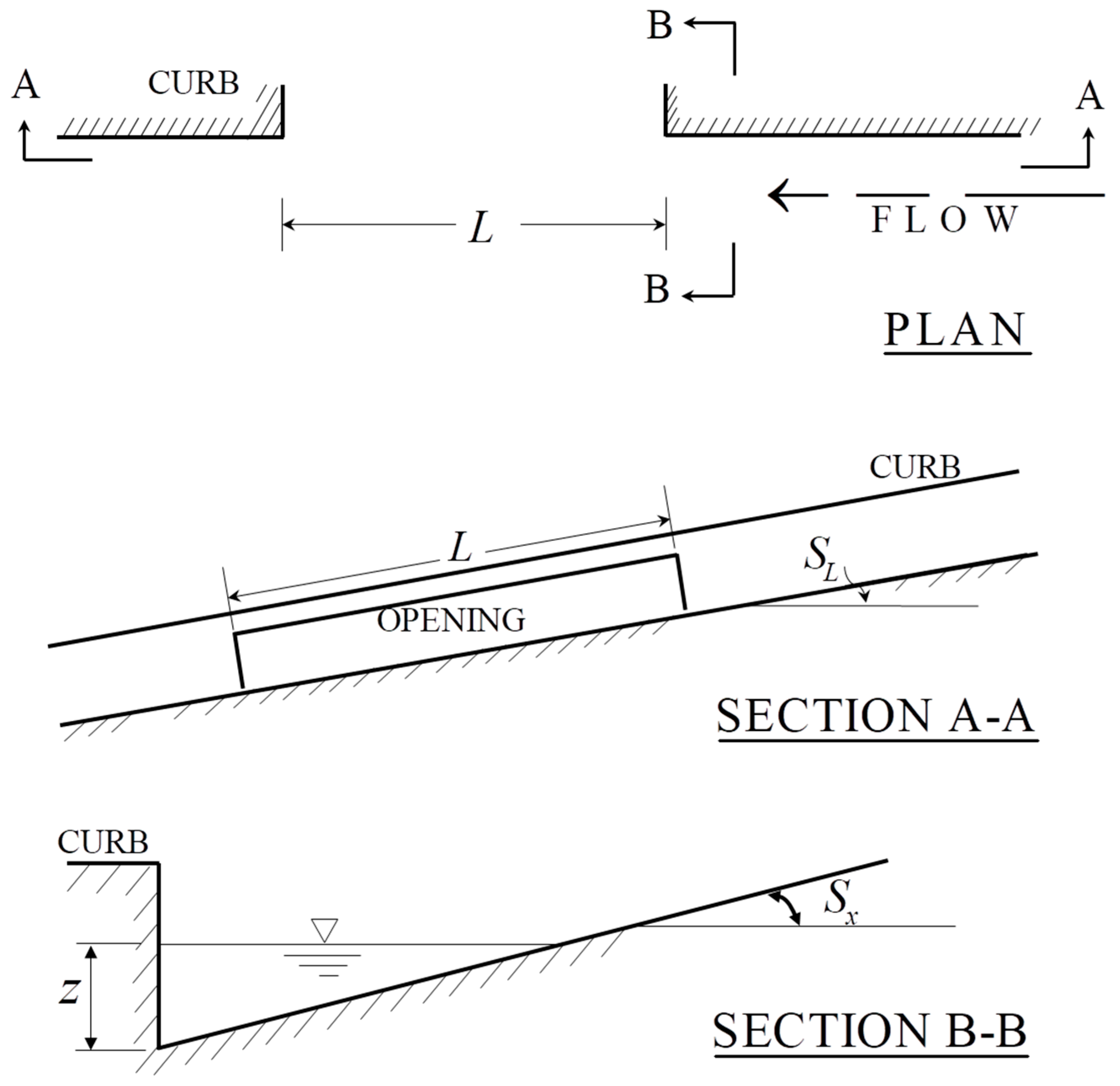
An on-grade UCOI is typically modeled as uniform along-road slope (SL) with a single cross slope (Sx) providing a triangular cross section, with the curb assumed to be vertical (Figure 1). A subset of UCOI uses compound cross-sections where the gutter near the curb has a steeper cross slope than the road Sx, but such configurations are more common with depressed COI—the steeper slope to the gutter is both an increased construction cost and a potential traffic hazard, and so it is less desirable on high-speed roads. Herein, we will focus on the simplest case of UCOI with a single Sx.
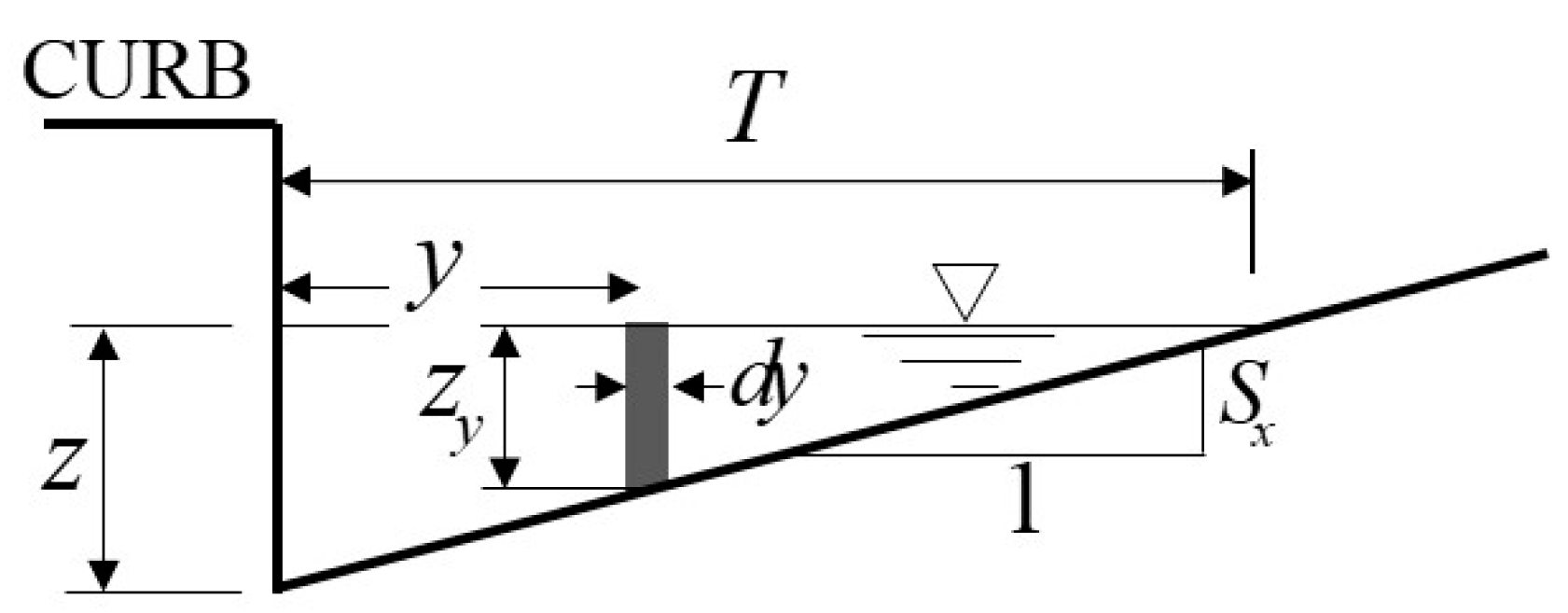
Analytical models typically seek a relationship between depth (z), flow rate (Q) and road slopes (SL, Sx), using hydraulic principles with the assumption of uniform flow along the roadway upstream of the UCOI. The gutter flow at any cross-section upstream of the inlet is approximated as having a negligible cross slope of the free surface (Figure 1, Section B-B) and correspondingly, the cross-stream velocity is assumed small. Izzard [14] used the simple Gauckler–Strickler–Manning equation for the overall triangular area (with the hydraulic radius taken as half the maximum flow depth), but that approach has been generally succeeded by a strip-integral approach [14]. Consistent with the approximations and assumptions above, for the strip-integral approach we imagine a vertical element (Figure 2) where the lateral shear can be neglected and flow equations can be integrated over the ponded width (T). Furthermore, we presume that at position y the depth of a strip (zy) is a reasonable approximation of the hydraulic radius. It follows that an integration of the Gauckler–Strickler–Manning equation for 0 ≤ y ≤ T provides
Q = 3 K M 8 S L 0.5 n S x z 8 / 3
where K M is a unit conversion factor defined as KM = 1.0 m1/3 s−1 for S.I., where Q is in m3 s−1 and z is in m, and KM = 1.486 ft1/3 s−1, where Q is in ft3 s−1 and z is in ft for US. The Gauckler–Strickler–Manning’s roughness coefficient is n, which is taken as a dimensionless value.

2.2. Existing UCOI Models

A collection of UCOI models to intercept the entire incoming flow are compiled for the design inlet lengths.
The majority of UCOI equations for full capture take on a general form of
L = a Q b z c n f S L h S x k
where a, b, c, f, h, k are coefficients presented in Table 1 (SI) and Table 2 (US); L [L] is the inlet length required for full interception of the incoming flow; Q [L3/T] is the flow present in the gutter and the roadway; z [L] is the incoming water depth; S L is the roadway grade; n is Manning’s roughness coefficient; and S x is the cross slope of the road. A notable exception is the empirical equation of Hammonds and Holley [6], that has the structure
L = Q α z β
where SI coefficients are 0.196 and 0.0023 and US customary coefficients are 0.643 and 0.0248 for α and β , respectively. Note that Equation (3) involves subtraction in the denominator and thus it produces negative inlet length forecasts as the flow depth becomes smaller.
As presented in Table 1 (SI) and Table 2 (US), the available solutions have a wide range of coefficients from different experimental setups and conditions. Logically, the wide range of coefficients in the literature implies either (i) many research teams are doing something wrong (unlikely) or (ii) the physics in different experimental conditions are sufficiently different such that a single set of regression coefficients is unlikely to correctly capture the processes. Arguably, the theoretical work of Wasley [10] needs to be revisited, but such an effort is beyond the present scope of work. Herein, we take the view that where quantitative analysis is intractable and simple regression equations are unsatisfactory over a wide range of conditions, a fuzzy inference system can provide better estimations of real-world performance. In many applications, ANFIS outperforms multiple linear regression, nonlinear regression, and multiple nonlinear regression models [15,16,17,18] (although not in all applications [19]) and thus is a potential new approach to UCOI design.

3. Methods

3.1. Physical Model

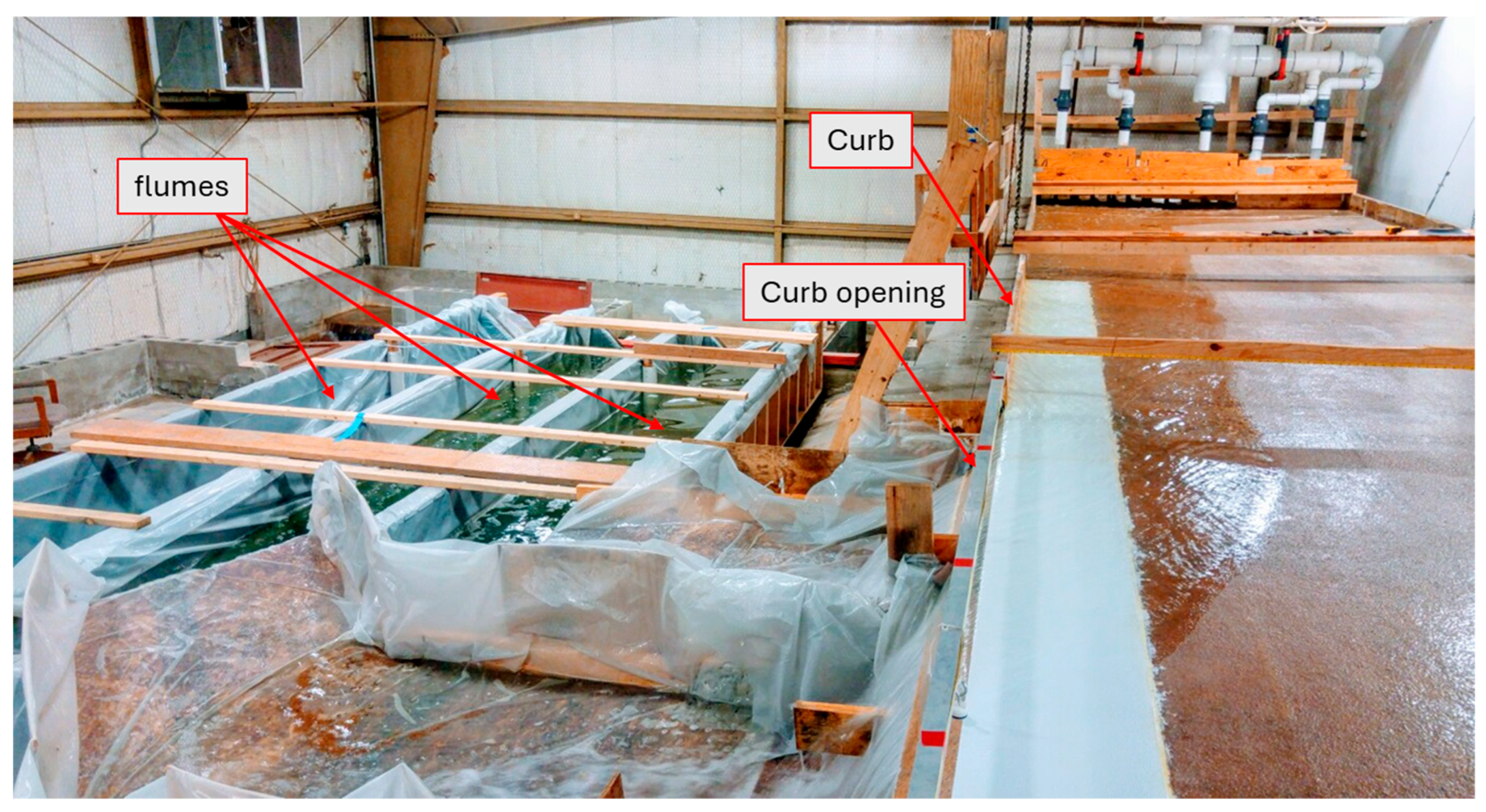
New experimental data reported herein were collected at University of Texas, Austin, using a full-scale physical roadway model. Details of the construction of the model and major subsequent modifications are described in Holley et al. [20], Hammonds and Holley [6], Schalla [21], Schalla et al. [3], and Muhammad [2]. The physical model includes a single on-grade lane (18.9 m long and 3.2 m wide) with a plywood deck supported by a steel structure. The plywood decking is coated in an epoxy sealant embedded with graded sand to obtain the desired roughness. Wooden curbs are provided along the long edges and modified for the desired inlet lengths. One corner of the roadway rests on a ball bearing that provides a pivot point. Hoists at the three corners are used to adjust transverse and longitudinal slopes. For the present experiments, water was conveyed from a 1900 cubic meter (500,000 gallon) reservoir by a single deepwell pump discharging up to 0.1 m3/s. Results from Schalla [21] show that the distance from the headbox to the inlet is long enough to allow the water to reach approximately uniform flow prior to entering the inlet section. The curb inlet test section for the present work consists of a 3.05 m (10 ft) opening. The intercepted flow is divided into two equal sections, with separate flow measurement V-notch weirs on adjacent channels, as described in Schalla [21]. A personnel walkway and an instrument carriage were used to span the model. The walkways and the instrument carriages could be moved longitudinally along almost the entire length of the roadway. The primary difference with the prior work ([2,3,21]) is that the present experiments use an on-grade inlet rather than a depressed inlet. A hard plastic filler with a texture similar to the road was used to fill where the upstream and downstream transition depressions, as illustrated in Figure 3.
The present experiments were designed to evaluate 100% interception flows over a range of inlet lengths up to 3.048 m (10 ft) for a range of cross slopes and along-road slopes, as detailed in Table 3. The flow rate at 100% interception was determined by slowly increasing the incoming flow to beyond the target inlet length, then decreasing the flow until the target length was achieved. The physical opening at the curb was unchanged (3.048 m) during all experiments, with the shorter inlets represented by a target length identified by a tape on the curb. Flow measurement was bubble flow meters at the V-notch weirs once the flows reached steady conditions [21]. Data collected for each test were water spreads ( T ) at 0.26 and 0.56 m upstream of the curb opening and flow rate. The two spread readings upstream of the opening were then averaged and multiplied by the cross slope to obtain flow depths. The use of depths calculated from the spread rather than directly measured at the curb is common practice, e.g., Spaliviero et al. [9] due to the difficulty in obtaining an accurate and precise depth measurement for shallow water at the curb edge.
One of the problems with existing UCOI experimental data is that most were collected at higher cross slopes than are used in roadway design. The median cross slope for the conducted experiments in this study is 4% (with a maximum of 6%, Table 4), while the previous data compiled in Muhammad [2] has a median of 6% for S x > S L and for all cases inclusive at full interception. The Pearson R correlation coefficient between the road flow (i.e., intercepted flow at 100% capture) and cross slope, S x , results in 0.283 (−0.284 for S L ) with a significant relationship (p-value < 0.05).

3.2. ANFIS

Fuzzy approximates of the relationship between input and output variables using interpolation in a vague environment can be used with the hybrid learning procedure of neural networks [13]. The technique called ANFIS (adaptive-network-based fuzzy inference system) largely eliminates the dependence on expert knowledge in attaining fuzzy rules; instead, it provides a systematic method of producing rules for consistent mapping of the input and output from training data.
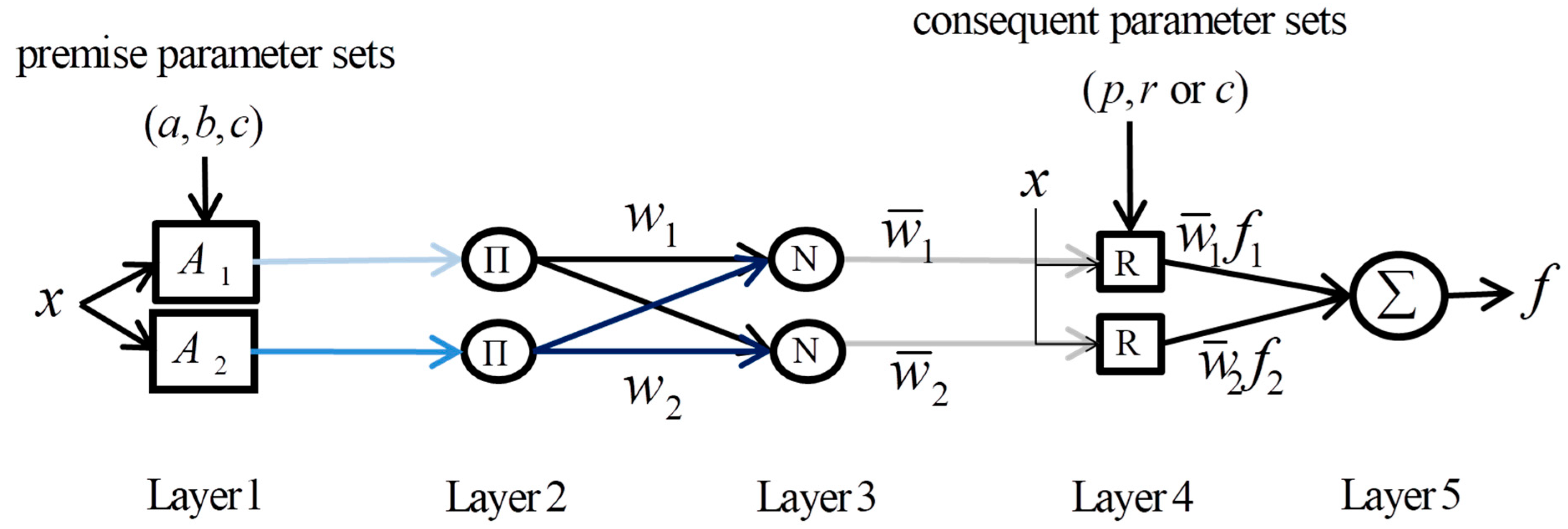
ANFIS is a 5-layer feedforward network where each node within the same layer performs the same task for the incoming signal and passes its output to the next layer (Figure 4). Layers consist of square (Layers 1 and 4) and circle (rest) nodes and while the former nodes have adaptive parameters (Layer 1 premise and Layer 4 consequent parameters), the circle nodes in Layers 2, 3 and 5 are fixed and do specific tasks. When the model inputs are passed on to the 1st layer, membership degrees are computed at Layer 1 through fuzzying. The membership function (MF, μ ) could be of any type and premise parameters are determined accordingly which change the shape of MFs. For a triangular MF,
μ A i ( x ; a i , b i , c i ) = 0 , x a i x a i b i a i , a i x b i c i x c i b i , b i x c i 0 , c i x
where a i , b i , c i constitutes the premise parameter sets and x is the input (vector). The output of this layer provides the degree of belongingness by fuzzifying the crisp input. The outputs are forwarded to Layer 2, where every node is labeled ∏ which multiplies the incoming signals from model inputs (for two inputs: w i = μ A i ( x 1 ) μ B i ( x 2 ) ) to generate the firing strengths ( w i ) for the rules and pass the results to Layer 3. Firing strengths are normalized at each node N in Layer 3 by diving the node’s signal to the total firing strength produced by the earlier layer, i.e., w ¯ i = w i / i w i where w ¯ i is the weighted average of each rule’s output. At Layer 4, each node has consequent parameters within node functions:
w ¯ i f i = w ¯ i ( p i x + r i )
where p i , r i are the consequent parameters for a single input model with a linear output MF, and each node computes the contribution of that rule. When f is linear, the consequent set includes one more parameter than number of inputs used in the model; when f is a constant MF (zero-order), a single consequent parameter is obtained, which multiplies the incoming signal from the previous layer, w ¯ i . Outputs of Layer 4 are forwarded to Layer 5 which computes the summation and provides the overall output ( i w ¯ i f i ).
Layer 1 delineates a fuzzy subspace and Layer 4 specifies the output within this subspace. With hybrid learning implemented, consequent parameters are identified with least squares estimate, and error rates are propagated backward to update premise parameters with gradient descent. Thus identifying premise and consequent parameters, a i , b i , c i and p i , r i , respectively, for the given input data that provide close-to-zero errors when the outputs are compared to the measured data; ANFIS accomplishes the goal for the given problem.
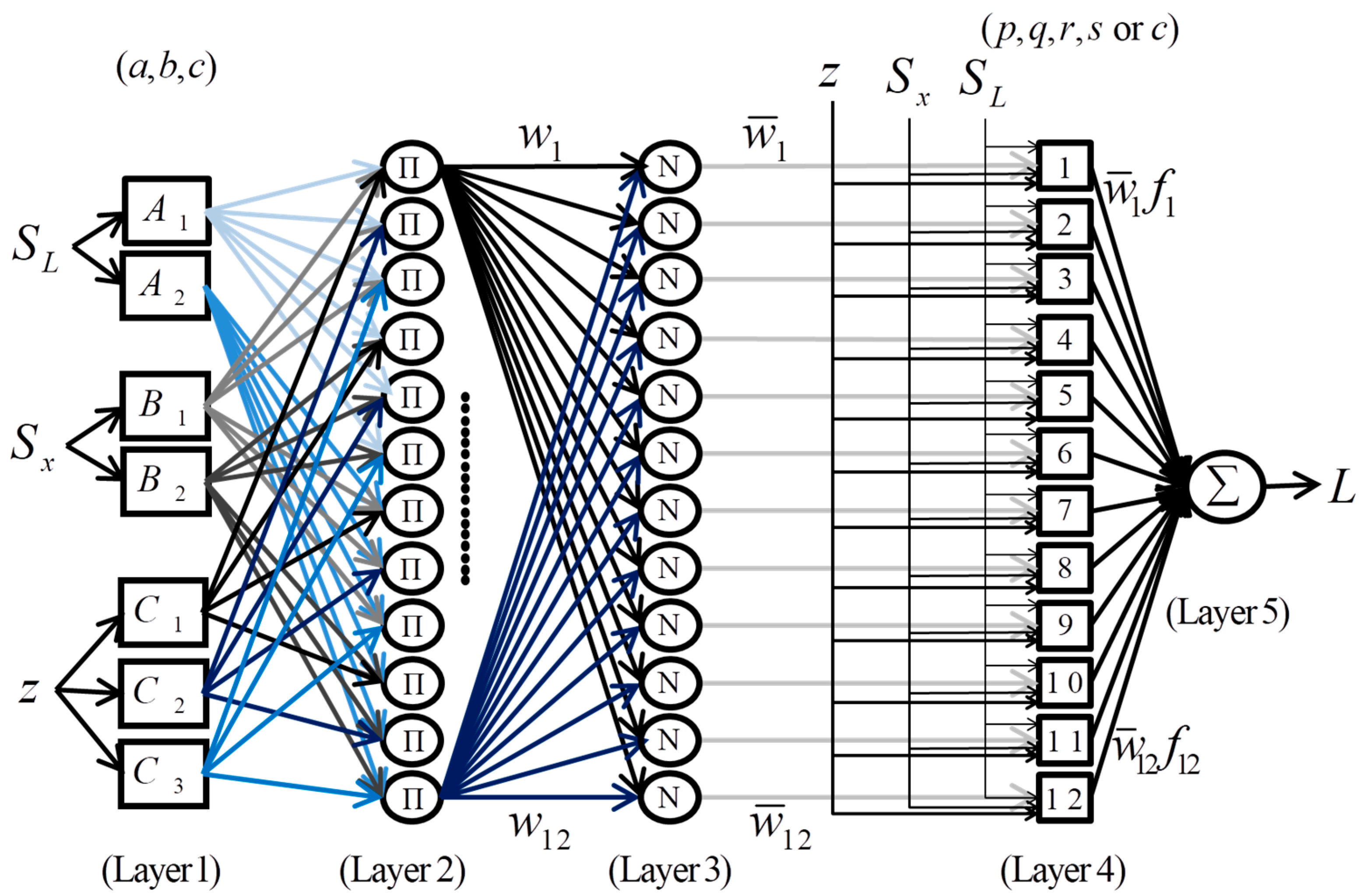
For the present work, ANFIS was implemented using a MATLAB toolbox (v. R2015b). To construct the fuzzy inference system, the type and numbers of MFs for each input need to be specified along with the type of MF for the output (linear or constant). To determine the input parameters, roughness ( n ), flow amount ( Q ), flow depth ( z ), and slopes ( S L and S x ) were tried in different combinations until the best predicting inputs were determined for forecasting. Based on the smallest error produced, 3 input parameters were chosen: S L , S x , and z (this requires four consequent parameters for a linear MF, f i = p i S L + q i S x + r i z + s i , and one parameter for a constant MF, f i = c i ) (Figure 5). Tests were conducted to obtain the proper architecture for each combination of the parameters. Different numbers and all types of MFs were explored for input and output in generating the fuzzy inference system. The model with the smallest RMSE for testing data was chosen, which used triangular MF (trimf) for inputs (this requires three premise parameters as in Equation (4)) with a constant MF for the output. Number of MFs associated with each input are 2, 2, and 3 for S L , S x , and z , respectively (Figure 5; Table 5) (that makes 12 (2 × 2 × 3) rules for the ANFIS model; Figure 5).
The accuracy of ANFIS predictions were determined using root mean square error (RMSE) and mean absolute percentage error (MAPE). The RMSE was calculated based on
R M S E = i = 1 n L ^ i L i 2 n
where L ^ i [L] are predicted values, L i [L] tested inlet lengths (measured), and n is the number of observations. The ANFIS code produces an RMSE for overall testing data, but when the forecasts are grouped under different categories the RMSE was calculated separately. MAPE was obtained as
M A P E = 1 n i = 1 n L ^ i L i L i 100
Smaller values of RMSE and MAPE are indicators of better accuracy. Data was shuffled (using MATLAB’s randperm function) and then divided into two sets for training and testing (60% and 40%, respectively). RMSE and MAPE were used in comparing the testing data to that of experimental in the results section. These were also used in comparing the performance of design models presented in Equations (2) and (3), later in the discussions.

4. Results

4.1. Data Collected

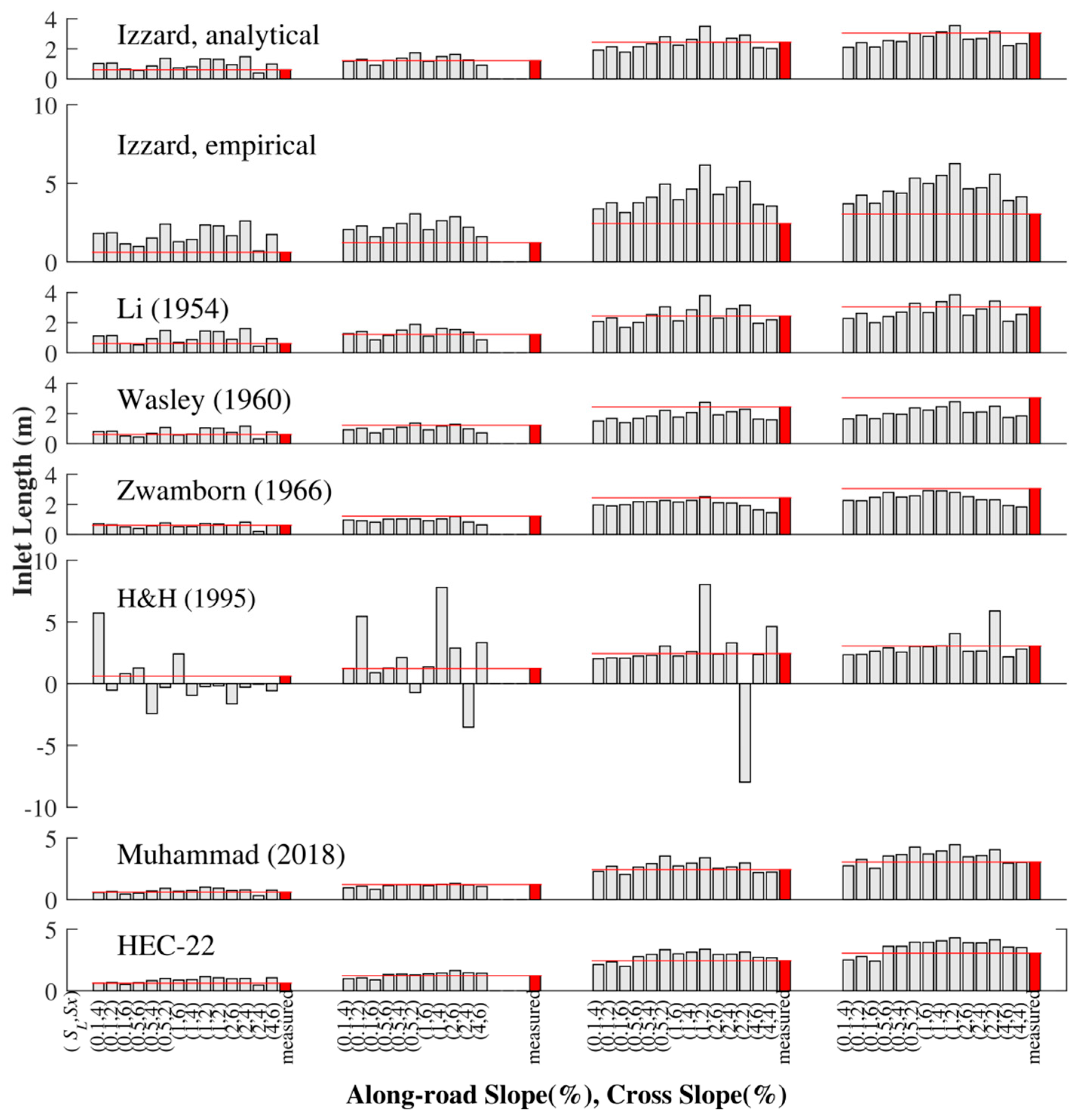
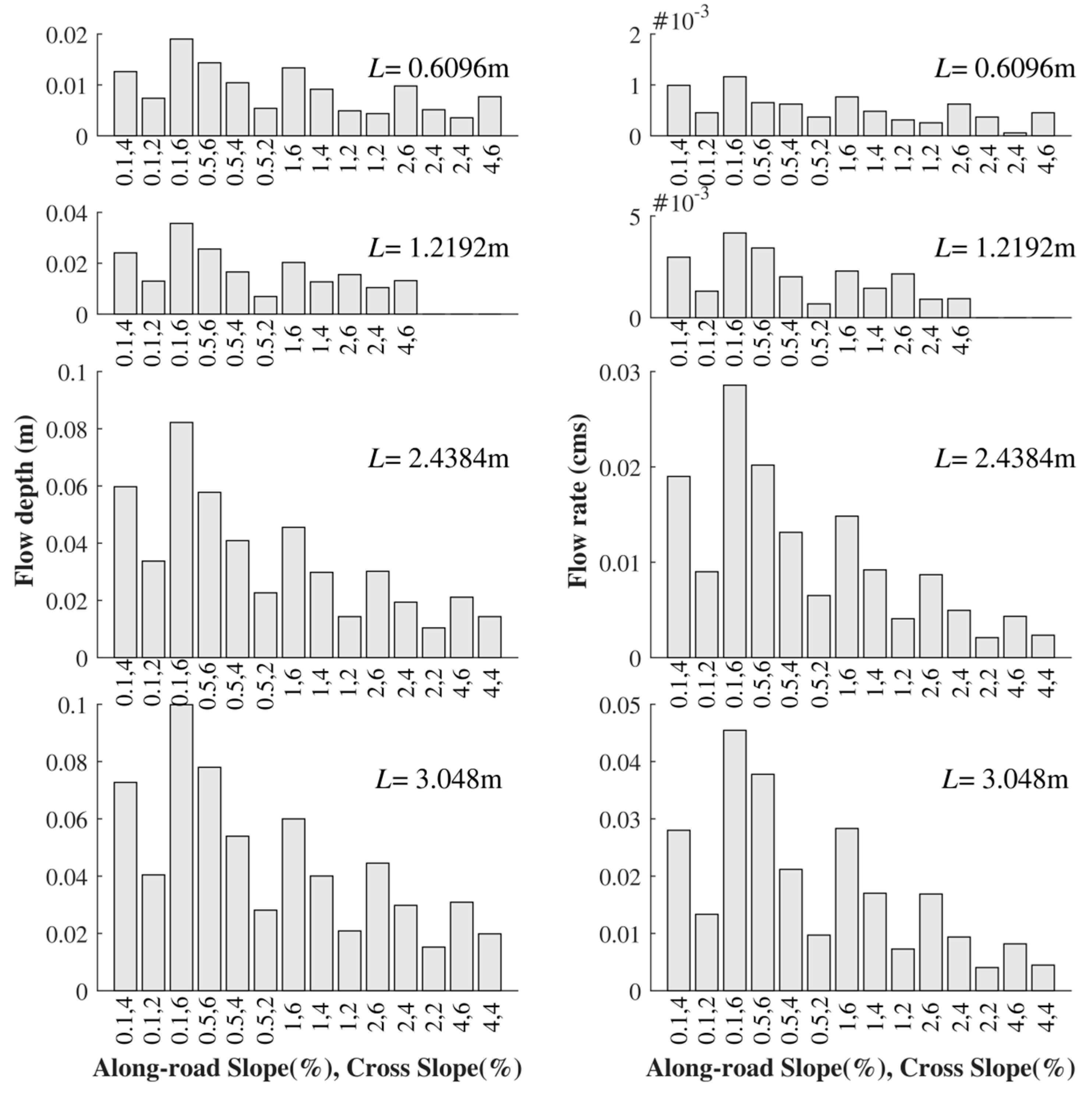
In the results analyzed below, all flow rates are the experimentally determined maximum inlet capacity over the road conditions presented in Table 3, above (data provided in Appendix A Table A1). For each configuration experimentally tested, Figure 6 presents flow depths (left subplots) and corresponding flow rates (right subplots) used in obtaining 100% flow capture. Using these data, the models documented in Table 1 and the model of Hammonds and Holley [6] were used to predict full-capture inlet lengths (Figure 7). Red bars are used for comparison purposes representing the experimentally measured inlet lengths. For each configuration MAPE and RMSE values are calculated (Table 6). For all the measurements combined, the MAPE values for these models range from 18.89% [2] to 122% [6] (Table 6). When the errors are grouped in terms of inlet length, only the Muhammad model drops below 10% (9.31%) at 1.22m inlet lengths. In such situations where precision matters in terms of safety, this level of imprecision is worrisome for the long inlets.

4.2. ANFIS Results

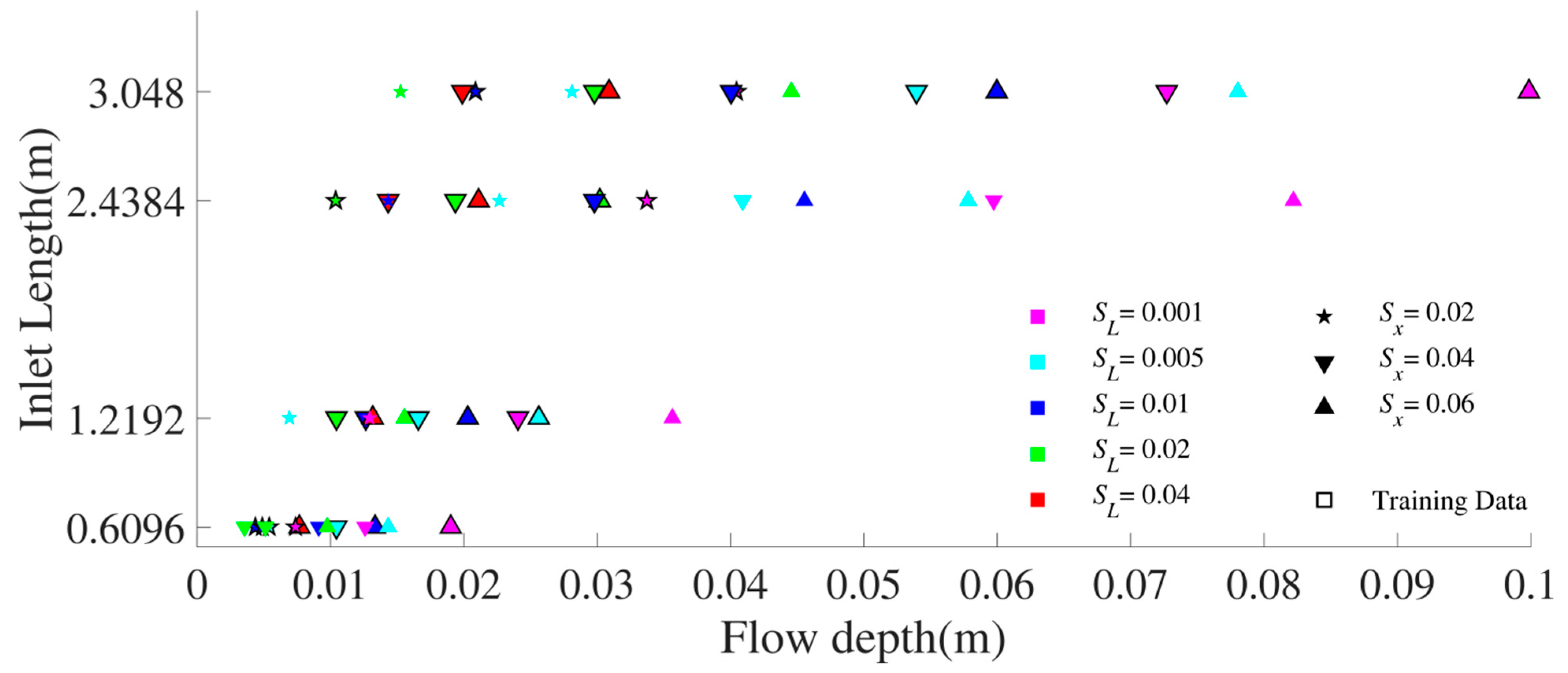
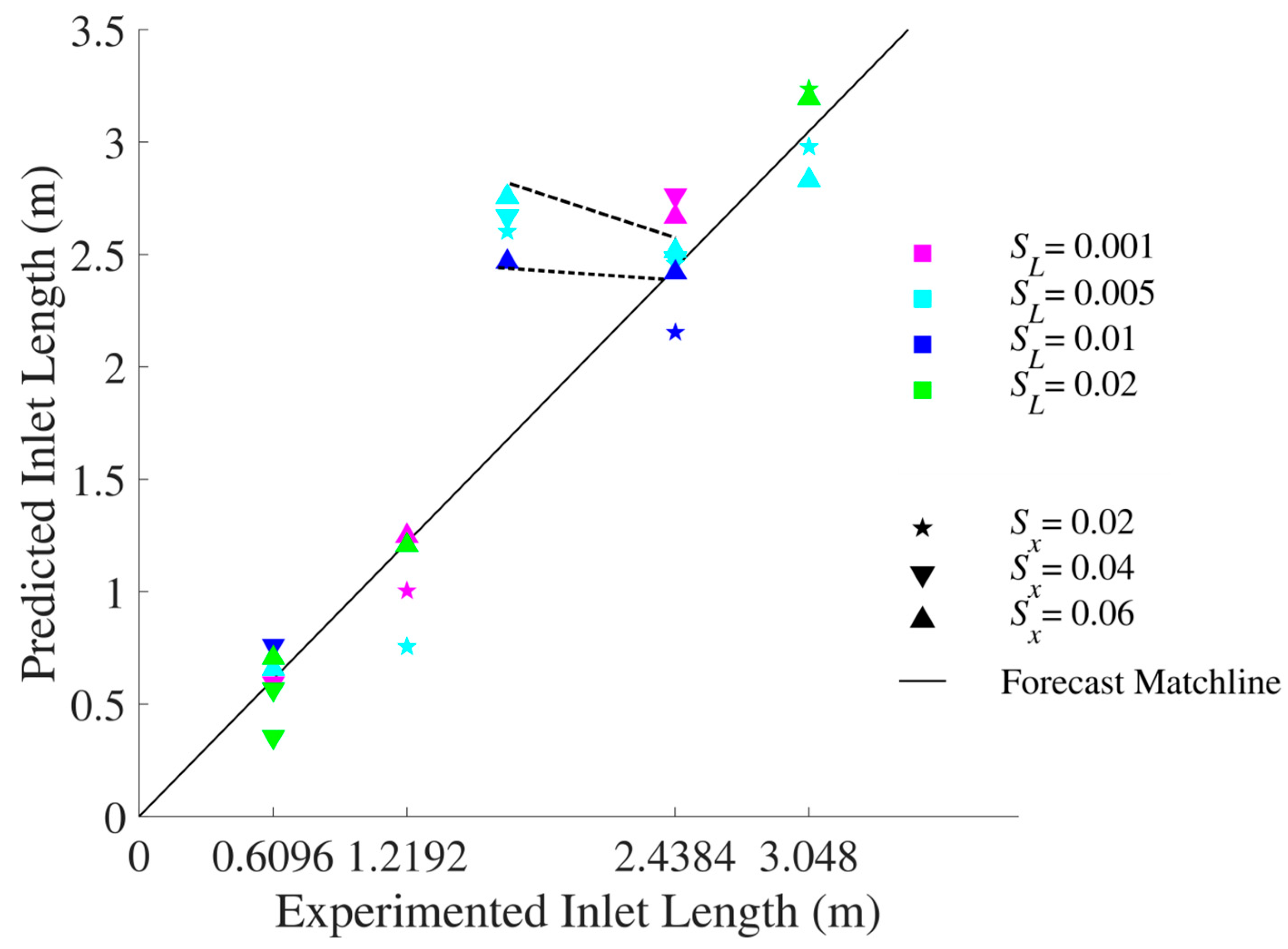
Figure 8 shows the experimental model results that were used in ANFIS. Table 7 shows the premise parameter sets and Table 8 the consequent parameters for the ANFIS model. The forecasted inlet lengths using ANFIS are presented in Table 9 for the tested measurements (model details are in Appendix B). ANFIS results show consistent scatter around the perfect match line for different inlet lengths (Figure 9) while smaller inlets result in higher MAPEs (Table 10). For the longest inlets tested, MAPE is half the overall (Table 10).
ANFIS seems to underestimate inlet lengths for configurations with lower S x values, except when on-road grades are relatively high (Figure 9), but this may also be due to the scarcity of data considering that experiments were limited in its entirety to on-grade slopes not greater than the cross slopes. Deviations are spread out over under- and over-prediction values, mostly depending on the difference in longitudinal and transverse slopes and flow amount.

5. Discussion

Using the prior UCOI models with the new laboratory data provides unacceptably large errors for estimating full-capture inlet length, as noted in Table 6. These results appear to indicate that prior UCOI models were developed using data sets that do not cover a sufficiently wide range and using model structures that do not capture the variability of factors affecting the full-capture inlet length. The novel use of an ANFIS neuro-fuzzy model (trained on 40% of the data set) reduces the error metrics across all tested capture lengths. The largest MAPE for the ANFIS model is 17% (Table 10) at shorter inlets, but less than 6% for longer inlets. Note that all the prior models (Table 6) also have larger MAPE for shorter inlets, which indicates further study of the change in hydraulics from short to long inlets requires further investigation. For comparison purposes, note that Table 6 (other methods) uses all of the new experimental data whereas Table 10 uses only the test data for ANFIS since including training data would artificially lower the error measures for ANFIS. We speculate that the driving causes of the larger error in the ANFIS model for short inlets are (i) that complex hydrodynamics near the inlet edge have a larger effect on the overall flow over short capture lengths and (ii) the ANFIS training does not have enough data for small inlets to capture this change relative to the longer inlets.
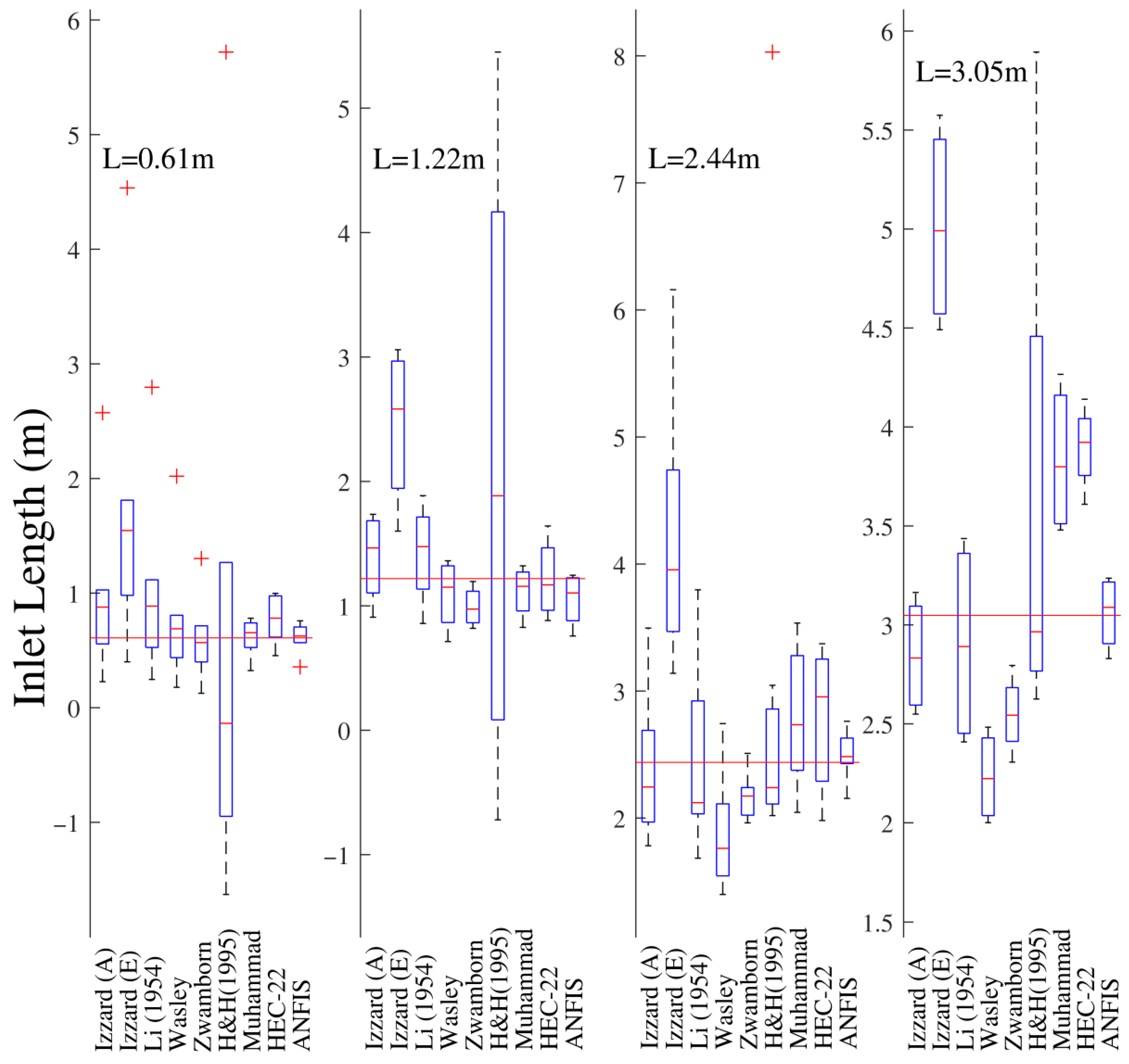
Figure 10 compares the inlet length forecasts with all the models (using testing data for all models) to the statistics of the models grouped by inlet length. As the full-capture inlet length increases, the magnitude of the difference in forecasts increases with larger shifts for longer inlets (although the MAPE decreases as the increase in inlet length error is smaller fraction of the overall length). Izzard [7]’s analytical solution and the Li [8] model show similar trends when the two are compared, although Li’s errors are larger, estimating both longer and shorter inlets than the expected, and the median tends to move for shorter forecasts with larger flows. Wasley [10] and Zwamborn [11] provide similar shifts from the experimental, consistently underestimating with increasing flows, Zwamborn forecasting is slightly better. In contrast, HEC-22 [5] and Muhammad [2] have the tendency to overestimate the lengths for longer inlets while they perform well for smaller flows (i.e., shorter lengths). Izzard [7]’s empirical equation and the work of Hammonds and Holley [20] are the most unpredictable models among them all. ANFIS, on the other hand, performs most consistently and does not seem to be biased towards one end.
It may, at first, seem unlikely that Izzard’s experimental model performs worse than the analytical. However, considering the empirical model was created as a fit to partial capture experiments of depressed gutters from the Illinois study [7], the results are reasonable. Hammonds and Holley [6] worked on relatively longer inlets (1.14 m and 3.42 m) when compared to the 0.61 m model in this study. Hammonds and Holley originally tested two depressed inlets of different lengths over various gutter configurations, obtaining two different empirical fits for each length, but then they attempted to collapse the two into a single model. Doing so they hypothesized that the transition lengths from the uniform gutter to the depressed opening at the up- and downstream of the inlet contribute to the actual opening of the inlet via increasing the flow amount captured. They proceeded further to state that the contribution of these transitions compares 1:1 to the performance of the depressed opening, i.e., the total length of the depressed opening and two transitions (1.14 + 2.29 m and 3.42 + 2.29 m) equal the inlet opening of the same total if the inlet opening was undepressed. Interestingly, however, instead of verifying this result with the sums 3.43 m and 5.71 m, Hammonds and Holley [6] compare the results to 1.14 m and 3.42 m undepressed inlet lengths. They confirm the results. It is unclear whether they really tested the longer lengths, but one thing unique with their data was that they tested larger on-grade slopes when compared to the cross slopes to identify the behavior and the limits of the downstream transition in terms of its contribution to the inlet capacity, thus the purely empirical nature may be the reason for such variations. (Note that the Hammonds and Holley model is scaled ¾:1 model-to-prototype, and model dimensions are reported here.)
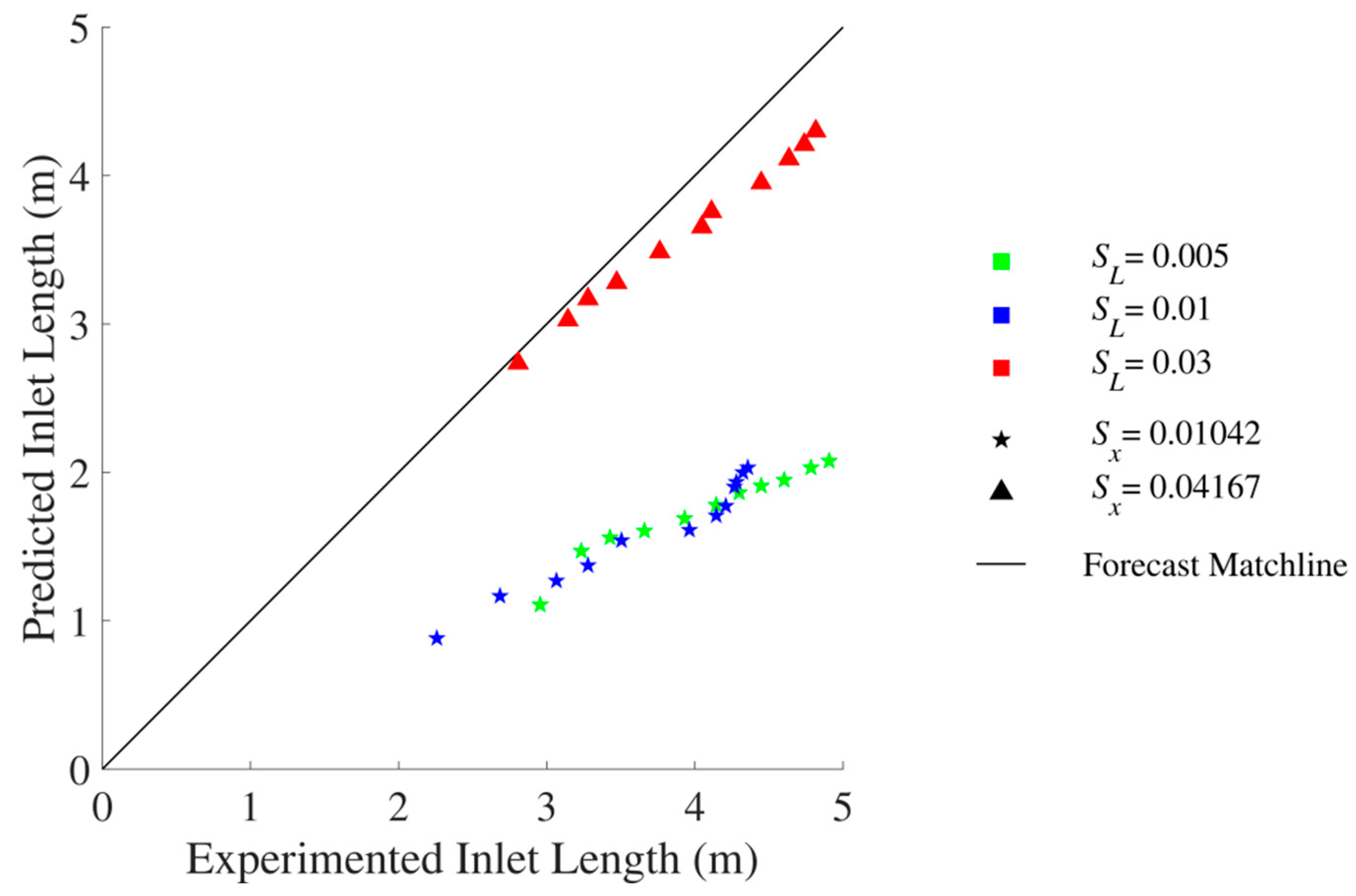
To confirm the performance of the trained ANFIS model for longer inlets, Wasley [10] data was employed (8.33% cross-sloped configurations were excluded for they were outside of the practical range). Among the ANFIS inputs were the two slopes, S L and S x , and although the current study and Wasley do have a few slopes in common, there are no identical sets. This means the ANFIS model was trained with completely different designs than the Wasley [10] data. Figure 11 shows that inlets tested on 3% S L and 4% S x provide reasonable forecasts with 7.74% MAPE (Table 11), especially at and around 3.05 m—the longest inlets tested in the current study. However, we see unacceptable errors when the ANFIS model was run using the Sx  1% cases from Wasley; these results indicate that the ANFIS model can only be used within its training regime, which was an Sx of 2–6% in the present work.
To evaluate ANFIS with an extended training set, we created a new ANFIS model (changing output MF type to linear in this case, Table 5) and trained it with a portion of the Wasley data and a portion of our experimental data (new premise and consequent parameters obtained). The goal was to see whether ANFIS could adapt with a new range of data introduced. Unsurprisingly, when the Wasley data is included in the training, the ANFIS results for the three Wasley experiment configurations of Figure 11 substantially improve, with a cumulative MAPE of 2.73% (Table 12). These results indicate that ANFIS provides coherent results when trained with a representative data set but cannot be considered robust outside the training range.
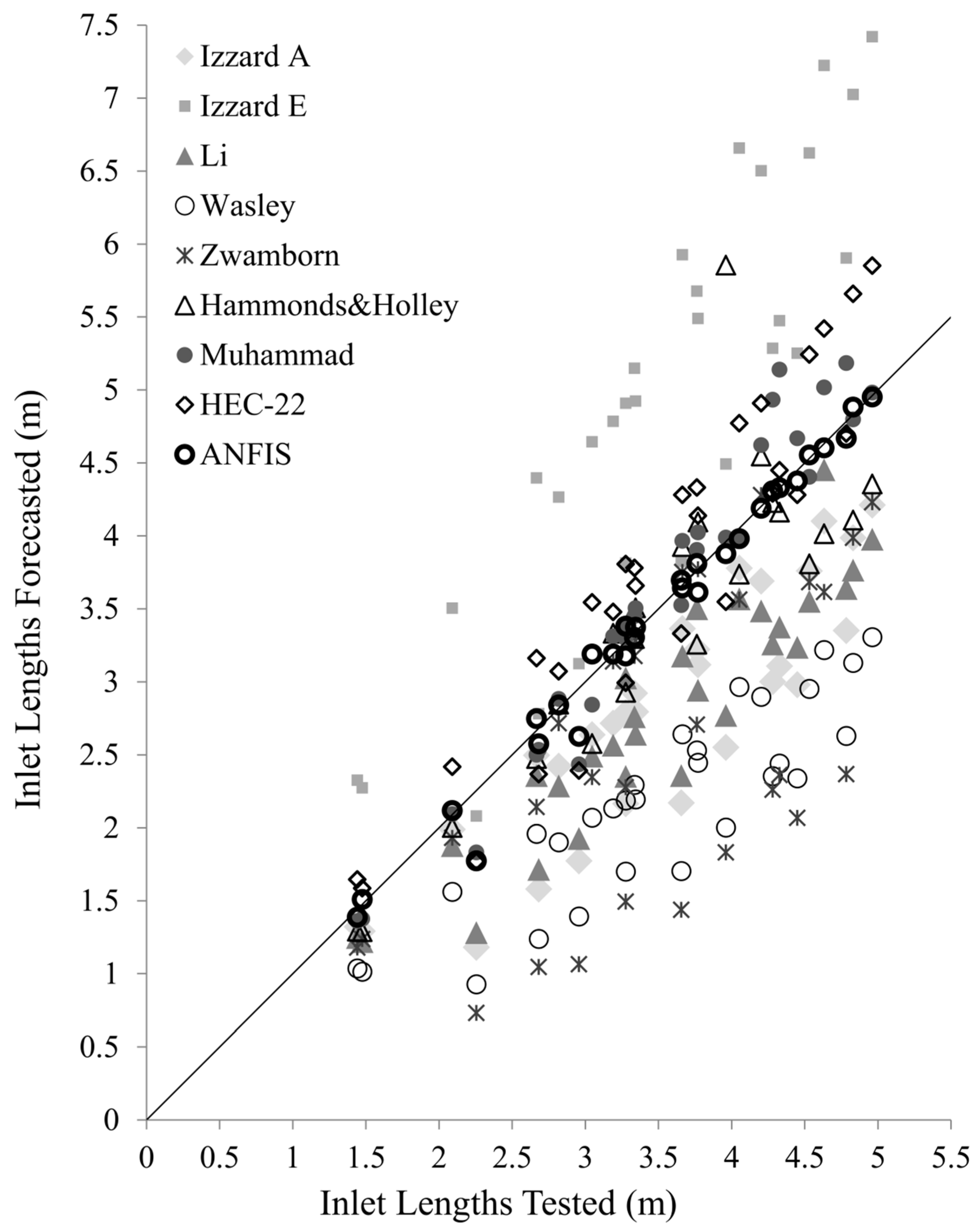
Comparisons of ANFIS (trained with 40% of both our data and Wasley data) with other models for the Wasley (testing) data are presented in Figure 12. The Wasley [10] tests are over inlets of 1.5 m to 5 m, which excludes the shorter inlets (Figure 9, Table 10) that had larger MAPE. The results in Figure 12 are consistent with above analyses, except for the Hammonds and Holley model whose MAPE drops to half of earlier work (Table 12). This is expected for an empirical model as the model is tested with conditions that reflect more closely with the original. Overall, ANFIS performs best and the Muhammad [2] model is a close second—the latter shows increased error for longer inlets, which is consistent with the behavior of models in the Schalla et al. [3] study of depressed COI for long inlets.
This study tested a wide range of UCOI for a wide range of flows and measured the 100% inlet capacity with full-scale roadway model. We developed a model based on ANFIS to predict the full-capture lengths trained from a portion of the observational data. To our knowledge, this approach has not been previously used in curb inlet design. Results indicate that the ANFIS model is in good agreement with observations as long as the training data covers the range of expected conditions. ANFIS makes better predictions than the other available models. Notably, most models work quite well with the data of their particular experiment, but do poorly on the wider range of data available in the literature—different neuro-fuzzy approaches should be employed in the future to find the best performing model within them. It is important to note that we have not tested the configurations where on-road slopes are higher than the cross slopes. UCOIs are more practical in lower on-road slopes where cross slopes have applicable steeper values than the road itself. For UCOIs, more short inlet lengths should be analyzed to make a conclusive comment, especially because we used different material to unwarp earlier depressed sections. To restate, we believe small variations in roughness at the curbside did not make much difference and in fact neared to in situ designs which use different material adjacent to the curb with slightly lower roughness.
In high-speed roads, preciseness in forecasting correct inlet lengths matters more than any other. With this in mind, lowering errors is very important, and we propose that ANFIS provides better estimations than any other model mentioned above. Thus, we encourage the use of ANFIS when the design slopes and flow amount (thus the flow depth) are known in the UCOI application.

6. Conclusions

This study provides results of laboratory experiments that built on recent work and evaluates a new approach using neuro-fuzzy modeling with an adaptive neuro-fuzzy inference system (ANFIS) in sizing UCOIs. The ANFIS model was built with data from present work and was tested against the 40% left for validation of the model. Wasley data results also confirmed that ANFIS produces the lowest errors among the available undepressed COI models when compared based on RMSE and MAPE. Additionally, it was found that HEC-22 model’s performance is limited to a very small range, and in general it does not perform well, especially with the longer inlets. We have found that Zwamborn [11] model performs significantly better under a variety of conditions. Muhammad [2] performs better than HEC-22 under almost all conditions, and Izzard [7] and Li [8] perform well under most conditions for predicting undepressed inlet lengths for a known flow to be fully captured, worsening with increasing inlet lengths. Hammonds and Holley [6] and Izzard [7]’s empirical solutions should be avoided for almost all configurations for the sake of economy (mostly). To conclude, we believe that some of the available methods are sufficient in forecasting inlet lengths, however, only under limited configurations and for shorter inlet lengths. While all models have discrepancies, the comparison illustrates that the ANFIS model is superior over other approaches for the design of UCOIs so long as the searched designs are close to the trained range. These findings must be interpreted with caution when the inlet length and slope configurations fall outside the available tested configurations; however, we believe that aside from on-road grades being higher than cross slopes, our results are consistent, and especially in critical areas where designing inlet lengths precisely is crucial for anti-hydroplaning conditions; ANFIS can be employed with confidence in terms of both safety and economy, when the available models are considered.

Author Contributions

Conceptualization, S.C., M.A.M. and B.R.H.; methodology, S.C. and B.R.H.; validation, S.C. and B.R.H.; formal analysis, S.C.; resources, B.R.H.; data curation, S.C. and M.A.M.; writing—original draft preparation, S.C.; writing—review and editing, B.R.H.; visualization, S.C.; supervision, B.R.H. All authors have read and agreed to the published version of the manuscript.

Funding

This research received no external funding.

Data Availability Statement

The original contributions presented in this study are included in the article. Further inquiries can be directed to the corresponding author.

Acknowledgments

We thank the three reviewers for their constructive suggestions.

Conflicts of Interest

The authors declare no conflicts of interest.

Abbreviations

The following abbreviations are used in this manuscript:
UCOIUndepressed curb opening inlet
UCOIsUndepressed curb opening inlets
COICurb opening inlet
ANFISNeuro-fuzzy inference systems
HEC-22Hydraulic Engineering Circular No: 22
MAPEMean absolute percentage error
RMSERoot mean square error
H&HHammonds and Holley
MFMembership function

Appendix A

Table A1. Experimental Data.
Inlet Length
(m)
Along-Road Slope Cross   Slope   S x Spread
T 0.26 (m)
Spread
T 0.56 (m)
Average   Spread   T a v e :   T 0.26 + T 0.56 2 Flow Depth (m)
z = T a v e S x
Flow Rate
(m3/s)
0.60960.0010.040.3350.2960.3150.01260.000991
0.60960.0010.020.3720.3660.3690.00740.000453
0.60960.0010.060.3260.3080.3170.01900.001161
0.60960.0050.060.2560.2230.2390.01440.000651
0.60960.0050.040.2830.2380.2610.01040.000623
0.60960.0050.020.2830.2560.2700.00540.000368
0.60960.010.060.2470.1980.2230.01340.000765
0.60960.010.040.2470.2100.2290.00910.000481
0.60960.010.020.2740.2160.2450.00490.000311
0.60960.010.020.2440.1920.2180.00440.000255
0.60960.020.060.1580.1680.1630.00980.000623
0.60960.020.040.1280.1280.1280.00510.000368
0.60960.020.040.0760.1010.0880.00350.000057
0.60960.040.060.1220.1340.1280.00770.000453
1.21920.0010.040.6000.6040.6020.02410.002973
1.21920.0010.020.6460.6490.6480.01300.001303
1.21920.0010.060.6000.5880.5940.03570.004163
1.21920.0050.060.4690.3840.4270.02560.003426
1.21920.0050.040.4570.3720.4150.01660.002010
1.21920.0050.020.3870.3050.3460.00690.000680
1.21920.010.060.3750.3020.3380.02030.002294
1.21920.010.040.3410.2930.3170.01270.001444
1.21920.020.060.2590.2590.2590.01550.002152
1.21920.020.040.2590.2620.2610.01040.000906
1.21920.040.060.2100.2290.2190.01320.000934
2.43840.0010.041.4901.4971.4940.05970.019001
2.43840.0010.021.6791.6951.6870.03370.009005
2.43840.0010.061.3661.3751.3700.08220.028572
2.43840.0050.060.9630.9630.9630.05780.020190
2.43840.0050.041.0520.9941.0230.04090.013139
2.43840.0050.021.0971.1671.1320.02260.006513
2.43840.010.060.7350.7830.7590.04550.014838
2.43840.010.040.7220.7680.7450.02980.009203
2.43840.010.020.6890.7440.7160.01430.004078
2.43840.020.060.4880.5180.5030.03020.008693
2.43840.020.040.4630.5060.4850.01940.004955
2.43840.020.020.4880.5520.5200.01040.002095
2.43840.040.060.3510.3540.3520.02110.004332
2.43840.040.040.3510.3660.3580.01430.002350
3.0480.0010.041.8171.8201.8180.07270.028005
3.0480.0010.021.9932.0512.0220.04040.013337
3.0480.0010.061.6671.6611.6640.09990.045449
3.0480.0050.061.2561.3441.3000.07800.037775
3.0480.0050.041.3381.3591.3490.05390.021181
3.0480.0050.021.4051.4081.4070.02810.009713
3.0480.010.060.9881.0121.0000.06000.028317
3.0480.010.040.9971.0061.0010.04010.017018
3.0480.010.020.9911.0971.0440.02090.007277
3.0480.020.060.7070.7770.7420.04450.016877
3.0480.020.040.7040.7860.7450.02980.009373
3.0480.020.020.7320.7920.7620.01520.004049
3.0480.040.060.4970.5330.5150.03090.008184
3.0480.040.040.4750.5180.4970.01990.004474
3.0480.040.020.6160.7560.6860.01370.001019

Appendix B

ANFIS data for the current experiments range
[System]
Name = ‘trimf223cons018′
Type = ‘sugeno’
Version = 2.0
NumInputs = 3
NumOutputs = 1
NumRules = 12
AndMethod = ‘prod’
OrMethod = ‘probor’
ImpMethod = ‘prod’
AggMethod = ‘sum’
DefuzzMethod = ‘wtaver’
 
[Input1]
Name = ‘input1’
Range = [0.001 0.04]
NumMFs = 2
MF1 = ‘in1mf1’:‘trimf’, [−0.038 −0.00522157416993401 0.0468233154257565]
MF2 = ‘in1mf2’:‘trimf’, [0.000223537955623841 0.0318565532184993 0.0789266493491601]
 
[Input2]
Name = ‘input2’
Range = [0.02 0.06]
NumMFs = 2
MF1 = ‘in2mf1’:‘trimf’, [−0.02 0.0123504379545176 0.0692793143147216]
MF2 = ‘in2mf2’:‘trimf’, [0.0241073951114033 0.0469098334133841 0.0997708694098835]
 
[Input3]
Name = ‘input3’
Range = [0.0044 0.0999]
NumMFs = 3
MF1 = ‘in3mf1’:‘trimf’, [−0.04335 −0.00403470236527499 0.0584975089807528]
MF2 = ‘in3mf2’:‘trimf’, [−0.000581283768555996 0.0425516590397951 0.0998835619072034]
MF3 = ‘in3mf3’:‘trimf’, [0.047970804221699 0.0996915014684212 0.14765]
 
[Output1]
Name = ‘output’
Range = [0.6096 3.048]
NumMFs = 12
MF1 = ‘out1mf1’:‘constant’, [−0.29976844256021]
MF2 = ‘out1mf2’:‘constant’, [3.69865431444472]
MF3 = ‘out1mf3’:‘constant’, [4.93811740674413]
MF4 = ‘out1mf4’:‘constant’, [−0.117840529383148]
MF5 = ‘out1mf5’:‘constant’, [1.31925102749174]
MF6 = ‘out1mf6’:‘constant’, [2.62182442038076]
MF7 = ‘out1mf7’:‘constant’, [0.345470701041242]
MF8 = ‘out1mf8’:‘constant’, [13.8411031983314]
MF9 = ‘out1mf9’:‘constant’, [3.20631592228571]
MF10 = ‘out1mf10’:‘constant’, [−0.629553918543747]
MF11 = ‘out1mf11’:‘constant’, [4.15730433816432]
MF12 = ‘out1mf12’:‘constant’, [3.61243468620193]
 
[Rules]
1 1 1, 1 (1): 1
1 1 2, 2 (1): 1
1 1 3, 3 (1): 1
1 2 1, 4 (1): 1
1 2 2, 5 (1): 1
1 2 3, 6 (1): 1
2 1 1, 7 (1): 1
2 1 2, 8 (1): 1
2 1 3, 9 (1): 1
2 2 1, 10 (1): 1
2 2 2, 11 (1): 1
2 2 3, 12 (1): 1

References

  1. Hodges, B.R.; Barrett, M.E.; Ashraf, M.; Schalla, F.E. Interception Capacity of Conventional Depressed Curb Inlets and Inlets with Channel Extension; University of Texas at Austin, Center for Transportation Research: Austin, TX, USA, 2018. [Google Scholar]
  2. Muhammad, M.A. Interception Capacity of Curb Opening Inlets; The University of Texas at Austin: Austin, TX, USA, 2018. [Google Scholar]
  3. Schalla, F.E.; Ashraf, M.; Barrett, M.E.; Hodges, B.R. Limitations of traditional capacity equations for long curb inlets. Transp. Res. Rec. 2017, 2638, 97–103. [Google Scholar] [CrossRef]
  4. Thomason, C. Hydraulic Design Manual; Texas Department of Transportation: Austin, TX, USA, 2019. Available online: https://www.txdot.gov/content/dam/txdotoms/des/hyd/hyd.pdf (accessed on 21 February 2026).
  5. Kilgore, R.; Atayee, A.T.; Herrmann, G.R. Urban Drainage Design, 4th ed.; United States Federal Highway Administration, Office of Bridges and Structures: Washington, DC, USA, 2024. [Google Scholar]
  6. Hammonds, M.A.; Holley, E. Hydraulic Characteristics of Flush Depressed Curb Inlets and Bridge Deck Drains; Research Project 0-1409-1; The University of Texas at Austin: Austin, TX, USA, 1995. [Google Scholar]
  7. Izzard, C.F. Tentative results on capacity of curb opening inlets. In Highway Research Board; National Research Council: Washington, DC, USA, 1950; pp. 11–13. [Google Scholar]
  8. Li, W.-H. Hydraulic Theory for Design of Storm-Water Inlets. In Proceedings of the Thirty-Third Annual Meeting of the Highway Research Board, Washington, DC, USA, 12–15 January 1954. [Google Scholar]
  9. Spaliviero, F.; May, R.; Escarameia, M. Spacing of Road Gullies Hydraulic Performance of BS EN 124 Gully Gratings and Kerb Inlets; Technical Report; HR Wallingford: Oxfordshire, UK, 2000. [Google Scholar]
  10. Wasley, R.J. Hydrodynamics of Flow into Curb-Opening Inlets; Prepared Under Research Contract CPR11-7623; U.S. Department of Commerce Bureau of Public Roads: Washington, DC, USA, 1960.
  11. Zwamborn, J.A. Stormwater Inlet Design Code; National Mechanical Engineering Research Institute, Council for Scientific: Durgapur, India, 1966. [Google Scholar]
  12. Comport, B.C.; Thornton, C.I. Hydraulic efficiency of grate and curb inlets for urban storm drainage. J. Hydraul. Eng. 2012, 138, 878–884. [Google Scholar] [CrossRef]
  13. Jang, J.-S. ANFIS: Adaptive-network-based fuzzy inference system. IEEE Trans. Syst. Man Cybern. 1993, 23, 665–685. [Google Scholar] [CrossRef]
  14. Izzard, C.F. Hydraulics of runoff from developed surfaces. Highw. Res. Board Proc. 1947, 26, 129–150. [Google Scholar]
  15. Abba, S.I.; Pham, Q.B.; Saini, G.; Linh, N.T.T.; Ahmed, A.N.; Mohajane, M.; Khaledian, M.; Abdulkadir, R.A.; Bach, Q.-V. Implementation of data intelligence models coupled with ensemble machine learning for prediction of water quality index. Environ. Sci. Pollut. Res. 2020, 27, 41524–41539. [Google Scholar] [CrossRef] [PubMed]
  16. Mahdiabadi, N.; Khanlari, G. Prediction of uniaxial compressive strength and modulus of elasticity in calcareous mudstones using neural networks, fuzzy systems, and regression analysis. Period. Polytech. Civ. Eng. 2019, 63, 104–114. [Google Scholar] [CrossRef]
  17. Bozchaloei, S.K.; Vafakhah, M. Regional analysis of flow duration curves using adaptive neuro-fuzzy inference system. J. Hydrol. Eng. 2015, 20, 06015008. [Google Scholar] [CrossRef]
  18. Wong, Y.J.; Arumugasamy, S.K.; Chung, C.H.; Selvarajoo, A.; Sethu, V. Comparative study of artificial neural network (ANN), adaptive neuro-fuzzy inference system (ANFIS) and multiple linear regression (MLR) for modeling of Cu (II) adsorption from aqueous solution using biochar derived from rambutan (Nephelium lappaceum) peel. Environ. Monit. Assess. 2020, 192, 439. [Google Scholar] [CrossRef] [PubMed]
  19. Rezaeianzadeh, M.; Tabari, H.; Arabi Yazdi, A.; Isik, S.; Kalin, L. Flood flow forecasting using ANN, ANFIS and regression models. Neural Comput. Appl. 2014, 25, 25–37. [Google Scholar] [CrossRef]
  20. Holley, E.R.; Woodward, C.; Brigneti, A.; Ott, C. Hydraulic Characteristics of Recessed Curb Inlets and Bridge Drains; Texas Department of Transportation: Austin, TX, USA, 1992. [Google Scholar]
  21. Schalla, F.E. Effects of Flush Slab Supports on the Hydraulic Performance of Curb Inlets and an Analysis of Design Equations; University of Texas at Austin: Austin, TX, USA, 2016. [Google Scholar]
Figure 1. Undepressed curb opening inlet (top: plan view; center: longitudinal section; bottom: transverse section). L inlet length; SL is on-grade slope; Sx is cross slope; and z is flow depth at the curb.
Water 18 01153 g001
Figure 2. Definition sketch for the flow cross section, used for strip-integral approach.
Water 18 01153 g002
Figure 3. Experimental set-up, white area on roadway is the former curb inlet depression area filled with plastic. Two of the three measurement flumes (to left of the roadway) designed by Schalla [21] are used in the present experiments.
Water 18 01153 g003
Figure 4. ANFIS architecture for a single input with two MFs and one output model.
Water 18 01153 g004
Figure 5. ANFIS architecture (Layer 2 outputs are only shown for the first and the last nodes for clarity).
Water 18 01153 g005
Figure 6. Observed flow depth (left) at 100% flow capture at inlet lengths of 0.6096 m, 1.2192 m, 2.4384 m, and 3.048 m when the flow rates (right) were introduced to the physical model at given slope configurations in x-axis. # represents the exponent that applies to all numbers in the y-axis.
Water 18 01153 g006
Figure 7. Predicted full-capture inlet lengths with each existing model for experimentally tested configurations (in gray)—measured in red [2,5,6,7,8,10,11].
Water 18 01153 g007
Figure 8. Experimental data used in training and testing. Black borders are used for training data.
Water 18 01153 g008
Figure 9. Measured vs. ANFIS forecast scatterplot. Dotted lines are used to enlarge the scale for the data points originally at the right side.
Water 18 01153 g009
Figure 10. Comparison of ANFIS and other models for the testing data of the experiments presented herein. Statistics for simulations with varying S x and S L grouped by inlet length. The central marks in box plots show the median, and the top and the bottom edges show the 1st and 3rd quartiles, respectively. The whiskers are limited by the most extreme data points that are not outliers, while the red + marks show the outliers. Long red lines show the measured full-capture inlet length [2,5,6,7,8,10,11].
Water 18 01153 g010
Figure 11. Wasley (1960)’s experimental inlet [10] lengths forecasted with ANFIS model that was trained with current experiments.
Water 18 01153 g011
Figure 12. Model predictions of inlet lengths for Wasley tests [10]. Solid line indicates 1:1 forecast matchline.
Water 18 01153 g012
Table 1. Model constants used in Equation (2) in SI units.
Coefficient: a b c f h k
Applies to:Equation Q z n S L S x
Izzard (1950) [7], analytical1.471.0−1.5000
Izzard (1950) [7], empirical2.591.0−1.5000
Li (1954) [8] 1.389   for   S x = 8.33 %
1.596   for   S x = 4.167   &   2.083 %
1.0−1.5000
Wasley (1960) [10]1.151.0−1.5000
Zwamborn (1966) [11]3.051.0−1.25000
HEC-22 (2009) [5]0.8170.420−0.60.3−0.6
Muhammad (2018) [2]0.10.470−0.950.26−0.75
Table 2. Model constants used in Equation (2) in US units.
Coefficient: a b c f h k
Applies to:Equation Q z n S L S x
Izzard (1950) [7], analytical0.8131.0−1.5000
Izzard (1950) [7], empirical1.4291.0−1.5000
Li (1954) [8] 0.767   for   S x = 8.33 %
0.881   for   S x = 4.167   &   2.083 %
1.0−1.5000
Wasley (1960) [10]0.6371.0−1.5000
Zwamborn (1966) [11]1.281.0−1.25000
HEC-22 (2009) [5]0.60.420−0.60.3−0.6
Muhammad (2018) [2]0.0620.470−0.950.26−0.75
Table 3. Tested configurations.
PropertyExperimental Conditions
Cross slope (%)2, 4, 6
Along-road slope (%)0.1, 0.5, 1, 2, 4
Inlet length (m)0.61, 1.22, 2.44, 3.05
Flow rate100% capture
Roughness0.01
Table 4. Ranges of parameters used in experiments.
S L (%) S x (%) z × 1 0 2 (m) Q × 1 0 6 (m3/s)
Min0.120.3557
Median141.994049
Max469.9945,449
Table 5. ANFIS model parameters used in training the model.
ParameterValue
Inputs (m/m, m/m, m) S L , S x , z
Output (m) L
Fuzzy Inference System (FIS) TypeSugeno
FIS Generating MethodGrid Partition
Input Membership Function (MF) TypeTriangular
Number of MFs for Inputs2, 2, 3
Output MF TypeConstant
Optimization Method for TrainingHybrid
Table 6. MAPE and RMSE for each model and overall measures for all inlets combined (data includes 100% of the experiments conducted in this study).
Model Inlet Length (m)Overall
0.611.222.443.05
Izzard (A) [7]RMSE (m)0.470.260.450.570.46
MAPE (%)64.3416.4615.2915.9728.67
Izzard (E) [7]RMSE (m)1.221.141.961.791.58
MAPE (%)178.5586.1973.4853.7298.65
Li (1954) [8]RMSE (m)0.540.320.560.600.53
MAPE (%)71.4821.9819.1317.6333.15
Wasley [10]RMSE (m)0.290.290.661.010.65
MAPE (%)38.3320.1224.5131.5229.1
Zwamborn [11]RMSE (m)0.160.310.470.680.45
MAPE (%)19.5922.5516.6619.5919.43
Hammonds and Holley [6]RMSE (m)1.942.953.230.912.4
MAPE (%)246.07169.2163.3319.50122.00
Muhammad [2]RMSE (m)0.200.160.500.720.47
MAPE (%)27.919.3116.6319.6618.89
HEC-22 [5]RMSE (m)0.310.230.560.790.53
MAPE (%)43.2217.0120.6524.2726.81
Table 7. Premise parameters.
Input [Range]MF a b c
S L
[0.001–0.04]
A 1 −0.038−0.005221574169934010.0468233154257565
A 2 0.0002235379556238410.03185655321849930.0789266493491601
S x
[0.02–0.06]
B 1 −0.020.01235043795451760.0692793143147216
B 2 0.02410739511140330.04690983341338410.0997708694098835
z  (m)
[0.0044–0.0999]
C 1 −0.04335−0.004034702365274990.0584975089807528
C 2 −0.0005812837685559960.04255165903979510.0998835619072034
C 3 0.0479708042216990.09969150146842120.14765
Table 8. Consequent parameters.
MF c
1−0.29976844256021
23.69865431444472
34.93811740674413
4−0.117840529383148
51.31925102749174
62.62182442038076
70.345470701041242
813.8411031983314
93.20631592228571
10−0.629553918543747
114.15730433816432
123.61243468620193
Table 9. Inlet lengths obtained using ANFIS along with the observed experimental lengths.
S L S x z (m) Q (m3/s) L (m)
ANFIS (Tested)
L (m)
Observed
0.0010.040.01260.0009910.5940.6096
0.0050.060.01440.0006510.65810.6096
0.010.040.00910.0004810.75820.6096
0.0050.020.02810.0097132.983.048
0.020.040.00350.0003680.35620.6096
0.0050.040.04090.0131392.48412.4384
0.0010.040.05970.0190012.7622.4384
0.020.040.00515.66 × 10−50.56760.6096
0.0010.060.03570.0041631.24631.2192
0.0050.060.07800.0377752.833.048
0.020.060.04450.0168773.19713.048
0.020.020.01520.0040493.2363.048
0.020.060.01550.0021521.20431.2192
0.0050.020.02260.0065132.4622.4384
0.0050.060.05780.020192.51232.4384
0.010.060.04550.0148382.41812.4384
0.020.060.00980.0006230.70430.6096
0.0010.020.01300.0013031.00321.2192
0.0050.020.00690.000680.75771.2192
0.0010.060.08220.0285722.66882.4384
0.010.020.01430.0040782.1552.4384
Table 10. RMSE and MAPE values for ANFIS results by inlet length and overall measures for all inlets combined.
Inlet Length (m)Overall
0.611.222.443.05
RMSE (m)0.130.260.190.170.18
MAPE (%)16.4814.755.865.1110.45
Table 11. RMSE and MAPE values for ANFIS results using Wasley experiments.
On-Road and Cross Slopes (%)
1 and 1.0420.5 and 1.0423 and 4.167
RMSE (m)2.332.130.37
MAPE (%)57.1356.977.74
Table 12. Model errors for ANFIS and other UCOI equations in predicting the testing data, which was 40% of data from our new experiments (present work) and of data from Wasley [10].
Izzard (E)Izzard (A)Li (1954) [8]Wasley [10]Zwamborn [11]Hammonds and Holley [6]Muhammad [2]HEC-22 [5]ANFIS [7]
Present WorkRMSE (m)1.840.590.70.650.372.180.530.550.18
MAPE (%)115.039.345.436.123.0138.320.926.910.4
Wasley [10]RMSE (m)1.580.860.81.411.275.140.290.490.13
MAPE (%)40.320.6720.737.727.769.96.212.52.73
Disclaimer/Publisher’s Note: The statements, opinions and data contained in all publications are solely those of the individual author(s) and contributor(s) and not of MDPI and/or the editor(s). MDPI and/or the editor(s) disclaim responsibility for any injury to people or property resulting from any ideas, methods, instructions or products referred to in the content.