Article

Performance of a Zeolite-Filled Slow Filter for Dye Removal and Turbidity Reduction

by
Shynggyskhan Sultakhan
1,
Makhabbat Kunarbekova
1,
Bostandyk Khalkhabai
1,
Ulan Kakimov
1,
Erzhan Kuldeyev
1,
Ronny Berndtsson
2,*,
Jechan Lee
3 and
Seitkhan Azat
1,*
1
Laboratory of Engineering Profile, Satbayev University, 22 Satbaev Str., Almaty 040000, Kazakhstan
2
Division of Water Resources Engineering, Lund University, P.O. Box 118, SE-22100 Lund, Sweden
3
Department of Global Smart City, School of Civil, Architectural Engineering, and Landscape Architecture, Sungkyunkwan University (SKKU), Suwon 16419, Republic of Korea
*
Authors to whom correspondence should be addressed.
Water 2025, 17(24), 3557; https://doi.org/10.3390/w17243557
Submission received: 31 October 2025 / Revised: 9 December 2025 / Accepted: 11 December 2025 / Published: 15 December 2025
(This article belongs to the Special Issue Research on Adsorption Technologies in Water Treatment)

Abstract

Ever-increasing global water shortages necessitate more advanced and cost-effective water purification methods. Herein, a novel slow filtration system using natural raw zeolite is proposed as an alternative to traditional quartz sand as a filter medium. The system demonstrates excellent performance in reducing turbidity and removing methylene blue (MB). The natural zeolite-based filtration system (filter bed depth of 70 cm) completely adsorbed 30 ppm MB at a filtration velocity of 0.2 m/h, maintaining its performance up to 2 months. The highest adsorption capacity (qmax) for MB of natural zeolite was 8.32 mg/g for the 0.3 mm fraction and 13.84 mg/g for the 0.1 mm fraction. The slow filtration process demonstrated high turbidity removal efficiencies, achieving 98.53% with the natural zeolite filter and 98.97% with the quartz sand filter, indicating the effectiveness of both media in improving water quality. This study highlights the potential of the natural zeolite-based slow filtration system as a versatile and effective water treatment solution.

1. Introduction

Increasing water consumption due to the continuous growth of population and infrastructure has created a demand for low-cost water purification methods [1]. The need for clean water is a pressing global issue, as stated in the UN Sustainable Development Goals (SDGs). In arid areas with often-lacking centralized drinking water supply systems, residents are obliged to use water from open sources such as reservoirs, rivers, and lakes [2]. In turn, water from such sources is often of poor quality for consumption. Also, water pollution from industrial activities has led to a decrease in safe access to the water supply and clean water [3]. Existing water purification technologies are often costly, and, in most cases, specialists are required to properly operate the purification processes. However, slow sand filtration technology is inexpensive and relatively easy to maintain [3]. The slow sand filtration process gives a possibility of combining different filter materials as well as various additives to improve the filtration characteristics. Despite high turbidity removal efficiency demonstrated by slow sand filters [4], there can be limitations such as low adsorption capacity and non-multifunctionality (i.e., only physical filtration) during periods with low function of the biological filter (schmutzdecke). Natural zeolites could become an adequate replacement for typical slow filter materials, as they have high ion-exchange properties, which are important for efficient water treatment. Natural zeolites are hydrated aluminosilicate materials featuring a hierarchical porous structure extending from macropores to mesopores [5]. They have valuable properties, including the ability to ion exchange, adsorption, and dehydration. The crystalline framework of natural zeolites is characterized by a tetrahedral structure with silicon or aluminum atoms in the center, surrounded by oxygen atoms. In this framework, there are large channels and cavities; thus, natural zeolites are effective at adsorbing a range of water pollutants such as dyes and heavy metals [6,7]. Natural zeolite provides physical filtration in addition to high adsorption properties due to its large surface area and cation exchange capacity, increasing its efficiency in filtering suspended particles, dissolved organic compounds [8,9], and heavy metal ions. Thus, natural zeolite in slow filters can perform several functions simultaneously, i.e., physical filtration, ion exchange [10], and adsorption, as well as reduction in microorganisms through its schmutzdecke layer [3,11]. In addition, zeolite filters, due to their greater sorption capacity, can demonstrate more stable purification efficiency under difficult conditions than sand-based filters (e.g., varying pH and temperature conditions).
In this regard, this study aimed at replacing the traditionally used sand material with a novel natural zeolite filter (natural raw zeolite found in the Shankanai deposit, Western Kazakhstan). Turbidity is a critical parameter in wastewater treatment because it reflects the concentration of suspended solids, colloidal particles, organic residues, and microbial contaminants. High turbidity not only impairs the appearance of wastewater but also complicates subsequent treatment steps such as disinfection and membrane filtration by protecting microorganisms and increasing reagent consumption. Therefore, effective turbidity removal is essential to ensure compliance with water quality standards and minimize the environmental impact of treated wastewater discharged into natural water bodies. Recent studies on dye adsorption and turbidity reduction by zeolites have shown that the application of natural and modified zeolites in water treatment has good merit [6,8]. A growing body of research confirms the effectiveness of zeolites as an efficient water purification solution. The primary objective of this article was to examine the properties and efficiency of a natural zeolite-based slow filter system to determine its potential for use in industrial and pre-industrial water purification. Consequently, this study proposes a next-generation slow filtration system that transforms a traditionally simple process (sand-based filtration) into a multifunctional, highly efficient water treatment technology using natural zeolite. It could offer simultaneous removal of turbidity, dyes, dissolved ions, and microorganisms, making it promising for industrial use, decentralized drinking water provision, and wastewater treatment. The results of this paper are also important in the regional context. Central Asia faces high water scarcity, unequal access to centralized drinking water systems (especially in Kazakhstan, Uzbekistan, and Kyrgyzstan), and dependence on open water sources in rural areas. Natural zeolites from Kazakhstan are abundant but rarely integrated into engineered water treatment systems.

2. Materials and Methods

2.1. Materials and Reagents

As filtration agents, natural quartz sand (LLS “NAMYS”, Kokshetau, Kazakhstan) and natural zeolite rock (hereinafter referred to as zeolite) without advanced treatment were used. The natural zeolite was quarried directly from the carrier and ground to the required particle size. For use in the experiments, the zeolite was sifted through two sieve sizes, 0.1 and 0.3 mm. Then, the material was soaked in water for 12 h and rinsed 10 times with distilled water. The physical and chemical properties of natural zeolite are shown in Table 1.
Water from the Pervomayski ponds near Almaty, Kazakhstan, was taken for infiltration experiments in the study. The water quality at the Pervomayskiy ponds is classified as bad, primarily due to pollution from heavy metals like cadmium and zinc, high levels of suspended solids, magnesium, and sulfates. This makes the water unsuitable for domestic use without extensive treatment. The silt from the same pond was used for the creation of the required turbidity level (30–100 NTU). Consequently, the Pervomayskiy pond water and silt were mixed into necessary proportions, which were determined experimentally, and left to stand for 30 min. After this, the turbidity was measured by a turbidity meter (Tn150 Portable Turbidity Meter EPA180, Chongqing TOP Oil Purifier Co., Ltd, Chongqing, China) and fed to the upper sample tank, in which the turbidity was maintained by aeration supplied by a compressor, thereby maintaining the original Nephelometric Turbidity Unit (NTU) of the water. Methylene blue (MB), purchased from Sigma Aldrich (St. Louis, MO, USA), was used as a dye for the adsorption experiments, and distilled water was used as the solvent.

2.2. Slow Filtration Setup

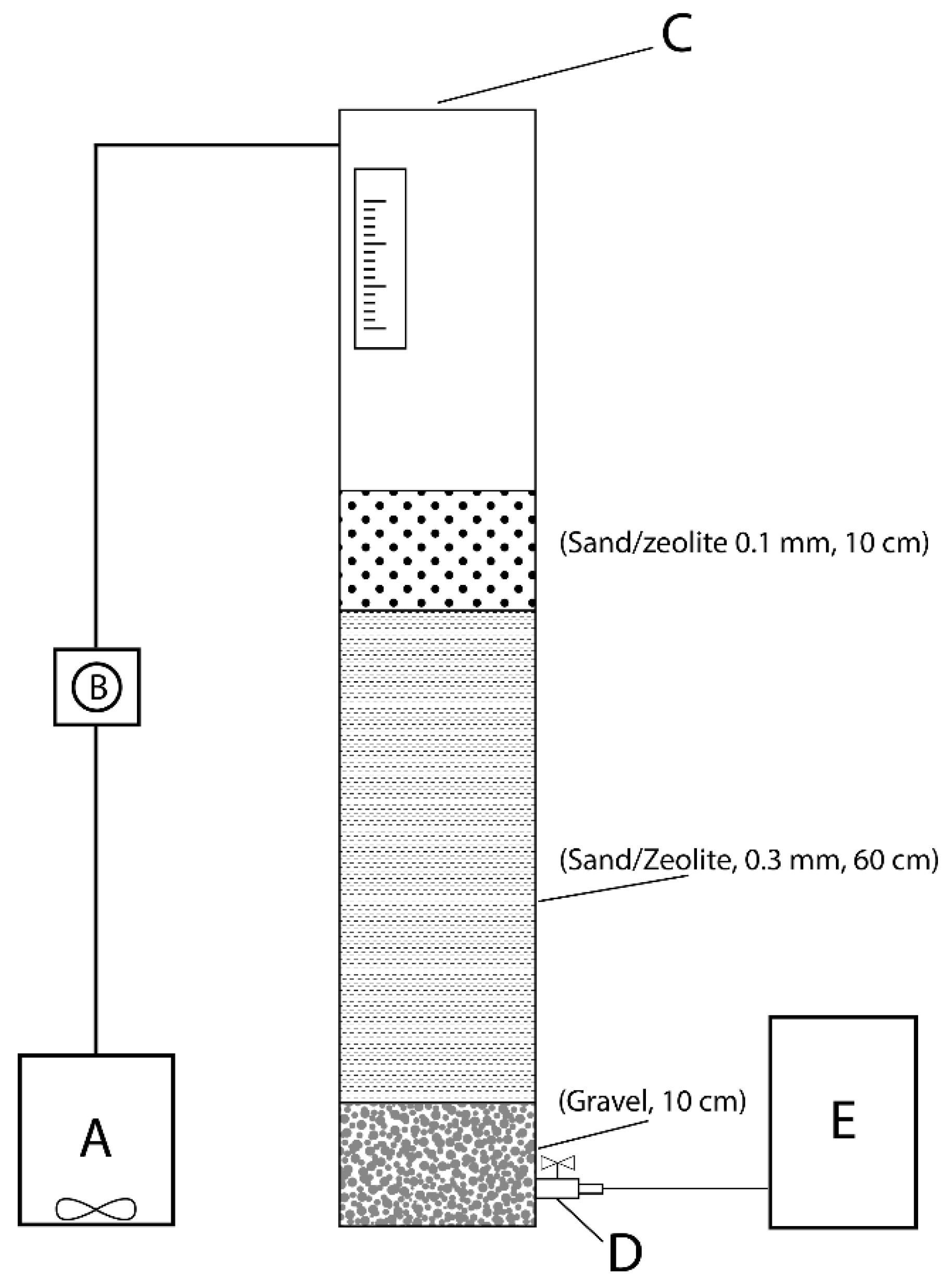
Figure 1 shows the experimental setup for slow filtration used in this study. The system involved a vertical column (C) equipped with a measuring scale for monitoring the water level. The column was filled with several layers of filter media: a 10 cm thick gravel layer at the base provided structural support, followed by a 60 cm thick layer of sand or zeolite with an average grain size of 0.3 mm (Z03) as the main filtration layer. On the topmost part was a 10 cm deep layer of sand or zeolite with a grain size of 0.1 mm (Z01), providing primary fine-scale filtration. Water was supplied from the reservoir (A) by a peristaltic pump (B), and the filtered product was monitored and controlled by a flow meter (D) and collected in the reservoir (E). The configuration allowed controlled experiments on optimizing slow filtration methods.

2.3. Characterization of the Zeolite

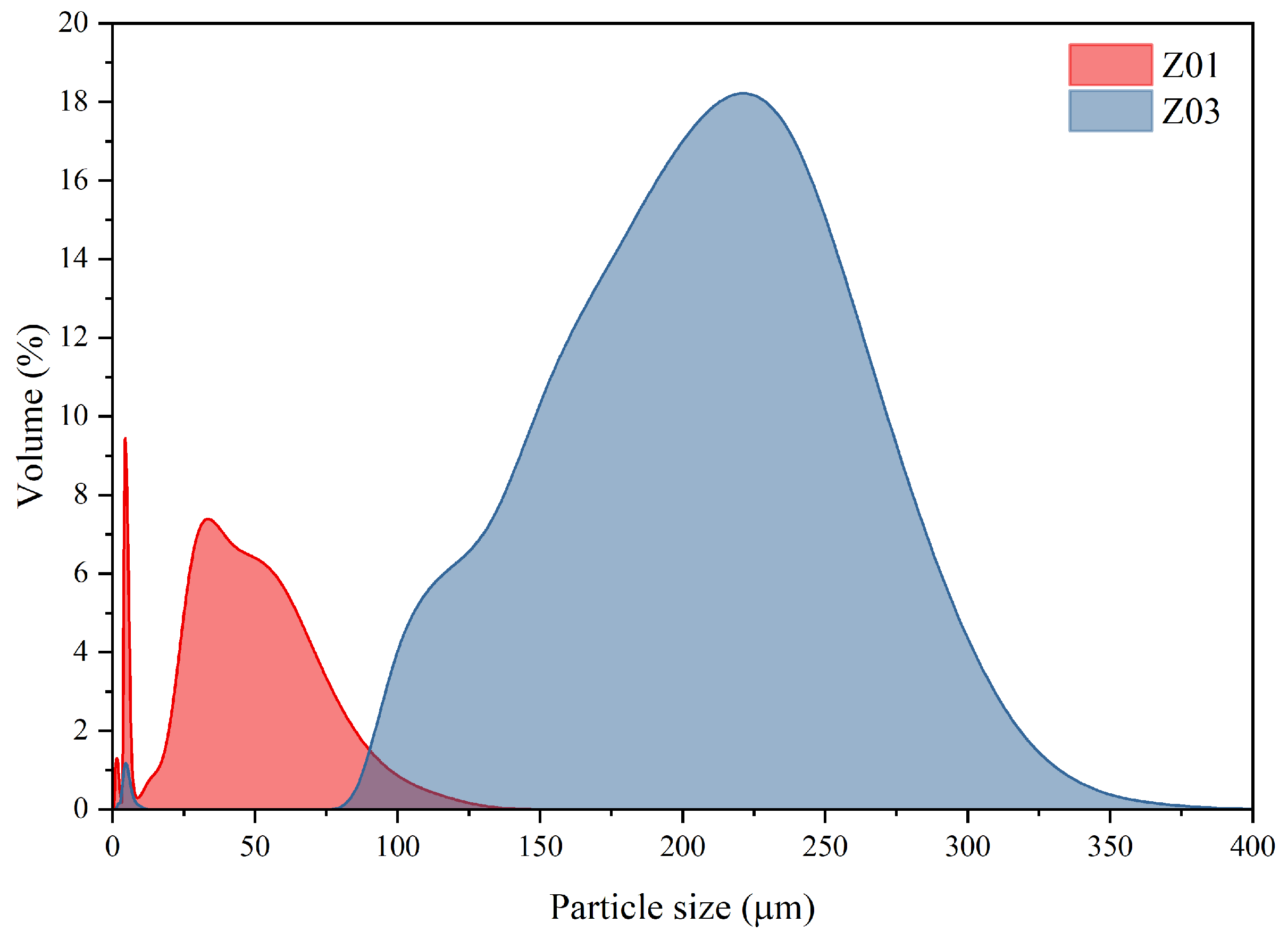
The granulometric composition of the natural zeolite serving as a filtration medium was determined by a laser particle size analyzer (Winner2005A; Jinan Winner Particle Instruments Stock Co., Ltd., Jinan, China). Based on the data (Figure 2) obtained, the main fraction Z03 was in the region of 100 to 300 microns, and the fraction Z01 was from 20 to 100 microns. According to Figure 2, peaks can be seen in the region of 10 microns. This indicates the presence of fine particles, a significant amount in the Z01 sample. Although this affects turbidity after filtration, this problem was solved by the fact that, before using the unit, a backwash of the filter was carried out. As a result, small particles were carried away by the water flow and drained from the top of the column.
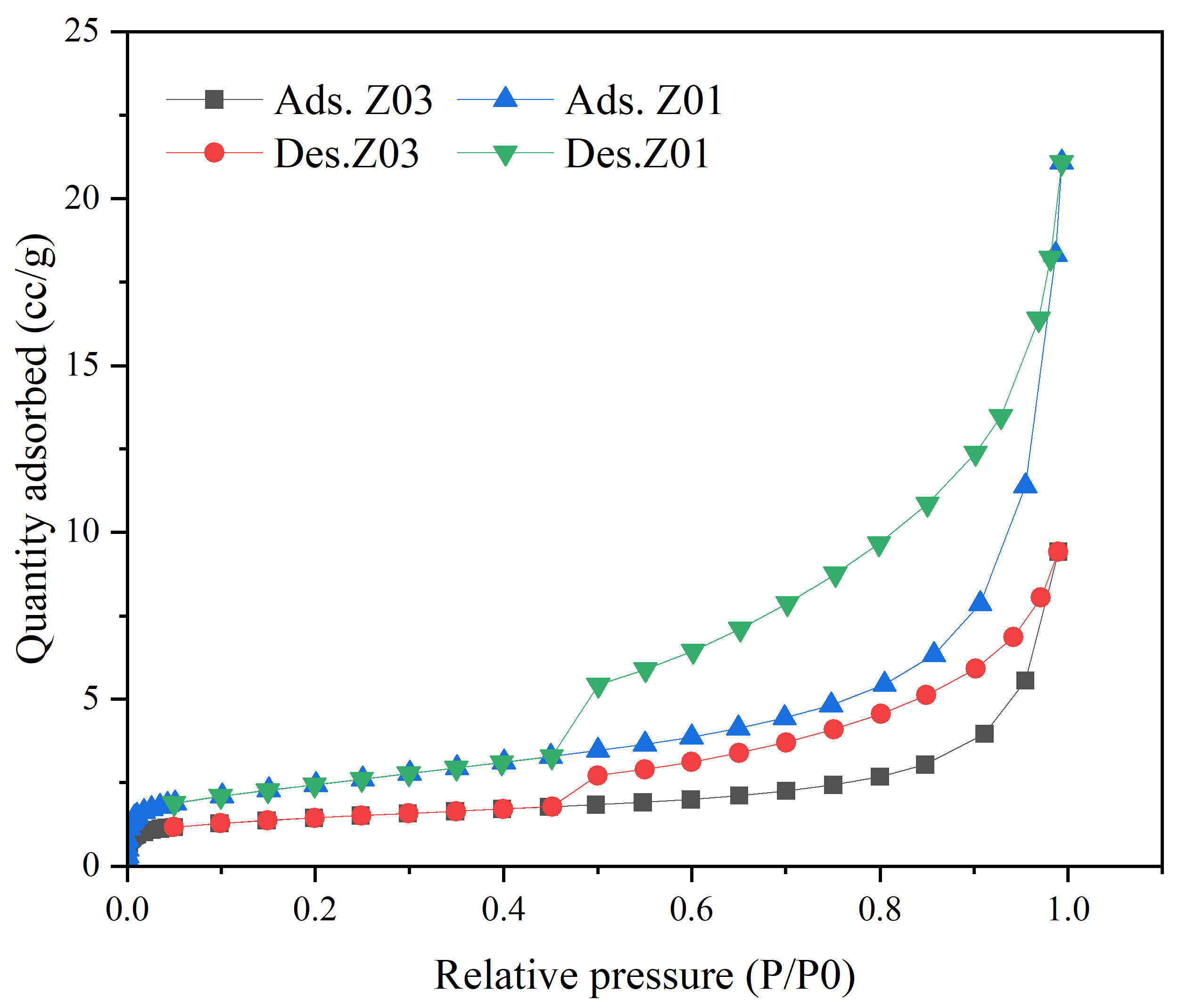
The textural properties of the samples were analyzed by low-temperature nitrogen adsorption at 77 K using a Kubo X1000 surface area (Beijing Baode Instrument Co., Ltd., Beijing, China) and porosity analyzer. Prior to the measurements, the samples were degassed at 180 °C for 4 h to remove adsorbed impurities and moisture. The nitrogen adsorption–desorption isotherms (Figure 3) exhibited type IV behavior according to the IUPAC classification, indicating the presence of a mesoporous structure. Specific surface area analysis was performed using the Brunauer–Emmett–Teller (BET) approach, and pore size distribution was assessed via the Barrett–Joyner–Halenda (BJH) model based on the adsorption branch of the isotherm. A summary of the results is provided in Table 2.
The observed enhancement in both specific surface area and total pore volume of sample Z01 relative to Z03 suggests pronounced morphological modifications within the material structure. These changes are likely attributable to the development of additional microcracks and pore networks induced by mechanical stress, which in turn increase the accessible surface area and overall porosity of the material. The expansion of the pore size distribution into the macroporous range supports the formation of a more open structure, which may enhance the accessibility of active sites and improve performance in ion transport, adsorption, and electrochemical processes. Z01 exhibited significantly improved textural properties, making it a more promising candidate for applications in energy storage, catalysis, or sorption technologies.

2.4. Batch Adsorption Experiments

For the kinetic and equilibrium adsorption studies, freshly prepared methylene blue (MB) solutions were used, and batch experiments were conducted under controlled conditions. Equilibrium adsorption measurements were performed in 50 mL polypropylene Eppendorf conical tubes with airtight lids, each containing 10 mg of the adsorbent and 20 mL of MB solution. All suspensions were agitated at 150 rpm in an orbital shaker to ensure sufficient interaction between the liquid and solid phases. For the kinetic study, MB solutions with an initial concentration of 100 mg/L were used, and the effect of contact time on adsorption performance was assessed at 0.5, 1, 2, 4, 6, 12, and 24 h. MB solutions of varying initial concentrations (10, 25, 50, 75, 100, 200, 300, and 400 mg/L) were prepared through appropriate dilution of the stock solution for the equilibrium experiments. A contact time of 24 h was selected to guarantee the attainment of adsorption equilibrium. The adsorption capacity q (mg/g) and removal efficiency (%) were calculated using Equations (1) and (2). The adsorption capacity q, in mg/g, and removal efficiency (%) of the adsorbate were calculated according to:
q = C 0 C × V m
R e m o v a l   E f f i c i e n c y = C 0 C C 0 × 100 %
where C0 and C (mg/L) denote the initial and final concentrations of the adsorbate solution, respectively, V (L) is the volume of the solution (20 mL), and m (g) denotes the mass of the adsorbent (0.01 g).
All experiments were performed in triplicate to ensure reproducibility of results. Statistical error parameters, including sum of squared errors (SSE), sum of absolute errors (SAE), and average relative error (ARE), were calculated to evaluate the accuracy and reliability of the obtained data. Each experimental observation was compared to the applied isotherm model prediction. For each adsorption isotherm, a total of n pairs of predicted and observed equilibrium adsorption values (qe,exp and qe,cal) were used. The statistical error parameters were calculated according to:
S S E = i = 1 n ( q e , e x p , i q e , c a l , i ) 2
S A E = i = 1 n | q e , e x p , i q e , c a l , i |
A R E = 100 n i = 1 n q e , e x p , i q e , c a l , i q e , e x p , i
where qₑ,exp,i and qₑ,cal,i are the experimental and calculated equilibrium adsorption capacities (mg/g), respectively, and n is the number of experimental data points.
Experimental data obtained at different contact times and initial adsorbate concentrations were used to evaluate the adsorption kinetics and isotherms, respectively (Table 3). The final concentrations of MB in the filtrate, after appropriate dilution, were determined using a UV–Vis scanning spectrophotometer (C-7000SEM; Peak Instruments, Shanghai, China) at a wavelength of 660 nm, based on a calibration curve ranging from 0 to 10 mg/L. Each experiment was performed in duplicate, and the corresponding results are expressed as the average of the obtained measurements.
The Temkin isotherm assumes that the decrease in the heat of adsorption follows a linear trend rather than a logarithmic curve (Table 3). The heat of adsorption constant B can be determined from the slope of the plot of qe versus ln Ce. The Dubinin–Raduskevich isotherm model was created to account for the impact of the porous structure of adsorbents. It is based on adsorption potential theory and suggests that adsorption occurs through the filling of micropores rather than a layer-by-layer adsorption on the pore walls. Unlike the Langmuir isotherm, the Dubinin–Radushkevich model does not assume a homogeneous surface or a constant adsorption potential. Accurate determination of the adsorption potential ε is crucial for the application of the Dubinin–Radushkevich isotherm model. The adsorption potential theory represents the change in Gibbs free energy of the adsorbent after it adsorbs one mol of adsorbate. The Dubinin–Radushkevich isotherm model has been adapted for adsorption from aqueous solutions, closely mirroring the gas adsorption model [17]. In this context, determining the adsorption potential involves replacing the saturation vapor pressure ps and the equilibrium pressure in gas adsorption with the solubility (Cs) and the equilibrium concentration (Ce) of the adsorbate, respectively.

2.5. Adsorption Mechanism of Methylene Blue on Natural Zeolite as a Function of pH

Natural zeolite fraction 0.1 mm was pre-washed with deionized water to a conductivity < 50 µS/cm, dried at 105 °C for 12 h, and stored in a desiccator. A stock solution of 1000 mg/L MB and working solutions of 300 mg/L were prepared by dilution. A 0.01 M NaCl solution was used as a background to stabilize the ionic strength. Measuring equipment for this was a UV spectrophotometer (λ = 664 nm; 1 cm cuvette), a calibrated pH meter (buffers 4.00/7.00/10.00), a thermostatic shaker at 25 ± 1 °C, a centrifuge or 0.22 µm membrane filters, and an analytical balance (±0.1 mg). pH was set at pH = 2, 3, 4, 5, 6, 7, 8, 9, and 10 using 0.1 M HCl/NaOH. The procedure for batch sorption experiments was as follows: 0.10 g of sorbent was weighed into 50 mL polypropylene bottles, 40.0 mL of MB solution with a concentration of 300 mg/L was added, sealed tightly, and kept on a shaker at 200 rpm at 25 °C for 24 h. After maturation, the liquid was separated by filtration (0.22 µm), pH was measured immediately, and optical density was determined at 664 nm.
Different ratios of MB concentration were used in the different experiments. The concentration was selected so that it fell within the sorbent’s adsorption range and so that, even with large changes, it would not fall outside the range and at the same time have complete saturation.

3. Results and Discussion

3.1. Surface Morphology Natural Zeolite

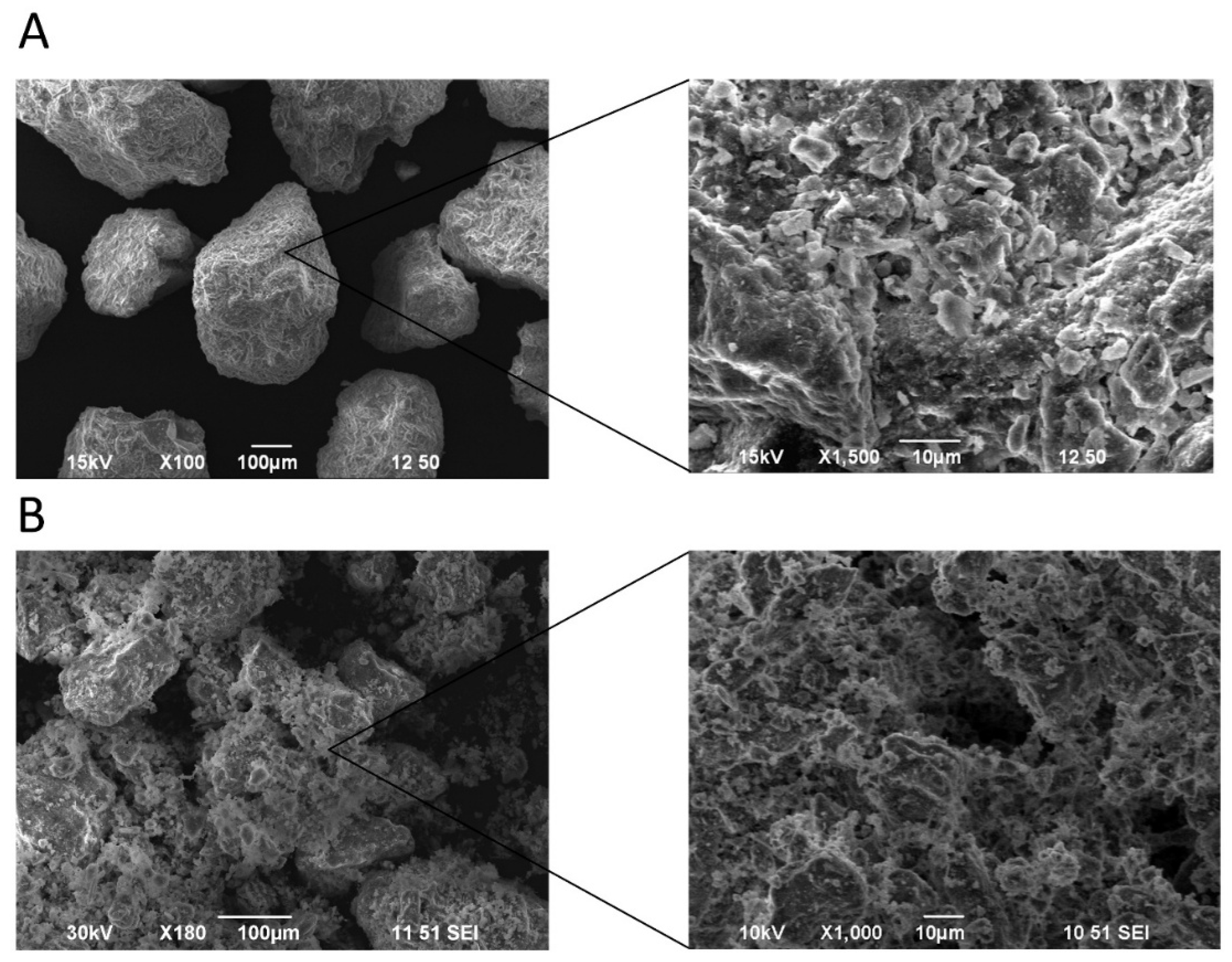
The surface morphology of experimental natural zeolite with different particle sizes was investigated using scanning electron microscopy (SEM) to assess structural features relevant to its adsorption behavior. SEM images for the 0.3 mm and 0.1 mm fractions are presented in Figure 4. The 0.3 mm fraction (Figure 4A) displays particles with a rough surface at low magnification (100×). At higher magnification (1500×), the surface reveals distinct plate-like microcrystalline structures and a moderately textured relief. These features indicate a partially crystalline framework with a limited number of accessible surface pores, suggesting that adsorption may predominantly occur on the external surfaces or through restricted diffusion within the pore system. In contrast, the 0.1 mm fraction (Figure 4B) exhibits a more heterogeneous and disordered morphology. At low magnification (180×), the particles appear more angular and agglomerated, likely due to increased mechanical fragmentation during sample preparation. The high-magnification image (1000×) shows a rougher surface with a complex network of cracks, voids, and interconnected pores. This pronounced surface porosity is expected to enhance the accessibility of adsorption sites and promote more active interactions with adsorbate molecules.
These morphological differences indicate that particle size plays a crucial role in determining the textural and structural characteristics of natural zeolite. The finer 0.1 mm (Z01) fraction provides a higher surface area and porosity, which may enhance adsorption efficiency, while the 0.3 mm (Z03) fraction retains a more compact and crystalline structure, potentially favoring surface-specific interactions under equilibrium conditions.

3.2. Turbidity and MB Removal Efficiency Using Zeolite and Quartz Sand in Slow Filtration

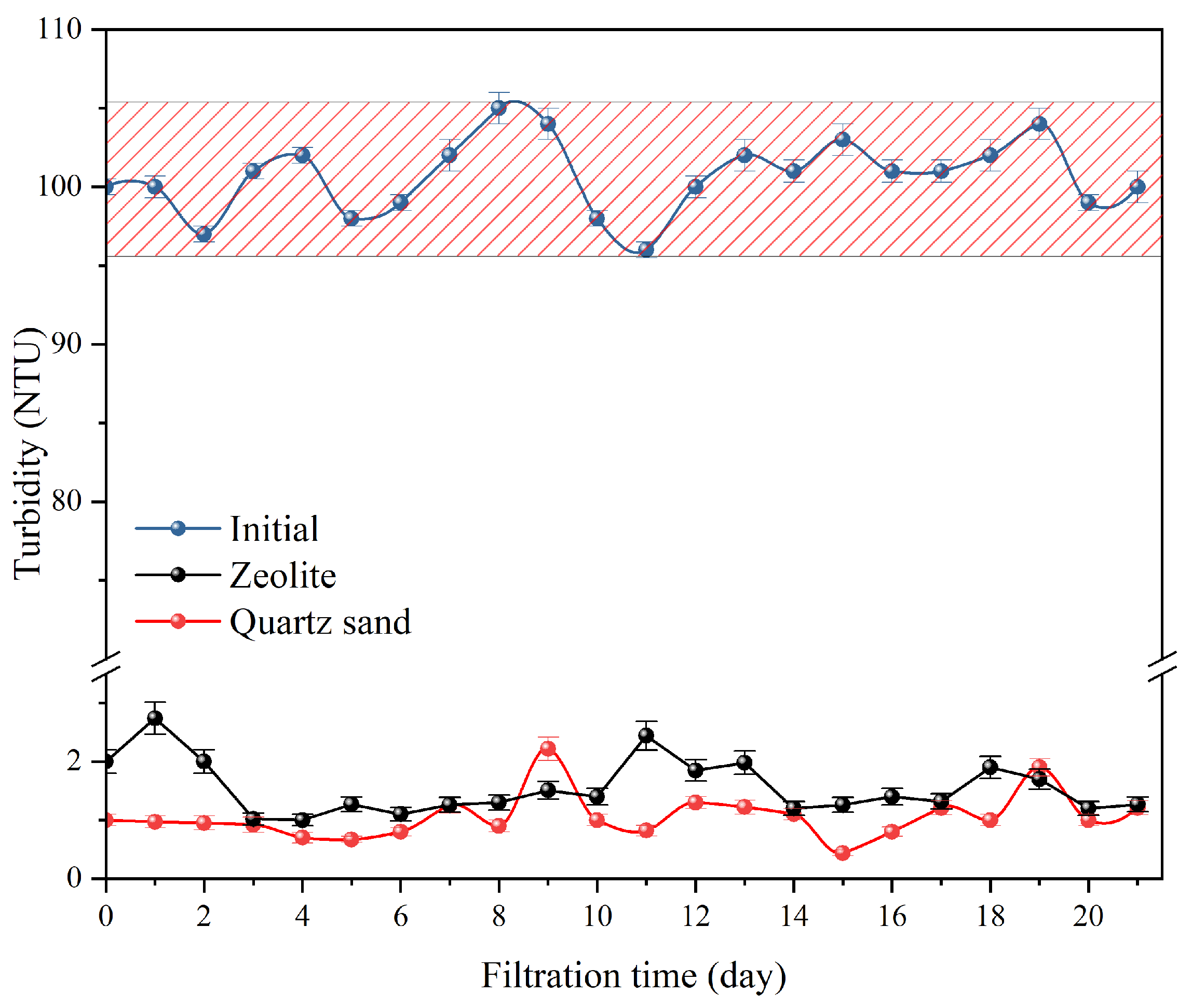
Figure 5 and Table 4 present the turbidity profiles of influent and effluent water over a 21-day filtration experiment using two slow sand filtration columns filled with natural zeolite and quartz sand, respectively. The initial turbidity of the synthetic influent water ranged from 96 to 104 NTU throughout the testing period, simulating the characteristics of highly turbid surface water. The initial turbidity variation was due to the difficulty in accurately preparing the suspension, as the particle distribution is not uniform. Despite this, only minor fluctuations (±4 NTU) in influent turbidity were observed over time.
Filtration through the quartz sand column consistently reduced the turbidity to 0.8–1.2 NTU, indicating a high level of mechanical particle retention and stable filtration performance. In contrast, the column packed with natural zeolite achieved turbidity levels ranging between 1.0 and 2.3 NTU. Although higher than those achieved with quartz sand, these values are still within acceptable limits for effective particulate removal.
The increased variability in turbidity observed in the zeolite column may be attributed to its finer grain structure and heterogeneous pore distribution, which can influence the uniformity of flow paths and particle retention. Nonetheless, zeolite offers distinct advantages, including ion-exchange capacity and potential for removing dissolved inorganic contaminants, which make it attractive for integrated filtration systems. Both filtration media demonstrated excellent turbidity removal performance under slow filtration conditions. Quartz sand provided more stable effluent quality, while zeolite may be more suitable for applications where both mechanical filtration and chemical adsorption are desired.
The installation (Figure 1) was also investigated for zeolite and sand sorption capacity to absorb MB at a constant filtration rate of 0.2 m/h. As a result of the zeolite filtering and using MB with a concentration of 30 ppm, it was established that over the course of continuous operation (60 d), the dye was completely absorbed after the filtration period. It is worth mentioning that 1750 L of MB solutions were filtered during the zeolite filtration process. On the other hand, using the sand filter for MB filtration, practically no sorption was observed. We speculate that this was caused by a not fully functional biological layer (schmutzdecke). Slow sand filters can normally remove MB through a combination of physical filtration and biological and chemical activity of the schmutzdecke [3,19].

3.3. Equilibrium Analysis

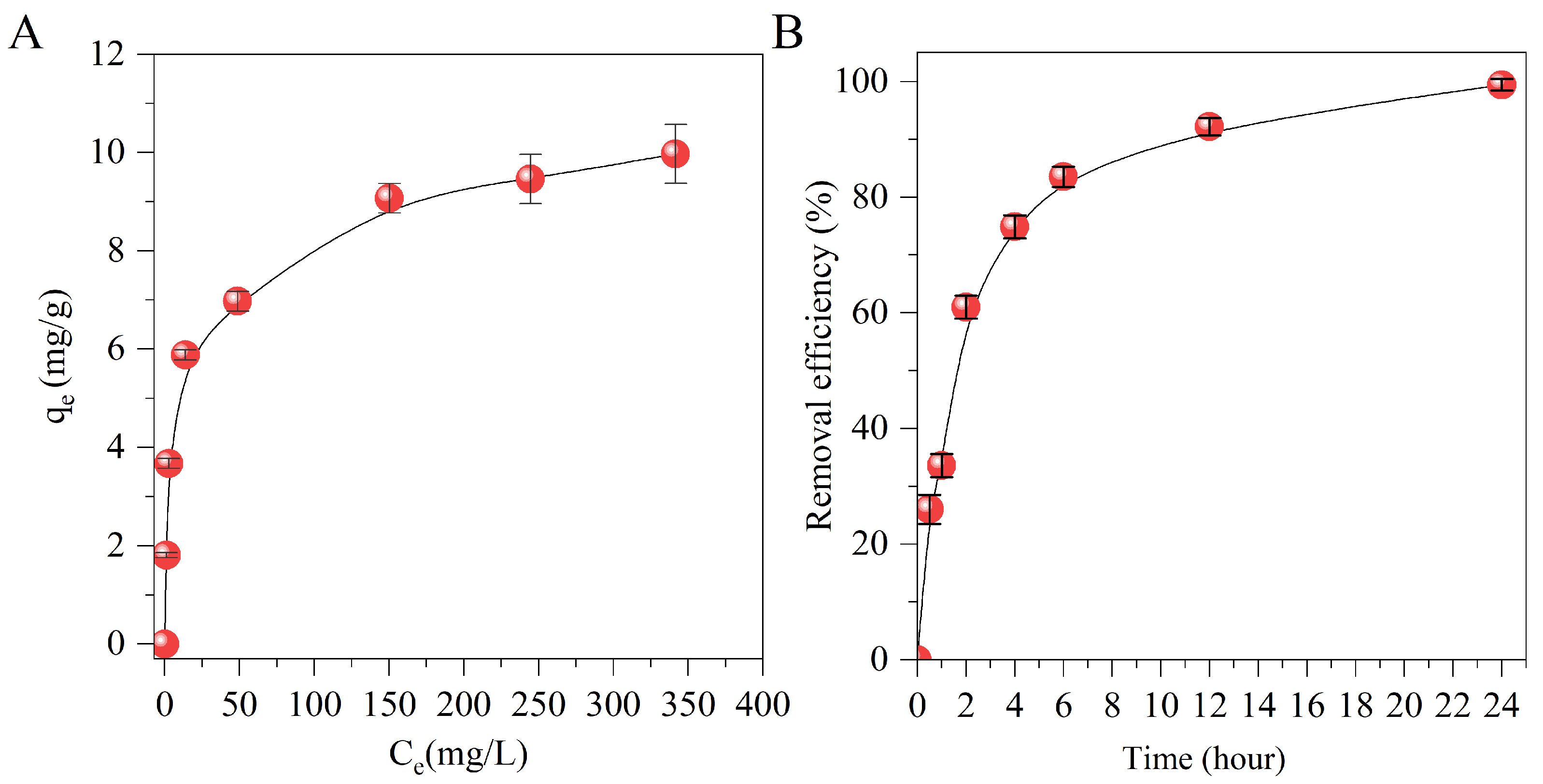
Equilibrium modeling plays a vital role in elucidating the adsorption mechanism by enabling a quantitative assessment of adsorbent–adsorbate interactions. In this study, four commonly used isotherm models, Langmuir, Freundlich, Temkin, and Dubinin–Radushkevich, were applied to analyze the equilibrium adsorption data of MB on the 0.3 mm fraction of the adsorbent. Figure 6 shows the results of the study of MB adsorption on the surface of the selected sorbent. Figure 6A illustrates the adsorption isotherm reflecting the dependence of the equilibrium amount of adsorbed dye (qe, mg/g) on its equilibrium concentration in solution (Ce, mg/L). A typical behavior is observed, in which the qe value increases with an increase in the concentration of MB in the solution, but at higher Ce values, the growth of qe slows down and reaches saturation, which indicates the filling of available active centers on the adsorbent surface. This shape of the curve is characteristic of monomolecular adsorption and can be described by the Langmuir model or, depending on the degree of surface heterogeneity, the Freundlich model. To quantitatively assess the agreement between the experimental adsorption data and the used isotherm models, statistical parameters were calculated: the sum of absolute errors (SAE), the sum of squared errors (SSE), and the average relative error (ARE). Calculation of these error metrics allowed us to objectively assess the accuracy of the approximation of the experimental isotherms and to evaluate the degree of discrepancy between the theoretically predicted and experimentally obtained values. Figure 6B demonstrates the dependence of the efficiency of MB removal on time. The data show that intensive dye absorption is observed in 0–6 h, and more than 80% removal was achieved within 4–6 h, after which the adsorption rate decreased significantly, and the curve tended to a plateau, reaching almost 100% efficiency after 24 h. This trend of the kinetic curve indicates high availability of active centers and favorable interaction between methylene blue and the sorbent surface. The results obtained confirm that the studied material has high sorption capacity and efficiency in removing organic dyes from aqueous solutions.
The model parameters were determined using linearized forms of the corresponding isotherm. Specifically, the Langmuir constants were derived from the plot of 1/qₑ versus 1/Cₑ, while the Freundlich parameters were obtained from the slope and intercept of the log qₑ versus log Cₑ plot. The calculated isotherm parameters are presented in Table 5.
All tested models exhibited a high degree of correlation with experimental data, with R2 values exceeding 0.9 in all cases, suggesting good model fits and reliable predictions. The Langmuir model yielded the highest R2 values for both samples, implying monolayer adsorption on a relatively homogeneous surface. The maximum monolayer adsorption capacity (qmax) for MB was 8.32 mg/g for sample Z03 and 13.84 mg/g for Z01. The corresponding Langmuir affinity constant, KL, was higher for Z03 (0.2493 L/mg), indicating a stronger interaction between the dye and the adsorbent surface. The obtained sorption capacity of zeolite Z03 demonstrates relatively high values compared to similar data presented in other scientific studies, which indicates its good sorption potential, as shown in Table 6. On the other hand, by enhancing natural zeolites with graphene oxide, even higher adsorption can be achieved (Table 6).
The Freundlich model parameters further support these observations. For sample Z03, the Freundlich exponent n was less than 1 (0.3017), suggesting weak, possibly unfavorable adsorption characterized by heterogeneity and multilayer formation. In contrast, sample Z01 showed an n value greater than 1 (3.1341), indicating more favorable adsorption conditions. The Freundlich constant KF, representing adsorption capacity, was also higher for Z03.
The Temkin model, which assumes a linear reduction in heat of adsorption with coverage, also provided excellent correlation (R2 = 0.9919). Constant b was calculated as 1.38 J/mol, and B, which is related to binding energy, was found to be 4.18.
The Dubinin–Radushkevich (D–R) model offers additional insight into the adsorption energy. The mean free energy of adsorption (ε) was 35.81 kJ/mol. This value suggests that the process occurs at the border between physical adsorption (physisorption) and chemical adsorption (chemisorption), and most likely indicates a mixed mechanism in this system. The maximum theoretical capacity (qm) obtained from this model was 10.03 mg/g. These findings collectively suggest that the adsorption of MB onto both adsorbents involves a combination of physisorption and chemisorption processes, with Z01 demonstrating higher capacity but Z03 exhibiting greater affinity.
For the D–R isotherm, the adsorption energy was equal to 35 kJ/mol, from which it can be concluded that the adsorption interaction between MB and zeolite was moderately strong and mixed physical and chemical. In the sorption of MB on zeolite in an aqueous medium, the value of bond energy suggests that the adsorption process occurs with the participation of weak intermolecular forces, such as van der Waals forces, and possibly electrostatic interactions, considering the cationic nature of MB and potential exchange processes on the zeolite surface. An energy of 35 kJ/mol implies that MB is well adsorbed on zeolite, but without forming strong chemical bonds. This is important in the context of water purification, as the adsorption process can be sufficiently effective, and the adsorbent (i.e., natural zeolite) can be regenerated and reused.
The results of the sorption kinetics of MB for pseudo-first, pseudo-second order, and interparticle diffusion are summarized in Table 7. The adsorption kinetics of the system reveal a complex mechanism, thus described by a pseudo-first-order and pseudo-second-order model with R2 values of 0.9932 and 0.9671, suggesting physisorption and chemisorption. The pseudo-first-order model with R2 of 0.9671 and qe of 3.24 mg/g and poor distribution of errors (i.e., SAE 1.607, SSE 0.556, and ARE 2.865%) appears to be less appropriate. The intraparticle diffusion analyzed in two stages further clarifies the process: stage 1 (0–2 h) shows a phase with K1 0.326 and R2 0.9535, while stage 2 (2–6 h) indicates a more progressive diffusion with K2 0.141 and R2 0.9852, confirming that the diffusion in the pores is the limiting stage after the initial. This multistage action of methylene blue for porous adsorbents, moving from high to low diffusion rates, leads to saturation of the outer part of the zeolite.

3.4. Influence of pH on Sorption Characteristics

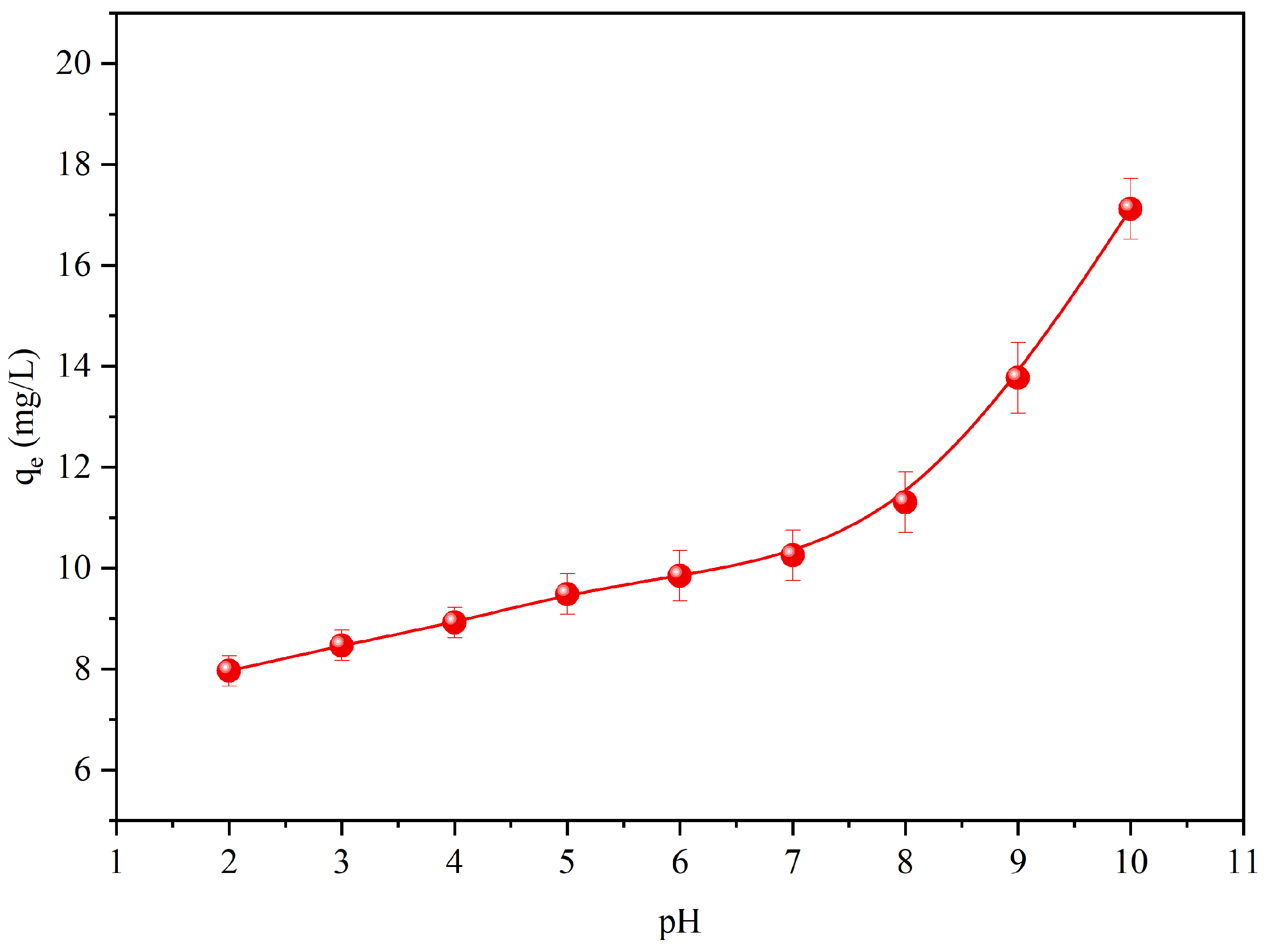
The adsorption behavior of MB on natural zeolite depends on the pH of the solution, as shown in Figure 7. The results obtained show that the adsorption capacity gradually increases with increasing pH, reaching its maximum value in alkaline conditions. This trend may be related to the pH-dependent surface charge of zeolite and the ionic nature of MB molecules.
At low pH values (pH < 5), the zeolite surface is predominantly protonated, and the surface hydroxyl groups (≡Si–OH) are converted into positively charged species ≡Si–OH2+ [23,24]:
≡Si–OH + H+ → ≡Si–OH2+
Since methylene blue exists in cationic form (MC+), a strong electrostatic repulsion occurs between the positively charged zeolite surface and the MC+ ions, resulting in low adsorption capacity. As the pH of the solution increases towards neutral values (pH ≈ 6–7), the degree of protonation of the zeolite surface decreases, and partial deprotonation of hydroxyl groups occurs in accordance with:
≡Si–OH ⇌ ≡Si–O + H+
The formation of negatively charged ≡Si–O centers enhances electrostatic attraction to cationic dye species, leading to a moderate increase in adsorption. Under alkaline conditions (pH > 8), the zeolite surface becomes predominantly negatively charged due to extensive deprotonation of surface hydroxyls. Consequently, the number of active centers capable of electrostatically attracting MB+ ions increases significantly. Moreover, at higher pH, competition from H+ ions for active sites is minimized, allowing more MB+ ions to be adsorbed. In addition to electrostatic interactions, ion exchange processes also contribute to the adsorption mechanism, in which exchangeable cations in the zeolite framework (e.g., Na+, K+, or Ca2+) are replaced by MB+ ions according to:
≡Si–ONa+ + MB+ → ≡Si–OMB+ + Na+
Moreover, π–π interactions between MB aromatic rings and the silicate framework of zeolite may play a secondary role in enhancing dye retention on the surface. Thus, the overall adsorption mechanism involves a combination of electrostatic attraction, ion exchange, and weak π–π stacking interactions, with electrostatic forces dominating under alkaline conditions. Thus, the gradual increase in adsorption capacity with increasing pH reflects the transition of the zeolite surface from a positively charged state in acidic conditions to a negatively charged state in alkaline conditions, which leads to an increase in binding capacity with respect to cationic dye molecules [25,26].

3.5. Spectroscopic Analysis of MB Sorption on Natural Zeolite

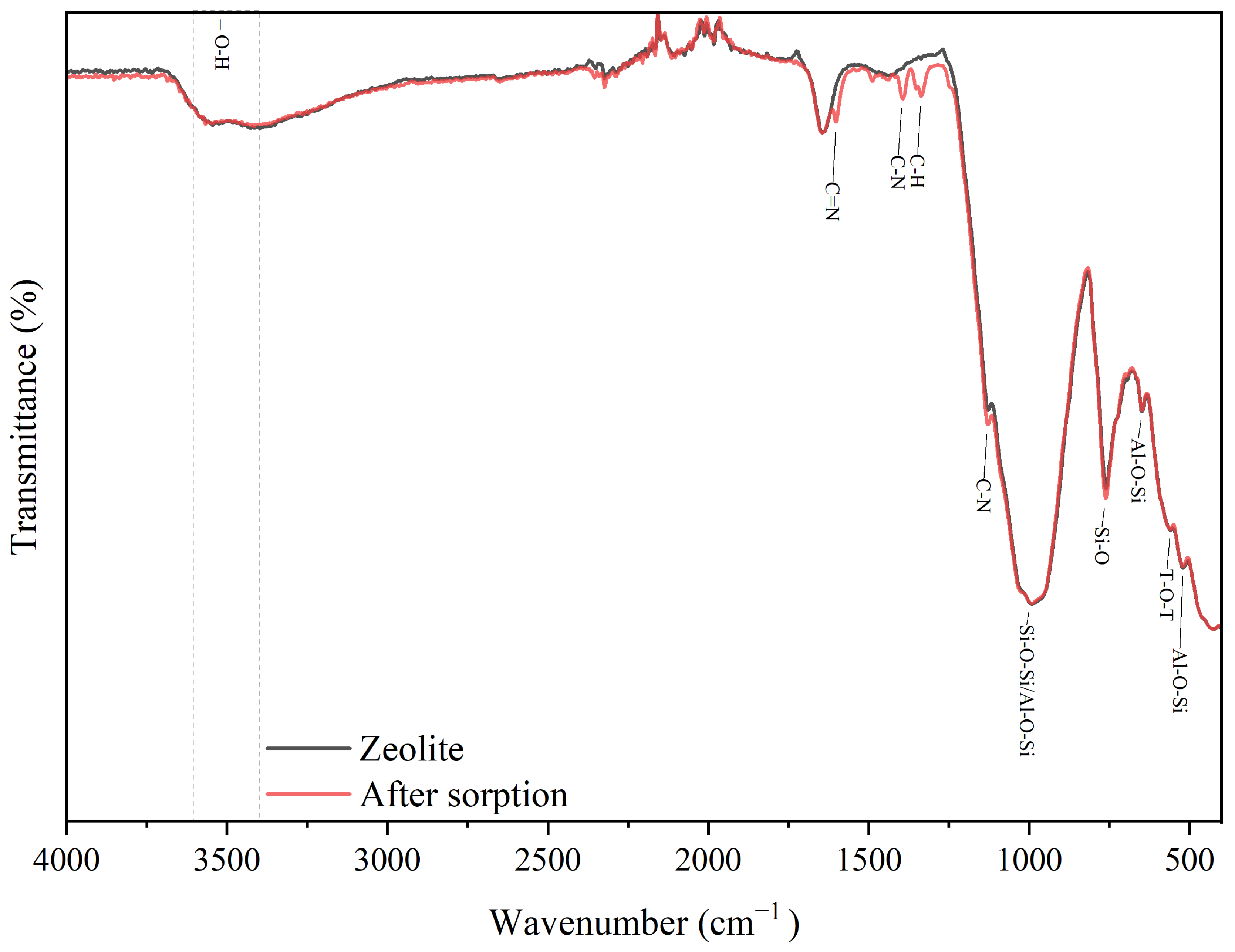
Experimental Fourier transform infrared (FTIR) spectra were obtained in transmission mode in the range of 4000–400 cm−1 using a Bruker ALFA II spectrometer with an ATR module. The spectra of raw zeolite and zeolite after reaching equilibrium in methylene blue sorption were compared to identify shifts, new bands, and changes in intensity, indicating chemisorption mechanisms. These results confirm the previously proposed dominance of ion exchange processes and highlight secondary interactions such as hydrogen bonding and π–π stacking.
The FTIR spectra (Figure 8) exhibit characteristic zeolite framework vibrations in the raw sample, overlaid with MB-specific bands post-sorption. Prominent peaks at 1643, 1600, 1395, 1336, 1128, 995, 761, 646, 558, and 519 cm−1 in the loaded spectrum reveal adsorption-induced perturbations. Characteristic IR absorption frequencies (cm−1) and their interpretations for zeolite before and after MB sorption are summarized in Table 8.
Starting with hydroxyl and aqua regions, a broad O-H stretching band centered at ~3434 cm−1 in the original spectrum can be attributed to structural silanol (Si-OH) and aluminol (Al-OH) groups. This spectral signature is indicative of hydrogen bond dilution: the polar OH groups of the zeolite form extended networks with electron-rich single pairs of nitrogen (N) and sulfur (S) MB, effectively lengthening the O-H bonds and reducing the vibration frequency. Simultaneously, the H-O-H bending mode at 1643 cm−1 is amplified by approximately 25%, reflecting the initial dehydration and MB+ cations connecting onto the surface, displacing the aqua ligands coordinated with exchangeable Na+/Ca2+. These changes reflect the influence of pH: under neutral-alkaline conditions (pH 7–10), deprotonation enhances the availability of –O, promoting the formation of stronger hydrogen bond acceptors and accelerating this phase, whereas an acidic environment (pH < 5) suppresses such shifts due to proton competition.
The nearby band at 1395 cm−1, enhanced by the deformation of the Al-O bond, manifests itself as a stretching of the C-N bond of the dimethylamino substituents of MB, indicating nucleophilic coordination with electron-deficient Al3+ centers. This is further confirmed by the deformation of the C-H bond in the 1336 cm−1 plane—a subtle but distinct overlap that emphasizes the van der Waals stabilization of the aliphatic edges of MB relative to the microporous walls of the zeolite.
In the lower middle part of the range, the shoulder at 1128 cm−1 on the dominant asymmetric Si-O-Si stretch (untreated peak at ~995 cm−1) contributes to the C-N/C-S vibrations from MB, broadening by approximately ~50 cm−1 and indicating intra-particle diffusion: dye dimensions of ~1.3 nm allow shallow fillings, disrupting tetrahedral bonds without destroying the framework. The stability of the 995 cm−1 band confirms structural stability, a hallmark of the thermal/mechanical stability of natural clinoptilolite under environmental sorption conditions.

4. Conclusions

This study demonstrated the effectiveness of an experimental zeolite-based slow filtration system, especially in terms of dye removal and turbidity reduction. The natural zeolite filter demonstrated MB adsorption efficiency, achieving complete removal of 30 ppm of the dye at a filtration rate of 0.2 m/h, with maintained efficiency for 60 days. The adsorption capacities of 8.32 mg/g and 13.84 mg/g for 0.3 mm and 0.1 mm zeolite fractions, respectively, indicated good adsorption properties due to their large surface area, mesoporous structure, and ion-exchange properties. On the other hand, the quartz sand filter indicated very low MB removal. Both the zeolite and quartz sand filters, however, demonstrated comparable turbidity removal efficiencies, with zeolite reaching 98.53% and quartz sand 98.97%, proving their effectiveness in improving water clarity. Equilibrium analysis using Langmuir, Freundlich, Temkin, and D–R isothermal models confirmed that MB adsorption on zeolite is a combination of physisorption and chemisorption, with the finer fraction of 0.1 mm providing higher capacity due to increased porosity and surface area. Kinetic studies further confirmed the validity of the pseudo-second-order model, indicating a robust adsorption mechanism. These results highlight the potential of zeolite-based slow filtration as a multifunctional and sustainable solution for water treatment, especially in regions facing water scarcity and pollution issues. Future research may explore the regeneration and reuse of zeolite filters to further enhance their practical applicability in large-scale water treatment systems.

Author Contributions

S.S.: data curation, methodology, writing—original draft preparation; M.K.: visualization, software; B.K.: methodology; U.K.: validation; E.K.: conceptualization; R.B.: investigation; J.L.: formal analysis; S.A.: funding acquisition, project administration, resources, writing—review and editing, supervision. All authors have read and agreed to the published version of the manuscript.

Funding

This research was funded by the Science Committee of the Ministry of Science and Higher Education of the Republic of Kazakhstan (Grant No. AP23489574).

Data Availability Statement

The original contributions presented in this study are included in the article. Further inquiries can be directed to the corresponding authors.

Conflicts of Interest

The authors declare no conflicts of interest.

Abbreviations

The following abbreviations are used in this manuscript:
AREAverage relative error
BETBrunauer–Emmett–Teller
BJH Barrett–Joyner–Halenda
D–RDubinin–Radushkevich
LLSLimited liability company
LtdLimited
MBMethylene blue
NTUNephelometric turbidity unit
SAESum of absolute errors
SDGsSustainable development goals
SSESum of squared errors
XRDX-ray diffraction

References

  1. Megbenu, H.K.; Daulbayev, C.; Nursharip, A.; Tauanov, Z.; Poulopoulos, S.; Busquets, R.; Baimenov, A. Photocatalytic and adsorption performance of MXene@Ag/cryogel composites for sulfamethoxazole and mercury removal from water matrices. Environ. Technol. Innov. 2023, 32, 103350. [Google Scholar] [CrossRef]
  2. Yu, Z.Q.; Hosono, T.; Amano, H.; Berndtsson, R.; Nakagawa, K. Groundwater Resource Assessment by Applying Long-Term Trend Analysis of Spring Discharge, Water Level, and Hydroclimatic Parameters. Water Resour. Manag. 2024, 38, 4161–4177. [Google Scholar] [CrossRef]
  3. Abdiyev, K.; Azat, S.; Kuldeyev, E.; Ybyraiymkul, D.; Kabdrakhmanova, S.; Berndtsson, R.; Khalkhabai, B.; Kabdrakhmanova, A.; Sultakhan, S. Review of Slow Sand Filtration for Raw Water Treatment with Potential Application in Less-Developed Countries. Water 2023, 15, 2007. [Google Scholar] [CrossRef]
  4. Li, N.; Li, X.; Zhao, L.; Lu, Z.-D.; Liu, Y.-W.; Wang, N. Slow sand filters with variable filtration rates for rainwater purification: Microecological differences between biofilm and water phases. J. Environ. Manag. 2025, 375, 124210. [Google Scholar] [CrossRef] [PubMed]
  5. Kuldeyev, E.I.; Seitzhanova, M.; Tanirbergenova, S.; Tazhu, K.; Doszhanov, E.; Mansurov, Z.; Nurlybaev, R.; Azat, S. Use of Natural Zeolite–Based Sorbents for Water Treatment: Characterization and Filtration Performance. Water 2023, 15, 2215. [Google Scholar] [CrossRef]
  6. Dehmani, Y.; Ba Mohammed, B.; Oukhrib, R.; Dehbi, A.; Lamhasni, T.; Brahmi, Y.; El-Kordy, A.; Franco, D.S.; Georgin, J.; Lima, E.C.; et al. Adsorption of various inorganic and organic pollutants by natural and synthetic zeolites: A critical review. Arab. J. Chem. 2023, 17, 105474. [Google Scholar] [CrossRef]
  7. Zhu, J.; Wang, Y.; Liu, J.; Zhang, Y. Facile one-pot synthesis of novel spherical zeolite-reduced graphene oxide composites for cationic dye adsorption. Ind. Eng. Chem. Res. 2014, 53, 13711–13717. [Google Scholar] [CrossRef]
  8. Huang, T.; Yan, M.; He, K.; Huang, Z.; Zeng, G.; Chen, A.; Peng, M.; Li, H.; Yuan, L.; Chen, G. Efficient removal of methylene blue from aqueous solutions using magnetic graphene oxide modified zeolite. J. Colloid Interface Sci. 2019, 543, 43–51. [Google Scholar] [CrossRef] [PubMed]
  9. Mutalib, N.F.A.A.; Seitkhan, A.; Othman, M.B.H.; Ramle, A.Q.; Salleh, N.M.; Othman, M.H.D.; Hubadillah, S.K.; Jamalludin, M.R.; Yusof, N.N.; Adam, M.R. Acid-activated natural zeolite clinoptilolite functionalized with curcumin for superior methylene blue adsorption: Insights into optimization, characterization, and adsorption mechanisms. Pure Appl. Chem. 2025, 97, 841–863. [Google Scholar] [CrossRef]
  10. Abdelwahab, O.; Thabet, W.M. Natural zeolites and zeolite composites for heavy metal removal from contaminated water and their applications in aquaculture Systems: A review. Egypt. J. Aquat. Res. 2023, 49, 431–443. [Google Scholar] [CrossRef]
  11. Guedes, J.; Gonçalves, D.B.; Rodrigues, C.F.; Parpot, P.; Fonseca, A.M.; Almeida-Aguiar, C.; Neves, I.C. Antimicrobial agents based on metal-ion zeolite materials: A multivariate approach to microbial growth inhibition. RSC Adv. 2025, 15, 36380–36392. [Google Scholar] [CrossRef] [PubMed]
  12. Wang, R.S.; Li, Y.; Shuai, X.X.; Liang, R.H.; Chen, J.; Liu, C.M. Pectin/Activated Carbon-Based Porous Microsphere for Pb2+ Adsorption: Characterization and Adsorption Behaviour. Polymers 2021, 13, 2453. [Google Scholar] [CrossRef] [PubMed]
  13. Rafiee Taqanaki, E.; Heidari, R.; Monfared, M.; Tayebi, L.; Azadi, A.; Farjadian, F. EDTA-modified mesoporous silica as supra adsorbent of copper ions with novel approach as an antidote agent in copper toxicity. Int. J. Nanomed. 2019, 14, 7781–7792. [Google Scholar] [CrossRef]
  14. Mansoori, S.A.; Reza, Z.; Mohammad, H.; Mohammad, M.S.; Abolfazl, J.; Sadegh, S.; Akbar, E. HSS anions reduction combined with the analytical test of aqueous MDEA in South Pars gas complex. Nat. Gas. Ind. B 2022, 9, 318–324. [Google Scholar] [CrossRef]
  15. Baimenov, A.; Berillo, D.; Azat, S.; Nurgozhin, T.; Inglezakis, V. Removal of Cd2+ from Water by Use of Super-Macroporous Cryogels and Comparison to Commercial Adsorbents. Polymers 2020, 12, 2405. [Google Scholar] [CrossRef]
  16. Danish, M.; Ahmad, T.; Majeed, S.; Ahmad, M.; Ziyang, L.; Pin, Z.; Iqubal, S.M.S. Use of banana trunk waste as activated carbon in scavenging methylene blue dye: Kinetic, thermodynamic, and isotherm studies. Bioresour. Technol. Rep. 2018, 3, 127–137. [Google Scholar] [CrossRef]
  17. Alberti, G.; Amendola, V.; Pesavento, M.; Biesuz, R. Beyond the synthesis of novel solid phases: Review on modelling of sorption phenomena. Coord. Chem. Rev. 2012, 256, 28–45. [Google Scholar] [CrossRef]
  18. Inglezakis, V.J. Solubility-normalized Dubinin–Astakhov adsorption isotherm for ion-exchange systems. Microporous Mesoporous Mater. 2007, 103, 72–81. [Google Scholar] [CrossRef]
  19. Nguyet, P.N.; Watari, T.; Hirakata, Y.; Hatamoto, M.; Yamaguchi, T. Adsorption and biodegradation removal of methylene blue in a down-flow hanging filter reactor incorporating natural adsorbent. Environ. Technol. 2021, 42, 410–418. [Google Scholar] [CrossRef] [PubMed]
  20. Hor, K.Y.; Chee, J.M.C.; Chong, M.N.; Jin, B.; Saint, C.; Poh, P.E.; Aryal, R. Evaluation of physicochemical methods in enhancing the adsorption performance of natural zeolite as low-cost adsorbent of methylene blue dye from wastewater. J. Clean. Prod. 2016, 118, 197–209. [Google Scholar] [CrossRef]
  21. Senila, L.; Emilia, N.; Cadar, O.; Becze, A.; Scurtu, D.A.; Tomoiag, C.H.; Senila, M. Removal of Methylene Blue on Thermally Treated Natural Zeolites. Anal. Lett. 2022, 55, 226–236. [Google Scholar] [CrossRef]
  22. Tubon-Usca, G.; Centeno, C.; Pomasqui, S.; Beneduci, A.; Arias, F.A. Enhanced Adsorption of Methylene Blue in Wastewater Using Natural Zeolite Impregnated with Graphene Oxide. Appl. Sci. 2025, 15, 2824. [Google Scholar] [CrossRef]
  23. Hosseinpour, E.; Rahbar-Kelishami, A.; Sadegh Nabavi, M. Evaluation of alkaline and acidic modification of NaY zeolite for enhancing adsorptive removal of diclofenac sodium from aqueous solution. Surf. Interfaces 2023, 39, 102917. [Google Scholar] [CrossRef]
  24. Cieśla, J.; Franus, W.; Franus, M.; Kedziora, K.; Gluszczyk, J.; Szerement, J.; Jozefaciuk, G. Environmental-Friendly Modifications of Zeolite to Increase Its Sorption and Anion Exchange Properties, Physicochemical Studies of the Modified Materials. Materials 2019, 12, 3213. [Google Scholar] [CrossRef] [PubMed]
  25. Ozer, C. Kinetic and equilibrium studies on the batch removal of methylene blue from aqueous solution by using natural magnetic sand. Desalin. Water Treat. 2020, 201, 393–403. [Google Scholar] [CrossRef]
  26. Elkholy, A.S.; Yahia, M.S.; Elnwawy, M.A.; Gomaa, H.A.; Elzaref, A.S. Synthesis of activated carbon composited with Egyptian black sand for enhanced adsorption performance toward methylene blue dye. Sci. Rep. 2023, 13, 4209. [Google Scholar] [CrossRef] [PubMed]
  27. Król, M.; Mozgawa, W.; Barczyk, K.; Bajda, T.; Kozanecki, M. Changes in the Vibrational Spectra of Zeolites Due to Sorption of Heavy Metal Cations. J. Appl. Spectrosc. 2013, 80, 644–650. [Google Scholar] [CrossRef]
  28. Sakizci, M.; Kilinç, L.Ö. Influence of acid and heavy metal cation exchange treatments on methane adsorption properties of mordenite. Turk. J. Chem. 2015, 39, 970–983. [Google Scholar] [CrossRef]
  29. Radoor, S.; Karayil, J.; Jayakumar, A.; Parameswaranpillai, J.; Siengchin, S. Removal of Methylene Blue Dye from Aqueous Solution using PDADMAC Modified ZSM-5 Zeolite as a Novel Adsorbent. J. Polym. Environ. 2021, 29, 3185–3198. [Google Scholar] [CrossRef]
  30. Tanirbergenova, S.; Tugelbayeva, D.; Zhylybayeva, N.; Aitugan, A.; Tazhu, K.; Moldazhanova, G.; Mansurov, Z. Effect of Acid Treatment on the Structure of Natural Zeolite from the Shankhanai Deposit. Processes 2025, 13, 2896. [Google Scholar] [CrossRef]
  31. Hadda Aya, H.; Djamel, N.; Samira, A.; Otero, M.; Ali Khan, M. Optimizing methylene blue adsorption conditions on hydrothermally synthesized NaX zeolite through a full two-level factorial design. RSC Adv. 2024, 14, 23816–23827. [Google Scholar] [CrossRef] [PubMed]
Figure 1. Slow sand/zeolite filter design. A: Reservoir for initial solution (water); B: peristaltic pump, C: vertical column; D: flow meter (controller); and E: reservoir for filtrated water.
Water 17 03557 g001
Figure 2. Laser particle size analysis of the zeolite filter medium.
Water 17 03557 g002
Figure 3. Nitrogen adsorption–desorption isotherms of Z01 and Z03 samples at 77 K.
Water 17 03557 g003
Figure 4. SEM images of zeolite particles (A) of 0.3 mm fraction and (B) of 0.1 mm fraction.
Water 17 03557 g004
Figure 5. Variation in turbidity of treated water during slow filtration of highly turbid influent through filter columns packed with zeolite and quartz sand.
Water 17 03557 g005
Figure 6. (A) Adsorption isotherm and (B) removal efficiency for methylene blue.
Water 17 03557 g006
Figure 7. Variation in methylene blue adsorption efficiency with pH.
Water 17 03557 g007
Figure 8. FTIR spectra before and after MB adsorption on zeolite.
Water 17 03557 g008
Table 1. Primary characteristics of the natural zeolite obtained from the Shankanai deposit in Kazakhstan [5].
No.IndicatorUnitCharacteristics
1.Visual description-Dark brown granules of arbitrary shape with no observable impurities
2.Mass fraction %50–84
3.Mineral form -Clinoptilolite
4.Mohs hardness-4.5
5.Organic content%-
6.Chemical composition:%
SiO260–74
CaO0.13–6.40
Na2O0.61–5.45
K2O0.66–4.03
P2O50.01–0.17
H2O0.01–4.09
Al2O314–15
TiO20.07–0.70
Fe2O31.40–5.83
MnO0.07–0.19
MgO0.01–2.12
7.Ratio of SiO2/Al2O3-4.00–5.28
Table 2. Textural properties of the zeolite samples based on nitrogen adsorption data (Z03 = 0.3 mm zeolite, Z01 = 0.1 mm zeolite).
ParameterZ03Z01
Specific surface area (BET), m2/g5.168.64
Specific surface area (Langmuir), m2/g5.808.72
Pore volume (BJH, adsorption), cm3/g0.01340.0270
Main pore size range, nm2.3–33.82.3–95.4
Pore diameter at maximum dV/dD, nm2.6–3.52.6–4.9
BET C-constant273.39171.60
Monolayer volume, cm3/g1.181.99
Coefficient of determination (R2, BET)0.9999980.999991
Table 3. Investigated models of adsorption kinetics and equilibrium used in the study.
ModelLinear EquationParametersRef.
Pseudo-first order ln q e q t = ln q e k 1 t qt (mg/g): adsorption capacity at time t
qe (mg/g): adsorption capacity at equilibrium
k1: pseudo-first-order kinetic constant
[12]
Pseudo-second order t q t = 1 k 2 q e 2 + t q e k2: pseudo-second-order kinetic constant[13]
Interparticle diffusion q t = k p t 1 / 2 + C kp (mg·g−1·min−1/2): rate constant of intra-particle diffusion
C: intercept
[12]
Langmuir 1 q e = 1 q m a x K L × 1 C e + 1 q m a x Ce (mg/L): equilibrium concentration of adsorbate
KL (L/mg): Langmuir constant
qmax (mg/g): maximum adsorption capacity of the adsorbent
[14]
Freundlich log q e = log K F + 1 n F l o g C e KF: Freundlich constant
nF: adsorption intensity
[15]
Temkin q e = R T b l n ( K T × C e )                   B = R T b Ce: equilibrium concentration of adsorbate in solution (mg/L or mmol/L),
R: universal gas constant,
T (K): absolute temperature,
B: constant associated with the heat involved in the adsorption process,
b (J/mol): constant related to adsorption heat
KT (L/mg): Temkin equilibrium constant
[16]
Dubinin–Radushkevich q e = q m a x e x p ( β ε 2 ) ε = R T l n 1 + 1 C e qe (mg/g): amount of adsorbate adsorbed per unit mass of adsorbent at equilibrium
qmax (mg/g): maximum adsorption capacity
β (mol2/kJ2): constant related to adsorption energy
ε (kJ/mol): adsorption potential
T (K): absolute temperature T (°C) +273.15
Ce (mg/L): equilibrium concentration
[17,18]
Table 4. Turbidity removal efficiency during 21 d slow filtration.
Filter MediumAverage Influent Turbidity (NTU)Average Effluent Turbidity (NTU)Turbidity Removal (%)
Quartz sand100.41.0398.97
Zeolite100.41.4898.53
Table 5. Isotherm model parameters of fractions 0.3 mm and 0.1 mm for the adsorption of methylene blue.
Langmuir
Sampleqmax, mg/gKL, L/mgR2SAESSEARE
Z038.320.24930.99062.671.431.88
Z0113.840.0780.97793.373.130.55
Freundlich
Sample1/nKF, mg/gR2SAESSEARE
Z030.30172.2220.91052.221.062.98
Z013.13410.04260.96271.690.780.57
Temkin
b, J/molBR2SAESSEARE
1.384.180.99191.600.471.51
Dubinin–Radushkevich
ε, KJ/molqm, mg/gR2SAESSEARE
35.8110.030.97902.321.446.61
Table 6. Adsorption isotherm model parameters and error analysis of Z03 for the adsorption of methylene blue (MB).
ZeoliteLangmuirFreundlichRef.
qmax (mg/g)KL (L/g)R2KF (mg/g)1/nR2
Natural zeolite (Sigma-Aldrich)2.1133.0322)
0.1338
1.6240.4492)
0.1917
[20]
Natural zeolite (clin)
Chiloara quarry; Romania
0.1383.860.97620.35-0.9913[21]
Graphene oxide-enhanced zeolite
Natural zeolite
58–83
8.32
0.0085–0.025
0.2493
0.92–0.95
0.9906
4.3–15
2.222
0.25–0.37
0.3017
0.83–0.97
0.9105
[22]
Our work
Table 7. Kinetic model parameters for zeolite adsorption of methylene blue (MB).
Pseudo-First Order
qe, mg/gK1R2SAESSEARE
3.240.220.96711.6070.5562.865
Pseudo-Second Order
qe, mg/gqe 2K2R2SAESSEARE
5.2827.8796.250.99321.1430.3601.326
Interparticle Diffusion
Step 1 (0–2 h)Step 2 (2–6 h)
kpR2kpR2
0.3260.95350.1410.9852
Table 8. Characteristic IR absorption frequencies (cm−1) and their interpretations for zeolite before and after MB sorption.
Wavenumber (cm−1)Assignment (Raw Zeolite)Post-Sorption ChangesInterpretation
1643H-O-H bending (adsorbed water)Intensified, shifted +7 cm−1Water displacement by MB+; ion exchange initiation [27].
1600-C=N/C=C, MB aromaticπ–π stacking with Si-O-Si; surface adsorption marker [28].
1395Weak Al-O deformationC-N, MBN-atom coordination to Al-O sites; electrostatic complex [29].
1336-C-H bend, MBAromatic CH interactions; H-bonding stabilization [29].
1128Si-O stretchShouldered (C-N/C-S, MB)Pore penetration; framework-MB overlay [22,29].
995Si-O-Si/Al-O-Si asymmetric stretchBroadenedSurface coverage; structural integrity preserved [29,30,31].
761Symmetric Si-OC-H out-of-plane, MBAromatic ring alignment; van der Waals forces [22,30].
646Al-O-SiC-S-C, MBS-atom binding; Brønsted site exchange [30,31].
558Zeolitic ring vibrationsSlightly intensifiedFramework stability; no collapse [30,31].
519T-O-T bending (T=Si/Al)IntensifiedAl-site involvement in cation exchange [30,31].
Disclaimer/Publisher’s Note: The statements, opinions and data contained in all publications are solely those of the individual author(s) and contributor(s) and not of MDPI and/or the editor(s). MDPI and/or the editor(s) disclaim responsibility for any injury to people or property resulting from any ideas, methods, instructions or products referred to in the content.