Article

Road Collapse Induced by Pipeline Leakage in Water-Rich Sand: Experiments and Computational Fluid Dynamics-Discrete Element Method Simulations


1
School of Water Conservancy and Transportation, Zhengzhou University, Zhengzhou 450001, China
2
Henan Transport Investment Testing and Certification Co., Ltd., Zhengzhou 450121, China
*
Author to whom correspondence should be addressed.
Water 2025, 17(23), 3400; https://doi.org/10.3390/w17233400
Submission received: 21 October 2025 / Revised: 20 November 2025 / Accepted: 26 November 2025 / Published: 28 November 2025
(This article belongs to the Section Hydrogeology)

Abstract

To investigate the mechanism of road collapse induced by structural defects in underground drainage/sewerage pipelines in water-rich sands, laboratory physical model tests were conducted to reproduce the macroscopic development of surface subsidence. A computational fluid dynamics-discrete element method (CFD-DEM) model was then established and validated against the tests to assess its reliability. Using the validated model, we examined the effects of defect size and groundwater level on the progression of groundwater-ingress-driven internal erosion and tracked the evolution of vertical stress and intergranular contacts around the pipe. Results show that internal erosion proceeds through three stages—initial erosion, slow settlement, and collapse—culminating in an inverted-cone collapse pit. After leakage onset, the vertical stress in the surrounding soil exhibits a short-lived surge followed by a decline on both sides above the pipe. The number of intergranular contacts decreases markedly; erosion propagates preferentially in the horizontal direction, where the reduction in contacts is most pronounced. Within the explored range, higher groundwater levels and larger defects accelerate surface settlement and yield deeper and wider collapse pits. Meanwhile, soil anisotropy strengthens with increasing groundwater level but peaks and then slightly relaxes as defect size grows. These qualitative findings improve understanding of the leakage-induced failure mechanism of buried pipelines and offer references for discussions on monitoring, early warning, and risk awareness of road collapses.

1. Introduction

Underground utility networks are a critical component of modern urban road infrastructure. Within these networks, drainage pipelines convey stormwater, whereas sewer pipelines convey wastewater; collectively, we refer to them as buried pipelines [1,2]. However, structural defects frequently develop in drainage and sewer pipelines due to aging as well as anthropogenic and natural factors—such as repeated underground excavation and construction or tree root intrusion [3]. Soil surrounding defective pipes is progressively lost into the pipe under gravity and groundwater ingress, forming subsurface voids that can ultimately trigger sudden ground collapse. These events are highly insidious, difficult to warn of in early stages, and, once initiated, often cause severe social and economic losses [4,5,6]. It is therefore of both theoretical and practical value to elucidate their formation mechanisms.
At present, the research on leakage-induced internal erosion generally falls into two categories: laboratory physical tests and numerical simulations. Some scholars have conducted research on the phenomenon of leakage and erosion through physical model tests. Guo et al. [7], Zhang et al. [8], and Indiketiya et al. [9] designed model tests, dividing the seepage erosion process into different stages and analyzing the development laws of the geometric shapes of collapse pits. Sato et al. [10] conducted a model test to study the influence of the location of underground structures on the seepage and erosion path of sewer pipes and found that underground voids preferentially developed along the local seepage path leading to wall-opening defects. Mukunoki et al. [11] designed model tests of different pipeline defects and obtained the mechanism of sand and soil damage caused by the discharge of water and soil from the pipeline. Chen et al. [12] and Liu et al. [13] obtained the law of ground subsidence induced by water and sand gushing through model experiments and proposed a prediction model for ground subsidence. Tang et al. [14] and Chen et al. [15] obtained the influence of different factors on the loss rate of sand and water during the leakage process through model tests combined with particle image velocimetry (PIV) technology. Zheng et al. [16] studied the seepage and erosion phenomena in fine sand and medium sand strata through model experiments and found that soil loss would cause the surface settlement profile to present an “inverted triangle” shape. Overall, existing laboratory physical model tests have, from the perspectives of collapse-pit geometry evolution, leakage-path development, the controlling effects of pipe defects and adjacent underground structures, and the relationship between water–soil loss and ground-surface settlement, provided a relatively systematic macroscopic understanding of leakage-induced internal erosion around buried pipes, thereby supplying important experimental evidence for elucidating the mechanisms of settlement and collapse-pit formation beneath urban roads and buried pipelines.
While laboratory physical tests can reproduce the development process of leakage-induced erosion and reveal the law of ground settlement, they provide limited access to the mesoscopic mechanism of water–soil interaction. To address this gap, some scholars have adopted computation-based simulation software to study the mesoscopic disaster-causing mechanism of the collapse process. Ji et al. [17] obtained the influence laws of leakage of sewer pipelines at different burial depths on the range of ground saturation zones and ground stability through numerical simulation on the ABAQUS platform. Wu et al. [18] studied the leakage problem of the water curtain during the dewatering process of foundation pits by using the finite element method (FEM) and found that the permeability coefficient and deformation modulus of the soil have a significant impact on ground settlement. However, the finite element method is applicable to simulating the deformation problem of continuous media and ignores the information at the particle scale of soil. Therefore, the DEM that regards soil as the discrete phase has been widely applied at present. Zhang et al. [19] simulated and studied the seepage process of sand and soil around tunnels under different densities through the CFD-DEM coupling method and obtained the evolution laws of fine particle loss and volumetric strain. Sun et al. [20] employed an FDM-DEM coupled approach to simulate the collapse process induced by tunnel leakage, with particular emphasis on elucidating the collapse mechanism from the perspective of the soil arching effect as a key micromechanical process. Cui et al. [21] investigated the over-pore pressure distribution and soil behavior caused by pipeline leakage by using the DEM-LBM coupling method and established the relationship between fluidization pressure and pipeline burial depth as well as leakage size. Sun et al. [22] numerically simulated the soil erosion slip failure between piles caused by underground pipeline leakage using the CFD-DEM method and explored the influences of pile spacing, density, friction coefficient, and soil gradation on soil resistance to erosion. Ma et al. [23] studied the upward seepage characteristics of coarse sand columns by using the CFD-DEM coupling method and found that porosity has a significant influence on hydraulic conduction during the seepage process. Peng [24], Tao et al. [25], Jung, B. et al. [26], and Cui et al. [27] studied the microscopic mechanism of the seepage and erosion process through the CFD-DEM coupling calculation method and obtained the variation law of surface settlement. Qian et al. [28] investigated the migration of fine particles in saturated silt through joints in segmented tunnels by using the CFD-DEM coupling method and tested the strength and deformation characteristics of the soil near the joints before and after leakage through triaxial tests. Taken together, these studies indicate that fluid–solid coupled numerical methods, represented by CFD-DEM, can realistically capture the interaction between pore-water flow and soil particles and, at the mesoscopic scale, reveal fine-particle migration, pore-structure evolution, and their impact on ground-surface settlement; they have thus become an important tool for investigating groundwater seepage and leakage-induced internal erosion problems.
However, most of the above studies only focused on the development of the macroscopic morphology of collapse pits. There is still insufficient research on the vertical stress of particles and the microscopic contact variation laws during the seepage erosion process, which is not conducive to deeply revealing the breaking mechanism of seepage erosion. In addition, due to the poor stability and low cohesion of water-rich sand layers, underground voids develop more rapidly once they form [29]. Therefore, this paper adopts the method combining laboratory physical model tests and CFD-DEM numerical simulation to explore the development law of ground collapse induced by groundwater ingress and leakage-induced internal erosion in water-rich sands. The variation laws of the geometric shape of the collapse pit, vertical stress, and intergranular contact were revealed. The influence of defect size and groundwater level change on the erosion process was explored by using the verified numerical simulation calculation method, offering qualitative references for monitoring, early-warning discussions, and risk awareness regarding road-collapse hazards.

2. Materials and Methods

2.1. Physical Model Tests of Pipeline Leakage

2.1.1. Experimental Setup

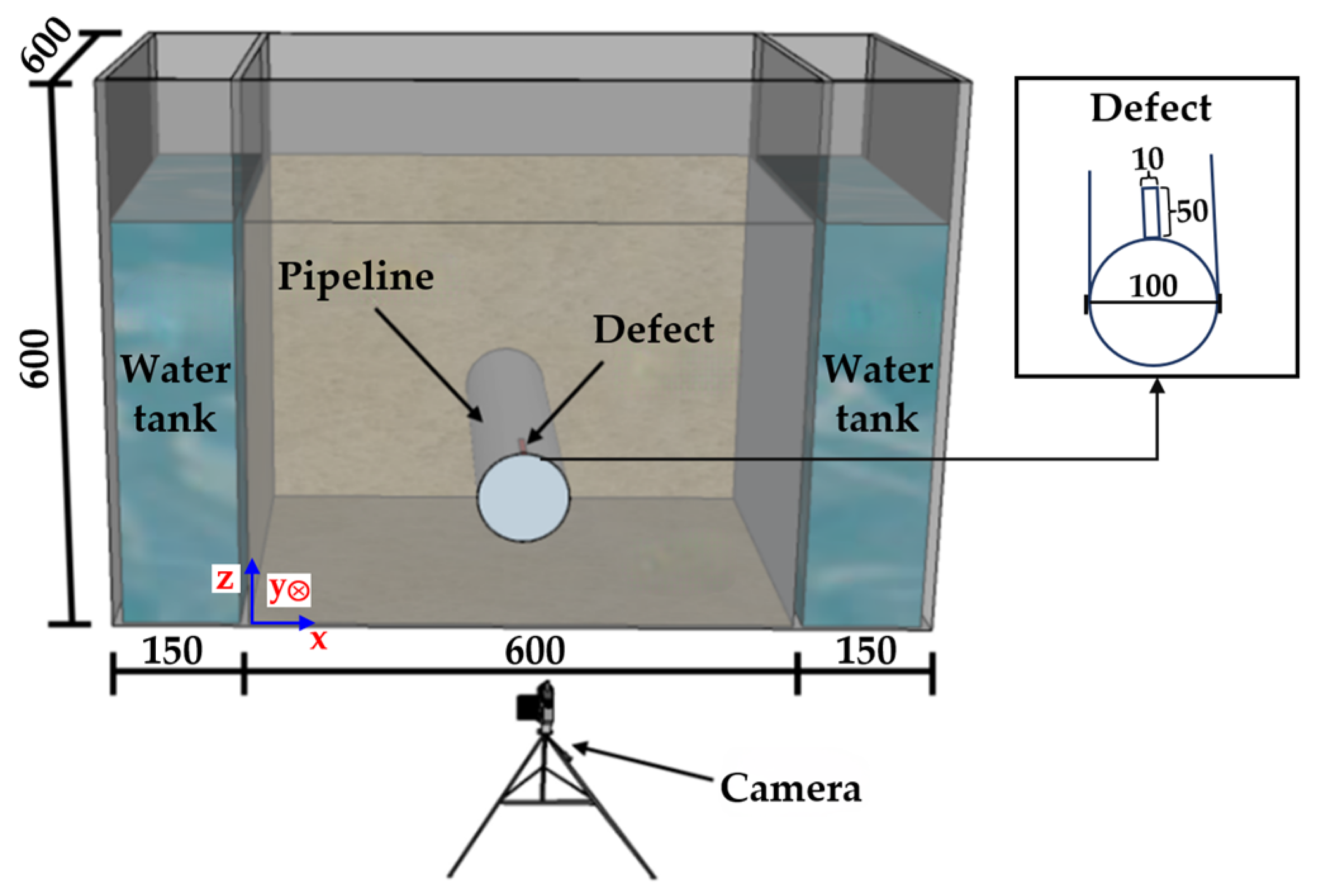
A custom-built visualization apparatus for leakage-induced internal erosion around a buried pipeline was built (Figure 1). It consists of a soil box and two side water tanks separated by a perforated plate covered with a permeable fabric to prevent soil loss. The soil box measures 600 × 600 × 600 mm3, and each side water tank measures 150 × 600 × 600 mm3. The test chamber is made of 10 mm-thick transparent acrylic (PMMA) panels. A circular hole with a diameter of 100 mm was reserved at the center of the long sides on both the front and back of the soil box at a height of 150 mm. During testing, a PVC pipe with an outer diameter of 100 mm was inserted to simulate a buried pipe with an actual diameter of 1 m. The geometric similarity ratio of this test was 1:10. Following Long et al. [30], the particle displacement losses on different x z planes extracted along the longitudinal cracks at the top of the tunnel are the same and consistent with the loss paths observed in the 2D numerical simulation. Therefore, a 50 mm × 10 mm rectangular wall-opening was machined at the pipe crown to simulate a longitudinal defect. The leakage-induced internal erosion can be idealized as plane strain and simulated using a 2D CFD-DEM approach, which substantially improves the efficiency of the subsequent numerical analysis.
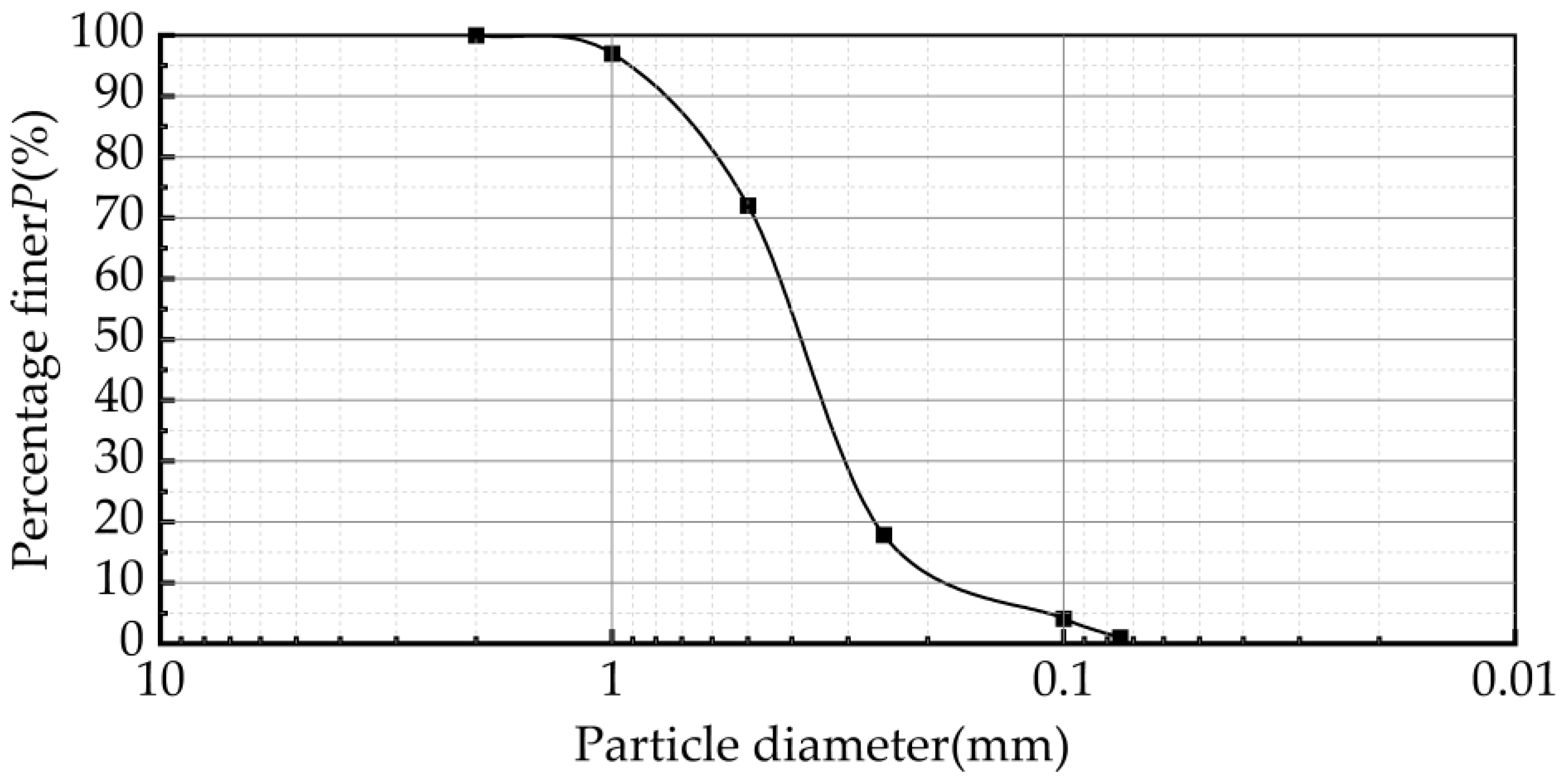
Sand was sampled from the Zhongmou Yellow River Irrigation District. The material was sieved to a maximum particle size of 2 mm. The main physical–mechanical properties are listed in Table 1. The grain-size distribution of the sand is shown in Figure 2, with a coefficient of nonuniformity Cu = 2.5 and coefficient of curvature Cc = 1.11; the sand is poorly graded and thus susceptible to leakage-induced internal erosion under groundwater seepage.

2.1.2. Experimental Procedure

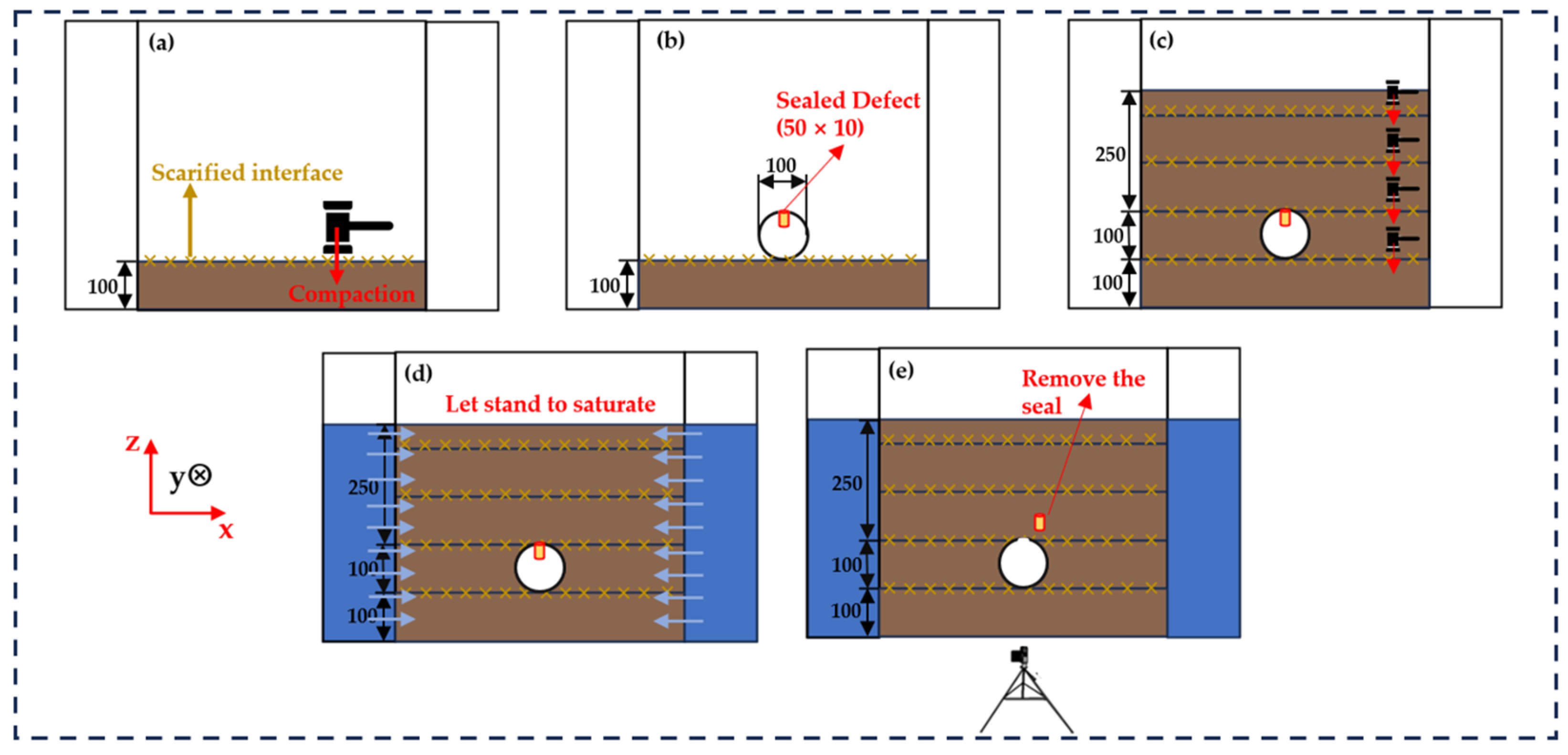
The sand was placed in the soil box by layered deposition and compaction, with a lift thickness of 10 cm. The surface of each lift was scarified to ensure good interlift contact (Figure 3a). After the first lift was completed, a PVC pipe with a pre-cut wall-opening defect was inserted and the defect was temporarily sealed (Figure 3b). Filling continued until the burial depth reached 25 cm (i.e., 2.5 × the pipe diameter), at which point placement stopped (Figure 3c). Water was then added to the side tanks to a level flush with the top of the soil box, and the specimen was allowed to stand to achieve saturation (Figure 3d). Finally, a video camera was positioned, the seal at the defect was removed, and the test was initiated while video-recording the process (Figure 3e).
The natural water content of the test sand is 8.4% (Table 1), which is reported only as an index property. Because the model box test was conducted under fully saturated conditions and the initial specimen state was controlled by the void ratio after saturation, the natural water content was not used as a specimen preparation parameter and was not involved in the subsequent numerical simulations. Based on the measured void ratio after saturation of approximately 0.61 (essentially consistent with the natural void ratio) and the minimum and maximum void ratios taken as 0.53 and 0.84, respectively, the relative density of the sand in the model box is calculated to be about 74%, indicating a dense state, corresponding to a dry density of approximately 1.67 × 10³ kg·m−3.

2.2. Numerical Simulation Method for Internal Seepage into Pipes

2.2.1. Fundamental Principles of CFD-DEM

The discrete element method (DEM) is a particle-based simulation approach. By alternating the force–displacement law with Newton’s second law, the velocity and position of each particle are updated at every time step. In PFC, the equations of motion for a single particle can be written as follows:
m d v p d t = F c + F f p + m g   ,
I p d ω p d t = M c + M f p
where m is the particle mass (kg); v p is the translational velocity (m·s−1); ω p is the angular velocity (rad·s−1); F c is the contact force accounting for particle–particle and particle–wall interactions (N); F f p is the fluid–particle interaction force (N); g is the gravitational acceleration (m·s−2); I p is the particle moment of inertia (kg·m2); and M is the torque acting on the particle (N·m).
In DEM simulations, when particles are idealized as circles in 2D or spheres in 3D, it is essential to account for rolling resistance [31]. Previous studies have shown that adopting a linear rolling resistance model can satisfactorily reproduce the macroscopic mechanical response of real sand [32,33]. Therefore, in this study a linear rolling resistance contact model is employed; this model augments the linear contact model by adding a rolling resistance torque to represent the rotational constraint between particles, and its formulation is given as follows:
M r t r i a l = M r o l d k r Δ θ b ,
k r = k s R ¯ 2 ,
M r n e w = M r t r i a l , M r t r i a l μ r R ¯ F n μ r R ¯ F n M r t r i a l M r t r i a l , o t h e r w i s e ,
where M r o l d is the rolling resistance torque at the previous time step (N·m); M r t r i a l is the trial rolling resistance torque at the current time step (N·m); M r n e w is the updated rolling resistance torque at the current time step (N·m); k r is the rolling stiffness (N·m); k s is the tangential stiffness (N/m); Δ θ b is the incremental relative rolling rotation at the contact (rad); μ r is the rolling resistance coefficient (dimensionless); R ¯ is the effective contact radius (m); and F n is the normal contact force (N).
The fluid flow obeys Darcy’s law; combined with the continuity equation, this yields the Laplace equation (Equation (6)) for the hydraulic head distribution in a 2D steady seepage field. As PFC does not include a fluid solver, the CFD module solves the flow using the FiPy finite-volume solver.
K x 2 h x 2 + K z 2 h z 2 = 0   ,
where K x and K z are the hydraulic conductivities along the x and z -axes (m·s−1); h x and h z are the hydraulic gradients along the x - and z -axes (dimensionless).
The permeability coefficient ( K ) was determined from the void ratio of the granular material using the Kozeny–Carman equation [34] as follows:
K = 1 C 0 S s 2 γ w μ e 3 1 + e ,
where C 0 is the Kozeny constant, typically taken as 5.0 for clean sand [35]; S s is the specific surface area of solids per unit volume (m−1), taken as 6 / d p , where d p is the particle diameter (m); γ w is the unit weight of the fluid (water) (N·m−3); μ is the dynamic viscosity of the fluid (water) (Pa·s); and e is the void ratio (dimensionless).
The void ratio can be further converted to porosity; thus, K can be expressed as follows:
K = 1 C 0 S s 2 γ w μ n 3 ( 1 n ) 2 ,
where n is the porosity (dimensionless).

2.2.2. Mechanism of CFD-DEM Coupling

The fluid–particle interaction force consists of drag and other hydrodynamic components; prior studies [36,37] indicate that the latter are negligible compared with drag. In this work, drag is treated as an equivalent seepage force, so the drag on a single particle is computed as follows:
F f p = V p γ w i ,
where V p is the particle volume (for PFC2D, V p equals the particle area), with units of m3 (3D) or m2 (2D); γ w is the unit weight of water (N·m−3); and i is the hydraulic gradient (dimensionless).
The seepage simulation proceeds as follows. A DEM model is first established; the fluid domain is meshed in Gmsh. Particles are identified and binned by their host fluid cells to obtain the local porosity, which is then converted to hydraulic conductivity. The hydraulic head field is solved with FiPy and passed to the particles via FISH. The particles then move under the combined action of seepage force and gravity, initiating the leakage-induced internal erosion process.

2.2.3. Development of the Coupled Model

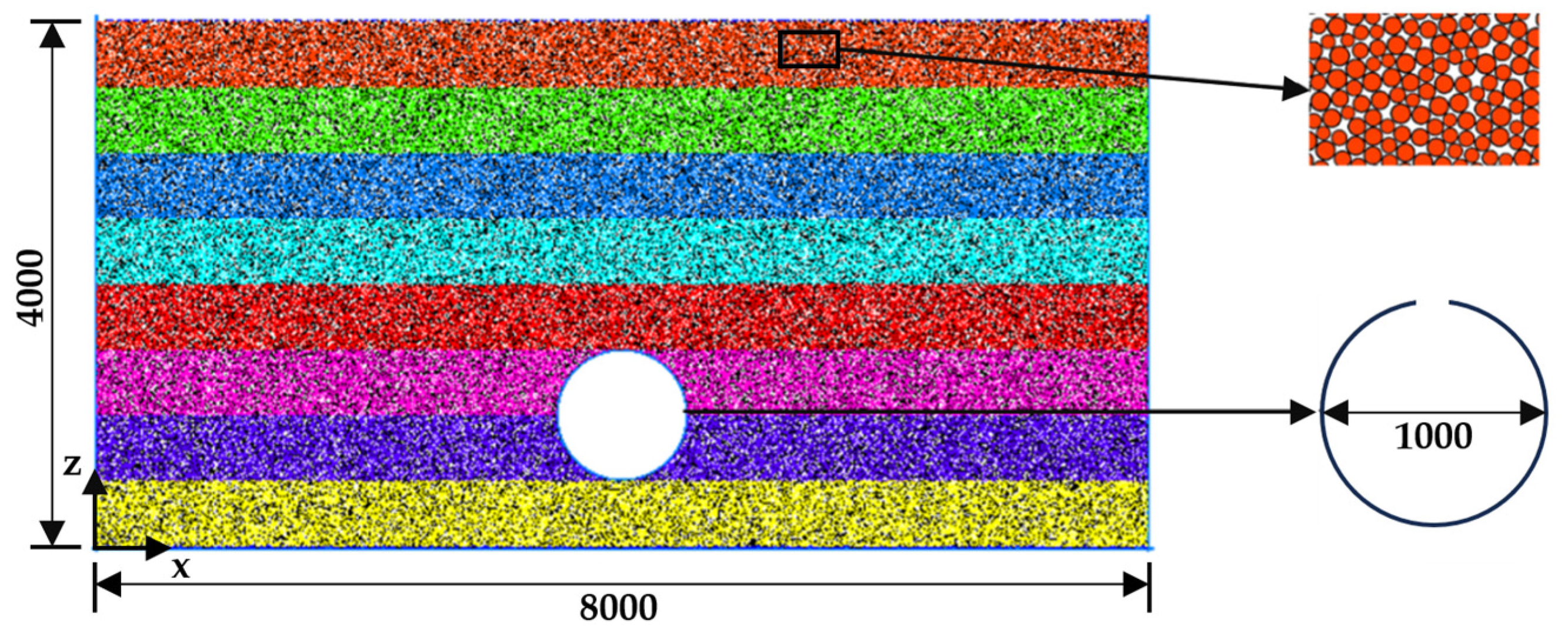
A stratigraphic model (Figure 4) was built using the discrete element software PFC2D, version 5.0 (Itasca Consulting Group, Inc., Minneapolis, MN, USA). After several trial runs, the model size was set to 8000 × 4000 mm; the pipe inner diameter is 1000 mm, with a burial depth of 2500 mm (i.e., 2.5D, where D denotes the pipe diameter). To balance computational efficiency and accuracy, the simulation used the median–limit grain-size range from the tests (0.30–0.45 mm). In the DEM model, soil particles were scaled by a factor of 40, yielding particle sizes of 12–18 mm in the numerical domain; additionally, the defect (breach) width was increased by a factor of 10 to allow particles to flow out smoothly.
In the DEM simulations for leakage-induced erosion, two types of damping were employed to ensure numerical stability. First, local damping was applied only during the particle generation and pre-equilibration stage to accelerate convergence; its coefficient was set to 0.7 and it was switched off before the leakage-erosion calculations to avoid artificial numerical dissipation. Second, contact viscous damping was included as part of the contact law and remained active throughout the leakage-erosion stage. The normal and tangential viscous damping ratios were both set to 0.2 to suppress numerical oscillations and represent energy dissipation at contacts.
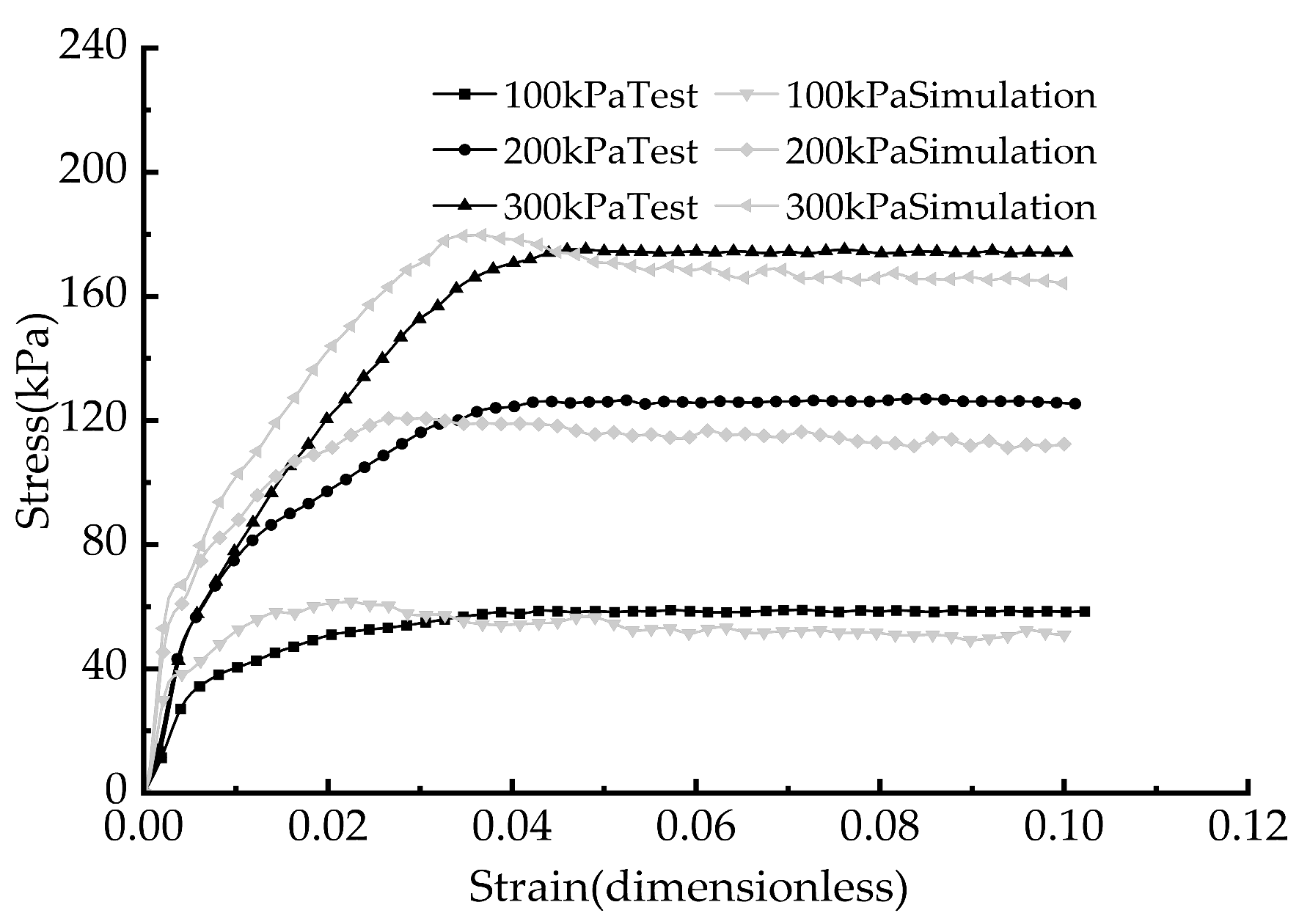
Using PFC, a series of direct shear simulations was performed. Micro-parameters—particle friction coefficient, normal–tangential stiffness ratio, and rolling resistance coefficient—were iteratively tuned (trial-and-error) until the simulated macroscopic response matched that of the tested sand. The resulting stress–strain curves from the numerical and physical direct shear tests are shown in Figure 5; fitting the Mohr–Coulomb strength envelope gives a simulated friction angle of 30.65°, within ±2° of the measured 28.9°. The adopted micro-parameters are listed in Table 2.
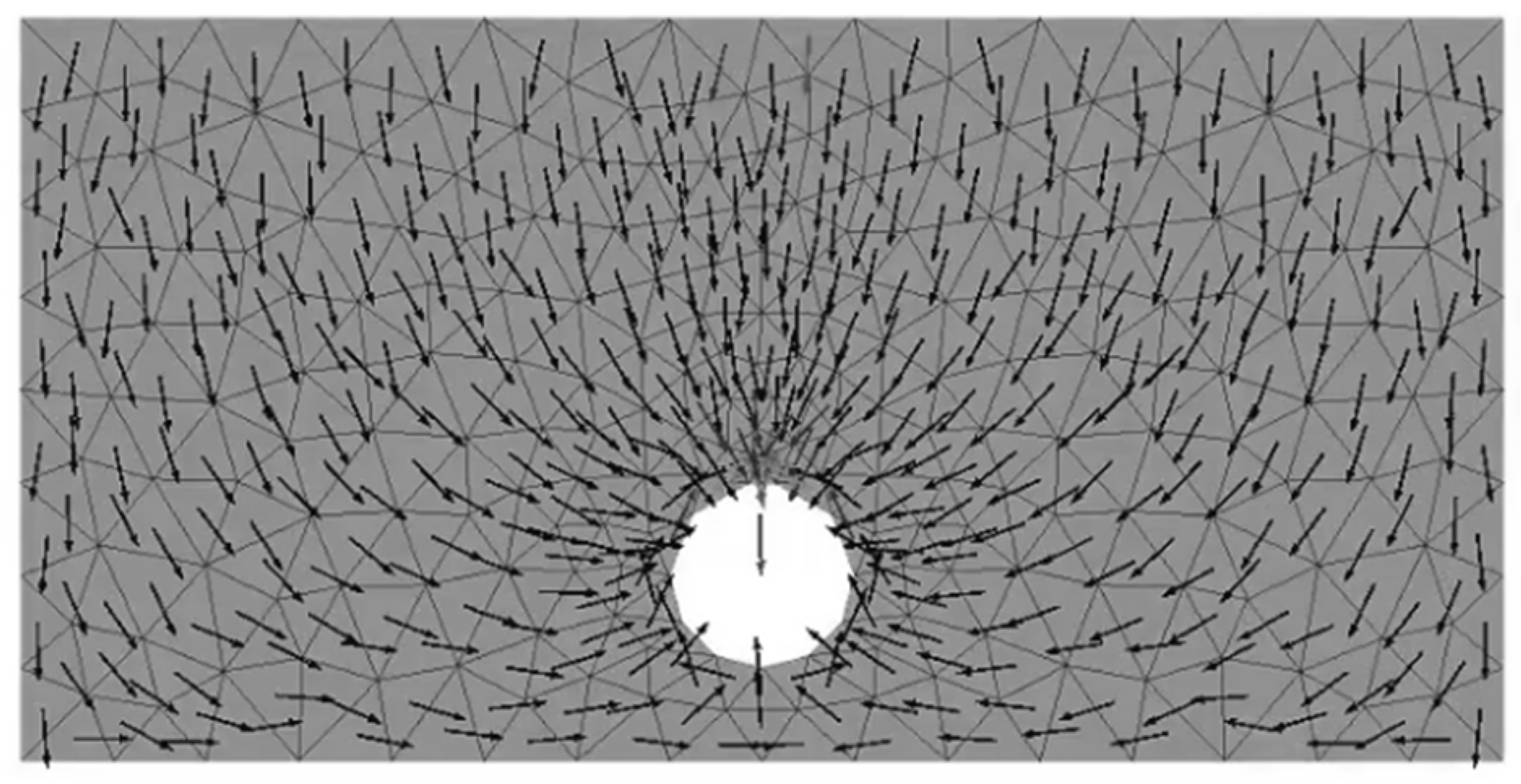
The fluid mesh was generated over the stratigraphic model domain. Fluid–particle interaction was applied to particles as a body force at the cell level. The fluid was assumed to be an incompressible Newtonian fluid with a dynamic viscosity of 1 × 10⁻³ Pa·s, corresponding to water at laboratory temperature. Boundary conditions were set as follows: velocity inlet at the top of the flow field, pressure outlet at the pipe defect, and no-slip rigid walls elsewhere to confine both fluid and solids. The computed flow field (Figure 6) shows water migrating toward the top defect under the imposed hydraulic gradient, consistent with observations.

2.2.4. Validation of the CFD-DEM Coupled Model

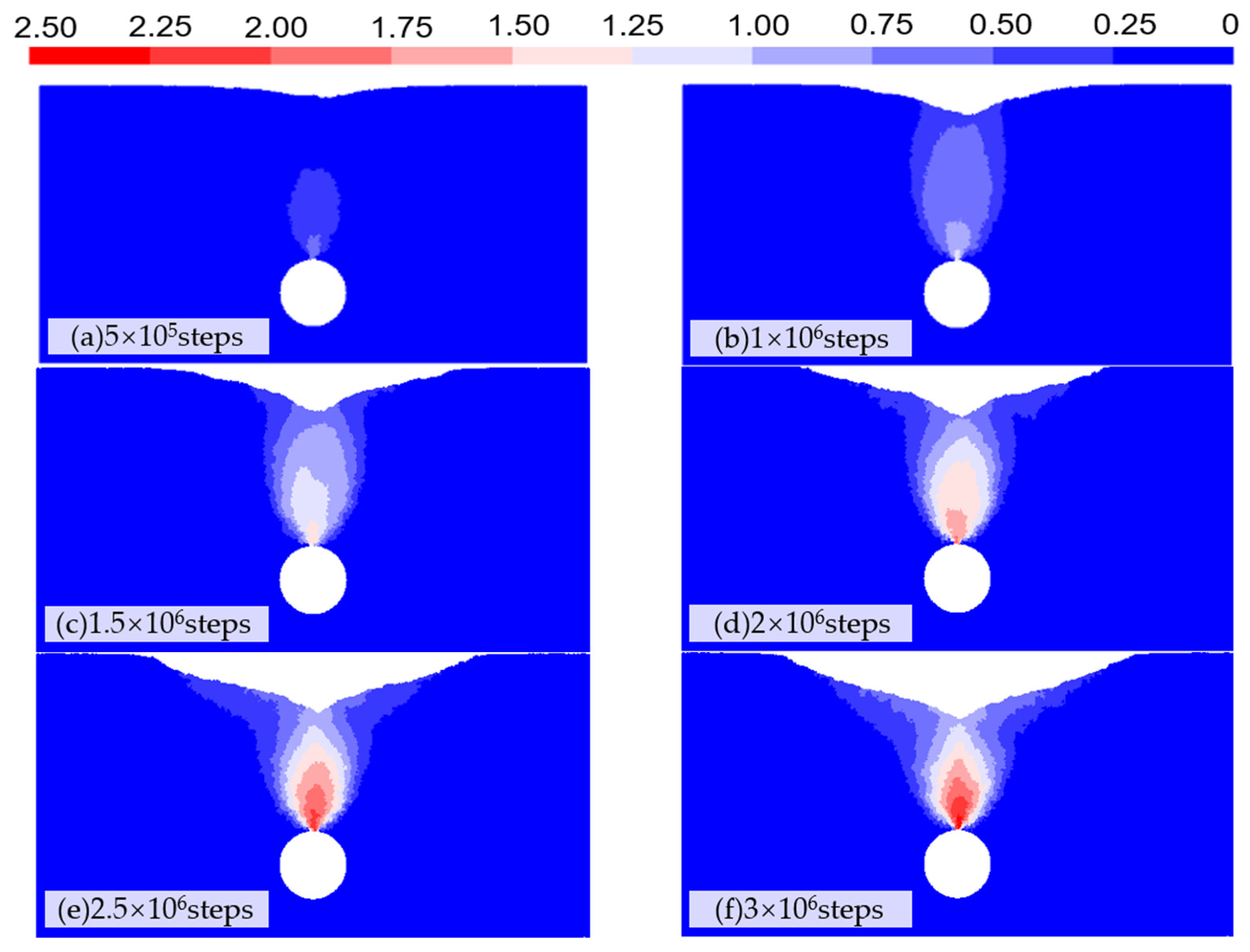
Based on the numerical simulation results, the evolution of road collapse induced by internal leakage from the buried pipe is examined. In the numerical model, the pipe defect is treated as a particle outlet, and particles eroded and detached at the defect are removed from the system so as to more clearly capture the evolution of particle displacements and the loosened zone. Figure 7 presents colormaps of vertical particle displacement at different times (with colors from blue to red indicating increasing downward displacement). In these maps, regions with relatively large vertical displacement (warm colors) are defined as the loosened zone.
At the onset of the simulation, the system enters an initial erosion stage (Figure 7a). During this early seepage phase, only a limited number of particles immediately above the defect undergo downward displacement, forming a small, vertically elongated elliptical loosened zone above the pipe crown. The upper boundary of this zone has not yet reached the ground surface, so the surface soil remains essentially stable, and no observable macroscopic settlement occurs.
With continued internal leakage and erosion, particles above the defect are progressively scoured and transported away, and the elliptical loosened zone expands both vertically and laterally. Once its upper boundary extends to the ground surface, the surface soil begins to move downward slowly, and the system enters a slow-settlement stage (Figure 7b–d). This stage occupies the longest portion of the evolution. A discernible settlement trough develops at the top of the model, and the ground surface gradually transitions from an essentially stable state to one of sustained settlement.
Subsequently, under the combined action of seepage forces and self-weight, the soil within the loosened zone cannot form a stable load-bearing structure; particles inside continue to be removed, while the adjacent soil masses on both sides squeeze inward and subside toward the center, marking the onset of the collapse stage (Figure 7e,f). The large-displacement zone progressively propagates upward from the defect and eventually connects to the ground surface. Surface particles are continuously drawn toward the defect, with some being flushed into the pipe interior, and a well-defined surface collapse pit is finally formed.
The simulated macroscopic evolution of leakage-induced erosion agrees well with the physical tests: the final collapse pit exhibits an inverted-cone profile in front view in both cases. This consistency demonstrates the qualitative validity of the proposed CFD-DEM approach and supports its use for qualitative analysis of the road-collapse process.

3. Results and Discussion

3.1. Experimental Leakage-Erosion Process

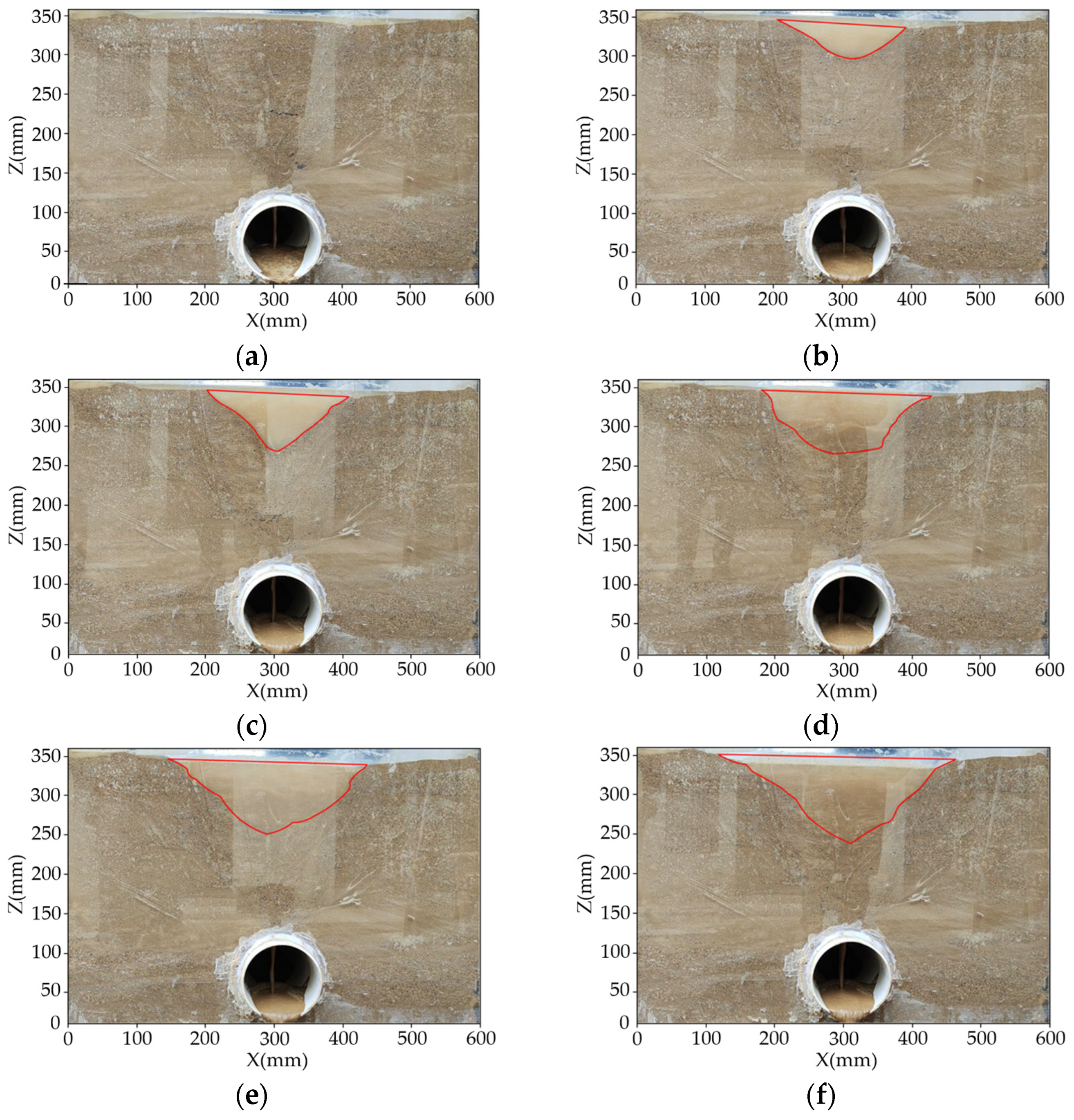
As shown in Figure 8, the experimentally observed leakage-induced internal erosion process can be divided into three stages.
Stage I—Initial erosion (Figure 8a). After removal of the seal, sand in the vicinity of the defect is first entrained into the pipe under the action of the hydraulic gradient, forming a locally downward seepage channel. Arch-shaped cracks develop within the soil layer above the pipe; however, the ground surface as a whole remains essentially intact at this stage, and no observable surface settlement occurs.
Stage II—Slow settlement (Figure 8b–d). As the overlying sand continues to migrate downward to replenish the eroded material, the erosion front propagates upward and reaches the top of the model within a short time. The ground-surface cover progressively loses support and enters a slow-settlement process. The upper sand mass starts to move toward the defect along a nearly smooth potential slip surface. A surface settlement trough first develops over a narrow zone directly above the defect, and its width and depth then continue to increase. High-resolution photographs show that the erosion pit is almost devoid of retained soil, and that the pit walls exhibit a clear outline approximating a funnel shape, indicating that significant internal cavities have formed as a result of leakage-induced internal erosion.
Stage III—Collapse (Figure 8e,f). Soil loss continues, and the zone affected by erosion expands both laterally and downward, mobilizing a larger volume of sand while the pit volume and span keep increasing. At approximately 60 s, the water level has dropped below the ground surface and the pit span has essentially reached its maximum. Thereafter, the water level continues to fall, pore water drains out through the sand pores, and the soil mass progressively desaturates from top to bottom. The outward expansion of the collapse edge is markedly reduced and the collapse geometry becomes nearly stable. Ultimately, the collapse pit assumes an inverted cone shape, and the pit sidewall forms an angle with the horizontal that is approximately equal to the sand’s internal friction angle, suggesting that the sidewalls of the collapse pit develop approximately along potential shear failure surfaces.

3.2. Simulated Leakage-Erosion Process

Laboratory physical tests can reproduce the overall process of leakage-induced internal erosion around buried pipelines, but they cannot resolve the evolution of vertical stress and intergranular contacts, limiting mechanistic insight. Prior studies likewise focus mainly on macroscopic pit morphology. Building on this, the present work systematically analyzes, at the grain scale, how vertical stress and contact networks evolve during leakage erosion and, on this basis, offers qualitative references for monitoring and early-warning discussions.

3.2.1. Vertical Stress Analysis

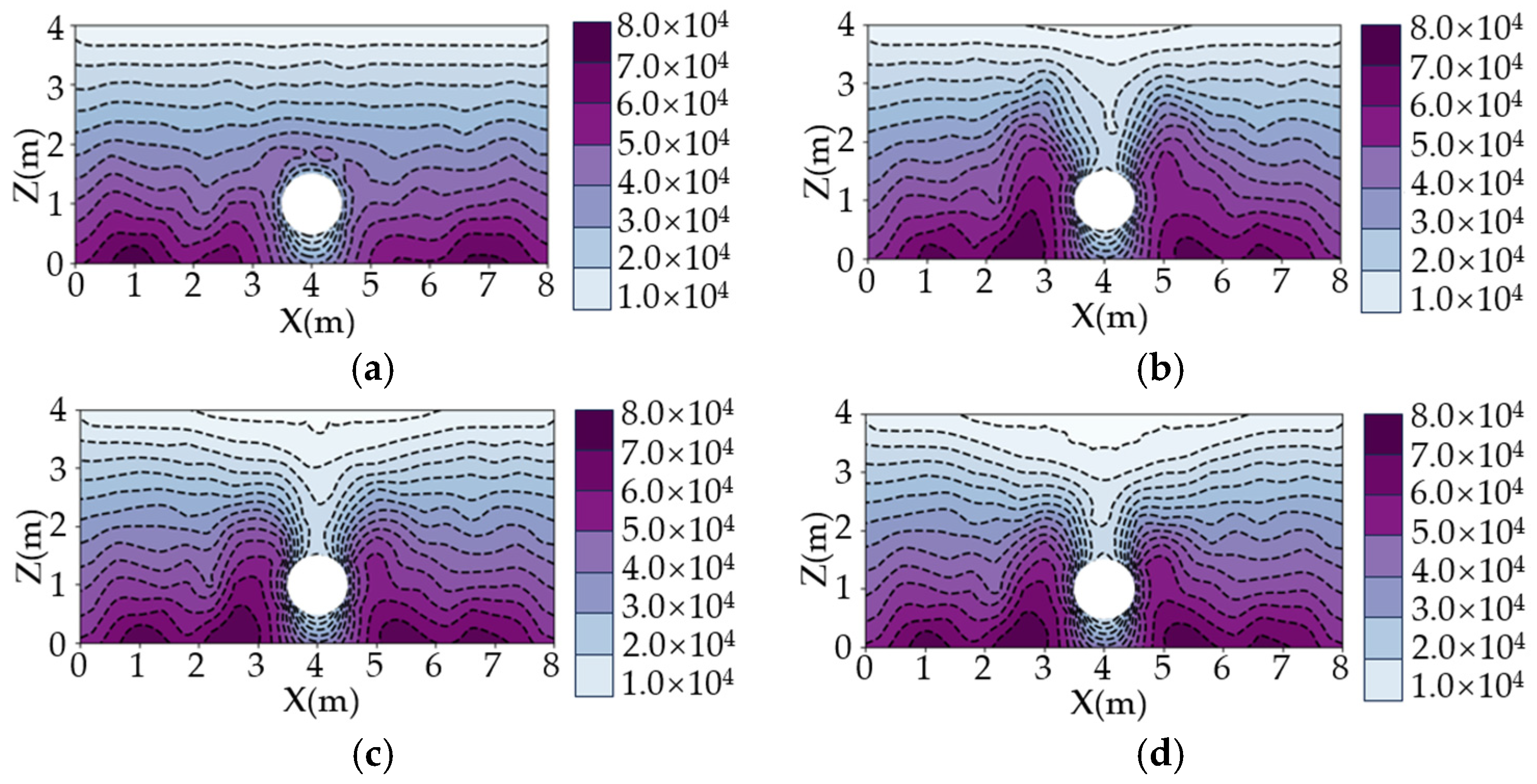
As shown in Figure 9, in the initial stage before leakage (Figure 9a), the vertical stress increases with depth and is essentially uniform at a given elevation above the pipe. Once leakage starts and the system enters a stress-redistribution stage (Figure 9b,c), a concave, symmetric, vertical stress pattern develops above the pipe: the stress directly above the defect drops markedly, whereas it increases on both sides and decays laterally. Near the ground surface the vertical stress change is minimal, but the variation becomes progressively stronger with depth. The side surges arise because, after leakage begins, the seepage force acting on soil particles has a downward component; at the same time, the soil above the defect undergoes larger relative downward displacement than the surrounding soil, imposing downward shear on the adjacent soil. This shear causes local compression and lateral movement, producing the observed stress peaks on both sides of the defect.
Subsequently, in the later stage of erosion (Figure 9d), as the time steps advance, the peak side surge decreases from about 77 to 69 kPa and its vertical position shifts downward (toward smaller z ), from z 2.5 m to z   2.0 m. Thus, both the magnitude and the extent of the surge diminish as leakage-induced internal erosion progresses. This is because continuing erosion causes progressive loss of overburden above the pipe, which lowers the vertical stress, and the expanding loosened zone reduces the relative displacement of the soil above the defect with respect to the surrounding soil, thereby weakening the shear and further attenuating the stress peak.
The pipeline sections adjacent to a wall-opening defect are often the weakest parts of the system. An increase in vertical soil stress above or adjacent to the defect may exacerbate local damage, promote additional particle loss, and foster a vicious cycle that escalates the hazard. In practice, surges in vertical stress (or suitable field proxies such as earth pressure cell readings, strain or acceleration responses, or pore water pressure changes) could be considered as qualitative monitoring indicators: a pronounced surge may signal groundwater ingress and an elevated risk of collapse. Site-specific thresholds should be calibrated, and when exceeded, they could motivate precautionary measures—e.g., temporary traffic management, localized dewatering where feasible, and timely defect sealing—to interrupt the cycle of “pressure increase → damage aggravation → soil loss.”

3.2.2. Particle Contact Analysis

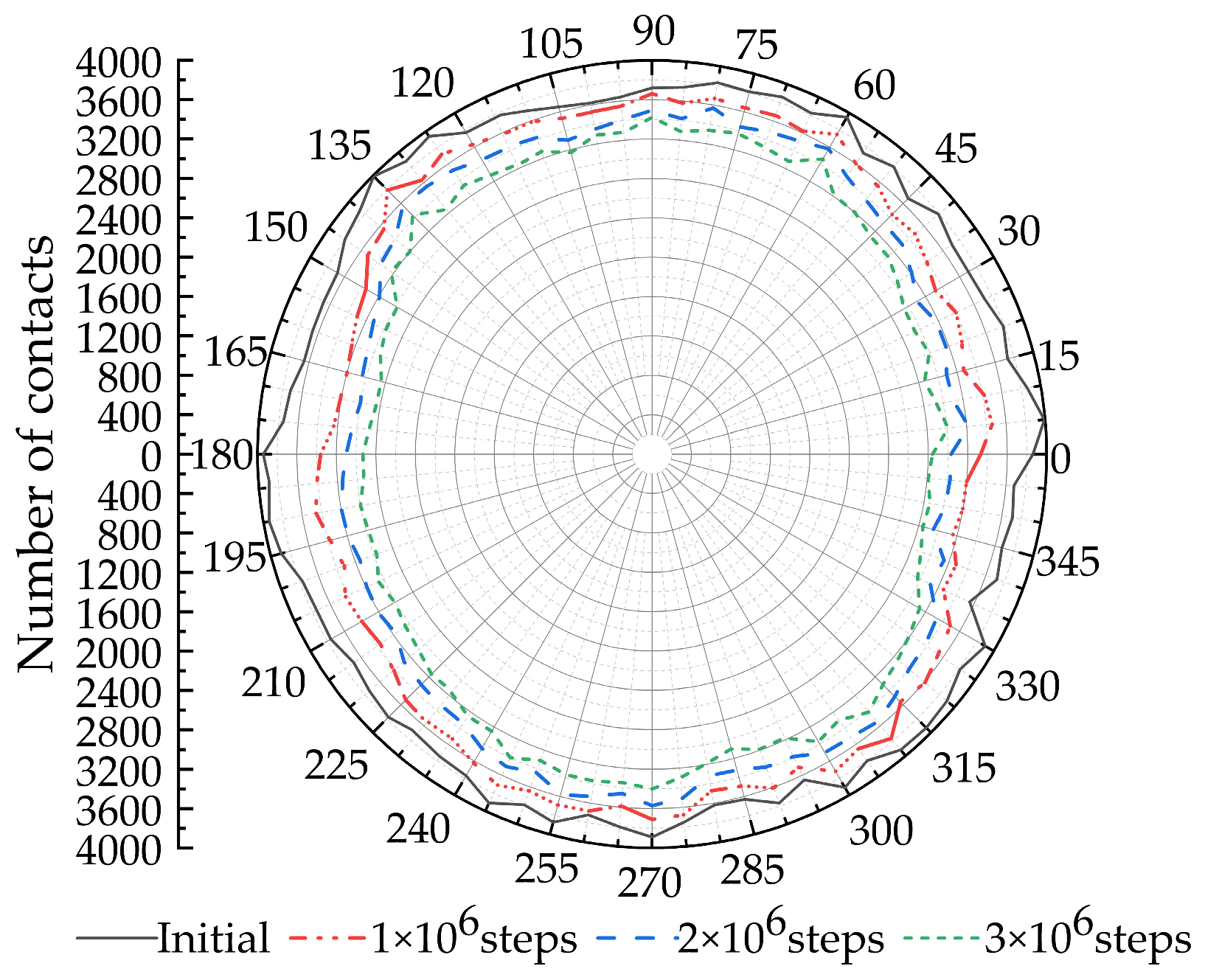
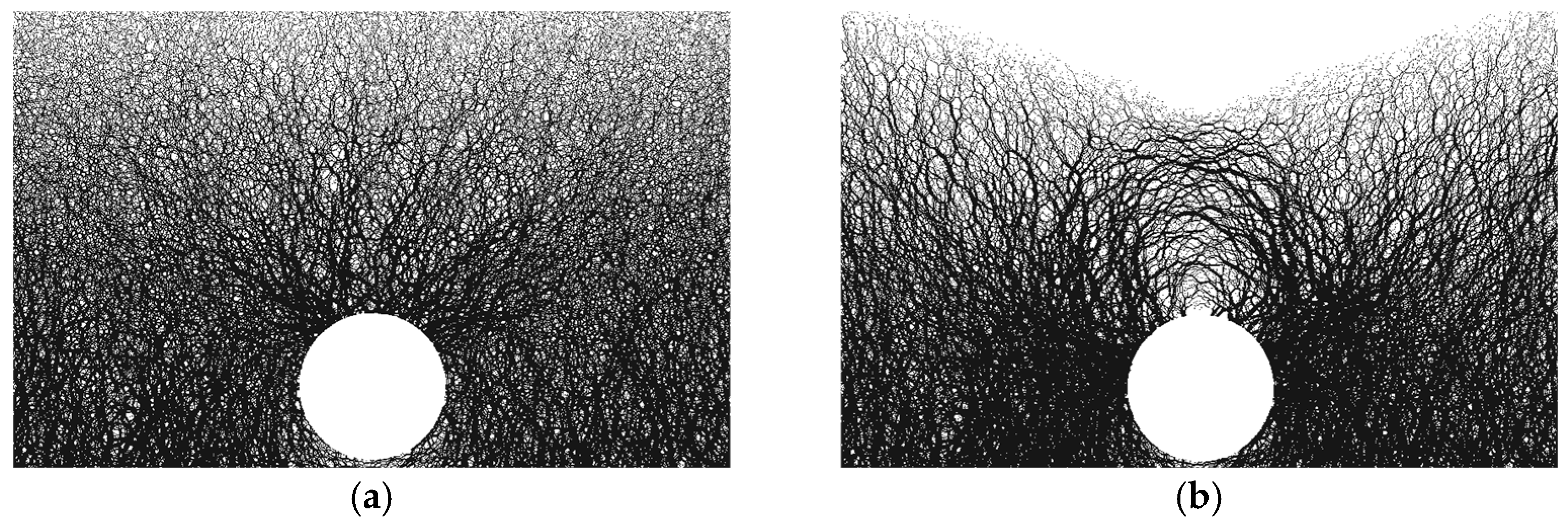
The evolution of intergranular contact topology is a key grain-scale mechanism underlying the macroscopic behavior of soils. Force chains denote the transmission paths of contact forces between particles, with chain thickness indicating force magnitude. Figure 10 presents the directional evolution of interparticle contact counts during leakage-induced internal erosion, and Figure 11 compares force-chain patterns before and after erosion.
Before leakage, contact counts are similar in all directions and force chains are dense, indicating a stable structure. Once leakage starts, contact counts decrease in all directions due to particle loss and loosening of the skeleton; however, the horizontal sector exhibits the largest reduction, revealing pronounced anisotropy. This anisotropy stems from a rotation of force chains toward the horizontal after leakage: above the defect, chains reorient and form arch-like structures, which partially compensate for the weakened vertical support—hence the smaller reduction in contacts closer to the vertical direction. Based on whether force chains undergo such reorientation, the soil can be broadly partitioned into a failure zone and a non-failure zone, whose extent closely matches the loosened zone identified in the particle-displacement contours. While force arches provide alternative load-transfer paths, they may fracture under subsequent impact from overlying particles and fluid; new arches then re-form as erosion progresses. Thus, arch formation and breakage recur throughout the leakage-erosion process.

3.3. Parametric Effects

Given this mechanism, variations in parameters do not change the qualitative evolution pathway—initial erosion → slow settlement → collapse; the overall behavior remains consistent with the baseline, while differences manifest mainly in the intensity of erosion and the rate of settlement. The basic settings for the numerical simulation cases are summarized in Table 3:

3.3.1. Effect of Defect Size

Building on the foregoing numerical model, the defect size—defined as the wall-opening width at the pipe crown—was set to 13, 15, and 17 cm to represent varying damage severities. The pipe burial depth was fixed at 2.5 m, and the groundwater level was set at the ground surface.
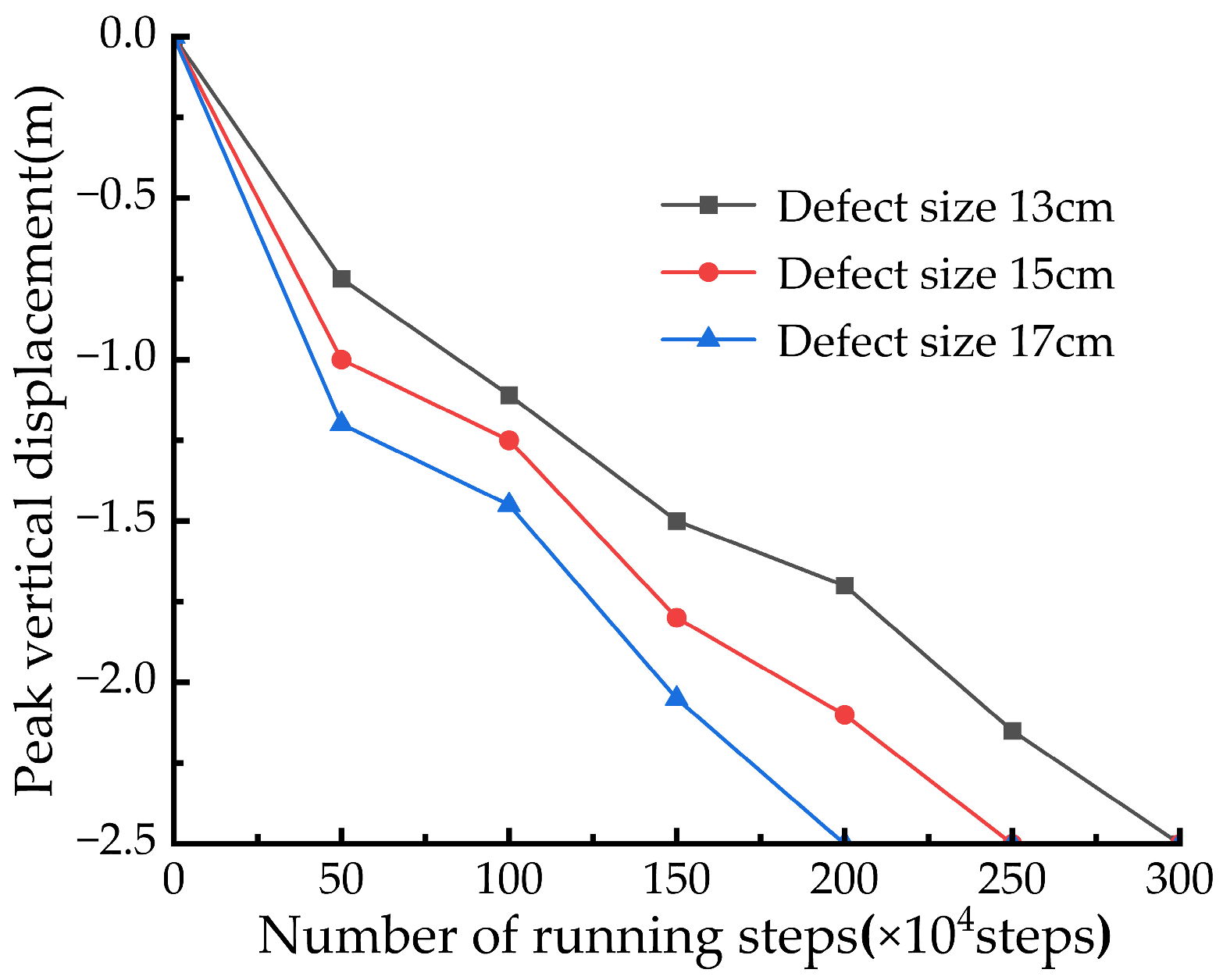
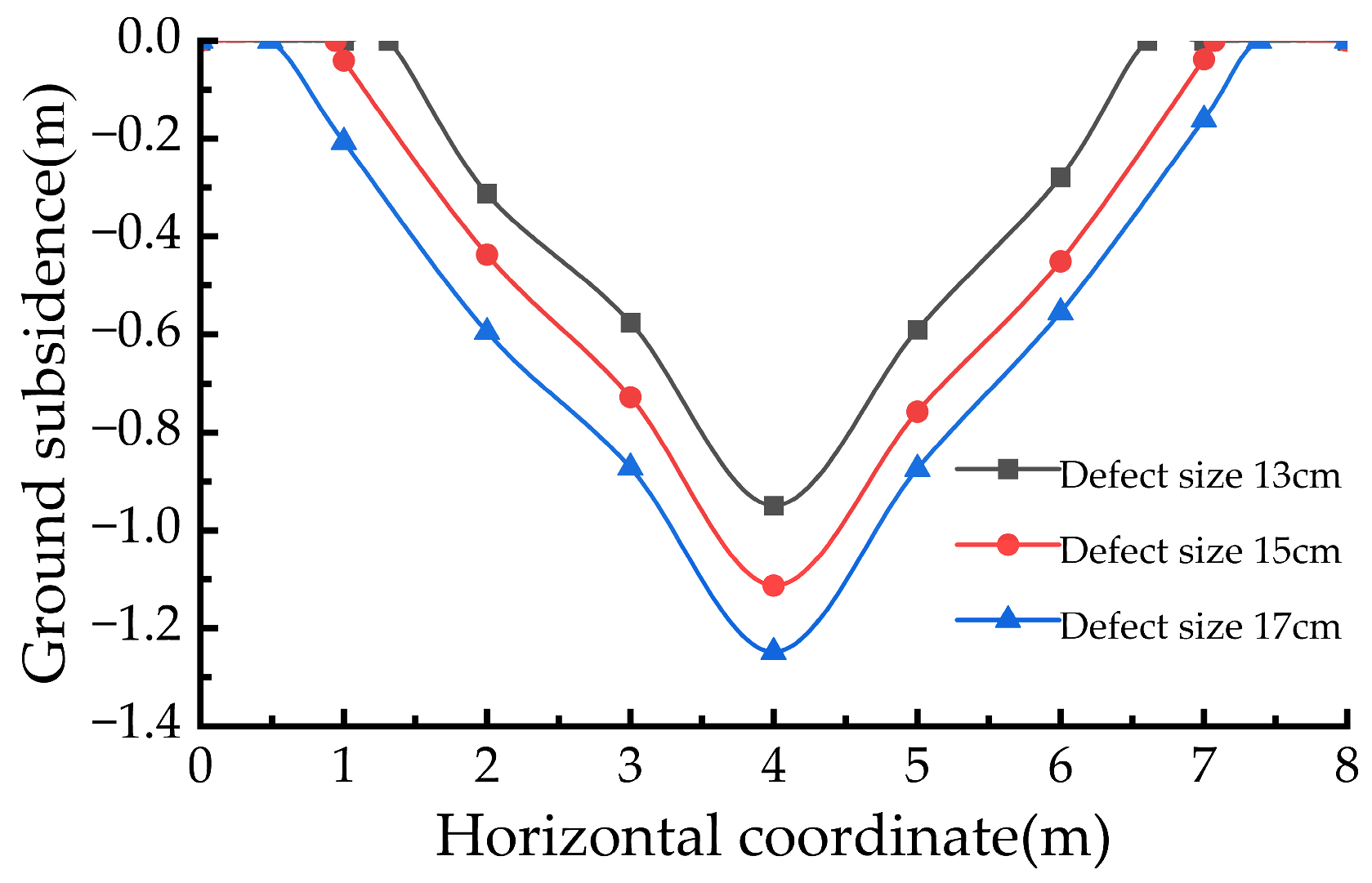
In the simulations, the peak vertical particle displacement at each time step is plotted in Figure 12. As the defect size increases, the peak occurs earlier in time and the vertical displacement rate increases. The ground-surface settlement profiles extracted at 3 × 10⁶ steps (Figure 13) show that the maximum settlement grows with defect size; for example, the 17 cm case is about 32% higher than the 13 cm case. The larger collapse pit also indicates a greater cumulative particle loss. Mechanistically, enlarging the defect provides a wider discharge pathway, increases the throughflow in the pipe, and thereby enhances the fluid’s particle-entrainment capacity.
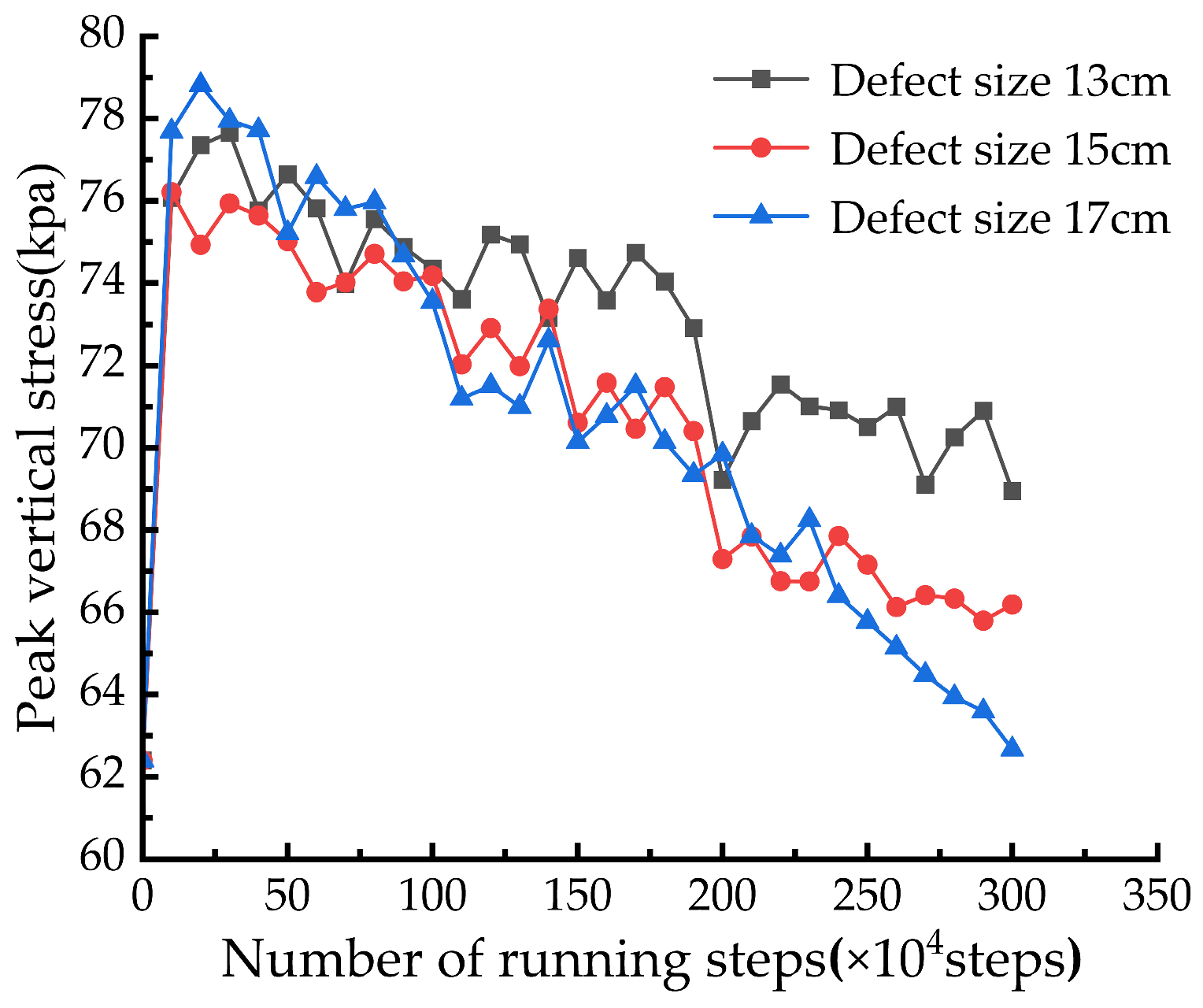
As shown in Figure 14, the domain-wide peak vertical stress attained during the surge varies little among defect sizes. However, the post-surge decay differs markedly: for the two smaller-defect cases, the decay curves exhibit an inflection at approximately 2 × 10⁶ steps, whereas for the large-defect case no clear inflection appears even by 3 × 10⁶ steps; moreover, the final peak vertical stress decreases as defect size increases. A plausible explanation is that a larger defect intensifies particle loss, loosening the granular skeleton and reducing interparticle contacts. In addition, the loss persists longer for the large defect and remains incomplete at 3 × 10⁶ steps, leading to a continued decline in the peak vertical stress.
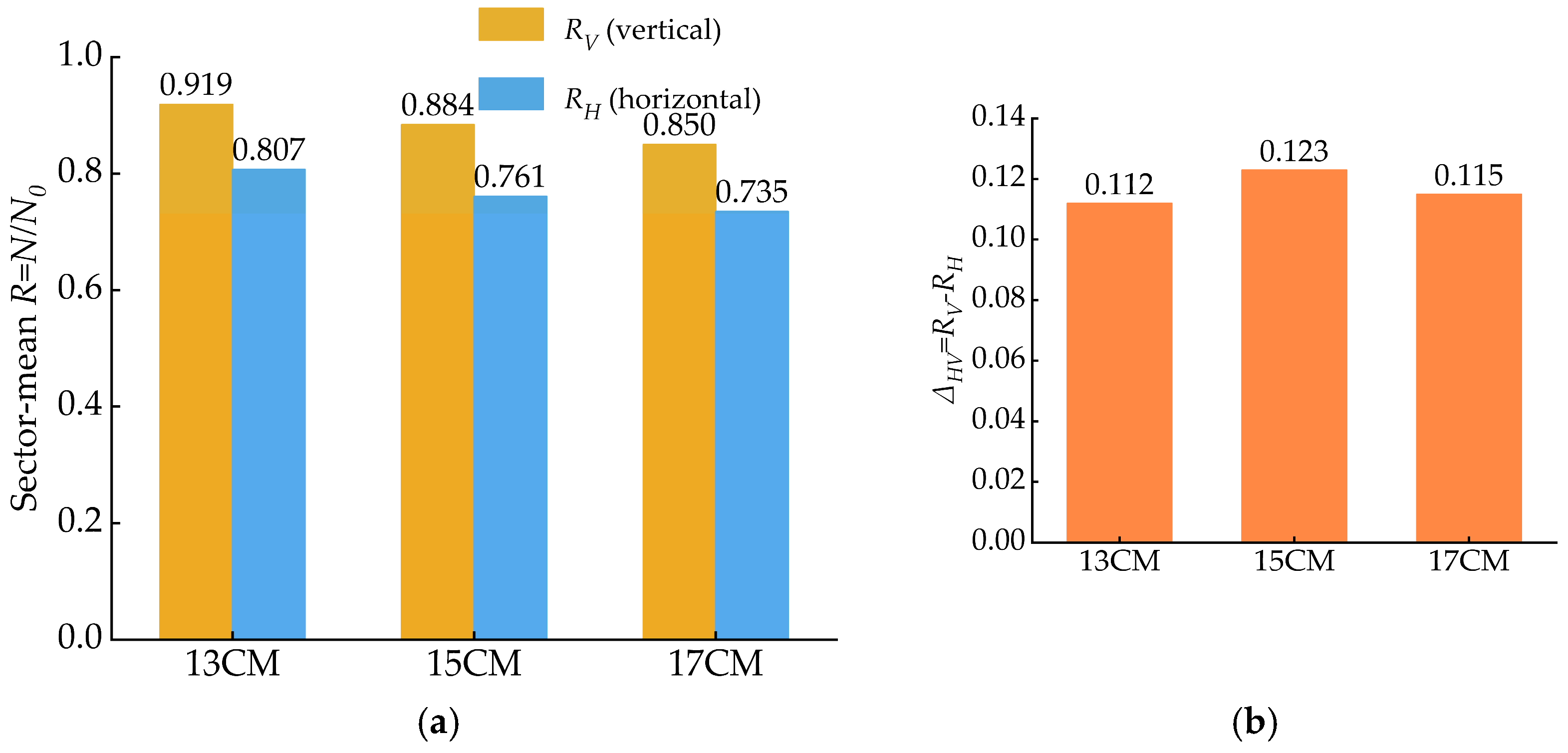
At 3 × 10⁶ steps, contact counts N were sampled every 5° within the horizontal sectors (0° ± 15° and 180° ± 15°) and the vertical sectors (90° ± 15° and 270° ± 15°). Let the initial counts be N 0 . We define the directional normalized retention as follows:
R = N N 0 ,
The sector means are denoted by R H and R V for the horizontal and vertical sectors, respectively, and the anisotropy metric is as follows:
Δ H V = R V R H ,
where Δ H V indicates a lower horizontal retention (i.e., a larger horizontal contact loss). As shown in Figure 15, both R H and R V decrease monotonically with increasing defect width; Δ H V peaks at 15 cm and slightly declines at 17 cm. A plausible mechanism is that enlarging the defect from 13 cm to 15 cm primarily strengthens horizontal flow paths, leading to preferential horizontal loss, whereas further enlargement to 17 cm intensifies disturbance in the vertical sector and accelerates its contact loss, thereby causing the slight reduction in Δ H V .
Increasing defect size both accelerates and intensifies internal erosion. In practice, defects evolve over time; therefore, examining their size evolution helps project the progression of field conditions and the associated risk level.

3.3.2. Effect of Groundwater Level

The numerical settings remained as previously described: the defect was placed at the pipe crown with a width of 15 cm, and the pipe burial depth was fixed at 2.5 m. Only the groundwater level (GWL) was varied, being set to 0 m, 3 m, and 4 m, respectively. In this study, GWL denotes the waterline elevation measured upward from the model bottom.
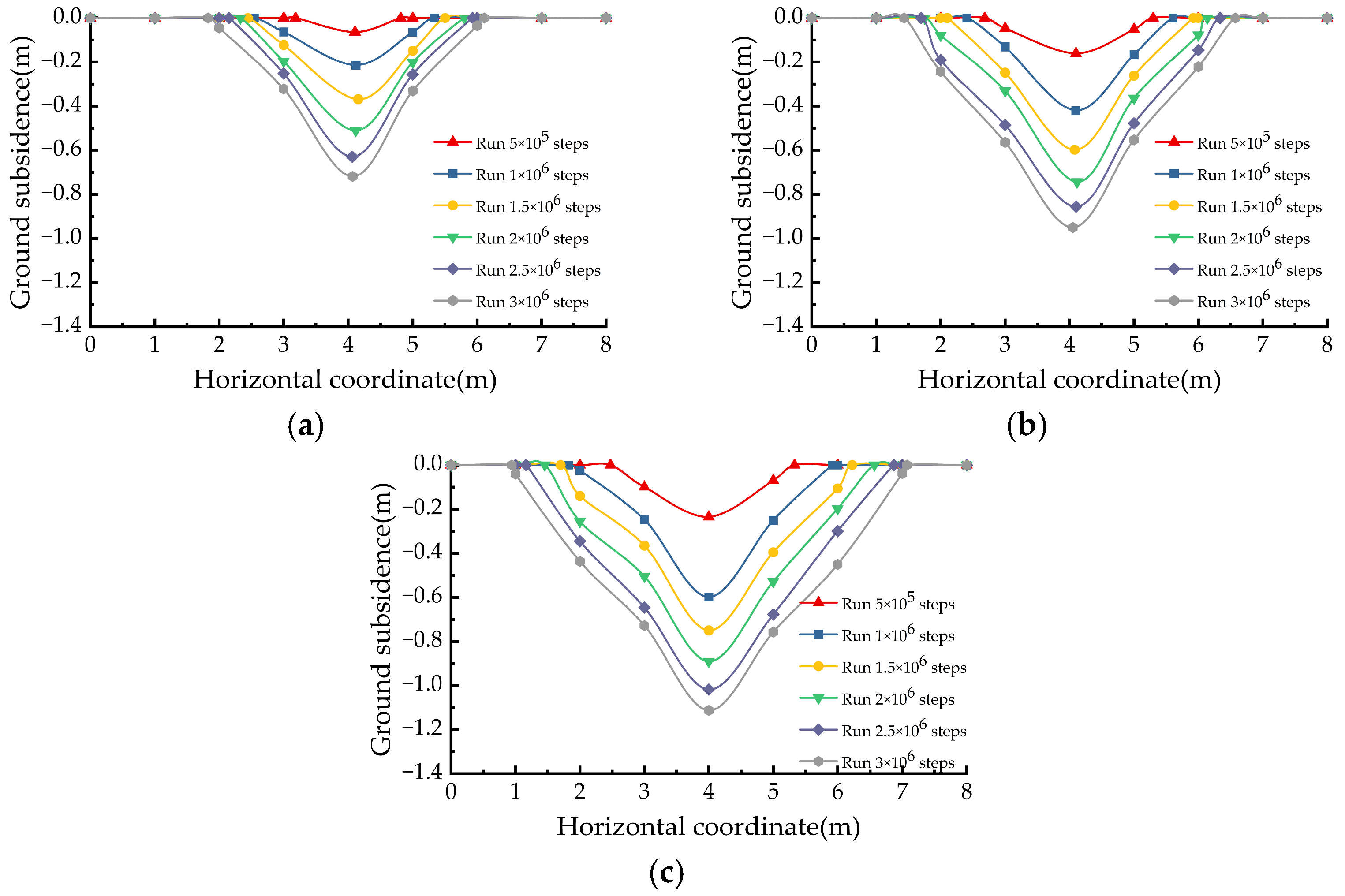
As shown in Figure 16, the evolution of collapse-pit morphology differs across groundwater levels. Comparing case (a) with cases (b) and (c) indicates that the presence of groundwater accelerates internal erosion induced by groundwater ingress: without groundwater, particles are removed primarily under gravity, whereas groundwater introduces a seepage force; the combined action of gravity and seepage enhances particle loss. In addition, partial or full saturation reduces effective stress and shear strength, making erosion more likely. With rising groundwater level, the peak domain-wide vertical particle displacement and the maximum surface settlement at the same time step both increase. From Figure 16, at 3 × 10⁶ steps the maximum surface settlement at GWL = 4 m exceeds those at 0 m and 3 m by 54.2% and 16.8%, respectively. Mechanistically, a higher groundwater level raises the hydraulic gradient and thus the seepage force; the fluid velocity at the defect increases, entraining more particles, which increases soil porosity and permeability, further amplifying seepage and sustaining particle loss—ultimately producing a deeper and wider collapse pit under high groundwater conditions.
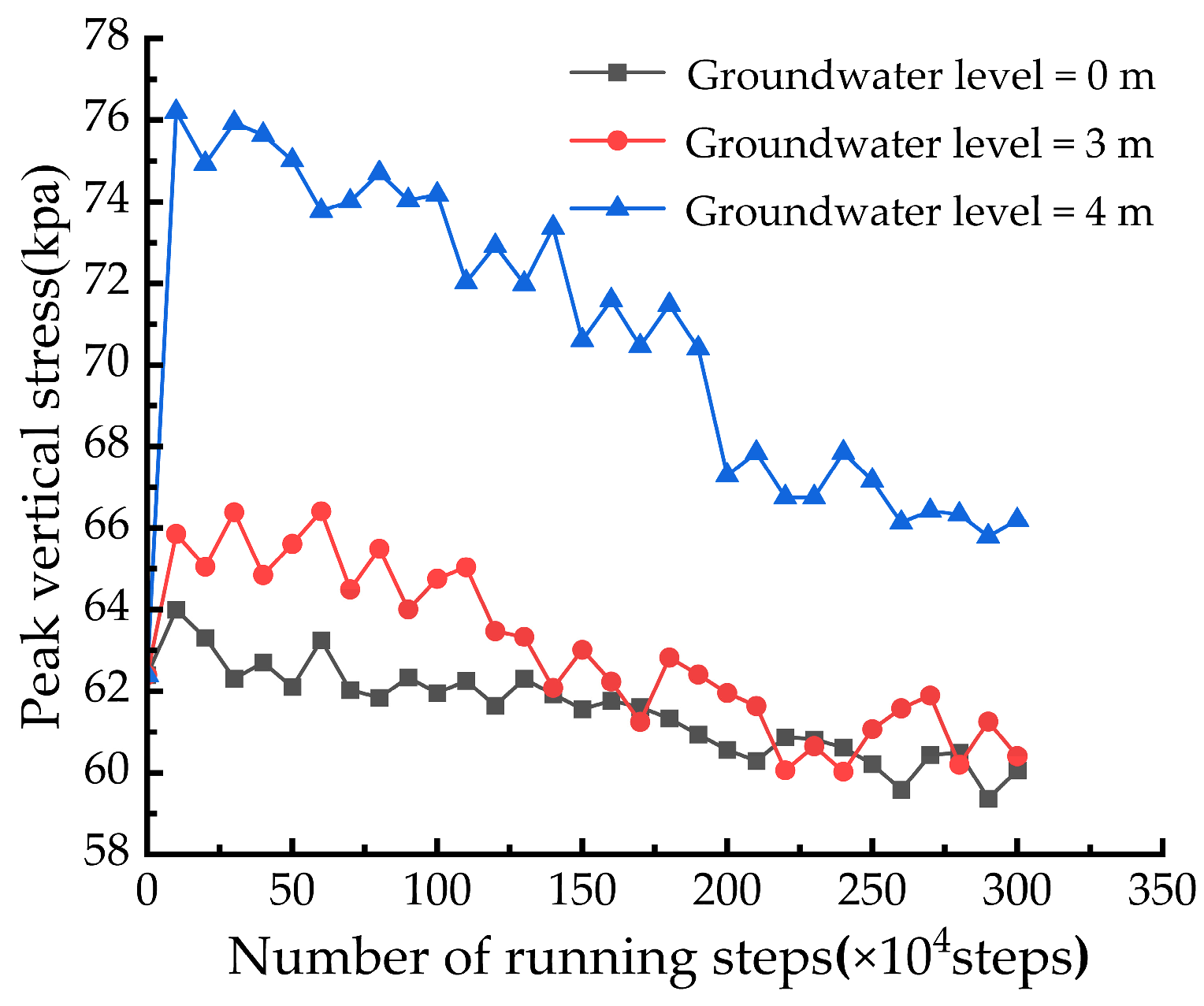
As shown in Figure 17, the domain-wide peak vertical stress under all three groundwater-level (GWL) conditions exhibit a sharp surge at the onset of internal erosion induced by groundwater ingress, followed by a gently fluctuating decline over time. The surge and subsequent drop are most pronounced at GWL = 4 m, with the peak decreasing from 76 kPa to 66 kPa; they are intermediate at GWL = 3 m (from 67 kPa to 60 kPa) and smallest at GWL = 0 m (from 64 kPa to 60 kPa). Mechanistically, a higher groundwater level increases the hydraulic gradient and thus the seepage force, which possesses a downward component above the defect and acts in the same direction as self-weight, producing an initial hydraulic surcharge. Concurrently, local densification near the defect and the transient formation of arching load paths concentrate load toward the “shoulder” regions, further elevating the peak. The greater the groundwater level, the stronger these two effects and the higher the peak. Subsequently, as erosion progresses, the overburden above the pipe thins and the loosening zone expands; these transient arches fail repeatedly, the load-bearing skeleton becomes sparser, and the peak vertical stress declines with fluctuations.
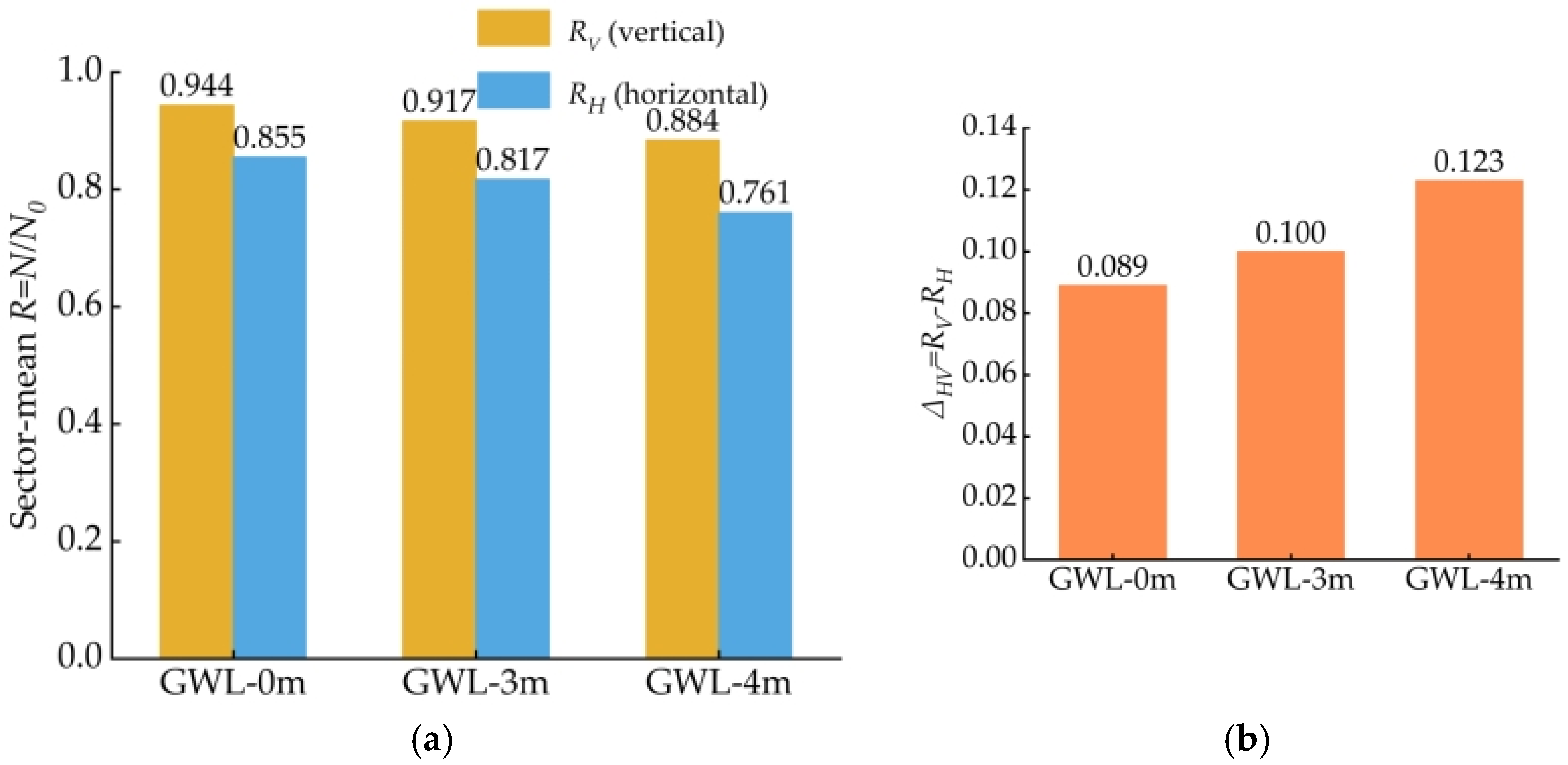
At 3 × 10⁶ steps, the variations of R V , R H , and Δ H V under different groundwater levels are shown in Figure 18 (definitions as in Section 3.3.1). With rising groundwater level, the sector-mean contact retention in the horizontal and vertical sectors ( R V and R H ) both decrease, indicating overall intensification of contact loss; meanwhile, Δ H V increases monotonically, implying that horizontal degradation outpaces vertical degradation and that anisotropy is progressively amplified during leakage-induced erosion. Relative to GWL = 0 m, at GWL = 4 m R V and R H decrease by approximately 6.4% and 11.0%, respectively, while Δ H V increases by about 38.2%. This trend is concomitant with the enhancement of seepage force and the reduction in effective stress at higher groundwater levels; together, these effects drive concurrent declines in R H and R V , with a larger horizontal loss, thereby causing Δ H V to increase steadily with groundwater level.

3.4. Limitations and Future Prospects

This study integrates physical tests and numerical simulations to analyze internal erosion induced by groundwater ingress around buried pipelines in water-rich sands; however, several limitations remain. First, the study relies primarily on numerical simulations to interrogate vertical stress redistribution and intergranular contact evolution during leakage-induced internal erosion, whereas the laboratory physical model was designed mainly as a benchmark for validating the numerical approach; consequently, only a single representative test case was conducted, without systematic variation in hydraulic and geotechnical parameters or comprehensive in situ measurements of pore pressure, stress, or contact evolution. Second, due to computational constraints, only 2D simulations were performed, which depart from the inherently 3D nature of the problem and thus support mainly qualitative interpretation. Finally, soil grains were idealized as circular particles in the DEM, neglecting particle shape diversity and gradation effects, which may underrepresent interlocking and self-stabilization behavior. Future work should incorporate realistic (non-spherical) particle shapes and gradations and extend to 3D simulations, complemented by a broader series of physical model tests under varied seepage regimes and soil conditions, with the aim of enabling quantitative analysis and deeper mechanistic insight into internal erosion induced by groundwater ingress.

4. Conclusions

In recent years, ground collapses induced by pipe leakage have occurred with increasing frequency, and such events are often more severe in water-rich sand layers due to their poor self-stability. In this study, we investigated leakage-induced road collapse in water-rich sands by combining physical experiments and numerical simulations. The main findings are summarized as follows:
  • Three-stage evolution. Leakage-induced surface instability proceeds in three stages: (1) initial erosion—soil near the defect is the first to be lost into the pipe, arch-shaped cracks appear above the pipe crown, and no surface settlement occurs; (2) slow settlement—once erosion reaches the ground surface, the overlying sand moves toward the defect along a smooth potential slip surface, and the pit maintains a funnel-like outline; (3) collapse—soil loss continues while the disturbed zone expands laterally and downward, so the pit volume and span grow. The final pit geometry is inverted-cone-shaped.
  • Stress and force-chain evolution. After leakage onset, the vertical stress above the pipe exhibits a concave pattern (low over the defect and high at the “shoulders”); the shoulder stresses surge initially and then decline as the loosening zone expands and the overburden thins. During leakage, the intergranular force-chain network rotates to horizontally dominated paths, forming transient arching that repeatedly forms and breaks—a key grain-scale signature of internal erosion-induced collapse.
  • Parameter effects (defect size and groundwater level). Increasing defect size and groundwater level both accelerate internal erosion and magnify settlement. Anisotropy versus defect size shows a peak at 15 cm followed by a slight relaxation, whereas anisotropy increases monotonically with groundwater level. Mechanistically, the former acts mainly by enlarging the geometric flow channel (increasing discharge), and the latter by raising the hydraulic gradient; both amplify seepage force, leading to a sustained decline in the domain-wide peak vertical stress and ultimately a deeper and wider collapse pit.

Author Contributions

N.W.: Conceptualization, Methodology, Funding Acquisition, Project Administration; P.Y.: Conceptualization, Methodology, Writing—Original Draft; X.W.: Conceptualization, Methodology, Writing—Review and Editing; J.Z.: Conceptualization, Methodology; H.F.: Conceptualization, Methodology. All authors have read and agreed to the published version of the manuscript.

Funding

This research was funded by the National Natural Science Foundation of China, grant number 52479111.

Data Availability Statement

The original contributions presented in this study are included in the article. Further inquiries can be directed to the corresponding author.

Conflicts of Interest

Author Xingyi Wang was employed by the company Henan Transport Investment Testing and Certification Co., Ltd. The remaining authors declare that the research was conducted in the absence of any commercial or financial relationships that could be construed as a potential conflict of interest.

References

  1. Niu, X.; Song, W.; Jin, Z.; Li, W.; Meng, X.; Xing, H. Research on the mechanism of disease and leakage of existing drainage pipes in Beijing. Sci. Technol. Eng. 2024, 24, 14379–14392. [Google Scholar]
  2. Wu, H.; Zhu, H.; Zhu, B.; Qi, H. Review of underground pipeline monitoring research based on distributed fiber optic sensing. J. Zhejiang Univ. Eng. Sci. 2019, 53, 1057–1070. [Google Scholar]
  3. Chen, S.; Lin, M.; Hsiao, G.; Wang, T.; Kao, C. Underground pipeline leakage risk assessment in an urban city. Int. J. Environ. Res. Public Health 2020, 17, 3929. [Google Scholar] [CrossRef] [PubMed]
  4. Hu, Y.; Bai, Y.; Xu, H. Analysis of reasons for urban road collapse and prevention and control countermeasures in recent decade of China. Highway 2016, 61, 130–135. [Google Scholar]
  5. Jiang, J.; Wang, F.; Wang, Y.; Jiang, W.; Qiao, Y.; Bai, W.; Zheng, X. An Urban Road Risk Assessment Framework Based on Convolutional Neural Networks. Int. J. Disaster Risk Sci. 2023, 14, 475–487. [Google Scholar] [CrossRef]
  6. Wang, X.; Xu, Y. Investigation on the phenomena and influence factors of urban ground collapse in China. Nat. Hazards 2022, 113, 1–33. [Google Scholar] [CrossRef]
  7. Guo, S.; Shao, Y.; Zhang, T.; Zhu, D.; Zhang, Y. Physical modeling on sand erosion around defective sewer pipes under the influence of groundwater. J. Hydraul. Eng. 2013, 139, 1247–1257. [Google Scholar] [CrossRef]
  8. Zhang, D.; Du, W.; Gao, C. Model tests on seepage erosion caused by pipeline damage in gap-grading sand. J. Geotech. Eng. 2018, 40, 2129–2135. [Google Scholar]
  9. Indiketiya, S.; Jegatheesan, P.; Rajeev, P.; Kuwano, R. The influence of pipe embedment material on sinkhole formation due to erosion around defective sewers. Transp. Geotech. 2019, 19, 110–125. [Google Scholar] [CrossRef]
  10. Sato, M.; Kuwano, R. Influence of location of subsurface structures on development of underground cavities induced by internal erosion. Soils Found. 2015, 55, 829–840. [Google Scholar] [CrossRef]
  11. Mukunoki, T.; Kumano, N.; Otani, J.; Kuwano, R. Visualization of three-dimensional failure in sand due to water inflow and soil drainage from defective underground pipe using X-ray CT. Soils Found. 2009, 49, 959–968. [Google Scholar] [CrossRef]
  12. Chen, F.; Wang, Y.; Zheng, S. Large-scale model experiment of ground collapse induced by water and sand gushing in subway tunnels. Civ. Eng. J. 2023, 56, 174–183. [Google Scholar]
  13. Liu, C.; Chen, B.; Lin, W.; Luo, H. Prediction model for settlement caused by damage of underground pipelines and its experimental verification. J. Geotech. Eng. 2021, 43, 416–424. [Google Scholar]
  14. Tang, Y.; Zhu, D.; Chan, D. Experimental study on submerged sand erosion through a slot on a defective pipe. J. Hydraul. Eng. 2017, 143, 04017026. [Google Scholar] [CrossRef]
  15. Chen, X.; Chen, W.; Zhao, L.; Chen, Y. Influence of Buried Pipeline Leakage on the Development of Cavities in the Subgrade. Buildings 2023, 13, 1848. [Google Scholar] [CrossRef]
  16. Zheng, G.; Dai, X.; Diao, Y.; Zeng, C. Experimental and simplified model study of the development of ground settlement under hazards induced by loss of groundwater and sand. Nat. Hazards 2016, 82, 1869–1893. [Google Scholar] [CrossRef]
  17. Ji, J.; Xia, J.; Zhang, Z.; Zhang, T.; Li, S. Numerical analysis of ground subsidence induced by leakage of sewage pipeline. J. Hohai Univ. Nat. Sci. 2021, 49, 406–412. [Google Scholar]
  18. Wu, Y.; Shen, S.; Lyu, H.; Zhou, A. Analyses of leakage effect of waterproof curtain during excavation dewatering. J. Hydrol. 2020, 583, 124582. [Google Scholar] [CrossRef]
  19. Zhang, D.; Gao, C.; Yin, Z. CFD–DEM modeling of seepage erosion around shield tunnels. Tunn. Undergr. Space Technol. 2019, 83, 60–72. [Google Scholar] [CrossRef]
  20. Sun, Q.; Liu, X.; De Corte, W.; Taerwe, L. Numerical Simulation on the Leakage-Induced Collapse of Segmental Tunnels. Appl. Sci. 2024, 14, 3796. [Google Scholar] [CrossRef]
  21. Cui, X.; Li, J.; Chan, A.; Chapman, D. Coupled DEM–LBM simulation of internal fluidisation induced by a leaking pipe. Powder Technol. 2014, 254, 299–306. [Google Scholar] [CrossRef]
  22. Sun, Z.; Tao, Y.; Cao, Y.; Wang, Y. Numerical simulation of seepage failure of sandy soil between piles induced by an underground leaking pipe. Arab. J. Sci. Eng. 2021, 46, 10489–10503. [Google Scholar] [CrossRef]
  23. Ma, Z.; Wang, Y.; Ren, N.; Wei, S. A coupled CFD–DEM simulation of upward seepage flow in coarse sands. Mar. Georesour. Geotechnol. 2019, 37, 589–598. [Google Scholar] [CrossRef]
  24. Peng, Y. Microscopic Mechanism of Erosion Disaster in Shanghai Sandy Silt Caused by Pipeline Leakage. Master’s Thesis, Shanghai University, Shanghai, China, 2021. [Google Scholar]
  25. Tao, H.; Tao, J. Quantitative analysis of piping erosion micro-mechanisms with coupled CFD and DEM method. Acta Geotech. 2017, 12, 573–592. [Google Scholar] [CrossRef]
  26. Jung, B.; Ryu, D.; Yum, B. Numerical simulation of urban road collapse induced by the damaged sewer pipe and repetitive heavy rainfalls. Geosci. J. 2023, 27, 515–529. [Google Scholar] [CrossRef]
  27. Cui, J.; Liu, F.; Geng, Y.; Pu, C.; Miao, M. Numerical Simulation of Ground Subsidence Factors Resulting from Unpressurized Pipeline Rupture Below the Water Table. Appl. Sci. 2023, 13, 9536. [Google Scholar] [CrossRef]
  28. Qian, J.; Li, W.; Yin, Z.; Yang, Y. Influences of buried depth and grain size distribution on seepage erosion in granular soils around tunnel by coupled CFD–DEM approach. Transp. Geotech. 2021, 29, 100574. [Google Scholar] [CrossRef]
  29. Dai, X.; Zheng, G.; Cheng, X.; Huo, H. Numerical simulation of ground movement induced by leakage of groundwater and sand in excavations based on the DEM–CFD method. J. Rock Mech. Eng. 2019, 38, 396–408. [Google Scholar]
  30. Long, Y.; Tan, Y. Soil arching due to leaking of tunnel buried in water-rich sand. Tunn. Undergr. Space Technol. 2020, 95, 103158. [Google Scholar] [CrossRef]
  31. Ai, J.; Chen, J.; Rotter, M.; Ooi, J. Assessment of rolling resistance models in discrete element simulations. Powder Technol. 2011, 206, 269–282. [Google Scholar] [CrossRef]
  32. He, J.; Liao, S.; Liu, C.; Liu, H.; Cui, J.; Liu, Y. Investigation on tunnel face failure under varying seepage conditions in saturated sand using coupled CFD-DEM and analytical modelling. Comput. Geotech. 2025, 183, 107232. [Google Scholar] [CrossRef]
  33. Yin, Z.; Wang, P.; Zhang, F. Effect of particle shape on the progressive failure of shield tunnel face in granular soils by coupled FDM-DEM method. Tunn. Undergr. Space Technol. 2020, 100, 103394. [Google Scholar] [CrossRef]
  34. Carman, P.C. Flow of Gases Through Porous Media; Academic Press: New York, NY, USA, 1956. [Google Scholar]
  35. Horner, R.; Ison, C.; Stanley, D.; Conley, W.; Tesařík, I.; Hudson, H.; Deb, A.; Eliassen, R.; O’Melia, C. Discussion of “Theory of Water Filtration”. J. Sanit. Eng. Div. 1965, 91, 92–100. [Google Scholar] [CrossRef]
  36. Morsi, S.; Alexander, A. An investigation of particle trajectories in two-phase flow systems. J. Fluid Mech. 1972, 55, 193–208. [Google Scholar] [CrossRef]
  37. Zhu, H.; Zhou, Z.; Yang, R.; Yu, A. Discrete particle simulation of particulate systems: Theoretical developments. Chem. Eng. Sci. 2007, 62, 3378–3396. [Google Scholar] [CrossRef]
Figure 1. Diagram of model box (unit/mm).
Water 17 03400 g001
Figure 2. The particle size distribution curve of the test sand.
Water 17 03400 g002
Figure 3. Schematic of the experimental procedure (unit/mm): (a) layered sand placement and compaction with scarified interfaces; (b) placement of a PVC pipe with a sealed pre-cut defect; (c) backfilling to a burial depth of 25 cm (red arrows indicate the compaction direction); (d) water filling and soil saturation (blue arrows indicate the direction of water flow); (e) seal removal and start of the test (with video recording).
Water 17 03400 g003
Figure 4. Two-dimensional pipeline leakage model (unit/mm); colors indicate different particle layers for visualization only and have no physical meaning.
Water 17 03400 g004
Figure 5. Direct shear stress–strain curve of sandy soil.
Water 17 03400 g005
Figure 6. Flow field schematic diagram; arrows indicate the direction of the seepage velocity field.
Water 17 03400 g006
Figure 7. Simulated vertical displacement colormap of particles during the leakage-erosion process (unit/m).
Water 17 03400 g007
Figure 8. Development process of leakage erosion test: (a) develop 10 s; (b) develop 20 s; (c) develop 30 s; (d) develop 40 s; (e) develop 50 s; (f) develop 60 s. The red line outlines the boundary of the collapse pit.
Water 17 03400 g008
Figure 9. Simulated vertical stress colormap during the leakage erosion process (unit/Pa): (a) initial vertical stress; (b) run 1 × 10⁶ steps; (c) run 2 × 10⁶ steps; (d) run 3 × 10⁶ steps.
Water 17 03400 g009
Figure 10. Simulated contact distribution between particles at different steps.
Water 17 03400 g010
Figure 11. Simulated distribution of force chain before and after leakage erosion (x-axis: 1.5–6.5 m; z-axis: 0.5–3.5 m): (a) before leakage; (b) after leakage.
Water 17 03400 g011
Figure 12. Simulated peak vertical particle-displacement curves for different defect sizes.
Water 17 03400 g012
Figure 13. Simulated erosion-pit outlines at 3 × 10⁶ steps for different defect sizes.
Water 17 03400 g013
Figure 14. Simulated peak vertical stress curves for different defect sizes.
Water 17 03400 g014
Figure 15. Simulated sector–mean contact retention and horizontal–vertical difference under varying breach sizes (±15° sectors): (a) sector–mean retention; (b) horizontal–vertical difference.
Water 17 03400 g015
Figure 16. Simulated erosion-pit outlines for different groundwater levels: (a) groundwater level = 0 m; (b) groundwater level = 3 m; (c) groundwater level = 4 m.
Water 17 03400 g016
Figure 17. Simulated peak vertical stress curves for different groundwater levels.
Water 17 03400 g017
Figure 18. Simulated sector–mean contact retention and horizontal–vertical difference under different groundwater levels (±15° sectors): (a) sector–mean retention; (b) horizontal–vertical difference.
Water 17 03400 g018
Table 1. Main physical and mechanical properties of test sands.
Soil TypeUnit Weight
(kN/m3)
Water Content
(%)
Void
Ratio
Specific Gravity
of Soil Solids
Cohesion
(kPa)
Internal Friction
Angle (º)
sand18.08.40.612.693.6728.9
Table 2. Mesoscopic parameter table.
Test Soil ParametersValue
Solid density (kg·m−3)1800
Porosity0.16
Effective modulus (Pa)5 × 10⁷
Stiffness ratio2.0
Coefficient of friction0.3
Rolling resistance coefficient0.3
Local damping0.7
Normal viscous damping0.2
Tangential viscous damping0.2
Fluid density (kg·m−3)1 × 10³
Fluid dynamic viscosity (Pa·s)1 × 10⁻³
Table 3. Summary of numerical simulation cases and settings.
CaseDefect Size (cm)Groundwater Level (m)Defect LocationBurial Depth
(m)
Case 1134crown2.5
Case 2154crown2.5
Case 3174crown2.5
Case 4150crown2.5
Case 5153crown2.5
Case 6154crown2.5
Disclaimer/Publisher’s Note: The statements, opinions and data contained in all publications are solely those of the individual author(s) and contributor(s) and not of MDPI and/or the editor(s). MDPI and/or the editor(s) disclaim responsibility for any injury to people or property resulting from any ideas, methods, instructions or products referred to in the content.