
Article

Freshwater Phenanthrene Removal by Three Emergent Wetland Plants
1
Department of Biosystems Engineering, University of Manitoba, 75 Chancellors Circle, E2-376 EITC, Winnipeg, MB R3T 5V6, Canada
2
International Institute for Sustainable Development Experimental Lakes Area, 325-111 Lombard Ave., Winnipeg, MB R3B 0T4, Canada
3
Department of Chemistry, University of Manitoba, 144 Dysart Road, 360 Parker Building, Winnipeg, MB R3T 2N2, Canada
4
Department of Environment and Geography, University of Manitoba, 70 Dysart Road, 220 Sinnott Building, Winnipeg, MB R3T 2M6, Canada
5
International Institute for Sustainable Development, 325-111 Lombard Ave., Winnipeg, MB R3B 0T4, Canada
*
Author to whom correspondence should be addressed.
Water 2025, 17(22), 3327; https://doi.org/10.3390/w17223327
Submission received: 20 October 2025 / Revised: 12 November 2025 / Accepted: 17 November 2025 / Published: 20 November 2025

Abstract

The use of floating wetlands has been receiving increased attention as a minimally invasive method for oil spill remediation, but the species of vegetation incorporated in floating wetlands may influence the success of oil degradation. Therefore, a freshwater microcosm experiment was conducted at the IISD Experimental Lakes Area, Canada to assess the potential of common wetland plants Typha sp., Carex utriculata, and C. lasiocarpa, to remove phenanthrene, a polycyclic aromatic hydrocarbon ubiquitously found at oil spill sites. Triplicate microcosms containing 3L of lake water were established with either Typha sp., Carex utriculata, or C. lasiocarpa and then treated with nominal concentration of 1 mg/L phenanthrene and monitored over 21 days. Two types of reference microcosms were also included: one set with the same plant allocations but not treated with phenanthrene and another with water only and no plants or phenanthrene. Phenanthrene declined by over 89.30% in all microcosms that received the compound, but the decline was more rapid in microcosms that included Typha sp. and C. lasiocarpa, than those with C. utriculate or no plants. Declining phenanthrene concentrations in microcosms without plants may have resulted from biofilm stimulation. Specific conductivity and pH were influenced by plant type but not phenanthrene, while dissolved oxygen was influenced by both. There was no influence of phenanthrene on plant growth rates or root biofilm bioactivity, measured by adenosine triphosphate or oxygen consumption. Results indicate there may be plant-specific factors influencing remediation success which should be explored in future research.

1. Introduction

Polycyclic aromatic compounds (PACs) are compounds with two or more benzene rings, and pose significant concerns to the environment and interacting biota when released in high concentrations (e.g., oil spills) due to potential toxicity, carcinogenicity, and mutagenicity [1,2,3,4,5,6,7]. Following a spill, mechanical or chemical methods are often implemented to recover oil; however, some efforts may damage sensitive environments (such as dredging sediment or excavating oiled material from freshwater shorelines) [1,5,8,9], may increase contaminant-biota interactions [5], and can leave residual oil in the environment [1,5,10,11].
There is a need for improved remediation methods that are less damaging to sensitive environments and increase oil removal [5]. Research at the International Institute for Sustainable Development Experimental Lakes Area (IISD-ELA), in northwestern Ontario, Canada, has explored non-invasive methods for oil spill remediation by conducting contained oil spills of diluted bitumen [12] and conventional heavy crude oil [13] in shoreline enclosures in an experimental lake, and exploring impacts and toxicity to biota. The FLOating Wetland Treatments to Enhance Remediation (FLOWTER) project was established to determine the effectiveness of engineered floating wetlands (EFWs) as a minimally invasive, secondary remediation method, where plants stimulate microbial colonization in the rhizosphere to enhance biodegradation of oil contaminants.
Biodegradation is a natural and cost-effective method for oil spill remediation [14], but often needs human intervention to enhance the degradation rate, such as through biostimulation or bioaugmentation [1,3,5,11,15]. Plants may also be an effective method to enhance microbial biodegradation, owing to their extensive root surface area and release of exudates into the rhizosphere to support the microbial community [5,16,17,18,19,20,21,22,23], while some microorganisms can also benefit plants by reducing contaminant toxicity (e.g., contaminant catabolism) and providing plant growth enzymes (e.g., indole-3-acetic acid) [14,24,25,26,27,28]. This synergistic relationship is an effective method for the bioremediation of contaminated sites, and recent research has confirmed the successful use of EFWs to remediate oil or hydrocarbon contaminants, synthesized in Stanley et al. [29].
To further assess whether EFWs can enhance oil spill remediation, we conducted an experiment to determine the removal of phenanthrene from contaminated freshwater microcosms by three emergent plants. Phenanthrene is a three ring PAC and a priority pollutant listed by the United States Environmental Protection Agency [30]. Due to its potential toxicity, the Canadian Council of Ministers of the Environment (CCME) [31] guidelines for the protection of aquatic life suggest phenanthrene should not exceed 0.4 μg/L for long-term exposure in freshwater. The presence of phenanthrene in the environment is often used as an indication of oil contamination [6,32], and was a prevalent compound detected in previous in-lake, controlled oil spill research at the IISD-ELA [12,13,33]. It also has greater persistence than 2-ring PACs, but is more soluble than ≥4-ring PACs, making it an ideal candidate for this study [5]. Finally, several previous studies have demonstrated degradation of phenanthrene by single species of plants and their root biofilm consortia [34,35,36] but few have compared that potential among different co-occurring species [22]. The objective of this research was to assess the efficacy of different wetland plants (Typha sp., Carex utriculata, and C. lasiocarpa) to enhance removal of phenanthrene from freshwater, and to compare removal rates among plant treatments. We hypothesized that plants would contribute to the removal of phenanthrene, and that removal rates would vary by plant type.

2. Materials and Methods

2.1. Chemicals

Phenanthrene (C14H10; molecular weight: 178.23 g/mol) in methanol (5000 μg/mL; CAS: 85-01-8) and phenanthrene d-10 (C14D10; molecular weight = 188.29) in methanol (2000 μg/mL; CAS: 1517-22-2) were obtained from Sigma Aldrich (St. Louis, MO, USA). Phenanthrene d-10 was diluted in Optima ™ methanol (ThermoFisher Scientific, Nepean, ON, Canada) to form a stock solution of 5 ng/μL as the recovery internal standard for assessing extraction efficiency and phenanthrene concentration using isotope dilution calculations.
Microcosms of lake water, described in Section 2.2, were initially amended with 10% strength modified Hoagland nutrient solution, using stock solutions of macronutrients, KNO3, Ca(NO3)2·4H2O, MgSO4·7H2O, KH2PO4; micronutrients, H3BO3, MnCl2·4H2O, ZnSO4·7H2O, CuSO4·5H2O, and Na2MoO4·2H2O; and an iron solution of C12H12Fe2O18 [37]. Stock solutions were prepared using chemicals from Sigma Aldrich (St. Louis, MO, USA) and Bio Basic Inc. (Markam, ON, Canada) (H3BO3). A 5% strength modified Hoagland nutrient solution in lake water was used to replace water lost to evapotranspiration. Nominal nutrient concentrations in one litre of media are indicated in Table S1. Hoagland’s incubation media was selected to ensure that nutrient availability was not a limitation of the study and was not intended to be representative of conditions in boreal lakes at the IISD-ELA, which tend to have poor nutrient availability and are categorized as oligotrophic. Concentrations of phosphorous available in 5% media would be considered hypereutrophic [38].

2.2. Experimental Design

Glass microcosms (4 L capacity jar; height: ~25.5 cm; diameter: ~15.25 cm; jar mouth diameter: ~10 cm) of lake water (3 L filtered with 52 μm nitex mesh to remove zooplankton) from Lake 260 at the IISD-ELA were established with and without emergent vegetation in triplicate for each treatment (Figure 1). Plants, Typha sp. (cattail), Carex utriculata (common beaked sedge, hereafter referred to as Sedge A), and C. lasiocarpa (wiregrass sedge, hereafter referred to as Sedge B), were collected from the Lake 260 wetland on 6 June 2022, and were thoroughly rinsed in the lake and with a hose to remove sediment or soil that could sorb phenanthrene. As discussed in previous research [12], the identification of Carex species is difficult due to the large number of species characterized by minor differences [39,40], and species names should be compared with caution.
Plants were placed into uncoated stainless steel perforated pots (7.6 cm diameter and 10.16 cm long) to support hydroponic growth and placed into experimental microcosms of 3 L lake water amended with 10% strength Hoagland nutrient solution. It was particularly important to create these hydroponic pots with stainless steel, as PACs and oil compounds can adsorb to the surface of some plastic material, such as polyethylene [41], and coated or galvanized stainless steel can include Zn and other elements that may leach into the water.
Hydroponic pots initially received either one Cattail, two Sedge A, or five Sedge B, and microcosms without plants received an unplanted hydroponic pot. Microcosm jars were covered with foil to reduce sunlight penetration into the water with efforts to eliminate photodegradation or photooxidation of phenanthrene, which can form more toxic photoproducts [42]. Microcosms were then randomly placed in a larger pool of water to maintain similar temperature between microcosms, gently aerated, and left for five weeks at ambient environmental conditions to establish. Because there was no wind or wave aeration as would be observed in a lake, aerators were connected to each microcosm with aquarium tubing and a glass pipette (Figure S1), providing gentle aeration to ensure mixing and reduce chance of anoxia from root respiration or metabolism. Water added to the microcosms to make up for evaporative loss or transpiration was amended with 5% strength Hoagland solution in lake water. Plants that died were removed and replaced during the establishment period; this only included one Sedge B plant, replaced in a Phenanthrene + Sedge B microcosm (microcosm 20).
The experiment was established in a fenced region covered with greenhouse plastic to eliminate dilution from precipitation events while maintaining natural light availability and air flow. The amount of photosynthetic active radiation reduced by the greenhouse plastic was ~20%, determined using a LI COR data logger (Model LI-1400, Serial No. DLA-1921, USA) over five-minute intervals for one hour on 27 June 2022. Onset HOBO Pendant MX Temperature/Light loggers (Cape Cod, MA, USA) were deployed in a non-experimental microcosm (without plants), in the pool, and above the pool to record temperature (°C) and light (lux) every five minutes.
Once established, the experimental microcosms received an injection of 0.6 mL of phenanthrene standard (5000 μg/mL in methanol) to reach an initial nominal concentration of 1 mg/L (day 0), and were monitored for basic water quality, phenanthrene chemistry, plant growth metrics, and microbial biofilm metrics over three weeks.

2.3. Basic Water Quality

Microcosm water was monitored for temperature (°C), dissolved oxygen (DO; mg/L), specific conductivity (μS/cm), and pH every 3 days using a Yellow Springs Instrument (YSI) Professional Series Plus multiparameter metre (YSI QUATRO, 18C100206, Xylem, Yellow Springs, OH, USA). During monitoring, microcosms that were not treated with phenanthrene were measured first with efforts to reduce risk of phenanthrene contamination between microcosms and the probe was rinsed thoroughly with lake water after each measurement.

2.4. Phenanthrene

2.4.1. Extraction

Water was sampled from microcosm treatments A, B, F, G, and H for phenanthrene analyses on days 0 (taken 4–7 h after application to allow mixing post injection), 2, 5, 10, and 21, using a 30 mL gas tight glass syringe attached to a stainless steel luer lock and glass borosilicate filter (GF/C, 1.2 μm pore size) to remove any suspended solids (e.g., roots/biofilm). Prior to sample collection, water with 5% strength Hoagland solution was added to the microcosms to replace water loss from evapotranspiration and bring microcosms back to 3 L. Using an empty syringe, air was sparged through the sample port (stainless steel straw and polytetrafluoroethylene [PTFE] tubing) to mix the microcosm water prior to sample collection. Initially, 5 mL of water was collected to rinse the syringe and luer lock/filter system and disposed into waste. Then 25 mL of water was collected, and 20 mL was filtered into a 40 mL glass amber vial with a PTFE lined cap for phenanthrene extraction, using modified methods from Stanley et al. [12] for small volumes. The remaining 5 mL of water was sampled for photoelectrochemical oxygen demand analyses; however, methanol in the phenanthrene standard skewed interpretation and is not discussed herein. During each sample period, a method blank was collected following methods described above with Optima ™ wate (ThermoFisher Scientific, Nepean, ON, Canada).
For extractions, each sample vial received 20 μL of 5 ng/μL of phenanthrene d-10 recovery internal standard (in methanol), 0.5 g of sodium chloride (NaCl; salt) and was gently mixed until dissolved, followed by the addition of 10 mL of dichloromethane (DCM). The vial was vortexed using an S/P Deluxe Mixer (S8220; Scientific Products, Division of American Hospital Supply Corporation, McGaw Park, IL, USA) for 20 s, pressure in the vial was released in a fume hood, followed by another 20 s vortex. Using glass borosilicate Pasteur pipettes, the DCM was carefully removed and placed into a 30 mL glass vial with a PTFE lined cap. Another 10 mL of DCM was added to the vial to repeat the extraction process. Upon completion, the vial was sealed and stored at 4 °C until further extraction and analyses.
At the Centre for Oil and Gas Research and Development laboratory (University of Manitoba, Winnipeg, MB, Canada), sodium sulphate (Na2SO4) was added to each sample vial and vortexed to remove any water contamination remaining from the extraction process. The DCM was transferred to a clean glass vial, and the sample vial was rinsed twice with Optima ™ grade hexanes (ThermoFisher Scientific, Nepean, ON, Canada) to ensure all extracts were removed from solids. The hexanes rinses were added to the clean vial with the DCM sample. A solvent exchange was performed from DCM to Optima ™ hexanes using a nitrogen gas evaporator (N-EVAP™111, Organomation Associates Inc., Berlin, MA, USA and OA-SYS Heating System) until 1 mL of hexanes remained. To each sample, an instrument performance internal standard (20 μL of 5 ng/μL d10-anthracene) was added and the sample was transferred to a 2 mL glass amber vial.

2.4.2. Quantification

Phenanthrene and phenanthrene-d10 were detected and quantified in extracts on an Agilent 7890 gas chromatograph (Santa Clara, CA, USA) coupled to a 7000C triple quadrupole mass spectrometer (GC-MS/MS). Details regarding isotope dilution methods of phenanthrene detection, including method performance, calibrations and appropriate blanks are outlined in Idowu et al. [43]. The limit of detection for phenanthrene and phenanthrene d-10 was 0.1 ng/L on the GC-MS/MS. Using isotopic dilution methods, previously described in Heumann [44,45], the peak area of deuterated phenanthrene recovery internal standard (representing 100 ng) was used to calculate concentration of phenanthrene in each sample (Equation (1)). Mean (±SD) extraction efficiency over the duration of all sample periods was 84 ± 16%.
P h e n a n t h r e n e   C o n c e n t r a t i o n   mg / L = p h e n a n t h r e n e   p e a k   a r e a p h e n a n t h r e n e   d 10   p e a k   a r e a 100   ng s a m p l e   v o l u m e / 1000

2.5. Plant Growth

To determine if plants were impacted by potential phenanthrene toxicity, microcosms were monitored for plant counts (number of live plants), maximum height (mm; gently measured the stretched leaf with a metre stick) and any notable changes (e.g., browning leaves) every 3 days, and for biomass (g) at the end of the study. Plants were divided into above and belowground material and weighed to determine wet biomass (g). Dry biomass was measured (g) after drying in an oven at 60 °C for 48 h.

2.6. Microbial Biofilm

Adenosine triphosphate (ATP) and oxygen consumption (respirometry trials) were monitored three times (days 1, 8, and 15) over the duration of the experiment in root and microbial biofilm samples.

2.6.1. Adenosine Triphosphate

LuminUltra 2nd Generation ATP ® Testing kits and PhotonMaster Luminometer (LuminUltra, Fredericton, NB, Canada) were used to measure total ATP (pg) of the root biofilm, that directly corresponds to microbial biomass [46,47]. Following manufacturers’ guidelines for measured deposit [48], small root samples were collected from each microcosm containing plant material. To standardize to root metrics, the roots were removed from the lysing agent following the assay and rinsed three times in deionized reverse osmosis water and gently dried using a Kimwipe ™. Root samples were weighed for wet biomass (g) and photographed for surface area (cm2) determined using Fiji software (v. 1.53c; [49]). Roots were then dried for 24 h at 60 °C and weighed for dry biomass (g). ATP in each root sample was calculated by manufacturers calculations and standardized to dry root weight, which had the best linear relationship compared to wet weight and area.

2.6.2. Respirometry

Respirometry trials were conducted to measure the rate of oxygen consumption by roots and associated microbial biofilm. Lake water was aerated to saturation for at least 30 min, filtered through a 0.2 μm filter, and pipetted into PreSens glass SensorVials SV-PSt5-20 mL (Regensburg, Germany). Vials were then placed into a dark, temperature-controlled environment (21 °C) for thirty minutes. The vials were removed and microbubbles forming on the sensor were removed. Five centimeter root clippings collected from each microcosm containing plant material were placed into designated vials, filled with the 0.2 μm filtered lake water and sealed with a lid to ensure no gas-filled headspace. Vials were placed into PreSens SDR Sensor Dish Reader, in a dark, temperature-controlled environment set at 21 °C. Each SDR Sensor Dish Reader included a triplicate control of 0.2 μm filtered lake water with no root clippings to measure background noise or potential oxygen consumption. Oxygen concentration (mg/L) was recorded every two minutes until the end of the trial using PreSens software (SDR v4.0.0). Upon completion, roots were extracted and analyzed for biomass (g) and surface area (cm2) as described in Section 2.6.1, which were then used to correct rate of oxygen consumption per root metric (e.g., mg O2/L/minute/mg).

2.7. Statistical Analyses

Statistical analyses were performed using R (4.2.2) in R Studio (2023.09.1 + 494) [50,51] using the tidyverse package (v. 2.0.0; [52]). Primary R packages used for data analyses are described below for each metric, and additional packages are included in Table S2.

2.7.1. Basic Water Quality

Basic water quality was analyzed for significant differences with an analysis of variance (ANOVA) or Kruskal–Wallis test, based on normality and homoscedasticity of the dataset, followed by pairwise comparisons of treatments using Tukey–Kramer Honest Significant Differences (HSD) or Dunn Test (with holm p-value adjustment methods), using the stats (v.4.2.2; [50]) and FSA packages (v. 0.9.4; [53]). This was conducted by using the parameter mean for each microcosm (day 1–19) as a treatment replicate for the ANOVA or Kruskal–Wallis. Significant differences were identified with a p-value < 0.05. In addition, Generalized Additive Mixed Models (GAMM) were prepared to assess water quality response as a result of the interaction between time and treatment. GAMMs were prepared following modified script from Pedersen et al. [54,55] and Wood [56] using the mgcv package (v 1.9-0; [56,57,58]). Models included the overall effect of treatment, a group level smoother of exposure day by treatment using thin plate regression splines [59], and a random effect smoother for microcosm replicates by treatment, using the restricted maximum likelihood method [60]. Global smoothers for time were not included to allow trends of each treatment type to vary without penalty for specific conductivity and pH GAMMS. However, a global smoother for time was included in the DO GAMM due to similar trends between treatments over the exposure period. GAMMs were plotted in ggplot2 (v. 3.4.1, [61]) by predicting the model daily for 21 days for each microcosm replicate and wrapped by treatment. It should be stated that GAMM outputs are approximate and have been conducted to support interpretation of data. Each model was prepared using the maximum degrees of freedom for the k value for each smoothing term, however it is acknowledged that some models may be underfitting the trend based on k index values using gam.check in the mgcv package (v 1.9-0; [56,57]). For example, k index values for pH and DO were 0.91 and 0.92, respectively; however, no significant p-values were identified in gam.check. In addition, p-values from the statistical test for each smooth (Ref Df and F) are approximate.

2.7.2. Phenanthrene

Phenanthrene removal rates (mg/h) were calculated for each treatment using a mixed effect, first order exponential decay model (Equation (2)). The SSasymp function in nls (stats package; v.4.2.2; [50]) was used to identify initial values to develop the exponential decay model using the nlme package (v. 3.1-160; [62,63]). Microcosm replicates served as the random effect for the y-intercept (y0), and fixed effects were the y0 and rate (k). Visualization of exponential decay models were based on hourly predictions over 600 h. The model was used to identify differences between rates (k) of phenanthrene removal with a 95% confidence interval and the DT50 for each treatment (Equation (3)), which is the time to decline to half of the initial concentration [64,65].
  F i r s t   O r d e r   E x p o n e n t i a l   D e c a y                           y t = y 0 e x p k t
D T 50                           D T 50 = l n 2 / k
y0 = intercept (initial phenanthrene concentration), k = slope/rate of removal, t = study time (hour); Model sourced from US EPA [64,65].

2.7.3. Plant Growth

Plants, initially planted with one Cattail, two Sedge A, and five Sedge B per microcosm, were established for 5 weeks, which resulted in new shoots in some microcosms prior to the start of the experiment. Over the experimental period, the number of Cattail in each microcosm did not change; however, numbers of Sedge A and Sedge B varied due to new shoot growth. No statistical analyses were conducted for plant counts; however, relationships to final biomass were analyzed for some water quality parameters with a linear model using the stats package (v.4.2.2; [50]). In addition, biomass was not statistically analyzed to determine potential impact of phenanthrene as they were collected from a donor wetland and may have had different initial biomass. Table S3 includes summary of final dry biomass by treatment.
Plant growth rates (height) were analyzed using mixed effect growth models to assess whether phenanthrene impacted the plant. Due to insect consumption on leaves in some Sedge A treatments, they could not be modelled for growth rates and were excluded from analyses. A logistic growth model was used to measure height growth rates for Cattail treatments; however, not all Sedge B reached a carrying capacity/stationary phase and did not follow logistic growth. Growth rates for Sedge B were estimated using exponential growth models. It is acknowledged that plants will not grow indefinitely, but as plants did not reach the stationary phase in all microcosms, this model allowed for identification of rates during the experimental period.
Logistic growth was modelled using the SSlogis self-starting function from nls (stats package v.4.2.2; [50]) to identify starting values for a mixed effect logistic growth model (Equation (4)), modified from Paine et al. [66], using the nlme package (v. 3.1-160; [62,63]). Each microcosm replicate served as the random effect for carrying capacity (k), and fixed effects were carrying capacity (k), b, and rate (r). Exponential growth was modelled using nls (stats package v.4.2.2; [50]) and SSexpf self-starting function from the nlraa package (v.1.9.3; [67]) to identify starting values for a mixed effect exponential growth model (Equation (6)) using the nlme package (v. 3.1-160; [62,63]). Each microcosm replicate served as the random effect for the intercept (y0), and fixed effects included y0 and rate (r). Visualization of growth models were based on daily predictions for 25 days.
Differences in intrinsic growth rate (r) between phenanthrene exposed and unexposed plants were confirmed if the 95% confidence intervals did not overlap. The estimated intrinsic growth rate (est. r) was used to calculate approximate finite growth rate (dH/dt; mm/day; Equations (5) and (7)) for each microcosm [66,68], noting there are limitations to this calculation with using the estimated rate for all replicates.
L o g i s t i c   G r o w t h   M o d e l                         H = k / 1 + b e x p r t
L o g i s t i c   F i n i t e   G r o w t h   R a t e                         d H / d t = H e s t .   r 1 H e s t .   k  
E x p o n e n t i a l   G r o w t h   M o d e l                       H = y 0 e x p r t
E x p o n e n t i a l   F i n i t e   G r o w t h   R a t e                       d H / d t = H e s t .   r
H = height; k = carrying capacity; est.k = estimated model carrying capacity; b = (kN0)/N0 [N0 = initial height, set to 20 mm]; r = intrinsic rate of growth; est.r = estimated intrinsic model rate; t = time (exposure day); y0 = intercept; dH/dt = finite growth rate [change in height over time; mm/day]; Model equations sourced or modified from Paine et al. [66].

2.7.4. Microbial Biofilm

Root biofilm ATP concentrations were compared for significant differences (p < 0.05) during each sample period using a Kruskal–Wallis test, followed by multiple pairwise comparisons using a Dunn Test (holm p-value adjustment) with the stats (v.4.2.2; [50]) and FSA packages (v. 0.9.4; [53]). Rates of oxygen consumption were calculated with a linear model for each individual vial over 1.5 h from minute 300 to 390 to ensure temperature acclimatization and that not all oxygen had been consumed. On each PreSens SDR Sensor Dish Reader, triplicate controls of filtered lake water with no root clippings were used to correct for background noise in the experimental vials prior to rate calculations using a linear model in the stats package (v.4.2.2; [50]). The slopes were then corrected for dry biomass and were compared for significant differences (p < 0.05) between microcosm treatments using an ANOVA and Tukey HSD for each sample period using the stats package (v.4.2.2; [50]). The relationship between oxygen consumption (mg/L/min) and dry root biomass (mg) were analyzed with a linear model using the stats package (v.4.2.2; [50]).

3. Results

3.1. Basic Water Quality

Mean temperature (±standard deviation [SD]) recorded with an Onset HOBO Pendant MX temperature and light logger in the microcosm was 20.79 ± 3.11 °C (range: 14.50 to 28.65 °C; n = 6087), similar to pool conditions of 20.88 ± 3.13 °C (range: 14.45 to 29.43 °C; n = 6092). Air temperatures outside were more variable, likely due to greater sun exposure, at 22.26 ± 8.32 °C (range: 10.38 to 55.08 °C; n = 6089) [69]. Microcosm temperature was also monitored with a multimeter probe every 3 days. A Kruskal–Wallis test indicated significant difference between treatments (χ2 = 18.90, p = 0.008, df = 7). However, a multiple pairwise Dunn Test revealed no significant differences between treatments with holm adjusted p-values (Figure S2). It is important to note that multimeter probe measurements were a snapshot of the conditions at the time of measurement, and do not reflect potential diurnal patterns. Light exposure was also recorded with the Onset HOBO Pendant MX loggers and was lowest in the microcosm at 82.85 ± 341.13 lux (range: 0.00 to 12,180.48 lux; n = 6087), followed by pool conditions of 7083.90 ± 12,736.42 lux (range: 0.00 to 61,829.12 lux; n = 6092), and outside the pool at 8843.72 ± 14,707.94 lux (range: 0.00 to 80,138.24 lux; n = 6089) [69], demonstrating that the foiled microcosms had reduced light exposure. This is particularly important in order to confirm whether loss of phenanthrene in the microcosms was due to plant presence or other external factors, like photodegradation caused by sunlight penetration.
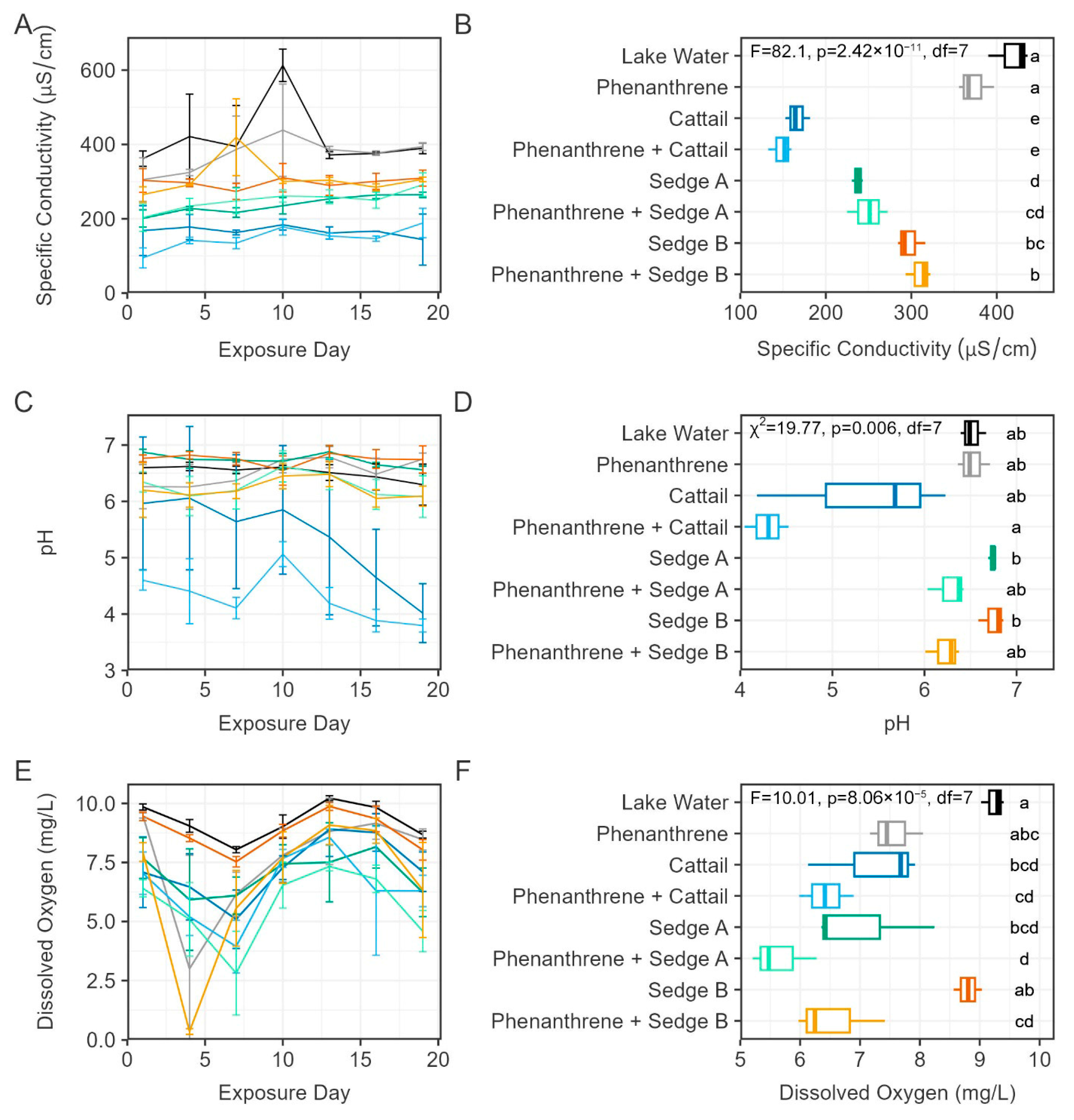
Trends in microcosm-specific conductivity displayed clear differences among treatment types, which appeared to increase in microcosms with decreasing plant biomass (Figure 2A). The lowest mean (±SD) specific conductivity was in Phenanthrene + Cattail (148.1 ± 34.2 μS/cm; n = 21) and Cattail (166.4 ± 36.1 μS/cm; n = 20) microcosms, while the highest specific conductivity was recorded in Phenanthrene (373.1 ± 67.3 μS/cm; n = 21) and Lake Water (418.1 ± 98.7 μS/cm; n = 21) microcosms. An ANOVA confirmed a significant difference among treatments (F = 82.1, p = 2.42 × 10⁻¹¹, Df = 7), and trends by plant type (Figure 2B). A linear model assessing the relationship between total dry biomass and mean specific conductivity revealed a significant, moderate negative relationship (y = −8.534x + 331.457, p = 0.0004, R2 = 0.55) (Figure S3). The results of a GAMM indicated a significant effect of interactions between exposure day and treatments of Lake Water (p < 2 × 10⁻¹⁶), Phenanthrene (p = 5.68 × 10⁻⁴), Phenanthrene + Cattail (p = 6.87 × 10⁻³), Sedge A (p = 8.72 × 10⁻³), Phenanthrene + Sedge A (p = 7.19 × 10⁻³) and Phenanthrene + Sedge B (p = 1.04 × 10⁻³) on specific conductivity with 89.3% deviation explained (R2 = 0.869, n = 167, −REML = 805.75) (Figure S4; Table S4). Also, there was only one significant random effect of microcosm replicate for the Lake Water treatment (p = 0.0483) on specific conductivity.
Trends in pH suggest some differences between treatments, specifically in microcosms containing Cattail, which appeared to have lower pH than other treatments that were more clustered together over the experimental period (Figure 2C). A Kruskal–Wallis test identified a significant difference in microcosm pH between treatments (χ2 = 19.77, p = 0.006, Df = 7), and a Dunn Test confirmed significant differences between Phenanthrene + Cattail to Sedge A (pholm-adj = 0.05) and Sedge B (pholm-adj = 0.03) treatments, but no other significant differences were identified (Figure 2D). Pairwise comparisons, however, do not consider the slope or trend of pH over the exposure period. For example, the pH in Cattail microcosms declined over the exposure period resulting in a wide distribution, as observed in the boxplots (Figure 2D). A GAMM indicated there were significant effects between the interaction of exposure day and Lake Water (p = 0.0370), Phenanthrene (p = 1.26 × 10⁻³), Cattail (p < 2 × 10⁻¹⁶), Phenanthrene + Cattail (p < 2 × 10⁻¹⁶), and Phenanthrene + Sedge A (p = 0.0161) treatments on pH, with 96.3% deviance explained (R2 = 0.952, n = 168, −REML = 31.704), however acknowledging there may be limitations and approximations to these modelled values (Figure S5; Table S5). All microcosm replicates/random effects had a significant effect on pH (p < 0.05), except Sedge A, and the greatest random effect was observed for Cattail microcosms, with larger variability of pH readings between replicates.
Dissolved oxygen varied over the exposure period for all treatments, but trends plummeted to near 0 mg/L on day 4 of exposure for some Phenanthrene and Phenanthrene + Sedge B microcosms (Figure 2E). These treatments also experienced visual changes to water conditions, where the water became slightly opaque and turbid, with a white appearance. The turbidity improved in the Phenanthrene + Sedge B treatments by day 7 where no cloudiness was noted. However, the water remained opaque and cloudy in the Phenanthrene treated microcosms until exposure day 13, despite oxygen returning by day 7. Trends in DO also declined on day 7 in other microcosms but were not as pronounced as Phenanthrene + Sedge B (Figure 2E, Figure S6). An ANOVA indicated significant differences in DO between treatments (F = 10.01, p = 8.06 × 10⁻⁵, Df = 7), and a Tukey HSD test identified some significant pairwise differences (p < 0.05) (Figure 2F).
Treatments that included vegetation typically had lower DO, excluding Sedge B microcosms, which was more similar to Lake Water treatment (Figure 2F). However, Phenanthrene + Sedge B had significantly lower DO than Sedge B (p = 0.01). Generally, treatments containing phenanthrene had lower DO than their unexposed counterpart; however, these differences were not always statistically significant, and not as defined for Sedge A and Cattail treatments. A GAMM indicated there was a significant effect of exposure day (p < 2 × 10⁻¹⁶), and interactions between exposure day and treatments of Phenanthrene (p < 2 × 10⁻¹⁶) and Phenanthrene + Sedge B (p < 2 × 10⁻¹⁶) on DO concentrations, with 82.8% deviance explained (R2 = 0.784, n = 168, −REML = 275.37) (Figure S6; Table S6). All treatments displayed a similar trend shape over time; however, there was a more pronounced decline on day 4 in Phenanthrene and Phenanthrene + Sedge B microcosms as discussed. There were also some significant effects of microcosm replicates as the random effect for Cattail (p = 2.02 × 10⁻³), Sedge A (p = 5.59 × 10⁻⁴), and Phenanthrene + Sedge B (p = 0.0194) treatments on DO. Similarly to pH, we acknowledge there are limitations and approximations to these modelled values and should be interpreted with caution.

3.2. Phenanthrene

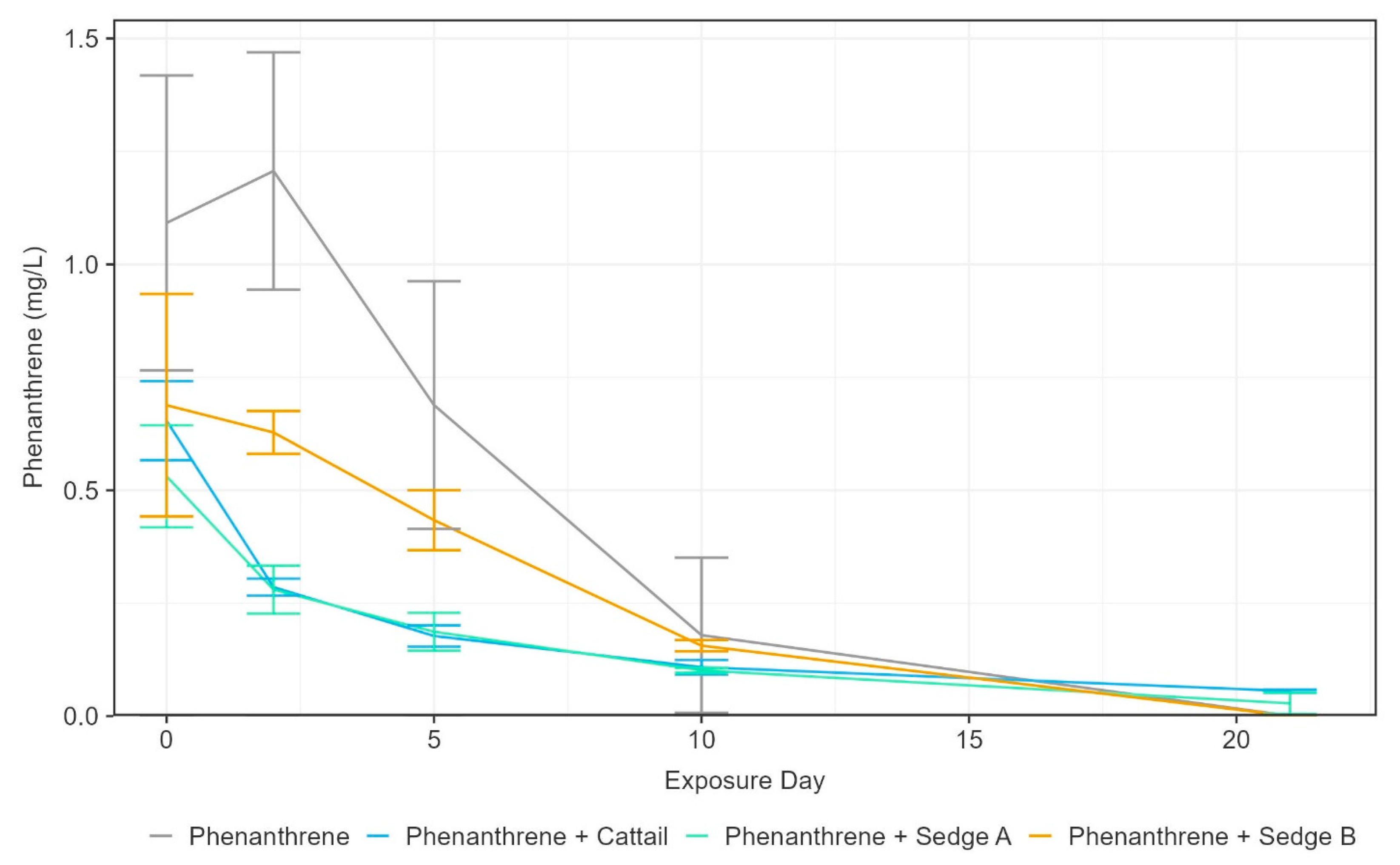
Concentrations of phenanthrene rapidly declined in all treatments containing vegetation by the first sample event (hours 4–7) (Table S7), and concentrations remained elevated in Phenanthrene microcosms without vegetation, with high variability (Figure 3). While an ANOVA revealed concentrations during the first sampling were not significantly different (F = 3.784, p = 0.059, df = 3), initial removal may occur quickly with plant treatment. By day 2 of exposure, concentrations continued to decline in both Phenanthrene + Cattail and Phenanthrene + Sedge A microcosms, remained stable in Phenanthrene + Sedge B microcosms, and increased slightly in Phenanthrene microcosms. By day 5, concentrations began to decline in Phenanthrene microcosms without vegetation, as well as in the Phenanthrene + Sedge B microcosms. After 21 days, all microcosms had over 94.19% removal of phenanthrene from the initial nominal concentration of 1 mg/L and over 89.30% from initial measured concentrations. Concentrations in experimental microcosms and method blanks are summarized in Table S7.
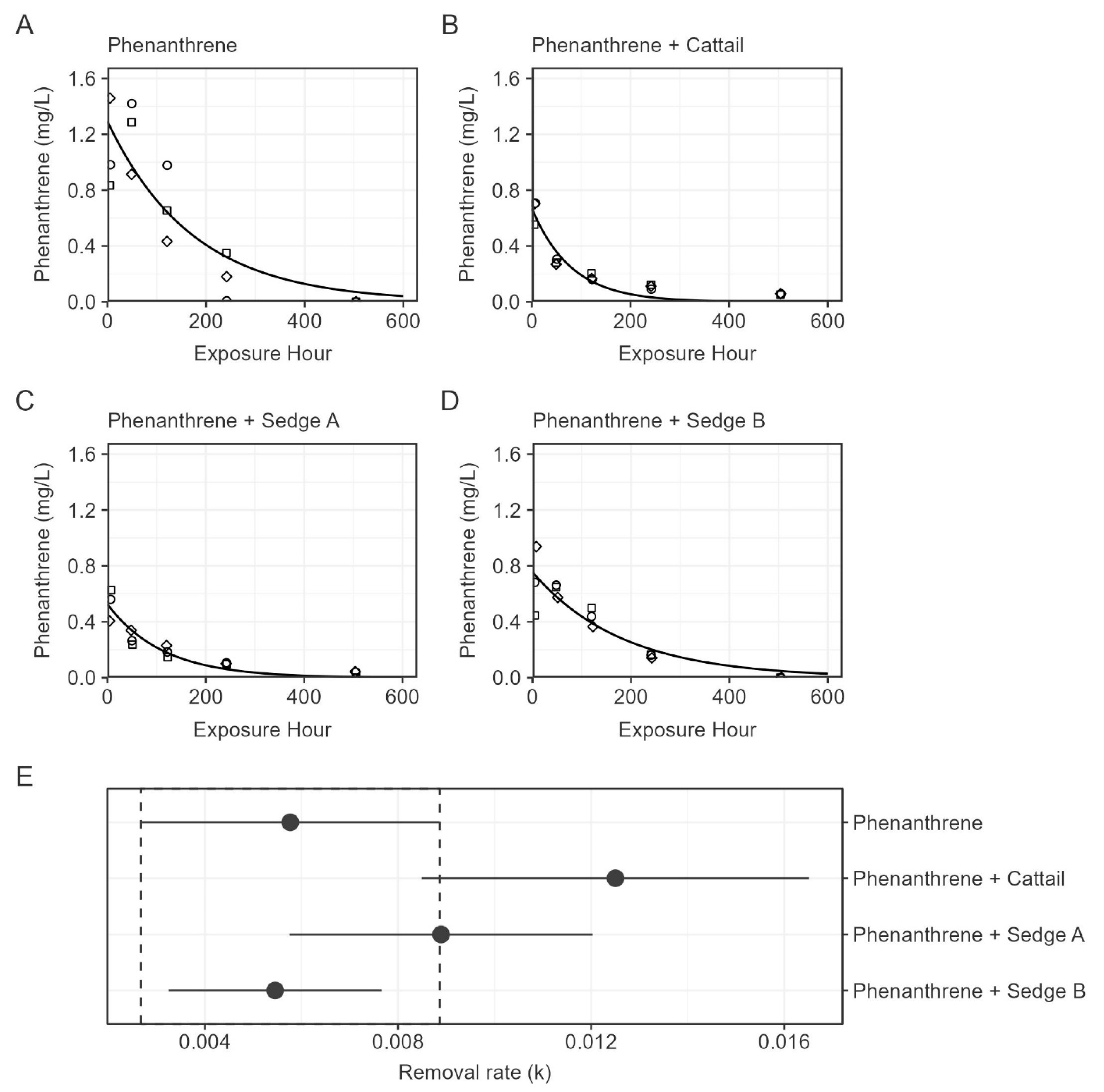
Figure 4 displays models and the estimated removal rate (k) with 95% confidence interval range (overlap indicates no significant difference). Phenanthrene + Cattail treatments had higher removal rates than Phenanthrene + Sedge B treatments; however, there were no differences between Phenanthrene + Sedge A and any other treatment. There was a small overlap between Phenanthrene and Phenanthrene + Cattail treatments, indicating no differences, but rates of phenanthrene removal by Phenanthrene + Cattail were generally higher. This was supported by the estimated DT50 generated from the model (Table 1), which was 55 h, 78 h, 120 h, and 127 h for Phenanthrene + Cattail, Phenanthrene + Sedge A, Phenanthrene, and Phenanthrene + Sedge B microcosms, respectively (acknowledging the rates are calculated based on initial concentrations (y0), which were slightly lower for microcosms containing plants). While an ANOVA indicated no significant differences for concentrations on day 0, the y0 intercept generated from the model indicated that Phenanthrene microcosms had a greater initial concentration than the plant treated microcosms, supporting that treatments with vegetation may have rapid treatment of phenanthrene (Table 1). The relationship between removal rates and mean final plant dry biomass (g) of each plant treatment was analyzed with a linear model (y = 0.0005x + 0.0024), revealing a strong positive correlation (R2 = 0.94). However, this was not statistically significant (p = 0.16) (Figure S7).

3.3. Plant Growth

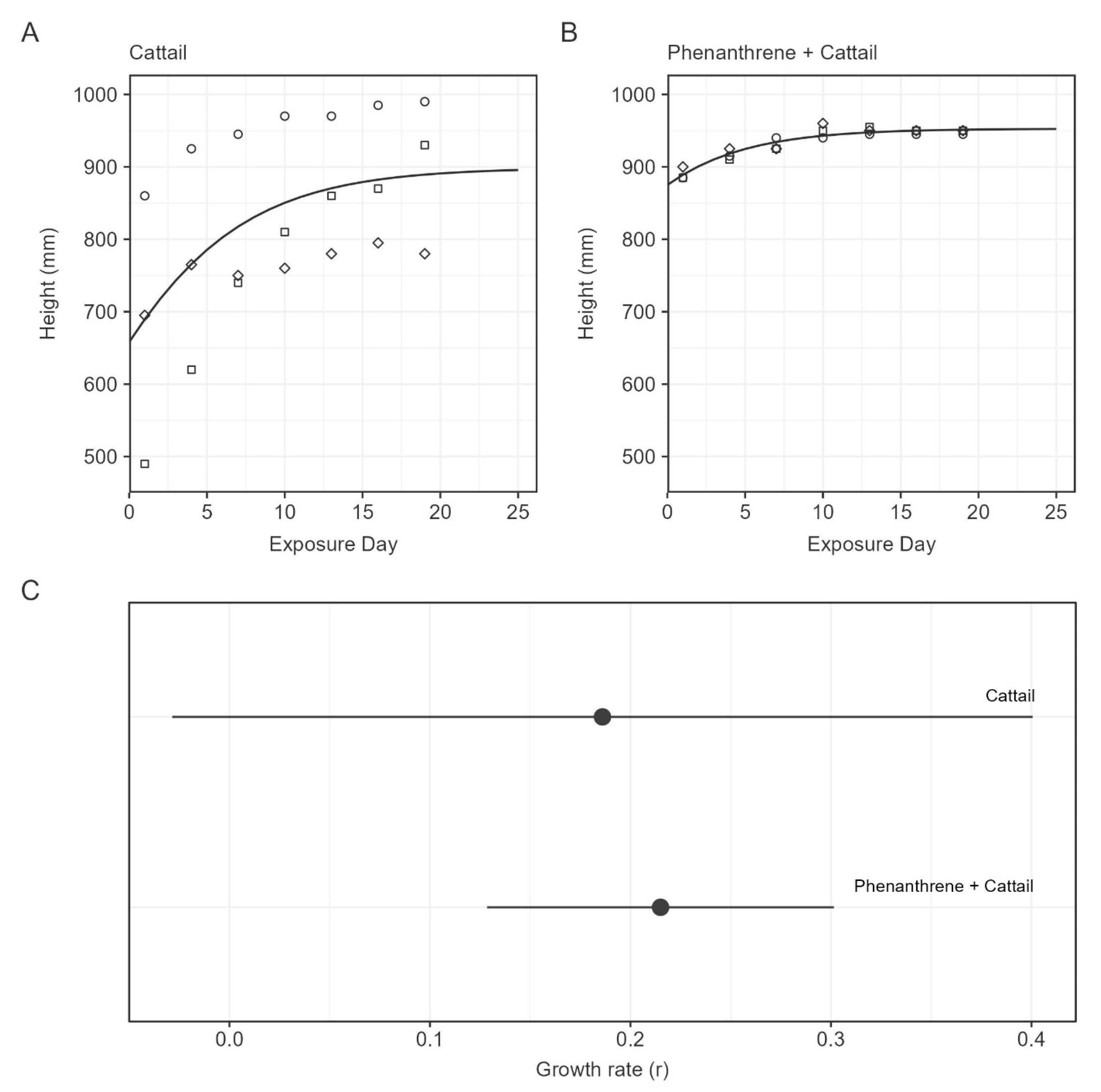
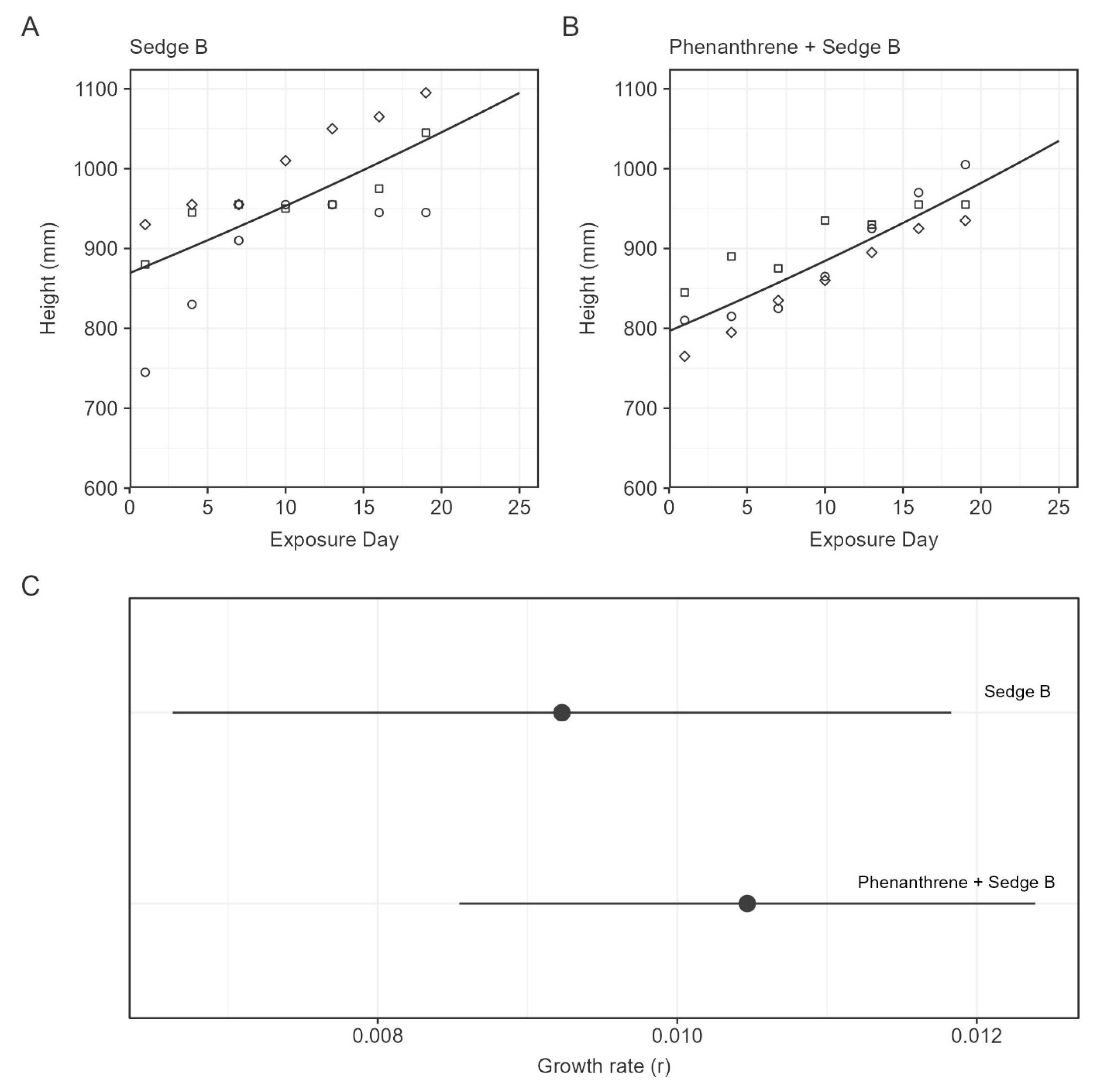
There were no differences in intrinsic growth rate (r) between Cattail (estimated rate: 0.186) and Phenanthrene + Cattail (estimated rate: 0.215), as identified with overlapping 95% confidence intervals (Figure 5). The finite growth rate (mm/day) varies daily with a logistic growth model, and the estimated growth on day 1 of exposure ranged from 7 to 41 mm/day and 11–14 mm/day for Cattail and Phenanthrene + Cattail microcosms. Of note, there was more variability in growth and carrying capacity of Cattail treatments compared to Phenanthrene + Cattail treatments, which may reflect growth stage when the experiment started, as plants were not grown by seed. Similarly, there were no differences in intrinsic growth rates between Sedge B (estimated rate: 0.009) and Phenanthrene + Sedge B (estimated rate: 0.010) (Figure 6). Finite growth rate (mm/day) calculated on day 19 ranged from 9 to 10 mm/day and 10–11 mm/day for Sedge B and Phenanthrene + Sedge B microcosms. Some physical changes to the plants were observed with some leaves yellowing or browning, mostly occurring after 13 days of exposure; however, this occurred in treatments with and without phenanthrene.

3.4. Microbial Biofilm

3.4.1. Adenosine Triphosphate

A Kruskal–Wallis test on day 1 indicated significant differences in root and biofilm ATP between treatments, and a Dunn Test further confirmed that Cattail had greater ATP/microbial colonization than Phenanthrene + Sedge B (pholm = 0.046); however, no other differences were identified (Table S8). Further, there were no differences in ATP concentrations between treatments on days 8 and 15; however, mean ATP concentration appeared higher for Cattail microcosms. Ultimately there were no statistical differences in ATP concentrations of individual plant types with or without phenanthrene exposure.

3.4.2. Respirometry

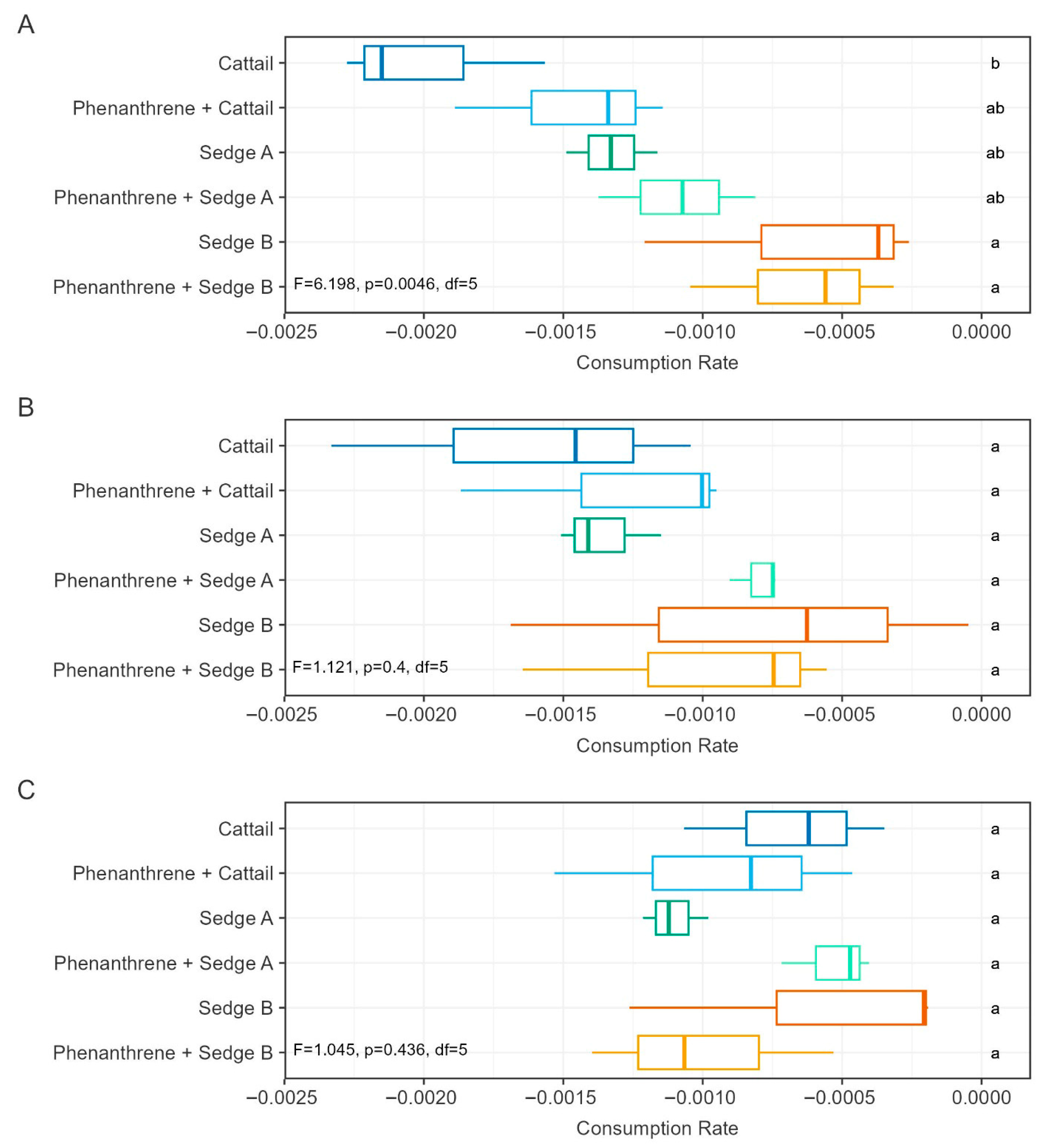
When corrected for plant biomass, there were no significant differences in oxygen consumption by plant roots and biofilm between treatments on days 8 and 15. However, there were differences between some treatments on day 1 of exposure (F = 6.198, p = 0.0046, df = 5) (Figure 7). Cattail treatments had greater oxygen consumption than Phenanthrene + Sedge B (p = 0.007) and Sedge B (p = 0.006) treatments.
A linear model of dry biomass (mg) and uncorrected rate of oxygen consumption (mg O2/L/min) revealed a moderate to strong, negative correlation on day 1 of exposure (r2 = 0.76, p = 2.61× 10⁻⁶, y = −0.001x − 0.0002), indicating that larger roots had greater oxygen consumption, while there was no correlation on day 8 (r2 = 0.23, p = 0.04, y = −0.0006x − 0.002) and a minor correlation on day 15 (r2 = 0.50, p = 0.001, y = −0.0006x − 0.0008) (Figure S8), with significant relationships in all analyses. Due to the variation, there may be other plant or microbial functions influencing oxygen consumption during different time points. However, ultimately there were no significant differences in oxygen consumption of individual plant types previously exposed or unexposed to phenanthrene.

4. Discussion

Mean microcosm temperatures were often within optimal conditions for biodegradation of petroleum hydrocarbons (HOBO Pendant MX logger data; Section 3.1), which ranges from 20 to 30 °C for freshwater environments [11,70]. Water quality monitoring that occurred every 3 days had slightly lower temperatures, but these data represent a snapshot of microcosm conditions and may have been influenced by cooler overnight temperatures, which in turn may influence biodegradation. There were no pairwise differences in microcosm treatments on temperature (Figure S2); however, the order and length of time required to measure each microcosm may have had an influence on multimeter probe readings (see Section 2.3 and Section 3.1). While not significantly different, the boxplots indicate that uncontaminated microcosms generally had lower temperatures than microcosms containing phenanthrene, which may result from lower temperatures overnight. This may have an influence on other measurements such as pH and DO [71,72] which also exhibit diurnal patterns [73,74,75], and should be considered in further interpretation of data.
Trends and relationships of other water quality parameters displayed some significant differences between treatments. For example, there was a clear relationship between plant type and specific conductivity (Figure 2B). It was hypothesized that plants with larger biomass would have greater nutrient uptake, resulting in decreased salt content in microcosms from Hoagland media and hence lower specific conductivity. Although the data revealed a negative correlation in this relationship (Figure S3), there may also be a plant-specific effect on uptake (e.g., surface area, transpiration). Table S3 includes a summary of final dry biomass results from each treatment. The GAMM (Figure S4; Table S4) indicated significant interactions between exposure day and some treatments, which may be caused by peaks in data as observed for Lake Water microcosms, or increasing trends over the exposure period. While inconclusive, as plant growth and metabolism slow, there may be a reduced requirement for nutrients causing nutrient salt content to slowly increase over time.
A plant effect was also observed for pH, where Phenanthrene + Cattail microcosms generally had lower pH than other treatments, though not always statistically significant. Differences in pH may have been caused by root respiration, plant exudation, and/or metabolism [5,11,76], though metabolism was not likely the driver, as pH declined prior to the start of the experiment. Stottmeister et al. [77] summarized that organic acids and other exudates can be released under nutrient limitation. In our study, the rapid uptake of nutrient salts by Cattail may have resulted in lower nutrient availability in the microcosm, potentially causing the plants to release acids. It is also possible that cattails have different exudation products than the two sedge species, or greater respiration. Although significant differences were not observed for Cattail microcosms, trends indicate declining pH over the experimental period (Figure 2D, Figure S5; Table S5), perhaps a result of increasing acidic exudates. However, there was a strong influence of microcosm replicate on the Cattail model, indicating variability of readings between microcosms. While it did not appear to impact degradation, low pH can influence biodegradation potential as optimal conditions range from 6.5 to 8 and may further influence microbial composition [5]. It is clear there were effects of plant type on microcosm water quality; however, no impact of phenanthrene on specific conductivity or pH was identified.
Differences in DO, while not always statistically significant, revealed a potential effect of both plant type/biomass and phenanthrene. An important note is that plants can both release oxygen into the rhizosphere, allowing them to grow under harsh anoxic conditions, and also consume oxygen through root respiration [74,77]. It is likely that both factors are observed in our measurements, while noting that these represent a snapshot of microcosm conditions, and oxygen in aquatic ecosystems often follow diurnal patterns [73]. Generally, microcosms containing larger plants (Cattail and Sedge A), with or without phenanthrene, had lower DO than Sedge B and Lake Water (Figure 2F), which may be a result of greater root respiration. Interestingly, microcosms of Phenanthrene + Sedge B had significantly lower DO than Sedge B microcosms, indicating an effect of phenanthrene. This was also observed in treatments without vegetation, where Phenanthrene microcosms typically had lower DO than Lake Water, though not statistically different. This may have resulted from a rapid decline in DO on day 4 in Phenanthrene and Phenanthrene + Sedge B microcosms (Figure 2E, Figure S6). It was hypothesized that available oxygen was consumed for aerobic metabolism of phenanthrene and the lack of vegetation or the small root system associated with Sedge B was not able to produce sufficient oxygen release into the rhizosphere, causing oxygen to decline. During this sample period, these microcosms were visibly cloudy which may indicate a microbial bloom. While this cannot be confirmed, the DT50 values identified from the phenanthrene exponential decay models were approximately 5 days for these two treatments (Table 1), so it is clear there was phenanthrene removal occurring, which may have included microbial aerobic metabolism.
We did not assess microbial communities in this study using molecular techniques but instead focused on gross indices of removal. We have previously shown that microbial communities on the roots of wetland plants grown on floating wetland platforms can change in response to oil exposure, and that some hydrocarbon degrading taxa can be stimulated [12]. However, attributing metabolism of a specific compound to one or more taxa is tenuous and it is likely that non-hydrocarbon degrading taxa may also support biodegradation, confounding interpretation of the removal with community change metrics [78,79].
Stottmeister et al. [77] and Wieβner et al. [80] note the importance of above ground biomass, including surface area and stomata in oxygen release, in addition to other internal processes and drivers. While others also note the role of root biomass [81], suggesting it may be species dependent. In fact, Moorhead and Reddy [82] found evidence of greater oxygen release of select macrophytes with smaller root systems, and while not strongly correlated suggest it may be related to greater root respiration in older and larger roots. Sedge B, whose common name is Wiregrass sedge, has a very small and thin leaf area which may not support sufficient oxygen release into the rhizosphere for metabolism, as potentially observed on day 4 for Phenanthrene + Sedge B (Figure 2E). In addition, the smaller root area may have led to lower root respiration [82], increasing microcosm DO (Figure 2F). Trends in other microcosms also slightly declined on day 7 but were not as pronounced as Phenanthrene + Sedge B and Phenanthrene microcosms on day 4, and no significant relationship to exposure day was observed for other microcosms treatments as observed in the GAMM (Table S6). It is possible other plant treatments also exhibited aerobic metabolism but were able to release oxygen more readily. Specifically, Phenanthrene + Cattail had less of a decline, and are well known for their ability to transfer oxygen to the rhizosphere [80]. Selection of plants that can support aerobic degradation may be an important criterium for phenanthrene removal. However, it is important to acknowledge that differences in oxygen may also arise from the time of measurement, as oxygen solubility changes with temperature [73], and the decline may be a result of this. Of note, trends in temperature recorded with the multimeter probe were highest on day 7 (Figure S2A), which may have influenced the slight decline in DO.
All treatments had successful phenanthrene removal after 21 days of exposure (≥89.30% from initial measured concentrations; Table S7). It was initially surprising that the Phenanthrene microcosms without vegetation had successful removal. However, we hypothesized that the addition of nutrients through the Hoagland media stimulated the native microorganisms in the lake water, enhancing phenanthrene removal. This is a common practice implemented during oil spills to facilitate biodegradation [1,3,5,11,15]; however, it is important to exercise caution in applying nutrients appropriately, and this practice in open water ecosystems may be impractical due to dilution [5]. While inconclusive, this may be supported by the observed decline in DO on day 4 of exposure as discussed above. Unfortunately, because of this, there was a slight overlap in the 95% confidence interval of removal rates between Phenanthrene and Phenanthrene + Cattail microcosms (Figure 4E). We suggest that future research have a control treatment with no supplemented nutrients and/or an autoclaved water treatment (abiotic control).
Moreover, while we could not confirm that plants enhanced removal of phenanthrene compared to the control, it is clear that Cattail treatments generally have faster removal rates, further supported by the DT50 (noting that all models had a different y0). In fact, all plant treatments had lower estimated y0 for the exponential decay model than Phenanthrene microcosms during the first round of sampling, suggesting that the plant treatments may have had fast removal of phenanthrene during the first ~4–7 h of exposure (Table 1). The ANOVA analysis on day 0 indicated no statistically significant differences (p = 0.059) but was close to significant. Phenanthrene removal from water in the treated microcosms could have resulted from the collective processes of volatilization, sorption to glassware, adsorption or absorption to roots, biodegradation, or photolysis. Sorption of phenanthrene to glassware can be significant and is dependent on contact surface area of the test vessel [83]. We included reference microcosm replicates that were treated with phenanthrene but had no plants to account for sorption to glassware and volatilization processes. Additionally, all microcosms were wrapped in foil to reduce photodegradation effects.
Flocco et al. [84] studied the removal and toxic effects of phenanthrene (50 mg/L) on Medicago sativa L. (alfalfa) in a 30 day hydroponic experiment and similarly noted a faster removal in the presence of vegetation (half life: 11.3 days with alfalfa and 31 days without). They discussed that phenanthrene would likely be quickly adsorbed to the roots due to compound lipophilicity and hydrophobicity, and unlikely to be taken up into plant tissue. The ability for plants to uptake chemicals is influenced by hydrophobicity of the compound, represented by their octanol water partition coefficient (log Kow). Compounds with a log Kow ranging between 0.5 and 3 are within hydrophobic and solubility properties to allow for plant uptake [16,85]. Phenanthrene has a log Kow of 4.46 [86], suggesting that it may pass into cell membranes and adsorb to the root, but unlikely to be translocated into shoot tissue [16,84,85,87]. It is possible in this study that the phenanthrene quickly adsorbed to plant roots when introduced.
While higher concentrations will often be found in the roots, others have detected phenanthrene in shoot tissue [88,89,90,91], and although this may pose potential concerns of phytotoxicity, some plants can internally metabolize phenanthrene with enzymes or endophytic microorganisms. Jia-hua et al. [92] measured phenanthrene uptake into root tissue of four submerged macrophytes upon exposure to 0.5 mg/L and 1 mg/L phenanthrene. Concentrations initially increased but later declined in tissues until 40 days of exposure. Similar trends have been observed in shoot tissue, which may be a result of internal metabolism [88,90,91]. This has previously been suggested by Zazouli et al. [93,94], who monitored uptake and metabolites of pyrene and phenanthrene in tissue of Azolla filiculoides and Lemna minor. While they found metabolites of both compounds and they observed greater accumulation of pyrene, suggesting more effective internal metabolism of phenanthrene. Future research should explore adsorption and absorption of phenanthrene to roots, and while minimal, measure phenanthrene and metabolites in shoot tissue to confirm translocation potential.
Between plant treatments, Phenanthrene + Cattail had greater removal rates than Phenanthrene + Sedge B, but not Phenanthrene + Sedge A. This may result from differences in plant biomass; however, while the results from the linear model indicated a strong correlation, they were not significant. Other plant specific properties may be important to study their roles in removal of phenanthrene, such as enzymes [21], exudation products [22,95,96], or potential uptake as discussed above. While exudation products may support microbial colonization and PAC degradation, on occasion can repress degradation [95] or act as a competitive, readily available carbon source [96]. In our study, all treatments showed successful degradation potential, however the lowest concentrations on day 21 were in Phenanthrene and Phenanthrene + Sedge B microcosms (Table S7), with most replicate samples near the CCME guidelines for the protection of aquatic life (0.4 μg/L) [31]. It is possible there may have been competing carbon sources in Phenanthrene + Cattail and Phenanthrene + Sedge A treatments, but this has not been confirmed, and no lag phase was observed. Ultimately, these treatments still had a lower estimated DT50, and may offer reduced periods of high contaminant exposure, which may be important when considering interacting biota in the natural environment. Future research to explore exudation products and microbial community composition on plant roots with and without phenanthrene exposure could inform the potential for plant species in enhancing phenanthrene removal.
It is clear in our study that there are plant-specific factors controlling phenanthrene removal and water quality parameters, which has been observed in other research. Jia-hua et al. [92] assessed plant-promoted phenanthrene dissipation by four submerged macrophytes and found phenanthrene removal was not often related to accumulation, but to a combination of plant enhanced biodegradation and sedimentation, and their importance varied by species. For example, removal success by Potamogeton maackianu and Ceratophyllum demersum was related to enhanced sedimentation and biodegradation, while Elodea canadensi was related mostly to biodegradation and exhibited the highest uptake, and P. crispu had the greatest phenanthrene dissipation attributed to enhanced biodegradation.
Similarly, He and Chi [22] found differences in sediment phenanthrene and pyrene dissipation potential of four submerged macrophytes, and found a strong correlation between sediment redox potential and phenanthrene (r = 0.76, p < 0.01) and pyrene (r = 0.34, p < 0.01) dissipation. They also noted that plant uptake and accumulation only accounted for 0.2–1.0% and 0.4–6.9% of phenanthrene and pyrene dissipation, respectively, and that the ability of submerged plants to enhance removal of polycyclic aromatic hydrocarbons may be attributed to oxygen release supporting biodegradation. In their study, Vallisneria spiralis had the highest phenanthrene and pyrene dissipation, as well as the most extensive root system, fastest growth, and largest sediment redox potential. The ability of plants to release oxygen into the rhizosphere may be an important driver of aerobic biodegradation of PACs in aquatic environments. While we did not measure oxygen release by different plants in our study, we did observe differences in oxygen concentrations between microcosms (Figure 2F), which may result from oxygen release, root respiration, and aerobic metabolism.
At an initial exposure of 1 mg/L, there were no negative impacts of phenanthrene on Cattail and Sedge B growth rates for height, as well as no clear impacts of phenanthrene on root microbial colonization as measured through ATP or oxygen consumption in plant treated microcosms. There were some signs of leaf browning/yellowing; however, this occurred among plants with and without phenanthrene exposure. Others have observed negative impacts on vegetation (Medicago sativa L., Lemna minor, Azolla filiculoides, and Sorghum bicolor (L.) Moench) at higher phenanthrene concentrations (various effects of concentrations ranging from 1 to 50 mg/L; 10–100 mg/kg), such as survival, decreased growth index and biomass, low nutrient consumption, acute effects on leaves (e.g., yellowing, drying, burning), and reduced pigment, frond number, exudation, and enzyme activity [21,36,84,93,94]. Flocco et al. [84] further note that these impacts may be greater in hydroponic studies where plants are in direct contact with the contaminant, compared with natural soil environments where plants may be further protected by soil interaction. In fact, Becker et al. [97] calculated that the EC50 (50% growth inhibition) for Lemna minor was an order of magnitude higher in phenanthrene exposures that contained water and sediment (EC50 = 161.4 mg/L) than water alone (EC50 = 11.50 mg/L) in visible light, due to sediment sorption and compound hydrophobicity, noting these values are higher than solubility. They also identified that the introduction of UVB light for 5 min daily resulted in increased toxicity from photomodification and photosensibilization, with an EC50 of 1.35 mg/L. This study supported previous results by McConkey et al. [42], who calculated an EC50 > 5.0 mg/L phenanthrene for Lemna gibba exposed to visible light in an 8 day study and found solar radiation increased phytotoxicity (EC50 = 3.48 mg/L), due to the photomodified product, phenanthrenequinone. They acknowledge these EC50s were above solubility but also observed significant growth inhibition within solubility range. In the same study, McConkey et al. [42] calculated a lower EC50 of 0.53 mg/L in the dark and under solar radiation for bacterium, Photobacterium phosphoreum, noting that greater sensitively may result from the differences in how these organisms interact with the environment. Kösesakal and Seyhan [36] monitored stress tolerance of a freshwater fern, Azolla filiculoides Lam, at varying concentrations of phenanthrene, and found no toxicity to concentrations ≤ 5 mg/L, but their tolerance limit was <10 mg/L. They also noted an increase in production of flavonoids and phenolics by the plant when exposed to 10 mg/L phenanthrene, which are produced as antioxidants to deal with stress.
Generally, increasing concentration results in greater toxic effects and ultimately the capacity to remediate contaminants [90]. Selection of plants with these capabilities may be important when treating high concentrations of contaminants in the natural environment. Wetland plants, including Typha and Carex spp., are commonly selected and used to treat contaminated wastewater due to their ability to survive under harsh conditions [77]. However, species-specific traits may be important to consider when selecting plants to treat phenanthrene contamination, as well as understanding potential toxic effects at different growth stages (e.g., from seed). Although our study did not prioritize monitoring all potential phytotoxic effects of phenanthrene on plant development, it may have been beneficial to monitor initial biomass, to have started plants from seed, or to monitor changes to pigment. Future researchers may want to integrate these considerations into their studies.
While some studies note negative impacts, it is important to consider the environmental relevance of tested concentrations, as well as the water solubility (1.08 (mean of n = 12 samples; [98]) to 1.15 mg/L at 25 °C (n = 1; [99]) as cited in [86]). In this study, we monitored removal of 1 mg/L phenanthrene, which is higher than total PACs (N = 44) in our previous in lake oil experiments, which had a maximum detected concentration of 0.012 mg/L [12]. It is also higher than maximum total PAC concentrations (0.0029 mg/L, N = 46) measured in a low-energy in-lake limnocorral study at the IISD-ELA, which was designed to represent the highest untreated on shore/surface water impacting oil spill (diluted bitumen) volumes in North America [100]. Following the 2010 Deepwater Horizon Spill in the Gulf of Mexico, C1-phenanthrenes/anthracenes had a mean (±SD) detection of 1.17 ± 8.00 mg/L in seawater (N = 48), while C2- and C4-phenanthrenes/anthracenes were present at much lower concentrations. Further, authors noted that the concentrations of compounds measured in seawater were higher than reported in other studies, which may reflect differences in sample location and time, and sampling methods [101]. While understanding toxic thresholds is valuable for plant selection, it is suggested to study their potential and functional roles at concentrations relevant to events in the natural environment.

5. Conclusions

All treatments had removal of ≥89.30% of phenanthrene after 21 days of exposure, with Cattail exhibiting a faster removal rate (DT50 = 55 h) than Sedge B (DT50 = 127 h), but not Sedge A (DT50 = 78 h), supporting our second hypothesis that removal rates of phenanthrene will vary by plant type. However, microcosms without vegetation also had successful removal (DT50 = 120 h), rejecting our first hypothesis that plants would enhance removal compared to the control. We further hypothesized that this may be a result of biostimulation from Hoagland nutrient solution, but we could not make any definitive conclusions from this experiment. Microcosm-specific conductivity and pH were related to plant type but not phenanthrene exposure, while dissolved oxygen was influenced by both plant type and phenanthrene, likely resulting from root respiration, root oxygen release, and/or aerobic metabolism. These differences may indicate plant specific factors controlling their success in phenanthrene removal that should be explored.

Supplementary Materials

The following supporting information can be downloaded at: https://www.mdpi.com/article/10.3390/w17223327/s1, Figure S1. Experimental design including (A) foil covered glass jars/microcosms, (B) stainless steel hydroponic pots, (C) experimental set up in pool and greenhouse tent, (D) example microcosm at the end of the experiment. Figure S2. Mean trends and boxplots of water temperature in freshwater microcosms over the experimental period. Error bars in (A) represent standard deviation of microcosm replicates (n = 3). Letters in (B) represent significant differences (p < 0.05) identified from Kruskal-Wallis and Dunn Tests (holm p-value adjustment). Figure S3. Linear relationship between mean specific conductivity (for each microcosm) and final dry biomass. Figure S4. GAMM of specific conductivity over the experimental period for each treatment type. Figure S5. GAMM of pH over the experimental period for each treatment type. Figure S6. GAMM of dissolved oxygen over the experimental period for each treatment type. Figure S7. Linear relationship between mean dry biomass (n = 3) and estimated phenanthrene removal rate. Figure S8. Linear relationship between root dry biomass and oxygen consumption on day 1 (r2 = 0.76, p = 2.61 × 10⁻⁶, y = −0.001x − 0.0002), day 8 (r2 = 0.23, p = 0.04, y = −0.0006x − 0.002), and day 15 (r2 = 0.50, p = 0.001, y = −0.0006x − 0.0008) of exposure. Note, negative values indicate oxygen removal/consumption. Table S1. Final mols/L of 5% and 10% strength modified Hoagland media based on Hoagland and Arnon, 1938 [37]. Table S2. Additional R packages used in data analyses and visualization. Table S3. Summary of final dry biomass (g) of plants by treatment. Table S4. Significance of parametric coefficients (treatment; A) and approximate significance of smooth terms (B) of specific conductivity GAMM (Figure S4). Table S5. Significance of parametric coefficients (treatment; A) and approximate significance of smooth terms (B) of pH GAMM (Figure S5). Table S6. Significance of parametric coefficients (treatment; A) and approximate significance of smooth terms (B) of dissolved oxygen GAMM (Figure S6). Table S7. Mean (± SD of microcosm replicates) phenanthrene concentration (mg/L) in microcosms over 21 days of exposure. Table S8. Mean (± standard deviation of microcosm replicates [n = 3]) root biofilm ATP (ng ATP/mg dry root) on days 1, 8, and 15 of exposure. References [102,103,104,105,106,107,108,109,110,111,112,113,114,115,116,117] are cited in the Supplementary Materials.

Author Contributions

Conceptualization: M.J.S., R.G. and V.P.P.; Data curation: M.J.S.; Formal analysis: M.J.S. and J.L.R.G.; Funding acquisition: G.T., R.G., D.B.L. and V.P.P.; Investigation: M.J.S. and A.G.; Methodology: M.J.S., L.E.P., T.H. and B.C.; Project administration: M.J.S. and V.P.P.; Resources: L.E.P., G.T., D.B.L. and V.P.P.; Supervision: D.B.L. and V.P.P.; Visualization: M.J.S.; Writing—original draft: M.J.S.; Writing—review and editing: A.G., L.E.P., T.H., G.T., J.L.R.G., B.C., R.G., D.B.L. and V.P.P. All authors have read and agreed to the published version of the manuscript.

Funding

This research was funded by Genome Canada Genomic Applications Partnership Program [GAPP R13-6336]; Mitacs Accelerate [Grant Number IT15202]; Natural Sciences and Engineering Research Council of Canada Collaborative Research and Development grant awarded to Dr. G. Tomy [NSERC File CRDPJ 532225-18] with Industrial partner support from the Canadian Association of Petroleum Producers, the Canadian Energy Pipeline Association [defunct], and the Myera Group, and in-kind contributions from the National Energy Board (now Canada Energy Regulator), TransCanada Pipelines, TransMountain Pipelines, and Enbridge.; Natural Sciences and Engineering Research Council of Canada Discovery Grant to Dr. G. Tomy [NSERC File RGPIN-05354-2019], and contributions from the International Institute for Sustainable Development Experimental Lakes Area. The above funding sources had no role in the design of the study; in the collection, analyses, or interpretation of data; in the writing of the manuscript; or in the decision to publish the results. Additional funding that supported this research included the International Institute for Sustainable Development Experimental Lakes Area Graduate Research Fellowship.

Data Availability Statement

The original data presented in this study are openly available in an Environmental Data Initiative (EDI) repository entitled “Data associated with a study on freshwater phenanthrene removal by three emergent wetland plants conducted in a microcosm experiment at the IISD Experimental Lakes Area, ON, Canada, in 2022” available at https://portal.edirepository.org/nis/mapbrowse?scope=edi&identifier=1879 (accessed on 16 November 2025) [69].

Acknowledgments

Authors would like to acknowledge that research occurred at the IISD Experimental Lakes Area field station, situation on the traditional land of the Anishinaabe Nation in Treaty 3 Territory and the Homeland of the Métis Nation. The University of Manitoba and IISD’s headquarters in Winnipeg are situated on Treaty 1 Territory, the ancestral lands of the Anishinaabe (Ojibwe), Ininiw (Cree), Anisinew (Ojibwe Cree), Dene, and Dakota Nations, and the homeland of the Red River Métis Nation. This article is a chapter of a doctoral dissertation [13], available online at http://hdl.handle.net/1993/38302 (accessed on 16 November 2025).

Conflicts of Interest

The authors declare no conflicts of interest. The funders had no role in the design of the study; in the collection, analyses, or interpretation of data; in the writing of the manuscript; or in the decision to publish the results.

Abbreviations

The following abbreviations are used in this manuscript:
ATPAdenosine Triphosphate
CCMECanadian Council of Ministers of the Environment
DCMDichloromethane
EFWEngineered Floating Wetland
FLOWTERFloating Wetland Treatments to Enhance Remediation
IISD-ELAInternational Institute for Sustainable Development Experimental Lakes Area
PACPolycyclic Aromatic Compound

References

  1. Zhu, X.; Venosa, A.D.; Suidan, M.T.; Lee, K. Guidelines for the Bioremediation of Marine Shorelines and Freshwater Wetlands; United States Environmental Protection Agency: Cincinnati, OH, USA, 2001. [Google Scholar]
  2. Cao, B.; Nagarajan, K.; Loh, K.C. Biodegradation of Aromatic Compounds: Current Status and Opportunities for Biomolecular Approaches. Appl. Microbiol. Biotechnol. 2009, 85, 207–228. [Google Scholar] [CrossRef]
  3. Haritash, A.K.; Kaushik, C.P. Biodegradation Aspects of Polycyclic Aromatic Hydrocarbons (PAHs): A Review. J. Hazard. Mater. 2009, 169, 1–15. [Google Scholar] [CrossRef] [PubMed]
  4. Dupuis, A.; Ucan-Marin, F. A Literature Review on the Aquatic Toxicology of Petroleum Oil: An Overview of Oil Properties and Effects to Aquatic Biota; Reseach Document 2015/007; DFO Canada, Canadian Science Advisory Secretariat: Ottawa, ON, Canada, 2015; p. 52. [Google Scholar]
  5. Lee, K.; Boufadel, M.; Chen, B.; Foght, J.; Hodson, P.; Swanson, S.; Venosa, A. Expert Panel Report on the Behaviour and Environmental Impacts of Crude Oil Released into Aqueous Environments; Royal Society of Canada: Ottawa, ON, Canada, 2015; ISBN 978-1-928140-02-3. [Google Scholar]
  6. Ghosal, D.; Ghosh, S.; Dutta, T.K.; Ahn, Y. Current State of Knowledge in Microbial Degradation of Polycyclic Aromatic Hydrocarbons (PAHs): A Review. Front. Microbiol. 2016, 7, 1369. [Google Scholar] [CrossRef] [PubMed]
  7. Honda, M.; Suzuki, N. Toxicities of Polycyclic Aromatic Hydrocarbons for Aquatic Animals. Int. J. Environ. Res. Public Health 2020, 17, 1363. [Google Scholar] [CrossRef] [PubMed]
  8. Pezeshki, S.R.; Hester, M.W.; Lin, Q.; Nyman, J.A. The Effects of Oil Spill and Clean-up on Dominant US Gulf Coast Marsh Macrophytes: A Review. Environ. Pollut. 2000, 108, 129–139. [Google Scholar] [CrossRef]
  9. Hoff, R.Z. Responding To Oil Spills in Coastal Marshes: The Fine Line Between Help and Hindrance. HAZMAT Report 96-2; Hazardous Materirals Response and Assessments Division, NOAA: Seattle, WA, USA, 1995; Volume 96. [Google Scholar]
  10. Etkin, D.S.; Tebeau, P. Assessing Progress and Benefits of Oil Spill Response Technology Development since Exxon Valdez. Int. Oil Spill Conf. 2003, 843–850. [Google Scholar] [CrossRef][Green Version]
  11. Das, N.; Chandran, P. Microbial Degradation of Petroleum Hydrocarbon Contaminants: An Overview. Biotechnol. Res. Int. 2011, 2011, 941810. [Google Scholar] [CrossRef] [PubMed]
  12. Stanley, M.J.; Peters, L.; Guttormson, A.; Tremblay, J.; Wasserscheid, J.; Timlick, L.; Greer, C.W.; Rodríguez Gil, J.L.; Halldorson, T.; Havens, S.; et al. Assessing Changes to the Root Biofilm Microbial Community on an Engineered Floating Wetland upon Exposure to a Controlled Diluted Bitumen Spill. Front. Synth. Biol. 2025, 3. [Google Scholar] [CrossRef]
  13. Stanley, M. Engineered Floating Wetlands as a Secondary Oil Spill Remediation Strategy for Freshwater Shorelines. Ph.D. Thesis, University of Manitoba, Winnipeg, MB, Canada, 2024. Available online: http://hdl.handle.net/1993/38302 (accessed on 16 November 2025).
  14. Rehman, K.; Imran, A.; Amin, I.; Afzal, M. Inoculation with Bacteria in Floating Treatment Wetlands Positively Modulates the Phytoremediation of Oil Field Wastewater. J. Hazard. Mater. 2018, 349, 242–251. [Google Scholar] [CrossRef] [PubMed]
  15. Raju, M.N.; Scalvenzi, L. Petroleum Degradation: Promising Biotechnological Tools for Bioremediation. In Recent Insights in Petroleum Science and Engineering; Zoveidavianpoor, M., Ed.; Intech Open: London, UK, 2018; pp. 351–369. [Google Scholar] [CrossRef]
  16. Pilon-Smits, E. Phytoremedation. Annu. Rev. Plant Biol. 2005, 56, 15–39. [Google Scholar] [CrossRef]
  17. Shahzad, A.; Siddiqui, S.; Bano, A. Rhizoremediation of Petroleum Hydrocarbon, Prospects and Future. RSC Adv. 2016, 6, 108347–108361. [Google Scholar] [CrossRef]
  18. Bisht, S.; Pandey, P.; Bhargava, B.; Sharma, S.; Kumar, V.; Krishan, D. Bioremediation of Polyaromatic Hydrocarbons (PAHs) Using Rhizosphere Technology. Brazilian J. Microbiol. 2015, 46, 7–21. [Google Scholar] [CrossRef]
  19. Dhir, B. Phytoremediation: Role of Aquatic Plants in Environmental Clean-Up; Springer India: Delhi, India, 2013; ISBN 9788132213079. [Google Scholar]
  20. Martin, B.C.; George, S.J.; Price, C.A.; Ryan, M.H.; Tibbett, M. The Role of Root Exuded Low Molecular Weight Organic Anions in Facilitating Petroleum Hydrocarbon Degradation: Current Knowledge and Future Directions. Sci. Total Environ. 2014, 472, 642–653. [Google Scholar] [CrossRef] [PubMed]
  21. Muratova, A.; Golubev, S.; Wittenmayer, L.; Dmitrieva, T.; Bondarenkova, A.; Hirche, F.; Merbach, W.; Turkovskaya, O. Effect of the Polycyclic Aromatic Hydrocarbon Phenanthrene on Root Exudation of Sorghum bicolor (L.) Moench. Environ. Exp. Bot. 2009, 66, 514–521. [Google Scholar] [CrossRef]
  22. He, Y.; Chi, J. Phytoremediation of Sediments Polluted with Phenanthrene and Pyrene by Four Submerged Aquatic Plants. J. Soils Sediments 2016, 16, 309–317. [Google Scholar] [CrossRef]
  23. Macek, T.; Makova, M.; Kas, J. Exploitation of Plants for the Removal of Organics in Environmental Remediation. Biotechnol. Adv. 2000, 18, 23–34. [Google Scholar] [CrossRef]
  24. Liu, J.; Zhang, Z.; Sheng, Y.; Gao, Y.; Zhao, Z. Phenanthrene-Degrading Bacteria on Root Surfaces: A Natural Defense That Protects Plants from Phenanthrene Contamination. Plant Soil 2018, 425, 335–350. [Google Scholar] [CrossRef]
  25. Golubev, S.N.; Schelud’Ko, A.V.; Muratova, A.Y.; Makarov, O.E.; Turkovskaya, O.V. Assessing the Potential of Rhizobacteria to Survive under Phenanthrene Pollution. Water. Air. Soil Pollut. 2009, 198, 5–16. [Google Scholar] [CrossRef]
  26. Afzal, M.; Rehman, K.; Shabir, G.; Tahseen, R.; Ijaz, A.; Hashmat, A.J.; Brix, H. Large-Scale Remediation of Oil-Contaminated Water Using Floating Treatment Wetlands. npj Clean Water 2019, 2, 10. [Google Scholar] [CrossRef]
  27. Hussain, F.; Tahseen, R.; Arslan, M.; Iqbal, S.; Afzal, M. Removal of Hexadecane by Hydroponic Root Mats in Partnership with Alkane-Degrading Bacteria: Bacterial Augmentation Enhances System’s Performance. Int. J. Environ. Sci. Technol. 2019, 16, 4611–4620. [Google Scholar] [CrossRef]
  28. Rehman, K.; Arslan, M.; Müller, J.A.; Saeed, M.; Imran, A.; Amin, I.; Mustafa, T.; Iqbal, S.; Afzal, M. Bioaugmentation-Enhanced Remediation of Crude Oil Polluted Water in Pilot-Scale Floating Treatment Wetlands. Water 2021, 13, 2882. [Google Scholar] [CrossRef]
  29. Stanley, M.; Palace, V.; Grosshans, R.; Levin, D.B. Floating Treatment Wetlands for the Bioremediation of Oil Spills: A Review. J. Environ. Manage. 2022, 317. [Google Scholar] [CrossRef]
  30. United States Environmental Protection Agency Priority Pollutant List. Available online: https://www.epa.gov/sites/default/files/2015-09/documents/priority-pollutant-list-epa.pdf (accessed on 15 April 2022).
  31. Canadian Council of Ministers of the Environment. Canadian Water Quality Guidelines for the Protection of Aquatic Life—Polycyclic Aromatic Hydrocarbons (PAHs). In Canadian Environmental Quality Guidelines; Canadian Council of Ministers of the Environment: Winnipeg, MB, Canada, 1999; Available online: http://ceqg-rcqe.ccme.ca/download/en/243 (accessed on 26 February 2025).
  32. Waigi, M.G.; Kang, F.; Goikavi, C.; Ling, W.; Gao, Y. Phenanthrene Biodegradation by Sphingomonads and Its Application in the Contaminated Soils and Sediments: A Review. Int. Biodeterior. Biodegrad. 2015, 104, 333–349. [Google Scholar] [CrossRef]
  33. Stoyanovich, S.; Yang, Z.; Hanson, M.; Hollebone, B.P.; Orihel, D.M.; Palace, V.; Rodriguez-Gil, J.R.; Mirnaghi, F.; Shah, K.; Blais, J.M. Fate of Polycyclic Aromatic Compounds from Diluted Bitumen Spilled into Freshwater Limnocorrals. Sci. Total Environ. 2022, 819, 151993. [Google Scholar] [CrossRef] [PubMed]
  34. Toyama, T.; Yu, N.; Kumada, H.; Sei, K.; Ike, M.; Fujita, M. Accelerated Aromatic Compounds Degradation in Aquatic Environment by Use of Interaction between Spirodela Polyrrhiza and Bacteria in Its Rhizosphere. J. Biosci. Bioeng. 2006, 101, 346–353. [Google Scholar] [CrossRef] [PubMed]
  35. Machate, T.; Noll, H.; Behrens, H.; Kettrup, A. Degradation of Phenanthrene and Hydraulic Characteristics in a Constructed Wetland. Water Res. 1997, 31, 554–560. [Google Scholar] [CrossRef]
  36. Kösesakal, T.; Seyhan, M. Phenanthrene Stress Response and Phytoremediation Potential of Free-Floating Fern Azolla Filiculoides Lam. Int. J. Phytoremediation 2023, 25, 207–220. [Google Scholar] [CrossRef]
  37. Hoagland, D.R.; Arnon, D.I. The Water-Culture Method for Growing Plants without Soil; University of California, College of Agriculture, Agricultural Experiment Station: Berkeley, CA, USA, 1938. [Google Scholar]
  38. Canadian Council of Ministers of the Environment. Canadian Water Quality Guidelines for the Protection of Aquatic Life—Phosphorus: Canadian Guidance Framework for the Management of Freshwater Systems. In Canadian Environmental Quality Guidelines; Canadian Council of Ministers of the Environment: Winnipeg, MB, Canada, 2004; Available online: https://ccme.ca/en/res/phosphorus-en-canadian-water-quality-guidelines-for-the-protection-of-aquatic-life.pdf (accessed on 16 November 2025).
  39. Naczi, R.F.C. Systematics of Carex Section Griseae (Cyperaceae). Ph.D. Thesis, University of Michigan, Ann Arbor, MI, USA, 1992. [Google Scholar]
  40. Starr, J.R.; Naczi, R.F.C.; Chouinard, B.N. Plant DNA Barcodes and Species Resolution in Sedges (Carex, Cyperaceae). Mol. Ecol. Resour. 2009, 9, 151–163. [Google Scholar] [CrossRef]
  41. Fries, E.; Zarfl, C. Sorption of Polycyclic Aromatic Hydrocarbons (PAHs) to Low and High Density Polyethylene (PE). Environ. Sci. Pollut. Res. 2012, 19, 1296–1304. [Google Scholar] [CrossRef]
  42. McConkey, B.J.; Duxbury, C.L.; Dixon, D.G.; Greenberg, B.M. Toxicity of a PAH Photooxidation Product to the Bacteria Photobacterium Phosphoreum and the Duckweed Lemna Gibba: Effects of Phenanthrene and Its Primary Photoproduct, Phenanthrenequinone. Environ. Toxicol. Chem. 1997, 16, 892–899. [Google Scholar] [CrossRef]
  43. Idowu, I.; Francisco, O.; Thomas, P.J.; Johnson, W.; Marvin, C.; Stetefeld, J.; Tomy, G.T. Validation of a Simultaneous Method for Determining Polycyclic Aromatic Compounds and Alkylated Isomers in Biota. Rapid Commun. Mass Spectrom. 2018, 32, 277–287. [Google Scholar] [CrossRef] [PubMed]
  44. Heumann, K.G. Isotope Dilution Mass Spectrometry of Inorganic and Organic Substances. Fresenius’ Zeitschrift Anal. Chem. 1986, 325, 661–666. [Google Scholar] [CrossRef]
  45. Heumann, K.G. Isotope Dilution Mass Spectrometry. Int. J. Mass Spectrom. Ion Process. 1992, 118–119, 575–592. [Google Scholar] [CrossRef]
  46. LuminUltra 2nd Generation ATP® Testing. Available online: https://www.luminultra.com/tech/2nd-generation-atp/?gclid=Cj0KCQjw0bunBhD9ARIsAAZl0E1KvVsKRkEIWCdNv1ciTaXT-WYeXv8-_2tMGRwgOSqEIh69sTctNScaAhicEALw_wcB (accessed on 30 August 2023).
  47. LuminUltra. Product Instructions. PhotonMasterTM Luminometer & Bluetooth® Module; LuminUltra: Fredericton, NB, Canada, 2017. [Google Scholar]
  48. LuminUltra. Test Kit Instructions—Deposit and Surface Analysis (DSA); LuminUltra: Fredericton, NB, Canada, 2020. [Google Scholar]
  49. Schindelin, J.; Arganda-Carreras, I.; Frise, E.; Kaynig, V.; Longair, M.; Pietzsch, T.; Preibisch, S.; Rueden, C.; Saalfeld, S.; Schmid, B.; et al. Fiji: An Open-Source Platform for Biological-Image Analysis. Nat. Methods 2012, 9, 676–682. [Google Scholar] [CrossRef]
  50. R Core Team. R: A Language and Environment for Statistical Computing; R Foundation for Statistical Computing: Vienna, Austria, 2022. [Google Scholar]
  51. Posit Team. RStudio: Integrated Development Environment for R. Available online: http://www.posit.co/ (accessed on 16 November 2025).
  52. Wickham, H.; Averick, M.; Bryan, J.; Chang, W.; McGowan, L.; François, R.; Grolemund, G.; Hayes, A.; Henry, L.; Hester, J.; et al. Welcome to the Tidyverse. J. Open Source Softw. 2019, 4, 1686. [Google Scholar] [CrossRef]
  53. Ogle, D.; Doll, J.; Wheeler, A.; Dinno, A. _FSA: Simple Fisheries Stock Assessment Methods_. R Package Version 0.9.4, 2023. Available online: https://cran.r-project.org/package=FSA (accessed on 16 November 2025).
  54. Pedersen, E.; Simpson, G.; Ross, N.; Rodriguez-Sanchez, F. Hierarchical Generalized Additive Models: An Introduction with Mgcv. Available online: https://github.com/eric-pedersen/mixed-effect-gams (accessed on 16 November 2025).
  55. Pedersen, E.J.; Miller, D.L.; Simpson, G.L.; Ross, N. Hierarchical Generalized Additive Models in Ecology: An Introduction with Mgcv. PeerJ 2019, 2019. [Google Scholar] [CrossRef] [PubMed]
  56. Wood, S.N. Generalized Additive Models: An Introduction with R, 2nd ed.; Chapman and Hall/CRC Press: New York, NY, USA, 2017; ISBN 9781315370279. [Google Scholar]
  57. Wood, S. Mgcv Pacakge. Mixed GAM Compution Vehicle with GCV/AIC/REML/NCV Smoothness Estimation and GAMMS by REML/PQL. Version 1.9-0. 2023. Available online: https://cran.rstudio.com/web/packages/mgcv/index.html (accessed on 16 November 2025).
  58. Wood, S.N. Stable and Efficient Multiple Smoothing Parameter Estimation for Generalized Additive Models. J. Am. Stat. Assoc. 2004, 99, 673–686. [Google Scholar] [CrossRef]
  59. Wood, S.N. Thin Plate Regression Splines. J. R. Stat. Soc. Ser. B Stat. Methodol. 2003, 65, 95–114. [Google Scholar] [CrossRef]
  60. Wood, S.N. Fast Stable Restricted Maximum Likelihood and Marginal Likelihood Estimation of Semiparametric Generalized Linear Models. J. R. Stat. Soc. Ser. B Stat. Methodol. 2011, 73, 3–36. [Google Scholar] [CrossRef]
  61. Wickham, H. Ggplot2: Elegant Graphics for Data Analysis; Spring-Verlag: New York, NY, USA, 2016; ISBN 978-3-319-24277-4. [Google Scholar]
  62. Pinheiro, J.; Bates, D.; R Core Team. _nlme: Linear and Nonlinear Mixed Effects Models_. R Package Version 3.1-160. 2022. Available online: https://cran.r-project.org/package=nlme (accessed on 16 November 2025).
  63. Pinheiro, J.; Bates, D. Mixed-Effects Models in S and S-PLUS; Springer-Verlag: New York, NY, USA, 2000; ISBN 0-387-98957-9. [Google Scholar]
  64. United States Environmental Protection Agency Degradation Kinetics Equations. Available online: https://www.epa.gov/pesticide-science-and-assessing-pesticide-risks/degradation-kinetics-equations (accessed on 5 November 2023).
  65. United States Environmental Protection Agency. Guidance to Calculate Representative Half-Life Values and Characterizing Pesticide Degradation. Available online: https://www.epa.gov/pesticide-science-and-assessing-pesticide-risks/guidance-calculate-representative-half-life-values (accessed on 5 November 2023).
  66. Paine, C.E.T.; Marthews, T.R.; Vogt, D.R.; Purves, D.; Rees, M.; Hector, A.; Turnbull, L.A. How to Fit Nonlinear Plant Growth Models and Calculate Growth Rates: An Update for Ecologists. Methods Ecol. Evol. 2012, 3, 245–256. [Google Scholar] [CrossRef]
  67. Miguez, F. _nlraa: Nonlinear Regression for Agricultural Applications_. R Package Version 1.9.3. 2023. Available online: https://cran.r-project.org/package=nlraa (accessed on 16 November 2025).
  68. Vandermeer, J. How Populations Grow: The Exponential and Logistic Equations. Nat. Educ. Knowl. 2010, 3, 15. [Google Scholar]
  69. Stanley, M.J.; Guttormson, A.; Peters, L.; Halldorson, T.; Tomy, G.; Rodríguez Gil, J.L.; Cooney, B.; Grosshans, R.; Levin, D.B.; Palace, V.P. Data Associated with a Study on Freshwater Phenanthrene Removal by Three Emergent Wetland Plants Conducted in a Microcosm Experiment at the IISD Experimental Lakes Area, ON, Canada, in 2022; Ver 1; Environmental Data Inititiave: Madison, WI, USA, 2025. [Google Scholar] [CrossRef]

  70. Al-Hawash, A.B.; Dragh, M.A.; Li, S.; Alhujaily, A.; Abbood, H.A.; Zhang, X.; Ma, F. Principles of Microbial Degradation of Petroleum Hydrocarbons in the Environment. Egypt. J. Aquat. Res. 2018, 44, 71–76. [Google Scholar] [CrossRef]
  71. Jones, L.A.; Muhlfeld, C.C.; Hauer, F.R. Temperature. In Methods in Stream Ecology: Volume 1: Ecosystem Structure, 3rd ed.; Hauer, F.R., Lamberti, G.A., Eds.; Academic Press: Cambridge, MA, USA, 2017; Volume 1, pp. 109–120. ISBN 9780124165588. [Google Scholar]
  72. Barron, J.; Ashton, C.; Geary, L. The Effects of Temperature on pH Measurement; Technical Services Department, Reagecon Diagnostics Ltd.: County Clare, Ireland, 2005; Volume TSP-01. [Google Scholar]
  73. Canadian Council of Ministers of the Environment. Canadian Water Quality Guidelines for the Protection of Aquatic Life—Dissolved Oxygen (Freshwater). In Canadian Environmental Quality Guidelines; Canadian Council of Ministers of the Environment: Winnipeg, MB, Canada, 1999; Available online: https://ccme.ca/en/res/dissolved-oxygen-freshwater-en-canadian-water-quality-guidelines-for-the-protection-of-aquatic-life.pdf (accessed on 26 February 2025).
  74. Pokorný, J.; Květ, J. Aquatic Plants and Lake Ecosystems. In The Lakes Handbook; O’Sullivan, P.E., Reynolds, C.S., Eds.; Blackwell Publishing Ltd.: Oxford, UK, 2004; pp. 309–340. ISBN 0-632-04797-6. [Google Scholar]
  75. Dodds, W.K. Freshwater Ecology: Concepts and Environmental Applications; Elsevier Science: Amsterdam, The Netherlands, 2002. [Google Scholar]
  76. Hinsinger, P.; Plassard, C.; Tang, C.; Jaillard, B. Origins of Root-Mediated PH Changes in the Rhizosphere and Their Responses to Environmental Constraints: A Review. Plant Soil 2003, 248, 43–59. [Google Scholar] [CrossRef]
  77. Stottmeister, U.; Wießner, A.; Kuschk, P.; Kappelmeyer, U.; Kästner, M.; Bederski, O.; Müller, R.A.; Moormann, H. Effects of Plants and Microorganisms in Constructed Wetlands for Wastewater Treatment. Biotechnol. Adv. 2003, 22, 93–117. [Google Scholar] [CrossRef]
  78. Kharey, G.S.; Palace, V.; Whyte, L.; Greer, C.W. Native Freshwater Lake Microbial Community Response to an in Situ Experimental Dilbit Spill. FEMS Microbiol. Ecol. 2024, 100, 1–13. [Google Scholar] [CrossRef]
  79. Kharey, G.S.; Palace, V.; Whyte, L.; Greer, C.W. Influence of Heavy Canadian Crude Oil on Pristine Freshwater Boreal Lake Ecosystems in an Experimental Oil Spill. FEMS Microbiol. Ecol. 2024, 100. [Google Scholar] [CrossRef]
  80. Wieβner, A.; Kuschk, P.; Stottmeister, U. Oxygen Release by Roots of Typha Latifolia and Juncus Effusus in Laboratory Hydroponic Systems. Acta Biotechnol. 2002, 22, 209–216. [Google Scholar] [CrossRef]
  81. Randerson, P.F.; Moran, C.; Bialowiec, A. Oxygen Transfer Capacity of Willow (Salix viminalis L.). Biomass Bioenergy 2011, 35, 2306–2309. [Google Scholar] [CrossRef]
  82. Moorhead, K.K.; Reddy, K.R. Oxygen Transport through Selected Aquatic Macrophytes. J. Environ. Qual. 1988, 17, 138–142. [Google Scholar] [CrossRef]
  83. Qian, Y.; Posch, T.; Schmidt, T. Sorption of Polycyclic Aromatic Hydrocarbons (PAHs) on Glass Surfaces. Chemosphere 2011, 82, 859–865. [Google Scholar] [CrossRef] [PubMed]
  84. Flocco, C.G.; Lobalbo, A.; Carranza, M.P.; Bassi, M.; Giulietti, A.M.; Cormack, W. Mac Some Physiological, Microbial, and Toxicological Aspects of the Removal of Phenanthrene by Hydroponic Cultures of Alfalfa (Medicago Sativa L.). Int. J. Phytoremediation 2002, 4, 169–186. [Google Scholar] [CrossRef]
  85. Trapp, S.; Karlson, U. Aspects of Phytoremediation of Organic Pollutants. J. Soils Sediments 2001, 1, 37–43. [Google Scholar] [CrossRef]
  86. National Center for Biotechnology Information PubChem Compound Summary for Phenanthrene. Available online: https://pubchem.ncbi.nlm.nih.gov/compound/Phenanthrene (accessed on 15 January 2025).
  87. Jatav, K.; Singh, R.P. Phytoremediation Using Algae and Macrophytes: II. In Phytoremediation: Management of Environmental Contaminants; Ansari, A.A., Gill, S.S., Gill, R., Lanza, G.R., Newman, L., Eds.; Springer International Publishing: Cham, Switzerland, 2015; Volume 2, pp. 291–296. ISBN 9783319109688. [Google Scholar]
  88. Sun, K.; Liu, J.; Gao, Y.; Jin, L.; Gu, Y.; Wang, W. Isolation, Plant Colonization Potential, and Phenanthrene Degradation Performance of the Endophytic Bacterium Pseudomonas Sp. Ph6-Gfp. Sci. Rep. 2014, 4, 5462. [Google Scholar] [CrossRef] [PubMed]
  89. Zhou, Y.; Gao, X. Characterization of Biofilm Formed by Phenanthrene-Degrading Bacteria on Rice Root Surfaces for Reduction of Pah Contamination in Rice. Int. J. Environ. Res. Public Health 2019, 16, 2002. [Google Scholar] [CrossRef] [PubMed]
  90. Pérez-Hernández, V.; Ventura-Canseco, L.M.C.; Gutiérrez-Miceli, F.A.; Pérez-Hernández, I.; Hernández-Guzmán, M.; Enciso-Sáenz, S. The Potential of Mimosa Pigra to Restore Contaminated Soil with Anthracene and Phenanthrene. Terra Latinoam. 2020, 38, 755–769. [Google Scholar] [CrossRef]
  91. Chen, S.; Ma, Z.; Li, S.; Waigi, M.G.; Jiang, J.; Liu, J.; Ling, W. Colonization of Polycyclic Aromatic Hydrocarbon-Degrading Bacteria on Roots Reduces the Risk of PAH Contamination in Vegetables. Environ. Int. 2019, 132, 105081. [Google Scholar] [CrossRef] [PubMed]
  92. Jia-hua, L.; Hong-yan, G.; Xiao-rong, W.; Hong, W.M.; ShiHe, W.; Da-qiang, Y.; Ying, Y.; Jingfei, Z. Plant-Promoted Dissipation of Four Submerged Macrophytes to Phenanthrene. Aquat. Ecosyst. Heal. Manag. 2009, 12, 471–476. [Google Scholar] [CrossRef]
  93. Zazouli, M.A.; Ala, A.; Asghari, S.; Babanezhad, E. Evaluation of Azolla Filiculoides Potential in Pyrene and Phenanthrene Accumulation and Phytoremediation in Contaminated Waters. Int. J. Phytoremediation 2023, 1–10. [Google Scholar] [CrossRef] [PubMed]
  94. Zazouli, M.A.; Asghari, S.; Tarrahi, R.; Lisar, S.Y.S.; Babanezhad, E.; Dashtban, N. The Potential of Common Duckweed (Lemna Minor) in Phytoremediation of Phenanthrene and Pyrene. Environ. Eng. Res. 2022, 28, 210592. [Google Scholar] [CrossRef]
  95. Phillips, L.A.; Greer, C.W.; Farrell, R.E.; Germida, J.J. Plant Root Exudates Impact the Hydrocarbon Degradation Potential of a Weathered-Hydrocarbon Contaminated Soil. Appl. Soil Ecol. 2012, 52, 56–64. [Google Scholar] [CrossRef]
  96. Louvel, B.; Cébron, A.; Leyval, C. Root Exudates Affect Phenanthrene Biodegradation, Bacterial Community and Functional Gene Expression in Sand Microcosms. Int. Biodeterior. Biodegrad. 2011, 65, 947–953. [Google Scholar] [CrossRef]
  97. Becker, A.M.; Heise, S.; Ahlf, W. Effects of Phenanthrene on Lemna Minor in a Sediment-Water System and the Impacts of UVB. Ecotoxicology 2002, 11, 343–348. [Google Scholar] [CrossRef] [PubMed]
  98. Yalkowsky, S.H.; He, Y.; Jain, P. Handbook of Aqueous Solubility Data, 2nd ed.; CRC Press LLC.: Boca Raton, FL, USA, 2010; ISBN 978-1-4398-0246-5. [Google Scholar]
  99. Schwarz, F.P. Determination of Temperature Dependence of Solubilities of Polycyclic Aromatic Hydrocarbons in Aqueous Solutions by a Fluorescence Method. J. Chem. Eng. Data 1977, 22, 273–277. [Google Scholar] [CrossRef]
  100. Rodriguez-Gil, J.L.; Stoyanovich, S.; Hanson, M.L.; Hollebone, B.; Orihel, D.M.; Palace, V.; Faragher, R.; Mirnaghi, F.S.; Shah, K.; Yang, Z.; et al. Simulating Diluted Bitumen Spills in Boreal Lake Limnocorrals - Part 1: Experimental Design and Responses of Hydrocarbons, Metals, and Water Quality Parameters. Sci. Total Environ. 2021, 790, 148537. [Google Scholar] [CrossRef]
  101. Sammarco, P.W.; Kolian, S.R.; Warby, R.A.F.; Bouldin, J.L.; Subra, W.A.; Porter, S.A. Distribution and Concentrations of Petroleum Hydrocarbons Associated with the BP/Deepwater Horizon Oil Spill, Gulf of Mexico. Mar. Pollut. Bull. 2013, 73, 129–143. [Google Scholar] [CrossRef]
  102. Robinson, D.; Hayes, A.; Couch, S. _broom: Convert Statistical Objects in Tidy Tibbles_. R Package Version 1.0.3. 2023. Available online: https://cran.r-project.org/package=broom (accessed on 16 November 2025).
  103. Wickham, H.; François, R.; Henry, L.; Müller, K.; Vaughan, D. _dplyr: A Grammar of Data Manipulation_. R Package Version 1.1.0. 2023. Available online: https://cran.r-project.org/web/packages/dplyr/index.html (accessed on 16 November 2025).
  104. Kassambara, A. _ggpubr: “ggplot2” Based Publication Ready Plots_. R Package Version 0.6.0. 2023. Available online: https://cran.r-project.org/package=ggpubr (accessed on 16 November 2025).
  105. Simpson, G. _gratia: Graceful Ggplot-Based Graphics and Other Functions for GAMs Fitted Using Mgcv_. R Package Version 0.8.1. 2023. Available online: https://gavinsimpson.github.io/gratia/ (accessed on 16 November 2025).
  106. Müller, K. _here: A Simpler Way to Find Your Files_. R Package 1.0.1. 2020. Available online: https://cran.r-project.org/web/packages/here/index.html (accessed on 16 November 2025).
  107. Firke, S. _janitor: Simple Tools for Examining and Cleaning Dirty Data_. R Package Version 2.2.0. 2023. Available online: https://cran.r-project.org/package=janitor (accessed on 16 November 2025).
  108. Grolemund, G.; Wickham, H. Dates and Time Made Easy with Lubridate. J. Stat. Softw. 2011, 40, 1–25. [Google Scholar] [CrossRef]
  109. Graves, S.; Piepho, H.; Dorai-Raj, S. _multcompView: Visualization of Paired Comparisons_. R Package Version 0.1-8. 2019. Available online: https://cran.r-project.org/package=multcompView (accessed on 16 November 2025).
  110. Pedersen, T. _patchwork: The Composer of Plots_. R Package Version 1.1.2. 2022. Available online: https://cran.r-project.org/package=patchwork (accessed on 16 November 2025).
  111. Wickham, H.; Henry, L. _purrr: Functional Programming Tools_. R Package Version 1.0.1. 2023. Available online: https://cran.r-project.org/package=purrr (accessed on 16 November 2025).
  112. Mangiafico, S. _rcompanion: Functions to Support Extension Education Program Evaluation_. R Package Version 2.4.21. 2023. Available online: https://cran.r-project.org/package=rcompanion (accessed on 16 November 2025).
  113. Wickham, H.; Hester, J.; Bryan, J. _readr: Read Rectangular Text Data_. R Package Version 2.1.4. 2023. Available online: https://cran.r-project.org/package=readr (accessed on 16 November 2025).
  114. Wickham, H. _stringr: Simple, Consitent Wrappers for Common String Operations_. R Package Version 1.5.0. 2022. Available online: https://cran.r-project.org/package=stringr (accessed on 16 November 2025).
  115. Müller, K.; Wickham, H. _tibble: Simple Data Frames_.R Package Version 3.1.8. 2022. Available online: https://cran.r-project.org/package=tibble (accessed on 16 November 2025).
  116. Wickham, H.; Vaughan, D.; Girlich, M. _tidyr: Tidy Messy Data_. R Package Version 1.3.0. 2023. Available online: https://cran.r-project.org/package=tidyr (accessed on 16 November 2025).
  117. Zuur, A.F.; Ieno, E.N.; Walker, N.J.; Saveliev, A.A.; Smith, G.M. Mixed Effects Models and Extensions in Ecology with R; Gail, M., Krickeberg, K., Samet, J.M., Tsiatis, A., Wong, A., Eds.; Springer: New York, NY, USA, 2019; ISBN 9780429576966. [Google Scholar]
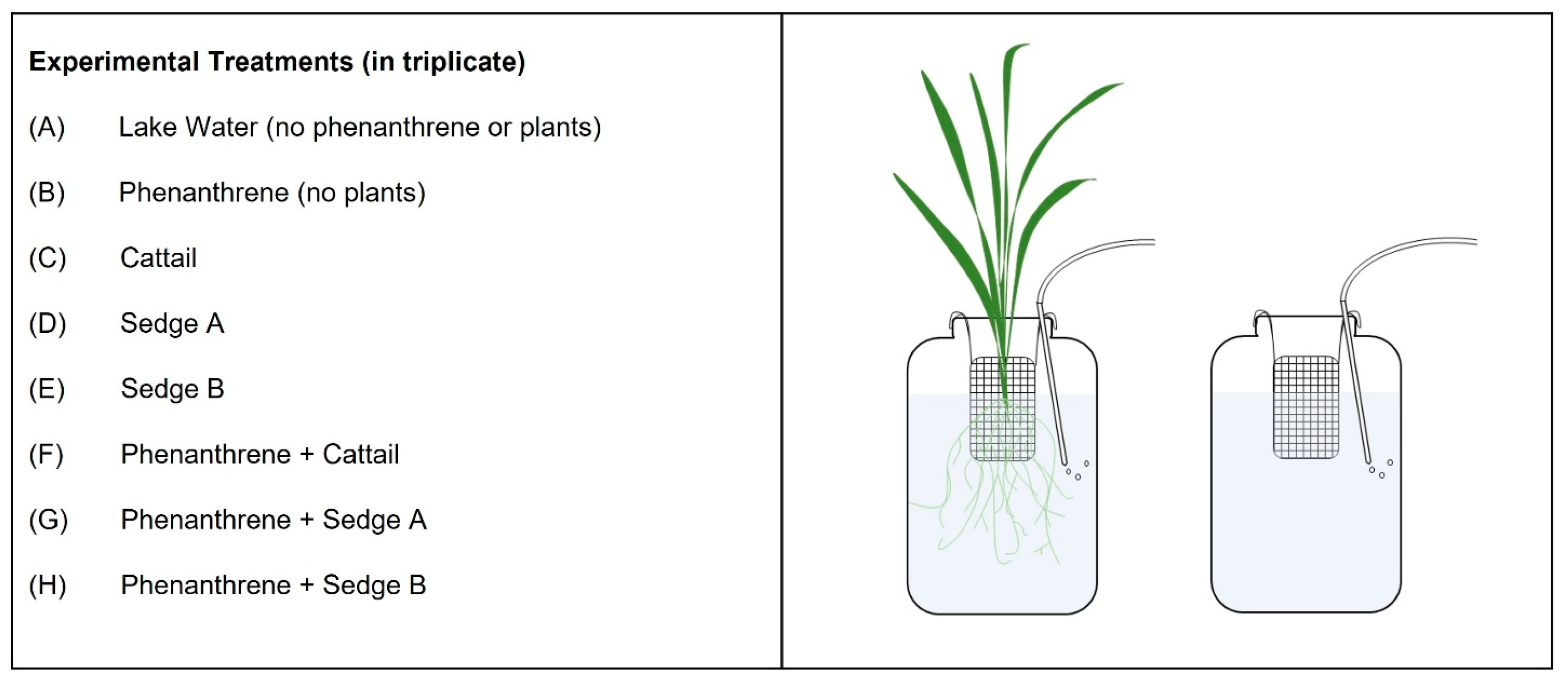
Figure 1. List of experimental treatments (in triplicate) and microcosm diagram (excluding foil cover and sample port; not to scale). Images of the entire experimental setup are included in Figure S1.
Water 17 03327 g001
Figure 2. Mean trends and boxplots of specific conductivity (A,B), pH (C,D) and dissolved oxygen (E,F) in freshwater microcosms over the experimental period. Error bars in trend figures represent standard deviation of microcosm replicates (n = 3). Colour of trendlines and box plots represent unique treatments. Letters in boxplot figures represent significant differences (p < 0.05) identified from parametric (ANOVA and Tukey–Kramer HSD) or non-parametric (Kruskal Wallace and Dunn Test) multiple pairwise comparisons. Note: One Cattail microcosm replicate had a conductivity under range on day 16.
Water 17 03327 g002
Figure 3. Mean concentration (± SD) of phenanthrene (mg/L) in microcosm water over 21 days of exposure. Error bars represent standard deviation of microcosm replicates (n = 3).
Water 17 03327 g003
Figure 4. Non-linear, first order exponential decay models (lines) and microcosm replicate concentrations (points) (AD), estimated removal rate (E) for each treatment. Model trends were based on hourly predictions over 600 h. Different symbols represent separate microcosm replicates of the same treatment Whiskers in E represent 95% confidence interval, and dotted vertical lines are the 95% confidence interval range for Phenanthrene.
Water 17 03327 g004
Figure 5. Logistic growth model (height) for Cattail (A) and Phenanthrene + Cattail (B) microcosms. Different symbols represent separate microcosm replicates of the same treatment. Estimated intrinsic growth rate (r) and 95% confidence interval whiskers are presented in (C). Model trends (A,B) were based on daily predictions for 25 days.
Water 17 03327 g005
Figure 6. Exponential growth model (height) for Sedge B (A) and Phenanthrene + Sedge B (B) microcosms. Different symbols represent separate microcosm replicates of the same treatment. Estimated intrinsic growth rate (r) and 95% confidence interval whiskers are presented in (C). Model trends (A,B) were based on daily predictions for 25 days.
Water 17 03327 g006
Figure 7. Rate of oxygen consumption (mg O2/L/min/mg dry weight) from minute 300 to 390 during respirometry trials on (A) day 1, (B) day 8, and (C) day 15 of the experiment (negative values indicate oxygen removal). Letters represent significant difference (p < 0.05) as identified with an ANOVA and Tukey–Kramer pair-wise comparison during each sample period.
Water 17 03327 g007
Table 1. First order exponential decay model output estimates (95% confidence interval).
Treatmenty0 (mg/L)kDT50 (h)
Phenanthrene1.29 (1.01–1.58)0.0058 (0.0027–0.0089)120 (78–259)
Phenanthrene + Cattail 0.67 (0.57–0.77)0.0125 (0.0085–0.0165)55 (42–82)
Phenanthrene + Sedge A0.53 (0.44–0.61)0.0089 (0.0058–0.0120)78 (58–120)
Phenanthrene + Sedge B 0.76 (0.63–0.88)0.0055 (0.0032–0.0077)127 (90–213)
Note(s): y0: Y intercept, k: removal rate, DT50: Hours to reduce concentration to half of the initial concentration.
Disclaimer/Publisher’s Note: The statements, opinions and data contained in all publications are solely those of the individual author(s) and contributor(s) and not of MDPI and/or the editor(s). MDPI and/or the editor(s) disclaim responsibility for any injury to people or property resulting from any ideas, methods, instructions or products referred to in the content.