
Article

The Impact of Catastrophic Flooding on Nitrogen Sources Composition in an Intensively Human-Impacted Lake: A Case Study of Baiyangdian Lake

1
Institute of Geographical Sciences, Hebei Academy of Sciences, Shijiazhuang 050011, China
2
Hebei Technology Innovation Center for Geographic Information Application, Shijiazhuang 050011, China
3
Center for Agricultural Resources Research, Institute of Genetics and Developmental Biology, Chinese Academy of Sciences, Shijiazhuang 050022, China
4
Key Laboratory of Agricultural Water Resources, Chinese Academy of Sciences, Shijiazhuang 050022, China
*
Authors to whom correspondence should be addressed.
Water 2025, 17(22), 3309; https://doi.org/10.3390/w17223309
Submission received: 10 October 2025 / Revised: 12 November 2025 / Accepted: 17 November 2025 / Published: 19 November 2025

Abstract

Urban development and intensive human activities have led to increasingly prominent nitrogen pollution issues in the Baiyangdian Lake basin. Accurately identifying the sources of nitrate pollution is a crucial prerequisite for implementing targeted remediation strategies, while flooding further complicates this task by exacerbating the transport and mixing of multi-source pollutants within the basin. This study, conducted from August to October 2023 (encompassing flood and post-flood periods), established 20 sampling sites in the lake area and its major inflow rivers. By integrating hydrochemical parameters, nitrate dual-isotope tracers (δ15N-NO3 and δ18O-NO3), and the Bayesian mixing model (MixSIAR), we quantitatively revealed the contributions of nitrate sources and their response mechanisms to a major flood event. The results indicate that domestic sewage and livestock wastewater (Manure & Sewage, MS) were the dominant sources of nitrate, with an average contribution of 84.0%, which further increased to 90.3% after the flood. Soil nitrogen was a secondary source (average 12.3%), while contributions from chemical fertilizers and atmospheric deposition were negligible (<4%). The results quantified a flood-driven dynamic response process of the nitrate source structure, characterized by “dilution-mixing-pollution rebound-process transformation”: the initial flood stage (August) showed multi-source mixing; the post-flood period (September) witnessed a rapid rebound of sewage sources; and during the October, nitrification persisted, but the basin’s overall denitrification capacity was limited, indicating a risk of nitrogen accumulation. Spatially, rivers like the Fu River were identified as key input pathways. This study revises the traditional understanding by emphasizing the absolute dominance of sewage sources after extreme hydrological events and the risk of insufficient denitrification capacity. The findings provide a scientific basis for water quality management in Baiyangdian and similar lakes.

1. Introduction

Urban development and intensive human activities have led to increasingly severe nitrogen pollution in river basin systems [1,2]. Precipitation and flooding further exacerbate the transport of sediments and nutrients from terrestrial areas to aquatic systems [3,4,5], contributing to global reservoir sedimentation and a consequent reduction in storage capacity [6,7]. The continuous discharge of excessive nitrogen into receiving water bodies triggers eutrophication, algal blooms, and drinking water contamination in rivers, lakes, reservoirs, and even coastal waters [8,9,10,11]. Over the past few decades, significant efforts have been devoted to identifying and quantifying nitrogen sources to enable effective pollution control [1,12,13,14,15,16,17]. However, in regions with dense populations and complex land use patterns, the mechanisms of nitrogen transport and transformation remain inadequately understood, making source apportionment particularly challenging [18,19,20]. This challenge stems primarily from the wide array of nitrogen pollution sources, the complexity of transformation processes (such as assimilation, nitrification, denitrification, and mineralization), and the dynamic influence of external conditions [21,22], all of which compromise the accuracy of source identification.
To address this challenge, stable isotope techniques have been widely applied to identify nitrogen pollution sources in water bodies [15,23,24]. The combined use of nitrogen and oxygen isotopes allows for more effective discrimination of nitrate sources [25,26], based on the principle that different nitrogen sources possess distinct isotopic signatures [27,28]. Generally, δ15N values in the Earth’s system range from −50‰ to +100‰, with most nitrogen-containing substances having δ15N values concentrated between −10‰ and +20‰ [29,30]. Nitrate (NO3) derived from nitrified soil nitrogen (SN) typically has a δ15N value ranging from 3‰ to 8‰, which is relatively close to atmospheric nitrogen sources (−3‰ to +7‰) [31]. In contrast, manure and sewage (M&S), due to the preferential consumption of light isotopes during organic matter decomposition and denitrification, exhibit higher δ15N values, approximately between +10‰ and +15‰ [32,33]. However, the δ15N values of nitrate from different sources can overlap, making source identification based solely on δ15N ambiguous. The δ18O-NO3 values can compensate for this limitation and aid in more accurate source tracing [34]. Nitrate from atmospheric deposition undergoes oxygen isotope fractionation during formation, resulting in a wide range of δ18O values (+25‰ to +75‰) that are significantly enriched in 18O (the δ18O of atmospheric O2 is approximately +23.5‰) [35]. The δ18O of nitrate from synthetic fertilizers typically ranges from +17‰ to +25‰, similar to the isotopic composition of atmospheric oxygen [36]. In contrast, nitrate influenced by nitrification processes generally has δ18O values between −5‰ and +15‰ [37].
Many river network areas in the coastal plains of eastern China are characterized by dense populations and intensive human activities [38]. Coupled with flat topography, gentle gradients, poor water mobility, and low connectivity, pollutants tend to have long retention times and undergo complex reaction processes. Processes such as microbial respiration, climate change, nitrification, and denitrification can cause fractionation of nitrogen and oxygen isotopes, thereby affecting the accuracy of nitrate source identification [39]. In such regions, establishing an integrated tracing system that combines multiple methods is particularly urgent.
Based on field sampling and analysis, this study integrates nitrate nitrogen and oxygen isotope composition with the SIAR mixing model to qualitatively and quantitatively analyze the sources of nitrogen pollution in Baiyangdian Lake. The findings aim to provide a scientific basis for watershed environmental management and offer insights for nitrogen pollution control in other inland lakes and rivers in China. Therefore, the objectives of this study were: (1) to quantify the contributions of different nitrate sources in Baiyangdian Lake under flood disturbance using dual-isotope and hydrochemical data; (2) to analyze the dynamic response mechanisms of nitrogen pollution to catastrophic flooding; and (3) to propose targeted management strategies based on source apportionment results.

2. Material and Methods

Baiyangdian Lake, located in Xiong’an New Area (the purple area in Figure 1), a newly established administrative zone in China in 2017, a typical shallow lake in a densely populated region, has been subjected to long-term, intensive anthropogenic disturbances, as evidenced by historical episodes of drying up. The total area of the Baiyangdian Wetland is 366 square kilometers. With water bodies as the dominant feature of its surface landscape, the wetland is divided into 143 lakes of varying sizes by more than 3700 crisscrossing gullies [40]. The core area of its basin encompasses the three counties of the Xiong’an New Area (Anxin, Xiong, and Rongcheng), which collectively have a population of 1.1244 million and a high population density of approximately 700 persons/km2 (860 persons/km2 excluding water area). This substantial demographic pressure, coupled with inputs from upstream urban centers like Baoding City, results in significant nutrient loading, with major pollutant fluxes entering the lake in 2015 including chemical oxygen demand (COD, ~11,585.7 tons), total phosphorus (TP, ~342.8 tons), and ammonia nitrogen (NH3-N, ~534.5 tons) annually [41]. Consequently, the lake receives nitrogen and other pollutants from diverse agricultural, industrial, and domestic wastewater sources, defining the severe environmental challenges it faces.
The study area experiences a warm temperate, semi-humid continental monsoon climate, characterized by abundant sunshine, dry and cold winters, and dry and hot summers. The multi-year average temperature is 12.2 °C, with the highest monthly average temperature being 26.5 °C in July and the lowest monthly average temperature being −4.3 °C in January. Precipitation predominantly occurs from June to September, with a multi-year average rainfall of 554 mm. The intra-annual distribution of rainfall is uneven, with 80% of the precipitation concentrated during the summer flood season. Interannual rainfall variability is significant, with the maximum annual value being up to three times greater than the minimum annual value. The multi-year average evaporation is 1050 mm [42].
This study, conducted from August to October 2023, covered two distinct hydrological periods defined by daily water level and precipitation data from local hydrological stations: the flood period (peak flow in early August), the post-flood period (September and October). From 29 July to 2 August 2023, the maximum cumulative precipitation during this period in North China reached 1003.4 mm, with a maximum daily precipitation of 307.5 mm (recorded at Zanhuang Station). Compared with the historically extraordinary rainstorms in North China (such as the “96.8”, “7.21” and “16.7” rainstorms), this event featured greater precipitation and a wider affected range. The rainfall of this event was 5 times that of the same period in an average year [43,44]. The study area is located in the lower reaches of the Baiyangdian Basin. A total of 20 water quality sampling sites were set up in the lake area and its surrounding main inflowing rivers—Xiaoyi River, Fu River, Baigou River, and Xiaobai River (Figure 1)—for water quality analyses. To assess the impact of inflowing rivers on lake water quality and the source structure of nitrogen pollutants, this study conducted on-site sampling and monitoring at the preset sites from April to December 2023, once a month, and obtained a total of 9 phases of water quality data. The layout of sampling sites is as follows: 3 monitoring sites were set up in the downstream near-lake area of each of the 4 inflowing rivers (Xiaoyi River, Fu River, Baigou River, Xiaobai River), totaling 12 river sites, numbered S1–S12; the remaining sites (S13–S20) are distributed within the Baiyangdian Lake area. In addition, after the flood, additional intensive sites (F1–F5) were added in the Fuhe River. As the Fu River is a major pollutant-receiving river flowing into Baiyangdian, carrying municipal sewage from Baoding City in the upper reaches, intensive site layout was conducted for it to conduct an in-depth analysis of pollution input characteristics.

2.1. In Situ Measurements

Water samples were collected at a depth of 0.5 m below the surface using 500 mL polyethylene bottles. Samples were immediately stored in a −20 °C refrigerator and transported to the Environmental Laboratory of Hebei Academy of Sciences for analysis. During collection, physicochemical parameters including water temperature, pH, electrical conductivity (EC), total dissolved solids (TDS), dissolved oxygen (DO), and oxidation-reduction potential (ORP) were measured in situ using a portable YSI multiparameter water quality instrument (YSI Inc., Yellow Springs, OH, USA).

2.2. Laboratory Analysis

In the laboratory, major ions’ (Cl, NO3) concentrations were determined using ion chromatography (Dionex ICS-900, Thermo Fisher, Walthan, MA, USA). Data quality was ensured through anion and charge balance verification, with errors maintained within ±5% [45].
Total nitrogen (TN) was measured by the Kjeldahl method. Ammonium nitrogen (NH4+-N) was determined via the alkali diffusion method [46]. Nitrite nitrogen (NO2-N) was analyzed using KCl extraction followed by spectrophotometry. Nitrate nitrogen (NO3-N) and NH4+-N were quantified by flow injection analysis [47]. Organic nitrogen was calculated as the difference between TN and inorganic nitrogen content [48]. Analyses utilized a UV spectrophotometer (SB-823, Shanghai, China), Titrette 50 mL digital titrator (BRAND GmbH + Co. KG, Wertheim, Germany), and AA3 flow analyzer (Bran Luebbe, Norderstedt, Germany).

2.3. Nitrate Nitrogen and Oxygen Isotope Analysis

Analysis of the nitrogen and oxygen stable isotopes (δ15N and δ18O) of nitrate was performed using a Delta V-Precon system (Thermo Fisher Scientific, Dreieich, Germany) coupled with a stable isotope ratio mass spectrometer (Delta V Plus, Thermo Fisher). Precision was ≤0.5‰ for δ15N and ≤1‰ for δ18O. The bacterial denitrifier method was employed in conjunction with a stable isotope ratio mass spectrometer (Delta V Plus). Nitrate was first converted to nitrous oxide (N2O) using denitrifying bacteria lacking N2O reductase activity (Pseudomonas aureofaciens, ATCC 13985, Manassas, VA, USA). The δ15N and δ18O of the produced N2O were analyzed using a trace gas preconcentration interface (Precon, Finnigan, Germany) coupled to an isotope ratio mass spectrometer (IRMS) (Delta V Plus, Finnigan, Germany). N2O samples were injected via headspace using an autosampler, with H2O and CO2 removed using two chemical traps (magnesium perchlorate and sodium hydroxide traps, Merck KGaA, Darmstadt, Germany). After cryogenic trapping and concentration, N2O was separated on a capillary column (PoraPlot Q, 25 m, 0.32 mm id, 10 mm df, Agilent Technologies, Santa Clara, CA, USA) at 35 °C before introduction into the IRMS. For quality control, one standard sample each of USGS32, USGS34, and USGS35 was inserted every 12 samples. δ15N was calibrated using USGS32 (δ15N = 180.0 ± 1.0‰) and USGS34 (δ15N = −1.8 ± 0.2‰), while δ18O was calibrated using USGS34 (δ18O = −27.9 ± 0.6‰) and USGS35 (δ18O = 57.5 ± 0.6‰). This nitrate dual-isotope analysis was conducted at the Environmental Stable Isotope Laboratory of the Chinese Academy of Agricultural Sciences (CAAS).

2.4. Bayesian Isotope Mixing Model

The Bayesian isotope mixing model was implemented using the MixSIAR model within the R programming language (version 4.2). In the R programming language, the isotopic signature values (δ15N-NO3 and δ18O-NO3) for different nitrate sources identified in this study were input into the SIAR model. The SIAR model has been widely used to quantify the proportional contributions of nitrate sources [49,50]. The model can be represented as follows [51,52]:
X i j = k = 1 K p k S j k + C j k + ε j k
S j k ~ N μ j k , ω j k 2
C j k ~ N λ j k , τ j k 2
ε i j ~ N 0 , σ j 2
where Xij refers to the value of isotope j of mixture i (i = 1, 2, 3 … i, and j = 1, 2, 3 … j), pk refers to the contribution of potential pollution source k. Sjk refers to the source value k of isotope j (k = l, 2, 3 … K), and following the normal distribution with mean μ jk and standard deviation (SD) ωjk; Cjk refers to the fractionation for isotope j of source k and generally follows the normal distribution with mean λjk and SD τjk; εij represents the residual error and follows a normal distribution with the mean 0 and SD σj.
In this study, there were two stable isotopes δ15N-NO3, δ18O-NO3, (j = 2) and four potential sources of NO3, (k = 4), including atmospheric N deposition (P), chemical fertilizers (CF), soil N (SN) and manure & sewage (MS).
Analyses were performed using IBM SPSS Statistics 20, Microsoft Excel 2016, RStudio 2025.05.0+496 and ArcGIS 10.5.

3. Results

3.1. Baseline Hydrochemical Characteristics

Table 1 illustrates the spatial variability of the physicochemical parameters in the study area. A considerable difference in dissolved oxygen (DO) values was observed at most sites before and after the flood, while the electrical conductivity (EC) exhibited significant spatial heterogeneity across different sampling sites.

3.2. Spatiotemporal Variations in Nitrate and Nitrite Concentrations

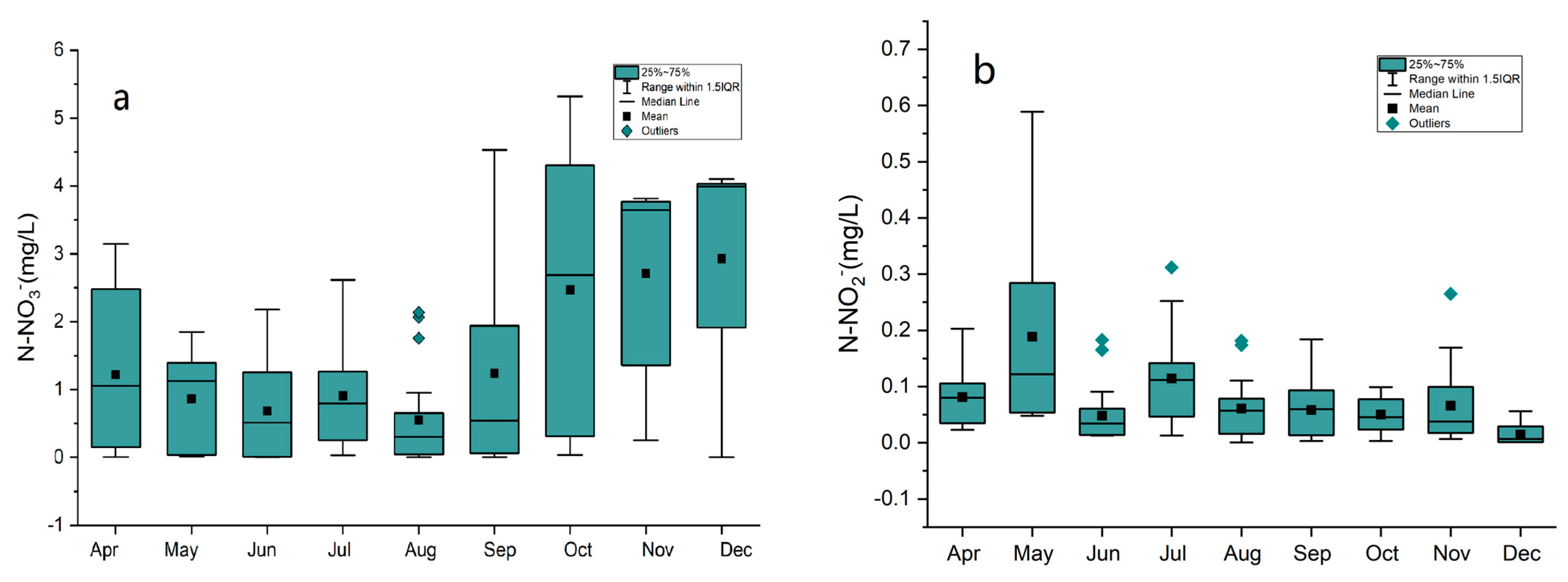
The nitrate (NO3–N) concentration at all sampling sites within the basin during the observation period (April–December) ranged from 0.002 to 5.322 mg·L−1. As the sampling sites were distributed across multiple inflow rivers and the lake interior, they exhibited distinct spatiotemporal variations during the ice-free period. Combined with Figure 2a, the heavy rainfall in August served as a critical hydrological threshold, leading to two typical variation patterns in nitrate concentration before and after the flood season.
During the dry season (April–July), nitrate concentrations at all sites were generally at low levels, with minimal monthly fluctuations and relatively stable average concentrations. June recorded the lowest average concentration in the dry season (0.68 ± 0.75 mg·L−1, coefficient of variation (CV) = 1.10), as shown in Figure 2a. Sampling conducted immediately after the heavy rainfall in August showed the lowest annual mean nitrate concentration across all sites (0.55 ± 0.68 mg·L−1), but with the highest spatial CV (1.25), reflecting the initial uniform dilution effect of rainfall on the water body. Subsequently, nitrate concentrations continued to rise, peaking in December at 2.9 ± 1.60 mg·L−1, while the CV decreased to 0.55, indicating that pollutant inputs became more concentrated in the later period.
The variation pattern of nitrite (NO2–N) significantly differed from that of nitrate (Figure 2b and Figure 3b). Except for June, nitrite concentrations during the dry season were generally higher than those during the flood season, with May having the highest average concentration (0.19 ± 0.16 mg·L−1, CV = 0.84). After the flood season, concentrations decreased overall, reaching the annual lowest in December (0.14 ± 0.02 mg·L−1, CV = 1.17). Compared to nitrate, nitrite exhibited more frequent monthly fluctuations and a more complex trend during the dry season, likely reflecting its instability as an intermediate product and the strong influence of biochemical processes.
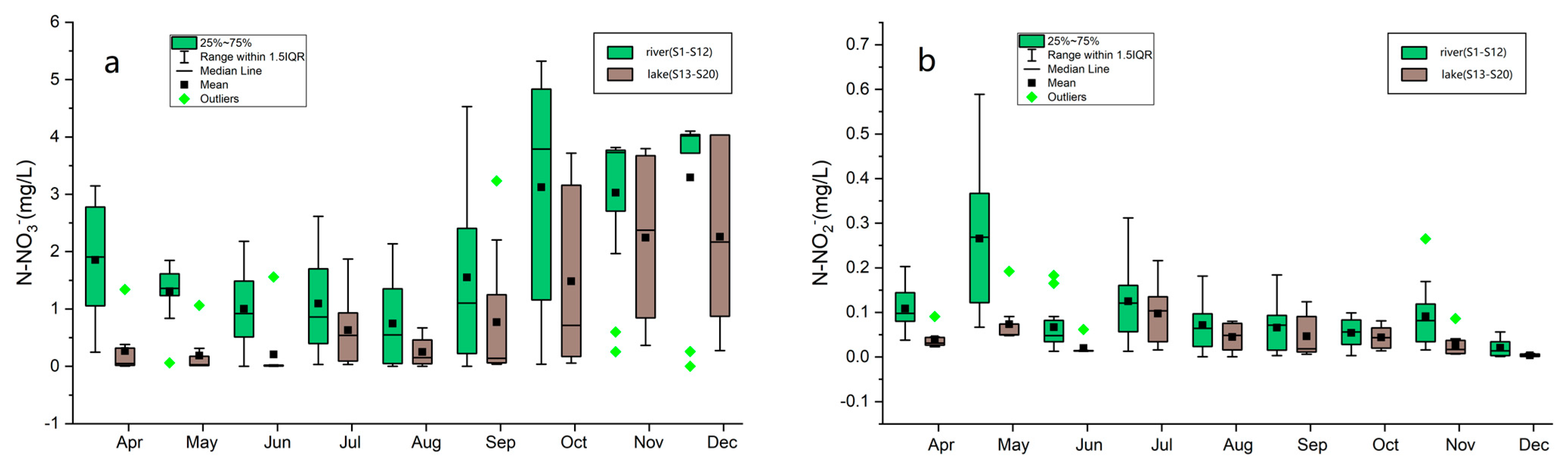
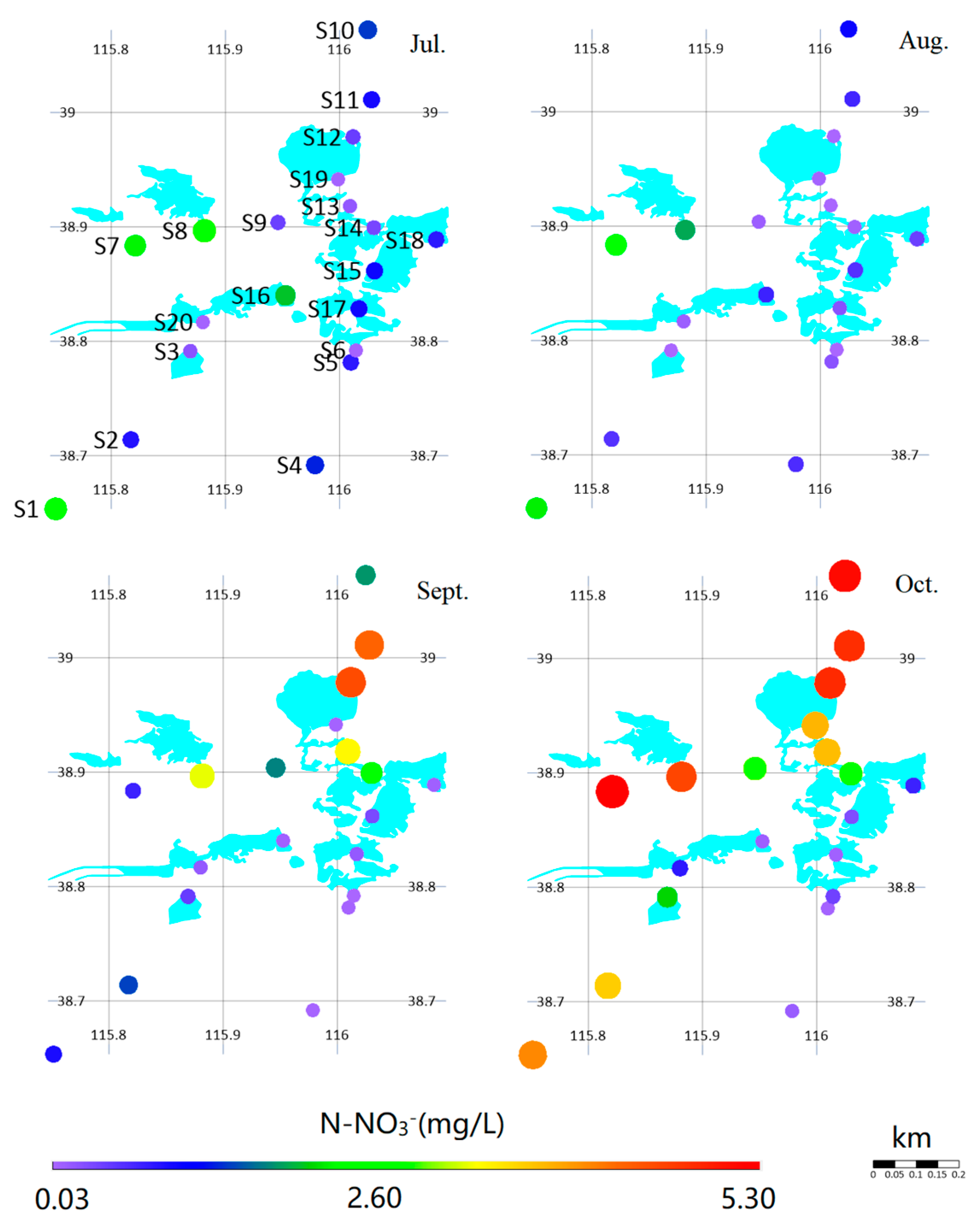
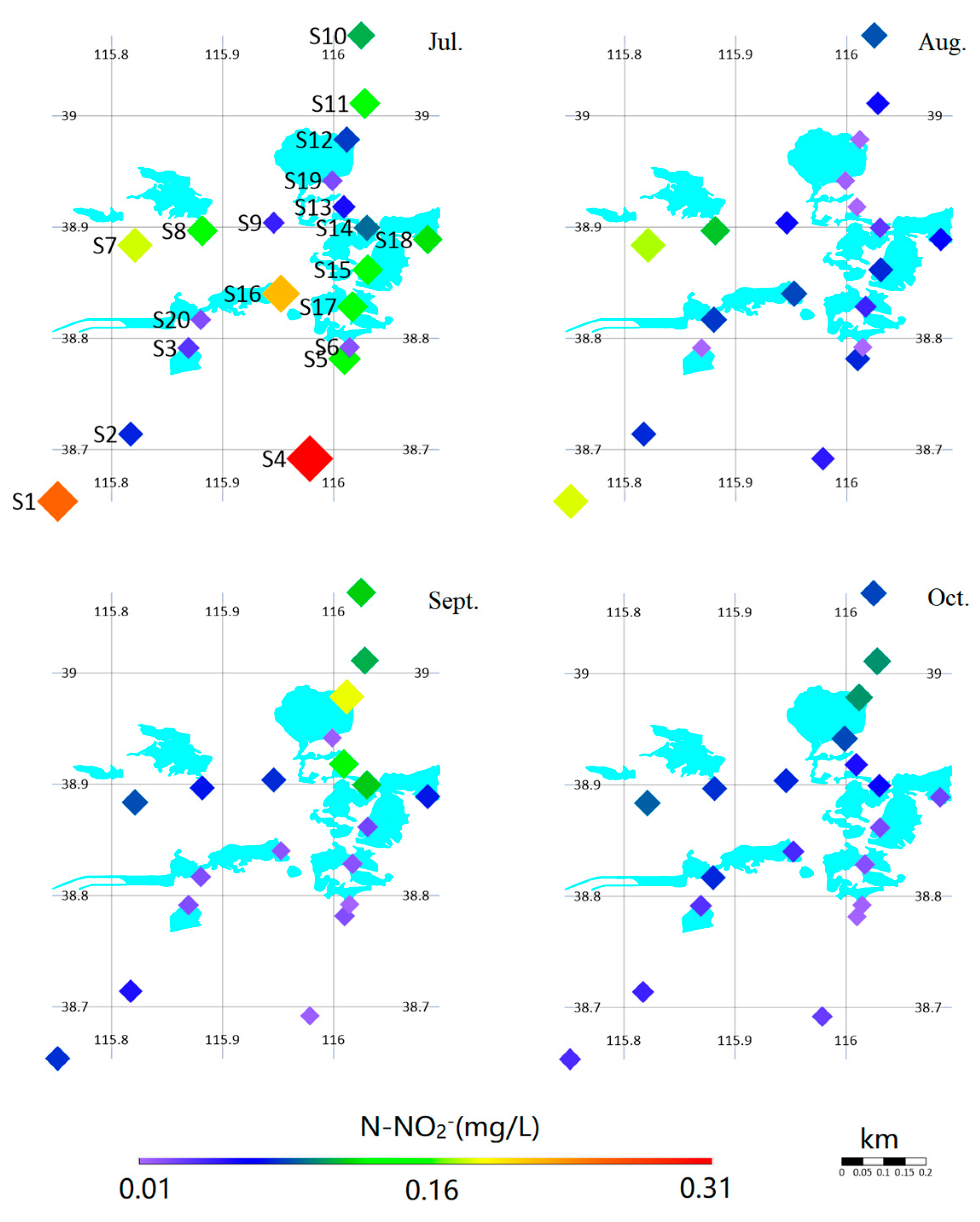
Spatially, based on Figure 3a and Figure 4, the nitrate concentrations at the inflow river sites (S1–S12) were significantly higher than those at the interior lake sites (S13–S20) in every month. The monthly average concentrations at the river sites were relatively stable during the dry season but showed a continuous increase after the flood season. The lake sites followed a similar trend, albeit with a gentler magnitude of change, demonstrating the buffering effect of water retention and mixing on pollution. Regarding nitrite, concentrations at the river sites were also generally higher than those in the lake, but the difference was less pronounced than for nitrate(Figure 4 and Figure 5). Heavy rainfall and subsequent flooding had a lesser impact on nitrite, as concentrations in both rivers and the lake remained at low levels after the flood season, with further narrowed fluctuation ranges.
Further analysis combining Figure 2a identified September as a turning point for water quality. Prior to September, nitrate concentrations at the lake sites fluctuated but within a limited range. After September, influenced by the combined effects of heavy rainfall and concentrated water releases from upstream reservoirs, concentrations at some sites increased significantly. As shown in Figure 3, sites S19 and S13, located near the inlet of the Baigou Diversion River, began to rise as early as September, whereas concentrations at sites in the Fu River (S7–S9) and Xiaoyi River (S1–S3) increased noticeably only in October, showing a lagged response in input. This indicates that external runoff from upstream was the primary cause of water quality deterioration after the flood season, and the impact pathways varied depending on the river channel.

4. Discussion

4.1. Identification Using NO3/Cl Molar Ratios

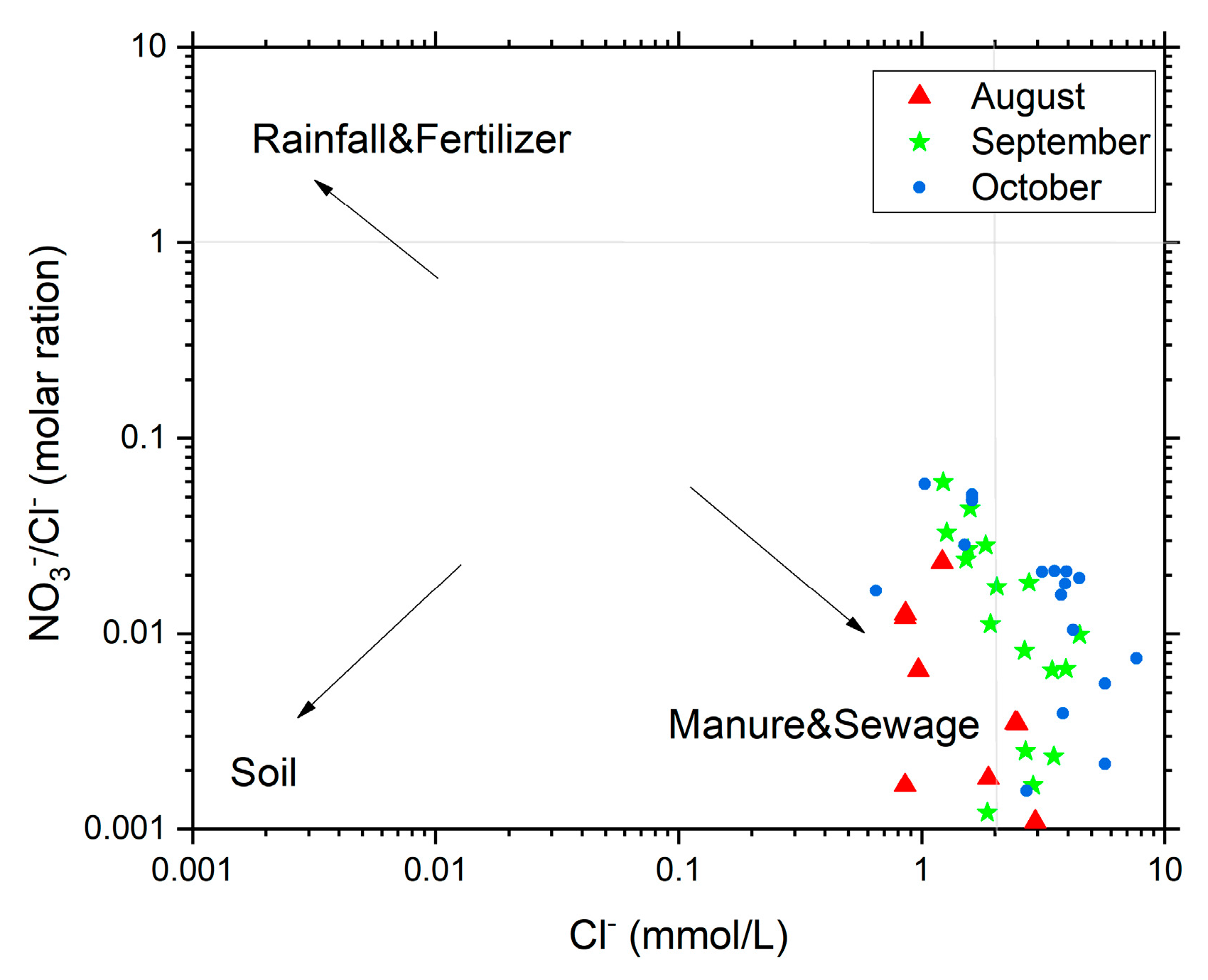
Chloride (Cl) is often used as a key tracer for sewage input due to its significant physicochemical stability in riverine environments [53]. Agricultural potash fertilizers, mineral dissolution (e.g., biotite, hornblende, sylvite, and apatite), animal manure, and domestic wastewater are the primary contributors to Cl in the basin [54,55]. Wastewater from human activities is typically enriched with both NO3 and Cl [31,56], and different pollution sources exhibit distinct characteristic ion combinations (Figure 4). For instance, sewage/manure sources are characterized by high Cl concentration (>5 mmol/L) and a low NO3/Cl ratio (<0.5 mol/mol). Agricultural fertilizer sources show low Cl concentration (<2 mmol/L) and a high NO3/Cl ratio (>2.0 mol/mol). Soil leaching sources exhibit a “double-low” characteristic (Cl < 1.5 mmol/L, NO3/Cl < 0.8 mol/mol) [24]. Based on this, a two-dimensional discriminant diagram of NO3/Cl molar ratio versus chloride concentration was constructed for the three sampling periods (Figure 4), combined with spatial distribution analysis, to validate pollution source contributions.
Analysis of the data from all three months using the double-logarithmic coordinate plot clearly reveals the sources and spatiotemporal evolution of nitrate (NO3) pollution in the Baiyangdian Lake basin. The dense clustering of all data points within the “Manure & Sewage” region conclusively indicates that domestic sewage and livestock wastewater (Manure & Sewage, MS) are the most core and persistent sources of nitrate in this area, with a weaker association with rainfall/fertilizer or natural soil sources.
Temporally, the data illustrates a complete sequence of dynamic responses to pollution following the flood disturbance. In August during the flood event, data points (red triangles) showed relatively high Cl concentration but very low NO3/Cl ratios (mostly <0.01). This is primarily attributed to the strong dilution effect of the substantial rainfall on nitrate, causing the points to plot lower, near the “Soil” region—a temporary phenomenon. In September during the post-flood period, data points (green stars) changed remarkably, with NO3/Cl ratios generally increasing by 1–2 orders of magnitude. The entire cluster shifted towards the core area of the “Manure & Sewage” region. This signifies that after the heavy rainfall ceased, the major upstream rivers began sustained water discharge into the lake, and strong flow agitation in the river channels potentially triggered the release of internal sediments, further exacerbating nitrate pollution. By October, the ratios remained high, and Cl concentrations generally increased, with the entire cluster shifting rightward. This indicates continued wastewater input, and the sustained high nitrate ratios suggest ongoing biogeochemical processes such as nitrification, continuously producing nitrate.
Spatially, the Fu River (F sites) played a particularly prominent role as a major pollution conveyance pathway in September. Its exceptionally high NO3/Cl ratio (e.g., F1: 0.033) identifies it as a concentrated input source for “Manure & Sewage.” Concurrently, some sites (e.g., S2, S3, S20) in October exhibited unusually high Cl concentration but low ratios, which is likely associated with the potential influence of localized saline water intrusion in Baiyangdian Lake. According to the findings of other studies, the salinity levels of the main water diversion rivers into Baiyangdian Lake from May to August 2023 were as follows: the salinity content in the water replenishment area of Baigou Yin River ranged from 212.79 to 787.57 mg/L, with an average value of 420.06 ± 102.28 mg/L; the salinity content in the water replenishment area of Fuhe River ranged from 277.47 to 688.74 mg/L, with an average value of 513.38 ± 149.55 mg/L; the salinity content in the water replenishment area of Xiaoyihe River ranged from 291.07 to 1428.39 mg/L, with an average value of 877.38 ± 324.46 mg/L; and the salinity content in the water replenishment area of Xiaobaihe River ranged from 364.45 to 1034.12 mg/L, with an average value of 841.14 ± 129.43 mg/L. These data indicate that the rivers flowing into the lake have relatively high salinity, resulting in high Cl concentration at multiple monitoring sites [57].
Nitrate in lakes originates from multiple sources, primarily including atmospheric precipitation (P), chemical fertilizer (CF), soil organic nitrogen (SN), and manure and sewage waste (MS) [28,58,59]. Since manure and sewage exhibit overlapping nitrogen and oxygen isotope values and similar isotopic compositions, they are considered as a single pollution source [60,61].
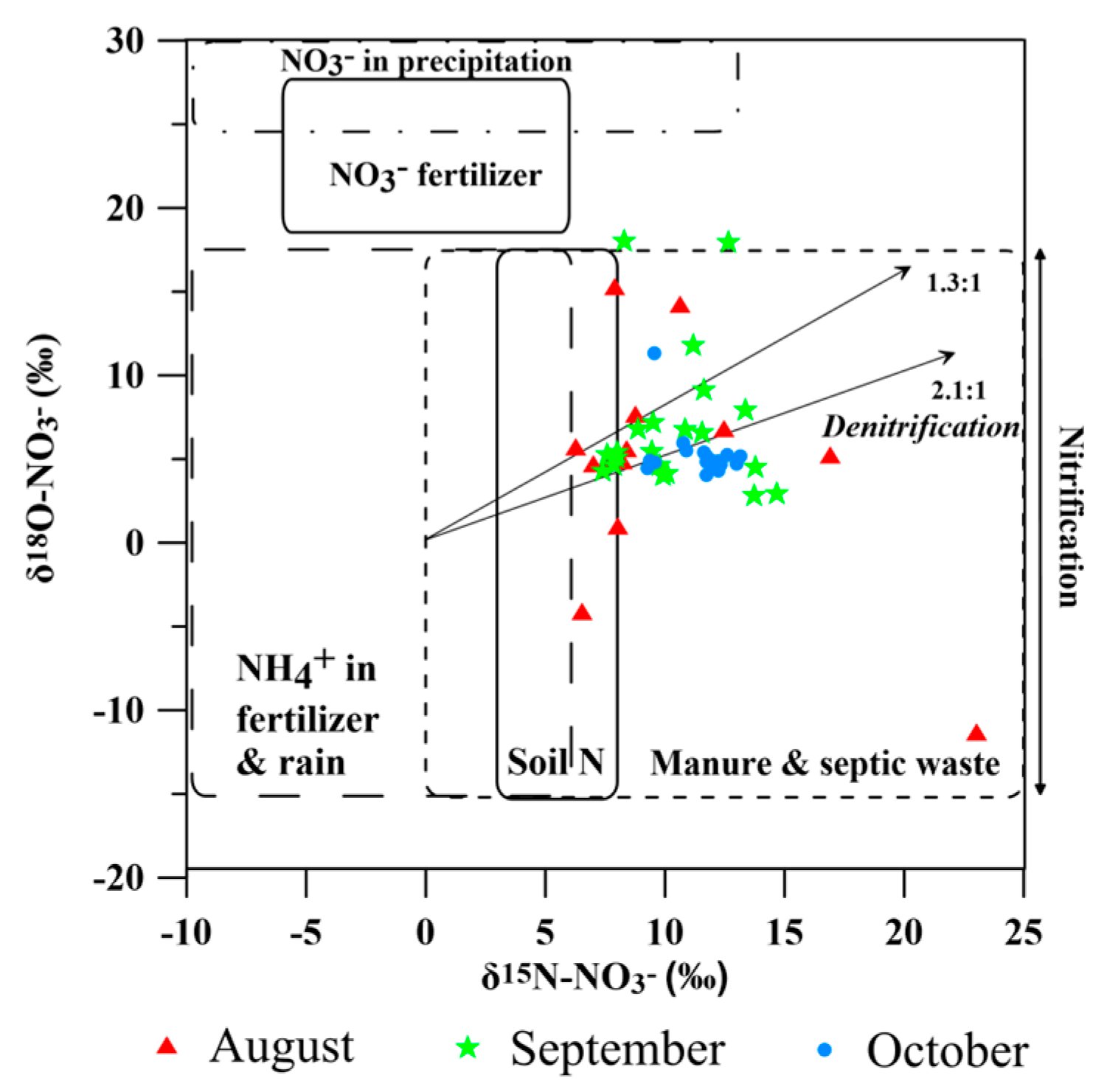
Figure 6 shows the nitrate isotope values from Baiyangdian Lake and the typical isotopic ranges from different sources. Based on continuous monitoring data of nitrate nitrogen and oxygen isotopes (δ15N-NO3 and δ18O-NO3) in the Baiyangdian Lake basin from August to October 2023, this study clearly reveals the main sources of nitrate pollution in the basin and their response dynamics to an extreme flood event. Domestic sewage and livestock wastewater (Manure & Sewage, M&S) were identified as the most core and persistent pollution sources.
Temporally, the data presents a typical shift in pollution source structure and dominant processes driven by the flood event (The statistical data are presented in Table 2). In August during the flood, intense dilution and scouring effects led to a very wide distribution of isotope values (δ15N: 0.000037‰ to 23.0‰; δ18O: −11.3‰ to 5.3‰), reflecting multi-source mixing characteristics involving soil organic nitrogen, residual chemical fertilizers, and sewage, which temporarily masked point source pollution. In September during the post-flood period, point source pollution strongly rebounded. The range of isotope values narrowed significantly and concentrated within the typical range for sewage (δ15N mostly between +5‰ and +18.49‰), confirming the rapid recovery and absolute dominance of contributions from urban domestic sewage and livestock manure. During this period, the role of the Fu River (F sites) as a significant sewage input pathway was particularly prominent. By October during the stable water period, the range of isotope values expanded again (δ15N: 0.000443‰ to 58.23‰; δ18O: −5.00‰ to 25.20‰), indicating that biogeochemical processes became dominant: ongoing nitrification increased the δ18O values of nitrate, while the extremely high δ15N value at site S19 (+58.23‰) strongly indicates denitrification, revealing the presence of complex anoxic conditions and the risk of internal sediment release within the lake area.

4.2. Nitrate Sources Constrained by Chemical and Isotopic Compositions (δ15N and δ18O)

Nitrification is a key process in the nitrogen cycle, playing a decisive role in nitrogen transformation and NO2 emissions. This process leads to a decrease in δ15N abundance [27]. During nitrification, oxygen from the external environment and water is used to oxidize ammonium nitrogen [62]. Denitrification, in contrast, is a respiratory process carried out by microorganisms under anoxic (anaerobic) conditions. These microorganisms utilize the oxygen in nitrate (NO3) as an electron acceptor, progressively reducing it to nitrogen gas (N2) or nitrous oxide (N2O), thereby removing reactive nitrogen (such as NO3) from the water body [63,64].
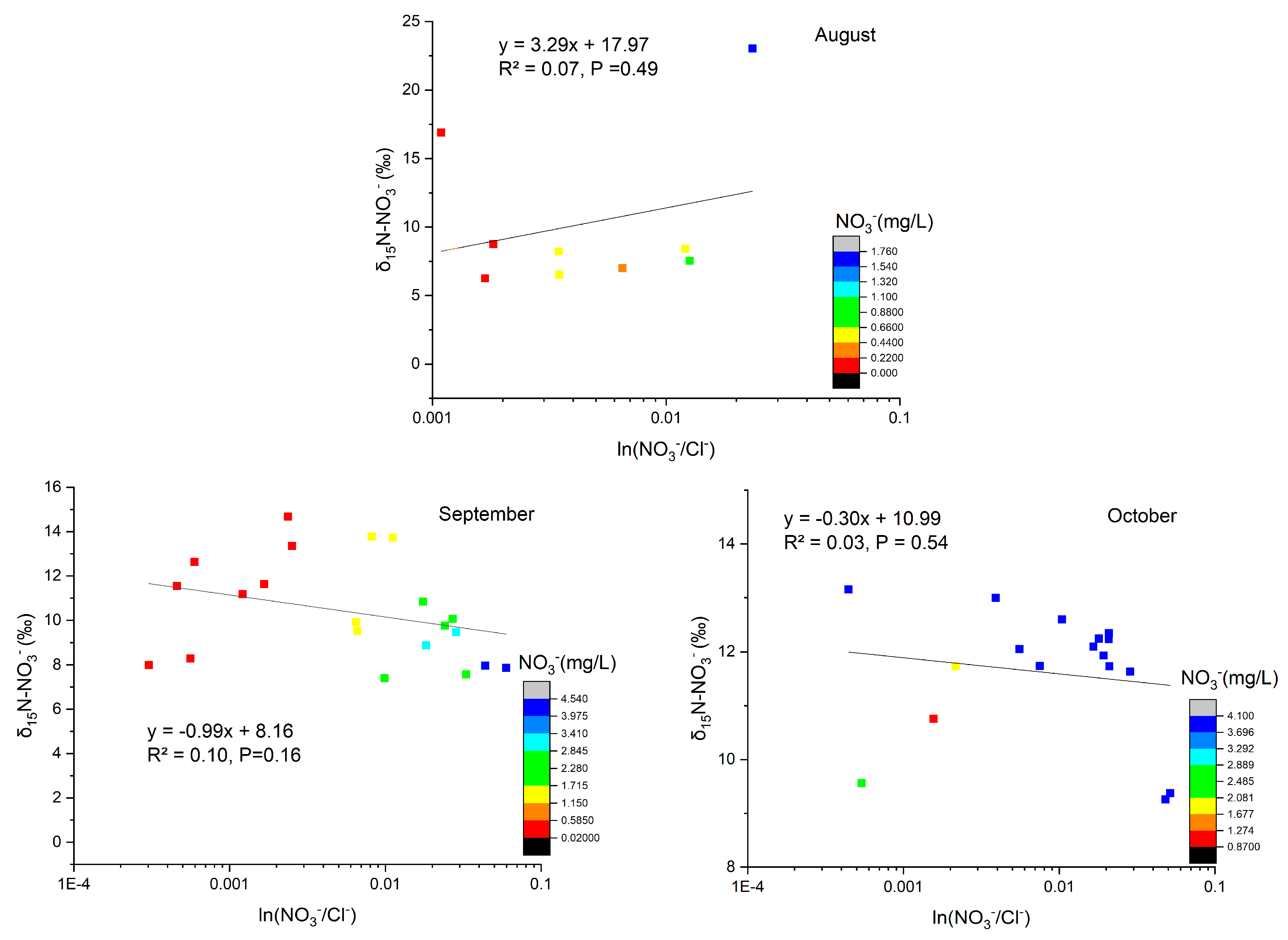
Integrating the results from Figure 6 (isotopic source apportionment plot) and Figure 7 (denitrification analysis plot), nitrate pollution in the Baiyangdian Lake basin exhibits characteristics of mixed sources dominated by domestic sewage and livestock wastewater (Manure & Septic waste, MS). Furthermore, hydrological conditions (flooding) significantly influence its transport and transformation processes. Nitrification is identified as the dominant biogeochemical process, while the influence of denitrification is very limited.
From the perspective of pollution source apportionment (Figure 6), the vast majority of data points are densely distributed within the “Manure & septic waste” region, clearly indicating that domestic sewage and livestock manure discharge are the most core and persistent sources of nitrate in the basin. Temporally, the data points from August (flood period, red triangles) are relatively scattered, indicating multi-source mixing caused by the strong initial dilution and scouring effects of the flood. In September (post-flood period, green stars), the points rapidly converge, confirming the strong rebound of point source pollution after the flood season. In October (stable flow period, blue circles), the distribution range of points expands slightly, suggesting enhanced influence of biological processes. It is noteworthy that most data points from each month fall in the area below the denitrification indicator lines (1.3:1 and 2.1:1), rather than between them. This spatial distribution pattern strongly implies that intense, large-scale denitrification did not occur across the basin.
Further verification regarding the lack of significant denitrification comes from Figure 7. The overall scatter plot of δ15N-NO3 versus ln(NO3/Cl) for the three months shows mixed data with no significant negative correlation (overall R2 = 0.07, p > 0.05). This means that changes in nitrate concentration (represented by ln(NO3/Cl)) were not accompanied by a systematic increase in δ15N-NO3 values, lacking the key isotopic evidence for denitrification. Examining the data by month, points from the high-flow period (August) and the stable-flow period (September) show a disordered distribution without any linear trend. This is primarily due to the massive dilution effect of the flood and sufficient re-aeration from water mixing, which increased dissolved oxygen (DO) levels and suppressed the activity of anaerobic denitrifying bacteria. Although data points from the low-flow period (October) appear slightly more clustered, they still do not form a statistically significant negative correlation trend. Therefore, this study concludes that nitrification was the dominant biological process transforming nitrate in the Baiyangdian Basin during this period. As shown in Figure 6, a large number of points lie within the “Manure & septic waste” source area. The nitrification process, involving the oxidation of ammonium nitrogen, incorporates atmospheric oxygen (δ18O ≈ +23.5‰), leading to elevated δ18O values in the product nitrate, which is consistent with the higher δ18O values observed for some data points in the figure. The nitrification of ammonium nitrogen from point source discharges under suitable conditions during the post-flood water quality recovery period was key in driving the changes in isotopic signals.

4.3. Nitrate Transport and Transformation

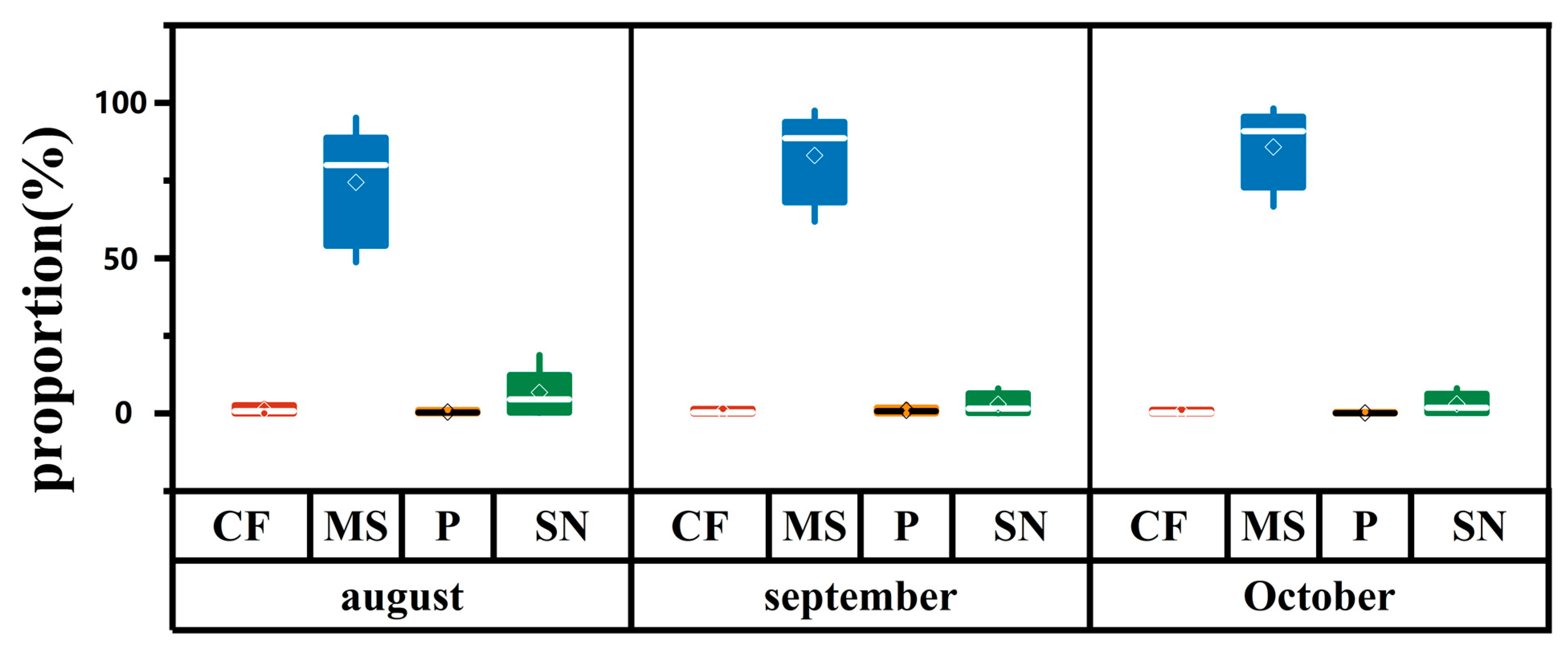
In this study, the Bayesian mixing model (MixSIAR) was used to quantitatively estimate the probability distribution of the proportional contributions from nitrate (NO3) pollution sources in the Baiyangdian Lake basin. We defined four main pollution sources for the basin: Manure & Sewage (MS), Soil Nitrogen (SN), Chemical Fertilizer (CF), and Atmospheric Precipitation (P). The model calculations were performed independently for the three months (August, September, October). The output of the SIAR model (simmr output plot) is shown in Figure 8 and Table 3.
Based on the continuous monitoring from August to October 2023 and the quantitative results from the MixSIAR model, nitrate pollution in this region exhibited a source characteristic overwhelmingly dominated by manure and sewage (MS), with an average contribution proportion as high as 84.0%. This significantly indicates that domestic sewage and livestock wastewater are the most core and persistent pollution sources in Baiyangdian, confirming the severity of point and non-point source wastewater discharges within the basin. The contributions from other sources were relatively limited. Soil nitrogen (SN), as the second largest source, accounted for an average of only 12.3%, while the contributions from chemical fertilizers (CF) and atmospheric precipitation (P) were very low, with mean values of 2.6% and 1.1%, respectively. This suggests that the direct impact of agricultural fertilizers and atmospheric deposition on nitrate pollution is relatively minor.
Temporally, the pollution source structure showed a significant response to the hydrological event. As shown in Figure 9, In August (flood period), the contribution from the MS source was already high (84.0%), and the contribution from the SN source was relatively elevated (12.3%). This reflects that while the flood diluted sewage, it also scoured and carried soil nitrogen, resulting in a temporary mixed contribution. By September (post-flood period), the MS source contribution peaked (90.3%), and the SN source contribution dropped to its lowest (6.4%). This indicates that after the flood receded, sewage discharges (incoming water from upstream) quickly resumed dominance, potentially further accentuated by internal nutrient release. In October (stable flow period), the MS source contribution remained high (83.7%), and the SN source contribution slightly increased (14.8%), suggesting a gradual return of the soil nitrogen contribution to baseline levels as hydrological conditions stabilized.
In summary, the fundamental issue of nitrate pollution in Baiyangdian Lake concentrates on incoming water from upstream (sewage discharges). The finding of limited denitrification capacity (as indicated by the lack of significant correlation between δ15N and ln(NO3/Cl)) underscores the necessity of “source control and interception” as a priority, because without sufficient natural denitrification, external inputs must be reduced. Subsequently, “ecological capacity expansion” (e.g., wetland restoration) can enhance denitrification to mitigate nitrogen accumulation.

4.4. Uncertainty Analysis of Source Apportionment Results

Uncertainty analysis of the nitrate source apportionment results for the Baiyangdian Lake basin from August to October revealed distinct spatiotemporal heterogeneity (Table 4). Temporally, as hydrological conditions transitioned from the flood period (August) through the post-flood period (September) to the stable period (October), the uncertainty associated with all pollution sources showed a declining trend, indicating a gradual increase in the reliability of the source apportionment results. Among these, soil nitrogen (SN) consistently represented the largest source of uncertainty, exhibiting the highest uncertainty index (UI90). This reflects the complexity of soil nitrogen transformation processes (e.g., nitrification/denitrification), significant spatial heterogeneity, and the substantial influence of rainfall scouring and interactions with groundwater. The ranking of source stability (from most to least stable) remained consistent across the three months: Atmospheric Precipitation (AP) < Chemical Fertilizer (CF) < Manure & Sewage (M&S) < Soil Nitrogen (SN). Particularly noteworthy is the significant impact of the hydrological event on uncertainty, with the uncertainty for the M&S source peaking in September (post-flood period). This clearly reflects the rapid rebound of point source pollution and the complexity of its spatial distribution following the drastic change in hydrological conditions.
Compared to other lakes in densely populated regions (such as Lake Taihu, Lake Chao, and Lake Dianchi in China), Baiyangdian Lake exhibits a significantly higher proportion of sewage-derived nitrate [65]. This pronounced “sewage dominance” in Baiyangdian stems from its unique hydrological setting and limited denitrification capacity—typical challenges faced by many eutrophic urban and suburban lakes in the attached table (including Lake Taihu, Lake Chao, and Lake Dianchi). The table confirms that nitrogen pollution (total nitrogen, TN) is one of the primary concerns for these eutrophic lakes. The comparison indicates that while the extreme “sewage dominance” pattern in Baiyangdian may be intensified by its specific conditions, the underlying vulnerability to human domestic wastewater input and the role of extreme hydrological events like floods in reshaping nitrogen sources are common phenomena in human-impacted lakes worldwide.

5. Conclusions

This study systematically elucidated the sources, transport and transformation patterns of nitrate pollution, and their responses to the 2023 catastrophic flood event in North China within the Baiyangdian Lake basin from August to October 2023, by integrating hydrochemical ion ratios, nitrate dual-isotope tracing, and the Bayesian mixing model (MixSIAR). The main conclusions are as follows:
The pollution source is overwhelmingly dominated by domestic sewage and livestock wastewater, indicating a singular source structure. Quantitative results revealed that manure and sewage (MS) is the most core source of nitrate in Baiyangdian, with an average contribution as high as 84.0%, which further increased to 90.3% in September after the flood, demonstrating strong persistence. Soil nitrogen (average 12.3%) was a secondary source, while the combined contribution of chemical fertilizers and atmospheric precipitation was less than 4%, indicating a minor impact. This significantly differs from the traditional pollution structure of “fertilizer dominance” or “soil nitrogen baseline” typical of agricultural basins, clearly revealing that the fundamental issue of nitrogen pollution in Baiyangdian, a highly human-impacted shallow lake, lies in point and non-point source wastewater discharges from upstream. The flood event was a key factor driving the dynamics of pollution sources and biogeochemical processes. The study uncovered a clear dynamic response pattern of “dilution-mixing—pollution rebound—process transformation”. The dilution and scouring effects in the initial flood stage (August) led to multi-source mixing characteristics. The rapid rebound of the sewage source contribution and the convergence of isotopic signals in the post-flood period (September) not only confirmed the dominance of point source pollution but also hinted that sediment internal loading potentially triggered by flood disturbance further exacerbated pollution. During the stable flow period (October), nitrification became the dominant biological process. However, the lack of a significant negative correlation between δ15N and ln(NO3/Cl) indicated limited denitrification capacity across the basin, which constitutes an important internal mechanism contributing to nitrogen accumulation and the low water environmental capacity of Baiyangdian. This indicates that the denitrification capacity across the entire basin is limited, a phenomenon that constitutes an important internal mechanism leading to nitrogen accumulation in Baiyangdian and the low water environmental capacity of the lake. It also underscores the urgency of pollution source control—since natural nitrogen removal processes are insufficient, there is an urgent need to adopt ecological measures to enhance (nitrogen) removal capacity. The study identified key spatial control points and a management priority sequence. Spatially, the Fu River and Baigou Diversion River were confirmed as critical conduits for wastewater input into Baiyangdian. Management measures must follow a strict priority order: the primary task is “source control and interception,” specifically, strengthening the comprehensive collection and treatment of urban and rural domestic sewage and the resource utilization of livestock manure, with a focus on the major inflow rivers, especially implementing precise control during the post-flood pollution rebound period. The secondary measure is “ecological expansion of capacity.” On the basis of source control, it is essential to improve habitats to promote denitrification through measures such as restoring wetlands and aquatic vegetation, and implementing ecological dredging in key areas, thereby systematically enhancing the self-purification capacity and environmental carrying load of Baiyangdian against nitrogen pollution. The findings of this study revise the traditional understanding of nitrogen pollution sources in such highly human-impacted lakes, emphasizing the absolute dominance of sewage sources after extreme hydrological events and the potential risk of insufficient denitrification capacity. This research provides a scientific basis for the precise management and ecological restoration of the water environment in Baiyangdian and similar lakes.

Author Contributions

Investigation, X.H., Y.W. and L.M.; Data curation, S.M.; Writing—original draft, Y.Z.; Visualization, J.C. All authors have read and agreed to the published version of the manuscript.

Funding

The authors are grateful for funding from the Hebei Academy of Sciences Basic Scientific Research Funds Pilot Project (2025PF05).

Data Availability Statement

The original contributions presented in this study are included in the article. Further inquiries can be directed to the corresponding authors.

Conflicts of Interest

The authors declare that they have no known competing financial interests or personal relationships that could have appeared to influence the work reported in this paper.

References

  1. Meghdadi, A.; Javar, N. Quantification of spatial and seasonal variations in the proportional contribution of nitrate sources using a multi-isotope approach and Bayesian isotope mixing model. Environ. Pollut. 2018, 235, 207–222. [Google Scholar] [CrossRef]
  2. Spalding, R.; Hirsh, A.; Exner, M.; Little, N.; Kloppenborg, K. Applicability of the dual isotopes δ15N and δ18O to identify nitrate in groundwater beneath irrigated cropland. J. Contam. Hydrol. 2018, 220, 128–135. [Google Scholar] [CrossRef] [PubMed]
  3. Keys, T.A.; Caudill, M.F.; Scott, D.T. Storm effects on nitrogen flux and longitudinal variability in a river–reservoir system. River Res. Appl. 2019, 35, 577–586. [Google Scholar] [CrossRef]
  4. Neville, J.A.; Emanuel, R.E.; Nichols, E.G.; Vose, J.M. Extreme Flooding and Nitrogen Dynamics of a Blackwater River. Water Resour. Res. 2021, 57, e2020WR029106. [Google Scholar] [CrossRef]
  5. Yue, F.-J.; Li, S.-L.; Waldron, S.; Wang, Z.-J.; Oliver, D.M.; Chen, X.; Liu, C.-Q. Rainfall and conduit drainage combine to accelerate nitrate loss from a karst agroecosystem: Insights from stable isotope tracing and high-frequency nitrate sensing. Water Res. 2020, 186, 116388. [Google Scholar] [CrossRef]
  6. Graf, W.L.; Wohl, E.; Sinha, T.; Sabo, J.L. Sedimentation and sustainability of western American reservoirs. Water Resour. Res. 2010, 46. [Google Scholar] [CrossRef]
  7. Kondolf, G.M.; Gao, Y.; Annandale, G.W.; Morris, G.L.; Jiang, E.; Zhang, J.; Cao, Y.; Carling, P.; Fu, K.; Guo, Q.; et al. Sustainable sediment management in reservoirs and regulated rivers: Experiences from five continents. Earths Future 2014, 2, 256–280. [Google Scholar] [CrossRef]
  8. Zhao, X.; Xu, H.; Kang, L.; Zhu, G.; Paerl, H.W.; Li, H.; Liu, M.; Zhu, M.; Zou, W.; Qin, B.; et al. Nitrate sources and transformations in a river-reservoir system: Response to extreme flooding and various land use. J. Hydrol. 2024, 638, 131491. [Google Scholar] [CrossRef]
  9. Ho, J.C.; Michalak, A.M.; Pahlevan, N. Widespread global increase in intense lake phytoplankton blooms since the 1980s. Nature 2019, 574, 667–670. [Google Scholar] [CrossRef]
  10. Nieder, R.; Benbi, D.K.; Reichl, F.X. Reactive Water-Soluble Forms of Nitrogen and Phosphorus and Their Impacts on Environment and Human Health. In Soil Components and Human Health; Springer: Dordrecht, The Netherlands, 2018. [Google Scholar]
  11. Qin, B.; Deng, J.; Shi, K.; Wang, J.; Brookes, J.; Zhou, J.; Zhang, Y.; Zhu, G.; Paerl, H.W.; Wu, L.; et al. Extreme Climate Anomalies Enhancing Cyanobacterial Blooms in Eutrophic Lake Taihu, China. Water Resour. Res. 2021, 57, e2020WR029371. [Google Scholar] [CrossRef]
  12. Denk, T.R.; Mohn, J.; Decock, C.; Lewicka-Szczebak, D.; Harris, E.; Butterbach-Bahl, K.; Kiese, R.; Wolf, B. The nitrogen cycle: A review of isotope effects and isotope modeling approach-es. Soil Biol. Biochem. 2017, 105, 121–137. [Google Scholar] [CrossRef]
  13. Jani, J.; Toor, G.S. Composition, sources, and bioavailability of nitrogen in a longitudinal gradient from freshwater to estuarine waters. Water Res. 2018, 137, 344–354. [Google Scholar] [CrossRef] [PubMed]
  14. Kendall, C.; Elliott, E.M.; Wankel, S.D. Tracing Anthropogenic Inputs of Nitrogen to Ecosystems. In Stable Isotopes in Ecology and Environmental Science; Wiley: Hoboken, NJ, USA, 2008; pp. 375–449. [Google Scholar]
  15. Kruk, M.; Mayer, B.; Nightingale, M.; Laceby, J.P. Tracing nitrate sources with a combined isotope approach (δ15NNO3, δ18ONO3 and δ11B) in a large mixed-use watershed in southern Alberta, Canada. Sci. Total Environ. 2020, 703, 135043. [Google Scholar] [CrossRef]
  16. Luu, T.N.M.; Do, T.N.; Matiatos, I.; Panizzo, V.N.; Trinh, A.D. Stable isotopes as an effective tool for N nutrient source identification in a heavily urbanized and agriculturally intensive tropical lowland basin. Biogeochemistry 2020, 149, 17–35. [Google Scholar] [CrossRef]
  17. Yi, Q.; Zhang, Y.; Xie, K.; Chen, Q.; Zheng, F.; Tonina, D.; Shi, W.; Chen, C. Tracking nitrogen pollution sources in plain watersheds by combining high-frequency water quality monitoring with tracing dual nitrate isotopes. J. Hydrol. 2020, 581, 124439. [Google Scholar] [CrossRef]
  18. Galloway, J.N.; Aber, J.D.; Erisman, J.W.; Seitzinger, S.P.; Howarth, R.W.; Cowling, E.B.; Cosby, B.J. The nitrogen cascade. BioScience 2003, 53, 341–356. [Google Scholar] [CrossRef]
  19. Pattinson, S.; Garciaruiz, R.; Whitton, B.A. Spatial and seasonal variation in denitrification in the Swale–Ouse system, a river continuum. Sci. Total Environ. 1998, 210–211, 289–305. [Google Scholar] [CrossRef]
  20. Zweimüller, I.; Zessner, M.; Hein, T. Effects of climate change on nitrate loads in a large river: The Austrian Danube as example. Hydrological Processes. Hydrol. Process. 2008, 22, 1022–1036. [Google Scholar] [CrossRef]
  21. Paredes, I.; Otero, N.; Soler, A.; Green, A.J.; Soto, D.X. Agricultural and urban delivered nitrate pollution input to Mediterranean temporary freshwaters. Agric. Ecosyst. Environ. 2020, 294, 106859. [Google Scholar] [CrossRef]
  22. Utom, A.U.; Werban, U.; Leven, C.; Müller, C.; Knöller, K.; Vogt, C.; Dietrich, P. Groundwater nitrification and denitrification are not always strictly aerobic and anaerobic processes, respectively: An assessment of dual-nitrate isotopic and chemical evidence in a stratified alluvial aquifer. Biogeochemistry 2020, 147, 211–223. [Google Scholar] [CrossRef]
  23. Fadhullah, W.; Yaccob, N.S.; Syakir, M.; Muhammad, S.A.; Yue, F.-J.; Li, S.-L. Nitrate sources and processes in the surface water of a tropical reservoir by stable isotopes and mixing model. Sci. Total Environ. 2019, 700, 134517. [Google Scholar] [CrossRef]
  24. Shang, X.; Huang, H.; Mei, K.; Xia, F.; Chen, Z.; Yang, Y.; Dahlgren, R.A.; Zhang, M.; Ji, X. Riverine nitrate source apportionment using dual stable isotopes in a drinking water source watershed of southeast China. Sci. Total Environ. 2020, 724, 137975. [Google Scholar] [CrossRef]
  25. Kendall, C.; Aravena, R. Nitrate Isotopes in Groundwater Systems. In Environmental Tracers in Subsurface Hydrology; Springer: New York City, NY, USA, 2000; pp. 261–297. [Google Scholar]
  26. Minet, E.; Goodhue, R.; Meier-Augenstein, W.; Kalin, R.; Fenton, O.; Richards, K.; Coxon, C. Combining stable isotopes with contamination indicators: A method for improved investigation of nitrate sources and dynamics in aquifers with mixed nitrogen inputs. Water Res. 2017, 124, 85–96. [Google Scholar] [CrossRef]
  27. Rock, L.; Mayer, B. Isotopic Assessment of Sources of Surface Water Nitrate within the Oldman River Basin, Southern Alberta, Canada. Water Air Soil Pollut. Focus 2004, 4, 545–562. [Google Scholar] [CrossRef]
  28. Xue, D.; Botte, J.; De Baets, B.; Accoe, F.; Nestler, A.; Taylor, P.; Van Cleemput, O.; Berglund, M.; Boeckx, P. Present Limitations and Future Prospects of Stable Isotope Methods for Nitrate Source Identification in Surface and Groundwater. Water Res. 2009, 43, 1159–1170. [Google Scholar] [CrossRef]
  29. Freyer, H.D. Seasonal variation of 15N/l4N ratios in atmospheric nitrate species. Tellus Ser. B-Hemical Phys. Mete-Orol. 1991, 43, 30–44. [Google Scholar] [CrossRef]
  30. Ding, J.; Xi, B.; Xu, Q.; Gao, R.; Lu, Y.; Huang, J.; Liu, H. Application of stable isotope on nitrate pollution researches of surface water. J. Lake Sci. 2013, 25, 11. Available online: https://www.jlakes.org/hpkx/article/abstract/20130501 (accessed on 9 October 2025). [CrossRef] [PubMed]
  31. Liu, C.-Q.; Li, S.-L.; Lang, Y.-C.; Xiao, H.-Y. Using δ15N- and δ18O-Values To Identify Nitrate Sources in Karst Ground Water, Guiyang, Southwest China. Environ. Sci. Technol. 2006, 40, 6928–6933. [Google Scholar] [CrossRef] [PubMed]
  32. Li, S.-L.; Liu, C.-Q.; Li, J.; Liu, X.; Chetelat, B.; Wang, B.; Wang, F. Assessment of the Sources of Nitrate in the Changjiang River, China Using a Nitrogen and Oxygen Isotopic Approach. Environmental. Environ. Sci. Technol. 2010, 44, 1573–1578. [Google Scholar] [CrossRef] [PubMed]
  33. Zhan, M.; Zeng, W.; Wu, C.; Chen, G.; Meng, Q.; Hao, X.; Peng, Y. Impact of organic carbon on sulfide-driven autotrophic denitrification: Insights from isotope fractionation and functional genes. Water Res. 2024, 255, 121507. [Google Scholar] [CrossRef]
  34. Umezawa, Y.; Hosono, T.; Onodera, S.-I.; Siringan, F.; Buapeng, S.; Delinom, R.; Yoshimizu, C.; Tayasu, I.; Nagata, T.; Taniguchi, M.; et al. Sources of nitrate and ammonium contamination in groundwater under developing Asian megacities. Sci. Total Environ. 2009, 407, 3219–3231. [Google Scholar] [CrossRef]
  35. McClelland, J.W.; Valiela, I. Linking nitrogen in estuarine producers to land-derived sources. Limnol. Oceanogr. 1998, 43, 577–585. [Google Scholar] [CrossRef]
  36. Kendall, C. Tracing nitrogen sources and cycling in catchments. In Isotope Tracers in Catchment Hydrology; Elsevier: Amsterdam, The Netherlands, 1998; pp. 519–576. ISBN 9780444815460. [Google Scholar] [CrossRef]
  37. Mayer, B.; Bollwerk, S.M.; Mansfeldt, T.; Hütter, B.; Veizer, J. The oxygen isotope composition of nitrate generated by nitrification in acid forest floors. Geochim. Cosmochim. Acta 2001, 65, 2743–2756. [Google Scholar] [CrossRef]
  38. Ji, X.; Xie, R.; Hao, Y.; Lu, J. Quantitative identification of nitrate pollution sources and uncertainty analysis based on dual isotope approach in an agricultural watershed. Environ. Pollut. 2017, 229, 586–594. [Google Scholar] [CrossRef]
  39. Matiatos, I.; Wassenaar, L.I.; Monteiro, L.R.; Venkiteswaran, J.J.; Gooddy, D.C.; Boeckx, P.; Sacchi, E.; Yue, F.; Michalski, G.; Alonso-Hernández, C.; et al. Global patterns of nitrate isotope composition in rivers and adjacent aquifers reveal reactive nitrogen cascading. Commun. Earth Environ. 2021, 2, 52. [Google Scholar] [CrossRef]
  40. Yi, Y.; Lin, C.; Tang, C. Hydrology, environment and ecological evolution of Lake Baiyangdian since 1960s. J. Lake Sci. 2020, 32, 1333–1347. [Google Scholar] [CrossRef]
  41. Chang, L.P. Research on Water Pollution Characteristics of Baiyangdian and Water Quality Enhancement Technology Based on Plant Purification. Master’s Thesis, Beijing Forestry University, Beijing, China, 2019. (In Chinese). [Google Scholar]
  42. Hou, X.L. A Comparative Study on the Simulation of Groundwater Evapotranspiration Changes Caused by Different Water Use Methods—Taking the Agricultural Irrigation Area and Ecological Water Recharge Area in the North China Plain as Examples. Ph.D. Thesis, University of Chinese Academy of Sciences, Beijing, China, 2021. [Google Scholar]
  43. Tang, Y.; Xu, G.; Tang, G.; Zhang, W.; Min, A. Temporal and spatial distribution characteristics of hourly heavy rainfall of the “23.7” heavy rainstorm event in North China. Trans. Atmos. Sci. 2024, 47, 778–788. Available online: http://dqkxxb.cnjournals.org/dqkxxb/article/abstract/20240508?st=search (accessed on 9 October 2025).
  44. Li, F.; Wu, L.; Zhang, L.; Shao, C.; Jiang, J. Synoptic-scale system characteristics and mechanisms of the “23.7” extreme rainstorm in North China. Trans. Atmos. Sci. 2025, 48, 828–842. [Google Scholar] [CrossRef]
  45. Hodgkins, R.; Tranter, M.; Dowdeswell, J.A. The hydrochemistry of runoff from a ‘cold-based’ glacier in the High Artic (Scott Turnerbreen, Svalbard). Hydrol. Process. 1998, 12, 87–103. [Google Scholar] [CrossRef]
  46. Stark, J.M.; Hart, S.C. Diffusion technique for preparing salt solutions, kjeldahl digests, and persulfate digests for nitrogen-15 Analysis. Soil Sci. Soc. Am. J. 1996, 60, 1846–1855. [Google Scholar] [CrossRef]
  47. Takesako, H. Double-plunger pump system flow injection spectrophotometric determination of inorganic nitrogen in soil extracts (part 2): Flow injection analysis of nitrate nitrogen in soil extracts. Jpn. J. Soil Sci. Plant Nutr. 1991, 62, 135–140. [Google Scholar]
  48. Czerwionka, K. Influence of dissolved organic nitrogen on surface waters. Oceanologia 2015, 58, 39–45. [Google Scholar] [CrossRef]
  49. Ming, X.; Yang, P.; Xie, S.; Sheng, T.; Luo, D. Sources and transformations of nitrate of the subterranean river system in Jin-foshan Karst World Heritage. J. Lake Sci. 2019, 31, 1299–1309. [Google Scholar] [CrossRef]
  50. Xue, D.; De Baets, B.; Van Cleemput, O.; Hennessy, C.; Berglund, M.; Boeckx, P. Use of a Bayesian isotope mixing model to estimate proportional contributions of multiple nitrate sources in surface water. Environ. Pollut. 2012, 161, 43–49. [Google Scholar] [CrossRef]
  51. Parnell, A.C.; Inger, R.; Bearhop, S.; Jackson, A.L. Source Partitioning Using Stable Isotopes: Coping with Too Much Variation. PLoS ONE 2010, 5, e9672. [Google Scholar] [CrossRef]
  52. Stock, B.C.; Jackson, A.L.; Ward, E.J.; Parnell, A.C.; Phillips, D.L.; Semmens, B.X. Analyzing mixing systems using a new generation of Bayesian tracer mixing models. PeerJ 2018, 6, e5096. [Google Scholar] [CrossRef]
  53. Chen, F.; Jia, G.; Chen, J. Nitrate sources and watershed denitrification inferred from nitrate dual isotopes in the Beijiang River, south China. Biogeochemistry 2009, 94, 163–174. [Google Scholar] [CrossRef]
  54. Chen, X.; Jiang, C.; Zheng, L.; Dong, X.; Chen, Y.; Li, C. Identification of nitrate sources and transformations in basin using dual isotopes and hydrochemistry combined with a Bayesian mixing model: Application in a typical mining city. Environ. Pollut. 2020, 267, 115651. [Google Scholar] [CrossRef] [PubMed]
  55. Leger, A.; Rebbert, C.; Webster, J. Cl-rich biotite and amphibole from Black Rock Forest, Cornwall, New York. Am. Miner. 1996, 81, 495–504. [Google Scholar] [CrossRef]
  56. Anornu, G.; Gibrilla, A.; Adomako, D. Tracking nitrate sources in groundwater and associated health risk for rural communities in the White Volta River basin of Ghana using isotopic approach (δ15N, δ18ONO3 and 3H). Sci. Total Environ. 2017, 603–604, 687–698. [Google Scholar] [CrossRef] [PubMed]
  57. Zhang, B. Study on the Characteristics of Salinity Change and Water Quality Effect in Baiyangdian Waterfill Area. Master’s Thesis, Hebei University of Engineering, Handan, China, 2023. (In English). [Google Scholar]
  58. Zhang, Q.; Wang, H.; Wang, L.; Long, W. Tracing nitrate pollution sources and transformations in the over-exploited groundwater region of north China using stable isotopes. J. Contam. Hydrol. 2018, 218, S0169772217302322. [Google Scholar] [CrossRef]
  59. Zhang, H.; Xu, Y.; Cheng, S.; Li, Q.; Yu, H. Application of the dual-isotope approach and Bayesian isotope mixing model to identify nitrate in groundwater of a multiple land-use area in Chengdu Plain, China. Sci. Total Environ. 2020, 717, 137134. [Google Scholar] [CrossRef] [PubMed]
  60. Biddau, R.; Cidu, R.; Da Pelo, S.; Carletti, A.; Ghiglieri, G.; Pittalis, D. Source and fate of nitrate in contaminated groundwater systems: Assessing spatial and temporal variations by hydrogeochemistry and multiple stable isotope tools. Sci. Total Environ. 2018, 647, 1121–1136. [Google Scholar] [CrossRef]
  61. Yu, L.; Zheng, T.; Zheng, X.; Hao, Y.; Yuan, R. Nitrate source apportionment in groundwater using Bayesian isotope mixing model based on nitrogen isotope fractionation. Sci. Total Environ. 2020, 718, 137242. [Google Scholar] [CrossRef] [PubMed]
  62. Andersson, K.K.; Hooper, A.B. O2 and H2O are each the source of one O in NO2 produced from NH3 by Nitrosomonas: 15N-NMR evidence. FEBS Lett. 1983, 164, 236–240. [Google Scholar] [CrossRef]
  63. Clark, T.B.; Whitcomb, R.F.; Tully, J.G. Spiroplasmas from coleopterous insects: New ecological dimensions. Microb. Ecol. 1982, 8, 401–409. [Google Scholar] [CrossRef]
  64. Zumft, W.G. Cell biology and molecular basis of denitrification. Microbiol. Mol. Biol. Rev. 1997, 61, 533–616. [Google Scholar] [CrossRef] [PubMed]
  65. Wu, F.; Zhan, J.; Deng, X.; Ling, Y. Influencing factors of lake eutrophication in China: A case study in 22 lakes in China. Ecol. Environ. 2012, 21, 94–100. [Google Scholar]
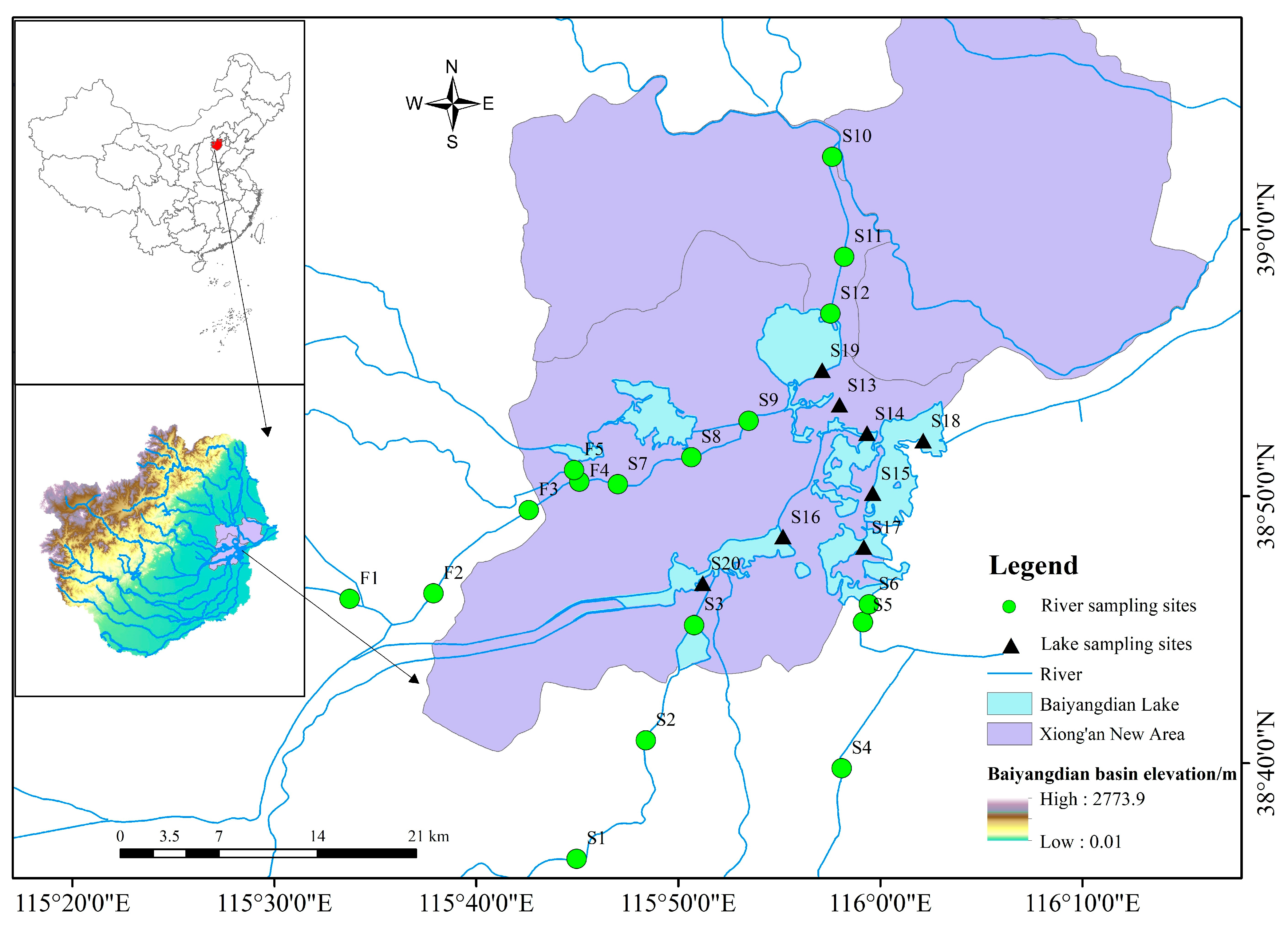
Figure 1. Location of the study area.
Water 17 03309 g001
Figure 2. Variations in Nitrate (a) and Nitrite (b) Concentrations by Month During the Sampling Period.
Water 17 03309 g002
Figure 3. Variations in Nitrate (a) and Nitrite (b) Concentrations at Lake vs. River Channel Sites by Month During the Sampling Period.
Water 17 03309 g003
Figure 4. Spatial Changes in Nitrate Concentrations in the Study Area Before and After the Flood. Note: The changes in the size and color of the circles both indicate the level of nitrate concentration at each monitoring point.
Water 17 03309 g004
Figure 5. Spatial Changes in Nitrite Concentrations in the Study Area Before and After the Flood. Note: The changes in the size and color of the diamonds both indicate the level of nitrite concentration at each monitoring point.
Water 17 03309 g005
Figure 6. Scatter plot of nitrate/chloride molar ratios for all sampling sites in different months.
Water 17 03309 g006
Figure 7. Relationships betweenδ15N-NO3- and δ18O-NO3- values for each sampling point in different months.
Water 17 03309 g007
Figure 8. Relationship between ln(NO3/Cl) ratios and nitrate isotopic signatures in Baiyangdian Lake and rivers during different sampling periods.
Water 17 03309 g008
Figure 9. Changes in nitrate nitrogen and oxygen isotope values in Baiyangdian Lake from August to October.
Water 17 03309 g009
Table 1. Physical and chemical parameters of water samples from Baiyangdian Lake and its inflowing rivers (July–October 2023).
Site IDTemperature Range (°C)pH RangeDissolved Oxygen (DO) Range (mg/L)Electrical Conductivity (EC) Range (μS/cm)Oxidation–Reduction Potential (ORP) Range (mV)
S120.5–30.28.10–8.291.58–5.60997–1341306–326
S219.9–29.48.14–8.351.70–5.851447–1598302–322
S319.3–30.68.00–8.211.29–4.631453–1887304–304
S420.9–30.57.98–8.501.75–7.98326–788308.5–326
S520.0–30.08.39–9.341.72–19.641331–1506299–323
S620.0–30.68.41–8.461.88–8.951073–1246303–321
S718.22–30.67.70–8.041.68–6.28670–1087305–321
S819.5–30.47.73–8.271.66–5.71640–756305–327
S918.6–27.27.77–8.541.14–3.13500–652301–320
S1019.6–32.78.25–8.731.41–8.33463–654297–323
S1119.2–32.38.31–8.941.68–7.80366–658303–327
S1218.7–27.88.57–8.681.90–6.88454–656298–320
S1319.4–27.37.85–8.521.24–4.09474–648295–320
S1419.6–30.07.88–8.451.04–6.65485–645304–323
S1519.1–30.48.03–8.741.63–7.75526–718300–322
S1618.25–30.67.82–8.050.49–5.24517–852310–322
S1720.9–30.97.89–8.471.48–8.45495–690320–324
S1820.6–31.57.85–8.521.57–9.68494–691319–324
S1920.6–31.97.85–8.501.59–9.23497–687319–324
S2020.6–31.27.84–8.511.65–8.91497–688319–325
Table 2. Changes in nitrate nitrogen and oxygen isotope sources and processes in the study area following the flood event.
MonthHydrological Periodδ15N-NO3 (‰) Rangeδ18O-NO3 (‰) RangeMajor Pollution SourcesKey Processes
AugustFlood Period0~23.0−11.3~5.3Mix of Soil N (SN) and Manure & Sewage (MS)Dilution effect, scouring action
SeptemberPost-flood Period0~18.49−1.31~11.09Dominated by Manure & Sewage (MS)Pollution rebound, nitrification
OctoberPost-flood Period0~58.23−5.00~25.20Manure & Sewage (MS), DenitrificationOngoing nitrification, denitrification
Table 3. Proportional contributions of potential nitrate sources in the Baiyangdian Lake basin during different hydrological periods (August–October 2023) based on MixSIAR model results.
SourceAugust (Flood Period)September (Post-Flood Period)October (Stable Flow Period)Key Characteristics and Interpretation
MS (%)84.090.383.7Absolutely dominant source (domestic sewage and livestock waste). Contribution further increased post-flood (Sept.), indicating a strong rebound of point-source pollution as water levels receded, and remained dominant during the stable period.
SN (%)12.36.414.8Secondary source (soil nitrogen). Relatively higher contribution during the flood (Aug.) due to scouring effects, then decreased, indicating its contribution is hydrologically driven, but overall much lower than MS.
CF (%)2.61.51.1Minor contribution (chemical fertilizer). A decreasing trend month-by-month, potentially related to post-growing season uptake; overall contribution is very low, reflecting limited direct leaching impact from agricultural fertilizer in the basin.
P (%)1.11.80.4Negligible contribution (atmospheric precipitation). Decreased significantly each month; its inherent nitrate content is low and likely subject to rapid dilution/transformation, resulting in minimal direct impact on the nitrate load in the water body.
Table 4. Uncertainty index (UI90) of nitrate source apportionment results for different pollution sources across hydrological periods.
Pollution SourceAugust (Flood Period)September (Post-Flood Period)October (Stable Period)Observations and Trends
MS0.3090.5510.421Uncertainty peaked in the post-flood period (September), reflecting the complex response of point-source pollution to drastic hydrological changes.
SN0.7270.6510.489Uncertainty was consistently the highest among all sources but decreased significantly over time, indicating the strongest spatiotemporal variability.
CF0.1570.1220.090Uncertainty was relatively low and decreased continuously, corresponding to a stable contribution rate.
P0.0500.0770.028Uncertainty remained the lowest among all sources, indicating the most stable contribution, reaching its minimum in the stable period (October).
Overall UncertaintyRelatively HighHighestRelatively LowSystemic uncertainty was most pronounced in the post-flood period and subsequently stabilized.
Disclaimer/Publisher’s Note: The statements, opinions and data contained in all publications are solely those of the individual author(s) and contributor(s) and not of MDPI and/or the editor(s). MDPI and/or the editor(s) disclaim responsibility for any injury to people or property resulting from any ideas, methods, instructions or products referred to in the content.