Article

Spatial Distribution and Environmental Impacts of Soil Nitrogen and Phosphorus in the Downstream Daliao River Basin


1
School of Chemical Engineering, Ocean and Life Sciences, Dalian University of Technology, Panjin 124221, China
2
National Marine Environmental Monitoring Center, Dalian 116023, China
3
CREE (Guangdong) Harbor Survey and Design Co., Ltd., Guangzhou 510670, China
*
Author to whom correspondence should be addressed.
Water 2025, 17(22), 3267; https://doi.org/10.3390/w17223267
Submission received: 14 October 2025 / Revised: 9 November 2025 / Accepted: 13 November 2025 / Published: 15 November 2025

Abstract

Soil nitrogen (N) and phosphorus (P) loss in watersheds is a critical source of water pollution. This study explores the spatial distribution, release potential, and environmental impacts of soil N and P in the downstream Daliao River basin by integrating field investigations and simulation experiments. Results showed that total nitrogen content in soils ranged from 256.09 to 3362.75 mg/kg, while that in sediments ranged from 114.85 to 1640.54 mg/kg. Total phosphorus content in soils varied from 250.18 to 1142.69 mg/kg, whereas in sediments it ranged from 327.23 to 586.24 mg/kg. The ammonia nitrogen release potentials of soils collected from rice paddies, corn farmlands, roadsides, and reed wetlands were 0.75, 0.86, 0.70, and 8.65 mg/L, respectively, with corresponding total phosphorus release potentials of 0.61, 1.01, 0.31, and 1.52 mg/L. For sediments, ammonia nitrogen and total phosphorus release potentials ranged from 0.96 to 1.21 mg/L and 0.44 to 0.52 mg/L, respectively. Temperature, pH, and dissolved oxygen were important factors influencing nitrogen and phosphorus release from soils and sediments. The export of nitrogen and phosphorus from soil reached 50.50 t/a and 21.63 t/a, respectively. During the soil erosion process in the Daliao River Basin, phosphorus exhibited a high release potential and served as the primary pollutant, whereas the release mechanism of ammonia nitrogen was more complex, showing seasonal variability. Soils in the downstream Daliao River basin have large specific surface areas and may pose a high pollution risk after discharge into water bodies due to prolonged adsorption of pollutants. It is recommended to propose promoting soil testing-based fertilization, constructing ecological engineering projects, developing sponge cities, and conducting environmental dredging to reduce N and P release from agricultural lands, construction areas, natural wastelands, and sediments.

1. Introduction

The export of pollutants from land-based sources constitutes a significant source of water pollution, with soil nitrogen and phosphorus loss being a primary contributing factor [1]. Intensified human activities have driven land use changes from natural ecosystems to agricultural and impermeable pavement, altering the distribution of soil nitrogen and phosphorus and reshaping environmental impacts across the watershed [2]. Soil nitrogen and phosphorus levels within a watershed are critical for crop productivity, as different crops such as corn, rice, and soybeans exhibit varying nutrient preferences and uptake patterns [3]. Accordingly, spatial heterogeneity in nitrogen and phosphorus concentrations influences the distribution of dominant crops across the watershed [4]. However, the use of chemical fertilizers has reduced reliance on natural soil fertility during crop cultivation, with applications generally tailored according to soil fertility assessments to optimize crop yields [5]. The World Data Bank showed that global fertilizer use on cropland has risen from 54.8 kg/ha in 1970 to 480.2 kg/ha in 2020 (https://data.worldbank.org.cn/indicator/ag.con.fert.zs?locations=cn, accessed 1 August 2024). The use of fertilizers has been demonstrated to change the nitrogen and phosphorus content of the natural soil composition [6,7]. Compared to natural soils, nitrogen and phosphorus losses from agricultural cropping areas are greater due to the scouring effect of rainfall runoff [8]. These pollutants not only directly increase pollution loads in water bodies during the flood season but also accumulate in bottom sediments, where they continue to impact the aquatic environment [9,10]. In addition, the expansion of built-up areas has resulted in alterations to the process of soil nitrogen and phosphorus transport within the watershed [11]. The original grasses, shrubs, and other vegetation are replaced by impervious surfaces, which disrupt the biological processes of nitrogen and phosphorus in plants and soil [12,13]. The pathways of pollutant export have shifted from soil erosion in natural areas to first-flush in built-up areas [14]. Runoff from impervious surfaces forms rapidly and exerts a strong scouring force, facilitating the faster transport of accumulated surface dust into water bodies and increasing the risk of urban flooding [15,16]. With the expansion of agricultural and built-up areas, woodlands, grasslands, and wastelands have gradually contracted, leading to changes in the distribution of soil nitrogen and phosphorus across watershed landscapes and associated environmental impacts [17]. Exploring the spatial distribution and environmental impacts of soil nitrogen and phosphorus in watersheds is essential for advancing effective soil and environmental management.
In terms of the soil survey, sample collection primarily includes the surface soil samples (0–20 cm) and soil core samples. Surface soil samples reflect the recent nutrient status of the soil and are particularly relevant to crop growth and pollutant export via rainfall runoff [18]. Consequently, surface soil sampling is commonly employed in assessments of agricultural management and watershed nonpoint source pollution [19,20]. Soil core samples enable observation of nitrogen and phosphorus deposition processes and are frequently employed to analyze long-term geochemical cycling [21]. Geostatistics, geographic information systems (GIS), fuzzy mathematics, and correlation analysis are widely applied to characterize the spatial distribution of soil nitrogen and phosphorus [22,23,24,25]. Among these, GIS offers superior spatial analysis and visualization capabilities and is extensively used in related research [26]. Using kriging or inverse distance weighting methods, the spatial distribution characteristics of nitrogen and phosphorus across the entire study area can be fitted based on actual survey points [27]. Although soil survey methods are well established [28,29], there remains an urgent need to investigate regions with uncertain or highly variable soil nitrogen and phosphorus levels to improve the effectiveness of environmental management. Little is known about the connection between soil N–P levels and land-use patterns in the Daliao basin, with further research needed to explore this issue.
In the context of environmental impacts, existing research has primarily focused on nitrogen and phosphorus losses driven by soil erosion [30,31,32]. The export coefficient method, the SWAT model, and the RUSLE (Revised Universal Soil Loss Equation) model have been widely applied to quantify these losses [33,34,35]. The export coefficient method emphasizes land use differences, while soil nitrogen and phosphorus contents are typically generalized using fixed export coefficients [36]. The SWAT model incorporates soil types, land use, and rainfall–runoff processes to calculate soil erosion and non-point source nitrogen and phosphorus losses [34]. SWAT effectively simulates hydrological processes; however, its accuracy in environmental applications is constrained by outdated soil environmental data, necessitating field surveys to refine soil input parameters. RUSLE takes into account topography, rainfall, and soil nitrogen and phosphorus content, offering advantages in ease of use and robustness [37]. Moreover, soils transported by runoff continue to accumulate as sediment, causing long-term pollution that adversely affects the receiving aquatic environment [38]. It is worth noting that recently accumulated sediments originate from watershed soils, implying that the release characteristics of sediments are influenced by the properties of these exported soils. Therefore, it is urgent to assess the potential release of nitrogen and phosphorus and the influencing factors in watershed soils.
The Daliao River is an important tributary of the Liao river basin, one of the seven major river basins in China, where nitrogen and phosphorus pollution constitute the primary environmental concerns. The downstream cities of Panjin and Yingkou are major grain-producing areas, experiencing significant impacts from human activities. However, the spatial distribution and environmental effects of soil nitrogen and phosphorus within the watershed remain poorly understood. This paper focuses on the downstream area of Daliao River basin to (1) explore the soil N, P fractions and spatial distribution characteristics; (2) reveal the release potentials and influencing factors of N, P from different soils; (3) analyze the potential impacts of soil loss on the water quality of the Daliao River; (4) and provide comprehensive countermeasures for the environmental management.

2. Materials and Methods

2.1. Study Area

The Daliao River originates from the Hun river in Fushun city, Liaoning Province, China, and the Taizi River in Benxi City, Liaoning Province, China, and the Taizi river in Benxi city, and flows through the cities of Panjin and Yingkou before discharging into the sea. The river has a gentle gradient and a complex morphology. It is 94 km in length, with a drainage area of 1926 km2. In the downstream reaches, nitrogen and phosphorus concentrations occasionally exceed the standard limits specified in GB3838-2002 (Class III) [39]. The downstream region primarily encompasses Panjin and Yingkou. Panjin covers a total area of 4102.9 km2 and comprises four administrative districts, with a population of 1.3 million. Yingkou includes five administrative districts, with a total area of 5402.0 km2 and a population of 2.3 million. Both cities are characterized by the cultivation of rice and corn and receive an average annual precipitation of approximately 600–800 mm. Given their location along the Daliao River, soil erosion within the basin directly affects the water quality of the river.

2.2. Sample Collection and Analysis

Sampling sites were determined based on Soil Quality—Guidance on Sampling Techniques (GB_T 36197-2018) [40], considering the topography, agricultural land use, and urban distribution in the Daliao River basin (Panjin and Yingkou sections). As shown in Figure 1, 26 soil sampling sites were established in Panjin and 17 in Yingkou. Additionally, 10 sediment sampling sites were deployed to investigate the nitrogen and phosphorus characteristics of sediments formed by soil erosion. The soil samples were collected from the surface layer (0–10 cm) at each sampling site. The samples were air-dried, and plant debris, sand, and gravel were removed. The soils were then ground, sieved through a 100-mesh sieve, and stored at 4 °C in a refrigerator. Total nitrogen content was determined using the Kjeldahl method (HJ 717-2014) [41]. Nitrate nitrogen, ammonia nitrogen, and nitrite nitrogen were quantified using spectrophotometric methods (HJ 634-2012) [42]. Total phosphorus, NaOH-P, HCl-P, Inorganic phosphorus, and Organic phosphorus were analyzed using the SMT method [43].

2.3. Nitrogen and Phosphorus Export Loads from Soils

The RUSLE model was used to estimate nitrogen and phosphorus export loads resulting from soil loss [44,45]. First, the Panjin and Yingkou sections of the Daliao River basin were divided into 12 sub-watersheds using a GIS toolbox (Figure 1).
Subsequently, soil erosion in each sub-basin was calculated using Equation (1) [46].
A = R × K × L × S × C × P
where A is the annual soil erosion amount (t·hm−2·a−1), R is the rainfall erosivity factor (MJ·mm·hm−2·h−1·a−1), K is the soil erodibility factor (t·h·MJ−1·mm−1), L is the slope length factor, S is the slope gradient factor, C denotes the vegetation and crop management factor, and P represents the soil conservation practices factor.
Then, the sediment load was calculated using the following equation [47].
F = D r × A
where N is the sediment load, F is the annual soil erosion in the watershed (t·a−1), and Dr is the sediment delivery ratio (SDR).
The sediment delivery ratio (SDR) was determined using the empirical equation proposed by the U.S. Department of Agriculture (USDA), which relates SDR to watershed area [48].
D r = 0.5656 × B 0.11
where Dr is the sediment delivery ratio, B is the watershed area (km2).
Finally, an empirical model was employed to estimate nutrient losses.
G = F × Q × E N R
where G is the pollutant loss (t·a−1), F is the annual soil erosion in the watershed (t·a−1), Q is the pollutant content in the eroded soil (mg·kg−1), and ENR is the enrichment ratio of pollutants in the soil. ENR was estimated using the empirical model: E N R = 2.53 × A 0.21 , where A is the annual soil erosion amount (t·hm−2·a−1).

2.4. Simulation Experiments

2.4.1. Release Potential of Nitrogen and Phosphorus from Soil and Sediment

Soils and sediments exhibit varying adsorption and release capacities under different overlying water concentrations [49]. The equilibrium concentration corresponding to an overlying water concentration of zero was considered the maximum release potential. Six samples were selected for analysis, including soils from rice, corn, reed, and road sites, as well as sediment samples. 0.3 g of treated sample was placed into a 50 mL centrifuge tube, followed by the addition of 30 mL of stock solution. The tubes were shaken at 200 rpm for 24 h at a constant temperature of 25 °C. After shaking, the samples were centrifuged at 5000 rpm for 10 min and then filtered through a 0.45 µm membrane filter. The filtrate was collected for subsequent analysis. The phosphorus stock solution was formulated with potassium dihydrogen phosphate (KH2PO4), prepared with a concentration gradient of 0, 0.005, 0.0125, 0.02, 0.05, 0.1, 0.2, 0.5, 1, 3, and 5 mg/L. The ammonium nitrogen stock solution was prepared from ammonium chloride (NH4Cl), using a concentration gradient of 0, 0.5, 1, 1.5, 2, 2.5, 5, 7.5, 10, 15, and 20 mg/L. Ammonia nitrogen and total phosphorus concentrations were measured using the spectrophotometric method. Regression analysis was employed to evaluate the release potential of soil nitrogen and phosphorus. Triplicate experiments were carried out at the same time, and the relative error was lower than 5%.
q = k × C N A P
where q is the amount of adsorption or release (mg/kg), C is the nitrogen or phosphorus concentration after 24 h (mg/L), NAP represents the background concentration in the soil (mg/kg), and k is the slope (L/kg), which reflects the adsorption efficiency.

2.4.2. Influencing Factors of Nitrogen and Phosphorus Release from Soils and Sediments

This study conducted simulation experiments to investigate the effects of temperature, pH, and dissolved oxygen on the release of nitrogen and phosphorus from soils and sediments. Consistent with the release potential analysis, six samples were selected for the simulation experiments investigating the influencing factors. 1 g of treated sample and 100 mL of distilled water were placed into a 100 mL centrifuge tube, which was then shaken at 200 rpm for 24 h in a temperature-controlled water bath shaker. After shaking, the samples were centrifuged and filtered, and the filtrate was collected for analysis. Temperature conditions were set at 5, 15, 25, and 40 °C and maintained using the water bath shaker. pH conditions were adjusted to 1, 3, 7, 10, and 12 using 0.01 mol/L NaOH and 0.01 mol/L HCl solutions. Dissolved oxygen (DO) levels were set at 2 mg/L and 7 mg/L and regulated by the boiling method.

3. Results and Discussion

3.1. Spatial Distribution and Fractions

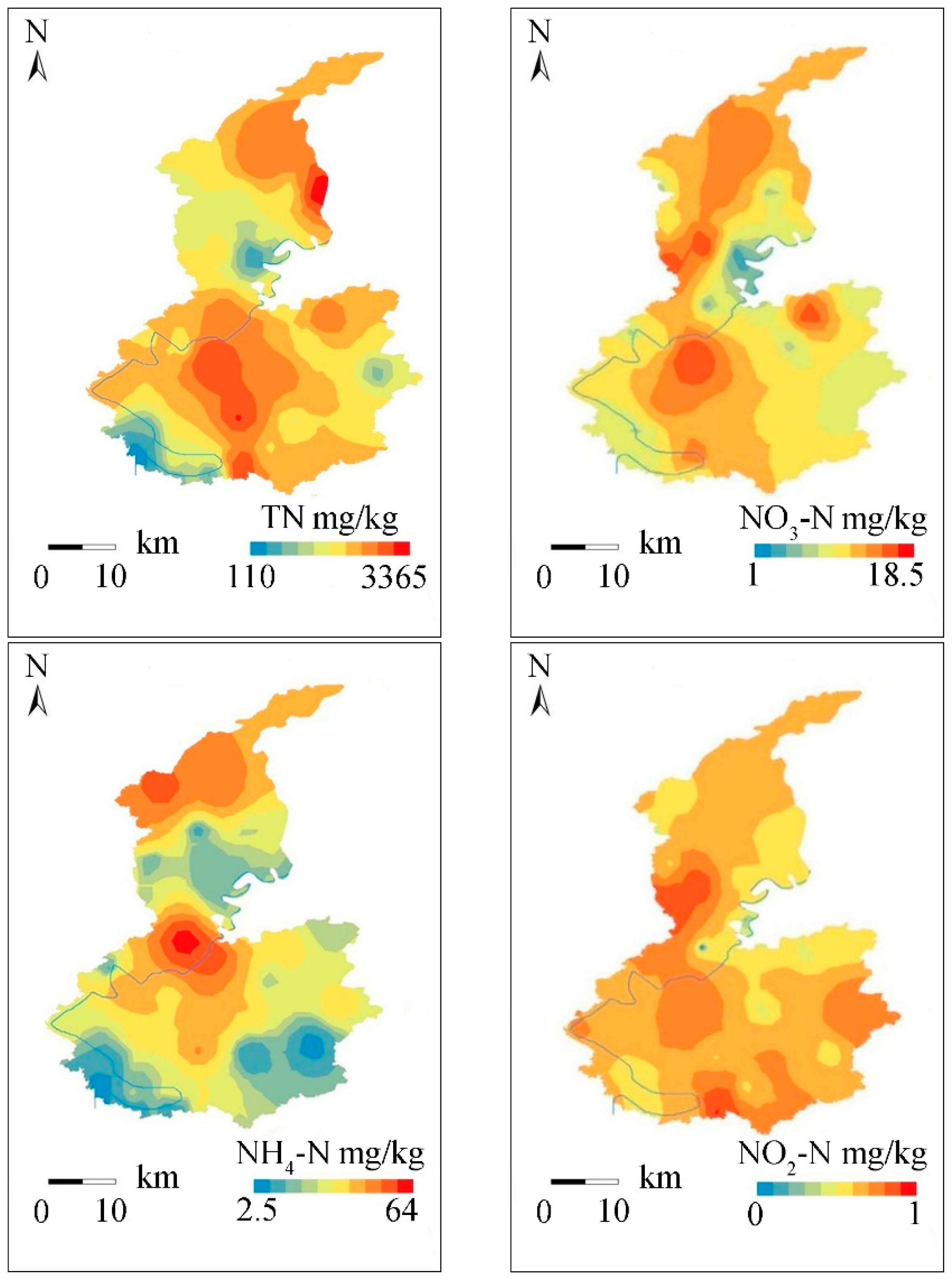
The spatial distribution of nitrogen fractions in the downstream Daliao River basin exhibits considerable variability (Figure 2). Total nitrogen concentrations range from 256.09 to 3362.75 mg/kg in soils and from 114.85 to 1640.54 mg/kg in sediments, with mean values of 1313.18 ± 768.18 mg/kg and 665.55 ± 659.69 mg/kg, respectively. Nitrate nitrogen levels vary between 1.21 and 18.50 mg/kg in soils and from 1.96 to 4.30 mg/kg in sediments, averaging 5.63 ± 4.38 mg/kg and 2.99 ± 0.91 mg/kg, respectively. Ammonia nitrogen concentrations in soils span 4.77 to 63.55 mg/kg, with a mean of 14.61 ± 10.02 mg/kg, while sediment concentrations range from 2.72 to 21.07 mg/kg, averaging 8.44 ± 3.90 mg/kg. Soil nitrite nitrogen content fluctuates from 0.01 to 1.00 mg/kg, with an average of 0.12 ± 0.19 mg/kg; sediment levels are more constrained, ranging from 0.01 to 0.03 mg/kg, with a mean value of 0.02 ± 0.06 mg/kg. Overall, nitrogen concentrations tend to be elevated in midstream cultivated areas and lower in downstream wastelands.
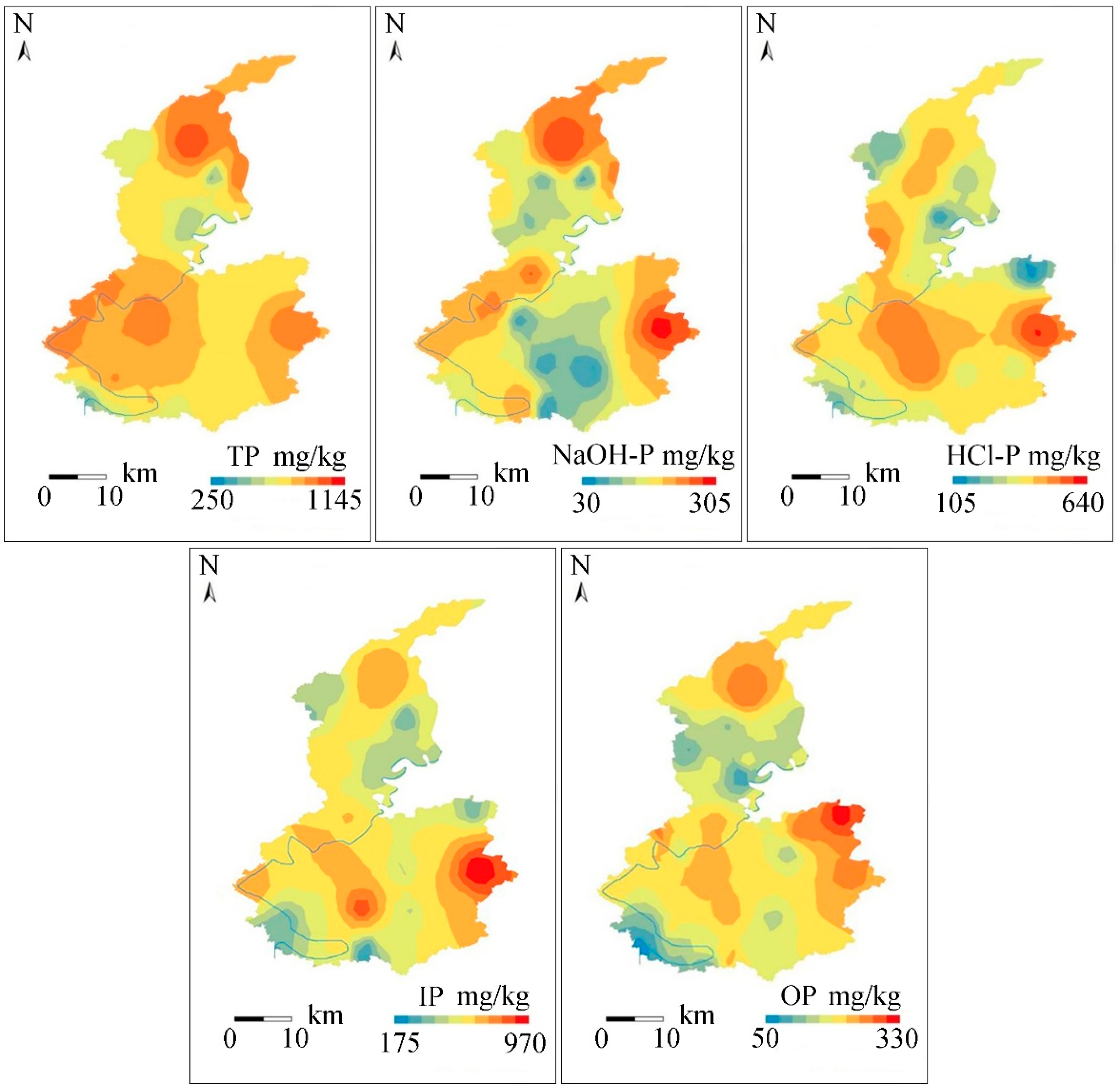
Similarly, phosphorus fractions show substantial spatial variation (Figure 3). Total phosphorus content extends from 250.18 to 1142.69 mg/kg in soils and from 327.23 to 586.24 mg/kg in sediments, with average concentrations of 565.96 ± 147.83 mg/kg and 439.16 ± 166.97 mg/kg, respectively. NaOH-P varies between 32.59 and 300.05 mg/kg in soils and from 54.11 to 120.20 mg/kg in sediments, with mean values of 110.15 ± 56.94 mg/kg and 82.10 ± 32.57 mg/kg. HCl-P in soils ranges from 108.95 to 637.34 mg/kg, averaging 276.71 ± 111.90 mg/kg, while sediment concentrations fall between 173.23 and 274.68 mg/kg, with a mean of 221.08 ± 44.63 mg/kg. In soils, inorganic phosphorus spans 178.42 to 969.73 mg/kg, and organic phosphorus ranges from 50.38 to 327.52 mg/kg, with respective averages of 439.25 ± 154.78 mg/kg and 158.85 ± 60.64 mg/kg. In sediments, inorganic phosphorus varies from 253.88 to 440.56 mg/kg, averaging 333.38 ± 112.75 mg/kg, whereas organic phosphorus ranges between 53.86 and 225.52 mg/kg, with a mean of 106.02 ± 75.34 mg/kg.
Land use in the downstream regions of Panjin and Yingkou shows a relatively natural state, characterized by limited farmland cultivation and consequently lower total soil nitrogen content. In contrast, elevated nitrogen and phosphorus levels are observed in the midstream region, which corresponds to a greater extent of farmland cultivation. Agricultural activities are primarily concentrated along both banks of the river, resulting in a general increase in nitrogen and phosphorus concentrations from west to east in Panjin, whereas total soil nitrogen content in Yingkou exhibits a decreasing trend in the same direction.
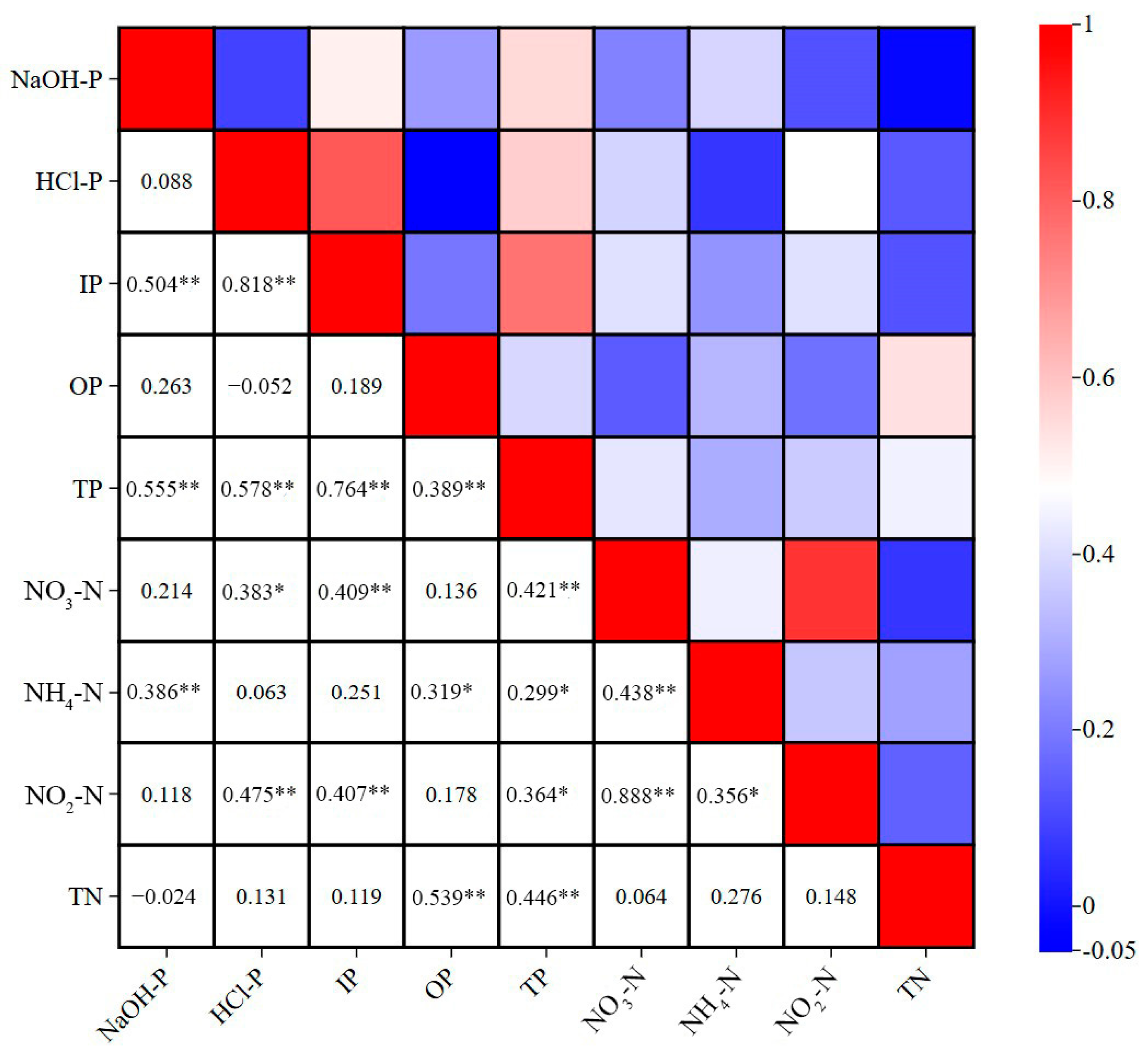
Correlation analysis reveals strong associations between nitrogen and phosphorus fractions in the downstream Daliao River basin (Figure 4). Total phosphorus shows significant correlations with NaOH-P, HCl-P, inorganic phosphorus, organic phosphorus, nitrate nitrogen, ammonia nitrogen, nitrite nitrogen, and total nitrogen. Additionally, total nitrogen is significantly correlated with organic phosphorus and total phosphorus. Furthermore, ammonia nitrogen demonstrates notable relationships with NaOH-P, organic phosphorus, and total phosphorus. These pronounced correlations may be attributable to fertilizer inputs from human activities. The observed associations between ammonia nitrogen and both nitrate and nitrite nitrogen reflect the interactive effects of soil nitrification and denitrification processes.
NaOH-PHCl-PIPOPTPNO3-NNH4-NNO2-NTN
NaOH-P10.0880.5040 ***0.2630.555 ***0.2140.386 ***0.118−0.024
HCl-P0.08810.818 ***−0.0520.578 ***0.383 **0.0630.475 ***0.131
IP0.504 ***0.818 ***10.1890.764 ***0.409 ***0.2510.407 ***0.119
OP0.263−0.0520.18910.389 ***0.1360.319 **0.1780.539 ***
TP0.555 ***0.578 ***0.764 ***0.389 ***10.421 ***0.299 **0.364 **0.446 ***
NO3-N0.2140.383 **0.409 ***0.1360.421 ***10.438 ***0.888 ***0.064
NH4-N0.386 ***0.0630.2510.319 **0.299 **0.438 ***10.356 **0.276
NO2-N0.1180.475 ***0.407 ***0.1780.364 **0.888 ***0.356 **10.148
TN−0.0240.1310.1190.539 ***0.446 ***0.0640.2760.1481
Note: *** and ** represent 1% and 5% significance levels, respectively.

3.2. Release Potential and Influencing Factors

3.2.1. Release Potential

Simulation experiments indicate that the ammonia nitrogen release potentials of soils collected from rice paddies, reed wetlands, corn farmlands, and roadsides were 0.75, 0.86, 0.70, and 8.65 mg/L, respectively (Table 1). Among these, roadside soils exhibited the highest ammonia nitrogen adsorption efficiency, while corn farmland soils showed the lowest. In sediments, the ammonia nitrogen release potential ranged from 0.96 to 1.21 mg/L. The total phosphorus release potentials for the four land use types were 0.61, 1.01, 0.31, and 1.52 mg/L, respectively (Table 2). Reed wetland soils demonstrated the highest phosphorus adsorption efficiency, whereas roadside soils had the lowest. In comparison, the total phosphorus release potential of sediment ranged from 0.44 to 0.52 mg/L. As a whole, the results indicate that soils exhibit considerable nitrogen and phosphorus release potential. Notably, the release potential from roadside soils far exceeds the Class V surface water quality thresholds (ammonia nitrogen: 2.0 mg/L; total phosphorus: 0.4 mg/L, GB3838-2002), highlighting urban first flush runoff as a significant pollution source. Compared with soils, except those from roadside areas, sediments generally exhibit a higher ammonia nitrogen release potential.

3.2.2. Temperature

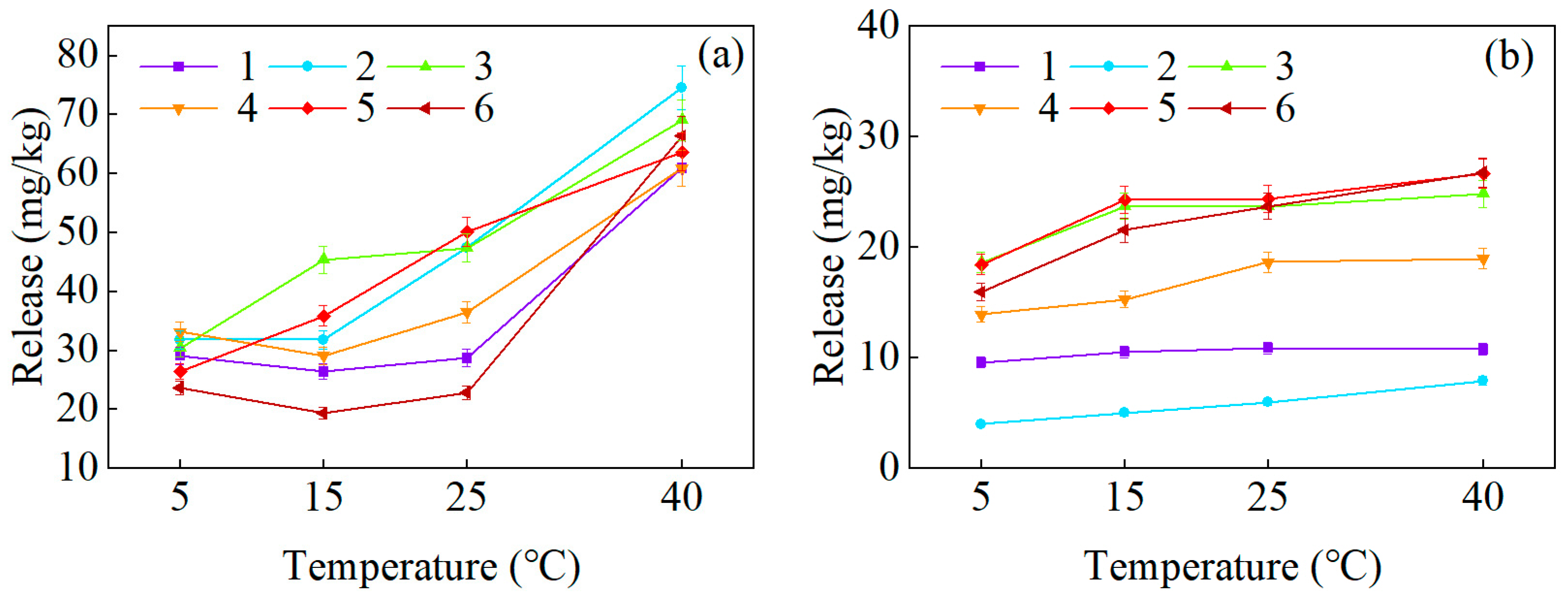
Figure 5 shows that the release of ammonia nitrogen and total phosphorus generally increases with rising temperature. Compared to 5 °C, soil ammonia nitrogen release at 40 °C increased by 1.80 to 2.80 times, while total phosphorus release rose by 1.10 to 1.68 times. Temperature is a key factor influencing soil mineralization [50]; as mineralization intensifies, the conversion of organic nitrogen to ammonia nitrogen also increases. Meanwhile, oxygen depletion resulting from enhanced soil mineralization inhibits nitrification reactions in sediments [51]. Together, these effects lead to increased soil ammonia nitrogen release as the temperature rises.
Furthermore, higher temperatures promote the migration of phosphorus from sediments to the overlying water via pore water. Elevated temperatures increase ionic activity and accelerate ion exchange, enhancing phosphate migration and transformation [52]. Additionally, microbial activity intensifies with rising temperature, facilitating the conversion of organic phosphorus to inorganic phosphorus [53]. This process creates anaerobic conditions at the sediment-water interface, favoring the reduction of Fe3+ to Fe2+ and Mn4+ to Mn2+. Consequently, Fe-bound and Mn-bound phosphorus are released, increasing the total phosphorus release [54]. Based on these findings, we infer that soils transported into the Daliao River by runoff face an increased risk of pollutant release during the summer.

3.2.3. pH

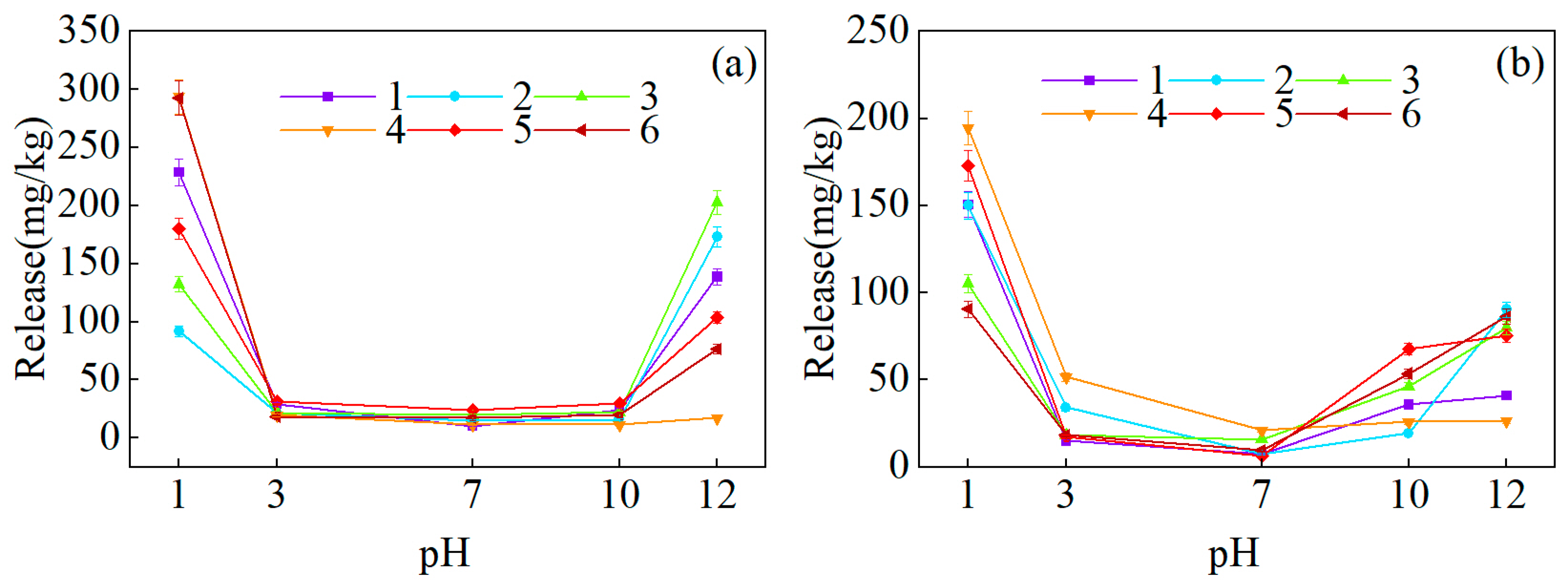
The pH primarily influences biochemical reactions in the system by altering the activity of functional microorganisms and physicochemical processes, thereby regulating the exchange of nitrogen and phosphorus at the soil or sediment–water interface [55]. Experimental results show (Figure 6) that the release of soil ammonia nitrogen and total phosphorus is elevated under both acidic and alkaline conditions compared to neutral conditions. Under acidic conditions, H+ competes with NH4+ for adsorption sites on colloidal particles, reducing NH4+ retention and promoting its release. As pH increases, more H+ ions are adsorbed onto colloid surfaces, displacing NH4+ and enhancing ammonia nitrogen release. In alkaline environments, the high concentration of hydroxide ions (OH) in the overlying water facilitates the conversion of NH4+ to NH3, which volatilizes more readily. This process increases the concentration gradient between overlying water and pore water, thereby accelerating the diffusion of endogenous nitrogen.
The effect of pH on phosphorus release is mainly attributed to changes in adsorption and ion exchange processes between phosphorus and soil or sediment particles [56]. In acidic environments, the reduced negative surface charge of clay minerals increases the solubility of phosphorus-bearing compounds, such as Ca–P, thereby enhancing phosphorus release [57]. Under alkaline conditions, the binding capacity of Fe–P and Al–P is weakened, and OH reacts with these inorganic phosphorus forms to generate HPO42− [58], further promoting phosphorus mobilization from soils or sediments.

3.2.4. DO

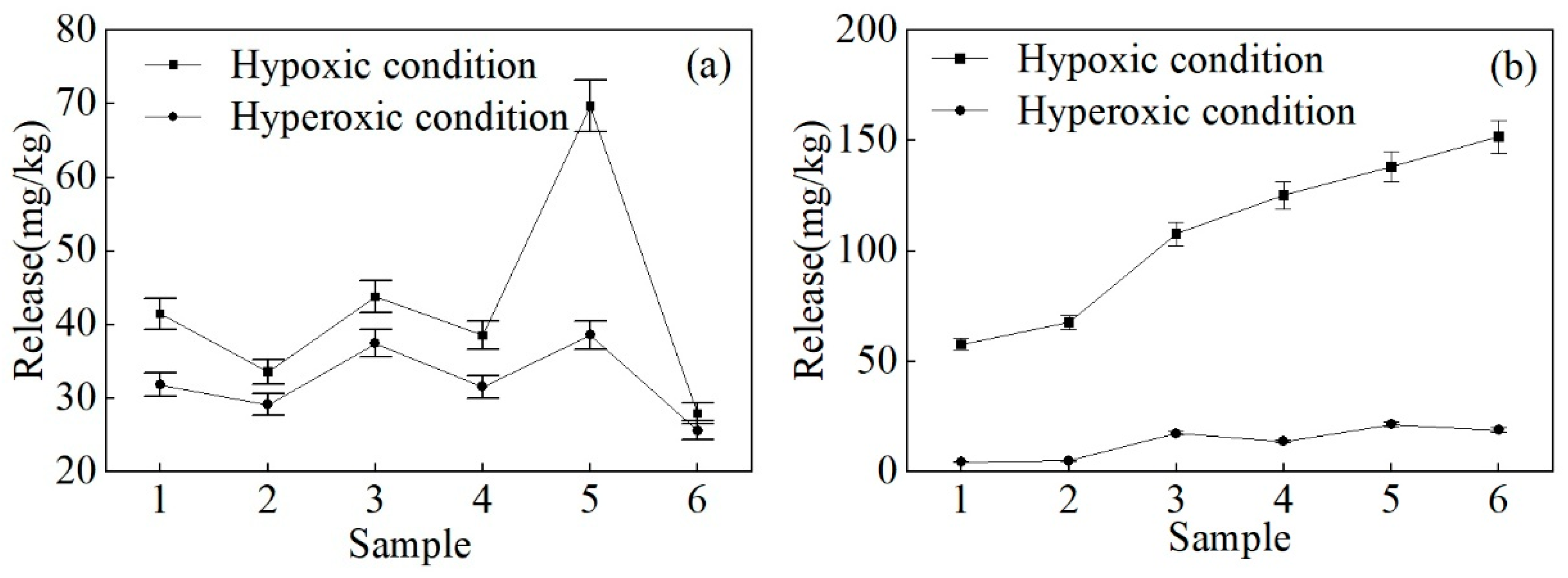
The experimental results (Figure 7) demonstrate that the release of ammonia nitrogen and total phosphorus is greater under hypoxic conditions than under hyperoxic conditions. Specifically, ammonia nitrogen release is 1.02–1.81 times higher, and total phosphorus release is 2.21–13.21 times higher under hypoxic conditions. These results are consistent with previous findings [59] and other estuarine systems [60] that reported approximately twofold higher release rates of total nitrogen and phosphorus in hypoxic estuarine environments compared to hyperoxic conditions, confirming that low dissolved oxygen concentrations enhance nutrient release.
In anaerobic environments, microbial decomposition of organic matter converts organic nitrogen into ammonia nitrogen, while nitrification is inhibited. This promotes the accumulation of ammonia nitrogen in pore water, increasing its potential for release.
Under hypoxic conditions, Fe3+ is reduced to Fe2+, leading to the release of phosphorus previously adsorbed onto iron hydroxide colloids. In contrast, higher dissolved oxygen concentrations facilitate the oxidation of Fe2+ to Fe3+, which promotes the formation of iron hydroxide colloids that effectively adsorb phosphorus, thereby limiting its release from the substrate [61]. Moreover, Fe3+ can also precipitate with phosphate, further reducing phosphorus exchange fluxes.

3.3. Impacts of Soil Erosion on the Water Environment

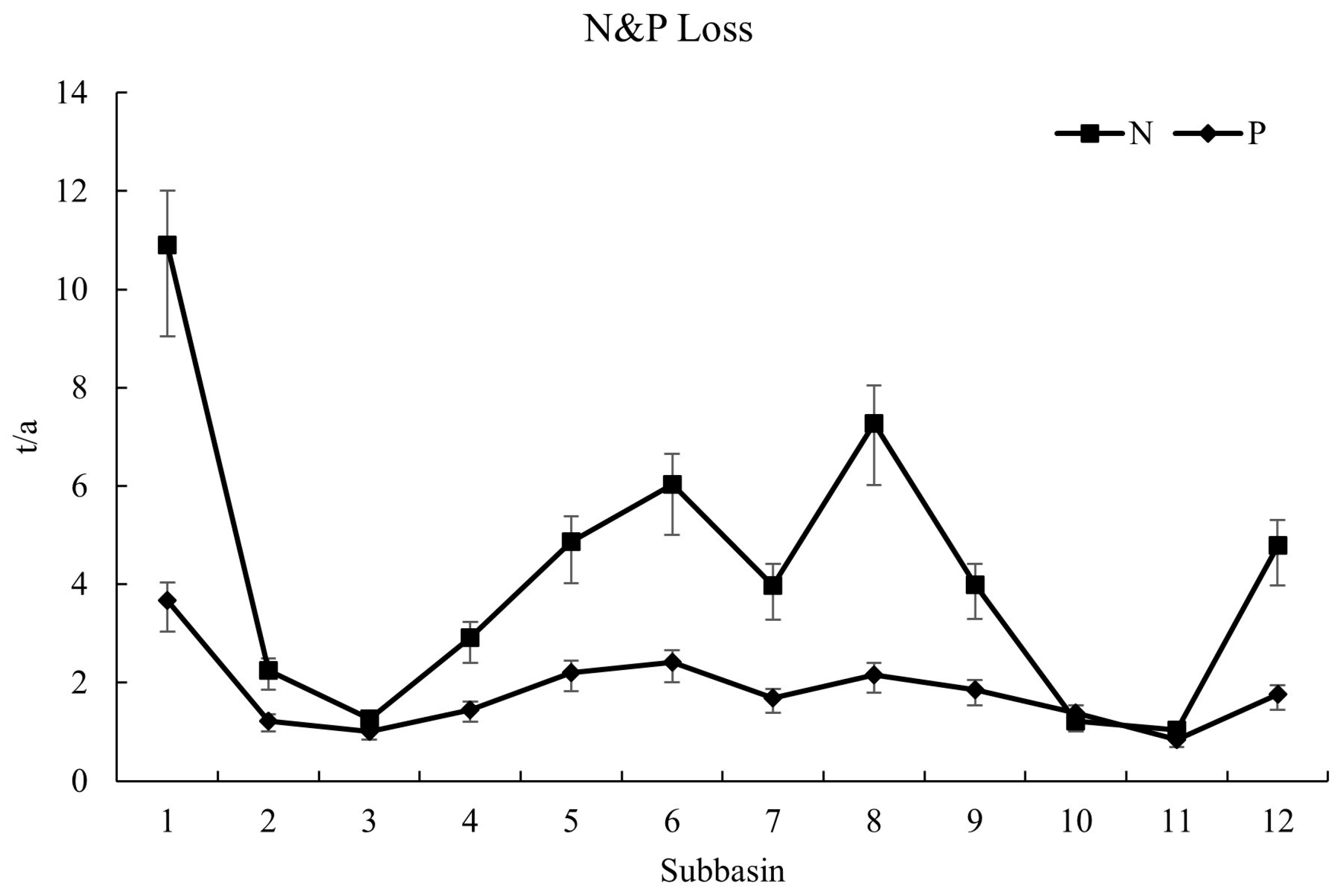
Previous research on the Liaohe River has primarily focused on nitrogen- and phosphorus-driven mechanisms [62], as well as the development of relevant ecological evaluation index systems [63]. However, studies using models to investigate the impact on pollutant output were relatively scarce. This study evaluates pollutant export based on measured soil nitrogen and phosphorus concentrations in the Daliao River basin. Subwatershed area, slope, and slope length are derived using Python 3.13.0rc1, while background concentrations of nitrogen and phosphorus in soils are determined through laboratory analysis. The results indicate that nitrogen and phosphorus exports from the basin are 50.50 t/a and 21.63 t/a, respectively (Figure 8). These exports directly increase the pollutant loads to receiving water bodies. Background pollutant concentrations in soil, slope length, slope gradient, and subwatershed area are identified as key factors influencing nutrient export [64]. Given the relatively flat topography and uniform hydrological conditions in the downstream Liao River region, background concentrations and subwatershed area emerge as dominant drivers. For example, subwatershed 1, which has the largest area (13.7% of the total) and a relatively high background pollution level, contributes 21.6% and 16.9% of the total nitrogen and phosphorus exports, respectively. Subwatershed 8, which exhibits the highest background pollution level and covers 8.8% of the total area, contributes 14.4% of nitrogen and 10.0% of phosphorus exports. In both cases, pollutant contributions are disproportionately high relative to their spatial extent.
Further, the environmental impacts of soil on the water quality of the Daliao River are explored. Monitoring data from the Ministry of Ecology and Environment show that ammonia nitrogen concentrations in the overlying water at the Daliao River estuary are 0.96, 0.72, 0.62, and 0.81 mg/L in spring, summer, autumn, and winter, respectively, while total phosphorus concentrations are 0.18, 0.23, 0.20, and 0.18 mg/L across the same seasons. The study compares seasonal nitrogen and phosphorus concentrations with the release potential of watershed soils to evaluate their environmental impacts.
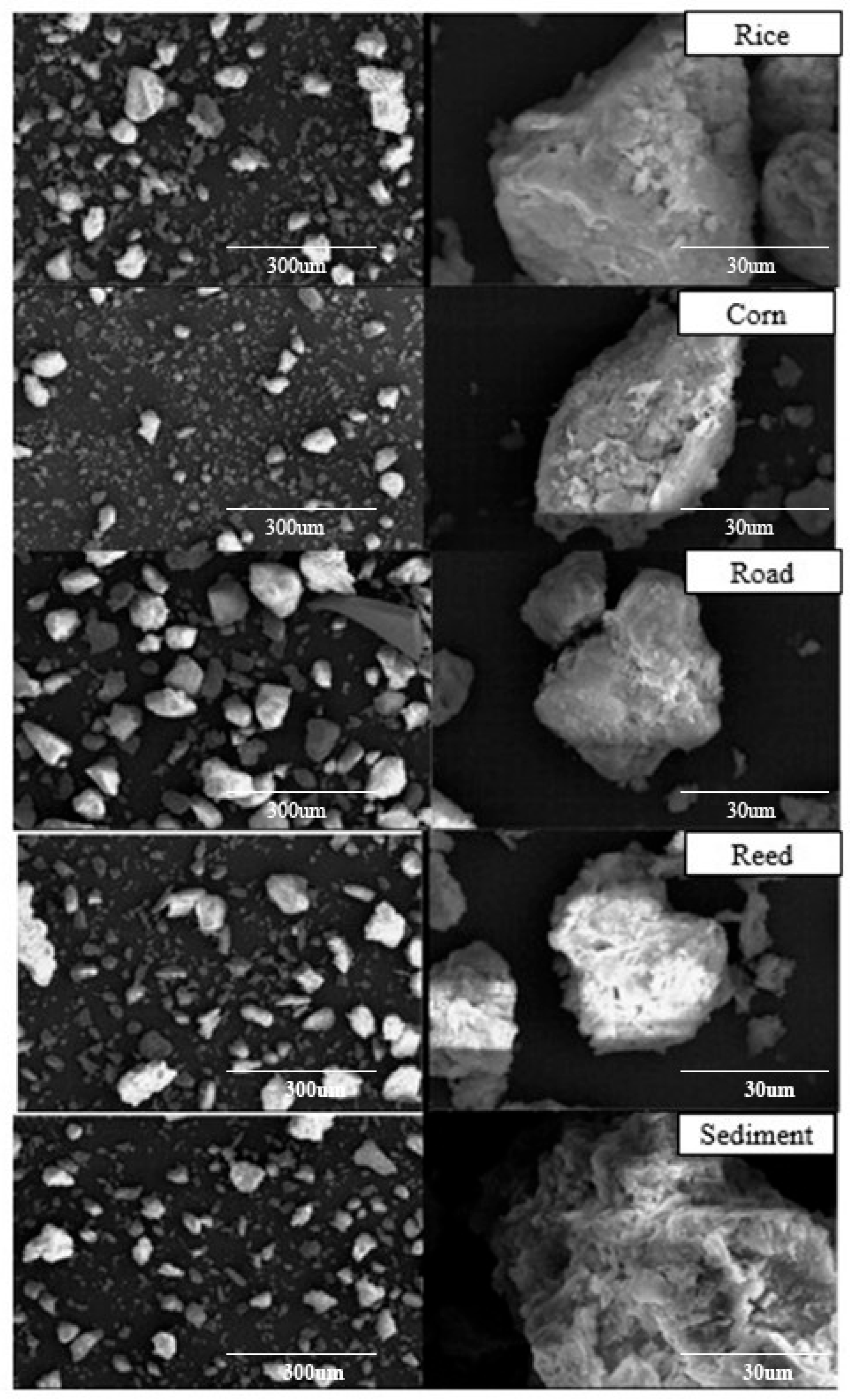
The overlying water concentrations of total phosphorus are consistently lower than the release potentials of the four soil types, indicating that soil loss serves as a source of phosphorus pollution. The behavior of ammonia nitrogen is more complex. In spring, the release potential of ammonia nitrogen from roadside soils exceeds river concentrations, indicating that soil export from these areas contributes to river pollution. In contrast, the release potentials of soils from rice paddies, corn farmlands, and reed wetlands are lower than river concentrations, suggesting that these soils act as pollutant sinks [65]. In summer, the release potential of ammonia nitrogen from rice paddies, reed wetlands, and roadside soils exceeds concentrations in the river, implying an elevated risk of ammonia release under runoff conditions. However, soils from corn farmlands act as pollutant sinks. In autumn, soils from rice paddies, corn farmlands, reed wetlands, and roadsides act as pollution sources. In winter, soil loss from reed wetlands and roadsides continues to release pollutants, while soils from rice paddies and corn farmlands function as pollutant sinks. Notably, results (Figure 9) from scanning electron microscopy (SEM) indicate that soils possess high specific surface areas. When these soils are lost to the Daliao River through runoff, particularly those from rice paddies and corn farmlands, they exhibit strong nitrogen and phosphorus adsorption capacities. Over time, this accumulation may increase the risk of pollutant release. Compared with the release potential of sediments, the relatively low nutrient concentrations in the overlying water of the Daliao River suggest that sediments primarily act as pollution sources.
The study further examines the environmental impacts from the perspectives of temperature, pH, and dissolved oxygen (DO). In spring, summer, autumn, and winter, the water temperatures are 16.5, 24.2, 11.8, and 8.2 °C, the pH values are 7.81, 7.40, 7.81, and 7.65, and the DO concentrations are 8.24, 6.53, 5.50, and 10.57 mg/L, respectively.
Previous analyses indicate that elevated temperatures and reduced dissolved oxygen levels promote the release of ammonia nitrogen and total phosphorus from soils in the Daliao River basin. These findings suggest that watershed soils transported into the Daliao River via runoff pose a greater risk of nitrogen and phosphorus release during the warmer summer months and oxygen-depleted autumn.

3.4. Management Strategies

Land-use practices strongly affect nutrient cycling and watershed responses to climate change. Intensive agriculture and urbanization increase soil N and P accumulation. In contrast, conservation tillage, buffer zones, and wetlands improve nutrient retention and hydrological resilience. Integrating land-use optimization with adaptive, low-carbon management can mitigate nutrient export, reduce emissions, and enhance watershed sustainability under changing climatic conditions.
Human activities alter the nitrogen and phosphorus contents in watershed soils [66]. This study explores management strategies for agricultural, construction, and natural land types. For agricultural land, the crop cultivation area in the downstream region of the Daliao River (Panjin and Yingkou sections) increased rapidly before 2006, then gradually stabilized, and has shown a slight decline in recent years. Fertilizer application has also decreased over time, indicating improved fertilizer use efficiency. Despite recent reductions in both sown area and fertilizer input, the historical accumulation of nitrogen and phosphorus remains a critical concern. It is recommended to adopt practices such as soil testing and drip irrigation to enhance fertilizer efficiency. Additionally, promoting the comprehensive utilization of crop straw as fertilizer, animal feed, and fuel could further reduce fertilizer use and pollutant discharge. The Daliao River basin is characterized by flat terrain, slow surface runoff, and long water residence times. Under these conditions, ecological engineering measures such as constructed wetlands, floating islands, vegetated filter strips, and oxidation ponds can effectively reduce the release of soil-derived nitrogen and phosphorus into the river. For construction land, it is suggested to strengthen road surface cleaning to prevent soil losses. In urban areas, the implementation of low-impact development (LID) practices and sponge city infrastructure can reduce anthropogenic pressures and enhance water retention capacity, thereby lowering non-point source pollution. For natural land, green spaces should be maintained and expanded to reduce stormwater runoff. On barren land, planting ecologically functional vegetation can reduce runoff and promote the uptake and retention of nitrogen and phosphorus. Furthermore, to address accumulated pollution in river sediments, environmental dredging could be conducted to mitigate long-term impacts and reduce internal nutrient loading.

4. Conclusions

(1) The spatial distribution of soil nitrogen and phosphorus in the downstream sections of the Daliao river basin (Panjin and Yingkou) exhibited substantial variability and strong correlations. Total nitrogen concentrations ranged from 256.09 to 3362.75 mg/kg in soil and from 114.85 to 1640.54 mg/kg in sediment. Total phosphorus concentrations varied from 250.18 to 1142.69 mg/kg in soil and from 327.23 to 586.24 mg/kg in sediment. The nitrogen and phosphorus exports from soil losses in the downstream Daliao river basin were estimated at 50.5 t/a and 21.63 t/a, respectively.
(2) Sediments acted as secondary sources of pollution, increasing the nutrient load in the river and demonstrating the delayed release of soil-derived nutrients. Temperature, pH, and dissolved oxygen were key factors affecting nutrient release from soils and sediments. Compared to 5 °C, the release of ammonia nitrogen from soil increased by 1.8–2.8 times at 40 °C, while total phosphorus release increased by 1.1–1.68 times. Under both acidic and alkaline conditions, the release of ammonia nitrogen and total phosphorus exceeded that under neutral conditions. Under hypoxic conditions, ammonia nitrogen release was 1.02–1.81 times higher and total phosphorus release was 2.21–13.21 times higher than under hyperoxic conditions.
(3) The integrated management strategies are suggested to mitigate nitrogen and phosphorus losses from soils, including soil testing and targeted fertilization, the construction of ecological engineering measures, the development of sponge cities, and environmentally responsible dredging to reduce the release of historically accumulated pollutants.

Author Contributions

Writing—original draft, visualization, methodology, investigation, data, supervision, conceptualization, T.W. (Tianxiang Wang); visualization, investigation, Y.L.; methodology, R.C.; methodology, investigation, Z.W.; methodology, investigation, Z.Z.; visualization, T.W. (Tianzi Wang); visualization, R.M.; supervision, methodology, G.S. All authors have read and agreed to the published version of the manuscript.

Funding

This study was supported by National Science and Technology Major Project for Comprehensive Environmental Management in Jing-Jin-Ji (2025ZD1206001), National Natural Science Foundation of China (42277383), Science and Technology Plan Project of Inner Mongolia Autonomous Region (2025YFHH0129), Hebei Provincial Water Conservancy Science and Technology Program Project (HBSL2025-02). The APC was funded by [2025ZD1206001].

Data Availability Statement

The original contributions presented in this study are included in the article. Further inquiries can be directed to the corresponding author.

Acknowledgments

The views and ideas expressed herein are solely of the authors and do not represent the ideas of the funding agencies in any form.

Conflicts of Interest

Author Zixiong Wang was employed by the company CREE (Guangdong) Harbor Survey and Design Co., Ltd. The remaining authors declare that the research was conducted in the absence of any commercial or financial relationships that could be construed as a potential conflict of interest.

Correction Statement

This article has been republished with a minor correction to the Funding statement. This change does not affect the scientific content of the article.

References

  1. Wang, R.; Zhang, J.; Cai, C.; Zhang, H. How to control nitrogen and phosphorus loss during runoff process?—A case study at Fushi Reservoir in Anji County (China). Ecol. Indic. 2023, 155, 111007. [Google Scholar] [CrossRef]
  2. Ma, T.; Hu, Q.; Wang, C.; Lv, J.; Mi, C.; Shi, R.; Wang, X.; Yang, Y.; Wu, W. Exploring the Relationship between Ecosystem Services under Different Socio-Economic Driving Degrees. Int. J. Environ. Res. Public Health 2022, 19, 16105. [Google Scholar] [CrossRef]
  3. Wang, Y.; Yang, K.; Jia, T.; Luo, Y. Influence of natural factors and land use change on changes in the main lake area in China over the past 30 years. Ecol. Indic. 2023, 155, 111005. [Google Scholar] [CrossRef]
  4. Liu, H.; Gao, L.; Yuan, Z.; Ma, T. Contrasting seasonal variations in riverine nitrogen and phosphorus concentrations in China: Implications for N/P imbalances. Water Res. 2025, 287, 124317. [Google Scholar] [CrossRef] [PubMed]
  5. Zhao, Z.; Zhou, H.; Chen, W.; Wu, Y.; Liu, G.; Xue, S. Response of soil structure and fertility to long-term fertilization in alpine grasslands revealed based on fractal theory. Soil Tillage Res. 2024, 242, 106167. [Google Scholar] [CrossRef]
  6. Wang, N.; Ai, Z.; Zhang, Q.; Leng, P.; Qiao, Y.; Li, Z.; Tian, C.; Cheng, H.; Chen, G.; Li, F. Impacts of nitrogen (N), phosphorus (P), and potassium (K) fertilizers on maize yields, nutrient use efficiency, and soil nutrient balance: Insights from a long-term diverse NPK omission experiment in the North China Plain. Field Crops Res. 2024, 318, 109616. [Google Scholar] [CrossRef]
  7. Sharma, T.; Arya, V.M.; Sharma, V.; Sharma, S.; Popescu, S.M.; Thakur, N.; Iqbal, J.M.; El-Sheikh, M.A.; Baath, G.S. Impact of cropping intensity on soil nitrogen and phosphorus for sustainable agricultural management. J. King Saud Univ.—Sci. 2024, 36, 103244. [Google Scholar] [CrossRef]
  8. Chen, Z.; Guo, M.; Chen, Y.; Shen, Q.; Chen, Q.; Liu, X.; Wang, L.; Zhang, X. Utilizing an 11-year runoff plot dataset to evaluate the regulation of six land management practices on runoff and sediment on Mollisols slopes and the applicability of the WEPP model. Soil Tillage Res. 2025, 252, 106601. [Google Scholar] [CrossRef]
  9. Feng, Z.; Zhang, R.; Liu, X.; Peng, Q.; Wang, L. Agricultural nonpoint source pollutant loads into water bodies in a typical basin in the middle reach of the Yangtze River. Ecotoxicol. Environ. Saf. 2023, 268, 115728. [Google Scholar] [CrossRef] [PubMed]
  10. Li, J.; Mao, J.; Zhao, H.; Peng, S.; Hang, X.; Feng, J. Spatiotemporal features and driving factors identification of urban flood-season pollution phenomenon. J. Hydrol. 2025, 661, 133581. [Google Scholar] [CrossRef]
  11. Mao, Y.; Zhang, H.; Cheng, Y.; Zhao, J.; Huang, Z. The characteristics of nitrogen and phosphorus output in China’s highly urbanized Pearl River Delta region. J. Environ. Manag. 2023, 325, 116543. [Google Scholar] [CrossRef]
  12. Cai, B.; Shao, Z.; Fang, S.; Huang, X.; Tang, Y.; Zheng, M.; Zhang, H. The Evolution of urban agglomerations in China and how it deviates from Zipf’s law. Geo-Spat. Inf. Sci. 2022, 27, 38–48. [Google Scholar] [CrossRef]
  13. Li, X.; Zhou, Y.; Asrar, G.R.; Mao, J.; Li, X.; Li, W. Response of vegetation phenology to urbanization in the conterminous United States. Glob. Chang. Biol. 2017, 23, 2818–2830. [Google Scholar] [CrossRef]
  14. Muller, A.; Osterlund, H.; Marsalek, J.; Viklander, M. The pollution conveyed by urban runoff: A review of sources. Sci. Total Environ. 2020, 709, 136125. [Google Scholar] [CrossRef]
  15. Sjöman, J.D.; Gill, S.E. Residential runoff—The role of spatial density and surface cover, with a case study in the Höjeå river catchment, southern Sweden. Urban For. Urban Green. 2014, 13, 304–314. [Google Scholar] [CrossRef]
  16. Li, Y.; Osei, F.B.; Dai, S.; Hu, T.; Stein, A. Identifying landscape patterns at different scales as driving factors for urban flooding. Ecol. Indic. 2025, 176, 113614. [Google Scholar] [CrossRef]
  17. Wu, L.; Long, T.; Liu, X.; Guo, J. Impacts of climate and land-use changes on the migration of non-point source nitrogen and phosphorus during rainfall-runoff in the Jialing River Watershed, China. J. Hydrol. 2012, 475, 26–41. [Google Scholar] [CrossRef]
  18. Zaibon, S.; Anderson, S.H.; Kitchen, N.R.; Haruna, S.I. Hydraulic Properties Affected by Topsoil Thickness in Switchgrass and Corn–Soybean Cropping Systems. Soil Sci. Soc. Am. J. 2016, 80, 1365–1376. [Google Scholar] [CrossRef]
  19. Pu, Y.; Yang, L.; Zhang, L.; Huang, H.; Zhang, G.; Zhou, C. Major contributions of agricultural management practices to topsoil organic carbon distribution and accumulation in croplands of East China over three decades. Agric. Ecosyst. Environ. 2024, 359, 108749. [Google Scholar] [CrossRef]
  20. Wang, Y.; Liu, G.; Zhao, Z.; Wu, C.; Yu, B. Using soil erosion to locate nonpoint source pollution risks in coastal zones: A case study in the Yellow River Delta, China. Environ. Pollut. 2021, 283, 117117. [Google Scholar] [CrossRef]
  21. Roshan, A.; Biswas, A. Fire-induced geochemical changes in soil: Implication for the element cycling. Sci. Total Environ. 2023, 868, 161714. [Google Scholar] [CrossRef] [PubMed]
  22. Bashir, O.; Bangroo, S.A.; Shafai, S.S.; Senesi, N.; Kader, S.; Alamri, S. Geostatistical modeling approach for studying total soil nitrogen and phosphorus under various land uses of North-Western Himalayas. Ecol. Inform. 2024, 80, 102520. [Google Scholar] [CrossRef]
  23. Wang, F.; Wang, J.; Cao, T.; Ji, X.; Yan, J.; Ding, S.; Chen, N. Seasonal hypoxia enhances sediment iron-bound phosphorus release in a subtropical river reservoir. Sci. Total Environ. 2024, 936, 173261. [Google Scholar] [CrossRef]
  24. Li, G.; Li, Y.; Ma, F.; Zhang, J.; Wang, M.; Zhao, W.; Huang, Y.; Meng, X.; Yue, D. Evaluating the suitability of ecological restoration techniques in distinct ecoregions along the China-Nepal Highway. Ecol. Indic. 2024, 168, 112743. [Google Scholar] [CrossRef]
  25. Gao, Y.; Zhu, B.; Lin, L.; Xu, Q.; Zhang, W.; Pan, X.; Dong, L. Distinct vertical profiles of microbial communities and functional genes between different lake sediment layers mediated by nutrients in the sediments and pore waters. Sci. Total Environ. 2025, 981, 179575. [Google Scholar] [CrossRef] [PubMed]
  26. Velasquez Hurtado, W.A.; Tapete, D. Monitoring the Recovery Process After Major Hydrological Disasters with GIS, Change Detection and Open and Free Multi-Sensor Satellite Imagery: Demonstration in Haiti After Hurricane Matthew. Water 2025, 17, 2902. [Google Scholar] [CrossRef]
  27. Bronowicka-Mielniczuk, U.; Mielniczuk, J. New indices to quantify patterns of relative errors produced by spatial interpolation models—A comparative study by modelling soil properties. Ecol. Indic. 2023, 154, 110551. [Google Scholar] [CrossRef]
  28. Chen, J.; Chakravarty, P.; Davidson, G.R.; Wren, D.G.; Locke, M.A.; Zhou, Y.; Brown, G., Jr.; Cizdziel, J.V. Simultaneous determination of mercury and organic carbon in sediment and soils using a direct mercury analyzer based on thermal decomposition-atomic absorption spectrophotometry. Anal. Chim. Acta 2015, 871, 9–17. [Google Scholar] [CrossRef]
  29. Ndikuryayo, F.; Gong, X.-Y.; Gan, X.; Yang, W.-C. Assessing emerging contaminants in soils using soil enzyme-based methods: A critical review. Trends Environ. Anal. Chem. 2025, 46, e00260. [Google Scholar] [CrossRef]
  30. Pontes, P.R.M.; Cavalcante, R.B.L.; Salomão, G.N.; Guimarães, J.T.F.; Dall’Agnol, R. Environmental assessment based on soil loss, deforestation in permanent preservation areas, and water quality applied in the Itacaiúnas Watershed, Eastern Amazon. Int. Soil Water Conserv. Res. 2025, 13, 248–262. [Google Scholar] [CrossRef]
  31. Assaye, Y.; Desta, G.; Molla, E.; Adimassu, Z. Effects of land management practices on runoff and soil and nutrient losses in the rainfed agroecosystem of the Beles River Basin, Ethiopia. Int. J. Sediment. Res. 2025, 40, 651–665. [Google Scholar] [CrossRef]
  32. Bai, Q.; Zhou, L.; Fan, H.; Huang, D.; Yang, D.; Liu, H. Effects of freeze–thaw on soil loss under simulated composite upslope inflow and rainfall erosion in the black soil region of northeast China. Environ. Earth Sci. 2025, 84, 280. [Google Scholar] [CrossRef]
  33. Fang, S.; Deitch, M.J.; Gebremicael, T.G.; Angelini, C.; Ortals, C.J. Identifying critical source areas of non-point source pollution to enhance water quality: Integrated SWAT modeling and multi-variable statistical analysis to reveal key variables and thresholds. Water Res. 2024, 253, 121286. [Google Scholar] [CrossRef] [PubMed]
  34. Li, H.; Chen, J.; Ling, M.; Chen, Z.; Lan, Y.; Huang, Q.; Li, X.; You, H.; Wang, F.; Han, X.; et al. A framework for dynamic assessment of soil erosion and detection of driving factors in alpine grassland ecosystems using the RUSLE-InVEST (SDR) model and Geodetector: A case study of the source region of the Yellow River. Ecol. Inform. 2025, 85, 102928. [Google Scholar] [CrossRef]
  35. Koralay, N.; Kara, Ö. Risk assessment of soil erosion with RUSLE using geographic information system and organic carbon and total nitrogen loadings of suspended sediment in Sogutlu Stream Watershed of Trabzon, Turkey. Environ. Earth Sci. 2025, 84, 258. [Google Scholar] [CrossRef]
  36. Pintos Andreoli, V.; Shimadera, H.; Koga, Y.; Mori, M.; Suzuki, M.; Matsuo, T.; Kondo, A. Inverse estimation of nonpoint source export coefficients for total nitrogen and total phosphorous in the Kako river basin. J. Hydrol. 2023, 620, 129395. [Google Scholar] [CrossRef]
  37. Fatima, B.; Rachid, H.; Abdeldjalil, B.; Abdessalam, O.; Mohamed, B.; Alfagham, A.T.; Tariq, A. Monitoring and forecasting water erosion in response to climate change effects using the integration of the global RUSLE/SDR model and predictive models. Appl. Soil Ecol. 2025, 206, 105910. [Google Scholar] [CrossRef]
  38. Butler, M.J.; Yellen, B.C.; Oyewumi, O.; Ouimet, W.; Richardson, J.B. Accumulation and transport of nutrient and pollutant elements in riparian soils, sediments, and river waters across the Thames River Watershed, Connecticut, USA. Sci. Total Environ. 2023, 899, 165630. [Google Scholar] [CrossRef]
  39. Zhao, X.; Zhang, Y.; Tang, H.; Zhang, Q.; Cui, C.; Qin, B. Water quality improvements and ecological inertia: A basin-wide assessment of ecosystem recovery in the Yangtze River system (2005–2022). Ecol. Indic. 2025, 176, 113700. [Google Scholar] [CrossRef]
  40. Dong, Y.; Han, Y.; Han, X.; Chen, Y.; Zhai, Y. Sewage Vertical Infiltration Introduced Polygenic Multipollutants into Groundwater. Water 2024, 16, 2305. [Google Scholar] [CrossRef]
  41. Ávalos, C.R.; Sosa, G.; Brozón, G.R.; Díaz-Cubilla, M.; Arrúa, A.A.; Ries, A.; Benítez Rodas, G.A. Impact of turbidity, temperature, and total nitrogen on cyanobacterial blooms in Lake Ypacaraí (Paraguay). Case Stud. Chem. Environ. Eng. 2024, 10, 101027. [Google Scholar] [CrossRef]
  42. Luo, H.; Zhu, G. Dual—Functional mechanism for efficient nitrogen removal from water: A hybrid physical system utilizing zero—Valent iron and titanium tannate—Synergistic effect, environmental impact, and kinetics. J. Environ. Chem. Eng. 2025, 13, 117744. [Google Scholar] [CrossRef]
  43. Zhang, Y.; He, F.; Liu, Z.; Liu, B.; Zhou, Q.; Wu, Z. Release characteristics of sediment phosphorus in all fractions of West Lake, Hang Zhou, China. Ecol. Eng. 2016, 95, 645–651. [Google Scholar] [CrossRef]
  44. Rendana, M.; Razi Idris, W.M.; Alia, F.; Effendi Rahim, S.; Yamin, M.; Izzudin, M. Relationship between drought and soil erosion based on the normalized differential water index (NDWI) and revised universal soil loss equation (RUSLE) model. Reg. Sustain. 2024, 5, 100183. [Google Scholar] [CrossRef]
  45. Mi, J.; Xiao, X.; Guan, Q.; Wang, Q.; Zhang, J.; Zhang, Z.; Yang, E. Exploring the spatiotemporal distribution characteristics and driving factors of water erosion in mountain area based on RUSLE-SDR. J. Hydrol. 2025, 649, 132451. [Google Scholar] [CrossRef]
  46. Fang, G.; Yuan, T.; Zhang, Y.; Wen, X.; Lin, R. Integrated study on soil erosion using RUSLE and GIS in Yangtze River Basin of Jiangsu Province (China). Arab. J. Geosci. 2019, 12, 173. [Google Scholar] [CrossRef]
  47. Liu, Z.; Wu, Z.; Tian, F.; Liu, X.; Li, T.; He, Y.; Li, B.; Zhang, Z.; Yu, B. Phosphate-solubilizing microorganisms regulate the release and transformation of phosphorus in biochar-based slow-release fertilizer. Sci. Total Environ. 2023, 869, 161622. [Google Scholar] [CrossRef]
  48. Woznicki, S.A.; Nejadhashemi, A.P. Spatial and Temporal Variabilities of Sediment Delivery Ratio. Water Resour. Manag. 2013, 27, 2483–2499. [Google Scholar] [CrossRef]
  49. Zhang, Q.; Yang, Y.; Liu, X.; Xie, F. The Adsorption Characteristics and Impact Mechanism of Phosphorus by Surface Sediments in Natural Freshwater Lakes. Water 2025, 17, 1775. [Google Scholar] [CrossRef]
  50. Tang, S.; Cheng, W.; Kimani, S.M.; Tawaraya, K.; Tokida, T.; Yoshimoto, M.; Sakai, H.; Usui, Y.; Nakamura, H.; Matsushima, M.Y.; et al. The effects of elevated CO2 and temperature on soil organic carbon and total nitrogen contents and mineralization in the 0 to 50 cm paddy soil layer were masked by different land use history. Soil Secur. 2024, 16, 100147. [Google Scholar] [CrossRef]
  51. Zhang, S.; Zheng, Q.; Noll, L.; Hu, Y.; Wanek, W. Environmental effects on soil microbial nitrogen use efficiency are controlled by allocation of organic nitrogen to microbial growth and regulate gross N mineralization. Soil Biol. Biochem. 2019, 135, 304–315. [Google Scholar] [CrossRef]
  52. Wu, Z.; Deng, F.; Lv, Q.; Wang, J.; Lv, K.; Xu, J.; Zhou, D.; Feng, Y.; Bai, J. Phosphorus migration during sewage sludge thermal conversion with a focus on the role of temperature and atmosphere. J. Environ. Manag. 2025, 376, 124418. [Google Scholar] [CrossRef]
  53. Zhang, S.; Wei, L.; Trakal, L.; Wang, S.; Shaheen, S.M.; Rinklebe, J.; Chen, Q. Pyrolytic and hydrothermal carbonization affect the transformation of phosphorus fractions in the biochar and hydrochar derived from organic materials: A meta-analysis study. Sci. Total Environ. 2024, 906, 167418. [Google Scholar] [CrossRef] [PubMed]
  54. Wang, Z.; Huang, S.; Li, D. Decomposition of cyanobacterial bloom contributes to the formation and distribution of iron-bound phosphorus (Fe-P): Insight for cycling mechanism of internal phosphorus loading. Sci. Total Environ. 2019, 652, 696–708. [Google Scholar] [CrossRef]
  55. Ying, J.; Li, X.; Wang, N.; Lan, Z.; He, J.; Bai, Y. Contrasting effects of nitrogen forms and soil pH on ammonia oxidizing microorganisms and their responses to long-term nitrogen fertilization in a typical steppe ecosystem. Soil Biol. Biochem. 2017, 107, 10–18. [Google Scholar] [CrossRef]
  56. Wu, Z.; Wang, C.; Jiang, H.; Li, K.; Yang, X.; Huang, W. Sediment pH structures the potential of the lake’s internal P pollution involved in different types of P reactivation. J. Clean. Prod. 2022, 352, 131576. [Google Scholar] [CrossRef]
  57. Xie, F.; Zhou, J.; Sun, S.; Li, H.; Xu, C.; Liu, H.; Yang, Z.; Liu, B.; Zhang, H.; Li, S. Differential adsorption and degradation of organic phosphorus by different interlayer cationic clay minerals in water-sediment system. J. Environ. Chem. Eng. 2025, 13, 118096. [Google Scholar] [CrossRef]
  58. Tao, Y.; Ma, S.; Cao, M.; Li, J.; Wang, F.; Gao, Z.; Xu, Q.; Guo, J.; Sun, K.; Wang, F. Recent advances on iron bound phosphorus in wetland sediments: Characteristics, influencing factors, interactions with organic matter and emerging contaminants. Environ. Pollut. 2025, 383, 126826. [Google Scholar] [CrossRef]
  59. Kang, M.; Peng, S.; Tian, Y.; Zhang, H. Effects of dissolved oxygen and nutrient loading on phosphorus fluxes at the sediment-water interface in the Hai River Estuary, China. Mar. Pollut. Bull. 2018, 130, 132–139. [Google Scholar] [CrossRef] [PubMed]
  60. Huang, W.; Weng, N.; Zhang, J.; Huo, S. Spatiotemporal patterns and driving factors of dissolved oxygen dynamics in a highly turbid subtropical macrotidal river estuary. Mar. Pollut. Bull. 2025, 222, 118732. [Google Scholar] [CrossRef]
  61. Chen, X.; Wang, Y.; Li, M.; He, X.; Li, Q.; Jin, J.; Wu, T.; Shao, Y.; Wu, J.; Li, G.; et al. Seasonal changes-facilitated release of phosphorus and tungsten from the Lake Taihu sediments through reductive dissolution of Fe/Mn (hydr)oxides and competitive adsorption with dissolved organic matter. Environ. Pollut. 2025, 383, 126746. [Google Scholar] [CrossRef] [PubMed]
  62. Jiang, J.; Su, C.; Geng, H.; Wang, Y.; Ge, W.; Pan, H.; Xie, X.; Feng, G. Novel insights into the DOM-driven processes affecting nitrogen cycling in shallow aquifers of the West Liao River Plain: Evidence from FT-ICR MS and isotope analyses. J. Hydrol. 2025, 655, 132969. [Google Scholar] [CrossRef]
  63. Hu, Y.; Gong, J.; Li, X.; Song, L.; Zhang, Z.; Zhang, S.; Zhang, W.; Dong, J.; Dong, X. Ecological security assessment and ecological management zoning based on ecosystem services in the West Liao River Basin. Ecol. Eng. 2023, 192, 106973. [Google Scholar] [CrossRef]
  64. Dall’Orsoletta, D.J.; Gatiboni, L.C.; Mumbach, G.L.; Schmitt, D.E.; Boitt, G.; Smyth, T.J. Soil slope and texture as factors of phosphorus exportation from pasture areas receiving pig slurry. Sci. Total Environ. 2021, 761, 144004. [Google Scholar] [CrossRef]
  65. Fan, J.; McConkey, B.G.; Liang, B.C.; Angers, D.A.; Janzen, H.H.; Kröbel, R.; Cerkowniak, D.D.; Smith, W.N. Increasing crop yields and root input make Canadian farmland a large carbon sink. Geoderma 2019, 336, 49–58. [Google Scholar] [CrossRef]
  66. Gong, J.; Yang, G.; Zhang, S.; Zhang, W.; Dong, X.; Zhang, S.; Wang, R.; Yan, C.; Wang, T. Human activities weaken the positive effects of soil abiotic factors and biodiversity on ecosystem multifunctionality more than drought: A case study in China’s West Liao River Basin. Sci. Total Environ. 2024, 957, 177564. [Google Scholar] [CrossRef] [PubMed]
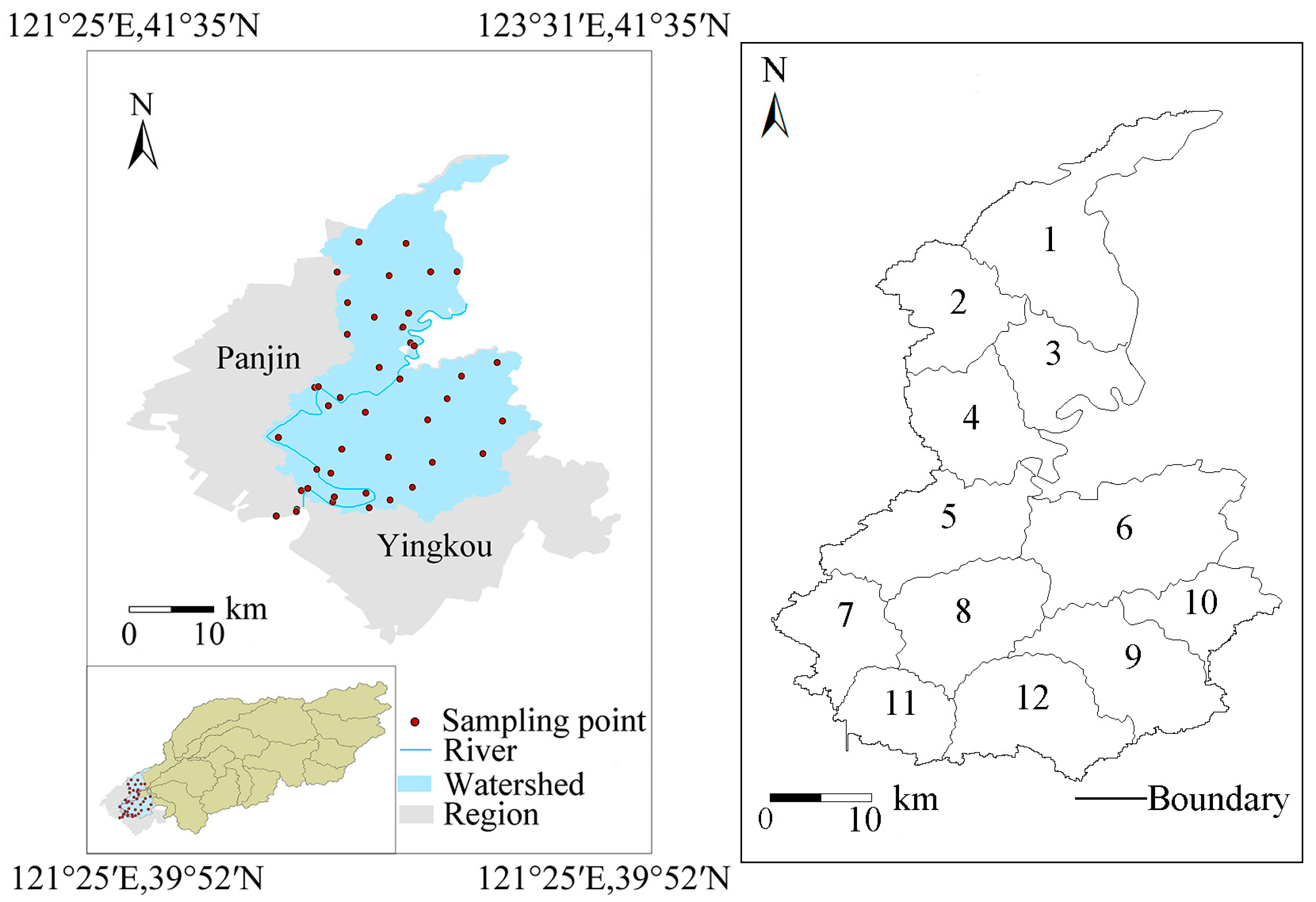
Figure 1. Sampling points and Sub-basin distribution.
Water 17 03267 g001
Figure 2. Spatial distribution of nitrogen fractions in the downstream Daliao River basin.
Water 17 03267 g002
Figure 3. Spatial distribution of phosphorus fractions in the downstream Daliao River basin.
Water 17 03267 g003
Figure 4. Correlation analysis. Note: ** and * represent 1% and 5% significance levels, respectively.
Water 17 03267 g004
Figure 5. Release of ammonia nitrogen and total phosphorus at different temperatures. (a) Ammonia nitrogen; (b) Total phosphorus.
Water 17 03267 g005
Figure 6. Release of ammonia nitrogen and total phosphorus under different pH conditions. (a) Ammonia nitrogen; (b) Total phosphorus.
Water 17 03267 g006
Figure 7. Release of ammonia nitrogen and total phosphorus under different DO conditions. (a) Ammonia nitrogen; (b) Total phosphorus.
Water 17 03267 g007
Figure 8. Nitrogen and phosphorus exports from soils in the subwatershed.
Water 17 03267 g008
Figure 9. SEM images of soils and sediments.
Water 17 03267 g009
Table 1. Potential of ammonia nitrogen release from soils and sediments.
Sample Regression EquationEC0 (mg/L)NAPR2Land Use Types
1q = −72.54C + 54.390.7554.390.917Rice land
2q = −22.53C + 15.770.7015.770.921Corn land
3q = −93.46C + 80.780.8680.780.935Reed land
4q = −90.69C + 784.718.65784.710.788Road land
5q = −46.40C + 44.520.9644.520.973Sediment
6q = −38.32C + 46.291.2146.290.988Sediment
Note: EC0 represents the equilibrium concentration (mg/L); NAP represents the background concentration in the soil (mg/kg).
Table 2. Potential of phosphorus release from soils and sediments.
SampleRegression EquationEC0 (mg/L)NAPR2Land Use Types
1q = −30.12C + 18.370.6118.370.967Rice land
2q = −22.61C + 22.721.0122.720.972Corn land
3q = −101.86C + 31.480.3131.480.978Reed land
4q = −10.22C + 15.531.5215.530.741Road land
5q = −72.94C + 38.190.5238.190.842Sediment
6q = −84.24C + 37.340.4437.340.858Sediment
Note: EC0 represents the equilibrium concentration (mg/L); NAP represents the background concentration in the soil (mg/kg).
Disclaimer/Publisher’s Note: The statements, opinions and data contained in all publications are solely those of the individual author(s) and contributor(s) and not of MDPI and/or the editor(s). MDPI and/or the editor(s) disclaim responsibility for any injury to people or property resulting from any ideas, methods, instructions or products referred to in the content.