
Article

Assessment of Groundwater Quality for Irrigation in the Semi-Arid Region of Oum El Bouaghi (Northeastern Algeria) Using Groundwater Quality and Pollution Indices and GIS Techniques

1
Laboratory of Functional Ecology and Environment, Department of Life and Nature Sciences, Faculty of Exact Sciences and Life and Nature Sciences, University of Larbi Ben M’hidi, Oum El Bouaghi 04000, Algeria
2
Water and Environmental Biology Laboratory, Faculty of Natural and Life Sciences and Earth and Universe Sciences, University of 8 May 1945, Guelma 24000, Algeria
3
Bioactive Molecules and Application Laboratory, Faculty of Exact Sciences and Natural and Life Sciences, Larbi Tebessi University, Tebessa 12002, Algeria
4
Applied Geology Research Laboratory, Applied Geology and Remote Sensing Research Team, Faculty of Sciences and Techniques, Moulay Ismaïl University of Meknes, Boutalamine P.O. Box 509, Errachidia 52000, Morocco
5
Department of Marine Sciences, University of the Aegean, 2007 Mytilene, Lesvos, Greece
6
Laboratory of Geo-Resources and Environment, University of Sidi Mohammed Ben Abdellah, Route d’Imouzzer P.O. Box 2202, Fez 30000, Morocco
*
Author to whom correspondence should be addressed.
Water 2025, 17(22), 3266; https://doi.org/10.3390/w17223266
Submission received: 18 June 2025 / Revised: 14 August 2025 / Accepted: 26 August 2025 / Published: 15 November 2025
(This article belongs to the Special Issue Research on Hydrogeology and Hydrochemistry: Challenges and Prospects)

Abstract

Groundwater quality in the semi-arid region of Oum El Bouaghi, Northeastern Algeria, was assessed for irrigation suitability using hydrogeochemical analyses, water quality indices, and GIS techniques. The study analyzed 23 groundwater samples during dry and wet seasons in 2022–2023, several physicochemical parameters were measured. Results revealed neutral to slightly alkaline pH levels, except for one acidic sample, with salinity (EC: 527–5001 µS·cm−1) exceeding WHO guidelines, particularly during the dry season due to evaporation and anthropogenic activities. Hydrogeochemical facies showed dominance of Na+-HCO3 and Ca2+-Cl/SO42− water types, indicating rock–water interactions and evaporation control, as confirmed by Gibbs plots. The IWQI classified water into five categories, with severe restrictions (IWQI < 40) in 13% of samples during the dry season, improving slightly in the wet season. Indices such as SAR, Na%, and RSC indicated low to moderate sodium hazard, while KR and PS highlighted salinity risks in specific areas. Spatial analysis revealed localized pollution hotspots, with the (GPI) identifying minimal to high contamination levels, linked to agricultural and geogenic sources. These findings underscore needs for sustainable groundwater management, including monitoring, optimized irrigation practices, and mitigation of anthropogenic impacts, to ensure long-term agricultural viability in this water-scarce region.

1. Introduction

Water is necessary for all living things, playing a key role in maintaining individual health and supporting human socio-economic growth [1]. Despite growing awareness, groundwater quality continues to decline rapidly due to significant landscape changes and increasing human activities. This deterioration has a considerable impact on human health through the consumption of contaminated water. As a result, numerous studies have been conducted worldwide to assess groundwater quality and its associated health risks [2]. However, the imbalance between aquifer recharge and excessive exploitation leads to a decline in its reserves, exacerbating pollution problems [3,4,5]. According to the World Health Organization, polluted water accounts for 80% of human diseases [6], groundwater quality is impacted by natural processes such as aquifer recharge, interactions between water and geological formations, mineral weathering, and pollution from nearby aquifers; human activities that impact groundwater include improper extraction, overuse of agrochemicals, industrial waste disposal, wastewater discharge, and urban development [7]. The Arab region is one of the most water-scarce areas in the world and relies primarily on groundwater, where extraction rates have exceeded natural recharge [8].
Assessment of groundwater quality, particularly for irrigation purposes, is based on a series of physicochemical parameters developed over time. The first indicators were developed in the 1950s–1960s with fundamental work such as that by [9,10] who introduced the sodium adsorption ratio (SAR) and Percentage of Sodium (Na%), respectively, in order to prevent the negative effects of excess sodium on soil structure. Kelly’s Ratio (KR), proposed in 1963, and Permeability Index (PI) by [11] were then used to refine the analysis of sodium–calcium–magnesium interactions on soil permeability. The Residual Sodium Carbonate (RSC), introduced by [12] and its variant RSBC, were developed to assess the effects of carbonates and bicarbonates on calcium and magnesium precipitation, indirectly affecting soil salinity and structure. The Magnesium Hazard Ratio (MHR) has been proposed more recently to assess the potential toxic effect of excess magnesium on permeability and plant growth [12]. At the same time, integrated approaches have emerged. Potential Salinity (PS), proposed by Doneen in the 1960s, takes into account the combined effects of chlorides and sulfates on the quality of water used for irrigation [11]. More recently, synthetic indices such as the Irrigation Groundwater Quality Index (IWQI) and the Groundwater Pollution Index (GPI) have been developed since the 2000s to summarize several physicochemical parameters in a global indicator [13]. The Groundwater Pollution Index (GPI) and the irrigation water quality index (IWQI) have emerged as major tools in the monitoring and management of water resources, the GPI was designed to quantify groundwater pollution by combining critical parameters such as nitrates, heavy metals, and electrical conductivity, making it easier to identify areas at risk and take environmental decisions [14]. At the same time, the IWQI was created to evaluate the quality of water used in agriculture by taking into account certain factors like hardness, salinity, and salt concentration that affect crop health and soil production [15]. While the GPI was designed to identify areas that are highly vulnerable to pollution from human activities, particularly agriculture and industry [16].
A significant way to monitor groundwater quality is by comparing the recorded concentrations of various parameters with the benchmark levels specified by national or international standards [17]. In addition, many studies have used indices such as the irrigation water quality index (IWQI) and sodium adsorption ratio (SAR) to evaluate groundwater Adequacy for irrigation purposes [18,19].
Recently, researchers have focused on analyzing the water chemistry of the studied aquifer by assessing its quality over time and space for irrigation purposes [20]. Another research group has proposed a hydrogeochemical evaluation using statistical methods and binary diagrams [21].
In Algeria, groundwater is an essential resource, especially in areas with scarce surface water availability [22,23]. It is also the primary source of freshwater used for irrigation in Algeria’s semi-arid and arid region [24]. Furthermore, groundwater is an essential source of drinking water [25].
However, excessive exploitation has caused depletion and contamination, highlighting the need for precise and reliable groundwater quality assessments [26]. Given these challenges, a comprehensive evaluation of aquifer characteristics is essential to guarantee the sustainable and environmentally responsible use of subsurface resources in the coming decades. Obtaining region-specific hydrogeochemical data is crucial for enhancing groundwater management strategies, promoting sustainability, and preventing further degradation [27,28,29,30]. Many researchers have carried out scientific studies in the Oum El ouaghi region, addressing aspects related to groundwater. Some studies have focused on the physicochemical analyses of well and spring water and their relationship with aquatic biodiversity [31,32,33,34,35].
This research aims to assess the quality of groundwater in the semi-arid region (Oum El Bouaghi), which is known for its agricultural and pastoral characteristics. Groundwater is considered to be the primary source of these activities.
Our objective study is to analyze the hydrogeochemical processes in the region, taking into account anthropogenic and natural factors. In addition, this work has classified water quality for irrigation purposes as IWQI, GPI, SAR, Na%, PI, KR, MHR, SSP, RSC, PS, and RSBC. This study is intended to help decision-makers prevent contamination and ensure safe planning of future developments in semi-arid regions.

2. Materials and Methods

2.1. Study Area

Oum El Bouaghi province is in northeastern Algeria (Figure 1), part of the Aurès Mountains region. It is bordered by some provinces, such as Khenchela to the south, Batna to the west, and Tébessa to the east [36]. The region has a semi-arid continental climate, with cold, dry winters and very hot summers, with temperatures reaching 41 °C. Summer rainfall is virtually non-existent, accentuating the aridity of the region. This climatic situation contributes to a significant drop in the water table, as observed in the Meskiana plain, due to both climatic variations and human exploitation of water resources, particularly for agriculture and industry [37].
This aquifer consists mainly of lithological formations such as gravel mixed with clay, limestone gravel and pebbles. It covers a large horizontal area, with Pliocene-Quaternary deposits covering the entire plain. The thickness of the aquifer varies significantly, ranging from 100 meters to around ten meters depending on the area. The aquifer, fed by limestone edges, has its flow constrained by an impermeable marl substrate. The piezometry, deep at the periphery but shallow at the center, establishes a connection between surface water and groundwater, increasing the risk of contamination.

2.2. Analytical Methods

Before collection, all groundwater samples were placed in 1.5 L plastic bottles, cleaned with distilled water, and then rinsed with the sample water. When transported to the laboratory, the samples were placed in a refrigerator and kept at 4 °C until the analysis day. In the field, physical parameters such as total dissolved solids (TDS), temperature (°C), pH, and electrical conductivity (EC) were determined using a WTW 3620 IDS multi-parameter device (Fisher Scientific GmbH, Wien, Austria).
This scientific study carefully investigated several chemical compounds using well-established procedures. Chemical parameters were analyzed for the following elements: T (°C), pH, TDS, EC, K+, Na+, Mg2+, Ca2+, Cl, SO42−, HCO3, NO3, and TH. The constituents were quantified and evaluated following standard protocols outlined by [38,39].

2.2.1. Piper Plot

The Piper plot or diagram was utilized to comprehend problems with groundwater geochemical processes. The various groundwater facies were categorized using the Piper diagram [40]. The trilinear diagram can demonstrate similarities and differences between groundwater samples. Based on this design, items of comparable quality will be displayed in groups [41].

2.2.2. Gibbs Diagram

The Gibbs diagram is a common technique for examining the connection between aquifer lithological characteristics and water composition. The diagram shows three domains: precipitation, evaporation, and rock–water interaction. Note that meq·L−1 represents all ionic concentrations [42].

2.2.3. Water Quality Assessment

Groundwater quality is the most important aspect in assessing its viability for consumption and irrigation [43,44]. Ref. [45] established a water quality categorization system. In 1970, Brown developed a general water quality index (WQI), a science-based communication tool that compares multivariable water quality data to accepted norms based on its intended [46]. Several water quality indices exist; for our objective, we calculated the irrigation water quality index (IWQI), the Pollution Index of Groundwater (GPI), and the water quality for irrigation. Evaluating irrigation water quality is essential to reducing agricultural risks to the environment and public health [19].

2.2.4. Standard Irrigation Water Quality Index (IWQI)

One of the most effective indices is the IWQI, which was calculated using the methodology by [47]. Five variables are used to evaluate IWQI: EC, SAR, Cl, HCO3 and Na+. The first step is to calculate for each variable the quality assessment scale (qi), according to the following Equation (1):
q i = q i m a x   x i j   x i n f   q i m a p X a m p
The maximum class level of q i is q i m a x , x   is the parameter’s measured level, the lower-class limit value of the variable is x i n f , the class amplitude is q i a m p , and x a m p is the parameter’s class amplitude. The highest level found in the physicochemical examination of the groundwater samples are the maximum limit for evaluating x a m p in the context of each parameter’s last class.
The IWQI was computed according to the following Equation (2):
I W Q I =   i = 1 n ( q i   w i )
The q i values denote the result of the within-limit quality measurement (Table 1), and w i corresponds to the weight of each parameter (Table 2).
After completing the IWQI calculation, the water quality is categorized according to Table 3.

2.2.5. Water Quality for Irrigation

The suitability of groundwater for irrigation depends on several factors, including soil texture and composition, the types of crops grown, the irrigation methods used, and the chemical characteristics of the water [48].
The assessment of irrigation water quality was conducted by analyzing various parameters. Parameters, including percentage of sodium (Na%), Sodium Absorption Ratio (SAR), Magnesium Hazard (MH), Kelly Ratio (KR), Permeability Index (PI), Potential Salinity (PS), Residual Sodium Carbonate (RSC), and the Residual Sodium Bicarbonate (RSBC) [49,50]. In this study, we aimed to assess water quality for irrigation using the mentioned indices. The results were obtained by applying the formulas expressed in meq·L−1, as shown in (Table 4).

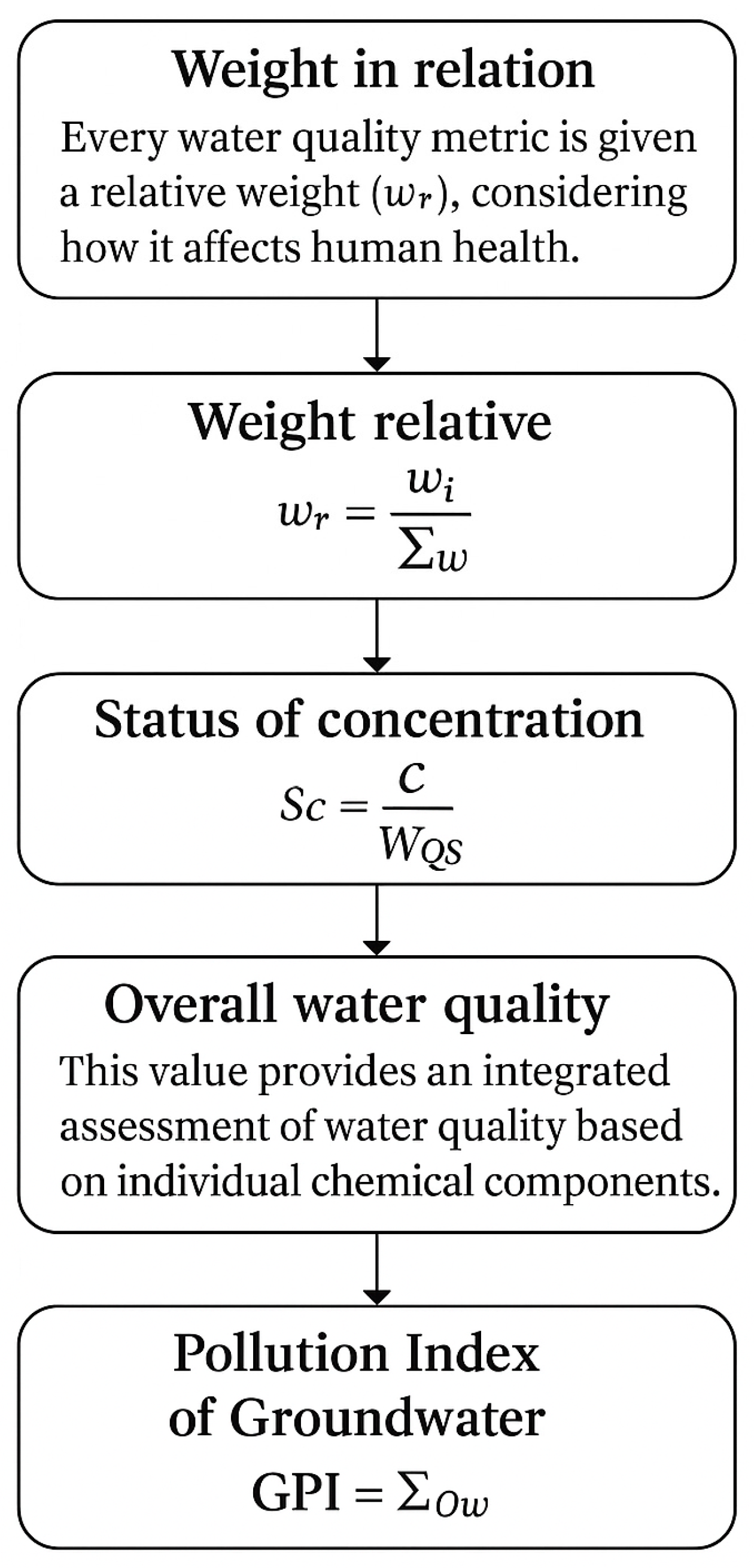
2.2.6. Groundwater Pollution Index (GPI)

The Groundwater Pollution Index (GPI) is valid for assessing water quality and providing detailed information on groundwater conditions [56]. The groundwater pollution index is a numerical scale that measures the extent of contamination. It depicts the combined effect of different water quality metrics on the overall quality of the aquifer. Subba Rao founded the GPI in 2012 as a scientific method for quantifying the influence of particular factors on the overall quality of groundwater. The methodological technique used to calculate the GPI comprises five key components [57] (Figure 2).
Step 1: Weight in relation. Every water quality metric is given a relative weight ( w r ), considering how it affects human health. The numerical magnitude of ( w i ) ranges from 1 to 5 (Table 2).
Step 2: Weight relative
w r = w i i = 1 n w i
( w r ) is determined based on the assigned weights, ( w i ) of each parameter (Table 2).
Step 3: Status of concentration
S c = C W Q S
( C ) concentration of the parameter in a water sample, ( W Q S ) drinking water quality standard (Table 2).
Step 4: Overall water quality
O w = w r   S c
This value provides an integrated assessment of water quality based on individual chemical components.
Step 5: Pollution Index of Groundwater
G P I = i = 1 n O w
Each water sample’s groundwater pollution index. ( G P I ) is calculated by adding together all of the ( O w ) values for the parameters under analysis (Table 5).

2.2.7. Technical Interpolation

The study used the ArcGIS 10.8® Geostatistical Analyst Wizard (GAW) to perform interpolation and spatial statistical analyses. This research applies interpolation methods for groundwater mapping and the representation of water quality indicators. In particular, inverse distance weighting (IDW) methods [58,59,60]. By utilizing a mathematical formula that assigns a weight to each point, the values measured at several places within the surface are converted into a statistical surface [61], this approach predicts and calculates the phenomenon’s value at any place on the network based on the inverse proportion of the distance from the observed sites [62].

2.2.8. Pearson Correlation

Pearson’s correlation coefficient was estimated using IWQI, GPI, and other water quality criteria. This coefficient demonstrates the significance of each parameter and its impact on the hydrochemical process [41]. The (R) values of the Pearson correlation matrix are in the range from 1 to −1 [63].

3. Results

3.1. Groundwater Physicochemical Parameters

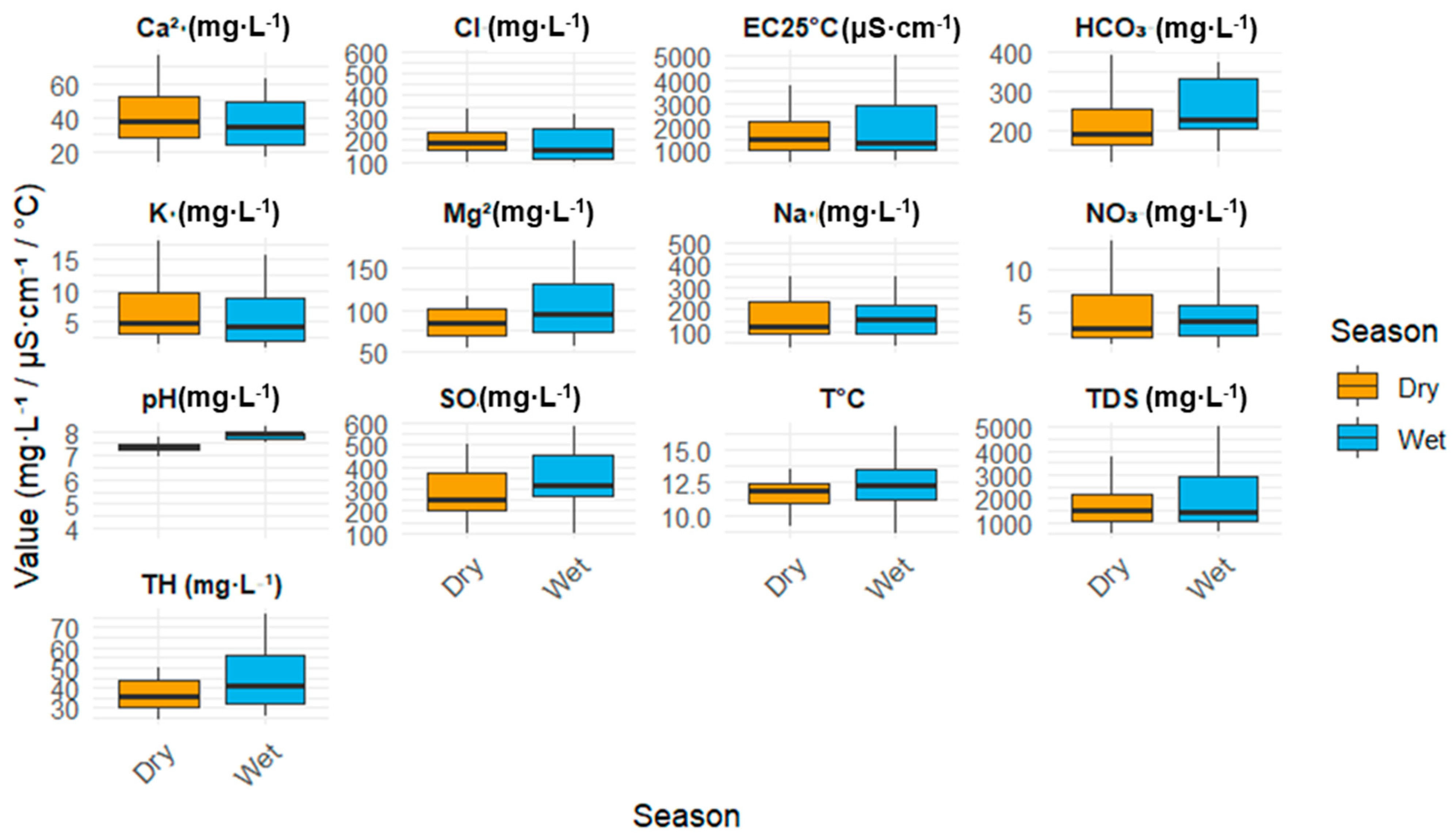
Physical and chemical data were analyzed and presented in (Table 6 and Figure 3) to determine the suitability of groundwater for agricultural irrigation. The parameters were analyzed using four statistical methods: minimum (min), maximum (max), mean, and standard deviation (SD). These results were compared to the 2017 World Health Organization (WHO) standards.
Groundwater sample temperatures varied from 8.6 to 16.7 °C (W 05 and W 10) during the wet season and from 9.07 to 16.20 °C (W 09 and W 10) during the dry season. With averages of 12.4 ± 1.97 °C and 11.8 ± 1.64 °C, respectively, all readings are under the WHO’s 25 °C guideline.
The pH values in the groundwater samples ranged from 5.31 to 7.98 during the dry seasons (W 22 and W 04) and from 5.31 to 7.98 (W 22 and W 18), with averages of 7.30 ± 0.48 and 7.63 ± 0.87, respectively. Most samples range from slightly acidic to alkaline, depending on the permissible values of 6.5–8.5. Except for P 22, which is very acidic during both seasons, during both periods of study, all EC and TDS values exceeded the 500 limit set by the WHO. The EC and TDS values were almost identical. In the dry season, values are between 527.33 and 4220.33 µS·cm−1 with averages of (1910.36 ± 1163.80) µS·cm−1. For the wet season, the values ranged from 603 to 5001 µS·cm−1, averaging (2031.12 ± 1336.90) µS·cm−1, at the same points during the two seasons (W 09 and W 06).
All TH levels fall below the acceptable 300 mg L−1 range throughout the two periods. In the dry period, we find values between 24.20 and 49.50 mg·L−1 W 09 and W 20) with average of (37.33 ± 8,36). At the same time, values in the wet period range from 26 to 77 mg·L−1 (W 21 and W 06) with average of (44.84 ± 14.79). Concerning groundwater cations, sodium (Na+) levels range from 28.95 to 454.37 mg·L−1 (W 23 and W 19) and average (164.00 ± 111.32 mg·L−1) during the dry period, with values between 36.18 and 502.42 mg·L−1 in the wet period (W 09 and W 05) with average (186.80 ± 138.91 mg·L−1). The concentrations of K+ during the wet and dry periods range between the values 1.57 and 17.81 mg·L−1 and 0.92 and 15.54 mg·L−1, respectively. The sources of their samples are, respectively, with averages of (6.41 ± 4.45 mg·L−1) and (5.72 ± 4.83 mg·L−1). For Na+, samples above the 200 mg·L−1 tolerance value represent 30.43%.
The calcium Ca2+ and magnesium Mg2+ concentrations ranged from 13.77 to 75.93 mg·L−1 (W 22 and W 06) with average of (39.93 ± 16.10 mg·L−1) and 55.00 to 116.51 mg·L−1 (W 09 and W 20) with average of (86.29 ± 19.83) mg·L−1, in the dry season, and 17.11 to 62.63 mg L−1 (W 21 and W 06) with average of (37.27 ± 13.64 mg·L−1) and 56.11 to 182 mg·L−1 (W 21 and W 06) with average of (104.50 ± 35.34 mg·L−1), in the wet season. Regarding calcium, all values belong to the values that the World Health Organization (WHO) allowed. As for magnesium, we find the opposite in the different samples, and their values are outside the recommended range. The potassium amounts (K+) values vary from 1.57 to 17.81 mg·L−1 (W 18 and W 05), with average of (6.41 ± 4.45 mg·L−1 in the dry period. On the other hand, values change between 0.92 and 15.54 mg·L−1 (5.72 ± 4.83 mg·L−1). In the total samples for the two seasons, we have 13.04% outside the permissible values for K+.
As for ions, in the wet period, we have different values for the elements where we find NO3 ranges from 1.19 to 13.19 mg·L−1,while values of SO42− range between 98.59 and 499.63 mg·L−1 (W 09 and W 05), in addition to the Cl that gave us the values between 98.75 and 501.67 mg·L−1 (W 03 and W 19), and finally with the values of HCO3 119.83 and 388.39 mg·L−1 (W 03 and W 06). With averages of (4.87 ± 3.86 mg·L−1), (289.82 ± 125.05 mg·L−1), (206.67 ± 96.36 mg·L−1) and (216.53 ± 74.17 mg·L−1), respectively. In the second half of the study, we find the following values for NO3, SO42−), Cl, and HCO3, (respectively: 0.90 to 10.18 mg·L−1), (99.62 to 580.05 mg·L−1), (99 to 577 mg·L−1) and (146.44 to 370.16 mg·L−1), where averages are estimated by these values (4.49 ± 2.68 mg·L−1), (341.90 ± 132.46 mg·L−1), (217.62 ± 152.83 mg·L−1), and (253.49 ± 72.12 mg·L−1). The NO3 values are within the required range. For SO42−, we find 36.96% within the allowed values, and if we talk about Cl and HCO3, we find that the samples within the permissible range represent 73.91% and 39.13%, respectively.

3.2. Hydrogeochemical Facies and Geochemistry Mechanism Controlling

3.2.1. Piper Diagram

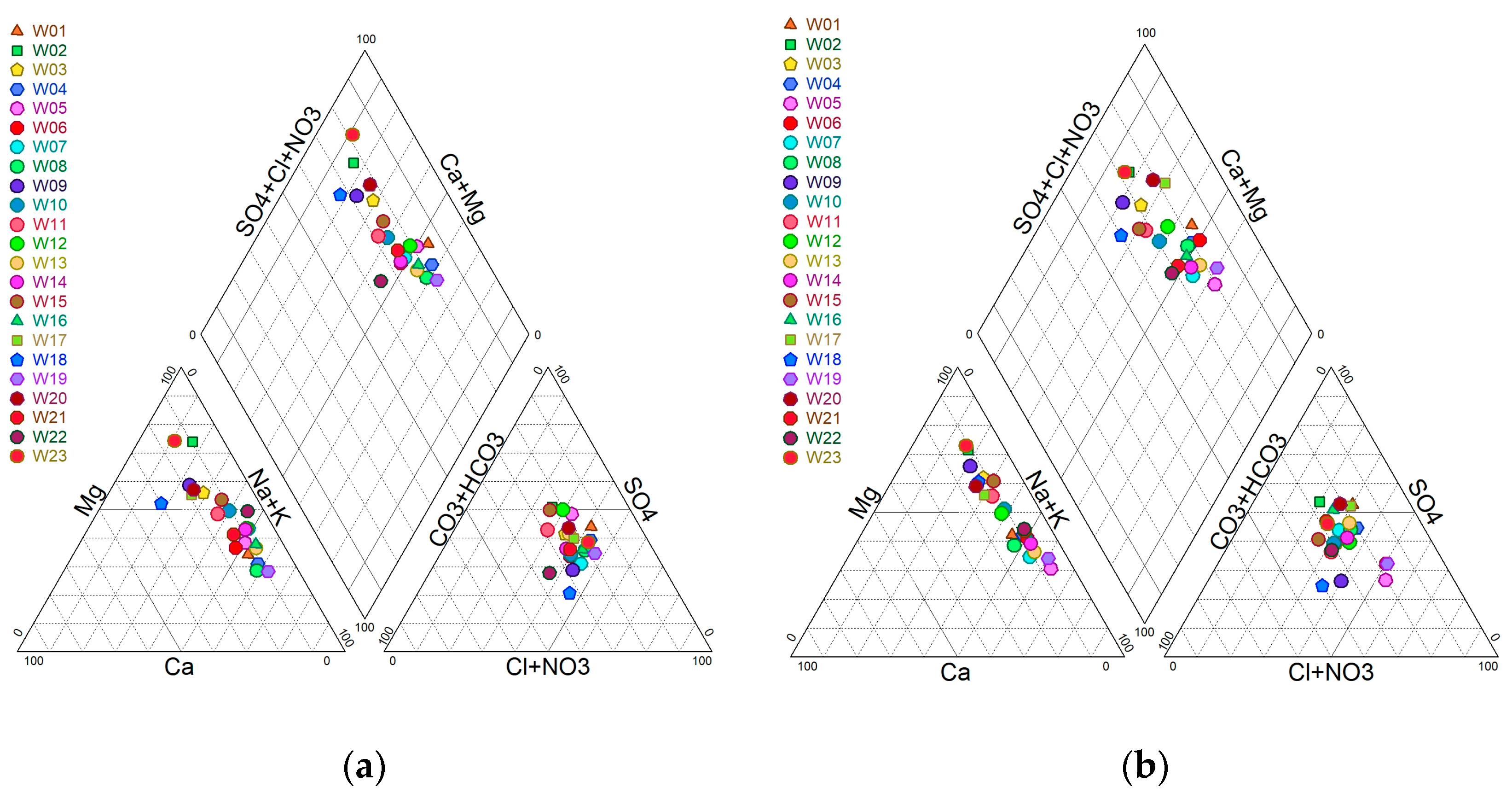
The Piper diagram shows the hydrogeochemical facies of the groundwater samples that were gathered (Figure 4). The Piper diagram for the dry period shows that approximately 65% of the samples fall within the sodium bicarbonate zone, indicating dominance of Na+ and HCO3 ions. Around 20% of the samples are located in the sodium chloride zone. Finally, about 15% of the points are distributed in mixed or intermediate zones. In the rainy period, the analysis of the normalized percentages shows that in the cation triangle, about 60% of the total cations are calcium (Ca2+), about 25% are magnesium (Mg2+), and about 15% correspond to the combination of sodium and potassium (Na+-K+). On the anion side, sulfate (SO42−) represents, on average, about 45% of the total anions, chloride (Cl) about 35%, and bicarbonate (HCO3) almost 20%. These percentages are reflected in the central diamond of the Piper diagram by a predominance of calcium-chloride (Ca2+-Cl) and calcium-sulfate (Ca2+-SO42−) type waters. However, a non-negligible fraction, up to 10–15% of samples, moves towards the sodium chloride (Na+-Cl) facies.

3.2.2. Data Plot on Gibbs Diagram

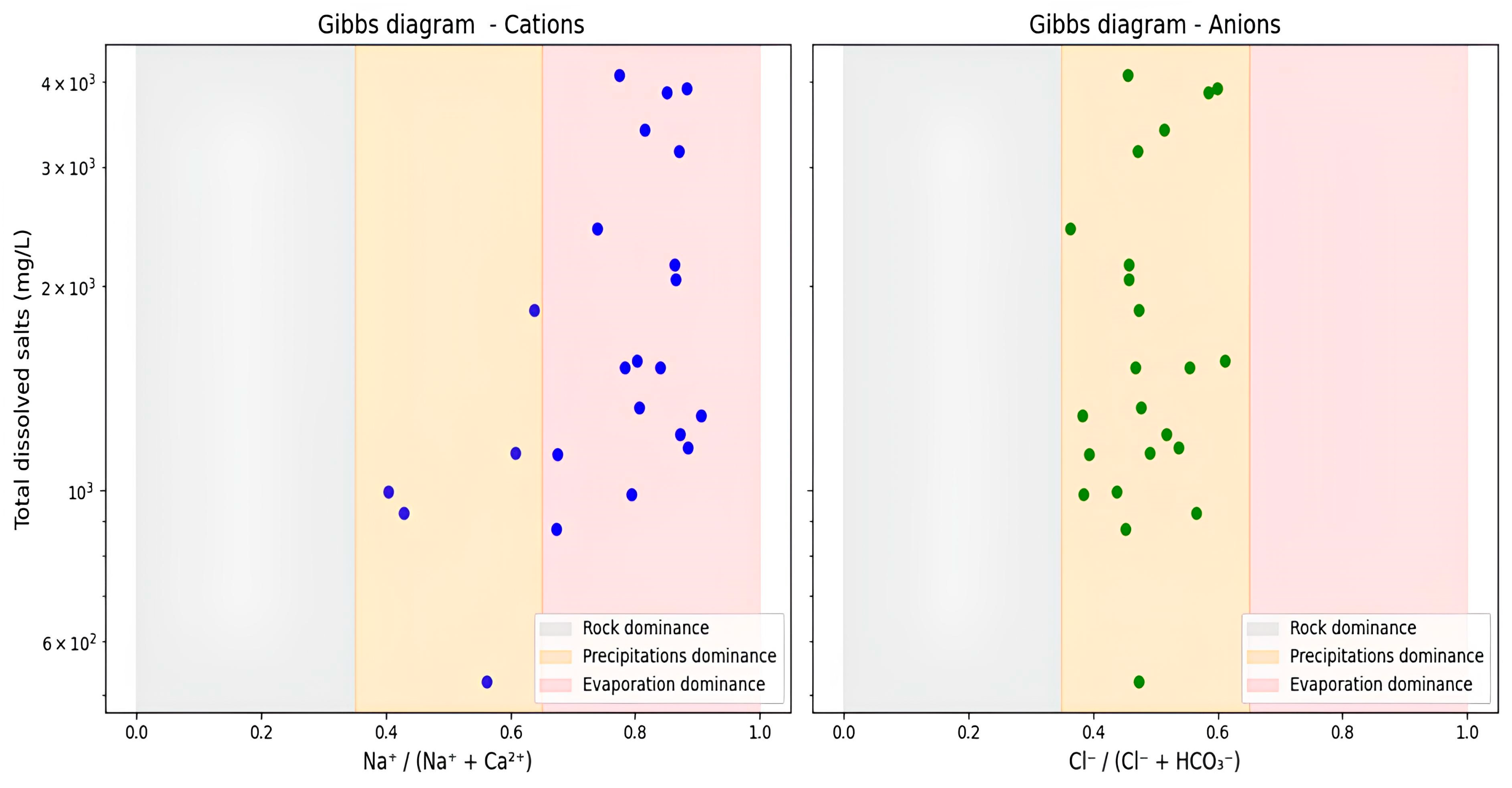
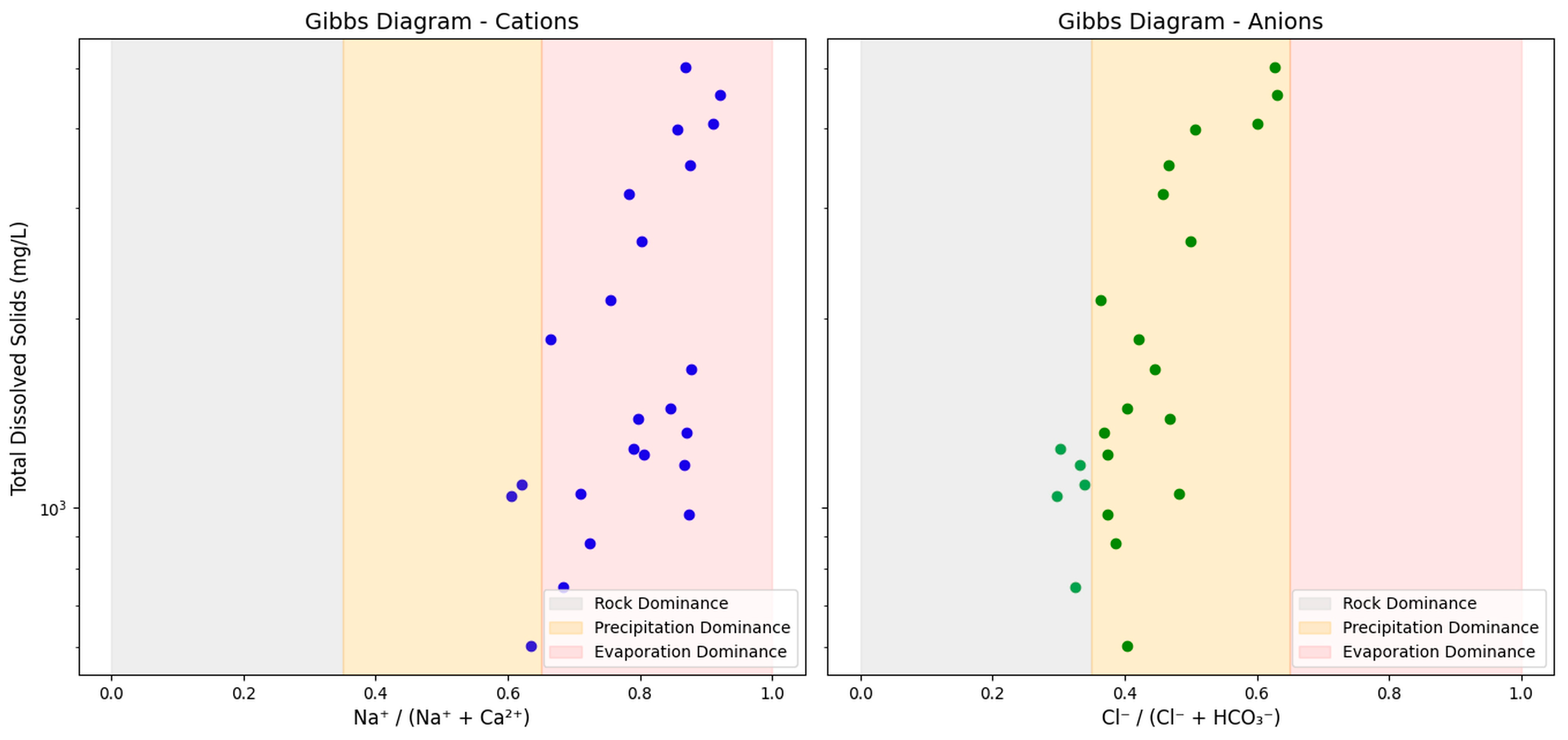
The Gibbs diagrams for cations and anions derived from groundwater samples taken during the dry season are shown in (Figure 5). With total dissolved solids (TDS) values ranging from around 1.000 to over 4.000 mg·L−1, most data points in the cation diagram (left) are grouped between 0.6 and 1.0 on the Na+/(Na+ + Ca2+) axis, firmly locating them inside the evaporation dominance zone. The assumption that evaporation plays a substantial role in regulating groundwater chemistry during the dry season is further supported by the anion diagram (right), where the Cl/(Cl + HCO3) ratio mainly varies between 0.6 and 0.9, and TDS values fall within the same range.
The (Figure 6) representing the Gibbs diagrams for the wet period, highlights that the influence of precipitation and evaporation dominates the majority of groundwater samples. In the cation diagram, approximately 13.04% of the points fall within the precipitation dominance zone, with (Na+/Na+ + Ca2+) ratio between 0.35 and 0.7. These samples’ total dissolved solids (TDS) concentrations ranged between 1.000 and 2.500 mg·L−1. For anions, nearly 80% of samples show a Cl/(Cl + HCO3) ratio between 0.3 and 0.6. A few points appear at the edge of the precipitation dominance zone.

3.2.3. Riverside Diagram

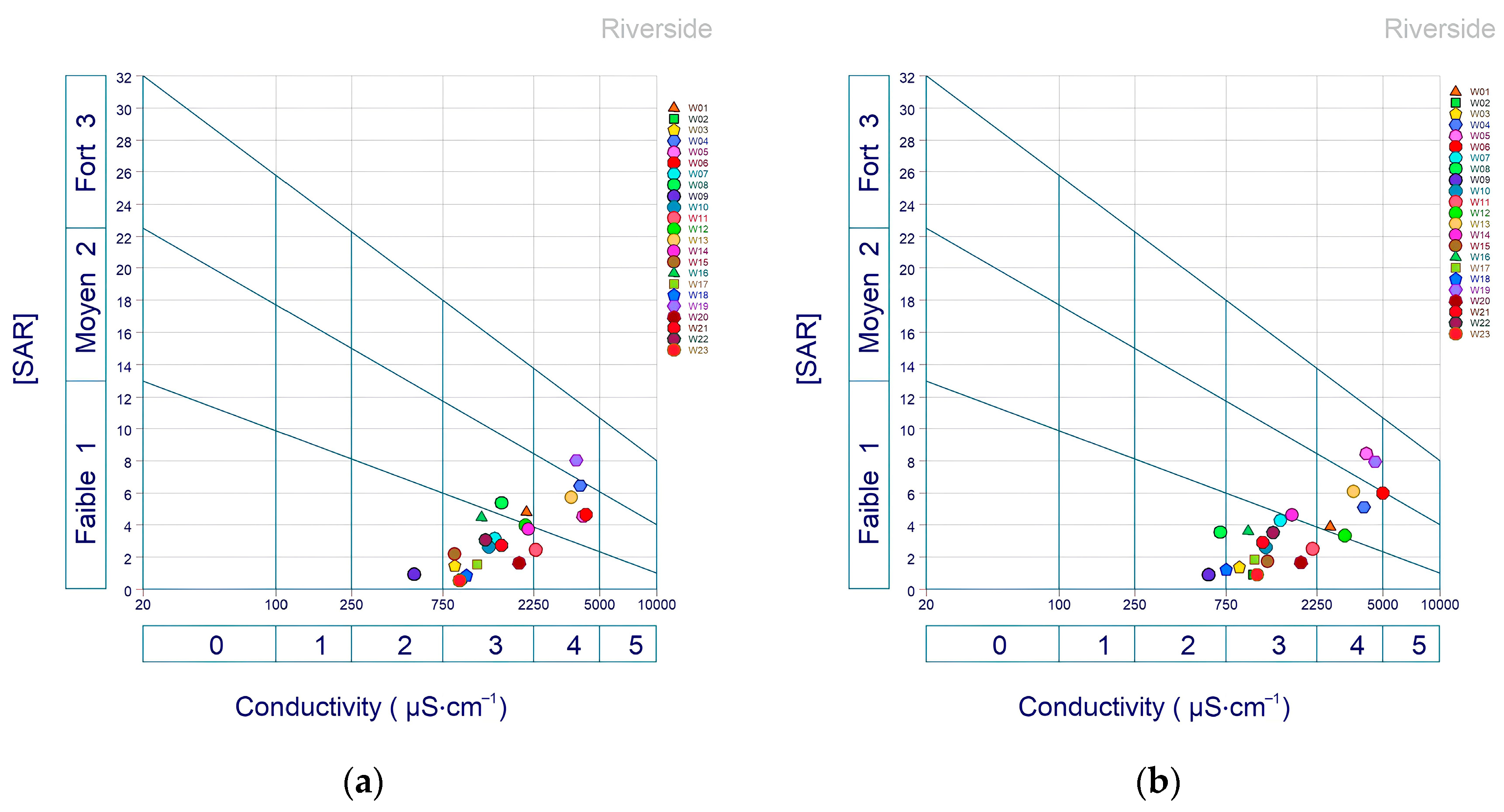
The analysis of the Riverside diagram for the dry period (Figure 7a) reveals that most water samples present an overall quality suitable for irrigation. Approximately 87% of the samples, or 20 points (W 01, W 02, W 03, W 04, W 05, W 06, W 07, W 08, W 10, W 11, W 12, W 13, W 14, W 15, W 16, W 17, W 18, W 20, W 21, W 22), fall within the low sodium adsorption ratio (SAR < 10) zone. In terms of salinity, 74% of the samples, or 17 points (W 01, W 02, W 03, W 04, W 05, W 06, W 07, W 08, W 10, W 11, W 12, W 13, W 14, W 16, W 17, W 20, W 21), exhibit a conductivity below 2250 µS·cm−1, reflecting low to moderate salinity. As a result, about 78% of the samples are considered suitable for irrigation without major concerns. However, a few samples (W 09, W 19, W 23) lie in the medium SAR zone or show higher conductivity. These results indicate that groundwater is generally suitable for agricultural irrigation during the dry period.
The vast majority of groundwater lies below safe salinity and salt intake parameters. However, it typically exhibits high quality for irrigation throughout the rainy season (Figure 7b), increasing its potential for use in agriculture. A few factors must be carefully considered to prevent detrimental effects on crops and land.

3.2.4. Wilcox Diagram

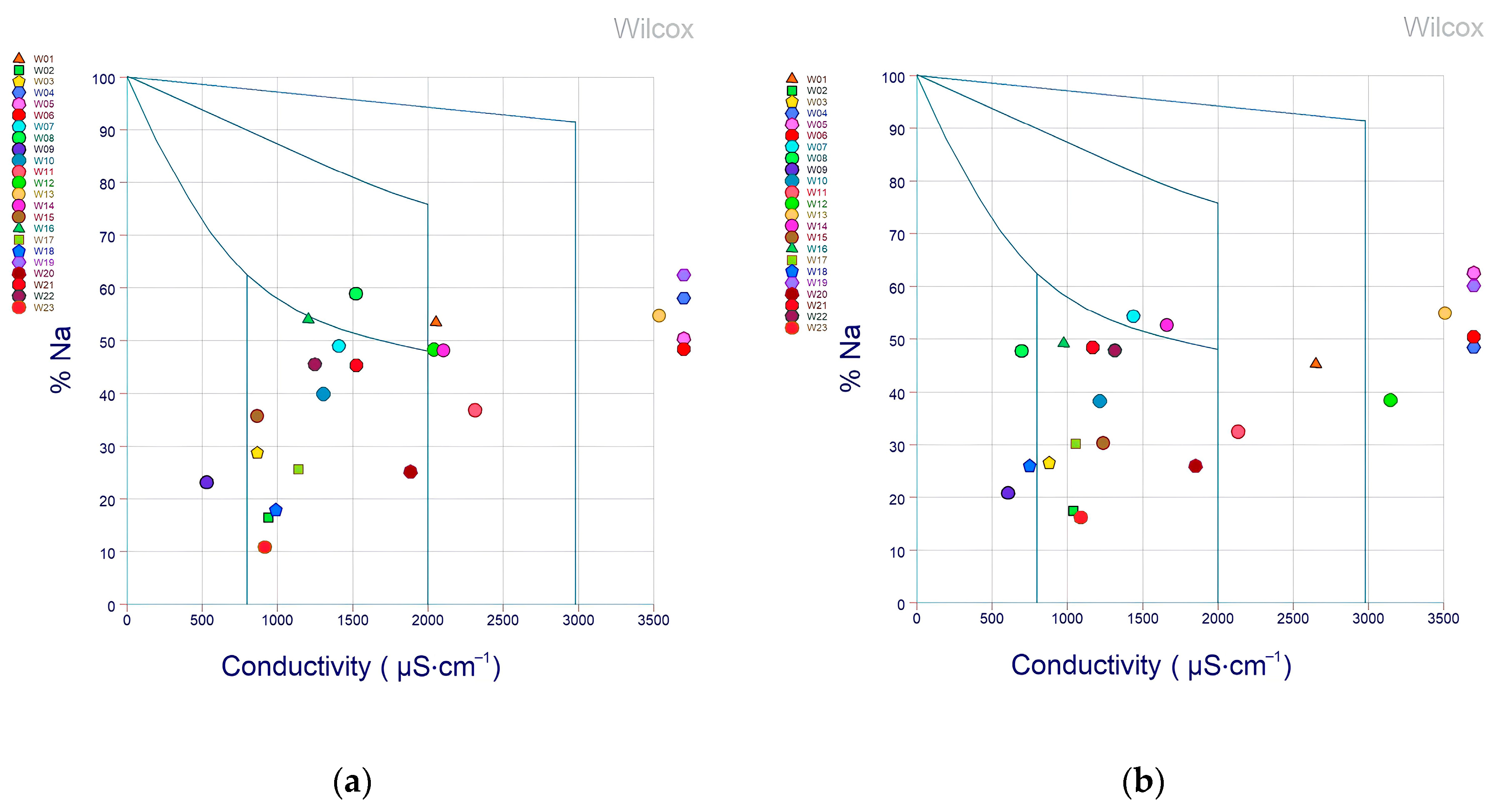
The analysis of the Wilcox diagram for the dry period (Figure 8a) reveals that most water samples present an overall quality suitable for irrigation. Approximately 87% of the samples, or 20 points (W 01, W 02, W 03, W 04, W 05, W 06, W 07, W 08, W 10, W 11, W 12, W 13, W 14, W 15, W 16, W 17, W 18, W 20, W 21, W 22), fall within the low sodium adsorption ratio (SAR < 10) zone. In terms of salinity, 74% of the samples, or 17 points (W 01, W 02, W 03, W 04, W 05, W 06, W 07, W 08, W 10, W 11, W 12, W 13, W 14, W 16, W 17, W 20, W 21), exhibit a conductivity below 2250 µS·cm−1, reflecting low to moderate salinity. As a result, about 78% of the samples are considered suitable for irrigation without major concerns. However, a few samples (W 09, W 19, W 23) lie in the medium SAR zone or show higher conductivity. These results indicate that groundwater is generally suitable for agricultural irrigation during the dry period.
Analysis of the Wilcox diagram during the wet period (Figure 8b) shows significant variability in irrigation water quality. Around 33% of samples (W 03, W 06, W 07, W 11, W 13) fall into the excellent to good zones, with low conductivity and a sodium percentage of less than 40%, indicating very good suitability for irrigation. On the other hand, 28% of the points (W 01, W 02, W 04, W 05, W 09) are in the admissible category, which means that the water is still usable, but with particular attention to the management of sensitive soils. However, a significant proportion, 44% of the samples (W 08, W 10, W 12, W 14, W 15, W 16, W 17, W 18), fall into people with low incomes in bad zones, presenting either a percentage of sodium greater than 60% or high conductivity (>2000 µS·cm−1).

3.3. Water Quality Indices

3.3.1. The Irrigation Water Quality Index (IWQI)

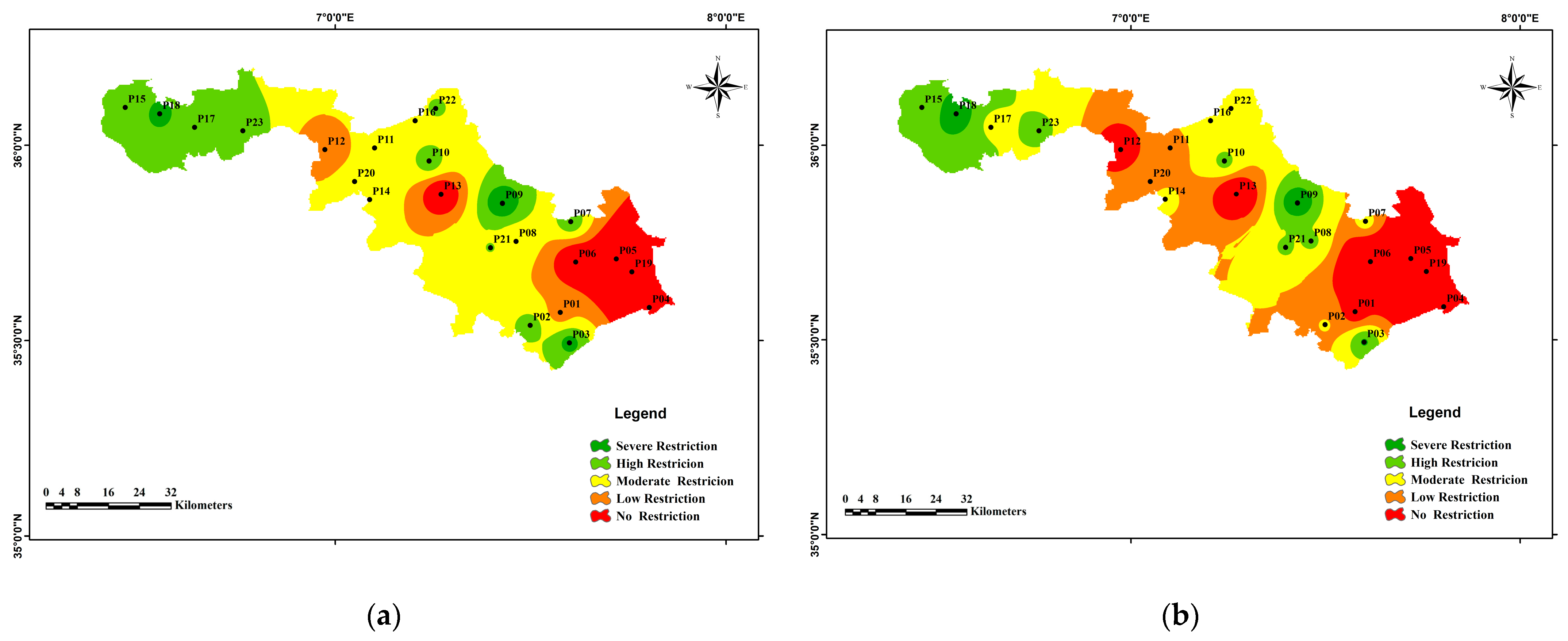
The index values were divided into five sections (No Restriction to Severe Restriction), with low values representing excellent and good water quality and higher values representing poor water quality. Each section was represented by a color, as shown in the two maps with color gradients.
A study of the water quality index for irrigation (IWQI) during the dry period reveals a contrasting situation depending on the areas sampled (Figure 9a). Of the 23 points analyzed, only three show very worrying results, with values below W40 (points 03: 34.87; 09: 25.99; and W 18: 36.31). This means that the water at these points is of very poor quality and is not recommended for irrigation without prior treatment. Other areas, notably points W 02 (49.76), W 07 (45.14), W 10 (47.11), W 15 (50.98), W 17 (51.54), and W 23 (47.38), around a quarter of the sites studied, also show low quality levels, corresponding to a severe restriction. This indicates a need to use the water with caution. Six other points fall into a medium category, where the water quality remains acceptable but requires a degree of caution: these are points W 08 (64.09), W 14 (63.97), W 16 (59.23), W 20 (64.55), W 21 (54.62), and W 22 (53.89). These results indicate a “moderate” restriction. Some sites were of more favorable quality. Points W 01 (76.27) and W 11 (67.23) show a low restriction, meaning the water can be used for irrigation with minimum risk. Only point W 12 (83.82) has water quality considered good, with no significant restrictions. Lastly, five points, numbers W 04 (113.23), W 05 (112.05), W 06 (108.02), W 13 (107.91), and W 19 (128.63), far exceed the thresholds of the classification grid, with values above 100. This indicates that water is very good quality and ideally suited to agricultural irrigation without any restrictions.
The map (Figure 9b) represents the spatial distribution of restriction levels across a study area during the wet period, based on data collected from 23 sampling points (W 01 to W 23). These values were grouped into five restriction categories: severe, high, moderate, low, and no restriction. Analysis shows that approximately 17.4% of the points (W 09: 26.35, W 18: 30.46, W 03: 38.61, W 15: 47.14) fall under severe restriction (green zone), indicating poor conditions despite the wet period. On the other hand, 21.7% of the points (W 05: 132.43, W 06: 141.96, W 19: 140.32, W 13: 117.71, W4: 118.69) are in the no restriction category (red zone), suggesting optimal conditions. The remaining points are spread across high (W 01: 93.71, W 11: 75.07), moderate (W 08: 52.57, W 10: 50.75), and low restriction zones.

3.3.2. Calculation of Groundwater Pollution Index (GPI)

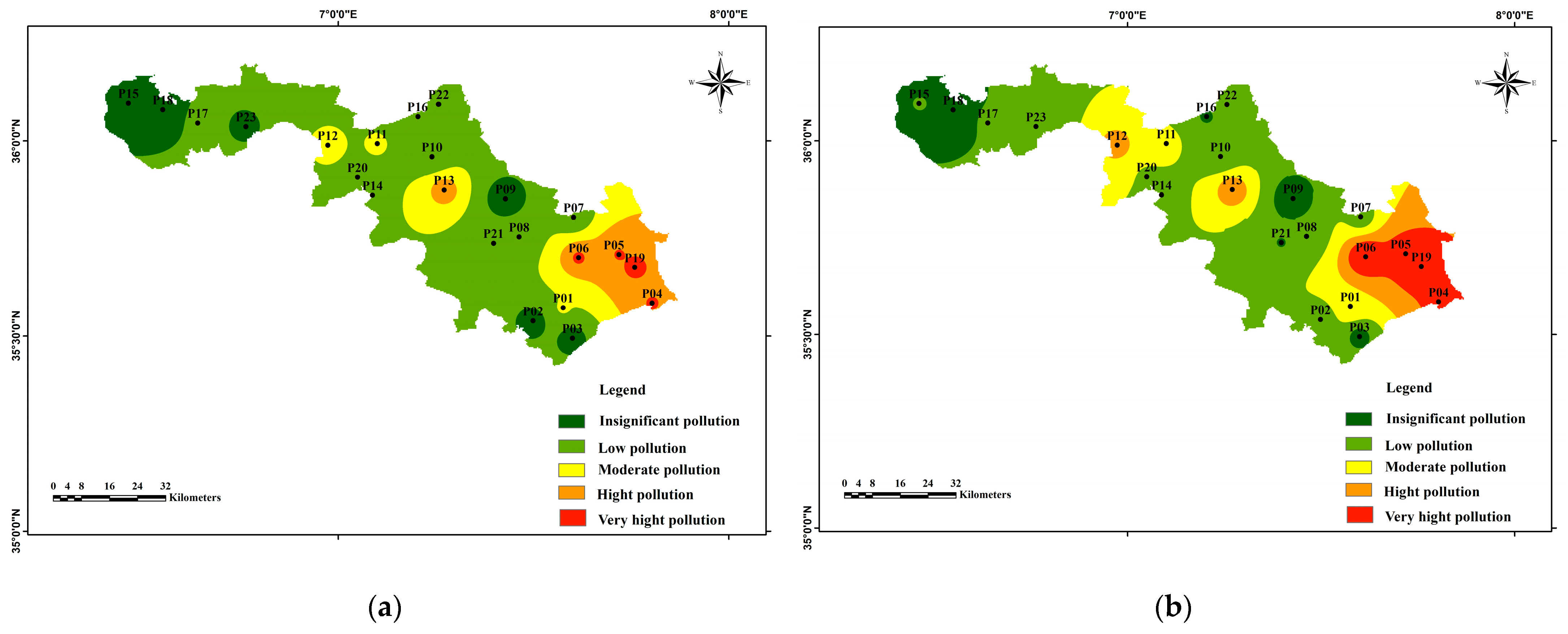
In the dry period, analysis of the map (Figure 10a) based on the Groundwater Pollution Index (GPI) reveals significant spatial variations in the region’s groundwater pollution level. A large proportion of the sites (around 35%), in particular points W 12, W 14, W 15, W 16, W 17, W 18, W 19, and W 22, fall into the “minimal contamination” category, indicating very satisfactory groundwater quality, which is mainly located in the northwest. 26% of points (W 04, W 07, W 10, W 11, W 20, W 21) show low contamination, indicating a slight deterioration in water quality. In contrast, 22% of sites (W 02, W 03, W 08, W 13) showed signs of moderate pollution. Sites P 01, P 05, and P 06 (13%) are in the high pollution zone, and finally, site P 09 (4%) is classified as highly polluted.
The map shown in (Figure 10b) indicates a mostly steady pollution state, while there have been some local changes since the last map. According to the findings, 30% of the sites (W 15, W 16, W 17, W 18, W 22, and W 23) have minor contamination. These sites are primarily located in the northwest and reflect regions where human activity has minimal impact on groundwater quality. W 04, W 07, W 10, W 12, W 19, and W 21, or 26% of the total points, fall into the low pollution category. Moderate pollution occurs at around 22% of the sites (W 03, W 08, W 11, and W 13). The water quality at sites W 01, W 06, and W 14 (13%) is very contaminated and unfit for drinking or irrigation. Finally, W 05 (4%) continues to be quite contaminated.

3.4. Water Quality Index for Irrigation

3.4.1. Sodium Adsorption Ratio (SAR)

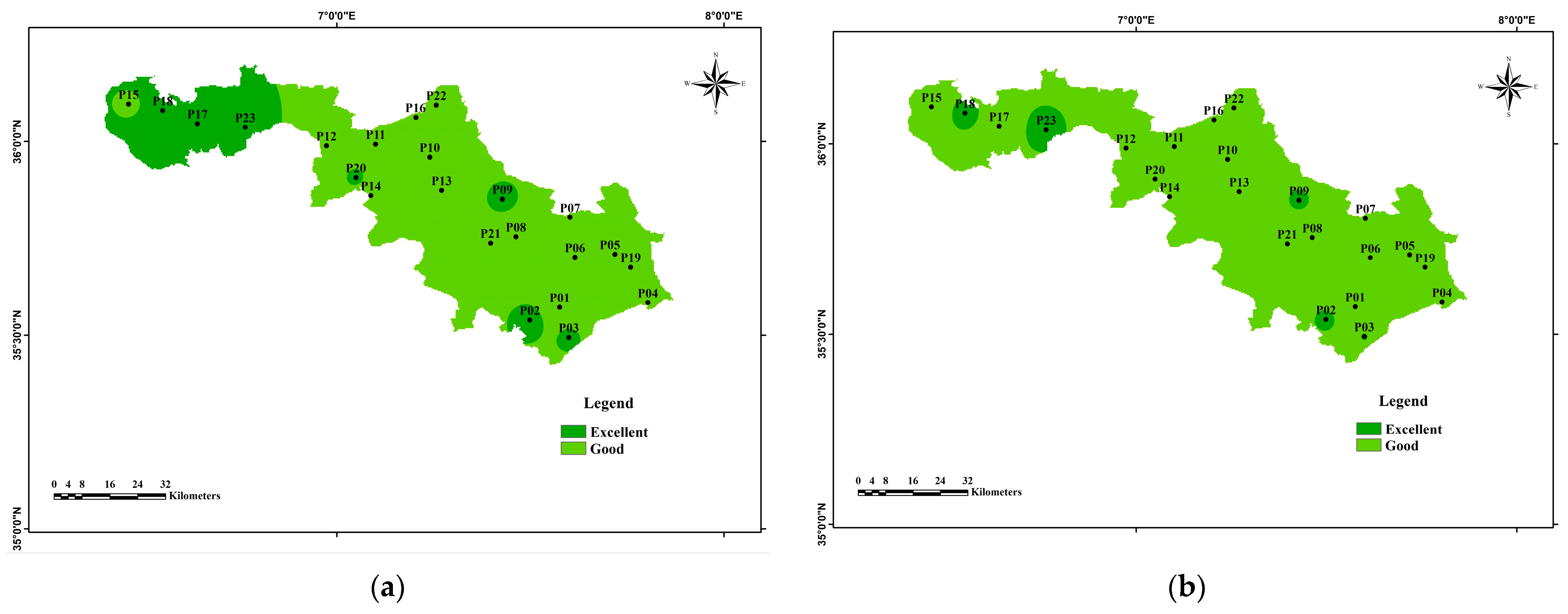
The SAR map (Figure 11a) shows the suitability of groundwater for irrigation purposes based on sodium uptake throughout the study area and during the dry period. The majority of the sampled sites, about 70% (W 01, W 02, W 03, W 04, W 06, W 07, W 08, W 10, W 11, W 12, W 13, W 18, and W 20), fall under the “excellent” category, indicating that the water in these areas has a very low sodium content. About 22% of the sites (W 05, W 09, W 14, W 15, W 21) are categorized as having “good” values for sodium in water (W 05, W 09, W 14, W 15, W 21). Only 8% of the sites (W 16 and W 17) fall into the “allowed” category, where sodium levels are higher but still acceptable for irrigation. Significantly, none of the sites fall into the “unsuitable” category.
The SAR map (Figure 11b) illustrates the suitability of groundwater for irrigation during the wet period based on the sodium adsorption ratio across the study area. A majority of the sampling sites, approximately 78% (including W 01, W 04, W 05, W 06, W 07, W 08, W 10, W 11, W 12, W 13, W 14, W 15, W 16, W 17, W 19, W 20, and W 21) are classified in the “excellent” category. Around 17% of the sites (W 02, W 03, W 09, W 18, and W 23) fall within the “good” category, reflecting water quality suitable for irrigation with low to moderate sodium hazard. Only 4% of the sites (specifically W 22) are categorized as “permissible,” where sodium concentrations are higher but still acceptable for agricultural use. Notably, no sites fall into the “unsuitable” category, highlighting the generally favorable quality of groundwater for irrigation during the wet season.

3.4.2. Sodium Percent (Na%)

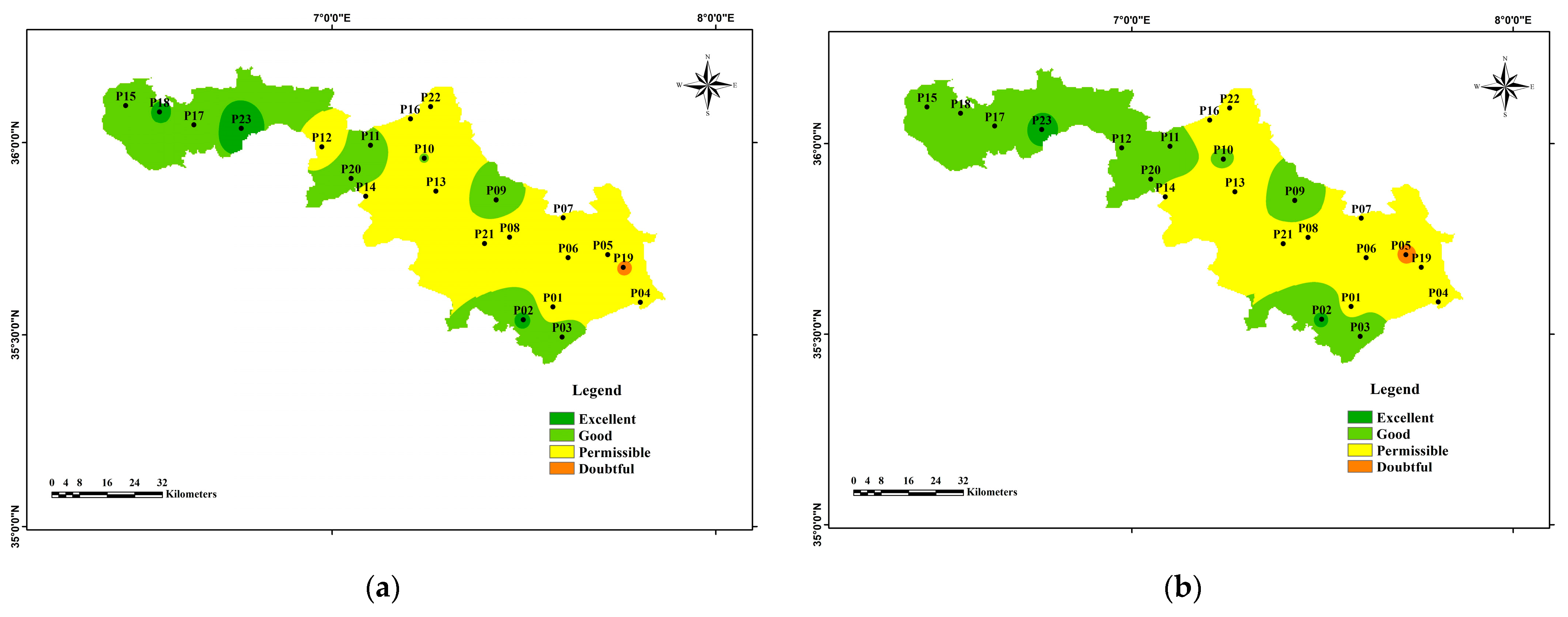
The Percent Sodium (Na%) map (Figure 12a) for the dry period reveals a moderate variation in groundwater suitability for irrigation across the study area. According to the classification, the majority of the stations, such as W 01, W 02, W 03, W 04, W 06, W 07, W 08, W 10, W 11, W 13, W 16, W 18, W 19, W 21, and W 22, fall under the “permissible” (yellow) category. A few stations, such as W 05 and W 12, are categorized as “doubtful” (orange), suggesting higher sodium levels. Only one station, W 09, is marked as “unsuitable” (red) for irrigation. On the other hand, more favorable zones are observed in the western region, with stations like W 14, W 15, W 17, and W 23 falling into the “excellent” (dark green) or “good” (light green) categories, reflecting low sodium content and high suitability for irrigation. In the wet period (Figure 12b), out of a total of 23 sampling points, 22.2% of the sites had water quality classified as excellent, 33.3% as good, 27.8% as permissible, 11.1% as doubtful, and 5.6% as unsuitable. The areas to the northwest of the territory (in particular points W 16, W 17, W 18, and W 11) show very good water quality, suitable for irrigation without risk to the soil. On the other hand, the southeast zone, including points W 01, W 02, and W 05, is of mediocre to poor quality.

3.4.3. Permeability Index (PI)

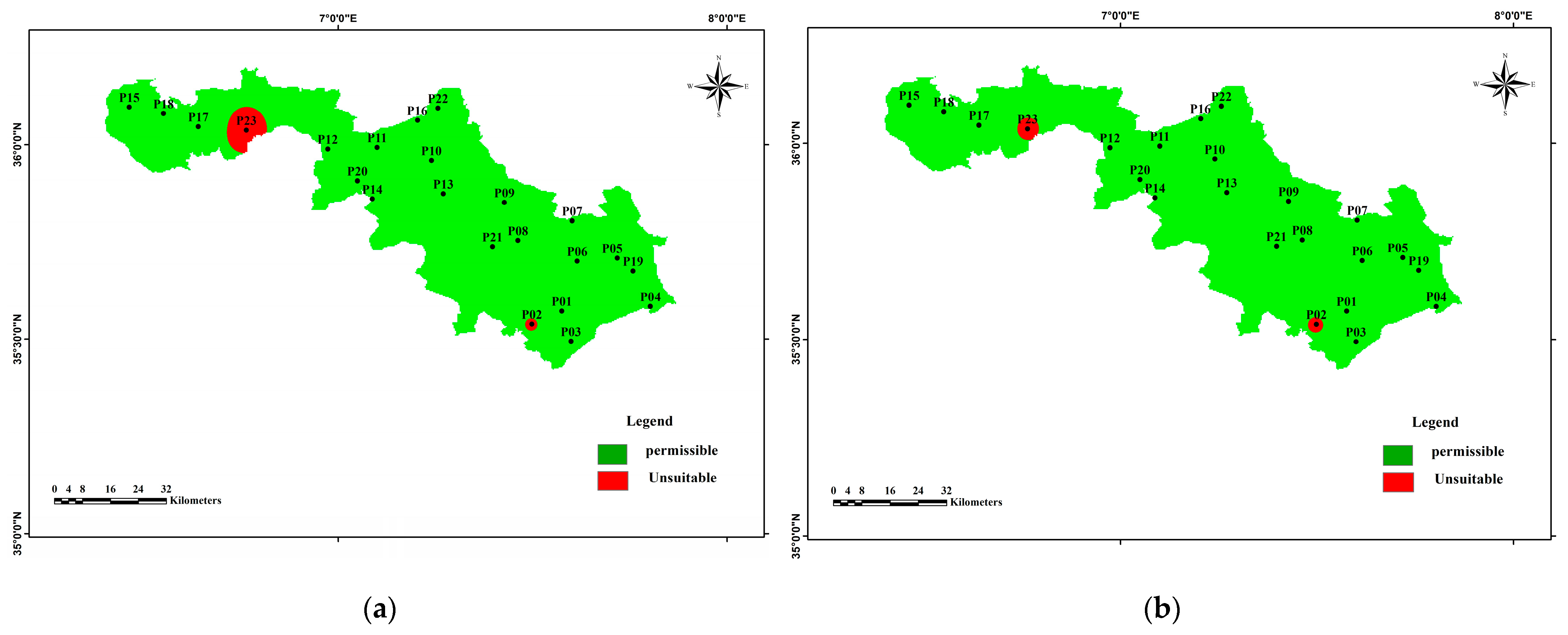
The Permeability Index (PI) evaluation for both dry and wet periods shows (Figure 13a,b) that the majority of the sampling points (W 01, W 03 to W 22) fall within the “suitable” category for irrigation, indicated by the green areas on the map. However, two stations, W 02 and W 23, consistently fall outside the suitable range during both seasons.

3.4.4. Magnesium Hazard Ratio (MHR)

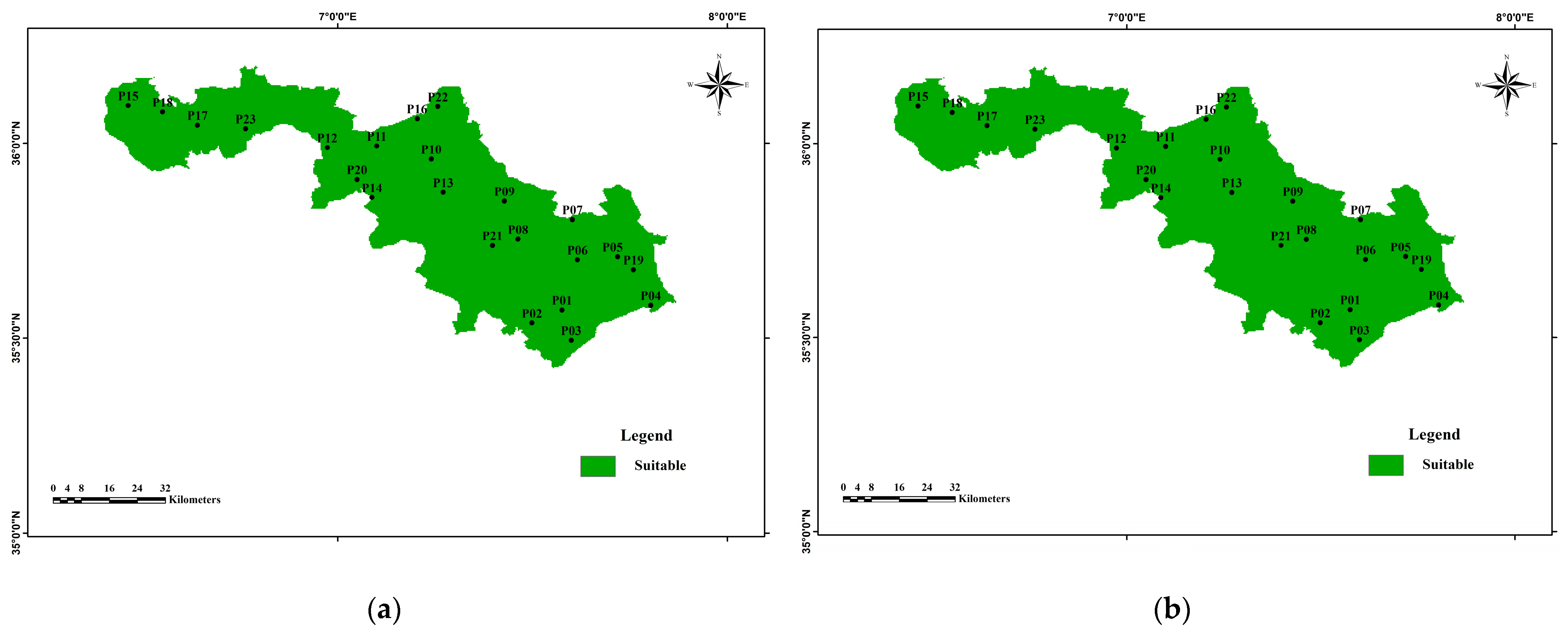
The MHR map (Figure 14a) for the dry period indicates that the entire study area is classified as “suitable” for irrigation, with 100% of the sampling points (W 01 to W 23) falling within the green zone. This classification suggests that, based on the Modified Hazard Risk Index, no significant health or agricultural hazard is associated with using Groundwater in this region during the dry season. The absence of any “unsuitable” (red) zones reflects optimal groundwater quality conditions, particularly regarding salinity, sodium hazard, and other contributing factors. As for the wet period, we find in the map (Figure 14b) the same results as in the dry period without any change.

3.4.5. Residual Sodium Carbonate (RSC)

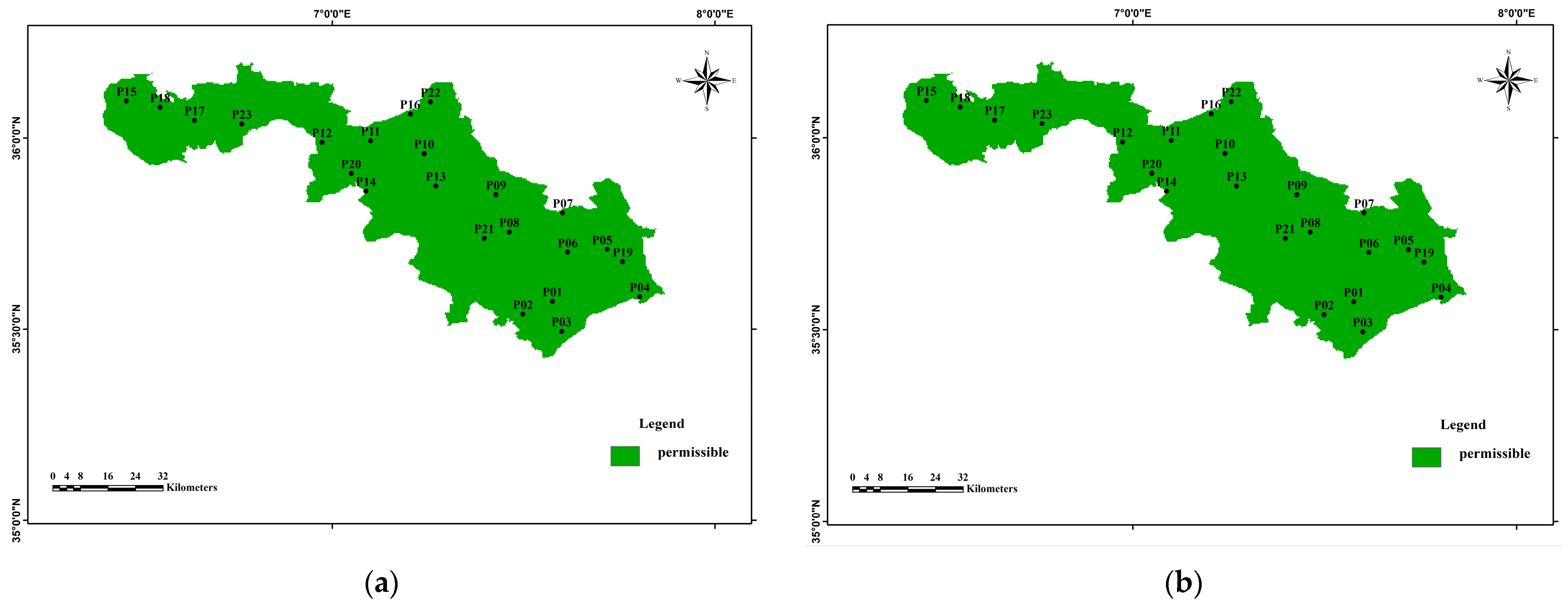
The Residual Sodium Carbonate (RSC) map (Figure 15a) illustrates the suitability of Groundwater for irrigation based on the balance between carbonate/bicarbonate and calcium/magnesium ions. According to the map, all sampling points (W 01 to W 23) are categorized as “suitable” (green), which is considered safe for irrigation. The results of the Residual Sodium Carbonate (RSC) index during the wet period are identical to those observed in the dry period (Figure 15b). All sampling points (W 01 to W 23) are classified as “suitable” for irrigation, indicating consistently low RSC values across both seasons.

3.4.6. Kelley’s Ratio (KR)

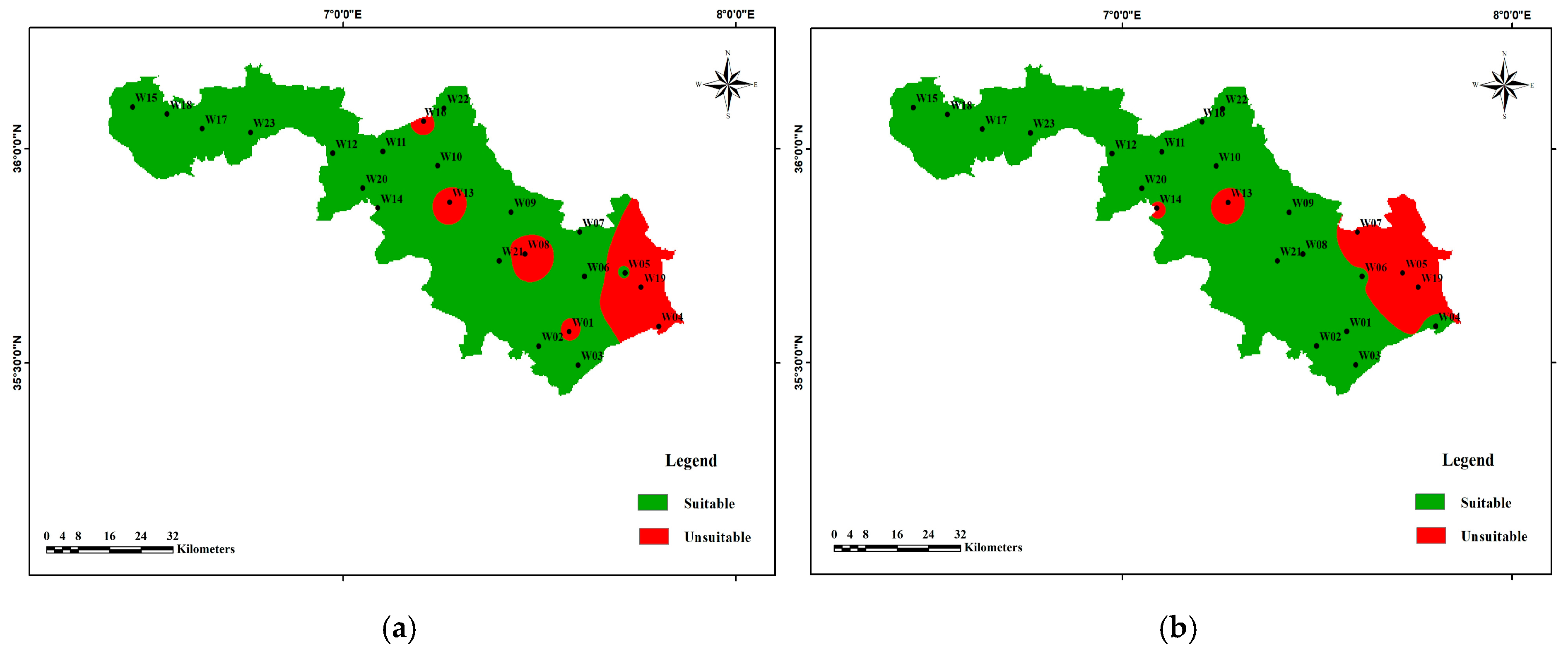
The Kelley’s Ratio (KR) assessment during the dry period reveals that a significant majority of the groundwater samples (approximately 74%) fall within the “suitable” category for irrigation, as shown by the green areas on the map (Figure 16a). These include sampling points such as W 02, W 03, W 05, W 06, W 07, W 09, W 10, W 11, W 12, W 14, W 15, W 17, W 18, W 20, W 21, W 22, and W 23. However, about 26% of the points, specifically W 01, W 04, W 08, W 13, W 16, and W 19, are located in the red zone, categorized as “unsuitable for irrigation.”
During the wet period, the evaluation of Kelley’s Ratio (KR) indicates that approximately 74% of groundwater samples fall within the “suitable” category for irrigation, as illustrated by the green zones on the map (Figure 16b). This classification includes sampling points such as W 01, W 02, W 03, W 04, W 06, W 08, W 09, W 10, W 11, W 12, W 15, W 16, W 17, W 18, W 20, W 21, W 22, and W 23. In contrast, around 26% of the sampling points, specifically W 05, W 07, W 13, W 14, and W 19, are categorized as “unsuitable for irrigation,” appearing in red on the map.

3.4.7. Potential Salinity (PS)

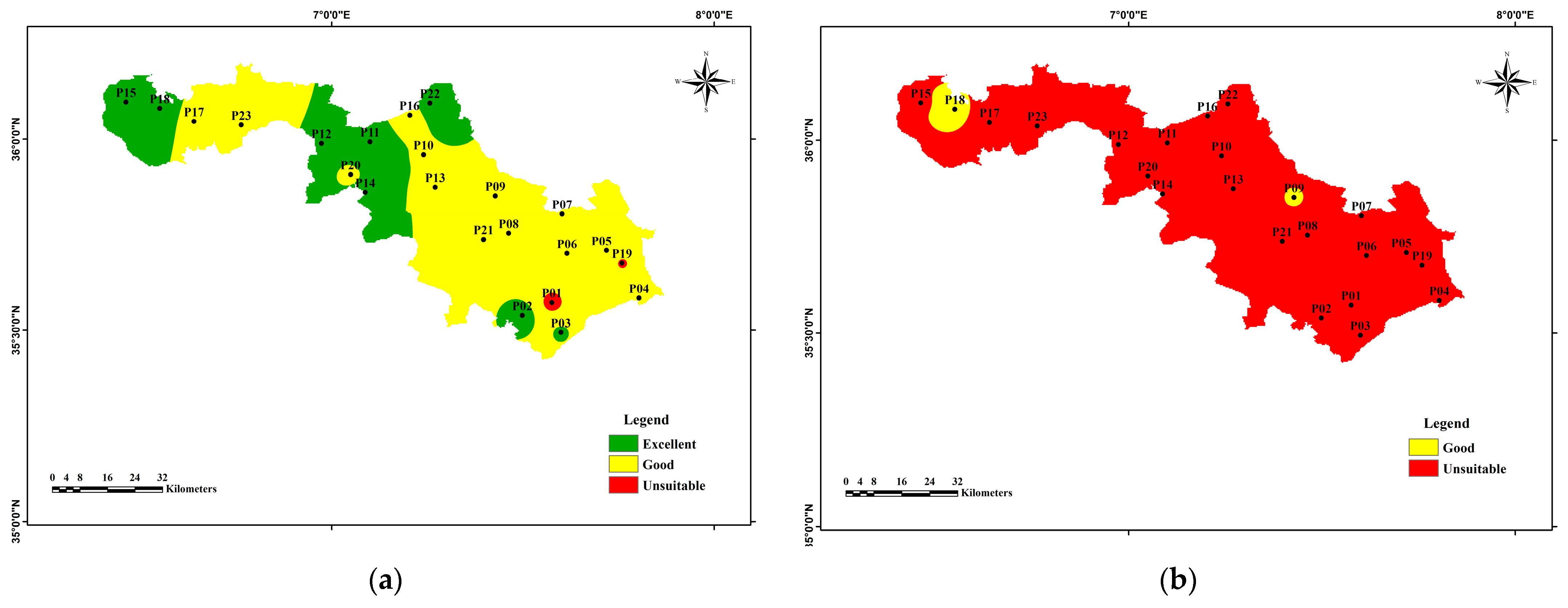
The Potential Salinity (PS) assessment during the dry period, as illustrated in the corresponding map (Figure 17a), highlights the suitability of groundwater for irrigation across the study area. Approximately 35% of the sampling sites (W 02, W 03, W 11, W 12, W 14, W 15, W 18, and W 22) fall within the “excellent” category (green), indicating very low concentrations of potentially harmful salts and excellent water quality for irrigation purposes. Around 52% of the sites (W 04, W 05, W 06, W 07, W 08, W 09, W 10, W 13, W 16, W 17, W 20, W 21, and W 23) are classified as “good” (yellow), suggesting generally acceptable water quality with minor salinity concerns. However, 13% of the sampling points (specifically W 01 and W 19) fall into the “unsuitable” category (red).
The Potential Salinity (PS) assessment during the wet period, as shown on the corresponding map (Figure 17b), reveals a significant decline in groundwater suitability for irrigation across the study area. The majority of the sampling sites, approximately 91%, fall into the “unsuitable” category (red). Only two sites, W 09 and W 18, representing about 9%, are classified as “good” (yellow), suggesting marginally acceptable water quality for irrigation.

3.4.8. Residual Sodium Bicarbonate (RSBC)

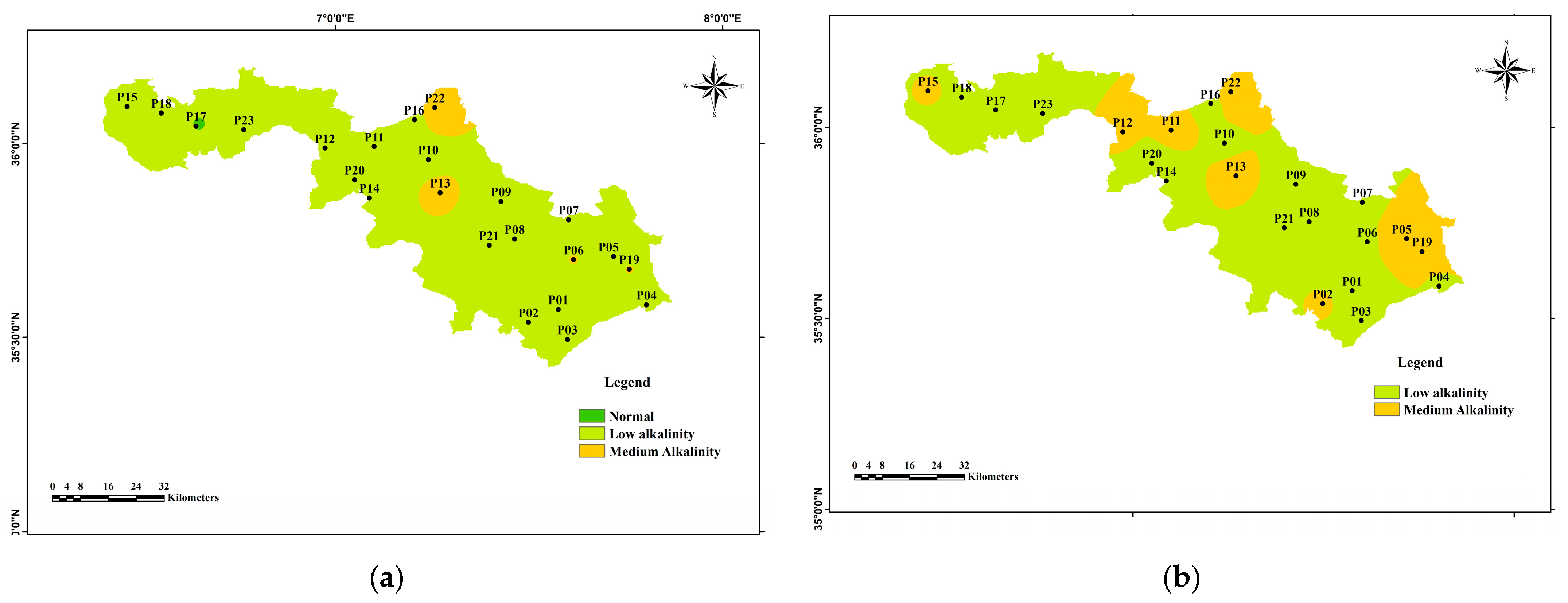
The Residual Sodium Bicarbonate (RSBC) assessment during the dry period, as illustrated in (Figure 18a), indicates that the majority of the groundwater samples across the study area fall within the “low alkalinity” category (green). Specifically, approximately 91% of the sampling points show low RSBC values, supporting their safe use in agricultural practices. However, two sites, W 13 and W 22, representing about 9%, are classified as having “medium alkalinity” (orange).
The Residual Sodium Bicarbonate (RSBC) assessment during the wet period, as shown in (Figure 18b), highlights the presence of moderate bicarbonate concentrations in several groundwater samples. Approximately 35% of the sites (W 02, W 05, W 11, W 12, W 13, W 15, W 19, and W 22) fall within the “medium alkalinity” category (orange), indicating a moderate risk of sodium accumulation in soil due to elevated bicarbonate levels. The remaining 65% of the sampling points exhibit “low alkalinity” (green), suggesting low bicarbonate levels and minimal concern for irrigation suitability.

3.5. Statistical Analysis

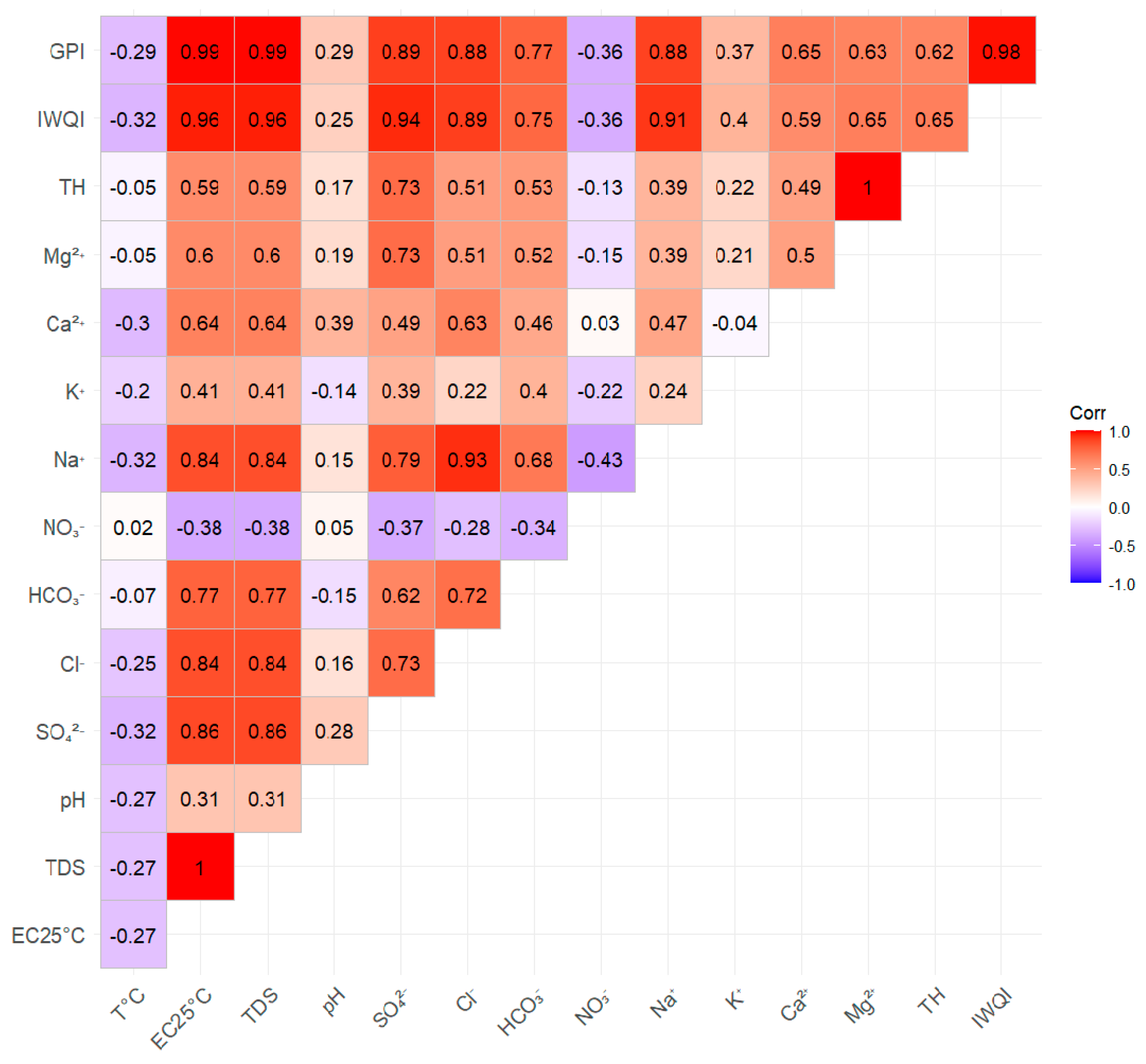
The correlation matrix for the dry period (Figure 19) demonstrates some significant correlations between the variables evaluated during the drought. Furthermore, as predicted, given that both indices are built using comparable characteristics to evaluate water pollution and quality, the IWQI and the Groundwater Pollution Index (GPI) exhibit an exceptionally high correlation (r = 1.00). A strong positive correlation is observed between electrical conductivity at 25 °C (C25 °C) and total dissolved solids (TDS) (r = 0.98). Similarly, calcium (Ca2+) and total hardness (TH) show a very high correlation (r = 0.99). Strong correlations exist between Na+ and Cl (r = 0.79) and between NO3 and Cl (r = 0.73). In addition, the quality index (IWQI) and global pollution index (GPI) are strongly correlated with major ions, in particular Na+ (r = 0.88) and Cl (r = 0.87).
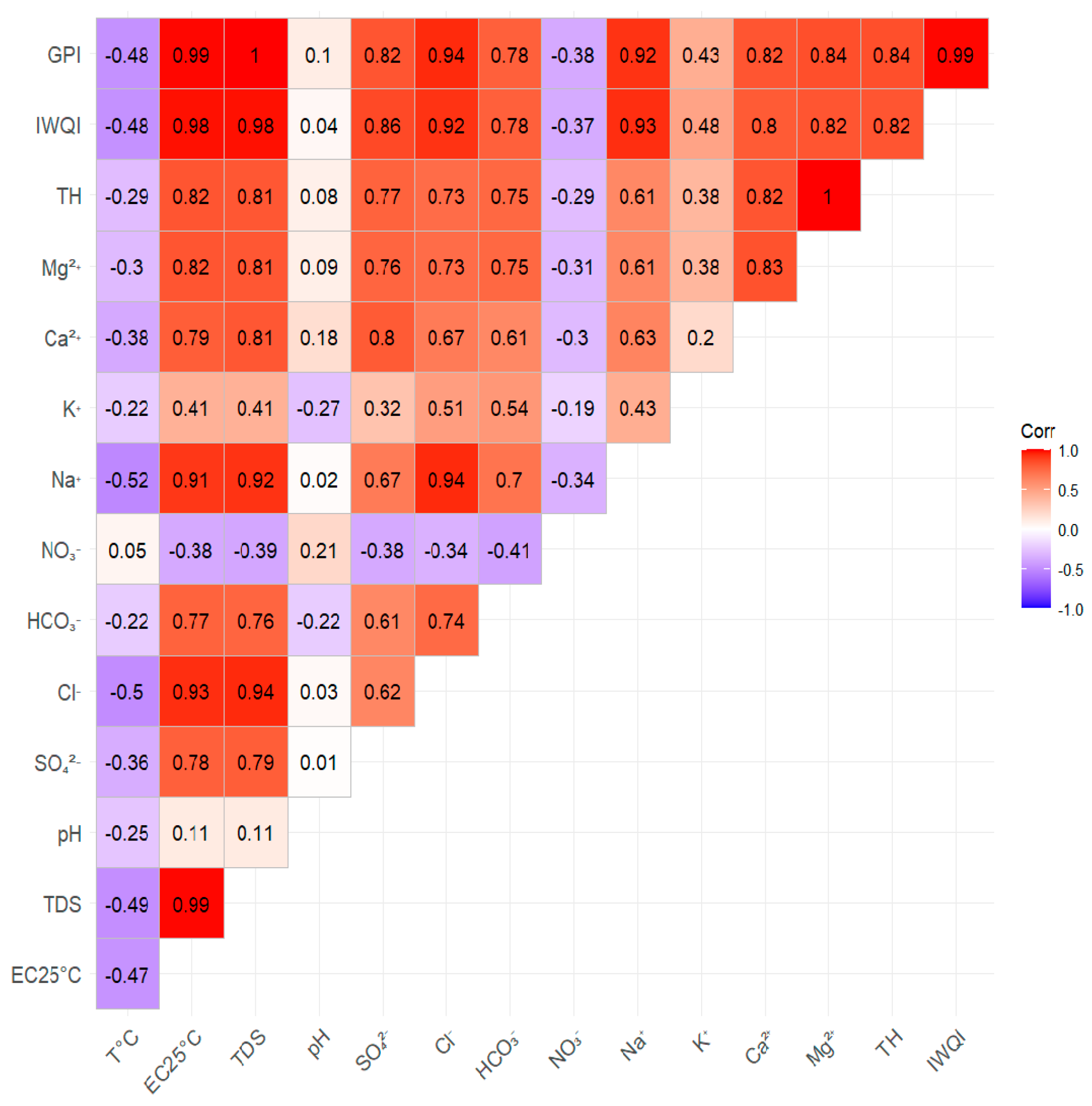
Examination of the correlation matrix (Figure 20) for hydrochemical parameters in the wet period highlights robust statistical relationships between several variables, testifying to standard hydrogeochemical processes. A strong correlation is observed between electrical conductivity (C25 °C) and total dissolved solids (TDS) (r = 1.00), and high correlations between Cl, SO42−, Na+ and K+ (r > 0.90). Total hardness (TH) remains strongly related to calcium (Ca2+) (r = 0.93) and magnesium (Mg2+) (r = 0.82). The IWQI and GPI indices strongly correlate with the major ions (Cl: r = 0.94, Na+: r = 0.92). In addition, temperature (T °C) is weakly correlated with the majority of the parameters (r < 0.5).

4. Discussion

In the Oum El Bouaghi region, the primary sources of drinking water are also used for riparian and agricultural irrigation [64]. The crop yield rate is significantly influenced by the mineral composition of the irrigation water; an excessive amount of dissolved ions in the irrigation water can have a detrimental effect on crop yield [65].
The study area has a neutral pH except for the sample P 22, which is advantageous for most crops [66]. Groundwater’s pH in Morocco’s semi-arid regions ranges from 7.06 to 7.86 [67]. As for the acidic sample, one of the leading causes of acidity in groundwater is the oxidative dissolution of metal sulfides, which is impacted by the type of rock, its physical properties, microbial activity, and the presence of neutralizing minerals [68]. The acidity is most likely caused by the carbonic acid released when atmospheric carbon dioxide dissolves and plant matter breaks down in the soil. A decrease in pH may result from the fact that water acids are often rich in dissolved carbon dioxide but poor in calcium minerals [69]. Thus, the alarming decline in groundwater quality in the study area is highlighted by the marked rise in salinity indices, such as EC, which reaches 4220.33 µS·cm−1 in the dry period and 5001 µS·cm−1 in the wet period. Higher EC values indicate a larger buildup of dissolved salts, which several human and environmental sources may cause [67]. Similar results in semi-arid locations confirm the most likely explanation: increased agricultural activity and irrigation techniques are causing salts to leach from the soil into the groundwater, these include the work achieved by [70]. Depending on the particular solutes available, higher evaporation rates can concentrate salts in groundwater to varying degrees [71,72]
The mineral content of groundwater is one of its key components particularly Ca2+ and Mg2+, and other polyvalent ions, including aluminum, barium, manganese, strontium, and zinc, are found in smaller concentrations [73]. The correlation matrix shows that TH has a strong relationship with Mg2+ TDS and Ca2+. The primary source of calcium and magnesium contributing to water hardness is the dissolution of carbonates (calcite and dolomite) [74]. Although hard water is usually safe, excessive hardness can lead to scaling in irrigation equipment and pipelines, making it typically undesirable for use in irrigation [75].
The major cations were arranged in the order Na+ > Mg2+ > Ca2+ > K+. Their magnesium readings fall outside the advised range. The primary sources of magnesium in the study area groundwater are precipitation, ion exchange, and rock weathering and dissolution [76]. When Mg2+ is present in groundwater, it frequently forms hydrochemical types, including Mg2+-HCO3, Ca2+-HCO3, and Na2+-HCO3 [77].
The range of potassium in the samples studied over the two periods is generally similar to some of the studies carried out, where a study carried out in Burkina Faso, West Africa, found K+ concentrations in groundwater ranging from 1.98 to 11.96 mg·L−1 [78].
Regarding samples exceeding the admissible limit of 12 mg·L−1, which is estimated at around 13%, the application of chemical fertilizers and poor purification conditions are specific sources of K+ in Groundwater [79].
The study area’s water sample locations had salt levels ranging from 28.95 to 454.37 mg·L−1, 36.18 to 502.42 mg·L−1. These values are less than the sodium levels found in the Naama watershed, when sodium levels varied between 21 and 806 mg·L−1 [80]. However, lower values were found in the Ain Essafra region (SW of Algeria), ranging from 21 to 390 mg·L−1 [41]. The Na+ concentration of shallow Groundwater is influenced by geologic (water–rock interactions) and anthropogenic (agriculture-related) sources [81].
The Riverside diagram results were mapped to illustrate spatial variations. Measuring water quality for irrigation shows significant differences between the dry and wet seasons. In the dry season, the water at some sites is of inferior quality, as shown by the very low indices (less than 40) at points such as W 03, W 09, and W 18. This means that the water at these sites cannot be used for irrigation without prior treatment. A quarter of the sites analyzed had lower quality levels, severely restricting their use. This deterioration in quality is often linked to evaporation, salt concentration, and the lack of natural groundwater recharge during the dry period [82]. However, water quality generally improves during the wet season at most sites. Groundwater recharge and the dilution of salts by rain play an important role in this improvement. However, even during the wet season, some sites remain severely restricted, which shows that the rainy season does not solve all the water quality problems, especially in areas where persistent contamination or soil geology is unfavorable [83,84]. For example, W 03, W 09, and W 15 remain affected despite groundwater recharge. Another interesting aspect is that, for some sites (such as W 01, W 10, and W 11), water quality improves in the wet season, moving from moderate or high restriction to lower restriction. This proves that the wet season allows for diluting harmful elements in the water, such as sodium and dissolved salts, thanks to groundwater recharge. However, this improvement is insufficient to guarantee stable quality in all areas, particularly those already heavily contaminated or with less favorable geological characteristics [85].
A comparative assessment of groundwater quality using the Groundwater Pollution Index (GPI) in a semi-arid region reveals an overall stable condition across the dry and wet seasons, with some localized variations.
Analysis of the sodium adsorption ratio (SAR) reveals significant seasonal variability in groundwater quality for irrigation in the study area.
According to the RSC and SAR indices, an assessment of the quality of the groundwater in the Souf region of Algeria revealed that, despite hydrochemical challenges, the water was still generally suitable for irrigation [86]. These studies highlight the significance of RSC as a reliable indicator of water quality for irrigation, particularly in arid and semi-arid regions [87].
The groundwater quality for irrigation was evaluated using the Kelley Index (KR). The obtained results indicate that, with minor geographical changes between the two seasons, 74% of the samples are appropriate for irrigation during the dry and rainy seasons, whereas 26% have an excessive salt level. The contributing elements seem to be mostly of geogenic rather than human origin, the current analysis results show a comparable proportion of “suitable” places. This shows that the chemical quality is typically steady and suitable for irrigation, but it also highlights several important areas that need careful observation.
The Potential Salinity (PS) analysis shows significant differences between the dry and wet seasons. During the dry season, most sampling points indicate water quality that is generally acceptable for irrigation: around a third of sites have excellent quality, over half have quality considered good, and only a few points pose a problem. However, during the rainy season, this pattern reverses, with over 91% of samples no longer eligible for irrigation due to a noticeable degradation [88].
The evaluation of the Sodium Bicarbonate Residue (RSBC) in Groundwater in Algeria’s Constantine area shows notable seasonal fluctuations that affect the water’s agricultural viability. Approximately 91% of samples had low alkalinity during dry spells, which is favorable for farming techniques since it indicates a low bicarbonate concentration and little chance of salt buildup in the soil [89].
The statistics comparative analysis of the correlation matrices for hydrochemical parameters between the dry and wet periods highlights the significant seasonal impact on groundwater quality. In the dry period, the high correlation between electrical conductivity (EC25 °C) and total dissolved solids (TDS) (r = 0.98), as well as between total hardness (TH) and calcium ions (Ca2+) (r = 0.99), indicates a concentration phenomenon linked to evaporation and reduced aquifer recharge.
The combined interpretation of correlation matrices and groundwater quality indicators for irrigation highlights the hydrogeochemical processes underlying the seasonal and regional water quality variations. The phenomenon of salt concentration through evaporation is reflected in the strong correlations between electrical conductivity (EC) and total dissolved solids (TDS) (r ≈ 0.98), which are observed during the dry season. These correlations directly affect indices like SAR, Na%, and KR, which tend to rise in these circumstances. Irrigation suitability indices are not just artificial instruments but also extremely sensitive to the ionic interactions that the correlation matrices disclose, as demonstrated by the dynamics between physicochemical parameters. Thus, a more comprehensive and trustworthy knowledge of groundwater quality may be obtained by integrating the study of correlation matrices with irrigation indicators, especially in areas with significant seasonal fluctuation.

5. Conclusions

The study of the physicochemical quality of groundwater in the semi-arid region of Oum El Bouaghi reveals considerable spatio-temporal variability, influenced by climatic conditions, the geological nature of the aquifer formations, and human activities. The results indicate that most waters are characterized by moderate to high salinity, particularly in the dry season, a direct consequence of intense evapotranspiration and low groundwater recharge. Interpretations using Wilcox, Riverside, and Piper diagrams, as well as suitability indices for irrigation (SAR, IWQI, etc.), show that although some waters remain usable, several present agronomic risks linked to excessive salinity or ionic imbalance. The dominant geochemical processes identified include the dissolution of evaporitic minerals (halite, gypsum) and ionic exchanges (Na+/Ca2+), confirmed by ionic ratios and the Gibbs diagram. In addition, anthropogenic inputs, particularly the excessive use of fertilizers, are contributing locally to the deterioration in quality, as evidenced by the increased presence of nitrates. These results underline the need for integrated, sustainable management of the resource, including regular monitoring of quality, promotion of appropriate agricultural practices, and awareness-raising among users, to preserve the aquifers functionality in this restrictive climatic context.

Author Contributions

N.M. and R.H.: Conceptualization, Methodology, Software, Investigation, Writing—original draft, Formal analysis, Resources. H.K., A.H., N.B. and A.C.: Investigation, Visualization, and Writing, review and editing. R.H. and H.K.: Editing, Validation, M.A.: Methodology, Visualization. O.T. Editing, Visualization: L.B. Editing and Validation. All authors have read and agreed to the published version of the manuscript.

Funding

This research received no external funding.

Data Availability Statement

The datasets generated and analyzed during the current study are available from the corresponding authors upon reasonable request.

Acknowledgments

The authors would like to express their sincere gratitude to the staff of the Functional Ecology and Environment Laboratory for providing all the results of the analysis of our research data. We would particularly like to thank the reviewers for their constructive comments, which have greatly improved the quality of this manuscript.

Conflicts of Interest

The authors declare no competing interests.

References

  1. García-Rubio, N.; Larraz, B.; Gámez, M.; Raimonet, M.; Cakir, R.; Sauvage, S.; Sánchez Pérez, J.M. An economic valuation of the provisioning ecosystem services in the south-west of Europe. Environ. Dev. Sustain. 2024, 1–27. [Google Scholar] [CrossRef]
  2. Adimalla, N. Groundwater quality for drinking and irrigation purposes and potential health risks assessment: A case study from semi-arid region of South India. Expo. Health 2019, 11, 109–123. [Google Scholar] [CrossRef]
  3. Ali, S.; Armanuos, A.M. Introduction to “Groundwater in Arid and Semi-Arid Areas”. In Groundwater in Arid and Semi-Arid Areas; Springer: Berlin/Heidelberg, Germany, 2023; pp. 1–12. [Google Scholar] [CrossRef]
  4. Bouderbala, A.; Merouchi, H. Impact of climate change and human activities on groundwater resources in the Alluvial Aquifer of upper Cheliff, Algeria. Indian J. Ecol. 2023, 50, 575–583. [Google Scholar] [CrossRef]
  5. Samal, P.; Srivastava, J.; Charles, B.; Subramanian, S.R. Species distribution models to predict the potential niche shift and priority conservation areas for mangroves (Rhizophora apiculata, R. mucronata) in response to climate and sea level fluctuations along coastal India. Ecol. Indic. 2023, 154, 110631. [Google Scholar] [CrossRef]
  6. Annan, K. Water-Related Diseases Responsible for 80 per Cent of All Illnesses, Deaths in Developing World; Nations Unies: New York, NY, USA, 2003; Available online: https://press.un.org/en/2003/sgsm8707.doc.htm (accessed on 25 August 2025).
  7. Luo, Y.; Xiao, Y.; Hao, Q.; Zhang, Y.; Zhao, Z.; Wang, S.; Dong, G. Groundwater geochemical signatures and implication for sustainable development in a typical endorheic watershed on Tibetan plateau. Environ. Sci. Pollut. Res. 2021, 28, 48312–48329. [Google Scholar] [CrossRef]
  8. Khiyat, Z. Groundwater in the Arab region: Making the invisible visible. Desalination Water Treat. 2022, 263, 204–206. [Google Scholar] [CrossRef]
  9. Richards, L.A. Diagnosis and Improvement of Saline and Alkali Soils (Agricultural Handbook No. 60); United States Department of Agriculture: Washington, DC, USA, 1954. [Google Scholar] [CrossRef]
  10. Wilcox, L.V. Classification and Use of Irrigation Waters (USDA Circular No. 969); United States Department of Agriculture: Washington, DC, USA, 1955. [Google Scholar]
  11. Doneen, L.D. Notes on Water Quality in Agriculture; Department of Water Science and Engineering, University of California, Davis: Davis, CA, USA, 1964. [Google Scholar]
  12. Eaton, F.M. Significance of carbonate in irrigation waters. Soil Sci. 1950, 69, 123–133. [Google Scholar] [CrossRef]
  13. Sahu, O.; Sikdar, P.K. Assessment of groundwater quality status by using water quality index and GIS technique in Ranchi city, India. Environ. Earth Sci. 2014, 71, 2053–2067. [Google Scholar] [CrossRef]
  14. Al-Aizari, H.S.; Aslaou, F.; Al-Aizari, A.R.; Al-Odayni, A.-B.; Al-Aizari, A.-J.M. Evaluation of Groundwater Quality and Contamination Using the Groundwater Pollution Index (GPI), Nitrate Pollution Index (NPI), and GIS. Water 2023, 15, 3701. [Google Scholar] [CrossRef]
  15. Ayers, R.S.; Zhang, J.; Li, P. Development of Irrigation Water Quality Index incorporating information entropy. Environ. Dev. Sustain. 2020, 22, 3119–3132. [Google Scholar] [CrossRef]
  16. El Mountassir, O.; Bahir, M.; Ouazar, D.; Chehbouni, A.; Carreira, P.M. Temporal and spatial assessment of groundwater contamination with nitrate using nitrate pollution index (NPI), groundwater pollution index (GPI), and GIS (case study: Essaouira basin, Morocco). Environ. Sci. Pollut. Res. 2022, 29, 17132–17149. [Google Scholar] [CrossRef]
  17. Gad, M.; Gaagai, A.; Agrama, A.A.; El-Fiqy, W.F.M.; Eid, M.H.; Szűcs, P.; Elsayed, S.; Elsherbiny, O.; Khadr, M.; Abukhadra, M.R.; et al. Comprehensive evaluation and prediction of groundwater quality and risk indices using quantitative approaches, multivariate analysis, and machine learning models: An exploratory study. Heliyon 2024, 10, e36606. [Google Scholar] [CrossRef] [PubMed]
  18. Singaraja, C. Relevance of water quality index for groundwater quality evaluation: Thoothukudi District, Tamil Nadu, India. Appl. Water Sci. 2017, 7, 2157–2173. [Google Scholar] [CrossRef]
  19. Gaagai, A.; Aouissi, H.A.; Bencedira, S.; Hinge, G.; Athamena, A.; Heddam, S.; Gad, M.; Elsherbiny, O.; Elsayed, S.; Eid, M.H. Application of water quality indices, machine learning approaches, and GIS to identify groundwater quality for irrigation purposes: A case study of Sahara Aquifer, Doucen Plain, Algeria. Water 2023, 15, 289. [Google Scholar] [CrossRef]
  20. Madene, E.; Boufekane, A.; Meddi, M.; Busico, G.; Zghibi, A. Spatial analysis and mapping of the groundwater quality index for drinking and irrigation purposes in the alluvial aquifers of the Upper and Middle Cheliff Basin (north-west Algeria). Water Supply 2022, 22, 4422–4444. [Google Scholar] [CrossRef]
  21. Hennia, K. Évaluation De La Qualité Des Eaux Souterraines Dans le Bassin Versant De Hennaya (Algérie): Application De L’indice De Qualité De L’eau (WQI) et Analyse Géospatiale. Ph.D. Thesis, Université Hassiba Benbouali de Chlef, Chlef, Algeria, 2022. [Google Scholar]
  22. Bouderbala, A. Human impact of septic tank effluent on groundwater quality in the rural area of Ain Soltane (Ain Defla), Algeria. Environ. Socio-Econ. Stud. 2019, 7, 1–9. [Google Scholar] [CrossRef]
  23. Djema, M.; Mebrouk, N. Groundwater quality and nitrate pollution in the Nador plain, Algeria. Environ. Earth Sci. 2022, 81, 460. [Google Scholar] [CrossRef]
  24. Bouteldjaoui, F.; Bessenasse, M.; Kettab, A.; Scheytt, T. Combining geology, hydrogeology and groundwater flow for the assessment of groundwater in the Zahrez Basin, Algeria. Arab. J. Geosci. 2019, 12, 804. [Google Scholar] [CrossRef]
  25. Food and Agriculture Organization of the United Nations. The State of the World’s Land and Water Resources for Food and Agriculture (SOLAW)—Managing Systems at Risk; Earthscan: London, UK, 2011. [Google Scholar] [CrossRef]
  26. Food and Agriculture Organization of the United Nations. The State of Food and Agriculture 2016: Climate Change, Agriculture and Food Security; FAO: Rome, Italy, 2016; Available online: https://www.fao.org/publications/sofa/2016/en/ (accessed on 25 August 2025).
  27. Barick, K.C.; Ratha, D. (Eds.) Magnetic Nanoparticles: Surface Engineering and Applications; Springer: Berlin/Heidelberg, Germany, 2014. [Google Scholar] [CrossRef]
  28. Nagaraju, A.; Sunil Kumar, K.; Thejaswi, A. Assessment of groundwater quality for irrigation: A case study from Bandalamottu lead mining area, Guntur District, Andhra Pradesh, South India. Appl. Water Sci. 2014, 4, 385–396. [Google Scholar] [CrossRef]
  29. Bari, J.A.; Perumal, K.; Muthuramalingam, S. Evaluation of Groundwater Quality and Suitability for Irrigation Using Hydro-Chemical Process in Bhavani Taluk; Erode District: Tamilnadu, India, 2021. [Google Scholar] [CrossRef]
  30. Masoud, M.; Rajmohan, N.; Basahi, J.; Schneider, M.; Niyazi, B.; Alqarawy, A. Integrated hydrogeochemical groundwater flow path modelling in an arid environment. Water 2022, 14, 3823. [Google Scholar] [CrossRef]
  31. Hadjab, R.; Khammar, H.; Redjaimia, L.; Merzoug, D.; Saheb, M. Impact of anthropic pressure on the quality and diversity of groundwater in the region of Sighus Oum-El-Bouaghi and El Rahmounia, Algeria. J. Bioresour. Manag. 2020, 7, 16–34. [Google Scholar] [CrossRef]
  32. Khammar, H.; Hadjab, R.; Redjaimia, L.; Merzoug, D.; Saheb, M. Biodiversity and distribution of groundwater fauna in the Oum-El-Bouaghi region (Northeast of Algeria). Biodiversitas J. Biol. Divers. 2019, 20, 2875–2884. [Google Scholar] [CrossRef]
  33. Bouakkaz, R.; Bouzidi, A.; Bouhoun, M. Hydrogeochemical characterization and groundwater quality assessment in the Bougaa area, Northeastern Algeria. Acta Geochim. 2021, 40, 415–428. [Google Scholar] [CrossRef]
  34. Redjaimia, L.; Hadjab, R.; Khammar, H.; Merzoug, D.; Saheb, M. Groundwater quality in two semi-arid areas of Algeria: Impact of water pollution on biodiversity. J. Bioresour. Manag. 2020, 7, 3. [Google Scholar] [CrossRef]
  35. Satour, M.; Bouzidi, A.; Bouakkaz, R. Hydrogeochemical and isotopic assessment for characterizing groundwater quality in the Mitidja plain (northern Algeria). Environ. Sci. Pollut. Res. 2022, 29, 15000–15015. [Google Scholar] [CrossRef]
  36. Gagui, F.; Laamari, M.; Tahar-Chaouche, S.; Merzoug, D. Aphids and their parasitoid Hymenoptera in Oum El Bouaghi Province (Algeria). Bull. De La Soc. Zool. De Fr. 2023, 148, 47–54. [Google Scholar]
  37. Rahal, O.; Gouaidia, L.; Garrote, L.; Sappa, G.; Balacco, G.; Brahmi, S.; de Filippi, F.M. Assessing the Impact of Climate Variability and Human Activity on Groundwater Resources in the Meskiana Plain, Northeast Algeria. Water Resour. 2024, 51, 1042–1053. [Google Scholar] [CrossRef]
  38. Aminot, A.; Kérouel, R. Dosage Automatique Des Nutriments Dans Les Eaux Marines: Méthodes En Flux Continu; Éditions Quae: Versailles Cedex, France, 2007; ISBN 978-2-7592-0023-8. [Google Scholar]
  39. Rodier, J.; Legube, B.; Merlet, N. L’analyse de l’eau: Eaux Naturelles, Eaux Résiduaires, Eau De Mer, 9th ed.; Dunod: Malakoff Cedex, France, 2009; ISBN 978-2-10-007246-0. [Google Scholar]
  40. Piper, A.M. A graphic procedure in the geochemical interpretation of water-analyses. Trans. Am. Geophys. Union. 1944, 25, 914–923. [Google Scholar] [CrossRef]
  41. Derdour, A.; Abdo, H.G.; Almohamad, H.; Alodah, A.; Al Dughairi, A.A.; Ghoneim, S.S.M.; Ali, E. Prediction of groundwater water quality index using classification techniques in arid environments. Sustainability 2023, 15, 9687. [Google Scholar] [CrossRef]
  42. Gibbs, R.J. Mechanisms controlling world water chemistry. Science 1970, 170, 1088–1090. [Google Scholar] [CrossRef]
  43. Raju, N.J.; Shukla, U.K.; Ram, P. Hydrogeochemistry for the assessment of groundwater quality in Varanasi: A fast-urbanizing center in Uttar Pradesh, India. Environ. Monit. Assess. 2011, 173, 279–300. [Google Scholar] [CrossRef] [PubMed]
  44. Singaraja, C.; Chidambaram, S.; Anandhan, P.; Prasanna, M.V.; Thivya, C.; Thilagavathi, R.; Sarathidasan, J. Determination of the utility of groundwater with respect to the geochemical parameters: A case study from Tuticorin District of Tamil Nadu (India). Environ. Dev. Sustain. 2014, 16, 689–721. [Google Scholar] [CrossRef]
  45. Horton, R.K. An index number system for rating water quality. J. Water Pollut. Control Fed. 1965, 37, 300–306. [Google Scholar]
  46. Brown, R.M.; McClelland, N.I.; Deininger, R.A.; Tozer, R.G. A water quality index—Do we dare. Water Sew. Work 1970, 117, 339–343. [Google Scholar]
  47. Poonam, T.; Tanushree, B.; Sukalyan, C. Water quality indices-important tools for water quality assessment: A review. Int. J. Adv. Chem. 2013, 1, 15–28. [Google Scholar]
  48. Meireles, A.C.M.; de Andrade, E.M.; Chaves, L.C.G.; Frischkorn, H.; Crisóstomo, L.A. A new proposal of the classification of irrigation water. Rev. Ciência Agronômica 2010, 41, 349–357. [Google Scholar] [CrossRef]
  49. Nadjai, S.; Khammar, H.; Boulabeiz, M.; Nabed, A.N.; Benaabidate, L. Sensitivity Analysis and GIS Tools for Groundwater Vulnerability Assessment: Application in the Middle Chellif Plain, Algeria. Earth Sci. Res. J. 2024, 28, 65–72. [Google Scholar] [CrossRef]
  50. Asadi, S.S.; Samadianfard, S.; Al-Ansari, N. Groundwater quality assessment for sustainable drinking and irrigation. Sustainability 2020, 12, 177. [Google Scholar] [CrossRef]
  51. Maman Hassan, A.; Firat Ersoy, A. Statistical assessment of seasonal variation of groundwater quality in Çarşamba coastal plain, Samsun (Turkey). Environ. Monit. Assess. 2022, 194, 135. [Google Scholar] [CrossRef] [PubMed]
  52. Kelley, W.P. Permissible composition and concentration of irrigation waters. Proc. ASCE 1940, 66, 607. [Google Scholar] [CrossRef]
  53. Doneen, L.D. The influence of crop and soil on percolating water. In Proceedings of the Biennial Conference on Groundwater Recharge; Ground Water Recharge Laboratory, Southwest Branch, Soil and Water Conservation Research Division: Fresno, CA, USA, 1962; pp. 156–163. [Google Scholar]
  54. Todd, D.K. Groundwater Hydrology, 2nd ed.; John Wiley: New York, NY, USA; Chichester, UK; Brisbane, Australia; Toronto, NO, Canada, 1981; pp. xiii + 535. [Google Scholar] [CrossRef]
  55. Gupta, S.K.; Gupta, I.C. Management of Saline Soils and Waters; Oxford and IBH Publishing Co.: New Delhi, India, 1987; p. 339. [Google Scholar]
  56. Raghunath, I.I.M. Groundwater, 2nd ed.; Wiley Eastern Ltd.: New Delhi, India, 1987; pp. 344–369. [Google Scholar]
  57. Subba Rao, N. Geochemistry and quality of groundwater of Gummanampadu sub-basin, Guntur District, Andhra Pradesh, India. Environ. Earth Sci. 2012, 67, 1451–1471. [Google Scholar] [CrossRef]
  58. Subba Rao, N. Groundwater quality from a part of Prakasam District, Andhra Pradesh, India. Appl. Water Sci. 2018, 8, 30. [Google Scholar] [CrossRef]
  59. Shepard, D. A two-dimensional interpolation function for irregularly-spaced data. In Proceedings of the 1968 23rd ACM National Conference; Association for Computing Machinery: New York, NY, USA, 1968; pp. 517–524. [Google Scholar] [CrossRef]
  60. Charizopoulos, N.; Zagana, E.; Psilovikos, A. Assessment of natural and anthropogenic impacts in groundwater, utilizing multivariate statistical analysis and inverse distance weighted interpolation modeling: The case of a Scopia basin (Central Greece). Environ. Earth Sci. 2018, 77, 380. [Google Scholar] [CrossRef]
  61. Zhang, B.; Cao, J.; Lin, S.; Li, X.; Zhang, Y.; Zheng, X.; Song, Y. Optimized inverse distance weighted interpolation algorithm for γ radiation field reconstruction. Nucl. Eng. Technol. 2024, 56, 160–166. [Google Scholar] [CrossRef]
  62. Njeban, H. Comparison and evaluation of GIS-based spatial interpolation methods for estimation groundwater level in AL-Salman District—Southwest Iraq. J. Geogr. Inf. Syst. 2018, 10, 362–380. [Google Scholar] [CrossRef]
  63. Yasin, K.H.; Gelete, T.B.; Iguala, A.D.; Kebede, E. Optimal interpolation approach for groundwater depth estimation. MethodsX 2024, 13, 102916. [Google Scholar] [CrossRef] [PubMed]
  64. Asadollah, S.B.H.; Sharafati, A.; Yaseen, Z.M. River water quality index prediction and uncertainty analysis: A comparative study of machine learning models. J. Environ. Chem. Eng. 2023, 11, 104599. [Google Scholar] [CrossRef]
  65. Grattan, S.R. Irrigation Water Salinity and Crop Production; ANR Publication 8066; University of California, Agriculture and Natural Resources: Oakland, CA, USA, 2002. [Google Scholar]
  66. Cheng, M.; Wang, H.; Fan, J.; Wang, X.; Sun, X.; Yang, L.; Zhang, S.; Xiang, Y.; Zhang, F. Crop yield and water productivity under salty water irrigation: A global meta-analysis. Agric. Water Manag. 2021, 256, 107105. [Google Scholar] [CrossRef]
  67. Velasco-Muñoz, J.F.; Aznar-Sánchez, J.A.; Batlles-delaFuente, A.; Fidelibus, M.D. Sustainable Irrigation in Agriculture: An Analysis of Global Research. Water 2019, 11, 1758. [Google Scholar] [CrossRef]
  68. Boukich, O.; Ben-Tahar, R.; Brahmi, M.; Alzain, M.N.; Noman, O.; Shahat, A.A.; Smiri, Y. Assessment of groundwater quality for irrigation using a new customized irrigation water quality index. J. Hydrol. Reg. Stud. 2025, 59, 102346. [Google Scholar] [CrossRef]
  69. Stolze, L.; Battistel, M.; Rolle, M. Oxidative dissolution of arsenic-bearing sulfide minerals in groundwater: Impact of hydrochemical and hydrodynamic conditions on arsenic release and surface evolution. Environ. Sci. Technol. 2022, 56, 5049–5061. [Google Scholar] [CrossRef]
  70. Wilkin, R.T.; DiGiulio, D.C. Geochemical impacts to groundwater from geologic carbon sequestration: Controls on pH and inorganic carbon concentrations from reaction path and kinetic modeling. Environ. Sci. Technol. 2010, 44, 4821–4827. [Google Scholar] [CrossRef] [PubMed]
  71. Al-Mashreki, M.H.; Eid, M.H.; Saeed, O.; Székács, A.; Szűcs, P.; Gad, M.; Abukhadra, M.R.; AlHammadi, A.A.; Alrakhami, M.S.; Alshabibi, M.A.; et al. Integration of Geochemical Modeling, Multivariate Analysis, and Irrigation Indices for Assessing Groundwater Quality in the Al-Jawf Basin, Yemen. Water 2023, 15, 1496. [Google Scholar] [CrossRef]
  72. Tang, X.; Ding, Z.; Li, H.; Li, X. Characterizing ecosystem water-use efficiency of croplands with eddy covariance measurements and MODIS products. Ecol. Eng. 2015, 85, 212–217. [Google Scholar] [CrossRef]
  73. Darkwah-Owusu, V.; Yusof, M.A.M.; Sokama-Neuyam, Y.A.; Turkson, J.N.; Fjelde, I. A comprehensive review of remediation strategies for mitigating salt precipitation and enhancing CO2 injectivity during CO2 injection into saline aquifers. Sci. Total Environ. 2024, 950, 175232. [Google Scholar] [CrossRef]
  74. Nandi, S. Quantitative regression analysis of total hardness related physicochemical parameters of groundwater. Open Access J. Pharm. Res. 2018, 2, 000160. [Google Scholar] [CrossRef]
  75. Subba Rao, N. Controlling Factors of Fluoride in Groundwater in a Part of South India. Arab. J. Geosci. 2017, 10, 524. [Google Scholar] [CrossRef]
  76. Ekwule, R.O.; Simeon, K.A.; Amer, M.A. Coupling hydrochemical characterization with geospatial analysis to understand groundwater quality parameters in North Central Nigeria. Sustain. Water Resour. Manag. 2023, 9, 17. [Google Scholar] [CrossRef]
  77. Adimalla, N.; Qian, H.; Li, P. Entropy water quality index and probabilistic health risk assessment from geochemistry of groundwaters in hard rock terrain of Nanganur County, South India. Chemosphere Earth Rep. 2020, 1, 125544. [Google Scholar] [CrossRef]
  78. Adimalla, N. Spatial distribution, exposure, and potential health risk assessment from nitrate in drinking water from semi-arid region of South India. Int. J. Environ. Health Res. 2019, 29, 442–457. [Google Scholar] [CrossRef]
  79. Subba Rao, N.; Das, R.; Gugulothu, S. Understanding the factors contributing to groundwater salinity in the coastal region of Andhra Pradesh, India. J. Contam. Hydrol. 2022, 250, 104053. [Google Scholar] [CrossRef] [PubMed]
  80. Derdour, A.; Mahamat Ali, M.M.; Chabane Sari, S.M. Evaluation of the quality of groundwater for its appropriateness for drinking purposes in the watershed of Naama, SW of Algeria, by using water quality index (WQI). SN Appl. Sci. 2020, 2, 1951. [Google Scholar] [CrossRef]
  81. Chen, K.; Liu, Q.; Peng, W.; Liu, X. Source apportionment and natural background levels of major ions in shallow groundwater using multivariate statistical method: A case study in Huaibei Plain, China. J. Environ. Manag. 2021, 298, 113806. [Google Scholar] [CrossRef]
  82. Bentekhici, N.; Benkesmia, Y.; Bouhlala, M.A.; Saad, A.; Ghabi, M. Mapping and assessment of groundwater pollution risks in the main aquifer of the Mostaganem plateau (Northwest Algeria): Utilizing the novel vulnerability index and decision tree model. Environ. Sci. Pollut. Res. 2024, 31, 45074–45104. [Google Scholar] [CrossRef] [PubMed]
  83. Maroubo, L.A.; Moreira-Silva, M.R.; Teixeira, J.J.; Teixeira, M.F. Influence of Rainfall Seasonality in Groundwater Chemistry at Western Region of São Paulo State Brazil. Water 2021, 13, 1450. [Google Scholar] [CrossRef]
  84. Hakami, R.A.; Naser, R.S.; El-Bakkali, M.; Othman, M.D.M.; Yahya, M.S.; Raweh, S.; Mohammed, A.; Belghyti, D. Groundwater quality deterioration evaluation for irrigation using several indices and geographic information systems: A case study. Desalination Water Treat. 2024, 320, 100645. [Google Scholar] [CrossRef]
  85. Al Haj, R.; Merheb, M.; Halwani, J.; Ouddane, B. Baseline hydro-geochemical characteristics of groundwater in Abu Ali watershed (Northern Lebanon). J. Hydrol. Reg. Stud. 2025, 57, 102135. [Google Scholar] [CrossRef]
  86. Eid, M.H.; Elbagory, M.; Tamma, A.A.; Gad, M.; Elsayed, S.; Hussein, H.; Péter, S. Evaluation of groundwater quality for irrigation in deep aquifers using multiple graphical and indexing approaches supported with machine learning models and GIS techniques, Souf Valley, Algeria. Water 2023, 15, 182. [Google Scholar] [CrossRef]
  87. El Osta, M.; Masoud, M.; Alqarawy, A.; Elsayed, S.; Gad, M. Groundwater suitability for drinking and irrigation using water quality indices and multivariate modeling in Makkah Al-Mukarramah province, Saudi Arabia. Water 2022, 14, 483. [Google Scholar] [CrossRef]
  88. Ait Hammou, B.; Chabour, N.; Belksier, M. Assessment of groundwater quality for irrigation in arid regions: Case study of the Ksour Mountains, Algeria. Environ. Monit. Assess. 2024, 1963, 13065. [Google Scholar] [CrossRef]
  89. Guerroudj, A. Weather Parameter Trends and Variability of the Water Balance in Constantine State, Algeria. Arab World Geogr. 2023, 26, 301–315. [Google Scholar]
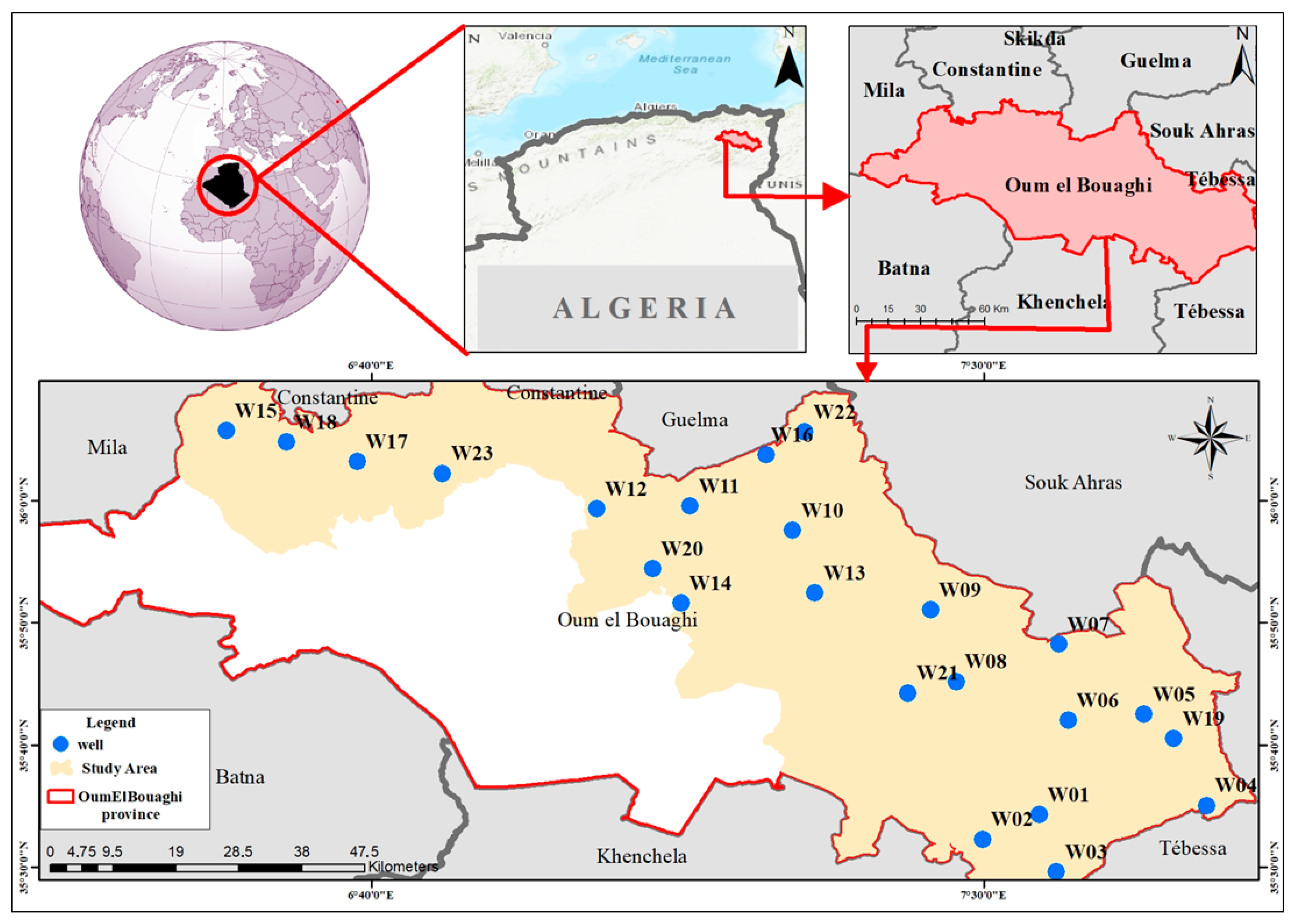
Figure 1. Location map of the study area.
Water 17 03266 g001
Figure 2. Calculation of the Groundwater Pollution Index (GPI).
Water 17 03266 g002
Figure 3. Box-plot of means with standard deviation of physicochemical parameters measured for different water wells. pH, IWQI, GPI: without units; others: mg·L−1.
Water 17 03266 g003
Figure 4. Piper diagrams showing the classification of groundwater types in the study area for the wet (a) and dry (b) periods.
Water 17 03266 g004
Figure 5. Gibbs diagram for cations and anions in collected dry period water samples.
Water 17 03266 g005
Figure 6. Gibbs diagram for cations and anions in collected water samples of the wet period.
Water 17 03266 g006
Figure 7. Riverside diagram of groundwater types in the study area for the (a) wet and dry (b) periods.
Water 17 03266 g007
Figure 8. Wilcox diagram of groundwater types in the study area for (a) dry and wet (b) period.
Water 17 03266 g008
Figure 9. Spatial distribution of irrigation water quality index (IWQI) in (a) dry and wet (b) period.
Water 17 03266 g009
Figure 10. Spatial distribution of Groundwater Pollution Index (GPI) in dry (a) and wet (b) periods.
Water 17 03266 g010
Figure 11. Spatial distribution of sodium adsorption ratio (SAR) in dry (a) and wet (b) period.
Water 17 03266 g011
Figure 12. Spatial distribution of the Percent Sodium (Na%) in the dry (a) and wet (b) period.
Water 17 03266 g012
Figure 13. Spatial distribution of the Permeability Index (PI) in dry (a) and wet (b) periods.
Water 17 03266 g013
Figure 14. Spatial distribution of the Magnesium Hazard Ratio (MHR) in dry (a) and wet (b) periods.
Water 17 03266 g014
Figure 15. Spatial distribution of Residual Sodium Carbonate (RSC) in dry (a) and wet (b) period.
Water 17 03266 g015
Figure 16. Spatial distribution of Kelley’s Ratio (KR) in dry (a) and wet (b) period.
Water 17 03266 g016
Figure 17. Spatial distribution of Potential Salinity (PS) in dry (a) and wet (b) periods.
Water 17 03266 g017
Figure 18. Spatial distribution of the Residual Sodium Bicarbonate (RSBC) in dry (a) and wet (b) period.
Water 17 03266 g018
Figure 19. The correlation matrix for the dry period.
Water 17 03266 g019
Figure 20. The correlation matrix for the wet period.
Water 17 03266 g020
Table 1. Limit parameters for calculating the quality index (qi).
qi (%)EC (µS·cm−1)SAR H C O 3 (meq·L−1)Na+ (meq·L−1)Cl (meq·L−1)
85–10020,000 ≤ EC < 750,0002 ≤ SAR < 31 ≤ HCO3 < 1.52 ≤ Na+ < 31 ≤ Cl < 4
60–85750,000 ≤ EC < 150,0003 ≤ SAR < 61.5 ≤ HCO3 < 4.53 ≤ Na+ < 64 ≤ Cl < 7
35–60150,000 ≤ EC < 300,0006 ≤ SAR < 124.5 ≤ HCO3 < 8.56 ≤ Na+ < 97 ≤ Cl < 10
0–35EC < 20,000 or ≥300,000SAR < 2 or ≥12HCO3 < 1 or ≥8.5Na+ < 2 or ≥9Cl < 1 or ≥ 10
Table 2. Relative weight (wr), weight parameters (wi).
Parameters w r w i WQS
pH40.097560987.5
TH40.09756098
EC (25 °C)40.09756098500
K + 10.0243902410
H C O 3 10.02439024300
C a 2 + 20.0487804975
M g 2 + 20.0487804930
N a + 40.09756098200
S O 4 2 50.12195122150
C l 50.12195122250
N O 3 50.1219512245
TDS40.09756098500
411
Table 3. Suggested irrigation classes for IWQI.
Type ClassesC 1C 2C 3C 4C 5
Range of (IWQI) for irrigation purposes<4040–5555–7070–8585–100
CategoriesSevere RestrictionHigh RestrictionModerate RestrictionLow RestrictionNo Restriction
Table 4. Classifications of the irrigation water quality indices.
Classification PatternEquationRangeCategoriesReferences
Electrical Conductivity (EC)/ <250Excellent
250–750Good
750–2250Permissible Doubtful[10]
2250–5000Unacceptable
>5000
Sodium adsorption ratio (SAR) S A R = N a + ( C a 2 + + M g 2 + ) 2 (3)<2Excellent[9]
2–12Good
12–22Permissible
22–32Fair
>32Poor
Residual Sodium
Carbonate (RSC)
R S C = H C O 3 + C O 3 C a 2 + + M g 2 + (4)<1.25Permissible[12]
≥1.25Unsuitable
Kelley’s ratio (KR) K R = N a + C a 2 + + M g 2 + (5)>1Unsuitable[51]
<1Suitable
Permeability index (PI) P I = N a + + ( H C O 3 ) C a 2 + + M g 2 + + N a + × 100 (6)<25.0Unsuitable
25–75Good
>75Suitable[11,52]
Potential Salinity (PS) P S = C l + S O 4 2 (7)<3Excellent
3–5Good
>5Unsuitable
Percent sodium (Na%) N a % = ( N a + + K + ) C a 2 + + M g 2 + + N a + + K + × 100 (8)0–20Excellent[10]
20–40Good
40–60permissible
60–80doubtful
>80Unacceptable
Soluble sodium
Percentage (SSP)
S S P = N a + C a 2 + + M g 2 + + N a + × 100 (9)<50Good[53]
>50Unsuitable
The Residual Sodium
Bicarbonate (RSBC)
R S B C = H C O 3 C a 2 + [54]
Magnesium Hazard Ratio (MHR) M H R = M g 2 + C a 2 + + M g 2 + × 100 (10)<50Good[55]
>50Unsuitable
Table 5. Suggested Irrigation classes for GPI.
G P I < 1.0Insignificant pollution
1.0 < G P I < 1.5Low pollution
1.5 < G P I < 2.0Moderate pollution
2.0 < G P I < 2.5High pollution
G P I > 2.5Very high pollution
Table 6. Physicochemical analysis of groundwater samples in the dry and wet periods (2023).
ParametersT °CEC 25 °CTDSpH S O 4 2 Cl H C O 3 N O 3 Na+K+Ca2+Mg2+TH
dryWHO 5005008.525025020050200127545300
W 0111.802053.672053.336.96352.73242.58150.511.29233.884.7348.3680.0035.00
W 0211.93939.00939.007.42288.52106.50166.782.2034.0413.5221.88100.0043.00
W 0311.93866.33866.007.34162.3998.75119.832.2662.763.0630.0066.3128.50
W 0410.933929.003929.337.98469.41377.50264.413.09349.693.7359.4099.0042.60
W 059.204092.004092.007.76499.63248.50244.076.09244.6617.8149.27103.0044.30
W 0611.934220.334220.337.61388.35337.25388.391.77273.8012.6475.93112.0048.00
W 0712.871408.671408.677.58146.72153.83146.444.81124.197.1017.8260.0026.00
W 0811.801522.331522.337.24249.32222.42188.103.99234.754.7344.2061.0026.50
W 099.07527.67527.337.4898.59106.92122.033.1138.344.7527.9755.0024.20
W 1016.201304.331304.337.30193.99165.67187.121.19122.431.5728.9881.0034.50
W 1112.532314.002314.007.43317.87153.83268.472.08122.436.0843.4788.0038.00
W 1211.372040.672040.677.43452.74195.25235.931.84201.019.2831.1698.0042.00
W 1312.203536.673537.007.45487.39307.67337.632.48311.023.0844.20110.0047.00
W 1411.802105.672104.677.21250.30189.33231.862.76176.154.4528.9884.3336.00
W 1510.80863.67863.677.31280.40102.83174.918.1199.973.9226.9580.7136.00
W 1610.331203.331203.677.41236.92201.58178.988.05198.314.0026.9574.1132.00
W 1710.671139.001139.007.20228.45153.83162.7112.7182.141.6554.3494.9141.00
W 1811.67992.00991.677.39108.61171.58219.6611.9639.121.7458.4062.0027.00
W 199.603760.003759.677.30498.34501.67338.811.77454.3710.1059.85110.3148.00
W 2011.531885.001885.007.27317.49183.42203.393.8395.443.0859.41116.5149.50
W 2113.271522.671522.677.04216.51165.67191.1910.14110.1111.0130.0056.1125.00
W 2213.471247.671248.005.31196.20189.33320.683.30134.3612.0613.7781.3136.00
W 2314.73915.33915.007.57225.08177.50138.3013.1928.953.4037.10111.0048.40
MIN9.07527.67527.335.3198.5998.75119.831.1928.951.5713.7755.0024.20
MAX16.204220.334220.337.98499.63501.67388.3913.19454.3717.8175.93116.5149.50
MOY11.811929.961929.887.30289.82206.67216.534.87164.006.4139.9386.2937.33
SD1.641163.801163.800.48125.0596.3674.173.86111.324.416.119.838.36
wetW 0112.732650.672650.677.99498.10207.08207.466.33213.004.5252.31106.0046.00
W 0212.331042.001042.337.13442.84118.33280.683.0152.2215.5534.05133.0056.60
W 0310.73877.67878.338.12193.03112.42178.984.0060.041.9122.9075.3132.00
W 049.603983.333984.337.73534.38313.00305.082.16322.083.4054.05150.0064.00
W 058.604083.674083.677.51382.29556.17370.177.00502.4215.4449.00132.0056.20
W 0612.535001.675001.677.86493.47566.25337.630.91414.2214.2962.64182.0077.00
W 0713.401437.671437.337.87317.50159.75235.934.56182.477.8133.0463.0027.00
W 0811.201387.391387.047.56274.94153.83174.913.71160.172.5140.7269.0030.00
W 0914.67603.00603.337.88101.58112.42166.782.3236.192.6420.8763.0027.00
W 1016.731213.331213.337.80232.00133.00222.344.32124.271.0530.0088.0037.30
W 1113.802136.002136.007.95316.56202.00352.835.20153.674.2150.00142.0061.00
W 1211.273145.673145.337.91464.96308.75366.072.21211.519.2858.79148.0062.60
W 1312.873508.333508.007.97580.06298.00341.691.97349.350.9349.27122.0052.00
W 1411.731661.331661.677.91308.54189.75235.931.27222.763.1931.0788.3337.60
W 1511.531240.001240.337.87216.7199.00227.804.9982.514.1822.0089.7138.00
W 1612.73973.67974.007.54298.62106.50178.985.36158.814.2622.9074.1132.00
W 1710.831054.671054.677.83336.36136.08146.449.9496.030.9939.1394.9141.00
W 1811.93748.00748.008.1799.6299.67206.349.0349.481.5022.9062.0027.00
W 199.634529.124529.127.89501.39577.58337.632.61488.298.6242.31147.3163.00
W 2012.831848.671848.337.65422.01153.83211.523.0095.642.0648.26116.5150.00
W 2113.631170.671183.337.87266.15101.00203.397.00111.1012.4317.1156.1126.00
W 2215.071315.331315.333.78299.76188.58322.072.29161.229.1223.9781.3136.00
W 2315.671089.331089.677.92283.03112.42219.6610.1849.091.9130.00120.0052.20
MIN8.6603603.333.7799.6299146.440.9036.180.9217.1156.1126
MAX16.75001.675001.678.16580.05577.58370.1610.18502.4215.5462.6318277
MOY12.42000.492031.127.63341.90217.62253.494.40186.805.7237.27104.5044.84
SD1.971359.941336.900.87132.46152.8372.122.68138.914.83113.6435.3414.79
Disclaimer/Publisher’s Note: The statements, opinions and data contained in all publications are solely those of the individual author(s) and contributor(s) and not of MDPI and/or the editor(s). MDPI and/or the editor(s) disclaim responsibility for any injury to people or property resulting from any ideas, methods, instructions or products referred to in the content.