Article

Hydrological and Geochemical Responses to Agricultural Activities in a Karst Catchment: Insights from Spatiotemporal Dynamics and Source Apportionment

1
College of Biological and Environmental Engineering, Guiyang University, Guiyang 550005, China
2
Puding Karst Ecosystem National Observation and Research Station National Ecosystem Research Network of China, Anshun 562100, China
3
Department of Geography, Hanshan Normal University, Chaozhou 521041, China
4
State Key Laboratory of Environmental Geochemistry, Institute of Geochemistry, Chinese Academy of Sciences, Guiyang 550081, China
5
Bureau of Water Affairs, Xiuwen County, Guiyang 550200, China
6
Guizhou Hydraulic Research Institute, Guiyang 550002, China
*
Author to whom correspondence should be addressed.
Water 2025, 17(22), 3264; https://doi.org/10.3390/w17223264
Submission received: 14 October 2025 / Revised: 12 November 2025 / Accepted: 13 November 2025 / Published: 15 November 2025
(This article belongs to the Section Hydrogeology)

Abstract

Karst aquifers, vital freshwater resources, are highly vulnerable to agricultural pollution, yet their hydro-geochemical responses remain poorly understood due to high spatial heterogeneity. This study aimed to unravel these complex responses in a subtropical karst agricultural catchment to provide a basis for its sustainable management. We employed high-frequency monitoring at a headwater spring (background), a depression well (hotspot), and the catchment outlet (integrated) in Southwest China. Using hydrological and geochemical data from 2017, we applied Principal Component Analysis (PCA) to apportion natural and anthropogenic sources. The main findings revealed significant spatial heterogeneity, with the depression well acting as a contamination hotspot characterized by rapid hydrological responses and elevated SO42− and Cl concentrations. PCA successfully decoupled an “anthropogenic factor” (PC1, 40.5%) from a “natural weathering factor” (PC2, 25.2%). Critically, agricultural SO42− at the hotspot was counter-intuitively higher during the wet season than the dry season, opposing the typical dilution pattern of background ions and revealing that depressions act as contaminant-concentrating pathways, whose risks are severely underestimated by traditional outlet monitoring. The anomalous sulfate dynamics reveal a cross-seasonal “storage-and-release” mechanism (legacy effect) within the karst Critical Zone, demonstrating that these systems can buffer and “remember” contaminants.

1. Introduction

Karst aquifers are critical freshwater reservoirs, supplying drinking and irrigation water to nearly a quarter of the global population [1]. However, their unique dualistic hydrological structure—comprising both rapid conduit flow and slow fissure-matrix flow—renders these systems extremely vulnerable to surface contamination [2,3]. Globally, agricultural intensification has become the primary source of non-point source pollution threatening karst water quality [4,5]. The application of fertilizers and pesticides introduces substantial solute loads into the hydrological cycle, profoundly altering the geochemical signatures of water bodies [6,7]. Consequently, understanding how karst catchments respond hydrologically and geochemically to agriculture is paramount for protecting regional water resources and maintaining ecosystem health [3,5].
The response of karst catchments to agricultural inputs exhibits a high degree of heterogeneity across spatiotemporal dimensions. Spatially, variations in topography and land use often lead to the formation of contaminant “hotspots” and “hot moments” within a catchment, where the accumulation and export fluxes of pollutants are significantly higher than average [8]. For instance, depressions or areas proximal to sinkholes in agriculturally intensive zones can act as preferential pathways for contaminants to enter groundwater systems [9,10]. Temporally, rainfall events are the primary drivers of contaminant transport [11]. During storms, complex hysteresis relationships often emerge between hydrological responses (e.g., discharge) and geochemical responses (e.g., solute concentrations), reflecting the mobilization and mixing of contaminants from different storage compartments, such as soils and the epikarst [12]. Unraveling these spatiotemporal dynamics is fundamental to accurately assessing the environmental impacts of agricultural activities [13,14].
A central challenge in accurately assessing agricultural impacts, however, lies in source apportionment—the quantitative differentiation of contributions from various sources within a complex mixed water body [15]. The chemical composition of karst waters typically results from the superposition of at least two primary sources: a natural geochemical background derived from water-rock interactions (e.g., carbonate weathering), and anthropogenic inputs from sources like fertilizers and domestic sewage [16,17]. Traditional ionic ratios and hydrochemical diagrams (e.g., Piper plots) provide effective tools for the qualitative identification of these sources [18,19]. More recently, multivariate statistical methods, particularly Principal Component Analysis (PCA), have been widely and successfully applied to objectively extract the main controlling processes from multivariate datasets, thereby distinguishing between natural and anthropogenic sources [20,21]. Integrating such robust source apportionment methods with observations of hydrological dynamics is therefore key to gaining a deeper understanding of the response mechanisms of karst catchments.
Southwest China hosts one of the world’s largest and most ecologically fragile contiguous karst areas, where agriculture is the primary livelihood, leading to increasingly prominent water-related environmental issues [22,23]. While recent comprehensive reviews highlight that nitrate (NO3) from agricultural activities has become a dominant pollutant in this region’s groundwater [24], sulfate (SO42−) is also increasingly recognized as another key contaminant [11,25,26]. To effectively manage these threats, robust source apportionment techniques are critical. Advanced statistical methods, such as the Principal Component Analysis (PCA) used in this study, are at the forefront of this effort globally, proving effective in complex hydrogeological systems from mining-impacted sites to industrial parks [27]. However, a significant research gap persists for sulfate. Unlike nitrate, whose transport pathways are relatively well-documented, the dynamics of sulfate are more complex. Recent global studies have powerfully applied stable isotopes to apportion sulfate sources in karst regions [28], but the high-frequency, event-based transport and cross-seasonal storage-release mechanisms—which dictate its ultimate environmental impact—remain poorly understood. This study is specifically designed to address this gap. Through high-frequency hydrological monitoring and systematic hydrochemical sampling at different geomorphic units (a headwater spring, an agricultural depression, and the catchment outlet), we aim to: (1) characterize the differential hydrological response patterns; (2) elucidate the spatiotemporal hydrochemical dynamics; and (3) apportion the contributions of natural versus agricultural activities using PCA. The core objective is to construct a comprehensive picture of how a karst agricultural catchment responds to human activities, providing scientific insights for sustainable water resource management in this region and other similar areas worldwide.

2. Materials and Methods

2.1. Study Area

The study was conducted in the Chenqi catchment (26°15′44′′ N, 105°46′22′′ E), located in Puding County, central Guizhou Province, Southwest China (Figure 1). This catchment covers an area of approximately 1.25 km2, with elevations ranging from 1316 to 1524 m, exhibiting a typical peak-cluster depression karst topography. The region is characterized by a subtropical monsoon climate, with a mean annual temperature of 14.3 °C. The long-term (last 10 years) mean annual precipitation is 1129 mm, while the total precipitation during our study year (2017) was 961 mm, indicating a slightly drier than average year. The rainfall is unevenly distributed seasonally, with over 70% concentrated in the wet season from May to September, with the highest rainfall typically occurring in summer (mean of 509 mm) and June being the wettest month on average (mean of 320 mm).
Geologically, the catchment is underlain by Middle Triassic dolostones and limestones of the Guanling Formation (T2gg), overlain by Quaternary (Q) clayey colluvium. This carbonate rock setting provides an abundant source of calcium, magnesium, and bicarbonate ions to the water chemistry. The dominant land used in the catchment is agriculture, primarily for cultivating maize and rice, with farming activities concentrated in the relatively flat depression areas. Anthropogenic activities, particularly the seasonal application of fertilizers (typically in May–June), represent a potential source of non-point source pollution.
To capture the internal hydrological and geochemical heterogeneity of the catchment, three monitoring sites were strategically established (Figure 1):
Headwater Spring (HS): An exsurgent spring located in the upper part of the catchment with minimal human activity in its recharge area, considered as a reference point representing the natural geochemical background.
Depression Well (DW): A private well situated within a depression in the agricultural core of the catchment. This site, characterized by its low-lying topography, acts as a collection point for surface runoff and interflow from surrounding farmlands and was hypothesized to be a “hotspot” of agricultural impact.
Upstream of Outlet (UO): Located approximately 2 m upstream of the main discharge point of the entire catchment. The flow at this site represents the integrated output of all upstream hydrological processes and mixed geochemical signals.

2.2. Field Monitoring and Water Sampling

2.2.1. High-Frequency Hydrological Monitoring

To capture the rapid hydrological responses to rainfall, automatic water level loggers (ONSET HOBO U20L-01, Bourne, MA, USA) were installed at the HS, DW, and UO sites to continuously record water level and temperature at 5 min intervals. A tipping-bucket rain gauge (ONSET HOBO U30, USA) was installed at a central location within the catchment to synchronously record rainfall data. All water level data were corrected for barometric pressure fluctuations.
To capture the rapid transport of suspended solids, which is a key indicator of surface runoff and conduit flow activation, high-frequency turbidity was also monitored in situ at the HS and UO sites. We used an online turbidity analyzer (VisoTurb@700IQ, WTW, Weilheim, Germany). This instrument utilizes an infrared light source to minimize interference from ambient light and is equipped with an ultrasonic self-cleaning system to ensure data accuracy and reduce maintenance. With a broad measurement range (0–3000 NTU) and high precision (0.1 NTU), the sensor was set to a 5 min resolution, synchronized with the water level and rainfall measurements, to capture the detailed dynamics of sediment flushing during storm events.

2.2.2. Water Sampling and In Situ Measurements

Systematic water sampling was conducted from January 2017 to December 2017, covering the entire wet season and the entire dry season. The sampling strategy included: (1) Routine sampling: Once-monthly collection of baseflow samples; (2) Storm event sampling: High-frequency sampling during five typical rainfall events, with intervals ranging from 30 min to 4 h depending on hydrograph dynamics. The five typical rainfall events for high-frequency sampling were deliberately chosen to represent the catchment’s response to a spectrum of common rainfall patterns in this subtropical monsoon region. The selection criteria were based on rainfall duration and intensity, covering three distinct types: (i) short-duration, high-intensity rainfall (e.g., events on 12 June and 9 July), which is expected to trigger rapid surface runoff and activate the conduit flow system; (ii) short-duration, moderate-intensity rainfall (e.g., 15 June and 20 July), representing more frequent storm events; and (iii) long-duration, moderate-intensity rainfall (e.g., 30 June), which is more likely to lead to soil saturation and activate different storage compartments and flow paths. This stratified selection ensures that our analysis captures the catchment’s behavior under a variety of representative hydrological forcing conditions.
All water samples were collected in 500 mL high-density polyethylene (HDPE) bottles, which were pre-rinsed three times with deionized water. Samples were immediately filtered through 0.45 μm cellulose acetate membrane filters and split into two bottles. The aliquot for cation analysis was acidified with high-purity nitric acid (HNO3) to a pH < 2. All samples were stored in a refrigerator at 4 °C until analysis. In the field, water temperature (T), pH, and electrical conductivity (EC) were measured in situ using a calibrated portable multi-parameter probe (Multi 3630, WTW, Weilheim, Germany).

2.3. Laboratory Analyses

All hydrochemical analyses were performed in the State Key Laboratory of Environmental Geochemistry, Institute of Geochemistry, Chinese Academy of Sciences. Major cations (K+, Na+, Ca2+, Mg2+) and anions (Cl, SO42−) were determined using an ion chromatograph (Dionex ICS-900, Sunnyvale, CA, USA), with detection limits better than 0.01 mg/L. Bicarbonate (HCO3) concentrations were determined by acid-base titration with 0.025 M HCl. Replicates and blanks were included in all analytical batches to ensure quality control. The reliability of the analyses was verified by calculating the ion charge balance error (ICBE), which was within the acceptable limit of ±5% for all samples.

2.4. Data Analysis

2.4.1. Hydrological Event Parameterization

To quantitatively characterize the hydrological response of the catchment, three key parameters were extracted from the hydrographs of the five selected storm events (Table 1): (1) Lag time (T_lag): the time difference between the rainfall peak and the onset of the hydrograph rise; (2) Time to peak (T_peak): the time difference from the onset of the rise to the hydrograph peak; (3) 50% recession time (T_r50): the time required for the discharge to recede to 50% of its peak value, a parameter used to characterize the storage and drainage capacity of the system.

2.4.2. Source Apportionment and Statistical Analysis

All statistical analyses and graphing were performed using SPSS 22.0 and Origin 2024.
Hydrochemical Facies Analysis: A Piper diagram was used to classify hydrochemical facies and visually identify evolutionary trends in water chemistry among different sites and seasons.
Statistical Comparison: Box-and-whisker plots were employed to compare the distribution characteristics and statistical differences of major ion concentrations at different sites and between seasons (wet season defined as May–September, dry season as other months). The Mann–Whitney U test, a non-parametric method suitable for data that may not be normally distributed, was used to determine the statistical significance of differences in ion concentrations between sites (e.g., DW vs. UO) and seasons. A p-value of less than 0.05 was considered statistically significant.
Principal Component Analysis (PCA): As the core tool for source apportionment, PCA was used to identify the dominant factors controlling the hydrochemical variability. Prior to the analysis, the suitability of the dataset, which included pH, EC, and all major ions, was confirmed using the Kaiser-Meyer-Olkin (KMO) and Bartlett’s sphericity tests. The data were then standardized using Z-scores to eliminate the effects of different units and scales. Principal components were extracted based on the criterion of having an eigenvalue greater than 1. A Varimax rotation was applied to the factor matrix to generate more readily interpretable geochemical meanings for the extracted components [29,30]. While more advanced techniques like Absolute Principal Component Scores-Multiple Linear Regression (APCS-MLR) can provide quantitative source contributions [31,32], this study focused on the qualitative and semi-quantitative insights provided by the rotated component matrix and sample score plots to reveal the relative contributions of natural and anthropogenic activities.

3. Results

3.1. Hydrological Response Characteristics

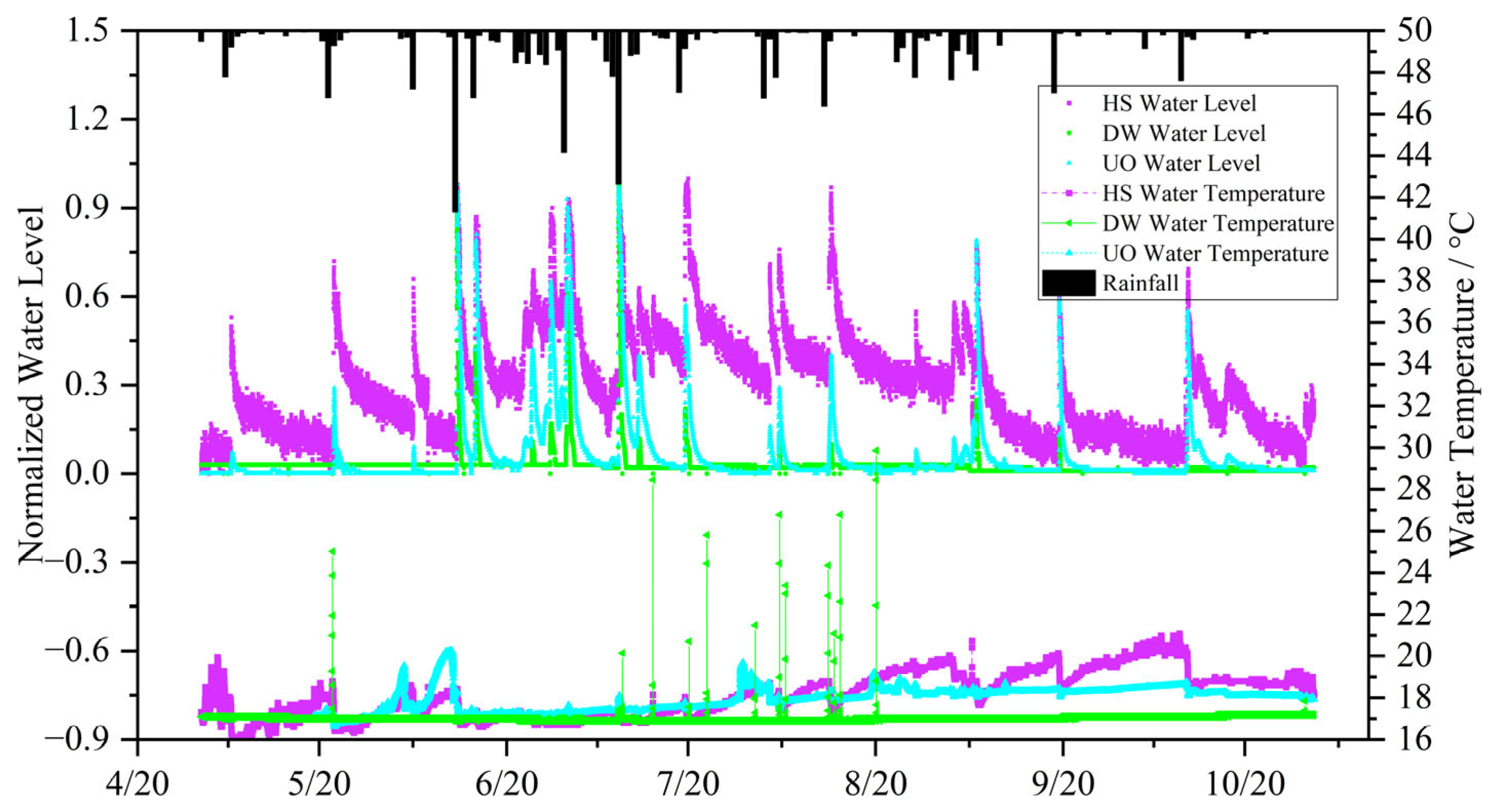
During the monitoring period (April to October 2017), a total of 961 mm of rainfall was recorded in the catchment, predominantly concentrated from May to September, exhibiting typical characteristics of a subtropical monsoon climate (Figure 2). The water levels at all three monitoring sites responded rapidly to rainfall events, but their response patterns differed significantly. The water level at the DW site showed the most dramatic fluctuations, with its normalized water level reaching its peak swiftly after heavy rainfall, indicating that this depression is a rapid flow convergence zone. In contrast, the water level fluctuations at the HS and UO sites were less pronounced, and their recession processes were relatively gradual, suggesting a greater system regulation and storage capacity. The water temperature dynamics also reflected the distinct origins of the different water bodies: the water temperature at HS and UO remained stable between 16–22 °C throughout the year, characteristic of deep groundwater; whereas the temperature at DW exhibited more pronounced seasonal fluctuations (17–30 °C) and tracked air temperature and rainfall events, indicating significant influence from shallow groundwater or ephemeral surface flow.
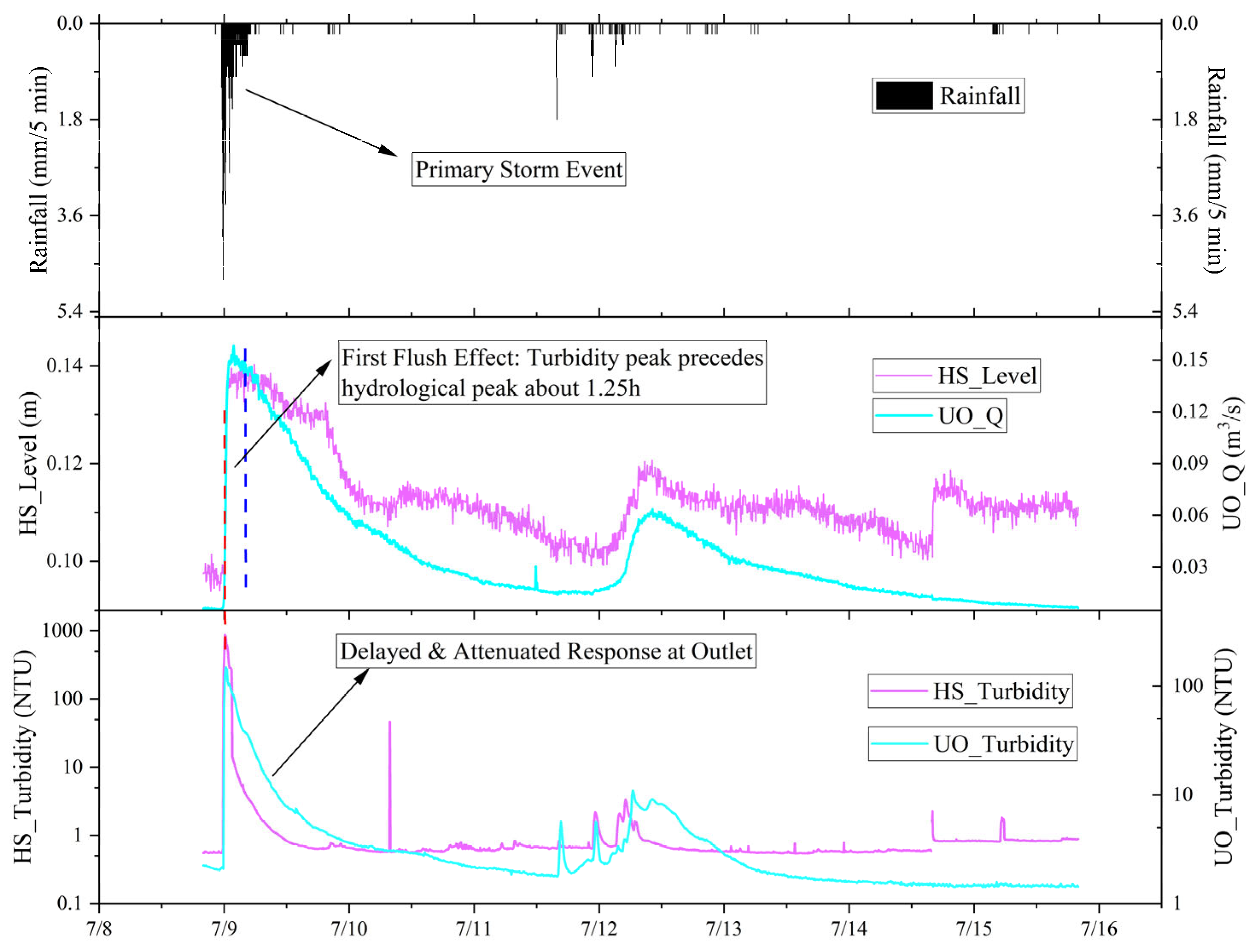
To further quantify these differences, the hydrological parameters of five typical storm events were analyzed (Figure 3, Table 1). Figure 3 illustrates the detailed hydrograph of the storm event on 9 July. The water level at HS responded most rapidly, and its turbidity peak preceded the hydrological peak by approximately 1.25 h, revealing a strong “First Flush Effect.” In contrast, the discharge response at UO showed a distinct Delayed & Attenuated Response. Its peak discharge was much lower than the theoretical discharge corresponding to the peak water level at HS, and its hydrograph was more attenuated, visually demonstrating the catchment’s mixing and peak-flow attenuation on the upstream signal.
Based on the average parameters from the five events (Table 1), HS had a relatively long time to peak (T_peak) (2.87 h), but its 50% recession time (T_r50) was significantly the longest (43.56 h). This suggests that although the water system at HS can respond quickly (likely via conduits), its main body comprises a large groundwater reservoir that drains slowly. In stark contrast, DW had the shortest T_r50 (averaging only 5.20 h), confirming its “fast-converging, fast-draining” hydrological characteristic. This rapid drainage capacity implies a very limited potential for natural attenuation, making the underlying aquifer extremely vulnerable to pollutants mobilized during storm events. The parameters for UO were intermediate between those of HS and DW, again reflecting its mixed character as the integrated outlet of the catchment.

3.2. Spatiotemporal Variations in Hydrochemistry

3.2.1. Hydrochemical Facies and Major Ion Composition

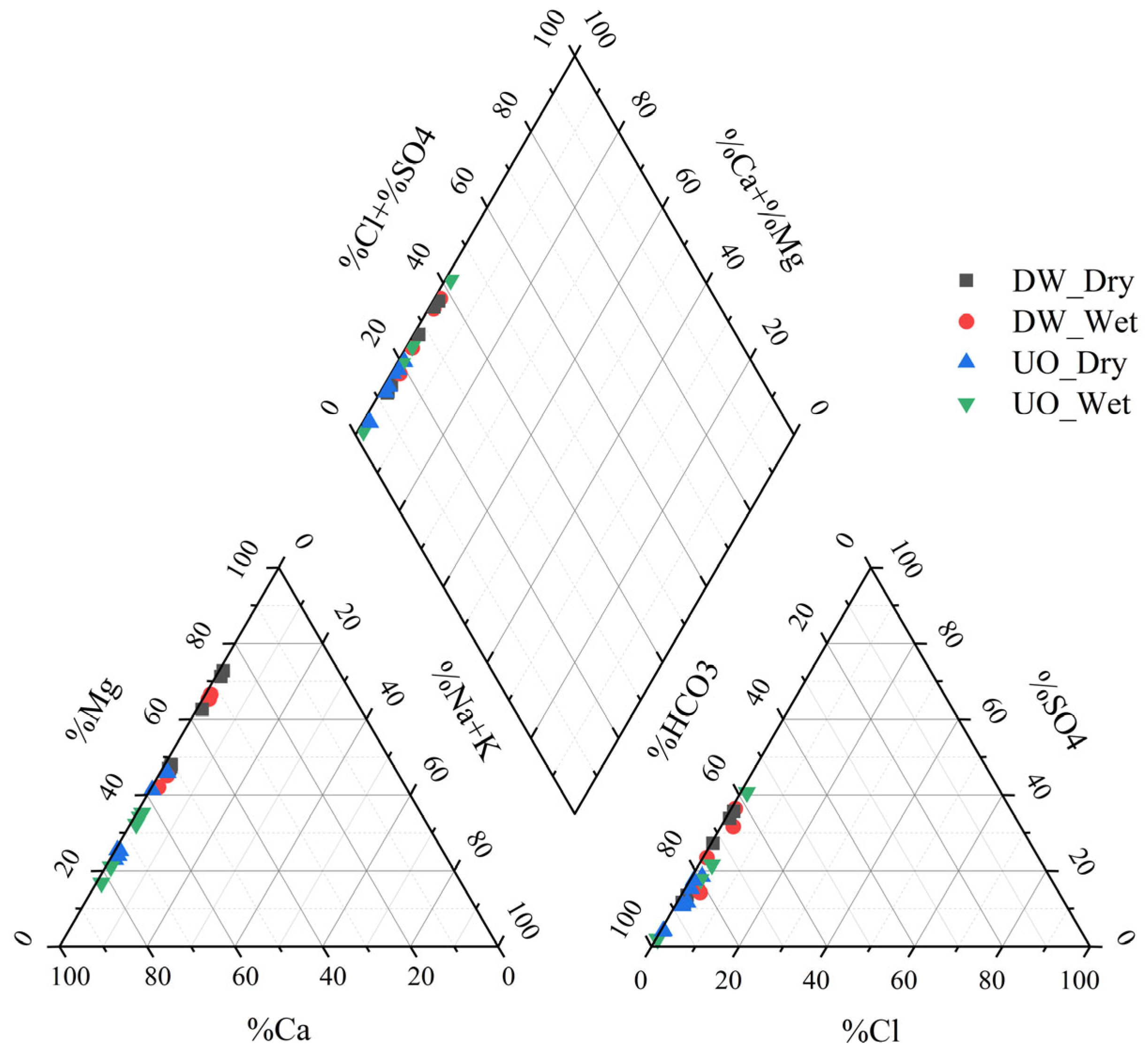
The Piper diagram for all water samples from the study area (Figure 4) reveals that they uniformly belong to the Ca-HCO3 hydrochemical facies. This indicates that carbonate weathering is the absolute dominant process controlling the chemical composition of both surface and groundwater in this region. Ca2+ was the predominant cation, accounting for over 70% of the total cations on average, while HCO3 was the predominant anion, accounting for over 85% of the total anions. However, systematic differences among the sites were observable in detail: the data points for DW (black squares and red circles) tended to shift towards the Mg2+ apex in the cation triangle and were clearly enriched towards the SO42− and Cl end-members in the anion triangle. This observation provides a preliminary indication that, in addition to the background process of carbonate weathering, the DW site was significantly influenced by other ion sources.

3.2.2. Spatial Differentiation and Seasonal Dynamics of Ions

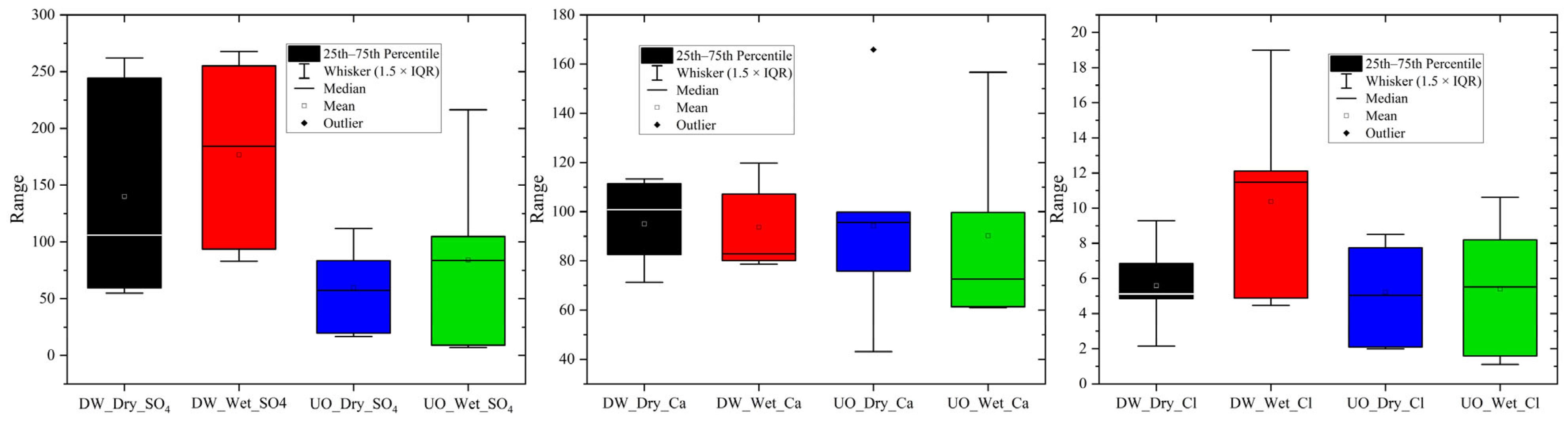
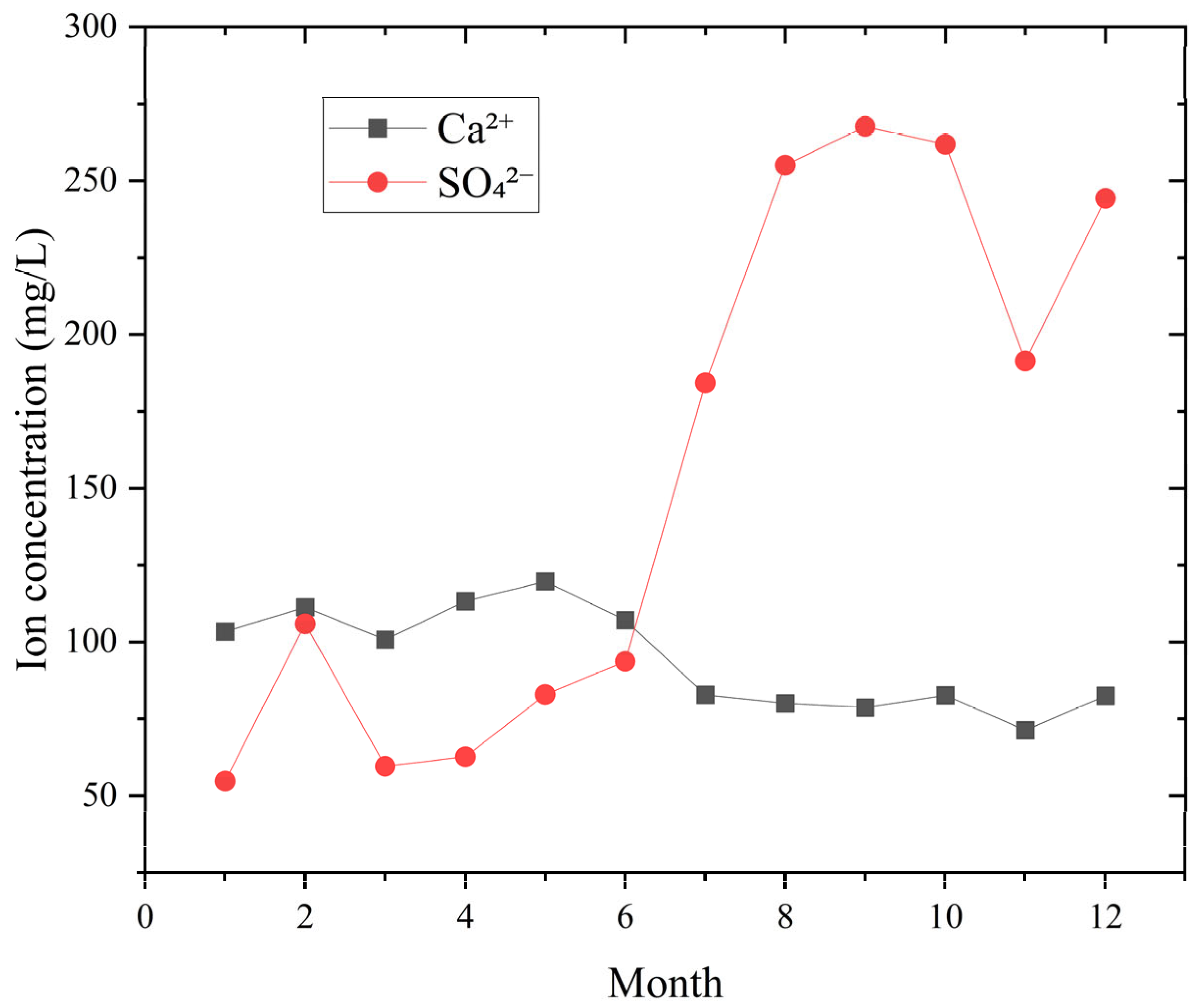
The box-and-whisker plots (Figure 5) further quantitatively reveal the spatiotemporal differences in major ion concentrations. The spatial differentiation was most pronounced for SO42− and Cl. The median concentrations of SO42− and Cl at the DW site were significantly higher than at the UO site in both the dry and wet seasons (p < 0.01), confirming that DW is a “hotspot” for the input of allochthonous solutes. Of particular note is the seasonal dynamic of SO42−: at the DW site, the SO42− concentration during the wet season (median 185.7 mg/L) was significantly higher than that during the dry season (median 105.3 mg/L). In contrast, the concentration of Ca2+, a background ion, showed a clear seasonal pattern at all sites, with lower concentrations in the wet season than in the dry season, which is consistent with the “dilution effect” brought by rainfall. This starkly contrasting seasonal pattern between the anthropogenic tracer SO42− and the weathering-derived ion Ca2+ suggests that their sources and transport mechanisms are fundamentally different. To visually and quantitatively support this key argument, a direct comparison of their monthly concentration trends at the DW site is presented (Figure 6). The results reveal a completely opposite behavior. Ca2+ exhibits a classic dilution pattern, with its mean concentration decreasing by 27% from 109.3 mg/L in the drier first half of the year (January–June) to 79.7 mg/L during the wetter second half (July–December). In stark contrast, SO42− shows a dramatic enrichment, with its mean concentration surging by over 200% from 76.6 mg/L to 234.1 mg/L between the same two periods. This direct evidence strongly supports the hypothesis of a different controlling mechanism for sulfate compared to background ions, and critically, suggests a significant temporal decoupling between solute inputs and outputs.

3.3. Identification of Dominant Hydrochemical Processes

To objectively identify the dominant factors controlling hydrochemical variations and to perform source apportionment, Principal Component Analysis (PCA) was applied to the hydrochemical dataset. The Kaiser-Meyer-Olkin (KMO) measure of 0.78 and a significant Bartlett’s test of sphericity (p < 0.001) indicated that the data were suitable for PCA. The analysis extracted three principal components (PC1, PC2, PC3) with eigenvalues greater than 1, which together explained 84.5% of the total variance in the dataset.
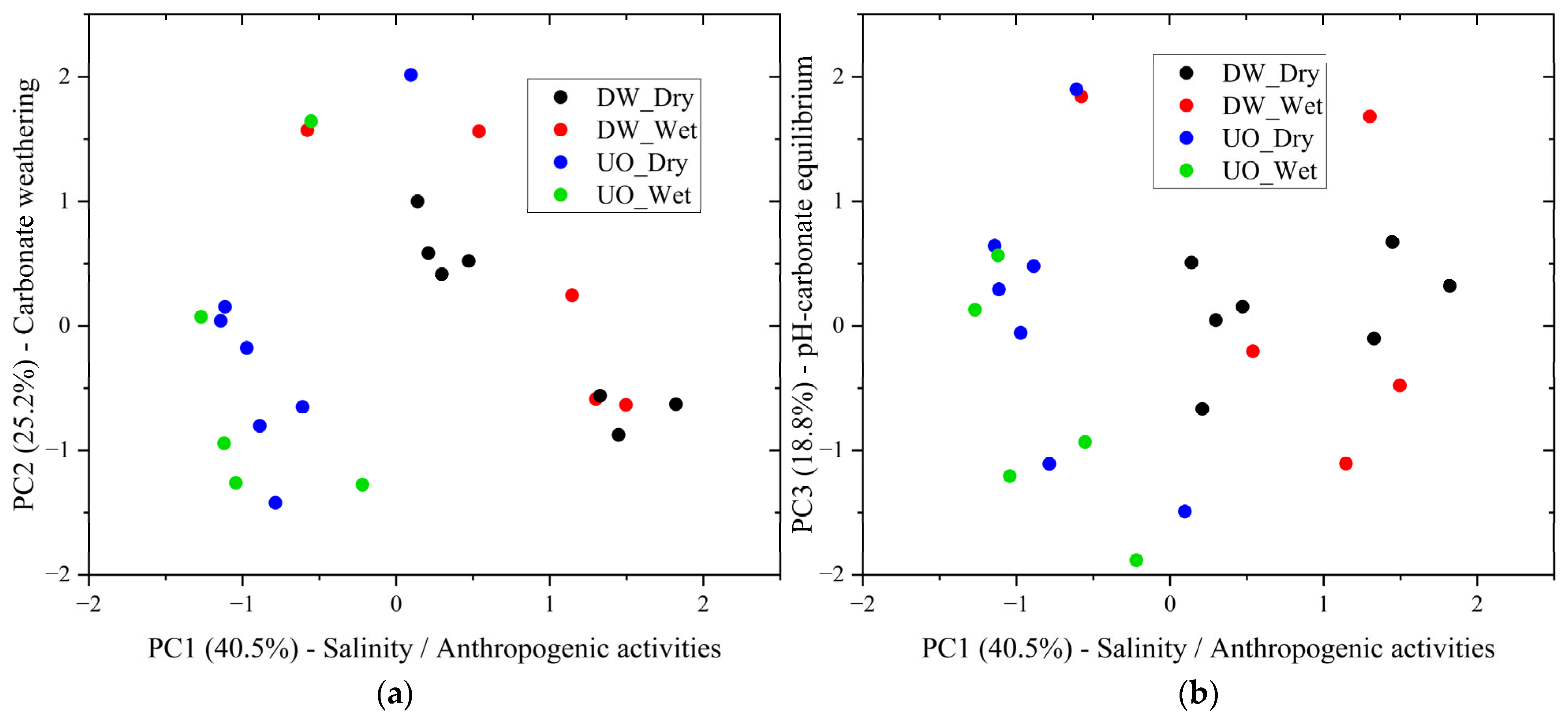
Principal Component 1 (PC1) accounted for 40.5% of the total variance and was strongly and positively loaded by SO42−, Cl, Na+, Mg2+, and EC (Figure 7). These parameters are typically associated with salinity and agricultural activities (e.g., fertilizers, sewage). Therefore, PC1 was interpreted as the “Salinity/Anthropogenic Factor.” Principal Component 2 (PC2) accounted for 25.2% of the total variance and was strongly and positively loaded by Ca2+ and HCO3. These two ions are the typical products of carbonate rock weathering. Thus, PC2 was interpreted as the “Carbonate Weathering Factor.” Principal Component 3 (PC3) accounted for 18.8% of the total variance and was strongly and positively loaded by pH, with some correlation to HCO3, reflecting the “pH-Carbonate Equilibrium” state of the water.
On the score plot of PC1 versus PC2 (Figure 7a), the samples from different sites showed a clear spatial separation. All DW samples (black and red dots) were located on the right side of the plot with high positive PC1 scores, whereas all UO samples (blue and green dots) were located on the left side with low or negative PC1 scores. This separation pattern provides strong evidence that anthropogenic activities (PC1) are the primary driver of the hydrochemical differences between the two areas. Within their respective groups, the samples are distributed along the PC2 axis, reflecting variations in the intensity of carbonate weathering under different hydrological conditions (e.g., dilution or concentration). In contrast, the score plot of PC1 versus PC3 (Figure 7b) did not show a clear spatial separation between sites comparable to that in Figure 7a. While the samples remained broadly separated along the PC1 axis (anthropogenic influence), they were intermingled along the PC3 axis. This indicates that anthropogenic activities were not the primary factor controlling the pH-carbonate equilibrium (PC3). Instead, PC3 appears to reflect a seasonal signal, with wet season samples (red and green dots) generally exhibiting lower PC3 scores than dry season samples (black and blue dots). This seasonal variation is likely driven by the natural process of rainwater mixing, which influences the overall pH and carbonate system of the catchment’s water, rather than site-specific agricultural inputs.

4. Discussion

4.1. Control of Spatial Heterogeneity on Catchment Hydro-Geochemical Responses

This study reveals significant spatial heterogeneity in the hydrological and geochemical responses within the karst agricultural catchment. The stark contrast in response patterns between the Depression Well (DW) and the Upstream of Outlet (UO) underscores the decisive role of geomorphological settings and land use in controlling solute transport and transformation. The DW site, a typical agricultural depression, is characterized hydrologically by “fast convergence and fast drainage” (shortest T_r50, Table 1) and geochemically as a “hotspot” for the accumulation of allochthonous solutes (SO42−, Cl) (Figure 5). This aligns with the “hotspots and hot moments” theory, which posits that specific locations within a catchment can become centers of intense biogeochemical activity when hydrologically connected [8,33]. Our results demonstrate that these agricultural depressions serve as preferential pathways for surface contaminants to enter the groundwater system, with their hydrochemical signals directly and rapidly reflecting the impacts of surficial agricultural activities.
In contrast, the response at the catchment outlet (UO) exhibits distinct “buffering” and “mixing” effects. Its hydrological peak flow is attenuated, the recession is prolonged (Figure 3, Table 1), and its chemical concentrations are diluted (Figure 5). This indicates that the water at UO is not simply a direct conveyance of water from the DW site but is rather a product of mixing, storage, and modulation along more complex flow paths within the catchment (e.g., longer conduits, greater contribution from fissure water). The hydrochemical signature at UO represents an integrated signal of all flow end-members, including the contaminated depression areas and the relatively pristine headwater zones (like HS), thereby masking the high contaminant concentrations present at internal hotspots [34,35]. This finding has critical practical implications: monitoring only the main outlet of a karst catchment can severely underestimate the extent of contamination and ecological risk within its internal, particularly agricultural, core areas. Accurate water resource management and pollution control strategies must be founded on a thorough understanding of the catchment’s internal spatial heterogeneity. Based on our findings, specific mitigation actions can be proposed. For instance, given that depressions are contaminant hotspots, management should focus on implementing precision agriculture practices within these zones to reduce excess fertilizer application. Furthermore, constructing ecological buffer zones or small-scale treatment wetlands around these depressions could intercept contaminated runoff before it enters the fast-flow conduit system. These targeted, spatially explicit strategies are likely to be far more effective and cost-efficient than catchment-wide, uniform policies.

4.2. Source Apportionment via PCA: Decoupling Natural and Anthropogenic Processes

The PCA powerfully decouples the complex processes governing the catchment’s hydrochemistry into two primary dimensions: an “anthropogenic factor” (PC1) and a “natural weathering factor” (PC2) (Figure 7). PC1 is dominated by SO42−, Cl, and Na+, which are classic indicators of agricultural fertilizers and domestic wastewater [36]. Notably, the strong loading of Mg2+ on this same anthropogenic factor is particularly insightful. While it could partially derive from the application of specific magnesium-containing fertilizers, a more profound geochemical process is likely at play. Agricultural intensification, particularly the widespread application of nitrogen-based fertilizers (e.g., urea, ammonium nitrate), can potentially induce soil acidification through the process of nitrification. In a catchment underlain by Middle Triassic dolostones, as is the case in our study area, this anthropogenically induced acidity can significantly accelerate the incongruent dissolution of dolomite (CaMg(CO3)2). This process could preferentially leach magnesium relative to calcium, releasing a higher flux of Mg2+ into the soil water and subsequently into the groundwater system [37,38]. Therefore, Mg2+ in this context acts as a powerful indirect indicator of agricultural pressure, reflecting not just direct chemical inputs but the fundamental alteration of natural weathering regimes by farming practices. In contrast, PC2 is unequivocally the signature of carbonate weathering, dominated by Ca2+ and HCO3 [39].
The clear spatial separation on the PCA score plot (Figure 7a) provides a quantitative answer to our core question: the fundamental hydrochemical difference between the DW and UO sites originates from the strong superposition of these anthropogenic signals (high PC1 scores) onto the natural weathering background (PC2). The high PC1 scores of all DW samples confirm its role as a direct receiver of agricultural pollution, while the consistently low PC1 scores of the UO samples quantify the catchment’s integrated capacity for dilution, mixing, and potential self-purification.
This PCA-based decoupling is consistent with a growing body of multi-tracer studies in karst regions, which increasingly combine hydrochemistry with stable isotopes for more robust source identification. For example, isotopic tracers like δ15N-NO3 and δ18O-NO3 have become standard tools for distinguishing between nitrate sources such as manure/sewage, chemical fertilizers, soil organic nitrogen, and atmospheric deposition [16,40]. Bao et al. further used this dual-isotope approach to unveil distinct nitrogen transformation processes (e.g., nitrification, denitrification) occurring in different karst media (conduit, fissure, and cave waters), highlighting the importance of aquifer heterogeneity [4]. Similarly, multi-isotope systems including δ34S and 87Sr/86Sr are being used to trace sulfate sources and complex contamination pathways in buried or mined karst systems [25,41]. While our study relies on major ion chemistry, the clear separation achieved by PCA provides a strong hydrochemical framework that aligns with the source distinctions identified by these more advanced isotopic methods.

4.3. Anomalous Seasonal Dynamics of Agricultural Sulfate: A Hypothesis of “Legacy Effect” in the Karst Critical Zone

One of the most compelling findings of this study is the anomalous seasonal dynamic of the agricultural tracer SO42− at the DW site. Its concentration is significantly higher during the wet season than the dry season, a pattern that counter-intuitively defies the dilution effect observed for background weathering ions like Ca2+ (Figure 5). We argue that this phenomenon cannot be explained by a simple, synchronous “flushing” of concurrently applied fertilizers. Instead, it points to a more complex cross-seasonal “storage-and-release” mechanism—a “Legacy Effect” of agricultural inputs within the karst Critical Zone, where past nutrient inputs are stored and subsequently released over extended periods, creating a time lag between management actions and water quality improvements [42,43,44]. This concept is now recognized as a central challenge in watershed management globally, with recent studies highlighting its widespread impact on nutrient cycling and water quality goals [45,46,47].
We propose the following process-based hypothesis. Storage Phase: During the late dry to early wet season (May–June), farmers apply sulfur-containing fertilizers to the fields in the depression. However, the sporadic and less intense rainfall during this period provides insufficient water flux for deep percolation and transport. Consequently, a significant portion of the applied sulfate is retained and accumulates within the relatively thick soil and epikarst layers. This zone acts as a temporary biogeochemical reservoir where sulfate can be adsorbed onto soil colloids, co-precipitate with minerals like gypsum in soil micro-pores during drying cycles, or be temporarily immobilized by microbial communities [48,49].
Release Phase: As the peak monsoon season arrives (July–September), persistent and high-intensity rainfall events thoroughly saturate this reservoir. This saturation shifts the system’s state from being storage-dominated to transport-dominated. The accumulated “legacy” SO42− is rapidly mobilized and flushed out in a concentrated pulse. The flux of this released sulfate is so substantial that it overwhelms the dilution effect of the large volume of rainwater, leading to the counter-intuitive observation of higher concentrations during the wettest part of the year. This mechanism effectively demonstrates the “hydrochemical memory” of the karst Critical Zone, a concept increasingly recognized in watershed science [50], which can buffer and delay the transport of anthropogenic contaminants, creating a temporal disconnect between their application and their ultimate export from the catchment [41].

4.4. Limitations and Future Perspectives

While this study provides a systematic understanding of the hydro-geochemical responses in a karst agricultural catchment, some limitations open avenues for future research.
First, the one-year monitoring dataset, while capturing a full seasonal cycle, may not fully represent the influence of inter-annual climate variability (e.g., exceptionally wet vs. dry years) on the system’s storage and release dynamics. Longer-term monitoring is crucial to assess the resilience and long-term trajectory of the catchment’s response.
Second, our source apportionment relied on hydrochemical indicators. Future studies could achieve more definitive source tracking by employing stable isotope techniques. For instance, the dual isotopes of sulfate (δ34S-SO4 and δ18O-SO4) serve as powerful “fingerprints.” They can quantitatively distinguish between SO42− sources such as synthetic fertilizers (which have a specific isotopic range derived from their source materials), atmospheric deposition, and the oxidation of bedrock sulfides (e.g., pyrite), as these sources often possess distinct isotopic signatures [25,51,52]. This would provide direct, unequivocal evidence to validate the agricultural origin of the observed sulfate anomaly.
Finally, our “storage-and-release” hypothesis for the Critical Zone is inferred from the integrated response observed in the well water. However, this ‘black-box’ approach lacks direct process-level evidence. Direct validation requires process-level investigation within the Critical Zone itself. Future work should involve installing lysimeters and soil moisture probes at different depths within the agricultural depression. This would allow for synchronous monitoring of the chemistry of soil water and vadose zone leachate, enabling us to directly observe the retention of solutes during dry periods and their mobilization during wet season flushing events. Such data would provide mechanistic proof for the proposed legacy effect and help parameterize predictive models for contaminant transport in these vulnerable landscapes.

5. Conclusions

This study systematically reveals the complex hydro-geochemical response of a karst agricultural catchment, leading to several conclusions with broad implications.
First, we demonstrate that geomorphologically defined depressions are the Achilles’ heel of karst landscapes, functioning as hotspots that dramatically amplify agricultural pollution risk. This finding challenges traditional catchment management paradigms based on outlet monitoring and calls for a paradigm shift towards spatially explicit, risk-based water protection strategies.
Second, our source apportionment reveals that agricultural pressure extends beyond simple solute addition, fundamentally altering natural weathering regimes by accelerating dolomite dissolution. This highlights a deeper, more insidious form of human impact on geochemical cycles that requires further investigation.
Finally, and most significantly, the discovery of a cross-seasonal “storage-and-release” legacy effect for sulfate demonstrates that karst critical zones possess a “hydrochemical memory.” This finding has profound consequences for remediation, implying that even if pollution sources are controlled, water quality improvements will be delayed, and contaminant pulses may recur for years. Future research must, therefore, focus on quantifying the size and longevity of these legacy stores and developing models that can predict their long-term behavior under changing climate and land-use scenarios.
Collectively, our work underscores that effective management of these vital water resources demands not only knowing where contaminants are coming from, but also understanding how long they will persist.

Author Contributions

Conceptualization and study design, T.P., S.W. (Shijie Wang) and L.C.; Data collection and investigation, L.C., Q.C. and S.X.; Data analysis and visualization, L.C., S.W. (Shangqing Wang) and Q.H.; Writing—original draft, L.C. and Y.L.; Writing—review and editing, T.P. and L.C.; Funding acquisition, L.C. All authors have read and agreed to the published version of the manuscript.

Funding

This work was funded by the National Natural Science Foundation of China (No. 42467027), the Science and Technology Foundation of Guizhou Province (QKHJC-ZK (2024) No. 531, QN [2025]433), the Natural Science Foundation of the Education Department of Guizhou Province (QJJ (2022) No. 296), and the Doctoral Research Foundation of Guiyang University (GYU-KY-2025).

Data Availability Statement

The data presented in this study are available on request from the corresponding author. A portion of the long-term background data is publicly available in the Science Data Bank at https://doi.org/10.57760/sciencedb.20971, ref. [31253.11.sciencedb.20971].

Conflicts of Interest

The authors declare no conflicts of interest.

Abbreviations

The following abbreviations are used in this manuscript:
HSHeadwater Spring
DWDepression Well
UOUpstream of Outlet

References

  1. Ford, D. Karst Hydrogeology and Geomorphology; John Wiley & Sons: Hoboken, NJ, USA, 2007. [Google Scholar] [CrossRef]
  2. Narvaez-Montoya, C.; Bonilla, R.M.; Goldscheider, N.; Mahlknecht, J. Groundwater Salinization Patterns in the Yucatan Peninsula Reveal Contamination and Vulnerability of the Karst Aquifer. Commun. Earth Environ. 2025, 6, 468. [Google Scholar] [CrossRef]
  3. Liu, J.; Wu, J.; Rong, S.; Xiong, Y.; Teng, Y. Groundwater Vulnerability and Groundwater Contamination Risk in Karst Area of Southwest China. Sustainability 2022, 14, 14483. [Google Scholar] [CrossRef]
  4. Bao, J.; Wu, X.; Zhang, Q.; Yuan, D.; Guo, F.; Liu, F. Unveiling the Nitrogen Transport and Transformation in Different Karst Aquifers Media. J. Hydrol. 2023, 620, 129335. [Google Scholar] [CrossRef]
  5. Peng, H.; Yang, W.; Xiong, S.; Li, X.; Niu, G.; Lu, T.; Ferrer, A.S.N. Hydrochemical Characteristics and Health Risk Assessment of Groundwater in Karst Areas of Southwest China: A Case Study of Bama, Guangxi. J. Clean. Prod. 2022, 341, 130872. [Google Scholar] [CrossRef]
  6. Smith, D.N.; Ortega-Camacho, D.; Acosta-Gonzalez, G.; Maria Leal-Bautista, R.; Fox, W.E.; Cejudo, E. A Multi-Approach Assessment of Land Use Effects on Groundwater Quality in a Karstic Aquifer. Heliyon 2020, 6, e03970. [Google Scholar] [CrossRef]
  7. Sheng, C.; Wu, D.; Yu, D.; Min, Y.; Huang, B.; Wang, M.; Gao, J.; Xiong, G.; Zhang, C.; Dang, X. Nitrate Sources and Migration in Rural Karst Aquifers: A Case Study in Pingyin Karst Catchment, North China. Isot. Environ. Health Stud. 2025, 61, 455–472. [Google Scholar] [CrossRef]
  8. Musolff, A.; Fleckenstein, J.H.; Rao, P.S.C.; Jawitz, J.W. Emergent Archetype Patterns of Coupled Hydrologic and Biogeochemical Responses in Catchments. Geophys. Res. Lett. 2017, 44, 4143–4151. [Google Scholar] [CrossRef]
  9. Fidelibus, M.D.; Balacco, G.; Gioia, A.; Iacobellis, V.; Spilotro, G. Mass Transport Triggered by Heavy Rainfall: The Role of Endorheic Basins and Epikarst in a Regional Karst Aquifer. Hydrol. Process. 2017, 31, 394–408. [Google Scholar] [CrossRef]
  10. Zhang, Z.; Li, J.; Hu, Z.; Zhang, W.; Ge, H.; Li, X. Impact of Land Use/Land Cover and Landscape Pattern on Water Quality in Dianchi Lake Basin, Southwest of China. Sustainability 2023, 15, 3145. [Google Scholar] [CrossRef]
  11. Jiang, Y.; Cao, M.; Yuan, D.; Zhang, Y.; He, Q. Hydrogeological Characterization and Environmental Effects of the Deteriorating Urban Karst Groundwater in a Karst Trough Valley: Nanshan, SW China. Hydrogeol. J. 2018, 26, 1487–1497. [Google Scholar] [CrossRef]
  12. Opsahl, S.P.; Musgrove, M.; Slattery, R.N. New Insights into Nitrate Dynamics in a Karst Groundwater System Gained from in Situ High-Frequency Optical Sensor Measurements. J. Hydrol. 2017, 546, 179–188. [Google Scholar] [CrossRef]
  13. Godsey, S.E.; Kirchner, J.W.; Clow, D.W. Concentration–Discharge Relationships Reflect Chemostatic Characteristics of US Catchments. Hydrol. Process. 2009, 23, 1844–1864. [Google Scholar] [CrossRef]
  14. Schilling, K.E.; Jones, C.S.; Clark, R.J.; Libra, R.D.; Liang, X.; Zhang, Y.-K. Contrasting NO3-N Concentration Patterns at Two Karst Springs in Iowa (USA): Insights on Aquifer Nitrogen Storage and Delivery. Hydrogeol. J. 2019, 27, 1389–1400. [Google Scholar] [CrossRef]
  15. Cloutier, V.; Lefebvre, R.; Therrien, R.; Savard, M.M. Multivariate Statistical Analysis of Geochemical Data as Indicative of the Hydrogeochemical Evolution of Groundwater in a Sedimentary Rock Aquifer System. J. Hydrol. 2008, 353, 294–313. [Google Scholar] [CrossRef]
  16. Ming, X.; Groves, C.; Wu, X.; Chang, L.; Zheng, Y.; Yang, P. Nitrate Migration and Transformations in Groundwater Quantified by Dual Nitrate Isotopes and Hydrochemistry in a Karst World Heritage Site. Sci. Total Environ. 2020, 735, 138907. [Google Scholar] [CrossRef]
  17. Li, Y.; Fang, J.; Li, Z.; Hua, D.; Wang, F.; Ying, Q.; Ye, H. Active Species and Source Apportionment of Volatile Organic Compounds in an Industrial Park of Shenyang. Environ. Pollut. Control 2021, 43, 145–149. [Google Scholar]
  18. Güler, C.; Thyne, G.D.; McCray, J.E.; Turner, K.A. Evaluation of Graphical and Multivariate Statistical Methods for Classification of Water Chemistry Data. Hydrogeol. J. 2002, 10, 455–474. [Google Scholar] [CrossRef]
  19. Hounslow, A.W. Water Quality Data: Analysis and Interpretation, 1st ed.; Taylor & Francis Group: Boca Raton, FL, USA, 1995; ISBN 978-0-87371-676-5. [Google Scholar]
  20. Helena, B.; Pardo, R.; Vega, M.; Barrado, E.; Fernandez, J.M.; Fernandez, L. Temporal Evolution of Groundwater Composition in an Alluvial Aquifer (Pisuerga River, Spain) by Principal Component Analysis. Water Res. 2000, 34, 807–816. [Google Scholar] [CrossRef]
  21. Zhang, C.; Zhang, B.; Zhang, W.; Zou, J.; Jia, R.; Yang, Y. Hydrochemical Characteristics and Evolution under the Influence of Multiple Anthropogenic Activities in Karst Aquifers, Northern China. Water 2024, 16, 1656. [Google Scholar] [CrossRef]
  22. Zhou, X.; He, S.; Yang, Y.; Wu, P.; Luo, W. Hydrochemical Fingerprints of Karst Underground River Systems Impacted by Urbanization in Guiyang, Southwest China. J. Contam. Hydrol. 2024, 264, 104356. [Google Scholar] [CrossRef] [PubMed]
  23. Peng, T.; Wang, S. Effects of Land Use, Land Cover and Rainfall Regimes on the Surface Runoff and Soil Loss on Karst Slopes in Southwest China. Catena 2012, 90, 53–62. [Google Scholar] [CrossRef]
  24. Yang, P.; Hua, M.; Luo, W.; Guo, W. Research Progress of Nitrate Tracing in Karst Groundwater Based on CiteSpace. Carsologica Sin. 2024, 43, 563–574. [Google Scholar]
  25. Zhu, M.; Chen, J.; He, C.; Ren, S.; Liu, G. Multi-Method Characterization of Groundwater Nitrate and Sulfate Contamination by Karst Mines in Southwest China. Sci. Total Environ. 2024, 946, 174375. [Google Scholar] [CrossRef] [PubMed]
  26. Pu, J.; Yuan, D.; Zhang, C.; Zhao, H. Hydrogeochemistry and Possible Sulfate Sources in Karst Groundwater in Chongqing, China. Environ. Earth Sci. 2013, 68, 159–168. [Google Scholar] [CrossRef]
  27. Eid, M.H.; Pinjung, Z.; Mikita, V.; Bence, C.; Szűcs, P. A Novel Integration of Self-Organizing Maps and NETPATH Inverse Modeling to Trace Uranium and Toxic Metal Contamination Risks in West Mecsek, Hungary. J. Hazard. Mater. 2025, 496, 139291. [Google Scholar] [CrossRef] [PubMed]
  28. Filipović, M.; Terzić, J.; Lukač Reberski, J.; Vlahović, I. Utilizing a Multi-Tracer Method to Investigate Sulphate Contamination: Novel Insights on Hydrogeochemical Characteristics of Groundwater in Intricate Karst Systems. Groundw. Sustain. Dev. 2024, 27, 101350. [Google Scholar] [CrossRef]
  29. Cao, L.; Liu, S.; Wang, S.; Cheng, Q.; Fryar, A.E.; Zhang, L.; Zhang, Z.; Yue, F.; Peng, T. Factors Controlling Discharge-Suspended Sediment Hysteresis in Karst Basins, Southwest China: Implications for Sediment Management. J. Hydrol. 2021, 594, 125792. [Google Scholar] [CrossRef]
  30. Liu, H.; Zhu, P.; Liu, Q.; Sun, C.; Yang, Y.; He, G.; He, C. Equivalent Nodal Intensity-Based Contact Model for 3D Finite–Discrete Element Method in Rock Fracturing Analysis. Rock Mech. Rock Eng. 2025, 58, 6059–6086. [Google Scholar] [CrossRef]
  31. Meng, L.; Zuo, R.; Wang, J.; Yang, J.; Teng, Y.; Shi, R.; Zhai, Y. Apportionment and Evolution of Pollution Sources in a Typical Riverside Groundwater Resource Area Using PCA-APCS-MLR Model. J. Contam. Hydrol. 2018, 218, 70–83. [Google Scholar] [CrossRef] [PubMed]
  32. Feng, J.; Song, N.; Li, Y. An In-Depth Investigation of the Influence of Sample Size on PCA-MLR, PMF, and FA-NNC Source Apportionment Results. Environ. Geochem. Health 2023, 45, 5841–5855. [Google Scholar] [CrossRef]
  33. McClain, M.E.; Boyer, E.W.; Dent, C.L.; Gergel, S.E.; Grimm, N.B.; Groffman, P.M.; Hart, S.C.; Harvey, J.W.; Johnston, C.A.; Mayorga, E.; et al. Biogeochemical Hot Spots and Hot Moments at the Interface of Terrestrial and Aquatic Ecosystems. Ecosystems 2003, 6, 301–312. [Google Scholar] [CrossRef]
  34. Martin, J.B.; Dean, R.W. Exchange of Water between Conduits and Matrix in the Floridan Aquifer. Chem. Geol. 2001, 179, 145–165. [Google Scholar] [CrossRef]
  35. Mudarra, M.; Andreo, B. Relative Importance of the Saturated and the Unsaturated Zones in the Hydrogeological Functioning of Karst Aquifers: The Case of Alta Cadena (Southern Spain). J. Hydrol. 2011, 397, 263–280. [Google Scholar] [CrossRef]
  36. Li, P.; Wu, J.; Qian, H.; Lyu, X.; Liu, H. Origin and Assessment of Groundwater Pollution and Associated Health Risk: A Case Study in an Industrial Park, Northwest China. Environ. Geochem. Health 2014, 36, 693–712. [Google Scholar] [CrossRef]
  37. Su, C.; Zhang, Y.; Ma, Y.; Liu, W. Hydrochemical Evolution Processes of Karst Groundwater in Guiyang City: Evidences from Hydrochemistry and ~87Sr/~86Sr Ratios. Earth Sci. 2019, 44, 2829–2838. [Google Scholar]
  38. Huang, H.; Chen, Z.; Wang, T.; Zhang, L.; Zhou, G.; Sun, B.; Wang, Y. Characteristics and Processes of Hydrogeochemical Evolution Induced by Long-Term Mining Activities in Karst Aquifers, Southwestern China. Environ. Sci. Pollut. Res. 2019, 26, 30055–30068. [Google Scholar] [CrossRef]
  39. Appelo, C.A.J.; Postma, D. Geochemistry, Groundwater and Pollution; Appelo, C.A.J., Postma, D., Eds.; CRC Press: Boca Raton, FL, USA, 2004; ISBN 978-0-429-15232-0. [Google Scholar]
  40. Lorette, G.; Sebilo, M.; Buquet, D.; Lastennet, R.; Denis, A.; Peyraube, N.; Charriere, V.; Studer, J.-C. Tracing Sources and Fate of Nitrate in Multilayered Karstic Hydrogeological Catchments Using Natural Stable Isotopic Composition (δ15N-NO3- and δ18O-NO3-). Application to the Toulon Karst System (Dordogne, France). J. Hydrol. 2022, 610, 127972. [Google Scholar] [CrossRef]
  41. Wang, Q.; Gao, X.; Jiang, C.; Li, C.; Zhang, X.; Wang, W.; Duan, Y.; Luo, W.; Mao, Z.; Wang, Y. Multiple Contamination Sources, Pathways and Conceptual Model of Complex Buried Karst Water System: Constrained by Hydrogeochemistry and S2H, S18O, S34S, S13C and 87Sr/ 86Sr Isotopes. J. Hydrol. 2024, 639, 131614. [Google Scholar] [CrossRef]
  42. Bain, D.J.; Green, M.B.; Campbell, J.L.; Chamblee, J.F.; Chaoka, S.; Fraterrigo, J.M.; Kaushal, S.S.; Martin, S.L.; Jordan, T.E.; Parolari, A.J.; et al. Legacy Effects in Material Flux: Structural Catchment Changes Predate Long-Term Studies. Bioscience 2012, 62, 575–584. [Google Scholar] [CrossRef]
  43. Chen, D.; Shen, H.; Hu, M.; Wang, J.; Zhang, Y.; Dahlgren, R.A. Legacy Nutrient Dynamics at the Watershed Scale: Principles, Modeling, and Implications. In Advances in Agronomy; Sparks, D.L., Ed.; Elsevier: San Diego, CA, USA, 2018; Volume 149, pp. 237–313. ISBN 978-0-12-815177-8. [Google Scholar]
  44. Ballard, T.C.; Michalak, A.M.; McIsaac, G.F.; Rabalais, N.N.; Turner, R.E. Comment on “Legacy Nitrogen May Prevent Achievement of Water Quality Goals in the Gulf of Mexico”. Science 2019, 365, eaau8401. [Google Scholar] [CrossRef]
  45. Chen, H.; Luo, L.; Ren, J.; Liu, X.; Wang, C.; Ren, Q.; Wang, Y. Legacy Nitrogen Impeding the Achievement of Nitrogen Management Targets: Evidence from China’s First Cross-Provincial Ecological Compensation Watershed. Environ. Technol. Innov. 2025, 38, 104178. [Google Scholar] [CrossRef]
  46. Wang, Y.; Wu, H.; Pan, Z.; Ma, L.; Zhang, Y.; Zhou, J.; Hu, M.; Cheng, Z.; Zheng, X.; Chen, D. Influence of Land Use and Landscape Pattern on Legacy Nitrogen Pollution in a Typical Watershed in Eastern China. Catena 2025, 256, 109129. [Google Scholar] [CrossRef]
  47. Qian, H.; Yuan, Z.; Chen, N.; Zhu, X.; Huang, S.; Lu, C.; Liu, K.; Zhou, F.; Smith, P.; Tian, H.; et al. Legacy Effects Cause Systematic Underestimation of N2O Emission Factors. Nat. Commun. 2025, 16, 2775. [Google Scholar] [CrossRef] [PubMed]
  48. Zhou, J.; Wei, Y.; Wu, K.; Wu, H.; Jiao, X.; Hu, M.; Chen, D. Modification of Exploration of Long-Term Nutrient Trajectories for Nitrogen (ELEMeNT-N) Model to Quantify Legacy Nitrogen Dynamics in a Typical Watershed of Eastern China. Environ. Res. Lett. 2023, 18, 064005. [Google Scholar] [CrossRef]
  49. Puckett, L.J.; Tesoriero, A.J.; Dubrovsky, N.M. Nitrogen Contamination of Surficial Aquifers-A Growing Legacy. Environ. Sci. Technol. 2011, 45, 839–844. [Google Scholar] [CrossRef]
  50. Basu, N.B.; Van Meter, K.J.; Byrnes, D.K.; Van Cappellen, P.; Brouwer, R.; Jacobsen, B.H.; Jarsjö, J.; Rudolph, D.L.; Cunha, M.C.; Nelson, N.; et al. Managing Nitrogen Legacies to Accelerate Water Quality Improvement. Nat. Geosci. 2022, 15, 97–105. [Google Scholar] [CrossRef]
  51. Fang, L.; Zhou, A.; Li, X.; Zhou, J.; Pan, G.; He, N. Response of Antimony and Arsenic in Karst Aquifers and Groundwater Geochemistry to the Influence of Mine Activities at the World’s Largest Antimony Mine, Central China. J. Hydrol. 2021, 603, 127131. [Google Scholar] [CrossRef]
  52. Cao, H.; Li, W.; Su, C.; Zhao, L.; Wei, F.; Chen, Z.; Liang, C. Indication of Hydrochemistry and δ34S-SO42− on Sulfate Pollution of Groundwater in Daye Mining Area. Earth Sci. 2023, 48, 3432–3443. [Google Scholar] [CrossRef]
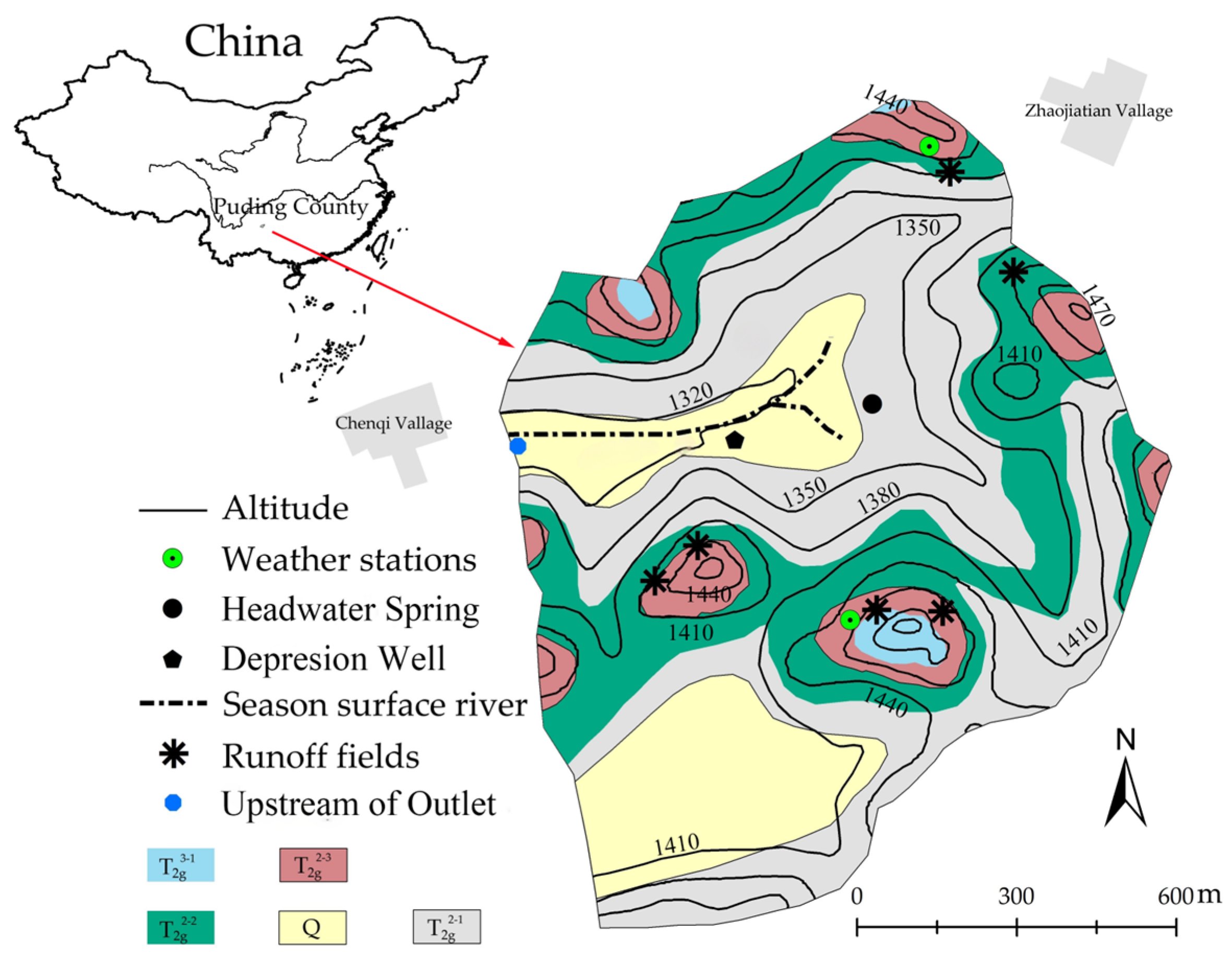
Figure 1. Geological map of the Chenqi catchment in Puding County, Southwest China, showing the locations of the three monitoring sites (HS: Headwater Spring; DW: Depression Well; UO: Upstream of Outlet), weather stations, and major geological units. (T2g2-1: lower member, marl intercalated with limestone; T2g2-2: middle member, limestone intercalated with marl; T2g2-3: upper member, dolomite; T2g3-1: lower member, dolomite; Q: Quaternary deposits).
Water 17 03264 g001
Figure 2. Time series of hydrological and meteorological data during the monitoring period (April to October 2017). The upper panel shows daily rainfall (black bars) and normalized water levels at HS, DW, and UO sites. The lower panel displays the corresponding water temperatures.
Water 17 03264 g002
Figure 3. Detailed hydrological and turbidity responses to the primary storm event on 9 July 2017. Panels from top to bottom show: (1) 5 min rainfall intensity; (2) Water level at HS and discharge at UO; (3) Turbidity at HS and UO. Note the logarithmic scale for the turbidity axis.
Water 17 03264 g003
Figure 4. Piper diagram illustrating the hydrochemical facies of water samples from the Depression Well (DW) and Upstream of Outlet (UO) sites during the dry and wet seasons.
Water 17 03264 g004
Figure 5. Box-and-whisker plots comparing the concentrations of sulfate (SO42−), calcium (Ca2+), and chloride (Cl) at the DW and UO sites during the dry and wet seasons. The box represents the 25th–75th percentiles, the line within the box is the median, the square is the mean, whiskers extend to 1.5 times the interquartile range (IQR), and dots represent outliers.
Water 17 03264 g005
Figure 6. Monthly Variation of Calcium Ion and Sulfate Ion Concentrations in DW.
Water 17 03264 g006
Figure 7. Principal Component Analysis (PCA) score plots for the hydrochemical data. (a) Plot of PC1 (Salinity/Anthropogenic activities) vs. PC2 (Carbonate weathering). (b) Plot of PC1 vs. PC3 (pH-carbonate equilibrium). Samples are grouped by site and season.
Water 17 03264 g007
Table 1. Summary of hydrological response parameters for five selected storm events at the HS, DW, and UO sites. Parameters include total precipitation (Total P), peak precipitation intensity (Peak P), duration, lag time (T_lag), time to peak (T_peak), and 50% recession time (T_r50).
Event No.DateTotal P
(mm)
Peak P
(mm/h)
Duration (h)ParameterHSDWUO
112-June84.646.25.25T_lag (h)1.251.751.5
T_peak (h)0.751.51.08
T_r50 (h)31.253.3312.25
215-June28.410.85.58T_lag (h)0.832.420.83
T_peak (h)2.672.672.67
T_r50 (h)39.675.6713.42
330-June50.28.216.08T_lag (h)3.754.252.5
T_peak (h)7.084.676.5
T_r50 (h)51.337.6717
420-July19.812.44.41T_lag (h)1.172.081.25
T_peak (h)2.251.832.42
T_r50 (h)64.743.9214.5
59-July65.230.85.67T_lag (h)0.50.580.33
T_peak (h)1.582.252
T_r50 (h)30.85.4216.17
Mean ± SD T_lag (h)1.50 ± 1.272.22 ± 1.331.28 ± 0.80
T_peak (h)2.87 ± 2.492.58 ± 1.232.93 ± 2.14
T_r50 (h)43.56 ± 14.245.20 ± 1.7214.67 ± 1.91
Disclaimer/Publisher’s Note: The statements, opinions and data contained in all publications are solely those of the individual author(s) and contributor(s) and not of MDPI and/or the editor(s). MDPI and/or the editor(s) disclaim responsibility for any injury to people or property resulting from any ideas, methods, instructions or products referred to in the content.