Article

Delineation Using Multi-Tracer Tests and Hydrochemical Investigation of the Matica River Catchment at Plitvice Lakes, Croatia


1
Department of Hydrogeology and Engineering Geology, Croatian Geological Survey, Milana Sachsa 2, 10000 Zagreb, Croatia
2
Faculty of Geotechnical Engineering, University of Zagreb, 42000 Varaždin, Croatia
*
Author to whom correspondence should be addressed.
Water 2025, 17(22), 3261; https://doi.org/10.3390/w17223261
Submission received: 8 October 2025 / Revised: 10 November 2025 / Accepted: 12 November 2025 / Published: 14 November 2025
(This article belongs to the Special Issue Water Management and Geohazard Mitigation in a Changing Climate)

Abstract

In the Plitvice Lakes National Park, several hydrogeological catchments can be distinguished, but their boundaries are not clearly defined. This study focused on the Matica River catchment area, which covers the main contributors to the lake system and its overall water balance. An initial assessment indicated that the Matica River catchment is among the most vulnerable areas due to the anticipated land-use expansion related to agriculture and tourism. This research provides critical hydrogeological data supporting sustainable management in response to the increasing extremes of floods and droughts induced by climate change. Two separate campaigns (March 2023 and April 2025) were carried out, each involving three simultaneous tracer injections using different fluorescent dyes. The results of earlier tracer tests were evaluated; furthermore, a hydrochemical analysis of the spring water offered valuable insights into subsurface processes and anthropogenic impacts. Tracing in the southwest clarified the boundary between the Plitvice Lakes and Una River catchments. In the Homoljac polje, the tracer responses highlighted a triple junction between the Plitvice Lakes, Gacka, and Una River catchments. In the southeastern Brezovac polje, the boundary between the Crna Rijeka and Bijela Rijeka catchments was delineated in detail.

1. Introduction

Identifying groundwater flow paths remains a major hydrogeological challenge due to the heterogeneous nature of karstified aquifers, which are characterized by a dual- or even triple-porosity system. Unlike porous-media aquifers, where flow occurs predominantly through intergranular pore spaces, karst aquifers exhibit flow through a combination of matrix porosity, fractures, and conduits formed by the dissolution of carbonate rocks [1,2]. In well-developed Dinaric karst systems, with dominant conduits and fracture porosity, the groundwater flow is non-uniform, anisotropic, and highly dynamic, responding quickly to precipitation events [3,4]. The dynamics of water movement in highly karstified rocks pose significant challenges under climate change conditions, where periods of intense rainfall and prolonged droughts strongly affect recharge processes and groundwater availability [5,6,7,8]. Understanding groundwater flow through the unknown geometry of the karst massif requires an integrated approach that combines hydrogeological mapping, tracer tests, and hydrochemical characterization.
Tracer tests provide important evidence of hydraulic connections, flow velocities, and travel times between recharge zones and discharge points or springs. Therefore, tracer tests present a key method for defining catchment areas; they can delineate sanitary protection zones for drinking water, identify potential contamination pathways, estimate the water balance, improve water resource management, and enable pollution risk assessments in karst terrains [9,10]. The simultaneous application of three tracers is rarely employed, primarily due to the technical complexity of its implementation. Nevertheless, this method has the potential to generate highly valuable hydrogeological information, offering insights into groundwater dynamics. In particular, it can contribute to the identification of previously unknown subsurface flow paths and expand the understanding of complex aquifer systems [11]. In parallel, hydrochemical data provide indirect, but complementary, evidence of flow processes. Variations in the ion composition, electrical conductivity, and water temperature can reveal differences in mineral dissolution, recharge sources, and residence times [1,12,13].
The Plitvice Lakes National Park (hereinafter, Park) was established in 1949 as one of Europe’s earliest formally protected karst areas and the oldest national park in Croatia. Its addition to the UNESCO World Heritage List in 1979 highlights its international significance for preserving geomorphological and hydrological heritage. The Plitvice Lakes represent a unique hydrogeological and ecologically significant natural system situated within the central zone of the Dinaric karst in Croatia. Renowned for its 16 tufa-forming lakes, dynamic hydrology, and pristine karst landscapes, the area exemplifies the intricate interaction between geological, hydrological, and biological processes. Tourism plays a central role in the socio-economic relevance of the region, attracting up to a million visitors annually. However, during summer low-flow periods, the system becomes particularly vulnerable to climatic and anthropogenic pressures [14]. Infrastructure development, urbanization, nearby land-use, increased wastewater production, and impervious surfaces, such as roads and parking lots, place significant pressure on the water quality. With the increasingly frequent extreme rainfall events, groundwater moves rapidly through conduits and fractures with minimal natural filtration, and even small pollution sources can spread widely and affect the spring water quality. Hence, a clear understanding of the catchment boundaries provides a basis for effective and sustainable management and is key to minimizing anthropogenic pressures on the groundwater quality and quantity in this natural phenomenon.
Although the catchment areas within the Park are generally known, their boundaries are still uncertain, and some inter-catchment borders have not been clearly defined. Within the Park, several hydrogeological catchments can be distinguished, including those of the Plitvice Lakes and the Korana, Lička Jesenica, Gacka, Una, and Korenička Rijeka Rivers [15]. Among these, the Plitvice Lakes catchment—the focus of this study—is the most significant for the Park, as it lies entirely within the protected area and it is the only one that contributes to the lake system. The Plitvice Lakes catchment can be subdivided into three primary sub-catchments: Matica, Plitvica, and lakes with Rječica streams [15,16]. The lack of a clear definition of the immediate catchment areas of the Plitvice Lakes represents a significant gap in the management of this protected area, as these streams serve as the primary water sources for the lake system; thus, this is the main threat to the system.
Hydrogeological investigations of the Plitvica stream sub-catchment were carried out in 2020 and 2021, while the Matica and Rječica sub-catchments remain insufficiently explored [17]. The Rječica hydrogeological catchment is entirely located within poorly permeable dolomitic strata, resulting in a watershed that is well defined by surface topography. Conversely, the Matica catchment—representing the principal contributor to the lake system—can only be delineated approximately based on the available topographic and hydrogeological data. This uncertainty provides the rationale for selecting it as the primary focus of the present investigation, which sought to achieve a more robust hydrogeological delineation of the catchment areas of the Crna Rijeka, Bijela Rijeka, and Plitvički Ljeskovac springs, situated in the southern area of the Park.
Open questions from earlier studies, including the challenge of determining the hydrological balance under climate change and ongoing management challenges—arising from intensive tourism and the local need for a new drinking water intake in the southern part of Plitvice Lakes National Park—formed the basis for this study, which included multiple tracer tests and physico-chemical observations of water. The initial phase of this research involved a comprehensive analysis and the systematization of previous investigations, with particular emphasis on the ten tracer tests that have been carried out to date. One tracer test was singled out, as its results were not consistent with the expectations based on the geological structure of the area. In 1984, the Uzelački Zavoj sinkhole in the western part of the Matica River catchment area showed a connection with the Crna Rijeka spring, which is situated roughly 4500 m from the location, and not with the Bijela Rijeka spring, which is situated roughly 800 m from the location [18]. Due to the lack of original literature and the consequently limited insight into the details of the previous investigation, we decided to repeat the tracer test and to verify its accuracy. In the Brezovac area, a tracer dye was injected at two locations to delineate the catchment boundaries between the Bijela Rijeka and Crna Rijeka springs. In the south part of the study area, in the Homoljac polje, two locations were chosen due to unverified oral reports of tracer tests conducted in the borehole that suggested a hydraulic connection with the Gacka River springs. Under such conditions, almost the whole Homoljac polje would fall within the Adriatic catchment, thus being exempt from the strict measures applied to the protected zone of the national park. This would also create the basis for the local population to request a new water intake and allow for greater flexibility in the development of livestock farming and agriculture. Furthermore, the eastern boundary of the catchment towards the Korenička Rijeka stream has not been previously traced; therefore, a sinkhole located in the mountainous area within the presumed catchment of the Matica River was selected as a testing site.
It is essential to note that the results of the first published tracing test in the Dinaric karst is presented in this study, which involved the simultaneous use of three different tracers not once, but twice. The concurrent use of different tracers at the same catchment significantly enhances the interpretation level and distinguishes sub-catchments, particularly during specific hydrological moments (specific groundwater levels).

2. Materials and Methods

2.1. Setting

The Plitvice Lakes National Park is located in the central part of the Croatian Dinaric karst, covering an area of 296 km2 [19], with the surface water accounting for about 1.9 km2. The system consists of 16 interconnected lakes arranged in a cascading sequence over approximately 9 km long section, with a total elevation drop of 162 m, from 637 m a.s.l. to 475 m a.s.l. The lakes follow a south-to-north flow direction, with water gradually descending through waterfalls, cascades, and channels. After the last lake, when the water from all the tributaries joins together, the resulting river (Korana) originates from the final lake and continues as a major surface outflow, draining the system into the Black Sea basin.
The area belongs to the continental climatic belt (according to Köppen classification, climate subtype Cfb) and has some elements of a mountain climate above 1200 m a.s.l. (according to the Köppen classification, climate subtype Dfb). The summers are dry and warm, and the winters are wet and cold. The air temperatures are the highest during July and August and the lowest in January. Annual precipitation ranges between 1023 and 2214 mm, and the average yearly temperature is between 4 °C in the highest part of the catchment and 8 °C in the lowest, and is mostly controlled by the elevation of the terrain [20,21].
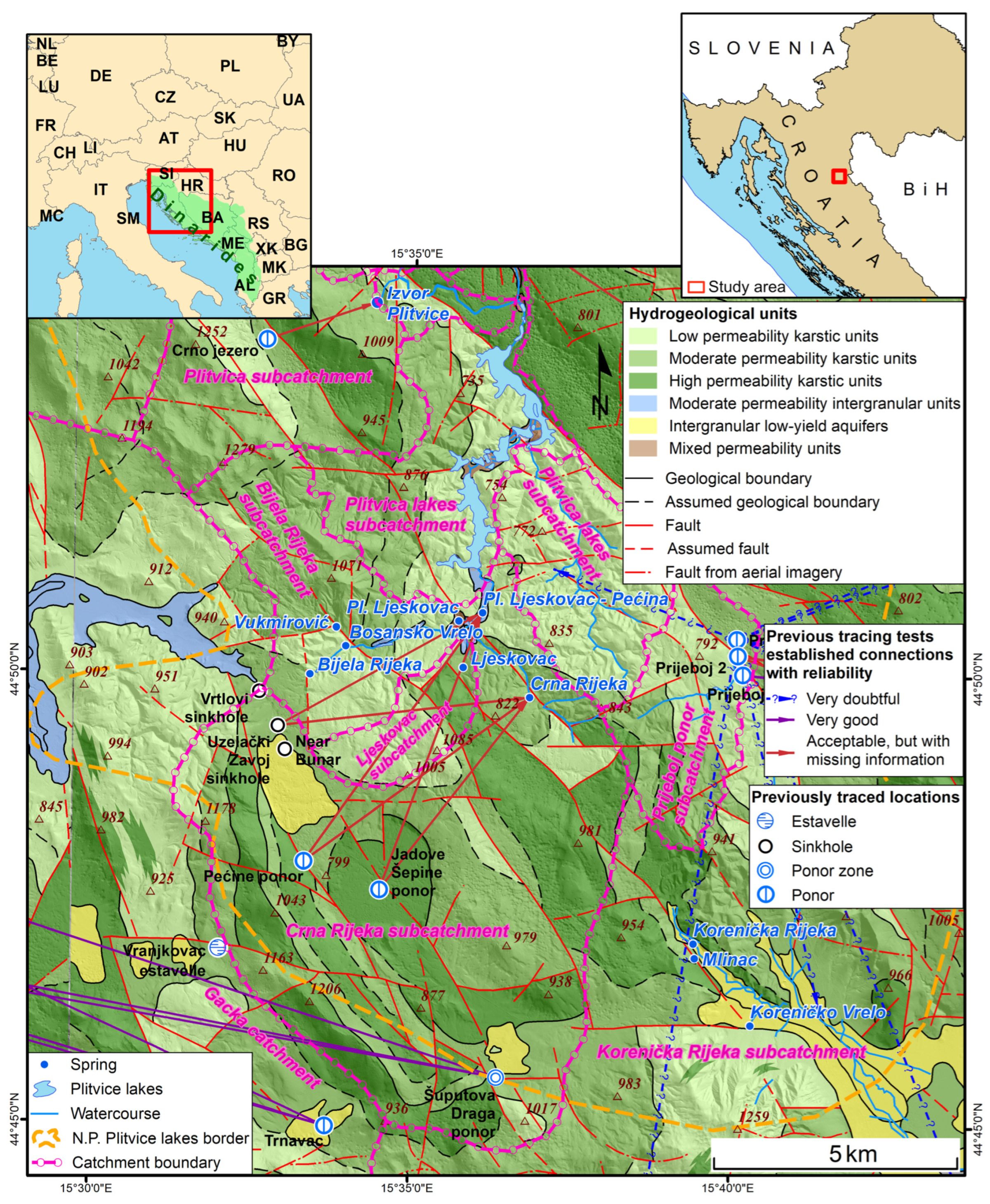
The study area is characterized by the complex tectonic evolution of the Dinaric fold-and-thrust belt, which represents the southern branch of the Alpine–Mediterranean orogenic system. The Dinaric mountains extend as a belt with a length of about 700 km along the Adriatic Sea, from the southern Alps in the northwest to the Hellenides in the southeast [22]. The dominant compressional tectonics, with a maximum compressive stress oriented southwest–northeast, led to the final uplift of the Dinarides (Figure 1).
Folded structures, thrusts, dislocations, and faulting throughout much of the Dinarides have retained a prevailing northwest–southeast orientation, commonly referred to as the Dinaric strike. The main deformation phase—known as the Dinaric orogenic phase—occurred from the Middle Eocene to the Oligocene, although in some areas, it continued locally into the Miocene [23].
In the Plitvice Lakes region, the tectonics are dominated by intense faulting, and the carbonate complexes are heavily fractured and disrupted. The area is composed predominantly of karstified Mesozoic and Tertiary carbonate rocks. Here, a general overview of its geological setting is presented, based on the 1:100,000 geological maps by Bihać [24] and Otočac [25]. The oldest surface rocks in the study area are of Upper Triassic age, forming the bedrock of the lake system and the Rječica steam catchment. These rocks are predominantly dolomites, which constitute the cores of anticlinal structures. They are overlain by Jurassic formations (Lias, Dogger, and Malm), which comprise the majority of the investigated area and represent the primary aquifers of the Plitvice Lakes catchment. These Jurassic deposits consist of alternating limestones and dolomites, particularly in the lower Jurassic, while limestones predominate in the middle Jurassic. Cretaceous deposits occur in the northeastern-most parts of the study area, but they are not of major hydrogeological significance for the investigated system due to their limited spatial extent and poor permeability. Lithologically, these are carbonate rocks, ranging from pure limestones to limestone–dolomite alternations, and nearly pure dolomites formed by late diagenetic dolomitization. Quaternary deposits, primarily tufa formations, are restricted to the narrower zone along the Matica River channel.
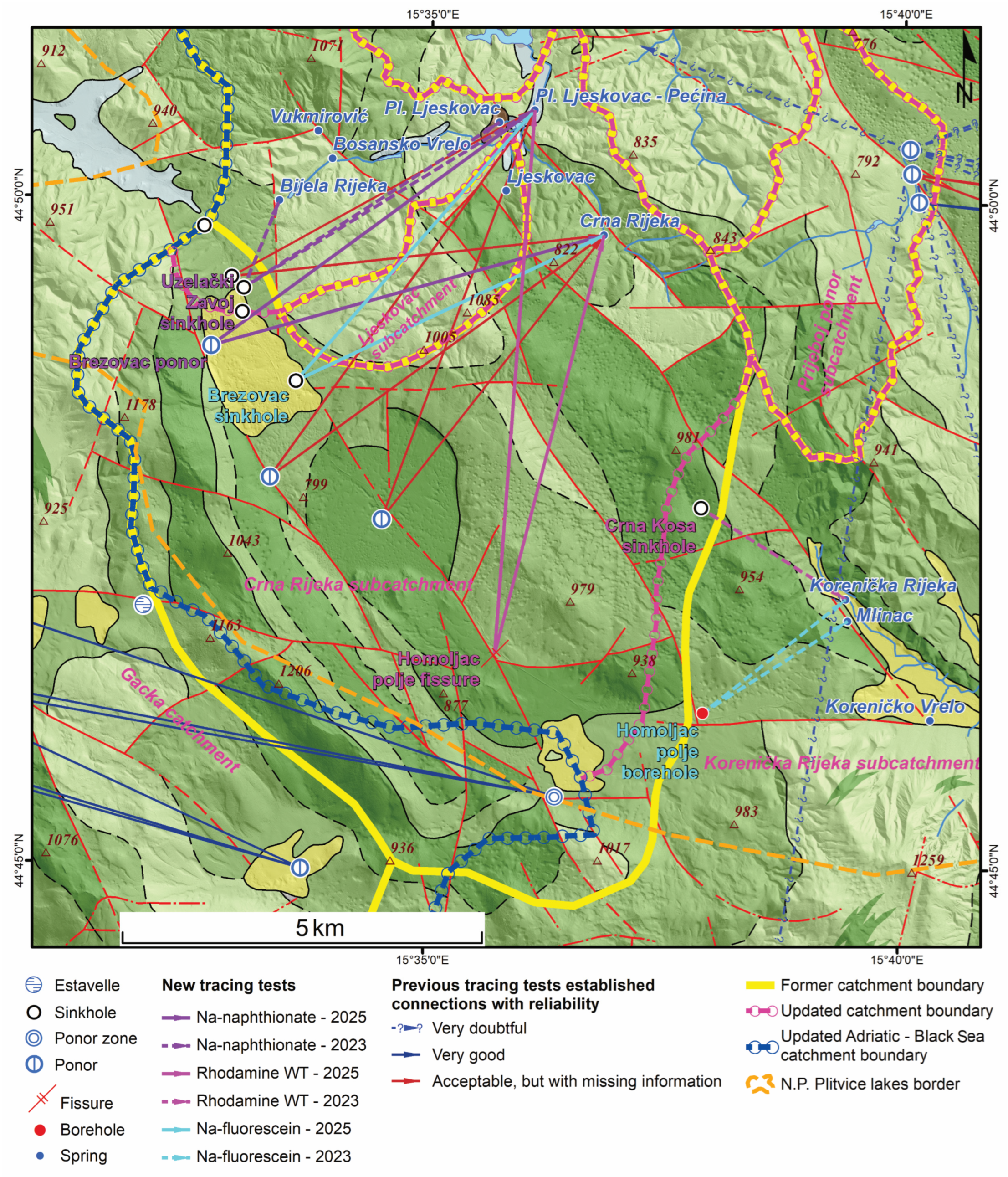
The division between the Plitvice Lakes and the Korenička Rijeka Rivers catchments is in the Homoljac polje area. The division is mostly related to the occurrence of less-permeable rocks and the morphology of the terrain, especially in the part built of poorly permeable Triassic dolomites, which act as a hydrogeological barrier throughout the basin. The divide continues to the north-northwest along the Kozjak fault, which separates the highly permeable Upper Cretaceous limestones from the Upper Triassic dolomites (Figure 1). The fault extends along the northeastern shore of the Kozjak Lake and further towards Kuselj.
Figure 1. Hydrogeological map of the Plitvice Lakes National Park with previous tracer tests; the location map boundaries of the Dinaric karst were obtained from [26].
Water 17 03261 g001

2.2. Hydrogeological Characteristics

Based on the lithological composition, structural setting, and differences in permeability, the study area was grouped into three principal categories: (A) karstic units, (B) intergranular units, and (C) mixed-permeability units (Figure 1). These groups reflect the spatial distribution of six main hydrogeological units (numbered below, along with an indication of the category to which each unit belongs) and their general characteristics, hydraulic characteristics, and degree of karstification within the catchment (Figure 1):
A. Karstic units
(1) High-permeability karstic units—predominantly thick-bedded, fractured, and karstified limestones that form the principal aquifers of the region. They are widespread in the central and northern parts of the study area and enable rapid infiltration and subsurface flow toward major springs.
(2) Moderate-permeability karstic units—alternating dolomites and limestones with limited karstification and a secondary porosity. These rocks dominate the western and southwestern parts of the area, forming semi-confined aquifers with a reduced transmissivity and a partial storage capacity.
(3) Low-permeability karstic units—massive-to-finely crystalline dolomites with very limited fracturing and a low permeability. They occur mainly in the southeastern sector near Homoljac and Brezovac and act as aquitards that hydraulically separate adjacent karst aquifers.
B. Intergranular units
(4) Moderate-permeability intergranular units—permeable sand, gravel, and silt deposits occurring in karst poljes and valley bottoms that form local intergranular aquifers of a limited extent and thickness. These units often serve as shallow unconfined aquifers or temporary storage zones.
(5) Low-yield aquifers—discontinuous and thin sedimentary layers located near sinkholes and depressions, characterized by a variable permeability and a minimal water-storage capacity. They generally act as transition zones between surface and subsurface flow.
C. Tufa deposits
(6) Mixed-permeability units—Holocene and Pleistocene tufa deposits that are genetically linked to the Plitvice Lakes system, the Plitvice stream, and the headwaters of the Korana River [24,25]. These deposits locally influence groundwater–surface water interactions and represent important geomorphological and hydrogeological features of the area.
The six described hydrogeological units collectively control the recharge, subsurface flow patterns, and discharge dynamics within the Matica River catchment, forming a complex, but well-defined, karst system.
The Matica River catchment area covers approximately 55% of the Plitvice Lakes catchment area and contributes about two-thirds of the total inflow to the lake system [16,26]. In general, it drains the well-karstified Mesozoic aquifer from south to north through three major and several secondary springs. These springs form a Matica watercourse that enters Prošćansko Lake after approximately 600 m near the Plitvički Ljeskovac on the 640 m a.s.l. Most of the karstic bedrock area is covered by thin, discontinuous soil, while thicker unconsolidated layers (up to several meters) occur locally in karst poljes (Figure 1 and Figure 2), though without significant hydrogeological function. The groundwater levels lie only a few meters above the Crna Rijeka and Bijela Rijeka springs, as confirmed by monitoring during low-flow conditions, indicating a direct hydraulic connection between the aquifer and spring discharge zones (measured during low hydrological conditions in this investigation). The average annual flow of the Crna Rijeka stream is 1.36 m3/s, with a recorded maximum of 10.60 m3/s and a minimum of 0.021 m3/s based on the observations from 1982 to 2008 [16]. During the same monitoring period, the average annual flow of the Bijela Rijeka stream was 0.45 m3/s, with a recorded maximum of 1.92 m3/s and a minimum of 0.002 m3/s. The average annual flow for the Matica River was 4.18 m3/s, with a maximum record of 12.0 m3/s and a minimum of 0.5 m3/s. The system exhibits its highest discharge in spring, with the most pronounced peak occurring in April. The pronounced spring peak typically reflects the combined effect of rainfall and the snowmelt period, and reaches its minimum towards the end of the hydrological year in late summer.

2.3. Methods and Data

This study began with a review and synthesis of previous tracer tests, which provided the foundation for the research presented in this paper. The reliability of these earlier tests was evaluated according to the methodologies employed. In several cases, only secondary references in the literature were available, as the original reports have been lost. Consequently, the reliability of those results was rated as very doubtful to acceptable, but with missing information (Figure 1).
Croatian Waters provided hydrochemical data, gathered as part of the national water quality monitoring program. This monitoring is conducted within the framework of the surveillance monitoring of the chemical and quantitative condition of groundwater, in accordance with the Regulation on Water Quality Standards and the River Basin Management Plan [27]. The Crna Rijeka and Bijela Rijeka springs were sampled quarterly from 2022 to 2024. The chemical composition was analyzed using a Piper diagram [28] (Grapher version 25.3.315; Golden Software, Denver, CO, USA) in order to determine the rock through which the water flows and to identify the anthropogenic impact on the water characteristics [29,30].
Between 2023 and 2025, we conducted two tracer tests by simultaneously using three toxicologically safe and non-impactful fluorescent dye tracers, namely Na-fluorescein (CAS: 518-47-8; C20H10Na2O5; detection threshold: 0.002 μg/L), Na-naphthionate (CAS: 130-13-2, C10H8NNaO3S; detection threshold: 0.04 μg/L), and the commercial solution rhodamine WT 20% concentrate (CAS 37299-86-8, C29H29ClN2Na2O5; detection threshold: 0.01 μg/L). The six injection sites within the wider presumed boundary area of the Matica River catchment area were selected based on a LiDAR imagery analysis, field surveys, and an evaluation of the results from previous tracer tests (Figure 2, Table 1). All the tracers were injected with additional water supplied by fire trucks.
In March 2023, three tracers were injected under moderate water-level conditions during the recession period, due to recent rainfall and snowmelt. The locations comprised two sinkholes, Uzelački Zavoj and Crna Kosa, and an abandoned borehole in Homoljac polje (Figure 2, Table 1). The Uzelački Zavoj sinkhole is in the area close to the previously traced sinkhole (exact location is unknown) [18]; this location was chosen to further investigate the reliability of the previous results, which contradicted the expected results. On 23 March 2023, the Uzelački Zavoj sinkhole was traced with 75 kg of Na-naphthionate. Before the test, 8 m3 of water was discharged into the sinkhole. The tracer was introduced at 10:50 h and was fully flushed into the subsurface by 12:20 h, after which an additional 30 m3 of water from the truck tanker was added. The Crna Kosa sinkhole is located in the hilly eastern area, where tracer tests have not yet been performed, to delineate the Matica and Korenička Rijeka River catchment areas. In the present study, 9 kg of rhodamine WT was injected on 22 March 2023 at 10:30 h. Prior to the tracer injection, 30 m3 of water from truck tankers was discharged into the sinkhole to moisten the fracture surfaces, thus reducing potential tracer sorption. Following the tracer injection, an additional 30 m3 of water was released into the sinkhole to flush and drive the tracer more efficiently toward the groundwater table. The third location, the Homoljac polje borehole is situated in the west part of the eponymous polje, or within the eastern part of the Matica River catchment area. It was chosen due to unverified oral reports of tracer tests having been conducted in this borehole that suggested a hydraulic connection with the Gacka River springs. It is 85.5 m deep and the groundwater table before the test was at a depth of 70.3 m. Before the tracer injection, 3 m3 of water from a truck tanker was poured into the borehole to moisten the borehole walls. Consequently, the depth of the groundwater table decreased to 38 m. A total of 15 kg of Na-fluorescein was injected into it on 23 March 2023 at 8:30 h. Following the tracer introduction, a total of 82 m3 of water was injected into the borehole. The depths were determined using a water level sensor at the time of the test.
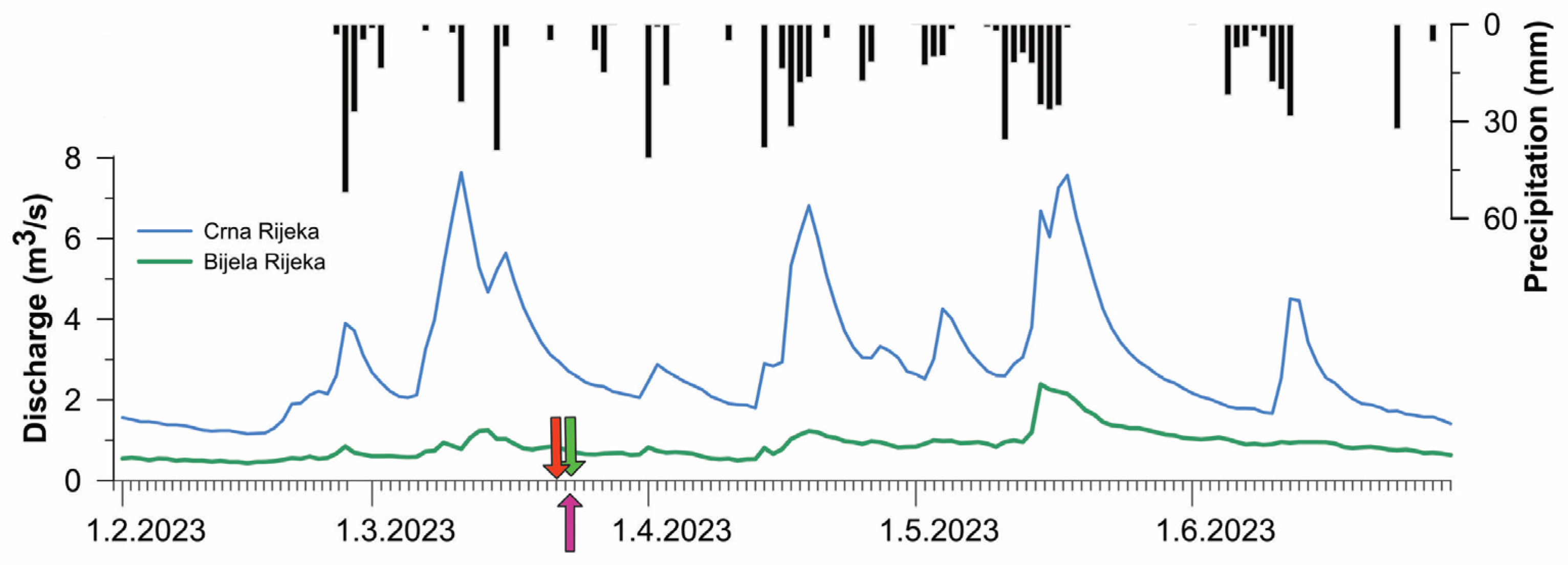
Three tracers were injected in sequence over two days during the recession limb of the hydrograph in order to achieve the highest possible flow velocities and to maximize the probability of tracer detection at the springs (Figure 3).
On 1 April 2025, the second tracer campaign was conducted, with a focus on delineating the catchments of the Bijela and Crna Rijeka springs in the central part of the Matica River catchment area. Three locations were selected in the southwestern part of the study area: one open fissure in the eastern part of the Homoljac polje and a sinkhole and ponor on the margins of the Brezovac polje (Figure 2, Table 2). High groundwater levels and active surface flow into the Brezovac ponor enabled the injection of all three tracers on the same day. The Brezovac ponor was traced with 50 kg of Na-naphthionate dissolved at the site, which was introduced into the stream flow 10 m upstream of the ponor at 11:25 h. Approximately 15 L/s of water was estimated to be flowing into the ponor, which was under slight impoundment at the time of injection. The Brezovac sinkhole was first subjected to approximately 3 m3 of fresh water, after which 15 kg of dissolved Na-fluorescein was added at 13:10 h and the sinkhole was flushed with an additional 9 m3 water from the truck tanker. In the Homoljac polje, 18 kg of rhodamine WT was injected in the fissure in the form of a commercially prepared 20% solution at 16:00 h, with continuous flushing using 9 m3 of water from a truck tanker (Table 1).
The tracers in both campaigns were monitored by taking water samples four times per day in the first 10 days at the following springs: the Bijela Rijeka, Crna Rijeka, Korenička Rijeka, Koreničko Vrelo, Ljeskovac, Mlinac, Plitvički Ljeskovac, Pećina, and Vukmirović springs. At the Gacka River, Majerovo Vrilo, Tonkovića Vrilo, and Klanac springs, samples were taken once per day. At the Krbavica, Suvaja, and Ševerova Pećina springs, samples were taken every 2 days (Table S1). After 10 days, samples were taken once per day at all springs. All samples were stored in the dark and, as a rule, collected once per week for a laboratory analysis. The background concentrations were determined from zero samples collected prior to tracer injection at all the monitored springs. Before determining the Na-fluorescein concentration, the samples were alkalized with NaOH to a pH of approximately 8.5 to ensure accurate concentration measurements. The water samples were analyzed on a Perkin-Elmer LS55 spectrofluorometer (PerkinElmer Life and Analytical Sciences, Shelton, CT, USA) in the Croatian Geological Survey laboratory, with the expected detection limits of 0.002 ppb for Na-fluorescein, 0.01 ppb for rhodamine WT, and 0.04 ppb for Na-naphthionate.
Additionally, Albillia GGUN FL30 field fluorometers (Albillia Sàrl, Auvernier, Switzerland) were installed to detect all three tracers with an interval of 15 min in the Bijela Rijeka, Crna Rijeka, Ljeskovac, and Tonkovića Vrilo springs. In the Koreničko Vrelo spring, Turner Design C3 field fluorometers (Turner Designs, San Jose, CA, USA) were used to detect all three tracers with an interval of 10 min (Table S1). The expected detection limits of the field fluorometer were 0.025 ppb for Na-fluorescein, 0.1 ppb for rhodamine WT, and 0.4 ppb for Na-naphthionate. In the campaign in 2025, the Krbavica spring was excluded from the monitoring network, and the Albillia GGUN FL30 field fluorometer (Albillia Sàrl, Auvernier, Switzerland) was settled in the Majerovo Vrilo spring with an interval of 15 min.
For all the monitored springs with an established tracer concentration above the detection limit, the basic parameters were determined. The apparent flow velocity of the tracer was determined as a ratio between the travel time and the straight-line distance between the injection and sampling points. In the case of the maximum apparent flow velocity, the travel time was calculated as a time difference between the injection and the first concentration value above the detection limit. For the peak apparent velocity, the travel time determined a time difference between the injection and the peak (maximum) concentration for the given tracer.

3. Results

3.1. Hydrochemical

The hydrochemical parameters of the Crna Rijeka and Bijela Rijeka springs were analyzed to characterize the physicochemical composition of the karst groundwater in the Matica River catchment area. The results (Table 2) show that both springs exhibit typical features of calcium-bicarbonate waters with low mineralization. The spring water temperatures ranged from 7.0 to 11.7 °C at Crna Rijeka and 6.1 to 11.3 °C at Bijela Rijeka, reflecting a seasonal variability typical of karst aquifers. The pH values were neutral to slightly alkaline (7.6–8.5), with an average of 8.14 for Crna Rijeka and 8.02 for Bijela Rijeka. The electrical conductivity (EC) was slightly higher at Bijela Rijeka (average 473 µS/cm) than at Crna Rijeka (average 413 µS/cm), indicating slightly higher total dissolved solids. Calcium and magnesium were the dominant cations, which is consistent with carbonate dissolution as the primary geochemical process with bicarbonate as the prevailing anion.

3.2. Previous Tracer Tests

Over the past five decades, ten tracer tests have been carried out to delineate the Matica River catchment area (Table 3). All of the tests employed Na-fluorescein as the tracer, with the concentrations determined through a visual inspection and by using a quartz lamp [18,31,32,33,34] or a spectrofluorometer [35,36]. This analytical approach ensured that the results could be regarded as reliable. Three of the ten tracer tests failed to detect tracer at any spring [32,33].
In the Brezovac polje area, three successful tracer tests were undertaken in the past. All three consistently indicated that the Brezovac polje catchment contributes to the Crna Rijeka system (Figure 1). Nevertheless, the authors of this study question the outcome of [18], while the geological structure and the distance open up the possibility that the northern part of the Brezovac area is hydraulically connected to the Bijela Rijeka spring. To resolve this uncertainty, a repeat tracer test was conducted during this study in the Uzelački Zavoj location.
The remaining five tracer tests indicated that the areas of Trnavac [35], Vrhovine [34], and the southern part of Homoljac polje [36] unexpectedly belong to the Gacka River catchment. The most recent test in 2010 confirmed this finding and effectively shifted the recognized watershed boundary between the Adriatic and Black Sea basins, emphasizing the complex and dynamic nature of karst aquifer systems [36].

3.3. Tracer Test Findings

The tracer tests conducted in March 2023 and April 2025 demonstrated heterogeneous groundwater flow conditions within the wider Matica River catchment area. All the tracers used were detected at one or more of the monitored springs (Table 4). Table S1 lists all the monitoring springs.
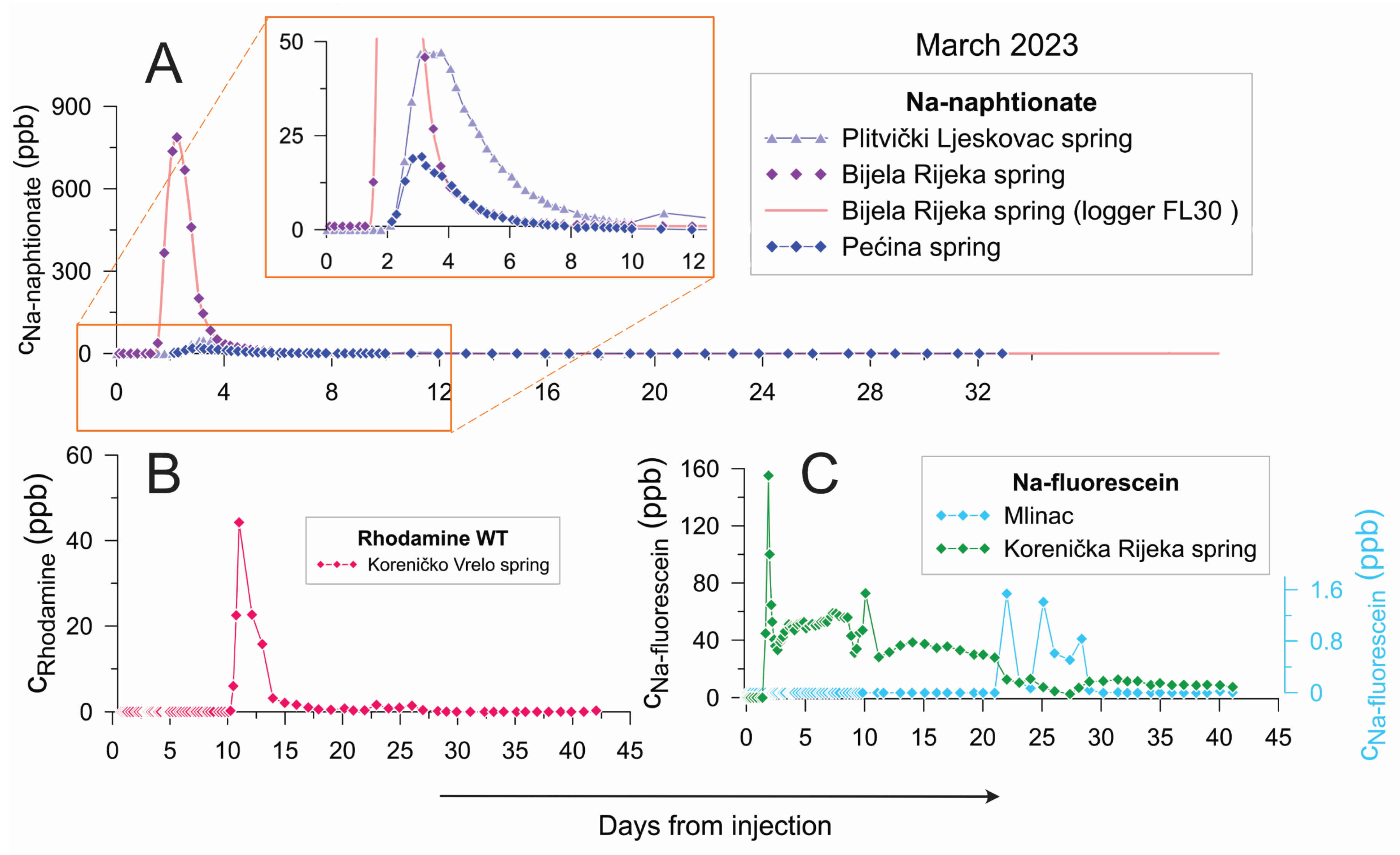
In March 2023, the strongest response was obtained after the injection of Na-naphthionate in the Uzelački Zavoj sinkhole; the tracer reached the Bijela Rijeka spring within 35 h with a maximum apparent flow velocity of 1.07 cm/s and a peak concentration of 791.4 ppb after 19 h. The subsequent arrivals were recorded in the Plitvički Ljeskovac spring water after 51.3 h (maximum apparent flow velocity, 2.34 cm/s; and peak concentration of 47.2 ppb after 38.8 h) and in the Pećina spring after 52.4 h (maximum apparent flow velocity, 2.56 cm/s; and peak concentration of 19.4 ppb after 22.5 h). Following the injection of rhodamine WT in the Crna Kosa sinkhole on 22 March 2023, the tracer first appeared in the Korenička Rijeka spring on 1 April (10 days later) with a maximum velocity of 0.27 cm/s and a peak concentration of 44.3 ppb after 26 h. The injection of 15 kg of Na-fluorescein in the Homoljac polje borehole on 23 March resulted in arrivals in the Korenička Rijeka spring after 40.2 h (maximum apparent flow velocity, 1.80 cm/s; and peak concentration of 155.1 ppb, after 4.9 h) and in the Mlinac spring after 22 days (maximum apparent flow velocity, 0.13 cm/s; and peak concentration of 1.5 ppb with the first detection of the tracer). Most likely, the tracer appeared earlier in the Mlinac spring water, but due to the sampling frequency, it was detected when it had already reached a high concentration (Figure 4).
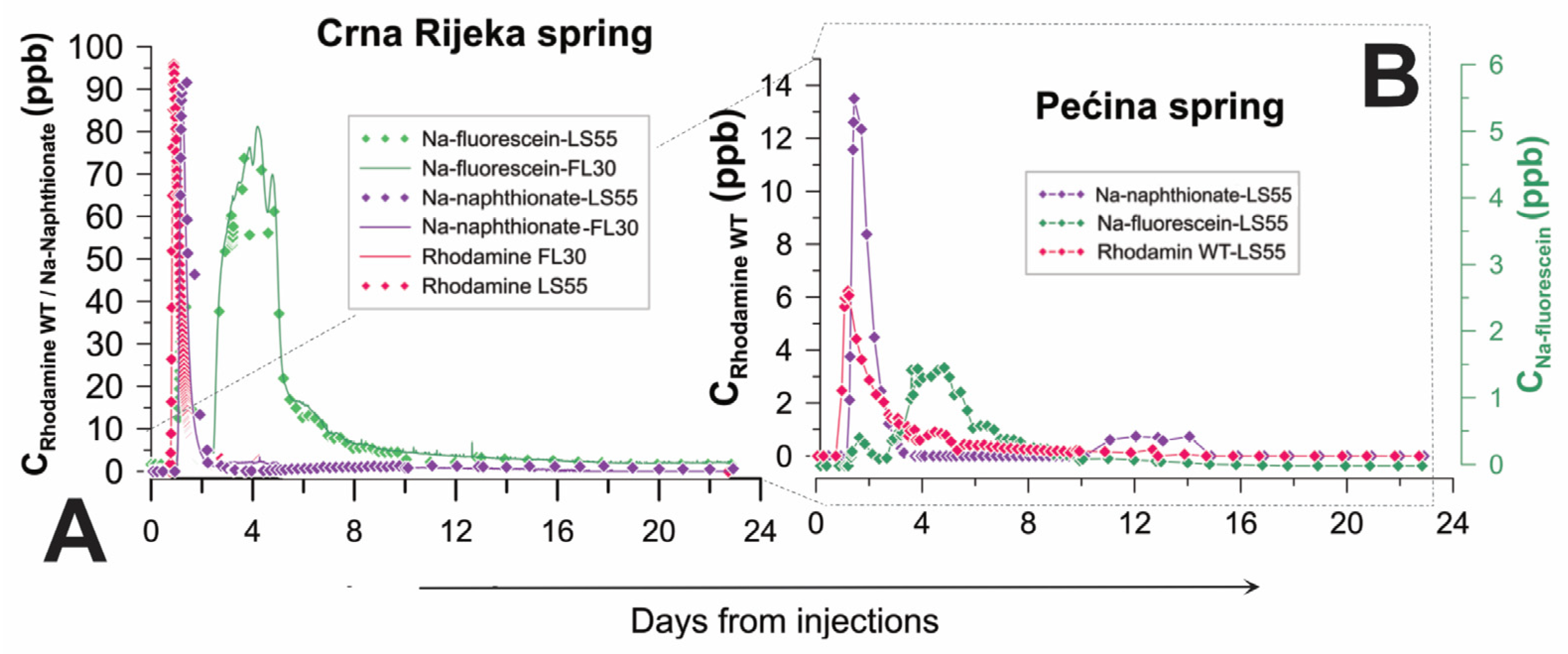
In April 2025, the tracer injection locations were selected near the assumed water divide at the Brezovac polje to clearly delineate the catchment areas of the Bijela Rijeka and Crna Rijeka springs. After its injection at the Brezovac ponor, Na-naphthionate was detected in the Crna Rijeka spring 23.8 h later, with a maximum flow velocity of 6.6 cm/s. The peak concentration was 92 ppb, occurring 5.5 h after first appearance, with 5.38 cm/s as the peak flow velocity. The first appearance at the Pećina spring was observed 30.3 h after injection (5.1 cm/s as the maximum apparent flow velocity), whereas the peak concentration of 13.5 ppb was observed 4.4 h after the first detection (peak flow velocity 4.5 cm/s). Similarly, the injection of 15 kg of Na-fluorescein in the Brezovac sinkhole resulted in arrivals in the Crna Rijeka spring 24.1 h after injection (maximum apparent flow velocity of 5.47 cm/s and peak concentration of 5.1 ppb occurring 8.7 h after the first detection) and at the Pećina spring 31.7 h after injection (maximum apparent flow velocity of 4.41 cm/s and peak concentration of 1.4 ppb occurring 84.3 h after the first detection). The most rapid transport occurred from the Homoljac polje fissure, where rhodamine WT injected on 1 April 2025 reached the Crna Rijeka spring after 18 h with a maximum apparent flow velocity of 9.29 cm/s (peak concentration of 95.9 ppb and peak flow velocity of 7.87 cm/s occurring 3.2 h after the first detection). At the Pećina spring, the tracer was observed 23.3 after injection with a maximum apparent flow velocity of 9.04 cm/s (peak concentration of 6.2 ppb and peak flow velocity of 7.31 cm/s, occurring 6.53 h after first detection) (Figure 5).

4. Discussion

In this study, the tracer tests were conducted twice—in March 2023 and April 2025—at six locations, from which the tracer traveled to one or more springs. The outcomes of several tests revised the previous understanding of groundwater flow directions. Accordingly, this study proposes refined catchment boundaries based on the most recent tracer evidence and hydrogeological interpretations. It should be noted that all the delineated catchment boundaries are not strictly defined by the geological structure. In the southern part of the Plitvice Lakes National Park, there are no completely impermeable rocks that would act as absolute hydrogeological barriers. Under such conditions, fluctuations in groundwater levels may temporarily alter the flow directions and, consequently, shift the position of the catchment boundaries. For this reason, all divides in this area are characterized as zonal, i.e., variable depending on the prevailing hydrological conditions.
The pronounced karstification of the rock mass was reflected in the exceptionally high groundwater flow velocities recorded during tracer tests. In April 2025, the calculated groundwater velocities reached extreme values of 4.41 up to 9.29 cm/s, in comparison to average 3.55 cm/s in the Dinaric region [36]. This indicated the presence of highly conductive flow paths within the aquifer. However, it should be noted that the velocities during high water flow were significantly higher than those during low flow. In March 2023, the groundwater velocities were low to moderate (0.13–2.56 cm/s), primarily due to the lower discharges during the injection time. Additionally, at the Crna Kosa sinkhole (Figure 6), the relative high difference in elevation must be considered, as it results in a longer tracer travel distance before reaching the saturated zone. This illustrates the importance of topographic controls during the interpretation of apparent velocities. It should also be considered that the tracer might have appeared at the spring earlier if a larger volume of water from the truck tanks had been poured in during the injection itself, since the tracer appeared at the spring following heavy rainfall. This factor could significantly influence the interpretation of the breakthrough times and may lead to reduced apparent flow velocities, even in highly karstified systems.
The most pronounced changes were observed in the southernmost part of the Park, where the most critical groundwater divide of the Croatian karst is located—the divide between the Black Sea and Adriatic Sea basins (Figure 6). This boundary had already been displaced prior to the present study through the tracer test at Šuputova Draga ponor [35], which demonstrated a hydraulic connection between the southernmost part of the Homoljac polje and the Gacka River springs. This study performed three additional tracer tests to delineate the divides of the Gacka, Crna Rijeka, and Korenička Rijeka catchments. Tests from a sinkhole and a borehole in the Homoljac polje provided strong evidence of the tri-junction of these three catchments within the polje itself, providing robust hydrogeological evidence of their intersection. Furthermore, tracer testing of the Crna Kosa sinkhole revised the boundary between the Crna Rijeka and Korenička Rijeka springs catchments, shifting it westwards. Despite these new insights, the precise delineation of the boundary between the Korenička Rijeka and Koreničko Vrelo catchments, as well as the springs of the Krbavica River, remains unresolved, emphasizing the complexity and dynamic nature of watershed divides in highly karstified terrains.
In the Brezovac area, three tracer tests were conducted with the aim of delineating the catchments of the Bijela Rijeka, Crna Rijeka, and Ljeskovac springs (Figure 6). The results clearly showed that none of the tracer tests produced detections at the Ljeskovac springs; consequently, the boundaries of this catchment were not modified.
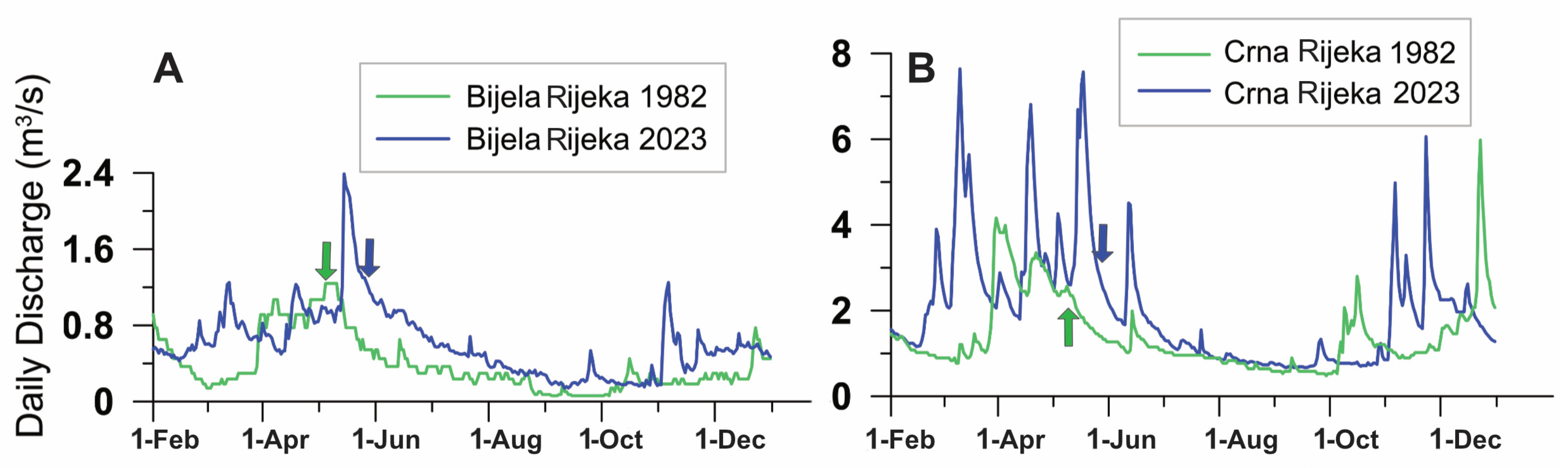
The repeated tracer test from the Uzelački Zavoj ponor established a connection between the northern part of the Brezovac polje and the Bijela Rijeka and Plitvički Ljeskovac springs, thereby confirming the hypothesized hydrogeological function of the subsurface (Figure 6). These results differ from those reported in 1982, likely due to different hydrological conditions or local-scale conduit activation. Supposing that the earlier results and the injection location are reliable, the most plausible explanation for this difference lies in the influence of differing hydrological conditions, which could have altered the groundwater flow directions, given the zonal character of watershed divides. To investigate this, the hydrological conditions were compared between 1982 and 2023 with an emphasis on the time of the injections (Figure 7). At the time of the tracer injection, the discharge data from the Crna Rijeka and Bijela Rijeka springs indicate that the flows were very similar in both years. Both tests were performed during the recession; however, the maximum in 2023 was considerably higher. Thus, the hydrological conditions can hardly account for the different paths and directions of groundwater flow between the two tracer tests, as the similarities between the conditions were too great. The exact reason for the different results between the two tracer tests remains unknown, but since the 1982 tracer test was poorly documented, the results from the new tracing test are considered to be more reliable.
In the 2025 tracer test, the tracers from the Brezovac and Homoljac poljes were first detected in the Crna Rijeka spring, and later in the Pećina spring, which is located approximately two kilometers downstream near the Matica riverbed, where the flows of the Crna and Bijela Rijeka converge. A similar pattern was detected in the tracer test carried out in the Uzelački Zavoj area in 1982 [18]; based on a comparison of the tracer concentrations in the Crna Rijeka and Pećina springs, it was concluded that water is locally lost in the Crna Rijeka riverbed and subsequently re-emerges at the Pećina spring (Figure 5). Similarities in the concentration curves were also evident in the case of the 2023 tracer test from the Brezovac sinkhole (Figure 4). A comparison of the Na-naphthionate concentrations in the Bijela Rijeka spring, the Plitvički Ljeskovac spring, and the Pećina spring showed clear similarities, with the concentrations decreasing with an increasing distance from the injection point. The results indicate that the Pećina and Plitvički Ljeskovac springs originate from water losses in the Bijela and Crna Rijeka riverbeds. The variations in the tracer concentrations suggest slower subsurface transport to the spring, rather than solely surface flow in the Bijela Rijeka followed by direct sinking near the Plitvički Ljeskovac spring.
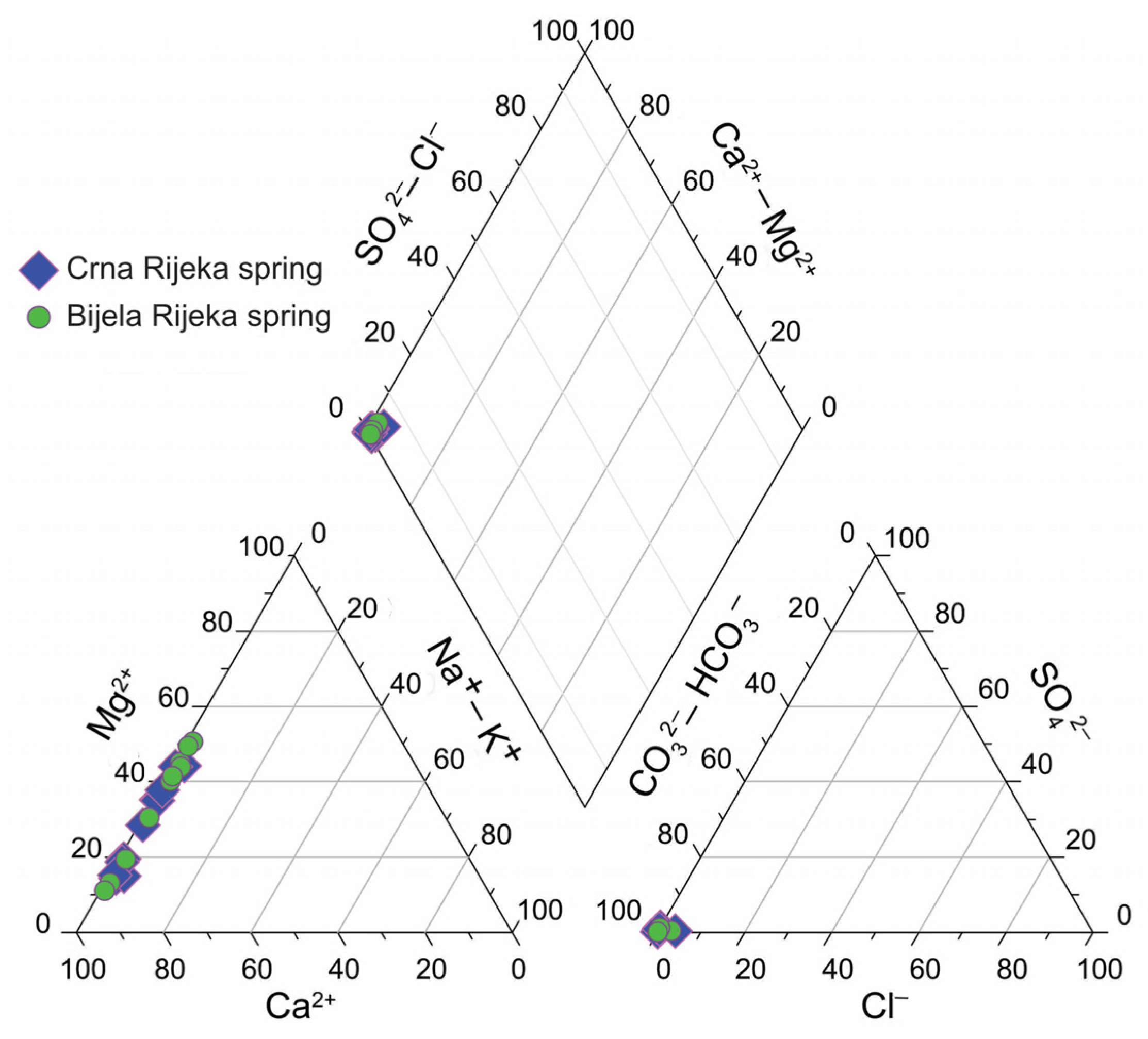
An analysis of the chemical indicators in the spring waters was conducted to define the types of rocks through which groundwater flows and to evaluate the degree of anthropogenic impact. The Piper diagram (Figure 8) clearly illustrates that all the sampled waters belong to the Ca–HCO3 to Ca–Mg–HCO3 water types, which are typical hydrochemical facies for groundwater and spring waters of the aquifers developed in the highly permeable carbonates of the Dinarides. The water chemistry indicates a homogeneous groundwater composition, resulting from the dissolution of carbonate rocks—limestones (calcite) and dolomites—with no significant influence from other lithological types [37,38]. The chloride concentrations remained below the detection limit of 5 mg/L for most measurements, suggesting negligible anthropogenic input. The nitrate levels were low (≤1.54 mg/L), indicating limited agricultural or wastewater influence on the springs. The sulfate concentrations were similarly low (1.34–1.43 mg/L on average). Both springs were well oxygenated, with the mean O2 concentrations exceeding 10 mg/L; this is characteristic of a rapid recharge and a short groundwater residence time in karst systems. Overall, the hydrochemical results confirm that both the Crna Rijeka and Bijela Rijeka springs are supplied by fast-flowing karst groundwater with a low anthropogenic impact and a geochemical signature dominated by carbonate rock dissolution [39]. The slightly higher mineralization at Bijela Rijeka may indicate a larger contribution by a deeper or longer flow path of groundwater or a flow path through rock with a higher dolomite content.

5. Conclusions

Hydrogeological investigations conducted between 2023 and 2025 in the Matica sub-catchment have further improved the understanding of groundwater–surface water interactions in the Plitvice Lakes National Park. These results have also emphasized the need to critically re-evaluate investigations that were carried out using considerably outdated technologies.
The boundary between the Adriatic and Danube catchments was determined long ago, using previous assumptions made on the basis of fewer data or data that were determined using descriptive methods based on terrain morphology. The watershed boundary was later adjusted based on tracer tests conducted around 2010, and it has been further refined with the tracer tests presented in this study. Furthermore, policies, programs, and management rules are implemented within the EU based on these watershed boundaries. Although these areas are small in scale compared to the EU boundaries, they have a significant influence on the implementation and application of Danube or Adriatic mechanisms and policy frameworks. Furthermore, knowledge about actual watershed boundaries is essential for local authorities, especially because the groundwater flow velocities are extremely high; for example, based on the speed of groundwater movement, the selected area would fall into the second or, at most, the third sanitary protection zone of the spring.
In light of the increasingly frequent climatic extremes, the accurate delineation of catchment areas is essential to their sustainable and effective management, particularly with regard to unique natural phenomena such as that observed for the Plitvice Lakes. The tracer tests of the groundwater flows enabled a more precise delineation of the catchment boundaries and directions of subsurface drainage. This is particularly important for the main inflows to the lake system—the Bijela Rijeka and the Crna Rijeka springs—which underpin the functioning of the entire biotic and abiotic environment. This resolved part of the previous uncertainties regarding the watersheds of these streams, which is an important prerequisite for effective water resource management in the protected area.
The outcomes from the presented study define the following: Three simultaneous tracer tests in the wider Brezovac area successfully refined the catchment boundaries of the Bijela Rijeka and Crna Rijeka springs. It was established that the northwestern part of Brezovac (e.g., near the Uzelački Zavoj sinkhole) drains underground toward the Bijela Rijeka spring, while the western Brezovac ponor drains toward the Crna Rijeka spring. This has led to a more precise definition of the watershed between the two catchments. The Ljeskovac spring represents a distinct hydrogeological unit within the Matica River system. None of the tracer tests resulted in tracer breakthrough at the Ljeskovac springs, supporting the previously assumed boundaries of its catchment. The catchment areas of the Crna Rijeka and the Korenička Rijeka springs were more precisely delineated through tracer tests in the Homoljac polje and Crna Kosa areas, resulting in a westward shift in their mutual watershed compared to its previously assumed position. The Homoljac polje area represents the tripoint of the Gacka, Crna Rijeka, and Korenička Rijeka catchments. Hydrogeological mapping and tracer tests confirmed that the southwestern area of the polje drains toward the Gacka River catchment, the eastern sector toward the Korenička Rijeka spring, and the northwestern sector toward the Crna Rijeka spring. The Pećina and Plitvički Ljeskovac springs are directly connected to the sinking of waters from the Bijela Rijeka and Crna Rijeka watercourses. The Pećina spring, located at the edge of the Matica watercourse, receives groundwater from both rivers, while the Plitvički Ljeskovac spring is predominantly fed by sinking waters from the Bijela Rijeka catchment. This confirms that part of the Bijela Rijeka and Crna Rijeka discharge drains through the hilly karstified aquifer system before reappearing in the surface flow of the Matica River.
Hydrochemical analyses confirmed that both the Crna Rijeka and Bijela Rijeka springs are recharged by fast-flowing karst groundwater with a low anthropogenic impact and a composition dominated by carbonate rock dissolution. The slightly higher mineralization at Bijela Rijeka suggests a modest contribution from deeper or longer groundwater flow paths. In other words, it can be concluded that there are no significant sources of pollution within the catchment area, and that there are no large agricultural farms located within the observed watershed boundaries.
These results have important implications for integrated water resource management in Plitvice Lakes National Park. The refined delineation of catchment boundaries provides a more robust basis for planning and implementing conservation measures for the main inflows to the lake system, which together constitute the majority of its water budget. An improved understanding of groundwater flow directions is particularly relevant for the early detection of potential impacts on both water quality and quantity, especially under projected climate change scenarios or in the event of accidental pollution. Our research indicates the need for new tracer tests to more accurately determine the watershed boundaries and to define the extent of their transitional zones.
The findings also underscore the necessity of extending the management strategies beyond the administrative boundaries of the Park. As significant portions of the recharge areas lie outside of the protected zone, the effective safeguarding of the natural hydrology of the Plitvice Lakes requires coordinated action across multiple jurisdictions.

Supplementary Materials

The following supporting information can be downloaded at https://www.mdpi.com/article/10.3390/w17223261/s1, Table S1. Monitored springs in tracer test in March 2023 and April 2025 in the Marica River catchment area, Plitvice National Park.

Author Contributions

Conceptualization, T.F. and H.M.; investigation, T.F., I.B., H.M. and J.T.; writing—original draft preparation, I.B. and T.F.; writing—review and editing, T.F., I.B., H.M. and J.T.; visualization, T.F. and I.B. All authors have read and agreed to the published version of the manuscript.

Funding

This research was funded by the Public Institution Plitvice Lakes National Park through the project “Hydrogeological and Hydrological Investigations of the Bijela Rijeka and Rječica Rivers” (procurement No. JN-52/21). The project was implemented by the consortium of the Croatian Geological Survey and the University of Zagreb Faculty of Geotechnical Engineering. The research was partially conducted within the scope of the project PACT-VIRA (project code: IP-2024-05-9190), funded by the Croatian Science Foundation.

Data Availability Statement

The original contributions presented in this study are included in the article/Supplementary Material. Further inquiries can be directed to the corresponding author.

Acknowledgments

The authors express their gratitude to the Croatian Meteorological and Hydrological Service and the Plitvice Lakes National Park for the provided data and cooperation. Appreciation is extended to the colleagues and students from the Faculty of Geotechnical Engineering, University of Zagreb, and colleagues from the Croatian Geological Survey for their support in field and laboratory work.

Conflicts of Interest

The authors declare no conflicts of interest.

References

  1. Ford, D.; Williams, P. Karst Hydrogeology and Geomorphology; Wiley: Chichester, UK, 2007. [Google Scholar]
  2. Goldscheider, N.; Drew, D. (Eds.) Methods in Karst Hydrogeology; Taylor & Francis: London, UK, 2007. [Google Scholar]
  3. Kovačič, G. Hydrogeological study of the Malenščica karst spring (SW Slovenia) by means of a time series analysis. Acta Carsologica 2010, 39, 201–215. [Google Scholar] [CrossRef]
  4. Stroj, A.; Briški, M.; Oštrić, M. Study of Groundwater Flow Properties in a Karst System by Coupled Analysis of Diverse Environmental Tracers and Discharge Dynamics. Water 2020, 12, 2442. [Google Scholar] [CrossRef]
  5. Sironić, A.; Barešić, J.; Horvatinčić, N.; Brozinčević, A.; Vurnek, M.; Kapelj, S. Changes in the geochemical parameters of karst lakes over the past three decades—The case of Plitvice Lakes, Croatia. Appl. Geochem. 2017, 78, 12–22. [Google Scholar] [CrossRef]
  6. Jiang, G.; Guo, F.; Liu, F.; Li, Z.; Milanović, S. Hydrogeological Responses of Karst Compartments to Meteorological Drought in Subtropical Monsoon Regions. J. Hydrol. 2025, 655, 132940. [Google Scholar] [CrossRef]
  7. Petrović, B.; Ignjatović, S.; Smiljković, Ž.; Marinović, V.; Gajić, V. Epikarst of Eastern Part of Suva Planina Mt.: A New Perspective Defining from an Integrated Survey. Geol. Croat. 2025, 78, 31–44. [Google Scholar] [CrossRef]
  8. Aguilera, H.; Murillo, J.M. The effect of possible climate change on natural groundwater recharge based on a simple model: A study of four karstic aquifers in SE Spain. Environ. Geol. 2009, 57, 963–974. [Google Scholar] [CrossRef]
  9. Ravbar, N.; Petrič, M.; Blatnik, M.; Švara, A. A Multi-Methodological Approach to Create Improved Indicators for the Adequate Karst Water Source Protection. Ecol. Indic. 2021, 126, 107693. [Google Scholar] [CrossRef]
  10. Simard, A.; Pelletier, G.; Rodriguez, M.J. Using a Tracer to Identify Water Supply Zones in a Distribution Network. J. Water Supply Res. Technol. AQUA 2009, 58, 433–442. [Google Scholar] [CrossRef]
  11. Aley, T.; Osorno, T.C.; Devlin, J.F.; Goers, A. Practical Groundwater Tracing with Fluorescent Dyes; The Groundwater Project: Guelph, ON, Canada, 2025. [Google Scholar] [CrossRef]
  12. Lukač Reberski, J.; Marković, T.; Nakić, Z. Definition of the river Gacka springs subcatchment areas on the basis of hydrogeological parameters. Geol. Croat. 2013, 66, 39–53. [Google Scholar] [CrossRef]
  13. Appelo, C.A.J.; Postma, D. Geochemistry, Groundwater and Pollution; Balkema: Rotterdam, The Netherlands, 1994; 536p. [Google Scholar]
  14. Radišić, M.; Rubinić, J.; Ružić, I.; Brozinčević, A. Hydrological System of the Plitvice Lakes—Trends and Changes in Water Levels, Inflows, and Losses. Hydrology 2021, 8, 174. [Google Scholar] [CrossRef]
  15. Meaški, H. Model of the Karst Water Resources Protection on the Example of the Plitvice Lakes National Park. Ph.D. Thesis, University of Zagreb, Zagreb, Croatia, 2011; 211p. (In Croatian). [Google Scholar]
  16. Meaški, H.; Biondić, B.; Biondić, R. Delineation of the Plitvice Lakes karst catchment area, Croatia. In Karst Without Boundaries; Stevanović, Z., Krešić, N., Kukurić, N., Eds.; International Association of Hydrogeologists—Selected papers; CRC Press/Balkema: London, UK, 2016; pp. 269–284. [Google Scholar]
  17. Vurnek, M.; Brozinčević, A.; Kepčija, R.; Matoničkin Frketić, T. Analyses of long-term trends in water quality data of the Plitvice Lakes National Park. Fundam. Appl. Limnol. 2021, 194, 155–169. [Google Scholar] [CrossRef]
  18. Dešković, I.; Marušić, R.; Pedišić, M.; Sipos, L.; Krga, M. Some Recent Results of Hydrochemical and Hydrological Investigations of Waters in the Plitvice Lakes Area. Vodoprivreda 1984, 16, 221–227. (In Croatian) [Google Scholar]
  19. Plitvice Lakes National Park Public Institution. Management Plan 2019–2028; Plitvice Lakes National Park: Plitvice Lakes, Croatia, 2019; Available online: https://np-plitvicka-jezera.hr/wp-content/uploads/2019/10/Plitvice-Lakes-NP-Management-Plan.pdf (accessed on 25 July 2025).
  20. Zaninović, K.; Srnec, L.; Perčec Tadić, M. Digital Annual Temperature Map of Croatia. Croat. Meteorol. J. 2004, 39, 51–58. Available online: https://hrcak.srce.hr/67221 (accessed on 20 April 2023).
  21. Gajić-Čapka, M.; Perčec Tadić, M.; Patarčić, M. Digital Annual Precipitation Map of Croatia. Croat. Meteorol. J. 2003, 38, 21–33. [Google Scholar]
  22. Korbar, T. Orogenic Evolution of the External Dinarides in the NE Adriatic Region: A Model Constrained by Tectonostratigraphy of Upper Cretaceous to Paleogene Carbonates. Earth-Sci. Rev. 2009, 96, 296–312. [Google Scholar] [CrossRef]
  23. Vlahović, I.; Tišljar, J.; Velić, I.; Matičec, D. Evolution of the Adriatic Carbonate Platform: Palaeogeography, Main Events and Depositional Dynamics. Palaeogeogr. Palaeoclimatol. Palaeoecol. 2005, 220, 333–360. [Google Scholar] [CrossRef]
  24. Polšak, A.; Juriša, M.; Šparica, M.; Šimunić, A. Basic Geological Map of Yugoslavia 1:100,000, Bihać Sheet (L33-116); Geološki zavod Zagreb, Savezni geološki zavod Beograd: Beograd, Serbia, 1976. (In Croatian) [Google Scholar]
  25. Velić, I.; Bahun, S.; Sokač, B.; Galović, I. Basic Geological Map of Yugoslavia 1:100,000, Otočac Sheet (L33-115); Geološki zavod Zagreb, Savezni geološki zavod Beograd: Beograd, Serbia, 1974. (In Croatian) [Google Scholar]
  26. Intergovernmental Hydrological Programme. Hydrogeological Map of the Dinaric Karst Aquifer System. Available online: https://ihp-wins.unesco.org/dataset/hydrogeological-map-of-the-dinaric-karst-aquifer-system (accessed on 31 October 2025).
  27. Ministry of Economy and Sustainable Development. River Basin Management Plan 2022–2027; Official Gazette NN 156/2022; Ministry of Economy and Sustainable Development: Zagreb, Croatia, 2022. (In Croatian)
  28. Piper, A.M. A graphic procedure in the geochemical interpretation of water-analyses. Trans. Am. Geophys. Union 1944, 25, 914–928. [Google Scholar]
  29. Selak, A.; Lukač Reberski, J.; Briški, M.; Selak, L. Hydrochemical characterization of a Dinaric karst catchment in relation to emerging organic contaminants. Geol. Croat. 2024, 77, 145–158. [Google Scholar] [CrossRef]
  30. Babinka, S. Multi-Tracer Study of Karst Waters and Lake Sediments in Croatia and Bosnia and Herzegovina: Plitvice Lakes National Park and Bihać Area. Ph.D. Thesis, Universität Bonn, Bonn, Germany, 2007; 168p. [Google Scholar]
  31. Dešković, I.; Pedišić, M.; Marušić, R.; Milenković, V. Importance, Purpose and Some Results of Hydrochemical, Hydrological and Sanitary Investigations of Surface and Groundwater in the Plitvice Lakes National Park. Vodoprivreda 1981, 12, 7–19. (In Croatian) [Google Scholar]
  32. Marušić, R.; Ćuruvija, M. Investigation of Subsurface Water Connections in the Plitvice Lakes National Park. Plitvički Bilt. 1990, 16, 19–28. (In Croatian) [Google Scholar]
  33. Šarin, A.; Singer, D. Report on the Spectrometric Analyses of Water Samples During the Dye Tracing of the Vranjkovac Estavelle Near Turjansko in 1988; Croatian Geological Survey: Zagreb, Croatia, 1989. (In Croatian) [Google Scholar]
  34. Biondić, B.; Goatti, V. Regional Hydrogeological Investigations of the Lika and Hrvatsko Primorje Regions; Croatian Geological Survey: Zagreb, Croatia, 1976. (In Croatian) [Google Scholar]
  35. Kuhta, M.; Frangen, T.; Stroj, A. Groundwater Investigation Works for the Protection of the Krbavica Spring, Phase II: Tracing of the Trnovac Field Ponor; Archive of the Croatian Geological Survey: Zagreb, Croatia, 2010. (In Croatian) [Google Scholar]
  36. Kuhta, M.; Frangen, T. Tracing of the Šuputova Draga Ponor in the Homoljačko Field; Archive of the Croatian Geological Survey: Zagreb, Croatia, 2013. (In Croatian) [Google Scholar]
  37. Kuhta, M.; Brkić, Ž. Water Tracing Tests in the Dinaric Karst of Croatia. In Integrating Groundwater Science and Human Well-Being; Taniguchi, M., Yoshioka, R., Sinner, A., Aureli, A., Eds.; Proceedings CD; International Association of Hydrogeologists (IAH): Toyama, Japan, 2008. [Google Scholar]
  38. Vasić, L.; Milanović, S.; Stevanović, Z.; Palcsu, L. Definition of groundwater genesis and circulation conditions of the complex hydrogeological karst system Mlava–Belosavac–Belosavac-2 (eastern Serbia). Carbonates Evaporite 2020, 35, 16. [Google Scholar] [CrossRef]
  39. Torkar, A.; Brenčič, M. Spatio-temporal distribution of discharges in the Radovna River valley at low water conditions. Geologija 2015, 58, 47–55. [Google Scholar] [CrossRef]
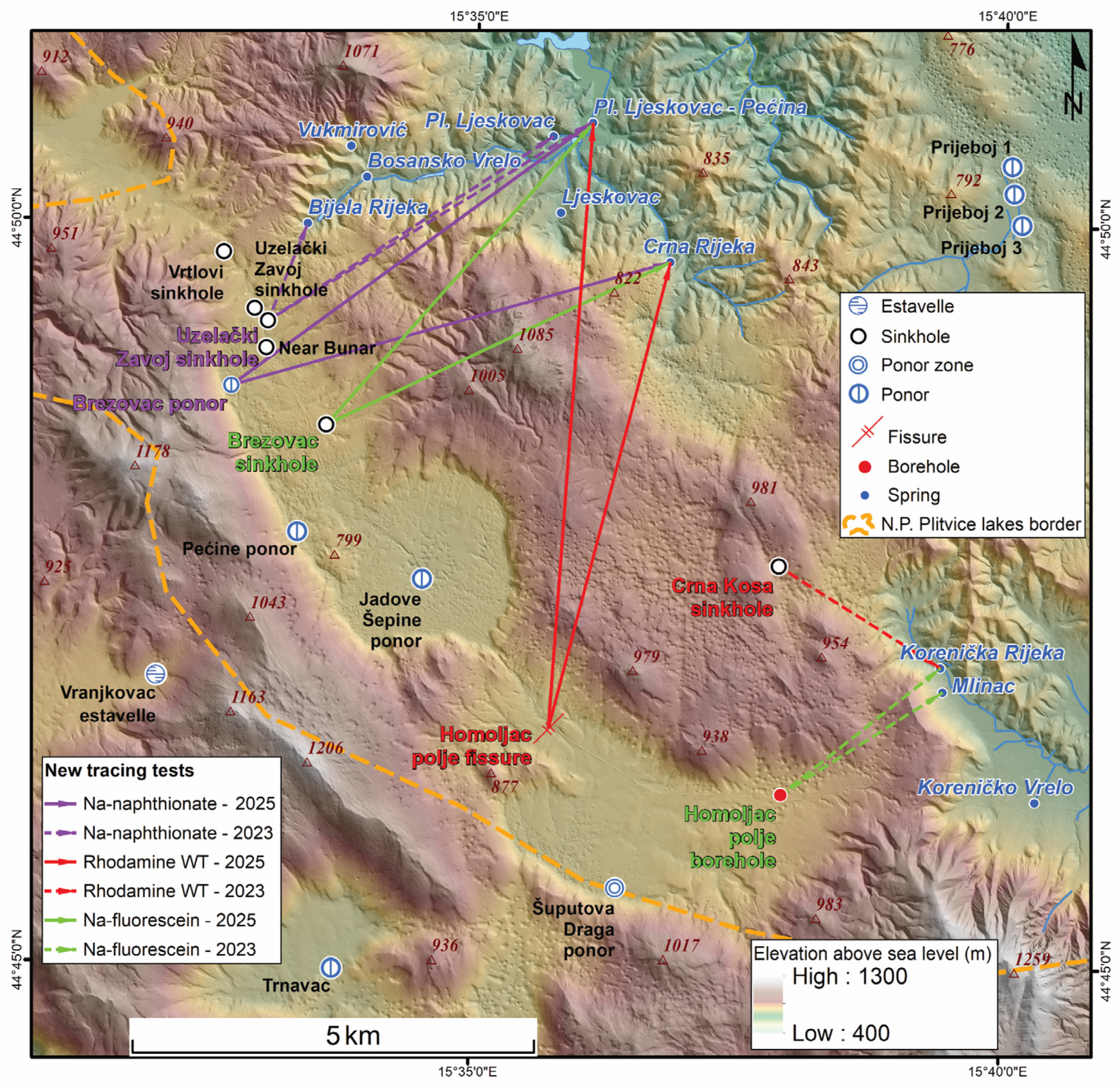
Figure 2. The injection locations for the simultaneous use of three different tracers in two campaigns (March 2023 and April 2025).
Water 17 03261 g002
Figure 3. Mean daily precipitation at the Babin Potok meteorological station and mean daily discharges at the Crna Rijeka and Bijela Rijeka limnigraph stations for Plitvički Ljeskovac, with the indicated tracer injection times (red arrow—rhodamine WT, green arrow—Na-fluorescein, purple arrow—Na-naphthionate).
Water 17 03261 g003
Figure 4. The results of the simultaneous tracer test conducted in March 2023 in the southern part of the Plitvice Lakes National Park: (A) the concentration of Na-naphthionate in the springs after injection in the Uzelački Zavoj sinkhole; (B) the concentration of rhodamine WT in the Koreničko Vrelo spring after injection in the Crna Kosa sinkhole; and (C) the concentration of Na-fluorescein in the springs after injection in the Homoljac polje borehole.
Water 17 03261 g004
Figure 5. The results of the simultaneous tracer test conducted in April 2025 in the southern part of the Plitvice Lakes National Park: the concentration of Na-naphthionate, Na-fluorescein, and rhodamine WT injected in the Brezovac ponor and sinkhole and in the Homoljac sinkhole in the spring waters of (A) the Crna Rijeka and (B) the Pećina. LS55—spectrofluorometric analysis, FL30—logger data.
Water 17 03261 g005
Figure 6. Subsurface groundwater connections identified using tracer tests and zonal catchment area divides (previous and revised conditions) in the southern part of the Plitvice Lakes National Park, the Matica River catchment area, and the Gacka River catchment area (modified after [16]). The legend for the hydrogeological units is the same as in Figure 1.
Water 17 03261 g006
Figure 7. Daily discharges at the DHMZ gauging station on (A) the Crna Rijeka and (B) the Bijela Rijeka for 1982 and 2023, with the times of the tracer injections at the doline in the Uzelački Zavoj indicated, the arrows indicate the moment of tracer injections.
Water 17 03261 g007
Figure 8. A Piper diagram of water from the Bijela Rijeka and Crna Rijeka springs.
Water 17 03261 g008
Table 1. Injection points and tracer characteristics.
Injection PointType of TracerMass (kg)
Uzelački Zavoj sinkholeNa-naphthionate75 kg
Homoljac polje boreholeNa-fluorescein15 kg
Crna Kosa sinkholeRhodamine WT9 kg
Homoljac polje fissureRhodamine WT18 kg
Brezovac ponorNa-naphthionate50 kg
Brezovac sinkholeNa-fluorescein15 kg
Table 2. The chemical composition of the main springs in the Matica River catchment area for the period of 2022–2024.
Spring T (°C)pHEC (μS/cm)O2
(mg/L)
Ca2+ (mg/L)Cl
(mg/L)
Na+
(mg/L)
NO3
(mg/L)
SO42−
(mg/L)
HCO32−
(mg/L)
Mg2+ (mg/L)
Crna
Rijeka
MIN7.007.63849.0956.11<50.930.340.382818.7
MAX11.708.547211.8998.677.34.60.974.0135634.8
AVERAGE8.878.1441310.5779.98<51.730.721.4331118.6
Bijela
Rijeka
MIN6.107.64248.8657.72<51.10.770.442928.7
MAX11.308.451211.73114.005.742.71.543.1634539.4
AVERAGE8.358.0247310.3978.38<51.71.061.3432125.3
Table 3. Previous tracer tests, on the basis of which the Matica River catchment area was defined, according to data from original reports (1975–2010). IP—injection point and its elevation; IT—time of the Na-fluorescein injection; TM—amount of injected Na-fluorescein; MS—monitored spring; D—air distance between injection point and monitored spring; t—time interval from injection to the first tracer detection; vmax—maximum apparent velocity of the tracer; HC—hydrological conditions at the time of tracer test execution; L—literature.
IPITTM
(kg)
MSD
(m)
h
(m)
t
(h)
vmax (cm/s)HCL
BREZOVACJadova Šepine ponor (758 m a.s.l.)17 November 1979N/ACrna Rijeka54377814–1710.79High[31]
Pećina6473113286.42water
Pećine ponor (758 m a.s.l.)21 March 1980N/ACrna Rijeka53907830–364.99Moderate[31]
Pećina6152113463.72water
Vrtovi sinkhole (~780 m a.s.l.)28 March 198120The tracer was retained in the subsurfaceN/A[18]
Uzelački Zavoj
sinkhole (780 m a.s.l.)
7 May 198221Crna Rijeka5085100682.08N/A[18]
Pećina4780135N/A1.95
Near Bunar
(780 m a.s.l.)
13 May 1985N/AThe tracer was retained in the subsurfaceN/A[32]
TURJAN and TRNAVACVranjkovac estavelle
(810 m a.s.l.)
26 April 1988N/AThe tracer was retained in the subsurface [33]
Trnavac
(724 m a.s.l.)
30 March 20105Klanac16,0602731403.18Moderate
water
[35]
Majerovo Vrelo17,7092771643.00
Tonkovića Vrilo16,0602781532.9
23 April 201015Klanac16,0602132961.51End of high water [35]
Majerovo Vrilo17,7092643121.58
VRHOVINEVrhovine polje ponor
(750 m a.s.l.)
13 January 197550Zalužnica9700227306 0.88Low
water
[34]
Sinac11,90027566 5.01
Majeroveo Vrilo990027330 9.17
Klanac10,10027742 6.68
Tonkovića Vrilo10,30027842 6.81
HOMOLJAC poljeŠuputova Draga
ponor
(757 m a.s.l.)
13 March 201375Tonkovića Vrilo17,9303021144.39High
water
[36]
Klanac17,9203011144.38
Majeroveo Vrilo19,3202971383.9
Table 4. The main parameters of the detected arrivals in the tracer tests conducted in March 2023 and April 2025 in the wider Matica River catchment area. IP—injection point and its elevation; IT—time of the tracer injection; TM—type of tracer and its mass; MS—monitored spring; D—air distance between injection point and monitored spring; t1—time interval from injection to the first tracer detection; vmax—maximum apparent velocity of the tracer; cp—highest tracer concentration; tmaxc—elapsed time to the highest peak concentration; vp—peak flow velocity.
IPITTM
(kg)
MSD
(m)
h
(m)
t1
(h)
vmax
(cm/s)
cp
(ppb)
tmaxc
(h)
vp
(cm/s)
March 2023Crna Kosa sinkhole
(843 m a.s.l.)
22 Mar 2023 10:30Rhodamine WT
9
Korenička Rijeka 2382145244.20.2744.267270.20.24
Homoljac polje borehole (792 m a.s.l)23 Mar 2023 8:30Na-fluorescein
15
Korenička Rijeka25437440.21.80155.14945.11.57
Mlinac238696529.60.131.538529.60.13
Uzelački Zavoj sinkhole
(764 m a.s.l)
23 Mar 2023
11:30
Na-naphthionate
75
Bijela Rijeka13134635.11.07791.41054.10.67
Plitvički Ljeskovac *42379151.32.3447.21590.11.31
Pećina *473011752.42.5619.38774.91.75
April 2025
Brezovac ponor
(773 m a.s.l.)
1 April 2025
11:25
Na-naphthionate
50
Crna Rijeka568310323.86.6291.58029.35.38
Pećina **556012630.35.0913.49934.44.49
Brezovac sinkhole1 April 2025
13:10
Na-fluorescein
15
Crna Rijeka47459524.15.475.07032.84.01
(765 m a.s.l.)Pećina **502611831.74.411.4091161.21
Homoljac polje fissure (763 m a.s.l.)1 April 2025 16:00Rhodamine WT 18Crna Rijeka60209318.09.2995.87021.27.87
Pećina **758811623.39.046.23029.837.07
Notes: * Tracer likely reached these springs due to water loss from the Bijela Rijeka channel. ** Tracer likely reached these springs due to water loss from the Crna Rijeka channel.
Disclaimer/Publisher’s Note: The statements, opinions and data contained in all publications are solely those of the individual author(s) and contributor(s) and not of MDPI and/or the editor(s). MDPI and/or the editor(s) disclaim responsibility for any injury to people or property resulting from any ideas, methods, instructions or products referred to in the content.