Article

Identification of a PCE Contamination Source in an Intergranular Aquifer Using a Simulation–Optimisation Framework: A Case Study of Ljubljana Polje, Slovenia


Geological Survey of Slovenia, Dimičeva Ulica 14, SI-1000 Ljubljana, Slovenia
Water 2025, 17(22), 3251; https://doi.org/10.3390/w17223251
Submission received: 8 October 2025 / Revised: 5 November 2025 / Accepted: 11 November 2025 / Published: 14 November 2025
(This article belongs to the Special Issue Water Management and Geohazard Mitigation in a Changing Climate)

Abstract

Identification of contamination sources is critical for effective remediation planning in contaminated aquifers. This study presents a simulation–optimisation framework that was developed to reconstruct the release history and identify the potential source location after tetrachloroethene (PCE) concentrations that exceeded regulatory limits were detected in production and monitoring wells at the Hrastje well field. The approach integrates a physically based groundwater flow and solute transport model with an evolutionary algorithm to estimate unknown source parameters. The method was tested under realistic field conditions, accounting for the complexity and uncertainty of the subsurface environment. In the optimisation procedure, parameter values converged towards optimal estimates, and the simulated PCE concentrations in monitored wells showed good agreement with the observed values. The delineated source location and the reconstructed temporal and spatial dynamics of PCE contamination in the aquifer provide essential guidance for decision makers in designing and prioritising remediation strategies. By narrowing the potential source area, more targeted and cost-effective field investigations can be planned. The developed model offers a practical tool for evaluating alternative remediation scenarios, supporting adaptive water resource management and safeguarding the drinking water supply.

1. Introduction

Identification of contamination sources is a fundamental task in groundwater management, providing the basis for remediation planning and the protection of water quality [1]. This task is especially challenging in densely populated or industrialised regions where multiple potential sources may exist [2,3]. The process typically involves solving an inverse problem, inferring unknown source characteristics from observed contaminant concentrations. This inverse modelling task is inherently challenging due to data limitations, model uncertainties, and the complex behaviour of contaminant transport through heterogeneous subsurface environments [4,5].
A variety of strategies have been developed to address this problem [6,7,8,9]. Methods are commonly grouped into three main classes: optimisation-based, stochastic-based and mathematics-based approaches [4]. Among the most widely used and adaptable approaches is the simulation-optimisation method, which integrates transport modelling with an optimisation algorithm to iteratively adjust source characteristics and minimise the difference between modelled and observed concentration data. This framework is particularly effective in handling nonlinearity and allows the incorporation of physical and chemical transport processes through numerical simulation [10,11,12].
Evolutionary algorithms are widely used for the optimisation component in solving groundwater pollution source identification problems, due to their robustness in exploring large and complex parameter spaces [11,13]. Their ability to escape local minima and approach global optima makes evolutionary optimisation frameworks well-suited to inverse problems, and they have demonstrated effective and accurate identification of pollution sources [14].
The shuffled complex evolution (SCE-UA) algorithm is a global, population-based optimiser originally developed for automatic calibration of hydrologic models [15]. It samples the feasible parameter space, partitions the samples into “complexes”, evolves each complex with competitive simplex-type moves, and periodically shuffles information across complexes to balance exploration and exploitation, thereby increasing the probability of approaching a global optimum [16]. It is a robust and efficient algorithm, used in a range of model calibration and optimisation tasks in science and engineering [17]. In groundwater contamination studies, it has been embedded in simulation–optimisation frameworks (e.g., with MODFLOW–MT3DMS) to infer unknown source locations and release histories from sparse concentration data in synthetic tests [18], and combined with MIKE SHE to optimise well-field management to mitigate trichloroethene contamination [19]. It is also integrated into AutoCal, a tool within MIKE Zero for automatic calibration, parameter optimisation, sensitivity analysis, and scenario management of numerical modelling engines [20].
Tetrachloroethene (PCE), a chlorinated solvent historically used in dry cleaning, metal degreasing, and chemical manufacturing, remains one of the most commonly detected contaminants in groundwater, particularly in urban and industrial settings [3,21,22]. Once released into the subsurface, PCE migrates through the unsaturated zone and can persist in aquifers for decades due to its relatively low aqueous solubility, high density, and strong sorption to organic matter [23]. Because it often forms dense non-aqueous phase liquids (DNAPLs), it may become trapped in low-permeability zones, acting as a long-term source of dissolved-phase contamination [24]. PCE is also of concern due to its transformation products. Under reducing conditions, it degrades through sequential dechlorination, forming trichloroethene (TCE), dichloroethenes (DCEs), and vinyl chloride (VC), compounds that can be equally or more toxic than the parent compound [25]. These processes often result in complex spatial patterns of contamination that are difficult to delineate based solely on monitoring data. A regulatory limit of 10 μg/L is prescribed for the sum of tetrachloroethene and trichloroethene in drinking water [26].
Elevated concentrations of PCE in groundwater that exceeded the regulatory limit were detected in the production wells of the Hrastje water supply well field and in the monitoring wells within its recharge area in early 2024. The highest concentrations, exceeding 30 µg/L, were measured in well MV-2, located west (upstream) of the well field, and in production well H-2. To protect the operational H-7 production well and to divert the contaminant plume, JP VOKA SNAGA–Water Supply Public Utility Company conducted pumping from wells H-6 and H-2, with the pumped water discharged into the sewer system. In collaboration with the Slovenian Environment Agency and JP VOKA SNAGA–Water Supply Public Utility Company, modelling activities were carried out to support the planning of more effective remediation measures by identifying potential sources of contamination and characterising their release and spread.
The aim of this study was to simulate the transport of PCE contamination in the catchment area of the Hrastje water supply well field, identify potential source locations, and reconstruct the release history of the contaminant. A simulation-optimisation approach was applied, integrating a groundwater flow and transport model with an evolutionary algorithm. The method for identifying unknown source parameters was tested under realistic conditions, accounting for the complexity and uncertainty of the subsurface environment. A key innovative aspect of the study is the integration of existing modelling and optimisation tools into a practical simulation–optimisation framework, adapted to solving real-world groundwater contamination problems.

2. Materials and Methods

2.1. Study Area

The Ljubljana polje aquifer is a highly productive unconfined alluvial aquifer located beneath the city of Ljubljana, the capital of Slovenia (Figure 1). The area is part of a tectonic basin and is filled with Quaternary fluvial sediments composed predominantly of coarse gravel and sand, which are partly conglomerated [27]. The thickness of the Quaternary fill is up to 100 m. Below is a low-permeability basement of Carboniferous–Permian siliciclastic rocks (quartz sandstone, quartz conglomerate, siltstone, and shale) [28]. The average depth to the water table is approximately 25 m below ground level. The aquifer is recharged by infiltration of precipitation (1.5 m3 s−1) and by bank infiltration from the Sava River (3.8 m3 s−1), particularly in the northwestern part of the aquifer [29]. The aquifer is discharged in the eastern part of the basin, which creates a predominantly west–east hydraulic gradient. High hydraulic conductivity and recharge conditions facilitate fast groundwater flow and solute transport, reaching up to 20 m d−1 [30].
The Ljubljana polje aquifer is the main source of drinking water for the city of Ljubljana. It provides about 90% of the total supply and serves approximately 300,000 inhabitants. The total groundwater abstraction from the aquifer is about 1 m3 s−1. The water is generally of high quality and is delivered to consumers without treatment. Abstraction takes place at four well fields.
The Hrastje well field has contributed, on average, about 17% of total abstraction over the last three decades, but its share has declined to around 11% in the last five years. It is located in the south-eastern part of the aquifer and is the most downgradient of the four well fields (Figure 1). Due to its location downstream of the urban area, its catchment area is susceptible to contamination from urban activities.
The groundwater in the Ljubljana polje area is protected by water protection zones, defined based on groundwater travel time to the abstraction points and the hydrogeological characteristics of the aquifer [31]. Zone 0 represents the immediate surroundings of abstraction wells and is subject to strict access control. Zone 1 covers areas where groundwater travel time is up to 50 days. The middle protection zone includes areas with groundwater travel times of up to 400 days and is subdivided into two subzones: zone 2A, which has a stricter protection regime, and zone 2B, which has a less strict regime. The outer zones (3A and 3B) delineate the recharge area of the aquifer [32].

2.2. Groundwater Flow and Solute Transport Model

Hydrological conditions up to the end of the period covered by the available monitoring data for this study (25 March 2024) were simulated using the MIKE SHE/MIKE 11 modelling framework [33]. The regional model, which provided hydraulic boundary conditions for the local solute transport model, is an updated version of a transient groundwater–surface water regional model [2,29]. The model domain covers an area of 88.80 km2 and is discretised into horizontal grid cells of 200 m × 200 m. It was calibrated against observed groundwater levels in observation wells. Daily values of time-dependent data (temperature, precipitation, river levels and discharges at boundaries, groundwater level observations, and abstractions) were implemented in the model. These datasets were updated to include the period considered in this study (1 January 2023 to 25 March 2024).
The local model used to simulate contaminant transport is a refined version of the calibrated regional model that covers the entire Ljubljana Polje aquifer [2,29]. Its domain extends across the proximal part of the Hrastje well field catchment, covering an area of 1.92 km2 (Figure 1). The model has one computational layer, and its domain is discretised into horizontal grid cells of 25 m × 25 m, enabling more accurate simulation of solute transport processes and allowing faster computation, which is essential for implementing the simulation–optimisation approach used in this study. At its boundaries, the model applies transient head (Dirichlet) boundary conditions extracted from the regional model. In the local model area, the average ground surface elevation is approximately 290 m a.s.l., and the water table is about 25 m below the surface. The thickness of the saturated zone is around 75 m. The calibrated horizontal hydraulic conductivity averages 0.019 m/s (transmissivity 1.72 m2/s), and the specific yield is 0.1. Within the aquifer, no continuous low-permeability layers are present to hydraulically separate it; therefore, the system functions as a single aquifer.

2.3. Simulation–Optimisation Framework

The simulation–optimisation framework integrated solute transport modelling with the SCE-UA algorithm, implemented in the AutoCal automatic calibration tool [20]. Python/IPython3 (version 3.10.14) was employed within a Mamba Miniforge distribution, and a series of Python scripts was developed in a JupyterLab environment (version 4.1.6), with ChatGPT-5 assisting in code generation and refinement. The workflow incorporated MikeIO (version 1.7.1), a Python library designed for the efficient handling of MIKE model input and output files, thereby ensuring streamlined data exchange and reproducibility. These scripts automated the creation of time series representing contaminant release timing and strength, as well as spatial maps of source locations, which were incorporated into the model set-up and subsequent post-processing of outputs.
To constrain the parameter space in the optimisation procedure, the following assumptions were adopted:
  • contamination originates from a single point source, and the observed PCE concentrations in the wells are attributed to this source;
  • the source strength remains constant throughout the release period;
  • contaminant release occurs directly into the saturated zone of the aquifer, and only transport within the saturated zone is considered;
  • the contaminant behaves as a conservative tracer, without degradation or sorption.
In the optimisation procedure, the objective function was defined as the difference between the observed and simulated time series of PCE concentrations in wells, and was minimised during the process. The root mean square error (RMSE) was used as the comparison statistic. The number of available PCE concentration measurements varies between wells, and their representativeness is affected by local hydrogeological conditions and well construction. To account for these differences, each well was assigned a weight reflecting the estimated uncertainty of measurements and the amount of available data. The highest weight (3) was assigned to well PAC-7, the most upstream well (with respect to groundwater flow), where PCE was detected, and no nearby wells are present. A weight of 2 was assigned to wells MV-2, H-1, H-5, H-7, and H-8. The remaining wells (H-2, H-2a, H-3, and H-6) had monitoring data available from the beginning and end of the observation period, with a data gap in between. To incorporate information from the initial part of the dataset, two RMSE values were calculated for each of these wells: the first using the early data and the second using the complete monitoring record. Each was assigned a weight of 1. The objective function used in the optimisation process was then calculated as the weighted sum of the RMSE values.
The initial sample of points in the SCE algorithm was generated using Monte Carlo sampling. Two complexes, each with 15 points, were used in the optimisation algorithm, which was limited to 700 model evaluations. A minimum relative change of 0.01 in the objective function over three consecutive iteration loops was set as the stopping criterion. Table 1 presents the model parameters, their initial values, and the lower and upper bounds of the feasible parameter values used in the optimisation procedure.

3. Results

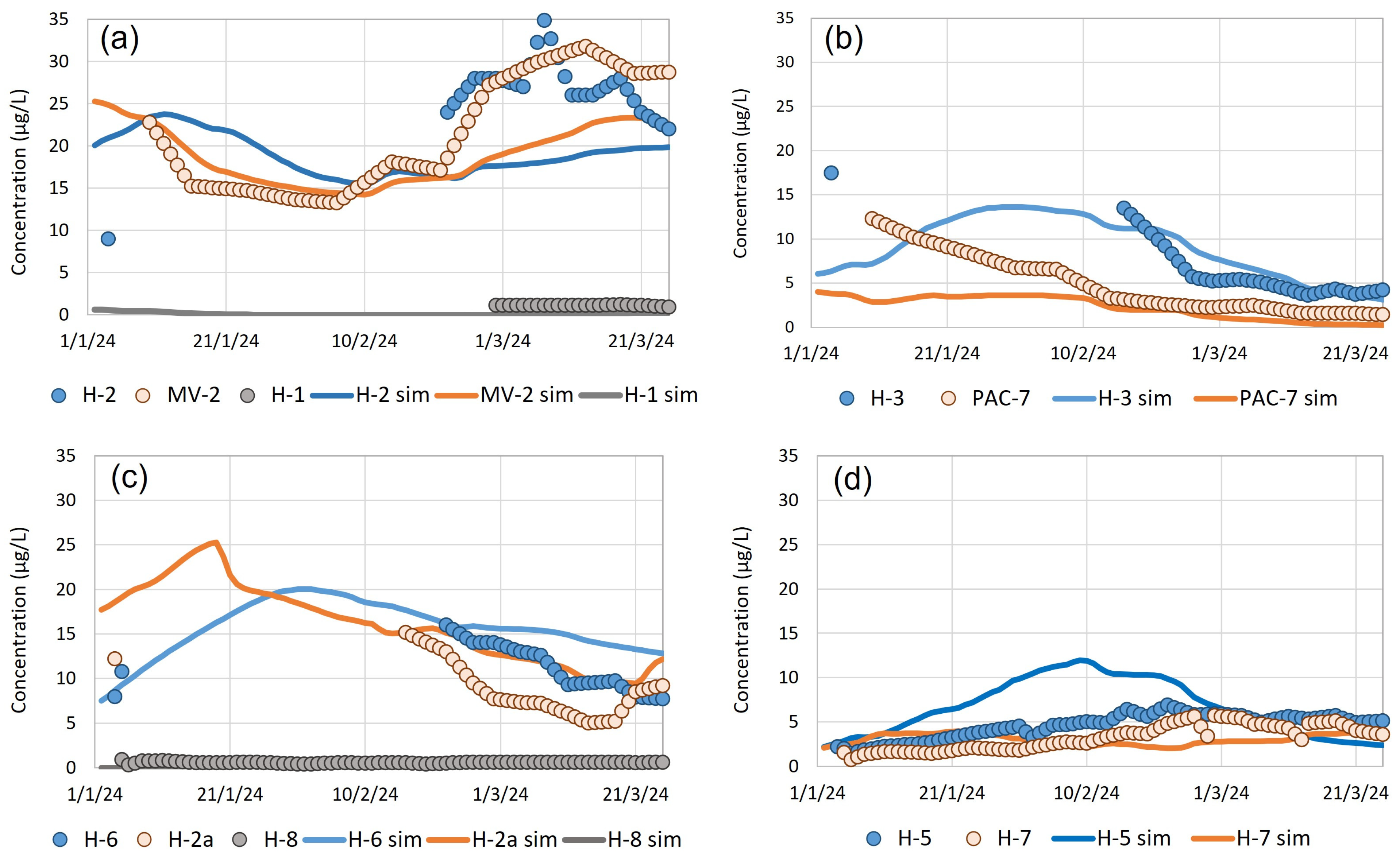
The objective function convergence criterion was met after 416 model evaluations. The estimated parameter values are shown in Table 2. The observed and simulated PCE concentrations in groundwater at the locations of the wells where sampling and measurements were conducted are presented as time series covering the period of available measurements (Figure 2).
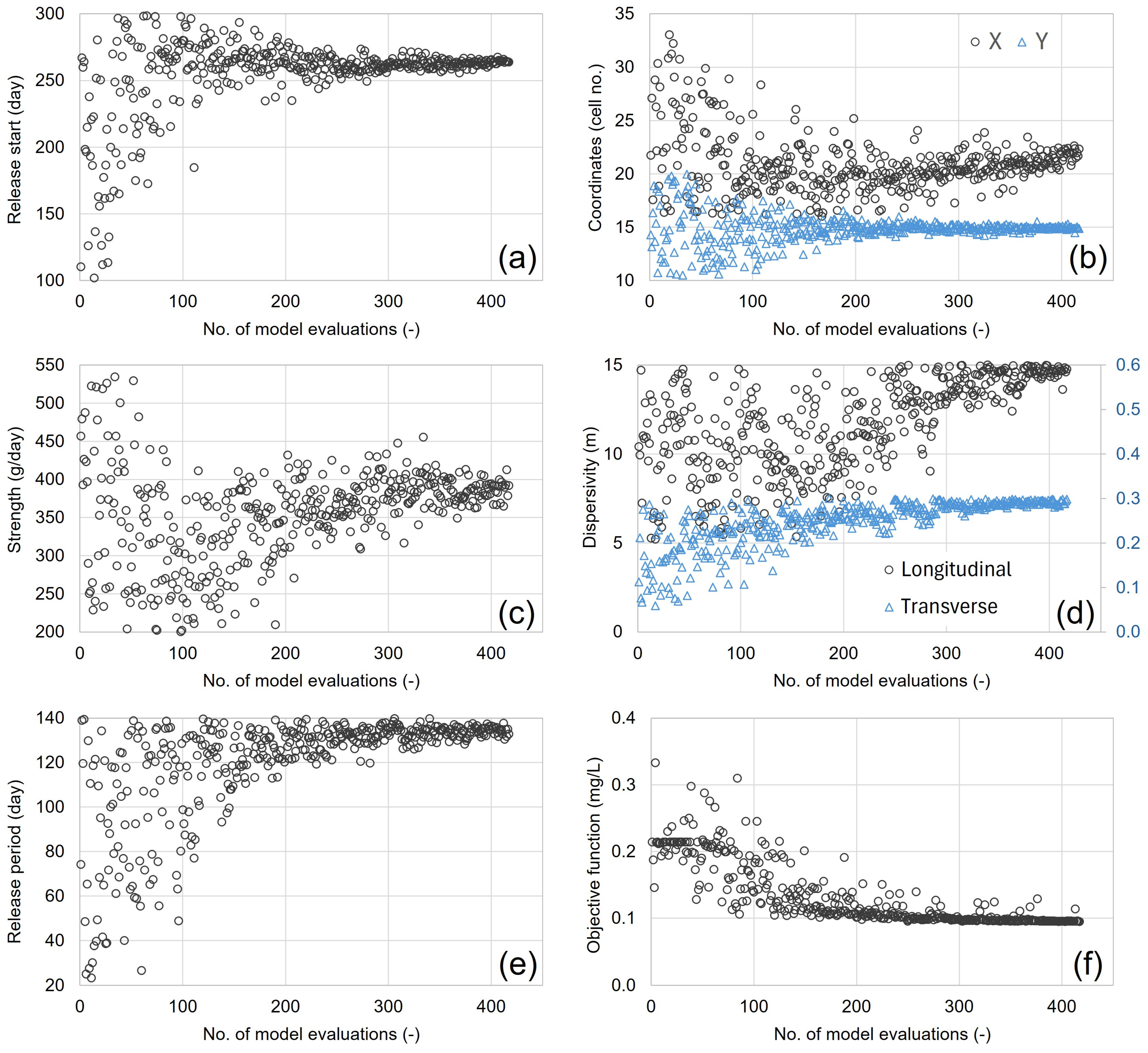
The evolution of sample points for the model parameters considered in the optimisation procedure is shown in Figure 3. The scatter plot patterns indicate that the sample points for all parameters progressively converged towards their optimal values (Figure 3a–e). Similarly, the aggregated objective function decreased and stabilised at its minimum value of 0.095 μg/L (Figure 3f), which was achieved after nine optimisation loops. In the first loop, which comprised 30 model evaluations, the lowest objective function value was 0.146 μg/L, while the highest reached 0.333 μg/L.
Figure 2. Observed and simulated PCE concentrations in groundwater at the monitored wells: (a) H-2, MV-2, H-1; (b) H-3, PAC-7; (c) H-6, H-2a, H-8; (d) H-5, H-7. Circles denote measured and solid lines simulate PCE concentrations. The locations of the wells are shown in Figure 4.
Water 17 03251 g002
Figure 3. Scatter plots showing the evolution of model parameters: (a) release start of contamination; (b) coordinates X (black circles) and Y (blue triangles) of the contaminant release; (c) source strength; (d) longitudinal (black circles) and transverse (blue triangles; scale shown on the right axis) dispersivity; (e) release period; and (f) objective function during the optimisation process.
Water 17 03251 g003
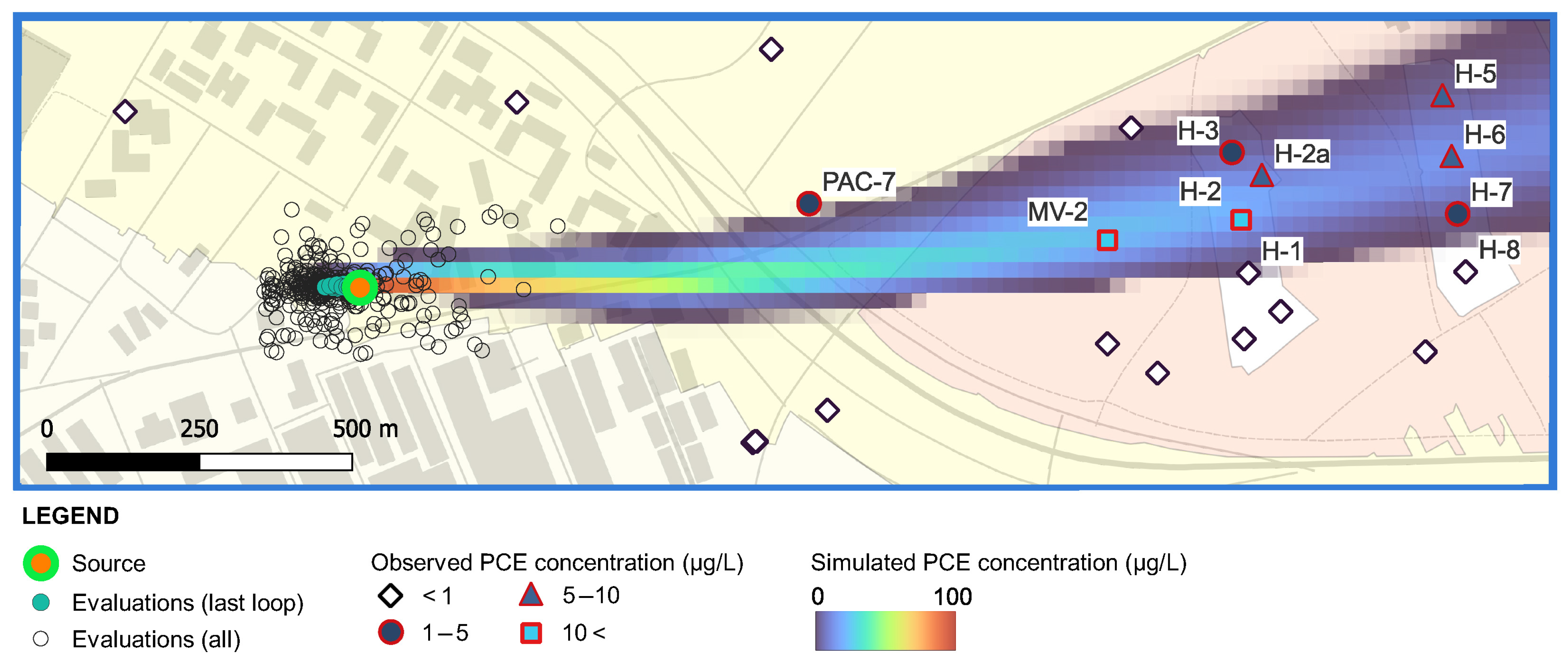
A spatial representation of simulated PCE concentration is provided in Figure 4. The population of sample points used in the evaluation of the source location during the optimisation procedure is shown. Within this set of 416 points, those from the final evaluation loop (39 iterations) and the best estimate of the source location are highlighted, illustrating the convergence of parameter values towards the optimal estimate. This model cell was identified as the subsurface contaminant source, with an estimated release rate of 392 g/day, starting on 22 September 2023. The spatial distribution of PCE concentrations in the aquifer was simulated using a constant source strength applied from this date until the end of the simulation period (25 March 2024).
Figure 4. Simulated spatial distribution of PCE contamination with the estimated source location, all evaluated locations, locations from the final evaluation loop (39 iterations), and observed PCE concentrations (25 March 2025).
Water 17 03251 g004

4. Discussion

Model parameter values estimated using the simulation–optimisation procedure form the basis for interpreting the contamination history and predicting the future evolution of the contamination. The simulated PCE concentrations in the monitored wells show relatively good agreement with the observed values. Simulated maximum concentrations in wells H-2 and MV-2 during the final simulation period are slightly lower than observed values (Figure 2a), but the overall dynamics and the relative ranking of wells by concentration are well reproduced over the period of available observations (Figure 2). The simulations also provide insights into contaminant spreading during the early part of the study period, when only limited measurements were available. However, the scarcity of data for this interval increases the uncertainty of the simulated results. Additional uncertainty in model predictions arises from the solute transport modelling, particularly due to the simplified representation of geological and aquifer heterogeneity.
The evolution of model parameters and the estimated optimal values show that for the parameters describing release start (Figure 3a), source coordinates (Figure 3b), and source strength (Figure 3c), the solutions remain within the feasible parameter range and do not converge towards their bounds. In these cases, the defined limits of the parameter space do not constrain the optimisation procedure. In contrast, the parameters representing longitudinal and transverse dispersivities (Figure 3d) and release period (Figure 3e) converge towards the upper bounds of the defined feasible parameter range.
A longer release period can be interpreted as a more sustained contaminant discharge rather than a single release event. However, considering the physicochemical properties of PCE, its relatively low aqueous solubility, high density, and strong sorption to organic matter [23], it is more likely that contamination persists because PCE becomes trapped in low-permeability zones and acts as a long-term source of dissolved-phase contamination. Once present in the aquifer, PCE dissolves slowly, and additional storage in low-permeability layers through matrix diffusion further extends plume longevity. Modelling studies have shown that even a relatively small, diffused mass in low-permeability zones can sustain elevated concentrations for decades [24]. High-resolution field investigations have also revealed strong small-scale spatial variability, with a limited fraction of the aquifer cross-section accounting for the majority of contaminant mass discharge [34].
Dispersivity is an important parameter controlling solute spreading in intergranular aquifers. Longitudinal dispersivity reflects local variations in the velocity field of a groundwater solute along the direction of fluid flow [35]. It is influenced by geological heterogeneity and generally increases with the scale of observation [36]. In modelling, dispersivity also depends on the level of detail represented in the model geometry and grid size. More heterogeneous systems and larger model domains require larger dispersivities, whereas finer representations of heterogeneity and larger grid sizes reduce dispersivity values due to numerical dispersion. Field studies provide empirical guidance suggesting that longitudinal dispersivity should be ≤1% of the travel distance and transverse-horizontal dispersivity about 1/50 of this value [37]. In the absence of site-specific measurements, this guideline was applied in the present study. However, because travel distances from the source to individual monitoring wells differ considerably, the use of a single dispersivity value introduces uncertainty.
A possible interpretation of high dispersivity values is that the contamination source is not a single point confined to one cell, but rather a more spatially distributed input to the saturated zone resulting from vertical percolation through the unsaturated zone, where contaminant pathways are redirected by low-permeability clay, silt, or conglomerate lenses.

5. Conclusions

The study provides plausible estimates of the source location and the temporal and spatial dynamics of PCE contamination discovered in the Hrastje well field and its recharge area. As a realistic case study, the results offer valuable guidance for decision makers in designing and prioritising remediation strategies. They also narrow the potential source area, enabling a more focused approach for subsequent targeted field investigations.
The simulated spatial distribution of the contaminant plume provides critical information for water managers, supporting the adaptation of pumping regimes and the planning of remediation activities to safeguard the drinking water supply. The developed model offers a practical tool for testing alternative remediation scenarios, allowing their effects to be evaluated in advance and facilitating the design of more efficient and cost-effective remediation measures. Pumping strategies aimed at controlling or diverting the plume and reducing contaminant concentrations in operating wells can be optimised. By adjusting pumping rates and configurations, groundwater flow can be redirected away from production wells or toward extraction wells for containment and treatment. Wells predicted to have elevated contaminant concentrations may be temporarily removed from the water supply system to minimise the risk of contaminant introduction into the distribution network. Optimisation should also consider pumping rates and durations, as well as energy costs and electricity price variations, to ensure both hydraulic effectiveness and economic efficiency.
The study relied on the best available data at the time of modelling. New measurements and monitoring results obtained after the completion of this work will be valuable for validating the predictions and for further constraining the parameter space, thereby enhancing confidence in contamination source characterisation and plume behaviour. The proposed methodological framework is flexible and allows straightforward integration of new data, which improves predictive reliability and supports adaptive water resource management in the Hrastje well field.

Funding

This work was supported by the Slovenian Environment Agency and the Slovenian Research and Innovation Agency through the programme Groundwaters and Geochemistry (P1-0020) and the project InnoGeoPot (N1-0347).

Data Availability Statement

The data used in this study are the property of JP VOKA SNAGA, the public water supply utility, and the Slovenian Environment Agency (ARSO), and are available upon request. The Python scripts used in this study are available at https://zenodo.org/records/17597364 (accessed on 8 November 2025).

Acknowledgments

The author gratefully acknowledges JP VOKA SNAGA–Water Supply Public Utility Company and the Slovenian Environment Agency (ARSO) for kindly providing the data used in the study.

Conflicts of Interest

The author declares no conflicts of interest.

References

  1. Gómez-Hernández, J.J.; Xu, T. Contaminant Source Identification in Aquifers: A Critical View. Math. Geosci. 2021, 54, 437–458. [Google Scholar] [CrossRef]
  2. Janža, M. A Decision Support System for Emergency Response to Groundwater Resource Pollution in an Urban Area (Ljubljana, Slovenia). Environ. Earth Sci. 2015, 73, 3763–3774. [Google Scholar] [CrossRef]
  3. Colombo, L.; Alberti, L.; Mazzon, P.; Antelmi, M. Null-Space Monte Carlo Particle Backtracking to Identify Groundwater Tetrachloroethylene Sources. Front. Environ. Sci. 2020, 8, 142. [Google Scholar] [CrossRef]
  4. Barati Moghaddam, M.; Mazaheri, M.; Mohammad Vali Samani, J. Inverse Modeling of Contaminant Transport for Pollution Source Identification in Surface and Groundwaters: A Review. Groundw. Sustain. Dev. 2021, 15, 100651. [Google Scholar] [CrossRef]
  5. Carrera, J.; Alcolea, A.; Medina, A.; Hidalgo, J.; Slooten, L.J. Inverse Problem in Hydrogeology. Hydrogeol. J. 2005, 13, 206–222. [Google Scholar] [CrossRef]
  6. Michalak, A.M.; Kitanidis, P.K. Estimation of Historical Groundwater Contaminant Distribution Using the Adjoint State Method Applied to Geostatistical Inverse Modeling. Water Resour. Res. 2004, 40, W08302. [Google Scholar] [CrossRef]
  7. Pollicino, L.C.; Colombo, L.; Alberti, L.; Masetti, M. PCE Point Source Apportionment Using a GIS-Based Statistical Technique Combined with Stochastic Modelling. Sci. Total Environ. 2021, 750, 142366. [Google Scholar] [CrossRef] [PubMed]
  8. Zhang, G.; Xu, T.; Lu, C.; Xie, Y.; Yang, J. Contaminant Source Identification in an Aquifer Using a Bayesian Framework with Arbitrary Polynomial Chaos Expansion. Stoch. Environ. Res. Risk Assess. 2024, 38, 2007–2018. [Google Scholar] [CrossRef]
  9. Wang, C.; Dou, Z.; Zhu, Y.; Yang, Z.; Zou, Z. Breaking the Mold of Simulation–Optimization: Direct Forward Machine Learning Methods for Groundwater Contaminant Source Identification. J. Hydrol. 2024, 642, 131759. [Google Scholar] [CrossRef]
  10. Ayvaz, M.T. A Linked Simulation–Optimization Model for Solving Unknown Groundwater Pollution Source Identification Problems. J. Contam. Hydrol. 2010, 117, 46–59. [Google Scholar] [CrossRef]
  11. Ghafouri, H.R.; Mosharaf-Dehkordi, M.; Afzalan, B. Identification of Immiscible NAPL Contaminant Sources in Aquifers by a Modified Two-Level Saturation-Based Imperialist Competitive Algorithm. J. Contam. Hydrol. 2017, 202, 33–46. [Google Scholar] [CrossRef]
  12. Chakraborty, A.; Prakash, O. Identification of Clandestine Groundwater Pollution Sources Using Heuristic Optimization Algorithms: A Comparison between Simulated Annealing and Particle Swarm Optimization. Environ. Monit. Assess. 2020, 192, 791. [Google Scholar] [CrossRef]
  13. Gurarslan, G.; Karahan, H. Solving Inverse Problems of Groundwater-Pollution-Source Identification Using a Differential Evolution Algorithm. Hydrogeol. J. 2015, 23, 1109–1119. [Google Scholar] [CrossRef]
  14. Habiyakare, T.; Zhang, N.; Feng, C.-H.; Ndayisenga, F.; Kayiranga, A.; Sindikubwabo, C.; Muhirwa, F.; Shah, S. Implementation of Genetic Algorithm for the Identification of DNAPL Sources. Groundw. Sustain. Dev. 2022, 16, 100707. [Google Scholar] [CrossRef]
  15. Duan, Q.; Sorooshian, S.; Gupta, V. Effective and Efficient Global Optimization for Conceptual Rainfall–Runoff Models. Water Resour. Res. 1992, 28, 1015–1031. [Google Scholar] [CrossRef]
  16. Duan, Q.Y.; Gupta, V.K.; Sorooshian, S. Shuffled Complex Evolution Approach for Effective and Efficient Global Minimization. J. Optim. Theory Appl. 1993, 76, 501–521. [Google Scholar] [CrossRef]
  17. Rahnamay Naeini, M.; Analui, B.; Gupta, H.V.; Duan, Q.; Sorooshian, S. Three Decades of the Shuffled Complex Evolution (SCE-UA) Optimization Algorithm: Review and Applications. Sci. Iran. 2019, 26, 2015–2031. [Google Scholar] [CrossRef]
  18. Huang, L.; Wang, L.; Zhang, Y.; Xing, L.; Hao, Q.; Xiao, Y.; Yang, L.; Zhu, H. Identification of Groundwater Pollution Sources by a SCE-UA Algorithm-Based Simulation/Optimization Model. Water 2018, 10, 193. [Google Scholar] [CrossRef]
  19. Janža, M. Optimization of Well Field Management to Mitigate Groundwater Contamination Using a Simulation Model and Evolutionary Algorithm. Sci. Total Environ. 2022, 807, 150811. [Google Scholar] [CrossRef]
  20. DHI. Auto Calibration Tool: User Guide; DHI: Hørsholm, Denmark, 2010. [Google Scholar]
  21. Pollicino, L.C.; Masetti, M.; Stevenazzi, S.; Colombo, L.; Alberti, L. Spatial Statistical Assessment of Groundwater PCE (Tetrachloroethylene) Diffuse Contamination in Urban Areas. Water 2019, 11, 1211. [Google Scholar] [CrossRef]
  22. Svetina, J.; Prestor, J.; Jamnik, B.; Auersperger, P.; Brenčič, M. Contaminant Trends in Urban Groundwater: Case Study from Ljubljana (Central Slovenia). Water 2024, 16, 890. [Google Scholar] [CrossRef]
  23. Feo, A.; Pinardi, R.; Artoni, A.; Celico, F. Estimation of Free-Product PCE Distribution in Thick Multilayered Aquifers as Possible Long-Term Pollution Sources for Shallow and Deep Groundwaters Using High-Precision Numerical Simulations. Water 2024, 16, 3053. [Google Scholar] [CrossRef]
  24. Seyedabbasi, M.A.; Newell, C.J.; Adamson, D.T.; Sale, T.C. Relative Contribution of DNAPL Dissolution and Matrix Diffusion to the Long-Term Persistence of Chlorinated Solvent Source Zones. J. Contam. Hydrol. 2012, 134–135, 69–81. [Google Scholar] [CrossRef] [PubMed]
  25. Ni, Z.; Smit, M.; Grotenhuis, T.; van Gaans, P.; Rijnaarts, H. Effectiveness of Stimulating PCE Reductive Dechlorination: A Stepwise Approach. J. Contam. Hydrol. 2014, 164, 209–218. [Google Scholar] [CrossRef]
  26. Official Gazette of the Republic of Slovenia (OGRS). Uredba o Pitni Vodi (Drinking Water Regulation). No. 61/23. Available online: https://pisrs.si/pregledPredpisa?id=URED8706 (accessed on 3 November 2025).
  27. Žlebnik, L. Pleistocen Kranjskega, Sorškega in Ljubljanskega polja (Pleistocene Deposits of the Kranj, Sora and Ljubljana Fields). Geologija 1971, 14, 5–51. [Google Scholar]
  28. Janža, M.; Lapanje, A.; Šram, D.; Rajver, D.; Novak, M. Research of Geological and Geothermal Conditions for Assessing the Shallow Geothermal Potential in the Area of Ljubljana, Slovenia. Geologija 2017, 60, 309–327. [Google Scholar] [CrossRef]
  29. Janža, M.; Prestor, J.; Pestotnik, S.; Jamnik, B. Nitrogen Mass Balance and Pressure Impact Model Applied to an Urban Aquifer. Water 2020, 12, 1171. [Google Scholar] [CrossRef]
  30. Janža, M.; Prestor, J.; Urbanc, J.; Jamnik, B. TCE Contamination Plume Spreading in a Highly Productive Aquifer of Ljubljansko Polje. In Proceedings of the EGU General Assembly; EGU: Vienna, Austria, 2005. [Google Scholar]
  31. Brenčič, M.; Prestor, J.; Kompare, B.; Matoz, H.; Kranjc, S. Integrated approach to delineation of drinking waterprotection zones. Geologija 2009, 52, 175–182. [Google Scholar] [CrossRef]
  32. Official Gazette of the Republic of Slovenia (OGRS). Uredba O Vodovarstvenem Območju ZA Vodno Telo Vodonosnika Ljubljanskega Polja (Decree on the Water Protection Area for the Water Body of the Ljubljansko Polje Aquifer). No. 43/15, 181/21, 60/22, 35/23. Available online: https://pisrs.si/pregledPredpisa?id=URED7006 (accessed on 3 November 2025).
  33. DHI. MIKE SHE: Integrated Catchment Modelling. Available online: https://www.dhigroup.com/technologies/mikepoweredbydhi/mike-she (accessed on 7 October 2025).
  34. Guilbeault, M.A.; Parker, B.L.; Cherry, J.A. Mass and Flux Distributions from DNAPL Zones in Sandy Aquifers. Ground Water 2005, 43, 70–86. [Google Scholar] [CrossRef]
  35. Schulze-Makuch, D. Longitudinal Dispersivity Data and Implications for Scaling Behavior. Ground Water 2005, 43, 443–456. [Google Scholar] [CrossRef]
  36. Neuman, S.P.; Di Federico, V. Multifaceted Nature of Hydrogeologic Scaling and Its Interpretation. Rev. Geophys. 2003, 41, 1003. [Google Scholar] [CrossRef]
  37. DHI. MIKE SHE User Manual, Volume 2: Reference Guide; DHI: Hørsholm, Denmark, 2011. [Google Scholar]
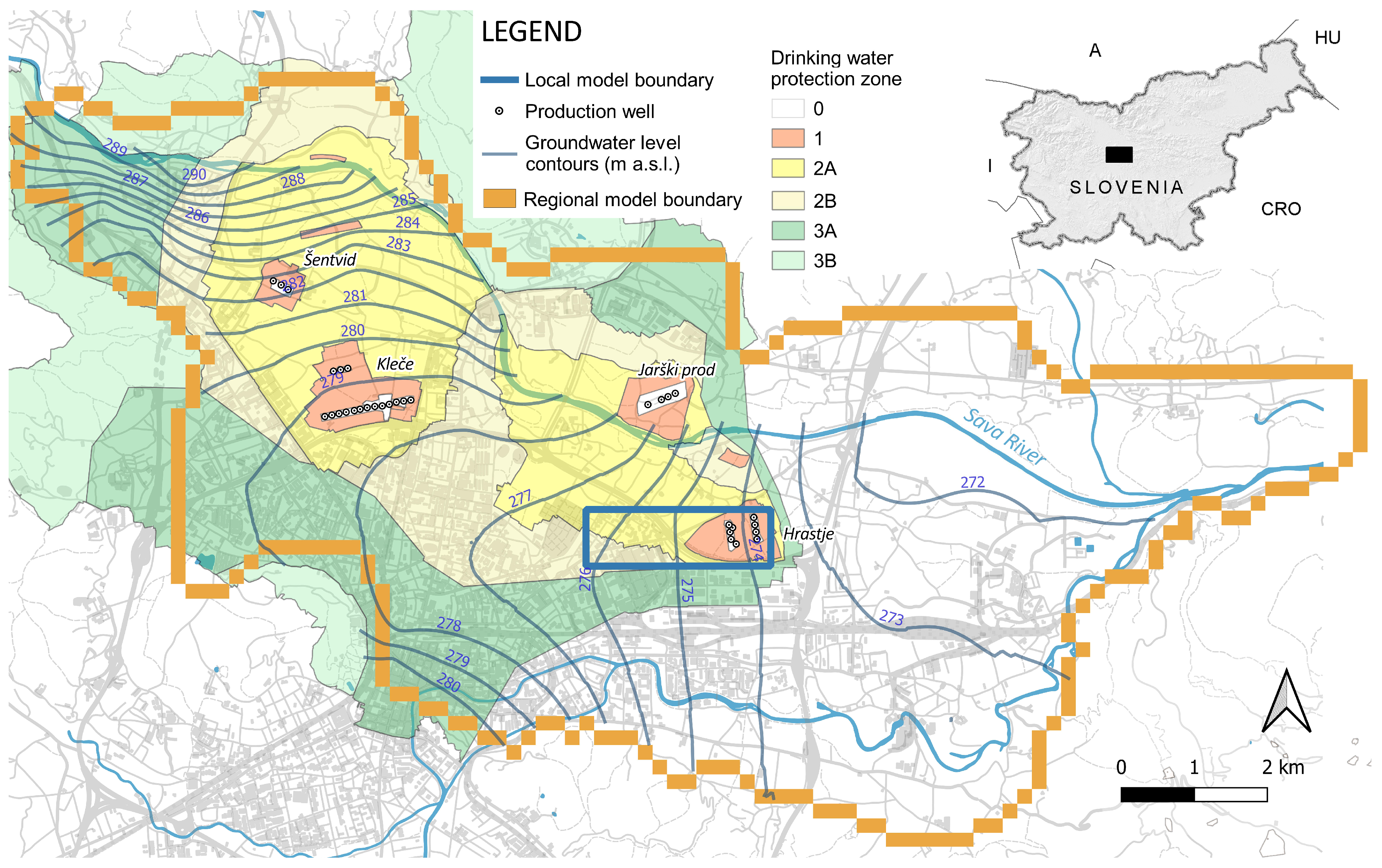
Figure 1. Area of the Ljubljana polje aquifer with groundwater level contours, regional and local model boundaries, well fields, and their protection zones.
Water 17 03251 g001
Table 1. Model parameters, their initial values, and lower and upper bounds used in the optimisation.
Model ParameterInitial ValueLower BoundUpper Bound
Release start (day) *200100300
Strength (g/day)400200550
Release period (day)10020140
X **261636
Y **151020
Longitudinal dispersivity (m)10515
Transverse dispersivity (m)0.10.010.3
* Time (in days) between the start of the simulation (1 January 2023) and the start of contaminant release into the saturated zone. ** Cell number in the model domain along the X and Y directions.
Table 2. Estimated optimal parameter values.
Model ParameterOptimised Value
Release start (day)264
Strength (g/day)392
Release period (day)133
X22
Y15
Longitudinal dispersivity (m)14.80
Transverse dispersivity (m)0.30
Disclaimer/Publisher’s Note: The statements, opinions and data contained in all publications are solely those of the individual author(s) and contributor(s) and not of MDPI and/or the editor(s). MDPI and/or the editor(s) disclaim responsibility for any injury to people or property resulting from any ideas, methods, instructions or products referred to in the content.