Article

Effects of Severe Hydro-Meteorological Events on the Functioning of Mountain Environments in the Ochotnica Catchment (Outer Carpathians, Poland) and Recommendations for Adaptation Strategies


1
Institute of Biology and Earth Sciences, University of the National Education Commission, Podchorążych 2, 30-082 Krakow, Poland
2
Institute of Nature Conservation, Polish Academy of Sciences, Adama Mickiewicza Ave 33, 31-120 Krakow, Poland
3
Faculty of Mathematical and Natural Sciences, University of Applied Sciences in Tarnow, Mickiewicza Str. 8, 33-100 Tarnow, Poland
4
Independent Researcher, 30-387 Krakow, Poland
5
Institute of Geography and Spatial Planning, Polish Academy of Sciences, św. Jana 22, 31-120 Krakow, Poland
6
Institute of Law and Administration, University of the National Education Commission, Podchorążych 2, 30-082 Krakow, Poland
*
Author to whom correspondence should be addressed.
Water 2025, 17(22), 3244; https://doi.org/10.3390/w17223244
Submission received: 2 October 2025 / Revised: 6 November 2025 / Accepted: 10 November 2025 / Published: 13 November 2025
(This article belongs to the Special Issue Spatial Analysis of Flooding Phenomena: Challenges and Case Studies)

Abstract

Mountain regions are highly susceptible to severe hydro-meteorological events. These events induce substantial morphological changes that are preserved in the environment and cause significant economic losses, representing a major challenge for water resource management. Due to their abrupt nature, mitigating the impacts of such events requires preventive measures. The goal of the study was to comprehensively evaluate the impact of severe hydro-meteorological events on the mountain environment of the Ochotnica catchment, considering both environmental and economic aspects, over several years. This multi-year perspective also provided the opportunity to formulate some recommendations for the development of adaptation strategies for extreme hydro-meteorological events in mountain areas. The study demonstrates that delineation of the Maximum Probable Flood (MPF) hazard zone is a key element in building resilience to such events in mountain areas. Information related to the extent and depth of this zone, together with flow velocity, are critical components which may support actions aimed at reducing flood exposure and vulnerability, limiting the negative consequences of extreme hydro-meteorological events in mountain catchments prone to flash floods.

1. Introduction

Water shortages and excesses are highly unfavorable and undesirable conditions for humans, as they lead to economic destabilization and environmental degradation [1]. Water excesses resulting from extreme hydro-meteorological events are considered one of the most serious challenges for water management [2,3]. This is particularly evident in mountain areas, where water excesses resulting from extreme hydro-meteorological events can cause flash floods [4,5,6,7,8]. Flash floods are one of the most destructive disasters in terms of number of people affected and economic losses [2,5]. Furthermore, these events are expected to be more frequent due to climate change [9,10,11]. This fact, in association with the growing pressure on the environment, makes the consequences of these events more severe [3,7,8]. The flash flood in October 2024 in the Walencja region (Spain) where more than 200 people lost their lives is one example [12]. Thus, knowledge about the driving factors and processes influencing the hydrological response of a catchment, as well as the environmental and economic consequences, are crucial for limiting the negative effects of flash floods.
Flash floods have attracted the attention of the scientific community for many years. Many studies have documented individual flood events. In the authors’ opinion, such works are particularly valuable as they often include a comprehensive analysis of flood events, covering the meteorological conditions, catchment response, and environmental as well as economic consequences (e.g., [4,5,6,7,8,10]). These works are also important for meta-analyses, which provide valuable information related to the regional diversity of flash floods and a foundation for more comprehensive regional studies [9,10,11]. For example, hydro-meteorological events are known to be more severe in the southern and western parts of Europe, where rainfall can last up to several hours, with totals reaching several hundred millimeters, generating floods that affect catchments up to several hundred square kilometers in area ([9,11]—review). In contrast, in inland continental parts of Europe, typical flash floods result from locally restricted heavy rainstorm zones, usually covering less than 100 km2 and most frequently around 25 km2 [11], with precipitation rarely exceeding 100 mm within three hours. Floods generated by this type of precipitation usually affect catchments smaller than 50 km2 [7,13].
Regardless of the region, flash floods result from the quick response of a catchment to heavy rainfall, which is characterized by a short lag time and time to peak, steep rising and recession limbs, and a high peak flow sometimes exceeding the flow expected over one thousand years [7,8]. It is not surprising that flash floods have a strong impact on natural environments and human-related infrastructure, causing significant relief transformation and huge amounts of damage [2,4,5,6,7,8,10]. How to deal with flash floods still remains an open area of scientific research. The literature indicates that the general aspects related to flood management have been extensively discussed and the overall principles related to floods are well established [14,15,16,17,18]. Nevertheless, in the authors’ opinion, certain gaps remain in our understanding of flash floods, especially some aspects related to flood hazard assessment, a critical element in flash flood management. Therefore, these aspects warrant further scientific attention in order to develop effective mitigation measures and to enhance adaptation strategies for flash flood events.
On 18 July 2018, an extraordinary rainstorm occurred over the eastern part of the Gorce (Outer Carpathian, Poland—see Figure 1a for map). The rainfall generated intense overland flow on the hillslopes and flash floods in the Ochotnica catchment, particularly in the central parts of the sub-catchments situated in the Gorc Massif [8]. Taking into account the hydrological response, this flood was one of the most severe events in the Polish Carpathians and resulted in significant environmental changes and economic losses. Viewing this event from a multi-year perspective could allow us to recognize the impact of severe hydro-meteorological events on mountain environments, allowing for the diagnosis of key elements related to flash flood management and supporting the formulation of recommendations for adaptation strategies for extreme hydro-meteorological events. In this context, the specific goals of this study were as follows: (i) to present the hydro-meteorological background of the 2018 flood as a basis for evaluating the mid-term impacts of severe hydro-meteorological events on the functioning of mountain environments, taking into account both environmental and economic aspects; (ii) to discuss the key elements related to flash flood management; and (iii) to formulate recommendations for adaptation strategies for flash floods in mountain areas. In this way, the results of this work could have practical implications for the management of mountain catchments where flash flood events are considered the most hazardous natural phenomena. The approach proposed in this study is more advantageous than those used in previous research in this area [4,5,6,7,8] because it investigates severe events over several years and therefore allowed us to capture the elements with the greatest impact on the mid-term functioning of mountain areas affected by this type of hydro-meteorological event.

2. Materials and Methods

2.1. Meteorological Settings

The meteorological conditions were characterized using a synoptic map produced by the Institute of Meteorology and Water Management of the National Research Institute (IMGW-PIB i in polish) and the daily commentary on the synoptic situation [19]. The extent of the precipitation zone and rainfall parameters were reconstructed based on Surface Rainfall Intensity (SRI) radar data with a 10-min temporal resolution (Brzuchania radar station, located ~89 km north of the catchment) and telemetry-type rainfall stations situated near the heavy rainfall area (Figure 2).

2.2. Hydrological Response

The largest flood occurred in the sub-catchments located in the northern part of the Ochotnica river catchment. These sub-catchments are not hydrologically controlled; therefore, post-flood investigations were conducted to collect hydrological data. The investigations followed the flash flood post-event field investigation guidelines proposed by Gaume and Borga [20] and Lumbroso and Gaume [21]. A field campaign was carried out one day after the flood event, during which, the highest flood-water stages were marked at cross-sections closing the sub-catchments (see Figure 3 for map). This allowed for the use of the slope–area method for maximum flow calculations (Qmax, m3·s−1). Geodetic measurements of the cross-sections and the slope of the highest flood-water stage were performed one week later. The cross-sections were measured with reference to flood-water marks that reflected the highest flow recorded during the flood event. The energy slope of the flood water was also determined based on these marks; the measurement points were situated from several to several tens of meters upstream and downstream from a given cross-section (the distance between the points was at least 5 times the flood water width at a given cross-section). Flow velocity was calculated using Manning’s equation for open-channel flow, with the roughness coefficient estimated based on field observations and standard tables published in Chow [22] considering the mountain channel bed and banks (D1b1—0.05; D1b2—0.07) and vegetation on the valley floor (D2c3—0.06). For the strict concrete channel B2c2—0.015. Flow velocity estimates were cross-checked against the values reported by Marchi et al. [10] and Lumbroso and Gaume [21] for flash floods in Europe. The Ochotnica catchment (106 km2) is hydrologically monitored by the Tylmanowa river gauge station at the catchment outlet; however, the station was destroyed during the flood, and flow data for the peak event were unavailable. Flood peaks calculated from the cross-sections were compared to p-probable floods to evaluate the flood magnitude. The p-probable floods were estimated using the Rainfall Formula, a regional equation applied in Poland for catchments up to 50 km2 [23]. The flood magnitudes recorded in the Ochotnica sub-catchments were compared to those of other local flash floods in the Carpathians using the K index, which was calculated as follows:
K = 10 − [1 − (LogQmax−6)/(LogA−8)]
where Qmax is the flood peak (m3·s−1) and A is the catchment area (km2) [24]. The K index, also known as the Françou–Rodier index, is a non-dimensional measure that allows for comparisons of flood magnitudes between catchments of different sizes. Higher K values indicate more severe flood events. A second measure that was used for flood magnitude comparison was the unit flood peak (qmax, m3·s−1·km−2).

2.3. Environmental and Economic Consequences

The environmental (mainly geomorphological) and economic consequences of the flood were evaluated using materials collected during a field campaign conducted immediately after the event by the authors and the Commission for Flood Damage Inventory (CFDI) that was appointed by the local government. The Commission documented infrastructure damage for the following infrastructure categories: roads, bridges, culverts, sewerage networks, and public facilities (e.g., sports and cultural infrastructure). For each category, the inventory included (i) a detailed description of the damage and (ii) spatial references linked to land parcel numbers. Flood losses were also estimated (originally in PLN, converted to EUR for this article). These data provided the basis for developing vector layers that enabled spatial analyses of the flood damage and losses in relation to geomorphological changes in slopes, channels, and valley bottoms, and their links to factors driving flood wave formation (e.g., rainfall characteristics, geological settings, relief, land use/land cover, and infrastructure distribution).

2.4. Record of Severe Hydro-Meteorological Events in Mountain Environment

In order to evaluate the mid-term impact of a severe hydro-meteorological event on a mountain environment, a field campaign was conducted seven years after the flood event. The field investigations focused on the parts of the catchment where post-flood surveys in 2018 had revealed different types of geomorphological changes and flood-related damage. The comparison between the two periods (2018 vs. 2025) made it possible to assess the resilience of the mountain catchment to severe hydro-meteorological events, taking into account both environmental and economic aspects. The data collected immediately after the flood and seven years later formed the basis for a discussion on flash flood risk management in mountain catchments, as well as for proposals aimed at support developing adaptation strategies for severe hydro-meteorological events.

3. The Study Area

The study area is located in the Gorce Mountains, part of the Beskidy range in the Polish Carpathians (Figure 1a). The Ochotnica catchment covers 105.7 km2. The bedrock is composed of flysch sandstones and shales of the Magura Nappe [25], which is overlaid with a 0.5–2.0 m thick mantle rich in clay fraction minerals (>25%). The hillslopes have predominantly Dystric Cambisol and Ranker mantles, whereas Eutric Fluvisols occur in the valley bottoms. The catchment is characterized by steep relief, with elevations ranging from 380 to 1282 m a.s.l. and mean slope gradients of 21° (16–25°). The valley floor is typically 80–250 m wide, locally widening to 400 m (Figure 1b). The river channel has incised several meters into alluvial deposits dominated by cobbles and gravels, forming a sequence of terraces. The lateral valleys are deeply entrenched and V-shaped, with the valley floors generally <100 m wide. The river network density reaches 3.06 km·km−2. Forest cover dominates the catchment (58%), followed by arable land (29%) and grassland (12%). Settlements account for ~1% of the area, concentrated mainly on the valley floor. Numerous farmsteads are scattered on lower hillslopes (Figure 1b), which has contributed to the development of a dense road network (2.8 km·km−2) that is comparable in density to the river system.

4. Results

4.1. Meteorological Settings of a Rainstorm

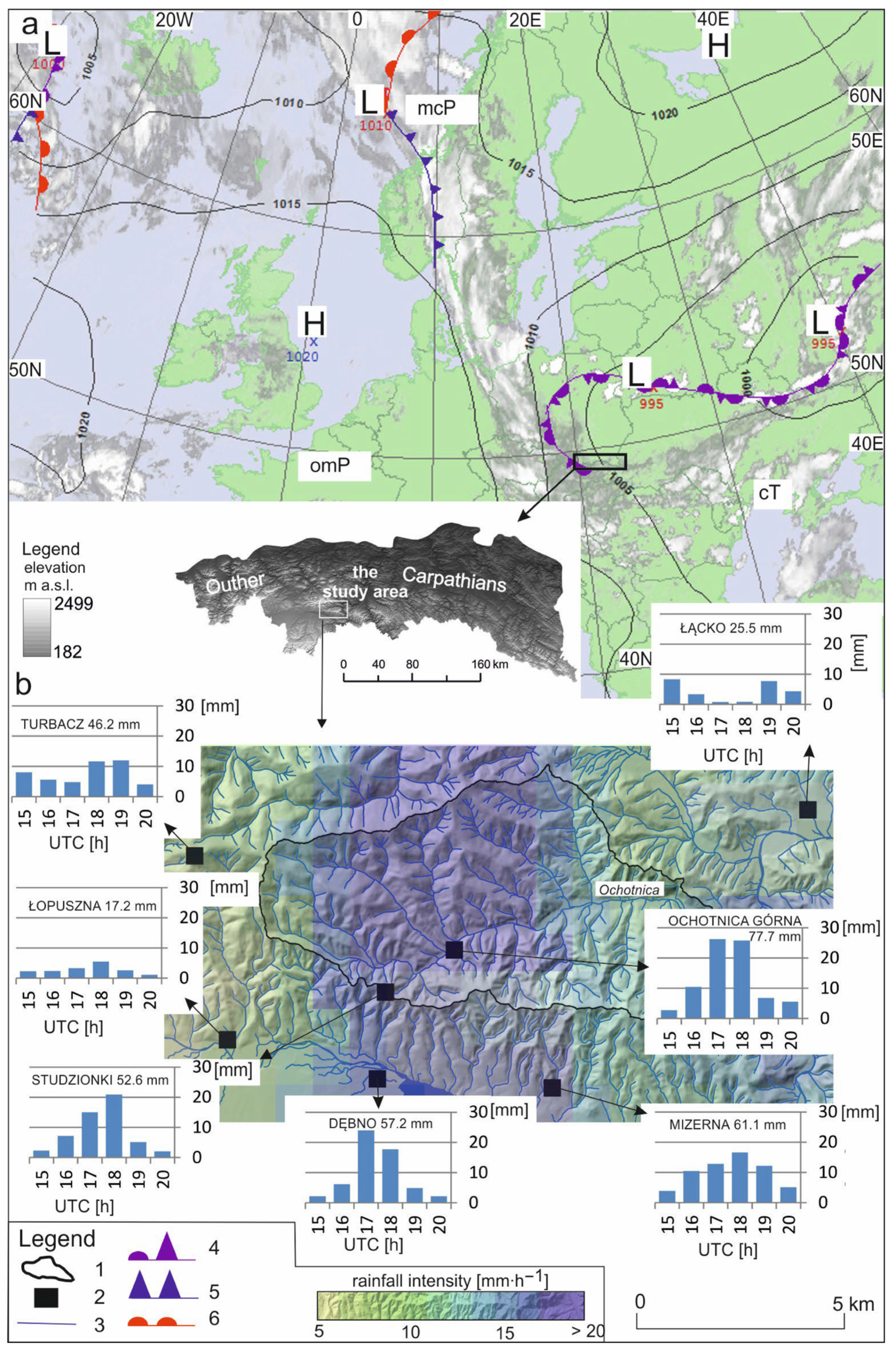
On 18 July, a trough of low pressure between anticyclones developed over northern Russia and Great Britain, with a cold front in the north and an occluded front in the south spreading over Central Europe (Figure 2a). Eastern Poland was dominated by warm, humid subtropical air, while western Poland experienced cold, maritime air. Rapid warming (up to 30 °C) in the trough over the southeastern Carpathians, coupled with intense convection in the occluded front zone, triggered thunderstorms with heavy rainfall.
Daily rainfall at the Ochotnica Górna gauge, located near the core of the heavy rainfall zone, reached 101.1 mm. The rainfall between 15:00 and 20:00 UTC (local time: UTC +2 h) that generated the flood was highly variable: gauges west and north of the catchment (Łącko, Turbacz, and Łopuszna) recorded 25.2, 46.2, and 17.2 mm, respectively; gauges south of the catchment (Dębno and Mizerna) recorded 57.2 and 61.1 mm. Within the catchment, the Studzionki and Ochotnica Górna gauges recorded 52.6 and 77.7 mm, respectively. The mean rainfall intensity at Ochotnica Górna was 2.8, 10.5, 26.2, 25.8, 6.8, and 5.6 mm·h−1. According to Surface Rainfall Intensity radar data, the most intense rainfall occurred in the upper parts of the Jamne (no. 4), Gorcowe (no. 9), and Młynne (no. 10) catchments (Figure 1a and Figure 2b).

4.2. Hydrological Response of a Catchment

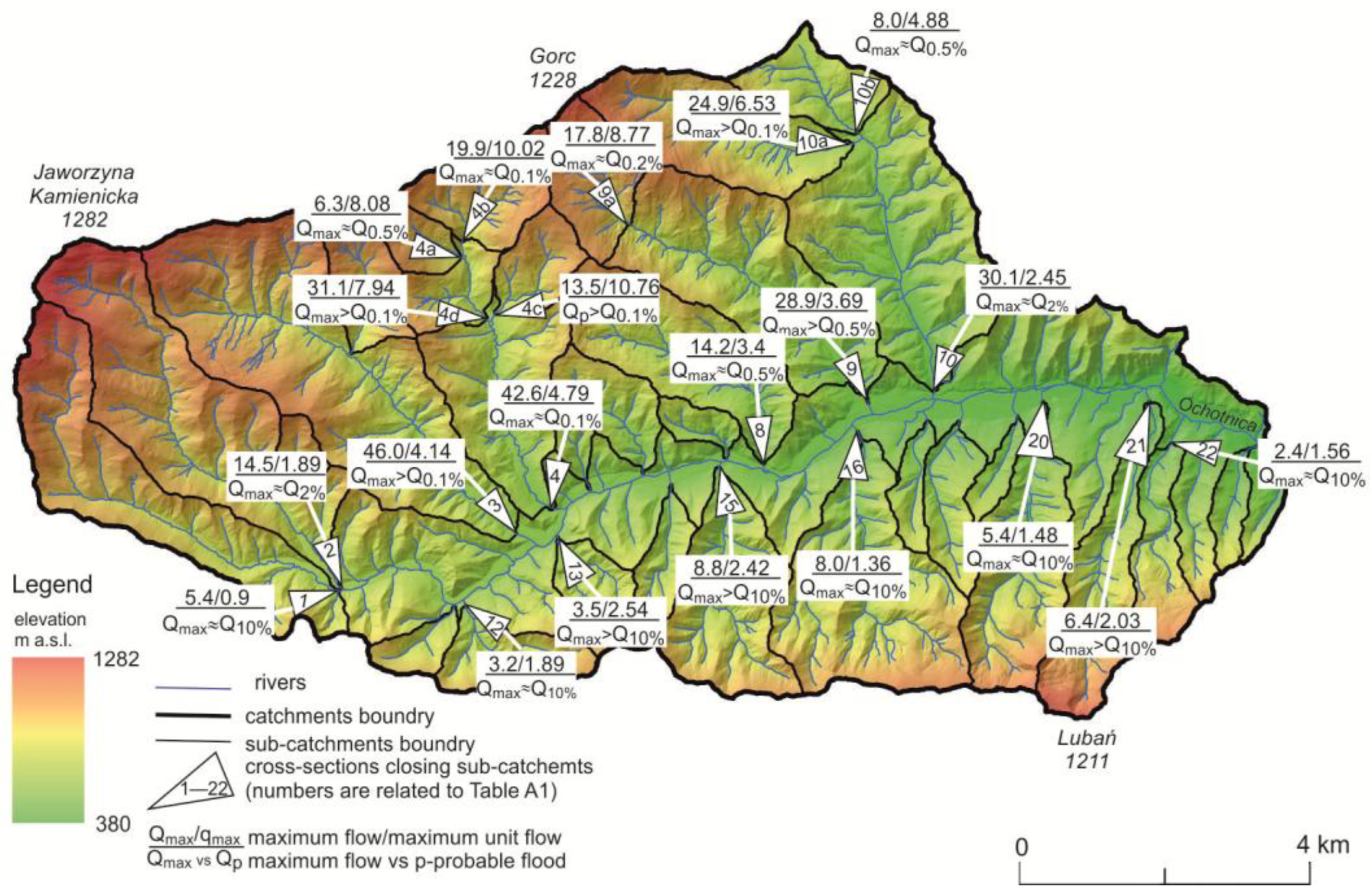
The flood peak and unit flood peak calculated after the event are presented in Figure 3 and Table A1 (Appendix A).
Flow velocities, calculated using Manning’s equation, ranged from 1.5 to 4.6 m·s−1, which is comparable to the velocities reported for other European flash floods [10,21]. The largest flash flood occurred in the sub-catchments draining the highest parts of the Gorc massif (Figure 3). In the upper part of the Jamne and Gorcowe catchments (sub-catchments 4a–4d, 9a in Figure 3) located within the center of the heavy rainfall zone, the maximum flows ranged from 6.3 to 31.1 m3·s−1, and the unit maximum flows ranged from 7.94 to 10.76 m3·s−1·km−2. High maximum flows and unit flows were recorded in the headwater areas of the Gorcowe (no. 9a in Figure 3; 17.8 m3·s−1–8.77 m3·s−1·km−2) and Młynne (no. 10a; 24.9 m3·s−1–6.53 m3·s−1·km−2) sub-catchments. The observed maximum flows correspond to 0.5–0.1% probable floods. Floods in the sub-catchments draining the southern part of the Ochotnica catchment (Lubań Range; Figure 3) had lower magnitudes. The maximum flows were generally below 10 m3·s−1 and the unit maximum flows were below 2.5 m3·s−1·km−2. These maximum flows corresponded to or slightly exceeded those of a 10% p-probable flood.

4.3. Environmental and Economic Consequences

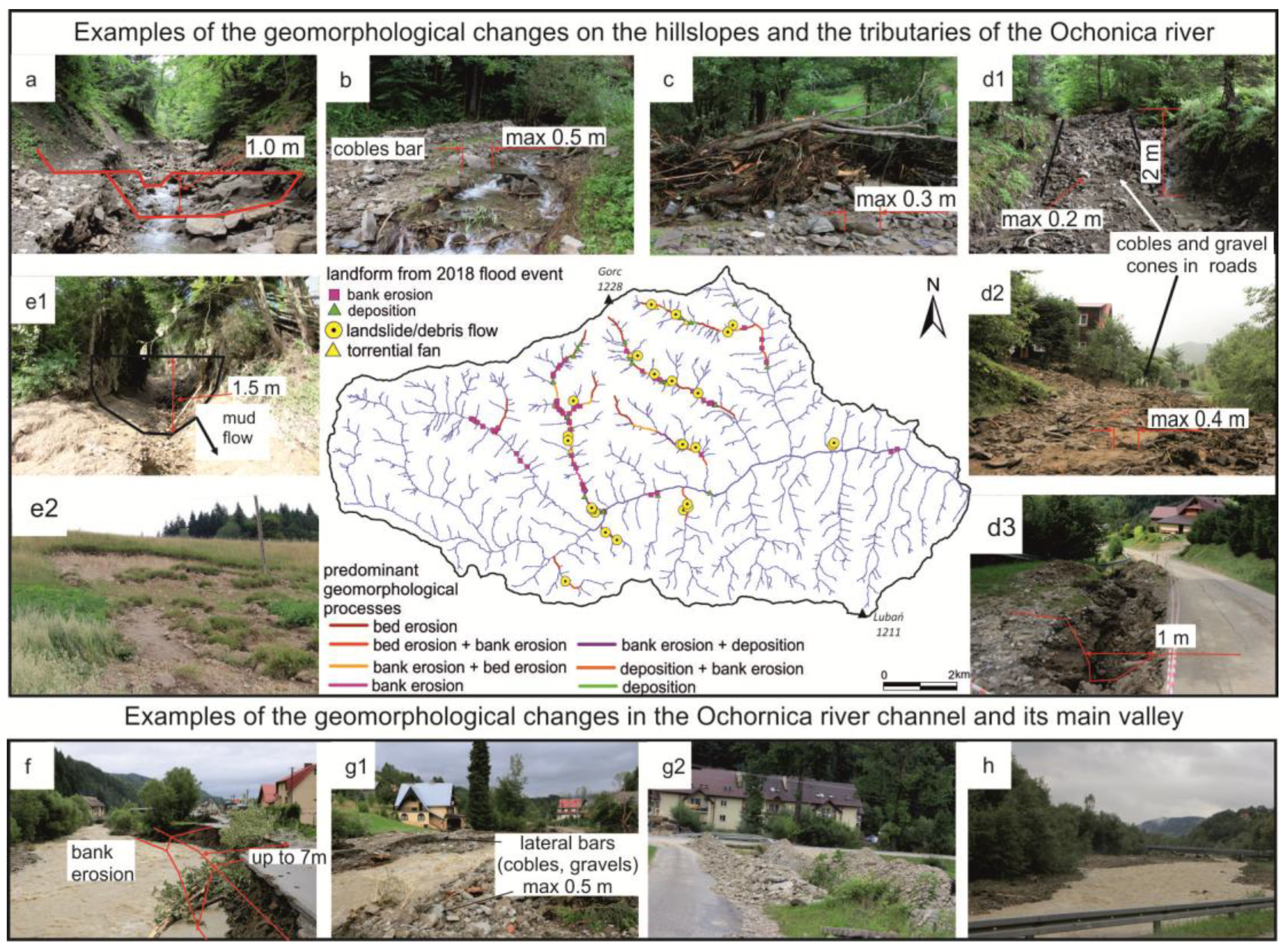
The environmental consequences of the studied hydro-meteorological event were primarily reflected in geomorphological changes on the slopes and channels of the sub-catchments and the main valley of the Ochotnica River. Figure 4 presents examples of morphological forms resulting from intense surface water flow.
The most significant morphological changes were caused by concentrated flows in both natural and human-related forms, such as lateral valleys (Figure 4a–c) and roads (Figure 4d1–d3). Post-flood investigations revealed that most of the valleys located in the heavy rainstorm zone were rejuvenated and the bed erosion incised the bedrocks up to 1 m (Figure 4a). The eroded material was transported and deposited in gentler parts of the lateral valleys, forming bars (Figure 4b). The deposited material was heterogeneous, typically composed of gravels (up to 20 mm in diameter) mixed with boulders (up to 500 mm) and silty-clay sediments. Due to the catchments being predominantly covered with forests, the upper parts of the mineral bars were often covered with organic material composed of tree logs and branches (Figure 4c).
The road network on the hillslopes was modified in a similar manner to the upper parts of natural valleys (Figure 4d1–d3). Intense erosion on slopes in the headwater sections of the lateral valleys led to the formation of debris flows in several valleys (see example in Figure 4e1). Mudflow cones typically extended onto the upper terraces of the main valley. Heavy precipitation saturated the soil mantle, triggering numerous shallow landslides (Figure 4e2), which altered the slope morphology and contributed material to the debris flows (Figure 4e1).
The Ochotnica River channel was also modified by the flood wave. Lateral erosion cut the banks at several locations in the upper part of the catchment (Figure 4f), and the eroded material was transported and deposited as lateral bars composed of gravels mixed with cobbles (Figure 4g1), with a maximum diameter of approximately 0.5 m. Natural and artificial channels in the lateral valleys on the terraced river floor were filled with similar sediments (Figure 4g2). The lower part of the river channel was moderately transformed by the flood wave (Figure 4h).
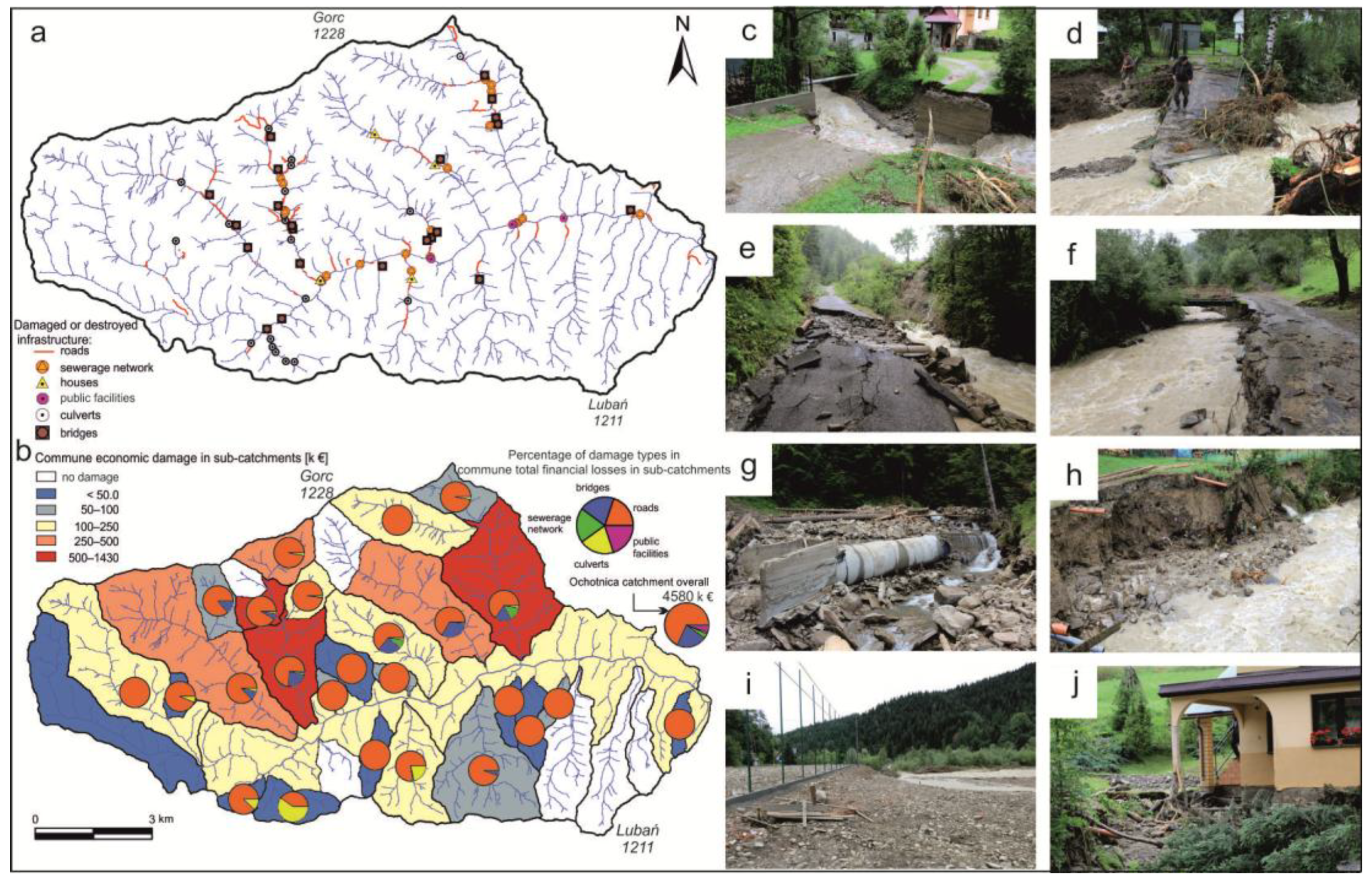
The July 2018 flood caused substantial economic damage in the Ochotnica catchment. The losses were estimated by the Ochotnica Dolna commune to be approximately EUR 4.6 million, making it the most costly flood event in the 21st-century history of the commune. Flood damage was estimated at ~40% of the Ochotnica Górna district’s annual income. The spatial distribution of the flood damage is presented in Figure 5a,b, with sites c–j providing representative examples. The middle and lower parts of the lateral valleys, where the flood wave inundated the entire valley floor, were the most severely transformed. Lateral erosion of river banks caused damage to roads and bridges (Figure 5c–g), residential infrastructure (Figure 5j), and the sewerage system (Figure 5h). These four types of damage constituted the majority of the flood losses (Figure 5b). On the main valley floor, the flood damage was primarily caused by the overflow of infrastructure located on the terraces (Figure 5i).

4.4. Record of Severe Hydro-Meteorological Event in Mountain Environment

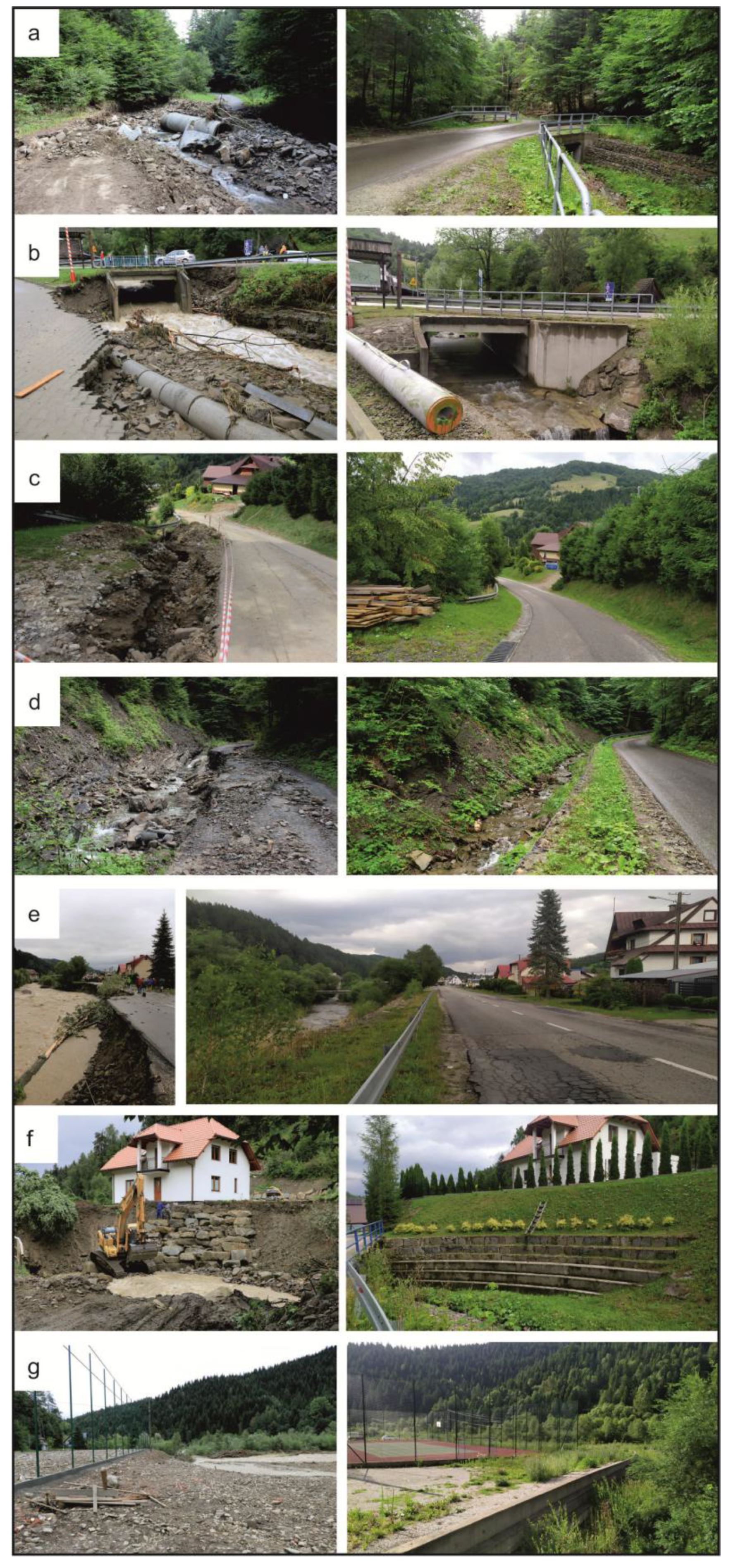
Field investigations conducted seven years after the flood event allowed for the assessment of the mid-term impacts of this severe hydro-meteorological event on the mountain environment. Representative examples are presented in Figure 6 and Figure 7.
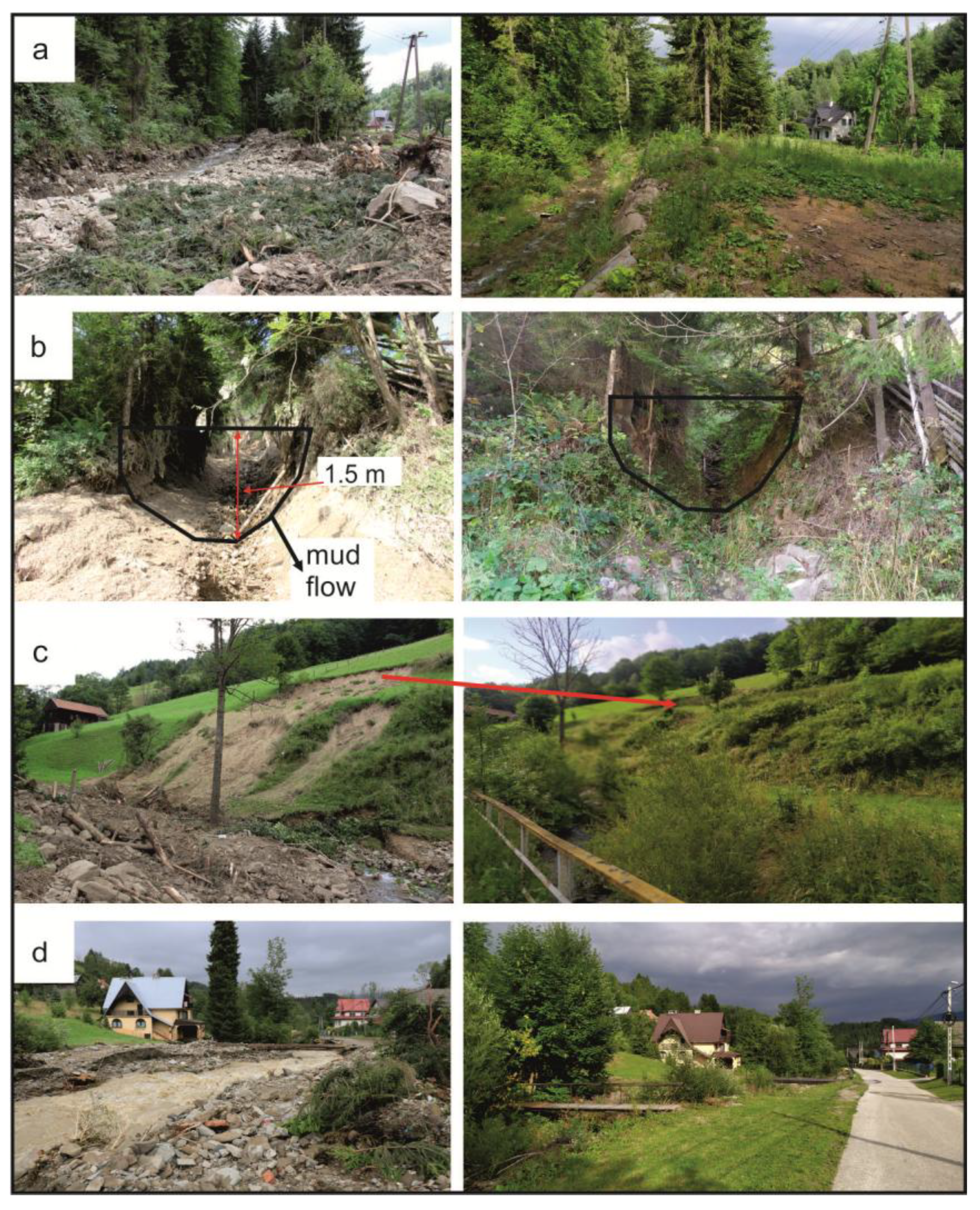
The investigations revealed certain regularities in the processes transforming the mountain environment, which can be summarized as follows. Changes such as erosional and depositional forms located in the headwater parts of lateral valleys were generally preserved (Figure 6a,b). This conclusion may be related to shallow landslides, where plant succession led to the landslide surfaces becoming covered with grass (Figure 6c). Additionally, the middle and lower parts of lateral valleys, where the flood wave caused morphological transformation of the river channel, also retained these changes (Figure 6d). However, the investigations indicated that the areas of the catchment where overland flow or flood waves transformed slopes or valley bottoms—and where these changes damaged infrastructure essential to the local community—were subsequently restored to re-establish normal living conditions (Figure 7).

5. Discussion—Severe Hydro-Meteorological Events in Mountain Areas

5.1. Triggering Factors and the Flood Magnitude

The event in the Ochotnica catchment was triggered by short-duration rainfall that developed in the frontal zone separating polar maritime air from continental subtropical air. Such synoptic conditions are conducive to extreme hydro-meteorological events in this region [7,11,26]. The total precipitation (~77 mm) that caused the flood was comparable to other events recorded in different parts of the Polish Carpathians, e.g., Grybów on 18 July 2003: 54 mm; Brzeziny on 25 June 2009: 95 mm; and Kasina Wielka: 95.2 mm [7,11]. These values support the general conclusion that, in mountain areas situated within the inland continental regions of Europe, short-duration rainfall events (up to 3 h) with accumulated totals of approximately 100 mm represent a critical threshold for the initiation of high-impact hydro-meteorological hazards at the local scale [4,7,8,9,11,13].
The flood generated by the thunderstorm in the Ochotnica catchment can be classified as ‘average’ in terms of magnitude. This conclusion arises from the analysis of the unit peak flow and flood K index recorded in catchments across the Polish, Slovak, and Romanian Carpathians (Table A2, Appendix A). The maximum unit flood peak in the sub-catchments located within the heavy rainfall zone generally ranged from 3.4 to 10.8 m3·s−1·km−2, and the K index ranged from 3.6 to 3.9. These two measures place the flood in the Ochotnica catchment in the middle of the Carpathian flash flood ranking (Table A2, Appendix A). Considering the maximum unit peak values, four floods in Slovakia and two in Romania exceeded the Ochotnica flood (qmax > 11 m3·s−1·km−2). Regarding the K index, seven floods in the Carpathian region (five in Slovakia and two in Romania) were greater than the flood in the Ochotnica catchment.

5.2. Environmental and Economic Consequences

Post-flood investigations revealed that intense, concentrated, or sheet-type surface flows caused significant transformation of the mountain environment and inflicted damage on various types of infrastructure. The morphological transformations of the slopes and valley bottoms in the Ochotnica catchment are consistent with those reported in other studies (e.g., [4,6,7,8,10,27,28,29,30,31,32]), allowing for some general conclusions regarding the prediction of environmental changes resulting from severe hydro-meteorological events in mountainous areas.
The first regularity concerns the transformation of the mountain environment through the morphological changes in slopes and valley bottoms. Both the literature [4,5,6,7,8,27,28,31] and observations in the Ochotnica catchment confirm that the headwater parts of lateral valleys are the most sensitive to morphological changes. These changes primarily occur in two locations: (i) natural or human infrastructure incisions, such as valleys and roads, which form the upper parts of the so-called active drainage network that operates during heavy rainfall [32], and (ii) the middle and lower parts of slopes. Changes in the active drainage network result from concentrated overland flow and are typically associated with erosional incisions of valley or road bottoms combined with the development of deposition bars. These processes create morphological thresholds that modify the longitudinal profiles of lateral valleys. Furthermore, these forms are preserved in the environment and may serve as records of severe hydro-meteorological events in mountainous areas. The second place where morphological changes are noticeable are the middle and lower parts of the hillslopes; these parts are usually modified by shallow landslides, typically occurring in the mantle layer. In addition, the transformation of the hillslopes is also preserved, resulting in the development of morphological thresholds that modify the longitudinal profiles of lateral valleys or slopes.
The second regularity is related to the sediment supply. Both the literature [27,28,29,30,31,32] and observations in the Ochotnica catchment indicate that erosional processes in the active drainage network, developed in the headwater parts, are responsible for supplying coarse sediment to river channels, as well as fine material (silt and clay) transported as suspended loads during flood events. Generally, it is estimated that 80% of the suspended material in rivers located in flysch mountain areas originates from erosion of the mantle within unconsolidated roads [29,30,32].
The third regularity may be related to record of the severe hydro-meteorological events in mountain areas and its economic consequences. A reinvestigation of the morphological changes, conducted seven years after the flood event, revealed that the erosional and depositional forms developed after the flood were generally preserved in areas where morphological changes did not cause infrastructure damage, constituting a record of severe hydro-meteorological events. In areas where the slope or valley bottom transformations were associated with infrastructure damage, subsequent repair works removed or obscured the morphological changes.
The fourth regularity may be related to economic consequences of severe hydro-meteorological events. Both the literature [7,33] and observations of the Ochotnica flood indicate that severe hydro-meteorological events can generate substantial damage, often representing a notable fraction of local administrative budgets. For example, the Kasiniczanka flood (5–6 August 2014) caused damage equivalent to ~10% of the Kasina Wielka district’s annual income [7] while repairing the damage from the Małoszówka flood (4 April 2000) cost ~20% of the Pałecznica district’s annual income [33]. In the Ochotnica catchment, the flood damage was estimated at ~40% of the Ochotnica Górna district’s annual income. Damage to roads, bridges, and residential buildings consistently represented the largest share of the total losses in each case study.
Taking into account the large impact of severe hydro-meteorological events on mountain environments, in the authors’ opinion, there is a need to develop solutions that can help mitigate the negative consequences of these events. These aspects are discussed in the following sections.

5.3. Reducing the Negative Effects of Severe Hydro-Meteorological Events in Mountain Areas—Recommendations for Adaptation Strategies

Both the literature [6,7,8,34,35,36] and Ochotnica case study indicate that the most severe consequences of severe hydro-meteorological events are the damage caused by flood waves. Therefore, adequate flood risk management is a key element in reducing the negative effects of severe hydro-meteorological events in mountain areas. The flood in the Ochotnica catchment provides an opportunity to discuss which aspects of this process are critical and should be considered as key components in the development of adaptation strategies to such events.
A principal component of the flood risk management process is flood risk assessment, commonly defined as a combination of the probability of a flood event and its potential adverse consequences for people, property, the environment, and economic activity [16,17,18]. A flood risk assessment typically involves consideration of three interrelated components: flood hazard, flood exposure, and flood vulnerability. The interaction among these components is essential for formulating strategies for flash floods. Therefore, these three components, with a focus on practical aspects that, in the authors’ opinion, are crucial for limiting the negative impacts of severe hydro-meteorological events in mountain areas, are discussed in the following sections and recommendations for adaptation strategies are given.

5.3.1. Flood Hazard

The flood hazard is typically described using indicators such as the frequency, magnitude, duration, and spatial extent of flood events. In mountain regions, severe hydro-meteorological events are particularly hazardous due to the rapid hydrological response of catchments [14], reflected in their relatively short duration, high magnitude, and spatial extent, which are strictly associated with the valley floor morphology. Therefore, delineation of flood hazard areas is a key step in developing adaptation strategies for such events. Different approaches have been developed for the identification of flood hazard areas. Some of them are implemented as dynamic tools with predictive modules, allowing for the detection of areas at risk of flooding in advance. These solutions generally function as flood alert systems, with global, regional, or local coverage and different spatial and temporal resolutions (e.g., the Global Flood Alert System (GloFAS); Global Disaster Alert and Coordination System (GDACS); European Flood Alert System (EFAS); and Regional Integrated Multi-Hazard Early Warning System for Africa and Asia (RIMES)). Their practical applicability in mountain areas, however, must be evaluated at the local level by experts. It is worth emphasizing that, in the case of severe hydro-meteorological events, the quality of the model describing the catchment response is of key importance. In this context, recent studies have shown that flood pattern detection using information and complexity measures [37] and high-accuracy streamflow data from fluvial acoustic tomography [38] appear to be promising approaches for the prediction of flood magnitude and extent.
However, in practice, flood hazard maps remain the basic source of information for assessing the extent and depth of flood zones [39,40]. These maps identify areas ‘at risk of flooding’ and classify them into zones. In EU countries [39], the zones correspond to (i) low-probability or extreme-event floods, (ii) medium-probability floods, and (iii) high-probability floods. In practice, low-probability floods are linked to 0.5% or 0.2% probable flows, while medium-probability floods correspond to 1% probable flows. Similar zones were delineated in the US [40] and other regions of the world [41]. The fact that the maximum flow recorded during a flash flood often exceeds a 0.1% p-probable flow [8,34,35,36] suggests that the existing flood hazard maps have limited applicability as they frequently do not include the boundaries of areas that will likely be inundated by extreme hydro-meteorological events such as flash floods. Consequently, in practice, severe hydrological events are frequently underestimated or omitted in strategic documents. Therefore, the first recommendation arising from this analysis is the need to delineate flood hazard zones for severe hydrological events. In the authors’ opinion, the Maximum Probable Flood (MPF) approach (which calculates the hazard zone based on a flood that occurs as a result of the highest probable rainfall under the most favorable conditions for flood wave formation) can be used for this purpose. A methodological proposal for the MPF calculation has been published in the literature [42]. In the case of a lack of appropriate data to use this methodology, the MPF flow can be estimated using envelope curves for Qmax estimation. This approach has been tested in small Carpathian catchments and gave good results [33]. In the authors’ opinion, the MPF approach can present the real extent of flood hazard zones for severe hydrological events. Furthermore, the extent and depth of this zone, together with the flow velocity, are critical components in the development of strategies to reduce flood exposure and vulnerability and limit the negative consequences of severe hydro-meteorological events.

5.3.2. Flood Exposure and Vulnerability

Flood exposure refers to the presence of people, infrastructure, ecosystems, and economic assets in areas prone to flooding, whereas flood vulnerability describes the degree to which exposed elements are susceptible to damage [16,17,18]. Considering that damage to infrastructure (roads, bridges, culverts, and residential assets) constitutes the dominant share of flood-related losses, these components should be prioritized in the development of solutions for reducing the adverse impacts of these events. Thus, based on a review of the literature [7,34,35,36] and the Ochotnica case study, several practical aspects are presented and discussed in the following subsections.
Design and Function of Road Networks
The road network pattern in mountain areas results from both environmental and socio-economic conditions, which historically determined settlement development and continue to influence this process today. Historically, settlements in mountain areas (typically villages) were located in valley bottoms, and the roads connecting them developed into a network that closely corresponded to the valley system pattern (see Figure 1). This structure has largely been preserved until the present day. These roads are usually asphalted and provide access to settlement areas distributed across different parts of the catchment (see Figure 1b). In valleys with narrow bottoms, those roads often share the same space as streams (see Figure 5e,f). This is especially the case in lateral valleys. During flash floods, the flood wave covers the valley floor, often destroying road surfaces (see Figure 5e,f). Therefore, it is recommended that road sections located in areas ‘at risk of flooding’ should be designed to be more resilient to flood impacts. In the authors’ opinion, the road design/construction process should take into account the MPF parameters flow velocity and flood depth, which determine the stream power that interferes with road surfaces during a flood event.
Road networks located out of the flood hazard zone require a slightly different approach. Both the literature [7,8,29,30,32] and post-flood investigations in the Ochotnica catchment indicate that road networks are very active during rainstorms and part of the flood losses are due to its erosional transformation. It is worth emphasizing that in mountain areas, there is usually well-developed network of minor roads that provide, for example, access to agricultural fields located in the valley bottoms, the lower and middle parts of the slopes, households, as well as forest areas covering the upper hillslopes and hilltops (see Figure 1). Most of these roads run along the slope gradient. This road pattern results from historical development related to the layout of arable fields—roads were often located on the boundaries of plots belonging to different landowners [29]. These roads are usually unpaved, but their density is typically higher than road networks in valleys [28,32]. During severe hydro-meteorological events, water erodes unpaved roads and/or ditches as a result of concentrated runoff (see Figure 4d1–d3). In order to mitigate the adverse impacts of such flows, water should be diverted away from roads and ditches and redirected back onto slopes. At points where road or ditch flows are redirected downslope, energy-dissipating elements should be used to reduce the erosive power of flowing water and to protect the surface cover (e.g., by applying oversized grains). In other words, technical solutions should focus on reducing the energy of concentrated water flows in order to limit their erosional impact (see, for example, Figure 7c).
Design and Function of Bridges and Culverts
Damage to bridges and culverts also constitutes a considerable proportion of flood-related losses. During severe hydro-meteorological events, hydraulic structures are frequently partially or completely destroyed. There are two primary mechanisms of failure. The first involves downward and lateral bank erosion caused by floodwaters overtopping bridge decks (Figure 5g). The second is related to the transport of organic debris, such as tree trunks, which obstruct culverts and bridges and thereby accelerates their structural degradation (Figure 5d). In the authors’ opinion, flood damage to this type of infrastructure is largely attributable to inadequate design assumptions at the project stage. In most cases, such structures are designed for a 1% probable flow [7,33]. Taking into account that, during flash floods in small catchments, flows corresponding to a 0.1% p-probable flood are frequently surpassed, the failure of culverts and bridges is likely, as was documented in the Ochotnica catchment (see Figure 5a,c,d,g). On this basis, it is recommended that the design/construction of culvers and bridges should account for flows with lower probabilities. In the authors’ opinion, Qmax corresponding to the MPF should be used in order to evaluate the impact of flood on culvert/bridge infrastructure. This evaluation can support technical solutions related to construction type of the culvert/bridge. For example, bridge construction should ensure minimal restriction of floodwater conveyance (e.g., the use of arch-type structures). Special attention should also be given to the foundation of bridge abutments and culverts, as well as their protection against erosion. The example from Ochotnica demonstrates that, during the reconstruction of infrastructure, the way the abutments were reinforced prevented damage during flooding (Figure 7a,b).
Design and Function of Residential Infrastructure
The environmental conditions determine the settlement development. In mountain areas, the geology and relief conditions strongly influence the accessibility of areas with good conditions for settlement. As a result, the residential infrastructure is located in valley bottoms and on slopes with preferable geological and relief conditions. This fact affects which approach for reducing potential adverse impacts of hydro-meteorological events should be implemented.
In mountain valleys, the morphology of the valley floor, in combination with the flood magnitude, determines the extent and depth of the flood hazard zone. A generally accepted view is that settlements should not be located in areas at risk of flooding. In practice, this principle is often difficult to implement for several reasons. Firstly, information delineating flood-prone and flood-free areas is frequently lacking, particularly in small catchments where severe hydro-meteorological events occur (e.g., in the Carpathians, catchments affected by flash floods are usually <50 km2). Secondly, as mentioned in the section on flood hazards, most documents used to develop flood risk management strategies do not include information on hazard zone parameters related to severe hydrological events. To the best of the authors’ knowledge, no catchment in the Polish Carpathians has a delineated flood risk zone for such severe events. It is believed that this is the typical case for mountain areas. The absence of this information hampers the effective development of flood risk management strategies that account for severe hydro-meteorological phenomena.
On this basis, it is recommended that in areas ‘at risk of flooding’, the MPF zone should be delineated for effective spatial/flood management to prevent damage to residential infrastructure. In the authors’ opinion, the extent, depth, and flow velocity of the flood wave should be considered when proposing solutions related to the location of the residential infrastructure or its construction parameters, limiting the negative consequences of flooding (e.g., no basements in houses located in flood-prone areas or situating living floors above the predicted flood level). Such solutions can substantially mitigate the negative effects of flooding, but their successful implementation depends on the accurate delineation of the MPF zone. It is worth emphasizing that settlement infrastructure located out of the flood hazard zone requires a slightly different approach. Both the literature [7,29,34,35,36] and Ochotnica case study indicate that such infrastructure is particularly exposed to intensive surface overland flows. The most vulnerable are buildings situated within valley axes (including small valleys incising hillslopes) or at the outlets of lateral valleys (Figure 4e2 and Figure 5j). These locations are especially predisposed to concentrated overland flow formation, which increases the risk of basement or ground-floor flooding. If the overland flow is in the form of muddy or debris flow, the resulting damage to residential infrastructure can be severe (Figure 4e1). Therefore, in order to reduce the potential negative flood impacts, residential infrastructure should not be located in these high-risk areas or an appropriate technical solution should be implemented to reduce vulnerability. These could include the design solutions mentioned above, e.g., houses without basements, or engineering solutions aimed at reducing concentrated flows.

6. Conclusions

Mountain regions are highly susceptible to severe hydro-meteorological events. The literature and Ochotnica case study indicate that these events induce substantial morphological changes and cause significant economic losses, representing a major challenge for water resource management.
The morphological changes observed in valleys (especially lateral valleys) include the development of sequences of erosional/accumulation forms, which modify the longitudinal profile of the valley floors. On hillslopes, changes are mainly related to the development of many mantle-layer shallow landslides that modify the hillslope profiles. The morphological changes are usually preserved and serve as a record of these events in mountain environments.
Given that the economic losses are primarily associated with damage resulting from flooding of valley bottoms, priority should be given to measures aimed at reducing exposure and vulnerability within flood hazard zones. In this context, a key recommendation is the delineation of the flood hazard zone for severe hydrological events. In the authors’ opinion, the Maximum Probable Food (MPF) approach provides an effective solution for delineation of this zone. Taking into account the regional variability of flash floods, the methodology for determining the MPF hazard zone should be adapted to the geographical region. From the authors’ experience, the use of envelope curves to estimate the Qmax required for hydraulic modeling gives satisfactory results for the delineation of MPF hazard zones [33]. It is worth emphasizing that the envelope curve approach is a simple and popular method in hydrological studies and many regional envelope curves have been developed [13,43,44,45,46]. Therefore, the use of this method for MPF estimation could be used in practice. In the authors’ opinion, implementation of MPF hazard zone estimation is a key step in building resilience to such events in mountain areas.
Taking into account the local nature of severe hydro-meteorological events, the development of context-specific adaptation strategies designed to mitigate the impacts of these phenomena are required. The adaptation strategies must be tailored to the characteristics of individual catchments to ensure their effectiveness. However, based on the research findings and analysis of the triggering factors, flood magnitudes, and flood consequences of numerous severe events, we recommend the following when developing local adaptation strategies for severe hydro-meteorological events:
In the valley bottom, the MPF zone should be delineated to support the planning and implementation of realistic and effective measures aimed at reducing exposure and enhancing flood resilience. It is recommended to consider the MPF extent and depth in spatial planning in mountain valley bottoms and incorporate engineering solutions that take into account the impact of MPF waves on infrastructure. For residential buildings, this may include recommendations related to basement construction and the location of living floors above the projected flood levels. For transportation infrastructure, measures should aim to increase road resilience within MPF hazard zones. For hydraulic structures such as culverts and bridges, this may include using MPF-related peak discharges (Qmax) to evaluate their design and function and select the appropriate construction solutions at the design/construction stage to mitigate potential destruction during floods, e.g., deep foundation placement for abutments, lateral reinforcement of abutments, arch-type bridges, and secure fastening of bridge decks.
On slopes along linear infrastructure that favor the formation of concentrated surface runoff (e.g., roads, drainage ditches, valley axes), it is recommended to implement engineering solutions that ensure proper water diversion and energy dissipation. The construction of residential infrastructure along valley axes should be avoided, or structural solutions should be applied to reduce the impact of flowing water on such structures.

Author Contributions

Conceptualization, T.B., K.B., P.F., K.W. and R.K.; methodology, T.B., K.B., P.F. and M.G.; validation, R.K., R.F. and K.W.; formal analysis, T.B., K.B., P.F. and M.G.; field investigation, K.B., P.F. and M.G.; data curation, T.B., K.B., P.F. and M.G.; writing—original draft preparation, T.B.; writing—review and editing, T.B., K.B., R.K., R.F. and K.W.; visualization, T.B. and K.B.; supervision, T.B. and K.B.; project administration, T.B. and K.B. All authors have read and agreed to the published version of the manuscript.

Funding

This research was funded by the University of National Education Commission, Krakow, grant number WPBU/2024/03/00111.

Data Availability Statement

All data used in this article were presented in text.

Acknowledgments

The authors would like to thank the authorities of the Ochotnica Dolna commune for their cooperation during the field research and for providing data on flood damage. The authors would like to thank two anonymous reviewers for their valuable comments that helped to improve the manuscript. The authors have reviewed and edited the output and take full responsibility for the content of this publication.

Conflicts of Interest

The authors declare no conflicts of interest. The funders had no role in the design of the study; in the collection, analyses, or interpretation of data; in the writing of the manuscript; or in the decision to publish the results.

Appendix A

Table A1. The flood peak (Qmax) and the unit flood peak (qmax) on the background of p-probable floods.
Cross-Section
Number
Sub-Catchments NameArea
[km2]
Qmax
[m3·s−1]
qmax
[m3·s−1·km−2]
P-Probable Flood
[%]
0.10.20.51.02.01050
[m3·s−1]
1Furcówka5.955.40.9124.6921.9618.616.0313.517.732.32
2Forendówki7.6714.51.8930.4127.0522.9119.7516.659.522.86
3Jaszcze11.2146.04.1443.7638.9332.9628.4223.9613.74.12
4Jamne8.8942.64.7945.5540.5234.3129.5824.9314.264.29
4aSkałka0.786.38.088.227.316.195.344.52.570.77
4bJamne
(upper part)
1.9919.910.0220.9218.6115.7613.5811.456.551.97
4cPierdołowski Potok1.2513.510.769.738.657.336.325.323.040.92
4dJamne (middle part)3.9131.17.9428.625.4521.5518.5715.668.952.69
8Skrodne4.1714.23.4019.8117.6314.9312.8710.856.21.87
9Gorcowe7.8328.93.6936.8732.827.7723.9420.1811.543.47
9aGorcowe (upper part)2.0317.88.7721.4219.0516.1313.9111.726.72.02
10Młynne12.2930.12.4553.9848.0240.6635.0529.5516.895.08
10aMłynne (upper part)3.8224.96.5124.7221.9918.6216.0513.537.742.33
10bWierch Młynne1.648.04.8810.189.067.676.615.573.190.96
12Mostkowe1.683.21.8911.910.598.977.736.523.731.12
13Zawadowski1.393.52.5410.018.917.546.55.483.130.94
15Jurkowski Potok3.628.82.4220.0617.8515.1113.0310.986.281.89
16Kudowe5.848.01.3629.1625.9421.9718.9415.969.132.75
20Lubanski3.675.41.4818.6216.5614.0212.0910.195.831.75
21Rolnicki3.146.42.0314.9113.2611.239.688.164.671.4
22Janczurowski1.562.41.569.478.437.136.155.192.960.89
23Ligasy0.64--5.184.613.93.372.841.620.49
Notes: Source: this study. 1—Furcówka, 2—Forendówki, 2a—Holina, 3—Jaszcze, 3a—Małe Jaszcze, 4—Jamne, 4a—Skałka, 4b—Jamne (upper part), 4c—Pierdołowski Potok, 4d—Jamne (middle part), 5—Błaszczaki, 6—Majdówka, 7—Pasadowskie, 8—Skrodne, 9—Gorcowe, 9a—Gorcowe (upper part), 10—Młynne, 10a—Młynne (upper part), 10b—Wierch Młynne, 11—Studzionki, 12—Mostkowe, 13—Zawadowski, 14—Groniowski, 15—Jurkowski Potok, 16—Kudowe, 17—Dłubacze, 18—Szymanowski, 19—Leskówka, 20—Lubanski, 21—Rolnicki, 22—Janczurowski, and 23—Ligasy.
Table A2. The maximum flow, maximum specific flow and K indexes for local flash flood events recorded in catchments up to 12 km2 in the Polish Slovakian and Romanian Carpathians.
LpRiverCross-SectionA
[km2]
Qmax
[m3·s−1]
qmax
[m3·s−1·km2]
K
Poland
1cwnPilzno7.5354.63.7
2DołżycaDołżyca9.742.64.43.8
3cwnSzymbark1.816.299.13.8
4KalniczkaKalnica4.328.87.13.8
5cwnBłędówka5326.63.8
6cwnMała P18.756.56.54.0
7WątokSzynwałd P12.632.312.44.1
8KisielinaŁysa Góra P12.734.612.84.1
9KisielinaSufczyn P310.177.27.64.1
10BielankaSzymbark6.57511.54.3
11 *Skrodne84.1714.23.43.4
Wierch Młynne10b1.6484.883.5
Skałka4a0.786.38.13.6
Gorcowe97.8328.93.73.6
Jaszcze411.446.54.13.8
Młynne (upper part)10a3.8224.96.513.8
Jamne38.842.64.83.8
Gorcowe (upper part)9a2.0317.88.83.8
Pierdołowski Potok4c1.2513.510.83.8
Jamne (upper part)4b1.9919.910.03.9
Jamne (middle part)4d3.9131.17.93.9
Slovakia
12MalinaKuchyňa7.943.5640.42.3
13Sološnický potokSološnica10.385.7280.62.5
14Turniansky creekbelow Rígeľský creek9.08171.93.2
15Hukov creekústie (confluence)8.08202.53.4
16Rígeľský creekústie (confluence)3.88153.93.5
17Ždiarsky creekbelow Zálešovský5.446.88.74.0
18Dubovický potok (creek)above Dubovica10.912011.04.4
19Malá Svinkaabove Renčišovský potok (creek)6.459014.04.4
20Renčišovský potok (creek)ústie (confluence)7.069513.54.4
21Štrbský CreekŠtrba -first bridge2.56526.04.5
Romania
22UrlatoareaOrb Confluence4.6306.53.8
23IrisPietreni677.612.94.3
24Topa-VarciorogVarciorog9.510911.54.4
Notes: Source: this study on the basis of Hydrate flash flood data center for floods recorded in Romania and Slovakia www.hydrate.tesaf.unipd.it (access at 1 September 2012) and Bryndal et al. [7] for floods in Poland; A—basin area, Qmax—maximum flow, qmax—maximum specific flow, K—flood index, cwn—creek without the name, and *—cross sections where Qmax exceeded 0.5% probable flood.

References

  1. Jokiel, P. Man and water. Acta Geogr. Lodz. 2024, 115, 7–21. [Google Scholar]
  2. Jonkman, S.N.; Curran, A.; Bouwer, L.M. Floods have become less deadly: An analysis of global flood fatalities 1975–2022. Nat. Hazards 2024, 120, 6327–6342. [Google Scholar] [CrossRef]
  3. Pielke, R. Economic ‘normalisation’ of disaster losses 1998–2020: A literature review and assessment. Environ. Hazards 2020, 20, 93–111. [Google Scholar] [CrossRef]
  4. Pekarova, P.; Bacova Mitkova, V.; Miklanek, P. Flash Flood on July 21, 2014 in the Vratna Valley. In New Developments in Environmental Science and Geoscience, Proceedings of the International Conference on Environmental Science and Geoscience (ESG 2015), Vienna, Austria, 15–17 March 2015; Mastorakis, N.E., Buluceva, A., Eds.; INASE: Vienna, Austria, 2015; pp. 34–38. [Google Scholar]
  5. Borga, M.; Stoffel, M.; Marchi, L.; Marra, F.; Jakob, M. Hydrogeomorphic response to extreme rainfall in headwater systems: Flash floods and debris flows. J. Hydrol. 2014, 518, 194–205. [Google Scholar] [CrossRef]
  6. Surian, N.; Righini, M.; Lucìa, A.; Nardi, L.; Amponsah, W.; Benvenuti, M.; Borga, M.; Cavalli, M.; Comiti, F.; Marchi, L.; et al. Channel response to extreme floods: Insights on controlling factors from six mountain rivers in northern Apennines, Italy. Geomorphology 2016, 272, 78–91. [Google Scholar] [CrossRef]
  7. Bryndal, T.; Franczak, P.; Kroczak, R.; Cabaj, W.; Kołodziej, A. The impact of extreme rainfall and flash floods on the flood risk management process and geomorphological changes in small Carpathian catchments: A case study of the Kasiniczanka river (Outer Carpathians, Poland). Nat. Hazards 2017, 88, 95–120. [Google Scholar] [CrossRef]
  8. Bucała-Hrabia, A.; Kijowska-Strugała, M.; Bryndal, T.; Cebulski, J.; Kiszka, K.; Kroczak, R. An integrated approach for investigating geomorphic changes due to flash flooding in two small stream channels (Western Polish Carpathians). J. Hydrol. Reg. Stud. 2020, 31, 100731. [Google Scholar] [CrossRef]
  9. Gaume, E.; Bain, V.; Bernardara, P.; Newinger, O.; Barbuc, M.; Bateman, A.; Blaškovićová, L.; Blöschl, G.; Borga, M.; Dumitrescu, A.; et al. A compilation of data on European flash floods. J. Hydrol. 2009, 367, 70–78. [Google Scholar] [CrossRef]
  10. Marchi, L.; Borga, M.; Preciso, E.; Gaume, E. Characterization of selected extreme flash floods in Europe and implications for flood risk management. J. Hydrol. 2010, 394, 118–133. [Google Scholar] [CrossRef]
  11. Bryndal, T. Local flash floods in Central Europe: A case study of Poland. Nor. Geogr. Tidsskr.—Nor. J. Geogr. 2015, 69, 288–298. [Google Scholar] [CrossRef]
  12. Mas-Coma, S.; Artigas, P.; Cuervo, P.F.; De Elías-Escribano, A.; Fantozzi, M.C.; Colangeli, G.; Córdoba, A.; Marquez-Guzman, D.J.; Mas-Bargues, C.; Borrás, C.; et al. Infectious disease risk after the October 2024 flash flood in Valencia, Spain: Disaster evolution, strategic scenario analysis, and extrapolative baseline for a One Health assessment. One Health 2025, 21, 101093. [Google Scholar] [CrossRef]
  13. Bryndal, T. Hydrological parameters of rainstorm-inducted flash floods in the Polish, Slovakian and Romanian parts of the Carpathians. Przegląd Geogr. 2014, 86, 5–21. [Google Scholar] [CrossRef]
  14. Montz, B.E.; Grunfest, E. Flash flood mitigation: Recommendations for research and applications. Nat. Hazards 2002, 4, 15–22. [Google Scholar]
  15. Kron, W. Flood risk, hazard, exposure, vulnerability. In Flood Defence; Wu, B., Wang, Z.Y., Wang, G.G.H., Huang, H., Huang, J., Eds.; Science Press: New York, NY, USA, 2002; pp. 33–72. [Google Scholar]
  16. Kron, W. Changing flood risk—A re-insurance’s viewpoint. In Changes in Flood Risk in Europe; Kundzewicz, Z.W., Ed.; IAHS Special Publication 10; SCS Press: Wallingford, UK, 2012; pp. 459–477. [Google Scholar]
  17. Merz, B.; Kundzewicz, Z.W.; Delgado, J.; Hundecha, Y.; Kreibich, H. Detection and attribution of changes in flood hazard and risk. In Changes in Flood Risk in Europe; Kundzewicz, Z.W., Ed.; IAHS Special Publication 10; SCS Press: Wallingford, UK, 2012; pp. 435–458. [Google Scholar]
  18. McClymont, K.; Morrison, D.; Beevers, L.; Carmen, E. Flood resilience: A systematic review. J. Environ. Plan. Manag. 2020, 63, 1151–1176. [Google Scholar] [CrossRef]
  19. Tomczuk, T.; Dąbrowska, M. Commentary to Synoptic Situation of Poland. IMGW-PIB. 2014. Available online: http://pogodynka.pl/polska/komentarz (accessed on 19 July 2018).
  20. Gaume, E.; Borga, M. Post-flood field investigations in upland catchments after major flash floods: Proposal of a methodology and illustrations. J. Flood Risk Manag. 2008, 1, 175–189. [Google Scholar] [CrossRef]
  21. Lumbroso, D.; Gaume, E. Reducing the uncertainty in indirect estimates of extreme flash flood discharges. J. Hydrol. 2012, 414–415, 16–30. [Google Scholar] [CrossRef]
  22. Chow, V.T. Open-Channel Hydraulics; McGraw-Hill: New York, NY, USA, 1959. [Google Scholar]
  23. Biernat, B.; Bogdanowicz, E.; Czarnecka, H.; Dobrzyńska, I.; Fal, B.; Karwowski, S.; Skorupska, B.; Stachy, J. Zasady Obliczania Maksymalnych Rocznych Przepływów Rzek Polskich o Określonym Prawdopodobieństwie Pojawienia Się; IMGW: Warsaw, Poland, 1991. [Google Scholar]
  24. Françou, J.; Rodier, J.A. Essai de classification des crues maximales: Floods and their Computation. In Proceedings of the Leningrad Symposium, Leningrad, USSR, 15–22 August 1967; IAHS–UNESCO–WMO: Louvain, Belgium, 1969; pp. 518–527. [Google Scholar]
  25. Detailed geology map of Poland 1: 50 000—Sheet Łącko, PIG, Krakow. Available online: https://bazadata.pgi.gov.pl/data/smgp/arkusze_skany/smgp1034.jpg (accessed on 5 November 2025).
  26. Parczewski, W. Warunki występowania nagłych wezbrań na małych ciekach. Wiadomości Służby Hydrol. I Meteorol. 1960, 8, 1–159. [Google Scholar]
  27. Verez, M.; Nemeth, I.; Schlaffer, R. The effects of flash floods on gully erosion and alluvial fan accumulation in the Kőszeg Mountains. In Geomorphological Impacts of Extreme Weather, Case Studies from Central and Eastern Europe; Lóczy, D., Ed.; Springer: Dordrecht, The Netherlands, 2013; pp. 301–311. [Google Scholar]
  28. Kowalczuk, I.; Mykhnowych, A.; Pylypovych, O.; Rud’ko, G. Extreme exogenous processes in Ukrainian Carpathians. In Geomorphological Impacts of Extreme Weather: Case Studies from Central and Eastern Europe; Lóczy, D., Ed.; Springer: Dordrecht, The Netherlands, 2013; pp. 53–66. [Google Scholar] [CrossRef]
  29. Kroczak, R.; Bryndal, T.; Bucała, A.; Fidelus, J. The development, temporal evolution and environmental influence of an unpaved road network on mountain terrain: An example from the Carpathian Mts. (Poland). Environ. Earth Sci. 2015, 75, 250. [Google Scholar] [CrossRef]
  30. Łajczak, A.; Margielewski, W.; Rączkowska, Z.; Święchowicz, J. Contemporary geomorphic processes in the Polish Carpathians under changing human impact. Episodes 2014, 37, 21–32. [Google Scholar] [CrossRef]
  31. Li, Y.; Ma, C.; Wang, Y. Landslides and debris flows caused by an extreme rainstorm on 21 July 2012 in mountains near Beijing, China. Bull. Eng. Geol. Environ. 2019, 78, 1265–1280. [Google Scholar] [CrossRef]
  32. Bryndal, T.; Kroczak, R.; Kijowska-Strugała, M.; Bochenek, W. How human interference changes the drainage network operating during heavy rainfalls in a medium-high relief flysch mountain catchment? The case study of the Bystrzanka catchment (Outer Carpathians, Poland). Catena 2020, 194, 104662. [Google Scholar] [CrossRef]
  33. Bryndal, T. Flash floods: Theoretical and practical aspects of the identification of the flood hazard zone in small Carpathian catchments. Czas. Geogr. 2025, 96, 375–402. [Google Scholar] [CrossRef]
  34. Bryndal, T.; Cabaj, W.; Suligowski, R. Hydrometeorologiczna interpretacja gwałtownych wezbrań małych cieków w źródłowej części Wielopolki w dniu 25 czerwca 2009 roku. In Monografie Komitetu Inżynierii Środowiska PAN, 69; Magnuszewski, A., Ed.; Komitet Inżynierii Środowiska Polskiej Akademii Nauk: Warsaw, Poland, 2010; pp. 81–91, (In Polish with English Summary). [Google Scholar]
  35. Bryndal, T.; Cabaj, W.; Gębica, P.; Kroczak, R.; Suligowski, R. Gwałtowne wezbrania spowodowane nawalnymi opadami deszczu w zlewni potoku Wątok (Pogórze Ciężkowickie). In Woda w Badaniach Geograficznych; Ciupa, T., Suligowski, R., Eds.; Uniwersytet Jana Kochanowskiego w Kielcach: Kielce, Poland, 2010; pp. 307–319, (In Polish with English Summary). [Google Scholar]
  36. Bryndal, T.; Cabaj, W.; Suligowski, R. Gwałtowne wezbrania potoków Kisielina i Niedźwiedź w czerwcu 2009 r. (Pogórze Wiśnickie). In Obszary Metropolitarne we Współczesnym Środowisku Geograficznym; Barwiński, M., Ed.; Wydział Nauk Geograficznych Uniwersytetu Łódzkiego: Łódź, Poland, 2010; pp. 337–348, (In Polish with English Summary). [Google Scholar]
  37. Sawaf, M.; Kawanisi, K. Assessment of mountain river streamflow patterns and flood events using information and complexity measures. J. Hydrol. 2020, 590, 125508. [Google Scholar] [CrossRef]
  38. Olfatmiri, Y.; Bahreinimotlagh, M.; Jabbari, E.; Kawanisi, K.; Hasanabadi, A.; Sawaf, M. Application of Acoustic Tomographic Data to the Short-Term Streamflow Forecasting Using Data-Driven Methods and Discrete Wavelet Transform. J. Hydrol. 2022, 609, 127739. [Google Scholar] [CrossRef]
  39. Directive 2007/60/EC of the European Parliament and of the Council of 23 October 2007 on the assessment and management of flood risks. Off. J. Eur. Union 2007, L 288.27, 27–34. Available online: http://data.europa.eu/eli/dir/2007/60/oj (accessed on 5 November 2025).
  40. Flood Zones. The Official Webside of US Department of Homeland Security. Available online: https://www.fema.gov/about/glossary/flood-zones (accessed on 5 November 2025).
  41. World Bank Group. Data Cataloque. Available online: https://datacatalog.worldbank.org/search?fq=identification%2Fcollection_id%2Fany(col:col%20eq%20%27RDL%27)&q=&rows=50 (accessed on 5 November 2025).
  42. Ozga-Zielińska, M.; Kupczyk, E.; Ozga-Zieliński, B.; Suligowski, R.; Niedbała, J.; Brzeziński, J. Powodziogenność Rzek Pod Kątem Bezpieczeństwa Budowli Hydrotechnicznych i Zagrożenia Powodziowego; Materiały Badawcze IMGW, Seria: Hydrologia i Oceanologia, 29; IMGW: Warsaw, Poland, 2003. [Google Scholar]
  43. Herschy, R.W. The World’s Maximum Observed Floods. Flow Meas. Instrum. 2002, 13, 231–235. [Google Scholar] [CrossRef]
  44. Jokiel, P.; Tomalski, P. Odpływy maksymalne w rzekach Polski. Czas. Geogr. 2004, 75, 83–97. [Google Scholar]
  45. Castellarin, A. Probabilistic Envelope Curves for Design Flood Estimation at Ungauged Sites. Water Resour. Res. 2007, 43, W04406. [Google Scholar] [CrossRef]
  46. Mimikou, M.A. Envelope Curves for Extreme Flood Events in North-Western and Western Greece. J. Hydrol. 1984, 67, 55–66. [Google Scholar] [CrossRef]
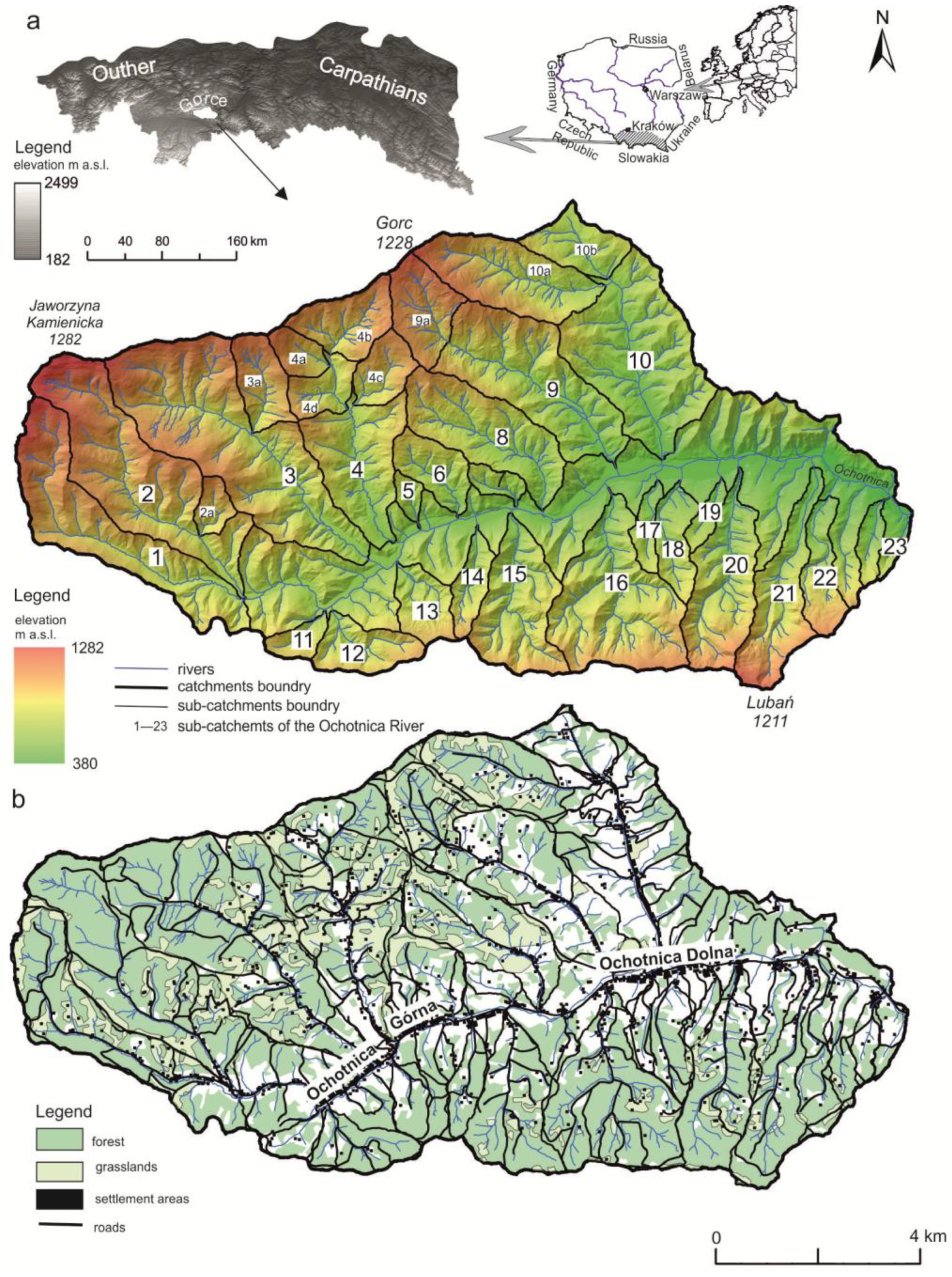
Figure 1. Study area: (a) location and hypsometry of the Ochotnica catchment, (b) land cover. Names of sub-catchments related to text and Table A1 (Appendix A): 1—Furcówka, 2—Forendówki, 2a—Holina, 3—Jaszcze, 3a—Małe Jaszcze, 4—Jamne, 4a-Skałka, 4b—Jamne (upper part), 4c—Pierdołowski Potok, 4d—Jamne (middle part), 5—Błaszczaki, 6—Majdówka, 7—Pasadowskie, 8—Skrodne, 9—Gorcowe, 9a—Gorcowe (upper part), 10—Młynne, 10a—Młynne (upper part), 10b—Wierch Młynne, 11—Studzionki, 12—Mostkowe, 13—Zawadowski, 14—Groniowski, 15—Jurkowski Potok, 16—Kudowe, 17—Dłubacze, 18—Szymanowski, 19—Leskówka, 20—Lubański, 21—Rolnicki, 22—Janczurowski, and 23—Ligasy. Source: this study on the base of NMT and BDOT10k (the source of the data is www.geoportal.gov.pl (https://mapy.geoportal.gov.pl/imap/Imgp_2.html?gpmap=gp0 (accessed on 20 July 2018))).
Water 17 03244 g001
Figure 2. Meteorological settings of a heavy rainstorm generating flash flood in the Ochotnica catchment: (a) the synoptic chart (18 July 2018 12:00 UTC); (b) spatial distribution of rainfalls sum (between 3.00–8.00 PM UTC) derived on the basis hourly rainfall in the telemetry-type rain gauge stations. 1—boundary of the Ochotnica catchment, 2—location of the stations, 3—rivers, 4–6—occluded-, cold-, and hot-type fronts, L—low pressure, H—high pressure, mcP—polar marine-continental air mass, omP—polar marine air mass (old), and cT—tropical continental air mass. Source: Based on meteorological data obtained from the IMGW-PIB official weather-service website www.pogodynka.pl; (access 28 February 2019) and radar data obtained from the IMGW-PIB official website https://danepubliczne.imgw.pl/datastore (access 28 February 2019). The source of the data is the Institute of Meteorology and Water Management—National Research Institute. The data from the Institute of Meteorology and Water Management—National Research Institute have been processed.
Water 17 03244 g002
Figure 3. Spatial diversity of the maximum flow, the maximum unit flow on the background of p-probable flood in the sub-catchments affected by flash flood in the Ochotnica. Source: this study.
Water 17 03244 g003
Figure 4. Environmental consequences of flash flood in Ochotnica catchment. The examples of: bed erosion forms in headwater part of a catchment (a); accumulation bars: composed of mineral materials (b), mineral materials with organic cap (c); erosional (d1,d3) and accumulation (d2) forms associated with road network; debris-flows within lateral valleys (e1); shallow landslides on the hillslopes (e2); erosional (f) and accumulation forms within river channel (g1) and on the terrace (g2); transformation of the valley channel in the lower part of the Ochotnica catchment (h). Source: this study.
Water 17 03244 g004
Figure 5. Economic damage in Ochotnica sub-catchments [in thousands €] with percentage breakdown by the types of loss (names of sub-catchments refer to Figure 1). Spatial distribution of flood damages (a); flood loses and its structure (b); examples related to: bridges (c,d); roads (e,f); culverts (g); sewer system (h); residential infrastructure (i,j). Detailed characterization are presented in the text. Source: this study.
Water 17 03244 g005
Figure 6. Record of the environmental transformation of a mountain environment in relation to: erosional and deposition forms in headwater parts of catchment (a); hillslopes transformed by mudflows (b) and shallow landslides (c); and deposition bars in the valley floor (d). Source: this study.
Water 17 03244 g006
Figure 7. The infrastructure destroyed during flood event—the examples showing the solutions in the recovery process in relation to: culverts (a); bridges (b), roads located on the hillslopes (c) and roads located in the valley bottom (d); river bank reinforcement (e,f); infrastructure protection (g). Source: this study.
Water 17 03244 g007
Disclaimer/Publisher’s Note: The statements, opinions and data contained in all publications are solely those of the individual author(s) and contributor(s) and not of MDPI and/or the editor(s). MDPI and/or the editor(s) disclaim responsibility for any injury to people or property resulting from any ideas, methods, instructions or products referred to in the content.