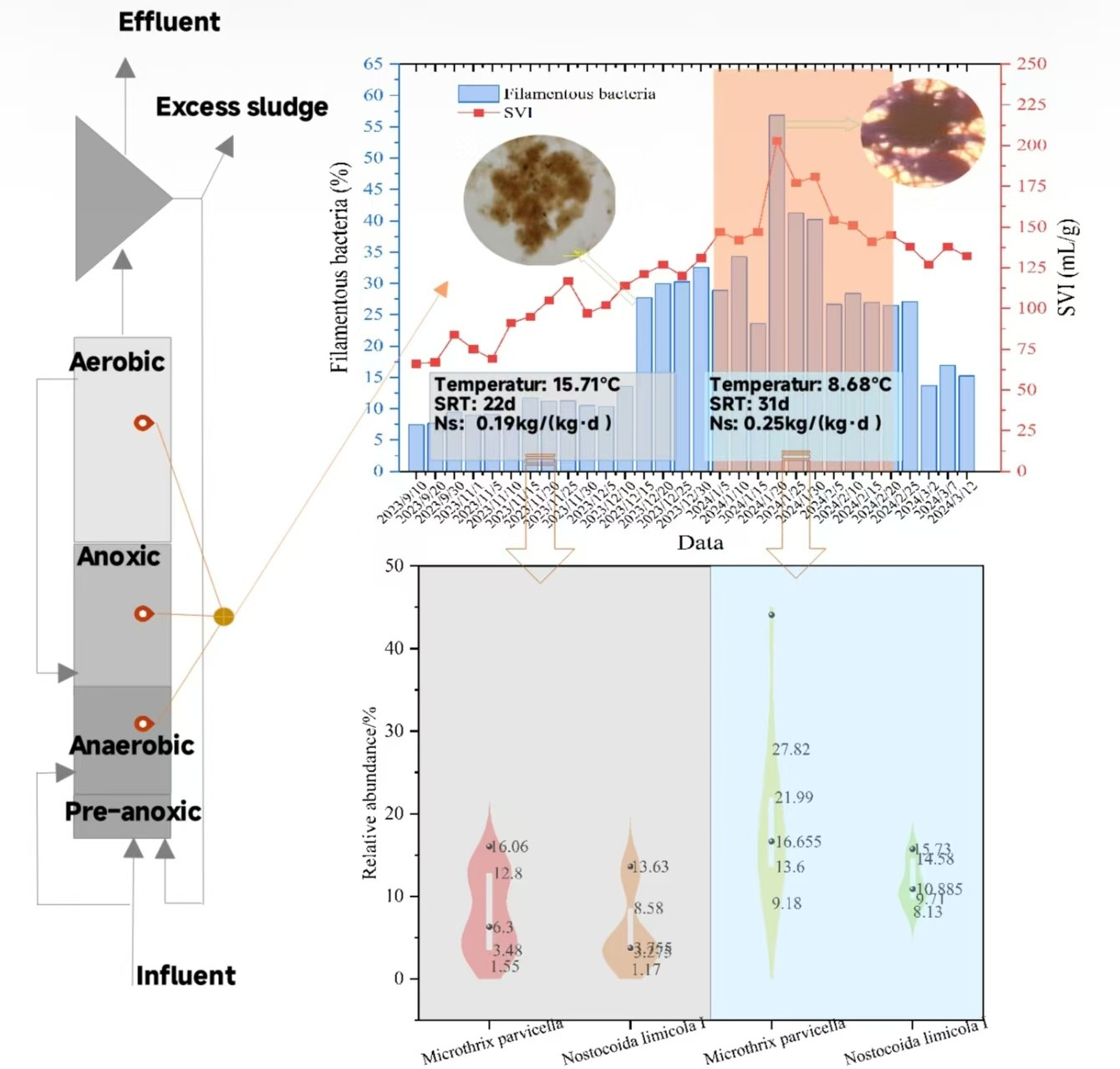

Composition and Abundance Distribution of Filamentous Bacteria During the Variable- and Low-Temperature Operation Periods of Wastewater Treatment Plants


Abstract
1. Introduction
2. Materials and Methods
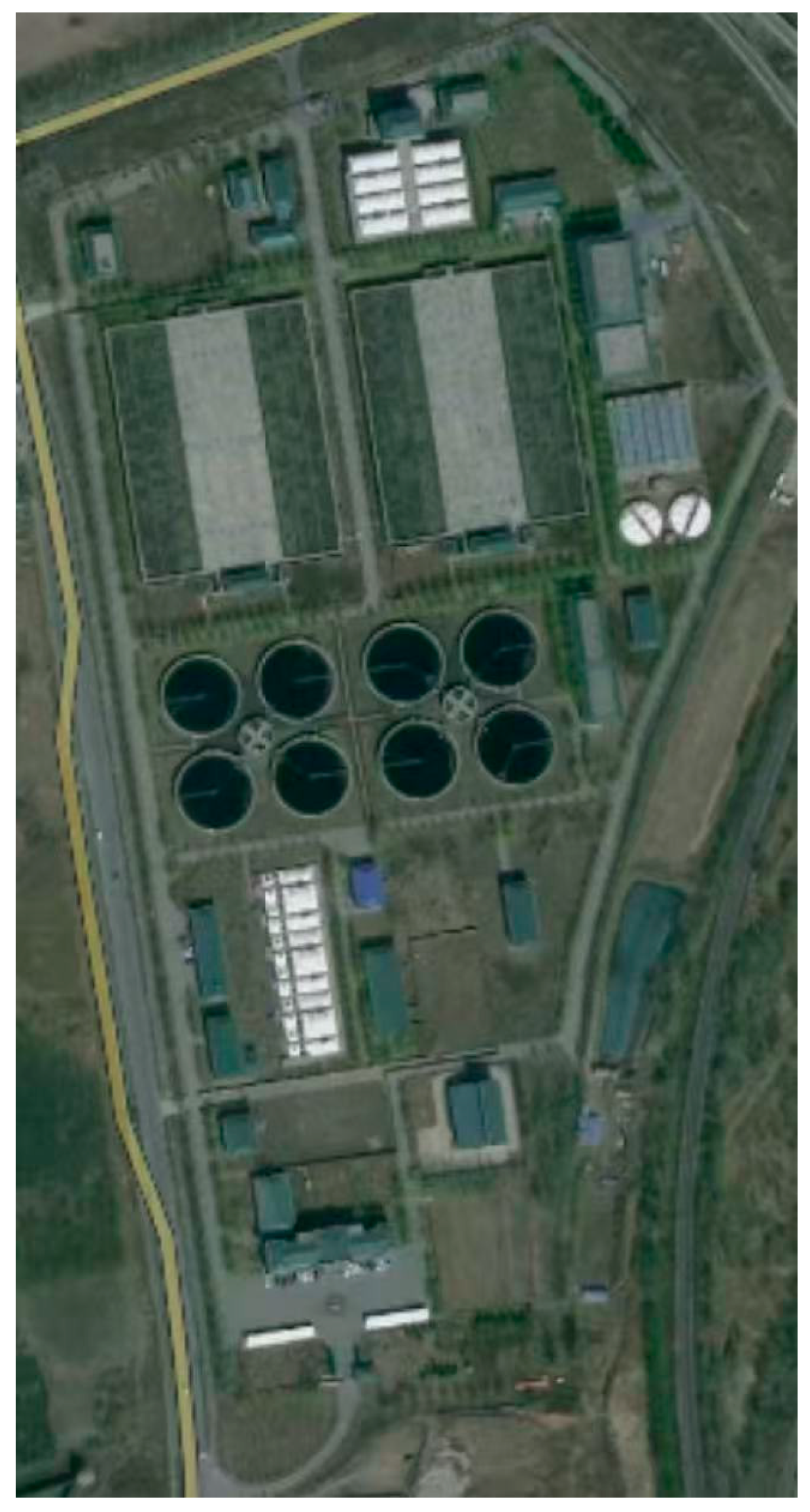
2.1. Wastewater Treatment Plant Description and Sampling
2.2. DNA Extraction and High-Throughput Sequencing
- C—abundance of some filamentous bacteria annotated in NCBI database, %;
- N—the number of annotated filamentous bacteria sequences in NCBI database with 97% similarity;
- NT—total number of sequences.
3. Results and Discussion
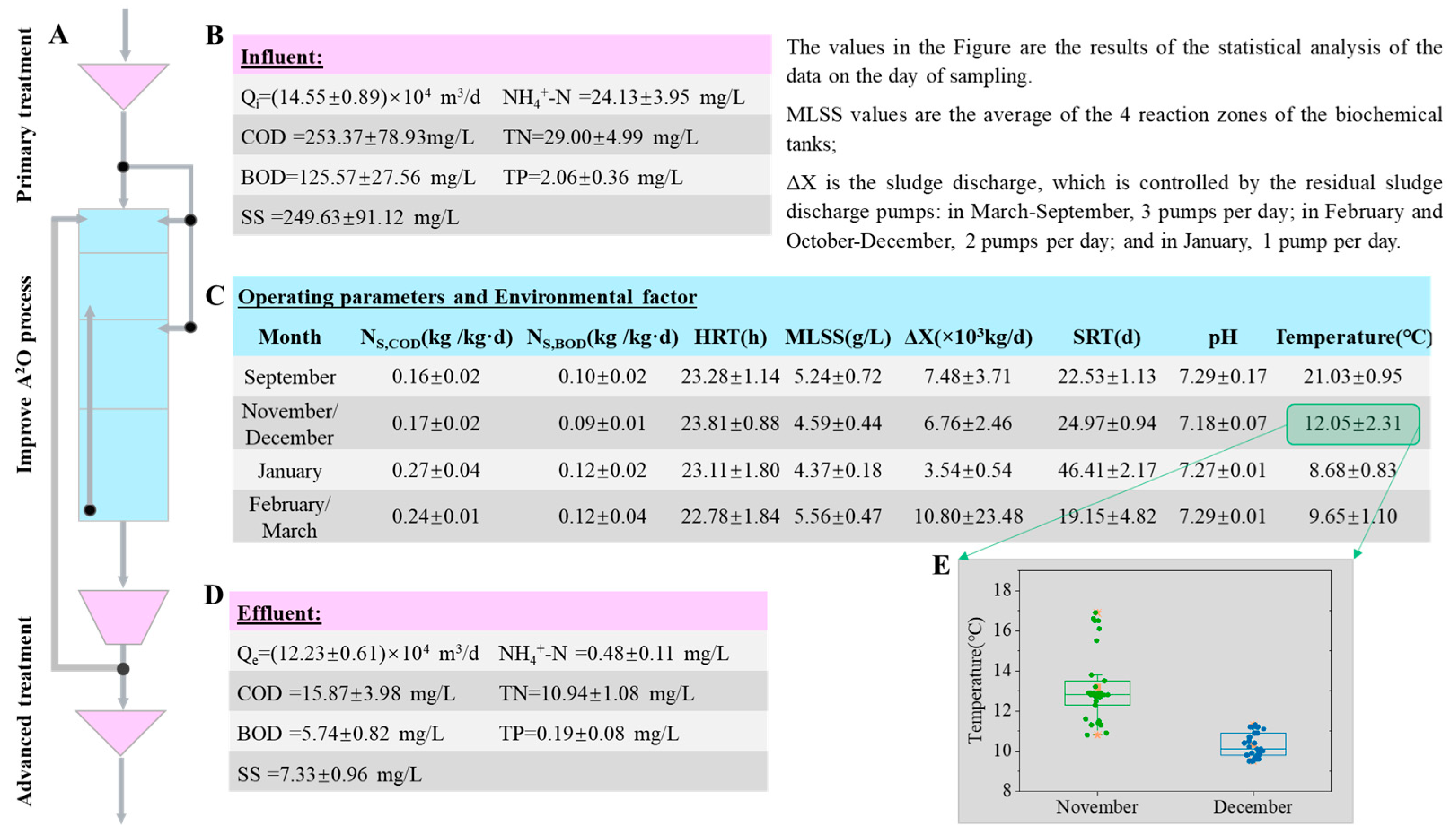
3.1. Operation Status of the Sewage Treatment Plant
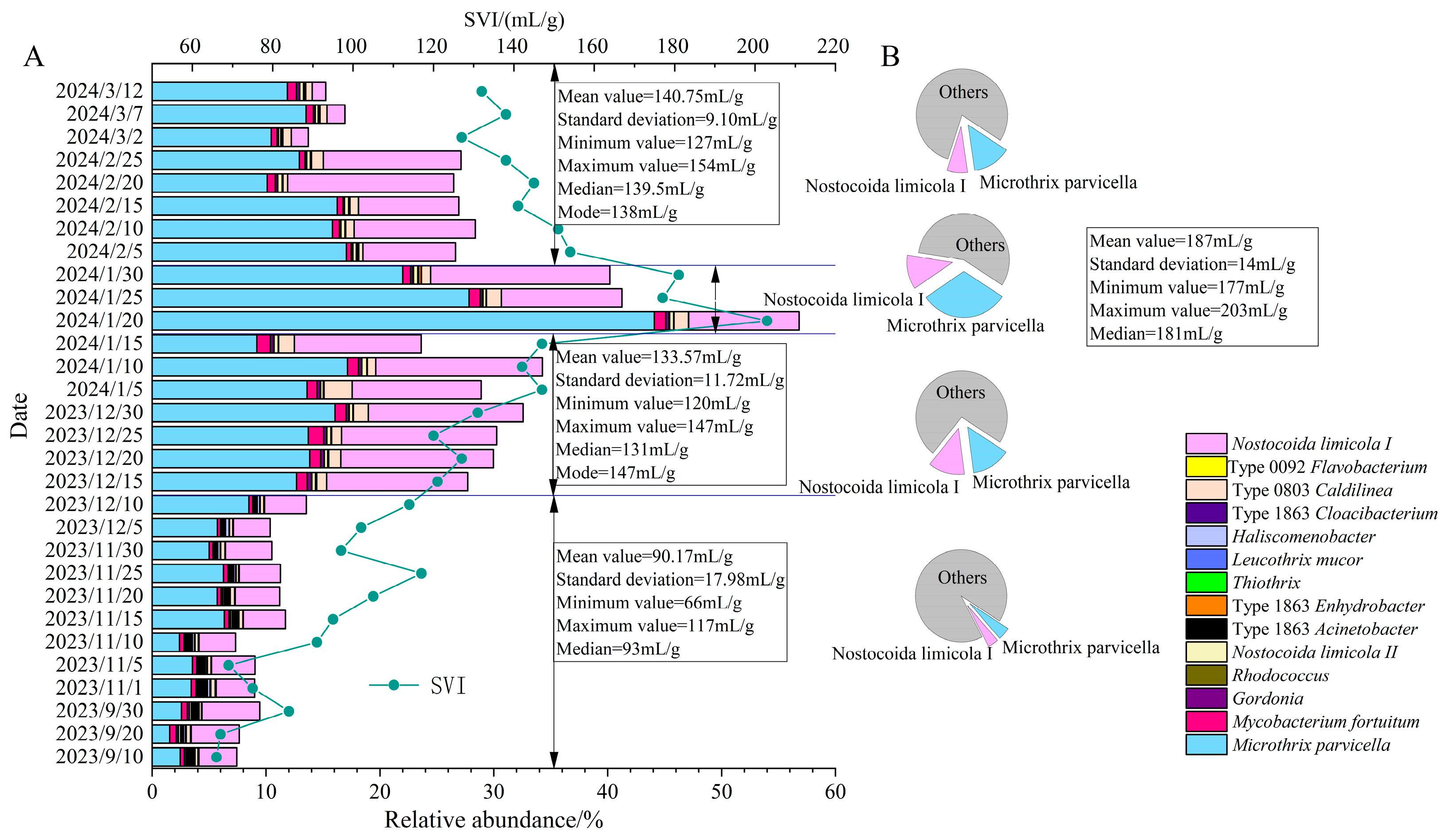
3.2. Filamentous Abundance Determined by HTS of 16s rRNA Gene
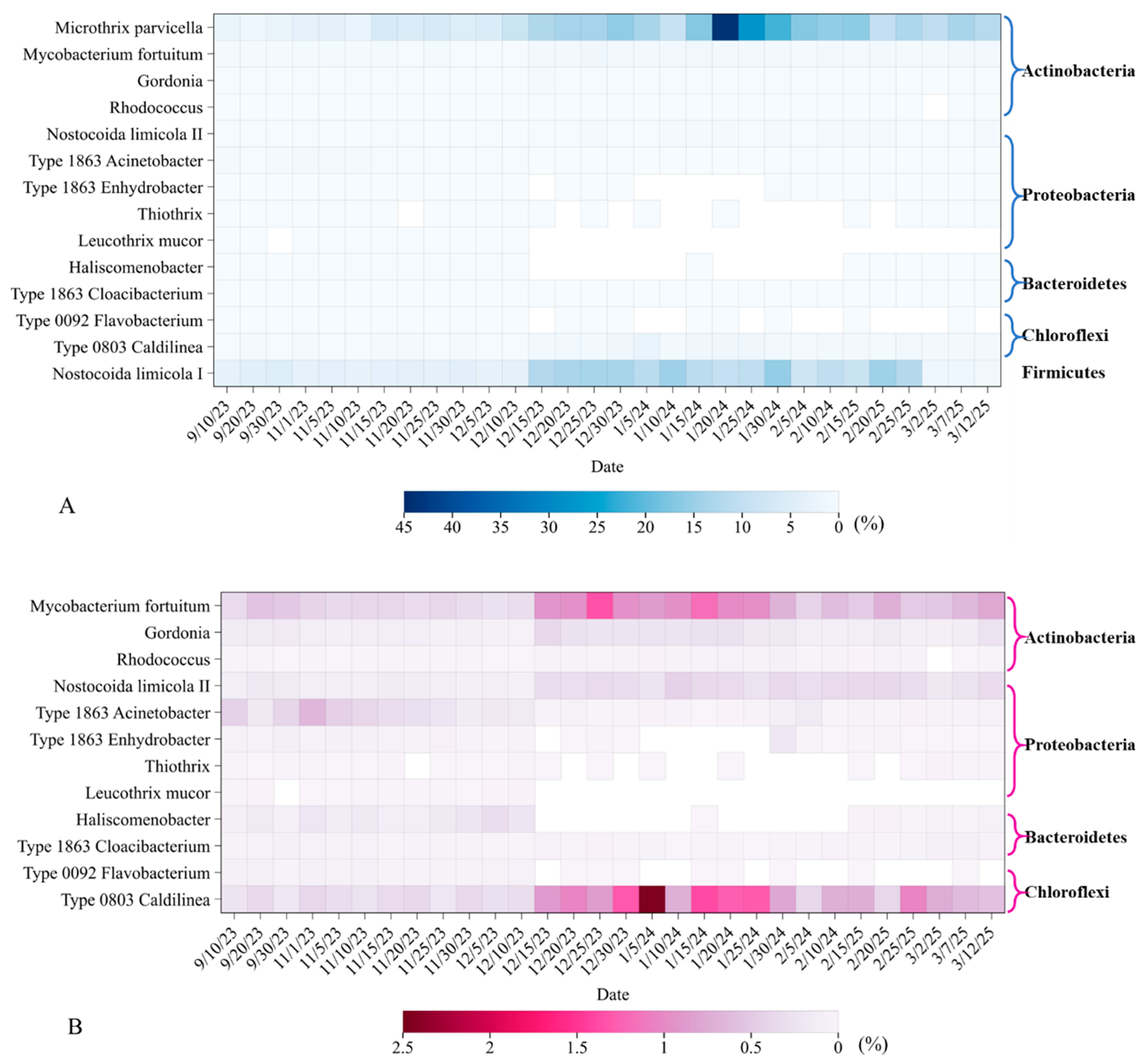
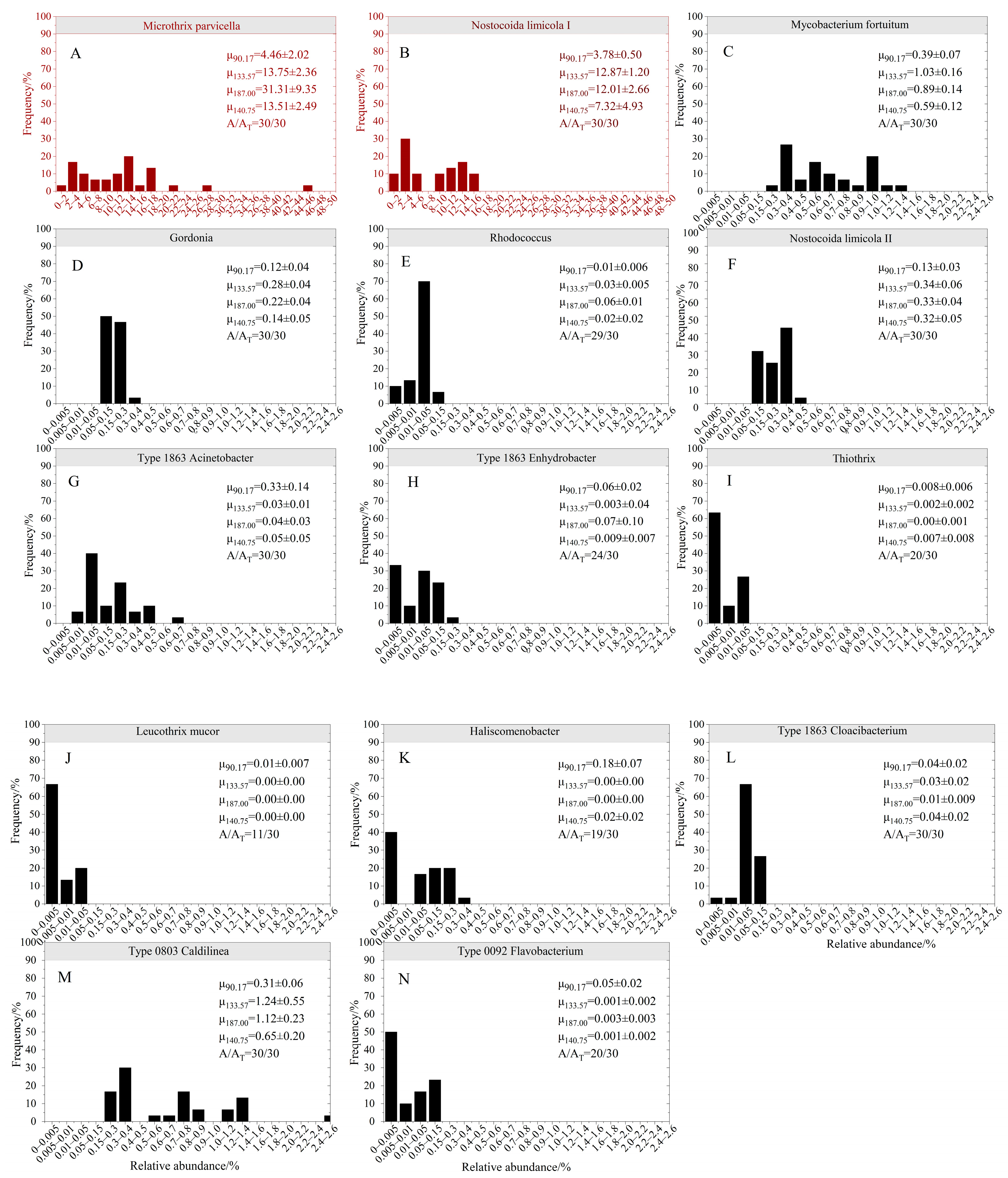
3.3. Abundance Distribution of 14 Filamentous Bacteria
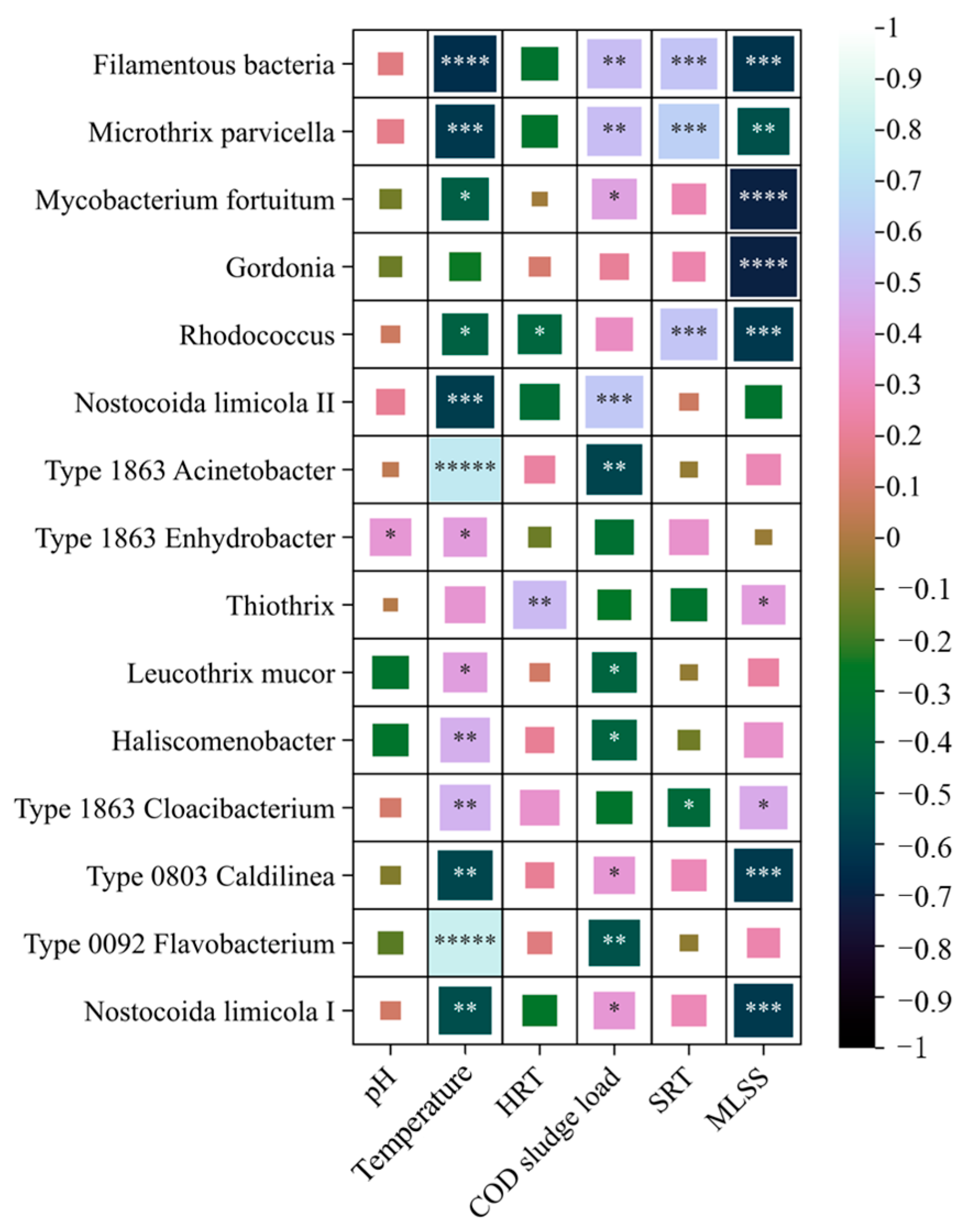
3.4. Correlation Analysis
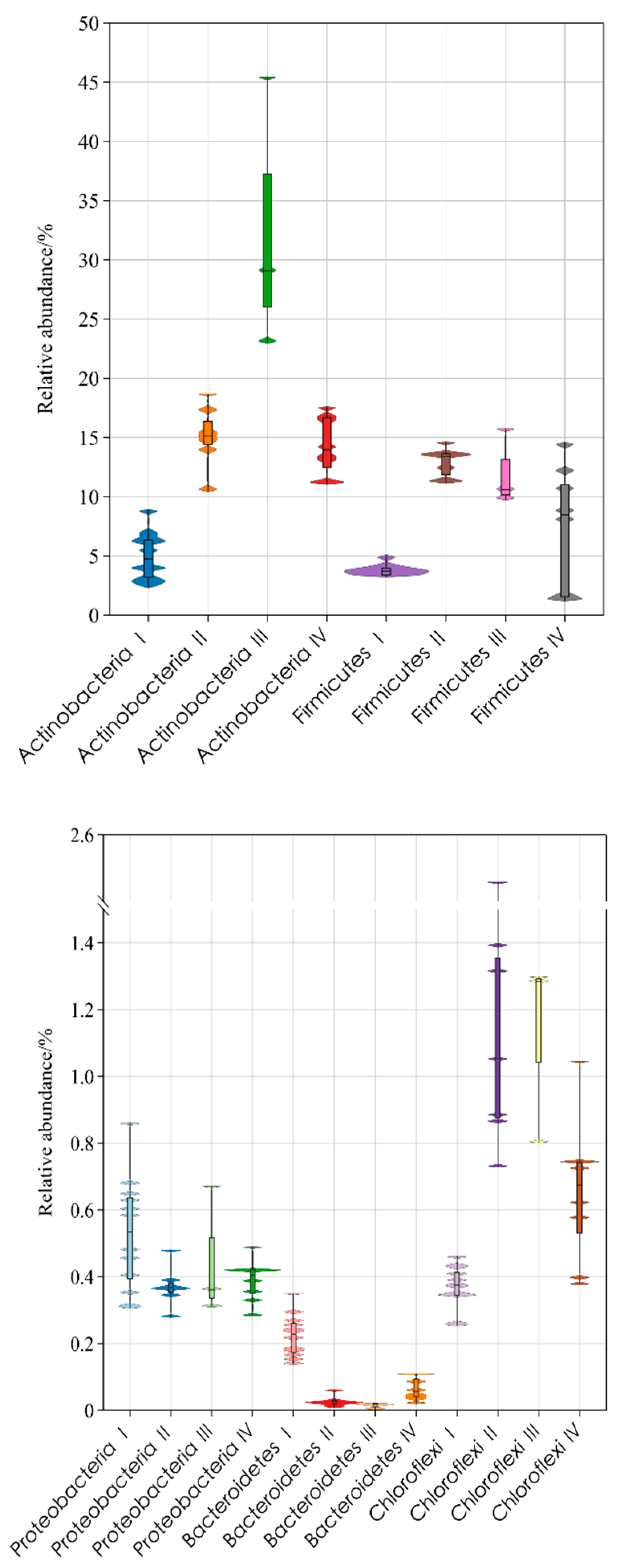
3.5. Fluctuation Distribution of Total Abundance of Filamentous Bacteria
3.6. Structure of Filamentous Bacterial Community
3.7. Operating Parameters and Environmental Factors Driving Fluctuations in Filamentous Bacterial Abundance
4. Conclusions
Author Contributions
Funding
Data Availability Statement
Conflicts of Interest
References
- Aaron, M.S.; Mads, A.; Jes, V.; Per, H.N. The activated sludge ecosystem contains a core community of abundant organisms. ISME J. 2015, 10, 11–20. [Google Scholar] [CrossRef]
- Chen, W.; Wen, D. Advances in spatial and temporal distribution and construction mechanisms of microbial communities in wastewater treatment systems. Environ. Eng. 2022, 40, 1–13. [Google Scholar]
- Sezgin, M.; Jenkins, D.; Parker, D. A Unified Theory of Filamentous Activated Sludge Bulking. J. Water Pollut. Control Fed. 1978, 50, 362–381. [Google Scholar]
- Parker, D.; Kaufman, W.; Jenkins, D. Physical Conditioning of Activated Sludge Floc. J. Water Pollut. Control Fed. 1971, 43, 1817–1833. [Google Scholar]
- Parker, D.; Kaufman, W.; Jenkins, D. Floc Breakup in Turbulent Flocculation Processes. J. Sanit. Eng. Div. 1972, 98, 79–99. [Google Scholar] [CrossRef]
- Guo, J.; Peng, Y.; Wang, S.; Yang, X.; Yuan, Z. Filamentous and non–filamentous bulking of activated sludge encountered under nutrients limitation or deficiency conditions. Chem. Eng. J. 2014, 255, 453–461. [Google Scholar] [CrossRef]
- Long, T.; He, Q.; Lin, G. Research on the Relationships between Filamentous Organisms and Flocculate Structure in Activated Sludge. China Water Wastewater 2000, 16, 5–8. (In Chinese) [Google Scholar]
- Bakos, V.; Gyarmati, B.; Csizmadia, P.; Till, S.; Vachoud, L.; Nagy Göde, P.; Tardy, G.M.; Szilágyi, A.; Jobbágy, A.; Wisniewski, C. Viscous and filamentous bulking in activated sludge: Rheological and hydrodynamic modelling based on experimental data. Water Res. 2022, 214, 118–155. [Google Scholar] [CrossRef]
- Gao, C.; Zhang, N.; Han, H.; Ren, H.; Li, Y.; Hou, C.-Y.; Wang, C.-D.; Peng, Y.-Z. Microbial Diversity of Filamentous Sludge Bulking at Low Temperature. Environ. Sci. 2020, 41, 3373–3383. [Google Scholar]
- Eikelboom, D. Filamentous Organisms Observed in Activated Sludge. Water Res. 1975, 9, 365–388. [Google Scholar] [CrossRef]
- Ju, F.; Zhang, T. Advances in meta–omics research on activated sludge microbial Community. Microbiology 2019, 46, 2038–2052. (In Chinese) [Google Scholar]
- Ju, F.; Zhang, T. Bacterial assembly and temporal dynamics in activated sludge of a full–scale municipal wastewater treatment plant. ISME J. 2015, 9, 683–695. [Google Scholar] [CrossRef] [PubMed]
- Wu, L.; Ning, D.; Zhang, B.; Li, Y.; Zhang, P.; Shan, X.; Zhang, Q.; Brown, M.R.; Li, Z.; Van Nostrand, J.D.; et al. Author Correction: Global diversity and biogeography of bacterial communities in wastewater tre atment plants. Nat. Microbiol. 2019, 4, 1183–1195. [Google Scholar] [CrossRef] [PubMed]
- Kwon, S.; Kim, T.; Yu, G.; Jung, J. Bacterial community composition and diversity of a full–scale integrated fixed–film activated sludge system as investigated by pyrosequencing. J. Microbiol. Biotechn. 2010, 20, 1717–1723. [Google Scholar]
- Ye, L.; Zhang, T. Pathogenic bacteria in sewage treatment plants as revealed by 454 pyrosequencing. Environ. Sci. Technol. 2011, 45, 7173–7179. [Google Scholar] [CrossRef]
- Sun, C.; Zhang, B.; Chen, Z. Sludge retention time affects the microbial community structure: A large–scale sampling of aeration tanks throughout China. Environ. Pollut. 2020, 261, 114140. [Google Scholar] [CrossRef]
- Fan, N.; Wang, R.; Qi, R.; Gao, Y.; Rossetti, S.; Tandoi, V.; Yang, M. Control strategy for filamentous sludge bulking: Bench–scale test and full–scale application. Chemosphere 2018, 210, 709–716. [Google Scholar] [CrossRef]
- Nierychlo, M.; Singleton, C.; Petriglieri, F.; Thomsen, L.; Petersen, J.F.; Peces, M.; Kondrotaite, Z.; Dueholm, M.S.; Nielsen, P.H. Low global diversity of Candidatus Microthrix, a troublesome filamentous organism in full–scale WWTPs. Front. Microbiol. 2021, 12, 690251. [Google Scholar] [CrossRef] [PubMed]
- De Graaff, D.; Van Loosdrecht, M.; Pronk, M. Stable granulation of seawater–adapted aerobic granular sludge with filamentous Thiothrix bacteria. Water Res. 2020, 175, 115683. [Google Scholar] [CrossRef] [PubMed]
- Fan, N.; Qi, R.; Huang, B.; Jin, R.; Yang, M. Factors influencing Candidatus Microthrix parvicella growth and specific filamentous bulking control: A review. Chemosphere 2020, 244, 125371. [Google Scholar] [CrossRef]
- Sun, C.; Zhang, B.; Ning, D.; Zhang, Y.; Dai, T.; Wu, L.; Li, T.; Liu, W.; Zhou, J.; Wen, X. Seasonal dynamics of the microbial community in two full–scale wastewater treatment plants: Diversity, composition, phylogenetic group based assembly and co–occurrence pattern. Water Res. 2021, 200, 117295. [Google Scholar] [CrossRef]
- Mielczarek, A.; Kragelund, C.; Eriksen, P.; Nielsen, P. Population dynamics of filamentous bacteria in Danish wastewater treatment plants with nutrient removal. Water Res. 2012, 46, 3781–3795. [Google Scholar] [CrossRef]
- Wang, P.; Yu, Z.; Qi, R.; Zhang, H. Detailed comparison of bacterial communities during seasonal sludge bulking in a municipal wastewater treatment plant. Water Res. 2016, 105, 157–166. [Google Scholar] [CrossRef] [PubMed]
- GB18918-2002; Discharge Standard of Pollutants for Municipal Wastewater Treatment Plant. Standards Press of China: Beijing, China, 2002.
- Ma, Y.; Rui, D.; Dong, H.; Zhang, X.; Ye, L. Large-scale comparative analysis reveals different bacterial community structures in full- and lab-scale wastewater treatment bioreactors. Water Res. 2023, 242, 120222. [Google Scholar] [CrossRef]
- Guo, F.; Zhang, T. Profiling bulking and foaming bacteria in activated sludge by high throughput sequencing. Water Res. 2012, 46, 2772–2782. [Google Scholar] [CrossRef] [PubMed]
- Li, B.; Peng, Z.; Zhi, L.; Li, H.; Zheng, K.; Li, J. Distribution and diversity of filamentous bacteria in wastewater treatment plants exhibiting foaming of Taihu Lake Basin, China. Environ. Pollut. 2020, 267, 115644. [Google Scholar] [CrossRef]
- Miłobędzka, A.; Muszyn’ski, A. Population dynamics of filamentous bacteria identified in Polish full–scale wastewater treatment plants with nutrients removal. Water Sci. Technol. 2015, 71, 675–684. [Google Scholar] [CrossRef]
- Nielsen, P.; Kragelund, C.; Seviour, R.; Nielsen, J. Identity and ecophysiology of filamentous bacteria in activated sludge. FEMS Microbiol. Rev. 2009, 33, 969–998. [Google Scholar] [CrossRef]
- Loy, A.; Horn, M.; Wagner, M. Probebase: An online resource for rRNA–targeted oligonucleotide probes. Nucleic. Acids Res. 2003, 31, 514–516. [Google Scholar] [CrossRef]
- Lu, X.; Yan, G.; Fu, L.; Cui, B.; Wang, J.; Zhou, D. A review of filamentous sludge bulking controls from conventional methods to emerging quorum quenching strategies. Water Res. 2023, 236, 119922. [Google Scholar] [CrossRef] [PubMed]
- Krohn, H.; Khudur, L.; Biek, S.K.; Elliott, J.A.; Tabatabaei, S.; Jiang, C.; Wood, J.L.; Dias, D.A.; Dueholm, M.K.D.; Rees, C.A.; et al. Microbial population shifts during disturbance induced foaming in anaerobic digestion of primary and activated sludge. Water Res. 2025, 281, 123548. [Google Scholar] [CrossRef]
- Zhang, M.; Yao, J.; Wang, X. The microbial community in filamentous bulking sludge with the ultra–low sludge loading and long sludge retention time in oxidation ditch. Sci. Rep. 2019, 9, 13693. [Google Scholar] [CrossRef] [PubMed]
- Jiang, X.; Guo, F.; Zhang, T. Population dynamics of bulking and foaming bacteria in a full–scale wastewater treatment plant over five years. Sci. Rep. 2016, 6, 24180. [Google Scholar] [CrossRef] [PubMed]
- Palm, J.C.; Jenkins, D.; Parker, D.S. Relationship Between organic loading, dissolved oxygen concentration and sludge settleability in the completely–mixed activated sludge process. J. Water Pollut. Control Fed. 1980, 52, 2482–2506. [Google Scholar]
- Kruit, J.; Hulsbeek, J.; Visser, A. Bulking sludge solved?! Water Sci. Technol. 2002, 46, 457. [Google Scholar] [CrossRef]
- Dunkel, T.; De León Gallegos, E.; Schönsee, C.; Hesse, T.; Jochmann, M.; Wingender, J.; Denecke, M. Evaluating the influence of wastewater composition on the growth of Microthrix parvicella by GCxGC/qMS and real–time PCR. Water Res. 2016, 88, 510–523. [Google Scholar]
- Seviour, E.; Eales, K.; Izzard, L.; Beer, M.; Carr, E.; Seviour, R. The in situ physiology of ‘Nostocoida limicola’ II, a filamentous bacterial morphotype in bulking activated sludge, using fluorescence in situ hybridization (FISH) and microautoradiography. Water Sci. Technol. 2006, 54, 47–53. [Google Scholar] [CrossRef]
- Blackall, L.; Seviour, E.; Bradford, D.; Rossetti, S.; Tandoi, V.; Seviour, R. ‘Candidatus Nostocoida limicola’, a filamentous bacterium from activated sludge. Int. J. Syst. Evol. Microbiol. 2000, 50, 703–709. [Google Scholar] [CrossRef][Green Version]
- Sheik, A.; Muller, E.; Audinot, J.; Lebrun, L.; Grysan, P.; Guignard, C.; Wilmes, P. In situ phenotypic heterogeneity among single cells of the filamentous bacterium Candidatus Microthrix parvicella. ISME J. 2016, 10, 1274–1279. [Google Scholar] [CrossRef]
- Rossetti, S.; Tomei, M.; Nielsen, P. “Microthrix parvicella”, a filamentous bacterium causing bulking and foaming in activated sludge systems: A review of current knowledge. FEMS Microbiol. Rev. 2005, 29, 49–64. [Google Scholar] [CrossRef]
- Kragelund, C.; Thomsen, T.; Mielczarek, A.; Nielsen, P. Eikelboom’s morphotype 0803 in activated sludge belongs to the genus Caldilinea in the phylum Chloroflexi. FEMS Microbiol. Ecol. 2011, 76, 451–462. [Google Scholar] [CrossRef] [PubMed]
- Kumari, S.; Marrengane, Z.; Bux, F. Application of quantitative RT–PCR to determine the distribution of Microthrix parvicella in full–scale activated sludge treatment systems. Appl. Microbiol. Biotechnol. 2009, 83, 1135–1141. [Google Scholar] [CrossRef] [PubMed]
- Noutsopoulos, C.; Mamais, D.; Andreadakis, A. Effect of solids retention time on Microthrix parvicella growth. Water SA 2007, 32, 315–321. [Google Scholar] [CrossRef]
- Nielsen, P.; Roslev, P.; Dueholm, T.; Nielsen, J. Microthrix parvicella, a specialized lipid consumer in anaerobic–aerobic activated sludge plants. Water Sci. Technol. 2002, 46, 73–80. [Google Scholar] [CrossRef]
- Carr, E.; Eales, K.; Seviour, R. Substrate uptake by Gordonia amarae in activated foams by FISH–MAR. Water Sci. Technol. 2006, 54, 39–45. [Google Scholar] [CrossRef]
- Wang, J.; Li, Q.; Qi, R.; Tandoi, V.; Yang, M. Sludge bulking impact on relevant bacterial populations in a full–scale municipal wastewater treatment plant. Process Biochem. 2014, 49, 2258–2265. [Google Scholar] [CrossRef]


Disclaimer/Publisher’s Note: The statements, opinions and data contained in all publications are solely those of the individual author(s) and contributor(s) and not of MDPI and/or the editor(s). MDPI and/or the editor(s) disclaim responsibility for any injury to people or property resulting from any ideas, methods, instructions or products referred to in the content. |
© 2025 by the authors. Licensee MDPI, Basel, Switzerland. This article is an open access article distributed under the terms and conditions of the Creative Commons Attribution (CC BY) license (https://creativecommons.org/licenses/by/4.0/).
Share and Cite
Wang, X.; Niu, L.; Pan, W.; Zhang, X.; Lu, H. Composition and Abundance Distribution of Filamentous Bacteria During the Variable- and Low-Temperature Operation Periods of Wastewater Treatment Plants. Water 2025, 17, 2770. https://doi.org/10.3390/w17182770
Wang X, Niu L, Pan W, Zhang X, Lu H. Composition and Abundance Distribution of Filamentous Bacteria During the Variable- and Low-Temperature Operation Periods of Wastewater Treatment Plants. Water. 2025; 17(18):2770. https://doi.org/10.3390/w17182770
Chicago/Turabian StyleWang, Xiaoling, Lu Niu, Wenbo Pan, Xu Zhang, and Hai Lu. 2025. "Composition and Abundance Distribution of Filamentous Bacteria During the Variable- and Low-Temperature Operation Periods of Wastewater Treatment Plants" Water 17, no. 18: 2770. https://doi.org/10.3390/w17182770
APA StyleWang, X., Niu, L., Pan, W., Zhang, X., & Lu, H. (2025). Composition and Abundance Distribution of Filamentous Bacteria During the Variable- and Low-Temperature Operation Periods of Wastewater Treatment Plants. Water, 17(18), 2770. https://doi.org/10.3390/w17182770