You are currently viewing a new version of our website. To view the old version click .
Water
  • Article
  • Open Access

28 November 2024

Medium- and Long-Term Hydrological Process Study in the Karst Watershed of the Lijiang River Basin


,
,
and
1
College of Environmental Science and Engineering, Guilin University of Technology, Guilin 541004, China
2
Collaborative Innovation Center for Water Pollution Control and Water Safety in Karst Area, Guilin University of Technology, Guilin 541004, China
3
Institute of Karst Geology, CAGS/Key Laboratory of Karst Dynamics, MNR & GZAR/International Research Center on Karst Under the Auspices of UNESCO, Guilin 541004, China
*
Author to whom correspondence should be addressed.
This article belongs to the Special Issue Karst Dynamic System and Its Water Resources Environmental Effects, 2nd Edition

Abstract

The hydrological processes in karst watersheds are influenced by various factors, including climate characteristics, underlying surface properties, and human activities. Existing watershed hydrological models primarily rely on theoretical concepts or empirical function relationships for simulation, resulting in insufficient accuracy in hydrological process analysis for study areas with limited data. The structure of artificial neural networks is similar to the hydrological process structure in karst watersheds. Based on the hydrological characteristics of the Lijiang River, a BP neural network model is configured with structural parameters set to 13-9-1. Using hydrological data from the Lijiang River from 1995 to 2020 as the foundational dataset, the network is trained and tested for prediction accuracy. The results show that the coefficient of determination for the monthly runoff model in the Lijiang River basin, based on the BP neural network, is 0.942. This suggests that it is feasible to use historical data to predict future flow changes in the Lijiang River basin, assuming that the changes are due exclusively to precipitation and evapotranspiration, but no significant changes occur in the land uses. The findings hold significant importance for water resource management in typical karst watersheds.

1. Introduction

In karst regions, the watershed serves as a fundamental unit, characterized by mutual transformation and the replenishment of water resources [1,2]. This distinctive feature highlights the interconnectedness of water systems within these areas, emphasizing the importance of integrated management for sustainable water resource utilization [3]. The watersheds in karst areas are complex systems with hierarchical structures and integral functions [4,5,6]. The hydrological cycle within these watersheds not only serves as the resource foundation for socio-economic development but also acts as a controlling factor for the ecological environment [7]. Additionally, it is often at the core of various water-related and ecological issues. Therefore, in karst regions, studying hydrology and water resources at the watershed level and implementing unified management have become an internationally recognized scientific principle [8]. This approach ensures effective conservation and sustainable use of water resources while addressing environmental challenges [9,10,11]. The upper reaches of the Lijiang River basin, influenced by the mountainous terrain, exhibit weak runoff regulation capacity. This leads to frequent flood disasters during the wet season and severe water shortages in the dry season, thereby restricting water availability for agricultural and industrial production, as well as for residents in the downstream areas [12,13,14]. The hydrological processes within a watershed are influenced by multiple factors, including precipitation characteristics, evapotranspiration, land surface conditions, and human activities [15]. These interactions play a crucial role in shaping water availability and distribution within the region. Many existing hydrological models primarily rely on conceptual simulations or empirical relationships for multi-structural connections, making it difficult to accurately describe the entire hydrological process using mathematical and physical equations [16]. As a result, their general applicability is often limited [16,17,18]. Artificial neural networks (ANNs) are complex information processing systems designed to recognize patterns and learn from data [19]. They excel in modeling nonlinear relationships and can adaptively improve their performance with training, making them valuable tools in various applications, including hydrology. From a systems perspective, artificial neural networks are adaptive nonlinear dynamic systems made up of many interconnected neurons [20]. Mathematically, they represent a highly nonlinear mapping between input and output, characterized by parallelism and nonlinear global effects, while also exhibiting robust fault tolerance and associative memory capabilities [21,22]. When integrated with hydrology, artificial neural networks exhibit several notable features, such as adaptability and self-learning capabilities [23]. These characteristics allow ANNs to effectively model complex hydrological processes, improve accuracy over time through learning from new data, and adjust to varying environmental conditions, making them valuable tools for water resource management and prediction [24,25]. Artificial neural networks possess powerful training, recognition, and associative capabilities when simulating hydrological processes. They can leverage accumulated hydrological data, such as long sequences of rainfall and runoff records, to model the complex relationships between system inputs and outputs [26]. This ability enables more accurate predictions and better understanding of hydrological dynamics [27]. In summary, using a BP neural network to simulate the mid- to long-term hydrological processes in the upstream area of the Lijiang River basin can address many issues related to missing correlations in research. This approach provides valuable data support for the overall water resource allocation within the basin.

2. Materials and Methods

2.1. Neural Networks and Hydrological System Analysis

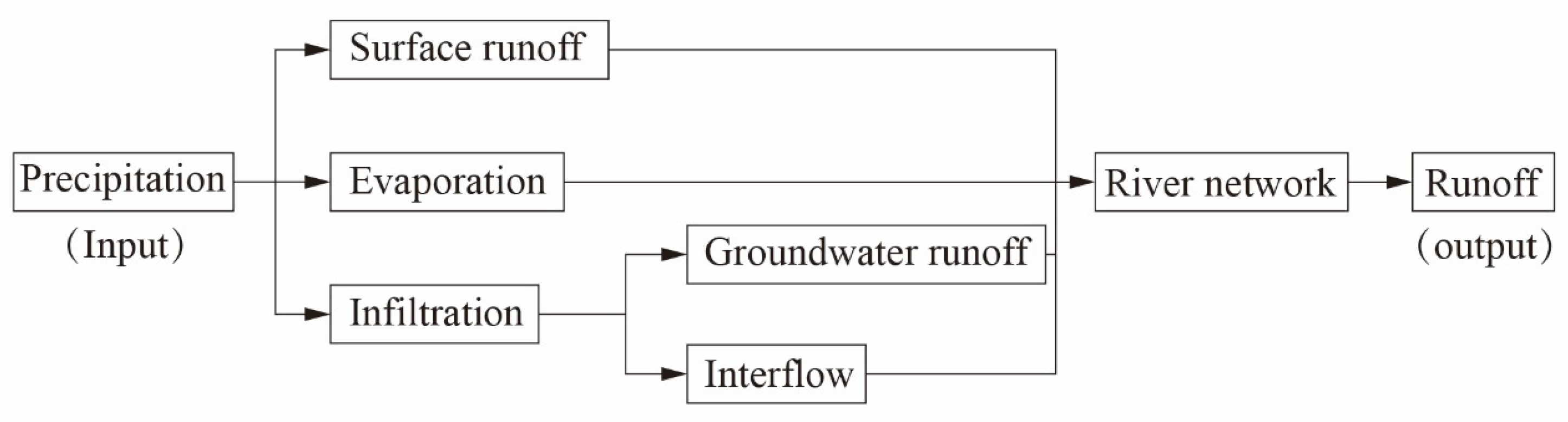
The hydrological processes in karst watersheds mainly include rainfall infiltration, runoff generation, and convergence [28]. Methods to study these processes are diverse and can be broadly categorized into two main types: physical methods and systematic methods [22]. The hydrological system and artificial neural networks (ANNs) share the same structural type and exhibit extreme conceptual similarity [26]. From a system structure perspective, the hydrological processes in the Lijiang River basin are a nonlinear system, based on the structure of rainfall (input) runoff (output). The intermediate network connections include multiple complex links (evaporation, infiltration, runoff generation, flow convergence, etc.), with each link mutually constraining and connecting to one another (Figure 1). This process is influenced by various factors, including topography, land surface characteristics, geological conditions, and human activities. Similarly, artificial neural networks are large nonlinear dynamic systems structured by the arrangement and interconnection of neurons across layers, forming different network structures by altering the connection patterns to simulate various complex links in the hydrological processes of karst watersheds (evaporation, infiltration, runoff generation, flow convergence, etc.).
Figure 1. Schematic diagram of the basin hydrological system.
From a conceptual perspective, the hydrological process system identification of a watershed involves using observational data to analyze the interrelationships among its intrinsic hydrological factors, such as the relationships between evapotranspiration, precipitation, and runoff [29]. The neural network system is based on long-term historical observational data, forming a mathematical model through training and testing [30]. The series of conceptual features of neural networks provides a strong theoretical foundation and assurance for their application in hydrological process research, effectively addressing issues related to the identification and analysis of nonlinear hydrological systems. Therefore, neural networks are conceptually well suited for the analysis and research of hydrological processes in the Lijiang River basin. The essence of the BP neural network is a type of neural network based on the error backpropagation algorithm, which possesses strong mapping capabilities. Using BP neural networks for studying hydrological processes in the Lijiang River basin can effectively address many practical issues.

2.2. The Basic Principle of the BP Neural Network

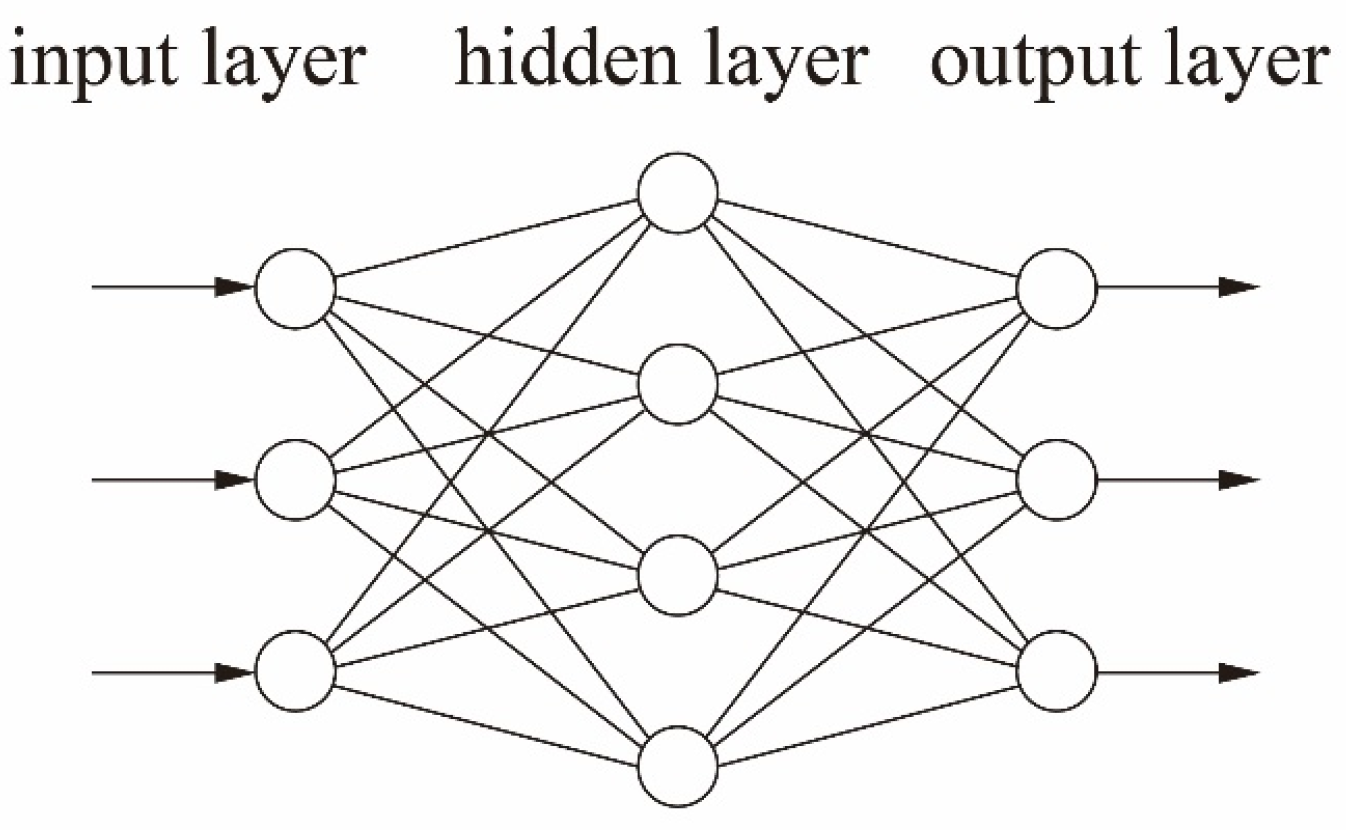
The basic structure of the BP network is multilayered, including an input layer (nodes), an output layer (nodes), and hidden layers (nodes). The hidden layer can consist of one or multiple layers. The input data enter the hidden layer nodes, where they are processed by activation functions, and then the information is output from the hidden layer nodes to the output layer, ultimately transformed into output results by the system (Figure 2).
Figure 2. Neural network structure diagram.
The learning process of the network consists of forward propagation and backward propagation. Forward propagation refers to the process of input signals being transmitted layer by layer from the input layer through the hidden layer units to the output layer, while backward propagation essentially involves the process of reducing system errors through training. The state of each layer of neurons is only associated with the states of the neurons in the previous layer. If the output layer does not achieve the desired result through the forward propagation mechanism, the system will backpropagate the error of the output signal and reduce the error between the expected and actual outputs by readjusting the weights of the neurons in each layer. This error signal is generally calculated using a squared error function, expressed as follows [21]:
E = 1 2 n y y ^ 2
In the formula, E is the signal error value (dimensionless); y is the actual input value (dimensionless); and y ^ is the expected value (dimensionless).
The algorithm of the BP network can be summarized as follows:
Step 1: Set initial values (weights W i j , W j k and thresholds H j and H k ). W ij   is the weight from input layer node i to hidden layer node j, W j k is the weight from hidden layer node j to output layer node k, H j is the threshold for hidden layer node j, and H k is the threshold for output layer node k; these are generally small random numbers.
Step 2: Input a randomly selected learning sample ( x 1 ,   x 2 ,…,   x n ,   t 1 ,   t 2 ,…,   t n ) into the main program.
Step 3: Calculate the input value n e t j for hidden layer node j and the corresponding output y j , namely:
n e t j = i W i j x i + σ j
y j = f n e t j
In the formula, n e t j   is the input value for hidden layer node j (dimensionless); W ij   is the weight from input layer node i to hidden layer node j (dimensionless); x i is the sample value (dimensionless); y j   is the output value for node j (dimensionless); and σ j is the threshold for hidden layer node j.
The activation function of the node is a Sigmoid function.
f x = 1 1 + e x
In the formula, x is the real number representing the input mapping (dimensionless).
Step 4: Calculate the input value n e t k for output layer node k and the corresponding output:
n e t k = j W j k x j + σ k
t ^ k = f n e t k
In the formula, n e t k   is the input value for output layer node k (dimensionless); W j k   is the weight from hidden layer node j to output layer node k (dimensionless); x j   is the sample value (dimensionless); t ^ k is the expected output value for node k (dimensionless); and σ k is the threshold for the connection from hidden layer node j to output layer node k.
Step 5: Calculate the reference error for output layer node k:
δ k = t ^ k 1 t ^ k t k t ^ k
In the formula, δ k   is the reference error for output layer node k (dimensionless).
Step 6: Calculate the reference error for hidden layer node j:
δ j = y i 1 y i k δ k W j k
In the formula, δ j   is the reference error for hidden layer node j (dimensionless).
Step 7: Adjust the weight W j k   from hidden layer node j to output layer node k and the threshold σ k :
W j k = W j k + η 1 δ k y j ,     η 1 0 , 1
σ k = σ k + η 2 δ k ,     η 2 0 , 1
Step 8: Adjust the weight W i j from input layer node i to hidden layer node j and the threshold σ j :
W i j = W i j + η 1 δ j x j ,     η 1 0 , 1
σ j = σ j + η 2 δ j ,     η 2 0 , 1
Step 9: Retrieve the next sample and return to Step 3 for learning, until all samples have been used for learning.
Step 10: Calculate E k and E. If the total error E is less than the specified accuracy, retain the weights and thresholds, and end the learning; otherwise, return to Step 2 to continue learning.
E k = 1 2 k = 1 n t k t ^ k 2
E = t = 1 p E k
In the formula, E k is the error for the k-th sample (dimensionless); E is the total error (dimensionless). In the formula, Ek is the error for the k-th sample (dimensionless); E is the total error (dimensionless).
Incorporate a momentum term when adjusting weights and thresholds to accelerate the network’s learning speed and reduce the likelihood of oscillations during learning.
W i j N + 1 = W i j N + η 1 δ j x j + α W i j N W i j N 1
In the formula, N is the number of iterations, and α is the momentum term coefficient.

3. Preparation of Model Materials

3.1. Generalization of the Hydrological System in the Lijiang River Basin

The catchment area above the Guilin Station in the Lijiang River basin is 2769 km2. Major tributaries in the region include the Liudong River, Huangbai River, Chuan River, and Xiaorong River, among others [31]. The hydrological processes are extremely complex, influenced by multiple factors from rainfall to runoff. With the development of the socio-economic conditions in the Lijiang River basin, the underlying surface has changed significantly, making the physical analysis of its hydrological processes operationally complex. Therefore, the complex hydrological processes in the Lijiang River basin are generalized into a hydrological system that overlooks the secondary characteristics of physical parameters and their precise spatial distribution. Its main performance is represented by the primary influencing factors, thus simplifying the analysis and research process. The systems approach can be used to address the analysis and research issues of hydrological processes in the Lijiang River basin to some extent.
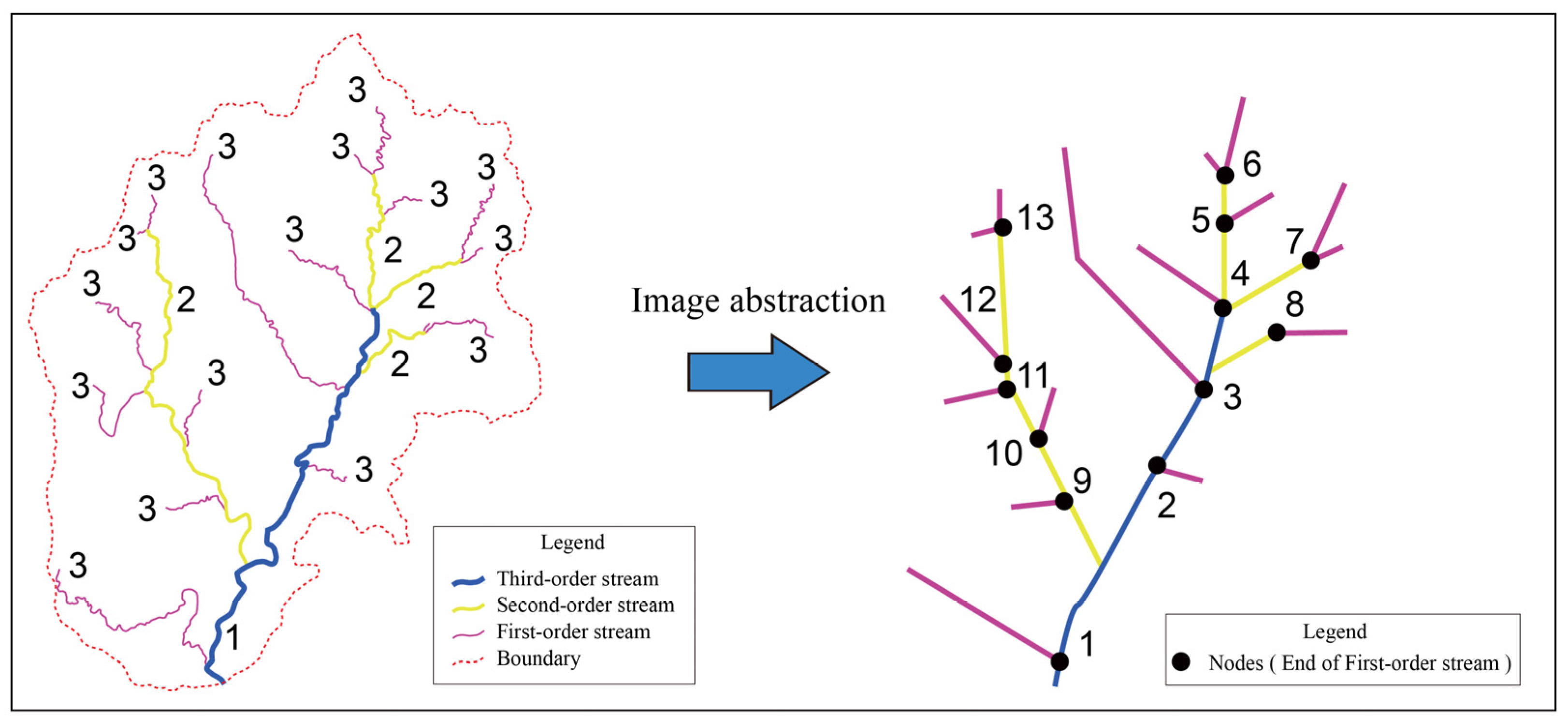
Hydrological process modeling requires the generalization of the hydrological system. To this end, we extract relevant topographic and hydrological information, generalize the river system structure of the basin (Figure 3), and calculate the hydrological structure parameters of the study area (Table 1 and Table 2).
Figure 3. Hydrological generalization map.
Table 1. Area statistics of sub-basin in the Upper Reaches of Lijiang River basin.
Table 2. Hydrological structure parameter calculation results.
The Lijiang River basin is a closed basin, with groundwater movement belonging to the shallow zone and no deep groundwater flow exiting the basin [32]. The water volume within the basin is discharged through the Lijiang River section controlled by the Guilin hydrometric station. Within a certain time period, the runoff quantity Q at the Lijiang River section controlled by the Guilin hydrometric station is a function of precipitation, evapotranspiration, and changes in water storage. The changes in water storage are influenced by the precipitation before the period as well as the precipitation and evapotranspiration during the period. Therefore, the relationship between the runoff quantity Q and the precipitation P and evapotranspiration E during the period can be expressed as a function. In practical research, the precipitation P is an observed value, while the evaporation E is usually calculated using temperature, humidity, and other variables through a function. Therefore, a system can be used to generalize the complex relationship between Q and the factors, allowing for the establishment of a systematic model.
For such a closed basin, the water balance equation for a specific time period is as follows:
Q = f P , E , Δ S
In the equation, Q is the runoff quantity at the basin outlet section (m3/s); P is the precipitation over the basin (mm); E is the evapotranspiration over the basin (mm); and ΔS is the change in water storage in the basin (m3).
By dividing the basin into zones and drawing an analogy with network structures, the mapping relationship can be generalized into a holistic system, allowing for simulation and approximation to establish a parameter model.

3.2. Preparation and Normalization of Training Sample Data

The neural network-based monthly rainfall runoff analysis model consists of two stages. First, actual measured data are used as samples to train the network for parameter identification. Then, the trained network is utilized to analyze and output simulated runoff values. The identification and training of model parameters utilized monthly average precipitation and average flow data from five counties in the Guilin region (Quanzhou, Xing’an, Lingchuan, Yangshuo, and Yongfu) as input data (Table 3). Simultaneously, the monthly average flow data from the Lijiang River hydrometric station in Guilin were used as output data for model development. Monthly averages provide insights into long-term trends and seasonal patterns, making them suitable for the development of medium- to long-term hydrological models. However, it is important to note that monthly averages may obscure important details of short-term flow variations and extreme events. Short-term hydrological process simulations should be achieved through the development of geomorphic instantaneous unit hydrographs.
Table 3. Network model sample list.
Due to the uneven temporal and spatial distribution of actual rainfall, the values of input layer data vary significantly. To accelerate the training speed of the network, normalization of the physical quantities in the input layer is performed before training. The Sigmoid function has very flat curves within the ranges [0, 0.1] and [0.9, 1.0]. Therefore, the physical quantities of each input are normalized to the range [0.1, 0.9].
The normalization formula is as follows:
X = 0.1 + 0.8 X X m i n X m a x X m i n
where X′ and X represent the values after and before normalization, respectively. X m a x and X m i n are the maximum and minimum values of the 13 physical quantities in each sample.

4. Network Training and Simulation

4.1. Network Structure Design

The number of input samples is set to 13, and the actual number of hidden layer neurons needed is determined through trial calculations. The BP neural network structurally resembles the Lijiang River hydrological system, but its parameters lack actual hydrological physical significance, classifying it as a black box model. A watershed hydrological system consists of the area where the main river is located and the tributary basins that flow into it. After a period of precipitation, water from the tributaries converges into the main river. In this process, each tributary area has its corresponding threshold values, such as watershed storage capacity. Precipitation and runoff serve as the input and output of the hydrological system, respectively. This process corresponds to the threshold, activation values, and outputs in the artificial neural network model.
In summary, the study area is divided into the mainstream region of the Lijiang River and nine tributary regions (Figure 4). After a precipitation event, the runoff from the nine tributary regions converges into the mainstream of the Lijiang River, which can be analogized to the structure of the BP neural network (Table 4). Overall, the structure of the BP neural network has become a gray box model, where some aspects of its internal workings are more interpretable yet still retain elements of opacity. Based on the analogy, the number of neurons in the hidden layer is set to 9, resulting in a 13-9-1 network structure (Table 5).
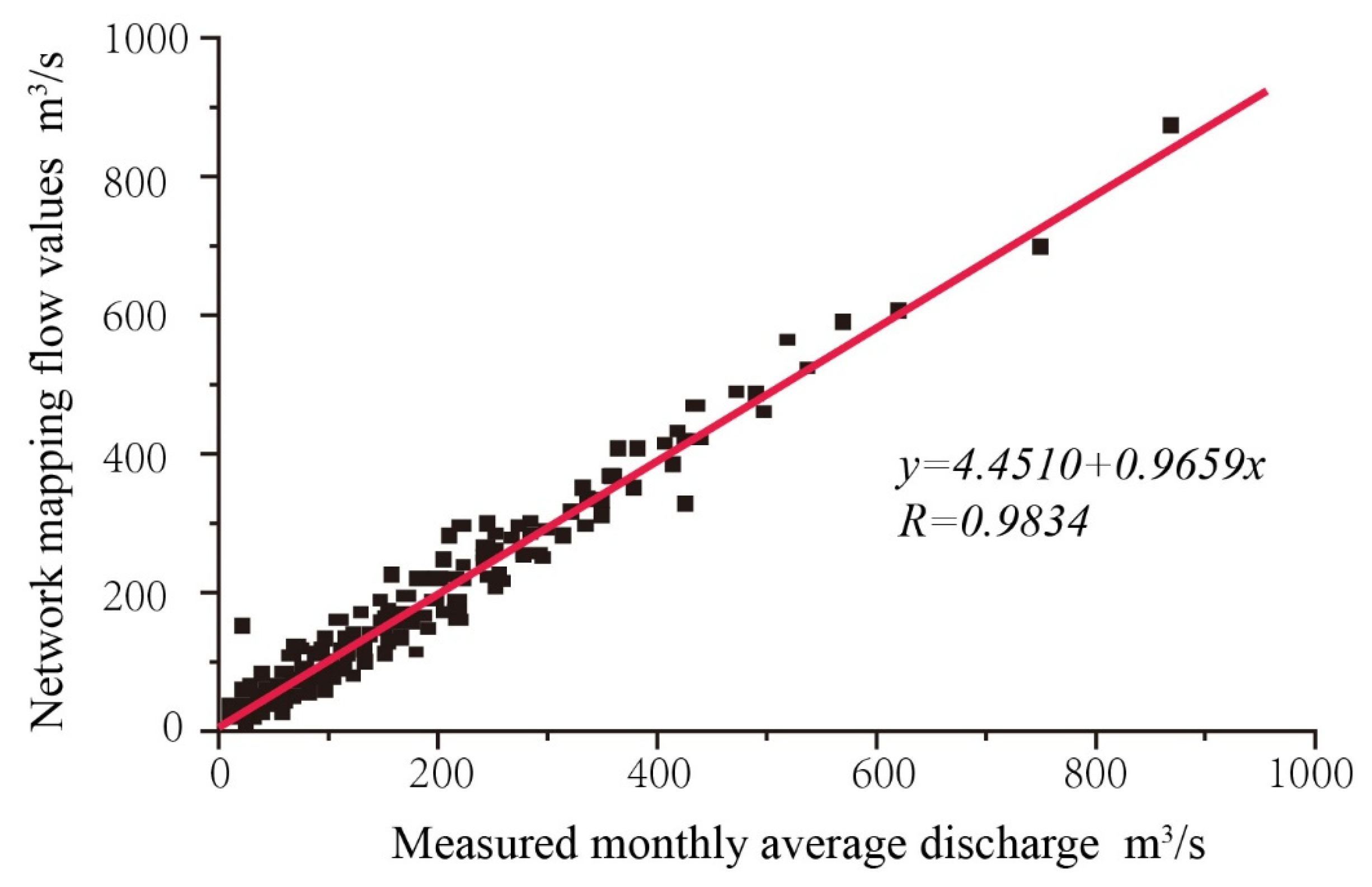
Figure 4. Correlation between network mapping values and measured values.
Table 4. Structural analogy.
Table 5. BP network model parameter list.

4.2. Network Training and Simulation Results

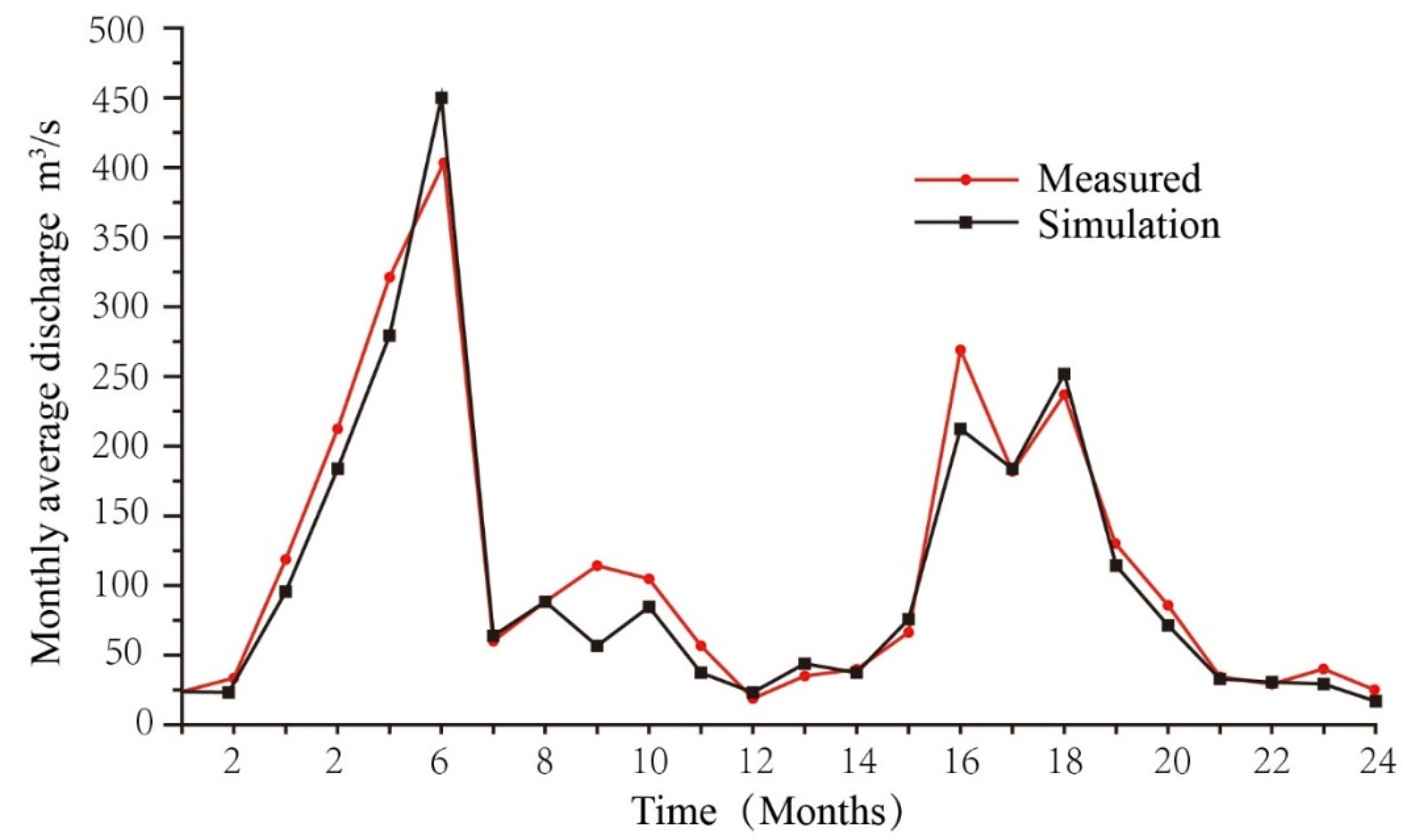
After determining the number of neurons in the input layer, hidden layer, and output layer, the network system is defined accordingly (Table 6). This definition includes the specific architecture and any relevant parameters for training and simulation. The training algorithm selected is the momentum method, and the activation function used is Sigmoid. The program successfully executed the training of the BP network model. The correlation between the network mapping values and the measured values is illustrated in Figure 4. This graph highlights the model’s accuracy and effectiveness in capturing the underlying data trends. The data from 2019 to 2020, spanning 24 months, are used as input layer data. The output results are compared with the corresponding measured data, as presented in Table 7 and illustrated in Figure 5. This comparison showcases the model’s performance over the specified period. It can be observed that the trained BP neural network simulates the monthly average flow rates with a high degree of accuracy. This indicates that the model effectively captures the underlying patterns in the data.
Table 6. Network system definition.
Table 7. Monthly average flow measured value and BP network simulation value.
Figure 5. Comparison of measured values of flow and simulated values.

4.3. Network Simulation Accuracy Analysis

The trained network model’s accuracy is assessed using the coefficient of determination method. The formula for calculating the coefficient of determination for model evaluation accuracy is as follows:
d y = 1 S 2 σ 2
S = i = 1 n y i y 2 n
σ = i = 1 n y i y ¯ 2 n
dy—coefficient of determination for model evaluation accuracy; S—mean square error of the difference between model values and measured values; σ—mean square error of calculated values; y i —measured value, m3/s; y—model calculated value, m3/s; y ¯ —mean of measured values, m3/s; n—number of test samples.
The larger the value of d y , the higher the accuracy of the model’s calculations. The coefficient of determination for the monthly runoff model at the Guilin station in the Lijiang River basin based on the BP neural network is 0.942, meeting the model accuracy requirements.
The Nash–Sutcliffe efficiency is an important metric for evaluating the accuracy of hydrological model predictions. The higher the NSE value, the better the model performance. To further assess the accuracy of the model, the Nash–Sutcliffe efficiency (NSE) is used for accuracy analysis.
The formula for calculating NSE is as follows:
NSE = 1 i = 1 n Q o b s , i Q s i m , i 2 i = 1 n Q o b s , i Q ¯ o b s 2
Q o b s , i —the observed flow value at the i-th time step; Q s i m , i —the simulated flow value at the i-th time step; Q ¯ o b s —the average observed flow value; n—the total number of observations and simulations.
The model’s predictions outperform simply using the average of the observed data, with a calculated NSE value of 0.963, indicating good model performance.

5. Conclusions

In conclusion, the hydrological processes in the Lijiang River basin are shaped by a complex interplay of factors, including climate, topography, and human activities. Relying solely on conceptual models or empirical relationships is insufficient to achieve the required accuracy in simulating these processes. While much of the existing research has focused on the urban segment of Guilin, with particular attention to ecological and environmental management—particularly in addressing flood and drought issues in the river channels—this focus is limited and fails to capture the full hydrological dynamics of the entire basin. To better understand and manage the hydrology of the basin, developing a model based on the water system in the upstream regions of the Lijiang River represents a scientifically robust approach. By leveraging historical data to predict future changes in water inflow to the upper reaches of the basin, such a model offers practical and valuable insights for comprehensive, basin-wide water resource management.
In this study, a BP neural network model (with a 13-9-1 structure and nine hidden layer neurons) was employed to simulate monthly rainfall runoff at the Guilin station in the Lijiang River basin. The model’s performance, as evaluated by the coefficient of determination and the NSE (Nash–Sutcliffe efficiency) value, indicates a good fit to the observed data. The model proves capable of predicting the hydrological response of the watershed to medium- and long-term precipitation events, thereby providing valuable decision support for flood forecasting, drought monitoring, and water resource management. Given the increasing demand for efficient water resource management, this model provides a solid scientific foundation for decision making, particularly in the context of climate change and anthropogenic influences. It can serve as an essential tool for formulating policies related to water resource management and environmental protection in the region.
However, it is important to note that the model, as currently trained, is designed primarily for medium- and long-term hydrological processes and assumes that conditions within the watershed remain unchanged (e.g., no significant shifts in climate or human activity). The impact of short-term flow variations and extreme events on model performance requires further investigation to enhance its applicability under more dynamic conditions.
In summary, the Lijiang River basin, as a karst watershed, is a highly complex, nonlinear system, where various hydrological processes are interconnected and influenced by a network of relationships. The structure of artificial neural networks, which mirrors these processes, significantly advances the simulation of hydrology in karst basins. Ultimately, this approach provides a critical foundation for effective water resource management and decision making in karst regions, with broader implications for sustainable water use and environmental protection.

Author Contributions

Conceptualization, W.L. and Y.C.; methodology, S.L. and Y.Z.; simulation, W.L. and S.L.; validation, W.L., S.L. and Y.Z.; formal analysis, W.L.; investigation, W.L.; resources, W.L.; data curation, Y.C.; writing—original draft preparation, W.L.; writing—review and editing, W.L.; visualization, S.L.; supervision, S.L.; project administration, S.L.; funding acquisition, S.L. All authors have read and agreed to the published version of the manuscript.

Funding

This research was funded by the Guangxi Young and Middle-aged Teachers’ Basic Ability Upgrading Project, grant number 2024KY0283; Guangxi Science and Technology Planning Project, grant number 2023GXNSFBA026355; Innovation Project of Guangxi Graduate Education, grant number YCBZ2024173.

Data Availability Statement

This article includes the majority of the data generated or analyzed during this study. The authors will make any remaining data available upon reasonable request.

Acknowledgments

We appreciate the assistance from Guangxi Key Laboratory of Environmental Pollution Control Theory and Technology for providing the necessary materials. We also appreciate the assistance from Guangxi Key Laboratory of Environmental Pollution Control Theory and Technology/Key Laboratory of Carbon Emission and Pollutant Collaborative Control (Guilin University of Technology), Education Department of Guangxi Zhuang Autonomous Region, for providing the necessary instruments and equipment.

Conflicts of Interest

The authors declare no competing interests.

References

  1. Felton, G.K. Hydrologic response of a karst watershed. Trans. ASAE 1994, 37, 143–150. [Google Scholar] [CrossRef]
  2. Vilhar, U.; Kermavnar, J.; Kozamernik, E.; Petrič, M.; Ravbar, N. The Effects of Large-Scale Forest Disturbances on Hydrology—An Overview with Special Emphasis on Karst Aquifer Systems. Earth-Sci. Rev. 2022, 235, 104243. [Google Scholar] [CrossRef]
  3. Luo, Y.; Zhou, Q.; Peng, D.; Yan, W.; Zhao, M. Key Influence of Hydrogeological, Geochemical, and Geological Structure Factors on Runoff Characteristics in Karst Catchments. J. Hydrol. 2023, 623, 129852. [Google Scholar] [CrossRef]
  4. Bonacci, O.; Pipan, T.; Culver, D.C. A Framework for Karst Ecohydrology. Environ. Geol. 2009, 56, 891–900. [Google Scholar] [CrossRef]
  5. Jourde, H.; Wang, X. Advances, Challenges and Perspective in Modelling the Functioning of Karst Systems: A Review. Environ. Earth Sci. 2023, 82, 396. [Google Scholar] [CrossRef]
  6. Guo, Y.; Huang, F.; Chi, F.; Zhang, N.; Ma, J.; Miao, Y.; Chen, F. Hydrogeological Structures of Karst Features Using Hydrographs in an Underground River Basin Formed in a Peak Cluster Depression, Southwest China. J. Hydrol. 2024, 634, 131085. [Google Scholar] [CrossRef]
  7. Cardoso De Salis, H.H.; Monteiro Da Costa, A.; Moreira Vianna, J.H.; Azeneth Schuler, M.; Künne, A.; Sanches Fernandes, L.F.; Leal Pacheco, F.A. Hydrologic Modeling for Sustainable Water Resources Management in Urbanized Karst Areas. Int. J. Environ. Res. Public Health 2019, 16, 2542. [Google Scholar] [CrossRef]
  8. Yang, G.R.; Wang, X.-J. Artificial Neural Networks for Neuroscientists: A Primer. Neuron 2020, 107, 1048–1070. [Google Scholar] [CrossRef]
  9. Yang, D.; Yang, Y.; Xia, J. Hydrological Cycle and Water Resources in a Changing World: A Review. Geogr. Sustain. 2021, 2, 115–122. [Google Scholar] [CrossRef]
  10. Hartmann, A.; Goldscheider, N.; Wagener, T.; Lange, J.; Weiler, M. Karst Water Resources in a Changing World: Review of Hydrological Modeling Approaches: Karst Water Resources Prediction. Rev. Geophys. 2014, 52, 218–242. [Google Scholar] [CrossRef]
  11. Wu, L.; Wang, S.; Bai, X.; Chen, F.; Li, C.; Ran, C.; Zhang, S. Identifying the Multi-Scale Influences of Climate Factors on Runoff Changes in a Typical Karst Watershed Using Wavelet Analysis. Land 2022, 11, 1284. [Google Scholar] [CrossRef]
  12. Cao, Y.; Zhang, J.; Yang, M.; Lei, X.; Guo, B.; Yang, L.; Zeng, Z.; Qu, J. Application of SWAT Model with CMADS Data to Estimate Hydrological Elements and Parameter Uncertainty Based on SUFI-2 Algorithm in the Lijiang River Basin, China. Water 2018, 10, 742. [Google Scholar] [CrossRef]
  13. Li, Z.; Tang, X.; Li, L.; Chu, Y.; Wang, X.; Yang, D. GIS-Based Risk Assessment of Flood Disaster in the Lijiang River Basin. Sci. Rep. 2023, 13, 6160. [Google Scholar] [CrossRef]
  14. Zhu, D.; Cheng, X.; Li, W.; Niu, F.; Wen, J. Temporal and Spatial Variation Characteristics of Water Quality in the Middle and Lower Reaches of the Lijiang River, China and Their Responses to Environmental Factors. Int. J. Environ. Res. Public Health 2022, 19, 8089. [Google Scholar] [CrossRef]
  15. Ravbar, N. Variability of Groundwater Flow and Transport Processes in Karst under Different Hydrologic Conditions. Acta Carsologica 2013, 42, 644. [Google Scholar] [CrossRef]
  16. Pandi, D.; Kothandaraman, S.; Kuppusamy, M. Hydrological Models: A Review. Int. J. Hydrol. Sci. Technol. 2021, 12, 223–242. [Google Scholar] [CrossRef]
  17. Sood, A.; Smakhtin, V. Global Hydrological Models: A Review. Hydrol. Sci. J. 2015, 60, 549–565. [Google Scholar] [CrossRef]
  18. Wagener, T.; Boyle, D.P.; Lees, M.J.; Wheater, H.S.; Gupta, H.V.; Sorooshian, S. A Framework for Development and Application of Hydrological Models. Hydrol. Earth Syst. Sci. 2001, 5, 13–26. [Google Scholar] [CrossRef]
  19. Zou, J.; Han, Y.; So, S.-S. Overview of Artificial Neural Networks. In Artificial Neural Networks: Methods and Applications; Livingstone, D.J., Ed.; Humana Press: Totowa, NJ, USA, 2009; pp. 14–22. ISBN 978-1-60327-101-1. [Google Scholar]
  20. Papacharalampous, G.; Tyralis, H. A Review of Machine Learning Concepts and Methods for Addressing Challenges in Probabilistic Hydrological Post-Processing and Forecasting. Front. Water 2022, 4, 961954. [Google Scholar] [CrossRef]
  21. Walczak, S. Artificial Neural Networks. In Advanced Methodologies and Technologies in Artificial Intelligence, Computer Simulation, and Human-Computer Interaction; IGI Global: Hershey, PA, USA, 2019; pp. 40–53. ISBN 978-1-5225-7368-5. [Google Scholar]
  22. Woldseth, R.V.; Aage, N.; Bærentzen, J.A.; Sigmund, O. On the Use of Artificial Neural Networks in Topology Optimisation. Struct. Multidisc. Optim. 2022, 65, 294. [Google Scholar] [CrossRef]
  23. Sharma, P.; Singh, S.; Sharma, S.D. Artificial Neural Network Approach for Hydrologic River Flow Time Series Forecasting. Agric. Res. 2022, 11, 465–476. [Google Scholar] [CrossRef]
  24. Ibrahim, K.S.M.H.; Huang, Y.F.; Ahmed, A.N.; Koo, C.H.; El-Shafie, A. A Review of the Hybrid Artificial Intelligence and Optimization Modelling of Hydrological Streamflow Forecasting. Alex. Eng. J. 2022, 61, 279–303. [Google Scholar] [CrossRef]
  25. Blöschl, G.; Sivapalan, M. Scale Issues in Hydrological Modelling: A Review. Hydrol. Process. 1995, 9, 251–290. [Google Scholar] [CrossRef]
  26. Tanty, R.; Desmukh, T.S. Application of Artificial Neural Network in Hydrology—A Review. Int. J. Eng. Res. Technol. 2015, 4, 184–188. [Google Scholar] [CrossRef]
  27. Gajamannage, K.; Jayathilake, D.I.; Park, Y.; Bollt, E.M. Recurrent Neural Networks for Dynamical Systems: Applications to Ordinary Differential Equations, Collective Motion, and Hydrological Modeling. Chaos Interdiscip. J. Nonlinear Sci. 2023, 33, 013109. [Google Scholar] [CrossRef]
  28. Parise, M.; Sammarco, M. The Historical Use of Water Resources in Karst. Environ. Earth Sci. 2015, 74, 143–152. [Google Scholar] [CrossRef]
  29. Hartmann, A.; Barberá, J.A.; Lange, J.; Andreo, B.; Weiler, M. Progress in the Hydrologic Simulation of Time Variant Recharge Areas of Karst Systems—Exemplified at a Karst Spring in Southern Spain. Adv. Water Resour. 2013, 54, 149–160. [Google Scholar] [CrossRef]
  30. Jougla, R.; Leconte, R. Short-Term Hydrological Forecast Using Artificial Neural Network Models with Different Combinations and Spatial Representations of Hydrometeorological Inputs. Water 2022, 14, 552. [Google Scholar] [CrossRef]
  31. Mao, X.; Meng, J.; Wang, Q. Tourism and Land Transformation: A Case Study of the Li River Basin, Guilin, China. J. Mt. Sci. 2014, 11, 1606–1619. [Google Scholar] [CrossRef]
  32. Chen, J.; Lu, M.; Dong, G.; Wu, S.; Xu, J.; Wang, S. Evaluating the Metabolic Structure and Interrelationships of the Lijiang River Basin Based on Ecological Network Analysis. J. Hydrol. Reg. Stud. 2024, 51, 101631. [Google Scholar] [CrossRef]
Disclaimer/Publisher’s Note: The statements, opinions and data contained in all publications are solely those of the individual author(s) and contributor(s) and not of MDPI and/or the editor(s). MDPI and/or the editor(s) disclaim responsibility for any injury to people or property resulting from any ideas, methods, instructions or products referred to in the content.

Article Metrics

Citations

Article Access Statistics

Multiple requests from the same IP address are counted as one view.