
Article

Climate-Constrained Attribution of Vegetation Carbon Sink Dynamics in a Karst Region: Disentangling Human and Climatic Contributions

1
Department of Culture and Tourism, Guizhou Light Industry Polytechnic University, Guiyang 550001, China
2
School of Karst Science, Guizhou Normal University, Guiyang 550001, China
*
Author to whom correspondence should be addressed.
Atmosphere 2026, 17(6), 537; https://doi.org/10.3390/atmos17060537 (registering DOI)
Submission received: 24 March 2026 / Revised: 5 May 2026 / Accepted: 12 May 2026 / Published: 23 May 2026
(This article belongs to the Section Biosphere/Hydrosphere/Land–Atmosphere Interactions)

Abstract

In the context of increasing climate variability and carbon neutrality targets, understanding the relative roles of climate and human activities is essential for accurately assessing vegetation carbon sink dynamics. This study develops a climate-controlled attribution framework to disentangle human-induced effects from natural climatic variability in Guizhou Province, a representative karst region of Southwest China. Using multi-source remote sensing and climate data from 2004 to 2023, net ecosystem productivity (NEP) was estimated, and its spatiotemporal dynamics were analyzed. A two-step attribution approach was applied to isolate climate-driven variability and quantify the contribution of anthropogenic activities. Results indicate that mean NEP increased significantly from 273 gC·m−2·yr−1 in 2004 to 369 gC·m−2·yr−1 in 2023, with a provincial average of 318 gC·m−2·yr−1. Human activities are estimated to contribute a dominant share (approximately 60–75%), although uncertainties remain due to methodological limitations. Spatial analysis reveals pronounced heterogeneity, with stronger human-induced enhancement in eastern regions and mixed restoration–disturbance effects in ecologically fragile western areas. These findings suggest that ecological restoration policies in fragile karst ecosystems can generate amplified carbon sink responses beyond background climatic effects. These findings provide insights into understanding climate–carbon cycle interactions and improving region-specific climate mitigation strategies.

1. Introduction

With the intensification of global climate change, greenhouse gas emissions have become a key factor affecting the stability of the Earth’s ecosystem [1,2]. As a vital component of the natural carbon cycle, vegetation absorbs 112–169 PgC annually [3]. These estimates primarily refer to Gross Primary Productivity (GPP), whereas this study focuses on Net Ecosystem Productivity (NEP), which further accounts for ecosystem respiration. Stores approximately 45% of organic carbon and accounts for two-thirds of the carbon uptake in terrestrial ecosystems, playing a crucial role in mitigating climate change and maintaining planetary ecological stability [4,5]. Against the backdrop of increasing international focus on global carbon reduction targets and carbon pricing mechanisms, accurately assessing vegetation carbon sink capacity and exploring its change mechanisms are of significant importance for formulating science-based climate policies, advancing carbon market development, and enhancing carbon mitigation efficiency [6,7]. Both natural and anthropogenic factors drive changes in carbon sinks. Human activities are primarily reflected through land-use change, ecological restoration projects, and socio-economic development indicators. Although direct quantification remains challenging, their combined effects are captured through residual analysis after excluding climate-driven components [8]. Therefore, in-depth research on vegetation carbon sink changes induced by human activities can help us better understand the relationship between non-natural factors and the global carbon cycle. This understanding provides a scientific foundation for land-use management, ecological restoration, and sustainable development, thereby aiding in mitigating climate change [9,10].
Existing studies have confirmed that human activities—including land-use management, the implementation of ecological restoration projects, and human migration—exert significant influence on vegetation carbon sinks [11]. As a major contributor to global vegetation change, anthropogenic factors in China, particularly ecological restoration policies, have played a crucial role in improving ecosystem services and enhancing carbon sequestration capacity. Specifically, despite accounting for only about 6.6% of the global vegetation area, China has contributed approximately 25% of the global increase in green leaf area [12,13]. Over the past two decades, the Chinese government has implemented a series of ecological restoration programs, including the Grain for Green (returning farmland to forest and grassland), the Natural Forest Protection Project, and the Poverty Alleviation Relocation Program. These policies have driven substantial land-use changes, strengthened ecosystem service functions, and notably boosted vegetation carbon sink capacity [14,15]. China has become the country with the world’s largest area of planted forests, with afforestation efforts surpassing the total of all other countries combined, and its contribution to the global carbon sink is widely recognized [16,17].
While existing research has analyzed the impact of human activities on carbon sinks in China in depth—for instance, some scholars have focused on carbon sink changes and ecological restoration outcomes in specific provinces or regions [18,19]; others have examined the long-term effects of ecological restoration projects using time-series data [20,21]; further studies have explored the interaction between population migration and land-use change [15,22] and employed new technologies such as remote sensing to analyze the impact of land-use change on vegetation carbon sinks [23,24]; some geographical researchers have also attempted to spatially visualize the effects of policies on vegetation carbon sinks [9]. Although many studies have applied residual-based approaches to distinguish between climate-driven and human-induced effects and have explored their underlying mechanisms, most remain largely descriptive, with limited spatially explicit representation. As a result, the interpretation of attribution results and associated mechanisms often lacks intuitive and visual support. Furthermore, karst ecosystems—characterized by shallow soils, high ecological sensitivity, and strong human–land interactions and representing extreme test cases of land–atmosphere coupling due to their pronounced vegetation–soil–climate feedbacks—remain underrepresented in carbon sink attribution studies, despite their potentially pronounced responses to ecological restoration and land-use interventions.
To address these limitations, this study develops an integrated attribution framework that combines residual trend analysis with multi-factor approaches to disentangle the relative roles of climate variability and human activities across space and time. Focusing on Guizhou Province, a representative karst region in Southwest China, we investigate how ecological restoration and other anthropogenic interventions have reshaped vegetation carbon sink dynamics. We hypothesize that, under relatively stable climatic conditions, human activities have become the dominant driver of NEP variation, with impacts exhibiting strong spatial heterogeneity associated with ecological fragility and land-use transformation intensity. Using 1 km resolution remote sensing data from 2004 to 2023, this study isolates climate-driven variability and quantifies residual anthropogenic contributions, providing a long-term, spatially explicit assessment of human-induced carbon sink enhancement. The findings offer methodological insights for carbon sink attribution in fragile ecosystems and support evidence-based optimization of ecological restoration under global change.

2. Materials and Methods

2.1. Study Area

Guizhou Province is situated in southwestern China and serves as a crucial ecological barrier in the upper reaches of both the Yangtze River and the Pearl River. The province covers a total area of 176,200 km2, of which 92.5% is mountainous or hilly terrain. As a pilot zone for ecological civilization construction in China, Guizhou exhibits distinct karst landform characteristics in its land use patterns. Its forest coverage rate increased from 41.5% in 2010 to 62.8% in 2022, representing one of the fastest growth rates nationwide. Studies indicate that through the implementation of an “ecology-first, green development” strategy, Guizhou has become a significant carbon sink growth pole in southwestern China [20]. The land-use structure in Guizhou follows a “three forests, one farmland” pattern (63.2% forest land, 21.8% cultivated land, 9.5% grassland, and 5.5% construction land). Karst areas account for 73.6% of the province’s total area. With a population density higher than the national average and limited arable land per capita, the region has formed a unique, fragile yet resilient coupled ecosystem (Figure 1). Over the past two decades, ecological restoration projects such as the Grain for Green Program and rocky desertification control have played a major role in rehabilitating rocky karst desertification areas. It has been confirmed that during the implementation of these ecological projects, the local forest carbon stock increased by 34.82 t·hm−2 [25]. Human activities—primarily the implementation of various ecological restoration initiatives—have thus exerted a significant impact on Guizhou’s ecological trajectory.

2.2. Date Collection and Preprocessing

All data were processed on the Google Earth Engine (GEE) cloud platform, chosen for its robust data catalog, preprocessing capabilities, and computational power [26,27].

2.2.1. Date Collection

Net Primary Productivity (NPP) Data: The MOD17A3HGF.V6 dataset was used, providing annual NPP at 500 m spatial resolution (NASA LP DAAC). This product offers consistent global information on vegetation productivity.
Temperature: We used the MYD11A2 V6.1 dataset, providing land surface temperature (LST) every 8 days at 1 km resolution. This MODIS-derived product ensures extensive spatial coverage and timely observations.
Precipitation: The UCSB-CHG/CHIRPS/DAILY quasi-global dataset was used, with daily temporal resolution and a spatial resolution of 0.05°. It captures precipitation patterns with a high level of spatiotemporal detail.
Soil Carbon Density Data: The global soil organic carbon (SOC) dataset developed by Ledo et al. [28] was used. This empirically derived product estimates SOC changes under perennial cropping systems, representing long-term average conditions rather than annual gridded values. It was treated as a stable background variable and resampled to a 1 km grid.
Slope and Elevation Data: Slope and elevation data were derived from the ALOS DSM: Global 30m dataset provided by the JAXA Earth Observation Research Center. With a spatial resolution of 30 m, it offers precise topographical data for the study area. As a static topographic product, this dataset remains valid for the entire 2004–2023 study period regardless of the mission start year (2006).
It is important to note that this study does not use explicit land-use or socio-economic datasets. Instead, anthropogenic effects are inferred through a residual analysis framework.

2.2.2. Data Preprocessing

All the aforementioned datasets underwent unified preprocessing on the Google Earth Engine platform, including cloud removal, radiometric correction, geometric correction, and data standardization. The specific steps are as follows:
Cloud Removal and Image Processing: Cloud cover in the remote sensing images was removed to ensure data clarity and accuracy. This was performed using GEE’s built-in cloud detection algorithms combined with image quality assessment indicators.
Radiometric and Geometric Correction: Radiometric and geometric corrections were applied to the remote sensing data to mitigate biases caused by atmospheric conditions, sensor characteristics, and viewing angles. This ensures comparability of data collected at different times and by different sensors.
Data Standardization: All datasets were processed in GEE and harmonized to a consistent spatiotemporal framework. Specifically, all variables were resampled to a spatial resolution of 1 km to match the NEP analysis grid. High-resolution data (e.g., 30 m DEM) were aggregated using a mean approach, while coarser-resolution data (e.g., 0.05° precipitation) were resampled using bilinear interpolation. In terms of temporal resolution, all datasets were converted to an annual scale, with daily precipitation aggregated to annual totals and 8-day temperature averaged to annual means. This ensured consistency across multi-source datasets and reduced potential scale-related biases.

2.3. Methodological Framework

In this study, anthropogenic influence is treated as a composite effect of land-use change, ecological restoration, and socio-economic development. Because this influence is difficult to measure directly, it is inferred indirectly using residual analysis, after the effects of climatic variability have been removed.

2.3.1. Vegetation Carbon Sink Assessment

Net Primary Productivity (NPP) is the net carbon absorbed by plants and serves as a core indicator of vegetation activity. Net Ecosystem Productivity (NEP), a key metric for carbon sink capacity, is then calculated as the difference between NPP and Soil Heterotrophic Respiration (Rh) [29]. The NEP model is a classic and widely applied approach in terrestrial ecosystem carbon sink research. It is calculated as follows:
N E P = N P P 0.6163 × 1.55 × e 0.031 T × P P + 0.68 × S O C S O C + 2.23 0.7918
where
NPP has units of t·km−2·yr−1;
T is the mean annual temperature (°C) of the ecoregion;
P is the annual precipitation (mm);
SOC is the soil carbon density (g C·m−2) at the soil surface within the study area.

2.3.2. Trend Analysis

The interannual trend of NEP was calculated using simple linear regression. The slope of the linear regression equation is defined as the interannual trend rate of NEP (slope) [30], calculated using the following formula:
s l o p e = n × i = 1 n ( i × N E P i ) i = 1 n i i = 1 n N E P i n × i = 1 n i 2 i = 1 n i
where slope is the slope of the simple linear regression equation fitted between NEP and the time variable. Since the time step between consecutive observations is one year, the slope value directly represents the mean annual change in NEP (gC·m−2·yr−1 per year); i is the time variable (year); n is the number of years in the study period (n ≤ 20); NEPi is the mean NEP for year *i*. A slope > 0 indicates an increasing trend in NEP over time, while a slope < 0 indicates a decreasing trend.

2.3.3. Partial Least Squares Regression Model

A Partial Least Squares Regression (PLSR) model was used to analyze the influence of natural and anthropogenic factors on NEP [31]. PLSR is ideal for this task because it handles multicollinearity among climate variables (e.g., temperature, precipitation, and radiation are often correlated). It works by extracting orthogonal latent components that maximize covariance between the predictors and NEP, making it robust in complex, spatially heterogeneous karst environments.
We selected temperature, precipitation, and solar radiation as the primary climatic drivers because they fundamentally control energy and water availability and are available in consistent long-term datasets. Other environmental variables—such as soil moisture and evapotranspiration—are strongly correlated with these and are thus partially reflected in the combined climatic signal.
N E P = β 0 + β 1 × X n a t u r e + β 2 × X h u m a n + ε
N E P h u m a n = N E P N E P n a t u r e = β 2 × X h u m a n + ε
where
NEP (Net Ecosystem Productivity): The dependent variable, representing the net carbon sink of the ecosystem.
Xnature: The matrix of natural factors, comprising environmental variables such as land surface temperature (LST), precipitation (Pre), and photosynthetically active radiation (PAR).
Xhuman: In this study, anthropogenic effects are not directly represented by explicit socio-economic or land-use variables. Instead, they are inferred indirectly using a residual-based approach. Specifically, after modeling and removing the contribution of natural (climatic) factors to NEP, the remaining unexplained component is interpreted as the integrated effect of human activities.
β1: The regression coefficients for the natural factors, quantifying their contribution to NEP.
β2: The regression coefficients for the anthropogenic factors, quantifying their contribution to NEP.
β0: The model intercept, representing the baseline NEP value in the absence of all influencing factors.
ε: The error term, representing the portion of variation in NEP that cannot be explained by the model.
In the PLSR framework, the original predictor matrices Xnature and Xhuman are first decomposed into a set of orthogonal latent variables, denoted as Tnature and Thuman. These latent variables are obtained as linear combinations of the original variables and are constructed to maximize the covariance with the response variable (NEP).
Specifically, the transformation can be expressed as follows:
T n a t r u e = X n a t r u e × W n a t r u e
T h u m a n = X h u m a n × W h u m a n
where Wnature and Whuman are weight matrices derived during the PLSR iterative extraction process.
The regression coefficients (β1, β2) are then estimated by regressing the response variable Y (NEP) onto the latent variables T. The fitted values of NEP are subsequently reconstructed by projecting the latent variable space back to the original variable space through the estimated coefficients.
Therefore, expressions (5) and (6) are derived based on the regression relationship between the latent variable T and the response variable Y, rather than directly from the original predictor matrices X. This transformation effectively reduces multicollinearity and ensures that the extracted components capture the dominant explanatory variance. To address potential multicollinearity among climate variables (e.g., temperature, precipitation, and solar radiation), principal component analysis (PCA) was applied to transform the original correlated variables into a set of orthogonal components. This reduces redundancy and ensures the independence of predictors in subsequent analysis. For the natural factor matrix Xnature, latent variables Xnature are extracted via PLSR as intermediate representations. The regression between these latent variables and the target variable (NEP) forms the basis for estimating the regression coefficient β1. The detailed transformation and derivation process is described as follows:
β 1 = ( T T n a t r u e T n a t r u e ) 1 T T n a t r u e Y
β 2 = ( T T h u m a n T h u m a n ) 1 T T h u m a n Y
ε = Y Y ¯
β 0 = Y ¯ β 1 T ¯ i
where
Tnature: latent variable matrix derived from Xnature.
Thuman: latent variable matrix derived from Xhuman.
Y: dependent variable (observed NEP).
TnatureTTnature: matrix product of the transpose of Tnature and Tnature.
ThumanTThuman: matrix product of the transpose of Thuman and Thuman.
A key limitation is that this approach treats anthropogenic influence as a single, integrated residual and cannot separate individual human drivers (e.g., afforestation vs. urbanization). Potential interactions between climate and human activities may also not be fully captured.

2.4. Research Framework

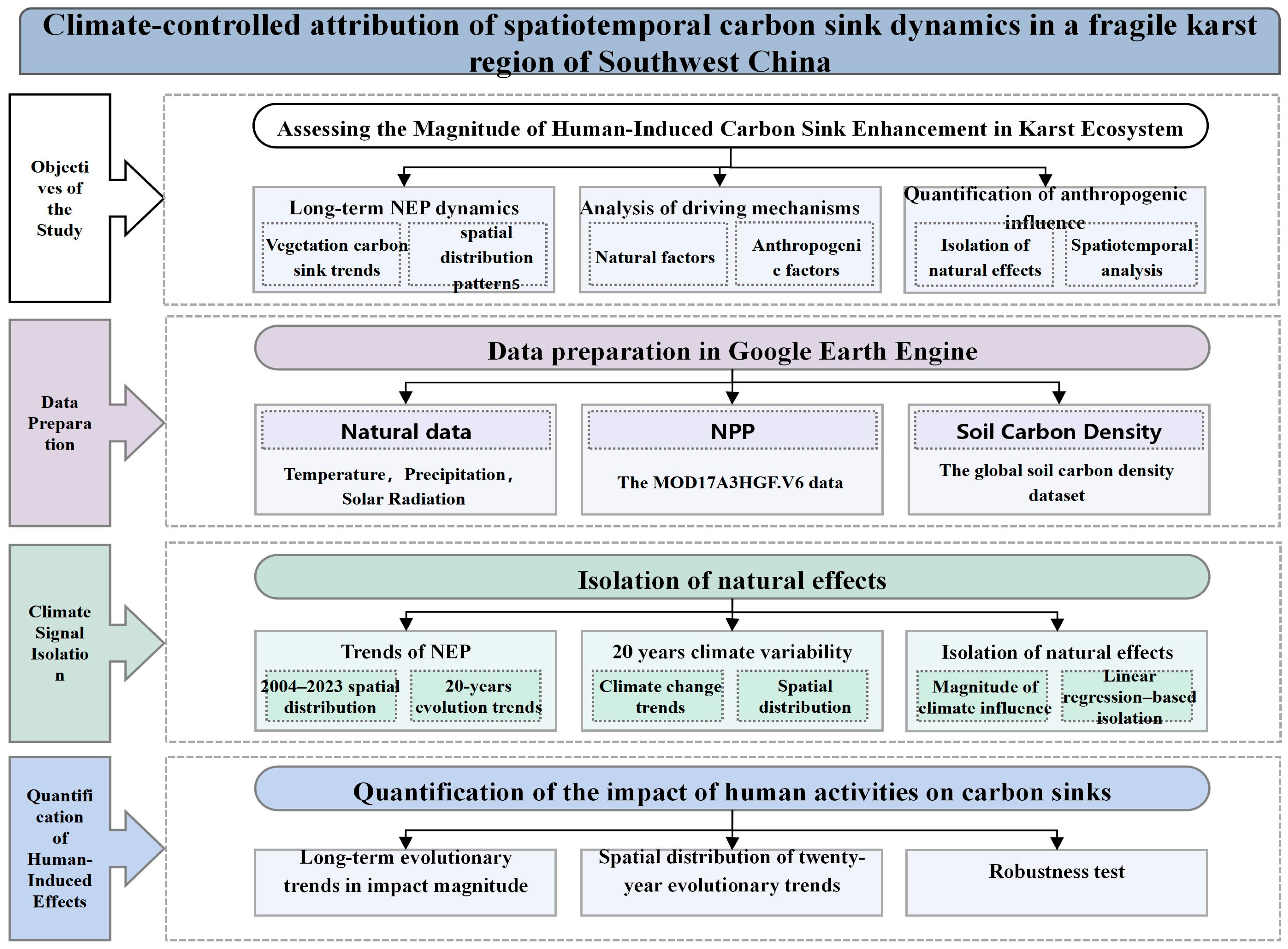
Our climate-adjusted attribution framework systematically disentangles the effects of climate variability and human activities (Figure 2). The workflow has three main steps: Carbon Sink Estimation: Long-term NEP dynamics are characterized using the remote sensing-based model. Climate-Driven Variability Modeling: Climatic variables are used to model the background climate-driven NEP signal. Anthropogenic Attribution: By controlling for climate effects, residual variations in NEP are interpreted as the integrated effect of human activities. This provides a spatially explicit quantification of human contributions to carbon sink dynamics across the fragile karst ecosystem (Figure 2).

3. Results

3.1. Spatiotemporal Evolution of NEP

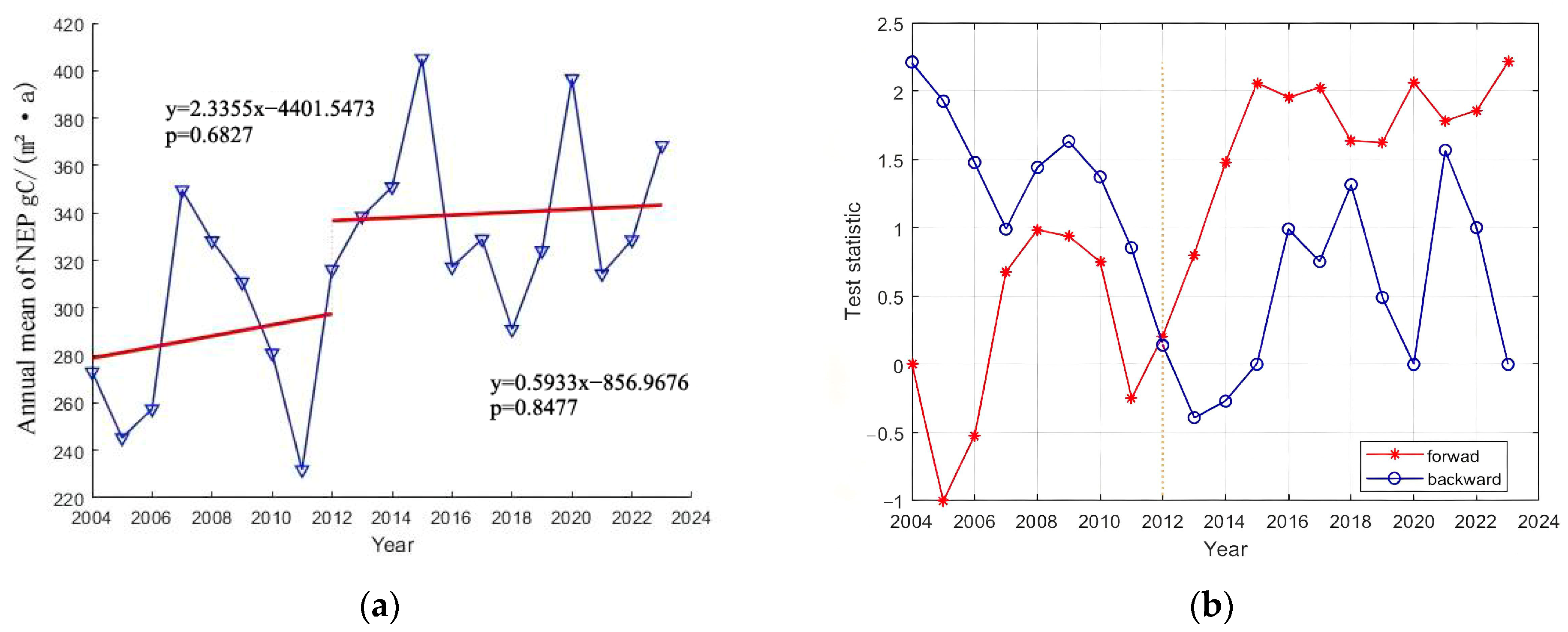
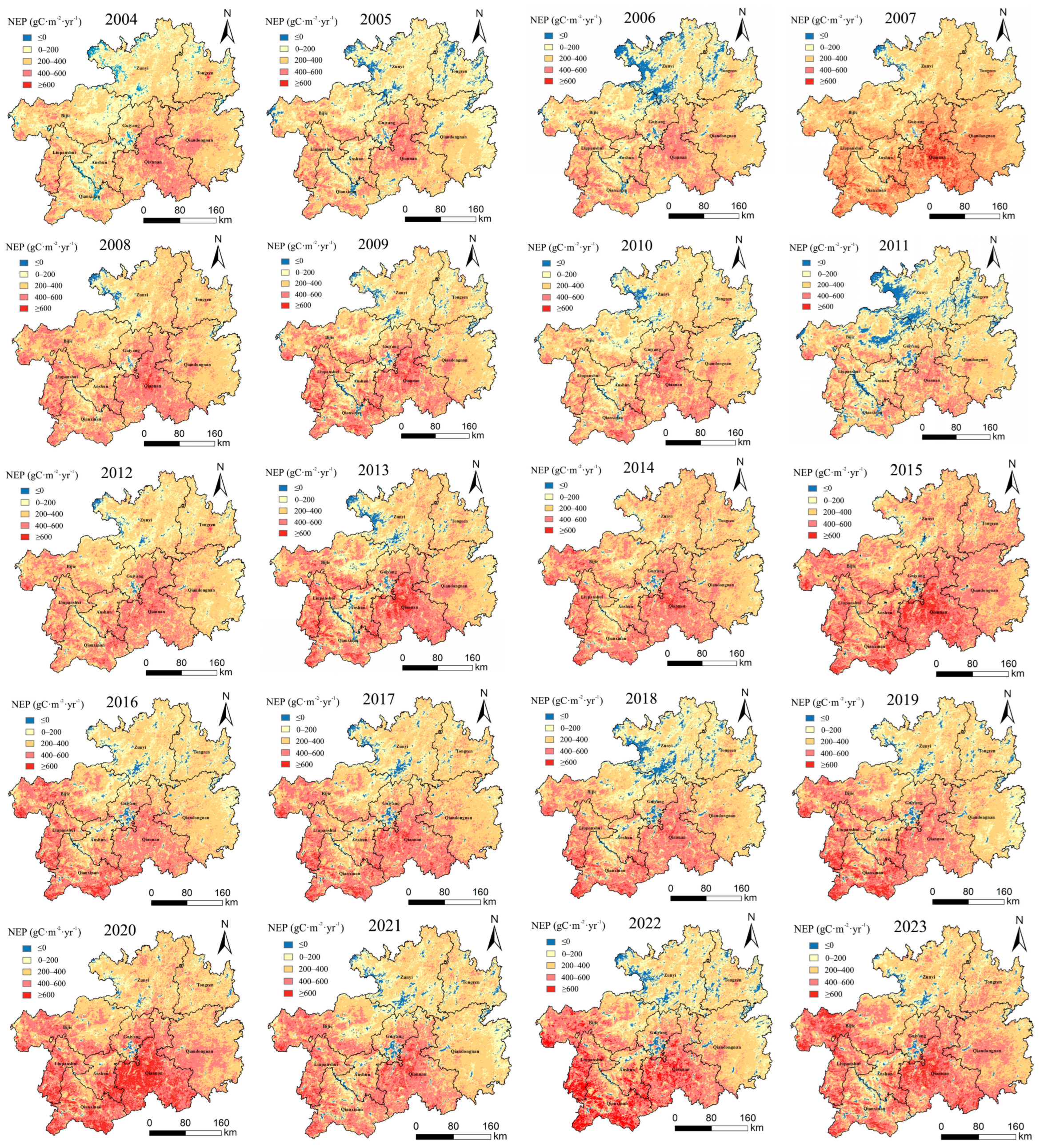
Analysis of the interannual variation in the mean NEP across Guizhou Province reveals a significant fluctuating upward trend over the 20-year period from 2004 to 2023 (Figure 2). The 20-year provincial mean NEP was 318 gC·m−2·yr−1. This trend indicates pronounced dynamic characteristics in the carbon uptake capacity of Guizhou’s ecosystems. Specifically, the lowest mean annual NEP occurred in 2011 at 232 gC·m−2·yr−1, while the peak value was recorded in 2015 at 405 gC·m−2·yr−1. Comparing the endpoints of the time series, the mean NEP was 273 gC·m−2·yr−1 in 2004 and increased to 369 gC·m−2·yr−1 by 2023. The carbon cycle in Guizhou Province is dominated by a net carbon sink. Over the past two decades, areas functioning as carbon sources were primarily concentrated in highly urbanized regions such as Guiyang and Zunyi. In some years (e.g., 2015, 2020), carbon source areas were confined to the urban cores of these major cities, while in other years (e.g., 2006, 2011), more extensive carbon source areas emerged in the central and northern parts of the province. Spatially, carbon sink capacity exhibited marked heterogeneity across the province. It was stronger in the south than in the north, and stronger in the west than in the east. This pattern is likely closely associated with spatial variations in topography, climatic conditions, and vegetation types. Guizhou Province demonstrates significant carbon sink capacity, with a mean annual net CO2 absorption of 55.9942 million tons over the recent 20 years. This amount is equivalent to offsetting the annual carbon emissions of approximately 15.34 million passenger vehicles, underscoring the pivotal role of Guizhou in regional and global carbon cycles.
From the perspective of the overall time series, the carbon sink capacity of Guizhou Province exhibited a fluctuating upward trend over the past two decades. To further identify abrupt change points in the NEP series, this study applied the non-parametric Mann–Kendall (M-K) test to the NEP sequence from 2004 to 2023. At the 90% confidence level, the forward sequence analysis results show a general fluctuating upward trend in NEP, while the backward sequence exhibits a fluctuating downward trend. These two sequences intersect in 2012, identifying this year as a statistically significant turning point in the NEP trajectory for Guizhou Province (Figure 3). Specifically, prior to 2012, the NEP in Guizhou Province displayed a more pronounced growth trend, with a higher rate of increase compared to the period after 2012. Following 2012, although the overall NEP maintained an upward trajectory, the growth rate noticeably decelerated, and interannual variability increased.
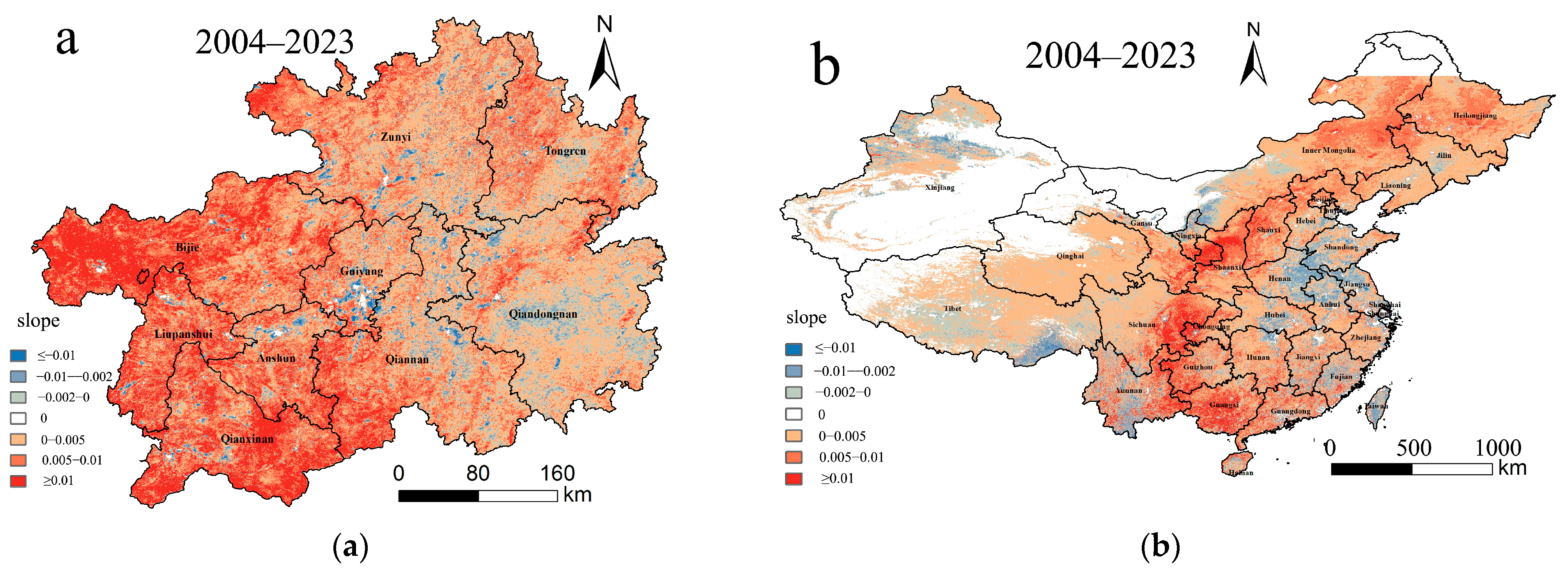
During the period from 2004 to 2023, the average trend coefficient (slope) of NEP in Guizhou Province, derived from simple linear regression analysis, was 0.005. This value is significantly higher than the contemporaneous national average trend coefficient of 0.0026. This result indicates that over the recent 20-year period, the carbon sink function in Guizhou has demonstrated a continuously strengthening trend, with a rate of increase approximately twice the national average, highlighting its substantial contribution to the national carbon sink framework (Figure 4). Further analysis based on the national NEP slope trend map reveals pronounced regional disparities in NEP growth across China over the past two decades. The primary growth zones are concentrated in central and western regions such as Guangxi, Guizhou, Chongqing, Shanxi, and Shaanxi, with a particularly prominent belt of high growth spanning Guizhou and Guangxi. Calculations based on national trend coefficients suggest that, overall, China’s carbon sink capacity has increased by approximately 5% over the past 20 years. In contrast, the NEP trend in Guizhou not only far exceeds the national average but also exhibits a distinct spatial clustering pattern. Specifically, the spatial variation in NEP change within Guizhou reveals a pattern characterized by “higher in the west and lower in the east.” Overlay analysis combining population density and the severity of rocky desertification in Guizhou indicates that the NEP growth trend is particularly pronounced in the western part of the province. Areas with high population density and ecologically fragile conditions, such as Bijie City and Liupanshui City, show significantly greater improvements in carbon sink capacity compared to eastern regions (Figure 4a). This phenomenon suggests that, despite a weaker ecological baseline and long-term challenges, including rocky desertification, land degradation, and population pressure, the western region of Guizhou has experienced a notably faster recovery and enhancement of its carbon sink function over the past two decades compared to the eastern region. Large-scale ecological restoration projects, comprehensive rocky desertification control, and policies like the Grain for Green Program implemented in western Guizhou in recent years have created favorable conditions for the restoration of ecosystem carbon sequestration. Concurrently, benefiting from the ecological compensation mechanisms established under the targeted poverty alleviation framework, the land-use structure in the western region has undergone a positive transformation. This has led to increased ecosystem productivity, thereby fostering sustained growth in NEP (Figure 5).

3.2. Analysis of Natural Factors Influencing NEP Variations

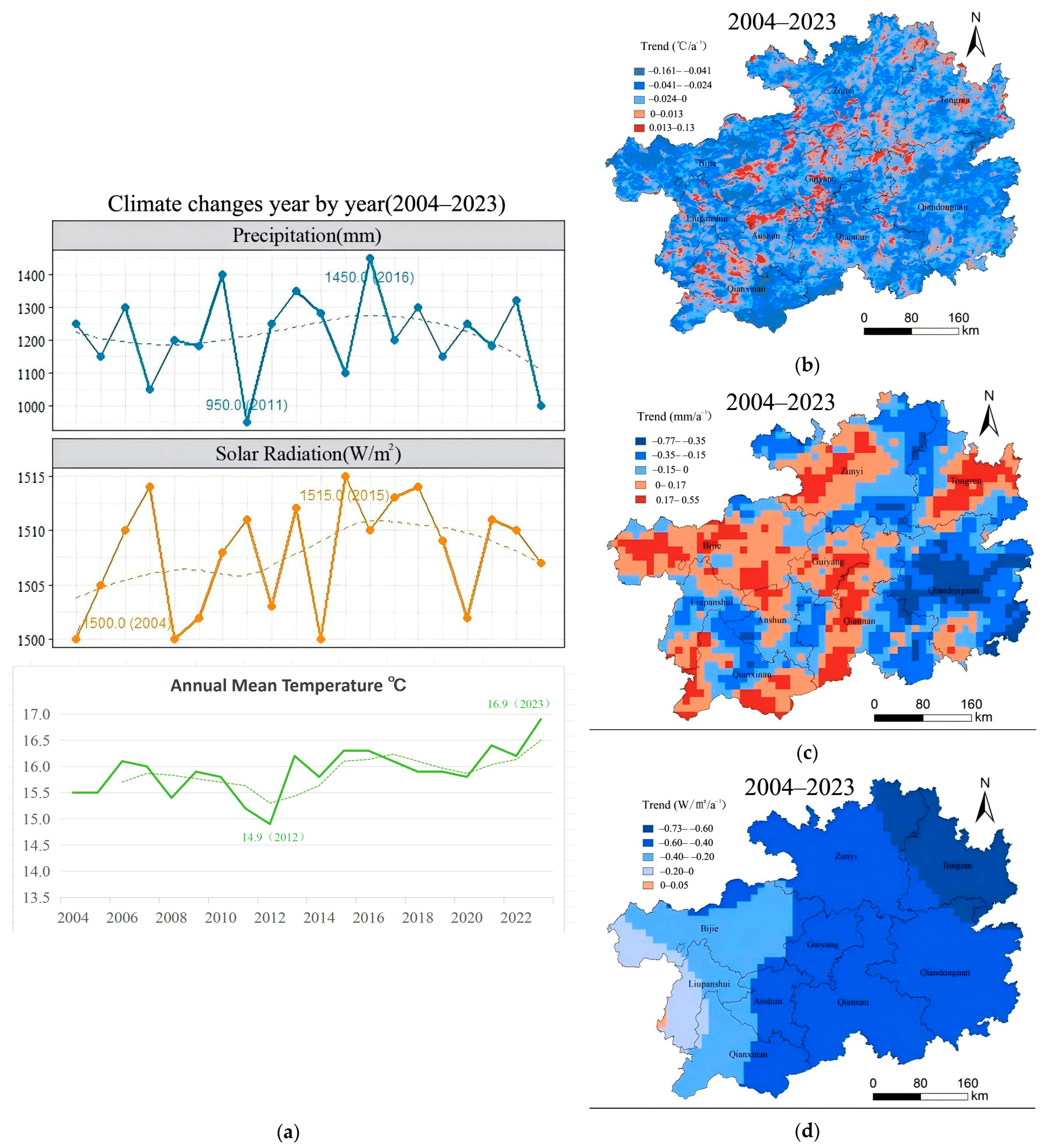
The variation in NEP is jointly regulated by natural and anthropogenic factors. Key natural drivers include solar radiation, temperature, and precipitation, while anthropogenic influences encompass both restorative activities (e.g., afforestation, returning farmland to forest, and rocky desertification control) and disruptive pressures (e.g., urban expansion, deforestation, and land-use change). To quantitatively assess the contribution of human activities to NEP, this study first quantifies and isolates the effects of natural factors, thereby enabling the identification and evaluation of the net anthropogenic impact. This section focuses on the spatiotemporal characteristics of key natural factors in Guizhou Province over the past two decades, providing a basis for subsequent attribution analysis of human influence. Overall, climate change in Guizhou Province exhibited stable fluctuations with a certain degree of regularity (Figure 6a).
Temperature Variation Characteristics: Over the past 20 years, the annual average temperature in Guizhou Province has remained relatively stable, around 15 °C. Interannual fluctuations were modest, consistent with the region’s subtropical mild climate featuring warm winters and cool summers. Spatially, a slight warming trend was observed in central and more urbanized areas, while most other regions exhibited a cooling trend (Figure 6b), indicating potential influences from localized climatic responses and human activities.
Precipitation Variation Characteristics: During the study period, the regional average annual precipitation was approximately 1200 mm, peaking in 2007 (1225 mm) and reaching a minimum in 2011 (950 mm). Spatially, areas with increased precipitation were mainly concentrated in the central-western parts of the province. However, the distribution of wetting and drying regions across Guizhou was relatively balanced, without a pronounced consistent trend (Figure 6c), suggesting high spatial heterogeneity in precipitation changes.
Solar Radiation Variation Characteristics: Solar radiation exhibited fluctuating trends over the past two decades, with an annual average of about 1508 W/m2/a (Figure 6d). Spatially, the west-to-east decline in solar radiation is primarily attributed to topographic and climatic factors: the western Yunnan–Guizhou Plateau has a higher elevation and thinner cloud cover, allowing greater surface solar radiation, while eastern areas are more frequently affected by the Yunnan–Guizhou quasi-stationary front, resulting in persistent cloud cover and lower radiation. Temporally, the overall declining trend may be associated with increased aerosol loading from fossil fuel combustion and enhanced atmospheric water vapor transport under regional climate change.
In summary, although the main natural factors in Guizhou Province showed certain interannual fluctuations over the past 20 years, their overall magnitude of change was limited. Solar radiation displayed a relatively distinct decreasing trend, while temperature and precipitation did not exhibit significant directional changes. Building on this natural context, the subsequent analysis will systematically isolate the contribution of natural variability to NEP, thereby enabling a quantitative assessment of the impact of human activities on ecosystem carbon sequestration.

3.3. Analysis of the Influence of Human Activities on NEP

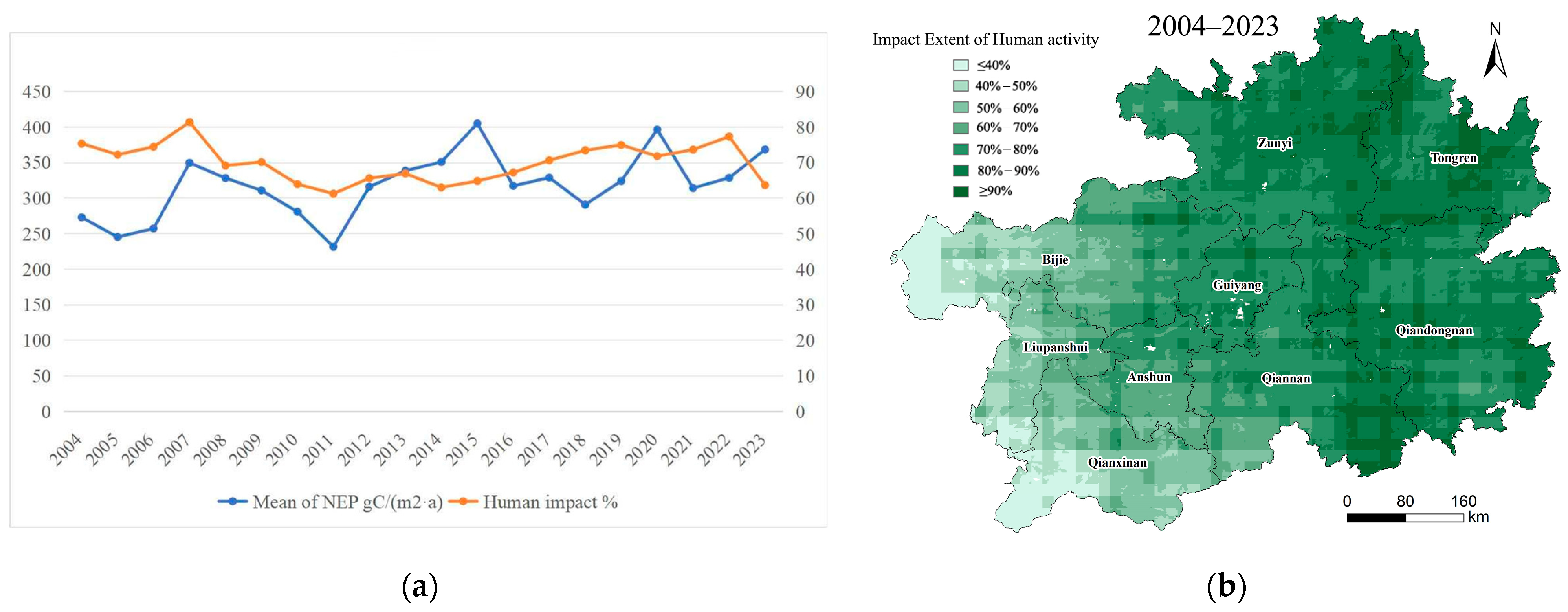
Based on a comprehensive analysis of Guizhou Province’s NEP data and human activity intensity from 2004 to 2023, after isolating the influence of natural factors on NEP, the contribution of human activities to NEP changes was found to be significant. The average comprehensive influence level over the 20-year period was 70.06%, with an overall fluctuation range between 61.25% and 81.38%. This is significantly higher than the contribution rate of natural factors, indicating that human activities are the dominant driver of vegetation carbon sink changes in Guizhou Province. In terms of temporal evolution trends, the overall NEP of Guizhou Province exhibited a fluctuating upward trend over the past 20 years. In contrast, the influence degree of human activities on NEP demonstrated a dynamic characteristic of “first decreasing and then rising.” Analysis based on the trend chart of human activity influence reveals that the impact of human activities on NEP showed a fluctuating downward trend, which is opposite to the fluctuating upward trend of NEP. This suggests that after large-scale ecological restoration projects and urbanization processes, China’s vegetation carbon sink tends to stabilize, and the influence of human activities on vegetation carbon sinks may gradually diminish. Specifically, Guizhou began comprehensively advancing the Grain for Green Program in 2002 and the rocky desertification control project in 2006. Both the average NEP value and the contribution level of human activities in 2007 were significantly higher than in other periods. This trend persisted until around 2020 when it peaked. During this period, with the large-scale advancement of ecological restoration projects and the gradual release of policy effects, the positive contribution of human activities continuously increased, driving the sustained enhancement of NEP (Figure 7a).
In terms of spatial distribution, the influence of human activities on NEP exhibited distinct regional differentiation characteristics, which can be categorized into the following two typical regions: Central-Eastern High-Influence Zone: This region has a relatively good ecological environment baseline and a low population density. Human activities here are primarily manifested as positive interventions dominated by ecological restoration. Projects such as the Grain for Green Program and Natural Forest Protection implemented in the region have shown significant effects, leading to continuous improvement in vegetation coverage and enhancement of the carbon sink function. Consequently, the contribution rate of human activities to NEP in this region generally exceeds 70%, demonstrating the strong positive effect of human activities in ecologically sound areas. Central-Western Moderate-to-Low Influence Zone: This region belongs to the ecologically fragile karst landform area with a dense population. Human activities here present a composite characteristic of “coexistence of restoration and pressure.” On the one hand, high-intensity ecological restoration projects such as rocky desertification control and the Yangtze River Shelterbelt Construction have actively promoted the recovery of carbon sink capacity. On the other hand, human disturbances like urban expansion and infrastructure construction have also exerted inhibitory effects on the local vegetation carbon sink. The superposition of these two opposing effects results in a net contribution rate of human activities to NEP in this region being relatively lower than in the eastern part, generally ranging between 40% and 70%. This reflects the complexity and spatial heterogeneity of human activity impacts on carbon sinks in ecologically fragile areas (Figure 7b). In summary, the influence of human activities on vegetation carbon sinks in Guizhou Province not only exhibits phased evolutionary characteristics over time but also presents a spatial pattern of “higher in the east, lower in the west, with coexistence of restoration and disturbance.” This provides an important scientific basis for formulating differentiated and precise ecological policies.

3.4. Stability Test

To ensure that the statistical results regarding the influence of human activities on NEP possess good stability and credibility, this study employed the Bootstrap resampling method. A total of 10,000 resampling analyses were conducted to obtain the mean value and related statistical characteristics. To verify the normality of the Bootstrap sampling mean distribution, a Shapiro–Wilk normality test was further performed. The test results showed a Shapiro–Wilk statistic W = 0.998 and a p-value = 0.317 (p > 0.05). Therefore, the null hypothesis was accepted, indicating that the sampling results conform to a normal distribution. This demonstrates that the mean distribution obtained through Bootstrap sampling exhibits good normality and can serve as a foundation for subsequent inferential analysis. Furthermore, the Bootstrap mean was 70.17%, with a standard error of 1.54% and a 95% confidence interval ranging from 66.96% to 73.27%. These metrics collectively indicate that the inference results within the sample have high stability and precision. In summary, the data passed the normality test, and the resampling results are stable and reliable. This provides robust support for the subsequent scientific analysis of the influence of human activities on NEP.

4. Discussion

The observed NEP enhancement reflects real ecological processes driven by restoration. In karst regions, efforts like afforestation increase vegetation cover and improve ecosystem structure, directly boosting photosynthetic capacity and carbon sequestration potential [32]. Concurrently, land-use transitions from degraded cropland to forest or grassland promote biomass accumulation, further strengthening the carbon sink [33]. These mechanisms collectively underpin the dominant anthropogenic role identified in our study. Our climate-adjusted attribution framework reveals that the substantial NEP increase is not merely a response to favorable climate conditions but is predominantly driven by human interventions. This finding is consistent with previous research in Southwest China that highlights the significant contribution of human-induced vegetation recovery to regional carbon sinks [34]. However, unlike conventional approaches that only differentiate climate and human impacts numerically, our study maps these contributions into spatially explicit patterns. This visualization allows for a more intuitive understanding of spatial heterogeneity and helps pinpoint where restoration or disturbance dominates.
Notably, our estimated human contribution of approximately 60–75% does not stand in isolation. It converges with independent, local-scale field evidence. For instance, Luo et al. [25] documented a 34.82 t·hm−2 increase in forest carbon stock under ecological restoration projects in a Guizhou study area. This consistency between our remote sensing-derived estimates and plot-level measurements provides a crucial indirect validation of our methodology and strengthens confidence in the identified anthropogenic dominance. This finding is comparable to studies conducted in other ecologically fragile regions, where ecological restoration policies have played a dominant role in enhancing carbon sinks. However, the relatively higher contribution observed in this study may be related to the residual-based attribution framework, which captures the integrated effect of multiple human interventions.
A key finding is the amplified carbon sink response observed in this fragile karst ecosystem. Karst regions feature thin, discontinuous soils, rapid water infiltration, and strong human–land coupling [32]. Under these conditions, vegetation productivity is highly sensitive to land-use interventions. Restoration measures can quickly alter land cover and soil stability. In contrast to deep-soil forests where carbon accumulates slowly, karst systems may exhibit a faster aboveground biomass response following restoration. This structural sensitivity likely explains the dominant anthropogenic contribution identified here. Moreover, once restoration reduces erosion beyond a critical threshold, positive feedback—like improved soil moisture and microclimate—can further accelerate carbon sequestration [15]. This suggests karst ecosystems can act as amplifiers of human-induced carbon sink enhancement, beyond background climatic effects. This mechanism-based interpretation strengthens the causal explanation of anthropogenic carbon sink enhancement. From a climate perspective, the observed increase in NEP suggests an enhanced terrestrial carbon sequestration capacity under relatively stable climatic conditions. In karst regions, this indicates that anthropogenic ecological restoration may amplify carbon sink responses beyond climate-driven variability, highlighting the increasing importance of human interventions in regulating regional carbon dynamics under climate uncertainty. Importantly, karst ecosystems do not merely respond passively to anthropogenic activities but may function as amplifiers of human-induced carbon sink enhancement due to their intrinsic ecological fragility and strong vegetation–soil coupling, which together enhance ecosystem sensitivity to restoration measures. Similar mechanisms have been widely reported in karst and other fragile ecosystems, where vegetation restoration improves soil structure, enhances water retention, and increases ecosystem productivity [35]. Compared with previous studies focusing on short-term or site-level observations, this study provides a long-term and spatially explicit perspective on the cumulative effects of ecological restoration.
In karst ecosystems, the improvement in carbon sink function is closely associated with ecological restoration practices that enhance soil retention and reduce soil erosion. These processes facilitate vegetation recovery, reflected in increased vegetation cover and leaf area index (LAI), which in turn strengthens ecosystem photosynthetic capacity. Meanwhile, reduced erosion and increased litter inputs promote soil organic carbon (SOC) accumulation. Together, these coupled vegetation–soil interactions provide a plausible ecological explanation for the observed increase in net ecosystem productivity (NEP) under human-induced restoration activities.
The identified turning point around 2012 further suggests a phase-based evolution of carbon sink dynamics. This timing may be associated with the transition in the implementation stage of major ecological restoration programs in the study region, where earlier large-scale expansion began to shift toward consolidation and optimization. Prior to 2012, NEP exhibited a relatively rapid increase, which coincided with the intensive implementation stage of large-scale ecological engineering projects [36]. After 2012, although the overall NEP continued to rise, the growth rate slowed and variability increased. This pattern may reflect the transition from an “expansion-driven restoration phase” to a “stabilization and consolidation phase.” Once large-scale afforestation reaches maturity, marginal carbon sequestration gains tend to decrease, and the relative influence of climatic variability becomes more apparent [37]. This indicates a gradual shift in the dominant controlling mechanism, from primarily human-driven land management enhancement toward a combined regulation of ecological maturity and climatic variability. This temporal shift underscores the importance of considering policy life cycles when interpreting long-term carbon sink trends. Carbon sink enhancement driven by human activities may not follow a linear trajectory but instead display saturation or stabilization characteristics after initial rapid growth. Recognizing such nonlinear policy–ecosystem interactions is crucial for designing the next stage of ecological management strategies.
Our spatially explicit framework further reveals pronounced regional heterogeneity. In eastern Guizhou, where the ecological baseline is more favorable and population density is lower, restoration activities clearly outweigh disturbance pressures, leading to a generally high contribution rate from human activities. In contrast, the ecologically fragile western region presents a “restoration–disturbance coexistence” pattern. Here, large-scale rocky desertification control enhances vegetation cover, but concurrent urban expansion and infrastructure construction partially offset these gains, resulting in a lower and more variable net contribution. This demonstrates that carbon sink dynamics are not determined by restoration intensity alone but by a dynamic balance between ecological engineering and land-use pressures, modulated by the regional environmental context.
Despite these findings, several uncertainties should be acknowledged. A principal limitation of this study is its reliance on remotely sensed and globally gridded datasets, as comprehensive, spatially explicit in situ measurements of NEP are unavailable for the entire Guizhou Province over the 20-year study period. The complex terrain and fragmented landscapes of karst regions pose significant challenges for establishing a representative ground validation network. Consequently, the NEP estimates presented here represent an approximation of actual carbon dynamics. While this is a common constraint in large-scale karst carbon cycle research [20,34], it implies that our results are best interpreted as capturing the dominant spatiotemporal patterns and relative driver contributions rather than absolute flux magnitudes. Second, the accuracy of NEP estimation is further subject to limitations in remote sensing data resolution and inherent model assumptions, particularly the simplified representation of soil heterotrophic respiration. Third, the climate-controlled attribution framework relies on residual analysis, which treats anthropogenic influence as an integrated proxy rather than a direct measurement of specific drivers such as land-use conversion, afforestation intensity, or infrastructure expansion. This approach, while effective for isolating the net human contribution, cannot disentangle the individual effects of restoration policies from countervailing disturbance pressures. Fourth, the complex interactions between climate variability and human interventions—such as climate-induced changes in restoration effectiveness or human adaptation to environmental change—may not be fully captured, particularly in highly heterogeneous karst environments where microclimatic gradients and local land-use legacies further complicate attribution. Future studies integrating higher-resolution remote sensing data, explicit land-use change trajectories, and socio-economic indicators could substantially improve attribution accuracy. More importantly, establishing coordinated field-monitoring networks—including eddy covariance flux towers and long-term soil carbon observation plots strategically distributed across representative karst landforms—would provide critical ground truth data to calibrate and validate remote sensing-based estimates, thereby refining both the absolute magnitude of the carbon sink and the mechanistic understanding of human–ecosystem interactions in fragile landscapes. It should be noted that some uncertainties remain in this study. These mainly arise from differences in spatial and temporal resolutions among multi-source datasets and potential errors in remote sensing and reanalysis products. In addition, the PCA-based representation of climate factors simplifies complex interactions, and the residual-based attribution framework assumes that non-climatic components can be interpreted as anthropogenic effects. These factors may introduce uncertainties in the estimated contribution of human activities, but they do not affect the overall spatial patterns and long-term trends observed in this study. It should be noted that the residual component may still contain climatic influences or model uncertainties that were not taken into account. Therefore, the estimated anthropogenic effects should be interpreted as an integrated signal of non-climatic factors rather than a purely isolated human contribution. In addition, the use of PCA helps reduce sensitivity to multicollinearity among climate variables, and the dominant patterns captured by the first principal component contribute to the stability of the results.

5. Conclusions

1. Over the period from 2004 to 2023, NEP in Guizhou Province showed a significant increasing trend, with carbon sequestration consistently dominating the regional carbon cycle. The spatial pattern reveals clear heterogeneity, with stronger carbon sink capacity in the southern and western regions. Notably, the rate of increase in NEP in Guizhou substantially exceeded the national average, indicating a relatively enhanced carbon sink response in this karst-dominated region.
2. Anthropogenic activities were identified as the dominant driver of NEP dynamics, and human activities were estimated to contribute a dominant share (approximately 60–75%). However, their effects are spatially heterogeneous and context-dependent. In eastern regions, ecological restoration efforts appear to outweigh disturbance pressures, resulting in stronger positive contributions to carbon sinks. In contrast, western areas exhibit a coupled restoration–disturbance pattern, where urbanization and infrastructure expansion partially offset ecological gains. This suggests that the impact of human activities is not unidirectional but reflects a balance between ecological enhancement and land-use pressure.
3. Further analysis indicates that human activities influence carbon sink dynamics through both direct and indirect pathways. While land-use change imposes immediate pressures on ecosystems, indirect effects—such as modifications to microclimatic conditions and vegetation recovery processes—also play a substantial role. These findings highlight that carbon sink variability in karst regions cannot be fully understood through single-factor attribution but instead requires integrated frameworks that account for the interaction between ecological fragility, restoration practices, and human disturbance. Building on this study, future research will prioritize the integration of field-measured data, such as those derived from long-term carbon flux observation stations and soil carbon monitoring plots in the Guizhou karst region, to calibrate and validate remote sensing-based models. This will refine the absolute carbon sink estimates and deepen our mechanistic understanding.

Author Contributions

Conceptualization, Q.F. and R.Z.; methodology, Q.F.; software, Q.F. and Q.C.; formal analysis, Q.F.; investigation, R.Z. and Q.C.; resources, R.Z. and Q.C.; data curation, Q.C.; writing—original draft preparation, Q.F.; writing—review and editing, Q.F.; visualization, Q.F.; supervision, Q.F.; project administration, Q.F.; funding acquisition, Q.F. All authors have read and agreed to the published version of the manuscript.

Funding

This research was funded by the 2025 Provincial Department of Education University-Level Humanities and Social Sciences Research Project: The Mechanism of Realizing the Value of Ecological Products and Green Economic Development in Guizhou; Guizhou Light Industry Technical College Institutional Project: Research on the Driving Forces, Mechanisms, and Optimization Pathways of the “Two Mountains” Transformation; and 2025 Teaching Reform Project of Guizhou Light Industry Technical College: Research on the Challenges, Opportunities, and Coping Strategies of New Quality Productive Forces for Vocational Education.

Institutional Review Board Statement

Not applicable.

Informed Consent Statement

Not applicable.

Data Availability Statement

The data presented in this study are available upon request from the corresponding author.

Acknowledgments

During the preparation of this study, the author(s) used Google Earth Engine for the purposes of data collection and processing. The authors have reviewed and edited the output and take full responsibility for the content of this publication.

Conflicts of Interest

The authors declare no conflicts of interest.

References

  1. Wang, M.; Zhang, S.; Guo, X.; Xiao, L.; Yang, Y.; Luo, Y.; Mishra, U.; Luo, Z. Responses of soil organic carbon to climate extremes under warming across global biomes. Nat. Clim. Change 2024, 14, 98–105. [Google Scholar] [CrossRef]
  2. Wernberg, T.; Thomsen, M.S.; Baum, J.K.; Bishop, M.J.; Bruno, J.F.; Coleman, M.A.; Filbee-Dexter, K.; Gagnon, K.; He, Q.; Murdiyarso, D. Impacts of climate change on marine foundation species. Annu. Rev. Mar. Sci. 2024, 16, 247–282. [Google Scholar] [CrossRef]
  3. Lal, R.; Smith, P.; Jungkunst, H.F.; Mitsch, W.J.; Lehmann, J.; Nair, P.K.R.; McBratney, A.B.; De Moraes Sá, J.C.; Schneider, J.; Zinn, Y.L.; et al. The carbon sequestration potential of terrestrial ecosystems. J. Soil Water Conserv. 2018, 73, 145A–152A. [Google Scholar] [CrossRef]
  4. Mo, L.; Zohner, C.M.; Reich, P.B.; Liang, J.; De Miguel, S.; Nabuurs, G.-J.; Renner, S.S.; van den Hoogen, J.; Araza, A.; Herold, M. Integrated global assessment of the natural forest carbon potential. Nature 2023, 624, 92–101. [Google Scholar] [CrossRef]
  5. Peng, B.; Zhou, Z.; Cai, W.; Li, M.; Xu, L.; He, N. Maximum potential of vegetation carbon sink in Chinese forests. Sci. Total Environ. 2023, 905, 167325. [Google Scholar] [CrossRef] [PubMed]
  6. Zhao, D.; Cai, J.; Shen, S.; Liu, Q.; Lan, Y. Nature-based solutions: Assessing the carbon sink potential and influencing factors of urban park plant communities in the temperate monsoon climate zone. Sci. Total Environ. 2024, 950, 175347. [Google Scholar] [CrossRef]
  7. Sha, Z.; Bai, Y.; Li, R.; Lan, H.; Zhang, X.; Li, J.; Liu, X.; Chang, S.; Xie, Y. The global carbon sink potential of terrestrial vegetation can be increased substantially by optimal land management. Commun. Earth Environ. 2022, 3, 8. [Google Scholar] [CrossRef]
  8. Moon, T.; Kim, M.; Chon, J. Adaptive green space management strategies for sustainable carbon sink parks. Urban For. Urban Green. 2024, 94, 128236. [Google Scholar] [CrossRef]
  9. Pan, Y.; Birdsey, R.A.; Phillips, O.L.; Houghton, R.A.; Fang, J.; Kauppi, P.E.; Keith, H.; Kurz, W.A.; Ito, A.; Lewis, S.L. The enduring world forest carbon sink. Nature 2024, 631, 563–569. [Google Scholar] [CrossRef]
  10. Luo, Q.; Bai, X.; Zhao, C.; Luo, G.; Li, C.; Ran, C.; Zhang, S.; Xiong, L.; Liao, J.; Du, C. Unexpected response of terrestrial carbon sink to rural depopulation in China. Sci. Total Environ. 2024, 948, 174595. [Google Scholar] [CrossRef]
  11. Erb, K.H.; Kastner, T.; Plutzar, C.; Bais, A.L.S.; Carvalhais, N.; Fetzel, T.; Gingrich, S.; Haberl, H.; Lauk, C.; Niedertscheider, M.; et al. Unexpectedly large impact of forest management and grazing on global vegetation biomass. Nature 2018, 553, 73–76. [Google Scholar] [CrossRef]
  12. Chen, C.; Park, T.; Wang, X.; Piao, S.; Xu, B.; Chaturvedi, R.K.; Fuchs, R.; Brovkin, V.; Ciais, P.; Fensholt, R.; et al. China and India lead in greening of the world through land-use management. Nat. Sustain. 2019, 2, 122–129. [Google Scholar] [CrossRef]
  13. Ouyang, Z.; Zheng, H.; Xiao, Y.; Polasky, S.; Liu, J.; Xu, W.; Wang, Q.; Zhang, L.; Xiao, Y.; Rao, E.; et al. Improvements in ecosystem services from investments in natural capital. Science 2016, 352, 1455–1459. [Google Scholar] [CrossRef]
  14. Hua, F.; Wang, X.; Zheng, X.; Fisher, B.; Wang, L.; Zhu, J.; Tang, Y.; Yu, D.W.; Wilcove, D.S. Opportunities for biodiversity gains under the world’s largest reforestation programme. Nat. Commun. 2016, 7, 12717. [Google Scholar] [CrossRef] [PubMed]
  15. Feng, Q.; Zhou, Z.; Chen, Q.; Zhu, C.; Zhu, M.; Luo, W.; Wang, J. Quantifying the extent of ecological impact from China’s poverty alleviation relocation program: A case study in Guizhou Province. J. Clean. Prod. 2024, 444, 141274. [Google Scholar] [CrossRef]
  16. Yu, Z.; Ciais, P.; Piao, S.; Houghton, R.A.; Lu, C.; Tian, H.; Agathokleous, E.; Kattel, G.R.; Sitch, S.; Goll, D. Forest expansion dominates China’s land carbon sink since 1980. Nat. Commun. 2022, 13, 5374. [Google Scholar] [CrossRef]
  17. Chen, Y.; Zhou, J.; Ge, Y.; Dong, J. Uncovering the rapid expansion of photovoltaic power plants in China from 2010 to 2022 using satellite data and deep learning. Remote Sens. Environ. 2024, 305, 114100. [Google Scholar] [CrossRef]
  18. Qu, Q.; Jian, S.; Chen, A.; Xiao, C. Investigating the Dynamic Change and Driving Force of Vegetation Carbon Sink in Taihang Mountain, China. Land 2024, 13, 1348. [Google Scholar] [CrossRef]
  19. Lyu, J.; Fu, X.; Lu, C.; Zhang, Y.; Luo, P.; Guo, P.; Huo, A.; Zhou, M. Quantitative assessment of spatiotemporal dynamics in vegetation NPP, NEP and carbon sink capacity in the Weihe River Basin from 2001 to 2020. J. Clean. Prod. 2023, 428, 139384. [Google Scholar] [CrossRef]
  20. Tong, X.; Brandt, M.; Yue, Y.; Horion, S.; Wang, K.; De Keersmaecker, W.; Tian, F.; Schurgers, G.; Xiao, X.; Luo, Y.; et al. Increased vegetation growth and carbon stock in China karst via ecological engineering. Nat. Sustain. 2018, 1, 44–50. [Google Scholar] [CrossRef]
  21. Huang, B.; Lu, F.; Wang, X.; Wu, X.; Zhang, L.; Ouyang, Z. Ecological restoration and rising CO2 enhance the carbon sink, counteracting climate change in northeastern China. Environ. Res. Lett. 2021, 17, 014002. [Google Scholar] [CrossRef]
  22. Zhou, Z.; Feng, Q.; Zhu, C.; Luo, W.; Wang, L.; Zhao, X.; Zhang, L. The Spatial and Temporal Evolution of Ecological Environment Quality in Karst Ecologically Fragile Areas Driven by Poverty Alleviation Resettlement. Land 2022, 11, 1150. [Google Scholar] [CrossRef]
  23. Zeng, J.; Zhou, T.; Wang, Q.; Xu, Y.; Lin, Q.; Zhang, Y.; Wu, X.; Zhang, J.; Liu, X. Spatial patterns of China’s carbon sinks estimated from the fusion of remote sensing and field-observed net primary productivity and heterotrophic respiration. Ecol. Inform. 2023, 76, 102152. [Google Scholar] [CrossRef]
  24. Tu, H.; Jiapaer, G.; Yu, T.; Zhang, L.; Chen, B.; Lin, K.; Li, X. Effects of Land Cover Change on Vegetation Carbon Source/Sink in Arid Terrestrial Ecosystems of Northwest China, 2001–2018. Remote Sens. 2023, 15, 2471. [Google Scholar] [CrossRef]
  25. Luo, D.; Zhou, Z.; Zhang, L.; Chen, Q.; Huang, D.; Feng, Q.; Wu, T.; Wu, L. Evolution and driver analysis of forest carbon stocks in karst mountainous areas of southwest China in the context of rocky desertification management. Catena 2024, 246, 108335. [Google Scholar] [CrossRef]
  26. Berra, E.F.; Fontana, D.C.; Yin, F.; Breunig, F.M. Harmonized Landsat and Sentinel-2 Data with Google Earth Engine. Remote Sens. 2024, 16, 2695. [Google Scholar] [CrossRef]
  27. Moazzam, M.F.U.; Lee, B.G. Urbanization influenced SUHI Of 41 megacities of the world using big geospatial data assisted with google earth engine. Sustain. Cities Soc. 2024, 101, 105095. [Google Scholar] [CrossRef]
  28. Ledo, A.; Hillier, J.; Smith, P.; Aguilera, E.; Blagodatskiy, S.; Brearley, F.Q.; Datta, A.; Diaz-Pines, E.; Don, A.; Dondini, M.; et al. A global, empirical, harmonised dataset of soil organic carbon changes under perennial crops. Sci. Data 2019, 6, 57. [Google Scholar] [CrossRef]
  29. Börker, J.; Hartmann, J.; Amann, T.; Romero-Mujalli, G.; Moosdorf, N.; Jenkins, C. Chemical Weathering of Loess and Its Contribution to Global Alkalinity Fluxes to the Coastal Zone During the Last Glacial Maximum, Mid-Holocene, and Present. Geochem. Geophys. Geosyst. 2020, 21, e2020GC008922. [Google Scholar] [CrossRef]
  30. Shi, F.; Zhang, F.; Shen, N.; Yang, M. Quantifying interactions between slope gradient, slope length and rainfall intensity on sheet erosion on steep slopes using Multiple Linear Regression. Sci. Total Environ. 2024, 908, 168090. [Google Scholar] [CrossRef]
  31. Qian, X.; Ling, M.; Sun, Y.; Han, F.; Shi, Y.; Duan, C.; Lan, Y. Decoding the aroma characteristics of icewine by partial least-squares regression, aroma reconstitution, and omission studies. Food Chem. 2024, 440, 138226. [Google Scholar] [CrossRef] [PubMed]
  32. Zhu, M.; Zhou, Z.; Wu, X.; Wan, J.; Wang, J.; Zheng, J.; Liu, R.; Li, F. Prediction and spillover effects of forest expansion and management to increase carbon sinks in karst mountainous areas: A case study in Guizhou, China. Land Use Policy 2025, 151, 107491. [Google Scholar] [CrossRef]
  33. Manan, B.; Simone, G.; Nicolas, R.; Julia, L.N.; Thomas, K.; Sarah, M.; Florian, S.; Karl-Heinz, E. Quantifying and attributing land use-induced carbon emissions to biomass consumption: A critical assessment of existing approaches. J. Environ. Manag. 2021, 286, 112228. [Google Scholar] [CrossRef]
  34. Zhang, X.; Brandt, M.; Tong, X.; Ciais, P.; Yue, Y.; Xiao, X.; Zhang, W.; Wang, K.; Fensholt, R. A large but transient carbon sink from urbanization and rural depopulation in China. Nat. Sustain. 2022, 5, 321–328. [Google Scholar] [CrossRef]
  35. Li, P.; Shuang, Z.; Tiantian, C. Mapping Forest Restoration Probability and Driving Archetypes Using a Bayesian Belief Network and SOM: Towards Karst Ecological Restoration in Guizhou, China. Remote Sens. 2022, 14, 780. [Google Scholar]
  36. Yang, Y.; Shi, M.; Liu, B.; Yi, Y.; Wang, J.; Zhao, H. Contribution of ecological restoration projects to long-term changes in PM2.5. Ecol. Indic. 2024, 159, 111630. [Google Scholar] [CrossRef]
  37. Ma, X.; Yu, Z.; Su, Q.; Liu, W. Microbial-assisted corn residue return as a sustainable strategy for soil structural and nutrient enhancement. Ecol. Eng. 2026, 223, 107825. [Google Scholar] [CrossRef]
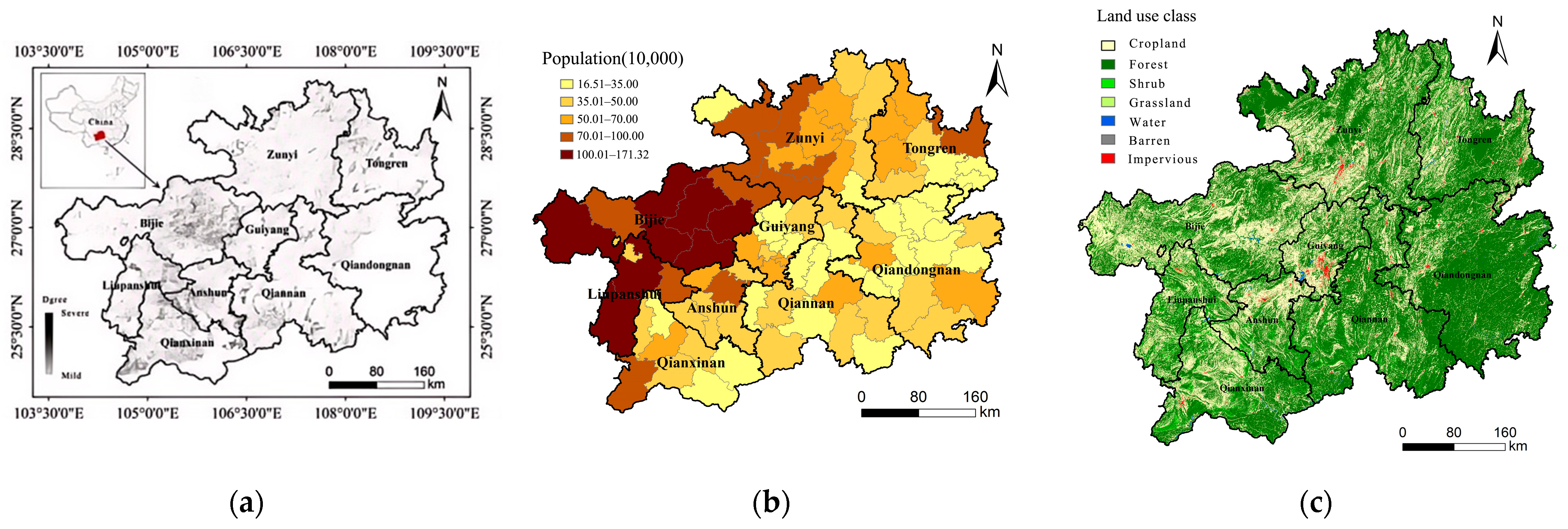
Figure 1. Basic overview of Guizhou Province in 2023: degree of rocky desertification (a), population density (b), and land-use status (c).
Atmosphere 17 00537 g001
Figure 2. Conceptual framework for climate-controlled attribution of NEP dynamics.
Atmosphere 17 00537 g002
Figure 3. Annual trend of NEP: linear trend of annual NEP (a); potential turning point in the annual NEP trend (b).
Atmosphere 17 00537 g003
Figure 4. Evolution of NEP in Guizhou Province over the past two decades (a) and spatiotemporal distribution of national NEP trends (b).
Atmosphere 17 00537 g004
Figure 5. Spatial distribution of NEP in Guizhou Province from 2004 to 2023. Units: gC·m−2·yr−1.
Atmosphere 17 00537 g005
Figure 6. Climatic evolution trend maps of Guizhou Province 2004–2023: annual average variation trends of precipitation, solar radiation, and temperature (a); spatiotemporal distribution of temperature variations (b); spatiotemporal distribution of precipitation variations (c); spatiotemporal distribution of solar radiation variations (d).
Atmosphere 17 00537 g006
Figure 7. Trend of the influence of human activities on the mean NEP (a); spatial distribution of the trend in the influence of human activities on NEP (b).
Atmosphere 17 00537 g007
Disclaimer/Publisher’s Note: The statements, opinions and data contained in all publications are solely those of the individual author(s) and contributor(s) and not of MDPI and/or the editor(s). MDPI and/or the editor(s) disclaim responsibility for any injury to people or property resulting from any ideas, methods, instructions or products referred to in the content.