

Climate-Constrained Attribution of Vegetation Carbon Sink Dynamics in a Karst Region: Disentangling Human and Climatic Contributions
Abstract
1. Introduction
2. Materials and Methods
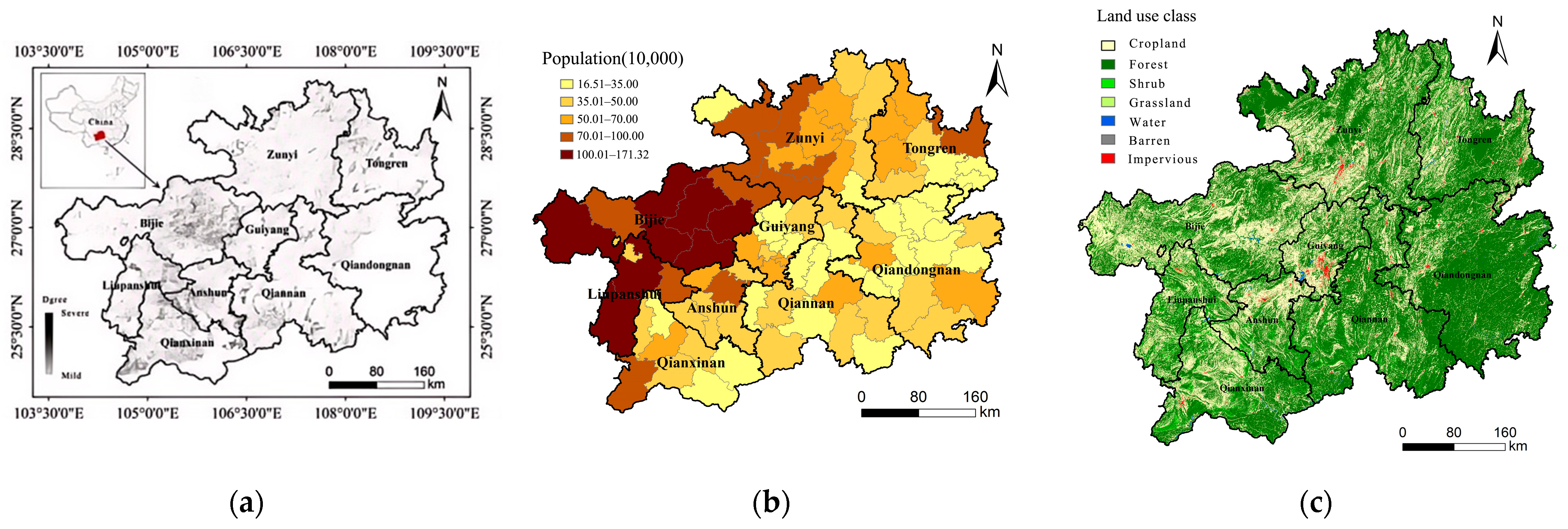
2.1. Study Area
2.2. Date Collection and Preprocessing
2.2.1. Date Collection
2.2.2. Data Preprocessing
2.3. Methodological Framework
2.3.1. Vegetation Carbon Sink Assessment
2.3.2. Trend Analysis
2.3.3. Partial Least Squares Regression Model
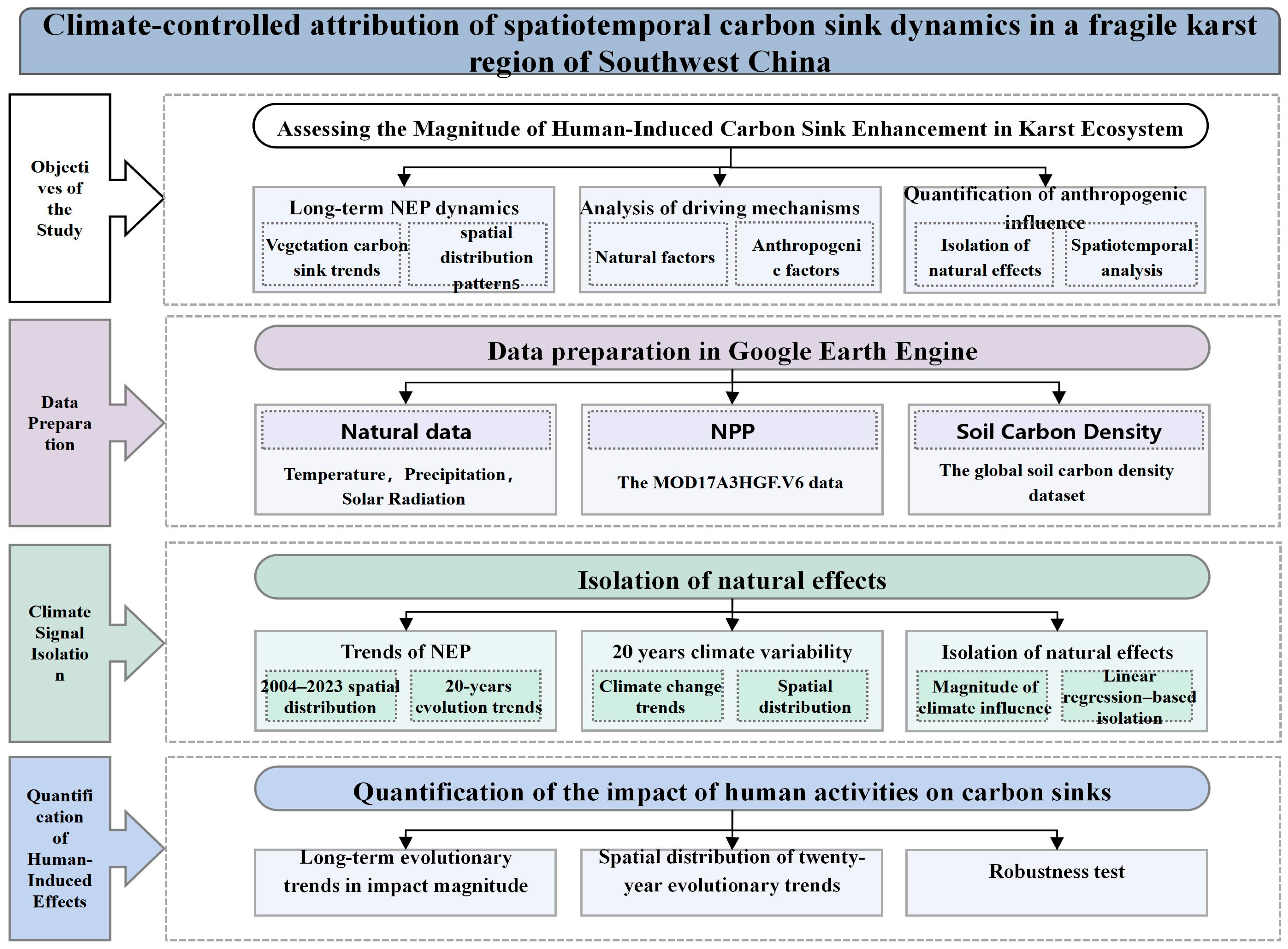
2.4. Research Framework
3. Results
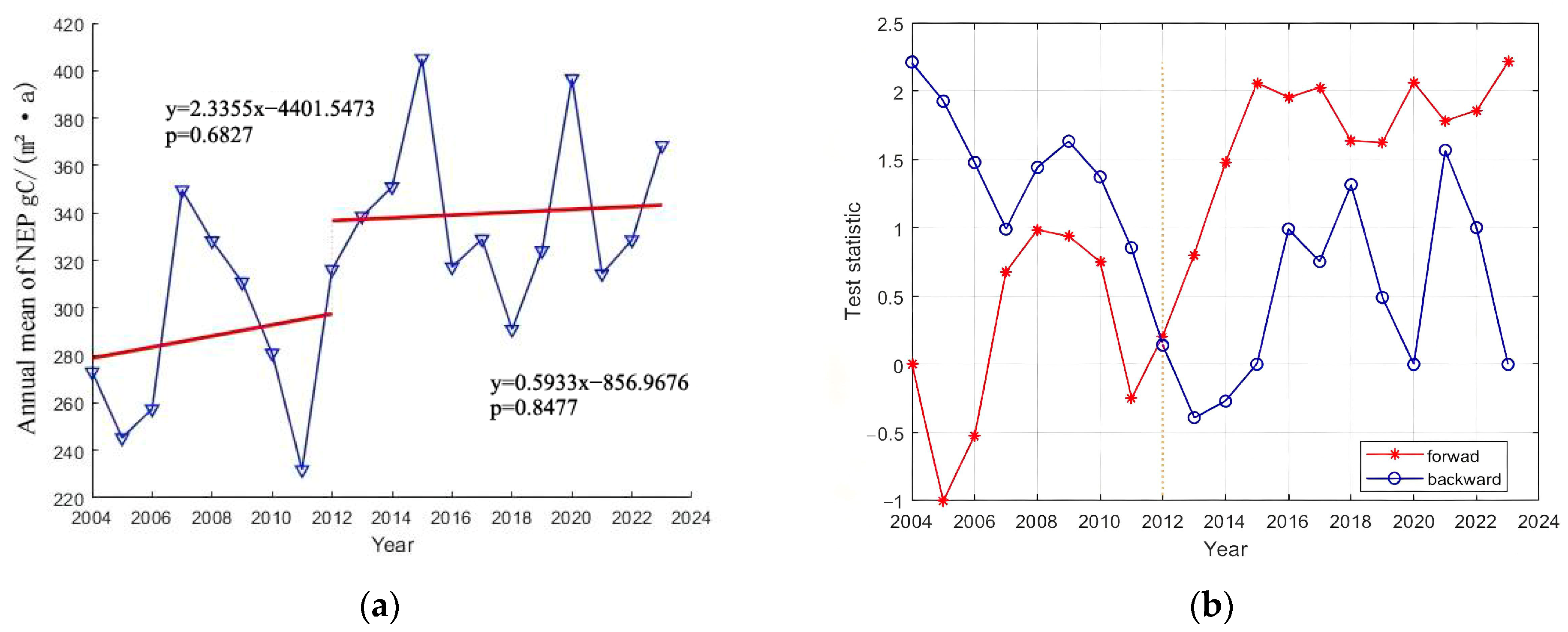
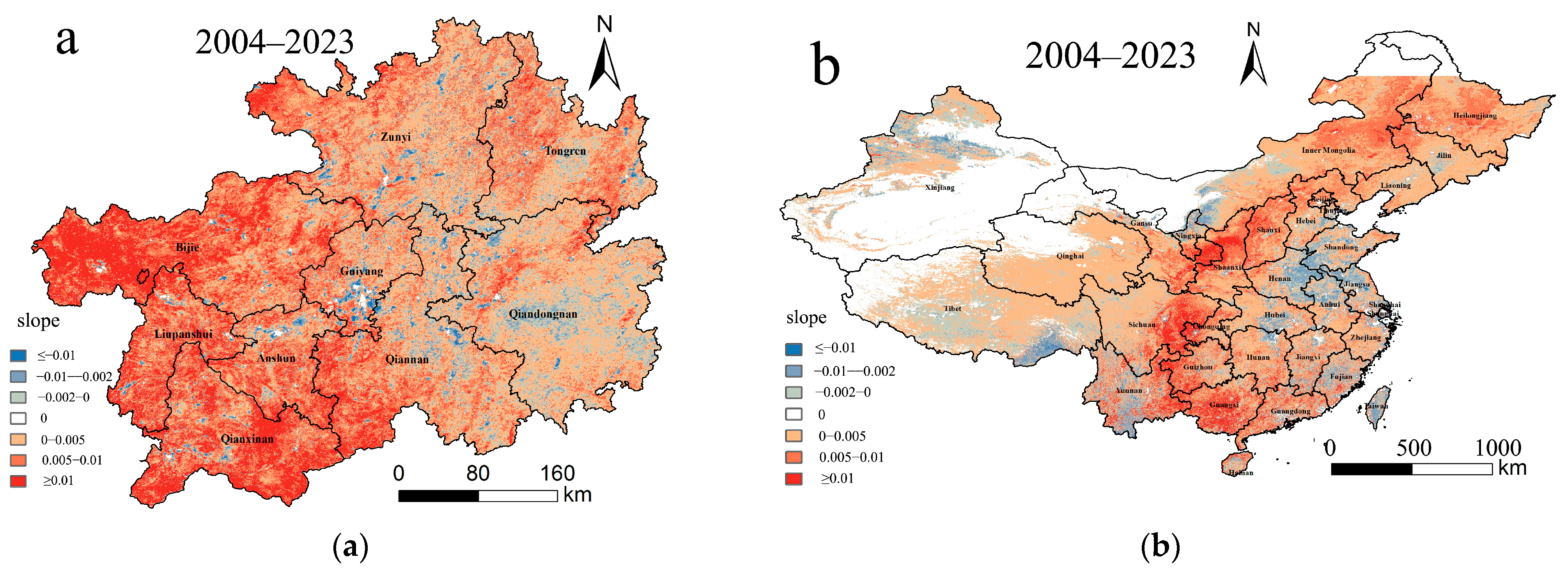
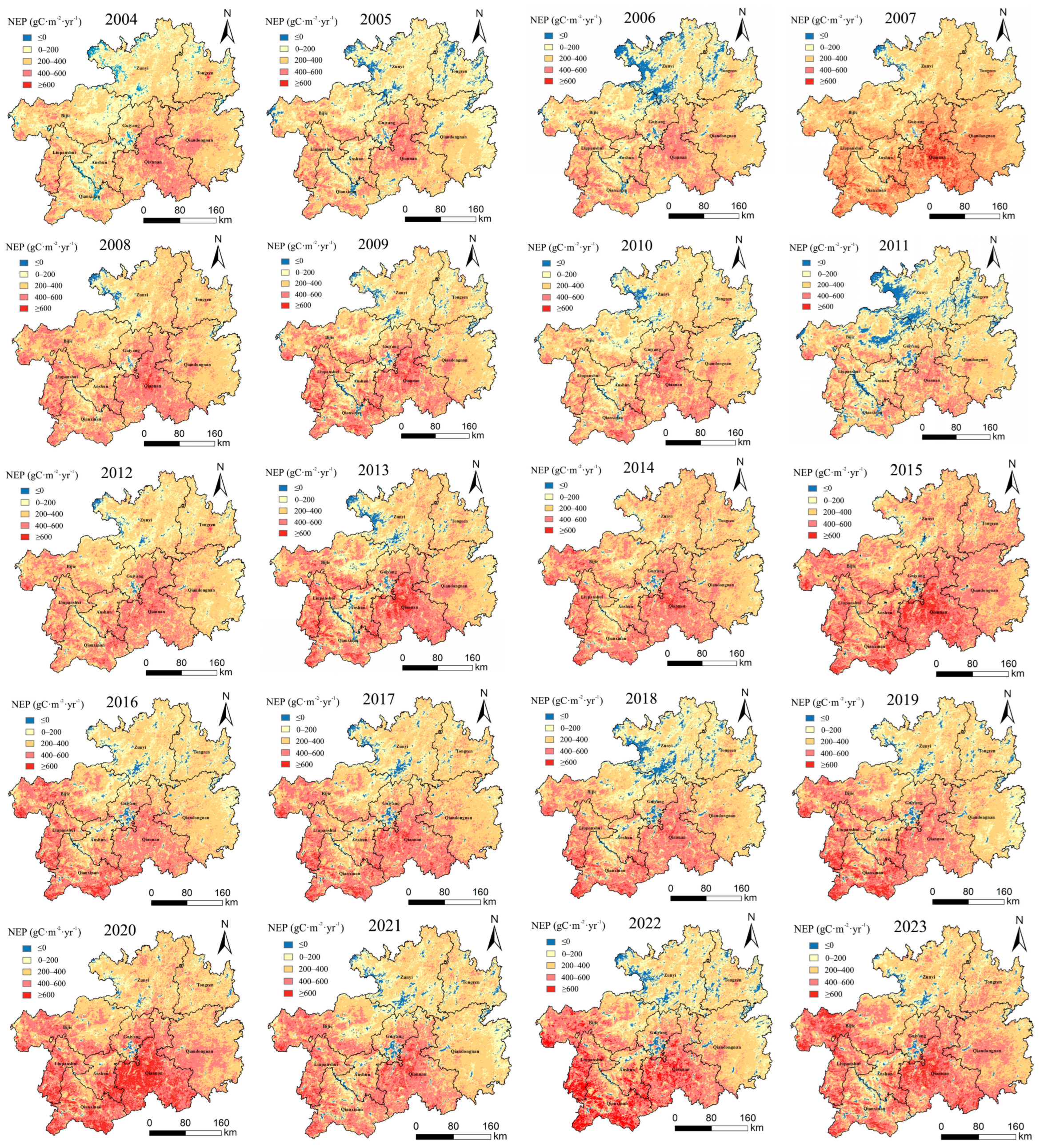
3.1. Spatiotemporal Evolution of NEP
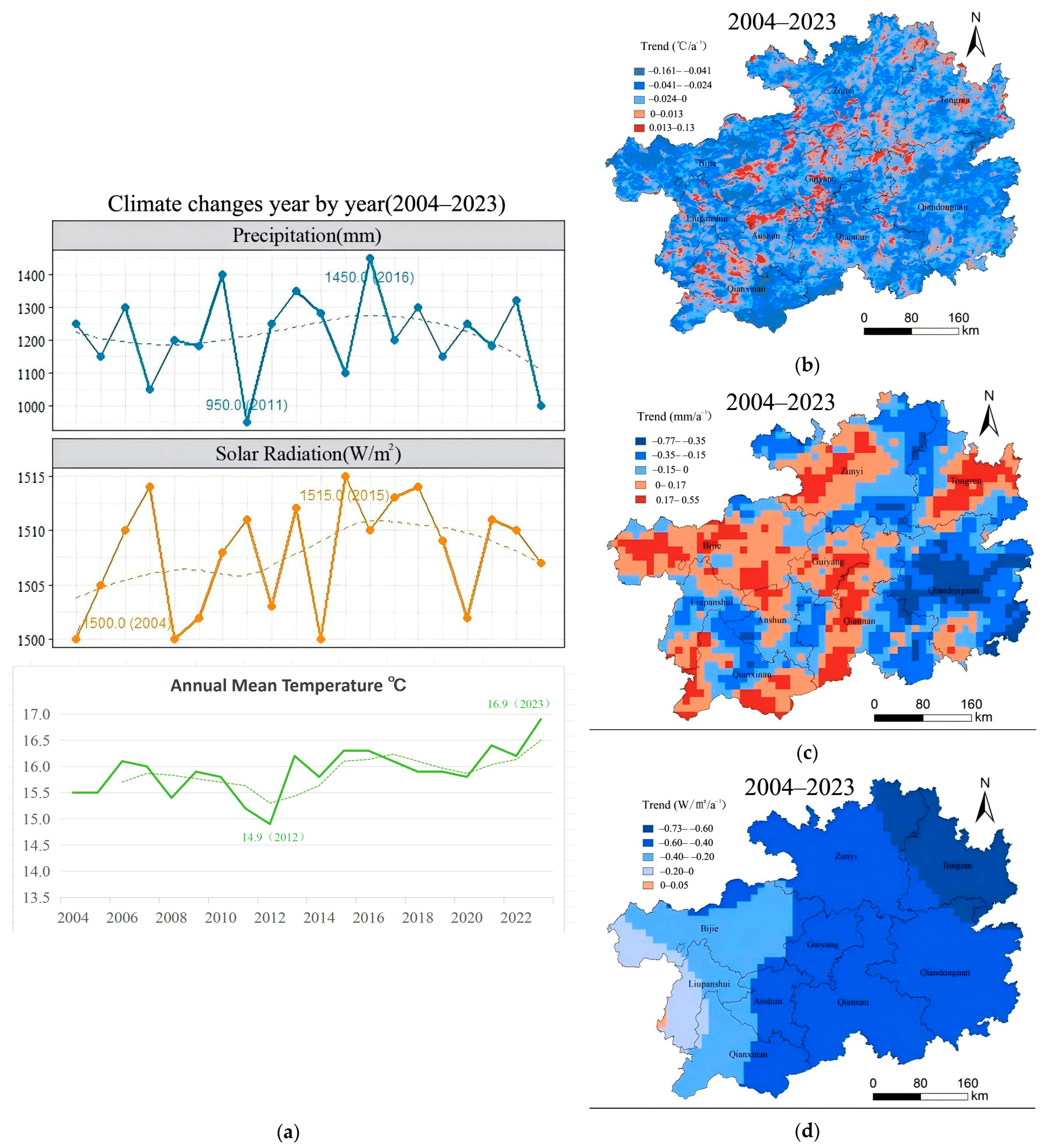
3.2. Analysis of Natural Factors Influencing NEP Variations
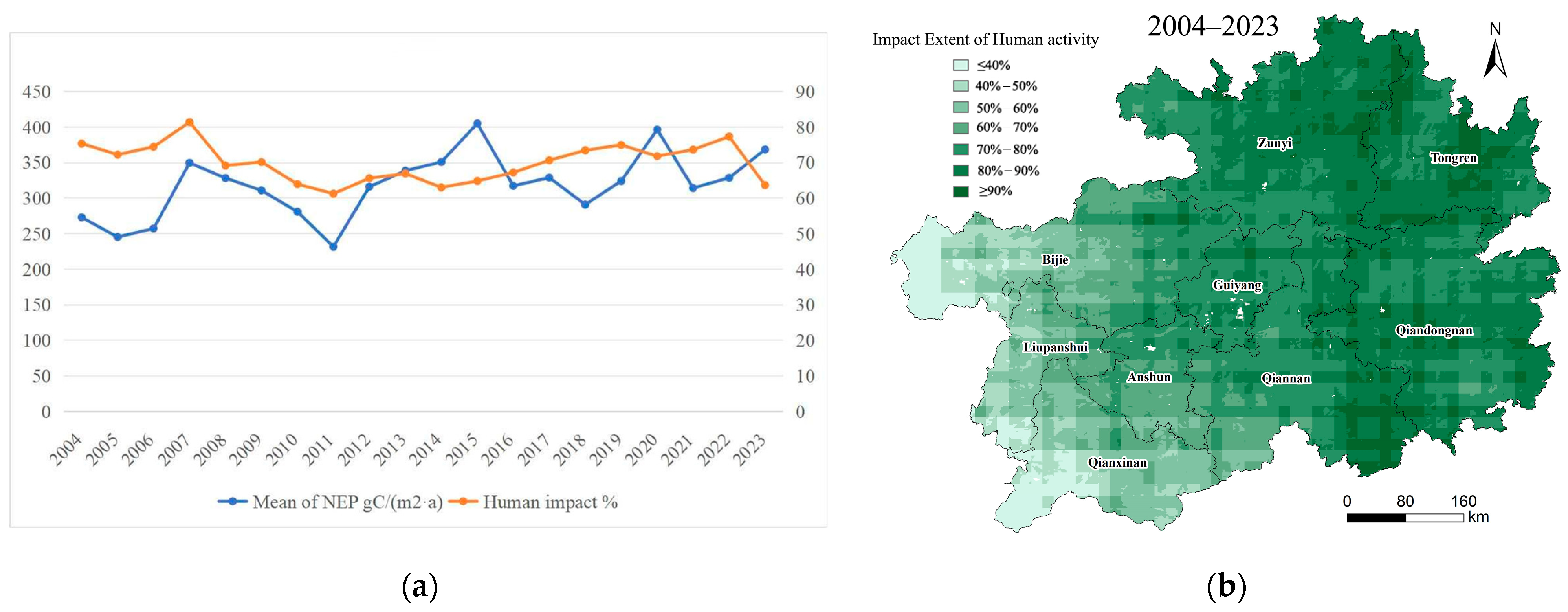
3.3. Analysis of the Influence of Human Activities on NEP
3.4. Stability Test
4. Discussion
5. Conclusions
Author Contributions
Funding
Institutional Review Board Statement
Informed Consent Statement
Data Availability Statement
Acknowledgments
Conflicts of Interest
References
- Wang, M.; Zhang, S.; Guo, X.; Xiao, L.; Yang, Y.; Luo, Y.; Mishra, U.; Luo, Z. Responses of soil organic carbon to climate extremes under warming across global biomes. Nat. Clim. Change 2024, 14, 98–105. [Google Scholar] [CrossRef]
- Wernberg, T.; Thomsen, M.S.; Baum, J.K.; Bishop, M.J.; Bruno, J.F.; Coleman, M.A.; Filbee-Dexter, K.; Gagnon, K.; He, Q.; Murdiyarso, D. Impacts of climate change on marine foundation species. Annu. Rev. Mar. Sci. 2024, 16, 247–282. [Google Scholar] [CrossRef]
- Lal, R.; Smith, P.; Jungkunst, H.F.; Mitsch, W.J.; Lehmann, J.; Nair, P.K.R.; McBratney, A.B.; De Moraes Sá, J.C.; Schneider, J.; Zinn, Y.L.; et al. The carbon sequestration potential of terrestrial ecosystems. J. Soil Water Conserv. 2018, 73, 145A–152A. [Google Scholar] [CrossRef]
- Mo, L.; Zohner, C.M.; Reich, P.B.; Liang, J.; De Miguel, S.; Nabuurs, G.-J.; Renner, S.S.; van den Hoogen, J.; Araza, A.; Herold, M. Integrated global assessment of the natural forest carbon potential. Nature 2023, 624, 92–101. [Google Scholar] [CrossRef]
- Peng, B.; Zhou, Z.; Cai, W.; Li, M.; Xu, L.; He, N. Maximum potential of vegetation carbon sink in Chinese forests. Sci. Total Environ. 2023, 905, 167325. [Google Scholar] [CrossRef] [PubMed]
- Zhao, D.; Cai, J.; Shen, S.; Liu, Q.; Lan, Y. Nature-based solutions: Assessing the carbon sink potential and influencing factors of urban park plant communities in the temperate monsoon climate zone. Sci. Total Environ. 2024, 950, 175347. [Google Scholar] [CrossRef]
- Sha, Z.; Bai, Y.; Li, R.; Lan, H.; Zhang, X.; Li, J.; Liu, X.; Chang, S.; Xie, Y. The global carbon sink potential of terrestrial vegetation can be increased substantially by optimal land management. Commun. Earth Environ. 2022, 3, 8. [Google Scholar] [CrossRef]
- Moon, T.; Kim, M.; Chon, J. Adaptive green space management strategies for sustainable carbon sink parks. Urban For. Urban Green. 2024, 94, 128236. [Google Scholar] [CrossRef]
- Pan, Y.; Birdsey, R.A.; Phillips, O.L.; Houghton, R.A.; Fang, J.; Kauppi, P.E.; Keith, H.; Kurz, W.A.; Ito, A.; Lewis, S.L. The enduring world forest carbon sink. Nature 2024, 631, 563–569. [Google Scholar] [CrossRef]
- Luo, Q.; Bai, X.; Zhao, C.; Luo, G.; Li, C.; Ran, C.; Zhang, S.; Xiong, L.; Liao, J.; Du, C. Unexpected response of terrestrial carbon sink to rural depopulation in China. Sci. Total Environ. 2024, 948, 174595. [Google Scholar] [CrossRef]
- Erb, K.H.; Kastner, T.; Plutzar, C.; Bais, A.L.S.; Carvalhais, N.; Fetzel, T.; Gingrich, S.; Haberl, H.; Lauk, C.; Niedertscheider, M.; et al. Unexpectedly large impact of forest management and grazing on global vegetation biomass. Nature 2018, 553, 73–76. [Google Scholar] [CrossRef]
- Chen, C.; Park, T.; Wang, X.; Piao, S.; Xu, B.; Chaturvedi, R.K.; Fuchs, R.; Brovkin, V.; Ciais, P.; Fensholt, R.; et al. China and India lead in greening of the world through land-use management. Nat. Sustain. 2019, 2, 122–129. [Google Scholar] [CrossRef]
- Ouyang, Z.; Zheng, H.; Xiao, Y.; Polasky, S.; Liu, J.; Xu, W.; Wang, Q.; Zhang, L.; Xiao, Y.; Rao, E.; et al. Improvements in ecosystem services from investments in natural capital. Science 2016, 352, 1455–1459. [Google Scholar] [CrossRef]
- Hua, F.; Wang, X.; Zheng, X.; Fisher, B.; Wang, L.; Zhu, J.; Tang, Y.; Yu, D.W.; Wilcove, D.S. Opportunities for biodiversity gains under the world’s largest reforestation programme. Nat. Commun. 2016, 7, 12717. [Google Scholar] [CrossRef] [PubMed]
- Feng, Q.; Zhou, Z.; Chen, Q.; Zhu, C.; Zhu, M.; Luo, W.; Wang, J. Quantifying the extent of ecological impact from China’s poverty alleviation relocation program: A case study in Guizhou Province. J. Clean. Prod. 2024, 444, 141274. [Google Scholar] [CrossRef]
- Yu, Z.; Ciais, P.; Piao, S.; Houghton, R.A.; Lu, C.; Tian, H.; Agathokleous, E.; Kattel, G.R.; Sitch, S.; Goll, D. Forest expansion dominates China’s land carbon sink since 1980. Nat. Commun. 2022, 13, 5374. [Google Scholar] [CrossRef]
- Chen, Y.; Zhou, J.; Ge, Y.; Dong, J. Uncovering the rapid expansion of photovoltaic power plants in China from 2010 to 2022 using satellite data and deep learning. Remote Sens. Environ. 2024, 305, 114100. [Google Scholar] [CrossRef]
- Qu, Q.; Jian, S.; Chen, A.; Xiao, C. Investigating the Dynamic Change and Driving Force of Vegetation Carbon Sink in Taihang Mountain, China. Land 2024, 13, 1348. [Google Scholar] [CrossRef]
- Lyu, J.; Fu, X.; Lu, C.; Zhang, Y.; Luo, P.; Guo, P.; Huo, A.; Zhou, M. Quantitative assessment of spatiotemporal dynamics in vegetation NPP, NEP and carbon sink capacity in the Weihe River Basin from 2001 to 2020. J. Clean. Prod. 2023, 428, 139384. [Google Scholar] [CrossRef]
- Tong, X.; Brandt, M.; Yue, Y.; Horion, S.; Wang, K.; De Keersmaecker, W.; Tian, F.; Schurgers, G.; Xiao, X.; Luo, Y.; et al. Increased vegetation growth and carbon stock in China karst via ecological engineering. Nat. Sustain. 2018, 1, 44–50. [Google Scholar] [CrossRef]
- Huang, B.; Lu, F.; Wang, X.; Wu, X.; Zhang, L.; Ouyang, Z. Ecological restoration and rising CO2 enhance the carbon sink, counteracting climate change in northeastern China. Environ. Res. Lett. 2021, 17, 014002. [Google Scholar] [CrossRef]
- Zhou, Z.; Feng, Q.; Zhu, C.; Luo, W.; Wang, L.; Zhao, X.; Zhang, L. The Spatial and Temporal Evolution of Ecological Environment Quality in Karst Ecologically Fragile Areas Driven by Poverty Alleviation Resettlement. Land 2022, 11, 1150. [Google Scholar] [CrossRef]
- Zeng, J.; Zhou, T.; Wang, Q.; Xu, Y.; Lin, Q.; Zhang, Y.; Wu, X.; Zhang, J.; Liu, X. Spatial patterns of China’s carbon sinks estimated from the fusion of remote sensing and field-observed net primary productivity and heterotrophic respiration. Ecol. Inform. 2023, 76, 102152. [Google Scholar] [CrossRef]
- Tu, H.; Jiapaer, G.; Yu, T.; Zhang, L.; Chen, B.; Lin, K.; Li, X. Effects of Land Cover Change on Vegetation Carbon Source/Sink in Arid Terrestrial Ecosystems of Northwest China, 2001–2018. Remote Sens. 2023, 15, 2471. [Google Scholar] [CrossRef]
- Luo, D.; Zhou, Z.; Zhang, L.; Chen, Q.; Huang, D.; Feng, Q.; Wu, T.; Wu, L. Evolution and driver analysis of forest carbon stocks in karst mountainous areas of southwest China in the context of rocky desertification management. Catena 2024, 246, 108335. [Google Scholar] [CrossRef]
- Berra, E.F.; Fontana, D.C.; Yin, F.; Breunig, F.M. Harmonized Landsat and Sentinel-2 Data with Google Earth Engine. Remote Sens. 2024, 16, 2695. [Google Scholar] [CrossRef]
- Moazzam, M.F.U.; Lee, B.G. Urbanization influenced SUHI Of 41 megacities of the world using big geospatial data assisted with google earth engine. Sustain. Cities Soc. 2024, 101, 105095. [Google Scholar] [CrossRef]
- Ledo, A.; Hillier, J.; Smith, P.; Aguilera, E.; Blagodatskiy, S.; Brearley, F.Q.; Datta, A.; Diaz-Pines, E.; Don, A.; Dondini, M.; et al. A global, empirical, harmonised dataset of soil organic carbon changes under perennial crops. Sci. Data 2019, 6, 57. [Google Scholar] [CrossRef]
- Börker, J.; Hartmann, J.; Amann, T.; Romero-Mujalli, G.; Moosdorf, N.; Jenkins, C. Chemical Weathering of Loess and Its Contribution to Global Alkalinity Fluxes to the Coastal Zone During the Last Glacial Maximum, Mid-Holocene, and Present. Geochem. Geophys. Geosyst. 2020, 21, e2020GC008922. [Google Scholar] [CrossRef]
- Shi, F.; Zhang, F.; Shen, N.; Yang, M. Quantifying interactions between slope gradient, slope length and rainfall intensity on sheet erosion on steep slopes using Multiple Linear Regression. Sci. Total Environ. 2024, 908, 168090. [Google Scholar] [CrossRef]
- Qian, X.; Ling, M.; Sun, Y.; Han, F.; Shi, Y.; Duan, C.; Lan, Y. Decoding the aroma characteristics of icewine by partial least-squares regression, aroma reconstitution, and omission studies. Food Chem. 2024, 440, 138226. [Google Scholar] [CrossRef] [PubMed]
- Zhu, M.; Zhou, Z.; Wu, X.; Wan, J.; Wang, J.; Zheng, J.; Liu, R.; Li, F. Prediction and spillover effects of forest expansion and management to increase carbon sinks in karst mountainous areas: A case study in Guizhou, China. Land Use Policy 2025, 151, 107491. [Google Scholar] [CrossRef]
- Manan, B.; Simone, G.; Nicolas, R.; Julia, L.N.; Thomas, K.; Sarah, M.; Florian, S.; Karl-Heinz, E. Quantifying and attributing land use-induced carbon emissions to biomass consumption: A critical assessment of existing approaches. J. Environ. Manag. 2021, 286, 112228. [Google Scholar] [CrossRef]
- Zhang, X.; Brandt, M.; Tong, X.; Ciais, P.; Yue, Y.; Xiao, X.; Zhang, W.; Wang, K.; Fensholt, R. A large but transient carbon sink from urbanization and rural depopulation in China. Nat. Sustain. 2022, 5, 321–328. [Google Scholar] [CrossRef]
- Li, P.; Shuang, Z.; Tiantian, C. Mapping Forest Restoration Probability and Driving Archetypes Using a Bayesian Belief Network and SOM: Towards Karst Ecological Restoration in Guizhou, China. Remote Sens. 2022, 14, 780. [Google Scholar]
- Yang, Y.; Shi, M.; Liu, B.; Yi, Y.; Wang, J.; Zhao, H. Contribution of ecological restoration projects to long-term changes in PM2.5. Ecol. Indic. 2024, 159, 111630. [Google Scholar] [CrossRef]
- Ma, X.; Yu, Z.; Su, Q.; Liu, W. Microbial-assisted corn residue return as a sustainable strategy for soil structural and nutrient enhancement. Ecol. Eng. 2026, 223, 107825. [Google Scholar] [CrossRef]


Disclaimer/Publisher’s Note: The statements, opinions and data contained in all publications are solely those of the individual author(s) and contributor(s) and not of MDPI and/or the editor(s). MDPI and/or the editor(s) disclaim responsibility for any injury to people or property resulting from any ideas, methods, instructions or products referred to in the content. |
© 2026 by the authors. Licensee MDPI, Basel, Switzerland. This article is an open access article distributed under the terms and conditions of the Creative Commons Attribution (CC BY) license.
Share and Cite
Feng, Q.; Zhang, R.; Chen, Q. Climate-Constrained Attribution of Vegetation Carbon Sink Dynamics in a Karst Region: Disentangling Human and Climatic Contributions. Atmosphere 2026, 17, 537. https://doi.org/10.3390/atmos17060537
Feng Q, Zhang R, Chen Q. Climate-Constrained Attribution of Vegetation Carbon Sink Dynamics in a Karst Region: Disentangling Human and Climatic Contributions. Atmosphere. 2026; 17(6):537. https://doi.org/10.3390/atmos17060537
Chicago/Turabian StyleFeng, Qing, Ruirui Zhang, and Qiqi Chen. 2026. "Climate-Constrained Attribution of Vegetation Carbon Sink Dynamics in a Karst Region: Disentangling Human and Climatic Contributions" Atmosphere 17, no. 6: 537. https://doi.org/10.3390/atmos17060537
APA StyleFeng, Q., Zhang, R., & Chen, Q. (2026). Climate-Constrained Attribution of Vegetation Carbon Sink Dynamics in a Karst Region: Disentangling Human and Climatic Contributions. Atmosphere, 17(6), 537. https://doi.org/10.3390/atmos17060537