Statistical Analysis of NO2 Emissions from Eskom’s Majuba Coal-Fired Power Station in Mpumalanga, South Africa


Abstract
1. Introduction
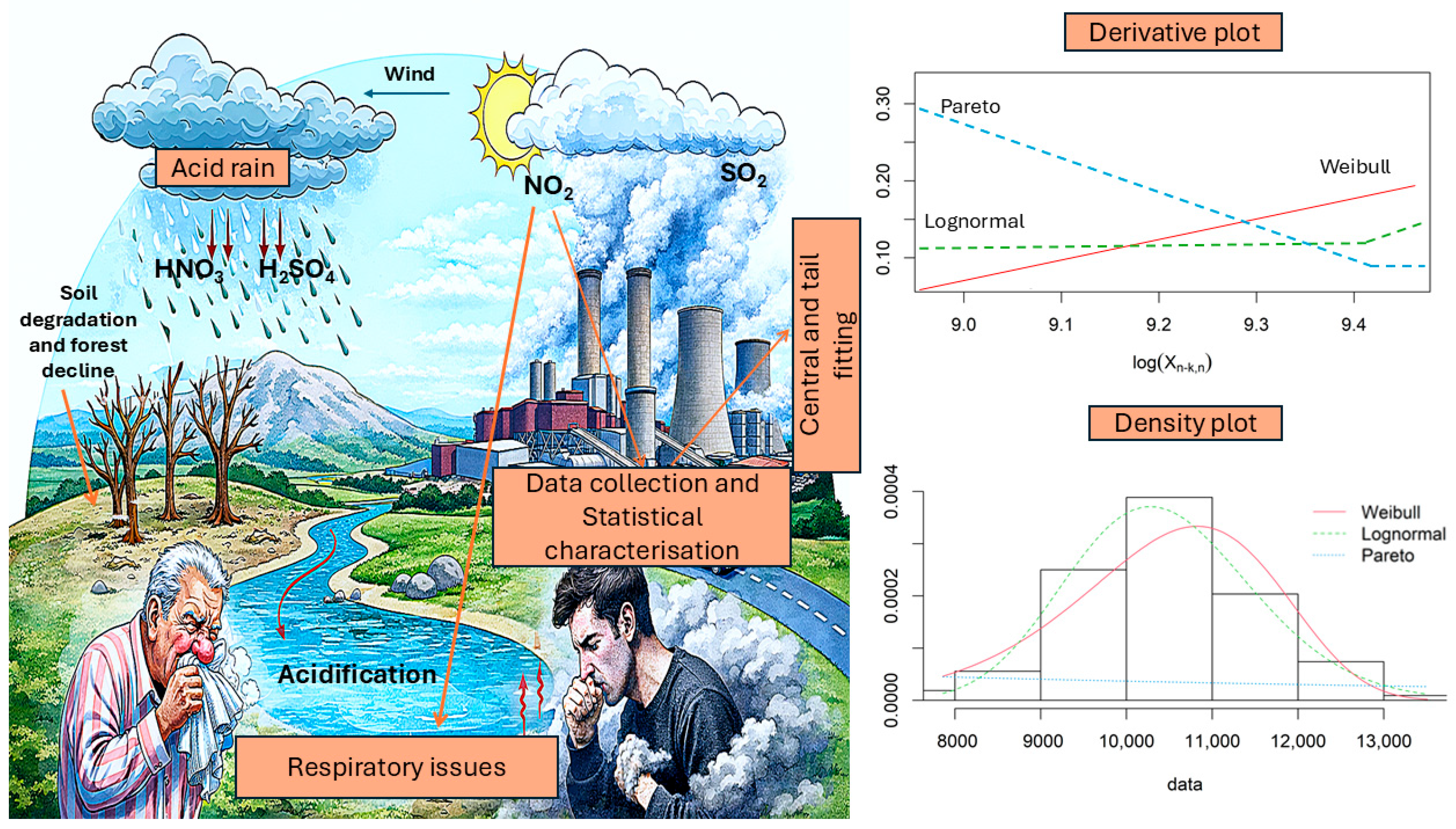
- Among the Weibull, Lognormal, and Pareto distributions, which distribution(s) best characterises the full/overall and upper tail distribution patterns of NO2 emissions data from the Majuba power plant?
- Can the derivative plot provide additional diagnostic value for distribution selection?
Methodological Overview
- (i)
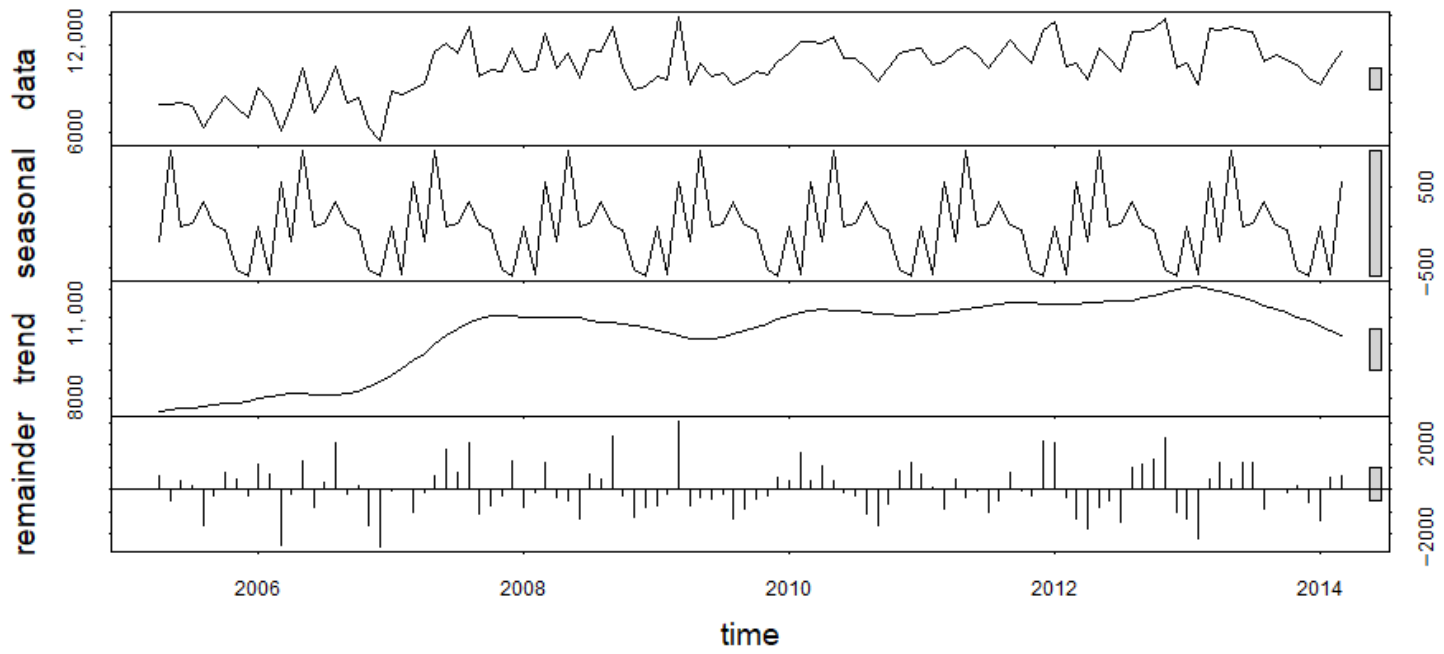
- First, the data is assessed if the assumptions of independence and stationarity hold before fitting of the probability distributions. If not, then adjustments to the data are made to satisfy the assumptions.
- (ii)
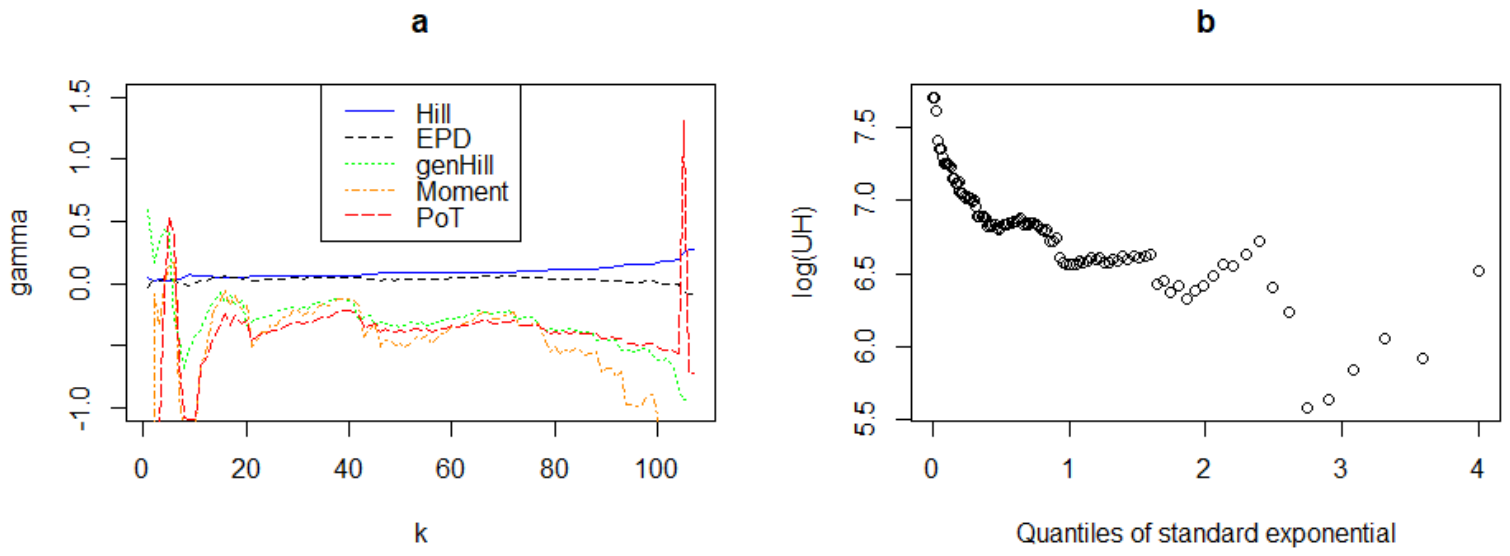
- The upper tail heaviness is then assessed to determine the appropriateness of the selected distributions for the data, particularly the fitting in the upper tail. The EVI estimates and the generalised QQ plots are used to achieve this.A good choice of , the number of exceedances, and, thus, the threshold can be determined by selecting a point or points where two or more of the EVI estimates plots intersect [24,28]. There is, however, a trade-off between the variance and bias in the selection of . With higher values of (lower values of the threshold), bias increases and the variance decreases. Conversely, with lower values of (higher values of the threshold), bias decreases and the variance increases [29]. As a result, caution should be applied when a is selected. The purpose of the current step is to only check the suitability of the selected distributions by assessing the upper tail.
- (iii)
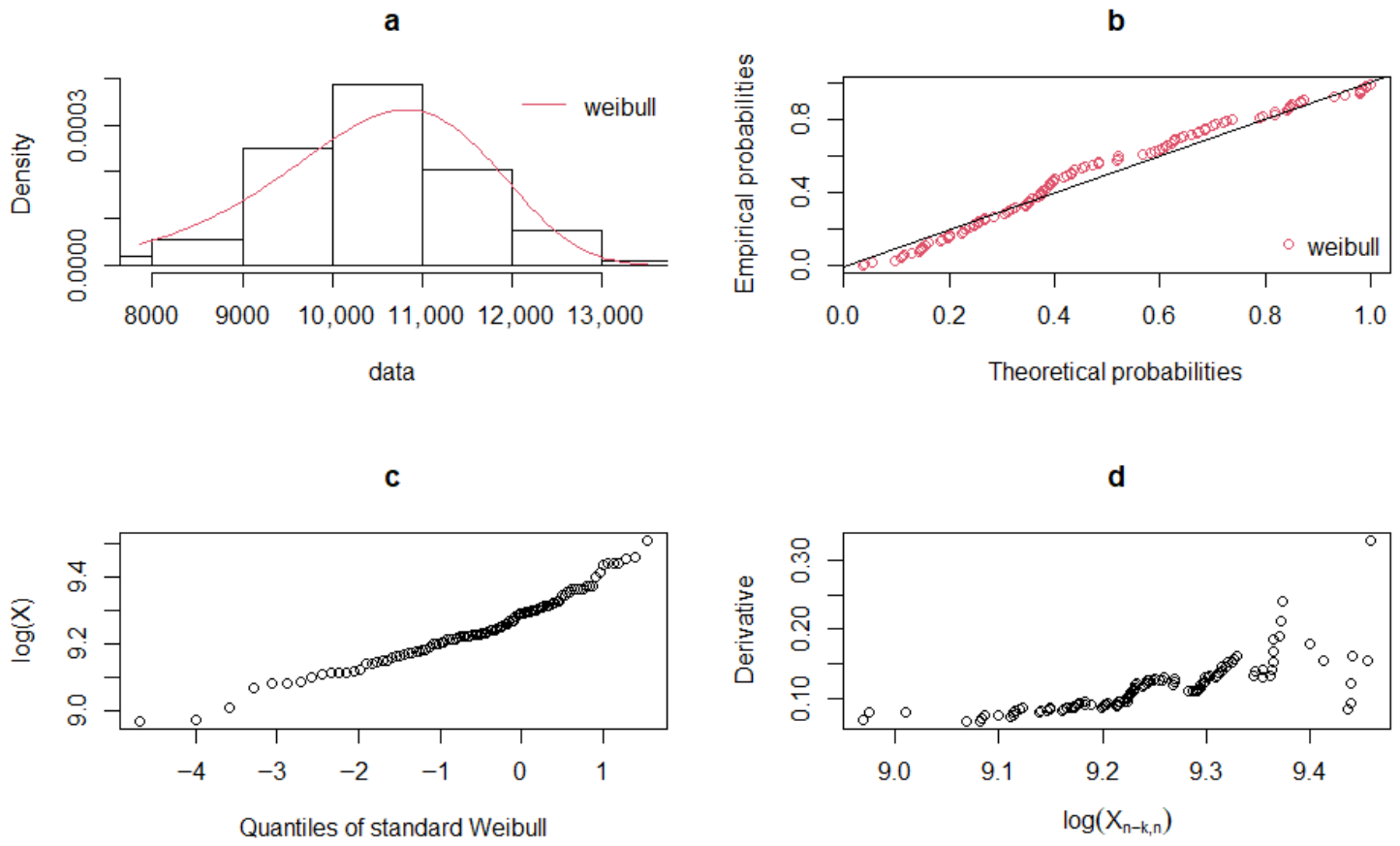
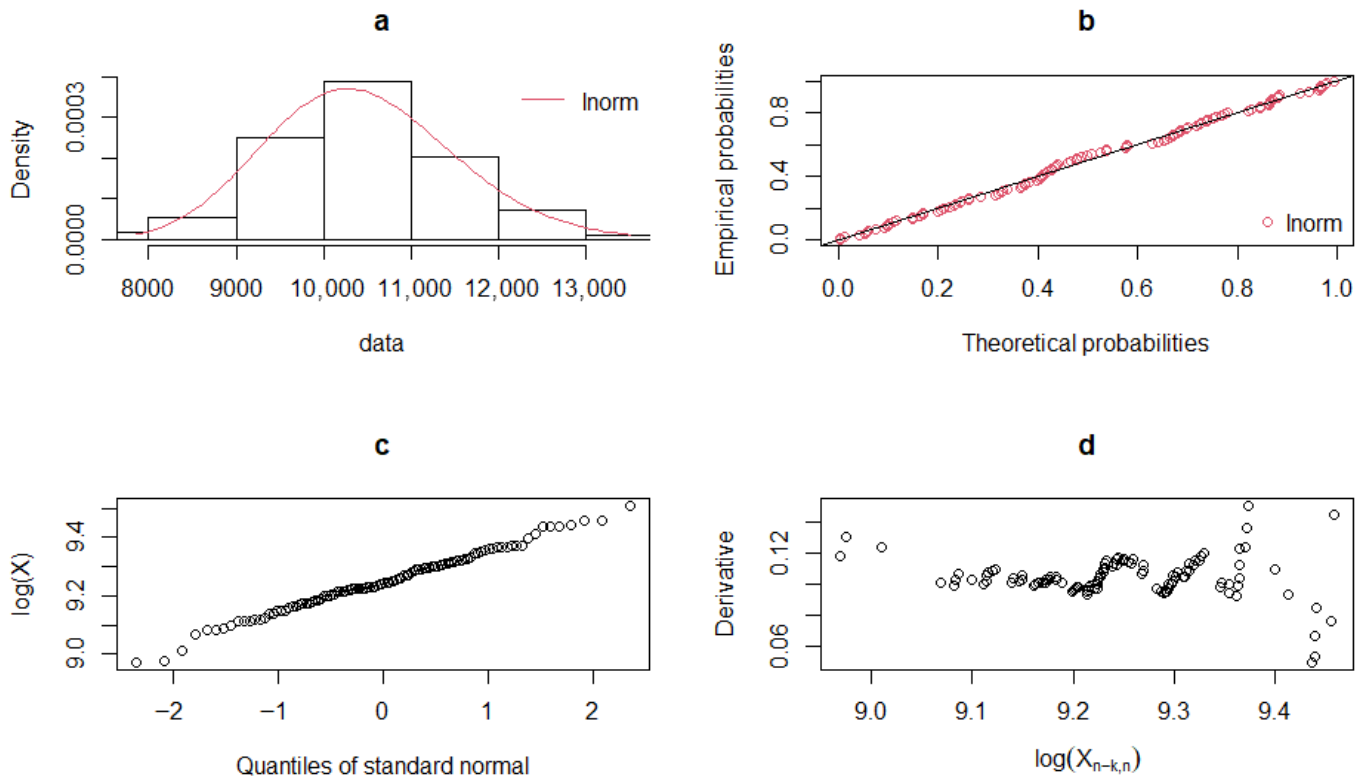
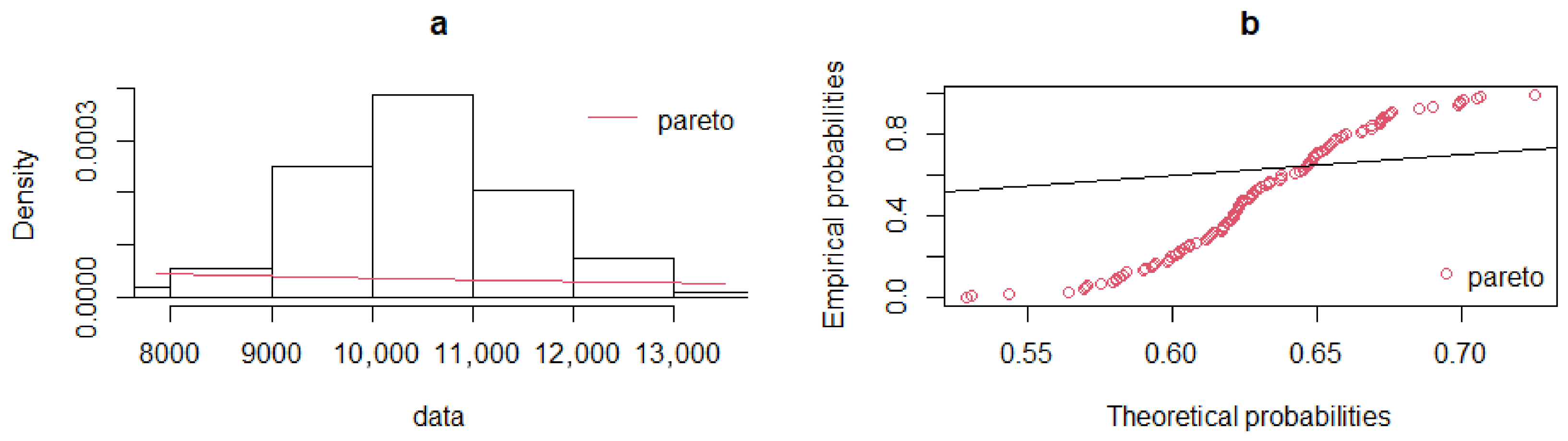
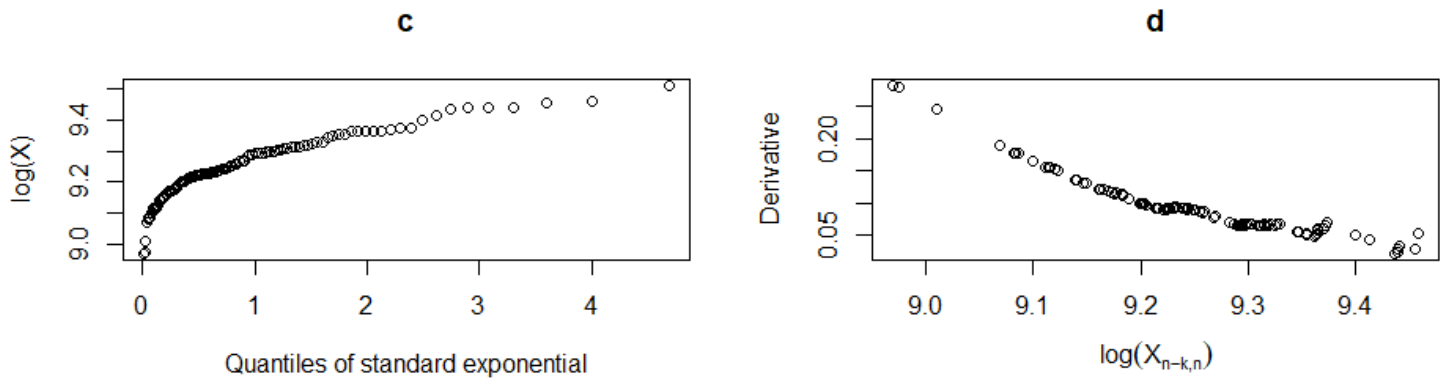
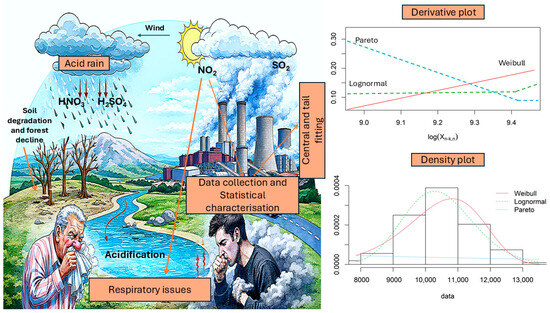
- The Weibull, Lognormal, and Pareto distributions are then fitted to the NO2 emissions data by employing the QQ and corresponding derivative plots of these distributions. For all three distributions, a linear QQ plot and a horizontal derivative plot show that the data belongs to that particular distribution. Convexity in the QQ plot and an increasing derivative plot suggest that a heavier tailed distribution than the one under investigation is a better candidate for that component of the data, while concavity in the QQ plot and a decreasing derivative plot suggest the appropriateness of a lighter tailed distribution than the one investigated for the component. As a result of this flexibility, employing the QQ and derivative plot can allow for piecewise analysis where necessary [24].
- (iv)
- The bootstrap goodness-of-fit tests, cross-validated likelihood, and information criteria (Akaike Information Criterion (AIC) and Schwarz’s Bayesian Information Criterion (BIC)) are used to assess the adequacy of the models for the full NO2 emissions data, then the BIC-corrected Vuong test for non-nested distributions is used to compare the performance of the distributions used in this study. The BIC-corrected version of the Vuong test is used since it places heavier penalty on model complexity compared to the AIC-corrected and uncorrected versions [30].
- (v)
- In the final step, the BIC and BIC-corrected Vuong test are again used to compare the performance of the three distributions across different values of to check the stability of the fit in the upper tail of NO2 emissions data. A consistent distribution across will indicate stability in distribution choice.
2. Methodology
2.1. The Shape of the Upper Tail: Extreme Value Index () Estimation
2.2. The Exponential Distribution
2.3. Weibull Distribution
2.4. Lognormal Distribution
2.5. Pareto Distribution
2.6. Goodness-of-Fit Test
2.6.1. Kolmogorov–Smirnov (KS) and Anderson–Darling (AD) Tests
2.6.2. BIC-Corrected Vuong Test
2.6.3. Cross-Validated Predictive Likelihood
- (1)
- the remaining fold (the training set) will be used in the estimation of maximum likelihood parameters,
- (2)
- the fitted model will then be evaluated on the held-out fold (the testing set),
- (3)
- summing contributions of the predictive loglikelihoods across all folds, the cross-validated loglikelihood will be obtained.
2.6.4. The Akaike Information Criterion (AIC) and Schwarz’s Bayesian Information Criterion (BIC)
3. Results
3.1. Data and Data Decomposition
3.2. Descriptive Statistics
3.3. Stationarity and Independence Tests
3.4. Shape of the Tail
3.5. Distribution of the Data
3.6. Goodness-of-Fit Test of the Data
3.7. Tail Selection
4. Discussion
4.1. Limitations
4.2. Future Studies
5. Conclusions
Author Contributions
Funding
Institutional Review Board Statement
Informed Consent Statement
Data Availability Statement
Conflicts of Interest
Appendix A

| 7951 | 7791 | 9381 | 10,449.26779 | 9284.955938 | 12,111.88881 | 11,557.36505 | 9580 | 13,005 |
| 7955 | 10,410 | 11,503 | 11,408.34552 | 10,740.62565 | 12,544.99748 | 11,846.01536 | 11,712 | 13,257 |
| 8028 | 7334 | 12,106 | 9668.793759 | 9779.458636 | 11,123.66211 | 11,277.75171 | 11,112 | 12,930 |
| 7844 | 8478 | 11,356 | 11,638.42621 | 10,078.26273 | 11,017.08322 | 10,416 | 10,149 | 12,844 |
| 6369 | 10,547 | 13,219 | 11,547.9462 | 9286.892432 | 10,370.19177 | 11,261 | 12,903 | 10,808 |
| 7470 | 7999 | 9837 | 13,179.70739 | 9618.821848 | 9522.406988 | 12,277 | 12,829 | 11,329 |
| 8538 | 8394 | 10,253 | 10,427.70967 | 10,153.32493 | 10,406.49334 | 11,459.64895 | 13,075 | 10,999 |
| 7750 | 6301 | 10,221 | 8904.369469 | 9943.661032 | 11,380.86745 | 10,686.1989 | 13,739 | 10,641 |
| 6996 | 5400 | 11,738 | 9196 | 10,864.4793 | 11,687.01793 | 13,027.66605 | 10,412 | 9670 |
| 9076 | 8822 | 10,214 | 9819.359517 | 11,452.04641 | 11,776.01469 | 13,565.87818 | 10,743 | 9293 |
| 8131 | 8560 | 10,240 | 9582.87134 | 12,242.48433 | 10,611.65925 | 10,540.09094 | 9301 | 10,445 |
| 6146 | 8916 | 12,767 | 13,923.24532 | 12,189.72768 | 10,855.8829 | 10,706.92656 | 13,078 | 11,511 |
References
- Pollet, B.G.; Staffell, I.; Adamson, K.-A. Current Energy Landscape in the Republic of South Africa. Int. J. Hydrogen Energy 2015, 40, 16685–16701. [Google Scholar] [CrossRef]
- Nkambule, N.P.; Blignaut, J.N. Externality Costs of the Coal-Fuel Cycle: The Case of Kusile Power Station. S. Afr. J. Sci. 2017, 113, 9. [Google Scholar] [CrossRef] [PubMed]
- Nogaya, G.; Nwulu, N.I.; Gbadamosi, S.L. Repurposing South Africa’s Retiring Coal-Fired Power Stations for Renewable Energy Generation: A Techno-Economic Analysis. Energies 2022, 15, 5626. [Google Scholar] [CrossRef]
- Shikwambana, L.; Mhangara, P.; Mbatha, N. Trend Analysis and First Time Observations of Sulphur Dioxide and Nitrogen Dioxide in South Africa Using TROPOMI/Sentinel-5 P Data. Int. J. Appl. Earth Obs. Geoinf. 2020, 91, 102130. [Google Scholar] [CrossRef]
- Mukwevho, P.; Retief, F.; Burger, R.; Moolna, A. Identifying Critical Assumptions and Risks in Air Quality Management Planning Using Theory of Change Approach. Clean Air J. 2024, 34, 16571. [Google Scholar] [CrossRef]
- Boden, T.A.; Marland, G.; Andres, R.J. Global, Regional, and National Fossil-Fuel CO2 Emissions. In Carbon Dioxide Information Analysis Center (CDIAC) Datasets; U.S. Department of Energy Office of Scientific and Technical Information: Oak Ridge, TN, USA, 2010. [Google Scholar] [CrossRef]
- Foster, E.; Contestabile, M.; Blazquez, J.; Manzano, B.; Workman, M.; Shah, N. The Unstudied Barriers to Widespread Renewable Energy Deployment: Fossil Fuel Price Responses. Energy Policy 2017, 103, 258–264. [Google Scholar] [CrossRef]
- Monn, C. Exposure Assessment of Air Pollutants: A Review on Spatial Heterogeneity and Indoor/Outdoor/Personal Exposure to Suspended Particulate Matter, Nitrogen Dioxide and Ozone. Atmos. Environ. 2001, 35, 1–32. [Google Scholar] [CrossRef]
- Li, Z.; Yu, Y.; Jia, L.; Wu, Y.; Cheng, P.; Zhang, Z.; Li, Z.; Fan, C.; Guo, X. Thermal Characteristic Analysis and Performance Optimization of a Novel Heating Boiler Based on a Porous Media Model. Appl. Therm. Eng. 2026, 289, 130035. [Google Scholar] [CrossRef]
- Cheng, P.; Li, Z.; Zheng, Y.; Meng, Q.; Yu, Y.; Jin, Y.; Gao, X.; Guo, X.; Jia, L. Study on the Regulation of Performance and Hg0 Removal Mechanism of MIL-101(Fe)-Derived Carbon Materials. Sep. Purif. Technol. 2025, 379, 134939. [Google Scholar] [CrossRef]
- Marchant, C.; Leiva, V.; Cavieres, M.F.; Sanhueza, A. Air Contaminant Statistical Distributions with Application to PM10 in Santiago, Chile. In Reviews of Environmental Contamination and Toxicology; Springer: New York, NY, USA, 2013; pp. 1–31. [Google Scholar] [CrossRef]
- Kan, H.-D.; Chen, B.-H. Statistical Distributions of Ambient Air Pollutants in Shanghai, China. Biomed. Environ. Sci. 2004, 17, 366–372. [Google Scholar]
- Nwaigwe, C.C.; Ogbonna, C.J.; Achem, O. On the Modeling of Carbon Monoxide Flaring in Nigeria. Int. J. Stat. Probab. 2018, 7, 94. [Google Scholar] [CrossRef]
- Okorie, I.E.; Akpanta, A.C.; Osu, B.O. Flexible Heavy Tail Distributions for Surface Ozone for Selected Sites in the United States of America. Ozone Sci. Eng. 2019, 41, 473–488. [Google Scholar] [CrossRef]
- Plocoste, T.; Calif, R.; Euphrasie-Clotilde, L.; Brute, F.-N. The Statistical Behavior of PM10 Events over Guadeloupean Archipelago: Stationarity, Modelling and Extreme Events. Atmos. Res. 2020, 241, 104956. [Google Scholar] [CrossRef]
- Intarapak, S.; Supapakorn, T. Investigation on the Statistical Distribution of PM2.5 Concentration in Chiang Mai, Thailand. WSEAS Trans. Environ. Dev. 2021, 17, 1219–1227. [Google Scholar] [CrossRef]
- Oguntunde, P.E.; Odetunmibi, O.A.; Adejumo, A.O. A Study of Probability Models in Monitoring Environmental Pollution in Nigeria. J. Probab. Stat. 2014, 2014, 864965. [Google Scholar] [CrossRef]
- Giavis, G.M.; Kambezidis, H.D.; Lykoudis, S.P. Frequency Distribution of Particulate Matter (PM10) in Urban Environments. Int. J. Environ. Pollut. 2009, 36, 99. [Google Scholar] [CrossRef]
- Hamid, H.A.; Jaffar, I.; Raffee, A.F. Two-Parameter Central Fitting Distribution to Predict the Concentration of Ground Level Ozone: Case Study in Industrial Area. AIP Conf. Proc. 2018, 2013, 020055. [Google Scholar] [CrossRef]
- Lu, H.C.; Fang, G.C. Predicting the Exceedances of a Critical PM10 Concentration—A Case Study in Taiwan. Atmos. Environ. 2003, 37, 3491–3499. [Google Scholar] [CrossRef]
- Martins, L.D.; Wikuats, C.F.H.; Capucim, M.N.; de Almeida, D.S.; da Costa, S.C.; Albuquerque, T.; Barreto Carvalho, V.S.; de Freitas, E.D.; de Fátima Andrade, M.; Martins, J.A. Extreme Value Analysis of Air Pollution Data and Their Comparison between Two Large Urban Regions of South America. Weather Clim. Extrem. 2017, 18, 44–54. [Google Scholar] [CrossRef]
- El Adlouni, S.; Bobée, B.; Ouarda, T.B.M.J. On the Tails of Extreme Event Distributions in Hydrology. J. Hydrol. 2008, 355, 16–33. [Google Scholar] [CrossRef]
- Papalexiou, S.M.; Koutsoyiannis, D.; Makropoulos, C. How Extreme Is Extreme? An Assessment of Daily Rainfall Distribution Tails. Hydrol. Earth Syst. Sci. 2013, 17, 851–862. [Google Scholar] [CrossRef]
- Albrecher, H.; Beirlant, J.; Teugels, J.L. Reinsurance: Actuarial and Statistical Aspects; John Wiley & Sons: Hoboken, NJ, USA, 2017. [Google Scholar]
- Beirlant, J.; Bladt, M. Tail Classification Using Non-Linear Regression on Model Plots. Extremes 2025, 28, 345–369. [Google Scholar] [CrossRef]
- Albrecher, H.; Araujo-Acuna, J.C.; Beirlant, J. Tempered pareto-type modelling using weibull distributions. ASTIN Bull. 2021, 51, 509–538. [Google Scholar] [CrossRef]
- Jakata, O.; Chikobvu, D. Estimation of Financial Risk Using the Archimedean Gumbel Copula with Log-Normal Distributed Marginals. J. Stat. Appl. Probab. 2025, 14, 543–560. [Google Scholar] [CrossRef]
- Reynkens, T. Using the ReIns Package. Available online: https://cran.r-project.org/web/packages/ReIns/vignettes/ReIns.html (accessed on 23 February 2026).
- Bader, B.; Yan, J.; Zhang, X. Automated Threshold Selection for Extreme Value Analysis via Ordered Goodness-of-Fit Tests with Adjustment for False Discovery Rate. Ann. Appl. Stat. 2018, 12, 310–329. [Google Scholar] [CrossRef]
- Desmarais, B.A.; Harden, J.J. Testing for Zero Inflation in Count Models: Bias Correction for the Vuong Test. Stata J. Promot. Commun. Stat. Stata 2013, 13, 810–835. [Google Scholar] [CrossRef]
- Dekkers, A.L.M.; Einmahl, J.H.J.; De Haan, L. A Moment Estimator for the Index of an Extreme-Value Distribution. Ann. Stat. 1989, 17, 1833–1855. [Google Scholar] [CrossRef]
- Hill, B.M. A Simple General Approach to Inference About the Tail of a Distribution. Ann. Stat. 1975, 3, 1163–1174. [Google Scholar] [CrossRef]
- de Souza, A.; Aristone, F.; Fernandes, W.A.; Oliveira, A.P.G.; Olaofe, Z.; Abreu, M.C.; de Oliveira, J.F., Jr.; Cavazzana, G.; dos Santos, C.M.; Pobocikova, I. Analysis of Ozone Concentrations Using Probability Distributions. Ozone Sci. Eng. 2020, 42, 539–550. [Google Scholar] [CrossRef]
- D’Agostino, R.B.; Stephens, M.A. Goodness-of-Fit Techniques; Dekker: New York, NY, USA, 1986. [Google Scholar]
- Efron, B. Bootstrap Methods: Another Look at the Jackknife. Ann. Stat. 1979, 7, 1–26. [Google Scholar] [CrossRef]
- Stephens, M.A. EDF Statistics for Goodness of Fit and Some Comparisons. J. Am. Stat. Assoc. 1974, 69, 730–737. [Google Scholar] [CrossRef]
- MacKinnon, J.G. Bootstrap Inference in Econometrics. Can. J. Econ. Can. D’écon. 2002, 35, 615–645. [Google Scholar] [CrossRef]
- Vuong, Q.H. Likelihood Ratio Tests for Model Selection and Non-Nested Hypotheses. Econometrica 1989, 57, 307. [Google Scholar] [CrossRef]
- Clarke, K.A. A Simple Distribution-Free Test for Nonnested Model Selection. Polit. Anal. 2007, 15, 347–363. [Google Scholar] [CrossRef]
- Karaivanov, A. Financial Constraints and Occupational Choice in Thai Villages. J. Dev. Econ. 2012, 97, 201–220. [Google Scholar] [CrossRef]
- Fafchamps, M. Sequential Labor Decisions Under Uncertainty: An Estimable Household Model of West-African Farmers. Econometrica 1993, 61, 1173. [Google Scholar] [CrossRef]
- Schneider, L.; Chalmers, R.P.; Debelak, R.; Merkle, E.C. Model Selection of Nested and Non-Nested Item Response Models Using Vuong Tests. Multivar. Behav. Res. 2020, 55, 664–684. [Google Scholar] [CrossRef] [PubMed]
- Stone, M. Cross-Validatory Choice and Assessment of Statistical Prediction. J. R. Stat. Soc. Ser. B 1974, 36, 111–147. [Google Scholar] [CrossRef]
- Geisser, S. The Predictive Sample Reuse Method with Applications. J. Am. Stat. Assoc. 1975, 70, 320–328. [Google Scholar] [CrossRef]
- Gelfand, A.E.; Dey, D.K.; Chang, H. Model Determination Using Predictive Distributions with Implementation via Sampling-Based Methods. In Bayesian Statistics 4; Oxford University Press: Oxford, UK, 1992; pp. 147–167. [Google Scholar] [CrossRef]
- Vehtari, A.; Gelman, A.; Gabry, J. Practical Bayesian Model Evaluation Using Leave-One-out Cross-Validation and WAIC. Stat. Comput. 2017, 27, 1413–1432. [Google Scholar] [CrossRef]
- Arlot, S.; Celisse, A. A Survey of Cross-Validation Procedures for Model Selection. Stat. Surv. 2010, 4, 40–79. [Google Scholar] [CrossRef]
- Rojo, J.; Rivero, R.; Romero-Morte, J.; Fernández-González, F.; Pérez-Badia, R. Modeling Pollen Time Series Using Seasonal-Trend Decomposition Procedure Based on LOESS Smoothing. Int. J. Biometeorol. 2017, 61, 335–348. [Google Scholar] [CrossRef] [PubMed]
- Cleveland, R.B.; Cleveland, W.S.; McRae, J.E.; Terpenning, I. STL: A Seasonal-Trend Decomposition Procedure Based on Loess. J. Off. Stat. 1990, 6, 3–73. [Google Scholar]
- Wang, X.; Smith, K.; Hyndman, R. Characteristic-Based Clustering for Time Series Data. Data Min. Knowl. Discov. 2006, 13, 335–364. [Google Scholar] [CrossRef]
- Hyndman, R.J.; Athanasopoulos, G. Forecasting: Principles and Practice; OTexts: Melbourne, Australia, 2018. [Google Scholar]
- Osborn, D.R.; Chui, A.P.L.; Smith, J.P.; Birchenhall, C.R. Seasonality and the Order of Integration for Consumption. Oxf. Bull. Econ. Stat. 1988, 50, 361–377. [Google Scholar] [CrossRef]
- Brockwell, P.J.; Davis, A.R. Introduction to Time Series and Forecasting, 2nd ed.; Springer: Cham, Switzerland, 2002. [Google Scholar]
- Shumway, R.H.; Stoffer, D.S. Time Series Analysis and Its Applications, 4th ed.; Springer: Cham, Switzerland, 2017. [Google Scholar]
- Mateus, A.; Caeiro, F. An R Implementation of Several Randomness Tests. AIP Conf. Proc. 2014, 1618, 531–534. [Google Scholar] [CrossRef]
- Moore, G.H.; Wallis, W.A. Time Series Significance Tests Based on Signs of Differences. J. Am. Stat. Assoc. 1943, 38, 153–164. [Google Scholar] [CrossRef]
- Cox, D.R.; Stuart, A. Some Quick Sign Tests for Trend in Location and Dispersion. Biometrika 1955, 42, 80–95. [Google Scholar] [CrossRef]
- Bee, M.; Riccaboni, M.; Schiavo, S. Pareto versus Lognormal: A Maximum Entropy Test. Phys. Rev. E 2011, 84, 026104. [Google Scholar] [CrossRef]
- Deepa, A.; Shiva Nagendra, S.M. Statistical Distribution Models for Urban Air Quality Management. In Advances in Geosciences Volume 16: Atmospheric Science (AS); World Scientific: Singapore, 2010; pp. 285–297. [Google Scholar] [CrossRef]
- Taylor, J.A.; Jakeman, A.J.; Simpson, R.W. Modeling Distributions of Air Pollutant Concentrations—I. Identification of Statistical Models. Atmos. Environ. 1986, 20, 1781–1789. [Google Scholar] [CrossRef]
- Gulia, S.; Nagendra, S.M.S.; Khare, M. Extreme Events of Reactive Ambient Air Pollutants and Their Distribution Pattern at Urban Hotspots. Aerosol Air Qual. Res. 2017, 17, 394–405. [Google Scholar] [CrossRef]
- Sharma, S.; Sharma, P.; Khare, M.; Kwatra, S. Statistical Behavior of Ozone in Urban Environment. Sustain. Environ. Res. 2016, 26, 142–148. [Google Scholar] [CrossRef]
- Aleksandropoulou, V.; Eleftheriadis, K.; Diapouli, E.; Torseth, K.; Lazaridis, M. Assessing PM 10 Source Reduction in Urban Agglomerations for Air Quality Compliance. J. Environ. Monit. 2012, 14, 266–278. [Google Scholar] [CrossRef]
- Maciejewska, K.; Juda-Rezler, K.; Reizer, M.; Klejnowski, K. Modelling of Black Carbon Statistical Distribution and Return Periods of Extreme Concentrations. Environ. Model. Softw. 2015, 74, 212–226. [Google Scholar] [CrossRef]




| Study | Type of Data Used (Location). | Methodology Used | Analysis of Tail Distribution? | Main Study Limitations |
|---|---|---|---|---|
| Kan et al. [12] Nwaigwe et al. [13] Intarapak et al. [16] Oguntunde et al. [17] Giavis et al. [18] Hamid et al. [19] | Pollutant data | Parametric modelling, GOF tests | No | Focus on overall distribution, no tail emphasis |
| Okorie et al. [14] | Surface ozone (USA) | Flexible heavy-tailed distributions | Limited | Tail considered, but no threshold-based EVT framework |
| Plocoste et al. [15] | PM10 (Guadeloupe) | Parametric modelling, EVT tools, GOF tests | Yes | Focus on overall distribution, and tail distribution considered but not exceedances |
| Albrecher et al. [24] | Actuarial loss data | Parametric modelling, EVT, QQ plots, derivative plots, tail heaviness ranking | Yes | Focus on overall and tail distribution, Introduces derivative QQ plots for tail classification |
| Beirlant et al. [25] | Theoretical/EVT | Nonlinear regression on model plots with mention of advantages of derivative plots, tail heaviness ranking | Yes | Advanced tail classification methodology |
| Albrecher et al. [26] | Actuarial loss data | Weibull-tempered Pareto modelling, QQ and derivative diagnostics, tail heaviness ranking | Yes | Focus on overall and tail distribution, Uses derivative plots for tail discrimination |
| Jakata et al. [27] | Financial risk data | Uses derivative plots for tail characterisation before Copula modelling with lognormal marginals, tail heaviness ranking | Yes | Tail dependence modelling, Uses derivative plots for tail characterisation |
| Current study | NO2 emissions from a Majuba power plant (2005–2014) | STL decomposition, seasonal and trend adjustment (see next subsection for details), parametric modelling, GOF tests (bootstrap, Vuong test, cross-validated likelihood, etc.), EVT diagnostics, derivative QQ plots, tail heaviness ranking | Yes (threshold-based) | Focus on overall and tail distribution, Uses derivative plots for tail discrimination, Small sample, tail inference uncertainty |
| N | Mean | Median | Standard Deviation | Minimum | Maximum | Skewness | Kurtosis |
|---|---|---|---|---|---|---|---|
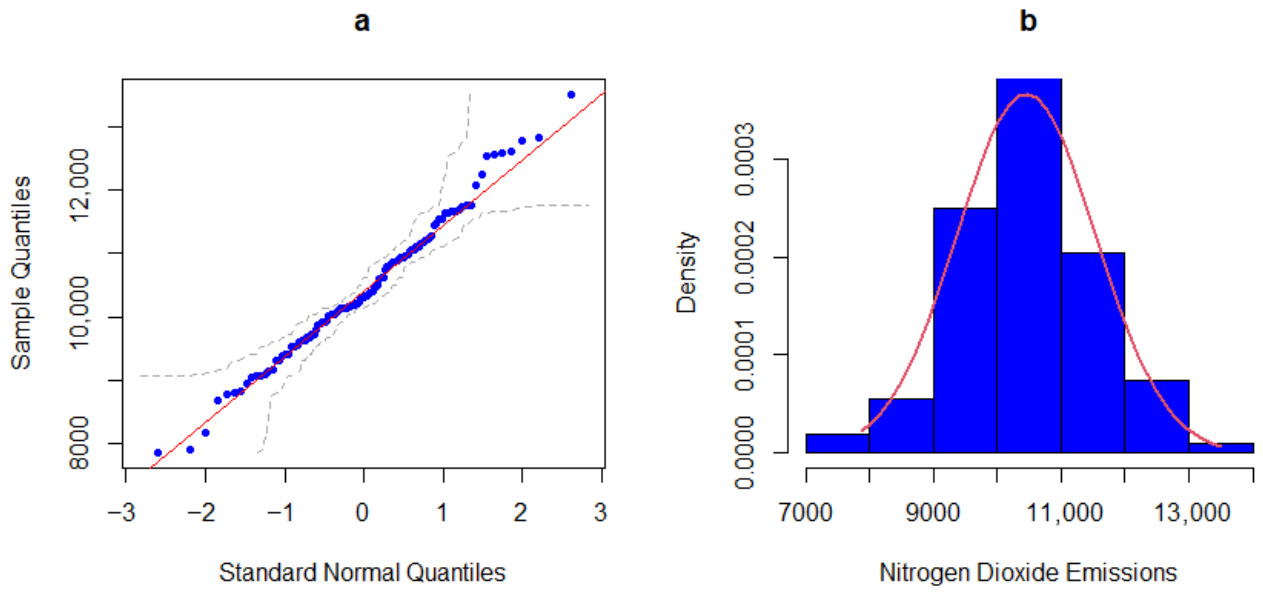
| 108 | 10,445.59 | 10,311.79 | 1090.09 | 7858.59 | 13,507.59 | 0.2359 | 3.0447 |
| Test | Statistic | p-Value | |
|---|---|---|---|
| Normality | Kolmogorov–Smirnov (KS) test for normality of data | 1 | 2.2 × 10⁻¹⁶ |
| Anderson–Darling (AD) test for normality of data | Inf | 5.556 × 10⁻⁶ | |
| Stationarity | Augmented Dickey–Fuller (ADF) test | −8.3474 | <0.01 |
| Phillips–Perron Unit Root Test | −69.24 | <0.01 | |
| Kwiatkowski–Phillips–Schmidt–Shin (KPSS) test for Level Stationarity | 0.014691 | >0.1 | |
| Independence (Randomness) [55] | Difference-sign test of randomness [53,55,56] | 0.8295 | 0.4068 |
| Mann–Kendall rank test of randomness [55] | −0.047787 | 0.9619 | |
| Cox–Stuart test of randomness [57] | 29 | 0.6835 | |
| Wald–Wolfowitz Runs Test-Two sided [55] | −1.9336 | 0.05317 | |
| Distribution | AIC | BIC | Cross Validated Loglikelihood | Bootstrap KS | Bootstrap AD | ||
|---|---|---|---|---|---|---|---|
| Statistic | p-Value | Statistic | p-Value | ||||
| Weibull | 1833.55 | 1838.92 | −916.2252 | 0.0901 | 0.031 | 1.5409 | 0.001 |
| Lognormal | 1819.31 | 1824.67 | −908.6738 | 0.0429 | 0.907 | 0.2305 | 0.812 |
| Pareto | 2218.85 | 2224.21 | −1107.4337 | 0.5366 | 0 | 40.116 | 0 |
| Comparison Model 1 vs. Model 2 | BIC-Corrected Vuong Test | |
|---|---|---|
| Statistic (V) | p-Value | |
| Lognormal vs. Weibull | 2.084035 | 0.03716 |
| Lognormal vs. Pareto | 26.883949 | <0.0001 |
| Weibull vs. Pareto | 26.789151 | <0.0001 |
| Distribution | Estimate | Standard Error | Estimate | Standard Error |
|---|---|---|---|---|
| Weibull | ||||
| 9.8699 | 0.687 | 10,941.9598 | 113.1302 | |
| Lognormal (values are in logscale) | ||||
| 9.2485 | 0.01 | 0.104 | 0.0071 | |
| Pareto | ||||
| 4.19 × 10⁶ | 4.38 × 10¹⁰ | |||
| k | BIC | BIC-Corrected Vuong Test | Best Model | |||||||
|---|---|---|---|---|---|---|---|---|---|---|
| Lognormal vs. Weibull | Lognormal vs. Pareto | Weibull vs. Pareto | ||||||||
| Weibull | Lognormal | Pareto | Statistic (V) | p-Value | Statistic (V) | p-Value | Statistic (V) | p-Value | ||
| 11 | 174.04 | 171.78 | 234.29 | 2.3488 | 0.0188 | 13.4507 | 0 | 13.1238 | 0 | Lognormal |
| 12 | 190.67 | 188.17 | 255.2 | 2.301 | 0.0214 | 14.9088 | 0 | 13.7076 | 0 | Lognormal |
| 13 | 207.29 | 204.51 | 276.1 | 2.1646 | 0.0304 | 16.1086 | 0 | 14.3098 | 0 | Lognormal |
| 14 | 223.74 | 220.55 | 296.98 | 2.1712 | 0.0299 | 17.0232 | 0 | 14.9065 | 0 | Lognormal |
| 15 | 240.05 | 236.35 | 317.85 | 2.2477 | 0.0246 | 17.6449 | 0 | 15.4743 | 0 | Lognormal |
| 16 | 256.29 | 252.05 | 338.7 | 2.3428 | 0.0191 | 18.0508 | 0 | 15.954 | 0 | Lognormal |
| 17 | 272.45 | 267.61 | 359.55 | 2.4571 | 0.014 | 18.2801 | 0 | 16.3598 | 0 | Lognormal |
| 18 | 288.74 | 283.39 | 380.38 | 2.5268 | 0.0115 | 18.485 | 0 | 16.7224 | 0 | Lognormal |
| 19 | 304.95 | 299.04 | 401.2 | 2.6222 | 0.0087 | 18.6069 | 0 | 17.0047 | 0 | Lognormal |
| 20 | 321.29 | 314.89 | 422 | 2.6761 | 0.0074 | 18.7306 | 0 | 17.3331 | 0 | Lognormal |
| 21 | 337.59 | 330.68 | 442.79 | 2.7504 | 0.006 | 18.8289 | 0 | 17.6024 | 0 | Lognormal |
| 22 | 354.26 | 347.13 | 463.54 | 2.7238 | 0.0065 | 18.959 | 0 | 17.8265 | 0 | Lognormal |
| 23 | 370.92 | 363.51 | 484.29 | 2.738 | 0.0062 | 19.1409 | 0 | 18.0434 | 0 | Lognormal |
| 24 | 387.55 | 379.82 | 505.03 | 2.7736 | 0.0055 | 19.3557 | 0 | 18.3223 | 0 | Lognormal |
| 25 | 404.2 | 396.16 | 525.76 | 2.8134 | 0.0049 | 19.5581 | 0 | 18.5777 | 0 | Lognormal |
| 26 | 420.82 | 412.4 | 546.48 | 2.8719 | 0.0041 | 19.7686 | 0 | 18.7847 | 0 | Lognormal |
| 27 | 437.46 | 428.69 | 567.19 | 2.9266 | 0.0034 | 19.9751 | 0 | 19.016 | 0 | Lognormal |
| 28 | 454.05 | 444.86 | 587.89 | 2.999 | 0.0027 | 20.1686 | 0 | 19.243 | 0 | Lognormal |
| 29 | 470.64 | 461.05 | 608.59 | 3.0678 | 0.0022 | 20.3542 | 0 | 19.4307 | 0 | Lognormal |
| 30 | 487.21 | 477.16 | 629.28 | 3.1475 | 0.0016 | 20.5208 | 0 | 19.6426 | 0 | Lognormal |
| 31 | 503.77 | 493.28 | 649.97 | 3.2226 | 0.0013 | 20.6809 | 0 | 19.8358 | 0 | Lognormal |
| 32 | 520.4 | 509.5 | 670.65 | 3.286 | 0.001 | 20.8441 | 0 | 20.0033 | 0 | Lognormal |
| 33 | 537.01 | 525.66 | 691.32 | 3.362 | 0.0008 | 20.9974 | 0 | 20.2079 | 0 | Lognormal |
| 34 | 553.64 | 541.87 | 711.98 | 3.4203 | 0.0006 | 21.1522 | 0 | 20.3653 | 0 | Lognormal |
| 35 | 570.22 | 557.99 | 732.64 | 3.4944 | 0.0005 | 21.2889 | 0 | 20.5108 | 0 | Lognormal |
| 36 | 586.79 | 574.08 | 753.29 | 3.5685 | 0.0004 | 21.4181 | 0 | 20.6749 | 0 | Lognormal |
| 37 | 603.37 | 590.18 | 773.95 | 3.6392 | 0.0003 | 21.5471 | 0 | 20.8398 | 0 | Lognormal |
| 38 | 619.92 | 606.24 | 794.59 | 3.7169 | 0.0002 | 21.6589 | 0 | 20.9758 | 0 | Lognormal |
| 39 | 636.46 | 622.27 | 815.23 | 3.7928 | 0.0001 | 21.7655 | 0 | 21.1142 | 0 | Lognormal |
| 40 | 653.01 | 638.3 | 835.87 | 3.8633 | 0.0001 | 21.8583 | 0 | 21.2393 | 0 | Lognormal |
Disclaimer/Publisher’s Note: The statements, opinions and data contained in all publications are solely those of the individual author(s) and contributor(s) and not of MDPI and/or the editor(s). MDPI and/or the editor(s) disclaim responsibility for any injury to people or property resulting from any ideas, methods, instructions or products referred to in the content. |
© 2026 by the authors. Licensee MDPI, Basel, Switzerland. This article is an open access article distributed under the terms and conditions of the Creative Commons Attribution (CC BY) license.
Share and Cite
Mamba, M.W.; Chikobvu, D. Statistical Analysis of NO2 Emissions from Eskom’s Majuba Coal-Fired Power Station in Mpumalanga, South Africa. Atmosphere 2026, 17, 415. https://doi.org/10.3390/atmos17040415
Mamba MW, Chikobvu D. Statistical Analysis of NO2 Emissions from Eskom’s Majuba Coal-Fired Power Station in Mpumalanga, South Africa. Atmosphere. 2026; 17(4):415. https://doi.org/10.3390/atmos17040415
Chicago/Turabian StyleMamba, Mpendulo Wiseman, and Delson Chikobvu. 2026. "Statistical Analysis of NO2 Emissions from Eskom’s Majuba Coal-Fired Power Station in Mpumalanga, South Africa" Atmosphere 17, no. 4: 415. https://doi.org/10.3390/atmos17040415
APA StyleMamba, M. W., & Chikobvu, D. (2026). Statistical Analysis of NO2 Emissions from Eskom’s Majuba Coal-Fired Power Station in Mpumalanga, South Africa. Atmosphere, 17(4), 415. https://doi.org/10.3390/atmos17040415