

High-Resolution Assessment of Wind Energy Potential and Operational Risks in Complex Mountain-Basin Systems

 and
and
Abstract
1. Introduction
2. Data and Methodology
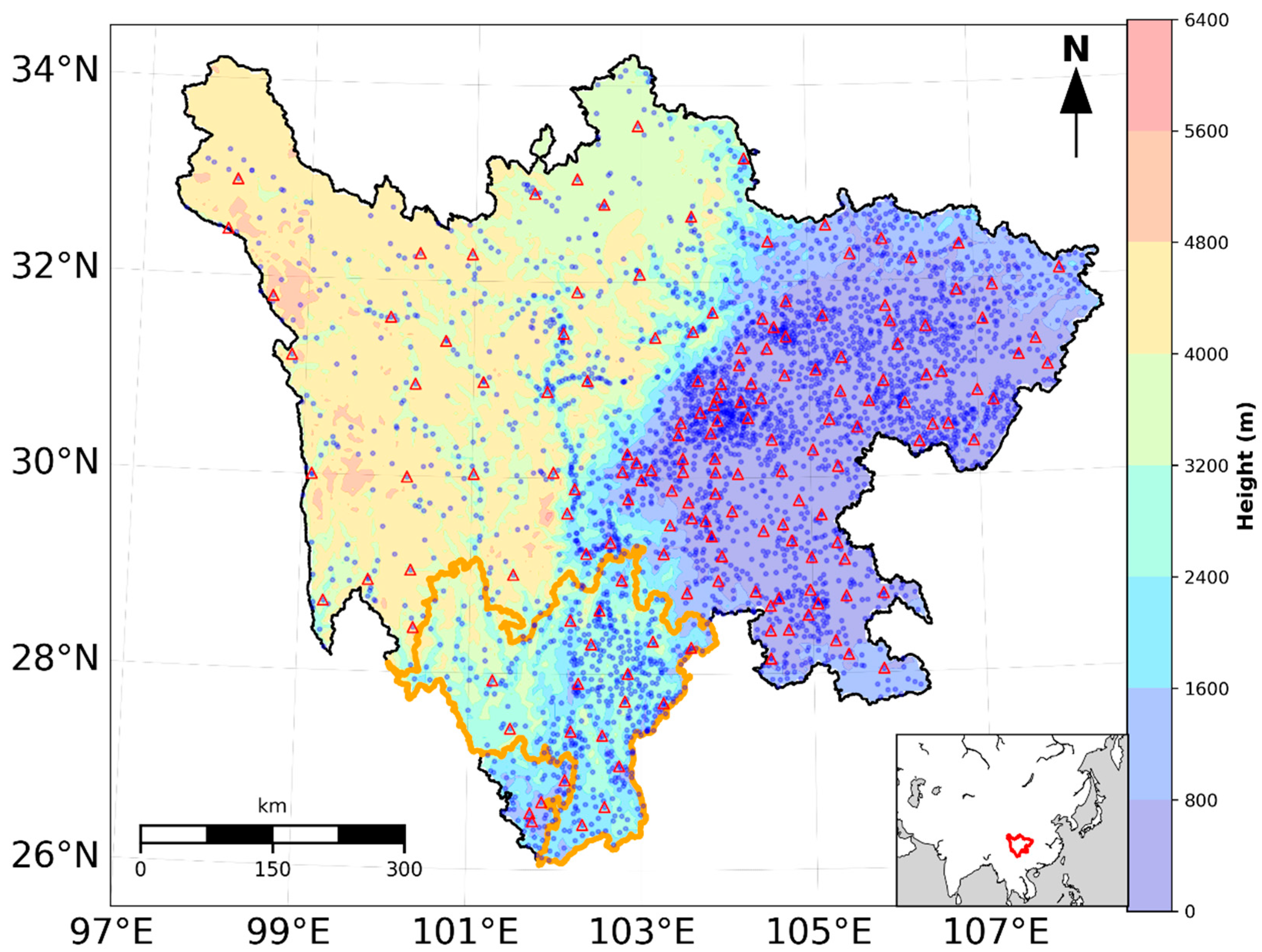
2.1. Study Area
2.2. Data Sources
2.3. High-Resolution Wind Field Dynamical Downscaling
2.4. Hub-Height Wind Speed Extrapolation and Wind Power Density Calculation
2.5. Differentiated Wind Energy Assessment Framework and Key Metrics
- Differentiated technology application scenarios. To bridge the gap between macro-scale (utility-scale) and micro-scale (distributed) generation potential assessments, this study designs two technology application scenarios:
- Utility-scale centralized development scenario: Assesses potential for large turbines suitable for “mega-base” development, with operational wind speed window set at 3 m/s (cut-in) to 25 m/s (cut-out).
- Distributed micro-wind generation scenario: Evaluates distributed wind power technology potential, with operational wind speed window set at 2 m/s to 15 m/s.
- Key assessment metric definitions:
- Annual available hours: Total annual hours suitable for electricity generation within the aforementioned operational windows.
- Calm wind risk (wind drought risk): Annual cumulative hours with wind speeds below 2 m/s.
- Cut-out risk (high-wind risk): Annual cumulative hours with wind speeds exceeding 25 m/s for large turbines; exceeding 15 m/s for distributed turbines.
- Seasonal and diurnal patterns: Analyzed through monthly mean wind speeds and diurnal wind speed ratios (nighttime 19:00–06:00 versus daytime 07:00–18:00).
- Spatiotemporal analysis methodology. For all aforementioned metrics, we adopt a unified analytical workflow:
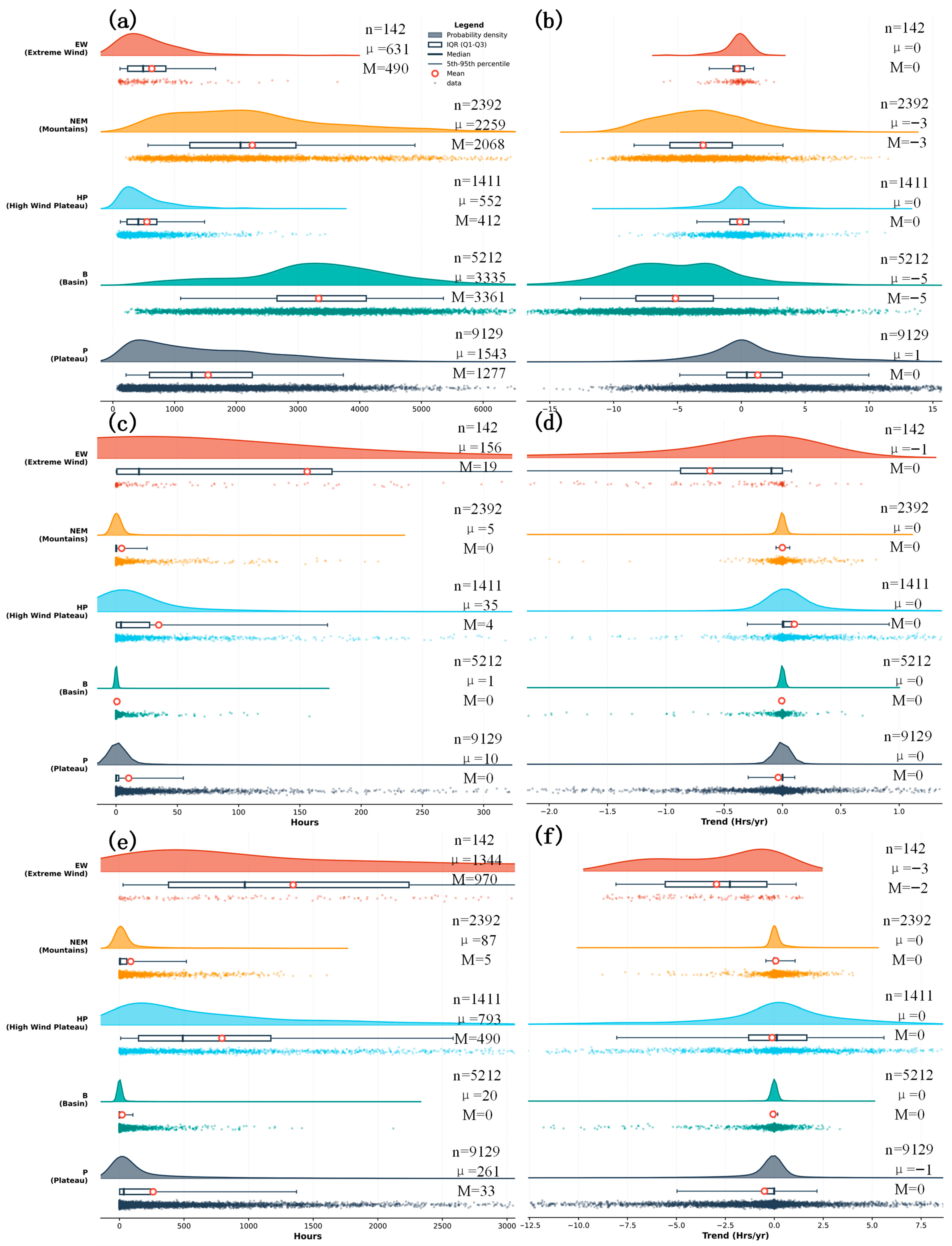
- Spatial distribution pattern analysis: Compute 40-year mean values for each grid cell, classify by five geographic zones, and visualize using violin plots to reveal median, mean, dispersion, and spatial homogeneity of resources across zones.
- Long-term evolution trend analysis: Apply nonparametric Mann–Kendall test to determine trend significance for annual time series at each grid cell, and use Sen’s slope estimator to quantify trend magnitude. Violin plots similarly display trend distribution characteristics across zones.
3. Results
3.1. High-Resolution Assessment of Wind Energy Potential for Differentiated Generation Technologies over Sichuan’s Complex Terrain
3.2. Topographic Control on the Spatio-Temporal Distribution of Wind Energy Resources
3.3. Comparative Assessment of Wind Availability for Different Turbine Technologies
3.4. Long-Term Operational Risk Assessment Under Climate Variability
4. Discussion
4.1. Reevaluating Resource Suitability Through a Technical Perspective
4.2. Physical Interpretation of Model Biases and Limitations
4.3. Practical Implications for Regional Planning
5. Conclusions
Author Contributions
Funding
Institutional Review Board Statement
Informed Consent Statement
Data Availability Statement
Conflicts of Interest
Nomenclature
| Abbreviation /Symbol | Full Name /Description | Note /Definition |
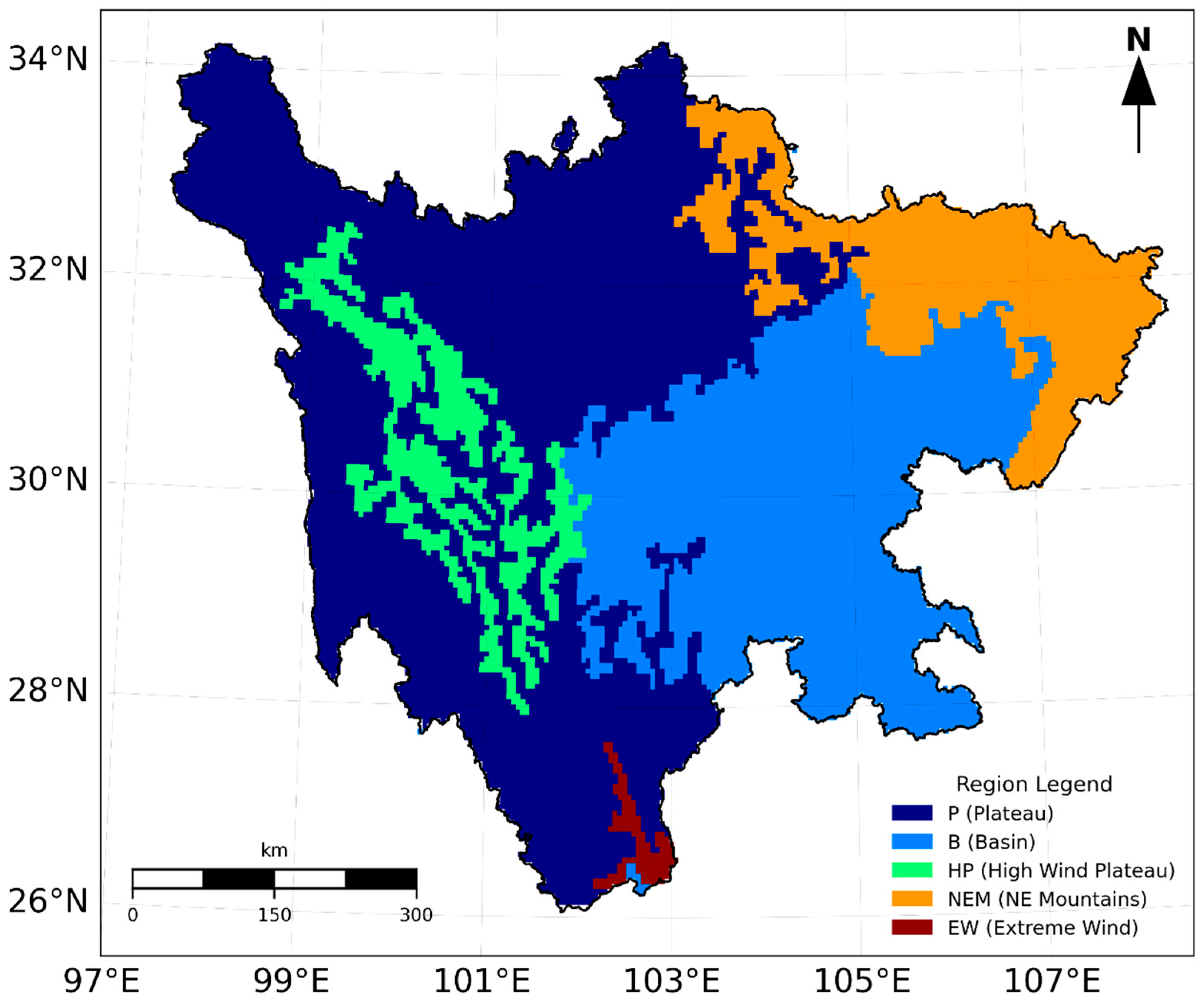
| B | Basin Region | The low-lying Sichuan Basin characterized by low wind speeds. |
| EW | Extreme Wind Region | Areas with the highest wind resources, located in localized gorges and passes. |
| HP | High Wind Plateau | The Hilly Plateau region, including parts of the Hengduan Mountains. |
| NEM | Northeastern Mountains | The Daba Mountains region, acting as a dynamic barrier. |
| P | Plateau Region | The transition zone of the eastern Tibetan Plateau. |
| AWS | Automatic Weather Station | Ground-based observation stations used for validation6. |
| ERA5 | ECMWF Reanalysis v5 | Global atmospheric reanalysis dataset used as boundary conditions. |
| IQR | Interquartile Range | Statistical measure of spread (difference between 75th and 25th percentiles). |
| KDE | Kernel Density Estimation | A non-parametric way to estimate the probability density function of a variable. |
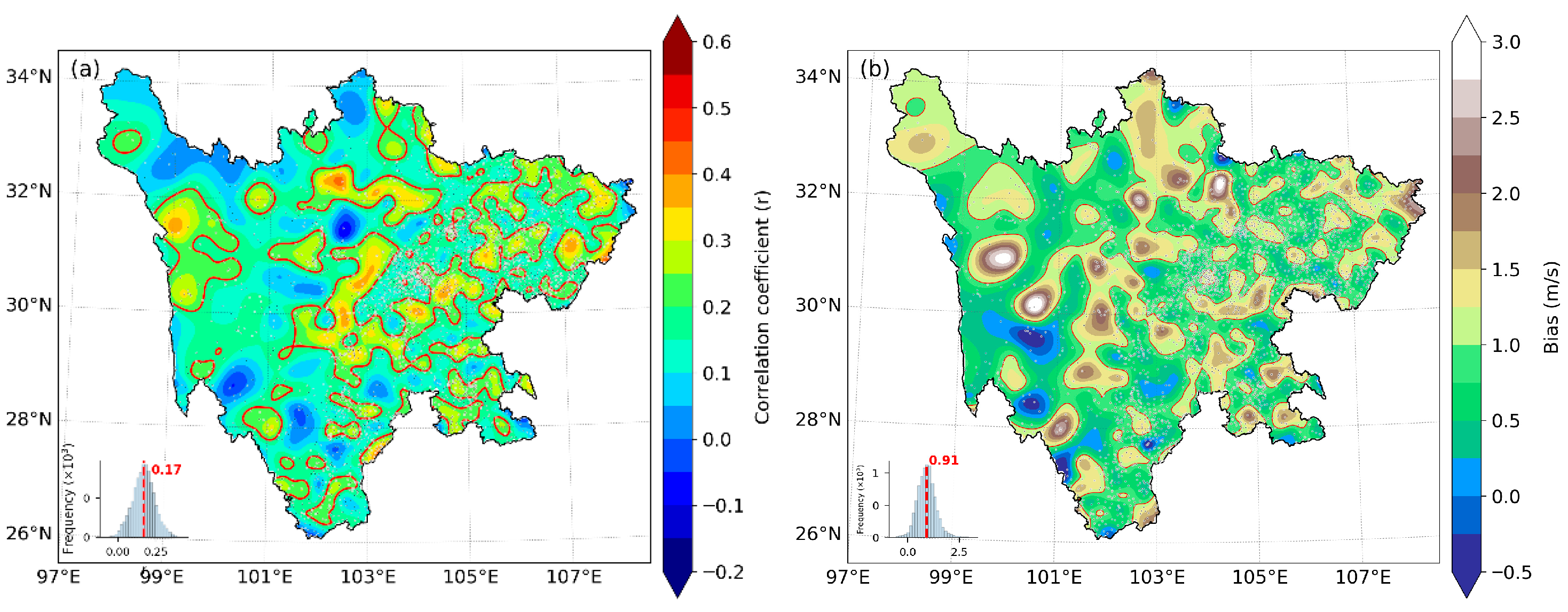
| MB | Mean Bias | Systematic error metric (Model minus Observation). |
| NWP | Numerical Weather Prediction | Mathematical models of the atmosphere. |
| WPD | Wind Power Density | The power available in the wind per unit area (W/m2). |
| WRF | Weather Research and Forecasting | The mesoscale numerical weather prediction system used for downscaling. |
| ρ | Air Density | Standard value set to 1.225 kg/m3. |
| α | Wind Shear Exponent | Coefficient used in the power law for vertical wind profile extrapolation. |
| r | Spearman Correlation Coefficient | Metric used to assess the correlation between simulated and observed data. |
Appendix A
References
- Antonini, E.G.; Virgüez, E.; Ashfaq, S.; Duan, L.; Ruggles, T.H.; Caldeira, K. Identification of reliable locations for wind power generation through a global analysis of wind droughts. Commun. Earth Environ. 2024, 5, 103. [Google Scholar] [CrossRef]
- Bloomfield, H.C.; Brayshaw, D.J.; Shaffrey, L.C.; Coker, P.J.; Thornton, H.E. The changing sensitivity of power systems to meteorological drivers: A case study of Great Britain. Environ. Res. Lett. 2018, 13, 054028. [Google Scholar] [CrossRef]
- Qu, M.; Shen, L.; Zeng, Z.; Yang, B.; Zhong, H.; Yang, X.; Lu, X. Prolonged wind droughts in a warming climate threaten global wind power security. Nat. Clim. Change 2025, 15, 842–849. [Google Scholar]
- Zeng, Z.; Ziegler, A.D.; Searchinger, T.; Yang, L.; Chen, A.; Ju, K.; Piao, S.; Li, L.Z.; Ciais, P.; Chen, D. A reversal in global terrestrial stilling and its implications for wind energy production. Nat. Clim. Change 2019, 9, 979–985. [Google Scholar]
- National Development and Reform Commission (NDRC). Notice on Issuing the “14th Five-Year Plan for Renewable Energy Development”. 2022. Available online: https://www.ndrc.gov.cn/xwdt/tzgg/202206/t20220601_1326720.html (accessed on 17 October 2025). (In Chinese)
- National Development and Reform Commission (NDRC). Opinions on Improving the Institutional Mechanisms and Policy Measures for a Green and Low-Carbon Energy Transition (NDRC Energy [2022] No. 206). 2022. Available online: https://www.ndrc.gov.cn/xxgk/zcfb/tz/202202/t20220210_1314511.html (accessed on 17 October 2025). (In Chinese)
- Bianchini, A.; Bangga, G.; Baring-Gould, I.; Croce, A.; Cruz, J.I.; Damiani, R.; Erfort, G.; Simão Ferreira, C.; Infield, D.; Nayeri, C.N. Current status and grand challenges for small wind turbine technology. Wind Energy Sci. 2022, 7, 2003–2037. [Google Scholar]
- Karimian, S.; Abdolahifar, A. Performance investigation of a new Darrieus vertical axis wind turbine. Energy 2020, 191, 116551. [Google Scholar] [CrossRef]
- Paraschivoiu, I. Wind Turbine Design: With Emphasis on Darrieus Concept; Polytechnic International Press: Montréal, QC, Canada, 2002. [Google Scholar]
- Wang, J.; Chen, L.; Tan, Z.; Du, E.; Liu, N.; Ma, J.; Sun, M.; Li, C.; Song, J.; Lu, X. Inherent spatiotemporal uncertainty of renewable power in China. Nat. Commun. 2023, 14, 5379. [Google Scholar] [CrossRef] [PubMed]
- Zhang, J.; Zhang, M.; Li, Y.; Qin, J.; Wei, K.; Song, L. Analysis of wind characteristics and wind energy potential in complex mountainous region in southwest China. J. Clean. Prod. 2020, 274, 123036. [Google Scholar] [CrossRef]
- Carta, J.A.; Ramírez, P.; Velázquez, S. A review of wind speed probability distributions used in wind energy analysis: Case studies in the Canary Islands. Renew. Sustain. Energy Rev. 2009, 13, 933–955. [Google Scholar] [CrossRef]
- Carta, J.A.; Velázquez, S.; Cabrera, P. A review of measure–correlate–predict (MCP) methods used to estimate long-term wind characteristics at a target site. Renew. Sustain. Energy Rev. 2013, 27, 362–400. [Google Scholar]
- Möhrlen, C.; Zack, J.W.; Giebel, G. IEA Wind Recommended Practice for the Implementation of Renewable Energy Forecasting Solutions; Academic Press: Cambridge, MA, USA, 2022. [Google Scholar]
- Hersbach, H.; Bell, B.; Berrisford, P.; Hirahara, S.; Horányi, A.; Muñoz Sabater, J.; Nicolas, J.; Peubey, C.; Radu, R.; Schepers, D. The ERA5 global reanalysis. Q. J. R. Meteorol. Soc. 2020, 146, 1999–2049. [Google Scholar] [CrossRef]
- Fan, W.; Liu, Y.; Chappell, A.; Dong, L.; Xu, R.; Ekström, M.; Fu, T.; Zeng, Z. Evaluation of global reanalysis land surface wind speed trends to support wind energy development using in situ observations. J. Appl. Meteorol. Climatol. 2021, 60, 33–50. [Google Scholar] [CrossRef]
- Gruber, K.; Regner, P.; Wehrle, S.; Zeyringer, M.; Schmidt, J. Towards global validation of wind power simulations: A multi-country assessment of wind power simulation from MERRA-2 and ERA5 reanalyses bias-corrected with the Global Wind Atlas. Energy 2022, 238, 121520. [Google Scholar] [CrossRef]
- Gelaro, R.; McCarty, W.; Suárez, M.J.; Todling, R.; Molod, A.; Takacs, L.; Randles, C.A.; Darmenov, A.; Bosilovich, M.G.; Reichle, R.; et al. The Modern-Era Retrospective Analysis for Research and Applications, version 2 (MERRA-2). J. Clim. 2017, 30, 5419–5454. [Google Scholar] [CrossRef] [PubMed]
- Kobayashi, S.; Ota, Y.; Harada, Y.; Ebita, A.; Moriya, M.; Onoda, H.; Onogi, K.; Kamahori, H.; Kobayashi, C.; Endo, H. The JRA-55 reanalysis: General specifications and basic characteristics. J. Meteorol. Soc. Jpn. 2015, 93, 5–48. [Google Scholar] [CrossRef]
- Liu, Z.; Jiang, L.; Shi, C.; Zhang, T.; Zhou, Z.; Liao, J.; Yao, S.; Liu, J.; Wang, M.; Wang, H. CRA-40/atmosphere—The first-generation Chinese atmospheric reanalysis (1979–2018): System description and performance evaluation. J. Meteorol. Res. 2023, 37, 1–19. [Google Scholar] [CrossRef]
- Hahmann, A.N.; Sile, T.; Witha, B.; Davis, N.N.; Dörenkämper, M.; Ezber, Y.; García-Bustamante, E.; González Rouco, J.F.; Navarro, J.; Olsen, B.T. The making of the new European Wind Atlas, Part 1: Model sensitivity. Geosci. Model Dev. 2020, 13, 5053–5078. [Google Scholar] [CrossRef]
- Horvath, K.; Koracin, D.; Vellore, R.; Jiang, J.; Belu, R. Sub-kilometer dynamical downscaling of near-surface winds in complex terrain using WRF and MM5 mesoscale models. J. Geophys. Res. Atmos. 2012, 117, D11111. [Google Scholar] [CrossRef]
- Zhang, D.; Chen, L.; Zhang, F.; Tan, J.; Wang, C. Numerical simulation of near-surface wind during a severe wind event in complex terrain by multisource data assimilation and dynamic downscaling. Adv. Meteorol. 2020, 2020, 7910532. [Google Scholar] [CrossRef]
- Bodini, N.; Castagneri, S. Long-term uncertainty quantification in WRF-modeled offshore wind resource off the US Atlantic coast. Wind Energy Sci. 2023, 8, 607–620. [Google Scholar] [CrossRef]
- Haupt, S.E.; Kosović, B.; Shaw, W.; Berg, L.K.; Churchfield, M.; Cline, J.; Draxl, C.; Ennis, B.; Koo, E.; Kotamarthi, R.; et al. On bridging a modeling scale gap: Mesoscale to microscale coupling for wind energy. Bull. Am. Meteorol. Soc. 2019, 100, 2533–2550. [Google Scholar] [CrossRef]
- Zou, Y.; Yue, P.; Liu, Q.; He, X.; Wang, Z. Wind field characteristics of complex terrain based on experimental and numerical investigation. Appl. Sci. 2022, 12, 5124. [Google Scholar] [CrossRef]
- Nedjari, H.D.; Guerri, O.; Saighi, M. CFD wind turbines wake assessment in complex topography. Energy Convers. Manag. 2017, 138, 224–236. [Google Scholar] [CrossRef]
- Stevens, R.J.A.M.; Meneveau, C. Flow structure and turbulence in wind farms. Annu. Rev. Fluid Mech. 2017, 49, 311–339. [Google Scholar] [CrossRef]
- Sichuan Provincial People’s Government. Why Does Sichuan—A Hydropower-Rich Province—Still Face Power Shortages? 2022. Available online: https://www.sc.gov.cn/10462/10464/13722/2022/8/18/a041da76a6cd45b79b9f39d89b06187d.shtml (accessed on 17 October 2025). (In Chinese)
- Sichuan Provincial People’s Government. Sichuan Coordinates Multiple Parties and Multiple Measures to Ensure Power Supply. 2022. Available online: https://www.sc.gov.cn/10462/10464/10465/10574/2022/8/13/1cf87d99f7fa496e85dcc9a05ccf9ffc.shtml (accessed on 17 October 2025). (In Chinese)
- Ma, M.; Qu, Y.; Lyu, J.; Zhang, X.; Su, Z.; Gao, H.; Yang, X.; Chen, X.; Jiang, T.; Zhang, J. The 2022 extreme drought in the Yangtze River Basin: Characteristics, causes and response strategies. River 2022, 1, 162–171. [Google Scholar] [CrossRef]
- Fan, J.; Huang, X.; Shi, J.; Li, K.; Cai, J.; Zhang, X. Complementary potential of wind–solar–hydro power in Chinese provinces: Based on a high temporal resolution multi-objective optimization model. Renew. Sustain. Energy Rev. 2023, 184, 113566. [Google Scholar] [CrossRef]
- Hu, Y.; Huang, W.; Wang, J.; Chen, S.; Zhang, J. Current status, challenges, and perspectives of Sichuan’s renewable energy development in Southwest China. Renew. Sustain. Energy Rev. 2016, 57, 1373–1385. [Google Scholar] [CrossRef]
- Clifton, A.; Barber, S.; Stökl, A.; Frank, H.; Karlsson, T. Research challenges and needs for the deployment of wind energy in hilly and mountainous regions. Wind Energy Sci. 2022, 7, 2231–2254. [Google Scholar] [CrossRef]
- He, G.; Kammen, D.M. Where, when and how much wind is available? A provincial-scale wind resource assessment for China. Energy Policy 2014, 74, 116–122. [Google Scholar] [CrossRef]
- Zhan, C.; Wei, R.; Zhao, L.; Chen, S.; Shen, C. Optimal distribution modeling and multifractal analysis of wind speed in the complex terrain of Sichuan Province, China. Sci. Rep. 2025, 15, 4648. [Google Scholar] [CrossRef] [PubMed]
- Deng, L.; Ding, Z.; Fu, Y. From macro to micro: A multi-scale method for assessing coastal wind energy potential in China. Appl. Energy 2025, 389, 125729. [Google Scholar] [CrossRef]
- Kadhim, M.A.; Phing, C.C.; Wai, L.C.; Paw, J.K.S.; Tak, Y.C.; Kadirgama, K.; Kadhim, A.A. Performance study of low-speed wind energy harvesting by micro wind turbine system. Energy Rep. 2025, 13, 3712–3727. [Google Scholar] [CrossRef]
- Mi, X.; Liu, P. A comparative study of near-surface wind speed observations and reanalysis datasets in China over the past 38 years. Int. J. Climatol. 2025, 45, e8738. [Google Scholar] [CrossRef]
- Vautard, R.; Cattiaux, J.; Yiou, P.; Thépaut, J.; Ciais, P. Northern Hemisphere atmospheric stilling partly attributed to an increase in surface roughness. Nat. Geosci. 2010, 3, 756–761. [Google Scholar] [CrossRef]
- Justus, C.G.; Mikhail, A. Height variation of wind speed and wind distribution statistics. Geophys. Res. Lett. 1976, 3, 261–264. [Google Scholar] [CrossRef]
- Manwell, J.F.; McGowan, J.G.; Rogers, A.L. Wind Energy Explained: Theory, Design and Application, 2nd ed.; John Wiley & Sons: Chichester, UK, 2010. [Google Scholar]
- Guo, H.; Xu, M.; Hu, Q. Changes in near-surface wind speed in China: 1969–2005. Int. J. Climatol. 2011, 31, 1455–1464. [Google Scholar] [CrossRef]

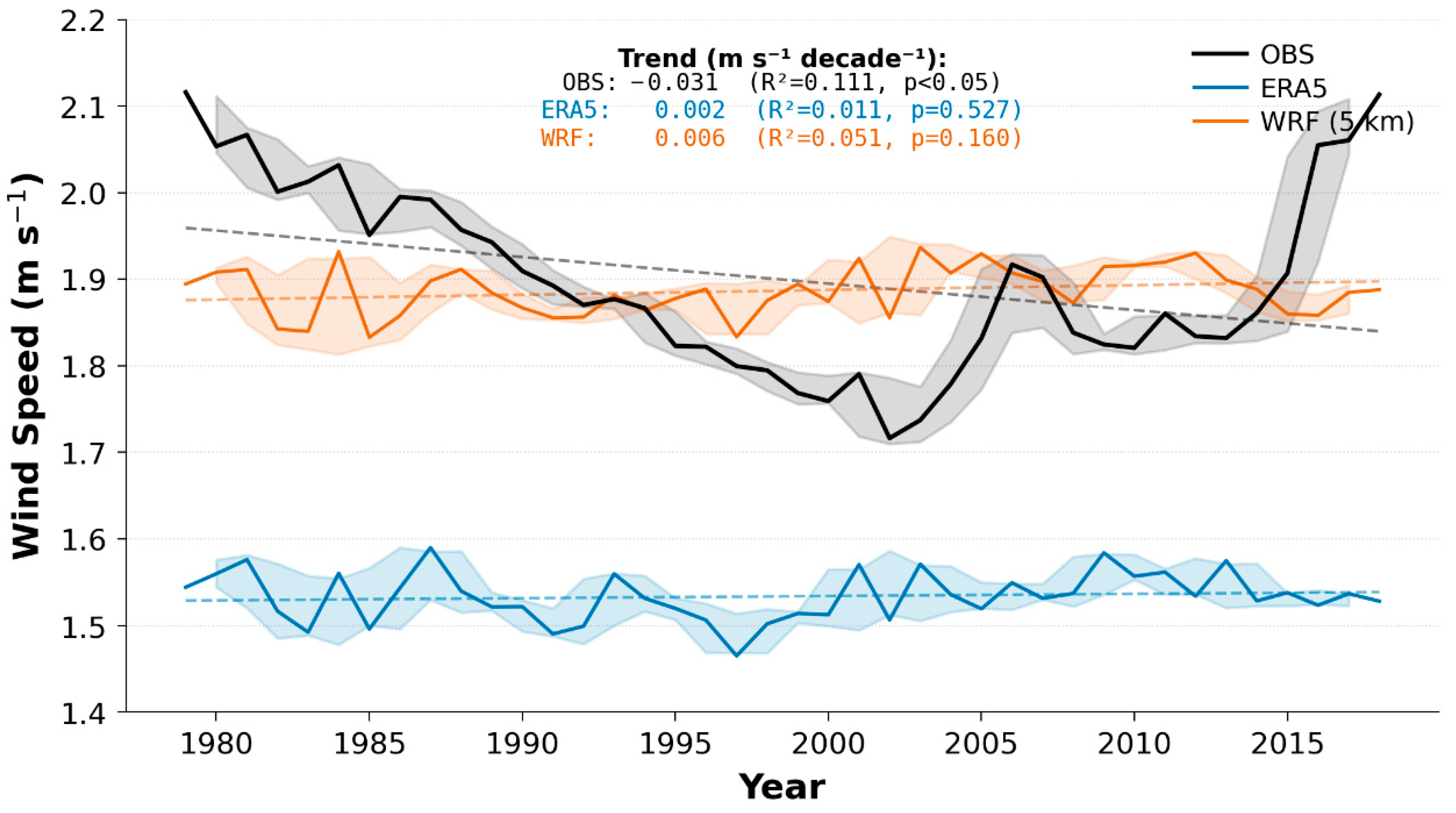
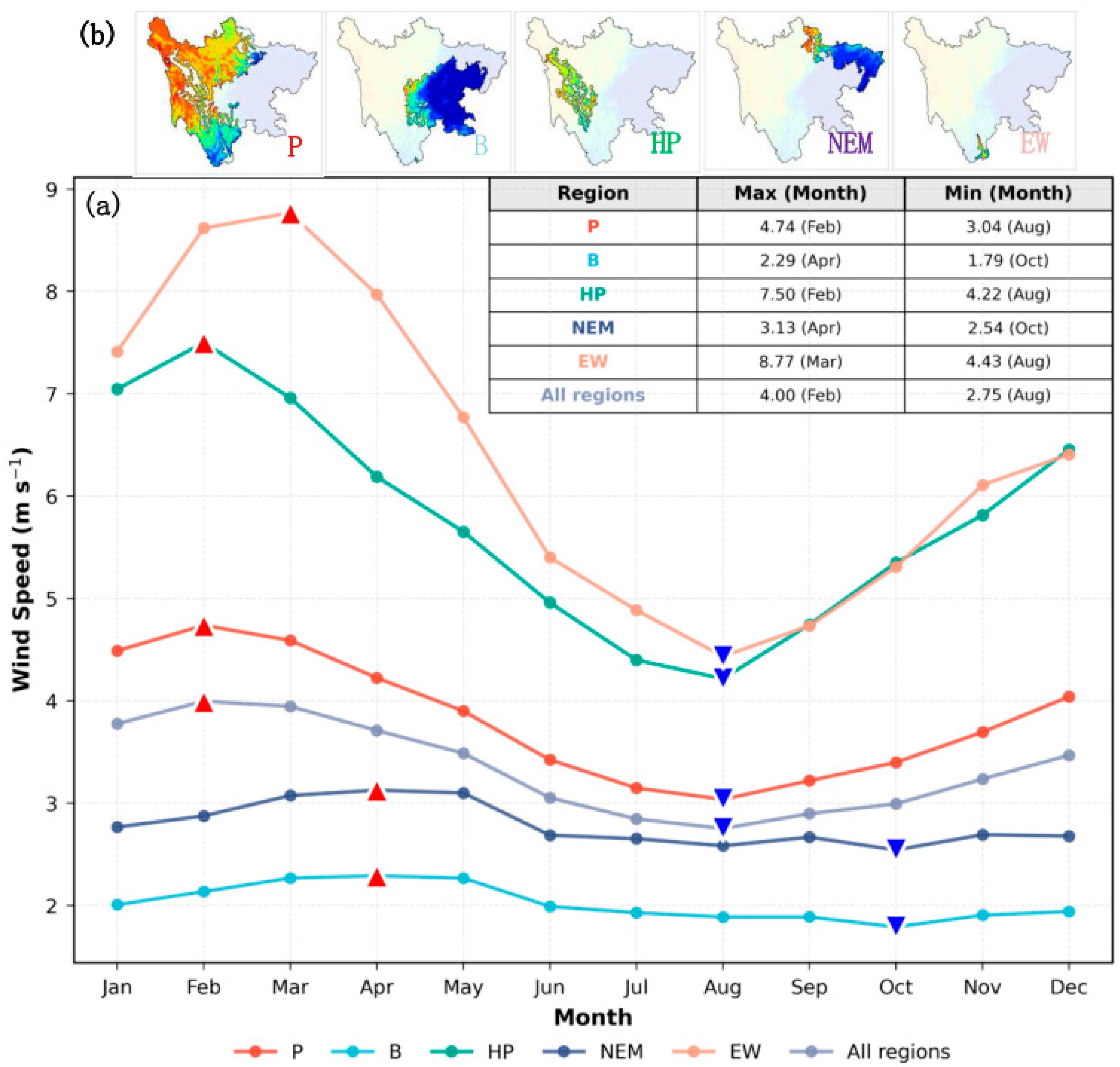
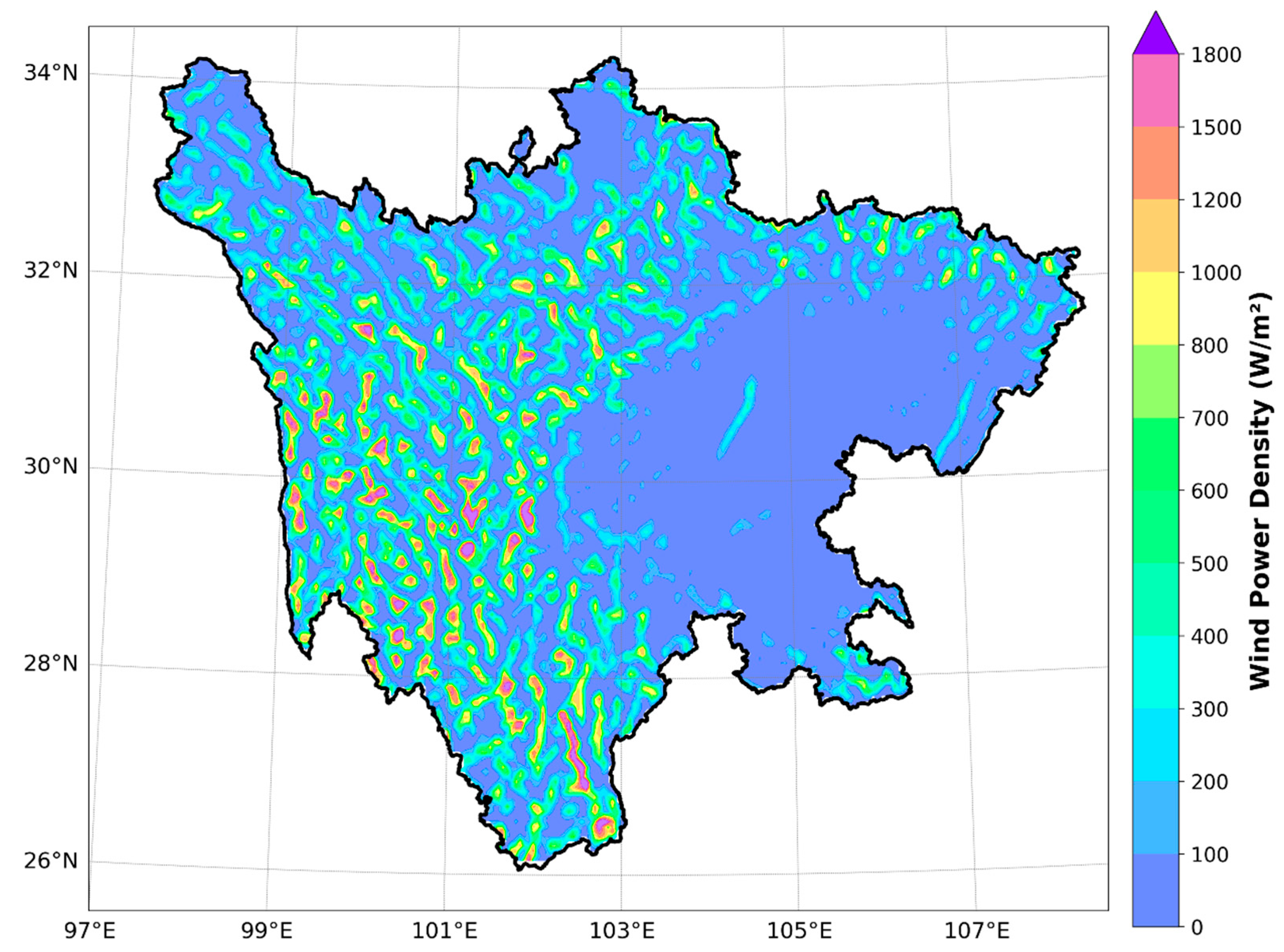
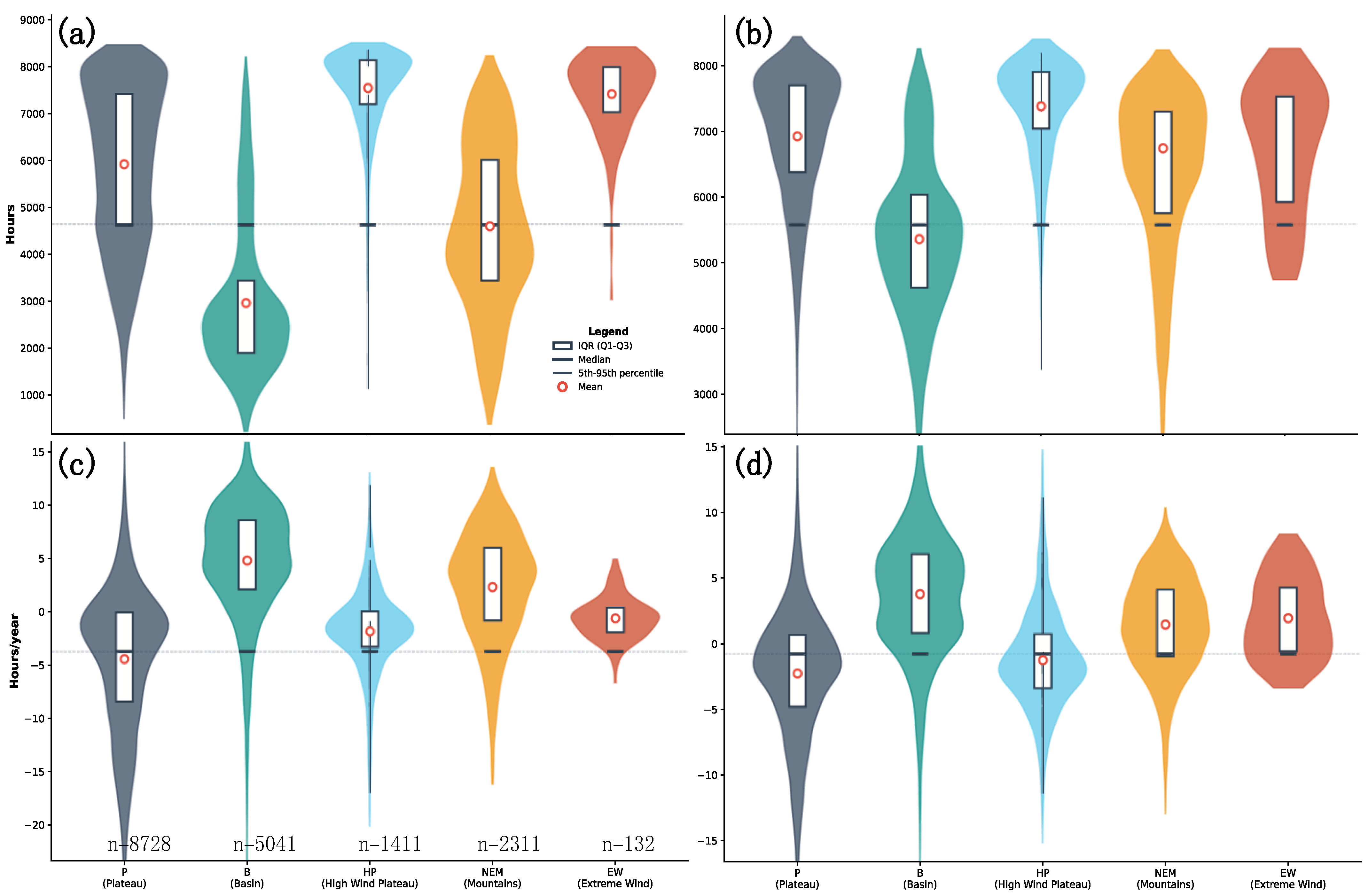

| P | B | HP | NEM | EW | |
|---|---|---|---|---|---|
| All year | 1.03 ± 0.15 | 1.15 ± 0.18 | 1.03 ± 0.11 | 1.06 ± 0.16 | 1.15 ± 0.11 |
| Trans. Seas. | 1.05 ± 0.16 | 1.12 ± 0.19 | 1.08 ± 0.14 | 1.05 ± 0.16 | 1.17 ± 0.13 |
| High WS Seas. | 1.02 ± 0.16 | 1.14 ± 0.16 | 0.97 ± 0.13 | 1.08 ± 0.16 | 1.15 ± 0.13 |
| Low WS Seas. | 1.04 ± 0.19 | 1.17 ± 0.22 | 1.08 ± 0.14 | 1.05 ± 0.16 | 1.14 ± 0.11 |
| P | B | HP | NEM | EW | |
|---|---|---|---|---|---|
| All year | 303 ± 380 | 48 ± 93 | 731 ± 569 | 133 ± 185 | 1166 ± 961 |
| Trans. Seas. | 250 ± 318 | 47 ± 87 | 615 ± 518 | 143 ± 203 | 923 ± 719 |
| High WS Seas. | 406 ± 530 | 54 ± 114 | 1014 ± 819 | 148 ± 209 | 1681 ± 1436 |
| Low WS Seas. | 174 ± 215 | 41 ± 81 | 367 ± 284 | 105 ± 149 | 515 ± 392 |
Disclaimer/Publisher’s Note: The statements, opinions and data contained in all publications are solely those of the individual author(s) and contributor(s) and not of MDPI and/or the editor(s). MDPI and/or the editor(s) disclaim responsibility for any injury to people or property resulting from any ideas, methods, instructions or products referred to in the content. |
© 2025 by the authors. Licensee MDPI, Basel, Switzerland. This article is an open access article distributed under the terms and conditions of the Creative Commons Attribution (CC BY) license (https://creativecommons.org/licenses/by/4.0/).
Share and Cite
Zhu, R.; Zhang, H.; He, C.; Wu, Z.; Dai, J.; Chen, B.; Liu, J.; Bai, L. High-Resolution Assessment of Wind Energy Potential and Operational Risks in Complex Mountain-Basin Systems. Atmosphere 2025, 16, 1362. https://doi.org/10.3390/atmos16121362
Zhu R, Zhang H, He C, Wu Z, Dai J, Chen B, Liu J, Bai L. High-Resolution Assessment of Wind Energy Potential and Operational Risks in Complex Mountain-Basin Systems. Atmosphere. 2025; 16(12):1362. https://doi.org/10.3390/atmos16121362
Chicago/Turabian StyleZhu, Rui, Haiku Zhang, Chuankai He, Zhiding Wu, Jun Dai, Bin Chen, Junjian Liu, and Lei Bai. 2025. "High-Resolution Assessment of Wind Energy Potential and Operational Risks in Complex Mountain-Basin Systems" Atmosphere 16, no. 12: 1362. https://doi.org/10.3390/atmos16121362
APA StyleZhu, R., Zhang, H., He, C., Wu, Z., Dai, J., Chen, B., Liu, J., & Bai, L. (2025). High-Resolution Assessment of Wind Energy Potential and Operational Risks in Complex Mountain-Basin Systems. Atmosphere, 16(12), 1362. https://doi.org/10.3390/atmos16121362