Identification of Upland Rice Genotypes Resistant to Neck Blast Disease: A Systematic Review of Field and Greenhouse Studies



Abstract
1. Introduction
2. Materials and Methods
2.1. Eligibility Criteria
2.2. Information Sources
2.3. Search Strategy
2.4. Selection Process
2.5. Data Collection Process
2.6. Data Items
2.7. Study Risk of Bias Assessment
2.8. Effect Measures
2.9. Synthesis Methods
2.9.1. Eligibility for Synthesis
2.9.2. Data Preparation
2.9.3. Tabulation and Visualization
2.9.4. Methods for Synthesis
2.9.5. Investigations of Heterogeneity
2.9.6. Sensitivity Analyses
2.10. Reporting Bias Assessment
2.11. Certainty Assessment
- Outcome 1: Identification of Upland Rice Genotypes Resistant to Neck Blast Disease
- Outcome 2: Screening Methodologies for Assessing Neck Blast Resistance
- Outcome 3: Genetic Factors Influencing Neck Blast Resistance Variation
3. Results
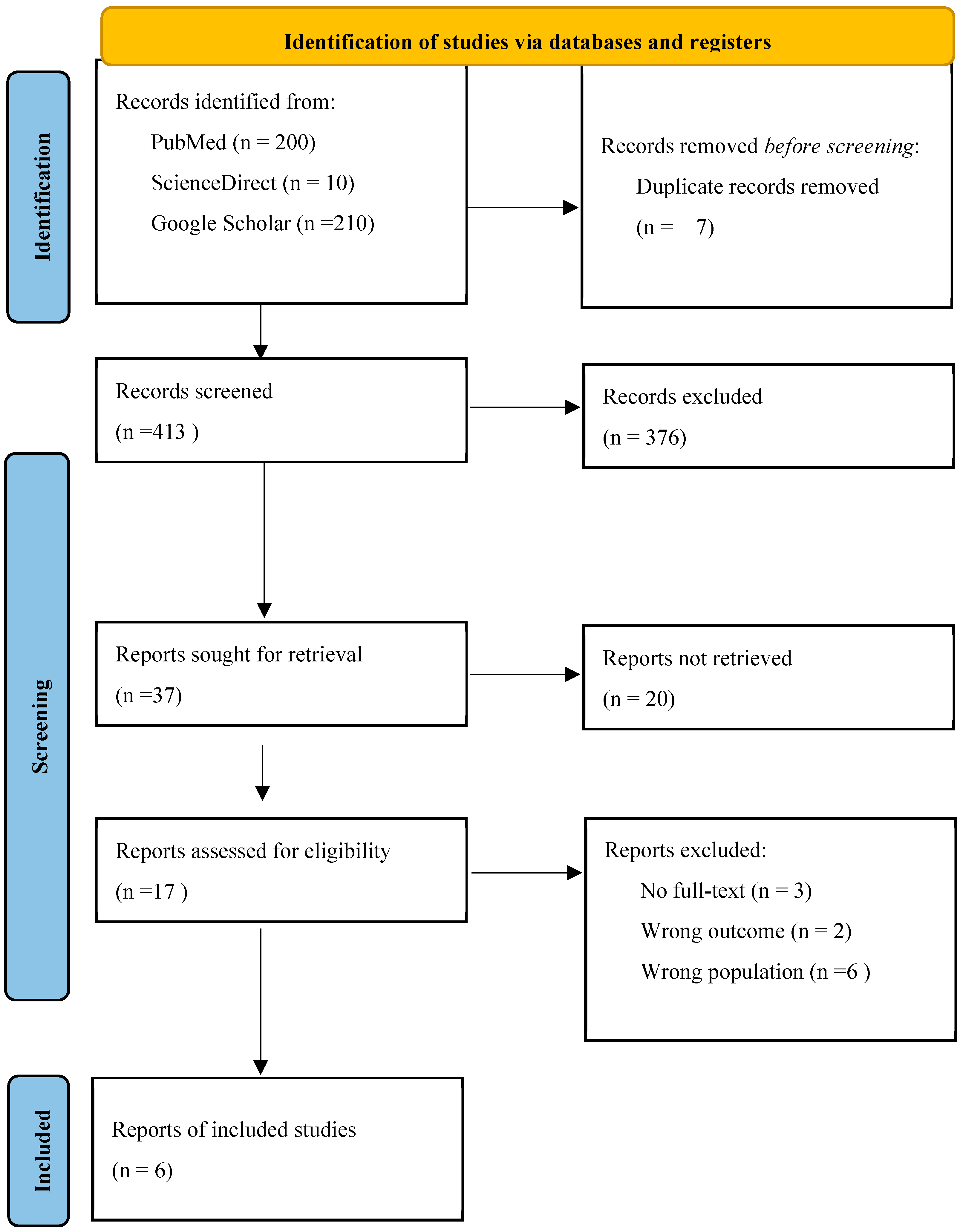
3.1. Study Selection
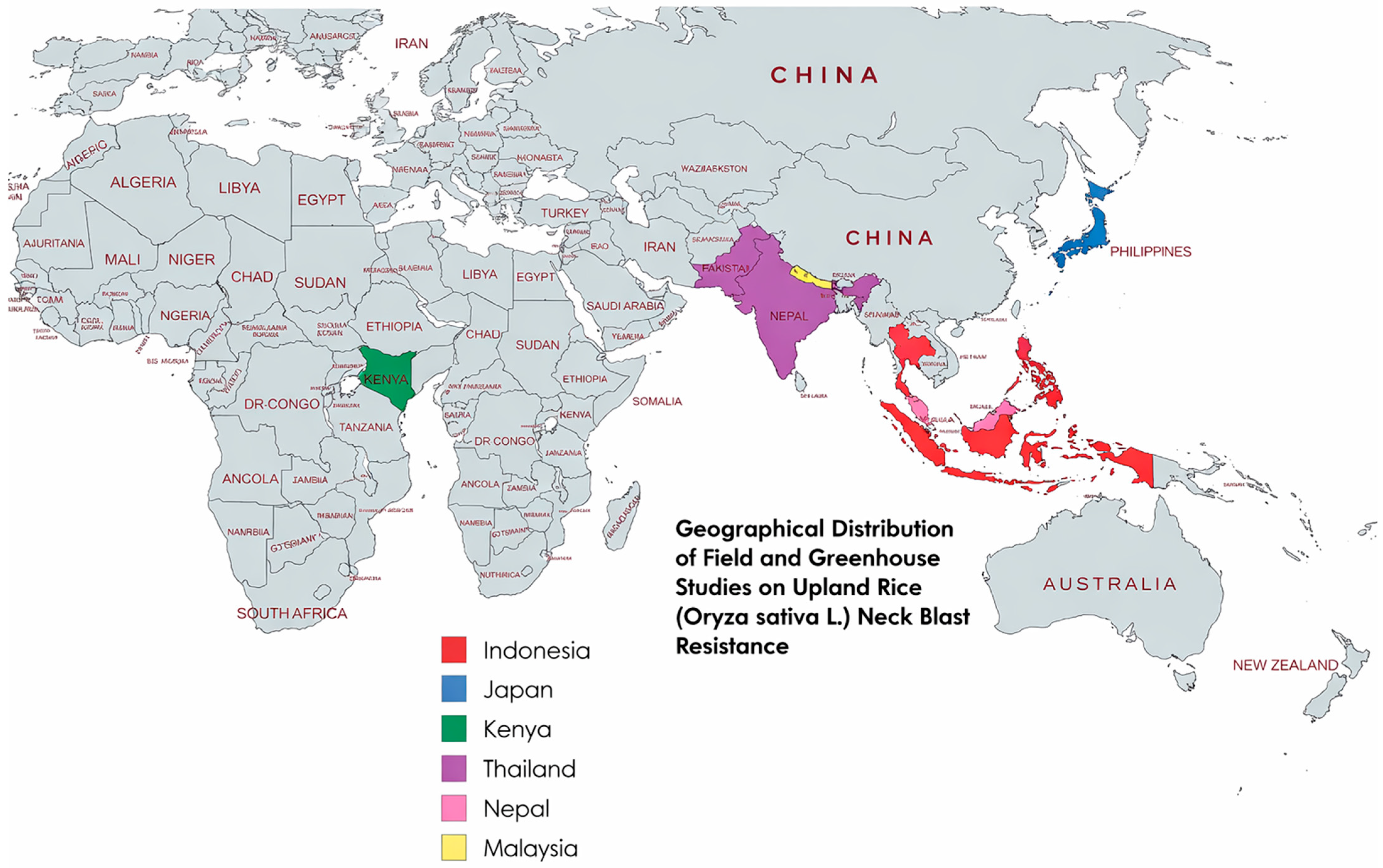
3.2. Study Characteristics
3.2.1. Upland Rice Genotypes Identified as Resistant to Neck Blast Disease Under Field and Greenhouse Screening Conditions
3.2.2. Screening Methods Employed in Field and Greenhouse Studies to Assess Neck Blast Resistance in Upland Rice Genotypes
3.2.3. The Genetic Factors Influencing the Variation in Neck Blast Resistance Among Upland Rice Genotypes Across Field and Greenhouse Studies
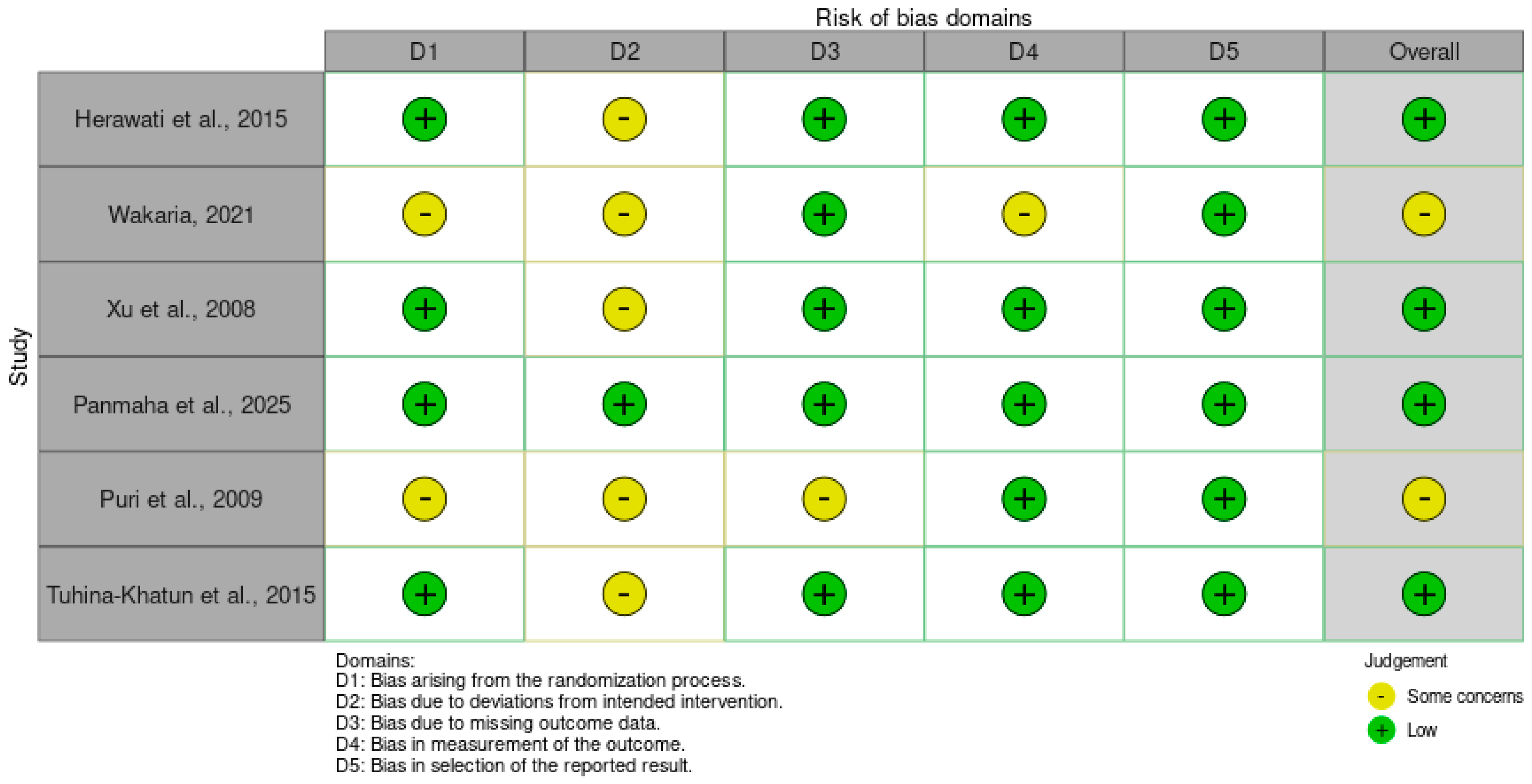
3.3. Risk of Bias in Studies
3.4. Results of Individual Studies
3.5. Results of Syntheses
3.6. Reporting Biases
3.7. Certainty of Evidence
4. Discussion
4.1. Interpretation of Results in the Context of Other Evidence
4.2. Limitations of the Evidence Included in the Review
4.3. Limitations of the Review Processes Used
4.4. Implications for Practice, Policy, and Future Research
5. Conclusions
Author Contributions
Funding
Institutional Review Board Statement
Informed Consent Statement
Data Availability Statement
Acknowledgments
Conflicts of Interest
Abbreviations
| ANOVA | Analysis of Variance |
| HR | Highly Resistant |
| HSD | Honestly Significant Difference |
| LOD | Logarithm of Odds |
| MR | Moderately Resistant |
| PICOS | Population, Intervention/Exposure, Comparator, Outcome, and Study Design |
| PRISMA | Preferred Reporting Items for Systematic Reviews and Meta-Analyses |
| QTLs | Quantitative Trait Loci |
| RoB | Risk of Bias |
| SES | Standard Evaluation System |
Appendix A

| Author (Year) | Country | Study Setting | Genotypes Evaluated (n) | Resistant Genotypes Identified | Resistance Level | Screening Approach | Outcome Type | Sample Size/Replications |
|---|---|---|---|---|---|---|---|---|
| Herawati et al. (2015) [3] | Indonesia | Greenhouse | 58 DH lines | P3-27, P5-50, P6-105, P3-162, P3-204 | High (leaf blast only) | Multi-isolate inoculation; anther culture | Binary classification (R/MR/MS/S) | 20 seeds per genotype; 15 replications |
| Njagi (2021) [17] | Kenya | Field | 33 | Duorado precoce, B6-144, IRAT 109, NERICA 1, 4, 5, 10, 11 | Variable (0.00–3.33 for resistant lines) | Spray inoculation; IRRI 0–9 scale | Continuous (neck blast severity scores) | 3 replications, 25 plants/plot |
| Xu et al. (2008) [23] | Japan | Greenhouse | F7 RILs (Kahei × Koshihikari) | Kahei | Very high (leaf blast only) | Novel evaluation system; F7 RILs | Continuous (lesion scores 0–10) | Not reported for disease scoring |
| Panmaha et al. (2025) [4] | Thailand | Greenhouse | 10 BC1F3/F4 lines | BC1F4-22-7-140-4; -322-5; -311-9 | High (leaf blast only) | Controlled inoculation; 12 isolates | Continuous (Severity Index 0–100) | 3 replications |
| Puri et al. (2009) [9] | Nepal | Greenhouse | 182 breeding lines (31 for neck blast) | Barkhe 1032, 1034, 1035, 1036, 2014 | High (0–15% incidence) | Spore suspension; leaf and neck blast assessment | Categorical incidence (0–15%, 15.1–30%, etc.) | 4 seedlings per genotype; 3 replications over 2 years |
| Tuhina-Khatun et al. (2015) [10] | Malaysia | Field (net house) | 50 | Barkhe 1032, 1035, 3004 | Moderate–High (leaf blast only) | Field hotspot and greenhouse | Continuous (lesion type 0–9; % DLA 0–100) | 3 replications over 2 trials |
| Author (Year) | Country | Molecular Approach | Genetic Markers/QTLs Identified | Chromosomal Location | Effect Size (R2 or LOD) | Target Trait | Validation Method | Genotypic–Phenotypic Consistency |
|---|---|---|---|---|---|---|---|---|
| Herawati et al. (2015) [3] | Indonesia | None reported | Not characterized | Leaf blast resistance | Phenotypic selection only | Yes (complete for phenotype) | ||
| Njagi (2021) [17] | Kenya | Inheritance analysis | Inferred monogenic/oligogenic | Not specified | F2 segregation ratios | Panicle blast resistance | Chi-square goodness-of-fit | Yes (inheritance–phenotype concordance) |
| Xu et al. (2008) [23] | Japan | QTL mapping; graphical genotyping | qBFR4-1 (Pikahei-1(t)) | Chromosome 4 (150-kb interval) | R2 = 25% (phenotypic variance explained) | Field resistance (leaf blast) | RIL population; residual heterozygosity analysis | Yes (complete marker–trait association) |
| Panmaha et al. (2025) [4] | Thailand | Marker-assisted backcross selection (MABS) | qBl1, qBl2 (blast); xa5 (bacterial blight) | Chromosomes 1, 2 (qBl1, qBl2); Chromosome 5 (xa5) | 70% severity reduction (combined effect) | Leaf blast and bacterial blight resistance | Foreground and background selection; BSR indices | Yes (complete genotypic–phenotypic alignment) |
| Puri et al. (2009) [9] | Nepal | None specified | Not characterized; NBS-LRR clusters inferred | — | Correlation (r ≈ 0.30) between leaf and neck blast | Leaf and neck blast resistance | Phenotypic correlation analysis | Partial (independent reactions observed) |
| Tuhina-Khatun et al. (2015) [10] | Malaysia | Genetic diversity analysis | Allelic diversity at unlinked loci (unspecified) | Not specified | Cluster similarity indices (%) | Leaf blast resistance and diversity | UPGMA clustering | Yes (phenotype–diversity concordance) |
| Author(s), Year | Country | Setting | Design and Replications | Genotypes Evaluated (Summary) | Comparator(s) | Neck Blast Outcome and Effect Measure | Scoring Scale |
|---|---|---|---|---|---|---|---|
| Herawati et al. (2015) [3] | Indonesia | Greenhouse; Field | CRD (anther culture); Augmented design (field); 15 lab reps; field reps not specified | 58 DH lines screened for blast; 20 DH lines field-evaluated | Susceptible: Kencana Bali; Resistant: Asahan; Parents: Fatmawati, Way Rarem, SGJT-28, SGJT-36 | Binary (R/MR/MS/S for leaf blast); Neck blast: Not reported | IRRI SES (1996) for leaf blast; neck blast not assessed |
| Njagi (2021) [17] | Kenya | Field | RCBD; 3 replications; 1 season | 13 upland genotypes (including. NERICA 1, 4, 5, 10, 11; Dular; Niwah) | Susceptible: NIMBAM 10, NIMBAM 11 | Continuous | IRRI SES (2002), 0–9 scale; severity scores reported, SD/SE not reported |
| Puri et al. (2009) [9] | Nepal | Greenhouse | Implied RCBD; 3 reps × 2 years | Barkhe lines; Judi lines; Masuli × MT4 progenies | Susceptible: Masuli; Resistant: Laxmi | Continuous (incidence-based) | Incidence categories: R (0–15%), MR (15.1–30%), MS (30.1–50%), S (50.1–100%) |
| Tuhina-Khatun et al. (2015) [10] | Malaysia | Field | RCBD; 3 reps × 2 trials | 50 upland rice genotypes | Resistant: Pongsu Seribu-1; Susceptible: MR219 | Not applicable | Leaf blast scored (0–9 lesion type; % DLA); neck blast excluded |
| Xu et al. (2008) [22] | Japan | Greenhouse | Segregating populations; reps not reported | Kahei, Koshihikari, Nipponbare; RILs and F9 populations | Resistant: Kahei; Susceptible: Koshihikari | Not applicable | Leaf blast scored on 0–10 scale; no neck blast data |
| Panmaha et al. (2025) [4] | Thailand | Greenhouse | CRD; 3 replications | BC1F3/BC1F4 lines; Morkhor 60-3, Morkhor 60-1; checks | Resistant: P0489, JHN, IR64; Susceptible: KDML105, RD6 | Not applicable | Leaf blast Severity Index (0–100); neck blast excluded |
References
- Fukagawa, N.K.; Ziska, L.H. Rice: Importance for Global Nutrition. J. Nutr. Sci. Vitaminol. Tokyo 2019, 65, S2–S3. [Google Scholar] [CrossRef]
- Sarfaraz, H. Rice Production, Quality, and Nutrition: A Comprehensive Review on Challenges, Opportunities, and Global Perspectives. Int. J. Agric. Sustain. Dev. 2023, 5, 90–103. [Google Scholar]
- Herawati, R.; Purwoko, B.S.; Dewi, I.S. Development of New Type Upland Rice Lines for Resistance to Blast Disease Through Anther Culture. In Proceedings of the International Seminar on Promoting Local Resources for Food and Health, Bengkulu, Indonesia, 12–13 October 2015; pp. 12–13. [Google Scholar]
- Panmaha, S.; Netpakdee, C.; Wongsa, T.; Chankaew, S.; Monkham, T.; Sanitchon, J. Improvement of Morkhor 60-3 Upland Rice Variety for Blast and Bacterial Blight Resistance Using Marker–Assisted Backcross Selection. Agronomy 2025, 15, 1600. [Google Scholar] [CrossRef]
- World Food Programme. Understanding the Rice Value Chain in Indonesia: Defining the Way Forward for Rice Fortification; World Food Programme: Rome, Italy, 2022. [Google Scholar]
- Waktola, T.G.; Leta, A.; Abebe, D. Adult-plant resistance of upland rice genotypes against blast (Pyricularia oryzae Cavara) in Metekel Zone, North West Ethiopia. Discov. Agric. 2025, 3, 213. [Google Scholar] [CrossRef]
- Rijal, T.R.; Hama, G.B.; Jha, P.; Koirala, K.B. Identification of Resistant Genotypes on Rice against Blast Disease under Field Condition at Rampur, Chitwan. Int. J. Appl. Sci. Biotechnol. 2017, 5, 505–510. [Google Scholar] [CrossRef][Green Version]
- Agbowuro, G.O.; Afolabi, M.S.; Olamiriki, E.F.; Awoyemi, S.O. Rice Blast Disease (Magnaporthe oryzae): A Menace to Rice Production and Humanity. Int. J. Pathog. Res. 2020, 4, 32–39. [Google Scholar] [CrossRef]
- Puri, K.D.; Shrestha, S.M.; Chhetri, G.B.K.; Joshi, K.D. Leaf and neck blast resistance reaction in tropical rice lines under greenhouse condition. Euphytica 2009, 165, 523–532. [Google Scholar] [CrossRef]
- Tuhina-Khatun, M.; Hanafi, M.M.; Wong, M.Y.; Rafii, M.Y. Reactions and diversity analysis of upland rice genotypes against blast disease of rice (Oryza sativa L.). Australas. Plant Pathol. 2015, 44, 405–412. [Google Scholar] [CrossRef]
- Bonman, J.M. Durable resistance to rice blast disease-environmental influences. Euphytica 1992, 63, 115–123. [Google Scholar] [CrossRef]
- Teng, P.S. The Epidemiological Basis for blast management. In Rice Blast Disease; CABI Publishing: Manila, Philipines, 1994. [Google Scholar]
- Thu, Y.M. Screening of Rice Varieties Against Pyricularia oryzae and Effect of Different Fungicides on Rice Blast Disease. Master’s Thesis, Yezin Agricultural University, Naypyidaw, Myanmar, 2019. [Google Scholar]
- Scheuermann, K.K.; Raimondi, J.V.; Marschalek, R.; de Andrade, A.; Wickert, E. Magnaporthe oryzae Genetic Diversity and Its Outcomes on the Search for Durable Resistance. In The Molecular Basis of Plant Genetic Diversity; IntechOpen: London, UK, 2012. [Google Scholar]
- IRRI. IRRI Towards 2000 and Beyond; International Rice Research Institute: Manila, Philipines, 1989. [Google Scholar]
- Miah, G.; Rafii, M.Y.; Ismail, M.R.; Puteh, A.B.; Rahim, H.A.; Asfaliza, R. Blast resistance in rice: A review of conventional breeding to molecular approaches. Mol. Biol. Rep. 2012, 40, 2369–2388. [Google Scholar] [CrossRef]
- Njagi, M.W. Evaluation of Rice Genotypes for Rice Blast Resistance and Its Inheritance in Mwea, Kirinyaga County, Kenya. Master’s Thesis, Kenyatta University, Kahawa, Kenya, 2021. [Google Scholar]
- Ministry of Agriculture and Animal Resources. National Rice Development Strategy (2021–2030); Ministry of Agriculture and Animal Resources: Kigali, Rwanda, 2021.
- Wu, Z.; Wang, G.; Zhang, B.; Dai, T.; Gu, A.; Li, X.; Cheng, X.; Liu, P.; Hao, J.; Liu, X. Metabolic Mechanism of Plant Defense against Rice Blast Induced by Probenazole. Metabolites 2021, 11, 246. [Google Scholar] [CrossRef]
- Mousanejad, S.; Alizadeh, A.; Safaie, N. Effect of weather factors on spore population dynamics of rice blast fungus in Guilan province. J. Plant Prot. Res. 2009, 49, 319–329. [Google Scholar] [CrossRef]
- Wang, G.-L.; Valent, B. Advances in Genetics, Genomics and Control of Rice Blast Disease; Springer: Berlin/Heidelberg, Germany, 2009; Volume 31, p. 430. [Google Scholar]
- Khan, J.A.; Jamil, F.F.; Gill, M.A. Screening of rice varieties/lines against bakanae and bacterial leaf blight (BLB). Pak. J. Phytopathol. 2000, 12, 6–11. [Google Scholar]
- Xu, X.; Chen, H.; Fujimura, T.; Kawasaki, S. Fine mapping of a strong QTL of field resistance against rice blast, Pikahei-1(t), from upland rice Kahei, utilizing a novel resistance evaluation system in the greenhouse. Theor. Appl. Genet. 2008, 117, 997–1008. [Google Scholar] [CrossRef]
- Tabien, R.; Li, Z.; Paterson, A.; Marchetti, M.; Stansel, J.; Pinson, S. Mapping QTLs for field resistance to the rice blast pathogen and evaluating their individual and combined utility in improved varieties. Theor. Appl. Genet. 2002, 105, 313–324. [Google Scholar] [CrossRef]
- Zeigler Robert, S.; Leong Sally, A.; Teng, P.S. Rice Blast Disease; National Library of Australia: Canberra, ACT, Australia, 1994.
- Rybka, K.; Miyamoto, M.; Ando, I.; Saito, A.; Kawasaki, S. High Resolution Mapping of the Indica-Derived Rice Blast Resistance Genes II. Pi-ta2 and Pi-ta and a Consideration of Their Origin. Mol. Plant. Microbe Interact. 1997, 10, 517–524. [Google Scholar] [CrossRef]
- Jiang, H.; Feng, Y.; Qiu, L.; Gao, G.; Zhang, Q.; He, Y. Identification of Blast Resistance QTLs Based on Two Advanced Backcross Populations in Rice. Rice 2020, 13, 31. [Google Scholar] [CrossRef] [PubMed]
- Fukuoka, S.; Okuno, K. QTL analysis and mapping of pi21, a recessive gene for field resistance to rice blast in Japanese upland rice. Theor. Appl. Genet. 2001, 103, 185–190. [Google Scholar] [CrossRef]
- Mutiga, S.K.; Rotich, F.; Were, V.M.; Kimani, J.M.; Mwongera, D.T.; Mgonja, E.; Onaga, G.; Konaté, K.; Razanaboahirana, C.; Bigirimana, J.; et al. Integrated Strategies for Durable Rice Blast Resistance in Sub-Saharan Africa. Plant Dis. 2021, 105, 2749–2770. [Google Scholar] [CrossRef] [PubMed]
- Wasimfiroz, M.; Hosagoudar, G.N.; Patil, B. Management of leaf blast and neck blast of rice caused by Pyricularia oryzae under field condition. J. Pharmacogn. Phytochem. 2018, 7, 968–971. [Google Scholar]
- Gohel, N.M.; Chauhan, H.L. Integrated management of leaf and neck blast disease of rice caused by Pyricularia oryzae. Afr. J. Agric. Res. 2015, 10, 2038–2040. [Google Scholar] [CrossRef][Green Version]
- Manojkumar, H.B.; Deepak, C.A.; Harinikumar, K.M.; Rajanna, M.P.; Chethana, B. Molecular profiling of blast resistance genes and evaluation of leaf and neck blast disease reaction in rice. J. Genet. 2020, 99, 52. [Google Scholar] [CrossRef]
- Sukhjinder, S. Epidemiology and Management of Blast Disease of Rice. Master’s Thesis, Punjab Agricultural University, Ludhiana, India, 2013. [Google Scholar]
- Suwannual, T.; Chankaew, S.; Monkham, T.; Saksirirat, W.; Sanitchon, J. Pyramiding of Four Blast Resistance QTLs into Thai Rice Cultivar RD6 through Marker-assisted Selection. Czech J. Genet. Plant Breed. 2017, 53, 1–8. [Google Scholar] [CrossRef]
- Methley, A.M.; Campbell, S.; Chew-Graham, C.; McNally, R.; Cheraghi-Sohi, S. PICO, PICOS and SPIDER: A comparison study of specificity and sensitivity in three search tools for qualitative systematic reviews. BMC Health Serv. Res. 2014, 14, 579. [Google Scholar] [CrossRef] [PubMed]
- Koutsos, T.M.; Menexes, G.C.; Dordas, C.A. An efficient framework for conducting systematic literature reviews in agricultural sciences. Sci. Total Environ. 2019, 682, 106–117. [Google Scholar] [CrossRef]
- Madden, L.V.; Paul, P.A. Meta-analysis for evidence synthesis in plant pathology: An overview. Phytopathology 2011, 101, 16–30. [Google Scholar] [CrossRef] [PubMed]
- Rosenberg, M.S.; Garrett, K.A.; Su, Z.; Bowden, R.L. Meta-analysis in plant pathology: Synthesizing research results. Phytopathology 2004, 94, 1013–1017. [Google Scholar] [CrossRef]
- Page, M.J.; McKenzie, J.E.; Bossuyt, P.M.; Boutron, I.; Hoffmann, T.C.; Mulrow, C.D.; Shamseer, L.; Tetzlaff, J.M.; Akl, E.A.; Brennan, S.E.; et al. The PRISMA 2020 statement: An updated guideline for reporting systematic reviews. BMJ 2021, 372, n71. [Google Scholar] [CrossRef]
- Ouzzani, M.; Hammady, H.; Fedorowicz, Z.; Elmagarmid, A. Rayyan—A web and mobile app for systematic reviews. Syst. Rev. 2016, 5, 210. [Google Scholar] [CrossRef]
- International Rice Research Institute. Standard Evaluation System for Rice (SES); International Rice Research Institute: Laguna, Philippines, 2002. [Google Scholar]
- Sterne, J.A.C.; Hernán, M.A.; Reeves, B.C.; Savović, J.; Berkman, N.D.; Viswanathan, M.; Henry, D.; Altman, D.G.; Ansari, M.T.; Boutron, I.; et al. ROBINS-I: A tool for assessing risk of bias in non-randomised studies of interventions. BMJ 2016, 355, i4919. [Google Scholar] [CrossRef]
- Chandler, J.; Cumpston, M.; Li, T.; Page, M.J.; Welch, V.J.H.W. Cochrane Handbook for Systematic Reviews of Interventions; Wiley: Hoboken, NJ, USA, 2019; Volume 4, p. 14651858. [Google Scholar]
- Piggott, T.; Morgan, R.L.; Cuello-Garcia, C.A.; Santesso, N.; Mustafa, R.A.; Meerpohl, J.J.; Schünemann, H.J.; GRADE Working Group. Grading of Recommendations Assessment, Development, and Evaluations (GRADE) notes: Extremely serious, GRADE’s terminology for rating down by three levels. J. Clin. Epidemiol. 2020, 120, 116–120. [Google Scholar]
- Chumpol, A.; Chankaew, S.; Saepaisan, S.; Monkham, T.; Sanitchon, J. New sources of rice blast resistance obtained from Thai indigenous upland rice germplasm. Euphytica 2018, 214, 183. [Google Scholar] [CrossRef]
- Veillet, S.; Filippi, M.C.; Gallais, A. Combined genetic analysis of partial blast resistance in an upland rice population and recurrent selection for line and hybrid values. Theor. Appl. Genet. 1996, 92, 644–653. [Google Scholar] [CrossRef] [PubMed]
- Alves, N.B.; Balestre, M.; Pennacchi, J.P.; Fernandes, M.C.N.; Castro, D.G.; Botelho, F.B.S. Genetic progress of upland rice (Oryza sativa L.) lines for disease resistance. Plant Breed. 2020, 139, 853–861. [Google Scholar] [CrossRef]
- Tan, Q.; He, H.; Chen, W.; Huang, L.; Zhao, D.; Chen, X.; Li, J.; Yang, X. Integrated genetic analysis of leaf blast resistance in upland rice: QTL mapping, bulked segregant analysis and transcriptome sequencing. AoB PLANTS 2022, 14, plac047. [Google Scholar] [CrossRef] [PubMed]
- Roumen, E.C. Partial resistance to neck blast influenced by stage of panicle development and rice genotype. Euphytica 1992, 64, 173–182. [Google Scholar] [CrossRef]
- Sirithunya, P.; Tragoonrung, S.; Vanavichit, A.; Pa-In, N.; Vongsaprom, C.; Toojinda, T. Quantitative trait loci associated with leaf and neck blast resistance in recombinant inbred line population of rice (Oryza sativa). DNA Res. 2002, 9, 79–88. [Google Scholar] [CrossRef][Green Version]
- Ashkani, S.; Rafii, M.Y.; Shabanimofrad, M.; Miah, G.; Sahebi, M.; Azizi, P.; Tanweer, F.A.; Akhtar, M.S.; Nasehi, A. Molecular Breeding Strategy and Challenges Towards Improvement of Blast Disease Resistance in Rice Crop. Front. Plant Sci. 2015, 6, 886. [Google Scholar] [CrossRef]
- Wang, Y.; Liu, S.; Mao, X.; Zhang, Z.; Jiang, H.; Chai, R.; Qiu, H.; Wang, J.; Du, X.; Li, B.; et al. Identification and characterization of rhizosphere fungal strain MF-91 antagonistic to rice blast and sheath blight pathogens. J. Appl. Microbiol. 2013, 114, 1480–1490. [Google Scholar] [CrossRef]
- Correa-Victoria, F.J.; Tharreau, D.; Martinez, C.; Vales, M.; Escobar, F.; Prado, G.; Aricapa, G. Studies on the Rice Blast Pathogen, Resistance Genes, and Implication for Breeding for Durable Blast Resistance in Colombia. In Rice Blast: Interaction with Rice and Control, Proceedings of the 3rd International Rice Blast Conference; Springer: Berlin/Heidelberg, Germany, 2004; pp. 215–227. [Google Scholar][Green Version]
- Wang, F.; Liu, Y.; Zhang, A.; Kong, D.; Bi, J.; Liu, G.; Yu, X.; Luo, L. Breeding an early maturing, blast resistance water-saving and drought-resistance rice (WDR) cultivar using marker-assisted selection coupled with rapid generation advance. Mol. Breed. 2022, 42, 46. [Google Scholar] [CrossRef]


| Author and Year | D1: Bias Arising from Randomization Process | D2: Bias Due to Deviations from Intended Intervention | D3: Bias Due to Missing Outcome Data | D4: Bias in the Measurement of the Outcome | D5: Bias in the Selection of the Reported Result | Overall Risk of Bias |
|---|---|---|---|---|---|---|
| Herawati et al. (2015) [3] | Low | Some concerns | Low | Low | Low | Low |
| Panmaha et al. (2025) [4] | Low | Low | Low | Low | Low | Low |
| Puri et al. (2009) [9] | Some concerns | Some concerns | Some concerns | Low | Low | Some concerns |
| Tuhina-Khatun et al. (2015) [10] | Low | Some concerns | Low | Low | Low | Low |
| Njagi (2021) [17] | Some concerns | Some concerns | Low | Some concerns | Low | Some concerns |
| Xu et al. (2008) [23] | Low | Some concerns | Low | Low | Low | Low |
Disclaimer/Publisher’s Note: The statements, opinions and data contained in all publications are solely those of the individual author(s) and contributor(s) and not of MDPI and/or the editor(s). MDPI and/or the editor(s) disclaim responsibility for any injury to people or property resulting from any ideas, methods, instructions or products referred to in the content. |
© 2026 by the authors. Licensee MDPI, Basel, Switzerland. This article is an open access article distributed under the terms and conditions of the Creative Commons Attribution (CC BY) license.
Share and Cite
Jonathan, O.; Bila, J.; Ndeve, A.; Jimmy, L. Identification of Upland Rice Genotypes Resistant to Neck Blast Disease: A Systematic Review of Field and Greenhouse Studies. Genes 2026, 17, 183. https://doi.org/10.3390/genes17020183
Jonathan O, Bila J, Ndeve A, Jimmy L. Identification of Upland Rice Genotypes Resistant to Neck Blast Disease: A Systematic Review of Field and Greenhouse Studies. Genes. 2026; 17(2):183. https://doi.org/10.3390/genes17020183
Chicago/Turabian StyleJonathan, Ojuka, Joao Bila, Arsenio Ndeve, and Lamo Jimmy. 2026. "Identification of Upland Rice Genotypes Resistant to Neck Blast Disease: A Systematic Review of Field and Greenhouse Studies" Genes 17, no. 2: 183. https://doi.org/10.3390/genes17020183
APA StyleJonathan, O., Bila, J., Ndeve, A., & Jimmy, L. (2026). Identification of Upland Rice Genotypes Resistant to Neck Blast Disease: A Systematic Review of Field and Greenhouse Studies. Genes, 17(2), 183. https://doi.org/10.3390/genes17020183