Article

Field Phenotyping of Triticale Overwintering Dynamics Under Varied Sowing Practices Using Spectral Indices


1
College of Grassland Science, Shanxi Agricultural University, Jinzhong 030801, China
2
Faculty of Software Technologies, Shanxi Agricultural University, Jinzhong 030801, China
*
Author to whom correspondence should be addressed.
Agronomy 2026, 16(9), 880; https://doi.org/10.3390/agronomy16090880
Submission received: 1 April 2026 / Revised: 18 April 2026 / Accepted: 24 April 2026 / Published: 27 April 2026

Abstract

This study aims to enhance the early warning and monitoring of frost damage in triticale (×Triticosecale Wittmack), as well as to identify frost-tolerant materials. To this end, this work focused on phenotyping the dynamics of triticale under different damage intensities using spectral indices. Sixteen triticale genotypes were planted under three sowing date (SD) treatments, with three sowing rate (SR) gradients set for each SD. The multispectral data of triticale under six frost damage intensities were acquired using an unmanned aerial vehicle (UAV) platform. A total of eight spectral indices (SIs) were extracted from samples under each intensity. In general, for each combination of SD and SR, all SIs decreased monotonically with increasing damage intensity. These indices are therefore suitable for monitoring frost damage in triticale under complex sowing scenarios. Under early frost damage, the relative decline rates (RDRs) of the SRI (Simple Ratio Vegetation Index), EVI2 (Enhanced Vegetation Index 2), NIRv (Near-Infrared Reflectance of Vegetation), and GLI (Green Leaf Index) were higher than those of other indices, indicating that they are more sensitive to early frost damage and thus more suitable for frost warning. Under frost stress, the RDRs of the indices were higher in early-sown samples than in late-sown samples. SD plays a more significant role than SR in determining the response of triticale indices to frost damage. Models were developed to detect triticale under varying damage intensities with SIs and classification algorithms—XGBoost, Quadratic Discriminant Analysis (QDA), Random Forest (RF), and Support Vector Machine (SVM). The SVM classifier demonstrated the best generalization performance (overall accuracy: 98.03%; F1-score: 0.98). The detection contributions of indices within the optimal model were evaluated by their respective SHAP (Shapley Additive Explanations) values. The GLI, NIRv, NDVI (Normalized Difference Vegetation Index), and GNDVI (Green Normalized Difference Vegetation Index) were identified as key indices, as they exhibit higher cumulative SHAP values. Identification models for triticale with different frost tolerance levels were established based on the time-series data of these key indices and the above four algorithms. The optimal model based on the SVM algorithm achieved an identification accuracy exceeding 90%. The average overwintering dynamics and frost damage responses of the key indices were analyzed for triticale with different frost tolerance levels under all treatments. Under frost stress, these indices and their RDRs in frost-tolerant triticale were generally higher and lower, respectively, than those in frost-sensitive triticale. These four key indices can thus assist in the identification of frost tolerance in triticale. This study aids in the early warning and monitoring of frost damage in triticale under complex planting scenarios and the evaluation of overwintering performance in triticale germplasm.

1. Introduction

Triticale (×Triticosecale Wittmack), a hybrid derived from wheat (Triticum aestivum L.) and rye (Secale cereale L.), is an important forage crop [1,2]. The overwintering period represents a critical transitional phase in the growth cycle of triticale, during which plants must cope with environmental frost damage. Overwintering hardiness not only determines the success of winter survival but also exerts a profound influence on post-greening growth and, ultimately, on yield formation [3,4]. Projected increases in prolonged warm autumns and extreme cold events are likely to exacerbate frost damage intensity in winter cereals [5]. Adaptive strategies include selecting frost-resistant varieties and optimizing autumn tillering through adjustments in sowing date (SD) and seeding rate (SR) [6,7,8,9,10]. Unpredictable weather and varietal differences in sowing flexibility pose additional limitations on the application of these strategies. In practice, various factors (preceding crop harvest times, available varieties, sowing conditions, and planting purposes) also contributed to the diversity in variety, SD, and SR within regional cultivation. Therefore, the overwintering dynamics of triticale may be more complex under diversified cropping scenarios. Precise assessment of triticale dynamics during the overwintering is of great practical significance for guiding field management and providing early warning of disaster risks [11]. The phenotyping of the dynamics is also indispensable for screening frost-tolerant germplasm and identifying favorable genes through genome-wide association studies (GWASs) or linkage mapping in breeding [2,3]. Traditional phenotyping relies heavily on manual sampling and visual field observation after symptoms appear during the late wintering period [11,12]. These methods are destructive, lack timeliness, and incur high labor costs while also making large-scale continuous monitoring difficult. They also fail to fully capture the dynamic response of triticale to frost damage and are particularly a bottleneck in handling thousands of plots within a short time for field breeding, achieving early-generation screening, and shortening the breeding cycle.
As multifunctional high-throughput phenotyping tools, UAV platforms integrated with multimodal sensors enable effective monitoring of crop growth dynamics [13,14]. Multispectral imaging (MSI) systems onboard UAVs capture valuable spectral data and have been widely used in trait estimation and stress phenotyping [15,16]. Derived spectral indices (SIs), which can effectively capture changes in crop traits such as canopy photosynthesis, pigment content, canopy structure, and biomass, are effective tools for crop phenotyping [17,18]. Research on crop frost damage detection based on SIs has provided valuable references for phenotyping triticale overwintering. For instance, in one study [19], the winterkill damage area in rapeseed was assessed using SIs. The best detection result (classification accuracy: 95%; F1-score: 0.87) was achieved using Optimized Soil Adjusted Vegetation Index (OSAVI) and Normalized Difference Vegetation Index (NDVI) imagery. In another [20], the frost damage severity in lettuce was estimated using multispectral data. It was found that the reflectance in the blue, red, and near-infrared bands, along with the six SIs, showed significant correlations with lettuce frost damage severity. Lettuce color thus has a notable influence on damage severity detection. Additionally, the frost damage degree in coffee plants was evaluated utilizing sample SIs [21]. The selected SIs had strong relationships with plant damage, and NDVI achieved the optimal detection performance. Furthermore, in another study [22], SIs were used to detect frost damage in coffee plants from varying ages and zones. The results indicated that damage severity varied depending on planting age and topographic conditions. The MSR (Modified Simple Ratio) and MCARI2 (Modified Chlorophyll Absorption in Reflectance Index 2) indices demonstrated efficacy in evaluating the damage in one-year-old plants, while the SAVI (Soil Adjusted Difference Vegetation Index), MCARI1 (First Modified Chlorophyll Absorption Ratio Index), and MCARI2 were more effective in two-year-old plantations. Moreover, a variety of SIs are applicable for assessing frost damage grade in wheat, and the integration of SIs and machine learning (ML) algorithms can automatically classify damage grades [23,24]. These studies have confirmed the utility of indices in assessing the severity of crop frost damage, with a particular focus on correlating visually observable damage grades with the indices. However, these methods may not meet the need for the early warning of crop damage that is difficult to observe visually. The effectiveness of SIs in the early detection of frost damage and early identification of frost-tolerance in triticale needs to be revealed. Studies on phenotyping crop frost stress under multiple SD and SR treatments based on SIs are relatively rare. The robustness of SIs against SD and SR factors in detecting frost stress in triticale warrants confirmation. The feasibility of using SIs to identify the frost tolerance in triticale under complex planting conditions is worthy of evaluation. SIs-based phenotyping of triticale dynamics under frost stress across diverse planting scenarios may provide valuable references for the early warning and monitoring of frost damage, as well as for the efficient screening and identification of frost-tolerant materials.
Therefore, a UAV MSI platform was used to acquire the overwintering temporal data of triticale germplasm (multiple SD and SR treatments). Different types of spectral indices were extracted for the phenotyping of the dynamics of triticale under different frost damage intensities. The aims of this work are to (1) evaluate the effectiveness and sensitivity of these indices for detecting frost stress in triticale under complex planting scenarios and the effects of SD and SR on the indices’ responses to frost stress; (2) identify key indices for detecting triticale subjected to different frost damage intensities under diverse planting conditions with an effective ML model and feature evaluation tool; (3) evaluate the potential of key indices for frost-tolerance identification in triticale using ML models and time-series analysis under complex planting conditions.

2. Materials and Methods

2.1. Materials and Experimental Site

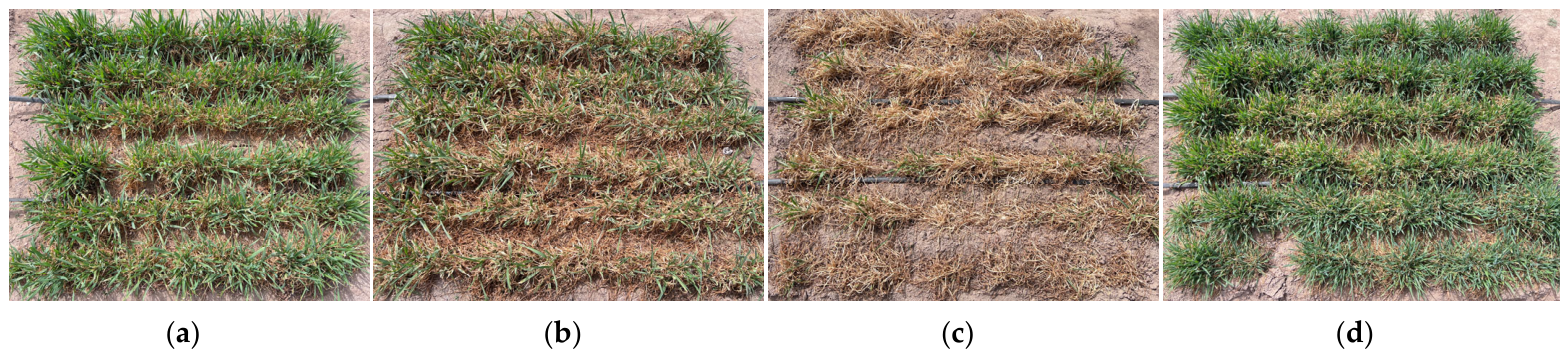
The experimental materials consisted of 16 triticale genotypes, covering three levels of frost tolerance: frost-tolerant (FT), moderately frost-tolerant (MFT), and frost-sensitive (FS). In addition, the planting materials included two excellent frost-tolerant rye varieties as Check materials. The performance of different types of materials after overwintering is shown in Figure 1.
The details of the materials are shown in Table 1. The experiment was carried out between October 2024 and February 2025 at the Organic Dryland Farming Trial Site (34°18′15″ N, 108°5′40.77″ E) located in Taigu District, Shanxi Province. The field soil (0–40 cm depth) exhibited the following characteristics: organic matter content (11.36–14.26 g/kg), pH value (7.9–8.1), NH 4 + -N (0.33–0.46 mg/kg), NO 3 -N (26.40–32.30 mg/kg), available phosphorus (9.52–13.33 mg/kg), and available potassium (133.56–149.66 mg/kg). The site has a warm temperate continental climate with long, dry, and cold winters.
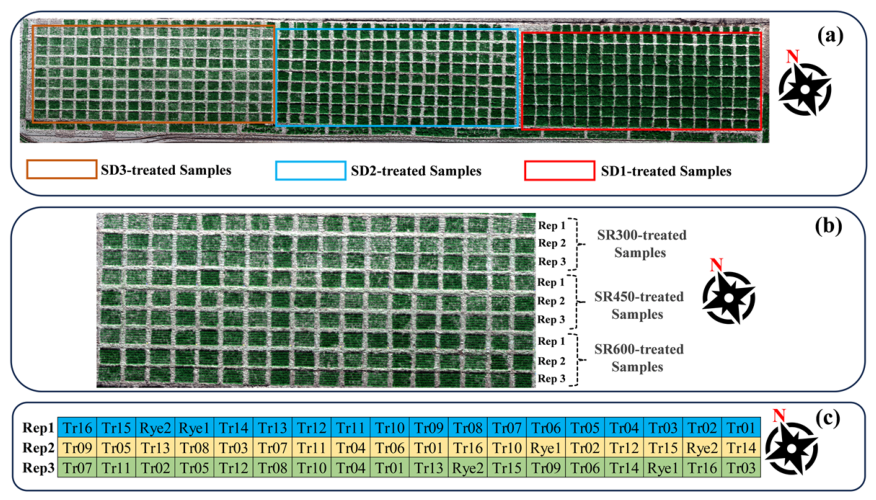
The experiment was conducted during the same growing season with three sowing dates (SDs): 27 September (SD1), 6 October (SD2), and 13 October 2024 (SD3). For each SD, three seeding rates (SRs) were applied: 300 (SR300), 450 (SR450), and 600 (SR600) plants/m2. These rates were set by adjusting the seed weight per unit area using the thousand-kernel weight and germination rate. A randomized complete block design (RCBD) with three replicates per genotype was used for each SR treatment. This setup was also employed in some studies on crop field phenotyping [25,26] to meet the essential requirements of agricultural trials. The spatial layout of the plots is shown in Figure 2. Each plot covered an area of 1.5 m2 (1.0 m × 1.5 m) and contained six rows spaced 20 cm apart. Adjacent plots were separated by a 50 cm alley to facilitate field operations. Guard rows were planted around the experimental area to minimize edge effects. Weeds were manually controlled, and drip irrigation was applied in early winter (13–14 December 2024).

2.2. Meteorological Data Throughout the Trial

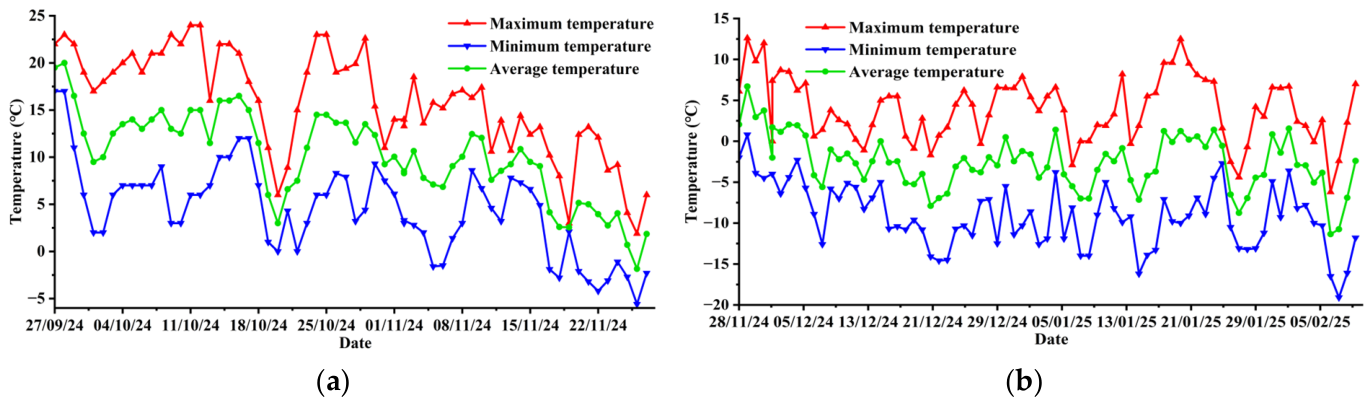
The daily air temperatures (minimum, average, and maximum) during the autumn growth after sowing are presented in Figure 3a. The population initiated overwintering after 28 November 2024, as confirmed by field investigation and meteorological data. For the SD1, SD2, and SD3 samples, the cumulative growing-degree days (GDDs) before overwintering were approximately 640 °C, 510 °C, and 370 °C, respectively. Following the SD1, three distinct precipitation events were recorded in 2024: 23 mm (29–30 September), 15.5 mm (17–18 October), and 17 mm (31 October to 5 November). The daily temperatures throughout the overwintering are provided in Figure 3b. An 8 mm water-equivalent snowfall occurred (25 January 2025) in the overwintering period. The intensity and duration of subfreezing temperatures increased, as did the accumulated freezing degree-days (FDD: temperature accumulation below 0 °C). Consequently, the cumulative frost damage intensity on triticale escalated throughout the overwintering process.

2.3. UAV Imaging Platform and Data Acquisition

Multispectral data were acquired using a UAV (DJI Matrice 350 RTK, SZ DJI Technology Co., Ltd., Shenzhen, China) equipped with a Micasense RedEdge-P sensor (Micasense, Seattle, WA, USA). The sensor captures five spectral bands—blue (B), green (G), red (R), red edge (RE), and near-infrared (NIR)—each at a spatial resolution of 1456 × 1088 pixels. A downwelling light sensor (DLS) was used during flights to record ambient light and solar angle information, enabling correction for variations in aircraft attitude and illumination conditions.
Spectral data were collected at six discrete overwintering stages, from the onset of overwintering until its conclusion. Following previous work [4,27,28], the frost damage intensity in triticale was quantified by calculating the FDD. The onset of the overwintering stage (S0, 28 November 2024) was used as the reference, as the samples were free from notable frost damage at this stage. For each stage, the damage intensity was quantified as the FDD from S0 to that specific stage. Thus, each stage corresponded to a specific damage intensity on triticale, with detailed information provided in Table 2. For descriptive purposes, S0, S1, S2, S3, S4, and S5 were used as labels to denote the corresponding damage intensity on triticale.
All flights were conducted around midday under consistent lighting conditions. The UAV was operated at a constant altitude of 24 m above ground level, with 88% forward overlap and 85% side overlap between images. Flight missions followed predefined waypoints using the DJI PILOT 2 APP (SZ DJI Technology Co., Ltd., Shenzhen, China). Prior to each flight, images of a pre-technically tested reflectance calibration panel (RCP) were captured for subsequent radiometric calibration.

2.4. Image Processing and Index Extraction

Raw multispectral images were mosaicked into orthophotos for each band using the Pix4D mapper 4.5.6 software (https://www.pix4d.com/ (accessed on 26 November 2024)). During this preprocessing stage, pixel values were converted to reflectance (0–1) based on calibration coefficients derived from the RCP. Orthophotos from stages S1 to S5 were adjusted to achieve geographic consistency with the S0-stage orthophotos using ground control points (GCPs) in the Quantum GIS (QGIS) software version 3.16.14 (https://www.qgis.org/en/site/ (accessed on 26 November 2024)). Subsequently, index orthophotos were computed in QGIS from the reflectance images for each overwintering stage. Index selection was guided by the documented functions of indices in crop stress phenotyping studies [16,17,18,19,20,21,22,23,24], with considerations for the employed spectral bands, calculation methodology, and sensor compatibility. The definitions and formulas of all indices are listed in Table 3. The Near-Infrared Reflectance of Vegetation (NIRv) index imagery from each stage was utilized to generate a stage-specific mask image for background removal. The mean NIRv values of samples (μ1) and the background (μ2) were quantified for each stage, and mask images were generated by threshold segmentation of NIRv imagery using the (μ1 + μ2)/2 as the threshold. The plot-scale images with background removed were cropped from the SI images using pre-established plot shapefiles in QGIS. Finally, indices were extracted using MATLAB R2022b (https://ww2.mathworks.cn/ (accessed on 26 November 2024)) image processing tools.

2.5. Data Analysis Methods

Firstly, index dynamics under different frost damage intensities were analyzed using one-way analysis of variance (ANOVA) and multiple comparisons (significance level: 0.05; comparison type: Tukey–Kramer). Differences in indices between SD and SR treatments were also examined using the same statistical methods. The sensitivity of indices to frost damage was analyzed based on the indices’ relative change rate.
To screen for more key indices in revealing triticale dynamics, models were first constructed using the SI and ML algorithms to detect triticale under different damage intensities. These models were applied to classify samples from six damage intensities (S0–S5). Four algorithms—eXtreme Gradient Boosting (XGBoost) [31], Quadratic Discriminant Analysis (QDA) [32], Random Forest (RF) [33], and Support Vector Machine (SVM) [33]—were employed. For each stage, 432 samples (144 per sowing date) were used. Samples from Rep1 and Rep3 of each SR treatment were assigned to the training set, while those from Rep2 formed the testing set. In total, 2592 samples across all stages were included, with each sample represented by an eight-dimensional vector. Prior to modeling, all features were normalized via vector normalization to ensure uniform scaling and prevent dominance by features with larger numerical ranges. The models were trained on 1728 samples and tested on 864 samples. Hyperparameter tuning was conducted using grid search combined with 10-fold cross-validation to mitigate overfitting or underfitting. The models’ classification accuracies and F1 scores were utilized for model evaluation and optimal model selection. Subsequently, the SHapley Additive exPlanations (SHAP) value of each index in the optimal model was used to rank their respective detection contributions. Indices with higher cumulative SHAP values were selected as key features. The SHAP value is an interpretability tool based on game theory that can fairly attribute feature importance in ML predictions [34,35].
To validate the potential of key indices for assessing frost tolerance in triticale, models were developed to identify triticale with varying tolerance levels. These models were constructed using the time-series data of key indices and the four algorithms mentioned above. Across all treatments, the numbers of samples at levels FT, MFT, and FS were 135, 162, and 135, respectively. The training set consisted of samples from Rep1 and Rep3 under all SR treatments, while the test set consisted of samples from Rep2. The feature preprocessing, hyperparameter search, and model evaluation involved were consistent with the modeling framework described above. Finally, the average dynamic and response difference of each key index under all treatments were analyzed for samples with different tolerance levels.

3. Results

3.1. The Dynamics of Indices in Triticale

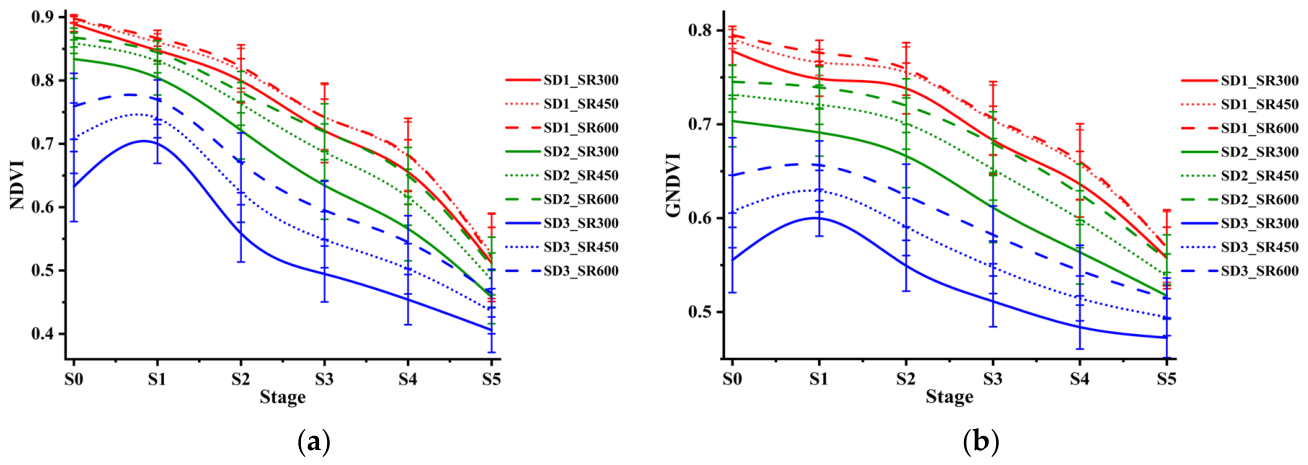
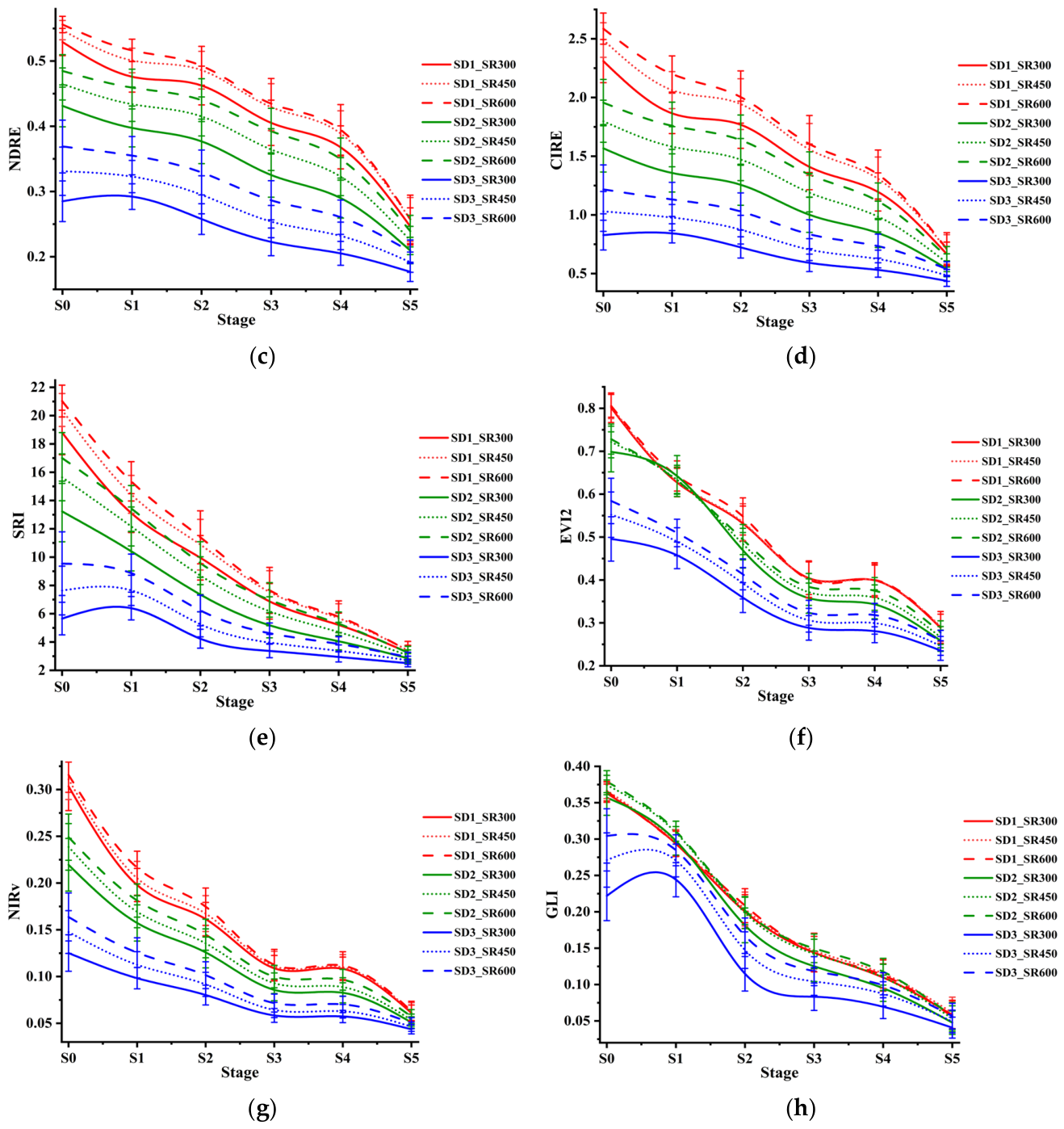
The dynamics (mean ± standard deviation (sd)) of sample indices under different treatments are presented in Figure 4. For the SD1 and SD2 samples, under the same SR treatment, the indices showed a generally significant (p < 0.05) and monotonic decrease with increasing damage intensity. For the SD3 samples, under each SR treatment, the indices decreased notably (p < 0.05) with increasing damage intensity after the S1 stage. These indices can continuously reflect the progressive decline in triticale growth vigor from mild to severe stages during the accumulation of frost damage. In all treatments, there were no significant differences (p > 0.05) in EVI2 between S3 and S4, and similarly, NIRv showed no obvious differences (p > 0.05) between these two stages. In each SR treatment of SD2, the GNDVI of samples at the S0 stage did not differ significantly (p > 0.05) from that at the S1 stage. In the SD3_SR300 treatment, the NDVI, GNDVI, SRI, and GLI of samples all exhibited a significant increase from the S0 stage to the S1 stage. In this treatment, there were no significant differences in the samples’ NDRE and CIRE between the S0 and S1 stages, respectively, whereas their EVI2 and NIRv both decreased significantly. For SD3_SR450, the samples’ NDVI and GNDVI both increased significantly from the S0 to S1 stages. No significant differences were observed in NDRE, CIRE, SRI, and GLI between those two stages. In contrast, EVI2 and NIRv showed a significant decrease from the S0 stage to the S1 stage. For the SD3_SR600 samples, between the S0 and S1 stages, NDVI, GNDVI, NDRE, and SRI showed no obvious changes, while CIRE, EVI2, NIRv, and GLI significantly decreased. Overall, at each stage, all indices (excluding EVI2 and GLI) of the SD1 samples were significantly higher than those of the SD2 samples. All indices of the SD2 samples were significantly higher than those of the SD3 samples at each stage. The indices of samples under high-SR treatments tend to be higher than those under low-SR treatments. However, for the SD1 or SD2 treatment, EVI2, NIRv, and GLI each showed relatively small differences between SR treatments. Furthermore, during the late period (S5), the differences between indices were relatively small among SR treatments under the same sowing date. Under complex sowing scenarios, the overwintering dynamics of indices are more variable compared to those under a single SD or SR condition.
The relative decline rates (RDRs) of each index from S0 to S2 (S0 vs. S2, calculated as 100% × (Index_S1-Index_S0)/Index_S0) were analyzed under each treatment. The RDRs (S0 vs. S2) of SRI (29.30% ± 7.60%~46.68% ± 6.95%), EVI2 (28.50% ± 3.16~33.09% ± 4.27%), NIR (37.04% ± 3.50%~45.90% ± 4.68%), and GLI (44.14% ± 5.77%~47.66% ± 5.09%) were significantly higher (p < 0.05) than those of NDVI (9.19% ± 3.45%~11.76% ± 2.62%), GNDVI (2.28% ± 2.47%~4.73% ± 2.69%), and NDRE (10.28% ± 2.51%~11.78% ± 3.91%). The RDR (S0 vs. S2) of CIRE (14.03% ± 3.88%~22.73% ± 6.16%) was also higher than those of NDVI, GNDVI, and NDRE under all treatments. These results indicate that SRI, EVI2, NIRv, and GLI are more sensitive to mild environmental frost damage. Moreover, under each treatment, the RDRs for each index from S2 to S5 (S2 vs. S5, calculated as 100% × (Index_S5-Index_S2)/Index_S2) were analyzed. All indices exhibited a more pronounced decline, and the RDRs (S2 vs. S5) of GLI (65.82% ± 9.28%~71.98% ± 8.36%) were the most dramatic. The RDRs (S2 vs. S5) of CIRE (43.46% ± 5.64%~63.62% ± 4.17%), SRI (46.62% ± 7.55%~68.58% ± 3.25%), NIRv (48.19% ± 4.87%~62.94% ± 2.77%), NDRE (34.24% ± 4.33%~47.34% ± 4.80%), and EVI2 (36.18% ± 4.30%~46.22% ± 3.22%) were also relatively drastic. The RDRs (S2 vs. S5) of NDVI and GNDVI ranged between 29.33% ± 4.13%~36.25% ± 5.72% and 15.87% ± 2.48%~24.79% ± 2.95%, respectively. The RDRs (S0 vs. S2 and S2 vs. S5) of indices under the SD1 treatment were significantly higher (p < 0.05) than those under the SD2 treatment. Moreover, the RDRs under the SD2 treatment were also higher than those under the SD3 treatment. Under each sowing date, no significant differences (p > 0.05) were observed in the RDRs (S0 vs. S2 and S2 vs. S5) of each index among different SR treatments. These results indicate that SD is a more dominant factor in affecting the response of triticale to frost damage stress.

3.2. Models for Triticale Detection Under Different Frost Damage Intensities

As shown in Table 4, the models achieved acceptable results on the training set, with average classification accuracy ranging from 95.83% to 98.32% and F1-scores of 0.96–0.98. On the test set, the accuracy varied from 93.29% to 98.03, and the F1-score fell between 0.93 and 0.98. Among these models, RF and XGBoost exhibited inferior average generalization performance compared to QDA and SVM. At the S3 stage, the classification performance of the XGBoost, QDA, and RF models was inferior to that of SVM, as evidenced by their low accuracies/F1-scores. In contrast, the SVM model achieved the best generalization results, outperforming the others in terms of both stage-wise and overall classification accuracy and F1-score on the test set. In the SVM model, the grid search employed a radial basis function (RBF) kernel with a penalty parameter of C = 2000 and a kernel coefficient of γ = 1.
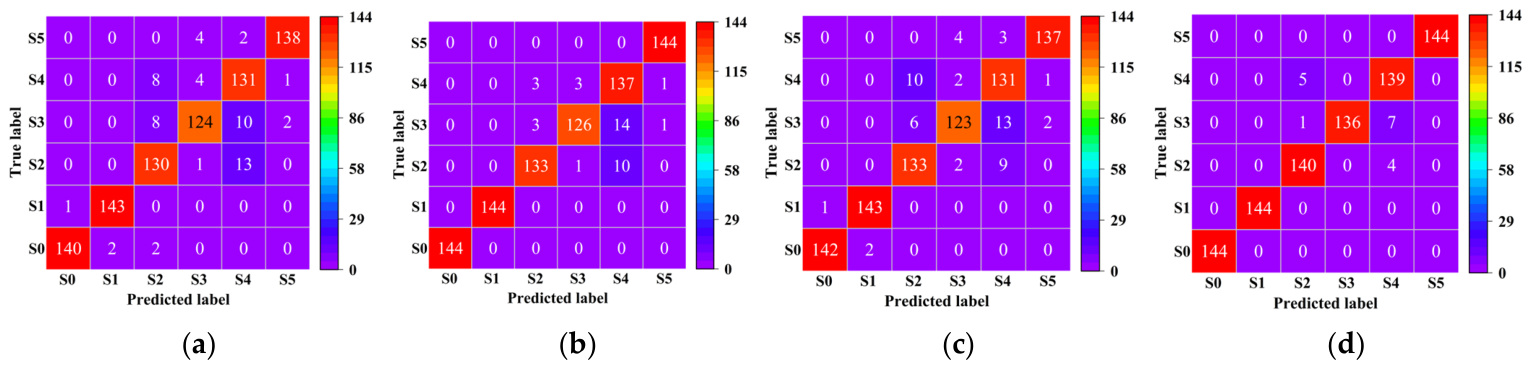
The models’ confusion matrices (CMs) on the test set provide a more detailed demonstration of their generalization performance (Figure 5). Intuitively, the RBF-SVM model had the fewest misclassified samples. As visually evidenced by the confusion matrices, these models exhibit a tendency for misclassification among the S2, S3, S4, and S5 stages. Specifically, they tend to misclassify the frost-sensitive genotypes belonging to the S2 or S3 stage into the subsequent S4 or S5 stage. Conversely, they tend to misclassify the frost-tolerant genotypes from subsequent stages into prior stages.
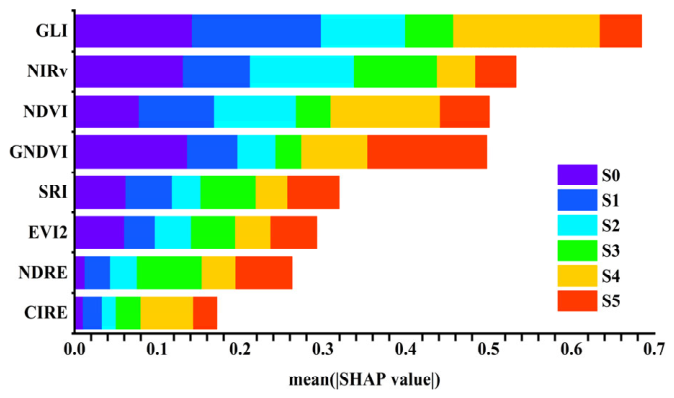
Given the above results, the SVM model is more suitable for detecting triticale exposed to varying damage intensities and complex sowing conditions. KernelExplainer from the SHAP tool was used to calculate the SIs’ prediction contributions to the RBF-SVM model for the testing samples. All test set samples (864 samples) were employed as the background dataset. The contribution distributions of indices at all stages are intuitively presented in Figure 6. The mean absolute SHAP values (mean |SHAP value|) of the features were leveraged to rank their respective importance in the model. A higher mean |SHAP value| is associated with a greater feature contribution. Evidently, the detection contributions of different indices are distinct across individual stages and in cumulative terms. At stages S0, S1, and S4, the mean |SHAP values| for GLI (0.142, 0.156, and 0.177, respectively) exceed that of all other features. The NIRv had high mean |SHAP values| at stage S0 (0.131), S1 (0.1126), and S4 (0.100). The NDVI reached relatively high mean |SHAP values| at stages S1 (0.091), S2 (0.098), and S4 (0.132). The mean |SHAP values| of GNDVI at stages S0 (0.136) and S4 (0.144) were also high. Across all stages, GLI had the highest cumulative contribution (0.685). The cumulative values of NIRv (0.533), NDVI (0.501), and GNDVI (0.498) were also significantly higher than those of SRI (0.319) and EVI2 (0.292). In contrast, the cumulative values of CIRE (0.172) and NDRE (0.263) were relatively low. So, GLI, NIRv, NDVI, and GNDVI were identified as key indices.

3.3. Identification Models and Key Index Dynamics for Materials with Different Tolerance Levels

The results of models built with the time-series data of key indices for tolerance identification in triticale are shown in Table 5. On the training set, the identification accuracies of the models ranged from 94.44% to 97.22% for FT-level samples, 82.22% to 97.77% for MFT-level samples, and 94.44% to 97.77% for FS-level samples. The accuracies of the models on the test set were inferior to those on the training set. The SVM model (RBF kernel, C = 50, and γ = 2) achieved the best accuracy for FT-level (90.74%), MFT-level (91.11%), and FS-level samples (91.11%) on the test set, outperforming all other models.
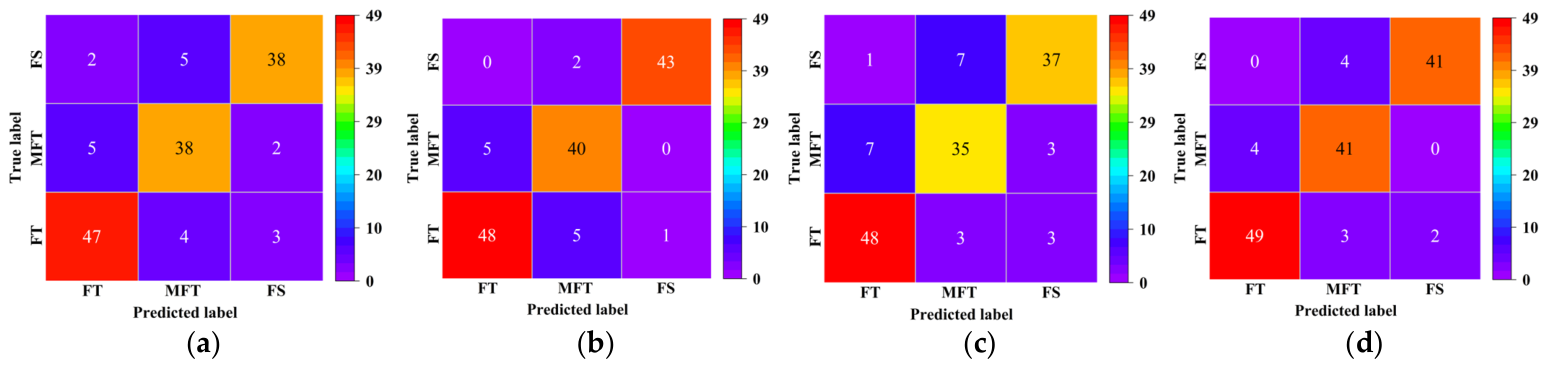
The CMs of the models on the test set reveal the details of identifying samples at three levels (Figure 7). According to qualitative evaluation, the SVM model exhibited the lowest misclassification rate. Evidence from the CMs indicates that the models are prone to misclassifying samples of the MFT-level, while samples of the FT-level and FS-level are less likely to be confused.
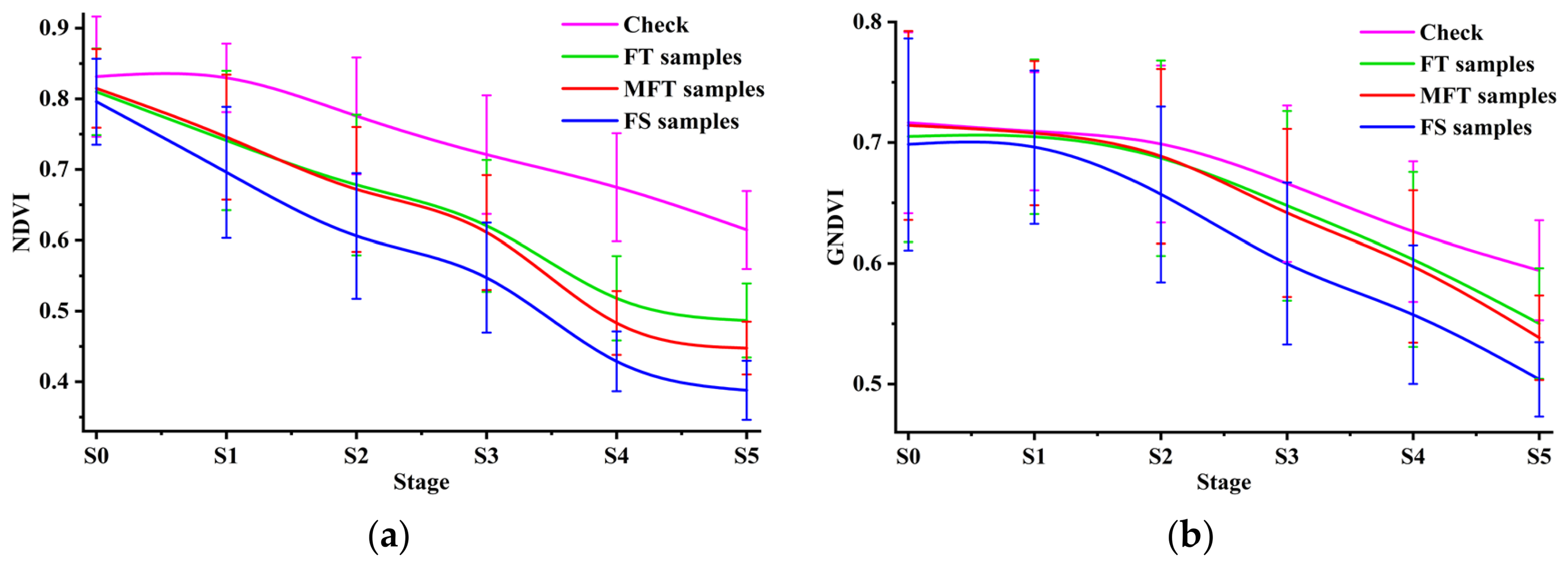
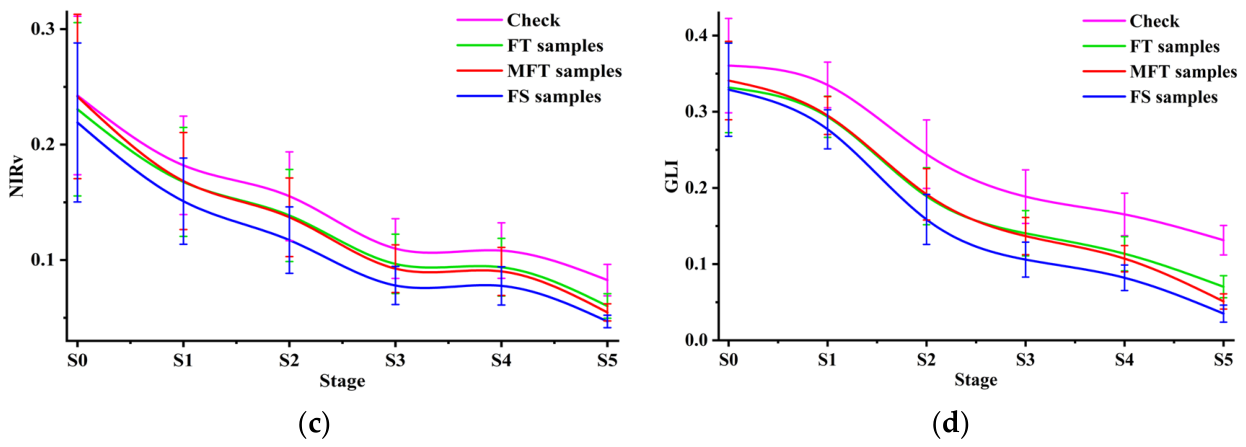
The average dynamics of key indices for samples with different tolerance levels under all treatments are shown in Figure 8. At stage S0, no significant differences were observed in the indices among FT-level, MFT-level, and FS-level triticale and extremely frost-tolerant rye (Check). At each of the stages S1 to S5, the NDVI, NIRv, and GLI of the Check samples were significantly higher than those for triticale samples of all types. The GNDVIs of the Check samples were significantly higher than those of the triticale samples at the stages S4 and S5. At any stage from S1 to S5, the NDVI, NIRv, and GLI of FS-level triticale were significantly lower than those of FT and MFT-level triticale. The GNDVI of FS-level triticale was also significantly lower than those of FT and MFT-level triticale at any stage from S2 to S5. Moreover, at the S5 stage, the indices of MFT-level triticale were significantly lower than those of FT-level triticale. The NDVI and GLI of MFT-level triticale were significantly lower than those of FT-level triticale at the S4 stage.
For samples with different tolerance levels, the RDRs from S0 to S2 (S0 vs. S2), S0 to S3 (S0 vs. S3), S2 to S4 (S2 vs. S4), and S2 to S5 (S2 vs. S5) were analyzed for each index (Table 6). The RDRs of highly frost-resistant rye (Check) were generally and significantly lower than those of triticale. Triticale with high levels of frost tolerance (FT or MFT) also tends to have generally lower RDRs compared to frost-sensitive (FS) triticale. In both the early and middle overwintering stages, the RDRs (S0 vs. S2 and S0 vs. S3) of GNDVI and NIRv and the RDRs (S0 vs. S3) of GLI decreased significantly with increasing frost tolerance in triticale. In the middle and late overwintering phases, the RDRs (S2 vs. S4 and S2 vs. S5) of GNDVI and GLI, the RDR (S2 vs. S4) of NIRv, and the RDR (S2 vs. S5) of NDVI followed the same trend. These results demonstrate significant differences in the responses of the indices to frost damage among materials with varying frost resistance levels. These differences could facilitate the screening and identification of frost-tolerant triticale under complex planting conditions.
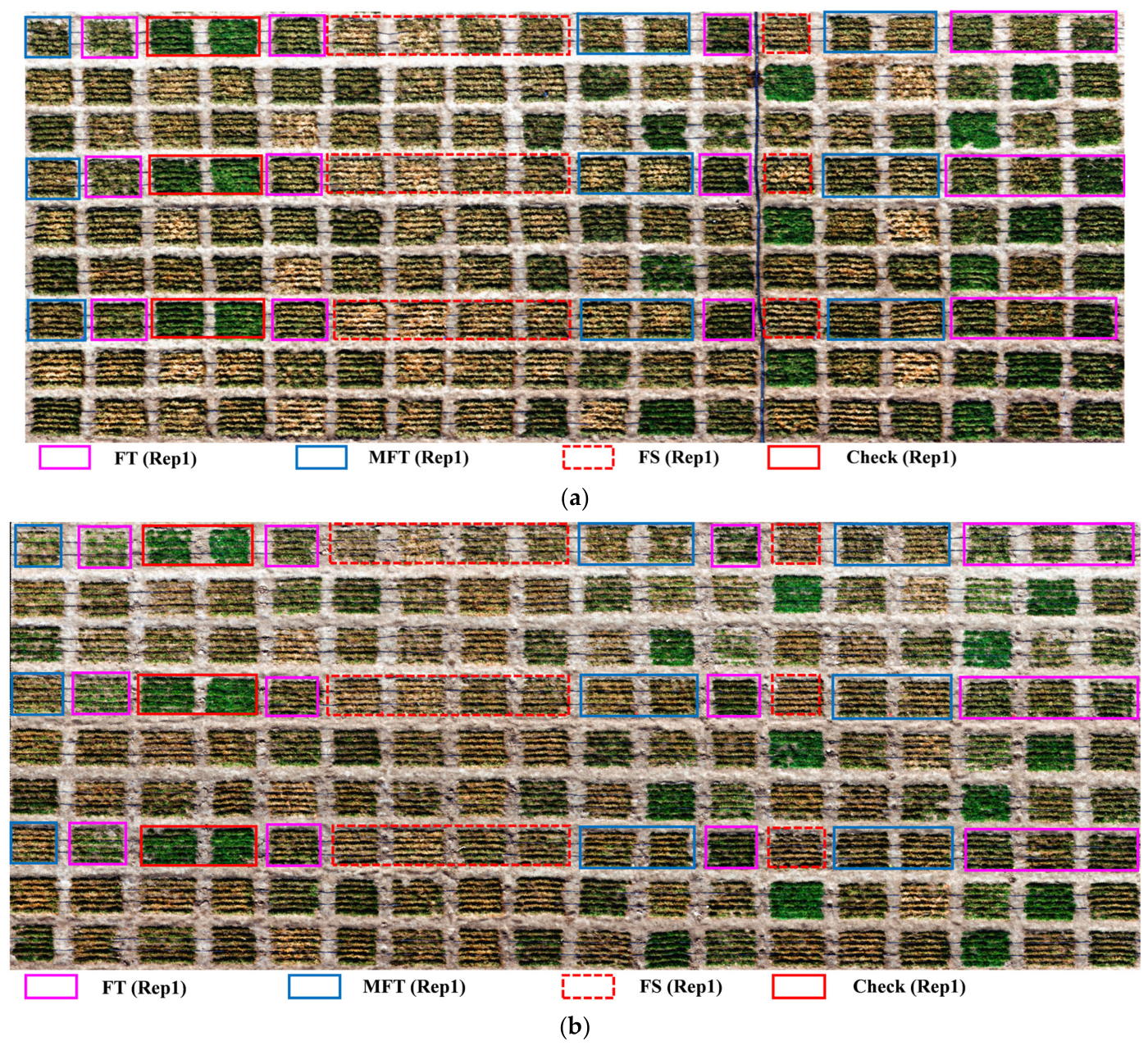
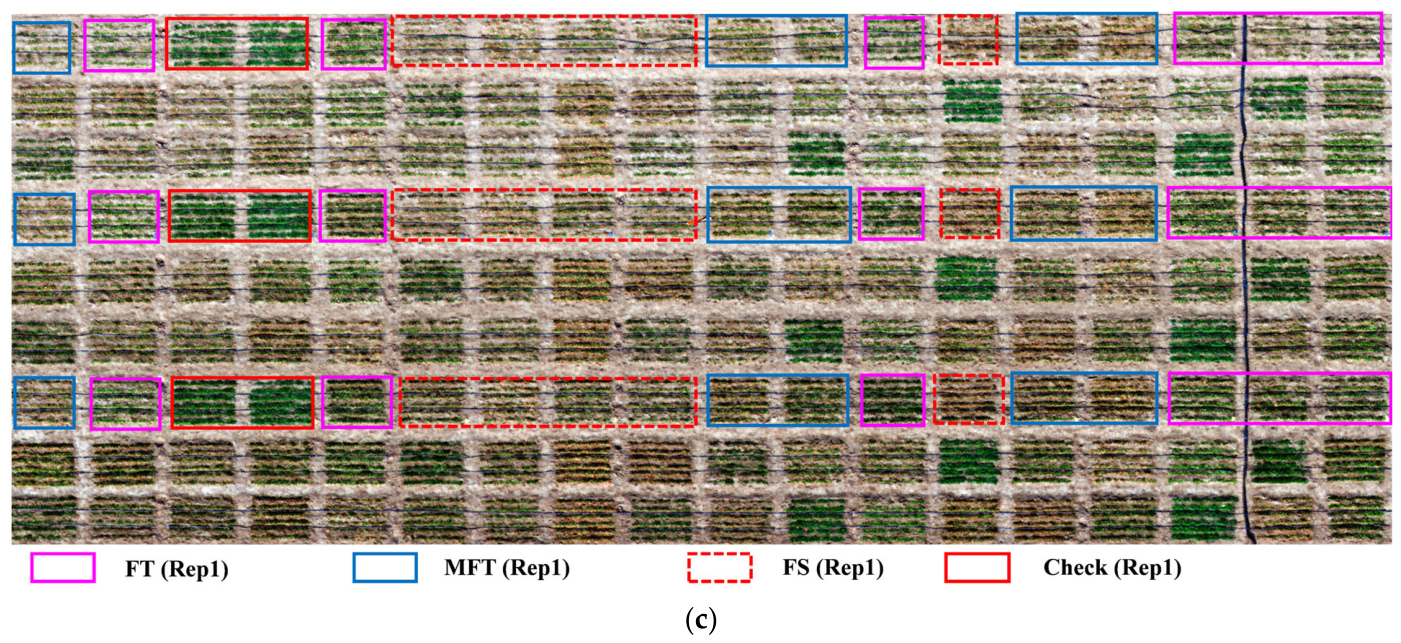
Traditionally, manual visual inspection during the early pre-regreening stage after overwintering allows for the reliable determination of frost tolerance among different triticale genotypes. The canopy images of samples (obtained on 28 February 2025) at this stage are presented in Figure 9. Visually, it was evident that across different treatments, the Check samples showed the highest canopy greenness, and the canopy greenness of FT-level or MFT-level triticale was generally higher than that of FS-level triticale. However, at an earlier stage that cannot be assessed by the naked eye, these indices and their responses to frost damage can yield results that are highly consistent with later visual assessment. These key indices demonstrate the potential for early identification of triticale frost tolerance.

4. Discussion

4.1. Overwintering Dynamics of Various Indices in Triticale

Post-winter air temperature shows a continuous downward trend (Figure 3b), and the environmental frost damage that triticale suffers is also a dynamic cumulative process from mild to severe (Table 2). Frost damage first affects the physiological traits of crops, causing metabolic disorders, and adversely impacts nutrient uptake and transport. Under sustained stress, changes occur in pigment contents (chlorophyll and carotenoids), nitrogen concentration, and mean leaf inclination angle. Prolonged stress leads to alterations in canopy structure, leaf wilting and desiccation, canopy yellowing, and reductions in biomass and Leaf Area Index (LAI) [11,12,36,37,38,39]. These indices are effective indicators of these related traits in crops [17,29,40]. All these indices were positively correlated with crop chlorophyll concentration and photosynthetic capacity. They were also associated with crop canopy green biomass, density or lushness, and LAI [14,15,16,17,18,29]. In particular, NIRv provides a more direct representation of crop physiological status and is highly correlated with the fraction of absorbed photosynthetically active radiation (FPAR) and gross primary productivity (GPP) [29,41,42]. The monotonic decline of indices with increasing damage intensity indicates the progressive decline of triticale growth vigor. Earlier research [19,20,21] had similarly demonstrated that crop SIs, such as NDVI, NDRE, GNDVI, and CIRE, exhibit a declining trend with the intensification of frost damage. Those outcomes align closely with those obtained in this study. The effects of frost damage on triticale status under identical sowing conditions can be assessed by comparing the SIs before and after the events. Thus, it is justifiable that previous studies [19,20,23,24] had developed models to detect crop frost damage severity by utilizing indices, such as NDVI, GNDVI, NDRE, and SRI, from the later stress periods.
Previous work has suggested that different indices may exhibit varying sensitivity to crop stress [16,17,18,19,20,21,22], and this pattern was further confirmed by the findings of this study. SRI, EVI2, NIRv, and GLI are more sensitive to early damage than NDVI, GNDVI, and NDRE. This may be mainly attributed to the temporal sequencing of crop trait changes under stress. As mentioned above, the physiological and biochemical traits (photosynthetic rate, light use efficiency, pigment content, etc.) of crops (including Triticeae crops) change before their structural traits under frost stress. By incorporating the absolute radiance of the NIR band, NIRv places greater emphasis on photosynthesis-related information. It exhibits strong correlations with solar-induced chlorophyll fluorescence (SIF), making it one of the important proxy indicators for estimating vegetation photosynthesis [41,42]. While direct NIRv-based studies on triticale frost stress are rare, photosynthesis-related research [2,27,43] indirectly supports that photosynthetic traits effectively reflect early frost stress in triticale. The results of this study provide preliminary evidence for the effective use of NIRv in detecting early frost damage in triticale. Similarly, research on detecting freezing stress in triticale using other SIs is relatively limited, which results in a lack of more direct comparative validation for these findings. Nevertheless, the findings from other studies could still provide some reasonable references for this issue. The sensitivity of SIs to crop changes is also closely related to their band selection and mathematical formulation [44,45]. EVI2 reduces background interference by optimizing soil adjustment, allowing it to more sensitively capture slight increases in red band reflectance when chlorophyll is mildly degraded [29,42]. Under mild stress, the reflectance in the NIR band decreases slightly while that in the R band increases slightly, and the ratio effect can lead to a significant decrease in the SRI value. GLI is formulated based on chlorophyll’s absorption properties and is optimized for its reflectance peak in the green band [20,29,46]. GLI is constructed from the R, G, and B bands, and visible bands are sensitive to plant pigments (chlorophylls, carotenoids, and anthocyanins), which are critical for crop photosynthesis and net primary productivity [16,17,20,29,47,48,49,50]. NDVI, GNDVI, and NDRE are calculated using band difference and normalization, which may result in changes in the relevant bands being averaged out by the denominator, leading to a sluggish response. These indices are more likely to be dominated by crop structural traits (biomass, leaf area, etc.) and exhibit a certain saturation effect [17,29]. The RE band is sensitive to chlorophyll content, and mild stress leads to changes in chlorophyll content. CIRE, which adopts a ratio-type calculation, may enhance the band response compared to NDRE. These findings provide useful guidance for the early warning of crop frost damage, suggesting that using GLI, NIRv, SRI, and EVI2 is more effective. Moreover, the synergistic use of multiple indices may be more beneficial for frost monitoring. In SD3 samples, NDVI, GNDVI, NDRE, and SRI did not show a significant decrease between the S0 and S1 stages, and they failed to capture the impact of the damage event on the samples. Meanwhile, NIRv and EVI2 sensitively revealed the stress response during this period. This implies that mild stress may have affected the physiological traits of the SD3 samples without influencing the macroscopic traits. Selecting appropriate indices is crucial for detecting frost stress in triticale under complex planting conditions. The results indicate that using NIRv or EVI2 in combination with an index such as NDVI, GNDVI, or NDRE could more effectively reveal the stress response of triticale.
SD and cultivar are the main factors influencing the dynamics of spectral indices in triticale during overwintering. SD primarily controls the growth level of triticale before winter by influencing accumulated temperature. Sowing date controls the degree of development of pre-winter traits in triticale—such as tillering, chlorophyll concentration, total photosynthetic biomass, and LAI. These directly lead to differences in the SIs of samples from different sowing dates. Early-sown triticale exhibits earlier development and more vigorous growth than late-sown triticale. On the same observation date, these traits are generally superior in early-sown triticale; therefore, the spectral index values reflecting these traits are also higher. Nevertheless, excessive pre-winter accumulated temperature can lead to the excessive growth of triticale, an increased consumption of soluble sugars, dilution of cell sap, insufficient cold acclimation, and consequently reduced cold hardiness [6,7,8,9]. These directly affect the magnitude of decline of spectral indices during the overwintering period. SIs can quantify the differences in triticale before and after overwintering under different SDs. SD can thus be transformed into a dynamic, quantifiable, and manageable risk factor with spectral indices, and using spectral indices to construct the overwintering curves of triticale is expected to provide intuitive guidance for its local overwintering management. Moreover, indices can reveal the differences among triticale genotype varieties with varying levels of frost tolerance. Under stress, triticale with strong frost tolerance exhibits superior photosynthetic function, cell structural stability, and slower pigment degradation compared to genotypes with weak tolerance. The index dynamics of triticale with strong frost tolerance are more stable, and these indices can serve as high-throughput tools to quantify the frost tolerance trait. Using the index dynamics of different triticale genotypes under multiple SD treatments helps to screen varieties with greater sowing flexibility. Time-series spectral indices may also provide a reference solution for addressing the phenotyping bottleneck in the large-scale screening and identification of triticale germplasm and the discovery of beneficial genes. These results may offer valuable insights into the phenotyping of overwintering performance in other crops (e.g., winter wheat, rye, and rapeseed), given that these crops face similar agricultural challenges.

4.2. Leveraging SIs and ML Algorithms: Potential Applications and Limitations

Diverse SIs serve as effective tools for analyzing the overwintering dynamics of triticale under complex sowing conditions. ML algorithms can discover non-obvious patterns within complex or ambiguously structured datasets, providing effective solutions for crop phenotyping [51,52,53,54,55,56]. The models developed using SIs and ML algorithms could detect triticale germplasm under different frost damage intensities in complex planting scenarios. These results have at least two implications. One is that the vector composed of diverse indices could serve as a descriptor for triticale growth, revealing a more comprehensive response to frost stress than a single index. This vector may also provide a novel feature tool for diagnosing frost stress in triticale and analyzing the overwintering adaptability of different genotypes. Another implication is that a detection model for frost damage in triticale with broader application potential can be developed. A robust model for frost stress detection should demonstrate good robustness against variations in crop cultivars and sowing conditions. The generalization ability of models developed using indices from only one cultivar or treatment may be compromised if applied to different cultivars or treatments. The model developed in this study demonstrates robustness against these factors, as it is capable of evaluating frost stress for any given test material at a specific SD (SD1, SD2, or SD3) or SR (SR300, SR450, or SR600) treatment. These findings may also serve as a valuable reference for automatically detecting drought and nutrient stress in crops subjected to varied varieties, sowing dates, and sowing rates. Admittedly, the result is based on a single field site and one growing season, so the model performance may not directly transfer to other environments, soil types, or climatic conditions. A more robust model should also be robust to interannual or regional variation factors and requires richer data or more diverse approaches (e.g., transfer learning and leveraging mechanistic models as assistance).
Algorithms that are well suited to the given dataset may yield better models. The SVM classifier outperformed the XGBoost, RF, and QDA models in terms of generalization performance. The SVM classification algorithm identifies the optimal maximum-margin hyperplane for decision boundaries to maximize generalization performance [33]. The kernel trick enables SVM to handle sophisticated nonlinear classification tasks by implicitly mapping data into higher-dimensional feature spaces. The RBF kernel used in this work can implicitly map input data into an infinite-dimensional feature space, thereby enabling the SVM to construct highly flexible, nonlinear decision boundaries [33,53]. The SVM algorithm is thus more suitable for detecting triticale under complex scenarios due to its inherent capacity for processing multidimensional SI vectors. The model’s interpretability tools provide insights into the contribution of each feature in the vector and facilitate the selection of critical features [57,58,59]. The varying contributions of each index in the vector further verify that this vector has stronger descriptive power than any single index. In this study, the contributions of indices were utilized to identify key features, thereby providing a more direct basis for optimal index selection. In particular, GLI was found to have the highest contribution, implying that lower-cost sensors can be used to analyze the overwintering dynamics of triticale. The fact that GLI does not rely on RE and NIR bands may contribute to its easier data acquisition in real-world use. The model constructed using the time-series data of the selected key indices demonstrated applicability in assessing frost tolerance in triticale. This provides a preliminary reference for establishing automated models to assess frost tolerance in triticale based on spectral indices.
Although this study employed relatively complex treatments with respect to SD, SR, and genotype, it should be acknowledged that this study has limitations that warrant further investigation and may inform future research. The limited selected indices and data from one growing season are relatively insufficient for obtaining ultimately reliable results. Therefore, spectral data from multiple growing seasons and diverse geographic regions should be collected to further explore related aspects in the future. Furthermore, future studies could also compare the potential of more types of sensors, such as consumer-grade RGB, professional-grade hyperspectral, and chlorophyll fluorescence, in analyzing the overwintering dynamics of triticale. Subsequently, it is worthwhile to further explore the application of more and more advanced ML algorithms in developing models for frost damage detection and frost tolerance identification in triticale. More feature evaluation tools based on different criteria are also worth applying to more comprehensively assess the contribution of the selected indices. In addition, an automatic image segmentation framework suitable for triticale under complex planting scenarios is worth investigating to streamline the extraction of relevant indices.

5. Conclusions

In this study, we employed spectral indices (SIs) to analyze the overwintering dynamics of triticale germplasm under multiple sowing dates and sowing rates. We demonstrate that under each treatment, the selected SIs of triticale decrease monotonically with increasing frost damage intensity, establishing these indices as effective quantitative indicators for assessing frost damage. Notably, SRI, EVI2, NIRv, and GLI exhibit heightened sensitivity to frost stress during the early overwintering stage, revealing their novel potential for early stress warning. Leveraging these indices and the Support Vector Machine (SVM) algorithm, we developed a model capable of detecting frost stress in triticale and is robust to variations in genotype, sowing date, and sowing rate, achieving a mean accuracy of 98.03%. Furthermore, we identify GLI, NIRv, NDVI, and GNDVI as key indices that critically elucidate the overwintering dynamics of triticale under complex planting conditions. By integrating time-series data of these key indices with the SVM algorithm, our model discriminates triticale with different frost tolerance levels at an accuracy exceeding 90%, offering a high-throughput tool for frost tolerance identification. Collectively, GLI, NIRv, NDVI, and GNDVI, together with their characteristic responses to frost damage, provide a practical pathway for identifying frost-tolerant triticale germplasm.
This work provides a useful reference for dynamic phenotyping of triticale during overwintering. While we acknowledge that a limited set of indices was examined, and their performance under more complex scenarios warrants further validation, the current findings lay a robust foundation for future research. Subsequent studies should incorporate additional algorithms and spectral data with broader temporal and spatial coverage to enable more comprehensive frost damage phenotyping in triticale.

Author Contributions

Conceptualization, W.G. and X.C.; methodology, W.G. and X.C.; software, X.C., M.S., R.L. and T.H.; validation, W.G., X.C., M.S., R.L. and T.H.; formal analysis, X.C., M.S., T.H. and W.M.; investigation, X.C., M.S., T.H. and W.M.; resources, W.G. and X.C.; data curation, W.G. and X.C.; writing—original draft preparation, W.G.; writing—review and editing, X.C.; visualization, W.G. and X.C.; supervision, W.G. and X.C.; project administration, W.G. and X.C.; funding acquisition, W.G. and X.C. All authors have read and agreed to the published version of the manuscript.

Funding

This work was funded by the Research Start-up Project for Introduced Talents of Shanxi Agricultural University (2023BQ128) and the Research Project Award Fund for Doctoral Graduates and Postdoctoral Researchers Relocating to Shanxi (SXBYKY2024011).

Data Availability Statement

The data that support the findings of this study are available from the corresponding author upon reasonable request.

Acknowledgments

The authors acknowledge the support in germplasm resources provided by Wenhua Du (Pratacultural College, Gansu Agricultural University, China), Wenjuan Jia (Ningxia Xibei Agriculture Forestry Animal Husbandry Ecological Technology Co. Ltd., China), and Yuan Li (Hebei Academy of Agricultural and Forestry Sciences, China).

Conflicts of Interest

The authors declare no conflicts of interest.

References

  1. De Zutter, A.; Landschoot, S.; Vermeir, P.; Van Waes, C.; Muylle, H.; Roldán-Ruiz, I.; Douidah, L.; De Boever, J.; Haesaert, G. Variation in potential feeding value of triticale forage among plant fraction, maturity stage, growing season and genotype. Heliyon 2023, 9, 12760. [Google Scholar] [CrossRef]
  2. Golebiowska-Paluch, G.; Dyda, M. The Genome Regions Associated with Abiotic and biotic Stress Tolerance, as Well as Other Important breeding Traits in Triticale. Plants 2023, 12, 619. [Google Scholar] [CrossRef]
  3. Liu, W.; Maurer, H.P.; Li, G.; Tucker, M.R.; Gowda, M.; Weissmann, E.A.; Hahn, V.; Wuerschum, T. Genetic Architecture of Winter Hardiness and Frost Tolerance in Triticale. PLoS ONE 2014, 9, 99848. [Google Scholar] [CrossRef]
  4. Rapacz, M.; Macko-Podgórni, A.; Jurczyk, B.; Kuchar, L. Modeling Wheat and Triticale Winter Hardiness under Current and Predicted Winter Scenarios for Central Europe: A Focus on Deacclimation. Agric. For. Meteorol. 2022, 313, 108739. [Google Scholar] [CrossRef]
  5. Han, W.; Wang, S.; Ma, L.; Ali, M.F.; Lin, X.; Wang, D. Four decades of temperature extremes reshape regional wheat yields and adaptation in China. J. Environ. Manag. 2025, 389, 126271. [Google Scholar] [CrossRef] [PubMed]
  6. Potapova, G.; Ivanova, M. The influence of sowing period and seeding norm on autumn vegetation, winter hardiness and yield of winter cereal crops. Interact. Sci. 2017, 11, 69–75. [Google Scholar] [CrossRef]
  7. Gao, G.; Zhang, H.; Duan, Y.; Fan, S.; Xue, Z.; Sun, X.; Ge, H.; Zhao, C. Regulatory Effects of Optimized Sowing Date and Seeding Rate on Yield Formation in Strong-Gluten Winter Wheat. Agronomy 2026, 16, 585. [Google Scholar] [CrossRef]
  8. Wu, L.; Quan, H.; Feng, H.; Ding, D.; Wu, L.; Liu, D.L.; Wang, B. Delaying sowing time and increasing sowing rate with plastic mulching can enhance wheat yield and water use efficiency under future climate change. Agric. For. Meteorol. 2025, 362, 110383. [Google Scholar] [CrossRef]
  9. Dadrasi, A.; Soltani, E.; Makowski, D.; Lamichhane, J.R. Does shifting from normal to early or late sowing dates provide yield benefits? A global meta-analysis. Field Crops Res. 2024, 318, 109600. [Google Scholar] [CrossRef]
  10. Ma, S.C.; Wang, T.C.; Guan, X.K.; Zhang, X. Effect of Sowing Time and Seeding Rate on Yield Components and Water Use Efficiency of Winter Wheat by Regulating the Growth Redundancy and Physiological Traits of Root and Shoot. Field Crops Res. 2018, 221, 166–174. [Google Scholar] [CrossRef]
  11. Hua, W.; Heinemann, P.; He, L. Frost management in agriculture with advanced sensing, modeling, and artificial intelligent technologies: A review. Comput. Electron. Agric. 2025, 231, 110027. [Google Scholar] [CrossRef]
  12. Shammi, S.; Sohel, F.; Diepeveen, D.; Zander, S.; Jones, M.G.K. A survey of image-based computational learning techniques for frost detection in plants. Inf. Process. Agric. 2023, 10, 164–191. [Google Scholar] [CrossRef]
  13. Wang, J.; Zhang, S.; Lizaga, I.; Zhang, Y.; Ge, X.; Zhang, Z.; Zhang, W.; Huang, Q.; Hu, Z. UAS-based remote sensing for agricultural Monitoring: Current status and perspectives. Comput. Electron. Agric. 2024, 227, 109501. [Google Scholar] [CrossRef]
  14. Xie, C.; Yang, C. A review on plant high-throughput phenotyping traits using UAV-based sensors. Comput. Electron. Agric. 2020, 178, 105731. [Google Scholar] [CrossRef]
  15. Berger, K.; Machwitz, M.; Kycko, M.; Kefauver, S.C.; Van Wittenberghe, S.; Gerhards, M.; Verrelst, J.; Atzberger, C.; van der Tol, C.; Damm, A.; et al. Multi-sensor spectral synergies for crop stress detection and monitoring in the optical domain: A review. Remote Sens. Environ. 2022, 280, 113198. [Google Scholar] [CrossRef]
  16. Chakhvashvili, E.; Machwitz, M.; Antala, M.; Rozenstein, O.; Prikaziuk, E.; Schlerf, M.; Naethe, P.; Wan, Q.; Komarek, J.; Klouek, T.; et al. Crop stress detection from UAVs: Best practices and lessons learned for exploiting sensor synergies. Precis. Agric. 2024, 25, 2614–2642. [Google Scholar] [CrossRef]
  17. Tayade, R.; Yoon, J.; Lay, L.; Khan, A.L.; Yoon, Y.; Kim, Y. Utilization of Spectral Indices for High-Throughput Phenotyping. Plants 2022, 11, 1712. [Google Scholar] [CrossRef] [PubMed]
  18. Tran, T.; Reef, R.; Zhu, X. A Review of Spectral Indices for Mangrove Remote Sensing. Remote Sens. 2022, 14, 4868. [Google Scholar] [CrossRef]
  19. Jelowicki, L.; Sosnowicz, K.; Ostrowski, W.; Osinska-Skotak, K.; Bakula, K. Evaluation of Rapeseed Winter Crop Damage Using UAV-based Multispectral Imagery. Remote Sens. 2020, 12, 2618. [Google Scholar] [CrossRef]
  20. Liu, Y.; Ban, S.; Wei, S.; Li, L.; Tian, M.; Hu, D.; Liu, W.; Yuan, T. Estimating the frost damage index in lettuce using UAV-based RGb and multispectral images. Front. Plant Sci. 2024, 14, 1242948. [Google Scholar] [CrossRef]
  21. Marin, D.b.; Ferraz, G.A.E.S.; Schwerz, F.; Barata, R.A.P.; de Oliveira Faria, R.; Dias, J.E.L. Unmanned aerial vehicle to evaluate frost damage in coffee plants. Precis. Agric. 2021, 22, 1845–1860. [Google Scholar] [CrossRef]
  22. Valente, G.F.; Ferraz, G.A.E.S.; Schwerz, F.; de Oliveira Faria, R.; Fernandes, F.A.; Marin, D.b. Remotely Piloted Aircraft for Evaluating the Impact of Frost in Coffee Plants: Interactions between Plant Age and Topography. Remote Sens. 2024, 16, 3467. [Google Scholar] [CrossRef]
  23. Liu, Y.; Yu, R.; Wu, J.; Han, D.; Su, B. High-throughput phenotyping for different genotype wheat frost using UAV-based remote sensing. Trans. Chin. Soc. Agric. Eng. 2023, 39, 128–136. [Google Scholar] [CrossRef]
  24. Zhu, J.; Zhao, H.; Lyu, Y.; Liang, Z.; Fu, Y.; Liang, Y.; Chang, Y.; Lan, Y. Evaluating freeze damage in winter wheat using vegetation index and texture-color features of unmanned aerial vehicle. Trans. Chin. Soc. Agric. Eng. 2025, 41, 162–170. [Google Scholar] [CrossRef]
  25. Sharma, V.; Honkavaara, E.; Hayden, M.; Kant, S. UAV remote sensing phenotyping of wheat collection for response to water stress and yield prediction using machine learning. Plant Stress 2024, 12, 100464. [Google Scholar] [CrossRef]
  26. Zhu, X.; Liu, X.; Wu, Q.; Liu, M.; Hu, X.; Deng, H.; Zhang, Y.; Qu, Y.; Wang, B.; Gou, X.; et al. Utilizing UAV-based high-throughput phenotyping and machine learning to evaluate drought resistance in wheat germplasm. Comput. Electron. Agric. 2025, 237, 110602. [Google Scholar] [CrossRef]
  27. Wąsek, I.; Dyda, M.; Gołębiowska, G.; Tyrka, M.; Rapacz, M.; Szechyńska-Hebda, M.; Wędzony, M. Quantitative trait loci and candidate genes associated with freezing tolerance of winter triticale (× Triticosecale Wittmack). J. Appl. Genet. 2022, 63, 15–33. [Google Scholar] [CrossRef] [PubMed]
  28. Dashtseren, A.; Temuujin, K.; Westermann, S.; Batbold, A.; Amarbayasgalan, Y.; Battogtokh, D. Spatial and Temporal Variations of Freezing and Thawing Indices from 1960 to 2020 in Mongolia. Front. Earth Sci. 2021, 9, 713498. [Google Scholar] [CrossRef]
  29. Zeng, Y.; Hao, D.; Huete, A.; Dechant, B.; Berry, J.; Chen, J.M.; Joiner, J.; Frankenberg, C.; Bond-Lamberty, B.; Ryu, Y.; et al. Optical vegetation indices for monitoring terrestrial ecosystems globally. Nat. Rev. Earth Environ. 2022, 3, 477–493. [Google Scholar] [CrossRef]
  30. Cao, X.; Liu, Y.; Yu, R.; Han, D.; Su, B. A Comparison of UAV RGB and Multispectral Imaging in Phenotyping for Stay Green of Wheat Population. Remote Sens. 2021, 13, 5173. [Google Scholar] [CrossRef]
  31. Zhen, J.; Mao, D.; Shen, Z.; Zhao, D.; Xu, Y.; Wang, J.; Jia, M.; Wang, Z.; Ren, C. Performance of XGboost Ensemble Learning Algorithm for Mangrove Species Classification with Multisource Spaceborne Remote Sensing Data. J. Remote Sens. 2024, 4, 146. [Google Scholar] [CrossRef]
  32. Wu, R.; Hao, N. Quadratic discriminant analysis by projection. J. Multivar. Anal. 2022, 190, 104987. [Google Scholar] [CrossRef]
  33. Maleki, F.; Ovens, K.; Najafian, K.; Forghani, B.; Reinhold, C.; Forghani, R. Overview of Machine Learning Part 1: Fundamentals and Classic Approaches. Neuroimaging Clin. N. Am. 2020, 30, 17–32. [Google Scholar] [CrossRef]
  34. Mersha, M.; Lam, K.; Wood, J.; AlShami, A.K.; Kalita, J. Explainable artificial intelligence: A survey of needs, techniques, applications, and future direction. Neurocomputing 2024, 599, 128111. [Google Scholar] [CrossRef]
  35. Barredo Arrieta, A.; Díaz-Rodríguez, N.; Del Ser, J.; Bennetot, A.; Tabik, S.; Barbado, A.; Garcia, S.; Gil-Lopez, S.; Molina, D.; Benjamins, R.; et al. Explainable Artificial Intelligence (XAI): Concepts, taxonomies, opportunities and challenges toward responsible AI. Inf. Fusion 2020, 58, 82–115. [Google Scholar] [CrossRef]
  36. Qian, Z.; He, L.; Li, F. Understanding cold stress response mechanisms in plants: An overview. Front. Plant Sci. 2024, 15, 1443317. [Google Scholar] [CrossRef]
  37. Wang, Y.; Wang, J.; Sarwar, R.; Zhang, W.; Geng, R.; Zhu, K.; Tan, X. Research progress on the physiological response and molecular mechanism of cold response in plants. Front. Plant Sci. 2024, 15, 1334913. [Google Scholar] [CrossRef] [PubMed]
  38. Yu, M.; Luobu, Z.; Zhuoga, D.; Wei, X.; Tang, Y. Advances in plant response to low-temperature stress. Plant Growth Regul. 2025, 105, 167–185. [Google Scholar] [CrossRef]
  39. Adhikari, L.; Baral, R.; Paudel, D.; Min, D.; Makaju, S.O.; Poudel, H.P.; Acharya, J.P.; Missaoui, A.M. Cold stress in plants: Strategies to improve cold tolerance in forage species. Plant Stress 2022, 4, 100081. [Google Scholar] [CrossRef]
  40. Yan, K.; Gao, S.; Yan, G.; Ma, X.; Chen, X.; Zhu, P.; Li, J.; Gao, S.; Gastellu-Etchegorry, J.; Myneni, R.b.; et al. A global systematic review of the remote sensing vegetation indices. Int. J. Appl. Earth Obs. Geoinf. 2025, 139, 104560. [Google Scholar] [CrossRef]
  41. Wu, G.; Guan, K.; Jiang, C.; Peng, B.; Kimm, H.; Chen, M.; Yang, X.; Wang, S.; Suyker, A.E.; Bernacchi, C.J.; et al. Radiance-based NIRv as a proxy for GPP of corn and soybean. Environ. Res. Lett. 2020, 15, 4009. [Google Scholar] [CrossRef]
  42. Zhang, J.; Xiao, J.; Tong, X.; Zhang, J.; Meng, P.; Li, J.; Liu, P.; Yu, P. NIRv and SIF better estimate phenology than NDVI and EVI: Effects of spring and autumn phenology on ecosystem production of planted forests. Agric. For. Meteorol. 2022, 315, 108819. [Google Scholar] [CrossRef]
  43. Stawoska, I.; Wesełucha-Birczyńska, A.; Golebiowska-Paluch, G. Temperature-Caused Changes in Raman Pattern and Protein Profiles of Winter Triticale (× Triticosecale, Wittm.) Field-Grown Seedlings. Molecules 2024, 29, 1933. [Google Scholar] [CrossRef]
  44. Jin, J.; Cheng, X.; Cai, Y.; Qin, Y.; Zhu, Q.; Wang, W.; Yang, P.; Qi, J.; Zhou, F.; Yang, G.; et al. Guiding VI selection for phenology monitoring: Differential sensitivity of vegetation indices to temporal dynamics in canopy leaf area and pigment. Remote Sens. Environ. 2026, 335, 115296. [Google Scholar] [CrossRef]
  45. Tian, Q.; Jin, H.; Fensholt, R.; Tagesson, T.; Feng, L.; Tian, F. Varying sensitivities of RED-NIR-based vegetation indices to the input reflectance affect the detected long-term trends. J. Photogramm. Remote Sens. 2026, 233, 247–265. [Google Scholar] [CrossRef]
  46. Signorelli, S.; Casaretto, E.; Etchemendy-Gamundi, M.; Bentancor, M.; Harvey Millar, A. The Green Index: A Widely Accessible Method to Quantify the Degree of Greenness of Photosynthetic Organisms. Plant Cell Environ. 2025, 48, 8027–8043. [Google Scholar] [CrossRef] [PubMed]
  47. Silva, J.M.; Jacinto, A.C.P.; Ribeiro, A.L.A.; Damascena, I.R.; Ballador, L.M.; Lacerra, P.H.; Vargas, P.F.; Martins, G.D.; Castoldi, R. Phenotyping in Green Lettuce Populations Through Multispectral Imaging. Agriculture 2025, 15, 1295. [Google Scholar] [CrossRef]
  48. Gobron, N.; Pinty, B.; Verstraete, M.; Widlowski, J.L. Advanced vegetation indices optimized for up-coming sensors: Design, performance, and applications. IEEE Trans. Geosci. Remote Sens. 2000, 38, 2489–2505. [Google Scholar]
  49. Hashim, W.; Eng, L.; Alkawsi, G.; Ismail, R.; Alkahtani, A.; Dzulkifly, S.; Mohamed, Y.; Hussain, A. A Hybrid Vegetation Detection Framework: Integrating Vegetation Indices and Convolutional Neural Network. Symmetry 2021, 13, 2190. [Google Scholar] [CrossRef]
  50. Bhandari, M.; Ibrahim, A.M.H.; Xue, Q.; Jung, J.; Chang, A.; Rudd, J.C.; Maeda, M.; Rajan, N.; Neely, H.; Landivar, J. Assessing winter wheat foliage disease severity using aerial imagery acquired from small Unmanned Aerial Vehicle (UAV). Comput. Electron. Agric. 2020, 176, 105665. [Google Scholar] [CrossRef]
  51. Muhammad, A.; Khan, Z.U.; Khan, J.; Mashori, A.S.; Ali, A.; Jabeen, N.; Han, Z.; Li, F. A comprehensive review of crop stress detection: Destructive, non-destructive, and ML-based approaches. Front. Plant Sci. 2025, 16, 1638675. [Google Scholar] [CrossRef]
  52. Lapajne, J.; Vončina, A.; Vojnović, A.; Donša, D.; Dolničar, P.; Žibrat, U. Field-scale UAV-based multispectral phenomics: Leveraging machine learning, explainable AI, and hybrid feature engineering for enhancements in potato phenotyping. Comput. Electron. Agric. 2025, 229, 109746. [Google Scholar] [CrossRef]
  53. Hillel, T.; Bierlaire, M.; Elshafie, M.Z.E.b.; Jin, Y. A systematic review of machine learning classification methodologies for modelling passenger mode choice. J. Choice Model. 2021, 38, 100221. [Google Scholar] [CrossRef]
  54. Teshome, F.; Bayabil, H.K.; Hoogenboom, G.; Schaffer, B.; Singh, A.; Ampatzidis, Y. Unmanned aerial vehicle (UAV) imaging and machine learning applications for plant phenotyping. Comput. Electron. Agric. 2023, 212, 108064. [Google Scholar] [CrossRef]
  55. Rahman, M.H.; Sejan, M.A.S.; Aziz, M.A.; Tabassum, R.; Baik, J.; Song, H. A Comprehensive Survey of Unmanned Aerial Vehicles Detection and Classification Using Machine Learning Approach: Challenges, Solutions, and Future Directions. Remote Sens. 2024, 16, 879. [Google Scholar] [CrossRef]
  56. Eskandari, R.; Mahdianpari, M.; Mohammadimanesh, F.; Salehi, B.; Brisco, B.; Homayouni, S. Meta-analysis of Unmanned Aerial Vehicle (UAV) Imagery for Agro-environmental Monitoring Using Machine Learning and Statistical Models. Remote Sens. 2020, 12, 3511. [Google Scholar] [CrossRef]
  57. Abdollahi, A.; Pradhan, B. Urban Vegetation Mapping from Aerial Imagery Using Explainable AI (XAI). Sensors 2021, 21, 4738. [Google Scholar] [CrossRef]
  58. Chen, H.; Yang, N.; Song, X.; Lu, C.; Lu, M.; Chen, T.; Deng, S. A novel agricultural drought index based on multi-source remote sensing data and interpretable machine learning. Agric. Water Manag. 2025, 308, 109303. [Google Scholar] [CrossRef]
  59. Zhang, Y.; Xu, D.; Gao, J.; Wang, R.; Yan, K.; Liang, H.; Xu, J.; Zhao, Y.; Zheng, X.; Xu, L.; et al. Development and validation of a real-time prediction model for acute kidney injury in hospitalized patients. Nat. Commun. 2025, 16, 68. [Google Scholar] [CrossRef]
Figure 1. Materials with different levels of frost tolerance after overwintering: (a) frost-tolerant (FT) triticale; (b) moderately frost-tolerant (MFT) triticale; (c) frost-sensitive (FS) triticale; (d) excellent frost-tolerant rye (Check).
Agronomy 16 00880 g001
Figure 2. The spatial distribution of samples plots: (a) samples from sowing date (SD) 1 (SD1-treated), SD2 (SD2-treated), and SD3 (SD3-treated) treatments; (b) samples under seeding rate (SR) treatments of 300 (SR300-treated), 400 (SR450-treated), and 600 (SR600-treated) plants/m2 within each SD treatment (exemplified by SD3; SD1/SD2 identical). Rep1, Rep2, and Rep3 represent the three replicates in a randomized complete block design (RCBD) for each SR treatment; (c) samples in the RCBD, with Rep1, Rep2, and Rep3 representing the three replicates in the design.
Agronomy 16 00880 g002
Figure 3. Daily air temperature during the autumn growth (a) and overwintering period (b) of the materials.
Agronomy 16 00880 g003
Figure 4. Overwintering dynamics (mean ± standard deviation (sd)) of triticale SIs across different treatments: (a) NDVI; (b) GNDVI; (c) NDRE; (d) CIRE; (e) SRI; (f) EVI2; (g) NIRv; (h) GLI. In the legend, labels of the form SDi_SRj (i = 1, 2, 3; j = 300, 450, 600) represent the seeding rate of j plants/m2 under sowing date i.
Agronomy 16 00880 g004aAgronomy 16 00880 g004b
Figure 5. Confusion matrices of triticale frost damage intensity detection models, evaluated on the test set: (a) XGBoost (eXtreme Gradient Boosting) model; (b) QDA (Quadratic Discriminant Analysis) model; (c) RF (Random Forest) model; (d) SVM (Support Vector Machine) model. S0–S5 represent frost damage intensities (overwintering stages) for accumulated freezing degree-days of 0, −122.3, −256.5, −353.8, −459.2, and −654.0 °C, respectively.
Agronomy 16 00880 g005
Figure 6. The mean absolute SHAP values (mean |SHAP value|) of various indices in the SVM model for triticale frost damage intensity detection. In the legend, S0–S5 denote frost damage intensities (overwintering stages) corresponding to accumulated freezing degree-days of 0, −122.3, −256.5, −353.8, −459.2, and −654.0 °C, respectively.
Agronomy 16 00880 g006
Figure 7. Confusion matrices of triticale frost-tolerance-level identification models, evaluated on the test set: (a) XGBoost (eXtreme Gradient Boosting) model; (b) QDA (Quadratic Discriminant Analysis) model; (c) RF (Random Forest) model; (d) SVM (Support Vector Machine) model. FT, MFT, and FS represent frost-tolerant, moderately frost-tolerant, and frost-sensitive triticale genotypes, respectively.
Agronomy 16 00880 g007
Figure 8. Average dynamics (mean ± standard deviation (sd)) of key indices for samples with different frost tolerance under three sowing dates and three seeding rate treatments: (a) NDVI; (b) GNDVI; (c) NIRv; (d) GLI. Check, FT, MFT, and FS samples represent excellent frost-tolerant rye, frost-tolerant triticale, moderately frost-tolerant triticale, and frost-sensitive triticale, respectively.
Agronomy 16 00880 g008aAgronomy 16 00880 g008b
Figure 9. The canopy images of samples from different sowing dates at the end of overwintering and prior to regreening: (a) sowing date 1 samples; (b) sowing date 2 samples; (c) sowing date 3 samples. FT (Rep1), MFT (Rep1), FS (Rep1), and Check (Rep1), respectively, represent the frost-tolerant triticale, moderately frost-tolerant triticale, frost-sensitive triticale, and excellent frost-tolerant rye (control) from replicate 1 of the randomized block design for each seeding rate treatment.
Agronomy 16 00880 g009aAgronomy 16 00880 g009b
Table 1. The materials used in this study.
Material CodeMaterial NameTolerance LevelMaterial CodeMaterial NameTolerance Level
Tr01Jisi 2FTTr10Gannong 2 FS
Tr02Jisi 3FTTr11Gannong 4FS
Tr03Jisi 4FTTr12Zangsi 1 FS
Tr04Jisi 5MFTTr13Test Line 2 FS
Tr05Jisi 6MFTTr14Zhongsi1048 FT
Tr06Test line 1FSTr15Test Line 3FT
Tr07Jinsi 1FTTr16Test Line 4MFT
Tr08Shennong 1MFTRye1YouxingCheck
Tr09Shida 1MFTRye2Dongmu 70Check
Table 2. Data collection time and their corresponding frost damage intensity.
LabelOverwintering StageGrowing Season DateFDD (°C)
S0Onset of Overwintering stage28 November 20240
S1Early Overwintering Stage16 December 2024−122.3
S2Early to Mid-Overwintering Stage29 December 2024−256.5
S3Mid-Wintering Stage12 January 2025−353.8
S4Mid to Late Stage 22 January 2025−459.2
S5Late Stage10 February 2025−654.0
Table 3. Indices used in this study.
Index NameAcronymFormulaReference
Normalized Difference Vegetation IndexNDVI(RnirRr)/(Rnir + Rr)[29]
Green Normalized Difference Vegetation IndexGNDVI(RnirRg)/(Rnir + Rg)[30]
Normalized Difference Red Edge IndexNDRE(RnirRre)/(Rnir + Rre)[30]
Chlorophyll Index Red EdgeCIRE(Rnir/Rre) − 1[30]
Enhanced Vegetation Index 2 EVI22.5 × (RnirRr)/(Rnir + 2.4 × Rr + 1)[29]
Green Leaf IndexGLI(2 × RgRrRb)/(2 × Rg + Rr + Rb)[30]
Simple Ratio Vegetation IndexSRIRnir/Rr[29]
Near-Infrared Reflectance of VegetationNIRvNDVI× Rnir[29]
Note: Rb, Rg, Rr, Rre, and Rnir represent image reflectance at the B, G, R, RE, and NIR bands respectively.
Table 4. Detection accuracy and F1-score of classifiers.
ClassifierData SetMetricsFrost Damage Intensities (Stage)Average
S0S1S2S3S4S5
XGBoostTraining setAccuracy99.30%98.96%95.83%92.01%94.44%98.96%96.58%
F1-score0.990.990.960.940.930.980.97
Testing setAccuracy97.22%99.30%90.28%86.11%90.97%95.83%93.29%
F1-score0.980.990.890.900.870.970.93
QDATraining setAccuracy100%100%88.54%87.50%95.49%100%95.83%
F1-score1.001.000.940.910.890.980.95
Testing setAccuracy100%100%92.36%87.50%95.14%100%95.83%
F1-score1.001.000.940.920.900.990.96
RFTraining setAccuracy99.30%99.65%95.48%91.66%93.75%98.26%96.35%
F1-score0.990.990.960.940.920.980.96
Testing setAccuracy98.61%99.30%92.36%85.42%90.97%95.14%93.63%
F1-score0.990.990.910.890.870.960.94
SVMTraining setAccuracy100%100%97.57%96.53%95.83%100%98.32%
F1-score1.001.000.980.970.9510.98
Testing setAccuracy100%100%97.22%94.44%96.53%100%98.03%
F1-score1.001.000.970.970.9510.98
Table 5. Identification accuracy and F1-score of classifiers.
ClassifierData SetMetricsTolerance LevelAverage
FTMFTFS
XGBoostTraining setAccuracy94.44%82.22%95.55%90.97%
F1-score0.920.880.920.91
Testing setAccuracy87.04%84.44%84.44%85.42%
F1-score0.870.830.860.85
QDATraining setAccuracy94.44%95.5598.88%96.18%
F1-score0.960.960.960.96
Testing setAccuracy88.89%88.89%95.55%90.97%
F1-score0.900.870.970.91
RFTraining setAccuracy96.29%83.33%94.44%91.66%
F1-score0.950.870.920.92
Testing setAccuracy88.89%77.78%82.22%83.33%
F1-score0.870.780.840.83
SVMTraining setAccuracy97.22%97.77%97.77%97.56%
F1-score0.980.970.980.98
Testing setAccuracy90.74%91.11%91.11%90.97%
F1-score0.920.880.930.91
Table 6. The RDRs of indices for samples with different tolerance levels.
RDRsIndexTolerance Level
CheckFTMFTFS
S0 vs. S2NDVI6.72% ± 1.28% a16.72% ± 6.39% b17.90% ± 5.67% b24.26% ± 5.88% c
GNDVI2.33% ± 1.72% a2.42% ± 1.96% a3.50% ± 1.86% b5.69% ± 2.97% c
NIRv35.20% ± 3.71% a38.89% ± 3.98% b42.31% ± 3.99% c44.90% ± 6.04% d
GLI32.34% ± 2.92% a43.16% ± 3.44% b43.98% ± 3.29% b51.71% ± 4.64% c
S0 vs. S3NDVI13.37% ± 2.51% a23.84% ± 6.20% b25.34% ± 5.29% b31.57% ± 5.09% c
GNDVI6.93% ± 2.15% a8.04% ± 2.44% b10.07% ± 2.39% c13.88% ± 3.70% d
NIRv53.86% ± 3.69% a56.94% ± 4.28% b60.07% ± 4.05% c62.87% ± 5.49% d
GLI47.70% ± 3.48% a57.74% ± 4.11% b59.96% ± 2.69% c97.68% ± 4.17% d
S2 vs. S4NDVI13.04% ± 2.14% a23.08% ± 4.76% b27.58% ± 4.74% c28.52% ± 6.07% c
GNDVI10.35% ± 1.54% a12.21% ± 1.63% b13.23% ± 1.37% c15.05% ± 1.78% d
NIRv29.74% ± 3.45% a31.71% ± 3.31% b33.81% ± 2.91% c33.20% ± 3.32% c
GLI31.84% ± 5.81% a39.65% ± 5.03% b43.72% ± 4.09% c47.94% ± 5.10% d
S2 vs. S5NDVI20.55% ± 3.47% a27.36% ± 8.39% b32.61% ± 7.32% c35.22% ± 7.61% d
GNDVI14.73% ± 3.12% a19.53% ± 4.02% b21.42% ± 4.12% c22.82% ± 4.97% d
NIRv45.34% ± 6.93% a54.59% ± 7.80% b58.59% ± 6.71% c58.53% ± 6.85% c
GLI45.36% ± 6.94% a62.21% ± 6.44% b72.92% ± 5.38% c77.61% ± 6.75% d
Note: Different letters (namely, a, b, c and d) with RDR values indicate significant differences (p < 0.05) according to ANOVA and multiple comparisons.
Disclaimer/Publisher’s Note: The statements, opinions and data contained in all publications are solely those of the individual author(s) and contributor(s) and not of MDPI and/or the editor(s). MDPI and/or the editor(s) disclaim responsibility for any injury to people or property resulting from any ideas, methods, instructions or products referred to in the content.