Do Intercropped Legumes Alter Weed Communities in Organic Field Crops? A Taxonomic and Functional Perspective


Abstract
1. Introduction
2. Materials and Methods
2.1. Characteristics of the Study Site
2.2. Description of the Experimental Design
2.3. Botanical Survey and Composition
2.4. Species Richness and Diversity of Communities
2.5. Functional Traits of Weed Species and Communities
2.6. Statistical Analyses
3. Results
3.1. Botanical Surveys and Composition
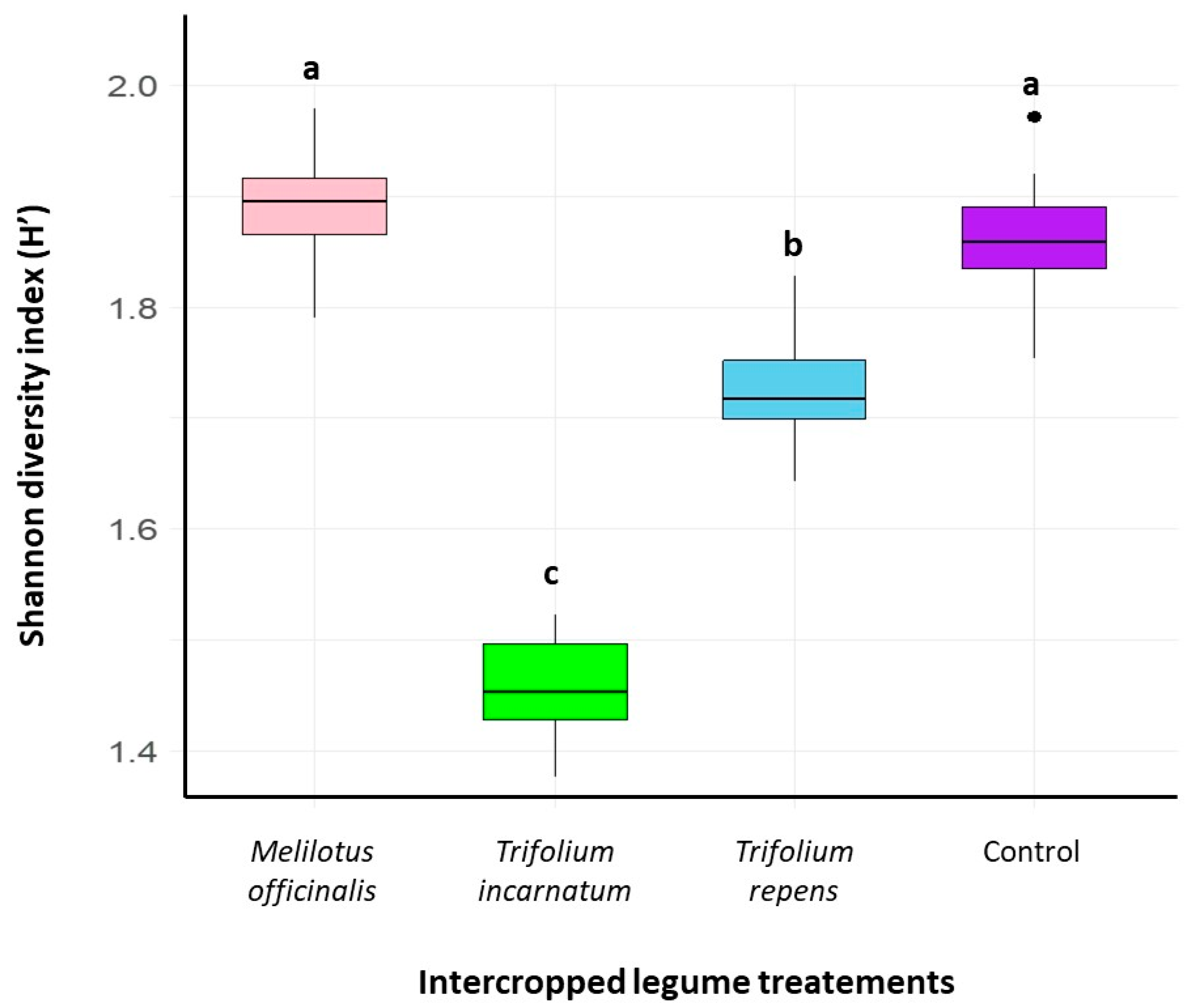
3.2. Species Richness (S) and Shannon Diversity (H′)
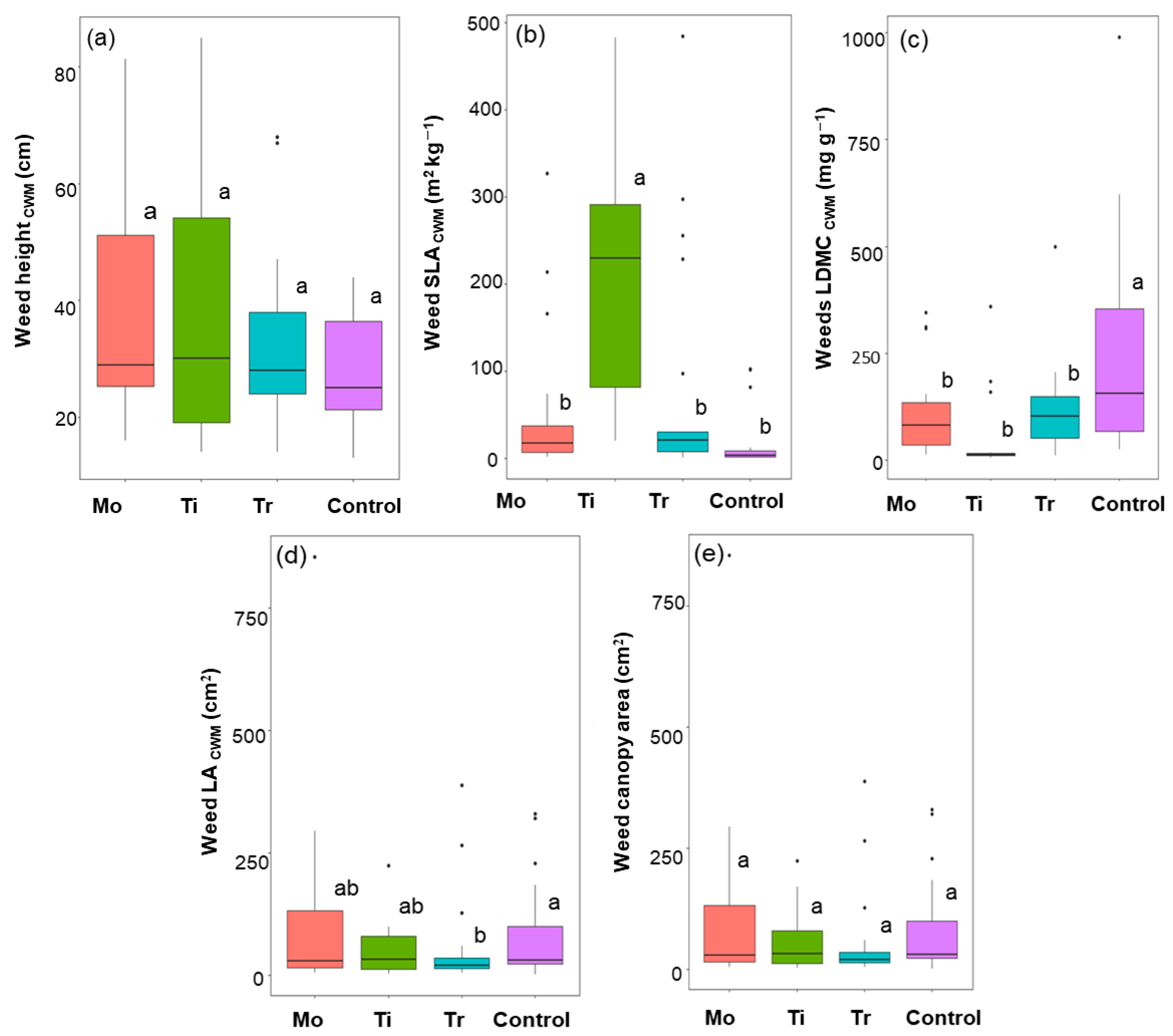
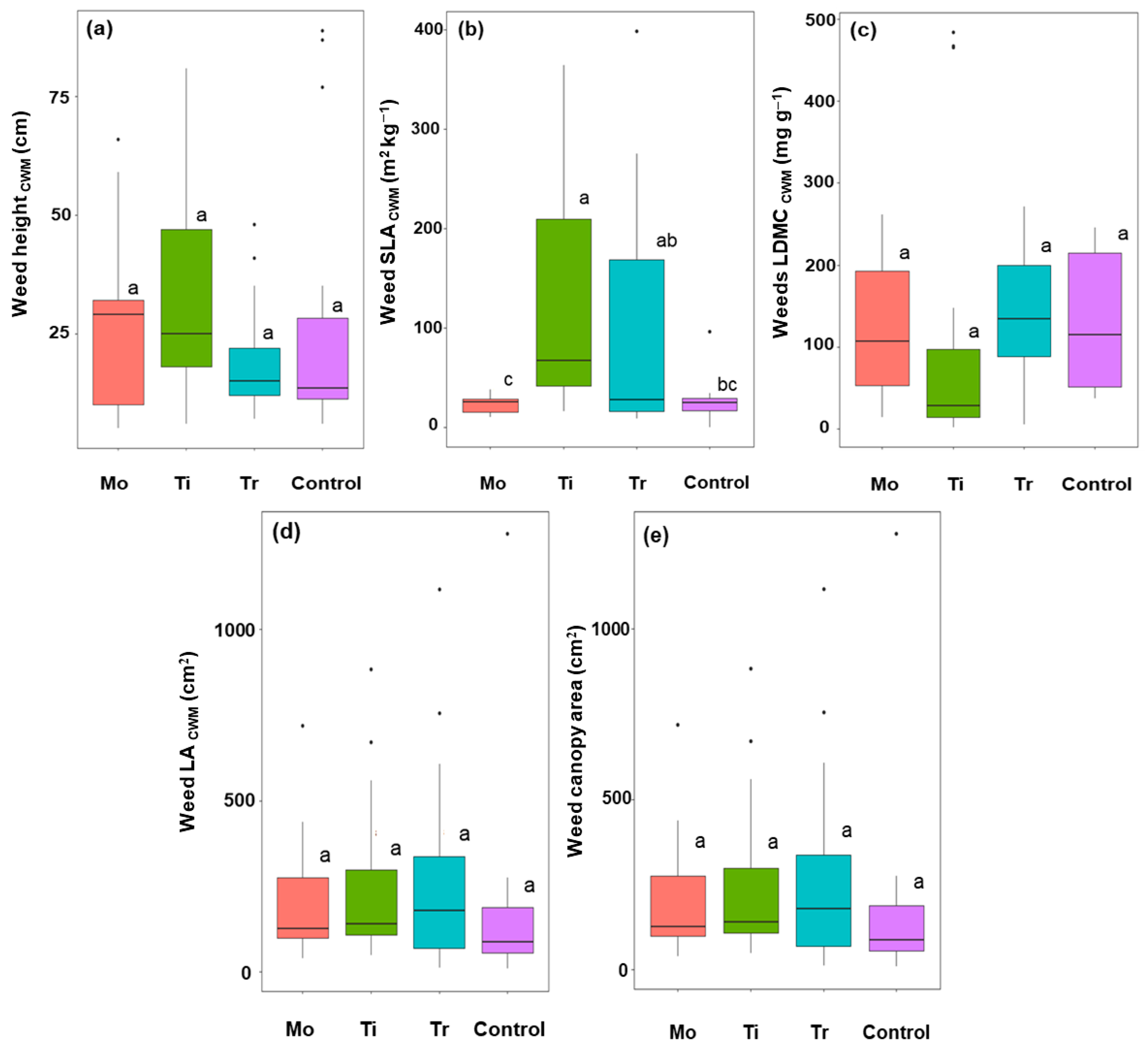
3.3. Species’ Functional Traits
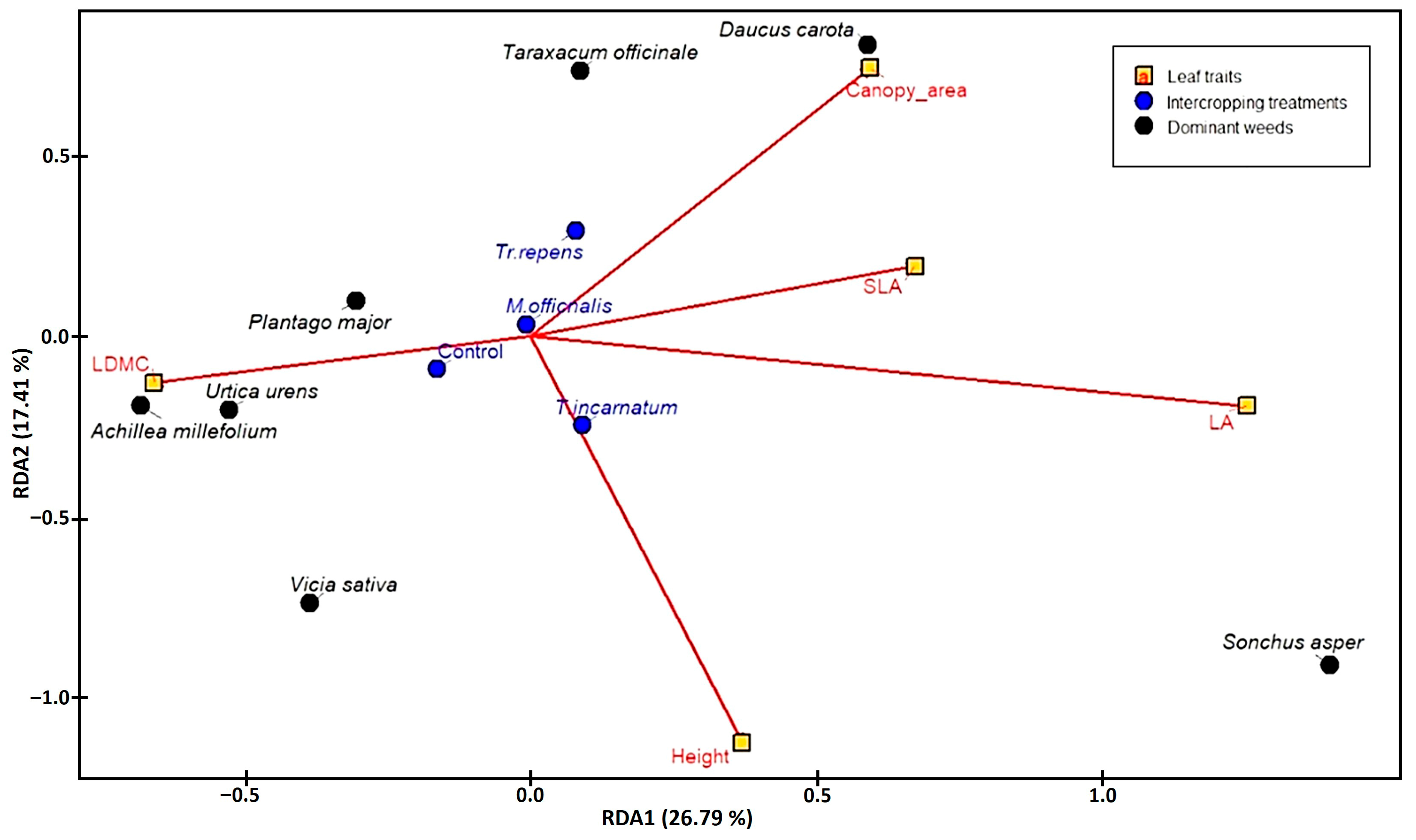
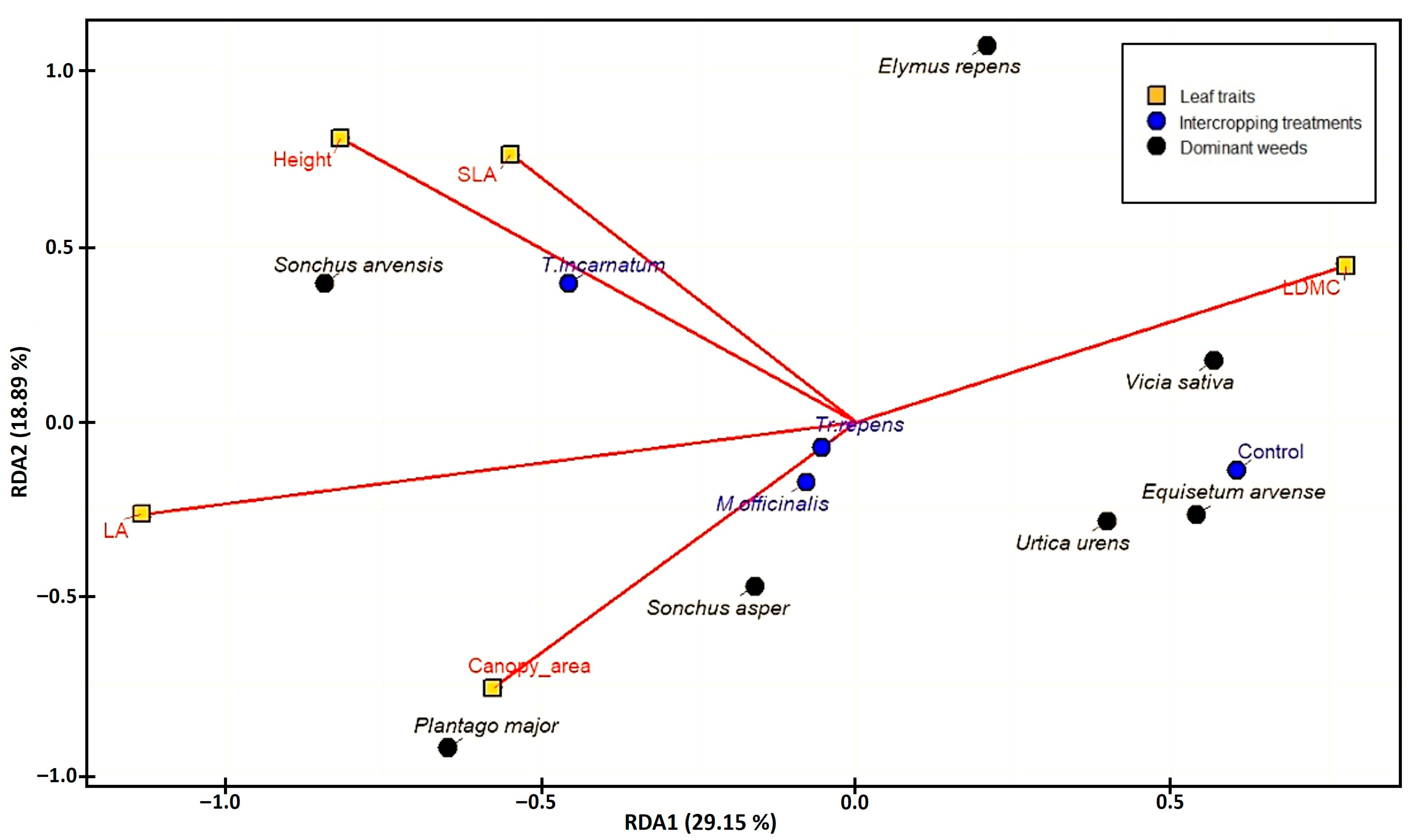
3.4. Functional Structuring of the Weed Communities
4. Discussion
4.1. Structure, Diversity, and Composition of Weed Communities
4.2. Functional Structure Response
5. Conclusions
Author Contributions
Funding
Data Availability Statement
Acknowledgments
Conflicts of Interest
Abbreviations
| SLA | Specific Leaf Area |
| LA | Leaf area |
| LDMC | Leaf Dry Matter Content |
Appendix A

| Weeds | Mo | Ti | Tr | Control |
|---|---|---|---|---|
| Height (cm) | ||||
| Achillea millefolium | - | 32.7 (14.0) | 12.3 (5) | - |
| Daucus carota | 7.0 (2.2) | - | - | - |
| Sonchus asper | - | - | 41.0 (7.0) | 29.3 (6.0) |
| Plantago major | - | 11.7 (1.5) | 11.0 (1.5) | 13.0 (2.6) |
| Taraxacum officinale | 12.0 (1.7) | 21.0 (11.5) | - | 10.7 (4.2) |
| Urtica urens | 30.3 (1.5) | 41.7 (13.8) | 32.0 (17.7) | 12.7 (6.4) |
| Vicia sativa | 31.3 (1.2) | 16.3 (9.6) | 17.7 (4.9) | 84.3 (6.4) |
| Specific Leaf Area (SLA, m2 kg−1) | ||||
| Achillea millefolium | - | 25.9 (6.5) | 19.4 (13.9) | - |
| Daucus carota | 28.8 (5.4) | - | - | - |
| Sonchus asper | - | - | 44.9 (31.4) | 38.0 (20.0) |
| Plantago major | - | 134 (115) | 231.9 (55.7) | 49.6 (40.6) |
| Taraxacum officinale | 33.7 (4.5) | 38.1 (25.2) | - | 20.1 (6.9) |
| Urtica urens | 25.1 (2.0) | 218 (2) | 17.8 (1.2) | 28.5 (3.5) |
| Vicia sativa | 17.8 (8.2) | 299 (80) | 24.2 (9.3) | 13.8 (14.7) |
| Leaf Dry Matter Content (LDMC, mg g−1) | ||||
| Achillea millefolium | - | 472 (9) | 315 (111) | - |
| Daucus carota | 182 (111) | - | - | - |
| Sonchus asper | - | - | 24 (5) | 63.1 (34) |
| Plantago major | - | 129 (114) | 123 (103) | 45.0 (35.0) |
| Taraxacum officinale | 38.0 (16.0) | 89 (63) | - | 42.6 (4.5) |
| Urtica urens | 232 (33) | 179 (148) | 233 (33) | 240 (6) |
| Vicia sativa | 152 (4) | 15.7 (2.1) | 163 (36) | 76.6 (35.6) |
| Leaf area (LA, cm2) | ||||
| Achillea millefolium | - | 1.8 (0.1) | 0.7 (0.4) | - |
| Daucus carota | 16.6 (5.4) | - | - | - |
| Sonchus asper | - | - | 14.6 (2.5) | 13.0 (4) |
| Plantago major | - | 4.7 (0.4) | 20.4 (8.4) | 17.8 (5.1) |
| Taraxacum officinale | 2.5 (0.9) | 1.9 (1.03) | - | 1.7 (0.8) |
| Urtica urens | 6.9 (7.5) | 1.3 (0.4) | 1.1 (0.1) | 1.4 (0.4) |
| Vicia sativa | 2.5 (0.4) | 3.1 (0.5) | 3.1 (0.9) | 0.9 (0.5) |
| Canopy area (cm2) | ||||
| Achillea millefolium | - | 141 (106) | 176 (98) | - |
| Daucus carota | 464 (230) | - | - | - |
| Sonchus asper | - | - | 71 (40) | 68 (35) |
| Plantago major | - | 93 (29) | 192 (110) | 123 (90) |
| Taraxacum officinale | 211 (196) | 501 (332) | - | 186 (94) |
| Urtica urens | 187 (134) | 302 (238) | 95 (88) | 90 (30) |
| Vicia sativa | 146 (40) | 89 (35) | 103 (52) | 130 (103) |
| Weeds | Mo | Ti | Tr | Control |
|---|---|---|---|---|
| Height (cm) | ||||
| Elymus repens | 26.7 (1.7) | 2.4 (1.1) | 33.0 (5.0) | 42.2 (0.8) |
| Equisetum arvense | - | 2.4 (1.3) | 30.2 (3.4) | - |
| Plantago major | 30.6 (1.4) | 23.4 (5.8) | 31.0 (7.8) | 25.7 (2.1) |
| Sonchus arvensis | 30.4 (1.4) | 26.2 (0.9) | - | 36.6 (3.5) |
| Sonchus asper | 77.2 (3.5) | - | 17.9 (3.7) | - |
| Urtica urens | 22.3 (5.5) | 3.1 (0.6) | 32.6 (7.6) | 22.6 (0.3) |
| Vicia sativa | - | 3.8 (1.1) | 23.9 (1.7) | 14.7 (0.5) |
| Specific Leaf Area (SLA, m2 kg−1) | ||||
| Elymus repens | 235 (83) | 335 (35) | 254 (56) | 8.3 (3.6) |
| Equisetum arvense | - | 38.9 (24.1) | 76.8 (59.2) | - |
| Plantago major | 6.5 (1.1) | 222 (80) | 260 (35) | 2.78 (2.8) |
| Sonchus arvensis | 38.5 (3.0) | 220 (50) | - | 2.7 (2.1) |
| Sonchus asper | 33.7 (5.2) | - | 15.4 (4.4) | - |
| Urtica urens | 4.5 (2.9) | 88.4 (52.8) | 23.4 (13.5) | 3.2 (0.3) |
| Vicia sativa | - | 358 (110) | 23.4 (8.4) | 1.5 (0.5) |
| Leaf Dry Matter Content (LDMC, mg g−1) | ||||
| Elymus repens | 322 (21) | 235 (109) | 201 (26) | 396 (1) |
| Equisetum arvense | - | 16.2 (0.6) | 152 (21) | - |
| Plantago major | 18.3 (7.3) | 10.3 (3.2) | 11.8 (0.6) | 301 (2) |
| Sonchus arvensis | 38.8 (22.8) | 11.5 (0.9) | - | 77.2 (3.6) |
| Sonchus asper | 98.6 (16.3) | - | 116 (42.2) | - |
| Urtica urens | 49.5 (22.2) | 8.6 (3.3) | 63.5 (47.8) | 92.1 (0.3) |
| Vicia sativa | - | 15.6 (2.2) | 164 (37) | 525 (1) |
| Leaf area (LA, cm2) | ||||
| Elymus repens | 2.3 (0.3) | 9.9 (9.7) | 5.1 (0.5) | 1.7 (0.9) |
| Equisetum arvense | - | 2.4 (1.3) | 0.7 (0.2) | - |
| Plantago major | 1.9 (0.8) | 158 (72) | 28.4 (4.9) | 8.5 (1.3) |
| Sonchus arvensis | 16.8 (6.6) | 37.6 (24) | - | 7.4 (3.6) |
| Sonchus asper | 22.2 (1.7) | - | 20.3 (5.7) | - |
| Urtica urens | 1.3 (0.5) | 14.1 (2.1) | 5.1 (0.5) | 1.2 (0.3) |
| Vicia sativa | - | 99.9 (25.3) | 3.0 (0.7) | 0.9 (0.5) |
| Canopy area (cm2) | ||||
| Elymus repens | 6.3 (2.1) | 55.9 (6.3) | 42.1 (21.7) | 113 (1) |
| Equisetum arvense | - | 26.1 (18.2) | 29.3 (5.5) | - |
| Plantago major | 431 (375) | 20.9 (6.7) | 260 (130) | 292 (2) |
| Sonchus arvensis | 173 (67) | 83.4 (2.1) | - | 26.3 (3.5) |
| Sonchus asper | 20.8 (1.9) | - | 4.9 (1.2) | - |
| Urtica urens | 2.2 (3.4) | 20.1 (6.7) | 15.9 (5.7) | 23.0 (7.8) |
| Vicia sativa | - | 37.9 (5.5) | 16.3 (3.3) | 3.9 (0.5) |
| Height | SLA 1 | LDMC 2 | LA 3 | Canopy Area | |
|---|---|---|---|---|---|
| Legume Species | (cm) | (m2 kg−1) | (mg g−1) | (cm2) | (cm2) |
| 2019 | |||||
| Melilotus officinalis (Mo) | 29.0 (2.1) | 17.8 (1.2) | 222 (62) | 3.0 (0.8) | 159 (138) |
| Trifolium incarnatum (Ti) | 44.5 (6.7) | 38.1 (25.2) | 119 (62) | 1.9 (1.0) | 173 (114) |
| Trifolium repens (Tr) | 19.8 (1.9) | 26.3 (5.7) | 198 (57) | 1.7 (0.5) | 323 (234) |
| 2020 | |||||
| Melilotus officinalis (Mo) | 9.9 (2.7) | 33.4 (2.8) | 231 (28) | 3.8 (0.9) | 133 (62) |
| Trifolium incarnatum (Ti) | 34.0 (2.0) | 36.0(13.6) | 180 (14) | 10.5 (3.0) | 36.9 (9.1) |
| Trifolium repens (Tr) | 16.8 (1.6) | 45.0 (15.0) | 96.2 (32.6) | 6.7 (1.9) | 40 (15) |
References
- Willer, H.; Trávníček, J.; Schlatter, B. (Eds.) The World of Organic Agriculture. Statistics and Emerging Trends 2025; Research Institute of Organic Agriculture FiBL, Frick, and IFOAM—Organics International: Bonn, Germany, 2025; 350p. [Google Scholar]
- Agriculture et Agroalimentaire Canada (AAC). Canada: Perspectives des Principales Grandes Cultures 2025—Rapport du Groupe de L’analyse du Marché, Division des Cultures et de L’horticulture, Direction du Développement et de L’analyse du Secteur, Direction Générale des Services à L’industrie et Aux Marchés; Gouvernement du Canada: Ottawa, ON, Canada, 2025; 15p. [Google Scholar]
- Reganold, J.P.; Wachter, J.M. Organic agriculture in the twenty-first century. Nat. Plants 2016, 2, 15221. [Google Scholar] [CrossRef]
- Halde, C.; Gagné, S.; Charles, A.; Lawley, Y. Organic No-Till Systems in Eastern Canada: A Review. Agriculture 2017, 7, 36. [Google Scholar] [CrossRef]
- Gaba, S.; Fried, G.; Kazakou, E.; Chauvel, B.; Navas, M.-L. Agroecological weed control using a functional approach: A review of cropping systems diversity. Agron. Sustain. Dev. 2014, 33, 103–119. [Google Scholar] [CrossRef]
- Reboud, X.; Bedoussac, L.; Cellier, V.; Cordeau, S.; Delzon, S.; Leclerc, M.; Jouan, J. Mobiliser les agroéquipements et le numérique pour des systèmes de culture sans pesticides—Chapitre 6. In Zéro Pesticide. Un Nouveau Paradigme de Recherche Pour Une Agriculture Durable; Jacquet, F., Jeuffroy, M.-H., Jouan, J., Le Cadre, E., Malausa, T., Reboud, C., Huyghe, C., Eds.; Éditions Quae: Versailles, France, 2022; pp. 117–194. [Google Scholar]
- MacLaren, C.; Storkey, J.; Menegat, A.; Metcalfe, H.; Dehnen-Schmutz, K. An ecological future for weed science to sustain crop production and the environment: A review. Agron. Sustain. Dev. 2020, 40, 24. [Google Scholar] [CrossRef]
- Singh, S.P.; Rani, V.; Sengar, R.S.; Gupta, S. Weed management in organic farming for better crop production. Progress. Agric. 2022, 22, 117–125. [Google Scholar] [CrossRef]
- Liebman, M.; Dyck, E. Crop rotation and intercropping strategies for weed management. Ecol. Appl. 1993, 3, 92–122. [Google Scholar] [CrossRef]
- Verret, V.; Gardarin, A.; Pelzer, E.; Médiène, S.; Makowski, D.; Valantin-Morison, M. Can legume companion plants control weeds without decreasing crop yield? A meta-analysis. Fiedl Crops Res. 2017, 204, 158–168. [Google Scholar] [CrossRef]
- Vannasse, A.; Thibaudeau, S.; Weil, A. Guide des Cultures de Couvertures en Grandes Cultures; Centre de Référence en Agriculture et Agroalimentaire du Québec (CRAAQ): Québec, QC, Canada, 2022; 204p. [Google Scholar]
- Abad, J.; Hermoso de Mendoza, I.; Marín, D.; Orcaray, L.; Santesteban, L.G. Cover crops in viticulture. A systematic review (1): Implications on soil characteristics and biodiversity in vineyard. OENO One 2021, 55, 295–312. [Google Scholar] [CrossRef]
- Garcia, L.; Celette, F.; Gary, C.; Ripoche, A.; Valdés-Gómez, H.; Métay, A. Management of service crops for the provision of ecosystem services in vineyards: A review. Agric. Ecosyst. Environ. 2018, 251, 158–170. [Google Scholar] [CrossRef]
- Smith, R.G.; Lounsbury, N.P.; Palmer, S.A. Mechanisms of Weed Suppression by Cover Crops, Intercrops, and Mulches—Chapter 10. In Weed Management in Organic Agriculture; Korres, N.E., Travlos, I.S., Gitsopoulos, T.K., Eds.; John Wiley & Sons Inc.: Hoboken, NJ, USA, 2023; pp. 172–195. [Google Scholar] [CrossRef]
- Gardarin, A.; Celette, F.; Naudin, C.; Piva, G.; Valantin-Morison, M.; Vrignon-Brenas, S.; Verret, V.; Médiène, S. Intercropping with service crops provides multiple services in temperate arable systems: A review. Agron. Sustain. Dev. 2022, 42, 39. [Google Scholar] [CrossRef]
- Gerhards, R. Weed suppression ability and yield impact of living mulch in cereal crops. Agriculture 2018, 8, 39. [Google Scholar] [CrossRef]
- Zhang, H.; Liu, C.; Mao, L.; Li, Y.; Shen, Y. Divergent response of hay and grain yield of oat: Effects of environmental factors and sowing rate. J. Sci. Food. Agric. 2023, 103, 233–242. [Google Scholar] [CrossRef]
- Food and Agriculture Organization of the United Nations. FAOSTAT Database: Oats. Available online: https://www.fao.org/faostat/en/#data/QCL (accessed on 8 December 2025).
- Damour, G.; Garnier, E.; Navas, M.L.; Dorel, M.; Risède, J.-M. Using functional traits to assess the services provided by cover plants: A review of potentialities in banana cropping systems. Adv. Agron. 2015, 130, 81–133. [Google Scholar] [CrossRef]
- Tribouillois, H.; Fort, F.; Cruz, P.; Charles, R.; Flores, O.; Garnier, E.; Justes, E. A functional characterisation of a wide range of cover crop species: Growth and nitrogen acquisition rates, leaf traits and ecological strategies. PLoS ONE 2015, 10, e0122156. [Google Scholar] [CrossRef]
- Brown, R.L.; Jacobs, L.A.; Peet, R.K. Species richness: Small scale. In Encyclopedia of Life Sciences; John Wiley & Sons, Ltd.: Chichester, UK, 2007; Available online: https://onlinelibrary.wiley.com/doi/abs/10.1002/9780470015902.a0020488 (accessed on 8 December 2025).
- Spellerberg, I.F.; Fedor, P.J. A tribute to Claude Shannon (1916–2001) and a plea for more rigorous use of species richness, species diversity and the ‘Shannon–Wiener’ Index. Glob. Ecol. Biogeogr. 2003, 12, 177–179. [Google Scholar] [CrossRef]
- Violle, C.; Navas, M.-L.; Vile, D.; Kazakou, E.; Fortunel, C.; Hummel, I.; Garnier, E. Let the concept of trait be functional! Oikos 2007, 116, 882–892. [Google Scholar] [CrossRef]
- Díaz, S.; Kattge, J.; Cornelissen, J.H.C.; Wright, I.J.; Lavorel, S.; Dray, S.; Gorné, L.D.; Wirth, C. The global spectrum of plant form and function. Nature 2016, 529, 167–171. [Google Scholar] [CrossRef] [PubMed]
- Kazakou, E.; Fried, G.; Richarte, J.; Gimenez, O.; Violle, C.; Metay, A. A plant trait-based response-and-effect framework to assess vineyard inter-row soil management. Bot. Lett. 2016, 163, 373–388. [Google Scholar] [CrossRef]
- Environment and Climate Change Canada. Canadian Climate Normals and Averages (1981–2010). 2025. Available online: https://climate.weather.gc.ca/climate_normals/index_e.html (accessed on 30 December 2025).
- Peel, M.C.; Finlayson, B.L.; McMahon, T.A. Updated world map of the Köppen-Geiger climate classification. Hydrol. Earth Syst. Sci. 2007, 11, 1633–1644. [Google Scholar] [CrossRef]
- Rompre, M.; Carrier, D. Études Pédologiques des Sols Défrichés de L’Abitibi-Témiscamingue; Centre de Recherche et D’expérimentation en sols, Ministère de l’Agriculture, des Pêcheries et de l’Alimentation du Québec: Québec, QC, Canada, 1997; 133p. [Google Scholar]
- Groupe de Travail sur la Classification des Sols. Le Système Canadien de Classification des Sols, 3rd ed.; Direction de la Recherche, Agriculture et Agro-Alimentaire du Canada: Ottawa, ON, Canada, 2002; 196p.
- Joly, A.; Bonnet, P.; Goëau, H.; Barbe, J.; Selmi, S.; Champ, J.; Dufour-Kowalski, S.; Affouard, A.; Carré, J.; Molino, J.-F.; et al. A look inside the Pl@ntNet experience. Multimed. Syst. 2016, 22, 751–766. [Google Scholar] [CrossRef]
- Neto-Bradley, B.M.; Bonnet, P.; Goëau, H.; Joly, A.; Cavender-Bares, J.; Coomes, D.A. Using reflectance spectra and Pl@ntNet to identify herbarium specimens: A case study with Lithocarpus. New Phytol. 2025. [Google Scholar] [CrossRef]
- Flora of North America Editorial Committee. Flora of North America: North of Mexico—Volume 2, Pteridophytes and Gymnosperms; Oxford University Press: Oxford, UK, 1993; 496p. [Google Scholar]
- Flora of North America Editorial Committee. Flora of North America: North of Mexico—Volume 3, Magnoliophyta: Magnoliidae and Hamamelidae; Oxford University Press: Oxford, UK, 1997; 616p. [Google Scholar]
- Flora of North America Editorial Committee. Flora of North America: North of Mexico—Volume 11, Fabaceae; Oxford University Press: Oxford, UK, 2013; 1108p. [Google Scholar]
- Flora of North America Editorial Committee. Flora of North America: North of Mexico—Volume 17, Tetrachondraceae to Orobanchaceae; Oxford University Press: Oxford, UK, 2019; 768p. [Google Scholar]
- Flora of North America Editorial Committee. Flora of North America: North of Mexico—Volume 19, Asteraceae, Part 1; Oxford University Press: Oxford, UK, 2006; 610p. [Google Scholar]
- Flora of North America Editorial Committee. Flora of North America: North of Mexico—Volume 24, Poaceae, Part 1; Oxford University Press: Oxford, UK, 2007; 944p. [Google Scholar]
- Peratoner, G.; Pötsch, E.M. Methods to describe the botanical composition of vegetation in grassland research. Die Bodenkultur J. Land Manag. Food Environ. 2019, 70, 1–18. [Google Scholar] [CrossRef]
- Daubenmire, R.F. A canopy-coverage method of vegetational analysis. Northwest Sci. 1959, 33, 43–64. [Google Scholar]
- Garnier, E.; Navas, M.-L.; Grigulis, K. Plant Functional Diversity: Organism Traits, Community Structure, and Ecosystem Properties; Oxford University Press: Oxford, UK, 2016; 231p. [Google Scholar]
- Shannon, C.E.; Weaver, W. The Mathematical Theory of Communication; University of Illinois Press: Urbana, IL, USA, 1949; 125p. [Google Scholar]
- Pérez-Harguindeguy, N.; Díaz, S.; Garnier, E.; Lavorel, S.; Poorter, H.; Jaureguiberry, P.; Bret-Harte, M.S.; Cornwell, W.K.; Craine, J.; Gurvich, D.E.; et al. New handbook for standardised measurement of plant functional traits worldwide. Aust. J. Bot. 2013, 61, 167–234, Corrigendum in Aust. J. Bot. 2016, 64, 715–716. [Google Scholar] [CrossRef]
- Grime, J.P.; Hodgson, J.G.; Hunt, R. Comparative Plant Ecology: A Functional Approach to Common British Species; Springer: Dordrecht, The Netherlands, 1988; 742p. [Google Scholar]
- Garnier, E.; Cortez, J.; Billès, G.; Navas, M.-L.; Roumet, C.; Debussche, M.; Laurent, G.; Blanchard, A.; Aubry, D.; Bellmann, A.; et al. Plant functional markers capture ecosystem properties curing secondary succession. Ecology 2004, 85, 2630–2637. [Google Scholar] [CrossRef]
- Laughlin, D.C. The intrinsic dimensionality of plant traits and its relevance to community assembly. J. Ecol. 2014, 102, 186–193. [Google Scholar] [CrossRef]
- Cornelissen, J.H.C.; Lavorel, S.; Garnier, E.; Díaz, S.; Buchmann, N.; Gurvich, D.E.; Poorter, H.; Steege, H.T.; Morgan, H.D.; Van Der Heijden, M.G.A.; et al. A handbook of protocols for standardised and easy measurement of plant functional traits worldwide. Aust. J. Bot. 2003, 51, 335–380. [Google Scholar] [CrossRef]
- Regent Instruments. WinFOLIA Software Pro Version 2006a for Windows; Regent Instruments Inc.: Québec, QC, Canada, 2006. [Google Scholar]
- R Core Team. R: A Language and Environment for Statistical Computing Version 4.1.1; R Foundation for Statistical Computing: Vienna, Austria, 2021; Available online: https://www.R-project.org/.
- Campiglia, E.; Radicetti, E.; Mancinelli, R. Weed control strategies and yield response in a pepper crop (Capsicum annuum L.) mulched with hairy vetch (Vicia villosa Roth.) and oat (Avena sativa L.) residues. Crop Prot. 2012, 33, 65–73. [Google Scholar] [CrossRef]
- Aerts, R. Interspecific competition in natural plant communities: Mechanisms, trade offs and plant soil feedbacks. J. Exp. Bot. 1999, 50, 29–37. [Google Scholar] [CrossRef]
- Légère, A.; Stevenson, F.C.; Benoit, D.L. Diversity and assembly of weed communities: Contrasting responses across cropping systems. Weed Res. 2005, 45, 303–315. [Google Scholar] [CrossRef]
- Stevenson, F.C.; Légère, A.; Simard, R.R.; Angers, D.A.; Pageau, D.; Lafond, J. Weed species diversity in spring barley varies with crop rotation and tillage, but not with nutrient source. Weed Sc. 1997, 45, 798–806. [Google Scholar] [CrossRef]
- Teasdale, J.R.; Brandsæter, L.O.; Calegari, A.; Neto, F.S. Cover crops and weed management. In Non-Chemical Weed Management: Principles, Concepts and Technology; Upadhyaya, M.K., Blackshaw, R.E., Eds.; CABI: Wallingford, UK, 2007; pp. 49–64. [Google Scholar] [CrossRef]
- Werner, C.M.; Stuble, K.L.; Groves, A.M.; Young, T.P. Year effects: Interannual variation as a driver of community assembly dynamics. Ecology 2020, 101, e03104. [Google Scholar] [CrossRef]
- Yue, K.; Jarvie, S.; Senior, A.M.; Van Meerbeek, K.; Peng, Y.; Ni, X.; Wu, F.; Svenning, J.-C. Changes in plant diversity and its relationship with productivity in response to nitrogen addition, warming and increased rainfall. Oikos 2020, 129, 939–952. [Google Scholar] [CrossRef]
- Ross, S.M.; King, J.R.; Izaurralde, R.C.; O’Donovan, J.T. Weed suppression by seven clover species. Agron. J. 2001, 93, 820–827. [Google Scholar] [CrossRef]
- Liebman, M.; Davis, A.S. Integration of soil, crop and weed management in low-external-input farming systems. Weed Res. 2002, 40, 27–47. [Google Scholar] [CrossRef]
- Uchino, H.; Iwama, K.; Jitsuyama, Y.; Yudate, T.; Nakamura, S. Yield losses of soybean and maize by competition with interseeded cover crops and weeds in organic-based cropping systems. Field Crops Res. 2009, 113, 342–351. [Google Scholar] [CrossRef]
- Jamshidi, K.; Yousefi, A.R.; Oveisi, M. Effect of cowpea (Vigna unguiculata) intercropping on weed biomass and maize (Zea mays) yield. N. Z. J. Crop Hortic. Sci. 2013, 41, 180–188. [Google Scholar] [CrossRef]
- Bilalis, D.; Papastylianou, P.; Konstantas, A.; Patsiali, S.; Karkanis, A.; Efthimiadou, A. Weed-suppressive effects of maize-legume intercropping in organic farming. Int. J. Pest. Manage. 2010, 56, 173–181. [Google Scholar] [CrossRef]
- Juhász, C.; Mendler-Drienyovszki, N.; Magyar-Tábori, K.; Zsombik, L. Evaluation of chemical weed-control strategies for common vetch (Vicia sativa L.) and sweet white lupine (Lupinus albus L.) under field conditions. Agronomy 2025, 15, 916. [Google Scholar] [CrossRef]
- Coleman, M.; Kristiansen, P.E.; Sindel, B.M.; Fyfe, C. Dwarf Nettle (Urtica urens): Weed Management Guide for Australian Vegetable Production; School of Environmental and Rural Science, University of New England: Armidale, Australia, 2018; 12p. [Google Scholar]
- Fried, G.; Blanchet, C.; Cazenave, L.; Bopp, M.C.; Kazakou, E.; Metay, A.; Cordeau, S.; Rouifed, S. Consistent response of weeds according to Grime’s CSR strategies along disturbance and resource gradients in Bordeaux vineyards. Weed Res. 2022, 62, 347–359. [Google Scholar] [CrossRef]
- Bitarafan, Z.; Andreasen, C. Seed retention of ten common weed species at oat harvest reveals the potential for harvest weed seed control. Weed Res. 2020, 60, 343–352. [Google Scholar] [CrossRef]
- Wright, I.J.; Reich, P.B.; Westoby, M.; Ackerly, D.D.; Baruch, Z.; Bongers, F.; Cavender-Bares, J.; Chapin, T.; Cornelissen, J.H.C.; Diemer, M.; et al. The worldwide leaf economics spectrum. Nature 2004, 428, 821–827. [Google Scholar] [CrossRef]
- Wilson, P.J.; Thompson, K.; Hodgson, J.G. Specific leaf area and leaf dry matter content as alternative predictors of plant strategies. New Phytol. 1999, 143, 155–162. [Google Scholar] [CrossRef]
- Grime, J.P.; Hunt, R. Relative growth rate: Its range and adaptive significance in a local flora. J. Ecol. 1975, 63, 393–422. [Google Scholar] [CrossRef]
- Grime, J.P. Evidence for the existence of three primary strategies in plants and its relevance to ecological and evolutionary theory. Am. Nat. 1977, 111, 1169–1194. [Google Scholar] [CrossRef]
- Lambers, H.; Poorter, H. Inherent variation in growth rate between higher plants: A search for physiological causes and ecological consequences. Adv. Ecol. Res. 1992, 23, 187–261. [Google Scholar] [CrossRef]
- Poorter, H.; Remkes, C. Leaf area ratio and net assimilation rate of 24 wild species differing in relative growth rate. Oecologia 1990, 83, 553–559. [Google Scholar] [CrossRef]
- Chapin, F.S., III. The mineral nutrition of wild plants. Annu. Rev. Ecol. Syst. 1980, 11, 233–260. [Google Scholar] [CrossRef]


| Mean Temperature | Precipitation | Days with Precipitation | Growing Degree-Days | |||||||||
|---|---|---|---|---|---|---|---|---|---|---|---|---|
| (°C) | (mm) | (No.) | (Base 5 °C) (No.) | |||||||||
| Months | 2019 * | 2020 * | Avg * | 2019 * | 2020 * | Avg * | 2019 * | 2020 * | Avg * | 2019 * | 2020 * | Avg * |
| May | 6.9 | 7.5 | 9.3 | 56 | 41 | 76 | 11 | 11 | na | 63 | 147 | 134 |
| June | 14.0 | 15.5 | 14.3 | 133 | 84 | 88 | 12 | 13 | na | 249 | 300 | 280 |
| July | 18.8 | 19.7 | 16.9 | 65 | 125 | 100 | 9 | 16 | na | 397 | 441 | 368 |
| August | 15.7 | 15.4 | 15.3 | 91 | 61 | 97 | 14 | 11 | na | 318 | 309 | 320 |
| September | 11.1 | 10.6 | 10.2 | 95 | 114 | 108 | 13 | 19 | na | 163 | 166 | 154 |
| October | 5.3 | 1.6 | 4.0 | 97 | 127 | 82 | 16 | 20 | na | 42 | 13 | 8 |
| Species | Intercropped Legume Treatments | Family | |||
|---|---|---|---|---|---|
| M. officinalis | T. incarnatum | T. repens | Control | ||
| (%) | (%) | (%) | (%) | ||
| Avena sativa | 15 | 18 | 25 | 38 | Poaceae |
| Melilotus officinalis | 10 | 0 | 0 | 0 | Fabaceae |
| Trifolium incarnatum | 0 | 35 | 0 | 0 | Fabaceae |
| Trifolium repens | 0 | 0 | 22 | 1 | Fabaceae |
| Achillea millefolium | 4 | 7 * | 10 * | 3 | Asteraceae |
| Daucus carota | 16 *,† | 2 | 0 | 0 | Apiaceae |
| Elytrigia repens | 0 | 0 | 0 | 2 | Poaceae |
| Gernium molle | 0 | 2 | 1 | 1 | Geraniaceae |
| Picris ecoides | 0 | 0 | 1 | 0 | Asteraceae |
| Plantago major | 4 | 8 * | 5 * | 14 * | Plantaginaceae |
| Sonchus asper | 3 | 3 | 9 * | 11 * | Asteraceae |
| Taraxacum officinale | 16 * | 4 * | 4 | 9 * | Asteraceae |
| Urtica urens | 18 * | 11 * | 11 * | 10 * | Urticaceae |
| Veronica arvensis | 0 | 0 | 0 | 1 | Plantaginaceae |
| Vicia sativa | 14 * | 10 * | 12 * | 10 * | Fabaceae |
| Total | 100 | 100 | 100 | 100 | |
| Species | Intercropped Legume Treatments | Family | |||
|---|---|---|---|---|---|
| M. officinalis | T. incarnatum | T. repens | Control | ||
| (%) | (%) | (%) | (%) | ||
| Avena sativa | 10 | 13 | 13 | 20 | Poaceae |
| Melilotus officinalis | 21 | 0 | 0 | 0 | Fabaceae |
| Trifolium incarnatum | 0 | 40 | 0 | 0 | Fabaceae |
| Trifolium repens | 0 | 0 | 25 | 0 | Fabaceae |
| Carduus pycnocephalus | 1 | 0 | 0 | 0 | Asteraceae |
| Centranthus calcitrapae | 0 | 1 | 0 | 0 | Valerianaceae |
| Convolvulus arvensis | 0 | 0 | 1 | 0 | Convolvulaceae |
| Crepis sancta | 0 | 2 | 1 | 1 | Asteraceae |
| Daucus carota | 0 | 0 | 0 | 1 | Apiaceae |
| Diplotaxis erucoides | 0 | 0 | 0 | 1 | Brassicaceae |
| Elymus repens | 10 *,† | 10 * | 9 * | 15 * | Poaceae |
| Equisetum arvense | 0 | 4 * | 9 * | 3 | Equisetaceae |
| Erodium cicutarium | 0 | 1 | 0 | 0 | Geraniaceae |
| Erigeron sumatrensis | 0 | 1 | 0 | 0 | Asteraceae |
| Geranium rotundifolium | 1 | 0 | 0 | 0 | Geraniaceae |
| Medicago sp. | 0 | 0 | 0 | 1 | Fabaceae |
| Plantago major | 13 * | 6 * | 11 * | 20 * | Plantaginaceae |
| Poa annua | 2 | 0 | 0 | 1 | Poaceae |
| Rumex pulcher | 0 | 0 | 0 | 1 | Polygonaceae |
| Sonchus arvensis | 6 * | 4 * | 0 | 7 * | Asteraceae |
| Sonchus asper | 24 * | 0 | 5 * | 0 | Asteraceae |
| Stellaria media | 1 | 0 | 5 | 0 | Caryophyllaceae |
| Urtica urens | 6 * | 12 * | 15 * | 16 * | Urticaceae |
| Veronica arvensis | 1 | 0 | 1 | 0 | Plantaginaceae |
| Veronica persica | 0 | 1 | 0 | 1 | Plantaginaceae |
| Vicia sativa | 1 | 5 * | 5 * | 11 * | Fabaceae |
| Vicia sp. | 0 | 0 | 0 | 1 | Fabaceae |
| Vicia villosa | 1 | 0 | 0 | 0 | Fabaceae |
| Vulpia myuros | 1 | 0 | 0 | 0 | Poaceae |
| Vulpia sp. | 1 | 0 | 0 | 0 | Poaceae |
| Total | 100 | 100 | 100 | 100 | |
| Species Richness (S) | Shannon Index (H) | |||
|---|---|---|---|---|
| Term | F-Ratio | p-Value | F-Ratio | p-Value |
| Treatment | 1.913 | 0.2160 | 17.649 | 0.0012 |
| Year | 256.000 | <0.0001 | 157.332 | <0.0001 |
| Treatment × Year | 5.667 | 0.0222 | 2.045 | 0.1861 |
Disclaimer/Publisher’s Note: The statements, opinions and data contained in all publications are solely those of the individual author(s) and contributor(s) and not of MDPI and/or the editor(s). MDPI and/or the editor(s) disclaim responsibility for any injury to people or property resulting from any ideas, methods, instructions or products referred to in the content. |
© 2026 by the authors. Licensee MDPI, Basel, Switzerland. This article is an open access article distributed under the terms and conditions of the Creative Commons Attribution (CC BY) license.
Share and Cite
Chida, I.; Ziadi, N.; Poirier, V. Do Intercropped Legumes Alter Weed Communities in Organic Field Crops? A Taxonomic and Functional Perspective. Agronomy 2026, 16, 708. https://doi.org/10.3390/agronomy16070708
Chida I, Ziadi N, Poirier V. Do Intercropped Legumes Alter Weed Communities in Organic Field Crops? A Taxonomic and Functional Perspective. Agronomy. 2026; 16(7):708. https://doi.org/10.3390/agronomy16070708
Chicago/Turabian StyleChida, Insaf, Noura Ziadi, and Vincent Poirier. 2026. "Do Intercropped Legumes Alter Weed Communities in Organic Field Crops? A Taxonomic and Functional Perspective" Agronomy 16, no. 7: 708. https://doi.org/10.3390/agronomy16070708
APA StyleChida, I., Ziadi, N., & Poirier, V. (2026). Do Intercropped Legumes Alter Weed Communities in Organic Field Crops? A Taxonomic and Functional Perspective. Agronomy, 16(7), 708. https://doi.org/10.3390/agronomy16070708