Article

Enhanced Photosynthetic Capacity and Assimilate Transport Are Associated with Higher Yield in Super Hybrid Rice

Jiangsu Provincial Key Lab for Organic Solid Waste Utilization, National Engineering Research Center for Organic-Based Fertilizers, Jiangsu Collaborative Innovation Center for Solid Organic Waste Resource Utilization, Nanjing Agricultural University, Nanjing 211800, China
*
Author to whom correspondence should be addressed.
Agronomy 2026, 16(6), 650; https://doi.org/10.3390/agronomy16060650
Submission received: 22 February 2026 / Revised: 6 March 2026 / Accepted: 17 March 2026 / Published: 19 March 2026
(This article belongs to the Section Plant-Crop Biology and Biochemistry)

Abstract

Enhancing rice yield under high-input systems increasingly relies on optimizing physiological processes rather than further increasing external inputs. This study aimed to clarify the physiological basis underlying the yield advantage of super hybrid rice, focusing on photosynthetic capacity and assimilate transport. We compared super hybrid rice (Yliangyou 3218 and Yliangyou 5867) with super conventional rice (Zhendao 11 and Nanjing 9108) under field conditions in 2023–2024. Super hybrid rice consistently outperformed super conventional rice, with grain yield 19.7% higher in 2023 and 23.7% higher in 2024, primarily due to an increased number of spikelets per panicle, and grain yield was also positively correlated with photosynthetic capacity (net photosynthetic rate, stomatal conductance, maximum carboxylation rate, maximum electron transport rate and triose phosphate utilization rate). In 2024, spikelets per panicle and grain yield were also positively associated with phloem soluble sugar and vascular bundle number, indicating that enhanced assimilate transport contributed to higher spikelet formation. These results demonstrate that, compared to super conventional rice, the yield advantage of super hybrid rice is underpinned by coordinated enhancement of photosynthesis and assimilate transport, highlighting the importance of source–sink optimization for further yield improvement.

1. Introduction

Rice (Oryza sativa L.) is one of the most important staple crops worldwide, feeding nearly half of the global population [1]. Continuous improvement in grain yield has long been a central goal of rice breeding and agricultural production. Since the Green Revolution, increases in cultivated area, intensive input of agricultural resources, and the development of high-yielding cultivars have collectively contributed to remarkable yield gains [2,3]. However, under modern high-yield conditions, further yield improvement increasingly encounters physiological constraints rather than being driven solely by external inputs such as fertilizers and pesticides.
Among the physiological processes influencing crop productivity, photosynthesis is widely recognized as a key determinant of biomass accumulation and yield potential [4,5]. More than 90% of plant dry matter is derived from photosynthetic carbon assimilation, which is jointly regulated by multiple factors, including CO2 diffusion capacity, Rubisco carboxylation activity, and electron transport rate [6]. Therefore, enhancing photosynthetic performance has been proposed as an effective strategy for sustaining future yield increases in rice [7].
Super rice refers to a group of rice cultivars developed through advanced breeding strategies that exhibit exceptionally high yield potential and favorable agronomic traits [8,9]. Unlike super conventional rice, which is improved through traditional breeding approaches such as pure-line selection, super hybrid rice is developed using hybrid rice technology by combining superior parental genotypes to maximize heterosis [10]. Super hybrid rice cultivars generally exhibit greater biomass accumulation, higher leaf area index, and larger panicles [8,11,12]. Accumulating evidence suggests that high-yielding super hybrid rice cultivars often possess enhanced photosynthetic capacity. For example, Huang et al. [13] reported that the super hybrid rice cultivar Y-liangyou 087 exhibited higher net photosynthetic rate (Pn), photochemical efficiency, Rubisco content, and chlorophyll a content than the control cultivar. Pan et al. [14] demonstrated that yield improvement in super hybrid rice was closely associated with increased aboveground biomass accumulation, largely attributable to higher radiation use efficiency. Similarly, Liu et al. [15] found that the superior yield performance of YLY900 was mainly driven by enhanced higher radiation use efficiency and biomass production. Together, these studies highlight the importance of improved photosynthetic performance in achieving high yield in super hybrid rice.
However, enhanced photosynthetic capacity does not necessarily translate directly into increased grain yield, as photosynthetically fixed carbon must be efficiently transported from source leaves to sink organs [16]. Assimilates are loaded into the phloem and transported over long distances through sieve elements from source to sink tissues [17], making phloem transport a critical component of plant carbon allocation. Structural characteristics of the vascular system, particularly the number and distribution of vascular bundles, may influence phloem transport capacity and the efficiency of carbohydrate export [18,19]. In addition, soluble sugar concentration in phloem sap can serve as an indicator of assimilate loading and transport status. Despite their theoretical importance, the coordinated relationship between photosynthetic capacity and assimilate transport traits remains poorly characterized in high-yielding rice cultivars, especially in super hybrid rice under field conditions.
In this study, representative super hybrid and super conventional rice cultivars were compared under field conditions to clarify the physiological mechanisms underlying yield differences. The objective of this study was to evaluate whether enhanced photosynthetic capacity and improved assimilate transport are associated with the yield advantage of super hybrid rice.

2. Materials and Methods

2.1. Experimental Design, Plant Materials, and Field Management

Field experiments were conducted during the 2023 and 2024 growing seasons at a long-term experimental site in Rugao, Jiangsu Province, China, which has been maintained for over ten years for rice cultivation studies. The experimental soil was a sandy loam derived from alluvial deposits of the Jianghuai Plain, with the following properties: organic matter 15.1 g kg−1, total nitrogen 1.74 g kg−1, available phosphorus 16.3 mg kg−1, available potassium 88.2 mg kg−1, and pH 7.43.
A randomized complete block design with three replicate plots per cultivar (n = 3) was used. Each plot measured 25 m2 and was managed under identical agronomic practices. Plants within each plot received controlled irrigation via inlet and outlet water to ensure uniform growing conditions. Adjacent plots were separated by ridges covered with waterproof plastic to prevent lateral water flow and ensure plot isolation.
Four high-yielding rice cultivars were used, including two super hybrid rice cultivars (Yliangyou 3218, YLY3218; Yliangyou 5867, YLY5867, Guangxi Hengmao Agricultural Technology Co., Ltd., Nanning, China) and two super conventional rice cultivars (Zhendao 11, ZD11, Zhenjiang Institute of Agricultural Sciences, Zhenjiang, China; Nanjing 9108, NJ9108, Jiangsu Academy of Agricultural Sciences, Nanjing, China).
All treatments were conducted under a uniform nitrogen application rate of 270 kg N ha−1 using urea (46% N), split according to a basal: tillering: panicle initiation: panicle protection ratio of 4:2:2:2. Phosphorus fertilizer (75 kg P2O5 ha−1 as calcium superphosphate, 12% P2O5) was applied as a basal dressing, and potassium fertilizer (90 kg K2O ha−1 as potassium chloride, 60% K2O) was split between basal and panicle initiation stages at a ratio of 2:1.
Seeds were sown between 21 and 24 May, and seedlings were transplanted after 30 days under shallow flooding conditions. Planting density was 30.8 × 10⁴ hills ha−1, with two seedlings per hill and a spacing of 25 cm × 13 cm. Water management and pest control followed local high-yield cultivation practices. Super hybrid rice cultivars were harvested around 20 October, while super conventional rice cultivars were harvested around 28 October.

2.2. Leaf Gas Exchange Measurements

Leaf gas exchange parameters were measured using a portable photosynthesis system (LI-6400, LI-COR Biosciences, Lincoln, NE, USA) on the flag leaf (the most recently fully expanded leaf) of at least six independent plants per cultivar, each plant representing one biological replicate. Measurements were conducted between 09:00 and 15:00 on clear days, avoiding the midday photosynthetic depression period. Leaves were clamped in the chamber and allowed to stabilize for at least 15 min before recording gas exchange. Photosynthetically active radiation was set to 1500 μmol m−2 s−1, leaf temperature was maintained at 28 ± 1 °C, reference CO2 concentration was set to 400 μmol mol−1, relative humidity was maintained between 40% and 60%, and chamber air flow rate was set to 500 μmol s−1. Net photosynthetic rate, stomatal conductance (gs), intercellular CO2 concentration (Ci), and transpiration rate (Tr) were recorded. Measurements were completed over four consecutive clear days, and all cultivars were measured each day in a rotating order to minimize potential daily environmental variation.

2.3. Pn–Ci Curves and Photosynthetic Parameter Estimation

PnCi curves were obtained immediately after gas exchange measurements on the same leaves, under the same conditions as described above, by sequentially adjusting the reference CO2 concentrations (400, 350, 300, 250, 200, 100, 400, 450, 500, 550, 650, 800, 1000, and 1200 μmol mol−1). The Farquhar–von Caemmerer–Berry model was fitted to the PnCi curves to estimate maximum carboxylation rate (Vcmax), maximum electron transport rate (Jmax), and triose phosphate utilization rate (TPU) [20].

2.4. Phloem Sap Collection and Soluble Sugar Determination

Phloem sap was collected in 2024 at the heading stage using the EDTA exudation method following previously described procedures with minor modifications [21]. Main tillers with uniform growth were excised at the stem base at night and immediately placed in 25 mL of 20 mmol L−1 EDTA-Na2 solution. Samples were incubated in darkness under constant temperature conditions for 10 h to induce phloem exudation. Soluble sugar concentration in the exudate was determined using the anthrone colorimetric method. Four biological replicates were analyzed for each treatment (n = 4), with each replicate corresponding to the main tiller of an individual plant, and all replicates obtained from different plants.

2.5. Vascular Bundle Anatomical Observation

Leaf and leaf sheath samples were collected in 2024 at the heading stage for anatomical analysis. Transverse sections were taken from the middle region of the flag leaf blade and from the flag leaf sheath at a fixed position approximately 1–2 cm below the junction between the flag leaf blade and sheath to ensure sampling consistency among cultivars. Samples were immediately fixed in FAA solution (formalin–acetic acid–alcohol; 90 mL 50% ethanol, 5 mL glacial acetic acid, and 5 mL formaldehyde) for 24 h and subsequently dehydrated through a graded ethanol series. Freehand transverse sections of approximately uniform thickness were prepared using a razor blade, stained with aniline blue, and observed under a light microscope (BX53, Olympus, Tokyo, Japan). Observations were performed at ×200 magnification. The numbers of large vascular bundles (LVBs) and small vascular bundles (SVBs) were counted across the entire transverse section. At least six sections were analyzed for each cultivar.

2.6. Yield and Yield Component Determination

At maturity, 30 hills were randomly selected in each plot to determine effective panicle number. Effective panicles were defined as panicles bearing at least one filled grain. Six hills per plot were sampled to measure spikelets per panicle, seed-setting rate, and thousand-grain weight following standard agronomic procedures. Grain yield was determined by harvesting a 6 m2 area from the central part of each plot to avoid border effects and expressed on an area basis (kg ha−1). Grain yield was adjusted to a standard moisture content of 14%.

2.7. Statistical Analysis

Statistical analyses were performed using SPSS 25 (IBM Corp., Armonk, NY, USA). Differences among cultivars or treatments were evaluated using one-way or two-way analysis of variance (ANOVA), as appropriate. Mean comparisons for significant effects were conducted using Duncan’s multiple range test at p < 0.05. Correlation analyses between physiological and yield-related traits were performed using Pearson correlation coefficients. Results are presented as mean ± standard deviation (SD). Figures were generated using OriginPro 2024 (OriginLab Corporation, Northampton, MA, USA).

3. Results

3.1. Yield Performance

Grain yield differed significantly among cultivars in both 2023 and 2024 (Table 1). YLY5867 consistently produced the highest yield, followed by YLY3218, with both super hybrid rice cultivars significantly outperforming super conventional rice, averaging 19.7% and 23.7% higher in 2023 and 2024, respectively. Although absolute yields increased in 2024, no significant year effect or cultivar × year interaction was detected.
The primary difference in yield components was spikelet number per panicle, which was markedly higher in super hybrid rice (Table 1). YLY3218 had the highest spikelet number across both years, followed by YLY5867. Notably, super hybrid and super conventional rice exhibited opposite interannual trends: spikelet number increased in super hybrid rice but declined in super conventional rice, leading to a significant cultivar × year interaction.
Seed-setting rate was influenced by cultivar and cultivar × year interaction, with no consistent differences across years, whereas thousand-grain weight was cultivar-dependent, highest in YLY5867 and lowest in YLY3218 (Table 1). Despite slightly lower seed-setting rates, super hybrid rice maintained a consistent yield advantage, primarily associated with its higher spikelet numbers.

3.2. Leaf Gas Exchange Parameters

The two super hybrid rice exhibited significantly higher Pn than the super conventional rice (Table 2). On average, Pn was 45.6% higher in 2023 and 36.7% higher in 2024 in super hybrid rice. The trend was consistent across both growing seasons, and the significant differences were attributable to cultivar effects, with no significant cultivar × year interaction detected.
Similarly, gs was consistently higher in super hybrid rice than in super conventional rice. In 2023, gs differed significantly between the two cultivar types, with YLY3218 showing the highest value, followed by YLY5867, while NJ9108 and ZD11 were markedly lower. In 2024, YLY5867 exhibited the highest gs, followed by YLY3218, and significant differences were mainly observed between the super hybrid rice and ZD11. Overall, the differences in gs were significant among cultivars but not influenced by year (Table 2).
In 2023, Ci was significantly higher in super hybrid rice than in super conventional rice (Table 2). In 2024, no significant differences in Ci were detected among cultivars, whereas Pn remained significantly different among cultivars. Furthermore, Tr exhibited a similar pattern, with super hybrid rice averaging approximately 55% higher than super conventional rice across the two seasons (Table 2). Collectively, these results demonstrate consistent cultivar-dependent differences in gas exchange traits across both growing seasons.

3.3. Photosynthetic Capacity Parameters

To further evaluate the photosynthetic capacity among rice cultivars, PnCi response curves were determined. As CO2 concentration increased, Pn progressively increased in both super hybrid and super conventional rice. Across the measured CO2 range, super hybrid rice consistently exhibited higher Pn than super conventional rice, and this pattern was maintained in both growing seasons (Figure 1a,b).
In both seasons, Vcmax was significantly higher in super hybrid rice than in super conventional rice (Figure 1c). Among the cultivars, YLY5867 showed the highest Vcmax, followed by YLY3218, whereas NJ9108 exhibited the lowest values. This ranking was consistent throughout the two years. The significant differences were primarily attributed to cultivar effects, while the cultivar × year interaction was not significant.
For Jmax (Figure 1d), super hybrid rice showed significantly higher values than super conventional rice in 2023, with YLY5867 ranking highest and NJ9108 lowest. In 2024, the ranking of cultivars differed slightly: YLY3218 exhibited the highest Jmax, followed by ZD11 and YLY5867, whereas NJ9108 remained the lowest. Statistical analysis indicated that Jmax was significantly affected by both cultivar and the cultivar × year interaction.
Similar to Vcmax, TPU was higher in super hybrid rice than in super conventional rice in both seasons (Figure 1e). In 2023, YLY5867 showed the highest TPU, whereas in 2024 YLY3218 ranked highest; NJ9108 consistently exhibited the lowest values in both years. The significant differences in TPU were mainly attributed to cultivar effects, with no significant effects of year or cultivar × year interaction detected.

3.4. Assimilate Transport-Related Traits

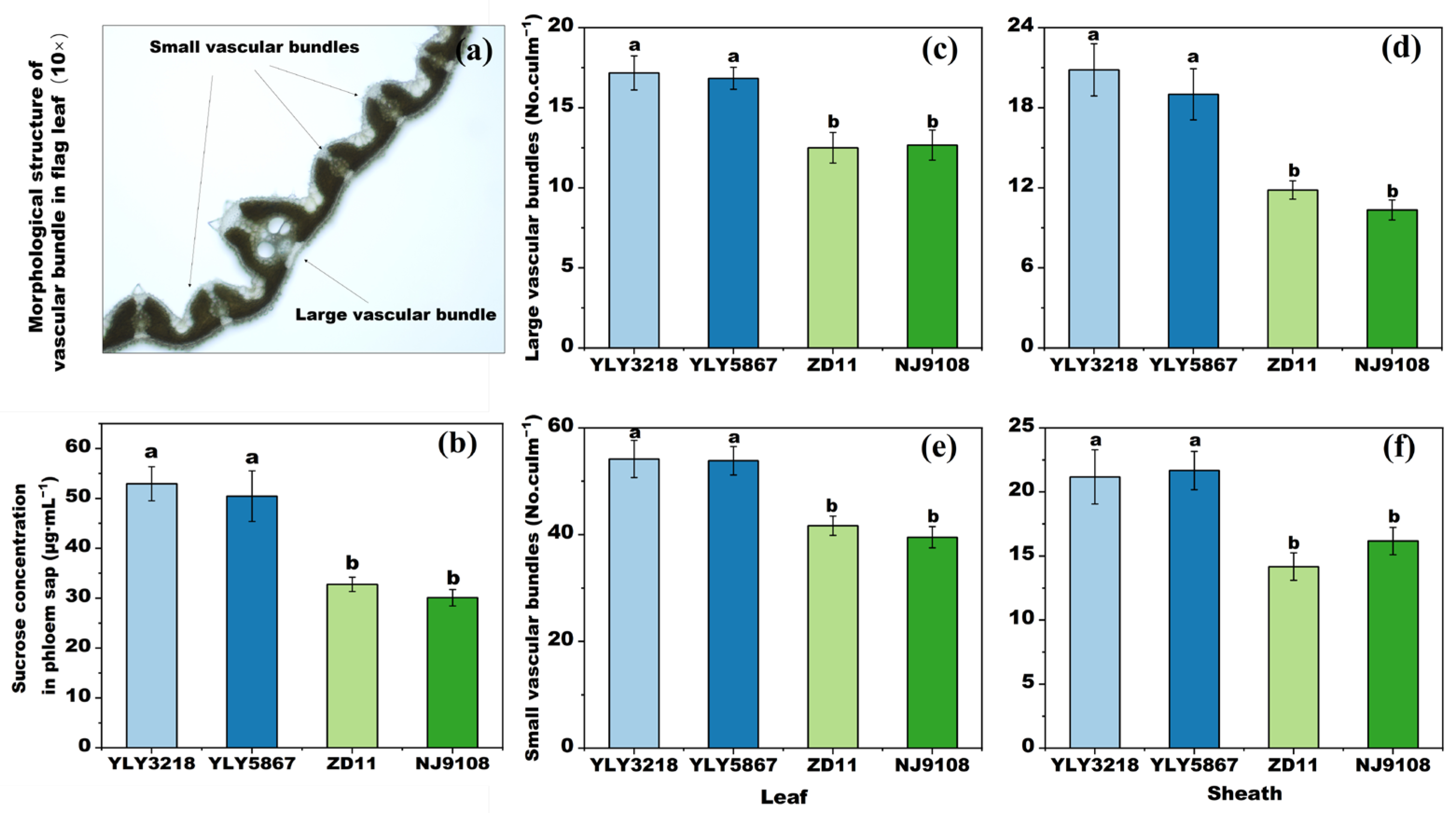
Transport-related traits, including soluble sugar concentration in phloem sap and vascular bundle number, were measured in 2024. Compared with super conventional rice, super hybrid rice exhibited significantly higher soluble sugar concentrations in phloem exudates (Figure 2b), with an average increase of 64%. Among the cultivars, YLY3218 showed the highest value, whereas NJ9108 showed the lowest.
Anatomical observations further revealed significant differences in vascular bundle number among cultivars, including both LVB and SVB (Figure 2c–f). In both leaves and leaf sheaths, YLY3218 had the highest LVB number, followed by YLY5867, while NJ9108 showed the lowest values overall (Figure 2c,d). For SVBs, the trend in leaves was generally consistent with that observed for LVBs; however, in leaf sheaths, YLY5867 exhibited the highest number, whereas ZD11 showed the lowest (Figure 2e,f). In leaves, super hybrid rice had on average 35.1% and 33.1% more LVBs and SVBs, respectively (Figure 2c,e). In leaf sheaths, these differences were further amplified, reaching 79.7% and 41.2%, respectively (Figure 2d,f). These results demonstrate clear differences in transport-related traits between the two rice types.

3.5. Relationships of Photosynthetic Capacity and Vascular Traits with Grain Yield and Spikelets per Panicle

Grain yield was analyzed across two seasons (2023–2024). Yield was significantly positively correlated with spikelets per panicle, but showed no significant correlation with other yield components, indicating that the yield advantage of super hybrid rice is primarily attributable to an increased number of spikelets per panicle (Table 3). Furthermore, grain yield was significantly positively correlated with photosynthetic parameters (Pn, gs, Vcmax, Jmax, and TPU), suggesting that enhanced photosynthetic biochemical capacity likely underlies the formation of higher grain yield (Table 3).
In 2024, grain yield was also significantly positively correlated with both soluble sugar concentration in phloem sap and the number of vascular bundles, indicating that transport capacity plays an important role in yield formation (Table 4). In addition, spikelets per panicle were significantly positively correlated with transport-related traits and assimilate flow, further supporting that the higher yield of super hybrid rice is underpinned by larger panicles and their enhanced capacity for assimilate transport (Table 4).

4. Discussion

4.1. Enhanced Photosynthetic Capacity Underpins the Yield Advantage of Super Hybrid Rice

Super hybrid rice achieves higher grain yield through both enhanced leaf photosynthetic capacity (Pn, gs, Vcmax, Jmax, TPU) and efficient assimilate transport (phloem sugar, vascular bundles), providing a physiological explanation for its yield advantage under field conditions. Across two consecutive growing seasons, this superiority in both photosynthetic performance and grain yield was consistently observed, indicating that the physiological advantages of super hybrid rice were robust under interannual environmental variation. Our results demonstrate that super hybrid rice exhibits significantly higher photosynthetic rates than super conventional rice under identical conditions (Table 2), and this pattern was maintained in both 2023 and 2024 without significant cultivar × year interaction. Breeding integrates favorable traits into new cultivars, and photosynthesis, being closely linked to yield, is often indirectly strengthened during selection. Transcriptomic analyses have revealed that genes involved in photosynthesis and carbon fixation are significantly upregulated in super hybrid rice compared with its parental lines [22,23], indicating a molecular basis for enhanced photosynthetic capacity.
The gs in super hybrid rice was significantly higher than in super conventional rice, facilitating the diffusion of CO2 from the atmosphere into the leaf intercellular spaces and thereby increasing the availability of carboxylation substrates. In 2023, Ci was also significantly higher in super hybrid rice, indicating that stomatal conductance contributed substantially to the higher Pn, with elevated gs enabling a relatively stable CO2 supply to support downstream biochemical processes (Table 2). In 2024, although Ci did not differ significantly among cultivars, the persistent significant differences in Pn, together with consistent reference CO2 levels, further suggest that gs played an important role in driving Pn (Table 2).
The observed differences in gs between super hybrid and super conventional rice may arise from both stomatal functional regulation and anatomical traits. Stomatal opening and closing are controlled by plasma membrane H+-ATPase activity and guard cell signaling, and overexpression of H+-ATPase has been shown to enhance photosynthetic capacity and grain yield in rice [24]. In addition, genotypic variation in stomatal density and size exists among rice cultivars, and the complementary trade-off between these traits can significantly affect gs [25]. Although stomatal density and size were not measured in the present study, they remain important potential factors underlying cultivar differences in gs. Furthermore, under fluctuating light conditions, stomatal responsiveness can strongly influence photosynthetic performance, as stomatal opening exhibits a lag relative to light changes and cannot instantaneously reach maximum aperture [26,27]. Differences in stomatal capacity may therefore cause reductions in photosynthetic rate and potential carbon loss, which could contribute substantially to the observed yield differences between super hybrid and super conventional rice. Taken together, our results indicate that the higher gs in super hybrid rice helps maintain a stable CO2 supply and supports higher photosynthetic rates; however, future studies incorporating measurements of stomatal anatomy and regulatory mechanisms are needed to provide a more complete physiological explanation.
In this study, super hybrid rice exhibited higher Vcmax (Figure 1c), which may result from multiple factors. Increased Rubisco content and activity can enhance Vcmax, while higher Rubisco activase levels can influence Vcmax by modulating Rubisco activation, thereby directly affecting photosynthetic capacity and grain yield [28,29]. Moreover, 30–40% of leaf nitrogen is allocated to carboxylation, so variation in leaf nitrogen distribution may also affect Vcmax [30,31]. As this study did not measure the content or activity of Rubisco and Rubisco activase, the dominant factors underlying the observed differences in Vcmax cannot be determined. Nevertheless, the observed increase in Vcmax may reflect the enhanced biochemical photosynthetic potential of super hybrid rice, though the specific mechanisms require further investigation.
Regarding differences in Jmax (Figure 1d), previous studies have shown that chloroplast electron transport is often limited by the cytochrome b6f complex, which serves as a key connection between photosystem II and photosystem I; insufficient abundance or activity of ATP synthase can also lead to proton gradient accumulation, restricting electron transport [32]. In addition, the Rieske FeS protein within the cytochrome b6f complex has been shown to directly modulate Jmax and leaf photosynthetic capacity in rice [33]. CO2 limitation may also indirectly affect Jmax, as this study observed significant differences in gs between the two rice types (Table 2), suggesting that stomatal factors could contribute to Jmax variation. Since this study did not directly measure chloroplast electron transport-related proteins, such as the cytochrome b6f complex or ATP synthase, the precise biochemical mechanisms underlying the observed Jmax differences remain undetermined.
Furthermore, significantly higher TPU in super hybrid rice (Figure 1e) suggests a greater capacity to utilize triose phosphates, which may help prevent feedback inhibition under high assimilation rates [34,35].
Overall, the photosynthetic advantage of super hybrid rice likely arises from the synergistic enhancement of stomatal conductance and biochemical photosynthetic capacity, supporting its higher grain yield; however, as Rubisco, Rubisco activase, and key electron transport proteins were not directly measured, the specific biochemical mechanisms require further validation.

4.2. Contribution of Assimilate Transport Traits

While enhanced photosynthesis provides the prerequisite for carbon input, efficient transport of photoassimilates from source to sink is essential for realizing yield gains [36]. Phloem transport thus represents a critical link between photosynthesis and yield formation. Compared with super conventional rice, super hybrid rice exhibited significantly higher soluble sugar concentration in phloem exudates (Figure 2b), reflecting stronger assimilate loading and transport capacity. Anatomically, this advantage is manifested by higher numbers of both LVBs and SVBs in leaves and sheaths (Figure 2c–f). Although these measurements were conducted only in 2024, both phloem sugar concentration and vascular bundle traits are generally stable physiological characteristics, reflecting the intrinsic assimilate transport potential of the cultivars. Therefore, the observed differences are likely representative across growing seasons. Vascular bundle number and structure can influence carbohydrate storage and transport capacity by altering conducting tissue area [37]. Although the relative contributions of LVBs and SVBs remain debated [38,39], the combined advantage in both bundle types suggests that super hybrid rice possesses enhanced transport and storage capacity sufficient to accommodate increased carbon assimilation.

4.3. Coordination Between Photosynthesis, Assimilate Transport, and Yield Formation

Crop yield is jointly regulated by photosynthetic efficiency and assimilate transport capacity, and their coordination is essential for maintaining yield stability and improvement [30,33]. In the present study, super hybrid rice consistently exhibited higher grain yield than super conventional rice under field conditions across two growing seasons. This yield superiority was accompanied by enhanced photosynthetic capacity and improved assimilate transport-related traits, highlighting the importance of coordinated source–sink regulation. The yield advantage of super hybrid rice was primarily attributable to increased spikelet number per panicle, whereas other yield components showed less consistent variation among cultivars.
Non-structural carbohydrates produced through photosynthesis provide both the energy and carbon skeletons required for panicle development, a process that is closely linked to assimilate transport and storage capacity. The higher soluble sugar concentration observed in the phloem sap of super hybrid rice likely reflects greater assimilate flux toward developing sinks, thereby supporting larger panicle formation. Enhanced photosynthetic capacity ensures sufficient carbon input, while improved vascular traits facilitate efficient translocation and partitioning of assimilates to reproductive organs. Importantly, improvement in photosynthesis alone may not necessarily translate into yield gains unless accompanied by adequate transport and allocation capacity [40]. The simultaneous enhancement of carbon assimilation and transport capacity observed in super hybrid rice therefore provides a mechanistic explanation for its stable yield performance.
These findings underscore that the integration of photosynthetic capacity with assimilate transport traits represents a critical physiological foundation for yield improvement. Rather than relying on enhancement of single traits, coordinated optimization of carbon assimilation and assimilate allocation should be regarded as a central target in breeding strategies aimed at sustaining high yield potential in modern rice cultivars under field conditions.

4.4. Implications and Limitations

By directly comparing super hybrid and super conventional rice, this study clarifies the physiological basis underlying their yield differences under field conditions. The consistent superiority of super hybrid rice across two growing seasons highlights that its yield advantage is closely associated with coordinated enhancement of photosynthetic capacity and assimilate transport traits, rather than improvement in a single component. It should be noted that Rubisco, Rubisco activase, and key electron transport proteins were not directly measured in this study; therefore, the precise biochemical mechanisms underlying the observed differences in Vcmax and Jmax remain undetermined. In addition, the study was conducted with a limited number of representative cultivars and under specific environmental conditions. Broader validation across diverse genetic backgrounds and environments, together with direct measurements of carbon flux and assimilate partitioning, would further strengthen the mechanistic understanding of yield formation.
Overall, the comparison between super hybrid and super conventional rice provides a practical physiological framework for identifying key traits that contribute to high yield potential, offering guidance for future breeding strategies aimed at coordinated source–sink optimization in modern rice cultivars.

5. Conclusions

Super hybrid rice consistently exhibited higher grain yield than super conventional rice across two growing seasons, with the yield advantage primarily attributed to increased spikelet number per panicle. This was supported by enhanced photosynthetic capacity, including higher Pn, gs, Vcmax, Jmax, and TPU, as well as improved assimilate transport, reflected in greater soluble sugar concentration in phloem sap and higher vascular bundle numbers. These results highlight the importance of coordinated improvements in both photosynthesis and assimilate transport for sustaining high yield potential. Future breeding strategies should focus on optimizing both carbon assimilation and transport traits to enhance rice yield stability and performance under field conditions.

Author Contributions

Conceptualization, M.W. and S.G.; methodology, Y.C.; investigation, Y.C., B.Z., X.R. and Y.D.; data curation, B.Z.; formal analysis, Y.C., B.Z., X.R. and Y.D.; writing—original draft preparation, Y.C.; writing—review and editing, Y.C., B.Z., X.R., Y.D., M.W. and S.G.; supervision, S.G.; funding acquisition, S.G. All authors have read and agreed to the published version of the manuscript.

Funding

This research was funded by the National Key Research and Development Program of China, grant number 2023YFD1901101.

Data Availability Statement

The original contributions presented in this study are included in the article. Further inquiries can be directed to the corresponding author.

Conflicts of Interest

The authors declare no conflicts of interest.

References

  1. Chen, C.; van Groenigen, K.; Yang, H.; Hungate, B.; Yang, B.; Tian, Y.; Chen, J.; Dong, W.; Huang, S.; Deng, A.; et al. Global warming and shifts in cropping systems together reduce China’s rice production. Glob. Food Secur. 2020, 24, 100359. [Google Scholar] [CrossRef]
  2. Pingali, P. Green Revolution: Impacts, limits, and the path ahead. Proc. Natl. Acad. Sci. USA 2012, 109, 12302–12308. [Google Scholar] [CrossRef] [PubMed]
  3. Bin Rahman, A.; Zhang, J. Trends in rice research: 2030 and beyond. Food Energy Secur. 2023, 12, e390. [Google Scholar] [CrossRef]
  4. Chang, S.; Chang, T.; Song, Q.; Zhu, X.; Deng, Q. Photosynthetic and agronomic traits of an elite hybrid rice Y-Liang-You 900 with a record-high yield. Field Crops Res. 2016, 187, 49–57. [Google Scholar] [CrossRef]
  5. South, P.; Cavanagh, A.; Liu, H.; Ort, D. Synthetic glycolate metabolism pathways stimulate crop growth and productivity in the field. Science 2019, 363, eaat9077. [Google Scholar] [CrossRef]
  6. Walker, A.; Beckerman, A.; Gu, L.; Kattge, J.; Cernusak, L.; Domingues, T.; Scales, J.; Wohlfahrt, G.; Wullschleger, S.; Woodward, F. The relationship of leaf photosynthetic traits—Vcmax and Jmax—To leaf nitrogen, leaf phosphorus, and specific leaf area: A meta-analysis and modeling study. Ecol. Evol. 2014, 4, 3218–3235. [Google Scholar] [CrossRef]
  7. Gu, J.; Yin, X.; Stomph, T.; Struik, P. Can exploiting natural genetic variation in leaf photosynthesis contribute to increasing rice productivity? A simulation analysis. Plant Cell Environ. 2014, 37, 22–34. [Google Scholar] [CrossRef]
  8. Zhang, Y.B.; Tang, Q.Y.; Zou, Y.B.; Li, D.Q.; Qin, J.Q.; Yang, S.H.; Chen, L.J.; Xia, B.; Peng, S.B. Yield potential and radiation use efficiency of “super” hybrid rice grown under subtropical conditions. Field Crops Res. 2009, 114, 91–98. [Google Scholar] [CrossRef]
  9. Yuan, L. Progress in super-hybrid rice breeding. Crop J. 2017, 5, 100–102. [Google Scholar] [CrossRef]
  10. Cheng, S.; Cao, L.; Zhuang, J.; Chen, S.; Zhan, X.; Fan, Y.; Zhu, D.; Min, S. Super hybrid rice breeding in China: Achievements and prospects. J. Integr. Plant Biol. 2007, 49, 805–810. [Google Scholar] [CrossRef]
  11. Wu, X. Prospects of developing hybrid rice with super high yield. Agron. J. 2009, 101, 688–695. [Google Scholar] [CrossRef]
  12. Islam, M.; Peng, S.; Visperas, R.; Ereful, N.; Bhuiya, M.; Julfiquar, A. Lodging-related morphological traits of hybrid rice in a tropical irrigated ecosystem. Field Crops Res. 2007, 101, 240–248. [Google Scholar] [CrossRef]
  13. Huang, M.; Shan, S.; Zhou, X.; Chen, J.; Cao, F.; Jiang, L.; Zou, Y. Leaf photosynthetic performance related to higher radiation use efficiency and grain yield in hybrid rice. Field Crops Res. 2016, 193, 87–93. [Google Scholar] [CrossRef]
  14. Pan, Y.; Gao, S.; Xie, K.; Lu, Z.; Meng, X.; Wang, S.; Lu, J.; Guo, S. Higher radiation use efficiency produces greater biomass before heading and grain yield in super hybrid rice. Agronomy 2020, 10, 209. [Google Scholar] [CrossRef]
  15. Liu, K.; Yang, R.; Deng, J.; Huang, L.; Wei, Z.; Ma, G.; Tian, X.; Zhang, Y. High radiation use efficiency improves yield in the recently developed elite hybrid rice Y-Liangyou 900. Field Crops Res. 2020, 253, 107804. [Google Scholar] [CrossRef]
  16. Liao, S.; Yan, J.; Xing, H.; Tu, Y.; Zhao, H.; Wang, G. Genetic basis of vascular bundle variations in rice revealed by genome-wide association study. Plant Sci. 2021, 302, 110715. [Google Scholar] [CrossRef]
  17. Braun, D. Phloem loading and unloading of sucrose: What a long, strange trip from source to sink. Annu. Rev. Plant Biol. 2022, 73, 553–584. [Google Scholar] [CrossRef]
  18. Li, J.; Yang, M.; He, D.; Luo, Z.; Li, B.; Huang, X.; Wu, F.; Xie, G.; Fan, C.; Sun, W.; et al. Genome-wide association study of stem structural characteristics that extracted by a high-throughput phenotypic analysis “LabelmeP rice” in rice. Plant J. 2024, 119, 2080–2095. [Google Scholar] [CrossRef]
  19. Zhai, L.; Yan, A.; Shao, K.; Wang, S.; Wang, Y.; Chen, Z.; Xu, J. Large vascular bundle phloem area 4 enhances grain yield and quality in rice via source-sink-flow. Plant Physiol. 2023, 191, 317–334. [Google Scholar] [CrossRef]
  20. Sharkey, T.; Bernacchi, C.; Farquhar, G.; Singsaas, E. Fitting photosynthetic carbon dioxide response curves for C3 leaves. Plant Cell Environ. 2007, 30, 1035–1040. [Google Scholar] [CrossRef]
  21. King, R.W.; Zeevaart, J.A. Enhancement of Phloem exudation from cut petioles by chelating agents. Plant Physiol. 1974, 53, 96–103. [Google Scholar] [CrossRef] [PubMed]
  22. Song, G.; Zhai, H.; Peng, Y.; Zhang, L.; Wei, G.; Chen, X.; Xiao, Y.; Wang, L.; Chen, Y.; Wu, B.; et al. Comparative transcriptional profiling and preliminary study on heterosis mechanism of super-hybrid rice. Mol. Plant 2010, 3, 1012–1025. [Google Scholar] [CrossRef] [PubMed]
  23. Peng, Y.; Wei, G.; Zhang, L.; Liu, G.; Wei, X.; Zhu, Z. Comparative transcriptional profiling of three super-hybrid rice combinations. Int. J. Mol. Sci. 2014, 15, 3799–3815. [Google Scholar] [CrossRef] [PubMed]
  24. Zhang, M.; Wang, Y.; Chen, X.; Xu, F.; Ding, M.; Ye, W.; Kawai, Y.; Toda, Y.; Hayashi, Y.; Suzuki, T.; et al. Plasma membrane H+-ATPase overexpression increases rice yield via simultaneous enhancement of nutrient uptake and photosynthesis. Nat. Commun. 2021, 12, 735. [Google Scholar] [CrossRef]
  25. Ohsumi, A.; Kanemura, T.; Homma, K.; Horie, T.; Shiraiwa, T. Genotypic variation of stomatal conductance in relation to stomatal density and length in rice (Oryza sativa L.). Plant Prod. Sci. 2007, 10, 322–328. [Google Scholar] [CrossRef]
  26. Yamori, W.; Kusumi, K.; Iba, K.; Terashima, I. Increased stomatal conductance induces rapid changes to photosynthetic rate in response to naturally fluctuating light conditions in rice. Plant Cell Environ. 2020, 43, 1230–1240. [Google Scholar] [CrossRef]
  27. Acevedo-Siaca, L.G.; McAusland, L. A guide to understanding and measuring photosynthetic induction: Considerations and recommendations. New Phytol. 2025, 247, 450–469. [Google Scholar] [CrossRef]
  28. Yoon, D.; Ishiyama, K.; Suganami, M.; Tazoe, Y.; Watanabe, M.; Imaruoka, S.; Ogura, M.; Ishida, H.; Suzuki, Y.; Obara, M.; et al. Transgenic rice overproducing Rubisco exhibits increased yields with improved nitrogen-use efficiency in an experimental paddy field. Nat. Food 2020, 1, 134–139. [Google Scholar] [CrossRef]
  29. Qu, Y.; Sakoda, K.; Fukayama, H.; Kondo, E.; Suzuki, Y.; Makino, A.; Terashima, I.; Yamori, W. Overexpression of both Rubisco and Rubisco activase rescues rice photosynthesis and biomass under heat stress. Plant Cell Environ. 2021, 44, 2308–2320. [Google Scholar] [CrossRef]
  30. Medlyn, B.; Badeck, F.; De Pury, D.; Barton, C.; Broadmeadow, M.; Ceulemans, R.; De Angelis, P.; Forstreuter, M.; Jach, M.; Kellomäki, S.; et al. Effects of elevated [CO2] on photosynthesis in European forest species: A meta-analysis of model parameters. Plant Cell Environ. 1999, 22, 1475–1495. [Google Scholar] [CrossRef]
  31. Grassi, G.; Meir, P.; Cromer, R.; Tompkins, D.; Jarvis, P. Photosynthetic parameters in seedlings of Eucalyptus grandis as affected by rate of nitrogen supply. Plant Cell Environ. 2002, 25, 1677–1688. [Google Scholar] [CrossRef]
  32. Yamori, W.; Takahashi, S.; Makino, A.; Price, G.; Badger, M.; von Caemmerer, S. The Roles of ATP Synthase and the Cytochrome b6/f Complexes in Limiting Chloroplast Electron Transport and Determining Photosynthetic Capacity. Physiol. Plant. 2011, 155, 956–962. [Google Scholar] [CrossRef] [PubMed]
  33. Yamori, W.; Kondo, E.; Sugiura, D.; Terashima, I.; Suzuki, Y.; Makino, A. Enhanced leaf photosynthesis as a target to increase grain yield: Insights from transgenic rice lines with variable Rieske FeS protein content in the cytochrome b6/f complex. Plant Cell Environ. 2016, 39, 80–87. [Google Scholar] [CrossRef] [PubMed]
  34. Fabre, D.; Yin, X.; Dingkuhn, M.; Clément-Vidal, A.; Roques, S.; Rouan, L.; Soutiras, A.; Luquet, D. Is triose phosphate utilization involved in the feedback inhibition of photosynthesis in rice under conditions of sink limitation? J. Exp. Bot. 2019, 70, 5773–5785. [Google Scholar] [CrossRef]
  35. Zhou, Z.; Zhang, Z.; van der Putten, P.; Fabre, D.; Dingkuhn, M.; Struik, P.; Yin, X. Triose phosphate utilization in leaves is modulated by whole-plant sink-source ratios and nitrogen budgets in rice. J. Exp. Bot. 2023, 74, 6692–6707. [Google Scholar] [CrossRef]
  36. Moreno, J.; Mi, J.; Agrawal, S.; Kössler, S.; Turekova, V.; Tarkowská, D.; Thiele, W.; Al-Babili, S.; Bock, R.; Schöttler, M. Expression of a carotenogenic gene allows faster biomass production by redesigning plant architecture and improving photosynthetic efficiency in tobacco. Plant J. 2020, 103, 1967–1984. [Google Scholar] [CrossRef]
  37. Bapat, V.; Kishor, P.; Jalaja, N.; Jain, S.; Penna, S. Plant cell cultures: Biofactories for the production of bioactive compounds. Agronomy 2023, 13, 858. [Google Scholar] [CrossRef]
  38. Zhang, G.; Cui, K.; Li, G.; Pan, J.; Huang, J.; Peng, S. Stem small vascular bundles have greater accumulation and translocation of non-structural carbohydrates than large vascular bundles in rice. Physiol. Plant. 2022, 174, e13695. [Google Scholar] [CrossRef]
  39. Arsovski, A.; Zemke, J.; Haagen, B.; Kim, S.; Nemhauser, J. Phytochrome B regulates resource allocation in Brassica rapa. J. Exp. Bot. 2018, 69, 2837–2846. [Google Scholar] [CrossRef]
  40. Pan, J.; Cui, K.; Wei, D.; Huang, J.; Xiang, J.; Nie, L. Relationships of non-structural carbohydrates accumulation and translocation with yield formation in rice recombinant inbred lines under two nitrogen levels. Physiol. Plant. 2011, 141, 321–331. [Google Scholar] [CrossRef]
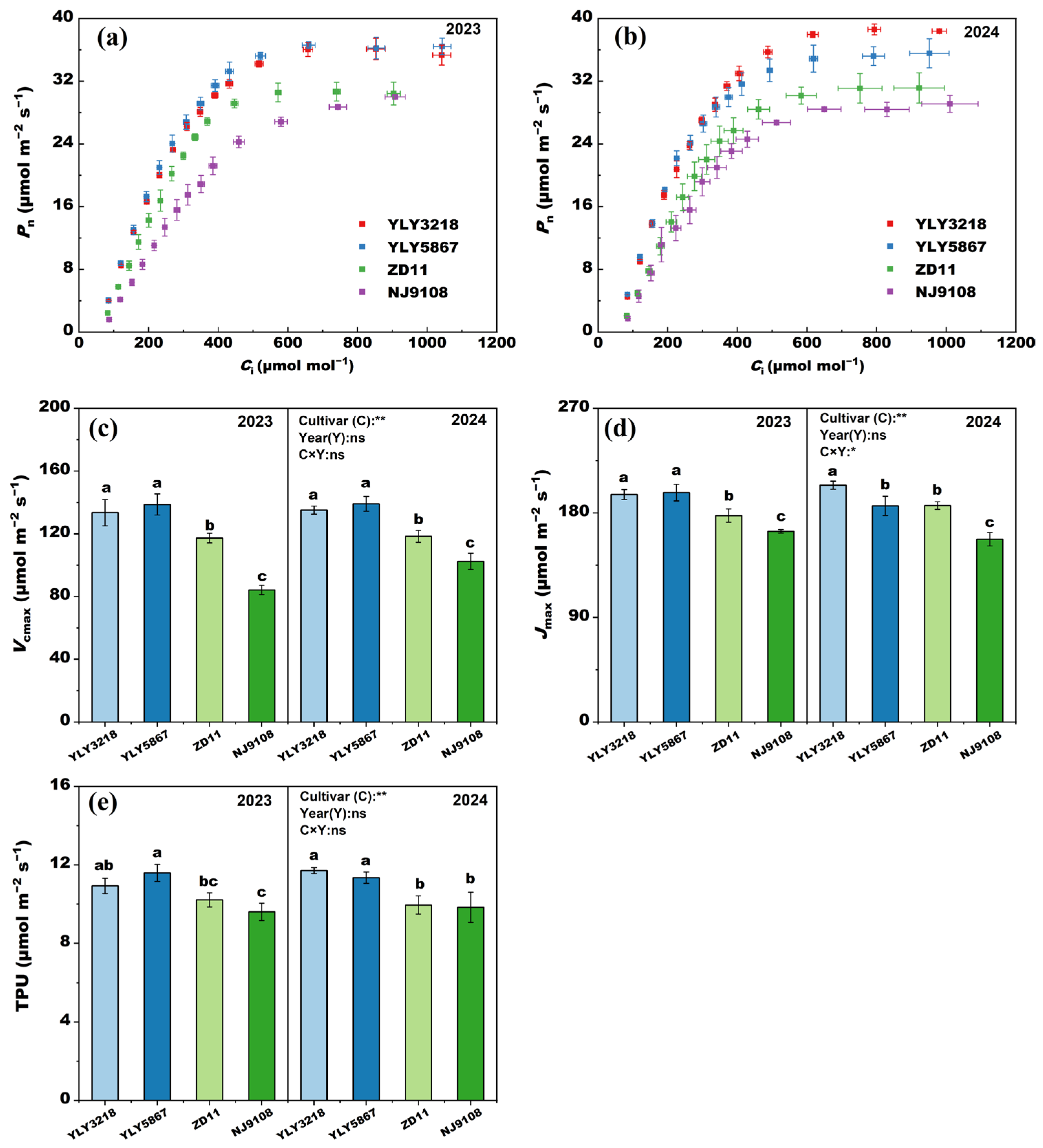
Figure 1. PnCi response curves and derived photosynthetic parameters of different rice cultivars. (a) PnCi response curves in 2023; (b) PnCi response curves in 2024; (c) Vcmax of different rice cultivars in 2023 and 2024; (d) Jmax of different rice cultivars in 2023 and 2024; (e) TPU of different rice cultivars in 2023 and 2024. Pn, net photosynthetic rate; Ci, intercellular CO2 concentration; Vcmax, the maximum Rubisco carboxylation rate; Jmax, the maximum rate of electron transport; TPU, triose phosphate utilization. Data are mean ± SD (n = 3). Different lowercase letters indicate significant differences among cultivars within the same year at p < 0.05 according to Duncan’s multiple range test. Significance levels from two-way ANOVA are indicated as follows: ** p < 0.01; * p < 0.05; ns, not significant.
Agronomy 16 00650 g001
Figure 2. Soluble sugar concentration in phloem sap and number of vascular bundles in different rice cultivars. (a) Schematic illustration of large and small vascular bundles. (b) Sucrose concentration in phloem sap collected from different rice cultivars. (c,e) Numbers of large and small vascular bundles in leaves. (d,f) Numbers of large and small vascular bundles in leaf sheaths. Data are mean ± SD of four plants for phloem sap measurements or six plants for vascular bundle counts per cultivar. Different lowercase letters indicate significant differences (p < 0.05) among the cultivars according to Duncan’s multiple range test.
Agronomy 16 00650 g002
Table 1. Grain yield and yield components of different rice cultivars.
YearCultivarPanicles
(×104 ha−1)
Spikelets per
Panicle
Seed-Setting
Rate (%)
Thousand-Grain
Weight (g)
Grain Yield
(kg ha−1)
YLY3218292.1 ± 12.6 a205.9 ± 8.0 a90.3 ± 0.9 b20.7 ± 1.2 c9546 ± 1127 a
2023YLY5867256.3 ± 7.3 a189.3 ± 3.3 b91.3 ± 0.9 ab23.4 ± 0.9 a9733 ± 812 a
ZD11276.8 ± 25.1 a155.8 ± 5.3 c95.3 ± 0.9 a21.6 ± 1.8 ab8320 ± 569 b
NJ9108281.9 ± 26.1 a134.1 ± 7.6 c95.0 ± 1.6 a23.3 ± 1.2 b7784 ± 232 b
YLY3218312.3 ± 7.1 a225.5 ± 7.3 a93.6 ± 0.8 a20.4 ± 0.6 d10,004 ± 848 a
2024YLY5867237.4 ± 24.4 b194.0 ± 7.8 b94.0 ± 0.4 a25.1 ± 0.4 a10,759 ± 188 a
ZD11293.4 ± 51.7 ab123.7 ± 2.7 c93.9 ± 1.1 a23.1 ± 0.3 b8605 ± 602 b
NJ9108250.7 ± 22.9 ab115.3 ± 18.3 c93.8 ± 0.6 a22.2 ± 0.3 c8180 ± 388 b
Cultivar (C) ns********
Year (Y) **nsnsnsns
C × Y ns****nsns
Data are mean ± SD (n = 3 plot replicates). Different lowercase letters indicate significant differences among cultivars within the same year at p < 0.05 according to Duncan’s multiple range test. Significance levels from two-way ANOVA are indicated as follows: ** p < 0.01; ns, not significant.
Table 2. Photosynthetic gas exchange traits of different rice cultivars.
YearCultivarPn
(μmol m−2 s−1)
Ci
(μmol mol−1)
gs
(mol m−2 s−1)
Tr
(mmol m−2 s−1)
2023YLY321826.2 ± 0.5 a310 ± 7 a0.840 ± 0.046 a9.5 ± 0.8 a
YLY586726.8 ± 0.9 a308 ± 8 a0.779 ± 0.095 a8.7 ± 0.5 a
ZD1120.2 ± 0.9 b267 ± 4 b0.320 ± 0.027 b5.8 ± 0.4 b
NJ910816.2 ± 0.4 c281 ± 9 b0.325 ± 0.011 b4.9 ± 0.7 b
2024YLY321827.1 ± 0.4 a298 ± 8 a0.761 ± 0.123 a9.3 ± 0.3 a
YLY586726.5 ± 1.0 a302 ± 10 a0.766 ± 0.139 a10.6 ± 1.2 a
ZD1120.0 ± 1.8 b276 ± 21 a0.384 ± 0.120 b6.9 ± 0.5 b
NJ910819.2 ± 1.8 b299 ± 22 a0.517 ± 0.184 ab6.9 ± 1.2 b
Cultivar (C) ********
Year (Y) nsnsns**
C × Y nsnsnsns
Data are mean ± SD (n = 3). Pn, net photosynthetic rate; Ci, intercellular CO2 concentration; gs, stomatal conductance; Tr, transpiration rate. Different lowercase letters indicate significant differences among cultivars within the same year at p < 0.05 according to Duncan’s multiple range test. Significance levels from two-way ANOVA are indicated as follows: ** p < 0.01; ns, not significant.
Table 3. Correlation of yield components and photosynthetic parameters with grain yield.
Correlation CoefficientPaniclesSpikelets per PanicleSeed-Setting
Rate
Thousand-Grain WeightPngsVcmaxJmaxTPU
Grain yield−0.247 ns0.703 **−0.339 ns0.065 ns0.719 **0.573 **0.673 **0.588 **0.566 **
Correlation coefficients were calculated using Pearson correlation analysis. ** p < 0.01; ns, not significant.
Table 4. Correlation of vascular traits and assimilates with grain yield and spikelets per panicle in 2024.
Correlation
Coefficient
Soluble Sugar Concentration in Phloem SapLVB
(Leaf)
SVB
(Leaf)
LVB
(Sheath)
SVB
(Sheath)
Grain yield 0.856 **0.842 **0.791 **0.748 **0.775 **
Spikelets per panicle 0.931 **0.942 **0.962 **0.945 **0.900 **
LVB and SVB, large and small vascular bundles. Correlation coefficients were calculated using Pearson correlation analysis. ** p < 0.01.
Disclaimer/Publisher’s Note: The statements, opinions and data contained in all publications are solely those of the individual author(s) and contributor(s) and not of MDPI and/or the editor(s). MDPI and/or the editor(s) disclaim responsibility for any injury to people or property resulting from any ideas, methods, instructions or products referred to in the content.