Article

Evaluating Photochemical Efficiency and Recovery Potential in Wheat Varieties with Divergent Drought Tolerance


Institute of Plant Physiology and Genetics, Bulgarian Academy of Sciences, Acad. G. Bonchev Str., Block 21, 1113 Sofia, Bulgaria
*
Author to whom correspondence should be addressed.
These authors contributed equally to this work.
Agronomy 2026, 16(10), 944; https://doi.org/10.3390/agronomy16100944
Submission received: 2 April 2026 / Revised: 29 April 2026 / Accepted: 4 May 2026 / Published: 8 May 2026
(This article belongs to the Section Plant-Crop Biology and Biochemistry)

Abstract

Drought stress during early growth stages severely limits wheat productivity globally. Understanding varietal physiological responses to drought stress is critical for breeding climate-resilient cultivars. Two-week-old plants from two winter wheat (Triticum aestivum L.) cultivars—Katya (drought-tolerant) and Zora (drought-sensitive)—were subjected to drought for seven days, followed by rehydration. The experiments were conducted in pots in controlled conditions. The photosystem II (PSII) function was evaluated using chlorophyll a fluorescence (OJIP transients), thermoluminescence emissions and pigment content analysis. Under drought, Katya maintained functional PSII integrity with stable quantum efficiency and increased chlorophyll content, while Zora exhibited chlorophyll degradation. Fresh and dry weight declined in both genotypes but significantly only in Zora; recovery occurred after rehydration. Chlorophyll fluorescence revealed that varietal divergence was localized to the O–J phase of PSII photochemistry, indicating differences in reaction-center behavior confirmed by thermoluminescence. Katya demonstrated preserved PSII reaction-center density, balanced energy partitioning, homogeneous PSII populations, and superior recovery capacity. Conversely, Zora showed reaction-center depletion, elevated energy dissipation, impaired electron transport beyond QA, and persistent PSII heterogeneity even after rehydration. Drought tolerance in the studied genotypes was associated with the maintenance of PSII structural integrity, efficient photochemical function, and rapid recovery mechanisms. These physiological markers—particularly early PSII photochemistry kinetics and reaction-center stability—provide valuable selection criteria for breeding programs, targeting drought resilience under changing climate conditions.

1. Introduction

Climate change, through rising temperatures and altered precipitation patterns, poses a major threat to global agriculture and food security [1].
The availability of water is a key factor determining the structure of ecosystems, the functioning of economies, and the well-being of human populations. In particular, drought can severely disrupt agriculture, energy production, industry and household water supply, highlighting the central importance of water for the sustainability and progress of societies [2]. Drought stands out as a critical stress factor, threatening not only agricultural yields but also the sustainability of food systems and humanity’s nutrition [3].
Wheat (Triticum aestivum L.) is a staple crop for much of the world’s population. It is the world’s leading cereal crop, recognized for its nutritional value, extensive cultivation, and global consumption [4,5]. Several developmental stages in wheat are particularly vulnerable to water deficit, including germination, crop establishment, anthesis and grain filling, each contributing distinctly to the final yield [6]. According to FAO data, in the 2025/26 marketing year, global wheat production is forecast to reach nearly 810 million tons, and drought is a major abiotic stress that severely affects wheat production globally [7]. Drought stress significantly influences both the morphological and phenological traits of the plants [8]. Among these, crop establishment is especially critical, as it determines early canopy development, root system architecture, and the potential for productive tillering. Drought stress during this phase can hinder leaf expansion, reduce biomass accumulation, and disrupt physiological processes essential for uniform crop establishment and subsequent yield formation. Specifically, water-deficit conditions during early vegetative growth impair key biochemical and physiological functions, leading to reductions in water content, osmotic and leaf water potential, leaf turgor, and the chlorophyll level, while increasing diffusive resistance. These changes collectively suppress leaf transpiration, destabilize photosynthetic machinery, and inhibit the activity of enzymes vital for carbon assimilation and energy metabolism, such as Rubisco [9,10,11]. Additionally, in drought conditions, plants have a more difficult time absorbing nutrients [12].
Identifying drought-tolerant wheat cultivars is therefore a crucial strategy for mitigating climate change impacts on crop production. Physiological indicators such as leaf water content (WC) and chlorophyll content provide reliable metrics for assessing plant water status and pigment integrity under stress [13,14,15,16].
Beyond pigment quantification, chlorophyll a fluorescence provides a powerful, non-invasive tool for studying the functional state of the photosynthetic apparatus. Chlorophyll a fluorescence emission mainly occurs in the red and far-red spectral region, with characteristic peaks near 685 nm and 730–740 nm, which reflect the rate of absorbed light energy [17]. Although chlorophyll a fluorescence accounts for only a small fraction of absorbed energy (0.5–10%), its intensity is inversely related to photochemical efficiency due to redox dynamics within the photosystems [18].
Over recent decades, chlorophyll a fluorescence has been employed as a rapid, information-rich method for assessing some photosynthetic functions, such as photosynthetic activity, quenching analysis, non-photochemical quenching (NPQ), electron transport rate (ETR), the photochemical efficiency of PSII, PQ pool reduction state, OEC donor-side function, PSI acceptor-side limitation, primary charge separation, and QA reduction kinetics, across plants, bacteria, and algae that contain chlorophyll [19]. Fluorescence kinetics are typically captured using either continuous or modulated excitation systems [20]. Under continuous excitation, the resulting induction curves—known as OJIP transients [21]—reflect sequential electron transport events in PSII and are interpreted using the energy flux theory of Strasser [22,23], which enables the calculation of parameters describing photochemical efficiency (Fv/Fm), reaction-center (RC) density (ABS/RC), and overall performance (PI(abs)). TL complements the fluorescence approach by probing the energetics of charge stabilization on PSII electron carriers through the temperature-dependent recombination of trapped charge pairs, providing information on a wider range of photosynthetic metabolism [24].
Chlorophyll a fluorescence and OJIP transient-based assays are frequently used to diagnose and study abiotic stresses in plants, including drought [25,26], nutrient deficiency [27,28], light stress [29], heat stress [30,31], low-temperature stress [32,33], salinity [34], and metal excess in plants [35,36]. The JIP test, while widely adopted, analyses the OJIP transient by extracting values at a small number of characteristic time points (Fo, Fj, Fi, and Fm) and computing algebraic combinations, discarding information encoded in the curve shape between these landmarks. To overcome this limitation, we complemented the JIP test with three curve-based statistical methods that treat each transient as a continuous function: functional data analysis (FDA) [37], which identifies where along the transient two groups of curves differ significantly using permutation-based family-wise error rate control; area under the curve (AUC) analysis, which quantifies the magnitude of divergence per phase with Cohen’s d effect sizes; and functional principal component analysis (fPCA) [37], which extracts the dominant modes of curve-shape variation and visualizes genotype separation in a reduced score space.
To our knowledge, this is the first study to apply FDA with permutation-based FWER control and phase-specific FDR correction to OJIP transients and the first to use fPCA to decompose fluorescence kinetic variation between genotypes under drought. Previous analyses have relied on normalization, difference kinetics (ΔVt), or multivariate statistics applied to JIP parameter arrays [22,23,38], which either depend on pre-selected reference points or discard the continuous curve-shape information. The curve-based methods do not replace the JIP test but complement it: the JIP parameters provide mechanistic insight into what is changing at the molecular level, while the FDA, AUC, and fPCA identify where along the transient those changes occur, how large they are, and which kinetic pattern best distinguishes the genotypes.
While the existing studies mostly focused on a single photosynthetic indicator (such as chlorophyll content, fluorescence parameters, etc.), there are relatively few systematic correlation studies on “biomass—water state—photosynthesis—rehydration recovery capacity”. In the present work we aimed to provide a detailed understanding of photosynthesis in vivo and growth-related traits under drought stress and rehydration. Therefore, we compared two wheat cultivars with contrasting drought tolerances (Katya—tolerant; Zora—sensitive) and their responses during early developmental stages to drought and subsequent rehydration. This was monitored in a non-destructive manner by using photosynthetic techniques, combined with plant biomass and leaf water content analyses. By integrating chlorophyll a fluorescence (OJIP transients analyzed by both the JIP test and curve-based methods), TL, physiological indicators, and pigment content, we aimed to localize the primary site of drought-induced photosynthetic damage along the electron transport chain and to determine whether recovery after rehydration resolves or amplifies varietal differences. Our findings may contribute to the identification of biophysical markers for drought tolerance and support breeding strategies for more resilient cereal crops.

2. Materials and Methods

2.1. Plant Materials and Growth Conditions

In this study, we compared two Bulgarian wheat cultivars with contrasting responses to drought: Katya, noted for its drought tolerance, and Zora, characterized as susceptible to water-deficit conditions. Cultivar Katya is released at the Institute of Plant Genetic Resources, Sadovo, in 1982 by the cross (Fortunato × No301) × Bezostaya 1. No 301 is an old historic cultivar of tall stature. Zora cultivar is developed at the Dobrudzha Agricultural Institute, General Toshevo, in 1997 by a complex cross, involving several historic cultivars. Katya cultivar is described by breeders to have high to excellent drought tolerance based on yield performance and a high stress-tolerance index under water-limited conditions. Both varieties carry the Rht8 gene for reduced final plant height, which contributes to the development of longer roots, coleoptiles, and shoots, thereby providing an advantage for improved seedling emergence and crop establishment under early-season drought [39].
Seeds were sown in 3 L pots (19 cm diameter × 15.5 cm height) filled with a commercial peat-based soil mixture (Klasmann-Deilmann GmbH, Geeste, Germany), supplemented with 1.5% perlite and 15% sand. Plants were cultivated in a growth chamber under controlled conditions: 20/18 °C day/night temperature, a 16/8 h light/dark photoperiod, photosynthetic photon flux density (PPFD) of 380 μmol m−2 s−1 from LED tubes (4000 K), and 70% relative humidity. Each pot contained 25 seedlings.
Seedlings were grown for 14 days, and at the stage of developing third leaf, watering was withheld for seven days in 2/3 of the pots. To monitor soil water loss, full soil water capacity was first determined, and the percentage of available soil water was evaluated daily by weighing pots on a digital scale (Soehnle, Backnang, Germany). The soil moisture was kept at 80% of soil capacity in control irrigated conditions and carried down to 35–40% by withholding the watering for 7 days. To check soil water content, a SM150 Soil Moisture Sensor (Delta-T Devices Ltd., Burwell, UK) was used. After the drought period, the water supply was restored: pots were watered over a 12 h period until control soil moisture (80–85% of capacity) was reached, then maintained at that level for 5 days. Measurements were performed at the end of the dehydration period (7th day) and five days after the rehydration started to evaluate the effects of water-deficit stress on the plants and their recovery capacity, respectively. Fluorescence measurements were performed additionally on the 4th day of dehydration and 3rd day of rehydration. During the experiment, one-third of the pots were watered daily, maintained under full irrigation, and served as controls. For all physiological analysis, the middle segment of the third leaf from individual plants was used. Each plant was considered a biological replicate. The samples were chosen from different pots. In order to minimize the position effects, pots were rotated daily.
The experiment was repeated three times. For each treatment (control, dehydrated, and rehydrated), five pots were used as replicates.

2.2. Determination of Fresh and Dry Plant Weights

Plant shoot samples from controls, drought-stressed, and rehydrated individuals were immediately weighed to determine their fresh mass. Afterwards, they were cut into small segments and were oven-dried at 70 °C for 48 h or when constant weight was reached. The fully dried samples were then weighed to obtain their dry mass [40].

2.3. Determination of Leaf Water Content

Leaf water content (WC) was measured using a gravimetric method [13]. The water content (WC) was defined as the weight of leaf water referred to as dry weight. Leaves were weighed immediately after excision (fresh weight) and again after oven-drying at 70 °C to constant weight (dry weight), and WC was calculated according to the equation:
WC = (FW − DW)/DW (g/g DW)
where FW—fresh weight; DW—dry weight. For each treatment (control, dehydrated, and rehydrated), four plants per pot were used as replicates.

2.4. Determination of Specific Leaf Area (SLA)

Each leaf was cut off from the culm and scanned [41]. The leaf surface was determined by analyzing images using ImageJ 1.54g (Image Analysis Software, LOCI, Madison, WI, USA). After that the leaves were dried in an oven at 70 °C until they reached a constant weight, then weighed using an analytical balance (in grams), and this is the dry mass in the formula:
SLA = Leaf Area (cm2)/Leaf Dry Mass (g)

2.5. Leaf Chlorophyll Content Measurement

Chlorophyll content was measured with the CCM-300 chlorophyll meter developed by the company Opti-Sciences, Inc., Hudson, NY, USA. The CCM-300 is a portable instrument for the direct determination of chlorophyll content in plant samples, utilizing a proven fluorescence ratio technique (F735/F700), as described by Gitelson [42]. For this parameter, chlorophyll measurements were performed on the middle segment of the third leaf from four plants per pot per genotype and treatment (control, dehydrated, and rehydrated).

2.6. Determination of PSII Activity

Induction curves of prompt fluorescence PF were measured with the fluorometer FluorPen FP 110 (PSI (Photon Systems Instruments) Drásov, Czech Republic). Before starting the measurements, the plants were dark-adapted for 20 min. Dark-adapted leaves were illuminated with saturating red actinic light (3000 μmol m−2 s−1), and prompt fluorescence was recorded over a 1 s induction period. The OJIP parameters derived from [43], and induction curves were calculated and visualized with the Excel package of Microsoft Office 13 and with R software version 4.5.1. A description of the JIP parameters we used is given in Table 1.
To track the dynamics of the effect of drought on the photosynthetic apparatus of the studied wheat cultivars, we conducted a comparative analysis at two points during the stress application: in the middle (fourth day for dehydrated plants and third day for rehydrated) of the drought/rehydration, and at the end of the drought/rehydration period (seventh day for dehydrated plants and fifth day for rehydrated).
Twenty-five measurements were made per pot for each treatment (control, dehydrated, and rehydrated plants) for both wheat varieties. Four pots were used for each treatment. Measurements were made on the third fully developed leaf, with one measurement per plant on the fourth and seventh (last) days from the start of drought and on the third and fifth (last) days of rehydration for control, dehydrated, and rehydrated plants.

2.7. Thermoluminescence Measurements

TL emission from wheat leaves was measured using a custom-built instrument device, as described by Zeinalov and Maslenkova [44]. Briefly, freshly cut two leaf segments (2 cm length) from the middle section of the leaf were placed on an aluminum sample holder at 20 °C and covered with a Plexiglas window. The samples were then cooled to 1 °C with liquid nitrogen and illuminated with two saturating (4J) single-turnover xenon flashes (10 μs half-band, 1 Hz frequency). Following illumination, the samples were gradually heated to 60 °C at a rate of 0.5 °C/s. Leaf temperature was recorded by a miniature thermocouple inserted in the sample holder. Luminescence was detected by an HR943-02 photomultiplier (Hamamatsu Photonics, Hamamatsu City, Japan). Data acquisition and signal processing were performed using in-house software, with the temperature maxima (Tmax) of individual bands determined through signal decomposition using Origin 8.5 Multiple Peak Fit (OriginLab Corporation, Northampton, MA, USA). The plants used in these measurements were dark-adapted for three hours.

2.8. Statistical Analysis

All statistical analyses were performed using R Studio (version 4.5.1) and Microsoft Excel 2013. The studies we have conducted contain different amounts and types of data, which necessitate the use of various statistical methods. Statistical analysis of fresh and dry weight, specific leaf area, water content, and chlorophyll content was performed with ANOVA followed by Tukey’s post hoc test. Significant differences at p < 0.05 are indicated by different letters. Fluorescence parameter distributions were assessed for normality using the Shapiro–Wilk test (“shapiro.test” function in R Studio) [45]. As several parameters deviated significantly from normality, the non-parametric Kruskal–Wallis one-way analysis of variance by ranks and Wilcoxon signed-rank test were applied to test for overall treatment effects within each genotype. Pairwise comparisons were performed using Dunn’s post hoc test with Benjamini–Hochberg correction for multiple comparisons [46]. To compare the two genotypes within a single treatment condition, the Mann–Whitney U test was used. Point-by-point Welch’s t-tests were performed in R using the functions “test.welch”, respectively [47]. Statistical analysis of the induction curves of prompt fluorescence was done by R packages version 4.5.1, “fda” for functional data analysis [48], “pROC” [49] for estimation of area under the curve, and “fdapace” for functional principal component analysis [50].

3. Results

3.1. Fresh and Dry Weight

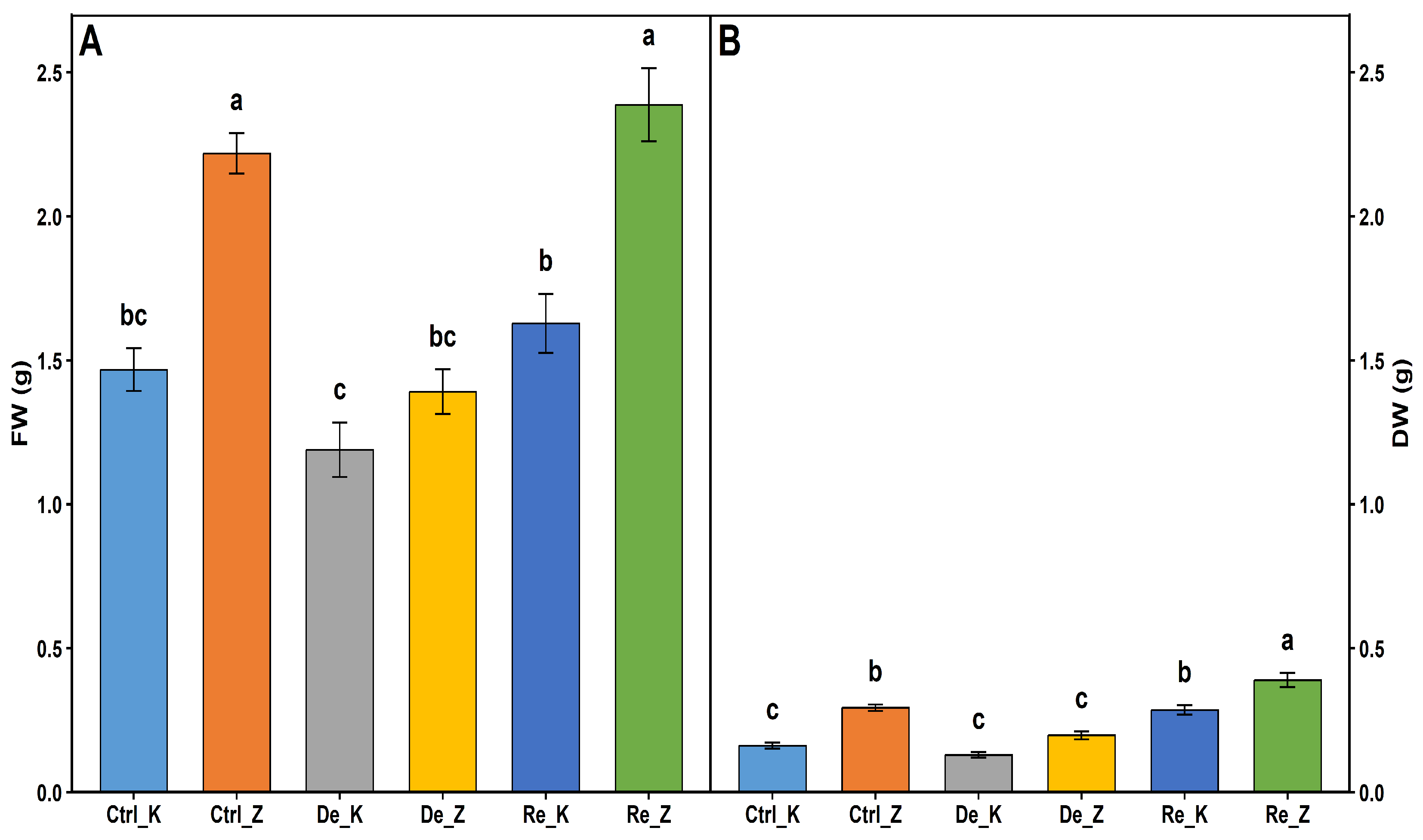
Under control conditions, Zora showed a 34% higher FW and 45% higher DW than Katya (Figure 1A,B). FW and DW decreased significantly after applying the drought stress only in Zora, and in Katya, they decreased non-significantly. Under drought, both varieties showed a similar FW and DW. After rehydration, Katya and Zora restored their FW to prestress levels. The DW of rehydrated plants increased and exceeded that of their respective controls.

3.2. Water Content (WC)

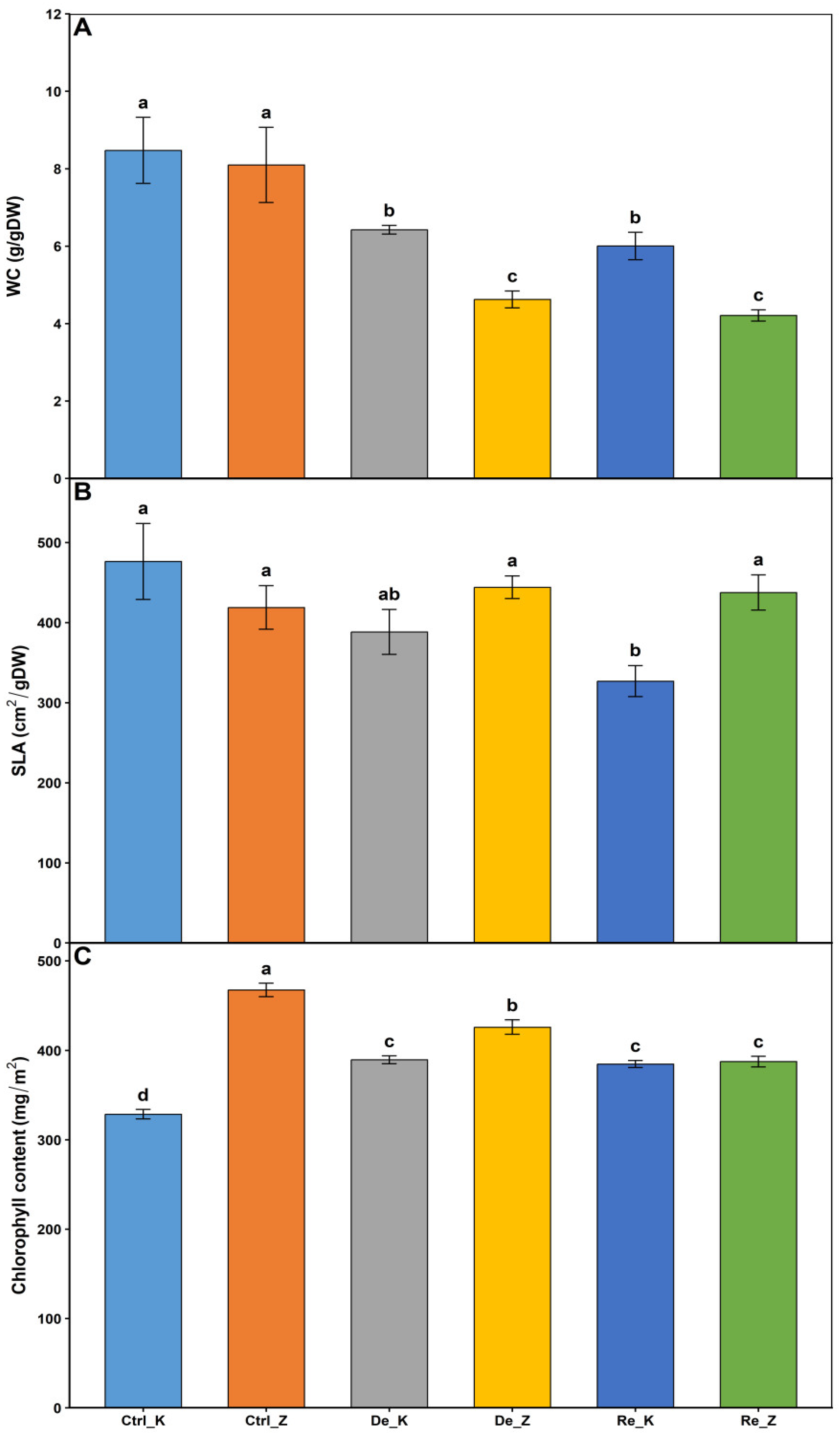
The water content of both varieties is presented on Figure 2A. The control plants of Katya had a slightly higher WC (8.89 g/gDW) than Zora (8.3 g/gDW), although the difference was not significant. Under drought, the water content decreased in both varieties—by 28% in Katya and more drastically in Zora by 45%—compared to controls. After rehydration, the WC remained unchanged compared to the dehydrated plants; however, Katya demonstrated a higher WC than Zora.

3.3. Specific Leaf Area (SLA)

Katya and Zora had similar SLAs under control conditions (Figure 2B). The drought stress caused a slight decrease in the SLA of Katya, which continued after rehydration. The rehydrated plants of Katya had a significantly lower SLA compared to the controls. Unlike Katya, the SLA of Zora did not change during the drought and rehydration periods.

3.4. Leaf Chlorophyll Content

Both varieties differed in their chlorophyll content. Katya was characterized by a lower chlorophyll content under control conditions compared to Zora (Figure 2C). The drought stress caused a decrease in chlorophyll levels in Zora. Contrarily, in Katya, the chlorophyll content increased by 18.5% under drought and remained the same after rehydration. After rehydration, the chlorophyll content in Zora decreased further.

3.5. Thermoluminescence

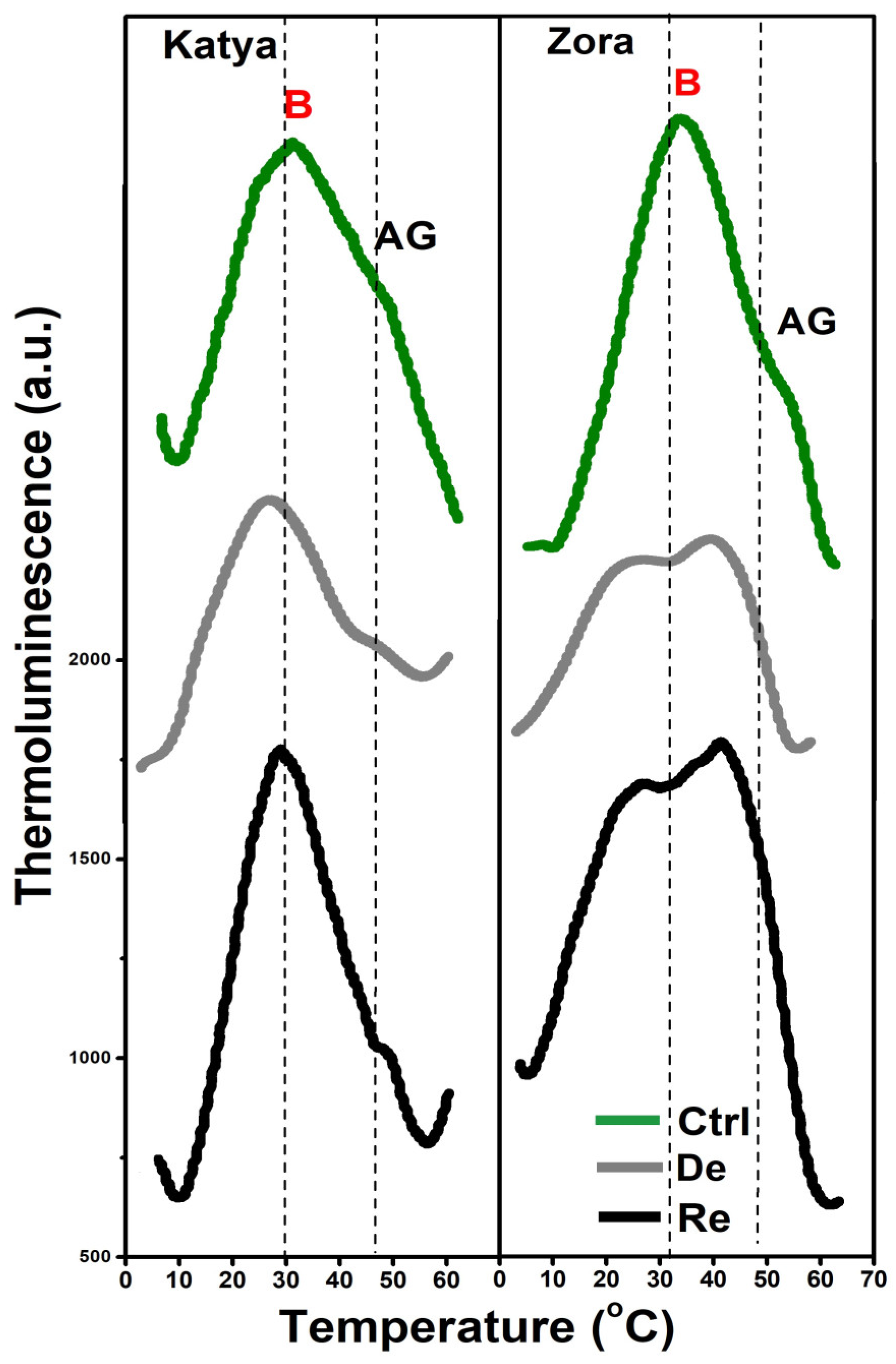
TL measurements from the control wheat leaves of Katya and Zora showed that excitation by two saturating single turnover flashes produced similar curves with a main B band (S2/3QB), which peaked at a maximum of about 30 °C, and a small after-glow band (AG) was noticeable as a shoulder at around 47 °C (Figure 3). In Katya, a certain decrease in the emission intensity of B and AG bands was observed in leaves under drought, but the B band temperature maximum was only slightly downshifted with no statistical difference from the control. No change in the temperature of AG was observed. In Zora, dramatic changes in the TL curve of dehydrated leaves, including considerable shifts in the peak positions of the existing bands and amplitude variations, were observed. The B band amplitude decreased, as well as both B and AG bands were shifted to a lower temperature region by 7–8 °C compared to the control (Figure 3 and Figure S1). These pronounced shifts indicated the strong destabilization of S2/3QB charge recombination (B band), while the increase in the AG band after drought was due to enhanced electron transfer from stroma to QB (S2/3QB + e). Rehydration led to the restoration of the initial TL emission in Katya. Although rehydration caused a rise in the number of recombining pairs in Zora, manifested by the increase in the B band amplitude, the characteristics of the TL bands remained altered with downshifted peak temperatures and a dominating AG band, revealing an incomplete recovery.

3.6. Prompt Chlorophyll Fluorescence (PF)

All fluorescence parameters had a normal distribution and were statistically evaluated by single-factor ANOVA followed by Tukey’s post hoc test. The effect of drought on the photosynthetic apparatus of the studied wheat genotypes was tracked in dynamics. Key parameters obtained from prompt fluorescence (PF) induction curves using the JIP assay [20], Fo, Fm, Fv/Fo, Vj, Vi, φ(Po), ψo, ABS/RC, TRo/RC, ETo/RC, DIo/RC, φ(Eo), φ(Do), and PI(abs) were used. We have described only the parameters that change statistically during the dehydration and rehydration of the studied plants. To assess differences between varieties, fluorescence transients were analyzed using curve-based statistical methods, including functional data analysis (FDA), point-by-point Welch’s t-tests, area under the curve (AUC), and functional principal component analysis (fPCA).

3.6.1. JIP Parameters Analysis of Katya and Zora Cultivars

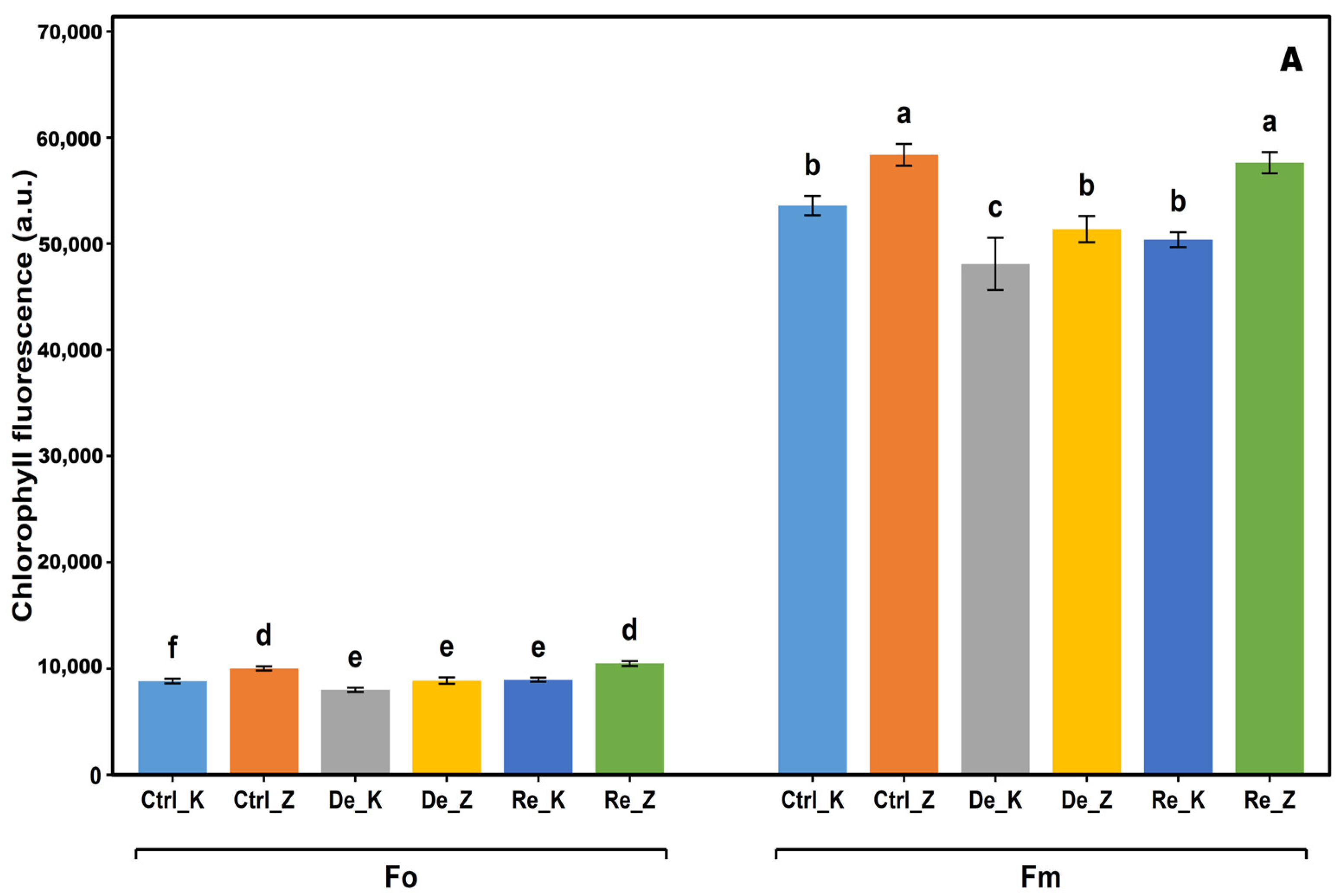
On the fourth day of dehydration and third day of rehydration, only five JIP parameters (Fm, Vi, ABS/RC, TRo/RC, and ETo/RC) in dehydrated plants and four in rehydrated (Vi, ABS/RC, TRo/RC, and ETo/RC) were statistically different from the controls (Tables S1 and S2; Figure S2A). The average Fm value in the control plants was 50,477.9 a.u. (arbitrary units) and differed statistically from that of dehydrated plants (48,334.7 a.u.). After rehydration, the Fm value recovered (49,640.3 a.u.) and was not statistically different from the controls. The parameter Fv/Fo reflects the efficiency of the water-splitting complex on the donor side of PSII. The lowest Fv/Fo 4.7 was measured in the plants subjected to drought, but it was not statistically different from that of controls (4.8). Fv/Fo increased in rehydrated plants (5.01). The parameters that reflect the energy flows, per QA-reduced PSII (RC) ABS/RC, TRo/RC, ETo/RC, changed similarly. ABS/RC decreased significantly from 2.53 in the control plants to 2.46 in plants subjected to drought and to 2.39 in rehydrated plants. Relative variable fluorescence at the I step Vi (after 30 ms) was lower in the control plants (0.80) than in the dehydrated and rehydrated plants at 0.82 and 0.84, respectively.
  • Analysis of the JIP parameters on the seventh day of dehydration and fifth day of rehydration of Katya cultivar
At the end of the drought and rehydration periods, more parameters changed compared to the initial period of dehydration (Tables S3 and S4; Figure S2B). Changes are registered in Fo, Fm, Vj, ψo, ETo/RC, φ(Eo), and PI(abs). No statistical differences were observed between control plants and rehydrated plants. Unlike the initial stage of dehydration, in the final stage, the values of the JIP parameter ETo/RC were higher in the dehydrated plants than for the control and rehydrated plants. In dehydrated plants, its value was 1.11, while in controls and rehydrated plants, the values were 0.97 and 1.00, respectively.
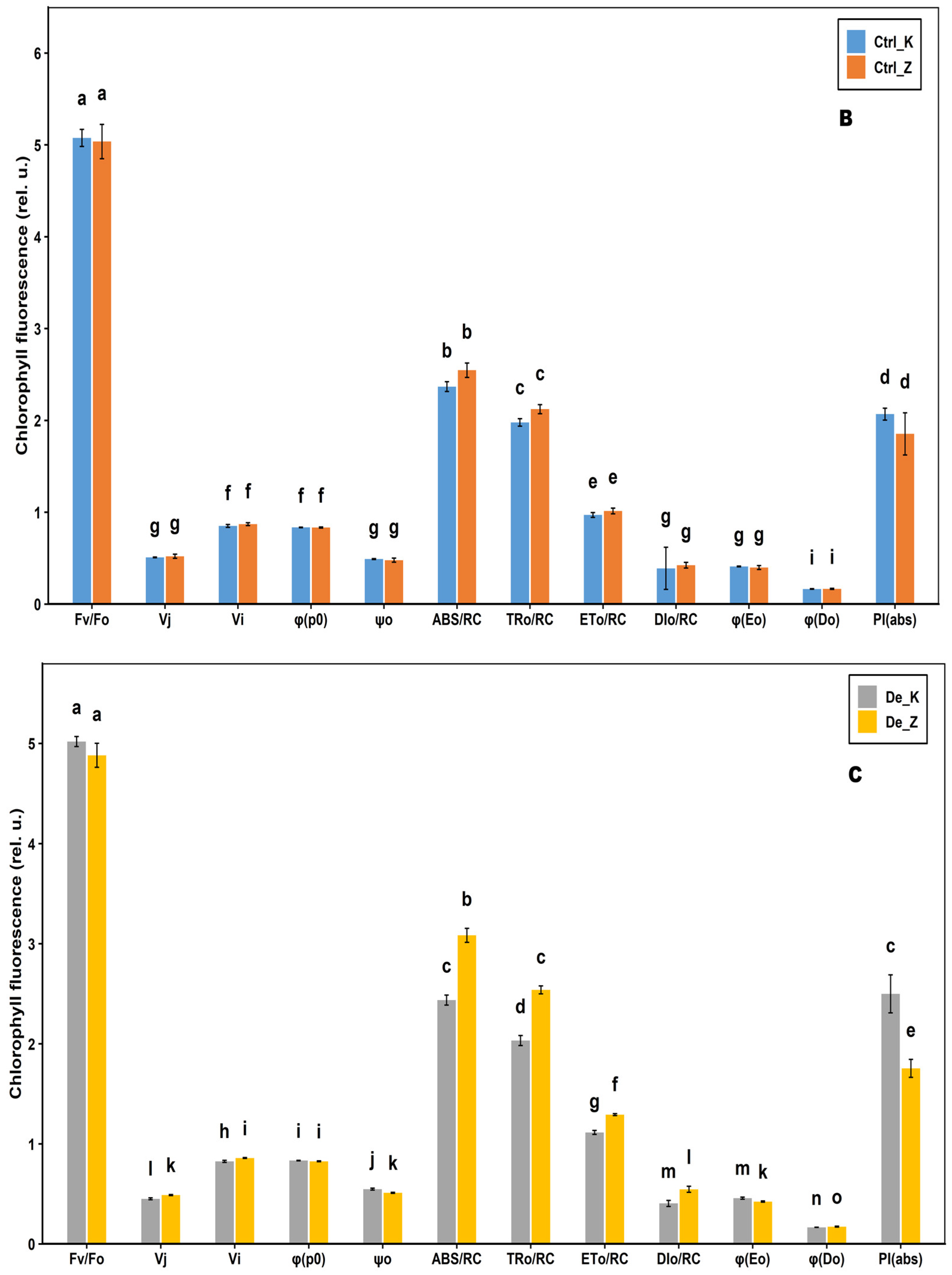
The parameter that changes most strongly during drought is PI(abs), which reflects the functional activity of PSII, related to the absorbed energy. Dehydrated plants have a value equal to 2.52, while the PI(abs) of the controls and rehydrated plants were 2.06 and 1.93, respectively. The parameter ψo gives the probability of electron transport outside QA−. In the controls, ψo was 0.49, while in the rehydrated plant, it was 0.49, and in the dehydrated plant, it was 0.55.
The parameter φ(Eo) provides information about the quantum efficiency of electron transfer in the electron transport chain (ETC) after QA or the quantum yield of the ETC at t = 0. In the control and rehydrated plants, φ(Eo) was 0.41, which was lower than that of the dehydrated plants at 0.46.
  • Analysis of the JIP parameters on the fourth day of dehydration and third day of rehydration of Zora cultivar
During the first few days of Zora’s dehydration, the only parameter that changed statistically compared to the controls was PI(abs), which decreased from 2.30 in the controls to 2.05 in the dehydrated plants. The rehydration of Zora led to changes in all studied JIP parameters except Fm (Tables S5 and S6; Figure S1B). A statistical difference was observed between the Fo measured in the control 9572.4 a.u. and rehydrated 10,481.1 a.u plants. Under drought stress, Fo 9811.1 a.u increased but not significantly. The parameter Fv/Fo did not change in the initial stage of drought (5.17) compared with the controls (5.18). At the beginning of rehydration, the Fv/Fo remains low (4.72).

3.6.2. Comparing the JIP Parameters of Katya and Zora Cultivars

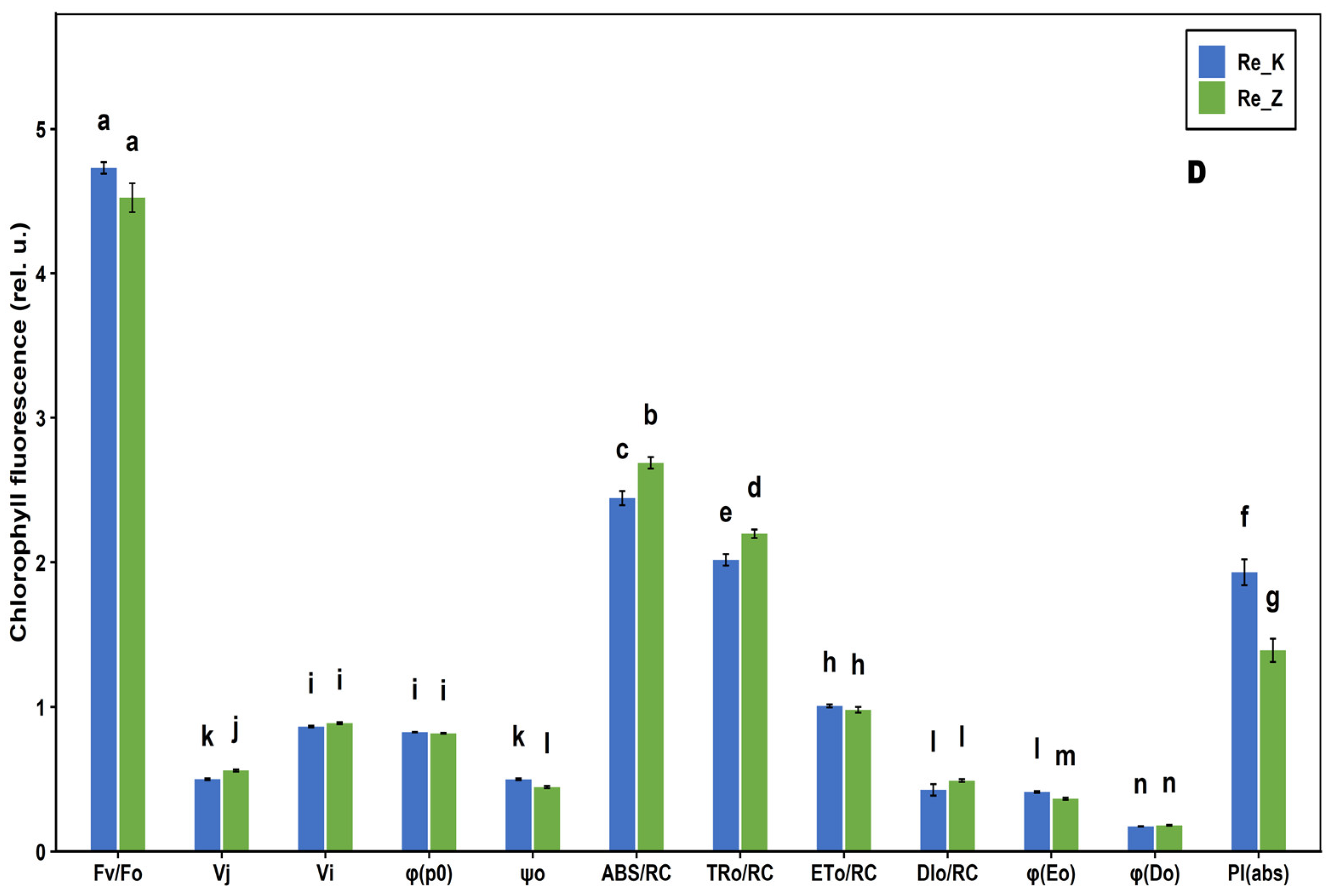
For a better understanding of the effect of drought, the JIP parameters between the two genotypes, Katya and Zora, were compared in the control, dehydrated, and rehydrated plants. Comparisons of JIP parameters were obtained upon the complete dehydration and subsequent rehydration of the plants. The parameters affecting energy flows, ABS/RC, TRo/RC, ETo/RC, and DIo/RC, were higher in Zora compared to Katya. The productivity index PI(abs), which provides information about the functional activity of PSII, was significantly higher in the drought-exposed plants of Katya compared to those of Zora (Figure 4C). In rehydrated plants, the parameters with statistical differences are fewer in number than the parameters in dehydrated plants and changed similarly (Figure 4D).

3.7. Analysis of Induction Curves of Katya and Zora Cultivars

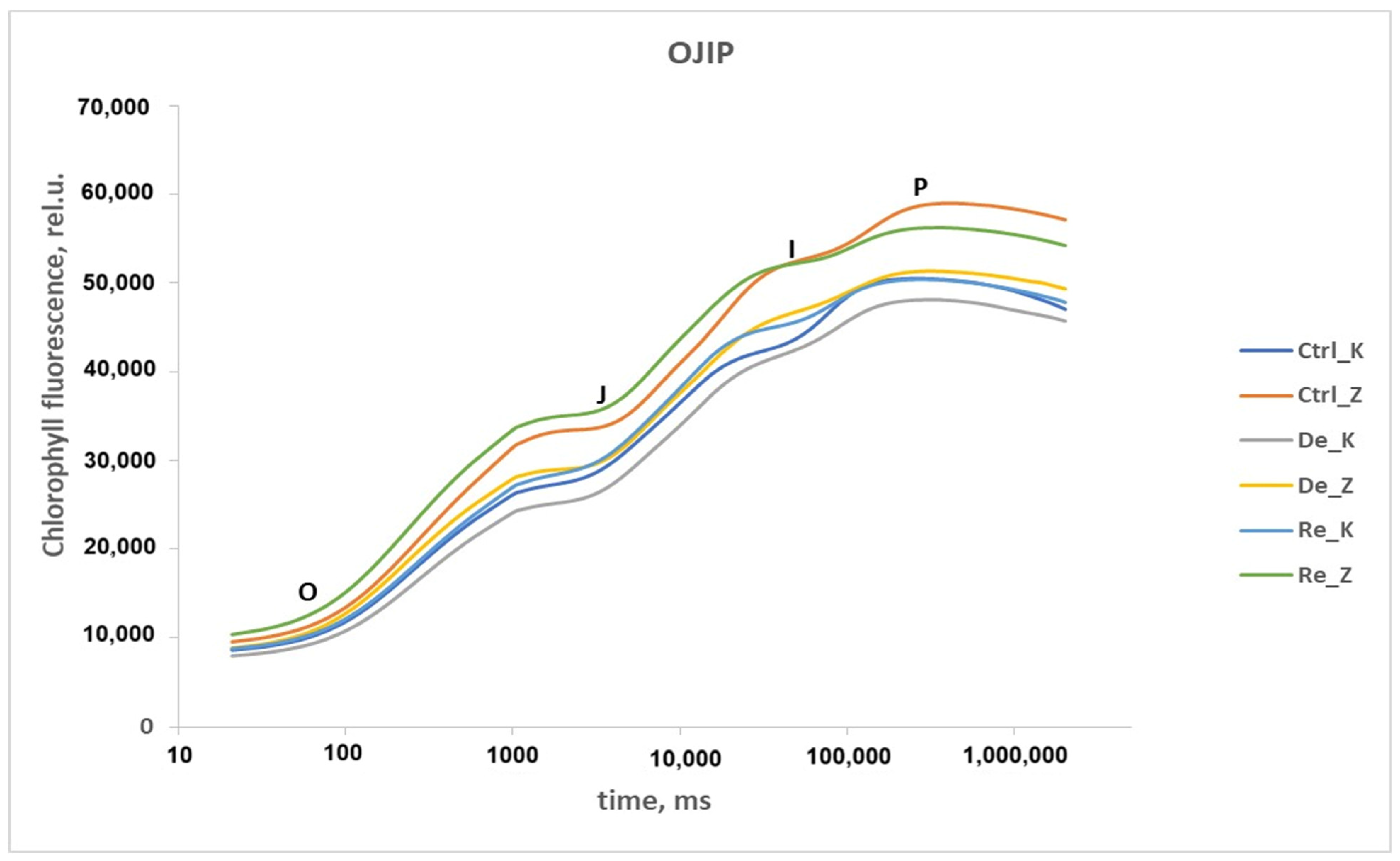
To study in detail the physiological state of the photosynthetic apparatus during drought, the JIP test was complemented by analyzing the induction curves themselves. We compared the curves directly for statistical significance (functional data analysis (FDA)), PCA, area under the curve (AUC), and Direct Point-by-Point Comparison. Figure 5 represents the averaged OJIP fluorescence induction curves between the controls, dehydrated, and rehydrated plants of both varieties.
We note that the assignment of OJIP phases to specific electron transport processes is model-dependent. The O–J phase is interpreted as primarily reflecting primary charge separation and QA reduction kinetics, governed by the RC function and OEC donor-side electron supply. The J–I phase is interpreted as primarily reflecting the PQ pool reduction through QB-mediated electron transfer. The I–P phase is interpreted as primarily reflecting the PSI acceptor-side limitation and the activation of terminal electron acceptors. These assignments follow the widely accepted energy flux framework of Strasser et al. [22,23] and the biophysical analyses of Stirbet and Govindjee [51] and Lazár [52], but they involve simplifying assumptions—notably, that each phase is dominated by a single rate-limiting step and that fluorescence yield is proportional to the QA reduction state. In practice, the phases overlap partially: donor-side effects can extend into the J–I window under severe OEC impairment, and the I–P rise reflects both photochemical and metabolic processes (Calvin cycle activation, cyclic electron flow). Our interpretations should therefore be understood as identifying the predominant process governing each phase not as direct measurements of individual electron transport components.
Table 2 shows the values for functional data analysis (FDA) and functional principal component analysis (fPCA) of OJIP induction curves by phase in the control, dehydrated, and rehydrated plants from two wheat cultivars—Katya and Zora.

3.7.1. Comparing the Induction Curves of the Control Plants to Katya and Zora

  • Functional Data Analysis (FDA)—Katya vs. Zora (OJIP Curves)
To compare the OJIP fluorescence induction kinetics between Katya and Zora, we applied functional data analysis (FDA), treating each replicate transient as a continuous function rather than a set of discrete time points. Individual curves were smoothed using a Savitzky–Golay filter prior to analysis. A pointwise Welch’s t-statistic was computed across the entire time domain, and statistical significance was assessed by a permutation-based functional test employing the maximum absolute t-statistic (max |t|) as the test criterion, which controls the family-wise error rate over the full curve. The test was performed with 2000 random label permutations at a significance level of α = 0.05.
A total of 457 time points were tested. The maximum absolute t-value was 4.89, exceeding the critical threshold (|t| = 2.51, FWER 0.05, and B = 2000 permutations). The permutation test yielded a global p-value of 0.001, indicating a highly significant overall difference between the two varieties.
The critical pointwise threshold was p = 0.04829*. Out of 457 tested points, 453 were FDA-significant, forming a single continuous significant interval spanning 131 µs to 2001.621 ms.
Thus, FDA confirmed a statistically significant difference in OJIP fluorescence kinetics between Katya (drought-tolerant) and Zora (drought-sensitive) at α = 0.05.
All three phases showed strong, phase-localized differences after FDR correction, with the J–I and I–P phases especially decisive (all points significant at FDR 0.05). This complemented the global FDA result and pinpointed where the curves diverge (Table 2 and Figure 5).
  • Area Under the Curve (AUC) Analysis—Katya vs. Zora
Comparisons of the area under the curve (AUC) computed for each phase of the OJIP transient revealed significant differences between Katya and Zora across all three fluorescence phases. In the O–J phase (20 µs–3 ms), Welch’s t-test indicated a significant difference between varieties (t = −3.64, p = 0.001), with a large effect size (Cohen’s d = −1.30; 95% CI [−2.42, −0.54]). A comparable result was obtained for the J–I phase (3–30 ms; t = −3.60, p = 0.001; d = −1.25; and 95% CI [−2.35, −0.53]). The strongest divergence was observed in the I–P phase (30–300 ms; t = −4.55, p < 0.001; d = −1.64; and 95% CI [−2.65, −0.97]). In all three phases, the confidence intervals for the effect size excluded zero, and the negative sign of Cohen’s d indicated that Katya exhibited consistently lower AUC values than Zora, reflecting a reduced cumulative fluorescence output across the entire induction transient.
  • Functional PCA (fPCA) by Phase—Katya vs. Zora
Functional principal component analysis (fPCA) was performed separately for each phase of the OJIP transient, using Savitzky–Golay smoothed curves with trapezoidal quadrature weighting on the original time grid. The first three principal components accounted for 99.1%, 0.8%, and 0.10% of the total variance, respectively, indicating that nearly all variations in the fluorescence kinetics were captured by a single dominant mode of the curve shape. This strong concentration of variance in the first component is characteristic of OJIP transients, where the primary kinetic pattern governs most of the inter-curve variability. Consequently, the PC1 eigenfunction describes the dominant time-dependent pattern of variation, and each curve’s PC1 score quantifies the degree to which it expresses that pattern. Separation between Katya and Zora in the PC1 score distributions would therefore reflect systematic differences in the curve shape between the two genotypes. This pattern held consistently across all three phases, with PC1 explaining more than 99% of the variance in each case. The corresponding PC1 eigenfunctions identified the temporal regions within each phase that contributed most to the observed variability. Varietal differences in the PC1 versus PC2 score space were consistent, with the results obtained from the FDA and AUC analyses described above (Table 2 and Figure 5 and Figure S3).

3.7.2. Comparing the Induction Curves of the Dehydrated Plants of Katya and Zora

  • Functional Data Analysis (FDA)—Katya vs. Zora (OJIP Curves)
Functional data analysis was applied to 457 time points across the full OJIP transient, comparing the dehydrated plants of Katya (n = 8) and Zora (n = 35). The global permutation test yielded a maximum absolute t-value of 2.89, which exceeded the critical threshold (|t| = 2.71; FWER-controlled at α = 0.05, B = 2000 permutations; and p = 0.036), indicating a statistically significant overall difference in fluorescence induction kinetics between the two genotypes under drought.
Phase-wise analysis using the Benjamini–Hochberg FDR correction localized this difference to the early part of the transient. Within the O–J phase (20 µs–3 ms), 69 of 70 time points were significant at the FDR-adjusted threshold (p* = 0.047), forming a single continuous significant interval. By contrast, neither the J–I phase (3–30 ms; 135 points) nor the I–P phase (30–300 ms; 151 points) contained any significant time points after FDR correction. When the Benjamini–Hochberg procedure was applied across all 457 points simultaneously, no individual time point reached significance, reflecting the more stringent penalty for multiple comparisons across the entire curve relative to the phase-wise analysis.
Taken together, these results demonstrate that, although the global FDA confirmed a significant overall divergence between the two genotypes under drought, this divergence was confined to the O–J rise when examined at the level of individual time points. The absence of detectable differences in the J–I and I–P phases indicates that genotype-specific responses to drought are primarily associated with early photochemical events, including primary charge separation and QA reduction, rather than with downstream electron transport steps (Table 2 and Figure 5).
  • Area Under the Curve (AUC) Analysis—Katya vs. Zora
Phase-specific comparisons of the area under the curve confirmed that cultivar differences under drought were concentrated in the early stages of the OJIP transient. In the O–J phase (20 µs–3 ms), Katya exhibited a significantly lower mean AUC than Zora (Welch’s t = −2.64, p = 0.021), with a large effect size (Cohen’s d = −0.88; 95% CI [−1.56, −0.32]). The J–I phase (3–30 ms) showed a moderate but non-significant difference (t = −1.89, p = 0.084; d = −0.67; and 95% CI [−1.39, −0.02]), while no meaningful divergence was detected in the I–P phase (30–300 ms; t = −1.29, p = 0.224; d = −0.49; and 95% CI [−1.29, 0.18]). Notably, the confidence interval for the effect size excluded zero only in the O–J phase, narrowly excluded zero in the J–I phase, and overlapped zero in the I–P phase, indicating a progressive weakening of the between-genotype signal from early to late fluorescence kinetics. This gradient of diminishing divergence is consistent with the phase-wise FDA results, where only the O–J phase survived FDR correction, and further supports the conclusion that the primary locus of varietal differentiation under drought lies in early PSII photochemistry.
  • Functional PCA (fPCA) by Phase—Katya vs. Zora
Functional principal component analysis of the dehydrated plants revealed that the first component explained 99.3% of the total variance, with PC2 and PC3 only contributing 0.57% and 0.13%, respectively. Given this strong dominance of PC1, Welch’s t-tests on the PC1 score distributions were used to evaluate varietal separation within each phase and across the full transient.
When applied to the entire OJIP curve, PC1 scores did not differ significantly between Katya and Zora (t = 1.36, p = 0.201). Phase-wise analysis, however, revealed a significant separation in the O–J phase (20 µs–3 ms; t = 2.64, p = 0.021), while neither the J–I (3–30 ms; t = 1.88, p = 0.086) nor the I–P phase (30–300 ms; t = 1.29, p = 0.225) reached significance. The corresponding PC1 eigenfunctions identified the temporal regions within each phase that contributed most to the dominant mode of variation. These results are in agreement with the FDA and AUC analyses, confirming that varietal divergence under drought is localized to the O–J rise and that the later phases of the induction transient do not distinguish the two genotypes at the imposed stress level (Table 2 and Figure 5 and Figure S4).

3.7.3. Comparing the Induction Curves of the Rehydrated Plants of Katya and Zora Wheat Cultivars

  • Functional Data Analysis (FDA)—Katya vs. Zora (OJIP Curves)
Functional data analysis of the rehydrated plants was performed across 457 time points spanning the full OJIP transient. The global permutation test yielded a maximum absolute t-value of 8.92, far exceeding the critical threshold (|t| = 2.44; FWER-controlled at α = 0.05, B = 2000 permutations; and p < 1 × 10⁻⁴), indicating a highly significant overall difference in fluorescence induction kinetics between Katya and Zora following rehydration from drought.
In contrast to the dehydrated plants, where varietal divergence was confined to the O–J phase, the rehydrated plants exhibited pervasive differences across the entire induction trajectory. Application of the Benjamini–Hochberg FDR procedure at α = 0.05 yielded a critical threshold of p* = 8.75 × 10⁻⁶, and all 457 time points exceeded this threshold, forming a single continuous significant interval that spanned the O–J, J–I, and I–P phases without interruption. This marked expansion of the significant region—from one phase under drought to all three phases after rehydration—indicates that the recovery process amplified rather than resolved the functional differences between the two genotypes. While Katya restored its fluorescence kinetics toward control values, Zora retained persistent alterations throughout the transient, resulting in systematic divergence across the full temporal domain of the OJIP curve (Table 2 and Figure 5).
  • Area Under the Curve (AUC) Analysis—Katya vs. Zora
Phase-specific comparisons of the area under the curve in rehydrated plants revealed strong and highly significant differences between Katya and Zora across all three phases of the OJIP transient. The largest divergence was observed in the O–J phase (20 µs–3 ms; t = −8.39, p = 5.62 × 10⁻¹⁰; Cohen’s d = −2.22; and 95% CI [−3.08, −1.63]), where mean AUC values were 4.94 × 10⁷ for Katya and 6.20 × 10⁷ for Zora. A similarly pronounced difference was detected in the J–I phase (3–30 ms; t = −7.27, p = 1.67 × 10⁻⁸; d = −1.87; 95% CI [−2.60, −1.34]; and mean AUC: 1.14 × 10⁹ vs. 1.35 × 10⁹), and the effect persisted in the I–P phase (30–300 ms; t = −5.87, p = 1.39 × 10⁻⁶; d = −1.61; 95% CI [−2.35, −1.07]; and mean AUC: 4.84 × 10¹⁰ vs. 5.53 × 10¹⁰). In all cases, confidence intervals for the effect size excluded zero, and Katya exhibited a consistently lower cumulative fluorescence than Zora. The uniformly large effect sizes across all phases stand in clear contrast to the pattern observed in dehydrated plants, where significant AUC differences were restricted to the O–J phase alone, and reinforce the conclusion that recovery from drought exposed a broader and more pervasive divergence in PSII function between the two genotypes.
  • Functional PCA (fPCA) by Phase—Katya vs. Zora
Functional principal component analysis of the rehydrated plants showed that PC1 accounted for 99.3% of the total variance, with PC2 and PC3 contributing 0.63% and 0.07%, respectively. Welch’s t-tests on the PC1 score distributions revealed highly significant separation between Katya and Zora both across the full OJIP transient (t = 5.96, p = 1.17 × 10⁻⁶) and within each individual phase. The strongest divergence occurred in the O–J phase (20 µs–3 ms; t = 8.42, p = 5.09 × 10⁻¹⁰), followed by the J–I phase (3–30 ms; t = 7.14, p = 1.79 × 10⁻⁸), and the I–P phase (30–300 ms; t = 5.87, p = 1.40 × 10⁻⁶). Notably, all three phases reached high significance in contrast to the dehydrated plants, where only the O–J phase yielded a significant PC1 separation. This pattern mirrors the FDA and AUC results for the rehydrated plants and provides further evidence that recovery from drought did not restore uniformity between the two genotypes but instead revealed persistent and widespread differences in PSII function, with the tolerant cultivar Katya and the sensitive genotype Zora following the distinct trajectories of photosynthetic recovery (Table 2 and Figure 5 and Figure S5).

4. Discussion

Drought stress is one of the premier limitations to global agricultural production due to the complexity of the water-limiting environment and changing climate [53]. Drought can have an influence on wheat plants at any point in their life cycle, but the seedling stage appears to be highly vulnerable to water deficit, because wheat growth and development are significantly affected. Drought stress causes significant impacts on the morphology, biochemistry, and physiology of wheat. Drought also provokes a loss of turgor pressure and a reduction in plant height [54]. On the other hand, when wheat height decreases under drought stress conditions, it leads to a reduced spike length [55]. A lack of water triggers serious disruptions in the metabolic activity of wheat [56]. A low water potential reduces stomatal conductance, resulting in a diminished CO2 uptake and lowered photosynthetic rate [57]. These conditions increase the demand in ATP and might favor alternative electron pathways. Moreover, the decline in photosynthetic activity restricts carbon assimilation and reduces sugar accumulation [58]. Identifying physiological and biophysical markers associated with drought tolerance at the seedling stage is crucial for developing drought-resistant varieties with a high yield.
Research on drought tolerance mechanisms supported the higher ability of Katya to preserve leaf water balance after desiccation at the early vegetative stage [59]. Other studies on water-stressed seedlings demonstrated that Katya had the ability to accumulate more proline, maintain lower levels of MDA and hydrogen peroxide, had less damage to cell membranes evidenced by smaller amount of electrolyte leakage from damaged tissues, and a better ability to restore leaf water status after rehydration [60]. Moreover, Katya sustained an elevated photosynthetic ability, stable charge separation across the thylakoid membrane in PSII, increased antioxidant activity under osmotic stress, and higher constitutive levels of the signaling molecules putrescine and salicylic acid compared to Zora [61].
Our results showed that Zora lost approximately 40% of its fresh weight and 30% of its dry weight during the drought period, while Katya lost only 20%. Katya retained higher water content and lost less biomass during drought than Zora. Upon rehydration, Katya restored the FW to near-control levels, whereas Zora’s recovery was incomplete. The FW recovery reflects both tissue rehydration (increased water content) and, at least in part, the resumption of biomass accumulation, as indicated by the increased DW relative to the dehydrated state. However, we note that this biomass increase may include a contribution from normal ontogenetic growth during the rehydration period, as the seedlings continued their developmental program regardless of prior stress history. Our data do not allow us to distinguish true compensatory growth (accelerated growth rate exceeding concurrent controls) from the resumption of normal developmental growth after stress relief. The stronger evidence for Katya’s functional drought tolerance comes from the photosynthetic measurements, the complete restoration of OJIP fluorescence kinetics, the return of PI(abs) to control values, and the stable TL characteristics, which demonstrate the recovery of photochemical function independently of biomass dynamics. These differences in dry and fresh weight loss between the two genotypes suggested that Katya can retain more water than Zora, which could probably be due to better stomatal control. These findings are consistent with our previous results obtained under osmotic stress [61]. The restriction of water loss to the atmosphere stabilizes the water status of the shoots [62], as stomatal regulation and induction of the signaling pathways represent a successful strategy to counteract drought [63]. Specific leaf area decreased under drought which represented a survival mechanism where the plants reduce the photosynthesis surface to conserve water [64]. In our experiments, such a strategy was manifested in Katya during dehydration, although not significantly proven. It seemed that rehydration time was insufficient for Katya to restore SLA (Figure 2B).
The chlorophyll content in Zora decreased during drought (by 10% compared to plants not subjected to stress) and continued to decline even during the rehydration period, which aligns with results from previous studies [65,66]. After water resumption, Zora did not restore the chlorophyll content and, on the contrary, lost another 10% compared to the control plants. This ongoing degradation of chlorophyll in Zora could be due to oxidative damage or upregulation of the enzyme chlorophyllase during drought [67,68]. On the other hand, Katya showed an 18.5% increase in chlorophyll content during drought compared to control plants. This level was also maintained during the rehydration period. That kind of behavior is typical for drought-tolerant species, which use light very efficiently during drought [69]. The decrease in SLA and the increase in chlorophyll indicated that Katya retained its chlorophyll content during drought, which allowed for faster recovery upon rehydration [70].
The light absorption by chlorophyll in chloroplasts, following instantaneous conversion into charge pairs in reaction centers and charge stabilization beyond the photochemical trap generate fluorescence and luminescence responses, which are beneficial for studying leaf photosynthesis. The dark emission detected from previously illuminated leaves is called luminescence and originates from PS II. Progressive warming at low temperatures reveals the recombinating charges as successive TL bands [24]. In dark adapted leaves, TL bands formed as a result of saturating single turnover flash excitation are associated with the recombination of charge pairs (S2/3QB) generating the main B band occurring typically between 20 and 38 °C, with QB (−) being the secondary quinonic acceptor and S2/3 (+) an oxidized state of the oxygen-evolving complex. In some cases, an AG band (S2/3QB + e) may appear in the 45–48 °C temperature range, which is connected to electron transfer capacity and the activation of cyclic electron flow around PSI or a strong (NADPH + ATP) assimilatory potential [71]. The slight decline in the B and AG bands intensities in dehydrated Katya plants, without a downshift in Tmax (Figure 3), pointed to a decrease in the number of recombining pairs without disturbances in the functionality of photosynthetic reactions. During rehydration, both bands recovered and assumed values close to those of the control plants. Unlike Katya, dehydration produced significant downshifts in TmaxB and TmaxAG in Zora, and the intensity of AG increased compared to B. The temperature downshift of the S3QB band induced by two or three flashes is a direct probe of the dark-stable pH of lumen in unfrozen leaves [24]. The downshift of the B band in the dehydrated leaves of Zora evidenced for lumen acidification in darkness makes recombination faster [72] and was described in the dehydrated leaves of barley and wheat genotypes [73,74,75]. The increase in the AG band generated by flash excitation is determined by NADPH + ATP assimilatory potential and was observed in slower CO2 fixation [76], induction of CAM metabolism [77], viral infection [78], and under drought stress [73,75] and was stimulated after rehydration [74,75]. The decrease in the TmaxAG in dehydrated and rehydrated Zora leaves could be referred to the partial induction of cyclic and chlororespiratory pathways that allows for the dark reduction in S2/3QB centers by stromal electrons to be triggered at a lower temperature than in the control leaves [73,79,80,81]. The acquired data on TL B and AG band characteristics of drought-tolerant Katya and drought-sensitive Zora in this study are compatible with polyethileneglycole-inducted osmotic stress TL curves from these genotypes, obtained by other instrumentation [61].
In the initial drought period, only five JIP parameters changed statistically in Katya compared to control plants. Chlorophyll fluorescence reached its maximum Fm upon a complete reduction in QA molecules. In dehydrated plants, the Fm decreased by approximately 6% compared to non-stressed plants due to the disruption of the ETC, leading to fewer reduced QA molecules and an increase in non-photochemical quenching. Reduced Fm indicated that the plant cannot reach the maximum fluorescence that is achieved under optimal conditions, which usually suggests stress or damage in the photosynthetic apparatus.
The parameter Fv/Fo provides information about the maximum efficiency of the water diffusion reaction on the donor side of PSII, and its slight decrease in the initial stage of drought indicated that minor disturbances occur in the electron transport chain of the photosynthetic apparatus. Parameter Vi reflects the ability of PSI acceptors to oxidize the plastoquinone pool. Its value increased by 3% at the beginning of the drought. The parameter ABS/RC provides information about absorbed light energy per active PSII RC, TRo/RC refers to energy trapped at t0 per RC, and ETo/RC shows the level of electron transport beyond Qᴀ per RC. In the initial stage of drought, the parameters ABS/RC and TRo/RC decreased slightly (6%) compared to those calculated for the control plants. ETo/RC remained unchanged in the initial phase of drought. These results aligned with those of Ghaffar et al. [82], who compared drought-tolerant and drought-intolerant wheat varieties. The decline in these parameters is considered to be a mechanism by which drought-tolerant plants adapted to drought conditions by limiting electron transport and reducing the photochemical activity of PSII [83].
After seven days of dehydration, the parameters Fo, Vj, ψo, ETo/RC, φ(Eo), and PI(abs) in Katya statistically changed their values compared to the same parameters measured in plants not subjected to drought. Fo is the fluorescence intensity when all RC are “open” and provides information about the emission from excited chlorophyll a molecules on the antenna before the excitation reaches the reaction centers [84]. Low Fo values under stress are associated with reduced chlorophyll content, which is not the case according to our results, or with a low light absorption capacity due to disorders in the light-harvesting complexes [85]. In Katya these lower values of the minimal fluorescence of dehydrated plants were due to the high adaptability of PSII to the applied stress. Reducing the value of the parameter Vj led to an increase in the probability that an exciton moved an electron beyond Qᴀ. Also, the parameter φ(Eo), which indicated the quantum efficiency of electron transfer in the ETC after QA, increased in the plants subjected to drought compared to controls. Higher values of this parameter in the early stage of drought indicated that Katya is trying to adapt to the stress conditions. The parameter that increased its value the most under drought was PI(abs), which is an indication of the high efficiency of PSII during dehydration. In the initial period of rehydration, the parameters that restored the values are Fm and Vi, which meant that Katya very quickly began to regain its photosynthetic activity. After 7 days of rehydration, the JIP parameters assumed values that were statistically indistinguishable from those measured in the control plants, indicating that after one week of rehydration, Katya completely restored its photosynthetic activity. In early or mild stress instances, decreases in Fo and Vj were accompanied by slight reductions in ABS/RC and TRo/RC, together with increases in ψ(Eo), φ(Eo), and PI(abs), a pattern consistent with photoprotective antenna downregulation that lowered the excitation pressure per RC rather than structural PSII damage.
Unlike Katya, Zora showed poor adaptability to drought. On the fourth day under stress, no JIP parameter changed statistically, indicating a slow adaptability to drought in contrast to the drought-tolerant wheat genotype. On the 7th day of drought, nine parameters statistically changed their values compared to that of the control plants. The parameters that changed the most were ABS/RC, TRo/RC, ETo/RC, and DIo/RC. The changes in these parameters indicated disturbances in the entire electron transport chain and fewer active PSII reaction centers. Although PI(abs) decreased by 5% on the seventh day of dehydration, its values continued to decrease during the rehydration process, and at the end of it, they were 24% lower than those of the unstressed plants. This drop in the values of the index could indicate that, as a result of dehydration, the photosynthetic apparatus of Zora has suffered irreversible damage. A similar trend is observed for some of the other studied JIP parameters, which confirmed this assumption. Only Vi and φ(Po) did not undergo profound changes during the drought and subsequent rehydration of the plants. Fo, Fm, TRo/RC, and ETo/RC are the parameters that, during the rehydration process, took on values close to those of the control plants. A comparison of the JIP parameters and the induction curves of chlorophyll a fluorescence between the two wheat genotypes clearly demonstrated the high drought adaptability of Katya. These results indicated that the reaction centers of PSII in Katya work much more efficiently under drought conditions. Under dehydration, Zora had higher ABS/RC, TRo/RC, ETo/RC, and DIo/RC values but significantly lower PI(abs) values, indicating less active PSII centers and reduced photochemical efficiency. In contrast, Katya maintained more balanced energy distribution, consistent with better drought tolerance.
To obtain more detailed information about the differences in the photosynthetic apparatus of the two wheat varieties during drought, methods for analyzing the induction curves were employed. The comparison of the induction curves of the control plants showed statistical differences between Katya and Zora in all phases. This meant that they reacted differently to light when optimally watered. Under drought conditions, the two varieties only showed statistical differences in the O-J phase. This phase is mainly associated with the accumulation of reduced QA. Additionally, during the O-J phase, primary photochemistry takes place [86]. According to the JIP test, Fo decreased in Katya. It increased in Zora in the initial stage of drought and decreased in the final stage. The increase in Fo could be related to difficulties in electron transfer from QA to QB, disruption of the LHCII connection with the PSII RC, and loss of both the functional and structural integrity of PSI and PSII [87]. Rehydrated plants of both genotypes showed significant differences across all phases of the OJIP induction curves, indicating distinct responses of the two wheat cultivars to drought and the high adaptability of Katya to this type of stress. The most significant differences again appear in the O-J phase, indicating that, in Zora, severe structural and functional disorders occur in PSII. In contrast, in Katya, photosynthetic activity was fully restored.
A methodological consideration should be acknowledged. The linkage between specific OJIP fluorescence phases and individual electron transport processes is based on the energy flux theory of Strasser [22,23] and supported by extensive experimental validation [27,28], but it remains an indirect inference. Chlorophyll a fluorescence is a complex signal that reflects the net redox state of QA, which in turn depends on the balance between all processes related to the antenna complex, charge separation, donor side on the one hand and the processes related to QB, PQ pool, cytochrome b6f, and PSI on the other hand. The assignment of a kinetic phase to a single molecular process rests on the assumption that the rate-limiting step in that time window is well separated from the adjacent steps—a condition that is generally satisfied under moderate stress, where the perturbation affects one segment of the electron transport chain preferentially but that may be violated under severe stress when the donor-side, acceptor-side, and PQ pool-level limitations overlap temporally. In our study, the convergence between the fluorescence-based phase assignments and the independent TL data (which probes S-state stability through a fundamentally different measurement—thermally stimulated charge recombination luminescence) provides partial cross-validation. The TL B band changes in Zora independently confirmed donor-side destabilization, supporting the interpretation that the O–J phase divergence detected by FDA reflects an OEC-level perturbation. Nevertheless, definitive confirmation of the site-specific assignments would require complementary techniques such as EPR spectroscopy of the Mn cluster, time-resolved absorption spectroscopy of P700 and plastocyanin, or electro chromic shift measurements of the thylakoid membrane potential.
Several limitations of this study should be acknowledged. The experiment was conducted under controlled conditions with a single drought cycle and only two genotypes, which may not fully capture the complexity of field drought or the generality of the observed patterns across a broader germplasm. Sample sizes were unequal between varieties, reducing statistical power for the smaller group, so non-significant results in the J–I and I–P phases under drought should be interpreted cautiously. The curve-based methods (FDA, AUC, and fPCA), while powerful for localizing and quantifying differences, are model-free and require the complementary JIP test for molecular-level interpretation. Future work should extend this integrated approach to a larger panel of genotypes, multiple stress intensities, and field conditions, with higher temporal resolution during the drought-to-recovery transition, to confirm whether the O–J-specific divergence under drought and the all-phase amplification upon rehydration are universal signatures of the tolerant versus sensitive photosynthetic phenotype.

5. Conclusions

This study demonstrates that drought-induced varietal divergence in wheat is localized to the O–J phase of the OJIP fluorescence transient, corresponding to PSII primary photochemistry, donor-side (OEC) electron supply, and RC function, while the downstream phases (J–I and I–P) remain indistinguishable between varieties under stress—indicating that PQ pool reduction and PSI acceptor-side processes converge at the imposed drought intensity. The curve-based analytical framework (FDA, AUC, and fPCA) applied here for the first time to OJIP transients enabled this phase-specific localization, which could not have been achieved by the JIP test alone.
The two genotypes exhibited contrasting strategies at the site of thedamage. The sensitive cultivar Zora showed progressive RC inactivation, antenna overloading of surviving RCs (elevated ABS/RC, DIo/RC), and reduced electron transport probability beyond QA, leading to a sharp decline in the overall photochemical performance (PI(abs)). The tolerant genotype Katya maintained RC density, balanced energy partitioning between photochemistry and thermal dissipation, preserved chlorophyll content, and sustained stable charge recombination energetics, as independently confirmed with the TL method.
These contrasting responses were most clearly revealed during recovery. Upon rehydration, Katya restored photosynthetic efficiency and growth rates to control levels within five days, whereas Zora failed to recover—with the varietal divergence expanding from the O–J phase to all three OJIP phases—indicating that persistent PSII damage propagated through the entire electron transport chain. Cohen’s d amplification from −0.88 (drought) to −2.22 (recovery) in the O–J phase quantifies the severity of this recovery failure.
These findings suggest that breeding for drought tolerance should prioritize traits associated with PSII RC preservation and OEC robustness rather than downstream electron transport capacity, and that recovery performance after rehydration may be a more informative selection criterion than stress-period survival. The integrated JIP test and curve-based analytical framework presented here offers a rapid, non-destructive phenotyping tool applicable to large germplasm panels for identifying drought-tolerant genotypes at early developmental stages.

Supplementary Materials

The following supporting information can be downloaded at: https://www.mdpi.com/article/10.3390/agronomy16100944/s1, Table S1: The effect of drought and rehydration on wheat plant Katya was measured on the fourth day of drought and on the third day of rehydration analyzed by the JIP parameters. Kruskal–Wallis one-way analysis of variance by ranks was applied. The significance values of difference as compared to control samples based on Dunnett’s method are presented. (Significant differences at p < 0.05 are indicated by *). Table S2: The effect of drought and rehydration on wheat plant Katya was measured on the fourth day of drought and on the third day of rehydration analyzed by the JIP parameters. Wilcoxon signed-rank was applied. The significance values of the difference between dehydrated and rehydrated samples are presented. (Significant differences at p < 0.05 are indicated by *). Table S3: The effect of drought and rehydration on wheat plant Katya was measured on the seventh day of drought and on the fifth day of rehydration and analyzed by the JIP parameters. Kruskal–Wallis one-way analysis of variance by ranks was applied. The significance values of difference as compared to control samples based on Dunnett’s method are presented. (Significant differences at p < 0.05 are indicated by *). Table S4: The effect of drought and rehydration on wheat plant Katya was measured on the seventh day of drought and on the fifth day of rehydration and analyzed by the JIP parameters. Wilcoxon signed-rank was applied. The significance values of the difference between dehydrated and rehydrated samples are presented. (Significant differences at p < 0.05 are indicated by *). Table S5: The effect of drought and rehydration on wheat plant Zora was measured on the fourth day of drought and on the third day of rehydration analyzed by the JIP parameters. Kruskal–Wallis one-way analysis of variance by ranks was applied. The significance values of difference as compared to control samples based on Dunnett’s method are presented. (Significant differences at p < 0.05 are indicated by *). Table S6: The effect of drought and rehydration on wheat plant Zora was measured on the fourth day of drought and on the third day of rehydration analyzed by the JIP parameters Wilcoxon signed-rank was applied. The significance values of the difference between dehydrated and rehydrated samples are presented. (Significant differences at p < 0.05 are indicated by *). Table S7: The effect of drought and rehydration on wheat plant Zora was measured on the seventh day of drought and on the fifth day of rehydration analyzed by the JIP parameters. Kruskal–Wallis one-way analysis of variance by ranks was applied. The significance values of difference as compared to control samples based on Dunnett’s method are presented. (Significant differences at p < 0.05 are indicated by *). Table S8: The effect of drought and rehydration on wheat plant Zora was measured on the seventh day of drought and on the fifth day of rehydration analyzed by the JIP parameters Wilcoxon signed-rank was applied. The significance values of the difference between dehydrated and rehydrated samples are presented. (Significant differences at p < 0.05 are indicated by *). Figure S1: Comparison of Tmax and intensities of B and AG bands resulting from decomposition of two-flash TL curves from Katya and Zora control (Ctrl), dehydrated (De) and rehydrated (Re) plants. Tmax of B band (A); Tmax of AG band (B); Intensity of B band (C); Intensity of AG band (D). Statistical analysis was performed with multifactorial ANOVA followed by Tukey’s post hoc test. Results are presented as mean ± SE, n = 5. Lowercase letters above columns indicate statistical differences between mean values based on the Tukey test with p < 0.05. Figure S2: Chlorophyll fluorescence parameters Fo, Fm, Fv/Fo, Vj, Vi, φ(Po), ψo, ABS/RC, TRo/RC, ETo/RC, DIo/RC, φ(Eo), φ(Do), and PI(abs) obtained from OJIP induction curves measured on the fourth day of dehydration and the third day of rehydration and measured on the seventh day of dehydration and the fifth day of rehydration of two wheat cultivars– Katya (Figure 1A) and Zora (Figure 1B), n = 25 per treatment. Statistically significant parameters are noted in Tables S1–S8. Figure S3: Functional principal component analysis of the variability of chlorophyll fluorescence induction curves in the OJ phase (A), in the JI phase (B) and in the IP phase (C) measured in control plants of two wheat cultivars—Katya and Zora. Figure S4: Functional principal component analysis of the variability of chlorophyll fluorescence induction curves in the OJ phase (A), in the JI phase (B) and in the IP phase (C) measured in dehydrated plants of two wheat cultivars- Katya and Zora. Figure S5: Functional principal component analysis of the variability of chlorophyll fluorescence induction curves in the OJ phase (A), in the JI phase (B) and in the IP phase (C) measured from rehydrated plants of wheat cultivars Katya and Zora.

Author Contributions

Conceptualization, V.A.; methodology, V.A., V.P., D.D. and S.M.; formal analysis, V.A., V.P., D.D., K.P. and A.A.; investigation, V.A.,V.P., D.D. and A.A.; data curation, V.A., D.D. and V.P.; writing—original draft preparation, V.A.; writing—review and editing, V.P., D.D., S.M. and V.A.; visualization, V.A. and V.P. All authors have read and agreed to the published version of the manuscript.

Funding

This research was funded by Bulgarian National Science Fund; grant number KP-06-H81/1.

Institutional Review Board Statement

Not applicable.

Informed Consent Statement

Not applicable.

Data Availability Statement

The original contributions presented in this study are included in the article/Supplementary Materials. Further inquiries can be directed to the corresponding author.

Acknowledgments

The authors thank the Department of Biophysics and Radiobiology, Faculty of Biology, Sofia University “St. Kliment Ohridski,” for assistance with fluorescence measurements.

Conflicts of Interest

The authors declare no conflicts of interest.

References

  1. Yuan, X.; Li, S.; Chen, J.; Yu, H.; Yang, T.; Wang, C.; Huang, S.; Chen, H.; Ao, X. Impacts of global climate change on agricultural production: A comprehensive review. Agronomy 2024, 14, 1360. [Google Scholar] [CrossRef]
  2. Gebrechorkos, S.H.; Sheffield, J.; Vicente-Serrano, S.M.; Funk, C.; Miralles, D.G.; Peng, J.; Dyer, E.; Talib, J.; Beck, H.E.; Singer, M.B.; et al. Warming accelerates global drought severity. Nature 2025, 642, 628–635. [Google Scholar] [CrossRef]
  3. Hultgren, A.; Carleton, T.; Delgado, M.; Gergel, D.R.; Greenstone, M.; Houser, T.; Hsiang, S.; Jina, A.; Kopp, R.E.; Malevich, S.B.; et al. Impacts of climate change on global agriculture accounting for adaptation. Nature 2025, 642, 644–652. [Google Scholar] [CrossRef] [PubMed]
  4. Arzani, A.; Ashraf, M. Cultivated Ancient Wheats (Triticum spp.): A Potential Source of Health-Beneficial Food Products. Compr. Rev. Food Sci. Food. Saf. 2017, 16, 477–488. [Google Scholar] [CrossRef]
  5. Reynolds, M.P.; Braun, H.J. (Eds.) Wheat Improvement: Food Security in a Changing Climate; Springer Nature: Cham, Switzerland, 2022. [Google Scholar]
  6. Ribaut, J.M. Drought Adaptation in Cereals; Taylor & Francis Group: Boca Raton, FL, USA, 2024. [Google Scholar]
  7. Nyaupane, S.; Poudel, M.R.; Panthi, B.; Dhakal, A.; Paudel, H.; Bhandari, R. Drought stress effect, tolerance, and management in wheat—A review. Cogent Food Agric. 2024, 10, 2296094. [Google Scholar] [CrossRef]
  8. Poudel, M.R.; Ghimire l, S.; Dhakal, K.H.; Thapa, D.B.; Poudel, H.K. Evaluation of wheat genotypes under irrigated heat stress and drought conditions. J. Biol. Today’s World 2020, 9, 212. [Google Scholar]
  9. Zivcak, M.; Kalaji, H.M.; Shao, H.-B.; Olsovska, K.; Brestic, M. Photosynthetic proton and electron transport in wheat leaves under prolonged moderate drought stress. J. Photochem. Photobiol. B 2014, 137, 107–115. [Google Scholar] [CrossRef]
  10. Demirevska, K.; Simova-Stoilova, L.; Vassileva, V.; Feller, U. Rubisco and some chaperone protein responses to water stress and rewatering at early seedling growth of drought sensitive and tolerant wheat varieties. Plant Growth Regul. 2008, 56, 97–106. [Google Scholar] [CrossRef]
  11. Ahmad, A.; Aslam, Z.; Javed, T.; Hussain, S.; Raza, A.; Shabbir, R.; Mora-Poblete, F.; Saeed, T.; Zulfiqar, F.; Ali, M.M.; et al. Screening of wheat (Triticum aestivum L.) genotypes for drought tolerance through agronomic and physiological response. Agronomy 2022, 12, 287. [Google Scholar] [CrossRef]
  12. Fierer, N.; Schimel, J.P. Effects of drying—Rewetting frequency on soil carbon and nitrogen transformations. Soil Biol. Biochem. 2002, 34, 777–787. [Google Scholar] [CrossRef]
  13. Turner, N.C. Techniques and experimental approaches for the measurement of plant water status. Plant Soil 1981, 58, 339–366. [Google Scholar] [CrossRef]
  14. Clarke, J.M. Effect of leaf rolling on leaf water loss in Triticum spp. Can. J. Plant Sci. 1986, 66, 885–891. [Google Scholar] [CrossRef]
  15. Zhang, J.; Blackmer, A.M.; Ellsworth, J.W.; Koehler, K. Sensitivity of chlorophyll meters for diagnosing nitrogen deficiencies of corn in production agriculture. Agron. J. 2008, 100, 543–550. [Google Scholar] [CrossRef]
  16. Monteoliva, M.I.; Guzzo, M.C.; Posada, G.A. Breeding for drought tolerance by monitoring chlorophyll content. Gene Technol. 2021, 10, 165. [Google Scholar]
  17. McCree, K.J. The action spectrum, absorptance and quantum yield of photosynthesis in crop plants. Agric. Meteorol. 1971, 9, 191–216. [Google Scholar] [CrossRef]
  18. Porcar-Castell, A.; Tyystjärvi, E.; Atherton, J.; Tol, C.; Flexas, J.; Pfündel, E.E.; Moreno, J.; Frankenberg, C.; Berry, J.A. Linking chlorophyll a fluorescence to photosynthesis for remote sensing applications: Mechanisms and challenge. J. Exp. Bot. 2014, 65, 4065–4095. [Google Scholar] [CrossRef]
  19. Kalaji, H.M.; Schansker, G.; Brestic, M.; Bussotti, F.; Calatayud, A.; Ferroni, L.; Goltsev, V.; Guidi, L.; Jajoo, A.; Li, P.; et al. Frequently asked questions about chlorophyll fluorescence, the Sequel. Photosynth. Res. 2017, 132, 13–66. [Google Scholar] [CrossRef]
  20. Strasser, R.J.; Tsimilli-Michael, M.; Srivastava, A. Analysis of the Chlorophyll a Fluorescence Transient. In Chlorophyll a Fluorescence: A Signature of Photosynthesis; Papageorgiou, G.C., Govindjee, G., Eds.; Springer: Dordrecht, The Netherlands, 2004; pp. 321–362. [Google Scholar]
  21. Kautsky, H.; Hirsch, A. Neue versuche zur kohlensäureassimilation. Naturwissenschaften 1931, 19, 964. [Google Scholar] [CrossRef]
  22. Strasser, R.J. The grouping model of plant photosynthesis. In Chloroplast Development; Akoyunoglou, G., Ed.; Elsevier: Amsterdam, The Netherlands, 1978; pp. 513–524. [Google Scholar]
  23. Strasser, R.J. The grouping model of plant photosynthesis: Heterogeneity of photosynthetic units in thylakoids. In Photosynthesis III. Structure and Molecular Organisation of the Photosynthetic Apparatus; Akoyunoglou, G., Ed.; Balaban International Science Services: Philadelphia, PA, USA, 1981; Volume 3, pp. 727–737. [Google Scholar]
  24. Ducruet, J.M. Chlorophyll thermoluminescence of leaf discs: Simple instruments and progress in signal interpretation open the way to new ecophysiological indicators. J. Exp. Bot. 2003, 54, 2419–2430. [Google Scholar] [CrossRef]
  25. Goltsev, V.; Zaharieva, I.; Chernev, P.; Kouzmanova, M.; Kalaji, H.M.; Yordanov, I.; Krasteva, V.; Alexandrov, V.; Stefanov, D.; Allakhverdiev, S.I.; et al. Drought-induced modifications of photosynthetic electron transport in intact leaves: Analysis and use of neural networks as a tool for a rapid non-invasive estimation. Biochim. Biophys. Acta (BBA) Bioenerg. 2012, 1817, 1490–1498. [Google Scholar] [CrossRef]
  26. Jamnická, G.; Húdoková, H.; Fleischer, P.; Ježík, M. Soil drought stress and high-temperature effects on photosystem II in different juvenile spruce provenances. Cent. Eur. For. J. 2024, 70, 95–106. [Google Scholar] [CrossRef]
  27. Kalaji, H.M.; Oukarroum, A.; Alexandrov, V.; Kouzmanova, M.; Brestic, M.; Zivcak, M.; Samborska, I.A.; Cetner, M.D.; Allakhverdiev, S.I.; Goltsev, V. Identification of nutrient deficiency in maize and tomato plants by in vivo chlorophyll a fluorescence measurements. Plant Physiol. Biochem. 2014, 81, 16–25. [Google Scholar] [CrossRef]
  28. Aleksandrov, V. Identification of nutrient deficiency in plants by artificial intelligence. Acta Physiol. Plant. 2022, 44, 29. [Google Scholar] [CrossRef]
  29. Mlinarić, S.; Begović, L.; Tripić, N.; Piškor, A.; Cesar, V. Evaluation of Light-Dependent Photosynthetic Reactions in Reynoutria japonica Houtt. Leaves Grown at Different Light Conditions. Front. Plant Sci. 2021, 12, 612702. [Google Scholar] [CrossRef] [PubMed]
  30. Netshimbupfe, M.H.; Berner, J.; Gouws, C. The interactive effects of drought and heat stress on photosynthetic efficiency and biochemical defense mechanisms of Amaranthus species. Plant-Environ. Interact. 2022, 3, 212–225. [Google Scholar] [CrossRef]
  31. Li, C.; Yang, Z.; Zhang, C.; Luo, J.; Jiang, N.; Zhang, F.; Zhu, W. Heat Stress Recovery of Chlorophyll Fluorescence in Tomato (Lycopersicon esculentum Mill.) Leaves through Nitrogen Levels. Agronomy 2023, 13, 2858. [Google Scholar] [CrossRef]
  32. Mihailova, G.; Solti, A.; Sárvári, E.; Keresztes, Á.; Rapparini, F.; Velitchkova, M.; Simova-Stoilova, L.; Aleksandrov, V.; Georgieva, K. Freezing tolerance of photosynthetic apparatus in the homoiochlorophyllous resurrection plant Haberlea rhodopensis. Environ. Exp. Bot. 2020, 178, 104157. [Google Scholar] [CrossRef]
  33. Aazami, M.A.; Asghari-Aruq, M.; Hassanpouraghdam, M.B.; Ercisli, S.; Baron, M.; Sochor, J. Low Temperature Stress Mediates the Antioxidants Pool and Chlorophyll Fluorescence in Vitis vinifera L. Cultivars. Plants 2021, 10, 1877. [Google Scholar] [CrossRef] [PubMed]
  34. Dąbrowski, P.; Baczewska, A.H.; Pawluśkiewicz, B.; Paunov, M.; Alexantrov, V.; Goltsev, V.; Kalaji, M.H. Prompt chlorophyll a fluorescence as a rapid tool for diagnostic changes in PSII structure inhibited by salt stress in Perennial ryegrass. J. Photochem. Photobiol. B Biol. 2016, 157, 22–31. [Google Scholar] [CrossRef]
  35. Ciszewski, D.; Aleksander-Kwaterczak, U.; Pociecha, A.; Szarek-Gwiazda, E.; Waloszek, A.; Wilk-Woźniak, E. Small effects of a large sediment contamination with heavy metals on aquatic organisms in the vicinity of an abandoned lead and zinc mine. Environ. Monit. Assess. 2013, 185, 9825–9842. [Google Scholar] [CrossRef]
  36. Paunov, M.; Koleva, L.; Vassilev, A.; Vangronsveld, J.; Goltsev, V. Effects of Different Metals on Photosynthesis: Cadmium and Zinc Affect Chlorophyll Fluorescence in Durum Wheat. Int. J. Mol. Sci. 2018, 19, 787. [Google Scholar] [CrossRef]
  37. Dabo-Niang, S.; Frévent, C. Uncovering data across continua: An introduction to Functional Data Analysis. Not. Am. Math. Soc. 2024, 71, 869–877. [Google Scholar] [CrossRef]
  38. Stirbet, A.; Lazár, D.; Kromdijk, J.; Govindjee, G. Chlorophyll a fluorescence induction: Can just a one-second measurement be used to quantify abiotic stress responses? Photosynthetica 2018, 56, 86–104. [Google Scholar] [CrossRef]
  39. Landjeva, S.; Karceva, T.; Korzun, V.; Ganeva, G. Seedling growth under osmotic stress and agronomic traits in Bulgarian semi-dwarf wheat: Comparison of genotypes with Rht8 and/or Rht-B1 genes. Crop Pasture Sci. 2011, 62, 1017–1025. [Google Scholar] [CrossRef]
  40. Huang, P.; de-Bashan, L.; Crocker, T.; Joseph, W.; Kloepper, J.W.; Bashan, Y. Evidence that fresh weight measurement is imprecise for reporting the effect of plant growth-promoting (rhizo)bacteria on growth promotion of crop plants. Biol. Fertil. Soils 2017, 53, 199–208. [Google Scholar] [CrossRef]
  41. Liu, M.; Wang, Z.; Li, S.; Lu, X.; Wang, X.; Han, X. Changes in specific leaf area of dominant plants in temperate grasslands along a 2500-km transect in northern China. Sci. Rep. 2017, 7, 10780. [Google Scholar] [CrossRef]
  42. Gitelson, A.A.; Buschmann, C.; Lichtenthaler, H.K. The Chlorophyll fluorescence ratio F735/F700 as an accurate measure of the chlorophyll content in plants. Remote Sens. Environ. 1999, 69, 296–302. [Google Scholar] [CrossRef]
  43. Strasser, R.J.; Srivastava, A.; Tsimilli-Michael, M. The fluorescence transient as a tool to characterize screen photosynthetic samples. In Probing Photosynthesis: Mechanism, Regulation and Adaptation; Yunus, M., Pathre, U., Mohanty, P., Eds.; Taylor and Francis: London, UK, 2000; Volume 25, pp. 445–483. [Google Scholar]
  44. Zeinalov, Y.; Maslenkova, L. A computerized equipment for thermoluminescence investigations. Bulg. J. Plant Physiol. 1996, 22, 88–94. [Google Scholar]
  45. Royston, P. Remark AS R94: A remark on algorithm AS 181: The W-Test for normality. J. R. Stat. Soc. Ser. C (Appl. Stat.) 1995, 44, 547–551. [Google Scholar] [CrossRef]
  46. Kassambara, A.; Mundt, F.; Erdey, L. factoextra: Extract and Visualize the Results of Multivariate Data Analyses. R Package Version 2.0.0. With Contributions from Laszlo Erdey (Faculty of Economics and Business, University of Debrecen, Hungary). 3 March 2026. Available online: https://CRAN.R-project.org/package=factoextra (accessed on 29 April 2026).
  47. Welch, B.L. The Generalization of ‘Student’s’ problem when several different population variances are involved. Biometrika 1947, 34, 28–35. [Google Scholar] [CrossRef] [PubMed]
  48. Ramsay, J.O.; Giles, H.; Spencer, G. Functional Data Analysis with R and Matlab; Springer: New York, NY, USA, 2009. [Google Scholar]
  49. Robin, X.; Turck, N.; Hainard, A.; Tiberti, N.; Lisacek, F.; Sanchez, J.C.; Müller, M. pROC: An open-source package for R and S+ to analyze and compare ROC curves. BMC Bioinform. 2011, 12, 77. [Google Scholar] [CrossRef] [PubMed]
  50. Zhou, Y.; Chen, H.; Iao, S.; Kundu, P.; Zhou, H.; Bhattacharjee, S.; Carroll, C.; Chen, Y.; Dai, X.; Fan, J.; et al. fdapace: Functional Data Analysis and Empirical Dynamics. R Package Version 0.6.0. 3 July 2024. Available online: https://CRAN.R-project.org/package=fdapace (accessed on 29 April 2026).
  51. Stirbet, A.; Govindjee, G. On the relation between the Kautsky effect (chlorophyll a fluorescence induction) and Photosystem II: Basics and applications of the OJIP fluorescence transient. J. Photochem. Photobiol. B Biol. 2011, 104, 236–257. [Google Scholar] [CrossRef] [PubMed]
  52. Lazár, D. The polyphasic chlorophyll a fluorescence rise measured under high intensity of exciting light. Funct. Plant Biol. 2006, 33, 9–30. [Google Scholar] [CrossRef] [PubMed]
  53. Fang, Y.; Xiong, L. General mechanisms of drought response and their application in drought resistance improvement in plants. Cell. Mol. Life Sci. 2015, 72, 673–689. [Google Scholar] [CrossRef]
  54. Salam, A.; Ali, A.; Afridi, M.S.; Ali, S.; Ullah, Z. Agrobiodiversity: Effect of drought stress on the eco-physiology morphology of wheat. In Biodiversity, Conservation and Sustainability in Asia; Öztürk, M., Khan, S.M., Altay, V., Efe, R., Egamberdieva, D., Khassanov, F.O., Eds.; Springer: Cham, Switzerland, 2022. [Google Scholar]
  55. Mathew, I.; Shimelis, H.; Mutema, M.; Clulow, A.; Zengeni, R.; Mbava, N.; Chaplot, V. Selection of wheat genotypes for biomass allocation to improve drought tolerance and carbon sequestration into soils. J. Agron. Crop Sci. 2019, 205, 385–400. [Google Scholar] [CrossRef]
  56. Marček, T.; Hamow, K.Á.; Végh, B.; Janda, T.; Darko, E. Metabolic response to drought in six winter wheat genotypes. PLoS ONE 2019, 14, e0212411. [Google Scholar] [CrossRef]
  57. Liang, Z.; Zhang, F.; Shao, M.; Zhang, J. The relations of stomatal conductance, water consumption, growth rate to leaf water potential during soil drying and rewatering cycle of wheat (Triticum aestivum). Bot. Bull. Acad. Sin. 2002, 43, 187–192. [Google Scholar]
  58. Davies, W.J.; Kudoyarova, G.; Hartung, W. Long-distance ABA signaling and its relation to other signaling pathways in the detection of soil drying and the mediation of the plant’s response to drought. J. Plant Growth Regul. 2005, 24, 285–295. [Google Scholar] [CrossRef]
  59. Petrov, P.; Petrova, A.; Dimitrov, I.; Tashev, T.; Olsovska, K.; Brestic, M.; Misheva, S. Relationships between leaf morpho-anatomy, water status and cell membrane stability in leaves of wheat seedlings subjected to severe soil drought. J. Agron. Crop Sci. 2018, 204, 219–227. [Google Scholar] [CrossRef]
  60. Kocheva, K.; Kartseva, T.; Landjeva, S.; Georgiev, G. Physiological response of wheat seedlings to mild and severe osmotic stress. Cereal Res. Commun. 2009, 37, 199–208. [Google Scholar] [CrossRef]
  61. Doneva, D.; Pál, M.; Brankova, L.; Szalai, G.; Tajti, J.; Khalil, R.; Ivanovska, B.; Velikova, V.; Misheva, S.; Janda, T.; et al. The effects of putrescine pre-treatment on osmotic stress responses in drought-tolerant and drought-sensitive wheat seedlings. Physiol. Plant. 2021, 171, 200–216. [Google Scholar] [CrossRef]
  62. Dietz, K.J.; Zörb, C.; Geilfus, C.M. Drought and crop yield. Plant Biol. 2021, 23, 881–893. [Google Scholar] [CrossRef] [PubMed]
  63. Tardieu, F.; Simonneau, T.; Muller, B. The physiological basis of drought tolerance in crop plants: A scenario-dependent probabilistic approach. Annu. Rev. Plant Biol. 2018, 69, 733–759. [Google Scholar] [CrossRef]
  64. Chaves, M.M.; Maroco, J.P.; Pereira, J.S. Understanding plant responses to drought—From genes to the whole plant. Funct. Plant Biol. 2003, 30, 239–264. [Google Scholar] [CrossRef]
  65. Nikolaeva, M.K.; Maevskaya, S.N.; Shugaev, A.G.; Bukhov, N.G. Effect of drought on chlorophyll content and antioxidant enzyme activities in leaves of three wheat cultivars varying in productivity. Russ. J. Plant Physiol. 2010, 57, 87–95. [Google Scholar] [CrossRef]
  66. Qayyum, A.; Al Ayoubi, S.; Sher, A.; Bibi, Y.; Ahmad, S.; Shen, Z.; Jenks, M.A. Improvement in drought tolerance in bread wheat is related to an improvement in osmolyte production, antioxidant enzyme activities, and gaseous exchange. Saudi J. Biol. Sci. 2021, 28, 5238–5249. [Google Scholar] [CrossRef]
  67. Li, D.; Lou, R.; Li, Y.; Bian, Z.; Zhu, Y. Effects of multi-stage continuous drought on photosynthetic Characteristics, Yield and Water use efficiency of winter wheat. Phyton. Int. J. Exp. Bot. 2020, 89, 691–703. [Google Scholar] [CrossRef]
  68. Li, D.; Liu, H.; Gao, S.; Leghari, S.J.; Hou, H.; Li, Y. Effect of post-drought rehydration on winter wheat fluorescence and photosynthetic indices under different levels of nitrogen application. Water 2023, 15, 305. [Google Scholar] [CrossRef]
  69. Arunyanark, A.; Jogloy, S.; Akkasaeng, C.; Vorasoot, N.; Kesmala, T.; Nageswara Rao, R.C.; Wright, G.C.; Patanothai, A. Chlorophyll stability is an indicator of drought tolerance in peanut. J. Agron. Crop Sci. 2008, 194, 113–125. [Google Scholar] [CrossRef]
  70. Legardón, A.; García-Plazaola, J.I. Gesneriads, a source of resurrection and double-tolerant species: Proposal of new desiccation and freezing-tolerant plants and their physiological adaptations. Biology 2023, 12, 107. [Google Scholar] [CrossRef]
  71. Ducruet, J.M. Pitfalls, artefacts and open questions in chlorophyll thermoluminescence of leaves or algal cells. Photosynth. Res. 2013, 115, 89–99. [Google Scholar] [CrossRef] [PubMed]
  72. Rutherford, A.W.; Crofts, A.R.; Inoue, Y. Thermoluminescence as a probe of Photosystem II photochemistry. The origin of the flash-induced glow peaks. Biochim. Biophys. Acta 1982, 682, 457–465. [Google Scholar] [CrossRef]
  73. Peeva, V.N.; Tóth, S.Z.; Cornic, G.; Ducruet, J.M. Thermoluminescence and P700 redox kinetics as complementary tools to investigate the cyclic/chlororespiratory electron pathways in stress conditions in barley leaves. Physiol. Plant. 2012, 144, 83–97. [Google Scholar] [CrossRef]
  74. Bürling, K.; Ducruet, J.M.; Cornic, G.; Hunsche, M.; Cerovic, Z.G. Assessment of photosystem II thermoluminescence as a tool to investigate the effects of dehydration and rehydration on the cyclic/chlororespiratory electron pathways in wheat and barley leaves. Plant Sci. 2014, 223, 116–123. [Google Scholar] [CrossRef]
  75. Popova, A.V.; Mihailova, G.; Geneva, M.; Peeva, V.; Kirova, E.; Sichanova, M.; Dobrikova, A.; Georgieva, K. Different responses to water deficit of two common winter wheat varieties: Physiological and biochemical characteristics. Plants 2023, 12, 2239. [Google Scholar] [CrossRef]
  76. Palmqvist, K.; Sundblad, L.; Samuelsson, G.; Sundbom, E. A correlation between changes in luminescence de-cay kinetics and the appearance of a CO2-accumulating mechanism in Scenedesmus obliquus. Photosynth. Res. 1986, 10, 113–123. [Google Scholar] [CrossRef]
  77. Krieger, A.; Bolte, S.; Dietz, K.J.; Ducruet, J.M. Thermoluminescence studies on the facultative crassula-cean-acid- metabolism plant Mesembryanthemum crystallinum L. Planta 1998, 205, 587–594. [Google Scholar] [CrossRef]
  78. Sajnani, C.; Zurita, J.L.; Roncel, M.; Ortega, J.M.; Barón, M.; Ducruet, J.M. Changes in photosynthetic metabolism induced by tobamovirus infection in Nicotiana benthamiana studied in vivo by thermoluminescence. New Phytol. 2007, 175, 120–130. [Google Scholar] [CrossRef]
  79. Havaux, M.; Rumeau, D.; Ducruet, J.M. Probing the FQR and NDH activities involved in cyclic electron transport around photosystem I by the ‘afterglow’ luminescence. Biochim. Biophys. Acta 2005, 1709, 203–213. [Google Scholar] [CrossRef] [PubMed]
  80. Apostol, S.; Szalai, G.; Sujbert, L.; Popova, L.P.; Janda, T. Non-invasive monitoring of the light-induced cyclic photosynthetic electron flow during cold hardening in wheat leaves. Z. Naturforsch. C J. Biosci. 2006, 61, 734–740. [Google Scholar] [CrossRef] [PubMed]
  81. Ortega, J.M.; Roncel, M. The afterglow photosynthetic luminescence. Physiol. Plant. 2021, 171, 268–276. [Google Scholar] [CrossRef] [PubMed]
  82. Ghaffar, A.; Hussain, N.; Ajaj, R.; Shahin, S.M.; Bano, H.; Javed, M.; Khalid, A.; Yasmin, M.; Shah, K.H.; Zaheer, M.; et al. Photosynthetic activity and metabolic profiling of bread wheat cultivars contrasting in drought tolerance. Front. Plant Sci. 2023, 14, 1123080. [Google Scholar] [CrossRef]
  83. Meng, L.L.; Song, J.F.; Wen, J.; Zhang, J.; Wei, J.H. Effects of drought stress on fluorescence characteristics of photosystem II in leaves of Plectranthus scutellarioides. Photosynthetica 2016, 54, 414–421. [Google Scholar] [CrossRef]
  84. Georgieva, K.; Yordanov, I. Temperature dependence of chlorophyll fluorescence parameters of pea seedlings. J. Plant Physiol. 1993, 142, 151–155. [Google Scholar] [CrossRef]
  85. Matorin, D.N.; Antal, T.K.; Ostrowska, M.; Rubin, A.B.; Ficek, D.; Majchrowski, R. Chlorophyll fluorimetry as a method for studying light absorption by photosynthetic pigments in marine algae. Oceanologia 2004, 46, 519–531. [Google Scholar]
  86. Schreiber, U. Pulse-amplitude-modulation (PAM) fluorometry and saturation pulse method: An overview. In Chlorophyll a Fluorescence: A Signature of Photosynthesis; Springer: Dordrecht, The Netherlands, 2004; Volume 19, pp. 279–319. [Google Scholar]
  87. Chen, Y.E.; Cui, J.M.; Su, Y.Q.; Zhang, C.M.; Ma, J.; Zhang, Z.W.; Yuan, M.; Liu, W.J.; Zhang, H.Y.; Yuan, S. Comparison of phosphorylation and assembly of photosystem complexes and redox homeostasis in two wheat cultivars with different drought resistance. Sci. Rep. 2017, 7, 12718. [Google Scholar] [CrossRef] [PubMed]
Figure 1. Fresh (FW; (A)) and dry weight (DW; (B)) of control (Ctrl_K, Ctrl_Z), dehydrated (De_K, De_Z), and rehydrated (Re_K, Re_Z) plants of two wheat cultivars—Katya (K) and Zora (Z). Statistical analysis was performed with multifactorial ANOVA followed by Tukey’s post hoc test. Results are presented as mean ± SE (n = 6). Lowercase letters above columns indicate statistical differences between mean values based on the Tukey test with p < 0.05.
Agronomy 16 00944 g001
Figure 2. Water content (WC; (A)), specific leaf area (SLA; (B)), and chlorophyll content (C) of control (Ctrl_K, Ctrl_Z), dehydrated (De_K, De_Z), and rehydrated (Re_K, Re_Z) plants of two wheat cultivars—Katya (K) and Zora (Z). Statistical analysis was performed with multifactorial ANOVA followed by Tukey’s post hoc test. Results are presented as mean ± SE, n = 5 for WC and SLA, and n = 15–20 for chlorophyll content. Lowercase letters above columns indicate statistical differences between mean values based on the Tukey test with p < 0.05.
Agronomy 16 00944 g002
Figure 3. Thermoluminescence glow curves from wheat cultivars Katya and Zora leaves of control (Ctrl), dehydrated (De), and rehydrated (Re) plants. The signals were obtained after excitation by two single saturation xenon flashes. The curves are vertically arranged, and the scale is the same for all curves. The mean curves (n = 8–10) are shown.
Agronomy 16 00944 g003
Figure 4. Comparison of statistically significant values of chlorophyll fluorescence parameters. (A) Fo and Fm in control (Ctrl_K, Ctrl_Z), dehydrated (De_K, De_Z) and rehydrated (Re_K, Re_Z). Fv/Fo, Vj, Vi, φ(Po), ψo, ABS/RC, TRo/RC, ETo/RC, DIo/RC, φ(Eo), φ(Do), and PI(abs) obtained from OJIP induction curves measured on control (B), dehydrated (C), and rehydrated (D) plants from Katya (K) and Zora (Z) wheat cultivars. Results are presented as mean ± SE. Lowercase letters above columns indicate statistical differences between mean values based on Mann–Whitney U test with p ≤ 0.05.
Agronomy 16 00944 g004aAgronomy 16 00944 g004bAgronomy 16 00944 g004c
Figure 5. Averaged chlorophyll a fluorescence induction curve for the specific steps of the OJIP test, measured in control (Ctrl_K, Ctrl_Z), dehydrated (De_K, De_Z), and rehydrated (Re_K, Re_Z) plants of wheat cultivars Katya (K) and Zora (Z), with a red actinic light irradiation intensity of 3000 µmol photons m−2 s−1 for a measurement period of 1 s.
Agronomy 16 00944 g005
Table 1. Definition of terms and formulae for calculation of the JIP test parameters from the Chl a fluorescence transient OJIP emitted by dark-adapted leaves.
Fluorescence ParametersDescription
Fominimal fluorescence, when all PS II RCs are open (at t = 0)
Fmmaximal fluorescence, when all PS II RCs are closed
F v / F o = F m F o F o the ratio of variable to minimum chlorophyll fluorescence in a dark-adapted sample
VJ =   F J F 0 F m F 0 relative variable fluorescence at the J step
VI =   F I F 0 F m F 0 relative variable fluorescence at the I step
φ(Po) = 1 F 0 F m maximum quantum yield of primary photochemistry (at t = 0)
φ(Eo) = 1 F 0 F m 1 V J quantum yield of electron transport (at t = 0)
φ(Do) = F 0 F m quantum yield (at t = 0) of energy dissipation
ψo = 1 V J probability (at t = 0) that a trapped exciton moves an electron into the electron transport chain beyond QA
ϒRC = Chl RC Chl total probability that a PSlI chlorophyll molecule functions as RC
PI ( abs )   =   γ RC 1 γ RC · ϕ ( Po ) 1 ϕ ( Po ) · ψ o 1 ψ o performance index (potential) for energy conservation from exciton to the reduction in intersystem electron acceptors
ABS/RC = 1 γ RC γ RC absorption flux (of antenna chlorophylls) per RC
DIo/RC = ABS/RC − TRo/RCdissipated energy flux per RC (at t = 0)
TRo/RC = M o 1 V J trapping flux (leading to QA reduction) per RC
ETo/RC = Mo(1/Vj) ψoelectron transport flux (further than QA) per RC
Moapproximated initial slope (in ms−1) of the fluorescence transient V = f(t)
Table 2. Functional data analysis (FDA) and functional principal component analysis (fPCA) of OJIP induction curves by phase in control, dehydrated, and rehydrated plants from two wheat cultivars—Katya and Zora.
PhaseTime RangePoints in PhaseFDR-Critical p *FDR-Significant PointsSignificant IntervalsPC1 Variance ExplainedPC2 Variance Explained
Control plants
O–J20 µs–3 ms700.0405965/70198.5%1.4%
J–I3–30 ms1350.00306135/135whole phase99.2%0.7%
I–P30–300 ms1510.00103151/151whole phase99.6%0.3%
Dehydrated plants
O–J20 µs–3 ms700.047069/70199.3%0.7%
J–I3–30 ms1350.00000/135099.3%0.5%
I–P30–300 ms1510.00000/151099.3%0.5%
Rehydrated plants
O–J20 µs–3 ms703.62 × 10−670/70199.25%0.71%
J–I3–30 ms1352.52 × 10−6135/135198.97%0.93%
I–P30–300 ms1511.98 × 10−6151/151199.68%0.23%
* indicates statistical difference at p ≥ 0.05.
Disclaimer/Publisher’s Note: The statements, opinions and data contained in all publications are solely those of the individual author(s) and contributor(s) and not of MDPI and/or the editor(s). MDPI and/or the editor(s) disclaim responsibility for any injury to people or property resulting from any ideas, methods, instructions or products referred to in the content.