

Effect of Composting and Vermicomposting on Microbiological and Chemical Characteristics of Spent Coffee Grounds

 ,
,  , ,
, ,  , ,
, , 
Abstract
1. Introduction
2. Materials and Methods
2.1. Raw Materials
2.2. Acute Toxicity Tests
2.3. Composting
2.3.1. Vermicomposting
2.3.2. Microbial Composting
2.4. Chemical Analyses
2.5. Biological Analyses
3. Results
3.1. Toxicity Tests
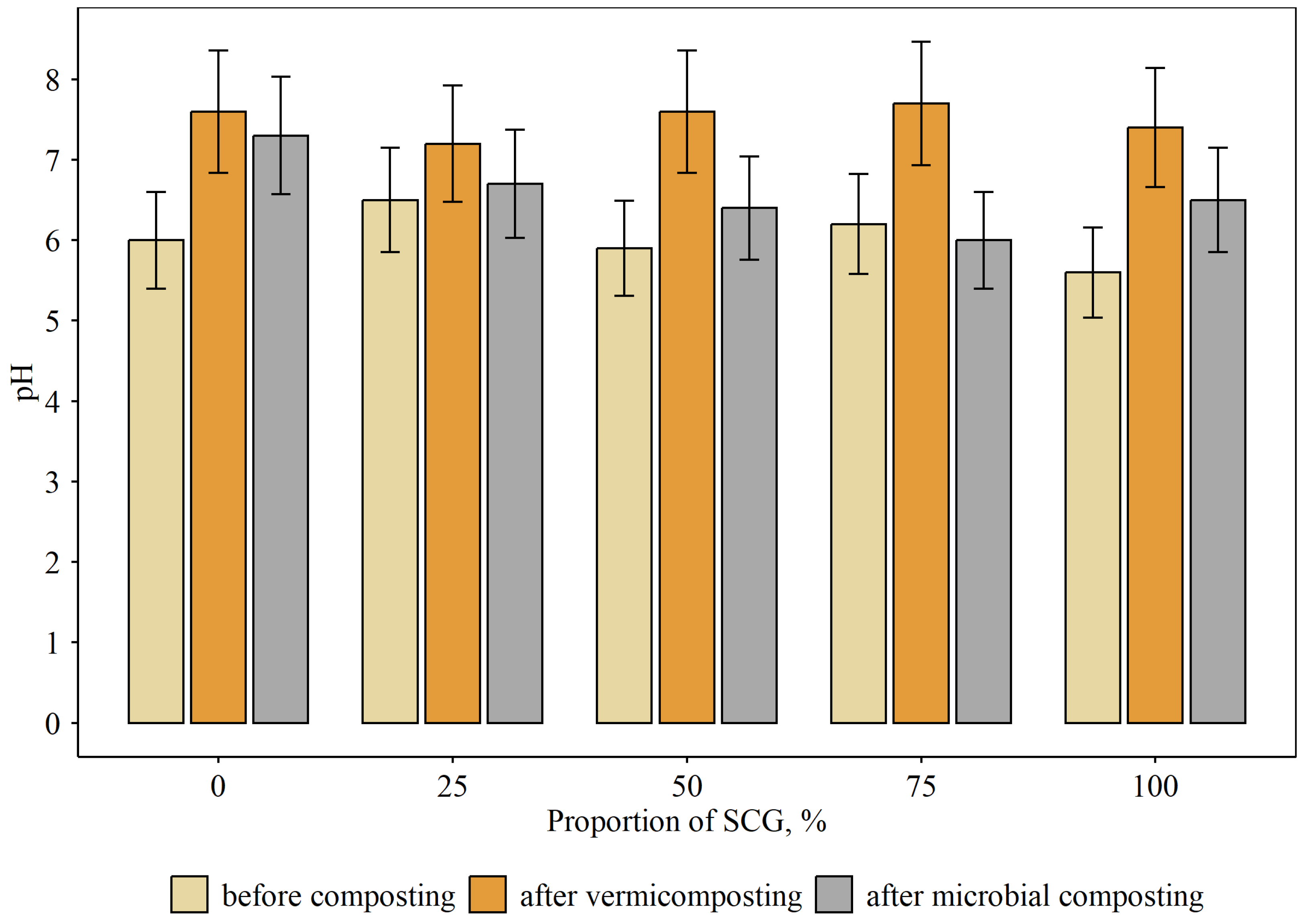
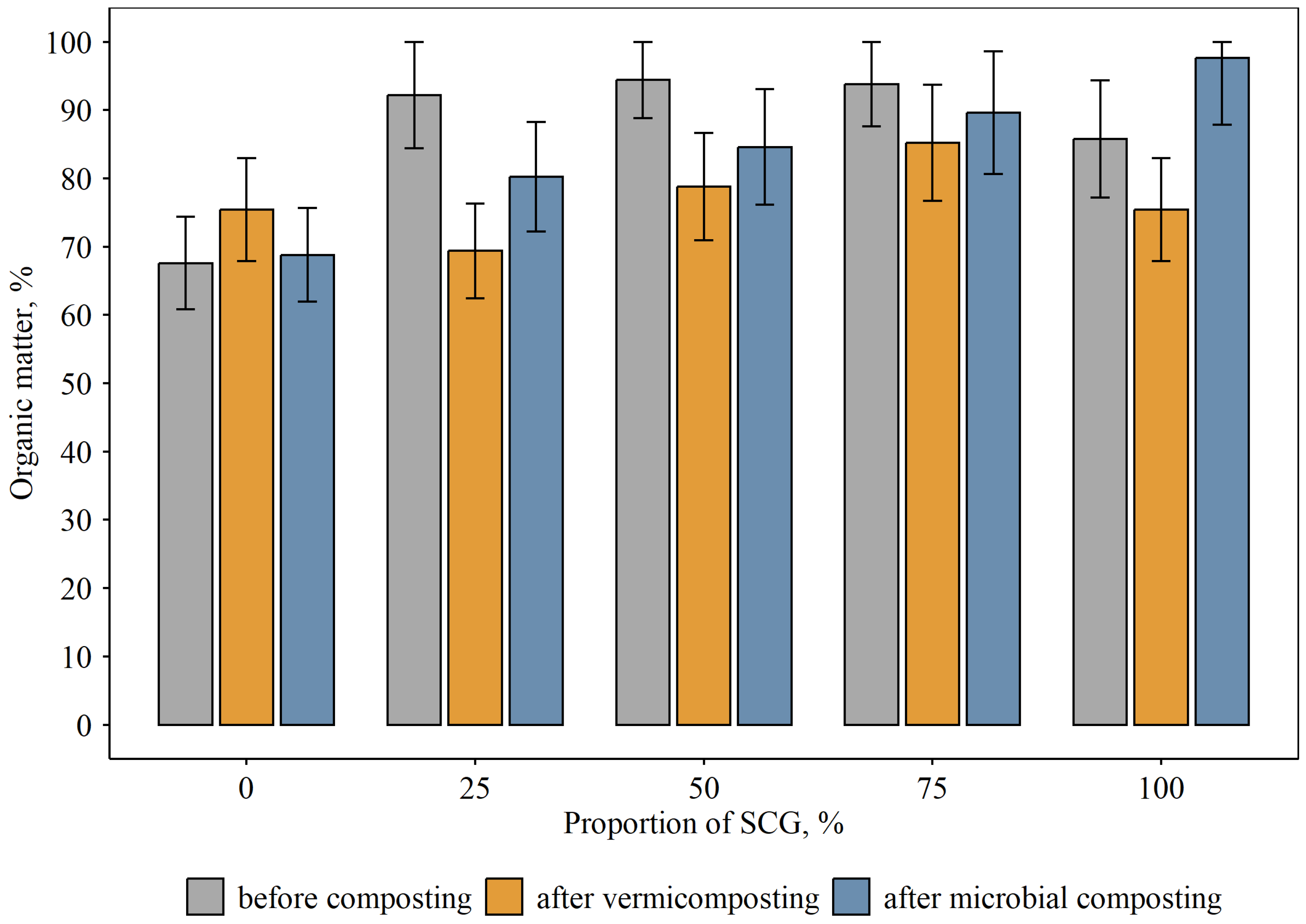
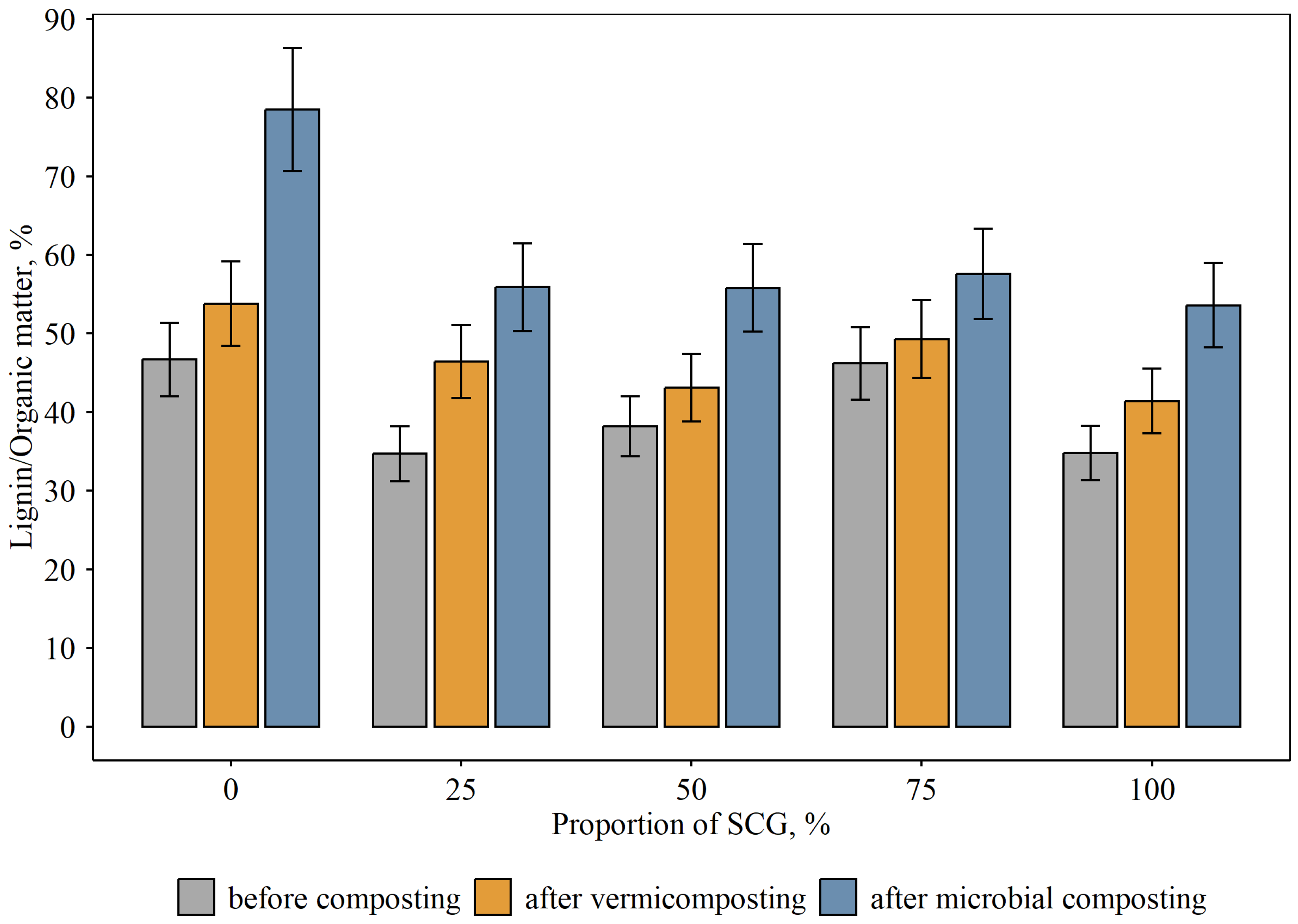
3.2. Chemical Properties
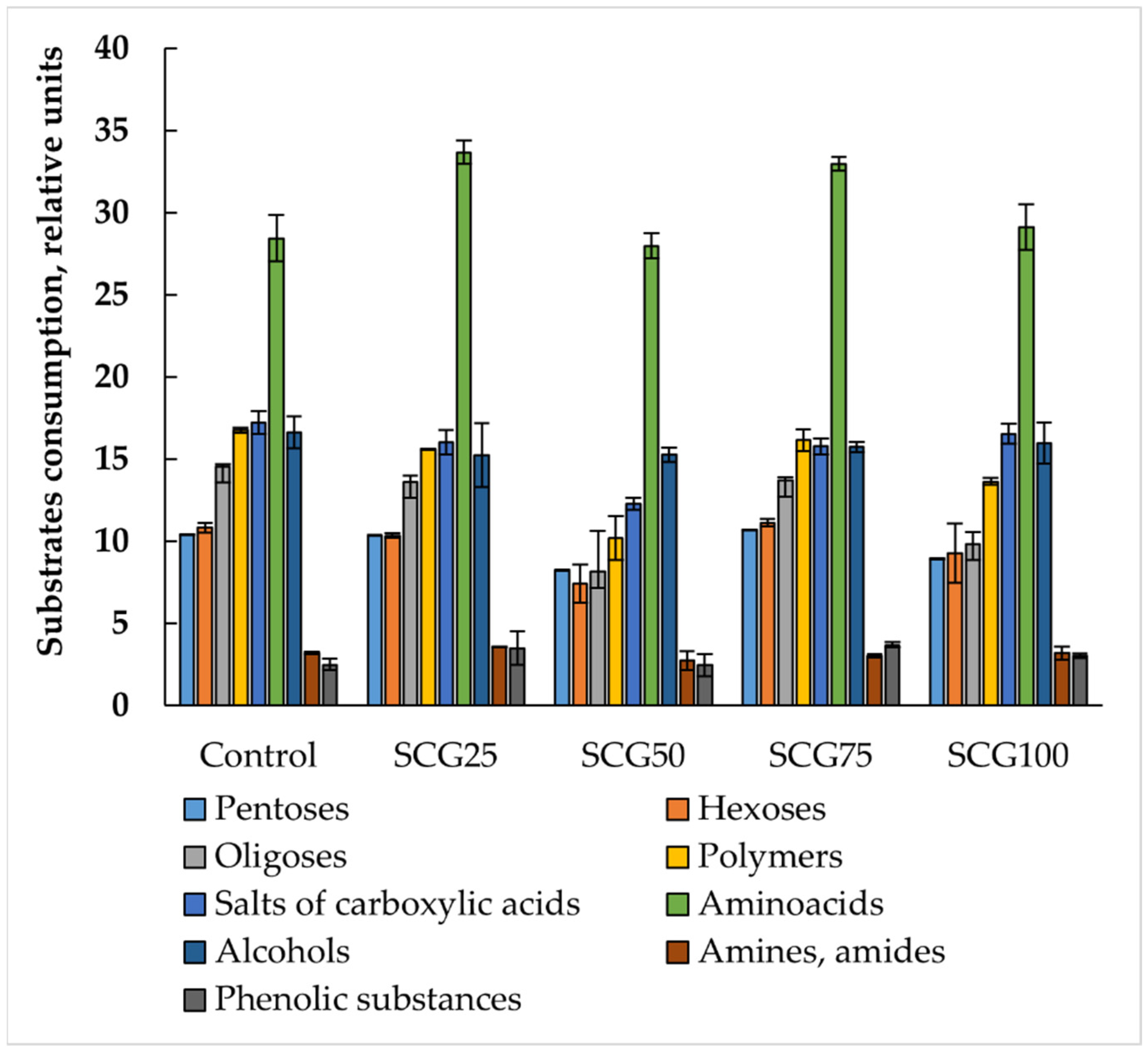
3.3. Bacterial Abundance and Functional Biodiversity
4. Discussion
4.1. Vermicomposting Potential for Coffee Waste Conversion into Biofertilizer
4.2. Chemical Parameters of Coffee Waste Conversion into Biofertilizer
4.3. Biological Parameters of Coffee Waste Conversion into Biofertilizer
4.4. Limitations of the Study
5. Conclusions
Supplementary Materials
Author Contributions
Funding
Data Availability Statement
Acknowledgments
Conflicts of Interest
Abbreviations
| SCG | Spent coffee grounds |
| PGPB | Plant-growth-promoting bacteria |
| CFU | Colony-forming unit |
| PBS | Phosphate-buffered saline |
References
- Voora, V.; Bermudez, S.; Larrea, C. Global Market Report: Coffee; International Institute for Sustainable Development: Winnipeg, MB, Canada, 2019; Available online: https://www.researchgate.net/publication/378140395_Global_Market_Report_Coffee (accessed on 14 October 2025).
- International Coffee Organization. Historical Data on the Global Coffee Trade; International Coffee Organization: London, UK, 2023. [Google Scholar]
- Bevilacqua, E.; Cruzat, V.; Singh, I.; Rose’Meyer, R.B.; Panchal, S.K.; Brown, L. The potential of spent coffee grounds in functional food development. Nutrients 2023, 15, 994. [Google Scholar] [CrossRef] [PubMed]
- Mussatto, S.I.; Ballesteros, L.F.; Martins, S.; Teixeira, J.A. Extraction of antioxidant phenolic compounds from spent coffee grounds. Sep. Purif. Technol. 2011, 83, 173–179. [Google Scholar] [CrossRef]
- Mesmar, A.K.; Albedwawi, S.T.; Alsalami, A.K.; Alshemeili, A.R.; Abu-Elsaoud, A.M.; El-Tarabily, K.A.; Raish, S.M.A. The Effect of Recycled Spent Coffee Grounds Fertilizer, Vermicompost, and Chemical Fertilizers on the Growth and Soil Quality of Red Radish (Raphanus sativus) in the United Arab Emirates: A Sustainability Perspective. Foods 2024, 13, 1997. [Google Scholar] [CrossRef]
- González-Moreno, M.A.; Gracianteparaluceta, B.G.; Sádaba, S.M.; Urdin, J.Z.; Domínguez, E.R.; Ezcurdia, M.A.P.; Meneses, A.S. Feasibility of vermicomposting of spent coffee grounds and silverskin from coffee industries: A laboratory study. Agronomy 2020, 10, 1125. [Google Scholar] [CrossRef]
- Bomfim, A.S.C.; Oliveira, D.M.; Walling, E.; Babin, A.; Hersant, G.; Vaneeckhaute, C.; Dumont, M.J.; Rodrigue, D. Spent coffee grounds characterization and reuse in composting and soil amendment. Waste 2022, 1, 2–20. [Google Scholar] [CrossRef]
- Jezerská, L.; Prokes, R.; Sassmanova, V.; Gelnar, D. The pelletization and torrefaction of coffee grounds, garden chaff and rapeseed straw. Renew. Energy 2023, 210, 346–354. [Google Scholar] [CrossRef]
- Sanchez-Hernandez, J.C.; Domínguez, J. Vermicompost derived from spent coffee grounds: Assessing the potential for enzymatic bioremediation. In Handbook of Coffee Processing by-Products; Galanakis, C., Ed.; Academic Press, Elsevier: London, UK, 2017; pp. 369–398. [Google Scholar] [CrossRef]
- Hu, Y.; Li, J.; Wu, Y.; Zhang, D.; Qi, Z.; Yang, R. Spent Coffee Ground and Its Derivatives as Soil Amendments—Impact on Soil Health and Plant Production. Agronomy 2025, 15, 26. [Google Scholar] [CrossRef]
- Hoseini, M.; Cocco, S.; Casucci, C.; Cardelli, V.; Corti, G. Coffee by-products derived resources. A review. Biomass Bioenergy 2021, 148, 106009. [Google Scholar] [CrossRef]
- Horgan, F.G.; Floyd, D.; Mundaca, E.A.; Crisol-Martínez, E. Spent coffee grounds applied as a top-dressing or incorporated into the soil can improve plant growth while reducing slug herbivory. Agriculture 2023, 13, 257. [Google Scholar] [CrossRef]
- Dzung, N.A. Evaluation of coffee husk compost for improving soil fertility and sustainable coffee production in rural Central Highland of Vietnam. Resour. Environ. 2013, 3, 77–82. [Google Scholar]
- Amalia, N.; Widialip, N.F.; Safira, N.; Citrasari, N. The potential of coffee waste composting technology using microbial activators to reduce solid waste in the coffee industry. IOP Conf. Ser. Earth Environ. Sci. 2021, 802, 012027. [Google Scholar] [CrossRef]
- Sukmawati, F.N.; Pramudya, Y.; Pamungkas, S.S.T.; Rozaki, Z.; Irna, A.; Sukarji, S.; Rahmat, A.; Hanum, F.F. Quality analysis of coffee waste compost with the addition of cassava tapai local microorganism (LMO) bioactivator. Appl. Res. Sci. Technol. 2023, 3, 72–85. [Google Scholar] [CrossRef]
- Hoseini, M.; Cocco, S.; Casucci, C.; Cardelli, V.; Ruello, M.L.; Serrani, D.; Corti, G. Producing agri-food derived composts from coffee husk as primary feedstock at different temperature conditions. J. Environ. Manag. 2025, 373, 123485. [Google Scholar] [CrossRef]
- Dimitrijević, S.; Milić, M.; Buntić, A.; Dimitrijević-Branković, S.; Filipović, V.; Popović, V.; Salamon, I. Spent coffee grounds, plant growth promoting bacteria, and medicinal plant waste: The biofertilizing effect of high-value compost. Sustainability 2024, 16, 1632. [Google Scholar] [CrossRef]
- Ozer, H.; Ozdemir, N.; Ates, A.; Koklu, R.; Ozturk Erdem, S.; Ozdemir, S. Circular Utilization of Coffee Grounds as a Bio-Nutrient Through Microbial Transformation for Leafy Vegetables. Life 2024, 14, 1299. [Google Scholar] [CrossRef] [PubMed]
- Santhanarajan, A.E.; Han, Y.H.; Koh, S.C. The efficacy of functional composts manufactured using spent coffee ground, rice bran, biochar, and functional microorganisms. Appl. Sci. 2021, 11, 7703. [Google Scholar] [CrossRef]
- Adi, A.J.; Noor, Z.M. Waste recycling: Utilization of coffee grounds and kitchen waste in vermicomposting. Bioresour. Technol. 2009, 100, 1027–1030. [Google Scholar] [CrossRef]
- Liu, K.; Price, G.W. Evaluation of three composting systems for the management of spent coffee grounds. Bioresour. Technol. 2011, 102, 7966–7974. [Google Scholar] [CrossRef]
- Zergaw, Y.; Kebede, T.; Berhe, D.T. Direct application of coffee pulp vermicompost produced from epigeic earthworms and its residual effect on vegetative and reproductive growth of hot pepper (Capsicum annuum L.). Sci. World J. 2023, 2023, 7366925. [Google Scholar] [CrossRef]
- Singh, R.P.; Singh, P.; Araujo, A.; Ibrahim, M.H.; Sulaiman, O. Management of urban solid waste: Vermicomposting a sustainable option. Resour. Conserv. Recycl. 2011, 55, 719–729. [Google Scholar] [CrossRef]
- Edwards, C.A.; Arancon, N.Q.; Sherman, R.L. Vermiculture Technology: Earthworms, Organic Wastes, and Environmental Management; CRC Press: Boca Raton, FL, USA, 2010. [Google Scholar] [CrossRef]
- Toor, M.D.; Ay, A.; Ullah, I.; Demirkaya, S.; Kizikaya, R.; Mihoub, A.; Zia, A.; Jamal, A.; Ghfar, A.A.; Serio, A.D.; et al. Vermicompost rate effects on soil fertility and morpho-physio-biochemical traits of lettuce. Horticulturae 2024, 10, 418. [Google Scholar] [CrossRef]
- Ravindran, B.; Contreras-Ramos, S.M.; Sekaran, G. Changes in earthworm gut associated enzymes and microbial diversity on the treatment of fermented tannery waste using epigeic earthworm Eudrilus eugeniae. Ecol. Eng. 2015, 74, 394–401. [Google Scholar] [CrossRef]
- Prisa, D.; Jamal, A. Vermicompost in agricultural production: Mechanisms, importance, and applications. Multidiscip. Rev. 2025, 8, 2025325. [Google Scholar] [CrossRef]
- Nogueira, W.A.; Nogueira, F.N.; Devens, D.C. Temperature and pH control in composting of coffee and agricultural wastes. Water Sci. Technol. 1999, 40, 113–119. [Google Scholar] [CrossRef]
- Shemekite, F.; Gómez-Brandón, M.; Franke-Whittle, I.H.; Praehauser, B.; Insam, H.; Assefa, F. Coffee husk composting: An investigation of the process using molecular and non-molecular tools. Waste Manag. 2014, 34, 642–652. [Google Scholar] [CrossRef]
- Dadi, D.; Daba, G.; Beyene, A.; Luis, P.; Van der Bruggen, B. Composting and co-composting of coffee husk and pulp with source-separated municipal solid waste: A breakthrough in valorization of coffee waste. Int. J. Recycl. Org. Waste Agric. 2019, 8, 263–277. [Google Scholar] [CrossRef]
- Hanc, A.; Hřebečková, T.; Grasserova, A.; Cajthaml, T. Conversion of spent coffee grounds into vermicompost. Bioresour. Technol. 2021, 341, 125925. [Google Scholar] [CrossRef]
- Vela-Cano, M.; Gómez-Brandón, M.; Pesciaroli, C.; Insam, H.; González-López, J. Study of total bacteria and ammonia-oxidizing bacteria and ammonia-oxidizing archaea in response to irrigation with sewage sludge compost tea in agricultural soil. Compos. Sci. Util. 2018, 26, 145–155. [Google Scholar] [CrossRef]
- Urgiles-Gómez, N.; Avila-Salem, M.E.; Loján, P.; Encalada, M.; Hurtado, L.; Araujo, S.; Collahuazo, Y.; Guachanamá, J.; Poma, N.; Granda, K.; et al. Plant growth-promoting microorganisms in coffee production: From isolation to field application. Agronomy 2021, 11, 1531. [Google Scholar] [CrossRef]
- Pérez-Burillo, S.; Cervera-Mata, A.; Arteaga, A.F.; Pastoriza, S. Why should we be concerned with the use of spent coffee grounds as an organic amendment of soils? A narrative review. Agronomy 2022, 12, 2771. [Google Scholar] [CrossRef]
- Raphael, K.; Velmourougane, K. Chemical and microbiological changes during vermicomposting of coffee pulp using exotic (Eudrilus eugeniae) and native earthworm (Perionyx ceylanesis) species. Biodegradation 2011, 22, 497–507. [Google Scholar] [CrossRef]
- Cruz, S.; Marques dos Santos Cordovil, C.S. Espresso coffee residues as a nitrogen amendment for small-scale vegetable production. J. Sci. Food Agric. 2015, 95, 3059–3066. [Google Scholar] [CrossRef]
- Cervera-Mata, A.; Navarro-Alarcón, M.; Rufián-Henares, J.A.; Pastoriza, S.; Montilla-Gómez, J.; Delgado, G. Phytotoxicity and chelating capacity of spent coffee grounds: Two contrasting faces in its use as soil organic amendment. Sci. Total Environ. 2020, 717, 137247. [Google Scholar] [CrossRef]
- Wang, Y.; Cang, T.; Zhao, X.; Yu, R.; Chen, L.; Wu, C.; Wang, Q. Comparative acute toxicity of twenty-four insecticides to earthworm, Eisenia fetida. Ecotoxicol. Environ. Saf. 2012, 79, 122–128. [Google Scholar] [CrossRef] [PubMed]
- Nelson, D.W.; Sommers, L.E. Total carbon, organic carbon, and organic matter. In Method of Soil Analysis, Part 2; Page, A.L., Miller, R.H., Keeney, D.R., Eds.; American Society of Agronomy: Madison, WI, USA, 1982; pp. 539–579. [Google Scholar]
- Feofilova, E.P.; Mysyakina, I.S. Lignin: Chemical structure, biodegradation, and practical application (a review). Appl. Biochem. Microbiol. 2016, 52, 573–581. [Google Scholar] [CrossRef]
- Reasoner, D.J. Microbiology of potable water and groundwater. J. Water Pollut. Control Fed. 1983, 55, 891–895. [Google Scholar]
- Rainey, F. Bergey’s Manual of Systematics of Archaea and Bacteria; Wiley: Hoboken, NJ, USA, 2015. [Google Scholar]
- Cheptsov, V.S.; Vorobyova, E.A.; Manucharova, N.A.; Gorlenko, M.V.; Pavlov, A.K.; Vdovina, M.A.; Lomasov, V.N.; Bulat, S.A. 100 kGy gamma-affected microbial communities within the ancient Arctic permafrost under simulated Martian conditions. Extremophiles 2017, 21, 1057–1067. [Google Scholar] [CrossRef] [PubMed]
- GOST R 56004—2014; National Standard of the Russian Federation. Organic Fertilizers. Vermicomposts. Technical Specifications. Standartinform: Moscow, Russia, 2020. Available online: https://internet-law.ru/gosts/gost/57362/ (accessed on 31 October 2025). (In Russian)
- Hayat, R.; Amara, U.; Khalid, R.; Ali, S. Soil beneficial bacteria and their role in plant growth promotion: A review. Ann. Microbiol. 2010, 60, 579–598. [Google Scholar] [CrossRef]
- Timilsina, S.; Potnis, N.; Newberry, E.A.; Liyanapathiranage, P.; Iruegas-Bocardo, F.; White, F.F.; Goss, E.M.; Jones, J.B. Xanthomonas diversity, virulence and plant–pathogen interactions. Nat. Rev. Microbiol. 2020, 18, 415–427. [Google Scholar] [CrossRef]
- Cherif-Silini, H.; Silini, A.; Bouket, A.C.; Alenezi, F.N.; Luptakova, L.; Bouremani, N.; Nowakowska, J.A.; Oszako, T.; Belbahri, L. Tailoring next generation plant growth promoting microorganisms as versatile tools beyond soil desalinization: A road map towards field application. Sustainability 2021, 13, 4422. [Google Scholar] [CrossRef]
- Ciesielczuk, T.; Rosik-Dulewska, C.; Poluszyńska, J.; Miłek, D.; Szewczyk, A.; Sławińska, I. Acute Toxicity of Experimental Fertilizers Made of Spent Coffee Grounds. Waste Biomass Valorization 2018, 9, 2157–2164. [Google Scholar] [CrossRef]
- Fortova, S.M.; Voronina, L.P.; Smolskiy, E.Y.; Romanenkov, V.A.; Krasilnikov, P.V. Ecotoxicological assessment of coffee waste as a component of organic fertilizers. Eurasian Soil. Sci. 2025, 58, 166. [Google Scholar] [CrossRef]
- San Martin Ruiz, M.; Reiser, M.; Kranert, M. Composting and methane emissions of coffee by-products. Atmosphere 2021, 12, 1153. [Google Scholar] [CrossRef]
- Hassen, A.; Belguith, K.; Jedidi, N.; Cherif, A.; Cherif, M.; Boudabous, A. Microbial characterization during composting of municipal solid waste. Bioresour. Technol. 2001, 80, 217–225. [Google Scholar] [CrossRef] [PubMed]
- Tang, J.C.; Inoue, Y.; Yasuta, T.; Yoshida, S.; Katayama, A. Chemical and microbial properties of various compost products. Soil. Sci. Plant Nutr. 2003, 49, 273–280. [Google Scholar] [CrossRef]
- Kopeć, M.; Baran, A.; Mierzwa-Hersztek, M.; Gondek, K.; Chmiel, M.J. Effect of the addition of biochar and coffee grounds on the biological properties and ecotoxicity of composts. Waste Biomass Valorization 2018, 9, 1389–1398. [Google Scholar] [CrossRef]
- Papale, M.; Romano, I.; Finore, I.; Lo Giudice, A.; Piccolo, A.; Cangemi, S.; Di Meo, V.; Nicolaus, B.; Poli, A. Prokaryotic diversity of the composting thermophilic phase: The case of ground coffee compost. Microorganisms 2021, 9, 218. [Google Scholar] [CrossRef]
- Shin, J.H.; Park, S.H.; Kim, A.; Son, Y.H.; Joo, S.H. Changes in physical, chemical, and biological traits during composting of spent coffee grounds. Korean J. Environ. Agric. 2020, 39, 178–187. [Google Scholar] [CrossRef]
- Emmanuel, S.A.; Yoo, J.; Kim, E.J.; Chang, J.S.; Park, Y.I.; Koh, S.C. Development of functional composts using spent coffee grounds, poultry manure and biochar through microbial bioaugmentation. J. Environ. Sci. Health Part B 2017, 52, 802–811. [Google Scholar] [CrossRef]
- Figueroa-Varela, P.A.; Duque-Dussán, E. Functional Characterization of Native Microorganisms from the Pulp of Coffea arabica L. Var. Castillo and Cenicafé 1 for Postharvest Applications and Compost Enhancement. Appl. Microbiol. 2025, 5, 86. [Google Scholar] [CrossRef]
- Silva, C.F.; Schwan, R.F.; Dias, Ë.S.; Wheals, A.E. Microbial diversity during maturation and natural processing of coffee cherries of Coffea arabica in Brazil. Int. J. Food Microbiol. 2000, 60, 251–260. [Google Scholar] [CrossRef]
- Duong, B.; Marraccini, P.; Maeght, J.L.; Vaast, P.; Lebrun, M.; Duponnois, R. Coffee microbiota and its potential use in sustainable crop management. A review. Front. Sustain. Food Syst. 2020, 4, 607935. [Google Scholar] [CrossRef]
- Figueiredo, M.V.B.; Bonifacio, A.; Rodrigues, A.C.; Araujo, F.F.; Stamford, N.P. Beneficial microorganisms: Current challenge to increase crop performance. In Bioformulations for Sustainable Agriculture; Arora, N., Mehnaz, S., Balestrini, R., Eds.; Springer: New Delhi, India, 2016; pp. 53–70. [Google Scholar] [CrossRef]
- Dastager, S.G.; Deepa, C.K.; Pandey, A. Isolation and characterization of novel plant growth promoting Micrococcus sp. NII-0909 and its interaction with cowpea. Plant Physiol. Biochem. 2010, 48, 987–992. [Google Scholar] [CrossRef] [PubMed]
- Dubey, A.; Kumar, A.; Khan, M.L.; Payasi, D.K. Plant growth-promoting and bio-control activity of Micrococcus luteus strain AKAD 3-5 isolated from the soybean (Glycine max (L.) Merr.) rhizosphere. Open Microbiol. J. 2021, 15, 188–197. [Google Scholar] [CrossRef]
- Sharma, S.K.; Dhyani, R.; Ahmad, E.; Maurya, P.K.; Yadav, M.; Yadav, R.C.; Yadav, V.K.; Sharma, P.K.; Sharma, M.P.; Ramesh, A.; et al. Characterization and low-cost preservation of Chromobacterium violaceum strain TRFM-24 isolated from Tripura state, India. J. Genet. Eng. Biotechnol. 2021, 19, 146. [Google Scholar] [CrossRef]
- Kim, H.; Woo, O.G.; Kim, J.B.; Yoon, S.Y.; Kim, J.S.; Sul, W.J.; Hwang, J.Y.; Lee, J.H. Flavobacterium sp. strain GJW24 ameliorates drought resistance in Arabidopsis and Brassica. Front. Plant Sci. 2023, 14, 1257137. [Google Scholar] [CrossRef]
- Agunbiade, V.F.; Fadiji, A.E.; Agbodjato, N.A.; Babalola, O.O. Isolation and characterization of plant-growth-promoting, drought-tolerant rhizobacteria for improved maize productivity. Plants 2024, 13, 1298. [Google Scholar] [CrossRef]
- Seo, H.; Kim, J.H.; Lee, S.M.; Lee, S.W. The plant-associated Flavobacterium: A hidden helper for improving plant health. Plant Pathol. J. 2024, 40, 251. [Google Scholar] [CrossRef] [PubMed]





| Treatment | Dead Individuals, ps | Biomass of Earthworms, g | Biomass Increment, % | ||
|---|---|---|---|---|---|
| Before Incubation | After Incubation | ||||
| Control | 0 | 4.117 ± 0.005 1 | 3.940 ± 0.005 | −4.1 | |
| SCG | 0.4% | 3.963 ± 0.005 | 4.050 ± 0.005 | 4.050 ± 0.005 | +2.2 |
| 0.8% | 4.083 ± 0.005 | 4.267 ± 0.005 | 4.267 ± 0.005 | +4.5 | |
| 1.2% | 3.810 ± 0.005 | 3.910 ± 0.005 | 3.910 ± 0.005 | +2.6 | |
| Compost Mixture | Dominants | Group of Average Abundance | Minor Components | ||
|---|---|---|---|---|---|
| Vermicomposting | Control substrate (SGC 0%) | Bacillus | Pseudomonas | Arthrobacter | |
| SCG | 25% | Bacillus | Pseudomonas | Micrococcus | |
| 50% | Bacillus | Pseudomonas | Flavobaccterium | ||
| 75% | Bacillus | Pseudomonas | Arthrobacter | ||
| 100% | Bacillus | Pseudomonas | Xanthomonas | ||
| Microbial composting | Control substrate (SGC 0%) | Bacillus | Arthrobacter | Streptomyces | |
| SCG | 25% | Bacillus | Pseudomonas | Flavobacterium | |
| 50% | Bacillus | Pseudomonas | Arthrobacter | ||
| 75% | Bacillus | Pseudomonas | Chromobacterium | ||
| 100% | Bacillus | Pseudomonas | Arthrobacter | ||
| Compost Mixture | Number of Consumed Substrates | Average Well Color Development | Shannon Index | Pielou Index | ||
|---|---|---|---|---|---|---|
| Vermicomposting | Control substrate (SGC 0%) | 44 ± 0 a | 2.52 ± 0.03 a | 5.26 ± 0.04 a | 0.96 ± 0.01 a | |
| SCG | 25% | 44 ± 0 a | 2.53 ± 0.03 a | 5.29 ± 0.05 a | 0.97 ± 0.01 a | |
| 50% | 44 ± 0 a | 1.97 ± 0.01 b | 5.24 ± 0.03 a | 0.96 ± 0.01 a | ||
| 75% | 43 ± 0 b | 2.54 ± 0.02 a | 5.24 ± 0.04 a | 0.97 ± 0.01 a | ||
| 100% | 45 ± 0 c | 2.28 ± 0.03 ab | 5.30 ± 0.05 a | 0.96 ± 0.01 a | ||
| Microbial composting | Control substrate (SGC 0%) | 44 ± 0 a | 3.02 ± 0.05 c | 5.24 ± 0.04 a | 0.96 ± 0.01 a | |
| SCG | 25% | 45 ± 0 c | 2.96 ± 0.19 c | 5.25 ± 0.03 a | 0.96 ± 0.01 a | |
| 50% | 45 ± 0 c | 3.24 ± 0.04 c | 5.29 ± 0.04 a | 0.96 ± 0.01 a | ||
| 75% | 46 ± 0 d | 2.97 ± 0.18 c | 5.25 ± 0.04 a | 0.95 ± 0.01 a | ||
| 100% | 46 ± 0 d | 2.31 ± 0.04 ab | 5.28 ± 0.03 a | 0.96 ± 0.01 a | ||
Disclaimer/Publisher’s Note: The statements, opinions and data contained in all publications are solely those of the individual author(s) and contributor(s) and not of MDPI and/or the editor(s). MDPI and/or the editor(s) disclaim responsibility for any injury to people or property resulting from any ideas, methods, instructions or products referred to in the content. |
© 2025 by the authors. Licensee MDPI, Basel, Switzerland. This article is an open access article distributed under the terms and conditions of the Creative Commons Attribution (CC BY) license (https://creativecommons.org/licenses/by/4.0/).
Share and Cite
Smolskii, E.; Cheptsov, V.; Belov, A.; Yakimenko, O.; Romanenkov, V.; Nezomba, H.; Nyamasoka-Magonziwa, B.; Wadzvanya, T.; Krasilnikov, P. Effect of Composting and Vermicomposting on Microbiological and Chemical Characteristics of Spent Coffee Grounds. Agronomy 2025, 15, 2823. https://doi.org/10.3390/agronomy15122823
Smolskii E, Cheptsov V, Belov A, Yakimenko O, Romanenkov V, Nezomba H, Nyamasoka-Magonziwa B, Wadzvanya T, Krasilnikov P. Effect of Composting and Vermicomposting on Microbiological and Chemical Characteristics of Spent Coffee Grounds. Agronomy. 2025; 15(12):2823. https://doi.org/10.3390/agronomy15122823
Chicago/Turabian StyleSmolskii, Egor, Vladimir Cheptsov, Andrey Belov, Olga Yakimenko, Vladimir Romanenkov, Hatirarami Nezomba, Blessing Nyamasoka-Magonziwa, Taliesen Wadzvanya, and Pavel Krasilnikov. 2025. "Effect of Composting and Vermicomposting on Microbiological and Chemical Characteristics of Spent Coffee Grounds" Agronomy 15, no. 12: 2823. https://doi.org/10.3390/agronomy15122823
APA StyleSmolskii, E., Cheptsov, V., Belov, A., Yakimenko, O., Romanenkov, V., Nezomba, H., Nyamasoka-Magonziwa, B., Wadzvanya, T., & Krasilnikov, P. (2025). Effect of Composting and Vermicomposting on Microbiological and Chemical Characteristics of Spent Coffee Grounds. Agronomy, 15(12), 2823. https://doi.org/10.3390/agronomy15122823