Article

Reliable Gene Expression Normalization in Cucumber Leaves: Identifying Stable Reference Genes Under Drought Stress


by
Wojciech Szczechura
1,
Urszula Kłosińska
1,*,
Marzena Nowakowska
1,
Katarzyna Nowak
1 and
Marcin Nowicki
2
1
Department of Genetics, Breeding, and Biotechnology of Vegetable Crops, The National Institute of Horticultural Research, 96-100 Skierniewice, Poland
2
Department of Entomology and Plant Pathology, Institute of Agriculture, University of Tennessee, Knoxville, TN 37996, USA
*
Author to whom correspondence should be addressed.
Agronomy 2025, 15(12), 2811; https://doi.org/10.3390/agronomy15122811 (registering DOI)
Submission received: 16 November 2025 / Revised: 3 December 2025 / Accepted: 4 December 2025 / Published: 6 December 2025
(This article belongs to the Special Issue Advances in Crop Molecular Breeding and Genetics—2nd Edition)

Abstract

Reverse transcription quantitative PCR (RT-qPCR) is extensively used to quantify gene expression under drought conditions; however, its reliability depends on the validation of the reference genes under specific conditions. In cucumber, reference genes have rarely been validated under drought conditions. This study identified stable housekeeping genes for RT-qPCR normalization in the leaves of two inbred lines with contrasting drought responses. Plants underwent a 7-day drought period, with leaf samples collected at multiple points along with watered controls. The expression stability of 13 candidate genes was evaluated using four algorithms: geNorm, NormFinder, BestKeeper, and the comparative ΔCt method, with the results integrated using RefFinder. Ten genes producing specific and efficient amplicons were analyzed for stability. CACS and UBI-1 consistently ranked among the most stable genes, with TIP41-like as an additional reliable option, whereas GAPDH and HEL were unstable. GeNorm pairwise variation analysis showed that the two reference genes were sufficient for accurate normalization. Functional validation with three drought-responsive targets (LOX, HsfC1, and CYP72A219) and comparison with RNA sequencing (RNA-seq) fold changes confirmed that normalization using CACS and UBI-1 yielded the most biologically credible expression profiles. These reference genes will facilitate robust RT-qPCR analyses of drought response in cucumber leaves and provide a starting point for validating suitable normalizers in other cucumber organs and related cucurbits.

1. Introduction

Gene expression analysis plays a fundamental role in understanding gene function and elucidating phenotypic variations in biological systems [1]. Among the available molecular tools, reverse transcription quantitative PCR (RT-qPCR) remains the most widely adopted technique because of its high sensitivity, reproducibility, rapid turnaround, and cost-effectiveness [2,3,4,5]. In addition to directly quantifying transcript abundance, RT-qPCR is frequently employed to validate the results of from transcriptomic and microarray analyses [6]. However, reliable RT-qPCR inference requires rigorous normalization using internal reference genes (housekeeping genes, HKGs) with demonstrably stable expression under the specific biological context (e.g., tissue, treatment, time). In addition, experimental design, reporting, and data interpretation must comply with the MIQE (Minimum Information for Publication of Quantitative Real-Time PCR Experiments) guidelines to ensure transparency, reproducibility, and cross-study comparability [1,2,3].
A key methodological insight into gene expression analysis is that no single HKG is universally stable [1,4,5,6]. Traditional reference genes such as actin (ACT), tubulin (TUB), glyceraldehyde-3-phosphate dehydrogenase (GAPDH), ubiquitin (UBI), and elongation factor 1-α (EF1α), were once assumed to have constant expression. Thanks to the increasing amount of evidence, we now recognize that their transcription fluctuates depending on the species, organ, developmental stage, and/or exposure to biotic or abiotic stress [2,3,4,5,6,7,8]. This variability can introduce substantial bias in target gene quantification if HKG are selected uncritically, thereby making rigorous condition-specific validation essential for credible RT-qPCR interpretation [7,8,9,10,11,12,13].
To address this emerging issue, several computational algorithms have been developed to objectively evaluate HKG stability. geNorm calculates the pairwise variation (M) among candidate genes and proposes geometric averaging of multiple stable references to determine the minimal number required [7]. NormFinder applies a model-based variance estimation approach that separates intra- and inter-group variation [14]. BestKeeper ranks candidates based on standard deviation, coefficient of variation, and correlation of raw cycle threshold (Ct) values [15]. The comparative ΔCt (delta cycle threshold) method provides a straightforward pairwise gene-to-gene comparison across samples [16]. Therefore, many recent studies advocate combining multiple algorithms, often through integrative tools such as RefFinder [17] to derive a consensus ranking and improve confidence in HKG selection [7,14,15,16].
The MIQE framework further emphasizes transparent reporting, including primer sequences and amplification efficiencies, stability metrics, and justification for the number of reference genes, to ensure reproducibility across laboratories and platforms [1]. In accordance with these recommendations, an increasing volume of plant research has evaluated the stability of HKGs under various conditions, including developmental gradients, hormone treatments, and diverse biotic and abiotic stresses [2,3,4,5,6,8,9,10,11,12,13,18,19,20,21]. These studies consistently demonstrate that the optimal selection of reference genes is highly context-dependent; loci that are effective in one tissue, species, or stress scenario may prove inadequate in another [18,19,22]. This context specificity challenges the use of universal reference genes and advocates for a framework in which HKGs are systematically assessed within each specific crop stress combination of interest.
Cucumber (Cucumis sativus L.) is a globally important vegetable crop and a genomic model within the Cucurbitaceae family, particularly since the release of its draft genome sequence [23]. Drought stress poses an increasing threat to cucumber productivity, as it triggers large-scale transcriptional changes involving ABA-dependent and ABA-independent signaling, osmotic regulation, ROS homeostasis, and aquaporin-mediated transport [24,25,26]. Transcriptomic comparisons among tolerant and sensitive cultivars have revealed genotype-specific response patterns [27]. Under such dynamic regulation, the assumption of universal HKG stability is untenable; instead, HKG must be validated for the specific drought-stressed tissues and genotypes under study. Empirical studies on cucumbers substantiate this conclusion. A comprehensive survey across organs, hormone treatments, and abiotic stresses identified EF1α and UBI as the most stable HKG candidates overall, with EF1α being particularly reliable under abiotic stress [28]. In cucumber–pumpkin graft systems, optimal normalizers vary by organ and condition [29]. Under biotic stress conditions affecting root function (including Meloidogyne incognita infection and treatments with a mixture of Pseudomonas strains RH58, RH61, and RH62), geNorm, NormFinder, BestKeeper, and RefFinder collectively identified EF1α, UBI, and CACS as the most stable housekeeping genes [30].
This study was based on the hypothesis that no single HKG maintains stable expression across drought conditions in cucumber and context-specific validation is required for robust RT-qPCR normalization. To achieve this, the expression stability of 13 candidate genes was evaluated in the leaves of drought-tolerant and drought-sensitive lines and multiple timepoints using four algorithms (geNorm, NormFinder, BestKeeper, and ΔCt method) combined through the RefFinder consensus approach. The selected reference genes were further validated by analyzing the expression of drought-responsive target genes (LOX, HsfC1, and CYP72A219) in leaf tissue and by comparing the RT-qPCR results with RNA-seq data. Our goal was to deliver a reliable, empirically justified set of reference genes to ensure accurate and reproducible gene expression quantification in cucumber leaves under drought stress.

2. Materials and Methods

2.1. Plant Material and Stress Treatments

Two cucumber lines with contrasting drought responses were used: SU2 (drought-tolerant) and SU6 (drought-sensitive) [31]. One of them, SU2, was bred at the National Institute of Horticultural Research (NIHR), Skierniewice, Poland and the other one, SU6 (PI 272327, India) was obtained from the North Central Regional Plant Introduction Station, Ames, IA, USA. The experiment was conducted in controlled environment (day/night 22 °C) in a greenhouse at the NIHR. Seeds were sown individually into the specially designed glass rhizoboxes (295 × 210 × 10 mm) filled with peat substrate. Plants were subjected to two different water regimes: optimal irrigation (−5 kPa, control), and reduced irrigation level (−40 kPa, stress treatment). Reduced irrigation was applied to the 3–4 leaf stage plants for up to 7 days, while the control plants were maintained under optimal irrigation.
For stability screening (reference-gene selection stage), leaf samples were collected on 1 day (D1), day 2 (D2), day 3 (D3), and day 7 (D7) after the onset of drought stress, with matched well-watered controls (C) sampled at the same timepoints. Equal concentration-normalized RNA aliquots from SU2 and SU6 across all timepoints and controls were subsequently pooled to generate a heterogeneity-representative cDNA template for primer verification and standard curves used in reference-gene evaluation.
For the validation phase (expression normalization), preselected RNA aliquots (with matched well-watered controls) were obtained from SU2 and SU6 on D3 and D7. These samples originated from the same experimental cohort as the RNA-seq dataset (Kłosińska et al., unpublished data), thus enabling cross-platform concordance assessments. This design resulted in six experimental groups: two genotypes sampled under one control condition and two drought timepoints. Each line × treatment × timepoint combination comprised three biological replicates (three individual plants).

2.2. RNA Isolation and cDNA Synthesis

Total RNA was isolated from frozen leaf tissue using the phenol–chloroform method described by Zeng and Yang [32]. The RNA samples were treated with RNase-free DNase I (Thermo Fisher Scientific, Waltham, MA, USA) to remove any genomic DNA. RNA quality and integrity were verified using an Agilent 2100 Bioanalyzer (Agilent Technologies, Santa Clara, CA, USA). All samples showed high integrity (RNA integrity number, [RIN] ≥ 7.0). RNA concentrations were adjusted to equal values prior to reverse transcription.
First-strand cDNA was synthesized from 1 μg of total RNA in a 20 μL reaction using the High-Capacity cDNA Reverse Transcription Kit (Applied Biosystems, Foster City, CA, USA) following the manufacturer’s instructions (random hexamer priming). A no-reverse-transcriptase control was included for each RNA sample to confirm the absence of genomic DNA; no amplification was observed in these controls.

2.3. Optimization of PCR Conditions for Reference-Gene Assays

Thirteen commonly used or literature-supported candidate reference genes were selected: ACT, CACS, CYP, EF1α, F-BOX, GAPDH, HEL, PDF-2, TIP41-like, TUA, UBI-1, UBQ, and 18S rRNA (Table 1).
Prior to RT-qPCR, primer specificity for each candidate was confirmed by standard PCR using pooled cucumber cDNA (equal aliquots from all samples) as a template. Reactions (20 μL each) contained 1 U of DreamTaq DNA polymerase with 1× DreamTaq Green buffer containing 20 mM MgCl2 (Thermo Fisher Scientific, Waltham, MA, USA), 0.4 mM dNTPs, 400 nM of each forward and reverse primer, and 1 µL of cDNA template. PCR cycling was carried out on a GeneAmp PCR System 9700 thermal cycler (Applied Biosystems, Foster City, CA, USA) with an initial denaturation at 95 °C for 2 min, followed by 45 cycles of 95 °C for 15 s, 60 °C for 30 s, 72 °C for 30 s, and a final extension at 72 °C for 5 min. Amplicons were resolved on 2% agarose gels and visualized using ethidium bromide on a Gel Doc XR + Documentation System (Bio-Rad, Hercules, CA, USA).
The PCR products were gel-purified and Sanger-sequenced (Genomed S.A., Warsaw, Poland) to verify that they corresponded to the correct target genes. BLASTn (v.2.17.0) [36] analysis against the cucumber Gy14v2.1 reference genome [35] confirmed that each sequenced amplicon matched the intended gene with 100% identity and did not align with to other loci, thereby indicating high primer specificity.

2.4. RT-qPCR Reaction Setup and Cycling Conditions

RT-qPCR reactions were carried out in a 10 μL volume containing 5 μL 2× PowerTrack SYBR Green Master Mix (Thermo Fisher Scientific, Waltham, MA, USA), 0.8 μL of each primer (400 nM), 1 μL of template (5× diluted cDNA, corresponding to 10 ng of reverse-transcribed RNA), and 2.2 µL of distilled water. All reactions were run in technical triplicate, and no-template controls (NTCs) were included for each primer pair.
RT-qPCR analyses were performed using a LightCycler 480 II Real-Time PCR System (Roche Diagnostics GmbH, Mannheim, Germany). The PCR program was set as follows: 95 °C for 2 min (initial denaturation), followed by 45 cycles of 95 °C for 15 s and 60 °C for 60 s. Immediately after amplification, a high-resolution melting (HRM) curve analysis (95 °C for 15 s, 60 °C for 1 min, and 95 °C for 15 s) was performed to verify the specificity of PCR amplification and to detect potential primer-dimers or non-specific products.
To determine the amplification efficiency (E) and linearity (R2) of each primer set, standard curves were prepared using a four-point 10-fold dilution series of pooled cDNA [1]. The dilution series, ranging from 10−1 to 10−4 of the original cDNA concentration, was run in triplicate for each gene. PCR efficiency (in percentage) was then calculated from the slope using the following formula: E (%) = (10(–1/slope) − 1) × 100% [1].

2.5. Data Analyses for Expression Stability

Expression stability was evaluated using four complementary algorithms: geNorm [7], NormFinder [14], the comparative ΔCt method [16], and BestKeeper [15]. Cycle threshold (Ct) values reported by the LightCycler 480 (v.1.5.1) software, considered equivalent to the quantification cycle (Cq) values, were either used directly or transformed as required for each program. For geNorm and NormFinder, Ct values were converted into relative quantities using the formula E−ΔCt [37].
geNorm calculates the stability measure M, which represents the average pairwise variation of a gene with all others, and the pairwise variation Vn/n+1, which is used to determine the minimum number of reference genes required for reliable normalization [7]. Genes with lower M-values are considered more stable, and a Vn/n+1 value of less than 0.15 is commonly interpreted as indicating that inclusion of an additional reference gene does not substantially improve normalization. NormFinder employs a model-based approach, akin to ANOVA, to partition intra- and intergroup variance, providing a stability value (SV), where a lower SV signifies greater stability [14]. BestKeeper utilizes raw Ct values to compute the standard deviation (SD) and coefficient of variation (CV); candidates with an SD greater than 1.0 Ct are typically deemed insufficiently stable and are excluded [15]. The comparative ΔCt method evaluates stability by examining the variance in pairwise Ct differences (ΔCt) between genes across samples, where lower and more consistent ΔCt variances reflect higher stability [16]. RefFinder integrates the rankings from geNorm, NormFinder, BestKeeper, and ΔCt, providing an overall stability rank based on the geometric mean of the method-specific ranks [17].
The computations for geNorm and ΔCt analyses were performed using the ctrlGene package [38] in R (v.4.3.3) [39]. NormFinder was executed using its Excel add-in (Microsoft Excel 2016) [9]. BestKeeper statistics, including SD, CV, and correlation to the BestKeeper index, were calculated using the Excel-based BestKeeper tool [10].

2.6. Validation with Drought-Responsive Target Genes

To evaluate the influence of reference gene selection on the quantification of target genes under drought conditions, we examined three differentially expressed genes (DEGs) identified in a concurrent RNA-seq experiment (Appendix A, Kłosińska et al., unpublished data): LOX (CsGy4G013180, lipoxygenase), HsfC1 (CsGy2G001180, heat stress transcription factor C1-like), and CYP72A219 (CsGy4G020825, Cytochrome P450 72A219-like). Primers were designed using Primer-BLAST (NCBI; Primer3 engine v.2.5.0) [40] verified through standard PCR and Sanger sequencing, and confirmed using BLASTn (v.2.17.0) [36] against the cucumber Gy14 v2.1 genome [35] (Table S1, Figure S1). RT-qPCR for these targets used the same cDNA panel and cycling conditions described in Section 2.4. For each sample, technical triplicates were examined for single-peak melt curves, and the mean Ct per biological replicate was used for downstream analysis.
Validation was performed on line-specific datasets for SU2 and SU6 at D3 and D7, corresponding to RNA-seq timepoints. Target gene Ct values were normalized (ΔCt) using either (i) a composite reference calculated as the geometric mean of CACS and UBI-1 (hereafter CACS+UBI-1), which ranked among the most stable candidates, or (ii) a single low-stability gene (GAPDH or HEL) identified in the stability screening. Relative expression (drought vs. well-watered control) was determined using the 2−ΔΔCt method [37]. Calibrators were defined within the line and timepoints (e.g., SU2-control for SU2-D3 drought), ensuring line- and time-specific fold-change estimates.
To test the impact of HKG selection on target gene expression estimates under drought conditions, two-way ANOVA models were fitted separately for each target gene and line (SU2 and SU6). In each model, the first fixed factor was the sampling timepoint (hereafter TRT; D3 vs. D7), and the second fixed factor was the normalization strategy (CACS+UBI-1 vs. single-gene alternatives: GAPDH or HEL; HKG). The interaction term (TRT × HKG) was also included. Because the interaction term was significant in nearly all cases, inference focused on simple effects rather than on the main effects averaged across factors. Post hoc comparisons employed Tukey’s HSD to evaluate normalization strategies separately for each genotype (SU2, SU6) and each timepoint (D3, D7), where applicable. ANOVA and post hoc tests were performed in R (v.4.3.3) [39] using the car (v.3.1.3) [41] and agricolae (v.1.3.7) [42] packages.
The concordance between RT-qPCR fold changes and RNA-seq fold changes for identical gene-line-time combinations was assessed using Pearson’s r and Spearman’s ρ, Lin’s concordance correlation coefficient (CCC), and scaled root mean square error (RMSE) after z-standardization of both variables. To formally compare the dependent and overlapping correlations obtained under different normalizers, we applied the Meng–Rosenthal–Rubin test for overlapping correlations with dependent groups. Tests were run in R using the cocor package (v.1.1.4) [43] with two-sided α = 0.05; where relevant, we reported the Meng z and p-values. CCC was calculated using a standard implementation of Lin’s coefficient, and the scaled RMSE was computed after z-scaling each axis to place RT-qPCR and RNA-seq on comparable scales. Analyses of concordance metrics were conducted globally, by pooling both the lines.

3. Results

3.1. Primer Specificity and PCR Amplification Efficiency

Of the 13 candidate HKGs, 11 produced specific amplicons under standard PCR conditions (Figure 1A). The primers for TUA and PDF2 did not amplify their targets under these conditions; therefore, these genes were excluded from further analyses. For the remaining 11 HKGs, agarose gel electrophoresis and high-resolution melting (HRM) confirmed single products without primer dimers or non-specific bands (Figure 1A,B). BLASTn verification of these amplicons demonstrated unique matches to the intended cucumber loci with no off-target alignments, indicating high primer specificity.
Amplification efficiencies for 10 of these 11 assays (all except 18S rRNA ) ranged from 94.8% (ACT) to 107.3% (HEL), with coefficients of determination (R2) ≥ 0.99 for all standard curves (Table 1), thereby confirming robust and reproducible RT-qPCR performance [44]. An exception was 18S rRNA, which showed aberrantly high efficiency (E = 153%) and a comparatively lower R2 value (0.955) than the other assays. This likely resulted from its extremely high transcript abundance or technical issues (e.g., amplification at very low dilution points), which could possibly lead to a deviation from true exponential amplification. Because such an outlier efficiency can compromise the quantitative accuracy, 18S RNA was eliminated from further consideration. Following these quality control measures, 10 candidate HKGs were retained for stability assessment during the drought experiment.
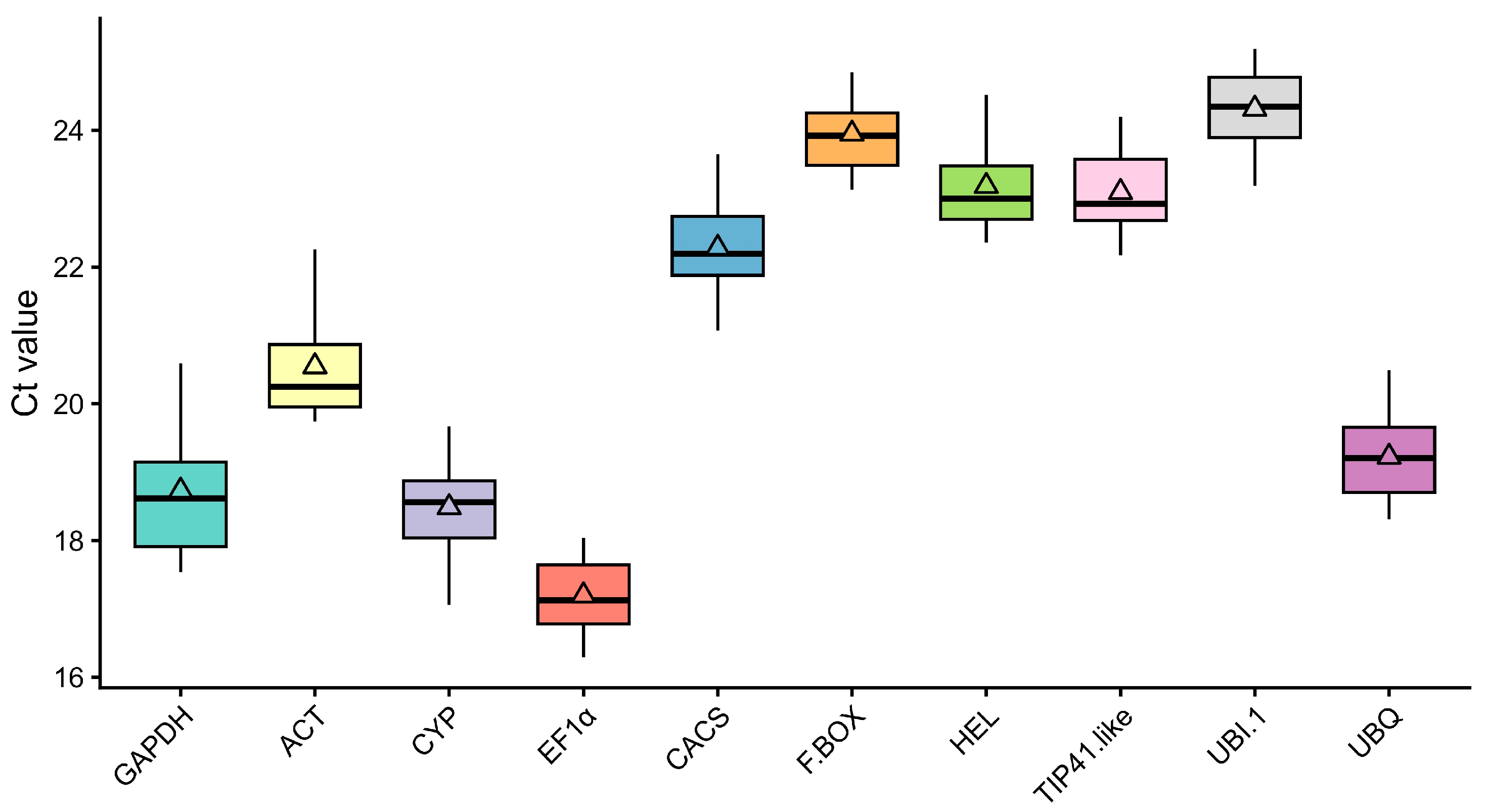
The average Ct values for the retained 10 candidates spanned approximately seven cycles, thus reflecting differences in transcript abundance (Figure 2). The average Ct value ranged from 17.20 (EF1α) to 24.31 (UBI-1). Among the genes, GAPDH exhibited the largest within-gene dispersion of Ct values (range 17.54–20.59), whereas F-BOX (23.13–24.85) and EF1α (16.29–18.04) showed the smallest dispersion, consistent with a tighter technical performance and/or more uniform expression.

3.2. Reference Gene Stability Rankings

To obtain a robust, consensus view of reference-gene stability under drought conditions we analyzed the expression stability of ten HKGs (ACT, CACS, CYP, EF1α, F-BOX, GAPDH, HEL, TIP41-like, UBI-1, and UBQ) using four widely accepted algorithms: geNorm, NormFinder, the ΔCt method and BestKeeper. In addition, we integrated the results using the RefFinder online tool to derive a comprehensive stability ranking. Notable differences in relative expression stability were observed depending on the algorithm used (Table 2 and Table 3, Figure 3).
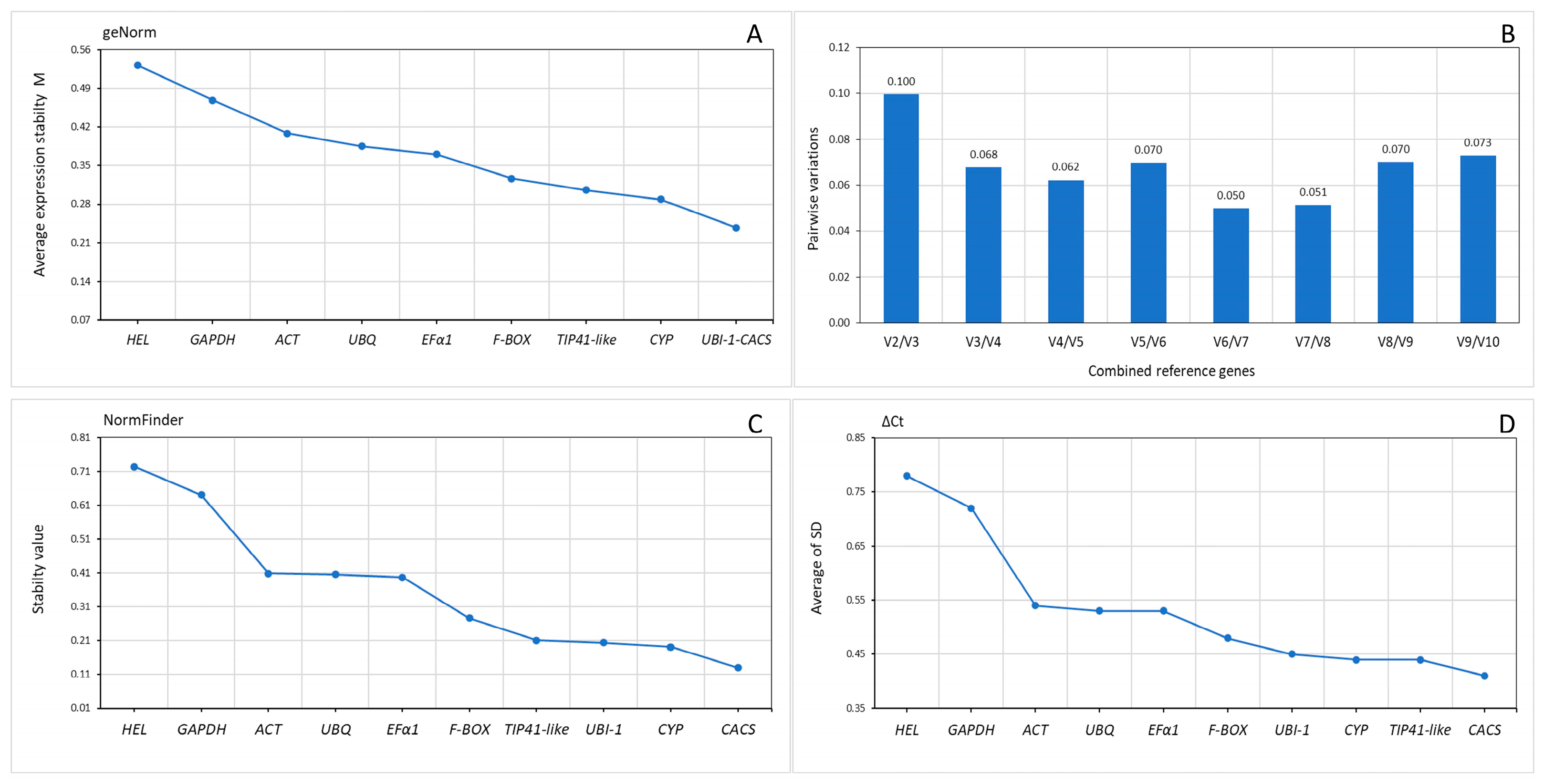
In geNorm, all genes showed M values < 0.70, which is well below the commonly used cutoff of 1.5 [3], indicating generally low pairwise variability across the panel (Figure 3A). Within this uniformly acceptable range, CACS and UBI-1 were identified as the two most stable genes with the lowest M values, whereas HEL and GAPDH displayed the highest M values, indicating relative instability. The geNorm pairwise variation analysis (Figure 3B) demonstrated that the inclusion of a third reference gene was unnecessary, as indicated by a V2/3 value of 0.100, which was below the empirical threshold of 0.15. Subsequent V values, ranging from 0.050 to 0.073, also remained well below 0.15, thereby confirming that the two genes are sufficient for normalization in drought-response expression profiling in cucumber leaves.
NormFinder assessed HKG stability using the SV parameter, with lower values indicating greater stability (Figure 3C). Although minor rank differences were observed for genes such as CYP and UBI-1, the overall top and bottom candidates were aligned with the geNorm ranking. CACS was identified as the most stable HKG, with the lowest SV, whereas GAPDH and HEL were the least stable genes. NormFinder also identified the combination of CACS and UBI-1 as the best two-gene normalizer, exhibiting the lowest combined intra- and intergroup variation. This agreement between a pairwise co-expression metric (geNorm) and a variance-component model (NormFinder) increases the confidence that the leading stable signals are not artifacts of any single method.
The comparative ΔCt method corroborated these results (Figure 3D). CACS demonstrated the smallest average standard deviation (SD) of ΔCt across samples, indicating the highest stability of expression, whereas GAPDH and HEL exhibited the greatest ΔCt variability, suggesting the lowest stability. The concordance between the ΔCt method and model-based algorithms further supports these rankings.
For BestKeeper, three variables, standard deviation (SD), coefficient of variation (CV), and Pearson’s correlation coefficient (r) with the BestKeeper index, were used jointly to assess expression stability. All ten candidates demonstrated SD (Ct) values below 1.0 (Table 2), which falls within the commonly accepted range for preliminary stability screening [15]. The lowest dispersion was observed for F-BOX (SD = 0.41; CV = 1.70%) and UBI-1 (SD = 0.43; CV = 1.75%), both of which exhibited strong correlations with the BestKeeper index (r = 0.86 and r = 0.92, respectively; p < 0.001), reinforcing their measurement stability and co-regulation with the global expression index. Although HEL ranked third in terms of SD (0.49; CV = 2.10%), its correlation with the BestKeeper index was weak (r = 0.32, p = 0.082), suggesting that it is unsuitable as a normalizer, despite its low dispersion. In contrast, CACS displayed a slightly higher SD (0.53; CV = 2.37%) but the strongest correlation with the index (r = 0.97, p < 0.001). CYP also showed a high correlation (r = 0.96, p < 0.001), thereby supporting their stability. GAPDH exhibited the greatest variability (SD = 0.78; CV = 4.17%) and, despite a moderate correlation with the index (r = 0.86), was ranked last owing to excessive dispersion. Collectively, the BestKeeper results favored F-BOX, UBI-1, and CACS (and, by correlation, CYP) as comparatively stable, whereas GAPDH and HEL were identified as unreliable under the conditions of this study.
RefFinder was used to generate an aggregate score by synthesizing the rankings from all methods (Table 3). According to RefFinder’s integrated ranking, CACS, UBI-1 and TIP41-like were the optimal HKGs for cucumber leaves under drought conditions, with the lowest mean rank values. HEL and GAPDH were the least stable HKGs (Table 3). This outcome aligns with the individual algorithms and confirms CACS and UBI-1 are the preferred HKGs in this experimental context. In practical terms, the combined results justify employing a two-gene normalizer and strongly support the CACS+UBI-1 geometric mean as a primary choice for normalization in subsequent RT-qPCR analyses, with TIP41-like as a credible alternative or third gene, where additional redundancy is desired.

3.3. Validation of Reference Gene Selection on Target Gene Expression

Subsequently, we investigated the impact of reference gene selection on the quantification of genes that responded to drought conditions. Our analysis focused on three genes, LOX, HsfC1, and CYP72A219, which exhibited differential expression under drought stress conditions in a concurrent RNA-seq experiment (Kłosińska et al., unpublished data, Figure S2). The relative expression of each target gene (fold change under drought versus control conditions) was determined using alternative normalization strategies for the RT-qPCR data: (i) a composite, stability-driven normalizer defined as the geometric mean of CACS and UBI-1 (hereafter CACS+UBI-1), and (ii) single-gene, low-stability alternatives, GAPDH and HEL.
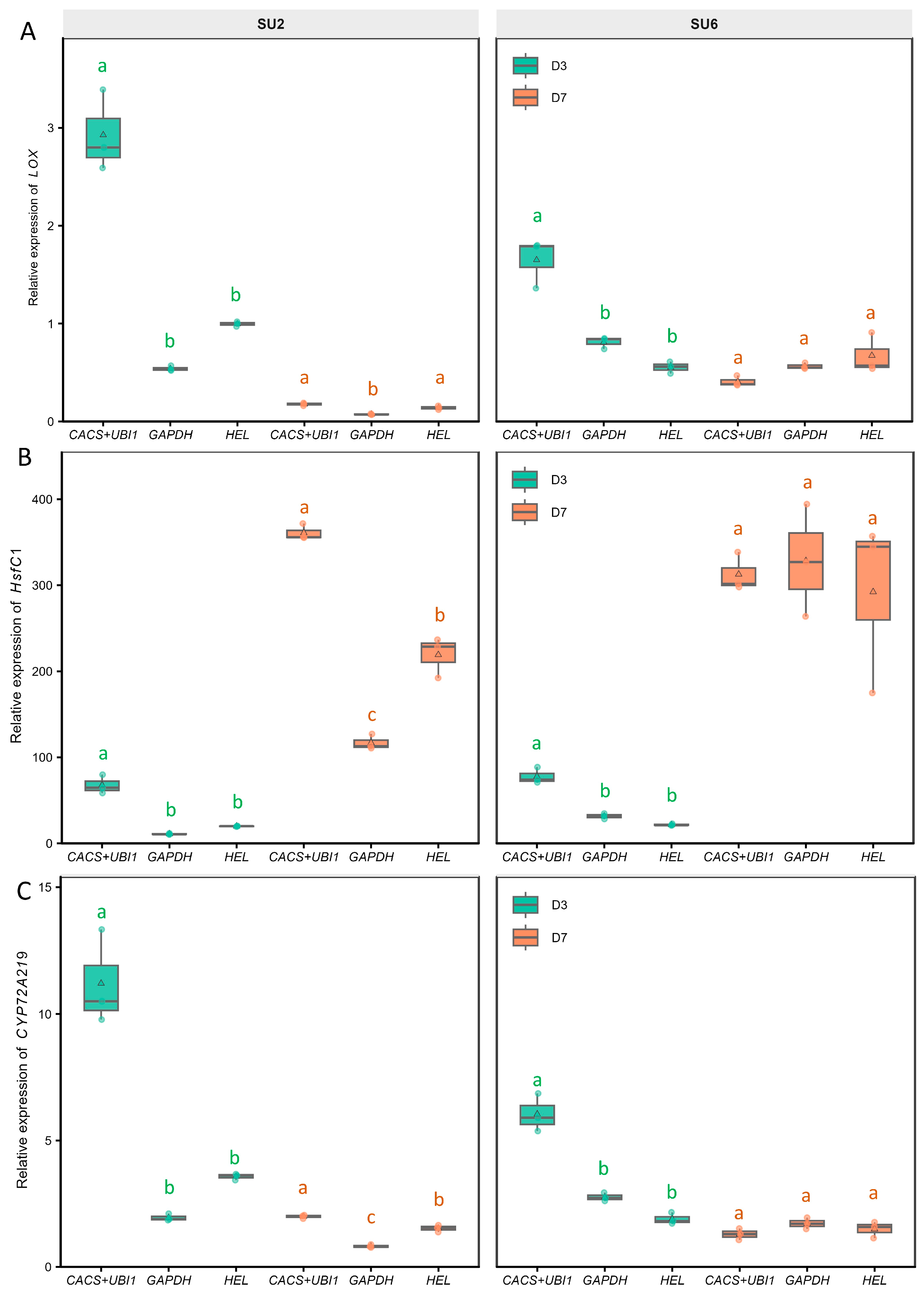
The findings indicated that HKG selection significantly influenced the observed expression levels of all three target genes (Figure 4). Two-way ANOVA models fitted separately for each line (SU2, SU6) and timepoint (D3, D7) confirmed the strong effects of treatment (TRT) and normalization (HKG), and in nearly all instances, a significant HKG × TRT interaction (p < 0.001), indicating that the perceived drought effect depended on the selected HKG (Table S2). The sole exception was HsfC1 in SU6, where the interaction term was not significant (p = 0.58) despite a pronounced main effect of treatment (p < 0.001).
For LOX in SU2 at D3, the CACS+UBI-1 normalizer yielded the highest fold changes (Figure 4A), whereas GAPDH and HEL compressed the response to near-baseline levels (α = 0.05). In SU6 cells, a similar pattern was observed: induction with normalization using CACS+UBI-1 was significantly greater than that with GAPDH or HEL. By D7, LOX induction was diminished in both genotypes, and the differences between normalizers narrowed, consistent with a reduced underlying biological effect. HsfC1 cells exhibited the largest dynamic range (Figure 4B). In SU2 on D3, CACS+UBI-1 normalization resulted in a very high induction, significantly surpassing GAPDH or HEL. In SU6, all normalizers captured strong drought induction at D7, but CACS+UBI-1 and GAPDH produced higher medians than HEL did. Consistent with the non-significant HKG×TRT interaction for this gene-line combination, differences among normalizers were less pronounced than those for the other targets. For CYP72A219 in SU2 on D3, the composite normalizer again produced the largest fold changes, with GAPDH or HEL yielding significantly smaller estimates (Figure 4C). SU6 exhibited a similar, but attenuated pattern.
To benchmark against transcriptome trends from the concurrent RNA-seq data, concordance between RT-qPCR fold changes and RNA-seq fold changes for identical gene–line–time combinations was quantified (Table 4). Overall, the composite CACS+UBI-1 demonstrated the strongest agreement for LOX (r = 0.926, CCC = 0.889) and CYP72A219 (r = 0.778, CCC = 0.676). For HsfC1, the concordance was high for both CACS+UBI-1 (CCC = 0.765) and HEL (CCC = 0.773). In contrast, GAPDH consistently underperformed across targets (LOX: r = 0.414, CCC = 0.168; CYP72A219: r = 0.224, CCC = 0.080; HsfC1: r = 0.495, CCC = 0.485).
To formally compare the HKGs, we employed the Meng–Rosenthal–Rubin test for overlapping dependent correlations. Overall, CACS+UBI-1 demonstrated superior performance compared with GAPDH for LOX (r = 0.926 vs. 0.414; Meng z, p = 0.0034), HsfC1 (0.904 vs. 0.495; p = 0.0046), and CYP72A219 (0.778 vs. 0.224; p = 0.036). The differences between CACS+UBI-1 and HEL were not significant at α = 0.05 (LOX, p = 0.077; HsfC1, p = 0.096; CYP72A219, p = 0.664). The contrast between GAPDH and HEL was significant for HsfC1 (p = 0.0077) and borderline for CYP72A219 (p = 0.043) expression.
Collectively, these results demonstrate that (i) employing an empirically stable composite normalizer (CACS+UBI-1) recovers larger and more biologically credible drought responses; (ii) unstable single-gene references, particularly GAPDH, compress fold changes and may obscure induction at early timepoints; and (iii) the composite normalizer produces RT-qPCR estimates that best align with independent RNA-seq trends. From a practical perspective, two genes suffice (per geNorm V2/3 = 0.100 < 0.15), and the CACS+UBI-1 combination is recommended for drought response in leaf sample studies in cucumber, with HEL and GAPDH being discouraged as the sole HKGs.

4. Discussion

RT-qPCR remains one of the most widely used methods to quantify gene expression changes; however, its accuracy and reliability critically depend on appropriate normalization using stable housekeeping genes (HKGs) [6]. Our study aimed to identify suitable HKGs for RT-qPCR analysis in cucumbers subjected to drought, across drought-tolerant and drought-sensitive lines, and at multiple timepoints. The results confirm that the stability of commonly used HKGs is not universal and that empirical validation under drought conditions is essential. Across four complementary algorithms (geNorm, NormFinder, BestKeeper, and the ΔCt method) and an integrative consensus ranking (RefFinder), CACS and UBI-1 consistently emerged as the most stable candidates, whereas GAPDH and HEL were repeatedly classified as unstable. Importantly, we show that the normalization choice has clear analytical consequences: for three biologically distinct drought-responsive targets (LOX, HsfC1, and CYP72A219), unstable HKGs compressed fold changes and weakened agreement with RNA-seq (Kłosińska et al., unpublished data), whereas a stable composite normalizer (CACS+UBI-1) preserved effect sizes and directionality, yielding the highest cross-platform concordance.
The necessity of stable HKGs for reliable normalization is well documented and consistent with our observations. An improper HKG selection can lead to erroneous conclusions [45], a risk that we explicitly illustrate by showing how GAPDH and HEL distort drought response estimates. In line with the recommendations of Pfaffl et al. [15] and Silver et al. [16], we used multiple algorithms (geNorm, NormFinder, BestKeeper, and the comparative ΔCt method) to comprehensively assess expression stability, rather than relying on any single metric. Two general principles emerging from broader plant studies support this strategy. First, different algorithms capture distinct facets of variability; thus, convergence across methods ensures more dependable HKG recommendations [8,10]. Second, the optimal number of HKG should be empirically determined (e.g., geNorm’s pairwise variation analysis) rather than assumed a priori [7,20]. In rice, studies on drought or heavy metal exposure showed that the optimal number of HKG varied with experimental heterogeneity, wherein two genes often sufficed for uniform conditions, but three or more were required across genotypes or tissues [12,13,21]. These general rules provide a conceptual framework, but still require crop- and stress-specific validation. In our experiment, geNorm pairwise variation analysis indicated that two genes were sufficient under the tested drought regime, and NormFinder independently identified CACS+UBI-1 as the best two-gene combination, which agreed with the concept of geometric averaging of multiple internal controls proposed by Vandesompele et al. [7].
Among the initial 13 candidate HKGs, we identified CACS, UBI-1, and TIP-41, which proved to be the most suitable candidates for normalizing RT-qPCR data in cucumber leaves under drought conditions. In contrast, ACT, which is often used as a reference gene in cucumber gene expression studies [46,47], ranked lower in stability in our analysis, reinforcing the notion that legacy HKGs should not be adopted uncritically. Several studies have shown that classical HKGs are not universally stable and that their performance is highly condition-specific [2,45,48,49]. A foundational survey in cucumber under various stress conditions (short-term metal treatments, hormone treatments with salicylic acid, methyl jasmonate, abscisic acid, indole-3-acetic acid, infection by Pseudoperonospora cubensis, and salt/drought stress) identified CACS, TIP41-like, and UBI-1 as outperforming traditional choices such as ACT, TUB, and UBQ variants, with EF1α among the few classical HKGs with good stability [28,50]. Similarly, Expósito-Rodríguez et al. [51] highlighted UBI-1 as a reliable reference gene across different tomato tissues, suggesting that ubiquitin-related genes can provide robust normalization across Solanaceae and Cucurbitaceae species. In tomato, no single gene proved uniformly stable under varying nitrogen availability, cold, or light stress; instead, RPL2, PP2Acs, ACT, and UBI ranked highly when considered together, and geometric averaging of multiple references was recommended [20]. Under varying access to nitrogen supply, CACS, TIP41-like, F-BOX, and EF1α emerged as the preferred HKGs [34], mirroring our drought time course in which CACS performed well and TIP41-like appeared as a reasonable secondary option. In cucumber-pumpkin graft systems spanning multiple organs and conditions, CACS was among the top performers [29]. For biotic stresses, optimal HKGs diverge with the pathosystem, and during Meloidogyne incognita infection, EF1α and UBI ranked best, whereas CACS topped rankings under Pseudomonas sp. treatment [30]. In cucumber green mottle mosaic virus (CGMMV) infection, EF1α and GAPDH were recommended for miRNA RT-qPCR across leaf, stem, and root tissues [33], which is in contrast with our finding that GAPDH is unsuitable for mRNA normalization under drought conditions in leaves. During viral infections in tomato, HKG rankings differed among tissues and pathogens, but integrating geNorm, NormFinder, and BestKeeper yielded consistent results [8]. In cucumber infected with Phytophthora melonis, HKGs stability was substantially reordered, which demonstrated that control-condition reference genes cannot be assumed to be stable during pathogen challenge [47]. This discrepancy illustrates that HKG performance depends not only on species and tissue but also on the target RNA class (mRNA vs. small RNA) and type of stress.
Similar patterns have been reported for other crops. In potato, EF1α and SEC3 outperformed classical HKGs under stress conditions [9]. Grapevine studies have extended this approach to both mRNA and small RNA assays: UBC, VAG, and PEP were generally stable for mRNA, whereas EF1α and CYP were contextually superior for specific pathogens [10] and distinct reference sets (miR160e + miR164a, miR160e + miR168, and ACT + UBQ + GAPDH) are required for miRNA quantification under salt, cold, and drought stress [11]. Our observation that GAPDH and HEL are among the least stable candidates under drought conditions resonates with findings from Arabidopsis, where these genes were also shown to be unreliable under some conditions [22]. Together, these studies and our results emphasize that classical HKGs such as ACT or GAPDH should not be used by default and that stability must be carefully evaluated for each experimental context.
Our study had several limitations that define the scope of our conclusions. First, we focused exclusively on leaf tissues under a defined drought regime for up to 7 days. As a result, the generalizability of our reference gene set to other organs (e.g., roots, stem, flowers). Other organs or distinct stress factors (salt, cold, pathogen exposure, or combined stresses) may display different stability patterns, and dedicated validation would be required in those contexts, although CACS and UBI-1 emerge as strong starting candidates based on both our data and previous studies [24,25,26,45,48]. Second, the duration and dynamics of stress were limited to an acute time course; longer or cyclic droughts might induce additional shifts in gene expression and potentially alter the HKG rankings. Thirdly, we evaluated two lines with contrasting drought responses. This increases the relevance of our findings for genetically divergent materials, but broader surveys in additional cultivars would be valuable to test how widely the CACS+UBI-1 combination can be generalized. Finally, functional validation was carried out using three drought-responsive targets. Although these genes represent distinct biological processes, extending such analyses to a larger panel of targets would further strengthen the conclusions. In future studies, we plan to validate the stability of HKGs in additional cucumber tissues, such as roots, to extend the applicability of our findings beyond leaf-specific expression profiles.
Despite these limitations, our study establishes a clear methodological baseline for RT-qPCR normalization in drought-stressed cucumber leaves and provides practical guidance for future studies. The validated reference genes CACS and UBI-1, identified here as highly stable under drought, formed a robust two-gene normalizer for this experimental context, with TIP41-like as a promising secondary candidate. This framework is readily extendable to other tissues and stresses, provided that stability is re-evaluated, as recommended in earlier studies [28,29,30,52]. The expanding availability of cucumber genomic and transcriptomic resources offers the opportunity to integrate empirically validated HKGs with large-scale RNA-seq datasets to refine our understanding of stress-responsive gene networks [23,27,53]. Combining the stability framework established here with ongoing transcriptomic studies could enable cross-validation of drought-responsive genes across multiple genotypes and environmental conditions [24,25,26,54,55], thereby improving the robustness of differential expression analyses and facilitating meta-analyses across laboratories and stress models.
From an applied perspective, these findings have direct implications in cucumber breeding. Accurate normalization of stress-responsive genes will improve marker discovery and candidate gene validation in molecular breeding pipelines aimed at enhancing drought tolerance [26,31,53]. The identification of stable reference genes supports the design of robust expression assays for genes implicated in ABA signaling, osmotic adjustment, and ROS regulation, which are key processes underlying drought resilience in cucurbits [24,25,56,57]. Future research should evaluate these reference genes in multi-stress scenarios (e.g., drought–salt or drought–pathogen combinations) and diverse genetic backgrounds. Ultimately, the development of a standardized normalization framework anchored on empirically validated HKGs will enhance reproducibility across studies and accelerate the translation of molecular insights into practical breeding outcomes for improved drought tolerance in cucumbers and related species [27,29,30,34].

5. Conclusions

This study demonstrated that the stability of commonly used housekeeping genes in cucumber is strongly context-dependent and cannot be assumed under drought stress. Using four complementary algorithms and an integrated RefFinder ranking, we identified CACS and UBI-1 as the most stable reference genes for RT-qPCR normalization in drought-stressed cucumber leaves, with TIP41-like as a promising secondary candidate, whereas GAPDH and HEL were unsuitable as single normalizers.
Functional validation with three drought-responsive targets (LOX, HsfC1, and CYP72A219) and concurrent RNA-seq data showed that the composite CACS+UBI-1 normalizer preserved biologically credible fold changes and achieved the highest cross-platform concordance, whereas unstable references compressed or distorted the drought responses. Together with the geNorm pairwise variation analysis indicating that the two reference genes are sufficient under the tested conditions, these findings provide a robust, empirically validated normalization framework for drought studies in cucumber leaves and a practical basis for more reliable expression analyses in stress biology and breeding programs targeting improved drought tolerance. Their use in other organs should, however, be preceded by organ-specific stability assessments.

Supplementary Materials

The following supporting information can be downloaded from https://www.mdpi.com/article/10.3390/agronomy15122811/s1, Figure S1. Primer specificity of target genes in cucumber leaves under drought stress. (A) Analysis of PCR-generated amplicons on agarose gel; M, GeneRuler 100 bp DNA Ladder (Thermo Fisher Scientific, Waltham, MA, USA; fragment sizes 100–1000 bp). (B) High-resolution melting (HRM) derivative curves for the same target genes across all samples, showing single sharp melting peaks and no evidence of primer–dimer formation or nonspecific products, thereby confirming assay specificity. Figure S2. RNA-seq-based fold changes in CYP72A219, HsfC1 and LOX in drought-tolerant (SU2) and drought-sensitive (SU6) cucumber lines at 3 and 7 d of drought; Table S1. Primer sequences and qPCR performance parameters for drought-responsive target genes used in RT-qPCR validation in cucumber; Table S2. Two-way ANOVA for the effects of the reference gene (HKG), treatment (TRT; sampling timepoint, D3 vs. D7), and their interaction (HKG × TRT) on fold change (FC; drought vs. control) of target genes in the two cucumber lines (SU2, SU6). Table S3. Comparison of overlapping dependent correlations (Meng–Rosenthal–Rubin test) between RT-qPCR and RNA-seq fold changes under different reference gene (HKG) normalizers.

Author Contributions

Conceptualization: W.S., U.K. and M.N. (Marzena Nowakowska); Methodology: W.S., M.N. (Marzena Nowakowska), U.K. and K.N.; Software: M.N. (Marzena Nowakowska) and W.S.; Formal analysis: W.S., M.N. (Marzena Nowakowska), M.N. (Marcin Nowicki) and U.K.; Investigation: W.S., M.N. (Marzena Nowakowska), U.K. and K.N.; Data curation: M.N. (Marzena Nowakowska), U.K. and W.S.; Resources: U.K.; Visualization: M.N. (Marzena Nowakowska) and K.N.; Writing—original draft: W.S., U.K. and M.N. (Marzena Nowakowska); Writing—review and editing: M.N. (Marzena Nowakowska), M.N. (Marcin Nowicki), W.S., U.K. and K.N.; Supervision: W.S. and U.K. All authors have read and agreed to the published version of the manuscript.

Funding

This research was funded by the Ministry of Agriculture and Rural Development of Poland; Basic research for biological progress in plant production, task no. 34: “Study of molecular mechanisms of cucumber resistance to the most important biotic and abiotic factors”.

Data Availability Statement

The original contributions presented in this study are included in the article/Supplementary Materials. Further inquiries can be directed to the corresponding author.

Acknowledgments

The authors gratefully acknowledge Ewa Matysiak and Paulina Fydrych-Lichman for their valuable technical assistance during the test performance. The authors have reviewed and edited the manuscript and take full responsibility for the content of this manuscript.

Conflicts of Interest

The authors declare no conflicts of interest.

Abbreviations

ABAAbscisic Acid
ANOVAAnalysis of Variance
BHBenjamini–Hochberg
CCCLin’s concordance correlation coefficient
CtCycle Threshold
DEGDifferentially Expressed Gene
DNADeoxyribonucleic Acid
FDRFalse Discovery Rate
HKGHousekeeping Gene
MIQEMinimum Information for Publication of Quantitative Real-Time PCR Experiments
RMSERoot Mean Square Error
RINRNA Integrity Number
RNA-seqRNA Sequencing
ROSReactive Oxygen Species
RT-qPCRReverse Transcription Quantitative PCR

Appendix A

RNA-seq was performed on the same experimental cohort of SU2 and SU6 plants used for RT-qPCR to enable the cross-platform validation of drought-responsive genes (Kłosińska et al., unpublished data). Briefly, total RNA from leaves representing six experimental groups (two genotypes sampled under one control condition and two drought timepoints), each with three biological replicates, was used to construct strand-specific libraries with the NEBNext Ultra II Directional RNA Library Prep Kit for Illumina (New England Biolabs, Ipswich, MA, USA). Sequencing was performed on an Illumina NovaSeq 6000 platform (Illumina, San Diego, CA, USA) to generate paired-end 2 × 150 bp reads.
Raw reads were quality-filtered and trimmed using Cutadapt (v.1.18) [58] and read quality was assessed using FastQC [59]. Clean reads were aligned to the C. sativus reference Gy14 v2.1 genome [35] using HISAT2 (v.2.1.0) [60] with the parameter RNA-strandness RF to account for strand-specific library preparation. Read counts per gene were obtained using HTSeq-count (v.0.10.0) [61] in stranded mode. Differential expression between defined experimental groups was analyzed in R [39] using DESeq2 (v.3.22) [62], with p-values adjusted for multiple testing according to the Benjamini–Hochberg false discovery rate (FDR) correction [63].
The RNA-seq experiment was conducted as part of a broader study on drought responses in cucumbers (Kłosińska et al., unpublished data). In the present study, RNA-seq results were used solely to identify and obtain fold-change estimates for three representative drought-responsive genes (LOX, HsfC1, and CYP72A219) employed for RT-qPCR validation (Section 2.6). In the context of the present study, the RNA-seq dataset served exclusively to provide unbiased estimates of transcriptional responses for three biologically relevant drought-responsive targets: LOX, HsfC1 and CYP72A219. These transcriptomic fold-change estimates were used as an external benchmark for evaluating the performance of alternative RT-qPCR normalization strategies and were not interpreted beyond their role in cross-platform validation.

References

  1. Bustin, S.A.; Benes, V.; Garson, J.A.; Hellemans, J.; Huggett, J.; Kubista, M.; Mueller, R.; Nolan, T.; Pfaffl, M.W.; Shipley, G.L.; et al. The MIQE guidelines: Minimum information for publication of quantitative real-time PCR experiments. Clin. Chem. 2009, 55, 611–622. [Google Scholar] [CrossRef] [PubMed]
  2. Dong, Z.; Zhan, B.; Li, S. Selection and validation of reference genes for gene expression studies using quantitative real-time PCR in prunus necrotic ringspot virus-infected Cucumis sativus. Viruses 2022, 14, 1269. [Google Scholar] [CrossRef]
  3. Chao, J.; Yang, S.; Chen, Y.; Tian, W.-M. Evaluation of reference genes for quantitative real-time PCR analysis of the gene expression in laticifers on the basis of latex flow in rubber tree (Hevea brasiliensis muell. arg.). Front. Plant Sci. 2016, 7, 1149. [Google Scholar] [CrossRef]
  4. Ashrafi, M.; Azimi Moqadam, M.R.; Moradi, P.; Mohsenifard, E.; Shekari, F. Evaluation and validation of housekeeping genes in two contrast species of thyme plant to drought stress using real-time PCR. Plant Physiol. Biochem. 2018, 132, 54–60. [Google Scholar] [CrossRef]
  5. Huang, Y.; Tan, H.; Yu, J.; Chen, Y.; Guo, Z.; Wang, G.; Zhang, Q.; Chen, J.; Zhang, L.; Diao, Y. Stable internal reference genes for normalizing real-time quantitative PCR in Baphicacanthus cusia under hormonal stimuli and UV irradiation, and in different plant organs. Front. Plant Sci. 2017, 8, 668. [Google Scholar] [CrossRef]
  6. Souček, P.; Pavlů, J.; Medveďová, Z.; Reinöhl, V.; Brzobohatý, B. Stability of housekeeping gene expression in Arabidopsis thaliana seedlings under differing macronutrient and hormonal conditions. J. Plant Biochem. Biotechnol. 2017, 26, 415–424. [Google Scholar] [CrossRef]
  7. Vandesompele, J.; De Preter, K.; Pattyn, F.; Poppe, B.; Van Roy, N.; De Paepe, A.; Speleman, F. Accurate normalization of real-time quantitative RT-PCR data by geometric averaging of multiple internal control genes. Genome Biol. 2002, 3, research0034.1. [Google Scholar] [CrossRef]
  8. Mascia, T.; Santovito, E.; Gallitelli, D.; Cillo, F. Evaluation of reference genes for quantitative reverse--transcription polymerase chain reaction normalization in infected tomato plants. Mol. Plant Pathol. 2010, 11, 805–816. [Google Scholar] [CrossRef]
  9. Nicot, N.; Hausman, J.-F.; Hoffmann, L.; Evers, D. Housekeeping gene selection for real-time RT-PCR normalization in potato during biotic and abiotic stress. J. Exp. Bot. 2005, 56, 2907–2914. [Google Scholar] [CrossRef]
  10. Borges, A.F.; Fonseca, C.; Ferreira, R.B.; Lourenço, A.M.; Monteiro, S. Reference gene validation for quantitative RT-PCR during biotic and abiotic stresses in Vitis vinifera. PLoS ONE 2014, 9, e111399. [Google Scholar] [CrossRef] [PubMed]
  11. Luo, M.; Gao, Z.; Li, H.; Li, Q.; Zhang, C.; Xu, W.; Song, S.; Ma, C.; Wang, S. Selection of reference genes for miRNA qRT-PCR under abiotic stress in grapevine. Sci. Rep. 2018, 8, 4444. [Google Scholar] [CrossRef]
  12. Santos, F.I.D.C.D.; Marini, N.; Santos, R.S.D.; Hoffman, B.S.F.; Alves-Ferreira, M.; De Oliveira, A.C. Selection and testing of reference genes for accurate RT-qPCR in rice seedlings under iron toxicity. PLoS ONE 2018, 13, e0193418. [Google Scholar] [CrossRef]
  13. Soni, P.; Shivhare, R.; Kaur, A.; Bansal, S.; Sonah, H.; Deshmukh, R.; Giri, J.; Lata, C.; Ram, H. Reference gene identification for gene expression analysis in rice under different metal stress. J. Biotechnol. 2021, 332, 83–93. [Google Scholar] [CrossRef]
  14. Andersen, C.L.; Jensen, J.L.; Ørntoft, T.F. Normalization of real-time quantitative reverse transcription-PCR data: A model-based variance estimation approach to identify genes suited for normalization, applied to bladder and colon cancer data sets. Cancer Res. 2004, 64, 5245–5250. [Google Scholar] [CrossRef] [PubMed]
  15. Pfaffl, M.W.; Tichopad, A.; Prgomet, C.; Neuvians, T.P. Determination of stable housekeeping genes, differentially regulated target genes and sample integrity: BestKeeper—Excel-based tool using pair-wise correlations. Biotechnol. Lett. 2004, 26, 509–515. [Google Scholar] [CrossRef] [PubMed]
  16. Silver, N.; Best, S.; Jiang, J.; Thein, S.L. Selection of housekeeping genes for gene expression studies in human reticulocytes using real-time PCR. BMC Mol. Biol. 2006, 7, 33. [Google Scholar] [CrossRef] [PubMed]
  17. Xie, F.; Wang, J.; Zhang, B. RefFinder: A web-based tool for comprehensively analyzing and identifying reference genes. Funct. Integr. Genom. 2023, 23, 125. [Google Scholar] [CrossRef] [PubMed]
  18. Klie, M.; Debener, T. Identification of superior reference genes for data normalization of expression studies via quantitative PCR in hybrid roses (Rosa hybrida). BMC Res. Notes 2011, 4, 518. [Google Scholar] [CrossRef]
  19. Zhu, J.; Zhang, L.; Li, W.; Han, S.; Yang, W.; Qi, L. Reference gene selection for quantitative real-time PCR normalization in Caragana intermedia under different abiotic stress conditions. PLoS ONE 2013, 8, e53196. [Google Scholar] [CrossRef]
  20. Løvdal, T.; Lillo, C. Reference Gene Selection for quantitative real-time PCR normalization in tomato subjected to nitrogen, cold, and light stress. Anal. Biochem. 2009, 387, 238–242. [Google Scholar] [CrossRef]
  21. Jain, M.; Nijhawan, A.; Tyagi, A.K.; Khurana, J.P. Validation of housekeeping genes as internal control for studying gene expression in rice by quantitative real-time PCR. Biochem. Biophys. Res. Commun. 2006, 345, 646–651. [Google Scholar] [CrossRef]
  22. Czechowski, T.; Stitt, M.; Altmann, T.; Udvardi, M.K.; Scheible, W.-R. Genome-wide identification and testing of superior reference genes for transcript normalization in Arabidopsis. Plant Physiol. 2005, 139, 5–17. [Google Scholar] [CrossRef]
  23. Huang, S.; Li, R.; Zhang, Z.; Li, L.; Gu, X.; Fan, W.; Lucas, W.J.; Wang, X.; Xie, B.; Ni, P.; et al. The genome of the cucumber, Cucumis sativus L. Nat. Genet. 2009, 41, 1275–1281. [Google Scholar] [CrossRef] [PubMed]
  24. Wang, J.; Zhang, L.; Cao, Y.; Qi, C.; Li, S.; Liu, L.; Wang, G.; Mao, A.; Ren, S.; Guo, Y.-D. CsATAF1 positively regulates drought stress tolerance by an ABA-dependent pathway and by promoting ROS scavenging in cucumber. Plant Cell Physiol. 2018, 59, 930–945. [Google Scholar] [CrossRef]
  25. Liu, Y.; Du, Q.; Bai, L.; Sun, M.; Li, Y.; He, C.; Wang, J.; Yu, X.; Yan, Y. Interference of CsGPA1, the α-submit of g protein, reduces drought tolerance in cucumber seedlings. Hortic. Plant J. 2021, 7, 209–220. [Google Scholar] [CrossRef]
  26. Das, A.; Kumari, K.; Munshi, A.D.; Raju, D.; Talukdar, A.; Singh, D.; Hongal, D.; Iquebal, M.A.; Bhatia, R.; Bhattacharya, R.C.; et al. Physio-chemical and molecular modulation reveals underlying drought resilience mechanisms in cucumber (Cucumis sativus L.). Sci. Hortic. 2024, 328, 112855. [Google Scholar] [CrossRef]
  27. Wang, M.; Jiang, B.; Peng, Q.; Liu, W.; He, X.; Liang, Z.; Lin, Y. Transcriptome analyses in different cucumber cultivars provide novel insights into drought stress responses. Int. J. Mol. Sci. 2018, 19, 2067. [Google Scholar] [CrossRef]
  28. Migocka, M.; Papierniak, A. Identification of suitable reference genes for studying gene expression in cucumber plants subjected to abiotic stress and growth regulators. Mol. Breed. 2011, 28, 343–357. [Google Scholar] [CrossRef]
  29. Miao, L.; Qin, X.; Gao, L.; Li, Q.; Li, S.; He, C.; Li, Y.; Yu, X. Selection of reference genes for quantitative real-time PCR analysis in cucumber (Cucumis sativus L.), pumpkin (Cucurbita moschata Duch.) and cucumber–pumpkin grafted plants. PeerJ 2019, 7, e6536. [Google Scholar] [CrossRef]
  30. Ji, T.; Ma, S.; Liang, M.; Wang, X.; Gao, L.; Tian, Y. Reference genes identification for qRT-PCR normalization of gene expression analysis in Cucumis sativus under Meloidogyne incognita infection and Pseudomonas treatment. Front. Plant Sci. 2022, 13, 1061921. [Google Scholar] [CrossRef] [PubMed]
  31. Kłosińska, U.; Nowakowska, M.; Szczechura, W.; Nowak, K.; Treder, W.; Klamkowski, K.; Wójcik, K. Opracowanie genetycznych, fizjologicznych i biochemicznych podstaw tolerancji ogórka na stres niedoboru wody. Biulletin Plant Breed. Acclim. Inst. 2019, 286, 291–294. [Google Scholar] [CrossRef]
  32. Zeng, Y.; Yang, T. RNA Isolation from highly viscous samples rich in polyphenols and polysaccharides. Plant Mol. Biol. Report. 2002, 20, 417. [Google Scholar] [CrossRef]
  33. Liang, C.; Hao, J.; Meng, Y.; Luo, L.; Li, J. Identifying optimal reference genes for the normalization of microRNA expression in cucumber under viral stress. PLoS ONE 2018, 13, e0194436. [Google Scholar] [CrossRef]
  34. Warzybok, A.; Migocka, M. Reliable reference genes for normalization of gene expression in cucumber grown under different nitrogen nutrition. PLoS ONE 2013, 8, e72887. [Google Scholar] [CrossRef] [PubMed]
  35. Yu, J.; Wu, S.; Sun, H.; Wang, X.; Tang, X.; Guo, S.; Zhang, Z.; Huang, S.; Xu, Y.; Weng, Y.; et al. CuGenDBv2: An updated database for cucurbit genomics. Nucleic Acids Res. 2023, 51, D1457–D1464. [Google Scholar] [CrossRef]
  36. Altschul, S.F.; Gish, W.; Miller, W.; Myers, E.W.; Lipman, D.J. Basic local alignment search tool. J. Mol. Biol. 1990, 215, 403–410. [Google Scholar] [CrossRef]
  37. Livak, K.J.; Schmittgen, T.D. Analysis of relative gene expression data using real-time quantitative PCR and the 2−ΔΔCT Method. Methods 2001, 25, 402–408. [Google Scholar] [CrossRef]
  38. Zhong, S. ctrlGene: Assess the Stability of Candidate Housekeeping Genes, R Package Version 4.3.3. 2019. Available online: https://CRAN.R-project.org/package=ctrlGene (accessed on 1 October 2019).
  39. R Core Team. R: A Language and Environment for Statistical Computing; R foundation for statistical Computing: Vienna, Austria, 2009. [Google Scholar]
  40. Ye, J.; Coulouris, G.; Zaretskaya, I.; Cutcutache, I.; Rozen, S.; Madden, T.L. Primer-BLAST: A tool to design target-specific primers for polymerase chain reaction. BMC Bioinform. 2012, 13, 134. [Google Scholar] [CrossRef]
  41. Fox, J.; Weisberg, S. An R Companion to Applied Regression, 3rd ed.; Sage Publications: Thousand Oaks, CA, USA, 2019. [Google Scholar]
  42. de Mendiburu Delgado, F.; Reinhard, S. Agricolae—A Free Statistical Library for Agricultural Research 2007, R package Version 4.3.3. Available online: https://cran.r-project.org/package=agricolae (accessed on 1 October 2019).
  43. Diedenhofen, B.; Musch, J. Cocor: A comprehensive solution for the statistical comparison of correlations. PLoS ONE 2015, 10, e0121945. [Google Scholar] [CrossRef]
  44. Casado-Martín, L.; Hernández, M.; Yeramian, N.; Pérez, D.; Eiros, J.M.; Valero, A.; Rodríguez-Lázaro, D. The impact of the variability of RT-qPCR standard curves on reliable viral detection in wastewater surveillance. Microorganisms 2025, 13, 776. [Google Scholar] [CrossRef] [PubMed]
  45. Guenin, S.; Mauriat, M.; Pelloux, J.; Van Wuytswinkel, O.; Bellini, C.; Gutierrez, L. Normalization of qRT-PCR data: The necessity of adopting a systematic, experimental conditions-specific, validation of references. J. Exp. Bot. 2009, 60, 487–493. [Google Scholar] [CrossRef]
  46. Qi, X.-H.; Xu, X.-W.; Lin, X.-J.; Zhang, W.-J.; Chen, X.-H. Identification of differentially expressed genes in cucumber (Cucumis sativus L.) root under waterlogging stress by digital gene expression profile. Genomics 2012, 99, 160–168. [Google Scholar] [CrossRef]
  47. Wang, L.; Li, P.; Wang, Z.; Liu, J.; Hu, J.; Li, J. Identification and validation of suitable internal reference genes for SYBR-GREEN qRT-PCR studies during cucumber development. J. Hortic. Sci. Biotechnol. 2014, 89, 312–320. [Google Scholar] [CrossRef]
  48. Bai, B.; Ren, J.; Bai, F.; Hao, L. Selection and validation of reference genes for gene expression studies in Pseudomonas brassicacearum GS20 using real-time quantitative reverse transcription PCR. PLoS ONE 2020, 15, e0227927. [Google Scholar] [CrossRef]
  49. Joseph, J.T.; Poolakkalody, N.J.; Shah, J.M. Plant reference genes for development and stress response studies. J. Biosci. 2018, 43, 173–187. [Google Scholar] [CrossRef] [PubMed]
  50. Wan, H.; Zhao, Z.; Qian, C.; Sui, Y.; Malik, A.A.; Chen, J. Selection of appropriate reference genes for gene expression studies by quantitative real-time polymerase chain reaction in cucumber. Anal. Biochem. 2010, 399, 257–261. [Google Scholar] [CrossRef]
  51. Expósito-Rodríguez, M.; Borges, A.A.; Borges-Pérez, A.; Pérez, J.A. Selection of internal control genes for quantitative real-time RT-PCR studies during tomato development process. BMC Plant Biol. 2008, 8, 131. [Google Scholar] [CrossRef] [PubMed]
  52. Kotrade, P.; Sehr, E.M.; Wischnitzki, E.; Brüggemann, W. Comparative transcriptomics-based selection of suitable reference genes for normalization of RT-qPCR experiments in drought-stressed leaves of three european quercus species. Tree Genet. Genomes 2019, 15, 38. [Google Scholar] [CrossRef]
  53. Zinati, Z.; Nazari, L. Deciphering the molecular basis of abiotic stress response in cucumber (Cucumis sativus L.) using RNA-seq meta-analysis, systems biology, and machine learning approaches. Sci. Rep. 2023, 13, 12942. [Google Scholar] [CrossRef]
  54. Mahdavi Mashaki, K.; Garg, V.; Nasrollahnezhad Ghomi, A.A.; Kudapa, H.; Chitikineni, A.; Zaynali Nezhad, K.; Yamchi, A.; Soltanloo, H.; Varshney, R.K.; Thudi, M. RNA-seq analysis revealed genes associated with drought stress response in kabuli chickpea (Cicer arietinum L.). PLoS ONE 2018, 13, e0199774. [Google Scholar] [CrossRef]
  55. Medina-Lozano, I.; Arnedo, M.S.; Grimplet, J.; Díaz, A. Selection of novel reference genes by RNA-seq and their evaluation for normalising Real-Time qPCR expression data of anthocyanin-related genes in lettuce and wild relatives. Int. J. Mol. Sci. 2023, 24, 3052. [Google Scholar] [CrossRef] [PubMed]
  56. Ksouri, N.; Jiménez, S.; Wells, C.E.; Contreras-Moreira, B.; Gogorcena, Y. Transcriptional responses in root and leaf of Prunus persica under drought stress using RNA sequencing. Front. Plant Sci. 2016, 7, 1715. [Google Scholar] [CrossRef]
  57. Tang, X.; Zhang, N.; Si, H.; Calderón-Urrea, A. Selection and validation of reference genes for RT-qPCR analysis in potato under abiotic stress. Plant Methods 2017, 13, 85. [Google Scholar] [CrossRef]
  58. Martin, M. Cutadapt removes adapter sequences from high-throughput sequencing reads. EMBnet. J. Bioinform. Action 2011, 17, 10. [Google Scholar] [CrossRef]
  59. Andrews, S. FastQC: A Quality Control Tool for High Throughput Sequence Data. 2015. Available online: https://www.bioinformatics.babraham.ac.uk/projects/fastqc/ (accessed on 24 June 2015).
  60. Kim, D.; Paggi, J.M.; Park, C.; Bennett, C.; Salzberg, S.L. Graph-based genome alignment and genotyping with HISAT2 and HISAT-genotype. Nat. Biotechnol. 2019, 37, 907–915. [Google Scholar] [CrossRef]
  61. Anders, S.; Pyl, P.T.; Huber, W. HTSeq—A python framework to work with high-throughput sequencing data. Bioinformatics 2015, 31, 166–169. [Google Scholar] [CrossRef]
  62. Love, M.I.; Huber, W.; Anders, S. Moderated estimation of fold change and dispersion for RNA-seq data with DESeq2. Genome Biol. 2014, 15, 550. [Google Scholar] [CrossRef] [PubMed]
  63. Benjamini, Y.; Hochberg, Y. Controlling the false discovery rate: A practical and powerful approach to multiple testing. J. R. Stat. Soc. Ser. B Stat. Methodol. 1995, 57, 289–300. [Google Scholar] [CrossRef]
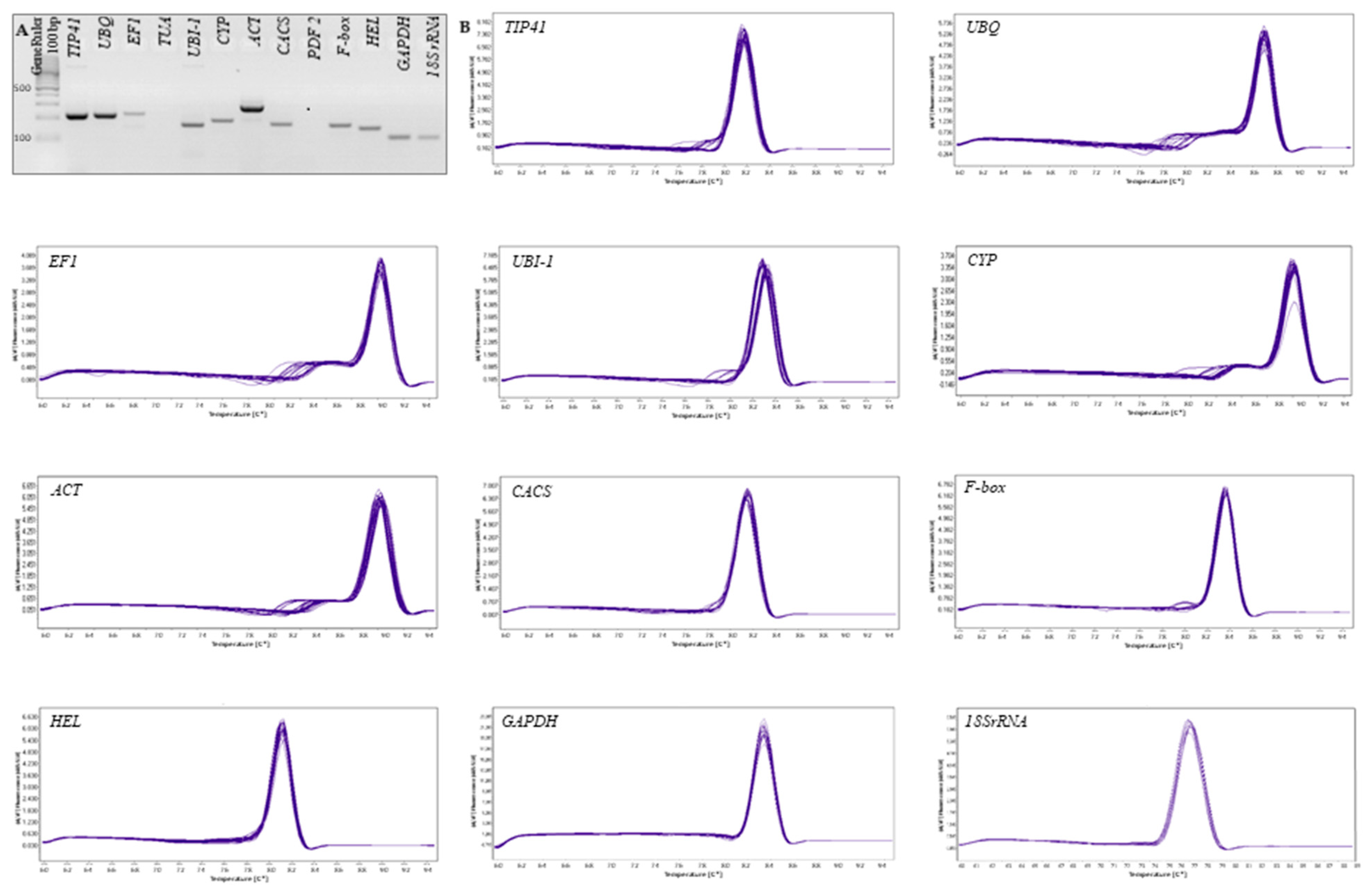
Figure 1. Primer specificity of candidate reference genes (HKGs) in cucumber leaves under drought stress. (A) Analysis of PCR-generated amplicons on agarose gel; M, GeneRuler 100 bp DNA Ladder (Thermo Fisher Scientific, Waltham, MA, USA; fragment sizes 100–1000 bp). (B) High-resolution melting (HRM) derivative curves for the same HKGs across all samples, showing single, sharp melting peaks and no evidence of primer–dimer formation or nonspecific products, thereby confirming assay specificity.
Agronomy 15 02811 g001
Figure 2. Distribution of cycle threshold (Ct) values for the 10 reference genes (HKGs) retained after initial screening. Data are pooled across lines (SU2, SU6) and timepoints. Boxes show the interquartile range (25th–75th percentiles), the horizontal line is the median, and the triangle denotes the arithmetic mean. The whiskers represent minimum and maximum values. Lower Ct indicates higher transcript abundance.
Agronomy 15 02811 g002
Figure 3. Values of gene-expression stability of the ten HKG. (A) geNorm stability measure (M-value). A lower M-value indicates more stable gene expression. (B) geNorm-pairwise variation (Vn/Vn+1) between the normalization factors NFn and NFn+1 to determine the optimal number of reference genes. NFn is computed from the expression of the first n top-ranked candidate reference genes. (C) NormFinder stability value (SV). Lower SV denotes higher stability. (D) Comparative ΔCt method: standard deviation (SD) of ΔCt across samples. Lower SD denotes higher stability.
Agronomy 15 02811 g003
Figure 4. Effect of reference gene choice on the estimated expression of drought-responsive targets in cucumber. Fold change (FC) in expression levels of LOX (A), HsfC1 (B), and CYP72A219 (C) in two cucumber lines (SU2, drought-tolerant; SU6, drought-sensitive) under drought versus control conditions. Gene expression data were normalized using the two most stable reference genes (CACS+UBI-1, geometric mean) and the two least stable ones (GAPDH and HEL), as identified by stability ranking analyses. Boxes indicate the interquartile range, horizontal lines the median, whiskers represent minimum and maximum values, triangles denote mean values, and points represent individual replicate values. Different letters above the bars indicate statistically significant differences at p < 0.05 according to Tukey’s HSD test (calculated separately for each combination of line, target gene, and timepoint).
Agronomy 15 02811 g004
Table 1. Characteristics of candidate housekeeping genes (HKGs) and their primer sequences used for RT-qPCR analysis in leaves of cucumber under drought stress.
GeneAnnotationGene ID in
Cucumber
Primer SequenceAmplicon Size (bp)E (%)R2References
ACTActinCsGy6G026130F:ATGACGCAGATAATGTTTGAG29094.80.999[33]
R:GGAGAATGGCATGAGGGAGGG
CACSAP-2 complex subunit mu-1CsGy3G044260F:TGGGAAGATTCTTATGAAGTGC160102.30.999[28]
R:CTCGTCAAATTTACACATTGGT
CYPCyclophilinCsGy7G014440F:GCTGGACCTGGAACCAACGGA19098.40.999[34]
R:TCTAAGAGAGCTGGCCACAAT
EF1αElongation factor 1-αCsGy2G009450F:ACTGGTGGTTTTGAGGCTGGT205104.20.999[33]
R:CTTGGAGTATTTGGGTGTGGT
F-boxF-box proteinCsGy5G004880F:GGTTCATCTGGTGGTCTT160103.10.993[34]
R:CTTTAAACGAACGGTCAGTCC
GAPDHGlyceraldehyde-3-phosphate dehydrogenaseCsGy3G019880F:GCCTTGGTCCTCCCTTCTCTT133107.00.999[33]
R:ATGCAGCATTCACCTCTTCAG
HELRNA helicaseCsGy5G005520F:TTCTCGAAGATTTAGTGATTCATGTG160107.30.999[28]
R:CAATGGACGAATGCAAAGG
TIP41-likeTIP41-like family proteinCsGy7G006670F:CAACAGGTGATATTGGATTATGATTATAC200100.80.999[34]
R:GCCAGCTCATCCTCATATAAG
UBI-1Ubiquitin-like proteinCsGy2G005440F:CTAATGGGGAGTGGGGAAGTA160100.10.999[33]
R:GTCTGGATGGACAATGTTGAT
UBQPolyubiquitinCsGy6G011285F:CACCAAGCCCAGAAGATC200101.90.999[30]
R:TAAACCTAATCACCACCAGC
18S rRNARibosomal RNA-processing protein 17CsGy4G017630F:CAAAGCAAGCCTACGCTCTGT127153.20.955[33]
R:CTATGAAATACGAATGCCCCC
PDF2Sucrose-phosphataseCsGy5G025470F:GTAGGACCTGAACCAACTA---[30]
R:CTTCACGCAGGGAAGA
TUAα-TubulinCsGy4G011690F:CAAGGAAGATGCTGCCAATAA---[33]
R:CCAAAAGGAGGGAGCCGGAC
The amplification efficiency (E) and coefficient of determination (R2) were determined using standard curve analyses. Gene IDs were obtained from the CuGenDBv2 database [35].
Table 2. Descriptive statistics of the ten candidate reference genes by BestKeeper analysis.
Reference Gene
F-BOXUBI-1HELTIP41-likeCACSEF1αUBQCYPACTGAPDH
Ranking12345678910
n30303030303030303030
Geo Mean (Ct)23.9424.3123.1823.0922.2717.1919.2118.4720.5318.70
AR (Ct)23.9524.3123.1823.0922.2817.2019.2218.4820.5518.73
Min. (Ct)23.1323.1922.3622.1721.0716.2918.3117.0619.7417.54
Max. (Ct)24.8525.1924.5224.2023.6518.0420.4919.6722.2620.59
SD (± Ct)0.410.430.490.510.530.460.560.540.630.78
CV (%Ct)1.701.752.102.212.372.682.902.933.054.17
Min. (x-fold)−1.76−2.17−1.76−1.89−2.30−1.86−1.87−2.66−1.73−2.24
Max. (x-fold)1.871.842.542.162.611.812.422.293.313.70
SD (±x-fold)1.331.341.401.431.441.381.471.461.541.72
coeff. of corr. (r)0.860.920.320.920.970.760.820.960.900.86
p-value0.0010.0010.0820.0010.0010.0010.0010.0010.0010.001
Parameters include the number of samples (n), geometric mean (GM) and arithmetic mean (AR) of Ct values, minimum and maximum Ct values, standard deviation (SD ± Ct), and coefficient of variation (CV %Ct). Additional columns show the minimum, maximum, and standard deviation of expression variation in x-fold changes, as well as the Pearson correlation coefficient (r) and significance level (p-value) between each gene and the BestKeeper index. Lower SD and CV values indicate greater expression stability across samples.
Table 3. Ranking order of 10 candidate reference genes (HKGs) according to four stability algorithms and the integrated RefFinder analysis. Lower rank values indicate higher expression stability. For geNorm, CACS and UBI-1 shared rank 1 (identical M values).
RankinggeNormNormFinderΔCtBestKeeperRefFinder
1CACS/UBI-1CACSCACSF-BOXCACS
2-CYPCYPUBI-1UBI-1
3CYPUBI-1TIP41-likeHELTIP41-like
4TIP41-likeTIP41-likeUBI-1TIP41-likeF-BOX
5F-BOXF-BOXF-BOXCACSCYP
6EF1αEF1αUBQEF1αEF1α
7UBQUBQEF1αUBQUBQ
8ACTACTACTCYPACT
9GAPDHGAPDHGAPDHACTHEL
10HELHELHELGAPDHGAPDH
Table 4. Concordance between RT-qPCR and RNA-seq fold-changes for three drought-responsive genes under different reference gene used for normalization in cucumber.
Reference GeneDEGPearson rp-Value (r)Spearman ρp-Value (ρ)Lin’s CCCScaled RMSE
CACS+UBI-1LOX0.9261.52 × 10−50.8743.09 × 10−40.8890.368
HsfC10.9045.36 × 10−50.8042.75 × 10−30.7650.419
CYP72A2190.7782.86 × 10−30.6621.90 × 10−20.6760.637
HELLOX0.7604.12 × 10−30.7061.33 × 10−20.3870.663
HsfC10.7842.52 × 10−30.6712.04 × 10−20.7730.629
CYP72A2190.8111.38 × 10−30.5884.41 × 10−20.3690.589
GAPDHLOX0.4141.81 × 10−10.3292.96 × 10−10.1681.040
HsfC10.4951.02 × 10−10.6014.28 × 10−20.4850.962
CYP72A2190.2244.84 × 10−10.0887.87 × 10−10.0801.190
The table summarizes the agreement between RT-qPCR and RNA-seq fold changes (drought vs. matched control) for LOX, HsfC1, and CYP72A219 calculated under three normalization schemes: a composite, data-driven normalizer CACS+UBI-1 (geometric mean of CACS and UBI-1), and two low-stability single-gene options (HEL, GAPDH). Metrics reported are the Pearson correlation coefficient (r) with two-sided p value, Spearman rank correlation (ρ) with p value, Lin’s concordance correlation coefficient (CCC), and scaled root-mean-square error (RMSE) after z-standardization of both methods. A higher r/ρ/CCC and lower scaled RMSE indicate a better cross-platform agreement. Values were computed across SU2 and SU6 at D3 and D7 (global comparison; n = 12 per normalizer-gene combination). Differences between overlapping correlations were assessed using the Meng–Rosenthal–Rubin test; p-values for prespecified contrasts are reported in Table S3.
Disclaimer/Publisher’s Note: The statements, opinions and data contained in all publications are solely those of the individual author(s) and contributor(s) and not of MDPI and/or the editor(s). MDPI and/or the editor(s) disclaim responsibility for any injury to people or property resulting from any ideas, methods, instructions or products referred to in the content.